0001133228-26-007255.txt : 20260429 0001133228-26-007255.hdr.sgml : 20260429 20260429165308 ACCESSION NUMBER: 0001133228-26-007255 CONFORMED SUBMISSION TYPE: 485BPOS PUBLIC DOCUMENT COUNT: 33 FILED AS OF DATE: 20260429 DATE AS OF CHANGE: 20260429 EFFECTIVENESS DATE: 20260501 FILER: COMPANY DATA: COMPANY CONFORMED NAME: LOOMIS SAYLES FUNDS I CENTRAL INDEX KEY: 0000917469 ORGANIZATION NAME: EIN: 043219179 STATE OF INCORPORATION: MA FISCAL YEAR END: 0930 FILING VALUES: FORM TYPE: 485BPOS SEC ACT: 1940 Act SEC FILE NUMBER: 811-08282 FILM NUMBER: 26917437 BUSINESS ADDRESS: STREET 1: 888 BOYLSTON STREET STREET 2: 8TH FLOOR CITY: BOSTON STATE: MA ZIP: 02199 BUSINESS PHONE: 617-449-2810 MAIL ADDRESS: STREET 1: 888 BOYLSTON STREET STREET 2: 8TH FLOOR CITY: BOSTON STATE: MA ZIP: 02199 FORMER COMPANY: FORMER CONFORMED NAME: LOOMIS SAYLES FUNDS II DATE OF NAME CHANGE: 20031119 FORMER COMPANY: FORMER CONFORMED NAME: LOOMIS SAYLES INVESTMENT TRUST DATE OF NAME CHANGE: 20031015 FORMER COMPANY: FORMER CONFORMED NAME: LOOMIS SAYLES FUNDS I DATE OF NAME CHANGE: 20030718 FILER: COMPANY DATA: COMPANY CONFORMED NAME: LOOMIS SAYLES FUNDS I CENTRAL INDEX KEY: 0000917469 ORGANIZATION NAME: EIN: 043219179 STATE OF INCORPORATION: MA FISCAL YEAR END: 0930 FILING VALUES: FORM TYPE: 485BPOS SEC ACT: 1933 Act SEC FILE NUMBER: 333-22931 FILM NUMBER: 26917436 BUSINESS ADDRESS: STREET 1: 888 BOYLSTON STREET STREET 2: 8TH FLOOR CITY: BOSTON STATE: MA ZIP: 02199 BUSINESS PHONE: 617-449-2810 MAIL ADDRESS: STREET 1: 888 BOYLSTON STREET STREET 2: 8TH FLOOR CITY: BOSTON STATE: MA ZIP: 02199 FORMER COMPANY: FORMER CONFORMED NAME: LOOMIS SAYLES FUNDS II DATE OF NAME CHANGE: 20031119 FORMER COMPANY: FORMER CONFORMED NAME: LOOMIS SAYLES INVESTMENT TRUST DATE OF NAME CHANGE: 20031015 FORMER COMPANY: FORMER CONFORMED NAME: LOOMIS SAYLES FUNDS I DATE OF NAME CHANGE: 20030718 0000917469 S000006638 Loomis Sayles Income Fund C000018122 Institutional Class LSBDX C000018123 Retail Class LSBRX C000018124 Admin Class LBFAX C000125493 Class N LSBNX 0000917469 S000006646 Loomis Sayles Investment Grade Fixed Income Fund C000018133 Institutional Class LSIGX 485BPOS 1 sft-efp24064_485bpos.htm LOOMIS SAYLES FUNDS TRUST I - 485BPOS (IXBRL) 2026-02-265-1RetailandInstitutionalProspectus
2025-12-31 false 0000917469 485BPOS 0000917469 2025-12-31 2025-12-31 0000917469 natixis:Dretailandinstitutionalprospectus_4830Member natixis:S000006638Member 2025-12-31 2025-12-31 0000917469 natixis:Dretailandinstitutionalprospectus_4830Member natixis:S000006646Member 2025-12-31 2025-12-31 0000917469 natixis:Dretailandinstitutionalprospectus_4830Member natixis:S000006638Member natixis:C000018122Member 2025-12-31 2025-12-31 0000917469 natixis:Dretailandinstitutionalprospectus_4830Member natixis:S000006646Member natixis:C000018133Member 2025-12-31 2025-12-31 0000917469 natixis:Dretailandinstitutionalprospectus_4830Member natixis:S000006638Member natixis:C000018123Member 2025-12-31 2025-12-31 0000917469 natixis:Dretailandinstitutionalprospectus_4830Member natixis:S000006638Member natixis:C000018124Member 2025-12-31 2025-12-31 0000917469 natixis:Dretailandinstitutionalprospectus_4830Member natixis:S000006638Member natixis:C000125493Member 2025-12-31 2025-12-31 0000917469 natixis:Dretailandinstitutionalprospectus_4830Member natixis:S000006638Member natixis:bench202401221103Member 2025-12-31 2025-12-31 0000917469 natixis:Dretailandinstitutionalprospectus_4830Member natixis:S000006638Member natixis:bench202305081068Member 2025-12-31 2025-12-31 0000917469 natixis:Dretailandinstitutionalprospectus_4830Member natixis:S000006638Member natixis:bench202401191094Member 2025-12-31 2025-12-31 0000917469 natixis:Dretailandinstitutionalprospectus_4830Member natixis:S000006638Member natixis:bench202305081059Member 2025-12-31 2025-12-31 0000917469 natixis:Dretailandinstitutionalprospectus_4830Member natixis:S000006638Member natixis:bench202604201143Member 2025-12-31 2025-12-31 0000917469 natixis:Dretailandinstitutionalprospectus_4830Member natixis:S000006638Member natixis:bench202305081071Member 2025-12-31 2025-12-31 0000917469 natixis:Dretailandinstitutionalprospectus_4830Member natixis:S000006638Member natixis:bench202305081050Member 2025-12-31 2025-12-31 0000917469 natixis:Dretailandinstitutionalprospectus_4830Member natixis:S000006638Member natixis:bench202305081052Member 2025-12-31 2025-12-31 0000917469 natixis:Dretailandinstitutionalprospectus_4830Member natixis:S000006638Member natixis:bench202305081069Member 2025-12-31 2025-12-31 0000917469 natixis:Dretailandinstitutionalprospectus_4830Member natixis:S000006638Member natixis:bench202305081061Member 2025-12-31 2025-12-31 0000917469 natixis:Dretailandinstitutionalprospectus_4830Member natixis:S000006638Member natixis:bench202305081060Member 2025-12-31 2025-12-31 0000917469 natixis:Dretailandinstitutionalprospectus_4830Member natixis:S000006638Member natixis:bench202401191095Member 2025-12-31 2025-12-31 0000917469 natixis:Dretailandinstitutionalprospectus_4830Member natixis:S000006638Member natixis:bench202505201141Member 2025-12-31 2025-12-31 0000917469 natixis:Dretailandinstitutionalprospectus_4830Member natixis:S000006638Member natixis:bench202305081073Member 2025-12-31 2025-12-31 0000917469 natixis:Dretailandinstitutionalprospectus_4830Member natixis:S000006638Member natixis:bench202305081048Member 2025-12-31 2025-12-31 0000917469 natixis:Dretailandinstitutionalprospectus_4830Member natixis:S000006638Member natixis:bench202305081049Member 2025-12-31 2025-12-31 0000917469 natixis:Dretailandinstitutionalprospectus_4830Member natixis:S000006638Member natixis:bench202305081066Member 2025-12-31 2025-12-31 0000917469 natixis:Dretailandinstitutionalprospectus_4830Member natixis:S000006638Member natixis:bench202401241121Member 2025-12-31 2025-12-31 0000917469 natixis:Dretailandinstitutionalprospectus_4830Member natixis:S000006638Member natixis:bench202305081053Member 2025-12-31 2025-12-31 0000917469 natixis:Dretailandinstitutionalprospectus_4830Member natixis:S000006646Member natixis:bench202401221103Member 2025-12-31 2025-12-31 0000917469 natixis:Dretailandinstitutionalprospectus_4830Member natixis:S000006646Member natixis:bench202305081068Member 2025-12-31 2025-12-31 0000917469 natixis:Dretailandinstitutionalprospectus_4830Member natixis:S000006646Member natixis:bench202401191094Member 2025-12-31 2025-12-31 0000917469 natixis:Dretailandinstitutionalprospectus_4830Member natixis:S000006646Member natixis:bench202305081071Member 2025-12-31 2025-12-31 0000917469 natixis:Dretailandinstitutionalprospectus_4830Member natixis:S000006646Member natixis:bench202305081059Member 2025-12-31 2025-12-31 0000917469 natixis:Dretailandinstitutionalprospectus_4830Member natixis:S000006646Member natixis:bench202305081050Member 2025-12-31 2025-12-31 0000917469 natixis:Dretailandinstitutionalprospectus_4830Member natixis:S000006646Member natixis:bench202305081052Member 2025-12-31 2025-12-31 0000917469 natixis:Dretailandinstitutionalprospectus_4830Member natixis:S000006646Member natixis:bench202305081069Member 2025-12-31 2025-12-31 0000917469 natixis:Dretailandinstitutionalprospectus_4830Member natixis:S000006646Member natixis:bench202305081061Member 2025-12-31 2025-12-31 0000917469 natixis:Dretailandinstitutionalprospectus_4830Member natixis:S000006646Member natixis:bench202305081047Member 2025-12-31 2025-12-31 0000917469 natixis:Dretailandinstitutionalprospectus_4830Member natixis:S000006646Member natixis:bench202305081060Member 2025-12-31 2025-12-31 0000917469 natixis:Dretailandinstitutionalprospectus_4830Member natixis:S000006646Member natixis:bench202505201141Member 2025-12-31 2025-12-31 0000917469 natixis:Dretailandinstitutionalprospectus_4830Member natixis:S000006646Member natixis:bench202401191095Member 2025-12-31 2025-12-31 0000917469 natixis:Dretailandinstitutionalprospectus_4830Member natixis:S000006646Member natixis:bench202305081073Member 2025-12-31 2025-12-31 0000917469 natixis:Dretailandinstitutionalprospectus_4830Member natixis:S000006646Member natixis:bench202305081048Member 2025-12-31 2025-12-31 0000917469 natixis:Dretailandinstitutionalprospectus_4830Member natixis:S000006646Member natixis:bench202305081049Member 2025-12-31 2025-12-31 0000917469 natixis:Dretailandinstitutionalprospectus_4830Member natixis:S000006646Member natixis:bench202305081066Member 2025-12-31 2025-12-31 0000917469 natixis:Dretailandinstitutionalprospectus_4830Member natixis:S000006646Member natixis:bench202305081053Member 2025-12-31 2025-12-31 0000917469 natixis:Dretailandinstitutionalprospectus_4830Member natixis:S000006638Member natixis:C000018122Member 2025-01-01 2025-12-31 0000917469 natixis:Dretailandinstitutionalprospectus_4830Member natixis:S000006646Member natixis:C000018133Member 2025-01-01 2025-12-31 0000917469 natixis:Dretailandinstitutionalprospectus_4830Member natixis:S000006638Member natixis:C000018122Member oef:AfterTaxesOnDistributionsMember 2025-01-01 2025-12-31 0000917469 natixis:Dretailandinstitutionalprospectus_4830Member natixis:S000006646Member natixis:C000018133Member oef:AfterTaxesOnDistributionsMember 2025-01-01 2025-12-31 0000917469 natixis:Dretailandinstitutionalprospectus_4830Member natixis:S000006638Member natixis:C000018122Member oef:AfterTaxesOnDistributionsAndSalesMember 2025-01-01 2025-12-31 0000917469 natixis:Dretailandinstitutionalprospectus_4830Member natixis:S000006646Member natixis:C000018133Member oef:AfterTaxesOnDistributionsAndSalesMember 2025-01-01 2025-12-31 0000917469 natixis:Dretailandinstitutionalprospectus_4830Member natixis:S000006638Member natixis:C000018123Member 2025-01-01 2025-12-31 0000917469 natixis:Dretailandinstitutionalprospectus_4830Member natixis:S000006646Member natixis:bench202401191097Member 2025-01-01 2025-12-31 0000917469 natixis:Dretailandinstitutionalprospectus_4830Member natixis:S000006638Member natixis:C000018124Member 2025-01-01 2025-12-31 0000917469 natixis:Dretailandinstitutionalprospectus_4830Member natixis:S000006638Member natixis:C000125493Member 2025-01-01 2025-12-31 0000917469 natixis:Dretailandinstitutionalprospectus_4830Member natixis:S000006638Member natixis:bench202401191097Member 2025-01-01 2025-12-31 0000917469 natixis:Dretailandinstitutionalprospectus_4830Member natixis:S000006638Member natixis:C000018122Member 2021-01-01 2025-12-31 0000917469 natixis:Dretailandinstitutionalprospectus_4830Member natixis:S000006646Member natixis:C000018133Member 2021-01-01 2025-12-31 0000917469 natixis:Dretailandinstitutionalprospectus_4830Member natixis:S000006638Member natixis:C000018122Member oef:AfterTaxesOnDistributionsMember 2021-01-01 2025-12-31 0000917469 natixis:Dretailandinstitutionalprospectus_4830Member natixis:S000006646Member natixis:C000018133Member oef:AfterTaxesOnDistributionsMember 2021-01-01 2025-12-31 0000917469 natixis:Dretailandinstitutionalprospectus_4830Member natixis:S000006638Member natixis:C000018122Member oef:AfterTaxesOnDistributionsAndSalesMember 2021-01-01 2025-12-31 0000917469 natixis:Dretailandinstitutionalprospectus_4830Member natixis:S000006646Member natixis:C000018133Member oef:AfterTaxesOnDistributionsAndSalesMember 2021-01-01 2025-12-31 0000917469 natixis:Dretailandinstitutionalprospectus_4830Member natixis:S000006638Member natixis:C000018123Member 2021-01-01 2025-12-31 0000917469 natixis:Dretailandinstitutionalprospectus_4830Member natixis:S000006646Member natixis:bench202401191097Member 2021-01-01 2025-12-31 0000917469 natixis:Dretailandinstitutionalprospectus_4830Member natixis:S000006638Member natixis:C000018124Member 2021-01-01 2025-12-31 0000917469 natixis:Dretailandinstitutionalprospectus_4830Member natixis:S000006638Member natixis:C000125493Member 2021-01-01 2025-12-31 0000917469 natixis:Dretailandinstitutionalprospectus_4830Member natixis:S000006638Member natixis:bench202401191097Member 2021-01-01 2025-12-31 0000917469 natixis:Dretailandinstitutionalprospectus_4830Member natixis:S000006638Member natixis:C000018122Member 2016-01-01 2025-12-31 0000917469 natixis:Dretailandinstitutionalprospectus_4830Member natixis:S000006646Member natixis:C000018133Member 2016-01-01 2025-12-31 0000917469 natixis:Dretailandinstitutionalprospectus_4830Member natixis:S000006638Member natixis:C000018122Member oef:AfterTaxesOnDistributionsMember 2016-01-01 2025-12-31 0000917469 natixis:Dretailandinstitutionalprospectus_4830Member natixis:S000006646Member natixis:C000018133Member oef:AfterTaxesOnDistributionsMember 2016-01-01 2025-12-31 0000917469 natixis:Dretailandinstitutionalprospectus_4830Member natixis:S000006638Member natixis:C000018122Member oef:AfterTaxesOnDistributionsAndSalesMember 2016-01-01 2025-12-31 0000917469 natixis:Dretailandinstitutionalprospectus_4830Member natixis:S000006646Member natixis:C000018133Member oef:AfterTaxesOnDistributionsAndSalesMember 2016-01-01 2025-12-31 0000917469 natixis:Dretailandinstitutionalprospectus_4830Member natixis:S000006638Member natixis:C000018123Member 2016-01-01 2025-12-31 0000917469 natixis:Dretailandinstitutionalprospectus_4830Member natixis:S000006646Member natixis:bench202401191097Member 2016-01-01 2025-12-31 0000917469 natixis:Dretailandinstitutionalprospectus_4830Member natixis:S000006638Member natixis:C000018124Member 2016-01-01 2025-12-31 0000917469 natixis:Dretailandinstitutionalprospectus_4830Member natixis:S000006638Member natixis:C000125493Member 2016-01-01 2025-12-31 0000917469 natixis:Dretailandinstitutionalprospectus_4830Member natixis:S000006638Member natixis:bench202401191097Member 2016-01-01 2025-12-31 0000917469 natixis:Dretailandinstitutionalprospectus_4830Member natixis:S000006638Member natixis:C000018122Member 2016-12-31 2016-12-31 0000917469 natixis:Dretailandinstitutionalprospectus_4830Member natixis:S000006646Member natixis:C000018133Member 2016-12-31 2016-12-31 0000917469 natixis:Dretailandinstitutionalprospectus_4830Member natixis:S000006638Member natixis:C000018122Member 2017-12-31 2017-12-31 0000917469 natixis:Dretailandinstitutionalprospectus_4830Member natixis:S000006646Member natixis:C000018133Member 2017-12-31 2017-12-31 0000917469 natixis:Dretailandinstitutionalprospectus_4830Member natixis:S000006638Member natixis:C000018122Member 2018-12-31 2018-12-31 0000917469 natixis:Dretailandinstitutionalprospectus_4830Member natixis:S000006646Member natixis:C000018133Member 2018-12-31 2018-12-31 0000917469 natixis:Dretailandinstitutionalprospectus_4830Member natixis:S000006638Member natixis:C000018122Member 2019-12-31 2019-12-31 0000917469 natixis:Dretailandinstitutionalprospectus_4830Member natixis:S000006646Member natixis:C000018133Member 2019-12-31 2019-12-31 0000917469 natixis:Dretailandinstitutionalprospectus_4830Member natixis:S000006638Member natixis:C000018122Member 2020-12-31 2020-12-31 0000917469 natixis:Dretailandinstitutionalprospectus_4830Member natixis:S000006646Member natixis:C000018133Member 2020-12-31 2020-12-31 0000917469 natixis:Dretailandinstitutionalprospectus_4830Member natixis:S000006638Member natixis:C000018122Member 2021-12-31 2021-12-31 0000917469 natixis:Dretailandinstitutionalprospectus_4830Member natixis:S000006646Member natixis:C000018133Member 2021-12-31 2021-12-31 0000917469 natixis:Dretailandinstitutionalprospectus_4830Member natixis:S000006638Member natixis:C000018122Member 2022-12-31 2022-12-31 0000917469 natixis:Dretailandinstitutionalprospectus_4830Member natixis:S000006646Member natixis:C000018133Member 2022-12-31 2022-12-31 0000917469 natixis:Dretailandinstitutionalprospectus_4830Member natixis:S000006638Member natixis:C000018122Member 2023-12-31 2023-12-31 0000917469 natixis:Dretailandinstitutionalprospectus_4830Member natixis:S000006646Member natixis:C000018133Member 2023-12-31 2023-12-31 0000917469 natixis:Dretailandinstitutionalprospectus_4830Member natixis:S000006638Member natixis:C000018122Member 2024-12-31 2024-12-31 0000917469 natixis:Dretailandinstitutionalprospectus_4830Member natixis:S000006646Member natixis:C000018133Member 2024-12-31 2024-12-31 0000917469 natixis:Dretailandinstitutionalprospectus_4830Member natixis:S000006638Member natixis:C000018122Member 2025-12-30 2025-12-31 0000917469 natixis:Dretailandinstitutionalprospectus_4830Member natixis:S000006646Member natixis:C000018133Member 2025-12-30 2025-12-31 0000917469 natixis:Dretailandinstitutionalprospectus_4830Member natixis:S000006638Member oef:RiskLoseMoneyMember 2025-12-31 2025-12-31 0000917469 natixis:Dretailandinstitutionalprospectus_4830Member natixis:S000006638Member oef:RiskNotInsuredDepositoryInstitutionMember 2025-12-31 2025-12-31 0000917469 natixis:Dretailandinstitutionalprospectus_4830Member natixis:S000006646Member oef:RiskLoseMoneyMember 2025-12-31 2025-12-31 0000917469 natixis:Dretailandinstitutionalprospectus_4830Member natixis:S000006646Member oef:RiskNotInsuredDepositoryInstitutionMember 2025-12-31 2025-12-31 natixis:Years iso4217:USD xbrli:pure xbrli:shares iso4217:USD xbrli:shares

Registration Nos. 333-22931

811-08282


UNITED STATES

SECURITIES AND EXCHANGE COMMISSION

Washington, DC 20549


FORM N-1A


REGISTRATION STATEMENT UNDER THE SECURITIES

  ACT OF 1933
     
  Pre-Effective Amendment No. __
  Post-Effective Amendment No. 85


and/or


REGISTRATION STATEMENT UNDER THE INVESTMENT

  COMPANY ACT OF 1940
     
  Amendment No. 93
  (Check appropriate box or boxes.)


LOOMIS SAYLES FUNDS I

(Exact Name of Registrant as Specified in Charter)


888 Boylston Street, Boston, Massachusetts 02199-8197

(Address of principal executive offices) (Zip Code)


Registrant’s Telephone Number, including Area Code (617) 449-2139


Susan McWhan Tobin, Esq.

Natixis Distribution, LLC

888 Boylston Street

Boston, Massachusetts 02199-8197

(Name and Address of Agent for Service)


Copy to:

Michael G. Doherty, Esq.

Jessica Reece, Esq.

Ropes & Gray LLP

1211 Avenue of the Americas

New York, NY 10036-8704


Approximate Date of Proposed Public Offering


It is proposed that this filing will become effective (check appropriate box):


  immediately upon filing pursuant to paragraph (b)
  on May 1, 2026 pursuant to paragraph (b)
  60 days after filing pursuant to paragraph (a)(1)
  on (date) pursuant to paragraph (a)(1)
  75 days after filing pursuant to paragraph (a)(2)
  on (date) pursuant to paragraph (a)(2) of Rule 485.


If appropriate, check the following box:


  This post-effective amendment designates a new effective date for a previously filed post-effective amendment.


8.637.482.8711.572.143.2312.498.056.709.146.418.422.089.367.190.8011.988.003.147.59
image 
  
Prospectus
May 1, 2026
 
 
Admin
Class
Retail
Class
Institutional
Class
Class
N
Loomis Sayles Income Fund (formerly named “Loomis Sayles Bond Fund”)
LBFAX
LSBRX
LSBDX
LSBNX
Loomis Sayles Investment Grade Fixed Income Fund
 
 
LSIGX
The Securities and Exchange Commission (“SEC”) has not approved or disapproved any Fund’s shares or determined whether this Prospectus is truthful or complete. Any representation to the contrary is a crime.


Contents
1
1
8


fund summary 

Loomis Sayles Income Fund
INVESTMENT OBJECTIVE
The Fund seeks to provide income with a secondary objective of capital appreciation.
FUND FEES & EXPENSES
The following table describes the fees and expenses that you may pay if you buy, hold, and sell shares of the Fund. You may pay other fees, such as brokerage commissions and other fees to financial intermediaries, which are not reflected in this table.
The Fund does not impose a sales charge, a redemption fee or an exchange fee.
Annual Fund Operating Expenses
(expenses that you pay each year as a percentage of the value of your investment)
Institutional Class
Retail Class
Admin Class
Class N
Management fees
0.56%
0.56%
0.56%
0.56%
Distribution and/or service (12b-1) fees
0.00%
0.25%
0.25%
0.00%
Other expenses
0.15%
0.15%
0.39%1
0.07%
Total annual fund operating expenses
0.71%
0.96%
1.20%
0.63%
Fee waiver and/or expense reimbursement2
0.07%
0.07%
0.06%3
0.04%
Total annual fund operating expenses after fee waiver and/or expense reimbursement
0.64%
0.89%
1.14%
0.59%
1 Other expenses include an administrative services fee of 0.24% for Admin Class shares.
2 Loomis, Sayles & Company, L.P. (“Loomis Sayles” or the “Adviser”) has given a binding contractual undertaking to the Fund to limit the amount of the Fund’s total annual fund operating expenses to 0.64%, 0.89%, 1.14% and 0.59% of the Fund’s average daily net assets for Institutional Class shares, Retail Class shares, Admin Class shares and Class N shares, respectively, exclusive of acquired fund fees and expenses, brokerage expenses, interest expense, taxes, and organizational and extraordinary expenses, such as litigation and indemnification expenses. This undertaking is in effect through April 30, 2027 and may be terminated before then only with the consent of the Fund’s Board of Trustees. The Adviser will be permitted to recover, on a class by class basis, management fees waived and/or expenses reimbursed to the extent that expenses in later periods fall below both (1) the class’ applicable expense limitation at the time such amounts were waived/reimbursed and (2) the class’ current applicable expense limitation. The Fund will not be obligated to repay any such waived/reimbursed fees and expenses more than one year after the end of the fiscal year in which the fees or expenses were waived/reimbursed.
3 In order to ensure that the total annual fund operating expenses after fee waiver and/or expense reimbursement do not exceed the amounts disclosed in the table, the Adviser may voluntarily waive additional advisory fees and/or other expenses. This may result in Admin Class shareholders realizing a total annual fund operating expense after fee waiver and/or expense reimbursement lower than 1.14% of the Fund’s average daily net assets. This additional waiver may be terminated at any time.
Example
The example is intended to help you compare the cost of investing in the Fund with the cost of investing in other mutual funds. The example assumes that you invest $10,000 in the Fund for the time periods indicated and then redeem all of your shares at the end of those periods. The example also assumes that your investment has a 5% return each year and that the Fund’s operating expenses remain the same except that the example is based on the Total Annual Fund Operating Expenses After Fee Waiver and/or Expense Reimbursement assuming that such waiver and/or reimbursement will only be in place through the date noted above and on the Total Annual Fund Operating Expenses for the remaining periods. The example does not take into account brokerage commissions and other fees to financial intermediaries that you may pay on your purchases and sales of shares of the Fund. Although your actual costs may be higher or lower, based on these assumptions your costs would be:
 
1 year
3 years
5 years
10 years
Institutional Class
$
65
$
220
$
388
$
876
Retail Class
$
91
$
299
$
524
$
1,172
Admin Class
$
116
$
375
$
654
$
1,449
Class N
$
60
$
198
$
347
$
782
Portfolio Turnover
The Fund pays transaction costs, such as commissions, when it buys and sells securities (or “turns over” its portfolio). A higher portfolio turnover rate may indicate higher transaction costs and may result in higher taxes for you if your Fund shares are held in a taxable account. These costs, which are not reflected in annual fund operating expenses or in the example, affect the Fund’s performance. During its most recently ended fiscal year, the Fund’s portfolio turnover rate was 104% of the average value of its portfolio.

1 

 
fund summary 

INVESTMENTS, RISKS AND PERFORMANCE
Principal Investment Strategies
Under normal circumstances, the Fund will invest at least 80% of its net assets (plus any borrowings made for investment purposes) in fixed-income securities (for example, bonds and other investments that Loomis Sayles believes have similar economic characteristics, such as notes, debentures and loans). The Fund will normally invest at least 55% of its net assets in investment-grade fixed-income securities. The Fund may also invest up to 35% of its assets in below investment-grade fixed-income securities (commonly known as “junk bonds”). Below investment-grade fixed-income securities are rated below investment-grade quality (i.e., none of the three major rating agencies (Moody’s Investors Service, Inc., Fitch Ratings, Inc. or S&P Global Ratings) have rated the securities in one of their respective top four ratings categories). The Fund’s fixed-income securities investments may include unrated securities (securities that are not rated by a rating agency) if Loomis Sayles determines that the securities are of comparable quality to rated securities that the Fund may purchase. The Fund may invest in fixed-income securities of any maturity.
In deciding which securities to buy and sell, Loomis Sayles may consider a number of factors related to the bond issue and the current bond market, including, for example, the stability and volatility of a country’s bond markets, the financial strength of the issuer, current interest rates, current valuations, Loomis Sayles’ expectations regarding general trends in interest rates and currency considerations. Loomis Sayles will also consider how purchasing or selling a bond would impact the overall portfolio’s risk profile (for example, its sensitivity to currency risk, interest rate risk and sector-specific risk) and potential return (income and capital gains).
Three themes typically drive the Fund’s investment approach. First, Loomis Sayles generally seeks fixed-income securities that are attractively valued relative to the Loomis Sayles’ credit research team’s assessment of credit risk. The broad coverage combined with the objective of identifying attractive investment opportunities makes this an important component of the investment approach. Second, the Fund may invest significantly in securities the prices of which Loomis Sayles believes are more sensitive to events related to the underlying issuer than to changes in general interest rates or overall market default rates. These securities may not have a direct correlation with changes in interest rates, thus helping to manage interest rate risk and to offer diversified sources for return. Third, Loomis Sayles analyzes different sectors of the economy and differences in the yields (“spreads”) of various fixed-income securities (U.S. government securities, investment-grade corporate securities, securitized assets, high-yield corporate securities, emerging market securities, non-U.S. sovereigns and credits, convertibles, bank loans and municipals) in an effort to find securities that it believes may produce attractive returns for the Fund in comparison to their risk.
The Fund may invest up to 40% of its assets in foreign securities, including emerging markets securities. The Fund may invest up to 20% of its assets in non-U.S. dollar-denominated securities. The Fund may invest without limit in obligations of supranational entities (e.g., the World Bank). Although certain securities purchased by the Fund may be issued by domestic companies incorporated outside of the United States, the Adviser does not consider these securities to be foreign if the issuer is included in the U.S. fixed-income indices published by Bloomberg.
The fixed-income securities in which the Fund may invest include, among other instruments, corporate bonds and other debt securities, U.S. government securities, commercial paper, zero-coupon securities, mortgage-related securities (including senior and junior loans, mortgage dollar rolls, stripped mortgage-related securities and collateralized mortgage obligations) and other asset-backed securities, when-issued securities, real estate investment trusts (“REITs”), securities issued pursuant to Rule 144A under the Securities Act of 1933 (“Rule 144A securities”), other privately placed investments such as private credit investments, structured notes, collateralized loan obligations, bank loans, repurchase agreements and convertible securities. The Fund may engage in options and futures transactions, foreign currency transactions (such as forward currency contracts) and swap transactions (including credit default swaps, in which one party agrees to make periodic payments to a counterparty in exchange for the right to receive a payment in the event of a default of the underlying reference security).
Principal Risks
The principal risks of investing in the Fund are summarized below. The Fund does not represent a complete investment program. You may lose money by investing in the Fund.
Fund shares are not bank deposits and are not guaranteed, endorsed or insured by the Federal Deposit Insurance Corporation or any other government agency, and are subject to investment risks, including possible loss of the principal invested.
The significance of any specific risk to an investment in the Fund will vary over time, depending on the composition of the Fund’s portfolio, market conditions, and other factors. You should read all of the risk information presented below carefully, because any one or more of these risks may result in losses to the Fund.

2 

 
fund summary 

Bank Loans Risk is the risk that the Fund’s investments in bank loans are subject to credit risk and may not be adequately collateralized. Indebtedness of borrowers whose creditworthiness is poor involves substantially greater risks and may be highly speculative. The interest rates on many bank loans reset frequently, and thus bank loans are subject to interest rate risk. Transactions in bank loans may settle on a delayed basis, such that the Fund may not receive the proceeds from the sale of a loan for a substantial period of time after the sale. There may also be less public information available about bank loans as compared to other debt securities.
Credit/Counterparty Risk is the risk that the issuer or guarantor of a fixed-income security in which the Fund invests, or the counterparty to a derivative or other transaction, will be unable or unwilling to make timely payments of interest or principal or to otherwise honor its obligations. As a result, the Fund may sustain losses or be unable or delayed in its ability to realize gains.
Below Investment-Grade Fixed-Income Securities Risk is the risk that the Fund’s investments in below investment-grade fixed-income securities may be subject to greater risks than other fixed-income securities, including being subject to greater levels of interest rate risk, credit risk (including a greater risk of default) and liquidity risk. The ability of the issuer to make principal and interest payments is predominantly speculative for below investment-grade fixed-income securities.
Currency Risk is the risk that the value of the Fund’s investments will fall as a result of changes in exchange rates. Loomis Sayles may elect not to hedge currency risk or may hedge imperfectly, which may cause the Fund to incur losses that would not have been incurred had the risk been hedged.
Distribution Rate Risk is the risk that the Fund’s strategy of seeking to provide a specific and predictable level of monthly distributions may not be successful. The income payable on debt securities in general and the availability of investment opportunities varies based on market conditions. In addition, the Fund may not be effective in identifying income producing securities and managing distributions; as a result, the level of dividend income may fluctuate. The Fund’s investments are subject to various risks including the risk that the counterparty will not pay income when due which may adversely impact the level and predictability of dividend income paid by the Fund. Tax and accounting considerations also may impact the Fund’s ability to pay predictable monthly distributions. The Fund does not guarantee that distributions will always be paid or paid at a predictable level.
Interest Rate Risk is the risk that the value of the Fund’s investments will fall if interest rates rise. Generally, the value of fixed-income securities rises when prevailing interest rates fall and falls when interest rates rise. Interest rate risk generally is greater for funds that invest in fixed-income securities with relatively longer durations than for funds that invest in fixed-income securities with shorter durations. The values of zero-coupon securities and securities with longer maturities are generally more sensitive to fluctuations in interest rates than other fixed-income securities. In addition, an economic downturn or period of rising interest rates could adversely affect the market for these securities and reduce the Fund’s ability to sell them, negatively impacting the performance of the Fund. Fiscal, economic, monetary or other governmental or central bank policies, actions or measures have in the past, and may in the future, cause or exacerbate risks associated with interest rates, including fluctuations in interest rates.
Market/Issuer Risk is the risk that the market value of the Fund’s investments will move up and down, sometimes rapidly and unpredictably, based upon overall market and economic conditions, as well as a number of reasons that directly relate to the issuers of the Fund’s investments, such as management performance, financial condition and demand for the issuers’ goods and services.
Cybersecurity and Technology Risk is the risk associated with the increasing dependence of the Fund, its service providers, and other market participants on complex information technology and communications systems. Such systems are subject to a number of different threats and risks that could adversely affect the Fund and its shareholders. Cybersecurity and other operational and technology issues may result in financial losses to the Fund and its shareholders.
Derivatives Risk is the risk that the value of the Fund’s derivative investments such as forward currency contracts, structured notes, options, futures transactions and swap transactions will fall, for example, because of changes in the value of the underlying reference instruments, pricing difficulties or lack of correlation with the underlying investments. The use of derivatives for other than hedging purposes may be considered a speculative activity, and involves greater risks than are involved in hedging. There is also the risk that the Fund may be unable to terminate or sell a derivative position at an advantageous time or price. The Fund’s derivative counterparties may experience financial difficulties or otherwise be unwilling or unable to honor their obligations, possibly resulting in losses to the Fund. This risk is greater for forward currency contracts, uncleared swaps and other over-the-counter (“OTC”) traded derivatives. Investing in derivatives gives rise to other risks, such as leverage risk, liquidity risk, credit/counterparty risk, interest rate risk and market/issuer risk. The use of derivatives may cause the Fund to incur losses greater than those which would have occurred had derivatives not been used.
Emerging Markets Risk is the risk that the Fund’s investments in emerging markets may face greater foreign securities risk. Emerging markets investments are subject to greater risks arising from political or economic instability, war, nationalization or confiscatory taxation, currency exchange or repatriation restrictions, sanctions by other countries (such as the United States or the European Union), new or

3 

 
fund summary 

inconsistent government treatment of or restrictions on issuers and instruments, and an issuer’s unwillingness or inability to make dividend, principal or interest payments on its securities. Emerging markets companies may be smaller and have shorter operating histories than companies in developed markets.
Foreign Securities Risk is the risk that the value of the Fund’s foreign investments will fall as a result of foreign political, social, economic, environmental, credit, informational or currency changes or other issues relating to foreign investing generally. Foreign securities may be subject to higher volatility than U.S. securities, varying degrees of regulation and limited liquidity. The Fund’s investments in foreign securities may be subject to foreign withholding or other taxes, which would decrease the yield on those securities.
Inflation/Deflation Risk is the risk that the value of assets or income from investments will be worth less in the future as inflation decreases the present value of future payments. As inflation increases, the real value of the Fund’s portfolio could decline. Inflation rates may change frequently and drastically. The Fund’s investments may not keep pace with inflation, which may result in losses to the Fund’s investors. Deflation risk is the risk that prices throughout the economy decline over time - the opposite of inflation. Deflation may have an adverse effect on the creditworthiness of issuers and may make issuer default more likely, which may result in a decline in the value of the Fund’s portfolio.
Large Shareholder Transaction Risk is the risk that ownership of shares of the Fund may be concentrated in one or a few large investors. Such investors may redeem shares in large quantities or on a frequent basis. In addition, a large number of shareholders collectively may purchase or redeem Fund shares in large amounts rapidly or unexpectedly (collectively, such transactions are referred to as “large shareholder transactions”). In the event of a large shareholder transaction, the Fund may be required to sell investments at unfavorable times or prices, which may increase realized capital gains, including short-term capital gains taxable as ordinary income for shareholders who hold Fund shares in a taxable account, may accelerate the realization of taxable income to shareholders, may increase transaction costs, and may otherwise negatively impact fund performance. The effects of taxable income and/or gains resulting from large shareholder transactions would particularly impact non-redeeming shareholders who do not hold their Fund shares in an IRA, 401(k) plan or other tax-advantaged plan. In addition, such transactions potentially limit the use of any capital loss carryforwards and certain other losses to offset future realized capital gains (if any). Such transactions may also increase the Fund’s expenses. A number of circumstances may cause the Fund to experience large redemptions, such as changes in the eligibility criteria for the Fund or share class of the Fund; liquidations, reorganizations, repositionings, or other announced Fund events; or changes in investment objectives, strategies, policies, risks, or investment personnel.
Leverage Risk is the risk associated with securities or investment practices (e.g., borrowing and the use of certain derivatives) that multiply small index, market or asset price movements into larger changes in value. Use of derivative instruments (such as futures and forward currency contracts) may involve leverage. When a derivative is used as a hedge against an offsetting position that the Fund also holds, any gains generated by the derivative should be substantially offset by losses on the hedged instrument, and vice versa. To the extent that the Fund uses a derivative for purposes other than as a hedge, or if the Fund hedges imperfectly, the Fund is directly exposed to the risks of that derivative and any loss generated by the derivative will not be offset by a gain. The use of leverage increases the impact of gains and losses on the Fund’s returns, and may lead to significant losses if investments are not successful.
Liquidity Risk is the risk that the Fund may be unable to find a buyer for its investments when it seeks to sell them or to receive the price it expects. Events that may lead to increased redemptions, such as market disruptions or increases in interest rates, may also negatively impact the liquidity of the Fund’s investments when it needs to dispose of them. Markets may become illiquid quickly. If the Fund is forced to sell its investments at an unfavorable time and/or under adverse conditions in order to meet redemption requests, such sales could negatively affect the Fund. During times of market turmoil, there may be no buyers or sellers for securities in certain asset classes and dealers may be unwilling or unable to make a market for certain securities. Securities acquired in a private placement, such as Rule 144A securities and privately negotiated credit and other investments, are generally subject to significant liquidity risk because they are subject to strict restrictions on resale and there may be no liquid secondary market or ready purchaser for such securities. In other circumstances, liquid investments may become illiquid. Derivatives, and particularly OTC derivatives, are generally subject to liquidity risk as well. Liquidity issues may also make it difficult to value the Fund’s investments. The Fund may invest in liquid investments that become illiquid due to financial distress, or geopolitical events such as sanctions, trading halts or wars.
Management Risk is the risk that Loomis Sayles’ investment techniques will be unsuccessful and cause the Fund to incur losses.
Mortgage-Related and Asset-Backed Securities Risk is the risk associated with the mortgages and assets underlying the securities, as well as the risk that the securities may be prepaid and result in the reinvestment of the prepaid amounts in securities with lower yields than the prepaid obligations. Conversely, there is a risk that a rise in interest rates will extend the life of a mortgage-related or asset-backed security beyond the expected prepayment time, typically reducing the security’s value, which is called extension risk. The Fund may also incur a loss when there is a prepayment of securities that were purchased at a premium. It also includes risks associated with investing in the mortgages

4 

 
fund summary 

underlying the mortgage-backed securities. The Fund’s investments in other asset-backed securities are subject to risks similar to those associated with mortgage-related securities, as well as additional risks associated with the nature of the assets and the servicing of those assets. The Fund’s investments in mortgage-related and other asset-backed securities are also subject to the risks associated with investments in fixed-income securities generally (e.g., credit/counterparty, liquidity, inflation and valuation risks).
Portfolio Turnover Rate Risk is the risk that the Fund may engage in active and frequent trading of portfolio securities to pursue its principal investment strategy. A high rate of portfolio turnover may involve correspondingly greater expenses, which must be borne by the Fund and its shareholders, and also may result in short term capital gains or losses to shareholders. Portfolio turnover is subject to fluctuations and is dependent on certain factors including current market conditions, portfolio re-balancing, cash flows, new issuance, and individual portfolio needs.
REITs Risk is the risk that the value of the Fund’s investments in REITs will fall as a result of changes in underlying real estate values, rising interest rates, limited diversification of holdings, higher costs and prepayment risk associated with related mortgages, as well as other risks particular to investments in real estate. Many REITs are highly leveraged, increasing their risk. The Fund will indirectly bear its proportionate share of expenses, including management fees, paid by each REIT in which it invests in addition to the expenses of the Fund.
Risk/Return Bar Chart and Table
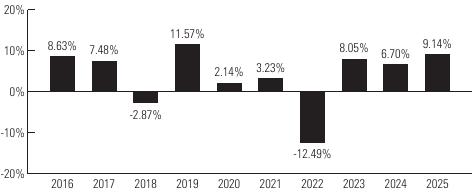
The following bar chart and table give an indication of the risks of investing in the Fund by showing changes in the Fund’s performance from year to year and by showing how the Fund’s average annual returns for the one-year, five-year and ten-year periods compare to those of a broad-based securities market index that reflects the performance of the overall market applicable to the Fund. The Fund’s past performance (before and after taxes) does not necessarily indicate how the Fund will perform in the future. The Fund’s performance prior to December 31, 2025 reflects returns achieved pursuant to a different investment objective and different principal investment strategies than those that are currently being pursued. If the Fund’s current investment objective and strategies had been in place during those prior periods, the performance information shown would have been different. Updated performance information is available online at www.loomissayles.com and/or by calling the Fund toll-free at 800-633-3330. Effective after the close of business on June 5, 2026, the telephone number will be 800-225-5478 and the website address will be www.im.natixis.com.
To the extent that a class of shares was subject to the waiver or reimbursement of certain expenses during a period, had such expenses not been waived or reimbursed during the period, total returns would have been lower.
Total Returns for Institutional Class Shares
image 
Highest Quarterly Return:
Fourth Quarter 2023, 7.34%

Lowest Quarterly Return:
First Quarter 2020, -11.75%
Average Annual Total Returns
 
 
(for the periods ended December 31, 2025)
Past 1 Year
Past 5 Years
Past 10 Years
Institutional Class - Return Before Taxes
9.14%
2.59%
3.92%
Return After Taxes on Distributions
7.09%
0.70%
2.20%
Return After Taxes on Distributions and Sale of Fund Shares
5.36%
1.13%
2.31%
Retail Class - Return Before Taxes
8.93%
2.34%
3.66%
Admin Class - Return Before Taxes
8.60%
2.11%
3.42%
Class N - Return Before Taxes
9.21%
2.64%
3.99%
Bloomberg U.S. Aggregate Bond Index
7.30%
-0.36%
2.01%
After-tax returns are calculated using the historical highest individual federal marginal income tax rates and do not reflect the impact of state and local taxes. Actual after-tax returns depend on an investor’s tax situation and may differ from those shown. After-tax returns shown are

5 

 
fund summary 

not relevant to investors who hold their shares through tax-advantaged arrangements, such as 401(k) plans, qualified plans, education savings accounts, such as 529 plans, or individual retirement accounts. The after-tax returns are shown for the Institutional Class of the Fund. After-tax returns for the other classes of the Fund will vary. Index performance reflects no deduction for fees, expenses or taxes.
MANAGEMENT
Investment Adviser
Loomis Sayles
Portfolio Managers
Matthew J. Eagan, CFA®, Portfolio Manager and Director of Loomis Sayles, has served as a portfolio manager of the Fund since 2012 and was an associate portfolio manager of the Fund from 2007 to 2012.
Brian P. Kennedy, Portfolio Manager of Loomis Sayles, has served as a portfolio manager of the Fund since 2016.
PURCHASE AND SALE OF FUND SHARES
The following information shows the investment minimums for various types of accounts:
Retail Class Shares
Type of Account
Minimum Initial Purchase
Any account other than those listed below
$2,500
For shareholders participating in Loomis Sayles Funds’ Automatic Investment Plan
$1,000
For Traditional IRA, Roth IRA, Rollover IRA and SEP-IRA
$1,000
There is no subsequent investment minimum for these shares. There is no initial investment minimum for:
 
Fee-based programs (such as wrap accounts) where an advisory fee is paid to the broker-dealer or other financial intermediary. Please consult your financial representative to determine if your fee based program is subject to additional or different conditions or fees.
 
Certain Retirement Plans. Please consult your retirement plan administrator to determine if your retirement plan is subject to additional or different conditions or fees imposed by the plan administrator.
 
Clients of a Registered Investment Adviser where the Registered Investment Adviser receives an advisory, management or consulting fee.
 
Effective June 1, 2026, accounts invested through certain intermediaries held within an Intermediary Omnibus Account.
 
Effective June 1, 2026, in its sole discretion, Natixis Distribution, LLC (the “Distributor”) may waive any share class eligibility requirement.
 
The minimum investment requirements for Retail Class shares of the Fund may be waived or lowered for investments effected through certain financial intermediaries that have entered into special arrangements with the Distributor. Consult your financial intermediary for additional information regarding the minimum investment requirement applicable to your investment.
Institutional Class Shares
Institutional Class shares of the Fund are generally subject to a minimum initial investment of $100,000. There is no subsequent investment minimum for these shares. There is no minimum initial investment for:
 
Fee-based programs (such as wrap accounts) where an advisory fee is paid to the broker-dealer or other financial intermediary. Please consult your financial representative to determine if your fee based program is subject to additional or different conditions or fees.
 
Certain Retirement Plans. Please consult your retirement plan administrator to determine if your retirement plan is subject to additional or different conditions or fees imposed by the plan administrator.
 
Certain Individual Retirement Accounts if the amounts invested represent rollover distributions from investments by any of the retirement plans invested in the Fund.
 
Clients of a Registered Investment Adviser where the Registered Investment Adviser receives an advisory, management or consulting fee.
 
Fund Trustees, former Fund trustees, employees of affiliates of the Loomis Sayles Funds and other individuals who are affiliated with any Loomis Sayles Fund (this also applies to any spouse, parents, children, siblings, grandparents, grandchildren and in-laws of those mentioned) and Natixis affiliate employee benefit plans.
 
Effective June 1, 2026, accounts invested through certain intermediaries held within an Intermediary Omnibus Account.
 

6 

 
fund summary 

 
Effective June 1, 2026, in its sole discretion, the Distributor may waive any share class eligibility requirement.
 
At the discretion of Natixis Advisors, LLC (“Natixis Advisors”),, clients of Natixis Advisors, and its affiliates may purchase Institutional Class shares of the Fund below the stated minimums.
Class N Shares
Class N shares of the Fund are subject to a $1,000,000 initial investment minimum. This minimum applies to Fee Based Programs and accounts (such as wrap accounts) where an advisory fee is paid to the broker-dealer or other financial intermediary. There is no subsequent investment minimum for these shares. There is no initial investment minimum for:
 
Certain Retirement Plans. Please consult your retirement plan administrator to determine if your retirement plan is subject to additional or different conditions or fees imposed by the plan administrator.
 
Funds of funds that are distributed by the Distributor.
 
Sub-accounts held within an omnibus account, where the omnibus account has at least $1,000,000. (Effective June 1, 2026, this waiver no longer applies.)
 
Effective June 1, 2026, accounts invested through certain intermediaries held within an Intermediary Omnibus Account.
 
Effective June 1, 2026, in its sole discretion, the Distributor may waive any share class eligibility requirement.
 
Admin Class Shares
Admin Class shares of the Fund are intended primarily for Certain Retirement Plans held in an omnibus fashion and are not available for purchase by individual investors. There are no initial or subsequent investment minimums for these shares.
Due to operational limitations at your financial intermediary, certain fee based programs, retirement plans, individual retirement accounts and accounts of registered investment advisers may be subject to the investment minimums described above.
The Fund’s shares are available for purchase and are redeemable on any business day through your financial adviser, through your broker-dealer, directly from the Fund by writing to the Fund at Loomis Sayles Funds, P.O. Box 219594, Kansas City, MO 64121-9594, by exchange, by wire, by internet at www.loomissayles.com, by telephone at 800-633-3330, through the Automated Clearing House system, or, in the case of redemptions, by the Systematic Withdrawal Plan. Effective after the close of business on June 5, 2026, the address will be Loomis Sayles Funds, P.O. Box 219579, Kansas City, MO 64121-9579, the telephone number will be 800-225-5478, and the website address will be www.im.natixis.com. See the section “How Fund Shares are Priced” in the Prospectus for details.
TAX INFORMATION
Fund distributions are generally taxable to you as ordinary income or capital gains, except for distributions to retirement plans and other investors that qualify for tax-advantaged treatment under U.S. federal income tax law generally. Investments through such tax-advantaged plans will generally be taxed only upon withdrawal of monies from the tax-advantaged arrangement. If the Fund’s distributions exceed its taxable income and capital gains realized during a taxable year, all or a portion of the distributions made in the same taxable year may be treated as a return of capital to shareholders to the extent of such shareholder’s tax basis in its shares, and thereafter as capital gain. A return of capital distribution will generally not be taxable, but will reduce each shareholder’s cost basis in the Fund and result in a higher reported capital gain or lower capital loss when those shares on which the distribution was received are sold.
PAYMENTS TO BROKER-DEALERS AND OTHER FINANCIAL INTERMEDIARIES
If you purchase shares of the Fund through a broker-dealer or other financial intermediary (such as a bank), the Fund and its related companies may pay the intermediary for the sale of the Fund shares and related services. These payments may create a conflict of interest by influencing the broker-dealer or other intermediary and your salesperson to recommend the Fund over another investment. Ask your salesperson or visit your financial intermediary’s website for more information.

7 

 
fund summary 

Loomis Sayles Investment Grade Fixed Income Fund
INVESTMENT OBJECTIVE
The Fund’s investment objective is above-average total investment return through a combination of current income and capital appreciation.
FUND FEES & EXPENSES
The following table describes the fees and expenses that you may pay if you buy, hold, and sell shares of the Fund. You may pay other fees, such as brokerage commissions and other fees to financial intermediaries, which are not reflected in this table.
The Fund does not impose a sales charge, a redemption fee or an exchange fee.
Annual Fund Operating Expenses
(expenses that you pay each year as a percentage of the value of your investment)
Institutional Class
Management fees
0.40%
Distribution and/or service (12b-1) fees
0.00%
Other expenses
0.19%
Total annual fund operating expenses
0.59%
Fee waiver and/or expense reimbursement1
0.06%
Total annual fund operating expenses after fee waiver and/or expense reimbursement
0.53%
1 Loomis, Sayles & Company, L.P. (“Loomis Sayles” or the “Adviser”) has given a binding contractual undertaking to the Fund to limit the amount of the Fund’s total annual fund operating expenses to 0.53% of the Fund’s average daily net assets, exclusive of brokerage expenses, interest expense, taxes, acquired fund fees and expenses, organizational and extraordinary expenses, such as litigation and indemnification expenses. This undertaking is in effect through April 30, 2027 and may be terminated before then only with the consent of the Fund’s Board of Trustees. The Adviser will be permitted to recover management fees waived and/or expenses reimbursed to the extent that expenses in later periods fall below both (1) the expense limitation at the time such amounts were waived/reimbursed and (2) the Fund’s current applicable expense limitation. The Fund will not be obligated to repay any such waived/reimbursed fees and expenses more than one year after the end of the fiscal year in which the fees or expenses were waived/reimbursed.
Example
The example is intended to help you compare the cost of investing in the Fund with the cost of investing in other mutual funds. The example assumes that you invest $10,000 in the Fund for the time periods indicated and then redeem all of your shares at the end of those periods. The example also assumes that your investment has a 5% return each year and that the Fund’s operating expenses remain the same except that the example is based on the Total Annual Fund Operating Expenses After Fee Waiver and/or Expense Reimbursement assuming that such waiver and/or reimbursement will only be in place through the date noted above and on the Total Annual Fund Operating Expenses for the remaining periods. The example does not take into account brokerage commissions and other fees to financial intermediaries that you may pay on your purchases and sales of shares of the Fund. Although your actual costs may be higher or lower, based on these assumptions your costs would be:
 
1 year
3 years
5 years
10 years
Institutional Class
$
54
$
183
$
323
$
732
Portfolio Turnover
The Fund pays transaction costs, such as commissions, when it buys and sells securities (or “turns over” its portfolio). A higher portfolio turnover rate may indicate higher transaction costs and may result in higher taxes for you if your Fund shares are held in a taxable account. These costs, which are not reflected in annual fund operating expenses or in the example, affect the Fund’s performance. During its most recently ended fiscal year, the Fund’s portfolio turnover rate was 76% of the average value of its portfolio.
INVESTMENTS, RISKS AND PERFORMANCE
Principal Investment Strategies
Under normal circumstances, the Fund will invest at least 80% of its net assets (plus any borrowings made for investment purposes) in investment-grade fixed-income securities. The Fund may invest up to 10% of its assets in below investment-grade fixed-income securities (“junk bonds”) and up to 10% of its assets in equity securities (including preferred stocks and common stocks). Below investment-grade fixed-income securities are rated below investment-grade quality (i.e., none of the three major rating agencies (Moody’s Investors Service,

8 

 
fund summary 

Inc., Fitch Ratings, Inc. or S&P Global Ratings) have rated the securities in one of their respective top four ratings categories). The Fund’s fixed-income securities investments may include unrated securities (securities that are not rated by a rating agency) if Loomis Sayles determines that the securities are of comparable quality to rated securities that the Fund may purchase. The Fund may invest in fixed-income securities of any maturity.
In deciding which securities to buy and sell, Loomis Sayles may consider a number of factors related to the bond issue and the current bond market, including, for example, the stability and volatility of a country’s bond markets, the financial strength of the issuer, current interest rates, current valuations, Loomis Sayles’ expectations regarding general trends in interest rates and currency considerations. Loomis Sayles will also consider how purchasing or selling a bond would impact the overall portfolio’s risk profile (for example, its sensitivity to currency risk, interest rate risk and sector-specific risk) and potential return (income and capital gains).
Three themes typically drive the Fund’s investment approach. First, Loomis Sayles generally seeks fixed-income securities that are attractively valued relative to the Loomis Sayles’ credit research team’s assessment of credit risk. The broad coverage combined with the objective of identifying attractive investment opportunities makes this an important component of the investment approach. Second, the Fund may invest significantly in securities the prices of which Loomis Sayles believes are more sensitive to events related to the underlying issuer than to changes in general interest rates or overall market default rates. These securities may not have a direct correlation with changes in interest rates, thus helping to manage interest rate risk and to offer diversified sources for return. Third, Loomis Sayles analyzes different sectors of the economy and differences in the yields (“spreads”) of various fixed-income securities (U.S. governments, investment-grade corporates, securitized assets, high-yield corporates, emerging markets, non-U.S. sovereigns and credits, convertibles, bank loans and municipals) in an effort to find securities that it believes may produce attractive returns for the Fund in comparison to their risk.
In deciding which equity securities to buy and sell, Loomis Sayles intends to emphasize dividend-paying stocks issued by companies with strong fundamentals and relatively limited anticipated volatility to supplement its fixed-income holdings. These securities will be selected with the same bottom-up investment process that is the foundation of the Fund’s overall strategy.
The Fund may invest up to 40% of its assets in foreign securities, including emerging markets securities. The Fund may invest up to 20% of its assets in non-U.S. dollar-denominated securities. The Fund may invest without limit in obligations of supranational entities (e.g., the World Bank). Although certain securities purchased by the Fund may be issued by domestic companies incorporated outside of the United States, the Adviser does not consider these securities to be foreign if the issuer is included in the U.S. fixed-income indices published by Bloomberg. The Fund may also invest in mortgage-related securities, including mortgage dollar rolls. The Fund may engage in futures transactions and swaps (including credit default swaps, in which one party agrees to make periodic payments to a counterparty in exchange for the right to receive a payment in the event of a default of the underlying reference security).
The fixed-income securities in which the Fund may invest include, among other instruments, corporate securities, U.S. government securities, collateralized loan obligations, bank loans, zero-coupon securities, mortgage-backed securities, collateralized mortgage obligations, when-issued securities, real estate investment trusts (“REITs”), securities issued pursuant to Rule 144A under the Securities Act of 1933 (“Rule 144A securities”), other privately placed investments such as private credit investments and structured notes, among others.
Principal Risks
The principal risks of investing in the Fund are summarized below. The Fund does not represent a complete investment program. You may lose money by investing in the Fund.
Fund shares are not bank deposits and are not guaranteed, endorsed or insured by the Federal Deposit Insurance Corporation or any other government agency, and are subject to investment risks, including possible loss of the principal invested.
The significance of any specific risk to an investment in the Fund will vary over time, depending on the composition of the Fund’s portfolio, market conditions, and other factors. You should read all of the risk information presented below carefully, because any one or more of these risks may result in losses to the Fund.
Bank Loans Risk is the risk that the Fund’s investments in bank loans are subject to credit risk and may not be adequately collateralized. Indebtedness of borrowers whose creditworthiness is poor involves substantially greater risks and may be highly speculative. The interest rates on many bank loans reset frequently, and thus bank loans are subject to interest rate risk. Transactions in bank loans may settle on a delayed basis, such that the Fund may not receive the proceeds from the sale of a loan for a substantial period of time after the sale. There may also be less public information available about bank loans as compared to other debt securities.
Credit/Counterparty Risk is the risk that the issuer or guarantor of a fixed-income security in which the Fund invests, or the counterparty to a derivative or other transaction, will be unable or unwilling to make timely payments of interest or principal or to otherwise honor its obligations. As a result, the Fund may sustain losses or be unable or delayed in its ability to realize gains.

9 

 
fund summary 

Below Investment-Grade Fixed-Income Securities Risk is the risk that the Fund’s investments in below investment-grade fixed-income securities may be subject to greater risks than other fixed-income securities, including being subject to greater levels of interest rate risk, credit risk (including a greater risk of default) and liquidity risk. The ability of the issuer to make principal and interest payments is predominantly speculative for below investment-grade fixed-income securities.
Interest Rate Risk is the risk that the value of the Fund’s investments will fall if interest rates rise. Generally, the value of fixed-income securities rises when prevailing interest rates fall and falls when interest rates rise. Interest rate risk generally is greater for funds that invest in fixed-income securities with relatively longer durations than for funds that invest in fixed-income securities with shorter durations. The values of zero-coupon securities and securities with longer maturities are generally more sensitive to fluctuations in interest rates than other fixed-income securities. In addition, an economic downturn or period of rising interest rates could adversely affect the market for these securities and reduce the Fund’s ability to sell them, negatively impacting the performance of the Fund. Fiscal, economic, monetary or other governmental or central bank policies, actions or measures have in the past, and may in the future, cause or exacerbate risks associated with interest rates, including fluctuations in interest rates.
Currency Risk is the risk that the value of the Fund’s investments will fall as a result of changes in exchange rates. Loomis Sayles may elect not to hedge currency risk or may hedge imperfectly, which may cause the Fund to incur losses that would not have been incurred had the risk been hedged.
Market/Issuer Risk is the risk that the market value of the Fund’s investments will move up and down, sometimes rapidly and unpredictably, based upon overall market and economic conditions, as well as a number of reasons that directly relate to the issuers of the Fund’s investments, such as management performance, financial condition and demand for the issuers’ goods and services.
Cybersecurity and Technology Risk is the risk associated with the increasing dependence of the Fund, its service providers, and other market participants on complex information technology and communications systems. Such systems are subject to a number of different threats and risks that could adversely affect the Fund and its shareholders. Cybersecurity and other operational and technology issues may result in financial losses to the Fund and its shareholders.
Derivatives Risk is the risk that the value of the Fund’s derivative investments such as structured notes, futures transactions and swap transactions will fall, for example, because of changes in the value of the underlying reference instruments, pricing difficulties or lack of correlation with the underlying investments. The use of derivatives for other than hedging purposes may be considered a speculative activity, and involves greater risks than are involved in hedging. There is also the risk that the Fund may be unable to terminate or sell a derivative position at an advantageous time or price. The Fund’s derivative counterparties may experience financial difficulties or otherwise be unwilling or unable to honor their obligations, possibly resulting in losses to the Fund. This risk is greater for uncleared swaps and other over the counter (“OTC”) traded derivatives. Investing in derivatives gives rise to other risks, such as leverage risk, liquidity risk, credit/counterparty risk, interest rate risk and market/issuer risk. The use of derivatives may cause the Fund to incur losses greater than those which would have occurred had derivatives not been used.
Emerging Markets Risk is the risk that the Fund’s investments in emerging markets may face greater foreign securities risk. Emerging markets investments are subject to greater risks arising from political or economic instability, war, nationalization or confiscatory taxation, currency exchange or repatriation restrictions, sanctions by other countries (such as the United States or the European Union), new or inconsistent government treatment of or restrictions on issuers and instruments, and an issuer’s unwillingness or inability to make dividend, principal or interest payments on its securities. Emerging markets companies may be smaller and have shorter operating histories than companies in developed markets.
Equity Securities Risk is the risk that the value of the Fund’s investments in equity securities could be subject to unpredictable declines in the value of individual securities and periods of below-average performance in individual securities or in the equity market as a whole In the event an issuer is liquidated or declares bankruptcy, the claims of owners of the issuer’s bonds generally take precedence over the claims of those who own preferred stock or common stock.
Foreign Securities Risk is the risk that the value of the Fund’s foreign investments will fall as a result of foreign political, social, economic, environmental, credit, informational or currency changes or other issues relating to foreign investing generally. Foreign securities may be subject to higher volatility than U.S. securities, varying degrees of regulation and limited liquidity. The Fund’s investments in foreign securities may be subject to foreign withholding or other taxes, which would decrease the yield on those securities.
Large Shareholder Transaction Risk is the risk that ownership of shares of the Fund may be concentrated in one or a few large investors. Such investors may redeem shares in large quantities or on a frequent basis. In addition, a large number of shareholders collectively may purchase or redeem Fund shares in large amounts rapidly or unexpectedly (collectively, such transactions are referred to as “large shareholder transactions”). In the event of a large shareholder transaction, the Fund may be required to sell investments at unfavorable times or prices,

10 

 
fund summary 

which may increase realized capital gains, including short-term capital gains taxable as ordinary income for shareholders who hold Fund shares in a taxable account, may accelerate the realization of taxable income to shareholders, may increase transaction costs, and may otherwise negatively impact fund performance. The effects of taxable income and/or gains resulting from large shareholder transactions would particularly impact non-redeeming shareholders who do not hold their Fund shares in an IRA, 401(k) plan or other tax-advantaged plan. In addition, such transactions potentially limit the use of any capital loss carryforwards and certain other losses to offset future realized capital gains (if any). Such transactions may also increase the Fund’s expenses. A number of circumstances may cause the Fund to experience large redemptions, such as changes in the eligibility criteria for the Fund or share class of the Fund; liquidations, reorganizations, repositionings, or other announced Fund events; or changes in investment objectives, strategies, policies, risks, or investment personnel.
Inflation/Deflation Risk is the risk that the value of assets or income from investments will be worth less in the future as inflation decreases the present value of future payments. As inflation increases, the real value of the Fund’s portfolio could decline. Inflation rates may change frequently and drastically. The Fund’s investments may not keep pace with inflation, which may result in losses to the Fund’s investors. Deflation risk is the risk that prices throughout the economy decline over time - the opposite of inflation. Deflation may have an adverse effect on the creditworthiness of issuers and may make issuer default more likely, which may result in a decline in the value of the Fund’s portfolio.
Leverage Risk is the risk associated with securities or investment practices (e.g., borrowing and the use of certain derivatives) that multiply small index, market or asset price movements into larger changes in value. Use of derivative instruments (such as futures and forward currency contracts) may involve leverage. When a derivative is used as a hedge against an offsetting position that the Fund also holds, any gains generated by the derivative should be substantially offset by losses on the hedged instrument, and vice versa. To the extent that the Fund uses a derivative for purposes other than as a hedge, or if the Fund hedges imperfectly, the Fund is directly exposed to the risks of that derivative and any loss generated by the derivative will not be offset by a gain. The use of leverage increases the impact of gains and losses on the Fund’s returns, and may lead to significant losses if investments are not successful.
Liquidity Risk is the risk that the Fund may be unable to find a buyer for its investments when it seeks to sell them or to receive the price it expects. Events that may lead to increased redemptions, such as market disruptions or increases in interest rates, may also negatively impact the liquidity of the Fund’s investments when it needs to dispose of them. Markets may become illiquid quickly. If the Fund is forced to sell its investments at an unfavorable time and/or under adverse conditions in order to meet redemption requests, such sales could negatively affect the Fund. During times of market turmoil, there may be no buyers or sellers for securities in certain asset classes and dealers may be unwilling or unable to make a market for certain securities. Securities acquired in a private placement, such as Rule 144A securities and privately negotiated credit and other investments, are generally subject to significant liquidity risk because they are subject to strict restrictions on resale and there may be no liquid secondary market or ready purchaser for such securities. In other circumstances, liquid investments may become illiquid. Derivatives, and particularly OTC derivatives, are generally subject to liquidity risk as well. Liquidity issues may also make it difficult to value the Fund’s investments. The Fund may invest in liquid investments that become illiquid due to financial distress, or geopolitical events such as sanctions, trading halts or wars.
Management Risk is the risk that Loomis Sayles’ investment techniques will be unsuccessful and cause the Fund to incur losses.
Mortgage-Related and Asset-Backed Securities Risk is the risk associated with the mortgages and assets underlying the securities, as well as the risk that the securities may be prepaid and result in the reinvestment of the prepaid amounts in securities with lower yields than the prepaid obligations. Conversely, there is a risk that a rise in interest rates will extend the life of a mortgage-related or asset-backed security beyond the expected prepayment time, typically reducing the security’s value, which is called extension risk. The Fund may also incur a loss when there is a prepayment of securities that were purchased at a premium. It also includes risks associated with investing in the mortgages underlying the mortgage-backed securities. The Fund’s investments in other asset-backed securities are subject to risks similar to those associated with mortgage-related securities, as well as additional risks associated with the nature of the assets and the servicing of those assets. The Fund’s investments in mortgage-related and other asset-backed securities are also subject to the risks associated with investments in fixed-income securities generally (e.g., credit/counterparty, liquidity, inflation and valuation risks).
REITs Risk is the risk that the value of the Fund’s investments in REITs will fall as a result of changes in underlying real estate values, rising interest rates, limited diversification of holdings, higher costs and prepayment risk associated with related mortgages, as well as other risks particular to investments in real estate. Many REITs are highly leveraged, increasing their risk. The Fund will indirectly bear its proportionate share of expenses, including management fees, paid by each REIT in which it invests in addition to the expenses of the Fund.
Risk/Return Bar Chart and Table
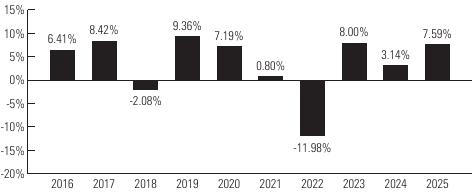
The following bar chart and table give an indication of the risks of investing in the Fund by showing changes in the Fund’s performance from year to year and by showing how the Fund’s average annual returns for the one-year, five-year and ten-year periods

11 

 
fund summary 

compare to those of a broad-based securities market index that reflects the performance of the overall market applicable to the Fund. The Fund’s past performance (before and after taxes) does not necessarily indicate how the Fund will perform in the future. Updated performance information is available online at www.loomissayles.com and/or by calling the Fund toll-free at 800-633-3330. Effective after the close of business on June 5, 2026, the telephone number will be 800-225-5478 and the website address will be www.im.natixis.com.
To the extent that a class of shares was subject to the waiver or reimbursement of certain expenses during a period, had such expenses not been waived or reimbursed during the period, total returns would have been lower.
Total Returns for Institutional Class Shares
image 
Highest Quarterly Return:
Fourth Quarter 2023, 7.59%

Lowest Quarterly Return:
First Quarter 2020, -7.01%
Average Annual Total Returns
 
 
(for the periods ended December 31, 2025)
Past 1 Year
Past 5 Years
Past 10 Years
Institutional Class - Return Before Taxes
7.59%
1.24%
3.48%
Return After Taxes on Distributions
5.34%
-0.54%
1.85%
Return After Taxes on Distributions and Sale of Fund Shares
4.46%
0.25%
2.09%
Bloomberg U.S. Aggregate Bond Index
7.30%
-0.36%
2.01%
After-tax returns are calculated using the historical highest individual federal marginal income tax rates and do not reflect the impact of state and local taxes. Actual after-tax returns depend on an investor’s tax situation and may differ from those shown. After-tax returns shown are not relevant to investors who hold their shares through tax-advantaged arrangements, such as 401(k) plans, qualified plans, education savings accounts, such as 529 plans, or individual retirement accounts. Index performance reflects no deduction for fees, expenses or taxes.
MANAGEMENT
Investment Adviser
Loomis Sayles
Portfolio Managers
Matthew J. Eagan, CFA®, Portfolio Manager and Director of Loomis Sayles, has served as a portfolio manager of the Fund since 2012 and was an associate portfolio manager of the Fund from 2006 to 2012.
Brian P. Kennedy, Portfolio Manager of Loomis Sayles, has served as a portfolio manager of the Fund since 2013.
PURCHASE AND SALE OF FUND SHARES
The following information shows the investment minimums for various types of accounts:
Institutional Class Shares
Institutional Class shares of the Fund are generally subject to a minimum initial investment of $3,000,000. There is no subsequent investment minimum for these shares. There is no minimum initial investment for:
 
Fund Trustees, former Fund trustees, employees of affiliates of the Loomis Sayles Funds and other individuals who are affiliated with any Loomis Sayles Fund (this also applies to any spouse, parents, children, siblings, grandparents, grandchildren and in-laws of those mentioned) and Natixis affiliate employee benefit plans.
 
Effective June 1, 2026, accounts invested through certain intermediaries held within an Intermediary Omnibus Account.
 
Effective June 1, 2026, in its sole discretion, the Distributor may waive any share class eligibility requirement.
 

12 

 
fund summary 

At the discretion of Natixis Advisors, LLC (“Natixis Advisors”), clients of Natixis Advisors, and its affiliates may purchase Institutional Class shares of the Fund below the stated minimums. The minimum may also be waived for the clients of financial consultants and financial institutions that have a business relationship with Loomis Sayles, if such client invests at least $1,000,000 in the Fund.
The Fund’s shares are available for purchase and are redeemable on any business day directly from the Fund by writing to the Fund at Loomis Sayles Funds, P.O. Box 219594, Kansas City, MO 64121-9594, by exchange, by wire, by internet at www.loomissayles.com, by telephone at 800-633-3330, through the Automated Clearing House system, or, in the case of redemptions, by the Systematic Withdrawal Plan. Effective after the close of business on June 5, 2026, the address will be Loomis Sayles Funds, P.O. Box 219579, Kansas City, MO 64121-9579, the telephone number will be 800-225-5478, and the website address will be www.im.natixis.com. See the section “How Fund Shares are Priced” in the Prospectus for details.
TAX INFORMATION
Fund distributions are generally taxable to you as ordinary income or capital gains, except for distributions to retirement plans and other investors that qualify for tax-advantaged treatment under U.S. federal income tax law generally. Investments through such tax-advantaged plans will generally be taxed only upon withdrawal of monies from the tax-advantaged arrangement.
PAYMENTS TO BROKER-DEALERS AND OTHER FINANCIAL INTERMEDIARIES
If you purchase shares of the Fund through a broker-dealer or other financial intermediary (such as a bank), the Fund and its related companies may pay the intermediary for the sale of the Fund shares and related services. These payments may create a conflict of interest by influencing the broker-dealer or other intermediary and your salesperson to recommend the Fund over another investment. Ask your salesperson or visit your financial intermediary’s website for more information.

13 

 
more information about investment strategies 

more information about investment strategies
Loomis Sayles Income Fund
Investment Objective
The Fund seeks to provide income with a secondary objective of capital appreciation. The Fund’s investment objective may be changed without shareholder approval. The Fund will provide prior written notice to shareholders before changing the investment objective.
Principal Investment Strategies
Under normal circumstances, the Fund will invest at least 80% of its net assets (plus any borrowings made for investment purposes) in fixed-income securities (for example, bonds and other investments that Loomis Sayles & Company, L.P. (“Loomis Sayles” or the “Adviser”) believes have similar economic characteristics, such as notes, debentures and loans). The Fund will normally invest at least 55% of its net assets in investment-grade fixed-income securities. The Fund may also invest up to 35% of its assets in below investment-grade fixed-income securities (commonly known as “junk bonds”). Below investment-grade fixed-income securities are rated below investment-grade quality (i.e., none of the three major rating agencies (Moody’s Investors Service, Inc., Fitch Ratings, Inc. or S&P Global Ratings) have rated the securities in one of their respective top four ratings categories). The Fund’s fixed-income securities investments may include unrated securities (securities that are not rated by a rating agency) if Loomis Sayles determines that the securities are of comparable quality to rated securities that the Fund may purchase. The Fund may invest in fixed-income securities of any maturity.
In deciding which securities to buy and sell, Loomis Sayles may consider a number of factors related to the bond issue and the current bond market, including, for example, the stability and volatility of a country’s bond markets, the financial strength of the issuer, current interest rates, current valuations, Loomis Sayles’ expectations regarding general trends in interest rates and currency considerations. Loomis Sayles will also consider how purchasing or selling a bond would impact the overall portfolio’s risk profile (for example, its sensitivity to currency risk, interest rate risk and sector-specific risk) and potential return (income and capital gains).
Three themes typically drive the Fund’s investment approach. First, Loomis Sayles generally seeks fixed-income securities that are attractively valued relative to the Loomis Sayles’ credit research team’s assessment of credit risk. The broad coverage combined with the objective of identifying attractive investment opportunities makes this an important component of the investment approach. Second, the Fund may invest significantly in securities the prices of which Loomis Sayles believes are more sensitive to events related to the underlying issuer than to changes in general interest rates or overall market default rates. These securities may not have a direct correlation with changes in interest rates, thus helping to manage interest rate risk and to offer diversified sources for return. Third, Loomis Sayles analyzes different sectors of the economy and differences in the yields (“spreads”) of various fixed-income securities (U.S. government securities, investment-grade corporate securities, securitized assets, high-yield corporate securities, emerging market securities, non-U.S. sovereigns and credits, convertibles, bank loans and municipals) in an effort to find securities that it believes may produce attractive returns for the Fund in comparison to their risk.
The Fund may invest up to 40% of its assets in foreign securities, including emerging markets securities. The Fund may invest up to 20% of its assets in non-U.S. dollar-denominated securities. The Fund may invest without limit in obligations of supranational entities (e.g., the World Bank). Although certain securities purchased by the Fund may be issued by domestic companies incorporated outside of the United States, the Adviser does not consider these securities to be foreign if the issuer is included in the U.S. fixed-income indices published by Bloomberg.
The fixed-income securities in which the Fund may invest include, among other instruments, corporate bonds and other debt securities, U.S. government securities, commercial paper, zero-coupon securities, mortgage-related securities (including senior and junior loans, mortgage dollar rolls, stripped mortgage-related securities and collateralized mortgage obligations) and other asset-backed securities, when-issued securities, real estate investment trusts (“REITs”), securities issued pursuant to Rule 144A under the Securities Act of 1933 (“Rule 144A securities”), other privately placed investments such as private credit investments, structured notes, collateralized loan obligations, bank loans, repurchase agreements and convertible securities. The Fund may engage in options and futures transactions, foreign currency transactions (such as forward currency contracts) and swap transactions (including credit default swaps, in which one party agrees to make periodic payments to a counterparty in exchange for the right to receive a payment in the event of a default of the underlying reference security).
In accordance with applicable SEC requirements, the Fund will notify shareholders prior to any change to the 80% policy discussed above taking effect.

14 

 
more information about investment strategies 

Loomis Sayles Investment Grade Fixed Income Fund
Investment Objective
The Fund’s investment objective is above-average total investment return through a combination of current income and capital appreciation. The Fund’s investment objective may be changed without shareholder approval. The Fund will provide prior written notice to shareholders before changing the investment objective.
Principal Investment Strategies
Under normal circumstances, the Fund will invest at least 80% of its net assets (plus any borrowings made for investment purposes) in investment-grade fixed-income securities. The Fund may invest up to 10% of its assets in below investment-grade fixed-income securities (“junk bonds”) and up to 10% of its assets in equity securities (including preferred stocks and common stocks). Below investment-grade fixed-income securities are rated below investment-grade quality (i.e., none of the three major rating agencies (Moody’s Investors Service, Inc., Fitch Ratings, Inc. or S&P Global Ratings) have rated the securities in one of their respective top four ratings categories). The Fund’s fixed-income securities investments may include unrated securities (securities that are not rated by a rating agency) if Loomis Sayles determines that the securities are of comparable quality to rated securities that the Fund may purchase. The Fund may invest in fixed-income securities of any maturity.
In deciding which securities to buy and sell, Loomis Sayles may consider a number of factors related to the bond issue and the current bond market, including, for example, the stability and volatility of a country’s bond markets, the financial strength of the issuer, current interest rates, current valuations, Loomis Sayles’ expectations regarding general trends in interest rates and currency considerations. Loomis Sayles will also consider how purchasing or selling a bond would impact the overall portfolio’s risk profile (for example, its sensitivity to currency risk, interest rate risk and sector-specific risk) and potential return (income and capital gains).
Three themes typically drive the Fund’s investment approach. First, Loomis Sayles generally seeks fixed-income securities that are attractively valued relative to the Loomis Sayles’ credit research team’s assessment of credit risk. The broad coverage combined with the objective of identifying attractive investment opportunities makes this an important component of the investment approach. Second, the Fund may invest significantly in securities the prices of which Loomis Sayles believes are more sensitive to events related to the underlying issuer than to changes in general interest rates or overall market default rates. These securities may not have a direct correlation with changes in interest rates, thus helping to manage interest rate risk and to offer diversified sources for return. Third, Loomis Sayles analyzes different sectors of the economy and differences in the yields (“spreads”) of various fixed-income securities (U.S. governments, investment-grade corporates, securitized assets, high-yield corporates, emerging markets, non-U.S. sovereigns and credits, convertibles, bank loans and municipals) in an effort to find securities that it believes may produce attractive returns for the Fund in comparison to their risk.
In deciding which equity securities to buy and sell, Loomis Sayles intends to emphasize dividend-paying stocks issued by companies with strong fundamentals and relatively limited anticipated volatility to supplement its fixed-income holdings. These securities will be selected with the same bottom-up investment process that is the foundation of the Fund’s overall strategy.
The Fund may invest up to 40% of its assets in foreign securities, including emerging markets securities. The Fund may invest up to 20% of its assets in non-U.S. dollar-denominated securities. The Fund may invest without limit in obligations of supranational entities (e.g., the World Bank). Although certain securities purchased by the Fund may be issued by domestic companies incorporated outside of the United States, the Adviser does not consider these securities to be foreign if the issuer is included in the U.S. fixed-income indices published by Bloomberg. The Fund may also invest in mortgage-related securities, including mortgage dollar rolls. The Fund may engage in futures transactions and swaps (including credit default swaps, in which one party agrees to make periodic payments to a counterparty in exchange for the right to receive a payment in the event of a default of the underlying reference security).
The fixed-income securities in which the Fund may invest include, among other instruments, corporate securities, U.S. government securities, collateralized loan obligations, bank loans, zero-coupon securities, mortgage-backed securities, collateralized mortgage obligations, when-issued securities, real estate investment trusts (“REITs”), securities issued pursuant to Rule 144A under the Securities Act of 1933 (“Rule 144A securities”), other privately placed investments such as private credit investments and structured notes, among others.
In accordance with applicable SEC requirements, the Fund will notify shareholders prior to any change to the 80% policy discussed above taking effect.

15 

 
more information about investment strategies 

TEMPORARY DEFENSIVE MEASURES
Temporary defensive measures may be used by a Fund during adverse economic, market, political or other conditions. In this event, each Fund may hold any portion of its assets in cash (U.S. dollars, foreign currencies or multinational currency units) and/or invest in cash equivalents such as money market instruments or high-quality debt securities as it deems appropriate. A Fund may miss certain investment opportunities if it uses defensive strategies and thus may not achieve its investment objective.
DERIVATIVES TRANSACTIONS
Each Fund may use derivatives, which are financial contracts whose value depends upon or is derived from the value of an underlying asset, reference rate or index. Examples of derivatives include options, futures and swap transactions (including credit default swaps), forward transactions and foreign currency transactions. The Funds may (but are not required to) use derivatives as part of a strategy designed to reduce exposure to other risks, such as risks associated with changes in interest rates or currency risk (“hedging”). When a derivative is used as a hedge against an offsetting position that a Fund also holds, any gains generated by the derivative should be substantially offset by losses on the hedged instrument, and vice versa. To the extent that a Fund uses a derivative for purposes other than as a hedge, or if a Fund hedges imperfectly, the Fund is directly exposed to the risks of that derivative and any loss generated by the derivative will not be offset by a gain. The Funds may also use derivatives for leverage, which increases opportunities for gain, to earn income, enhance yield or broaden the Fund’s diversification by gaining exposure to issuers, indices, sectors, currencies and/or geographic regions. A Fund may be required to sell other securities at inopportune times to meet collateral requirements on its derivatives transactions.
REPURCHASE AGREEMENTS
Under a repurchase agreement, a Fund purchases a security and obtains a simultaneous commitment from the seller (a bank or, to the extent permitted by the Investment Company Act of 1940, as amended (the “1940 Act”), a recognized securities dealer) to repurchase the security at an agreed-upon price and date (usually seven days or less from the date of original purchase). The resale price is in excess of the purchase price and reflects an agreed-upon market rate of interest unrelated to the coupon rate on the purchased security. Such transactions afford a Fund the opportunity to earn a return on its cash at what is expected to be minimal market/issuer risk. A Fund may invest in a repurchase agreement that does not produce a positive return to the Fund if Loomis Sayles believes it is appropriate to do so under the circumstances (for example, to help protect the Fund’s uninvested cash against the risk of loss during periods of market turmoil). There is a risk that the seller may fail to repurchase the underlying security. In such event, a Fund would attempt to exercise rights with respect to the underlying security, including possible disposition in the market. However, a Fund may be subject to various delays and risks of loss, including possible declines in the value of the underlying security, possible reduced levels of income, inability to enforce rights and expenses involved in attempted enforcement. Repurchase agreements maturing in more than seven days may be considered illiquid securities.
SECURITIES LENDING
Each Fund may lend a portion of its portfolio securities to brokers, dealers and other financial institutions, provided that a number of conditions are satisfied, including that the loan is fully collateralized. Please see the section “Investment Strategies” in the Statement of Additional Information (the “SAI”) for details. When a Fund lends portfolio securities, its investment performance will continue to reflect changes in the value of the securities loaned, and the Fund will also receive a fee or interest on the collateral. These fees or interest are income to a Fund, although the Fund often must share the income with the securities lending agent and/or the borrower. Securities lending involves, among other risks, the risk of loss of rights in the collateral or delay in recovery of the collateral if the borrower fails to return the security loaned or becomes insolvent. The Funds may pay lending fees to the party arranging the loan. In addition, any investment of cash is generally at the sole risk of a Fund. Any income or gains and losses from investing and reinvesting any cash collateral delivered by a borrower pursuant to a loan are generally at a Fund’s risk, and to the extent any such losses reduce the amount of cash below the amount required to be returned to the borrower upon the termination of any loan, the Fund may be required by the securities lending agent to pay or cause to be paid to such borrower an amount equal to such shortfall in cash, possibly requiring it to liquidate other portfolio securities to satisfy its obligations. Each Fund’s securities lending activities are implemented pursuant to policies and procedures approved by the Board of Trustees and are subject to Board oversight.
PERCENTAGE INVESTMENT LIMITATIONS
Except as set forth in the SAI, the percentage limitations set forth in this Prospectus and the SAI apply at the time an investment is made and shall not be considered violated unless an excess or deficiency occurs or exists immediately after and as a result of such investment.

16 

 
more about risk 

PORTFOLIO HOLDINGS
A description of the Funds’ policies and procedures with respect to the disclosure of each Fund’s portfolio securities is available in the Funds’ SAI.
A “snapshot” of each Fund’s investments may be found in each Fund’s filing on Form N-CSR. In addition, a list of each Fund’s full portfolio holdings, which is updated monthly after an aging period of at least 30 calendar days, is available on each Fund’s website at www.loomissayles.com (click on “Resources”, then “Holdings, then select the relevant Fund’s Monthly Holdings”). These holdings will remain accessible on the website at least until each Fund files its respective Form N-CSR or Form N-PORT with the SEC for the period that includes the date of the information. In addition, a list of each Fund’s top 10 holdings as of the month-end is generally available within 7 business days after the month-end on the Fund’s website at www.loomissayles.com (click on “Resources“, then “Holdings” then select the relevant Fund’s “Top 10 Holdings”). Effective after the close of business on June 5, 2026, this information is available on each Fund’s website at im.natixis.com/us/funddocuments (in the “Holdings” column select “Full portfolio holdings” for the relevant Fund). These holdings will remain accessible on the website at least until each Fund files its respective Form N-CSR or Form N-PORT with the SEC for the period that includes the date of the information. In addition, a list of each Funds’ top 10 holdings as of the month end is generally available within 7 business days after the month end on the Funds’ website at im.natixis.com/us/fund-documents (click Fund name and navigate to “Top Ten Holdings” section on the web page).
more about risk
This section provides more information on certain principal risks that may affect a Fund’s portfolio, as well as information on additional risks a Fund may be subject to because of its investments or practices. In seeking to achieve their investment goals, the Funds may also invest in various types of securities and engage in various investment practices which are not a principal focus of the Funds and therefore are not described in this Prospectus. These securities and investment practices and their associated risks are discussed in the Funds’ SAI, which is available without charge upon request (see back cover). The significance of any specific risk to an investment in a Fund will vary over time, depending on the composition of a Fund’s portfolio, market conditions, and other factors. You should read all of the risk information presented below carefully, because any one or more of these risks may result in losses to the Funds.
Fund shares are not bank deposits and are not guaranteed, endorsed or insured by the Federal Deposit Insurance Corporation or any other government agency, and are subject to investment risks, including possible loss of the principal invested.
RECENT MARKET EVENTS RISK
The Funds are subject to the risk that geopolitical and other events (e.g., wars, pandemics, terrorism, trade disputes and rapid technology developments or widespread adoption of new technology) will disrupt securities markets and adversely affect particular economies and markets as well as global economies and markets, thereby potentially decreasing the value of a Fund’s investments. The COVID-19 pandemic resulted in, among other things, significant market volatility, exchange trading suspensions and closures, declines in global financial markets, higher default rates, and economic downturns and recessions, and may continue to have similar effects in the future. Such factors, and the effects of other infectious illness outbreaks, epidemics, or pandemics, may have a significant adverse effect on a Fund’s performance, exacerbate other risks that apply to a Fund, exacerbate existing economic, political, or social tensions, have the potential to impair the ability of a Fund’s investment adviser or other service providers to serve the Fund, and lead to disruptions that negatively impact the Fund.
In addition, Russia’s military invasion of Ukraine in February 2022, the resulting responses by the United States and other countries, and the potential for wider conflict could increase volatility and uncertainty in the financial markets and adversely affect regional and global economies. These and any related events could significantly impact a Fund’s performance and the value of an investment in the Fund, even if the Fund does not have direct exposure to Russian issuers or issuers in other countries affected by the invasion.
In addition, U.S. trade policy has changed rapidly in the past, and may do so in the future, and it may be an ongoing source of instability, potentially resulting in significant currency fluctuations and/or having other adverse effects on international markets, international trade agreements, and/or other existing cross-border cooperation arrangements (whether economic, tax, fiscal, legal, regulatory, or otherwise). To the extent trade disputes escalate globally, there could be additional significant impacts on the sectors or industries in which a Fund invests and financial markets generally, as well as other adverse impacts on the Fund’s overall performance. Events such as these and their impact on the Funds are impossible to predict.
Other issuers or markets could be similarly affected by past or future geopolitical or other events or conditions.

17 

 
more about risk 

BANK LOANS RISK
A Fund’s investments in bank loans are subject to credit risk may not be adequately collateralized. Indebtedness of borrowers whose creditworthiness is poor involves substantially greater risks and may be highly speculative. The interest rates on many bank loans reset frequently, and thus bank loans are subject to interest rate risk. Most bank loans, like most investment-grade bonds, are not traded on any national securities exchange. There may also be less public information available about bank loans as compared to other debt securities. Some loans may not be considered “securities” for certain purposes under the federal securities laws, and purchasers, such as a Fund, therefore may not be entitled to rely on the anti-fraud protections of the federal securities laws.
Transactions in bank loans may settle on a delayed basis, such that a Fund may not receive the proceeds from the sale of a loan for a substantial period of time after the sale. In order to finance redemptions pending settlement of bank loans, a Fund may employ a wide variety of means to meet short-term liquidity needs, including, without limitation, drawing on its cash and other short-term positions, all of which may adversely affect a Fund’s performance.
BELOW INVESTMENT-GRADE FIXED-INCOME SECURITIES RISK
Below investment-grade fixed-income securities, also known as “junk bonds,” are rated below investment-grade quality and may be considered speculative with respect to the issuer’s continuing ability to make principal and interest payments. To be considered rated below investment-grade quality, a security must not have been rated by any of the three major rating agencies (Moody’s Investors Service, Inc., Fitch Investor Services, Inc. or S&P Global Ratings) in one of their respective top four rating categories at the time a Fund acquires the security or, if the security is unrated, the portfolio managers must have determined it to be of comparable quality. Analysis of the creditworthiness of issuers of below investment-grade securities may be more complex than for issuers of higher-quality debt securities, and a Fund’s ability to achieve its investment objectives may, to the extent the Fund invests in below investment-grade securities, be more dependent upon the portfolio managers’ credit analysis than would be the case if the Fund were investing in higher-quality securities. The issuers of these securities may be in default or have a currently identifiable vulnerability to default on their payments of principal and interest, or may otherwise present elements of danger with respect to payments of principal or interest.
Below investment-grade securities may be more susceptible to real or perceived adverse economic and competitive industry conditions than higher-grade securities. Yields on below investment-grade securities will fluctuate. When a Fund makes an investment, the Fund may incur costs, such as transactional or legal expenses, associated with the investment. With respect to investments in distressed instruments, including some below investment grade fixed-income securities, a Fund may be more likely to incur additional expenses. For example, if the issuer of below investment-grade securities defaults, a Fund may incur additional expenses to seek recovery.
The secondary markets in which below investment-grade securities are traded may be less liquid than the market for higher-grade securities. A lack of liquidity in the secondary trading markets could adversely affect the price at which a Fund could sell a particular below investment-grade security when necessary to meet liquidity needs or in response to a specific economic event, such as a deterioration in the creditworthiness of the issuer, and could adversely affect and cause large fluctuations in the net asset value (“NAV”) of a Fund’s shares. Adverse publicity and investor perceptions may decrease the values and liquidity of high yield securities generally.
It is reasonable to expect that any adverse economic conditions could disrupt the market for below investment-grade securities, have an adverse impact on the value of such securities and adversely affect the ability of the issuers of such securities to repay principal and pay interest thereon. New laws and proposed new laws may adversely impact the market for below investment-grade fixed-income securities.
CREDIT/COUNTERPARTY RISK
This is the risk that the issuer or the guarantor of a fixed-income security, the issuer or guarantor of a security backing an asset-backed security, or the counterparty to a derivatives or an over-the-counter (“OTC”) transaction will be unable or unwilling to make timely payments of interest or principal or to otherwise honor its obligations. Each Fund will be subject to credit/counterparty risk to the extent that it invests in fixed-income securities or asset-backed securities or is a party to derivatives or OTC transactions. This risk will be heightened to the extent a Fund enters into derivatives transactions with a single counterparty (or affiliated counterparties that are part of the same organization), causing the Fund to have significant exposure to such counterparty. Many of the protections afforded to participants on organized exchanges and clearing houses, such as the performance guarantee given by a central clearing house, are not available in connection with OTC derivatives transactions, such as foreign currency transactions. For centrally cleared derivatives, such as cleared swaps, futures and many options, the primary credit/counterparty risk is the creditworthiness of a Fund’s clearing broker and the central clearing house itself.
Funds that invest in below investment-grade fixed-income securities are subject to greater credit/counterparty risk (because such securities are subject to a greater risk of default) and market/issuer risk than funds that invest in higher quality fixed-income securities. Below

18 

 
more about risk 

investment-grade fixed-income securities, including senior loans and other floating rate securities that are rated below investment-grade, are considered predominantly speculative with respect to the ability of the issuer to make timely principal and interest payments. The value of loans made to such borrowers is likely to be more sensitive to adverse news about the borrower, markets or economy. The amount of public information with respect to senior loans may be less extensive than that is available for registered or exchange-listed securities.
The Funds’ investments in securities issued by U.S. government agencies are subject to credit/counterparty risk. Agencies of the U.S. government are guaranteed as to the payment of principal and interest of the relevant entity but are not backed by the full faith and credit of the U.S. government. An event affecting the guaranteeing entity could adversely affect the payment of principal or interest or both on the security, and therefore, these types of securities should be considered to be riskier than U.S. government securities.
Funds that invest in fixed-income securities issued in connection with corporate restructurings by highly leveraged issuers or in fixed-income securities that are not current in the payment of interest or principal (i.e., in default) will be subject to greater credit/counterparty risk.
Funds that invest in foreign securities are subject to increased credit/counterparty risk, because, for example, of the difficulties of requiring foreign entities to honor their contractual commitments and because financial reporting and other standards are often less robust in foreign countries.
CURRENCY RISK
This is the risk that fluctuations in exchange rates between the U.S. dollar and foreign currencies or between two or more foreign currencies may cause the value of a Fund’s investments to decline. Funds that may invest in securities or other instruments denominated in, or that receive revenues in, foreign currency are subject to currency risk. Loomis Sayles may elect not to hedge currency risk or may hedge imperfectly, which may cause a Fund to incur losses that would not have been incurred had the risk been hedged. The market for some (or all) currencies may from time to time have low trading volume and become illiquid, which may prevent a Fund from effecting positions or from promptly liquidating unfavorable positions in such markets, thus subjecting the Fund to substantial losses.
CYBERSECURITY AND TECHNOLOGY RISK
The Funds, their service providers, and other market participants increasingly depend on complex information technology and communications systems, which are subject to a number of different threats and risks that could adversely affect the Funds and their shareholders. These risks include, among others, theft, misuse, and improper release of confidential or highly sensitive information relating to the Funds and their shareholders, as well as compromises or failures to systems, networks, devices and applications relating to the operations of the Funds and their service providers, including those relating to the performance and effectiveness of security procedures used by a Fund or its service providers to protect a Fund’s assets. Power outages, natural disasters, equipment malfunctions and processing errors that threaten these systems, as well as market events that occur at a pace that overloads these systems, may also disrupt business operations or impact critical data. Cybersecurity incidents and cyber-attacks have been occurring globally at a more frequent and severe level and will likely continue to increase in frequency in the future. There may be an increased risk of cyber-attacks during periods of geopolitical or military conflict, and geopolitical tensions may increase the scale and sophistication of deliberate cybersecurity attacks, particularly those from nation-states or from entities with nation-state backing. Furthermore, as a Fund’s assets grow, it may become a more appealing target for cybersecurity threats such as hackers and malware. Any problems relating to the performance and effectiveness of security procedures used by a Fund or its service providers to protect a Fund’s assets, such as algorithms, codes, passwords, multiple signature systems, encryption and telephone call-backs, may have an adverse impact on an investment in a Fund. Cybersecurity and other operational and technology issues may result in financial losses to the Funds and their shareholders, impede business transactions, violate privacy and other laws, subject the Funds to certain regulatory penalties and reputational damage, and increase compliance costs and expenses. Although the Funds have developed processes and risk management systems designed to reduce these risks, the Funds do not directly control the cybersecurity defenses, operational and technology plans and systems of their service providers, financial intermediaries and companies in which they invest or with which they do business. Similar types of cybersecurity risks also are present for issuers of securities in which the Funds invest, which could result in material adverse consequences for such issuers, and may cause the Funds’ investment in such securities to lose value.
The Adviser, the Funds and the issuers in which they invest, service providers, and other market participants may utilize artificial intelligence technologies in business operations. It is possible that the information provided through use of artificial intelligence could be insufficient, incomplete, inaccurate or biased leading to adverse effects for a Fund, including, potentially, operational errors and investment losses. Moreover, recent technological developments in, and the increasingly widespread use of, artificial intelligence technologies may pose risks to the Adviser and the Funds. For instance, the economy may be significantly impacted by the advanced development and increased regulation of artificial intelligence technologies. As artificial intelligence technologies are used more widely, the profitability and growth of a Fund’s holdings may be impacted, which could significantly impact the overall performance of a Fund. The legal and regulatory frameworks within

19 

 
more about risk 

which artificial intelligence technologies operate continue to rapidly evolve, and it is not possible to predict the full extent of current or future risks related thereto.
DERIVATIVES RISK
As described herein and in the SAI, the use of derivatives involves special risks. To the extent that a Fund uses a derivative for purposes other than as a hedge, or if a Fund hedges imperfectly, a Fund is directly exposed to the risks of that derivative and any loss generated by the derivative will not be offset by a gain. A Fund may also use derivatives for leverage, which increases opportunities for gain but also involves greater risk of loss due to leverage risk, and to earn income, enhance yield or broaden the Fund’s diversification by gaining exposure to issuers, indices, sectors, currencies and/or geographic regions. The use of derivatives for these purposes entails greater risk than using derivatives solely for hedging purposes.
Funds that use derivatives also face additional risks, such as liquidity risk, market/issuer risk, management risk, the credit/counterparty risk relating to the other party to a derivative contract (which is generally greater for forward currency contracts, uncleared swaps and other OTC derivatives than for centrally cleared derivatives), the risk of difficulties in pricing and valuation, the risk of ambiguous documentation and the risk that changes in the value of a derivative may not correlate perfectly with relevant assets, rates or indices. This could, for example, cause a derivatives transaction to imperfectly hedge the risk which it was intended to hedge. A Fund’s use of derivative instruments may involve risks greater than the risks associated with investing directly in securities and other traditional investments, may cause the Fund to lose more than the principal amount invested and may subject a Fund to the potential for unlimited loss. A Fund may be required to sell other securities at inopportune times to meet collateral requirements on its derivatives transactions. In addition, a Fund’s use of derivatives may increase or accelerate the amount of taxes payable by shareholders. Also, suitable derivatives transactions may not be available in all circumstances and there can be no assurance that a Fund will engage in these transactions to reduce exposure to other risks when that would be beneficial or that, if used, such strategies will be successful.
A Fund’s derivative counterparties may experience financial difficulties or otherwise be unwilling or unable to honor their obligations, possibly resulting in losses to the Fund. Losses resulting from the use of derivatives will reduce a Fund’s NAV, and possibly income, and the losses may be significantly greater than if derivatives had not been used. It is possible that a Fund’s liquid assets may be insufficient to support its obligations under its derivative positions. When used, a Fund’s use of derivatives may affect the timing, amount or character of distributions payable to, and thus taxes payable by, shareholders. Similarly, for accounting and performance reporting purposes, income and gain characteristics may be different than if a Fund held the underlying securities or other assets directly.
Derivatives that are centrally cleared are subject to the credit/counterparty risk of the clearing house and the member of the clearing house through which a Fund holds its cleared position. If a Fund’s counterparty, clearing house, or clearing house member were to default, the Fund could lose a portion or all of the collateral held by the counterparty, clearing house, or clearing house member, or suffer extended delays in recovering that collateral.
Rule 18f-4 under the 1940 Act governs the use of derivative investments and certain financing transactions by registered investment companies. Among other things, Rule 18f-4 requires funds that invest in derivative instruments beyond a specified limited amount to apply a value-at-risk based limit to their use of derivative instruments and financing transactions and to adopt and implement a derivatives risk management program. A Fund that uses derivative instruments in a limited amount is not subject to the full requirements of Rule 18f-4. Compliance with the rule by a Fund could, among other things, make derivatives more costly, limit their availability or utility, or otherwise adversely affect their performance.
DISTRIBUTION RATE RISK
Distribution Rate Risk is the risk that the Fund’s strategy of seeking to provide a specific and predictable level of monthly distributions may not be successful. The income payable on debt securities in general and the availability of investment opportunities varies based on market conditions. In addition, the Fund may not be effective in identifying income producing securities and managing distributions; as a result, the level of dividend income may fluctuate. The Fund’s investments are subject to various risks including the risk that the counterparty will not pay income when due which may adversely impact the level and predictability of dividend income paid by the Fund. Tax and accounting considerations also may impact the Fund’s ability to pay predictable monthly distributions. The Fund does not guarantee that distributions will always be paid or paid at a predictable level.
EMERGING MARKETS RISK
In addition to the risks of investing in foreign investments generally, emerging markets investments are subject to greater risks arising from political or economic instability, war, nationalization or confiscatory taxation, currency exchange or repatriation restrictions, sanctions by other countries (such as the United States or the European Union), new or inconsistent government treatment of or restrictions on issuers

20 

 
more about risk 

and instruments, and an issuer’s unwillingness or inability to make dividend, principal or interest payments on its securities. Emerging markets companies may be smaller and have shorter operating histories than companies in developed markets. In addition, pandemics and outbreaks of contagious diseases may exacerbate pre-existing problems in emerging market countries with less established health care systems.
Economic and Political Risks. Emerging market countries often experience instability in their political and economic structures and have less market depth, infrastructure, capitalization and regulatory oversight than more developed markets. Government actions could have a significant impact on the economic conditions in such countries, which in turn would affect the value and liquidity of the assets of a Fund invested in emerging market securities. Specific risks that could decrease a Fund’s return include seizure of a company’s assets, restrictions imposed on payments as a result of blockages on foreign currency exchanges or sanctions, and unanticipated social or political occurrences.
The ability of the government of an emerging market country to make timely payments on its debt obligations will depend on many factors, including the extent of its reserves, fluctuations in interest rates and access to international credit and investments. A country that has non-diversified exports or relies on certain key imports will be subject to greater fluctuations in the pricing of those commodities. Failure to generate sufficient earnings from foreign trade will make it difficult for an emerging market country to service its foreign debt.
Companies trading in emerging markets are generally smaller and have shorter operating histories than companies trading in developed markets. Foreign investors may be required to register the proceeds of sales. Settlement of securities transactions in emerging markets may be subject to risk of loss and may be delayed more often than transactions settled in the United States, in part because a Fund will need to use brokers and counterparties that are less well capitalized, and custody and registration of assets in some countries may be unreliable compared to more developed countries. Disruptions resulting from social and political factors may cause the securities markets to close. If extended closings were to occur, the liquidity and value of a Fund’s assets invested in corporate debt obligations of emerging market companies would decline.
Investment Controls; Repatriation. Foreign investment in emerging market country debt securities is restricted or controlled to varying degrees. These restrictions may at times limit or preclude foreign investment in certain emerging market country debt securities. Certain emerging market countries require government approval of investments by foreign persons, limit the amount of investments by foreign persons in a particular issuer, limit investments by foreign persons only to a specific class of securities of an issuer that may have less advantageous rights than the classes available for purchase by domiciliaries of the countries and/or impose additional taxes or controls on foreign investors or currency transactions. Certain emerging market countries may also restrict investment opportunities in issuers in industries deemed important to national interests.
Emerging market countries may require governmental approval for the repatriation of investment income, capital or proceeds of sale of securities by foreign investors. In addition, if a deterioration occurs in an emerging market country’s balance of payments, the country could impose temporary restrictions on foreign capital remittances. A Fund could be adversely affected by delays in, or a refusal to grant, any required governmental approval for repatriation of capital, as well as by the application to a Fund of any restrictions on investments. Investing in local markets in emerging market countries may require a Fund to adopt special procedures, seek local governmental approvals or take other actions, each of which may involve additional costs to a Fund.
EQUITY SECURITIES RISK
The value of a Fund’s investments in equity securities is subject to the risks of unpredictable declines in the value of individual securities and periods of below-average performance in individual securities, industries or in the equity market as a whole. The market value of a security can change daily due to political, economic and other events that affect the securities markets generally, as well as those that affect particular companies or governments. These price movements, sometimes called volatility, will vary depending on the types of securities a Fund owns and the markets in which they trade. Historically, the equity markets have moved in cycles, and the value of a Fund’s equity securities may fluctuate drastically from day to day. Individual companies may report poor results or be negatively affected by industry and/or economic trends and developments. The prices of securities issued by such companies may suffer a decline in response to such trends and developments. In addition, the value of stock in a Fund’s portfolio may decline for a number of reasons that relate directly to the issuer. Those reasons may include, among other things, management performance, the effects of financial leverage and reduced demand for a company’s goods and services. Equity securities may take the form of stock in corporations, limited partnership interests, interests in limited liability companies, real estate investment trusts (“REITs”) or other trusts and other similar securities. Rule 144A securities may be less liquid than other equity securities. Growth stocks are generally more sensitive to market movements than other types of stocks primarily because their stock prices are based heavily on future expectations. If the Adviser’s assessment of the prospects for a company’s growth is wrong, or if the Adviser’s judgment of how other investors will value the company’s growth is wrong, then the price of the company’s stock may fall or not approach the value that the Adviser has placed on it. Value stocks can perform differently from the market as a whole and

21 

 
more about risk 

from other types of stocks. Value stocks also present the risk that their lower valuations fairly reflect their business prospects and that investors will not agree that the stocks represent favorable investment opportunities, and they may fall out of favor with investors and underperform growth stocks during any given period. Equity securities may include common stock, preferred stocks, warrants, securities convertible into common and preferred stocks and other equity-like interests in an entity. In the event an issuer is liquidated or declares bankruptcy, the claims of owners of the issuer’s bonds generally take precedence over the claims of those who own preferred stock or common stock.
FOREIGN SECURITIES RISK
This is the risk associated with investments in issuers that are located or do business in foreign countries. A Fund’s investments in foreign securities may be less liquid and may experience more rapid and extreme changes in value than investments in securities of U.S. issuers.
The securities markets of many foreign countries are relatively small, with a limited number of issuers and a small number of securities. In addition, foreign companies often are not subject to the same degree of regulation as U.S. companies. Reporting, accounting, disclosure, custody and auditing standards and practices of foreign countries differ, in some cases significantly, from U.S. standards and practices, and are often not as rigorous. The Public Company Accounting Oversight Board, which regulates auditors of U.S. public companies, is unable to inspect audit work papers in certain foreign countries. Among other things, nationalization, expropriation or confiscatory taxation, currency blockage, the imposition of sanctions or threat thereof by other countries (such as the United States), political changes or diplomatic developments, as well as civil unrest, geopolitical tensions, armed conflicts, wars and acts of terrorism, may impair a Fund’s ability to buy, sell, hold, receive, deliver or otherwise transact in certain securities and can cause the value of a Fund’s investments in a foreign country to decline. In the event of nationalization, expropriation, confiscation, or other government action, intervention, or restriction, a Fund could lose its entire investment in a particular foreign issuer or country. These risks also apply to securities of foreign issuers traded in the United States or through depositary receipt programs such as American Depositary Receipts. Finally, the threat of or actual imposition of tariffs may adversely impact the price of non-U.S. securities.
Funds that invest in emerging markets may face greater foreign risk since emerging market countries may be more likely to experience political and economic instability. See “Emerging Markets Risk.”
LARGE SHAREHOLDER TRANSACTIONS RISK
Ownership of shares of a Fund may be concentrated in one or a few large investors, which may include, among others, institutional investors, financial intermediaries, or Funds over which the Adviser has investment discretion. Such investors may redeem shares in large quantities or on a frequent basis. In addition, a large number of shareholders collectively may purchase or redeem Fund shares in large amounts rapidly or unexpectedly (collectively, such transactions are referred to as “large shareholder transactions”). In the event of a large shareholder transaction, the Fund may be forced to sell investments at unfavorable times or prices, which may increase realized capital gains, including short-term capital gains taxable as ordinary income, for shareholders who hold Fund shares in a taxable account may accelerate the realization of taxable income to shareholders, and may increase transactional costs. The effects of taxable income and/or gains resulting from large shareholder transactions would particularly impact non-redeeming shareholders who do not hold their Fund shares in an IRA, 401(k) plan or other tax-advantaged plan. In addition, the Fund also may be required to sell its more liquid investments to meet a large redemption, in which case the Fund’s remaining assets may be less liquid, more volatile, and more difficult to price. These transactions potentially limit the use of any capital loss carryforwards and certain other losses to offset future realized capital gains (if any). Such transactions may also increase a Fund’s expenses or could result in the Fund’s current expenses being allocated over a smaller asset base, leading to an increase in the Fund’s expense ratios. Any of these potential effects may also negatively impact Fund performance. In addition, large purchases of Fund shares may adversely affect the Fund’s performance to the extent that the Fund is delayed in investing new cash and is required to maintain a larger cash position than it ordinarily would, diluting its investment returns. A number of circumstances may cause a Fund to experience large redemptions, such as changes in the eligibility criteria for a Fund or share class of the Fund; liquidations, reorganizations, repositionings, or other announced Fund events; or changes in investment objectives, strategies, policies, risks, or investment personnel.
INFLATION/DEFLATION RISK
Inflation risk is the risk that the value of assets or income from investments will be worth less in the future as inflation decreases the present value of future payments. As inflation increases, the real value of a Fund’s portfolio could decline. Inflation rates may change frequently and drastically as a result of various factors, including unexpected shifts in the domestic or global economy (or expectations that such policies will change), and a Fund’s investments may not keep pace with inflation, which may result in losses to the Fund’s investors. Deflation risk is the risk that prices throughout the economy decline over time (the opposite of inflation). Deflation may have an adverse effect on the creditworthiness of issuers and may make issuer default more likely, which may result in a decline in the value of a Fund’s portfolio.

22 

 
more about risk 

INTEREST RATE RISK
This is the risk that changes in interest rates will affect the value of a Fund’s investments in fixed-income securities, such as bonds, notes, asset-backed securities and other income-producing securities and derivatives. Fixed-income securities are obligations of the issuer to make payments of principal and/or interest on future dates. Increases in interest rates may cause the value of a Fund’s investments to decline. Interest rates can also change in response to the supply and demand for credit, inflation rates, and other factors. In addition, the value of certain derivatives (such as interest rate futures) is related to changes in interest rates and may suffer significant price declines as a result of interest rate changes. A prolonged period of low interest rates may cause a Fund to have a low or negative yield, potentially reducing the value of your investment. Generally, the value of fixed-income securities, including short-term fixed-income securities, rises when prevailing interest rates fall and falls when interest rates rise.
Even funds that generally invest a significant portion of their assets in high quality fixed-income securities are subject to interest rate risk. Interest rate risk is greater for funds that generally invest a significant portion of their assets in below investment-grade fixed-income securities (commonly known as “junk bonds”) or comparable unrated securities. Interest rate risk also is greater for funds that generally invest in fixed-income securities with longer maturities or durations than for funds that invest in fixed-income securities with shorter maturities or durations. A significant change in interest rates could cause a Fund’s share price (and the value of your investment) to change.
Interest rate risk is compounded for funds when they invest a significant portion of their assets in mortgage-related or asset-backed securities because the value of mortgage-related and asset-backed securities generally is more sensitive to changes in interest rates than other types of fixed-income securities. In addition, these types of securities are subject to the risk of prepayment when interest rates fall, which generally results in lower returns because funds that hold these types of securities must reinvest assets previously invested in these types of securities in fixed-income securities with lower interest rates.
Funds also face increased interest rate risk when they invest in fixed-income securities paying no current interest (such as zero-coupon securities and principal-only securities), interest-only securities and fixed-income securities paying non-cash interest in the form of other fixed-income securities because the prices of those types of securities tend to react more to changes in interest rates.
Fiscal, economic, monetary or other governmental or central bank policies, actions or measures have in the past, and may in the future, cause or exacerbate risks associated with interest rates, including fluctuations in interest rates.
LEVERAGE RISK
When a Fund borrows money or otherwise leverages its portfolio, the value of an investment in the Fund may be more volatile, and other risks are generally compounded. Funds face this risk if they create leverage by using investments such as reverse repurchase agreements, inverse floating-rate instruments or derivatives, or by borrowing money. The use of leverage may lead to losses that are greater than if a Fund had not used leverage.
LIQUIDITY RISK
Liquidity risk is the risk that a Fund may be unable to find a buyer for its investments when it seeks to sell them or to receive the price it expects. Decreases in the number of financial institutions willing to make markets in a Fund’s investments or in their capacity or willingness to transact may increase the Fund’s exposure to this risk. Events that may lead to increased redemptions, such as market disruptions or increases in interest rates, may also negatively impact the liquidity of a Fund’s investments when it needs to dispose of them. Markets may become illiquid quickly. If a Fund is forced to sell its investments at an unfavorable time and/or under adverse conditions in order to meet redemption requests, such sales could negatively affect the Fund. Securities acquired in a private placement, such as Rule 144A securities and privately negotiated credit, equity and other investments, as applicable, are generally subject to significant liquidity risk because they are subject to strict restrictions on resale and there may be no liquid secondary market or ready purchaser for such securities. Derivatives, and particularly OTC derivatives, are generally subject to liquidity risk as well. In other circumstances, liquid investments may become illiquid. Liquidity issues may also make it difficult to value a Fund’s investments. A Fund may invest in liquid investments that become illiquid due to financial distress, or geopolitical events such as sanctions, trading halts or wars. In some cases, especially during periods of market turmoil, there may be no buyers or sellers for securities in certain asset classes, dealers may be unwilling or unable to make a market for certain securities, and a redemption may dilute the interest of the remaining shareholders.
MANAGEMENT RISK
Management risk is the risk that Loomis Sayles’ investment techniques could fail to achieve a Fund’s objective and could cause your investment in a Fund to lose value. Each Fund is subject to management risk because each Fund is actively managed by Loomis Sayles. Loomis Sayles will apply its investment techniques and risk analyses in making investment decisions for each Fund, but there can be no guarantee that Loomis Sayles’ decisions will produce the desired results. For example, securities that Loomis Sayles expects may appreciate in

23 

 
more about risk 

value may in fact decline. Similarly, in some cases derivative and other investment techniques may be unavailable or Loomis Sayles may decide not to use them, even under market conditions where their use could have benefited a Fund.
MARKET/ISSUER RISK
The market value of a Fund’s investments will move up and down, sometimes rapidly and unpredictably, based upon political, regulatory, market, economic, and social conditions, as well as developments that impact specific economic sectors, industries, or segments of the market, including conditions that directly relate to the issuers of the Fund’s investments, such as management performance, financial condition and demand for the issuers’ goods and services. The Funds are subject to the risk that geopolitical events will adversely affect global economies and markets. War, terrorism, and related geopolitical events have led, and in the future may lead, to increased short-term market volatility and may have adverse long-term effects on global economies and markets or on specific sectors, industries and countries. Likewise, natural and environmental disasters and epidemics or pandemics may be highly disruptive to economies and markets. Due to the interconnectedness of economies and financial markets throughout the world, if a Fund invests in securities of issuers located in or with significant exposure to countries experiencing economic and financial difficulties, the value and liquidity of the Fund’s investments may be negatively affected. Events such as these and their impact on the Funds may be difficult or impossible to predict.
MORTGAGE-RELATED AND ASSET-BACKED SECURITIES RISK
Mortgage-related securities, such as Government National Mortgage Association certificates or securities issued by the Federal National Mortgage Association, differ from traditional fixed-income securities. Among the major differences are that interest and principal payments are made more frequently, usually monthly, and that principal may be prepaid at any time because the underlying mortgage loans generally may be prepaid at any time. As a result, if a Fund purchases these assets (or other asset-backed securities) at a premium, a faster-than-expected prepayment rate will reduce yield to maturity, and a slower-than-expected prepayment rate will increase yield to maturity. If a Fund purchases mortgage-related securities (or other asset-backed securities) at a discount, faster-than-expected prepayments will increase, and slower-than-expected prepayments will reduce, yield to maturity. Prepayments, and resulting amounts available for reinvestment by a Fund, are likely to be greater during a period of declining interest rates and, as a result, are likely to be reinvested at lower interest rates. Accelerated prepayments on securities purchased at a premium may result in a loss of principal if the premium has not been fully amortized at the time of prepayment. These securities will decrease in value as a result of increases in interest rates generally, and they are likely to appreciate less than other fixed-income securities when interest rates decline because of the risk of prepayments. In addition, an increase in interest rates would give rise to extension risk by extending the life of a mortgage- or asset-backed security beyond the expected prepayment time, typically reducing the security’s value, which is called extension risk. It would also increase the inherent volatility of a Fund by increasing the average life of the Fund’s portfolio securities.
The value of some mortgage-backed and asset-backed securities in which a Fund invests may be particularly sensitive to changes in prevailing interest rates, and the ability of a Fund to successfully utilize these instruments may depend in part upon the ability of Loomis Sayles to forecast interest rates and other economic factors correctly. The risk of non-payment is greater for mortgage-related securities that are backed by loans made to borrowers with weakened credit histories or with a lower capacity to make timely payments on their loans, but a level of risk exists for all loans. Market factors adversely affecting mortgage loan repayments may include a general economic downturn or recession, high unemployment, a general slowdown in the real estate market, a drop in the market prices of real estate or an increase in interest rates resulting in higher mortgage payments by holders of adjustable-rate mortgages. During periods of difficult economic conditions, delinquencies and losses on commercial mortgage-backed investments in particular generally increase, including as a result of the effects of those conditions on commercial real estate markets, the ability of commercial tenants to make loan payments, and the ability of a property to attract and retain commercial tenants.
A mortgage dollar roll involves the sale of a security by a Fund and its agreement to repurchase the instrument at a specified time and price, and may be considered a form of borrowing for some purposes. A Fund will designate assets determined to be liquid in an amount sufficient to meet its obligations under the transactions. A dollar roll involves potential risks of loss that are different from those related to the securities underlying the transactions. A Fund may be required to purchase securities at a higher price than may otherwise be available on the open market. Since the counterparty in the transaction is required to deliver a similar, but not identical, security to a Fund, the security that a Fund is required to buy under the dollar roll may be worth less than an identical security. There is no assurance that a Fund’s use of the cash that it receives from a dollar roll will provide a return that exceeds borrowing costs.
PORTFOLIO TURNOVER RATE RISK
Portfolio turnover rate risk is the risk that the Fund may engage in active and frequent trading of portfolio securities to pursue its principal investment strategy. A high rate of portfolio turnover may involve correspondingly greater expenses, which must be borne by the Fund and its shareholders, and also may result in short term capital gains or losses to shareholders. Portfolio turnover is subject to fluctuations and is

24 

 
management 

dependent on certain factors including current market conditions, portfolio re-balancing, cash flows, new issuance, and individual portfolio needs.
REITS RISK
REITs involve certain unique risks in addition to those risks associated with investing in the real estate industry in general (such as possible declines in the value of real estate, lack of availability of mortgage funds or extended vacancies of property). REITs are dependent upon management skills, are not diversified and are subject to heavy cash flow dependency, risks of default or prepayment by borrowers and self-liquidation. REITs are also subject to the possibilities of failing to qualify for the favorable tax treatment available to REITs under the Internal Revenue Code of 1986, as amended (the “Code”), and failing to maintain their exemptions from registration under the 1940 Act.
Furthermore, the real estate industry is particularly sensitive to economic downturns. Securities of companies in the real estate industry, including REITs, are sensitive to factors such as changes in real estate values, property taxes, interest rates, cash flow of underlying real estate assets, occupancy rates, government regulations affecting zoning, land use and rents and the management skill and creditworthiness of the issuer. The U.S. residential and commercial real estate markets may, in the future, experience and have, in the past, experienced a decline in value, with certain regions experiencing significant losses in property values. When growth is slowing, demand for property decreases and prices may decline, which could impact the value of real estate investments as well as mortgage-backed securities that may be held by a Fund. Although interest rates have significantly increased in recent years, the prices of real estate-related assets generally have not decreased as much as may be expected based on historical correlations between interest rates and prices of real estate-related assets. This presents an increased risk of a correction or severe downturn in real estate-related asset prices, which could adversely impact the value of other investments as well (such as loans, securitized debt and other fixed income securities). This risk is particularly present with respect to commercial real estate-related asset prices, and the value of other investments with a connection to the commercial real estate sector. Exposure to such real estate may adversely affect a REIT’s performance, and therefore a Fund’s performance. Companies in the real estate industry may also be subject to liabilities under environmental and hazardous waste laws. In addition, the value of a REIT is affected by changes in the value of the properties owned by the REIT or securing mortgage loans held by the REIT. A Fund will indirectly bear its proportionate share of expenses, including management fees, paid by each REIT in which it invests in addition to the expenses of the Fund.
REITs may have limited financial resources, may trade less frequently and in a limited volume and may be subject to more abrupt or erratic price movements than more widely-held securities.
A Fund’s investment in a REIT may result in the Fund making distributions that constitute a return of capital to Fund shareholders for U.S. federal income tax purposes. In addition, distributions by a Fund from REITs will not qualify for the corporate dividends-received deduction or, generally, for treatment as qualified dividend income.
management
Investment Adviser
Loomis Sayles, located at One Financial Center, Boston, Massachusetts 02111, serves as adviser to the Funds. Founded in 1926, Loomis Sayles is one of the oldest investment advisory firms in the United States with over $431.4 billion in assets under management as of December 31, 2025. Loomis Sayles is well known for its professional research staff. Loomis Sayles makes investment decisions for each of the Funds.
The aggregate advisory fees paid by the Funds during the fiscal year ended December 31, 2025, as a percentage of each Fund’s average daily net assets, were:
Fund
Aggregate Advisory Fee
Loomis Sayles Income Fund (after waiver)
0.49%
Loomis Sayles Investment Grade Fixed Income Fund (after waiver)
0.34%
A discussion of the factors considered by the Funds’ Board of Trustees in approving the Funds’ investment advisory contracts is available in the Funds’ filing on Form N-CSR for the fiscal period ended June 30, 2025.
The Funds consider the series of Natixis Funds Trust I, Natixis Funds Trust II, Natixis Funds Trust IV, Gateway Trust, Loomis Sayles Funds I, Loomis Sayles Funds II, Natixis ETF Trust and Natixis ETF Trust II, all of which are advised or subadvised by Natixis Advisors, Loomis Sayles, AEW Capital Management, L.P., Gateway Investment Advisers, LLC, Mirova US LLC, Harris Associates L.P. or Vaughan Nelson Investment Management, L.P. (collectively, the “Affiliated Investment Managers”), to be part of the “same group of

25 

 
management 

investment companies” under Section 12(d)(1)(G) of the 1940 Act for the purchase of other investment companies. The Affiliated Investment Managers are all under common control.
Portfolio Managers
The following persons have had primary responsibility for the day-to-day management of each indicated Fund’s portfolio since the dates stated below. Associate portfolio managers are actively involved in formulating the overall strategy for the funds they manage but are not the primary decision-makers. Each portfolio manager has been employed by Loomis Sayles for at least five years.
Matthew J. Eagan, CFA® has served as portfolio manager of the Loomis Sayles Income Fund and the Loomis Sayles Investment Grade Fixed Income Fund since 2012. He served as an associate portfolio manager of the Loomis Sayles Income Fund from 2007 until 2012, and the Loomis Sayles Investment Grade Fixed Income Fund from September 2006 until February 2012. Mr. Eagan, Executive Vice President and Director of Loomis Sayles, began his investment career in 1989 and joined Loomis Sayles in 1997. He earned a B.A. from Northeastern University and an M.B.A. from Boston University. Mr. Eagan holds the designation of Chartered Financial Analyst® and has over 35 years of investment experience.
Brian P. Kennedy has served as portfolio manager of the Loomis Sayles Income Fund since 2016, and the Loomis Sayles Investment Grade Fixed Income Fund since 2013. Mr. Kennedy is a Vice President of Loomis Sayles. He began his investment industry career in 1990 and joined Loomis Sayles in 1994 as a structured finance and government bond trader, then a credit trader in 2001 and a product manager in 2009. He earned a B.S. from Providence College and an M.B.A. from Babson College and has over 35 years of investment experience.
Please see the SAI for information regarding portfolio manager compensation, other accounts under management by the portfolio managers and the portfolio managers’ ownership of securities in the Funds.
Distribution Plans and Administrative Services and Other Fees
Loomis Sayles Income Fund has adopted distribution plans under Rule 12b-1 of the 1940 Act that allow the Fund to pay fees for the sale and distribution of Retail and Admin Class shares and for services provided to shareholders. This 12b-1 fee currently is 0.25% of a Fund’s average daily net assets attributable to the shares of a particular class. Because distribution and service (12b-1) fees are paid out of the Fund’s assets on an ongoing basis, over time these fees will increase the cost of your investment and may cost you more than paying other types of sales charges and service fees.
Admin Class shares of Loomis Sayles Income Fund are offered exclusively through intermediaries, who will be the record owners of the shares. Admin Class shares may pay an administrative services fee at an annual rate of up to 0.25% of the average daily net assets attributable to Admin Class shares to Natixis Distribution, LLC (“Natixis Distribution” or the “Distributor”) and/or securities dealers or financial intermediaries for providing personal service and account maintenance for their customers who hold these shares.
The Distributor, on behalf of Loomis Sayles, may pay certain broker-dealers and financial intermediaries whose customers are existing shareholders of the Funds a continuing fee based on the value of Fund shares held for those customers’ accounts, although this continuing fee is paid by the Distributor, on behalf of Loomis Sayles, out of Loomis Sayles’ own resources and is not assessed against the Fund.
The Distributor, Loomis Sayles and their respective affiliates may, out of their own resources, make payments in addition to the payments described in this section to dealers and other financial intermediaries that satisfy certain criteria established from time to time by the Distributor. Payments may vary based on sales, the amount of assets a dealer’s or intermediary’s clients have invested in the Funds, and other factors. These payments may also take the form of sponsorship of seminars or informational meetings or payments for attendance by persons associated with a dealer or intermediary at informational meetings. The Distributor and its affiliates may also make payments for recordkeeping and other transfer agency-related services to dealers and intermediaries that sell Fund shares; Class N shares do not bear such expenses.
The Distributor, on behalf of Loomis Sayles, may pay certain broker-dealers and financial intermediaries whose customers are existing Institutional Class shareholders of the Funds a continuing fee at an annual rate of up to 0.40% of the value of Fund shares held for these customers’ accounts, although this continuing fee is paid by the Distributor, on behalf of Loomis Sayles, out of Loomis Sayles’ own resources and is not assessed against the Fund.
The Distributor may pay fees to third party broker-dealer firms for services provided by those firms. The fees vary by firm and are generally based on asset levels. Fees are paid by the Distributor (as distributor of the Funds) on behalf of Loomis Sayles, out of Loomis Sayles’ own resources.
The payments described in this section, which may be significant to the dealers and the financial intermediaries, may create an incentive for a dealer or financial intermediary or their representatives to recommend or sell shares of a particular Fund or share class over other mutual

26 

 
general information 

funds or share classes. Additionally, these payments may result in the Funds receiving certain marketing or service advantages that are not generally available to mutual funds that do not make such payments, including placement on a sales list, including a preferred or select sales list, or in other sales programs. These payments may create potential conflicts of interest between an investor and a dealer or other financial intermediary who is recommending a particular mutual fund over other mutual funds. Before investing, you should consult with your financial representative and review carefully any disclosure by the dealer or other financial intermediary as to the services it provides, what monies it receives from mutual fund advisers and distributors, as well as how your financial representative is compensated. Please see the SAI for additional information about payments made by the Distributor and its affiliates to dealers and other financial intermediaries. Please also contact your dealer or financial intermediary for details about payments it may receive.
Additional Information
The Funds enter into contractual arrangements with various parties, including, among others, the Adviser, the Distributor and the Funds’ custodian and transfer agent, who provide services to the Funds. Shareholders are not parties to, or intended to be third-party beneficiaries of, any of those contractual arrangements, and those contractual arrangements are not intended to create in any individual shareholder or group of shareholders any right to enforce such arrangements against the service providers or to seek any remedy thereunder against the service providers, either directly or on behalf of the Funds.
This Prospectus provides information concerning the Funds that you should consider in determining whether to purchase shares of the Funds. None of this Prospectus, the SAI or any contract that is an exhibit to the Funds’ registration statement, is intended to, nor does it, give rise to an agreement or contract between the Funds and any investor, or give rise to any contract or other rights in any individual shareholder, group of shareholders or other person other than any rights conferred explicitly by applicable federal or state securities laws that may not be waived.
general information
Choosing a Share Class
Each class has different fees and expenses, which allows you to choose the class that best meets your needs. Which class is best for you depends upon a number of factors, including the size of your investment. For information about the investment minimums for each class, see the section “Purchase and Sale of Fund Shares” in each Fund Summary. Certain share classes and certain shareholder features may not be available to you if you hold your shares through a financial intermediary. Your financial representative can help you decide which class of shares is most appropriate for you. The Funds may engage financial intermediaries to receive purchase, exchange and sell orders on their behalf. Accounts established directly with the Funds will be serviced by the Funds’ transfer agent. The Funds, the Funds’ transfer agent and the Distributor do not provide investment advice.
Pursuant to expense offset arrangements, credits realized as a result of uninvested cash balances may be used to reduce a Fund’s transfer agent expenses. For information about a Fund’s expenses, including the impact of any such arrangement on a Fund’s total annual operating expenses, see the section “Fund Fees & Expenses” in each Fund Summary.
How Fund Shares Are Priced
NAV is the price of one share of a Fund without a sales charge, and is calculated each business day using this formula:
image 
The policies and procedures used to determine the NAV of Fund shares are summarized below:
 
A share’s NAV is determined at the close of regular trading on the New York Stock Exchange (“NYSE”) on the days the NYSE is open for trading. This is normally 4:00 p.m., Eastern time. A Fund’s shares will not be priced on the days on which the NYSE is closed for trading. In addition, a Fund’s shares will not be priced on the holidays listed in the SAI. See the section “Net Asset Value” in the SAI for more details.
 
The price you pay for purchasing, redeeming or exchanging a share will be based upon the NAV next calculated after your order is received by the transfer agent, SS&C Global Investor & Distribution Solutions, Inc., (rather than when the order arrives at the P.O. box) “in good order” (meaning that the order is complete and contains all necessary information). See the Section “How to Purchase Shares,” which provides additional information regarding who can receive a purchase order.
 

27 

 
general information 

 
Requests received by the Funds after the NYSE closes will be processed based upon the NAV determined at the close of regular trading on the next day that the NYSE is open. If the transfer agent receives the order in good order prior to the NYSE market close (normally 4:00 p.m., Eastern time), the shareholder will receive that day’s NAV. Under limited circumstances, the Distributor may enter into contractual agreements pursuant to which orders received by your investment dealer before a Fund determines its NAV and transmitted to the transfer agent prior to market open on the next business day are processed at the NAV determined on the day the order was received by your investment dealer. Please contact your investment dealer to determine whether it has entered into such a contractual agreement. If your investment dealer has not entered into such a contractual agreement, your order will be processed at the NAV next determined after your investment dealer submits the order to a Fund.
 
If a Fund invests in foreign securities, it may have NAV changes on days when you cannot buy or sell its shares.
 
Generally, during times of substantial economic or market change, it may be difficult to place your order by phone. During these times, you may send your order by mail as described in the sections “How to Purchase Shares” and “How to Redeem Shares.”
Fund securities and other investments for which market quotations are readily available, as outlined in the Funds’ policies and procedures, are valued at market value. The Funds may use third-party pricing services to obtain market quotations and other valuation information, such as evaluated bids.
Generally, Fund securities and other investments are valued as follows:
 
Equity securities (including shares of closed-end investment companies and exchange traded funds (“ETFs”)), exchange traded notes, rights, and warrants — listed equity securities are valued at the last sale price quoted on the exchange where they are traded most extensively or, if there is no reported sale during the day, the closing bid quotation as reported by a third-party pricing service. Securities traded on the NASDAQ Global Select Market, NASDAQ Global Market and NASDAQ Capital Market are valued at the NASDAQ Official Closing Price (“NOCP”), or if lacking an NOCP, at the most recent bid quotations on the applicable NASDAQ Market. Unlisted equity securities (except unlisted preferred equity securities discussed below) are valued at the last sale price quoted in the market where they are traded most extensively or, if there is no reported sale during the day, the closing bid quotation as reported by a third-party pricing service. If there is no sale price or closing bid quotation available, unlisted equity securities will be valued using evaluated bids furnished by a third-party pricing service, if available. In some foreign markets, an official close price and a last sale price may be available from the foreign exchange or market. In those cases, the official close price is used. Valuations based on information from foreign markets may be subject to the Funds’ fair value policies described below. If a right is not traded on any exchange, its value is based on the market value of the underlying security, less the cost to subscribe to the underlying security (e.g., to exercise the right), adjusted for the subscription ratio. If a warrant is not traded on any exchange, a price is obtained from a broker-dealer.
 
Debt securities and unlisted preferred equity securities — evaluated bids furnished to a Fund by a third-party pricing service using market information, transactions for comparable securities and various relationships between securities, if available, or bid prices obtained from broker-dealers.
 
Senior Loans — bid prices supplied by a third-party pricing service, if available, or bid prices obtained from broker-dealers.
 
Bilateral Swaps — bilateral credit default swaps are valued based on mid prices (between the bid price and the ask price) supplied by a third-party pricing service. Bilateral interest rate swaps and bilateral standardized commodity and equity index total return swaps are valued based on prices supplied by a third-party pricing service. If prices from a third-party pricing service are not available, prices from a broker-dealer may be used.
 
Centrally Cleared Swaps — settlement prices of the clearing house on which the contracts were traded or prices obtained from broker-dealers.
 
Options — domestic exchange-traded index and single name equity options contracts (including options on ETFs) are valued at the mean of the National Best Bid and Offer quotations as determined by the Options Price Reporting Authority. Foreign exchange-traded single name equity options contracts are valued at the most recent settlement price. Options contracts on foreign indices are priced at the most recent settlement price. Options on futures contracts are valued using the current settlement price on the exchange on which, over time, they are traded most extensively. Other exchange-traded options are valued at the average of the closing bid and ask quotations on the exchange on which, over time, they are traded most extensively. OTC currency options and swaptions are valued at mid prices (between the bid price and the ask price) supplied by a third-party pricing service, if available. Other OTC options contracts (including currency options and swaptions not priced through a third-party pricing service) are valued based on prices obtained from broker-dealers. Valuations based on information from foreign markets may be subject to the Funds’ fair value policies as described below.
 
Futures —most recent settlement price on the exchange on which the valuation designee believes that, over time, they are traded most extensively. Valuations based on information from foreign markets may be subject to the Funds’ fair value policies as described below.
 
Forward Foreign Currency Contracts — interpolated rates determined based on information provided by a third-party pricing service.
 
Mutual Funds - net asset value.
 

28 

 
general information 

Foreign denominated assets and liabilities are translated into U.S. dollars based upon foreign exchange rates supplied by a third-party pricing service. Fund securities and other investments for which market quotations are not readily available are valued at fair value as determined in good faith by the Adviser in its capacity as “valuation designee.” A Fund may also value securities and other investments at fair value in other circumstances such as when extraordinary events occur after the close of a foreign market but prior to the close of the NYSE. This may include situations relating to a single issuer (such as a declaration of bankruptcy or a delisting of the issuer’s security from the primary market on which it has traded) as well as events affecting the securities markets in general (such as market disruptions or closings and significant fluctuations in U.S. and/or foreign markets). When fair valuing its securities or other investments, each Fund may, among other things, use modeling tools or other processes that may take into account factors such as securities or other market activity and/or significant events that occur after the close of the foreign market and before the time each Fund’s NAV is calculated. Fair value pricing may require subjective determinations about the value of a security, and fair values used to determine a Fund’s NAV may differ from quoted or published prices, or from prices that are used by others, for the same securities. In addition, the use of fair value pricing may not always result in adjustments to the prices of securities held by a Fund. Valuations for securities traded in the OTC market may be based on factors such as market information, transactions for comparable securities, various relationships between securities or bid prices obtained from broker-dealers. Evaluated prices from a third-party pricing service may require subjective determinations and may be different than actual market prices or prices provided by other pricing services. As of the date of this prospectus, the Funds’ Adviser serves as the Funds’ valuation designee for purposes of compliance with Rule 2a-5 under the 1940 Act.
Trading in some of the portfolio securities or other investments of some of the Funds takes place in various markets outside the United States on days and at times other than when the NYSE is open for trading. Therefore, the calculation of these Funds’ NAVs does not take place at the same time as the prices of many of its portfolio securities or other investments are determined, and the value of these Funds’ portfolios may change on days when these Funds are not open for business and their shares may not be purchased or redeemed.
Self-Servicing Your Account
Shareholders that hold their accounts directly with Funds may use the following self-service options. Shareholders that hold Fund shares through a financial intermediary should consult their financial intermediary regarding any self-service options that they may offer.
Loomis Sayles Funds Website. You can access our website at www.loomissayles.com to perform transactions (purchases, redemptions or exchanges), review your account information and Fund NAVs, change your address, order duplicate statements or tax forms or obtain a Prospectus, an SAI, an application or periodic reports (certain restrictions may apply). Effective after the close of business on June 5, 2026, the website address will be im.natixis.com.
Loomis Sayles Automated Voice Response System. (Excludes Class N shares) You have access to your account 24 hours a day by calling Loomis Sayles Automated Voice Response System at 800-633-3330. Effective after the close of business on June 5, 2026, the telephone number will be 800-225-5478. You may review your account balance and Fund NAVs, order duplicate statements, order duplicate tax forms, obtain distribution and performance information.
Restructuring and Liquidations
Investors should note that each Fund reserves the right to merge or reorganize at any time, or to cease operations or liquidate itself. At any time prior to the liquidation of a Fund, shareholders may redeem their shares of the Fund pursuant to the procedures set forth under “How To Redeem Shares.” The proceeds from any such redemption will be the NAV of a Fund’s shares less any applicable sales charges, redemption fees or other charges. Shareholders may also exchange their shares, subject to investment minimums and other restrictions on exchanges as described under “Exchanging or Converting Shares.” For federal income tax purposes, an exchange of a Fund’s shares for shares of another Loomis Sayles Fund is generally treated as a sale on which a gain or loss may be recognized.
Retirement Accounts. Absent an instruction to the contrary prior to the liquidation date of a Fund, for shares of a Fund held using a Loomis Sayles Funds’ prototype document, in individual retirement accounts, in custodial accounts under a SEP, or SARSEP plan or in certain other retirement accounts, the Distributor may redeem any shares remaining in the Fund on the liquidation date and purchase shares of Loomis Sayles Limited Term Government and Agency Fund (or, if that Fund is no longer in existence, then in shares of another comparable Natixis Fund or Loomis Sayles Fund) at NAV. The information in your current account paperwork will be deemed up-to-date and accurate unless you promptly inform us otherwise. Please refer to your plan documents or contact your plan administrator or plan sponsor to determine whether this paragraph applies to you.
How To Purchase Shares
Each Fund is generally available for purchase in the United States, Puerto Rico, Guam and the U.S. Virgin Islands. The Funds will only accept investments from U.S. citizens with a U.S. address (including an APO or FPO address) or resident aliens with a U.S. address (including an APO or FPO address) and a U.S. taxpayer identification number. U.S. citizens living abroad are not allowed to purchase

29 

 
general information 

shares in the Funds.
Admin Class shares are offered exclusively through intermediaries (who will be the record owner of such shares), are intended primarily for Certain Retirement Plans held in an omnibus fashion, and are not available for purchase by individual investors. Class N shares are not eligible to be purchased or exchanged through the website or through the Loomis Sayles Automated Voice Response System.
Each Fund sells its shares at the NAV next calculated after the Fund receives a properly completed investment order. A Fund generally must receive your properly completed order before the close of regular trading on the NYSE for your shares to be bought or sold at the Fund’s NAV on that day.
All purchases made by check should be in U.S. dollars and made payable to Loomis Sayles Funds. Third party checks, travelers checks, starter checks and credit card convenience checks will not be accepted, except that third party checks under $10,000 may be accepted. You may return an uncashed redemption check from your account to be repurchased back into your account. Upon redemption of an investment by check or by periodic account investment, redemption proceeds may be withheld until the check has cleared or the shares have been in your account for 10 days.
A Fund may periodically close to new purchases of shares or refuse any order to buy shares if the Fund determines that doing so would be in the best interests of the Fund and its shareholders. See the section “Restrictions on Buying, Selling and Exchanging Shares.”
You can buy shares of each Fund in several ways:
The Funds may engage financial intermediaries to receive purchase, exchange and sell orders on their behalf. Accounts established directly with the Funds will be serviced by the Funds’ transfer agent. The Funds, the Funds’ transfer agent and the Distributor do not provide investment advice.
Through a financial adviser (Certain restrictions may apply). Your financial adviser will be responsible for furnishing all necessary documents to Loomis Sayles Funds. Your financial adviser may charge you for these services. Your financial adviser must receive your request in proper form before the close of regular trading on the NYSE for you to receive that day’s NAV.
Through a broker-dealer (Certain restrictions may apply). You may purchase shares of the Funds through a broker-dealer that has been approved by the Distributor. Your broker-dealer may charge you a fee for effecting such transactions. Your broker-dealer must receive your request in proper form before the close of regular trading on the NYSE for you to receive that day’s NAV.
Directly from a Fund. Loomis Sayles Funds’ transfer agent must receive your purchase request in proper form before the close of regular trading on the NYSE in order for you to receive that day’s NAV.
You can purchase shares directly from each Fund in several ways:
By mail. You can buy shares of each Fund by submitting a completed application form, which is available online at www.loomissayles.com or by calling Loomis Sayles Funds at 800-633-3330, (effective after the close of business on June 5, 2026, the telephone number will be 800-225-5478 and the website address will be im.natixis.com) along with a check payable to Loomis Sayles Funds for the amount of your purchase to:
Regular Mail
Overnight Mail
Loomis Sayles Funds
P.O. Box 219594
Kansas City, MO 64121-9594
Loomis Sayles Funds
801 Pennsylvania Ave
Suite 219594
Kansas City, MO 64105-1307
Effective after the close of business on June 5, 2026, the addresses will be:
Regular Mail
Overnight Mail
Loomis Sayles Funds
P.O. Box 219579
Kansas City, MO 64121-9579
Loomis Sayles Funds
801 Pennsylvania Ave
Suite 219579
Kansas City, MO 64105-1307
After your account has been established, you may send subsequent investments directly to Loomis Sayles Funds at the above addresses. Please include either the investment slip from your account statement or a letter specifying the Fund name, your account number and your name, address and telephone number.
By wire. You also may wire subsequent investments. Call Loomis Sayles Funds at 800-633-3330 to obtain wire transfer instructions. Effective after the close of business on June 5, 2026, the telephone number will be 800-225-5478. At the time of the wire transfer, you will

30 

 
general information 

need to include the Fund name, your class of shares, your account number and the registered account owner name(s). Your bank may charge you for such a transfer.
By telephone. You can make subsequent investments by calling Loomis Sayles Funds at 800-633-3330 if you have already established electronic privileges. Effective after the close of business on June 5, 2026, the telephone number will be 800-225-5478.
By exchange. You may purchase shares of a Fund by exchange of shares of the same class of another Fund by sending a signed letter of instruction to Loomis Sayles Funds, by calling Loomis Sayles Funds at 800-633-3330 or by accessing your account online at www.loomissayles.com. Effective after the close of business on June 5, 2026, the telephone number will be 800-225-5478 and the website address will be im.natixis.com.
Through Automated Clearing House (“ACH”). Before you can purchase shares of Loomis Sayles Funds through ACH, you must provide specific instructions to Loomis Sayles Funds in writing (see STAMP2000 Medallion Signature Guarantee below). You may purchase shares of each Fund through ACH by either calling Loomis Sayles Funds at 800-633-3330 or by accessing your account online at www.loomissayles.com. Effective after the close of business on June 5, 2026, the telephone number will be 800-225-5478 and the website address will be im.natixis.com.
By internet. If you have established a user name and password and you have established the electronic transfer privilege, you can make subsequent investments through your online account at www.loomissayles.com. If you have not established a user name and password, but you have established the electronic transfer privilege, go to www.loomissayles.com, click on “Client Login,” under Mutual Funds Login, click on “Login to Mutual Funds,” click on “Establish User ID,” and follow the instructions. Effective after the close of business on June 5, 2026, the website address will be im.natixis.com. Click on “Account Access,” and follow the instructions.
Through systematic investing. You can make regular investments of $50 or more per month for the Loomis Sayles Income Fund and $50,000 or more per month for the Loomis Sayles Investment Grade Fixed Income Fund through automatic deductions from your bank checking or savings account. If you did not establish the electronic transfer privilege on your application, you may add the privilege by obtaining an Account Options Form through your financial adviser, by calling Loomis Sayles Funds at 800-633-3330 or by visiting www.loomissayles.com. Effective at the close of business on June 5, 2026, the telephone number will be 800-225-45478 and the website address will be im.natixis.com. A medallion signature guarantee may be required to add this option.
Through liquid securities. Subject to the approval of a Fund, an investor may purchase Institutional Class shares of a Fund with liquid securities and other assets that are eligible for purchase by the Fund (consistent with the Fund’s investment policies and restrictions) and that have a value that is readily ascertainable in accordance with the Fund’s valuation policies. These transactions will be effected only if Loomis Sayles deems the security to be an appropriate investment for a Fund. Assets purchased by a Fund in such a transaction will be valued in accordance with procedures adopted by the Fund. The Funds reserve the right to amend or terminate this practice at any time.
For information about Minimum Investment Requirements, see the section “Purchase and Sale of Fund Shares” in each Fund’s Summary.
Minimum Balance Policy. In order to address the relatively higher costs of servicing smaller fund positions, on an annual basis a Fund may close an account and send the account holder the proceeds if the account falls below $500. The valuation of account balances for this purpose and the liquidation itself generally occur during October of each calendar year, although they may occur at another date in the year.
Certain accounts such as those using the Loomis Sayles Funds’ prototype document including IRAs, accounts associated with fee-based programs (such as wrap programs), trust networked accounts, accounts initially funded within six months of the liquidation date, certain retirement accounts, are excluded from the liquidation.
Due to operational limitations, the Funds’ ability to apply the Minimum Balance Policy to shareholder accounts held through an intermediary in an omnibus fashion may be limited. The Funds may work with these intermediaries to enforce the Minimum Balance Policy on these accounts as can best be applied per the timing and the constraints of the intermediaries’ account record keeping systems. For information about the policy for Class N shares, see the section “Purchase and Sale of Fund Shares” in each Fund’s Summary.
Accounts held through certain financial intermediaries that have entered into special arrangements with the Distributor may be subject to a different minimum balance policy than the one described above. Please see Appendix A to the Prospectus for more information regarding the minimum balance policies of specific financial intermediaries, which may differ from those disclosed elsewhere in the Prospectus or in the SAI. Consult your financial intermediary for additional information regarding the minimum balance policy applicable to your investment.
Certain Retirement Plans. Loomis Sayles Funds defines “Certain Retirement Plans” as it relates to share class eligibility and account minimums as follows:

31 

 
general information 

Certain Retirement Plans include 401(k), 457, 401(a), (including profit-sharing, money purchase pension plans), 403(b), 403(b)(7), defined benefit plans, non-qualified deferred compensation plans, Taft-Hartley multi-employer plans, and retiree health benefit plans. Accounts must be plan-level omnibus accounts to qualify.
Certain Retirement Plans do not include individual retirement accounts such as an IRA, SIMPLE IRA, SEP IRA, SARSEP IRA, and Roth IRA. Any account registered in the name of a participant does not qualify.
Intermediary Omnibus Account. Natixis Funds defines an “Intermediary Omnibus Account” as a single account in the Fund held in the name of an intermediary that contains the aggregated assets for all of the intermediary’s investments in the fund. Consult your financial advisor or intermediary if you are unsure how your intermediary assets are held.
Information about purchasing shares of the Funds is available at the Funds’ website at www.loomissayles.com. Effective after the close of business on June 5, 2026, the website address will be im.natixis.com.
How To Redeem Shares
You can redeem shares of each Fund directly from the Fund on any day on which the NYSE is open for business. The information below details the various ways you can redeem shares of a Fund. Except as noted below and in the “Selling Restrictions” section of this Prospectus, each Fund typically expects to pay out redemption proceeds on the next business day after a redemption request is received in good order. The information below also notes certain fees that may be charged by a Fund, its agents, your bank or your financial representative in connection to your redemption request. The Funds do not currently impose any redemption charge. The Funds’ Board of Trustees reserves the right to impose additional charges at any time.
Each Fund may fund a redemption request from various sources, including sales of portfolio securities, holdings of cash or cash equivalents, and borrowings from banks (including overdrafts from the Fund’s custodian bank and/or under the Fund’s line of credit, which is shared across certain other Natixis Funds and Loomis Sayles Funds). Each Fund typically will redeem shares for cash; however, as described in more detail below, each Fund reserves the right to pay the redemption price wholly or partly in-kind (i.e., in portfolio securities rather than cash), if the Fund’s Adviser determines it to be advisable and in the best interest of shareholders. If a shareholder receives a distribution in-kind, the shareholder will bear the market risk associated with the distributed securities and would incur brokerage or other charges in converting the securities to cash.
Because large redemptions are likely to require liquidation by a Fund of portfolio holdings, payment for large redemptions may be delayed for up to seven days to provide for orderly liquidation of such holdings. Under unusual circumstances, a Fund may suspend redemptions or postpone payment for more than seven days as permitted by the SEC.
Redemptions totaling more than $100,000 from a single fund/account cannot be processed on the same day unless the proceeds of the redemption are sent via pre-established banking information on the account. Please see the section “STAMP2000 Medallion Signature Guarantee” for details.
Generally, for expedited payment of redemption proceeds, a transaction fee of $5.50 for wire transfers, $50 for international wire transfers or $36.00 for overnight delivery will be charged. These fees are subject to change.
Redemptions through your financial adviser. Your financial adviser must receive your request in proper form before the close of regular trading on the NYSE for you to receive that day’s NAV. Your financial adviser will be responsible for furnishing all necessary documents to Loomis Sayles Funds on a timely basis and may charge you for his or her services.
Redemptions through your broker-dealer. You may redeem shares of a Fund through a broker-dealer that has been approved by the Distributor, which can be contacted at 888 Boylston Street, Suite 800, Boston, MA 02199-8197. Your broker-dealer may charge you a fee for effecting such transaction. Your broker-dealer must receive your request in proper form before the close of regular trading on the NYSE for you to receive that day’s NAV. Your redemptions generally will be wired to your broker-dealer on the first business day after your request is received in good order.
Redemptions directly to the Funds. Loomis Sayles Funds’ transfer agent must receive your redemption request in proper form before the close of regular trading on the NYSE in order for you to receive that day’s NAV. Your redemptions generally will be sent to you on the first business day after your request is received in good order, although it may take longer.
You may make redemptions directly from each Fund in several ways:
By mail. Send a signed letter of instruction that includes the name of the Fund, the exact name(s) in which the shares are registered, your address, telephone number, account number and the number of shares or dollar amount to be redeemed to the following address:
Regular Mail
Overnight Mail

32 

 
general information 

Loomis Sayles Funds
P.O. Box 219594
Kansas City, MO 64121-9594
Loomis Sayles Funds
801 Pennsylvania Ave
Suite 219594
Kansas City, MO 64105-1307
Effective after the close of business on June 5, 2026, the addresses will be:
Regular Mail
Overnight Mail
Loomis Sayles Funds
P.O. Box 219579
Kansas City, MO 64121-9579
Loomis Sayles Funds
801 Pennsylvania Ave
Suite 219579
Kansas City, MO 64105-1307
All owners of shares must sign the written request in the exact names in which the shares are registered. The owners should indicate any special capacity in which they are signing (such as trustee or custodian or on behalf of a partnership, corporation or other entity).
By exchange. You may sell some or all of your shares of a Fund and use the proceeds to buy shares of the same class of another Loomis Sayles Fund by sending a letter of instruction to Loomis Sayles Funds, calling Loomis Sayles Funds at 800-633-3330 or exchanging online at www.loomissayles.com. Effective after the close of business on June 5, 2026, the telephone number will be 800-225-5478 and the website address will be im.natixis.com.
By internet. If you have established a user name and password and the electronic transfer privilege, you can redeem shares through your online account at www.loomissayles.com. If you have not established a user name and password, but you have established the electronic transfer privilege, go to www.loomissayles.com, click on “Client Login,” under Mutual Funds Login, click on “Login to Mutual Funds,” click on “Register,” and follow the instructions (certain restrictions may apply). Effective after the close of business on June 5, 2026, the website address will be im.natixis.com. Click on “Account Access,” and follow the instructions.
By telephone. You may redeem shares by calling Loomis Sayles Funds at 800-633-3330. Effective after the close of business on June 5, 2026, the telephone number will be 800-225-5478. Proceeds from telephone redemption requests (less any applicable fees) can be wired to your bank account, sent electronically by ACH to your bank account or sent by check in the name of the registered owner(s) to the address of record. A wire fee will be deducted from your proceeds. Your bank may charge you a fee to receive the wire.
The telephone redemption privilege may be modified or terminated by the Funds without notice.
You may redeem by telephone to have a check sent to the address of record for the maximum amount of $100,000 per day from a single fund/account. For your protection, telephone or internet redemption requests will not be permitted if Loomis Sayles Funds has been notified of an address change or bank account information change for your account within the preceding 30 days. If you prefer, you can decline telephone redemption and transfer privileges by calling Loomis Sayles Funds at 800-633-3330. Effective after the close of business on June 5, 2026, the telephone number will be 800-225-5478.
Systematic Withdrawal Plan. If the value of your account is $10,000 or more, you can have periodic redemptions automatically paid to you or to someone you designate. Please call 800-633-3330 for more information or to set up a systematic withdrawal plan or visit www.loomissayles.com to obtain an Account Options Form. Effective after the close of business on June 5, 2026, the telephone number will be 800-225-5478 and the website address will be im.natixis.com.
In-Kind. Shares normally will be redeemed for cash upon receipt of a redemption request in good order, although each Fund reserves the right to pay the redemption price wholly or partly in-kind if the Fund’s Adviser determines it to be advisable and in the best interest of shareholders. For example, a Fund may pay a redemption in-kind under stressed market conditions or if the redemption amount is large.
You may also request an in-kind redemption of your shares by calling Loomis Sayles Funds at 800-633-3330. Effective after the close of business on June 5, 2026, the telephone number will be 800-225-5478 and the website to find account forms will be www.im.natixis.com. In-kind redemptions typically take several weeks to effectuate following a redemption request given the operational steps necessary to coordinate with the redeeming shareholder’s custodian. Typically, the redemption date is mutually-agreed upon by a Fund and the redeeming shareholder. A Fund is not required to pay a redemption in-kind even if requested and may in its discretion pay the redemption proceeds in cash.
Redemptions in-kind will generally, but not necessarily, result in a pro rata distribution of each security held in a Fund’s portfolio. If a shareholder receives a distribution in-kind, the shareholder will bear the market risk associated with the distributed securities and would incur brokerage or other charges in converting the securities to cash.
By wire. Before Loomis Sayles Funds can wire redemption proceeds (less any applicable fees) to your bank account, you must provide

33 

 
general information 

specific wire instructions to Loomis Sayles Funds in writing (see “STAMP2000 Medallion Signature Guarantee” below). A wire fee will be deducted from the proceeds of each wire. Your bank may charge you a fee to receive the wire.
By ACH. Before Loomis Sayles Funds can send redemptions through ACH, you must provide specific wiring instructions to Loomis Sayles Funds in writing (see “STAMP2000 Medallion Signature Guarantee” below). For ACH redemptions, proceeds will generally arrive at your bank within three business days.
STAMP2000 Medallion Signature Guarantee. You must have your signature guaranteed by a bank, broker-dealer or other financial institution that can issue a STAMP2000 Medallion Signature Guarantee for the following types of redemptions:
 
If you are selling more than $100,000 per day from a single fund/account and you are requesting the proceeds by check (this does not apply to IRA transfer of assets to new custodian).
 
If you are requesting that the proceeds check (of any amount) be made out to someone other than the registered owner(s) or sent to an address other than the address of record.
 
If the account registration or bank account information has changed within the past 30 days.
 
If you are instructing us to send the proceeds by check, wire or ACH to a bank not already active on the fund account.
 
The Funds will only accept STAMP2000 Medallion Signature Guarantees bearing the STAMP2000 Medallion imprint. The surety amount of the STAMP2000 medallion imprint must meet or exceed the amount on the request. Please note that a notary public cannot provide a STAMP2000 Medallion Signature Guarantee. This signature guarantee requirement may be waived by Loomis Sayles Funds in certain cases.
Exchanging or Converting Shares
In general, you may exchange shares of each Fund for shares of the same class of another Loomis Sayles Fund that offers such class of shares (see the sections “How to Purchase Shares” and “How to Redeem Shares”) subject to restrictions noted below. When exchanging into a fund that has the same investment minimums the exchange must be for at least the minimum to open an account or the total NAV of your account, whichever is less. When exchanging into a fund that has a higher investment minimum, the exchange must be for at least the minimum to open an account. Once the fund minimum is met, exchanges under the Automatic Exchange Plan must be made for at least $50.00. All exchanges are subject to the eligibility requirements of the fund into which you are exchanging and any other limits on sales of or exchanges into that fund. The exchange privilege may be exercised only in those states where shares of such funds may be legally sold. For U.S. federal income tax purposes, an exchange of Fund shares for shares of another fund is generally treated as a sale on which gain or loss may be recognized. Subject to the applicable rules of the SEC, the Board of Trustees reserves the right to modify the exchange privilege at any time. Before requesting an exchange into any other fund, please read its Prospectus carefully. You may be unable to hold your shares through the same financial intermediary if you engage in certain share exchanges. You should contact your financial intermediary for further details. Please refer to the SAI for more detailed information on exchanging Fund shares. Class N shares are not eligible to be exchanged through the website or through the Loomis Sayles Automated Voice Response System.
In certain circumstances, you may convert shares of your Fund from your current share class into another share class in the same Fund. A conversion is subject to the eligibility requirements of the share class of your Fund that you are converting into including investment minimum requirements. The conversion from one class of shares to another will be based on the respective NAVs of the separate share classes on the trade date for the conversion.
Generally, a conversion between share classes of the same fund is a nontaxable event to the shareholder. All requests for conversions must follow the procedures set forth by the Distributor. The Funds reserve the right to refuse any conversion request. Due to operational limitations at your financial intermediary, your ability to convert share classes of the same fund may be limited. Please consult your financial representative for more information.
In general, you may sell Institutional Class shares of any Loomis Sayles Fund and use the proceeds to purchase Class Y shares in any Natixis Fund, subject to the eligibility requirements, including fund minimums, of the fund you are purchasing into.
Cost Basis Reporting
Upon the redemption or exchange of your shares in a Fund, the Fund or, if you purchased your shares through a broker-dealer or other financial intermediary, your financial intermediary will be required to provide you and the Internal Revenue Service (“IRS”) with cost basis and certain other related tax information about the Fund shares you redeemed or exchanged. This cost basis reporting requirement is effective for shares purchased, including through dividend reinvestment, on or after January 1, 2012. Please consult the Fund at www.loomissayles.com or by calling Loomis Sayles Funds at 800-633-3330 or consult your financial intermediary, as appropriate, for more information regarding available methods for cost basis reporting and how to select a particular method. Effective after the close of business

34 

 
general information 

on June 5, 2026, the telephone number will be 800-225-5478 and the website address will be im.natixis.com. Please also consult your tax adviser to determine which available cost basis method is best for you.
Dividends and Distributions
It is the policy of each Fund to pay its shareholders each year, as dividends, substantially all of its net investment income. Each Fund expects to distribute substantially all of its net realized long- and short-term capital gains annually (or, in the case of short-term capital gains, more frequently than annually if determined by the Fund to be in the best interest of shareholders), after applying any available capital loss carryovers. To the extent permitted by law, the Board of Trustees may adopt a different schedule for making distributions as long as distributions of the net investment income and net realized capital gains, if any, are made at least annually.
For each Fund other than the Loomis Sayles Income Fund, which intends to declare and pay distributions from its investment income at a level rate as described below, a Fund’s distribution rate fluctuates over time for various reasons, and there can be no assurance that a Fund’s distributions will not decrease or that a Fund will make any distributions when scheduled. For example, foreign currency losses potentially reduce or eliminate, and have in the past reduced and eliminated, regularly scheduled distributions for certain Funds.
Capital gain distributions normally are made annually, but may be made more frequently as deemed advisable by the Funds and as permitted by applicable law. To the extent permitted by law, the Board of Trustees may change the frequency with which each Fund declares or pays dividends. Generally each fund declares and pays dividends monthly.
The Loomis Sayles Income Fund generally distributes net investment income, if any, at least monthly. In connection with the Loomis Sayles Income Fund’s strategy of managing distributions throughout the year to target a specific and predictable level of monthly distributions, the Fund may not distribute all of its net investment income on a monthly basis or may distribute amounts that represent a return of capital. The Loomis Sayles Income Fund will distribute its net realized capital gains, if any, at least annually but may, to the extent permitted by law, distribute gains more frequently in connection with the Fund’s strategy of managing distributions. For each taxable year, the Loomis Sayles Income Fund will generally distribute substantially all of its net investment income and net realized capital gains. However, in connection with the Loomis Sayles Income Fund’s strategy of managing distributions, the Fund may carry over a portion of undistributed income from one calendar year to the next, which may be subject to an excise tax in accordance with Internal Revenue Code. The Loomis Sayles Income Fund intends to make distributions sufficient to avoid imposition of an excise tax, although the Fund reserves the right to pay an excise tax in certain circumstances. In certain circumstances, distributions paid by the Fund may also constitute a return of capital and reduce the amount of capital available to the Fund for investment. See “Taxation of Distributions of the Fund.”
You may choose to:
 
Participate in the Dividend Diversification Program, which allows you to have all dividends and distributions automatically invested in shares of the same class of another Loomis Sayles Fund registered in your name. Certain investment minimums and restrictions may apply.
 
Receive distributions from dividends and interest in cash while reinvesting distributions from capital gains in additional shares of the same class of a Fund, or in the same class of another Loomis Sayles Fund.
 
Receive distributions from capital gains in cash while reinvesting distributions from dividends and interest in additional shares of the same class of a Fund, or in the same class of another Loomis Sayles Fund.
 
Receive all distributions in cash.
 
For accounts held directly with a Fund, any cash distributions to be paid by check, in an amount of $10 or less, will instead be automatically reinvested in additional Fund shares. If a dividend or capital gain distribution check remains uncashed for six months and your account is still open, a Fund will reinvest the dividend or distribution in additional shares of the Fund promptly after making this determination and the check will be canceled. In addition, future dividends and capital gain distributions will be automatically reinvested in additional shares of a Fund unless you subsequently contact the Fund and request to receive distributions by check.
If you do not select an option when you open your account, all distributions will be reinvested.
Generally, if you earn more than $10 annually in taxable income from a Fund held in a non-retirement plan account, you will receive a Form 1099-DIV to help you report the prior calendar year’s distributions on your U.S. federal income tax return. This information will also be reported to the IRS. Be sure to keep this Form 1099-DIV as a permanent record. A fee may be charged for any duplicate information requested.
Restrictions On Buying, Selling and Exchanging Shares
The Funds discourage excessive short-term trading that may be detrimental to the Funds and their shareholders. Frequent abusive purchases and redemptions of Fund shares by shareholders may present certain risks for other shareholders in a Fund. This includes the risk of diluting

35 

 
general information 

the value of Fund shares held by long term shareholders, interfering with the efficient management of each Fund’s portfolio and increasing brokerage and administrative costs. Funds investing in securities that require special valuation processes (such as foreign securities, below investment grade securities or small-capitalization securities), also may have increased exposure to these risks. The Board of Trustees has adopted the following policies to address and discourage such trading.
Each Fund reserves the right to suspend or change the terms of purchasing or exchanging shares. Each Fund and the Distributor reserve the right to reject any purchase or exchange order for any reason, including if the transaction is deemed not to be in the best interests of the Fund’s other shareholders or possibly disruptive to the management of the Fund. A shareholder whose exchange order has been rejected may still redeem its shares by submitting a redemption request as described under “How to Redeem Shares.”
Limits on Frequent Trading. Excessive trading activity in a Fund is measured by the number of round- trip transactions in a shareholder’s account. A round trip is defined as (1) a purchase (including a purchase by exchange) into a Fund followed by a redemption (including a redemption by exchange) out of the same Fund; or (2) a redemption (including a redemption by exchange) out of a Fund followed by a purchase (including a purchase by exchange) into the same Fund. A round trip transaction is defined as occurring in a single Fund within a 30-day period. Two round trips in a 90-day period will constitute a violation of the Fund’s trading limitations. After the detection of a first violation, the Fund or the Distributor will issue the shareholder and/or their financial intermediary a written warning. The written warning will expire one year from the date the warning is issued, if no further violations occur during the period. After the detection of a second violation (i.e., two more round trip transactions in the Fund within a 90-day period), the Fund or the Distributor will restrict the shareholder from making subsequent purchases (including purchases by exchange) in that Fund for 90 days. After the detection of a third violation within 12 months of the second violation, the Fund or the Distributor will restrict the shareholder and/or their financial intermediary from making purchases (including purchases by exchange) into any of the shareholder’s accounts in the violated Fund for one year from the date the third violation is issued. The above limits are applicable whether a shareholder holds shares directly with a Fund or indirectly through a financial intermediary, such as a broker, bank, investment adviser, record keeper for retirement plan participants, or other third party. The preceding is not an exclusive description of activities that a Fund and the Distributor may consider to be excessive, and, at its discretion, a Fund and the Distributor may restrict or prohibit transactions by such identified shareholders or intermediaries including a period of restriction with no end date.
Notwithstanding the above, certain financial intermediaries, such as retirement plan administrators, may monitor and restrict the frequency of purchase and redemption transactions in a manner different from that described above. The policies of these intermediaries may be more or less restrictive than the generally applicable policies described above. Each Fund may choose to rely on a financial intermediary’s restrictions on frequent trading in place of the Fund’s own restrictions if the Fund determines, at its discretion, that the financial intermediary’s restrictions provide reasonable protection for the Fund from excessive short-term trading activity. Please contact your financial representative for additional information regarding their policies for limiting the frequent trading of Fund shares.
This policy also does not apply with respect to shares purchased by certain funds-of-funds or similar asset allocation programs that rebalance their investments only infrequently. To be eligible for this exemption, the fund-of-funds or asset allocation program must identify itself to and receive prior written approval from a Fund or the Distributor. A Fund and the Distributor may request additional information to enable them to determine that the fund-of-funds or asset allocation program is not designed to and/or is not serving as a vehicle for disruptive short-term trading, which may include requests for (i) written assurances from the sponsor or investment manager of the fund-of-funds or asset allocation program that it enforces the Fund’s frequent trading policy on investors or another policy reasonably designed to deter disruptive short-term trading in Fund shares, and/or (ii) data regarding transactions by investors in the fund-of-funds or asset allocation program, for periods and on a frequency determined by the Fund and the Distributor, so that the Funds can monitor compliance by such investors with the trading limitations of the Funds or of the fund-of-funds or asset allocation program. Under certain circumstances, waivers to these conditions (including waivers to permit more frequent rebalancing) may be approved for programs that in the Fund’s opinion are not vehicles for excessive trading and are not likely to engage in abusive trading.
The Funds and the Distributor may deem shares acquired, redeemed, or exchanged through a firm discretionary program where purchases and redemptions are made at a home office or firm level on behalf of a client not deemed to be intended to engage in market timing. In addition to the circumstances previously noted, the Funds reserve the right to waive any purchase and exchange restrictions at each Fund’s sole discretion where it believes such action is in the Fund’s best interests. The exception would require additional review as noted above for asset allocation programs.
Trade Activity Monitoring. Trading activity is monitored selectively on a daily basis in an effort to detect excessive short-term trading activities. If a Fund or the Distributor believes that a shareholder or financial intermediary has engaged in excessive, short-term trading activity, it may, at its discretion, request that the shareholder or financial intermediary stop such activities or refuse to process purchases or exchanges in the accounts. At its discretion, a Fund and the Distributor, as well as an adviser to a Fund may ban trading in an account if, in

36 

 
general information 

their judgment, a shareholder or financial intermediary has engaged in short-term transactions that, while not necessarily in violation of the Fund’s stated policies on frequent trading, are harmful to a Fund or its shareholders. A Fund and the Distributor also reserve the right to notify financial intermediaries of the shareholder’s trading activity.
Accounts Held by Financial Intermediaries. The ability of a Fund and the Distributor to monitor trades that are placed by omnibus or other nominee accounts may be severely limited in those instances in which the financial intermediary maintains the record of a Fund’s underlying beneficial owners. In general, each Fund and the Distributor will review trading activity at the omnibus account level. If a Fund and the Distributor detect suspicious activity, they may request and receive personal identifying information and transaction histories for some or all underlying shareholders (including plan participants) to determine whether such shareholders have engaged in excessive short-term trading activity. If a Fund believes that a shareholder has engaged in excessive short-term trading activity in violation of the Fund’s policies through an omnibus account, the Fund will attempt to limit transactions by the underlying shareholder that engaged in such trading, although it may be unable to do so. A Fund may also limit or prohibit additional purchases of Fund shares by an intermediary. Investors should not assume a Fund will be able to detect or prevent all trading practices that may disadvantage a Fund.
Purchase Restrictions
Each Fund is required by federal regulations to obtain certain personal information from you and to use that information to verify your identity. The Funds may not be able to open your account if the requested information is not provided. Each Fund reserves the right to refuse to open an account, close an account and redeem your shares at the then-current price or take other such steps that the Fund deems necessary to comply with federal regulations if your identity cannot be verified.
Each Fund reserves the right to create investment minimums in its sole discretion.
Selling Restrictions
The table below describes restrictions placed on selling shares of the Funds. Please see the SAI for additional information regarding redemption payment policies.
Restriction
Situation
Each Fund may suspend the right of redemption:
  • When the NYSE is closed (other than a weekend/holiday) as permitted by the SEC.
  • During an emergency as permitted by the SEC.
  • During any other period permitted by the SEC.
Each Fund reserves the right to suspend account services or refuse transaction requests:
  • With a notice of a dispute between registered owners or death of a registered owner.
  • With suspicion/evidence of a fraudulent act.
Each Fund may pay the redemption price in whole or in part by a distribution in-kind of readily marketable securities in lieu of cash or may take up to 7 days to pay a redemption request in order to raise capital:
  • When or if it is advisable for the Fund to redeem in-kind, as determined in the sole discretion of the Adviser, or if requested by the redeeming shareholder and agreed to by the Fund.
Each Fund may withhold redemption proceeds for 10 days from the purchase date:
  • When redemptions are made within 10 calendar days of purchase by check or ACH to allow the check or ACH transaction to clear.
The Funds reserve the right to suspend account services or refuse transaction requests if a Fund receives notice of a dispute between registered owners or of the death of a registered owner or a Fund suspects a fraudulent act. If a Fund refuses a transaction request because it receives notice of a dispute, the transaction will be processed at the NAV next determined after the Fund receives notice that the dispute has been settled or a court order has been entered adjudicating the dispute. If a Fund determines that its suspicion of fraud or belief that a dispute existed was mistaken, the transaction will be processed as of the NAV next determined after the transaction request was first received in good order.
Certificates
Certificates will not be issued or honored for any class of shares.
Unclaimed Property Laws
Many states have unclaimed property laws and regulations that provide for transfer to the state (also known as “escheatment”) of unclaimed or abandoned property under various circumstances. The particular circumstances may include inactivity (e.g., no owner-initiated contact for a certain period), returned mail (e.g., when mail sent to a shareholder is returned by the post office as undeliverable), or a combination of both inactivity and returned mail. If your account is deemed unclaimed or abandoned under applicable state property laws or regulations,

37 

 
general information 

the Funds may be required to “escheat” or transfer the assets in your account to the applicable state’s unclaimed property administration. The state may sell escheated shares and, if you subsequently seek to reclaim your proceeds of liquidation from the state, you may only be able to recover the amount received when the shares were sold (and not the amount those shares are worth currently).
It is your responsibility to maintain a correct address for your account, to keep your account active by contacting the Transfer Agent by mail or telephone or accessing your account through the Funds’ website, and to promptly cash all checks for dividends, capital gains and redemptions. Each state’s requirements to keep an account active can vary and are subject to change. If you invest in a Fund through a financial intermediary, you are encouraged to contact the financial intermediary regarding applicable state unclaimed property laws. The Funds, the Transfer Agent and the Distributor will not be liable to shareholders or their representatives for good faith compliance with state unclaimed property laws.
Tax Consequences
Except as noted, the discussion below addresses only the U.S. federal income tax consequences of an investment in a Fund and does not address any non-U.S., state, or local tax consequences.
Each Fund intends to meet all requirements under Subchapter M of the Code necessary to qualify and be eligible each year for treatment as a “regulated investment company,” and thus does not expect to pay any U.S. federal income tax on income and capital gains that are timely distributed to shareholders. If the Fund fails to qualify as a regulated investment company or to meet certain distribution requirements with respect to a taxable or calendar year, it may be subject to federal income and/or excise taxes at the Fund level. Such taxes would reduce the amount of income and gain available for distribution to shareholders and would likely adversely affect the Fund’s total return and NAV.
Unless otherwise noted, the discussion below, to the extent it describes shareholder-level tax consequences, pertains solely to taxable shareholders. The Funds are not managed with a view toward minimizing taxes imposed on such shareholders.
Taxation of Distributions from the Fund. For U.S. federal income tax purposes, distributions of investment income are generally taxable to Fund shareholders as ordinary income. Taxes on distributions of capital gains are determined by how long a Fund owned (or is deemed to have owned) the investments that generated them, rather than how long a shareholder has owned his or her shares. Distributions attributable to the excess of net long-term capital gains from the sale of investments that a Fund owned (or is deemed to have owned) for more than one year over net short-term capital losses from the sale of investments that a Fund owned (or is deemed to have owned) for one year or less, and that are properly reported by the Fund as capital gain dividends (“Capital Gain Dividends”) generally will be taxable to a shareholder receiving such distributions as long-term capital gain includible in net capital gain and taxed to individuals at reduced rates. Distributions attributable to the excess of net short-term capital gains from the sale of investments that a Fund owned (or is deemed to have owned) for one year of less, over net long-term capital losses from the sale of investments that a Fund owned (or is deemed to have owned) for more than one year, will be taxable as ordinary income. A Fund’s transactions in derivatives or short-sales may cause a larger portion of distributions to be taxable to shareholders as ordinary income than would be the case absent such transactions.
Distributions of investment income properly reported by a Fund as derived from “qualified dividend income” will be taxed in the hands of individuals at the reduced rates applicable to net capital gain, provided that the holding period and other requirements are met at both the shareholder and Fund levels. Income generated by investments in fixed-income securities, derivatives and REITs generally is not eligible for treatment as qualified dividend income. Dividends received by a Fund from foreign corporations that are not eligible for the benefits of a comprehensive income tax treaty with the U.S. (other than dividends paid on stock of such a foreign corporation that is readily tradable on an established securities market in the U.S.) will not be treated as qualified dividend income, and hence will not increase the amount of a Fund’s distributions that may be reported as qualified dividend income. Additionally, a portion of a Fund’s distributions may be eligible for the dividends-received deduction in the case of corporate shareholders, provided certain requirements are met.
If a Fund’s distributions exceed its taxable income and capital gains realized during a taxable year, all or a portion of the distributions made in the same taxable year may be treated as a return of capital to shareholders to the extent of such shareholder’s tax basis in its shares, and thereafter as capital gain. A return of capital distribution will generally not be taxable, but will reduce each shareholder’s cost basis in the Fund and result in a higher reported capital gain or lower capital loss when those shares on which the distribution was received are sold.
A 3.8% Medicare contribution tax is imposed on the net investment income of certain individuals, trusts and estates to the extent their income exceeds certain threshold amounts. Net investment income generally includes for this purpose dividends, including any Capital Gain Dividends paid by a Fund, and net capital gains recognized on the sale, redemption, exchange or other taxable disposition of shares of the Fund.
Fund distributions are taxable whether shareholders receive them in cash or in additional shares. In addition, Fund distributions are taxable to shareholders even if they are paid from income or gains earned by a Fund before a shareholder’s investment (and thus were included in the price the shareholder paid for his or her shares). Such distributions are likely to occur in respect of shares purchased at a time when a Fund’s NAV reflects gains that are either unrealized or realized but not distributed.

38 

 
general information 

Dividends declared by a Fund and payable to shareholders of record in October, November or December of one year and paid in January of the next year generally are taxable in the year in which the dividends are declared, rather than the year in which the dividends are received.
Dividends derived from interest on securities issued by the U.S. Government or its agencies or instrumentalities, if any, may be exempt from state and local income taxes. Each Fund advises shareholders of the proportion of the Fund’s dividends that are derived from such interest.
Dividends paid by a Fund to retirement plans and other investors that qualify for tax-advantaged treatment under U.S. federal income tax laws will generally not be taxable. Special tax rules apply to investments through such retirement plans. If your investment is through such a plan, you should consult your tax adviser to determine the suitability of a Fund as an investment through your plan and the tax treatment of distributions to you (including distributions of amounts attributable to an investment in a Fund) from the plan.
Redemption, Sale or Exchange of Fund Shares. A redemption, sale or exchange of Fund shares (including an exchange of Fund shares for shares of another Loomis Sayles Fund) is a taxable event and generally will result in recognition of gain or loss in an amount equal to the difference between your adjusted tax basis in the shares and the amount received. Gain or loss, if any, recognized by a shareholder on a redemption, sale, exchange or other taxable disposition of Fund shares generally will be taxed as long-term capital gain or loss if the shareholder held the shares for more than one year, and as short-term capital gain or loss if the shareholder held the shares for one year or less, assuming in each case that the shareholder held the shares as capital assets. Short-term capital gains generally are taxed at the rates applicable to ordinary income. Any loss realized upon a disposition of shares held for six months or less will be treated as long-term, rather than short-term, capital loss to the extent of any Capital Gain Dividends received by the shareholder with respect to the shares. The deductibility of capital losses is subject to limitations. Additionally, any loss realized on a sale of shares of a Fund may be disallowed under “wash sale” rules to the extent the shares disposed of are replaced with other shares of the Fund within a period of 61 days beginning 30 days before and ending 30 days after the date of disposition, including pursuant to a dividend reinvestment in shares of the Fund. If disallowed, the loss will be reflected in an adjustment to the basis of the shares acquired. See “Cost Basis Reporting” above for information about certain cost basis reporting obligations.
Taxation of Certain Fund Investments. A Fund’s investments in foreign securities may be subject to foreign withholding and other taxes. In that case, a Fund’s yield on those securities would be decreased. If a Fund invests more than 50% of its assets in foreign securities, it generally may elect to permit shareholders to claim a credit or deduction on their income tax returns with respect to foreign taxes paid by the Fund. The Funds generally do not expect that shareholders will be entitled to claim a credit or deduction with respect to foreign taxes incurred by a Fund. In addition, a Fund’s investments in foreign securities and foreign currencies may be subject to special tax rules that have the effect of increasing or accelerating the Fund’s recognition of ordinary income and may affect the timing or amount of the Fund’s distributions. Because the Funds invest in foreign securities, shareholders should consult their tax advisers about the consequences of their investments under foreign laws.
A Fund’s investments in certain debt obligations (such as those issued with “OID” or accrued market discount, in each case as described in the SAI), mortgage-backed securities, asset-backed securities, REITs and derivatives may cause the Fund to recognize taxable income in excess of the cash generated by such investments. Thus, a Fund could be required to liquidate investments, including at times when it is not advantageous to do so, in order to satisfy the distribution requirements applicable to regulated investment companies under the Code. In addition, a Fund’s investments in derivatives may affect the amount, timing or character of distributions to shareholders. In particular, a Fund’s transactions in options or other derivatives or short sales may cause a larger portion of distributions to be taxable to shareholders as ordinary income than would be the case absent such transactions.
A Fund may at times purchase debt instruments at a discount from the price at which they were originally issued, especially during periods of rising interest rates. For U.S. federal income tax purposes, some or all of this market discount will, when recognized as income by a Fund, be included in such Fund’s ordinary income, and will be taxable to shareholders as such when it is distributed.
Backup Withholding. Each Fund is required in certain circumstances to apply backup withholding on taxable dividends, redemption proceeds and certain other payments that are paid to any shareholder if the shareholder does not furnish the Fund with certain information and certifications or is otherwise subject to backup withholding.
Other Information
Non-U.S. investors are generally not subject to U.S. withholding tax with respect to Capital Gain Dividends, short-term capital gain dividends and interest-related dividends, as defined in the SAI and subject to limitations set forth in the SAI. With respect to distributions other than Capital Gain Dividends, short-term capital gain dividends and interest-related dividends, non-U.S. shareholders are generally subject to U.S. withholding tax at a rate of 30% (or lower applicable treaty rate). Non-U.S. investors may also be subject to U.S. state, local, and estate tax with respect to their Fund shares.

39 

 
financial highlights 

Please see the SAI for additional information on the U.S. federal income tax consequences of an investment in a Fund.
You should consult your tax adviser for more information on your own situation, including possible U.S. federal, state, local, foreign or other applicable taxes.
financial highlights
The financial highlights tables are intended to help you understand each Fund’s financial performance for the last five years (or, if shorter, the period of the Fund’s operations). Certain information reflects financial results for a single Fund share. The total returns in the table represent the return that an investor would have earned (or lost) on an investment in a Fund (assuming reinvestment of all dividends and distributions). This information has been audited by PricewaterhouseCoopers LLP, an independent registered public accounting firm, whose report, along with each Fund’s financial statements, is included in the Funds’ filing on Form N-CSR. The Loomis Sayles Funds I Form N-CSR is incorporated by reference into the SAI, both of which are available free of charge upon request from the Distributor.

40 

 
financial highlights 

For a share outstanding throughout each period.
Loomis Sayles Income Fund
 
Institutional Class
 
Year Ended
December 31,
2025
Year Ended
December 31,
2024
Year Ended
December 31,
2023
Year Ended
December 31,
2022
Year Ended
December 31,
2021
Net asset value, beginning of the period
$
11.75
$
11.64
$
11.35
$
13.62
$
13.58
INCOME (LOSS) FROM INVESTMENT OPERATIONS:


Net investment income(a)
 
0.65
 
0.62
 
0.54
 
0.42
 
0.34
Net realized and unrealized gain (loss)
 
0.40
 
0.14
 
0.34
 
(2.11)
 
0.09
Total from Investment Operations
 
1.05
 
0.76
 
0.88
 
(1.69)
 
0.43
LESS DISTRIBUTIONS FROM:


Net investment income
 
(0.56)
 
(0.65)
 
(0.59)
 
(0.58)
 
(0.39)
Net asset value, end of the period
$
12.24
$
11.75
$
11.64
$
11.35
$
13.62
Total return(b)
 
9.14%
 
6.70%
 
8.05%
 
(12.49)%
 
3.23%
RATIOS TO AVERAGE NET ASSETS:


Net assets, end of the period (000’s)
$
3,173,540
$
3,187,651
$
3,386,079
$
3,759,888
$
5,776,109
Net expenses(c)
 
0.64%(d)
 
0.66%(e)
 
0.67%(f)
 
0.67%
 
0.67%
Gross expenses
 
0.71%
 
0.72%
 
0.71%
 
0.69%
 
0.68%
Net investment income
 
5.42%
 
5.28%
 
4.75%
 
3.44%
 
2.47%
Portfolio turnover rate
 
104%
 
62%
 
30%
 
23%
 
87%
(a)
Per share net investment income has been calculated using the average shares outstanding during the period.
(b)
Had certain expenses not been waived/reimbursed during the period, total returns would have been lower.
(c)
The investment adviser agreed to waive its fees and/or reimburse a portion of the Fund’s expenses during the period. Without this waiver/reimbursement, expenses would have been higher.
(d)
Effective July 1, 2025, the expense limit decreased from 0.65% to 0.64%.
(e)
Effective July 1, 2024, the expense limit decreased from 0.66% to 0.65%.
(f)
Effective July 1, 2023, the expense limit decreased from 0.67% to 0.66%.

41 

 
financial highlights 

For a share outstanding throughout each period.
Loomis Sayles Income Fund
 
Retail Class
 
Year Ended
December 31,
2025
Year Ended
December 31,
2024
Year Ended
December 31,
2023
Year Ended
December 31,
2022
Year Ended
December 31,
2021
Net asset value, beginning of the period
$
11.67
$
11.57
$
11.28
$
13.55
$
13.51
INCOME (LOSS) FROM INVESTMENT OPERATIONS:


Net investment income(a)
 
0.62
 
0.58
 
0.51
 
0.39
 
0.30
Net realized and unrealized gain (loss)
 
0.40
 
0.14
 
0.34
 
(2.11)
 
0.10
Total from Investment Operations
 
1.02
 
0.72
 
0.85
 
(1.72)
 
0.40
LESS DISTRIBUTIONS FROM:


Net investment income
 
(0.53)
 
(0.62)
 
(0.56)
 
(0.55)
 
(0.36)
Net asset value, end of the period
$
12.16
$
11.67
$
11.57
$
11.28
$
13.55
Total return(b)
 
8.93%
 
6.38%
 
7.83%
 
(12.78)%
 
2.98%
RATIOS TO AVERAGE NET ASSETS:


Net assets, end of the period (000’s)
$
639,592
$
670,561
$
740,592
$
861,223
$
1,248,925
Net expenses(c)
 
0.90%(d)
 
0.91%(e)
 
0.92%(f)
 
0.92%
 
0.92%
Gross expenses
 
0.96%
 
0.97%
 
0.96%
 
0.94%
 
0.93%
Net investment income
 
5.16%
 
5.03%
 
4.50%
 
3.20%
 
2.22%
Portfolio turnover rate
 
104%
 
62%
 
30%
 
23%
 
87%
(a)
Per share net investment income has been calculated using the average shares outstanding during the period.
(b)
Had certain expenses not been waived/reimbursed during the period, total returns would have been lower.
(c)
The investment adviser agreed to waive its fees and/or reimburse a portion of the Fund’s expenses during the period. Without this waiver/reimbursement, expenses would have been higher.
(d)
Effective July 1, 2025, the expense limit decreased from 0.90% to 0.89%.
(e)
Effective July 1, 2024, the expense limit decreased from 0.91% to 0.90%.
(f)
Effective July 1, 2023, the expense limit decreased from 0.92% to 0.91%.

42 

 
financial highlights 

For a share outstanding throughout each period.
Loomis Sayles Income Fund
 
Admin Class
 
Year Ended
December 31,
2025
Year Ended
December 31,
2024
Year Ended
December 31,
2023
Year Ended
December 31,
2022
Year Ended
December 31,
2021
Net asset value, beginning of the year
$
11.63
$
11.53
$
11.24
$
13.49
$
13.45
INCOME (LOSS) FROM INVESTMENT OPERATIONS:


Net investment income(a)
 
0.59
 
0.56
 
0.49
 
0.36
 
0.27
Net realized and unrealized gain (loss)
 
0.39
 
0.13
 
0.34
 
(2.09)
 
0.09
Total from Investment Operations
 
0.98
 
0.69
 
0.83
 
(1.73)
 
0.36
LESS DISTRIBUTIONS FROM:


Net investment income
 
(0.50)
 
(0.59)
 
(0.54)
 
(0.52)
 
(0.32)
Net asset value, end of the period
$
12.11
$
11.63
$
11.53
$
11.24
$
13.49
Total return(b)
 
8.60%
 
6.24%
 
7.50%
 
(12.91)%
 
2.74%
RATIOS TO AVERAGE NET ASSETS:


Net assets, end of the period (000’s)
$
29,263
$
28,015
$
30,522
$
30,678
$
44,562
Net expenses(c)
 
1.13%(d)(e)
 
1.12%(f)(g)
 
1.13%(h)(i)
 
1.13%(h)
 
1.15%(j)
Gross expenses
 
1.20%(e)
 
1.19%(f)
 
1.17%(h)
 
1.15%(h)
 
1.16%(j)
Net investment income
 
4.93%
 
4.81%
 
4.31%
 
2.99%
 
1.99%
Portfolio turnover rate
 
104%
 
62%
 
30%
 
23%
 
87%
(a)
Per share net investment income has been calculated using the average shares outstanding during the period.
(b)
Had certain expenses not been waived/reimbursed during the period, total returns would have been lower.
(c)
The investment adviser agreed to waive its fees and/or reimburse a portion of the Fund’s expenses during the period. Without this waiver/reimbursement, expenses would have been higher.
(d)
Effective July 1, 2025, the expense limit decreased from 1.15% to 1.14%.
(e)
Includes refund of prior year service fee of 0.01%.
(f)
Includes refund of prior year service fee of 0.03%.
(g)
Effective July 1, 2024, the expense limit decreased from 1.16% to 1.15%.
(h)
Includes refund of prior year service fee of 0.04%.
(i)
Effective July 1, 2023, the expense limit decreased from 1.17% to 1.16%.
(j)
Includes refund of prior year service fee of 0.02%.

43 

 
financial highlights 

For a share outstanding throughout each period.
Loomis Sayles Income Fund
 
Class N
 
Year Ended
December 31,
2025
Year Ended
December 31,
2024
Year Ended
December 31,
2023
Year Ended
December 31,
2022
Year Ended
December 31,
2021
Net asset value, beginning of the year
$
11.73
$
11.63
$
11.33
$
13.60
$
13.57
INCOME (LOSS) FROM INVESTMENT OPERATIONS:


Net investment income(a)
 
0.66
 
0.62
 
0.55
 
0.43
 
0.35
Net realized and unrealized gain (loss)
 
0.40
 
0.13
 
0.35
 
(2.11)
 
0.08
Total from Investment Operations
 
1.06
 
0.75
 
0.90
 
(1.68)
 
0.43
LESS DISTRIBUTIONS FROM:


Net investment income
 
(0.57)
 
(0.65)
 
(0.60)
 
(0.59)
 
(0.40)
Net asset value, end of the period
$
12.22
$
11.73
$
11.63
$
11.33
$
13.60
Total return
 
9.21%(b)
 
6.76%(b)
 
8.12%(b)
 
(12.46)%
 
3.22%
RATIOS TO AVERAGE NET ASSETS:


Net assets, end of the period (000’s)
$
565,451
$
490,587
$
400,409
$
439,999
$
519,821
Net expenses
 
0.59%(c)
 
0.60%(d)
 
0.62%(e)
 
0.61%
 
0.61%
Gross expenses
 
0.63%
 
0.64%
 
0.63%
 
0.61%
 
0.61%
Net investment income
 
5.47%
 
5.33%
 
4.81%
 
3.54%
 
2.56%
Portfolio turnover rate
 
104%
 
62%
 
30%
 
23%
 
87%
(a)
Per share net investment income has been calculated using the average shares outstanding during the period.
(b)
Had certain expenses not been waived/reimbursed during the period, total returns would have been lower.
(c)
Effective July 1, 2025, the expense limit decreased from 0.60% to 0.59%.
(d)
Effective July 1, 2024, the expense limit decreased from 0.61% to 0.60%.
(e)
Effective July 1, 2023, the expense limit decreased from 0.62% to 0.61%.

44 

 
financial highlights 

For a share outstanding throughout each period.
Loomis Sayles Investment Grade Fixed Income Fund
 
Institutional Class
 
Year Ended
December 31,
2025
Year Ended
December 31,
2024
Year Ended
December 31,
2023
Year Ended
December 31,
2022
Year Ended
December 31,
2021
Net asset value, beginning of the period
$
10.24
$
10.40
$
10.04
$
11.86
$
12.47
INCOME (LOSS) FROM INVESTMENT OPERATIONS:


Net investment income(a)
 
0.52
 
0.48
 
0.40
 
0.29
 
0.29
Net realized and unrealized gain (loss)
 
0.24
 
(0.16)
 
0.38
 
(1.70)
 
(0.19)
Total from Investment Operations
 
0.76
 
0.32
 
0.78
 
(1.41)
 
0.10
LESS DISTRIBUTIONS FROM:


Net investment income
 
(0.54)
 
(0.48)
 
(0.42)
 
(0.31)
 
(0.30)
Net realized capital gains


(0.10)
 
(0.41)
Total Distributions
 
(0.54)
 
(0.48)
 
(0.42)
 
(0.41)
 
(0.71)
Net asset value, end of the period
$
10.46
$
10.24
$
10.40
$
10.04
$
11.86
Total return
 
7.59%(b)
 
3.14%(b)
 
8.00%(b)
 
(11.98)%
 
0.80%
RATIOS TO AVERAGE NET ASSETS:


Net assets, end of the period (000’s)
$
191,202
$
223,055
$
195,375
$
193,489
$
243,490
Net expenses
 
0.53%(c)
 
0.53%(c)
 
0.54%(c)(d)
 
0.52%
 
0.52%
Gross expenses
 
0.59%
 
0.57%
 
0.55%
 
0.52%
 
0.52%
Net investment income
 
5.05%
 
4.61%
 
3.93%
 
2.72%
 
2.33%
Portfolio turnover rate
 
76%
 
38%
 
41%
 
35%
 
85%
(a)
Per share net investment income has been calculated using the average shares outstanding during the period.
(b)
Had certain expenses not been waived/reimbursed during the period, total returns would have been lower.
(c)
The investment adviser agreed to waive its fees and/or reimburse a portion of the Fund’s expenses during the period. Without this waiver/reimbursement, expenses would have been higher.
(d)
Effective July 1, 2023, the expense limit decreased from 0.55% to 0.53%.

45 

 
appendix a - financial intermediary specific commissions & investment minimum waivers 

appendix a – financial intermediary specific commissions & investment minimum waivers
UBS Financial Services, Inc. (“UBS-FS”) (Loomis Sayles Income Fund only).
Pursuant to an agreement with the Funds, Institutional Class shares may be available on certain brokerage platforms at UBS-FS. For such platforms, UBS-FS may charge commissions on brokerage transactions in the Funds’ Institutional Class shares. A shareholder should contact UBS-FS for information about the commissions charged by UBS-FS for such transactions.
The minimum for the Institutional Class shares is waived for transactions through such brokerage platforms at UBS-FS.
JP Morgan

There is no initial investment minimum for shareholders purchasing Class N shares through Fee Based Programs (such as wrap accounts) where such shares are held within a JP Morgan omnibus account.
Class N shares purchased through a Fee Based Program and held within a JP Morgan omnibus account, where the omnibus account does not have a balance of at least $1,000,000 within two years of the establishment of the omnibus account, will not be subject to liquidation.
Exemption from Minimum Balance Policy
Class N accounts held within an omnibus account are exempt from the $500 minimum balance policy.
Effective June 1, 2026, the proceeding provisions relating to shares held within a JP Morgan account will no longer apply.

46 

 
additional index information 

additional index information
Bloomberg U.S. Aggregate Bond Index
A broad-based benchmark that measures the investment grade, US dollar-denominated, fixed-rate taxable bond market. The index includes Treasuries, government-related and corporate securities, mortgage-backed securities (agency fixed-rate pass-throughs), asset-backed securities and commercial mortgage-backed securities (agency and non-agency).

47 

 
If you would like more information about the Funds, the following documents are available free upon request:
ANNUAL AND SEMI-ANNUAL REPORTS TO SHAREHOLDERS AND FORM N-CSR
Provide additional information about each Fund’s investments. Each annual shareholder report filed on Form N-CSR includes the Funds’ financial statements and accompanying notes, as well as a discussion of the market conditions and investment strategies that significantly affected the Funds’ performance during the last fiscal year.
STATEMENT OF ADDITIONAL INFORMATION (SAI)
Provides more detailed information about the Funds and their investment limitations and policies. The SAI has been filed with the SEC and is incorporated into this prospectus by reference.
To order a free copy of the Funds’ shareholder reports or their SAI, or to make shareholder inquiries generally, contact your financial representative, or Loomis Sayles at 800-633-3330. The Funds’ shareholder reports and SAI are available on the Funds’ website at www.loomissayles.com. Effective after the close of business on June 5, 2026, the telephone number will be 800-225-5478 and the website address will be im.natixis.com.
Text-only copies of the Funds’ reports on Form N-CSR and SAI and other information are available free from the EDGAR Database on the SEC’s Internet site at: www.sec.gov. Copies of this information may also be obtained, after paying a duplicating fee, by electronic request at the following E-mail address: publicinfo@sec.gov.
Important Notice Regarding Delivery of Shareholder Documents:
In our continuing effort to reduce your fund’s expenses and the amount of mail that you receive from us, we will combine mailings of prospectuses, shareholder reports and proxy statements to your household. If more than one family member in your household owns the same fund or funds described in a single prospectus, report or proxy statement, you will receive one mailing unless you request otherwise. Additional copies of our prospectuses, reports or proxy statements may be obtained at any time by calling 800-633-3330. Effective after the close of business on June 5, 2026, the telephone number will be 800-225-5478. If you are currently receiving multiple mailings to your household and would like to receive only one mailing or if you wish to receive separate mailings for each member of your household in the future, please call us at the telephone number listed above and we will resume separate mailings within 30 days of your request.
image 
Effective after the close of business on June 5, 2026, the addresses will be Loomis Sayles Funds, P.O. Box 219579, Kansas City, MO 64121-9579, the telephone number will be 800-225-5478 and the website address will be im.natixis.com
Loomis Sayles Funds I
File No. 811-08282
XLS51-0526

 
image
STATEMENT OF ADDITIONAL INFORMATION

May 1, 2026
LOOMIS SAYLES FUNDS I
Loomis Sayles Income Fund (Formerly, Loomis Sayles Bond Fund)
Institutional Class (LSBDX), Retail Class (LSBRX), Admin Class (LBFAX) and Class N (LSBNX)
Loomis Sayles Investment Grade Fixed Income Fund
Institutional Class (LSIGX)
This Statement of Additional Information (the “Statement”) contains specific information that may be useful to investors but that is not included in the Statutory Prospectus of the series of Loomis Sayles Funds I listed above (the “Trust” with each series being known as a “Fund” and together the “Funds”). This Statement is not a prospectus and is authorized for distribution only when accompanied or preceded by the Loomis Sayles Statutory or Summary Prospectus, each dated May 1, 2026, as may be revised and supplemented from time to time (collectively, the “Prospectus”). This Statement should be read together with the Prospectus. Investors may obtain the Prospectus without charge from Loomis Sayles Funds, P.O. Box 219594, Kansas City, MO 64121-9594, by calling Loomis Sayles Funds at 800-633-3330 or by visiting the Funds’ website at www.loomissayles.com. Effective after the close of business on June 5, 2026, the address will be Loomis Sayles Funds, P.O. Box 219579, Kansas City, MO 64121-9579, the telephone number will be 800-225-5478, and the website address will be im.natixis.com.
The Funds’ Statement incorporates by reference the Funds’ audited financial statements and accompanying notes for the fiscal year ended December 31, 2025 from the Loomis Sayles Funds I Form N-CSR. Each Fund’s Prospectus, shareholder reports, and financial statements and other information are available upon request and without charge by calling Loomis Sayles Funds at 800-633-3330 or by visiting the Funds’ website at www.loomissayles.com or the Securities and Exchange Commission’s (“SEC”) website at https://www.sec.gov. Effective after the close of business on June 5, 2026, the address will be Loomis Sayles Funds, P.O. Box 219579, Kansas City, MO 64121-9579, the telephone number will be 800-225-5478, and the website address will be im.natixis.com.
M-LSSAI-0526 


Table of Contents
3
3
5
2 

 
THE TRUST
Loomis Sayles Funds I is a registered with the Securities and Exchange Commission (the “SEC”) as an open-end management investment company.
Loomis Sayles Funds I is organized as a Massachusetts business trust under the laws of Massachusetts by an Agreement and Declaration of Trust (a “Declaration of Trust”) dated December 23, 1993, as amended and restated on June 22, 2005, and is a “series” company as described in Section 18(f)(2) of the Investment Company Act of 1940, as amended (the “1940 Act”). Prior to July 1, 2003, Loomis Sayles Funds I was named “Loomis Sayles Investment Trust.” Loomis Sayles Funds I offers a total of ten series.
The Loomis Sayles Income Fund, a diversified series of Loomis Sayles Funds I, was organized in Massachusetts and commenced operations on May 16, 1991. Prior to December 31, 2025, Loomis Sayles Income Fund was known as “Loomis Sayles Bond Fund.” The Loomis Sayles Investment Grade Fixed Income Fund, a diversified series of Loomis Sayles Funds I, was organized in Massachusetts and commenced operations on July 1, 1994.
INVESTMENT RESTRICTIONS
The following is a description of restrictions on the investments to be made by the Funds. The restrictions marked with an asterisk (*) are fundamental policies that may not be changed without the vote of a majority of the outstanding voting securities of the Fund (as defined in the 1940 Act). The other restrictions set forth below are not fundamental policies and may be changed by the Board of Trustees (the “Board”). Except in the case of restrictions marked with a dagger (†) below, the percentages set forth below and the percentage limitations set forth in the Prospectus apply at the time an investment is made and shall not be considered violated unless an excess or deficiency occurs or exists immediately after and as a result of such investment.
The Loomis Sayles Income Fund may not:
*(1)
Act as underwriter, except to the extent that, in connection with the disposition of portfolio securities, it may be deemed to be an underwriter under certain federal securities laws.
*(2)
Invest in oil, gas or other mineral leases, rights or royalty contracts or in real estate, commodities or commodity contracts. (This restriction does not prevent the Fund from engaging in transactions in futures contracts relating to securities indices, interest rates or financial instruments or options, or from investing in issuers that invest or deal in the foregoing types of assets or from purchasing securities that are secured by real estate.)
*(3)
Make loans, except that the Fund may lend its portfolio securities to the extent permitted under the 1940 Act. (For purposes of this investment restriction, neither (i) entering into repurchase agreements nor (ii) purchasing debt obligations in which the Fund may invest consistent with its investment policies is considered the making of a loan.)
(4)
With respect to 75% of its assets, purchase any security (other than U.S. government securities) if, as a result, more than 5% of the Fund’s assets (taken at current value) would then be invested in securities of a single issuer.
(5)
With respect to 75% of its assets, acquire more than 10% of the outstanding voting securities of an issuer.
*(6)
Purchase any security (other than U.S. government securities) if, as a result, more than 25% of the Fund’s assets (taken at current value) would be invested in any one industry (in the utilities category, gas, electric, water and telephone companies will be considered as being in separate industries).
*†(7)
Borrow money, except to the extent permitted under the 1940 Act.
(8)
Purchase securities on margin (except such short term credits as are necessary for clearance of transactions) or make short sales (except where, by virtue of ownership of other securities, it has the right to obtain, without payment of additional consideration, securities equivalent in kind and amount to those sold).
(9)
Participate on a joint or joint and several basis in any trading account in securities. (The “bunching” of orders for the purchase or sale of portfolio securities with Loomis, Sayles & Company, L.P. (“Loomis Sayles” or the “Adviser”) or accounts under its management to reduce brokerage commissions, to average prices among them or to facilitate such transactions is not considered a trading account in securities for purposes of this restriction.)
†(10)
Purchase any illiquid security, including any security that is not readily marketable, if, as a result, more than 15% of the Fund’s net assets (based on current value) would then be invested in such securities.
(11)
Write or purchase puts, calls, or combinations of both, except that the Fund may (i) acquire warrants or rights to subscribe to securities of companies issuing such warrants or rights, or of parents or subsidiaries of such companies, (ii) purchase and sell put and call options on securities, and (iii) write, purchase and sell put and call options on currencies and enter into currency forward contracts.
3 

 
*(12)
Issue senior securities. (For purposes of this restriction, none of the following is deemed to be a senior security: any pledge or other encumbrance of assets permitted by restriction (13) below; any borrowing permitted by restriction (7); any collateral arrangements with respect to options, futures contracts, and options on futures contracts and with respect to initial and variation margin; and the purchase or sale of options, forward contracts, futures contracts, or options on futures contracts.)
The Loomis Sayles Income Fund may:
(13)
Pledge its assets to the maximum extent permitted by applicable law.
Under normal circumstances, the Fund will invest at least 80% of its net assets (plus any borrowings made for investment purposes) in fixed-income securities. Prior to any change to such policy adopted by the Board of the Fund, the Fund will provide notice to shareholders as required by Rule 35d-1 under the 1940 Act, as such Rule may be interpreted from time to time by the staff of the SEC.
The 80% policy is applied at the time of investment. However, if the Fund no longer meets the 80% policy (due to changes in the value of its portfolio holdings or other circumstances beyond its control), it must make future investments in a manner that would bring the Fund into compliance with the 80% requirement, but would not be required to sell portfolio holdings that have increased in value.
The Loomis Sayles Investment Grade Fixed Income Fund may not:
*(1)
Act as underwriter, except to the extent that, in connection with the disposition of portfolio securities, it may be deemed to be an underwriter under certain federal securities laws.
*(2)
Invest in oil, gas, or other mineral leases, rights, or royalty contracts, or in real estate, commodities, or commodity contracts. (This restriction does not prevent any Fund from engaging in transactions in futures contracts relating to securities indices, interest rates, or financial instruments or options, or from investing in issuers that invest or deal in the foregoing types of assets or from purchasing securities that are secured by real estate).
*(3)
Make loans, except to the extent permitted under the 1940 Act. (For purposes of this investment restriction, neither (i) entering into repurchase agreements nor (ii) purchasing debt obligations in which a Fund may invest consistent with its investment policies is considered the making of a loan.)
*(4)
Change its classification pursuant to Section 5(b) of the 1940 Act from a “diversified” to “non-diversified” management investment company.
*(5)
Purchase any security (other than U.S. government securities) if, as a result, more than 25% of the Fund’s assets (taken at current value) would be invested in any one industry (in the utilities category, gas, electric, water and telephone companies will be considered as being in separate industries.)
*(6)
Borrow money in excess of 10% of its assets (taken at cost) or 5% of its assets (taken at current value), whichever is lower, nor borrow any money except as a temporary measure for extraordinary or emergency purposes; however, the Fund’s use of reverse repurchase agreements and “dollar roll” arrangements shall not constitute borrowing by the Fund for purposes of this restriction.
†(7)
Purchase any illiquid security, including any security that is not readily marketable, if, as a result, more than 15% of the Fund’s net assets (based on current value) would then be invested in such securities.
*(8)
Issue senior securities other than any borrowing permitted by restriction (6) above. For the purposes of this restriction, none of the following is deemed to be a senior security: any pledge, mortgage, hypothecation, or other encumbrance of assets; any collateral arrangements with respect to options, futures contracts, and options on futures contracts and with respect to initial and variation margin; and the purchase or sale of or entry into options, forward contracts, futures contracts, options on futures contracts, swap contracts, or any other derivative investments to the extent that Loomis Sayles & Company, L.P. (“Loomis Sayles” or the “Adviser”) determines that the Fund is not required to treat such investments as senior securities pursuant to the pronouncements of the SEC.
Under normal circumstances, the Fund will invest at least 80% of its net assets (plus any borrowings made for investment purposes) in investment-grade fixed-income securities. Prior to any change to such policy adopted by the Board of the Fund, the Fund will provide notice to shareholders as required by Rule 35d-1 under the 1940 Act, as such Rule may be interpreted from time to time by the staff of the SEC.
The 80% policy is applied at the time of investment. However, if the Fund no longer meets the 80% policy (due to changes in the value of its portfolio holdings or other circumstances beyond its control), it must make future investments in a manner that would bring the Fund into compliance with the 80% requirements, but would not be required to sell portfolio holdings that have increased in value.
4 

 
General Notes on Investment Restrictions
With respect to restrictions on borrowing, the 1940 Act limits a Fund’s ability to borrow money on a non-temporary basis if such borrowings constitute “senior securities.” In addition to temporary borrowing, and subject to any stricter restrictions on borrowing applicable to any particular Fund, a Fund may borrow from any bank, provided that immediately after any such borrowing there is an asset coverage of at least 300% for all borrowings by a Fund and provided further, that in the event that such asset coverage shall at any time fall below 300%, a Fund shall, within three days (not including Sundays and holidays) thereafter or such longer period as the SEC may prescribe by rules and regulations, reduce the amount of its borrowings to such an extent that the asset coverage of such borrowing shall be at least 300%. A Fund may also borrow money or engage in economically similar transactions if those transactions do not constitute “senior securities” under the 1940 Act.
Where applicable, the foregoing investment restrictions shall be interpreted based upon rules, no-action letters and other pronouncements of the staff of the SEC. In connection with its compliance with Rule 18f-4 under the 1940 Act, a Fund may treat all reverse repurchase transactions and similar financing transactions as derivatives transactions subject to the requirements of Rule 18f-4 or treat all reverse repurchase transactions and similar financing transactions as senior securities subject to the 300% asset coverage requirement otherwise applicable to borrowings by the Fund.
A Fund may not purchase any illiquid security if, as a result, more than 15% of the Fund’s net assets (based on current value) would then be invested in such securities. Securities generally will be considered “illiquid” if the Fund reasonably expects the security cannot be sold or disposed of in current market conditions in seven calendar days or less without the sale or disposition significantly changing the market value of the security.
With respect to limitations on industry concentration as disclosed in this Statement, a Fund applies such policies to direct investments in the securities of issuers in a particular industry, as determined by the Adviser. Even if a Fund may not invest more than 25% of its total assets in any one industry, the Fund may invest in a number of similar industries that could roll up to a broad sector.
INVESTMENT STRATEGIES
The table and the descriptions below summarize and describe certain investment strategies, including particular types of securities or instruments or specific practices that may be used by Loomis Sayles in managing the Funds. Each Fund’s principal strategies are described in its Prospectus. This Statement describes some of the non-principal strategies the Funds may use, including related risks, in addition to providing additional information about their principal strategies.
The list of securities or other instruments under each category below is not intended to be an exclusive list of securities, investments and practices for investments. Unless a strategy, practice or security is specifically prohibited by the investment restrictions listed in the applicable Prospectus, in the section “Investment Restrictions” in this Statement, or under applicable law, each Fund may engage in each of the strategies and invest in securities and instruments in addition to those listed below. Loomis Sayles may invest in a general category listed below and, where applicable, with particular emphasis on a certain type of security, but investment is not limited to the categories listed below or the securities specifically enumerated under each category. A Fund is not required to engage in a particular transaction or invest in any security or instrument, even if to do so might benefit the Fund. Loomis Sayles may invest in some securities under a given category as a primary strategy and in other securities under the same category as a secondary strategy. Loomis Sayles may invest in any security that falls under the specific category, including securities that are not listed below. The relevant Prospectus and/or this Statement will be updated if a Fund begins to engage in investment practices that are not described in a Prospectus and/or this Statement.
5 

 
Fund
Securities
Practices
Loomis Sayles Income Fund
Debt Securities (Asset-Backed Securities, Collateralized Loan Obligations, Collateralized Mortgage Obligations, Commercial Paper, Corporate Securities, Investment-Grade Fixed-Income Securities, Below Investment-Grade Fixed-Income Securities, Mortgage-Related Securities, Real Estate Investment Trusts, Stripped Securities, Mortgage-Backed Securities, U.S. Government Securities, When-Issued Securities, Zero-Coupon Securities, Rule 144A Securities, Mortgage Dollar Rolls, Inflation-Linked Securities, Bank Loans and Variable and Floating Rate Instruments) Equity Securities (Investment Companies, Common Stock, Growth Stock, Preferred Stock, Value Stocks) Foreign Securities (Foreign Currency Transactions, Emerging Markets, Supranational Entities)
Repurchase Agreements,
Swap Contracts,
Illiquid Securities,
Futures Contracts,
Options,
Temporary Defensive Strategies National Security / Committee on Foreign Investment in the United States (“CFIUS”) Regulation Risk,
Indirect Exposure to Cryptocurrency Risk
Loomis Sayles Investment Grade Fixed Income Fund
Debt Securities (Investment-Grade Fixed-Income Securities, Corporate Bonds, U.S. Government Securities, Below Investment-Grade Fixed-Income Securities, Zero-Coupon Securities, Rule 144A Securities, Mortgage-Backed Securities, Stripped Securities, Real Estate Investment Trusts, When-Issued Securities, Collateralized Loan Obligations, Collateralized Mortgage Obligations, Mortgage-Related Securities (including Dollar Rolls, Structured Notes, Inflation-Linked Securities), Bank Loans and Variable Floating Rate Instruments) Equity Securities (Common Stocks, Preferred Stocks, Investment Companies) Foreign Securities (Emerging Markets, Supranational Entities, Foreign Currency Transactions)
Temporary Defensive Strategies,
Futures Contracts,
Options,
Swap Contracts,
Repurchase Agreements National Security / Committee on Foreign Investment in the United States (“CFIUS”) Regulation Risk,
Indirect Exposure to Cryptocurrency Risk
Asset-Backed Securities
A Fund may invest in asset-backed securities, which are securities that represent a participation in, or are secured by and payable from, a stream of payments generated by particular assets, most often a pool or pools of similar assets (e.g., trade receivables). The credit quality of these securities depends primarily upon the quality of the underlying assets and the level of credit support and/or enhancement provided. Mortgage-backed securities are a type of asset-backed security. The securitization techniques used to develop mortgage securities are also applied to a broad range of other assets. Through the use of trusts and special purpose vehicles, assets, such as automobile and credit card receivables, are securitized in pass-through structures similar to mortgage pass-through structures or in a pay-through structure similar to a collateralized mortgage obligation (“CMO”) structure (described herein). Generally, the issuers of asset-backed bonds, notes or pass-through certificates are special purpose entities and do not have any significant assets other than the receivables securing such obligations. In general, the collateral supporting asset-backed securities is of shorter maturity than mortgage loans. Instruments backed by pools of receivables are similar to mortgage-backed securities in that they are subject to unscheduled prepayments of principal prior to maturity. When the obligations are prepaid, a Fund will ordinarily reinvest the prepaid amounts in securities, the yields of which reflect interest rates prevailing at the time. Therefore, a Fund’s ability to maintain a portfolio that includes high-yielding asset-backed securities will be adversely affected to the extent that prepayments of principal must be reinvested in securities that have lower yields than the prepaid obligations. Moreover, prepayments of securities purchased at a premium could result in a realized loss. In addition, the value of some mortgage-backed or asset-backed securities in which a Fund invests may be particularly sensitive to changes in prevailing interest rates, and the ability of a Fund to successfully utilize these instruments may depend in part upon the ability of the Adviser to forecast interest rates and other economic factors correctly. These types of securities may also decline for reasons associated with the underlying collateral. Asset-backed securities involve risks similar to those described in the section “Mortgage-Related Securities.” The Funds may also invest in residual interests in asset-backed securities, which are interests in the
6 

 
excess cash flow remaining after the issuer makes required payments on the securities and pays related administrative expenses. The total amount of residual cash flow resulting from a particular issue of asset-backed securities depends in part on the characteristics of the underlying assets, the coupon rate on the securities, prevailing interest rates, the amount of administrative expenses and the actual performance of the underlying assets. Among other things, such performance is influenced by the amount and timing of losses incurred on the assets and leasing and disposition activity of the asset manager.
Asset-backed securities also involve the risk that borrowers may default on the obligations backing them and that the values of and interest earned on such investments will decline as a result. Loans made to lower quality borrowers, including those of sub-prime quality, involve a higher risk of default. Therefore, the values of asset-backed securities backed by lower quality assets, such as lower quality loans, including those of sub-prime quality, may suffer significantly greater declines in value due to defaults, payment delays or a perceived increased risk of default, especially during periods when economic conditions worsen. Additionally, asset-backed securities may be “subordinated” to other interests in the same pool, and a holder of those “subordinated” securities would receive payments only after any obligations to other more “senior” investors have been satisfied. During periods of deteriorating economic conditions, such as recessions or periods of rising unemployment, delinquencies and losses generally increase, sometimes dramatically, with respect to securitizations involving loans, sales contracts, receivables and other obligations underlying asset-backed securities.
Certain Funds may also gain exposure to asset-backed securities through entering into credit default swaps or other derivative instruments related to this asset class. For example, a Fund may enter into credit default swaps on asset-backed securities, which are indices made up of tranches of asset-backed securities, each with different credit ratings. Utilizing asset-backed securities, one can either gain synthetic risk exposure to a portfolio of such securities by “selling protection” or take a short position by “buying protection.” The protection buyer pays a monthly premium to the protection seller, and the seller agrees to cover any principal losses and interest shortfalls of the referenced underlying asset-backed securities. Credit default swaps and other derivative instruments related to asset-backed securities are subject to the risks associated with asset-backed securities generally, as well as the risks of derivatives transactions. See the section “Derivative Instruments below.
Bank Loans
Some Funds may invest in bank loans, which include both senior secured and unsecured floating rate loans made by banks and other financial institutions to corporate customers. Typically, these loans hold the most senior position in a borrower’s capital structure, may be secured by the borrower’s assets and have interest rates that reset frequently. Senior loans can include term loans, revolving credit facility loans and second lien loans. The proceeds of senior loans primarily are used to finance leveraged buyouts, recapitalizations, mergers, acquisitions, stock repurchases, dividends, and, to a lesser extent, to finance internal growth and for other corporate purposes. These loans may not be rated investment-grade by the rating agencies. Although secured loans are secured by collateral of the borrower, there is no assurance that the liquidation of collateral from a secured loan would satisfy the borrower’s obligation, or that the collateral can be liquidated. Economic downturns generally lead to higher non-payment and default rates and a senior loan could lose a substantial part of its value prior to a default. However, as compared to junk bonds, senior floating rate loans are typically senior in the capital structure and are often secured by collateral of the borrower. Some senior loans are subject to the risk that a court, pursuant to fraudulent conveyance or other similar laws, could subordinate such senior loans to presently existing or future indebtedness of the borrower or take other action detrimental to the holders of senior loans including, in certain circumstances, invalidating such senior loans or causing interest previously paid to be refunded to the borrower.
A Fund’s investments in loans are subject to credit/counterparty risk, and, as described above, even secured bank loans may not be adequately collateralized. Indebtedness of borrowers whose creditworthiness is poor involves substantially greater risks, and may be highly speculative. The interest rates on many bank loans reset frequently, and thus bank loans are subject to interest rate risk. Most bank loans, like most investment-grade bonds, are not traded on any national securities exchange. There may also be less public information available about bank loans as compared to other debt securities.
Bank loans are generally less liquid than many other debt securities. Transactions in bank loans may settle on a delayed basis, such that a Fund may not receive the proceeds from the sale of a loan for a substantial period of time after the sale. As a result, the proceeds related to the sale of bank loans may not be available to make additional investments or to meet a Fund’s redemption obligations until a substantial period after the sale of the loans. In order to finance redemptions pending settlement of bank loans, a Fund may employ a wide variety of means to meet short-term liquidity needs, including, without limitation, drawing on its cash and other short-term positions, all of which may adversely affect the Fund’s performance. With limited exceptions, the Adviser will take steps intended to ensure that it does not receive material non-public information about the issuers of bank loans who also issue publicly traded securities, and therefore the Adviser may have less information than other investors about certain of the loans in which it seeks to invest.
A Fund may participate in the primary syndicate for a bank loan or it may also purchase loans from other lenders (sometimes referred to as loan assignments), in either case becoming a direct lender. A Fund may also acquire a participation interest in another lender’s portion of the senior loan. Large loans to corporations or governments may be shared or syndicated among several lenders, usually (but often not limited to) banks. A Fund may participate in such syndicates, or can buy part of a loan, becoming a direct lender. Participation interests involve special types of risk, including liquidity risk and the risks of being a lender. Loans and loan participations may be transferable among financial institutions; however, they may not have the liquidity of conventional debt securities and because they may be subject to restrictions on resale, they are potentially illiquid. The purchase or sale of loans may require the consent of a third party or of the borrower, and although such consent is rarely withheld in practice, the consent requirement could delay a purchase or affect a Fund’s
7 

 
ability to dispose of its investments in loans in a timely fashion. Although the market for loans and loan participations has become increasingly liquid over time, this market is still developing, and there can be no assurance that adverse developments with respect to this market or particular borrowers will not prevent a Fund from selling these loans at their market values at a desirable time or price. To the extent a senior loan has been deemed illiquid, it will be subject to a Fund’s restrictions on investment in illiquid securities. When investing in a loan participation, a Fund typically will have the right to receive payments only from the lender to the extent the lender receives payments from the borrower, and not from the borrower itself. Likewise, a Fund typically will be able to enforce its rights only through the lender, and not directly against the borrower. As a result, a Fund will assume the credit/counterparty risk of both the borrower and the lender that is selling the participation.
Investments in loans through direct assignment of a financial institution’s interests with respect to a loan may involve additional risks to a Fund. For example, if the loan is foreclosed, a Fund could become part owner of any collateral, and would bear the costs and liabilities associated with owning and disposing of the collateral. In addition, it is conceivable that under emerging legal theories of lender liability, a Fund could be held liable as a co-lender.
Some loans may not be considered “securities” for certain purposes under the federal securities laws, and purchasers, such as a Fund, therefore may not be entitled to rely on the anti-fraud protections of the federal securities laws. Loans and other debt instruments that are not in the form of securities may offer less legal protection to a Fund in the event of fraud or misrepresentation.
Some of the loans in which a Fund may invest or to which a Fund may gain exposure through its investments in collateralized loan obligations (“CLOs”) may be covenant-lite loans, which contain fewer or less restrictive constraints on the borrower than certain other types of loans. Covenant-lite loans generally do not include terms that allow the lender to monitor the performance of the borrower and declare a default or force a borrower into bankruptcy restructuring if certain criteria are breached. Under such loans, lenders typically must rely on covenants that restrict a company from incurring additional debt or engaging in certain actions. Such covenants can only be breached by an affirmative action of the borrower, rather than by a deterioration in the borrower’s financial condition. Accordingly, a Fund may have fewer rights against a borrower when it invests in or has exposure to such loans and, accordingly, may have a greater risk of loss on such investments as compared to investments in or exposure to loans with additional or more conventional covenants.
Financial Services Risk
Events leading to limited liquidity, defaults, non-performance or other adverse developments that affect the financial services industry, or concerns or rumors about any events of these kinds, have in the past and may in the future lead to market-wide liquidity problems, may spread to other industries, and could negatively affect the value and liquidity of a Fund’s investments. Should such events occur, the U.S. government may take measures to stabilize the financial system; however, uncertainty and liquidity concerns in the broader financial services industry may remain. Additionally, should there be additional systemic pressure on the financial system and capital markets, there can be no assurances of the response of any government or regulator, and any response may not be as favorable to industry participants as the measures currently being pursued. In addition, highly publicized issues related to the U.S. and global capital markets in the past have led to significant and widespread investor concerns over the integrity of the capital markets. Such events could in the future lead to further rules and regulations for public companies, banks, financial institutions and other participants in the U.S. and global capital markets, and complying with the requirements of any such rules or regulations may be burdensome. Even if not adopted, evaluating and responding to any such proposed rules or regulations could result in increased costs and require significant attention from a Fund’s investment adviser. Other adverse developments that affect financial institutions or the financial services industry generally may have other adverse effects on the economy, a Fund or issuers in which the Funds invest.
Benchmark Reference Rates Risk
Many debt securities, derivatives, and other financial instruments, including some of a Fund’s investments, utilize benchmark or reference rates for variable interest rate calculations, including the Euro Interbank Offer Rate, Sterling Overnight Index Average Rate, and the Secured Overnight Financing Rate (”SOFR”) (each a “Reference Rate”). Instruments in which a Fund invests may pay interest at floating rates based on such Reference Rates or may be subject to interest caps or floors based on such Reference Rates. A Fund and issuers of instruments in which a Fund invests may also obtain financing at floating rates based on such Reference Rates. The elimination of a Reference Rate or any other changes to or reforms of the determination or supervision of Reference Rates could have an adverse impact on the market for—or value of—any instruments or payments linked to those Reference Rates.
For example, such Reference Rates as well as other types of rates and indices are classed as “benchmarks” and have been the subject of ongoing national and international regulatory reform, including under the European Union regulation on indices used as benchmarks in financial instruments and financial contracts (known as the “Benchmarks Regulation”). The Benchmarks Regulation has been enacted into United Kingdom law by virtue of the European Union (Withdrawal) Act 2018 (as amended), subject to amendments made by the Benchmarks (Amendment and Transitional Provision) (EU Exit) Regulations 2019 (SI 2019/657) and other statutory instruments. Following the implementation of these reforms, the manner of administration of benchmarks has changed and may further change in the future, with the result that relevant benchmarks may perform differently than in the past, the use of benchmarks that are not compliant with the new standards by certain supervised entities may be restricted, and certain benchmarks may be eliminated entirely. Such changes could cause increased market volatility and disruptions in liquidity for instruments that rely on or are impacted by such benchmarks. Additionally, there could be other consequences which cannot be predicted.
8 

 
Collateralized Loan Obligations (“CLOs”)
The Funds may invest in CLOs. CLOs are types of asset-backed securities. A CLO is a trust typically collateralized by a pool of loans, which may include, among others, domestic and foreign senior secured loans, senior unsecured loans and subordinate corporate loans, including loans that may be rated below investment-grade or equivalent unrated loans. CLOs may charge management fees and administrative expenses.
For CLOs, the cash flows from the trust are split into two or more portions, called tranches, varying in risk and yield. The riskiest portion is the “equity” tranche which bears the bulk of defaults from the loans in the trust and serves to protect the other, more senior tranches from default in all but the most severe circumstances. Since they are partially protected from defaults, senior tranches from a trust typically have higher ratings and lower yields than their underlying securities, and can be rated investment-grade. Despite the protection from the equity tranche, CLO tranches can experience substantial losses due to actual defaults, increased sensitivity to defaults due to collateral default and disappearance of protecting tranches, market anticipation of defaults, as well as aversion to CLO securities as a class. A Fund may invest in any tranche, including the equity tranche, of a CLO. The risks of an investment in a CLO depend largely on the type of the collateral securities and the class of the instrument in which a Fund invests.
Normally, CLOs are privately offered and sold, and thus, are not registered under the securities laws. As a result, investments in CLOs may be characterized by a Fund as illiquid securities, although an active dealer market may exist for CLOs allowing them to qualify for Rule 144A under the Securities Act of 1933, as amended (the “Securities Act”). In addition to the normal risks associated with debt instruments discussed elsewhere in the Prospectus and in this Statement (e.g., prepayment risk, credit risk, liquidity risk, market risk, structural risk, legal risk, default risk and interest rate risk (which may be exacerbated if the interest rate payable on a structured financing changes inversely to changes in interest rates or based on multiples of changes in interest rates)), CLOs may carry additional risks including, but are not limited to: (i) the possibility that distributions from collateral securities will not be adequate to make interest or other payments; (ii) the possibility that the quality of the collateral may decline in value or default; (iii) the possibility that investments in CLOs are subordinate to other classes or tranches thereof; and (iv) the complex structure of the security may not be fully understood at the time of investment and may produce disputes with the issuer or unexpected investment results.
Collateralized Mortgage Obligations
The Funds may invest in CMOs. CMOs are securities backed by a portfolio of mortgages or mortgage-backed securities held under indentures. CMOs may be issued either by U.S. government instrumentalities or by non-governmental entities. CMOs are not direct obligations of the U.S. government. The issuer’s obligation to make interest and principal payments is secured by the underlying portfolio of mortgages or mortgage-backed securities. CMOs are issued with a number of classes or series which have different maturities and which may represent interests in some or all of the interest or principal on the underlying collateral or a combination thereof. CMOs of different classes are generally retired in sequence as the underlying mortgage loans in the mortgage pool are repaid. In the event of sufficient early prepayments on such mortgages, the class or series of the CMO first to mature generally will be retired prior to its maturity. Thus, the early retirement of a particular class or series of CMO held by a Fund would have a similar effect to the prepayment of mortgages underlying a mortgage pass-through security. CMOs and other asset-backed and mortgage-backed securities may be considered derivative instruments. CMOs involve risks similar to those described in the section “Mortgage-Related Securities.”
Common Stocks and Other Equity Securities
The Funds may invest in equity securities. Common stocks, preferred stocks, warrants, securities convertible into common or preferred stocks and similar securities, together called “equity securities,” are generally volatile and more risky than some other forms of investment. Equity securities of companies with relatively small market capitalizations may be more volatile than the securities of larger, more established companies and the broad equity market indices generally.
Equity securities are securities that represent an ownership interest (or the right to acquire such an interest) in a company and may include common and preferred stocks and securities exercisable for, or convertible into, common or preferred stocks, such as warrants, convertible debt securities and convertible preferred stock, and other equity-like interests in an entity. Equity securities may take the form of stock in a corporation, limited partnership interests, interests in limited liability companies, depositary receipts, real estate investment trusts (“REITs”) or other trusts and other direct or indirect interests in business organizations. Common stocks represent an equity or ownership interest in an issuer. Preferred stocks represent an equity or ownership interest in an issuer that pays dividends at a specified rate and that has precedence over common stock in the payment of dividends. Shareholders may suffer a loss of value if dividends are not paid. The market prices of preferred stocks are subject to changes in interest rates and are more sensitive to changes in the issuer’s creditworthiness than are the prices of debt securities. Under normal circumstances, preferred stock does not carry voting rights. In the event that an issuer is liquidated or declares bankruptcy, the claims of owners of bonds and other debt securities generally take precedence over holders of preferred stock, whose claims take precedence over the claims of those who own common stock.
9 

 
While offering greater potential for long-term growth, equity securities generally are more volatile and more risky than some other forms of investment, particularly debt securities. The value of your investment in a Fund that invests in equity securities may decrease, potentially by a significant amount. A Fund may invest in equity securities of companies with relatively small market capitalizations. Securities of such companies may be more volatile than the securities of larger, more established companies and the broad equity market indices. See the section “Market Capitalization/Small Capitalization Companiesbelow. A Fund’s investments may include securities traded over-the-counter (“OTC”) as well as those traded on a securities exchange. Some securities, particularly OTC securities, may be more difficult to sell under some market conditions.
Stocks of companies that a Fund’s Adviser believes have earnings that will grow faster than the economy as a whole are known as growth stocks. Growth stocks typically trade at higher multiples of current earnings than other stocks. As a result, the values of growth stocks may be more sensitive to changes in current or expected earnings than the values of other stocks. If the Adviser’s or Subadviser’s assessment of the prospects for a company’s earnings growth is wrong, or if its judgment of how other investors will value the company’s earnings growth is wrong, then the price of that company’s stock may fall or may not approach the value that the Adviser has placed on it.
Stocks of companies that are not expected to experience significant earnings growth, but whose stocks a Fund’s Adviser believes are undervalued compared to their true worth, are known as value stocks. These companies may have experienced adverse business developments or may be subject to special risks that have caused their stocks to be out of favor. If the Adviser’s assessment of a company’s prospects is wrong, or if other investors do not eventually recognize the value of the company, then the price of the company’s stock may fall or may not approach the value that the Adviser has placed on it.
Many stocks may have both “growth” and “value” characteristics, and for some stocks it may be unclear into which category, if any, the stock should be characterized.
Cybersecurity, Operational and Technology Risk
The Funds, their service providers, and other market participants increasingly depend on complex information technology and communications systems to conduct business functions. These systems are subject to a number of different threats or risks that could adversely affect the Funds and their shareholders. These risks include theft, loss, misuse, improper release, corruption and destruction of, or unauthorized access to, confidential or highly sensitive information relating to a Fund and its shareholders; and compromises or failures to systems, networks, devices and applications relating to the operations of a Fund and its service providers, including those relating to the performance and effectiveness of security procedures used by a Fund or its service providers to protect a Fund’s assets. Power outages, natural disasters, equipment malfunctions and processing errors that threaten these systems, as well as market events that occur at a pace that overloads these systems, may also disrupt business operations or impact critical data. Cybersecurity incidents and cyber-attacks have been occurring globally at a more frequent and severe level and will likely continue to increase in frequency in the future. There may be an increased risk of cyber-attacks during periods of geopolitical or military conflict, and geopolitical tensions may increase the scale and sophistication of deliberate cybersecurity attacks, particularly those from nation-states or from entities with nation-state backing. Furthermore, as a Fund’s assets grow, it may become a more appealing target for cybersecurity threats such as hackers and malware. The rapid development and increasingly widespread use of new technologies, including machine learning technology and generative models, could exacerbate these risks. Cybersecurity and other operational and technology issues may result in, among other things, financial losses to a Fund and its shareholders; the inability of a Fund to transact business with its shareholders or to engage in portfolio transactions; delays or mistakes in the calculation of a Fund’s net asset value (“NAV”) or other materials provided to shareholders; the inability to process transactions with shareholders or other parties; violations of privacy and other laws; regulatory fines, penalties and reputational damage; and compliance and remediation costs, legal fees and other expenses. A Fund’s service providers (including, but not limited to, the adviser, any subadvisers, administrator, distributor, transfer agent, and custodian), financial intermediaries, companies in which a Fund invests and parties with which a Fund engages in portfolio or other transactions also may be adversely impacted by cybersecurity and other operational and technology risks, resulting in losses to a Fund or its shareholders. Furthermore, as a result of breaches in cybersecurity or other operational and technology disruptions or failures, an exchange or market may close or issue trading halts on specific securities or the entire market, which may result in the Funds being, among other things, unable to buy or sell certain securities or financial instruments or unable to accurately price their investments. The Funds have developed processes, risk management systems and business continuity plans designed to reduce the risks associated with cybersecurity and other operational and technology issues. However, there is no guarantee that those measures will be effective, particularly since the Funds do not directly control the cybersecurity defenses and operational and technology plans and systems of their service providers, financial intermediaries and companies in which they invest or with which they do business and there are inherent limitations in systems designed to minimize the risk of cyber-attacks through the use of technology, processes and controls. Additionally, such third party service providers may have limited indemnification obligations to the Advisers or the Funds. Similar types of cybersecurity risks also are present for issuers of securities in which the Funds invest, which could result in material adverse consequences for such issuers, and may cause a Fund’s investment in such securities to lose value.
Artificial Intelligence
Artificial intelligence refers to computer systems that can perform tasks that would otherwise require human intelligence and encompasses various different forms of artificial intelligence, including machine learning models. Artificial intelligence is typically designed to analyze data, learn from patterns and experiences, make decisions, and solve problems.
10 

 
The Adviser, the Funds and the issuers in which they invest, service providers, and other market participants may use and/or expand use of artificial intelligence in connection with business, operating and investment activities. Actual usage of such artificial intelligence will vary. While the Adviser expects from time to time to adopt and adjust usage policies and procedures governing the use of artificial intelligence by its personnel, there is a risk of misuse of artificial intelligence technologies.
Artificial intelligence is highly reliant on the collection and analysis of large amounts of data and complex algorithms, but it is not possible nor practicable to incorporate all data that would be relevant for a task conducted by artificial intelligence. Therefore, it is possible that the information provided through use of artificial intelligence could be insufficient, incomplete, inaccurate or biased leading to adverse effects for a Fund, including, potentially, operational errors and investment losses.
Artificial intelligence and its current and potential future applications, including in the investment and financial sectors, as well as the regulatory frameworks within which they operate, continue to rapidly evolve, and it is impossible to predict the full extent of future applications or regulations. Ongoing and future regulatory actions with respect to artificial intelligence generally or artificial intelligence’s use in any industry in particular may alter, perhaps to a materially adverse extent, the ability of the Adviser, a Fund or the issuers in which it invests, service providers, or other market participants to utilize artificial intelligence in the manner used to-date, and may have an adverse impact on the ability of the Adviser, the Fund or the issuers in which it invests, service providers, or other market participants to continue to operate as intended.
Debt Securities
The Funds may invest in debt securities. Debt securities are used by issuers to borrow money. The issuer usually pays a fixed, variable or floating rate of interest and must repay the amount borrowed at the maturity of the security. Some debt securities, such as zero-coupon securities, do not pay interest but are sold at a discount from their face values. Debt securities include corporate bonds, government securities and mortgage- and other asset-backed securities. Debt securities include a broad array of short-, medium- and long-term obligations issued by the U.S. or foreign governments, government or international agencies and instrumentalities, and corporate issuers of various types. Some debt securities represent uncollateralized obligations of their issuers; in other cases, the securities may be backed by specific assets (such as mortgages or other receivables) that have been set aside as collateral for the issuer’s obligation. Debt securities generally involve an obligation of the issuer to pay interest or dividends on either a current basis or at the maturity of the securities, as well as the obligation to repay the principal amount of the security at maturity.
Debt securities are subject to market/issuer risk and credit/counterparty risk. Credit/counterparty risk relates to the ability of the issuer to make payments of principal and interest and includes the risk of default. Sometimes, an issuer may make these payments from money raised through a variety of sources, including, with respect to issuers of municipal securities, (i) the issuer’s general taxing power, (ii) a specific type of tax, such as a property tax, or (iii) a particular facility or project such as a highway. The ability of an issuer to make these payments could be affected by general economic conditions, issues specific to the issuer, litigation, legislation or other political events, the bankruptcy of the issuer, war, natural disasters, terrorism or other major events. U.S. government securities are not generally perceived to involve credit/counterparty risks to the same extent as investments in other types of fixed-income securities; as a result, the yields available from U.S. government securities are generally lower than the yields available from corporate and municipal debt securities. Market/issuer risk is the risk that the value of the security will fall because of changes in market rates of interest. Generally, the value of debt securities falls when market rates of interest are rising. Some debt securities also involve prepayment or call risk. This is the risk that the issuer will repay a Fund the principal on the security before it is due, thus depriving the Fund of a favorable stream of future interest payments.
Because interest rates vary, it is impossible to predict the income of a Fund that invests in debt securities for any particular period. Fluctuations in the value of a Fund’s investments in debt securities will cause the Fund’s NAV to increase or decrease. See section “Variable and Floating Rate Instruments.”
Derivative Instruments
The Funds may, but are not required to, use derivative instruments for risk management purposes or to seek to enhance investment returns. Generally, derivatives are financial contracts whose value depends upon, or is derived from, the value of an underlying asset, reference rate or index, and may relate to stocks, bonds, interest rates, currencies or currency exchange rates, commodities, related indices and other assets. For additional information about the use of derivatives in connection with foreign currency transactions, see the section “Foreign Currency Transactions.” The Adviser may decide not to employ one or more of these strategies and there is no assurance that any derivatives strategy used by a Fund will succeed. In addition, suitable derivatives transactions may not be available in all circumstances and there can be no assurance that a Fund will engage in these transactions to reduce exposure to other risks when that would be beneficial. Examples of derivative instruments that a Fund may use include (but are not limited to) options and warrants, futures contracts, options on futures contracts, structured notes, zero-strike warrants and options, swap agreements (including total return, interest rate and credit default swaps), swaptions and debt-linked and equity-linked securities.
Derivatives involve special risks, including credit/counterparty risk, correlation risk, illiquidity, difficulties in valuation, leverage risk and, to the extent the Adviser’s view as to certain market movements is incorrect, the risk that the use of derivatives could result in significantly greater losses or lower income or gains than if they had not been used. A Fund’s derivative counterparties may experience financial difficulties or otherwise be unwilling or unable to honor their obligations, possibly resulting in losses to the Fund. Losses resulting from the use of derivatives will reduce a Fund’s NAV, and possibly income, and the losses may be significantly greater than if
11 

 
derivatives had not been used. The degree of a Fund’s use of derivatives may be limited by certain provisions of the Internal Revenue Code of 1986, as amended (the “Code”). When used, derivatives may affect the amount, timing and/or character of distributions payable to, and thus taxes payable by, shareholders. Although a Fund’s Adviser will attempt to ensure that the Fund has sufficient liquid assets to cover its obligations under its derivatives contracts, it is possible that the Fund’s liquid assets may be insufficient to support such obligations under its derivatives positions. See the subsection “Certain Additional Risks of Derivative Instruments” below for additional information about the risks relating to derivative instruments.
Several types of derivative instruments in which a Fund may invest are described in more detail below. However, the Funds are not limited to investments in these instruments and may decide not to employ any or all of these strategies.
Futures Contracts
Futures transactions involve a Fund’s buying or selling futures contracts. A futures contract is an agreement between two parties to buy and sell a particular security, commodity, currency or other asset, or group or index of securities, commodities, currencies or other assets, for a specified price on a specified future date. A futures contract creates an obligation by the seller to deliver and the buyer to take delivery of the type of instrument or cash (depending on whether the contract calls for physical delivery or cash settlement) at the time and in the amount specified in the contract. In the case of futures on an index, the seller and buyer agree to settle in cash, at a future date, based on the difference in value of the contract between the date it is opened and the settlement date. The value of each contract is equal to the value of the index from time to time multiplied by a specified dollar amount. For example, S&P 500® Index futures may trade in contracts with a value equal to $250 multiplied by the value of the S&P 500® Index.
When an investor, such as a Fund, enters into a futures contract, it is required to deposit with (or for the benefit of) its broker as “initial margin” an amount of cash or short-term, high-quality/liquid securities (such as U.S. Treasury bills or high-quality tax-exempt bonds acceptable to the broker), the value of which may vary depending on applicable exchange rules and the terms of a Fund’s contractual arrangement with its broker. Initial margin is held to secure the performance of the holder of the futures contract. As the value of the contract changes, the value of futures contract positions increases or declines. At the end of each trading day, the amount of such increase and decline is received and paid respectively by and to the holders of these positions. The amount received or paid is known as “variation margin.”
The gain or loss on a futures position is equal to the net variation margin received or paid over the time the position is held, plus or minus the amount received or paid when the position is closed, minus brokerage commissions and other transaction costs. Should the value of the assets in the margin account drop below the minimum amount required to be maintained, or “maintenance margin,” a Fund will be required to deposit additional assets to the account. Although many futures contracts call for the delivery (or acceptance) of the specified instrument, futures are usually cash-settled or closed out before the settlement date through the purchase (or sale) of an offsetting contract. If the price of the sale of the futures contract by a Fund is less than the price of the offsetting purchase (in each case taking into account any brokerage commission and other transaction costs), the Fund will realize a loss. A futures sale is closed by purchasing a futures contract for the same aggregate amount of the specific type of financial instrument or commodity and with the same delivery date. Similarly, a futures purchase is closed by the purchaser selling an offsetting futures contract.
Futures contract prices, and the prices of the related contracts in which a Fund may trade, may be highly volatile. Such prices are influenced by, among other things: changing supply and demand relationships; government trade, fiscal, monetary and exchange control programs and policies; national and international political and economic events; and changes in interest rates. In addition, governments from time to time intervene, directly and by regulation, in these markets, with the specific intention of influencing such prices. The effect of such intervention is often heightened by a group of governments acting in concert. However, if futures or options are used to hedge portfolio securities, an increase in the price of the securities, if any, may partially or completely offset losses on the futures contract.
Furthermore, the low margin deposits normally required in futures trading permit an extremely high degree of leverage. Accordingly, a relatively small price movement in a futures contract can result in immediate and substantial losses to the investor. As an added risk in these volatile and highly leveraged markets, it is not always possible to liquidate futures positions to prevent further losses or recognize unrealized gains. Positions in futures contracts and options on futures contracts may be established or closed out only on an exchange or board of trade. There is no assurance that a liquid market on an exchange or board of trade will exist for any particular contract or at any particular time. Illiquidity can arise due to daily price limits taking effect or to market disruptions. Futures positions may be illiquid because certain commodity exchanges limit fluctuations in certain futures contract prices during a single day through regulations referred to as “daily price fluctuation limits” or “daily limits.” Under such daily limits, during a single trading day no trades may be executed at prices beyond the daily limits. Once the price of a particular futures contract has increased or decreased by an amount equal to the daily limit, positions in that contract can neither be taken nor liquidated unless market participants are willing to effect trades at or within the limit. Futures prices have occasionally moved beyond the daily limits for several consecutive days with little or no trading. If there is not a liquid market at a particular time, it may not be possible to close a futures or options position at such time, and, in the event of adverse price movements, a Fund would continue to be required to make daily cash payments of variation margin. The potential inability to liquidate futures positions creates the possibility of a Fund being unable to control its losses. If a Fund were to borrow money to use for trading purposes, the effects of such leverage would be magnified. Cash posted as margin in connection with a Fund’s futures contracts will not be available to the Fund for investment or other purposes. In addition, a Fund’s futures broker may limit a Fund’s ability to invest in certain futures contracts. Such restrictions may adversely affect the Fund’s performance and its ability to achieve its investment objective.
12 

 
Funds that invest in futures contracts may be subject to risks related to rolling. When investing in futures contracts, a Fund will generally seek to “roll” its futures positions rather than hold them through expiration. In some circumstances, the prices of futures contracts with near-term expirations are lower than the prices of similar futures contracts with longer-term expirations, resulting in a cost to “roll” the futures contracts. The actual realization of a potential roll cost will depend on the difference in prices of futures contracts with near- and longer-term expirations, and the rolling of futures positions may result in losses to a Fund.
Options
Options transactions may involve a Fund’s buying or writing (selling) options on securities, futures contracts, securities indices (including futures on securities indices) or currencies. A Fund may engage in these transactions either to enhance investment return or to hedge against changes in the value of other assets that it owns or intends to acquire. Options can generally be classified as either “call” or “put” options. There are two parties to a typical options transaction: the “writer” (seller) and the “buyer.” A call option gives the buyer the right to buy a security or other asset (such as an amount of currency or a futures contract) from, and a put option gives the buyer the right to sell a security or other asset to, the option writer at a specified price, on or before a specified date. The buyer of an option pays a premium when purchasing the option, which reduces the return (by the amount of such premium) on the underlying security or other asset if the option is exercised, and results in a loss (equal to the amount of such premium) if the option expires unexercised. The writer of an option receives a premium from writing an option, which may increase its return if the option expires or is closed out at a profit. An “American-style” option allows exercise of the option at any time during the term of the option. A “European-style” option allows an option to be exercised only at a specific time or times, such as the end of its term. Options may be traded on or off an established securities or options exchange.
If the holder (writer) of an option wishes to terminate its position, it may seek to effect a closing sale transaction by selling (buying) an option identical to the option previously purchased. The effect of the purchase is that the previous option position will be canceled. A Fund will realize a profit from closing out an option if the price received for selling the offsetting position is more than the premium paid to purchase the option; a Fund will realize a loss from closing out an option transaction if the price received for selling the offsetting option is less than the premium paid to purchase the option (in each case taking into account any brokerage commission and other transaction costs). Since premiums on options having an exercise price close to the value of the underlying securities or futures contracts usually have a time value component (i.e., a value that diminishes as the time within which the option can be exercised grows shorter), the value of an options contract may change as a result of the lapse of time even though the value of the futures contract or security underlying the option (and of the security or other asset deliverable under the futures contract) has not changed. As an alternative to purchasing call and put options on index futures, a Fund may purchase or sell call or put options on the underlying indices themselves. Such options would be used in a manner similar to the use of options on index futures.
Commodity Futures Contracts
The Funds may invest in commodity futures contracts. There are additional risks associated with transactions in commodity futures contracts including, but not limited to the following:
Storage. Unlike the financial futures markets, in the commodity futures markets there are costs of physical storage associated with purchasing the underlying commodity. The price of the commodity futures contract will reflect the storage costs of purchasing the physical commodity, including the time value of money invested in the physical commodity. To the extent that the storage costs for an underlying commodity change while a Fund is invested in futures contracts on that commodity, the value of the futures contract may also change (even if the Fund does not intend to physically settle the commodity futures contract). While the Funds typically do not intend to physically settle any commodity futures contracts, physical delivery of commodities can result in temporary illiquidity and a Fund would incur additional charges associated with the holding and safekeeping of any such commodities.
Reinvestment. In the commodity futures markets, producers of the underlying commodity may decide to hedge the price risk of selling the commodity by selling futures contracts today to lock in the price of the commodity at the relevant delivery date. In order to induce speculators to purchase the other side of the same futures contract, the commodity producer generally must sell the futures contract at a lower price than the expected future spot price. Conversely, if most hedgers in the futures market are purchasing futures contracts to hedge against a rise in prices, then speculators will only sell the other side of the futures contract at a higher futures price than the expected future spot price of the commodity. The changing positions and views of the participants in the commodity markets will influence whether futures prices are above or below the expected future spot price, which can have significant implications for a Fund. If the positions and views of the participants in futures markets have shifted when it is time for a Fund to reinvest the proceeds of a maturing contract in a new futures contract, a Fund might reinvest at higher or lower futures prices, or choose to pursue other investments.
Speculative Position Limits. The U.S. Commodity Futures Trading Commission (“CFTC”), certain foreign regulators and many futures exchanges have established (and continue to evaluate and revise) limits (“position limits”) on the maximum net long or net short positions which any person, or group of persons acting in concert, may hold or control in certain options and futures contracts. In addition, U.S. federal position limits apply to swaps that are economically equivalent to futures contracts on certain agricultural, metals, and energy commodities. All positions owned or controlled by the same person or entity, even if in different accounts, must be aggregated for purposes of determining whether applicable position limits have been exceeded, unless an exemption applies. Thus, even if a Fund does not intend to exceed applicable position limits, it is possible that different clients managed by the Adviser or Subadviser and its
13 

 
affiliates may be aggregated for this purpose. Therefore, the trading decisions of the Adviser may have to be modified and positions held by a Fund liquidated in order to avoid exceeding such limits. The modification of investment decisions or the elimination of open positions, if it occurs, may adversely affect the profitability of the Fund. A violation of position limits could also lead to regulatory action materially adverse to a Fund’s investment strategy. A Fund may also be affected by other regimes, including those of the European Union and United Kingdom, and trading venues that impose position limits on commodity derivative contracts.
Index Futures Contracts
In the case of futures on an index, the seller and buyer agree to settle in cash, at a future date, based on the difference in value of the contract between the date it is opened and the settlement date. The value of each contract is equal to the value of the index from time to time multiplied by a specified dollar amount. For example, S&P 500® Index futures may trade in contracts with a value equal to $250 multiplied by the value of the S&P 500® Index. The price of index futures may not correlate perfectly with movement in the relevant index due to certain market distortions. One such distortion stems from the fact that all participants in the futures market are subject to margin deposit and maintenance requirements. Rather than meeting additional margin deposit requirements, investors may close futures contracts through offsetting transactions, which could distort the normal relationship between the index and futures markets. Another market distortion results from the deposit requirements in the futures market being less onerous than margin requirements in the securities market, and as a result the futures market may attract more speculators than does the securities market. A third distortion is caused by the fact that trading hours for foreign stock index futures may not correspond perfectly to hours of trading on the foreign exchange to which a particular foreign stock index futures contract relates. This may result in a disparity between the price of index futures and the value of the relevant index due to the lack of continuous arbitrage between the index futures price and the value of the underlying index. Finally, hedging transactions using stock indices involve the risk that movements in the price of the index may not correlate with price movements of the particular portfolio securities being hedged.
Warrants and Rights
A Fund may invest in warrants and rights. A warrant is an instrument that gives the holder a right to purchase a given number of shares of a particular security at a specified price until a stated expiration date. Buying a warrant generally can provide a greater potential for profit or loss than an investment of equivalent amounts in the underlying common stock. The market value of a warrant does not necessarily move with the value of the underlying securities. If a holder does not sell the warrant, it risks the loss of its entire investment if the market price of the underlying security does not, before the expiration date, exceed the exercise price of the warrant. Investment in warrants is a speculative activity. Warrants pay no dividends and confer no rights (other than the right to purchase the underlying securities) with respect to the assets of the issuer. A right is a privilege granted to existing shareholders of a corporation to subscribe for shares of a new issue of common stock before it is issued. Rights normally have a short life, usually two to four weeks, are freely transferable and entitle the holder to buy the new common stock at a lower price than the public offering price.
A Fund may invest in low exercise price call warrants, which are equity call warrants with an exercise price that is very low relative to the market price of the underlying instrument at the time of issue. Low exercise price call warrants are typically used to gain exposure to stocks in difficult to access local markets. The warrants typically have a strike price set such that the value of the warrants will be identical to the price of the underlying stock. The value of the warrants is correlated with the value of the underlying stock price and therefore, the risk and return profile of the warrants is similar to owning the underlying securities. In addition, the owner of the warrant is subject to the risk that the issuer of the warrant (i.e., the counterparty) will default on its obligations under the warrant. The warrants have no voting rights. Dividends issued to the warrant issuer by the underlying company will generally be distributed to the warrant holders, net of any taxes or commissions imposed by the local jurisdiction in respect of the receipt of such amount. Low exercise price call warrants are typically sold in private placement transactions, may be illiquid and may be classified as derivative instruments.
Options on Indices
A Fund may transact in options on indices (“index options”). Put and call index options are similar to puts and calls on securities or futures contracts except that all settlements are in cash and gain or loss at expiration depends on changes in the index in question rather than on price movements in individual securities or futures contracts. When a Fund writes an index call option, it receives a premium and undertakes the obligation that, prior to the expiration date (or, upon the expiration date for European-style options), the purchaser of the call, upon exercise of the call, will receive from the Fund an amount of cash if the exercise settlement value of the relevant index is greater than the exercise price of the call. The manner of determining “exercise settlement value” for a particular option series is fixed by the options market on which the series is traded. S&P 500® Index options, for example, have a settlement value that is calculated using the opening sales price in the primary market of each component security on the last business day (usually a Friday) before the expiration date. The amount of cash is equal to the difference between the exercise settlement value of the index and the exercise price of the call times a specified multiple (“multiplier”). When a Fund buys an index call option, it pays a premium and has the same rights as to such call as are indicated above. When a Fund buys an index put option, it pays a premium and has the right, prior to the expiration date (or, upon the expiration date for European-style options), to collect, upon the Fund’s exercise of the put, an amount of cash equal to the difference between the exercise price of the option and the exercise settlement value of the index, times a multiplier, similar to that
14 

 
described above for calls, if the exercise settlement value is less than the exercise price. When a Fund writes an index put option, it receives a premium and the purchaser of the put has the right, prior to the expiration date, to require the Fund to deliver to it an amount of cash equal to the difference between the exercise settlement value of the index and exercise price times the multiplier if the exercise settlement value is less than the exercise price.
Exchange-Traded and OTC Options
The Funds may purchase or write both exchange-traded and OTC options. OTC options differ from exchange-traded options in that they are bilateral, uncleared contracts, with price and other terms negotiated between buyer and seller, and generally do not have as much market liquidity as exchange-traded options.
An exchange-traded option may be closed out before its scheduled maturity only on an exchange that generally provides a liquid secondary market for an option of the same series. If a liquid secondary market for an exchange-traded option does not exist, it might not be possible to effect a closing transaction with respect to a particular option. Reasons for the absence of a liquid secondary market on an exchange include the following: (i) there may be insufficient trading interest in certain options; (ii) restrictions may be imposed by an exchange on opening transactions or closing transactions or both; (iii) trading halts, suspensions or other restrictions may be imposed with respect to particular classes or series of options or underlying securities; (iv) unusual or unforeseen circumstances may interrupt normal operations on an exchange; (v) the facilities of an exchange or the Options Clearing Corporation (“OCC”) or other clearing organization may not at all times be adequate to handle current trading volume; or (vi) one or more exchanges could, for economic or other reasons, decide or be compelled at some future date to discontinue the trading of options (or a particular class or series of options), in which event the secondary market on that exchange (or in that class or series of options) would cease to exist, although outstanding options on that exchange that had been issued by the OCC as a result of trades on that exchange would continue to be exercisable in accordance with their terms.
For some Funds, rather than transferring margin to and from a counterparty, a Fund’s custodian (or a securities depository acting for the custodian) acts as the Fund’s escrow agent as to securities on which the Fund has written call options. The escrow agent enters into documents known as escrow receipts with respect to the stocks included in a Fund (or escrow receipts with respect to other acceptable securities). The escrow agent releases the stocks from the escrow account when the call option expires or when a Fund enters into a closing purchase transaction. Until such release, the underlying stocks cannot be sold by a Fund, which could prevent the Fund from selling securities when it might otherwise wish to do so.
An OTC option (an option not traded on an established exchange) may be closed out before its scheduled maturity only by agreement with the other party to the original option transaction. With OTC options, a Fund is not only subject to the credit/counterparty risk of the other party to the transaction, but also the risk that its counterparty will not permit the Fund to terminate the transaction before its scheduled maturity. While a Fund will seek to enter into OTC options only with dealers who agree to or are expected to be capable of entering into closing transactions with the Fund, there can be no assurance that the Fund will be able to liquidate an OTC option at a favorable price at any time prior to its expiration. OTC options are not subject to the protections afforded purchasers of listed options by the OCC or other clearing organizations.
Index Warrants
A Fund may purchase put warrants and call warrants whose values vary depending on the change in the value of one or more specified securities indices (“index warrants”). Index warrants are generally issued by banks or other financial institutions and give the holder the right, at any time during the term of the warrant, to receive, upon exercise of the warrant, a cash payment from the issuer based on the value of the underlying index at the time of exercise. In general, if the value of the underlying index rises above the exercise price of the index warrant, the holder of a call warrant will be entitled to receive a cash payment from the issuer upon exercise based on the difference between the value of the index and the exercise price of the warrant; if the value of the underlying index falls, the holder of a put warrant will be entitled to receive a cash payment from the issuer upon exercise based on the difference between the exercise price of the warrant and the value of the index. The holder of a warrant would not be entitled to any payments from the issuer at a time when, in the case of a call warrant, the exercise price is more than the value of the underlying index, or in the case of a put warrant, the exercise price is less than the value of the underlying index. If a Fund were not to exercise an index warrant prior to its expiration, then the Fund would lose the amount of the purchase price paid by it for the warrant. A Fund will normally use index warrants in a manner similar to its use of options on securities indices.
The risks of a Fund’s use of index warrants generally are similar to those relating to its use of index options. Unlike most index options, however, index warrants are issued in limited amounts and are not obligations of a regulated clearing agency, but are backed only by the credit of the bank or other institution which issues the warrant. Also, index warrants generally have longer terms than index options. Although a Fund will normally invest only in exchange-listed warrants, index warrants are not likely to be as liquid as certain index options backed by a recognized clearing agency. In addition, the terms of index warrants may limit a Fund’s ability to exercise the warrants at such time, or in such quantities, as the Fund would otherwise wish to do.
15 

 
Forward Contracts
As described in the section “Foreign Currency Transactions,” each Fund may invest in forward contracts. Forward contracts are transactions involving a Fund’s obligation to purchase or sell a specific currency or other asset at a future date at a specified price. For example, forward contracts may be used when the Adviser anticipates that particular foreign currencies will appreciate or depreciate in value or to take advantage of the expected relationships between various currencies, regardless of whether securities denominated in such currencies are held in a Fund’s investment portfolio. Forward contracts may also be used by a Fund for hedging purposes to protect against uncertainty in the level of future foreign currency exchange rates, such as when a Fund anticipates purchasing or selling a foreign security. This technique would allow a Fund to “lock in” the U.S. dollar price of the investment. Forward contracts also may be used to attempt to protect the value of a Fund’s existing holdings of foreign securities. There may be, however, imperfect correlation between a Fund’s foreign securities holdings and the forward contracts entered into with respect to such holdings. The cost to a Fund of engaging in forward contracts varies with factors such as the currency involved, the length of the contract period and the market conditions then prevailing.
Forward contracts are not traded on exchanges and are not standardized; rather, banks and dealers act as principals in these markets negotiating each transaction on an individual basis. There is no limitation on the daily price movements of forward contracts. Principals in the forward markets have no obligation to continue to make markets in the forward contracts traded. There have been periods during which certain banks or dealers have refused to quote prices for forward contracts or have quoted prices with an unusually wide spread between the price at which they are prepared to buy and that at which they are prepared to sell. Disruptions can occur in the forward markets because of unusually high trading volume, government intervention or other factors. For example, the imposition of credit controls by governmental authorities might limit forward trading, to the possible detriment of a Fund.
Forward contracts are subject to many of the same risks as options, warrants and futures contracts described above. As described in the section “Foreign Currency Transactions,” above, forward contracts may give rise to ordinary income or loss to the extent such income or loss results from fluctuations in the value of the foreign currency concerned. In addition, the effect of changes in the dollar value of a foreign currency on the dollar value of a Fund’s assets and on the net investment income available for distribution may be favorable or unfavorable. A Fund’s investments in forward contracts may be subject to foreign currency risk. See the section “Foreign Currency Transactions” for more information.
Additionally, in their forward trading, the Funds are subject to the credit/counterparty risk of, or the inability or refusal to perform with respect to their forward contracts by, the principals with which the Funds trade. Funds on deposit with such principals are generally not protected by the same segregation requirements imposed on CFTC regulated commodity brokers and futures commission merchants (“FCMs”) in respect of customer funds on deposit with them. A Fund may place forward trades through agents, and the insolvency or bankruptcy of such agents could also subject a Fund to the risk of loss. See the section “Credit/Counterparty Risk” for additional information.
Swap Transactions
A Fund may enter into a variety of swap transactions, including, but not limited to, interest rate, index, commodity, equity-linked, credit default, credit-linked and currency exchange swaps. A Fund may enter into swap transactions for a variety of reasons, including to preserve a return or spread on a particular investment or portion of its portfolio, to gain exposure to one or more securities, currencies, commodities or interest rates, to protect against or attempt to take advantage of currency fluctuations, to protect against any increase in the price of securities that a Fund anticipates purchasing at a later date, to efficiently gain exposure to certain markets, to add economic leverage to the Fund’s portfolio or to shift the Fund’s investment exposure from one type of investment to another.
Swap transactions are two-party contracts entered into primarily by institutional investors for periods ranging from a few weeks to a number of years. Swap agreements are individually negotiated and structured to include exposure to a variety of types of investments or market factors. In a standard “swap” transaction, two parties agree to exchange the returns (or differentials in rates of return) earned or realized on particular predetermined investments or instruments, which may be adjusted for an interest factor. The gross returns to be exchanged or “swapped” between the parties generally are calculated with respect to a “notional amount,” such as the return on or increase in value of a particular dollar amount invested at a particular interest rate or in a “basket” of securities representing a particular index. In a typical interest rate swap, for example, one party agrees to make regular payments equal to a floating interest rate times a “notional principal amount,” in return for payments equal to a fixed rate times the same amount, for the term of the swap agreement. The “notional principal amount” of a swap transaction is the agreed-upon basis for calculating the payments that the parties agree to exchange (i.e., the return on or increase in value of a particular dollar amount invested at a particular interest rate), in a particular foreign currency or commodity or in a “basket” of securities. Under most swap agreements, payments by the parties will be exchanged on a “net basis,” and a party will receive or pay, as the case may be, only the net amount of the two payments.
Swap transactions are sophisticated financial instruments that typically involve a small investment of cash relative to the magnitude of risks assumed. Swaps can be highly volatile and may have a considerable impact on a Fund’s performance, as the potential gain or loss on any swap transaction is not subject to any fixed limit. A Fund’s successful use of swap transactions will depend on the Adviser’s ability to predict correctly whether certain types of investments are likely to produce greater returns than other investments. Because swaps are two-party contracts that may be subject to contractual restrictions on transferability and termination and because they
16 

 
may have terms of greater than seven days, swap agreements may be considered to be illiquid. If a swap is not liquid, it may not be possible to initiate a transaction or liquidate a position at an advantageous time or price, which may result in significant losses. A Fund may also suffer losses if it is unable to terminate (or terminate at the time and price desired) outstanding swap transactions (either by assignment or other disposition) or reduce its exposure through offsetting transactions.
Moreover, a Fund bears the risk of loss of the amount expected to be received under a swap agreement in the event of the default or bankruptcy of a swap agreement counterparty. See the section “Credit/Counterparty Risk” below.
Additionally, U.S. regulators, the European Union, the United Kingdom, and certain other jurisdictions have adopted minimum margin and capital requirements for uncleared OTC derivatives transactions. These rules impose minimum margin requirements on derivatives transactions between a Fund and its swap counterparties and may increase the amount of margin the Fund is required to provide. They also impose regulatory requirements on the timing of transferring margin and the types of margin that can be provided. See the section “Risk of Government Regulation of Derivatives” below.
A Fund may also enter into swaptions. A Fund may engage in swaptions for hedging purposes or to manage and mitigate credit and interest rate risk. A Fund may write (sell) and purchase put and call swaptions. The use of swaptions involves risks, including, among others, (i) imperfect correlation between movements of the price of the swaptions and the price of the securities, indices or other assets serving as reference instruments for the swaption, reducing the effectiveness of the instrument for hedging or investment purposes, (ii) the absence of a liquid market to sell a swaption, which could result in difficulty closing a position, (iii) the exacerbation of losses incurred due to changes in the market value of the securities to which they relate, and (iv) credit/counterparty risk.
Credit Default Swaps
A Fund may enter into credit default swap agreements, which may have as reference obligations one or more debt securities or an index of such securities. In a credit default swap, one party (the “protection buyer”) is obligated to pay the other party (the “protection seller”) a stream of payments over the term of the contract, provided that no credit event, such as a default or a downgrade in credit rating, occurs on the reference obligation. If a credit event occurs, the protection seller must generally pay the protection buyer the “par value” (the agreed-upon notional value) of the referenced debt obligation in exchange for an equal face amount of deliverable reference obligations or a specified amount of cash, depending upon the terms of the swap.
A Fund may be either the protection buyer or protection seller in a credit default swap. If a Fund is a protection buyer, such Fund would pay the counterparty a periodic stream of payments over the term of the contract and would not recover any of those payments if no credit event were to occur. However, if a credit event occurs, a Fund that is a protection buyer has the right to deliver the referenced debt obligations or a specified amount of cash, depending on the terms of the swap, and receive the par value of such debt obligations from the counterparty protection seller. As a protection seller, a Fund would receive fixed payments throughout the term of the contract if no credit event occurs. If a credit event occurs, however, the value of the obligation received by a Fund (e.g., bonds which defaulted), plus the periodic payments previously received, may be less than the par value of the obligation, or cash received, resulting in a loss to the protection seller. Furthermore, a Fund that is a protection seller would effectively add leverage to its portfolio because such Fund will have investment exposure to the notional amount of the swap.
Credit default swap agreements are subject to greater risk than a direct investment in the reference obligation. Like all swap agreements, credit default swaps are subject to liquidity, credit and counterparty risks. The notional value of credit default swaps with respect to a particular investment is often larger than the total par value of such investment outstanding and, in event of a default, there may be difficulties in making the required deliveries of the reference investments, possibly delaying payments.
A Fund generally may exit its obligations under a credit default swap only by terminating the contract and paying applicable breakage fees, or by entering into an offsetting credit default swap position, which may cause the Fund to incur losses.
Investment Pools of Swap Contracts
The Funds may invest in publicly or privately issued interests in investment pools whose underlying assets are credit default, credit-linked, interest rate, currency exchange, equity-linked or other types of swap contracts and related underlying securities or securities loan agreements. The pools’ investment results may be designed to correspond generally to the performance of a specified securities index or “basket” of securities, or sometimes a single security. These types of pools are often used to gain exposure to multiple securities with less of an investment than would be required to invest directly in the individual securities. They may also be used to gain exposure to foreign securities markets without investing in the foreign securities themselves and/or the relevant foreign market. To the extent that a Fund invests in pools of swap contracts and related underlying securities or securities loan agreements whose performance corresponds to the performance of a foreign securities index or one or more foreign securities, investing in such pools will involve risks similar to the risks of investing in foreign securities. See the section “Foreign Securities” below. In addition to the risks associated with investing in swaps generally, an investing Fund bears the risks and costs generally associated with investing in pooled investment vehicles, such as paying the fees and expenses of the pool and the risk that the pool or the operator of the pool may default on its obligations to the holder of interests in the pool, such as a Fund. Interests in privately offered investment pools of swap contracts may be considered illiquid and, except to the extent that such interests are deemed liquid under the Funds’ policies, subject to a Fund’s restriction on investments in illiquid securities.
17 

 
Swap Execution Facilities (“SEFs”)
Certain derivatives contracts are required to be executed through SEFs. A SEF is a trading platform where multiple market participants can execute derivatives by accepting bids and offers made by multiple other participants in the platform. Such requirements may make it more difficult and costly for investment funds, such as the Funds, to enter into highly tailored or customized transactions. Certain derivatives are also available to be traded on a SEF on a voluntary basis. Trading swaps on a SEF may offer certain advantages over traditional bilateral OTC trading, such as ease of execution, price transparency, increased liquidity and/or favorable pricing. Execution through a SEF is not, however, without additional costs and risks, as parties are required to comply with SEF and CFTC rules and regulations, including disclosure and recordkeeping obligations, and SEF rights of inspection, among others. SEFs typically charge fees, and if a Fund executes derivatives on a SEF through a broker intermediary, the intermediary may impose fees as well. A Fund also may be required to indemnify a SEF, or a broker intermediary who executes swaps on a SEF on the Fund’s behalf, against any losses or costs that may be incurred as a result of the Fund’s transactions on the SEF. In addition, a Fund may be subject to execution risk if it enters into a derivatives transaction that is required to be cleared, and no clearing member is willing to clear the transaction on the Fund’s behalf. In that case, the transaction might have to be terminated, and a Fund could lose some or all of the benefit of any increase in the value of the transaction after the time of the trade. Similar “trade execution” regulations have been implemented in the European Union and the United Kingdom.
Structured Notes
Each Fund may invest in a broad category of instruments known as “structured notes.” These instruments are debt obligations issued by industrial corporations, financial institutions or governmental or international agencies. Traditional debt obligations typically obligate the issuer to repay the principal plus a specified rate of interest. Structured notes, by contrast, obligate the issuer to pay amounts of principal or interest that are determined by reference to changes in some external factor or factors, or the principal and interest rate may vary from the stated rate because of changes in these factors. For example, the issuer’s obligations could be determined by reference to changes in the value of a commodity (such as gold or oil) or commodity index, a foreign currency, a security or an index of securities (such as the S&P 500® Index) or an interest rate (such as the U.S. Treasury bill rate). In some cases, the issuer’s obligations are determined by reference to changes over time in the difference (or “spread”) between two or more external factors (such as the U.S. prime lending rate and the total return of the stock market in a particular country, as measured by a stock index). In some cases, the issuer’s obligations may fluctuate inversely with changes in an external factor or factors (for example, if the U.S. prime lending rate goes up, the issuer’s interest payment obligations are reduced). In some cases, the issuer’s obligations may be determined by some multiple of the change in an external factor or factors (for example, three times the change in the U.S. Treasury bill rate). In some cases, the issuer’s obligations remain fixed (as with a traditional debt instrument) so long as an external factor or factors do not change by more than the specified amount (for example, if the value of a stock index does not exceed some specified maximum), but if the external factor or factors change by more than the specified amount, the issuer’s obligations may be sharply reduced.
Structured notes include, but are not limited to, equity-linked notes. An equity-linked note is a note whose performance is tied to a single stock, a basket of stocks, or a stock index. Equity-linked notes combine the principal protection normally associated with fixed-income securities with the potential for capital appreciation normally associated with equity securities. For example, an equity-linked note that refers to the stock of an issuer may be the economic equivalent of holding a position in that stock and simultaneously selling a call option on that stock with a strike price greater than the current stock price. The holder of the note would be exposed to decreases in the price of the equity to the same extent as if it held the equity directly. However, if the stock appreciated in value, the noteholder would only benefit from stock price increases up to the strike price (i.e., the point at which the holder of the call option would be expected to exercise its right to buy the underlying stock). In exchange for limiting its ability to benefit from price appreciation, the noteholder may receive periodic payments on the note. In such a case, the note may be analyzed as converting potential stock appreciation into current yield.

Upon the maturity of the note, the holder generally receives a return of principal based on the capital appreciation of the linked securities. Depending on the terms of the note, equity-linked notes may also have a “cap” or “floor” on the principal amount to be repaid to holders, irrespective of the performance of the linked securities. For example, in consideration for greater current income (or yield), a noteholder may forego its participation in the capital appreciation of the underlying equity assets above a predetermined price limit. Alternatively, if the linked securities have depreciated in value, or if their price fluctuates outside of a preset range, the noteholder may receive only the principal amount of the note, or may lose the principal invested in the equity-linked note entirely.
Structured notes can serve many different purposes in the management of a Fund. For example, they can be used to increase a Fund’s exposure to changes in the value of assets that the Fund would not ordinarily purchase directly (such as commodities or stocks traded in a market that is not open to U.S. investors). They can also be used to hedge the risks associated with other investments a Fund holds. For example, if a structured note has an interest rate that fluctuates inversely with general changes in a country’s stock market index, the value of the structured note would generally move in the opposite direction to the value of holdings of stocks in that market, thus moderating the effect of stock market movements on the value of a Fund’s portfolio as a whole. They will often be used to generate income while producing a level of exposure to equity markets or specific equity securities.
Structured notes involve special risks. As with any debt obligation, structured notes involve the risk that the issuer will become insolvent or otherwise default on its payment obligations. This risk is in addition to the risk that the issuer’s obligations (and thus the value of a Fund’s investment) will be reduced because of adverse changes in the external factor or factors to which the obligations are linked. The value of structured notes will in many cases be more volatile (that is, will change more rapidly or severely) than the value of traditional
18 

 
debt instruments. Volatility will be especially high if the issuer’s obligations are determined by reference to some multiple of the change in the external factor or factors. Many structured notes have limited or no liquidity, so that a Fund would be unable to dispose of the investment prior to maturity. As with all investments, successful use of structured notes depends in significant part on the accuracy of the Adviser’s analysis of the issuer’s creditworthiness and financial prospects, and of the Adviser’s forecast as to changes in relevant economic and financial market conditions and factors. In instances where the issuer of a structured note is a foreign entity, the usual risks associated with investments in foreign securities (described below) apply. Structured notes may be considered derivative instruments.
A Fund’s use of commodity-linked structured notes will potentially be limited by the Fund’s intention to qualify as a RIC, and will potentially bear on the Fund’s ability to so qualify. The tax treatment of certain commodity-linked instruments including structured notes in which a Fund might invest is not certain, in particular with respect to whether income or gains from such instruments constitute qualifying income to a RIC. If a Fund were to treat income or gain from a particular instrument as qualifying income and the income or gain were later determined not to constitute qualifying income and, together with any other nonqualifying income, caused the Fund’s nonqualifying income to exceed 10% of its gross income in any taxable year, the Fund would fail to qualify as a RIC unless it is eligible to and does pay a tax at the Fund level.
Interest Rate Caps, Floors and Collars
A Fund may use interest rate caps, floors and collars for the same purposes or similar purposes for which they use interest rate futures contracts and related options. Interest rate caps, floors and collars are similar to interest rate swap contracts because the payment obligations are measured by changes in interest rates as applied to a notional amount and because they are generally individually negotiated with a specific counterparty. The purchase of an interest rate cap entitles the purchaser, to the extent that a specific index exceeds a specified interest rate, to receive payments of interest on a notional principal amount from the party selling the interest rate cap. The purchase of an interest rate floor entitles the purchaser, to the extent that a specified index falls below specified interest rates, to receive payments of interest on a notional principal amount from the party selling the interest rate floor. The purchase of an interest rate collar entitles the purchaser, to the extent that a specified index exceeds or falls below a specified interest rate, to receive payments of interest on a notional principal amount from the party selling the interest rate collar.
Hybrid Instruments
A Fund may invest in hybrid instruments. A hybrid instrument is a type of derivative that combines a traditional stock or bond with an option or forward contract. Generally, the principal amount, amount payable upon maturity or redemption or interest rate of a hybrid is tied (positively or negatively) to the price of some currency or securities index, another interest rate or some other economic factor (each a “benchmark”). The interest rate or (unlike most fixed-income securities) the principal amount payable at maturity of a hybrid security may be increased or decreased, depending on changes in the value of the benchmark. An example of a hybrid could be a bond issued by an oil company that pays a small base level of interest with additional interest that accrues in correlation to the extent to which oil prices exceed a certain predetermined level. Such a hybrid instrument would be economically similar to a combination of a bond and a call option on oil.
Hybrids can be used as an efficient means of pursuing a variety of investment goals, including currency hedging, duration management and increased total return. Hybrids may not bear interest or pay dividends. The value of a hybrid or its interest rate may be a multiple of a benchmark and, as a result, may be leveraged and move (up or down) more steeply and rapidly than the benchmark. These benchmarks may be sensitive to economic and political events, such as currency devaluations, which cannot be readily foreseen by the purchaser of a hybrid. Under certain conditions, the redemption value of a hybrid could be zero. Thus, an investment in a hybrid may entail significant market risks that are not associated with a similar investment in a traditional, U.S. dollar-denominated bond that has a fixed principal amount and pays a fixed rate or floating rate of interest. The purchase of hybrids also exposes a Fund to the credit/counterparty risk of the issuer of the hybrids. These risks may cause significant fluctuations in the NAV of a Fund.
Certain hybrid instruments may provide exposure to the commodities markets. These are derivative instruments with one or more commodity-linked components that have payment features similar to commodity futures contracts, commodity options or similar instruments. Commodity-linked hybrid instruments may be either equity or debt securities, leveraged or unleveraged, and are considered hybrid instruments because they have both security and commodity-like characteristics. A portion of the value of these instruments may be derived from the value of a commodity, futures contract, index or other economic variable and therefore are subject to many of the same risks as investments in those underlying securities, instruments or commodities. For more information, see the sections “Commodities” and “Structured Notes.”
Certain issuers of structured products such as hybrid instruments may be deemed to be investment companies as defined in the 1940 Act. As a result, a Fund’s investments in these products may be subject to limits applicable to investments in investment companies and may be subject to restrictions contained in the 1940 Act.
Certain Additional Risks of Derivative Instruments
General. As described in the Prospectus, the Funds intend to use derivative instruments, including several of the instruments described above, to seek to enhance investment returns as well as for risk management purposes. Although the Adviser may seek to use these instruments to achieve a Fund’s investment goals, no assurance can be given that the use of these instruments will achieve this result. Any or all of these investment techniques may be used at any time. The ability of a Fund to utilize these derivative instruments
19 

 
successfully will depend on the Adviser’s ability to predict pertinent market movements, which cannot be assured. Furthermore, a Fund’s use of certain derivatives may in some cases involve forms of financial leverage, which involves risk and may increase the volatility of a Fund’s NAV. Leveraging may cause a Fund to liquidate portfolio positions to satisfy its obligations when it may not be advantageous to do so. To the extent that a Fund is not able to close out a leveraged position because of market illiquidity, its liquidity may be impaired to the extent that it has a substantial portion of liquid assets used as collateral for its derivatives transactions. Each Fund will comply with applicable regulatory requirements when implementing these strategies, techniques and instruments. Use of derivatives for other than hedging purposes may be considered a speculative activity, involving greater risks than are involved in hedging. A short exposure through a derivative may present additional risks. If the value of the asset, asset class or index on which a Fund has obtained a short exposure increases, the Fund will incur a loss. Moreover, the potential loss from a short exposure is theoretically unlimited.
The value of some derivative instruments in which a Fund invests may be particularly sensitive to changes in prevailing interest rates or other economic factors and the ability of a Fund to successfully utilize these instruments may depend in part upon the ability of the Adviser to forecast interest rates and other economic factors correctly. If the Adviser incorrectly forecasts such factors and has taken positions in derivative instruments contrary to prevailing market trends, a Fund could be exposed to the risk of loss. If the Adviser incorrectly forecasts interest rates, market values or other economic factors in using a derivatives strategy for a Fund, the Fund might have been in a better position if it had not entered into the transaction at all. Also, suitable derivatives transactions may not be available in all circumstances. The use of these strategies involves certain special risks, including a possible imperfect correlation, or even no correlation, between price movements of derivative instruments and price movements of related investments. While some strategies involving derivative instruments can reduce the risk of loss, they can also reduce the opportunity for gain or even result in losses by offsetting favorable price movements in related investments or otherwise, due to the possible inability of a Fund to purchase or sell a portfolio security at a time that otherwise would be favorable and the possible inability of a Fund to close out or to liquidate its derivatives positions. In addition, a Fund’s use of such instruments may cause the Fund to realize higher amounts of short-term capital gains (generally taxed at ordinary income tax rates) or ordinary income than if it had not used such instruments. To the extent that a Fund gains exposure to an asset class using derivative instruments backed by a collateral portfolio of other securities, changes in the value of those other securities may result in greater or lesser exposure to that asset class than would have resulted from a direct investment in securities comprising that asset class.
Although the Adviser may seek to use derivatives transactions to achieve a Fund’s investment goals, no assurance can be given that the use of these transactions will achieve this result. One risk arises because of the imperfect correlation between movements in the price of derivatives contracts and movements in the price of the securities, indices or other assets serving as reference instruments for the derivative. A Fund’s derivative strategies will not be fully effective unless the Fund can compensate for such imperfect correlation. There is no assurance that a Fund will be able to effect such compensation. For example, the correlation between the price movement of the derivatives contract and the hedged security may be distorted due to differences in the nature of the relevant markets. If the price of the futures contract moves more than the price of the hedged security, a Fund would experience either a loss or a gain on the derivative that is not completely offset by movements in the price of the hedged securities. For example, in an attempt to compensate for imperfect price movement correlations, a Fund may purchase or sell futures contracts in a greater dollar amount than the hedged securities if the price movement volatility of the hedged securities is historically greater than the volatility of the futures contract. Conversely, a Fund may purchase or sell futures contracts in a smaller dollar amount than the hedged securities if the volatility of the price of hedged securities is historically less than that of the futures contracts. The use of derivatives for other than hedging purposes may be considered a speculative activity, and involves greater risks than are involved in hedging. With respect to certain derivatives transactions (e.g., short positions in which a Fund does not hold the instrument to which the short position relates), the potential risk of loss to a Fund is theoretically unlimited.
The price of index futures may not correlate perfectly with movement in the relevant index due to certain market distortions. See the section entitled “Index Futures Contracts” for more information.
Price movement correlation in derivatives transactions also may be distorted by the illiquidity of the derivatives markets and the participation of speculators in such markets. If an insufficient number of contracts are traded, commercial users may not deal in derivatives because they do not want to assume the risk that they may not be able to close out their positions within a reasonable amount of time. In such instances, derivatives market prices may be driven by different forces than those driving the market in the underlying securities, and price spreads between these markets may widen. The participation of speculators in the market enhances its liquidity. Nonetheless, the presence of speculators may create temporary price distortions unrelated to the market in the underlying securities.
Once the daily limit has been reached in a contract, no trades may be entered into at a price beyond the limit, which may prevent the liquidation of open futures or options positions. Futures prices have in the past occasionally exceeded the daily limit for several consecutive trading days with little or no trading. However, if futures or options are used to hedge portfolio securities, an increase in the price of the securities, if any, may partially or completely offset losses on the futures contract.
Income earned by a Fund from its options activities generally will be treated as capital gain and, if not offset by net recognized capital losses incurred by the Fund, will be distributed to shareholders in taxable distributions. Gain from options transactions may hedge against a decline in the value of a Fund’s portfolio securities. However, that gain, to the extent not offset by losses, will be distributed to eliminate Fund-level tax, resulting in a distribution of the portion of the Fund value so preserved via such options transactions.
20 

 
The value of a Fund’s derivative instruments may fluctuate based on a variety of market and economic factors. In some cases, the fluctuations may offset (or be offset by) changes in the value of securities or derivatives held in a Fund’s portfolio. All transactions in derivatives involve the possible risk of loss to a Fund of all or a significant part of the value of its investment. In some cases, the risk of loss may exceed the amount of a Fund’s investment. For example, when a Fund writes a call option or sells a futures contract without holding the underlying securities, currencies or futures contracts, its potential loss is unlimited.
The successful use of derivatives will depend in part on the Adviser’s ability to forecast securities market, currency or other financial market movements correctly. For example, a Fund’s ability to hedge against adverse changes in the value of securities held in its portfolio through options and futures also depends on the degree of correlation between changes in the value of futures or options positions and changes in the values of the portfolio securities. The successful use of certain other derivatives also depends on the availability of a liquid secondary market to enable a Fund to close its positions on a timely basis. There can be no assurance that such a market will exist at any particular time. Furthermore, a Fund’s use of certain derivatives may in some cases involve forms of financial leverage, which involves risk and may increase the volatility of the Fund’s NAV. Leveraging may cause a Fund to liquidate portfolio positions to satisfy its obligations when it may not be advantageous to do so. To the extent a Fund is not able to close out a leveraged position because of market illiquidity, its liquidity may be impaired to the extent that it has a substantial portion of liquid assets used as collateral for its derivatives transactions.
In the case of OTC options, a Fund is at increased risk that the other party to the transaction will default on its obligations, or will not permit the Fund to terminate the transaction before its scheduled maturity. See the section entitled “Credit/Counterparty Risk” below for additional information.
The derivatives markets of some foreign countries are small compared to those of the United States and consequently are characterized in some cases by less liquidity than U.S. markets. In addition, derivatives that are traded on foreign exchanges may not be regulated as effectively as similar transactions in the United States, may not involve a clearing mechanism and related guarantees, may be subject to less detailed reporting requirements and regulatory controls, and are subject to the risk of governmental actions affecting trading in, or the prices of, foreign securities. The value of such positions also could be adversely affected by (i) other complex foreign political, legal and economic factors, (ii) lesser availability than in the United States of data on which to make trading decisions, (iii) delays in a Fund’s ability to act upon economic events occurring in foreign markets during non-business hours in the United States, (iv) the imposition of different exercise and settlement terms and procedures and margin requirements than in the United States, and (v) lesser trading volume. Furthermore, investments in derivatives markets outside of the United States are subject to many of the same risks as other foreign investments. See the section “Foreign Securities.”
Additional Risk Factors in Cleared Derivatives Transactions.
Transactions in some types of swaps (including interest rate swaps and credit default index swaps on North American and European indices) are required to be centrally cleared. Other types of derivatives are also available to be centrally cleared on a voluntary basis. In a cleared derivatives transaction, a Fund’s counterparty is a clearing house, rather than a bank or broker. Since the Funds are not members of a clearing house and only members of clearing houses can participate directly in the clearing house, the Funds will hold cleared derivatives through accounts at clearing members. In cleared derivatives transactions, the Funds will make payments (including margin payments) to and receive payments from a clearing house through their accounts at clearing members. Clearing members guarantee performance of their clients’ obligations to the clearing house.
Under some circumstances, centrally cleared derivative arrangements are less favorable to the Funds than bilateral arrangements. For example, the Funds may be required to provide greater amounts of margin for cleared derivatives transactions than for bilateral derivatives transactions. Also, in contrast to bilateral derivatives transactions, following a period of notice to a Fund, a clearing member generally can require termination of existing cleared derivatives transactions at any time or increases in margin requirements above the margin that the clearing member required at the beginning of a transaction. Clearing houses also have broad rights to increase margin requirements for existing transactions or to terminate transactions at any time. Any increase in margin requirements or termination by the clearing member or the clearing house could interfere with the ability of a Fund to pursue its investment strategy. Further, any increase in margin requirements by a clearing member could also expose a Fund to greater credit risk to its clearing member, because margin for cleared derivatives transactions in excess of clearing house margin requirements typically is held by the clearing member. Also, a Fund is subject to risk if it enters into a derivatives transaction that is required to be cleared (or that the Adviser expects to be cleared), and no clearing member is willing or able to clear the transaction on the Fund’s behalf. In those cases, the transaction might have to be terminated, and a Fund could lose some or all of the benefit of the transaction, including loss of an increase in the value of the transaction and/or loss of hedging protection offered by the transaction. In addition, the documentation governing the relationship between the Funds and the clearing members is developed by the clearing members and generally is less favorable to the Funds than typical bilateral derivatives documentation. For example, this documentation generally includes a one-way indemnity by the Funds in favor of the clearing member, indemnifying the clearing member against losses it incurs in connection with acting as the Funds’ clearing member, and the documentation typically does not give the Funds any rights to exercise remedies if the clearing member defaults or becomes insolvent.
21 

 
Some types of cleared derivatives are required to be (or are capable of being) executed on an exchange or on a SEF. A SEF is a trading platform where multiple market participants can execute derivatives by accepting bids and offers made by multiple other participants in the platform. While trading on a SEF can increase transparency and liquidity in the cleared derivatives market, trading on a SEF can also create additional costs and risks for the Funds. For example, SEFs typically charge fees, and if a Fund executes derivatives on a SEF through a broker intermediary, the intermediary may impose fees as well. Also, a Fund may indemnify a SEF, or a broker intermediary who executes cleared derivatives on a SEF on the Fund’s behalf, against any losses or costs that may be incurred as a result of the Fund’s transactions on the SEF. See the subsection “Swap Execution Facilities” above for additional information.
Risk of Government Regulation of Derivatives
The regulation of derivatives transactions and funds that engage in such transactions is an evolving area of law and is subject to modification by government, self-regulatory organization and judicial action. For example, the U.S. government enacted the Dodd-Frank Wall Street Reform and Consumer Protection Act (the “Dodd-Frank Act”), which includes provisions for regulation of the derivatives market, including clearing, margin, reporting and registration requirements. Various U.S. regulatory agencies have implemented and are continuing to implement rules and regulations prescribed by the Dodd-Frank Act. The European Union, the United Kingdom, and some other jurisdictions have also implemented and continue to implement similar requirements that will affect a Fund when it enters into derivatives transactions with a counterparty organized in that jurisdiction or otherwise subject to that jurisdiction’s derivatives regulations. Because these requirements are evolving (and some of the rules are not yet final), their ultimate impact remains unclear. These regulatory changes could, among other things, restrict a Fund’s ability to engage in derivatives transactions (including because certain types of derivatives transactions may no longer be available to a Fund) and/or increase the costs of such derivatives transactions (including through increased margin requirements), and the Fund may be unable to execute its investment strategy as a result.
It is possible that government regulation of various types of derivative instruments, including futures and swap agreements, may limit or prevent a Fund from using such instruments as part of its investment strategy, and could ultimately prevent a Fund from being able to achieve its investment goals. It is impossible to fully predict the effects of legislation and regulation in this area, but the effects could be substantial and adverse. It is possible that legislative and regulatory activity could limit or completely restrict the ability of a Fund to use these instruments as a part of its investment strategy, increase the costs of using these instruments or make them less effective. Limits or restrictions applicable to the counterparties with which a Fund engages in derivatives transactions could also prevent a Fund from using these instruments or affect the pricing or other factors relating to these instruments, or may change the availability of certain investments.
There is a possibility of future regulatory changes altering, perhaps to a material extent, the nature of an investment of a Fund or the ability of a Fund to continue to implement their investment strategies. In particular, the Dodd-Frank Act has and will continue to change the way in which the U.S. financial system is supervised and regulated. Title VII of the Dodd-Frank Act has caused broad changes to the OTC derivatives market and granted significant authority to the SEC and the CFTC to regulate OTC derivatives and market participants. Pursuant to such authority, rules have been enacted that currently require clearing of many OTC derivatives transactions and may require clearing of additional OTC derivatives transactions in the future and that impose minimum margin and capital requirements for uncleared OTC derivatives transactions. Similar regulations have been and are being adopted in other jurisdictions around the world.
These and other rules and regulations could, among other things, further restrict a Fund’s ability to engage in, or increase the cost to a Fund of, derivatives transactions, for example, by making some types of derivatives no longer available to a Fund or otherwise limiting liquidity. The implementation of the clearing requirement for certain swaps has generally increased the costs of derivatives transactions for a Fund, since each Fund has to pay fees to its clearing members and is typically required to post more margin for cleared derivatives than it has historically posted for bilateral derivatives. The costs of derivatives transactions are expected to increase further as clearing members and their affiliates raise their fees to cover the costs of additional capital requirements and other regulatory changes applicable to the clearing members and their affiliates. These rules and regulations are evolving, so their full impact on the Funds and the financial system are not yet known. While the rules and regulations and central clearing of some derivatives transactions are designed to reduce systemic risk (i.e., the risk that the interdependence of large derivatives dealers could cause them to suffer liquidity, solvency or other challenges simultaneously), there is no assurance that they will achieve that result, and in the meantime, as noted above, central clearing and related requirements expose the Funds to other kinds of costs and risks.
The futures markets are subject to comprehensive statutes, regulations, and margin requirements. The CFTC and the exchanges are authorized to take extraordinary actions in the event of a market emergency, including, for example, the implementation of higher margin requirements, the establishment of daily price limits and the suspension of trading.
Rule 18f-4 under the 1940 Act governs the use of derivative investments and certain financing transactions by registered investment companies. Among other things, Rule 18f-4 requires funds that invest in derivative instruments beyond a specified limited amount to apply a value-at-risk based limit to their use of certain derivative instruments and financing transactions and to adopt and implement a derivatives risk management program. A fund that uses derivative instruments in a limited amount is not subject to the full requirements of Rule 18f-4. Compliance with Rule 18f-4 by a Fund could, among other things, make derivatives more costly, limit their availability or utility, or otherwise adversely affect their performance.
Additionally, special resolution regimes adopted in the United States, the European Union, the United Kingdom, and various other jurisdictions may result in increased uncertainty about credit/counterparty risk and may also limit the ability of a Fund to protect its interests in the event of the insolvency (or similar designation) of a derivatives counterparty. More specifically, in the event of a counterparty’s (or its affiliate’s) insolvency (or similar designation), a Fund’s ability to exercise remedies, such as the termination of
22 

 
transactions, netting of obligations and realization on collateral, could be stayed or eliminated. Such special resolution regimes provide government authorities with broad authority to intervene when a financial institution is experiencing financial difficulty. In particular, with respect to counterparties who are subject to such proceedings in the European Union and the United Kingdom, the liabilities of such counterparties to a Fund could be reduced, eliminated, or converted to equity in such counterparties (sometimes referred to as a “bail in”).
Credit/Counterparty Risk
The Funds will be exposed to the credit/counterparty risk of the counterparties with which they trade, or the brokers, dealers and exchanges through which they trade, whether they engage in exchange-traded or off-exchange transactions. Transactions entered into by the Funds may be executed on various U.S. and non-U.S. exchanges, and may be cleared and settled through various clearing houses, custodians, depositories and prime brokers throughout the world. There can be no assurance that a failure by any such entity will not lead to a loss to a Fund. To the extent a Fund engages in cleared derivatives transactions, it will be subject to the credit/counterparty risk of the clearing house and the clearing member through which it holds its cleared position. If a Fund engages in futures transactions, it will also be exposed to the credit/counterparty risk of its FCM. If a Fund’s FCM or clearing member (as applicable) becomes bankrupt or insolvent, or otherwise defaults on its obligations to the Fund, the Fund may not receive all amounts owed to it in respect of its trading, even if the clearing house fully discharges all of its obligations. The Commodity Exchange Act (the “CEA”) requires an FCM to segregate all funds received from its customers with respect to regulated futures transactions from such FCM’s proprietary funds. If an FCM were not to do so to the full extent required by law, the assets of an account might not be fully protected in the event of the bankruptcy of an FCM. Furthermore, in the event of an FCM’s bankruptcy, a Fund would be limited to recovering only a pro rata share of all available funds segregated on behalf of an FCM’s combined customer accounts, even if certain property held by an FCM is specifically traceable to the Fund (for example, U.S. Treasury bills deposited by the Fund). It is possible that a Fund would be unable to recover from the FCM’s estate the full amount of its funds on deposit with such FCM and owing to it. Such situations could arise due to various factors, or a combination of factors, including inadequate FCM capitalization, inadequate controls on customer trading and inadequate customer capital. Similar requirements, restrictions and risks apply to clearing members as well. In addition, in the event of the bankruptcy or insolvency of a clearing house, a Fund might experience a loss of funds deposited through its FCM or clearing member (as applicable) as margin with the clearing house, a loss of unrealized profits on its open positions and the loss of funds owed to it as realized profits on closed positions. Such a bankruptcy or insolvency might also cause a substantial delay before a Fund could obtain the return of funds owed to it by an FCM who is a member of such clearing house.
The Funds may also engage in bilateral OTC derivatives transactions, which are not centrally cleared. Because bilateral derivatives transactions are traded between counterparties based on contractual relationships, the Funds are subject to the risk that a counterparty will not perform its obligations under the contracts. Although the Funds intend to enter into transactions only with counterparties which the Adviser believes to be creditworthy, there can be no assurance that a counterparty will not default and that a Fund will not sustain a loss on a transaction as a result. In situations where a Fund is required to post margin or other collateral with a counterparty, the counterparty may fail to segregate the collateral or may commingle the collateral with the counterparty’s own assets. As a result, in the event of the counterparty’s bankruptcy or insolvency, a Fund’s collateral may be subject to conflicting claims of the counterparty’s creditors, and the Fund may be exposed to the risk of a court treating the Fund as a general unsecured creditor of the counterparty, rather than as the owner of the collateral.
When a counterparty’s obligations are not fully secured by collateral, then a Fund is essentially an unsecured creditor of the counterparty. If a counterparty’s credit becomes significantly impaired, multiple requests for collateral posting in a short period of time could increase the risk that a Fund may not receive adequate collateral or that the counterparty may default. If the counterparty defaults, a Fund will have contractual remedies, but there is no assurance that a counterparty will be able to meet its obligations pursuant to such contracts or that, in the event of default, the Fund will succeed in enforcing contractual remedies. Credit/counterparty risk still exists even if a counterparty’s obligations are secured by collateral because a Fund’s interest in collateral may not be perfected or additional collateral may not be promptly posted as required. Credit/counterparty risk also may be more pronounced if a counterparty’s obligations exceed the amount of collateral held by a Fund (if any), a Fund is unable to exercise its interest in collateral upon default by the counterparty, or the termination value of the instrument varies significantly from the marked-to-market value of the instrument. As described above, in the event of a counterparty’s (or its affiliate’s) insolvency, the Funds ability to exercise remedies could be stayed or eliminated under special resolution regimes adopted in the United States, the European Union, the United Kingdom, and various other jurisdictions. Such regimes provide government authorities with broad authority to intervene when a financial institution is experiencing financial difficulty and may prohibit a Fund from exercising termination rights based on the financial institution’s insolvency.
Credit/counterparty risk with respect to derivatives is also being affected by rules and regulations affecting the derivatives market. Some derivatives transactions are required to be centrally cleared, and, as described above, a party to a cleared derivatives transaction is subject to the credit/counterparty risk of the clearing house and the FCM clearing member through which it holds its cleared position, rather than the credit/counterparty risk of its original counterparty to the derivatives transaction. Credit/counterparty risk of market participants with respect to derivatives that are centrally cleared is concentrated in a few clearing houses, and increasingly fewer clearing members. It is not clear how an insolvency proceeding of a clearing house would be conducted and what impact an insolvency of a clearing house would have on the financial system. A clearing member is obligated by contract and by applicable regulation to segregate all funds received from customers with respect to cleared derivatives transactions from the clearing member’s proprietary assets. However, all funds and other property received by a clearing broker from its customers generally are held by the clearing broker on a commingled basis in an omnibus account, and the clearing member may invest those funds in certain instruments permitted under the applicable
23 

 
regulations. The assets of a Fund might not be fully protected in the event of the bankruptcy of a Fund’s clearing member, because the Fund would be limited to recovering only a pro rata share of all available funds segregated on behalf of the clearing broker’s customers for a relevant account class. Also, the clearing member is required to transfer to the clearing organization the amount of margin required by the clearing organization for cleared derivatives, which amounts generally are held in an omnibus account at the clearing organization for all customers of the clearing member. Regulations promulgated by the CFTC require that the clearing member notify the clearing house of the amount of initial margin provided by the clearing member to the clearing organization that is attributable to each customer. However, if the clearing member does not provide accurate reporting, the Funds are subject to the risk that a clearing organization will use a Fund’s assets held in an omnibus account at the clearing organization to satisfy payment obligations of a defaulting customer of the clearing member to the clearing organization. In addition, clearing members generally provide to the clearing organization the net amount of variation margin required for cleared swaps for all of its customers in the aggregate, rather than the gross amount of each customer. The Funds are therefore subject to the risk that a clearing organization will not make variation margin payments owed to a Fund if another customer of the clearing member has suffered a loss and is in default, and the risk that a Fund will be required to provide additional variation margin to the clearing house before the clearing house will move the Fund’s cleared derivatives transactions to another clearing member. In addition, if a clearing member does not comply with the applicable regulations or its agreement with the Funds, or in the event of fraud or misappropriation of customer assets by a clearing member, a Fund could have only an unsecured creditor claim in an insolvency of the clearing member with respect to the margin held by the clearing member.
The Funds may enter into derivatives transactions, repurchase transactions and short sale transactions with a single counterparty or with counterparties that are affiliated with one another. In such an arrangement, a Fund may have significant exposure to that counterparty and the Fund’s credit/counterparty risk will be heightened. A Fund’s derivative counterparties generally will have broad discretion to establish margin requirements for the Fund’s derivative positions, and may be able to change such margin requirements at any time.
Each Fund is subject to the risk that issuers of the instruments in which the Fund invests and trades may default on their obligations under those instruments, and that certain events may occur that have an immediate and significant adverse effect on the value of those instruments and any derivatives whose value is based on such instruments. There can be no assurance that an issuer of an instrument in which a Fund invests will not default, or that an event that has an immediate and significant adverse effect on the value of an instrument will not occur, and that the Fund will not sustain a loss on a transaction as a result.
Other Derivatives; Future Developments
The above discussion relates to the Funds’ proposed use of certain types of derivatives currently available. However, the Funds are not limited to the transactions described above. In addition, the relevant markets and related regulations are constantly changing and, in the future, the Funds may use derivatives not currently available or widely in use.
CFTC Regulation
The Adviser has claimed an exclusion from the definition of commodity pool operator (“CPO”) pursuant to CFTC Rule 4.5 (the “exclusion”) with respect to its operation of each Fund. Accordingly, the Adviser, with respect to the Funds, is not subject to registration or regulation as a CPO under the CEA. To remain eligible for the exclusion, each of the Funds will be limited in its ability to use certain financial instruments including futures and options on futures and certain swaps transactions (“commodity interests”). In the event that a Fund’s exposure to commodity interests is not within the thresholds set forth in the exclusion, the Adviser may be required to register as a CPO and/or “commodity trading advisor” with the CFTC with respect to that Fund. The Adviser’s eligibility to claim the exclusion with respect to a Fund will be based upon, among other things, the level and scope of a Fund’s exposure to commodity interests, the purposes of such exposure and the manner in which the Fund holds out its use of commodity interests. Each Fund’s ability to have exposure to commodity interests is limited by the Adviser’s intention to operate the Fund in a manner that would permit the Adviser to continue to claim the exclusion under Rule 4.5, which may adversely affect such Fund’s total return. In the event the Adviser becomes unable to rely on the exclusion in Rule 4.5 and is required to register with the CFTC as a CPO with respect to a Fund, such Fund’s expenses may increase, adversely affecting that Fund’s total return.
Fixed-Income Securities
The Funds may invest in fixed-income securities. Fixed-income securities pay a specified rate of interest or dividends, or a rate that is adjusted periodically by reference to some specified index or market rate. Fixed-income securities include securities issued by federal, state, local and foreign governments and related agencies, and by a wide range of private or corporate issuers. Fixed-income securities include, among others, bonds, debentures, notes, bills and commercial paper. Because interest rates vary, it is impossible to predict the income of a Fund for any particular period. In addition, the prices of fixed-income securities generally vary inversely with changes in interest rates. Prices of fixed-income securities may also be affected by items related to a particular issue or to the debt markets generally. For example, changes to monetary policy by the Federal Reserve or other regulatory actions could expose fixed-income and related markets to heightened volatility, interest rate sensitivity and reduced liquidity, which may impact a Fund’s operations and return potential. The NAV of a Fund’s shares will vary as a result of changes in the value of the securities in the Fund’s portfolio. As inflation increases, the present value of a Fund’s fixed-income investment typically will decline. Investors’ expectation of future inflation can also adversely affect the current value of portfolio investments, resulting in lower asset values and potential losses.
 
 
Investment-Grade Fixed-Income Securities. To be considered investment-grade quality, at least one of the three major rating agencies (Fitch Ratings, Inc. (“Fitch”), Moody’s Investors Services, Inc. (“Moody’s”) or S&P Global Ratings (“S&P”)) must have
 
24 


rated the security in one of its respective top four rating categories at the time a Fund acquires the security or, if the security is unrated, the Fund’s Adviser must have determined it to be of comparable quality.
 
 
Below Investment-Grade Fixed-Income Securities. Below investment-grade fixed-income securities (commonly referred to as “junk bonds”) are rated below investment-grade quality. To be considered below investment-grade quality, none of the three major rating agencies (Fitch, Moody’s and S&P) must have rated the security in one of its respective top four rating categories at the time a Fund acquires the security or, if the security is unrated, the Fund’s Adviser must have determined it to be of comparable quality.
 
Below investment-grade fixed-income securities are subject to greater credit/counterparty risk and market/issuer risk than higher-quality fixed-income securities. Below investment-grade fixed-income securities are considered predominantly speculative with respect to the ability of the issuer to make timely principal and interest payments. If a Fund invests in below investment-grade fixed-income securities, a Fund’s achievement of its objective may be more dependent on the Adviser’s own credit analysis than is the case with funds that invest in higher-quality fixed-income securities. The market for below investment-grade fixed-income securities may be more severely affected than some other financial markets by economic recession or substantial interest rate increases, by changing public perceptions of this market, or by legislation that limits the ability of certain categories of financial institutions to invest in these securities. In addition, the secondary market may be less liquid for below investment-grade fixed-income securities. This lack of liquidity at certain times may affect the values of these securities and may make the evaluation and sale of these securities more difficult. Below investment-grade fixed-income securities may be in poor standing or in default and typically have speculative characteristics. These risks are especially acute for distressed instruments, which are securities of issuers in extremely weak financial condition or perceived to have a deteriorating financial condition that will materially affect their ability to meet their financial obligations. Issuers of such instruments are generally experiencing financial or operating difficulties, have substantial capital needs or negative net worth, face special competitive or product obsolescence problems, or may be involved in various stages of bankruptcy, restructuring, or liquidation. When a Fund makes an investment, the Fund may incur costs, such as transactional or legal expenses, associated with the investment. With respect to investments in distressed instruments, a Fund may be more likely to incur additional expenses, including costs associated with seeking recovery upon a default in the payment of principal or interest on the Fund’s portfolio holdings.
For more information about the ratings services’ descriptions of the various ratings categories, see Appendix A. A Fund may continue to hold fixed-income securities that are downgraded in quality subsequent to their purchase if the Fund’s Adviser believes it would be advantageous to do so.
Foreign Investment Companies
Some of the countries in which a Fund may invest may not permit, or may place economic restrictions on, direct investment by outside investors. Investments in such countries may only be permitted through foreign government-approved or authorized investment vehicles, which may include other investment companies. A Fund may also invest in registered or unregistered closed-end investment companies that invest in foreign securities. Investing through such vehicles may involve frequent or layered fees or expenses and may also be subject to limitation under the 1940 Act or to special tax rules under the Code. If a Fund invests in investment companies, shareholders will bear not only their proportionate share of the Fund’s expenses (including operating expenses and the fees of the Fund’s Adviser), but also, indirectly, the similar expenses of the underlying investment companies.
Foreign Securities
The Funds may invest in foreign securities. Foreign securities may include, among other things, securities of issuers organized or headquartered outside the U.S. as well as obligations of supranational entities. The examples described in this section should not be considered a definition of “foreign securities.” In addition to the risks associated with investing in securities generally, such investments present additional risks not typically associated with investments in comparable securities of U.S. issuers. Investments in emerging markets may be subject to these risks to a greater extent than those in more developed markets, as described more fully in the section “Emerging Markets.”
Non-U.S. dollar denominated securities may include, among other investments: (a) debt obligations issued or guaranteed by non-U.S. national, provincial, state, municipal or other governments or by their agencies or instrumentalities; (b) debt obligations of supranational entities; (c) debt obligations of the U.S. government issued in non-dollar securities; (d) debt obligations and other fixed-income securities of foreign corporate issuers; (e) non-U.S. dollar denominated securities of U.S. corporate issuers; and (f) equity securities issued by foreign corporations or other business organizations. In addition to the risks associated with investing in foreign securities generally, such investments present additional risks not typically associated with investments in comparable securities of U.S. issuers.
There may be less information publicly available about a foreign corporate or government issuer than about a U.S. issuer, and foreign corporate issuers are not generally subject to accounting, auditing and financial reporting standards and practices comparable to those in the United States. The Public Company Accounting Oversight Board, which regulates auditors of U.S. public companies, is unable to inspect audit work papers in certain foreign countries. The securities of some foreign issuers are less liquid and at times more volatile than securities of comparable U.S. issuers. Foreign brokerage commissions and securities custody costs are often higher than those in the United States, and judgments against foreign entities may be more difficult to obtain and enforce. Investors in foreign countries often have limited rights and few practical remedies to pursue shareholder claims, including class actions or fraud claims, and the ability of the SEC, the U.S. Department of Justice and other authorities to bring and enforce actions against foreign issuers or foreign persons is limited. With respect to certain foreign countries, there is a possibility of governmental expropriation of assets, confiscatory taxation,
25 

 
political or financial instability and diplomatic developments that could affect the value of investments in those countries. Foreign issuers may become subject to sanctions imposed by the U.S. or another country or other governmental or non-governmental organizations, which could result in the immediate freeze of the foreign issuers’ assets or securities and/or make their securities worthless. The imposition of such sanctions, such as sanctions imposed against Russia, Russian entities and Russian individuals in recent years, could impair the market value of the securities of such foreign issuers and limit a Fund’s ability to buy, sell, receive or deliver the securities. Sanctions, or the threat of sanctions, may cause volatility in regional and global markets and may negatively impact the performance of various sectors and industries, as well as companies in other countries, which could have a negative effect on the performance of such Fund. If a Fund’s portfolio is over-weighted in a certain geographic region, any negative development affecting that region will have a greater impact on a Fund than a fund that is not over-weighted in that region. The receipt of interest on foreign government securities may depend on the availability of tax or other revenues to satisfy the issuer’s obligations.
Since most foreign securities are denominated in foreign currencies or traded primarily in securities markets in which settlements are made in foreign currencies, the value of these investments and the net investment income available for distribution to shareholders of a Fund may be affected favorably or unfavorably by changes in currency exchange rates or exchange control regulations. To the extent a Fund may purchase securities denominated in foreign currencies, a change in the value of any such currency against the U.S. dollar will result in a change in the U.S. dollar value of the Fund’s assets and the Fund’s income available for distribution. The 2008 global economic crisis has caused many European countries to experience serious fiscal difficulties, including bankruptcy, public budget deficits, recession, sovereign default, restructuring of government debt, credit rating downgrades and an overall weakening of the banking and financial sectors. In addition, some European economies may depend on others for assistance, and the inability of such economies to achieve the reforms or objectives upon which that assistance is conditioned may result in deeper and/or longer financial downturns among the Eurozone nations. Recent events in the Eurozone have called into question the long-term viability of the euro as a shared currency among the Eurozone nations. Moreover, strict fiscal and monetary controls imposed by the European Economic and Monetary Union as well as any other requirements it may impose on member countries may significantly impact such countries and limit them from implementing their own economic policies to some degree. As the result of economic, political, regulatory or other actions taken in response to this crisis, including any discontinuation of the euro as the shared currency among the Eurozone nations or the implementation of capital controls or the restructuring of financial institutions, a Fund’s euro-denominated investments may become difficult to value, a Fund may be unable to dispose of investments or repatriate investment proceeds, a Fund’s ability to operate its strategy in connection with euro-denominated securities may be significantly impaired and the value of the Fund’s euro-denominated investments may decline significantly and unpredictably.
Global economies and financial markets are interconnected, and conditions in one country, region, or market could adversely impact economic conditions, market conditions, and issuers in other countries, regions, or markets. For example, a member state’s decision to leave the European Economic and Monetary Union and/or the European Union, or any increased uncertainty as to the status of such entities, could have significant adverse effects on global currency and financial markets, and on the values of a Fund’s investments. The European Union faces challenges related to member states seeking to change their relationship with the European Union, exemplified by the United Kingdom’s withdrawal from the European Union in 2020 (an event commonly referred to as “Brexit”). Brexit has resulted in volatility in European and global markets and could have negative long-term impacts on financial markets in the United Kingdom and throughout Europe. There is still considerable uncertainty remaining in the market regarding the ramifications of the withdrawal of the United Kingdom from the European Union and the arrangements that will apply to the United Kingdom’s relationship with the European Union and other countries following its withdrawal; the range and potential implications of possible political, regulatory, economic, and market outcomes are difficult to predict. Moreover, other countries may seek to withdraw from the European Union and/or abandon the euro, the common currency of the European Union. Additionally, certain European countries, as well as China, have developed increasingly strained relationships with the U.S., and if these relations were to worsen, they could adversely affect European and Chinese issuers that rely on the U.S. for trade. Moreover, the national politics of countries in Europe have been unpredictable and subject to influence by disruptive political groups and ideologies, including for example, secessionist movements. The governments of European countries may be subject to change and such countries may experience social and political unrest. The ultimate effects of these events and other socio-political or geopolitical issues are not known but could profoundly affect global economies and markets. Whether or not a Fund invests in securities of issuers located in Europe or with significant exposure to European issuers or countries, these events could negatively affect the value and liquidity of the Fund’s investments.
Furthermore, many emerging and developing market countries have experienced outbreaks of pandemic or contagious diseases from time to time. Because emerging and developing market countries tend to have less established health care systems, the adverse impact of outbreaks may be more severe for these countries. The risks of such outbreaks and resulting social, political, economic and environmental damage cannot be quantified. Such outbreaks can affect the economies of many nations, individual companies and the market in general. The impact may be short term or may last for an extended period of time.
Although a Fund’s income may be received or realized in foreign currencies, the Fund will be required to compute and distribute its income in U.S. dollars. Therefore, if the value of a currency relative to the U.S. dollar declines after a Fund’s income has been earned in that currency, translated into U.S. dollars and declared as a dividend, but before payment of such dividend, the Fund could be required to liquidate portfolio securities to pay such dividend. Similarly, if the value of a currency relative to the U.S. dollar declines between the
26 

 
time a Fund incurs expenses or other obligations in U.S. dollars and the time such expenses or obligations are paid, the amount of such currency required to be converted into U.S. dollars in order to pay such expenses in U.S. dollars will be greater than the equivalent amount in such currency of such expenses at the time they were incurred. Compliance with foreign tax laws may reduce a Fund’s net income available for distribution to shareholders.
In addition, because the Funds may invest in foreign securities traded primarily on markets that close prior to the time each such Fund determines its NAV, the risks posed by frequent trading may have a greater potential to dilute the value of Fund shares held by long-term shareholders than a fund investing in U.S. securities. In instances where a significant event that affects the value of one or more foreign securities held by a Fund takes place after the close of the primary foreign market, but before the time that the Fund determines its NAV, certain investors may seek to take advantage of the fact that there will be a delay in the adjustment of the market price for a security caused by this event until the foreign market reopens (sometimes referred to as “price” or “time zone” arbitrage). Shareholders who attempt this type of arbitrage may dilute the value of a Fund’s shares by virtue of their transaction, if those prices reflect the fair value of the foreign securities. Although each such Fund has procedures designed to determine the fair value of foreign securities for purposes of calculating its NAV when such an event has occurred, fair value pricing, because it involves judgments that are inherently subjective, may not always eliminate the risk of price arbitrage. The Funds’ securities may change in price on days on which the U.S. markets are closed and the Funds do not calculate their NAVs or sell or redeem their shares. For more information on how the Funds use fair value pricing, see the section “Net Asset Value.”
Foreign withholding or other taxes imposed on a Fund’s investments in foreign securities will reduce the Fund’s return on those securities. In certain circumstances, a Fund may be able to elect to permit shareholders to claim a credit or deduction on their income tax returns with respect to foreign taxes paid by the Fund. See the section “Taxes.”
Emerging Markets
Investments in foreign securities may include investments in emerging or developing countries whose economies or securities markets are not yet highly developed. The same or similar risks are seen in investments in companies that are located in developed markets but derive substantial revenues from emerging markets. The risks associated with investing in foreign securities are often heightened for investments in emerging market countries. These heightened risks include (i) greater risks of expropriation, confiscatory taxation, nationalization, war, and less social, political and economic stability; (ii) the small size of the markets for securities of emerging market issuers and the oftentimes low or nonexistent volume of trading, resulting in lack of liquidity and in price volatility; (iii) certain national policies that may restrict a Fund’s investment opportunities, including restrictions on investing in issuers or industries deemed sensitive to relevant national interests or currency transfer or repatriation restrictions; (iv) an economy’s dependence on revenues from particular commodities or on international aid or development assistance; (v) the absence of developed legal structures governing private or foreign investment and private property and/or less developed custodial and deposit systems and delays and disruptions in securities settlement procedures; (vi) risks associated with the imposition of sanctions, or the threat of sanctions, by the U.S. government or the European Union; and (vii) an issuer’s unwillingness or inability to make dividend, principal or interest payments on its securities. A Fund’s purchase and sale of portfolio securities in certain emerging market countries may be constrained by limitations as to daily changes in the prices of listed securities, periodic trading or settlement volume and/or limitations on aggregate holdings of foreign investors. In certain cases, such limitations may be computed based upon the aggregate trading by or holdings of a Fund, its Adviser and its affiliates, and their respective clients and other service providers. A Fund may not be able to sell securities in circumstances where price, trading or settlement volume limitations have been reached. These limitations may have a negative impact on a Fund’s performance and may adversely affect the liquidity of a Fund’s investment to the extent that it invests in certain emerging market countries. Moreover, settlement and asset custody practices for transactions in emerging markets may differ from those in developed markets. Such differences may include possible delays in settlement and certain settlement practices, such as delivery of securities prior to receipt of payment, which increases the likelihood of a “failed settlement.” Failed settlements can result in losses. In addition, some emerging market countries may have fixed or managed currencies that are not free-floating against the U.S. dollar. Further, certain emerging market countries’ currencies may not be internationally traded. Certain of these currencies have experienced a steady devaluation relative to the U.S. dollar. If a Fund does not hedge the U.S. dollar value of securities it owns denominated in currencies that are devalued, the Fund’s NAV will be adversely affected. Many emerging market countries have experienced substantial, and in some periods extremely high, rates of inflation for many years. Inflation and rapid fluctuations in inflation rates have had and may continue to have adverse effects on the economies and securities markets of certain of these countries.
In determining whether to invest in securities of foreign issuers, the Adviser may consider the likely effects of foreign taxes on the net yield available to a Fund and its shareholders. Compliance with foreign tax laws may reduce a Fund’s net income available for distribution to shareholders.
For the purposes of determining whether a particular country is considered a developed or emerging market, a Fund will use a country’s sovereign quality rating. An emerging market country is defined as a country that carries a sovereign quality rating below investment grade by either S&P Global Ratings (“S&P”) or Moody’s Investor Services (“Moody’s”), or is unrated by both S&P and Moody’s. Thus, an emerging market security is defined as a security that is issued by sovereign or corporate entities domiciled in an emerging market country as defined above.
27 

 
Foreign Currency Transactions
Some Funds may engage in foreign currency transactions for both hedging and investment purposes. Many foreign securities in a Fund’s portfolio will be denominated in foreign currencies or traded in securities markets in which settlements are made in foreign currencies. Any income on such investments is generally paid to a Fund in foreign currencies. The value of these foreign currencies relative to the U.S. dollar varies continually, causing changes in the dollar value of a Fund’s portfolio investments (even if the local market price of the investments is unchanged) and changes in the dollar value of a Fund’s income available for distribution to its shareholders. The effect of changes in the dollar value of a foreign currency on the dollar value of a Fund’s assets and on the net investment income available for distribution may be favorable or unfavorable.
To protect against a change in the foreign currency exchange rate between the date on which a Fund contracts to purchase or sell a security and the settlement date for the purchase or sale, to gain exposure to one or more foreign currencies or to “lock in” the equivalent of a dividend or interest payment in another currency, a Fund might purchase or sell a foreign currency on a spot (i.e., cash) basis at the prevailing spot rate or may enter into futures contracts on an exchange. If conditions warrant, a Fund may also enter into contracts with banks or broker-dealers to purchase or sell foreign currencies at a future date (“forward contracts”). See the section “Derivative Instruments.”
Forward contracts are subject to many of the same risks as derivatives described in the section “Derivative Instruments.” Forward contracts may give rise to ordinary income or loss to the extent such income or loss results from fluctuations in the value of the foreign currency concerned. A Fund may incur costs in connection with conversions between various currencies, and the Fund will be subject to increased illiquidity and credit/counterparty risk because forward contracts are not traded on an exchange and often are not standardized. A Fund may also be required to liquidate portfolio assets, or may incur increased currency conversion costs, to compensate for a decline in the dollar value of a foreign currency occurring between the time when the Fund declares and pays a dividend, or between the time when the Fund accrues and pays an operating expense in U.S. dollars.
In addition, a Fund may buy and write options on foreign currencies in a manner similar to that in which futures or forward contracts on foreign currencies will be utilized. A Fund may use options on foreign currencies to hedge against adverse changes in foreign currency conversion rates. For example, a decline in the U.S. dollar value of a foreign currency in which portfolio securities are denominated will reduce the U.S. dollar value of such securities, even if their value in the foreign currency remains constant. In order to protect against such diminutions in the value of the portfolio securities, a Fund may buy put options on the foreign currency. If the value of the currency declines, a Fund will have the right to sell such currency for a fixed amount in U.S. dollars, thereby offsetting, in whole or in part, the adverse effect on its portfolio.
Conversely, when a rise in the U.S. dollar value of a currency in which securities to be acquired are denominated is projected, thereby increasing the cost of such securities, a Fund may buy call options on the foreign currency. The purchase of such options could offset, at least partially, the effects of the adverse movements in exchange rates. As in the case of other types of options, however, the benefit to a Fund from purchases of foreign currency options will be reduced by the amount of the premium and related transaction costs. In addition, if currency exchange rates do not move in the direction or to the extent desired, a Fund could sustain losses or lesser gains on transactions in foreign currency options that would require the Fund to forego a portion or all of the benefits of advantageous changes in those rates.
A Fund may also write options on foreign currencies. For example, to hedge against a potential decline in the U.S. dollar due to adverse fluctuations in exchange rates, a Fund could, instead of purchasing a put option, write a call option on the relevant currency. If the decline expected by a Fund occurs, the option will most likely not be exercised and the diminution in value of portfolio securities be offset at least in part by the amount of the premium received. Similarly, instead of purchasing a call option to hedge against a potential increase in the U.S. dollar cost of securities to be acquired, a Fund could write a put option on the relevant currency which, if rates move in the manner projected by the Fund, will expire unexercised and allow the Fund to hedge the increased cost up to the amount of the premium. If exchange rates do not move in the expected direction, the option may be exercised and the Fund would be required to buy or sell the underlying currency at a loss, which may not be fully offset by the amount of the premium. Through the writing of options on foreign currencies, a Fund also may lose all or a portion of the benefits that might otherwise have been obtained from favorable movements in exchange rates.
The Adviser may decide not to engage in currency transactions, and there is no assurance that any currency strategy used by a Fund will succeed. In addition, suitable currency transactions may not be available in all circumstances and there can be no assurance that a Fund will engage in these transactions when they would be beneficial. The foreign currency transactions in which a Fund may engage involve risks similar to those described in the section “Derivative Instruments.”
A Fund’s use of currency transactions may be limited by tax considerations. Transactions in foreign currencies, foreign currency denominated debt and certain foreign currency options, futures contracts and forward contracts (and similar instruments) may give rise to ordinary income or loss to the extent such income or loss results from fluctuations in the value of the foreign currency concerned and may affect the timing or amount of distributions to shareholders.
28 

 
Transactions in non-U.S. currencies are also subject to many of the risks of investing in non-U.S. securities described in the section “Foreign Securities.” Because a Fund may invest in foreign securities and foreign currencies, changes in foreign economies and political climates are more likely to affect a Fund than a mutual fund that invests exclusively in U.S. companies. There may also be less government supervision of foreign markets, resulting in non-uniform accounting practices and less publicly available information. If a Fund’s portfolio is over-weighted in a certain geographic region, any negative development affecting that region will have a greater impact on a Fund than a fund that is not over-weighted in that region.
Investing Through Bond Connect
In addition to the risks described under “Emerging Markets,” there are risks associated with a Fund’s investment in Chinese government bonds and other mainland China-based debt instruments traded on the China Interbank Bond Market (“CIBM”) through the Bond Connect program, or on other trading platforms in China which may participate in Bond Connect from time to time or in the future. The Chinese economy is generally considered an emerging and volatile market. Although China has experienced a relatively stable political environment in recent years, there is no guarantee that such stability will be maintained in the future. Political, regulatory and diplomatic events, such as the U.S.-China “trade war” that intensified in 2018, could have an adverse effect on the Chinese or Hong Kong economies and on investments made through the Bond Connect program. There are significant risks inherent in investing in Chinese debt instruments, similar to the risks of investing in other fixed-income securities in emerging markets. The prices of debt instruments traded on the CIBM may fluctuate significantly due to low trading volume and potential lack of liquidity. Trading through Bond Connect is subject to a number of restrictions that may affect a Fund’s investments and returns. Investments made through Bond Connect are subject to order, clearance and settlement procedures that could pose risks to a Fund. In addition, securities offered through Bond Connect may lose their eligibility for trading through the program at any time. If Bond Connect securities lose their eligibility for trading through the program, they may be sold but can no longer be purchased through Bond Connect. CIBM does not support all trading strategies (such as short selling) and investments in Chinese debt instruments that trade on the CIBM are subject to the risks of suspension of trading without cause or notice, trade failure or trade rejection and default of securities, depositories and counterparties. Furthermore, securities purchased through Bond Connect will be held via a book entry omnibus account in the name of the Hong Kong Monetary Authority Central Money Markets Unit (“CMU”) maintained with a China-based custodian (either the China Central Depository & Clearing Co. (“CCDC”) or the Shanghai Clearing House (“SCH”)). A Fund’s ownership interest in Bond Connect securities will not be reflected directly in book entry with CDCC or SCH and will instead only be reflected on the books of its Hong Kong sub-custodian. Therefore, a Fund’s ability to enforce rights as a bondholder may depend on CMU’s ability or willingness as record-holder of Bond Connect securities to enforce a Fund’s rights as a bondholder. Additionally, the omnibus manner in which the securities are held could expose a Fund to the credit/counterparty risk of its Hong Kong sub-custodian. While a Fund holds a beneficial interest in the instrument it acquires through Bond Connect, the mechanisms that beneficial owners may use to enforce their rights are untested. In addition, courts in China have limited experience in applying the concept of beneficial ownership. Moreover, securities purchased through Bond Connect generally may not be sold, purchased or otherwise transferred other than through Bond Connect in accordance with applicable rules.
A primary feature of Bond Connect is the application of the home market’s laws and rules applicable to investors in Chinese fixed-income instruments. Therefore, a Fund’s investments through Bond Connect are generally subject to Chinese securities regulations and listing rules, loss recovery limitations and disclosure of interest reporting obligations, among other restrictions. A Fund will not benefit from access to Hong Kong investor compensation funds, which are set up to protect against defaults of trades, when investing through Bond Connect. Bond Connect is only available on days when markets in both China and Hong Kong are open for trading and when banking services are available in both markets on the corresponding settlement days, which may limit a Fund’s ability to trade when it would be otherwise attractive to do so. In addition, the trading, settlement and information technology systems required for non-Chinese investors in Bond Connect are relatively new. In the event of systems malfunctions or extreme market conditions, trading through Bond Connect could be disrupted. Uncertainties in China tax rules governing taxation of income and gains from investments through Bond Connect could result in unexpected tax liabilities for a Fund, which may negatively affect investment returns for shareholders. The withholding tax treatment of dividends and capital gains payable to overseas investors currently is unsettled. Bond Connect trades are settled in Chinese Yuan (“RMB”), and investors must have timely access to a reliable supply of RMB in Hong Kong, which cannot be guaranteed.
CIBM Bonds may also be purchased through the CIBM Direct Access Program. The CIBM Direct Access Program, established by the People’s Bank of China, allows eligible foreign institutional investors to conduct trading in the CIBM, subject to other rules and regulations as promulgated by Chinese authorities. Eligible foreign institutional investors who wish to invest directly in the CIBM through the CIBM Direct Access Program may do so through a settlement agent located in China, who would be responsible for making the relevant filings and account opening with the relevant authorities. A Fund is therefore subject to the risk of default or errors on the part of such agent.
A Fund’s investments in Chinese issuers are subject to risks associated with China’s currency. China has only comparatively recently moved from a pegged currency to a managed float. China’s currency is not completely freely tradable and may not at all times reflect economic fundamentals of China’s economy. The value of the RMB is subject to changes based on the economic objectives of the Chinese government, including devaluation in order to improve the competitiveness of Chinese goods in an effort to improve the Chinese balance of trade. Additionally, RMB bond markets are emerging markets characterized by relatively small numbers of issuers and relatively low trading volume, resulting in substantially less liquidity and greater price volatility as compared to more developed markets.
29 

 
Newly developed securities markets may be subject to additional risks, including lack of developed regulation, periods of volatility and instability and market suspension. Methods of settlement and clearing in newly developed markets may be subject to increased risks of error or inefficiency. Moreover, information about issuers in emerging markets including China may not be as complete, accurate or timely as information about listed companies in other more developed economies or markets.
The Bond Connect program is a relatively new program and may be subject to further interpretation and guidance. There can be no assurance as to the program’s continued existence or whether future developments regarding the program may restrict or adversely affect a Fund’s investments or returns. In addition, the application and interpretation of the laws and regulations of Hong Kong and China, and the rules, policies or guidelines published or applied by relevant regulators and exchanges in respect of the Bond Connect program are uncertain, and they may have a detrimental effect on a Fund’s investments and returns.
Supranational Entities
Some Funds may invest in securities issued by supranational entities, such as the International Bank for Reconstruction and Development (commonly called the “World Bank”), the Asian Development Bank and the Inter-American Development Bank. The governmental members of these supranational entities are “stockholders” that typically make capital contributions to support or promote such entities’ economic reconstruction or development activities and may be committed to make additional capital contributions if the entity is unable to repay its borrowings. A supranational entity’s lending activities may be limited to a percentage of its total capital, reserves and net income. There can be no assurance that the constituent governments will be able or willing to honor their commitments to those entities, with the result that the entity may be unable to pay interest or repay principal on its debt securities, and a Fund may lose money on such investments. Obligations of a supranational entity that are denominated in foreign currencies will also be subject to the risks associated with investments in foreign currencies, as described in the sections “Foreign Securities” and “Foreign Currency Transactions.”
Geopolitical Risk
Occurrence of global events similar to those in recent years, such as war (including Russia’s military invasion of Ukraine), terrorist attacks, natural or environmental disasters, country instability, infectious disease epidemics, such as that caused by the COVID-19 virus, market instability, debt crises and downgrades, embargoes, tariffs, sanctions, trade disputes and other trade barriers and other governmental trade or market control programs, the potential exit of a country from its respective union and related geopolitical events, may result in market volatility and may have long-lasting impacts on both the U.S. and global financial markets. Events occurring in one region of the world may negatively impact industries and regions that are not otherwise directly impacted by the events. Additionally, those events, as well as other changes in foreign and domestic political and economic conditions, could adversely affect individual issuers or related groups of issuers, securities markets, interest rates, secondary trading, credit ratings, inflation, investor sentiment and other factors affecting the value of the Fund’s investments. Trade disputes have in the past affected the economies of the United States and its trading partners, as well as companies directly or indirectly affected and financial markets generally. Similar circumstances may arise in the future, and the occurrence of such events and their impact on the Funds are impossible to predict.
On February 24, 2022, Russia launched a large-scale invasion of Ukraine significantly amplifying already existing geopolitical tensions. The United States and many other countries have instituted various economic sanctions against Russian individuals and entities. The extent and duration of the military action, sanctions imposed and other punitive actions taken and resulting future market disruptions in Europe and globally cannot be easily predicted, but could be significant and have a severe adverse effect on the global economy, securities markets and commodities markets globally. Other issuers or markets could be similarly affected by past or future geopolitical or other events or conditions. Furthermore, prolonged conflict in the Middle East, and the potential expansion of the conflict in the surrounding areas and the involvement of other nations in such conflict, such as the Houthi movement’s attacks on marine vessels in the Red Sea, could further destabilize the Middle East region and introduce new uncertainties in global markets, including the oil and natural gas markets.
Adverse developments that affect financial institutions or the financial services industry generally, or concerns or rumors about any events of these kinds or other similar risks, may reduce liquidity in the market generally or have other adverse effects on the economy, a Fund or issuers in which the Funds invest. In addition, issuers in which the Funds invest and the Funds may not be able to identify all potential solvency or stress concerns with respect to a financial institution or to transfer assets from one bank or financial institution to another in a timely manner in the event such bank or financial institution comes under stress or fails. See the section “Financial Services Risk” above for more information.
Some countries, including the U.S., have adopted more protectionist trade policies. The U.S. government recently altered its approach to international trade policy, resulting in significant impacts on international trade relations, certain tax and immigration policies, and other aspects of the national and international political and financial landscape. The rise in protectionist trade policies, slowing economic growth, changes to some major international trade agreements, risks associated with trade agreements between the U.S. and the European Union, and the risks associated with trade negotiations between the U.S. and China, could affect the economies of many nations in ways that cannot necessarily be foreseen at the present time.
30 

 
Global trade disruption, significant introductions of trade barriers, and bilateral trade frictions, together with any future downturns in the global economy resulting therefrom, could adversely affect the financial performance of a Fund and its investments. Trade policy may be an ongoing source of instability, potentially resulting in significant currency fluctuations and/or having other adverse effects on international markets, international trade agreements, and/or other existing cross-border cooperation arrangements (whether economic, tax, fiscal, legal, regulatory, or otherwise). To the extent trade disputes escalate globally, there could be additional significant impacts on the sectors or industries in which a Fund invests and financial markets generally, as well as other adverse impacts on a Fund’s overall performance.
Illiquid Securities
The Funds may invest in illiquid securities, either by acquiring illiquid investments or owning investments that become illiquid because of financial distress or geopolitical events (such as trading halts, sanctions or wars). Illiquid securities generally are those that are not readily resalable. Securities whose disposition is restricted by federal securities laws may be considered illiquid. Securities generally will be considered “illiquid” if a Fund reasonably expects the security cannot be sold or disposed of in current market conditions in seven calendar days or less without the sale or disposition significantly changing the market value of the security. Investment in illiquid securities involves the risk that a Fund may be unable to sell such a security at the desired time or at the price at which the Fund values the security. Also, a Fund may incur expenses, losses or delays in the process of registering restricted securities prior to resale.
The Funds have implemented a liquidity risk management program pursuant to Rule 22e-4 under the 1940 Act. In accordance with Rule 22e-4, the Funds may not acquire any illiquid investment if, immediately after the acquisition, the Funds would have invested more than 15% of its net assets in illiquid investments. In the event a Fund’s illiquid investments exceed 15% of the Fund’s net assets, the Adviser will seek to bring the Fund’s illiquid investments to or below 15% of the Fund’s net assets within a reasonable time.
Indirect Exposure to Cryptocurrency Risk
Cryptocurrencies are currencies which exist in a digital form and may act as a store of wealth, a medium of exchange or an investment asset. Cryptocurrencies are not legal tender in the United States. There are thousands of cryptocurrencies, such as bitcoin. Some issuers have begun to accept cryptocurrency for payment of services, use cryptocurrencies as reserve assets or invest in cryptocurrencies, and the Funds may invest in securities of such issuers. The Funds may also invest in securities of issuers which provide cryptocurrency-related services.
Cryptocurrencies are subject to substantial fluctuations in value. Cryptocurrencies are not backed by any government, corporation, or other identified body. Rather, the value of a cryptocurrency is determined by other factors, such as the perceived future prospects or the supply and demand for such cryptocurrency in the global market for the trading of cryptocurrency. Such trading markets are unregulated and may be more exposed to operational or technical issues as well as fraud or manipulation in comparison to established, regulated exchanges for securities, derivatives and traditional currencies. The value of a cryptocurrency may decline precipitously (including to zero) for a variety of reasons, including, but not limited to, regulatory changes, a loss of confidence in its network or a change in user preference to other cryptocurrencies. An issuer that owns cryptocurrencies may experience custody issues, and may lose its cryptocurrency holdings through theft, hacking, and technical glitches in the applicable blockchain. The Funds may experience losses as a result of the decline in value of its securities of issuers that own or have exposure to cryptocurrencies or which provide cryptocurrency-related services, including banks that provide cryptocurrency-related banking services. If an issuer that owns cryptocurrencies intends to pay a dividend using such holdings or to otherwise make a distribution of such holdings to its stockholders, such dividends or distributions may face regulatory, operational and technical issues.
Factors affecting the further development of cryptocurrencies include, but are not limited to: continued worldwide growth of, or possible cessation of or reversal in, the adoption and use of cryptocurrencies and other digital assets; the developing regulatory environment relating to cryptocurrencies, including the characterization of cryptocurrencies as currencies, commodities, or securities, the tax treatment of cryptocurrencies, and government and quasi-government regulation or restrictions on, or regulation of access to and operation of, cryptocurrency networks and the exchanges on which cryptocurrencies trade, including anti-money laundering regulations and requirements; perceptions regarding the environmental impact of a cryptocurrency; changes in consumer demographics and public preferences; general economic conditions; maintenance and development of open-source software protocols; the availability and popularity of other forms or methods of buying and selling goods and services; the use of the networks supporting digital assets, such as those for developing smart contracts and distributed applications; and general risks tied to the use of information technologies, including cyber risks. A hack or failure of one cryptocurrency may lead to a loss in confidence in, and thus decreased usage and/or value of, other cryptocurrencies.
Inflation-Linked and Inflation-Indexed Securities
The Funds may invest in inflation-linked and -indexed securities. Inflation-linked and -indexed securities are fixed-income securities whose principal values are adjusted periodically according to the rate of inflation. These securities generally have maturities of ten or thirty years and interest is payable semiannually. The principal amount of these securities increases with increases in the price index used as a reference value for the securities. In addition, the amounts payable as coupon interest payments increase when the price index increases because the interest amount is calculated by multiplying the principal amount (as adjusted) by a fixed coupon rate.
31 

 
Although inflation-linked and -indexed securities protect their holders from long-term inflationary trends, short-term increases in inflation may result in a decline in value. The values of inflation-linked and -indexed securities generally fluctuate in response to changes to real interest rates, which are in turn tied to the relationship between nominal interest rates and the rate of inflation. If inflation were to rise at a rate faster than nominal interest rates, real interest rates might decline, leading to an increase in value of the inflation-linked and -indexed securities. In contrast, if nominal interest rates increased at a faster rate than inflation, real interest rates might rise, leading to a decrease in the value of inflation-linked and -indexed securities. If inflation is lower than expected during a period in which a Fund holds inflation-linked and -indexed securities, the Fund may earn less on such securities than on a conventional security. If interest rates rise due to reasons other than inflation (for example, due to changes in currency exchange rates), investors in inflation-linked and -indexed securities may not be protected to the extent that the increase is not reflected in the price index used as a reference for the securities. There can be no assurance that the price index used for an inflation-linked and -indexed security will accurately measure the real rate of inflation in the prices of goods and services. The Funds may invest in inflation-linked and -indexed securities issued by the Japanese government. Inflation-linked and -indexed securities issued by the Japanese government will be subject to the risks described in the section “Foreign Securities.” Inflation-linked and -indexed securities include Treasury Inflation-Protected Securities issued by the U.S. government (see the section “U.S. Government Securities” for additional information), but also may include securities issued by state, local and non-U.S. governments and corporations and supranational entities.
A Fund’s investments in inflation-linked and -indexed securities can cause the Fund to accrue income for U.S. federal income tax purposes without a corresponding receipt of cash; the Fund may be required to dispose of portfolio securities (including when not otherwise advantageous to do so) in order to obtain sufficient cash to meet its distribution requirements for eligibility to be treated as a RIC under the Code.
Investment Companies
Certain Funds may invest in other investment companies. Investment companies, including exchange-traded funds (“ETFs”), are essentially pools of securities. Investing in other investment companies involves substantially the same risks as investing directly in the underlying securities, but may involve additional expenses at the investment company level, such as investment advisory fees and operating expenses. In some cases, investing in an investment company may involve the payment of a premium over the value of the assets held in that investment company’s portfolio. In other circumstances, the market value of an investment company’s shares may be less than the NAV per share of the investment company. As an investor in another investment company, a Fund will bear its ratable share of the investment company’s expenses, including advisory fees, and the Fund’s shareholders will bear such expenses indirectly, in addition to similar fees and expenses of the Fund. A Fund may also be exposed to the risks associated with the underlying investment company’s investments.
Despite the possibility of greater fees and expenses, investment in other investment companies may be attractive nonetheless for several reasons, especially in connection with foreign investments. Because of restrictions on direct investment by U.S. entities in certain countries, investing indirectly in such countries (by purchasing shares of another fund that is permitted to invest in such countries) may be the most practical and efficient way for a Fund to invest in such countries. In other cases, when a Fund’s Adviser desires to make only a relatively small investment in a particular country, investing through another fund that holds a diversified portfolio in that country may be more effective than investing directly in issuers in that country. In addition, it may be efficient for a Fund to gain exposure to particular market segments by investing in shares of one or more investment companies.
ETFs
A Fund may invest in shares of ETFs. An ETF is an investment company that is generally registered under the 1940 Act that holds a portfolio of securities designed to track the performance of a particular index and may be actively managed. Unlike shares of a mutual fund, which can be bought and redeemed from the issuing fund by all shareholders at a price based on NAV, shares of an ETF may be purchased or redeemed directly from the ETF solely by Authorized Participants (“APs”) and only in aggregations of a specified number of shares (often 10,000 or more) called “creation units.” Shares representing fractional interests in these creation units are listed for trading on national securities exchanges and can be purchased and sold in the secondary market in lots of any size at any time during the trading day. The Funds will typically buy and redeem shares of ETFs on the secondary market. ETFs sometimes also refer to entities that are not registered under the 1940 Act that invest directly in commodities or other assets (e.g., gold bullion). Investments in ETFs involve certain inherent risks generally associated with investments in a broadly-based portfolio of securities, including risks that the general level of stock prices may decline, thereby adversely affecting the value of each unit of the ETF or other instrument. In addition, an ETF may not fully replicate the performance of its benchmark index because of the temporary unavailability of certain index securities in the secondary market or discrepancies between the ETF and the index with respect to the weighting of securities or number of stocks held. ETFs are also subject to additional risks, including, among others, the risk that the market price of an ETF’s shares may trade above or below its NAV, the risk that an active trading market for an ETF’s shares may not develop or be maintained, the risk that trading of an ETF’s shares may be halted, and the risk that the ETF’s shares may be delisted from the listing exchange. ETFs may have a limited number of financial institutions that act as APs and to the extent that those APs exit the business, or are unable to or choose not to process creation and/or redemption orders for creation units and no other AP steps forward to create and redeem ETF shares, the ETF’s shares may be more likely to trade at a premium or discount to NAV and possibly face trading halts or delisting.
32 

 
Limitations on Investments in Other Investment Companies
Investments in other investment companies, including ETFs, are typically subject to limitations prescribed by the 1940 Act. The 1940 Act limitations currently provide, in part, that, unless an exception applies, a Fund may not purchase shares of an investment company if such a purchase would cause the Fund (a) to own in the aggregate more than 3% of the total outstanding voting stock of the investment company; (b) to have more than 5% of its total assets invested in the aggregate in the investment company; or (c) to have more than 10% of its total assets invested in the aggregate in all investment companies. Rule 12d1-4 under the 1940 Act permits the Funds to invest in other investment companies beyond the statutory limits, subject to certain conditions, including that the Funds must enter into investment agreements with other investment companies in certain circumstances. These restrictions could affect a Fund’s ability to redeem its investments in other investment companies, make such investments less attractive, cause the Fund to incur losses, realize taxable gains distributable to shareholders, incur greater or unexpected expenses, or experience other adverse consequences.
Mortgage-Related Securities
Some Funds may invest in mortgage-related securities, such as Government National Mortgage Association (“GNMA”) or Federal National Mortgage Association (“FNMA”) certificates, which differ from traditional debt/fixed-income securities. Among the major differences are that interest and principal payments are made more frequently, usually monthly, and that principal may be prepaid at any time because the underlying mortgage loans generally may be prepaid at any time. As a result, if a Fund purchases these assets at a premium, a faster-than-expected prepayment rate will tend to reduce yield to maturity, and a slower-than-expected prepayment rate may have the opposite effect of increasing yield to maturity. If a Fund purchases mortgage-related securities at a discount, faster-than-expected prepayments will tend to increase, and slower-than-expected prepayments will tend to reduce, yield to maturity. Prepayments, and resulting amounts available for reinvestment by a Fund, are likely to be greater during a period of declining interest rates and, as a result, are likely to be reinvested at lower interest rates. Accelerated prepayments on securities purchased at a premium may result in a loss of principal if the premium has not been fully amortized at the time of prepayment. Although these securities will decrease in value as a result of increases in interest rates generally, they are likely to appreciate less than other fixed-income securities when interest rates decline because of the risk of prepayments. In addition, an increase in interest rates would increase the inherent volatility of a Fund by increasing the average life of the Fund’s portfolio securities.
The value of some mortgage-backed or asset-backed securities in which a Fund invests may be particularly sensitive to changes in prevailing interest rates, and the ability of a Fund to successfully utilize these instruments may depend in part upon the ability of a Fund’s Adviser to forecast interest rates and other economic factors correctly. These types of securities may also decline for reasons associated with the underlying collateral. The risk of non-payment is greater for mortgage-related securities that are backed by mortgage pools that contain “subprime” or “Alt-A” loans (loans made to borrowers with weakened credit histories, less documentation or with a lower capacity to make timely payments on their loans), but a level of risk exists for all loans. Market factors adversely affecting mortgage loan repayments may include a general economic downturn, high unemployment, a general slowdown in the real estate market, a drop in the market prices of real estate, or an increase in interest rates resulting in higher mortgage payments by holders of adjustable-rate mortgages. For example, ongoing developments in the residential and commercial mortgage markets may have additional consequences for the market for mortgage-backed securities. During periods of deteriorating economic conditions, such as recessions or periods of rising unemployment, delinquencies and losses generally increase, sometimes drastically, with respect to securitizations involving mortgage loans. Many subprime mortgage pools have become distressed during the periods of economic distress and may trade at significant discounts to their face value during such periods. The effects of and responses to pandemics and epidemics, may result in increased delinquencies and losses and may have other, potentially unanticipated, adverse effects on such investments and the markets for those investments.
Securities issued by the GNMA and the FNMA and similar issuers also may be exposed to risks described in the section “U.S. Government Securities.” A Fund also may gain exposure to mortgage-related securities through entering into credit default swaps or other derivative instruments related to this asset class. For example, a Fund may enter into credit default swaps on CMBX, which are indices made up of tranches of commercial mortgage-backed securities, each with different credit ratings. Utilizing CMBX, one can either gain synthetic risk exposure to a portfolio of such securities by “selling protection” or take a short position by “buying protection.” The protection buyer pays a monthly premium to the protection seller, and the seller agrees to cover any principal losses and interest shortfalls of the referenced underlying mortgage-backed securities. Credit default swaps and other derivative instruments related to mortgage-related securities are subject to the risks associated with mortgage-related securities generally, as well as the risks of derivatives transactions. See the section “Derivative Instruments” above.
Mortgage Dollar Rolls
The Funds may enter into mortgage dollar rolls. A dollar roll involves the sale of a security by a Fund and its agreement to repurchase the instrument at a specified time and price, and may be considered a form of borrowing for some purposes. A dollar roll involves potential risks of loss that are different from those related to the securities underlying the transactions. A Fund may be required to purchase securities at a higher price than may otherwise be available on the open market. Since the counterparty in the transaction is required to deliver a similar, but not identical, security to a Fund, the security that the Fund is required to buy under the dollar roll may be worth less than an identical security. There is no assurance that a Fund’s use of the cash that it receives from a dollar roll will provide a return that exceeds borrowing costs.
33 

 
National Security / Committee on Foreign Investment in the United States (“CFIUS”) Regulation Risk
Certain investments by a Fund that involve a business connected with or related to national security (including, without limitation, critical technology, critical infrastructure, or sensitive data) may be subject to review and approval by CFIUS and/or non-U.S. national security/investment clearance regulators. In the event that CFIUS or another regulator reviews one or more of a Fund’s proposed or existing investments, it is possible that CFIUS or another regulator will seek to impose limitations on or prohibit one or more of the Fund’s investments or unwind a transaction. Such limitations or restrictions may prevent a Fund from pursuing certain investments, cause delays with respect to consummating such investments, or require the Fund to consummate an investment on terms that are less advantageous than would be the case absent such restrictions. Where a Fund is required to unwind a transaction, in addition to incurring additional legal, administrative, and other costs, the Fund may have to dispose of the investment at a price that is less than it would have received had the Fund exited at a different time or under different circumstances. Any of these outcomes could adversely affect a Fund’s performance.
Original Issue Discount (“OID”) Securities
Some Funds may invest in OID securities. OID securities are securities that have OID as defined in section 1273 of the Code and that generate OID inclusions in the holder’s taxable income under section 1272 of the Code. Generally, OID is the excess of a security’s stated redemption price at maturity over the issue price. OID securities generally include any securities issued with a term exceeding one year at a discount to redemption price, including but not limited to pay-in-kind securities and zero-coupon securities. In general, for tax purposes, the amount of the OID is treated as interest income and is included in a Fund’s income over the term of the debt security, even though payment of that amount is not received until a later time, upon partial or full repayment or disposition of the debt security. In order to satisfy a requirement for qualification for treatment as a RIC under the Code, a Fund must distribute each year at least 90% of its net investment income, including the OID accrued on OID securities. Because a Fund will not, on a current basis, receive cash payments from the issuer of an OID security in respect of accrued OID, in some years a Fund may have to distribute cash obtained from other sources in order to satisfy its distribution requirements for eligibility to be treated as a RIC under the Code and to eliminate tax at the fund level. Such cash might be obtained from selling other portfolio holdings of a Fund. In some circumstances, such sales might be necessary in order to satisfy cash distribution requirements even though investment considerations might otherwise make it undesirable for a Fund to sell such securities at such time.
REITs
A Fund may invest in REITs. REITs are pooled investment vehicles that invest primarily in either real estate or real estate-related loans. REITs involve certain unique risks in addition to those risks associated with investing in the real estate industry in general (such as possible declines in the value of real estate, lack of availability of mortgage funds, or extended vacancies of property). The U.S. residential and commercial real estate markets may, in the future, experience and have, in the past, experienced a decline in value, with certain regions experiencing significant losses in property values. Exposure to such real estate, including through REITs, may adversely affect Fund performance. Equity REITs may be affected by changes in the value of the underlying property owned by the REITs, while mortgage REITs may be affected by the quality of any credit extended and changes in interest rates. REITs, whose underlying assets are concentrated in properties used by a particular industry, such as health care, are also subject to risks associated with such industry. REITs are dependent upon management skills, are not diversified, and are subject to heavy cash flow dependency, risks of default by borrowers, and self-liquidation. REITs are also subject to the possibilities of failing to qualify for favorable tax treatment available to REITs under the Code, and failing to maintain their exemptions from registration under the 1940 Act.
REITs (especially mortgage REITs) are also subject to interest rate risks, including prepayment risk. When interest rates decline, the value of a REIT’s investment in fixed rate obligations can be expected to rise. Conversely, when interest rates rise, the value of a REIT’s investment in fixed rate obligations can be expected to decline. If the REIT invests in adjustable rate mortgage loans the interest rates on which are reset periodically, yields on a REIT’s investments in such loans will gradually align themselves to reflect changes in market interest rates. This causes the value of such investments to fluctuate less dramatically in response to interest rate fluctuations than would investments in fixed rate obligations. REITs may have limited financial resources, may trade less frequently and in a limited volume, and may be subject to more abrupt or erratic price movements than more widely held securities.
A Fund’s investment in a REIT may result in the Fund making distributions that constitute a return of capital to Fund shareholders for U.S. federal income tax purposes. In addition, distributions by a Fund from REITs will not qualify for the corporate dividends-received deduction, or, generally, for treatment as qualified dividend income.
Repurchase Agreements
The Funds may enter into repurchase agreements, by which a Fund purchases a security and obtains a simultaneous commitment from the seller (a bank or, to the extent permitted by the 1940 Act, a recognized securities dealer) to repurchase the security at an agreed-upon price and date (usually seven days or less from the date of original purchase). The resale price is in excess of the purchase price and reflects an agreed-upon market interest rate unrelated to the coupon rate on the purchased security. Repurchase agreements are economically similar to collateralized loans by a Fund. Such transactions afford a Fund the opportunity to earn a return on temporarily available cash at relatively low market/issuer risk. The Funds do not have percentage limitations on how much of their total assets may be invested in repurchase agreements. The Funds typically use repurchase agreements for cash management purposes, and may also invest in them for investment and temporary defensive purposes. A Fund may invest in a repurchase agreement that does not produce a positive
34 

 
return to the Fund if the Adviser believes it is appropriate to do so under the circumstances (for example, to help protect the Fund’s uninvested cash against the risk of loss during periods of market turmoil). While the underlying security may be a bill, certificate of indebtedness, note or bond issued by an agency, authority or instrumentality of the U.S. government, the obligation of the seller is not guaranteed by the U.S. government and there is a risk that the seller may fail to repurchase the underlying security. In such event, a Fund would attempt to exercise rights with respect to the underlying security, including possible disposition in the market. However, a Fund may be subject to various delays and risks of loss, including (i) possible declines in the value of the underlying security during the period while a Fund seeks to enforce its rights thereto, (ii) possible reduced levels of income and lack of access to income during this period, and (iii) inability to enforce rights and the expenses involved in the attempted enforcement, for example, against a counterparty undergoing financial distress. See also the “Credit/Counterparty Risk” and “Risk of Government Regulation of Derivatives” sections. The SEC recently finalized rules that will require certain transactions involving U.S. Treasuries, including repurchase agreements, to be centrally cleared. Historically, such transactions have not been required to be cleared and voluntary clearing of such transactions has generally been limited. Compliance with these rules is expected to be required by mid-2027. Although the impact of these rules on each Fund is difficult to predict, they may reduce the availability or increase the costs of such transactions, or otherwise make it more difficult for a Fund to execute certain investment strategies, and may adversely affect a Fund’s performance.
Reverse Repurchase Agreements
Some Funds may enter into reverse repurchase agreements. In a reverse repurchase agreement a Fund transfers possession of a portfolio instrument to another person, such as a financial institution, broker or dealer, in return for cash, and agrees that on a stipulated date in the future the Fund will repurchase the portfolio instrument by remitting the original consideration plus interest at an agreed-upon rate. The ability to use reverse repurchase agreements may enable, but does not ensure the ability of, a Fund to avoid selling portfolio instruments at a time when a sale may be deemed to be disadvantageous. Pursuant to Rule 18f-4 under the 1940 Act, a Fund has the option to treat all reverse repurchase agreements and similar financing transactions as “derivatives transactions,” or to include all such transactions in the Fund’s asset coverage ratio for borrowings. The SEC recently finalized rules that will require certain transactions involving U.S. Treasuries, including reverse repurchase agreements, to be centrally cleared. Historically, such transactions have not been required to be cleared and voluntary clearing of such transactions has generally been limited. Compliance with these rules is expected to be required by mid-2027. Although the impact of these rules on the Funds is difficult to predict, they may reduce the availability or increase the costs of such transactions, or otherwise make it more difficult for a Fund to execute certain investment strategies, and may adversely affect a Fund’s performance.
Rule 144A Securities and Section 4(a)(2) Commercial Paper
The Funds may invest in Rule 144A securities and/or Section 4(a)(2) commercial paper. Rule 144A securities are privately offered securities that can be resold only to certain qualified institutional buyers pursuant to Rule 144A under the Securities Act. A Fund may also purchase commercial paper issued under Section 4(a)(2) of the Securities Act or similar debt obligations.
Commercial paper is generally considered to be short-term unsecured debt of corporations. Like all fixed-income securities, commercial paper prices are susceptible to fluctuations in interest rates. If interest rates rise, commercial paper prices will decline and vice versa. However, the short-term nature of a commercial paper investment makes it less susceptible to volatility than many other fixed-income securities because interest rate risk typically increases as maturity lengths increase. Commercial paper tends to yield smaller returns than longer-term corporate debt because securities with shorter maturities typically have lower effective yields than those with longer maturities. Section 4(a)(2) commercial paper is commercial paper issued in reliance on the so-called “private placement” exemption from registration afforded by Section 4(a)(2) of the Securities Act. Section 4(a)(2) commercial paper is restricted as to disposition under the federal securities laws, and generally is sold to investors who agree that they are purchasing the paper for investment and not with a view to public distribution. Any resale by the purchaser must be in an exempt transaction. Section 4(a)(2) commercial paper is normally resold to other investors through or with the assistance of the issuer or dealers who make a market in Section 4(a)(2) commercial paper, thus providing liquidity.
Investing in Rule 144A securities and Section 4(a)(2) commercial paper could have the effect of increasing the level of a Fund’s illiquidity to the extent that qualified institutional buyers become, for a time, uninterested in purchasing these securities. The Adviser, in accordance with a Fund’s liquidity risk management program, will determine whether securities purchased under Rule 144A and/or Section 4(a)(2) commercial paper are illiquid. A Fund’s Adviser will also monitor the liquidity of Rule 144A securities and/or Section 4(a)(2) commercial paper and, if as a result of changes in market, trading, and investment-specific considerations, the Adviser determines that such securities are no longer liquid, the Adviser will review the Fund’s holdings of illiquid securities to determine what, if any, action is required to assure that such Fund complies with its restriction on investment in illiquid securities. The Funds may also invest in securities that are purchased in other private placements. See the section “Private Placements” for more information.
Securities Lending
The Funds may lend a portion of their portfolio securities to brokers, dealers, financial institutions or other borrowers under contracts calling for the deposit by the borrower with the Funds’ custodian of collateral equal to at least the market value of the securities loaned, marked to market on a daily basis. If a Fund lends portfolio securities, its investment performance will continue to reflect changes in the value of the securities loaned and the Fund will also receive a fee or interest on the collateral, which may include shares of a money market fund subject to any investment restrictions listed in this Statement. These fees or interest are income to each Fund, although a Fund often must share a portion of the income with the securities lending agent and/or the borrower. A Fund will continue to benefit from
35 

 
interest or dividends on the securities loaned (although the payment characteristics may change) and may also earn a return from the collateral, which may include shares of a money market fund subject to any investment restrictions listed in this Statement. Under some securities lending arrangements, a Fund may receive a set fee for keeping its securities available for lending. Any voting rights, or rights to consent, relating to securities loaned, pass to the borrower. However, if a material event (as determined by the Adviser) affecting the investment occurs, a Fund may seek to recall the securities so that the securities may be voted by the Fund, although the Adviser may not know of such event in time to recall the securities or may be unable to recall the securities in time to vote them. The Funds pay various fees in connection with such loans, including fees to the party arranging the loans, shipping fees and custodian and placement fees approved by the Board or persons acting pursuant to the direction of the Board.
Securities loans must be fully collateralized at all times, but involve some credit/counterparty risk to the Funds if the borrower or the party (if any) guaranteeing the loan should default on its obligation and the Funds are delayed in or prevented from recovering or applying the collateral. In addition, any investment of cash collateral is generally at the sole risk of the Funds. Regulations require certain bank-regulated counterparties and certain of their affiliates to include in certain financial contracts, including many securities lending agreements, terms that delay or restrict the rights of counterparties, such as the Funds, to terminate such agreements, foreclose upon collateral, exercise other default rights or restrict transfers of credit support in the event that the counterparty and/or its affiliates are subject to certain types of resolution or insolvency proceedings. It is possible that these requirements, as well as potential additional government regulation and other developments in the market, could adversely affect a Fund’s ability to terminate existing securities lending agreements or to realize amounts to be received under such agreements in the event the counterparty or its affiliate becomes subject to a resolution or insolvency proceeding. Any income or gains and losses from investing and reinvesting any cash collateral delivered by a borrower pursuant to a loan generally are at a Fund’s risk, and to the extent any such losses reduce the amount of cash below the amount required to be returned to the borrower upon the termination of any loan, a Fund may be required by the securities lending agent to pay or cause to be paid to such borrower an amount equal to such shortfall in cash, possibly requiring it to liquidate other portfolio securities to satisfy its obligations. The Funds did not have any securities lending activity during their most recently completed fiscal year.
“Stripped” Securities
The Funds may invest in stripped securities, which are usually structured with two or more classes that receive different proportions of the interest and principal distribution on a pool of U.S. government or foreign government securities or mortgage assets. In some cases, one class will receive all of the interest (the interest-only or “IO” class), while the other class will receive all of the principal (the principal-only or “PO” class). Stripped securities commonly have greater market volatility than other types of fixed-income securities. In the case of stripped mortgage securities, if the underlying mortgage assets experience greater than anticipated prepayments of principal, a Fund may fail to recoup fully its investments in IOs. Stripped securities may be illiquid. Stripped securities may be considered derivative instruments. See the section “Derivative Instruments.”
Tax-Exempt Securities
The Funds may invest in tax-exempt securities (“Tax-Exempt Securities”), which are debt securities the interest from which is, in the opinion of bond counsel to the issuer (or on the basis of other authority believed by a Fund’s portfolio manager to be reliable), exempt from U.S. federal income tax. Tax-Exempt Securities include debt obligations issued by or on behalf of states, territories and possessions of the United States and their political subdivisions (for example, counties, cities, towns, villages and school districts) and authorities to obtain funds for various public purposes, including the construction of a wide range of public facilities such as airports, bridges, highways, housing, hospitals, mass transportation, schools, streets and water and sewer works. Other public purposes for which certain Tax-Exempt Securities may be issued include the refunding of outstanding obligations, obtaining funds for federal operating expenses or obtaining funds to lend to public or private institutions for the construction of facilities such as educational, hospital and housing facilities. In addition, certain types of private activity bonds have been or may be issued by public authorities or on behalf of state or local governmental units to finance privately operated housing facilities, sports facilities, convention or trade facilities, air or water pollution control facilities and certain local facilities for water supply, gas, electricity or sewage or solid waste disposal. Such obligations are included within the term “Tax-Exempt Securities” if the interest paid thereon is, in the opinion of bond counsel to the issuer (or on the basis of other authority believed by a Fund’s portfolio manager to be reliable), exempt from U.S. federal income taxation. The Funds do not expect to qualify to pass through to shareholders the tax-exempt character of interest paid on Tax-Exempt Securities.
Funds that invest in certain tax-exempt bonds or certain private activity bonds may not be a desirable investment for “substantial users” of facilities financed by such obligations or bonds or for “related persons” of substantial users. You should contact your financial adviser or attorney for more information if you think you may be a “substantial user” or a “related person” of a substantial user.
There are variations in the quality of Tax-Exempt Securities, both within a particular classification and between classifications, depending on numerous factors (see Appendix A).
The two principal classifications of tax-exempt bonds are general obligation bonds and limited obligation (or revenue) bonds. General obligation bonds are obligations involving the credit of an issuer possessing taxing power and are payable from the issuer’s general unrestricted revenues and not from any particular fund or source. The characteristics and method of enforcement of general obligation bonds vary according to the law applicable to the particular issuer, and payment may be dependent upon an appropriation by the issuer’s legislative body. Limited obligation bonds are payable only from the revenues derived from a particular facility or class of facilities, or in
36 

 
some cases from the proceeds of a special excise or other specific revenue source such as the user of the facility. Tax-exempt private activity bonds are in most cases revenue bonds and generally are not payable from the unrestricted revenues of the issuer. The credit and quality of such bonds are usually directly related to the credit standing of the corporate user of the facilities. Principal and interest on such bonds are the responsibilities of the corporate user (and any guarantor).
The yields on Tax-Exempt Securities are dependent on a variety of factors, including general money market conditions, the financial condition of the issuer, general conditions of the Tax-Exempt Securities market, the size of a particular offering, the maturity of the obligation and the rating of the issue. Further, information about the financial condition of an issuer of tax-exempt bonds may not be as extensive as that made available by corporations whose securities are publicly traded. The ratings of Moody’s, S&P and Fitch represent their opinions as to the quality of the Tax-Exempt Securities which they undertake to rate. It should be emphasized, however, that ratings are general and are not absolute standards of quality. Consequently, Tax-Exempt Securities with the same maturity, interest rate and rating may have different yields while Tax-Exempt Securities of the same maturity and interest rate with different ratings may have the same yield. Subsequent to its purchase by a Fund, an issue of Tax-Exempt Securities or other investments may cease to be rated or the rating may be reduced below the minimum rating required for purchase by the Fund. Neither event will require the elimination of an investment from a Fund’s portfolio, but the Adviser will consider such an event as part of its normal, ongoing review of all the Fund’s portfolio securities.
Tax-Exempt Securities are subject to the provisions of bankruptcy, insolvency and other laws affecting the rights and remedies of creditors, such as the federal Bankruptcy Code, and laws, if any, which may be enacted by Congress or the state legislatures extending the time for payment of principal or interest, or both, or imposing other constraints upon enforcement of such obligations. There is also the possibility that as a result of litigation or other conditions, the power or ability of issuers to meet their obligations for the payment of interest and principal on their Tax-Exempt Securities may be materially affected or that their obligations may be found to be invalid and unenforceable. Such litigation or conditions may from time to time have the effect of introducing uncertainties in the market for tax-exempt bonds or certain segments thereof, or materially affecting the credit risk with respect to particular bonds. Adverse economic, legal or political developments might affect all or a substantial portion of a Fund’s Tax-Exempt Securities in the same manner.
From time to time, proposals have been introduced before Congress for the purpose of restricting or eliminating the U.S. federal income tax exemption for interest on debt obligations issued by states and their political subdivisions. In this regard, for bonds issued after December 31, 2017, the tax-advantaged treatment previously available to “tax credit bonds” and “advance refunding bonds” is no longer available. Further similar proposals may well be introduced in the future. If such a proposal were enacted, the availability of Tax-Exempt Securities for investment by a Fund and the value of such Fund’s portfolios could be materially affected, in which event such Fund would reevaluate its investment objectives and policies and consider changes in their structure or dissolution.
All debt securities, including tax-exempt bonds, are subject to credit and market risk. Generally, for any given change in the level of interest rates, prices for longer maturity issues tend to fluctuate more than prices for shorter maturity issues.
U.S. Government Securities
The Funds may invest in some or all of the following U.S. government securities:
 
 
U.S. Treasury Bills – Direct obligations of the U.S. Treasury that are issued in maturities of one year or less. No interest is paid on Treasury bills; instead, they are issued at a discount and repaid at full face value when they mature. They are backed by the full faith and credit of the U.S. government.
 
 
U.S. Treasury Notes and Bonds – Direct obligations of the U.S. Treasury issued in maturities that vary between one and thirty years, with interest normally payable every six (6) months. These obligations are backed by the full faith and credit of the U.S. government.
 
 
U.S. Treasury Floating Rate Notes – Treasury Floating Rate Notes are relatively new instruments authorized by amendments to the U.S. Treasury’s marketable securities auction rules. As with other floating rate securities, at certain intervals the interest payment on a Treasury Floating Rate Note will increase when the applicable index increases, and will decrease when the applicable index decreases. Treasury Floating Rate Notes are a relatively new type of financial instrument. As such, there is no significant trading history of these securities, and there can be no assurance that a liquid market in these securities will develop. Lack of a liquid market may impose the risk of higher transaction costs and the possibility that a Fund may be forced to liquidate positions when it would not be advantageous to do so.
 
 
Treasury Inflation-Protected Securities (“TIPS”) – Fixed-income securities whose principal value is periodically adjusted according to the rate of inflation. The interest rate on TIPS is fixed at issuance, but over the life of the bond this interest may be paid on an increasing or decreasing principal value that has been adjusted for inflation. Although repayment of the original bond principal upon maturity is guaranteed, the market value of TIPS is not guaranteed, and will fluctuate.
 
 
“Ginnie Maes” – Debt securities issued by a mortgage banker or other mortgagee that represent an interest in a pool of mortgages insured by the Federal Housing Administration or the Rural Housing Service or guaranteed by the Veterans Administration. The GNMA guarantees the timely payment of principal and interest when such payments are due, whether or not these amounts are collected by the issuer of these certificates on the underlying mortgages. It is generally understood that a guarantee by GNMA is backed by the full faith and credit of the United States. Mortgages included in single-family or multi-family residential mortgage
 
37 


pools backing an issue of Ginnie Maes have a maximum maturity of 30 years. Scheduled payments of principal and interest are made to the registered holders of Ginnie Maes (such as the Funds) each month. Unscheduled prepayments may be made by homeowners, or as a result of a default. Prepayments are passed through to the registered holder (such as the Funds, which reinvest any prepayments) of Ginnie Maes along with regular monthly payments of principal and interest.
 
 
“Fannie Maes” – The FNMA is a government-sponsored corporation owned entirely by private stockholders that purchases residential mortgages from a list of approved seller/servicers, including state and federally chartered savings and loan associations, mutual savings banks, commercial banks, credit unions and mortgage banks. Fannie Maes are pass-through securities issued by FNMA that are guaranteed as to timely payment of principal and interest by FNMA, but these obligations are not backed by the full faith and credit of the U.S. government.
 
 
“Freddie Macs” – The Federal Home Loan Mortgage Corporation (“FHLMC”) is a corporate instrumentality of the U.S. government. Freddie Macs are participation certificates issued by FHLMC that represent an interest in residential mortgages from FHLMC’s National Portfolio. FHLMC guarantees the timely payment of interest and ultimate collection of principal, but these obligations are not backed by the full faith and credit of the U.S. government.
 
U.S. government securities generally do not involve the credit/counterparty risks associated with investments in other types of fixed-income securities, although, as a result, the yields available from U.S. government securities generally are lower than the yields available from corporate fixed-income securities. Like other debt securities, however, the values of U.S. government securities change as interest rates fluctuate. Fluctuations in the value of portfolio securities will not affect interest income on existing portfolio securities but will be reflected in a Fund’s NAV. Because the magnitude of these fluctuations generally will be greater at times when a Fund’s average maturity is longer, under certain market conditions a Fund may, for temporary defensive purposes, accept lower current income from short-term investments rather than investing in higher yielding long-term securities. Securities such as those issued by Fannie Mae and Freddie Mac are guaranteed as to the payment of principal and interest by the relevant entity (e.g., FNMA or FHLMC) but have not been backed by the full faith and credit of the U.S. government. Instead, they have been supported only by the discretionary authority of the U.S. government to purchase the agency’s obligations. An event affecting the guaranteeing entity could adversely affect the payment of principal or interest or both on the security, and therefore, these types of securities should be considered to be riskier than U.S. government securities. From time to time, uncertainty regarding the status of negotiations in the U.S. government to increase the statutory debt ceiling could: increase the risk that the U.S. government may default on payments on certain U.S. government securities; cause the credit rating of the U.S. government to be downgraded or increase volatility in both stock and bond markets; result in higher interest rates; reduce prices of U.S. Treasury securities; and/or increase the costs of certain kinds of debt. If a U.S. government-sponsored entity is negatively impacted by legislative or regulatory action, is unable to meet its obligations, or its creditworthiness declines, the performance of a Fund that holds securities of the entity may be adversely impacted.
The downgrade in the long-term U.S. credit rating by all three major rating agencies has introduced greater uncertainty about the ability of the U.S. to repay its obligations. Further credit rating downgrades or a U.S. credit default may result in increased volatility or liquidity risk, higher interest rates and lower prices for U.S. government securities and increased costs for all kinds of debt. The value of the Funds’ shares may be adversely affected by rating agency downgrades of the U.S. government’s credit rating given that the Funds may invest in U.S. government securities.
In September 2008, the U.S. Treasury Department placed FNMA and FHLMC into conservatorship. The companies remain in conservatorship, and the effect that this conservatorship will have on the companies’ debt and equity securities is unclear. Although the U.S. government has provided financial support to FNMA and FHLMC in the past, there can be no assurance that it will support these or other government-sponsored enterprises in the future. In addition, any such government support may benefit the holders of only certain classes of an issuer’s securities.
Under the Federal Housing Finance Agency’s “Single Security Initiative,” FNMA and FHLMC have entered into a joint initiative to develop a common securitization platform for the issuance of Uniform Mortgage-Backed Securities (“UMBS”), which would generally align the characteristics of FNMA and FHLMC mortgage-backed securities. In June 2019 FNMA and FHLMC started to issue UMBS in place of their current offerings of TBA-eligible mortgage-backed securities. The long-term effects of the issuance of UMBS on the market for mortgage-backed securities are still uncertain.
The values of TIPS generally fluctuate in response to changes in real interest rates, which are in turn tied to the relationship between nominal interest rates and the rate of inflation. If inflation were to rise at a faster rate than nominal interest rates, real interest rates might decline, leading to an increase in the value of TIPS. In contrast, if nominal interest rates increased at a faster rate than inflation, real interest rates might rise, leading to a decrease in the value of TIPS. If inflation is lower than expected during the period a Fund holds TIPS, the Fund may earn less on the TIPS than on a conventional bond. If interest rates rise due to reasons other than inflation (for example, due to changes in currency exchange rates), investors in TIPS may not be protected to the extent that the increase is not reflected in the bonds’ inflation measure. There can be no assurance that the inflation index for TIPS will accurately measure the real rate of inflation in the prices of goods and services.
See the section “Mortgage-Related Securities” for additional information on these securities.
38 

 
Variable and Floating Rate Instruments
The Funds may purchase variable and floating rate instruments (which may include bank loans, which are discussed in the section “Bank Loans” above). These instruments may include variable amount master demand notes, which are unsecured demand notes that permit the indebtedness thereunder to vary in addition to providing for periodic adjustments in the interest rate. These instruments may also include leveraged inverse floating rate debt instruments, or “inverse floaters.” The interest rate of an inverse floater resets in the opposite direction from the market rate of interest on a security or interest to which it is related. An inverse floater may be considered to be leveraged to the extent that its interest rate varies by a magnitude that exceeds the magnitude of the change in the index rate of interest, and is subject to many of the same risks as derivatives. The higher degree of leverage inherent in inverse floaters is associated with greater volatility in their market values. Certain of these investments may be illiquid. The absence of an active secondary market with respect to these investments could make it difficult for a Fund to dispose of a variable or floating rate note if the issuer defaulted on its payment obligation or during periods that the Fund is not entitled to exercise its demand rights, and the Fund could, for these or other reasons, suffer a loss with respect to such instruments.
Many variable and floating rate instruments use or may use a floating rate based on SOFR. See “Benchmark Reference Rates Risk” section for more information.
When-Issued, Delayed Delivery and Forward Commitment Securities
To reduce the risk of changes in interest rates and securities prices, the Funds may purchase securities on a forward commitment or when-issued or delayed delivery basis, which means delivery and payment take place a number of days after the date of the commitment to purchase. The payment obligation and the interest rate receivable with respect to such purchases are fixed when a Fund enters into the commitment, but a Fund does not make payment until it receives delivery from the counterparty. Some Adviser will commit to purchase such securities only with the intention of actually acquiring the securities, but the Adviser may sell these securities before the settlement date if it is deemed advisable.
Securities purchased on a forward commitment or when-issued or delayed delivery basis are subject to changes in value, generally changing in the same way, i.e., appreciating when interest rates decline and depreciating when interest rates rise, based upon the public’s perception of the creditworthiness of the issuer and changes, real or anticipated, in the level of interest rates. Securities so purchased may expose a Fund to risks because they may experience such fluctuations prior to their actual delivery. Purchasing securities on a when-issued or delayed delivery basis can involve the additional risk that the yield available in the market when the delivery takes place actually may be higher than that obtained in the transaction itself. Purchasing securities on a forward commitment or when-issued or delayed delivery basis when the Adviser is fully or almost fully invested may result in greater potential fluctuation in the value of a Fund’s net assets. In addition, there is a risk that securities purchased on a when-issued or delayed delivery basis may not be delivered and that the purchaser of securities sold by a Fund on a forward commitment basis will not honor its purchase obligation. In such cases, a Fund may incur a loss.
Zero-Coupon Securities
The Funds may invest in zero-coupon securities. Zero-coupon securities are debt obligations that do not entitle the holder to any periodic payments of interest either for the entire life of the obligation or for an initial period after the issuance of the obligations; the holder generally is entitled to receive the par value of the security at maturity. These securities are issued and traded at a discount from their face amounts. The amount of the discount varies depending on such factors as the time remaining until maturity of the securities, prevailing interest rates, the liquidity of the security and the perceived credit quality of the issuer. The market prices of zero-coupon securities generally are more volatile than the market prices of securities that pay interest periodically and are likely to respond to changes in interest rates to a greater degree than are other types of securities having similar maturities and credit quality. A Fund’s investment in zero-coupon securities will require the Fund to accrue income without a corresponding receipt of cash; the Fund may be required to dispose of portfolio securities (including when not otherwise advantageous to do so) in order to obtain sufficient cash to meet its distribution requirements for treatment as a RIC under the Code.
TEMPORARY DEFENSIVE POSITIONS
Each Fund has the flexibility to respond promptly to changes in market and economic conditions. In the interest of preserving shareholders’ capital, Loomis Sayles may employ a temporary defensive strategy if it determines such a strategy to be warranted. Pursuant to such a defensive strategy, a Fund may temporarily hold cash (U.S. dollars, foreign currencies or multinational currency units) or invest up to 100% of its assets in cash, high-quality debt securities or money market instruments of U.S. or foreign issuers. It is impossible to predict whether, when or for how long a Fund will employ temporary defensive strategies. The use of temporary defensive strategies may prevent a Fund from achieving its goal.
In addition, pending investment of proceeds from new sales of Fund shares or to meet ordinary daily cash needs, a Fund may temporarily hold cash (U.S. dollars, foreign currencies or multinational currency units) and may invest any portion of its assets in money market or other short-term high quality debt instruments.
In the event of failure of any of the financial institutions where a Fund maintains its cash and cash equivalents, there can be no assurance that the Fund would be able to access uninsured funds in a timely manner or at all, and the Fund may incur losses. Any such event could adversely affect the business, liquidity, financial position and performance of the Fund.
39 

 
PORTFOLIO TURNOVER
Each Fund’s portfolio turnover rate for a fiscal year is calculated by dividing the lesser of purchases or sales of portfolio securities for the fiscal year by the monthly average of the value of the portfolio securities owned by the Fund during the fiscal year, in each case excluding securities having maturity dates at acquisition of one year or less. High portfolio turnover involves correspondingly greater brokerage commissions and other transaction costs, which will be borne directly by the Fund, thereby decreasing the Fund’s total return. High portfolio turnover also may give rise to additional taxable income for the Fund’s shareholders, including through the realization of short-term capital gains which are typically taxed to shareholders at ordinary income tax rates, and therefore can result in higher taxes for shareholders that hold their shares in taxable accounts. It is impossible to predict with certainty whether future portfolio turnover rates will be higher or lower than those experienced during past periods. Each Fund anticipates that its portfolio turnover rate will vary from time to time depending on the volatility of economic, market and other conditions. The rate of portfolio turnover will not be a limiting factor when the Adviser believes that portfolio changes are appropriate.
PORTFOLIO HOLDINGS INFORMATION
The Board has adopted policies to limit the disclosure of confidential portfolio holdings information and to ensure equal access to such information, except in certain circumstances as approved by the Board. These policies are summarized below. Generally, portfolio holdings information will not be disclosed until it is first posted on the Funds’ website at www.loomissayles.com. Effective after the close of business on June 5, 2026, the website address will be im.natixis.com. Generally, full portfolio holdings information will not be disclosed until it is aged for at least 30 calendar days. However, an officer of the Funds, after consultation with a Fund’s Adviser, can approve a shorter or longer period if such officer determines that the different period is in the best interests of the Fund’s shareholders. Notwithstanding the above, the top ten holdings of a Fund as of any month-end may be posted to a Fund’s website prior to the approved aging period if the Adviser of the Fund has consented to the posting in advance. A list of the Funds’ top 10 holdings will generally be posted on a monthly basis within 7 business days after month end. Any holdings information that is released must clearly indicate the date of the information, and must state that due to active management, the Funds may or may not still invest in the securities listed. Portfolio characteristics, such as industry/sector breakdown, current yield, quality breakdown, duration, average price-earnings ratio and other similar information may be provided on a current basis. However, portfolio characteristics do not include references to specific portfolio holdings.
Other Permitted Disclosure
There are circumstances where disclosure of portfolio holdings to third parties is necessary in connection with services provided to the Funds or is otherwise in the best interests of the Funds. An officer of the Funds may permit such disclosure, but only if: (i) the recipient of the information has entered into a written confidentiality agreement with the Funds, their principal underwriter or an affiliate of the Funds’ principal underwriter relating to such information, including a duty not to trade on the non-public information (or the recipient is otherwise subject to duties of confidentiality and not to trade); (ii) there is a legitimate business purpose for releasing the holdings disclosure; and (iii) the release of the holdings disclosure is necessary in connection with services provided to the Funds or is otherwise in the best interest of the Fund’s shareholders. In addition, portfolio holdings information may be disclosed to an affiliate of a Fund’s investment adviser if such affiliate requires the information for regulatory, oversight or other legitimate business purposes. Such release will be made in accordance with (i) through (iii) above.
As of the date of this Statement, the only entities that receive information pursuant to this exception are:
Entity
Fund(s)
Type
Frequency
Purpose
ACA Group (formerly Global Trading Analytics)
Certain Funds
Transactions
Quarterly
Trade cost analysis
Bloomberg
All Funds
Full portfolio
holdings
Daily
Attribution analysis and portfolio analytics
Broadridge Financial Solutions, Inc.
All Funds
Full portfolio
holdings
As needed
Proxy voting recordkeeping services
CAPIS
Certain Funds
Transactions
Daily
Trade cost analysis
Confluence Technologies, Inc.
All Funds
Full portfolio
holdings
Quarterly, or more frequently as needed
Performing certain functions related to quarterly Form N-PORT filings and production of shareholder reports
Donnelley Financial Solutions
All Funds
Full portfolio
holdings
Quarterly, or more frequently as needed
Certain functions related to the production of the Funds’ financial statements, quarterly Form N-PORT filings and other related items
40 

 
Entity
Fund(s)
Type
Frequency
Purpose
Ernst & Young LLP
All Funds
Foreign equity
holdings
Annually, or more frequently as needed
Performing certain functions related to the production of the Funds’ federal income and excise tax returns
FactSet
All Funds
Full portfolio
holdings
Daily
Performing attribution analysis and portfolio analytics
Gresham Technologies plc
Certain Funds
Full portfolio
holdings
Daily
Certain electronic reconciliations of portfolio holdings of the Funds
ICE Data Services
All Funds
Full portfolio
holdings
Daily
Performing functions related to the liquidity classification of investments, and facilitating reporting to Natixis as disclosed previously in this section
Institutional Shareholder Services, Inc. (ISS)
All Funds
Full portfolio
holdings
As needed
Proxy voting administration and research
JP Morgan Chase & Co.
Certain Funds
Full portfolio
holdings
Daily
Providing private credit pricing services
KPMG LLP
All Funds
Full portfolio
holdings
Annually, or more frequently as needed
Performing certain duties related to tax compliance services
KPMG Global Services Private Limited
All Funds
Full portfolio
holdings
Annually, or more frequently as needed
Performing certain duties related to tax compliance services
Lipper
All Funds
Full portfolio
holdings
Monthly
Industry wide services
Loomis Sayles
All Funds
Full portfolio
holdings
Daily
Fund Advisor
Natixis Advisors, LLC
All Funds
Full portfolio
holdings
Daily
Fund Advisor and/or Administrator
NIM-os, LLC
All Funds
Full portfolio
holdings
Daily
Hosting of Portfolio Accounting and Trade Order Management and Compliance Systems, Corporate Actions, Trade Settlements, Pricing, Reconciliation
NIM-os EU
All Funds
Full portfolio
holdings
Daily
Risk Analysis
OnCorps, Inc.
All Funds
Full portfolio|
holdings
Quarterly, or more frequently as needed
Performing certain functions related to quarterly Form N-PORT filings and production of shareholder reports.
PricewaterhouseCoopers LLP
All Funds
Full portfolio|
holdings
Annually, or more frequently as needed
Funds’ independent public accountant
Qontigo
All Funds
Full portfolio
holdings
Daily
Compliance testing related to the Funds’ use of derivatives
Ropes & Gray LLP
All Funds
Full portfolio
holdings
As needed
Funds’ outside counsel
Stradley Ronan Stevens & Young, LLP
All Funds
Full portfolio
holdings
As needed
Counsel to the independent Trustees
State Street Bank & Trust Co.
All Funds
Full portfolio
holdings
Daily
Funds’ custodian, fund accounting agent, and sub-administrator
These entities may in turn disclose portfolio holdings information to their affiliates and third parties. Although the Trust may enter into written confidentiality agreements, in other circumstances, the obligation to keep information confidential may be based on common law, professional or statutory duties of confidentiality. Common law, professional or statutory duties of confidentiality, including the duty not to trade on the information, may not be as clearly delineated and may be more difficult to enforce than contractual duties. The Board exercises oversight of the disclosure of portfolio holdings by, among other things, receiving and reviewing reports from each Fund’s chief
41 

 
compliance officer regarding any material issues concerning the Funds’ disclosure of portfolio holdings as well as periodic reports on the persons receiving portfolio holdings information as described above. Notwithstanding the above, there is no assurance that the Funds’ policies on the sharing of portfolio holdings information will protect the Funds from the potential misuse of holdings by individuals or firms in possession of that information.
Other registered investment companies that are advised by the Adviser may be subject to different portfolio holdings disclosure policies, and neither the Adviser nor the Board exercises control over such policies or disclosure. In addition, separate account clients of the Adviser have access to their portfolio holdings and are not subject to each Fund’s portfolio holdings disclosure policies. Some of the funds that are advised by the Adviser and some of the separate accounts managed by the Adviser may have investment objectives and strategies that are substantially similar or identical to the Funds’, and therefore potentially substantially similar, and in certain cases nearly identical, portfolio holdings as certain Funds. As a result, it is possible that other market participants may be able to use such information for their own benefit, which could negatively impact the Funds’ execution of purchase and sale transactions and, as a result, Fund performance.
In addition, any disclosures of portfolio holdings information by a Fund or an Adviser must be consistent with the anti-fraud provisions of the federal securities laws, a Fund’s and the Adviser’s fiduciary duty to shareholders, and a Fund’s code of ethics. Each Fund’s policies expressly prohibit the sharing of portfolio holdings information if the Fund, an Adviser, or any other affiliated party receives compensation or other consideration in connection with such arrangement. The term “compensation or other consideration” includes any agreement to maintain assets in a Fund or in other funds or accounts managed by an Adviser and/or by any affiliated person of the Adviser, but shall not include the provision of “seed capital” by an Adviser or its affiliates.
MANAGEMENT OF THE TRUST
The Trust is governed by the Board, which is responsible for generally overseeing the conduct of Fund business and for protecting the interests of shareholders. The Trustees of the Board (the “Trustees”) meet periodically throughout the year to oversee the Funds’ activities, review contractual arrangements with companies that provide services to the Funds and review the Funds’ performance.
Trustees and Officers
The table below provides certain information regarding the Trustees and officers of the Trust. For purposes of this table and for purposes of this Statement, the term “Independent Trustee” means those Trustees who are not “interested persons,” as defined in the 1940 Act, of the relevant Trust. In certain circumstances, Trustees are also required to have no direct or indirect financial interest in the approval of a matter being voted on in order to be considered “independent” for the purposes of the requisite approval. For purposes of this Statement, the term “Interested Trustee” means those Trustees who are “interested persons,” as defined in the 1940 Act, of the Trust.
The following table provides information about the members of the Board, including information about their principal occupations during the past five years, information about other directorships held at public companies, and a summary of the experience, qualifications, attributes or skills that led to the conclusion that the Trustee should serve as such. Unless otherwise indicated, the address of all persons below is 888 Boylston Street, Suite 800, Boston, MA 02199-8197.
42 

 
Name and Year of Birth
Position(s) Held with
the Trust(s), Length of
Time Served and Term
of Office1
Principal
Occupation(s)
During Past 5
Years
Number of
Portfolios in Fund
Complex Overseen2
and Other
Directorships Held
During Past 5
Years
Experience,
Qualifications,
Attributes, Skills
for Board
Membership
INDEPENDENT TRUSTEES
Edmond J. English
(1953)
Trustee since 2013
Contract Review Committee
Member
Executive Chairman of Bob’s Discount Furniture (retail)
36
Director, Burlington Stores, Inc. (retail); Director, Rue La La, Inc. (e-commerce retail)
Significant experience on the Board and on the boards of other business organizations (including retail companies and a bank); executive experience (including at a retail company)
Richard A. Goglia
(1951)
Trustee since 2015
Chairperson of the
Audit Committee
Retired
36
Director, Ardian Access LLC (investment management/private markets industry)
Significant experience on the Board and executive experience (including his role as Vice President and treasurer of a defense company and experience at a financial services company)
Martin T. Meehan
(1956)
Trustee since 2012
Chairperson of the Governance Committee and Contract Review Committee Member
President, University of Massachusetts
36
None
Significant experience on the Board and on the boards of other business organizations; experience as President of the University of Massachusetts; government experience (including as a member of the U.S. House of Representatives);academic experience
Maureen B. Mitchell
(1951)
Trustee since 2017
Chairperson of the Contract Review Committee
Retired
36
Director, Sterling Bancorp (bank)
Significant experience on the Board; financial services industry and executive experience (including role as President of global sales and marketing at a financial services company)
James P. Palermo
(1955)
Trustee since 2016
Audit Committee Member and Governance Committee Member
Founding Partner, Breton Capital Management, LLC (private equity); formerly, Partner, STEP Partners, LLC (private equity)
36
Director, Candidly (chemicals and biofuels)
Significant experience on the Board; financial services industry and executive experience (including roles as Chief Executive Officer of client management and asset servicing for a banking and financial services company)
43 

 
Name and Year of Birth
Position(s) Held with
the Trust(s), Length of
Time Served and Term
of Office1
Principal
Occupation(s)
During Past 5
Years
Number of
Portfolios in Fund
Complex Overseen2
and Other
Directorships Held
During Past 5
Years
Experience,
Qualifications,
Attributes, Skills
for Board
Membership
Erik R. Sirri
(1958)
Chairperson of the Board since 2021
Trustee since 2009
Ex Officio Member of the Audit Committee, Contract Review Committee and Governance Committee
Retired; formerly, Professor of Finance at Babson College
36
None
Significant experience on the Board; experience as Director of the Division of Trading and Markets at the SEC; academic experience; training as an economist
Kirk A. Sykes
(1958)
Trustee since 2019
Contract Review Committee Member and Governance Committee Member
Managing Director of Accordia Partners, LLC (real estate development); President of Primary Corporation (real estate development); Managing Principal of Merrick Capital Partners (infrastructure finance)
36
Advisor/Risk Management Committee, Eastern Bank (bank); Director, Apartment Investment and Management Company (real estate investment trust)
Significant experience on the Board and significant experience on the boards of other business organizations (including real estate companies and banks)
Cynthia L. Walker
(1956)
Trustee since 2005
Audit Committee Member and Governance Committee Member
Executive Consultant for Finance & Administration, Dartmouth’s Geisel School of Medicine; formerly, Deputy Dean for Finance and Administration, Yale University School of Medicine
36
None
Significant experience on the Board; executive experience in a variety of academic organizations (including roles as dean for finance and administration)
INTERESTED TRUSTEES
Kevin P. Charleston3
(1965)
One Financial Center
Boston, MA
02111
Trustee since 2015
President and Chief Executive Officer of Loomis Sayles Funds I since 2015
President, Chief Executive Officer and Chairman of the Board of Directors, Loomis, Sayles & Company, L. P.
36
None
Significant experience on the Board; continuing service as President, Chief Executive Officer and Chairman of the Board of Directors of Loomis Sayles
44 

 
Name and Year of Birth
Position(s) Held with
the Trust(s), Length of
Time Served and Term
of Office1
Principal
Occupation(s)
During Past 5
Years
Number of
Portfolios in Fund
Complex Overseen2
and Other
Directorships Held
During Past 5
Years
Experience,
Qualifications,
Attributes, Skills
for Board
Membership
David L. Giunta4
(1965)
Trustee since 2011
President and Chief Executive Officer of Natixis Funds Trust I, Executive Vice President of Loomis Sayles Funds I and President of Loomis Sayles Funds II since 2008; Chief Executive Officer of Loomis Sayles Funds II since 2015
President and Chief Executive Officer, Natixis Advisors, and Natixis Distribution, LLC
36
None
Significant experience on the Board; experience as President and Chief Executive Officer of Natixis Advisors, and Natixis Distribution, LLC
Marina Gross5
(1976)
Trustee since 2024
Executive Vice President - Head of Solutions, US, Natixis Investment Managers
36
None
Experience as Executive Vice President - Head of Solutions, US, Natixis Investment Managers
1 Each Trustee serves until retirement, resignation, or removal from the Board. The current retirement age is 75. The position of Chairperson of the Board is appointed for a three-year term.
2 The Trustees of the Trust serve as Trustees of a fund complex that includes all series of the Natixis Funds Trust I, Natixis Funds Trust II, Natixis Funds Trust IV and Gateway Trust, (collectively, the “Natixis Funds Trusts”), Loomis Sayles Funds I and Loomis Sayles Funds II (collectively, the “Loomis Sayles Funds Trusts”), and Natixis ETF Trust and Natixis ETF Trust II (collectively, the “Natixis ETF Trusts”) (collectively, the “Fund Complex”).
3 Mr. Charleston is deemed an “interested person” of the Trust because he holds the following positions with an affiliated person of the Trust: President, Chief Executive Officer and Chairman of the Board of Directors of Loomis, Sayles & Company, L.P.
4 Mr. Giunta is deemed an “interested person” of the Trust because he holds the following positions with an affiliated person of the Trust: President and Chief Executive Officer, Natixis Advisors, LLC and Natixis Distribution, LLC.
5 Ms. Gross is deemed an “interested person” of the Trust because she holds the following position with an affiliated person of the Trust: Executive Vice President and Head of Solutions, US, Natixis Investment Managers.
Name and Year of Birth
Position(s) Held with the Trust(s)
Term of Office1 and Length of Time Served
Principal Occupation(s)
During Past 5 Years2
OFFICERS OF THE TRUST
Matthew J. Block
(1981)
Treasurer, Principal Financial and Accounting Officer
Since 2022
Senior Vice President, Natixis Advisors and Natixis Distribution, LLC; formerly, Vice President, Natixis Advisors, LLC and Natixis Distribution, LLC; Assistant Treasurer of the Fund Complex
Susan McWhan Tobin
(1963)
Secretary and Chief Legal Officer
Chief Compliance Officer and Anti-Money Laundering Officer
Since 2022
Since 2025
Executive Vice President, General Counsel and Secretary, Natixis Advisors, LLC and Natixis Distribution, LLC; formerly, Executive Vice President and Chief Compliance Officer of Natixis Investment Managers (March 2019 - May 2022)
1 Each officer of the Trust serves for an indefinite term in accordance with the Trust’s current by-laws until the date his or her successor is elected and qualified, or until he or she sooner dies, retires, is removed or becomes disqualified.
2 Each person listed above, except as noted, holds the same position(s) with the Fund Complex. Previous positions during the past five years with Natixis Distribution, LLC, Natixis Advisors or Loomis, Sayles & Company, L.P. are omitted, if not materially different from an officer’s current position with such entity.
Qualifications of Trustees
The preceding tables provide an overview of the considerations that led the Board to conclude that each individual serving as a Trustee of the Trust should so serve. The current members of the Board have joined the Board at different points in time. Generally, no one factor was determinative in the original selection of an individual to join the Board. Among the factors the Board considered when concluding that an individual should serve on the Board were the following: (i) the individual’s knowledge in matters relating to the mutual fund industry; (ii) any experience possessed by the individual as a director or senior officer of other public companies; (iii) the individual’s educational background; (iv) the individual’s reputation for high ethical standards and personal and professional integrity; (v) any
45 

 
specific financial, technical or other expertise possessed by the individual, and the extent to which such expertise would complement the Board’s existing mix of skills and qualifications; (vi) the individual’s perceived ability to contribute to the ongoing functions of the Board, including the individual’s ability and commitment to attend meetings regularly and work collaboratively with other members of the Board; (vii) the individual’s ability to qualify as an Independent Trustee for purposes of applicable regulations; and (viii) such other factors as the Board determined to be relevant in light of the existing composition of the Board and any anticipated vacancies or other transitions. Each Trustee’s professional experience and additional considerations that contributed to the Board’s conclusion that an individual should serve on the Board are summarized in the tables above.
Leadership and Structure of the Board
The Board is led by the Chairperson of the Board, who is an Independent Trustee. The Board currently consists of twelve Trustees, nine of whom are Independent Trustees. The Trustees have delegated significant oversight authority to the three standing committees of the Trust, the Audit Committee, the Contract Review Committee and the Governance Committee, each of which consists solely of Independent Trustees. These committees meet separately and at times jointly, with the joint meetings intended to educate and involve all Independent Trustees in significant committee-level topics. As well as handling matters directly, the committees raise matters to the Board for consideration. In addition to the oversight performed by the committees and the Board, the Chairperson of the Board and the chairpersons of each committee interact frequently with management regarding topics to be considered at Board and committee meetings as well as items arising between meetings. At least once a year the Governance Committee reviews the Board’s governance practices and procedures and recommends appropriate changes to the full Board. The Board believes its leadership structure is appropriate and effective in that it allows for oversight at the committee or board level, as the case may be, while facilitating communications among the Trustees and between the Board and Fund management.
The Contract Review Committee of the Trust consists solely of Trustees who are not employees, officers or directors of Natixis Advisors, LLC (“Natixis Advisors”),, Natixis Distribution, LLC (the “Distributor”) or their affiliates and considers matters relating to advisory, and distribution arrangements and potential conflicts of interest between a Fund’s Adviser and the Trust. During the fiscal year ended December 31, 2025, this committee held five meetings.
The Governance Committee of the Trust consists solely of Trustees who are not employees, officers or directors of Natixis Advisors, the Distributor or their affiliates and considers matters relating to candidates for membership on the Board and Trustee compensation. The Governance Committee makes nominations for Independent Trustee membership on the Board when necessary and considers recommendations from shareholders of the Funds that are submitted in accordance with the procedures by which shareholders may communicate with the Board. Pursuant to those procedures, shareholders must submit a recommendation for nomination in a signed writing addressed to the attention of the Board, c/o Secretary of the Funds, Natixis Advisors, LLC, 888 Boylston Street, Suite 800, Boston, MA 02199-8197. This written communication must (i) be signed by the shareholder, (ii) include the name and address of the shareholder, (iii) identify the Fund(s) to which the communication relates, and (iv) identify the account number, class and number of shares held by the shareholder as of a recent date or the intermediary through which the shares are held. The recommendation must be received in a timely manner (and in any event no later than the date specified for receipt of shareholder proposals in any applicable proxy statement with respect to a Fund). A recommendation for Trustee nomination shall be kept on file and considered by the Board for six (6) months from the date of receipt, after which the recommendation shall be considered stale and discarded. The recommendation must contain sufficient background information concerning the Trustee candidate to enable a proper judgment to be made as to the candidate’s qualifications. During the fiscal year ended December 31, 2025, this committee held four meetings.
The Governance Committee has not established specific, minimum qualifications that must be met by an individual to be recommended for nomination as an Independent Trustee. The Governance Committee, however, believes that the Board as a whole should reflect a diversity of viewpoints, and will generally consider each nominee’s professional experience, education, financial expertise, gender, ethnicity, age and other individual qualities and attributes. Such considerations will vary based on the Board’s existing composition. The Governance Committee has adopted a diversity policy pursuant to which the committee, through its nomination and evaluation process, will seek to maintain a well-rounded and diverse Board that is composed of individuals who can fairly represent the interests and concerns of Fund shareholders. The Governance Committee conducts an annual self-assessment and will consider the effectiveness of its diversity policy as part of this process. In evaluating candidates for a position on the Board, the Governance Committee may consider a variety of factors, including (i) the nominee’s reputation for integrity, honesty and adherence to high ethical standards; (ii) the nominee’s educational and professional accomplishments; (iii) the nominee’s demonstrated business acumen, including, but not limited to, knowledge of the mutual fund industry and/or any experience possessed by the nominee as a director or senior officer of a financial services company or a public company; (iv) the nominee’s ability to exercise sound judgment in matters related to the objectives of the Funds; (v) the nominee’s willingness to contribute positively to the decision-making process of the Board and to bring an independent point of view; (vi) the nominee’s commitment and ability to devote the necessary time and energy to be an effective Independent Trustee; (vii) the nominee’s ability to understand the sometimes conflicting interests of various constituencies of the Funds and to act in the interests of all shareholders; (viii) the absence of conflicts of interests that would impair his or her ability to represent all shareholders and to fulfill director fiduciary responsibilities; (ix) the nominee’s ability to be collegial and compatible with current members of the Board and management of the Funds; (x) any specific financial, technical or other expertise possessed by the nominee, and the extent to which such expertise would complement the Board’s existing mix of skills and qualifications; (xi) the nominee’s ability to qualify as an Independent Trustee for purposes of applicable regulations; and (xii) such other factors as the Governance Committee may request in light of the existing composition of the Board and any anticipated vacancies or other transitions.
46 

 
The Audit Committee of the Trust consists solely of Independent Trustees and considers matters relating to the scope and results of the Trust’s audits and serves as a forum in which the independent registered public accounting firm can raise any issues or problems identified in an audit with the Board. The Audit Committee also reviews and monitors compliance with stated investment objectives and policies, SEC regulations as well as operational issues relating to the transfer agent, administrator, sub-administrator and custodian. In addition, the Audit Committee implements procedures for receipt, retention and treatment of complaints received by a Fund regarding its accounting, internal accounting controls and the confidential, anonymous submission by officers of a Fund or employees of certain service providers of concerns related to such matters. During the fiscal year ended December 31, 2025, this committee held four meetings.
The current membership of each committee is as follows:
Audit Committee
Contract Review Committee
Governance Committee
Richard A. Goglia – Chairperson
Maureen B. Mitchell – Chairperson
Martin T. Meehan – Chairperson
James P. Palermo
Edmond J. English
James P. Palermo
Cynthia L. Walker
Martin T. Meehan
Kirk A. Sykes
Kirk A. Sykes
Cynthia L. Walker
As Chairperson of the Board, Mr. Sirri is an ex officio member of each committee.
Board’s Role in Risk Oversight of the Funds
The Board’s role is one of oversight of the practices and processes of the Funds and their service providers, rather than active management of the Trust, including in matters relating to risk management. The Board seeks to understand the key risks facing the Funds, including those involving conflicts of interest; how Fund management identifies and monitors these risks on an ongoing basis; how Fund management develops and implements controls to mitigate these risks; and how Fund management tests the effectiveness of those controls. The Board cannot foresee, know, or guard against all risks, nor are the Trustees guarantors against risk.
Periodically, Fund officers provide the full Board with an overview of the enterprise risk assessment program in place at Natixis Advisors and the Distributor, which serve as the administrator of and principal underwriter to the Funds, respectively. Fund officers on a quarterly and annual basis also provide the Board (or one of its standing committees) with written and oral reports on regulatory and compliance matters, operational and service provider matters, organizational developments, product proposals, Fund and internal audit results, and insurance and fidelity bond coverage, along with a discussion of the risks and controls associated with these matters, and periodically make presentations to management on risk issues and industry best practices. Fund service providers, including advisers, transfer agents and the custodian, periodically provide Fund management and/or the Board with information about their risk assessment programs and/or the risks arising out of their activities. The scope and frequency of these reports vary. Fund officers also communicate with the Trustees between meetings regarding material exceptions and other items germane to the Board’s risk oversight function.
Pursuant to Rule 38a-1 under the 1940 Act, the Board has appointed a Chief Compliance Officer (“CCO”) who is responsible for administering the Funds’ compliance program, including monitoring and enforcing compliance by the Funds and their service providers with the federal securities laws. The CCO has an active role in daily Fund operations and maintains a working relationship with all relevant advisory, compliance, operations and administration personnel for the Funds’ service providers. On at least a quarterly basis, the CCO reports to the Independent Trustees on significant compliance program developments, including material compliance matters, and on an annual basis, the CCO provides the full Board with a written report that summarizes his review and assessment of the adequacy of the compliance programs of the Funds and their service providers. The CCO also periodically communicates with the Audit Committee members between its scheduled meetings.
Fund Securities Owned by the Trustees
As of December 31, 2025, the Trustees had the following ownership in the Funds and in all funds in the Fund Complex:
Dollar Range of Fund Shares1
Edmond
J.
English2
Richard
A.
Goglia2
Martin
T.
Meehan2
Maureen
B.
Mitchell
James
P.
Palermo2
Erik
R.
Sirri2
Peter
J.
Smail
Kirk
A.
Sykes2
Cynthia
L.
Walker2
Independent Trustees:
Loomis Sayles Income Fund
A
A
A
A
A
A
A
A
A
Loomis Sayles Investment Grade Fixed Income Fund
A
A
A
A
A
E
A
A
A
Aggregate Dollar Range of Fund Shares in All Funds Overseen by Trustee in the Fund Complex
E
E
E
E
E
E
E
D
E
1 A. None
B. $1 - $10,000
C. $10,001 - $50,000
D. $50,001 - $100,000
E. over $100,000
47 

 
2 Amounts include economic value of notional investments held through the deferred compensation plan.
Dollar Range of Fund Shares1
Kevin P. Charleston
David L. Giunta
Marina
Gross
Interested Trustees:
Loomis Sayles Income Fund
E
A
E
Loomis Sayles Investment Grade Fixed Income Fund
A
A
A
Aggregate Dollar Range of Fund Shares in All Funds Overseen by Trustee in the Fund Complex
E
E
E
1 A. None
B. $1 - 10,000
C. $10,001 - $50,000
D. $50,001 - $100,000
E. over $100,000
As of December 31, 2025, none of the Independent Trustees or their immediate family members owned beneficially or of record any securities of the Adviser, the Distributor, or of a person (other than a registered investment company) directly or indirectly controlling, controlled by or under common control with the Adviser or the Distributor.
Trustee Fees
The Trust pay no compensation to their officers or to Trustees who are employees, officers or directors of Natixis Advisors, the Distributor, or their affiliates.
The Chairperson of the Board receives a retainer fee at the annual rate of $410,000. The Chairperson does not receive any meeting attendance fees for Board meetings or committee meetings that he attends. Each Trustee who is not an employee, officer or director of Natixis Advisors, the Distributor or their affiliates (other than the Chairperson) receives, in the aggregate, a retainer fee at the annual rate of $235,000. Each Trustee who is not an employee, officer or director of Natixis Advisors, the Distributor or their affiliates also receives a meeting attendance fee of $10,000 for each meeting of the Board that he or she attends in person and $5,000 for each meeting of the Board that he or she attends telephonically. In addition, the Chairperson of the Audit Committee and the Chairperson of the Contract Review Committee, each receives an additional retainer fee at an annual rate of $30,000. The Chairperson of the Governance Committee receives an additional retainer fee at an annual rate of $20,000. Each Contract Review Committee and Audit Committee member is compensated $6,000 for each committee meeting that he or she attends in person and $3,000 for each committee meeting that he or she attends telephonically. Each Governance Committee member is compensated $2,500 for each committee meeting that he or she attends. These fees are allocated among the funds in the Fund Complex based on a formula that takes into account, among other factors, the relative net assets of each mutual fund portfolio. Trustees are reimbursed for travel expenses in connection with attendance at meetings.
During the fiscal year ended December 31, 2025, the Trustees received the amounts set forth in the following table for serving as Trustees of the Trust and of the Fund Complex. The table also sets forth, as applicable, pension or retirement benefits accrued as part of fund expenses, as well as estimated annual retirement benefits:
Compensation Table
For the Fiscal Year Ended December 31, 2025
 
Aggregate
Compensation
from Loomis
Sayles Funds
I1
Pension or
Retirement
Benefits
Accrued as
Part of Fund
Expenses
Estimated
Annual
Benefits Upon
Retirement
Total
Compensation
from the
Fund
Complex2
INDEPENDENT TRUSTEES
Edmond J. English
$44,727
$0
$0
$310,000
Richard A. Goglia
$48,990
$0
$0
$340,000
Martin T. Meehan
$48,990
$0
$0
$340,000
Maureen B. Mitchell
$48,990
$0
$0
$340,000
James P. Palermo
$46,148
$0
$0
$320,000
Erik R. Sirri
$46,839
$0
$0
$410,000
Peter J. Smail
$44,727
$0
$0
$310,000
Kirk A. Sykes
$46,148
$0
$0
$320,000
Cynthia L. Walker
$46,148
$0
$0
$320,000
INTERESTED TRUSTEES
Kevin P. Charleston
$0
$0
$0
$0
48 


Aggregate
Compensation
from Loomis
Sayles Funds
I1
Pension or
Retirement
Benefits
Accrued as
Part of Fund
Expenses
Estimated
Annual
Benefits Upon
Retirement
Total
Compensation
from the
Fund
Complex2
David L. Giunta
$0
$0
$0
$0
Marina Gross
$0
$0
$0
$0
1 Amounts include payments deferred by Trustees for the fiscal year ended December 31, 2025, with respect to Loomis Sayles Funds I. The total amount of deferred compensation accrued for Loomis Sayles Funds I as of December 31, 2025 for the Trustees is as follows: English $384,224, Goglia $334,949, Meehan $539,777, Palermo $557,056, Sirri $654,181, Sykes $18,905 and Walker $2,345,464.
2 Total Compensation represents amounts paid during the fiscal year ended December 31, 2025 to a Trustee for serving on the board of eight (8) trusts with a total of thirty-six (36) funds as of December 31, 2025.
The Fund Complex does not provide pension or retirement benefits to the Trustees, but has adopted a deferred payment arrangement under which each Trustee may elect not to receive fees from the Funds on a current basis but to receive in a subsequent period an amount equal to the value that such fees would have been if they had been invested in a Fund or another fund in the Fund Complex selected by the Trustee on the normal payment date for such fees.
Code of Ethics. The Trust, Loomis Sayles, and the Distributor each have adopted a code of ethics under Rule 17j-1 of the 1940 Act. These codes of ethics permit the personnel of these entities to invest in securities, including securities that a Fund may purchase or hold. The codes of ethics are on public file with and are available from the SEC.
Proxy Voting Policies. The Board has adopted the Proxy Voting Policy and Guidelines (the “Procedures”) for the voting of proxies for securities held by the Funds. Under the Procedures, the responsibility for voting proxies generally is delegated to Loomis Sayles, the investment adviser. Decisions regarding the voting of proxies shall be made solely in the interest of each Fund and its shareholders. Loomis Sayles shall exercise its fiduciary responsibilities to vote proxies with respect to a Fund’s investments that are managed by Loomis Sayles in a prudent manner in accordance with the Procedures and the proxy voting policies. Proposals that, in the opinion of Loomis Sayles, are in the best interests of shareholders are generally voted “for” and proposals that, in the judgment of Loomis Sayles, are not in the best interests of shareholders are generally voted “against.” The Procedures, as implemented by the Loomis Sayles Proxy Committee (the “Proxy Committee”), are intended to support good corporate governance, including those corporate practices that address environmental and social issues, in all cases with the objective of protecting the Funds’ interests and maximizing their shareholders’ value. Loomis Sayles is responsible for maintaining certain records and reporting to the Audit Committee of the Trusts in connection with the voting of proxies. Upon request for reasonable periodic review as well as annual reporting to the SEC, Loomis Sayles shall make available to each such Fund, or Natixis Advisors, each such Fund’s administrator, the records and information maintained by Loomis Sayles under the Procedures.
Loomis Sayles uses the services of third parties (each a “Proxy Voting Service” and collectively the “Proxy Voting Services”), to provide research, analysis and voting recommendations and to administer the process of voting proxies for those clients for which Loomis Sayles has voting authority. Each of Loomis Sayles’ Proxy Voting Services provides vote recommendations and/or analysis to Loomis Sayles based on the Proxy Voting Services’ own research. Loomis Sayles will generally follow its express policy with input from the Proxy Voting Service unless Loomis Sayles’ Proxy Committee determines that the client’s best interests are served by voting otherwise. All issues presented for shareholder vote are subject to the oversight of the Proxy Committee. All non-routine issues will generally be considered directly by the Proxy Committee and, when necessary, the equity analyst following the company and/or the portfolio manager of the fund holding the security, and will be voted in the best investment interests of the fund. All routine issues will be voted according to Loomis Sayles‘ policy approved by the Proxy Committee unless special factors require that they be considered by the Proxy Committee and, when necessary, the equity analyst following the company and/or the portfolio manager of the fund holding the security. Loomis Sayles’ Proxy Committee has established these routine policies in what it believes are the best investment interests of Loomis Sayles’ clients.
The specific responsibilities of the Proxy Committee include the following: (1) the development, authorization, implementation and updating of the Loomis Sayles‘ Proxy Voting Policies and Procedures (“Procedures”), including an annual review of the Procedures, existing voting guidelines, and the proxy voting process in general; (2) oversight of the proxy voting process, including oversight of the vote on proposals according to the predetermined policies in the voting guidelines, directing the vote on proposals where there is reason not to vote according to the predetermined policies in the voting guidelines or where proposals require special consideration, consultation with the portfolio managers and analysts for the fund holding the security when necessary or appropriate, and periodically sampling or engaging an outside party to sample proxy votes to ensure they comply with the Procedures and are cast in accordance with the clients’ best interests; and (3) engagement and oversight of third-party vendors, including determining and periodically reassessing whether a Proxy Voting Service has the capacity and competency to adequately analyze proxy issues, providing ongoing oversight of the Proxy Voting Services to ensure that proxies continue to be voted in the best interests of clients, receiving and reviewing updates from the Proxy
49 

 
Voting Services regarding relevant business changes or changes to the Proxy Voting Services’ conflict policies and procedures, and in the event that the Proxy Committee becomes aware that a Proxy Voting Service’s recommendation was based on a material factual error: investigating the error, considering the nature of the error and the related recommendation, and determining whether the Proxy Voting Service has taken reasonable steps to reduce the likelihood of similar errors in the future.
Loomis Sayles has established policies and procedures to ensure that proxies are voted in its clients’ best interest and are not affected by any possible conflicts of interest. First, except in certain limited instances, Loomis Sayles votes in accordance with its pre-determined policies set forth in the Procedures. Second, where these Procedures allow for discretion, Loomis Sayles will generally consider the recommendations of the Proxy Voting Services in making its voting decisions. However, if the Proxy Committee determines that the Proxy Voting Services’ recommendation is not in the best interest of its clients, then the Proxy Committee may use its discretion to vote against the Proxy Voting Services’ recommendation, but only after taking the following steps: (1) conducting a review for any material conflict of interest Loomis Sayles may have, and (2) if any material conflict is found to exist, excluding anyone at Loomis Sayles who is subject to that conflict of interest from participating in the voting decision in any way. However, if deemed necessary or appropriate by the Proxy Committee after full prior disclosure of any conflict, that person may provide information, opinions or recommendations on any proposal to the Proxy Committee. In such event, prior to directing any vote, the Proxy Committee will make reasonable efforts to obtain and consider information, opinions, or recommendations from or about the opposing position on any proposal.
Information regarding how the Funds voted proxies related to their respective portfolio securities during the 12-month period ended June 30 is available without charge (i) through the Funds’ website, www.loomissayles.com, and (ii) on the SEC’s website at www.sec.gov. Effective after the close of business on June 5, 2026, the website address will be im.natixis.com.
OWNERSHIP OF FUND SHARES
The following table provides information on the principal holders of each Fund. A principal holder is a person who owns of record or beneficially 5% or more of any class of a Fund’s outstanding securities. Information provided in this table is as of April 1, 2026.*
To the extent that any shareholder listed below beneficially owns more than 25% of a Fund, it may be deemed to “control” such Fund within the meaning of the 1940 Act. The effect of such control may be to reduce the ability of other shareholders of a Fund to take actions requiring the affirmative vote of holders of a plurality or majority of the Fund’s shares without the approval of the controlling shareholder.
Loomis Sayles Income Fund1
 
(Institutional Class Shares)
Charles Schwab & Co. Inc.
San Francisco, CA 94104-4151
34.33%
 
National Financial Services Corp.
For the Exclusive Benefit of its Customers
Jersey City, NJ 07310-2010
13.71%
 
Merrill Lynch Pierce
Fenner & Smith Inc
Jacksonville, FL 32246-6484
8.44%
 
Morgan Stanley Smith Barney LLC
For the Exclusive Benefit of its Customers
Jersey City, NJ 07310-2010
7.75%
 
Wells Fargo Clearing Services LLC
Saint Louis, MO 63103-2523
6.23%
(Retail Class Shares)
Charles Schwab & Co. Inc.
San Francisco, CA 94104-4151
38.37%
 
National Financial Services Corp.
For the Exclusive Benefit of its Customers
Jersey City, NJ 07310-2010
29.33%
 
Vanguard Brokerage Services
Malvern, PA 19355-2331
6.43%
(Admin Class Shares)
Hartford Life Insurance Co.
Windsor, CT 06095-1512
54.84%
 
National Financial Services Corp.
For the Exclusive Benefit of its Customers
Jersey City, NJ 07310-2010
11.36%
 
Nationwide Trust Company
Columbus, OH 43218-2029
9.54%
50 


Reliance Trust Company FBO
Greenwood VLG, CO 80111-5002
6.27%
(Class N Shares)
Charles Schwab & Co. Inc.
San Francisco, CA 94104-4151
47.86%
 
SEI Private Trust Company
Oaks PA, 19456-9989
11.59%
Loomis Sayles Investment Grade Fixed Income Fund
 
(Institutional Class Shares)
UMass Memorial Investment Partnership LLP
Worcester, MA 01605-2192
21.84%
 
SEI Private Trust Company
Oaks PA, 19456-9989
13.17%
 
Northern Trust FBO
Chicago, IL 60675-2956
10.36%
 
Plumbers Local No 27
Coraopolis, PA 15108-9307
8.05%
 
Saxon & Co. FBO
Cleveland, OH 44101-4597
7.61%
 
Saxon & Co. FBO
Cleveland, OH 44101-4597
6.23%
 
SEI Private Trust Company
Oaks PA, 19456-9989
5.30%
 
SEI Private Trust Company
Oaks PA, 19456-9989
5.13%
1 As of April 1, 2026, Charles Schwab & Company Inc., San Francisco, CA 94105-4151 owned 38.73% of the Loomis Sayles Income Fund and therefore may be presumed to “control” the Fund, as that term is defined in the 1940 Act. However, such ownership may be beneficially held by individuals or entities other than Charles Schwab & Company Inc.
*Such ownership may be beneficially held by individuals or entities other than the owner listed. To the extent that any listed shareholder beneficially owns more than 25% of a Fund, it may be deemed to “control” such Fund within the meaning of the 1940 Act. The effect of such control may be to reduce the ability of other shareholders of such Fund to take actions requiring the affirmative vote of holders of a plurality or majority of the Fund’s shares without the approval of the controlling shareholder.
Ownership of shares of a Fund may be concentrated in one or a few large investors. For Funds that have recently launched and/or have limited operating history, such investors may include an affiliate of the Fund’s adviser. A Fund may experience large and/or frequent redemptions or investments due to transactions in Fund shares by funds of funds, other large shareholders or similarly managed accounts. In addition, a large number of shareholders collectively may purchase or redeem Fund shares in large amounts rapidly or unexpectedly (collectively, such transactions are referred to as “large shareholder transactions”). While it is impossible to predict the overall effect of these transactions over time, there could be an adverse impact on the Fund’s performance. In the event of a large shareholder transaction, a Fund could be required to sell securities or to invest cash at a time when it may not otherwise desire to do so. Large shareholder transactions may increase a Fund’s brokerage and/or other transaction costs. In addition, when funds of funds or other investors own a substantial portion of a Fund’s shares, a large shareholder transaction could cause actual expenses to increase, or could result in the Fund’s current expenses being allocated over a smaller asset base, leading to an increase in the Fund’s expense ratio. Large shareholder transactions may increase realized capital gains, including short-term capital gains taxable as ordinary income for shareholders who hold Fund shares in a taxable account, which may accelerate the realization of taxable capital gains, including short-term capital gains taxable as ordinary income if sales of securities result in capital gains, and could also accelerate the realization of taxable income to shareholders and may limit the use of any capital loss carryforwards and certain other losses to offset future realized capital gains (if any). The effects of taxable income and/or gains resulting from large shareholder transactions would particularly impact non-redeeming shareholders who do not hold their Fund shares in an IRA, 401(k) plan or other tax-advantaged plan. The impact of large shareholder transactions is likely to be greater when an investor or investors purchase, redeem, or own a substantial portion of a Fund’s shares. Furthermore, large redemptions could also result in a Fund failing to comply with its investment restrictions or relevant regulatory requirements. When possible, the Adviser will consider how to minimize these potential adverse effects, and may take such actions as it deems appropriate to address potential adverse effects, including redemption of shares in-kind rather than in cash or carrying out the transactions over a period of time, although there can be no assurance that such actions will be successful. A number of circumstances may cause a Fund to experience large redemptions, such as changes in the eligibility criteria for the Fund or share class of the Fund; liquidations, reorganizations, repositionings, or other announced Fund events; or changes in investment objectives, strategies, policies, risks, or investment personnel.
51 

 
Management Ownership
As of record on April 1, 2026, the officers and trustees of the Trust collectively owned less than 1% of the then outstanding shares of each of the Funds. The amounts include shares held by the Loomis Sayles Employees’ Profit Sharing Plan (the “Profit Sharing Plan”) or the Loomis Sayles Funded Pension Plan (the “Pension Plan”).
As of April 1, 2026, the Profit Sharing Plan owned the following percentage of the outstanding Institutional Class shares of the indicated Fund: 0.90% of the Loomis Sayles Income Fund.
The trustee of the Pension Plan and Profit Sharing Plan is Charles Schwab Trust Company. The Pension Plan’s Advisory Committee, which is composed of the same individuals listed below as trustees of the Profit Sharing Plan, has the sole voting and investment power with respect to the Pension Plan’s shares. The trustees of the Profit Sharing Plan are Greg O’Hara, Tom Fahey, Justin Teman, Susan Sieker, Michael Giles, Rich Bruder, Elaine Stokes, Debbie Lewis, Carol Embree, and Nicole Pytlak. Except for Carol Embree and Elaine Stokes, each member of the Advisory Committee is an officer and employee of Loomis Sayles. Plan participants are entitled to exercise investment and voting power over shares owned of record by the Profit Sharing Plan. Shares not voted by participants are voted in the same proportion as the shares voted by the voting participants. The address for the Profit Sharing Plan and the Pension Plan is One Financial Center, Boston, MA 02111.
INVESTMENT ADVISORY AND OTHER SERVICES
Loomis, Sayles & Company, L.P. (“Loomis Sayles”) is a limited partnership whose sole general partner, Loomis, Sayles & Company, Inc. is indirectly owned by Natixis Investment Managers, the holding company for the North American asset management business (“NATIXIS IM-NA”).
NATIXIS IM-NA is part of Natixis Investment Managers, an international asset management group based in Paris, France, that is in turn owned by Natixis, a French investment banking and financial services firm. Natixis is wholly owned by BPCE, France’s second largest retail banking group. BPCE is owned by banks comprising two autonomous and complementary retail banking networks consisting of the Caisse d’Epargne regional savings banks and the Banque Populaire regional cooperative banks. The registered address of Natixis is 7 promenade Germaine Sablon, 75013 Paris, France. The registered address of BPCE is 7 promenade Germaine Sablon, 75013 Paris, France.
The 7 principal subsidiary or affiliated asset management firms of NATIXIS IM-NA collectively had over $716.1 billion in assets under management or administration as of December 31, 2025.
Advisory Agreements. Each Fund’s advisory agreement with Loomis Sayles provides that the Adviser will furnish or pay the expenses of the applicable Fund for office space, facilities and equipment, services of executive and other personnel of the Trust and certain administrative services. The Adviser is responsible for obtaining and evaluating such economic, statistical and financial data and information and performing such additional research as is necessary to manage each Fund’s assets in accordance with its investment objectives and policies. For these services, the advisory agreements provide that each Fund shall pay Loomis Sayles a monthly investment advisory fee at the following annual percentage rates of the particular Fund’s average daily net assets:
Fund
Rate
Loomis Sayles Income Fund
0.59% of the first $3 billion
0.49% of the next $22 billion
0.48% thereafter
Loomis Sayles Investment Grade Fixed Income Fund
0.40%
Each Fund pays all expenses not borne by the Adviser including, but not limited to, the charges and expenses of the Funds’ custodian and transfer agent, independent registered public accounting firm, legal counsel for the Funds, legal counsel for the Trust’s Independent Trustees, 12b-1 fees, all brokerage commissions and transfer taxes in connection with portfolio transactions, all taxes and filing fees, litigation and other extraordinary expenses, the fees and expenses for registration or qualification of its shares under federal and state securities laws, all expenses of shareholders’ and Trustees’ meetings, cost of preparing, printing and mailing reports to shareholders, and the compensation of Trustees who are not directors, officers or employees of the Adviser, or its affiliates, other than affiliated registered investment companies. See the section “Description of the Trust.”
Each advisory agreement provides that it will continue in effect for two years from its date of execution and thereafter from year to year if its continuance is approved at least annually (i) by the Board or by vote of a majority of the outstanding voting securities of the Fund and (ii) by vote of a majority of the Independent Trustees, cast in person at a meeting called for the purpose of voting on such approval.
Each advisory agreement may be terminated without penalty by vote of the Board or by vote of a majority of the outstanding voting securities of the Fund, upon 60 days’ written notice, or by the Adviser upon 90 days’ written notice, and each terminates automatically in the event of its assignment (as defined in the 1940 Act).
Each advisory agreement provides that Loomis Sayles shall not be subject to any liability in connection with the performance of its services thereunder in the absence of willful misfeasance, bad faith, gross negligence or reckless disregard of its obligations and duties.
52 

 
During the periods shown below, pursuant to the advisory agreements described above, Loomis Sayles received the following amounts of investment advisory fees from each Fund (before fee waivers and expense assumptions) and bore the following amounts of fee waivers for each Fund.
 
Fiscal Year Ended
 
12/31/23
12/31/24
12/31/25
Loomis Sayles Income Fund
Total Advisory Fee
$26,785,779
$24,813,848
$24,570,911
Fee Reduced
$2,180,132
$2,647,224
$2,882,240
Total Paid
$24,605,647
$22,166,624
$21,688,671
Loomis Sayles Investment Grade Fixed Income Fund
Total Advisory Fee
$768,537
$828,018
$840,812
Fee Reduced
$26,193
$71,814
$115,847
Total Paid
$742,344
$756,204
$724,965
Loomis Sayles has given a binding contractual undertaking (for all classes of the Funds in the table below) to waive the advisory fees and, if necessary, to reimburse certain expenses related to operating the Funds in order to limit their expenses, exclusive of acquired fund fees and expenses, brokerage expenses, interest expense, taxes and organizational and extraordinary expenses, such as litigation and indemnification expenses, to the annual rates indicated below. The undertaking is in effect through April 30, 2027 and will be reevaluated on an annual basis, thereafter. Loomis Sayles will be permitted to recover, on a class-by-class basis, expenses it has borne to the extent that the Funds’ expenses in later periods fall below both 1) the class’ applicable expense limitation at the time such amounts were waived/reimbursed and 2) the class’ current applicable expense limitation. However, Loomis Sayles will not be entitled to recover any such waived/reimbursed fees more than one year after the end of the fiscal year in which the fee/expense was waived/reimbursed.
Fund
Expense Limit
Date of Undertaking
Loomis Sayles Income Fund
Institutional Class
0.64%
July 1, 2025
Retail Class
0.89%
Admin Class
1.14%
Class N
0.59%
Loomis Sayles Investment Grade Fixed Income Fund
Institutional Class
0.53%
May 1, 2026
In addition to serving as investment adviser to each series of the Trust, Loomis Sayles also acts as investment adviser to certain series of Loomis Sayles Funds II, Natixis Funds Trust I and Natixis Funds Trust II, each a registered open-end management investment company. Loomis Sayles also serves as subadviser to a number of other open-end management companies and provides investment advice to numerous other corporate and fiduciary clients.
Distribution Agreements and Rule 12b-1 Plans. Under a separate agreement with each Fund, the Distributor serves as the principal distributor of each class of shares of the Funds. The Distributor’s principal business address is 888 Boylston Street, Suite 800, Boston, MA 02199-0197. Under these agreements (the “Distribution Agreements”) the Distributor conducts a continuous offering and is not obligated to sell a specific number of shares. The Distributor bears the cost of making information about the Funds available through advertising and other means, printing and mailing the Prospectus to persons other than shareholders and providing compensation to underwriters, broker-dealers and sales personnel. Each Fund pays the cost of registering and qualifying its shares under state and federal securities laws and distributing the Prospectus to existing shareholders. The Distributor currently is paid a fee for serving as Distributor for the Loomis Sayles Income Fund.
The Distributor is paid by each Fund the service and distribution fees described in the applicable Prospectus. The SEC is of the view that dealers receiving all or substantially all of the sales charge may be deemed underwriters of a fund’s shares.
As described in its Prospectus, the Loomis Sayles Income Fund has adopted Rule 12b-1 plans (the “Plans”) for its Retail Class shares and its Admin Class shares. Class N shares and Institutional Class shares have no such plans. The Plans, among other things, permit the Retail and Admin Classes to pay the Distributor monthly fees, at annual rates not exceeding 0.25% of the assets of the Retail Class and Admin Class as compensation for its services as principal underwriter of the shares of such class. Loomis Sayles Income Fund’s classes may pay the Distributor monthly fees of less than 0.25% of the relevant Class’s assets. Pursuant to Rule 12b-1 under the 1940 Act, each Plan (together with the Distribution Agreements) was approved by the Board, including a majority of the Independent Trustees of the Trust. Under these Plans, intermediaries providing shareholder servicing and/or account maintenance services for the benefit of retirement plan recordkeeping investors and/or “no transaction fee” or wrap program investors may be eligible to receive Admin Class share payments. Payments under these Plans also may be made for activities such as advertising, printing, and mailing the Prospectus to persons who are not current shareholders, compensation to underwriters, compensation to broker-dealers, compensation to sales personnel, and interest, carrying, or other financing charges.
53 

 
Each Plan may be terminated by vote of a majority of the Independent Trustees, or by vote of a majority of the outstanding voting securities of the relevant class of shares of the Loomis Sayles Income Fund. Each Plan may be amended by vote of the Trustees, including a majority of the relevant Independent Trustees, cast in person at a meeting called for that purpose. Any change in any Plan that would materially increase the fees payable thereunder by the relevant Class of shares of the Loomis Sayles Income Fund requires approval by a vote of the holders of a majority of such shares outstanding. The Trustees review quarterly a written report of such costs and the purposes for which such costs have been incurred. For so long as a Plan is in effect, selection and nomination of those Trustees who are Independent Trustees shall be committed to the discretion of such Trustees.
Benefits to the Loomis Sayles Income Fund and its shareholders resulting from the Plans are believed to include (1) enhanced shareholder service, (2) asset retention and (3) enhanced portfolio management opportunities and bargaining position with third party service providers and economies of scale arising from having asset levels higher than they would be if the Plans were not in place.
The Distribution Agreements and the Plans will continue in effect for successive one-year periods, provided that each such continuance is specifically approved (i) by the vote of a majority of the Independent Trustees and (ii) by the vote of a majority of the entire Board cast in person at a meeting called for that purpose or by a vote of a majority of the outstanding securities of a Fund (or the relevant class, in the case of the Plans).
The following table provides information on the amount of fees paid by Loomis Sayles Income Fund under these Plans during the past three fiscal years:
 
Fiscal Year Ended
 
12/31/23
12/31/24
12/31/25
Loomis Sayles Income Fund
Retail Class
$1,995,815
$1,739,900
$1,639,617
Admin Class*
$139,294
$137,517
$136,468
TOTAL
$2,135,109
$1,877,417
$1,776,085
* Up to 50% of the fees paid to the Distributor are administrative service fees and are not paid pursuant to a 12b-1 plan.
During the fiscal period ended December 31, 2025, the Distributor used the Rule 12b-1 fees paid by Loomis Sayles Income Fund under the Plans as follows:
Fund
Compensation to Broker-Dealers
Retained by the Distributor
Total
Loomis Sayles Income Fund
$1,779,489
$—
$1,779,489
The Funds may pay fees to intermediaries such as banks, broker-dealers, financial advisors or other financial institutions for sub-administration, sub-transfer agency and other services, including, but not limited to, recordkeeping, shareholder or participant reporting or shareholder or participant recordkeeping (“recordkeeping and processing-related services”) associated with shareholders whose shares are held of record in omnibus, other group accounts (for example, 401(k) plans) or accounts traded through registered securities clearing agents. These fees are paid directly or indirectly by the Funds (with the exception of Class N shares, which do not bear such expenses) in light of the fact that other costs may be avoided by the Funds where the intermediary, not the Funds’ service providers, provides shareholder services to Fund shareholders. The intermediary may impose other account or service charges directly on account holders or participants. In addition, depending on the arrangements, the Funds’ Adviser and/or Distributor or their affiliates may, out of their own resources, compensate such financial intermediaries or their agents directly or indirectly for such recordkeeping and processing-related services; such payments will not be made with respect to Class N shares. The services provided and related payments vary from firm to firm. In certain cases, a recipient of 12b-1 distribution payments, shareholder servicing payments or revenue sharing payments may rebate some or all of such amounts to its clients or plan participants, or use such amounts to defray client or plan expenses. For more information, investors should contact their financial representatives or plan administrator.
Additional Payments
The Distributor, the Adviser and its affiliates may, out of their own resources, make additional payments to financial intermediaries who sell shares of the Funds (with the exception of Class N shares, for which such additional payments are not made). Such payments and compensation are in addition to any fees paid or reimbursed by the Funds. These payments may include: (i) additional compensation with respect to the sale and/or servicing of Institutional Class and Retail Class shares, (ii) payments based upon various factors described below and (iii) financial assistance programs to firms who sell or arrange for the sale of Fund shares including, but not limited to, remuneration for: the firm’s internal sales contests and incentive programs, marketing and sales fees, expenses related to advertising or promotional activity and events and shareholder recordkeeping or miscellaneous administrative services. From its own profits and resources, the Adviser may, from time to time, make payments to qualified wholesalers, registered financial institutions and third-party marketers for marketing support services and/or retention of assets (with the exception of Class N shares, for which no such payments are made). Among others, an affiliate of the Adviser has agreed to pay an annual fee for marketing support services to Equitable Advisors, LLC (formerly known as AXA Advisors, LLC). In addition to marketing and/or financial support payments described above, payment for travel, lodging and related expenses may be provided for attendance at Fund seminars and conferences, e.g., due diligence meetings held
54 

 
for training and educational purposes. The Adviser intends that the payment of these concessions and any other compensation offered will conform with state and federal laws and the rules of any self-regulatory organization, such as the FINRA. The participation of such firms in financial assistance programs is at the discretion of the firm and the Adviser. The payments described in (iii) above may be based on sales or the amount of assets a financial intermediary’s clients have invested in the Funds. The actual payment rates to a financial intermediary will depend upon how the particular arrangement is structured (e.g., solely asset-based fees, solely sales-based fees or a combination of both) and other factors such as the length of time assets have remained invested in the Funds, redemption rates and the willingness of the financial intermediary to provide access to its representatives for educational and marketing purposes. The payments to financial intermediaries described in this section and elsewhere in this Statement, which may be significant to the financial intermediaries, may create an incentive for a financial intermediary or its representatives to recommend or sell shares of a particular Fund or shares class over other mutual funds or share classes. Additionally, these payments may result in a Fund’s inclusion on a sales list, including a preferred or select sales list, or in other sales programs. Investors should contact their financial representative for details about the payment the financial intermediaries may receive.
From time to time, the Funds’ service providers, or any of their affiliates, may also pay non-cash compensation to the sales representatives of financial intermediaries in the form of (i) occasional gifts; (ii) occasional meals, tickets or other entertainment; and/or (iii) sponsorship support of regional events of intermediaries.
Other Services. Natixis Advisors, 888 Boylston Street, Suite 800, Boston, MA 02199, performs certain accounting and administrative services for the Funds, pursuant to an Administrative Services Agreement dated January 1, 2005, as amended from time to time (the “Administrative Agreement”). Under the Administrative Agreement, Natixis Advisors provides the following services to the Funds: (i) personnel that perform bookkeeping, accounting, internal auditing and financial reporting functions and clerical functions relating to the Funds, (ii) services required in connection with the preparation of registration statements and prospectuses, registration of shares in various states, shareholder reports and notices, proxy solicitation material furnished to shareholders of the Funds or regulatory authorities and reports and questionnaires for SEC compliance, and (iii) the various registrations and filings required by various regulatory authorities.
For these services, Natixis Advisors received the following fees from the Funds for the last three fiscal years:
 
Fiscal Year Ended
Fund
12/31/23
12/31/24
12/31/25
 
Fee
Fee
Fee
Loomis Sayles Income Fund
Administrative Fees
$2,224,676
$1,972,998
$1,886,586
Loomis Sayles Investment Grade Fixed Income Fund
Administrative Fees
$88,993
$91,652
$90,116
Support Services. Pursuant to an intercompany agreement between Loomis Sayles and Natixis Advisors, Natixis Advisors provides various marketing, relationship management and support services to the Funds and Loomis Sayles. Loomis Sayles, and not the Funds, pay Natixis Advisors for these services.
Custodial Arrangements. State Street Bank and Trust Company (“State Street Bank”), One Congress Street, Suite 1, Boston, MA 02114, serves as the custodian for the Trust. As such, State Street Bank holds in safekeeping certificated securities and cash belonging to each Fund and, in such capacity, is the registered owner of securities in book-entry form belonging to each Fund. Upon instruction, State Street Bank receives and delivers cash and securities of each Fund in connection with Fund transactions and collects all dividends and other distributions made with respect to Fund portfolio securities. State Street Bank also maintains certain accounts and records of the Trust and calculates the total NAV, total net income and NAV per share of each Fund on a daily basis.
Transfer Agency Services. Pursuant to contracts between the Trust, on behalf of each Fund, and SS&C Global Investor & Distribution Solutions, Inc. (“SS&C GIDS” or the “Transfer Agent”), whose principal business address is 30 Braintree Hill Office Park, Suite 400, Braintree, MA 02184, SS&C GIDS acts as shareholder servicing, transfer agent and dividend paying agent for the Funds and is responsible for services in connection with the establishment, maintenance and recording of shareholder accounts, including all related tax and other reporting requirements and the implementation of investment and redemption arrangements offered in connection with the sale of the Funds’ shares. From time to time, the Funds, directly or indirectly through arrangements with the Adviser or the Transfer Agent, may pay amounts to third parties that provide recordkeeping and other administrative services relating to a Fund to persons who beneficially own interests in the Fund, such as shareholders whose shares are held of record in omnibus, other group accounts (for example, 401(k) plans) or accounts traded through registered securities clearing agents. See the section “Distribution Agreements and Rule 12b-1 Plans.”
Independent Registered Public Accounting Firm. The Trust’s independent registered public accounting firm is PricewaterhouseCoopers LLP, located at 101 Seaport Blvd, Boston, MA 02110. The independent registered public accounting firm conducts an annual audit of each Fund’s financial statements, assists in the review of federal and state income tax returns and consults with the Trust as to matters of accounting and federal and state income taxation. The financial highlights in the Funds’ Prospectus and the Funds’ audited financial
55 

 
statements and accompanying notes for the fiscal year ended December 31, 2025 contained in the Loomis Sayles Funds I Form N-CSR, for the fiscal year ended December 31, 2025 and incorporated by reference into this Statement, have been so included in reliance on the reports of the Trust’s independent registered public accounting firm, given on the authority of said firm as experts in auditing and accounting.
Counsel to the Funds. Ropes & Gray LLP, located at Prudential Tower, 800 Boylston Street, Boston, MA 02199, serves as counsel to the Funds.
PORTFOLIO MANAGEMENT INFORMATION
Portfolio Managers’ Management of Other Accounts
As of December 31, 2025, the portfolio managers of the Funds managed other accounts in addition to managing one or more of the Funds. The following table provides information on the other accounts managed by each portfolio manager.
Registered
Investment Companies
Other Pooled
Investment Vehicles
Other Accounts
Other Accounts Managed
Advisory fee
is based on performance
Other Accounts Managed
Advisory fee
is based on performance
Other Accounts Managed
Advisory fee
is based on performance
Name of Portfolio
Manager
# of Accts
Total Assets
# of Accts
Total Assets
# of Accts
Total Assets
# of Accts
Total Assets
# of Accts
Total Assets
# of Accts
Total Assets
Matthew J. Eagan
19
$35.0
billion
0
$0
35
$13.6
billion
0
$0
100
$31.8
billion
3
$346.5
million
Brian P. Kennedy
15
$33.9
billion
0
$0
17
$12.7
billion
0
$0
104
$31.7
billion
3
$346.5
million
Material Conflicts of Interest
Conflicts of interest may arise in the allocation of investment opportunities and the allocation of aggregated orders among the Funds and other accounts managed by the portfolio managers. A portfolio manager potentially could give favorable treatment to some accounts for a variety of reasons, including favoring larger accounts, accounts that pay higher fees, accounts that pay performance-based fees, accounts of affiliated companies and accounts in which the portfolio manager has an interest. In addition, due to differences in the investment strategies or restrictions among a Fund and a portfolio manager’s other accounts, the portfolio manager may take action with respect to another account that differs from the action taken with respect to a Fund. Although such favorable treatment could lead to more favorable investment opportunities or allocations for some accounts and may appear to create additional conflicts of interest for the portfolio manager in the allocation of management time and resources, the Adviser strives to ensure that portfolio managers endeavor to exercise their discretion in a manner that is equitable to all interested persons. Furthermore, the Adviser makes investment decisions for all accounts (including institutional accounts, mutual funds, hedge funds and affiliated accounts) based on each account’s investment objectives, investment guidelines and restrictions, the availability of other comparable investment opportunities and the Adviser’s desire to treat all accounts fairly and equitably over time. The Adviser has adopted policies and procedures to mitigate the effects of these potential conflicts as well as other types of conflicts of interests. However, there is no guarantee that such procedures will detect each and every situation where a conflict arises or that the Adviser will treat all accounts identically. For more information on how the Adviser allocates investment opportunities between the Funds and their other clients, see the section “Allocation of Investment Opportunity Among Natixis Funds Trusts and Loomis Sayles Funds Trusts and Other Accounts Managed by the Adviser; Cross Relationships of Officers and Trustees” in this Statement. Conflicts of interest also arise to the extent a portfolio manager short sells a stock or otherwise takes a short position in one client account but holds that stock long in other accounts, including the Funds, or sells a stock for some accounts while buying the stock for others, and through the use of “soft dollar arrangements,” which are discussed in the section “Portfolio Transactions and Brokerage.”
Portfolio Managers’ Compensation
The following describes the structure of, and the method used to determine, the compensation of each of the above-listed portfolio managers as of December 31, 2025.
Loomis Sayles believes that portfolio manager compensation should be driven primarily by the delivery of consistent and superior long-term performance for its clients. Although portfolio manager compensation is not directly tied to assets under management, a portfolio manager’s base salary and/or bonus potential may reflect the amount of assets for which the manager is responsible relative to other portfolio managers. The annual bonus is incentive-based and generally represents a significant multiple of base salary. The bonus is based on three factors: investment performance, profit growth of the firm, and personal conduct. Investment performance is the primary component of the annual bonus and generally represents at least 60% of the total for fixed-income managers. The other factors are used to determine the remainder of the annual incentive bonus, subject to the discretion of the firm’s Chief Investment Officer (“CIO”) and senior management. The firm’s CIO and senior management evaluate these other factors annually.
56 

 
The investment performance component of the annual incentive bonus depends primarily on investment performance against benchmark and/or against peers within similar disciplines. The score is based upon the product’s institutional composite performance; however, adjustments may be made if there is significant dispersion among the returns of the composite and accounts not included in the composite. For most products, the product investment score compares the product’s rolling three year performance over the past nine quarters (a five year view) against both a benchmark and a peer group established by the CIO. The scoring rewards both the aggregate excess performance of the product against a benchmark and the product’s relative rank within a peer group. In addition, for fixed income products, the performance score rewards for the consistency of that outperformance and is enhanced if over the past five years it has kept its rolling three-year performance ahead of its benchmark. Portfolio managers working on several product teams receive a final score based on the relative revenue weight of each product.
Portfolio managers may also participate in the three segments of the long-term incentive program. The amount of the awards for each segment are dependent upon role, industry experience, team and firm profitability, and/or investment performance.
General
The core elements of the Loomis Sayles compensation plan include a base salary, an annual incentive bonus, and, for senior investor and leadership roles, a long-term incentive bonus. The base salary is a fixed amount based on a combination of factors, including industry experience, firm experience, job performance and market considerations. The annual incentive bonus and long term incentive bonus is driven by a variety of factors depending upon the specific role. Factors include investment performance, individual performance, team and firm profitability, role, and industry experience. Both the annual and long term bonus have a deferral component. Loomis Sayles has developed and implemented three long-term incentive plan (“LTIP”) segments to attract and retain investment talent.
For the senior-most investment roles, an, LTIP provides annual grants relative to the role, and includes a post retirement payment feature to incentivize effective succession management. Participation is contingent upon signing an award agreement, which includes a non-compete covenant. The second and third LTIPs are constructed to create mid- term alignment for key positions, including a two year deferral feature. The second plan is role based, and the third is team based which is more specifically dependent upon team profitability and/or investment performance.
In addition, Loomis Sayles also offers a profit sharing plan for all employees and a defined benefit plan for employees who joined the firm prior to May 3, 2003. The profit sharing contribution to the retirement plan of each employee is based on a percentage of base salary (up to a maximum amount). The defined benefit plan is based on years of service and base compensation (up to a maximum amount).
Portfolio Managers’ Ownership of Fund Shares
As of December 31, 2025, the portfolio managers had the following ownership in the Funds:
Name of Portfolio Manager
Fund(s) Managed
Dollar Range of Equity Securities Invested*
Matthew J. Eagan
Loomis Sayles Income Fund
Loomis Sayles Investment Grade Fixed Income Fund
F
A
Brian P. Kennedy
Loomis Sayles Income Fund
Loomis Sayles Investment Grade Fixed Income Fund
E
B
*A. None
B. $1 - $10,000
C. $10,001 - $50,000
D. $50,001 - $100,000
E. $100,001 - $500,000
F. $500,001 - $1,000,000
G. over $1,000,000
There are various reasons why a portfolio manager may not own shares of the Fund he or she manages. One reason is that the Fund’s investment objectives and strategies may not match the portfolio manager’s personal investment objective. In addition, portfolio managers may invest in other funds or pooled investment vehicles or separate accounts managed by the portfolio manager in a similar style to the Fund managed by such portfolio manager. Administrative reasons (such as facilitating compliance with the Adviser’s code of ethics) also may explain why a portfolio manager has chosen not to invest in a Fund.
Allocation of Investment Opportunity Among Natixis Funds Trusts and Loomis Sayles Funds Trusts and Other Accounts Managed by the Adviser; Cross Relationships of Officers and Trustees
Loomis Sayles has organized its business into two investment groups: the Fixed-Income Group and the Equity Group. The Fixed Income Group and the Equity Group make investment decisions for the funds managed by Loomis Sayles. The groups make investment decisions independently of one another. These groups also have responsibility for the management of other client portfolios. The other investment companies and clients served by Loomis Sayles’ investment platforms sometimes invest in securities in which the funds (or segments thereof) advised or subadvised by Loomis Sayles also invest. If one of these funds and such other clients advised or subadvised by the
57 

 
same investment group of Loomis Sayles desire to buy or sell the same portfolio securities at or about the same time, the respective group allocates purchases and sales, to the extent practicable, on a pro rata basis in proportion to the amount desired to be purchased or sold for each fund or client advised or subadvised by that investment group. It is recognized that in some cases the practices described in this paragraph could have a detrimental effect on the price or amount of the securities which each of the Funds purchases or sells. In other cases, however, it is believed that these practices may benefit the relevant Fund. The goal of Loomis Sayles’ policies and procedures is to act in good faith and to treat all client accounts in a fair and equitable manner over time, regardless of their strategy or fee arrangements. These policies include those addressing the fair allocation of investment opportunities across client accounts.
PORTFOLIO TRANSACTIONS AND BROKERAGE
Fixed Income Securities
In placing orders for the purchase and sale of securities, Loomis Sayles selects only brokers and dealers that it believes are financially responsible, will provide efficient and effective services in executing, clearing and settling an order and will charge spreads, when combined with the quality of the foregoing services, will produce the best price and execution for the transaction. Fixed-income securities are generally purchased from the issuer or a primary market maker acting as principal on a net basis with no brokerage commission paid by a Fund.
Equity Securities
In placing orders for the purchase and sale of equity securities, Loomis Sayles selects only brokers that it believes are financially responsible, will provide efficient and effective services in executing, clearing and settling an order and will charge commission rates that, when combined with the quality of the foregoing services, will produce the best price and execution for the transaction. This does not necessarily mean that the lowest available brokerage commission, if any, will be paid. However, the commissions charged are believed to be competitive with generally prevailing rates. See the section titled “Commissions and Other Factors in Broker or Dealer Selection” below. Loomis Sayles may place orders for the Funds which, combined with orders for its other clients, may impact the price of the relevant security. This could cause the Funds to obtain a worse price on the transaction than would otherwise be the case if the orders were placed in smaller amounts or spread out over a longer period of time.
Subject to the overriding objective of obtaining the best possible execution of orders, Loomis Sayles may allocate brokerage transactions to affiliated brokers. Any such transactions will comply with Rule 17e-1 under the 1940 Act. In order for the affiliated broker to effect portfolio transactions for the Funds, the commissions, fees or other remuneration received by the affiliated broker must be reasonable and fair compared to the commissions, fees and other remuneration paid to other brokers in connection with comparable transactions involving similar securities being purchased or sold on a securities exchange during a comparable period. Furthermore, the Board, including a majority of the Independent Trustees, has adopted procedures that are reasonably designed to provide that any commissions, fees or other remuneration paid to an affiliated broker are consistent with the foregoing standard.
As discussed in more detail below, Loomis Sayles’ receipt of brokerage and research products may sometimes be a factor in the Loomis Sayles’ selection of a broker or dealer to execute transactions for a Fund, subject to Loomis Sayles’ duty to seek best execution of the transactions. Such brokerage and research services may be paid for with Loomis Sayles’ own assets or may, in connection with transactions in securities effected for client accounts for which Loomis Sayles exercises investment discretion, be paid for with client commissions (the latter, sometimes referred to as “soft dollars”).
Generally, Loomis Sayles seeks to obtain quality executions at favorable security prices and at competitive commission rates, where applicable, through brokers and dealers who, in Loomis Sayles’ opinion, can provide the best overall net results for its clients. Transactions in equity securities are frequently executed through a primary market maker, but may also be executed on an Electronic Communication Network (“ECN”), Alternative Trading System (“ATS”), or other execution systems that in Loomis Sayles’ opinion can provide the best overall net results for its clients. Equity securities may also be purchased from underwriters at prices which include underwriting fees.
Transactions on stock, option, and futures exchanges involve the payment of negotiated brokerage commissions. In the case of securities traded in the OTC market, OTC transactions incorporate any commission within the bid/ask spread.
Commissions and Other Factors in Broker or Dealer Selection
Loomis Sayles uses its best efforts to obtain information as to the general level of commission rates being charged by the brokerage community from time to time and to evaluate the overall reasonableness of brokerage commissions, if any, paid on client portfolio transactions by reference to such data. In making this evaluation, factors affecting liquidity and execution of the order, as well as the amount of the capital commitment by the broker or dealer, are taken into account. Other relevant factors may include, without limitation: (a) the execution capabilities of the brokers and/or dealers, (b) research and other products or services (as described in the section “Soft Dollars” below) provided by such brokers and/or dealers which are expected to enhance Loomis Sayles’ general portfolio management capabilities, (c) the size of the transaction, (d) the difficulty of execution, (e) the operations facilities of the brokers and/or dealers involved, (f) the risk in positioning a block of securities, (g) fair dealing and (h) the quality of the overall brokerage and research services provided by the broker-dealer.
58 

 
Soft Dollars
First and foremost, Loomis Sayles recognizes that it has a fiduciary duty to seek best execution of its clients’ transactions. Brokerage trading activity is an essential factor in accessing Wall Street and third-party firm research, and Loomis Sayles acquires research and research services with the commission charged on its equity clients’ transactions (i.e., soft dollars). In connection with Loomis Sayles’ use of soft dollars, a client’s account may pay a broker-dealer an amount of commission for effecting a transaction for the client’s account in excess of the amount of commission it or another broker-dealer would have charged for effecting that transaction if Loomis Sayles determines in good faith that the amount of commission is reasonable in relation to the value of the brokerage and research products or services provided by the broker-dealer, viewed in terms of either the particular transaction or Loomis Sayles’ overall responsibilities with respect to the accounts as to which Loomis Sayles exercises investment discretion.
For purposes of this soft dollars discussion, the term “commission” includes commissions paid to brokers in connection with transactions effected on an agency basis. Loomis Sayles does not generate soft dollars on fixed-income transactions. Furthermore, Loomis Sayles has unbundled its equity commissions to separate the execution and research components of a commission. Loomis Sayles’ traders are diligent in ensuring that the firm’s average cost per share is appropriate, in consideration of the number and types of securities being purchased and sold and the various services rendered by broker-dealers, and well within recognized industry ranges of $.005-$.04 per share.
Loomis Sayles will only acquire research and brokerage products and services with soft dollars if they qualify as eligible products and services under the safe harbor of Section 28(e) of the Securities Exchange Act of 1934, as amended (the “1934 Act”). Eligible research services and products that may be acquired by Loomis Sayles are those products and services that may provide advice, analysis or reports that will aid Loomis Sayles in carrying out its investment decision-making responsibilities. Eligible research must reflect the expression of reasoning or knowledge (having inherently intangible and non-physical attributes) and may include the following research items: traditional research reports; discussions with research analysts and corporate executives; seminars or conferences; financial and economic publications that are not targeted to a wide public audience; software that provides analysis of securities portfolios; market research including pre-trade and post-trade analytics; and market data. Eligible brokerage services and products that may be acquired by Loomis Sayles are those services or products that (i) are required to effect securities transactions; (ii) perform functions incidental to securities transactions; or (iii) are services that are required by an applicable self-regulatory organization or SEC rule(s). The brokerage and research products or services provided to Loomis Sayles by a particular broker-dealer may include (a) products and services created by such broker-dealer, (b) products and services created by other broker-dealers, and (c) products and services created by a third party. All soft dollar services are reviewed and approved by Loomis Sayles’ Chief Compliance Officer.
If Loomis Sayles receives a particular product or service that both aids it in carrying out its investment decision-making responsibilities (i.e., a “research use”) and provides non-research related uses, Loomis Sayles will make a good faith determination as to the allocation of the cost of such “mixed-use item” between the research and non-research uses and will only use soft dollars to pay for the portion of the cost relating to its research use. As of the date of this Statement, there are no mixed-use services being provided to Loomis Sayles.
The research services purchased with a Fund’s commissions are not necessarily for the exclusive benefit of the particular Fund, but rather for the benefit of the funds/clients in the same product (e.g., Large Cap Growth). The soft dollar commissions of an account in one product are not used for the benefit of a product managed by a different investment team. Soft dollars that are generated in a given quarter/year that are not used to acquire research in that quarter/year may be carried over to the following quarter/year to be used at a later time.
With very limited exception, all of Loomis Sayles’ clients generate soft dollars. However, some clients do not generate soft dollar commissions, such as Managed Account Program clients, clients with directed brokerage or zero commission arrangements (which may limit or prevent Loomis Sayles from using such clients’ commissions to pay for research and research services), and clients that prohibit soft dollars, and those clients may still benefit from the research provided to Loomis Sayles in connection with the soft dollar transactions placed for other clients. As a result, certain clients may have more of their commissions directed for research and research services than others.
Loomis Sayles’ use of soft dollars to acquire brokerage and research products and services benefits Loomis Sayles by allowing it to obtain such products and services without having to purchase them with its own assets. Loomis Sayles does not, however, pay for market data with soft dollars, but rather it pays for such data in hard dollars from its own P&L. In addition, as a result of guidance from UK Financial Conduct Authority, Loomis Sayles pays broker-dealers a “Corporate Access” arrangement fee in hard dollars in connection with the Corporate Access meetings attended by investment team members who manage equity accounts of clients organized in the United Kingdom.
However, conflicts may arise between a Fund’s interest in paying the lowest commission rates available and Loomis Sayles’ interest in receiving brokerage and research products and services from particular brokers and dealers without having to purchase such products and services with Loomis Sayles’ own assets.
59 

 
Client Commission Arrangements
Loomis Sayles has entered into several client commission arrangements (“CCAs”) (also known as commission sharing arrangements) with some of its key broker-dealer relationships. In a CCA, subject to best execution, Loomis Sayles will allocate a higher portion of its clients’ equity trading with broker-dealers who have agreed to unbundle their commission rates in order to enable Loomis Sayles to separately negotiate rates for execution and research and research services. The execution rates Loomis Sayles has negotiated with such firms vary depending on the type of orders Loomis Sayles executes with the CCAs.
Pursuant to the CCAs Loomis Sayles has with these broker-dealers, each firm will pool the research commissions accumulated during a calendar quarter and then, at the direction of Loomis Sayles, pay various broker-dealers and third-party services from this pool for the research and research services such firms have provided to Loomis Sayles.
These CCAs are deemed to be soft dollar arrangements, and Loomis Sayles and each CCA intends to comply with the applicable requirements of Section 28(e) of the 1934 Act, as well as the Commission Guidance Regarding Client Commission Practices under Section 28(e).
The CCAs enable Loomis Sayles to strengthen its relationships with its key broker-dealers, and limit the broker-dealers with whom it trades to those with whom it has FIX Connectivity, while still maintaining the research relationships with broker-dealers that provide Loomis Sayles with research and research services. In addition, the ability to unbundle the execution and research components of commissions enables Loomis Sayles to provide greater transparency to its clients in their commission reports.
In addition to trading with the CCA broker-dealers discussed above, Loomis Sayles continues to trade with full service broker-dealers and ECNs, ATSs and other electronic systems.
Brokerage Commissions
The following tables set forth, during the periods shown below, (1) the aggregate dollar amount of brokerage commissions paid on portfolio transactions during such year, (2) the dollar amount of transactions on which brokerage commissions were paid during such year that were directed to brokers providing research services (“directed transactions”) and (3) the dollar amount of commissions paid on directed transactions during such year. Funds not listed in a table did not pay brokerage commissions during the relevant year. Amounts in the tables include amounts paid by the Funds’ predecessors, where applicable. The information in the tables includes transactions that were directed to broker-dealers based on the internal “broker vote” allocation policy of Loomis Sayles as well as transactions that were allocated under arrangements with brokers providing research services. The “broker vote” is an internal voting process whereby Loomis Sayles’ equity portfolio managers, research analysts and strategists vote on various aspects of a broker-dealer’s qualitative services, which include without limitation: research and other services, idea generation, models, expert consultants, political and economic analysts, technical analysts, discussions with research analysts and corporate executives, seminars and conferences. This internal voting process is performed on a quarterly basis, and Loomis Sayles uses the results of this internal vote to determine, in good faith, the value of the research and research services it receives from the broker-dealers that provide such services, and it will pay such broker-dealers for these services through its CCAs and/or through trading directly with the broker-dealer.
 
Fiscal Year Ended
 
12/31/23
12/31/24
12/31/25
Loomis Sayles Income Fund*
Aggregate Brokerage Commission
$346,762
$753,171
$1,246,650
Directed Transactions
$0
$0
$0
Commissions Directed Transactions
$0
$0
$0
Loomis Sayles Investment Grade Fixed Income Fund
Aggregate Brokerage Commission
$18,236
$24,702
$16,085
Directed Transactions
$0
$0
$0
Commissions Directed Transactions
$0
$0
$0
* The aggregate brokerage commissions paid changed significantly from 2023 and 2024 to 2025 as a result of increased futures trading in the Fund’s portfolio.
Regular Broker-Dealers
The table below contains the aggregate value of securities of each Fund’s regular broker-dealers* (or the parent of the regular broker-dealers) that were held by the Fund, if any, as of the fiscal year ending December 31, 2025.
Fund
Regular Broker-Dealer
Aggregate Value of Securities of Each Regular Broker or Dealer (or its Parent) Held by Fund
Loomis Sayles Income Fund
JPMorgan Chase Bank NA
$40,345,258
 
UBS Group AG
$28,161,228
 
Morgan Stanley
$27,094,561
 
Bank of America Corp.
$21,543,305
 
Wells Fargo Commercial Mortgage Trust
$17,114,719
60 

 
Fund
Regular Broker-Dealer
Aggregate Value of Securities of Each Regular Broker or Dealer (or its Parent) Held by Fund
 
GS Mortgage Securities Corp. Trust
$17,091,840
Loomis Sayles Investment Grade Fixed
Income Fund
Morgan Stanley
$3,279,481
 
JPMorgan Chase & Co.
$1,795,744
 
Wells Fargo Commercial Mortgage Trust
$1,006,187
 
Bank of America Corp.
$889,343
 
UBS Group AG
$596,605
 
Goldman Sachs Group, Inc.
$209,122
*“Regular Broker-Dealers” are defined by the SEC as: (a) one of the ten brokers or dealers that received the greatest dollar amount of brokerage commissions by virtue of direct or indirect participation in the company’s portfolio transactions during the company’s most recent fiscal year; (b) one of the ten brokers or dealers that engaged as principal in the largest dollar amount of portfolio transactions of the investment company during the company’s most recent fiscal year; or (c) one of the ten brokers or dealers that sold the largest dollar amount of securities of the investment company during the company’s most recent fiscal year.
General
Subject to procedures adopted by the Board, the Funds’ brokerage transactions may be executed by brokers that are affiliated with Natixis IM-NA or Loomis Sayles. Any such transactions will comply with Rule 17e-1 under the 1940 Act, or other applicable restrictions as permitted by the SEC pursuant to exemptive relief or otherwise.
Under the 1940 Act, persons affiliated with the Trust are prohibited from dealing with the Trust’s funds as a principal in the purchase and sale of securities. Since transactions in the OTC market usually involve transactions with dealers acting as principals for their own accounts, affiliated persons of the Trust may not serve as the Funds’ dealer in connection with such transactions.
To the extent permitted by applicable law, and in all instances subject to the foregoing policy of best execution, Loomis Sayles may allocate brokerage transactions to broker-dealers (including affiliates of the Distributor) that have entered into arrangements in which the broker-dealer allocates a portion of the commissions paid by a Fund toward the reduction of that Fund’s expenses.
It is expected that the portfolio transactions in fixed-income securities generally will be with issuers or dealers on a net basis without a stated commission. Securities firms may receive brokerage commissions on transactions involving options, futures and options on futures and the purchase and sale of underlying securities upon exercise of options. The brokerage commissions associated with buying and selling options may be proportionately higher than those associated with general securities transactions.
DESCRIPTION OF THE TRUST
The Declaration of Trust of Loomis Sayles Funds I permits the Board to issue an unlimited number of full and fractional shares of each series. Each share of each Fund represents an equal proportionate interest in such Fund with each other share of that Fund and is entitled to a proportionate interest in the dividends and distributions from that Fund. The Declaration of Trust further permits the Board to divide the shares of each series into any number of separate classes, each having such rights and preferences relative to other classes of the same series as the Board may determine. When you invest in a Fund, you acquire freely transferable shares of beneficial interest that entitle you to receive dividends as determined by the Board and to cast a vote for each share you own at shareholder meetings. The shares of each Fund do not have any preemptive rights. Upon termination of any Fund, whether pursuant to liquidation of the Trust or otherwise, shareholders of each class of that Fund are entitled to share pro rata in the net assets attributable to that class of shares of that Fund available for distribution to shareholders. The Declaration of Trust also permits the Board to charge shareholders directly for custodial, transfer agency, servicing and other expenses.
Each Fund offers Institutional Class shares. The Loomis Sayles Income Fund offers Retail Class shares, Admin Class shares and Class N shares.
The assets received by each class of a Fund for the issue or sale of its shares and all income, earnings, profits, losses and proceeds therefrom, subject only to the rights of creditors, are allocated to, and constitute the underlying assets of, that class of the Fund. The underlying assets of each class of a Fund are segregated and are charged with the expenses with respect to that class of the Fund and with a share of the general expenses of the relevant Fund and Trust. Any general expenses of the Trust that are not readily identifiable as belonging to a particular class of a Fund are allocated by or under the direction of the Trustees in such manner as the Trustees determine to be fair and equitable. While the expenses of the Trust are allocated to the separate books of account of each Fund, certain expenses may be legally chargeable against the assets of all of the Funds in the Trust.
61 

 
The Declaration of Trust also permits the Board, without shareholder approval, to subdivide any Fund or series or class of shares into various sub-series or sub-classes with such dividend preferences and other rights as the trustees may designate. The Board may also, without shareholder approval (except to the extent such approval is required by law), establish one or more additional series or classes or merge two or more existing series or classes. Shareholders’ investments in such an additional or merged series would be evidenced by a separate series of shares (i.e., a new “fund”).
The Declaration of Trust provides for the perpetual existence of the Trust. The Trust, however, may be terminated at any time by vote of at least two-thirds of the outstanding shares of each series of the Trust. In addition, a Fund may be terminated at any time by vote of at least two-thirds of the outstanding shares of such Fund. Similarly, any class within a Fund may be terminated by vote of at least two-thirds of the outstanding shares of such class. The Declaration of Trust further provides that the Board may also, without shareholder approval, terminate the Trust or a Fund upon written notice to its shareholders.
Voting Rights
Shareholders of each Fund are entitled to one vote for each full share held (with fractional votes for each fractional share held) and may vote (to the extent provided in the relevant Declaration of Trust) on the election of Trustees and the termination of the Trust and on other matters submitted to the vote of shareholders.
All classes of shares of the Funds have identical voting rights except that each class of shares has exclusive voting rights on any matter submitted to shareholders that relates solely to that class, and has separate voting rights on any matter submitted to shareholders in which the interests of one class differ from the interests of any other class. On any matters submitted to a vote of shareholders, all shares of the Trust then entitled to vote shall, except as otherwise provided in the Trust’s by-laws, be voted in the aggregate as a single class without regard to series or class of shares, except (1) when required by the 1940 Act, or when the Trustees shall have determined that the matter affects one or more series or class of shares materially differently, shares shall be voted by individual series or class and (2) when the matter affects only the interest of one or more series or classes, only shareholders of such series or class shall be entitled to vote thereon. Consistent with the current position of the SEC, shareholders of all series and classes vote together, irrespective of series or class, on the election of Trustees and the selection of the Trust’s independent registered public accounting firm, but shareholders of each series vote separately on most other matters requiring shareholder approval, such as certain changes in investment policies of that series or the approval of the investment advisory and subadvisory agreement relating to that series, and shareholders of each class within a series vote separately as to the Rule 12b-1 plan (if any) relating to that class.
There will normally be no meetings of shareholders for the purpose of electing Trustees, except that, in accordance with the 1940 Act, (i) the Trust will hold a shareholders’ meeting for the election of Trustees at such time as less than a majority of the Trustees holding office have been elected by shareholders, and (ii) if there is a vacancy on a Board, such vacancy may be filled only by a vote of the shareholders unless, after filling such vacancy by other means, at least two-thirds of the Trustees holding office shall have been elected by the shareholders. In addition, Trustees may be removed from office by a written consent signed by the holders of two-thirds of the outstanding shares and filed with the Trust’s custodian or by a vote of the holders of two-thirds of the outstanding shares at a meeting duly called for that purpose.
Upon written request by a minimum of ten holders of shares having held their shares for a minimum of six months and having a NAV of at least $25,000 or constituting at least 1% of the outstanding shares, whichever is less, stating that such shareholders wish to communicate with the other shareholders for the purpose of obtaining the signatures necessary to demand a meeting to consider removal of a Trustee, the Trust has undertaken to provide a list of shareholders or to disseminate appropriate materials (at the expense of the requesting shareholders).
Except as set forth above, the Trustees shall continue to hold office and may appoint successor Trustees. Shareholder voting rights are not cumulative.
The affirmative vote of a majority of shares of the Trust voted (assuming a quorum is present in person or by proxy) is required to amend the relevant Declaration of Trust if such amendment (1) affects the power of shareholders to vote, (2) amends the section of the relevant Declaration of Trust governing amendments, (3) is one for which a vote is required by law or by the Trust’s registration statement or (4) is submitted to the shareholders by the Trustees. If one or more new series of the Trust is established and designated by the Trustees, the shareholders having beneficial interests in the Funds shall not be entitled to vote on matters exclusively affecting such new series, such matters including, without limitation, the adoption of or any change in the investment objectives, policies or restrictions of the new series and the approval of the investment advisory contracts of the new series. Similarly, the shareholders of the new series shall not be entitled to vote on any such matters as they affect the other funds.
Shareholder and Trustee Liability
Under Massachusetts law, shareholders could, under certain circumstances, be held personally liable for the obligations of the Trust. However, the Declaration of Trust disclaims shareholder liability for acts or obligations of the Trust and requires that notice of such disclaimer be given in each agreement, obligation or instrument entered into or executed by the Trust or the Trustees. The Declaration of Trust provides for indemnification out of each Fund’s property for all loss and expense of any shareholder held personally liable for the obligations of the Fund by reason of owning shares of such Fund. Thus, the risk of a shareholder incurring financial loss on account of shareholder liability is considered remote since it is limited to circumstances in which the disclaimer is inoperative and a Fund itself would be unable to meet its obligations.
62 

 
The Declaration of Trust further provides that the Board will not be liable for errors of judgment or mistakes of fact or law. However, nothing in the Declaration of Trust protects a Trustee against any liability to which the Trustee would otherwise be subject by reason of willful misfeasance, bad faith, gross negligence or reckless disregard of the duties involved in the conduct of his or her office. The by-laws of the Trust provide for indemnification by the Trust of Trustees and officers of the Trust, except with respect to any matter as to which any such person did not act in good faith in the reasonable belief that his or her action was in the best interests of the Trust. Such persons may not be indemnified against any liability to the Trust or the Trust’s shareholders to whom he or she would otherwise be subject by reason of willful misfeasance, bad faith, gross negligence or reckless disregard of the duties involved in the conduct of his or her office.
HOW TO BUY SHARES
The procedures for purchasing shares of each Fund are summarized in its Prospectus. All purchases made by check should be in U.S. dollars and made payable to Loomis Sayles Funds or the Funds’ custodian bank.
Shares may also be purchased either in writing, by phone, by wire, by electronic funds transfer using Automated Clearing House (“ACH”) or by exchange, as described in the Prospectus, or through firms that are members of the FINRA and that have selling agreements with the Distributor. For purchase of Fund shares by mail, the trade date is the day of receipt of the check in good order by the Transfer Agent so long as it is received by the close of regular trading of the New York Stock Exchange (the “NYSE”) on a day when the NYSE is open. For purchases through the ACH system, the shareholder’s bank or credit union must be a member of the ACH system and the shareholder must have approved banking information on file. With respect to shares purchased by wire or through the ACH system, shareholders should bear in mind that the transactions may take two or more days to complete. Banks may charge a fee for transmitting funds by wire.
Shareholders, may also go to www.loomissayles.com to purchase fund shares if they have established the electronic transfer privilege. Effective after the close of business on June 5, 2026, the website address will be im.natixis.com. Class N shares are not eligible to be purchased, exchanged or redeemed through the Automated Voice Response System.
Shareholders of the Funds may be permitted to open an account without an initial investment and then wire funds into the account once established. These shareholders will still be subject to the investment minimums as detailed in the Prospectus of each Fund.
REDEMPTIONS
The Funds will only accept medallion signature guarantees bearing the STAMP 2000 Medallion imprint. However, a medallion signature guarantee may not be required if the proceeds of the redemption do not exceed $100,000 and the proceeds check is made payable to the registered owner(s) and mailed to the record address or if the proceeds are going to a bank on file. Please contact the Funds at 800-633-3330 with any questions regarding when a medallion signature guarantee is required. Effective after the close of business on June 5, 2026, the telephone number will be 800-225-5478.
If you select the telephone redemption service in the manner described in the next paragraph, shares of the Funds may be redeemed by calling toll free 800-633-3330. Effective after the close of business on June 5, 2026, the telephone number will be 800-225-5478. As noted above, Class N shares are not eligible to be redeemed through the Automated Voice Response System. A wire fee may be deducted from the proceeds if you elect to receive the funds wired to your bank on record. Telephone redemption requests must be received by the close of regular trading on the NYSE. Requests made after that time or on a day when the NYSE is closed for business will receive the next business day’s closing price. The proceeds of a telephone withdrawal will normally be sent within three business days following receipt of a proper redemption request, although it may take longer.
A shareholder automatically receives access to the ability to redeem shares by telephone following the completion of the Fund application, which is available at www.loomissayles.com or from your investment dealer. Effective after the close of business on June 5, 2026, the website address will be im.natixis.com. When selecting the service, a shareholder may have their withdrawal proceeds sent to his or her bank, in which case the shareholder must designate a bank account on his or her application to which the redemption proceeds should be sent as well as provide a check marked “VOID” and/or a deposit slip that includes the routing number of his or her bank. Any change in the bank account so designated or addition of a new bank account may be made by furnishing to SS&C GIDS or your investment dealer a completed Account Options Form, which may require a medallion signature guarantee. Telephone redemptions by ACH or wire may only be made if the designated bank is a member of the Federal Reserve System (the “System”) or has a correspondent bank that is a member of the System. If the account is with a savings bank, it must have only one correspondent bank that is a member of the System. The Funds, the Distributor, the Transfer Agent and State Street Bank (the Funds’ custodian) are not responsible for the authenticity of withdrawal instructions received by telephone, although they will apply established verification procedures. The Transfer Agent, as agreed to with the Funds, will employ reasonable procedures to confirm that your telephone instructions are genuine, and if it does not, it may be liable for any losses due to unauthorized or fraudulent instructions. Such verification procedures include, but are not limited to, requiring a form of personal identification prior to acting on an investor’s telephone instructions and recording an investor’s instructions.
63 

 
The redemption price will be the NAV per share next determined after the redemption request and any necessary special documentation are received by the Funds’ Transfer Agent or your investment dealer in proper form. Payment normally will be made by State Street Bank on behalf of a Fund within seven days thereafter. Shares purchased by check or through ACH may not be available immediately for redemption to the extent that the check or ACH transaction has not cleared. The Funds may withhold redemption proceeds for 10 days when redemptions are made within 10 calendar days of purchase by check or through ACH.
Each Fund will normally redeem shares for cash; however, each Fund reserves the right to pay the redemption price wholly or partly in kind, if Loomis Sayles determines it to be advisable and in the interest of the remaining shareholders of a Fund. The redemptions in kind will generally, but will not necessarily result in a pro rata distribution of each security held in the Fund’s portfolio. If portfolio securities are distributed in lieu of cash, the shareholder will normally incur brokerage commissions upon subsequent disposition of any such securities. However, the Funds have elected to be governed by Rule 18f-1 under the 1940 Act, pursuant to which each Fund is obligated to redeem shares solely in cash for any shareholder during any 90-day period up to the lesser of $250,000 or 1% of the total NAV of each Fund at the beginning of such period.
The Funds reserve the right to suspend account services or refuse transaction requests if a Fund receives notice of a dispute between registered owners or of the death of a registered owner or a Fund suspects a fraudulent act. If a Fund refuses a transaction request because it receives notice of a dispute, the transaction will be processed at the NAV next determined after a Fund receives notice that the dispute has been settled or a court order has been entered adjudicating the dispute. If a Fund determines that its suspicion of fraud or belief that a dispute existed was mistaken, the transaction will be processed as of the NAV next determined after the transaction request was first received in good order.
Other
The Funds have authorized one or more brokers to accept on their behalf purchase and redemption orders; such brokers are authorized to designate intermediaries to accept purchase and redemption orders on the Funds’ behalf. The Funds will be deemed to have received a purchase or redemption order when an authorized broker or, if applicable, a broker’s authorized designee accepts the order. The broker’s customers will receive a Fund’s NAV next computed after an order is accepted by an authorized broker or the broker’s authorized designee.
SHAREHOLDER SERVICES
Open Accounts
A shareholder’s investment is automatically credited to an open account maintained for the shareholder by SS&C GIDS. Following each additional investment or redemption from the account initiated by an investor (with the exception of systematic investment plans), a shareholder will receive a confirmation statement disclosing the current balance of shares owned and the details of recent transactions in the account. After the close of each calendar year, the Funds will send each shareholder a statement providing account information which may include U.S. federal income tax information on dividends and distributions paid to the shareholder during the year. This statement should be retained as a permanent record.
The open account system provides for full and fractional shares expressed to three decimal places and, by making the issuance and delivery of stock certificates unnecessary, eliminates problems of handling and safekeeping, and the cost and inconvenience of replacing lost, stolen, mutilated or destroyed certificates. Certificates will not be issued or honored for any class of shares.
The costs of maintaining the open account system are paid by the Funds, and no direct charges are made to shareholders. Although the Funds have no present intention of making such direct charges to shareholders, they each reserve the right to do so. Shareholders will receive prior notice before any such charges are made.
Minimum Balance Policy
The Funds’ minimum balance policy is described in the Prospectus.
Automatic Investment Plans
Subject to each Fund’s investor eligibility requirements, investors may automatically invest in additional shares of a Fund on a monthly basis by authorizing the Fund to draw from an investor’s bank account. An Account Options Form must be completed to open an automatic investment plan and may be obtained by calling the Funds at 800-633-3330 or your investment dealer or by visiting the Funds’ website at loomissayles.com. Effective after the close of business on June 5, 2026, the telephone number will be 800-225-5478 and the website to find account forms will be www.im.natixis.com.
This program is voluntary and may be terminated at any time by SS&C GIDS upon notice to existing plan participants. The Automatic Investment plan may be discontinued at any time by the investor by written notice to SS&C GIDS, which must be received at least five business days prior to any payment date. The plan may be discontinued by State Street Bank at any time without prior notice if any check is not paid upon presentation or by written notice to the shareholder at least thirty days prior to any payment date. The Funds are under no obligation to notify shareholders as to the nonpayment of any check.
64 

 
Systematic Withdrawal Plan
A Systematic Withdrawal Plan (a “SWP”), referred to in the Prospectus in the section “General Information - How to Redeem Shares,” provides for monthly, quarterly, semiannual or annual withdrawal payments of $50 or more from the account of an eligible shareholder, as provided in the Prospectus, provided that the account has a value of at least $10,000 at the time the plan is established.
A shareholder under a SWP may elect to receive payments monthly, quarterly, semiannually or annually for a fixed amount of not less than $50 or a variable amount based on (1) the market value of a stated number of shares, (2) a specified percentage of the account’s market value. Other options are available for individual retirement accounts retirement accounts under the Loomis Sayles prototype document. Please review the IRA distribution form available from SS&C GIDS, your financial representative or by visiting Loomis Sayles’ website at loomissayles.com. Effective after the close of business on June 5, 2026, the website address will be im.natixis.com.
Payments will be made either to the shareholder or to any other person designated by the shareholder. If payments are issued to an individual other than the registered owner(s), a medallion signature guarantee will be required on the SWP application. Income dividends and capital gain distributions will be reinvested based upon the NAV determined as of the close of regular trading on the NYSE on the ex-dividend date for the dividend or distribution.
Since withdrawal payments represent proceeds from the liquidation of shares, withdrawals may reduce and possibly exhaust the value of the account, particularly in the event of a decline in NAV. Accordingly, a shareholder should consider whether a SWP and the specified amounts to be withdrawn are appropriate under the circumstances. The Funds and the Distributor make no recommendations or representations in this regard. It may be appropriate for a shareholder to consult a tax adviser before establishing such a plan. See the section “Taxes” for certain information as to U.S. federal income taxes.
Dividend Diversification Program
You may also establish a Dividend Diversification Program, which allows you to have all dividends and any other distributions automatically invested in shares of the same class of another Fund, subject to the investor eligibility requirements of that other Fund and to state securities law requirements. Shares will be purchased based upon the selected Fund’s NAV determined as of the close of regular trading on the NYSE on the ex-dividend date for each dividend and distribution. A dividend diversification account must be registered to the same shareholder as the distributing Fund account and, if a new account in the purchased Fund is being established, the purchased Fund’s minimum investment requirements must be met. Before establishing a Dividend Diversification Program into any other Fund, you must obtain and carefully read a copy of that Fund’s Prospectus.
Exchanging or Converting Shares
A Fund’s policies for exchanging or converting shares are described in its Prospectus.
Before requesting an exchange into any other Loomis Sayles Fund, please read its Prospectus carefully. Subject to the applicable rules of the SEC, the Board reserves the right to modify the exchange privilege at any time. Except as otherwise permitted by SEC rule, shareholders will receive at least 60 days’ advance notice of any material change to the exchange privilege.
Automatic Exchange Plan
A shareholder may establish an Automatic Exchange Plan under which shares of a Fund are automatically exchanged each month for shares of the same class of one or more of the other series of the Loomis Sayles Funds. Registration on all accounts must be identical. The fund minimum of the new fund must be met in connection with each investment. Exchanges may be processed on any day of the month (or the first business day thereafter if the exchange date is not a business day) until the account is exhausted or until SS&C GIDS is notified in writing to terminate the plan. Exchanges may be made in amounts of $50 or more. There is no fee for exchanges made under this plan. The Accounts Options Form may be used to establish an Automatic Exchange Plan and is available from SS&C GIDS, your financial representative or by visiting Loomis Sayles’ website at loomissayles.com. Effective after the close of business on June 5, 2026, the website address will be im.natixis.com.
Restrictions on Buying, Selling and Exchanging Shares
As stated in the Funds’ Prospectus, each Fund and the Distributor reserve the right to reject any purchase or exchange order for any reason. When a purchase or exchange order is rejected, the Fund or the Distributor will send notice to the prospective investor or the investor’s financial intermediary promptly after receipt of the rejected order.
Broker Trading Privileges
The Distributor may, from time to time, enter into agreements with one or more brokers or other intermediaries to accept purchase and redemption orders for Fund shares until the close of regular trading on the NYSE (normally, 4:00 p.m., Eastern Time on each day that the NYSE is open for trading); such purchase and redemption orders will be deemed to have been received by a Fund when the authorized broker or intermediary accepts such orders; and such orders will be priced using that Fund’s NAV next computed after the orders are placed with and accepted by such brokers or intermediaries. Any purchase and redemption orders received by a broker or intermediary under these agreements will be transmitted daily to a Fund no later than the time specified in such agreement; but, in any event, no later than market open, Eastern Time, following the day that such purchase or redemption orders are received by the broker or intermediary.
65 

 
Individual Retirement Accounts (“IRAs”)
IRAs may be established under a prototype plan made available by Loomis Sayles. These plans may be funded with shares of any Fund. All income dividends and capital gain distributions of plan participants must be reinvested. Plan documents and further information can be obtained from Loomis Sayles.
Check with your financial or tax adviser as to the suitability of Fund shares for your retirement plan.
Certain Retirement Plans
“Certain Retirement Plans” as it relates to share class eligibility and account minimums is defined as follows:
Certain Retirement Plans include 401(k), 457, 401(a), (including profit-sharing, money purchase pension plans), 403(b), 403(b)(7), defined benefit plans, non-qualified deferred compensation plans, Taft-Hartley multi-employer plans, and retiree health benefit plans. Accounts must be plan-level omnibus accounts to qualify.
Certain Retirement Plans do not include individual retirement accounts such as an IRA, SIMPLE IRA, SEP IRA, SARSEP IRA, and Roth IRA. Any account registered in the name of a participant does not qualify.
Transcript Requests
Transcripts of account transactions will be provided, free of charge, at the shareholder’s request.
NET ASSET VALUE
The method for determining the public offering price and NAV per share is summarized in the Prospectus.
The total NAV of each class of shares of a Fund (the excess of the assets of such Fund attributable to such class over the liabilities attributable to such class) is determined at the close of regular trading (normally 4:00 p.m., Eastern Time) on each day that the NYSE is open for trading. Each Fund will not price its shares on the following holidays: New Year’s Day, Martin Luther King Day, Presidents’ Day, Good Friday, Memorial Day, Juneteenth National Independence Day, Independence Day, Labor Day, Thanksgiving Day and Christmas Day. Fund securities and other investments for which market quotations are readily available, as outlined in the Funds’ policies and procedures, are valued at market value. A Fund may use a third-party pricing service to obtain market quotations and other valuation information, such as evaluated bids. Generally, Fund securities and other investments are valued as follows:
 
Equity securities (including shares of closed-end investment companies and ETFs), exchange-traded notes, rights, and warrants — listed equity securities are valued at the last sale price quoted on the exchange where they are traded most extensively or, if there is no reported sale during the day, the closing bid quotation as reported by a third-party pricing service. Securities traded on the NASDAQ Global Select Market, NASDAQ Global Market and NASDAQ Capital Market are valued at the NASDAQ Official Closing Price (“NOCP”), or if lacking an NOCP, at the most recent bid quotations on the applicable NASDAQ Market. Unlisted equity securities (except unlisted preferred equity securities discussed below) are valued at the last sale price quoted in the market where they are traded most extensively or, if there is no reported sale during the day, the closing bid quotation as reported by a third-party pricing service. If there is no sale price or closing bid quotation available unlisted equity securities will be valued using evaluated bids furnished by a third-party pricing service, if available. In some foreign markets, an official close price and a last sale price may be available from the foreign exchange or market. In those cases, the official close price is used. Valuations based on information from foreign markets may be subject to the Fund’s fair value policies described below. If a right is not traded on any exchange, its value is based on the market value of the underlying security, less the cost to subscribe to the underlying security (e.g., to exercise the right), adjusted for the subscription ratio. If a warrant is not traded on any exchange, a price is obtained from a broker-dealer.
 
Debt securities and unlisted preferred equity securities — evaluated bids furnished to a Fund by a third-party pricing service using market information, transactions for comparable securities and various relationships between securities, if available, or bid prices obtained from broker-dealers.
 
Senior Loans — bid prices supplied by a third-party pricing service, if available, or bid prices obtained from broker-dealers.
 
Bilateral Swaps — bilateral credit default swaps are valued based on mid prices (between the bid and ask prices) supplied by a third-party pricing service. Bilateral interest rate swaps and bilateral standardized commodity and equity index total return swaps are valued based on prices supplied by a third-party pricing service. If prices from a third-party pricing service are not available, prices from a broker-dealer may be used.
 
Centrally Cleared Swaps — settlement prices of the clearing house on which the contracts were traded or prices obtained from broker-dealers.
 
66 


Options — domestic exchange-traded index and single name equity options contracts (including options on ETFs) are valued at the mean of the National Best Bid and Offer quotations as determined by the Options Price Reporting Authority. Foreign exchange-traded single name equity options contracts are valued at the most recent settlement price. Options contracts on foreign indices are priced at the most recent settlement price. Options on futures contracts are valued using the current settlement price on the exchange on which, over time, they are traded most extensively. Other exchange-traded options are valued at the average of the closing bid and ask quotations on the exchange on which, over time, they are traded most extensively. OTC currency options and swaptions are valued at mid prices (between the bid and ask prices) supplied by a third-party pricing service, if available. Other OTC options contracts (including currency options and swaptions not priced through a third-party pricing service) are valued based on prices obtained from broker-dealers. Valuations based on information from foreign markets may be subject to the Funds’ fair value policies described below.
 
Futures — most recent settlement price on the exchange on which the valuation designee believes that, over time, they are traded most extensively. Valuations based on information from foreign markets may be subject to the Funds’ fair value policies described below.
 
Forward Foreign Currency Contracts — interpolated rates determined based on information provided by a third-party pricing service.
 
Mutual Funds - net asset value
 
Foreign denominated assets and liabilities are translated into U.S. dollars based upon foreign exchange rates supplied by a third-party pricing service. As noted below, Fund securities and other investments for which market quotations are not readily available are valued at fair value as determined in good faith by the Adviser in its capacity as “valuation designee. A Fund may also value securities and other investments at fair value in other circumstances such as when extraordinary events occur after the close of a foreign market but prior to the close of the NYSE. This may include situations relating to a single issuer (such as a declaration of bankruptcy or a delisting of the issuer’s security from the primary market on which it has traded) as well as events affecting the securities markets in general (such as market disruptions or closings and significant fluctuations in U.S. and/or foreign markets). When fair valuing its securities or other investments, each Fund may, among other things, use modeling tools or other processes that may take into account factors such as securities or other market activity and/or significant events that occur after the close of the foreign market and before the time a Fund’s NAV is calculated. Fair value pricing may require subjective determinations about the value of a security, and fair values used to determine a Fund’s NAV may differ from quoted or published prices, or from prices that are used by others, for the same securities. In addition, the use of fair value pricing may not always result in adjustments to the prices of securities held by a Fund. Valuations for securities traded in the OTC market may be based on factors such as market information, transactions for comparable securities, various relationships between securities or bid prices obtained from broker-dealers. Evaluated prices from a third-party pricing service may require subjective determinations and may be different than actual market prices or prices provided by other pricing services.
Rule 2a-5 under the 1940 Act addresses valuation practices and the role of the board of directors with respect to the fair value of the investments of a registered investment company. Among other things, Rule 2a-5 permits a fund’s board to designate the fund’s primary investment adviser to perform the fund’s fair value determinations, which are subject to board oversight and certain reporting and other requirements. As of the date of this Statement, the Adviser serves as each Fund’s valuation designee for purposes of compliance with Rule 2a-5 under the 1940 Act.
Trading in some of the portfolio securities or other investments of the Funds takes place in various markets outside the United States on days and at times other than when the NYSE is open for trading. Therefore, the calculation of these Funds’ NAV does not take place at the same time as the prices of many of its portfolio securities or other investments are determined, and the value of these Funds’ portfolios may change on days when these Funds are not open for business and their shares may not be purchased or redeemed.
The per share NAV of a class of each Fund’s shares is computed by dividing the number of shares outstanding into the total NAV attributable to such class.
DISTRIBUTIONS
As described in the Prospectus, it is the policy of each Fund to pay shareholders at least annually according to the schedule specified in each Funds’ Prospectus, as dividends, all or substantially all of its net investment income and to distribute annually (or, in the case of short-term gains, more frequently than annually if determined by a Fund to be in the best interest of shareholders) all or substantially all of its net realized capital gains, if any, after offsetting any capital loss carryforwards. To the extent permitted by law, the Board of Trustees may adopt a different schedule for making distributions as long as distributions of net investment income and net realized capital gains, if any, are made at least annually. A Fund’s distribution rate fluctuates over time for various reasons, and there can be no assurance that a Fund’s distributions will not decrease or that a Fund will make any distributions when scheduled. For example, foreign currency losses could potentially reduce or eliminate, and have in the past reduced and eliminated, regularly scheduled distributions for certain funds.
67 

 
Ordinary income dividends and capital gain distributions are reinvested based upon the NAV determined as of the close of the NYSE on the ex-dividend date for each dividend or distribution. Shareholders, however, may elect to receive their ordinary income dividends or capital gain distributions, or both, in cash. The election may be made at any time by submitting a written request directly to Loomis Sayles Funds. In order for a change to be in effect for any dividend or distribution, it must be received by Loomis Sayles Funds on or before the record date for such dividend or distribution.
If you elect to receive your dividends in cash and the dividend checks sent to you are returned as “undeliverable” to the Funds or remain uncashed for six months, your cash election will automatically be changed and your future dividends will be reinvested. No interest will accrue on amounts represented by uncashed dividend or redemption checks.
As required by federal law, U.S. federal tax information regarding Fund distributions will be furnished to each shareholder for each calendar year early in the succeeding year. Funds with significant investments in REITs typically request a 30-day extension to provide such federal tax information to their shareholders.
TAXES
The following discussion of certain U.S. federal income tax consequences of an investment in a Fund is based on the Code, U.S. Treasury regulations, and other applicable authorities, all as of the date of this Statement. These authorities are subject to change by legislative or administrative action, possibly with retroactive effect. The following discussion is only a summary of some of the important U.S. federal tax considerations generally applicable to an investment in a Fund. There may be other tax considerations applicable to particular shareholders. Shareholders should consult their own tax advisers regarding their particular situations and the possible application of foreign, state and local tax laws.
Taxation of the Funds
Each Fund has elected to be treated and intends to qualify and be eligible to be treated each year as a RIC under Subchapter M of the Code. In order to qualify for the special tax treatment accorded RICs under the Code, each Fund must, among other things: (i) derive at least 90% of its gross income in each taxable year from (a) dividends, interest, payments with respect to certain securities loans, gains from the sale or other disposition of stock, securities or foreign currencies, or other income (including, but not limited to, gains from options, futures or forward contracts) derived with respect to its business of investing in such stock, securities or currencies and (b) net income derived from interests in qualified publicly traded partnerships (“QPTPs”); (ii) diversify its holdings so that at the end of each quarter of a Fund’s taxable year (a) at least 50% of the value of the Fund’s total assets consists of cash and cash items (including receivables), U.S. government securities, securities of other RICs, and other securities limited, with respect to any one issuer, to no more than 5% of the value of the Fund’s total assets and 10% of the outstanding voting securities of such issuer, and (b) not more than 25% of the value of the Fund’s total assets is invested, including through corporations in which the Fund owns a 20% or more voting stock interest (1) in the securities (other than those of the U.S. government or other RICs) of any one issuer or of two or more issuers that the Fund controls and that are engaged in the same, similar or related trades or businesses, or (2) in the securities of one or more QPTPs; and (iii) distribute with respect to each taxable year at least 90% of the sum of its investment company taxable income (as that term is defined in the Code without regard to the deduction for dividends paid—generally taxable ordinary income and the excess, if any, of net short-term capital gains over net long-term capital losses) and net tax-exempt income, if any, for such year.
In general, for purposes of the 90% gross income requirement described in (i) above, income derived by a Fund from a partnership will be treated as qualifying income only to the extent such income is attributable to items of income of the partnership that would be qualifying income if realized directly by the Fund. However, 100% of the net income derived by a Fund from an interest in a QPTP (a partnership (x) the interests in which are traded on an established securities market or are readily tradable on a secondary market or the substantial equivalent thereof, and (y) that derives less than 90% of its income from the qualifying income described in (i)(a) above) will be treated as qualifying income. In general, such entities will be treated as partnerships for U.S. federal income tax purposes because they meet the passive income requirement under Code section 7704(c)(2). In addition, although in general the passive loss rules of the Code do not apply to RICs, such rules do apply to a RIC with respect to items attributable to an interest in a QPTP.
For purposes of the diversification requirements described in (ii) above, outstanding voting securities of an issuer include the equity securities of a QPTP. Also for purposes of the diversification requirements described in (ii) above, identification of the issuer (or, in some cases, issuers) of a particular Fund investment can depend on the terms and conditions of that investment. In some cases, identification of the issuer (or issuers) is uncertain under current law, and an adverse determination or future guidance by the IRS with respect to identification of the issuer for a particular type of investment may adversely affect a Fund’s ability to satisfy the diversification requirements in (ii) above.
Assuming that it qualifies for treatment as a RIC, a Fund will not be subject to U.S. federal income tax on income or gains distributed to its shareholders in a timely manner in the form of dividends (including Capital Gain Dividends, as defined below). If a Fund were to fail to meet the income, diversification or distribution requirements described above, the Fund could in some cases cure such failure, including by paying a fund-level tax or interest, disposing of certain assets or making additional distributions. If a Fund were ineligible to or did not cure such a failure for any year, or if the Fund otherwise were to fail to qualify as a RIC accorded special tax treatment for such year, the Fund would be subject to tax on its taxable income at corporate rates, and all distributions from earnings and profits, including any distributions of net long-term capital gain, would be taxable to shareholders as ordinary income. Some portions of such distributions may be eligible for the dividends received deduction in the case of corporate shareholders and may be eligible to be treated as “qualified
68 

 
dividend income” in the case of shareholders taxed as individuals, provided in both cases that the shareholder meets certain holding period and other requirements in respect of a Fund’s shares (as described below). In addition, a Fund could be required to recognize unrealized gains, pay substantial taxes and interest and make substantial distributions before requalifying as a RIC that is accorded special tax treatment.
Each Fund intends to distribute at least annually to its shareholders all or substantially all of its investment company taxable income (computed without regard to the dividends-paid deduction). If a Fund retains any investment company taxable income, the Fund will be subject to tax at regular corporate rates on the amount retained. Each Fund also intends to distribute annually all or substantially all of its net capital gain (that is, the excess of net long-term capital gain over net short-term capital loss, in each case, determined with reference to any loss carryforwards). If a Fund retains any net capital gain, it will be subject to tax at regular corporate rates on the amounts retained, but may designate the retained amount as undistributed capital gains in a notice to its shareholders, who in turn (i) will be required to include in income for U.S. federal income tax purposes, as long-term capital gains, their shares of such undistributed amount, and (ii) will be entitled to credit their proportionate shares of the tax paid by the Fund on such undistributed amount against their U.S. federal income tax liabilities, if any, and to claim refunds on properly filed U.S. federal income tax returns to the extent the credit exceeds such liabilities. If a Fund makes this designation, for U.S. federal income tax purposes, the tax basis of shares owned by a shareholder of a Fund will be increased by an amount equal to the difference between the amount of undistributed capital gains included in the shareholder’s gross income under clause (i) of the preceding sentence and the tax deemed paid by the shareholder under clause (ii) of the preceding sentence. The Funds are not required to, and there can be no assurance that a Fund will, make this designation if a Fund retains all or a portion of its net capital gain in a taxable year.
In determining its net capital gain, including in connection with determining the amount available to support a Capital Gain Dividend, its taxable income and its earnings and profits, a RIC may elect to treat any post-October capital loss (defined as any net capital loss attributable to the portion of the taxable year, if any, after October 31 or, if there is no such loss, the net long-term capital loss or net short-term capital loss attributable to such portion of the taxable year) and certain late-year ordinary losses (generally, the sum of its (i) net ordinary loss, if any, from the sale, exchange or other taxable disposition of property attributable to the portion of the taxable year after October 31, and its (ii) other net ordinary loss, if any, attributable to the portion of the taxable year, if any, after December 31) as if incurred in the succeeding taxable year.
Capital losses in excess of capital gains (“net capital losses”) are not permitted to be deducted against a Fund’s net investment income. Instead, potentially subject to certain limitations, a Fund may carry net capital losses from any taxable year forward to subsequent taxable years to offset capital gains, if any, realized during such subsequent taxable years. Distributions from capital gains are generally made after applying any available capital loss carryforwards. Capital loss carryforwards are reduced to the extent they offset current-year net realized capital gains, whether a Fund retains or distributes such gains. If a Fund incurs or has incurred net capital losses, those losses will be carried forward to one or more subsequent taxable years without expiration to offset capital gains realized during such subsequent taxable years; any such carryforward losses will retain their character as short-term or long-term.
If a Fund fails to distribute in a calendar year at least an amount equal to the sum of 98% of its ordinary income for such year and 98.2% of its capital gain net income for the one-year period ending on October 31 of such year (or December 31 of that year if the Fund is eligible to and so elects) plus any such amounts retained from the prior year, the Fund will be subject to a nondeductible 4% excise tax on the undistributed amounts. For purposes of the required excise tax distribution, a Fund’s ordinary gains and losses from the sale, exchange or other taxable disposition of property that would be taken into account after October 31 (or December 31, if the Fund is eligible to and makes the election referred to above) are generally treated as arising on January 1 of the following calendar year. Also for purposes of the excise tax, each Fund will be treated as having distributed any amount on which it has been subject to corporate income tax in the taxable year ending within the calendar year. Each Fund generally intends to make distributions sufficient to avoid imposition of the 4% excise tax, although there can be no assurance that it will be able to do so.
Taxation of Fund Distributions
For U.S. federal income tax purposes, distributions of investment income generally are taxable to shareholders as ordinary income to the extent of a Fund’s earnings and profits. Taxes on distributions of capital gains are determined by how long a Fund owned (or is deemed to have owned) the investments that generated them, rather than how long a shareholder has owned his or her shares. In general, a Fund will recognize long-term capital gain or loss on the disposition of assets it has owned (or is deemed to have owned) for more than one year, and short-term capital gain or loss on the disposition of investments it has owned (or is deemed to have owned) for one year or less. Distributions of net capital gain that are properly reported by the Fund as capital gain dividends (“Capital Gain Dividends”) generally will be taxable to a shareholder receiving such distributions as long-term capital gain includible in net capital gain and taxed to individuals at reduced rates. The IRS and the Department of the Treasury have issued final regulations that impose special rules in respect of Capital Gain Dividends received through partnership interests constituting “applicable partnership interests” under Section 1061 of the Code. Distributions of the excess of net short-term capital gain over net long-term capital loss generally will be taxable to a shareholder receiving such distributions as ordinary income. Distributions from capital gains generally are made after applying any available capital loss carryforwards.
69 

 
Distributions of investment income properly reported by a Fund as derived from “qualified dividend income” will be taxed in the hands of individuals at the rates applicable to long-term capital gain. In order for some portion of the dividends received by a Fund shareholder to be qualified dividend income, the Fund must meet holding period and other requirements with respect to some portion of the dividend-paying stocks in its portfolio and the shareholder must meet holding period and other requirements with respect to the Fund’s shares. In general, a dividend will not be treated as qualified dividend income (at either the Fund or the shareholder level) (1) if the dividend is received with respect to any share of stock held for fewer than 61 days during the 121-day period beginning on the date which is 60 days before the date on which such share becomes ex-dividend with respect to such dividend (or, in the case of certain preferred stock, 91 days during the 181-day period beginning 90 days before such date), (2) to the extent that the recipient is under an obligation (whether pursuant to a short sale or otherwise) to make related payments with respect to positions in substantially similar or related property, (3) if the recipient elects to have the dividend income treated as investment income for purposes of the limitation on deductibility of investment interest, or (4) if the dividend is received from a foreign corporation that is (a) not eligible for the benefits of a comprehensive income tax treaty with the United States (with the exception of dividends paid on stock of such a foreign corporation that is readily tradable on an established securities market in the United States) or (b) treated as a passive foreign investment company (as defined below). Income derived from investments in fixed-income securities, REITs and derivatives generally is not eligible for treatment as qualified dividend income. The Loomis Sayles Income Fund and Loomis Sayles Investment Grade Fixed Income Fund do not expect a significant portion of their distributions to qualify for treatment as qualified dividend income.
In general, distributions of investment income properly reported by a Fund as derived from qualified dividend income will be treated as qualified dividend income in the hands of a shareholder taxed as an individual provided the shareholder meets the holding period and other requirements described above with respect to such Fund’s shares. If the aggregate qualified dividends received by a Fund during any taxable year are 95% or more of its gross income, excluding net long-term capital gain over net short-term capital loss, then 100% of the Fund’s dividends (other than dividends properly reported as Capital Gain Dividends) will be eligible to be treated as qualified dividend income.
In general, properly reported dividends of net investment income received by corporate shareholders of a Fund will qualify for the dividends received deduction generally available to corporations to the extent of the amount of eligible dividends received by the Fund from domestic corporations for the taxable year. In general, a dividend received by a Fund will not be treated as an eligible dividend (1) if it has been received with respect to any share of stock that the Fund has held for less than 46 days (91 days in the case of certain preferred stock) during the 91-day period beginning on the date which is 45 days before the date on which such share becomes ex-dividend with respect to such dividend (during the 181-day period beginning 90 days before such date in the case of certain preferred stock) or (2) to the extent that the Fund is under an obligation (pursuant to a short sale or otherwise) to make related payments with respect to positions in substantially similar or related property. Moreover, the dividends received deduction may be disallowed or reduced (1) if the corporate shareholder fails to satisfy the foregoing requirements with respect to its shares of the Fund or (2) otherwise by application of various provisions of the Code (for instance, the dividends received deduction is reduced in the case of a dividend received on debt-financed portfolio stock -- generally, stock acquired with borrowed funds). The Loomis Sayles Income Fund and Loomis Sayles Investment Grade Fixed Income Fund do not expect a significant portion of their distributions to be eligible for the dividends received deduction.
Any distribution of income that is attributable to (i) income received by a Fund in lieu of dividends with respect to securities on loan pursuant to a securities lending transaction, or (ii) dividend income received by a Fund on securities it temporarily purchased from a counterparty pursuant to a repurchase agreement that is treated for U.S. federal income tax purposes as a loan by the Fund, may not constitute qualified dividend income to individual shareholders and may not be eligible for the dividends-received deduction for corporate shareholders.
Distributions by a RIC to its shareholders that the RIC properly reports as “section 199A dividends,” as defined and subject to certain conditions described below, are treated as qualified REIT dividends in the hands of non-corporate shareholders. Non-corporate shareholders are permitted a federal income tax deduction equal to 20% of qualified REIT dividends received by them, subject to certain limitations. Very generally, a “section 199A dividend” is any dividend or portion thereof that is attributable to certain dividends received by the RIC from REITs, to the extent such dividends are properly reported as such by the RIC in a written notice to its shareholders. A section 199A dividend is treated as a qualified REIT dividend only if the shareholder receiving such dividend holds the dividend-paying RIC shares for at least 46 days of the 91-day period beginning 45 days before the shares become ex-dividend, and is not under an obligation to make related payments with respect to a position in substantially similar or related property. A RIC is permitted to report such part of its dividends as section 199A dividends as are eligible, but is not required to do so.
A RIC that receives business interest income may pass through its net business interest income to shareholders for purposes of the tax rules applicable to the interest expense limitations under Section 163(j) of Code. A RIC’s total “Section 163(j) Interest Dividends” for a tax year are limited to the excess of the RIC’s business interest income over the sum of its business interest expense and its other deductions properly allocable to its business interest income. A RIC may, in its discretion, designate all or a portion of ordinary dividends as Section 163(j) Interest Dividends, which would allow the recipient shareholder to treat the designated portion of such dividends as interest income for purposes of determining such shareholder’s interest expense deduction limitation under Section 163(j). This can potentially increase the amount of a shareholder’s interest expense deductible under Section 163(j). In general, among other requirements, in order to be eligible to treat a Section 163(j) Interest Dividend as interest income, a shareholder must have held the shares in the Fund on which such dividend is paid for more than 180 days during the 361-day period beginning on the date that is 180 days before the date on which the share becomes ex-dividend with respect to such dividend.
70 

 
The Code generally imposes a 3.8% tax on the net investment income of certain individuals, trusts and estates to the extent their income exceeds certain threshold amounts. For these purposes, “net investment income” generally includes, among other things, (i) distributions paid by a Fund of net investment income and capital gains as described above, and (ii) any net gain from the sale, redemption, exchange or other taxable disposition of Fund shares. Shareholders are advised to consult their tax advisers regarding the possible implications of this additional tax on their investment in a Fund.
Distributions are taxable to shareholders even if they are paid from income or gains earned by a Fund before a shareholder’s investment (and thus were included in the price the shareholder paid for his or her shares). Distributions are taxable whether shareholders receive them in cash or in additional shares.
Dividends declared and payable by a Fund during October, November or December to shareholders of record on a date in any such month and paid by the Fund during the following January generally will be treated for U.S. federal income tax purposes as paid by the Fund and received by shareholders on December 31 of the year in which the dividends are declared rather than the calendar year in which they are received.
If a Fund makes a distribution in excess of its current and accumulated “earnings and profits” in any taxable year, the excess distribution will be treated as a return of capital to the extent of a shareholder’s tax basis in his or her shares, and thereafter as capital gain. A return of capital generally is not taxable, but it reduces a shareholder’s basis in his or her shares, thus reducing any loss or increasing any gain on a subsequent taxable disposition by the shareholder of such shares.
Sale, Exchange or Redemption of Shares
A sale, exchange or redemption of Fund shares generally will give rise to a gain or loss. In general, any gain or loss realized upon a taxable disposition of shares will be treated as long-term capital gain or loss if the shares have been held for more than 12 months. Otherwise, gain or loss on the taxable disposition of Fund shares generally will be treated as short-term capital gain or loss. However, any loss realized upon a taxable disposition of Fund shares held by a shareholder for six months or less will be treated as long-term, rather than short-term, to the extent of any Capital Gain Dividends received (or deemed received) by the shareholder with respect to the shares. All or a portion of any loss realized upon a taxable disposition of Fund shares will be disallowed under the Code’s “wash sale” rules if other substantially identical shares are purchased within 30 days before or after the disposition. In such a case, the basis of the newly purchased shares will be adjusted to reflect the disallowed loss.
Upon the redemption or exchange of a Fund’s shares, the Fund or, in the case of shares purchased through a financial intermediary, the financial intermediary may be required to provide you and the IRS with cost basis and certain other related tax information about the Fund shares you redeemed or exchanged. See the Funds’ Prospectus for more information.
Certain Fixed-Income and Other Instruments
Some debt obligations with a fixed maturity date of more than one year from the date of issuance (and zero-coupon debt obligations with a fixed maturity date of more than one year from the date of issuance) that are acquired by a Fund will be treated as debt obligations that are issued originally at a discount. Generally, the amount of the OID is treated as interest income and is included in a Fund’s income (and required to be distributed by the Fund) over the term of the debt security, even though payment of that amount is not received until a later time, upon partial or full repayment or disposition of the debt security. In addition, payment-in-kind securities will give rise to income that is required to be distributed and is taxable even though a Fund holding the security receives no interest payment in cash on the security during the year.
Some debt obligations with a fixed maturity date of more than one year from the date of issuance that are acquired by a Fund in the secondary market may be treated as having “market discount.” Very generally, market discount is the excess of the stated redemption price of a debt obligation (or in the case of an obligation issued with OID, its “revised issue price”) over the purchase price of such obligation. Generally, any gain recognized on the disposition of, and any partial payment of principal on, a debt security having market discount is treated as ordinary income to the extent the gain, or principal payment, does not exceed the “accrued market discount” on such debt security. Alternatively, a Fund may elect to accrue market discount currently, in which case the Fund will be required to include the accrued market discount in the Fund’s income (as ordinary income) and thus distribute it over the term of the debt security, even though payment of that amount is not received until a later time, upon partial or full repayment or disposition of the debt security. The rate at which the market discount accrues, and thus is included in a Fund’s income, will depend upon which of the permitted accrual methods the Fund elects.
Some debt obligations with a fixed maturity date of one year or less from the date of issuance that are acquired by a Fund may be treated as having OID or, in certain cases, “acquisition discount” (very generally, the excess of the stated redemption price over the purchase price). A Fund will be required to include the OID or acquisition discount in income (as ordinary income) and thus distribute it over the term of the debt security, even though payment of that amount is not received until a later time, upon partial or full repayment or disposition of the debt security. The rate at which OID or acquisition discount accrues, and thus is included in a Fund’s income, will depend upon which of the permitted accrual methods the Fund elects.
71 

 
If a Fund holds the foregoing kinds of debt obligations, or other debt obligations subject to special rules under the Code, it may be required to pay out as an income distribution each year an amount that is greater than the total amount of cash interest the Fund actually received. Such distributions may be made from the cash assets of the Fund or, if necessary, by disposition of portfolio securities including at a time when it may not be advantageous to do so. These dispositions may cause a Fund to realize higher amounts of short-term capital gains (generally taxed to shareholders at ordinary income tax rates) and, in the event the Fund realizes net capital gains from such transactions, its shareholders may receive a larger Capital Gain Dividend than if the Fund had not held such obligations.
Investments in Collateralized Loan Obligations
The timing and character of income or gains arising from CLOs can be uncertain depending on the tranche (debt or equity). Equity tranches of CLOs elect to be treated as partnerships or corporations. To the extent a Fund invests in equity tranches that are treated as partnerships for U.S. federal income tax purposes, all or a portion of any income and gains from such entities could constitute non-qualifying income to the Fund for purposes of the 90% gross income requirement described above. In such cases, a Fund’s investments in such entities could be limited by its intention to qualify as a RIC, and could bear on its ability to so qualify. Income from such entities may be allocated to a Fund on a gross, rather than net, basis, for purposes of the 90% gross income requirement. To the extent, a Fund invests in equity tranches that are treated as corporations, the CLO could be subject to the PFIC rules depending on where the CLO is organized. See “Passive Foreign Investment Companies” discussion below.
Securities Purchased at a Premium
Very generally, where a Fund purchases a bond at a price that exceeds the redemption price at maturity (i.e., a premium), the premium is amortizable over the remaining term of the bond. In the case of a taxable bond, if a Fund makes an election applicable to all such bonds it purchases, which election is irrevocable without consent of the IRS, the Fund reduces the current taxable income from the bond by the amortized premium and reduces its tax basis in the bond by the amount of such offset; upon the disposition or maturity of such bonds acquired on or after January 4, 2013, the Fund is permitted to deduct, any remaining premium allocable to a prior period. In the case of a tax-exempt bond, tax rules require a Fund to reduce its tax basis by the amount of amortized premium.
Certain Higher-Risk and High Yield Securities
A Fund may invest in lower-quality debt obligations or debt obligations that are unrated, including debt obligations of issuers not currently paying interest or who are in default. Investments in debt obligations that are at risk of default, or are in default, present special tax issues for a Fund. Tax rules are not entirely clear about issues such as whether a Fund should recognize market discount on a debt obligation and, if so, the amount of market discount the Fund should recognize, when a Fund may cease to accrue interest, OID or market discount, when and to what extent a Fund may take deductions for bad debts or worthless securities and how a Fund should allocate payments received on obligations in default between principal and interest. These and other related issues will be addressed by each Fund when as and if it invests in such securities, in order to seek to ensure that it distributes sufficient income to preserve its status as a RIC and does not become subject to U.S. federal income or excise tax.
A portion of the interest paid or accrued on certain high yield discount obligations in which a Fund may invest may be treated as a dividend for purposes of the corporate dividends received deduction. In such cases, if the issuer of the high yield discount obligations is a domestic corporation, dividend payments by the Fund to corporate shareholders may be eligible for the dividends received deduction to the extent of the deemed dividend portion of such accrued interest.
Commodity-Linked Derivatives
A Fund’s use of commodities and commodity-linked derivatives can bear on or be limited by the Fund’s intention to qualify as a RIC. Income and gains from certain commodity-linked derivatives do not constitute qualifying income to a RIC for purposes of the 90% gross income test described above. The tax treatment of certain other commodity-linked derivative instruments in which a Fund might invest, including ETNs and certain structured notes, is not certain, in particular with respect to whether income or gains from such instruments constitute qualifying income to a RIC. If a Fund were to treat income or gain from a particular instrument as qualifying income and the income or gain were later determined not to constitute qualifying income and, together with any other non-qualifying income, caused the Fund’s non-qualifying income to exceed 10% of its gross income in any taxable year, the Fund would fail to qualify as a RIC unless it were eligible to and did pay a tax at the Fund level on the excess, to “cure” such failure.
Passive Foreign Investment Companies
Funds that invest in foreign securities may own shares (or be treated as owning shares) in certain foreign entities that are treated as “passive foreign investment companies” (each a “PFIC”), which could potentially subject such a Fund to U.S. federal income tax (including interest charges) on distributions received from the PFIC or on proceeds received from a disposition of shares in the PFIC. This tax cannot be eliminated by making distributions to Fund shareholders. However, the Fund may make certain elections to avoid the imposition of that tax. For example, a Fund may make an election to mark the gains (and to a limited extent losses) in a PFIC “to the market” as though the Fund had sold and repurchased its holdings in the PFIC on the last day of each taxable year of the Fund. Such gains and losses are treated as ordinary income and loss. Each Fund may also in certain cases elect to treat a PFIC as a “qualified electing fund” (i.e., make a “QEF election”), in which case the Fund would be required to include in its income annually its share of the PFIC’s income and net capital gains, regardless of whether it receives any distributions from the PFIC.
72 

 
The mark-to-market and QEF elections may accelerate the recognition of income (without the receipt of cash) and increase the amount required to be distributed by a Fund to avoid taxation. Making either of these elections therefore may require a Fund to liquidate other investments (including when it is not advantageous to do so) to meet its distribution requirements, which also may accelerate the recognition of gain and affect the Fund’s total return. Dividends paid by PFICs will not be eligible to be treated as qualified dividend income.
Because it is not always possible to identify a foreign corporation as a PFIC, a Fund may incur the tax and interest charges described above in some instances.
Foreign Taxes
Income, gains and proceeds received by a Fund from investments in securities of foreign issuers may be subject to foreign withholding and other taxes. This will decrease the Fund’s yield on securities subject to such taxes. Tax treaties between certain countries and the U.S. may reduce or eliminate such taxes. The Funds generally do not expect that shareholders will be entitled to claim a credit or deduction with respect to such foreign taxes incurred by the Funds.
Tax Implications of Certain Fund Investments
Options, Futures, Forward Contracts, Swap Agreements and Hedging Transactions
The tax treatment of certain positions entered into by the Funds, including regulated futures contracts, certain foreign currency positions and certain listed non-equity options, will be governed by Section 1256 of the Code (“Section 1256 Contracts”). Gains or losses on Section 1256 Contracts generally are considered 60% long-term and 40% short-term capital gains or losses (“60/40” gains or losses) although certain foreign currency gains and losses from such contracts may be treated as ordinary in character, as described below. Also, any Section 1256 Contracts held by the Funds at the end of each taxable year (and, for purposes of the 4% excise tax, on certain other dates as prescribed under the Code) are “marked to market” with the result that unrealized gains or losses are treated as though they were realized and the resulting gain or loss is treated as 60/40 or ordinary gain or loss, as applicable.
A Fund’s investments in futures contracts, forward contracts, options, straddles, contingent payment debt instruments, trust preferred securities, convertible bonds, swap agreements, and options on swaps and foreign currencies, derivatives, as well as any of its other hedging, short sale, or similar transactions, may be subject to one or more special tax rules (including the mark-to-market, constructive sale, notional principal contract, straddle, wash sale and short sale rules). These rules may affect whether gains and losses recognized by a Fund are treated as ordinary or capital, accelerate the recognition of income (without receipt of cash) and increase the amount required to be distributed by a Fund to avoid taxation, defer losses to the Fund, or cause adjustments in the holding periods of the Fund’s securities, thereby affecting whether capital gains and losses are treated as short-term or long-term. These rules, therefore, could affect the amount, timing and/or character of distributions to shareholders. In certain cases, these tax implications may require a Fund to liquidate other investments (including when it is not advantageous to do so) to meet its distribution requirements (to avoid the payment of Fund-level taxes), which also may accelerate the recognition of gain and affect the Fund’s total return.
Moreover, because the tax rules applicable to these types of transactions are in some cases uncertain under current law, an adverse determination or future guidance by the IRS with respect to these rules (which determination or guidance could be retroactive) may affect whether a Fund has made sufficient distributions, and otherwise satisfied the relevant requirements, to maintain its qualification as a RIC and avoid a Fund-level tax.
In general, option premiums received by a Fund are not immediately included in the income of the Fund. Instead, the premiums are recognized when the option contract expires, the option is exercised by the holder, or the Fund transfers or otherwise terminates the option (e.g., through a closing transaction). If a call option written by a Fund is exercised and the Fund sells or delivers the underlying stock, the Fund generally will recognize capital gain or loss equal to (a) the sum of the strike price and the option premium received by the Fund minus (b) the Fund’s basis in the stock. Such gain or loss generally will be short-term or long-term depending upon the holding period of the underlying stock. If securities are purchased by a Fund pursuant to the exercise of a put option written by it, that Fund generally will subtract the premium received for purposes of computing its cost basis in the securities purchased. Gain or loss arising in respect of a termination of a Fund’s obligation under an option other than through the exercise of the option and related sale or delivery of the underlying stock will be short-term gain or loss depending on whether the premium income received by that Fund is greater or less than the amount paid by the Fund (if any) in terminating the transaction. Thus, for example, if an option written by a Fund expires unexercised, that Fund generally will recognize short-term gain equal to the premium received.
Certain covered call writing activities of a Fund may trigger the U.S. federal income tax straddle rules contained primarily in Section 1092 of the Code. Very generally, where applicable, Section 1092 requires (i) that losses be deferred on positions deemed to be offsetting positions with respect to “substantially similar or related property,” to the extent of unrealized gain in the latter, and (ii) that the holding period of such a straddle position that has not already been held for the long-term holding period be terminated and begin anew once the position is no longer part of a straddle. Options on single stocks that are not “deep in the money” may constitute qualified covered calls, which generally are not subject to the straddle rules; the holding period on stock underlying qualified covered calls that are “in the money” although not “deep in the money” will be suspended during the period that such calls are outstanding. Thus, the straddle rules
73 

 
and the rules governing qualified covered calls could cause gains that would otherwise constitute long-term capital gains to be treated as short-term capital gains, and distributions that would otherwise constitute “qualified dividend income” or qualify for the dividends-received deduction to fail to satisfy the holding period requirements and therefore to be taxed as ordinary income or to fail to qualify for the dividends-received deduction, as the case may be.
A Fund’s use of certain commodity-linked instruments and commodity-linked structured notes will potentially be limited by the Fund’s intention to qualify as a RIC, and will potentially bear on the Fund’s ability to so qualify. The tax treatment of certain commodity-linked instruments including structured notes in which a Fund might invest is not certain, in particular with respect to whether income or gains from such instruments constitute qualifying income to a RIC. If a Fund were to treat income or gain from a particular instrument as qualifying income and the income or gain were later determined not to constitute qualifying income and, together with any other nonqualifying income, caused the Fund’s nonqualifying income to exceed 10% of its gross income in any taxable year, the Fund would fail to qualify as a RIC unless it is eligible to and does pay a tax at the Fund level.
Certain of a Fund’s investments, including but not limited to, derivative instruments, foreign currency denominated instruments, and any of the Fund’s transactions in foreign currencies and hedging activities, may produce a difference between its book income and its taxable income. If a Fund’s book income is less than the sum of its taxable income and net tax-exempt income (if any), the Fund could be required to make distributions exceeding book income to qualify as a RIC that is accorded special tax treatment and avoid a fund-level tax. If a Fund’s book income exceeds the sum of its taxable income, including net realized capital gains, and net tax-exempt income (if any), the distribution (if any) of such excess will be treated as (i) a dividend to the extent of the Fund’s remaining earnings and profits (including earnings and profits arising from tax-exempt income, if any), (ii) thereafter, as a return of capital to the extent of the recipient’s basis in the shares, and (iii) thereafter, as gain from the sale or exchange of a capital asset.
Foreign Currency Transactions
Gain or loss on foreign currency denominated debt securities and on certain other financial instruments, such as forward currency options, futures contracts, forward contracts and currency swaps (and similar instruments, that is attributable to fluctuations in exchange rates occurring between the date of acquisition and the date of settlement or disposition of such securities or instruments may be treated under Section 988 of the Code as ordinary income or loss. Any such net gains could require a larger dividend toward the end of the calendar year. Any such net losses generally will reduce and potentially require the recharacterization of prior ordinary income distributions. Such ordinary income treatment may accelerate Fund distributions to shareholders and increase the distributions taxed to shareholders as ordinary income. Any net ordinary losses so created cannot be carried forward by a Fund to offset income or gains earned in subsequent taxable years.
A Fund may elect out of the application of Section 988 of the Code with respect to the tax treatment of each of its foreign currency forward contracts to the extent that (i) such contract is a capital asset in the hands of the Fund and is not part of a straddle transaction and (ii) the Fund makes an election by the close of the day the contract is entered into to treat the gain or loss attributable to such contract as capital gain or loss.
The Fund’s forward contracts may qualify as Section 1256 contracts under the Code if the underlying currencies are currencies for which there are futures contracts that are traded on and subject to the rules of a qualified board or exchange. However, a forward currency contract that is a Section 1256 contract would, absent an election out of Section 988 of the Code as described in the preceding paragraph, be subject to Section 988. Accordingly, although such a forward currency contract would be marked-to-market annually like other Section 1256 contracts, the resulting gain or loss would be ordinary. If a Fund were to elect out of Section 988 with respect to forward currency contracts that qualify as Section 1256 contracts, the tax treatment generally applicable to Section 1256 contracts, as described above, would apply to those forward currency contracts: that is, the contracts would be marked-to-market annually and gains and losses with respect to the contracts would be treated as 60/40 gain or loss. If a Fund were to elect out of Section 988 with respect to any of its forward currency contracts that do not qualify as Section 1256 contracts, such contracts would not be marked to market annually and the Fund would recognize short-term or long-term capital gain or loss depending on the Fund’s holding period therein. A Fund may elect out of Section 988 with respect to all, some or none of its forward currency contracts.
Investments in Other RICs
A Fund’s investments in shares of another mutual fund, ETF or another company that qualifies as a RIC (each, an “underlying RIC”) can cause the Fund to be required to distribute greater amounts of net investment income or net capital gain than the Fund would have distributed had it invested directly in the securities held by the underlying RIC, rather than in shares of the underlying RIC. Further, the amount or timing of distributions from such a Fund qualified for treatment as a particular character (for example, long-term capital gain, exempt interest, eligibility for dividends-received deduction, etc.) will not necessarily be the same as it would have been had the Fund invested directly in the securities held by the underlying RIC.
If a Fund receives dividends from an underlying RIC, and the underlying RIC reports such dividends as qualified dividend income, then the Fund is permitted in turn to report a portion of its distributions as qualified dividend income, provided the Fund meets holding period and other requirements with respect to shares of the underlying RIC.
74 

 
If a Fund receives dividends from an underlying RIC and the underlying RIC reports such dividends as eligible for the dividends-received deduction, then the Fund is permitted in turn to report its distributions derived from those dividends as eligible for the dividends-received deduction as well, provided the Fund meets holding period and other requirements with respect to shares of the underlying RIC.
If a Fund were to own 20% or more of the voting interests of an underlying RIC, subject to a safe harbor in respect of certain fund of funds arrangements, the Fund would be required to “look through” the underlying RIC to its holdings and combine the appropriate percentage (as determined pursuant to the applicable Treasury Regulations) of the underlying RIC’s assets with the Fund’s assets for purposes of satisfying the 25% diversification test described above.
Partnerships and Other Pass-Through Structures
To the extent a Fund invests in entities that are treated as partnerships (other than QPTPs, as defined above), trusts, or other pass-through structures for U.S. federal income tax purposes, all or a portion of any income and gains from such entities could constitute non-qualifying income to the Fund for purposes of the 90% gross income requirement described above. For example, income that a Fund derives from indirect investments, through such entities, in certain commodity-linked instruments generally will not or may not be considered qualifying income for the purposes of the 90% gross income requirement. In such cases, a Fund’s investments in such entities could be limited by its intention to qualify as a RIC, and could bear on its ability to so qualify. Income from such entities may be allocated to the Fund on a gross, rather than net, basis, for purposes of the 90% gross income requirement.
Investments in Exchange-Traded Notes
The timing and character of income or gains arising from exchange-traded notes can be uncertain. An adverse determination or future guidance by the IRS with respect to such rules (which determination or guidance could be retroactive) may affect the Fund’s ability to qualify for treatment as a RIC and to avoid a fund-level tax.
REITs, REMICs and TMPs
A Fund’s investments in REIT equity securities may result in the Fund’s receipt of cash in excess of the REIT’s earnings; if the Fund distributes these amounts, such distributions could constitute a return of capital to Fund shareholders for U.S. federal income tax purposes. Dividends received by a Fund from a REIT will not qualify for the corporate dividends-received deduction and generally will not constitute qualified dividend income.
A Fund may invest directly or indirectly (including through REITs) in residual interests in real estate mortgage investment conduits (“REMICs”) (including by investing in residual interests in CMOs with respect to which an election to be treated as a REMIC is in effect) or equity interests in taxable mortgage pools (“TMPs”). Under a notice issued by the IRS in October 2006 and Treasury regulations that have yet to be issued but may apply retroactively, a portion of a Fund’s income (including income allocated to the Fund from a REIT or other pass-through entity) that is attributable to a residual interest in a REMIC or an equity interest in a TMP (referred to in the Code as an “excess inclusion”) will be subject to U.S. federal income tax in all events. This notice also provides, and the regulations are expected to provide, that excess inclusion income of a RIC generally will be allocated to shareholders of the RIC in proportion to the dividends received by such shareholders, with the same consequences as if the shareholders held the related interest directly. As a result, a Fund investing in such interests may not be a suitable investment for charitable remainder trusts (“CRTs”), as noted below. The Funds do not intend to invest in REITs in which a substantial portion of the assets will consist of residual interests in REMICs.
In general, excess inclusion income allocated to shareholders (i) cannot be offset by net operating losses (subject to a limited exception for certain thrift institutions) and (ii) will constitute unrelated business taxable income (“UBTI”) to entities (including a qualified pension plan, an individual retirement account, a 401(k) plan, a Keogh plan or other tax-exempt entity) subject to tax on UBTI, thereby potentially requiring such an entity that is allocated excess inclusion income, and otherwise might not be required to file a tax return, to file a tax return and pay tax on such income. A shareholder will be subject to U.S. federal income tax on such inclusions notwithstanding any exemption from such income tax otherwise available under the Code. See also the section “Tax-Exempt Shareholders” below for a discussion of the special tax consequences that may result where a tax-exempt entity invests in a RIC that recognizes excess inclusion income.
Tax-Exempt Shareholders
Income of a RIC that would be UBTI if earned directly by a tax-exempt entity generally will not constitute UBTI when distributed to a tax-exempt shareholder of the RIC. Notwithstanding this “blocking effect”, a tax-exempt shareholder could realize UBTI by virtue of its investments in a Fund if shares in the Fund constitute debt-financed property in the hands of the tax-exempt shareholder within the meaning of Section 514(b) of the Code.
A tax-exempt shareholder may also recognize UBTI if a Fund recognizes excess inclusion income derived from direct or indirect investments in residual interests in REMICs or equity interests in TMPs, as described above, if the amount of such income recognized by the Fund exceeds the Fund’s investment company taxable income (after taking into account deductions for dividends paid by the Fund). Furthermore, any investment in residual interests of a CMO that has elected to be treated as a REMIC can create complex tax consequences, especially if a Fund has state or local governments or other tax-exempt organizations as shareholders.
75 

 
In addition, special tax consequences apply when CRTs invest in RICs that invest directly or indirectly in residual interests in REMICs or equity interests in TMPs. Under legislation enacted in December 2006, if a CRT (as defined in Section 664 of the Code) realizes any UBTI for a taxable year, a 100% excise tax is imposed on such UBTI. Under IRS guidance issued in October 2006, a CRT will not recognize UBTI as a result of investing in a Fund that recognizes excess inclusion income. Rather, if at any time during any taxable year, a CRT (or one of certain other tax-exempt shareholders, such as the United States, a state or political subdivision, or an agency or instrumentality thereof, and certain energy cooperatives) is a record holder of a share in a Fund that recognizes excess inclusion income, then the Fund will be subject to a tax on that portion of its excess inclusion income for the taxable year that is allocable to such shareholders at the highest U.S. federal corporate income tax rate. The extent to which this IRS guidance remains applicable in light of the December 2006 legislation is unclear. To the extent permitted under the 1940 Act, each Fund may elect to specially allocate any such tax to the applicable CRT (or other shareholder), and thus reduce such shareholder’s distributions for the year by the amount of the tax that relates to such shareholder’s interest in the Fund. CRTs and other tax-exempt investors are urged to consult their tax advisors concerning the consequences of investing in a Fund.
Backup Withholding
Each generally is required to withhold and remit to the U.S. Treasury a percentage of the taxable distributions and redemption proceeds paid to any individual shareholder who fails to properly furnish a Fund with a correct taxpayer identification number, who has under-reported dividend or interest income, or who fails to certify to a Fund that he or she is not subject to such withholding.
Backup withholding is not an additional tax. Any amounts withheld may be credited against the shareholder’s U.S. federal income tax liability, provided the appropriate information is furnished to the IRS.
Non-U.S. Shareholders
Distributions by a Fund to shareholders that are not “U.S. persons” within the meaning of the Code (“Foreign Persons”) properly reported by the Fund as (1) Capital Gain Dividends, (2) interest-related dividends and (3) short-term capital gain dividends, each as defined below and subject to certain conditions described below, generally are not subject to withholding of U.S. federal income tax.
In general, the Code defines (1) “short-term capital gain dividends” as distributions of net short-term capital gains in excess of net long-term capital losses and (2) “interest-related dividends” as distributions attributable to U.S.-source interest income of types similar to those that would not have been subject to U.S. federal income tax if earned directly by an individual shareholder that is a Foreign Person, in each case to the extent such distributions are properly reported as such by the Fund in a written notice to shareholders. The exceptions to withholding for Capital Gain Dividends and short-term capital gain dividends do not apply to (A) distributions to an individual Foreign Person who is present in the United States for a period or periods aggregating 183 days or more during the year of the distribution and (B) distributions attributable to gain that is treated as effectively connected with the conduct by the Foreign Person of a trade or business within the United States under special rules regarding the disposition of U.S. real property interests as described below. If a Fund invests in a RIC that pays such distributions to the Fund, such distributions retain their character as not subject to withholding if properly reported when paid by the Fund to Foreign Persons. The exception to withholding for interest-related dividends does not apply to distributions to a Foreign Person (A) that has not provided a satisfactory statement that the beneficial owner is not a U.S. person, (B) to the extent that the dividend is attributable to certain interest on an obligation if the Foreign Person is the issuer or is a 10% shareholder of the issuer, (C) that is within certain foreign countries that have inadequate information exchange with the United States, and (D) to the extent the dividend is attributable to interest paid by a person that is a related person of the Foreign Person and the Foreign Person is a controlled foreign corporation. The Funds, however, do not intend to report any eligible distributions as interest-related or short-term capital gain dividends, and/or treat such dividends, in whole or in part, as ineligible for these exemptions from withholding.
In the case of shares held through an intermediary, the intermediary may withhold even if the Fund reports a payment as an interest-related or short-term capital gain dividend. Foreign Persons should contact their intermediaries regarding the application of these rules to their accounts.
Distributions by the Fund to Foreign Persons other than Capital Gain Dividends, interest-related dividends and short-term capital gain dividends (e.g., dividends attributable to dividend and foreign-source interest income or to short-term capital gains or U.S. source interest income to which the exception from withholding described above does not apply) are generally subject to withholding of U.S. federal income tax at a rate of 30% (or lower applicable treaty rate).
If a beneficial holder of Fund shares who or which is a Foreign Person has a trade or business in the United States, and Fund dividends received by such holder are effectively connected with the conduct of such trade or business, the dividends generally will be subject to U.S. federal net income taxation at regular income tax rates and, in the case of a foreign corporation, may also be subject to a branch profits tax. If a beneficial holder of Fund shares who or which is a Foreign Person is eligible for the benefits of a tax treaty, any effectively connected income or gain will generally be subject to U.S. federal income tax on a net basis only if it is also attributable to a permanent establishment maintained by the holder in the United States. More generally, a beneficial holder of Fund shares who or which is a Foreign Person and who or which is a resident in a country with an income tax treaty with the United States may obtain different tax results than those described herein, and is urged to consult its tax advisors.
76 

 
A beneficial holder of Fund shares who is a Foreign Person is not, in general, subject to U.S. federal income tax on gains (and is not allowed a deduction for losses) realized on a sale or redemption of shares of a Fund unless (i) such gain is effectively connected with the conduct of a trade or business carried on by such holder within the United States, (ii) in the case of an individual holder, the holder is present in the United States for a period or periods aggregating 183 days or more during the year of the sale, or redemption and certain other conditions are met or (iii) the special rules relating to gain attributable to the sale or exchange of “U.S. real property interests” (“USRPIs”) apply to the Foreign Person’s sale of shares of the Fund (as described below).
Subject to certain exceptions (for example, for a fund that is a “United States real property holding corporation” as described below), a Fund is generally not required to withhold on the amount of a non-dividend distribution (i.e., a distribution that is not paid out of the Fund’s current or accumulated earnings and profits for the applicable taxable year) when paid to a beneficial holder of Fund shares who or which is a Foreign Person.
Special rules would apply if a Fund were a qualified investment entity (“QIE”) because it is either a “U.S. real property holding corporation” (“USRPHC”) or would be a USRPHC but for the operation of certain exceptions to the definition of USRPIs described below. Very generally, a USRPHC is a domestic corporation that holds USRPIs the fair market value of which equals or exceeds 50% of the sum of the fair market values of the corporation’s USRPIs, interests in real property located outside the United States, and other trade or business assets. USRPIs generally are defined as any interest in U.S. real property and any interest (other than solely as a creditor) in a USRPHC or, very generally, an entity that has been a USRPHC in the last five years. A Fund that holds, directly or indirectly, significant interests in REITs may be a USRPHC. Interests in domestically controlled QIEs, including REITs and RICs that are QIEs, not-greater- than-10% interests in publicly traded classes of stock in REITs and not-greater-than-5% interests in publicly traded classes of stock in RICs generally are not USRPIs, but these exceptions do not apply for purposes of determining whether a Fund is a QIE.
If a Fund were a QIE, under a special “look-through” rule, any distributions by the Fund to a shareholder that is a Foreign Person (including, in certain cases, distributions made by the Fund in redemption of its shares) attributable directly or indirectly to (i) distributions received by the Fund from a lower-tier RIC or REIT that the Fund is required to treat as USRPI gain in its hands and (ii) gains realized on the disposition of USRPIs by the Fund would retain their character as gains realized from USRPIs in the hands of the Fund’s shareholders that are Foreign Persons and would be subject to U.S. tax withholding. In addition, such distributions could result in the Foreign Person being required to file a U.S. tax return and pay tax on the distributions at regular U.S. federal income tax rates. The consequences to a Foreign Person, including the rate of such withholding and character of such distributions (e.g., as ordinary income or USRPI gain), would vary depending upon the extent of the Foreign Person’s current and past ownership of the Fund.
In addition, if an interest in a Fund were a USRPI, the Fund would be required to withhold U.S. tax on the proceeds of a share redemption by a greater-than-5% shareholder that is a Foreign Person, in which case such Foreign Person generally would also be required to file U.S. tax returns and pay any additional taxes due in connection with the redemption.
Shareholders of a Fund that are Foreign Persons also may be subject to “wash sale” rules to prevent the avoidance of the tax-filing and -payment obligations discussed above through the sale and repurchase of Fund shares.
The Funds generally do not expect that they will be QIEs.
In order to qualify for any exemptions from withholding described above or for lower withholding tax rates under income tax treaties, or to establish an exemption from backup withholding, Foreign Persons must comply with special certification and filing requirements relating to their non-U.S. status (including, in general, furnishing an IRS Form W-8BEN, W-8BEN-E or substitute form). Foreign Persons should consult their tax advisors concerning the tax consequences of owning shares of the Funds, including the certification and filing requirements imposed on Foreign Persons in order to qualify for exemption from the backup withholding tax rates described above or a reduced rate of withholding provided by treaty.
Shareholder Reporting Obligations With Respect to Foreign Bank and Financial Accounts
Shareholders that are U.S. persons and own, directly or indirectly, more than 50% of a Fund by vote or value could be required to report annually their financial interest in the Fund’s foreign financial accounts, if any, on FinCEN Form 114, Report of Foreign Bank and Financial Accounts. Shareholders should consult a tax advisor, or if holding shares through an intermediary, their intermediary, regarding the applicability to them of this reporting requirement.
Tax Shelter Reporting Regulations
Under Treasury regulations, if a shareholder recognizes a loss of at least $2 million in any single taxable year or $4 million in any combination of taxable years for an individual shareholder or at least $10 million in any taxable year or $20 million in any combination of taxable years for a corporate shareholder, the shareholder must file with the IRS a disclosure statement on Form 8886. Direct holders of portfolio securities are in many cases excepted from this reporting requirement, but under current guidance, shareholders of a RIC are not excepted. Future guidance may extend the current exception from this reporting requirement to shareholders of most or all RICs. The fact that a loss is reportable under these regulations does not affect the legal determination of whether the taxpayer’s treatment of the loss is proper. Shareholders should consult their tax advisers to determine the applicability of these regulations in light of their individual circumstances.
77 

 
Certain Additional Reporting and Withholding Requirements
Sections 1471-1474 of the Code and the U.S. Treasury and IRS guidance issued thereunder (collectively, “FATCA”) generally require a Fund to obtain information sufficient to identify the status of each of its shareholders under FATCA or under an applicable intergovernmental agreement (an “IGA”) between the United States and a foreign government. If a shareholder fails to provide the requested information or otherwise fails to comply with FATCA or an IGA, a Fund may be required to withhold under FATCA at a rate of 30% with respect to that shareholder on ordinary dividends it pays. The IRS and the Department of Treasury have issued proposed regulations providing that these withholding rules will not apply to the gross proceeds of share redemptions or Capital Gain Dividends a Fund pays. If a payment by a Fund is subject to FATCA withholding, the Fund is required to withhold even if such payment would otherwise be exempt from withholding under the rules applicable to foreign shareholders described above (e.g., interest-related dividends and short-term capital gain dividends).
Each prospective investor is urged to consult its tax adviser regarding the applicability of FATCA and any other reporting requirements with respect to the prospective investor’s own situation, including investments through an intermediary.
Other Tax Matters
Special tax rules apply to investments through defined contribution plans and other tax-qualified plans and tax-advantaged arrangements. Shareholders should consult their tax advisors to determine the suitability of shares of a Fund as an investment through such plans and arrangements and the precise effect of such an investment in their particular tax situations.
Dividends and distributions, and gains from the sale of Fund shares may be subject to state, local and foreign taxes. Shareholders are urged to consult their tax advisers regarding specific questions as to federal, state, local, and where applicable, foreign taxes.
PERFORMANCE INFORMATION
Yield and Total Return
Each Fund may advertise the yield and total return of each class of its shares. Each Fund’s yield and total return will vary from time to time depending upon market conditions, the composition of its portfolios and operating expenses of the Trust allocated to each Fund. These factors, possible differences in the methods used in calculating yield and total return, and the tax-exempt status of distributions, should be considered when comparing a Fund’s yield and total return to yields and total return published for other investment companies and other investment vehicles. Yield and total return should also be considered relative to changes in the value of the Fund’s shares and to the relative risks associated with the investment objectives and policies of the Fund. Yield and total returns may be stated with or without giving effect to any expense limitations in effect for a Fund. For those funds that present yield and total returns reflecting an expense limitation, its yield and total return would have been lower if no limitation were in effect.
A Fund may also present one or more distribution rates for each class in its sales literature. These rates will be determined by annualizing the class’s distributions from net investment income and net short-term capital gain over a recent 12-month, 3-month or 30-day period and dividing that amount by the maximum offering price or the NAV. If the NAV, rather than the maximum offering price, is used to calculate the distribution rate, the rate will be higher.
At any time in the future, yields and total return may be higher or lower than past yields or total returns, and there can be no assurance that any historical results will continue.
Investors in the Funds are specifically advised that share prices, expressed as the NAVs per share, will vary just as yield and total return will vary. An investor’s focus on the yield of a Fund to the exclusion of the consideration of the share price of that Fund may result in the investor’s misunderstanding the total return he or she may derive from the Fund.
Benchmark Comparisons
Performance information for a Fund will be included in the Fund’s Prospectus (in the subsection “Risk/Return Bar Chart and Table” within the Fund Summary), along with the performance of an appropriate benchmark index.
THIRD-PARTY INFORMATION
The Prospectus and this Statement may contain references to third party copyrights, indexes, and trademarks, each of which is the property of its respective owner. Such owner is not affiliated with Natixis Investment Managers, LLC or any of its related or affiliated companies (collectively “Natixis Affiliates”) and does not sponsor, endorse or participate in the provision of any Natixis Affiliates’ services, funds or other financial products.
The index information contained in the Prospectus and this Statement is derived from third parties and is provided on an “as is” basis. The user of this information assumes the entire risk of use of this information. Each of the third party entities involved in compiling, computing or creating index information, disclaims all warranties (including, without limitation, any warranties of originality, accuracy, completeness, timeliness, non-infringement, merchantability and fitness for a particular purpose) with respect to such information.
78 

 
FINANCIAL STATEMENTS
The financial statements, financial highlights and the reports of the Independent Registered Public Accounting Firm included in the Loomis Sayles Funds I Form N-CSR dated December 31, 2025 are incorporated herein by reference to such reports. The Funds’ shareholder reports are available upon request and without charge. Each Fund will send a single copy of its shareholder report to an address at which more than one shareholder of record with the same last name has indicated that mail is to be delivered. Shareholders may request additional copies of any shareholder report by telephone at 800-633-3330, by writing Loomis Sayles Funds, P.O. Box 219594, Kansas City, MO 64121-9594 or by visiting the Funds’ website at www.loomissayles.com. Effective after the close of business on June 5, 2026, the address will be Loomis Sayles Funds, P.O. Box 219579, Kansas City, MO 64121-9579, the telephone number will be 800-225-5478 and the website address will be im.natixis.com. The shareholder reports are also available online at the SEC’s website at www.sec.gov.
79 

 
APPENDIX A
DESCRIPTION OF SECURITIES RATINGS
The Funds make use of average portfolio credit quality standards to assist institutional investors whose own investment guidelines limit their investments accordingly. In determining a Fund’s overall dollar-weighted average quality, unrated securities are treated as if rated, based on the Adviser’s view of their comparability to rated securities. A Fund’s use of average quality criteria is intended to be a guide for those investors whose investment guidelines require that assets be invested according to comparable criteria. Reference to an overall average quality rating for a Fund does not mean that all securities held by the Fund will be rated in that category or higher. A Fund’s investments may range in quality from securities rated in the lowest category in which the Fund is permitted to invest to securities rated in the highest category (as rated by S&P Global Ratings, Moody’s Investors Service, Inc. (“Moody’s”) or Fitch Ratings, Inc. (“Fitch”) or, if unrated, determined by the Adviser to be of comparable quality). The percentage of a Fund’s assets invested in securities in a particular rating category will vary. Following is a description of S&P Global Ratings, Moody’s, and Fitch ratings applicable to fixed-income securities.
S&P Global Ratings—A brief description of the applicable rating symbols of S&P Global Ratings and their meanings (as published by S&P Global Ratings) follows:
Issue Credit Ratings
An S&P Global Ratings issue credit rating is a forward-looking opinion about the creditworthiness of an obligor with respect to a specific financial obligation, a specific class of financial obligations, or a specific financial program (including ratings on medium-term note programs and commercial paper programs). It takes into consideration the creditworthiness of guarantors, insurers, or other forms of credit enhancement on the obligation and takes into account the currency in which the obligation is denominated. The opinion reflects S&P Global Ratings’ view of the obligor’s capacity and willingness to meet its financial commitments as they come due, and this opinion may assess terms, such as collateral security and subordination, which could affect ultimate payment in the event of default.
Issue credit ratings can be either long-term or short-term. Short-term issue credit ratings are generally assigned to those obligations considered short-term in the relevant market, typically with an original maturity of no more than 365 days. Short-term issue credit ratings are also used to indicate the creditworthiness of an obligor with respect to put features on long-term obligations. We would typically assign a long-term issue credit rating to an obligation with an original maturity of greater than 365 days. However, the ratings we assign to certain instruments may diverge from these guidelines based on market practices.
Long-Term Issue Credit Ratings
Issue credit ratings are based, in varying degrees, on S&P Global Ratings’ analysis of the following considerations:
 
The likelihood of payment—the capacity and willingness of the obligor to meet its financial commitments on an obligation in accordance with the terms of the obligation;
 
The nature and provisions of the financial obligation, and the promise we impute; and
 
The protection afforded by, and relative position of, the financial obligation in the event of a bankruptcy, reorganization, or other arrangement under the laws of bankruptcy and other laws affecting creditors’ rights.
 
An issue rating is an assessment of default risk but may incorporate an assessment of relative seniority or ultimate recovery in the event of default. Junior obligations are typically rated lower than senior obligations, to reflect lower priority in bankruptcy, as noted above. (Such differentiation may apply when an entity has both senior and subordinated obligations, secured and unsecured obligations, or operating company and holding company obligations.)
AAA
An obligation rated ‘AAA’ has the highest rating assigned by S&P Global Ratings. The obligor’s capacity to meet its financial commitments on the obligation is extremely strong.
AA
An obligation rated ‘AA’ differs from the highest-rated obligations only to a small degree. The obligor’s capacity to meet its financial commitments on the obligation is very strong.
A
An obligation rated ‘A’ is somewhat more susceptible to the adverse effects of changes in circumstances and economic conditions than obligations in higher-rated categories. However, the obligor’s capacity to meet its financial commitments on the obligation is still strong.
BBB
An obligation rated ‘BBB’ exhibits adequate protection parameters. However, adverse economic conditions or changing circumstances are more likely to weaken the obligor’s capacity to meet its financial commitments on the obligation.
A-1 

 
BB, B, CCC, CC, and C
Obligations rated ‘BB’, ‘B’, ‘CCC’, ‘CC’, and ‘C’ are regarded as having significant speculative characteristics. ‘BB’ indicates the least degree of speculation and ‘C’ the highest. While such obligations will likely have some quality and protective characteristics, these may be outweighed by large uncertainties or major exposure to adverse conditions.
BB
An obligation rated ‘BB’ is less vulnerable to nonpayment than other speculative issues. However, it faces major ongoing uncertainties or exposure to adverse business, financial, or economic conditions that could lead to the obligor’s inadequate capacity to meet its financial commitments on the obligation.
B
An obligation rated ‘B’ is more vulnerable to nonpayment than obligations rated ‘BB’, but the obligor currently has the capacity to meet its financial commitments on the obligation. Adverse business, financial, or economic conditions will likely impair the obligor’s capacity or willingness to meet its financial commitments on the obligation.
CCC
An obligation rated ‘CCC’ is currently vulnerable to nonpayment and is dependent upon favorable business, financial, and economic conditions for the obligor to meet its financial commitments on the obligation. In the event of adverse business, financial, or economic conditions, the obligor is not likely to have the capacity to meet its financial commitments on the obligation.
CC
An obligation rated ‘CC’ is currently highly vulnerable to nonpayment. The ‘CC’ rating is used when a default has not yet occurred but S&P Global Ratings expects default to be a virtual certainty, regardless of the anticipated time to default.
C
An obligation rated ‘C’ is currently highly vulnerable to nonpayment, and the obligation is expected to have lower relative seniority or lower ultimate recovery compared with obligations that are rated higher.
D
An obligation rated ‘D’ is in default or in breach of an imputed promise. For non-hybrid capital instruments, the ‘D’ rating category is used when payments on an obligation are not made on the date due, unless S&P Global Ratings believes that such payments will be made within the next five business days in the absence of a stated grace period or within the earlier of the stated grace period or the next 30 calendar days. The ‘D’ rating also will be used upon the filing of a bankruptcy petition or the taking of similar action and where default on an obligation is a virtual certainty, for example due to automatic stay provisions. A rating on an obligation is lowered to ‘D’ if it is subject to a distressed debt restructuring.
*Ratings from ‘AA’ to ‘CCC’ may be modified by the addition of a plus (+) or minus (–) sign to show relative standing within the rating categories.
Short-Term Issue Credit Ratings
A-1
A short-term obligation rated ‘A-1’ is rated in the highest category by S&P Global Ratings. The obligor’s capacity to meet its financial commitments on the obligation is strong. Within this category, certain obligations are designated with a plus sign (+). This indicates that the obligor’s capacity to meet its financial commitments on these obligations is extremely strong.
A-2
A short-term obligation rated ‘A-2’ is somewhat more susceptible to the adverse effects of changes in circumstances and economic conditions than obligations in higher rating categories. However, the obligor’s capacity to meet its financial commitments on the obligation is satisfactory.
A-3
A short-term obligation rated ‘A-3’ exhibits adequate protection parameters. However, adverse economic conditions or changing circumstances are more likely to weaken an obligor’s capacity to meet its financial commitments on the obligation.
B
A short-term obligation rated ‘B’ is regarded as vulnerable and has significant speculative characteristics. The obligor currently has the capacity to meet its financial commitments; however, it faces major ongoing uncertainties that could lead to the obligor’s inadequate capacity to meet its financial commitments.
A-2 

 
C
A short-term obligation rated ‘C’ is currently vulnerable to nonpayment and is dependent upon favorable business, financial, and economic conditions for the obligor to meet its financial commitments on the obligation.
D
A short-term obligation rated ‘D’ is in default or in breach of an imputed promise. For non-hybrid capital instruments, the ‘D’ rating category is used when payments on an obligation are not made on the date due, unless S&P Global Ratings believes that such payments will be made within any stated grace period. However, any stated grace period longer than five business days will be treated as five business days. The ‘D’ rating also will be used upon the filing of a bankruptcy petition or the taking of a similar action and where default on an obligation is a virtual certainty, for example due to automatic stay provisions. A rating on an obligation is lowered to ‘D’ if it is subject to a distressed debt restructuring.
SPUR (S&P Underlying Rating)
A SPUR is an opinion about the stand-alone capacity of an obligor to pay debt service on a credit-enhanced debt issue, without giving effect to the enhancement that applies to it. These ratings are published only at the request of the debt issuer or obligor with the designation SPUR to distinguish them from the credit-enhanced rating that applies to the debt issue. S&P Global Ratings maintains surveillance of an issue with a published SPUR.
Municipal Short-Term Note Ratings
An S&P Global Ratings U.S. municipal note rating reflects S&P Global Ratings’ opinion about the liquidity factors and market access risks unique to the notes. Notes due in three years or less will likely receive a note rating. Notes with an original maturity of more than three years will most likely receive a long-term debt rating. In determining which type of rating, if any, to assign, S&P Global Ratings’ analysis will review the following considerations:
 
Amortization schedule—the larger the final maturity relative to other maturities, the more likely it will be treated as a note; and
 
Source of payment—the more dependent the issue is on the market for its refinancing, the more likely it will be treated as a note.
 
SP-1
Strong capacity to pay principal and interest. An issue determined to possess a very strong capacity to pay debt service is given a plus (+) designation.

SP-2
Satisfactory capacity to pay principal and interest, with some vulnerability to adverse financial and economic changes over the term of the notes.

SP-3
Speculative capacity to pay principal and interest.

D
‘D’ is assigned upon failure to pay the note when due, completion of a distressed debt restructuring, or the filing of a bankruptcy petition or the taking of similar action and where default on an obligation is a virtual certainty, for example due to automatic stay provisions.
Dual Ratings
Dual ratings may be assigned to debt issues that have a put option or demand feature. The first component of the rating addresses the likelihood of repayment of principal and interest as due, and the second component of the rating addresses only the demand feature. The first component of the rating can relate to either a short-term or long-term transaction and accordingly use either short-term or long-term rating symbols. The second component of the rating relates to the put option and is assigned a short-term rating symbol (for example, ‘AAA/A-1+’ or ‘A-1+/A-1’). With U.S. municipal short-term demand debt, the U.S. municipal short-term note rating symbols are used for the first component of the rating (for example, ‘SP-1+/A-1+’).
S&P Global Ratings Disclaimers
The analyses, including ratings, of S&P Global Ratings and its affiliates (together, S&P Global Ratings) are statements of opinion as of the date they are expressed and not statements of fact or recommendations to purchase, hold, or sell any securities or make any investment decisions. S&P Global Ratings assumes no obligation to update any information following publication. Users of ratings or other analyses should not rely on them in making any investment decision. S&P Global Ratings’ opinions and analyses do not address the suitability of any security. S&P Global Ratings does not act as a fiduciary or an investment advisor except where registered as such. While S&P Global Ratings has obtained information from sources it believes to be reliable, it does not perform an audit and undertakes no duty of due diligence or independent verification of any information it receives. Ratings and other opinions may be changed, suspended, or withdrawn at any time.
A-3 

 
Active Qualifiers
S&P Global Ratings uses the following qualifiers that limit the scope of a rating. The structure of the transaction can require the use of a qualifier such as a ‘p’ qualifier, which indicates the rating addresses the principal portion of the obligation only. A qualifier appears as a suffix and is part of the rating.
Federal deposit insurance limit: ‘L’ qualifier
Ratings qualified with ‘L’ apply only to amounts invested up to federal deposit insurance limits.
Principal: ‘p’ qualifier
This suffix is used for issues in which the credit factors, the terms, or both, that determine the likelihood of receipt of payment of principal are different from the credit factors, terms or both that determine the likelihood of receipt of interest on the obligation. The ‘p’ suffix indicates that the rating addresses the principal portion of the obligation only and that the interest is not rated.
Preliminary ratings: ‘prelim’ qualifier
Preliminary ratings, with the ‘prelim’ suffix, may be assigned to obligors or obligations, including financial programs, in the circumstances described below. Assignment of a final rating is conditional on the receipt by S&P Global Ratings of appropriate documentation. S&P Global Ratings reserves the right not to issue a final rating. Moreover, if a final rating is issued, it may differ from the preliminary rating.
 
Preliminary ratings may be assigned to obligations, most commonly structured and project finance issues, pending receipt of final documentation and legal opinions.
 
Preliminary ratings may be assigned to obligations that will likely be issued upon the obligor’s emergence from bankruptcy or similar reorganization, based on late-stage reorganization plans, documentation, and discussions with the obligor. Preliminary ratings may also be assigned to the obligors. These ratings consider the anticipated general credit quality of the reorganized or post-bankruptcy issuer as well as attributes of the anticipated obligation(s).
 
Preliminary ratings may be assigned to entities that are being formed or that are in the process of being independently established when, in S&P Global Ratings’ opinion, documentation is close to final. Preliminary ratings may also be assigned to the obligations of these entities.
 
Preliminary ratings may be assigned when a previously unrated entity is undergoing a well-formulated restructuring, recapitalization, significant financing, or other transformative event, generally at the point that investor or lender commitments are invited. The preliminary rating may be assigned to the entity and to its proposed obligation(s). These preliminary ratings consider the anticipated general credit quality of the obligor, as well as attributes of the anticipated obligation(s), assuming successful completion of the transformative event. Should the transformative event not occur, S&P Global Ratings would likely withdraw these preliminary ratings.
 
A preliminary recovery rating may be assigned to an obligation that has a preliminary issue credit rating.
 
Termination structures: ‘t’ qualifier
This symbol indicates termination structures that are designed to honor their contracts to full maturity or, should certain events occur, to terminate and cash settle all their contracts before their final maturity date.
Counterparty instrument rating: ‘cir’ qualifier
This symbol indicates a counterparty instrument rating (“CIR”), which is a forward-looking opinion about the creditworthiness of an issuer in a securitization structure with respect to a specific financial obligation to a counterparty (including interest rate swaps, currency swaps, and liquidity facilities). The CIR is determined on an ultimate payment basis; these opinions do not take into account timeliness of payment.
Inactive Qualifiers
Inactive qualifiers are no longer applied or outstanding.
Contingent upon final documentation: ‘*’ inactive qualifier
This symbol indicated that the rating was contingent upon S&P Global Ratings’ receipt of an executed copy of the escrow agreement or closing documentation confirming investments and cash flows. Discontinued use in August 1998.
Termination of obligation to tender: ‘c’ inactive qualifier
This qualifier was used to provide additional information to investors that the bank may terminate its obligation to purchase tendered bonds if the long-term credit rating of the issuer was lowered to below an investment-grade level and/or the issuer’s bonds were deemed taxable. Discontinued use in January 2001.
A-4 

 
U.S. direct government securities: ‘G’ inactive qualifier
The letter ‘G’ followed the rating symbol when a fund’s portfolio consisted primarily of direct U.S. government securities.
Interest Payment: ‘i’ inactive qualifier
This suffix was used for issues in which the credit factors, terms, or both that determine the likelihood of receipt of payment of interest are different from the credit factors, terms, or both that determine the likelihood of receipt of principal on the obligation. The ‘i’ suffix indicated that the rating addressed the interest portion of the obligation only. The ‘i’ suffix was always used in conjunction with the ‘p’ suffix, which addresses likelihood of receipt of principal. For example, a rated obligation could have been assigned a rating of ‘AAApNRi’ indicating that the principal portion was rated ‘AAA’ and the interest portion of the obligation was not rated.
Public information ratings: ‘pi’ qualifier
This qualifier was used to indicate ratings that were based on an analysis of an issuer’s published financial information, as well as additional information in the public domain. Such ratings did not, however, reflect in-depth meetings with an issuer’s management and therefore could have been based on less comprehensive information than ratings without a ‘pi’ suffix. Discontinued use as of December 2014 and as of August 2015 for Lloyd’s Syndicate Assessments.
Provisional ratings: ‘pr’ inactive qualifier
The letters ‘pr’ indicate that the rating was provisional. A provisional rating assumed the successful completion of a project financed by the debt being rated and indicates that payment of debt service requirements was largely or entirely dependent upon the successful, timely completion of the project. This rating, however, while addressing credit quality subsequent to completion of the project, made no comment on the likelihood of or the risk of default upon failure of such completion.
Quantitative analysis of public information: ‘q’ inactive qualifier
A ‘q’ subscript indicates that the rating is based solely on quantitative analysis of publicly available information. Discontinued use in April 2001.
Extraordinary risks: ‘r’ inactive qualifier
The ‘r’ modifier was assigned to securities containing extraordinary risks, particularly market risks, that are not covered in the credit rating. The absence of an ‘r’ modifier should not be taken as an indication that an obligation would not exhibit extraordinary non-credit-related risks. S&P Global Ratings discontinued the use of the ‘r’ modifier for most obligations in June 2000 and for the balance of obligations (mainly structured finance transactions) in November 2002.
Local Currency And Foreign Currency Ratings
S&P Global Ratings’ issuer credit ratings make a distinction between foreign currency ratings and local currency ratings. A foreign currency rating on an issuer can differ from the local currency rating on it when the obligor has a different capacity to meet its obligations denominated in its local currency versus obligations denominated in a foreign currency.
Moody’s Investors Service, Inc.—A brief description of the applicable Moody’s rating symbols and their meanings (as published by Moody’s) follows:
Moody’s Global Rating Scales
Credit Ratings are assigned on Moody’s global long-term and short-term rating scales and are forward-looking opinions of the relative credit risks of financial obligations issued by non-financial corporates, financial institutions, structured finance vehicles, project finance vehicles, and public sector entities. Moody’s defines credit risk as the risk that an entity may not meet its contractual financial obligations as they come due and any estimated financial loss in the event of default or impairment. The contractual financial obligations addressed by Moody’s ratings are those that call for, without regard to enforceability, the payment of an ascertainable amount, which may vary based upon standard sources of variation (e.g., floating interest rates), by an ascertainable date. Moody’s rating addresses the issuer’s ability to obtain cash sufficient to service the obligation, and its willingness to pay. Moody’s ratings do not address non-standard sources of variation in the amount of the principal obligation (e.g., equity indexed), absent an express statement to the contrary in a press release accompanying an initial rating. Long-term ratings are assigned to issuers or obligations with an original maturity of eleven months or more and reflect both on the likelihood of a default or impairment on contractual financial obligations and the expected financial loss suffered in the event of default or impairment. Short-term ratings are assigned to obligations with an original maturity of thirteen months or less and reflect both on the likelihood of a default or impairment on contractual financial obligations and the expected financial loss suffered in the event of default or impairment. Moody’s issues ratings at the issuer level and instrument level on both the long-term scale and the short-term scale. Typically, ratings are made publicly available although private and unpublished ratings may also be assigned.
A-5 

 
Moody’s differentiates structured finance ratings from fundamental ratings (i.e., ratings on nonfinancial corporate, financial institution, and public sector entities) on the global long-term scale by adding (sf) to all structured finance ratings. The addition of (sf) to structured finance ratings should eliminate any presumption that such ratings and fundamental ratings at the same letter grade level will behave the same. The (sf) indicator for structured finance security ratings indicates that otherwise similarly rated structured finance and fundamental securities may have different risk characteristics. Through its current methodologies, however, Moody’s aspires to achieve broad expected equivalence in structured finance and fundamental rating performance when measured over a long period of time.
Global Long-Term Rating Scale
Aaa
Obligations rated Aaa are judged to be of the highest quality, subject to the lowest level of credit risk.
Aa
Obligations rated Aa are judged to be of high quality and are subject to very low credit risk.
A
Obligations rated A are judged to be upper-medium grade and are subject to low credit risk.
Baa
Obligations rated Baa are judged to be medium-grade and subject to moderate credit risk and as such may possess certain speculative characteristics.
Ba
Obligations rated Ba are judged to be speculative and are subject to substantial credit risk.
B
Obligations rated B are considered speculative and are subject to high credit risk.
Caa
Obligations rated Caa are judged to be speculative of poor standing and are subject to very high credit risk.
Ca
Obligations rated Ca are highly speculative and are likely in, or very near, default, with some prospect of recovery of principal and interest.
C
Obligations rated C are the lowest rated and are typically in default, with little prospect for recovery of principal or interest.
Note: Moody’s appends numerical modifiers 1, 2, and 3 to each generic rating classification from Aa through Caa. The modifier 1 indicates that the obligation ranks in the higher end of its generic rating category; the modifier 2 indicates a mid-range ranking; and the modifier 3 indicates a ranking in the lower end of that generic rating category. Additionally, a “(hyb)” indicator is appended to all ratings of hybrid securities issued by banks, insurers, finance companies, and securities firms.*
* By their terms, hybrid securities allow for the omission of scheduled dividends, interest, or principal payments, which can potentially result in impairment if such an omission occurs. Hybrid securities may also be subject to contractually allowable write-downs of principal that could result in impairment. Together with the hybrid indicator, the long-term obligation rating assigned to a hybrid security is an expression of the relative credit risk associated with that security.
Issuer Ratings
Issuer Ratings are opinions of the ability of entities to honor senior unsecured debt and debt like obligations. As such, Issuer Ratings incorporate any external support that is expected to apply to all current and future issuance of senior unsecured financial obligations and contracts, such as explicit support stemming from a guarantee of all senior unsecured financial obligations and contracts, and/or implicit support for issuers subject to joint default analysis (e.g. banks and government-related issuers). Issuer Ratings do not incorporate support arrangements, such as guarantees, that apply only to specific (but not to all) senior unsecured financial obligations and contracts.
While Issuer Ratings reflect the risk that debt and debt-like claims are not serviced on a timely basis, they do not reflect the risk that a contract or other non-debt obligation will be subjected to commercial disputes. Additionally, while an issuer may have senior unsecured obligations held by both supranational institutions and central banks (e.g., IMF, European Central Bank), as well as other investors, Issuer Ratings reflect only the risks faced by other investors.
A-6 

 
Long-Term and Short-Term Obligation Ratings
Moody’s assigns ratings to long-term and short-term financial obligations. Long-term ratings are assigned to issuers or obligations with an original maturity of eleven months or more and reflect both on the likelihood of a default or impairment on contractual financial obligations and the expected financial loss suffered in the event of default or impairment. Short-term ratings are assigned to obligations with an original maturity of thirteen months or less and reflect both on the likelihood of a default or impairment on contractual financial obligations and the expected financial loss suffered in the event of default or impairment.
Medium-Term Note Program Ratings
Moody’s assigns provisional ratings to medium-term note (“MTN”) or similar programs and definitive ratings to the individual debt securities issued from them (referred to as drawdowns or notes).
MTN program ratings are intended to reflect the ratings likely to be assigned to drawdowns issued from the program with the specified priority of claim (e.g. senior or subordinated). To capture the contingent nature of a program rating, Moody’s assigns provisional ratings to MTN programs. A provisional rating is denoted by a (P) in front of the rating and is defined elsewhere in this document.
The rating assigned to a drawdown from a rated MTN or bank/deposit note program is definitive in nature, and may differ from the program rating if the drawdown is exposed to additional credit risks besides the issuer’s default, such as links to the defaults of other issuers, or has other structural features that warrant a different rating. In some circumstances, no rating may be assigned to a drawdown.
Moody’s encourages market participants to contact Moody’s Ratings Desks or visit moodys.com directly if they have questions regarding ratings for specific notes issued under a medium-term note program. Unrated notes issued under an MTN program may be assigned an NR (not rated) symbol.
Global Short-Term Rating Scale
P-1
Ratings of Prime-1 reflect a superior ability to repay short-term obligations.
P-2
Ratings of Prime-2 reflect a strong ability to repay short-term obligations.
P-3
Ratings of Prime-3 reflect an acceptable ability to repay short-term obligations.
NP
Issuers (or supporting institutions) rated Not Prime do not fall within any of the Prime rating categories.
Short-Term Issuer Ratings
N-1
N-1 issuers or issuances represent the strongest likelihood of repayment of short-term debt obligations relative to other domestic issuers or issuances.
N-2
N-2 issuers or issuances represent an above average likelihood of repayment of short-term debt obligations relative to other domestic issuers or issuances.
N-3
N-3 issuers or issuances represent an average likelihood of repayment of short-term debt obligations relative to other domestic issuers or issuances.
N-4
N-4 issuers or issuances represent a below average likelihood of repayment of short-term debt obligations relative to other domestic issuers or issuances.
Fitch Ratings, Inc.—A brief description of the applicable rating symbols of Fitch and their meanings (as published by Fitch) follows:
About Ratings and Rating Scales
Fitch publishes credit ratings that are forward-looking opinions on the relative ability of an entity or obligation to meet financial commitments. Issuer Default Ratings (“IDRs”) are assigned to corporations, sovereign entities, and financial institutions, such as banks, leasing companies and insurers, and public finance entities (local and regional governments). Issue-level ratings are also assigned and often include an expectation of recovery, which may be notched above or below the issuer-level rating.
A-7 

 
Issue ratings are assigned to secured and unsecured debt securities, loans, preferred stock and other instruments. Structured finance ratings are issue ratings to securities backed by receivables or other financial assets that consider the obligations’ relative vulnerability to default.
Credit ratings are indications of the likelihood of repayment in accordance with the terms of the issuance. In limited cases, Fitch may include additional considerations (i.e., rate to a higher or lower standard than that implied in the obligation’s documentation). Please see the section Specific Limitations Relating to Credit Rating Scales for details.
Fitch also publishes other ratings, scores and opinions. For example, Fitch provides specialized ratings of servicers of residential and commercial mortgages, asset managers and funds. In each case, users should refer to the definitions of each individual scale for guidance on the dimensions of risk covered in each assessment.
Fitch’s credit rating scale for issuers and issues is expressed using the categories ‘AAA’ to ‘BBB’ (investment grade) and ‘BB’ to ‘D’ (speculative grade) with an additional +/- for ‘AA’ through ‘CCC’ levels indicating relative differences of probability of default or recovery for issues. The terms “investment grade” and “speculative grade” are market conventions and do not imply any recommendation or endorsement of a specific security for investment purposes. Investment-grade categories indicate relatively low to moderate credit risk, while ratings in the speculative categories signal either a higher level of credit risk or that a default already occurred.
Fitch may also disclose issues relating to a rated issuer that are not and have not been rated. Such issues are also denoted as ‘NR’ on its webpage.
Credit ratings express risk in relative rank order, which is to say they are ordinal measures of credit risk and are not predictive of a specific frequency of default or loss. For information about the historical performance of ratings, please refer to Fitch’s Ratings Transition and Default Studies, which detail the historical default rates. The European Securities and Markets Authority also maintains a central repository of historical default rates.
Fitch’s credit ratings do not directly address any risk other than credit risk. Credit ratings do not deal with the risk of market value loss due to changes in interest rates, liquidity and/or other market considerations. However, market risk may be considered to the extent that it influences the ability of an issuer to pay or refinance a financial commitment. Nonetheless, ratings do not reflect market risk to the extent that they influence the size or other conditionality of the obligation to pay upon a commitment (for example, payments linked to performance of an equity index).
Fitch will use credit rating scales to provide ratings to privately issued obligations or certain note issuance programs, or for private ratings using the same public scale and criteria. Private ratings are not published, and are only provided to the issuer or its agents in the form of a rating letter.
The primary credit rating scales may also be used to provide ratings for a narrower scope, including interest strips and return of principal, or in other forms of opinions such as Credit Opinions or Rating Assessment Services.
Credit Opinions are either a notch- or category-specific view using the primary rating scale and omit one or more characteristics of a full rating or meet them to a different standard. Credit Opinions will be indicated using a lowercase letter symbol combined with either an ‘*’ (e.g. ‘bbb+*’) or (cat) suffix to denote the opinion status. Credit Opinions will be typically point-in-time but may be monitored if the analytical group believes information will be sufficiently available.
Rating Assessment Services are a notch-specific view using the primary rating scale of how an existing or potential rating may be changed by a given set of hypothetical circumstances. While Credit Opinions and Rating Assessment Services are point-in-time and are not monitored, they may have a directional Watch or Outlook assigned, which indicates the realtive liklihood of rating transition.
Ratings assigned by Fitch are opinions based on established, approved and published criteria. A variation to criteria may be applied but will be explicitly cited in our rating action commentaries (RACs), which are used to publish credit ratings when established and upon annual or periodic reviews.
Ratings are the collective work product of Fitch, and no individual, or group of individuals, is solely responsible for a rating. Ratings are not facts and, therefore, cannot be described as being “accurate” or “inaccurate.” Users should refer to the definition of each individual rating for guidance on the dimensions of risk covered by the rating.
Issuer Default Ratings
Rated entities in several sectors, including financial and non-financial corporations, sovereigns, insurance companies and some sectors within public finance, are generally assigned IDRs. IDRs are also assigned to certain entities or enterprises in global infrastructure, project finance and public finance. IDRs opine on an entity’s relative vulnerability to default - including by way of a distressed debt exchange (“DDE”) - on financial obligations. The threshold default risk addressed by the IDR is generally that of the financial obligations whose non-payment would best reflect the uncured failure of that entity. As such, IDRs also address relative vulnerability to bankruptcy, administrative receivership or similar concepts.
In aggregate, IDRs provide an ordinal ranking of issuers based on the agency’s view of their relative vulnerability to default, rather than a prediction of a specific percentage likelihood of default.
A-8 

 
AAA: Highest Credit Quality.
‘AAA’ ratings denote the lowest expectation of default risk. They are assigned only in cases of exceptionally strong capacity for payment of financial commitments. This capacity is highly unlikely to be adversely affected by foreseeable events.
AA: Very High Credit Quality.
‘AA’ ratings denote expectations of very low default risk. They indicate very strong capacity for payment of financial commitments. This capacity is not significantly vulnerable to foreseeable events.
A: High Credit Quality.
‘A’ ratings denote expectations of low default risk. The capacity for payment of financial commitments is considered strong. This capacity may, nevertheless, be more vulnerable to adverse business or economic conditions than is the case for higher ratings.
BBB: Good Credit Quality.
‘BBB’ ratings indicate that expectations of default risk are currently low. The capacity for payment of financial commitments is considered adequate but adverse business or economic conditions are more likely to impair this capacity.
BB: Speculative.
‘BB’ ratings indicate an elevated vulnerability to default risk, particularly in the event of adverse changes in business or economic conditions over time; however, business or financial flexibility exists that supports the servicing of financial commitments.
B: Highly Speculative.
‘B’ ratings indicate that material default risk is present, but a limited margin of safety remains. Financial commitments are currently being met; however, capacity for continued payment is vulnerable to deterioration in the business and economic environment.
CCC: Substantial Credit Risk.
Default is a real possibility.
CC: Very High Levels of Credit Risk.
Default of some kind appears probable.
C: Near Default.
A default or default-like process has begun, or for a closed funding vehicle, payment capacity is irrevocably impaired. Conditions that are indicative of a ‘C’ category rating for an issuer include:
 
The issuer has entered into a grace or cure period following non-payment of a material financial obligation;
 
The formal announcement by the issuer or their agent of a DDE; and
 
A closed financing vehicle where payment capacity is irrevocably impaired such that it is not expected to pay interest and/or principal in full during the life of the transaction, but where no payment default is imminent.
 
RD: Restricted Default
‘RD’ ratings indicate an issuer that in Fitch’s opinion has experienced:
 
An uncured payment default or DDE on a bond, loan or other material financial obligation, but
 
Has not entered into bankruptcy filings, administration, receivership, liquidation, or other formal winding-up procedure, and
 
Has not otherwise ceased operating. This would include:
 
The selective payment default on a specific class or currency of debt;
 
The uncured expiry of any applicable original grace period, cure period or default forbearance period following a payment default on a bank loan, capital markets security or other material financial obligation.
 
D: Default
‘D’ ratings indicate an issuer that in Fitch’s opinion has entered into bankruptcy filings, administration, receivership, liquidation or other formal winding-up procedure or that has otherwise ceased business and debt is still outstanding.
Default ratings are not assigned prospectively to entities or their obligations; within this context, non-payment on an instrument that contains a deferral feature or grace period will generally not be considered a default until after the expiration of the deferral or grace period, unless a default is otherwise driven by bankruptcy or other similar circumstance, or by a DDE.
In all cases, the assignment of a default rating reflects the agency’s opinion as to the most appropriate rating category consistent with the rest of its universe of ratings and may differ from the definition of default under the terms of an issuer’s financial obligations or local commercial practice.
A-9 

 
Specific Limitations Relevant to Ratings Assigned Using the Primary Credit Rating Scale and Financial Institution Ratings
The following specific limitations relate to issuer default scales, ratings assigned to corporate finance obligations, ratings assigned to public finance obligations, ratings assigned to structured finance transactions, ratings assigned to global infrastructure and project finance transactions, ratings assigned for banks and non-bank financial institutions (Viability Ratings, Government Support Ratings, Shareholder Supporting Ratings, Derivative Counterparty Ratings, Ex-government Support Ratings, as well as historical Support Ratings and Support Rating Floors) and Insurer Financial Strength (IFS) ratings:
 
The ratings do not predict a specific percentage of default likelihood or failure likelihood over any given time period.
 
The ratings do not opine on the market value of an issuer’s securities or stock, or the likelihood that this value may change.
 
The ratings do not opine on the liquidity of an issuer’s securities or stock.
 
Obligation ratings assigned on the Probability of Default Only scale do not opine on the possible loss severity on such obligation should an issuer (or an obligation with respect to structured finance transactions) default, except in limited circumstances for U.S. public finance obligations where Chapter 9 of the Bankruptcy Code provides reliably superior prospects for ultimate recovery to local government obligations that benefit from a statutory lien on revenues or during the pendency of a bankruptcy proceeding under the Code if there is sufficient visibility on potential recovery prospects.
 
The ratings do not opine on the suitability of an issuer as a counterparty to trade credit.
 
 
The ratings do not opine on any quality related to an issuer’s business, operational or financial profile other than the agency’s opinion on its relative vulnerability to default or in the case of Viability Ratings (“VRs”) on its relative vulnerability to failure. For the avoidance of doubt, not all defaults will be considered a default for rating purposes. Typically, a default relates to a liability payable to an unaffiliated, outside investor.
 
 
The ratings do not opine on any quality related to a transaction’s profile other than the agency’s opinion on the relative vulnerability to default of an issuer and/or of each rated tranche or security.
 
 
The ratings do not predict a specific percentage of extraordinary support likelihood over any given period.
 
 
In the case of Government and Shareholder Support Ratings, the ratings do not opine on any quality related to an issuer’s business, operational or financial profile other than the agency’s opinion on its relative likelihood of receiving external extraordinary support.
 
The ratings do not opine on the suitability of any security for investment or any other purposes.
Short-Term Ratings Assigned to Issuers and Obligations
A short-term issuer or obligation rating is based in all cases on the short-term vulnerability to default of the rated entity and relates to the capacity to meet financial obligations in accordance with the documentation governing the relevant obligation. Short-term deposit ratings may be adjusted for loss severity. Short-Term Ratings are assigned to obligations whose initial maturity is viewed as “short term” based on market convention (a long-term rating can also be used to rate an issue with short maturity). Typically, this means a timeframe of up to 13 months for corporate, sovereign, and structured obligations and up to 36 months for obligations in U.S. public finance markets.
F1: Highest Short-Term Credit Quality
Indicates the strongest intrinsic capacity for timely payment of financial commitments; may have an added “+” to denote any exceptionally strong credit feature.
F2: Good Short-Term Credit Quality
Good intrinsic capacity for timely payment of financial commitments.
F3: Fair Short-Term Credit Quality
The intrinsic capacity for timely payment of financial commitments is adequate.
B: Speculative Short-Term Credit Quality
Minimal capacity for timely payment of financial commitments, plus heightened vulnerability to near term adverse changes in financial and economic conditions.
C: High Short-Term Default Risk
Default is a real possibility.
RD: Restricted Default
Indicates an entity that has defaulted on one or more of its financial commitments, although it continues to meet other financial obligations. Typically applicable to entity ratings only.
D: Default
Indicates a broad-based default event for an entity, or the default of a short-term obligation.
A-10 

 
Rating Actions and Reviews
Assignment (New Rating)*:
A rating has been assigned to a previously unrated issuer or issue.
Publication (Publish)*:
Initial public announcement of a rating on the agency’s website, although not necessarily the first rating assigned. This action denotes when a previously private rating is published. In cases where the publication coincides with a rating change, Fitch will only publish the changed rating. The rating history during the time when the rating was private will not be published.
Affirmations*:
The rating has been reviewed with no change in rating through this action. Ratings affirmations may also include an affirmation of, or change to, an Outlook when an Outlook is used.
Upgrade*:
The rating has been raised in the scale.
Downgrade*:
The rating has been lowered in the scale.
Reviewed- No Action*:
The rating has been reviewed by a credit rating committee with no change in rating or Outlook. As of the review date, the credit rating committee determined that nothing had sufficiently changed to warrant a new rating action. Such review will be published on the agency’s website, but a RAC will not be issued.
Matured*/Paid-In-Full:
 
‘Matured’ – Denoted as ‘NR’. This action is used when an issue has reached its redemption date and rating coverage is discontinued. This indicates that a previously rated issue has been repaid, but other issues of the same program (rated or unrated) may remain outstanding. For the convenience of investors, Fitch may also include issues relating to a rated issuer or transaction that are not and have not been rated on its section of the web page relating to the respective issuer or transaction. Such issues will also be denoted ‘NR’.
 
‘Paid-In-Full’ – Denoted as ‘PIF’. This action indicates that an issue has been paid in full. In covered bonds, PIF is only used when all issues of a program have been repaid.
 
Pre-refunded*:
Assigned to certain long-term U.S. public finance issues after Fitch assesses refunding escrow.
Withdrawn*:
The rating has been withdrawn and the issue or issuer is no longer rated by Fitch.
When a public rating is withdrawn, Fitch will issue a RAC that details the current rating and Outlook or Watch status (if applicable), a statement that the rating is withdrawn and the reason for the withdrawal. A RAC is not required when an issue has been redeemed, matured, repaid or paid in full.
Withdrawals cannot be used to forestall a rating action. Every effort is therefore made to ensure that the rating opinion upon withdrawal reflects an updated view. However, this is not always possible, for example if a rating is withdrawn due to a lack of information. Rating Watches are also resolved prior to or concurrent with withdrawal unless the timing of the event driving the Rating Watch does not support an immediate resolution.
Ratings that have been withdrawn will be indicated by the symbol ‘WD’.
Under Criteria Observation
The rating has been placed Under Criteria Observation (“UCO”) upon the publication of new or revised criteria that is applicable to the rating, where the new or revised criteria has yet to be applied to the rating and where the criteria could result in a rating change when applied but the impact is not yet known. UCO is not a credit review and does not affect the rating level or Outlook/Watch, and does not satisfy the minimum annual review requirement. Placing a rating on UCO signals the beginning of a period during which the new or revised criteria will be applied. Where there is heightened probability of the application of the new or revised criteria resulting in a rating change in a particular direction, a Rating Watch may be assigned in lieu of the UCO to reflect the potential impact of the new or revised criteria. The status of UCO will be resolved after the application of the new or revised criteria, which must be completed within six months from the publication date of the new or revised criteria. UCO is only applicable to private and public international credit ratings. It is not applicable to National Ratings, Non-Credit Scale Ratings, Credit Opinions or Rating Assessment Services. It is not applicable to ratings status Paid in Full, Matured, Withdrawn or Not Rated.
A-11 

 
Criteria Observation Removed
UCO can be addressed and removed by a subsequent rating action such as affirmation, upgrade or downgrade; with these actions, the annual review requirement is also met. Where a rating action has not been taken, a Criteria Observation Removed action may be taken if it has been determined that the rating would not change due to the application of the new criteria. The Criteria Observation Removed action does not satisfy Fitch’s minimum annual credit review requirement.
Recovery Rating Revision
Change to an issue’s Recovery Rating.
Rating Modifier Actions
Modifiers include Rating Outlooks and Rating Watches.
Outlook Revision:
Outlook revisions (e.g. to Stable from Positive) are used to indicate changes in the likelihood of rating transition. In structured finance transactions, the Outlook may be revised independently of a full review of the underlying rating (Revision Outlook).
Rating Watch On*:
The issue or issuer has been placed on active Rating Watch status.
Rating Watch Maintained*:
The issue or issuer has been reviewed and remains on active Rating Watch status.
Rating Watch Revision*:
Rating Watch status has changed.
Under Review:
Applicable to ratings that may undergo a change in scale not related to changes in fundamental credit quality. Final action will be “Revision Rating.”
* A Rating Action or Review must be recorded for each rating in a required cycle to be considered compliant with Fitch policy concerning aging of ratings. Not all Rating Actions, Data Actions, or changes in rating modifiers, meet this requirement. Actions or Reviews that can meet this requirement are noted with an *.
A-12 


Registration Nos. 333-22931

811-08282


LOOMIS SAYLES FUNDS I

PART C

OTHER INFORMATION


Item 28. Exhibits.


(a)     Articles of Incorporation.
       
  (1) (i) Loomis Sayles Funds I’s (the “Registrant”) First Amended and Restated Agreement and Declaration of Trust dated June 22, 2005 (the “Agreement and Declaration”) is incorporated by reference to exhibit (a)(1) to post-effective amendment (“PEA”) No. 29 to the initial registration statement (“Registration Statement”) filed on June 30, 2005.
       
    (ii) Amendment No. 1 dated September 15, 2017 to the Agreement and Declaration is incorporated by reference to exhibit (a)(1)(ii) to PEA No. 64 to the Registration Statement filed on January 26, 2018.
       
(b)     By-Laws.
       
  (1)   The Registrant’s Amended and Restated By-Laws dated September 23, 2008 (the “By-laws”) are incorporated by reference to exhibit (b)(1) to PEA No. 34 to the Registration Statement filed on December 3, 2008.
       
(c)     Instruments Defining Rights of Security Holders.
       
      Rights of shareholders as described in Article III, Section 4 of the Agreement and Declaration is incorporated by reference to exhibit (a)(1) to PEA No. 29 to the Registration Statement filed on June 30, 2005.
       
(d)     Investment Advisory Contracts.
       
  (1)   Advisory Agreement dated October 30, 2000 between the Registrant, on behalf of Loomis Sayles Fixed Income Fund, and Loomis, Sayles & Company, L.P. (“Loomis Sayles”) is incorporated by reference to exhibit (d)(4) to PEA No. 12 to the Registration Statement filed on January 30, 2001.
       
  (2) (i) Advisory Agreement dated October 30, 2000 between the Registrant, on behalf of Loomis Sayles Institutional High Income Fund, and Loomis Sayles is incorporated by reference to exhibit (d)(5) to PEA No. 12 to the Registration Statement filed on January 30, 2001.
1 

    (ii) Addendum dated July 1, 2023 to the Advisory Agreement dated October 30, 2000 between the Registrant, on behalf of Loomis Sayles Institutional High Income Fund, and Loomis Sayles is incorporated by reference to exhibit (d)(2)(ii) to PEA No. 78 to the Registration Statement filed on January 26, 2024.
       
  (3) (i) Advisory Agreement dated October 30, 2000 between Registrant on behalf of Loomis Sayles Intermediate Duration Bond Fund (formerly, Loomis Sayles Intermediate Duration Fixed Income Fund), and Loomis Sayles is incorporated by reference to exhibit (d)(6) to PEA No. 12 to the Registration Statement filed on January 30, 2001.
       
    (ii) Addendum dated July 1, 2005 to Advisory Agreement dated October 30, 2000 between the Registrant, on behalf of Loomis Sayles Intermediate Duration Bond Fund (formerly, Loomis Sayles Intermediate Duration Fixed Income Fund), and Loomis Sayles is incorporated by reference to exhibit (d)(3)(i) to PEA No. 30 to the Registration Statement filed on January 30, 2006.                                                                                                                              
       
  (4)   Advisory Agreement dated October 30, 2000 between the Registrant, on behalf of Loomis Sayles Investment Grade Fixed Income Fund, and Loomis Sayles is incorporated by reference to exhibit (d)(7) to PEA No. 12 to the Registration Statement filed on January 30, 2001.
       
  (5) (i) Advisory Agreement dated September 12, 2003 between the Registrant, on behalf of Loomis Sayles Income Fund (formerly, Loomis Sayles Bond Fund), and Loomis Sayles is incorporated by reference to exhibit (d)(9) to PEA No. 22 to the Registration Statement filed on November 28, 2003.
       
    (ii) Addendum dated July 1, 2014 to Advisory Agreement dated September 12, 2003 between the Registrant, on behalf of Loomis Sayles Income Fund (formerly, Loomis Sayles Bond Fund), and Loomis Sayles is incorporated by reference to exhibit (d)(5)(ii) to PEA No. 50 to the Registration Statement filed on January 28, 2015.
       
    (iii) Addendum dated July 1, 2023 to Advisory Agreement dated September 12, 2003 between the Registrant, on behalf of Loomis Sayles Income Fund (formerly, Loomis Sayles Bond Fund), and Loomis Sayles is incorporated by reference to exhibit (d)(5)(iii) to PEA No. 78 to the Registration Statement filed on January 26, 2024.
       
  (6) (i) Advisory Agreement dated September 12, 2003 between the Registrant, on behalf of Loomis Sayles Global Bond Fund, and Loomis Sayles is incorporated by reference to exhibit (d)(10) to PEA No. 22 to the Registration Statement filed on November 28, 2003.
2 

    (ii) Addendum dated July 1, 2018 to Advisory Agreement dated September 12, 2003 between the Registrant, on behalf of Loomis Sayles Global Bond Fund, and Loomis Sayles is incorporated by reference to exhibit (d)(6)(iii) to PEA No. 66 to the Registration Statement filed on January 28, 2019.
       
    (iii) Addendum dated June 30, 2025 to Advisory Agreement dated September 12, 2003 between the Registrant, on behalf of Loomis Sayles Global Bond Fund, and Loomis Sayles is incorporated by reference to exhibit (d)(6)(iii) to PEA No. 82 to the Registration Statement filed on November 28, 2025.
       
  (7)   Advisory Agreement dated September 12, 2003 between the Registrant on behalf of Loomis Sayles Small Cap Value Fund, and Loomis Sayles is incorporated by reference to exhibit (d)(11) to PEA No. 22 to the Registration Statement filed on November 28, 2003.
       
  (8) (i) Advisory Agreement dated September 12, 2003 between the Registrant, on behalf of Loomis Sayles Inflation Protected Securities Fund, and Loomis Sayles is incorporated by reference to exhibit (d)(12) to PEA No. 22 to the Registration Statement filed on November 28, 2003.
       
    (ii) Addendum dated July 1, 2005 to Advisory Agreement dated September 12, 2003 between the Registrant, on behalf of Loomis Sayles Inflation Protected Securities Fund, and Loomis Sayles is incorporated by reference to exhibit (d)(8)(i) to PEA No. 30 to the Registration Statement filed on January 30, 2006.
       
  (9)   Advisory Agreement dated April 1, 2004 between the Registrant, on behalf of Loomis Sayles High Income Opportunities Fund, and Loomis Sayles is incorporated by reference to exhibit (d)(12) to PEA No. 26 to the Registration Statement filed on December 2, 2004.
       
  (10)   Advisory Agreement between dated July 1, 2005 between the Registrant, on behalf of Loomis Sayles Securitized Asset Fund, and Loomis Sayles is incorporated by reference to exhibit (d)(10) to PEA No. 30 to the Registration Statement filed on January 30, 2006.
       
(e)     Underwriting Contracts.
       
  (1)   Distribution Agreement dated July 1, 2003 between the Registrant, on behalf of Loomis Sayles Fixed Income Fund, Loomis Sayles Institutional High Income Fund, Loomis Sayles Intermediate Duration Bond Fund and Loomis Sayles Investment Grade Fixed Income Fund, and Natixis Distribution, LLC (“Natixis Distribution”) is incorporated by reference to exhibit (e)(1) to PEA No. 20 to the Registration Statement filed on September 10, 2003.
3 

  (2)   Distribution Agreement dated September 12, 2003 between the Registrant, on behalf of Loomis Sayles Income Fund (formerly, Loomis Sayles Bond Fund), Loomis Sayles Global Bond Fund, Loomis Sayles Small Cap Value Fund and Loomis Sayles Inflation Protected Securities Fund and Natixis Distribution is incorporated by reference to exhibit (e)(2) to PEA No. 22 to the Registration Statement filed on November 28, 2003.
       
  (3)   Distribution Agreement dated April 1, 2004 between the Registrant, on behalf of Loomis Sayles High Income Opportunities Fund, and Natixis Distribution is incorporated by reference to exhibit (e)(4) to PEA No. 26 to the Registration Statement filed on December 2, 2004.
       
  (4)   Distribution Agreement dated July 1, 2005 between the Registrant, on behalf of Loomis Sayles Securitized Asset Fund, and Natixis Distribution is incorporated by reference to exhibit (e)(5) to PEA No. 30 to the Registration Statement filed on January 30, 2006.
       
  (5)   Form of Dealer Agreement used by Natixis Distribution is filed herewith.
       
(f)     Bonus or Profit Sharing Contracts.
       
      Not applicable.
       
(g)     Custodian Agreements.
       
  (1)   Custodian Contract dated September 1, 2005 among the Registrant, on behalf of its respective series, Natixis Funds Trust I, Natixis Funds Trust II, Natixis Funds Trust IV, Loomis Sayles Funds II and State Street Bank and Trust Company (“State Street”) is incorporated by reference to exhibit (g)(1) to PEA No. 30 to the Registration Statement filed on January 30, 2006.
       
  (2)   Amendment No. 1 dated September 15, 2006 to Master Custody Agreement dated September 1, 2005 among the Registrant, on behalf of its respective series, Natixis Funds Trust I, Natixis Funds Trust II, Natixis Funds Trust IV, Loomis Sayles Funds II and State Street is incorporated by reference to exhibit (g)(2) to PEA No. 31 to the Registration Statement filed on January 26, 2007.
       
  (3)   Amendment to Master Custody Agreement dated October 14, 2016 by and among the Registrant, on behalf of its Series, Gateway Trust, Loomis Sayles Funds II, Natixis Funds Trust I, Natixis Funds Trust II, Natixis Funds Trust IV, Natixis ETF Trust and State Street is incorporated by reference to exhibit (g)(3) to PEA No. 58 to the Registration Statement filed on November 29, 2016.
4 

  (4)   Amended Appendix A and B dated December 13, 2023 to Master Custody Agreement dated August 25, 2020 by and among the Registrant, on behalf of its respective series, Gateway Trust, Loomis Sayles Funds I, Natixis Funds Trust I, Natixis Funds Trust II, Natixis Funds Trust IV, Natixis ETF Trust, Natixis ETF Trust II and State Street is incorporated by reference to exhibit (g)(4) to PEA No. 79 to the Registration Statement filed on April 26, 2024.
       
(h)     Other Material Contracts.
       
  (1) (i) Transfer Agency and Services Agreement dated October 1, 2005 among the Registrant, on behalf of its respective series, Natixis Funds Trust I, Natixis Funds Trust II, Natixis Funds Trust IV, Loomis Sayles Funds II and SS&C GIDS, Inc. (formerly, DST Systems, Inc.) (“SS&C”) is incorporated by reference to exhibit (h)(1)(i) to PEA No. 30 to the Registration Statement filed on January 30, 2006.
       
    (ii) First Addendum dated November 1, 2005 to the Transfer Agency and Services Agreement is incorporated by reference to exhibit (h)(1)(ii) to PEA No. 30 to the Registration Statement filed on January 30, 2006.
       
    (iii) Amendment dated October 1, 2008 to Transfer Agency and Services Agreement dated October 1, 2005 among the Registrant on behalf of its respective series, Natixis Funds Trust I, Natixis Funds Trust II, Natixis Funds Trust IV, Loomis Sayles Funds II, Gateway Trust and SS&C is incorporated by reference to exhibit (h)(1)(v) to PEA No. 34 to the Registration Statement filed on December 3, 2008.
       
    (iv) Amendment dated October 1, 2011 to Transfer Agency and Services Agreement dated October 1, 2005 among the Registrant on behalf of its respective series, Natixis Funds Trust I, Natixis Funds Trust II, Natixis Funds Trust IV, Loomis Sayles Funds II, Gateway Trust and SS&C is incorporated by reference to exhibit (h)(1)(vii) to PEA No. 42 to the Registration Statement filed on November 22, 2011.
       
    (v) Addendum dated February 21, 2012 to Transfer Agency and Services Agreement dated October 1, 2005 among the Registrant on behalf of its respective series, Natixis Funds Trust I, Natixis Funds Trust II, Natixis Funds Trust IV, Loomis Sayles Funds II, Gateway Trust and SS&C is incorporated by reference to exhibit (h)(1)(viii) to PEA No. 45 to the Registration Statement filed on November 29, 2012.
       
    (vi) Addendum dated September 12, 2014 to Transfer Agency and Services Agreement dated October 1, 2005 among the Registrant on behalf of its respective series, Natixis Funds Trust I, Natixis Funds Trust II, Natixis Funds Trust IV, Loomis Sayles Funds II, Gateway Trust and SS&C is incorporated by reference to exhibit (h)(1)(ix) to PEA No. 50 to the Registration Statement filed on January 28, 2015.
5 

    (vii) Amendment dated October 1, 2017 to Transfer Agency and Services Agreement dated October 1, 2005 among the Registrant on behalf of its respective series, Natixis Funds Trust I, Natixis Funds Trust II, Natixis Funds Trust IV, Loomis Sayles Funds II, Gateway Trust and SS&C is incorporated by reference to exhibit (h)(1)(xii) to PEA No. 64 to the Registration Statement filed on January 26, 2018.
       
    (viii) Amendment dated December 15, 2021 to Transfer Agency and Services Agreement dated October 1, 2005 among the Registrant on behalf of its respective series, Natixis Funds Trust I, Natixis Funds Trust II, Natixis Funds Trust IV, Loomis Sayles Funds II, Gateway Trust and SS&C is incorporated by reference to exhibit (h)(1)(xiv) to PEA No. 73 to the Registration Statement filed on January 28, 2022.
       
    (ix) Amendment dated October 1, 2023 to the Transfer Agency and Services Agreement dated October 1, 2005 among the Registrant on behalf of its respective series, Natixis Funds Trust I, Natixis Funds Trust II, Natixis Funds Trust IV, Loomis Sayles Funds II, Gateway Trust and SS&C is incorporated by reference to exhibit (h)(1)(ix) to PEA No. 78 to the Registration Statement filed on January 26, 2024.
       
    (x) Amendment dated September 23, 2025 to the Transfer Agency and Services Agreement dated October 1, 2005 among the Registrant on behalf of its respective series, Natixis Funds Trust I, Natixis Funds Trust II, Natixis Funds Trust IV, Loomis Sayles Funds II, Gateway Trust and SS&C is incorporated by reference to exhibit (h)(1)(x) to PEA No. 82 to the Registration Statement filed on November 28, 2025.
       
  (2) (i) Administrative Services Agreement dated January 3, 2005, between the Registrant on behalf of each of its series, Natixis Funds Trust I, Natixis Funds Trust II, Natixis Funds Trust IV, Loomis Sayles Funds II and Natixis Advisors, LLC (“Natixis Advisors”) is incorporated by reference to exhibit (h)(2)(i) to PEA No. 27 to the Registration Statement filed on January 28, 2005.
       
    (ii) Letter Agreement dated June 27, 2005, to Administrative Services Agreement relating to the applicability of such agreement to the Loomis Sayles Securitized Asset Fund is incorporated by reference to exhibit (h)(2)(ii) to PEA No. 30 to the Registration Statement filed on January 30, 2006.
6 

    (iii) First Amendment dated November 1, 2005 to the Administrative Services Agreement between the Registrant, on behalf of its respective series, Natixis Funds Trust I, Natixis Funds Trust II, Natixis Funds Trust IV, Loomis Sayles Funds II and Natixis Advisors is incorporated by reference to exhibit (h)(2)(iii) to PEA No. 30 to the Registration Statement filed on January 30, 2006.
       
    (iv) Second Amendment dated January 1, 2006 to Administrative Services Agreement between Registrant on behalf of its respective series, Natixis Funds Trust I, Natixis Funds Trust II, Natixis Funds IV, Loomis Sayles Funds II and Natixis Advisors is incorporated by reference to exhibit (h)(2)(iv) to PEA No. 30 to the Registration Statement filed on January 30, 2006.
       
    (v) Third Amendment dated July 1, 2007 to the Administrative Services Agreement between the Registrant, on behalf of its respective series, Natixis Funds Trust I, Natixis Funds Trust II, Natixis Funds Trust IV, Loomis Sayles Funds II and Natixis Advisors is incorporated by reference to exhibit (h)(2)(v) to PEA No. 33 to the Registration Statement filed on January 29, 2008.
       
    (vi) Fourth Amendment dated September 17, 2007 to the Administrative Services Agreement between the Registrant, on behalf of its respective series, Natixis Funds Trust I, Natixis Funds Trust II, Natixis Funds Trust IV, Loomis Sayles Funds II and Natixis Advisors is incorporated by reference to exhibit (h)(2)(vi) to PEA No. 33 to the Registration Statement filed on January 29, 2008.
       
    (vii) Fifth Amendment dated February 1, 2008 to the Administrative Services Agreement between the Registrant, on behalf of its respective series, Natixis Funds Trust I, Natixis Funds Trust II, Natixis Funds Trust IV, Loomis Sayles Funds II and Natixis Advisors is incorporated by reference to exhibit (h)(2)(vii) to PEA No. 33 to the Registration Statement filed on January 29, 2008.
       
    (viii) Sixth Amendment dated February 19, 2008 to the Administrative Services Agreement between the Registrant, on behalf of its respective series, Natixis Funds Trust I, Natixis Funds Trust II, Natixis Funds Trust IV, Loomis Sayles Funds II, Gateway Trust and Natixis Advisors is incorporated by reference to exhibit (h)(2)(viii) to PEA No. 34 to the Registration Statement filed on December 3, 2008.
       
    (ix) Seventh Amendment dated July 1, 2008 to the Administrative Services Agreement between the Registrant, on behalf of its respective series, Natixis Funds Trust I, Natixis Funds Trust II, Natixis Funds Trust IV, Loomis Sayles Funds II, Gateway Trust and Natixis Advisors is incorporated by reference to exhibit (h)(2)(ix) to PEA No. 34 to the Registration Statement filed on December 3, 2008.
7 

    (x) Eighth Amendment dated September 29, 2008 to the Administrative Services Agreement between the Registrant, on behalf of its respective series, Natixis Funds Trust I, Natixis Funds Trust II, Natixis Funds Trust IV, Loomis Sayles Funds II, Gateway Trust and Natixis Advisors is incorporated by reference to exhibit (h)(2)(x) to PEA No. 34 to the Registration Statement filed on December 3, 2008.
       
    (xi) Ninth Amendment dated October 31, 2008 to the Administrative Services Agreement between the Registrant, on behalf of its respective series, Natixis Funds Trust I, Natixis Funds Trust II, Natixis Funds Trust IV, Loomis Sayles Funds II, Gateway Trust and Natixis Advisors is incorporated by reference to exhibit (h)(2)(xi) to PEA No. 34 to the Registration Statement filed on December 3, 2008.
       
    (xii) Tenth Amendment dated January 9, 2009 to the Administrative Services Agreement between the Registrant, on behalf of its respective series, Natixis Funds Trust I, Natixis Funds Trust II, Natixis Funds Trust IV, Loomis Sayles Funds II, Gateway Trust and Natixis Advisors is incorporated by reference to exhibit (h)(2)(xii) to PEA No. 35 to the Registration Statement filed on January 28, 2009.
       
    (xiii) Eleventh Amendment dated July 27, 2009 to the Administrative Services Agreement between the Registrant, on behalf of its respective series, Natixis Funds Trust I, Natixis Funds Trust II, Natixis Funds Trust IV, Loomis Sayles Funds II, Gateway Trust and Natixis Advisors is incorporated by reference to exhibit (h)(2)(xiii) to PEA No. 36 to the Registration Statement filed on November 23, 2009.
       
    (xiv) Twelfth Amendment dated February 25, 2010 to the Administrative Services Agreement between the Registrant, on behalf of its respective series, Natixis Funds Trust I, Natixis Funds Trust II, Natixis Funds Trust IV, Loomis Sayles Funds II, Gateway Trust and Natixis Advisors is incorporated by reference to exhibit (h)(2)(xiv) to PEA No. 38 to the Registration Statement filed on March 29, 2010.
       
    (xv) Thirteenth Amendment dated July 1, 2010 to the Administrative Agreement between the Registrant, on behalf of its respective series, Natixis Funds Trust I, Natixis Funds Trust II, Natixis Funds Trust IV, Loomis Sayles Funds II, Gateway Trust and Natixis Advisors is incorporated by reference to exhibit (h)(2)(xv) to PEA No. 40 to the Registration Statement filed on January 28, 2011.
8 

    (xvi) Fourteenth Amendment dated September 21, 2010 to the Administrative Agreement between the Registrant, on behalf of its respective series, Natixis Funds Trust I, Natixis Funds Trust II, Natixis Funds Trust IV, Loomis Sayles Funds II, Gateway Trust and Natixis Advisors is incorporated by reference to exhibit (h)(2)(xvi) to PEA No. 40 to the Registration Statement filed on January 28, 2011.
       
    (xvii) Fifteenth Amendment dated December 14, 2010 to the Administrative Agreement between the Registrant, on behalf of its respective series, Natixis Funds Trust I, Natixis Funds Trust II, Natixis Funds Trust IV, Loomis Sayles Funds II, Gateway Trust and Natixis Advisors is incorporated by reference to exhibit (h)(2)(xvii) to PEA No. 40 to the Registration Statement filed on January 28, 2011.
       
    (xviii) Sixteenth Amendment dated July 1, 2011 to the Administrative Agreement between the Registrant, on behalf of its respective series, Natixis Funds Trust I, Natixis Funds Trust II, Natixis Funds Trust IV, Loomis Sayles Funds II, Gateway Trust and Natixis Advisors is incorporated by reference to exhibit (h)(2)(xviii) to PEA No. 42 to the Registration Statement filed on November 22, 2011.
       
    (xix) Seventeenth Amendment dated September 16, 2011 to the Administrative Agreement between the Registrant, on behalf of its respective series, Natixis Funds Trust I, Natixis Funds Trust II, Natixis Funds Trust IV, Loomis Sayles Funds II, Gateway Trust and Natixis Advisors is incorporated by reference to exhibit (h)(2)(xix) to PEA No. 42 to the Registration Statement filed on November 22, 2011.
       
    (xx) Eighteenth Amendment dated March 28, 2012 to the Administrative Agreement between the Registrant, on behalf of its respective series, Natixis Funds Trust I, Natixis Funds Trust II, Natixis Funds Trust IV, Loomis Sayles Funds II, Gateway Trust and Natixis Advisors is incorporated by reference to exhibit (h)(2)(xx) to PEA No. 45 to the Registration Statement filed on November 29, 2012.
       
    (xxi) Nineteenth Amendment dated June 29, 2012 to the Administrative Agreement between the Registrant, on behalf of its respective series, Natixis Funds Trust I, Natixis Funds Trust II, Natixis Funds Trust IV, Loomis Sayles Funds II, Gateway Trust and Natixis Advisors is incorporated by reference to exhibit (h)(2)(xxi) to PEA No. 45 to the Registration Statement filed on November 29, 2012.
       
    (xxii) Twentieth Amendment dated November 16, 2012 to the Administrative Agreement between the Registrant, on behalf of its respective series, Natixis Funds Trust I, Natixis Funds Trust II, Natixis Funds Trust IV, Loomis Sayles Funds II, Gateway Trust and Natixis Advisors is incorporated by reference to exhibit (h)(2)(xxii) to PEA No. 46 to the Registration Statement filed on January 29, 2013.
9 

    (xxiii) Twenty-First Amendment dated September 26, 2013 to the Administrative Agreement between the Registrant, on behalf of its respective series, Natixis Funds Trust I, Natixis Funds Trust II, Natixis Funds Trust IV, Loomis Sayles Funds II, Gateway Trust and Natixis Advisors is incorporated by reference to exhibit (h)(2)(xxiii) to PEA No. 48 to the Registration Statement filed on January 28, 2014.
       
    (xxiv) Twenty-Second Amendment dated February 10, 2014 to the Administrative Agreement between the Registrant, on behalf of its respective series, Natixis Funds Trust I, Natixis Funds Trust II, Natixis Funds Trust IV, Loomis Sayles Funds II, Gateway Trust and Natixis Advisors is incorporated by reference to exhibit (h)(2)(xxiv) to PEA No. 50 to the Registration Statement filed on January 28, 2015.
       
    (xxv) Twenty-Third Amendment dated July 1, 2014 to the Administrative Agreement between the Registrant, on behalf of its respective series, Natixis Funds Trust I, Natixis Funds Trust II, Natixis Funds Trust IV, Loomis Sayles Funds II, Gateway Trust and Natixis Advisors is incorporated by reference to exhibit (h)(2)(xxv) to PEA No. 50 to the Registration Statement filed on January 28, 2015.
       
    (xxvi) Twenty-Fourth Amendment dated July 10, 2014 to the Administrative Agreement between the Registrant, on behalf of its respective series, Natixis Funds Trust I, Natixis Funds Trust II, Natixis Funds Trust IV, Loomis Sayles Funds II, Gateway Trust and Natixis Advisors is incorporated by reference to exhibit (h)(2)(xxvi) to PEA No. 50 to the Registration Statement filed on January 28, 2015.
       
    (xxvii) Twenty-Fifth Amendment dated September 30, 2014 to the Administrative Agreement between the Registrant, on behalf of its respective series, Natixis Funds Trust I, Natixis Funds Trust II, Natixis Funds Trust IV, Loomis Sayles Funds II, Gateway Trust and Natixis Advisors is incorporated by reference to exhibit (h)(2)(xxvii) to PEA No. 50 to the Registration Statement filed on January 28, 2015.
       
    (xxviii) Twenty-Sixth Amendment dated December 1, 2014 to the Administrative Agreement between the Registrant, on behalf of its respective series, Natixis Funds Trust I, Natixis Funds Trust II, Natixis Funds Trust IV, Loomis Sayles Funds II, Gateway Trust and Natixis Advisors is incorporated by reference to exhibit (h)(2)(xxviii) to PEA No. 50 to the Registration Statement filed on January 28, 2015.
10 

    (xxix) Twenty-Seventh Amendment dated June 30, 2015 to the Administrative Agreement between the Registrant, on behalf of its respective series, Natixis Funds Trust I, Natixis Funds Trust II, Natixis Funds Trust IV, Loomis Sayles Funds II, Gateway Trust and Natixis Advisors is incorporated by reference to exhibit (h)(2)(xxix) to PEA No. 52 to the Registration Statement filed on January 27, 2016.
       
    (xxx) Twenty-Eighth Amendment dated November 30, 2015 to the Administrative Agreement between the Registrant, on behalf of its respective series, Natixis Funds Trust I, Natixis Funds Trust II, Natixis Funds Trust IV, Loomis Sayles Funds II, Gateway Trust and Natixis Advisors is incorporated by reference to exhibit (h)(2)(xxx) to PEA No. 52 to the Registration Statement filed on January 27, 2016.
       
    (xxxi) Twenty-Ninth Amendment dated March 31, 2016 to the Administrative Services Agreement between the Registrant, on behalf of its respective series, Natixis Funds Trust I, Natixis Funds Trust II, Natixis Funds Trust IV, Loomis Sayles Funds II, Gateway Trust and Natixis Advisors is incorporated by reference to exhibit (h)(2)(xxxi) to PEA No. 54 to the Registration Statement filed on June 21, 2016.
       
    (xxxii) Thirtieth Amendment dated October 14, 2016 to the Administrative Services Agreement by and between the Registrant, on behalf of its Series, Natixis Funds Trust I, Natixis Funds Trust II, Natixis Funds Trust IV, Loomis Sayles Funds II, Gateway Trust, Natixis ETF Trust and Natixis Advisors is incorporated by reference to exhibit (h)(2)(xxxii) to PEA No. 58 to the Registration Statement filed on November 29, 2016.
       
    (xxxiii) Thirty-First Amendment dated November 30, 2016 to the Administrative Services Agreement between the Registrant, on behalf of its respective series, Natixis Funds Trust I, Natixis Funds Trust II, Natixis Funds Trust IV, Loomis Sayles Funds II, Gateway Trust, Natixis ETF Trust and Natixis Advisors is incorporated by reference to exhibit (h)(2)(xxxiii) to PEA No. 58 to the Registration Statement filed on November 29, 2016.
       
    (xxxiv) Thirty-Second Amendment dated February 28, 2017 to the Administrative Services Agreement between the Registrant, on behalf of its respective series, Natixis Funds Trust I, Natixis Funds Trust II, Natixis Funds Trust IV, Loomis Sayles Funds II, Gateway Trust, Natixis ETF Trust and Natixis Advisors is incorporated by reference to exhibit (h)(2)(xxxiv) to PEA No. 62 to the Registration Statement filed on March 30, 2017 .
       
    (xxxv) Thirty-Third Amendment dated December 26, 2017 to the Administrative Services Agreement between the Registrant, on behalf of its respective series, Natixis Funds Trust I, Natixis Funds Trust II, Natixis Funds Trust IV, Loomis Sayles Funds II, Gateway Trust, Natixis ETF Trust and Natixis Advisors is incorporated by reference to exhibit (h)(2)(xxxv) to PEA No. 64 to the Registration Statement filed on January 26, 2018.
11 

    (xxxvi) Thirty-Fourth Amendment dated July 1, 2018 to the Administrative Services Agreement between the Registrant, on behalf of its respective series, Natixis Funds Trust I, Natixis Funds Trust II, Natixis Funds Trust IV, Loomis Sayles Funds II, Gateway Trust, Natixis ETF Trust and Natixis Advisors is incorporated by reference to exhibit (h)(2)(xxxvi) to PEA No. 66 to the Registration Statement filed on January 28, 2019.
       
    (xxxvii) Thirty-Fifth Amendment dated December 28, 2018 to the Administrative Services Agreement between the Registrant, on behalf of its respective series, Natixis Funds Trust I, Natixis Funds Trust II, Natixis Funds Trust IV, Loomis Sayles Funds II, Gateway Trust, Natixis ETF Trust and Natixis Advisors is incorporated by reference to exhibit (h)(2)(xxxvii) to PEA No. 66 to the Registration Statement filed on January 28, 2019.
       
    (xxxviii) Thirty-Sixth Amendment dated July 1, 2019 to the Administrative Services Agreement between the Registrant, on behalf of its respective series, Natixis Funds Trust I, Natixis Funds Trust II, Natixis Funds Trust IV, Loomis Sayles Funds II, Gateway Trust, Natixis ETF Trust and Natixis Advisors is incorporated by reference to exhibit (h)(2)(xxxviii) to PEA No. 68 to the Registration Statement filed on January 28, 2020.
       
    (xxxix) Thirty-Seventh Amendment dated September 11, 2020 to the Administrative Services Agreement between the Registrant, on behalf of its respective series, Natixis Funds Trust I, Natixis Funds Trust II, Natixis Funds Trust IV, Loomis Sayles Funds I, Gateway Trust, Natixis ETF Trust, Natixis ETF Trust II and Natixis Advisors is incorporated by reference to exhibit (h)(2)(xxxix) to PEA No. 70 to the Registration Statement filed on November 24, 2020.
       
    (xl) Thirty-Eighth Amendment dated September 29, 2020 to the Administrative Services Agreement between the Registrant, on behalf of its respective series, Natixis Funds Trust I, Natixis Funds Trust II, Natixis Funds Trust IV, Loomis Sayles Funds I, Gateway Trust, Natixis ETF Trust, Natixis ETF Trust II and Natixis Advisors is incorporated by reference to exhibit (h)(2)(xl) to PEA No. 70 to the Registration Statement filed on November 24, 2020.
       
    (xli) Thirty-Ninth Amendment dated December 15, 2020 to the Administrative Services Agreement between the Registrant, on behalf of its respective series, Natixis Funds Trust I, Natixis Funds Trust II, Natixis Funds Trust IV, Loomis Sayles Funds II, Gateway Trust, Natixis ETF Trust, Natixis ETF Trust II and Natixis Advisors is incorporated by reference to exhibit (h)(2)(xli) to PEA No. 71 to the Registration Statement filed on January 28, 2021.
12 

    (xlii) Fortieth Amendment dated December 15, 2021 to the Administrative Services Agreement between the Registrant, on behalf of its respective series, Natixis Funds Trust I, Natixis Funds Trust II, Natixis Funds Trust IV, Loomis Sayles Funds II, Gateway Trust, Natixis ETF Trust, Natixis ETF Trust II and Natixis Advisors is incorporated by reference to exhibit (h)(2)(xlii) to PEA No. 73 to the Registration Statement filed on January 28, 2022.
       
    (xliii) Forty-First Amendment dated June 28, 2023 to the Administrative Services Agreement between the Registrant, on behalf of its respective series, Natixis Funds Trust I, Natixis Funds Trust II, Natixis Funds Trust IV, Loomis Sayles Funds II, Gateway Trust, Natixis ETF Trust, Natixis ETF Trust II and Natixis Advisors is incorporated by reference to exhibit (h)(2)(xliii) to PEA No. 78 to the Registration Statement filed on January 26, 2024.
       
    (xliv) Forty-Second Amendment dated December 13, 2023 to the Administrative Services Agreement between the Registrant, on behalf of its respective series, Natixis Funds Trust I, Natixis Funds Trust II, Natixis Funds Trust IV, Loomis Sayles Funds II, Gateway Trust, Natixis ETF Trust, Natixis ETF Trust II and Natixis Advisors is incorporated by reference to exhibit (h)(2)(xliv) to PEA No. 78 to the Registration Statement filed on January 26, 2024.
       
  (3)   Reliance Agreement for Exchange Privileges dated September 30, 2017 by and among Natixis Funds Trust I, Natixis Funds Trust II, Natixis Funds Trust IV, Gateway Trust, Loomis Sayles Funds II and Registrant is incorporated by reference to exhibit (h)(3) to PEA No. 72 to the Registration Statement filed on April 29, 2021.
       
  (4) (i) Loomis Sayles Fee Waiver/Expense Reimbursement Undertakings dated January 31, 2026 between Loomis Sayles and the Registrant on behalf of Loomis Sayles Fixed Income Fund, Loomis Sayles Global Bond Fund, Loomis Sayles Inflation Protected Securities Fund, Loomis Sayles Institutional High Income Fund, Loomis Sayles Intermediate Duration Bond Fund, and Loomis Sayles Small Cap Value Fund is incorporated by reference to exhibit (h)(4)(i) to PEA No. 83 to the Registration Statement filed on January 27, 2026.
       
    (ii) Loomis Sayles Fee Waiver/Expense Reimbursement Undertakings dated April 30, 2026, between Loomis Sayles and the Registrant on behalf of Loomis Sayles Income Fund (formerly, Loomis Sayles Bond Fund) and Loomis Sayles Investment Grade Fixed Income Fund is filed herewith.
13 

    (iii) Loomis Sayles Fee Waiver/Expense Reimbursement Undertakings dated June 30, 2025, between Loomis Sayles and the Registrant on behalf of Loomis Sayles Global Bond Fund is incorporated by reference to exhibit (h)(4)(iii) to PEA No. 82 to the Registration Statement filed on November 28, 2025.
       
    (iv) Loomis Sayles Fee Waiver/Expense Reimbursement Undertakings dated June 30, 2025, between Loomis Sayles and the Registrant on behalf of Loomis Sayles Income Fund (formerly, Loomis Sayles Bond Fund) is incorporated by reference to exhibit (h)(4)(iv) to PEA No. 82 to the Registration Statement filed on November 28, 2025.
       
    (v) Expense Reimbursement Undertakings of Transfer Agency Expenses for Class N shares dated June 18, 2025, between Natixis Advisors and the Registrant, on behalf of Loomis Sayles Inflation Protected Securities Fund and Loomis Sayles Intermediate Duration Bond Fund is incorporated by reference to exhibit (h)(4)(v) to PEA No. 82 to the Registration Statement filed on November 28, 2025.
       
  (5) (i) Securities Lending Authorization Agreement dated September 1, 2005 among the Registrant, on behalf of its series enumerated on Schedule B thereto, Natixis Funds Trust I, Natixis Funds Trust II, Natixis Funds Trust IV, Loomis Sayles Funds II and State Street is incorporated by reference to exhibit (h)(5) to PEA No. 30 to the Registration Statement filed on January 30, 2006.
       
    (ii) First Amendment dated December 20, 2005 to Securities Lending Authorization Agreement dated September 1, 2005 among the Registrant, on behalf of its series enumerated on Schedule B thereto, Natixis Funds Trust I, Natixis Funds Trust II, Natixis Funds Trust IV, Loomis Sayles Funds II and State Street is incorporated by reference to exhibit (h)(5)(i) to PEA No. 34 to the Registration Statement filed on December 3, 2008.
       
    (iii) Second Amendment dated February 29, 2008 to Securities Lending Authorization Agreement dated September 1, 2005 among the Registrant, on behalf of its series enumerated on Schedule B thereto, Natixis Funds Trust I, Natixis Funds Trust II, Natixis Funds Trust IV, Loomis Sayles Funds II and State Street is incorporated by reference to exhibit (h)(5)(ii) to PEA No. 34 to the Registration Statement filed on December 3, 2008.
       
    (iv) Third Amendment dated January 1, 2011 to Securities Lending Authorization Agreement dated September 1, 2005 among the Registrant, on behalf of its series enumerated on Schedule B thereto, Natixis Funds Trust I, Natixis Funds Trust II, Natixis Funds Trust IV, Loomis Sayles Funds II and State Street is incorporated by reference to exhibit (h)(5)(iv) to PEA No. 40 to the Registration Statement filed on January 28, 2011.
14 

(i)     Legal Opinion.
       
    (i) Opinion of Ropes & Gray LLP with respect to Loomis Sayles Fixed Income Fund, Loomis Sayles Intermediate Duration Bond Fund and Loomis Sayles Investment Grade Fixed Income Fund is incorporated by reference to exhibit (i) to PEA No. 12 to the Registration Statement filed on January 30, 2001.
       
    (ii) Opinion of Ropes & Gray LLP with respect to Loomis Sayles Securitized Asset Fund is incorporated by reference to exhibit (i) to PEA No. 29 to the Registration Statement filed on June 30, 2005.
       
(j)    

Other Opinions.


    (i) Consent of Independent Registered Public Accounting Firm for Loomis Sayles Income Fund (formerly, Loomis Sayles Bond Fund) and Loomis Sayles Investment Grade Fixed Income Fund is filed herewith.
       
(k)     Omitted Financial Statements.
       
      Not applicable.
       
(l)     Initial Capital Agreements.
       
      Not applicable.
       
(m)     Rule 12b-1 Plans.
       
  (1)   Distribution Plan relating to Retail Class shares of Loomis Sayles Income Fund (formerly, Loomis Sayles Bond Fund) is incorporated by reference to the exhibit (m)(2) to PEA No. 22 to the Registration Statement filed on November 28, 2003.
       
  (2)   Distribution Plan relating to Retail Class shares of Loomis Sayles Global Bond Fund is incorporated by reference to the exhibit (m)(3) to PEA No. 22 to the Registration Statement filed on November 28, 2003.
       
  (3)   Distribution Plan relating to Retail Class shares of Loomis Sayles Small Cap Value Fund is incorporated by reference to the exhibit (m)(4) to PEA No. 22 to the Registration Statement filed on November 28, 2003.
       
  (4)   Distribution Plan relating to Admin Class shares of Loomis Sayles Income Fund (formerly, Loomis Sayles Bond Fund) is incorporated by reference to the exhibit (m)(5) to PEA No. 22 to the Registration Statement filed on November 28, 2003.
15 

  (5)   Distribution Plan relating to Admin Class shares of Loomis Sayles Small Cap Value Fund is incorporated by reference to the exhibit (m)(6) to PEA No. 22 to the Registration Statement filed on November 28, 2003.
       
  (6)   Distribution Plan relating to Retail Class shares of Loomis Sayles Inflation Protected Securities Fund is incorporated by reference to the exhibit (m)(6) to PEA No. 39 to the Registration Statement filed on May 27, 2010.
       
  (7) (a) Rule 12b-1 Plan for Class A shares of Loomis Sayles Intermediate Duration Bond Fund is incorporated by reference to the exhibit (m)(8)(a) to PEA No. 55 to the Registration Statement filed on August 31, 2016.
       
    (b) Rule 12b-1 Plan for Class C shares of Loomis Sayles Intermediate Duration Bond Fund is incorporated by reference to the exhibit (m)(8)(b) to PEA No. 55 to the Registration Statement filed on August 31, 2016.
       
(n)     Rule 18f-3 Plan.
       
  (1)   Registrant’s Amended and Restated Plan pursuant to Rule 18f-3(d) under the Investment Company Act of 1940, as amended (the “1940 Act”), effective September 11, 2025 is incorporated by reference to exhibit (n)(1) to PEA No. 82 to the Registration Statement filed on November 28, 2025.
       
(o)     Code of Ethics.
       
  (1)   Code of Ethics for Registrant dated September 14, 2007, as amended December 9, 2025 is filed herewith.
       
  (2)   Code of Ethics dated October 1, 2007, as amended January, 2026 for Natixis Advisors and Natixis Distribution is filed herewith.
       
  (3)   Code of Ethics dated January 14, 2000, as amended December, 2025, for Loomis Sayles is filed herewith.
       
(p)     Powers of Attorney.
       
  (1)   Power of Attorney for Kevin P. Charleston, Edmond J. English, David L. Giunta, Richard A. Goglia, Marina Gross, Martin T. Meehan, Maureen B. Mitchell, James P. Palermo, Erik R. Sirri, Peter J. Smail, Kirk A. Sykes, and Cynthia L. Walker dated January 2, 2026, and effective January 2, 2026, designating Michael G. Doherty, Matthew J. Block and Susan McWhan Tobin as attorneys to sign for each Trustee is incorporated by reference to exhibit (p)(1) to PEA No. 83 to the Registration Statement filed on January 27, 2026.
16 

EX-101.INS XBRL Instance Document - the instance document does not appear in the Interactive Data File because its XBRL tags are embedded within the inline XBRL
   
EX-101.SCH XBRL Taxonomy Extension Schema Document
   
EX-101.CAL XBRL Taxonomy Extension Calculation Linkbase
   
EX-101.DEF XBRL Taxonomy Extension Definition Linkbase
   
EX-101.LAB XBRL Taxonomy Extension Labels Linkbase
   
EX-101.PRE XBRL Taxonomy Extension Presentation Linkbase


Item 29. Persons Controlled by or Under Common Control with the Registrant.


The Registrant is not aware of any person controlled by or under common control with any of its series.


As of January 2, 2026, the persons listed below owned 25% or more of the outstanding voting securities of one or more series of the Registrant and thus may be deemed to “control” the series within the meaning of Section 2(a)(9) of the 1940 Act:*


Fund


Shareholder and Address

Percentage of
shares held
Loomis Sayles Securitized Asset Fund

Merrill Lynch Pierce Fenner & Smith Inc.

Jacksonville, FL 32246-6484

57.04%
Loomis Sayles Intermediate Duration Bond Fund

Charles Schwab & Co Inc.

San Francisco, CA 94105-1901

44.39%
Loomis Sayles High Income Opportunities Fund

Merrill Lynch Pierce Fenner & Smith Inc.

Jacksonville, FL 32246-6484

40.02%
Loomis Sayles Income Fund

Charles Schwab & Co Inc.

San Francisco, CA 94105-1901

38.73%


Loomis Sayles Small Cap Value Fund

Charles Schwab & Co Inc.

San Francisco, CA 94105-1901

28.95%
Loomis Sayles Intermediate Duration Bond Fund

National Financial Services LLC

Jersey City, NJ 07310-1995

28.64%
Loomis Sayles Global Bond Fund

Charles Schwab & Co Inc.

San Francisco, CA 94105-1901

28.10%
 Loomis Sayles Fixed Income Fund

SEI Private Trust Company

Oaks, PA 19456-9989

25.63%


* Such ownership may be beneficially held by individuals or entities other than the owner listed. To the extent that any listed shareholder beneficially owns more than 25% of the Fund, it may be deemed to “control” the Fund within the meaning of the 1940 Act.

17 

Item 30. Indemnification.


Under Article 5 of the Registrant’s By-laws, any past or present Trustee or officer of the Registrant (hereinafter referred to as a “Covered Person”) shall be indemnified to the fullest extent permitted by law against all liability and all expenses reasonably incurred by him or her in connection with any claim, action, suit or proceeding to which he or she may be a party or otherwise involved by reason of his or her being or having been a Covered Person. That provision does not authorize indemnification when it is determined that such Covered Person would otherwise be liable to the Registrant or its shareholders by reason of willful misfeasance, bad faith, gross negligence or reckless disregard of his or her duties. This description is modified in its entirety by the provision of Article 5 of the Registrant’s By-laws incorporated by reference to exhibit (b)(1) to PEA No. 34 to the Registration Statement filed on December 3, 2008.


The Distribution Agreement, the Custodian Agreement, the Transfer Agency and Service Agreement and the Administrative Services Agreement (the “Agreements”) contained herein and in various PEAs and incorporated herein by reference, provide for indemnification. The general effect of these provisions is to indemnify entities contracting with the Registrant against liability and expenses in certain circumstances. This description is modified in its entirety by the provisions of the Agreements as contained in this Registration Statement and incorporated herein by reference.


Insofar as indemnification for liabilities arising under the Securities Act of 1933, as amended (the “Securities Act”), may be permitted to Trustees, officers and controlling persons of the Registrant pursuant to the foregoing provisions or otherwise, the Registrant has been advised that in the opinion of the Securities and Exchange Commission such indemnification is against public policy as expressed in the Securities Act and is, therefore, unenforceable. In the event that a claim for indemnification against such liabilities (other than the payment by the Registrant of expenses incurred or paid by a Trustee, officer or controlling person of the Registrant in connection with the successful defense of any claim, action, suit or proceeding) is asserted against the Registrant by such Trustee, officer or controlling person in connection with the shares being registered, the Registrant will, unless in the opinion of its counsel the matter has been settled by controlling precedent, submit to a court of appropriate jurisdiction the question whether such indemnification by it is against public policy as expressed in the Securities Act and will be governed by the final adjudication of such issue.


The Registrant and its Trustees, officers and employees are insured, under a policy of insurance maintained by the Registrant in conjunction with Natixis Investment Managers, LLC and its affiliates, within the limits and subject to the limitations of the policy, against certain expenses in connection with the defense of actions, suits or proceedings, and certain liabilities that might be imposed as a result of such actions, suits or proceedings, to which they are parties by reason of being or having been such Trustees or officers. The policy expressly excludes coverage for any Trustee or officer for any claim arising out of any fraudulent act or omission, any dishonest act or omission or any criminal act or omission of the Trustee or officer.


Item 31. Business and Other Connections of Investment Adviser.

18 

(a)

Loomis Sayles, the investment adviser of the Registrant, provides investment advice to each series of Loomis Sayles Funds I and to other registered investment companies, organizations, and individuals.


The sole general partner of Loomis Sayles is Loomis, Sayles & Company, Inc., One Financial Center, Boston, Massachusetts 02111.

   
  The list required by this Item 31 regarding any other business, profession, vocation or employment of a substantial nature engaged in by officers and partners of Loomis Sayles during the past two years is incorporated herein by reference to schedules A, C and D of Form ADV filed by Loomis Sayles pursuant to the Investment Advisers Act of 1940, as amended (SEC File No. 801-170; IARD/CRD No. 105377).


Item 32. Principal Underwriters.


(a) Natixis Distribution, LLC the principal underwriter of the Registrant, also serves as principal underwriter for:


Natixis Funds Trust I

Natixis Funds Trust II

Natixis Funds Trust IV

Loomis Sayles Funds II

Gateway Trust

Investment Managers Series Trust

Loomis Sayles Credit Income Opportunities Fund


(b) The officers of the Registrant's principal underwriter, Natixis Distribution, LLC, and their addresses are as follows:
Name Positions and Offices with Principal Underwriter Positions and Offices with the Registrant
David L. Giunta President and Chief Executive Officer, Natixis Investment Managers, U.S. President and Chief Executive Officer
Susan McWhan Tobin Executive Vice President, General Counsel Secretary and Chief Legal Officer, Chief Compliance Officer and Anti-Money Laundering Officer
Matthew J. Block Senior Vice President Treasurer, Principal Financial and Accounting Officer
19 

Name Positions and Offices with Principal Underwriter Positions and Offices with the Registrant
Warren Besser Executive Vice President, Treasurer and Chief Financial Officer None
Molly Gorman Senior Vice President, Deputy General Counsel, Secretary and Clerk None
Anthony Loureiro Senior Vice President, Chief Compliance Officer – Broker-Dealer, and Anti-Money Laundering Compliance Officer None
Marilyn Rosh Senior Vice President and Controller

None


Sara Kaufman Vice President and Assistant Controller None
Marina Gross Executive Vice President and Head of Natixis Investment Managers Solutions None
Cate McManus Senior Vice President and Director of Operations None
David Vallon Senior Vice President and Chief Compliance Officer – Advisor None
Matthew Coldren Executive Vice President None
James Cove Executive Vice President None
Abhijeet Dalvi Executive Vice President None
Kenneth Herold Executive Vice President None
Robert Hussey Executive Vice President None
Liana Magner Executive Vice President None
Susan St. Germain Executive Vice President None
Bonnie Bate Senior Vice President None
20 

Name Positions and Offices with Principal Underwriter Positions and Offices with the
Registrant
Graham Brewster Senior Vice President None
Mark Cintolo Senior Vice President None
Jeff Clough Senior Vice President None
James Dolan Senior Vice President None
Matthew Doucette Senior Vice President None
Tracy F. Duffy Senior Vice President None
Dineen Dusablon Senior Vice President None
Nick Elward Senior Vice President None
Gregory Fecteau Senior Vice President None
Matt Garzone Senior Vice President None
Alaina Giampapa Senior Vice President None
John Janasiewicz Senior Vice President None
Jeff Keselman Senior Vice President None
Michael Kroupa Senior Vice President None
Joseph Labresh Senior Vice President None
Karyn Lee Senior Vice President None
Robert Lyons Senior Vice President None
Neil Martin Senior Vice President None
Dianne Masel Senior Vice President None
Mark Mason Senior Vice President None
Brian O’Mara Senior Vice President None
Meghan Peachey Senior Vice President None
Rebecca Poulin Senior Vice President None
21 

Name Positions and Offices with Principal Underwriter Positions and Offices with the
Registrant
Jennifer Round Senior Vice President None
Steven Schedin Senior Vice President None
Manav Sehgal Senior Vice President None
Christopher Sharpe Senior Vice President None
Paige Skilling Senior Vice President None
Jebb Tether Senior Vice President None
Jay Wightman Senior Vice President None
Michael Yip Senior Vice President None
Kevin Finney Managing Director None
Pat Fitzsimons Managing Director None
Robert Hinckle Managing Director None
Christopher Hunter Managing Director None
Daniel Lynch Managing Director None
Ian MacDuff Managing Director None
Kent Mappin Managing Director None
Shawn McClain Managing Director None
Ryan McNeill Managing Director None
Mike Muti Managing Director None
Chuck Nanick Managing Director None
Bill Slimbaugh Managing Director None


The principal business address of all the above persons or entities is 888 Boylston Street, Boston, Massachusetts 02199-8197.

22 

(c) Not Applicable.


Item 33. Location of Accounts and Records.


The following companies, in the aggregate, maintain possession of the documents required to be maintained by Section 31(a) of the 1940 Act and the rules thereunder:


  For all series of Registrant:
   
  (i)          Loomis Sayles Funds I
 

 888 Boylston Street

 Boston, Massachusetts 02199-8197

   
  (ii)          Loomis, Sayles & Company, L.P.
  One Financial Center
  Boston, Massachusetts 02111


(iii)         SS&C Global Investor & Distribution Solutions, Inc.

 30 Braintree Hill Office Park, Suite 400

 Braintree, Massachusetts 02184

   
  (iv)         State Street Bank and Trust Company
  One Congress Street, Suite 1
  Boston, Massachusetts 02114-2016
   
  (v)          Natixis Advisors, LLC
  888 Boylston Street
  Boston, Massachusetts 02199-8197
   
  (vi)         Natixis Distribution, LLC
  888 Boylston Street
  Boston, Massachusetts 02199-8197


Item 34. Management Services.


None.


Item 35. Undertakings.


The Registrant undertakes to provide a copy of the annual report of any of its series to any person who receives a prospectus for such series and who requests the annual report.

23 

LOOMIS SAYLES FUNDS I

SIGNATURES


Pursuant to the requirements of the Securities Act of 1933, as amended, and the Investment Company Act of 1940, as amended, the Registrant certifies that it meets all of the requirements for effectiveness of this Post-Effective Amendment to its Registration Statement under Rule 485(b) under the Securities Act of 1933, as amended, and has duly caused this Post-Effective Amendment to its Registration Statement to be signed on its behalf by the undersigned, duly authorized, in the City of Boston, and the Commonwealth of Massachusetts on the 29th day of April, 2026.


  LOOMIS SAYLES FUNDS I
     
  By: /s/ David L. Giunta
    David L. Giunta
    President and Chief Executive Officer


Pursuant to the requirements of the Securities Act of 1933, as amended, this amendment to the Registration Statement has been signed below by the following persons in the capacities and on the date indicated.


Signature   Title Date
       
/s/ David Giunta      
David Giunta   President and Chief Executive Officer and Trustee April 29, 2026
       
/s/ Matthew J. Block      
Matthew J. Block   Treasurer, Principal Financial and Accounting Officer April 29, 2026
       
Kevin P. Charleston*      
Kevin P. Charleston   Trustee April 29, 2026
       
Edmond J. English*      
Edmond J. English   Trustee April 29, 2026
       
Richard A. Goglia*      
Richard A. Goglia   Trustee April 29, 2026
       
Marina Gross*      
Marina Gross   Trustee April 29, 2026
       
Martin T. Meehan*      
Martin T. Meehan   Trustee April 29, 2026
       
Maureen B. Mitchell*      
Maureen B. Mitchell   Trustee April 29, 2026
       
James P. Palermo*      
James P. Palermo   Trustee April 29, 2026
 

Erik R. Sirri*      
Erik R. Sirri   Trustee, Chairperson of the Board April 29, 2026
       
Peter J. Smail*      
Peter J. Smail   Trustee April 29, 2026
       
Kirk A. Sykes*      
Kirk A. Sykes   Trustee April 29, 2026
       
Cynthia L. Walker*      
Cynthia L. Walker   Trustee April 29, 2026


  *By: /s/ Susan McWhan Tobin
    Susan McWhan Tobin
    Attorney-In-Fact 1
    April 29, 2026


1 Power of Attorney for Kevin P. Charleston, Edmond J. English, David L. Giunta, Richard A. Goglia, Marina Gross, Martin T. Meehan, Maureen B. Mitchell, James P. Palermo, Erik R. Sirri, Peter J. Smail, Kirk A. Sykes, and Cynthia L. Walker dated and effective January 2, 2026, designating Michael G. Doherty, Matthew J. Block and Susan McWhan Tobin as attorneys to sign for each Trustee is incorporated by reference to exhibit (p)(1) to PEA No. 83 to the Registration Statement filed on January 27, 2026.
 
EX-99.(E)(5) 2 sft-efp24064_ex99e5.htm FORM OF DEALER AGREEMENT USED BY NATIXIS DISTRIBUTION

Exhibit (e)(5)


Natixis Distribution LLC

888 Boylston Street

Boston, MA 02199


Dealer Agreement


This dealer agreement (“Dealer Agreement”) is entered into between Natixis Distribution LLC (formerly, Natixis Distribution, L.P.) (“our”, “us”, or “we”) and the undersigned company (“you”). We offer to sell to you shares of each of the mutual funds distributed by us (the “Funds” and each a “Fund”), for each of which we serve as principal underwriter as defined in the Investment Company Act of 1940, as amended (the “Act”), and from which we have the right to purchase shares.1 Shares are offered pursuant to the then current prospectus, including any supplements or amendments thereto, of each of the Funds (the “Prospectus,” which term as hereinafter used shall include the Statement of Additional Information of the Fund).


With respect to each of the Funds (except for Section 5, which applies only with respect to each Fund having in effect from time to time a service plan, service and distribution plan or other plan adopted pursuant to Rule 12b-1 under the Act, each a “Plan” and together the “Plans”):


1. For all sales of shares of the Funds you shall act as dealer for your own account, and in no transaction shall you have any authority to act as agent, except as limited agent for purposes of receiving and transmitting orders and instructions regarding the purchase, exchange and redemption of shares of your customers and employees, with no authority to otherwise act as agent for any Fund or for us.


2. You or your designated agent agree to obtain and provide to your customers the Prospectus(es) of the applicable Fund(s) together with any supplemental sales literature you provide. You agree not to purchase any Fund shares for any customer, unless you deliver or cause to be delivered to such customer, at or prior to the time of such purchase, a copy of the Prospectus of the applicable Fund, or the Prospectus of the applicable Fund. You hereby represent that you understand your obligation to deliver a Prospectus to customers who purchase Fund shares pursuant to federal securities laws and you have taken all necessary steps to comply with such Prospectus delivery requirements.


3. Orders received from you will be accepted by us only at the public offering price applicable to each order, except for transactions to which a reduced offering price applies as provided in the Prospectus of the Fund(s). The minimum dollar purchase of shares of each Fund by any investor shall be the applicable minimum amount described in the Prospectus of the Fund and no order for less than such amount will be accepted hereunder. The public offering price shall be the net asset value per share plus the sales charge, if any, applicable to the transaction, expressed as a percentage of the public offering price, as determined and effective as of the time specified in the Prospectus of the Fund(s). The procedures relating to the handling of orders shall be subject to any instructions that we shall forward from time to time to you. All orders are subject to acceptance or rejection by us, or our designated agent, in our sole discretion. You hereby agree to comply with attached Appendix A, Policies and Procedures with Respect to Mutual Fund Trading, as well as with the terms of the Prospectus and the policies and procedures of the Funds. You understand that in recommending the purchase, sale or exchange of any Fund shares to your customers, you must have reasonable grounds for believing that such recommendation is suitable for such customer.


4. The sales charge applicable to any sale of Fund shares by you and the dealer concession or commission applicable to any order from you for the purchase of Fund shares accepted by us shall be set forth in the Prospectus of the Fund. You shall notify us if you are not eligible to receive a dealer concession or commission. You may be deemed to be an underwriter in connection with sales by you of shares of the Fund where you receive all or substantially all of the sales charge as set forth in the Fund’s Prospectus, and therefore you may be subject to applicable provisions of the Securities Act of 1933.


1 The definition of “Funds” shall not include the following mutual funds, which are distributed by Natixis Distribution LLC, but which are not available to you through the terms of this Dealer Agreement: Loomis Sayles Fixed Income Fund; Loomis Sayles Institutional High Income Fund; Loomis Sayles Investment Grade Fixed Income Fund; Loomis Sayles High Income Opportunities Fund; and Loomis Sayles Securitized Asset Fund.


(a) We are entitled to a contingent deferred sales charge (“CDSC”) on redemptions of applicable classes of shares of the Funds, as described in the Prospectus. You agree that you will sell shares subject to a CDSC and that are to be held in omnibus accounts only if you are a NETWORKING participant with the National Securities Clearing Corporation and if such accounts are established pursuant to a NETWORKING Agreement.


(b) Reduced sales charges or no sales charge may apply to certain transactions, including under letter of intent, combined purchases or investments, reinvestment of dividends and distributions, repurchase privilege, unit investment trust distribution reinvestment or other programs, as described in the Prospectus of the Fund(s). To obtain any such reductions, you must notify us when the sale that would qualify for such reduction takes place.


(c) You agree to disclose your compensation under this Dealer Agreement, together with any other compensation you receive in connection with your customers’ investment in the Funds, to your customers as required by applicable law.


5. Rule 12b-1 Plans. The substantive provisions of this Section 5 have been adopted pursuant to the Plans.


(a) You agree to provide (i) for the Funds with a service plan, personal services to investors in shares of the Funds and/or services related to the maintenance of shareholder accounts, and (ii) for those Funds with a service and distribution plan, both personal services to investors in shares of the Funds and/or services related to the maintenance of shareholder accounts and also distribution and marketing services in the promotion of Fund shares. As compensation for these services, we shall pay you, as agent, upon receipt by us from the Fund(s), a quarterly service fee or service fee and distribution fee based on the average daily net asset value of Fund shares at the rate set forth with respect to the relevant Class(es) of shares of the Fund(s) in the Prospectus. This fee will be based on the average daily net asset value of Fund shares that are owned of record by your firm as nominee for your customers or that are owned by those shareholders whose records, as maintained by the Fund or its agent, designate your firm as the shareholder’s dealer of record. Normally, payment of such fee to you shall be made within forty-five (45) days after the close of each quarter for which such fee is payable provided, however, that any other provision of this Dealer Agreement or the Prospectuses to the contrary notwithstanding, we shall not have any obligation whatsoever to pay any amount of distribution and/or service fee with respect to shares of any Fund except to the extent, and only to the extent, that we have actually received payment of at least such amount of distribution and/or service fee from the Funds with respect to such shares pursuant to a Plan in consideration of you furnishing distribution and client services hereunder with respect to your customers that own such class of shares of such Fund, it being understood that our liability to you in respect of such fees is limited solely to the proceeds of such fees received by us from the Funds.


(b) You shall furnish us and the Fund with such information as shall reasonably be requested by the Trustees of the Fund with respect to the fees paid to you pursuant to this Section 5 and you shall notify us if you are not eligible to receive 12b-1 fees, including without limitation by reason of your failure to provide the services as required in this Section 5.


(c) The provisions of this Section 5 may be terminated by the vote of a majority of the Trustees of the Funds who are not interested persons of the Funds and who have no direct or indirect financial interest in the operation of the Plan or in any agreements related to the Plan, or by a vote of a majority of the Fund’s outstanding shares, on sixty (60) days’ written notice, without payment of any penalty. Such provisions will be terminated also by any act that terminates either the Fund’s Distribution Contract or Underwriting Agreement with us, or this Dealer Agreement under Section 16 hereof or otherwise and shall terminate automatically in the event of the assignment (as that term is defined in the Act) of this Dealer Agreement.


(d) The provisions of the Distribution Contract or Underwriting Agreement between the Fund and us, insofar as they relate to the Plan, are incorporated herein by reference. The provisions of this Section 5 shall continue in full force and effect only so long as the continuance of the Plan, the Distribution Contract or Underwriting Agreement and these provisions are approved at least annually by a vote of the Trustees, including a majority of the Trustees who are not interested persons of the Fund and who have no direct or indirect financial interest in the operation of the Plan or in any agreements related to the Plan, cast in person at a meeting called for the purpose of voting thereon.


6. You agree to purchase Fund shares only from us or from your customers. If you purchase Fund shares from us, you agree that all such purchases shall be made only: (a) to cover orders already received by you from your customers; (b) for shares being acquired by your customers pursuant to either the exchange privilege or the reinvestment privilege, as described in the Prospectus of the Fund; or (c) for your own bona fide investment. If you purchase shares from your customers, you agree to pay such customers not less than the applicable redemption price next quoted by the Fund pursuant to the procedures set forth in the Prospectus of the Fund.


7. You shall sell shares only: (a) to customers at the applicable public offering price, except for shares being acquired by your customers at net asset value as described in the Prospectus of the Fund, and (b) to us as agent for the Fund at the redemption price. In such a sale to us, you may act either as principal for your own account or as agent for your customer. If

Contract #: «Contract_Number» 209-17


you act as principal for your own account in purchasing shares for resale to us, you agree to pay your customer not less than the price that you receive from us. If you act as agent for your customer in selling shares to us, you agree not to charge your customer more than a fair commission or fee for handling the transaction, except that you agree to receive no compensation of any kind based on the reinvestment of redemption or repurchase proceeds pursuant to the repurchase privilege, as described in the Prospectus of the Fund.


8. You hereby certify that all of your customers’ taxpayer identification numbers (“TIN”) or social security numbers (“SSN”) furnished to us by you are correct and that you will not open an account without providing us with the customer’s TIN or SSN. You agree to comply with the provisions of Appendix B, Policies and Procedures with Respect to Rule 22c-2.


9. You hereby acknowledge that, in the performance of the services contemplated by this Dealer Agreement, you use or have access to records, systems, or operations that include, in tangible or electronic form, information relating to your customers such as their name, address (including email address), phone number, account number, SSN, drivers license number, date of birth, account activity, investments, and other nonpublic personal information (including consumer reports) (collectively, “Personal Information” or “Customer Data”), which is subject to the requirements of the Gramm-Leach Bliley Act and Regulation S-P thereunder promulgated by the Securities and Exchange Commission, as from time to time amended, and other federal and state laws and regulations applicable to the management, use, disposal, and safekeeping of Personal Information and/or Customer Data as well as laws and regulations relating to “know your customer,” anti-money laundering, and similar federal and state regulatory requirements (collectively “Privacy Laws”). You agree to comply with all applicable Privacy Laws relating to Personal Information and Customer Data and to cooperate with us in enabling us to satisfy our regulatory requirements relating to Personal Information. You acknowledge that nonpublic customer information (as defined in Regulation S-P, including any amendments thereto) of customers of the Funds received from the Funds or us is subject to the limitations on redisclosure and reuse set forth in Section 248.11 of such Regulation, and you agree such information (i) shall not be disclosed to any third party for any purpose without the written consent of the Funds unless permitted by exceptions 248.14 or 248.15 of such Regulation and (ii) shall be safeguarded pursuant to procedures adopted under Section 248.30 of such Regulation if so required.


10. You shall not withhold placing with us orders received from your customers so as to profit yourself as a result of such withholding; e.g., by a change in the net asset value from that used in determining the public offering price to your customers.


11. We will not accept from you any conditional orders for shares.


12. If any Fund shares sold to you or your customers under the terms of this Dealer Agreement are redeemed by the Fund or repurchased by us as agent for the Fund within seven (7) business days after the date of our confirmation of the original purchase by you or your customers, it is agreed that you shall forfeit your right to any dealer concession or commission received by you on such Fund shares. We will notify you of any such repurchase or redemption within ten (10) business days after the date thereof and you shall forthwith refund to us the entire concession or commission allowed or paid to you on such sale. We agree, in the event of any such repurchase or redemption, to refund to the Fund the portion of the sales charge, if any, retained by us and, upon receipt from you of the concession allowed to you on any Fund shares, to pay such refund forthwith to the Fund.


13. Payment for Fund shares sold to you shall be made on or before the settlement date specified in our confirmation, at the office of our clearing agent, and by check payable to the order of the Fund, which reserves the right to delay issuance, redemption or transfer of shares until such check has cleared. If such payment and all necessary applications and documents are not received by us, we reserve the right, without notice, forthwith either to cancel the sale, or at our option, sell the shares ordered back to the Fund, in which case you shall bear any loss resulting from your failure to make payment as aforesaid.


14. You will also act as principal in all purchases by a shareholder for whom you are the dealer of record of Fund shares with respect to payments sent directly by such shareholder to the Shareholder Services and Transfer Agent (the “TA”) specified in the Prospectus of the Fund, and you authorize and appoint the TA to execute and confirm such purchases to such shareholders on your behalf. Upon receipt of payment from the Funds, we, as agent, will remit to you, no less frequently than monthly, the amount of any concessions due with respect to such purchases, except that no concessions will be paid to you on any transaction for which your net sales concession is less than $5.00 in any payment cycle. You also represent that with respect to all such direct purchases by such shareholder, you may lawfully sell shares of such Fund in the state designated as such shareholder’s record address.


15. No person is authorized to make any representations concerning shares of the Funds except those contained in the Prospectuses of the Funds and in sales literature issued by us supplemental to such Prospectuses or approved in writing by us. In purchasing shares from us, you shall rely solely on the representations contained in such Prospectuses and such sales literature. We will furnish you with additional copies of such Prospectuses and such sales literature and other releases and information issued by us in reasonable quantities upon request.

Contract #: «Contract_Number» 309-17


(a) If, with prior written approval from us, you use any advertisement or sales literature which has not been supplied by us, you are responsible for ensuring that the material complies with all applicable regulations and has been filed with the appropriate authorities.


(b) You shall indemnify and hold us (and our directors, officers, employees, controlling persons and agents) and the Fund and its Trustees and officers harmless from and against any and all losses, claims, liabilities and expenses (including reasonable attorneys’ fees) (“Losses”) incurred by us or any of them arising out of (i) your dissemination of information regarding any Fund that is alleged to contain an untrue statement of material fact or any omission of a material fact necessary in order to make the statements made, in light of the circumstances under which they were made, not misleading and that was not published or provided to you by or on behalf of us, or accurately derived from information published or provided by or on behalf of us or any of our Affiliates, (ii) any breach by you of any representation, warranty or agreement contained in this Dealer Agreement, (iii) any act or omission, including without limitation any material misstatement by you in connection with any orders or solicitation of orders for, or transactions in, shares of the Funds, or (iv) any willful misconduct or negligence on your part in the performance of, or failure to perform, your obligations under this Dealer Agreement, except to the extent such losses are caused by our breach of this Dealer Agreement or our willful misconduct or negligence in the performance, or failure to perform, our obligations under this Dealer Agreement.


(c) We shall indemnify and hold you (and your directors, officers, employees, controlling persons and agents) harmless from and against any and all Losses incurred by you arising out of (i) our dissemination of information regarding any Fund that contains an untrue statement of material fact or any omission of a material fact necessary in order to make the statements made, in light of the circumstances under which they were made, not misleading, (ii) any breach by us of any representation, warranty or agreement contained in this Dealer Agreement, (iii) any act or omission, including without limitation any material misstatement by us in connection with any orders or solicitation of orders for, or transactions in, shares of the Funds, or (iv) any willful misconduct or negligence on our part in the performance of, or failure to perform, our obligations under this Dealer Agreement, except to the extent such losses are caused by your breach of this Dealer Agreement or your willful misconduct or negligence in the performance, or failure to perform, your obligations under this Dealer Agreement.


(d) This Section 15 shall survive termination of this Dealer Agreement.


16. The Fund reserves the right in its discretion and we reserve the right in our discretion, without notice, to refuse any order for the purchase of Fund shares for any reason whatsoever, and to suspend sales or withdraw the offering of Fund shares (or shares of any class(es)) entirely. We reserve the right, by written notice to you, to change or amend any provision of this Dealer Agreement or restate this Dealer Agreement in its entirety, modify, cancel or assign this Dealer Agreement, including Section 5 hereof, and any appendices that are now or in the future attached to this Dealer Agreement. Notice for all purposes shall be deemed to be given when mailed or electronically transmitted to you. Any such change, amendment or restatement shall become binding on you and us on the date of your first order for shares of any Fund sold to you by us subsequent to our furnishing a copy of such notice to you. Upon written notice to you, we may change or discontinue any schedule or schedules of dealer discounts, of sales commissions and of distribution plan payments from time to time and we may issue a new or replacement schedule or schedules of dealer discounts, of sales (I) or of distribution plan payments. You hereby agree that you shall have no right or interest in any type or level of discount, sales commission, distribution assistance payment, or service fee, or right to expect or to rely upon the continuance in effect of any thereof, and that you shall have no claim against us or any Fund by virtue of any change or diminution in the rate or amount of, or discontinuance of, any discount, sales commission, distribution assistance payment or service fee in connection with shares of any Fund.


17. This Dealer Agreement shall replace any prior agreement between you and us or any of our predecessor entities (including but not limited to Natixis Distribution, L.P., Natixis Distributors, L.P., IXIS Asset Management Distributors, L.P., CDC IXIS Asset Management Distributors, L.P., Nvest Funds Distributor, L.P., New England Funds, L.P., TNE Investment Services Corporation, and Investment Trust of Boston Distributors, Inc.) and is conditioned upon your representation and warranty that you are (i) registered as a broker/dealer under the Securities Exchange Act of 1934, as amended (the “1934 Act”), and are a member in good standing of the Financial Industry Regulatory Authority, Inc. (“FINRA”) or (ii) exempt from registration as a broker/dealer under the 1934 Act. Regardless of whether you are a FINRA member, you and we agree to abide by the Rules and Regulations of FINRA, including without limitation Conduct Rules 2310, 2420, 3110, 3510 and 2830, and all applicable state and federal laws, rules and regulations. You agree to notify us immediately if you cease to be registered as a broker/dealer under the 1934 Act (or exempt from registration as a broker/dealer under the 1934 Act) and a member of FINRA. You agree to notify us of any material compliance matter related to the services provided by you pursuant to this Dealer Agreement. Should you cease to be registered as a broker/dealer under the 1934 Act (or exempt from such registration) and/or a cease to be a member in good standing of FINRA, you will be removed as broker-dealer of record and this Dealer Agreement will be terminated.

Contract #: «Contract_Number» 409-17


(a) You will not offer Fund shares for sale in any state (a) where they are not qualified for sale under the blue sky laws and regulations of such state or (b) where you are not qualified to act as a broker/dealer. You agree to offer Fund shares only to U.S. citizens with U.S. addresses and U.S. tax payer identification numbers or in accordance with the shareholder eligibility terms of a Fund’s prospectus if those terms differ from the Agreement.


(b) If you are a bank, with respect to any and all transactions in shares of the Funds pursuant to this Dealer Agreement, it is understood and agreed in each case that unless otherwise agreed to by us in writing: (i) you shall be acting solely as agent for the account of your customer; (ii) each transaction shall be initiated solely upon the order of your customer; (iii) we shall execute transactions only upon receiving instructions from you acting as agent for your customer; (iv) as between you and your customer, your customer will have full beneficial ownership of all shares; and (v) each transaction shall be for the account of your customer and not for your account.


18. Each of the parties represents and warrants that it has enacted appropriate safeguards to protect non-public customer information. If non-public personal information regarding either party’s customers or consumers is disclosed to the other party in connection with this Dealer Agreement, the party receiving such information will not disclose or use that information other than as necessary to carry out the purposes of this Dealer Agreement and in accordance with Regulation S-P.


19. (I) You hereby represent and certify to us that you are aware of, and in compliance with, all applicable anti-money laundering laws, regulations, rules and government guidance, including the reporting, recordkeeping and compliance requirements of the Bank Secrecy Act (“BSA”), as amended by the USA PATRIOT Act of 2001 (the “Patriot Act”), its implementing regulations, and related Securities and Exchange Commission and self-regulatory organization rules and regulations. You hereby certify to us that, as required by the Patriot Act, you have a comprehensive anti-money laundering compliance program that includes: internal policies, procedures and controls for complying with the Patriot Act; a designated compliance officer or officers; an ongoing training program for appropriate employees; and an independent audit function. You also hereby certify to us that, to the extent applicable, you are in compliance with the economic sanctions programs administered by the U.S. Treasury Department’s Office of Foreign Assets Control (“OFAC”), and have an OFAC compliance program that satisfies all applicable laws and regulations and sanctions programs administered by the U.S. Treasury Department’s Office of Foreign Laws and Regulations. You represent that you have adopted a Customer Identification Program in compliance with applicable laws, rules and regulations and will verify the identity of customers who open accounts with you and who invest in shares of the Funds. Except to the extent restricted by applicable law, you hereby agree to notify the Funds promptly whenever questionable activity or potential indications of suspicious activity or OFAC matches are detected with respect to the Funds. You hereby undertake to notify us promptly if any of the foregoing certifications cease to be true and correct for any reason. You further agree to monitor your employees’ use of web based systems used by you to access customer account information. You agree to notify us should any system ID require reassignment. You agree to remove such access as necessary. You agree that any order to purchase shares shall constitute your continued certification of the matters you have certified in this Section 19.


(II) By performing your obligations as described in item 4(j)(1) above, you hereby agree to undertake the customer identification responsibilities of the Funds contemplated by the Patriot Act. You further agree that no less than annually you shall certify to us that you will continue to satisfy the Funds customer identification responsibilities in the manner contemplated herein.


20. You hereby agree that all purchases, redemptions and exchanges of shares contemplated by this Dealer Agreement shall be effected by you for your customers in accordance with each Fund’s Prospectus, including, without limitation, the collection of any redemption fees, if applicable, and in accordance with applicable laws and regulations. You agree that, in the event that it should come to your attention that any of your customers are engaging in a pattern of purchases, redemptions and/or exchanges of Funds that potentially violates the Funds’ frequent trading policy as described in the relevant Fund’s Prospectus, you shall immediately notify us of such pattern and shall cooperate fully with us in any investigation and, if deemed necessary or appropriate by us, terminating any such pattern of trading, including, without limitation, by refusing such customer’s orders to purchase or exchange shares of the Funds.


21. You hereby represent that you have established and will maintain a business continuity program, in compliance with FINRA Rules 3510 and 3520, designed to ensure that you will at all times fulfill your obligations as set forth in this Dealer Agreement.


22. You hereby agree to provide any additional material as we may reasonably request to allow us to conduct periodic due diligence reviews and to ensure compliance with this Dealer Agreement.

Contract #: «Contract_Number» 509-17


23. You hereby acknowledge that each Fund and class of shares thereof may be offered and sold only in accordance with the terms and conditions set forth in the respective Fund’s prospectus and statement of additional information, as may be amended from time to time.


24. All communications to us should be mailed to the above address and e-mailed to thirdpartynotices@natixis.com. Any notice to you shall be duly given if mailed or faxed to you at the address specified by you.


25. This Dealer Agreement together with attached appendices shall be effective when accepted by you below and shall be governed by and construed under the laws of the Commonwealth of Massachusetts.


26. This Dealer Agreement together with attached appendices shall be effective as against you and your successor in interest. All obligations, representations, warranties and covenants made and belonging to you shall be enforceable against your successor in interest to the same extent that such would be enforceable against you. Each party agrees that the electronic signatures, whether digital or encrypted, of the parties included in this Dealer Agreement, if any, are intended to authenticate this writing and to have the same force and effect as manual signatures.


27. (a). You warrant that (i) you have received the proper authority through appropriate written instructions (the “Instructions”) signed by your customers requesting the transfer of his/her/its own shareholder account; (ii) the signature by your customer on the Instructions has been guaranteed by you pursuant to the Medallion Signature Program of the New York Stock Exchange (“NYSE”); and (iii) you have the proper authority from your customer to request this transfer on behalf of your customer.


(a). You agree to maintain the original documents of Instruction and any applicable or required supporting documentation relating to the Instructions (e.g. original, signed stock power, etc.) in accordance with all applicable state and federal laws.


(b). At the request of us, you agree to provide a list of individuals authorized to affect the transfers contemplated by this agreement.


(c). You further agree to provide to us, to the transfer agent of the Funds, or to any regulatory authority, in a timely manner, if so reasonably requested, copies of the Instructions and supporting documentation to such Instructions.


(d). In reliance upon you receiving and maintaining the properly authorized customer Instructions, we, through the Funds’ transfer agent, agrees to process the transfer of shareholder accounts based only upon written Instructions it receives by mail or facsimile from you, which Instructions shall be certified and signed by a properly authorized representative of you. You acknowledge that we, the Funds, and the Funds’ transfer agent may assume that the person(s) certifying and signing these Instructions are properly authorized by the you to certify, sign and submit such Instructions.

Contract #: «Contract_Number» 609-17


Your submission and our acceptance of an order for the Funds, or receipt by us of an executed copy of this Dealer Agreement from you represents your acknowledgement and acceptance of the terms and conditions of this Dealer Agreement and its attached appendices.


«Company_Name»

«Natixis Distribution LLC


By:     By:  
  Authorized Signature of Dealer     Authorized Signature
         
Name:     Name:  
  (Please print name)      
         
Title:     Title:  
Address:

«Company_Address1»

«Company_Address2»

«Company_City», «Company_State» «Company_Postal_Code»

  Address:

«LE_Address1»

«LE_City», «LE_State»

«LE_Postal_Code»

         
Date:     Date:  
Contract #: «Contract_Number» 709-17


Appendix A

Natixis Distribution LLC

Policies and Procedures with Respect to Mutual Fund Trading


You shall establish and maintain effective internal policies and controls, including operational and system controls, with respect to the processing of orders of the funds received prior to and after the close of the New York Stock Exchange – normally 4:00 p.m. Eastern Time (“Pricing Time”), for the purchase, redemption and exchange of shares of mutual funds, including the Funds.


For all transactions in the Funds, you shall follow all applicable rules and regulations and shall establish internal policies regarding the timely handling of orders for the purchase, redemption and exchange of shares of the Funds (“Fund Orders”) and maintain effective internal controls over the ability to distinguish and appropriately process Fund Orders received prior to and after the Fund’s Pricing Time, including operational and systems controls. Specifically, you represent as of the date of Dealer Agreement and each time that you accept a Fund Order on behalf of a Fund that:


Your policies and procedures provide reasonable assurance that Fund Orders received by you prior to the Fund’s Pricing Time are segregated from Fund Orders received by you after the Fund’s Pricing Time and are properly transmitted to the Funds (or their agents) for execution at the current day’s net asset value (“NAV”).


Your policies and procedures provide reasonable assurances that Fund Orders received by you after the Fund’s Pricing Time are properly transmitted to the Funds (or their agents) for execution at the next day’s NAV.


Your policies and procedures provide reasonable assurance that transactional information is delivered to the Funds (or their agents) in a timely manner.


You have designed procedures to provide reasonable assurance that policies with regard to the receipt and processing of Fund Orders are complied with. Such procedures either prevent or detect, on a timely basis, instances of noncompliance with the policies governing the receipt and processing of Fund Orders.


Policies and procedures governing the timely handling of Fund Orders have been designed and implemented effectively by all third parties to whom you have designated the responsibility to distinguish and appropriately process Fund Orders received prior to and after the Fund’s Pricing Time.


To the extent we have entered into related agreements with you regarding your handling of Fund Orders, you acknowledge and agree that this appendix shall apply to your handling of all Fund Orders, whether authorized under the Dealer Agreement or any other agreement with us or our affiliates.

Contract #: «Contract_Number» 809-17


Appendix B

Natixis Distribution LLC

Policies and Procedures with Respect to Rule 22c-2


I. Shareholder Information.

1. Agreement to Provide Information. You agree to provide to the Fund, upon written request, the taxpayer identification number (“TIN”), the Individual/International Taxpayer Identification Number (“ITIN”), or other government-issued identifier (“GII”), if known, of any or all Shareholder(s) of each account held of record by you and the amount, date, name or other identifier of any investment professional(s) associated with the Shareholder(s) or account (if known), and transaction type (purchase, redemption, transfer, or exchange) of every purchase, redemption, transfer, or exchange of Shares held through an account maintained by you during the period covered by the request.


2. Period Covered by Request. Requests must set forth a specific period, not to exceed ninety (90) days from the date of the request, for which transaction information is sought. The Fund may request transaction information older than ninety (90) days from the date of the request as the Fund deems necessary to investigate compliance with policies established by the Fund for the purpose of eliminating or reducing any dilution of the value of the outstanding shares issued by the Fund.


The Fund reserves the right to request the information set forth in Section I. (1) for each trading day and you agree, if so directed by the Fund, to provide the information.


3. Form and Timing of Response. You agree to provide, promptly upon request of the Fund or its designee, the requested information specified in Section I. (1). If requested by the Fund or its designee, you agree to use best efforts to determine promptly whether any specific person about whom you have received identification and transaction information specified in Section I. (1) is itself a financial intermediary (“indirect intermediary”) and, upon further request of the Fund or its designee, promptly either (i) provide (or arrange to have provided) the information set forth in Section I. (1) for those shareholders who hold an account with an indirect intermediary or (ii) restrict or prohibit the indirect intermediary from purchasing, in nominee name on behalf of other persons, securities issued by the Fund. You additionally agree to inform the Fund whether you plan to perform (i) or (ii). Responses required by this paragraph must be communicated in writing and in a format mutually agreed upon by the parties. To the extent practicable, the format for any transaction information provided to the Fund should be consistent with the NSCC Standardized Data Reporting Format.


4. Limitations on Use of Information. Fund agrees not to use the information received for marketing or any other similar purpose without your prior written consent.


5. Agreement to Restrict Trading. You agree to execute written instructions from the Fund to restrict or prohibit further purchases or exchanges of Shares by a Shareholder that has been identified by the Fund as having engaged in transactions of the Fund’s Shares (directly or indirectly through your account) that violate policies established by the Fund for the purpose of eliminating or reducing any dilution of the value of the outstanding Shares issued by the Fund.


6. Form of Instructions. Instructions to restrict or prohibit trading must include the TIN, ITIN, GII, if known, and the specific restriction(s) to be executed. If the TIN, ITIN, or GII is not known, the instructions must include an equivalent identifying number of the Shareholder(s) or account(s) or other agreed upon information to which the instruction relates.


7. Timing of Response. You agree to execute instructions as soon as reasonably practicable, but not later than five (5) business days after receipt of the instructions by you.


8. Confirmation. You must provide written confirmation to the Fund that instructions have been executed. You agree to provide confirmation as soon as reasonably practicable, but not later than ten (10) business days after the instructions have been executed.


9. Definitions. For purposes of this schedule only:


(a) The term “Fund” includes the fund’s principal underwriter and transfer agent. The term does not include any “excepted funds” as defined in SEC Rule 22c-2(b) under the Investment Company Act of 1940.*


* As defined in SEC Rule 22c-2(b), the term “excepted fund” means any: (1) money market fund; (2) fund that issues securities that are listed on a national securities exchange; and (3) fund that affirmatively permits short-term trading of its securities, if its prospectus clearly and prominently discloses that the fund permits short-term trading of its securities and that such trading may result in additional costs for the fund

  907-15


(b) The term “Shares” means the interests of Shareholders corresponding to the redeemable securities of record issued by the Fund under the Investment Company Act of 1940 that are held by you.


(c) The term “Shareholder” means the beneficial owner of Shares, whether the Shares are held directly or by you in nominee name.


(d) Note that the term “Shareholder” may have alternative meanings as follows: (1) for Retirement Plan Recordkeepers the term “Shareholder” means the Plan participant notwithstanding that the Plan may be deemed to be the beneficial owner of Shares and (2) for Insurance Companies the term “Shareholder” means the holder of interests in a variable annuity or variable life insurance contract issued by an Intermediary.


(e) The term “written” includes electronic writings and facsimile transmissions.

  1007-15
EX-99.(H)(4)(II) 3 sft-efp24064_ex99h4ii.htm LOOMIS SAYLES FEE WAIVER/EXPENSE REIMBURSEMENT UNDERTAKINGS DATED APRIL 30, 2026, BETWEEN LOOMIS SAYLES AND THE REGISTRANT ON BEHALF OF LOOMIS SAYLES INCOME FUND (FORMERLY, LOOMIS SAYLES BOND FUND) AND LOOMIS SAYLES INVESTMENT GRADE FIXED INCOME FUND

Exhibit (h)(4)(ii)


April 30, 2026


Loomis Sayles Funds I

Loomis Sayles Funds II

Natixis Funds Trust II

(the “Trusts”)

888 Boylston Street, Suite 800

Boston, MA 02199-8197


Re: Fee Waiver/Expense Reimbursement


Ladies and Gentlemen:


Loomis, Sayles & Company, L.P. (“Loomis Sayles”) notifies you that it will waive its management fee and to the extent necessary, reimburse certain expenses of the Funds listed below through April 30, 2027 in order to limit the Funds’ total annual fund operating expenses, exclusive of acquired fund fees and expenses, brokerage expenses, interest expense, taxes, and organizational and extraordinary expenses, such as litigation and indemnification expenses, to the following annual rates:


Name of Fund Expense Cap
   
July 1, 2025 through April 30, 2027:  
   
Loomis Sayles Income Fund 0.64% for Institutional Class shares
(f/k/a Loomis Sayles Bond Fund) 0.89% for Retail Class shares
  1.14% for Admin Class shares
  0.59% for Class N shares
   
Loomis Sayles Investment Grade Bond Fund1 0.73% for Class A shares
  1.48% for Class C shares
  0.43% for Class N shares
  0.73% for Class T shares
  0.48% for Class Y shares
  0.98% for Admin Class shares
   
May 1, 2026 through April 30, 2027:  
   
Loomis Sayles High Income Fund1 0.95% for Class A shares
  1.70% for Class C shares
  0.65% for Class N shares
  0.95% for Class T Shares
  0.70% for Class Y shares
   
Loomis Sayles Investment Grade Fixed Income Fund 0.53% for Institutional Class shares
 1

Name of Fund Expense Cap
Loomis Sayles International Growth Fund1 1.20% for Class A shares
  1.95% for Class C shares
  0.90% for Class N shares
  0.95% for Class Y shares
   
Loomis Sayles Strategic Alpha Fund1 0.98% for Class A shares
  1.73% for Class C shares
  0.68% for Class N shares
  0.98% for Class T shares
  0.73% for Class Y shares
   
Loomis Sayles Strategic Income Fund1 0.92% for Class A shares
  1.67% for Class C shares
  0.62% for Class N shares
  0.92% for Class T shares
  0.67% for Class Y shares
  1.17% for Admin Class shares


1Natixis Advisors, LLC (“Natixis Advisors”) will bear a portion of the waiver. The Natixis Advisors portion of the waiver will be equal to the ratio of the Natixis Advisors Support Services Fee divided by the management fee earned by Loomis Sayles.


With respect to each Fund, subject to applicable legal requirements, Loomis Sayles shall be permitted to recover, on a class-by-class basis, management fees waived and/or expenses reimbursed subsequent to the effective date of this undertaking in later periods to the extent that a class’ total annual fund operating expenses fall below both 1) the class’ applicable expense limitation at the time such amounts were waived/reimbursed and 2) the class’ current applicable expense limitation, provided, however, that the Fund is not obligated to pay any such waived/reimbursed fees and expenses more than one year after the end of the fiscal year in which the fee/expense was waived/reimbursed.


During the period covered by this undertaking, the expense cap arrangement set forth above for each of the Funds may only be modified by a majority vote of the “non-interested” Trustees of the Trusts affected.


For purposes of determining any such waiver or expense reimbursement, expenses shall not reflect the application of balance credits made available by the Funds’ custodian or arrangements under which broker-dealers that execute portfolio transactions for the Funds agree to bear some portion of the Funds’ expenses.


We understand and intend that you will rely on this undertaking in preparing and filing the Registration Statements on Form N-1A for the above referenced Funds with the Securities and Exchange Commission, in accruing each Fund’s expenses for purposes of calculating its net asset value per share and for other purposes permitted under Form N-1A and/or the Investment Company Act of 1940, as amended, and expressly permit you to do so.

 2

  Loomis, Sayles & Company, L.P.
     
  By: /s/ Gregory Woodgate
  Name: Gregory Woodgate
  Title: Chief Accounting Officer, Finance Director and Treasurer
 3
EX-99.(J)(1) 4 sft-efp24064_ex99j1.htm CONSENT OF INDEPENDENT REGISTERED PUBLIC ACCOUNTING FIRM

Exhibit (j)(i)


CONSENT OF INDEPENDENT REGISTERED PUBLIC ACCOUNTING FIRM


We hereby consent to the incorporation by reference in this Registration Statement on Form N-1A of the Loomis Sayles Funds I of our report dated February 23, 2026, relating to the financial statements and financial highlights of Loomis Sayles Income Fund and Loomis Sayles investment Grade Fixed Income Fund, which appear in the Loomis Sayles Funds I’s Certified Shareholder Reports on Form N-CSR for the year ended December 31, 2025. We also consent to the references to us under the headings “Independent Registered Public Accounting Firm”, “Financial Highlights”, and “Other Permitted Disclosure”, in such Registration Statement.


/s/ PricewaterhouseCoopers LLP

Boston, Massachusetts

April 27, 2026

 
EX-99.(O)(1) 5 sft-efp24064_ex99o1.htm CODE OF ETHICS FOR REGISTRANT DATED SEPTEMBER 14, 2007, AS AMENDED DECEMBER 9, 2025

Exhibit (o)(1)


Natixis Funds Trust I

Natixis Funds Trust II

Natixis Funds Trust IV

Loomis Sayles Funds I

Loomis Sayles Funds II

Gateway Trust

Natixis ETF Trust

Natixis ETF Trust II

Loomis Sayles Credit Income Opportunities Fund


As amended December 9, 2025


CODE OF ETHICS


In order to ensure that all acts, practices and courses of business engaged in by personnel of the above-named trusts (the “Trusts”), their advisers, subadvisers and underwriters reflect high standards of conduct and comply with the requirements of Section 17(j) of the Investment Company Act of 1940, as amended (the “1940 Act”) and Rule 17j-1 thereunder, the Boards of Trustees of each Trust has determined that the Trust shall adopt this Code of Ethics.


It is the fundamental ethical principle of each Trust that actions taken on behalf of a Trust must be in the best interests of such Trust’s shareholders. In that regard, it is the policy of each Trust that all Trust personnel, including each Trust’s Trustees and Officers; its advisers; sub-advisers and principal underwriter should (1) at all times place the interests of fund shareholders first; (2) conduct all personal securities transactions in a manner that is consistent with this Code of Ethics and in such a manner as to avoid any actual or potential conflict of interest or any abuse of the individual’s position of trust and responsibility; and (3) adhere to the fundamental standard that Trust personnel, advisers, sub-advisers and underwriters should not take inappropriate advantage of their position or engage in any act, practice or course of conduct that would violate this Code of Ethics, the fiduciary duty owed to fund shareholders, or the provisions of Section 17(j) of the 1940 Act and Rule 17j-1 thereunder.


Each of the Advisers and the Underwriters, as defined below, imposes reporting and review requirements and restrictions on the personal securities transactions of its personnel. The Trustees have determined that, in addition to the requirements of this Code of Ethics, the standards and reporting and review requirements established by these organizations will be appropriately applied by each Trust to those of its officers and those of its Trustees who are affiliated with these organizations.


The provisions of the codes and policies of the Advisers and the Underwriters, as defined below, are incorporated in this Code of Ethics as the provisions applicable to officers, Trustees or advisory persons of the Fund who are officers, partners, directors or employees of these organizations. A violation of any such incorporated code or policy by any officer, Trustees or advisory persons of the Fund who are officers, partners, directors or employees of these organizations covered by that code or policy with respect to personal securities transactions or holdings reports covered herein shall constitute a violation of this Code.


1. Definitions


(a) “Access person” means any trustee, officer, general partner or advisory person of a Fund.


(b) “Adviser” means each entity that serves as an investment adviser, investment manager or sub-adviser to any Fund.


(c) “Advisory person” means (i) any director, officer, general partner, or employee of a Fund or of any company in a control relationship to the Fund, who, in connection with his or her regular functions or duties, makes, participates in, or obtains information regarding the purchase or sale of Covered Securities by a Fund, or whose functions relate to the making of any recommendations with respect to such purchases or sales; and (ii) any natural person in a control relationship to the Fund who obtains information concerning recommendations made to the Fund with regard to the purchase or sale of Covered Securities by the Fund.


(d) “Control” has the same meaning as in Section 2(a)(9) of the 1940 Act.


(e) “Covered Fund” means any series of Natixis Funds Trust I, Natixis Funds Trust II, Natixis Funds Trust IV, Loomis Sayles Funds I, Loomis Sayles Funds II, Gateway Trust, Natixis ETF Trust, Natixis ETF Trust II and any other open-end investment company, mutual fund or ETF under the supervision of the Disinterested Trustees covered by this Code of Ethics.


(f) “Covered Security” means a security as defined in section 2(a)(36) of the 1940 Act, except that it does not include: (i) direct obligations of the Government of the United States; (ii) bankers’ acceptances, bank certificates of deposit, commercial paper and high quality short-term debt instruments, including repurchase agreements; and (iii) shares issued by open-end investment companies registered under the 1940 Act. Covered Security includes shares of closed-end funds and municipal obligations and securities issued by agencies and instrumentalities of the U.S. government (e.g., GNMA obligations)


(g) “Disinterested Trustee” means a Trustee of a Fund who is not an “interested person” of the Fund within the meaning of Section 2(a)(19) of the 1940 Act.


(h) “Fund” or “Funds” means one or more series of Natixis Funds Trust I, Natixis Funds Trust II, Natixis Funds Trust IV, Loomis Sayles Funds I, Loomis Sayles Funds II, Gateway Trust, Natixis ETF Trust and Natixis ETF Trust II.

.


(i) “Purchase or sale of a security” includes, among other things, the writing of an option to purchase or sell a Covered Security.


(j) “Security held or to be acquired” by a Fund means (i) any Covered Security which, within the most recent 15 days, (A) is or has been held by the Fund, or (B) is being or has been considered by the Fund or its Adviser for purchase by the Fund; and (ii) any option to purchase or sell, and any security convertible into or exchangeable for, a Covered Security described in section (i) of this item (j).


(k) “Underwriter” means the principal underwriter with respect to Natixis Funds Trust I, Natixis Funds Trust II, Natixis Funds Trust IV, Loomis Sayles Funds I, Loomis Sayles Funds II and Gateway Trust and the principal underwriter with respect to the Natixis ETF Trust and Natixis ETF Trust II.


2. Exempted Transactions


The prohibitions of Section 3 of this Code shall not apply to:


(a)Purchases or sales of shares of a money market fund that is a Covered Fund.
   
(b)Purchases or sales effected in any account over which the access person has no direct or indirect influence or control.


(c)Purchases or sales which are non-volitional on the part of either the access person or the Fund.


(d)Purchases which are part of an automatic dividend reinvestment plan.


(e)Purchases effected upon the exercise of rights issued by an issuer pro rata to all holders of a class of its securities, to the extent such rights were acquired from such issuer, and sales of such rights so acquired.


3. Prohibitions


(a) No access person shall purchase or sell, directly or indirectly, any Covered Security in which he or she has, or by reason of such transaction acquires, any direct or indirect beneficial ownership and which he or she knows or should have known at the time of such purchase or sale:


(i) is being considered for purchase or sale by the Fund; or


(ii) is being purchased or sold by the Fund.


(b) No Access Person shall purchase and sell, or conversely sell and purchase, shares of the same Covered Fund, except shares of a money market fund, within 60 calendar days. For purposes of the preceding restriction, non-volitional trades (e.g., company retirement plan matching contributions) or automatic transactions (e.g., payroll deduction, deferred compensation, retirement plan contributions, systematic withdrawal plans) shall not be considered purchases or sales, as the case may be. However, this restriction does apply to exchanges and re-allocation of assets within an Access Person’s retirement or deferred compensation plan account.


4. Reporting


(a) Unless excepted by Section 4(c), every Access Person shall report to the Fund the information described in Section 4(d) and (e) of this Code with respect to portfolio holdings and transactions in any Covered Security in which such access person has, or by reason of such transaction acquires, any direct or indirect beneficial ownership in the Covered Security; provided, however, that an access person shall not be required to make a report with respect to portfolio holdings or transactions effected for any account over which such person does not have any direct or indirect influence or control.


(b) Notwithstanding Section 4(a) of this Code, an access person need not make reports where the reports would provide only information that previously has been reported pursuant to Rules 204-2(a)(12) or 204-2(a)(13) under the Investment Advisers Act of 1940 or pursuant to codes of ethics or policies and procedures with respect to the flow and use of material nonpublic (inside) information adopted by an Adviser or an Underwriter (collectively, “Adviser’s or Underwriter’s Codes”). Reports which have been filed with the Funds’ Chief Compliance Officer shall be subject to inspection by appropriate representatives of the Fund, including the President and Secretary of the Fund, and the Funds’ Chief Compliance Officer shall notify the Board of Trustees at least annually in writing of any issues arising under this Code or of an Adviser’s or Underwriter’s Code.


(c) A Disinterested Trustee of the Fund is not required to provide an initial or an annual holdings report, and need only provide a quarterly transaction report if such Trustee, at the time of that transaction, knew or, in the ordinary course of fulfilling his or her official duties as a Trustee of the Fund, should have known that, during the 15-day period immediately preceding the date of the transaction by the Trustee, such Covered Security was purchased or sold by the Fund or was being considered by the Fund or its investment adviser for purchase or sale by the Fund. For purposes of the reporting requirements, non-volitional trades or automatic transactions (e.g., deferred compensation plan contributions, systematic investment or withdrawal plans) shall not be considered purchases or sales, as the case may be. However, this reporting requirement does apply to exchanges and re-allocation of assets within an Access Person’s retirement or deferred compensation plan account. A Disinterested Trustee shall make a report containing the following information when reporting a transaction that is within the reporting requirements specified in this section:


(i) The date of any transactions, the title, interest rate and maturity date (if applicable), and the number of shares, and the principal amount of each Covered Security or Covered Fund involved;


(ii) The nature of the transaction(s) (i.e., purchase, sale or any other type of acquisition or disposition);


(iii) The price at which the transaction(s) was effected;


(iv) The name of the broker, dealer or bank with or through whom the transaction was effected; and


(v) Identification of factors potentially relevant to a conflict of interest analysis, of which the access person is aware, including the existence of any substantial economic relationship between his or her transactions and transactions of or securities held or to be acquired by the Fund.


(d) Quarterly transaction reports shall be made not later than 10 days after the end of the calendar quarter in which the transaction to which the report relates was effected, and shall contain the following information:


(i) Any securities accounts opened through a bank or broker-dealer during the reporting period.


(ii) The date of any transactions, the title, interest rate and maturity date (if applicable) and the number of shares, and the principal amount of each Covered Security or Covered Fund involved;


(iii) The nature of the transaction(s) (i.e., purchase, sale or any other type of acquisition or disposition);


(iv) The price at which the transaction(s) was effected;


(v) The name of the broker, dealer or bank with or through whom the transaction was effected; and


(vi) Identification of factors potentially relevant to a conflict of interest analysis, of which the access person is aware, including the existence of any substantial economic relationship between his or her transactions and transactions of or securities held or to be acquired by the Fund.


(e) Initial holdings reports shall be made no later than 10 days after the person becomes an Access Person, and shall include the following information:


(i) The title, number or shares and principal amount of each Covered Security in which the Access Person maintained an account in which any securities were held for the direct or indirect beneficial ownership when the person became an Access Person;


(ii) The name of any broker, dealer or bank with whom the Access Person maintained an account in which any securities were held for the direct or indirect benefit of the Access Person as of the date the person became an Access Person; and


(iii) The date that the report was submitted by the Access Person.


(f) Annual holdings reports shall include the following information:


(i) The title, number of shares and principal amount of each Covered Security in which the Access Person had any direct or indirect beneficial ownership;


(ii) The name of any broker, dealer or bank with whom the Access Person maintains an account in which any securities are held for the direct or indirect benefit of the Access Person; and


(iii) The date that the report is submitted by the Access Person.


(g) Any such reports may contain a statement that the reports shall not be construed as an admission by the person making such reports that he or she has any direct or indirect beneficial ownership in the security to which the report relates.


5. Sanctions


Upon discovering a violation of this Code, the Board of Trustees of the Fund and/or the Adviser or the Underwriter may impose such sanctions as it or they deem appropriate, including, inter alia, a letter of censure or suspension or termination of the relationship to the Fund or of the employment by the Adviser or the Underwriter of the violator. Any material sanctions imposed by an Adviser or an Underwriter with respect to this Code or to an Adviser’s or Underwriter’s Code shall be annually reported to the Board of Trustees of the Fund.


6. Review by Boards of Trustees


(a) The Boards of Trustees including a majority of Disinterested Trustees, must approve this code of ethics, the code of ethics of each investment adviser and principal underwriter of the Fund, and any material changes to these codes based upon a determination that the code contains provisions reasonably necessary to prevent access persons from engaging in any prohibited conduct as described in Rule 17j-1(b) under the 1940 Act and before approving a code of a Fund, investment adviser or principal underwriter or any amendment to the Code, the Board of Trustees must receive certification from the Fund, the investment adviser or principal underwriter that it has adopted procedures reasonably necessary to prevent access persons from violating the investment adviser’s or principal underwriters code of ethics.


(b) No less frequently than annually, every Fund must furnish to the Fund’s Board of Trustees and the Board of Trustees must consider, a written report that:


(i)Describes any issues arising under the code of ethics or procedures since the last report to the Board of Trustees, including but not limited to, information about material violations of the code or procedures and sanctions imposed in response to the material violations; and
(ii)Certifies that the Fund has adopted procedures reasonably necessary to prevent access persons from violating the code.
 
EX-99.(O)(2) 6 sft-efp24064_ex99o2.htm CODE OF ETHICS DATED OCTOBER 1, 2007, AS AMENDED JANUARY, 2026 FOR NATIXIS ADVISORS AND NATIXIS DISTRIBUTION

Exhibit (o)(2)


Code of Ethics


Natixis Advisors, LLC

Natixis Distribution, LLC


As Amended

January 2026

1 


Introduction


This is the Code of Ethics (“Code”) of Natixis Advisors, LLC (“Natixis Advisors”) and Natixis Distribution, LLC (“Natixis Distribution”) (the “Firms”).


Statement of General Principles


It is the policy of the Firms that no Supervised Person shall engage in any act, practice, or course of conduct that would violate the Code, the fiduciary duty owed by the Firms and their personnel to Clients, or any applicable federal securities laws, including but not limited to certain sections of and rules promulgated under the Investment Advisers Act of 1940 (as amended; the “Advisers Act”) including Rule 204A-1 thereunder, the Employee Retirement Income Security Act of 1974 (as amended; “ERISA”), or the Investment Company Act of 1940 (as amended; the “1940 Act”) including Rule 17j-1 thereunder. The fundamental position of the Firms is, and has been, that at all times the interests of their Clients are placed first. Accordingly, a Supervised Person’s personal financial transactions (and those of members of their Family/Household) and related activities must be conducted consistently with this Code and in such a manner as to avoid any actual or potential conflict of interest or abuse of the Firms’ position of trust and responsibility.


It is not intended that the policies in this Code will specifically address every situation involving personal trading. These policies will be interpreted and applied, and exceptions and amendments will be made by the Compliance Officer in a manner considered fair and equitable, in all cases with the view of placing the Firms’ Clients’ interests paramount. It also bears emphasis that technical compliance with the procedures, prohibitions, and limitations of this Code will not automatically insulate a Supervised Person from scrutiny of, and sanctions for, securities transactions that indicate an abuse of the Firms’ fiduciary duty to any of its Clients.


Things You Need to Know to Use This Code


1. Terms - Terms in boldface type have special meanings as used in this Code. To understand the Code, you need to read the definitions of these terms. The definitions are at the end of the Code.


2. Purpose of the Code - The policies in this Code reflect the Firms’ desire to detect and prevent not only situations involving actual or potential conflicts of interest or unethical conduct, but also those situations involving even the appearance of these. This Code (i) sets forth standards of conduct expected of Supervised Persons (including compliance with the federal securities laws), (ii) is intended to safeguard material nonpublic information about Client transactions, and (iii) requires Access Persons to report personal securities transactions, including transactions in shares of certain investment companies managed by the Firms or any affiliate of any of the Firms (“Covered Funds”). A complete list of Covered Funds is maintained by the Compliance Officer and is posted on the Firms’ Intranet; a printed list is available upon request from the Compliance Officer.


3. Access Persons – For purposes of this Code, all officers, directors, and employees of the Firms are considered Access Persons, except for any director who is not an officer or employee of the Firms and who meets all the following conditions:


The employee, in connection with regular functions or duties, does not make, participate in or obtain information regarding the purchase or sale of Covered Securities by a registered investment company, and whose functions do not relate to the making of recommendations with respect to such purchases or sales;
2 


The employee does not have access to nonpublic information regarding any Clients’ purchase or sale of securities, or nonpublic information regarding the portfolio holdings of any Covered Fund; and
The employee is not involved in making securities recommendations to Clients and does not have access to such recommendations that are nonpublic.


While many officers and employees of the Firms do not have regular access to information regarding the purchase and sale of securities by either Mutual Fund Clients or Separate Account Clients, they may have occasional access to mutual fund or separate account portfolio information that has not been aged 30 days. Therefore, all officers and employees of the Firms have been designated Access Persons.


4. Investment Persons – All Access Persons (and employees of any company in a control relationship with the Firms) that have been specifically identified by the Compliance Department as having a greater chance of access to or knowledge of material nonpublic information regarding the purchase and sale of securities by Mutual Fund Clients or Separate Account Clients are also considered Investment Persons. A complete list of Investment Persons is maintained by the Compliance Department.


5. Compliance Department and Compliance Officer – This Code is administered by the Compliance Officer and their designee(s). Any significant issues, concerns, or findings identified by the Compliance Officer are reported to the Firms’ Ethics and Supervisory Committee.


The Compliance Officer has the authority to grant written waivers of certain provisions of this Code in appropriate instances. However, some provisions of the Code are mandated by Securities and Exchange Commission (SEC) rules and cannot be waived.


6. Ethics and Supervisory Committee (“Committee”) - The Committee is comprised of certain members of senior management of the Firms. The Committee is charged with ensuring the Code remains reasonably designed to prevent Supervised Persons from engaging in any act, practice, or course of conduct that would violate the fiduciary duty owed by the Firms and their personnel to Clients, any applicable federal securities laws, including but not limited to certain sections of and rules promulgated under the Advisers Act including Rule 204A-1 thereunder, ERISA, or the 1940 Act including Rule 17j-1 thereunder. The Committee will review the terms and provisions of this Code at least annually and make amendments, as necessary.


The Committee meets quarterly to review any Code violations, the severity the violation represents, and, if necessary, mete out disciplinary actions as described in Section E of this Code.


The Compliance Officer will distribute the Code to all Supervised Persons annually and upon any amendment. You are required to acknowledge your receipt and understanding of the Code annually through ACA ComplianceAlpha.


7. Mutual Fund Clients – Includes all investment companies for which Natixis Advisors serves as adviser, or for which Natixis Distribution is the Distributor. All investment company Clients are currently considered Mutual Fund Clients.


8. Separate Account Clients - Natixis Advisors markets the investment expertise of Natixis Solutions, its advisory affiliates, and other advisory firms to separate account platforms. While Natixis Advisors primarily relies on model portfolios provided by affiliates or third party subadvisers to manage Client assets, it normally has investment discretion over Separate Account Client portfolios.

3 


For purposes of this Code of Ethics, Mutual Fund Clients and Separate Account Clients are collectively referred to as Clients.


Specific Requirements of the Code


A. General Rules


It is improper for Supervised Persons to:


use for their own benefit (or the benefit of anyone other than the Clients) information about the trading activity or holdings of Clients or recommendations of the advisers or subadvisers; or
take advantage of investment opportunities that would otherwise be available for the Clients; or
engage in insider trading or employ a manipulative and deceptive device; or
make any untrue statement of a material fact to any Client or omit to state a material fact necessary in order to make the statements made to any Client, in light of the circumstances under which they are made, not misleading.


Also, as a matter of business policy, the Firms require that Supervised Persons adhere to a standard of conduct that: (i) reflects the fiduciary obligations of the Firms, including preventing access to material nonpublic information about Clients by Supervised Persons not needing such information to perform their duties; (ii) complies with all securities laws; and (iii) avoids even the appearance that Supervised Persons receive any improper benefit from information about trading activity or holdings of Clients, the advisers or subadvisers, or from our relationships with the brokerage and advisory communities.


The Firms expect all Supervised Persons to comply with the spirit of the Code, as well as the specific rules contained in the Code.


B. Feed Broker Request


Except as described in paragraphs (i)-(v) below, Access Persons who have personal accounts that hold or can hold securities, including Covered Securities or shares of Covered Funds in which they have Beneficial Ownership are encouraged to maintain such accounts at one of the following firms: Ameriprise, Charles Schwab, Chase, E*Trade, Edward Jones, Fidelity Investments, First Republic, Interactive Brokers, JP Morgan, LPL Financial, Merrill Lynch, Morgan Stanley Smith Barney, National Financial Services, Northern Trust, Pershing, Raymond James, Robinhood, Royal Bank of Canada, UBS, Wells Fargo Advisors, or Vanguard (collectively, the “Feed Brokers”).


Access Persons can continue to maintain accounts with brokers other than the Feed Brokers but must report the account through the Compliance system and either establish an aggregation connection or provide electronic copies of statements as described in the Aggregation Notice and Statement Requirement section (see Section F.5 of this Code) below.

4 


NOTE: Access Persons are required to report all accounts in which any securities are held (not just Covered Securities and Covered Funds). For example, a 401(k) account from a prior employer must be reported even if there are no Covered Funds available in the plan.


NOTE: In instances in a deviation from the Feed Broker Request to any accounts that hold or can hold Covered Securities and/or Covered Funds, the Aggregation Notice and Statement Requirement (see Section F.5 of this Code) shall apply instead.


C. Gifts to or from Brokers, Clients, or Others


No Access Person may accept, receive or give on their own behalf, or on behalf of the Firms, any gift or other accommodations from or to a vendor, broker, securities salesman, Client, or prospective Client (a “business contact”) that might create a conflict of interest or interfere with the impartial discharge of such Access Person’s responsibilities to the Firms or the Clients, be construed as an improper attempt to influence the recipient, or place the recipient or the Firms in a difficult or embarrassing position. This prohibition applies equally to gifts to or from members of the Family/Household of Access Persons.


In no event should gifts to or from any one securities industry contact have a value that exceeds the annual limitation on the dollar value of gifts established by the Compliance Officer from time to time (currently $100). Extra care should be given when accepting any gifts or entertainment from Broker-Dealer or Research Provider Firms to ensure they are neither too frequent nor excessive in totality.


These policies are not intended to prohibit normal business entertainment such as meals or tickets to sporting events or the theatre. Please note that business entertainment is different than giving or receiving gifts. If you are unsure whether something is a gift or business entertainment, refer to the Firms’ Non-Cash Compensation Policy, the Policy Regarding Employee Political Contributions to Certain Government Officials, or ask the Compliance Officer.


D. Service on the Board or as an Officer of Another Company


To avoid conflicts of interest, “inside information” concerns, and other compliance and business issues, the Firms prohibit all Access Persons from serving as officers or members of the board of any other entity, except with the advance written approval of the General Counsel or Compliance Officer. Approval must be obtained through the Compliance Officer and could require consideration by the Ethics and Supervisory Committee. The Firms can deny approval for any reason or without providing a reason. This prohibition does not apply to service as an officer or board member of any parent, subsidiary, or affiliate of the Firms, nor does it apply to non-employee members of the Firms’ board (i.e., those board members who are not employees of the Firms).


E. Violations and Penalties


The Firms expect all Supervised Persons to comply with the spirit of the Code, as well as the specific rules contained in the Code. Any violations must be reported promptly to the Compliance Officer.

5 


The Firms treat violations of this Code (including violations of the spirit of the Code) very seriously. If you violate either the letter or the spirit of this Code, the Firms (through the Ethics and Supervisory Committee) might take a variety of remedial measures. These may include imposing penalties or fines, cutting your compensation, demoting you, requiring disgorgement of trading gains, imposing a ban on your personal trading, suspending, or terminating your employment, or reporting the matter to civil or criminal authorities. Sanction guidelines can be found in the Firms’ Violation and Sanctions Policy.


Improper trading activity may constitute a violation of this Code. You may also be considered in violation of this Code by failing to promptly report violations to the Compliance Officer, by failing to file required reports in a timely manner, or by making inaccurate, incomplete, or misleading reports or statements concerning trading activity or securities accounts. You may be considered in violation of this Code even if no harm results from your conduct.


If you have any doubt or uncertainty about what this Code requires or permits, you should ask the Compliance Officer. Do not just guess at the answer since ignorance of the requirements of the Code or the legal regulations underlying the Code will not serve as an excuse for a violation.


F. Reporting Requirements -- Applies to All Access Persons


One of the more important aspects of complying with this Code is understanding which holdings, transactions, and accounts you must report and what accounts are subject to trading restrictions. For example, accounts of members of your Family/Household are covered, as are certain categories of trust accounts, certain investment pools in which you might participate, and certain accounts that others may be managing for you. To be sure you understand which holdings, transactions, and accounts are covered, it is essential that you carefully review the definitions of Covered Security, Covered Fund, Family/Household, and Beneficial Ownership in the “Definitions” section of this Code.


NOTE: All reports specified in this Code must be submitted to the Compliance Department. You must file the reports described below, even if you have no holdings, transactions, or accounts to list in the reports, and whether or not your accounts are held at a Designated Broker or duplicate confirmation statements have been forwarded to the Compliance Department. With limited exceptions, reports are filed using ACA ComplianceAlpha.


1. Initial Holdings Report. No later than 10 days after you become an Access Person, you must file with the Compliance Officer an Initial Holdings Report.


The Initial Holdings Report requires you to list all Covered Securities and Covered Funds in which you (or members of your Family/Household) have Beneficial Ownership (including the title and type of security; as applicable, the exchange ticker symbol or CUSIP number; the number of shares; and principal amount). The information reported must be current as of a date no more than 45 days prior to becoming an Access Person.


The Initial Holdings Report also requires you to list all brokers, dealers, and banks where you maintained an account in which any securities, including Covered Funds or Covered Securities were held or could have been held for the direct or indirect benefit of you or a member of your Family/Household on the date you became an Access Person.

6 


The Initial Holdings Report also requires you to confirm that you have read and understand this Code; that you understand that it applies to you and members of your Family/Household; and that you are considered an Access Person under the Code.


NOTE: It is important for new Access Persons to be familiar with the Feed Broker Request of this Code; any questions concerning this requirement should be directed to the Compliance Officer.


2. Quarterly Transaction Reports. No later than 15 days after the end of March, June, September, and December each year, you must file with the Compliance Officer a Quarterly Transaction Report. While compliance with this requirement will be monitored, a late report will not be considered a regulatory violation of the Code unless it is filed with the Compliance Officer more than 30 days after the end of the quarter.


The Quarterly Transaction Report requires you to report all volitional transactions during the most recent calendar quarter in Covered Securities and Covered Funds (including the date of the transaction; the title and type of security; the exchange ticker symbol, CUSIP number, or interest rate and maturity date (as applicable); the number of shares; price; and principal amount), in which you (or a member of your Family/Household) had Beneficial Ownership. It also requires you to report the nature of the transaction (i.e., purchase, sale or any other type of acquisition or disposition) and the name of the broker, dealer, or bank with or through which the transaction was affected.


You do not need to report non-volitional transactions effected pursuant to an automatic investment plan. An “automatic investment plan” means a program in which regular periodic purchases (or withdrawals) are made automatically in (or from) investment accounts in accordance with a predetermined schedule and allocation. An automatic investment plan includes a dividend reinvestment plan and the Natixis 401(k). Applicable transactions within the Natixis 401(k) are provided directly from the plan sponsor and do not need to be included in the ACA ComplianceAlpha certification by employees.


Non-volitional transactions in Covered Securities (including Covered Funds) such as automatic monthly payroll deductions, changes to future contributions within the Natixis 401(k), dividend reinvestment programs, and dollar cost averaging programs are still subject to the Code’s annual holdings reporting requirement.


If no volitional transactions in any Covered Securities were affected during a quarterly period by an Access Person, such Access Person shall nevertheless submit a report within the period specified stating that no reportable securities transactions were affected.


All Access Persons maintaining accounts at non-Feed Brokers are responsible for establishing an Aggregation Connection to automate the reporting; or attaching electronic or scanned copies of statements for those non-Feed Broker accounts when completing quarterly certifications in addition to entering the transactions into the certifications they make through the ACA ComplianceAlpha system. All transactions must be captured when the certification is submitted in order for the submission to be considered complete. Missing transactions will be considered a violation of this Policy. Three (3) violations of either failing to attach statements or failing to enter the transactions in the system may result in the employee being required to establish an aggregation connection, if available, or move the account to a Feed Broker.


The Quarterly Transaction Report also requires you to either confirm or amend your complete list of brokers, dealers, and banks with whom you or a member of your Family/Household established an account in which any securities, including Covered Funds or Covered Securities, were held or could have been held during the quarter for the direct or indirect benefit of you or a member of your Family/Household.

7 


3. Annual Holdings Reports. By January 30 of each year, you must file with the Compliance Officer an Annual Holdings Report.


The Annual Holdings Report requires you to list all Covered Securities and Covered Funds (including the title and type of security; as applicable, the exchange ticker symbol or CUSIP number; the number of shares; and principal amount) in which you (or a member of your Family/Household) had Beneficial Ownership. It also requires you to list all brokers, dealers, and banks with whom you or a member of your Family/Household maintained an account in which any securities, including Covered Securities or Covered Funds were held, or could have been held, for the direct or indirect benefit of you or a member of your Family/Household.


All Access Persons maintaining accounts at non-Feed Brokers are responsible for establishing an Aggregation Connection to automate the reporting; or attaching electronic or scanned copies of the year-end statement for those accounts when completing annual certifications.


The Annual Holdings Report also requires you to confirm that during the prior year, except as otherwise indicated therein, you have complied with all applicable requirements of the Code and have reported all accounts, holdings, and transactions required to be reported under the Code, that you understand that it applies to all members of your Family/Household, that you understand that you have been designated an Access Person, and whether you have been designated an Investment Person under the Code.


4. Annual Acknowledgement. You must acknowledge your receipt and understanding of the Code (and any amendments), along with the Firms’ Statement of Policies and Procedures with Respect to the Flow and Use of Material, Non-Public (Inside) Information, by submitting an electronic affirmation annually.


5. Aggregation Notices and Statements. Any Access Person or member of their Family/Household that has a securities account (in which Covered Securities or shares of Covered Funds are held, or could be held) with any broker, dealer, or bank that is not from the Feed Broker Request under Sections B. (iii), (iv), or (v) of this Code, must either establish an Aggregation connection to that account through the ACA ComplianceAlpha system or providing a scanned or digital copy of the statement through the ACA ComplianceAlpha system.


NOTE: In certain circumstances Covered Securities may be held in accounts that are not subject to the Feed Broker Request, but do not have the ability to generate duplicate confirmation notices and statements (i.e., ESOP, DRIP, and 401(k) Plans). In these limited circumstances, duplicate statements are not required, but approval must be granted by the Compliance Officer.


G. Transaction Restrictions


1. Initial Public Offerings, Initial Coin Offerings, Securitized Coin Offerings, and Private Placements. Access Persons may not acquire securities in an Initial Public Offering (“IPO”), Initial Coin Offering (“ICO”), Securitized Coin Offering (“SCO”) or Private Placement unless prior written approval is obtained from the Compliance Officer, and, in the determination of the Compliance Officer, participation does not present a conflict of interest with any Clients or impede the equitable distribution of the offering to the public. Any request for allocation of an IPO or a Private Placement to an Access Person that is in any way connected with their position in the Firms will be denied. Further, the Compliance Officer may deny requests for any reason or without providing a reason.

8 


Access Persons must request approval for participation in an IPO, ICO, SCO or Private Placement by submitting a written request to the Compliance Officer. These requests must include:


A brief description of the Private Placement, ICO, SCO or IPO opportunity
In the case of a Private Placement, the nature of the employee’s participation
A statement as to how and why the opportunity was offered to the Access Person and other factors relevant, from the perspective of the Firms, to the approval decision (e.g. whether participation in the Private Placement or IPO is connected with the Access Person’s position with the Firms or will result in any conflicts of interest with Client portfolios.)


No Access Person will be allowed to participate in any ICO or SCO that is being offered by any Affiliated Entity.


2. Futures and Related Options. No Access Person shall use derivatives, including futures, options on futures, or options on a Covered Security, to evade the restrictions of the Code. In other words, no Access Person may use derivative transactions with respect to a Covered Security if the Code would prohibit the Access Person from taking the same position directly in the Covered Security.


3. Blackout Period. No Access Person (including any member of the Family/Household of such Access Person) may purchase or sell any Covered Security within the three calendar days immediately before or after a calendar day on which any Mutual Fund Client or a Separate Account Client purchases or sells that Covered Security (or any closely related security, such as an option or a related convertible or exchangeable security), unless the Access Person had no actual knowledge that the Covered Security (or any closely related security) was being considered for purchase or sale for any Mutual Fund Client or Separate Account Client. Note that the total blackout period is 7 days (the day of the Client trade, plus three days before and three days after).


The blackout period does not apply to Access Person transactions concurrent with Separate Account Client transactions intended merely to rebalance, liquidate, or open accounts for Separate Account Clients where Natixis Advisors acts as the adviser, for the following reasons: Natixis Advisors primarily relies on model portfolios supplied by investment advisory affiliates and third party investment advisory firms; due to the nature of Natixis Advisors’ separate account program, a number of these Separate Account Clients may add or withdraw funds, and open or close accounts, on a daily basis; the trades generated by these activities are unpredictable; they are not caused by a change in the investment opinion of Natixis Advisors or any of its subadvisers; they tend to be small in size with little or no market impact; they are of an administrative nature; and if triggering a blackout period, they would likely have the effect of “blacking out” every security traded by Separate Account Clients of Natixis Advisors on every trading day. The blackout period does apply, however, to transactions concurrent with Separate Account Client transactions related to implementation of changes to model portfolios or related to changes in the investment opinion of Natixis Advisors or any of its subadvisers. However, the blackout period does not apply to model changes for overlay relationships where un-affiliated model portfolios are implemented, except for specifically designated Investment Persons (list maintained by the Compliance Officer).


NOTE: All transactions for Access Persons subject to the Blackout Period will be compared to transactions executed by Natixis Advisors or a subadviser on behalf of Mutual Fund Clients and Separate

9 


Account Clients. The fact that the Compliance Officer has precleared a trade does not mean that it is not monitored. When evaluating a preclearance request, trades executed on behalf of Separate Account Clients over the previous 3 days are considered. Changes to model portfolios on the day preclearance is requested and over the subsequent 3 days may create a concurrent trade but will not be deemed a violation of the Code unless the employee had prior knowledge of the Client transaction. Due to the nature of Natixis Advisors’ advisory activity with respect to Mutual Fund Clients it is impossible to consider trading by Mutual Fund Clients when granting preclearance. Transactions by Access Persons will be compared to transactions executed by both Separate Account Clients and Mutual Fund Clients at the end of the reporting period to determine any patterns.


For example if an Access Person executes a trade in a Covered Security for which the employee has received proper preclearance on January 1st, and a subadviser changes a model portfolio which results in trades in the same Covered Security by Separate Account Clients any time before January 4th (the remainder of the 7 day blackout period), it may result in a violation of the Code, if the Access Person had knowledge that the Covered Security was being considered for purchase or sale for any Client account.


Trading within the 7-day blackout period is not automatically considered a violation of the Code but is instead subject to the knowledge condition set forth above. The Compliance Officer will monitor personal securities trading activity and if a pattern appears to exist with respect to the trading activity of an Access Person and any Mutual Fund Client and/or Separate Account Client within the 7-day blackout periods, it will be investigated. If it is determined that a pattern of violations has occurred, the Firms will generally require any profits from the transactions to be disgorged and donated to charity and may impose other sanctions as deemed necessary (see Section E of this Code). A single trade lining up with a single client does not represent a pattern of abuse.


4. Preclearance Requirement. Access Persons are required to request and receive preclearance by the Compliance Officer before executing the purchase or sale of Covered Securities. Given the nature of Natixis Advisors’ current advisory operations, which include oversight of other investment advisers, approving, and in some cases effecting, transactions for Client accounts, Natixis Advisors’ role as an administrator, and Natixis Distribution’s role as a distributor and underwriter, the Firms have incorporated several exemptions to the Preclearance Requirement that you should be familiar with.


a.Preclearance. Unless specifically exempted by this Code, no Access Person shall purchase or sell any Covered Security for their own account (or the account of any member of their Family/Household) without proper preclearance. Unless specifically noted by the Compliance Officer, trades must be completed on the same day that preclearance is granted. This requirement applies to all trades in Covered Securities. Instruments representing an indirect interest in a Covered Security, such as options and warrants, must also be precleared.


b.Process. Access Persons are required to submit a preclearance request to the Compliance Officer and receive approval for the transaction before executing a trade for a Covered Security transaction requiring preclearance. Trades in Covered Securities cannot be executed until the Compliance Officer provides specific approval. Preclearance will not be granted for any trades that would violate the blackout period restriction as it applies to personal transactions effected within 3 days after a Separate Account Client trade.


Due to the fact that the Firms do not and have no future plans to utilize products that invest in cryptocurrencies, there are no conflicts or fiduciary obligation issues with respect to client accounts.

10 


Therefore, all access persons can transact in cryptocurrencies without pre-approval, however, they should report, prior to quarter end, new investments in cryptocurrencies to the Compliance Officer for guidance to be given if such currencies are determined to be securities and need to be included in future transactional and/or holding reports. The Firms reserve the right to revisit this specific policy at any time, which may include requiring preclearance for any cryptocurrencies.


The Firms reserve the right to require any Access Person to preclear exempted transactions (discussed below) at any time and, if requested by the Firms, an Access Person must obtain the approval of the Compliance Officer before buying or selling any security, for such period (which may be indefinite) as the Compliance Officer shall determine.


5. Good Until Canceled and Limit Orders. No Access Person shall place a “good until canceled”, “limit”, or equivalent order with their broker for any Covered Security subject to the preclearance requirement except that an Access Person may utilize a “day order with a limit” so long as the transaction is consistent with provisions of this Code, including the preclearance procedures. All orders must expire at the end of the trading day on which they are precleared unless otherwise extended by the Compliance Officer.


6. Exempt Transactions. The blackout period and preclearance requirements do not apply to Covered Funds and the following categories of transactions in Covered Securities by all Access Persons:


Transactions in accounts for which the Access Person has Beneficial Ownership but no investment influence or control.
Transactions in any Covered Security guaranteed by the United States Government, or any state government or governmental agency of a municipality.
Transactions that occur by operation of law or under any other circumstance in which no investment discretion is exercised, and no recommendations are made, by the Access Person or any member of their Family/Household.
Purchases pursuant to the exercise of rights issued pro rata to all holders of the class of a Covered Security held by the Access Person (or Family/Household member) and received by the Access Person (or Family/Household member) from the issuer.
Purchases of a Covered Security pursuant to an automatic investment, withdrawal or dividend reinvestment plan.
Transactions in Exchange Traded Funds (“ETFs”) other than those that are Covered Funds, are ETFs for single stocks, or are Exchange Traded Notes (“ETNs”), as well as any related options.
Transactions in futures and options contracts on interest rate instruments, commodities, or indexes; and options on such contracts, so long as the transactions do not violate the knowledge provision in Section G.3. of this Code.
The purchase of additional shares, (including mandatory capital calls), or the subsequent sale (partial or full) of a previously approved Private Placement.


Additionally, the preclearance and blackout requirements do not apply to the following transactions by all Access Persons:


Transactions of 100 shares or less of common or preferred stocks of a class that is publicly traded on a national stock exchange, or
Transactions with an aggregate dollar value (excluding commissions) of $10,000 or less, or
Transactions in Covered Securities issued by a company with a market capitalization of at least $5 billion U.S. (or the equivalent in foreign currency).
11 


NOTE: These transactions are not exempted from the reporting requirements of this Code.


H. Compliance Officer Approval


The Compliance Officer is charged with responsibility for ensuring that all Access Persons adhere to the reporting requirements of this Code of Ethics and that the review requirements of this Code are performed in a prompt manner.


Definitions


The following terms have special meanings in this Code of Ethics:


Access Person
Beneficial Ownership
Client
Compliance Officer
Covered Fund
Covered Security
Feed Broker
Family/Household
Initial Public Offering
Investment Person
Mutual Fund Client
Non-volitional transactions
Private Placement
Separate Account Client
Supervised Person
Volitional transactions


The special meanings of these terms as used in this Code of Ethics are explained below. Some of these terms (such as “Beneficial Ownership”) are sometimes used in other contexts, not related to Code of Ethics, where they may have different meanings. For example, “Beneficial Ownership” has a different meaning in this Code of Ethics than it does in the SEC’s rules for proxy statement disclosure of corporate directors’ and officers’ stockholdings, or in determining whether an investor has to file 13D or 13G reports with the SEC.


IMPORTANT: If you have any doubt or question about whether an investment, account, or person is covered by any of these definitions, ask the Compliance Officer. Do not just guess at the answer.


Access Person means Access Person as defined in Rule 17j-1 under the 1940 Act and/or Rule 204A-1 under the Advisers Act, as those rules are amended from time to time. The elements of these definitions are outlined beginning on page 2 of this Code.

12 


Due to the nature of the Firms’ activities and for the purposes of administering this Code, the Firms have designated all their officers, directors, and employees as Access Persons (except for directors that satisfy the conditions listed above), whether or not such officers, directors and employees fall within the definition of “Access Person” as defined in Rule 17j-1 under the 1940 Act and/or Rule 204A-1 under the Advisers Act. An officer, director or employee becomes an Access Person on their hire date.


The term “Access Person” under this Code and relating to the Firms normally does not include an employee of a company in a control relationship to the Firms, who is not an employee, officer, or director of any of the Firms, where such company is required to have a Code of Ethics containing provisions reasonably necessary to prevent the Access Person from engaging in any act, practice, or course of business prohibited by Rule 17j-1(b) and such employee is required to report their transactions to such company. However, in certain instances a person may be an employee of both the Firms and an affiliated adviser and may be subject to (and required to make required reports for) more than one Code of Ethics.


Beneficial Ownership means beneficial ownership as defined in Rule 17j-1 under the 1940 Act, as amended from time to time. Currently this means any opportunity, directly or indirectly, to profit or share in the profit from any transaction in securities. Beneficial Ownership is a very broad concept. Some examples of forms of Beneficial Ownership include:


securities held in a person’s own name, or that are held for the person’s benefit in nominee, custodial, or “street name” accounts.


securities owned by a member of your Family/Household.


securities owned by or for a partnership, in which the person is a general partner (whether the ownership is under the name of that partner, another partner, the partnership, or through a nominee, custodial, or “street name” account).


securities that are being managed for a person’s benefit on a discretionary basis by an investment adviser, broker, bank, trust company, or other manager.


securities in a person’s individual retirement account.


securities in a person’s account in a 401(k) or similar retirement plan, even if the person has chosen to give someone else investment discretion over the account.


securities owned by a trust of which the person is either a trustee or a beneficiary.


securities owned by a corporation, partnership, or other entity that the person controls (whether the ownership is under the name of that person, under the name of the entity, or through a nominee, custodial, or “street name” account).


securities that are traded on behalf of an investment club of which an Access Person is a club member or in which a member of their Family/Household is a member.


The above is not a complete list of the forms of ownership that could constitute Beneficial Ownership for purposes of this Code. You should ask the Compliance Officer if you have any questions or doubts at all about whether you or a member of your Family/Household would be considered to have Beneficial Ownership in any particular situation.

13 


Client means any individual, entity, or registered investment company for which Natixis Advisors serves as adviser or subadviser, or Natixis Distribution serves as distributor. Client information includes information obtained from entities contracted by Natixis Advisors as adviser to serve as subadviser for certain Mutual Fund Clients and Separate Account Clients.


Compliance Officer currently means the Chief Compliance Officer of Natixis Advisors or another person that they have designated to perform the functions of Compliance Officer. For purposes of reviewing the Compliance Officer’s own transactions and reports under this Code, evidence must be maintained that the review is completed by a different designee of the Compliance Officer.


Covered Fund means (i) any registered investment company advised or subadvised by Natixis Advisors, (ii) any registered investment company advised or subadvised by any investment adviser that controls Natixis Advisors, is controlled by Natixis Advisors or is under common control with Natixis Advisors (e.g. Loomis Sayles, Harris Associates, etc.), (iii) any registered investment company administered by Natixis Advisors, or (iv) any registered investment company distributed by Natixis Distribution (or any principal underwriter that controls Natixis Advisors, is controlled by Natixis Advisors or is under common control with Natixis Advisors). For clarification purposes, Covered Funds include, but are not limited to, the Natixis ETFs, the Natixis Funds, the Loomis Sayles Funds, and the Oakmark Funds.


NOTE: Covered Funds do not include money market funds whether or not Natixis Advisors (or any affiliate) serves as the investment adviser or subadviser.


NOTE: A 529 plan invested in underlying mutual funds will not be treated as a Covered Security or as an investment in Covered Funds, so long as the plan is not distributed, advised or subadvised by Natixis Advisors, Natixis Distribution, or any affiliated firm, and your 529 plan investments are not in any portfolios distributed, advised or subadvised by Natixis Advisors, Natixis Distribution, or any affiliated firm.


A complete list of Covered Funds may be obtained from the Compliance Officer or the Firms’ Intranet. The Compliance Officer may either add or remove funds from this list if he determines that there is either a heightened risk of access to portfolio information (in the case of funds that would not be considered Covered Funds under this definition), or no access to portfolio information about a fund (for those funds that would otherwise meet the above criteria of a Covered Fund).


Covered Security means a reportable security as defined in Rule 204A-1 under the Advisers Act, as amended from time to time. Currently this means anything that is considered a “security” under the Advisers Act, except:


Direct obligations of the U.S. Government.
Bankers’ acceptances, bank certificates of deposit, commercial paper and high-quality short-term debt obligations, including repurchase agreements.
Shares of money market funds that are registered under the 1940 Act.
Shares of open-end or closed-end investment companies that are (i) registered under the 1940 Act (mutual funds) and (ii) not Covered Funds.
Shares of unit investment trusts that are invested exclusively in one or more mutual funds (none of which are Covered Funds).
14 


Security is a very broad term. It includes most kinds of investment instruments, including things that you might not ordinarily think of as “securities”, such as:


Options on securities and currencies, and commodities.
Commodity interests.
Certain Cryptocurrencies including ICOs and SCOs (currently only Bitcoin and Ethereum are exempt)
Investments in all kinds of limited partnerships.
Investments in closed end funds and exchange traded funds.
Investments in foreign unit trusts, and foreign mutual funds.
Investments in private investment funds, hedge funds, and investment clubs.


If you have any question or doubt about whether an investment is a considered a Covered Security or a Covered Fund under this Code, ask the Compliance Officer.


Feed Broker means Charles Schwab, Fidelity Investments, Merrill Lynch, Morgan Stanley Smith Barney, Northern Trust, T.D. Ameritrade, UBS, E*Trade, Ameriprise, Interactive Brokers, or Vanguard (collectively, the “Feed Brokers”).


Family/Household means:


Your spouse or live-in partner who shares your household and combines their financial resources in a manner similar to that of married persons (unless they do not live in the same household as you and you do not contribute in any way to their support).


Your children under the age of 18.


Your children who are 18 or older (if they live in the same household as you and you contribute in any way to their support).


Any of these people who live in your household: your stepchildren, grandchildren, parents, stepparents, grandparents, brothers, sisters, parents-in-law, sons-in-law, daughters-in-law, brothers-in-law, and sisters-in-law, including adoptive relationships.


Any individual for whom you are exercising investment control.


NOTE: There are a number of reasons why this Code covers transactions in which members of your Family/Household have Beneficial Ownership. First, the SEC regards any benefit to a person that you help support financially as indirectly benefiting you, because it could reduce the amount that you might otherwise need to contribute to that person’s support. Second, members of your Family/Household could, in some circumstances, learn of information regarding the Firm’s trading or recommendations for Client accounts, and must not be allowed to benefit from that information.


Initial Public Offering (“IPO”) means an offering of securities registered under the Securities Act of 1933, the issuer of which, immediately before the registration, was not subject to the reporting requirements of sections 13 or 15(d) of the Securities Exchange Act of 1934.

15 


Investment Persons – Include all Access Persons (and employees of any company in a control relationship with the Firms) that have been specifically identified by the Compliance Department as having regular or periodic knowledge of material nonpublic information regarding the purchase and sale of securities by Mutual Fund Clients or Separate Account Clients.


In addition to exposure to Client trading information, an individual may be designated an Investment Person for any reason. A complete list of Investment Persons is maintained by the Compliance Department.


NOTE: All Investment Persons are also Access Persons and must satisfy all applicable Code requirements.


Mutual Fund Client includes all investment companies for which Natixis Advisors serves as adviser, or for which Natixis Distribution is the Distributor. All investment company Clients are currently considered Mutual Fund Clients.


Non-Employee Access Persons are contractors or temporary employees hired through an affiliated or non-affiliated entity that, through their daily work responsibilities for Natixis Advisors may allow them access to information regarding the purchase or sale of Covered Securities and are therefore deemed to be treated the same way as an Access Person under the Code.


Non-volitional transactions are any transaction in which the employee has not determined the timing as to when the purchase or sale will occur and the amount of shares to be purchased or sold, i.e., changes to future contributions within the Natixis 401(k), dividend reinvestment programs, dollar cost averaging program, and automatic monthly payroll deductions. Non-volitional transactions are not subject to the pre-clearance or quarterly reporting requirements under the Code.


Private Placement means an offering of a stock or bond that is exempt from registration under the Securities Act of 1933 pursuant to Section 4(2) or Section 4(6) or Pursuant to Rule 504, 505, or 506 thereunder.


Separate Account Client includes all separately managed accounts for which Natixis Advisors provides investment advisory services.


Although Natixis Advisors has the ultimate investment decision-making authority with respect to securities to be purchased or sold, in most cases Natixis Advisors generally follows the recommendations implicit in the model portfolios supplied by its subadvisers. While Natixis Advisors relies primarily on these model portfolios to manage Client assets, it will retain discretionary authority over Client portfolios. This discretion will be primarily used to execute trades and manage accounts according to specific Client requirements.


Supervised Person means any partner, officer, director (or other person occupying a similar station or performing similar functions) or employee of a Firm, or other person who either provides investment advice on behalf of Natixis Advisors or has access to information regarding the purchase or sale of Covered Securities and is subject to the supervision and control of Natixis Advisors. All Access Persons and Non-Employee Access Persons are also Supervised Persons.

16 


Volitional transactions are any transactions in which the employee has determined the timing as to when the purchase or sale transaction will occur and number of shares to be purchased or sold. Volitional transactions are subject to the pre-clearance and reporting requirements under the Code.


Version Revision Details Date Effective
V1.03.15.2020 Updated to improve Investment Person Pre-clearance requirements 03/12/2020
V2.07.01.2021 Added new feeds, clarified non-designated broker responsibilities, and clarified cryptocurrency and covered funds 07/01/2021
V3. 10.01.2022 Revised language to cover new compliance system (ACA ComplianceAlpha), rename Feed Brokers from Designated since new system allows aggregation connections to 5,00 brokers, and to clean up process of setting up accounts in new system to limit the need for statements. 10/01/2022
V4.04.01.2023 Updated to include the designation of Non-Employee Access Persons and the requirement for them to be treated like an employee based on their access to transaction information in addition to non-material administrative changes. 04/01/2023
V5.01.01.2024 Updated for adjustments to market cap di minimis amount and for blackout period change to 3 days on either side of client trade. 01/01/2024
V6.01.01.2025 Updated to clarify the case is which disgorgement will be imposed. 01/01/2025
V7.01.01.2026 Updated to reflect Investment Actions not being internally received and cleaning up feed broker list. 01/01/2026
17 
EX-99.(O)(3) 7 sft-efp24064_ex99o3.htm CODE OF ETHICS DATED JANUARY 14, 2000, AS AMENDED DECEMBER, 2025, FOR LOOMIS SAYLES

Exhibit (o)(3)

LOOMIS, SAYLES & CO., L.P.

LOOMIS SAYLES INVESTMENTS LIMITED

LOOMIS SAYLES INVESTMENTS ASIA PTE. LTD.

LOOMIS SAYLES (NETHERLANDS) B.V.

LOOMIS SAYLES TRUST COMPANY LLC

LOOMIS SAYLES DISTRIBUTORS, L.P.

Code of Ethics


Policy on Personal Trading and

Related Activities

by Loomis Sayles Personnel


EFFECTIVE:

January 14, 2000

AS AMENDED:

December 2025

 1


Table of Contents


Code of Ethics      3  

1.


INTRODUCTION

     3  

2.


STATEMENT OF GENERAL PRINCIPLES

     3  

3.


A FEW KEY TERMS

     4  

3.1.


Covered Security

     4  

3.2.


Beneficial Ownership

     6  

3.3.


Investment Control

     7  

3.4.


Maintaining Personal Accounts

     7  

4.


SUBSTANTIVE RESTRICTIONS ON PERSONAL TRADING

     8  

4.1.


Pre-clearance

     9  

4.2.


Good Until Canceled and Limit Orders

     10  

4.3.


Short Term Trading Profits

     10  

4.4.


Restrictions on Round Trip Transactions in Loomis Advised Funds

     11  

4.5.


Derivatives

     11  

4.6.


Short Sales

     12  

4.7.


Competing with Client Trades

     12  

4.8.


Large Cap/De Minimis Exemption

     13  

4.9.


Investment Person Seven-Day Blackout Rule

     13  

4.10.


Research Recommendations

     14  

4.11.


Initial Public Offerings

     15  

4.12.


Private Placement Transactions

     16  

4.13.


Insider Trading

     16  

4.14.


Restricted and Concentration List

     18  

4.15.


Loomis Sayles Hedge Funds

     18  

4.16.


Exemptions Granted by the Chief Compliance Officer

     19  

5.


PROHIBITED OR RESTRICTED ACTIVITIES

     19  

5.1.


Public Company Board Service and Other Affiliations

     19  

5.2.


Participation in Investment Clubs and Private Pooled Vehicles

     20  

6.


REPORTING REQUIREMENTS

     20  

6.1.


Initial Holdings Reporting, Account Disclosure and Acknowledgement of Code

     20  

6.2.


Brokerage Confirmations and Brokerage Account Statements

     21  

6.3.


Quarterly Transaction Reporting, Account Disclosure and Related Person of a Public Company Certification

     22  

6.4.


Annual Reporting

     23  

6.5.


Review of Reports by Chief Compliance Officer

     23  

6.6.


Internal Reporting of Violations to the Chief Compliance Officer

     23  

6.7.


Register of Interests in Securities

     24  

6.8.


Mandatory Notification to the MAS for Loomis Asia’s Directors and Appointed Representatives

     24  

7.


SANCTIONS

     25  

8.


RECORDKEEPING REQUIREMENTS

     26  

9.


MISCELLANEOUS

     27  

9.1.


Confidentiality

     27  

9.2.


Disclosure of Client Trading Knowledge

     27  

9.3.


Notice to Access Persons, Investment Persons and Research Analysts as to Code Status

     27  

9.4.


Notice to Personal Trading Compliance of Engagement of Independent Contractors

     27  

9.5.


Exemptions to the Application of the Code

     28  

9.6.


Questions and Educational Materials

     28  
 2


Code of Ethics


Policy on Personal Trading and

Related Activities


1.

INTRODUCTION

This Code of Ethics (“Code”) has been adopted by Loomis, Sayles & Co., L.P. (“Loomis US”), Loomis Sayles Investments Limited (“Loomis UK”), Loomis Sayles Investments Asia Pte. Ltd. (“Loomis Asia”), Loomis Sayles (Netherlands) B.V., including the employees in the Paris branch (“Loomis Netherlands”), Loomis Sayles Trust Company LLC, and Loomis Sayles Distributors, L.P. (collectively (“Loomis Sayles”) to govern certain conduct of Loomis Sayles’ Supervised Persons and personal trading in securities and related activities of those individuals who have been deemed Access Persons thereunder, and under certain circumstances, those Access Persons’ family members and others in a similar relationship to them.

The policies in this Code reflect Loomis Sayles’ desire to detect and prevent not only situations involving actual or potential conflicts of interest with client investments or unethical conduct, but also those situations involving even the appearance of these.


2.

STATEMENT OF GENERAL PRINCIPLES

It is the policy of Loomis Sayles that no Access Person or Supervised Person as such terms are defined under the Code, (please note that Loomis Sayles treats all employees as Access Persons) shall engage in any act, practice or course of conduct that would violate the Code, the fiduciary duty owed by Loomis Sayles and its personnel to Loomis Sayles’ clients, Rule 204A-1 under the Investment Advisers Act of 1940, as amended (the “Advisers Act”), the Employee Retirement Income Security Act of 1974, as amended (“ERISA”), or the provisions of Section 17(j) of the Investment Company Act of 1940, as amended (the “Investment Company Act”), and Rule 17j-1 there under. It is required that all Access Persons must comply with all applicable laws, rules and regulations including, but not limited to the Federal Securities Laws. The Investment Management Association of Singapore’s (“IMAS’”) Code of Ethics & Standards of Professional Conduct provides that Loomis Asia (as a member of IMAS) should have in place appropriate policies and internal controls governing personal dealing and appropriate structures in place to carry out monitoring and to ensure compliance. Therefore, all employees of Loomis Asia must also comply with the Securities and Futures Act, Chapter 289 of Singapore (the “Securities and Futures Act”), the Financial Advisers Act, Chapter 110 of Singapore (the “Financial Advisers Act”), and all other applicable Singapore laws, rules and regulations.

Under the requirements of the Financial Conduct Authority (FCA), there are Conduct Rules within the Senior Managers and Certification Regime (SM&CR) with which all employees of Loomis UK must comply. These rules are designed to improve the levels of responsibility and accountability, honesty and integrity, and to act at all times with due care, skill and diligence.

The Code is designed to comply with all of the above regulations.

 3


The fundamental position of Loomis Sayles is, and has been, that it must at all times place the interests of its clients first. Accordingly, your personal financial transactions (and in some cases, those of your family members and others in a similar relationship to you) and related activities must be conducted consistently with this Code and in such a manner as to avoid any actual or potential conflict of interest or abuse of your position of trust and responsibility.

Without limiting in any manner the fiduciary duty owed by Loomis Sayles to its clients, it should be noted that Loomis Sayles considers it proper that purchases and sales be made by Access Persons in the marketplace of securities owned by Loomis Sayles’ clients, provided that such securities transactions comply with the spirit of, and the specific restrictions and limitations set forth in the Code. In making personal investment decisions, however, you must exercise extreme care to ensure that the provisions of the Code are not violated and under no circumstances, may an Access Person use the knowledge of Covered Securities purchased or sold by any client of Loomis Sayles or Covered Securities being considered for purchase or sale by any client of Loomis Sayles to profit personally, directly or indirectly, by the market effect of such transactions.

Improper trading activity can constitute a violation of the Code. The Code can also be violated by an Access Person’s failure to file required reports, by making inaccurate or misleading reports or statements concerning trading activity, or by opening an account with a non-Select Broker without proper approval as set forth in the Code.

It is not intended that these policies will specifically address every situation involving personal trading. These policies will be interpreted and applied, and exceptions and amendments will be made, by Loomis Sayles in a manner considered fair and equitable, but in all cases with the view of placing Loomis Sayles’ clients’ interests paramount. It also bears emphasis that technical compliance with the procedures, prohibitions and limitations of this Code will not automatically insulate you from scrutiny of, and sanctions for, securities transactions which indicate an abuse of Loomis Sayles’ fiduciary duty to any of its clients.

You are encouraged to bring any questions you may have about the Code to Personal Trading Compliance.

Personal Trading Compliance, the Chief Compliance Officer and the Loomis Sayles Ethics Committee will review the terms and provisions of the Code at least annually, and make amendments as necessary. Any amendments to the Code will be provided to you.


3.

A FEW KEY TERMS

Boldfaced terms have special meaning in this Code. The application of a particular Code requirement to you may hinge on the elements of the definition of these terms. See the Glossary at the end of this Code for definitions of these terms. In order to have a basic understanding of the Code, however, you must have an understanding of the terms “Covered Security”, “Beneficial Ownership” and “Investment Control” as used in the Code.


  3.1.

Covered Security

This Code generally relates to transactions in and ownership of an investment that is a Covered Security (defined under Sec. 2(a)(36) of the Investment Company Act 1940). Currently, this means any type of equity or debt security (such as common and preferred stocks, and corporate and government bonds or notes), any equivalent (such as ADRs, GDR’s, etc.), any derivative, instrument representing, or any rights relating to, a Covered Security, and any closely related security (such as certificates of participation, depository receipts, collateral–trust certificates,

 4


put and call options, warrants, and related convertible or exchangeable securities and securities indices). Shares of closed-end funds, municipal obligations and securities issued by agencies and instrumentalities of the U.S. government (e.g. GNMA obligations) are also considered Covered Securities under the Code.

Additionally, the shares of any investment company registered under the Investment Company Act and the shares of any collective investment vehicle (“CIV”), (e.g. SICAVs, OEICs, UCITs, etc.) that is advised, sub-advised, or distributed by Loomis Sayles, Natixis, or a Natixis affiliate (“Reportable Funds”) are deemed to be Covered Securities for purposes of certain provisions of the Code. Reportable Funds include open-end and closed-end funds and CIVs that are advised, sub-advised, or distributed by Loomis Sayles, Natixis, or a Natixis affiliate, but exclude money market funds. A current list of Reportable Funds is attached as Exhibit One and will be maintained on the firm’s intranet site under the Legal and Compliance page.


Explanatory Note:    While the definition of Reportable Funds encompasses funds or CIVs that are advised, sub-advised and/or distributed by Natixis and its affiliates, only those funds or CIVs advised or sub-advised by Loomis Sayles (“Loomis Advised Fund”) are subject to certain trading restrictions of the Code (specifically, the Short-Term Trading Profit and Round Trip Transaction restrictions). Please refer to Section 4.3 and 4.4 of the Code for further explanation of these trading restrictions. Additionally, Exhibit One distinguishes between those funds and CIVs that are only subject to reporting requirements under the Code (all Reportable Funds), and those that are subject to both the reporting requirements and the aforementioned trading restrictions (Loomis Advised Funds).

Shares of exchange traded funds (“ETFs”) and closed-end funds are deemed to be Covered Securities for the purposes of certain provisions of the Code. Broad based open-ended ETFs with either a market capitalization exceeding U.S. $1 billion OR an average daily trading volume exceeding 1 million shares (over a 90 day period); options on such ETFs, options on the indices of such ETFs; and ETFs that invest 80% of their assets in securities that are not subject to the pre-clearance requirements of the Code, are exempt from certain provisions of the Code (“Exempt ETFs”). A current list of Exempt ETFs is attached as Exhibit Two and will be maintained on the firm’s intranet site under the Legal and Compliance page.


  Explanatory Note:    Broad based open-ended ETFs are determined by Personal Trading Compliance using Bloomberg data.

All Access Persons are expected to comply with the spirit of the Code, as well as the specific rules contained in the Code. Therefore, while the lists of Reportable Funds and Exempt ETFs are subject to change, it is ultimately the responsibility of all Access Persons to review these lists which can be found in Exhibit(s) One and Two, prior to making an investment in a Reportable Fund or ETF.

It should be noted that private placements, hedge funds and investment pools are deemed to be Covered Securities for purposes of the Code whether or not advised, sub-advised, or distributed by Loomis Sayles or a Natixis investment adviser. Investments in such securities are discussed under sections 4.12 and 5.2.

Please see Exhibit Three for the application of the Code to a specific Covered Security or instrument, including exemptions from pre-clearance.

 5


  3.2.

Beneficial Ownership

The Code governs any Covered Security in which an Access Person has any direct or indirect “Beneficial Ownership.” Beneficial Ownership for purposes of the Code means a direct or indirect “pecuniary interest” that is held or shared by you directly or indirectly (through any contract, arrangement, understanding, relationship or otherwise) in a Covered Security. The term “pecuniary interest” in turn generally means your opportunity directly or indirectly to receive or share in any profit derived from a transaction in a Covered Security, whether or not the Covered Security or the relevant account is in your name and regardless of the type of account (i.e. brokerage account, direct account, or retirement plan account). Although this concept is subject to a variety of U.S. Securities and Exchange Commission (“SEC”) rules and interpretations, you should know that you are presumed under the Code to have an indirect pecuniary interest as a result of:


ownership of a Covered Security by your spouse or minor children;


ownership of a Covered Security by a live-in partner who shares your household and combines his/her financial resources in a manner similar to that of married persons;


ownership of a Covered Security by your other family members sharing your household (including an adult child (even if that child is currently living away at a college/university), a stepchild, a grandchild, a parent, stepparent, grandparent, sibling, mother- or father-in-law, sister- or brother-in-law, and son- or daughter-in-law);


your share ownership, partnership interest or similar interest in Covered Securities held by a corporation, general or limited partnership or similar entity you control;


your right to receive dividends or interest from a Covered Security even if that right is separate or separable from the underlying securities;


your interest in a Covered Security held for the benefit of you alone or for you and others in a trust or similar arrangement (including any present or future right to income or principal); and


your right to acquire a Covered Security through the exercise or conversion of a “derivative Covered Security.”

In addition, life events such as marriage, death of a family member (i.e., inheritance), etc. may result in your acquiring Beneficial Ownership and/or Investment Control over accounts previously belonging to others. Therefore, any Covered Security, including Reportable Funds, along with any account that holds or can hold a Covered Security, including Reportable Funds, in which you have a Beneficial Ownership and/or Investment Control, as described in Section 3.2 and Section 3.3 of the Code, resulting from marriage or other life event must be reported to Personal Trading Compliance promptly, and no later than the next applicable quarterly reporting period.

 6


Explanatory Note:    All accounts that hold or can hold a Covered Security in which an Access Person has Beneficial Ownership are subject to the Code (such accounts include, but are not limited to, personal brokerage accounts, mutual fund accounts, accounts of your spouse, accounts of minor children living in your household, Family of Fund accounts, transfer agent accounts holding mutual funds or book entry shares, IRAs, 401Ks, trusts, DRIPs, ESOPs, etc.).

Please see Exhibit Four for specific examples of the types of interests and accounts subject to the Code.


  3.3.

Investment Control

The Code governs any Covered Security in which an Access Person has direct or indirect “Investment Control.” The term Investment Control encompasses any influence (i.e., power to manage, trade, or give instructions concerning the investment disposition of assets in the account or to approve or disapprove transactions in the account), whether sole or shared, direct or indirect, you exercise over the account or Covered Security.

You should know that you are presumed under the Code to have Investment Control as a result of having:


Investment Control (sole or shared) over your personal brokerage account(s);


Investment Control (sole or shared) over an account(s) in the name of your spouse or minor children, unless, you have renounced an interest in your spouse’s assets (subject to the approval of the Chief Compliance Officer);


Investment Control (sole or shared) over an account(s) in the name of any family member, friend or acquaintance;


Involvement in an Investment Club;


Trustee power over an account(s); and


The existence and/or exercise of a power of attorney over an account.

Please see Exhibit Four for specific examples of the types of interests and accounts subject to the Code.


  3.4.

Maintaining Personal Accounts

All Access Persons that reside within the U.S.(“Loomis US Access Persons”), who have personal accounts that hold or can hold Covered Securities in which they have direct or indirect Investment Control and Beneficial Ownership are required to maintain such accounts at one of the following firms: Ameriprise, Baird, Bank of America/Merrill Lynch, Charles Schwab, Citi Personal Wealth Management, Fidelity Investments, Interactive Brokers, JP Morgan Chase & Co., LPL Financial, MML Investor Services, Morgan Stanley Smith Barney, Robinhood, UBS, Vanguard, or Wells Fargo (collectively, the “Select Brokers”). Additionally, an Access Person may only purchase and hold shares of Reportable Funds through either: a Select Broker; directly from the Reportable Fund’s through its transfer agent, or through one or more of Loomis Sayles’ retirement plans, unless an exception to the Select Broker requirement, as described below, is granted.

 7


Accounts in which the Loomis US Access Person only has either Investment Control or Beneficial Ownership; certain retirement accounts with the Loomis US Access Person’s prior employer; accounts managed by an outside adviser in which the Loomis US Access Person exercises no investment discretion; accounts in which the Loomis US Access Persons spouse is employed by another investment firm and must abide by that firm’s Code of Ethics; and/or the retirement accounts of a Loomis US Access Person’s spouse may be maintained with a firm other than the Select Brokers upon the prior written approval of Personal Trading Compliance or the Chief Compliance Officer. In these cases, Loomis US Access Persons are responsible for ensuring that Personal Trading Compliance receives duplicate confirms as and when transactions are executed in such accounts, and statements on a monthly basis, if available, or at least quarterly for non-Select Brokers. In addition, Personal Trading Compliance or the Chief Compliance Officer may grant exemptions to the Select Broker requirement for accounts not used for general trading purposes such as ESOPs, DRIPs, securities held physically or in book entry form, family of fund accounts or situations in which the Loomis US Access Person has a reasonable hardship for not maintaining their accounts with a Select Broker.

Access Persons with a residence outside the U.S., are exempt from maintaining their personal accounts at a Select Broker. However, such Access Persons are responsible for ensuring that Personal Trading Compliance receives duplicate confirms as and when transactions are executed in such accounts, and statements on a monthly basis, if available, or at least quarterly.

All Access Persons must receive pre-clearance approval from Personal Trading Compliance prior to the opening of any new personal accounts that can hold Covered Securities in which the Access Person has direct or indirect Investment Control or Beneficial Ownership. This includes Select Broker accounts. In addition, the opening of all reportable accounts must also be reported to Personal Trading Compliance as set forth in Section 6.2 and Section 6.3 of the Code.

Finally, Access Persons must inform the Select Broker or other financial institution of his/her association with Loomis Sayles during the account opening process.


Explanatory Note:    While certain accounts may be granted an exemption from certain provisions of the Code, inclusive of the Select Broker requirement, they are still subject to the reporting requirements of the Code and may be subject to the pre-clearance requirements of the Code (e.g. joint accounts) as set forth in Section 4.1 of the Code. The terms of a specific exemption will be outlined in an exemption memorandum which is issued to the Access Person by Personal Trading Compliance. An Access Persons failure to abide by the terms and conditions of an account exemption issued by Personal Trading Compliance could result in a violation of the Code.


4.

SUBSTANTIVE RESTRICTIONS ON PERSONAL TRADING

The following are substantive prohibitions and restrictions on Access Persons’ personal trading and related activities. In general, the prohibitions set forth below relating to trading activities apply to accounts holding Covered Securities in which an Access Person has Beneficial Ownership and Investment Control.

 8


  4.1.

Pre-clearance

Each Access Person must pre-clear through the FIS Employee Compliance Management system (“ECM”) all Volitional transactions in Covered Securities (i.e. transactions in which the Access Person has determined the timing as to when the purchase or sale transaction will occur and amount of shares to be purchased or sold) in which he or she has Investment Control and in which he or she has or would acquire Beneficial Ownership. Exceptions to the pre-clearance requirement include, but are not limited to: Open-ended mutual funds and CIVs meeting the criteria described below, Exempt ETFs listed in Exhibit Two, and US Government Agency bonds (i.e. GNMA, FNMA, FHLMC), as set forth in Exhibit(s) Three and Five.


Explanatory Note:    A CIV is exempt from pre-clearance under the following conditions: issues shares that shareholders have the right to redeem on demand; calculates an NAV on a daily basis in a manner consistent with the principles of Section 2(a)(41) of the 1940 Act and Rule 2a-4 thereunder; issues and redeems shares at the NAV next determined after receipt of the relevant purchase or redemption order consistent with the “forward pricing” principles of Rule 22c-1 under the 1940 Act; and there is no secondary market for the shares of the CIV.


Explanatory Note:    Futures, options and swap transactions in Covered Securities must be manually pre-cleared by Personal Trading Compliance since ECM cannot handle such transactions. Initial public offerings, private placement transactions, including hedge funds whether or not they are advised, sub-advised, or distributed by Loomis Sayles or a Natixis investment adviser, participation in investment clubs and private pooled vehicles require special pre-clearance as detailed under Sections 4.11, 4.12 and 5.2 of the Code.


Explanatory Note:    Broad based open-ended ETFs with either a market capitalization exceeding $1billion OR an average daily trading volume exceeding 1 million shares (over a 90 day period); options on such ETFs, options on the indices of such ETFs; and ETFs that invest 80% of their assets in securities that are not subject to the pre-clearance requirements of the Code, are exempt from the pre-clearance and trading restrictions set forth in Sections 4.1, 4.3, 4.5, 4.6, 4.7, 4.9, and 4.10 of the Code. A list of the Exempt ETFs is provided in Exhibit Two of the Code. All closed end-funds, closed-end ETFs, sector based/narrowly defined ETFs and broad based open-ended ETFs with a market capitalization below U.S. $1 billion AND an average daily trading volume below 1 million shares (over a 90 day period) are subject to the pre-clearance and trading restrictions detailed under Section 4 of the Code.


   All closed-end funds and ETFs, including those Exempt ETFs and their associated options as described above, are subject to the reporting requirements detailed in Section 6 of the Code.

Any transaction approved pursuant to the pre-clearance request procedures must be executed by the end of the trading day on which it is approved unless Personal Trading Compliance extends the pre-clearance for an additional trading day. If the Access Person’s trade has not been executed by the end of the same trading day (or the next trading day in the case of an extension), the pre-clearance will lapse and the Access Person may not trade without again seeking and obtaining pre-clearance of the intended trade.

 9


For Access Persons with a U.S. residence, pre-clearance requests can only be submitted through ECM and/or to Personal Trading Compliance Monday – Friday from 9:30am-4:00pm Eastern Standard Time. Access Persons with a residence outside the U.S. will be given separate pre-clearance guidelines instructing them on the availability of ECM and Personal Trading Compliance support hours.

If after pre-clearance is given and before it has lapsed, an Access Person becomes aware that a Covered Security as to which he or she obtained pre-clearance has become the subject of a buy or sell order, or is being considered for purchase or sale for a client account, the Access Person who obtained the pre-clearance must consider the pre-clearance revoked and must notify Personal Trading Compliance immediately. If the transaction has already been executed before the Access Person becomes aware of such facts, no violation will be considered to have occurred as a result of the Access Person’s transaction.

If an Access Person has actual knowledge that a requested transaction is nevertheless in violation of this Code or any provision thereof, approval of the request will not protect the Access Person’s transaction from being considered in violation of the Code. The Chief Compliance Officer or Personal Trading Compliance may deny or revoke pre-clearance for any reason that is deemed to be consistent with the spirit of the Code.


  4.2.

Good Until Canceled and Limit Orders

No Access Person shall place a “good until canceled,” “limit” or equivalent order with his/her broker except that an Access Person may utilize a “day order with a limit” so long as the transaction is consistent with provisions of this Code, including the pre-clearance procedures. All orders must expire at the end of the trading day on which they are pre-cleared unless otherwise extended by Personal Trading Compliance.


  4.3.

Short Term Trading Profits

No Access Person may profit from the Volitional purchase and sale, or conversely the Volitional sale and purchase, of the same or equivalent Covered Security (including Loomis Advised Funds) within 60 calendar days (unless the sale involved shares of a Covered Security that were acquired more than 60 days prior). Hardship exceptions may be requested (in advance) from Personal Trading Compliance.

An Access Person may sell a Covered Security (including Loomis Advised Funds) or cover an existing short position at a loss within 60 calendar days. Such requests must be submitted through the ECM System and to Personal Trading Compliance for approval because the ECM System does not have the capability to determine whether the Covered Security will be sold at a gain or a loss.


Explanatory Note:    For purposes of calculating the 60 day holding period, the trade date of a given purchase or sale is deemed to be day zero. 60 full days must pass before an Access Person can trade that same Covered Security for a profit and therefore, allowing the Access Person to do so on the 61st day.


Explanatory Note:    The Short Term Trading Profits provision is applicable to transactions that are executed across all of an Access Person’s accounts. For example, if an
 10


    Access Person sold shares of ABC in his/her Fidelity brokerage account today, that Access Person would not be allowed to buy shares of ABC in his/her Charles Schwab IRA account at a lower price within 60 days following the sale.
     
Explanatory Note:    Please refer to Exhibit One for a current list of Loomis Advised Funds. Please also note that all closed-end funds are subject to the trading restrictions of Section 4.3 of the Code.


  4.4.

Restrictions on Round Trip Transactions in Loomis Advised Funds

In addition to the 60 day holding period requirement for purchases and sales of Loomis Advised Funds, an Access Person is prohibited from purchasing, selling and then re-purchasing shares of the same Loomis Advised Fund within a 90 day period (“Round Trip Restriction”). The Round Trip Restriction does not limit the number of times an Access Person can purchase a Loomis Advised Fund or sell a Loomis Advised Fund during a 90 day period. In fact, subject to the holding period requirement described above, an Access Person can purchase a Loomis Advised Fund (through one or multiple transactions) and can liquidate their position in that fund (through one or several transactions) during a 90 day period. However, an Access Person cannot then reacquire a position in the same Loomis Advised Fund previously sold within the same 90 day period.

The Round Trip Restriction will only apply to Volitional transactions in Loomis Advised Funds. Therefore, shares of Loomis Advised Funds acquired through a dividend reinvestment or dollar cost averaging program, and automatic monthly contributions to the firm’s 401K plan will not be considered when applying the Round Trip Restriction.

Finally, all Volitional purchase and sale transactions of Loomis Advised Funds, in any share class and in any employee account (i.e., direct account with the Loomis Advised Fund, Select Broker account, 401K account, etc.) will be matched for purposes of applying the Round Trip Restriction.


Explanatory Note:    Only Loomis Advised Funds are subject to Section 4.4 of the Code. Please refer to Exhibit One for a current list of Loomis Advised Funds.


  4.5.

Derivatives

No Access Person shall use derivatives, including but not limited, to options, futures, swaps or warrants on a Covered Security to evade the restrictions of the Code. In other words, no Access Person may use derivative transactions with respect to a Covered Security if the Code would prohibit the Access Person from taking the same position directly in the underlying Covered Security.


Explanatory Note:    When transacting in derivatives, Access Persons must pre-clear the derivative and the underlying security in ECM as well as receive manual approval from Personal Trading Compliance before executing their transaction. Please note that options on Exempt ETFs and the underlying index of the ETF, as well as futures on currencies, commodities, cash instruments (such as loans or deposits), stock indexes and interest rates do not require pre-clearance, but do require reporting. For more detailed information, please see Section 4.1 of the Code.
 11


Explanatory Note:    Futures and Options on virtual currency (e.g., Bitcoin, Ethereum) are exempt from pre-clearance and the Code’s trading restrictions, similar to futures and options on other currencies, but they are subject to the Code’s reporting requirements. Futures and Options on an Initial Coin Offering require pre-clearance, reporting and are subject to the Code’s trading restrictions.


Explanatory Note:    Entering into Financial Spread Betting or Contract for Difference transactions, the act of taking a bet on the price movement of a security or underlying index is strictly prohibited under the Code.


  4.6.

Short Sales

No Access Person may purchase a put option, sell a call option, sell a Covered Security short or otherwise take a short position in a Covered Security then being held long in a Loomis Sayles client account, unless, in the cases of the purchase of a put or sale of a call option, the option is on a broad based index.


Explanatory Note:
   If an Access Person seeks pre-clearance to purchase a put option or sell a call option to hedge an existing long position in the same underlying securities, Personal Trading Compliance will compare the value of the underlying long position to the option to determine whether the Access Person’s net position would be long or short. If short, the option transaction will be denied.


  4.7.

Competing with Client Trades

Loomis Asia is required to give priority to Loomis Sayles’ client orders. Loomis Asia cannot purchase or sell securities that are permitted to be traded on the Singapore Exchange Securities Trading Limited (the “SGX-ST”) or on the securities market of any recognized market operator in Singapore if it were to act as a principal or on behalf of a person associated with or connected to Loomis Asia, where a client of Loomis Sayles who is not associated with or connected to Loomis Asia has instructed Loomis Asia to purchase or sell securities of the same class and Loomis Asia has not complied with the instruction. In addition, Loomis Asia must also accord priority to transactions for the purchase or sale of securities or to investments made on behalf of clients, over those made for the following persons: (i) Loomis Asia; (ii) Loomis Asia’s associated persons; (iii) Loomis Asia’s officers; (iv) Loomis Asia’s employees; (v) Loomis Asia’s representatives; (vi) any person whom Loomis Asia knows to be an associated person of the persons in (iii), (iv) or (v). However, neither Loomis Asia nor its employees will act in a principal capacity.

Except as set forth in Section 4.8, an Access Person may not, directly or indirectly, purchase or sell a Covered Security (Reportable Funds are not subject to this rule.) when the Access Person knows, or reasonably should have known, that such Covered Securities transaction competes in the market with any actual or considered Covered Securities transaction for any client of Loomis Sayles, or otherwise acts to harm any Loomis Sayles client’s Covered Securities transactions.

 12


Generally pre-clearance will be denied if:


a Covered Security or a closely related Covered Security is the subject of a pending “buy” or “sell” order for a Loomis Sayles client until that buy or sell order is executed or withdrawn.


the Covered Security is being considered for purchase or sale for a Loomis Sayles client, until that security is no longer under consideration for purchase or sale.

The ECM System has the information necessary to deny pre-clearance if any of these situations apply. Therefore, if you receive an approval in ECM, you may assume the Covered Security is not being considered for purchase or sale for a client account unless you have actual knowledge to the contrary, in which case the pre-clearance you received is null and void. For Covered Securities requiring manual pre-clearance (i.e. futures, options and other derivative transactions in Covered Securities), the applicability of such restrictions will be determined by Personal Trading Compliance upon the receipt of the pre-clearance request.


  4.8.

Large Cap/De Minimis Exemption

An Access Person who wishes to make a trade in a Covered Security that would otherwise be denied pre-clearance solely because the Covered Security is under consideration or pending execution for a client, as provided in Section 4.7, will nevertheless receive approval when submitted for pre-clearance provided that:


the issuer of the Covered Security in which the Access Person wishes to transact has a market capitalization exceeding U.S. $5 billion (a “Large Cap Security”); AND


the aggregate amount of the Access Person’s transactions in that Large Cap Security on that day across all personal accounts does not exceed $10,000 USD.

Such transactions will be subject to all other provisions of the Code.


  4.9.

Investment Person Seven-Day Blackout Rule

No Investment Person shall, directly or indirectly, purchase or sell any Covered Security (Reportable Funds are not subject to this rule) within a period of seven (7) calendar days (trade date being day zero) before and after the date that a Loomis Sayles client, with respect to which he or she has the ability to influence investment decisions or has prior investment knowledge regarding associated client activity, has purchased or sold such Covered Security or a closely related Covered Security. It is ultimately the Investment Person’s responsibility to understand the rules and restrictions of the Code and to know what Covered Securities are being traded in his/her client(s) account(s) or any account(s) with which he/she is associated.


Explanatory Note:   

The “seven days before” element of this restriction is based on the premise that an Investment Person who has the ability to influence investment decisions or has prior investment knowledge regarding associated client activity can normally be expected to know, upon execution of his or her personal trade, whether any client as to which he or she is associated, has traded, or will be trading in the same or closely related Covered Security within seven days of his or her personal trade. Furthermore, an Investment Person who has the ability to influence investment decisions has a fiduciary obligation to recommend and/or affect suitable and attractive trades for

 13


clients regardless of whether such trades may cause a prior personal trade to be considered an apparent violation of this restriction. It would constitute a breach of fiduciary duty and a violation of this Code to delay or fail to make any such recommendation or transaction in a client account in order to avoid a conflict with this restriction.

It is understood that there may be particular circumstances (i.e. news on an issuer, a client initiated liquidation, subscription or rebalancing) that may occur after an Investment Person’s personal trade which gives rise to an opportunity or necessity for an associated client to trade in that Covered Security which did not exist or was not anticipated by that person at the time of that person’s personal trade. Personal Trading Compliance will review all extenuating circumstances which may warrant the waiving of any remedial actions in a particular situation involving an inadvertent violation of this restriction. In such cases, an exception to the Investment Person Seven-Day Blackout Rule will be granted upon approval by the Chief Compliance Officer.

The Chief Compliance Officer, or designee thereof, may grant a waiver of the Investment Person Seven-Day Blackout Rule if the Investment Person’s proposed transaction is conflicting with client “cash flow” trading in the same security (i.e., purchases of a broad number of portfolio securities in order to invest a capital addition to the account or sales of a broad number of securities in order to generate proceeds to satisfy a capital withdrawal from the account). Such “cash flow” transactions are deemed to be non-volitional at the security level since they do not change the weighting of the security being purchased or sold in the client’s portfolio.


Explanatory Note:    The trade date of an Investment Person’s purchase or sale is deemed to be day zero. Any associated client trade activity executed, in either that Covered Security or a closely related Covered Security, 7 full calendar days before or after an Access Person’s trade will be considered a violation of the Investment Person Seven-Day Blackout Rule. For example, if a client account purchased shares of company ABC on May 4th, any Access Person who is associated with that client account cannot trade ABC in a personal account until May 12th without causing a potential conflict with the Investment Person Seven-Day Blackout Rule.


Explanatory Note:    While the Investment Person Seven-Day Blackout Rule is designed to address conflicts between Investment Persons and their clients, it is the fiduciary obligation of all Access Persons to not effect trades in their personal account if they have prior knowledge of client trading or pending trading activity in the same or equivalent securities. The personal trade activity of all Access Persons is monitored by Personal Trading Compliance for potential conflicts with client trading activity.


  4.10.

Research Recommendations

The Loomis Sayles Fixed Income Research Analysts issue “Buy,” “Sell,” and “Hold” recommendations on the fixed income securities that they cover. The Equity products have their own Research Analysts that provide recommendations to their respective investment teams. Collectively the fixed income and equity recommendations and equity price targets are hereinafter referred to as “Recommendations”.

 14


Recommendations are intended to be used for the benefit of the firm’s clients. It is also understood Access Persons may use Recommendations as a factor in the investment decisions they make in their personal and other brokerage accounts that are covered by the Code. The fact that Recommendations may be used by the firm’s investment teams for client purposes and Access Persons may use them for personal reasons creates a potential for conflicts of interests. Therefore, the following rules apply to Recommendations:


During the three (3) business day period before a Research Analyst issues a recommendation on a Covered Security, that the Research Analyst has reason to believe that his/her Recommendation is likely to result in client trading in the Covered Security, the Research Analyst may not purchase or sell said Covered Security for any of his/her personal brokerage accounts or other accounts covered by the Code.


Explanatory Note:    It is understood that there may be particular circumstances such as a news release, change of circumstance or similar event that may occur after a Research Analyst’s personal trade which gives rise to a need, or makes it appropriate, for the Research Analyst to issue a Recommendation on said Covered Security. A Research Analyst has an affirmative duty to make unbiased Recommendations and issue reports, both with respect to their timing and substance, without regard to his or her personal interest in the Covered Security. It would constitute a breach of a Research Analyst’s fiduciary duty and a violation of this Code to delay or fail to issue a Recommendation in order to avoid a conflict with this restriction.

Personal Trading Compliance will review any extenuating circumstances which may warrant the waiving of any remedial sanctions in a particular situation involving an inadvertent violation of this restriction.


Access Persons are prohibited from using a Recommendation for purposes of transacting in the Covered Security covered by the Recommendation in their personal accounts and other accounts covered by the Code until such time Loomis Sayles’ clients have completed their transactions in said securities in order to give priority to Loomis Sayles’ clients’ best interests.


   Explanatory Note:    Personal Trading Compliance utilizes various automated reports to monitor Access Persons’ trading in Covered Securities relative to Recommendations and associated client transactions. It also has various tools to determine whether a Recommendation has been reviewed by an Access Person. An Access Person’s trading in a Covered Security following a Recommendation and subsequent client trading in the same security and in the same direction will be deemed a violation of the Code unless Personal Trading Compliance determines otherwise.


  4.11.

Initial Public Offerings

Investing in Initial Public Offerings of Covered Securities is prohibited unless such

 15


opportunities are connected with your prior employment compensation (i.e. options, grants, etc.) or your spouse’s employment compensation. No Access Person may, directly or indirectly, purchase any securities sold in an Initial Public Offering without obtaining prior written approval from the Chief Compliance Officer.


  4.12.

Private Placement Transactions

No Access Person may, directly or indirectly, purchase any Covered Security offered and sold pursuant to a Private Placement Transaction, including hedge funds and Initial Coin Offerings (“ICO”), including Coins and Tokens offered through an ICO structure, without obtaining the advance written approval of Personal Trading Compliance, the Chief Compliance Officer and the applicable Access Person’s supervisor or other appropriate member of senior management. In addition to addressing potential conflicts of interest between the Access Person’s Private Placement Transaction and the firm’s clients’ best interests, the pre-clearance of Private Placements is designed to determine whether the Access Person may come into possession of material non-public information (“MNPI”) on a publicly traded company as a result of the Private Placement.

A Private Placement Transaction approval must be obtained by completing an automated Private Placement Pre-clearance Form which can be found on the Legal and Compliance Intranet Homepage under ‘Personal Trading Compliance Forms’.


Explanatory Note:    If you have been authorized to acquire a Covered Security in a Private Placement Transaction, you must disclose to Personal Trading Compliance if you are involved in a client’s subsequent consideration of an investment in the issuer of the Private Placement, even if that investment involves a different type or class of Covered Security. In such circumstances, the decision to purchase securities of the issuer for a client must be independently reviewed by an Investment Person with no personal interest in the issuer.

The purchase of additional shares, (including mandatory capital calls), or the subsequent sale (partial or full) of a previously approved Private Placement, must receive pre-clearance approval from the Chief Compliance Officer. In addition, all transactions in Private Placements must be reported quarterly and annually as detailed in Section 6 of the Code.


Explanatory Note:    To submit a pre-clearance request for subsequent trade activity in a Private Placement, Access Persons must complete the automated Private Placement Pre-clearance Form which will be reviewed by Personal Trading Compliance to ensure there are no conflicts with any underlying Code provisions including the Short-Term Trading Rule.


  4.13.

Insider Trading

At the start of an Access Person’s engagement with Loomis Sayles, and annually thereafter, each Access Person must acknowledge his/her understanding of and compliance with the Loomis Sayles Insider Trading Policies and Procedures. The firm’s policy is to refrain from trading or recommending trading when in the possession of MNPI.

 16


Some examples of MNPI may include:


Earnings estimates or dividend changes


Positive or negative forthcoming news about an issuer


Supplier discontinuances


Mergers or acquisitions


Regulatory Actions

If an Access Person receives or believes that he/she may have received MNPI with respect to a company, the Access Person must contact the Chief Compliance Officer or General Counsel immediately, and must not:


purchase or sell that security in question, including any derivatives of that security;


recommend the purchase or sale of that security, including any derivatives of that security; or


relate the information to anyone other than the Chief Compliance Officer or General Counsel of Loomis Sayles.

If it has been determined that an Access Person has obtained MNPI on a particular company, its securities will generally be placed on the firm’s Restricted List thereby restricting trading by the firm’s client accounts and Access Persons, unless a firewall can be put in place in accordance with Loomis Sayles’ Insider Trading Policies and Procedures.

In addition, under the Securities and Futures Act, Chapter 289 of Singapore (the “SFA”), Loomis Asia is required under the Notice on Reporting of Misconduct of Representatives by Holders of Capital Markets Services License and Exempt Financial Institutions to report to the Monetary Authority of Singapore (“MAS”) upon discovery of, inter alia, any involvement of its representatives in market misconduct or insider trading.

The Market Abuse Regulation (“MAR”) requires that firms and individuals report suspicious transactions and orders (STORs), as defined in Article 16 of MAR, as well as attempted market abuse, to the FCA, without delay. The STOR report should be submitted via the FCA’s Connect system.

Separately, Access Persons must inform Personal Trading Compliance if a spouse, partner and/or immediate family member (“Related Person”) is an officer and/or director of a publicly traded company in order to enable Personal Trading Compliance to implement special pre-clearance procedures for said Access Persons in order to prevent insider trading in the Related Person’s company’s securities.


Explanatory Note:    An Access Person may not trade in the securities of a company with which a Related Person is associated without receiving prior approval from Personal Trading Compliance in order to ensure that the Access Person is not trading while in possession of material non-public information relating to the company.
 17


Access Persons should refer to the Loomis Sayles Insider Trading Policies and Procedures which are available on the Legal and Compliance homepage of the firm’s Intranet, for complete guidance on dealing with MNPI.


  4.14.

Restricted and Concentration List

The Loomis Sayles Restricted and Concentration List (“Restricted List”) is designed to restrict Loomis Sayles and/or Access Persons from trading in or recommending, the securities of companies on the Restricted List for client and/or Access Persons personal accounts. Companies may be added to the Restricted List if Loomis Sayles comes into possession of MNPI about a company. A company’s securities can also be added to the Restricted List due to the size of the aggregate position Loomis Sayles’ clients may have in the company. Finally, there may be regulatory and/or client contractual restrictions that may prevent Loomis Sayles from purchasing securities of its affiliates, and as a result, the securities of all publicly traded affiliates of Loomis Sayles will be added to the Restricted List. No conclusion should be drawn from the addition of an issuer to the Restricted List. The Restricted List is confidential, proprietary information which must not be distributed outside of the firm.

At times, an Access Person may have possession of MNPI on a specific company as a result of his/her being behind a firewall. In such cases, Personal Trading Compliance will create a specialized Restricted List in ECM for the Access Person behind the wall in order to prevent trading in the company’s securities until such time as the Chief Compliance Officer has deemed the information in the Access Person’s possession to be in the public domain or no longer material.

If a security is added to either the Loomis Sayles firm-wide Restricted List or an individual or group Access Person Restricted List, Access Persons will be restricted from purchasing or selling all securities related to that issuer until such time as the security is removed from the applicable Restricted List. The ECM System has the information necessary to deny pre-clearance if these situations apply.


  4.15.

Loomis Sayles Hedge Funds

From time to time Loomis Sayles may manage hedge funds, and Access Persons of Loomis Sayles, including the hedge fund’s investment team and supervisors thereof may make personal investments in such hedge funds. At times, especially during the early stages of a new hedge fund, there may be a limited number of outside investors (i.e., clients and non-employee individual investors) in such funds. In order to mitigate the appearance that investing personally in a hedge fund can potentially be used as a way to benefit from certain trading practices that would otherwise be prohibited by the Code if Access Persons engaged in such trading practices in their personal accounts, investment team members of a hedge fund they manage are individually required to limit their personal investments in such funds to no more than 20% of the hedge funds’ total assets. In addition, the supervisor of a hedge fund investment team must limit his/her personal investment in such hedge fund to no more than 25% of the hedge fund’s total assets.

By limiting the personal interests in the hedge fund by their investment teams and their supervisors in this manner, all of the portfolio trading activity of the Loomis Sayles hedge funds is deemed to be exempt from the pre-clearance and trading restrictions of the Code.

 18


  4.16.

Exemptions Granted by the Chief Compliance Officer

Subject to applicable law, Personal Trading Compliance or the Chief Compliance Officer may from time to time grant exemptions, other than or in addition to those described in Exhibit Five, from the trading restrictions, pre-clearance requirements or other provisions of the Code with respect to particular individuals such as non-employee directors, consultants, temporary employees, interns or independent contractors, and types of transactions or Covered Securities, where, in the opinion of the Chief Compliance Officer, such an exemption is appropriate in light of all the surrounding circumstances.

In situations where the CCO or Personal Trading Compliance may have a familial relationship with an Access Person covered by the Code, the CCO or Personal Trading Compliance member will abstain in the review and potential approval of any investment related activity for that Access Person, and such review and approval will be conducted by a Personal Trading Compliance professional that does not have a familial relationship with the Access Person.


5.

PROHIBITED OR RESTRICTED ACTIVITIES


  5.1.

Public Company Board Service and Other Affiliations

To avoid conflicts of interest, MNPI and other compliance and business issues, Loomis Sayles prohibits Access Persons from serving as officers or members of the board of any publicly traded entity. This prohibition does not apply to service as an officer or board member of any parent or subsidiary of Loomis Sayles.

In addition, in order to identify potential conflicts of interests, compliance and business issues, before accepting any service, employment, engagement, connection, association, or affiliation in or within any enterprise, business or otherwise, (herein after, collectively Outside Activity(ies)), an Access Person must obtain the advance written approval of Personal Trading Compliance, the Chief Compliance Officer and the applicable Access Person’s supervisor or other appropriate member of senior management.

To pre-approve an Outside Activity the Access Person must complete the Outside Activity Form, that can be found within the ‘Important Links’ section of the ECM Homepage. In determining whether to approve such Outside Activity, Personal Trading Compliance and the Chief Compliance Officer will consider whether such service will involve an actual or perceived conflict of interest with client trading, place impediments on Loomis Sayles’ ability to trade on behalf of clients or otherwise materially interfere with the effective discharge of Loomis Sayles’ or the Access Person’s duties to clients. Loomis Asia Compliance will also be involved in this review process to be alerted on activities that require prompt notifications to MAS.


Explanatory Note:    Examples of Outside Activities include, but are not limited to, family businesses, acting as an officer, partner or trustee of an organization or trust, political positions, second jobs, professional associations, etc. Outside Activities that are not covered by the Code are activities that involve a charity or foundation, as long as you do not provide investment or financial advice to the organization. Examples would include: volunteer work, homeowners’ organizations (such as condos or coop boards), or other civic activities.
 19


  5.2.

Participation in Investment Clubs and Private Pooled Vehicles

No Access Person shall participate in an investment club or invest in a hedge fund, or similar private organized investment pool (but not an SEC registered open-end mutual fund) without the express permission of Personal Trading Compliance, the Chief Compliance Officer and the applicable Access Person’s supervisor or other appropriate member of senior management, whether or not the investment vehicle is advised, sub-advised or distributed by Loomis Sayles or a Natixis investment adviser.


6.

REPORTING REQUIREMENTS


  6.1.

Initial Holdings Reporting, Account Disclosure and Acknowledgement of Code

Within 10 days after becoming an Access Person, each Access Person must file with Personal Trading Compliance, a report of all Covered Securities holdings (including holdings of Reportable Funds) in which such Access Person has Beneficial Ownership or Investment Control. The information contained therein must be current as of a date not more than 45 days prior to the individual becoming an Access Person.

Additionally, within 10 days of becoming an Access Person, such Access Person must report all brokerage or other accounts that hold or can hold Covered Securities in which the Access Person has Beneficial Ownership or Investment Control. The information must be as of the date the person became an Access Person. An Access Person can satisfy these reporting requirements by providing Personal Trading Compliance with a current copy of his or her brokerage account or other account statements, which hold or can hold Covered Securities. An automated Initial Code of Ethics Certification and Disclosure Form can be found on the Legal and Compliance Intranet Homepage under ‘Personal Trading Compliance Forms’. This form must be completed and submitted to Personal Trading Compliance by the Access Person within 10 days of becoming an Access Person. The content of the Initial Holdings information must include, at a minimum, the title and type of security, the ticker symbol or CUSIP or ISIN, number of shares, and principal amount of each Covered Security (including Reportable Funds) and the name of any broker, dealer or bank with which the securities are held. With the exception of the Access Persons of Loomis Asia and Loomis UK, newly hired Access Persons must close existing non-Select brokerage accounts and transfer the assets to a Select Broker within 30 days of their start date at Loomis Sayles, unless the Access Person receives written approval from Personal Trading Compliance or the Chief Compliance Officer to maintain his/her account(s) at a non-Select Broker.


Explanatory Note:    Loomis Sayles treats all of its employees and certain consultants as Access Persons. Therefore, you are deemed to be an Access Person as of the first day you begin working for the firm.


Explanatory Note:   

Types of accounts in which Access Persons are required to report include, but are not limited to: personal brokerage accounts, mutual fund accounts, accounts of your spouse, accounts of your partner, accounts of minor children living in your household, accounts of your adult children (18 years or older) living at college / university, Family of Fund accounts, transfer agent accounts holding mutual funds or book entry shares, pension accounts, cash management accounts (e.g. checking, savings, ATM or other banking accounts that allow transactions and holdings in Covered Securities), microsavings and mobile based application accounts, IRAs, 401Ks, trusts, DRIPs, ESOPs etc. that either hold or can hold Covered Securities (including Reportable Funds). In addition, physically held shares of Covered Securities must also be reported. An Access Person should contact Personal Trading Compliance if they are unsure as to whether an account or personal investment is subject to reporting under the Code so the account or investment can be properly reviewed.

 20


At the time of the initial disclosure period, each Access Person must also submit information pertaining to:


His/her participation in any Outside Activity as described in Section 5.1 of the Code;


His/her participation in an Investment Club as described in Section 5.2 of the Code;


Holdings in Private Placements including hedge funds; and


A Related Person that is an officer and/or director of a publicly traded company; if any.

Upon becoming an Access Person, each Access Person will receive a copy of the Code, along with the Loomis Sayles Insider Trading Policies and Procedures and Loomis Sayles Gifts, Business Entertainment and Political Contributions Policies and Procedures. Within the 10 day initial disclosure period and annually thereafter, each Access Person must acknowledge that he or she has received, read and understands the aforementioned policies and recognize that he or she is subject hereto, and certify that he or she will comply with the requirements of each.


  6.2.

Brokerage Confirmations and Brokerage Account Statements

Each Access Person must notify Personal Trading Compliance immediately upon the opening of an account that holds or may hold Covered Securities (including Reportable Funds), in which such Access Person has Beneficial Ownership or Investment Control. In addition, if an account has been granted an exemption to the Select Broker requirement and/or the account is unable to be added to the applicable Select Broker’s daily electronic broker feed, which supplies ECM with daily executed confirms and positions, Personal Trading Compliance will instruct the broker dealer of the account to provide it with duplicate copies of the account’s confirmations and statements. If the broker dealer cannot provide Personal Trading Compliance with confirms and statements, the Access Person is responsible for providing Personal Trading Compliance with copies of such confirms as and when transactions are executed in the account, and statements on a monthly basis, if available, but no less than quarterly. Upon the opening of an account, an automated Personal Account Reporting Form must be completed and submitted to Personal Trading Compliance. This form can be found on the Legal and Compliance Intranet Homepage under ‘Personal Trading Compliance Forms’.


Explanatory Note:    If the opening of an account is not reported immediately to Personal Trading Compliance, but is reported during the corresponding quarterly certification period, and there has not been any trade activity in the account, then the Access Person will be deemed to have not violated its reporting obligations under this Section of the Code.


Explanatory Note:    For those accounts that are maintained at a Select Broker and are eligible for the broker’s daily electronic confirm and position feed, Access Persons do not need to provide duplicate confirms and statements to Personal Trading Compliance. However, it is the Access Person’s responsibility to accurately review and certify their quarterly transactions and annual holdings information in ECM, and to promptly notify Personal Trading Compliance if there are any discrepancies.
 21


  6.3.

Quarterly Transaction Reporting, Account Disclosure and Related Person of a Public Company Certification

Utilizing ECM, each Access Person must file a report of all Volitional transactions in Covered Securities (including Volitional transactions in Reportable Funds) made during each calendar quarterly period in which such Access Person has, or by reason of such transaction acquires or disposes of, any Beneficial Ownership of a Covered Security (even if such Access Person has no direct or indirect Investment Control over such Covered Security), or as to which the Access Person has any direct or indirect Investment Control (even if such Access Person has no Beneficial Ownership in such Covered Security). Non-volitional transactions in Covered Securities (including Reportable Funds) such as automatic monthly payroll deductions, changes to future contributions within the Loomis Sayles Retirement Plans, dividend reinvestment programs, dollar cost averaging programs, and transactions made within the Guided Choice Program are still subject to the Code’s quarterly reporting requirements. If no transactions in any Covered Securities were effected during a quarterly period by an Access Person, such Access Person shall nevertheless submit a report through ECM within the time frame specified below stating that no reportable securities transactions were affected. The following information will be available in electronic format for Access Persons to verify on their Quarterly Transaction report:

The date of the transaction, the title of the security, ticker symbol, CUSIP or ISIN, number of shares, and principal amount of each reportable security, nature of the transaction (i.e., purchase, sale or any other type of acquisition or disposition), the price of the transaction, and the name of the broker, dealer or bank with which the transaction was effected. However, the Access Person is responsible for confirming the accuracy of this information and informing Personal Trading Compliance if his or her reporting information is inaccurate or incomplete.

With the exception of those accounts described in Exhibit Four, Access Persons are also required to report each account that may hold or holds Covered Securities (including accounts that hold or may hold Reportable Funds) in which such Access Person has Beneficial Ownership or Investment Control that have been opened or closed during the reporting period. In addition, life events such as marriage, death of a family member (i.e., inheritance), etc. may result in your acquiring Beneficial Ownership and/or Investment Control over accounts previously belonging to others. Therefore, any Covered Security, including Reportable Funds, along with any account that holds or can hold a Covered Security, including Reportable Funds, in which you have a Beneficial Ownership and/or Investment Control, as described in Section 3.2 and Section 3.3 of the Code, resulting from marriage or other life event must be reported to Personal Trading Compliance promptly, and no later than the next applicable quarterly reporting period.

Finally Access Persons must report any Related Person that is an officer and/or director of a publicly traded company and that they do not serve as an officer or member of the board of any publicly traded company.

Every quarterly report must be submitted no later than thirty (30) calendar days after the close of each calendar quarter.

 22


  6.4.

Annual Reporting

On an annual basis, as of a date specified by Personal Trading Compliance, each Access Person must file with Personal Trading Compliance a dated annual certification which identifies all holdings in Covered Securities (including Reportable Funds) in which such Access Person has Beneficial Ownership and/or Investment Control. This reporting requirement also applies to shares of Covered Securities, including shares of Reportable Funds that were acquired during the year in Non-volitional transactions. Additionally, each Access Person must identify all personal accounts which hold or may hold Covered Securities (including Reportable Funds), in which such Access Person has Beneficial Ownership and/or Investment Control. The information in the Annual Package shall reflect holdings in the Access Person’s account(s) that are current as of a date specified by Personal Trading Compliance. The following information will be available in electronic format for Access Persons to verify on the Annual Holdings report:

The title of the security, the ticker symbol, CUSIP or ISIN, number of shares, and principal amount of each Covered Security (including Reportable Funds) and the name of any broker, dealer or bank with which the securities are held. However, the Access Person is responsible for confirming the accuracy of this information and informing Personal Trading Compliance if his or her reporting information is inaccurate or incomplete.

Furthermore, on an annual basis, each Access Person must acknowledge and certify that during the past year he/she has received, read, understood and complied with the Code, Insider Trading Policies and Procedures, and the Policies and Procedures on Gifts, Business Entertainment, and Political Contributions, except as otherwise disclosed in writing to Personal Trading Compliance or the Chief Compliance Officer. Finally, as part of the annual certification, each Access Person must acknowledge and confirm any Outside Activities in which he or she currently participates and any Related Person that is an officer and/or director of a publicly traded company.

All material changes to the Code will be promptly distributed to Access Persons, and also be distributed to Supervised Persons on a quarterly basis. On an annual basis, Supervised Persons will be asked to acknowledge his/her receipt, understanding of and compliance with the Code.

Every annual report must be submitted no later than (45) calendar days after the date specified by Personal Trading Compliance.


  6.5.

Review of Reports by Chief Compliance Officer

The Chief Compliance Officer shall establish procedures as the Chief Compliance Officer may from time to time determine appropriate for the review of the information required to be compiled under this Code regarding transactions by Access Persons and to report any violations thereof to all necessary parties.


  6.6.

Internal Reporting of Violations to the Chief Compliance Officer

Prompt internal reporting of any violation of the Code to the Chief Compliance Officer or Personal Trading Compliance is required under Rule 204A-1 and FCA (MAR and COBS). While the daily monitoring process undertaken by Personal Trading Compliance is designed to identify any violations of the Code, and handle any such violations promptly, Access Persons and Supervised Persons are required to promptly report any violations they learn of resulting from either their own conduct or those of other Access Persons or Supervised Persons to the Chief Compliance Officer or Personal Trading Compliance. It is incumbent upon Loomis Sayles to create an environment that encourages and protects Access Persons or Supervised Persons who

 23


report violations. In doing so, individuals have the right to remain anonymous in reporting violations. Furthermore, any form of retaliation against an individual who reports a violation could constitute a further violation of the Code, as deemed appropriate by the Chief Compliance Officer. All Access Persons and Supervised Persons should therefore feel safe to speak freely in reporting any violations.


  6.7.

Register of Interests in Securities

Pursuant to regulations 4 and 4A of the Securities and Futures (Licensing and Conduct of Business) Regulations, all employees of Loomis Asia who have been appointed as representatives under the Securities and Futures Act are required to maintain a register of their interests in securities which are listed for quotation, or quoted on the Singapore Exchange Securities Trading Limited or any recognized market operator recognized by the Monetary Authority of Singapore under the Securities and Futures Act. For purposes of the register of interests in securities, “securities” includes any type of equity or debt security, any equivalent, any derivative, instrument representing, or any rights relating to a security, and any closely related security, as well as units in any open-ended funds, closed-end funds and business trusts. In addition, all employees are deemed to have an “interest” in securities if he/she has Beneficial Ownership or Investment Control (whether formal or informal, expressed or implied) over those securities. Section 4 of the SFA also sets out instances under which a person is deemed to have an “interest” in securities (for instance, where a person has an interest in securities through a corporation in which such person has a controlling interest. If you are unsure whether your personal trading activity needs to be entered into your register of interests in securities, please consult Personal Trading Compliance.

Representatives of Loomis Asia must enter into their register of interests in securities, within 7 days after the date that they acquire any interest in securities, particulars of the securities in which they have an interest and particulars of their interests in those securities. Where there is a change in any interest in securities, representatives must enter in their register, within 7 days after the date of the change, particulars of the change (including the date of the change and the circumstances by reason of which the change occurred). Representatives of Loomis Asia maintain records of their holdings and transactions in securities on an Automated System (ECM). Such records must be produced for the MAS’ inspection upon request.

Loomis Asia separately maintains a nil register of interest in securities for the entity which does not hold any such interest.

The register of interests in securities is kept in Loomis Asia’s office (as notified to MAS) and Loomis US. Each entry in the register must be retained in an easily accessible form for a period of not less than 5 years after the date on which the entry was first made.


  6.8.

Mandatory Notification to the MAS for Loomis Asia’s Directors and Appointed Representatives

Pursuant to the license conditions set out upon being granted the Capital Markets Services License to conduct the regulated activity of Fund Management and Dealing in Capital Markets Products in Singapore, Loomis Asia’s Directors and Chief Executive Officer (“CEO”) are required to inform MAS via email or other means directed, of any change in business interests and substantial shareholdings promptly (i.e., 5% or more ownership of the outstanding voting securities in any entity).

 24


Notification of Substantial Shareholdings

For Loomis Asia’s Appointed Representatives, Directors and CEO, substantial shareholdings need to be recorded in ECM in a timely fashion upon the acquisition date of a 5% position, and thereafter for any 1% change in a 5% position. For Loomis Asia’s Directors and CEO who are not an Appointed Representatives, notification of substantial shareholdings to MAS is required and usually made via email unless otherwise directed to be made in other means.

Appointed Representatives, the CEO and Directors of Loomis Asia are responsible for notifying Personal Trading Compliance within 14 calendar days upon acquiring a 5% position and any 1% changes thereto for review and mitigation of potential conflict of interests arising of such substantial shareholdings. Loomis Asia Compliance will also rely on ad hoc reviews, monthly certifications and quarterly checklists to identify reportable holdings.

Notification of Business interests

Business interests refer to any role with any business entity arising from pre-approved Outside Activities or internal roles within Loomis’s corporate and affiliated entities usually held by senior officers and directors. Loomis Asia’s Appointed Representatives, Directors and CEO must notify Personal Trading Compliance within 14 calendar days from the effective date of any changes to their business interests. Changes in business interests of Loomis Asia’s Directors or CEO would be separately notified to MAS via email or other means directed.

For internal roles within Loomis’s corporate and affiliated entities held by certain Loomis Asia’s directors, Loomis Asia’s Compliance will work with the Legal and Compliance of Loomis US to periodically obtain updates on potential changes to the internal roles for prompt notification to MAS.


7.

SANCTIONS

Any violation of the substantive or procedural requirements of this Code will result in the imposition of a sanction as set forth in the firm’s then current Sanctions Policy that is maintained on the ECM Homepage, or as the Ethics Committee may deem appropriate under the circumstances of the particular violation. These sanctions may include, but are not limited to:


a letter of caution or warning (i.e. Procedures Notice);


payment of a fine,


requiring the employee to reverse a trade and realize losses or disgorge any profits;


restitution to an affected client;


suspension of personal trading privileges;


actions affecting employment status, such as suspension of employment without pay, demotion or termination of employment; and


referral to the SEC, FCA or MAS and other civil authorities or criminal authorities.


Serious violations, including those involving deception, dishonesty or knowing breaches of law or fiduciary duty, will result in one or more of the most severe sanctions regardless of the violator’s history of prior compliance.

 25


Explanatory Note:    Any violation of the Code, following a “first offense” whether or not for the same type of violation, will be treated as a subsequent offense.

Fines, penalties and disgorged profits will be donated to a charity selected by the Loomis Sayles Charitable Giving Committee.


8.

RECORDKEEPING REQUIREMENTS

Loomis Sayles shall maintain and preserve records, in an easily accessible place, relating to the Code of the type and in the manner and form and for the time period prescribed from time to time by applicable law. Currently, Loomis Sayles is required by law to maintain and preserve:


in an easily accessible place, a copy of this Code (and any prior Code of Ethics that was in effect at any time during the past five years) for a period of five years;


in an easily accessible place a record of any violation of the Code and of any action taken as a result of such violation for a period of five years following the end of the fiscal year in which the violation occurs;


a copy of each report (or information provided in lieu of a report including any manual pre-clearance forms and information relied upon or used for reporting) submitted under the Code for a period of five years, provided that for the first two years such copy must be preserved in an easily accessible place;


copies of Access Persons’ and Supervised Persons’ written acknowledgment of initial receipt of the Code and his/her annual acknowledgement;


in an easily accessible place, a record of the names of all Access Persons within the past five years, even if some of them are no longer Access Persons, the holdings and transactions reports made by these Access Persons, and records of all Access Persons’ personal securities reports (and duplicate brokerage confirmations or account statements in lieu of these reports);


a copy of each report provided to any Investment Company as required by paragraph (c)(2)(ii) of Rule 17j-1 under the 1940 Act or any successor provision for a period of five years following the end of the fiscal year in which such report is made, provided that for the first two years such record shall be preserved in an easily accessible place; and


a written record of any decision and the reasons supporting any decision, to approve the purchase by an Access Person of any Covered Security in an Initial Public Offering or Private Placement Transaction or other limited offering for a period of five years following the end of the fiscal year in which the approval is granted.


Explanatory Note:    Under Rule 204-2, the standard retention period required for all documents and records listed above is five years, from the end of the calendar year in which the record was created, in an easily accessible place, the first two years in an appropriate office of Personal Trading Compliance. Under the IMAS Code of Ethics & Standards of Professional Conduct, Loomis Asia is required to keep records related to its policies and internal controls governing personal dealing, including any violations and the resultant investigations and actions taken where appropriate, for a period of six years. Under MAR, the FCA requires all records be retained for 5 years.
 26


9.

MISCELLANEOUS


  9.1.

Confidentiality

Loomis Sayles will keep information obtained from any Access Person hereunder in strict confidence. Notwithstanding the forgoing, reports of Covered Securities transactions and violations hereunder will be made available to the SEC, FCA, MAS or any other regulatory or self-regulatory organizations to the extent required by law, rule or regulation, and in certain circumstances, may in Loomis Sayles’ discretion be made available to other civil and criminal authorities. In addition, information regarding violations of the Code may be provided to clients or former clients of Loomis Sayles that have been directly or indirectly affected by such violations.


  9.2.

Disclosure of Client Trading Knowledge

No Access Person may, directly or indirectly, communicate to any person who is not an Access Person or other approved agent of Loomis Sayles (e.g., legal counsel) any non-public information relating to any client of Loomis Sayles or any assets held in the account of a client, including, without limitation, the purchase or sale or considered purchase or sale of a Covered Security on behalf of any client of Loomis Sayles, except to the extent necessary to comply with applicable law or to effectuate traditional asset management/operations activities on behalf of the client of Loomis Sayles.


  9.3.

Notice to Access Persons, Investment Persons and Research Analysts as to Code Status

Personal Trading Compliance will initially determine an employee’s status as an Access Person, Research Analyst or Investment Person and the client accounts to which Investment Persons should be associated, and will inform such persons of their respective reporting and duties under the Code.

All Access Persons and/or the applicable supervisors thereof, have an obligation to inform Personal Trading Compliance if an Access Person’s responsibilities change during the Access Person’s tenure at Loomis Sayles.


  9.4.

Notice to Personal Trading Compliance of Engagement of Independent Contractors

Any Access Person that is engaged by Loomis Sayles as a non-employee service provider (“NESP”), such as a consultant, temporary employee, intern or independent contractor, shall be communicated to Personal Trading Compliance prior to his/her engagement by that person’s supervisor. The NESP’s supervisor shall provide to Personal Trading Compliance the information necessary to make a determination as to how the Code shall apply to such NESP.

While NESPs are considered Access Persons under the Code, they generally have no investment or research related duties, do not have access to intended client investment decisions, and do not participate in client investment meetings. As a result, NESPs are not subject to the Code’s pre-clearance and trading restrictions. However, to ensure that Personal Trading Compliance can effectively review NESP trading activities for potential front running conflicts

 27


with client accounts, certain Code provisions under Section 6. Reporting Requirements do apply. These reporting requirements, along with the NESP’s fiduciary duties, are described in further detail in the Code of Ethics Compliance Statement that each NESP must formally acknowledge upon their engagement with Loomis Sayles, as well as on an annual basis.


At times, NESPs are contracted to various departments at Loomis Sayles where they may be involved or be privy to the investment process for client accounts or the Loomis Sayles recommendation process. Prior to their engagement, the NESP’s supervisor will notify Personal Trading Compliance of these roles and depending on the facts and circumstances, Personal Trading Compliance will inform the NESP as to which further provisions of the Code will apply to them during their engagement.


Explanatory Note:    It is important to note that while the Code’s reporting requirements outlined in Section 6. Reporting Requirements, apply to all Access Persons, given the nature of the access and roles of NESPs, as described above, the Code provides for waiver of certain Code requirements, depending on the tasks to be performed by the NESP. The Code of Compliance Statement nevertheless mandates that NESPs comply with the spirit of the Code’s reporting requirements, and that failures to report accurately or timely will be reviewed for risk as it pertains to client investments. Dependent on the facts and circumstances of any potential reporting failures, it will be the judgement of Personal Trading Compliance or the Chief Compliance Officer to determine the severity of the failure and apply the appropriate sanctions as described in Section 7. Sanctions, above.


  9.5.

Exemptions to the Application of the Code

Under limited circumstances, the Chief Compliance Officer may deem it admissible to allow non-Loomis Sayles employees access to certain client information, which will designate those individuals as Access Persons under the Code. Since there are significant variations in terms of: (i) the nature of the types of services, (ii) types of access being provided; and the length of time during which such persons provide services to Loomis Sayles or require access to client data, the Chief Compliance Officer may deem it appropriate to apply a limited set of Code requirements to those individuals. In such instances, the Chief Compliance Officer or Personal Trading Compliance will train those individuals of the relevant key concepts of the Code, and require them to periodically certify having received, read, understood and complied with those requirements.


  9.6.

Questions and Educational Materials

Access Persons are encouraged to bring to Personal Trading Compliance any questions you may have about interpreting or complying with the Code about Covered Securities, accounts that hold or may hold Covered Securities or personal trading activities of you, your family, or household members, your legal and ethical responsibilities, or similar matters that may involve the Code.

 28


Personal Trading Compliance will from time to time circulate educational materials or bulletins or conduct training sessions designed to assist you in understanding and carrying out your duties under the Code. On an annual basis, each Access Person is required to successfully complete the Code of Ethics and Fiduciary Duty Tutorial designed to educate Access Persons on their responsibilities under the Code and other Loomis Sayles policies and procedures that generally apply to all employees.

 29


GLOSSARY OF TERMS

The boldface terms used throughout this policy have the following meanings:


  1.

Access Person” means an “access person” as defined from time to time in Rule 17j-1 under the 1940 Act or any applicable successor provision. Currently, this means any director, or officer of Loomis Sayles, or any Advisory Person (as defined below) of Loomis Sayles, but does not include any director who is not an officer or employee of Loomis Sayles or its corporate general partner and who meets all of the following conditions:


  a.

He or she, in connection with his or her regular functions or duties, does not make, participate in or obtain information regarding the purchase or sale of Covered Securities by a registered investment company, and whose functions do not relate to the making of recommendations with respect to such purchases or sales;


  b.

He or she does not have access to nonpublic information regarding any clients’ purchase or sale of securities, or nonpublic information regarding the portfolio holdings of any Reportable Fund; and


  c.

He or she is not involved in making securities recommendations to clients, and does not have access to such recommendations that are nonpublic.

Loomis Sayles treats all employees as Access Persons.


  2.

Advisory Person” means an “advisory person” and “advisory representative” as defined from time to time in Rule 17j-1 under the 1940 Act and Rule 204-2(a)(12) under the Advisers Act, respectively, or any applicable successor provision. Currently, this means (i) every employee of Loomis Sayles (or of any company in a Control relationship to Loomis Sayles), who, in connection with his or her regular functions or duties, makes, participates in, or obtains information regarding the purchase or sale of a Covered Security by Loomis Sayles on behalf of clients, or whose functions relate to the making of any recommendations with respect to such purchases or sales; and (ii) every natural person in a Control relationship to Loomis Sayles who obtains information concerning recommendations made to a client with regard to the purchase or sale of a Covered Security. Advisory Person also includes: (a) any other employee designated by Personal Trading Compliance or the Chief Compliance Officer as an Advisory Person under this Code; (b) any consultant, temporary employee, intern or independent contractor (or similar person) engaged by Loomis Sayles designated as such by Personal Trading Compliance or the Chief Compliance Officer as a result of such person’s access to information about the purchase or sale of Covered Securities by Loomis Sayles on behalf of clients (by being present in Loomis Sayles offices, having access to computer data or otherwise).


  3.

Beneficial Ownership” is defined in Section 3.2 of the Code.

1 


  4.

Chief Compliance Officer” refers to the officer or employee of Loomis Sayles designated from time to time by Loomis Sayles to receive and review reports of purchases and sales by Access Persons, and to address issues of personal trading. “Personal Trading Compliance” means the employee or employees of Loomis Sayles designated from time to time by the General Counsel of Loomis Sayles to receive and review reports of purchases and sales, and to address issues of personal trading, by the Chief Compliance Officer, and to act for the Chief Compliance Officer in the absence of the Chief Compliance Officer.


  5.

Covered Security” is defined in Section 3.1 of the Code.


  6.

“Exempt ETF” is defined in Section 3.1 of the Code and a list of such funds is found in Exhibit Two.


  7.

Federal Securities Laws” refers to the Securities Act of 1933, the Securities Exchange Act of 1934, the Sarbanes-Oxley Act of 2002, the Investment Company Act of 1940, the Investment Advisers Act of 1940, Title V of the Gramm-Leach-Bliley Act, any rules adopted by the SEC under any of these statutes, the Bank Secrecy Act as it applies to funds and investment advisers, and any rules adopted there under by the SEC or the U.S. Department of the Treasury, and any amendments to the above mentioned statutes.


  8.

Investment Control” is defined in Section 3.3 of the Code. This means “control” as defined from time to time in Rule 17j-1 under the 1940 Act and Rule 204-2(a)(12) under the Advisers Act or any applicable successor provision. Currently, this means the power to directly or indirectly influence, manage, trade, or give instructions concerning the investment disposition of assets in an account or to approve or disapprove transactions in an account.


  9.

Initial Public Offering” means an “initial public offering” as defined from time to time in Rule 17j-l under the 1940 Act or any applicable successor provision. Currently, this means any offering of securities registered under the Securities Act of 1933 the issuer of which immediately before the offering, was not subject to the reporting requirements of Section 13 or 15(d) of the Securities Exchange Act of 1934.


  10.

Investment Company” means any Investment Company registered as such under the 1940 Act and for which Loomis Sayles serves as investment adviser or subadviser or which an affiliate of Loomis Sayles serves as an investment adviser.


  11.

Investment Person” means all Portfolio Managers of Loomis Sayles and other Advisory Persons who assist the Portfolio Managers in making and implementing investment decisions for an Investment Company or other client of Loomis Sayles, including, but not limited to, designated Research Analysts and traders of Loomis Sayles. A person is considered an Investment Person only as to those client accounts or types of client accounts as to which he or she is designated by Personal Trading Compliance or the Chief Compliance Officer as such. As to other accounts, he or she is simply an Access Person.


  12.

“Loomis Advised Fund” is any Reportable Fund advised or sub-advised by Loomis Sayles. A list of these funds can be found in Exhibit One.

2 


  13.

Non-volitional” transactions are any transaction in which the employee has not determined the timing as to when the purchase or sale will occur and the amount of shares to be purchased or sold, i.e. changes to future contributions within the Loomis Sayles Retirement Plans, dividend reinvestment programs, dollar cost averaging program, automatic monthly payroll deductions, and any transactions made within the Guided Choice Program. Non-volitional transactions are not subject to the pre-clearance or quarterly reporting requirements under the Code.


  14.

Portfolio Manager” means any individual employed by Loomis Sayles who has been designated as a Portfolio Manager by Loomis Sayles. A person is considered a Portfolio Manager only as to those client accounts as to which he or she is designated by the Chief Compliance Officer as such. As to other client accounts, he or she is simply an Access Person.


  15.

Private Placement Transaction” means a “limited offering” as defined from time to time in Rule 17j-l under the 1940 Act or any applicable successor provision. Currently, this means an offering exempt from registration under the Securities Act of 1933 pursuant to Section 4(2) or 4(6) or Rule 504, 505 or 506 under that Act, including hedge funds.


  16.

Recommendation” means any change to a security’s price target or other type of recommendation in the case of an equity Covered Security, or any initial rating or rating change in the case of a fixed income Covered Security in either case issued by a Research Analyst.


  17.

Related Person” means a spouse/partner and/or immediately family member of an Access Person.


  18.

Reportable Fund” is defined in Section 3.1 of the Code, and a list of such funds is found in Exhibit One.


  19.

Research Analyst” means any individual employed by Loomis Sayles who has been designated as a Research Analyst or Research Associate by Loomis Sayles. A person is considered a Research Analyst only as to those Covered Securities which he or she is assigned to cover and about which he or she issues research reports to other Investment Persons or otherwise makes recommendations to Investment Persons beyond publishing their research. As to other securities, he or she is simply an Access Person.


  20.

Select Broker” is defined in Section 3.4 of the Code.


  21.

Supervised Person” is defined in Section 202(a)(25) of the Advisers Act and currently includes any partner, officer, director (or other person occupying a similar status or performing similar functions), or employee of Loomis Sayles, or other person who provides investment advice on behalf of Loomis Sayles and is subject to the supervision and control of Loomis Sayles.


  22.

Volitional” transactions are any transactions in which the employee has determined the timing as to when the purchase or sale transaction will occur and amount of shares to be purchased or sold. Volitional transactions are subject to the pre-clearance and reporting requirements under the Code.

3 
EX-101.SCH 9 natixis-20260501.xsd XBRL SCHEMA FILE 010001 - Document - Document And Entity Information {Elements}link:presentationLinklink:calculationLinklink:definitionLink EX-101.DEF 10 natixis-20260501_def.xml XBRL DEFINITION FILE EX-101.LAB 11 natixis-20260501_lab.xml XBRL LABEL FILE Loomis Sayles Income FundLoomis Sayles Income FundLoomis Sayles Investment Grade Fixed Income FundLoomis Sayles Investment Grade Fixed Income FundDretailandinstitutionalprospectus_4830Loomis Sayles Funds I - Classes Admin, Retail, Institutional, and NDretailandinstitutionalsai_48215-1 Retail and Institutional SAIClass Institutional - C000018122InstitutionalClass Retail - C000018123RetailClass Admin - C000018124AdminClass N - C000125493NClass Institutional - C000018133InstitutionalDistribution Rate RiskDistribution Rate RiskPortfolio Turnover Rate RiskPortfolio Turnover Rate RiskBloomberg U.S. Aggregate Bond IndexBloomberg U.S. Aggregate Bond IndexBank Loans RiskBank Loans RiskCredit/Counterparty RiskCredit/Counterparty RiskBelow Investment-Grade Fixed-Income Securities RiskBelow Investment-Grade Fixed-Income Securities RiskInterest Rate RiskInterest Rate RiskCurrency RiskCurrency RiskMarket/Issuer RiskMarket/Issuer RiskCybersecurity and Technology RiskCybersecurity and Technology RiskDerivatives RiskDerivatives RiskEmerging Markets RiskEmerging Markets RiskEquity Securities RiskEquity Securities RiskForeign Securities RiskForeign Securities RiskLarge Shareholder Transaction RiskLarge Shareholder Transaction RiskInflation/Deflation RiskInflation/Deflation RiskLeverage RiskLeverage RiskLiquidity RiskLiquidity RiskManagement RiskManagement RiskMortgage-Related and Asset-Backed Securities RiskMortgage-Related and Asset-Backed Securities RiskREITs RiskREITs Risk EX-101.PRE 12 natixis-20260501_pre.xml XBRL PRESENTATION FILE GRAPHIC 13 pr4830img001.jpg GRAPHIC begin 644 pr4830img001.jpg M_]C_X 02D9)1@ ! @ 0 ! #_VP!# @&!@<&!0@'!P<)"0@*#!0-# L+ M#!D2$P\4'1H?'AT:'!P@)"XG("(L(QP<*#7J#A(6&AXB)BI*3E)66EYB9FJ*CI*6FIZBIJK*SM+6VM[BYNL+#Q,7& MQ\C)RM+3U-76U]C9VN'BX^3EYN?HZ>KQ\O/T]?;W^/GZ_\0 'P$ P$! 0$! M 0$! 0 $" P0%!@<("0H+_\0 M1$ @$"! 0#! <%! 0 0)W $" M Q$$!2$Q!A)!40=A<1,B,H$(%$*1H;'!"2,S4O 58G+1"A8D-.$E\1<8&1HF M)R@I*C4V-S@Y.D-$149'2$E*4U155E=865IC9&5F9VAI:G-T=79W>'EZ@H.$ MA8:'B(F*DI.4E9:7F)F:HJ.DI::GJ*FJLK.TM;:WN+FZPL/$Q<;'R,G*TM/4 MU=;7V-G:XN/DY>;GZ.GJ\O/T]?;W^/GZ_]H # ,! (1 Q$ /P#P_5IYO[9O MOWK_ /'Q)_$?[QKV[X$R._@;QB6=B0G&3_TR>O#=6_Y#-]_U\2?^A&O#^?-_SUD_[Z-'GS?\]9/^^C78?#GP7!XNU.]FU*Y>VT;2 M[A."<^@-86O:GIU]>NND:5#IVGH2(DR7D8=B[L22?I@>U & M9Y\W_/63_OHU[-^SA)(_C'50[LP_L_N<_P#+1*\5KVC]F[_D;=0VTDD,?\ ?<*2H_$XJ[10!XHR3P75[J,& MI79$-D;JVU5YF/GR""*0 8X;<[X\L_*5)"C(X]G@9WMXWE39(R@LF<[3CD5D MQ>$]!AOQ>1Z;$LJR>:J@GRU?.=X3.T-GG(&V>!L!@/ED7LZ^ MH(YJ+0=MVNKZ;+Y=U;/N4GHPZ%2.X(R#]:^CMZGL?<'U% 'S!7M'[-W_(Y:M_V#_P#VHE>,R1O%(T3RW$[VY9Y97+NWS-U)Y-=3=P?:K*>WW;?-C9-V,XR,9KD/!7A/Q#X4 MMK/3I_$5K>:3:QLBVZV'EN>Y]* .?\)Z5=?$CP^WBC5-?UFU>]FE^Q MV]A>-!':1JY1<*O#-\I))SFJMKX^UK2OA#KU]=VS+)*6W&0G^]N /X"@#E_$WA+4?#'@^Z\0V7BS6Y- M;T^+[3)-/=L\,Y7EE,1^7:><#''%7?'FKWVJ?#K0_P"S[J73[W7[FR@CDAD* M-&9<.<$EQZ'K?C%KO1%VK)'#9"*>X1<81Y-QXX&2!DUT. MN>%5U>^\.RQW"6]MH]V+D0"+/F;5*J <_+C/H: //+OQ7J_B#X8:%I%CT;X=6^C_$/4_%*7C/'=[VALRF!!))L\UP<\EMGH.M2Z1X&? M2OAO?>$!J(D2>&ZABG\K'EK-NQ\N><;SW&?:@#%U6?Q'M:WP]OO#=U%?)H=]JO%5O"WA&ZT?6-3 MUW5]374=8U$(DDD< ACCC08557)_$D]A0!TB?\?TO_7)/YM7F?CZ>]MO&<$N MN'7%\'K9?ZS2'=0D^[EIO+^?;CIVZ>]>F)_Q_2_])8AGI@X.T=,'U MK=N?AI:R>#-%\)17K+I%C<)+=HZ9:[4,7*$@C:&8Y./;%%S\,=,@UK1]7T%S MIM[I]SYC.S23":(@AX\,_&0>OZ4 G39)&DM&\3M<&U4R'5C<&(YQDIYO&<^G:M#4O"VLZ[X&U30-9UR"XNKS MY4NXK/RUC3Y2!LW')R#SD=?:K?AO2?$>EMY>KZ]:ZA:I"(XHXK'R"I&,$MO. M>!TH \[T:_CM?$Y7Q_>:_8:T=1)LY&GE2PD4,#&D>P["..0W7O7L]<#JG@CQ M!XDN8[;Q!XBMY]$BNEN1:V]D(Y)=IRJ,^XX [X'-=]0 4444 ?!FK?\ (9OO M^OB3_P!"-=I\._BA+X L=0M$TB*_2]=6;S)BF, C&-ISG-=/??L[^+;G4+FX M34=$"2RLZAIY:V3E(QO!7_ODMM!]ZBB_9P\5F0"75-% M5,\E)96(_#RQ_.NZLOA3X@\*^&KO3/"=QIBZA?ILN]6NYI$EV?W(T5"$'ON) M_3 !\^^,;BWN_&VNW-I@VTNH3O$5Z%3(Q!%>G?LW?\CEJW_8/_\ :B57_P"& MG313VODJ+61V8-N4\[D7CB M@#U^BBB@ HHHH **** "BBB@ HHHH ,#.< GRAPHIC 14 pr4830img003.jpg GRAPHIC begin 644 pr4830img003.jpg M_]C_X 02D9)1@ ! 0 0 ! #_VP!# @&!@<&!0@'!P<)"0@*#!0-# L+ M#!D2$P\4'1H?'AT:'!P@)"XG("(L(QP<*#7J#A(6&AXB)BI*3E)66EYB9FJ*CI*6FIZBIJK*SM+6VM[BYNL+#Q,7& MQ\C)RM+3U-76U]C9VN'BX^3EYN?HZ>KQ\O/T]?;W^/GZ_\0 'P$ P$! 0$! M 0$! 0 $" P0%!@<("0H+_\0 M1$ @$"! 0#! <%! 0 0)W $" M Q$$!2$Q!A)!40=A<1,B,H$(%$*1H;'!"2,S4O 58G+1"A8D-.$E\1<8&1HF M)R@I*C4V-S@Y.D-$149'2$E*4U155E=865IC9&5F9VAI:G-T=79W>'EZ@H.$ MA8:'B(F*DI.4E9:7F)F:HJ.DI::GJ*FJLK.TM;:WN+FZPL/$Q<;'R,G*TM/4 MU=;7V-G:XN/DY>;GZ.GJ\O/T]?;W^/GZ_]H # ,! (1 Q$ /P#W2^O_ +$( M@MK<7,DA(6. +G@9))8@ ?4U2MO$MC=RP"!)VAF,:BXV@('=!(JG)SDJRGIC MD#.:7Q!]MEM([6TM)YXYWV7+0.BLD6.<;F7EONY!XR3U K.&G7G]H-$FGO%; MS7\%X'W)MB1(8U*$!L[LQXX!'(YH U++7K:^:)8HIE:5AL# M6_[!EE_P"C;JMRL.U_Y'K5O^P99?\ HVZH W**** "BBB@ HHHH **** " MBBB@ HHHH **** "BBB@ HHJG+J4$6JP:O'M0!<88<]ZKV^L27<,DT&E7KQJ2$;="/,(;:= MN9/8GG' _"@#4HK&C\26SK 6MKF,RRO$58(?+*2+$Q8AB,;V X)_0UIVMREW M;K/&&",3M)_B ) 8>QQD>Q% $U%%% !1110 4444 %%%% !1110 4444 %%% M% !1110 4444 %%%% !1110 4444 %%%% !1110 4444 %%%% !1110 456O M;^TTZ!9KR=(8V<1J6/5CT ]33&U6R2_%BTW[\D+C8VT,1N"EL8#8YQG.* +E M8=K_ ,CUJW_8,LO_ $;=5>M]7L;O;Y$Q;?)Y:_(PW':6&,CD%02#T/K5&U_Y M'K5O^P99?^C;J@#74VH1>?)<9;(=1SC(WM"U!;N!XG:0W,9+S M!P< L[#"D]5#*RC_ '?I0!K445GSZJ;;48+22QN0L\GE1S@QE&;:6Z;MW16_ MA[4 :%%4+O5[6RU*RL)=_G7A?R]JY"A5+$L>W .*J0>)K6XMS*MM=*3'#+$C M*H:5)6VQE?FP,GLQ!'?% &U15.PU*#45WP!]GEHY9AC&X9V_[P&"1[BKE !1 M110 4444 %4+NVEEU?3IT3,,XUM8 MWUE?3W-AI$EN8[>Y!C:Y5DNI6=6B();/9N6 V[L?3SO_ (:'_P"I6_\ *A_] MKH_X:'_ZE;_RH?\ VN@9ZC/H4<>AV=HB-+&:3S;D$JSH%*Q#!'S-EB.OW3P:GO=0OO,LK:TCABN;B&29O/4L$"!9NVY^<\;V MM]&9+2YAN$4[2T4@< ^F1WIFIPI<:5>0R2-&DD#HSHI)4%2,@#DFN>\,WB2Z MK>2M=V,D*YDVCI:ZM8V-BTEO)J02:* HI\HQ1E\; MBH.[[IYS\Q-5+*REG\+Z%=1/);S36=M L6T%\JK;74@X& SOCN !QS0!VT6C ^V[:?=?PK8H * M*** ,S7X7GT6X2.-I)/EVJJY/WAT_"LB>&;^VKFW%O.6FU6&Z1Q$Q3RUAC!) M?&T0F7<2#/)A"SAV*#=A"6 M4-E<@'/;CI3[33;6QFGEMT97G.7)=F[LV ">!EF.!ZU\5U]%_ /_ )$6^_[" M2&:'+P(()% MVEEDP?F=N@/+YY JOX>T&2WBDBO;*>*$V=O'())][&:,L28RK$HH)! &T ] M.:YG_A?GA7_H'ZS_ -^8O_CE'_"_/"O_ $#]9_[\Q?\ QR@#K=(L=3LK^W41 M216K /(H9/+12C?)C.XLI\M0>FU?K73UQ?A#XG:+XTU:73M.M;^*:* SEKB- M%7:&54444%!7V_7Q!7V_0)A1110(**** "BBB@ HJ"*]M)[B6W MANH9)XO]9&D@+)]0.13?[1L?/F@^V6_G0+OEC\U=T:^K#/ ^M %FBJJZG8/! M%.M];-#*_EQR"52KMZ YY/M5A)$DW;'5MIVG!S@^E #J*** "BBB@ HHHH R M=7TB;4)XY[>YCAD6WFMB)8?,4I)LR<;AR-@]N33)M&N_]&>UOHHY;6-H(FD@ M+_NV500WS#+;D!SP.V.]5?'FOW7A?P7J&LV4<,EQ;^7L6=24.Z15.0"#T8]Z M\7_X7YXJ_P"@?HW_ 'YE_P#CE 'MT&@3PO8P?;P^GV31O#"T/[P;(]@&\'&, M_-TSDD9Q2:IX>?4YI96N(U>0E 6BW[8]FW Y&&!+,&[;CP:\2_X7YXJ_Z!^C M?]^9?_CE:/A_XV^)-6\2:7IT]CI*PW=Y%!(T<4@8*[A21F0C.#Z4#L>]5C^) M9IX=*06_F[Y;F"(^4^QBK2*& ;MD9&>HSQS6Q5>]LH-0M6M[E6:,E6^5RI!4 MA@000000#D>E C-TOR;O09(YY;M4BEE20R7#"1-DAX\Q2"0,<'.2,9[US;SW MB:+//]KO(S%I<^HP*T[EE)8M&').6VJ%&&R.3Q77+HE@MC)9>7*;>6.2.1#. MYWAR2Y)SR22?FZ\]:6^T:QU)D-S$S;4,>$D9 R'&58*1N4X'!R* ,*]FOK'5 M6\^2X$,\N"4D+;EWILV*#\O41GIDR \XS73VMS%>6L5S"28Y5#J2,'!]1V-0 MW6FVUZS-.KL655!#E2NUMP*D<@Y .1_='I4UO;Q6EM%;PKMBB4(H))P![GDT M 2UQUY\4O!>FWUQ8W.L>7<6\K12I]EF.UU)##(3!Y!Z5V-?'GC3_ )'KQ#_V M$[G_ -&M0!]%_P#"W_ G_0=_\E)__B*0_%WP&2"=;!(.039S\?\ CE?+-% [ M'VCH^KV&O:5#J>F3^?9S;O+DV,F[#%3PP!Z@]JO5P_P@_P"26Z-_VW_]'R5W M% @HHHH **** "L.U_Y'K5O^P99?^C;JMRL.U_Y'K5O^P99?^C;J@#@H*^B_@'_ ,B+??\ M83D_]%15\Z5]%_ /_D1;[_L)R?\ HJ*@3/5*\0_:'_YES_MY_P#:5>WUXA^T M/_S+G_;S_P"TJ!(\/HHHH*/5/@'_ ,CU??\ 8,D_]&Q5]%U\Z? /_D>K[_L& M2?\ HV*OHN@3"BBB@04444 %8?C3_D1?$/\ V#+G_P!%-6Y6'XT_Y$7Q#_V# M+G_T4U 'QY11104%?;]?$%?;] F1W#3);2M;QK).$)C1FVAFQP">PSWJAI-Y M=W+WT5T8)6MIA&)8$**YV@D8)/()P3G\L$5>NDFDM)DMYA#.R,(Y63>$;'#% M*%&+(75V4<\$@!2Q/' /2HYO$D\$]F7BC,4MJDS(JG>Y9)"= MASC@H@Z'_6#IQFY)X=MKBS>">25F\^::.2.1XBAD+'^%AG 8CWIYT7_B4V6F M"=S! JAV))9]J_+R23PVUNO\.* -"UD:2UB9WB>3:-[1'Y2W?'MG-35G:-IC M:5:/$\D3L[ACY47EH,*J\+DXX7/7J36C0!REK>:1G!F=E'.U2,?7>3P M :FU?XC^$M U6?3=2U7R+R';YD?V:5L94,.54@\$=ZH_\+?\"?\ 0=_\E)__ M (B@!T=LE[I^K7ANXY2MU*KRVZ?N[E7BC&(QD[6X5,Y;Y@WK@:WAN_DE>YL) M!"7MBQD:-\DN9'#%AVW%2P]F]N<8_%WP$5"G6P0,$#['/VZ?P5TF@>(](\3V M,E]HUU]IMTE,3/Y;IAP 2,, >C"@#5HHHH **** "BBB@#A_B_\ \DMUG_MA M_P"CXZ^6*^I_B_\ \DMUG_MA_P"CXZ^6*!H*W/!?_(]>'O\ L)VW_HU:PZW/ M!?\ R/7A[_L)VW_HU:!GV'6'XT_Y$7Q#_P!@RY_]%-6Y6'XT_P"1%\0_]@RY M_P#134$GQY11104%?;]?$%?;] F%?'GC3_D>O$/_ &$[G_T:U?8=?'GC3_D> MO$/_ &$[G_T:U (PZ***!GU/\(/^26Z-_P!M_P#T?)7<5P_P@_Y);HW_ &W_ M /1\E=Q02%%%% !4)O+9;M;0W$(N67<(2XWD>NWKBIJX^XDB&O7-L707CZQ! M+%&3\YC%O&"P'7;Q(,].#0!U,5[:3?ZJYAD_>&+Y) ?G R5X[X[5E6O_ "/6 MK?\ 8,LO_1MU6'<,WANX$BO'<1VJB)?-/EKN$+%5[YDV(!GOYO3C%7IXM5E\ M=:C_ &9>6=MC3+/S/M-HT^[][L.G$(-JA1@&4GHH[UE_\,\?]33_Y3_\ [90,\/KZ+^ ? M_(BWW_83D_\ 1458G_#/'_4T_P#E/_\ ME=IX0\#:UX+TF73M.U^PEAEG,Y: MXTMV;<55(?M#_\RY_V\_\ M*O4_LOBK_H,Z-_X*9?_ ))K ME?&?PWU7QQ]B_M/Q#9Q?8_,\O[-IC+G?MSG=.?[H_6@1\S45[A_PSQ_U-/\ MY3__ +91_P ,\?\ 4T_^4_\ ^V4#N8?P#_Y'J^_[!DG_ *-BKZ+KR_PA\)]0 M\%ZM+J.G>([:6:6 P%;C369=I96S\LP.!]"@U/[5HU[YMRMOY?]GRQXRK-G/GG^[TQWKSK_A?GBK_ *!^ MC?\ ?F7_ ..4 ?1=%?.G_"_/%7_0/T;_ +\R_P#QRMSP?\6_%7BOQ39:)Y6C M6OVG?^^^RROMVHS_ '?-&?NXZ]Z!V/;ZP_&G_(B^(?\ L&7/_HIJ/LOBK_H, MZ-_X*9?_ ))JKJ>B^)-6TF\TZ?6])6&[@>"1H]*D#!74J2,W!&<'TH$?(U%> MX?\ #/'_ %-/_E/_ /ME'_#/'_4T_P#E/_\ ME [GA]?;]>(?\,\?]33_P"4 M_P#^V5ZG]E\5?]!G1O\ P4R__)- ,W*\%\0?&WQ)I/B35-.@L=):&TO)8(VD MBD+%4:C/XG19KN=YY% MCTXA0SL6(&92<9/K0(YG_A?GBK_H'Z-_WYE_^.4?\+\\5?\ 0/T;_OS+_P#' M*W/^&>/^II_\I_\ ]LH_X9X_ZFG_ ,I__P!LH'H>F> ]?NO%'@O3]9O8X8[B MX\S>L*D(-LC*, DGHH[UT=<=X;\+:_X7T"VT:RUW3)+>WW[>N0N=S%CDBX M ZL>U:OV7Q5_T&=&_P#!3+_\DT"/G3XO_P#)4M9_[8?^B(ZX>OH3Q)\%[KQ1 MK]SK-[XEACN+C9O6'3B$&U0HP#*3T4=ZR_\ AGC_ *FG_P I_P#]LH&>'U]% M_ /_ )$6^_["J45\Z?\ "_/%7_0/T;_OS+_\*O'&NSZ9_Q)K+RK9KCS/L)/" MVO\ BC0+G1KW7=,CM[C9O:'2Y XVL&&";@CJH[5P/_#/'_4T_P#E/_\ ME T M>'UN>"_^1Z\/?]A.V_\ 1JUZI_PSQ_U-/_E/_P#ME6M,^!$NDZM9ZC!XG1IK M2=)XUDTXE2R,& .)0<9'K0%SV6L/QI_R(OB'_L&7/_HIJ/LOBK_H,Z-_X*9? M_DFJNIZ+XDU;2;S3I];TE8;N!X)&CTJ0,%=2I(S<$9P?2@1\C45[A_PSQ_U- M/_E/_P#ME'_#/'_4T_\ E/\ _ME [GA]?;]>(?\ #/'_ %-/_E/_ /ME>I_9 M?%7_ $&=&_\ !3+_ /)- ,W*^//&G_(]>(?^PG<_^C6KZG^R^*O^@SHW_@IE M_P#DFO-M3^!$NK:M>:C/XG19KN=YY%CTXA0SL6(&92<9/K0"/!:*]P_X9X_Z MFG_RG_\ VRC_ (9X_P"II_\ *?\ _;* N=O\(/\ DENC?]M__1\E=Q7'>&_" MVO\ A?0+;1K+7=,DM[??L:?2Y"YW,6.2+@#JQ[5J_9?%7_09T;_P4R__ "30 M(W**P_LOBK_H,Z-_X*9?_DFMR@ HQSGO110 @5020HY.3QU-8EK_ ,CUJW_8 M,LO_ $;=5N5AVO\ R/6K?]@RR_\ 1MU0!N4444 %%%% !1110 4444 %%%% M!1110!YM\;=,U#5O!EG!IUC"_P#"%^*O M^A:UG_P E_\ B:^N[R]M["$2W#E5+!%"H79F/0!5!)/L!49U6R&G+?\ G_Z, MY 5@I))+;0NW&=VXXQC.>*!GR1_PA?BK_H6M9_\ "7_ .)KL?A9X8U_3OB1 MI-U>Z'J=M;IYV^:>TD1%S"X&21@?_:5 (\/HHHH*/5/@'_R/5]_V#)/_1L5?1=?.GP#_P"1ZOO^P9)_Z-BK MZ+H$PHHHH$%%%% !1110 4444 %%%% !1110 4444 %%%% !1110 4444 %8 M=K_R/6K?]@RR_P#1MU6Y6':_\CUJW_8,LO\ T;=4 ;E%%% !1110 4444 %% M%% !1110 4444 8VLW5]8P231HL^]ECMDBM'D:%CP7?:3E0,GA1Z9YJCJ$,: M^&K>SLDO2(Y+>3S?L[^:H$REI,%>7R"Q!!]2".#T]% ')V%MZFFFC*LZ)*SH6X&&9S&<8&0#@ N"%/08KJZ* *VGRSSZ;:RW2>7(?M#_ /,N?]O/_M*O;Z\0_:'_ .9< M_P"WG_VE0"/#Z***"CU3X!_\CU??]@R3_P!&Q5]%U\Z? /\ Y'J^_P"P9)_Z M-BKZ+H$PHHHH$%%%% !1110 4444 %%%% !1110 4444 %%%% !1110!@>(< MWFBW7FV]S;_9Y49"9 !)AA@_*QRO?#8[<50G53KES=8_TF+6(((Y/XA$8(RR M#_9^9SCIGFNKDBCFC,K>M:0&Z486!R/O=>A/YF M@#D(]_AZZ47$8G2W'FN(#]YQ$V9"3CYRB2$CU9.3UJ[/+JL7CK4?[,LK.YSI MEGYGVF[:#;^]N<8VQOGOZ8P.N>.@FTZRN0PN+2&8-()2)$# N%VYY[X&/I6; M:_\ (]:M_P!@RR_]&W5 &EI\FH20,=1MK:WFW8"6]PTRE<#GWUX[\=M%U75_[ _LS M3+R]\K[1YGV:!I-F?*QG:#C.#^1H!'@5%;G_ A?BK_H6M9_\ )?_B:/^$+\ M5?\ 0M:S_P" $O\ \304=Q\ _P#D>K[_ +!DG_HV*OHNO!?@EX?UK2?&=Y/J M.D7]G"VGN@DN+9XU+>9&<98 9P#Q[5[U0)A1110(**** "BBB@ HHHH **** M "BBB@ HHHH **** "BBB@ HHHH *P[7_D>M6_[!EE_Z-NJW*P[7_D>M6_[! MEE_Z-NJ -RBBB@ HHHH **** "BBB@ HHHH **** "BBB@ HHHH **** "BB MB@ HHHH **** "BBB@ HHHH **** "BBB@ K.?6K6.YOX"EP7LH5FDQ$<,#G M 3^\?E/3OQUS5NYADG@,<5S+;L7D\#WJ MBGB:SF\Q;:&YN)$O&LUC15!D=4WDJ6(&W;GDD=..HRW3H+Q-)D@,%S;7MQO, MMU((VQ*5_P!9A7/&< #/ '09K)AT._L%F$ENUPB7J/;-88ADC06RQE@'<@C MC9M)!ZMSQ@ V4\3:>_DN!+Y,L(F\XJ-JY1GVD9R#M1CT[5KQN9(D*W U&*V56=G+*A120#SACN.W)SE6;UK>T9;M;)A=B8 M'S&\L3LK2!.VXJ2,YS^&* -"BBB@ HHHH **** "BBB@ HHHH **** "BBB@ M HHHH **** "BL/6+F">T=_-OD%O(4\F(20-<2'Y557X)&3U!QW)Q67;R:A! M603P3B,[9'QVV#@9 J] MXL;:)7MI(!M>-YRP(DD4])%Z9[T ='16'_;NH_\ 0IZS_P!_;/\ ^/T?V[J/ M_0IZS_W]L_\ X_0!N45A_P!NZC_T*>L_]_;/_P"/T?V[J/\ T*>L_P#?VS_^ M/T ;E%8?]NZC_P!"GK/_ ']L_P#X_1_;NH_]"GK/_?VS_P#C] &Y16'_ &[J M/_0IZS_W]L__ (_1_;NH_P#0IZS_ -_;/_X_0!N45A_V[J/_ $*>L_\ ?VS_ M /C]']NZC_T*>L_]_;/_ ./T ;E%8?\ ;NH_]"GK/_?VS_\ C]']NZC_ -"G MK/\ W]L__C] &Y16'_;NH_\ 0IZS_P!_;/\ ^/T?V[J/_0IZS_W]L_\ X_0! MN45A_P!NZC_T*>L_]_;/_P"/T?V[J/\ T*>L_P#?VS_^/T ;E%8?]NZC_P!" MGK/_ ']L_P#X_1_;NH_]"GK/_?VS_P#C] &Y16'_ &[J/_0IZS_W]L__ (_1 M_;NH_P#0IZS_ -_;/_X_0!N45A_V[J/_ $*>L_\ ?VS_ /C]']NZC_T*>L_] M_;/_ ./T ;E%8?\ ;NH_]"GK/_?VS_\ C]']NZC_ -"GK/\ W]L__C] &Y16 M'_;NH_\ 0IZS_P!_;/\ ^/T?V[J/_0IZS_W]L_\ X_0!N45A_P!NZC_T*>L_ M]_;/_P"/T?V[J/\ T*>L_P#?VS_^/T ;E%8?]NZC_P!"GK/_ ']L_P#X_1_; MNH_]"GK/_?VS_P#C] &Y16'_ &[J/_0IZS_W]L__ (_1_;NH_P#0IZS_ -_; M/_X_0!N45A_V[J/_ $*>L_\ ?VS_ /C]']NZC_T*>L_]_;/_ ./T ;E%8?\ M;NH_]"GK/_?VS_\ C]']NZC_ -"GK/\ W]L__C] &Y16'_;NH_\ 0IZS_P!_ M;/\ ^/T?V[J/_0IZS_W]L_\ X_0!N45A_P!NZC_T*>L_]_;/_P"/T?V[J/\ MT*>L_P#?VS_^/T ;E%8?]NZC_P!"GK/_ ']L_P#X_1_;NH_]"GK/_?VS_P#C M] &Y16'_ &[J/_0IZS_W]L__ (_1_;NH_P#0IZS_ -_;/_X_0!N45A_V[J/_ M $*>L_\ ?VS_ /C]']NZC_T*>L_]_;/_ ./T ;E%8?\ ;NH_]"GK/_?VS_\ MC]']NZC_ -"GK/\ W]L__C] &Y16'_;NH_\ 0IZS_P!_;/\ ^/T?V[J/_0IZ MS_W]L_\ X_0!N45A_P!NZC_T*>L_]_;/_P"/T?V[J/\ T*>L_P#?VS_^/T ; ME%8?]NZC_P!"GK/_ ']L_P#X_1_;NH_]"GK/_?VS_P#C] &Y16'_ &[J/_0I MZS_W]L__ (_6Y0!3O]+M=2:!KD2[H'+Q-%.\15B"I.4([$C\34:Z)8+>)=>7 M(94*L-TSD%@NT,P)PS;>-QR>!SP*T** ,^[T6QOA(+B-W\R3S&Q(RG.S9C(( MXVY&.G)K0HHH **** ,C7[[4-/LWN;-;;RXHF=A*I8R/P$C4 C!8DC/.#C@Y MJO!K5Y)?Q9BA-M/=36D2 $.'C5SDMG!!,;<8&,CDU;U33;R]O+.:WO((H[8L M_E36YD#/T5N'7[HW8'/)SU J&WT.6'48YFNT:UAN);J*(1$,)) P;+;N1\[X M&!U'/'(!0D\1WJ6%GYILK6ZGN+F)W97DC01.Z\ $,Q.T>GZ2-7/E/O3)&?E;N/0UEMH=Q$MN]I>1)<07-Q,K2P%U(E=F*[0P/&XI"J!G]* +55KXW8M\60A\XL!NFR51<\M@$$\= MLCZU9JAK-A/J>FO:07*6_F$"1GC+ADS\RX#*>1P3GH30!A1^)K^2V:X$5MY= MO"D\IVM^_C>61%9.?ERL>\9W?> ]ZUH+O4;J[U.U MK>2W=! Y5I04(SEAE> M3CH#QGO5:YT"ZNG9GO8%$\,4%RJ6Q 9(W9EV?.=IP[ YW=CQTJ]-IDK'4W@N MS#+>1A$<)GRB%*ANO/7/:@ T.\N+_2TN;DQ,SN^QXD*JZ!B%8 DXR #U[UHU M%;6\5I:PVT"A(H46-%'90, ?E4M $=PTR6TK6\:R3A"8T9MH9L< GL,]ZY]- M8U-KK[!NLVG-V;<7*Q,(\"(R-\F_)((V_>[^Q%;]TDTEI,EO,(9V1A'*R;PC M8X8KD9P><9&:QH="O(+.QC2]MA-92F2)_LS;6RC*V\&0EB2Q;.1S0 :?K=Y> MW&F[K6%(+NR>=B')82*4RHXQM^;KW]LGO[4S1=$ETMU:6Z2; MR[2*TC$W- &S1110!S5[K>J6%Y)#+%:OO0F-$#9AW3)% M$7;/S;MQ. !C8PYZU(^LZC%"ZF&VDEM]1AL[B0;D4JYCPRKRR)?+/J%NYN9A,L@M2'1E8-&"?,(*KM P ,\G()-6%T21K29)[I6N)[V*\E MD2+:N8VC(4*23G&#MQC' M1@<]JZ*L=M%FEUV*_EN(6CAE,L:BW"RC,;)M+@\J-['IGD<\<[% !6/J-]J% MI?VXC6V-M+-%"L9!,DI8G>0E;%94NFWKZ\NHK>0>2D8C2&2W+ M%!G+E6#@9; Y(.-H]\@&=8ZUJM_';>7'9J][:QWD+%6Q"C$;@PW?.0".A7)S MTJ&/Q-?R6S7 BMO+MX4GE.UOW\;RR(K)S\N5CWC.[[P'O3_^$4NQ8+:+JD06 M.VCLXR;8\P*.E &_1110!E:[>7UA9ORN-1TR6TM[H6SRX5I#&7^7/S# 92,C(R#D9R* , >)M0:RGN% MCM2MG;O=3-L;%Q&)'53'\WR[EC+ G=U'7K5^74-8CU-K1(K.1Y(I7BB&X&,* MP5&=LX(;.< ]1DX)IMUX>N;N-T-[;QK/;"TN5CM2JF($D!!O^4X9ASD<@XX MQ3_['U57U-X]5MTEO2VR;[(2\(Z( ?,P0H]ADDGN: +>CWEQ>170N#$Y@N&A M6:%"J2A0,D DXPQ93R>5-:54]+M);"PCM9'@81 +'Y,1C4*!P,%F)/OFKE # M7++&Q1=S $A6-[;S+J$$D<,7EA) M+4Y&6W2,I#X!8XZ@X '7G-K3=+N[:\:ZOKY+J7R$MU98?++!23N;D@L<]L < MX'- &M1110!S>H:WJ6F3W)FAMI$6WGG2%-P9 A 0N^,FF2^']0FG\]M2MC(]R+B5#:,8W*HJH,>8#A2N[J$!Z9 '/^\M;M8Q\.VYU:VU(2S+/'(TLH6:0 M)(Y3;G;OP.W8],5LT %8^J7VH65W 85MS;/+#"$8$R2L[X;;@@+M7YNAS@], M9K8K*N--O9=YR 4+/6M4O%MQ%%:E MKZV-S; AAY2!T!W\_,0L@;C;D@CWJJ/$UT)88Y[NQMD(F8W#V[NDBI($W !Q ML7ODDCIS@U9_X1B\6T\B+54C,5L;2V<6YS'$SJ6W?.,L515!&W'7VJQ>:+J% MUI?]GC4+6&WDMWM98X[,A=C %!ORI R.21STXH W:*0 #H*6@ HHHH ** M** "BBB@ HHHH **** "BBB@ HHHH **** "BBB@ HHHH **** "BBB@ HHH MH **** "BBB@ HHHH **** "BBB@ HHHH **** "BBB@ HHHH **** "BBB@ ? HHHH **** "BBB@ HHHH **** "BBB@ HHHH __V0$! end GRAPHIC 15 pr4830img004.jpg GRAPHIC begin 644 pr4830img004.jpg M_]C_X 02D9)1@ ! 0 0 ! #_VP!# @&!@<&!0@'!P<)"0@*#!0-# L+ M#!D2$P\4'1H?'AT:'!P@)"XG("(L(QP<*#7J#A(6&AXB)BI*3E)66EYB9FJ*CI*6FIZBIJK*SM+6VM[BYNL+#Q,7& MQ\C)RM+3U-76U]C9VN'BX^3EYN?HZ>KQ\O/T]?;W^/GZ_\0 'P$ P$! 0$! M 0$! 0 $" P0%!@<("0H+_\0 M1$ @$"! 0#! <%! 0 0)W $" M Q$$!2$Q!A)!40=A<1,B,H$(%$*1H;'!"2,S4O 58G+1"A8D-.$E\1<8&1HF M)R@I*C4V-S@Y.D-$149'2$E*4U155E=865IC9&5F9VAI:G-T=79W>'EZ@H.$ MA8:'B(F*DI.4E9:7F)F:HJ.DI::GJ*FJLK.TM;:WN+FZPL/$Q<;'R,G*TM/4 MU=;7V-G:XN/DY>;GZ.GJ\O/T]?;W^/GZ_]H # ,! (1 Q$ /P#W/4M2@TJU M%Q.LK(75 (D+')/?T'N:9'J?G:E-9Q65RZP2".6<% BL45\C6K: M6[TB>"!-\C;<+D#/S ]ZRKO3IF\0":VTV2*1KJ.5KY9P4:,(%8%2V02%VX ( M/RG/H :%EKUM?-$L44RM*PV!@.4*%P_!/RD#ZY(! K4KDM0TB]MII9=&MYHB MA\J,1NN>8R=V7.-F_P H;1TV<#&:M7-J-7\67EE=7%ZMO:V-M+$EM>2V^'DD MG#DF-E+9$:=D9B!QTSC\Z MM4 %%%% !1110 4444 %%%% !1110 4444 %%%% !1110 4444 %%%% !111 M0 4444 %%%% !1110 4444 %%%% !1110 4444 %%%% !1110 4444 %%%% M!1110 4444 %%%% !1110 4444 %%4]2U*#2K47$ZRLA=4 B0LYJ%] M:MTU(V9CF.)5@:8 >6LC+O"'G.2I'.,<@9S0!I5AVO\ R/6K?]@RR_\ 1MU5 MBRUZVOFB6**96E8; P'*%"X?@GY2!]M6_P"P99?^C;J@#6+$'=M(^,],LEU*.W2*?R98#* 9G>&1AE>I Q'CL2_J*6WMKUX=06SN M[RYMT:"+<]P=\SHY\\HQ(VY'RX! #*<8ZT =517-Z!J;-*MM>S2OFXD2'/=0I]*Z2@ HHHH **** "JE_?II\4;-%)+)+((HHH@-SLSB*6T\[Q3+(OV>54DCZC9OW["N,X!#9!.<#!.<R-\WG(D8+0!9#&2PSS\R ML/EW9VDCBH=-AOM+\/K;#3KB63>TC)YZA]LDKL5#;N753D\@'LQK#&@ZE%$[ M1V-SYTL+1VSK<+NMF\^1T:0[_F.V0$D;B<-G)/(!U*Z];/<20B*;J:3(+YKBPMY59"DCF)P&+D:;:B\.;H0IYQX^_@;NG'7/2@"S13)98X(GEED6.- 69W. H'4D]A M45I?V=^C/9W<%RBG#-#(' /H<4 6**K2ZA906YN)KRWC@5BAD>4!0P.",DXS MD$8I_P!LMO.CA^T0^;*N^--XW.OJ!W% $U%-CD26-9(W5T&:3S;D$JSH%*Q#!' MS-EB.OW3P:GO=0OO,LK:TCABN;B&29O/4L$"!TN5AB2RN)T@"$$R M )=V[..IVXQ[Y[5)HWB"XU!X4G%NC,VYRH*@ HI MVG MZF+^6YB-I<6TENRJZS%#R1N'*,PZ$'KW% %ZBL6'Q$DVGV]Y_9UZJ77EBU1O M*W3[P6&W#D#Y02=Q%.B\1V4KP@),JN/G=@ (3N=M2T %%%% %#6K:6[TB>"!-\C;<+D#/S ]ZRIM/O6 MUB=%M6,$^HQ7GVC>NQ42)%((SNW;H_3'S#GK7244 OELN M[IWSCG'4UU58=K_R/6K?]@RR_P#1MU0!I:?I\.FP-# ]RZLV\FXNI)VS@#[T MC,0..FAS@U M+;ZEJ%[K]Y#!+$EK]G=;;?'N!=&"LYY!(W$C&1PN>]6;+P_'8RJ\5]=GRD\J M -L(ACW!BB_+R#M RJ'0](O!*Y,EN)+B1(@0S_)PW!VH09"2,8P.>QV-&U!+^U8F=7G5BTD8 MZQ98X0^XQM)]5/O3ETJ)-'BTQ'?R(U2,EL$L@(RI^H&#]:+#2HM/N+F9)I9# M.>C[<(-SO@8 XS(W7/:@"_5!]&L7O_MK1-YQ<2G$K!2X7:&*YVE@,#..P]!5 M^O'?CMK6JZ1_8']F:G>67F_:/,^S3M'OQY6,[2,XR?S- 'K+6%NZ6JNKM]E. M8F:1BP.PIDL3DG:S#))ZYZ\U%IVD6FDV_D6?GI$%"*KW$D@4#I@.QQ^%?)7_ M FGBK_H9=9_\#Y?_BJ/^$T\5?\ 0RZS_P"!\O\ \50.Q]:0:-8V]Q#/'$P> M%%1/WC;0 I4';G!;!(SC.#5^O!?@EX@UK5O&=Y!J.KW]Y"NGNXCN+EY%#>9& M,X8D9P3S[U[U0(**** "BBB@ JCK6H_V1H6H:GY7F_8[:2X\O=MW[%+8S@XS MCKBKU8?C3_D1?$/_ &#+G_T4U 'EG_#0_P#U*W_E0_\ M='_ T/_P!2M_Y4 M/_M=>'T4#L>X?\-#_P#4K?\ E0_^UU[?7Q!7V_0# G R>E8N@RQ269OYI%5] M5G::(,V"Z;<1@#U\I%)'^\:VJXZ]^*?@O3K^XLKK6?+N+>5H94^RS':ZG!&0 MF#R#TH$-2.VT_3[*2.:TLTM=6NA"DX*PG/G+MR.%X)(/MCO5>#3I5\.:-N7GXO> R,'7,C_KTG_\ B*0_%WP&2"=; M!(Z'['/Q_P".4 =)H&H_VEIY<+ %C81J;=]T;#:K?*?;=M^JFM6J.CZO8:]I M4.I:9/Y]G-N\N38R9PQ4\, >H/:KU !1110 4444 %%%% !1110 4444 9.K MZ1-J$\<]OW)IDVC7?\ HSVM]%'+:QM!$TD! M?]VRJ"&^89;<@.>!VQWJKX\U^Z\+^"]0UFRCADN+?R]BSJ2AW2*IR 0>C'O7 MB_\ POSQ5_T#]&_[\R__ !R@#VJQ\,&PFMDBNP;&"5)EB:+YRRPB(#?G&. W M3.>^*?JGAY]3FEE:XC5Y"4!:+?MCV;<#D88$LP;MN/!KQ+_A?GBK_H'Z-_WY ME_\ CE:/A_XV^)-6\2:7IT]CI*PW=Y%!(T<4@8*[A21F0C.#Z4#L>]4444"" MBBB@ HHHH *RM(AN;2S#W-N_VJ\G>::3>7D+>7&SO(0^#ACABN M><%R0>]>=_\ #0__ %*W_E0_^UT?\-#_ /4K?^5#_P"UT#/6?#ZZDM@XU/SA M+O&T3,A;&Q=W*\8W[\>V*UJP_!_B+_A*_"UEK?V7[+]IW_N?,W[=KLGWL#/W M<].];E @HHHH *RHM6EGUNXL$BM0D$@C9GN2)6_=JY*Q[>1\X'WAWK5K!O-) MNKG5TD6WL$@%U'<&Y7*S?(N-I&WYB<8SN'RG&..0!^F^(#J,L,8M0CRXD $F M[$13<&/ YR5!7L6')I+7_D>M6_[!EE_Z-NJJZKX?N;F2>2Q6"!BY"!7,0P8V MS)E1][>P.._EJ>H%1SZ+I6K^.M1_M/3+.]\K3+/R_M,"R;,RW.<;@<9P/R% M'5455T_3-/TF!H-.L;:SA9MYCMXEC4M@#.% &< <^U6J / OB/\ $?Q9H'C[ M4],TS5O(LX?*\N/[/$VW,2,>64GJ3WKE?^%O^._^@[_Y*0?_ !%'Q?\ ^2I: MS_VP_P#1$=T?"+Q)JWBCPG=7NLW?VFX2 M^>%7\M$P@2,@84 =6/YU\OU]%_ /_D1;[_L)R?\ HJ*@&>J5XA^T/_S+G_;S M_P"TJ]OKQ#]H?_F7/^WG_P!I4"1X?11104>J? /_ )'J^_[!DG_HV*OHNOG3 MX!_\CU??]@R3_P!&Q5]%T"84444""BBB@ K#\:?\B+XA_P"P9<_^BFK3W*D@D>V0: )J*** "BBB@ HHH MH X?XO\ _)+=9_[8?^CXZ^6*^I_B_P#\DMUG_MA_Z/CKY8H&@K<\%_\ (]>' MO^PG;?\ HU:PZW/!?_(]>'O^PG;?^C5H&?8=5=06X>S<6TY@?()D$>]@H(+; M1@Y;&0.#SC@]*M56OK0WMMY2W$UNP9766%@&!!SW!!'&""""*"2AH]U>:AX? M\T3J;AI)DCEEBP<+(RJ708PVT#*\O$/_ &$[ MG_T:U?8=?'GC3_D>O$/_ &$[G_T:U T8=%%% SZG^$'_ "2W1O\ MO\ ^CY* M[BN'^$'_ "2W1O\ MO\ ^CY*[B@D**** "BBL*76;I-5D0)#]DBO8[)U(/F% MGC5PX.<8!=1C'8G/:@#=K#M?^1ZU;_L&67_HVZJ#2O$%Q>S113"W0LVYR 5$ M:[1F,Y/WU=E4^O/ Q4]K_P CUJW_ &#++_T;=4 ;E%%% 'RQ\7_^2I:S_P!L M/_1$=J5XA^T/_P RY_V\_P#M*O;Z\0_:'_YES_MY_P#: M5 D>'T444%'JGP#_ .1ZOO\ L&2?^C8J^BZ^=/@'_P CU??]@R3_ -&Q5]%T M"84444""BBB@ K#\:?\ (B^(?^P9<_\ HIJW*P_&G_(B^(?^P9<_^BFH ^/* M***"@K[?KX@K[?H$PKX\\:?\CUXA_P"PG<_^C6K[#KX\\:?\CUXA_P"PG<_^ MC6H!&'1110,^I_A!_P DMT;_ +;_ /H^2NXKA_A!_P DMT;_ +;_ /H^2NXH M).8L+*_M;Z R6$ICLS=D.KQ_OO,E#(%^;^[DG=C!'>LRY\/ZE+<7+QV9 M_XUY9_P MT/\ ]2M_Y4/_ +77HO@'QG_PG&A3ZG]@^Q>5_["=M_Z-6L.MSP7_P CUX>_["=M_P"C5H&?8=8_BV:6V\&: M[/!*\4T6GW#QR1L59&$;$$$<@@]ZV*P_&G_(B^(?^P9<_P#HIJ"3Y8_X33Q5 M_P!#+K/_ ('R_P#Q5'_":>*O^AEUG_P/E_\ BJPZ*"C<_P"$T\5?]#+K/_@? M+_\ %5]AU\05]OT"85\>>-/^1Z\0_P#83N?_ $:U?8=?'GC3_D>O$/\ V$[G M_P!&M0",.BBB@9]3_"#_ ));HW_;?_T?)7<5P_P@_P"26Z-_VW_]'R5W%!(4 M444 %8TFAR/JCW NE%K)=)=R0^5\YD6-4 #;L!?D4XQG@\\\;-% &#K'AY]6 M:9FN(T9SM4M%O"Q^6R8QD?-F1R#]!5.?1=*U?QUJ/]IZ99WOE:99^7]I@639 MF6YSC<#C.!^0KJJP[7_D>M6_[!EE_P"C;J@ _P"$+\*_]"UHW_@!%_\ $T?\ M(7X5_P"A:T;_ , (O_B:W** ,/\ X0OPK_T+6C?^ $7_ ,31_P (7X5_Z%K1 MO_ "+_XFMRB@##_X0OPK_P!"UHW_ ( 1?_$T?\(7X5_Z%K1O_ "+_P")K8Z8< @'*D'HQ_.N<_X M5!X$_P"@%_Y-S_\ Q= [GRQ78_"RRM=1^)&DVM[;0W-N_G;X9XPZ-B%R,@\' MD _A7NW_ J#P)_T O\ R;G_ /BZO:/\./">@:K#J>F:5Y%Y#N\N3[1*VW*E M3PS$=">U 7+W_"%^%?\ H6M&_P# "+_XFC_A"_"O_0M:-_X 1?\ Q-;E% C# M_P"$+\*_]"UHW_@!%_\ $T?\(7X5_P"A:T;_ , (O_B:W** ,/\ X0OPK_T+ M6C?^ $7_ ,31_P (7X5_Z%K1O_ "+_XFMRB@##_X0OPK_P!"UHW_ ( 1?_$T M?\(7X5_Z%K1O_ "+_P")K M?_:5 T>'T444#/2?@EIFGZMXSO(-1L;:\A73W<1W$2R*&\R,9PP(S@GGWKWK M_A"_"O\ T+6C?^ $7_Q->(? /_D>K[_L&2?^C8J^BZ!,P_\ A"_"O_0M:-_X M 1?_ !-'_"%^%?\ H6M&_P# "+_XFMRB@1A_\(7X5_Z%K1O_ B_P#B:/\ MA"_"O_0M:-_X 1?_ !-;E% &'_PA?A7_ *%K1O\ P B_^)H_X0OPK_T+6C?^ M $7_ ,36Y10!A_\ "%^%?^A:T;_P B_^)H_X0OPK_P!"UHW_ ( 1?_$UN44 M8?\ PA?A7_H6M&_\ (O_ (FC_A"_"O\ T+6C?^ $7_Q-;E% &'_PA?A7_H6M M&_\ "+_ .)H_P"$+\*_]"UHW_@!%_\ $UN44 8?_"%^%?\ H6M&_P# "+_X MFC_A"_"O_0M:-_X 1?\ Q-;E% &'_P (7X5_Z%K1O_ "+_XFC_A"_"O_ $+6 MC?\ @!%_\36Y10!A_P#"%^%?^A:T;_P B_\ B:W*** "L&/6I'\1W-@]W:PQ MQ3K"D+0,7DS$K_?W!0;IEGY?VF=8]^);G.-Q&<9'YBKFL> M'GU9IF:XC1G.U2T6\+'Y;)C&1\V9'(/T%.M?^1ZU;_L&67_HVZH TM/U/3]6 M@:?3KZVO(5;89+>59%#8!QE21G!''O5JBB@ HHHH **** "BBB@ HHHH *** M* ,;6IK=[>5+^PGEMXF0QJ2A2Z<\+&%W9/S$<, ,C/053N[)['POI]C<,&!N M;:.8 _)AIER@_P!CG:!Z<5NW=C:7\2Q7EK!(?M#_P#,N?\ ;S_[2KV^O$/VA_\ F7/^WG_V ME0"/#Z***"CU3X!_\CU??]@R3_T;%7T77SI\ _\ D>K[_L&2?^C8J^BZ!,** M**!!1110 4444 %%%% !1110 4444 %%%% !1110 4444 %%8NLZFXTR>72[ MZV,MM*JSXQ(5^;!7&?E;Z^_%5IM2O5U>9EGQ;PZA%9>1L7:RO$C%B<9W;I/7 M&!TYS0!T=8=K_P CUJW_ &#++_T;=50LM;NX)XH]5N# N1)*T\83!V(?M#_P#,N?\ ;S_[2H!'A]%%%!1ZI\ _^1ZO MO^P9)_Z-BKZ+KYT^ ?\ R/5]_P!@R3_T;%7T70)A1110(**** "BBB@ HHHH M **** "BBB@ HHHH **** "BBB@"O>V<=]:26TI94?&2G!X.?Z53?0X7U(WA MGG"M,MP\ *[&D5 @8\;N@7C./E''7.I10!DZAH$.I&9I;B9&D;[T>W(3RRA3 MD'CYG/KEJAM?^1ZU;_L&67_HVZKG! M_*@#XCHK[0X:)2,L5W9+EQD'&0!]=F]LX[ZTDMI2RH^,E.#P<_TJK/HRW&H+%)[%I5MDE:\B0(.0/,DSL436;>[CO\ 341'MTCO$!>V MC807&0PR.2K+QE<;EZXP?2*3:,8P,>E '!"Q\OPSI5U$9#NLXQ]G"_,P2%PQ M#=@49\?+]XKTZ'KM&OSJ-B93Y!"2&,/;ONC<#NI].WU!J_M!8-@;@, XY%*! M@8% !1110 4444 %%%% !1110 4444 %%%% !1110 4444 %%%% !16'K%S! M/:._FWR"WD*>3$)(&N)#\JJK\$C)Z@X[DXK+MY-0@N UU?2RW-M?VUD^UR(W M5H(R^4Z9+.S9QGIVH ["L.U_Y'K5O^P99?\ HVZK*M[^ZTFYCCU66Y"1CSI? MG,I9O+()X)Q&=LCX[;!P,@5>N7U#3_%EY>PZ+>7]O<6-M$KVTD VO&\Y8$22 M*>DB],]Z .CHK#_MW4?^A3UG_O[9_P#Q^C^W=1_Z%/6?^_MG_P#'Z -RBL/^ MW=1_Z%/6?^_MG_\ 'Z/[=U'_ *%/6?\ O[9__'Z -RBL/^W=1_Z%/6?^_MG_ M /'Z/[=U'_H4]9_[^V?_ ,?H W**P_[=U'_H4]9_[^V?_P ?H_MW4?\ H4]9 M_P"_MG_\?H W**P_[=U'_H4]9_[^V?\ \?H_MW4?^A3UG_O[9_\ Q^@#(JQ!4G*$=B1^)J-=$L%O$NO+D,J%6&Z9R"P7:&8 M$X9MO&XY/ YX%:%% &?=Z+8WPD%Q&[^9)YC8D93G9LQD$<;WEG-;WD$4=L6?RIK([U+ M"S\TV5K=3W%S$[LKR1H(G=> "&8G:/3N<<8KHK.9KBQMYW\O=)&KGRGWIDC/ MRMW'H:RVT.XB6W>TO(DN(+FXF5I8"ZD2NS%=H8'C<.<]NG-:.F6*:9I5G81N M72U@2%6/4A5 S^E %JJU\;L6^+(0^<6 W39*HN>6P"">.V1]:LU0UFPGU/37 MM(+E+?S"!(SQEPR9^94[6_?QO+(BL MG/RY6/>,[OO >]:T%WJ-U=ZG:@6UO);N@@&*"Y5+8@,D;LR[/G.TX=@<[NQXZ5>FTR5CJ;P79AEO(PB.$SY1"E0 MW7GKGM0 :'>7%_I:7-R8F9W?8\2%5= Q"L 2<9 !Z]ZT:BMK>*TM8;:!0D4* M+&BCLH& /RJ6@".X:9+:5K>-9)PA,:,VT,V. 3V&>]<^FL:FUU]@W6;3F[-N M+E8F$>!$9&^3?DD$;?O=_8BM^Z2:2TF2WF$,[(PCE9-X1L<,5R,X/.,C-8T. MA7D%G8QI>VPFLI3)$_V9MK91E;>#(2Q)8MG(YH -/UN\O;C3=UK"D%W9/.Q# MDL)%*94<8V_-U[^V.6>&M?FUII!(ULX6WAF8P CR9'W;H6R3\R[1GH>>0*MV MFAK:IIR"X9A9VKVY.W!>U*= O9$OEGU"W3D$FK"Z)(UI,D]TK7$][%>2R)%M7,;1D*%)./E MC49R?7VH JIX@G.OQVC-;"&6]>S6'!\T%83+O)SC!VXQCHP.>U=%6.VBS2Z[ M%?RW$+1PRF6-1;A91F-DVEP>5&]CTSR.>.=B@ K'U&^U"TO[<1K;&VEFBA6, M@F24L3O(.<*%4%NAR%/2MBLJ73;U]>745O(/)2,1I#);EB@SERK!P,M@^0#.L=:U6_CMO+CLU>]M8[R%BK8A1B-P8;OG(!'0KDYZ5#'XFOY+9K@16W MEV\*3RG:W[^-Y9$5DY^7*Q[QG=]X#WI__"*78L%M%U2(+';1V<9-L>8%.65O MG&2P 4D8XS@<\6KG0+JZ=F>]@43PQ07*I;$!DC=F79\YVG#L#G=V/'2@#?HH MHH RM=O+ZPLWN;3[,L<43R2-,K.21C:BJ"#ELGGG&!P4+G M[((22'\SR?,SOSC&[Y<8]\]JOZMIUW?SV;V]W!%';N9&BFMS(LC\;"<.OW>3 MCGG!["JLN@W37KSQW\2(T_VI5-N21-Y7ECG=RN?FQUSQF@"";6M6M=/U60QV M=Q-8[2TB!HX_N;F7&6)(&.XSN'3!KI:PX-#N%\.W&DSWD+^;$R":.W*G+9W. MP+G<222>G)-;E !5>]-V+8_8A$9RR@&7.U02,L0,$X&3C(STR.M6*HZO97&H MZ9+:6]T+9Y<*TAC+_+GYA@,I&1D9!R,Y% & /$VH-93W"QVI6SMWNIFV-BXC M$CJIC^;Y=RQE@3NZCKUJ_+J&L1ZFUHD5G(\D4KQ1#<#&%8*C.V<$-G. >HR M<$TVZ\/7-W&Z&]MXUGMA:7*QVI53$"2 @W_*<,PYR.0<<8I_]CZJKZF\>JVZ M2WI;9-]D)>$=$ /F8(4>PR23W- %O1[RXO(KH7!BEVDMA81VLCP,(@%C\F(QJ% X&"S$GWS5R@!KEEC8HNY@"0N<9/ MIFN;76=6%\NG2?8C<231P^>D;>7$YBDE9"N[+%5C7G(SY@X&.>DD#F-A&P5R M#M8C(![''>L"VT"_@L[1&U&V>XM9_M$1]Q$A4YPH4*6Y!R%/2K>D:G>W6I75G=FT9X8HY) M!;9/D.Q;,3$DY( !SQUZ#(J&QT"\L;VWF74()(X8O+"26IR,MND92'P"QQU! MP .O.;6FZ7=VUXUU?7R74OD);JRP^66"DG/W>G.!*^@7.1I90LT@21RFW.W?@=NQZ8K9 MH *Q]4OM0LKN PK;FV>6&$(P)DE9WPVW! 7:OS=#G!Z8S6Q65<:;>RZY%?I> M0"&*/8D$EN6*Y/SL&#CDC R0<8]SD H6>M:I>+;B**U+7UL;FV!##RD#H#OY M^8A9 W&W)!'O54>)KH2PQSW=C;(1,QN'MW=)%20)N #C8O?))'3G!JS_ ,(Q M>+:>1%JJ1F*V-I;.+ GRAPHIC 16 pr4830img005.jpg GRAPHIC begin 644 pr4830img005.jpg M_]C_X 02D9)1@ ! @ 0 ! #_VP!# @&!@<&!0@'!P<)"0@*#!0-# L+ M#!D2$P\4'1H?'AT:'!P@)"XG("(L(QP<*#7J#A(6&AXB)BI*3E)66EYB9FJ*CI*6FIZBIJK*SM+6VM[BYNL+#Q,7& MQ\C)RM+3U-76U]C9VN'BX^3EYN?HZ>KQ\O/T]?;W^/GZ_\0 'P$ P$! 0$! M 0$! 0 $" P0%!@<("0H+_\0 M1$ @$"! 0#! <%! 0 0)W $" M Q$$!2$Q!A)!40=A<1,B,H$(%$*1H;'!"2,S4O 58G+1"A8D-.$E\1<8&1HF M)R@I*C4V-S@Y.D-$149'2$E*4U155E=865IC9&5F9VAI:G-T=79W>'EZ@H.$ MA8:'B(F*DI.4E9:7F)F:HJ.DI::GJ*FJLK.TM;:WN+FZPL/$Q<;'R,G*TM/4 MU=;7V-G:XN/DY>;GZ.GJ\O/T]?;W^/GZ_]H # ,! (1 Q$ /P#W^BBB@ HH MHH **** "BBB@ HHHH **** "BBB@ HHHH **0$,H92"",@CO0"&&000>XH M6BBHY)X8GC225$:0[45F +'K@>IH DHHHH ***CDGAA:-998T:1MJ!F W'T' MJ: )**** "BBB@ HJ.*>&??Y,J2>6VQ]C [6]#CH>1Q4E !1110 457MK^SO M))8[6[@G>%MLJQ2!BA]& /!^M6* "BBB@ HH) &2<"@$$9!R* "BD!##(((] M12T %%%% !13&EC618VD4.WW5)Y/T%/H **CFGAMX_,GE2),@;G8*,GIR:DH M **** "BHY)X87C265$:1MJ!F +'T'J:DH ***CBGAGW^5*DFQBC[&!VMZ'T M/(XH DHHHH **** "BBB@ HHHH ***3(R1D9':@!:*CEGA@V>=*D>]@B[V W M,> !GJ3Z4\D#J0,G'- "T5&EQ!(TBI-&S1MM M7K_>'J*&U[1T2!WU6R59^(BTZC?\VWCGGYB!]>* -"BLO3?$.E:XUY#I.I6M MS-:N8I!&X?8V.X!Y'/4>A&>*Y;3O'&I76E>(DN+6UCUK2KX64=HH8K*S$"(Y MSG#D\'MUYH [VBNBG)!.57+<9H Z&BJ;:MIR7D5HU_;"Y MEP8X3*N]L@D8&:;_P )9X;_ .A@TK_P-C_QH \YN_"^@VGQLT+2H='L18_V))F MVZE6(9@"P(Y/N>:T=.^(5OI=AI\=II&SP]%JB^'X)?/)F5E7:LA3;C;QCKGO M[5M3GP-<^)H/$,FNV1U.!/+CE&JX"IW7:'VX/<8J 67PZ6_^UC4M+S]L^W^3 M_:0\K[3C'F^7OV[OP]^O- %?1/'NK7EKJUU>:;9+#;ZT^F1D7FQ8]NT$N649 M'4Y&6)8 +WK ?Q$OBWQ'\-M:-HMM+)>W\3*&WCY%*\-@$@XST[UOR:/\.)); MB3^U[-#/?#42(]9**MSG/FJ!)A6]Q26>B?#>PN+*:VUBT1K&=[BU7^V25A=_ MO;09,8/<4 ;?BCQ3>:)K>@Z58Z?!=3ZO++&CS7!C6/8N[G"L>:Y_0OB?=ZK< M^'?/T6*&WUB2YMU:.Z+NDL.<_*4 VG''.?Z[6J7'@G6-3T_4;S7-/:ZT]F:V M=-3">66&"<*X!R..:R[;1OAM:#3UAU6Q"Z?+)-;*=7)"-)]_@OR#W!XY- !% M\36>^U*V_LN%C::+)JZB.\#\(Q4Q.RJ5#?[I8#D=JY?7O$MUJ-SX#\2:SIL% MA;&[%S%)%*9B8F@#L3A]739?#YH-(A.LV1CTV:/6F5[=S]XQL),IGN! MP:U$7P'%KMOK46MV,=_!!]G$JZMC?'N+8?Y_GY).6SD]&^+_VP=Z3G_EHK>9E6]QU[YH Z$^*9++P-/XCUC2[BQDMH9)9K,G< MX*D@ '_:P",XX/-] #O!^W1?AC9Z\NBPO?KHUNVVS.Z6[1(04 M#':#N.3Q\V,]35.Q^*JZA9Z6+:PCN+[4IY88H89'81^7$KR!QLWAE+;=NWGK MG!KP^'EQJ,&H'6+*.[AC\DS0ZP8WE3.=LC"0&0$]=V<]\U7N=$^&MU>S74FK6: MO->K?ND>LE$,ZYQ(%$@ ;GJ.: *NK^,[W5;+Q=:3^&X+G1=*%S;WK'4#&\BK M'NX 3(W=.#Q3]!\47IUC1?#6GZ39QZ6?#$6HB-[I]RHQ1 H;:3\O(P>N5K!+7P.KY\TG@G[_ !D<<8XIBZ?\/H[JPN8M;M(I[&T^ MPPR1ZR5;R ''$M[;W5W#8BX>01(DK# M&\@LQ9O8 <^F*Z73O'LM[XRA\/W6EG3I9(4E5+N0K)(#%O;8 NUMK?(1NSU/ M8BJ,>A?#6&RT^U@U:S@73F=K22'6622'>N:4ZPSQW$8^W(,2(P93PW8CI5EO%7AET*/KVDLK#!!O(R"/SH YGP MIX7\/ZG\-]/GOH(+J2^LTN;N_FPTS2LH9G,AY!5LXYXQ[5._Q"9/%EGHW]F* MZW37:*8KE9)5,";P2J@@;QT&[/() SBF+9?#^.QET^'6[.'3IB2]E%K!2$Y. M2 @? 4]U& !\P!!R<=#7I?A3Q/<:_=:U9 M7EE%:W>E7?V:3R9C(CY4$$$JI_2L.;2/ASDW/@G1+[4+RQUS3UGU"02W+/J8?>P[X9R!^% $*^/';QI8>' M_P"SHQ]LENH5;[4K/&84W NJ@A0W89W#@D#.*RM ^*%UJLN@2W>D06MAK+W: M12)=%WB,&XDLNP#!"]C4_P#8_P .%U-=1BUBSANDNI;M'BUDILDD&)"H$F & MP,@=:=9:3\.-.&F"UU>R0:9+)+:#^UR1&S_?ZOR#SD'U- '.3^(9?%GC'X=Z MXMC%;6-Q=WHM29=\K(J%Z_XJETWQ%I/AZPLTN-2U)99$,TI MCBC2-=Q+$ DD] />L&UT3X;65U:3VVK6<7V.9Y[:-=9(CA=_O;%\S"@^@XY MK7U:Z\$ZS=V=Y=ZUIHO+)F:VN8M16.2+<,-AE8<$<$'B@# T_P")FH:]?^$D MTO3((DU9[M;F.YG(9&@4[D#!#QDJ0V.<8P.M8O@3Q'<>' ]H-.@?3M1\5W5B M)%F*R1NW*X3;C:-O][/M75?V?\.4BTF.'4]-MQI+.UFUOJGEM&7^_EE<%MW? M).:ACT?X<1)"B:Q9@0WQU%/^)R>+@]9/]9U_2@!]E\1KO4DGO;'P]/-I2+=X MNC(5 ,(;&X[< .5(&"2.,]>-OP;K^J>)-&CU2_TN&RM[B&*:V,5QYID5ERE0:98Z[IJ6D"[(D?45?:O899B<4 82?$Z1M1O+1=%,TD.E2ZA'#;W(ED+)) ML\IMH*ACP?E+8Y')JHWQ:4:%8:H+*V-O=7#P27/G2>3;,J*P67]WN1BS%.1C MY=V<$5-!X<^&5HT)MM6M(3!&\47EZVPV(S[]H_>< /\ ,!V/-6'TKX=207$+ M:O8[;II'NL:M@W)D*E_,^?YL[5^F.,9- %BV\>WFIZU-9Z3H,MW;6U]]AN)Q M(0$?:"SY"E=BD@'G)!) XP<*P^*>IKX+T_Q!J6EVR6]]>2P_:$E(88KZ^ %S-%KC(9 !AE5&T#X9-% M=1G4[#;=0PPR@:N>5BQY>/GX*[1@]>OJ: .=\2>)Y/%,?ARZCL8$NM/\9I8) M^])24H"=P;;D*/LCFR=DRL "XQN M^4X[9K5_L/X;_O,:Q:@O>C4 ?[:;*W('^M'[S[QSR>_X5//IWPZN;6.WDU;3 M]J7O]H;UU7:[W/\ SU9@^6;TST[4 <,\FG6>G^+C?:4M]!_PF*JD7GM"$<[0 M'^7K@GIWKH=>\6W6H:=X]M-6T:TNM(T@)"T"7;QO("-WW@G?(/48QCGK6E+H MGPWGBNHI-8M&2[NQ>S#^V6^>8='_ -9U_P !Z5)=Z9\.KV75))M8LLZJJ+>J MFL%%FV@ $J) ,\=?KZF@!MKX[E6Y72-%\/SW@T^&S%RL3G]V)4!PO!!VI@Y8 MC.,>]:/A+QR/%&KZC8-:)9RV;.'MY'83H VU2RE0,,.U4UL/AXFI0: MA'K%E'L%?.C48590)/W@ X^;.1PVFCF MA<922-@RL/4$<&@"2BBB@ HHHH **** "BBB@ HHHH **** "BBB@ HHHH * M*** "BBB@ HHHH **** "BBB@ HHHH XZ^\%G7M&UC3=7\F/[3>-=V=Q;.QD MMWP-K D## CL>02/KA#X;ZHLVD233Z=J"1:2FFWUO>>9Y;;6W>8FW[Q)/W6Q MG'7T].HH Y7PGX=U'PY?^(1*]I+9ZCJ,NH0%&82*T@4%&&, #;U!-8VL^ M1 MU2UBODDM(?$,6JC4$N3/(T8"M\J[<=D"ITYVYSVKT.B@#R^X^&NHWFH:M-.U MH+'4@7N-/6[FV23&97\U6VYB;"+TW D#(QQ3+/X::U!=V<^H7VGZR'LA:WJW MXD.")6D5UVXWXW8.[&2-V/- M.2K C QCJ"<^U0OX*1OB4OBE)@L#6H6>V&?WDZY6.0]CA&8?4"NMHH \IG^' M/B2:\OI7NM)9+C3[[3D5-T2Q).VY7"*F,C)R.YYW$FDU'X9ZY<65I'<;&B;.]<+R"!T.,>]>KT4 <#IW@C4;3Q7-J-S_9MU:7$L-U^],C M2VTL:!,)T5AA>"<$9Z&MKQ%X.MO$5]'=3730M'&(PHM;>7(R3G,D;'OT!Q72 M44 0VMN+2S@ME;,M*E>\NKJTL;6WTJ]M M]RR7,*/*XP0BO%+AM=O)/$\MK9>(H8[C088[-6@N$;[2 M!\P4?PG(&>@/T-4[W0-8$6LQVUGKVQM MS;J#<_->KC..?O#/T'X4 >KVWB< M7/CJ^\,_8V0VMFEU]H,@(<,< !<<=^_:N@KP_5](U&^UK4;R[TW6VN+CPU#% M:3P03!OMJC(!91\IW=VP.M:$6G^*9-;BL_$TFO'=96)L[K3(Q(J3HH,P=\$( MS/G+' 9>"<8H ]@HKSKP!I$[>(?$.IZE'JR3KJEP;(W;SJC6SA0I"OP?N\=Q M^58GB^U\3S:SXL5;?5I+J1+0^'9K-9#'$0?WGS+\J$G[QYA^)WB#4-1L M[L/+;VGEW)20122K&1+@_=(R> >/2L?QC;>)9=<\6#[-JTLDEO;?\([+9+(4 MB<$>9\R\(Q;J6QD ]N* /7Z;YB>;Y6]?,V[MF><>N/2O$O%%KXLB?Q5"8-;F MNKO3K$V;V:S/'YZX$VUE^5>2V1QGTJY=Z;?#QGKUP;;7H!?Z/!'9WUM;3R&) M]I63@=&&2=IP>..2* /89)8X@ID=4#,%&XXR3T'UIU>%+I&MM9^')M4T?47@ ML===9WM8;C,L B55G\G[Z9(.>.N3_%6I;3ZPOQ TV[FT[Q%#I\=S?V]VSPSR MLZ,H\EB44#9G[H4?+CDDG- 'L-8&L>)QI/BC0-$-HTAUAYE6;> (_+3<!^->6^$M.\3V$W@BXDM]:6^V:C'JS7(G9 S%C;^9G(QN(.1[DT:+::JVO>! MKW5-)UHZG93W_P#:]S-:3/\ ,ZD(0P!!4YP-O 'TH ]>T#5Y=:TS[9-I=[IK M^8R?9[Q-LF <;L>AK3KQ#3-.UV;2?#-M?VVO_)K=Q)?!A< F DE6ZU+1-*T6+6&U%+*/6;U?L-XEPJ3P%"8LN%9L+U P) MQX8CTIS9M**\=L$UG3;34+&33M=ELSXCE%M'LF9%M&4[&88+O M&"#\H(Y()..N;H^FZWJUOX"T[6+?Q&L4"7T&KEDN8MFX%8"6& >N PSQUXH M]THKR""QUL:IK*ZD?%$=_:W-Q)92V,0>*2V,96-5D(P<#!V9!W 'DYKI/AC: MZK9:=J%KJD$N()EBAO)(Y8C>*%'[PQR?,K=B>A(]LD [NBBB@ HHHH **** M"BBB@ HHHH **** "BBB@ HHHH **** "BBB@ HHHH **** "BBB@ HHHH * M*** "BBB@ HHHH **** "BBB@ HHHH **** "BBB@ HHHH **** "BBB@ HH MHH **** "BBB@ HHHH **** "BBB@ HHHH **** "BBB@ HHHH **** "BBB M@ HHHH **** "BBB@ HHHH **** "BBB@ HHHH **** "L76_#-MK5_I]^;N M\L[[3RYM[BU=00' # AE96! '45M44 4-)TBUT:VDAM0Q,TSSS2. GRAPHIC 17 pr4830img006.jpg GRAPHIC begin 644 pr4830img006.jpg M_]C_X 02D9)1@ ! @ 0 ! #_VP!# @&!@<&!0@'!P<)"0@*#!0-# L+ M#!D2$P\4'1H?'AT:'!P@)"XG("(L(QP<*# -H# 2( A$! Q$!_\0 M'P 04! 0$! 0$ $" P0%!@<("0H+_\0 M1 @$# P($ P4% M! 0 %] 0(# 01!1(A,4$&$U%A!R)Q%#*!D:$((T*QP152T? D,V)R@@D* M%A<8&1HE)B7J#A(6&AXB)BI*3E)66EYB9FJ*CI*6FIZBIJK*SM+6VM[BYNL+#Q,7& MQ\C)RM+3U-76U]C9VN'BX^3EYN?HZ>KQ\O/T]?;W^/GZ_\0 'P$ P$! 0$! M 0$! 0 $" P0%!@<("0H+_\0 M1$ @$"! 0#! <%! 0 0)W $" M Q$$!2$Q!A)!40=A<1,B,H$(%$*1H;'!"2,S4O 58G+1"A8D-.$E\1<8&1HF M)R@I*C4V-S@Y.D-$149'2$E*4U155E=865IC9&5F9VAI:G-T=79W>'EZ@H.$ MA8:'B(F*DI.4E9:7F)F:HJ.DI::GJ*FJLK.TM;:WN+FZPL/$Q<;'R,G*TM/4 MU=;7V-G:XN/DY>;GZ.GJ\O/T]?;W^/GZ_]H # ,! (1 Q$ /P#PO5O^0S?? M]?$G_H1KW#X#_P#(B^,O]S_VD]>'ZM_R&;[_ *^)/_0C7N'P'_Y$7QE_N?\ MM)Z / Z*[;X;^"[7Q7J%_=:M<26^BZ3;FZO9(_O%0"0H/;(5CGT!KG]>U2RU M&^?^S-*M]-L%;$,*9=\=B[L2S'UYQZ"@#)KVC]F[_D@:C=6,7FWD-K+)!'C.^0*2H_$@5 M?HH \3:)XYKS4;:]N2([(W-KJ[.S-<3"&)U 8#YLR.04)VD':JY!Q[1 TCV\ M;2ILD9077.=IQR*S(_"N@PZB+^/2;1+D.9 ZQ@8<]7 Z!O\ :QFM>@#X,U;_ M )#-]_U\2?\ H1KW#X#_ /(B^,O]S_VD]>'ZM_R&;[_KXD_]"->X? ?_ )$7 MQE_N?^TGH H? )[#5;#Q7X6NW"/J5J,$?>9-KH^/<;P?Q->5>*/#6H>$O$%S MH^HQ[9H6^5P/EE0_==?8_P"(ZBJVBZS?>']9M=5TZ8Q7=LX>-NWN".X(R"/0 MU](:C;:1\=?AR+ZSC2#7;,':I/S12XR8R>Z-V/T/4$4 ?,%>T?LW?\CEJW_8 M/_\ :B5XS)&\4C1R*4="596&"".H->S?LW?\CEJW_8/_ /:B4 ?1FJ,5TB]9 M20P@<@CJ/E-[NQ9FP3W/4UU-W!]JLY[?=M\V-D MW8SC(QFN1\'>#M=\*I:6&.R179%"*I )&W.3G-5+?QUK>E?![Q!>3W'VK5=(U" M32HKR0#]X0Z*LC=B0'_$KSGFNCM_AYJVBFZM?#7BZ?2M)N)6E^QM9).82WWO M*=B"H].#CZ\UL0> M$A\#R^$S'+)I\R,)7=\RR.3N,A;^]NP* M/!(-.\0:Q_;^G0_:7O)KUW6X*\LK1L=NT\X&/3K5SQ]J=YK/PXT& M.UGDL;SQ#=6,"O$Q4QF3#GDT-:+:)%),BX MPDDH)+#@9X!/K70ZYX736=0T"<7 MX-(NOM*P+%D2$*549R-H&?0T >7WWBC M5/$OPQT#P_:7,T.OWDTEI>,C$21BU!:4DCH3M0_\#KJ=,U:?4/V>9-1$\OVA M= G7SMYW[XXG7=NZYRN!%TCX<7?@Y=1:6*>"Y@2X,6#&LN[^'=SC<>XS[4 8>I#Q#>_!;PZ M^BM>37+VEB]X+:7;<2P>6ID",>=YXYZ]:T_AU=^&9!J-OH?]IP7B,AO;+5'E M,\1P<$B0G&1^,8+G7+76KKP>MEC&DRN!%/NY>54(8C;WZ#\Z]-3_C^E_P"N2?S:L+Q# MHGB+5+K.E^*1I5F\/ER0"P29BB^%X;J2/1]/N$FGA=-QNPK%BK'(P"Q).!^51S?"S0 MK;5M)U3P_##HUY870F9X8BPFCP0T9!88!!Z]J .4U/5=>\(ZQJ_@JP-Q//KD MJRZ%<2,S^0LG$P+=A'@L/3KWK=\:VTGA[1_ >G6EW<[8_$5A;R2&5M\RX?=O M.>=QY(Z5U.I^&5U+QAH7B W9C.DI<*(/+SYOFH%^]GC&,]#FH/&OA2;Q98:= M#;:F=.N-/U"*_AG$ FP\88*-I('5L_ATH J_%.>:U^&6O36\LD,J0 J\;%67 MYEZ$5G_#JVTQ':>ST_Q);SM;)YDFJF;RGS@G9O8C.1V[5I7OA'5=8\$:GX?U MKQ&;Z>].%O19)%Y:?*0NQ3@\J3G/\7M5SPWHNOZ0^W5/$BZI;+$(XH18)!L( MQ@[@23P,8]Z /-])DM]/\49^(2ZY;ZRVI;K*^:XE^P.-^8T38=@' ^5A]?2O M:JX:^\"ZMKMY OB#Q2U]I4%T+I;&*P2$L5.45G!)('T&:[F@ HHHH ^#-6_Y M#-]_U\2?^A&NN\ _$_4/ %G?6UGI]K=+=NKN9RW& 1@8/O7>7O[.6KW5]<7" MZ]8J)96< Q/QDYJ#_AFO6/\ H8+'_OR] %3_ (:$U+_H6-&_[Y;_ !I_P*UF M]O?BIJLT<8BMK^&:XN88_N)\X9?R+8'U-6E_9JU8L-WB&R"]R(')_G796OPF MU70O"MSHGAO4;*REOEVWVHRAGFF7D;5P (UY/J>>M 'SIXLNK>]\8ZW=VF#; M37\\D1'0J9&(_2O4/V;O^1RU;_L'_P#M1*G_ .&:]8_Z&"Q_[\O7=_"WX3WW M@#7+S4+K4[>[2XMO)"Q(RD'<&SS]* /5:*CN)X[6VEN)FVQ1(7%HI$R,@E6 .#S@].#Z&H=2\1:;I%W';7DLB.\?FY6%W54W!=S,H(4 M9(&30!JT5']HA,C1^='O3&Y=PRN>F1[U'=WL5G:/9J&[[-&P*N^T$M\I&1C:V]TN[M8RH>:!X MU+= 2I'/YUS1\'RPZ5<6-JT?F36\):[N+B261IXF#1J0W_+(8Z CJ>.I+<636R9LGMEFDF='MW+JRRJJJ0^W&=I(!(%$7C>6Z*RVND/-;2 M,L49$X$KR-:"Y50F,8((7.[J>F*/^$X"_P!G VD3O& R10!0G\$:AL=I.\@[CP1N)ZBDM_$\TWAW5M1DL! M#=:?'([67F,T@*IN 8%5P3[;@>H8BF/^;'X) M6T^W2)I]C?QL(H+/3[VY_ ;KBM7Q9JEYH_AV>[TZ 3WN^*."'^^S2*N/ MR)H P8/ 4JC2$?4)8C:P(;J>"9]\]PD?EHX5LK\H.=Q!)VH","MCPMX9;PT= M1B6[DN+>XF1XO,";@!&BDMM5<\'J3G!L?&%WXAU);&RN/L<%W>,;6Z M1%9C;")L$!@1N:2*7!(/R@_6M$^(=0M?!MW>%4N]0@O&L(7"A5FD\_R$8C( MY(R,@9!Y H ZZBN$N_'1MK73K>)9C=_:X;:]>[B"E!YZPO\ ;6+\P>(SJ%\ME'IEXJI)9Q!W\HPQN% <$,Y+XZY/XU2[2QG-O';(;)A] MHE>8I(DFY=T>$VE3\N)=*T<]Q+!##+Y-LS2 M#=$J@DG*J"!)&>:73O'ES>3>%[5;@(82A$F_[NW'.?;% M1( MEF&4+E2!N'IG&:\[T_PUKNFRM>QZ57+;I;75U$\^7AB3>[[MI0&+:.2P M5CQVH [."'PR;EM&@6P,\>'-JI4LN(ECSCVC*K_ND=C37T3PQ#=1V[VEBEQ% M&9U0X#A5?=O/SL'#11V$T]PFHAD82F2+8H"YW94L< M[@!A!R<\3+HFNV?C274H7NK@3R1&6;S8UA:W2#:8BF=V\R[F&!M&[KU! -FS MO_"VEV,ES:75A;VTTNV20. "X X8]L+CKT&.U/.F>&_#ML9C:V=E!YB'<0%4 M,N2N/3&3@#IS7/W6DZO<^'?$-K_9=YOU>X=HD::#S$!A1/WQW;2F5*X4L=@ MQFNBU*#4!IMVC_:[TW(""*R,43P@@@E6<@'GU.?K0!1-EX:74;&"*[MH?LC/ M>PVD;)M+M&1Y@R#T1F( XYSCBI;:_P#"NGZ%81K?6(L+1EAMVDD7".B\?1@O M/L.>E4H-.U=+GPVLFG_-I=O_ *0T"2$8<$Y% '83>'=&N8%AETVV: M,(B*-@&%0L4 (Z8WMC_>/K5@:58#2_[,%G"+$)Y?V?8-FWTQ3M-M6L=+M+-I M/,:"%(B_]XJH&?TJU0!3ATFPM[%+**TB6V202K&%X#A]X;Z[ANSZ\TR[T/2[ M^.:.[L()DGE6:573.]U "L?4@*H!]A5^B@"K#IME;BV$5K$GV966#"_ZL'J! MZ9P*?-9VUQ<6]Q-!')-;DM"[+DQDC!(]#C(SZ$U/10!F)X>T>."[@73K?RKL M;;A2F1*O/RMZCD\=.3ZU>>V@D,)>%&,#;XLC[C8*Y'IP2/QJ6B@ HHHH *** M* "BBB@ HHHH **** "BBB@"&\N5LK*XNF1Y%AC:0I&,LP S@#UXK ;QWH>9 M?)EDG6%F\QHE!"QJJLTO)&47< 2.X([5TM8]MX5T.SC$=OIT4:BT-E@9_P!2 M26*?0DD_C0!37QQH\DZQQM,X\]H)9 HVPD2+&I1=V\=K.@R \<8(0 M'Z ]>O3TJ:/0--@O);F&!HGFE,TJQR,J2,8Q&=R@X;Y0.".#SUYH R(?&]K' M8VT][;SK'Y4!N[N-!Y,$DJ!PIRV_^)>@(&X9/6G#QO;$QQ?V5J8NY?+,5J5B M$CH\5HHU1?)>=VC?8-J%U)PQ P 3D M\#T&)+/PGI-C)#)'%,\D)4QR33O(RA4>-5RQ/RA99 !_M$]>: ,^+QQ;W<5K M)!97L:SF!QYD2,6BE5V1@%?(SL88Z@]5YJ:R\:V-_)IZ1VERIOHWDC+R08 7 MJ"1(P=N>O-5W\%Z-+'Y"- M/FLULXV;[.\\$MP)W>9G6(@JJDM\N0 IZY7(QSFM"?PSIL]R]R%N(9VD:4R0 M7#QL"RJK8(/ (5<@<$@'KS0 W1/$MGKUQ<16D4ZB (Q>7:NX,H8$)NW@$'JR M@'MFH6\5P>7--'I]]+;I.;6.9!'MGF$GE%$!<-]_(RP"_*3G&";+^'+%[V6\ M9[LSR*J;_MG0U&_A73'\]<7*QS2&;REN9 B2%Q)O10< M*V\;LCN3ZG(!G-X\L\NJ:7J-V1@=I(X93T)%4X/"ND6Z.J6[DR&-I':5F9V24RJQ M)/)WL3GOTZ<5I6=G!80M#;IL1I9)B,D_-([.QY]68G\: )Z*** "BBB@ HHH (H **** /_]D! end GRAPHIC 18 sa4821img001.jpg GRAPHIC begin 644 sa4821img001.jpg M_]C_X 02D9)1@ ! @ 0 ! #_VP!# @&!@<&!0@'!P<)"0@*#!0-# L+ M#!D2$P\4'1H?'AT:'!P@)"XG("(L(QP<*#7J#A(6&AXB)BI*3E)66EYB9FJ*CI*6FIZBIJK*SM+6VM[BYNL+#Q,7& MQ\C)RM+3U-76U]C9VN'BX^3EYN?HZ>KQ\O/T]?;W^/GZ_\0 'P$ P$! 0$! M 0$! 0 $" P0%!@<("0H+_\0 M1$ @$"! 0#! <%! 0 0)W $" M Q$$!2$Q!A)!40=A<1,B,H$(%$*1H;'!"2,S4O 58G+1"A8D-.$E\1<8&1HF M)R@I*C4V-S@Y.D-$149'2$E*4U155E=865IC9&5F9VAI:G-T=79W>'EZ@H.$ MA8:'B(F*DI.4E9:7F)F:HJ.DI::GJ*FJLK.TM;:WN+FZPL/$Q<;'R,G*TM/4 MU=;7V-G:XN/DY>;GZ.GJ\O/T]?;W^/GZ_]H # ,! (1 Q$ /P#P_5IYO[9O MOWK_ /'Q)_$?[QKV[X$R._@;QB6=B0G&3_TR>O#=6_Y#-]_U\2?^A&O#^?-_SUD_[Z-'GS?\]9/^^C78?#GP7!XNU.]FU*Y>VT;2 M[A."<^@-86O:GIU]>NND:5#IVGH2(DR7D8=B[L22?I@>U & M9Y\W_/63_OHU[-^SA)(_C'50[LP_L_N<_P#+1*\5KVC]F[_D;=0VTDD,?\ ?<*2H_$XJ[10!XHR3P75[J,& MI79$-D;JVU5YF/GR""*0 8X;<[X\L_*5)"C(X]G@9WMXWE39(R@LF<[3CD5D MQ>$]!AOQ>1Z;$LJR>:J@GRU?.=X3.T-GG(&V>!L!@/ED7LZ^ MH(YJ+0=MVNKZ;+Y=U;/N4GHPZ%2.X(R#]:^CMZGL?<'U% 'S!7M'[-W_(Y:M_V#_P#VHE>,R1O%(T3RW$[VY9Y97+NWS-U)Y-=3=P?:K*>WW;?-C9-V,XR,9KD/!7A/Q#X4 MMK/3I_$5K>:3:QLBVZV'EN>Y]* .?\)Z5=?$CP^WBC5-?UFU>]FE^Q MV]A>-!':1JY1<*O#-\I))SFJMKX^UK2OA#KU]=VS+)*6W&0G^]N /X"@#E_$WA+4?#'@^Z\0V7BS6Y- M;T^+[3)-/=L\,Y7EE,1^7:><#''%7?'FKWVJ?#K0_P"S[J73[W7[FR@CDAD* M-&9<.<$EQZ'K?C%KO1%VK)'#9"*>X1<81Y-QXX&2!DUT. MN>%5U>^\.RQW"6]MH]V+D0"+/F;5*J <_+C/H: //+OQ7J_B#X8:%I%CT;X=6^C_$/4_%*7C/'=[VALRF!!))L\UP<\EMGH.M2Z1X&? M2OAO?>$!J(D2>&ZABG\K'EK-NQ\N><;SW&?:@#%U6?Q'M:WP]OO#=U%?)H=]JO%5O"WA&ZT?6-3 MUW5]374=8U$(DDD< ACCC08557)_$D]A0!TB?\?TO_7)/YM7F?CZ>]MO&<$N MN'7%\'K9?ZS2'=0D^[EIO+^?;CIVZ>]>F)_Q_2_])8AGI@X.T=,'U MK=N?AI:R>#-%\)17K+I%C<)+=HZ9:[4,7*$@C:&8Y./;%%S\,=,@UK1]7T%S MIM[I]SYC.S23":(@AX\,_&0>OZ4 G39)&DM&\3M<&U4R'5C<&(YQDIYO&<^G:M#4O"VLZ[X&U30-9UR"XNKS MY4NXK/RUC3Y2!LW')R#SD=?:K?AO2?$>EMY>KZ]:ZA:I"(XHXK'R"I&,$MO. M>!TH \[T:_CM?$Y7Q_>:_8:T=1)LY&GE2PD4,#&D>P["..0W7O7L]<#JG@CQ M!XDN8[;Q!XBMY]$BNEN1:V]D(Y)=IRJ,^XX [X'-=]0 4444 ?!FK?\ (9OO M^OB3_P!"-=I\._BA+X L=0M$TB*_2]=6;S)BF, C&-ISG-=/??L[^+;G4+FX M34=$"2RLZAIY:V3E(QO!7_ODMM!]ZBB_9P\5F0"75-% M5,\E)96(_#RQ_.NZLOA3X@\*^&KO3/"=QIBZA?ILN]6NYI$EV?W(T5"$'ON) M_3 !\^^,;BWN_&VNW-I@VTNH3O$5Z%3(Q!%>G?LW?\CEJW_8/_\ :B57_P"& MG313VODJ+61V8-N4\[D7CB M@#U^BBB@ HHHH **** "BBB@ HHHH ,#.< XML 30 report.css IDEA: XBRL DOCUMENT /* Updated 2009-11-04 */ /* v2.2.0.24 */ /* DefRef Styles */ .report table.authRefData{ background-color: #def; border: 2px solid #2F4497; font-size: 1em; position: absolute; } .report table.authRefData a { display: block; font-weight: bold; } .report table.authRefData p { margin-top: 0px; } .report table.authRefData .hide { background-color: #2F4497; padding: 1px 3px 0px 0px; text-align: right; } .report table.authRefData .hide a:hover { background-color: #2F4497; } .report table.authRefData .body { height: 150px; overflow: auto; width: 400px; } .report table.authRefData table{ font-size: 1em; } /* Report Styles */ .pl a, .pl a:visited { color: black; text-decoration: none; } /* table */ .report { background-color: white; border: 2px solid #acf; clear: both; color: black; font: normal 8pt Helvetica, Arial, san-serif; margin-bottom: 2em; } .report hr { border: 1px solid #acf; } /* Top labels */ .report th { background-color: #acf; color: black; font-weight: bold; text-align: center; } .report th.void { background-color: transparent; color: #000000; font: bold 10pt Helvetica, Arial, san-serif; text-align: left; } .report .pl { text-align: left; vertical-align: top; white-space: normal; width: 200px; white-space: normal; /* word-wrap: break-word; */ } .report td.pl a.a { cursor: pointer; display: block; width: 200px; overflow: hidden; } .report td.pl div.a { width: 200px; } .report td.pl a:hover { background-color: #ffc; } /* Header rows... */ .report tr.rh { background-color: #acf; color: black; font-weight: bold; } /* Calendars... */ .report .rc { background-color: #f0f0f0; } /* Even rows... */ .report .re, .report .reu { background-color: #def; } .report .reu td { border-bottom: 1px solid black; } /* Odd rows... */ .report .ro, .report .rou { background-color: white; } .report .rou td { border-bottom: 1px solid black; } .report .rou table td, .report .reu table td { border-bottom: 0px solid black; } /* styles for footnote marker */ .report .fn { white-space: nowrap; } /* styles for numeric types */ .report .num, .report .nump { text-align: right; white-space: nowrap; } .report .nump { padding-left: 2em; } .report .nump { padding: 0px 0.4em 0px 2em; } /* styles for text types */ .report .text { text-align: left; white-space: normal; } .report .text .big { margin-bottom: 1em; width: 17em; } .report .text .more { display: none; } .report .text .note { font-style: italic; font-weight: bold; } .report .text .small { width: 10em; } .report sup { font-style: italic; } .report .outerFootnotes { font-size: 1em; } XML 31 Show.js IDEA: XBRL DOCUMENT // Edgar(tm) Renderer was created by staff of the U.S. Securities and Exchange Commission. Data and content created by government employees within the scope of their employment are not subject to domestic copyright protection. 17 U.S.C. 105. var Show={};Show.LastAR=null,Show.showAR=function(a,r,w){if(Show.LastAR)Show.hideAR();var e=a;while(e&&e.nodeName!='TABLE')e=e.nextSibling;if(!e||e.nodeName!='TABLE'){var ref=((window)?w.document:document).getElementById(r);if(ref){e=ref.cloneNode(!0); e.removeAttribute('id');a.parentNode.appendChild(e)}} if(e)e.style.display='block';Show.LastAR=e};Show.hideAR=function(){Show.LastAR.style.display='none'};Show.toggleNext=function(a){var e=a;while(e.nodeName!='DIV')e=e.nextSibling;if(!e.style){}else if(!e.style.display){}else{var d,p_;if(e.style.display=='none'){d='block';p='-'}else{d='none';p='+'} e.style.display=d;if(a.textContent){a.textContent=p+a.textContent.substring(1)}else{a.innerText=p+a.innerText.substring(1)}}} ZIP 36 0001133228-26-007255-xbrl.zip IDEA: XBRL DOCUMENT begin 644 0001133228-26-007255-xbrl.zip M4$L#!!0 ( *.&G5Q>CPC)0 0 *@? 4 ;F%T:7AI EFB'F$1I)-4X M&/;?1TJB%4N)9TD.M[Q$,L\YWW?N=+)\MT\3\ ,S3C*ZLN#$M0"F4183NEM9 MA=C:,^O=^LW5U=7R)]L&GS#%# D<@\TC^(5E*&8DWF'PD5!$(X(2<)LEA9"V M.+BF$;!MI5NJ[_F"1_@&+M1R":%_'%G=;UBB[7J..MX@CK7XOB-?LX#S M^=PI3[5HP6WQF..&0FFYX(X^4 ASVX6V=V"C1&)QK%%S"9SJ4(O&@CW/6QXX MRKYRU>^:)R>\)90+F13IK4!LA\5O*,4\1Q$^$4:)XKSM2A M=VJ]I/$^BPI5Y_HWHO$'*HAXO)8ES-*2G@5(O++.DJRQF_I;N]"5@PS80.L] M??R9QJ R IY8 7]]J)J/_[UTVO8J@(+C^ M=E\_M2-8ZM4A7/D))5"1GBQ_W M4DO:.0IU-0*U-FZRJ#1U0D6]V5K/5A_9 M<"HGYF3/XZKN>W)H%D8_#EJO/X?2&,?19)?]<#*\5;,Y>!Z>OR2N'E27!@,Q M;<8&PS+60NX%'F/2!UF+JX<^#K>S-J^F L4[=;4Y+]F)#-)3+;O<_S+5,!S" MXMD]_U(0_DVS?.=]LM^YEIQ9[UI!>=]$_TV)6-\E2D@Y2!D6B"1R?JH&):*\ M)*)$SG*>XT@4_,Z?>>YGG&XPLP"HUI#T;1%G*2+T6N!4#1MYQ(O-P< GEA7Y MRBJO0@LB92Q 22*7IEHB@A6XFN+U\+_K1Z*R*E<-R>)O%9^"51-?KIMS/>2( M2*M3^-^XUD;OZ=.MJW["T)N],OTNT$"F?FB(:0/4D^FO2A_.X'2J#;P.T2[. M4**>(:+>6**^(:+^"*)P&OAS Q$]QAD84<]0ZKVA1#>81O?E-Q)_ZD+HG\%W M!-T7T0:R]F66? B;\?RJK#MHPUG#.73G;TVQ/D8;$>LIA*Z9"NF@#63MR6_: M,^B&,R.L.V@C*^2,>7S!"ADZE5O>OS73C1VT<:R#N4G6#=I(UJY1UD.O]FT[ M9]S<+LAZZ/VMW=5&*R2\4(6$1KLQO% W^F9V8P=M9*R-=F,XMAL#V1KJ%F:F M0CIH(W=C8'0W!A?:C69N3QVTD=UH]/;DC[T]:3M&Y[5_J7D=&ITA0_\(T]ZQ M1NLZ.+.NGJK45:OF*MW;RH%)UBJ!R";=[/WU9P,F"P8"+8["/D0!CV>^^6;&]D#VS=O# M-M)^ *$XB6]T^\K2-8B#),3QYD;_]L\'8ZZ_O7WSNV%H?T,,!*40:JMG[4^2 MH)#@< /:!QRC., HTI9)M$^9'JI]C /-,&[?1#C^?LT_5HB"QDS%-+N\T1_3 M='=MFD]/3U>'%8FN$K(Q'T*R$""*U-5 T51- P>GY"!RC&QI,4QYOOF)W99 M8.""@_:(BC]P2"$.(=3%V2$)*N,1WZ@3(B9%: 71C7Z7!'L6W?2NR.F3*U ( M.%^!V)?C"L0N'FJJS'XXAY MM?X5,^^>1RC[BJ+Q*FAI\3_?G\T;BT4>'M^TZW>:/@Z?/7_; L@S6&:F,UDO M#_B1UV;@,V55]J+Q^/4B6SXB IG&WD76?+IG%P^2LO&R_3UGW9[;CB-HK_HA MC8]O>C;K-EV.*_#ZA&E'H6GWA&E7B6G;\=Q%A]>5\>8%0N4*(9=-?1DXKAAR MZHJUK6U-OC3DQ\P7B]M4D#MUY.YDD+LUY-X4D%?+MD#N9\C'VPE//!,:85>4 M-8^P.[8J'6_E7$$#=NDSI]>[3RWIUFKCZ).?/Z.0TG" M'1^L_GJ*\8QX%T5<):U&Z:>2JZ:J9TH56/;4V""T>_B #Q!^C(-D"TL(]H0Q M!*?!K1%=98$OU.0((4JIN'.$VL?2V8_[[:'@^=:+'/&8P&8SLX=PUT&44 AO M])3LX2?#<9^0=(,V\"<*OD.H."(GC%UH4$Y1).+BC1F7]TD4H10(BO!_$ H( MGU<1WF0O&=4$J*_5"XU4;])$R/QQ0[;= N$OL<]:5+W-7FS0^M(FHC8?,VKO M*(7T+('JLG2AL>DD1W28UICA6"8_@ #>Q'>P2A4'I-O6A8;D!$$B*+^V&0UH M WS+==@IV9U5(=?:@+K4^=N )G9/-P"2=Z(!<(L&8/RFRG%MN^6]6)O45-B4 MO!-L>NK8=&S;ZL[-NM24V*QX5V].1V9SQD;FMN4WOX9JDYH*FY)W@LW7RG(S M>[3@GLK-BM14V)2\$VS.E>;FZ^YULRXU%38E[P2;"Z5L>HL^;)92$V/SZ)U@ MT[;4TMG\PYPVJ:G1:4ETVFKI='K167]7.Q4ZZR_R/-M1NZWW*G9_HL7NR\4^ M4TMGKYW(G^A.Y$L[D:VH(2H,NMUOF>I2$Z/3E=XOV8HZ(A&_7EN1/]&MR)>W M(D4MDJ)O(G1*7E7TJFX*>I^_%&7F@J= MDGG&ULS9QM M[G\8YYTO M5Q_.SLXN_C$,\!.&D+@Q],'L%7S#WOIFC0(?$N!T;6 83/ B0.'39_9GYD80 MT.S#B'^]["SB>/79-%]>7KJ;&0FZF,S-?J]GFWOISDY\DY)_L;FT-1J-3'[W M331"68(T6\O\[VX\]19PZ1HHC&(W]%@!$?H<\8MC[+DQUSJ7"P@EV#=C+V:P M2X;5-VRKNXG\#M@QAK2<#8K>"MI]ISGTA[U!S^J JZW5" [@!#X"]O]A2WFJNW?+%WE&/ 6@,FQ^KM'-78.^J6?WOQS[3'?H9#^_P.+F?P M+2DGONRD;^^M7U_1SE!:]/OM^HK^1F#LHL -?=:GH'C-NA W6!$]G\J1N*RC9EI=LJRO9D9?L M*"G9Z@^,'M8$TFIJY?LSD$DI

MG^1^FI12QC$8%>%XDU+'D3W(BZ34<60/F"(I=>VE4+T,E=?+L)"?#I7[J2/O M3Y-2ZNQ1R$^'ZOQT0)V/C:3R>DE*J>M/!X7ZTX'R_E0^SB6EU/EIH7'.43?. M[4LHU'\XZON/[#6E2$I=OU[(/P8I_V!B1R0$1GA-^-[784;\WY^\Q7RAC87= M3L8RH'FS;4,8&@_3SM48XR6*P-1]#6 $;D,/+R'XL0[]"_,=I#GL^'"/JT'V MY"9&G29_AE&\A&$,?A+7IPJ@#?3;ITVIFM"GTBE;/54JKUAY[=>O1'6R"J.5 M"@SP-7"CB%ZY]I G_< M%Z2\&D[72.J! \/:N1=WIR,/ ]/KVQ;KI=2O1#NP55R(M^J$B6E;?RNI/EM7 MH9>ZRQ&\ EZ[;FOO?/O S'8[L*5FWE(K '7JMB\?H0[-Z[2#6FI>#ETO9];S M@^K6_;6S[#;W=A!++5OC=$3T;$1=#VPKZ!I.H6^B!\YY'E1IYH2BF* 91P83 M-X9@@J*G5J%++:Z+7_ (K(KI?V,2/^( 87"_)B&F,Z:6*B"M .U:9#T!K%(- M-P%=Y]&\YN"A.^V"Z_F<\+ 7<(/YG-N'FU;I(:V-II3)>AQ:J5+<\ F,L1M& M"IO#B!X%%W)5^' 7XY MV"XT#K8+C=UVX11Z:X)B!!6VAU/UDK>'-B@GB NH4FFWS-&H3BH'NPK8.;-4 M;>S)$(A*W=2:$)J[XK[I%&)YWZ0'N\;=_3N7/,'8O(VB-9O-M0U;:FV=['7N M/K[.F%:\'WSEF[WWT%N$.,!SU8Y3]RYD=AJ=JGMM2D@B,NK%'[BDCE=>2Q< A>8OQ=X3^BBW?6V&XEM4T,> MJ-" +H(0Q6I+JL> O^9H?H.[3^V#SUE8Z=) $)E9J47 9TCK%;-T;;GJP MDZ&GE0R-Z)CE(]6;;*<@RRVMB;O&6?R=&U+7X#%XK6/.6<;J 4^&$%$[V@;:93=V1G>U1+QEI7J;#)]]O[%N+*@V]R MF:_)<7B[2[Q]Z?1C#L!.PO1PZ,%5;.Q-QY,_$KS,>EM\7QS.C?DVFP!]CW/. M!752[PKH "T7VRI4HE0V;5 P&5U95K-$>JTJI8,8A?3B%^*U@MK%03/?5-$& MZA0'3;U*JPOT.#Y-"IK]=KY.B]K%JS[],K\.4&&0E)!7E*(1[%1H42ZV\*@ MS=C',3A%L+-/%M!M[:/(E4+6SCR(0"=V*O0C%UMX;D$33I+?*8M2-&GM3\6; MI/!4A :PWY_!%\5.'Z+0!';^'%64HE'L_"F<*$6C/4EI)TF?Z- $=NDFF3X MH@%LI_@H*3POH@EKEVZ2Z>,E=&*G'A'E8@M/HVABE!R4'B53AU&UL[5U;<]HX%'[N_@HO^PSXWI!IVDF3=",]771^_?S2/>M\^OC7NW?O/OS=[2K_8@\3%.*Q M,GQ1KOW1_//<<<>8*&;/4+I=;OC!=;S?Y_S/$%&LL.X]&GV]Z$S#,#CO]Y^? MGWN+(7%[/GGJZZIJ]&/KSLI\D;-_-B)K;3 8]*.SB2EUB@Q9MUK_OZ]W#Z,I MGJ&NX]$0>2,^ '7.:73PSA^A,+KJG;B44@O^K1N;=?FAKJ9W#:VWH...LL+H ML7$6#DT&6GUG/>BV:JE:Y^.2-.*[^!Y/E.@"S\.7 %]TJ#,+7(X[.C8E>++L MAK)^(B@4CWI/_I^^CR>\0XM_Z/(/',(_WS1TY3/W=A3>^:_[VP1$JC$A?7Z^ MGYCWQ4&Z=^CO>QS.B5<1U$8#@;!^8#+QR8S/DJ_(0T]XAKVP(L+BM@+!WGI_ M, WY* \AOQ^?7BHB+6@H$.87C.FE-[Y9!-BCF%;$F&VU%Q[Y)*L*,-M*($!V M0S[, ]9#C=F8;B,0W,,4$3SU^0+ ?7:-0E018E%+@4"_!WS58DM:/*=J0"UN M*Q#L:IR;!5IV4PEEIM'>X'WS[_$8SP*^D+X*:JH#@; _(W+%)EU8P_.I)OM9 M>7ZBH8MK0"QL&D,-"*8L D1)SAT[L,+'&U;, E)7B1M6R^Z+(X\/G3),J:X;Q<-L7O1V67=KX-T ME91UXZ0LPK0Z^'A-<(@<%WECGDDZX9R/A=R ^#3 HW!.'\TS0_V*9\,U:S'( M.DV+7'=)TN@1&<5#L(\I;^;STY5%/V#QU@N[HRE+U^/6$^+/=I.H,"P33 @> MWRTOJ'2L:*"020D<6;+T=TX9-C]87G$RF_R:I"@^8>L$$R>JT5&$^Y0BAPVN M:W6_J\*+=F^FIM(#RK_9]O&6>&RO=R>F6T[VF(:';$I@=E!3W(%& 1 $2!4@4(%& 1 $2!2GI+DT4:MQG M5RZBM.(=5ERB95\>U[TTY^PK?I':F:;K\55FD&?/'\#;&^P)\'.>@96?#55O M\K:*QS&,[4PGYUO+])J!A.E&$X_$HSN8UEO/M)YGNM&E(AG'W,&TV7JFS1S3 MU5>)BDQKNF4.MLSIU/E6,IUF(&':WH]PWW@V*D:WER_]/Q+A%H'(I!?9L[6F MG105A#W.TA(J([W5K,ASES,ZEF=Z3X6*R;%I;:B8M,&+QU4QD2,8OE%CIX.? MWF3H@WH0U(.@'E14#Y(C;F-Y: MZ:J1:6SN.\&(S@E^<]I1TJ5<.4C9=;\E(3%K)R0UF;VY=.S0D MSC 2L+0P\=YE?1"DE][X ;FX)N),JT-,I:WW"9]1.YV3N9^326-MS)KCN**L M$\NNS&XT01]B;S1E9TQ5TP::.GA?.(?*K"1B6,"24,I-7,DR->X,<8]!BG[O M*^8A"&Q>A%(\E.);Z\7C*L5#L1J*U<=,]YY_Y9![W0:D") B0(H *<+II@C2 M[P"'! 42E)-)4'*OVSJA!.6-\6Y[9!59;.:N*H"0'(8T[<@6>$C3VN#%!M(T M2$\@/9&:[C=M]JOQS,M635W5--,H9+W4Z@#L9Q?CS:=3.7R->2:.+99JBWGB MJ)N:5K(8E%I)QGX.GP#VWPMB7]?8JK^3_925A.RG\ E@?R" ?8.=.=-4NWAY M+;62C/TR; MG7*[&O2\Z^+I!]2V#.4RGR MV))''EMDY!&AMF+V1YZ1:5#OH-[;Q/0!U/MG1*ZFB(2P/Q[T.NAUT.N@UT&O'Y. M!+T.>KUU>2#H==#K;60:]#KH]38Q_2J]OCS._PP1Q1__!U!+ P04 " "C MAIU=E6=4TUD:QO\I MI #*T!QZ1YA14 **"()(,[)*463 @ 5$ 344 Z%-:() 1 %%I0B!85!:EEZ' MJ%1%C$!H"67HH$(2,!(DX;\X9V=GS^[L.;O[W/-\>M[SGON[SX<+CH"_ M^< ML,7: A H $"V#P"R "L A4 @$2(H)!*)1J-$Q65VB(N)BGKJ&GLU512TC7^;N]^ R,C(U4=DR.',&;ZAD:8KTL@:#1:7$Q<;L<. M.8RZDCKF?Q;X')!$ ?H $P;1 *"2$)@D!&P'5+?O*0+Y3<#?!8'"X"(() HM M*K8]4/L- (7 8% X3$0$#M].H[9S "XI(J5N8(F0=KJ(U B4P<2D45":QRI? MR#KW<;0,+P7%HD5W?2LGKZ"]6T?WN^^-#APT/F1RV,K:QM;N./;$Z3,N9UU_ M<'/W\K[L<^6JKU_P34)(*#$L/"[^5D+B[:3D](S[#S(?/GJ<55#X4]'/Q4^? ME515U]36U3%HX"'"Y.EQ5ML)G=@S&E*_8J9V;A.YT$&+".>/GMJR,)WE< MG:UX_S%S& ATI\SL6[?XG/$.&;>Q1J*[6; +[?*,!;R,K2\'1B)-.#@5?0;; MAU'AR;+M7^X=_/1JO0XXU;=X"DW//W"+ZA=.X'VH2"NR*O9=/)Z$\;153FF6 MPGZY$.&(N/+[EH^3U?'I%F2"X\H;B^K-'!#HL:;*4J\*LVFS08.TCZH@4"L5 M;?ZP(%D7^#<72DD'<&=NV5P38D% -#U:5+?@#Q>5X7#N5Q^N'PP,JW=D8;4, M0"#J97HA]U!IC2,R&>,@,KA2B"@*L3YH^Y[E$O9H8Q6E<0^2JAC<:E:]^D!+ MMWMF]-WN0RT MN$VE_#RZN]"OY6Y+WU1?Y:<)B\.K>"E^" B\;!(.W7W:54=4A$1O>'N^;4!_* M1F<^]2CF7>5*<>4ZDN&(?".[K%H=*DAUKQ?&@<#G E?R*\4.33N-!P1MM^,O MX 39[4;^*79$]F458GR-*\@NF4BUN-B= [C)-K&>%'J"N_;X[.K8J<]S3]QP MS?5OQK&SPZ=#DJ"8*UL^G^&OJ,$J M3\Q<,%%C3T3DG0 6!#I%'I''.9O$PC/#O&S77[+.5[)&/(TDF;853@&E;<:O ML3HF)76MYD,UU/C#/-Z;EVS7/O9L?_H2XY+MSI*J_8L!JEP6W7VBAK/SEWS% M9@=Q8OE-X>YYUP?7B__JQF14OEIE!^P:P!8TV(4D3[9TX77$K+5:7IWMOG,0[I"QC3AYAF1D^F+O? M_J-'<8YX8(<'=YX:51)Y^!T(5*\4#; )F]FZFNGRHD8^.),72F2 )!I)DQ#8 M/5L*7 R?)+NSK3U*M0)&4<4--IV2LV/$7[UC,CQV-DZY#+);3/>&HO'7"\=3 MTH 4D/&X=:A('@265BVMFW=.7)YLK/E8$#Q^(L.43\(4" M*X; ^2&9.\Z^>NWU!4NM;+-AI%GFZ.)A1I-=3-X)/CYJ"O(T28IX@Y),VJ/B MWMNLJA_6N39VA1EM0' 3V 5RO-J&%4PGZ:':Y1D3OY3.+TT9/+O7Z:!-5^)] M<)^4P+<8$V17KX8R$Y/!9^56;.L#/P0\=93GW\C9HHK]/#A*B3!&4O)U0Z5@DJ-W,' M(>L21))RN'A468/4]8G&>V61[?J8_R6"A9=_H=] Z."$CY+*^I496IN-OBVT MO!N'0Y;8GH_RN,)]PB"'^<&X:3W#CM!UKTV)\]4#91.J^M:9/6\)UW*:11HDTB0KJY$SXUM7Y'-^=[CR/"\BO#L)>VV,V)4P:]LR=1>2+LDOQ<75W'S!*V?E)616$0UM./==RYIL[KRT M#TE][%\KCJ.HW:$\FIUAR> $!@-J0S51YRV#?YY86C?W,C7*0!>H)=X5%WBK MT(J 8(7,1BK?[O10I#*\WC6TJ:54)W'%)^1>9U5NU1Z#5U#]'R((Y33YHLG$ MFR3HR#D_U[*V]H,'!]X.U&W>4E]'FO0@S.X1*_)<.*.,EO-3RS<]4)WW]"T3 M>^C9"VJ>C3-R=*LLZ@Q)=(Q?TF6?2G>R%\LU=4YQ3':-ZQ4IW!'M&K#RG+=\ M])M(QZ:&2KYOQ1@39X\W"X"FM\_)GYI;M-.HWE+)/8A5L+?EFN(473#*/XS) MI0:F/\'+TXO]WC%:],H^M"(&C79,7=&]';IJ*VE#3/+ M^7@L5R5SPI-*=7^_ZQDJ57>ZDM4UH6]_>3/7XX\Y=JUGB5,J"%( M79OUG;-'R^PW^"EBY\M#L\:>O(^\Y^^?H+C()'VO.B[R=OE"GT;3N31_O+=F MND?Q]^3-5( =TQO* )QL9" @IAUOP;- M?O@L'G/IT7--.69PSK!#U*8IOV[!L;'AI)TU>F_9>X6PX%CLPCH!*3"\2[98 MU*: P.0&C3\(;/\H8CTG0: @HO!'?Q#H7 (!*"^[E)K<1*E-Z:YBJ&>%E6?< M)^-%2.QTEN7ZTP)ACME9;ZC':9LS=&WM![<%9I6"#TU5_-/3$J)\/_9?.+F= MCYIN?;G6/%@QGZ8]*NSNLLG=8 M%&V6;Y%!D"!!HDU4E" 96C)($I&__9ZN?\4=7UGGI/_IU3A1W'S@'4]U0U M5 $\/ # P_T +!I0!DB)B4F(B4A)2$C(R$@O4=!=IB GIV"Z0DM%Q\8,NL;& MS,K*SBUX@YV3GXN5E5?R)K^0L)B8&.@&6%9*1$905$SD%Q,\,C(R"G(*QLN7 M&44X6#E$_I\/;!- 0PHTXTT0X'$"^#1X!#1XV!8 A-LG$=Z_'\!?#CQ\ D(B M8A)2LDODN!LJJ %\/ ("?$("(B)"0MR_ ;C_ 4(:HBL/K]_)52&C8Z_ (1%Q\0N+;=TG)V3FY M>>_S/WPL^%S^I:(2655=\ZVYI;6MO0/5.3@T/#(Z-CXQ.;^PN+2\LOI];7UO M_^#PZ/C'R>G/7W+A 01X?SW^4[EH<'+A$Q(2$)+\D@L/W_O7#32$1!S"Q%<4 M=4ELW&@Y18)(Z91BL\J^DG&)ZNW2/W(?N,3 +3;/L_=+M'^7[)\3+/A?DNQO M@OT?N28!"@(\G/$(: !YX(?F!A8H(PV>G+) <7#8!@KZ,'$GLN,=B=]#MU1* MNC>Q:TPR13X6E @,FB:,R+\!OM7I9QLCFFQ-'5!IKKX%%;B1#IZU[U+X_BG6 M-M7%?KEA6W&1^PB_/#3-]R)SX'KZGGD/C&@N %7)K6ZK]XJX=[,=CL<*=R+0 MZ[*J;'!*Y'UOE!#:U.0>0AXVEQ$?=(0"@LP24(^95;:^#';EF/?0*"^KL,:QW'SR M>JC8#2X<%T,)CRC,7]M=*Q43DNTJE-AW$D]ZJ>#\,>$HS4 M.)9<&\9SC\BW^:CX(24+O[/1X=TWS".Z+JA1!TFJ39CL>GU#&<^4B!9Q@M_> M1PZ69US=')5IU7'CZ6Y-Y[P$>A%MT2V)O:4,E=6177PMAL$@_MPWM PR)O>+N5MC%RT7S(6@!C&YZQVSVD4:'55Z(#_-AF6N&Z)?6> H 89 M)UH>FQS9]E/IWX<:H6ZWOM$ZVU=:M(52J,[EE06.KS+U\N(OVTQB@8ZC0MBX M2!<64)TVW BP:MMQC16&[OM"]H6FO!(9.Y;H"5_V_QQAL3Z]5N%Z1FP*^XXN M *:R(WB![.K;%%:66A]45E'N1A"UM_Z#.YH(;H+N2+M-'=)%\A]C<%&=M<]3 MUI8UVAX?S.OG:\C94^GL-;[-&\O7%XATGS]UO3](UA%8"3KH'@T7-S M@7N=WRPQGO.PVX^7> WY-:]-$41\) DO2Y,Z-T*0'4--L5YQ>EG@8!T,[ #8]M\6N,.7K!:56'\WS1N2%[K;#]RN#8@ MRBKG<-RQR!=DO ZO^( %[)S,0O.7?1MM*Q&+7=/(%ZT"D7.+4AL1 'R0:4NP MPC29Q+.J3BV22_#>J2Z'BWH3D;GLKA1)Y**YR:RIM;:'3:Z&BRVRFEBBVDCS MH^E(-GMBG\-R(+H6I"V-!4+#L,!'USJ$1$8W3/.T)]6ZO/!HFYK7'LT=J%-T M^R!S4PJIZC"UK(A[IC18WE]ZZ\?X%$$3\/U[=@3 ^Q>Z8\" K$0.) D(VE2I M2&NJL#^E>J_FYY!_R<+9. ;%I8I0^-X;H:%C$!D(OEZ]0S'#75.T5.1MR^VN M""74>CS+5?,ITL"Q$-IL6]K^WHD@WW3>/C;1@%/$L,-F/W88=._1K)EHTQM/ M/$C(+.D5BHZJ7N-AVW2^) EX8DU%5-0;#=?KN5><,GGS.X55K5DB7M9NIWL< MT!KR?\K+^/:3?EB;IV[(%*U0!B7:+T!;JDLQ4NS Y_#:Q?#0:IR:S"B6PAR* MPIL=7,/,GK8G$#WF]+?UCT+%7G]RX@CH)$F,!.30E1F>YWR/ B_Q9@>*BI]8 M!3#,R^'*7E,38'"AZ+C%S,F& M[IE,2UJ M7W .;;QR:LQN1X%/3,5J )TONCGC"/$E>^O&WG>=NCSLT4LOZD2="0MW46M) M?VLL@,C[A 705!& KZCO02%/[JIQK<;V];1#"P(=+\K-##M/^MHGC8,PK1?YKKZWT3)] MMS<[BJ)2/-*ZY>ODS0@UO'/7D+(,VFV4X<,""A>.F/-6+-#.2U TR.\IS7?F2:-!7PCL\]KM#]R3 M1$5N\^=WZ?A!K8N>';6>*"]XO5G4,K.4?E#1&.&4*9I8%47O%6K8WKFTRB]M M[*Q 1*?['V1S,H2Y:TV-!<9%5K& BKB+$2A*?DEEC^KBI2#L4%^'I#U>5X6( M**#1FMH8?4@6@EL3_+?B&,R'UMCF08:N,]UXLAGJ#:YCO&9:O% M4%\@C8>.%0T18*BM$Z'>2B,NGQ.M,_?$/T6Y MN2YOF@['2^<:@H&7 ]%^>[ 3Z_1;6"#S1106>(&# XOQ>%O]3K3?CH4"ZN0R M[ ;JA+[(U[%PC1/OND6>3XLB5-TT"GQ\C\!Y"<5B,,0@EI%8DI*94R\,7?=9X?4<1 5ZN-8@PU5/F:2:CM0N+ M%E;GIGCJ@1!./^JI^Q&>W2<_N<,E[.RQ+L3W8#D^48#1_8'YXQ#&)W!M^C'! M\(>5(J:^[BF^M@@P=>^JC[LFP@/%G9%2(NOL^@7"IA$SU=)30>&CP43 T688 M'%O]@(2$,U"HQ*&A;,2\#S&G+%/%PRU0[?V^)X*J:UC5SZZ#2JKGV3%2V,JL MU8/L.MC@#D+H:8":K/5U MZ5K"^%A[NA@N8#=:Y(]IJ[' 0)$"2 4+?)O=O7%! MO7@V$X8\XM=YG8TYY< MH524\-C# G#C+C$=:9#3]Y_UH?5YRA_7XDZ//5SVE\91M10&NTW7,H\+1YK/ MV7'YQ#P'AH9=@'B\Z4C_6C7X*,!=[5=3%J8U%PV9=C%P[4V%XUY-.2-9+ OC\/!2C*8*W:! MUXX?%A+ZE#':SW< MJ!O_YYLZBO^!R_NQ(#"_7T-&8G1C7.IS,ODILR:)DDS M-^*<9@9 \4C_YX[BXHY.D[;.1M&T*-KR*MMEE>7,;P6[U5+S'F,?Q7,46/.* M5E)E]!"*'H\%,BMK* HDQ&N3<@YDNC,6;&)_^('J4U\G'RA6#^^8.1<1I6>L MJNZ&$J6K/G7PTNT=X0)9+NWB?:R O<943MV-F?2:4[0 MHR+T+I#?19Z380'%V?/X#"SP.I-$[8KES>"BN9K3WF>IY 1\FR]86*61 G:/6T-@[9J4CD)>.KY?6@!5FNEF,1:ZDQOW[&//WK(!Z,^ GE'G9[ ^)5@KV M!@OL:WIFG-G@_&BQ))%O_<]7>)DO3>U:GT=;7<,"I6E(3)19Y M,1KV?233<=PS;%'[E,9?&>>A71D7="/5)B]^A>M57+A2_ I7+<4;?ZHG_KZX M%=?J<"MLI#,NF$>.V?YT91A?"(?CB .T=U]B-%QPR1J*!0[]$Z:,J?YT04?] M%^ VN+X_X3+:/Z4D:.I-JAFUY+>U$9%<=1;.R7S44_;L:O0G17[=N(-WK74/ M2]F\]MC['EP&/(6M)K4P!2M,\CZ/3KE)5@EX?';@(PD0+, U6O1+DML7+)XF MWA0S+%57^-K=V I>O^V1,]NF+C/<29)@9]I9.5RD]_.I,/7WQ.%Z!RM3M.W] M\@.Y(:>A[8NM7N'*N^TPBZ5G[>QLAO1AQ];TL'Y'52SP]7[C>9S:A+\ASOII M+%B 2 2G;2W ?VT/AKF76(X%GL@?WO5L'NM/YSZY[;D0]6+5M'Z/7WC*XLE, MZ5H+^V26*EY\>H3TJ/6Y:/N%EORI-A;8BJ?8_?GS]ASH_#5R]I@V#A?S*B89 MNWV@(YP)EN6Q0*6Q\SP5 <2*?-!^Z,O6BV\F]JF]9HN:7M!60[?]7F*AG K MV_./>:=P&-.U4/*3XOOLR M18*GP9CO%TXT!^+TVZ _/E(7"U#@DK"^-D8?"YS9$U2'_2EA;72=<^QFZ.Q: M%0GFY/O )TWS IN,%K4<+/,2RO>[*=USZKTR[/>,+XB?N9[3X;I0E!CI5';= M:OL,[YYQT"&ON'R%TU@#M!-]"IO8;X\LE/!8S=@^;/<[*/G[\GYH27^0?WZ[ M#V<">9P)&G$JW^N>O&SAPGF_?AXEX+/>;6AX7YV>?Q!D-NHJM'=7SV-0&S<7F#.92 MT ]_Y)(D="09# )QZ5K-_ZZ(WY2D(YT.LG8=>PUKEH$-#V&!>"R F;#*_]U9 M%$3=ZZZV@%C\-7)/X@R&,LL&S5@T40^C?C"8O=,Z4=2B8Y.(;(;V?"C@3&V^49R".9JO\ 7B(#W?<3,[(NV M#,V8ZJE6N'H50>&UD<(_R1>=)G<;9U^]4=A6&.8UO,KO)VU+!M%VG6[)U(9D M T^H])NHE%$VJ5]^C5=:R;@F17E2EX6S2T]50;&<:5,;G5FZD$\:,T1CT&=42RJ!/Y*1(%RQ3:T(SV,"0M66L<]Y$H;Y^E;^ MY\T/ORFGH";]S8*6N4;=4/[H84+H-DFP:O2]&"%CO=S(*9I4T#U"_RB5YV%_ MS$^_^;?"MD] 0*,5Q^]QX9?Q=SFQI_/D +<+69\PS#=O^9_BA>NPWQ5U -6> MNUM36>3[H6_AF6GQJN^2R>$"G6C9(V+[&TQR7_!E&")^4)TX1O],ANWCRBR: M]T]^$UB-_AW_T;?[N/[2<\@A.92YRW*(&XF<+YB(TH>1(INFJ1<9>GTQ'%&@W!*?9D")'+ #P8($%2-F)Z7P4[,%);.ZT MU7>_M(H:7_1*^N!=E6Y!8@U&UAAYYA^K>Y3),9_:-+KOJXL(?,HS"+VE3%VE MQTBM^)5>:&33S-26EFW@3HY_5%1K)4 I],*%4O3E:&"U'P[._I<#)"N.,QP MZ,9A!E?YLWOU#77*QV%8(,D#,P,[3@"BJ;(C>'F/M -A^[+6./UI7[#0!URU MON/_*_C7SS!?$;#OXX7?:PB__:/G_)5,O!KW91_/'E-\QJ$4I&'U[^<&>-7_ MEX7$$N6> ;:$<:IOY(Y-MA!\:K%9ME^])Q\84*33^3DFYWQ09CYY/-.+NJT. MU_25F2UO3,Z\GY?[U4'?8G?'"\F8M16U!4G,^T;#HO]YD)D MB?D*LP/YG/?[Y%(@ H.^WE27Q#X&2Y0!L2^'DLO_P438^/6+?BQP( A#]V$& M2UQ+J"^RL,"*!19 9ESD*7 UXZ#7)5E]'*:(-L8I X 5HLXM/.G4M\87CI,ODY<;ZZC:)MM.=M4C*ZL7, ME >?JRD$!3C>B07K<2LT55E6KS80RR6D_(X$%9C-_)-?Q0@/0XN*5J8#$W]< M%DEH6O7@I/9(%S[Y:?:'F>._0GPM\DZPT[?R6[B>S=D8.08_]QKPM+0^(S@3 MO5]7O]\PL!*03!SGX/_)T4FJEVK)B="'GAX7):36N.1C-@K;Q;?&7(\^43K' M)5&E41R.#+R"0SEB=-Z@/UNL[NKX9/< MZRH,S:JNBKW-W&.KHF/GJ;7T\1'Q=/52[! \1V HLT[KNCK%58DQ)$LW4H\4 M?24!"YB&>+0]!?H O'Z'SS;].YL,-CRU%IQ6.6CQ4 Z$&$,7TT.V#JZH% V2 M0H\V0$*_9?+YJ2!AP_W2\+J%G,?+3,>QJ2\K& ^WS/:J$=SND2'Q5XHB2\K: M_9;:PQRB%88$%I $NA$3AFFIG[-4N EZ&;>EW3T2'(Z*MIA<1E$AX^] PG5E MTGSJM)4+N9&K\J&\!$K_U"NRYE'!A^D#LST-BJX]Z3COA3W! B<7('1-],4EO[Z+ M"]REQ4-<,L89V65=_O#FAOR/XSXL$#UP48OKO?KS?\U,T?(8>066^/]E\[]L M_I?-_W\VH\N ?N/@EN?UH.*[M9GN>V+Z=2HFP;G+I)OJYUJJ-3S!,SQC;SD2 M+I5.B\:8"/9WDS5+S$BRII/(7.K/#A3=/C1GF6>OBIKMCNM^HM[I4>X@0KKH MHGK'':+TZQ5S!"\!EW7#L-B99'6YN:L@;]+XO;S(Z";U87PA$X1H+Z44N& 7 M8HRP;GV7)3$TK>5\!5 .B[)8JGRJ*(QD9.Q8&JG7UZJKKRM/GMDGS:GDQQB, MKBCT#9B'6==(/O1 ]>G<8@F@-/%D7(%\@9BX\-1$<-!0<,<(/:G<5NL]8613 MDW''4]*FF/; M&O61OOBS(6['99?%_E%S)V\:@=I)J[MOJ2VF[A?Q$PV'6[XK[F_:J_)(GP87 ML8FTBO7.E3,?#3')#LY/I-_ZFI/X+32XI/+H>70^IM=D^ MRU4X?(!(T*[[0285W1,Q-OBJ/EVA]\^[ CM]66G37_43T[VXWHB8*"8TFK&L MNRF3#WF!D4R\:_3@A<6GYVW> 7.R&V;D]:KK._H5^),SFMZ*! G.BDJBB4Q6 M#^X0M#T?@:3AKZ]-I!\3T3;37;V5V$*L/IWDY;_JW%P*GA[?&RS1>G^O7=]' ML%MD1I6&];I_-MT'E[JCOL> F'37FPL!09?[]WMWRA:4"KXSACPDD^H CG;, MQ.DKZHP22]$*69PA#&*Z$PI-H 1-!9K_; "]D:%EJP\I*74I=^Z90%[EHR7= MY1211#5R!TM<;&-:C"X&M7AR4:Y"H5ZJ-)VH.B[;4+[8U&MNL'"@;SOA. MN#!R96,6S5K>;'8^.:3.#7$D=Z7H?DCH*R*WU5^IZ&8OV"( */;=R<1MGFDP#]JEKYDM/!\OX8GEG*R.RN%00KCMM^6 Y1J& M\0QE%,%CBU\<*JF[_(XAE%3)E[[9SSQP>XED;%1544-.I+NR9I M2ZSS2A\$^I=NKIG3)PBF^/W<7^?S)4'$OAYD$NBB8^I*>#AG7PIF7W3ZT4'L M":\HF&V'+K<[E#R'L"WQ&Y9=$F9Y>7D6#,!#W#T&LZ);QO;-Q9LBT%W(D!OQ M6ZZS;?L=$:B^KH1HG]Z=.I)Z>0R-9MG#RC<%=QFDG387KX\?X*=^1O:*F "Y MD6ZIE#X5'IF6EM*B,TW9/H^"E_7& U$LY8)]J5M27B32M=?NZ!!?X'IJ)K.M MY:.0E*G)@"3;B!L(U213%!>+K@&U^X3,020EY>,WD.0P-*FYDTR6Q[$B&;=\ MTM)ITFRJK7=7Y//5"NN1+QNUIYLS,]ND.4@/+A7QZEB[%Q*T8=:UJ':9N6-Z M(TOBM1(KGYV%N\Z8X0(HBM.5KXMU>]GCP+;8IP=0E*@H-%O[^2E46CK\DU=B M+($::&JJ*[*,F\*;:>K.PS%-DZ=.WN3SZ*CKSSNL>\)CM-BJ]1-[5Q]:;',C MM!_\&BWO#S)W/0^##16FUT_?1+%=IPMD,V@_\ M:Q-%FM*FU:PJ7E@JFT3K0^Y&]*HA;EKQAL[97OJJFU8>S )N HZ8I*ZG>,YO MI%1-7]ZJ@\B6?JDVV;KW\?45!<7&92D'UB5W2JE6^3.0H?'PC*S1-$^]P&?7 MSU=VX:_Q#H24HFT0&MM.^#/1OFZ^]/U5PN#@^2S3+*6/O#HB"MR+%*;:-Q+$ M\PP.:S6>\'-5Q,[94).#XFBBE(*:OCIPGZT4ZQ!8?&YKO>H!J%LLWA@2[RDN M+R1?'LH]HZE".,T?#$KL+WC0(3[33R?>*BL!,QV0$+ >(DB$2Z."JTD@-#%4 MMO"C(&BF]5='IZ@/:-E67%ES@KM^+IW9+"ZV\ WCJ?OFPT6"C@#@ J[ZB7SD M&;=&'J4[;76SB\I$5X5?2IU7"A'H %_R,ZSGTJ^O&2[^M-V3(R.LQAV,OM'A M)?#N'<)= 5B%UQ.K*-MF6IG,H+MK7EU1H[ RT1!XH&K^+#)7#L\6GCF'-Y8Z M.?2LMA;25M/0H/G1_Q72R,3_\U<-Z10$.>MQ$^NEK2\^'?,^(7,N-KLQ;MQE#%S? M7$KDV@'5#J6262O4ICY&N<'(WV>R>0N475&MXJ 3=B?5\7MHA_!!O=>+HJ,=A?D479JD[P5\4%XA2"$K_8CJCT/N)>\W)T\'14]H2>&X)]*! MW MZOLH^-GA]9UUF5=$^DN[>$*@ZIHB?:Q1_%D.,=QP?1>OG::M\W4'$;DLQ*#.W(W.**^D**JGE",L/JB?[?R\A3^H M"HT@_5&0TS*F9&*;OMTV09H4U8RNS8U $$X!;F7/EQ!W/%X:P>89Z\RU.04, MN83-630=&5:%6WKSD/Z+_(;TBBQN8Y.?K)QJ0D;?7J2+DYM EY#/36WAW2'C M38".:V>,")C;8R@"F,Z. 0""S+S_^>\5_T!4V(E_ U!+ P04 " "CAIU< M3Y*YEY,C !/+@ $ '!R-#@S,&EM9S P-"YJ<&?M>G5<5=^V[]JT@)2D MI+ 5I!20!BEID9#N[D8:W&P4$*13&@F1[NZ0%)#N[I02V,3>;_L[[X2>\WGW MW'/ON^_]<1:?\<<::^TQYW?,$=^Y)H@IQ!) ("L)YT\CH%NW;N'BX)+?ODW.>8_J'N=_^D*T H18 M0 =H&A5$#Z 0@E )08A.@!8Y3W30'Q?POR\0"BH:.@8FUBUL'.0+500 "@@5 M%04-%1T=#0WYU!?Y'$ C1">ZQR&&<4?9")/>B9@3&O41BT&\K(U$9?@0S&7L M['\+FY2,G.+N_0>,3 ^9GW#S\/+Q"T@\DY22EI&5>ZFJIJZAJ:5M8FIF;F%I M9>WRRM7-W-3'LK9; M#%PJAR3&SL/8I. GR_>/?D+[ ]D_!\S_7T+V%V!_Q34#X**"D(N'2@B( .?" M\BIOY*K([A06!HP#P3A4,8O?O)-,O=)3\Q0L2.+Z"XFPUE.(L0J5#:BJ5SL> MB2V$6<_H--%[T"D<\\RQBPY]Q??J:QC]Y$!PJZARFCZJ."NN)-Y1.0N+!*HR MC18PZX\_F-0/+U,Q, MU%:G1 7U$;/3^K]6P9P$HZ!K5"& J%UU!%!JE@ /J\^XW<>4Z8?]%RF6\NXO M6\E5OC\4G7 DL1'LA&MMB-;9FZ99ANDV\M3IQ"D$V/U<_/+E1*S'T/-R/3G! M5R&0!YJX&12IRU&!&GFHA*MECW8>VNV7Z%.+V1Y\9[<;SGCO,D=](L!_TL?! M8"_=[R>*FTN^*TJM1C*P=3?Y28&=]Y,29S4ZS.CDJ!<'7O9@&9=Y\72Y;28@ M,^1/DI]POIW[A?*)BCRX'"LSA(Y7D"H%-U( Q9,A1Z=PP'D^M^)=3N5)XTO6 M]V>>:N"(SW,-M8QHAU[^KV.!HT+Q2Y7%;MQC#"?R &+/Y/,]EM E@FFT352T M3:IQR2/NBCW"Z86>1=Z48'(V0 O7M'1(A+,4YFYAQ1 2I!!X)7]X.7M;8$6+ MMS(TS2MH%ES\1<)^??R%(AW-5QM<2X%894%I$Y=->1QIVUW'AJ+DH:CA;$&X M2;6H+&5PAP7XW&1[3B1.G^S?"M. MG(W:TIHX+6R9#4902L5RM3V?RIVO0\]AB;L#=MLK:U;5F8<;6^)I3JO?E^RW MNW5/,W">O+P?ST?O:19E$@8R=^?#QE11-%+6-IA>S!).G2-CRL7]UD.%NN4D M2LJ4/[)#JJ23'%S"M@K5_!BU#I) ]>=\P14I]1 !V%:?9 7M$\#*BR]&/>9V M=S"=1.\H*X0_B^>.YM60!L7%KA%X$5B- '0P7-JJ T%-DG M]F+,@U"YSL?27Z>-!6Y&V_*^N^)\Y^R;&>$SKJL-E$T>4FE#0>];(AS4Q3UK M6_J&T43RU6KA?MT8S=&CN6J(!,*4EB95 ?Q$>J8>4G%G\2C*273I3IE!8 M4F[NCC%-ZE>>:[K M[U4=6%Y=M1G5X(G"Q!B=B+<:IYZ]NN@%8+S9U183=I59#0R-R %ME M99T7[';&J>%^95 M7DU,,$I6F:!=AFJD6RXTD!"!5; &]V>S3KN_\N_JW2<&]5K?E=RO'.G/TAD@ ME%B78G =XHAI8'>J@,3RA"?SD0\\]7TPJWHTD746_.A._RCKV4W2F8W/ADY: MLP[[0>I)N-/8I)JF6\NQL/7B&6XY ABN407EY&X?;I<^>2S<7\!S;,^>G5KA M]_0TM!-/P((V53LS!-CPX2K0M>8$)_ ZE]557XFWW:\5;>&]KC#$4#5%34D+ MXN-F:\[YK+]['MG&*FMSYJYC=W2 /NQ?D2;&X,1 0<7N/9[\"+_;A+E18]*B M3Y$9F,4*%&X+>=3?(RC:V]M*3G?R4BS#*KZ^Y"RN*85@SM..@J.S("4EVI$K M3=@2E6['Z^.WT_=M+#'W:Z-7GKTC&#IVG*/^+!89S1&*YTT=1JDD?Z7^P-5S M_+TL^2ZIYC)^;=>(K^K5:()<\!./RD[W8P;5T/@V5K_0O$OHFQ^9'7+O%6OK M$A_$2_!O73F^<6G& %8Y>77/,G!^B)W:D+5ZP' JU]3IUZ[ MH*!F^H6Q>=1[U-)/\G>BW2IPH[TV2[A)4[.UK7C@DNEI4>A8^>=$,L1X'_"Z M:0-\XA# K=R0EBVS"Z1U@)--VLLN0WO#MCU M)6]O2'$%@BW03K[K_Q#U#V'*0/DIGW>U(\ZD CY;O]9(/A.T8A=JFG7?4YD: MQ.,*KRT8#UI5A!'Z2" P_[T&^(QT'KZX3<$\(,%LH[450TC@-OX"$"E!JXJ ML*EK)L&PU7W6W M)+H!_^T:0C]AGVP5Z:NNZH+PIHOW^A3"R ]" M;T:@MV7V*V^>]LEL5%;(ZVEOB;&MT)''W)%YO ML]&_>Q8-">RQ$""%?"E,VP%IG1]G0L10][:VVW^,J6I\ G=]9M,3]I/%_@:8E1B972 MCK8IW#=EMK&.A],"5_6PE2;CK. ?5C503,'V'>L[W<)-7QU[JD]T"%F?&L?& MF+_@Q9-JV^_]I)"EAP"RA(M.E?MM*,7NR((@\^6?[S4;Q<_Y;4)GJ7=*(KBO M2G N'BE-V&8%RK^'/#(>S/XX3Y_7@T83ZCWY'@&T7Q]IW*">.ER=/$( 5!GX MUF6';:5)T_0-&%VW5,R",V']K/1TO)OD2[S/-YL?7N8&I;],TM)>X?:\):K- M=F4R78,:%8A6@;%?>VC3V;+\VJ, #KWDO8$E(!VA'A$$Y[F(43]ZD)"K:))= MR.L>)<8@30SU;P@ FXMSO=D6W?,>1U*+OT1/>>4[>SO6CKG9EID21L]<4"Q, MLER58TA0E=ZG;DO0=*+(XZ#J:/:*06_LR="%M-!BV5ROPX9O@_U-J ;?\2!7 M>&(&7O&L5"V4H"-3;T8,5XG)GZ730DNU]!$%JX21#(4M*68N>4$\G+HKS )M MHI!=WXHW(;(F@5*P1V)I.9R\V+/-6>R[OOLO84C[MQ'ZC6O"YVE]]!3?V/4R M^U'E\QX=2C)WEB[>[]W5+-JEU[0KCR[DKMG,BFX2]EJL%J_2N5[/%_>>EW*= MNXPVV2O1_60-A9^KK"PF#EB)6)0B91C,O:/O.\P71)?MK_DL^2XO5-E@G,C6 MUXV/2-:4RJ"/N6.L.U?XO _+MH,%=W'5^N22KT9B;C?3"826=K&)"]5&@A[L M/7OI:-*Z>5],_TO0@^A)N'21#KPMWN"29R=_IYFVKB[:DU4=B[P.B^2K! ;/ MUT3E\YI2ON_K>3OHTD_?YUC#!<8@E:?]@HLLSRN.X:,HO16<8#QYD59=45 LF?XPOTP>4/<95&*5JHKM7S@\-$[!$!XK97A'B._Q-"^PA)O)5Z2\( ,:L/713 MBNP+A)/XHH.K<%)DH"" +4$$$!T).2+9I\5JE"WPR&IWUZ@?6)RQ)X(M:QP/ M/X8RT!F)4FO"78]O?,D.\>'/=+Y?W>I% )F9&10[<2NTE2+7_>EG)PB@LF!V MMU/$$@)+$-G?1 !62F!D(5$6D\[W047RRYTK>%LT9&NJ8*L>-KI$>QVA@6Q2 M,4AF^L5 \ML#9,]$^8-M=ASE7K]KOO>3BP[!0ZSG"D7N0GK>K]!>8>@BI_HI M S^"*3,$&_OJ=3-=2R+DZ[T8V&/('B[N\@E=\&>P*^*SVA&PY+$N)?I MRYC7T?.4\%FD$1A+;3'MK_<9D9D5=MP-WOW?R[-=V'T6V:65RPW8_)\NN+0) MMPXI1ZFM'0G'*CR,9@D(QNTKWT,WM4RVR?=S25G#A:8XB5*JJG-=1,_P(5/" M.?K97D6G^,%;Y@(N'DHT=%>A.^=!)+EVS@G*%5V4UCW#:^?,,F!OT[M TI\S M#REXM"L( #D?"_@49.MB=SWD,OTW!89_C1 9 F"8#&K98[1#EAWUTEV7-@@2 MJ#>\W6WQDMN2XHQ:;8QT>6].YX6AC[\IX7?##/]9*3P="M0W@WS"S./JS96\ MU0LJQAA&2W&?%.^PN)Y8,KTF"#V=K>H5@IHOX&:!:(X M&IA.$,9N'N5\ #=?3)WOYZ("#* 1@NNIN=E8),)%-U\R@6[]!V)@1M0A0S!UN0D3$XGI K3NX',?(,L.8&6 M!_=D/[IZ9"OU[#B3TXB1R)W+AL,ZGI102"H3AN+/QSG"*-"H8E]@P6F]*BRL MX]659KJ^]A*AX4[U=KN$GX*$?3R1C8^F$5E"C 33;^Z.GU'_IAF[3?Y*61+U M:>Z%& ( UT@A@&H$P!39FG.A'V,6A2*Q)E,B4FY*QTL M((W;<6F3''W,A#IXR!J8+Q0T@-%4.5QA:$&V9O/?R!VA?]D;EGQ<(SY0UX/^ MS*;2G"OF?'Q:]?*D]8NB#7)5)XI^]N5'-Y2NHI2Q2/;H4W8$@.2:=?[[\I:0Q# 2P)MF,3)24]$MF9MA(\_L+9*+3LYW?O%U#YKBRT@.O M'(^@?60]Y=R\:40 ^\QGET?X,[1PLZ$K3P0PHWJ+AA9)EY5WTG]:\OIIR33] MDH?YDKWYU4]+#./G-V_ 2$ME&L.O;@7\N5F47ELA1WGT#K)'X8(L DDU+/C( MA*._"(*W)8A(79)'.+YR=?(R.$N"$BL0+6^E3(M97/$.+ MOA7F^STEYVY4OGNN^YKIO[:=D?!DMH'F/!?A-]GG9.(ZEME&<3=C3F9G9>C. M;Z.BL78$U5(Q)N"#WA_8T=HG.,II.6+]49OG:S]X=R_TJS)S O,+LAA MBN7+'8CA%5F<\P3<('7# KLH99]V83M\#&OG\Q\!]B=9AB-I02_;!&0_"!X1 MWJQ9DO>;(L.2Y9<:8(/W>Y& IAM-B+PWCY]M2]H[E#M2($UW/.JE)#$UHB00 MH_+']YKZO;S&K/\]2X6T6ZV47%*XIE_C(ZE%2*$ $],< G@[^L7@E'-7Y((6 M.2D2 Z/)3I*S&Q0C QJ/4;AT"0$"F'J!; )25;Y!?Z<"0@68,J'I+Z_ID)U' M)PLR"[FAO>].TO'K/3'1SXT42=B#((:="$?V6.W>5PG.$NL^&Y)A2L!L*=G: MRU"+-T-"ML.BY +=0>GJ5HG%#%(N5?*2C:RO=1YP1)V82]/=H+],EQRI@E C M2:&76>KWN$]:,(@5U'0ZT=XEK'65CS:R.+]T'[+F-=ZR1V&&])C]9V0RO'W4 MWG+*9KEX 4)Z\X[T];W7) C@HPTR#ENQ6BZ2YC+]'B. 99S#DAL<;5XX((D M.I$$&LL@ +*E/=QRB/((_J"&*0-7Y$+\F@4!B$^$(0 _0LC1$T@[V;+!)6FE MPS6 9'_!17U,J/AP@A9L!/"M*@NRA&9PK4![&'"A 0\HHD0 #T"6+%Q#@$Z M_KMFA'_W8G;YADSVT"SETBW*R(++&BM0WMLT+ 3F3&4FRM=#Y:WA/SFMC0 " M3].)->_'5UB=);^*?9ZW(6#42D>5AYE%.U@W=*%*@X8 ,LC@"D,(X,LWP716 M#9/#\KY)Y8NH[)F%60D7>[C;A46H ,\]9TY\S$C\9?U]!(#]IC7]% 49O'4( MX**^*>N:[S -FM^1MYVD$>6)]YU=L5)NUCE'$;?S%6,5R/G\=WPBOT*;6"?& M^F]SRO]_R_0OS?1J+Z0S-\]6^+C=HBBG(L" $DNL 7(&=QJ-)!/WG1:;J_MGEZ@H501&4X),%T9X6$CS^XSG_PQN*#GD-X]9_OXKG5@E#-K_ M>.%!0;\Y+.(W9W'720)&R+W5+Q[+^@V%O;+H_^,9(=<0V4M-)K(AA'-3PO.% M'%\$VB,KSB:1%]_S, \#!W=-2%/@"F,5)K[2RJX/ M(-T!CQHE\4=/V[4R*3GFM_J1T=&\_4'1MH12'+>"\WXZ,\3(/B#9)1+[W:3E M5PO&[P7E>3\VH2'^OC9R(T*NGY'&40R.LY$>EL%L/W1)#R12O3DEWOU;2@.,C/X0%E&'YHZ6%)7< M4Y\RK8DS59K"I%"1+NL#ZK'1)]T,!&"2FN'EI%/CQI-P MQ*H17ZK;550+'@X"+I?.UT9%RD\1 %W'&8X!4VY"1:]>@TMJ;??SDPAMX.0J MAVZ'A=BID526"\.MK5+,$0$\8B?^\*21&^(@ND@\B57%/S+^D*1. C'X- M(%.4)+YD!@*_;ZW0VI$<3>S_-,X?8KPKD!S&Z?FJ8=>$K3*_8I6(!%:J M00'3V?W^13U9I4E/WUSKR 'O(TE"5)E;>:/,E^ N=_N827)J_@'@E6O0KY15 ME;6JH98Q1%A]J;6.2&ZTZPZF!426GO@B0?:*G-JJG>JA&"$]1_E?!2=0H,'R7GIBT['JWO9M;] [4"9"&C&=OJMD99<51I6^,J30>B&&^9$8R_6? M. CKQ_\M/H\38_]$BM1SY]]F?7/N MU>"@>.+=O<_ JN$FGT"!20'XNCG8KC971L^H]$6$QBX=NMPP%UYRSEGCN-Q? M'WXG5^'[H?S#^>=6H;".##XTW-#58E&.PO]:/-N\5/IV;RQT@*VS9X1W(<)> MW-,,VQF?EBM=MTKBM\W>7>W7'_%R4!50=#,+;.E7)F0H^3 />O)E-HLY8&KY M?_T^\*\(EKWV,MV#"::CYX#8F M8PN GU%4SX2:7!H^YJ'B31IG%ZW>&(R")WH"'OQ"E8+G*,R2K),;HU73$(X M%)Y)U\A\)R"K#GM+1H'+R<_V*!5!V?$U5X[>,U/! MPE5:"YR3QS*Z'+>GB"VZ^\]#3K>\]N]>[_ \>+E&$$W>,=N\-8>WXROH*U9P M)68X1>G7RK>F H5"_\DST:!"W3;AK)9D'_\%\;3GXC)W5R2.\PL.97IW\ 1C M0OIK8I3\E[C'3\OG9@UFM9Y.TO.J^W/"7B2R[DUW>;EEX+7_ROL+F!?@N[)U MX<+J.I%1$0(&*7U:C>6WEE*DW'HN]DL=.='UZWPE%(_,UO<$V-9OFKZ$50G4.Z8#/CT&V7DY ON^G(P#:K"MW922]4-1" "W5D.O7?KQ,_[;Q;QO_ MMO%_T491'Y +R9G944#5#78775^QS/4(*4.7[2.WXA/ ^2CY* Q?Q6-6^[F!-E2R+CAZFHV$WSKZ:$77.A MK]8F O[$KC"D6GP_6YTYN)A7+^@JUIP-ZT12MMJ7><5?86F M9];@M;RR;]V,2UY12>7.PTLO7>Q4B?]L,P9+4\/G+I8,BL2BUGM-B&/7D45 MI#\\_R0SU#??_;&P^ML!O8Y[96,P.UU=;:*V)DX>40.'WD?HJN.F<+V+MH!9 MB%626NI;>STV0QFU"!42T:%M4=+\JJ,&THMR M@7OWD>N+ MB9MK!]9WA2G7=9KGH0=7K=X3E61>8>,+N=;H58WQ!_Z8S"/^;RU8.1M37F&& MGN=/"J"/CU8([V$S!C*QJ[&]PXUJX-R##8X&&;HTE*WFZ"<_CPO_=*CWP:PQ ME)[O.>S90Z5YS]VT,<#2/8'L4EMW[D-BZJ))9X#:-P[L5B*G2-#N0J4UBXU' M$9M1-51<$IO5,JL$V::$2\],'6)>RZ+97,,+="V6(B_&0ZL;5 M8. 36F7@#L,+\$1/#;7RMGU0'MM[YR:QNEHYKN;-/599X^F>#;_;(CJ-3;6C M[MKMD7K30GL2T>V2#^.H3!P&)ENJ^2T"JV!5GR)E)@9)%R@^M&(=F_K.?K2- M.6$?3@M*$RUP2[H[\RG%?_F#UDQ3G:"C;O77&OVGWQ4AUN;O,^5SZBMK9'D3 MK$BRC?E\6J*%IQAC8DZ\\>TM4X9&JSO,R?7EZ MR2H72BGQ /#J>IB4LZ_O9Y1\#W^7DF[+ =M[\3_V)JAHGY"\[6],6<6TYP@/ MQ?/6D-3SX\?ZV/JQ_CW&0BS.77B MF;@2F-M:^PV=Q;J&OT?B[E+;J+6$S_:'#^B?30CV:!88$QOS8E V.X.HL=#(_TZV7>VZ24U&- MDTYRXU<35'_S%-_<\R>2@7#UGG"U\'5]3R _'[)N*;":=#^9;FJ:(Y2VWY * ML7&A[[FV9<1K<8\)]VS;8RZLOSVJWWBTV/EN]"9/=3;ZV8)&//]\W^9&M^Y1 M$N!O9Z->-?I#"]?-_8[F/AL]1KA(75T"A;$,^0%7[:NVXOC2I6\'9!TU=Y^? M1[8DWZ%+$G3.94L=;*V;DP6GI<3HQ )JWJ-N;!%3;Z6<^T )@JI$G)VX=Z Q MH:&G/;OJS.$E9DZ?MZ-G=.9Q+!*P1\C[K^M@@:@/*2@H,!GXB4%^0@J?N6// M<:CS= 3=ZQ.K>=@9B 3R(C9@[JQF4,'Z\";KZ_K ,II/$\$D*1%@E4;EVZU= M)/Y9@A9H/"Y^H!U.1P6>W8Y)7J=ZREF/"6\C*^>RF;B7!&"_-Y ^QZ_\/6M4 M3B&0LZ?Y)7F-7D7U\EXZIHNF]Y>I"5 W# -H.L Q<]_0FVB.5XY9/CH:NZ!W MB%>(!Z@H99CZR7:1EZM$Q$),KJQ=2*=B4\+O*1R MO5WS]+3FDZ4\C,-ET:L5(_=T.#C :WZ@(6HOW)# ;M'&LJ::1%WR3!77Y\$%=@M^\)2F)E_M#LOF)1_WX^_ M=<./^^>9Q,:/VPXJHXQU7!)V]&R-)]D/:SG1Z.ZY#S[U.6WM%G:T3%7,1%R0!QW M?R)W R5M>;856*N.U=DD]M.AWVD/:OIY?(T-^87;W,[$3&2\61K_72WQ 3I9 MJD]S^XO0V;+MD.D,E+(?\OOB?0>HV+/)%O'DXH\?R&HMWJY!0Y]IX95(H?DP M8*NNUI7LS5Y'B]$.!@M?CUD[7J/G&\M%#?2*<(E$IO4:R+/HWJ%J4C> M0(:>=+&5?SQ ^R#9H$I\K;P[HT\YG]>59+JC0;AUUQ MBAY="5F3EL[VVI^5=U,GXI3Y 1F+<72FSC*;N<2@!DDZ , 4D_^?_;?3WX06 M,?V_ %!+ P04 " "CAIU[\K?]S<7)F;>W;>?^P\NSOOUY;9W8OI MBQ_ Y7OJ6NH B 0 0'\*<#$'W $HR,DAY&04$ B$DI+B$C4C#345%34SPQ4Z M1C86#G8V%BCT!DR4[P:7,#<4RB\M('Q+# Z'<_#)*LJ(*XA*P,7_&@1$24E) M347-1$/#),X)Y13_;\?%)X"> I #DX)!7 )/0A,#[KH 3C^^"0#_1W /P)$ M B8E(X=04%ZB^M.@Z3) @*#24C!9&2DI'^R07_R "D]&0.GF"KY%8,G$"Y/ M1O'0E$(*[MOUW5<-1_=@$C9>8927KEUG8F;AX>7C%Q"$2TI)R\C*W;FKIJZA MJ77/Z,%#8Q-3,W-;._NG#HX()^]G2!]?/_^ \(C(J.B7,;&I::]>IV>\RVSZB>WK[^@<$O8^,3DYBIZ9G9)2QN>67UY]KZ M!G[_U\$AX8AX?/(7%P@ @_XE_D,N^C]<)*2D8%+(7UP@$M^_&M"3DG&*D3.H M&D">>%[A$@^E8+R=4EC?37!4Q^H)V^K/07J-T,W'$GN_=WAKXRY9+KI:)%K&7/(?!"DO("2_VTL\+?* ML'G,1\?B17D6+D'QM)@#F35_Z(-7@($:(V#P<+MV:Q>6+F_1RN=GX5+)&!K+ MH0[LO6BR^8<3&"C5@Y^4/MF+'WB;?!EU(TQ1301@-% #&(U83#%J"47ZVTI?J]\1OS,R 17TV] U) M_[> K-2_//]MR[ HF^G=UF.?EL(#A43^?^#\>Q4-##(SLY6!',M6\IBD_,>* M J>Y=A]+B_T Y16=& V"R\%\T&\DHP;%/0SPV#3U8597#R:&TF\G[(CE$$H8 M()>F0J7&J _Z7\FCF5W^PP40T?<+E57=(16_#S>W)XRO6+8E95*@J<5I)= K MN=4W5 ?MDR]<&(AKXS[P70)V"+VY9 N;N>9D\770#:"Y^_DB^Q MR[,5Y 5WM!;0EL2BTZS&N%*QLI+:L,#'YDC$!%-(GZ]W__=''[^SOXV::GRF MR79HP6-&?-FX(7TVY_YEKWT^Y'IS<;37&N=NO0=;?OG^[%:7\CGR=6567R2L-5R.!3A>E9Z M<>G<@I8MS>07^$:8XEHI[,IKRQ;F MJHV)+9YIR,%'/)WW4?,LAE[E=VOJ=D M8AX<(#TGK_GGN=9)(4UI8U!YK*YA8.:.S:=3WTJJ13AM>'R92@FC*US-O@ H M':(N@+7'8Q_WI)3Q!72R[7M=X0A\P^VQPM$MM20"+#-DKMR8\PW)IT2]#ZN- MSW9?&I]81>6SE:0TH$:=XI:(/+\&,\U,G :,W*3PB1]VMRV,\L&6Q"RZRX,U M,VRZI/NX5TZMEW*G'(-:%?L$0?9[Z^[G&$F1F\HNI\%IOXL4:AMQ[.X9']UV M48NU<)#U7?Q.M;]SI=4C1+,V35?CB9W=(Q=3PC;I!WMF-EUUTW3@9L"G8/J; M<<\U]N;,I>)04RGNULY7A0-J>,F\4\/F\Z'(A)(X MWIJW\I_.N*^*R0N^ICE??RS+5IDQU:&-+)LGTO5DC6231=:W7Q?38BRQL7$$ MU\M8QK//']3$TM&>233KUSD1ZFMGV(>HJINI:;69+@!,T'RJYZZ)3@9J-5PS M8E-*71&ZVAO<= %,^G#THZ'>>3(%%.@>B_2&;U_E'AA]=_8<4JR2.J(1+-(L M6'EY/WV9IL!S1.\J;Q).Q/LA?D).>%9!ZE:"P$V'6 0ZFU4BDCNRNYO4-CX\ MAU!A0/1=>B5E3$C>:/;DJ>H+?)ID;A_HJ^S7]_E^26!H=_5=:U!OS=RF@;./ MV&(W9*:GLM+V>6#55_+0;'IIM,EH@?,3[^ M\M-/0F:] $A\XN1'NE[R=))HC=[330G$K6YHGYHM0Q2"DH)6$; \.&-<^TB3 M$&X6[&SV,F%O0I5ED+8%>HZW^/HE+Y#E3N%SN)2$.9OQD$M+%/$CH?M[6OZQ M8_6JO<4\+ M!QNDJ4\*\X[;-G2U[BUG=>;46UU_J!,MJ/OI3JU!(EW9IM7MC3P:%OEUO6J$ M]\P@JP:77IEPB;(AD$?X?)%G&+8#2/ MS?'#$^2N"NW>BX7K2PEY'6W"-U^T2;:[-L@7M]^-8*3V"6]=QO^R5=0QJB=6 MM$7FI8M4<;=V392F,Q5&:3SAR&#H".T;7GK5O-#NOYG#,A_[J]O##PEG.EQ0 M,-6X'"5Y/LZ:HK$ .MIA^M2-9KJ:H92VAUV=[^>M+#W^Z"S]T4G'Q 7K!8C" M:)D8 "8(]%D!996"9^7&T7M$NA*[:9.V!:RMH[FS;9\@?Z69AU-7"RR?" P< M8BO/='.I=D9M>UYPLU#9;.6(]>]J# YL]K-!%/ V@731&2SQ+*$8X7?M4.A7DP:T8TJ]_J]ZU)'54@PZT E^PYP/V%!1L'H@(/Q4:ZM MVAXFOVBFOSB?6JWLY??U(T&QNY=8$R&+#^&B]"C$L4MF1OG'RQBYRYG:#8,8G M&-U$7M$W\NC8YPZV2PX-L<]2M=SXHL0K&2,$Y;=%7AM20G,[]7"Z>.,F3^>] M"^ !YID'6LY, ;/R[D92AGQS'1J<0S^;?@&8[R660@5\:Q"Z=6BV'MOM 3&N M6_8*TC9R#]/Q)E%6EY0ZB][7=9/OBU.W>/?NE=UP M9R/?VJ<$RY2(9*"(6_;C2YBMI?$26.5,DV)D5+"]V:;W7+#"[DKWYM*XH9XGS9_ MB#,P78[S0#UY'4WJH8H-N06_ &*RHCJ#EV!C!P-<.F8[F%7YS $[1\8=E6XZ M9L$[MCFVX&H;XI4>7W8HG2-\C4-WXKD)T@9F%CO(VB(4,9?PSOVH8=O*A!", M>A6GE(1ZY),* M*B%;=Z3'GI;W3ZWE.?&W=6;!OA^8&AB7;5<65$X$>;JY0B?0?<@?V%E1RW+7I?0>3 _A294,$PB9QE7[-;MOG/KS(N%?G?&Z=^_Q,HD&7_32.:68N8[4C5 ML(-GA8;F(U M?G !K<5N)+KEI0@!5O-NQKOS3IN"Z<];S7RR]93<#)('@YFPA M+\C)Z"FZPWMPE_C@U_HB;8VK;4N:\3BA>)<0=3CITSY_ :"-'Q\_/4#K3H!0 M"EG(O'PL+JA8Y(!C[TU%T:/ V_0CWSA6-L,"?&NB'^%=,86E?H1QX]%JT<:$ M&S 1$JL.]QO2SQ)V''ZRX MU?;.CL+UHKY:5ND&^_"H>'1<]BFA-8W'L1^^6[H)36)T.DD(-^?):799VE[V MN5) TZ0MH'\+E5,NLQ;X4+*.Z)?UBB4BH/>5K]CMYBW\)MGSM8DGQOJPWS_ M2=FR4&AL4Q$'B6-&R3[:;+QKE(!L,N.92+^=7/ZEK_W-DJKRT)]M9J]F>P%\ M-EOZ>,($KSVC23IS-OR.I6I_EC?KN!K99Z@Y+5YW2.KA^!_\O_]KDMG<)TU11@JDIMOQ)DVHN$]TKA&?OINF5.E%>2\UR M/>S\F;G2C%E8Y5WLT%)&UN<@#PXV^,&O]_*CD1RTUL2(>X34F0VY^+8(,N:( MV#$R,B9;@*9353*ABDAE,"EBTZ4EPHFG-B^;8%A&!!7I]RD<3ZT6W8),X.U1F]#9),H'5FBHW>: M)EI39RVTMW4#B>Q2KKAA6<%/\=2V97Q*DU1$ 5:L(;&8EPIL'IDW[7"45F,L M2V<;\91#7ZCZ;8A"27"T$BQK_\2D;)N+B7?)XO M T*2(RI@I3 MZ^TDK3S38IS!@$*>CG-KNPH[7J$<-7WBQT?J4%A=2^\G-]=C,KJ@\^Q;H^?+ MSW$6_E[BNMXPE\ #R-4Q Y7+LW-QVC(BKUN$#:H>;X-EF-8 \![P8,) A8SQ M/Q>TY"-N6!GU"#;>F&OXW<^F"RN_H_!*$?#.J=%CSZ]VMMADT,/*=]Z8_I+_ M-$QVN!O)/\3IT-9#J'MQV&2TUS@PIZ(M49+PL3<:I1\I*.HO1=8Y"OC,&4 \QK=-\FY1? MIO3.8G-FFW.L*BU2&S3HX8#6$=E3E+(J41]2.>>78TG<^%.SM9-J1B )X3!9^P=[&9:=QH";_H'KF\8O:JM)IR#Y>$N9$RS BCP*4SCO9^SV-COKCMYWI2#=A>BR!S[7*& M;T0?9\GD?GK(4;[X69G6:>_ -I%'^(>B,W&82T2KJN-&>FG#UATX@,+*1-X M^,A4#9DB#7L8Y$%I5CK^_9'PP#WC53K9,U5HCKS6*Z[VQR:I M,U"'L1JK]1947\!A=_-4P?43!?J910L+/P>X^:.K]AG?\^Z:O]*4<=B(Y1&5A.=\@ M=1CR>JQG$?&=RBC-.TUD=*:QZP^*L\9Y+[$1/XX$?_>(QMTKTSH_XF)$#HN[ M9LKZ*R4'&DJ':CM-(E?NC=I@6 VT^0^S M)T]IL):">J#;-D.13S\?@B&RA!_@1>=\O$E,?Q3W6,Y,T\"$)),+.8QJ)9-6 MFIW6 X3]< &0;B4MN2S:8':1<3UA#[(V9'G2#6X9[?>EYI1;OR+[_!/ 92TM MCS8=']#(Z[:/(ZE2$%@AC5,[XR/ZIN$.)]^1@44YZ:\@!3=%B3!'\'?^6K8Z M'0>=Q@EAN_&F&1?TRY5KHUN9*:[,NGU/PG:9;IP5)&K"<#5N226; 4T?0QJW M;19[G!DI@\AKS$1M9EJOAJ0S06K U/BI6.#HGM# C7I,7WE53=%S [;?U<,] MZ8;3/>P"(O'VM@^3XZ'4;)D0#TA:UKH2T^Q&L[E/H7.%JNB-3)NH?945OV>80DT/-%K?Z!?>"M(KQGX00TR6?N_]ZA\ M,?-/4$L#!!0 ( *.&G5S;#C$(*!0 " 5 0 <'(T.#,P:6UG,# V M+FIP9YV8=5#4[_;'/PM+EW1++/5E"6G!I64%5T4$5EH)Z6X0I$-@20$!"0FE MNQ>D2TJZNP0D%DF)O7KG_G[W%W?F%^>9]U_GS)GSFC-SGO,\V&GL,G#K(5P- M#H!P #T^P#8.4 9(,3')\#'(R0@(" B(B0FI2$C)2$A9:2BIJ!A96*[ST'P)1X5!PBBOC4&L8$G$XTH@%Q'PDA M2A5MM,]&#KG$3)P#B8CIZ!D8F;AY>/G^XA>7D)2Z*RVC?%\%_D!5[:&FEC;R MN8ZNGJG9*W,+2RMK%UT=G5W=/;]W5T;'QBR?7+, *2[H M=_-P*0%YX+!9_T99:ND$PWL3;#,OAXL%>B/7A,_D3Q.FPG:6CAB_8(&RM_+' M$*.50[:;^R\8_1JP0'6&/XP\8N\+\[G05)=WR/5DB1/WE\C&EG&WO.@VO%8%UJ6)/M<*H;),=OVW<.WJ#+:L> MSBK(86D0>;;PVJ@=U;ITK$PW/LN)HPP^%K!A+/$&SL606"!V\.S:1PT+?&0Z MH_#' D>Y)RN_ZJY"'5IV5]6O":?J?7Y#Q=%WO]CWV^/-(F8#,CJT MRS$O0DKG(3O('+#OYN/2F!BG)K;.J43/G Z]L. F19><'9&]5+H+ XHD+7FW MJ6DL$+[#7QM9O.3IIULSX;H=]=Q]Z+;DWC[A/F$OY-O4*!.J-@XSM=+[I0K% M/F7;-IM[-8*(>M^WCYJ^IGBJ OBT&8U<2OGU;A3Y3%==5(V9T)=^0T#98Z;!K, MSE]D&QKT<8WZ)KQ&5YC;4L^?2(POM)T62>^=V?TT-5N(6H,PECYH6R2?\N%/ M2G(^+U^RDJQ@&.W='NGI#-1=:9UBWQR-J(T9.5 MZ#[:&1K. B"N3EIZ4*L.,UF7YW,;@[=^QF8]X8I2>LP/[0.N5\@C*J5,%/PZ MRZ0W&^_YA:761MB7^$BL;A^7\*PBDW_8F26\1_@>_#4=F#,6%%,F44'@7ZWJ M0R$6DP!(6 :,7#KEB=ELEN]?)U'-Z MDTXQ:W1D,^56#^V'PGOLQX;P964FAMFL/5*'.U#X]W37*YHP9!-1Q!@13<8$ MAKJ&X(F],%T-F/KW.,!N_?W3]T95H:FC1XR":UW"N<0OZ M8;(4=7C4#\?L%ZT&-UJ1[:^Q%L20X'Y9$@D8YHX@[RB5_FRY"#:$K'0M!25K M6)EDD+RG6NX*8NI'GWNXH'KJAVL XQWE3JD6O":97U"CQ\ZG2<*>@GES3@*W M]5)P1+:\UC*:;=17)I9"S9A07\*N/^.MBC+/"6ILB'4Z.JK&?K#@_=AE2X:K M677X)B7;\M=T14-%( />FIY M@H*Y\-'F 7C;I?R2B:AW-M":YFAG$*U0NM? M_O=3-S[J)&K@TVK3LU-T;OK+@+% S+;?;KR?9)GH>6!=W'DW2;KSE%[CH?>, M*=.C4K#F_L:&%D?XW%+6U>Z8YHU\'A8H5;N:+6]2SO:,U&H<2EZ-R]-MDC.( M)0&GO.WKAR:!J0A9R464<=">,2K?;AAKT7GSOCF(VBIAZ_T?W4IRVL_T-_ML MA6&;#>IAPL7G%EW"*TNWEAZ["949W_Z,^ZCS71I#*D>F\I LGJO4"[+JBR;> M[',CY@+(R/%E<*JGH11S>;%.$4L43F="P(66BX_ MY(:.UZMPZL[WZ>2Z)7, M/4T$>&+ XF9T#.#;S?FX[\9/#%^WRW27+1?A.L%^K1<)A3A!Q"Y(>*EQ%H(] M!61ESDJ6F.;45O;86KW=\A:&IJ]4C!VX0I%+HBMG#M);3NO1B>,[;Q@-$=U, M].%D,U';?SEF4PC+.:0&O#GU[!;[MIF%*0OAP;P*32>K_>2ZBY)_&G'#V(EC M"S,.1.4&3%2=NV81M]!LI4ZM)#5+-%4J\RL0-]EJ)V\:!2/].HKL1%@_5XU= MJ3G:P^3?6^\B;UT4Z<2*K"M(%P-UN%B)NPF7U:#D9HN^L.6U.*7 MU#'P-QQ"#0[%M7F-7R]*N2]Q41@ M;YZBJU!2-Q0<7*'Y#NFHQNZ+;]/P]Q%/$23A<$&ZY#?5F?F+LA3=*D]]0@'H M+NGK;I_6(=QW]BT$NT$,#'(GBT8W0WK-$R==[;N3_-R)'W"I,0FI03>,93J_ M!W5@S\U5,Z"%!4*#QUN^ZXRT'"1A 2:_UA+ST[/53T7B3N$E92NIJYL,-ZL^ M*\E'@@$G$E9^YB4ZY0NKS.S-O0%]-VXS>E<\$Z["Q//?,YC';8OSOAC6S49] MS+!*CJMQ!%!>^P'BZ/\5A 7?@T=_T_W7 $6 M6$D]B?G%(.!WT#_E<5BW(GOF+]$_J+2K68=&1#IP":A^59QGAEWSX4Y8YN_S M1D_.ZK]-L]7@\+@[!#!*)-JMIG-NMN\?J@MHZ,&Y/Z@[<#W)5^2?TU5D7U[V M=PDD$ =5J3P=N5D*8W]DAZ-ZUY>A?10!JS@ 0%IFHM/\O@WI&+D8-']H8=T(R4VR>L"S^0 M[C'.NP+A87@OW^:9N$3A/55_T=\,Z&17[ET]R)VOS8A;Y$W)M[\4MR5&[X'K MOL+ADK4NT7"9";XKN^S'#ELJ@F,%(A?6M?%)B68+%2/N&XFUD@QF3@JL9+31 M&;QC;,\BU9=DAH6^2\93!RZ%.^ M_9Q.LH0M1:*)NW1?B"L)GL%#QA2[=-1KF@4I6/LPI58XKV:5LSC?J1 /]>)2 M@GL1JY;*='1/.>0,%B"HJ@?YE>DR.9N<\RD=A)3@/Q Q[TE?"HDJDBDPNR.9 MOEI/Z35W(HE<7&LGA\$NZ%S'[E&1EQL@"Q[DFB4+N75,Q)5POHUW_+RN1*5Y MWUZ2%8_K:P^AXLK"PMA+I_1J.B".?9!)2KBC:GV\3GJ-F$'TYXO156 IYEM M3"$=\QQ,SE#!49+8P$IJ#Z0_BJ=P3"CWI0*LS-#HX D4UFLD1/&IF*^Q?:@P*T MV^3F G88(DSG=[S=DC+%&\/F,DXWP2:TD/NDY$K&:OQ/9.(5#G: 73L$E^(=M_9H*G@[J!2.)CZ8ON&2%^]3C75%W5ERQDXK-[< MX *^\P!MV0^)==YK-0 5E'S:DQZNV6CX5".Z:W&<3LDPK7N76+\L]YL.;A6 M F?&%?YNQ 3&O, KY]S]=;,,2';_/">0[:!*M2BF-Q5H"VI]EC]*>4)D(EG. MT9A!E.ES1L26%$U;V<(G/:_(:XUS!VK:OLCH0,8*YT;'KRZNFGDVM:;Y4V;' MSVD[=Q;T;<%NYV[A]W33O^$83^K^NO;#T7!1I*;Q/M+4EM/V%@-E0VZ$ 17% M5XK):O5P-Y(7^ N+M(AF)9+N\I#V$-WE140*P7CK_,#C08C1FI MK1DK6=5%+@#'3>=GL1CR/85N.NT(0ZY,)T^^$+.O+N-_^V]K^#T6[A91LZ/N' M4@6KM>SO]4B?=KEX/#, M-?B7P D3FQ3!==4DXW="6@'UWA:,9??&KB1*MRMK?GAK#[9[.<_EU4R,J\L9 M,22\_K*7!XJT7"]'PMRSR(<(?43M]>$!MJ28E<'"1('ZMZ9#LCG\+?MQTV,O M[A]V2FG,->=%&*@PIC]=OJOM.S?L$BI-ZDW=]=(R@W[B!V]5N>/( V/Q,Z+\ M4#A5"N=TEI#'*P3+/F!,P M[U,B#MEA3<^,SVEE6YX+K-DU/TM6I2KZ/L'#_ M*;3)P S?;U8$9JI:#FN33;D'\R9"FJM']^(5EG&6R1E.V]?*%*/'?W[R=.BH M[3:UL7A%\#[,":0ENEXJ*Y+@+^-B<#V94#1_[M$IV3+CD7;R.LPR[E/0@(+Q M_6O,0O4GK5*:BFF@VR9[/&LH=?D^7:IB&JS;R"V(_A)L#:A[6(I%DLT-[X)L28:4DGD@2N M8S>K1D_XO8^#4L@CC%P! M["])MY7:[\ML&+USH!'YNS.N]FL(J\W((749/L"+T"X7/R0Y4!7.0AVGP!J\ MR#I2^E+GU9A=ZIWP"$E0B%(7 /DD52N_*%?ST@J)B[@9H'.,O)7Q8N:4+,U7 MY,F8G5X/HKK*"M8=2!/>T>JLTG(U7GM9L>U&-*:X#I&0?4GB=6]'U2MK M/3X@.^)?"H>Y/[&RLK[1S(N.858I+JH*$/.7]2S&QRR&I?BDF*4;F_]DX@8+ M6!<."G.]HG<$1R]'3XQ.RM:%N-Z[V^G^RU4COUI2AQ$+/%,SR512DT5'2/W?TY2V1&+-E^/Y(IF>NP>"A/=>B!+']WVFH:F?6HU_'H$6%)\$;Z M'7Q$ON:0A[ED[W%/">Q<74DRV;UE9L2+WATS.Q3$#G,*O,66)>M]?%R0\TU\ M6IB[(13_[>:[0?X>"+]JMPCC?-;*EZ=W(4'#1I:XG&S,LSVF=K)[3;MLB2 T M&D60 ([/G,5NSRAKU=%]VME#?XK\)+1Q-(#,,Z&2@3GWEE*D5.-P M)!?A$"]'J^BJXUN&F[!9)&:C-'R2TV>EIB4_NO&2*K2"UP]E\;FJ#C,23+E$ M'] ,C^P]$C1GSZ?2]5YL; !4D_K M+DQJ=:<'YX']#GL$0TYG*7&Q8K#/5KG[5IF$X15]#H(M6<;P,3-B2S5^0;7] M>2OHO44\P)8(/*_$[,=Y4'_=%6R$[T;="&M]U0?W!*7>M) MFBP76])O[.?N?(M7+])]H\Q1K ;$GXBUX&M7(\ M9W=4)2@3!Q:H.VN]3[HZD7%/LH$H(\.B>M%0,,_>\BWO2O_7YA\=:-LV!L6] M?8]KMZ5KHLTH]S*,>=]I@!R7_" ".%>Y6PP\_>?.70>OFBS08KV%:3=3/!K* MT#U-M/_#J("IS\H:+2&N/3^GZ*$LHXQ->0VQG*H&:LTT+% 'YLI["3O.H ^+ ML*K^0BOO#_'W>Q.RBQ5:]\24:*O8P011X7TP=AGVCP+ M"[Q@0;)&6WB26GB?O'CT4$\FTL2/"=E6=4TUD:QO\I MI #*T!QZ1YA14 **"()(,[)*463 @ 5$ 344 Z%-:() 1 %%I0B!85!:EEZ' MJ%1%C$!H"67HH$(2,!(DX;\X9V=GS^[L.;O[W/-\>M[SGON[SX<+CH"_ M^< ML,7: A H $"V#P"R "L A4 @$2(H)!*)1J-$Q65VB(N)BGKJ&GLU512TC7^;N]^ R,C(U4=DR.',&;ZAD:8KTL@:#1:7$Q<;L<. M.8RZDCKF?Q;X')!$ ?H $P;1 *"2$)@D!&P'5+?O*0+Y3<#?!8'"X"(() HM M*K8]4/L- (7 8% X3$0$#M].H[9S "XI(J5N8(F0=KJ(U B4P<2D45":QRI? MR#KW<;0,+P7%HD5W?2LGKZ"]6T?WN^^-#APT/F1RV,K:QM;N./;$Z3,N9UU_ M<'/W\K[L<^6JKU_P34)(*#$L/"[^5D+B[:3D](S[#S(?/GJ<55#X4]'/Q4^? ME515U]36U3%HX"'"Y.EQ5ML)G=@S&E*_8J9V;A.YT$&+".>/GMJR,)WE< MG:UX_S%S& ATI\SL6[?XG/$.&;>Q1J*[6; +[?*,!;R,K2\'1B)-.#@5?0;; MAU'AR;+M7^X=_/1JO0XXU;=X"DW//W"+ZA=.X'VH2"NR*O9=/)Z$\;153FF6 MPGZY$.&(N/+[EH^3U?'I%F2"X\H;B^K-'!#HL:;*4J\*LVFS08.TCZH@4"L5 M;?ZP(%D7^#<72DD'<&=NV5P38D% -#U:5+?@#Q>5X7#N5Q^N'PP,JW=D8;4, M0"#J97HA]U!IC2,R&>,@,KA2B"@*L3YH^Y[E$O9H8Q6E<0^2JAC<:E:]^D!+ MMWMF]-WN0RT MN$VE_#RZN]"OY6Y+WU1?Y:<)B\.K>"E^" B\;!(.W7W:54=4A$1O>'N^;4!_* M1F<^]2CF7>5*<>4ZDN&(?".[K%H=*DAUKQ?&@<#G E?R*\4.33N-!P1MM^,O MX 39[4;^*79$]F458GR-*\@NF4BUN-B= [C)-K&>%'J"N_;X[.K8J<]S3]QP MS?5OQK&SPZ=#DJ"8*UL^G^&OJ,$J M3\Q<,%%C3T3DG0 6!#I%'I''.9O$PC/#O&S77[+.5[)&/(TDF;853@&E;<:O ML3HF)76MYD,UU/C#/-Z;EVS7/O9L?_H2XY+MSI*J_8L!JEP6W7VBAK/SEWS% M9@=Q8OE-X>YYUP?7B__JQF14OEIE!^P:P!8TV(4D3[9TX77$K+5:7IWMOG,0[I"QC3AYAF1D^F+O? M_J-'<8YX8(<'=YX:51)Y^!T(5*\4#; )F]FZFNGRHD8^.),72F2 )!I)DQ#8 M/5L*7 R?)+NSK3U*M0)&4<4--IV2LV/$7[UC,CQV-DZY#+);3/>&HO'7"\=3 MTH 4D/&X=:A('@265BVMFW=.7)YLK/E8$#Q^(L.43\(4" M*X; ^2&9.\Z^>NWU!4NM;+-AI%GFZ.)A1I-=3-X)/CYJ"O(T28IX@Y),VJ/B MWMNLJA_6N39VA1EM0' 3V 5RO-J&%4PGZ:':Y1D3OY3.+TT9/+O7Z:!-5^)] M<)^4P+<8$V17KX8R$Y/!9^56;.L#/P0\=93GW\C9HHK]/#A*B3!&4O)U0Z5@DJ-W,' M(>L21))RN'A468/4]8G&>V61[?J8_R6"A9=_H=] Z."$CY+*^I496IN-OBVT MO!N'0Y;8GH_RN,)]PB"'^<&X:3W#CM!UKTV)\]4#91.J^M:9/6\)UW*:11HDTB0KJY$SXUM7Y'-^=[CR/"\BO#L)>VV,V)4P:]LR=1>2+LDOQ<75W'S!*V?E)616$0UM./==RYIL[KRT M#TE][%\KCJ.HW:$\FIUAR> $!@-J0S51YRV#?YY86C?W,C7*0!>H)=X5%WBK MT(J 8(7,1BK?[O10I#*\WC6TJ:54)W'%)^1>9U5NU1Z#5U#]'R((Y33YHLG$ MFR3HR#D_U[*V]H,'!]X.U&W>4E]'FO0@S.X1*_)<.*.,EO-3RS<]4)WW]"T3 M>^C9"VJ>C3-R=*LLZ@Q)=(Q?TF6?2G>R%\LU=4YQ3':-ZQ4IW!'M&K#RG+=\ M])M(QZ:&2KYOQ1@39X\W"X"FM\_)GYI;M-.HWE+)/8A5L+?EFN(473#*/XS) MI0:F/\'+TXO]WC%:],H^M"(&C79,7=&]';IJ*VE#3/+ M^7@L5R5SPI-*=7^_ZQDJ57>ZDM4UH6]_>3/7XX\Y=JUGB5,J"%( M79OUG;-'R^PW^"EBY\M#L\:>O(^\Y^^?H+C()'VO.B[R=OE"GT;3N31_O+=F MND?Q]^3-5( =TQO* )QL9" @IAUOP;- M?O@L'G/IT7--.69PSK!#U*8IOV[!L;'AI)TU>F_9>X6PX%CLPCH!*3"\2[98 MU*: P.0&C3\(;/\H8CTG0: @HO!'?Q#H7 (!*"^[E)K<1*E-Z:YBJ&>%E6?< M)^-%2.QTEN7ZTP)ACME9;ZC':9LS=&WM![<%9I6"#TU5_-/3$J)\/_9?.+F= MCYIN?;G6/%@QGZ8]*NSNLL\@&^OU89?9D<45R\N(IC_JPJ'=N-D7Y.ZY#VV@99N7@PS6WG8,/L1M[_ #_ MC(MOM5LU\YS'MNO9OG,*E+KQ!-EC>]_#(!KS03R)/NR)+WT8P8,,!ZCQOR;N MS#'W(]KE["*%380OWVLQ/PNWD-I?L\&UW88\?CC[Y*XT=BS[_?]P.?O(_>_?-]Z7Z&G\$'W;A^_ MS,,GRFCR@N0=KN-P7_FC_#L,>C89\= =B)G=CUN)U-(R%"?:Q$[FCL\>1OUR&NC=SCM62/U^\B M![9887(SYR$F& 63<'I^A&?[D@E/QCAD0,*T_(NS=W,2JZE/LP=>$K?GEZ_+V%!,C1Q[2M%Y '9Q6 MF,6O$!YF/9$\Y "A=V//';BQF,]3E #'A=>3[IF#HU,_5762/QW"9JTD+O[(]<1;DYW"!/#':[4;WR72F^V4. M>_167=96O>%1C$O\:PBZTXE[QQV]??7V5;=OLZVW;Y'PC=F^R5;]<>39490S MT?3NU;OW68?OLND,^'"?Q#-/X1$2:'9-R]+X4B1\8_!ED7J@,4=CSK(TAF73 M^0#F-!H:9ABFD9#(XI&E(U!E',W^IDGL,_] MP37LM2; BI7)J\:5C<85H]W5N*)Q90MPI6&TC&XFKQI7-AM7>DV-*QI7M@!7 M0%\Q>YF\:ES9;%QI]32N:%S9 ER1^DHBKQI7-AI7S*;VKVA/*1N.*T3$UKFA/*%N&*3AR:(GP3<:6M_;8:5[8(5]K:;SM%^$;BBO:O:%S9)ES1_I4IPC<2 M5[1_1>/*-N&*]J],$;Z)N-)K:5S1N+(%N)+$Q;4TKA0)WT!<,9O:#M*XL@VX MTC):%+^B[: IPC<05XR.CHO3N+(-N)+$K^BXN"G"-Q%7FCKO4./*%N%*4^<= M3A&^D;BB[YDUKFP3KNA[YBG"-Q%7VFV-*QI7M@=7VKI@_Q3A&X@KIJ7]MAI7 MM@%7L*Y3,Y-7C2L;C2M&2_MM-:YL ZXDNTUBS35BC:]=- M$;XM6*/KV6FLV2:LT?7LI@G?&JS1OF&--=N$-=HW/$7XMF!-LZ.Q1F/-]F!- M(J\::[8/:W2-38TUVX0UNL;F-.%;@C6Z/I[&FNW &ET?;]NQ1M?XU5BS'5BC M:_QN/=;H^IP::[8":W1]SJW'&EVS4V/--F&-KMDY3?C68(V.K]%8LTU8H^-K MI@C?%JS1M3TUUFP3UNC:GM.$;PO6Z+I\&FNV"6MT7;YIPC<&:U)<.?+L"'Y7 M-L4/G-8/P\3_T8^F]:.A[\ U]FQ.35 2VCR%1TB@V36M;7MIW//KF?W:C.'3[)!.1!LTBX1L#FDM1WS20:B#=91VN# HU MD"K?WP$@?19H:L-7@Z;6/DL&S4/?N;!ACVKP+!*^,>"Y-"U4 ZH&5*V%:D!] M[8":!\]SVMGZZD4#YA9KH/KJ98KPC8&;A?K;/&6MIXM+:>S9'&5MGBHT+TUZ M6TI-O48\RJL_A\[(];7VHQ%HB[6?ID:;(N$;BC9G&FDTTFPGTIA6J]G3=M84 MX9N'--JFTCBS!3BC;:H=Q)[9]W&FUG@T$FTN$FU_>I'Y*E'G&9$!&HDT$FVP MGWG[TXM>)Q(]&75T5+R&GEU6@LJ@<'>CXE\G:"Y%?=- JH%TEW6X,BC40*I\ M?P> ]%F@J0U?#9I:^]31\*\=/)>FA6I U8"JM5 -J*\=4.>E%^FK%PV86ZJ! MZJN7*<(W!FX>2B^:J:SI4#B-/1NDK.UF*-SKQ*,YZ45:^]$(M*7:SW:D%VFT MD>E%&FDTTFP?TFQ1>M$K1QIM4VF M9+9?)>H\/3) (Y%&HDWV,V]]>M$K1:(GHXZ.BM?0L\M*4!D4[FQ4_"L%S:6H M;QI(-9#NL@Y7!H4:2)7O[P"0/@LTM>&K05-KGSH:_K6#Y]*T4 VH&E"U%JH! M];4#ZIST(GWUH@%S6S50??4R1?C&P,T#Z46SE34="J>Q9X.4M9T,A7NE>#0[ MO4AK/QJ!ME7[V8KT(HTV,KU((XU&FBU$FNU)+WKM2*-M*HTS6X SVJ;:0>R9 M=Q\G,"C[42.11J*-0:)=2"_*X<;34*?X[:U!G6=%!F@DTDBTL7[F74@O>HU( M] #J=#+4Z6C4T:BC]9\EHT[G1:C3V5+4>8;^HY%((Y'6?PJ?:R0J6?_I9JC3 MU:BC44?K/TM&G>Z+4*>[I:CS#/U'(Y%&(JW_%#[72%2R_M/+4*>G44>CCM9_ MEHPZO1>A3F]+4><9^H]&(HU$6O\I?*Z1J.3^R4:*.LF/&G4TZFC]9VE%S8V7 MH$[QVUN#.L]H/*R12".1UG\*GVLD*EG_,3/4,37J:-31^L^24<=\$>J86XHZ MS]!_-!)I)-+Z3^%SC40EZS]6ACJ61AV-.EK_63+J6"]"'6M+4><9^H]&(HU$ M6O\I?*Z1J&3]IY&A3D.CCD8=K?\L&74:+T*=QI:BSC/T'XU$&HFT_E/X7"-1 MR?I/,T.=ID8=C3I:_UDRZC1?A#K-+46=9^@_&HDT$FG]I_"Y1J*2]1]1@]70 M%9\UZFC]IPS4$753C6>BSK9677V&_J.12".1UG\*GVLD6IK^8QH)GS2BO&Y$ MV1#=YMR-?F9M2_&W+T'$OP8^O]\B/'FU]>1-HVEH/-%XLL%X'UZ>?GN03LEL^'%-9%YP.'T(*=B,.> M ?J'-D#/(AQ\N@Q-3WSA0 I!G[D/A[S_>)(>S89IFA:-E3PW:Q5S#/T0C73,,T* MBP/Q^1\7)S_4CW]TS$:SLK>VL5OK&KO=L8R&4<+HC4ZW8M$F=N MK9'CC35RO+G&L5N;.G9IDIZ,WE[#S)-=-D?2<[OL%P5NW;M]0/=@$@YXE'Q M?[WF8/L)\/ZP!U!]\,N',8MB,!!Q8#_>9Z8QCMEAZ-I>E?W&O1L>NP.[RBYL M/ZI=@$(Y?,]&=GCE^OO,>,]0AZS9GGL%OX;NU75<.3CG5VX4A[0,["R(ZJS1 M:-0LJX>*Z_C@E^6/V#7-FM&UNI9\__^IU=B)RSUGGYU//%[[;E]Q5JL=?( ) MJT/7AO;(]>[W'S5X+0[&^ZPQCM,_](,X#D:"_O?LUG7B:_S%>%/)C=0/0EAR M\?5/GCWXR2R8;Q1XKO.>R15X< 'D2Y(AQ7O,Y#V5@[__S6P;[P5+Y;^55=C+ M+<,R.3 XPA=!A_Z!ZA;'7]F%Y>'E\<7'_;Z!\OFMC+6Q?'1[^>GEZ?'%^SP M[#,[_O?1;X=GOQZSHV]?OYY>7)Q^.RN9@#]LV.'^51SX5?;YB%E&J]DK<\B$ MOS/?WES"A$Z^G7]E'P A_, GU=,=,&DC NR@ZV!H3[RXPG@TL,[=30VV?[M5.3BKF8<$1-DP!PO6;1DS M2Y:N5'DX/_[U].*2[+4SL06^'I]=LM_//A^?L\O?CEDFL0HEL=WW.+S&\Z*Q M/0!Y^E@Q*O3[V':G4JL@40H<@\#S[''$@6CY$YE!'^+P&8!XPT/\HY>L M T";-*H^Q,XSWB<);KVAI?S@IBQSI6S$SA)>W\/EF,D^6'S_R>\E6M,S]_#H MDGT[86:OT1 DXSM?3/G469=?JV?2_?>_]3K-YGN51OA7N"GRD('=\A:O"*-+ M9DONQ:]E+9\K?M]#7CL>#OD@=F]XMH%&W'?0#0LJ8YW]^%'6#M+;9I6L#J+X M05YW6QO*Z_9L7N_1J;UZ+>_%;[=]9R\(UZ*AKD3%.CW[U_'%)?YQVU6L%VE3 M,V!%41OF+N_2U:XB'<)V34GI]DI4Q\ ._'YX]F>FEC6-):IE#\RL_6:3SYWE MRU9YBM:\A5[OB,M5^7:5'\\5]U0Y2#[ENM (_X&-<@$6?7^+Q]^,S^"3O M\VM7#KY\^_;U]()='/[YY?B"G8#"=L%.G^ $?/'"OSV^LP=@; !Q+!BRC%QF M1^QBS <8=N8PUV='UW8(7WE7.JM>/*=NM\L^!?=>% <^NXA#SN,J_"$BC_17 M.XKLP?4DXG$<,<,R>[U:U^QU2EO@0\<)>13AZL)6]@?NV/88O^.#"1I^\.>A M.^#1._;V_W/'["AP^!:L<"8F?_];US([[R-VR3T^O@Y\SD!L^SRL@LP,O F: M$3 6MW_!J;'[ ?X!_('OP&'&![S0[ M=X1:,L;\XN)\![TYB$!Q^3[I>Z"K?1L.X7O^U691?AHSP.EQ0FM\;3\)H@H9&', W0_LJM,?7[&W_73G71RM@G^+>*&,ARV02L.4K MG%YFE5F&U=Y=WI2SF\KE3=M@CGT?,7L(9_(#N\=^]];43%K/!GKK ,B]TYS9 M,,YT6D_:/M9V,JE,'I7(HD?O'>L=N2+ M;0B*:G"+(@@Z^_)5=JUN/Q"5L$S%>NDJ=.7@$JV_,88&9?:>G88$.3R"U0") M C1C/MCFV4.X?\@598,]R6_<8!*!O@UHQYWTLK#PWO\G??'<[51BMH"P0@KI M HTG9@ND4?XOS!9(LPZ>G"V@?(9_?<\N^%\3[@]@DYCT",G"]"22\2]9]K6SJ1^Y41?KEFQJ--_FX@.R):<]3.GZC.?=;\]Z+4IR( ML,SCF>)!R.V?M3Z'_0*3'A/?5-ELHQA.:1,6<:* U=T'%EDX0E0Z5&E*!0D_ M^>4#29MZ0^*XT=BS[_$RD%>2^\>3T!Y0 I%Z ?F,>L=F.ZVRGOPHJUP T S< MD>U%'RNG9R<5)BH\X,5EO.]/1C4GH'L;? 2$#J0!2*U9R>4GUB0X]'WO/ Z_ M#^(*P\Q6HE&D;.>N0#N5@VZ]W4AN/).II=%(JUN,3K88G34M1A>4U7JSNP&+ MTMBJ]]8A(!_0]TZRW-F U+"/KT6"L M:35,% VSN0&+,;=A^^H6PZH<-.K6!D#I_.ZMJT>/3@/OS>J8@+CV99G;U&UU M,M+$X]9H;#W\#--5. M!Z6E:6[H JU?>^UT$5N:UH8NT 9IM!W2:(V5Z/G/6*GU:[E= \&HT=[,!=H MQ;=KHJ5HKD2I><8"K5\9[H(R;-2[*SG;G[% &Z0@=QMD4?8V%(TV0&GN"J5Y M4V5I_8ITMX66YZ;JCAN@7'?;"->M^7 MKAD4![7P;5NM>K/1-'IFL]WL&:UN ML_GFO>*FQ@L4^2LZW??->KMA-'I&L]-MF;VVT6J\>3_T CO>%_4QTN*..5>X M/?AY%0:P?'@-$(3[?SNA?]XG[F]ZM05#)7_ H4WE=^D?-]X+#SX^_U[QZ-/O MR;-$"+U-O36:]I]'Z#^/Z)*"'HS<__)]4YEP8?XI#2A2HRMF>\C'D7W%@7/A MX&-E'*(PP4>&8=;_,[ZJ[.4N>I2:7X7U$9SH&F H-AM6M]W%6FK-3HX1YA0G MS'JSU[1:5K?3:+4;EME-.$&K\4H8H6[[@<[;TV(2@(1_^&%S;XYB'/TQXU2 &C?)'M]'M MFB:=#[B\MGJ_AC?O=%F:6V>J1J!W-YGY$R_"X %=\;'BI7>%1?N<[,Z M*^I77PQ3(.6M^4@ECB=%V,0?5BEM2\2J1MW ,(;W6,TG*7&?'/3]<*^DL1Z3 MFZHJ.!@O4AO!4]>HSM0<^[YV#Z34N*\J.-D,,+$BK]1T*@=*R/!TSJJBVA0* M'L?.'+E-(T\>V,A2,H!U"F>;TYPM;N'D-R%1QK/V\Z(]2=$26<)T<4IK/@BV M6,.8P=OE[MI>W;#$1LJI$/ES9:?7]U M.J!D9IMGN 7JT#:/Y NW 7+%VL!';8K814S02U04M M=@^9O83Y>+\T8)']C5K*&._7OL2KU+Y*MQ0S'#]T1JY?DMZ5C4(NIT?K.EI* M-DU*SJDWE183+28+^9=S*FMIT=+R>/Z5)B5GSS*QV;J5OW;1 [D)RM\CO$*Y M29 ILU1/CIGR55QX,7'CQ<3U%L/[+?86'3@\].[)0^,PK+UD&>_E%U)QF+YT M6QGMDNA/ 5"+)!.%YOMW>=JFA.@%&+<:#%L@I+OEO%3$\-/)X;^7< AI!I7% MH(M/YYI!F\V@SYI!F\V@L\.:6%5[%3\3>KOHJ5$WN8:\^/B3!6&(CW M]+&>'3/0W,3+T=+C+[HIEEY>)DXE=VQ'S@UB47KH!_2X(F>-&Z:^V?Y]ZI:AFN6CT3H_QF(G;J]Y?,U#48AUEC=M63/-@JNP"FP<3N+KX<1#:D K'7M 49T= LDA'P.5 MH+N*ML%Q0(6D,,(KM,-[_*[-!J$[XO6I(VBVQ"L34 !%87=[BMVB"LUUB@HT ME<9[*<D:]"UL;]G6KT6I:AKDPZ+Y9;[5;1@^ H-=M-;N]UIOWN862*R1O7)05HA4T MZBUU+RL(4MS6T^ A7ZGB\[Q%+F6.(D#W\MN1C,--EML^V.&(D.+ V8]+A<-& MH]Z>%^-^A*&=?CQ]0?A(WC\QO'TV\YMML&D:CU3/:[:;5 M>5J,=[W1;?5Z[28N2JMC=5I;%-75V(0]/#>Y0$ZMV(($T]) (JY##)S^FYI] M8"7I!J6$;P_Q?B^:C(#6^W1CVUOHA[(V/=)_XUAOOHC?&P4!3:,@#25U/8F:2,[ MI7;LG'GS&,E9FGFSRXBR8_9-(Z^.=C8)4;1]LX7VS6,$:FE T]H=H-EY Z<$ M2[=HX BC)G2CGUN-";MHPY3+?;.SNT" W41V"PE:Y2*![=M7'/4�*OBO'6 M#FD#N^[(:.7,4!AX;L"^DA821KL )3OGHWB,R"P-2MH:2K8-2AI"+M8:/?;9 MC>+0[5-%*_;=@X.,.9!;.-\J*.>%+ M.LT?IM%M=XRUQI@=PC"BB!X[S<)%-)YLJ]PL#5!VV,.ZE7!Q=!T$$ S&;76!B/\O7 MT=UB#-DY;^MCQ$;K%J_/6&GG76=KC4#]+;@597&->%413WESV 2LL/! %@4:TS94ME9&J;T-*9L&Z9@ MPVW3:AO&.D'EG$=Q.!G$DY!L'U!8OKA_35R')K$3YL_.XLI"^=' \GJ!I24. MG.ZZ[9_+@'V?A$!=Q*49I/%D2\5&P\GKA9.VD(O>!L#).7'S:L2] M5E"V57:6ABDZ!7#K,,4TA&"L-7&';GO< :$("WSV:7(/PU;9!?>\Y/Y'L8ZT M/;3=8J7QYA7CC8B.;*PU8^?2OD/_2L3_FG!_H*%D>R5F:5"BZSYO3WQ^"2%+ M:M<:U[?] 7R+7E[*79\3^;H_&[]5R\5B%8#09L5O;O5'+G&A, M>0URU-RA\@*[CRDE! BHF.*D%0-J8,B_K-)GL<3]WJP;5J>G_#.>W09Y1L=4P>ATBZ^>WQN_ MP;>L][/L,3ZS%ROV&9_Q<;X124-Y>A6;<77Z6W/V1G3O\'@^FXS@ZP-V-_+V M/1N[6G._]OM%!;0='ZD[QY-[0&OS0[3%$%TQ1/<+3'K^RD=]'E88CP;V&%9J M:'L1KS#?'L$O 1_NG[O1SW,>3T+_-V[C]"K$"_?NIM9J=Y<*"5:WWFV/9_3P M2-2!4H82:U'J$/DV(SG6'4RAV')$U]H$V6VL67:_]?\#(.'>\&G1[327>YI9 M<)HU!;<_] ].S_YU?''Y]?CLDGW[](_CH\O3?QU_V.L?K%8&%G;HWEDIB,/) M;"'X'KJH0US"6S]YP>"G*@V]Y4H#'/O)M=JU:#+$(LY_1BP.V#@,,%P([%OJ M0'3KQM?,9G,D8_6K= 'VG^_,6:>N5=8Z1#U!+,3BS0U&56 $@',/U)]PYC#]6\.\7W.,4&U6C 4W#5,2FAX8 M8 Y,*W3[HJC%^RF4I92ZFA'^U8W8?3-C(OF=C^+\[ MI%_[D_LJNPX\ITK/1]SS6"3*$ 'ZQ?+PJ&,%D?2K =5GQC&JY>)C-!G T12Q M?AC\Y*%]Q7-W.4AO1@J>;#-O@EPD\_;:Q5>%G/E!S,".0^YQ!YZ#.8*>3XN8 M02_Q;B5;;\/WG91[T6L9Y7N.[)$+Z6>)>2O_IC>"#&:XP\2&VI51[7@##XY M)567".4%VV$8!+$4I6;3:/9Z-0"M!+42_HB#5')(\:,.X$P$+F,A+9AJSD'\ MOA^$#@_32P*\<651X+D.2[RG>5?DW7M8A.Q]'RN&>N/W(4Z]NJK3=?HN%/9>_SC(/K-3J?5ZC::7:O7;#9:V_7U5KO3L)J]5LLTV^U>.__U9U[. M/\S1PJVM>'+%T:-KCS9^M&ZP7(.]DVH%;Z=56]1-N0UZWCT,@7JCS0 <\)(* M54>ISM[8WH1^N<>:>%DDT#L5RF?I!(I@/?_&?SND:\=N^C*A0<^H'\5N/)&1 M'K)PLW*0:]YN+V_/>6R[FJF[Q53J%*5YNE,\)6ZRLR?Q?S\;40W02VJ38/]Z(_T';/*=P M)7:]PP?NR/:BCY73LY,*$X&VZ-^)]_W)J.8$% >*CP#K@9\PA9JE.@ RT<(^ M@=^ [X=1Q..HPB:^*V@[/[P\_9;YC:Q>H]NM'!A@-2;NFF1*!V^T:+Y&T13Z MXIIELJ=E4LMD)I.D[JY7)/'Z4HND%LE$),_6+([FB\51VPY;9SOD^D;;OK,7 MA"P27:+96]/JU\QWVJAXM9!4CE&ARMRA[\BFY"!LYE/@RD*X,@Q]>FI1+<'( M6(Z,-E!&K9:642VCRS18BT_VRT=&& MRFLR5"X#RBL7^4M4P"A(\Y>T^?*:T:@<\^5IH-0T*,*@8VHU40ME"9;+4Z61 M @QZ.MY%2V,)1LM3A=&J')AU2U\?:V%(:E.+JA;5E9DZ+Y'4UFQ)G664EZ-T-/15 MS:O?#LLSMEZR%=JSMT)S]9;8AHCH3EI:C[FB8?8P%O4MYQAER[?#,@)G&GS+ MZW:D\6[]>%>.;77&XZ?ZFB@QO_T2A--RMT5RMV0+Z1D"1U$1W5F!0%K@=E#@ MEFOG/%W>3 -O=4P-<*]$WI9G2#Q#UD2^_$NP;58'P]E5T7&=T(;Q@QB+THL? MS@.43A7-NX=[*0_;/[-T$[WVN9Z%HL2@_"BJM-\LU+J0[PTSY M/ M "NN6;)["5J_EBDU/H8'8RH;8*N5GVF"O&F_B<"SG;B.48PH7]6A(:@)$ MHN#[D!EUJ_D&]QE3"@?*E@;UV0LS6]H5P2Y3REM:RI\GY=8.2+DX0JI)FSG1 M!N8H&,%0]U7VI?Z]SM[^_6]=RS+>YQK2T=_,]]C@ &L:RT<.G1L7QI(?OF/7 M=L2N8(_ GF%]U\"T BFP?^+?XR!M]H$_>^[(C>DO]@BTA%AM M!H+O-SOOL>-&T8-1ICMBAG<$"$6K\4V5H2X/_T$5ZPTU!L$#\,U,JNT;T4K$ M 0ODGOD\9C:=J809,ZH#2^RH,K6Z;/K':9"AX66!RU(7)"$!_C46#:L\$!I^ M!T@9R>Y5]N"OB1MR1W!GJBM,5>FLDOV->J?P*$[^5&6Q?8])NK=X;NQ>V4D=EU*7!!MWCWQW",_2> DQ=7:)75Y4 M@7?Q4&%\.(2E R$!7?CJ.J5M93TQ'G83?[9C_FUXR4.0,UNTRTATO4YKN3T$ MLW4\'(<@Z0VCRBS#RIIA%U2_,D8F$<%&0WW.8CEID%_1J1DWL\\"'_8M=:W# MO0V\B/@<@/H4V*&#GUR&DRCFB@)0"NG8J*;, 22^P]P]#]=GC.L3X_( $(9\ M$(#05!EN,S8@_.G?)S_8$1XSHWP]5N%3=@H^Y2B+]'&28P&$';]$E?85G8QY M-KJG@0XW< ! ;:++"VX93I:]-=_1M\M<$YJ?9#CVT?/@2Z@W)0YR.L@D^(@# M+79'7&(3'6VP# !WPB&"<^P94&9RP-ZA)CK]/2F>X2-Q!:S<8MQV42![A](!'PGV6-#%RU5\0 ( M@>BME;8=4R5I]LING!K>[EA&P]"*^/,4\<8.*.*G(/-X6X^[$D1W(C:"!(QE M7-3E+M.8$Q >@*[&$0E2-3MB#NPM+XB2UG1<=*:KTH\)_H]*!HV;P -:[!#U M8YH-0S8D&A\2$8"BE^ 'SC+(6>M2VT(R08^<>#'.94I1QJ:#/,33!@3UO[B8 M]F.6>NY*E[DBL[D(!QV!(XPG#(^GF!MRD925E=.95GY #A''\>!Z-G0F'[[8 M!]RK;\1%_;J;V4F?[/$=F.S>=.?83LA>(>OG=(F5+)C5+#83 M@E;IC3&Y($.8LZ"D.T*SO.;>F'IB#="9)"PG^#DB.TDTO2(CV,^\/HI%->,Q M@?"C29P@\]F MK3(RX.,XF[FR-\ !N8' M8IHB\FIQHW_F/6IQ2)Y>N?+*#A6#BN#,W2-H-.+9_ MXCP!]>S!@)S53^\77>K,\LVHIUMQP\K3WAY/P@%L:FF6B][&@$"SVG$?>H!+ MR$[ZHO3G(W!'B?YX#4W MOX9&V]8&JRZK[9V;5V#^@&/_/&V;/:MY+JDRV*9D$[KETN^2-\OOGELW#+/3 M:S4:EMEH-YOM)S6DM>H]L]4VL:5+J]LQ.@WK25\'PTK]LAY[)6.W6V;':+7: MK9;5:UN-I;00+L ,8L=VM!Q<=U?AO__-;!OOGQX*9VW_TN]RMT>3K)(7->_4 M'-YH#C>(PR_KSZI9O-$L;FD6[SJ+3>,9/"Y-1]K4?-F=3$:<$?>VA,2$[64R M\5'ELOC#MK/Y?UXU4W6"RO(S/XWYGJ4_068--97]]XO/^405JW+0GBX5_ZIE M5 //#C)5 \_J@:>Q"'@:E0-K1HG-5RVD&GEVD*D:>5://*U%R-.L'#2Z78T\ M&GEVG*D:>5:./*:Q"'E:E8-N9[J@LL<;6 MBUQ[[]>M72J2%G!YFJ(6>% MD+/0F=>M'+2LZ9J.KUHZ->3L(%,UY*P. M#V]#9',G?72R"40YH+,AC-,GQ18R39\$R^G4]B+?6A/TSE6EH&V(W&FPV$*F M:;!8#5@L=(NU0&7LK2IM;$,$3Z/%%C)-H\5JT&*A2ZM=.6@T.QHM-%IL.-,T M6JP$+1:[HSJ5@TYW20%EBYM%_[(LJ3*;F^!*6G:%0A"L:#[E!S,*.#>:W1+[T5#W2+&]GW$XA > M3V$PBI5NL$I'ABJ[Q4XL;LSZDWO9] "KO<._!Y/0C;%9PML@3-H;8Y.3B.'\ MDO;';ARQ<3+Y=W5VF'0]2/]8GP0BY9U#[3)"\*D68]LXU%E=M*"M]"J!KY,1Y\_X'7V&>0!&Q%A?PML M3U3J7$..6HAWST0[):7=974&F:FHY:7A%F1]%I4O(.T%*L8+=(N:M1!KSFUL MJYEJ%^>'EZ??\OH% (]I3%^PORFWTY!LEY*TW[NQO0FUQ,YA1CVGY#QX8BD_ M*0>70K/L*F#4NZ;5:?;:K4:K:1GFFSDU?>E$:]9;[9;1:S0:O6ZKV>VUJ$OG M==K+0AZ&\BY9Z;1!4X89J\?=T OL>/;)-WV^RE>JS3+V#E8WQU7H #M6KKDK MY3O75H41-)A2E$4/A>>*+@F6,J/VU(S@+SGQ)+H:[R6[>O3/G)>9^+:Y(C:& M;5KKA]S^61/=OO=M[Q:4B<7DF!;2,T.4Q&/(DNF^$K,)D(+=>I-;7NM-<<0" MTUO9KU*8Y@BW%+E]8Y;-F/6WJ:1#88! PFV"$=7K*/W,@@92P:#*"C^Z7@@ZO MX6#K=NN6T32M9K?;Z9E&NY6'L,=-I)P5>[_H0[AZ FHUU]P='8 06V)EK(X[U=:F2WNV6Z6T[/_G5\<$.SSZS[\?G)]_.OQZ>'1VOW/VRX7XXR3V;C"7DTAP.ENDC \-U MX([!@#S-6K=*,7-Y5.282K%VF97F,DOV^:SVS0]O^::RY3OM4OUJO_L.#YF/ M=KK'!FXXF(RB&'TB455MW>QY24]D.V8P-OS0-=XD]F[6=9Z]'7N3B-K)]X,P M#&Z!L=@RU.'D>5*Z"X\GX3B(>/0.'3:EFNI#]XX[-9=XEW/](46IFZ@?^([: MPS4C5794%8+ A"2P/O=<#D^P:_L&WNH";3:\#7@+3PW8X-I&/P00%0&1BGNR MU)EBRUT8R^%]('L2RD:OH-GXT3O1W#9CIV"Y=S_%UU9K%E^!2=F*U*Y"XNCL MA5U!XVZ:!GHYJ8NUG,%DC 9((R,_(QVX%=P^>@+L+3J1J=?:)*"^Y?? CEP4=LB%U.9^SGG]- -;C>_;6K?-Z%43, MYXF?+ 9#$EW8_PG(?XG.5K#'X>3"Y?X:!,Y]ZO$L=;+BD Q"V,@\O'$'L/,! MU8'8$S>&'5KJV.T =LEX._$X EV$@]V3/^ MPD;)..9BV^]HC <3/ ]'*@#X).%=R4S"&XZK )M9*["5RL<\\5016]R5#+P) M2.7$%[-5-[CR,X%[>M<@Q!N )2>E]^_PPJ34.>>/%X=C2V_73^@K< K)!3;! M"HSAG$&/2[+U &G9IN^(87-I!.X M+T5WW8@4DI?:&\W'Z)BM4M7*4Y^N@G!MY&V>*H\!7LBF]['5@FJ%D@CT1RYJ MIC;S)ZAJHW ,0:-"Y ZY)^ K(*G&XYBY433A]$K\$PP5HI))'Y4JSL"GGSRN M2K"!Z5993JVDC1O;?9=V)])W$P#UXE<4>$:WJV%V_!'-XK52!Q^Z/FCD0!F\ M":9U%5\GIRK-.JRF\W71[5CZ%D: B;)!\>J+)#(J<%).B6YG![%X!)AW98D%F2ITOZ0WJCP11G IP M'"69S@O!P-M@@A?I@,_R[AGO,D'?SNX&4X:#C?"3C<-@Z *.YXT2U&(C#F/" M(2S1/5V09#K$>+Y_1AC/<%<1_T0+3: ??CLBWKH/\?J?*C$>W@;A[>$ZZE:Z&R,Q@CGF%TADLG M]T_BC8O8C> 'G]GP%.JI8%F("=.Y-4L@+M![XE3+GV-1WXU@NR.0V124 ^=0 M3M X8#/8B:2>"E5FCB<(Q7$4A#Q%;)(1^ @-DH+.,D&WFT<+6ZZV30H";A>? M#@_X[Y6P])+3MW#FPNF3G%1"!P$];FAC)!E]3B(:Y;8B+B2:3F17VLQQ0PRW M&@2AV"D 9"2YR=!E&Q?Y^: T32*,:AOC6L,2C&P?M]6"(9#6#& 3AY& M(!5H2H'A.Y"Q<^)(7O!J[_Z_:+ZY^!(4[U*G*P[B*-E5POLHM,R$ M@H'@-GY\[W(/]*RWTI45C4-N9WXL?,F-';K!9#[JOOV]?E%G5R@@/FW>[+.J MZ@TJ==+"U03R!>B"O%-I2'[^+W!->/^J%/Y8H[G/^1*<87@67R4"KWX&!F>- M)AWAI#D A51+";7A@7+]((%/B11@X,-0?=O_*9RY(L@34)FIPZ!L_[SP8KA1X$MT1-<3'H=: M0WRNAMA^C(;864W MG+0"@]]TYCAH<> +%C3 J)(F[JX1:.IVX;9(UEBI'*/ MG-PT4KQP L^SPQHH4'! ^ 6/W&R:\9@,)C'SW)%+@=M!'\1,FLTPC6@R#N&$ M$5W>&&IF I1Y_:J^ JWICR $"/T$((21\![2>@7'.N"3G5>9$N^ M]%C0)PX<+G@Y)KR8OO#@I@CM,%@*M+63P^UWT#%YR.B!H3^+)Y*L*NZ9N _B1_:2:>!),KOL+8WL3$4A76 M[ @!H\P%K0;G^I\)_4BJ5,E33(B3YP$+X3^HI\:A.QX#K8N()ST3OQ:C/48Z M;?HZY6AXI_"/#J(:[LGOA/,DFJ ; 7#V?.)Q9C:;A\*"I@UPD7WC<$ N!K/7:&3OQZ^4 M.G6B)Z,[FXM@RCAT;V )/-"X/7M YT!V49G$A0\@A)RV2 \1P.DQ$> M!;% 259%HF2AS@R1D@<*>:)+,/LJY%PLF=@7J64T7Z_B_I4P]5DP%EH4?G4X M$:$Q2NI<5$U/[]6XU]6QV=M$!H"&6SO,WWF0:2;W>'1KCUG^JQF^2<%)O#7X M+*G0\J3 BWVPLO ."E3>DL&3Y"YQ7/L?I J,SABQ0<2I1HJR?Z9[H]Q99('08 M46R8@L2I 05HCA;U@' 97H3W*$HV7%:R+(=B-AR)V48IFY+7# M5WMEK?*?P83.J5+!R0LBO);P^3T:E3,YF,&6#K%9FL0UC6=+7'/)"0.%FR\E MVQ^W)6ES#A\'D2N5J^23JXD-RD;,N5/%5/4@1)\.17%'I(PF[AWNT$W29_$. M=HH?8P@Y.Y*&)IK19'O=2Y6XW N"S*(4P7O5=%;1A*XW4;-0@(?P374WPCPB M4BUA\Z2W*QD>BJ]RO6_*/X2RJ]D!3^(#FYHXDB=V[L\)XN-5GL MCCB&QX]!FBEL1SQ*U]-X8XMB.EQ0@J%L9X&X?\);<%>:)9EI+X/?Z@Q/C>B: MPHOP H_A5:VDFA;$]475!9R-/'#3B.T!;(+AQ/-@2_3YP)Z@886;$J-^0W%Y M+5X5E:PR"Y4B7Z<$-YLP3*8/)IU(JI.C-R(Y>D&%!$M72- 5$G2%A%< KI" M@JZ0L/S]L\D*_O(,8]-XOBNF8Y9ZY?JA?X#A#>P+Q5@A%:I7L9PR8FZ4:>ZY M/*T9P=,BE56) LM;M$HD<5H%D Q\4/(=_M=$W$'EKXY*KNIWZN.-,G=\+NQH MD1/.PXC=7J-?2I!\"_;5M4O/N&AMB43QP,- -9@?YJ-C3@$0?P7*2<0C-KY@-0UA]JOA7E1E*DV@!'Z=# M4V$NZJU/7@IP!6"4&)4*K-M8ZDP=[MGW:$[:D9MDM4^G%PIOK[BY$:Z38,"Y M$\%*!".1$F4+'<@6=Y=X[V.KO&;BYHBL41?S1X:QO.W%;Q)ORP[^3]/+0;P\ ME$V*SAGD[&O[QG8]426SCZ%;*E,CF9XI@KYGQE?H#,?2W*_M[K-/F6[II\P1 MP=[>D7H-NL;C1H:JP1Z4'M\@%'MS5OS1_8SH(W%$ 1[(Z]O<_6ZY%^D!70!3 M\ 0EK81RIRG7Y%7A!NSCU;"PO4+X"?^6I@3\Y 0S&**17%33=9<$XB!4O+\X M1[F?;UTXPZX#'P^LN.34!B6\H\X.(TQ0)\]9-0^]T22B>$SI3 /*!J31@ZC6?#TR]TM5?\A)GA:1JOU*RQ0GA@)B&&FZU MJ2KR(ZJ]K"(@),F.ZN?4N[P.2YE9TL,_.]I3O9CJM5'LL M.TE%,3N4>"0[-U&D3,;IB%@FS_UKXCJ(/5GF8X)&N>3V%* S!+;IR)'33 '; M+1F QS!/BN6G+$'%TB#M]6D5AC2^EH:OK=ZS\;57;@L#5/R2R+XU(F=:J7PA MC)+*-,2[13O3-2A?.4LA3>:.U<\"\L4@!82 M$>(C=X3=!( <-/&%8(69G(2%4A 05D@'UB1)Z$7YM!$.CA]!1)EFRPJ#X7Z/)8,"C M:#CQ$K6+**41*[(1+(NE)DLLG9RZ3"4O(]_S['QO3BC2DY% MR(SM5*A@.R+U3D(W3G'H8:X&B.N,RG7J 5MP^B:I]\(JR-3HZ9U1%W.113]:S MPM .W(VT_.CBPO]B69UI!-4J06GV2L=\MDI@ENX/.DVL['6K T\U6MR"(X2 M%2#YUZ2^5#7_VK7XAI"D2" J[#@\W<49F*-;V&"8MV9CZSK1T6[6U$ZG*]ID MU;1@41-W#'HK,"XEJ0J29 VOIP@WU09*:FH!H5X !F4()TR"Q>0@FTOSPM=& MUZ 4J2];065JDBARQ,W.5TX*Z.4(E9.6A4^3 J\9]Z:K2B5:1G(?7) (Q:NX M#JX65$ L39,41G>"6Y\J ^*!D][Q@K3.$/T!F<:9>J%T\I-:I\P7+#M:N< ^ M.!VQ;LXBK0"K05)YO"KS^54BW$*=2-0ZI0&ABFQ8&0];XU731:M2_DY,8>SA M:C,HQ'T7!NNA)4+7V^/ O5-Q-[%&C4@BX!,4HQ'L:BR,1.7A (9A9%ATO/<&%<(>NXXG2L>5 M.IF)GQD7F(5"/@HZ(PME!Y&2K)V&FA(#T^&)7SHK#@W:323UA5@6(?3N9=G% M)*=$W"BE&5VE%YFTZG+7C&1Z0'RB +.9FDY.A5 M$#B)=D&-#31$E0A1UK,AJFF4?LETWT>%24;KH$1<\L&U#TR\6L?%4_$X%_5? M![A?R9-'V7B\H 0EI:])DA-';YA+B%N%5Q/]8%1DD2*"?)FV?I>+ 8RSQ165 M2494F5$J#M%]%/,1:,07N.OE;T7GGXIC*RH=BOU8;)GOFT8BQ(M4;I'KCUX[ MY SF$%\''C*ESJ8E3K!(-NBF>G7DQ0EWL M LT*0X6W2D[9481RF$6YHI\';^VI:H'LJ)?$G)5=FIAN3+#00\S^VXXF:0,;2T[R%AT8T)30K;ZR(<= MI^4#\/H$75\WH#& I2_("*(![,N!977*+=O2>P@]DX)71+B[ K-\6C M(+E9I#,M=Q(W34'4M/88($,QT*)TKU.)#!.GF(V*K,C=N+W (1#4=.Y&"@!,&IQ(L@$N[C MQ'2P6HE*^E-OIA\N.=]5-?EVZ1%MQTG9^*^R;/RF!+05$A:FRMM3()$-9[YR M$!;*X\L-GDYQ!>Z0A0%,A=1<>:-'"9]X8X3CT%U2ZM-%G5S>F%49',)5EM2V M=_^;E@R#AX=X&Q8'X3V+[3M;W"B6BUV)+I#&-U/?E[$=PZN(, 1?V%Y2QX'W M2=.EG]0W$SW]1*=1B?9*#7M19CY)ECN>A,&8PSS@T\!_AQ>&MTS1>QX';+I^ MA*Z)LJF%D1JZ,)(NC*0+([T"$-"%D71AI)7NG]796\VY]M;CNL64FUN((7A^ MY$:(FVI+E1BU\J35**FQF>:*%YI)1(3PU2I.<@J03SY/[9;4_2<*^F"='B7H MC=)TD^#^\OWL63V&Z63@P)<7R%E(XG'1R,KZ3B5)VB/;\[CH$4,NB"2 5-YC MPG>O88F#T$U"+,OOBR?[8C$'P_ #:ADCR']IKX&%.\Y:_WXS9^\W[L#@^T&;CZJM]3I9RY_V@A@ELU62>VCO!/R,4^A,FP-JBLI:O?ED@\0K-UD M=NDN*#D;7-1!%/UOLK0S04^BME)AKXPR&269="2E=GKSSZ>T2X$,XH-Y@:9. MB6')"T5:#56F$([MCBD$!/\88N]<+!@9*VW;)<.R5A6L1I]CJ53M(>X15TEMA%X7H83#@ 5L'O;U6RDT+. MN>#[*N5% M9RZV(8;5&MHW02@B'"E'+HGA+#N$.#L*$P4P*<[J,(!&%Y-RJ4JKFJU*KLH: MAJGFGZ&@"2I0C1. 1S&+.%&<,995%>7;:PSE!-VQ? #)Y-7.2!0%6:JBJLQ@ MP#U.$6Z)\IO&A0S3K\B9( ^5B53SJZ?( >S6*'%OE[Y7L\C9J1QPJF:@IOT) ME5@H5M&,&0+!>UB@F7B:!=.2[;-0\DO6C80G0>1)38"0;(:@&=0$0@GY+,B9 M$XBB=RAN(G"X@&- [.GY894U#?/MSW?8.]O/>3-J:91UR:**(Q>.A&FX' =X M]2*Z%)#S2 3V1VG7NF174DO!@1V&]S+V6#:TYB'5;1;3RVR98#BD%@+"4$QQ MH.3@315 WKHT@7':4TR3?2R]H$M,?\B"\LGV)QBOH 2^3*P!&1(EYL4=LWX?38L#E:46: M0/2>7-K9W-4:>>0GQ0CB:E)0D)S!63T+&9\MVH^D78D!L +?US6PRJR!]>RR MF%:S5;KQEX3IKS]U6O'^%X044U;(M_26UZ_J5=EHA^IPR^J12>J4@/IW MPIXB.'4AW^%TU*?6 %B,Z=85Z374JDEL5 %,"N=RF)C=0G?U> MS&M0(QBRP-LD]5#63J!TG]7$#Z>Y1.^D/DJY;FG>1YW]@<6\50OM4KO-D0]"&$RP -"IN@*-I6,TN]E<@IK MR+$^F6(C>MAE&2W,M!=UG!#G#EDQ)0)702GWJY6&LI2&YK,[/%FMTC./OJ3) M?&M..2KD26.4@(N[FO4G]S+!UBTD]H@2DS%5VHYRQ>QD[Z-\:S?$9K=D3!*. M2PSB(RU?*BS*WDS@Q)EM#4E%PW&C<#).B]9EWJV:F;;3OIO2\2A+!7VP ML)?DE4_M]6 A8(IX<,@OCNIIZIN0 _(E80@G#L#@7X.?>!U[.LR=0B 5 \4S M6FX!OF):&6DZ1>]KXO^B2@GI)6=6%HPN'T)'MHOA/%;D@%R]HC\9R0-V$$R* M2RK,+766A3HZ=?89%'F,J1*>Y6$BH7#TC +7(Z4@Y,GF]0.Q7:.D^@#^2-[; M7,'X1+<7RC39\5+O=;A-WUE%/-:<$@%T VRKA3L3D M:W!T PZXT R3S7T^@1',9O.P6&:U[ #D&]%1%60HB(65)GLA994"?D7[:57TNCE-D#I-?&^!F%\A5G0YU105Q1,/$0]LX;INUC4 M8)WI&[-JC(XDR4(7E%'#2J4U?$9-"DCJ"I=K!\RRTZ>#^L=8;L)U9+7Y)!Y2 MQ$&H5UI#:8/+IV7,3TZG3CH,W()B13'^45)UIV0[(*$JU[CX*/!E:='$Q'$I M<29=#UL49)IN:4"H1EY?<9_AN4/903YA="V4LIG<)]3Z0C33RJ2ESK?/[P-) M6Q)G)3AS+P :+#V8\_U8A$"+)@(%.;Q/=2U2P9*H6!<#!L#H<\3\HR3 N*"% M)1?Q$PS (Y=MR6%*W%=YJ,R5VK2E BC:'.)SB0&0M1D:N9,1:/YQ2KPW<7C2 M!:NXJUVUDE=^B^MB*;I8RA;525A0+*6IBZ7H8BFZ6,HK %=+$472]'%4N98 MMV7:LP4C,+4?\N8"^:0?2OJ6H8@SK(VDBYOB^Q5:;>0"V78H(CN"LF->BSKT ME+$TRP3& !89ZVQ[:"AG*IXHN[WK RR; M6H'LMF81'\E 49B91>7,-E/2\=;25C&[>Y !@3.J"2LEAZM*UC$%7('YF26R M1N]>6FQ&>P<7I#Y:STY];)CMLAU_W].L\LM)Z%-J\KI[P:8.#^Y?B5 RT71 MW$JFJ7S)!0Z@3Y8:K[HE O1'1!-. 3 K*E:E..^2IO:8&(&%2T0U[QRU<;+D M:O@H=9"(QACZX%_!!D\*[R:)%FDN]22B>+Q^$/H\B=DK/TQR5B<=64XLZ:J= M>30I:XW-R%H+U!R8?+.A[]/+XT8J,I<+N&I72%L&;GR#ZU,E MMPFP)*..PHST15%Y?>6>G0C1L$H_"LZ/3R\WM#970>42E,XMSJ6D$N2Z!6$\ M0(2UN<5((B.H]-KJQ<##I/04\!+PCL*"DJQ76=0)'I*5KBB;582C9-[WF3=B MB;*;NLQSVK[2GZ+DDS"-FA'7SSFV*1S N$7_7C(2U6^<,*96ROAQIZKV$!3Y MH^)*9"6VA9 MA$@9KM^' 5:A1P2(Q6B6Q3+A%\4B._FSPT9I+CKDE.:&=W&@ M!7 ;= -<5UQQ>;^4=%07>;?2\DN,G.3MN1[5:S@".J_@""BB/Z!7E(/_3W9X M!&R/#WWG>Y8\3L[@WSCIN^J9T&@OUV%IU0VKF9T'L-_VSBE;@@%=C @3_4:1 M'O606(F ;(3G:\4"4E0/%*$XL\.0PA&?$E=B&JK\E-VK=F7;1EF6TZP YJGG M3805%OW+!NI%?O2WH9#I*%L)J]>T>@+]00_V1&)EWZ:D1"GR,=W'7 DKE$Z& M[-C.)7!-76+3>0+ #+80O;>0N9VO\9;-0Y1^N.?B)*7_VOD7P7^FWV#+_"O; M]U&UE\E.:2IXX/,:O@N[4-^('V7G5E_\@HGMV&B:BA.'//-B4BA&/PQLIR:: M>N>B6LCBH:Q/HKV Q\//9@064HN7(*Y7&%K46BOMM1 M_#G@T5D0GPJ^PRO0,9H3H ;LI6EW\MB.V MM]HX&W'*5SN^$PJ( M2R[P9#2SY]6&(1=<6C=[OE_#29K'?[-RT#6,6KO1J#4:#:.X8O5R'2K'E(!& M8"%.%2S(B!N5\OW&<>@@(YQL9+B0$GT.JZ59;5J MK6:GF]XIWO(^54*UA=AGE7Y!,MU1'1O(W;DDE]I)^;RK=[-*!2*';Z[F )=G:8(E>K<]EAH.EU5VV@Z5M M-8H18>1LN209.5?,M5,?S,AX(H,TCF@/48G:Z*F>%V&[YJ(G*7XK#71\(+2G M$-]DY,,H@5FP1ST/Z,%+K8\5(XUVHL'3.#(US.O@0^S,^'M&' 6"Q6$V(9K$ M@U-2" '""J)=%/^IB6$TWC/FDCU!#\V?6+M7;X&AV.KT>NUFMV6T<9J/_G;# MJ#=;[5[3,HQ&RVSVFOEOJ\LEB)U^-6 #BLW'BID&H +L4JJDW.:P+H4)[1#2 MS GY7)7S+@$:31+"["2(XI^W5JD7P"$P#F-ML(4RK MYRSMYIM.K]R!]N"I_!O>@$;Q_SNQL46;=R^.QB]VGWLY8GME6<.2 )92($_G M_7DF<3_<6^^2I8K,S*7[;,?PM'" X.K!C/E@'YTD?XD'N>^H*]NUREK9DV"" MC5LD?6B)-E;J9IA=T?0%[TPW\$F8EJ%^.9\=/@#P]Z*/E=.SDQSG]L&6KCE! M7)./ )("?,(<:M;CY:'")KXK*#P_O#S]EO=F /,[]48S84@RL8,WR=*1M*]= MY+^ \?0P2'27K,9GHB3&WT*,F+EP3X6(GED:1+AAMJR($,:V(T1MHR%BICA, M(P06,H)7Y*&B43DPS7JG-1\KEJ1!+C((=R.Z8$Y>S=Y2M;$GQ!C,MU1ZB9+X M-(L\[T?H4TFW-&&SWAK'+ H\UV%):E@^S^JN9//9 MYV;AVXW6BK_>:G<:5K/7:IEFN]UKE^$=$)PJQ3K;A.VW8O_ HLNF?,C7PW$] MIK(YF\9R]9V.&B5\* -,#D6 2][YW'X?1 OOI)J5@YZ=7/! ME926TE9&2&FKI[RKI.4,XU@&L'F MZ(7KL&"Q=%&KWFCKPU:+ZA/TPK6(JEDY,.MF0XNJ%M4GZ(5K$54+]<*&J?7" M5Z87VJZ^!]9 50 J(1<;/D>U>!;$#-J@[::F!21$EQFEH"-POY9D>RK0?YZ#;>6%8D M6U)N=G&[J1?+6:^^$2K2YC2YI3*8T\T*'JZ':2GU,%M6>]D=#9YR M#OL)=[#YZ3D5VU:(+*U(.25\U&+[+NNWB>TI;0\;M6./Q$G299U=NU$M5;-^DP62X>O31C. GBKQV]L/[X,+NV[SWS(PY [CQ'L MABHSC=(*L!\.8N2X/24Z#A]S6& X&:@/,G8K#<*TC2D^&;FQK$"(G!C9][+G MI^AH+'J44F_0.IN63-$T%.5S'M<>U_!/^4E!965Y1-GDGE'OFE:GV6NW&JTF MG&!OYI3@(KANUEOMEM%K-!J];JO9[;7>("Q>IV6G)=)+AX]2!)M6%Q971?*A M%]CQ;%"?/CSD*]6ZUGL'JYOCT@ZX!15,=ZRZ6E=NI5S%FA'\)2>>1%?CO627:$ WYV4FOFVNB(WM*U[KA]S^61/MK/=M[]:^ MCQ:38UI(SPQ1$H\A2Z:K\:TWQ1$+3&]EOTIAFB/<4N3VC5F* M=29/CQ8+>(W-KD,\2?YV^>V(#I/*#-2 [5,Y^ 0["_MB7HK6Q$-VA >1'T!1\VIW3#I7QQ? \NNKE'9K=D.?@O.0P>4UA#,!^I;'%5%0V([8DW# M?/OS'1N#:0%__0N4:G?H8E]Z\0?N3 9BWJ7:1)%] Q( ]ME@ -*FTM>R>@DM M0:@:>Z"1NZ'HPIQ\*V]*Y2IWK\^8^N9SNLS[-B1K LRI"[0A5#.I55J3P,MK M/L-&0O-%&#))1?19%5?A9"^]_3JNZ"PS*Z$+1@##C!IT\Y0BJOM K==OX#C: M /N9;LK.@L^X67 )3X+PA//H6+;[IJ@GE=_MTEH7$B58WSX1P<3-@3W'P3:6 M!-+Z#H'$:M:3'%><_!$/&[:OO?7W$EEG@0+6'"=5KK\>GAW^>OSU^.QR7HGK MEZ]L\S4N["D=F718'#HW+CQ=W@)OA/I3_@*K3281-9F S7+6M/,ZUC0OM-^# M,!X&GANPK[8/*MS\PO=::)\LM%_M&'2)6_:/.CNVKVR_RHY.#I>OZW0E-Z/) M&"WF3A/;EL//I6I5538E.N3K_@P*\P ,!U2D\M=3*W2(\/5$7!P,7+F<6DD1/?,HP.6DI(8;V<#;/) M%Z&E\.$3?,-GW^OLG]SWN7,_2\B6)E?MDKCV.M7*[[^?'_UV>'',#L\^LXO# M+\?LVPD[^1U_^>WP_/CB,<(N7 M\*XOHF+0B$070B3NSS/U>N3Z[F@R$B8\V.=N,(%G[L?"?$\\-?M:35S:[LZ5 M1TK*8<[9T/.Z(*<72@^X4 M^Y/1QL8#&L_H?+VP;#,21PWU^9^T=:.S<,I[4 M2[GX^ [TK=R$?;O:AF:7 (F(B(<"$=?5J0XFKAFZ%(9^%0807/HWRA.JT_@TTQ>%I/_ MQZJV#$/OX1UE[TD@;\[Q)IV'$1O;N-+N&*P'# ME"N&$MR(*;7?/=O78+*]TO8_9M4H'TPT^TH$B\O0=EP9*G%Z?EAEY_#:Y"?/ M"V#Q\3?1J^+X>PU^7GXRF6;I!NS(HB]BQQ.LRO(OAIRY%* 23?H1_VN"9^BT M2S$)"J+T#/1RU4N]=V(J8:XTZF93]: W,\=SH[CEICF>!8+#PBO4C7/1JR_/ MJD0^9S'M<_V%Y'8"+$)G7-$/5IQB(8Y=S/C-^\I#A]C,2-[B,@G_E_5F:HYEQX+D^KTDW6X^69!&P*OQH/V6[X4)W+:O]_M&GP%SD7S3_ M_%KUNF^F$6?QHA37[=&K\=24@U*V[8?^P0GGM;X=81!K&%R%]BCG#R\'+-XF M\:JWH3U.KSG>L5L"$;R_QK"C(+S'L#L$E;$-VG80_3^4;1DPE$:I/<%41>X= BH,*3Z@6$2,3IQY M"?R20_FI.&S,Q^&-!5]3@Z\&W_6![Q',R79]+/R8A.>CRP+WIL'H!&3%D/$&/[]W2$3$].@Z<&3PV> M6P2>1YZ+J5D4)E,NME#0R!7>3H7<88MCX\N!:J$6(W M) 2P>,!!T8Q4#;HJ M0P?I08!#B??HJP=DU+"G84_#WA;!WC$H.0.R)O\Q 2W,K#++L-K5U(:6/C?N MI'FM ZEB*E:Q"Q!QS3U,"XRO7:K]4C:"GBHV.?LV\MW^))H5S5/*^!KE-,II ME-L!E$,8 XR+ I!GQXT&:'P&?I6=V;%[!Y;G9S3G %K$7[]\.6)O46LBEAGO MTT]%B2O+?/^."EK=VCB2[=^+FQ*10,TX+)[;=STWOB\7'4/^UT2:T,L!JD?% M^.Y/WXKE8 I^%%$/Q7N4; [XS .1OE/;(<6IU=T2OL8[PO2^3;F"4^1,Y!OD M0N%E-0PUOPCW1I^+[>&@[> %MV1Z#*FV1/)BV"JT716=HUQGNU1H9CK\7:KH M874T&>,)[BE44FRW@ MMD*VZZ<>"XV*&A4U*FX1*NJP.1TVIV%/P]XK@SUT8^(%RV4X 1S@Y>M\5>J' M">!"P\9RV"KCH[$7W'-9WV\X=#V76NU)C6Y&[0Q*C!<>S*R?@VAF@==%Z3M$ M-!^IAZ7.;)I$#+*!OP!5@;BVQ3OX0 34C(-)Q*M8)$0TTAAJQ/A+TD:"/A"TZ$G0D]=HBJ7U,6E;-R;5C4EU8])7 *Z M,:EN3+IH_[RR>$EUXZ< G%\#;6=J.W-#<]D*^2*/S%#3260ZB6RI8GL8DR1F MDHDJ8N(,/12W9)',L93YE<5/DR3+:KF>]G(O$0?9A>GT[,D['4>J(Q^WZU@V M,R@T"BZ5T+DY)510GWZ-8KHF2'H.Z22JY251B=4_TXE3Y8CUV;QDJ5R*E"A- MC/]?4($6$Y%@#R<92,I]U0GG[!,%VG^7>0[EMVM,G@LA:V.0M"5CC1XKCDPC31;],ZO(!N!RJ.@\ISF M&F2(HCB>-)1H*-%0LEU0%CZC//8 0JFZQ M8K:7W*+F[3Q7/(6ODH^]Y,)(8-=Z@7\%PTB_0_V=1EF-LAIEMP=E=S%LM/[L MKLL:B#00:2#:*"#2<07;%%?P*F]+#]%EJ4M-EA2XH2SNG%M3U$1\ARJ*N4 6 MC$.7+ACST)8W*9X[JH87E0M7MU$554BE ]3#;W<&WW<$,E(L/'"K/2 (F^V*#T0)36VE;LF MW*FS)-/A<):[?7B/W0]N9I<@T(+YK&+I"(RHLIJ=]REF4FYU#M!2S$DP#WC* M^4BD3_BD10$R@H8-P.O8]ZG]5Q!LR?IJ_G,9PE&J:(KXD"IHA2'(&H(^EA?* M L5 'PQ=*G$AQ5 <&/&LK/0J^U[_5F>?@CMFF;U6KUEE_X3A[8@=@=I895^_ ML7;3M,R:^*Q?<1KJ%^57%R0 ;S^3LDL#%$$"%H>/Q@2?U>3ZYH)H 4P=L#_<^-H)[5N0.#S$Z^72EQDC M]A#67!#J!8+2=%? +B%;I94Y7CG>K8?XX:WK>0B%*RY>4)3D3F^^).-G2'(F M,OYDU(?I)K2C^%A6J]9J=KHB.A0?O^7]R(U+GEEQ&5'>W5'=%S&K*.TEB\ % M%[[^" 4!."V#@G\+;@6.7&2X^CUT!]R1X<&)7'\/ ^S0$$^$$N90?AO=GIV\NW\Z^'EZ;>S$HVN>N?5*1(DY/GR??ER_K%]I[2S MP%C/ +MAH#_6]6%_BGXZ.5"?)K%X!)2JR0!HM>=0. BB.",QTY%]+.9) M 8CH)F'7 &)46 X7F^=9E3922O\*>A+6<^*^+&^4>&V [&MW<#W%)G9K1TG1 M.AD&#U3JDW*))^7WPS^_'I]=7K#+;^S3^;=_'I_7/A\??CD^OV"'9Y_9M\O? MCL_9R>G9X=G1Z>$7.%0OC\^_'G\^/3P_/;[0Y^HR@?B4(G0SZWN&3S,Y).RG M94)D21?P1=O_^:Z:W]&(0"'W".M*[@XQ@M>Z2?:8?2^=0(6>70*41;&&E-#$ M74$()&B%D6Y P19.4%@Q>*$X3/'M P)OF/$@\(>>.R!$IJ$X0EO)=KH+8TZX M/W!E$[ Y_,I-':=&/A*<.Y@(80002/H/K!M,S,D6@THHVW[RDK1=&#N,?HIW ME#H[E4"8RXT+9M\BOV9ZK"06(G)Y%)"'/FV;-HWKNC:#KC>RJ46'.KKHD"XZ MI(L.O0(0T$6'=-&A;"B;N<['"J# #]#2QR#5/ZP:>H+-']:/;J/;-9L"& YP MHR]OMS4WV!IR[_;]P#^;C.#K W8W\O8]&\.0N%_[_:*"^C=2=X[ .:#%^2%N M)\3E1.8$^S6T'7[BWG'GE)P_J.E^Y7CO4&$\&MAC!&_;BWB%^?8(?@GXDT_D-V[CE"O$(/?NIF;VFLVE(H'5K7?;L^Y7E%K[- E&LV!B&J2QIY"? M6ZR#*618CK186EIF2\LWBCYP;_@L8>F4VGWX[%_'%Y?H:V'?/OWC^.CR]%_' M.?_)2@1CL]TJJQ2-.)S,EHSO%"IV?PDC??*"P4]51%HF4(D<65&(AMK[.*$/ M,[8I,*9FW_ 0E'A0,^-\_0CI(\Z\1; (?=>W$W?X8!*&(BYLRL=>[M7M>!QB M:_II:W]%XK_)+MZUXN+QW9C[T2Q4;+7+1,63W\\^LY/CXPOV=WLT?L^.__W] M^.RBX%G6R+A69)2R<89W>@A "C+BN*X_X5[*\DV#"B'RG5%L"X8Z+.#]2?W589W8N). M+N*>-\,A7V=_*E^5+GAJ?U*N^U5Z\X53&8\ =!"[420NX]/;<9IN',QVRKI( MIKAW2^*:P:I!]B6=[]Q(+.(ZH'K#-Z,4?'&BHH#/$?Y5: O,"7A$_!-54^"\ M)_\\ P,UQ$A!6PFAH\!BO![W61)*.-WGBUBL3E&?QZNV4T3XN'\EP3\L^OMM6H^@+$[DNOH]QZ"21*?DLH?^I!_J\[*G4J:MRL#G-P8(O MQ\B[C(V',J:2D567UH&2P*?\/2..G%[3*51K/;P%5_#)*9$BUW3!S!D&02SE MJ-GH=!MFS33,Q.AY4F9;8?E%%EOJTZ\#OF,PA^NPQ'N8=\7=/8M#\_(MI]C5 M[=2;#:O=:1G-9K?;:"#O'OUEV 2M=J=A-7NMEFFVV[UV_NNJ$+ YR;& DK@9 M/E;,] KAX24JI':*)Q51]3^*)2*HL[=4-R_6O66G=(S3@?R>JMY^9J]_$C./I\ M-J:FP$EHBX2/%REL/VCCY[ @T>$G528"(Q"13[>]R>CF@.J MF7P$Q %X#-.J6:JREXG;"4C;-Y"%PRCB<51A$]\5])YC0D1F(%B]9@O.2:/> M-!*U/)GFP1N-3+N+3)_5,&O;=_8P8UR$4[*WIM6OF>\T9&G(*AVR5#D\])T+ M(8(@@.93(*R-$&9H"'M5$/:-?-P\=3!IH-) 51Y0D;0EKK/'XE('<$8MG"'4TQHD+K#-5IIM%H%6CT5J+H(5"T-5*\*J+ /E"P&+2U "4\L MY.ZH/PDC\B4L/Y1!QM!^B";C Q->#_^1@Y3H\=Y4T=( N0Z !-G_@T3_6WBN M"KL*F/,N1"US"DS1_&RO'CTW1(1W$AT?H\;)(E##IP'I"S!M0QBN,6L=F'7& MXR?J=1AP"7I=8TG(E$:TS P$Q'5$N/0#2O 6/YP'%$(1Q^/]O3TLU777#[UZ M$/[_['WY<]M&MNZ_@LJ[>6574;1V2Y,[J5)D.=&=>+F2G'GY*04230H1"'"P M2&;^^G>VWD!0EATVI<2HNGF,;.'RM*T:T(H(1\Y859*W;*9.K1,074CF\T(^51!O:,&P)."FI\(G>KX M)FVQ1<+/Q.O*U'XSZO92=! =U4O7R/KM:;M6'5<4#!15P+>=H],0DB1&;F1B MD"2M0H1<65,AW@2)#4VAL7[LP%)IR*\&Q!B%'$9C8E)/>+9+)=<#V)!IG*=_ M:'K<,+UG[9K T2MCPT!FAZ&KJ+.T3J>Q3H0AIZZ:Y>D$'DV_TU^0?KJN/# Y MDB)*2(.VT5-YU/K13YNWK^):O9M<47?(F$M+S<6QO;\7Z"R?S,LTBY!R-.2. M[V[OOEQ1;!KD?20WFC-,5A1;S1&M AZZG'G4D$*-SF#(R6.#4+5"&?U0Q&6" M?[DJFZI6PIP3B4XTE)ISG$--K5V8?08MVYE?R\(&;](R>"MK\28M/C0JEC,? M@W.#'#XEOBLMDA!+./]M]OKS4&F-'_:_&9*8LOXZ7G^X36GNA:RM&&6JD(&Q, M=E5H;[%RD=IBX%R7I[<,F)FQ2"-#?BYL>98)%SF*1.XF*=JP_('4)7BC1[H2 MT[VRPV[+I=L<=2S/]:$3CH=/PN5]BO $<4/./H(MEBVC!G>W#W9#H@;EO9L' M"?;R28-0$#97:ML3M7:Q$(G#1N)YY*(X7 ! MR*ASZ"[-A=WY,0;9S9I:F_9RG08F@.?)@9T.>^W4H//0HO_:H0Z3WC0TIQ[= M:OK"15]GS/2FS"R7"\\_,ZA*F;IFW:M]_8XPL["LM#Q*7E SYZPJEB;NEM)S MO\WHX%L-@7>*\FF2,@_OIN[PF4HUBQURV+#=.D/W"T!>93-SYVQP>Y&"I\G1 MSOLQ7-$)7?28-OJW%^V4#T2>J\$;A=\/.D&:F;5>S)B\R"M;5V2#CXCV=Y[% M8^6U/4B0+!(-"&D[PC#:3R].V&X#>N7U"6;!Q/=V'A"#! 4'E7@U"].)]O.Q MPH'Y,;T>D4LP;%AY.MN:#96'RKA69%;N@&*?9*"73)\1"=^@XC;-9X2M6/,2 M#^0(A&UHD4N;)3H.W,:"1\A#NRN:#%W%?WP^R+K'2(8P7["?R(7!2W>!)-F0 M>?E$8)'T;]GR=<,D#["J=N?E\<'>WN[.WN'^_N%G 25WA\<[!X<[QWM'QP=' M+[=?[NU^UM?! 7._W+][(^\^/-AYN7UP<'APL'M\N+NW%FAKRVE"U?C7P",^ M-MJUS:3J;L1]&>/=O_[2_YVAH#ODDWP6^K/?X;_4#N_1#G\>P+??XK_4%A_T M6_QWW^*=[2_8X_792$^DVNMO6=[7R<;PI^OSGNXFTCZYN\B_^*MOXW_]K3>M MK[/<3)WE]NIPT*\@I]MNP?>'RU=^C>7.-]\?["]56/ZMY;)7)G_!3>N5R=-0 M)GOW*9/=;[[?.5JNU_Y;"V:O3?Z"F]9KDZ>A30[NTR9[WWR_M]MKDUZ;//5- MZ[7)D] F.]OW:9/];[Y_N;?[Y=KDX5"R]55L]GVS5I3POB_*>E)D:7'5E#D6 M^"]7\>[L!:WB-2.(]!#Z@MXG4M"[)!Q=%3 [>^%+>:G8;AXOJJ@NX>-&H5:U M ^!R"MH&W%X^K;&!1V5:=U3PO^.F3&NL-7M6E!H,B#6B%353UF!!;(4]U[-_ M/HQ.=-&8^67@D2L6]-UNGH@2PMAT$>EJIH,NSJ9CR(@CVH'J4!8 M2GJ];MJEPKIH:O@1X^>IADEJ!H=AI\H]NV4O[VE$\@D(?E'J6F>I@AQ$L4;D MM2I]X9C-8Q>@3Q@'3>6!V)U=]"YE@KMF6P1<36Z XX9= S3B)HO#7=Q M-TSJ3PQMS<;*VJ#N2PKH(D9\^'U0]P.P3NZAX A3NRT%J!I&:RC>/372MSI[ M2H;/98V':;HP]LZG.ZH?M"&:+9-Y.4@NCB__-=E=/+V5?3^[.+UNXLW M)V]/-]\T\HF;T ]K!A%TT][#33).YZ#1G4:P(F?IMI[]FB&K3[\ M7];,[J6K!P["=O?Z@#P#8 S!S9E%X[0<-[.J1LNE&KCXM$PW_D2(%KP;?CC: M_E9?09;0(7HVSYJ*H+ZCHBRI11[B(A)%]J$#H9HW)781JYZC6148 Z)?NC6E MKLD3W,PMZ4IJ+78')=<^KK4J$S]#M(:E@SG7R+ ML"8CV(EP6>!NOBF*9&&L?E9L15E%0H)N.3(>9C^79%?1U=+/O#@\.#[>.]O;WCHX/]H^,#XBFZ-K@2N9.D'M%! MO="\8=KNK3/)BKCNOH"6KSEYI M<>?']YN:XB:OX;U8Z>21"[D&<(O(RCT24 M&<_PI:)+@N7,Z'!I1O ;3SQI7'O?R79QQ\(5#]O!IZT4L3D*;+:9U M^4>#I$B3^&6[*,\>@>@ CVP;?>\NY^VWYC:],/[#]%F%8( MMP$-=B5"K#P]6"S@,7$$>ANLN/]S]>Z4#+EO.K0&')]OOO\!3A;>@X2V0ZU_ MBD9@7H/I'"_G%WHE\(25P,X^N$8OVQU".U0"Q?.J9@9_6JQ%.WP-%]O1T7!W M>W]G=__HZ.7QSO;A@:_"'C;)=2SGPU[U]_)G.R#4GQ6#>/D0'_,HJ%<)GC+8 MUJ_3>GP=UI*^($NZ"OJ.0833P03 )9%"OH]^S(H1N,OR!W%Y6',V9=I@3P%SZTK:NSV1_&FK/=4B4^, MCJ&*FIQGZSJ-SL]$LV"2+.R-+; _..=4R#59/,=,D<>D&7:.B6+./#V^UD[A M<&&;F+2'[ /M*2*!67NV'L4+LTD(@T1W% 'D@-S3C:H'D8E##2AZ M:!*O='3K>)32^<3QW18P>OXGBGQ$B>721CUHS/Q8"6Q: IJJAFE-ZVL=!J)9 MEP,S7\- &SHFA#%7_5),\9%$5JV=E"E18GK,](ZX>=.X)+D U:I*F!3.B=BW M[/#I#1S HY>,K43P8X:;5,<44R:F+2.6U\6=5J,X%6H5F65T8_ &,HE-"AI: MTNZ8LD4:,9,#-1M>IM5--"^+20J:_)DG/1C^K!2\$ZYAT>]F0<)N,8QIX.\' MCY,/+9[#+30/D!28_L"QVWF!/BI*JK"-/1,]3UL9SU-DC9K&:0YV0Z_?OU2_ M'S] O^]N!ZY$PO@SR#7QSBWF6#";+:*D)'.Q;1 ZN91X#I(>CZ^'8'*75=W6 M_:(3,@SRJYMJ98+"F&U!3T%<$^DYS D&1)4,"5\^;!331#LUWKA428I%.Q6, M!%E>53RS#.-5I:IJ)HS$^J-PAM@>&\'Z8.+BUG"3C< 23$)2);OD7*/?Q>C' M[$N"IWFR(+UFUL+=SF*.^@R+4%*ZN6]H;U+4W:C\X&\Q? HM5? M+ 5SIT!< M*I#J9!!^CFV+MX+C3NSF5(\$]Y G: IT0:?+%[$A_JMC)O<)#;N,R+9K5 M6O?9A^'E,)JB@.3D:0\VG$H%J0*=PANKQ_4'\E-*BP:L\MRB>4;N1^&6PMMV M:LWJ'"Y*FDR%DU&@ ,3<)&V,QFV1$Q $O.L*61'SFR@K8OE46(\"M"F5SG"] M04SM%$"1"A7ELF^/I;U:!Y%[7Q9),U:NQF:IM:29I '37$((:57DHI@P[H,W M46^4PWE]19 MT!U#83,2IQP?3RH_K.ZKRP+&@#F3&-4/G!>:C;;/X":GK@+$YES3B<*?'>\; MYE8U<_"SR Y!5\O3>]=%ABO8=>7IKA"5DIKLP.ZG&'Y(O!RQ4&XUJJ*II645)C^X MQ0@%J9!/N9F7<:X[,J$?Q":0&DZ'&_!1_EV48,3\ ';'8R-EGP'10?S M20%[8?Z17,I(<.H&0KF_ >5]$FWUDGQXBIW@0[1RL./5-:]/T)G^D,'E.H)# MU1)%BBG:M LXC_44JVJTL]A]//7'1.JC$O[3%G*53]G+@0L23+_0?I>#P!*( MV5T\]ZHS)P,O0C^Y>!V5X!GAU*]&.V$Q93I;C^5/!*KIH>J,7 M?53TRV_A\!?LZM2ST\QI.9U*^FB ;;,P4T"M!=(W +_I#E06^&:04<)XE%HZN+4T M1A%O;GD0R[LEM[H[LE*AD5+AC>KZ!34VM;,AGXNS\RL3\!EX(LR/!&.B:C!B M"[KMHLE4M+._?\(JBX3[TG[C9$PJ;>=X;V\S< $['CMN.Q<^5_,RO84E -^/ MVIDD7E6(!D?+AP)'JNB^"ULW[TZ.+EW8[C'>]@FU;:D\G5,]SM7RI%&7&X"_ M7:35S4JRW#4L[Q.AJ0V_P/Y5/#<+C.'*:G6_,DS*<$DMJ6Q"VCBVLO$W2C7' M;!TFI,A%RI2O2>=E,2WCF24 "(G9^VUG>V_O4\ ]E*PN$HK==<-Q[UB$6S M,5'SHDKE,M1_F38Q.*>U4LD J28*:N)*^,Z*;DH=-5$)I4-?\3.B<_PS@DNC M4S'/*9!:4HTB&QM!3X%C^7,-ZL#,JFHH1X\VFJ.@2 ^Z80*81X7I*["F*Y,B MM'J3OZKZLQ3^LK+U!6.ERUR]XBF*:>3N;OHM-[,,4[,+BME3R\H!RCI(,]6> MY=*/;^K. GLH4C6 I1RI>$1.2SVNX!Q&>)-4UU0CAUEHW6"3@RNP M(&G.#"DX&[F8#4YV#(=@TF09'(F1&L<-=I+#0XG%ZR578/"C0G?D9-/#YQG" MP\;AJ^7+ZJLY26%O)3".OOQ6"@LF =,?0_;1SU0J@*-P3?] 7F!ECTUW.U?7 M3T0N *>8P;].G%HT0Z$E#=AA(_[3L&OM1T$"4V*=YXD:P=G/%5]B3-4 [FQT M1RUW>VJ1(L'<068W88,EU:C*9\1'87<(=5\=34I8?:++&DB->U/=LX_+Q4TP%S=$[TL! MK@"\I4:@*9*>!<:V9/$"=7E8^K4J[])>QNZ?-2D>$"\,I1-RCB-OUTGVYN2Z-;E \#6YN\Q&(M+[>FV?[\.B+;Y[#X#?/*:G"%Z=N:NP1 MKR!)R<*Y%!>L*/F\=J51%AU)%+ZV0$=(ULW+^85-9Q:4MZ,X,95"EW+ZG#SG MP%0!-3EC]$OX"7]G"DUON+]\MK#)2XI3B7(N2L<=PSG*&;]+*ZP^RO$2JP,G M;IW,Q3 ZP4[Q;,H.?'5<-175'8AU"R/SYJUU.I;?HOL],@56F)? TC'"?'RF MLNI![CUQPU-E;SGNV5MZ]I:>O>4K4 (]>TO/WK+^\_,5^U#'^U_L0QV'I=?' MZ!U%F.T++\L$S=JLSWKTSP*W#&PXV:.A6OL3=1')E4@C)4/DO_TZ0)NDD6^JL= M)X_=P9;"&F5)Y/<%DG4 I!=\^CV&VCUMM5.>^W/E2 MG;NW?1!:YYYK2<:.!H^I4DVO@GOU*X5])IBP3%O*AJ@\U##Z49,8#/S'/HK^ MQ2%5W ,&#C!&F[F8QALW30>U"OX@G^ZX MBL!=XF 91+F::N%FSB$*0E\KM\&/J]F0?@7;S S,H@VHYJZF,I-RLQ5.'/[& M* %68%$&;%YDZ9AL/YVRQ-(.%5>$92*J"2F1F%1RC0= M>B]-)ND5UF85UA>79^_MO@RML-Z0]?3BG(,8CZBUQ(S[#.4U ],$20V(2 EL M27@S+#KF\L$/BN=IDBW"\P U.09DH MK88MC2JX:)4X/;70=64+(2C3A:L<>C)EX\'IV+KV8F 0>\S9Q3@<:\\.'&)4 M,VW>,S4C9U8*1V0RFIQO6A2)=I&HK4QO9VU8;>U^L=K:"QZ-.EV,T!.4JB24 MDBLUOLYA8Z>/87NU_11F3QSC&4;_@6$ JN7=:>)8DFZLG43>IM*KQ-\$!@ K MM8AXB2J?]P9!"\AOQ3",MDLZ^Q#]#1;]VJ4BC5>&Q M>!;78%7M,L*A>UZ]3MUH9>J7^Z[[8=LV@DY]94HI'S5ENMH"=&H]NQ@#EH'U MFE6GD_AF@UP[QM=NTG-=\4T@5ZN4UBT 3% M'#B)S"E=@:QT9,CQSI._4YVMS$/C&)!Q&9$&W74">I)2L8NJF_J+H,$OU/5^ MP7/8/+*&*2*%-X;P;\% /L>F6<)JL&%T6.G/TG7077*P76= 38:*%,28GM? MM277UEB/ D_4EH-3;;A>>R[M9K)5CSE&$+L:3BB@]PY$(;(/2]^ 5LZMR6GT M2C-P;LN9UYN <(%I MAS NR?%&BC468R?,Z Z>X8(JQXGUX< -VX!?7N41'A=[IDE%WPBIZ!.MG5LB M/\7C.(GA2G'T;(L\5(&G&M_W"V/N 5RE<0W02) MY4%T%Y>#2#.?IG\8Y@OX\ 23QG51+J(Z_AASXCVLGM6)$Y,P(@[^>5S#HVA@ MJ&OA-,D5"L\3RWBD:3JXOQ+W?9.;PV$X91)2#3$[:TKPNF$>\-RZ691?NQUN5P3A,6Z_^7MPLB]'++[X7#\.VR<-[D:GY MGT91N0D.!(Z>?N(*7NI6P(%5OXS4E;2B1?6!%6-O-Z+ 6U\.MT1DM;W.5.EK)UX6$?/K>C6,U% M]&JL)&%BG%;SO,"2@WX:[!X.&P1"41L--K!F,ZSCQ'_W5\1F7: M 283I+^/0^X1?\2IN[$NN((PTZYL_S2FVRNJ'LST:/1O^Y\;YOIT*HNS< P#J#G+)9R.<311 M=U%&J\8ZA4@DPW:GP5B1>9FP/"9*S?3:8&J&1O0?9,PW=CLQJ&F^-F8Y:R-5 MY'NV:L6MFR!Z/:6;S@:O\-#M@SC 1/-S^77-).,9AM%L^2/EFKBQM\)_/W.' MK6G=O.1XJ2)C\F+53A5)CHA?X*S!YO+G.C5@>^U,[MXH[GLK< M**'JQ6=K6*U)?%N4G 2D2E*=YG1Z1O3$2#TQTI^_EA^3&&EGNV=&ZIF1>F:D MKT +],Q(/3/21L_/YAS;_96.[<-ZT>T%]2 M2E"0 $KS;"81.,0I JJ)<--% M&E,^= OK_OS/4":?^(?1(H6/(@)

;Y)AB\QI\WX!%:!R2V0QQ3,G_ MS3/'8UAVJK(B1U8YQ0H3\Q69"1KESD0&_NHYACVX7Y7.H0=WOFPIXA)^GY@H MW&01A]<4(0JJCAG"@%\@UR[MJ2T@I**/>UV9P*Q!'$AC*$@# [$SQ.Z]['*R M?+;D+"D8VHKBQL62+<<4!GM^<3*(]K=WGMT\QXYON1?,VS*5I8%%%=_<\O&7 M_=]Y@68.D]!SS^':EO\AZ;L^E=2N91R7Y0*V_BXN!:NF6__R]&Q1:#&9$$,\ M%:1;/1"VNL%3(,]2FL!S0>EXLW:ZW#J15"](C$&$O,(JCQ,G)#).RW$S0S+W ML5<2&3JW&S;HIHLYG4+EL+VTZ.#C(9O-=864U$"U8 $*;M14RH'&90KW1!H; M "4-6]\%F"ZMO-#@=R9QRZ\H55%.XURT<>B6F*72!>6@1I@MG,](G.=P6V 7 M2!H_A7:J[RBC8^?N]-PI*$V 5:P#1'S Q3*E7(CE(I$"9.XN83K#@<(J\EQE M?>_>33-)'GQITG9_+SCFZ3R?<+;LQ2LE/SV)K"V<72R@(QEF(P\MA*64[4A% MU%2%&U=XM#JH/5(].Y,B"]UAG)J <(=&2ZC&X]&5@\1@;T>FKQQI,4\MQA7ER;-/95IU_Y0;I>:P-G#' M$';*+(Q+,W)?XZK6P\.G7.Q!T= 67XXY6@X_@Y*<7F.W%+JYJ%I@H3?,-DF+ MMNCOQ9SN!ZG7DC<,(_LRXF+!DE$&(R$6-W#A <."=>.V=@2)KRU+;Y1/'&-W-#9+T@7]\W8X,-Y+3E:?)]\LZ><7MTG;WP].L_"S M!F\]/J5"N^[2Z?F+;@RJG&=J.!T.I/D8D?OFB>N_:>?,04(]9YTU0S]\G@4. M)%#U.]:2JH\#72N*>7.\ZUEM$J>-KL0!)4^>@6<)DW881A_:@#076V A%!H M+3PKZ*=N" F"QP(W!E:8@S@$BC5HP&'T;V0O]>"LL/L(1^,2-*;=BLEWI?I3 M]J!KZ9G*T%0?/DL>+ 8B*# 4>"_9J>:JL=HVJ'6F(XTSN;3)Z6TGH8#1PO3I M8;W/W%S./G)XB\A!\+J+P:#@:Q]T 2%/].R#\_[@OE3^9J'3:=#9#G+;;AY[ M8$YI"OVV\JG4;!NIRI(<@=]=5)RCU^I /-DX,&.(,T&&Y_ FW;O/9(A+_T6[ MMS&%73STJ$'"&I.7ZZ$YS@8?8)FBLCTC&9LM\2\5$K(Z@=4,V[YB6-8TQZWU MX-))U :WX2J Z@%=7$V:+D^[-R0"XF>^N.O=_D%PFKF?#>S[D0&ERR0+DQ1/ M>C1J%H+.3UNP3>;9QGZ.ZJ;R&'VE'YS? A/U=1I83W%)%T+N*%PF1HQS7K6* M2;K#BF)\)&F%B W-W&OUTA+'[<#&B)>3(,%UE"4-^"0QH.Q53FU(82%@BGB9 MR!=G0P-L9CF@V H"+O$%$?S/^ 8]]_.)=S.!5(R=FK&P.-,V:)BLGW9=FDXD M$K6]LK9*C#R!H,8>=I*?KH M/G#3)OX7TP?NOPQ;[$1,TH;^ M]Y%L?(]!7O,(.Y%"HN9,T?9QND);?Y4+..ZE=.KE?;-XW\,OE_?@\+ W15E/ ML0K]@CBYF5_U!$W-+2R?1M::QT0"=U$2SV3(; Y*CMEA:L3/N/A234T>UA7H MM-$5;:$Y% M&977S_VTR(6)6'LY*6&PS7K$3+"WW-J)E!@%@SG-D:43+AXP&[U5BFSJ-,/6 MB$73$!D'G>](+0H9FP:A\:8O$= M^'T)S[_2Z>B6(::+VAI$)U(D-S !G\K=/73FBOA!*X#<& 0_IWV A!Q]_,8L M;69@_-=F\%F3"'G9&"GUE,:1MY\\2(WYE-XFB?)VH*YLF4SUO#<=-]N]XLO+*HZ#NTH79^=73Y0=IG7R>*0/Z17F MD91C)*%"SD9^$Q?E!N?<;*DK?X4 .;$N:>!L[J=ZV.3N &8]\(1N)6A@GC.@&R48G [=3"4,X MV)+:R!7#LH7\:I+\'\$+* 47V!(OL. -;^=:,#S5#>D9>B+& #ZKM-/]UI\/L*U\/(KO1;:-P)HM,J[$GZ( MRU,0A?HD3]Y;3!>!H']2%/YT[HF#[;WU G5WA]N[^_:.@#/XXH+J,2(85T0# MXTY'.![WXMB(T#P)Q.<3$)JV&>$(RMNX+"GA\5FL1ON>3)E*C$<]",ZDSBW1 MVGF6-0RYJ7Z)80,9B/1NPE):/62R![$WV^/UGB#_>ID46<9UH*.8:BCE_# 5 MZ92+O.CJL7:!5V^VY%S3A06:O[KFY[;063Y2P6$0)?#&0O%53?^-_0?!?Y:? MH+E(XSQ'XE&IS3)PKR)76_@L;+!WRS]* ZJ<_Z')35>HB9[&IJ>Q68-*?E0: MFYV>QJ:GL>EI;+X"+=#3V/0T-CV-S2H'X@&&]^<\$:STD!TW2F4S-Y2N')5% MG&QQ[VPO\TOU<@28XM@EZ/V,F%4HQ^M8V&*ZMWMNS^<9#$MWTS/%IJY%[('_ MHR?C=KV/J_I5H:JW17W.'@H\ E-%KO]$?98WDP&:QY77UCMZQO8*5Q),:LW, M_#Q*"FDPEBLLK %'$2O%90Z>I\.Q/WFHCUX?KO1:@DSWPYS[&;@3#!RJMLV5 M,55\&Z<9&RDY88$=H--3D<@3'B/Y_/]6H\NT5B=)@F6$GD@&<^GO[NZ&&1W[OUUD7LZ9'\WU(8=;6]O'>[M M;<'=O;W1C1J&S:B=$7:!PD>L]Z@YB5QF8>MIFDK(!_+H?QI0$P>#:'=[]Y!Q ME#50J9P'G7B#3O3HQ ZD\=5%[81)G3:H M]!0J]WL<\B>2K2_M(+$T,8S=?,!?[ M"?K0ZHD='@\/]O>V#UX>'Q_N'QUL'^(T'_SMO>WA_L'A\?[N]O;>P<[^\;[_ M;7>Y>+#+CP9]@6+SSV]V3+@25#&A;N3HP[JT)O0WTCXK H2/F;G5RH>BPUV5 M8 >'AR8;.X.;,*OA#[-X"D^IRO$_OYF7."+XT_;V_O#W^10/SCKS'MMR"^I( M_J<+11R)=+20$=+D"8GEX5.0RIVG*Y6GX%' ?#OE\N7N)JH$?J.+S[L+/WFA M_X35=%7]OTV,;7VS!=^J/\;PORX-TWB8O4_4&.Z2K/KG-^=O7WN[^0]PW[>2HMZ2CX!B!FT,\]K: M?;B,?!,U>15!)%EU)Y5]L4%3;E:#].O;K^)CK M^'D&7?3P>^G3EL/F-N")1]T?EL5>KV=G;X=G&L2B,2K@4JHD>J7&=/%%>SM4 MV'#P_%.E!X[$?/FI_(N(S=^LHMNS%;#<,=J)?H4'>J9!OZE_]4T]H$VM^EW] M6^WJSO87;.MZ;O7'V_'MX 7V'=]_K/]E/= MY\V>[0?L]9=O1U]*N752VXON2W)W7D2DGO\S?<[P]W]7G)[R7VHY.X.]]\ M?S#0__GZ*"W M(GLKTK,B"FA0)2F MT8?AY3 ZF4Y+;&>LHA^P"]4YTLBM03L]D1WLM<]*[;/*T#M^^1BJAD!0R( 5 MX*;L9?')APE7F6V;$\;.F. 1VF][8=R/7BJ?OH;L-L8>1T,>DS'V*9CHYP) M[^]O\*=E[WCX),RK)\#J]2FDZ#U,)H='IM?:DX+3?:A4);P*KU6"G,(7!(IW M!AZ,>I="GEMU_-%0V2%A,APQ;/:%)+6-[M057:=5792H:KF-&?6FQZ6P.)Y"8!*F'6]CNFC &D H8 M'O$'KR;^?5("\K: -V7J-L[KJ^(J_OA*3519JL03D:-@(C*N<8/C)4E)U!R; M 5,+2FE?4Y2&PQD_68%';IM48H_<))W V+E'#7-R8U>:?!@M"R+]@<0QJ$BP M//+JVN9V15E%=]<%M>Z3/G5"=%E?@_:>7N/\MN($OX5][2+LQI1SY[9JP,R5 M<17M;^\\NWD>S4%XX+?_@75,)RE2/_,OL 4QKT_0*5;Q+1QB.(%C:B?JC.]@ M]UB/I2C=XPR;D)9,UZF_]40/"WG:;XM7N):XE*^+\K52U9G0AE(VQSTHQ\'( M6F@D'JNW89#/"S@M,D B?>3F?K9'GQ":#U$J'];*%]$]=@4=U%_S.,SN)IG ^B MT] CF0WJV:.9 HO]Y'4%'X.:FH-HB71(=OW%74_!SOT"+3.=BZ MJD36<6IX/31TA\>:GM2?&!H9];O;VX=H M1N,(AV$.S%,.A039AQ_@&WGT?AC]2^6Y2A9=0K8VN=H+M&M?IUGY_L/%Z4\G MEV?1R=M7T>7)SV?1N]?1ZP_XCY].+LXN UXK3R0EN\F#XC?B==L>83"!&WG9 MYO71+,W363-C&O[;N$R+!CZSF'/3=.WW_J.WJ];H##RHUT%O7_VY.,3R(DOP MRM7X&%F;JIQZV"WXJM;KL\8Z<)9K2B]DAOL=<< MM+U,S!*Y^^W2:726T*QQ^U0N]PGX3OHB8PN[+2&C/*8EN2_WZ^S'X><<;5SH MH]W=PXA-62RT.,GM77V/XQJPIN5HK9C()&4LW!]%&#"-NE4H)@ M?)UF"?P,[TE'V'T0?C>'ZAMN.)4\IY>_ MY19R=IW-%D8CN.0F:FE+ .JIS(U3%O7T3O M9GDZ N?RA <=_%KKM=P7:+F=7LOU6NZ):3E48Z#CJ@+D.4FK,=9E%#FWX#7X M5'!^L;:&6I>R.7=-55SD^2M8DI3;,4#?&@C@O_6 ZN>/H!?F00 M5MM%MBOU@(Z-2W)H%,2#9F/7P1439W]%,+>'1SN[+_>/#P_V#O9WMW>^7<&- M25*[/SPX/-@^WMO;.SXZV#\Z/D"-\M_79;?:<-:/)ST\<&7>69BVK"\'QN21 M;A.*%]]O;HZ;"-[]S6A/CT07>#=01&I]9U<.*TOT4MG/ _>5),N9TN'2E. W MGGS*12/[Q9UL5SR,+I65,C:/IVIK5*KX9FM$/)Z@$^[B177_<'9V<3P=LF0U MQS)/?O< 1+(/OO76=_?;]AM;N^XX/B)-*Z3;Z+4NZ^;+[IDXNBZQ9.[_7+T[ MI:JY;SK4!IR?;[[_ 8X6>O)4+(KN]RE6W(%M_-\OXN6@>J\%GK 6V-D?;N^^ M;'>.[M )$TK:-C/XTV(MVN%KN-F.CH:[V_L[N_M'1R^/=[8/#WP5]K!)KF,Y M'_:JOF+BBVO6&5M@+6;4BCI$2&6(15D-HI]_/HV>D7NS_5W[K_3KG>^>#\". M3E&9=C^" I]UY<:(T1:?-^7X.JY49W?WL,7>RYF^DQ+V=:7Y4&KJ>!BHC(4IKD-DXS,F-0],PIBB5?7:I$J1F;.3FYNF;3$T*7 M8)5=MM#X$BW_X!N7:4U IL))@ ?.4W%EQ?VP.+D(&%/FE EDCGG.*; M<0M^PE135"VJ6LT0=C+09VR,.PT:!C=Y-J<#3// OUW2Q^%4CZ-_PX%.RO@N MM)YYG\7Y,.PK;-2'T%6B:@M>!B/9(.D4%#K002'\&"B!$O]XEV89*NQ/"]O+ MXV5A"SH[+NPH/KN[!UL'^R^/^$;%C]^I4976RS-%>4]G MPYRO8I3VP+MTJ11?GMRN*A*#X2>X4X.^UV&9(^7WODS'*A&[1!^:]V51S6%@ M#5>Q):H&!=J=Y>QK.+^L:.WJY/]%YV]?O[MX@VCRMWW)YMJ%//&9%KW"M#K^ M2/<]W-R+HL%2YJ*$*6-632#&(/;C>)YBP\]IG!*N\N-8S6L^$-ZCX2$.LI$* M IRZC0U4K2&NE&Q6QH(NV,+VH:1UJ6*N3H.U@6$1OY#&5SNPZBR^L^LTC"S0 MRH)4R!5"A>%?S1QTZ)V]Q.&JFQ4Y9FB-U;8:6]LK MMG46IY_\BH#'R^CJ7?3#Q;M_G5ULO3H[^?GLXI+*U=]=_71V$;T^?WOR]O3\ MY&?0@5=G%V_.7IV?7)SWE>MKKMF=D'8S#D^'%Z_/-#BZ97&CRJU$Q1FB.$I1 M7];_3MW:@V<:[ U?C/.;YP/' Y+@!3G,H54#Z"UX;*H#)/%"RO&=H>IP0R4\ MNQ:=(E80_*C'BM 6L(9$IN8%J.X)5"9?HC6^L/H MI+KA9P1F$[ #1-Q$"E8ZO[9; (V;KPUZW.49]G)S !K+>KT/6_>IF">;D-WK M$[)]0K9/R'X%6N#!"=GVC1;%HZ*I7:P1.*)@E$Q3P]30)VS_9@E;4!%(- 1: MXCF=VCX=$A MFZA??Q5+#EZ!IL/^[U$KWQ6LQMUY(].$;>)-Y'F%"WE\)?&.W>'A M[E[[+FVS1+TC(')ZJWI(^%I3[N%S5952-Q1CGY?%;9HH':QFP"/FSXH\P6!' MH;<8;..@PS*)@7@^+Q62V&"L(5JJ0' ![F9L&$@:J8CS[Z&I=F")\(JB0!>2 M3F*(9X[K&&=VO!Q8UZL[+].BI,H&\"V05S4=4YK$>485L7?'D]#QJ*[9]L4M M813;^Q(.03H'$714W*5C??0Z;DU'Z ,ERW*T^;)HG);C9E;52,-9.1%O.D L M_[;HY MYN2#:HD)5N]L@1EBR4Q.3CP MQ"0L437+8)H[N[$S28X4HR9 M#DH1W^1$_5QI&?N]R6]8K+68A47/1C\\8%FL4WL8ZM+WL" ^<0KMC M*>R3HH(NM$#A"H7+IM%[5X$Y"V9#@7#VYQU6["KQ="\ U WPB:P!J6SR,GS: MUSW@SL]T$>&Y(?YU/CN@M3PI73S'2FW_MDH49A:Q,)(?(85Y[DF$E:1<ZT=F:X1F=K+/[+54M6AKD8-4&(@<-V"&SN,;?+'I;?5U$:=1Y!B<1 MW5VGH.7<[2NB4<-Y^4IE\&!?#JG*H,BKE#PU7=&*^(AX3%I4URE(Q3G>7E%: M58TR!:[P*N32X3^%Y73V/FQXIY;9/_50W3FH+++Y<0S;H+B']?\D0A;^94D%U+%AD5Y:%5K6A$R M^HQ87H,I(CH'IP([CI),ZI4W\*YHLD1W8,&MPM*2&$,,FBO6;#B8U#<8>9BD MH%-]?X,("A2\$^XLT;1F0<)N,8QIX.\'CY,/+9[#+;Q+TPGX!O@'IHJ:%YB+ M3;G+!?;]?B8:E[;2K21]WFO:=<4?2RZBGREB6$7N#K#SDY*LG'NB<10#B\?7 M0S!#RZIN:V&'OY)BCZLN4&-MA'7:ZIJZB=TJ&! J'"7E:FS++3/':=TS+E62 M8AN:"D:"%;LJGIG50&>MJC3YIOXH2#.;$2-8'VR,AR=WJM#R&8%U)"QSP>U8 M-Y(;@=*!H6; ]&]I$0S#FH(_H9=>-!Z Y.8)]P* M6%J!N*1P\B#\'-N&&K8X1)4"0Z4H@2]H%)<=L]'&1H4OLB:$@>)(B4JM.TE& MX$]YO60]4"%X1@L;MG*1KFH\+E1\R*%ONO7T/=BZ_;"84>X,M@; HIK$329_ MU\69S@KA0J+-+Z!-ANS!EI<:M$GR#8/+D)9)6WO!H[/%'^C44%>LX,2Y?"6:JF(. MF[&]IT=ELT]Q5?@CNLI%2*"+S[M[S(MVC2 M%4Y:@:(0 Y&T-GP@<(5U3L18(P(Y8[$WASBY^QIH74I$<)P:7J\F(*'$^ RV M>[)T7<(M8W05>:]ED31CY6IVW:I-UVV3I@P=!&??/I7Z:(F9X'78VVIKA6>[ M5QY'D/>W.R+(F%Z$R;?.MOB9[<-2K0Y8>V_:Y3>%5?[>-,S)38HLB[%8'U,* MN4 -[A^S3MYFZ2RE.$XQ GD05Q(;6S;S,LYCX8! &XG5HQI.AQNP7_Y=E*#, M?D#LQS ZR7"L#DNF<^QU?"K1J&LST9%X\?27!-0\YERO=90R&J2CQ8_WANFV+U,1UH24X=<,52!TO<=)$WX@, MQ',O.V1Z'M/*P8Y7U[P^06?Z T+]1W"H>G6WQIXA*P/G8L+7G?%:DHY!%,\* MC*Y(KK6JRT:Z@%K[H9V23=3(-QR"RLQ]9ABABTJ*V\WC.8;I_E!E 1)#,$WW MD^"KU%.$#5@$EK7TK,8';P;+4G"NOS?T(]D@@:>H!R?J.RKA/VC@U64ZGR/C MS3V#)P,-OU:C(T/&H'F,#JASN+ M>S,[?CA1Y5OOX.+L_,JA3'+/$(\7[I:JX1:[82N^+II,13O[^R>"GB;V$#N< M$\8"[ASO[=G!XU>"CHK&8Q?%+A2+T[Q,;V%]LP5"TL=TX=B,G:YAD _I")#S M$9+S9HR%#8DN=6@)-)Y!5Y@#"XWU/8)+I^4(FI:*^R_+B3;.T&H#3N53]NZC M8B[D TADU7"-"/@Y>16/9<&TF;"9V+;[;@OAA3' M#PQ1TR 95Y/L#0'(*F+0T4_0UAI%TCA[I:] F%]:5N ML0% F5"?;2XPQI8F8\KYA_4USD[#WF .2_=2Z2)6^4X6?HDOUP%+)Q0'+LB NQ*9"YRX>@2D86'O%-^3]$[]5C^WN49U/#-5Y'[9[O\=V]]CN M'MO]%6B!'MO=8[O_%+9;P-N[#-Y^&0*\_96T";X'2.S@IGZD7.YKC-9&C/WM M<;D]+OVAMNMO,O]9L$NOBF6GJU[F(8A+ M)WT6%C&X$E])5\0]L\ 09;U8D0*>4U0=DU%578QO=#X&P9WRF^?/ (<&'3IFL&A0>?XYY&GZP"' M!K[T>N1ICSSMD:=_^J+ND:<]\K1'GCX%3=LC3WOD:8\\[9&G/?+T:T:>^GC3 M#42:#/3C,U"FR]C2AR!*[P5]AK7M-X@H[4&?FW9(ER.\G_!+45&AHX)7R6R. MEO\?V($;$W*P^/.8[A )"%LPH<40DO(-JX7J$I%:$Q"&&!4!2*YM*<6V$T$X M\9R".8&RC3\['BFRZS9S\#VXT+QN:2#,_F$HKN/RT=U+8>5 %VZ"3E@Z:P$JJY$I6DDVN:@9AI%MA;DV.>"N\+FJ$(AQWIPUU\1 MDN\>SS9 ?D,4L5\-2O>3E (=2/H'(/(#CYJP_!UP^_4CXC\'M+Z1@B [GC6! MUL,&6^AZ"EL9XTZ.[L@EQ+VC)O?4P+('/5BV M!\OV8-FO0 OT8-D>+/O@5ZWO?&U_+2:O@W^].GOS_MW%R<6OT:NSUV=O+\]_ M.8O>G)U?D M5B3@"V.)48(U%\HTGAM$NLX5_0=\>T;U*>0G8ZU0*E69YSD7'5&$<1"I.#2^ MP43(T/\AGP=+G23!Y^=CQG%U+843')M>YCQ+N>YFUF1U:K(KIN(2BZN8A^R% M06V9!P>=)?J MW'F11[ &U<+71KDQ !Q E1]HI.S9J', 8AP2Q1O)Y6S H)AV7DMW3A2SP"2RMY:K7P+M) M%6_JX[Q .X/*.,E*P&(VIV$M_1/EJT#V!%U4[53%+E?#FH6B&E$=R;]6"5:# MZ.#],/KWMS)S #6WAI3@8)&I%A$.-9ZF83. $$:@/%H2L)*F8 MYZ--.78T73"^#L8+?5,J@FM;->%,IKHF9 E66C4C!*4CW");R)OP"UF!9>V! MKVI.)--\$\?Z&##$">DHT(*,08XY]@S:F7)(SMSI:O4LVI10CVMW>K@TN,FX M0??NL0[NXR[;?8U).H9A9^NK'1+/MH;!7P505TS*>7R,T"FQ54N3R+#KY M\>+L[,W9VZO>M%XWO4L<=9&K#_3=HO^$=X^N@.(.":.:;FGX=8J1@CA7"-5 M_H^474YC5N/9AC<]BQFW4)0#?4G(?1B:>GR&#%'FBG%H@TZIT')A*R_VMP=T MS\)?L3[Q&7Y>3"S\(W[0%DC@THV+:4Z5*XYB250,\WW.Q6=F;1TB@<"EC#$9 M7;27R1;Y.X088QP.>A?/FJH14.,MW#5)O"#3,L-"<;-K]$E8E ($/,4(D)Z) MT$Z 60K3E$>GE53XX2.DBL[,/.SVFJF!"X5%]U5[\A(<*F4^QJ1N\A8(3DJ7 M^(.Y-P>SOXMA=(G&N^_((" &K)H-!/D(1&V,BX4Q*&*--98+BJ)Q( AW4O?/ MZ'.>*UR],[CA5.-Y;%BGNE;6T4;3*I)7C-1;ET&.4 P%K-BC3CXULRWR!_U="4!#:]Z!I N9K$ M:=:A'IV8BSUNYSF[RQ),EWN)F05BT.NS.=76J8_8WZB2PE_!&0F/SJ91KGKP M;D4X"&U%74J2M#).L%0B\P8-HY^*._0HS"3%3@87]W>9A49$)J"Y%@)KTHX6 M[G[G&P/SY8PS8LN1N9@8VHH-'=AQ<90D(37T<]G;U^=O_VQ=R0"Q>@SA0&>=@+2 M$+ZT84)E<4,A!3::W>YY-J*/%UU:-Q+H%OK71(?1+#52Z+:[DN"E$'0%WG^% M<'Q7Y9J+E$K\X8*=-&AF^T7NP^@]LF2B-V"\ EHJ<30Z:4W%Z]!:EG!9FK(C MZ+1/$IXU\:W::A_7,[H\.3>H?31J$@6N(<*=) A-HI%1]J5+# ;M7"5&&O%% M7 R<<48GS1O%)@-9^8'WVD;@E^XT1WYQEU$ -.&6K4FFD*%%'DV4I'3$]1#O MPLJ%AA)/%$?YS2>#<\H(]H806SA^F(U&,IHI%1,D6)XUE? S"V<*?=%BD)UU M@;W6#'ZUC@]*=#$[VBH> 7\.MTS)(-#?\5:R-M[U1$ IZ1 MB(3AWX]8<3-A520-[4I:D2?,U%IG=4!9K M<&MI<"2S$H[GRT82113WX,&3Z%) P?WW@B?C;#&( <;-=>F0V>JP\0X'3Q3S M/8,GTEN#V'<=F<9,Z&2J:[Q)8^+>ICTR?M5"9DG^!\V$/0N*:C&D:X4MQB;- M@J[CP*1>!MPWC(SU:.2U:U?&Q/VG&5C3F9!SM !VA.O195%$?9%P301U$K#[ M_D.!E0ZA3:81$(*J7 MB#R$OZ/U!3 2WI<%A>N:REC4\!"" IJK';.T1.9GS8Q4F@B$C?]@5=5U;"L2 MG-C-;5IP'J')*842VTP(VHH35$E8L5.,0:_1+]7'%$'$Z6RFDI31M3'8V-Q/ MG>H\0&L)(0&I>SO='CG88X:>&&;H/N3@88\<[)&#/7+P*] "GX<<9+0@>J8] M.+ '!_9.S)(3\^[BZO6[G\_?13^]^QGS5;W7LL: M71>Z/K!;%MJ=DD;"QDK57%^V0._C45?@L((XM M+/.2/_$F"]RRU!Y*S>9KBO@1(Y:0/S^#;UX[OGD43VUI%46:=UHC,C4 M)"ZIPF/@'_ B<'7*AK?G3HVJM$9&[\#4;'=WPXRJ^2HJYAN.BUGT; RJ^2;X MDFJ*-"5L^W*L [>0JS%C+J\.^JJ?C-33*YFOFA.A\.,MQM.]+7\C1T%_;Q/+ M\5QGQ?41Y=QZ8.3>#,'>\1CC=ZF<75P61^;YR#=YG08>S&:.-5XS5!\;..OC M-#4,6R=M[DH,M)8D6;AX6]4A4V(W8KK[J>*RE,7?+:-146-):<;$FW_[^\(H.A%[' MK:@#8:\^O'GS*T7"?MO^[2"4*=IU71HK/PZUM8]T'V_B9?Y]O,FK;^E6#JR9 MNZY\F?85G];6[.%N/B,F2RIP,R<$'6'2:^8(@5S\#\(K#P;1[O;NX8!3?2YQ M6-M27O:#PAJ9]MBFLR%6D7Q,Z>B\:*H7V$0D*<;"*?-,'/5N@<#2H&9F=DT^ M]+IQVQT:I:>_8^C*W2TPAD_0B?M6U><:/F:7'//!N>$_XQ(.?/.:&_[/7\)F MSB9*\XFK+%JZRL(FJ=OWY">NLJAUE9EI??),;#F'@O4_B4(>2Y?+H-/,XULL M'Z*J+$=)78'&;!])75IM93G"A-[SH./S0VM@!*3)/[\!.^"W\74\APWX;9^3 M8GPK=_QY"X>]\]O.;T=[1T<[Q\ZGUQ=4W_\J G6[1\.C0]Z5[K33FL.?+[^* M5?68,M+*G#)!9E31$CDH_)_F49N7H(.QGYP@UT@M$\T&V1/MXE5S=1(P^PYI M(N*J_6RMK./0T0'FZUF%SALIKA85S(L;[$5.%^I^-U9,$(C]9%-N :DIVVKJ M=^=4-DV+.'/HSJNEAC2AFU=JN&&]F#,#E4N?@3@\T\)&?])K/2;S=5BZB*'. M$8$)7".5EX'1I5\E%5N8+P7&,&(V:*0;$GFE:!U-WN(\Z9ZG#!TVT:%T$IDI ME4,WWY7PH7HY$X+>H)V &A&NGA(VDO'OZC\-"MA&N3FOP+[M\UIQTH7 M6WL]L)EUWRO0,R @LC1OD8L3GTC%?(%YU9CV3;(H#-&8&?AMZ+A*O,&@BJ,G M!>]M 6L#%U47$V//,/JU:#2-%C9>C;"V40XB;:.K8@,S.,#YHE)NAAF,X:P0 M;FY@%"H*&;:?0E;2HM0V>Z59IE M2L$DR)J@&1Q6@+Y1QSHI* @"5AG-3)PN M<,SP4-E2=_S+M(E+<&D50N3@$(+4,0PIS:O& 6&\5@G!:5[Q,^!RA#^3>CF5 M-DXI4S:2%(2GB'(Z1"$89+P8=!7P._I-4&0=R'L-)JNY:[=<>IK(H2_Z7R=9 M%-;\1V].+OYU=A6=_8)<4='%^>6_^K*9 *QXK;-@[@RRY:>JL/S8]N*1QO/2 MG/..B*=AE(F:I6,T @ M38)L%\7F8< M-02%IN,&VUL*0[K:1#MR/23K#$ZS8H2]VKQ!F-;JY$N,D!$="XN9)C111-2H MH:R6]W=EM0X;OZ?O?CE_M;5S'-@@DE,A-@WY"SYN&8-[F+NWQGBMK3[;QGI@ M.VZBT!,)2U,A<8IAWY6Z-:)?L#0NLIYAVW0:<@>S44C7KDK#2UQRYUER,X6 M/TJ*NYP[QS,^EV+5QL!%,]"E"KB.D2DVA1&BB)+0&D WLR4+F5?8F<9"D:DQ M37HDR*U6<^M*2J20^YQEG#5I:L(!3 M6N1MJ0[-MJ>Y&U#^XK$J1Q9YZD1\&-7ET XX'R9X%)&/FLX+YD:A52#G.@/] MF,OVTSJ0E:5/>7#(;CJ;QRD'TS59T7T:!/>%VB>;CA'P#Z((EJA9R1A<^*4R MC@L+389W Y*5L8*FTTMKF*NI[FB/HPG-B@&C"N_0]J[:^GHJFA3610-Z,C92 M.4-QQ2@,B&=C I.;3UF268F?SA)V+P2J)=H3=H=O1=Y3; M"<&/Y%G51'1F856LC0M;'DA2]SSPCS#LEDC*]MD@A#X) MO?H)H'Z""@FU,F*O3MJZ7H-/P(:O^'996/])'XMY7(5M3VS-7.8M]6Q9_F-: MZ[P4]EW(IP69_50RQ02+52W62N!M<=TM>WG B%U;U32SF&389CDV?4&0, H. M>FH\'M^J91YV!$N:_E3&C?!_S8*Q&<):ONA>& //F+'CLJ@J.',E7TG%7$E0 MDQF5A#7RV=VUXN\9J[>./P[@)JK([LW VLNP+_D4?&YP*18#8TO>I4S+'-CD M=;B#6F$4A4-$TYVO0&D242JYAE <;8K6E0"^DBJ=G9%^ M+_IJE868/42 I1 M2'[I1@I; AB>3F+9PC!E0J&UB(V=^*>KM1N>F8!1<9"V"J:Z.S6:_56 M&W-'$N5LS81.3]5>U#.=F> ^\@UA*Z6N;MZ]T? E2_V.PR'6@-,'PV@1B>88 M^YL-.+QX\>-\$?H!:*N-;W7$U6G5V).I]#0*3XM&X3XRE9<]F4I/IM*3J7P% M6J G4^G)5'HRE745A_QP\O9?T<_O3M[V)2'K9K_88(6C6TZ=YEQWAC2_2^4H MTN"6*E)T6VR*0""%+I$MM@GYSW-L#ZZ27-I7:?I=W4(X+-D\#?<.J3 9JI-B M-2?W5B?.\E:/TRG83[5)INJ(($P0$^@95^-BA B;?5/50KN)++;$RA?N F(% M9N#DX83*BG/J'VJ:EJ_>0V_,TICJ35'5SE<&49;>()*).E1IV=B:4F1J!#X> MQN.D%)'"581UPID'1B?I,)>MH]&%&+KUDJGCAUTCRM!Y,\K2L5=S:XNT^7IW MUXKZ[,UC(>!F_[;5X#YPA]1+Y%'GT3A'S"%%U:PX9D NXM%@072;6]N!:R+5 MH"X)='PG.43=;*=T>BC_U2NX \?A+93"V2>,S-<92T^)"E$"?JACMB9EW"2Z M$1D%Y*6"=<76]-&O==&%Q[:EH'_!X=9A!VU&Y<;<@ )C7W&5ZJ- %2%_]<-@ MA%3W3N'*Z6*L5.+TIJ3.DU1M0PT04*4$;K[H7,$._Q.S41M0+0Z+P%V=%= MG*E+PA:VAY F"%CPD:,L.>7Z X."LO3D@R@IXSN!#=E^FJ:VQ7FP1A/A%<40 MFK!T!90((P.B78OR5Q>;KHJ4'B.Q1C?X[.=W_W9Z(FS]>''RZBQZ??[_SEYM MG;\]???F+'(:Y?6N\EI%_ <"MRTY*I/THTJVI#&1VQ2-_(.;O+C+TAP67Z;E=/]BVB,?4PZG:8 MW_%D03FM,62I<30_$#]Q;L&>P+ M[3F7*RIN4:42:!)C.[:T*FK%*@1@&;Y]NCD\CGK1[ NM)I0%A:+2 M6Y[DH-4ZS92E2BD2^6N?6JV!6:H-0-YQE*9!VK)P:M8!B97&6NIH\^YTN04! MYK%>VJW$O:/FX:8S'LR\M;MN$.HJM @[0E:WB1I$.F&$&E3$986H2[CTD*JB M<:W224KG\+;)L ;+BH?Y9BZ*2U\Y^$;_5@I\R_"5-^"ZF(4M_(L$0!^I3)F1 M)1AN+)[!.PU'^V!.4&MOA>JLF@K[:.FRLE+QIE#GK!3[UIGR5XV$(_0> M*%P8#MVA4BVY<(J;^"R'I9#C@]^>VS#Z-5590JF&3]\A!#[5!<#*[QJ,ME_E M@Q!:71U!AIO A #CHJJ=@'-MXW2\3528:WK2#USR%T-VYS3PBO[=.I2MQ%:2 MPD8JX8F!'QNI+0ZL7C1Y086.2'O7HD\Y*QXE$LDT)F<8X<=;Y!0 ZZ4:(C$@ M O_0<# FU@:NBX<9-Z+Z_>FMG RC]]2-:0K)Y 891_;>+X5]:Q[ D*^[2+F"$H/-SPG/3)"5^VPK: MLJ%B$(B,'C;D4^9NI$I?JZ]C=K]2S223;J#Y=I=C90,> [F^.W>._D2L1QEQ M=4ATP()-& M$B$$9%*"R#2H0^G*;79>O,=H@2:%>ZP-6J)7M&O"[%$O5=P.N-C$%,7;C=1) MS/W"EPQ1Q]YD@=8T(BV5^@#OF#VSP":K#W71B6^#=^7FVC[77Z=R=3#_]F!7 M78\@@QZ[B?O>(OYF(QXC([&0UOBMNJ.,O>YJA;47"3'-T&_]I)(LT,.V<85A MV&=OUI>].;TX>W5^]>+TW8>W5V<7[T\NKG[M4S0!R&S3JL5G98]W)&3M0FQ7 ME'S)=@D_ R"=[[6^8RP?W!H*\^=\HV_A+U3@8)(=I,R(@/&J1'-02%D2^/9M MS %0XMXC . 6?'A+/FRLCG=7I\;J<)QC=NS!VF[X-H&G-#G^3FAO*:^#D?W0 MM.ANT,LH12+D=0)@NHZ.(FK7<+F5%!$NP(J9LO$UC,X,Y[V>VE+5Z0MO)34? MJA,YWD"?F=J-2J_0S+2GKKSY?\*>#)&1AI8LP'Z[^TQ17C0<<+)Z8<*&G:CB M7^5(:+,\'N>Q3$W7H_ MF#M6,"4<,48/$4Y)SKC@H!.5.2*+B53,:IXR> '.]KIH*,3F8((]_A)#.1I- M4Z0GP>QJA$@@K%OTGV*+@[U&G*%3X[G2RA'$#T_2*@&UD\3J3=A4RY;@'[[7 M5%!+4\32=APK+*#S6/LD_$IN8H:>_4FO*-=SE M2/]MZIR,0([*XH8Z3#+[SI+ !NX#@\$&N.Q4-NE=Z?4EFRO=<8:H^E_%'&'CR%,I$<17_NL'*^$+-8V]A@I72MEQ!" MZK3R*A\S^L&K\>G1CCV(]VF >.^#\A_U4/X>RM]#^;\"+=!#^7LH_Z:/T.:, MZOT-&M4/KYUWJEE4GF*)#N-F;1<<%$YBLT5XL9NLT<&=^TKJ.72PJ2)Z)!DK M9@@DJWUT=V=)?6=>JAUN_70UO9L3"SI1#7!,;)#*HN_3RBDC,L5RR/HMA>,F M'YDK3&N1\L1IZT<,3)U$H7D5%SR[>(8.%-5!,O8Z<"[. KO;N^:)J%N@0D'- MBE&05*,2UWZS7$S((0%Q59.@4"T5A\VVL&6I%]7M/?LU-T'1%=2MZCU'E]#9 M(X0'<=2V^PIU^/BK?/MA=**_(>>:GKBQ-DBE$UE-*.Y:"./M0N-75Z@4W5%, MMS%,[#:0H 2%$S-CY*YK$%)S'R"_7IX?60F9)[:P1BL&E1)+VU]%V MLQ+4H8#G?1^D1YX.K6!VC:*:$ M?8:AMF6\5ST;"2JNBAZ*\H%/M),.8^FJ1J3^=8G591AD)CY_H9"!PZK*&/FS M73;UULLV(:B>28;*0F ;EG+;'*[NS.ZS=*B& P<"\KPK=_NIV&HOP2$E6-); MJT/?NFU#LG*#3*O( 1E%IJ1VV"NIYC-4C$C4#?K8+YEB2X5PKBX5L3P$-0QE@4+.7$Q 8.1;<>R M^\@9V5Z2Q0E_QM<:*KP\7%V=O3_LRKXV4>;7KK$WS-&9-&ZGZ#E';QE), MD$..<[:M!+W4T)AOW!6F<6W')P-WRUM(,?D#^]QQN0_U@AM&CKIFZ(M6V7ZQ M4"%=S Q6"9Z04\1"]ZXCC1>:GDA3!I5HM#?4-F"P7#O1]KCT[]G-^KF <5?1 M90Q#8V<<'):L$!,+[CH9C\I]"=QQ3)?H5R*%G>6!X?__J11$6**;[ M-Z/ ,!+9YTV@3Z$3,_Z7YH%!10WDN2VR9J;TG8\CQ1))1#^XFSPOQ17EQ:+G*N.6&@ZB*/0D MZ<5S^)\Y!B-YG!Q);?))?%LPFX$=#RJ+AN9@VG$VE3Z [?HUEV2+I: W)]9H M3OSZP]F%\/O\&IV\?15=G9W^]/;=S^]^[$V,4%'"@9CZ5;O9X\"QXD55>:66 MXO-@=2JBI)#2 2-$FF3##2@[G8N#TQ"@F]+D\%$^WM6BJM6LTIIJJ1@H;V8C MAMNB"Z9*YLY ;UM:N-J&H/>$T*3]BNG\$C;R@"BYZR+#3=(]]GB8G%527BM> MWN!)/8C ;N"J4@Q_SA!=@Q5.8#X@NHW(7O()4TUP_$^S]9ILAKNEU,PON'\J M4=SV\KHKX#4+0N$KT4!BNV\2IQF5>*+JUH*0*ZS6O*&6PD0-Q!"J^3PS0F,F M)^\/6U*LFVV9T/G2=)>/ILT?UL3_W!YQNV6BW,1P0TN)JH%W$'=E0JO45*%A M'53M3)>IH!>6IL9-BZC2N^T$$!H )/X]YLVP 7$\Q50J&/$-UJ(F:15CG@D[ M$L.E3_W+07%EDR;75>,,*J.>S!@9QW[N@=T;P>=0]"[7_"]:$AW!%04K+8#H M6\68:,K]O)V_1MQ7@6#V]L.[5**V]+KB^LN14-A; MV%SIU+8;1X5US7437MVCEJ\.;PRZP;5FGK!0:>RWQ[JG*N;7V&>0M2M7W&;I M2%&$?^P)A\Q\X,#^,;4>GN*>O 8F1M^JN$\PWA_DQ.C8*.4FW,]H:!S&(4J\ M:V>4J2)$?X?FBL LO1O8!ICD2HE(P_6C8L:=(:8^--4] C*\A=FZ /]IMGQ'?M&-$W26=)VMX<9QB!HR9/VKKU'ACHM$D:!6 M%9@3:$?/,'P/MB\!G&)J]&;4<]B.RW#N%G/FY$>C 4RZ^35R&<(1S @^)Q>$ MQJ\O0\SC=A=E7HFV\K8>@;E5-D$MYO@/E.YC=<--6SGKIU,0.C3S$+L1HU78 MB$%?E#ZVZ38MJ%_H'%%*8W?J8>\6:B5@7!0S"8P$2D\"VU\5F;KCS- E&K> MU'I3DG@&]I%8^UHQDW.6TADESB@^J8;LZ"1#FNGI=7BCER+?:A\:1ZWFFZ__T/ T1:8?Y;P6>DLHSE:1QJ<6 2#MS:4N[ :IO&*4)O1?" MZ.?\!79!'[%A=,GM,6T=A[]4TC$&[5C"KPIO8(NKTRTBR.VK-B&Q/$T=3>"( M@-5#,\S1XZYH!8L%*6P,JHH#O7B3R%1LLVR; %E1N&6BE#YK1^"ZQTH2,GUQ MP?IB;B?);5IAV>?2_60DW)7IA9&XSX[/H6 U=8H-I"+\_20U"B.#1469W-"M M+0>UPR,=1DSI8UL6&SX+)]8D4\95*NEZ:CA@M6I6IAEOFE<-UE6D1+<5FIZ0 M I\UT@3F,;JO:#U@EC4E%P]>E(BYW&X5S]U!N-6.T_3!:5#O7QT2N+"T5:0B M)!\1=IIOP%G!&,2 ^I]@K-1L,CG\?)?K6M.!E6TW6(S]-BK0[7$B.SE8N96> M#%&:J3#1SM *L+;'UO<-Q8)B*; DI" !^,W'7 MRS/4$FWDI<$)#58?(W?MP3:L'K9)>&^3YT5^+6YUMM"(^F*2UKK\GT()X!!C M7>E2OC\PG#Q+J)Q0LR_+[OBW>M<.TC0ZVLS_'3#_G)-FIEAV)HR7,2GCF:*8 M.1EWCE79H[UZ$./3 #'>!V4^[J',/92YAS)_!5J@AS+W4.8>RKR^T-Z#+'YV M3967#RWC>9J W:RH0;1$HMK[[OU=G%^2\G5^>_]+W[UBW")Y07&9?I",N.07+37 (* M=+ N3\[9!Y?(F4OI9YNX(T\]PGCP'%"_.J^?5&QJ>QM*T3@/H0B6:96]@2P9 MX3DISTX%U52_G^HH O^NBKQJ=/D3*""3#B+N2?LBXP56=R5!Z6+RC M)ISN3BPG<*QFD^C$YL_P_*GN ^NYL\H2XPC)G4 M<0X=;$(-CL"M)N?$ GX6G\H8:'R:$9' '1=\7C9:[X3O$SUVP=+%7(X-+Z8J MFF(&DU+Y-<5BF(8? Z]E$2<"B/&B2Z!>5%E1<(<";+"..%^J"7/X2#?1%0P# MO@GW)ZQ *@O\C5.A#_-\@;NABBGB?9S^G.8HX&B M"?]_%Y>)!5'I;\(Z-;E'4.MDX) H=V,'R32PO)=5]_G @H^DOMU C-.:6MN/N5>#9*ITW18"G%F)!SL:DR"IYZL/N+5Q_A[XN2 M3?C(W/Z:T$88/G155ZG+_$0%"TLXA?];*.VPU2*4_8]7\2Q3>:DU903'9U9( MI+F.[F(B%,?.FHF! FK+P-Q]2U>&!XNIO0]R*DVK%G&BF5OY M39D*]E&.D2H:QH0GM2G)ZG;]0W)55#Y%>SW5J =O2K9TSS6X6998!U"_-0=A M&Q:6@JB#7$FD2[#@U.X1,]EB'H&6Q+;?IB$H$;2,L6!QTF2]_;JN#H.^I^;: M;UZ/"T*^?T1H! 4D;4&DSZ12.CU3J-&+;N]":E3W$',I3YQ^*H'O?8F"ZD+F ME%M5+UT[=0B=8S>B\,<@WKHF!?X'34\"SUO5<7 M6KS CVA?B8/6G2CUP1BQF_#5BM/0;HI;B865?"-AD) M,Y?)>EUU\8A5I'3T5+7& 6VZ5(#G3G:PU)<(M8H_ M'YGLG6)+3JCL!ILIRY>*/?*WXHC4 N(,2[*0]?I;SX,.HD3OOVR>]!>\2%3) M^9$D-' Z45F\J+BW,#7O9NAW[+I4O:98SUI?-' U[1Q-MO;EID9!V3G>WXY. M0"DP@6C5;7UY1%6$Q1',EMBGN&FN'S1:N/3(3C%W:(H,!@B!#VJ)(B*L[)S" M+>K,7YSTJKO]S8H@TD@M"DR9Z<;7&*>0>(58)1B;G<]#=U6,.5*X%==;3,#$ M=?@X%%'M8.[?'P\C[K3NK9,45)P4\UI3:F0<%O=#>>'#X$Y$?EYBIFAF8D(Z M$U"MFB%!/5O;(U4:K6N0BC/\J,W$D97 P(-3BURDF"!%"QL.J[A]XSWN$R/2 M1"WO6R:HQ-L6 MC/A4-Y+G$S"8O5[&PNM"963D5C(7"'P--$&-%$:^8QH\R2'!6B#H M$SUN8E$4:E8F>5G-7=KR+G'/,+OJLG=IRD'_9'C.9WB&&RK2C'5XD(/Q6(EC MZ1[M)>5 HRP)CSF.1G#;RS:/4^.%"?XH_A@^=.-$E'2W (G*47T$Y7;LA'PV M$)D,]1Q>>!JG4]%868B20K%-9=O_AJ>;];4>"0W#1O TTO)CU1[^ETFFVAJT M+WU=7^GKV9NSBQ_/W_X8O3FY^-?955__NF99=VZ?I7I.6S[@D,V[6MG4 0TB M\&Q*NFMT5Z9[M+=;3X=_3"N3F@F<-W(8P!AW#$80P9%'XJS5 J*I@E_^( M=4",*!ZK,<,ZZ_BCU/R84B=#*4Y]F^8QZ ]-]XBZQ/3]CG,;P-A >8$A[X^> MN7W5/^3DM5X:OB[\Y5F#Q);8[B7G/O2YNN,B']+W%54S.UU@:MQ%W:*#IFUG M2G4)PLK00UY[L-O3 KO= WG=W>XAKSWDM8>\?@5:H(>\]I#7'O*ZEM !2=, M:F0@P"^Q &T-CJXA8RXKM"R=R !G&B36,5C14%&WL=5UKTXGPNA,>R"!4T;L MWEBN0%V5-0-'2 B/B)ZQNB[*VA)^8B84K M22M&O7$)83Q6Y8B)/M66^IBRIVAH;K'/DN\3 M.MX(9:*X$RXZ7UE:71/\,LZPBV'P%LS"%-EG@]:6#3K3WC1*YWOC9U\0(M8- MUX3A83I;*6G<.,\I>'7.Y<",=%QX--G MZU<=(F7+!0<+;_,CAL#3;*E%X4:P(KF4N3N5G QSPH6QJ#PI9I(20<.;%ARS MPQB5#EWHWER7.A^WU#,E48*6:%69E8JF+FU+X&'I'TTIT"Z^5A9+7-Q>?"9T M-X-"DFGFPG9R3CC,45:,;[ -!7YHJ9.;CJ:1E6!B9FQ7-#FVD4+3@+J@%QIY MX 3WQO*@'AV[3@)6)R6%1\F)!*+8K;KMK6V'@*9LL63"42K7+?*F?(MMBS1# M!H%)+!#OT%2D3A[1TJG@,)%0N;Q%[=/N)FF,4X9%DNU+^6MN;P%_U/%DW?+< MYQ\E')I9+#S[US'FO/*MP$DNP?(K(C('6[7B*&Z6\JG4%7@WBC)[](%[&BRW MET50>Y27)I$IF$9]5B2B]EYSDZ'@: +-/!$Y" 8D0" J2\HZ: 6$($@AC""1 M36N+BN&R^GO%7#,-ITQ-2X]$\>ZUT/I*V=AATAT6ER]63C99@/J?<)?'D.MDV)"WN *GJ"EA-$CM6BKO=5'%&=H6J:ZFL],G?O7K,KC64EP4& M^1@=XA&7:$ O0D*P>%LSXK(ESXA@=_P5S=(P]GBY+6H/C[4?INFVB[3,%:]C M<%S!J"Q,4Y@6',\@*LCTIZY6QL(G'!-^I0$12!;:UD^IP$LZ HE%BU8R%H=8 MQT>6L,E1HU.TF@2[#"W">-W[7H?M(!Z]XAY;TBO. ^6))<<@.VW*R;W? J$[ MDJP%%KM\((R!(!F;01;@^^@*T=@-LCNYA,LZ'IHDHJLYL]D[ZR:,BQ)N6KRL MENPB^/[RW:-5U0:POKIW='^9K2MHQN5B T1)8((JV]#3=7.IX*X6+@6N5D=7L53L M-R_7M- 9%,/W@8LPC$[E"V%[5:T,<8E)X'ID\1RK?>/,+WREJA,]9S!_*G*J M31&_0\"PXCMAJW-X0 RLL&WL)(N@QWG_;,!OR83!R!0YC[.X:G>_88]5V)GH M"C9=ON@>#@U3B#&HKKB"%?1798E.:+3H1AK""J$('%]C'&B$;8%FX,1DTK?( MH/2T- CS&<=@7,8J1A#;,TI.7NAN>2TC%M^N@SP^3\GIO8=.&S14:JI/^.J2 M[C1W>\($CADD3<4#3!0,/A%?.6:TEG']=92@#TFM:>%7A_RYQ5U;)Z)MJ;6B M&[V$%IP5P%):CZLQI:F4(4^;U0EQ]H?T#M$A9HZZ\ MSHPU.HHSW9)#Q^@&CFY92$AZ Y'CJ%9XAK"#:KNHT(2*95M*!9<"\^P8Z)[I M8M3&@S'WJ$$$$S0-@]*3ID+]B+&L.*=FK8&+,XT3OUH\VZ(I$_9Z'^NF.+8# M-U]]W+5S0O-8JLITXXY!)WGN5@]G!;ISMC;X$WI>'U]+YL5P4%3E6H>$S]>2SP0S.X.5];C!M:(&_C?#^=7 MOT:79ZM/S&%DC:@ Z:W,732-!AF<(2 MJ2=OTZ2!4]1"O85V4G1+\9'*BKNM6.B5788=2@IU#(\XB[6U2&5-G&CBY1%% M2(G2N^LB$TB<_-I9:M/T,S"Y9B[\H5$"KLA"$TJ;X-S INLMC:2ZI4WGJ*9- MR7=$[!SLB'.E<9K(_;KC"6Z&VP%WQEXD)JZ N2S$J]TJ,8TPWLJ!!>P6#9?Y M+?8]UC@2C"]C^$,RF90%X^TV'5Q=N94[^RYT:MYP[-B;V&F92?FO8?03)T3& MO#M+(BKMAW$I.&:Y@.%5E@IME5985@/! <4&7AHE6$3#4^)XTPCEN(:=]9"T!-K[_)2GA._XKPS<'C/G= 26-H(&XCL M^"8R#=B-U.$&3D!G,415SX@[A^:-9IK"*AOBUT3-(S3(AC-7KB@.*02VFJ]( M >KA"&,J!BM7\7-8!A-[ \FAE2ZI,#VGS[ON!\#))"0[1*&9$6$++X?KL;G]W<79^14VM=W>^>VZ) M[N13]M:MI#FX&Y1F@IG]_9/V0HXV$>,4#DD*:XIET-[5P ?I1VZ12E+2+@J@ M!&6EW9';"YN?!0H5/IZ&9F'2&6NN4&5I%UV.LV&^BFL5 MW^)(,#3"S9BPU'5YK&J=&6 E ^@)%,][NOB3K;(1IC%\,)+@6-7JZ8A;ZJOE:U54C:<[G^-5S\X M.?:$>/=*(CR@\$7,EIF9D)!:Z.;*6"@VS^(QUUJF]3#ZA3XH@HHFO-P*EEU3 MVS_6"G1<#N\Z[S%-/53O:4#U[@/L[O2 W1ZPVP-VOP(MT -V>\!N#]A=2U@, M#^IS6 MRX@UQ^H&$%C&+R"[&JO%K"DM$RV5GN4DOBU*Z13375YB(IV+R!KM#7DD]&6W M]U)1;B!$1F3+VM"?>GYOTA#A-6:"I^#JDC^0%DE@W[L[@J/1:@0"R7F$"/16 MX)A09S@:,G$P81Z>.SOJ!X2F8[Q599WRKF,M,0]1"/F\\;G)#IKF5I;>*#^N MA-46>0U_HX EQ>)NJ2S/U)RENLU&+(63&)B,R] 3'<7Y#19@CR6N#^],9_^? MO3=M;MLZWX>_"B;3/B/-4(P6+W*3=$:VY42_QLM?8+#,^+^=ROU)B:%>%S^A6!RB M*'5*-;68+>F\CQ,YX%3BF[N+&+TQM7_$AJSZYK+JK]Z>GY[]_&9(JT=,JV=U MP/';W]//YM8-SM'5D913*U-*IWD]!C^O'N/DUKS]5F"_:Z+3I@F1% -Y!?QD MW5=J(7^% X"TZGZO2QLM*[HS"B' OXTOQF8!!UCFYF A/=E^Y)2F0M[N&:0S MR^UH*9E*]7HC/NJ.7]\EZLQY5]PH 9_V_NIG%\XB'UR7AW23LA "JE7#J?7T M ZC5'($M9(=2ZI'8&XC,H>8SZ?69.#?=FD9>3Z<1.#_FM)=UX7L+(#4&%;"R><5RXLG)"9\'O M\A*"66W:ZL6NSLL*8C2_*-[3Y"RR'NQ70L89,6.]]I5!'8EPL3Z5,-FF.$L&YD M- C;C9@:$_]H=^""A'.SI:7W1#1&1DF$MX]Q2E)]&3J4,-#;K^#(74#ZE\40 M7'89@ 0:@:\U3T;&P%M@NNG6Z+,DHFGPC<"M&+G62D> 77^INH@AZC^7:I)47 !YWMA^Q/5B9%#)W.- M$+TB>>D>/N>'G3$;93+)JZQPT$ 1G7UD M5&$+PQF)@]&_L5Z"*TW.>DDE9@HVPU+&R-4C/Q?\5.QJ?6M9R$2\/XRX\5WV M_,(M4<<'!'$>F1S2;>A$@%NV..VUS!V)\,:"Y!KB41N+1_UZIZ\/S]YP8)^>J6Y6>Q%._730HPOQZ)ALY:(2*4%BCK-_[1(H&=; M)Z-%-<-Z.QSN1-59%V6M9%!>E,7K/$UM5+D]5<[Y,%NK3IAYFA^=CZU.DJD, M:HX3YMR0L&!HI,9_[_C#'AE$N\U' %'# .2B< #R*1K*I[$:<:W"2,5F%/W>/JW*OX9@/&YO3 MJ7N5LWH^2H*:&8+B'WCQ&-FANM\<[":;JE&-:7HE YZ52O\++ MV*%JBHLZUUJ.#X$C>UL8\I>>)?:L2X:\3Z MBA3"E9HOMA",LQ5F4R4QE@Z3[1R.&&$4F UK-0DTXDE)>9V6\TT<8Y:#5PGX)JK]?P"8[&7W'KA@7P:PM7TIL(=S+4(RZMJ@-X0S>62'_E=A' M\# ';!OWH8FF$Y';9.8UU:-9,D<\*E0!,8*#PB2-J*,+)_)B\[ZLS$'&GE A M$H;+"T.5B\6CY@1:B6MWQRLD%$%&%]UO6AS* KZ_QLHBV1V?REK$9!AE\0I\ MPY([KQ9:B^1 [!TBI7 M/ P;;^*4'>V6F6M\QU$;2^$Z)NRK0[^WF:5=-V7C-MB<=MZ-@N MMA76Z.J">F3CBUX^G380_-C,U+%5&;+,*"D5XM)E,:8R$WPS4]#''X#CIIT?A'!(@8.A4W,5YJV![5$\!F9&U5. MV+G(> P%%DAN?V3&OA!J+"KC79'9M:7,#VD IMHPD9A\N87* M>H\2H=.>P?37MKS[SM=V8100^-FLL1N9PL;C^X@_(R\G:.Q0G'R9[" 3@E>7 MRD>(-(T1GUOHS]HP']Q&SC M7O15'3]4%PU%'TMEO0 H,I;-#Z6R<*_1MAA_>GYZ?7KQ/ MSD_>GPZ!A\@%4-P.T8_)!?W6R&]W@^T*D.XHRK2ECFJ=IU)X^36E$;!W5/_4"-+0:2CC M:CUMF[ZX>4_;_&_F=7@V+0O,QCHR*RR/)3R*B0>M[G_8&N@^N^^CJ2,S8 8.2BYXQL04+D*[S[610H@BO \KA7>%2Q!\I]64;9RS0$C M=>A59H;W&2V/;6H'&P[VL/&;60NB*??N[=XE-3D-5F5;!=X[S,L L_A0("V$ M U7^NRT^L,GETYURQT(*/[0%(XK#"M^5%23]>I]EW *2^!8SDS,*I"8JT 2- MK4>JD+'%)4F*[@3N^6;3Y#0R8V7ON%$'^F?363L=V] MIM*,B1THT;8E.6PH^RD]BT1E L>RW8 ]R6J P6OF/6]Q(MJ<<3[$:)=BGMRJ M95O;N>8ML5&)=ZB;&UUU=F40F)NL@"3K@TH<#4XD[;$K5T7F+>H<;A1!(DL+ MDK4OM/[U?W55PNZTB]@-'3M1)QO!V2.;SOUUU_'L=__$_M1=DRWV"'AIIVJP M0D+]SP+SB]PD7U>XSAK2MJ;GQF,G:N[5CM!>4@VW*83A/F[H/B+E@=>B"&L( M"DU%\CT4"-S?D+=NLJ<4:0O:2&YUT,3$ M>6-C*4DFRZ/!_!E[;#,V,J84"W&=?R;+!%D!+X.DB+$E*LT /K#E31TO,>8* MO5#TL E^-V7MZ4QR>YRZJ5I)&U5^AH&P]C ;WG5BCP5 09=JBD6A&.PS?T6T%FK@2N;T$MX,-S)DNJ',\0@^RFGJ<.*F(Q[_)#& @',=';(@#P MO3B@2 M<5JG 3+ ./7+\21R\D%+*92?^%0Y;T@KCQ)V],1!ZXTMX>_JVDC1F1>1HM5)2&%*'&D$"* M@0"1.$13HU)'7,/*B8^+%R!_Z1N>\;?59[AX^_Y%:/>NW:K.]@@;*$7WA='4 MKST>]3%%\(H%HB)R)MP9%(1%\XKCN6ZG"8D>V%E;+W,-K;FH+Q-A[2/%0!W5 M%8O8YSJVAG4F ZB#!@XM^S(!1ZNTTC;2Q?+5CHA%$BV+*R7]B)&SE?;8$2S# MW4>:7T8+21<0KWFYG/VFK>9EED?VZ[HWD2Q &CBJ&/R1+ER0)C& ,J9ZH*)R MG%2J%7W &I?&RB+E8RQ-.C;*3)(@=/*Z+87'38VAIXBH^S"R!+ EY<".,ZDD M-3PH/G/-X ]NSA]\??+FY.?3UZ=OW@\.X6;/_6O7A+K?(_RU+.?PRPL%WUN+ MR/;C;(V>7A49&FIBFLU4EA.CR_0JT]) MM9A4$[A V+?5&-2>=IYW%LI83]I_7CDRO8+XH";+< %C:V/_NP1>3ZCD#K6) MMVG42YSLC4+E2W&H0 B'04;$Z68U=PG#I(69] @4@G"O$T::E434.5ZV"EM, MF49@O>?3C9;6@+'W++Q379-'(/B"U2!R\VS@*;*&4< MY1SZ[@YE@P^L;/"VXN&CH7AX*!X>BH>_ 2DP% \/Q<-#W]W-U5()3 A+]EPA MXD4&[\1@7[=1EHO[]89Q?3/<9=RP6HH%;]4Q/Z-G&=!L3KGO&8A_B0W/1Q3. MDOR [>U@TP,W9/QSUJNES &Z=(2RFNA"SZA/"OM:0TADDR&1\W^F)+QI_FH$OWU!M;DZL\*57 M7A\PHO;MOY\(MT$BCTC7[TD1NQY-QH1(+LM26*SAA=<(AF;LE:#A MUY2*2"7>:JJ#8TU=>N&X@2"?J-#D:P6I,4[^J:J1W_^.XEQ2#M0W 5)8N4[Y MR9#@TD A1B$6PJN$WL+Y-21!Z-;0U0)+VY[*: M(*UI)!DYE_A!(]Z3>E.VE6G85%QG56FPWFE6J[HQ_( :Q*H&.<,]+N W_ \Q MIK"4&#-H DOA>JXUQ^5E:V]]_#+U*;(*(PVGX3P,!^6DA=FH#NWC35DAJ8!# M.[(PZFF3;"28(6,G+ ?CRN.FTSS8@8\U>[@D=!9.]IF 7FTC*!-X"Q+$JS=$!E.U:7,R\K;II79Y(? M%>-A,*4W:$J_/7__\\G/IWOGI[^>O#]]F9R\@?]=7)R^WWM^\N(?\(N+TQ>_ MG9^]/SL=^I)M.O_8+=7MXW/ZV34\?2,M4Q/SP>1$ZF70[$&H (D=:%$1X@]2MJZ)3@+3*&YPE^P'&1F8QFC"#^J M1PLBV59J\?IS$.&YHC'P%[5I^B!;@(N0= MU]*@OSI]E]Z.7S7/6K1BDQF9/WM8[K"W!?@T4B&YVG JZB!3GTB,A-Z(T^-$ M*+$TZ)F:*I9YF+>_R8*45]XEZ-:HL^SLS@IS@,^ Z+> WAAJ+E5W+/+?@^I@H"MPO0, M"_@2X B;+A0X,_$90GZY6^H'G!HQ6DKPT6[OXT[6(4NHV8;',[*6(Z*'L\,0 MX!O5:<"**XP?*TU#M]B*JTL(2KF#2W35D9V-VRDU2,=BNBZ "*'?I(9 +\]F M$IZULGL=&0UJ[64IC$1]2BDNDC;#SI7- M8V0S;!J#TI/VJL@%N8T?R3:![,2:C!7L%SNL8TZ*7$5C&2:[A6"&?DSZO'OG M'\M06M">=2=5&G:GD@;$( ?RK MJ:J;'J-%5(4-J0F];#(M*TYR<)S?Z $D;#'RKT.^=YLQ3*Y;=%]23B,(*W;P MR+=$VXNJQJD]+(8R;[3Z #K;U$XE5QFV[!%R.WI"B75FRS)-I0%*9=A^WW+B MZ!Q](<-;XTZ3"LASW K:$OTQP]M%[?GRG(=A"@WM7G83+2N^<.(9@UZ'=E@' M,6[<^Z5.W5PP$V_8Q11Z;_;&M/# MFED4S/.4INA6 [E0L=W1[>08J:('I"Z&>*8F=2'L#!B**^=S77$6HZ-M.G3N M3H,$5*G&*799VXX)'SU7XW?8)I(H+VTT5J156@)1XK%HFJ:"O,2[-U3Y=7JT ?3;$,.O!,&:9GC%:A*"@F!T7XM M/12I*I;.@/-CEL:.H60U1ET,T0MS+5@"&/8$C#7# 0!)^&*EN-1_L^C<0@!* MC$:X2'4&XHZ08889SE'!4$DAVJDP#2RX=V6AXMQC>A'OFH114XUI[ZS@VO>) MUT2=^MI18(HHZ)$6++J?)U7RN"M^RP;&SU$8PVOUC3/KW7G7=IH)A(B)OO:( M;TSTOY$, DDHCY0_NGCTK$$O)-\W09]3Q&\(;4^I7W2/)U04)?.$4/P#/^T( MH2;:"S-NHU$AB,=")#OB/0LI)J(XKZY0@UGZ.&_RW0;8J"^E&SI#1MF^Q)@: MW(9"L%_VEJ,PEBHK/T:P#=O;5K3YPY^T2^\4^Z=6]M;K$$N;AG:7F9<=/KD? M%>*1L%0,;G!;<;=QQS]CHP)>W"HR&U]])>FSQC#5U'RO5#!14TYVG9$QS9RT M_$G]<4H\(4Z,3OW_U]M>SM\G[W\[?O/T=@:]#&Z>-WX9W M-A:'IYMZR@9G&&>N._FZ':E+S.*>N&M=[,\ M>/9H/SF)5F7VS:5Y7[45YJZP*F9TB\"L;T'3K>!UZH#IF@$&,/;,B;V^+XG> M!L28=G1Q6" %\S!&H-$('DK0'R^);#0#+3)!?>3N1R'"S\DP6 $O#>F_*VZJ MC%+0HZ2<3EMX_W1I1N9:5!DV!XY^6L#6?\N"+-J<6"&D-+1BIG9!@'0E/)=C M$\B-.Q>SV M&>[,Y9Y H(!!M,>&=,0E!OQ;;3Q'D&#_4QJ>U5L@WU^J@V^E5;6Y"F8PL?KF-!G0(6M!1P[2!?M MU06-FN)\K"W:3D'0.#G)P9QM+[O-U)@_P=M%#WB6LD3"4%:RA,$(H*L78^CZ MS#(>Q<'8Z O((-/FM9&E43*W7"2TSK;.@8EFRL*@8Z=$\%+1T.EH3W1SHU?K M2"P\Z(Y9HVS(J*]J+3)L.QU 4@ME5@;C3$V+L?KW&H$&%N :JIAP^#+%\ 8X MF&W?7=A"[["^*V9]*4$HF_N%15BIGC0>!IS*A9*5^I7'FAU:Z2F^TA[#8+Z%9\-ZM'J=EF+FD\C%>J<>#P;M8:@GEZOT M.8JL*%V&KX+^J2LL6-A6K:<%:NNGI>.W3=.&:$1FW$'%$KW7R3-A@**PO2+&3B7Y3 M. ("&J1E*%@M93?JT3P;(B QS"F,51.8!,$EH@.$N1L\71?,_A-OC04X.,/? MLUEGFDQX+)+'NCTD#>?-,25%6>-3UX3A)VW?[A>,#1[I)@."ED,JS^;$T^BX M=T#TEVTU->VT$+HC]:B.UL%092G[^>LR;P52+/:'3Z'/'+-(QD11M0KC#I'+ M%1A"BMQ\EJZNX('<@/N2+_?HH@TUAYL'MJ_A8^+S0F(@!!YY.#)J/D#==;)) MZ]'T(6RAN=!I M+6/&N+,9HRQ*>+-^5$F6_O0=F"]_@/I<@,?QQV.&6/R=(!,]?]Y#*^W@CX,_ MCH^.X5AY3V\NX?;HF[BGA\?CXR?='$(&58;6D4!U M5C>^(J41E^!=S;)J;KV/WPHRQ"X:)M1 1Y@ N7^).N1'1P?C1U&_(9E@M[B2 MHC@29C.,Y-;?4.0J1!W&2U"WU#SXZ"!R*N5P__!QU"\8=^CE,PDP?2BP^-HT M>0;/;\9EV^P4P)=C<\T&O.ON"["6-3#U>II&Q=X?=W<'0WYCY"'J\K)"@E/M MR1R--8KBV3O^4B'8HBQ/5F.(&6/G"2>M_T1W1YC!%KK"! &&;3 :8KJB6;?' MT-ZD*HM-2ECH)C&YR!M=Z;_UGG]B%0@1V80*M>#I.P"#'=2D?9R/-YS"9 HB MI$:2C>+RI^_V+8:2OMRB4WWPZ-]_;-*>W[O!$;RTJ>P_;D$<)/'S\]?'IP M@'.^]Z/]M_\N31X=/#XV?AI_VUX\&NOAH$(!Z6G[X[L CWNY?H M&N.:<,5%W,%2=:;\Y[%OHX/.G]I[#.X#BI!U#H/=TW38Q8>]BR=6:9X8I?E* MZT_:U\UO'%KTD6 B:@7=]C::!?SZ-'G7:@11(@EQ> MFUA"\'Q?"!2^@EC+*(KE /RQD:(K8YLQ\![6X!6R6KW9>W%Q[@H.."(BW.,< M$_F_MM#)T?[7'@\9HFV;B[9Q),U<&J%^J@3DCPU+/L(9YX?HQB1GH_Y?K_O] M[Z/D9_!+;M22?S/JQ'&C W)K''+XG?)K;\BG[U_)@!%-LOI;?!894F%1A)^X MDO@DPEPK!)Z8?X'4,9\77ZR.?.$Z2:J3TW\F+P2E\-KF*V -QN_&;C-6TX;P MT5]_?3%*7F<@#%7RVP7_\Q=553@74Y97TXMPTK^K]O(J-O+VC<+MS M2G;@DN=ZRBVQ&*$GU4HG,Y21E+);>0%W)^0Z)B;R([IE42?R@EK-L:%#V2[P M#P.-S$ @\<"B0+?1R!@M/-#(##0R XW,GUD*##0R XW,0".SL?HG5]TL)J*@ M?RZDON?@<"?=W3G8W?EYU]B+IHC=^M^6;KBG9LB]GVM<^\W4N%TBQ086 Q>7* M:(R0U8@:H]*4*T7UIS 2JA988%Q$R%K,Q4[5$D:\!__QT8 &D8/%4HP17==Q MRO)YI^1,QV5-;V@H$PUS'3L7WAO./) #XD,;[AZ"HF)M'Q$*2'@4 9XH, Q_ MK8LX4E2%&MCQ6XEOW)#$1"<-,-MF<(![B!!$PMA3W)>5&5.#06HNR(UA.'(3 MQHFH+TZ3P AK$.S(*4'%V4/\<3,[AMVP50,'XR;Y/]RF2U6,DA>O3GQ1MT%/ M6;ZT;A?XS6#X/GWT@WP5_BHJGA@/&\&_4R:FZAY&L2*V&!KEO&/<65NVZ=6Y MK61#X\:!5U*M+(;!Q#X?@BW89#DMSB@^,\@] MSL;J]M%8+S08H83QA5$_D5&_TI.J13W >_NZLI+E]*.>ML0,]#N6:;XSI#+Q M&]&\I/KILO):]YE@_43#V) E(W /0&F2PX!<7,]H"_Y=4L>9#H@>'WCVE$XP M#+<@XIKGXY,QK\\;9.W1U!8Z#UVX^"BF,0]Y&T+M2)C MEG_3:4>2NB^N5-50'M>5V9P4*E_635SE8#1#?*W E ,UU\Q$_:JCN!E9MHLB M=\69^5?$D34-UMC&K+'G\*$B>3=._J$+$";+.(;88!>%%LB3T4.WD8Y88,NI M(-1+5X=V-1OII%[E9GE:?"WW;#^^H7&+"GW$%3;8N6Z*='&&FX+))3QRO0EU M],;-J"C1C/0"T@>6?XLO!&OD@/4@%K1A+;L]S[$Q0O#5S[KFP(6HX7?<20IG M]0(3YI>Z5UFK">;;_2?^3"IJT"(QM4B0<>ID*_8I ?5C]O=WN>8V?!P&NS@Y MX_K/@EBDR/S#6H:*"'Y650+&SG51*V:XX-"ZFE)SO)XJ7<$ ]@6\1.;^^'T6 M4\G=:TE6AV%/PD;I?O5I%L:&;PG5'W&H_B@*H\4W0B$?QNI? M>B0KR;M<2=>IDW2>%<)W##[G!5@YQ&N(?WM+I_:5UC'#^@\$E?W%Z!K^)';B M%?%%E(N&6&Z\H[:@H\82[[S-=7)P.-D[6$E(DKMJ$[ZGS M;_102# #&.HY-GW.W85)7N2JENYQ?%>H/Z^Y/-(-,UUM"TSV]*T>9(T0/C_RQ*U^$35&=)6HQ%) M;:!A3# ?&JYP##*_JC!/U33P9=D&67-#]$9_AS\RM1J1K,%I)B@\R=5FN=#Q MR3GPOA"C>'6IZV W<%J#/;FA4H]5H=!U-?\DX9$'C2Q U!0TVV6 M?Q158(^,6X)HCJ6(I9&!7FMK$!LX!SS%J,-%(\B1&H3GQH NWI$:H5:>Z"N5 MSWHR4>;*FB8$DZK\H*L]<]C(%+.GK7,@;JA_D]M5E&4:CCR!1N++($._Z1D[ M-3-RPP!:' ,*&\M)'_ F.Q)/X4'F4QK,QSCC)LR M4#"\=^@V>E]463B3\T4 MZHX)Z=[;*\9@\%LOR. H>$W+9 3MH)2M<=44M65V_;>'&QKIAH:6C<2H0&(* M.3YU.3=H46ETXLQ\>"[8RA&QI"723:N7]MK^+3*C:SV%*3*@C*Y,[:CR?0EC M6@FLD3/DRV+HKYXY005OAH@(NLIMD%EAD MX,A;T[B"B8NO"X?*4O$W> X))(B5RAC*1&AEZ44VP;12E4S6!H+A!,RU M1BU"?['O96 >]LDCPP*VUJ X8_NV06M"LU7=+4*[MG\6C/?VC@E+VZ;NW&I> MM?#VXJ2C3H\]B ]:+U"3N:,#IGM1SS#,?HE=^VRG#&O*=RYQ[Z5%LD=/U_X@ M=O0;HWO3DC0.=1B@AA51IVK8_@<]-EB:]PX$,!T\7VC/"[R?]7FKJ_MHW[JZ M=QFF*%_C-ACY#*LWIF$:6>0-5N\7EQ96(% \F S3K$HI#KX,A8.P3_>G!.C@ MH72@AUC3TAO9]F+J:MN@UK5-BWK K,G';:5R?:USI/H. O6K5R;94;4+]Y=5 M(%QVOX+[-%R5S5T5:P&N=:-,)SG3!L=K%2E^GJ]Y]BQF#M=8852?U*-%"L^0XVE M*,7&F2FV=N=MTWKQU*$D>BCR?QA%_K=1?3P9J#X&JH^!ZN,;D +WIOH0 ]>:U:CV:BO!.N'N>!@/,9$M;DA/ MR*3*IJ$7LSQ#"EDJ2) >Z*8I.OE=F,^1_(#O&74S9-O" M?2P)JI'5SL^2/7:.E7>8>ARJ&3\X]I'E^\(H1(?GJ*^J!CCRD>*THNT+P MO[AI*Z\!K>]/TJ)7^CK3-U2E-&OIXA1+XAW.N;&V!&W6[TR8$:HMU-,$KK+& MQ*X(S:4B2X!YR6VY&Y%3B./!)*F_:]*7CL,$7OBI'MF.\/#?J_*&-V?M^E%T M6,HT=!KYOO74D\0]-7@KK7X(ZE;4!*-OWM5/=5]PKR?G]TEY\'$B[SOC,[@T*2&ZZ^Y:9(WH33I[]V:6>O3'P?[QDZ?[CP9JJ0V5JSC3 M)CGS78.!7FKCM-KD9^(-*2UG/(I:556JN)0>X:3JKN%:EVW-RC3H<#]"@(A! MM@MD1/B:1[UR984E/GZR,,T4ER,$0(&&(QH_"6[#K(;>. Z$+B.#6*C:FX!^&LO(2I<7?D #"V M!\MVM/[ [X,/I:0<*\U53/['XZ)&NV,;)3HCE9L254M.J88@RS;T^MRXF 0K M\5U5$JZQM7G<.C"HX/Z +UT$K3G83^UX#9G4WH/U >9(1I^XN=*,7RH=&Z?+ M"44_9"+AWMB^RL%\1]98)<'MNHKP]#)BHM(?K[))U@0RT\CU2E]*504""I'H MCRGQB6W!"I412!DXU259_I'[$%RBZ5]E-4464"5<5EJB!)6;GG%R/:P,L1 L MK<]+0K_S,F]]K*M%1[_ND9?;0IR/DGYI:4?(J$0#H[M2A1.DA)^1Z(C^N,A! MB:'8 6]!+?!?%*&9Z91BN!@^P1WVJT!R=2-7(:[;"$8[ _.X+U5ZI^G^Q#/5 M^_XLEOT!%Z(_CE*(_NB;D*:'Q^/C)T%\KR?:OV$]]>R;6-F.S_3BJBQKCG>1 MPTUF0%H.N,&2?4P MO84$XP2#J@B]KCE^46B-&OF?] )^+JOY*8Q" M]A#\O!\])Q,:/M]3"#W&?E\]<2?\B%WFA<@=QI0MEB=9!F=O.YLE%.T=*WW'R0O(I09:&7C7U_R(NT@SWP\/J!Y,D$6CB-YU&B -CUL;2%VU5MX+4%"6'/ "(%@ZC2LPS MAPDXF/Y_A:W8)**QF*"P16!355\E$Y5C=51M4*%MS6$F>$V+:>B0%,0>M[B2 M\M+0KE'US1I%UAF:4_VA>LSF"_('9^15=:-1G)H.YUAB3SRIP2C!.5/QRT;< MX-=H1M)TA ?__]1\\4-R*A^X52/>Z8.%C3F>#-F3#7D"OY0WOMF2G%3(@HD" M?_ &-M?S\>1WM#&H/AG7EGKH%!*\]>-K_$HJZ?OLOF()F_2^IJ^M-WBPJ% M!?QI?__Q^-^+2X3-1=EF \P=S(A-%8J4&$84SP@,-Y!*Y <9S6^"XZR'\)9U MZ@SQ>M6D8LC H+XQ=UZ+8!_V._O0PPCI(-.P'-Y<%@' LP\F_6F+?PU-V3%9S.]_7CR M:7!TLE>>_! LL8$8-^G:->D9^"WS#]?JV?%?5Z7 [8O27;=[K\:G@O.C7/(3 MOJC6H!5%:>]UBF7&' 0KN?5[KV^2?Y75A^2B*:"!1VYG)!*GGGDPO!();K@+2 @[]'?]O>3 MQ7@^'B6GTN4"F3[ <0_-?A%NY*%+.(C,BC28&?S,H11_BK2.:?S:-SO),T?1 M,NJZ+W?.XPKD/\T%$;"."^3BY&R<7/1['V_ S3RATM3?L?#<VO5TX/5B,=#!IIT$A?2".]MSX:AJ2IB!^) M>CB42_BU2J<:V7VH!D(BNYQ*8W?.!$ZY4IY2(\8Z+6!I?"].S1!/1P%U"@BC MA([-B(.A:1O,[0+<+BXH9O,B^3DO)P2H%-0^AW("9O"+,J3\N-NW.F*3@#A?UF6*0_%:(2=N5:"PY%! MV2U J'>N&P[7$V X0PYTU%*P?G6-R& OR+?KE-%%J(PPN )NBLT5<8QE9(80 M=>ZL^RT(:0W VS4F0&PCIF-,]D)Y'7]Q83:CR5@A!"6J5!WG:86_[?]MU8\- M]!C\.*$Q=7TLMQ#4B:"K:^[0(5:1W6LV0W7A4#C[8,OGGP[E\T/Y_% ^_PU( M@:%\?BB?O\J(,KW_:<<-]CQW@, MEUK9-S(/A4QV)PR@1YWE:G1^=^0:'@E>D[;.^-%,0J&6?HYCG/Q&]6%Y-L\( MWI15TW9>-P1O6BV#9-QA;^EE9'"3U+O4& NPH"Z.+ B"T3_2W?Y&4E[-!KS! M.-@C6U/).)YB6VH)J]%P9C=Z,5/G#-HC)B>+4D%RT>A4!U@+(KJT]](<]? ^ MNE2,=ZYO5+AB4:?8OQV1R0M^G!C^@J#2?O54!.E[4]F6-027I\-.^1ZLKR0< M7.?41^[C#+.PAY_$UII)X& QT=I&W-D>>WI$!>/7IUK MW4[F>&/=:<9"-L,CW(\5Z[4DADS7D.D:K-(O;I6>6=@AWW4J/$5-#?/QZC)' MANF$VG*@9&)H!0$,*#E/J1[,EDU506G\=FDI:U%@W-(#ZY/EPY\G?] Y'0,J M\%Z']F=#^S9*4CB@F+X#&YP*A4 _H05-=&0:E&\YSZ8)6<_L*]"IM:=YHJDH M#YF^R*@E!CA?.6,/EJNRT./DI7P1T:#1UXWBE];A&&LD?PZ'-*?FLBO,V18& M4]^>>C291[2XPP?/*:LMCXWEN0'*NC'B!+_2W1%B.2N+JQH-ZSF=V/^T9:-X M4]'AJ#0X\C[?(7&8E6V3D^WF,S>:DJLU^-G(%9,X6.KZ0?:L3(9^T2VF:^N0 M_0:!%WC5?&Z=)6HF'I >@]([\';>!C>QH^3OY_^I\V:I7^7=US]H^,Q8HCRGK:."04A M$).EBLR2)PB^&Z/;B&>/_%LZ;/*'%VJ1 M-=Y?5O9=GHLZG[TC]P+>?D[6\5$P" MWSW)$I=Q[#-QITL=E:_J8RHY$)-E>>3[B MFKZVLU#Q0TE(Y-)._HVZHX][<::R2CIUVIB!"S&1***3KX0T51I+.DV%A!5F M_484]>6W9778IGX;XLEV',4O)"+6?,F'E^X:")I X#Y+QDN.:&!9_ZR^/S5]FBMGS!08IUYAN) M\%(T($E >^(YOC44-BX?1/\@^@?1_W6)_@M=()#QUQ(>W9XX]Z15W6( YI-] MR+5";Y!+@UP:Y-)7+Y>>9\AX@/5G%S=JL5719+Z8Z4:35,\48GYJ'(Y$J+6Y(4;J%M%\:*&BWP=-&PMD\@7"K% M\G_D1L,FB&6*#@$EV-@WR(I4?Q2:T4HW8*9[ZQ8_B.-MRJ>J%XJ&R(6H[W MX*LVK+*JW73 MY$P9;:SIF>36X*M0ZEV5B+P+".),M0IV174YO;*ZU2"/W%QBL/8'$3B(P*]0 M!+ZEM-0615Y:SK'[]M0FN/9$@+$!2VTW8 /@)A5JKHUU6_(P/=GG =+,'T%* M(IZL#XD1-_:L*7G.*!TEU%W/T9Y_GJ4TH[?84RA 1 ?,J5)C+GLAH)MS0E'@ M_$[:YJK$O"8U+0@2X'L6*!,X6^[RTSM]0^\.FKJMJKYWK8#UC'X?C.R%!,%U" M;GU6,'+LMV,M&(>O(0P).. A!BPZQ\&ZY;WW"KQ_(5LX=2>>!!18 MB7W+X(4CHD[N* M'7>:GP5#^DRDD%H%"PU&^V"T#T;[5V6TOV+S8VM&^VUVT5I;AG[KZOU [,"" M:XU2)]/,(:2:NS7RMHH5/A,..LCA00X/0+0?4PCQA&&/H$FC".WR-#-\BF038-LNFKDDVO6Z(S8P:'O?ARJ,"B M1>KFP_P1 X?0T(,@VAPW1M?Q[;"/W]:#X'CH03#T(!AZ$'P#4F#H03#T((AV MC;XY[BOC]Z<:*0P+;A2'-C"GJO),3;+<\;A0/1H[Z,0^_-OX8IRD99ZKJO8I MXU>JW-F=OSN7%Q<%8-"ZF^'(P^S="D]>)Y_J14Y#P$06.7M,C/;P[@G( +;TCBNAKH--Z,TA:58LMSMP:.F5X#T MV<5EBCI'3E_#!F2-"?ASW2?"-K"J50 O65VW,*T=LPH*=G8*EY5W&08^4<6' MJETT4V+1Q3]CY2Y!DGA6_ ;71=?P$UA""UB0.:[F-FIC;6)&J-LYR[)+^XL$ MP$21R =O-D..4D&Q>.?49#VPZ8,8"'9UY%O2K,8E89"'I5GA(QX9I7199#-X MM(!KD[=3N[W778=:T,M>GE$, MSW"B%[L6N )/^)752,FC:Z?E*VCMM5*G@"XTKG8IA2EPD_F3XCAGG[I(7[,N;U_0MS9265;E-51CQM MA1SX\_DC1O%?JJ OJ#,9\S$633@@V>/]I.3 M:3-P8F^H,[TT+Y9V6>E7?9EB1;O0]R$@\-N%JZ'\";C=0Q-CFH MV1K..'W@MX*:E44]<1<-125,:Q'">#>FQT-/=WF_OQPK1%XE8IJOR%037DFQ M:<3)XF8.P9V*.B\P,.JXAEQ::F%\0Y,\KLE"IT40^F1]D"4L@LII\CE2SL%_ MT?&Y_S%%4\=%9486@.[3^FUU[^S0.8K@$(FN^XTW)!N'LD?2MHZ3F8 1)FS7 MQOK"'F#2J(,,SHJ:<73+OW]429;^]!V+GX#_DCDA 3F1*SCD^9)-C6[W$"W='MCN@ETSIJ74=XR3 M-=_"$6>^B)%#*Z:.9 86;4'4L02L@QN>89RNOBK;'!DX"G*0>/IKGJWT)3)V M$#?VLG?"MOGJDE:I1'MYL,$V!H'ZM2SG8'!<*'AS+:?QGWI2@VTTC@^(^A>W M6.,I1H3+9*$K]$!#WW/'J!SL4P *9^[B MJY'A\=) ;A>_]SK3-]SCR@00?3 I:DRZIU^W<38R1@-/-$U!YE"@!WVEM"7& M>N3H0>-7;'6P9-5'-!_F;"9Q%Z3(/#3O/+<47G]QZ@CJ%FG* E0 (& /7R$!# 5 MI1XQJ+9$YSB/GNK_I-U!;7:\O[_WY.AH[^CH:#]RM>QGBA!* NE<4Z/(N",L MVOG$:QF-:W-X^'CO\:.GQY'7!H\3AVE7=?5$Y10$_-/HZ?4J>?5OJ*#CM-<,,Q8HJG&KKDEW#%EW:)<-E-C1!,\[W%RPA^,3JT2 M8IQR=Z@X\XW3';%Q8>(<++&IIV\03OW M,8R!;QD[\6EC%&%-?7 73OD9 N956+U !7_PK\[)?85X#E@T!KY/,0.'EH-) MIY*'[7@.9EUHBFP[X1VV$*S$ 12\XJN1+LRT79K6O$E3:0$G(_@&VWA9,*!* M+M%D09E9UI;/H-+3\A(%;C^O[>#T?H[3>PZ/5DR=(0F*>@MQR)-)C=^HL/:; M;1X4" :#6V*A>K5E4V9;-G[\C.N#@YAQ\Q M^TYW)38 W83IC$#M&3=NU$OC:)25;T:0ON4]@H_!>P2,8,T)X6Q9V6?%I@;% MFK[2A4>='D _$Y.(WM069.S!2O(A@=N1+ MF04(!C['-UFMQ\F[G.QUZFUE UYTK\RU9> X?*,":\/]6:5H:\"!5WC<2_EM M7'0@!KI8+CI ZLV5%G@+PL-@@R\KM;AB(T^;&-Z]7?O'C OVC"@C;T9&ETTZR!QXN: M40Y*JDLD=>218\*X3MZ]14GU"OXC#^QR0 .A>BC+062L>5'=H^2^OS0B M\($6:HE:%<=,91^DF#C0/>XL2@[6%KYV4I4J==TZ$/C!T'Y[-+Y@Z?B#KR$> MRN,?&DG&LX$D8R#)&$@RO@$I,)!D#"097^(:;<]=>+1%=T&"+E[XJ;]1T!!3 M_N2E/<&(B""69)G1WB8<,78-1TP3LQM;AGP/H8S!BIV;JS)(Q6'@OTJ3\@8D M&Y4A8=I.L% C>CN^H4BY=! FBOP=L]A U!<2#O4BZ._ -92R4T1;%DDY+[)) M"WZ:JJ^H?),\F&ZSP- YG2S]\'!F4M7C#@K,OB9N)@M.9H9#!"NB6V9BLDZN MU8$/6Z3J8O?K3P/7#7=QPU&1&FDDF4)"3@^77V$BNH!I>T7['H9---&6<,90>W%-/#R[4$LE KXGCTGT1Z![ MN?R>7EH3"0$H<,1GF-_$S7@T\.T$$<$OHZ%+-^8I,IU/$3M19)A6,X^0]2"E MD1PVQ5)04%@80)4"I^ZT)+WZEX/]$3@0!G1@/CVFVIG(1 %+TR49WMX64T6\ M'AYBAC>5@KX!CI;O=Z6=>L:[P\0Z_H/CY#?D2&G'V,Q65D/8)J=\RC?DV1 V[)GF!DFK/[19/E+!;IM<@@-96NJ8;=A"4@ =KCTEEH[=*B MELT(1G&P3Y6^@[C;D+ASO'7F_)"N9L4(![[0-YX\1'=!,NR8XIAAU2?5E9-B MQ8O36EQ"YH$;;6I5"B+3DBI$P3'Q)&KT&J )-FPTG=A#]"5*06O/"5QNG%QH M;?C1Z.H(V.R\@WY[WBYA.B-XG"LW\&4>("V$H T'=V.%$%A[Z1TXV$^'-T8L MB+ZFV!U&P/\V+/MF(,$V38LB0Q>7V ^RMSI:@!+&)#M=C< M&1KH5XH W0:J!?=-&6(N6X >55Q0NK8)<]+8!(JKNVT_UP"=1@6]"'F!-4'K MP*Y5#ZU0^*Q-C?MHK[24_H=$;+0UJT*E:_O!#/?E!Z>,XZQ"R M1,X8[>A-,+)T2%.BCMAG9+'!E?M10$7F U)8OF:J 3C/VTP)T[\"B=0!Y]G&6??MWM>HTW^SC$O_NM9+U?N\&1\C% M_[$3:5>@=V7^RL06=[8=[9W+NAZY*Q,[0B3K\=/#QT<'CPZ.CPZ.<)KW__31 M^-G1\;/'QT_WGQX]V3]^\FF?/ASO'QT>'3Q^]O3XT>,G^P?AI_W%3M:T0P9U MBJ?KI^\.+.QZM57O[9UY/T\Y[X^?/@C]?!!;/Q_#^;#J^5PLX]>@YM;5R]G- MZ^G4/&S75K?K+19'$U?.5[=A#P($O::.X),:5@^2Z\M?A1ZSR%R$2?5]G.]\ M-WX[3IZ7'Y/#@V>/GSV*_GW_P%AEG;R@GDFOWR9/'AT<'NSY7_W)=_YP.)E_ MQI-YO'^0O--%42_S:U5D*CFYUM&_]*)%U^G+W87]QWL'1_M/[WT7;K/T_^># M_FS\(,[Y5L'OGQ\"$'];6X][<"D'EW)P*?\,ZF]P*;^V[1IT2.9%#A9?&&'N)_1$@:Q/S5&BL& MVDF-4* BY&ZS4(\U652ISU63\MKS2"/75PL1)C.QZ41GPBJI_4+O.L\6/56( MMMD%EEJI)-<-KA9VA,IF6&[D:I<*A4SYP8/5NY&>X#U7;YR\P$J >\!4\&Y*_Q1ZGP7_>;35L:_D M1IH+?;G^/RW%CSI=FRFWC8_9YA5.BNK/<'>M]1:8'O,2N&DCZ8IY@JD!\ MX4Z]:PKI5/&!/(.X_37"TEVJZE/6V!W3+ MEGTK6QOE-[D+R\)KD/-.99@V2K:F2A+\4B(/W(ZPHYV\^$6HSK;!E[7"2'F5407K3JUU[R\H9-]5Y5$+OCGRO#]5::U ZGP 8Q/8CI04Q',C6)A*_0S1:D[YGG M=/G.EDK:6D(&W'$4K,D;[#H@&>G53^!)]+PHFQJT[M3(RGAR&N/*Z'Z/U,@R MDD!&\H@@6D,4, Z6"/G\[K-,8,JVD27:YV["98FZJF^J(Q!/&;(16Y[4%]CZ MK@$A#X=_9#IP,R_TZ[;!?@PL\?F!R)&DSMCH.W$J_DCL(+M/GYI%2G[##3M[ M:9_$;9N5V/I.)ON!*8BHPW':YWXT"]B (UQC8?M$UD_XV"*"A;_)%+QSIOSPF6W".YC[2/\WA35>6'2.T)*..]JR M\ZOC+H@EI8[Z-;"DQ,Y_WV4]X MQR>1,R2,I\JDRZN(T+<+7N]7R) 66"TK/*>?&36#S[);NGVW:VOXL&:C/M>C M!^=T14:J)7,;HJAMB.+2ABBD^P32^F45YS#Y]L !+.G\#NI]X^H]SV"UD75] MVF)8B7)4L77[13OY-UPIW&!"8!/9*P@@FX[ /FZV,UL8KCH#:R]K6CP-\(F@ M#9[+9A"9ELPLKEMHEXWN,2=&8$BZD;86V$3.]GCKMJ&SF?F=*1)JUPA?2@*> M>4L-Z:'#%R5H&?.-/I7PKLB2V*$O3J@FL&.MD%C"!<7T:H8=X>LILQP3+ N[ M]$VQN:#"YD']4\/W,/6>F1D1Y=M!)F]E"L$Q]7!_6Y;1-\AHLV7D[]_V,<[8/R N$ MU_8WY'EGQ"R*Q O%"%$ZK]Q[Q\02X&#:S(252!?M'&8]--#;G+5AMO&YRNF2 MOD-)O]Q&.+IPG:B,\C+U'*Q5Y&[&<[,H MT;\!331"Y] /2Y*D3DX8K9 >519 M4^M\YO4^+:=@022@H_"DO9TVY80Q,R2.P/V&E5%5LH2A@36<-U>FT^^2MHH_ M36J(C'D+I3VA$RNN$>W*B\K!<;MCIG?3:46B?GU M+O8D14!$H9N;LOK@H,#^V$'(-QD=;I28,@.T#[./'$2TB#+_9N#)'27B-<1N MMV%;B7O#1Q?M(V&E4XY'=D8X7*7-K/[+EABML5.#$O\]S^99HT2MKK1$4Y,L M%Q^+.N30$_VF!#[C=6IT9_(*^YC:$'3T5JRVV=VROT.]"7+1Q'7@B5!1+=PM MZR93G7BW>YY&$WFJ>YEIBN@YONVFV&D[2;+SJ\TNC:)1^T7I!-1NFH>HR1[-B;V75&R"KA94"# M@H-/;VP-Q>"*/'@1=-(K%HSN6=^UDCM?(3:BX$(8:OU,P#U,G%05 JPE!1JR,;QC@1 MF@H\T2>+!0*\/R8G)E[[KBIQYDW+=C7E"?W+4NE+5:714T$XE-[)9=*6V, J MUVVKZ?*!F\/K9=0_6G9I5I/+DB8ZK_4-V-C6OO86@((6\>=Y<7(VQ@+7NLV; M;MHN4#JX(7A)1;_V;\O:E5N:'*8TGXC/%.(BI8.(VUBTQ?@LY\[[O(W4 M3E^^.-4SZO-M,&!K1F?A/>!(-!R@89.']*O4GW NAF@EC$!7&/3 AIDP8 'K M\*/OU:S9^T5538Z9*7!/LST]7^3E$B&R_ CCE' !=7*E,9>5!-\W3FQ8)JX9 MWW*$$K\4SO>USFUTU@8S00GRQ(>06^PKE):$M#8W*2M@;;,44^H]:1J;=H,1 MGIV?C)*+L]?O?CV5GT_?R0\GY_9G/'7G,/S(R/_S$SB^Q=(+5UNR'(D642T7 M81,7"@FR,QA' [,'YQ;G/QRW38<_SOR V%NYX2)BMA "><. ZD[P0]E\P&W# M\V(@2*=17.8.]R#'B3('%+Z67T1G\F72CS#.2!'Q*7P"KC8C:M3E)488J9TR MHP4I%IGG/6F>90^NM3;SF1%";TVP,S(Z_CJK8= 4U/4S>5P;@E&H%D8%_[DJ M;WADP7,R;WP.-VBXTINJKNHFXL1^HGQ@P%0C' E^VVXIV@@2R[8@<4V)[AOYD_ F;E/,F(K3 MBM?7"19'76);"EB8$/V:\*#+)%4$C^"D(O[QS;\N3A,J7M(%:4-S_QCVX2?G M&,X8-R6L05GGK*ROP1TMP>S $*IE45B9N!*T_.G'J5XT:)2 P8I0>AJL*JP) M(I;-A>:BP7.O*,58- 8408(:UL3E4".7H7O$,\M%-B5XFOZ(7TW>W@(WK6UH M\O,%>[8&>%J* 0\GW=7ZX2ZSW%;^A[!J#1$P5 HSU2#=:74NRS)E!'+DXKK^ M T5L_;AIM0,Y: -H$% ",VIZ)1TC!*N"/<< >U><6U9=:ZS2"ZR?*!K"4D?/ MA(.]66A+^$9C6=T!'U(E+N:TK1 *@>5"V?<( M?L2%DW*1R)&*H!C%C-EE]7F\]5"%$J'8UTH+O!T$_.^]YJ0 C!2MX21.$4_B MXGZUREF&+LJJF95Y5GHEEB."N5/].3PQ5?45WBWZ+]:V7"/XNXDM%U%\3\JJ M*F]H(#0AO.:U'[XLKW655B#NZE#E6?]M"O>B!.^G8!$!+_T>IL*,+BL/$ST. MSA@6-&L,_":3 L[((4XU!8WCQ""CYD-?'9>D!\"P"QJP1XF0>1SJS)ELXP_H M(.IKK*57M8>N@N\EM-06]#PK@)%GO%C1%4@7U']<$./I/RQQNX$SBF4*%86M M4'86>Q\R+%;-QGJ,9[WW;">5DI9&,#5+&H>(S2I ;F1U4>O$:C^($9?S3B MJ"F^*8&;;>9E7VNIPJ).G/B5'?9!<_LTH60( MRC9J<[6,+?IQ!.V"H&0@E+'B9,FVO[![SBCF M!S<)9NM/$>4 IAW,G,;);Z38VJ*M,4\QS:II.Z\;JC&+K:ZW5 -8MS7B?8.] MBHVT!_NV62 .V3\RI"A)BWB;!MIT@1*]\2JZ+TY?#/)@,QMQ[FUZ4S:*O'FW M$7\YV&=V*+(%;8("K>3O399BJ@ITN292OUG7Q-3@:,31?6Z+W-3A.E][%E^1 M>#8.RC=T7)/K3,$@])Y/>HBF+,[<]Z=E#I8ORD/(]]1\W,[*&W62EO+71%[P M,DGL9[@G&UIC4\4[HM7%<%**Y5Q6@,%I[@DHC3HD&3.MF<9N_'B?7A0T[H/' M_R*_9_Y64S07/A5=.O_EZ,EXG\=1VE;QH+?!_JV6-DD@421#W4)1)E4%)2^V MW<%P!C>3Z [$]:V<;MLA;.SY8J91%W?)A.PD4DH7 \L$4UEG[-.IT^RHT4"%2&!$,8.:S4&(.=MHM$14;_ ?[#A-- MAAYTRA;N,_OB>ZE6^;;N,NW^2D;HJW=Q;"5XN*:FPE-ZC3,CG7,QH@[,JQ,U M(5&NIV9\#7&=(>7F\7'RO%SF=8.V9%-IW8R2BQ83]L=@EL/?\"^CY/5)LG]X M\.S9WO'!LZ>F-5LPU\Z]5F2'1'? F;>-8N/H4WMV4/\@-Z$W^D1[](G>7V_X M/K8CAC&ZX\:08*Z* #.A65;5O:G)8,'BAE_7YCL'O1!#+U@(@A1CDP+_,H6= M)DMJ*9$I9=Q[ MYU3&2($&B=CS$CRXX6IO$'&$2RL<]SV7G )M+H67<3 4R[80N;-:A#SLPV>* MV.>X"UF^#?)C39B"E5Z)03M#(M7EPH@Z*"(P(I\SC/HC6%"F#2^U!K/8,['9 M,03C2A)&6V!T$/3H:(7_?+2NO[#\TVL[68$_G*-X5G/Z &=NV1MAFXCD)Y7B MDR_-W]E_'QI*]@9EO%1!:"MN[VC4O @K[.SC?-SA5"93G>?PQ<@9^=-W^[;> MCK[<5C+ZA89__[%)>W[O!D>EB$UEY_ ]3>+.*7D#@8%U[G#WFJ],#/[].7-Q M3]!#ZR=VA*6IQT\/'Q\=/#HX/CHXPFG>_]-'XV='Q\\>'S_=?WKT9/_XR:=] M^G"\?W1X=/#XV=/C1X^?[!^$G_87FZ>Z^FJ0H'BZ?OKNP-914PI\JG*1AK"J MG>78B#S>'S]]$"+Y(+9(/H;SX1F];*&]!K&\#N5L-R\=MNL+;]=;FQKXZC;L M02#=UQ #W+EXZ]3$4*T_$%$\6#J:PX&.9J"C&>AHO@$I,-#1#'0TZZ[19WFQ MCQ>KP:K!BUVU!9/!B_WB;E%/SL1HKTGU?9SO?#=^.TZ>EQ^3PX-GCY\]BOY] M_\ T;IV\R)KE*'G]-GD"3^6<\F#_FS\(,[Y5NLY/[4ENJ/#D*2" MMD080WIA2"\,AMF?0?T-Z86O;;N&],*73R\,DNO+7X4O[E(^??;%7$KWU8-+ M.9S,!^!2?IF[,+B47[B'&%*:WA14>FDA:P1Z1DP?,RE66*$>H)U#N%Y]#[ > M\U')-]570LV1PA@;9K"*2[HAO,FEG3!=1-_9EJ$-LV01F9'E M!2JI6F&BKU0^\27RK_F@+<+=5 M/U:#MY_4Y9R.A% !$P*URS%(6%!D(@DX 1#VV2X[%*_$(L#-H(B7F$^,:)^H MT_)4&Q:&8>]J I^N _&6?443(^SM3+P*?8686.>UO[_WY.AH[^CH:#^AXG+: M-BY2( :MN/#=AT>)>WN8K@LSMA47N)"'AX_W'C]Z>FRQQH;C=AL0Z'L1Z Y2 M[7^3:DR-H+=!['[&-.#M>;0P0F=-E599%-7 M*[6HLNLLUY=ZM(9_-2@ CCHQ$2L&G;]. @3S1XZ7^ZS!"&YOT[]LG96)7>._ MLNR7)8KHOJF"C,ZSZ8?$\;F\R#.LW_JUA),],L0JS'+XNFV0"XKE-S^P\G'Z M-7Z;_[!]3^2*MW HYV)?VF_'W>)*"F'IMQJL3G8,6V+E,?J29J=^W+L/5RM$ M'=@]B=*3%YVUER8/V.P!*V3NL0.#KMBDKK"FPA>C4 "S\1/,O\B4T9]\O:*. MYA,MNLAK\\[X($Q[:T>T6LH,4I+8S- C][HG(P'2KB%RL*7\4"9PPKT<&$&=-^_:(( W M1T_?>XNL06880>=ERFWGX"PR>Z_RR!Y93B*7+9+V@Q6:38<]VG YNJBLB:

F9DE,<_@/1,-L$#)2/&NHWWB8K7^(/QEAM7=QHV-3&X^ M)6>U5Y:0O[WBZ7VRU?40G)K(#O_GQM$&4;LQ?^1B"484WK]I\D^X9FFE;E1. MK3&W$\KB-D!YJVU0WDJ&&L4T26GA87:7FY0 R+L,M/0T9 QO8\? M69%N@U^'(RT%7FN?@,NRQY@F+7#+R: #AV_1<"JRGZBLEQ5K35^5N/SEG]^T M)4Z7E&UU.*G97-A)>14H9F.*=M_^=OKU_^BNOT_#O\XBG50T.8)E;"]@2K25T8^,VF"NW1:"71W+6IYXN,^R-@KN*9)JF0P 8KHO:8Q>/;8A/ M2U"/%*AS;:98WV:F13,+\M6^<>/DO5F,45<8I_C"#,%UF#7-EWOJLM(@RTEQ M3R(#X+;!1FUN9/2N)RL;@;%SII2DIJZFPU-JK(M>E4I]>+*9.7PZM33Q8"!@ MS] TJZ>59GMDU42)VT/()&RR8F@1%JDED#D'I"(N70^4"8?BK<#)\)>@O-N< M[&=LL%-B7\!.LSS36EGZNRV3*TT05S'OK*RPS<6D$=_6^NK=J\M?Q$9\<8F[ M/[W+W]"(+RX^01*.L3WDYTRVW6=.8XB/4JI][;!OR7/W)9,Y:$C >--H[PMR M-SUX$I^!G^JAL=0=#2QU TO=P%+W#4B!@:5N8*G[$M=H>\9L#_%,-&.62@=G ME#:M.H#R_IHHJBU$QX**";6^7Q?5E4:GU/%^MQ<5&!F3XD,.NUUMR<4ERWZ M'WYA_^KDQ2]?WKVJN]VU3:$/C*['9?(O4T8]B6^[3E%G%N.N8EH/T@HS< M]0D#38FJ*LJ]-%LHBJ)K:O%O%4S4[Z4T%&9L$ AUOY.SK9H-O'R$4\&YWN^WNP6@4G:Y]A]VG(=D>%N_-6>.3#;'1F. M/WU'['A=EKKN%'MYASV;,5E#E-1KGG>7B2W8P[^NR %O">T:=^7!*KO-#Q)- M0-3LGMCMSVA);F.]\?;CR:M;0\M\T_7*MGQW]=E:JW+TIW MW>Z]&I\:3HB34F;@-7%P:,9&S+E](GS9'0A['P1/J0;S)DGJF5B_U<&V%&BG MP>[/::DY8Q@W^8KEI6C>G)V?.$@W8K3J6G.3[$+?N"QR/U5([[F[)QW.IXJS M_?7B[,'*L(-!A@TR[,O+L$#R@!$3B!^1/532LA1XWB[5B2GPCK (S(-_L_%% M8G!=I:*I<(1/Q:Y5L751X:A6RJ4&V37(KD%V?5VRBRZR6%$L9AR'V=HR.RP# MY%*[-"BM4^!RFJJZ018,LF"0!5^5+#!VC W-@B'3UEQ+)@#/%6]JQ#D*B7ZB M,<)B STKE5=:I6#L,-3<=(MO'51[,U+B7C3_?UN--@8R GZ<4&U,-W+C5NL> MS/\K9]$*B>U1F7YSL=?W'I\"TV6UO"! MQ:TF@'7N&$(_JB1+?_JNTK,_P(!:@$_WQQ-XQ;0Y^./I'\='QUB50F =JA/9 MF$AX^FV(A,/Q_N$CFX\Y]0A'*P0U&0@P5U:NZ[WP)P%*;%, GQ4FN2F)7^58 M>CW66U=JBJF:3V##]0EK2625LQF122-?L_V0O##JE:9,L4#(.74M:>-?D/2N M3-ZU%4P;Q"N?,9\9+WSPG+EI@L=V84*3?\.+&4'A,16BL$XYUSQ._GFE"Y]- M%W1 &5M*S^S2H^]G-RR#.U4W+'FS BER:B$(E\TGW33AW!Q\&%4/Q\7D<:(! M6&@B ?"XNZ@6$)12GKPY^=U64L8-]&RXEEMR58J+6[#*;9#F6Z7B&@Y5#M "TOTP2 M;WPB;_<5%;PM)1R:9W.L& .KI58YR[.X!F'E39 &2B<0Q\W&J3UF*XQD^J.N MIAD6D9.)3%$;K/FM&]5@=SB8CB^N2;K.R&*2%\#+"+]2EWG*D)>H4_UM?#%. M9B H&:DZ1?[U1GT$.[5:P+CK$9YA.UT8,2D(F4"H8HQ"F4FIH,/B-."C4@4@ MWF#<0MQ*WOM+M!#A-7D9F\A(UA?#Z)<%_ U6]R(\MUZE2M7F3F]>G+Y@Z?*\ M5!4Q9KWGY@5UR.=@*1>(EFX9"B1W4E3L?"C\EP MVT;)@CT7#"I0E>:[JD146=,B( U,ZA;V\Z3DM894_A&;+]!LUGS8CS\ ML[:BM8L,&87QYK7U*HE"S9S9BY,S1U#$3R*UG,]4%*A5[_HBYS":=6_\EB+$ MU4WRFS=UXI8HS 9CWG@%LC1OT+9YF_(_K36[%?/4 MGP,;--[T:<A5LK-"X@.? PD5+L.;.8MZ6V_CWRU:+#VQI9J(.CAQ$)=R2MYIM M(Z&O%&F.U 2^]EI_3HU[AM^$OH.ABX2O1.J*SE=&)FE9X(X7..-KW%%7:E1VYM#TL-UL2/NN<%]69&WCLH6):/)[_F7>1,2=R^0-$US%ER2C^QH^ M(\]X\<-9\ <_QF,L'YF?L7SNG:XYYG3-P9"NV5"ZYD4)6O(Y[$0-WA)2Y<", MAAS-YH)I"VL*.XK"*@B?^?$1RUXTLGR;\/C(A"R,5 B#*L8?5NO*B>(:0;JZM&&2>*;)(3@7LZ(0A\^?8XV(%@0%V#4H&._(VF=L_,+F\4A8J0I M'N<)'>?($;74^L"\R)7.*?* H5(_V*(FA#(VNRE[AK.TE++>@4@EX^[-HS+7 M,DBYQYZ@MER57DC7GC]?VIOC!\(!]H^J4YWW.DKXP#/AY?^IHL7]/T#V21!$ M79/)KE+L@&@O-S9B+S^)+C1ACZ//V@OO D:Y%W# %Q5R>(V_:JZ;JS(UCE//><-#?L6)TYJZ $GWW6S:YJJ2SS^(+E,#,]3 M"?.P.&%N8X9Z-#!### MP'] WS%R32GW[ #M8MMV".S&^06>+\ F/CJ;U+Q#.KS=.UKWC*-UAT.T;D/1 MNI?B8S/-\TN/57H 5F\PQ$_A%0K)EWDV788H:J&X1RB4WV.&GUC"$,C?-]&0 MFB+H")!H,F:APEJ9&7TT(*Z+B0[%,#D*"C69C!^H/]3HRV$ M16:4DRRPO1$5U=N!9C,G%(..L8)Z6M?&R#\%NR.)4Q %"0=1EKYLE=G&!S=. M554MRVOJ?O1>Z?HI 8'N'/J,DK0C2@U11AJBY\VIV-( MGVXHJ8C!;BO@.MP68.TR%LI."U*SA#BJU<<;MP:U$>AZ>!($LHMGK. M0A.[;"/7USI/".&$FD#74QB8J22!0Q:_-8QM?A$TGJ 1S?*6>P/!E<%R"\0% MTUV^5E56MAC_537Q*(K-C! (17WHBQ()E-I*<=T"+63P;5N\[K:!,IR#BLQI M@G/9,?$#<^R/A!*X\V&L+#&"+.UTA\-X%MPW02>"]D=9C*15]!G?> G&45@GTVQ>_P+F4&>I4)RA)*%KK5BT-.>RF,BW\# MR#)X"S$QU&P56(0D M]:9KVHH:B(D;$#G>=_OQ)4/%&_:*L[W.5^FZ*$:)C"Q6KT<6QS5\4=![4^%( M0%>79?T7[1./O5AM*(X-4)R#+]ZEC4NAL68K^\31)\: [O!7Q\DOY0W62E-< M)781S!T2\?.$EH=O(Q, @Q7LCRAJV"<-_N#O7I>[V WMLC[=AMXE -L>4"[FTZL2<6U-.9#E#V3Y T'CPR!H?$=XUVQ!O<0+ MJ><3H#/\@&5NH")99KZKRLM*S8V!H+ ZD*'>R(6 P3M%IKZ?P^VD3@R_"R>D M2$93\?X6NA9_.BF41Y -(R0$0Z$P@_E"5&H?49%BH\"Q+,VCVP*8BAN8<0=F MW$'P?D6"]UQZV?7D]4():E/Q:,.KFJ+&R-G]YO%ZF#X)Y$,R#8!X$ M\R"8[RF8E9]/) DKDGCH^S#T?=@,@E,HC.OD2N<8PZKT%#.[E.0R!!;$!(7Z MOX-6("RUR:=(-Y.,B9%M_N(O!U1Z&(4X"?-_,EP\&<83.HV(XW>M0 +;T$P-L+&"VJ<&X(*XE[(,F)GRZ@( M@?; 5'Y-,=]'*- S-XU1,FNIWT5HEJ[=5U=(%A[.M>?'+=+7;EK"(<9K2F%N M1#E8F(=AS'6D'A3Y)3XX)HSK\R.,3!B@I5)A,4\^;$4D-^ED8I(JRF*O M@A$(9] B=]T'F+Q.A+S8C9'!?F4U3P[VGSW;>WGV.V7$=+X0(B2$_ @'7D;Z MT\/>]-8R$*$K'==U=/4,Q1 Z)9\*A^9,T(VHTZ5K@O-B>BNBLSJ_0 9V:F2% MO_N@]8*U8+@V1(J/J#U5:&H026U>DQ.8INTJ,+U">"=;#E3@T!(C!% M@/9R 09()Q"L%;84P&YP=8TBU:MS1>;IS/2HEDL,QF^5H6@&T>4!M&I3>I55 M07'I.'DE*-I$(?75M>71C(U,9]/-,!C6W:X?8+0%I= X/0.W-O"Z*JL_<-V1 MQ^UN/F!Y#ZV\1G8YBQJL/^ WIEG>4OAX8/L:>'X>%L_/;6Q?CP>VKX'M:V#[ M^@:DP,#V-;!]#6Q?FPS57JN\7>DQ1_$-+"M&DA&RK7U;@]4"5WBGA9*J-"*Q\9 MN=#ZES[*!D:!+O<(,NQ@\ 9]#"%$8 ((HDLJ M36P%]KQFUT'Z&:W6GE_%KIVDBD"3_B5;[&YCTVY,8-IQ4J3EOB*E2J<#-X MC^'CV<*7!1*R\^[*=DB@;._L$QX9#XP$TXQH^^"X[QSL8O[$"+T=)].\W\)$ MS;7>-9W%I3@6%;5PW/@7*GA/[))>\Z7!,)'AP\>^XGA_0#FW<[A[RUCO>%WO MO./R"'WJUJPT_O3V?D5!V7-03I'"2PQE.*OP4VZ)&IHK^F74>1[M[Z48"8Y@>6RC# 373&VI?C++ MJM@M$>UP@P9&*^800[KJNM7=IHYH/7W/G\C6]@]2R4V%C"9%EO(%T$T$92&IY7'3"P13LM8,*F!\TTIP5^4ME&T73$YL$G: M5IPGTO;DK-U1<(O*V) I=P)WLK$>P\;>E Q,Z+^%ME5O>-."@[Y[C^-ABD3C M6Y+^\:,=%(":@S-Y>39/9KE?=D06^^*6:^'9/IR'Y6TW$]:HVMHVRI8<'!JX MH6W+2X?I4ZYPL$?WN,61XPI^+W9O'S]M\XC(91DT=5PR4CMUQ M% A1Y[I&VO YN.ZE0QZO&ZT5-NC95^55-LF:4/&0.XPTP2DRMR>)1>$4(A<"-$5I"3+BA?8IX!SR1HT*RA&%H:*D/'9!I7:,RP@>>2B27[M%89M;E#W2E\Z!W1TMV^NV0D$@SE.MNOVW+2WJ)US72] %Y55$I!F M2OZP,EK8K&%@E>D\8!-)<4=6 @KVL*TN#)L;27[28870OYL5? R MV/W(A/P-6:NW;&XB[2M$VH[,<=S)8%/!H5*^'NUXBFZZ$L993N MX.PN,C"$;5+K3ZSI4=4C?N#K2W?-&3V$K5R,TS(MYV OQU-F!11Q0CH$$H94,YZ7%WST'F-V]I DW>IY M>';7>%FLCZ3D*S0+O(#[=KR4<@&>,)[+2I/<%U'/ E6O)IWQ?,JC>?8!':T& M@QZ7"'9"UU2J60;(4Z3BI'6V"2$_Q%)54X(.4OL@AOF,?,!0&H1?J[GG.V*\ MW6B@&VH8]87*DOSV;2JYHDX1B/LDY!,-6EI>8#NK*P7F)65?ICD!0]FT(7R3 MP38A.3K_TQU6V+T/('<:;+=T2:P!D4&$+#\,<"F09A@=OL:N73GUT, M-I&VCW_>OJ)6>S.OLA64= :6[L[;CD&[F3>PL0WJF/_42 M4!A-8XE'$G'\_/I=!QT!.SBAL 17UIH>P*"ZZCY5U5WW05B>:E28Z!Z5A3A5 M#N",C.OQL6JOXL(Y+4E6*D[,/H[808/RH#WIG9OFHPFO1E<:.4IKR' MR_DD#Y0M[D=W[L*4J:W)^6 &=Q:$-11QQN=9[--'N0':3PS6 M<"WR*LYV8/Q^0E1D8#J9.1\GGI_WM)%E<>AT*M+CP_36^'$_E^+PJ^Q^*:UZ M\]#M<*ZNZ354^4XQ?#"N@T=62D,K"AB4[J.>::*\'$/:4V>#QS0O9I)ML;>; M)=L"+PHS]B4/?(_H="E=T6FL?FD956V$,ON?&]3LCELCYT^YJ!.]C^\HK[ 0 MBY).1<-QKW"ZC[R@?((KJE(0?UKI:8,$*.3VU2.W[[$,WS8R?)'ABPS?([ " MR/!%AB\R?'=[S?C?Y>2&7ZFTOO>84#T;%#Y^OBUOI=7'N6\GH'Q3[46^K*"V M%EF_OVRU.!'AHD5\S7J<1TLXLQ@Y;J?+>6G[S&^ALOROO"S0(S>0XJIZHR=( MZ709O?DE[D-!5H]%UZX%;, -LBLWR'D6N/Q[FD+_/N=/O\*??;A%1$B>/^<> MD2(+:9,(\]Z4Z8T5EXW!,#G]((N[:Y4:M&]B7YHH('RK:UF(J>,DXU[F!A!N M^K*+2?DUPBKJU-7&L\+9Q$.!+7,)L>_>5T,[RD$DC#PRR".-9)%.CB+@0XQ6 M2EJ;^?Q.- OM4NQ=OQ57(;RR:XF]E1CI(P@R; M/'GI8JTV>FESV%\A3(\Y)Q]R03X64KAQ-[$_12T*2F07=,&J0I52>63YTR3A MEV:&\$$C5]0B/_8F7Y@BBS(S#S=Y02W6[ZK%^BF[4"T7 M946M50457/PXN[\5>[^L^G-$;Y99+BW3CW DPW_2,*!B82XMQB+*C]>@%JMR M2,0%C RIJ81H?N&P[O<0*RYW#5GRE[S(Y[K+S4%)]]?*M6>1_GE1YLH,TO#, M-*!^HMB6,5WX5K4=Y><+AJ&X3Q/4*M<^'\]#$?B04R^+)*&WDJI93$R2IE72 MX)07$Q"Y0%$:4))X?].L\(S8 25T$5?C[?8R3XXZSKT;(K1*1/:E,>F;M$/6 MF(]()FT\+#"5,"'IOBCJK1=E[N^IQL5@V=[= MLIV52L>JK2P(4;8,DZ4%LWR\U5POZ4W//(KUQ)Z]1)4_U;;M&SD\NW,FU+7O=+G M!3AQ?_.#7>'2GF]2$32V#'"[YD](=EU4G53ZY>SN]^'OIW.A-2-G[X8VEV!HW1@Z\).E M]V1V[D9YZ\?I_6U)]A# I:_MQOG!.JO[6FS(18V.;$5_O7N5_F$VKVX37E=B M-]9_RW^^G&^(>>(Q7>4.P,9:-^'N8IW_^: ;.NB6.'K*Y:H:#L(&B]G8',=I MF_="O5@A60L5E@%2F**BP,A7)JE7TBN3QW[P' M'Q>_RS\'/>ZJ$=Z)"3G)*@)Q/P6YH_1O)J=G,RXZWOTK'F K<\<2Z07;_1:W M@"CVVKV+1QH(E[1B[F^4P+/E?%VJ-SX(LGZPLOY.%C?D60VW-+H1":VK@@QA M@[#M5MCN4S=M6H3KN:0-F\9#V#0^WCX@NU 0E3#&E<0>I0MT*: DJVZ!K2LL MK.JMJRP$RJ,]944RCU]2+'CIZA%-[F23A!M&.1..,$.PKL*+9W0RV\^S1^H[A+ M$H$&(ER8W_Z*^E,B'%-5BX8"6[G5.AOU]&\_2&O7>A.>/B%K8,@KGZ)Y%X,W M]^F2?W'LQ3.2%AE1NN_A,1C+!=^!=421=9$^[:VT[LCB=!E V<*'E_OT?%Z> M1[89PU8)*\<^O'QM6/96J\5Y1.3".&1"5:V>=)ZEU+MG#*BW[Y*@K. M5%U]JU58TCOX\ZQTNIQ&$6HV*FP7O55SW5X 7&DS0+R;B*8E>XIR:,U9?+&X MJE]<>1P0G>Q\F!EP)$4\W+5>%Z6>$;'?RN5=*9BYQ>_BS16WF5,%C(3HV9_*?FO>$ D M'_>9;?AJA-,/VV!7.[K UR*&?6,*\A9.TTV.3;[Y\#)GK,BZBQ]U02D._MO@ MWTHW3"4WU^K71!I>FG*T%$7#XW4/0BEG39*#?V<#1=A,QQZGEJ^X7.UCY&YE M!5US=%G"4M9Z>I+%TU^>_T$")NOE;:V7]\;:R-@\K#YCKO+NS:+%:TR39$XG MDEN\/7.RV@161#YQ_)/_+B<^+^&7UN5/@9:96'1@R"HUQX4SB1-3\)]D]=.F M68*BZNK9@J#TJR\V\W=L9K?L)3M9!UOQ-(_1?9RMF^26CR6[$J;\5ISIRQ;# MFY"WX>$\1!#][H+H+_C^9\K%GR)X?G?R6B:K5+TT2T=V=>.68A8&HI!DULE[ M//=BH9%H_['C/*O/ :.MS\L#?XK"!>/,/?G@W2D4]Z,C\D(/)2= MQNPHXHF\J[3[^2NN/\78JEM;>2,VGS HSU(V:O_B1:+T1*7F<]J;2Y1E6/*> M,=6*T.4^%WZ0ER@XH=J-UN*]YL3V\]0/_,0758BR/DAJ6U?(#521BBN;P$8T M649\XK>>/\\PWO'SK/@@%@61PI42#2+[-_U=ZO);A'&2E?IFC.74F_,*^_P M]ZJ5[=YN1XP@F4-3[=Z1/:),?2FOI;F*76$U?S?.BH\7@E>1#2D2I19G4J:K MBB$.3KE>%,T.4&<.)13KXJ-]N)!J!X5444@5A52/P J@D"H*J:*0Z@X+J99* MQ8QH41V'6=>6&S#0>T4IMD7JE" M[49[F)_M1"X?;SR03I3FM;Q$NW%9\83$RU&74[<6DLB<-$D0??3M@I-XWB(S>B9*JGNEYHZ:X] M;2=>-8JI]96=,&FK#T>,T[_3;L'RVXLF9<@K0PDN[C+ M*+&\%]N>.E>72R%*X\<1TX#?B8E*D*+JE/0D/5+8MJC(LN;(>,#7)]U=RFMS MQZU-6O-@/=O4#3_W,\M<*7\JX_G\:*7?MY1;<0$U]7@@>:D!IRC5)0FAN*KO M9BI7K#T[D_F37U^P8]E?3! 7C']_M=E#QXGQEV'\U;6Z7E_Y059N2\:X/MMEW371]"_OZ-?*[N7'2[8JB2:0/!@I77%IVN6S M-M#RPGD^,W*WO(C55V[A@7+2M,,_<;N3]X56WAQ3;!7YS$H3!*4?> MRO:HS-KPKH+S->Q'OKDKCT(>'884XY"4ZC*X-*69+$ (A0\5PV^5+#9*25G?_DRK:,"S&E7Q?IYD/D3S!Y>D@+1$Z( M>,>?DFZ^4B W:=7ZM$!_PI::N:@\+-=/N5&H=J_H%Q7>^+HXCRMDB&7PE)Q1 M.LCZO$C:)X"3/[MEJB2Q5/@A%EN^&T\G[/%I2:=B5(1*7W5.+WE^=_'+FE MV)F=_AS,N9D6=0CNN'P\LB*U,K<+(X)85Y)2U<02DT]E-^-5X][B]ZNR>P1/ MY)#-MC,!5]M?H*+7I?;3:>_O6R\09X4[F38L6T*$=^Q$( N>^O\K3J]"-_S; MA:B"$P;K_07V+Y3_7<:\ET-9+K./&B^:<@]:NAA77[+X74' MVX>*,54N^A3DMIX?.9D0 M\BV$A,:T3VA1&*S/8\5;$M%RO.;HGLS8GG@>\B-ZVG+J+A#5J*)2C(+J.8KH M'S'P*R$9!>W3S84DN]A/S.AMB[#7>;<@166WO(N41EJU057FSF=LPHI(? MW!LH=J["=\TG6&JFDLUP'HHCV*ZGR,=6.DTY,7;08OQ+'9=Y=RKA89ESK]>" MS;<(5Y)GQ+C"W<*?24[2C?Q%^N??^)_?97_.8]0*RY,%96<62&QI][72IS<0 MHF0S7ZBK]H;-HJ#T9 MKQR9RGV3N!*S4;^DSMXPDL*@="YJ6VEQ3LI+99E?Y)$YVY3R2FIL7OL(I*P: M$Y[C7;%RW]@%20;+4_!(GK#'/.?1&XG(4F&NRAS$85>%S=RX==ZX-GKYRBCT MB&2S3[.E,GU8YM,JZ6_6>I'GB07R,E]Q8E%E@4JK(12+5/FZ MB\GMZFK7REOS%(EN7*SYHIH6+>3KH:QB6'%EB5Q?[G-,B @Z5M[(=K7\0N': M$ETA!7.+S?GHOK(*,)Y,?<:P MN8^5"^2#PJ<5.[,B%J.092' /!*4:3>_XV?"7LY9R#PCE5EQ'LJ6FTFLJDA: M:9[IC MG!<3XAWKI/-5<:HNKSH;\ZV;'\]X>%!1N4C6,\I,!I_GJ\H]KZ"$S'5\4!#D MYG]&Y6UN^EOVITAT+*EZ=Q5SM+)%65E"LV: (DHL-;V/R_=YWEQE?L^;=)?6 M_I5^M-6ATE'VJ+#"EYJ*Y&FNC!-NB--*5L4>@#M"4J&L]*&.2[8XNTG89'&Q M5]A1?-0WI(B?KOAJSL\0Z<9O_?(I/6(Q59NSQS.6IY5_\Y_(#3Z_F!.Y0"41 M3AWP%;F=*%Y#4SF,O5M:09BI3,G<>-E]3,EQM[KQK=X69,9W8V]U9M5'7NP7 M?<6$^ZNE/F:*+QI4)H.O.#[XF6I]CI7+.V%.BYU 9I0EY5J$?2OK,BUNTL15 MZ:;ICWF:6#Y_Y5NE/!2 D7@Y3^,#9DQ1Q28NM;T5IX>XL+^C4>5HG45VE@(V MPW(/\2JIO-(VQ$LC0'%?LDNVGA-+Z[XD'RDO]\ HS,/><18'8 M7*R>@;BXIRM,Z?S08NJ_Y%5.N.30-!NVJN(RN$RQB1(0I?6-Q/&(*BX"62V M:/7",M^VE*SK21ZW)=([4MNJJ"CHBK+(>L1YADGJ Y*3Y+>IJY>JK])8IW7V MI!%)O#/S>+P4C,ZBL0K]SRK4B:I1GH@DDSNA?1Z>>4FCB$[GHC[72FP;]84H M+X/\V"&R[]/7?%/*-ZJET+=U2X-D1>3AUC8;OXML?&3C(QO_"*P LO&1C:], MC8[T(%3<"DYX>GE4O>%F_UMX]YN3!Z?B.!V)3?W5. E'O.3^9?B%WHYDW=AW M[+PD7T^+0!WY2%_\ZE]>L.11$/LX0HN"GP)!X?(I'\%21ZOXAE]U6V8$DB&H MDDC52,YM?IEY.W&.5R6^I5 ,DHC<^6* M"W":I7=+G17=+^(U995'XW#E2FGE1BLC9GYXK%!5W-=DI(44 Z9J4+IDNFD<&"BGQ\#B9:SM.8I'L97EL.U)25!81,KE*H*%M8]OBO_$BQ?X8# MD14(XIF([..Y3_QZ3>#BLY.:*A("\\P&Z;=:^HF75M_(HQ?$+6LECS>;C:P' M,_>"O Y 'A5SF]ZT[C?XD4_ZI+@J64W M79?N/0:>S"OMY?%*_ZTGY+N[!;RD/YBEN M@;Q VN0/87C+;,W N^?&2PJP'Y>"/+@#7M;L6$F-*.[?TXNJ;*4N+MUC$1+ M55T&:5%N\K-K5\5:/IVRA9^'C64-*V2UG E?A.FD&K11*O"4&:650E":S!=) M9U7LJTIW=&(5+#OQ0^5>]54)?,)]8%GL-N:\R$B9!]),'(%>B!M9!7^MT8H\C84JV>:[L3V_:+A&T,JHF[&,M8Q#6%^#&TI"DC6 MGF,[E(=29]9.ED4K$1E=K39LM!*ZO9X1$MQ+%N57/\N%T*?-U]J"#IQ5L?^5 M"420S.(L?:R0Z2+^*Y?J_&"L^$3/'YKSH54-1%H+-"L':U3C*2JQT*NRL%I_ MH1"+/51[2L-!BVW@2AJ3'Y<+<Q2T?15.EG8#G&Z'Q1U^ M7#[P9@W'O"QI@?VM;8R/*-E\!MQ56VFQ/>:'.8ZB"27G8HB,-[[_' M(984M1R)M%A&\=++*M#G8=$1K>ZEU\D@3DD%FUOJG7 R3#"U'NE]M8P*X#L: ML9&XI44Y3[F;"*<5>SR6)4.9&:8T2[FYX &3;\6WKT7 (J-+7D%F%'Z10=VE MVP#^Z;(HP:(X;R&/YHPR<"0"H7O%YZ#O1QD*FZUUDDM>Q4KDG_U+6$E0>CS(Q[GV]LPCQ0 MN6!"GG\YH3(99E+NB2:9&)?VQH[^4N0,X3-D>T2^)ZN2#R109%^5'8(RICW]6)4V4QE&9S,:[F78/5R MS9YB\I.P4A^,RVYE[MFZP_30%\WROD&,QR>L.JJ9%S@6%&VZYJU$0GI/M8W< MZN7I>:+L\WBSR8S7',="!I3.4-0"$%M36:M,5D3CUD,L\K*T\)PGF6;UCBNS M7W'SK*:%>^ENO%0(+?%OLR?G67IKC]V?MU[PFBGIX*K_KM2&P&FB=%2M+42.;2\F)VL5U[Q"8F>W)3<7F_X@,\]%#==23GI1!2,_[J85^857=34[ M4?4(V52 M^3HH[5)6HU4LMJH+^6ZUDJ^*9&D-DRM7J[26C=FBX(T3&2JT=IVX4H8U*#45 M;.TURGZUBDZ8-K+/;P8VE=4AVQ2G>6+]&,7=$5"Y*M::7[].+LB7FXC6)' MQZB:"B5TIV)A5G1/7KMM*)NW:A#$DTJ+W:/9/(C3^B$G(T\H6"[(OPO/W!Y< MBD5\GQ\7>Z'2_KC:79=?!8BHJ9$$6W8CRNSO] 8[SVPN+KX5AT5E?:M$68P4 MO%P]%]Y]N0A?EIDH H/NJZUUUV^9\_KPTV44^''1M4<>"8H$]N(.0'$1'SD] MV18]VR;XY=+:)=_%.IL4J:W0G2-81ZN]2ZZ$?/7+V2#*FI=HG:/;JERF#3U* MX:C5DM-<+TO2+KY;-DE\15]UMRK5SLW! &H+'CP8.Z/8798X Q*S+=94M.,KOJ^)=;',Q\G^*E:72KX= MC_1LS^"L[\[*[K&BJ6KCSKYA L0A)DJC'2S]I:B]*PL-E7TBLMP?_]XKC6RP M/>+(-(_#E?L!.779<4BD4*B^U/7#.)QGOQ$H6 M2HB5G51A4>OY!SI]XE)F-[S[24+/U&=-2,/TN4SEP@X_5;SY4ZIV?*F/Y^FO9EE:^:.BM;,AGT4(FEV MM6Y[L=+[?&W1W;&V'TG;ZT(-AI4&\05YB.2VY/60L;[FE:YX_FJBO MC9DWOD];H8CRWO+Z*<@]2FGP@XCU3"MB2L=4G+P2N50/=-<^R=,.*[DX?)6> MSU?\=OL+V7S%*2Z2= NV\9:#(Y[1Z['%* W,^L1#!^[8ZA.Q]2ZF%R%G?DP^ M?/C4DC.>T 67?)'2>\-&H/Q& M/9_W5!3NML>43ZRL6>187+F7SV-9TY^Q7\W3F]/WC&;D\O1B<%U- M)ZS'I*PZMRDF9+U>>JNMSR>"L MCX:0;\:N-)V=F? PVXJW9'LBIJ,R8H:;^%)/ZXC*G4GPOA&QG0^9P./V=-^?:'GAD(,GIO@ MLH5\\TLRV?!Y 4[8T"3*YW F)O'-*96 ,& CD5>51ETRF\-[B/D3DIGLC9-* MK>'7[YI5\0WQI8>G:.F:KK<[9MMT.]VN;3M\PEO_VM#,KFL9?-7H.+:K6^[3 M?FYJ';UMLF5 9^N!WFEW,?JQC&Z:MFY;KMGINJ[9KOZ\K'!2R->?S=89;F%^ M?6'DIX O/(A][,W3-4-:C15=(-^S<.G;[[[WMW!MWGFO'O[*-)T\1L7B,)4: MJ^P N&:ME)%Y=7_PR 79?@\YANH]@LO..*7E.D[\9)G>L%_,O3A^:$7=R-KO MU)X5MF]8IJ!?WZ]?9BWI_$B*S8&Y$3KE$]"?O)YGC]^%EA5K%)TI&S%O,&$9 MK7V-:>JF\R3# 9F%S#Z_S-J069+VBI5.,^Z@HDKJ>\V6LWBL6!CFPS+*UM@H5- M9B$TL-'L8QKH=%6[XO;&/UVK122X\D"C;B70Z/+BZF./G'RX&@Q>D??75Q]) M__*/WF#XL7?>M?GP_[5Y>#U#]T4U"L^[_FU\;LC]$!'T!%T!!U!1] 1 M= 0=04?0$73\_E-QXP^MM8@/V>.1E<>'5,I7R;367:>TIM7J?HF7BSZ;A'C=.U]B[NN8Z-0Y#T)DKZ+NZ3CHU#D/0&2KJSB^BA M8^,0)+V!DF[#ID/2CT+2K>UM.M)BFL5<[O:(*)N0Z 0=3,@RR-^*OGHG\S". M7R&RD&K:$^@0U.@*0=%9T6:8B#+!)IR6'1^_MTW. A-:0*=E6C* MB:D9!DXJT)7#HK.B545WX=,YT%(G0]%%3C1BZA<1+5=YTSJ82)C(@Z*SFAPT M34<:-C3EL.BL:#/1:4-3H"D'16=%FM+=/JT9'(2F-('.:IPYAM9VXMZ\W&)!W_<'PNO_VLRB+(2IFH#9&O6P@GU$=K8T ?8%<.-_GM1-><]B[\T,?&(\AZ$V6][4#6 M(>O'(>O.3NX7CXU'D/5&RGH7L@Y9/PY9MYY@UW>3VO"L;8GKX(O88[##6A]7 M&DQ4=W"M*7^?WQ0VI7EOKZ!!UB/H1B#I[Y4#4(>I'(.HGAJG9[BM(.Z3]"*3=TDQK M>U&ONU?#.C*OQB^C-]?GP_[5@ ROR/D?O>OSWWKDLC M'JP'B7Y=T""FL>+TC3'2-^ 'KQ<=]ZAHNM8NTC<4:=@$&@8-JQ<=]ZMA;=4: M1J%AT+!ZT7&_&M91K6%3:!@TK%YT?"X- XL@ZA#U_"W\1C7BWF]1&,=KGB-H M&BS6(5NLCH'%&:)^'*)N0M0AZLL@LW1!-8>@BF#W3> MALYJFCKI.]D$@(/0E/K064VSDYVX^\! *$I]Z*SF8+F3GD!@(!2E/G16&_;:&\UI_E:\R\#=^9-DQF:EO\SHPR90FI^]/K_B M$\F8[)VD*YL^&=,Y%YPQ>]JO+_0R]W])HFSD&17?-Q9?.<&8M*U_7H![Z94 L* K8B+N2)1:Q-C[[]G+FMJ]-#$3$WOMHV.X]JF8[M6Q^CR>6[]<[>C MN8;5-6W=Z=B.WK:JO]Y-E! CS"ZT=Y76M?#.[5%W3SP%)8W!F]UX3BG3XYD7 M41)L"N0B,R\F(TH#PB@_7LZ]A$[(,F8S%M6K/<84[X;*)\0D7"9QX@6<(&2R MC+)OR1K7VIY#_" @NU'>$92WKKSYW6/$9I3U_"#/[R1!F$B-O?/\+W1R%E'_ M=K2,8J:X:SK9(DFI)WQ,[L+E?,)T_@N5CYB'=S2"XC92.&01-RAN'7DS9!I8 M6FN]R1>??9EX-Q%E:IJ$4G>)G\1D2IE.LS7U+(Q(KLK$(XN0,28,LCX2[QG% MLP82A2U87X3)O_UDQM9I]ID?RV&BPD1P-*WBYR5SL/M2,@4UA*F9,5;"UC14 MGF4Y.]B:.O*F-YW2<<+-R;^6\WMBM(BIFTY+&(54T\G3-1LVTM]/,=J:9#C2SF=R7Y?.@F77D MS4;-M+;3S$ZFF>WOU,P#O[(HB%&6RQ+G4@>_KG4-LV.[;<=R;%,W7CX@"V)2 MMN:T'=VU+,OM.G;7=5YRD+,[&^.&8%5JOB8G0II5*9%^DE3U=P1:EY1"L+ON][86;\K>5><2V_.S>WX M*B2K-*7VVI38)Q7Y%,"LGU-^N>+? P\S^-,>E+&%=T-/1\PD_7TZHM,PHJ^] M^9UW'S\.QS YG@VR)+_&>;)^?[X90"K9SLL*?L^%"8YG)(+ M-@S3A?B7,^_-FK&'%:BQ%3!LMMIWW-*_!VS"U ^\8,R>*5Q4"=6XAA6 MN&Y7,W7;,.UNM^,:>MNIFK+M)KD+5:I*>+*7OJZ,W[ M,")>>IUFQ*U;"N-"11F#AN%FZINOMCMDVW4ZW:]O.D^*[#,WLNI;!UXV.8[NZY3[MYZ;6T=LF6PATMB+H MG?;3HLLP>H-'-TU;MRW7['1=UVRKB L\\,3='8=/Z\\?/[VZ/[#KT\3SY^1B[L7Q0TOI1I[N)A]^P_H$Q?I^Q3)K26>]+JJEW(/0*1]] M_F1/(KU@0BM[U%%TIFS$=W1,;T8/'+@288#,@N9?7Z9M2&SD-F& MR:P%F87,-DQF3<@L9+9A,FL\PT$8Q^!]!7+QZO1>'+/_?O'F2]HB(\J&#?BE M5)HX(>^B4(2AR5S^!]C79/89AM;N@(5-9B$TL-'L8QKH0 ,;S4)H8*/99_"+ M;["PR2R$!C::?8:E.0Y8V&060@,;S3ZN@89J5]S>^*?7(P1\CUT8>$#PY<75 MQQXY^7 U&+PB[Z^O/I+^Y1^]P?!C[W)(KC[UKL^'_:O+P>L?NBFH5V#>\VLC M.L^ CJ CZ @Z@HZ@(^@(.H*.H.,SG(H;?VBM17S('H^LEYN*7N\^E[6='I#C MY2*MALY>I,.L,1%J"'.V9SKN4>-TK6W"\0-)/P9)=W9QHWML'(*D-U'2M[^W M 8<@Z0V6=,N%I$/2CT+2=:3%'+#;(Z)L0O]+)[RY"%D&^=L;WDWH9![&\2[J M4S>!Q8=@"4'GK1RT:BREO;VE! >A*4V@LR)-,6QH"C3EH.BL:O<-38&F'!:= MU;31,37#P$D%NG)8=%:U_X)/9Z\^G3TR=R@Z.8LN5/TBHN5J02./-XJ-82)A M(@^*SFIRT-@K: HTY:#HK&@ST8&F0%,.B\Z*-*6+P@+0E,.BLQIGCL$6%3AS MH"N'1>?GOW:N>][141;+^- ;#,B[_F!XW7_[693%$!4S4!NC7C8.= 0=04?0 M$70$'4%'T!%T!!U!1]3&./03ZJ.U,: /L"N'F_QVHFN.M0L_]+'Q"++>1%EO M[^3.Y=AX!%EOHJP[;<@Z9/U(9-V!K$/6CT/6K2?8]=VD-CQK6^(Z^"+V&.RP MUL>5!A/5'5QKRM_G-X5-Z=T#!NXU<\+4C#:8V&PF0@L;SD!%O93!1&@A&/C< M_93!1&@A&/COAG5D7HU?1F^NSX?]JP$97I'S/WK7Y[_UR&5O2,X'@]YP@ H< ML&.@(^@(.H*.H"/H"#J"CJ CZ-AL.C;_F'ILE^]YUDN\(>&%G.BZ_L^?NJ;1 M^7DGK5KKP,8#]1;M(H@)[%%W(6FY+ID%VM^6:2-MH*@>YYXA^ M7= @IK'BM(TQTC;@_ZX7'?>H:+KFZB\5:]@$&@8-JQ<=]ZMAAFH-H] P:%B] MZ+A?#3-5:]@4&@8-JQ<=GTO#P"*(.D0]?PN_48VX]UL4QO&:YPB:!HMUT!:K MC<49HGX1LZJ\D,U'=R MTP .0E/J0V\->>Z,YS=^*=QFX.W^2S-BL])<9?=@$2O.SU^=7?"(9D[V3 M=&73)V,ZYX(S9D_[]85>YOXO292-/*/B^\;B*R<8D[;USPMP+\[>?,^42D 8 ML!5Q,5PNJ:M M.QW;T=M6]=>[B1)BA-F%]J[2NA;>N3WJ[HFGH)0Q>+,;SREE>CSS(DJ"38%< M9.;%9$1I0!CEQ\NYE] )6<9LQJ)JM<>8XMU0^828A,LD3KR $X1,EE'V+5G; M6MMSB!\$9#?*.X+RUI4WOWN,V(RRGA_D^9TD"!.IL7>>_X5.SB+JWXZ64&01,L:$0=8_XCVC>-8XHK % MZXLP^;>?S-@ZS3[S8SE,5)@(CJ95_+QD#G9?2J:@AC U,\9*V)J&RK,L9P=; M4T?>]*93.DZX.?G7N^A&8VDONR#!XTLXZ\V:B9]G::::2:R504FME([LOR>=#,.O)FHV9: MVVFFF6FF\9V:>>!7%@4QRG)9XESJX&>[#L/LV&[;L1S;U(V7#\B"F)2M.6U' M=RW+?RGIZ3U%>?2FW-S.[X*R2I- MJ;TV)?9)13X%,.OGE%^N^/? PPS^M =E;.'=T-,1,TE_GX[H-(SH:V]^Y]W' MC\,Q3(YG@RS)KW&>K-^?;P:02K;SLD)?\^7JB"M<=XJWJ30](-VYU5N1B16! MVEHNV&,\,HOH]-<7/PVO+OZRNY;^8H/98/KSXLU;IEK[-F[&$%:FP%#)NM]AVW].\!FS#U R\8LV<*%]6<3S+>B94XAA6NV]5, MW39,N]OMN(;>=JJF;+M)[H* M)Y?O@I,9(^"-<#M3;SPK+H1'ZT9S)^1O'POQNZ:=4_]#&-[Z,1EX[-$Q*1-7 MV9#]M-K+'H82-QP/2LR!G9$>FU(UK"L-210FCMN%7M0%>EJ[I M>KMCMDVWT^W:MO.D^"Y#,[NN9?!UH^/8KFZY3_NYJ77TMLD6 IVM"'JG_;3H M,HS>X-%-T]9MRS4[7=>36S\@%W,OCA]:23>R=#?I\!N6)^C5]^N564LZZW71+.4.A$[YY/,G>Q+I M!1-:V:*.HC-E([ZC8WH[HA&QC-:^QE1TJ*B,P8,3GF20"^@%VMZ83R#\P.NCWW%[O&&!%X9+VB(C MRH8-^#UDFBMSSP9"U8TF\_@?8%^3V6<86ML""YO,0FA@H]G'--"!!C::A=# M1K./:2!WZ(*%S64A-+#1[#,LS7;!PB:S$!K8:/9Q#70.IO.G7H^8_SVVW> 1 MX)<75Q][Y.3#U6#PBKR_OOI(^I=_] ;#C[W+(;GZU+L^'_:O+@>O?^@NHEZ1 MF,^OC6@U!#J"CJ CZ @Z@HZ@(^@(.H*.SW J;ORAM1;1(7L\LEYNJG*^^Y"C M=GI CI>+M/P]>Y$.L\9$J"',V9[IN$>-TS5G%U[V8^,0)+V)DMZ&I$/2CT'2 M=W)S>FP<@J0W4-(MV'1(^E%(NME!4LP!NSTBRB;TOW3"N\F099"_O>'MHT[F M81SOHB!Y$UA\")80=-[*0:MH3X"X06C*8=%9D:88R#*!IAP6G56M*<@&@:8< M%IW5]$TR-=W%206ZJ>=W24Q3(^] 8#\JX_&%[WWWX693%$Q0S4QJB7C0,=04?0 M$70$'4%'T!%T!!U!1] 1M3$._83Z:&T,Z /LRN$FOYWHFJ/OP@]];#R"K#=2 MUG<20'ML/(*L-U+6;<@Z9/U(9-V$K$/6CT/6K2?(^FY2&YZU\7$=?!%[#'98 MZ^)*@TG6OW7!?A5.=A\T5%/^/K\I;$KO'C!PK]U[3,TPP,1F,Q%:V' &*NJE M#"9""\' Y^ZG#"9""\' Y^ZI#"9""\% 17V5$014+\^JK"H2T609!8K[XHS0 M%P=7&/6BXQX5K:NU]9>XK8.H'[ZHM]FV'*(.43\"4>]H#JPZ1/T81/W$,#77 M> 5IA[0?@;2;6N<)>YBZ>S6L(_-J_#)ZT-R M/ACTA@-4X( = QU!1] 1= 0=04?0$70$'4''9M.Q^X@T)+^1$ MU_5__M0UC<[/.VG56@>VS)W$C4/'D&%CI,]9K>E&PYX M5&<>085JS1Y+;SFF"1[5F4=0H5JSAZE0N[.+_FW@$53H.-ECVRVGO?TJ!)=1 MO=C'74;TZX(&,8T5YVN,D:\!QW>]Z+A'13,TPWJI6,,F50U3-0R%(D.1ZT7' M_2JRJ5J1I_M1Y!LH,A2Y7G0\L!5YMA]%]J'(4.1ZT?&P%1D:!@U[;CKN5\,< MU1KVWQ_5,+@6ZR4TOT5A'*\Y%Z'@,)2';"A-7;6AA/L-&E8S.NYW*^+NV?T& M#8.&/3<=]ZMA'1RG&R,9T+ F:ICRXS0T#!I6,SKN5\/:<%C!8?7D6#@T,(>] MK L=]QG%J[D6*O%!U(]"U+L&1!VB?A2B;D'4(>K'(.JFYKH0=8CZ$8BZ\211 MWTWO\EHVP#I()\2G,$JFC-0AX2V40D9G$GG)+MP036#I(9@^T'D;.JLQC?I. M&L6 @]"4^M!934\E$XH"13DL.BLJ$0-%@:(<%IW5>&!VU=I70OOW!YU]\134#D=O-F-YY0R/9YY$27!ID N,O-B,J(T M((SRX^7<2^B$+&,V8U$DWV-,\6ZH?$),PF42)U[ "4(FRRC[EBREK^VYW!T$ M9#?*.X+RUI4WOWN,V(RRGA_D*<,D"!.IL7>>_X5.SB+JWXZ64682,,6&0M:MYSRB>]:DI;,'Z M(DS^[2=$K'"3ML1*=+V7ENP1;IB-RSYQ/VNR_^F/(- M /^+KND&E+"9C):U,:"$=>3-4Y70@A(VD]&R<#.4L(Z\V;A'M;?;H[:S/:H# MS6PF]V79#6AF'7GSU.41!\6&,EJ60X<2UI$W&Y=':[OEL9,MCVUH9C.Y+VOF M0#/KR)NG+H_F=RKA@8>Q%<0HBV")26G0EZYU#;-CNVW'DSU9@"I9#LO*_0U7ZZ.N,)UIWB;2M,#TIU;O169 M6!&HK>6"/<8C,V;2?WWQT_#JXB^[:^DO-I@-IC\OWKQEJL6W6$-ADIF9OV## M,%V(?SGSWJP9>UB!&EL!PV8K=,UV7$-O.U53MMTD=T'.[8;:F1ZYFE.'W;&E7(OT=#%E3QV]><\V MPUX:8ER.#TYFC( W(A2)>N-9$20\6C>:.R%_^UB(WS7MG/H?PO#6C\G 8X^. M29FXRH;LIQ5 ]S"4B'I[4&(.[(STV)2JJ3YIFIHP<=SFK&2I;9Q4:@^_JDWZ ML=@16&]WS+;I=KI=VW:>E/-C:&;7M0R^;G0?/J5W=']AU.>8H MKYOEYNY+MH9>S+TX)I"3PY<75 MQQXY^7 U&+PB[Z^O/I+^Y1^]P?!C[W)(KC[UKL^'_:O+P>L?NB>H5T3>\VLC MVI""CJ CZ @Z@HZ@(^@(.H*.H.,SG(H;?VBM173('H^LEYLZ(.T^B;6='I#C MY2)MC<5>I,.L,1%J"'.V9SKN4>-TK=V&XP>2?A22;D+2(>G'(.F. TF'I!^# MI-N[B-(Y-@Y!TALHZ=;V-AU),:),L@?WO#6\N>S,,X MWD4-ZB:P^! L(>B\E8-6T9X <8/0E,.BLR)-,1#C#DTY+#H__^X;'(2F-('. M:EKEF)IAX*0"73DL.BM:5?0N?#H'6NAD&";>7/: ZQ<1+5<+&GF)'P8Q3"1, MY$'164T.FJ;O(CP%'(2FU(?.BC83'1Q1H2F'16=%FN+B@@":]]]^%F4Q1,4,U,:HEXT#'4%' MT!%T!!U!1] 1= 0=04?0$;4Q#OV$^FAM#.@#[,KA)K^=Z)K3V84?^MAX!%EO MHJRW'<@Z9/U(9%V'K$/6CT/6'1>R#ED_#EFWGV#7=Y/:\*Q-B>O@B]ACL,-: M%U<:3++^K0OVJW"R^Z"AFO+W^4UA4WKW@(%[S9PP-7,7]0[!1&@A&%BS7LI@ M(K00#'SN?LI@(K00#'SNGLI@(K00#%345QE!0/7RK,JJ(A%-EE& NP3<)1S^ M78*KF<9+Q2V@1F@!!0VK%QWWJ&%MK=.&AC5&,J!AC=.PKF:8T+#&2 8TK'$: M=F*8FMU^]1)G(DC[X4N[I9GF]J)>=Q^.=60^G%]&;Z[/A_VK 1E>D?,_>M?G MO_7(96](S@>#WG" >B.P8Z CZ @Z@HZ@(^@(.H*.H"/HV&PZ-O^8>FRA!GF. M3[PAO8>2>-:>O Q@/U%NTB9 OL4<8>I^VT;,< D^K,).A0 MK=ECNWK+Z7; I#HS"3I4:_;8NMZR=1=,JC.3H$.U9H]MN2W7A0[5FDG0H5JS MQS'<5M?<_CP$OU&]^,?]1O3K@@8QW463VSKPZ?G=IW!#UUCB>64WU>&]8X3W M0L/J1<>]:EA;5ZUA$V@8-*Q>=-ROABE/4:'0,&A8O>BX7PTSD)\"48>HPX%3 M:^[]%H5Q#!<.+-9STW&_%LO"X@Q1/PY1MR'J$/7C$'58=8CZD8@ZO L0=8@Z MO OUYA[:&,-PU8F.^XQLT^P.UFB(^E&(NH63%T3]&$3=UKHX>4'4CT'4+L-?>:$[SM^)=!N[.GR0S-BO]948?-H'2 M_.SU^16?2,9D[R1=V?3)F,ZYX(S9TWY]H9>Y_TL292//J/B^L?C*"<:D;?WS M MR+LS??,Z42$ 9L15S,%8E:FQA[_SUS65.CAR9F:GJW;70M.QW;TME7]]6ZBA!AA=J&]J[2NA7=NC[I[XBFH* S>[,9S M2ID>S[R(DF!3(!>9>3$941H01OGQ=_ MH9.SB/JWHV44,\5=T\D624H-Z&-R%R[G$Z;S7ZA\Q#R\HQ$4MY'"(4M,07'K MR)O>=$K'"5-/\J_E_)X8+6+JIM,2FIDJ,IG[MWY")G0<48\K[S0*;XDHG,24 MEH@:9=#,1G)?EJ:"9M:1-QLUT]Y.,XU4,YF*0C,;R7U9T@J:64?>;-1,:SO- M-#/--+Y3,P_^!AQG\:0_*V,*[H:X[A1O4VEZ0+ISJ[7?QE=RW]Q0:SP?3GQ9NW3+6X=1\*DQQ.R04;ANE"_,N9 MM]YW'5:@QE; L-EJWW%+_QZP"5,_\((Q>R:9L0G.^23CG5B)8UCANEW-U&W# MM+O=CFOH;:=JRK:;Y"[(N=U0.],C5W/JL&6VE&N1GBZF[*FC-^_#B'CI%4_Y M?B:9,0+>S-A'A'KC67%),UHWFCLA?_M8B-\U[9SZ'\+PUH_)P&./CDF_N%[[ M+?(FE+SWO[)32E]>M;UG!'V0_ =VX'AL2M6XA33F1M@+KL K(3<;)Y4:EZ]J M(Q@L7=/U=L=LFVZGV[5MYTD!#(9F=EW+X$:XX]BN;KE/^[FI=?2VR:RJSLRK MWFD_+7P"HS=X=-.T==MRS4[7=!B[L7Q0ROJ1M;N)N]SPS(%_?I^_3)K26>]+AJF M_%3>*1\G_F1/(KU@0BM;U5%TIFS$=W1,;T8_#;^288#,@N9?7Z9 MM2&SD-F&R:P%F87,-DQF3<@L9+9A,FL\PT$8Q^!]5F'VXIC]]XLW7](6&5$V M;, O>L)I*> ?R<9-YO(_P+XFL\_0-=,&"YO,0FA@H]G'--#6P<(FLQ :V&CV M,0W4L08VFH70P$:SSS"T;ALL;#(+H8&-9I]A:G;G8!J>Z?4(J]YCM7$>:'1Y MI,.L,1%J"'.V9SKN4>-X$CXUV!7Z=9[!V*KJ6BNU.IIOK5@D8>K_T:PTC"2!X4 MG15MO3M(!(6F'!:=51U2=Q',!0Y"4^I#9U5K"MPYT)3#HK,J=XYMP)T#73DL M.BM:58SM R_KGGMTE 4S/O0& _*N/QA>]]]^%J4Q1-4,U,>HEXT#'4%'T!%T M!!U!1] 1= 0=04?0$?4Q#OV$^FA]#.@#[,KA)L"=Z)IC[\(/?6P\@JPW4=;M M+F0=LGXDLFY"UB'KQR'KUD[NTH^-1Y#U1LKZ$]* D-K0+/962E:,O87/,QUX MK0HD-33'_('.6[E)5>C//W_JFH;Y,Y0%RG)0=(:R' 3H2Q0%C 1RE(K.BM+ MP$>Q"NC*@=%9F:?^"=Y+>'2:Q5Y9K.*='R>1/UJB/@7LXN'1N=Z1*> A=*4^ M=*YW9 MX"%VI#YWK'1D#'D)7ZD/G.IQ-P4/H2A/HK$I7.GOWX_!B$C5D\4%Z MN2R-R3G@T%O.$ G(-@QT!%T!!U!1] 1= 0=04?0$71L-AV;?TP]ME"#/,0TYT71=UX#H_QZ@W7FM&[B)D"^Q1%Y#E&BU3-\&D.C,).E1K]IBFU=(= M!TRJ,Y.@0[5FC^$Z+:L#':HUDZ!#M6:/X5HMN^N"275F$G2HUNPQ;:9#[O;I MFO ;U8M_W&]$ORYH$--=E/>M Y^>WWT*-W2-)5[7'$MU>.\8X;W0L'K1$1H& MR8"&'8Z&*4\"6]$P5<-,H,A0Y'K1<;^*;"(-!J(.48>?J-;<^RT*XQB>(EBL MYZ;C?BV6B\49HGX!8@Z1!W>A7ISCT>A^,$7 M&B>W-. OQ^$MA>&"X3I\P^5H.K:C$/5C$'5;:QL0=8CZ$8BZI;D61!VB?@2B M;FH=.!D@ZL.7]B[V & @%*4^=%9S,NQ"4: HAT5G-=["G?@*P4 H2GWH MK&9%V;1L=Q[5-QW:MCM'E M\]SZYVY'XPIW@V53XA)N$SB MQ LX0(S2CK^4&>WDF",)$:>^?Y M7^CD+*+^[6@9Q4QQUW2R19)2F_N8W(7+^83I_!X2/XG)E#*=9FOJ61B17)6)1Q8A8TP8 M9,TBWC.*9UTB"ENPO@B3?_O)C*W3[#,_EL-$A8G@:%K%STOF8/>59 IJ"%,S M8ZR$K6FH/,M*0+ U=>1-;SJEXX2;DW\MY_?$:!%3-ZV6, JIII.Y?^LG9$+' M$?7X1F$:A;=$)%MR8R1JPGV?9I9]%<4ORTPL33,]V>M:US [MMMV+,/E M X03W+4UI^WHKF59;M>QNZ[SDM-QECLG4L%('70E[XB@$IM9F?73>>@EFZ5@ M7=;21Y:]'V=O]C?'_V5FAK_ER=<05KCO%VU2: M'I#NW$.[(A,K K6U7+#'>&06T>FO+WX:7EW\97,V0!LW\[F?DLGOA?=DWA!Q_[4'[/MS.VM'\=L1QZ3?WJWBY_+^_M;/_!O ME[?I=CO>B:DYAF6RV]5,W39,N]OMN(;>=JKV<+M)[H*<6P[E$7_RZPMF4OX: MS[P%$Y._NM*LO!%F8L.?F72.$^,OXZ^NU>W:9NG;^]#L_>UW-]RD[5:KS:[6 M36N3EO16G(B-G[^IO;L_W9;P?(=IJ&RR?UP$.G40 >O;(B!PL%-(&'G^H_848G_B>C$($QK/[\=D/>YH UH M],4?T[A%^L%8(R=<%$W]9_:ET_<#\<;X.>?VJ-A#K MBLZGRBIQ\"$.F &3@ ML8?%9+M)UW(N_6IM@]$!LDLX$DD8S.]?:0]R:FW/LA,KY33$2NV,;Y^64;ST MV"+ #A;L\<+[*Q:%.S^9Y5Y=84'BQ$^6G)G,LES,O3C.KEQOO7LRXA>QGC^7 M9Y,@OQ(:1>'?\GYV,?<2=B:\C8F7$&F"-/(^9-N_Y7BF8/4K33(?NI4.+""S M#5#$<)67QK ,.(G88[UQ(O["II(3(_5Q/T(2C9S+5[-P/A&WV\*+K7228_8A M0YO-D,V7@>:S%@I(O)'TN%H&U/YA&_<\EV6YS0 MG!V/*%9V.S*17R[+8S)CU+Z9258]KF3'S;MF+X7_^D0^AM&-%V =S+D[BL[4 MJ6=$N=8%(;.=?B(/:VOG)&$B"^L>D\4R8H941"1)_;W,-#A3T_>4DK?B6N-3 M%-Y$'E/0$Z&Z'E/QR%L0;SQF/$KB5VH7B3LQ0S%RBI"'7,,W)%;DITQ845&4NGAE^ZIM'CK\L*OW[?E4XM(-O/59>5/9!*6 MCC]*9L=C?\1UO<>LV9R=1(6OFBU';( X(?\P6LS<\?]E,TGN0G+/!H^S. *F M;VP;Z<\KO5V(?::XMOV86LJWJ0!\8HO;^/Z7,W_]G@(L^1$3DBT;5=.P9A&$ ME:>"1Y)!7*/^X3 =S-:T3%47@E/0G-VPJ1SWP#9U,NZA+>,>%E$XIE3$*;.7 M7WQY((LHV\&+>*DP6Q\>LOH9;U-#2.9A<,,#N!:+^08&XDH'=YZUC7QH(_(! MD0^(?#@"*[!]Y .;7>H3\X,)_5IV9B)XX6B"%]S'@Q?<:O""KB1XP3Z*;6LY M>N';NE<]&1QM1G.:C2_$1'/6DO&KDUI)W7_X^ZG&?%6<_6QJNL..(Z[INEUF M)MJ=)V4_=SJ::[L=2^_HNM%Q'60_UVVM=?/X^U]&;][.P_!V1*,;\ED;:.3\ MYB:B-U["LVHVQQ#L0FZI%R_EE48E;^PF\B:T13X/R"2)9VBTS]KW1RRLM@ MDL3[*DRJ2ED;<4'CF&FB$9G@)I>O\7PY8=B'D9B%ST.B;GB%SH#/X50X7=B4 MN8]]'$:+4 !F.POVU41\^3:,DAMQQF.21%73*,8E)VS(8'Q?)N/"B^/3 M]*(@?M4B["U-,EBEG\JYW-[22(2"/?,$.)H@#$[EVU=(Y($[J^$'VU#=UYREF_:VNF:QC=3L=R[;;5_JZAU@_S MAO[X8=_0JZ=]&ZD*W^V&8V<_T\XWZ/TIN0^7::[]W/^;\OT"?2!^, T(Y2^G M;,L7WHE2.^%XR?=2,J"D" 6=1I22Y8(](*+_LV2;QM7G\P_D_/(=&?0^]D_3]]>]3U?7PP$97I'![^?7O=^O/KSK70_$]]Y? M77\DEZ<7@VN%S-".[K;W$[_&G3#I+[O/5C6(>N-9M5)&<9B*-=+C?_:"8,E^ M7(X@CB@OML$. G/*0^-YX/2M9&%QNE$:UK,6_5SD,\4).YBDRL_V^?Q>^I9! MN.=V(0@3?G[B86YT/N?_KQ2E1R9^/%Z*Z.8L!]EA*)!LD2A+1]@XX2>K M&U\]"=DY.F;RSO.]O""9LW.1"! 0H5\KY%W02(@.#\HHE5"9\QBJ*9LCHSL/ MFE(4J6$XQZ*^56,Z&)X/>Q][ET-R]9Z21T7S.;L=QS3&CB"2/WR.9#*#![YT=E-18%1+Q"PT4HD\^3,;@GB#&M M*"0HS:A(<5%N- >]"VEP8E'/,/4N\?FQ(X"H@+2(0IX%FBQCGH?!=KPTHDSM M$82UHZCND(B+%^+)W>@X7-R72U;E)G=]O8V)3-)@@L;DIR7>A6Q!^9M6ONP' M_[/TN5>1W-" 1MY\?M\B63X.VUA':J6L6(D9ZHC&3!D\'G0F\%83']D"U-7U MT[9EG5J6I4O5^"81N/AR_:EN[<,-*5%J@]?I*/83RB=Q=W>GS<7,8C$QC6TY M-*6#DR*6SYNRTZA,I9J'L3C!CW@]4AJ+##(1ZN>40_T2.J>+6<@^#I;\#D:& M[(VHX(5I.J=*D3MVIYM93)+3<#*).-X,B7^K!4QHOOI54L+T_)CIX1/BB:S< MZ'#[L,GLY*:FLJO/=8ZGPK+?K&3SK1^R\[C>WKO?SJ_5:N([+_'X+5%F ]@: MEQ]G^MRIRPOYIKKZ6BAK3,?:3?A%(Q,$V]\O%VQ9ES&R:JTJ90:4K<=,=\=)% ;^.'-A< -4]7[T3F\9+S*E M>DT6RQ'?>["Y_7_9Q''*WA%?^K=<77C*\F7(?D')-;WQ(A%'_8[.>04+L;H/ M2NO8N\PY]1IV;3<\8(=KMJOA6QP_6'+2T^F4^R?8[BBBDR7CBMCV3#=6!,W6 M(N]6Q*\S9@GM$<=C[H:,Z)CR=598M&7<8HN67*?8RC3BR9%*]9YC83,2)JK8 MF7,GQD-;(_:MK_=E+PBC@IC^+&0_Y#_02'\JCS=LDHQV; X2'[FE8D/@!WO8 M)^9P2'@7R(O\V+NE@DM\JS@59RMV$AM'_DB<4)B]Y5F-8 MFE8YR!8FO@AXP3U)?$9!MDRHS>UG1PI.P>K>7>F0*K>[?$>J&'YZHZ'6V;R,V&&=N_*DQ',NW2[GB;^8YX*_P2 (NU&Z;A%V,],8]K"RVO!"#NG]C!_/ MRE]5.KN8+CP1<9+/@N<]"_=U:K3"Z>JLTBH9TV6RC-CN:<%3/BEOVS GRSC; M-JV)Q]R/1?3-*.32Q@F3VGNE\V,[-;8I(.O33%.M+)U,O/LXGV5J5;X[LVH7 MEZ9'<-20]2M'"0U%U9*67T)^T*XV\#;\2TW"=CMLB_Y?72(G)A9_-;OFD_GRO?D)NU/!-8/WJ KNLP_G%DKX MPTMOQLK_?!@XC(>.V=ZT.F[DU0_&D1];+&[VO]UFE[JFU>FXINT8IFOJW:=E ME^H=5V=')ZO+?FE^ST@; DK_LKNF<40!I!N/5K''J2".5D9VM-KMP<>L!4VV M+18HZBSR6ZG7R\6"1F,OWG6MP"SFZ,'AM@Y&VE#!6)3'VW6-O&J4U$?O7DW6 MX,HX6<$0T C'H%412"253O%3,,D76K ZF3'V* MT#.9LCR>]S>>64[>\]1G4K)PAVF]^K_]YYO2^O@>^_E%\@$7P(Z5SWQL*_'? M)6/=]+X\W^RCQF\HACQ>;I %)/ KE%)40[\41W?";Q?27B_Y]]-V+Z]D7+(? MQ$7GH7(,GJSU($,=EC&=+N?\PEE&V8=13$8B#I]]QY==OI6J19K9E-\K\\DL M&8Q[7A4Y"YE/0RKY8V18QT8?K%J@E1MLM::"S57M!B 5G&'$]"85&K7$$VD8 M(JX@Y>&(\K"'OX/P+N )8Y[:X=/Y9BEYI99(ZC9827A#14QO25/SF"%[Q MJ/^**4EUV2MGHJ0I*]XRF841>X+L03%A@A[YHZ5L^\TC5>YF-,A3_GPJ LF4 MPE_PZ)>)[%G"R5=5]\)$,!R#Y>VM5[$6+2EH$Y&!HQ2F\)&HE*.\F+"7QZ9% ME/=PE\%%\7*QF OV9KV4U9HE'@;'$YKX_Y^P]7PN;_[Y.;0DY 4GLO5H31C3 M7CEB.EY)5?*&1,4S--+/%R9. AF;)[ZD=+*EU>,:L=7Q&)S=>=,8VF-Z9:W3LMGNFZ[IAN)9A.F9;=PV]:Y4^.C7; MI_+#4U&K4)LEM\_6P2POV;G=\-]N7[;Y*%YD.:Y<72HW;K*\2J7Z2OELL"'! M1RXZ&Y5#[3J[1=IGN:R2C)NO;D:_L8O<8J.G=(K?L8ML_V6Y![6+3.L+D$&U M<&?O*V-AP%AXD??JS 4VZ^*=)K-FEF1PRZ[O#YT^Q53+:)X'EBGOH4-X$/+C?U9QNAS3;F8Q[6H<6K_WU.X? M!T.E(VP\-50E1'.,Q8[SD#9N[X #.( #.( #.( #.( #.( #.( #.( #.( # M.( #.( #.( #.( #.( #.( #.( #.( #.( #.( #.( #.( #.( #.( #.( # M.("CCCB*9A.E'*D&])JI=T9O[5*EK!_B-[+F]BH*EE)1Z%_^T1L,12>/:_;B MNG_!>W<,-ADFI+D!!W !W !W !W !W !W !W !W !W !W !W M!W !W !W !W !W !W !W !W !W @O/M(P[O5QO0BO+M!X=WVOL*[ M!\/K\V'OMWX/P=W 1S 1S 1S 1S 1S 1S 1S 1S 1S 1S 1S M 1S 1S 1S 1S 1S 1S 1S 1S 1S 44,<"'8_B@AGYX?XC6#WO8J" MHU04AKV/GZZNSZ__).]Z[WN7@_X?/?+I:M!'17/@ [@ [@ [@ [@ [@ M [@ [@ [@ [@ [@ [@ [@ [@ [@ [@ [@ [@ (Z#Q8%@T:.( M$+3<'V(XHD7W*@MMI;+PZ>IZ^/[J0_^*##]?7U[]T;O>9)00(@H

]2]_&Y#^Y?NK MZX_GO&3U)@.%= 3@ [@ [@ [@ [@ [@ [@ [@ [@ [@ [@ [@ M [@ [@ [@ [@ [@ [@:!X.A$<>14@Q= M#LG5>S+\O4\_CP8*AT!09? 1S 1S 1S 1S 1S 1S 1S M 1S 1S 1S 1S 1S 1S 1S 1S 1S 1S 1S 1S 47L<"-H^BD!= MV_PAAB-H>Z^RX"J5A:M_7_:N![_W/_&8[?>?+]^1P>_GU[W!)M.$P&K@ [@ M [@ [@ [@ [@ [@ [@ [@ [@ [@ [@ [@ [@ [@ [@ [@ M [@ [@ [@.!X<"*P^BF!:!]6P&Q18;>A*A:%_^4=O,!3EL,_?_=$?7%W_ M2^]:S+H7?_1OT"<-7 !W !W !W !W !W !W !W !W M!W !W !W !W !W !W !W @ONBX8DH<5&YL4H"1H508/EU=#]]??>A? MD8_GE^>_]42H4?_R_=7UQ_-A_^H2H47 1S 1S 1S 1S 1S 1S 1S M 1S 1S 1S 1S 1S 1S 1S 1S 1S T1P<"($[CJ@GI_U#'$<(W'Z% MP=Q3"-SP^OQR<'[!X]X&HLS6V^NK_]N[/O^MM\E0(0P..( #.( #.( #.( # M.( #.( #.( #.( #.( #.( #.( #.( #.( #.( #.( #.!#FA# GM9$M3A=A M3@T*<[*4"L.[WN#BNO^)!S>1J_=D^'N/*(UJ&EY_'@P1-P4

]P2:K MA-ANX .X .X .X .X .X .X .X .X .X .X .X .X .X . MX .X .X .X .X .X .X .X .Y&0T)2=#;1A^V_HACB,G8[_"X"@5 MANO>N]Y'4=(?V1C 1S 1S 1S 1S 1S 1S 1S 1S 1S 1S 1S M 1S 1S 1S 1S 1S 1S 1S 1S 1S 1S 1S 1S H1@'LI>.(V$% MV4N-REYJ*Q6& 6\C\_O5AW>]:S+H7?_1OT!3&> #N #N #N #N #N M#N #N #N #N #N #N #N #N #N #N #N #N #N #N #N M#H3='WND==O^(8XC['Z_PM!1*@R7O2$Y'PS8?_\X__"YM\DF(>(>.( #.( # M.( #.( #.( #.( #.( #.( #.( #.( #.( #.( #.( #.( #.( #.( #.( # M.( #.( #.( #.( #.( #.)J) YDRQY$1*;-?8>@J%89W_<'PNO_V M\[!_=8G.%, !', !', !', !', !', !', !', !', !', !', !', !', ! M', !', !', !', !', !', !', !', !', !', !' >+ WE#QY$JTN[\$,>1 M-[1?87"5"L/P_#\]Y L!!W !W !W !W !W !W !W !W !W !W M!W !W !W !W !W !W !W !W !W !W !W !W !W !W !W M1TUQ(._Q.%+=VMT?XCCR'O7%_WS#V0P M/!_V/O8NAX--A@GAW< !', !', !', !', !', !', !', !', !', !', ! M', !', !', !', !', !', !', !', !', !', !'.+_$'9_%)'6'?>'.(ZP M^_T*@Z54&,X_?>I=ONO_AYQO,D<(M@<.X .X .X .X .X .X .X . MX .X .X .X .X .X .X .X .X .X .X .X .X .X .X . MX .X#AT'$@J.Y(\HE/CAUA>SBICK[W1G(JWQ2_+/"W!OO,GR>RURY!T7+UC MN5;7U+OFRS(1#;N@HF"VK;FFU>FXINT8ILN^__+G7(:4BLZ8!HP79=E)/]FG M\"C@?YFX.A'FQ4S%X9\_&6W]Y_]G50ZVY*NAZQ56MM>FQ#YA_OTQ&=AA%][B3]N-Y!%_\NN+B@W*3%!A M(GYQH3J-O7R\6"1F,OICM62Y.I);=Y#P['QQN]&?[> M8Z(W>O/(UJ%F@*\_#X;KB->,BVJY^N\R3OSI?5FPLH^>2[)VMI!_",-;/R8# MCSTV)N\9T6+2)YMD8V=#LN$\I0.0B-[X,5-\.B%W?C(CR8R2 1TO(S_QV2R] M8$)Z7YF5"FXHN0AO&0%BMILB)_Q[__RI:YKZSX/>A7AE_/R*>/PG)%S0X)2R MG]YZ 5LK;IEI44RGX N-$S'..+QE(]P7NVV(OBK19Y^$T8T7L"]/!.?)1R^. MO?%L&=,DBOW7';.;R(J)8;+WCLZ MGGMR!Z]6@AB:H4!YXF5R71X[^W,NZ!,OH0(>O1VQ69E6BQBNR_[+Z<#@3SA) MV 0B)I?BJ^PA_UH&E)AFBYBZ[K3$G[F"9^-Q=#1.1\CDF#]/Z<0G-!Y'_H@A M] .N^6*Z1O=D^NK$?,7GS1G6+_3K(L5U/D[X7PW7UBN3+EL&_D?^Q8QJ&OD4 M^2&3@9#18GY/#$$*1K2J?"F=;R:\=PQSP$!/,K!5#*49"\9K&5\VJT(XG=*( M\S()$V\NR$89=L%1F*)=\F_(Q&N/XM(/F")2M6LP%R*F0X2)!!,B?^HSH92B MPP5IH\"UA/P6UI?I;M68.% M'3!=S>;K1:;T/V-?[=S%RI%5RN MBTI'V*NBYP;_M\B;J%9Y_RM3RQ)S5>B_TBD4QJ6J_TH'S78-3$5M;=,9=X-K MQ8)KI4Z>BO[E'[W!D#>Q)M?LQ77_8MB_NAS =Z%\US0-Y_/PCDU#GCKDQG^1 M'6_X027RQ[D>\VU\<:R.^6(UHNQ /Z'\H,;_*DR1)A:!RH_9G/[.W D>7ZN8 M\/OQW^3D_WU%O$CQBC%EH/A1A._"%^'<'W,KFLR\A,&Z)T&8\%E(?X:$&"X3 M,9LO84(Y'3SVQ?^&D9_<9X1PLF>PS98%1%E:R13AX@)Z(@RG1!BR65CH_1XPI%U M7Q:(]+D.L=O_Q-O2B2>[5H&R6)\IYGNY8Q="%1Z#W=4P7"4F%CB\4:]:H M8E#(Q+NY8?P\$8^P?WXE6=@2/^=+#>?>#=W 8\;&ZG?43G?NW_J)MRIOON(= MDG+)^12%\8*.DR53C,6";<<\:3\3G^UDV8 E5ZP?R_6"4SZ>>?-Y;G\93?R) M<#I_\<.Y\(\M@SEW%;(G4"81,=_=R'-RS[*]JJ?JN2[1[E)G%] M_UJ*Y!!^Y#E;!W_6-8?\I(M_)&;FFAEF9C_XGXA.+*(_YBTJ[3?_?_:^_4=N MXUKS7R$N]BYF@M;$LBW;B>X&4&0Y5[AQ;$AR NPO"W:S>IH1FVSS,:/.7[_G M676*9(\D9ZIER<1B;ZR9'C;K=>H\OO-]O_YAV"R ^#%_G YDUF,FP(B^@ZGV MRSZ!A33K_.5TG4<%;?]QWE^P#;*-JQ"-M(&G_9__^,Q"COZK]^"#G:///SR\ MP:GIBYF?AY#!]YXZ*S[E,6,."2YTL\2W$;\^O:S+^[^'RQ M.;_^9>(Z ]J2IH2_O*8TON0H]N#RX9F$[^K0:- @Z?=M<\RK_HCVIV_S#?\0 MGM$Z^#A##%94[VL*24NU_I_FKQ*7M2Y>[<#1-K%[5C3P+ACU'5IWPY94W-AM MV^PS5U_GUY21A/ ?4\:YA/QHH(9^@$>9(;<.0D7\=&]M*WRV*#;V!Y\ ;P(@'SI/B8E)2%5X(/X3#Y"!1QEEVW8!8 4I*\F_P M@X6C!]$$(:;VNJ&1'@^<8\R[SO6)2V#ZNH>AW>SR;I3HI/?%1!G]C)-@9OM= MO;OQ66Z.7Y=)^MW%%\O-\>M?IN_SURZKFAPMBWJIN]R85'0P*X1=EF IYMS0 MD5=[<.V^[#GYIM \357?1PU]18VH$W;?&= M;_)J<)?9;3-49(IJS%ZPT6+X45P2SS,TNI43;W?)*GRL!^#BT:=BICZXQ.&' M,E#YYN>A!*,2+,O#S_[SG<$M>;V-^ M]V6?%C \YTF,G @<>5/CSPI8U19&+QFQH2\K-DF;O'?737NDU"D$PA48/@@4 M$1"M.(T>?GC8X7.XB0K_[+:LJK3CBW$ML!1K)QF_SAVPC\P/"]=KL:8?ZS'] MG0#/+K[^5(SJI^D9_;EIV^86S&#MCB?*NG!NY=B&,=L.H:(Y. I;+'CBN^7UAA#$MIQX MB06V/:;/^5%)_8 N1YBA#N 6G#>WPEK93=GV [U:,-P Z;&,8#H-WSG*O8-!\ M]RZD[64KTOT(;K240S]:NZ5!]V*:V#DUX=N;F/.CI6=^4P'Y[(828U3;7K?9(46W*(Q>G=*Z(4NX0[ M=+%-'^ENOWBX='-\!,OT#VQSR-A%8.MT&+#^"5->,1@7?*-U62M7R3;#+[T# M2X=P,RV>WN8M.$8"QF98-J*0AS6SI^$_TF85HJ)LJ&M@;9:*MFALIB])PT;_ M.&\5G8SO7!9EKOPR])?^@:L(.">]NRYU[006BAFKL$E8X--H:VU:!'\/[P8O M1_TLJYEW//48-MF^F9\@A(P?E-\D;N<'O_46^^T##O\7W04+^_?'9I1FV+^_ M6-B__TWV;]G9@>.;=]M_CK]QM.J/PC]E-YW8W;XS>K0G1AOJG?<%$7Z+[L"K M'YXR'95?65X/[/V&\_,??_HS'"V\3%Y1CS.8YZ?P-6BZD;YJ8C4^27KT?ZO- M^]'(Z#P:?>/2YKT$!O?9YKWT7'X$Z_0< 8S@(M;(NAEEM<<]+N.,XBI#W1C- M/$0,:E$?=SYZ^O&/E/DX5*ZX=LFI;+B&"'[LL%_[ J@D+@+&@?KU0FOFQ<,O MA#OI,;WKFO 2.+C3?_+U)7\6MARR]K2I:XX4SUQ+5\_M".KJVRPGG:(<+)@ M8-I+BA\8/["L85O D))S9]Y \,6\XGP"'@=R*HUI3&TCC',<1LP./32@SH[\ M%^;(QQPL*8D8%UZCWQ:OT4?YZCY--$/$M# P+0Q,BVO^@7/VGTQ/^Z<)S_V1 M7>/0J*38W'W^IMP/^RE&%_5A#H<*GH[&I\IO__TLZFCI[ERASS_\^CR<7Y_[ M)9Q\='HG?LH,V3\1>J=NVCU$ )NRA5@*&^.(6"8YJ2K+.R1O41'^@;PGAJ$^ M^^8SWRQH2]V'"LE=;4@H1*Y;(AT*1 42.%\F9[7=HES"@_(,6BPV.^!5.BCD M90TT*OIM=DS2 :I@%B+;1/:+D^KK'7$5:@HTO(>VN:F+(ALNMR/B@SI(G]TGRN*@1\>6]E_);,PHV*(Y6'&0QV(B;/_;FX1 M\HD F[ ?ZR:KFAJIM/>.KM_XR1?%0$O+^[Y3:BI"O23G)8@);' #DQ'R1&F1 M?8:=>6R$]8;2'$UUR82+J.=&L'_.@D1Z!@A[17W"FILK>VU()&X9/TFI*<4: MJKQ7)27M/*,D+D/2;Q8[@#.16$QI/>C,"O>W-T%$XH8F<;K.M!Z[_ 97;-,Z M0E[!>M'>FY5]N3>KLK!M+UFIB104JS5]E$/)WHTY?$E8+0FK)6'UH6O)GTK" MZE,N)2^4X0ME^"=DP3%/*\-7;.,-7LZ3AJ[>PAJ]^M;3AF('[!&C# M5PMO^)@W?&$$^&CMTL(;_E$LTQQO^+_# _[^5-WILZCWP0.>9^])U)VV)6IA M ?]-F-"%!OPC6*:G7/RE"E,%+E6YA3\C3Q4L2S?DS,7Q4L+\1Q?K2RV JAUE M#RE7'A%8"/#EX#%.I7#Q ?++NJD?S'S $'^< 25 W\-MH]=>$_&%1O:/LYVBQ":WQ="EAWQAHK?MW(E('FV[NL[8 M>XC)[:I2SSAJ$^QVR/Z!R6.TR7W9#V!^0W.CH!0YF3R7V4@\RD!6MUP#'ZE] M^>0(X#_ERV"AJENHZGX[INEW"_G]Q[!,)P@I,A/PORLEPU>76;YN;MQ5]ET@ M7WX'/HODNH*_D"R#+&E_G>-_[8X'G)&-4,Y[S,,LTP4S4R2F*O:T%Q^&F2(Q M]JO(WI.9 I<"9 MHOM&4/=W8!9/.K[WH2TO'*IIE+7",WQ$Y#V>T*31@_LC0AQV/K _;&*_;#4D MN:SRH6UJN&\V<@C?TG'V5O=EZ0M>^H)G=ME;^H+IV*1M2:7\]4?;NAN^],$U M-=/87EYC.Y*^1-)>WK1QG6\4_N"]O&EOKV"VTW3V+?W"2[_PI]PO;%IZNX1M MM^_-/;LP4/_:&*B_7!BH%P;JA8'Z' ;G-T@G<%^=ZW]QW-?TMZ9G95#3E?\B M)#1]W)"$9.;KJ]]HU/N/40+2I)!I,7QXN8I1KE6Y)^#$"&VV1@C7D=*_%IM! M H6(=@VH!=$D%%F2,^ HR/,Q2 ')F$W)HC6S]KSVDJL4+H57#W-"BB3#^I\R M>U19I/D#Y_'D5";.[@;J/'FC TE%#@BFX/ V[?>?@4&-0EO>8 RWQD1(7K]> M::Q>2%UWOW=%F?>N@JA_R]C!(^^XL!H8.#@*F!)G2"AW UM0A!JQH*%9GB_ M+Z+4#4):S'Y=)RYTG&.Q\(SX9=D.+<[W2KL;.==^XU/MM#:CB6*@3]ZGK_M0 MC+RE-4"^=%J63^"XT 2RIC3->.M<5H ?G5U@T!B $2_AP_AC7+$=7M;PCTL^ M'WQZ2%4*%DCR P?XXH9PL)*03RV(>L0^81'BPOKH4(G24^NNARJ7LI1(I>([ MB32U)%#-P=*48%Y'E1[ZF\DQ'1F,U$Q^M/UBVY"X,?O)F6QV7G5CSZ#E)F]' M^$VXGIL]XA' 7G?@8>"5%?=];T5C//IIT9Q'O?8MGH,Z#C/-E0LUXGWZK'1A M!S]G->J)GV]95<#H*"7.&*KA X:F1,$3CS@C07GK^\I"8^E?,HOCDJ1:;OM MM_,TF^B8CKEF.,49)PRI"/#PF^V#+^=K!>%8V3#W*./2(W5C-G"^F\%XO[HCPSRIESF!@?PF6]3WAIJF[K^["LF); MKIZ/:TXJ@1M!%=RX;TON;YT?O;;+]%BY,[A96,YI:CB#V"Z"61UVSOT>V.2U M5(JZIDIC-X+XEIY9V BQ&C4P!^W^'VC G%R M3&VL JV,4%2:-MD\'?.*_2*!^GE@BX !K[)G>*[*K77Y./ GJ-&DB;@D%&2? M'(;*U\I,2[ !X!B2%AI]/>S7CI2NU6T*#;<_GJ^V=_>Y6]?/7BR:MG?WG^ M[&5$:;R B5* B9A)65'A!:7=!,G-R=%NV,/[P%_2APK-RRF)J(G".[3&[IK) M3GVVT1@RSV)G[5[B[MH1)Q_>*^A 0(B/D==&S8F@Z(:.[6H,!2]K)FNQT"!P M1)_E<(M$;O2AA7&7!^14]7-!7'E)AZAK0C\E5T$_KU@SNP MV7M7!FMVL^_N1TL3!+-C5Y:(&.%;V[)[34N>^"(Q53HN-%"7G_R46!/1LHA# ML!8WLFQG5V5QVN[;D%1EUT_/-N?3["'D))7#LZ,$(&)II%D!TW9U$;J+J.&_ M&CKLX)A^R2KN8DB-V0MF(T9@PTG[J:80)M===EQY(Y.9YB@\+[Q*: MFD&>&C[@\[#!<".HU#NE9E_S+\*6+D<0 BI=R&+1UKX:72AC=U?R&.% )!VI M?3,<"_)>C%/ME%HV5[?;'W8$Y2",AU[^>*&;XWADH*K9OG*D*8B3]B.88QEF MF;I%+!JH=%#9[*H]A0Y"#M?F@34SLE!7V9.3#55ADT91F\GNGL')\7O)-KTW MUO*NJ/Y.I;4&2VE=D^WQOH'IJ=VV#$UC=V_6+F[ST&.<79? M+MON%#OO.M#($<[?.K@% __)8. ?+1CX!0._8.#?P>#\9L7 XK=>-RWOCHFR^^AMWT7MI@].>???%0Y<4> MW>=?_T).H-$,3^8W&2?-E^]^0_ZJI-BC09 672*WZ[_6?^(N]Q/)=;/ROYQR MZ(,M_WLX2+^JY;_/Y7UIVO#G12&7U?QX5O-'C7;>:S%_J=F>+,NWW^#_>SR^ M,M^V!WX!"9Q\TV+-WW.#Q D+(Q&;V,3_RK;*8BO6?_H6Y7#FS7\:--K%$\1W M/, (RQ7FFQ/WTSSUU&WPBR+[:P/?\4-0 3KOMW\O#'=G?8/]WK6D.O=C?L!. MJZ=-BXV+O3O?(H2ZSP,CK/U #-#97N//E-^_^V72DMV8D>I>>/!"JN-GFX87 M*,+WC$3X;'/UJW;HD$+D9=^6AX-+7!^=G8IS&P<2U_A+$->P7_R/G:L?$%_G M&6?B_[JV>?"TH?83^W-J5DCZ%@^__/))-K]G=ARU]Z#OY;U M>"?\.:]?D_T^0_7^[TB'J7BG[ZJ&=41?\(GQ]=S+M"_Q[.SIQ!/]@S"A+].;9'I?>USF^[*5"O'Z/WC[I0#C$59[CN]7;/<=WF:A&<,,_U00#/?O?\IY>>D_^%YZK)7I3=Z\5XI-IDTKOY[,VA(8&\OLF>ML<#Q),:T9UC M$^ :GZ,^ET9J::FRO7^5S1LWDV[.IA6W#_:^9ZL#?G#UKU_5EORXJWF3*DK2 M[SM9+PK%K#\W=?$AZP5<7/HME-'N+%)0'>'3KQSY(EDT ?.%M:0OHE4[6ZY: MBNMG>H,[:K@H8Z_]-DG?(2[/P;X<-ICM*9A ^\,5["ZCBEUR 3M?L?L55>ML MZ2SU2H12G'[=7*TP\1S,U.0N?%W,EZ[2&N;9NM@JFU3O$EOE4!I,H,NZ>,YG MRBG^N\F8=YGUWV(RYMXK$LM$)ZU(+--[CE+Q,LOO@7XX;[G'EV+.\:VCM\YQC)C],+>FM=9YSU1D6@[34DGZ)[O4O#!]^%?'#>57/UG\ZT=9R M:EF2'KA/F3KNR1D4MT<4/K2R:UY92R1WNRM1*J9U$R:=UJ$@#5YP2O%4'MCD MES61F?D_8A(WTD+*CY2X0N4J)"!.RQJ$0@=[9+: KV4_BCG%A%7.\%(Q'R^2 MPA.57N^(MZII*AP'_F]G:7>5%-Y=75^MD-.J0/:@C2MO<'#=)?,);6#<99_] M/.05.U,)A\H\;5VT2(4[."2I9$XH>"XK?:";H.\D]&XL67@DYD@>FE*?5N[& M5?@Q&4PW'%!35ZF#7+W+11 D-<,@:VA=A2K(9*_2?LL]_=K4!:K([IRPH<=W- ?FC.LY^#WLJ/ 96"5,':D#BW).@.0V,V+UXJ M'!&8U6L628;WIT6E0@DK;" Y%CCU$%4@&7UVX^! D]:+[GF1'4NG)Q59&C^Q9Q5!WC1![T,LM.T-6)GI M=]O7S#'=:>(#0+SM MR4D_S?:4G8FLSWM/=U>? MR0956+JZLC6D3)?V&&Y .QEYO+GWIPTS 1U98>[(?Q8D?(:ZV^Q<,52I&ZO M6?%N +H$GO\8_JOA$,V;O*QH>_*+HQ0D MW90ML:ZM[I"ZW>?PM)QI/F$#;)NJ;%3?$DO"J3O5=N#B/Z"!WG6\E%,Q+TCO MBA11MS 5@7W5"B&>W"E[N%7Q,;K*?#^=RS6@=R.K6#6W8"5D>;T5U.T6F25P MEQQB>%;C49D':\*Q()U1_."^'/8J)D%R2>EYS%&\AR_%JNG8GBI],.]F+S-# M9*MC:].TIVUKK4&,L-72VG7*;A^B@"HYBVF-BCTWE$$AF1Y^.W, XZ.Y\GZX MGKC&DX&RB.?&==UV0*K>H2]Q^B0,L$3,.$Z.!=B;:A/[ZC[*,"]M)%GPS=&J M;/)N8HJ"V*#*86;;')5+4.&OQ2Q4Q2X\:LG-Z"9XGE D>R<):=0 MJ:YK-B5%EL02/0JK@C=PE3TYN4]O&OAN5@ZP-RM39T<\KI9O/.D8Q1F] _SC M- D[;(M@NW!*8, MH0<.&1NA MNY.E6MT5%9!S[6?NQ!J&V&'3#ZG7\>!:DIE" >Y3107P?/<-_$N3=_ ;S3[; M/R]QS;80Z\$_O/B/C):&!(XQ/F5+@2+YS52'3JWG*C%-J(_ DSL:'>8LC1PK M0F%O3-S#VM2DE>;:16+K7NND)PZ_NO 43Y$@.L14G$!A96[,CW-Q%>DQ8,7D06*,I& MCM;@Q!X(V>MXX..R5_S;]#GV=YUOW)[=L-VB;D\D\'P-;CMZ ++D=,5Q9&1 G1+.4J_N4S]&(?NV:3M7PPWBA0VKX^KDTB<=HJ0-)3$""\?I?_"F-!$"2]"( MPM\H T!:2UA,X

[/:F*EC2E[?"'4^UZ6S)S-)46W\O=0:374^2+#:6TH^7 MU)1U"*XNFS:HW:&]PCP>);#7#M:Y@S_OMB46];^-MP%M%O31L-L5?S&S)"KMCDJ=&YX5]^.Q+[/4E_X5ZY2]&B(<61BK%!P'K.O"ON.2X ^7VOWP]CS MFY[0Q0NZU]Y0%AX\:W[T&FM^SB!"3]EBQ0!0*E""F4;Q'^I^=;?YP2BCPO:! M'4;13&*O(U1)-"*F?'O9B=>^J7(L1GV'6*S?RI$;U3HCCQ M& O2A",O<#@P.@@"K=V=WI-HCI(I*DIT0M"-D#&R449Q5ZHYW7'.5R1M#WY+ MYDI:V:1#I3W9'6OX)O@#]CNB+6I*U.1SP0BMPW@,=U=%A;7HNLN@]AD"! M_#7ZJ835R'S0%_YX/1SCO_4%DE>I$PWA.S-X"]=RKB>'>QGFA$1UN;(K-6_S M<1PQ%HDU9\#_SG+L0*$+?H-%9+KY0SE<[C:6F)0XA::%!1K/ 'C,J!&8,P7O M<.MD3^<.:;C$C-TY81JB)Y\3$V@0,QK/3HN.IVSP=0"(@;]T"VN+_QN>0_Z6 M#KVS(JTP9R^=2Y\B&VDG?QL6P@"2TAXFRVF@:Y^Y@/)DC=5^USCG$AVP$R-0KPR_->/ SP/_T;H.M?YKJX05E/6N0GX*[D]\ MKK7&:;$;$%S7A$%%2U_V@P]E-YYE:0-+"9/08CGD>-#PC $V_.H8OI-QI+X! M&;GW"0@5IWDV#Y[;Y(<2ZRH>T[M2)%+Z^R0DU">O91+;%**/D#G2\8$^\18K M3:XF*,Y+'C+/!OIYNA7@C_>Z25JG,:4XD-M\4YXIV\88>-*SSJK2U9G@7%^Q M_[-QKA 0D1E(Z)C JU=[ GC+<$]$FU_C7 ['9I"8F%=5XVA84]=>4W8U;4)F M\_-0=CXC@FPHV)W*#(71'(!9C'E=V;+3JV -\S=H' M.'M;'Y>%HR' [4[!6&=82#PDB M'_"4+8P>&L.M6; CY-&QA8(4H#7.5/:GZ M'8/RY0S(SHC;DPQ@6YQ+/2-TYENJ3"4=9TW^Y=#22OAJ S.'6TJO8DS'Q"$N3W- F.M,+N:HQO=]7G=4_,!E843-TF48%,Y.>]A MYGDH:OPW+ R!WAC=C4_'. *U9:*F0L;R;]H*2:)]=,^F(5 MO@[WSKW3L8+; UV,R/*>"'5$T1[7L@6#!=:G&[ =!"U7FP_8/8#IB08LPI%. M3]K84^VA8C2K_!86BC>:2=UKAL&,#UY8FB9AP=P;!"%@+1N6ETAB8/$*MX8C M42/X8S1?/OD@[5]G0'\6KL>B5(T;29:#*Q;3.],7M;"^11T_F(W9E.UFV..1 MVSBJ?,%9(&.F/331,^ _-OG019 'A$&4S="E+FT0=![&2/#^+283?&^ W[!+ MUOK>>YS]K60KVF4];P[8??S]!K$@KD7[?23S(+Y-WAF0=+YN;L"U!O-JS)&/ M7*PWD=8F%N L@RVHCJ/>/^QPB,]Z0";<4BV01WO;M B5P<^ _W%HR,)3L;RS MMYFI"U-.AU-YYP@L\%K&V^?@-D3Y<<.M0^, DS5'M.'9@W&X82F'X?.?FJT M!Z+'TEBQR07[4:K)SZY()-T6YV\88^+ZOB($8LXX$3*47:D5=G&]TG)I M:D$-3XWB&GH;HE.LPQ *AE3G[-UO"=,2N?54HR?G"?$T 2V+?XG=-QX@M8J_ M0M/\240.BRQWN1Q+]%%*7VKSO7C%DTXI&Y_X* Q*LWW996< M=V.Z&O$JJ&?K>XXS$MNSB8CP_F #74UH*=ZI%/A%4Q>79 F.D7J(MV6!&+2V M=(SSW#OQ[FDMJ CV@%-@=$@QUU7C)EM9/QEK-FAC*P@C>@G(BS:_I9"@SC!T M)#!T2(F:!Z=UAAN?4\JK*G00T_4TZJ&EE8SVGD'S7F7_P,(4C1".%J+:A:0Q M:@DD""/%-EWO#AU=\NJ!)QVHJ[DX3 W+?58T<"=;&[1'CPKW,64=IG$931U..21KII>=DK/(2PZ!%[V;L=>>=8?M/5)_H)NCQO* DG:[K*AFX@7_)B M/2CE%5J^Q#E?O@?ZYI++?=%"C38SYX=T'-V*TT,$;?&Y6_8"5W=LA!]GESMQ M)E_A[,ISXWO5.5L1 .#!/: TI\)O/"QC[7A0.IH@"4Z'(]K+?A<0?@..*7F0 MJ=NWL#MKMI;Z.-MI=IMX7]2_I%ZY5>"S.3182>,T3"E:KU)C5..*9U)E%_J M3ES;'"&(;9%QAJMIS]*E%JI=5$/Q-3,\A?IN)5P ,%X8)?JN.U[!7<8.Y[)(?S4 M,@2KA*E?SOH2'!N'L>)V!7EI^"]85NH')0)3RC/YX%]Q'5.@B21U],^TL31N M1*(O2MQ;1Z,@_DC?ZF_J8C@R]"&Q*,S$PQ0\4,BJH'V+SV-D2]GJ]$C7*"6T M"]>5[")3GAB_$WP\K,0TZ9TMH9N+D2J\GR .*U#VH?">Y K#=:6P,S[O).4; M>ZEEI$"@#XM* \1SF#H2<@QRH(,W/48^>1N +#14'R:08<+ASO<[^L( AT@3 M/C__BS.0A"*7GKZ%6R$Y6\=W[P\W^2I?I#V9Z+'KY4M!;C+ML(-N74%TWF'Q"0#/XE5 M2W):K2$FX!V0>)N%JIX9+?&I5UREH72=LA?!SQ\08M8T?WJ@Z8D!VJRS@9C8 M#DF.(5*W,N/@I,B%5&Z%(8'4/GW[2X>H=9G\$A!#R$)P06?U]V7M1D MN=73G,SYDK$!<$BC&4-;)K\=\0Z(2S 3[8^4%N@635O!,S ;K^'PUQ\Z+^(@ M10OLI 9/I7\ =Y"+^^B090/'MW4"]Z:=[..Z&S9C?8NS_O#5*_WE?GT M+72^J"4PGJ?3@1G(FJ@ZV/XPM1L5DOW%(=R^J,FJ[H,AW&_#P8*P04$+&$K/*J'UPE?U$ MXZ9[0T&F4GH/ 6#:Q LRV^M-H3LT=/W1_B.7!;6U)>AFWCWRWX*_3%<#*0-= MY]<2]NO@0TLYUY3T6S K1;%K:JBR3CBK46'MJ22PRXW3;HI)YU>;]UYJ!/_* M$A-QB^=LCU4(1CQC$83 FPVUAEP3U/E,B$K*H[!!D32!QN=F_Q+O5JF 9K*? ML(:8C[+\&6%_"M[>CL=_5QX!T9.C)I"$8I86;P17'ET/%&B%H0E:BT@4PF9N MA-(J*D[[?;OT\=]+'W]4-!P53#ZC&N)_E7_ZSI^GEZZ](4(;UH,LEZ;_^SQ0 MSV[H@&#+):6Y&@_=]&B-E>$7)%2DO9ZU,VZVGL"W?0"-!B/9Z:*6=0%3V1X) M[)/4=%#^H&4D%80Q =N(]YN[49D4KB:\+JFO0QKC)?O7];['1J,2;N+3AE4N M.CP@K' NT!(LJ[.*]RSM2@,/[JZ?, M#XNDV-UW['JW-WBEH1:7I3^.9L#O&KWX49@/9C8\+#&)P^B<"(H(J<''Y)@= MKP87_M914I,'7&ZH%Y6N0(DEQG/"NT0ZB7D[IT8JGRQ4^C0%YFX18Z1I3K/L M),A"RM.-XICJ8_@#VV(!/EI^T[1:3O$3FKC)5$H&XJ!0N5EW**LI]^0'$X,8 M=CESHZ#)?DJ['2/)*;0E:/F(P$Z.&\[ ==6LJ:4_6L7D@D[>1@JXG!6+K)0? M%8 *)T9*(>;AB'&)6SH)KUO#J#T:BP048G+8J,46.2VH56SL=FC)RK:#4F.V M7@6=TO?:S,=1%%EA L&N3B H3<8MVC@RMO$*I[TNQT: [X_]@1G7O.:10?UU M>D#I0N!9"0?4 E;70UNX&D'F5QEZ(!@QXSG-B^;0N]095(=7G7"&T**AM5#W MQ[\_7-N8$"[F!S+62@OLQZ'*HF#/Z!#T/0<6'%*?H2 Q,3D]K3Y081W 6Q?;-,G-BZD#-GFU4?L=<_*[[-G0-N!V MP<>I:^H'*BOAUEQE+^&'! 'Y ;U.PB8AD<.;[ FS@LG'S@).>2F\%N%5)$\" MKX>OD5V<@S+SY0_?O?!%CK3?2*3$N59P8ZNAKQ!K&-\E_GF@R%WV1)ZX]2GB M;T*"B\[(>8SM7]/.M+CX5]T(638\$M,6=S[*-UBEERH)#;#EW *D/1'IR<^C MK4,]A>I]EY@XAAQFV^@S4'F2LXU>@#AS/'*&2M)@O0O<6TWH^ MZJ:ZAW]1[&8:#NC>=5(V&6]A]HA%Q-U[8&EW((15&Z_E$V#<=#E]_IBN M80 MEI_@T.U>)=RQX#?!QK_6:!HQY>.U6Y !]UFMLKBW68MH>*MYLX:62L_[IU3W M6%LEXGYL?NT\+[LZ(1[OX[E."71-[;=B;5.S C;U=8-&PE,">0YU_Q.?QSK* M2;0^2@ EH:=R M@>PTZ=#,]%X\T>^G121.(4TG_]@V? ^ ^_?LI^S9F[*_-.O1XX]_@>+7QU2!.#_/.Q&G2:XSY0#IG-Y,@;.OIN_]PA S-M17K#$;TA,PB.#J]TM;J.ZR-N"=#P4 M<:(^"E+/("12<8)$\LBH%H)38RY3_F0T)^O@H,E#$"6C$!9QF!(7*M&1XN;W MD%;4AJ8&SQCKVC&(&A%(RO05ZE9;H@T< 385[X-.8$O'@,WE6E*>82H2'\>X M<"45(,5-*_5TW1%/(-YG@I:#$\G%G /VC>"K3[VRI7'\(VT<_V9I'%\:QY?& M\7,8G-]D\>%IC _'%H?LAP#AMM6'9.\PBQ-?ZA[W[%U H'@N:<0@DH,K>D7_ M5UGZ[]3;PS0M?!@;V_(,O#1LG_7([U$K \&044368^\3EQL"]Z.@]U?"*4:N M&=:0FCTV>6]4+L3!_AGK *F<*/\T* (9E1;#G!^41LXQ0,/')9VF>>_C!'+\ M2;C+%+>2OLZ#M"@Y8JK&A!L$!S\_Z8HK+;1=R#2[A5UNJ O8$!$!.\3S/;>Y]+>- M!\8+-2**7X"EPG2Y2(NNL.IZE/X/3VUW+%TEO&CXLY+T'<[!KEA&B47<^/W1 MJW7S*TM0B=W1_.'U4%G9UDR*8PRVR'PC&XA&903NI4 A^/ M2F2)>&)2=Z#)%4EI?!$($GE:H>W!]A;:=QWGLI@/QHB%6C $PUWK.8VIC]WB M7V7?NNZ G7E]+/V:?A,2UHK.G&Z2%3D[?L>00/ ;I JGBH_E#Q>-V6)@!=]- M/U"3F>Z]D!"#78@)Z1NE@M)3*W^9.$7G-8[TP$DV+C\"LM$^H0H&EV"ZIBJ"M$Q09VG=-;B8]+%03YUP'T2\ M1:,F0OKBQ(1HW#,.?CCFYML0 #*HIYOC]5H%]M:!G6X0D7Y!_^X8LOR!A* M>30QU"QYB4ZWA7LHX7[NKZ:H5%&Y5Q9%9L$8?E?\3$V/Z6Y'^D M[;&2SGV9Z94PB?!_>[%)#6FF <-EYY M7JVQ,+"RM+>ZU##1M+&L!U+-^Q].9+S:@&G;PTR4AXH36R?_Y/)R91(*>=L> MI_Q:Y\GNK"C^4?,?N.C_F%V4E^P6@[=9*I\H)H$*3$*4:VEP(&]VWB7PU)34 M:<>:;UZ]QT](:DNJS4*,87L,XSHU,/PA&7C3514&ADN%S!=E3<=:8'.M;G]Z M\*DGC^[(I./U-[_-'?IV5\: <5^*AAI47&ZV#/ZZ*&\N9>@( 7D3CI_.B:SP MT;8.;@>,..FJZOH&Q8U2A[D[Y2C=1ET[*IO0-L4 08RJ V]ZP+H@R&Y&>5; M,;[:Q"&MN#4+D4&ZLM+W3=M?8U? B=+24N#Y: L\WU.!YWLU0.$JD.*.E&G: M?MM494,B8;(9.LF?TC^FM2!F"AS2D]:BV#"J;3L=B+@L9#8*%=J!<5"GJ6FS M#IY@+JR1#7T.Z2#"Q^ >4="5F:A %7L^.BXQYJ-AB$PIV<@9,LG5 M6OLF-C;#J-0,FB.8+5Q?#]0D&)7 Y@)_46R?NH9_C@A?!VA$30E62!%K?\'MWR M_1[F_F7?;%[SYF.J@V=I(X6B1*$HC6I/[G- MVS:ON>;L;0*1\X$=E0YOU$FDQ]"MKT](G#'TNTK-@$W&]\VUXWP$8R0B%(+] MI.]+BRXR@?@[M8UL<:0S@]T>[MC7;LTSZ'FP^_QL/ (6\A-R&R7:KY1VF[*B:L$4"-&;3 MBJSC:M8\JH%5YOI@:%.[6O[EYC0_[>]'+VNY2O@$/JA*$ZRST%?-&8CCG*WR M%(&]\LFG]I?IQ74K>2W?E:]$8#@PWJ2$<3%#"G2]H\.NA M*VM'<=(U#%GNCI'C$!][L<[)"R]3Z\+[C]-+5]F/X[-[XBW?\B V;!#@80GV M!L(4=*Q(SHRDAK=E:E^'2I9\ >8]=;L><*L5E(L@QKZ-68S0.7K4J->_=N*> MPIBM5K7)K9U(2E(E)(%4<6'P&TIWK&" VMO!M M1 %SNBY+7)>M\SA3PL*YT=_TTWQG6OM.%?U;B'1W?&[)HV7_GP M!>\0 50G84%6-/ 0ZCJFVO)-P_0KQ'5^E;8ND/3IS\_0)LXY/^[=]B:F[ 1] M06D)JOJ2!D)G% Y\8J[DF(/-%NNTT4&*M6+,M1L"&[I\TYZTD6E2&;VE"?F3:4+^P]*$O#0A+TW(YS XO]%,QC]V M)6T=N(S0;5'IE$-#O,#@_; ,-4Z2@Q 5YO6VWZVFV5-SKWHW\/TRAZFCWQ![ MKDSAJYI0DK)KK$QMV;$9VDEG &OC!K19-YM15A@;=8@D3F7X!4/Z]B-5YPS+ M\QX5;4^T3DQ?^Q=G45.'5-$K=BSBI._Y2Q*XOS#'FAH44W(CG'-S=;ND7_X] M#_!IM*R_3[NHM)_B;\2$"J_#.?AC$VM^8>=V:OZBDQS(49[8'(+$V;<<^R,P M:'D ._B!Z&G[=-P/KY[Z9)QI+N.(1O^8T.@VM\QY!#@7>''8^E9DS.'9T2_/ M4;$G,X+8&7P+RI.@3+<@Z.B>4W.I6FQ+*];]VA!.5D7W%B<5XH/QA'4&D$VA M=-@K34@6>(F:&G;I3PBW@VY.MLVQ.RO<(4+7SYV.$'BC8P,+[ZDCV33,A*+W+<(L$"+]& :\^"R ^.VLUZ=83HSZ^C[SQ'V]F= MR40=#2OI,;8\'EG\^O$XGS.&2W;$>=*1\*8OAW5^SJ\D%%^GN6_IO*;V*.:F M]T5%_SI^"F6Y2S#0;8/-*U@6V1)\[9]#<:W/W,%)X:E5!1UI1F$/6KL;[%5+C0]WIG#BD>0+TUFN(GG-@#7444SMIUF,SF)JG8&10@L4=V]*QW12- M:JJ*#(*XWC2P=44RT"$L@8]"8ISY/FE9R\;:AH R.5-K=WUPU*K)8DS[9*7V;D M[2F"E&,Z@[2[[;>)=CZN\59AP/TJ^P'N&RLT\,IM=C5,X?4Q6X2V4D*>5WIA ML@X>WD2(-&DCI2T%@<0*CY2T)FEUIR4FS(Z0?'B%:;-]9:'_J=U@'897%X(DP)7AB MXD%E03!2R Q?EXPT+J>!%NGP^#4UTP>?VT+\CDBC5;8ONP'K#^4>-221H,Q5 M7)'8-*W0M3-?E./^^9DWWRJK'<*17A-6 MDJ4I"3AU.%1^5]L!$8&?6L\NR-V%(4Y/MF6_:E)+'HU?UHJQXSMR;QBL&<,F MMX'0 -X8'#Z:('+M0Y,9^L9S0[/,AJ,0C7JX4I>??B0N/X@WN#.PSIFD!5G6 M,%'8<57T(/K?E;= @IUN<'_C5+FV;=I.W6 JN)+_'HQ4Q+DF]EG4A>FOTAY, ME$QG3.=_GF]>=$6&BP7,EG$2-T1#WW%/HLFU+3:_*MDGLE16& MM*(E#>N%&'!B3 ;C50^B[,T%8,Q9RA,VQS.*L- -T3KUR',K#DQ\09A-B:8# M3B6UCL.3FX)3OZXY-)4L'49W"/U&F#>::C!=/3L4T<=Z--?:6I.:8(=GF,JE M\-U.>-<..XI2#*=A5:X=JV]&.T]&/JHEL?TDTAUNQWY *';6/L2?>DT7*I(G M':-] 6)X@!6Z B-(RCZX.YF:;,XL4J)K%8*R#49JLJ6)'Y+D1'NLB3,=6SPW MZ@MI;T9BT>3-:S3UW.)2W>:R?[,V/Y2%5806]BOCIQHQ=]$'0ET>[Y]2.3!< MCOM\@Z#@K))\8.*2:.PE,UB&?)E] [L2"8S)N0QL76)HR:\;&\K@O#>CT,I\ M#Z%I.^$L$%WPU+JP@94=2=?JZTA:7JA4W^:G,76"=I<$EP<]#%3]RJV;3P=O M_(R,&^W3EAEJ:C$',QX8-O3UT.H]1F.#;1)D+3L$]'H(O%'^G5$PKI&,%0^N MI,NT:OZW)W^?MK#L$:T%[]ZIFU0D'_E=J\4>&COR9C)XF<9+I&1A+9K0Q]E- MV53!SR4JS8W=ZDB'^=C*$J;6#R1L@8.3Y?O!6G<8>CUN1;Z''1#B"A0<$Z\7 M.1:*DA=XTU 3%9/X>?9Z:1Q37OELA.!0WSR\-7GW1I_BT]_%Q]_TE9FM3\[Q.5 H(75@A=0V[W]QT)6SDDM# M*/0GMEN#M"@5D58S<>+KR+6&31\M*G,++B :L5^4.P9L5>O0M9/ ?46=<8([ MXII&>O@?D516Z'?B#.,53I@.7(9=7@E'#;?:;2)4(_>'L$"@O.DJL[1%X@*8 MC-+:T8F?N[43ES<)KX[UN^'(G#,0.GG-Q&A0\SJNG#R2A^08LS'M,E? .$MF M4'#L0O*@F42*__-2-A(Z9$*N9/ H2VO:[[4 M6T7(I1 M91MPT78^5?]![DCOUHRNR1Z%.00\#J?07(WTFZ()NUD2UBW#Y,IZQ[EUMHX#.YB<%;V6E&?3X H9U0?I&;#ZJTR?ZR5) "W SIQD8PHQ.(3%?!/#8$Y TNG,XUM9MI0F(Y>' MZ%#?A>"O%1-^FHD^XS:B[] MKS+^9IJ!PFV$%^2/3*H'MOSQ9U>/,NHZ_.PS5+,H"^)@)W;NS[(OLL_@;,/E MC+R*L!>?PSU2P3SB)O1+62:J\']]]>BW6>,W$UZ:"<^HK5Q*XGNDXVY#F9QJ MV/ NJK/>Y[ZTS<2.Y"_>EB0]STQ$NV$O/$3^&Y+79N!;T.^@"_8&G)%FZ$QI MWM.,Y?,S<&>.EY.M<%.?F+W28ND30R P]1074$AP1K8BM^6:XO', A<:VX MB@&V266WUQC%;,J.Y>]$9^:&'$>(B_8S'28+"\!'R@+P\+.%!F"A 5AH !8: M@*20P2>:X9]@SGR\,I<&6+T_O!!C$(I ZN+WW+Z%GQ]2@Y5..PV4-V[J6EJM M*:NA>8R59G*07+J.]$M(VDSULUD:^CO);2<>*\K=7&;,[6*P] M-\BHF"R*NF#H+_^;%\V!"^MY@5M;1H.8CHWFA QNBZ4,5&=1$B5FR,G357X^ MUT>J1L Z=;B*E$,(T -ZYDH'=V=@5B/I*@J$LJ# M3.S#X#%S2\SU.;)! 785G^P/X+SY-/C!,&"$V)1C^KF\)*6QT M6AAOW:.;#HN[RP\"RM!2 *6U6+1>@EZ)\#I>NOJ!S1'\DT[B2%*SYXU&T(8 MC-LT@H Q#WV)&G=WN?0]<=R"0]ARCT'?/"CH/"3/8?KB&_+-RGH(!%X??[['\%EGK%MV8E!F1\XLZ M3J@(OQVK$K3.MTNI94 <5=,B8]&^J=W1R@K"9YE'@!C;<_!;WCCP6[&JPKG" MU#UP5<.)$W;>M[&6X1Y3#"07QA:1(CH9BR-96S;@O4#Y8DE<80(;35G0D/B7 M:QND'CLTB46 [9<+@\.!5E6&JJ+/75,5W$V$ZN4T5L["$/!GB[U6S%8T77;M MZPPQ)-%?A*-P&J=QWRA&Z(3-E$L%2BT7T\]S*D3 MH%I0)4#,_!$RTA!#O8GUA*>JIJ5'LSQ&"\9[89-W*IXX5<^3+9*6=?$84++2 M!76AAB$2*N7W);62&S2)W:5AG:&6P([Z,7I54=#R:V$@AS;Z7H8!/B_AN[J/F=4[IM_8M9IFW=N*AVD [%LP- MMTE07)5[9:RHGGL%V>.2A[G/U9GS60SC LN(WW"GO/'AQ%%&%C9XXTGOM@A8S=R[IQB/#;QP>N?FZ"'I:N&T^5#W; M8JS$<..!O#[:S+VH1'7FB\AS('\OM=Y.V9ED;DX7B.-9[IJAW41=E:M)SL4@ M'8FZ@R;&VHJ+\G+.C(HUR_K\#2@]EM[O1CFXV!3' J MTBZE:]$!8SB+9;>>?9BJ-%&6KV24__TQAXE7V_?2> M+\W-YXN'$:FA]\X((4%D@FO'<'4$[P?V7\ENLOB822Q<97_1R3K#:OIW'X=0 M^.9==HO,C*?>E%86IH*('&;C,.I+T--@=-4;EO(5]^C5KNQT9M.Z M&RR;K2 M.K'7[64QK//=U/&Z,OQ/"D[%X'"1$-_KL.%;H22<_\;.>*+UI)T-\;/+]^>J M/OE%TDMF"1'NK[3].\+O(R>AP;>*V&R6.I!]U@/0L8,HI0Q$[V4A3[:LM#*%P[0 M$9>&'.;C0#-0A/6VG?%;H:RTO>:' ?Q!H3PD<1)'<'%7[W(NE)]'E+EU<&\C M>L-X:&$4[.D&8 VUU>:(N&)N=C:D'%O8[O&A]$W0$"\S72-1N<,)VY6?0UUIN\>.V MI"H(?'!GH(V.E;>^DU=ZJJ_TRKR2WFB90=*K_AO6#O ,XYG;'ZH&(OB:"470 M%>;(A]0'<$FOC?J89TN "8;HOD[=/"Y"O,=H<>2UCF.:3G))NF&S<0X>U M7WE,EI4].0'V.1$KCM+#8]+&!Z^(?$J-BX_$G,T\8U_DVL5S;22$>+2!](M7 M+!I2H.AP;\#<8HB"*!BN+U':XI:)^E,3>'I \1KL+".CKK)G;_*]Z@"=N#KL M<+5#0VNU%_8N"M10EUES"!RGMUC)39\-X_BO"S?$RK\%'-:9WS*K\8"W)[P^ MVDG"!B!-U6OGWUI(.]3 W.:'++]NG>/)N3"TNDV/"A5TFR4>:G0GF#*)%@WH M-;M+?MVP$!@]/*C*&LNLU#I*\H7Z$Y.D68+:>ZU[V1N-LS:1GHG%%9]*;C(I MMY.$,_\$3 _IH1.9OM>9$\8(]'5\JOH&_*IK2;"E1> ME.Z6"K6-IW>2=-B^N9&357;<'('L.JN9_.",OS#FP4CK!03MH.KH!7*%$(W$ M<6])Q(63$FUV#:,4 ;)RRSCL75[(;0<7 %ZC$\(_8Y+-EE#0A%$R2DUZ*-YW MM,NT?$#, "3J@;"$KD'$]1RFE&XRK[*_\LL8>N M+Z'HJ[DM)GE-NL_S2;YE)4T$,BY>_)5OEY2AJ;S1[ ;2#;*TZ7\R;?H/ES;] MI4U_:=/_P!;GW"[FEV=T,>T-->-48.ZA;8PUAH0=F>;VD!_)&"1N8E7/!'&_^1L7 MOG>-/(41A>^3JM\1TBMM^!!MS;2+JLDX\NB04&E_X%1,BGU.#8+<('2%FFPM0)P%T/&G"/PSK43+YJ1C:P!F:O: D(=B(^5*>)IC7 MKD)Q\CC5GC@+-9?'YYRF%8":SRLN2:;[7(N7E..I J[M1#)WS&MO^LPPC5NX M;@/7$+'"S<@%)]C?I5@NIY3$B@C/N=HA:49NML& 5 X\( MJM%."RR_\4;4TTR?GP09Z7=2 GBJ-\T<#2G]3QK-U]\L*:E.?%07\]U(\;6^ M'HZ2043V?TK'C2LWF"4=_Y HG>I0F0&#U=]B!-3?-EZP0Y0%4F? 6;<@@L\' MT5NMRQ]7H8;M<=B"1,!L,>RN@X<)Q(30H^)^# BPE??4!3>BO!&PO"M49[R. M?BBH3.17F%VW#>4]NU%3FC19XD1R\P!*M*$OJ:E46$?^!2HHI:9DI:_V^'KM M_PAW#B-ONUUVP3@4VL!XT3H1SW!FO(0 QJD[[(X=]0J$+Y#'P-KU%6WC2VVK M(RJVY!M7P(C2&1<6406J9!!4UJGNSX_21(:6"]I9K*X]65 MDQW_RL*.4(PFLECNYR&UDRYUE&A0;%.F5'][+( 571P-L0[I3+PO%&@77Z7Y\_^FRT3I/E_7079(D9[W-.*7E)]AHC*I1E M"QU]3&1')3GBZ6F\=0YWMR9J# 85@9B8YN#=>\'\"'QA$^@(VZTO*3.R;IO7 MY*AHYJ.LRSXYNQ9/K:9,T&'T3>!T\Z+;26P32"VQHK[&!WCTP%_[O22<#/K> M4P=0G]:KEF2*CMFZQ"M>!,KUSS'#^L"]H2PC(3L3W^:;C3OT6H*G!: )O_R8 M6U,C2Q07_NYO>%F>YSK1%;X3#GD0# M/D?JVU8ZZ5O!0!XC/W:''3>"D4.E.GA%+JU]X4RSS(TVP"1WG^4UV29*XRH+ M1I:%-K_##ZLCN5>B7>N7K0L9*9,J?A4&Y)^)P0,^$K[G==W MWIBC=ITT69/?Z.6,ZXZ0,8:2=1Q;^0.C&R0$$;*5:M('UCT@]F.R<:@LX\-* M,B;F@6AK5MFA&D2EN!X27U;]'7M)5> M[Y!V8MG=J^SECJ""D3%*/T0N57D"2EH;N*AIX$7;'*2&0[]%-;IA'Z8EN%AK M_%MPR>#_XQS 1,G9IY^ZFBX$?OK*>SH&K9Y:<';.'30EJ5!ZI#GAX2?NN/35 MZSWF_R<)16Z;5D_5IV/0?14_"J;TTO>B^Z@X<75-TTLK_\9,\\?4?>BO/N!\ M YT6/A,9EN&DF7HF(9%9"H@92A@N'#M.Q>"_^OPU(T]3%\/UI.,6G#-9 M=UFL2T, *Q#4G%ENZ7*PF56:-F\C<:)DX 0].6\+AC]31,F17U^W[IHZ%F+J MK3&SSIRX+VUQS9US6PEZS?[A_M1RWBWI,$4]$AL5S96LVRN:>WO.0DDC/F,3 M/WW)H.X9WA-^J'&RRH$5RPE$)S7F ZM[U06C2N>]+5X;:>6XWF)-[! MYNQV3\OEHZ$R]*!JQNH 3\'@J,9>N1:\=/@\WB4&K*V]>R@DMFE:_#-V.Q*' M<%4NF:H.AR%[5)OSJ"-[II2?UZ;YKMR3:+STIR+2$<(HRFK&'5Y:?:#L),DB MH$H0\X(ESF*QU=1KF]Y3KG*=]B+8U" 6Q4AXMH #G:F$INB&1&IY MZY@N0;#JS76-GGS2D0ZU! P%]R%>93^:3.M,1&R:GF>[I]7U@:7+UU79[29! M:%.C>:IY=XNWD)I7?MWD+26&R7<1 :P)5X(TM$L]1QI/IV\:/TPZ_=^473]' M'.4/ 3,AXV_/H+!!7XVN O@LH1F8#F+>8E=FP9H;15XBV3\=8H)2=AKVRFW? MM(&"%WL1D%&2\\_?3?:S0JWE"Q.OJ#"":0-*" %UJ3H>4;8=L6KI7TQK#.R7 M%W#/4D2,@3%R4A!!-&='C*@0*V>WJ;,]6&#U27R[7&98LG2:TPN)/_X\_]83 MCOQ$('1RL^SO5Y.!F_H)GA/:[>%\OP&'I&?5A<0^/JW*VAT;BY5T>:DB%Y3YCI])7?J/L.7]E>B3S*BITL4&*KM%:>-;7E)\"GQA; MJ/TE4V1#33FO.0DD='.U#QMQS]*&Q*N:TU$71;#DU3\:JS$AO,1$H=]L-GE' ML1I,./H5Q:FE)VO;";P=)@D]9(*U%W@)4Z0#L5[/JB6R?XD[DW.*:O\3;]_Q M=4(WS,A(DP]A&&ZL T$7IW&J3-SB"Q^Y]+'PLW)6&N1RZ(THL*FF5/JC&I@: MO%H8$\Q8K2=2KPS5 %:GI[4EM(6E1Q\7K3@8#7I\9:V\TJGSM'?Y(']0!,DN)-%W1%WIDZ98SH@*]1#(F:PAMO4WI(/0X0'CJ,9 M%;34&-VSAWC^H'U.Q 786?J4EK'IZ(;H/%YARMLU@EE,_),X,GO:!.DI28]H+C'#P[ ML2"5;V#]^'L@_?1;Q(RJ?YHER3>[TF&_5&]Y5U.W#?Z302'3',U"^/&Q$GY\ MOA!^+(0?"^''.2S.;S8'C0AB0W ^G\53IJF@LF2ZL]DG!]^THG")T.#\,"FL MS% F6AS1F31 E)98,4;*BTA'H*'\^EB_U3[F+_@=-"2^_Z>6Y:F>XI3?5;^]=O ML8X/_WDAJ*]+6U"S=?XY:F(KB\NTZDG-D:$Q-KV\T[>X-)SSI.;T)&"B[F3! MEGSVO+P @3]FAA,-=SJS^^*3+[CI^])?9?(I:@#WY:DG#+KF1V?73 4?&OO3 MBU:!/5)"B#SH4,4,"J'#+VX5-,0-4QS$I2A.X/#!2\%2^.E!\GND+BT*(<6I M42(3'(&E^3UY.;F$,6)W6&4L=R@(\ZA%W/>[\^@$2LZ/%)WYQ&4)MR^'/7>, M&,QS&-E*@)S,WRNB^/+4-740%SE/#BY]+#JE#'C/_>%Y9V1FIL8%AWT@[$.NK M\O(23%+O5O_)E>D'#0"[OM/UG1\@"\48T J7[=IFBW7+)^>1QGJRAX_ S?& MGA_;9R2J:F[#,ONVAH-6!!%I0F!1*>MKN>#2A4>_?7Y8E'+M_& M%4*_QQ@R9,W.AH?64P"PPX' +2]:#2MZ%&*QF2]O*PI7.I'AI M2[F*65D F?MTU!79[OO=TG&7C3IOUS$S/ M3\8=_7KOT5*7&DDQZM>[REZ6&.7*^"B =R%X)80-0N8]C/(JENI0%TWC]##>T)PPD8E7->JR@_BJ.$0$9J5 M2??Q9%DGJ,4F4 6F!H3[#65/6LX^E>E$F02+TFA)M4LF.IX;R24!,!%RPQ-5 M>'A_)7U:-RYYML<$@91LH/8Q'X_3F2PMSY>O;U''C5HBL9B2KVC'3Q@=3TW7 M8=&IPU?M4C>CHDNL[^,Q6M3H1%'@/J]K! )+?4BLB[#^GYJ)I83P*9<0GGH0 M_4*)^\GK!1N 0&B>F"^U2A[8D'4P7 ,?[,I"3' G:4QC^_,<\_$D>BK%BR* M'(M0\KW48$8#H3Y+R'T^NQ;6ZCYLUD.T62_[AOH@8ZN4]@S]5%>H!$K[R%-2 M!$Y0;0Q4]=R_'0]K-O!<_"('?V];DT]9# MP]1MI8HW.JPPX/@KTPY/)]=P;1N95@T^O"?.J'LVDX'L>/H4F).1LF4^-UKN M#CR;^QZ614(2B*8J+4NSBF88V#1<;'S[D9^KMX"PJA))U! M@RH:Q[$%UV(I;R"KA1W+S"Q]]Y8E[:92/B9H.JYVPA.*9O3TLVS7\.J8SKCC MKE[-48=O+2G\J!4;M8U@A\+'C&2LU"=-YT[B7@0()ZUK@?)7UV[&N9!4KBAE MP8.W[K5S!P%#X=Q0%< ,=TFG?]QW^PL7P"!GO>"?O^7J7F':&6O%GIQS]K*T M7,0D7Y'+@!0<..^:/'D57LS4**:FOV^HY[G)JF;S>I:-Q!!N]$I\R1]7G31^D-;I#(TWM5QC'2_L6TV,4-7Y/XA"-/VC"SD-!YC5/HBEF MZ'J^;FZ86,.SG)Z>%,5SH"-#Q0:CEIV5>Z+WYDEA%1K6"7]^!A;7]UB.<2#( M ]F56W)VJ-^"2&4H' GCH+8,N1+%)C<;YPKA*T],[-PSCB3(E& 2N7:W,P94 ML^6$8?-O#"=-SAE1%]].=@-QUFYVC12[P/IT@SM'F@+5?G\[M53%1%>A1[M!L[0=:WL M,WC7L99A?:;$:J#4(4MEP5)4&;34#@XS!,KNA-_4YDW-3F?&G&A]D0V)W"2$ @4U->V\K,9MD%FY:/VLJ8- M) ^AX=ZS#M;%7+;]>>($4: JH-VY=07QIXQ6A(0R* 3H;O.#8('PKE;&3'*# MD<$#5ELD=6=32#KJ_+I%PA/X!%&&NCZOTLHX)U8<22X9@;'&]3%*9F1/JLIX M&PFJP*Q,,4UO$7Q X@)P_R=YLN0CU":WWJ%RL#E2U'-VM Q)\[\D-:= MT&BP,BU#\/! J;MH!%O&6Y1,$8G9@WD"+PBASD)_Q B:O4!7\1%,8CIT81+$ M1TDZPIE\)+_K'>.:5[D.Z[6I2J+& >M//(2RY*I:GA:LU68OAW5^CJ]2&HZ% M_>*38;_X8F&_6-@O%O:+#VQQSAUN?GDVFP.7QG9;5B41L4FOA_%E6'*B[-3G M$&3+UM,U>[Y+MRE9*DC2-WJWDF>?WRB#'3IFW,%)[//JEY$B6UKN4Z]Q8I@? M2Y-ISV^:LA!7PW.Y*V$F1J;\ZAM/FF!Z;LWH&<'I\ ]K_U$4MCU3#$:I:NRP MW6R&MEO-TY!)'FQ;]GG@W/OXNI4X*N9>YYI9?T5!.^[=WLK*Y'&87K8]0<3@/ @TJKR?XL9_Q@--S;92$: M36AUTWZU[*PF]6ESY&RY:31:)&J*9EWCWBH64U)UHI*ZL2@6P2%T/Q)44@ M0O/W00$"W$LAB/FA=B(CX'\*+^/VTHE*:(M\(W!8$HN9027,H$X,*V%B_]5* M\TA)+2BE"D$Y5X6S%X8\<.\FK=U:;'KG%5>]Y.D3SL46P6\H[$&FN71F%!17]8+(;EH7H:1H/%28,,V< MX0LP..MW95O8*2U3[]-\,+*8P6AH>+5K(/ZG!(Z6PN'5")IXTIYV!]2," 85 MX9?T%-'M(=2P[ %YYEE*Z/@BJAII94KN&)=WP/B6H!1..>9ZS'&]X($$[C3G M?2ZR1/?&^J1 MD!\RTO6(46VT?>699UKT(/V!AF,TJ-XB"^(/($\]JFZ#'G$T!=G#WQM]&XPT6\%:DH ML>L9Z%'\!'@03.W@ZNO 14G-#(\W5>@9>SM?C@@OR<[T[^N["&0DA,SAQG=R M6W .A6<.5["-J&O+,W@BJO)FO80Y(DH=T4KI.05B;W?N2I%)_+N(?D@>+=. M&,4PS,1NLS= *ME#@56X="<"QK3Q3A'?)6Q9#%\E^X'L(V;#Z@%TW.%3$E;UAW6W:(WT/?"\;>M<:LM# MCO]62) 8QMF7VG0L]D6XA2FY G,0#9WU9^>:NP[#NBHWF+]QU(;!?5U+L\)' M[4IAN].8Z@T3I6KU-"U'R&NXETG"U_Q>$OH3OCBN0W<9-6+BEZAN=_JR3' % M3EU+QC64YE'F*3*IL9BGDDA$_HM9>>;>3%L* M&-.)GG0U@B,X_[K(IJQ)A>(=?#.RAB'#DWK/6A@8Y6.X>848HLDEKV:'9+C3 MFMMZAC8E\C&M3B0UI][6'.68QR9/M9KB2IQ\"N[%^)6$MY%[2 =$)V.T=+Q4 M49UM3B2'-7G"#5Q3U]*!&5@ O>L8G03:_VGUDIKLIB$W2 /5;[USR)Z%3D28 M?YH"247'(<\!NX%&$E=K1XER\)^&?OHT\;L2\U)B;Y0P8/3Y&^;_#%RGG2"2 M?'Z=C=,_86-V12F-\GB@@MOP==EEQ1_@-E4^K M?,,%T[BV-1:FSP5[-M'A,+"L<$LMP*Q/.G?Y0V"Z?,[9^25U^6GYVVH,,M-] MR;RF5(O1IE2NK\@'M"7U*OMQ8&@ 6;GH,PQ6""[ 89"D*'YTK).4.K2>=E]B M/N=@T!F/RG34O")^WR2$2S6/\:BR+Q),!__AY0&U(++WGZ0O^ M%!$W]:0H5?**PNV.L*:WD&&+JJ6R7*$P0.>1@%: B'-^4[&1Y$XIF; ^?RU9 M\^!6T8(B_U#9>-+>42XONVC:5385?_) -PO*LN92['B@#6? M7DMT8-MBQ52=')VJMC!GB"EJ"(\WOJ&CT&5;OF&/,'DZH/'J*Y06:"RM>W@? M%F6Y^H2Q@#H1*UH=CT;5),!XGVH.![8$Y;QAM1A)<(8%<[4*FRC,(@ 2]D@7 MJ&OI(<+*\1_(X6O!=F!/.;XXID605NQ"T[1@?-L2?G)YHBJ1MC/;@YW']F,$ M:M]";BXNT][>I1T%U4Q!8KKO-OCL;EM\'GLY;@>CG=B@Q5?=W7F+D1N3]&8^D1.931_@>[V' [7B7G9JM0BA/OQ,N(6)2[B/ M_9+$7N78Z?GWHX)QQ9Z<$*J>>S=DLEL2 Y'>O6.#6YBCO?^>D&,$/KYY^7"^LTL)C9M&E0/21:6%943^Z5C-\OM=E?M"' M(P6;5(/J*_L/N10X0SW^0_U,67NT1>+4*Z9 UB4F#HER?D.OKCASDYJ[9X:4_3^)U1W T(Z2T$2%8Q:!;NH 0\ W_;EALM=O&C O+J M;,,D06FNX$1]J!B%3M>6?DY?CZ/ J=">Z[S"*Z(;8-5K3PBGU%RGAYH6"#;: MB&8;$I*+R_U25;0RMNT\*A,'?7,)OZ.B%'\,S56']]VF;#?#ONN1#4(5,V$3 MM,,A\=$4S@58Q3;WG30,&N:[S1OTCKBQ3=QN5,,RCW)1@IEE '5P-/:I%^QUJ%;SL0^M]'U. M-)*2T:&G,'2EZ#G.MTDC&5E@89]!QPMY=C"^S",HOBKN^$+N!N:H*4IX$)L' M X<3-APE"45I+[DKTN90]8TN,T(G2CHX+C]WF[:YS?)KZ@UBR(#!\5G@$*6$ M,:>,P7J/EW4 )DC#3?0T*F=B^)VZ+ZAH-HP:SU[7S6U-(2F_B"#JN]DV3]]. M1"YJP8PN-$A\8[#TZ]&0CSM6R.C/3"*S+.Z47XF%YT)Y^DC4G6.K* M(V$D)*)J #MRMZ;885MJMGV)Q%;1G0'[ M39T*GK8Y9MLZM.&ZI)'2;"5>099^-*=+5<]+$:X7+(.M%%I>:N M@45#TB0=<73 _H%_:!*K7D^NY%0)2SS&?6R;UA5E_WM[*7IYU>1WV\P S8!6 MV1I;")#G.NZX$Q;O\,($=,81'A#P:RP"/I0PP!06Q(^WBY[6:$QVE$IE:SFZ MI"X#1_@),M=LK6V.G-:.=D;A\@H-^NVN"22[Z*RT1OZ1O=]-?E T1MH4"KZS M)'N:^62)W]1LQSEOA,0N:Z1*1+:&H277V?=4AJG!2%:R;9ZW'T^W,0+IE6.W M^4W#] 22]^^Y;Q!;L'U1GBA-?%$^KG+@^A [2GP #VW3.YFD?+M%*8(B( $H ME ,#UIM2R#FPYQAW33,:-NFP=/=]TMU]C+Q7AIBEL^_3ZNSS#CHBC")>LA%- M!NE&$*RE@_]!=7+J:C,DH+Y&$/,2V#QB -&?B_-UOD51AQ7P^L^CGY.)#O6S MD(E:Y_5KD\7?EDATC,QCV.Q<]D,0IKPN;V+.FM0NE,#"[&U4L-XPN3O@_(Q8 M"00D1B"T$]UC_I,YP]8/^9&\7A^-:J^_Y>U/.LI3=!<""XO94'0XQ!PAR^D1 MA'<_":72.T$?GL;+GX%%/"Q6V$O,067.I_>.A"RI,$O[MK6+%_Z4 D/B0FH M +YW"Y!,P>-W6]ZBUKOJ)D(D&&AJL9',0\7_R MF"> HBT86R;[D)?D"I2]3_M[;IXG)E;U/'M#Y^(A=YR;EOYDTRB%,S!TZ:-T M4X";NDI+AO*> 9A">-ILQR4F6>K1W@ANYX@<@Z7;F(<.O;IHOT2T&IAAKY 0 M;=]T??RKQ/7K77/K;A#76$[]:?&B2]%SPY*]L..2((/8"LM^15,FDGP(N]3L M Y9)-D?)"B)($W8D78:R$FWZUA\I47$9PE=33H!S\/.7I;)4I%FJJRW+ESE:SI);&T\WZL[;R/EG;> MI9UW:><]A\592AJ_BI+&=TT+EV*Q:,B>O:J!X#EM[98T1\_&/R+W.3W[OE;J66*+M5@B-]92 MZ351XQ\)?GBRI(V S&$5?7Q$:@P3Z=]9I1@6G4W<\B$<8I/I5VP0<:-[E-V3 MXJ;LJ(6O)QG.7B7+9X3H9.P$#/M2&:[0_7M B5J2R\[GD&XB#4%,NC&B%83G,%^L\;G&":'4CE"QV!]04 MN6N@D1@?Z^<;S\G.508$ZO>N$9CQDFMS1XT4(!%QI'O 8P\I[:B43 90RV1[Q1CP&A'R+&W1>U0>/-%JA)G=U>7/@\+[<^P^TY>&R9?KHV*-0+TG<%I^NGIY MI6K6(SE W0JSMA87WQJ!U+CGO._=_M#;G12EV_,QTYC(TV I!?Z7SJ$7P32L M^:],9]XJ"QFZO4A[>ED!AL+QD4]<-HE&,GWI,":M(TWM,\7C9%M0#W0$YZ:= MK0_ABM,&69&Y M9* EAE"N]#:-T,R<:I]HKLXXV3^&<:?N M[+-V3*>6,OTPB-BEMKUK>_38]..CIQAUIC\/32]%5:],/1H5.EKX5_310C^KDDW21]ZJKAD!Z]Q()H0D2ECLYSW;_DHNEY M8'MJI1-:"*FKI8T2<',U%8&GPXN#9HD#NU\' )1R==1KWR<&VE?BA< MWY:J_Q572]-%R%9JKT(#H]X@3LNPB7'B'R\T7OR.$ZU3P8<0[>)7-):Q2 M1SWOGPVCESV5PR @:EMVTAT">P#1NW#I8=^L%[)5&L&>*,C1$PV?2#I@^GKN MZ19LU[8:-OV0&[:G$>9H$M?"@.'6J?'^F]1HA94%K4NLO2$1H0FO4L< \4LW MIUXCKABS>"EQ2_$?H%255RY 6@)BNZSC" G M'%T2!7R6[<:N_A A7\@^6)4+?BS],)M\\(6Z 2$ZE)0FO0/W MVG?RW=/O?;?)2"N0>!WVZ";/K@S,QMXC2ZEE!S7ZHLU.18B6T5K((-"M?"ZH MK#O,'TD))FUL! $?QBZ;8Y \I+>1+GU*J.HA#(E;W]&+_8W@#)RT[$_YP#ZU M!_8%_&&DV.,M0^IH/K5I7Z "OPJHP,O;_! YW0M4X--J@#1=]CFGY7NV7[CP ML0@J4\N09X'(8\:Q,I*Y)S2O\!NVQ, N_1S^0EJ)_O@#V%ZO,:%_CFR'2 OK ME\EW"5[-"Z%$3JR]3K:**>.*T%6\CD6.,]EJWLC5# M+1#CZH2*XK3N[]??QMNS3\*T"BQI2\1QJ6ME(;.*AS!4!#F#>F>-FCY =,U! M!,$I#2EXL9-5U52UI#SI#\!N!F;#M)D/K,/B8H@3%,7)?C\*;J/;E=M^^C&S MI_W *(F"&[8_'J0WQ'^(FNDH*;M$I/>YEB\GUI%TMF^;!^RGGBA;LQA@R6TK MIG.$&LIQT; NC'96RSCP#52Q%@:[K;O-;IU[W67I*;WJ8;_FCLTC/!'==!RS M9T(*BG%K>X:.F4>F)T^0\PN6!/ZF&HT!5W\D)(N7)MMK.KV=+[]S?JD-3>A>R@AL M<-4P>"%^O&HB)AWE>,_Y!-YX]U'&B38=W29SPR U8_/J/@LGC_+=SI9*I(ON M #[;'W3$9A/FDYB%5)*QOQM?N'A A H$*%&!,3K=2IGB9\D3D9VV[6ESB.65 MNUI-+4>:PWV9="RKM!%].8KY)K6CQ%3L)O_\[C82V[61#(.ZM>,3!9>KWX:2 M&==-Z)E$PLUFO@ZKA+2US],R0<"SS' P*J<)6QO?5DJ<%@I%I>YA+6G&G OL M2?' ET@E?:32-8<=PHE9[3FFM1(W3\P@WZ651Z:BF<6>\"B](BK'C"J^\1'N M/K^N(<(ITC-<*/*C@W0C5NA*.(S/% M[P^(CVPF;012 42B2K^Y#TW/WCQG&A1;D=;DU)2>F;OI1A23^#&^Y"EI.:G, M@X.Z<5VW'2KEE)BF_.AH,_&;PA&D(\8_)JV9"?WS&)V4"E[?8'I'>U TJS,; M0.)F#^0#A[8IA@V&(X[21CX@0;8%Y7/P?WR5_5DP<6DA0+193^4/Z!1.01+Z M ?3G(FT9I0;>XH[FV:/:H)#AJMRWHOUZJZJV-/??@W'_L,W]7RW-_4MS_]+< MOVAU)W,HO>ODV7#T-J5;M$-IAJR $[L:QS:>?E\\+L]6#EX&\0$)F1S]F3@T M_ M6^1.MJY$,7^*T4DD9;6N4FE$]&F3D77 M"%ME87]@]S2RXZ$'Z>*B+.%HTGH@ \FP\GJ#2QT1V^)?E M7T6O@@MYA>M*6-S+2&%JZEQ>N)(\+FRT[7 .M%1[!N6!HNQTT2X9ZT=^H5 2 M2H%"(%;-=HM*WV-B^R5,O<]E^1YN^H;Z5*7FN\:BTP0LIOD"R1Z,5 \D"5$P M2Z5:DB#>(4AP%H^1)PEBXLQHNX9G>@U4LD#_'&!?%QJU<2ZB: [X5V!< MR_VP5Q&SY(F\37XH>XHC#>1V2\J>]#V.%;SA2)4WE-_I8D.(50!DJAPJIU#= M\1BB1Q/B-3SK? 0GH=E=8"4%"__@430'L)3.6B9LD9Q[S!.K^G+*G%=V.L1" M\@PHP$PSDUJT'+T#F72_,X^3"9=K6I0PY[3R%$'LTRA^C"@SR:DT&5-TO,&P7Z,7*\!,_%GB8,(6C+FKR8P$=1G!P<:^X$OVIJU6AY?H,-. MU5>3N[4L3EB)QYQXA&(%^Y5!AE%<]:!MB)0H7"[F5DC/)BF14LZ0 M$+ZY[WP07C7F28FA=G 3NYQP;QZ0@V''!!&GA=B5#XXX8JK]KJ!T4R#?RVW* M"?[1W-;7V-.)UXW\14N@M!63P:0'%##0;+H?)1UOAR&OI W(H[7Y_^R]ZY+< MQI4U^BH(1YR)9D2Q17OD8WL\GR-HBK3YSJ*JL;)@HH ZANEI[^ MY-J7S)T JIN4.R%;JHB)L=AU0]YV[LO::Q5[;T,,AE87=[P;"KO 2H:@$=M5 M=LX-"P<,P$)ZAF>ZJF$ZMGP.#5V3D3]0R#/#*G=HTXTI@JV_$.X$5C)_VG-C MTRS!:GPN('561LV/IB%1-U"W]1(V9[B6I 8FM8_9TT'5HO'1JLY88"O 5,&Z MC+].+(\1>,C;H2=G/G%X2VEHJ3;%I]I5\J2C4ACT.NZ(D%>H?Y#W"M]4[8S= MS=M?0-:0%*_0+@BK>%W\.7!MGK6;V@=/:M9SR^4]!"U[@),*ZAML2&;M4EX3 M8CV3CS4GYXP)AT0*$Q5@:PRJ:(^.3*W1?LO<:VFVZN3D$2E4.?U[6,M[B75Y M9 RY,UAR*B)":O[L#E]ZU_)>?.AV#Z2Q$RXF0^X5T;TE#H>-IN"]NCFK1)!\"@ MN4P #LVK+H9@::[E5>9XU'MU\5UR^2ZO'HQOQVQ+ 5V+>@T=+1_F5$#MID1F M#P0>_PLU.\UV)Z'T$D)O=IR3T7$*E @>3.%@DM^3]'P:7QC2R_0WINV%F9VT M.98$Q.:[P36%__N-XKGHUFI1'I[>U[8%P$!]_/\02U? 6820ERZ40$Z>F0I# M4\ZL=8G&/DV^AU*MN%:5ZR>!GP6"KQ1P!A7TNB3UTTNW2L8@*:80*-'V 7BT MH4]<0X7XS*7>@C"D@MYEW9.8XL#K6!X.M7\T1.F$.BYS=_?M'&HW+>'>*(4H MO:3HV+!8L[F!Q8I)S"@&'']@V*)ZAB()+V6&GW"9X6TTP%^W(#GV5HP:OBY* M5\OK_N9%1#"-8ZHA=3AZ@[BI3X(OOO->%QKU5'>7T09T^24J.-@H]Y0X,6K> M2CS;N9'E6<3E"B19(U*M"6G5B%4K%OT#;$G07($SNA&5(X6%\G#3PLH2PC;X MJ;J%,QR\6781:4&DG\XNE)(DB[,$5/5-PU43PE/TAS:Y*I6G/'8J"M(T9&V6 M&J;H%G?MBF[*OJNH"$[*G/5R_0YV? MOUM'33Z\"F25R9DC3YHC[K5+D()RF#D\JH.TDU' &$G[G*9*53KZS(0J<6IG M!'Q410"3@&07CTLR(Y;$.Z'X$5;)G]+/6DUQU@[]$^$3_-5^\ LD5H00 MW9*/\4C(BA[TCOTA-N:\&1!C; ]NYGRG6H_^K-&86:YPJFV5>OJ^5;KV3#3, M=T[%;>/41LX=VWG/9N4_6':6=-;T!\OSS2EH/4(U_BZ\-4696C+Z]$?]Y=IN MJD@DE!G.9*>?T@OADEA%PX0WS'1:])+.Z!.!^O$ DM_ ZB:,49GE#9V/?6JK M9R>A')D9)^!MM(8T?0SL\9 !2ZB9J2&^)-:G]2-&^+SF%+'&3;J4,XM6I+)&E,*Z V 7+ZR/M[ M[A"XVZU9ELR3CJXDJ(PWI%L%)W)F0 /BX%D=? 3%Q)V6)"'E1#"=]-E1%R-E MA#!\8X@N??D_F;[\WUSZ\B]]^9>^_"4LSB4W^2^1FZ0\Y.L/_C:CZ_1-N0$; M#0()U*P:^I;\_S*V M0.4!#SX 9I4.QDG<"H;N)5XVG6U%9DM>,3P M=K<.[PB/'1')X:G5X9:!^D 1OFC2:@FGF2A$G*T7R4X0#H57F MEDWNJKPFVVLH&3>W &H47%'.3A-0!9RQ&-<^L:[A5,7U9DDN#M9]@%[Y$RDR ML.8O7-/B!G;.WO3%/6GC"AB SCW>E%GI=Y27W[I]XZ]\'M2* ; S T+R-D[( MR,"TD2(@Y!C6[K:L=ZM$;4.Z'(E/ML]]/5I&P=#Z2)DCZ=>4U%?RU F/@@S+ MCW DP%DF&'>39PEVBU-O3#%$ET_/MT_>W7N.NR(@)$=.C]!>\.$$-A?_)JX$ M1Z((%2>S1?&&7F6@5"IE?F;M:=+R+S&X=U>3QV*I8R;PXAM4V9QDN'E7(G^1 M7'J/:]B37A1M@2247;UVC=M5#$L;Z=Q,P,Y+,9,4Y6[0%@BB"]OILH%#Y)V4 M,21JHK_& Z4E"',/&3GX"D3W< .CG'%*5Q-2XEG'FM+A7#!)/^FX/\J^_*7U M=^(ELE\FLG]=*C _!0F1UU*"/&1P-Z &8@\S$%6\;]K[!O>_JJ3$]6NP?M=J M81B(83]::INR+5@)_&B=V5_S#MH1Q1H*%[J#[%3O!Z=DYB*P1+[53> -*NL@ MJL:Q6#*2^&/X*>ZL8.1-^,7KZJ?%8FT MADAKEA-YC]Q1;X"A90<)!FJ'5$WIRJ;MLC[ N__P>^KW7Q>_?O'BZ7^'+V6Z M^HX'U/M^\_GO_:_X_\X;#[S%E#X+U!GVG"9NZD11HC#K[IS&V;OU6N>1%,#FT800[MO [9K9$G[ MF3F#H"%Z*+GQAR8V>QXJ=B2I.I*T_0WMYKU6&\;"0-2?U;$PS9[661M7^6-T M^#YYO;-GI52KE=N1NMYIJM.8;:IVG+OSBJM$\:S:/;AV-ZW_RN-A=MSA^.2F M#^!^LM&I8H+F[0]:H2[=!_/GC3C\AA#XQ_<,;\]<&[^^6BYXN/NRP]@SWW&PN/R50_,PQ*J= _, MKBH&?MQ9[&_+[D"M^'2D+PV43^K&C2(]U=WEG01+.I:Q3_MI..0O7C8S?^=R M/_W7%+$.J<6*$^BAB2,S09<_3@@*N+N$'&?\J9=:C3ENU\7KZ2 17ZR1MQI% MTY$IH<'8YM#/9,V>^T_@U"[:7L)X7Y4=8Q5+)N\N#]ZAPT,^^.2\J G8/0DH MR]EUIS \OR<;P,Z\=-)%P^D(L1UD!U6M'4_J[:LTF0,AG?**%LI>S=]'FM05 MKOVR<=8!(4+ M&X:+34;4K\/G<>NXQA$!+$JEFSWBE_VFZUKN Y:[5*&16U>S3R_OU5:HE$XI M;HNPT;FD01?L*DR 3 E/ _>!2\$GKY^.9)%9GU!7@CL=M[5992/R>F@K3,@0 M>61'*VLWIUW@H'WA/KAN4_4N?VM"8*5:'SD/:?N=,'YV/Q.&/+IMJ%<$.>,H MZ:AMUK"H1-B94.GRJB>R?M]#T7U;VM M\EN81A_M]F@CLZE"""\'_53Y,Q'\HG7WF?R_/+4YY?_;EX/DNJ(]6=G=&-N! M9!48,Z Q>+Q#UP1!DJ^=O:#D)^22L==1UH7]XD&:,A[PC#\46RY%,U1R*'YH MH:DU)%9V==MVX<_-R+V06$'U:@YE10>89S@WBJ?JA&*&E'IW\-5N?MNN?":L%%F?, M:@$!%/= &SVW:"1RWSQ9,,;BM61>S9CMI2C>[F!B\IW4'6E&S-4RJNN(CYW4 M=[1X%:7;TTH7%<>SWS.I_LEHJ+P[#6U;>Q?J%.V!$C*Z20TY0OA*R=WT,8D7 MC]%=Y[UEZ2 1 MRP9SXUB"&%J:W->N^.7WMQ7UF;0B>%02KVS-#2S1_HGWJ]0QL%)<4MC,Y"DO M=VW>*@&SLM "H++.#*8OM5Z'^S=%PJW&-B!^R91A0Y*XM#77CO9(U?1XJ/5O)J4ZMG)YPSU,C?29"<*TQ [CE0%Q]"I?.FW MJ']6;YZNQ#=9\;LE7TGOZ7STOF5:/P+5<=/AJKCMQ>J MC@M5QX6JXT>V.$N[7Y\OZ'Z- $_>Z_@KWTKP>?6B=N*+^7L(K?E:!/TD]&D" M$'T(]98[I?^P/W%=?(F+>G*-4RY8L2K^[4W"OM^WA>5I#(718Z/\ -NJI[;B M)=KY+*%:5ZG8\" DIL&1KNLB(9;OCYN-Z_O=L0Y*ON-98&T=;G#PQP#Q$>@Q M47?0&+2$;DNY.2TRTI?;.^],QRU(YJ?IFU'6B WK'^Q,3LQB)=H_\E%%<)9TA8C;:_1JLQ\%!50"S7+ M)8DU7I^FW>T5^4$2*T,2D>@3^MPA[S=O7V7]?C9,^=6.TIDNNUD& 0.?Z<,D MSDA9,EG_W$X!IQ"4,X* 1=JVRA4#&0")R9A> MCK%8CK>L4@C82+\_46LPKDCH0N. 87RH+33S-2EKPQRY]& $C?6[U4HVJH(@ M+=QH!#R I(W%*,3[@S7]">V/B5^4=8STE#0$8B^RWB?6C^AYPFS//BU8J&YX M^4*FD;_%$I5\18?!^0NI6N=&5),$S99[$ZCWETR* M+4)2&O]"W_!3IF]0WNCB&U2+7I4'[YB_ :2-?=M7;>WMT(7485'7+6_5$$[Y ML7>C.O6&5GX75W[#*T]XO #F#E ,I,J%IR;\#>\,98*YW]@=X6[D9H-LYV0: M&$W=1Y[T1T9-(H!13R =QX@X74LKA+>2&M-B?/%X4-O@:D+EY*&)9XW$S[1I M9ZRF639;.Y03?74L\4>)DCIS$VSC;ORCQ8BTC'5B*[LH:CH*B5$1EM'REOKM;S5'-FQ_BMKW,8!)X$RF5QT@.B1A &%P8H>F1Z(.)Y\(Z3I"!04Z9 M92JU^V6XG3G\F9'8CRX5G<$?M%@T;5BMG=^:/:RUB87S@2>W* <.-;%RDAW;%>LVT8]HMQ- MJ]Q["*/<=O=EMPW>[G7QIZ@M-=?JM%);Z(TSI4&.Z#>+O68=$$EN'WX@M8M4 M(]%IR\V+B\OEBIN'[QS#?[SK*S*I6JRMD5O5U)BE;[ <[!\_"-,&%,D,/P[ M&4_@7"OY?"Y$A^B_LJUJ8D.GG"/LAY]ZBB9 !4"W483AAA5F\Q&IUT?4>YM- M=^2I(-% )I@=>W(*!L0#T.G(WD-!:=[*4"(B%*6 1:TM+>BF%/N74L@_6)ZU PC($)8T*^V/ORH8)+X]= M?V3\^EW956XX1?5(VDDW;5DGK/_A-D#G"@DX;(_2QFJ:E/(S]0@?8W%_Y:8.,,? MC"%N2:]@AH8*3A:% T!!?51?N+H")N/=+M^'68?F4&9>MM-_ZO/8%" K M%HSQ T._R"F-V1=80]Y3U\5W)-H8*]8*J&>KB(T_T8;MSO7==BE8Z]D3EE M-[N);\>\@@+87U863K5$-QRC=P*I+99AC+8IPT4T?GP3 JRXAVY+20,?CF)/ M$(,_WU/T ]1\)KQK"S'WFKRQN![\\^I%[NJ6VZNF!,7CQ-6M6"KJ"&0JF]#< M)]X'X\H^LQE@;LY8!.T7(%S$C\%/JQ:"EQG[C)/G=IMIYQ]39;.)^YHN+H-LYT!KTI-JQ+$S9UM'J![X M_O[7&VT=)O2LUI]VKN1:F_%S(\&R%N)"#6ME7I12F2WQ94ZNFJ3)J_$HSZPD MW/F*XVEN':0 ;STDPN31&_"O F A_V2$%U;6(!,7N/:2422E-E;P\+\3XV.N M1L;9>$_@;:R6_QE_7#>48D+7J>$:L<'KB+Q_"44E.BA^+D,>?(X!?#79?JLB M:LVG.1+XX9Q.8*!31_TM7)V-:D/4]K7$-4 U<.U-'R-E!^)(M/Q89BO:E3!< MYX%LA^Q'U1 UC[1;IJ+TF;U/21"]BL^EE$:8>17P'$E]J%3$Y0K+<(6QR]&/ M6@2XR=IO(O7]S]M'44EGZBGC77+.J&)$P-;M*(DBKLDO?_?YB^(ETKQY6PIL MZ%:.4<6C4P5#%H8]E1HCA+) &S;:"3(66Y\=O4BGY#:*YEF-WCQ;OW)V\G_> M9<%_SVJ?'MN7,;?Z#5T4_OQ^$?W'1ZJ!E_K?$_?XGEMWJ6)=V]G/4RA\"2.K M_3)RTK^6)JAC'P'"TD]!!OO8GPLZ;/:1>M7+H'1GKX#XBWDS &"P(TB&]U;> ML\#P+=-#1XO+V3)548(9'>W9*BJ.D,(TNM/R)N.K6=Z"\-Q$U!UR3J M3YFOJD0WL4^6<'";VZ;ZQS&V='$FG=5,(5C *1WM5@G9#5HM-+I^KRMV)I:^ M$"K\= @5?GNRB!'? 1&'B0 MAZJA^N^(Z&U:.*/;'!1';XX=DE!(UDSB5KG2\^: )^RCO8O+_]Z7?PO/S&)<8<*2W0N MF!\"]:7(OZ=Z$.2U]?[A^]V)2MBV;^+^%G+)@ZF-@Q>K]"'Y#<0BB$X"/;?> ML>T@?6'HO90GLC;<&1A]^&<0@]\?2A5! M-P^1>;!H>]5R97]<@RZ!2/)-)IN?5'E1%;1!F.F!(IZ=8!+.R+S[&"*JXS+; M5[L_*.6FR11E;@0@A6Y(\(K/ MT*,<3W'FG' ,@D;)W+ZN;5]3D@=&[Y,\.>(E\,_S+B1K@R=3@O=0(6\HIR_F MB.)D&02*'/VMWQNF:'?;47B8&:I@(A6N'?I%0KD[)GB$-?'MM/;">W?%_^// MKO]?!KM2F6/4"H^ST*XE%UB.1YN;P)-E2VRC,I/I;8Y05?)6!W0]_L)K29IE M2 2)\*IVK8\>NZ)^$/^Y00!W@)02E\2EXOW4C561&!%.P)D(>TS P.%].+Z1 M=(!TD@P(R>!C_1FX*ZN:N^*3YL+(^"N\$ M8]9'W[L4SQ*>/- ?C5LXX>+.SP3A=5E'Z6W"J43L!/):^&*I']EIA!4:RO'OPD[]==URRC'> :VH_G>$@QD%K$#<"F>"+-AH3K*S(D\G M?-R'**.AL]O/E+YU;?PT'7M&I=HK7[P%^@69"F/#F5TE+Z2!( N $1)<;>T& M7.A1BXW%ODIF!J%<%_?R\>H8;XW2B'6-O&_? M18#>2X/>G5O/ M'*G13=5MCGLA^.*,9Y+(C1Y<#*PT9$N8EFT6G_3K>F+[\$ZAZXB%W*#O2=,# MB$_DE3,CC,R/JD TM[\8%O3=N5-+.,#IN[4#WY1DKXN_$6,XJZ#&2E&""0)T-('M Q\7]VLQ'(V5'+:V['/$;Z$2R% ML)A$T"G C!3@H?DC3H?Z#(\-*T;LZ0L7)O$+:O1Q+OTTH;^* M29-P.1 0H21O"$RCWFHSDI>Q)G#CGZ.Y)HA:9:>4ZHNKR#,QE!^XM"2Z)Z= MP%1^X+OS&6W5\:N((=-+AQ('XPFA?,Z9E,L" [7(4U@3$Q_R+7_&."$F4@5[ MDPB)1\$O'3L0%G5VKK4MB74NI%]C903JZ%1H@<;++MS"5EW'=:8 G, M..G"FDIXF] ;!A\$.Q-VT_G],;!L,-_4,L0^-GLGCC$8?DDOLU3C*>6OS:S3)F?$'*68_J/2S#@ G?0W<8Y*G4YNI S:S+HC)K.B&@Q+ M#C(MMY]YK-X';CB74EK1<47)HLF7C&<$G5:J1)C,9>Z:X4']Z")LWMQHJ/!RL5I2GY]2Y/W;B.-[ M#NF2>)-7[OKF>B55QZ2HD'6H20F-F)-A@J%G.<)@IYIIZ6-*^JU_-JZGVIPC M,Y,H%"2MI>;UX"^%VER%VF"-A+!2CK\6-/2"#7.;!Q^+O$==, MSXQ4EL1UX]3A.^DFS)T3H>TMC)"A;_ M/>4;&>TK-7;:8;B;Z7^\[+VG7)BO MTV##QB0/V5BJ=4P" 6$-,?@ROO(/!"=0@,3GKU20&5 C4; MCQ!=2'\,'$#-<;]F?@<3RW=.]+.Y.]YU5,#SEW,7C^S6$8G6DA M[DN^;Q"\[F?T6$])R70"*/3OJ#ISA\+DD!L&:%#+ZEKB@F4N7DDKR=LFINVI MUKJ:V5I*/:;[LZ,DU]H*QWMKLG'![<)P\2YE9 UZVMR1$_NV%\H;KTS%M#^ MG*>W&8+>A3.$(=Z#I$F(4Q[9[69PTH[5IP#0S-V]?VD;*'S Y56.2$#GA$71 M/"O5ILA)+!!IMH3YX DQEY=?&BU72D'R[,I=]*/SK.A7C52[MR4(I,@_), 0 MX3\Z,%BR/U\:3H>F9?,9"3LL"(22:[S6:W=JY9:@;U9PNJ N[[A,E_D*T>JN M'*GVX >F_AEB+R%%,=58]6?$#E%=2I,MP&ZUFTW9$U 4F5#B,!0E&SN+.Q4= MSEUH16CHCP?GIL MA6(C:)O(P_0Q\U [$5V4EZ^+/[?WCF"?/KZ>F0SNCW'?]K3]ER"\XN=Q% M72J\C8W1GX)^F,[5!#+')[0D'$)N4DJ0[1([PAAY,*I?SMD+8W;(@;TA2;BT M1R5=2Y[7LU.8EYP69AQD?#2PY\RXZQ=I)=5-QDH31"$N6,A.INQ-M.EYJOJ6 MO:8.B;*[JF2'>&YMIZ;HTCG];]HY_:L7E\[I2^?TI7-Z"8OS,W6UOGW@,CX# M/83OH#2FCGB/MJR#8TBR)2)'0F/I[+9D=U-;O!-]\IJJ$#0"^EXY(B,=" M\Z.>1F8 5[#9[)KJSV1WH9G2F44!J$F+)TW@,)D&\C+1IWN*Q]_@U47F&4E)8OV63SE"Z8LU&O9I5?^G#S&=8 M8\/A7 G?\E1HH^'C?!6A%3"!4L/:KA(Q&@8'1*:')?C-(\C(=!\F!VUT(,VX MTFBTW!(6Y6,,LEI@WMT:/F9&!'/#>4A#(#!_!X4J>H3/*&J5VBJ(*VG"%+F:=7?(1O@/E38\DR> MMD!=E)3DN;+V$00V^3AF\K)M?"2!C>99PK"?G&5F,>G?3Z*P,,0]F]"Z.V3]37& 5^8D8-,$%:4$/"$7&0N. MS'2OBUNW*]'9UC9CHBEJWPZ=$7FM/131AJ3/DT72J, ^>FQ.S]'3]JC>'H'7 M4L6^B!<[!^EZQ6HLKZP:"_B.%=/%,KZ[W+0@B9+=!3R6+;*90W8IWPSVD1\P M:[-WQ*P.>092(22V]6"DV]C3]5V#$+1X-P1>$ZI/_^/H-UK-TO-1[>)[!A?D M=0FC;[,6N':\<@A!1!I,$41F>[$3!)W*/3%V#"9!9\A]4"_;7-E"$\974-Y2 ME79C88*-,LPH6359GE5X7/7ZRH(>BMPEAS%5_9[EU 2H&P=H,81&(&("2@1C4;QT*[T@,A@N3E]5S^3V M8WS$A_ K08L.(CLWF(O<\>DXK;SR3^1)D'(F.*DP J_\!7G3L.BDOZ[JH M;=X>Z96F]?<#> 5P)F[;8W?N@%]5=\^TUU8]_NP=M &GZ3X 6]LS-0?X2Y@: MD;P7Y95I-]Y'Z8)L!ZZ^]$B?774^U%=W8;/H8GM;=D10G'642<0]DB69O56/ M SIXSMR3YW6/4FDBR0;*KLC-JQ-Y?<9NHWB+;^1!WD7CE%4ZZ")U,B-Y,5(F M*=Y$@K%7> Z_S;XP&_+;-"+-)5+R^<_4J1XY7>1^#J<#7U+]?7GHO5$.)&&I M^"Z_3$XSA6$A_.1V('[9G[Z_>-?GMGBY=^A")"!<\?K8M0=79K<)1&SPC R6 M6&E5H@)ZAX%[&]YUU\57W-BHHT]RQE![@ZL2F=[.?(W4I+U-]\Y9%]*S\-,S M9\[E]\^TT4SRK(F":=5;9]I?T>#>\HL<.CU+/Y#F/;S)==>^=YVWL96BL5DV M1J5E]PX]++GSC[O)\S(K9>-70I\ 6>3D+4RN%OL6G!#VU">]L<=3$(='N1-J ML-2)7JR:'HB&-QOFQRH'&_C08&F'/;(%^LEXR.D4K<[DH(MGD[DJP+_[C$FH M$ EM7'5G'DA8E4;KK-/!_4(/3\JKT5]B1)@]!T9IH"8 P/VC;FHT>?5R A,: M>!6 349ZR1\]Y9*PU#?G5RR!YFK&AAL(4MEUR)5(O-XYSLE$&C]9.3Y49"I] MT"3I>_M9KDCGC4TMX0L_D"0][-VGXL/:%F](]^34(UWZF"GAH>*=<;C+&<2$ M8Y_Y6EF^W;_24TP2G^J\,=RU==W>"_FI?U=+8"1_AZ%M(P"45FF:B1HT\S+T MA98"I@*EI0LI= F)J7B+)WITH8PZ%G._"]5ZP2W:DP"6Q-3RYXSDIT-Y8SS% M81 M14L6B&D]38GDS.JQ]IKM8)I;/GR;V2K2VY'?\S1+)RG'T;7-23Z*()!OX7ZO MX1QI^N'8]4#!TCYD/G S-#6\$C1Q ME:^EH8Z^9A7*W<8R_YA!!!D-0![[&>]Z/AUV.@A92"68*=F1HZ&J&8^ET+QE M%B.&B_EGQE9JZ.BE,?3<' 1&K7% *5-W1=M?K)9R+(*Z:\,F*+[U&:<$L_-I MC_9FQ*[ P=>T@"<^6>EHBOE/_*HXRZVZL?P:),EF- W5OUXC>*X:)<2 M<+QMW/-[0IUMW9Z(X$UC)UEN&OPBU(>3BTP>:G?2C36V2@K!U>;4@?M3>W'L M&Z(:B>_'#VBN#T!,4[+S!SW51W2:[,.RW1*0UU)UR:6\,C M-YXCR:^2D^<] V_/LHL5]"BT-S.-YI?NSG_7[LY?7KH[+]V=E^[.2W=GME3K MNZ2*.!=3SA3D$#<1WJX\Z,Y;.S\-SW _;HA$H24^8(6O48<**E/O7K\!-;C_ M'ZYC*; B;X;?^XA(\0/^[I]Z#XX%[ZX%5C M,JFDCPPBF06D#C8;=R!O9EUM M15D-OCM2MUM'%,KZS1$ '+XX=[Z#FFYDH*J6I+.K4T^CBYT.B#2 M40_&$83 MT8NVQ#;:#MI)-OO=E$7)ZZTR^9=!\6[:7N%YA&51IGMRWT;^N7].F^< 7M1O MSIU3R$\5\EJR!U(\?QCK(KUCI=1O.1$'=[/L3AP&VK]P^\J>,E<8"7SM>Q?5 MT0Q3<_#L>1@K[N2=^97[/I0[ MA]H[1$]FKJUGL6X-'189PX!_.JY'$*AW]^6A>$WSA+^^*3=(OOJ80Q'SG/XG M-;\E0>T7J-0,5.H;@?O^*^&SCD<'/+6\/ ^H %!;5=\'1.F+_V,7^'9Q$Z:1_0OB7%\%GM))>M& MQ71":I/)3/?+,.I86: 7WJ:M-7NTDL+,RG0A2.-!104UIH*/19OKXJ_^@VC= MI$4T^\!O:V9Z8)9)%8_'/2@-"[FY(_W3'RF%V,:?+[IC[9)F"NY:]]?RIJO6 M,4><+BHW)@0DXG=-2(@+VOE__ ]MVSU[<50]6$!;^N]'[W'ZP\5CH'DF!W@\ MV3(7+IT);:890]*EY9N[*@+EB#3NVK+7CX+AD*QN"DD4F\,]5S0$.S6)3&C: M)C-ZYPRO4.X>\+@)KXL_1J+LWHV0%OZ\A)O@*FPR%3#B32VHRI,W8>AMKUFL MH>H*A(5[D@'=']"=X;^5I!V/#0TD("&9QP3."T#YN\!/1I;+0 4WTK)#B M7<(-P &&=D>=_8&LXS3SJL%B;$6>*>U+]3JT^4ID=&R".IED/,Y@.&SH=$$Z M/FFK.<$3 N\6LY=&3RQU4N[DJI_9WI9^S3H6@7,&%@OQ9 F>&7D;M@%32N?& MJB@GMV7I9?':B?JPWVI*)W9F-Z[D4@5:0"UK'7F_[6]05C+@)C(K&K%,Y>BA M26/SNN!UIBR-K'0K@H<'0(LV#$'A=EM:VAH>7QV]>+,3Z(ZMZ+[QS[4^II\- M#9JY03F!)8/\2>X&U8&F&SJ,Y%TSTK=@IF+0J)E>C =R=MPL+KR=R:.QP#R*Z))@K:8N4QC>&V'!, M,_F2%:^@^E>S9%7JH=@6R,N%^K3.+CA*Z'B2$0I3SU?AG!]4C3M !;F7J#NP9%P7WX*( MIOCKV[<:L,T,DL*3K:#0=6>(V1QNVZZ*S$+O M7K\*WOVK-_[+ )25L1?C+Y=6^''9,W,$^C40XJ(XQ>QV.HB5Q,[< 0# 8DP^ MHDN,Z"H'\@*XMR+@K*@'ICE-1CC)]L(BZZ>7 =+A5,:"S(,/6%FQ$%E&0):Y MG+>OFFI_W&M(1VZOJ$Y,&A8DEY"[V?&AT:#15'-:,;<7EU83C^*5;]O#P"FC MN71:23<>S;# S11% .?BWKK]"$HY4* MQ/F.'8^9)J->"X\1PI*TB^(TD2SJ(]VAF9VVLE$ZS430&H_G'R1M1#6/Q?OV M\>U%N7AJTN%A!XNB-JDT$Y>WD&=615K<=SMO]XAYIRLKMG+^S[JF&Z3VTE-D MD4QS=[NQT3.12XS0\Z[IJ.?]H8'3,O;NS)5B"RDK:!;)!!U]>"'5D=9VK:AG MNQ!-N403MI3SOFGOFX"HNST[,#AGW)V>.*ET@SRXE[<._CWO97]2C[E-&H^Q MVG [W55U[:Z-'$/HAR,\&'-OJQ)G37"YI!G&E34V N=T0OELSYX^T)&%8>7E M#@7+/I^;H+RN'1V4O@(VLVS 8(I__8 ^5NNP4I.E_[,Y0\5K*$42>P&2MICLA>_>5\B@FQD,:6DWS5"L3[[V;+4-^4_CDQ>N4D0V9[L[=NJ9'>KSW[MJ1&.B,;5F=8[#C&Y."?K63D3 T.\1# M@OCOA:L5J6N_A%W9=G[12DGNFR"74[V4LE*MX;WK %,YF9+5R!4?9EW96[\A M7+:^&-Q5I80K3E/K\O1'_L#EE8\<%%)O9RQ)UR@;_QU M7/SRM[OGG[/L#EL5[O*21D.EQG+ M)&4OG7HO]D3J8/71/2^'Y^2(L&P85P0']1//*DZDU3G4DN:7L.1<.26?^"H/ MF?+,20CK-M$ ]V53,N,0L(DW7;E':\SNJ$E XD!-!,51)/L.,);^"RUOS1D!Z"5-AW,5HV?*3I.1.S9B"_VN][''<1"NFL\2@&8B=4.5 M]W!TSG#Z,-PZOSJ-TI1.O42.04/(B)Y#AX#-^;FLB[,BOBR]A,.1J MV_!.F?JCF>_O^#PA/WXE.&09+6L^(P%:D2H [,D H0>&0#^,O;*5C_:\ZCDOCNZ!K 0P6_)41)"MO(S8&Y"?Y$'*1*;SSMAUG M*UD2!M(:#ELY>&VI_QS27V,7&G_SWLY:&IE#&\52_E?EK)QUV(I<=?$A:-R) M*T8A-WXC2)D1(313(] CC[[U"G6>@;:HM\>NDY(LX82E3W'M U3_<6U0O'1G M+]>=?4Y[SG1B3_RE2T/V/U?W,-SU:R>5J""]>39(59S*6: Y5>=(*"T(9C&! M1;\*U!I++\WV*SG'[TN8J]@>5O]SPPY:2 ND3T@R(7 M2F. ABL&4JWF*7VT30(87&9&+5Y3O\(,[,*^09#N!K5FK9AYO2[4H;: M/O/5M_%'K=U694/;AA2L6E8B).TH,'#+MM(';:71AM&(CXDX>R? FWN .I'G M;$Y\:9 FYBF*>_K1Y*8\Q&U'[*/AWCLC[FM:-QZC%H:^;CC9HWSS8R=[&0AN ME!F9(V=,#RVP2FT-VLTATM&HIIEWR'8S,Z1%W?E9R4^#]&D6%0-[\^I+,Y:0 M./)_+A0E9F;HJK3@HF>!PA+*,MWQD+]C,-!9CG+LD5=SHIMK:6*CL$)0HE3) M$A!-!"&%>X&04595/6&9,:G69C9$R$).2$1Y^W*#X+;JF:>J5SKDT;@%!=#N M01/B5_VU7B5CHHQ7KU^J\QE+A7Y(V .Y:WR]N_$A'%%W^4%P?5)61/J^Z/3! M*N]A=,>A2=0\G3MZ_ UD8OU@PN;V@8HWY8[$G79,!_:6&G?RHHW]=-X[09"I MHGI2CA/#&[";D(\M[WG/BL(X-QB)8H[PXR-&8'.2 MQR3;,I(M'*78FV1AXC<$?K)[#<:TJDF+3H!)IIFC$K$?-;2NRJ*_+;D-*V]E M&K8BP+MYUX:=3)X0LY'-#-';RW4%5)_NZ2!_M"KTS&L9&_O4P6 KZ[X(J0>.0B_=OH,-DPJ:5A=.Z]LMP,FK^JAJ-MH2B\ M55Y,X:B3WC1R@7Z:.0?1\P$QB509,GAK>S+JGQ,B3W= MV\H&F3WRL@^B/RX/:]N/+&8K[6D./)&,.E$YA035K 2*"?W^V*1EC[ZLF>UL M57!&42_2/-)-$?*,3KU_:H#%5H['-5"'#&?=P+PL)B,?L^P5T!?T9J:#U,$< M&\XQ.U+ZW57&(SRXQJI62PR0SH)Q_')KJ,\]YZ8FUST\I=B-\OR:\[JR!#>A MK,O"^6-;,S'"\T9)2I-UOEAR3_FZ[S!263 M)1>7MX,I($MBJBMV^3S4-:I$?=IS,:/VJL1<\TIQR_&VXA$E;:?Z*J-$)8,6 M6Q6XVW@_H$Z$61)ASU%Q)>W!&'&L46(AZU Q^8)5FX36$5FK R,UO^%6Y3V# MUJ]'8$G2=*G]Q#_OBDW2$/ M)/>F2X/94U'ET,>M_JZ^H?=&I63L)JZCO$C,)M7>2TB\X-H8+Y6)T:.@U[2K MD"_FT+<3*[ISA("K<0X_O1Z9C# M:[7WC83F?M_'B9RZA?ESG'./=\YOF)&2#@.6W'S2B]+LZFHC8I5EM>]GZC'Q M1_G,4""A7E;^-NY0C4BRGYKII'W8^<& )EYHEGA7T^Z7GF9OSGJW.6*#ZQCF M!CJ2U6;\G-\(N1WC\"BZ5!>'Z$FIAAFD,7_,+9!%'!+.M^F&69\2.,O 7Z:& MTWD301YY33[OQ^VSS.PK;W?G1BNREIK<-S0S-4D*E+@#5E'6 M<"876IL3Q: M$EP1G$1 6'+K+U$CTDMJMJHH*IW:V6-GZT;-5P%B.L/>$%'CUEY>^+#<[91! MGKQ!JQ*KY,;/.DJB54F]3(7["B7@N?[6.>\%#*B2B=N#@GOL_QW&##[!# M"<(S3Z]9F7%3YZ%Q^&<#-(D*[1!"(*#5W"Q=%Z_.%.3F%+#].+P) M0R^C^IEL=;3!(-%=C_QIA/B873LC.4W?PUOL% MSZ5/^,S7D">^#B5'@/%SJ/;J%[[PQ%N:98C M>V3V&$[-6]2;BMU0\PZ9H3,+]8"/2#2A4YE'.BZY[\JYL\@16#>S:;';?*3" M?YS MCC 0/^SM<:-R.??"@ HNL/3[YKXD;X,,/2&%VI-KCVFT0-DP/GQ5"#(T6./X MDT8'AS^RMAE:_R1W'4%RN8$Q!H%W'GWW&" X^NZCN9B%XFD>_<_MO7>D(?R> M.UFR"UQR[%T&P%68 (K#PL.+).8,+C&R8N(0:PB7C%P^W'*24:H-F6$QWC6K MF!6D*=I]4ZV](RUXL]59+@A(]C/=D>P6X(:@,-/61!%:?\ M@Y=&\B=P*7_<1O+_O#227QK)+XWDET;R;&%L(KOW;8IZMSC&3T"\CT#IHZIW M>O.M0M)\F9KU#\6V?PK\?,8%B<,/[LL"U-R=J]T=*55(\\*F]JNK:N1S?L@( M<$*.)9ACQZS#B;0MN1\AK9Z28^9VMDX//-<9SNV .?MC M^9<3JB]A]XRW&:_?M5&Z)D=_?ZQ#[#,H0:E*<,0*ZV@7^+,.9?KDI;P5U%;8 M!-.M5#4506IE2TD^>.KF:Z;EX4U:4@1>#D/G5W4(U1RPRNN\9B[_ARAKW&0F M ]BVCHD#-?/M=]X1&8BH0?PIF,79>&EI6K5"#)9G$:+?$7RAOY.I,4YYXR7MN?6^,P)(']-OD;!%P@V#\/^R4 MX203:^9DYF071VB^UIES-]$U@AD=G9#Q)H9@!'/&(Q'("%G1NZB:"/C0;,8$ MXJ- E@2\N@1=D,%.3"9]?);XTI%&C9E7:!#[]BZ2MJ=.[$-)N.P\O;J0X_L_ M[9-*DK3C2X:$/4\1;#N;"R50$=7/5:TV?B"[M]Z+3%$:8NRZ\DB5]WW5^V>F M;&;HIXLMGGSEI,E$C3F2MAS)*8]A@GEO#<4@$K97[L0TO3YW+L?)8(%H8'?/ MYC]E5USJOEGN""1M36_%^:X:[[T=N\TM26V-&; 9H]F7]>@UP?+W#)!/JFEM MMT#1;$S5I<6R@*/9\D.T#[:EM4G)+/&HKPT?Q%UXZ^AI7X"+L" M4HG.J9\;% UR _XF"A;DLTUFPXPHM$@F?$(:1PG1!2W_W+=C^S0G@B!?[-%3 M+N5KE46S&(F)HUKU_='D#48$]K'AB[^(*E'2L(LFN][BKJ7^6G4S;6F9CVH[ MEGD.[5U:)B,O@1^W1?#,K])QPPV[!XZ/JKK-2,N5">-%YUM+S ;MV.8N<(]5 M$W!:[)5R3X_ 3U09!!B=.//AQ_FP&MD-03HY@$%S*[@D N6ZR\8]>ZN _B]E M/741^W]J#=.A9F;SE"'1'C3;-(7(S_0A/M@J^/.FJ:3GV+I-VY')^2^R.'75 MN!^5S_(C'_'%]:\+JMN]> 'MM6I+!Q@O%2^*_RQ>_.(/7U% ]T4\\;_W.X6T MB+_PAZ!N#WLN[,D6J&)]C_XG#VGF;ZY__?.\5:D2!IPB^6?'OF>D=4UZDH:5 MIQ=/B7 LU 8YTL695:R-8MJAIF0P.&F&%T8BLUIMJ(3AEY,H9 3:'.47R,70 M&E,054L4\%*YR8W_CX%;#,A?%)Z:93H%F*W,3B^\A&.?8ADI,S)='@ZZMHXT M>(M\S!@78_PO88RI3A9K:1>KNYS555:(6](.+GV\N"5'\,.F/I(5#@!'[R]2 MA3"53\F4#5%*QT/;UB VZB#_6UPIG^/77RF?8UYN%]O]R9L4,EZ?^PU]E=V MREC#2@0&RW%:4KB?NHFT39X.L$5TP:^+EYL-Z6G>U-(O)CMU-9N672(Y/I69 M8TW$;@%(0MM9Q#1%*?X0&$#JJ]#R^B1)ZY9$\'DM2"0:5/I6 F,?E!,H^;-. E=U$]=0 M35\TC4% +.@JP%V,M1N*@/.6Q?)OGTA6:?+6,W/@#V?>=<3)A^$1UWFX]3_+ MK46]&W#*AMM0.HM'S=@MS>#:(JUJJO*!SCH 6 N_Q3[SYF"RDP*')9ZT[60_ MQQ,[E08&AO_N!: M"B!C?!<1-Z.6?#E26@H 3Z4&.51T8S(BGEO*$O> 6>B&JEF *WON-N900N-; M16T3N>E8W9E)P.U6'MJ!*(; A#MQ0^,8E6\KLKMT^-K<;)#I0/V2A"B^G+(^ M!I\L=7]"R#7V@_[='8O5S'*"J:/II0Z=N0S+Q&BKR2YC%@;Q,>L_O*D^N.WSMPW.9_$.F#QB??GOS];3QK:+/MP_E7+-?Z1[V^ ,S29: MW(H7MP^+>UV\F7\!@&F X5@D X4E7)C4(2+T6SZ*]#N@VCI%C9:%7*IE?N*% MO6#X_N*0"G_5DP_$QI]:^\ ;62LF00$A9D!&]E,\^4?/VR;;BF?>8<&[0CQDH'GV]29AL7P<;;4U &8I-1?.-ZD*5%.G%)ZK<@!]E8X1RF>4ZGSI[VW'A5FDT_H B_+>Y: ME!\0LJ[2,^;7M %8]:X2"+'("ONXS/O56_I #">4X"9U[$(!2XT:B6HZ8PR4@Q"B1$$_7",(XNE"F8%_T&.[\-FF)SK%J M=E+=49\XMQ(H&Q?7,R^EPO;29TSV'WL4A.<;3@>Y=VEFMFZ#>CZL%][2=@&H M@U!B,T0!)L98Q<$"-TDV(/K_>9T'#F&I;X-Q)W'L84',2%E&25H=_2K6[;VV MN_ '13A5-RKA"KWY>\QK3ISC%R/G^,6,"1C4'@@\DB':E@DZ'&%/F MB8&^;85;K??^+^M&A^>[H>?[Q['D>ZPD*6)$-$TPVZCM(1/^=Q3=64PAKTD2 MQ[VX>E,-N3/0W]" \A9+5_X:V%R'DC6-2HO4J^++MMU&PN!P8>0=]COO=L$= M77+L=OJG?_X1W'WW]=_*ENUW *>4G"Y^1E_<2S8N_#76ZJF#/5BHE+ M+)K_9Q?A7S>!=,G<0?X_UVWGCQSJMASX6^+, M$$YP?&L\8OOG[?.YT5R8UOY=F=8^OS"M79C6+DQKGV9Q?IHQ@[6(EYCA)Q\S M );%>;V8(:$N#_' =*0\BK:H/WHBEU[#)[XQG_VIB41#6GP(YDER:N6&RKD M]NF7MY$#*OY@9H?SV- H5].T3\ #!J]NZUAS )'*(-3NC%$YE!V=*8E79K,* MG^S__>0MRB4+\;.R*)J%^*.KV_OB7RP7P0\U24"<*XE<$<()[#A4S!1,2FZE M;@D\_WYLWG/M+42K)#K!E(;S U'+-$VZ//P!5/3F4RYY$<%\BXQ2+N.D!#*Z M$H7;Z#O+O94?@_9)E^*_\+WUT\E;C*SIA8#E$[;T)QK4$6OG#>1QP>1V5EJ/ MN'90_OQ,:#N4U:4I;OVZY;.KBOJM8:VHI^S. M+=]5I_!GY ^1(NC,)7_M>%L.!S7M?^2 M@^LV3AL'<6ARQ[ \$L+W^<>I 8Q6R1YL)4+=\U8S9UE[&(W#0Q"@&=&\GO4# M%:;HOZA/=\<$"Y47<8?EV@+C(3M2ME?METZ@+#]@DV*/HT4!&4T_$0$24Q@: MK8'4';.#K0WV0: +;'O[],80MCDVPX3C]V^6QF.TE)6UF_T@6RU5?G9M11@11D:)S_Y$T)F^:7:#,>.N/K]5[!Y%?KWO[$@ MK9"AOB?;EMOS46-G]-D9C ]VQ$U+':I,VIHT^/-*^RNVK$/W#70\^W9CV%^9 M2U)_P@]PS 0286O9/;QSEL>0SZIK5E?O86;H 3$-AC8\CC42)= L3<;>._<> MKXI\S(E%OS-[[GHQ"'PSR"'L3&!"5XCV13P$\Z1.5" ]+HRL3PW%IFU6-?Y& MW(NCLD;#+S&F";JF%P20 E.9:\VZTRY8&_U,]&%7V'_%RP-"LNI#\5*YB&F? M+]:WB0UT-A@*G-%;'QB2JT465$,P7!3N'T?7:'3O;\3 DRV)P-E\GW=W$;!" M0S?J.65N\ '%G3?X6 M0?:.;Y]+M]X3=?M)*E*G\D?Y8+,@4KY 9;BY]A1GP MC=)?1'D?)#4[Z3I(.(!-6R#^D[2/J!,]N%^'&NZAR5OXF[W:*%G1RM_Z'7P- MTPFP/H%;H<^N-5(I4/3:E/AHB.1.Q4$3&34J:-Y,1>E6U06?=M$])U4+^)MH MRCH.M][@?Y^ AHL[YV>QSIXI-#TRTG_(N27S)!L]0P\I&-C M_KVIP9KZW#7;V6_-GC,;S&/J4J09'[S*O=^\8+2ZN@"Z@Q$?%+M.[C-XSN6) MQK=SCB*?T,%>VBG*?7&90@,EQ]@7B21MO_S=YR^*EYM!NM[_(:$D,CRQ/R=RG)VX9 MFCF[%U?FR5V9"V?!3XRS8.9R>#/YF[TLY^G0YM.?HA['%V3>D,V56Q^"=7(= MBZ<$(_'=];MK9('N'<1N^['&8G\\=&53:IZD&4S%3#J/+6$X92@@2>)8R*"_ MI5!-=(0SDS*%\G(Y8@D68-',8BK)H"GQ6!F5:?ZG"IY!E>R D)Y=:?IVH1R8 MMLZ:;!8_.>8\5A'FQQ&<5P.62;=W>=3?9D^]:R91<7JIV$PH? MU)^ON IO_H1[M"E40$;+V22KX!1>0>E-LX'I3:QW+=DVWZX1^R0^G M^_.2J7O"N?Y+VSRG;;UM:[A-6]<0%@5GXV-LNCDZ_U5RK!B (*[J;PC,^X>Z>.@.3.WRA&EU?+'F'7ZZ2IXU).I< M=&SUAP%3B: ,%X3*F;/<=A,;)?K8^AFSC*N$BBNS6SVR$T&?*"(2C$LFTNY4 M""^/V,ZL]F.P!$'6GO$O9;<5\A*@6HBLR>QD.M#BP&6GH?FN(?[6=P-31R'& M^9I!;UPR.)$' @CC/?.5L>40 %C']NU?Z#O^Y>@[?GVA[[C0=USH.WYDB[-T@/?Y@@$>^%/9 MSVB[4?>(.@BX>;?5H6X1]6TTPR7\V*>YM"+/'O)3H[^9-,XBF!9>"6%- M%3\]*HOO.N>^#U"!D=.D>$UV+JA_*NE5^8R02]RJ4B4O$N =L1$'4WFC/*Q1 M*'M1$BLL8 1\3]=4/<5OH'GL?X?_UX0.V.3Z1\ /[JKML:Q[AOG P2A.?@CD M=&&*:9-1T;ZR/2@*ZN5S1":4W8NMK_ M5S?ZHH@%3HHXX,? >&.M#;[1'73J% M0@.*8R,L^/C1\/+G?%FG[NV$WM@P_OI-Z_?7\WOFNQ;E'@V2;EQ[TY6'6X)$ MWE T@Z14&)ZY>\;R)?Q^[E>26D8'H94 :*9@5(N5I3!R>'^:-U2DNF-J8/R@V59OW/-D:/VWJ]8OSN9GO/8 M4&W:PB[9^J>THQ5.^KXU*9$118&MF=FD!%%T:RUTX*:&0U?Y!Z\8*)#4C=FT M!M2S=QB&VL5.OLQ;*!:N8+77H&+ZBL_Z&&$1H^J_51BVX) M[)/XV_,3RD@Z,S3:[\J[%GG>$\.-XS^UB9TO#)F1$[2XZ*\BT$%P7?D+6FFZ MMC9BQSU1"[&$%V%+EAIA:(XQ6^S1;8K^-QG*6!$ %P9#U74>U/D+7KT4D.FN MR"V,*I[X^''M7>JNL3.N&S=Y[=%MRY?*KUZ\^*TZ17FQ"MK,L.DJ4&20 MTCV\-2RS7Y/7QZX]N-+FV/VY"NVX6']VD"BG68^:<&-ZVS:F2L%I?=S>N,S( M9 #N-A7K% C)A/\0KF3:FM+!..J537.YA+E8*9>(]AIK%QDOLW]RO+_T.Q/M MXJZ1;\F>HL>T3DN9XJR.*"*H0A;64Q9>ZB_176"5(=;@\?.%6NC&Q?J#_XWH M1BR@[QJ>DHJX1 [#4 KD)?<,PU""F)Z[7OEZXX:_, +X9M7R;M%_5:"G$LO:"Z,#JOT/:C3&K7RWW X2ZJ103 EO(U<9Z Q MR/+ZJ?K'$9 2\?XPGN<@(RONJE']R/EO6$!?F^[AK;'M#XST2W]MX# !&X;N M*K4L%!.J@)#K]6NX6-9Q_:E/M-W#?76QH 0]E-=;"*9DY3:H$H_ MR*OYC^S=?FV#17JY]_:I\L:+N:@D7ADU<\6$06X,PK[8=>T>C\$N(P=P2"F! M9RE<(J3K)*>5S,W6^8C+D80/GUI5!M*/K(J0RUQ9O:<0G6C5,.\(8;,Y*=%[ M$](+P ,V@ZY%>Y-A5?V%+6W-H;QG3Q.E83YZRVOV)'=VBE3]] J+ MVC:G0,F'\R?9X(%$ 7PC'$>^X5"!2D*K6R2W1@*W562;4?'OD;8\9*>V]F\ M\JU)6/0S6H#&5"U044O7@VBK>N0J? 1 "24C#VJW7!^(@H!QXM0&NW'T 6S? MV^H0Z93&R^X^.+^363,X-^K>(%__QS_QMMV'N<;S;;ORWJ\1N:731\4!_=6+ M7[THKA#JWDF#\2QWN/0X_;%S'ZI!J;VO"_XWY4/8:^6D5MYB4U(@"R,Z4R S MVSR46F*HQY:3=OG45FLZ*YG>_*&2L!8 -\Z#HY/":#I_6=9U(.,E'\W:%!\\ M^?^0)@E38_5&M^RV$HX4G7\RG/:DT<;LEB52,J-)/;=! Z"S(PEJ \R@!&=Y M.# IV /'X)$SFWN4,HC1/5CLVKIN[VFE!GM4?R\K!)N3BH(B-K&+%E2H9T/# ME8D=L^]8V65^QR)VD6J,C3'$Z[1IB_&$4#3OS2[>KM/QT+; G5NN_7^T"T"V MX<^OA!@']C'>A7)6TN?SD7QH!D)#DI: IVGBI#3^ZM:;H)7RXFNK:VY5<;@F M?A^B$\1'2\3$;X],'\\,\OKBX&D)*KS3#Z*C>/&^]=X#4^V>)HZJX*@2FXU1 MXZORCE,\4JE+H\QD:A4[+0S:#4K5-.V$E#,F/0F&&XF'PFNV=JY)0BP^P@:0 ME7DM=][K0A9W3;D7%!)PVT48'(*Y@Z SMLZ'=#>C^L/.^N&]U@(J<#VUS#=[PN5D*S$MW?%L6W5BP&_4#SPT5&5 "AL]8-WL MDE;.;D[9-.)!V^<)AO'&M?'?M*5C0]?[!CE&D-CPH3MT[0ZA>SQU-W,1:@C! M_G;KZ&=;IN19HD)J^(CF*3;J=J-E4CEG;2=,GB9B(9G[(UN?L!%-NT3:E1#7 M<0&TFT%F32"DG)96)N^Y+)(-EBZYFB?=?1WV.GJI5ES #608! CFNQ?_C D7 ML29DZ*,Y(3H6Z@%@G\Q_W"%/0-L._)-4]?7&F"CYQ9^I>2-%# 6&:X89SS MJ7H#7^9TSD>=D-R5K5F6^!V8$PY>J:VU9I8/8P)N*)B8:>3]>VN&-0K4C MA@,37.D@U!<$5J M$,Z,COWV-FP:O=-OV\Z/ <&Y\$G6)6.^@!\@_ X!N "HV)+9Q$Z_F,4>E*5DH 59ON13DI^#[\X FO=H*X?W34B_9&NQ":!%P+X9@?!8H M#LEP_",;P%(OR98=W0W5SES8E,T,@1]'/G%!=\HV[-=\FL/J@I+%USR M>@M$S]V=RET1]@T5\H2,]Z(X 1=%L6=@QW=QC:>!;4Q=0F M)F%W<<2,YF]U."QY>9YY.@.KO"D5I$]N17PI74XY=%KZ#B$>>(OJBG"Y+,$H MGC7ZDNKROA=X[O:X<6,?L\D-&?_DQI)+B/:4TY] UM>2Y5&G^W$>Y&D;% "V M4O;F0 $D_WB=:>;#/G7E1OCTR4YE;DL0;>B>@L&_O/SKRA $!D1SX/#'H#BK M==(V234"L8Q*D,8: 6;BY=-H:+_VQ:VKZ8LC3" _[%O;KVR'94)Y2#9N)&Q) M3 8-0"WW!! HT[SXG=#H:C]IGPZ91,=%]V@1-CJS_W2*M:^4E-58.(1C9JJU MU@(\I7Y?VJJG\*0J+&K"46-,Q;32E\]MH[QWG)1[@]Q(4MS&6(L@3Q08"[AM MFY^[<^$6 QMV708^XW(+$Z9!M\G8^>G9L!$NHQ9[WE%R_Q.U%%2][#;0Z]4) M!4- H+2X]8HK -Z966X>840#469O/QSY,ZTK\.#Z4MFMJP'$;\]\]&Y/T/UM MY@1#.0QN?QAXV,/IP%D"?1Q&X,Y8F-$-+;;&3]]=U0T!1UQU5M)/LA%BBC<\ M:;4F>7=@4@C?GQUF-D>G'U*%HWL!R2U"@F^/'7/,^T_R4H?C.#.&F9L*6_IP M[&#M^^S#W)0U*[4*+L?;"IA6\>0"2 ZC:S?LIJWL$+!(Q)ZI5W(UJ-1,;TC^ M@LQ:U>"PLX[Z41NT,ELG56WBZ+]P:(TAL16]6D6:$*98-S474,BW4"Z5$5H^ M=H#R1[T_L<77FTXSR9=9)'3>Q:R9'L4TF/;0@54].*+C/B+M(G*UX'1832VE'$ -" 2>2+5S_S"1]4!&6$X8 MGT.).1'^9NYLYT[3^Q'=I8F_X:V656BH9&Z8=_.'\%N\?73T)OGCGY5Z$SW' MUFV$)OZ_6.O*NP2Y9)Z2A/XHE_F"\OO_77WL([ZX_G5!>=\7+XJ^K;$)2G]M MP*%Y4?RR>/&+/[P.]K6*J=_I?OV)S\+^XV9AT<&E BW)DUU4OIXB*_78;6:% M*:LS>D1D_ -$*6*3[NF*,\B6;HZY)V_H)V#+D_>H0!Y>GR)06^C6RSUE5536 M3\0L")[$S=-SP@]-(KYL8(\3Q:/\,H7^A*/$#:WGH>2<6>"^(OQ:6*B '8WH MJD]5[3!<[,P>AB!QEUM0[=S.&\/A:&1^SYEGXV'J%KZJGH448X"7)9S6CS)9 MY\&="FY="#I7Q7TILA.$Z9M@W!C9IC"W0(_Z>S] /T+R:?:@;<'OI(DG#M!3 M^.YX/A=!]FN81[N)$TRUC\N8N]1]@'@M5'C;^B@JQYPL7AGHG]\*-Q##0+T&6OO0.B/3J8RLU6BUJ*MG**.%\0/-0P<\4:\ M&YDG,C#W^*'=\4DMU[T34LQX>]3N!HQ'0ED!N21JX,!:^YU])QHVBU0!S,YD MX1C^>=A,?Y9.@5X(ABH.@"4\M'/#+Q>H7 M.S&CN4\LC+<3\]?CP/!72_O[<72QEL?9D'"-^]#S-S>*\-@=;&%HNPC'ZM@@ M?>%WF4A_&6(L]%RC$A(Q@WXG-$'=+I"$"L:0#=30I]GGU.;E75&E\J,6HY)! M/K,(0Z/)<]:ST/P(.GFUZPX5QZ#XW0L_P+9$==8P(&;O=91" UV"?DRM'0FG#;*T4WWFCVG%_+M'AV=:T M\\[ED/"J,B>T,M!^G"FT/;=+K2.Q45)=1*7!HGZ=- -K"78N0A2:I6H'AU-Z MU$4];!*P2Z<.O]G1+LY>WM/P-% $B&]$OE R";HZYL]A)J+F@!#G,X0M'L^ M#C+DWG)=+Z((H;PZO6S8]_XQ;UON"BJ#;KB_0.D2TP$&V? WXU>XBRKR7=9^ M^MPL/^BB$6[J-) 9(15;[H]JRIM(H)>DD6!<(8OQ?%>W7-(^0Q9\74A#Y.KL M:5UF@%I;-J,QMT02#=4GP;!=%Z_DF4.?MOGXI%VS]$_ORBWE[1 MUVVV$Q_D!/Q?''/I^RN$^8;F>93M]3B 5W+"*#VW%WBTSG3F+.,U$X!"H4RC M:P9K]V72?/MXMZW)2JXT-4,GDAU3(*8',(CZ'T%^-K,9$NYQ,"/NF >#;@_J MMR1)%=@.?87:3,N##^)W-:+P".*.G^8OI%'?EMMP^PN+I@N=N3,D7=GA/REO MP$SF'=08DZ,8;OD+YN!IX;\*H\*YN1?N!K\](NHWSPH\U,%G&@$F0,IR.92XYT$8O[/(N9G0>V9F5@OB/G%8#J, M(S98PKDS5-I\K^JB,2TZG0_R(:*7#\*<]/H*$!BZ]X &*_5[EKES(W'_/XXE MY=J8CM]'WN?",!HA5 :[??5OW,S0-DQDW9Q[KO]_8YJBPD,,PL402EE[2U4 M18OV[C_*_>'W7Q="POH-/5-?7$D,("\K;2$6[4L?)\3U4+WDXAVG*^)'D_?I M%U!NEN2_.W*Z_(-@4.$QF"74?! Y@6-NF;QRNKH!"3Y>WO""JCC1O4 CB4M, M)"8J(!_4Y+:H$5:UR%O]**'"B8-2&<_:/_#45EXZK?]=.ZU_<^FTOG1:7SJM ME[ X%\#HOP144B'DKQ3-\*W)/Y^%4>;!$/],H8OO$/C%YEG7W)0WK/ZQ#C^F%@X\[C?3N479V;JQTHD%Q#@=;TF"H5UN#SV MA*!-P0/CA/)Y.5LS8U= 1"DU$O"IRI*N[5X+4(:/5O#8\,"VS[B2]4FC_"CZ M@FE^";M 98ASMR(^-IZ)86H_:N1&=M%D\1Z3#%TN"2;@"Q4 =:D>Z(7I[VGI M%T'-W@[8SUH;'(MY3K99HKR:L)T1Z5IH^"R5 ,X'[*2Q@.XO!5%IJV5N13U- MPF>=6:L[@E$5_:(?BJKIVU[AQ^MMG\&ZK0&Z3 M&:KF8*6(MA6/T0F.E3TX4C 'F=#NR)C7N!5;SES)3J8RK!%@NB>UB2'I92SK MOK7?&;^+"@W9Y4MI=ZV[]KWK?)3A-U$W?Z!FMB5*P#('O.DUM^G?ZX=JCFC4 M=3G3ROB%([0N/)RL(WX+5.21F:\O/Q8^%S3DD<< IHZ%"1Y"?$:9- MHH?D'8P1DOZ <3E_&(4*R\#J@U7V ]XX,,I>9_T]"^,DRC+_PPKY&RDM,K=; M3_.C_@("%E"C)[+GAJDAA*?+J6>H2!L0Z[;[AWO2/Z/2@^M0'3PQ3X:2?$SL M:(!?2=B<7C?L>U/3F[X/F)8M%)J^!R@F;V@\NM-&U+QS[+D<,JST9N75CO-E M=YZL,^^%E;([NZ979ZL,ZI295_.CHR;B<>$29G1EB6Z(F%\,C13Q(7/H=*!6 M$].\@-MY_/G,$$C[<.5FTQV39VM$914C$\;!"=7UY4[-15B M>\K)?L7FT*&F0%Y'R1'4P]9O:O52$08 PC?B=XY-7T7D@7\7>6S==@L)(?)Y M]?[KK D<&80-6!$>M0C?)AE&%2"23[%"!I^I%9(UN<6M*0_8 4*/%1UNQTIW MX0(.FG_4 F73ONCB"V9T(Z,2QK/3@<&5,KX5Z/%<4%14<=0WGV[.Y.9 M#U2'6,501?+'34C5NE&: Q2=1&<9\O;8EKTW8F5HA2JD+]\O,]W;M.-M.3QW M3'=V\5@2F!Y9HMD8&PESVPUV'*X(&3Z=W)W=E-RYJ\R\E)VP13AT^/'FOUPO M&1,2'Q$GC1SR:01A^+X?\-6WW%&CYBYOW#1*$J9G-3UU*R+V=B4U,HKQ(FR) M\3]7,D^EO8+T!@JD*1.G=)'D"](-&\%%R[@HRR)=)_*L9&_WN&>EVT3:_-P' MUVTJR]P:77?,7/ Q9J.HM9.K=*&;5'S>AV\+E4I+=:;.K+%=SP=WMF;@%E . M2\]-<([..72C2T1W:MR]9S\V7F+V],O=-4]8E^)V6VG/%F]7O:UPL MQR;=HB64W)/K)K9PFBPI)NUXT%MW=J-D3OV^W7V$BQ .;_ 5DE,K\(SI(>5X MS+R/#+D^$>](]1050># KB41,4_'N" R8F(R'#C&\^(ZHSO%' M;&GBGMC-W51+%'IL-$+W)DEEPD:"P9;L) MR#JD^_W3IAPW<1+ 1K%V#X.G MJQ%4+ %>DVA"YOPW81J2.@OLYS^':K@8JR>/#2.='">:SI^PM= NB?M6?@AM MNQQY72>=%?-8[]7"U2:;^-RZ=%STX+@%;$UR!ZOXGY]-L7# MY 4E+@RVF>)A\O.A40XC4F@-B%N)GRQZE!;KW#_>\7_I8OUW[6+][:6+]=+% M>NEB7<+B_$R=H[$KT[3-PW5"&1'3B#[0VD]0GW=_@FD^$[ZQ5GO5'% MY=8&V7>1_%=!Q'\4$&9IX:@/*)^*ES1Q^F;01BGC523+SZQ:5NTI-T<-E.@T MD?0X*A7L6ZAH)DN%[KTCZ!]J)W^*Y)ONPZ8^]M[!JT\!RQ'4)B@^ZUR" R7* M[;R\+9&JNC\>P+722X(JE8OL1[3\V)#'I@(M*J".<*:8NEQ).X.TP>&XKJL- M..9,E!W4VH1P+WO=>:Z;TA\S/_CG]ZPEP>PIP<^_<>U-5QY\-.P'?L,00G]* M UEL0OI.NX"1"N4@[S=0GZAZF[<<.^*O+:QTK=+*(.4Q&;9Y[$RYO0NOP8_- M:_"?X#5X&RX5S9W_L?6;XQ7W!RQ,;/";ZU__//T$DZ;4:)NO_7BETZ)J?NOU M/I7)6ID>1K@3W3FQG_,LT?[0O[H%,M%9M8*\37,MN!PB$3G0J#7^B0.7@5AL,"4B>G/6(Z05SM =&A7 M\*7OUT)OH"]GJ:8HH+U$#OND/USZ[?'_^#_1=<^,R7?-@HKL84A3I2) MG1@=9?7.J2O37T9^V!O )%1]C%6CBVJDV:1#);.6&8L7;.8JK:"%,6G'E9N:A&N8])?-R(. G;>I $S0N_EJNY1W= M2+.#S2[E00 0;L_QGOA-)9>#:%HD^XRQ+61N"BFNXY:G$#EY:#.X3_SZW!); M[/50"5JJ?SX.V9)$)FKG#0YD<^/0FAE X/,K<\U'/)#P]T<2S:/RO(Y,$ >8 MARN]P?(>SEL\ G!3_N>?C:C%^HG!3VPCMB]?I-:$C;K\$VO='WMTB2I@2 := M&6, IVPH.(-'4HU#D/8!!U!5@[1"^<>\:?F[)!U9\&U70JDC02*N5!NN[31Q M9QJW&3O,8A?(K24G=Q'YL#.&0;VW6_"=WU6E-S/KMGT/QA'(KNR;:GWL-?6E MCEU3[D/9,[HV7[:-&U!H?7GTLTOL-WE==#RCO]KPNR>-&8OOFLK$2%]^%T(D MXY]*T&@#,I7Y:XHKH7:.<9C^T!>ZP*>"^):+5Q@*-NNK-C.",@SHU1>O+)LT M'O(=$LBW914?Y\\MMG4@H7[U9_W(LXET77OO@YK^MCI$KIYQ/&9V*NT601-U M;E[)GNFSD5S@FKW W Z./7W9Z#H@N*1#9WF8R M;>Q1$:=6*-DLP95XEL/CL?WWMUMD$>1),0\T)P'FEAQ7!GSK)0QY'@'$]\'H M9QVDW46\/'N'LE;5[\4C, _.%B?TZ)O-P/Z=[@$"O ^N'R:(1S^9W6#22A2& MY_5N!=L5,S=413D<&/#-C9O^KRQ%-AFL-Z]6;,XJF3U\.\>44W8'7JPZ_-B5 M>2QD]@)46[6.$69(L@^EE_D LB&OH=M&413,EW\6I+BZ8WW!5S\U9/'057OX M7SM7$N?:V+Y7G/B29; (_5MD13C]$6PQR=907(VULHL7U'[:+@D&\O:QV02. MB3A&-_79#,'9'$ \8R9 T2&9HRJIR_SMIE12KCA_17._4CCBIB4QQ$2LEU6G M-S5S15+R2RZ&SE$?!H" :[_52\6Z[W';\/&UZ9; GA*S-R]-A?NCT\D MN:D1,^"'N 6-$CVHX;DFKF^^[K#D<9HP!ZV?GR07DAUP2H^'TA3E)U2[AD _ MMLF GCK(M$G7?MM!N!>LE_19PXMZ2AJE:)M/6(2C?\RA>?YA5D/L,XAW83D0 MSEDXM[>MOSE';@HA<7E!5F/Y4P,-*?RFO6W\]79S"K+RH8LM.P4R "YJ[!*C M/K&3ID[5N'L:*^&G[QP#C/79]V7M#ZFD<*E;FH01H^Z3TIVNELGUS!K^C2ZH MMYW=\4 ^YG>-@&*T,,#'#6!^O@*Y@DP.7_DAW)]*6^V_G;D)R*+9J^?'&EX4 ME$7GJ'17DB)=Q<>H$M5A%0TW38J"_XG2S*:H+HGV_)MSRH$./U+DSFDD P!' M>Z<0=R;%D^Q;>?"W9"V+[/?&8]'60;PN_-AW5XO6$KG"TIO MM$%4KO1D_G]')*8DG_/-EW^,>F Q-XMQ[+TS*[1+%6F1QHN5"LT5S0%RS-1[ M6OBOPL^$VV01]>2-#]DYV B%Y>TE%'C23864^Q];U111F.4TV SY^2\HRU:\ MY.WRM2D&/_#ZJG"$6*CZV]BVGG4#?>W:0^V",_!'8&, 88>A7G$_?"\%HCIV MY, ;K(8C)Y#,:6$V[>U1CI_4BW5.5C8>$'>9(Z'<-L%&&B4Q4NV/]8T*_JE- M*"7+3J6%UQ\[YOM;"+#TMT:RU698PX98Y,YZ>/MQAA..5=BO9>)'W>#_0Q-D MB-:R7/$0(Q\ 7,U>Y\9_Y_L%/ Y#,+$CFGC>-5I&@;].TI_(BB3O3A95XC$. MVSG$G2NB,49!2E+>W^HZ+'2[ '4%$9 HK1@MQ\6.9^Q"/5.#%67E<8UU'BI) M9R1\8Z3IB>@T"D@)KM^I"\C0L#IS!A(T#\+]4!8'=W-C*9[)@]F738F_[NJV M'*[/C$71WQA"[08\_ZYSU,C@C3PY0"IOCK>54FOW_E*OM:+,8#2&@&THEU%B M.?T%':ZQ,!Y!'DX5H-AKZ^U::P\)US+EZ(??:>E]1)R_A%S2%' +SJ%-?:0; M=NLPEE))E0(Q:[7W]YSPA5+&!ZJO/K;$A2!SPU_:;IFNN '<#CB%T8<7R4:N MRYKRVII:&I>HL$0H8(7D!P[G&&B&94,.P?_,]WRW6RSH'MN2D5%)TY$:8E,->.T)8K4O0L?1B+T:&N7JHX2BJ6PRV#E,'%,##*Z^)+Y\-(?K)1X6&C M&#$TMXZFZ_P<13;!@-K,ZR(CAN6V'^_D59N*@Y0(H;#UDW(-**>Z1S. ?K.@ M'.983JP^! HKQ.='E7++FR&0[&P_,Q"4?HFV41JF8P_#R$>*K224UV"'Z1)_ M/RUEW6R7#**OF\B^EA=F M$*C=RD"&)&.(,75+LKZ$?,*VI)"G0W&:FVI$VR_VB!-, GI2@HHZF%2>@@V( MEV@KS/Y:7LH[U/-YE+:S?2.CZJU%RG"A)5D\":8C4,;D;?UKID:OW9^K_+<# M9049-8(^0M4'Q2:C%FEA*J"4/18"0PS!)R#TM),7ON$NP/HD)\KH>, M8MW,7*M2J0W,C0R0$Q:"K?/[C/,JIB7O([N'+KP /TU>@%^"%^#=\>!-7BGN MWNMF(.=P83Z SW^>E^D[H"1P!/L15X[MQH031\:H3U;*R4JE';S4'Q_>0\5 ME'B^<23]U!UCQ\X7AL4D;Y^&=]OVG$$OZ]HQ0[74[?_6=O66'C.6[_'RRQYM M)_81:2C*;TVC?/[2^[3H^9R\C_/#,=>:NVM\[T)&DJE9YU>*+@$9>#^TF_<" MXTA:JX?3 6WA!&]^[P)B@S@D$ZI":8IKB29]WZ(+%OM ?TR,^D)I^R[=7_ZA M$I(<9-HCXY-X@M@6U3!(KA.#-6'G_+A9[HS'*+@4RHSD;LWHW ''TU^+Z]:' M8?>H7J(6.;/.IP@6=@SG,Z,?T:)2 <='S,AO@FA7^A^&=H@S0,EEU]W)W#4N M>S,YH%M3OWO$>BSP?BJH8XGC88OB/9RT"@TW1,;O]TLG30V\_H)$5K[?:-6R M-SM*E9GP8&%,LK5DH61[ 4A+YEE0Q.0@XR^'SD]7=4!3 ZN>4>]G(E&%$G=D M0Z.>W3TUY[4-']C,JQD\NNOBJPAY9EFPN>TKI-9C$;!9M4A::$72S+:RFE)K M_O4_] MNZYB;O&;8^\]N7 E[I&A9=[INU*[V[][WZ$%&9X?Y3BKW!*DY3#XC>$?ND%/ M4$D"'8;X!SI555_V_FGZ%3>LTQ.'##.E6LEH''N\E71_W*':.N\*)?YX*>WT M 0GXZJN_OOWB^2]_5_A?.^:^Y"0)GCPY75 ;D(Q+GTQ[W]Q((XCW8OU>:_&? M?I&JW:ZGWU!!".XM\.,]' =GV;SX!?_9KM)B/+^P$'UE62N[0F<0]4/7UII^ M$;&K2/WB/E2#2&/*^C)"G9)UE,U!$\.QT6!)Y05OK!E2!J7L-.81M"[#&Y56 M0IX'#!O/ZU)X?H@3DE!OU'.B!$^<8.7SO?/W>T-=F0%=\)J/?)1B1ZX]MTJ9 M\&9*!NV>HL(1YEXH+JMF>T3.U(7\8N3%@=="))>A(R7B..G3\2#RVHTA*IFS MD.3@RJ:!K80($]!E=%AF.&_Y@.[1F+4Q#&B4@-3(R_:.<(O#)(_LIPQ= ""F MU8I09G6!>%[\[7NP4)W53 %R9?KS6("OQ_"VN"A"LQ WC>,-"+[(!&O-,73% M]3C=H:RW@ W:^3U%*6'# CL"IIU+L#+7E+&G=(#%)3U S8Z_5/(EIK#%WPM. M#__:NZ%48UQE;ZM1%L.R&QI:2[.)8VTNG#FJ589_A>$0Z?/8[L26TZ#+-Y+B M(=2^:AUG+Q=P&2?DTL48C%]]OBI^]>)7OUJ)]UG4Y;'9W!*QI-]6-^YY[ZVHF_-! M1T1RD#3UTT-)G+ISY?;$-3_\(?$$!@89])D9;[Z=/?=,(<]W"#DS5;0FW/#@ MWW_GCP[$9NO>.75)1#*%#*3J(<0!T MOL2P\#PZ>>G$(UI5(K+I4T/2I_?]9AOCYV[<$9/XQRX]H! M!N7S^J1V @*>Q*&FW1N6@A+?( 6^'K+>[@SMID9S#)_.[.?,((R8^6N_;[?I MWW7TU\57C 00]R2"-^RX]ZS6&F^2]8EORC:4W9-3F=O)X;TFUP UY:LK-N(U M\U$(<=^1%-2NKC:!H>;+:KOUINBU'T6\:VR8XA^]-Z=@_/G,?)0=W3\5M]27 MX:XK1!%.FTQY(IHH!$7WHSYK6J#Z=TO M,M1O8%)=J2ZT(E.V3D+G[]UXN93J7S 070NA>@*]',<]TW+ZC+>KZ1'R+"KV MZ#49D3=H+OL++"I+6Y+8W03WPT$I6^+H\9HVQ%[YZN*K@3A" MU3](Q78F2@ MH,8HG>.>H@_"R,$+6( P.A8YWU=P<(,=U!RA $8Y;T&'(G8_R%&6*S>RS/@O MH6N,ORF]P_JT=^>T"/<PVIEWE*H%(5O>J='.^]5YL]?*%BMT0%&/;[ R5KQG8OU?VH<3PB^QC<\DJXK\=.W M+8A5>#F$G,FO!DH>G,)6?"('6Y2N-2(=H>FTK AON'8M3Q_(#_L%1<)DYUOZN$0&O[3PLP3QT MXVY:?R6R8S;[V )8ECQ[%)=-LK.4CS'!$-KA%VVP^[I\XBQ50()(M M7Z7>GF3" L@PQ8;P/;RN4!SNPI?ME&YUY;?H#;=1,3FROTBUGZJ];YAA;XET M8)HO-\XMDP[YN/9LL3W-YAQ<1R&7U T%":K5VIER,/O3BC_-'!=[I_RF)<;1 M]MAMA"G7@(5"DJ ^G7?P \>,RC$I!^]GG-6I K/N3%YGP7@E!1L\X-?*HTMV M7^M]FZ[M>W_*B)METWK/54(3O[7A/;.S>Z5M@.K Y\:4E!]6?KOU)"17NYM4 M3VZ54)4_\WN,L;E29AL!NAR^!9V^6I51Q;M0@C'X_#,A7O:Z/)(K+5>(#!(H MI-SD@*GJ\B-0@QD4CNY1,Z91DQRB\?SIN6@W?N;==T^*(GY;O7M1!8)U4[U9.R;7UX^M1>$^ M;VUY9ZR6M\\ATSP#/XWR9PK/NBWKP2)WJ06G['IO_]].I\E488!58I!B@J;, M#/ST#\WN14D4Z=?F;(*VLN<;"B)31(_6AYYY!@#LW)9<22N,A^;ST&069&EU M#9-?B*.G9I;,]/[V<:0\H$^E*?LJ>(FHN+=H0#H5S%3=6R4?BQ@AH3WTW-%$ MH8D=CIPR.$]9QKG#U&^?S#H_)5K@RH[9^_WS$1>:ZLS16$KN$+,KG$*P*#6I MB71%/UM\I4Z'E;A,+,)26!?!1/21@Y1/46S^2AK*H"0HP(BXI)*DV[J>F.Y5 MZ#GD[L 7Y_^1EA=Y/K*G&.U4OZS[=F6'5C7^)=JF3:_B'$RRL'4U5E^!K1#U M9/9"X"?08T&2'O%(6R&@KN+"(AF'7([0SS2<_S;4H1DJ"+X?G!V&28:*/6UD MYAA555;BLS@/9H/SF:29*\U_6(OA%TO])P)@/9=ND"1K&% 6, M].\$,T\JP_0 N?6MS(B^V3A4*/S@2]OVFA^CTWO4!RKH) \>_T'7#&-=L*3= M7>7G11B\[A1]ZH\ANTA]GBF8C;QF \UNWRE%^]D%N)F!$W-T33=*43AS6NNK MX%K4U6K3]"[@B^2M<: MK:L1AA/J-=F?#;=$)<8)K0HIUJ8][%20YNB9'UIPA%_8[Q%&P M[8M:3KSID30;/+3>&N[J@K; W@1+)EJZP96=PU;A\'7[.0S8*>1:7:%%4! < MAT![TF5W!X-W)71#^S$069)).S%E 3?(H M%$@JK'&S&?,Z[3*NHRGSE5 PDOXF@OF\8>"MTZS()(Y"3]!R)Y+PG( M7,7Y M1A603EH0BAS^'K='S;V,SKJ M@322P]H[U:XYZ('.A(L0Y>HNLD@,*Y2;P]/@/#2JJ.4I;MJJG.-AYY;+XOY= M5C4AEU/Y!OZI"^Z.P0+/%=?%FI90?1-A+SDJY9;EF%AU"=IUP_! N3G-I+GO M]UKV]L18G42A%+S6N;>GI+^>;9D+$YVW".J=?2(ATG8UY_&\ $MPH4S8RVD4 M/"VJV2>0$)J)OI'BS%W"9VGHKKJ:64)\87UJ],6G@PO#]I(6I:G>4(X7MR%= MHLAU#:P1Q6>L-VOZ6DV B'^9S!=LOWYOU[WD9$XN37]KCS!PYI8>@B4GR_;5[).0*' M"1 /#%@HRD<[./>C?R!9B42[^D9=LD'R"ULZ:?D?!YQF.8"*KS_CE)LK\$\. MSS;1P5SBP63 .CR/3&K#JA#VO"&<6A\+HC9!A @5!@DC-M9TZ%)0=*F'IFO+ M%G0HA9WKYZ)X:;$X%6)N?H>3:HSN1FP5;?KW?C&+TY_)K,I0#,%]@E/Z38)S M;3ZRQ[VNM:%3Z\,1#*?*!G_\5YJ.)S'D3V";QB7AX[B?F;I=9%+V! MB^'>'=-R$[S%N);!J93MLY33G#M^"BQ T% M\Y^S(RIT#3Z]OL_DICE9-OV$YR[C$N;ENR6IK24FN%:P+CPG8H8/7(=CC6B8 MF2 2AAB>GL.U1[<]MR@@+]C3LMA$4'-@+@$MN,< !;\#GCD, A/"8OEL^< M]6)U&!D9%95NK-,UR(HL>%SMD4S&*/_;<&%CUN\&LW["W+;[)B\_"6^/_>4) MW"Z?581HWCN(II%P8<6^FXNTK4FXY^R%JS]);L,\AU_N,FNY^[>P( 12]Y;] M6Q!8*1$PX3:!<7(GM)RY_!D (R8V <2HI=;29X.Q!@IH-6J9IV79,8_3V<)=EW3)O;U-7P07+L=: M7D@F[(\&*9;3Q0!"3XA!-W"VF) >.I3)=XU.%_A[L]\/B:9HEX.H$+N5+G?' MQ9+!-SGL<[X_M09'\0ZXUAG'.N,8YUQ.":U M%6YPM9Q^N: MC9I81;AX)4O!'%1$BXX(!_LTYI;&W *,:%'5K?Z[8X8$OI!E)#)/G^<]W:_J,LT\NFA7TR[V^JY%)QOC)LZ!(3;50+0H.:4V\)&0JA MQ(>G,AE:JF2)!UMOCPG%5<2O('2E6)AN"IB_*/'M&-$?%D/4T MGV^3I.VP3&O'R\9+2*OF4,!O7RA<^XF,P5VKL)/7,2SMS6A9?*52HPRSW:Q@ MGA?5):>:2RD*4T253+%3<3DWJJ%1%P8^W/T)R3RW3"MXHX6PX0V9G"E^@L>6 M7-NF>WHYZI=$157DL.6Q\D+JYVW9VKR_<4E=A-V>G=+JI]*8)-W,Q3M9R0XZ MP>HS,J&#LH'ON?>%J3&]%H9@3= M#L[JTX:^ V9PP5_8%J;H11*&8@BA.>)K+=PKN_=MC'RN ?K7T$U2+JN;PR.C M)BP387_HNL8C MH8NMW9Z^)@%&U[:-T9.9R;5==4<6"6:Z<.>2^#7_A?P>H51A 1U=C?4(ELZP9I$KLM;8CP%C R&78JJFF,5R,JZHJN.;5"ZKA;(2@FS:BSRY48;& SB=2 M)*U M/5X%@L,7W3?)0A7B9J7MP/"-@62N?%H#*1YSFSY.!FF?!M?$/+19P%DT M_%]AK7%">&/ #(?Y[NCO&('E =BX>W^@>\E18Z=0<5^2T3PY@W#U6EB/ LX]I\#I19^?'S37UF;8=1"?!<>@6[5W0<0$ROU71CL6+T1>?R T57\ 87 M^B4X1'DKVIGJE-C*QY DF?@#.VOB;H.K+W'1;FE+T'+L=%E6)3(/DTKBNFKB MJ0W.WLCES-0BB@T)1G:7$HJAS:[[67ML5"\$AT95T5XUC=@;[LRG:_9V==R" MWB)F7^ #XS3UL?>R:Q%)LT/=>74'NU)V-9B.7'W)UQ%=6U+^0 X]78T-7AC+ MO)4,A,-0XCWS YVS4D/?> MXQP+.B%-1L9:;&X8SN53A"WRK!.>E8 F-[K@VXGK&:Y(8B+.YC M:7J9FDG8^T]L7N6E>KZ_]S@AC.+^/G+E(HTS:"6"5^TG#Y/]G_Z*SKP12@C9 M/-E[_&,:0FP@ATV!]FC!S#E$J1+Y"/P#+]MA9UI?Q18HIZEIL01M@]#4U\2! MBR>U:O=B/72GG9?B8M0$N65N)K_7B*.[.,WO4 NQU4EW['I^3D60YON.VE"=CG9"66WG(8NF\1M MRJN\4\VQ0NE@?X)*5R[#!UA=4ECN<\36D)?0E7EKDN')*3^B5M*LCL1--FGE MH@1UJ1"1&+H/HF!LD5,5UCQXC93F$BMMDTCGJ-IJ>\K*\@:WFX(RLU5A0 D- M5GUG*1EO9&W [XNJE5T+YB2\G78XZBUD!Q?L7_#(GIYFEJY=WB**VK3KE92Y M3;NU[/<8__BB%0G%+#@12"4!%%F7;Y2.^&M=R%AN0:^E^N&]? M=5@N;%=LB8CNJ+WSO4ERCJ*>=D6!" ,W 4%[F99!AW4#N&J7BH[3:9UE6;%>I=5[):+R@T(2DF[1I_I2O? \5FXXFA(2%RD46$. M/YQT.,)KI-?'2Q\J$W16V&$7U8N._Z'&-F+&MEEU1[@FWY^1JR;H-#6@<=ZQ M\<*L FK(*,BI(6LY6^#1$ZM@:@,Q1,:BEH@<@>/9E1Y7!";TS;[!+WJ8H5$P M5;YN9%(HT/VKE&E+W)ZMN.HZZLS#[302"Z;+2/=8D8V+;3SCY$[:)C/DSE#"19FC4-3ST MQ_7@T-SVQ%9PV[^7*6W?: .RD#YUVN"06Q4_SYW'#;E6T*G:4V,[&*%R MS%LA;F/Q,G,XF+$\\R'P-<*"\ /J<\ZK,44Z.]4PA113LNIF*O"+V:+";^ . M0"(\Z3,2F"1$K$YA*$&K9[D2BBBN/L.!]6Q3PN[)M7'T 0:E5O3!R[3.F( + MTP.N&46^ 8E_LFU;!+]?=*@/?<1B+8YGIK2W)1EG5LA4& Z?P(0H42@Q3YL0 M]GEMJJ1##._=6"=^?^K$#V.=>*P3CW7B8VB<&/;_YK#_&S2)4I-W[OGC[^F. M'H9PQE3!S=L9O>7?#G]PXPIHY3+\TH:A',>I<"2,X42I 9)B%=ND[,R-\(0- M2C@CD@Z-".EDZFG".&'#C_ZZ;0PSHX6&OJ^'=PF!T,-@D4&$QC=D?CHTO&:)XR!+.:JG4E MGCE6=W5$RTP'F(A%C9;1<3%+U>K3)HL_+P!UT-<)&?Z8RJA&V[*VQSV'PJ[$ MB-LIN7A<35+G ;:X/3R'3?L0G]06MX@S&[QS0W[]6X0 0=PWROD2*UR#K)L, MU&)QNU/NTL#D$YB7:=//9,XB0B7P)$U9D6DGZZ1 )S(^#30$!=*5ABW"H@VK MVNTY(?D*CH,3(;+Z5T>J'W^G\KI9>'IGD/!RQUU*@&50?7&]H MK]VAH8*G/ML._U*6SS'KRD%EI_E2IJ;MSUN85O>2(\H_<*;A?T.G#7B(I)>D M-2-E8S6/)88;#4>E(=[$#RXQ7$G&T[PFS48E!5U#Q*7PA[)=X"]2C;6TCY'X MYPH337FFT^]AT^V8VW>9.IU: ;UMX?Z!ISA)V^%Q4M-:JCD1?K&)TV->F^B- M "G$R*.H;FC*>PP93PROTRZ:M+OFEJ))<%$3$8DPT$#Q]0NF1 &ZIJ$K)?R8L7 M7(=?*[]2@64W$1B2SI=,E3'(^H1=L"$8D,!(XCZ=W423"O'I#0Z!\<:L)\IDU7U$$1]:4M=I2JA"W$ZU3IT7M):*X]BNGV<"R42O>DU*?O[O$E M]L;,02OS 8[."%SJHL("#XV*$5T]#7R?.'<&!5ZPO@NM@'QNYNSYWD.$&K'( M[X:YUBQ C$JXS2TMC8$K00#JGWW(E,?2R&K6(#PL>!L#VN"QYPR'\=CW0E_J M>,UMWDD6KN) PVR!#GA.B+U@Y=GA,?FW$K5H87(:AK=2-'6:;D*,\8//';=F M#":!&=]9VK0#U['H/].?21HE,PT.@D%UE*Q=KU2/IL$6"FNMQ08$,S ZJ,NP M[2L&*I#AM*-="5*6TW8Y&$+EYE2/=6DY1A/K5R.F0;OX7I*\+# M>9%C%D.8XOTVW12N_:72,'.8@8;3%^VN=HS%J]KA_Y#3B(80R!9-'PF=7JKT MD\("#-#(<)LDBQPK^2EN0-=D5LUHEYM^?A[1LS)Y>A M+=WLH)95ER5R2D] 4.>(XE7+55&MN5&[_3RZ)YF3CR(:2T6T;@(_Q$]G=;4: M!>_JPC8;:1ZMQ\,8N"OM%^NUP-]PWJIVCJ!>N>G:4*6CLJ5.'NC8[-:2AZ// MAR8M?>V2S%;E>46E!K:W76-%TG"7>RE.1LR]J@EE:.:FN[9;Z*,%S[IA;$3#:"V7J=_2]:<2R0\;1.8=%&T M7TG0 KI$^K<9;33P0- (I.0,\C5E;GF.(Q:KF.23IC+/@"JQP(^BLZ&S@CIL MU @*-Z\9ILEVK8R?-II,@,T##F4)QB SW02D"S68%4O=0%.MH46ZNGQS8(K,AOY,VC/'F"U.L5L6DY2? \.!U/LR[A3?!9 M[:;8[9CVJA![?1C@X&H_4/H+"_D_'#G'(VS194JY)5!":1L\DO;+TJ?8?M>< ME[/0EJ1])];9PG*#$8]!9$E=FA"V5-,X'\<9X^VF%1;_G! @B&[L&7$%HGUC M ^/.+6D\"UJ6.=R.@7>R#N'J-@K94/YSR(P^'CJ/-F;S92T0]H!>E<.KMQ#7 M]TMQKWJ($\P'M^!288N&QGD6N15Z"4+W>P(5U'#1/@CF=)BB_:45R(D5B#Y2 M5(@8R7)N&VK>8$Q>8LRP3C["?R(D/EB&P4*7',/#N)\9RZ!&&2 =I?.SYA)H MA-RW$%X8T\/%Y*I9RZ,#HS&BG( W".[@81*KCCD[;'E+*-LJN)Z9 G$IL9H M#CB7R-.0HJ^UQ/EQJ)8X0Y &$1URS5F_=7V,VQ>\#QPK8DFK=J ME&^9>@E6YRJD;+2G9X^V4NT;68[4;8GE*(%'KCVG[#$.S;+L(Q61 5-(]J=: MJ=)P@YSFW+5(,6&'\"2*9BH?+NOA7I7H(.6'#"(7 _M92)J/7,G.YE9Y@1Y^Y8 M_293O0MK\J3=1PDY(:0PA8+@S9/#,$=;:*%"Z5I?, MJJ;=#H2.=?_C&7$Q/E,!H]N"N>4 M&8MM\UM)="VG+:5S-8;_^/7);Z<&Q/]1G7?2J?,C&)>Q=N2%C0WAEDSS6 M:]),<-R0Q!#4:/YS';$AA(^QYOLL@6NGR=7$=-6R5<*39(8&]2RT<]*JV:*$ M#7&^=MZ8EW/,S-;8.+QFU('%HF5IFS[0QJ@3NZK51:XN&8N_0NL-'@2+1CM7 M<^68]G5F.<9P2]8_NX6 ^' R5VL^157-"%'B(KHP5$0\;L);/%"PM<,>53F"K8ZQ ,#&J_@!5W,((=*?C )YM\ M$?"8F6MVMJD%=%5H:"\30_Q]/ 2&/;KEDH$A_1STA*=';J17LVJ^I7JL .AU MJWKI!"3"NY1^%2H<_QRFBWS$D$?*9<6V]0$.9@3*S/"[)/9( ARR8TUC M;7'Z<#IY5>DY@;%XY,3CJVRC'Z)NT^4>-LC%Y1.UQ#:<9*-?:7Y4KF7"./.N M16B-*3;O(0]'10D[E)HQ-W%SEO)[&'V.1^4$T1/)2TTDIPW?]R;@:7'-\)L26R47O;% M4CBVX1'_#C4EWQ9I:\HI;:- PBWQ!S;DZ^$W&6B-<,@-@)0@W=&B2#B,RNSH M*EEC<[?@%-X> V5_VBXKBX[7:UI4 BZN=^&,?4(#PMW:\.._55V!]J *%;_K MIEZ9":/]QNJ_S*8"%Z3J+:AWG.TA;) ;LGU3-IA$A!E77/9,:OJ@V1,D2'D^ MT@"8_3LA'RETYH%09$Y[2[91>=9Y(VSM8GO [_("2QFH0@7-C F7%%$M%9)' MU532F=A*<&8L-3B?H7F2C,.B770_Z0:LPF:^IDR'Z11-V^I?'5PS1-: PZ2- MAD)F&Q!!0)O=G"UDK2.B>B&,40STTH<1Y@!_?;9O^*K"L@,KKZL;[S6?*DDN M#&IV3KT[^O>.[AOG]L6$;8!@-.Q%SHQJB%G(B9J']@9GG$S10]B&)FZG$J9" M3KU94/)2NW/X5YDK?(0<%4I9HWP:%W3H^ ):D#0I[D&NF:!'0%(V55?/N/QP M8^/^[H[GF]M8$T0KU-,ET=J#BI6T:?#.-%P6)3$$6N\E&G8X;G_A-:B0!6"1 MB&A-(';2AH64V655@A>KWC4$H;R-!48@Q$E!*IKF[:K_OXZN0L MNFDW7JH\>ELUDN,>_X>\/2Q\4IE[^"_4(I\5VON3KV*Y5%KGW"-'@.)N967E M_6A0K5)T%72&/!>=P-%1WJ[,_]5IQ&PO<"C8K$%@KM<,LE\_"BX%;#U6M;K> M=$?7[P5N(B>!?ZDX-XZN82[PZDJ+E,E4^ZU?#. 0KT5-'HA4/3#]BW0F'5B( M;P-[W+?K!UPH%KZ,Y8J:T,T*7HIJ3/02S#M.:SDTB/@$M+7,9U9@(+N?P-BR M+M[7;"Y2LSA*SR9L3H57JQD190&<,<=HZT1P/.3N"?]%N=9E..:\T2ZW\^W3,9G9H*YRYJ[) MW>K0W<6J$@%CS =EMR%A5QN>9+\Y)>E&6]"\@&W9HL&-AW.H']*P!I9<&#]- M7U7!Z;*8Q 3O/PHV<$--N@^;3^"<"CLYM2:R;9N%JLXO^H!I7XCA/V0=1\I*9%6GR6N*+!5 M[AA8ZT8_?7[K6)5[\V;;#D50&?C"K4X2]S"0/96@G-L^W_J+N M.:IF:-3CX,< ^DJQR8AL!?H 5Y']N ]N"G& M,!>>=4E@HC5IZ_X\WD]_6A;.2Y8<'TZ=5?),52Y"J[$[;HM5>UB55&;-KDE M!@8#9IV@V:IZXI9Z;Z0#)5M(C>9YD+(J$:]T@W%M6QU[9#JKQ#CW6 703G&R M;6PSP=/LL:I: G6G[IE0EY2^:[B"$_1?6A(6=4:U&4NG&#=XP2QQ<>RDR30M M/]'1]MOA!9=5X2.;63T >RSCRF6[%+<( MS;>.;KO04!HQ0Y0S*#$Q<639Z9-PMU0:&*AG(I%EN+>PI)T?3: 6 M!V=%(0@]<_OVP(%H,K";_LJ*E>T;J%W9J_ 6J),[=$G6,=59U9DMHN#]"W6)[9,($P(A+Q[@H M34?Z/'CPV<2<* :7MERW W<[O!D#Z-:O(V"%W M!/0-1F^96MPK^UC@"J \^7SEM=\93MR"$3PL#BL/W@#AY:'[TYENDQVQ-0R= M2FK_3: 1&Q.V^#U-9$&!*DF6!EX\B@C0L-P: CR&PZZ$<14%;G"\#G7T%(U,S@3A$*MT&IJ*B?; MY^$YDYVY2Q]*V=UBI5D9-[NU!.;H-H836[;4HK3U^N00)U6V04,NS@NLU++* MBP>8%\N+C9YTQJ_4@(9DFA3GF)N'V580G^! T$PI9-*RIYT.2] MY)IQ1CWMVD7%!3"U0P=ID!>M1B^=&YY1J[NT<>YT=O('R9?A?=N.Z@8W??"49V&J-I!?@!)\J@0UB?$;I&%EN=+> M;:L)3,^='[<#%$1^(VW-=$V302U2ZR$I\28N?CU)I$"@68Z0((.!P\CSTNE^ MK>YBQQF,%Y4G#0P9LQ(XB3;JX5GO-9*WTD.;-,\1G29QZ< MO$Z\OHK$?3&X%R:F/8!7/D08 OMR+O()OYQLA,RH]FZ#$B8A_)\ZS[W8WA>( M*B*71*#<+/=JB3G:[T 9X25I60Y;0O4G'.C=_AF3)4*5,$ M#V/14R.7KY!FP>EM$(^A8>NI@^'*!2=#@(UI77W"4N!:4K,3SE]0^$$G"001 M+CT9T)@@_!\\9=5QHC#C0J(Q*E_;SF6/$JO&C9I"##@]6K9>JF)4W6: M7E1Y9BJ$AQ8N=)4"'B2B72+0;\I<\.)[9CA!;=. )>]2<^TE'Y #+>5M_Q&L ME^3@Z7SWT0#$W4QX(1TGJI4IFD-L$O61#&R97R4^MS^3G%+,DW; ?$S;KNL5)ND+> MF\[2S?@S8[A$7 0[! ]S1329@0/7?0(_J;7">I0"R9@*LI6U(K(P M<\?90:YG[$[7,'VN9SKB!*WEZ&QE+)%T@4 40@Y-H\8F0U\8.E?(X^R+3M(I M_M")%5M,2Z(.K_D_EP M5>?&1I=7D*FO"2W(\D2P--H0:6"SWF1:*3%M956F%'Z@^,[F\;36#UI/!,T@ MW'AOF=XN&O/7 MO63C'" Q!*4]J70T:98II?DYQ"2%=X%[I)?GJF;Y.352>-;TS)W%8+8&E#AA M$5ISZ9B5X,I()#>0AMN([I2Z6)H-,_'0@_C=H1/UK6$@_-)]CEIIV[5"<3_Q MR<2U::I=G+,R65"Y])-5D7+>5T<=#.L %TD$CJ8XC :,V6?7\%I7XO462;.Z M,_N?(3K/>RP*86.=4C;H[,XBO11_RB&];1*R@5H-U:[ PKE<5!QR,/B:-5MM M;%P8= 7-=P!UC4$&XO4,7H6 M[Y+[09L2GB].&&^S+C2E%W7$P^W%A"P(T8IVY@TN\(E+Y;;-M?ORWI_9[@L$ M]N%X#".7\";7"H(@30.-8\*FM JS>7H5AZ3,ON#\RMUJFK\SI=3K25C/8-VLF7 M"T5*QMD1MEB/;RZ[;20,$'2&7]R+>"]ID6M?VRR QCO3+,GY7E9EWDK-NUT> MV*+7"70$G>GV&6)[U7S.B5@A-4 _KT]W,B%"#>JVQ1P:^D[>E:;#LQZ+[<3# MA)M-$+[K:KO)54M,8MKB9<'XPY/,#=D3&R!SEXU8;P:O:T/E[?&TY04M$2T] M@FA[K7RHGZS85K00%!^:45)#.Q&$&[7-@9+*BX^C>[PY358^-HKG%N"%UD3] M")MC+K+2%&1!WP40;*74<--4Q5OX(!_]8#ZJW86Y[LN5EQ24)XLM1N5O+"KO MN#QOP/^&^<1P>]!P>Z&HLQ[2K?NZC&$WH+_%HI\,XW,:DY2SC(IR MB<-% )?%+#1 _W_7#K6;)V#7Q[@.K]56B(]9>!H"HPA8UY%&@U!G;(4*_RIIT.E\%B&U2W *63#>ZHC&Z[A8Y-I'H,(, M:G&+GZ*;&1R%.6+@W'F3]2K$3M5(Z&FP>30\80QP<34'YXLC+B3 #46G%\ H M 7<_\?U#M6VM-L==U6'2:QO'8JI*-<];/Z08Z^=OX*+\OO7SCV/]?*R?C_7S ML7X^F'%NK9+:LB&:K-:&L;.3NF@_3;8,UA@:V/ 66)49V_ELH3WP&7)\6JAQ MR-F^ULZZ45/H-VXU.6:2VI@1=8T2$"2MTX7,6J8(-4;K%%V63TJM*%@.UK@; MK#)T6G,B=Z-G<\+IHJ+H.E?#5>NI M=*7N+C#\2>=1.&NBSG(CAZ# 3+%^X PUCP:V;BFA/]OM@@CW7%0\?5KW8*!: M:S[,)M?$7V@6^6IE/D\-14P4 7\R@4?^0-CL#-*J7-A]]:)*ZPPEQ?55#<6> ML7+& 112E"2O93W$0:(OQDSH#>>57-78&$@ -E)=]^D?IH/FDIW3,2R5OA-J'2CL#I03ABS/[A1X]ZQ-@].X5X MO9N%&U+T\);ZEJ@*RR)DIK_G,#X[9Z;&<* MS1/95Q0A=M?#5J\:T3$#,=DQF%CBOSOO0E]\5E!SJ>#$P:X%;@B .%:OSZ&> MF3MA4R^,\^7N64U'-+,Z[,OV@C%U/)TD\3,\W<[&",ZQZW@,IN1NO6(/@Z!3 MW(:5V:I0JY:S-2(4I,DZ!LV)ILQ0YNC9-::X2UOT37*)K5!3_'"K>^>)'@@- M<':HJFI+[D*Q^IPSI,6/*[TP;<_+[_%/7W[:]'=O?K8+/"3Q#U\6]S@YEWT]W MF*^3ZF;4#MJ*+@RUY6@*W@)';W.MK.# 1#O);.V_MU;URV,6RE9NE MH"L ?Z-/FJ9F*->T,)[KV:LR[7E<(YU&(7%8\27)V'2>Y"K-,],:T\P0/2)> M$Y-095@.XM?G:.^BG4 ,#J)YUS)+CHG@%W3C/#5&A_9MZ7"W2[O7D,@ZM5F> M62;P+38->F,7/H%4$TE%MZ'JU>=Z ZYZLX7&Q<_>-XUL$8'0* M-M5JI3(-*[(N882[C%1=VH@(/.R#[2%GNFFT-=:&U;H?:GM9)1H#-BO2IM&H M,QW&Q9)SN-X8Z"K9YO!5\9S+UIE]##:!'IGE*\TD**4)# K!+N,XHC[+:445 M%0K;W#F_[47Z=)\_[E# -*84B$B)@3_H+*M2%EU#,B5R7A0VGR]KL./^M$ME MMC!Z.7XG[_7!HZ<]T&V*B6.%+I.KWV(7=R=\&$6_JS^)#[U)["6GFUN:(+WT M1;I^SI$VAF+)#%CJ%?3QW(V#M*5NDV0>?#?C?J)(M)Z4V7D>6&F#B[6W0=T^ MY'KV-%O=VY8"BSP9W,*W(9/*52KO!1? MF#CH,5[3J$([T%)NN(/08QX- 5^IX1G=;):>7KH09+:OEN7;,:X>%RW5QETO M#HG0!-G[C!D.63^OS50MTF+.URL&8BG876-U MD@[G6U+(P$$$W16@I(:[A-4P7-Z$0\=V]^B1-MT4$3$\)+\3!,7MF%%"[(*V MNL24[ 7[I8K8-K*R M:1".2Y;LAQB.3FSVFQ"@A P6_OH\G:$Q1Y #39^9(V\ =7&L\^P\N(6^ #6- M@,))LH!Y44'8HFJHD2UU7FZ$_ \'E7*&C,6"29.V5DIH!2_)4".I*4+I5_4G ML!S>T(GTCR3 MX -F>^B37ZVH;@[^9LCM0VC@C>A)TAN1L\)6$]5BS:;,K*P"X3O(2TB?AZ9\^Y.6I>;>>/'I3U S'IG*;-$BN8>EIW]D8=!RJQTXA M",.P)MU76UV!D0@A3;JKK"XN]G0C^X'-!6)"_JQ[\>BVZ91G:2P%!V8AW-;P MM >L_6_ P$R2X,H:Q#6X02+"TLM/]"_3V6V+M!QJ['1X99R%23>6)I[C&P[D( JA5N2U6;) U+>D MFYG,8U"C@OL% ]"W=$HH8N0E3B73P/W\-&9GJMI+-"K]/U'-]6H,$!P,H^R6 MJD;/%,XQ$3[M-$HE1RMZ_^?DZ$'<6S>=I,3,HDTL]61/F:?^78%[43 R+F16 M_H@0(&8M=_^X0Y@^,-@[]8 _N9?\*L\([%#V!U@K/T9EV._)>V2$(:%>M(FI M8U+XD?0S-WZXE# !D7ZD:RZ-T85,_#UC!IZ/,<^N="CX9*4;0TU'0T,0B*,! MJ+2)G(JNGDF/CGX)%Y5M*3!UL:C9[5^'/P[L@; F.,GO HGTF05*:GX(U9U> M8D]7<'QU*8BNFI#9LDP8MJ4+UDS;#%0O^ M"0&&2SG2'I7VS'I)J8(C3>=X4 MG)2:5MD:66TWSI3=SWH'4L;5;$.S"RC;IJ'JWBT@YA+#IRCW[-E0$\;_Q5KR M^U-+_DNL)8^UY+&6/-:2!S,J+2S+7D4"')<*:R+GPV+;SUP#HBF;#&F?W%QB MFGAE+>A@:CR4OKTX+RDVJ@Y?!&:A]&(CS&G#P%F>N9Z!-8I]5#D:91MVX[ - MYY':BIG&5FKP[L>.?RE :CU;C5/DPDV"27-\0"PO7:EC$)M("]TUHA?ZQ_UB1FD M'9?^Q+926W4GO):^[ M&N^"B1?!3*=5U_9$XJV:==:' A9NZ#JPXT:E0 WA=B7XOL3$I.7/F*Z]=B7( M3.XW5& :44SA8HL>3&MFK/1YN6@+O*W )]2>Z"0Y_6.Z7#W_0 O[.F]!3=9J M!>H+ST)HP"QF63E1UPCS?R\PN7V[,G:B1:I] M*V2-".8%1J&7K2ZN ZB V^ MBO33_T8^CX7M-9*V9E7"7O=.Q$M'?7!#I5,JE%-\SZ4U&S@R>>SM43;J7QW5 MT4RV+8*A@$N7]DA.>LU%J'R.CTM@ D!!;-MR E&]C%0?GH,F171GX%_?- F: MJGVPEIQYIWE&T"G2?#!I/A794)EX:UF_;2)W8O3*U@B[-5Y=Q#0Q'W�D[X MDFDD )6QY$B)9JQ Q!.D2P*7<%27W5(/PI3P8>+(70!=0;Z7O%,YS8_+5;UN MHE3[B,%>MU;0S0B&1RINR[@S987+8Z/9$@F"+BY%*;/"XFFX)2E5W>HN%Q.P M(\XK7B7BX,;I";G,EC3_2.1.T;X,CZOC=EVF*%J<6(T#14Q*6GZJNU4[(V5M M2J1M\3OVGNE110F_ 1=#+\%#4N%+M-@3(_/7]:,USN2%F09<5YGB #FWS=%\ M\98N#6_B,IT)<11<;^;JZGOUZPT&8]M,+8K\;":T,T02^C[-QV:FGQI7DF?7NJ3=)$BV"YXC*4K98NA>R!@/E^( MCOM'-5L4+A(^,_KO8%N:MJ[@\L>=W94"[3%D:)8[?!X:T'L5TJA1YVPO,?IO M/F$\:T]RO=0LT1.1*8D!&E'/CH\KR>4C)A9)%*Q>M0>!K0\: M6=F8CK+7HE&87# @W#_,%\I$8<9XEBT^A -?3K=5H0]?OHKZGF:ZQ7,$,"= MV%!K."!UQEVF6!'(P])Y&QHA]U+!!3Z%MSP\F"2'^P=/)@:MFF878>V'+5Q8 /2?!.^5!N+D-=4WI[GJ7 * M5 'C-\VHR%_)+TPQ79'/3!&"=GW]IAEY;;DFF/VYT>1/\3ZY2:D=4=ZN_W5G]_8/7-6FPNPC?,_"%A MSS2\:F"H+9E8!.'YRT^(!_L)G,2B@$^B!_N7G_9_ZL^D?Y,83)4_50?00^^I MG9_H%]G0@W'ZC"=R'N@LS<9R.GOS@O\-CW&FW&9;WPOB)+MYUW[OBC?ZHWOV MM#_?U>9A<<>V^:Z?_('U]LWOP)P%.3=:/YUAS]VN7B+55!A M2"]>$MS%KR2:6]?-#,LTA+2]XFW;>:HB+!5QW5$1+CB+>\F[ROI>R/PJE7)A M2\KU>*>XC,^IH%JE;,JOW?$3"2:8AL1X(/%K&F':$FD00BRT87VY4"4_@*;, MR')^&MX.EB]2OHBAG+ ^$%J_!M=OA&4UZ:"AJRT*[^C"C[4U-DAK174;U>T/ MHV[?53KJ\X)B.+=.\0[J6]+&5#>B2]Q0_7(X($?.Y;" W@.NDR3\G.[\\0%A:NVAT#\5^;?]6-;I%TXW$[Q#5:%2C48U>1XV^ M+BH.^G_$@ )PZ&H:2_^+707\,M,,G@CI+Z] M-30A6PZ&T4ET491" %1W!:+*CP1HQ_GPN9XXP=+<>!S<$SHY2:KZ L/C/;82 MR7X'-LW3J^3$8*:\G-4$,M,6MUL!F9>9^FP^TC"N@[Z6J2]^+3 3OXSI"P>" M&^?V-B-2(S%'K-O]F[6+V&\4CGD=Y^4(KH\2%DE2AGDO>8-56Y0X]K\9 M'&-(Z!DIEY"V04C%IFJF6TOY$,ZJIC6YPF03P>)U%2 L1.8S[5,+=8%+8\ZU M'2/-HA'C.D.(M 0PJ@QV5!5-G6CJ1%-GV-0Q2OVDG'-'H-T/-6ATPF"=#M#" MGGPXU2RPXUE!KX=)QJ4>P\+-.*:% 3EX6)6A<# 1G&%>,G1/C V6 [)7"-TE M*\N5(3[,'HND8$EQS,2DCD8-NL5XP3 L&CTV3@KF)8(ZB&>9QH9 KT MA69^(> X&0:"C1$S@>@V>M*@6V.1-HS ,;+@Q+]9F2/=S=2PK.NI@@4+BA,> M1W.V3P^+\T,TJ9.^M)T),UV.Q>3X&IV@A8CWD/M98\B9E&F\C>)M%&^CX=M( M+IE?\[+,5?(VM3R4X\4N>W3F%D67VK816$[ H&SV4?4?E&[SH@OZTM+)$[EM M5?0W M?"@;_5.4V_7@M:\6_"VGJ488D18N@--2M\ZF/G?N84'.M\QGWCC&+3 M#_P[]MV&,?2>Q#==T)G]^N[MD1V0,%KF2\51VLV: J_"C1P3@H&9EAY4E-PI M+*!0)%.8+RIS=N9TR\#@9*W884_-G&;?3J4LC00C'DSYI1K-I3K0V<0TI;1, M!O0I<':K3'MR9OGP9;2@>>#]^#7!<)?L?2]Y:PZ,X;-%" ;,N5 R'@*D=T6; MZY]!UGDF73;-V;V1ZU="6+PZCA)V.'*<.P[N6<,3XUR^\,\IF(RJ)O(1BG/Q M4^S2X6I)ULLDP_$X^ RR'S<)\@;=AI;;9065>H+!GL;^=; MSL$-8&)@T1$TK$YNJ0>=)J[O37#'K9(FC.Z#1*58 (V8C#TP(AL[.Z>!GRD\ MSR7 2,\^3^$'9--2GCN"#/Z87+$<_H.+,K (N@Q< M-_$.#=E;NXO[H"^D%*L)=!7H.=5]DGBLJW;%CHOALA@NBS? E>&RU^GW"Y=1 M;81$#E('I;M+='P5:BF'02M!/9@EZ)+7&*G!!DC" -FTU>R3;4^2MH;A)G!( M8BA(T&CVY2)O6$LCQ_0%-4HM"E7_W'!0S*>I8TH-5%Y2%8P-V1=IS.A/.3D>*:?:=+TJ1>EBIY@_I?1[238^>"U#B+UW][ M\_;8 "WHL+6;(K;N2P MEXE>J?6L#;<,'9MDJ0">9JX(2%&%PF-J^6SL2TGO[1,>+(+HHPC M5@;G:>-0U_!0[5VU9?K8(^>3$D%L,&TXK,%2J$IRNF(!A#\C-&.T3YGA@+J2 MU_)/M^.;08=9TM$^*IR(B9EHS+D":;&0S_ SMG:B'E8##\![(^AL:83$3#L7 M4 )A6#P2GG='?]]+7JA9V@FT?)F>EWF+?:T-9F'NKHW=JOKQY\CEA"VZ6KI+ M!3?>>T\*4G?3]X&"SQ;QQQ0H$X9-F$*3#?)Y!Q#/G"ZM6N+6K]<8V!5Z<=NS M/9W-U*J5$PJ2)')E$7AX"X>(67:I^:^K$6$S+[3"X-_CGH/92GD *1#\%:X) M?]T]R0Y,V$:B$9CKF'TF;!">H]$Q3+=$!7Q>S.TA 0ZW%PIK"BAH!3MC)^#8 MO2Q_+\%)%LQ?_YS_5>V=[TW^_',>&G*-D178SF3R/B!=0]DD+K10H;O'?;M= MFIQXO B6_ ^[=B,O4<:=U^39R)-0*S+UL56=Z10]1IN%_GV&W)B:UIM*O9%SAJVEI_\L=!M66:NW=CU)AYE8PG MRMTF &V_Z^UFWO/$VADC\'#WFIX," ;4E:7Y3EU_N"]+2L!7@I\F<(S>.Y(-1 MN2!\34OO4UYR9PW<*$1$F?97SDD.B8H*:[0W>)YT86J^7!E2=+=S)_6\Q>PT M'2$NAIR@(=B5FE*4N+:1Q='1Q,Q+#K_C+7,)-\PB+Y%1-E.S O\U&8%G7-74 M?P>K4@TEL53>5.C[.2I3-K,LO.XN;BX'O3R13_*F*>2,HC LC\::IO/AZQPL M.*#^%;5"G^I_<7OR7\@JR G=T[@,L-J-M/V&S/ W3;;MKHB\,W*U66VH]E+G*%BFZJ!0Y^&3QGIMLJ.S:4"VSC^?0 M8EX1OF#/0T^'=>I-V446]>),K?E(FIVK5,N'WX?[^T\D 3=1+ MA:%=)OLN4E1UY)Q2 S5*R,#AJ\@!0 X0[)ZRR%?2>[."ZZS,JLZ)S8*X4I-!&==@]B[WD64.; MUHQ&+T?-%^CL4%AYJ"CS-1T:1E3G_3B(G=%QP>'."G^.WM"\-/H5'03#]C\PYA$V&X35E_@[6$KE2- M.9P9':^>9#2X85?"G6[@"%3(?W:EP@X8S_K?:]JTEO;-#/O'60>_VNCN%3,N MM\D+W::6)GCVXFA7P0KDZ#%?-;TSS__AR]'KGFUDCU.3&S%P[L?T6-H^<.;Y M;_$>,FY6U(LW[2G;C"_1:MB3:_L.,$P([V+274Z;#+ :BZ3?VH 5@71^ASL: M_D]N^Y\S;1D\"^TPS3H:F*YJ29PF V[C%NJ8$^E8RCU/L2:$ MOT@1[^$W3(:61_I=A>:1PV#8)($':I(GPHI03"3VYKLPWR^95*. MYSR\%F;A9/IC0@1X;5%0_MPML]^6J;ORIG2TP72HSRMVM[.NUJD#)CS2D3\. M^H5E(X=13HQS3H8L/+DD?G2MK^GTTI"IR3N($C-6C*K#$+C,TELOVM)9Q]L; MUH?(@]WTM%Z3G>#=\-3G=+DJ0&XR'$?)\.4W@SE_%N0)C?[!1/+GX-/AQV@! MG(;F*T.M)9J'6FX:KU YYX&IA )7/CBP#LTJ9;Q-N])+\L.5[IZYU4/C"9@] M2^24*"1:!?+=TADL'"P4J')YJ.A?V!!T7$-')]WA\;DQ:8_SJLI8 TMQQW=P M>.YG_Y13I71^EY9>3'5CS7_$Z]X*3DCW#-R(6N"S;N;E+)_SO (>"1[S?L&_&M/[XH!PF%. M\OA?P%B:LBM3K8C#/?"$,^H21*VL"21I675M^,NVMTX-/-2#D(+$>;OFQ'98 MLRM!\-C^' 6VL $4'4FJ QX_-P1VI8/G$RL[B&W4%%+0A]7GF5)9,UACT6L? MRZYW?Q4#"[^AU M@]'CD2\%\.-O$X%Z44@?3H?85-:&OYNX&E$9LYA M5;X[&A^%I -S!)\L^%BKS\BBT7"#;[DHR32S'43XN[1X$YWB9/0"QS8#"Y3" MJ/#!#G-U2&M2-8TF9#+")HR"<\'$O-9-"N$M*L-KVJ =;PW4$OC/M/?1*:4Z M0OE5I4ZE7"6R[36P[T:6[,!W*+& M*<]F7%G#L++P55EF.9DT1<:058J-,C)+]=0[L- *-%)YBLH1JO$W7>:(P/6! MI]4R<,SK*+L ([3F3"LOE5=1&O;RQ,WBG74J\&\79L^5FODF10@/457,P/DQ M" :7_T$8<^IO0FQ M3BJBB$3^7&JFZ%_%@JHBW9ZI+WR8,4CL/%!_*\(_='!#S S(.'25(I)?B!JP M!#Y.S63E!0.HV)^%(\@MC#*4PC*&YJ.NI$-TL1\=.-;\WBTPQHQQ *W]).;2N)UNELJ M$RNE:%YAC,^F@-P^JGD+-];\2B%=2X<%AF4.BLZLN;Z L3UA5W"+G;185G#" M^&>.#JD552JV[L2FM M?T&K22IL)BVLPPM5IS8['=.,89J;"]/\7U57N\<560HQ^G(?H!"VO/G?*-L9 MR]:MROF_@[]GN .FGUT*45(R0LHHV1"GA)'Q_6N;@!\CC]-X)J#**;6B"\J8 M=-[KHNNG?2B%54I17&$0]2:PXU8E^=]NGKLS#YN!-)X):&8W"251#JFGK7V* M ),Z3UO3!$8C'GIREBN-KA%FM:&:"D2[$&)$QT[ 'IV'-\"X[:+D1QFR(E,R M Y*4.;@_JB3<1R7W$ R/F5*G#\%(>'W(XX_2 $N%-HDN*'1RP8X4"J MI;#8D*"$\*5$TO:8MV'S_]8.Q>W&258)(VN$D-5 MNC%29W2,.B(])@OF=_F&A2'RT_P3UA?0D< "L:SGXH]9_$.%/MH6%G #S14' MVB.A=6:ZH#X-29/#*+!9#F]2S1/BRWLO.?*),FVV/OALMVPC,AAK)"F0R)SV M@=/9K.Z4IKO$Z&!%4=Q958NL*,>)FFQ%!QU,R<5SO\B(Z$CIT5GXHF4+8Q@D M8-VQO3_(8\*KD*1Z275Y&?)&IN>JZF@GP%W95 ^(?KB6&Y+]1\K+Y[,<188S M]JBF0D^PK?-I1U>@+"M?I'1KXL:EC40$Q4%'\O'D.*P9U)EZ^Z#O.:ZRL/:< M[^+\.4WR["\_U6K^3U!Q*U S_WS,D/F_(@3^YLI1#K=;Y^/6HUS#-J>14"@& M\_=_ZE9X5X)3&LA=VOHZ]J/.7KW]\/[CT<=_)"]?O7[U[O3D[Z^2#^]/3\Y. MWK\[]=RIX>*EF#[X]L/R"EL!3AI52)35A1_6!HJY&XN(0N1I=LSM)5WN)SWE0PU"8Y3>&= M[/NIY:JH,. S1$]-;=O5^5JR6ADV=5]B0%[XG.T'&#%[F=9$,IL%SIE^Z&IT MN6PV.AT8],1AX#:S@_>1.\;WZ0X1%655 =940_@[A20=4L2;,^,<=0XO==,/ M4^#;@3O8/ A)\FD95*@,6 M=4%EFMF3/5U: /813*OXL)8Q"*9IG89!OZ:-@C:<;!$)A:")IY%MQ1;K;(%2D'E.UYE18Q7WS# M?'(VHJ\# HY'1 JZ8B ]":14E_#0@ETPDI.0''+BC1MQW'A2\JCF8,!MA'\;\,4R;AI*82!_T!W M\P*.'M4R;2?_"PN<\[#]EYI,7A,^8[>.!JD58094!C>G8#IU09&V7\NT+#&_ M1NU+TJ+H0?YMA@KS4XJ(^X4.D)>7"RK"1E&'F/^G2#8'DYO86./$$2D5@&G8 M8(]>6D]N\]!%HH6[2K3P+!(M1**%2+1PU9LV0VV_Q%#;K0JU?7C_\>SU^S__W5Q]C?"UX?"T\>L&DMFP2!BD-S.P7-;PZH3@ MA\6L8V*I*3@,N; ",%RT$4R4+6^ 1Q@_<##9HW$$@9M%VCE(@RKPNMH%VFY2 M$"T&F)??'QQP=5G:%EI<*&'Y IT7$8I6I8+<"@V+U0FSS72GR<5G7&;4#%&Q-$2<5G6)" ?D1["=RE"$XBCAAF;Z2"U/[YRT58L@6X7K M$3A$NTT"Q)N!S@]V!Y-($R$ M!A_4H!6O8QOY\1M=K?"QK$9'2XPDI@620)8DN(< 9-E_X.(+QHB#X%OBU%C) M9-OJ2-A:^/ZWW4N!(^I:6\CRHE)T^_XB<,%6%QCEC[T6-+7!7F(39+:LHK'D M)-LN7'HUL>^$[UGJ-L_S45YT#3J=?^8F23=Q,W>L=)VT75B+Y*V0DW":J?ZJ*7%T8:)49K,Z HEK &J1J52/#RB"_YH!;]"2Z M1;?4+?K;^SIJXIBX!BV3PL=&=>) M^<"@2C.6"=%@K$B(XK-K4)>U8CI77>)%7C7 E&?H%#0:Y M5%/B<$MM.;2.][W\[>W;?Y"2_N?!X3\?/@RU]R\O+_<*@J(TA$39 ZO1J)HT M&*U,4'&]XG;+X-38R@ 23W#NA))]OMS#I//G_%Y(W5$+U(S\"QK3/;ZA ;P#NH'X!N>&1GQF*]0?\FP:DZY M^(JA@HV['H,!C\ [^EW5XH+CM6GBHL0AR^H$S*2D!7?!;&_;5CAM-!" 0I.[ MRB+SY3JBL@=O8EH[N17M]IX.*]AS2^:GR0:U ^3(@"PHZLE8.OTY<$)"T$!P M_IG">HLB;UIO/^L[%U?M8-\N&ND!6_@26AM8:R U86-=PXL,"\D3>XDXK$7T MT;!&JBHS1CX,JDN.-Q![*[?Q68+UG]#;J<0<2WS:$;J^N]1-GM%)*"D<$QR7 M5OA8I2F,\'0NTQ*T+E,3^4Q80N2'MP$W#K-EF'[%&6VK\)A:U\MW^]--!&*+ MHLE@KO7Z9V3$@^%35AT[^4Y,TS>B;)@8.);SB0P;O/"B2<*"BKEVL3D0"9[^ M3"LZ!GY,2JCLD*TM4&(=_+?6P;^GC?2!V,Y1N[XT?G2LA;_Y6 E&'#&!X/GT#"GT Q@# M%CC=V7F-A'VU[HI<*HQ3"$\\7.^ED'R2L=E(HR>K"\9@L>.KH:(DM:T6_**1 M2-#!06N:T>9,QT\ZW*X44ZD1&5L^_U.RDS^0I-DL7^7!F=(VKU*RLGJ]:"]K M/%BE%Y*B2F!9$[UWEXB6H; M<'A8W&*2>_\)T;)C7]C49@H7:,O6 NY%K,#7T9VR*G>9KLM;T1W)G%J9AB[E ML)O6(5>>,GMB0(_>-,/-Y\!SV(6]$3;A3J',P@99$;JP-U%574_$M^K%L M&&HWQ1SX,5QK.$3/:0HP9G-ZR$S56\L,QU%0WZQYAI5#X/#JIN:YAG?JEUI< M'0\1D\M&*[C[IW=*>QYCX"F;BI!4,UR)F!XS=]Z'*L'#)3!4%O'@&3_O+3_L&N4PO-RAON*_Q M\P>KS[C4;3;P>SLX@GBWM?5A:!)?G)(S$#M.&?64&!<,!'OO\:I%#K0\2PCB MO+_?@P-__J:)V4_0A[;/\G!_[^$O^P=/]Y\]>_SHR>.#@T.<]+6_?O!D#X;\ M;/_1LR=/'CYY_/B77T;]^M.]@X-GCQX_V3]X^/C)HZ_\]N&3O<>'^P]_.7CV M;/_9X_W#PZ?^UUW)\U)O/ALT#F[UO_QD\>H] 6^(%S0TGMA"M M_KB>Q;U)Q MCWHJCK3-=]=QUZ@E\6:Q3T4@870@N-"O4+>MMP(-'.$[NLOLARSN@-M<3402 M1M-MIWFP+2(297F'9'FV7FT-;45!WB%!OD8/!HN]HS3O@30_L/OX5;(;>C[Y%;X[?3D"7%*<<_TZ)G$U^_1,9#;Q[9>"]0+3\5-7GT7"Z):*_.=N]**+1=,=E^-J# M_FM!3NN? Y<&Q2US9[?,2Z2,C/*[L_([:BU!OK;.F!-OG.K 5,=2HDEXJS;8 M>"9A7:59G6?G*GEMV!EO0]#OM"J8\7.2G)2SO6BQWI*=&2W6*,-HL<8M\SLP MBTANKK(HPSLKPP]U]7F=7%14<5 KQ/Q^4FJ5$^\>(\^C/7FK1#^:V79\].'D M-!IKMT3L,2\;Y1CSLO=/C#'L=[?E%W.RMUW4XQE,53DO$$:KDC,U6Y2PEN?4 M'_HV!.%BY.T6;8LRC)&WN&5^-YAOPHT\Z]#-)K@^!%L,I#'H=^>WSP?N MTH9!/DV-.^]*=B69?R0TU5Y;(2,8[^'D-8PE>;>+Y-,)4BH$)^Q(N8]SULUT M,PB'L"+LJVN%FCZXBQ!/SO>QLE\B>TM1J/5M3<&'QQOM;O'();TC=\-@N!55L<7T7CN) B^M'^['%=6QQ'5M<7T/C1(J]2+$7V7_N3GPJ4NS= MTAT0*?:B+"/%WCT69*38NT_2%(J])'+LW3HQCV9+O:K+IDW^F"Y7SY-_P'*> M)V_>?+@U-M6/O@UN9?XMRO [Y>>J&GS?$CM2D^]SA_)S<WY@A!VUI;TZTQ=V3\,FKE-L8SJKEHKR;.KS#+M4M>GGT#"[MJN_HBXN MFN;WRC1_G<[:4]5&8_R6"#X:XU&&]P$L%[=,+)*.\OM=YG"ZC29QI/[GD2;Q M=NZUT6S#7VO5+-*E5Z*=K(I9-!9OR4Z(3#=1CM%@C%LF&HP_KORTZE:%FK5U M5>8S(B3X5?(R;=/DM$^/&>W& M>Z)\8I#Q[LLPVHQQRT2;\8>2GQ-D_#Y5M47^KR[/\G:=S(JT:?(Y?$MGWH.^ M."\O5--*)2W&4N(_#9X&M@A=_!"S]C.+=)LKR9%543&N6PJM5% M7G5-L4[ 6V@7\/)&D>BC?7ZK3OEX]GG9M'E+^86T2$X'>)V^*P^/. W<"2?9 M.3D]C:VO;\L>C0Y$E&%T(.*6B?UP?EP9>OUPT@R\B;QIZU3@"H&MV5HU\*39 M(MJNMVISC68=_N>'Y&U5G\.3CQ=IHZ2V[+B*Q.VW92M$;$*48S03XY:)<>8? M5WY@(E[D.(5D5><7::N26:VRO,4?9\$#KDWLRG@;=]=H-N)_?7C[:R0:N$62 MCU'#*,-H#L8M$XD&XNZY%40#6==B28N#? A+-)!^A@VQ7!5YBIT/HWUZ*S?< MN/;IKT4UQ>R[[(5;D7K_(,[:FWR9MX[.B_;S/5&%T7Z^^S*,]G/<,M%^CKLG MVL_1?KY5&VXT,_5-OEJI.EJGMT3NT3J-,HS6:=PRWRK"M_#+14SWWV$)GI19 MU[3U.KG,LVB>W5)ICV>>5=4R;Y+3%!X;2_]OB_BCE19E&*VTN&4B)//'E!^J M[.0HN\B;JHZ6V:V2\6B6F28?D&W03)(W;XZCA79+MD&TT*(,HX46MTRTT'Y, M^;D6&A92_PS_.;+EU=%LNV6"'\]L.WF[6T5C[58)/QIK48;16(M;)AIK/Z;\ M_E8UQ']3S9,/A@7]:#:#E6->G-!$.&=UFJGD/4H_>9N6Z;E"63\*.X*-'L!_M\5MU MMD>VQY-7OT5K_):(/EKC48;1&H];)EKC/Z;\/N;-I^1(6F5&L^Q6"7DTL^Q] MB7Z(\(9'T^R6B#^:9E&&6TRS_Q=ML[AGOBC"_^[2NE5UK%Z.V^>&JIS8V/ MFKUHD-^JHS6:08XQ>74)!ZQ>5%VCCJMJI>K;P704V4%OSWZ,'D*48?00XIZ) M]$9Q]WPGV&WSQ_]X>GCPY'F2EYE:*?@_99NLNFF1SP);YXP82AN6P7@9T+SQKM M&H4!6]@'R,N=7T1.I5NVZT:S$C]6*]5(L\M?ZW0=VQO=HET03<8HPV@RQBWS MS<<^1A'OO P]NZWJV@:9,#&VUZ@B&FVW2N:C&6VG;9UFA5HG'ZL2'G_:J@M5 M:BON-F3!_P$R/I]$6_(6;,HOU>)B.R*(#AJ%2;O$C+3V(MDMQOA;M\7_PN+EL_7[M;0OPJR.QZ.N#O.%JI1"0@GIV:9RW0-IGS2 M=G699'DS*RKXJ]'WB5;'\!FL5R."*?$ \CI)YW-BG8+GH*#;15YGR2JM\EGG;:M*T)GE/$<'"QZ0M^LD M/0<#7)C%0&;P(AC.+*]GW;)I$1L"OT?7K)K"EC6B^J34RA.?^UB:UU0ET[11 M64)_7"[A/T5Z&9BT;%57<]4T," 8157#\].V ^6PUFU&.IH6"#ZZ3LFH#[U X+D0-A_(@S]G(8D+KCR, &:1-0N\L8 :JR$M% M\!X\6"(D*B+(.>J'XSF=?5,E'I;$$^A-QWL(2+7,V3C2O&^9=S)/ MSV!.3Y[M/WGX[.'3P_VGAW]PU?3!(ZNGV=;8>W;X\,F39X>/'A\-%W=Q]Q.*%SPZ$%G^\3\.?ME_;JR!KQ3LP?Z^ M)\M?-N8$OX%)+6K]"!K9P^RPILH=UIK=)/NU,% MYU7]*2TNTW5S]7 .#G$\ YN)/X9"^4G6Y$N+(5O[\1^\];5[6[^Q)_;']D?9 M3ENVMVRZ/^WW-D5O1UU[8\!CTF11J_E??OJ/L_?'_WP$1]MX#2(/#/7" ?KI MKR_@;*$J/$/K$%7,,;P&[\@__YS^]5O5P-.G>X?[CPX.'SU]^N39P?XOCWUQ M[U]'#]R(QKG6F\;0.&.;Q(]&-(F=)NX57JYP"=7J'"Y-OGS6!9JJ9U?D4S9$IW/![R;NJO2-P:,>> MP=P(K&P&AEB#EFG8NL^\7N+H85!-P_8PFUZPWLZCW M9*F"DL@;T QP+/+R0C4M<5VC-DE+W':/\D+#>X+-@BO: !P/FT MT9.ANP$C="!?] B=;;'IY5QO>^PEI]52C3+3.6G(+^UX"@%1H$9V#5M'Z8/U)>'YYBES"<7=/-0@([S^\!\!E;W)X=%KC7N2(PRPUN7+W MSIM(J R..?H"]B[!9PP]D;\ "EX31TDR1OT0C 6RE'RYR6C3U\T-*?5,N!PED.XV\;K0O)B(=5PTN5SGC0 M:;IW_IQU&IS+ZK*$H91JGL,L+AS3E-: MK;IZM@!A\;9/<69@##6IT'S!;R>XB';)@M=PH<5)4P:3+%H$-[FZWIV#/H-5 MQ\TU+$Y0=RGMI(2ZK%F]A['G*6*VRP9M#5![:'>SO0UGIQU1J<'G:5<% MW4.BMN\UYA"*]!&LD]6\IT71Z-N;W<["-9WG*H=HUGG>'_:UA MA==[U*S*Z-90+1Q(4#6O!JY$L08"VR,KD&@#*@#6?)%/\_8K?8M\;K3&Q)'T MA 6_%A5I,BN<3UF+MQ9Z=FB[*M!0K,%JG6+ S8<2YPE0I+E4,W&58#>2IDYK M4&[<[X7CSF 9+Q,4S^'^\VL\F#YY\%Q"]'2IKT/G*"6?@CMP"?<8W67@LZJ6 M/"I[(DVVA*<6VF42+]<>](D[WM,XW.23+L6-RCXM&A7ROJR(ZOU M!@Y(1-4H&.8L7>5M6FB93$-+H@R;P]-B05&"S&S>TK\$_YR"R?.7G\ R^R=< MW"O8P/]\RM''OV(T\>;B;(?;+\EQ0_O7N")I)&2XH!+[4[>"+8PFZ U?I8<@ M+0SZ;7T=OF_ZU[='[XY^??7VU;NSY/WKY.QOKV!C3FV<=W,3W:[AGWW\[?1L M<\0;68UHBOTNA,,8B !P;LXQ%E%:;Y7B(=IGR#'$VJSPBD.G!OV+<_ J:O+M M*$VJE Z=PD6(5+BHA>G*F79-7F*P "TA_*8$(_7G WM%&--J.$3B&F9\K6NP MM[[#. BT@_^4&T1_0FZ/!\D2<<,ZV$WS;QB0 M79 9.Y$\LY=+=PR;ANV=7HB/;M$,HQGU13Y3C>?V.]GKS6F%=\>>W0;T6_C3 MK]6O:%F]17'MWW-*I_&T[HVN\:,?5L\FA,D#![6H+O4QL%$AU^VQ";76U2$H M(,FYC1.1I3<'?<,>LJD'SFQU]:IJM J&BX;%8"X+_>?PL0!X-Q6'+ GMV?:\ MOI/-&B'M42P5/!Z^@'!#LQLN%Y4)?\LC]&5D7*=FHA]!>JI4=K!A&A]4)[=[A@:+YHJ0;+6O&;V)HIKEYC\ MJ3'>3^ZF_!MF!X^@S+.L@YYJNL+CALBW.?BI0><*)QAQCU.R5BZJEH&"Z!)3 MFU>8@0Y0990+,Y(SPM<2DQAKXN]?Q:O1Y*V=%A^BC7WN[+7@XO4WLMF%7[./ M?_<>'D<=QDCP35^+\ZJ &Y%N.]+,YFKT+?-4D"U5D M26J(C(TMK<.^3;=<8FA8%D-]1L=!@2*=8,.2(@=C(96.RV&]@K:M\VG7R0,>.5N8R;ZB0 M%F>D,KX_8?O7] '0ZXA"$;1.T*FR_0;Z]>G3I[#[UD735J74>TZ2TPXU\]/] M_0G\#?\R2=X>)?N'!\^>[3X]>/9D4WU$L.U=!=L>1K!M!-M&L.TU- Y?[)[0 M::<:^7P!S=I[U[XO?3CSX$P46#,Y@Z?]Y:=]MS;RSZTY.& 'X._PI^_:6(;Y:3;9GFXOW?X=/_Q MH\-G3W]Y=/CXX2.<\[6_?? ,)/[LT<'!DU\>/=E__/3IPWOT]7%HW/AS-U'( MNW%#7U'(>^NNZ-&(+_X\_>N[=,FQGW]@%!V4\HN\;A=;DTS.AAB-A"?NBAN7 M^H>J(;313O, OYE19L(5>CB.!GB[\7/@]9/DC2K/VP5LO='>?Y;#GC]%SXHK M),]4O1SMY7#$.*G@OO'F7O8$+U%Z5=.M\'T'\A[\*1[E>WB4=1AGM!W\WH2+ MX/R.]M:7')CZ@'&CQZ.]%6_%K%;NV%EYUV&H=,RKYH/&XZ'C:2(O(HWF4U2"40G>&27XRN9$1MM! M_^WG7D9[[Y%)PTR24TK"C/9J3%=3+FZT-[[E1"!HI:\ZJU\5VGG\T_93]_(I M_L_S?E0O ,>NO.E^4+=]*=JS,_SP MP:T)X][0L8QVG(%>(4PD1WZ4P_V#A]OO^QM9YBM.U[BK?(T3=H/$X SD3SXR M!#\HC@;I"9&Z445)WOSBLFU\9QM(1*6'0GS%_ @7*CE>I#E6O@2':K^HIJ9& M_&7>, G,ZZXN\Q:Y4H*^>Z=6;9H7#^*NO=.[]N$O4:$'X)&7(.PD>='5!4P% M0:=!C^,IO WC2"?E;"_19S-P<:&=Y<=.)6]2^/\R@+":1^TBE;-"=N"HA.Z# M$CJ%R5 %JXO"XI/0I\96^)+M7HC$%1.\6T$@.?R 5,,';:!I>EL56=1D4)MQ)5=7U_YQ0#G?0MP M?LQG"]1?1WO)K]5YD:7., MOI(AN@[,[H'\E?B>GU=U?H%DW('?A^3/B*7-P#RHO\(SBWKG-NJ=6Q&6^JZQ M#"2F"1O*J HBD/A[#B_^4*N&>-G#D]ZWM4J1P+IFDJ%,S579!%YBB=>(5,UR M!V;Z@-E9JB5#XS?&1&-@ZL<-3+W%!@AE M6BP;<:G#Z#F-$9<*>Y_^2ES,U&O.!*;"=\?Z/O#")&+A[H$>,I;\)/FMS*EO M\S=O90A5%C"?> M&@%%G-O]-38WXHE/HE=V]^.)MZUP.*J".Z *(I3N/D@QAM7"0NE.83Y8[YF\ M2,M95:\"NYY4[Q2/Y)T^DM\[H/?\D'."[ULHHA MI5LC'0PI/0X84HKFS(@AH^AQA"]3#)S XXP6WOD.%.VNX<'BH0^W'5_C,N7$ M_5ZWI4+>HUH%YSPZ3E=Y"R;A6U/G%;AO*E6OZ5(R;.S#,.ZZKQHP?AHT?'L,EFV?%.G"08K9 Z$9: M,"G3-*_FG2J:>/AN]^&+D<)['"EL,%1XO,A58""7I:GE1G_AD6JS(L?XI*W& M#R_-M&E4*Z%"7&!L=S("]1S%0F%N8Q^3WQ6M=%LEQ^[V=^$F&.INKQGV8W=[ M?ESL;A^[VW]==_O8"OX^?#VV@K^GZ;K8"OZN[(J;[5 ;6\''5O#Q*-^'HQQ; MP<5WG$7]]:T2#^.NGL:3_7EZL \7FS.L4-E4M:/##@X@?"X^YWW\6 M5SEHTKV7;Q1=G(/)RC'3O/KSSWD )]:1N0#C1R&,Z%4;!$99?R?BV>"@I"$: MWUB[?:)Y8F'[@:M]JKIJFHF/_.N?-E 9NH_,BG:*Q<%P5A3J/._9N M[]@(X ^QJI%7]\X?C.\/KG?>&IHU0F<&M/7X,K_(FSST7.%E9W6::93T6VF7 M%OK^P@F>OCI^GHQ-6?H\ 3LV+W-AA@V\NFI6E=4R;]IO#:C&T.H]"JW^5UY_ MPK;@I^M/JHFAU5LCFAA:O;\FQ ;U10S#W9_PD$."<<^:/<6.2_= ]Q '!EJ: MKFD?-B@\FU78.#KQV2+"ULS6*BT2U;1(1Y&I"U54*ZPH#ITU; M=[.VJY44!ZM(VWJW%6X,I :Y5+*+O*GJGS_F36 E8$FC1DMLO@(M +8=J[]4G,'&X?(*^U=5 3/J2JR:\IL6K MZBO8P2)0^[YE$X[79;L 5__-7O(_:?')KV&*&87OGE'X)684[J7AL 'L?1R= MSDBF_7N3&-&;N--*P3(X'H/MV14M6O18Q1=T$VFTZ1_3Y2IPU.(H6^9EWK0< M_@XGFS'6;X[NQ>Z4=RWB_E_J JZ&#WO)\2*M06VV53FP'\8;W09]VL--^K28 M"/C>B8!?OJ%K9A1&"&&\+Y4$/^";R3%9Z+W#N\&Q-=K@7E2H3R;)VZ-;,Z3] MPX.#@]][S8U]DT6W;;#L)2:I@D+0T9^YEXVBWE18OYJP+>E=VQ%:N9^S$OJ#![YO8%S0JP:@$;[$2C'U!1WEU[ L:P>_?*:;S,KT 0;S92W[- MN[)-;Q?P_5$$OM\RK/4W M]C3>@=N.\WP,6Q@6@$%W\3T@I,M\^YAA73MDI. M0A.^FEG^'7$U=I5#,R%^!R0U;AR/)EW&$)9&Q9O@B6B)H*\\W-]_^CSIXY:" MOM(Y(KY@PQ+^^(MZ0QCY>)=^O[OT^VOY2:+5<& R(&(1!Y\9)SK**U]B_3]Z MZL0^].;-<3PK=_JL1+C[+8:[QX/Q_0[&]X?#C]@G]?O?F*/Y1?Z=.,YS[>%L_]CFP(,*R=@V=/?GD0%L<8[\GQ M I>'CV[ \(D"&X-6>./IOM=EW*DL'[OFK$W0=B4B7_-C!(<=:Z9K[X)MI4D)_V2 M/7<7HXF_M83OIR]YCEL/W+'F]W:O_"ZVUSYD([IK9L^ M9#V%L*OEN%5M\*F_<7?HJ=,W<[9(C#V-92]-TI5M7B0U/*"F%I"3! _2>2GT M_U4-/R^KB[1(YG6UM(PZ>\D9_'/6U37N1OO]!'9E N?@R6/^Q$H*C*@F%KD" M0$$T58^=!SZ?KE95#DHP"]2!PZY""B^NE=I=8YT;:-WEWK!TXX'Y]@-S>#\. MS)FN3U/_G[TO;VXC1_;\*HB>[A?V1HG-^[!G.D*VY1[WVFV'Y9G9]U<'6 1% MM(I5[#I$<3[]9B: *A0/698%BJ+PWNYKBU%F=3\&YH$"+V">0SGC.%-HXPXU&$WY+5">RH -GZ\J[7_^UTEVXRK]4# M?N6Y6/(5F@XT 9IB\-[VLV76VB6T5NME\^#'54Q>.A; MWWEWPX.V?6']<:ZI:39[]N6M9D_[MKMZ]<:-;'R\W, -7\+],MV>8S[NK=&] M6Z/.<5BC#ZF-8HY.TT2 SX6MRX:AT(,"_PW=*.5G::XZ#N,U%B$O,L%@([,D M DV!6YJ"<"5+;(8RKF9&3>QX*GPZE9'DU7$K!-H;G3IC- M&C37&A;F!ESE)Z_M[EW;=8]'VZFV%:_IO*:S"T?VJNRJ^,44=CCU]^WJ#6>A MT.?-ONL(?\W^8/!-<(;M5@,Q+?O]7JLW[ Q:S=X^O]YI-5K]9FO8'(UZW4&OU?)@ MBAY,T541HN>*AP94V0JFJ V_"\BE-3!##:3H\7F.A)T0C9(]/$JDL_UIM]&] M9)3 HLP"_/1BL@/ HV0;$&D.97438>_;_8EOWWV^9Q]?,N^_/-,#=!^^.G9'F#L8..<#SP']W;)?FNP5U$27MXI MPKD7\G@PKTTPKV'+@WD=I=?S)14\*U*\G:J\'[<@-N4(;G3:3\,PP<)AUX/4 M]!V<1SIXU-QZ;CHWVYZ0CYN0(I9)NG;YLWE![AX?;><%]DOL'IB+%.LL]]AS MM'D&M)H'/8C3+(,7N>N.U-(4F3M.NZ;5XU =_7L"'V(?P/S/XSY=D+&/O M^Q\,?1#(M^/0]_=&UJ61#5.1\W1E5;R]%Q>N'?RONMKW0M(GV;>N:$@F47)T MA?YKH%(F5$JM-/O;8DFGJ\! ]2NQI-/G5Q'[GNM+;V.B(:A]*&0/]NP# M3\,9 H:/V F\O'(-R-YN/[]3Q.Y[ IXNG$A2"HDXDN#"X/[FW X@!DH M0#B5&5 Z*\)09&"8L!5$8&.[GI[\EYKM)B8$&Z-^P.6:86WP'.S*R!*(<5(V MD3C>36'1P#]@>81= \N#SXU%F,R!N!.9E0OU_4[WKMN.!/F%=)MNWHDD=3;Q M,;!2P,1U*!8Y0JC$28Z\7K4$95CUO;"*@$L=82?%&^C87,FDR*P^SHDJ(L// M+K"0;(I>$"(4Z1;/[%GFJSMHA>^.O_J'D,+N. ^] MVD#M;GF'4!\&2O6Y&I5H5W&NTX3$G_!L.5W99VU>>J3';5W3H6))12@FI&:0 M>4']I,D5!%@D)&!YKJ18&C\N!(+ 6ZDF#4%"1: $*ZB'/,$/$4B4>EN@R@2? M2<)O F')F<*'@:;D)>J<:U1&-P[9.ARUTR> 1Y,4$=C*1/FC=:2]N9KM6H?= MF'&P%G\F,JY1"&A2:4-"UZ/9X[F&W7'"P'UB4XZP'6Y/;\FQ>QB] M:8D(@[!J7! Y"4K$HS4 ML["[_B(%QP0>=:6.><,V6O^R3*2U=>7TCV W@U$3>UJ'[>808@ [16XU-:M[ M]L:HW1D,1NUNK]4>P>=_J@*9>T@Y/[V,/M?#7J-5\VUH6_$*/K__H@JXHKWLT/;"6$03HAU]> M@6RA8O]">0<$T87'@#" B\PW7>1;M ^-LV_??PM^A#/?/UN($,,L-C5%W '+13B+R0JAU2532Z8[E]F- MEENA<>)K<%#H5P)K+L&3P*4I:N-9Q[YN10E8977,N,G**YO$:Q MR2YE%&5VGE*'G6A4=SL4L)U0R"M*_\@(;+".>U021AB7"[S0!!\&/E=8!K/[ MV7&@H7I-^FC+)LS2N0+YG4MUT01K1P\27IP+@6>%[LI%$?$T4I]=)NDE7DE' M?)RD7.&7JFR)XA@K%G$>U.F9=4"KW<2R2*1HO")',V;OXHE8P$9QUR8217=L M4:3 ZQH$>;$ 3Y.TK#H%S1UX$/A4>"RQN-JZVQM1'R/DJ?!;]N18;QA-Q(^+;$YA%,;U[Q$)6#R"J-X):H*7Q M93\;S$:FKV3/=H+M886X>M#)VA7?EJJH)'1B1+2N'E0PB+_-3+SF.E3Z>C"( MJ%F%>I*(F*CX1 MZ2 160Y]B"H78]=LB #LN9,+;I$X*?LW02T^04IXLP:#(MIV8QT.R_R69)JZT9J M 8=8J!R"UO5T*2+V8H[=)D#=)W 5"OLI>$TY7B^IDU,O8GR5@@%FGP4EQ,NW MW>[9>8F3O+S-I5\2 MO0=;DY2[!6L$?CRL=2%#.(O3C(&"I(SL#!8=4'2E8-R' U=66JA\O M>=EM2T+%:S(7F4S7,1 4H."LH1QV7+%7E MG.6SY'6AHS(LVA7IH, $N"$G;;*"S:*[)R.ZSL-8GILX=E[$99T +R_]W#L* M1E,8#JWK!"KKJ>3/471V0VW(L4<*.YVQQ^_DJIE"6QRBDN\P\,$0 BN5I)O:PC0?H&WBV-OW(/+H*8-KC+$V=:[>ZX.;_68S\RY]9E8Q #I2-&$HN[5E^@)7DI(E16< M1C)4.0"#3U^J<;=N#MD%=U7;]GF3P.F1/+E)*C38FZJ<="HSO.8A!TJ%*4Y7 M]$:$="O .BVW?$S]=>BWR\SR,&8(NTO%LZ4OZ8WR/1OEK2ZXM\>WL,?.?5;+ M&-W1"(683YS0A]&9UU=\&'$DZ]ZON4G#:R819SH@__(0>2;8RJ7 BGQ55XA1 M JY^V[W?KAU1C6 LL+7%@"]4)^5T0V5X:%:.A>O9#%@-6PNL8D\U'E/=5]%5 MT5C5P>_J3++"T/'*7-/;OSMWW5-816[6LG2,^ZE(LX*K>^A\EF3V>H.U=:)H MJNTRSNKG182N"$]G09DOUY9NF4H2&E#IJ:J6T($\7:IO7+H&+/PYJ=I\:S3= M@1\5L.%P"-]>133P\3Q/P:8%[+S EK1AL^G8P7^5X&,#]N&4-=NMTEO;.U?0E"PN M4,V#T$4\4W9/O>+<42'B9,H1W60A3'G1Q&WLQ8!E4G.ELM0J2IF+B43UD,_ M);V86<>@?Q@U/_ZXLK1KNI#8>.R8_7#I5!)%JA8O2WLH7:X7F#G6ZSH\9)LNPIT".*D*T1/X?Y6=L] MJG1E=4N3R6OVK/_<[4'-X<69]I=*Q@(6TMP$*F**C%>)T-J.RZU9.P&:Z^U- M,'!.(6#>+6F.?:L-FR-K94AVON70N%=A:_ M*HVVO6!CEBS!<(/G5-X\TC:MT!][MY9@H84I94S%%)OVX&7'J5^Z6F5TDSE[:;^(-;Q-A)Y3XI'\Q]PYX*GNN!>9H:1&J[+ MO$KF12FM)VIYA6=A2W>PNV@&DW_EP3I6W:![I%"*6SC%3@7ASV8SN+^W.YO5% M3@2$.EF>4GWPN,@DL3X/"_BF=9!@LXN?F_YP MW/O/A*EUXP MO?()>,[(YB=S?HD2KA7DEJI*<) IUM-X:\91=5N>1_6[VHFT^O_6=VSURI&B MJ6@Y$5=)KC/ Y9419L*4BP%>Z,5*._^P_JIB;HLO[AA=LVJ8NX$U"1J:M*7* M-"80S%#MLZFB0 I5/@6>'"AT1+!" Y++O!"Z=U<(J0<1E:@/@60=7>5WK#]Q#07^"):-3 M](]*73D%YS"D_#$F*]&XTUHU<,;U5QF!Z[:^';FG*O MUWIRU]IF]QZUNDW;H[M.E?\9J5.G#W/33FQW_'H FZ,!L.E[ !L/8.,!;/:A M<9[PK;\>N$F!6YALA"ZY2PKHGP_>0/'(.6U]@+D G4:F<)J MIUP1*.V"\-FKRP [F0"N(T(XX_6^3MSP:H#M5*9S2J2KIE;T8V26%W";J-4W8N\%6 2FWB7*,H)QK4LP<(;9W7M4O7^.K\/J:0G4#D3D\[6(D6IP22J>JPQRZ*8 M7"&()?%JCMDC*NFE?#ANI"JDGYI-P3Q%>S#-2^Z68]KX R8-4_C'S\TU^9IF"?/!'V^M;C&4ZOF35BO5XNC>/"6 M@SYV#O98XYAUIMK8&,:A=]C+KD$:&QOK=!H=B%3Z_5ZK-^P,(#3"?7[;UYN= M5G_0A=BEU>W=Y[?O..1Y4YS?#/%_7[[\QEGPZG/ &#?J"OWC-PX<;C9ZAZ M M;C'3T'X*N_$QK'H.,UJ"U4Z!=2GA\_?Q+^37K \AM/*@VS'32BZXW>## Z#[ MAC@_$;H3D0WVPCJ=-W&Q/+F/@-S5C<;]"/8=M?VV<:??/R'^AE3]_NAXBS3] MO:IK-1[KLPQG$!BN$_6TP7Y-+B+)"<>BU7IIHU_=@SC?#QV_X)$*$:\3[56#?9!Y.,-\B2?;(9(-3F^#:E^ :D)@]]OWT,SKT\/0I[_QNQ!OF[K<&.XLOL-C6$^B!"71? N05XF$HQ->K M.)])OD[1]PWV'QY=BM0+W&%[)9X^#TR?_RO3RRWAV?GJ4F1>&]XWY3R;/V8V M]\1Q0YQ[,^).IV0/#X$:^[RC/8&W>:O_Q= M_B*N50F'!!]>_N*V$$Q=6&]>5OL!2?:/(9 1]DS#[+[))]+#'>[3X< M/RS)08E&G0HI42&C@=TX)'F=#O4A![KMO9Z.ER7ZSJN$JJZFS?,:4[11FRY@98\QX0*"+;TI-Y*5;TM8Q&(^QC_H%& MIK2G2R)(IYIJH\O\-GLG7R* S/I@!%96N*X5J>8TB4?MBTH>RTF:8Y[)S'%O M[+:53G R1;)0Z[3J-T)0C MM>[:H#0>(T@ MKIDV.J(3?P!UEI>%-3.=<%EG*F65MI;P&*LI-63ZLN:=/PT MCU7+G?X*?MPC5MTG%3_!6\D$ QNQ+!OY M4$07J=0LRRRD%?BEBY13"?TBXCAQ)]^ I'7?WHN+M!"L P-93),R=5=GO;H; M*X7)SH&6D@L>*:V)$*]HPA(;85>C-Q),06/M(%'U8.MK"E^+'(-*JF9)PKLA M':=*^&U2*BH^P^TI*X\%W5L&_3U7E#: MH03E<+/IF*1I#GM2A?:)R6@==D3 MX-BFD\T+:A7]IFG#]C=8]F6!P'$*#:)10*Y854;6IZEEUHX-#1 M-&GMA7!UZWJ:5.563/G2*7&ZS_4Y=5;3S1PQCA5:8"@6NK6I0NZC<7<7 B@7 MET/CUR([)& 5SYE)\MZ;NE=OR@(._%Q *-T9\I.6\AJ()JU1M\E.0ST@5LD= M@1$N"#2(X A?SZ3 -N;2EG[4N%1F&M;KUQ_+45!Z>G$)QQ(ID O'36C*1Q)E M0Q+Y0)K5;"] :PE;!>O83&$R(981+#P M24;9<]=S7>&1X@JYU4P&"RPB!.N+MCQC K>DE'$L(N*W#2;8H%6#?8S1[5=C M-VUWF-S4/0RO04H9[:]5Y-9>Z&1CLNT:.Z]YCQ9O&R5M?:?F6#G=GTIPV+Z_ M'CL+^]9DR+;'^X0_%) M7D*0>CZO%/O'I36;Q:B$![EX.*8SK]TX@JQ:'<55TZ_E9<^XBFE44R@Y_$ 7 MU4"JL?XJ44=, ]>FJW!"KN>UEJLZI W MUXY[6&$%90]I=S#J?UL/ZZ#1;XZ:W=%@T!GT>OV>__:3_O9=NX[OUG2X7D!S M#[5TS4,P0;%W)^N'Y6J'IR"-V!V>,H^X_#?$G?^G.9CU5R!38/C M=I$#O<*L6. R6WHQ^%=M21M<\CU]LP_%J!NET-2?$B>]"0CU8GGQ\.+QW9I6Y-AQ>6P)I?,YE][) M.1(>Q6[NX\OGZ&9TK\*]>'P?(^E^^GWQ[?N]28B! W@D(O+0F-,$0_%M8G4; M .JCN13>V*4[D=Q62_IBRW6Q VU\8-STZ)2T/WM_]O[L_=G[L_=G[\_>G[T_ M>W_V_NR?T-GOIXC[#L?O*[CO$(R_3Y*YS-@YAU_-V+LX3.:J:>=@JJ3OB1,> MG2"ZH/;I_J][//D\^3SY//D\^3SY//D\^3SY//D\^3SY//D.DGP^NW/,V9TK MD>6$1?5KRA'F4EZ+"FAK[RWZU3I]WLGK'T\^3SY//D\^3SY//D\^3[X#(=^9 M)]]C)I^7/D\^3[[#)]\]SDSV>:5]X#Z>7ES@Q(U2IY*GDJ> M2IY*GDJ>2IY*GDK?-*O 4^D14.G;9.G6 WCLH^W!PW8.Y%D;H+/)$3NYX"Y; MQ^F?Z^DCZY]JE>V?[O>\^^JP6^4I;V/\M7,SE%_CTA,S^6DG+^L)3/>=)AE6 M6<8&^SV)A2/(I>HYKQKLQQ8[@?_3#)K-IO/GO6[H1]%#>_MYZ)N&?I3>Z7Z> M>M:@>;L;#[R=K%=:PM:ZUMJ4%(V 4P>CYJ SZ@S;S2$(E3U+RYHIII+ C5&[ M,QB,VMU>JSV"S_]4:89[4.Y/1K>7D^%J@\X8J8/N0!/Z?_[6ZC=?EJ0MR7D[ MPI(2M_;4W]@3O *;FI73T&AEG9>:8"/ZGQT_UL)?HTEOV]:RX!?B9)P*?GDR M%M,D%2]XM.2K[.;EM-JXGBW,I#Z&1/E!G\G7#D.S=N^GVOE6O&V>N$;V7O6G M9J<=[*V9[D5SC2G6..K6C $_P]DL%=-__/"W+Q]?_]$=MBO'2M,#K^5 @$#C M@FSA_-DO9,@3G/0,DA#GV=]_YILNPBVY93ALM)O=5KL[' Y&K6:_5R=W\S9Z MX%XTSJV>Y'V9V_DR[2/Q9>9@2?),#TH63(1)G,QER*YX5) (Q G.E.81?,24 MP;'*\#P]P[6G]L8Y[R M9^_/WI_]EK/WT!:'8,,\<*EWGGT7YA,CGV_C>]3DN[WT>1M[S#9V*WR4-[W' M+?Q>=WOR>?(=/OE\!_UC,JW?TD%_^[YUWRW^N*7==Q)Y*GDJ^4ZB1U=]ZSN) M[M1)Y!N)#JN1Z'ZT;7NWMOT3?#8Y7=ER:EYRHF\[KO5MV=T#PI.A[_I&A&(^ M!@IT6@%K-]N]@,4@4O@6NJG;)K^S),7W9,KD?"XF$EUBM0HVI]^"3RQC,6%C M$8NI#&%A\!9\"7XS%2$$IXS'*W;_I5C6YC(1%JG,I1(>-ZT"N!]6#PN M[Y>NT2$$DN[%J@T$Z9:.C(GUW@JQLZ+K^X^V^S3UUA?@6Z$VI/:>;LG2)T^<$;DE3&C<.9QNA<Z0? MR!KLC(>S,FV(PB_5EF#11@64&L!6 '@R3K>X7;E8\K]-B&I^55XGU_.2[H') MCW*3;0UNP0I.=XM\UN[T%)]]#TWN=FP\RI)*+-RR;BDA=28F45.21NPL\!#, M1VOB:W@8/I15K(PTU7+)XPF$F3?^DM,MWKC,7$1B,4MBS.U$JP8$/PR5+5KG M8)UER["B@ ]@(E^+,VYPQT>Q&3[E8>YVAY_%E13+:D6!.N1*L5:;0O%9DRQ\ M=TW'=G:H6+VK7S%^CXE5JE-PNL.[;Z7=M*2X),?ZB1$-U^FJ(EL4=\?AG/8( M(9[[L5^7DPV;<4MQZWSCS^S!/&[*&I%D*R]5)U\[G';0N\OA-!S'#C.1:<./ MKCKL+0EIO1S"\0L2F&FA:;1^#(?P(D M(%\L(O@A>#M@J"E0.0")P>"#=TWY6)5IAB^!?DP+5+<96_ TQZU,U80 A^LW M^HL6NQ11A/\5H!SF2O5K+V1SN2_VGG/=[_7QOO.NK^U\VA>E:)PU[ZX]^ZU. MJ;]5&O1_48.>D09UTW>^]GA+3>_E>PBB0X0@ZHX:[6&KVQV,^IUA ML_EM*$# /UAL]=MCX;];KO7Z7S[UP?#0:?3[+3Z@R["I1W0UQ\;AM$WX%,^ M=+WF.BZB?>8>".-0"[,L]\:N?75I3VM/M$WYWAXZ39,Y4UTT>WNF[M:A@N&] M/?2=&Q]A@ ;N9GPN#\QU3'KA4QF-[8UU/Y=AU-X>^4J':WM[X&D9Q>[MD9]T MM*SZ O?TT#,=.'O K"/1!V=S_87,^S5=FWIW7/H2+?OP9'^IAQ'[V"1KHZV5]4M7.!: /C[F[-/ M9_!_?O_"OGS^U_F7L[/S>\0+]+@BA\!0]\8P9Y-Y$D_8;PUV%E]$,IL=#'*( M]TSNE](_=KO!H#WP+N:C)V33T]#3T-/PP6G8J3<->]?I:;E.GV4XPY+STP;[ M-0'?B7O7Z5@EO3L,1B.OLA\_(3T-/0T]#1^>AIVN=YV>L.OT@<.YQ^Q+@WT0 M8L9C[SD=JZ![S^E(".EIZ&GH:?CP-/2>TQ/WG(H488=?@>LD\W FHL@[3\AIZ&GH:/CP-O?/TI)VGW_A<9#AM_A./1#I/O.=TK(+>[0>M[M!K M[$=/2&]U/0T]#1^>AIVV]YR>L.=TELI+]KG!SF6:2N\V':N4@]LT[(R\NG[T MA/0FU]/0T_#A:=CU)>)/V6WZ)("-L;GN?,ZEOZ@[7C'WK77'04AOY)^TW_5Z:7V%=WOKI$"#'O-AVGE/M;NB,AI#>YGH:>A@]/0W]+]Z3= MIM>K.)])SMXWV']X="E2[SH=JZ1[U^E(".G-KJ>AI^'#T]"IZ^0A5X\<>S\R]G;PX(<=4[X0^4NQ17,L8F@]*AR^9?CK T--7:4W]C3_ * M;&I6#CNEE75>:H*-Z']V_%@+?XT&N6Y;RX)?B)-Q*OCER5A,DU2\X-&2K[*; ME]-JXWJV,)/Z&!)E<\KE]@5HUN[]5#O?BK?-$]?(WJO^U.RT@[TUT[UHKC'% M&D?=FC'@9SB;I6+ZCQ_^]N7CZS^ZPW:E:C4],.X$ ?KAEU<@6RQ/U.!EG"7V M&AX#PI#]_6>^.;3HEMPR'#;:S6ZKW1T.!Z-6L]^KD[MY&SUP+QKG5D\R)/&S M@OVLX,/-W1UN,.YG!3]JI\'/"O:S@N\\XLS/"CYNO>!G!?M9P=_Q4#\K^,CT M@9\5[&<%>TFY#4G]K.#[?Z"?%>QK?I].N<$;?@54>-]@O\HBSOT,LF,U%K[( MT-/0T]#3T-/PP4H=F"^^/'1OZ -/9P;]^)Y*.+I:>1IY&GD:?04 M:+2KZI*M5R79IXH)I)U52C]\S;/9ZP*?N/U59K?&-",5\+%+6 M:;E\3,#:S78O8$N9SU@JLH4(OPP^['7&06#P2!P>O)ZZ@P\K3<(FKU^ MH.#4V8_]7C=H#5N!PKMB/[:&P:C9<[D4QN.)QHAP>_3MH-/M!=U^U^5#&MMB M/&\][\UZMH_#>M)E*[,O0<%P+,!VD GEVK8NN)RP29'"DG983TN#:BT'=H<; M%4%2 OSGC.2P(=DP;6B9%- &JP%+'.,)73O&S*WAEHE^( MKT2&U**=$$, O3D/S206&*Q10461%7 M!/60)B ?$YGDCHVV6F84S"7";>\CFO*K$6!,IG+G-8!_\R2.!:17A@L!7A?YE*0(E92C)*: M"=!7]'J@(W9T":I7E8+0DH[*<%&D(6AM@6(_2Z*)"EOWND^>DFPOBG$D0_!] M@ C*18$EXGO\BLN(W.52/Y^?O?92OFPOR)G MUO8ND LV5[0BIOFU /\EDC%PV3/\W/_\;=AN-U_"QT,!7K;(Z(76R^=EJN!* M_0;P)'@_UU(GLISNRY+)F8C(DI:>1X/]BQ22WJ1>=4!_8]XI <]L+".9KVB= M>O5FZ1?@HJ4\BE:8^("#H/:IR4:B2OV39)D,U@$^"F@)X"99TED< M*2= 8BH>=1ZJ$=3O3O=!VA(Y"QU?6%8J M4%6"3FZX?6X]7Z?.0UR+%$Y0T%JFK.EMHLP!'*LK37$]:*AN DM : MO,Q812IC(U(\^)A?[,'+J^^37-%%6DR0;V )P,WT6A@FZ83'H38/=>$H+?^" ME((1":.F\).+)..1VEU@^"A9R)B"'!=A\*X=!G2X>@5C9;D5.Y-9M!F,/ED) M-%)T8O09B+Y69+3YQ?8=_EE,+D@"X9?75N%TQ[APC+&^>YO\@LLXRQMFKU_6 ME"(8!8E1"6Y2E'JTSE+*4CC=+X1&X*UAG+)F<^#!Y7O&\!@.R%5V!\0Q*Q:+ M),W919+@G6@*?V!@0BK+-V[R01.)G,<4B)O3XHI)U\.T0/?^0FO4([6Y9_#?UT(W;=WF M_-*Q3U)%$[ 67+-%"*G%8]Q.6$FQ;Y=^J4@2*X,3U@GRU MA4I?D(&7\:+(*=GEEO[5EIP^IWY>KB]^(CS-K9R]YHNS"4Y*G5.:B-QF/ ZE M9TH;OQ:UH-..FEW9<>,FX57)$B+R!CL%*KM-J)!OS?0%LJ[JL5QA)4&TS((< M;>-P81B1T46P=B_7#D.M/4[B$S#\L"VAW?AUSAT[SPV#*PT;@:U-)&B"')^Y MVK9BU L!V (1,_".@>@\72DO#+Q4S(PIA9%K83,Q!M9&\7AEM K9'_!-X4,R MT?D.QXD_30"Z6T.JF97IA.!*76+0N8^%#H7K07295*O%T^9'%2FWD;'\.95* M@0>[U2]N Y4U,^#T8:00^B^-EN8+-%E5LF&=-;46PEP;1L13B,XADJ#X"9BZ MU#8D3A;'CU='H>^K*W8UER. M/&+_3ES+C Y)AUD7Y:6^T\>2]^W>#:O?4NH$F&/]8L*XE^Q9^WDM(GR8_5J\ M[%C8][I5M[=0&-]CL51YV5O&?ZDB+2M M=OHD+S;KIHCG914#^&3PN8(*CG;&7:;4X[&_%-G>6XLY )[/8UDF%?9']U> M4;4[GW)C4/#]^CGNKUWKNILJ%A5RAC-+4E,D@G6.GC<%.I]\(\*POBEB.UVB"P7BTR!1$R*4%WH M1O)21'*&O3W8^23AN0CM@ELN<\O3 H_#5S\\FNJ'>HGO>CW.#N.Q'B2ZS>"J M"-1Q:B6U8EHL:5Y+OC_ATNA_\$RQ56R29:B\SC@GE M"470!OHQ#]%SJ/*LRZ%NRU4C&12I.K*LP MMXQJA"43U%Y&1?#[S-\WP N$XU45A:GCQU*IGEMFM6\FJ-< +\HF,@L1R@D- MZ8W]"<92NZ? >K-'+7FW1U/N6$=*[ &\Q,V@9.E;Y(E!0FBP?R9+<,?!1Y+; M*\^VM2H$N-MS)1:'Y5"J-5[JN#A!7O6>HY*&.('U75H M*ORF%"*MJJC1=3&)2H18[L::X4 60FBMQWQ=X;S@#\OM0+'7"%>>K<0BED(U MQE+-(WER98GG*HD%X^O'OIPES'5Q?JV##%:PE1OH*H=:FT.Y4!%_O53*&#GR M,N$ EGQ5-W<3(>;@7NZJ<]D+PN!&:QD)Z+1PWNK4:%]_%"IR!\ID! M4V<*'ZXJ#_%GT*(%6ZT@^;Z$.V$E<<04HQ"*UMUV&HPI4E.7]]KIWGK\CHM" M'*<<-SB'] 9*^C@IV;?WWX\+]T M1?M'J_]'>^2*1,OELA&1PY*1O]((*R@#O.EUI,10BSZ3<#(:KN'\['5YQ:// MA%DIUVVG,ORC/7!Y*L!DC8ODROEA--QJ3[?8)Y1<1>'4@1*5SB(*#'@PY>4N MT)BDL$?8\7UEVTLJ:P0TT_9^ \G;S3_:/51XBZ>S97;: ) MED7L?-Q+&N7^\3^_GWT^_^>[3^SC6_;V7[^_8>?_//U\=F[/=E?_V:BE\B[$ M]_4M6[ "L7.@!#9P&W:D$!,$6-\&SVE@9]\JP(V-3Y#Q-K$51NO)4F6W M%42<\RX*-:8!VX^B%>O]A,^;)U8,&'$%N+6& HL-%SF8T3IH.,98U9GH@](E MK C(1.#I*Q]G<)!1\S!%*F:(X$&Q8$%'31ZZ@E_SXK%+_\''@#_\?+M M0+Y5J@!V5I8X(=?;0$F1I+$78X&78S5I(4DE8-:C-#;,JG,NZ MWJ\49J[5J#;K5<,@DLR:./:/'YIK$\?,DVI%:W&-0EQ-Y+)>KQ9'U=:W M'(6V<_39FAI;UW1;QQ;<82^[1HUM;*S3:K3ZS=:P.1KUNH->J]7!?=[ZZ[U6 MH]L=#0:=0:_7[_5;K6_Z=FO0Z(R:S6X/JY[[P\%@4/^Z'R%_'XT2>QLA#Y% M_7[G78S%MZ2F-D.!/:ZQ[K' ,EMZ.97C4O=?+ Z\M_G/]\2&WU! _]!O)Y^]BR%"R0OT-G&L)D6QY^2^/7_TZNBQ4/O^<"*! M<&CLSL/9DH_9__#YXB5[G6"V(2R=WW'ZLS/PP9B]37D!WKDW@6XG#@;"@ MK.R(?)VDBSVHS[<:>>D,B]4R3,.\4J.!=7$K>UUD< BBPC-QMY;?X"EBQ5X3 M>O;OO['FH--JGK2;K:97Y ?-QZU.8]#RBMPK\J>JR#^(-,4:A?>K.)RQ3U*D MH=B#[A8T5%%YW.=S[/@"GWL/>AJX(DOB*]BQ"-C;]ZS3;G?[)_WNL.L5]4'S MZ;#1[7H][?7TD]7327H!/WN>\S@"3U/IS%<\C>&/]^]?>W?;N]N/@(L'C4'/ M:W&OQ9^J%O\/E@.PM_"TA+W&'ZU!2>U%CY_C*%CV/BED%K /'UD?5&?GI-UK M=[SN/&C>Z3?:CS7E["\6OWJQ^%GD7/H;Q4/ MIG' /IVRUJC3ZYVT.QWO^QXVQ_0;W<>J,7UFXZN9C=/)7,8^L?&X1?2?'%%J M0*F_EU/!WB%^-('UOD[VX)?_1\:3# '<7W]AS7YSU#MI]5IMK]0/FF-ZW<;0 M5VQX/_C)JDR?T/ )C6-0Y*U6H]/WBMPK\J>MR)<(3/LE!86)T*WPG)5[G?DZ MB8KYN,@"]O&?K-MIMX:@,-LCKS /FE]&C=X='5\;F,3/('T,U-XR@[1G'!H_ M@U3]G)]!ZF>0;MZJUIG=[:$SWPDG>_O?M]/.[W9Q%)RC77G&_V]M5' M]P[XKZD0\1*G9O[[_:\!>_V1#9NM5NNDUVSZ_/-ALTV_T7ZL]73^4O&KEXKJ M.O%W?Z'X6,735TI[Q7XWTG4'C:'[?/0X22!_)[,-GI./5 MQJU6HSRNO:33[ T)$U]=[(W#U M(PP,#H$E'WG&[,#5\B/7F8_%?=I?;L)C1#\\M>^-FO_Z@.3[(.8)?M4V@)]X MFL'A.+;ZPREK@O;MG;1;(Y^(/FP.:K=\(;1W1YZP M"CVZ?,/#,\KQ:LM6I]%ZK/=V7EMZ;?G]U<9)BA,/8ZTJ]U+F\'H&'[M( O;N M/>LW^P/P*T>]OM>4!\TH\$_?E^$UY=/5E)^P.0+'K;Y/X'39[PEK#_;1DY'R M9)%$")^)(!.]5G-X,NHT!UY='C2W#!M-#SWLM>63U9;G_#J)K3JK_3B6D;@2 M$<>YY=C!UFTU6R?=WLCKRL/FE4&C[X5WI=:77E5Y7'B\LN]>57E?ZVYW# M8Y3C59:]1J?IE:57EEY9>F7IE>57E67KCIZEC2-#M+-Q%NR#1>R$G;@+/WQ- M]^[D@;ML' %%UN7=^J=:)0%ZW.-I]_556GG*V]A^[=P,W==X],10;BUYT4JLF(.*\P3]C]_ M&[;;S9%%.*,34&6>>C]C E%$1,=HQ68BFK#Q"GX$)%1."AX!%5(&.DCF M$DXGP>/ Y\8E*5R>QTXR;V?QF[3&)F#.=NW_6O.1DPQW7=FC0Z"F&^GM6+'[Y/\ ]\)_[9US;-[I764.!IA]CD[I87IQ9K- MP"Y2,2E"02S*$'VK-H;?#'GE_"5$'LK,OB5OPI)(S3IAZ93 MF+-+GBD?F\/K (MV8=1V.;,_C]>JW_A-2:'1"5J@:93!&E%#[#JT )#"=2 MGBL_(8D%$IBSJ5BR"%8JX%5L"4G2K,$0;QF_K?V,&0=63 7^ ,AZQ(LXG GR MD7Z&#]*[3GDRDG.)ZTX6 C: S#23N-*5=FS*E=-N91Q&Q028,291BB17,K3! MP'QR)>&I#79:'96XAF=(@3!-ZE3T)J HG,>\PLD:!B" MS.7 $YW^0X( S*'>P!?5J\NIAJHDH7-.D'\(]#OH MIG2NV*-)PQC/B7CPN M,:^= 1R)IMN/3:(&[0JO9%;2>?-]A_9A)"8;"LX/_+^2+),HFQ,?P61!(3&2J%G(#W#P9Z M7U82'@F4J>T45\!R.1>!BJ> H@4Z/TH^)U>(IHX;X+B\>%-(01PA!)LCVZI:=-2:U;4X'2Q^M4&I=UG<7*+U=:';Q+UVY/5HRSG(/_#<[+(DEIQ:41 M77-Y@JU\MR]"N'V08N:0%QFYIQ"9D$F,,^!A8F!%_P#)I#Z+>8LH-[D'IXNK MT0)$*T4U4"YO+- S &V7A.3ED.;A+)O#2_BO+!,Y&]/B84$3"#R C+&0./'#!90Q\KUPKYX4CU1 8%FC2F;7ML)+>\:C+''+<;<[:[T1 M-*DVZ[@]2!T,4-Q!BT-UB.8@7I4G%H'+!7^DZ0KX>LE3,%UT>B+-.098RO.& M#RG-F4RGJ'^F15ZDNP2,/9/TC.=V:L/Q7C>/6EMPM2+%*.B1O!2N@PY@,G!"+X"U M0 $IUXJ,F_*BJG@2/2H3104ZAB)[KMRL;_&$&O B=?EAZB_0Y["W"+E25)9" MTT[YE,M(6WA@Z@6:I:%94%57CU_)4AF7 G8)"0DK#/RZ ?S'%8+QZBL(Q M[!*./3 3RE&\Q$Y5C@)6#_%$",N4R%ZS9(D[ UD"#?5?TI^@H!8)9H21;B:N MTAI$Z774:)1VI'"TC$0S##V0!S*5OENDE##)'0LE! %P^ME-BZ[L:D5U*\2]3 MS4XWMY$OLP14)SZ PT#7Q!=*UU+\'LD+J=/E(;@D\ NL M[-U+T*4@D!.N'^%8VR3I!8^U6Y*AM@3QI. 5."L+*BO!XQA\R1 ,!*V?,A39 M2^+#:N^6YDG&?ZK\$)X2I64O)/X;&_)"^E M#_%Y#*4VVX;XF)(0/\1'_9P?XN.'^#C2.*-#J )U?_/8!FW371B ==V=TV>8HCZZHYI.98B) *JY MPV)B(4J7S^DJJ'+9;9*K=G^I2A C#'LH6FF5A8@YAI40J* ?/RDS))GS"SO! ML5:I\JXSE=HPEZ?F*EVOQI0M;99.GD&(G:R ;CI!P#ZE"8YG1KA0W,XG3*D\ MP^_I:\XM[YN[3>M F4\"XFL0K\W56F^45["^B.7>-=Q1Z36G#ZK+ MCUL=1N*@=!?N:PHJ+5FBU$+ B($37OMJ'6*KL&WPP95:PT]C^:.ZJW-^ ?3" M[2.:C5'3Z0-VE*P[KM/!^P"WO(6T\9KT7IT:2G62%V5XIF;7T,O:9IV!J=9: M+&J-7$=!= .6I,E<-'YS*'!SM.RZG[6IE1:C_)\*Y?;33CIU4>\GO;]C'+_\\^\S.SS[_^]WKL_.=XY&\/WD?@J5T MMFM+K<*96K=GP-XW/C78,YV#J=D.DX1Q&YR@,6.F^61AC4E9SL#K5/[AA8BQ MQ-Z\'6@;MVM+V,'JV)AEY &#B]2O3\5. M7/6R@#-4I(Z]]G6IP(K^MZF(RUXRQ=D\OC2QW[1T+^!GKR36VF"79J,\%$F% MC)$MH6"9SWDZ6*!3-^A64Z>H/&-7W%X[\*\%"310'A4VI]/DQTA^&54-]1?B^^ MC^.JL$-.N\"6-,#_&SBN"$P3.'B<4OFK2.OKO/TNWT!OLC&N,A7J3-ZZ#FW6H M2O#Z/0K"%LB),+@ZZX774_!(I"HK7O"5AM_0;6=[Z*G%PNP(/HPE6JJZ'>M. M*_"KG S0:5OP(+%=F@4Z1D@^HMP8UV8\2W'%HT*A&E"Y-/J'P)HA MU@7#RQE!DJWYH!.>Q]CI:]WG M8T5Z>8M4-72M$?!*]7Q/(!A8812@2?IBJ[&M@?=9EEL@3T]&('W0-WW5IC8&Y6U@U.99CG[L6/2-N[!NIN-;O7X& Z7_=AN M[_7QPY]4NRV?YB)]G(C]7J%]JT(KPYY?4TQQOY778K(?/>?UF#-)ON/ C1O0 MH.]X^$^T":W,K6)"(V,$*VB2H%CF!B8^%J:(K$Q_&0R'@(V+G#YG"BKR1.53 MPAG=A:IDF)55+7N23$]1"">93*2N,G./NS7%"L8+2J+*>")@91,%&E)>K2V* M<21# R1%*#DRG2.^V 5=)Q:PEZB&;)#M>M-]UM6D;=QF7]]9)^5^3P*3TC!*,,,2ZU"Q30"?47:C)FO-K!I1YA'K(Z?@F=:1 M5M7OJB^I3"R!RZA'.H:^S>5%E8)5*7M0+BDOH;Z,S"AIPC7516E*P#87U149 M_/U7 VZ/K4")XOX4A^XK0ULR"BC M$'!MA@W,:W,A+# MS*0"OC$TP.X)U;T%-C"R^^MS]QV,[N$HGTE%T]W';#M>E6\4(F, QZM;?@4Z MK4TDO!=AFXWQ0!=%BLUT^'N:3/ %==&KQSKX(II]J"\S743@53L9:3-B \C+ M(Z"XQ0>'*^/[/0H$$K%B M/6;8'Q6I2^[3+&I+D874(8*%,C7,?O)+(2:[B(G;G_&=\\M\7?\#N$OU5*HJ M8*'L#D)04JF,0DU'=&0S\FA+'$T&I1K=8 CO6"GH2C=RU508JUF*CS.AEX'. MX+2(&.QR"FZ3ZCX8T!%#V H@=0W(?&>:*&^4U1SOY3>-1H=Q&, MG6!+ @S,L@)1R34*R+8"U FES,:8#A@G5R)8L^,XO$U>;0 X&9PWUS[TCD)4 MG7.IZF6?*05%1:I++J\,*J 9PH) V1I<^CF],58C)W?LR?X9I_O#$+K5?G0.L*;U<$_97L[*"K?&Q5_;/>#P; 7# :C>_#>#X%. M!Z'P'-&J&PQ;G6#8'7I:/0):]0;-8-1JN8ZB]F@$'XEVW)L-!*/'/HM)$8K] M=8!ZXW>/0AJTALV@U6E[?7KXI.IW!T$;$XV>5(=.JN&P';2[36_YCM;RJ>CO M$Y?>\#U*$>T&_68/5:I7IP=/*_!2^OV@[TW?(Z!5*^@/AT%_X#SJ.^RL\_[4 M9NNP[\Z^#ASDK]0>C$F.]F3WJV']Z1[BZ1Y^3.6OU/R5VN%0^?Z$(-V\.@V?*7:8=/J&XS&+9NGZ4_?-OW2)2BOTGS-N^V922M4<=KTD.G MTZ %BM0G$@^>3JU6+QA^0W;^T"S>D]>(6R[('K>P'2>9?AQTVT&GZS7BX1.J MUP_:34^HPR=4NQN,^KW#P-8?[B;!,2/ U*^A9CQC%_)*Q(RSL52@B@C^FO(P MQS%]A&R68X@,H2)4H>2(306URBF M 9/3:C9D@$M)A9R/BS03Y*F)7A7X5$F.NI<[S6#0CVP(*DKUZ3J$!P!KQ^*5 \^Z'HR;I M!8_E?[F>W:E6NAU17L&_9FP-AMXQ6-!$S.,*G=["M]?X1VI:I1I1B?(1$I\0 M?ZOAJ[:$R,Q"?,YGH)(N9FXW<+I(9<0Z3::[GB7K&LR= MN,"08*R1\$I9X4@V8(Q0>^@ P\'(FPYF92O*S.>DE2-O&[W4[W?E#/'@-V MR7%F<;:-&/88-(^6EF=:L;]'$_J$B'JTPOE&#\#Y5Q5&N<,7ZGQ[&>$=IFH^ MFMK7IP0N=%!3=GW!XU?YX5V<06!2Z+S1:XRLCKOZXWC-=K/1[]Y^GNYA4^F@ MA/'>*/1;$:U8B])\=[N<.4"-^DAHN#>%^EGD7'I-^JCEM-D8CKPF?5S(]WV.'5;L]'SOMMAZC:? M%O:X&8_*-/ILL<\6'[&=['@[><@4^L!-LKA_WY7\-QYT^^&/^1:(*[XQXG*ZRO3S5'O'L7N'WH[SR7U](\CLC WE'=[=9W8#G$&IRE MXD)FV/@PP:Z.^ 2K1^<\YA8>6KQCY/CZB+7"Z(OEDQMNC*65S, MQ_!OH&B"]>Y;=Z"6+74+R")-KN1$;+!*2+7F3G<&BQ6@YS*]UC!)%PGV3-"Z MIG)2A!*;/<)(X@3I[06X?J3W72-U M/A>18*WV^*3%/D7P*""._,4ILZA:+V#Q3"RXXA*S)+:4^:P:;TVM'JQ _5+\+RB&X7#(7B6K*,N!3.L/-"P@D-F\T WL-W'&O;#Z>LV6Z- M1DX?..[)!)HN1)HEL3'5U&E#Q)PE$0B, M[4JH9N Y5EQSXY8[71[U4BY34'AIVQB!KLS)@*MN"K M.M\9[\_0\J\"#/]T1;P(4J;U-CT2-E(Z*P+^=FU0,A$6L$MTW"*^5%LKCVON.VL3E3+6=UI=_K( M6A+;I6WT_O=]Y@76&-FP[WA5.;+$2<3%H5B3=E"KU/<(@5L(KX#=U4@*5N-H M):U*;L[/7N-CM,]Y)<6248NO6R]8Z^%4A$(J<03G *6S&(/^!*,)?Z_4BVIA M2EN'(/87 DSI"OM-)^@&39BMZ0DRP;$PP_.,$^Y6X6F_R$O8?59VK4F'6TB( MW#&'5,(Q<3UKJS2RC+PT^5(]B:WW,*:MV?\2D#LJN :B V4)2/Z!PC@ /;$1"2@ MK# 0(Y@-$A%]JJXQ@^Q]PIHQ5@*CM1ZGPU+S6:1@C-Q>!SB6S[R.;H.9!7$= M"D%Q7[/1[OUD##F>1U[Z&S4>KX[-Z6KUP[)Z/(KZ@F(YY5G1!ZH4F^5CE!Y) MF:PC1J0DWEZ3_I8&WH\_8K"ZT/U";G8>6>X2%3ST"!.=E'&HL5K: MMNO9ON<$00*N?)I<"8H)G*"0$(IA/U>J02;@96SDKY5DC>H97GKB3$[5[J<)8R[ MQI9" VQ0H^Q<6;"1A*WG2=??K>=--]]?2Z*J,S (@8YOET*>IBLZ>+Q+(Q4Z ME2A:E&NF3,&6X-GZEQ5#6XM2X#TC>,Y@U!QT1IUANSEL_U0KW;$PFU39:F/4 M[@P&HW:WUVJ/X/,_52A%OG;O>Z^B&=T]]PSN___\K=5OOBP+P+Z1L(1:9>VI MO[$G> 4V-2NAIVAEG9>:8"/ZGQT_1N6UA*2U;2T+?B%.QJG@ER=C :I%O.#1 MDJ^RFY?3:N-ZMC"3^A@2Y0=])E\[#,W:O9]JYUOQMGGB&ME[U9^:G7:P=XEO MML84:QQU:\: G^%LEHKI/W[XVY>/K__H@C=7%F5J>B"L#@@0^"H@6ZB2OE": M$VSHZP1-+<:S?!,#YI;<,APVVLUNJ]T=#@>C5K/?JY-[O4IBJQZX%XUSJR?Y MY.#W692STN773@"Z>F!2X1/.;^LLZX* MUZ.E'24H>X]FW0:P&"KK>UZ;RGR.I*N1>#_1"W&)8U#BW9%;2?SMW!OR#.L: MM7-'*1XV%X+8-.01XGRJP 7>613I(LE$@YW&*W2]X@N!7T7P3SIH]S=*RZ2( MT/O&2WJZ.X*=@Z7-A,'QQ)NTE:X+ >]4.?\ZABY/PGW>R2V#/P4!!FH1)+IK MW'?*LV!UW0H8W]8+IKAE0Z=3>&C.O]+M*CN]%VT"9T,WN'\5/ 5)P"M4AK$= M^$'PUB))\RI?F62Y>^A\55JIM(-*="AP76L)E,X?"U@AB"R&K*"BW^)5<,*B M1!5J<*5%;$CT .O)1%A"N\<)&6K\D\@$SZO246XUCX[GMR;"W-KSF<+6QJB\ M0A''$Y_(+,04DCH-.FRS)'^=?*\)4I6RR\S!/TSZ7V5=7-_Q9ZSD3\0PSGXZO,#<3L2)@S]K/U24 IE81 MJ%SKC6<=:UFH(*=))!.[,2)9X,M%K!QG_,X8F(O+&#DUU&>GDO4RQ>C#- M78.>Z_(?W::A*QI%F* :U)=2X*.!:YNJTE0B$FA:5?F&QP >CXA ^X+DF=)- M(.***4<*E(J<6E0E-'Q,*J)#&/%0>#7BK.YK2V.%10C$V]E!&FWZ(;">G:8.G:;U7<92ZRGLGGQA'_ MM@A;";"\S==1XH&#Z3ZKC&R<[O4;PB:=*."W3!74PWBN+, S?8=4C^@#4P#H M.!&?EESKQWN6SN 68J2)=TL41!K->A5O1")KO:D$29($1WWJ@K2A_%- MW/HDFW=XDR(U]V\+E'/'10JIJ(T/R5[X@2"'/!"DVV\T.]W.<-3J-MN#5O?; M!H*T!HU1]=5.N]4YI*_[X;QWOL)53T[.W%Y'E8 MRZ@>6.%N$O^=W' 0$N]/UY_NT9[N02';;ISN8P&V=3N5YW&#GAZ$'#@A MUH^M8#3J!5(]&*D&G5$P:C8]J0Z?5'T@5;\U/TUKZ M.5^W;Z)M68VE=4#G+Q^_G+ZW@9K]E)-')L3MH-7I!:WFR.O;0R=5*Q@.!D'7 MF\;'0*K!H!\TAW>;8GYCN9Q]N-AOV=J=]O4NNT<3L6XBK7^J55+O M_ST>^; \\2H VR8 :T=G54;:IWEB*+B3H77)Y'T;W6H;_UI@VTNO64)2546X MNDG(AK7"=AF.02^^QG.LW3?-'5-3XLYU[P7]QL)"L.(6%F)C^^G=[=F..:"[#=5C;&N_77=2B"3"5--ZF]$* @XO]-R/$"HW6SW-J=F%)E0_2@6 M?-H3*3-WCZ2N.N@R7>WOB\GKUK"^ZK6JHT9OH^ZHCI]R[;BRO-?H=T;#UJC9 M[/;:W>$W5I8/&ZW6J-L;-,&5'W3[_T^UHO@/64%5+6T^^*@@RD* MO('^QQN^ (U?;XQ;J>CMZIFO%%[@&X47>'3UI4^5E:BT)+9!9]VSDN5T>CXZ M$C[ZDN0\VD>5LIL+!^]:?'=\]I@O%YZDU%(>=!1 0/.H4M9/DU:$=]]^Z2EU M\)3Z=JERF\GM[J;",6=ROY1S0\U0"\IE$FY5#>??0+^/>7RY,4\R,,#C/%(# MU1'[?AV4'-Z3U5";S/V HJP8G]A7"SCN%U\C%/\I3DV^$'&XLL:6FHD$UL0' MV&J1T^U#).=2087[54-%< PUFY=@9O!.:B6BB MAD7@1A#J)YG'$#$A]##1$_7 PLR>R-@S9#EQS>>+2 2LVVP]NWRN!B@]9]6, MB@S'/"B@*#4_UPP_=8[;5N$:T6\252[41(@OA/"B;L1H5(3$N8>P<1SRB9-[ MXO(O':(JJ7Y6#E7!<40+@XA8'S@5:%#*24*,CF.'74LF/$U<8W9&P-D#X2)4 MH.6%(0]S!1"ER*AP,@U8\54B)U4DKK:Y1$A;^MM26ZN ME-^2@_#*>\72_ X MQQC$)531%F ^4K4$8+4YT=7>"NU>SA5:%AV*F:B2E+]E9CY8C!&7'W.ZPQ(1 MMJ9V8!OO8IS)+I7N50!FI*TT3E.:(E(RP;P%FW0Z14N".U5C6.Q+. 7V)>&] MZ51&DF9NP0D%B!.&7.3ZI@J>G"P14C9+BI0,1CD81"A3:1N]FB&MEDZBO4N* M-9[=C&UJ:=?,NLL$O-03Y\S\&(+B4PI#38LA70-G@C-?D*_K6D8Q= MVKQ9L^)@Q_RC51V!86O$D_PH8 Y8=U4?%)MW/(B='N M^4I-3(9FAUN *.J.HPM0^O7A"-\4(JQAUV_;GZG30V?@>8.=U[P%YYY+;30; M3]4 #KU**A:,5U:A%IEC.1\7:;863)A@JV9 -8KW"P+KM?9>>R@=I.. OW2N MS%!XXQY7+@<0;]OT8"3 EI'*@4(0+G>+6G3"B@7L!_PDF109Q6-H2:O!X4XW M.191LC38QK T*[<$CBG" *O@#6=%+-)R\NX+74N9SLN)K:0?D'IJQ""Z+R+3<@1+1T#GJ^H84.NDEPIE M&3^AOC2E03;&#RN];!2&:H(CIBD2KJA.ZQW9#O/]8@'O3N9 M8>$:CP5RX_9J81#;M^C1H[)&?0P/I;D$SM6.I?B1AL9PD)50HP'DG 9_XG^U M<; MPE\%> )3B>DTV+_(=$+52CKMR)\J7'293D[V +BON MC?!2IBM>R@J8# M6%.CE3:JA@P@1+<:>?W-AJ:<<6X;&,?;),MU6HU0QR PKLR_,9V&S#.4"9W3?)S+&*4%=G'Z M_TZM%<"'GM?2-[C4FHI!*E><:796DJJR%7R<7 'CZW?W;_&V7?Z9$OKB+/T M"04JJ1ZJ1+[QI BY";#U_#B503>N!P8(&+_319D:]Z LK')1,AR+%E,NWWB+ M& &;&S4K;$VF4_(S*9_O.$2G%*V^.,[1G\)U306X_;#/B"^K<3]I$>D!+[!J MB.NF)^ 2%Q%F8_&NY(+'\K_EI;ZJ3: 0_MWOGT_5096IZ]H<.!4L.AXZ^I68 M569,TZP^J,X$@>4A:%J;_6SX5O D%2.3DV6\&A7")XX'_*@04P?8U<@5[>SS M[:FN51G?FHL&&G^HLO5J0_5$#$:,195D8BGEX*CWLWJ 8VI:U[ D(^HB4^5( M9LE2"Q\R&_!G:E]K(J4A4BU@#RAASY37F$&W]2- .U"OLO2ZL:J8KKC3G2]QRX0R MXQD:TL+YT*S*5]NIA*0PQ H%K-$/E+O7DH'-O.QMJL10J<2KZMZONA14FHA' MFSK4L;QP[H1DW#=#>3:P5S@T&5Z*W"KUI0P0%M @<[\T:4*G>U7^;P:^&&8N9W)1YB*I,O1" M+5A?-U[N7*4.=M5W?&1^.3<7-K8E1A.V(/]#C)P##H?L5;** MP%3$X..D0H!=.2\D.!'#9C. ]_"=@'TX9UC]'%6WFUJG[J&BQ.ST_J2S(%7@W79A#+BO_&X0*>HA7@GS5Y X^;G"FIE MX_J*/7/NI.O:]+7EEZLV9>@-]B\S^7)]J^5G@PW:5U-#\]I(4?L^ICQ2==>_ MAQFYL8CT.%S%9A!])9=E;T'%:D%U)\P+]/$T]]7\&MT/ ,YA6%T3PH)3;&:R M7J8;$0+QVE;H+J(@HHV:Y_$M(^Y[W=>54K5$K2VM7I011BUV#C)58\)K/IZ1;5KH3FTOL$5(\^)H7^V,>F?S$"7I\,Y.?.$'W M,S3Y8*A]N.;XKL[N(9[R$Y2I6]U^O!5B5^^II[6GM:?U$Z'U7;BT' [[06]X>[GT,>=AV^>'C#FQ;X:*@G]%Z&/V5EZ+ MB0]%'Z&R\8]=KY_JW:#4.(CM6-B_SLL6T+'(ET+$ MK!X.8AO69M?L[E[*O735E:@J@6Y=3&)J]I[SF&NL'<*1W8*P674-X2=J>VW4 M_PQ,@Y[=6.MZ2L/FR4XWFJ5\F_J>1?8U[#698"?FJ36D9@^"2Y@[NBN=O>+Q M);'DEQ36PUYK 38#O#8^:[JC _8Q%HA"")*>96L][JWU#O=6US&3(Q>C7E%M MUZ$^VKALXG/Z<#HZIT]HL%.%C!5LH1ZV[5+O<<:GPF!:(XP 2BI\3KEV"_J MU4;<$(1 CPF]%O27X*%C6'F",X*'![10Q/@*.7;YY:L $V5P_>P:_T$I"1=*3"1S3W@8QKL7PB;ADC6"(M&^'VU4W.Z42*);C-5QST1 M$?P;E"Z=.YF0:E>PQW+AV]K4Z74:)\CM;OLD0MBBC,;L@(X&(VF,CT))<;I% M>SI1MGTN$RT;S>0TB61B;;BQ3?T@J W"N2'PQ08"1J;AE1&QO>Q-?^3R[+YW M'D(BQ!'+-1!%CE/!V>^G_P[T/V.!\%R4?2=G[/3?B VA@;YJ3$E 71,N<>X? MSZ1W%/;M*'PQPT1/U3#1!_+Q$>DL_?_LO6ES&T>R+OQ7.GPT$^0)$ *XB*1U M/#SF7YU]7LK3M8HC'O=4UGSC4:?S H1 ,H>] MC>HR(=Q*N%%DTH%6/AA$KQ Q&&5U]!/BDKZ?3!"Q[ .X2MK8.T1 H[ J5:]! MFY,G8$YZ6X^(+T7;_$ORY[QYO.S&::V):&J)'H/J(Q[Q()3@0&H$+)8@NL(D M=Z9VKL&L 084HS0IIXP_1&I39CQ2P.C)A&?TN*>AM:DS>)BL!SVW("P>H?CL M&"<60TA!L%B8'9JOBL-S9PPMQ_ ZB\QX-MJL[W].@3*\YN>!0Q1YPC@'Y M4Y,I[P($[*T;T:GG WO;-!O2,-V*9\U-#SNV[$;Q'<_R=D8TTJ08AC"5"C-< M0]RN3AA5$V;;!^UXT%%"V>M)D9TD'W]Z<&5-\U0_I*\HAD#?JK=)"G* UXVA8F)WVLX5;R2-4/N,>^ MTG^=";M=$_8R8T!SE. ?+2M]J$&3C:,S"W7X!J?DAK=K@X^2),M5HQZ'W4OB MG*US3>=\M@Z,),'^@SGSH0 9NT 8N&E>E_(\SU&PAIX(]0'')7$X"A3#<# $ M82$HD/XJO8U7 H8#/:#\:S8'6C^NR1(T$[((QC#XO&[C-QB@:V=NE0$2[*E) M#4:+%/(VD0O"SE7S*2@Z1 $2Y9RCY53(JBY,Y"=#:.UR2V;-%D(AHN3!7U6E ML ?#QD9\6-6[SIW,3V9#2\TI2.D4);5G"AAK[X.!B0Q\:,I6=E\>^(UXD;Q1 M@=WTL4>9U&^;/G;431_KIH]UT\>ZZ6/!"HD:<,JHABG3C(HXRZO0-1XZKN<@ MN$:,0/Y:CN5L!%[X >&3[Q\%GT]6Z<%%GOFF;^.TJN;E]\^?+Q:+/KC1_9O\ M]GGR^?_$^?B'YV?%>(IIQ>ESN*K#X>G!1^KQ_TCW3= MN:I"QS%5^*=H$ TC$(!^+1&':B^C-Y@1?K=W?O6QM8V$1%6@',)?Q+I!7^O< MB\ 9&+IT:N9X7LR1(QB4F^;TT-C;)./XHC8[C?,*.2^(?O0'/\-IZ*.XZNGSWYOW'MV?7E^_?K<5MWK!\.EU/P:(B6RLR4ZP!<.R7Q1[/HX2/=VS7@ SM! M-*W)L.Y,L6Y8=>F-0>)7FKH%G29'BRWF8:B*O@M\WR0FZE9-69 M9FVGVO#(%M-$D]!D=%54PR9I8S=ZD^![449KY<3;+<5O=MJ-:ILG>V#]<)N' M.0QG^*)_H.;@G+PX.3X^^:J!-"_ZPZ/3_>,7@^')X/3TZ/#KOGWV.011BH5'\YE,-7=W0?=B@E#SMM3-Z#K=UR/8)1\3S<*QWD*&Y. M3.1:=Z3CM"?#:>Q_?LCS]*_AM5_E-(%'=ZSVK;#:ET(=K03O9M4\(!-B_P&> M;W>G*+#@7JI0K^3XY=?-?NQ8Z.&RD,(J6>)PYJU9 $E)U2;4];P-IIW+@H)R MV5AVC/M$&+>3?1T+=;*ODWW?(N-VLJ]CH4[VA9-]?_6$ANS-81M(Z.+M95=#G]W\V(>K^C^+RYJ"B\^P<#XRDAMQS8/ MEVVN"9%N*WQ3EG)SC//PE&K'4H]:$G4,]6 9ZK'*J$ZY=9*H8YO'QS:/5=YT M*NS!LM3CE$0=0SU8AGJL,JI3;ITDZMCF\;'-8Y4WG0I[L"SU."51QU /EJ$> MM(S:3KGZAF87/]D$\<:8X*VHJJE<1/_;CR[$C<@>3&IU4].K.Z$"3QV>;M]X M[0BXR1FZ!T?]0?@JIE&2IDF>=0$' XZ"CYN"CX[&/9/.GW;,;B%7PCBS[THW_*+)/Q,ESFHA,& 6VW381* M.@*%E-8'_=/'9)IUS/"P0QT=?1YX**,C4$!U=]P1Z$$3Z-EPOW_"PH]"#IA!&WCM]US'#QB+K'7V^[LOA6 ,_"%Z/S/)NDR9BG+%\B)\NR"C=-\7#]83_E:8K>*2?JE*.96$:B M2$H<'\X#F%.:=4OS[_!S9MA'/L=)=W665 E.L$0ZL"BO$O^1 FLYA]&S:ZRF MHHKF0/LIL#-\9")EZY\=",X]QOYL?#(L+8&C)I,D38BCQGJR$3&1.UUR,4W& MTW;Z1E.!GS<,WP(IG+^.CAUA3YC"4*KPQ7N;H^/@RXLVDUS>N;:5360/FV:\FW%I8>T\Q1 MG#%J/Q9TFVME)LH%(RY93OB2 VE, GD^A[7@NL>X'VD8%I3EN%6,X[-\B@?= MHF:G5ITQLS.2JP2W![N"1>9U,4;1$7P$+F$C(XYJP/=$>$UQFCO02&9E#=S% M,G-%O\"?8XF,1Q_]+(LQ*MO0AY 4<+%*X!XB"@[@Q05ELN!E)K"LW^N$![CB MM4I3PTL@:4'JHT[IPV4K\,;B[7DJA)N!7"E=Z1Y+H(BYD'@2886@ONP[5F$G M&=B85:UNN)7AL[JJX1<3M)QZT53&-Y)_8&U@5:/^RJX%Z*;9Q.KW1DEL2ZGE MH_^ P,8+TG/?>5,GL4R33*EP5]FQPA*W(DG%"+;%Q@WK"U+\++COM$>WQ:#Z M.,,R:BS+I @M*7+6F,3VUH 520%V+QZIEA) C5L4'B#/^V&7=+TM04"&89S/ M2>"!R!YK-IH7^5C&(-))NL^ O]"C(?Z48*LHU0L_AI;CQ@EQE#XL>B&16-KB MJY9S20MJ-0Q AO^4+R30CBX8\!.(_BR'FP@7"CZCU!994<_Y_D,?G\EX*TM?VX, M=GGKQQX4G5Y&YT5>EM%'F;(C,$WF)2/L!-S8>S 6QA20@772DL&/IV,?OF0S M'O=5 87QP/M1>[1(I&6NPD6H.E B?D89U>:91N44?@4D3E-X*VPH'W_"ZTNL ML AO!).=)]0JYGF9:%,XSZ3B1..)CNH*KE,:J\@'KS7-R31;\:RMW68XO8<; M\W=JO+OM6).+:0+FT:A>ZG795=#Z,69#M[$@MQD_49U7D MGV0!O-=7:PX3/S[]%H/U]MC5F))26<$TVG"$8VMQL7(3(=EO)9C.1N!\C@8]J+]P?Y1 M/XQ$>O%M :L P\,C4&88Q\O ^4E@V; .;:UAH()\ M$G:M2N0CM!B +\MZ#HO* UO<:'[L(;>[21A2Z GH>V5*.Y'P+^R8_#X,MQ>@ MK&&;8++3C1*$D!Z%36.LS&1C"@J^#(4(QB.>PXU&>U:5-RE&0 MO)"3E+(">-=G9,9AOHBW@\=DLT(F7%U2+@&IB<&D@BSP6QD\\<$69%ON$06B MR#*,\O$>$W2PL)P#UJ4R;LAR-S(#RP:SD86>5A7FHL"%>C'X MF_YF13"8R*J3Y+.,]X#PZ##XW,&\HXZ2S&_2A:'#@D;1TDH+.1,)20A_TX95 M>?OPY)HBO]H[='(0#G7-33^?)M+W\]E+C7:4L7]^^5Z9\KOA0U! *!3J5@8R M ?P57[YG%=#\;"1O15JK.&&Y0C8ZKG2YJO^=?SEF@+.G11)7T^]/89G'IX/C M@].#D_W!R?[?/(OUT"I=[JWMG^X?'!^?[A\>#?=/X?-_>_G=!NN5OKW*-/=P M!]$<>WZ/-'S2W_]K^&+PTA2'?25AAX.!1\L7*WN"W\"FIH5^!*WLX*4BV"G] MWYJ'#?%IWSW_1_M:YL"Z>Z-"BD][(PE22'XOTH58EG#!E,T..K>C &/$1%HMLD/ MW_W7]?OSWPY!*)BR4$4/!%> "_3=/U[!W4(Q>$UY*Y!^Y_ :5 7_\URL^LCW MY):3D_[^X'"X?WAR;.O_FSWO+[:93M,X*:2AD M4./@ <2EX]Y0#+3UF>)&8"(:G*)L/(5/?PI=#42FO7[K7*+?C/4^";PK@8<* MKF$ FQ8SQJR,RW'..2PV->MYGBG3+T<+T4ETNQEU.JTR >7L[/A'++$8RN54SD7C M]]"BSM!*#;K-WVM15,B>.P+,P5NUHMM$+G;MK8'7@$=F+X\JV .V1@>GGD>P M?] %23FU*2$P)RU?XX8+N1 %W%=Z&MUK75$;./WZ>2S+TC_DB4= O<_F%EO) MIQWK0F2?])UVSZ)1A6ESO2:P+M@SH:7QDD\<',6\ MKCRY#*>,!5O9%'^,47#X%\"P),B]BNH:/LEYX!0YQJ"\6[JW/Y3H?)C;"F8XH:(" MEI?5,EI(M"I,S%FM5OMW*]Y EP/IK#K%5RWL3S6_F%H'C0@/2>8H[Y7^9A58 MRANV()14ML%A:_$!#]X48J:"BB8B2EK$"AUBU\!Q%%HKIXK)_L2?R%0#B2$Q M@1X#,8ME)#]C(%U2+!#O.8DZC+>HR*"J!.SI,'"[X1HHJ?)-IGE_Y-AEUWP5 MP)4CE253Z5UD/X?E96SF*?6MD#F/9I>-Z>.%6!N"A;O"%I6*4?*E04\K= 5 MFRU G$V3.5UT7$NKH**%JKR$D^M)2E+OGS'EP=++J&"L YR-0//K4+(*K+K% M.$:J!#:4K<@B2>7^XC_Y*&I:;FCSR(KM/#@=+OGR$C]-GQV_A<<6UAANHTGP M!)%*MH+W(R*GATV'R5E;(#&-8X^=/^@9$T>!EZD^J:_%NLP2,$-RF\1XO-[O M29SV0V9Y$I8V4+M=H^*"MUUNCGZ\L/)FUD+"?,=5=5(<:5:CZH MP*%U&:@2*6ZW*]'8("W?*#>7==$>!8B<(]=J(@O*4+VPEPC9#6\[R!NI4WW1 M#9;7EUZ) ?F1CA0@"592Z2R<"J9)"TXESL62_CN1@NJA0N=Z]36"OZ@.!UQQ M68\Q)H0*UTV)?C NBJHJ Y4\^Y)7\F/B>S>J:\MEW>9BM1W'5SP!H6#*^X392W1(OWO."U;^FB M/ELH[G^_R)1'#X0B'(JK*6;M_I( T5,B@--R%K[YRZE##VMH4Y'[&NP1]!Q9 M^MH.@-RP5^+T#7[?RED,5N"5#E&]DZGR<0EXN$K 1L7*P*\A OI&8VS@FHLQ M/.V'[P8NJMO_5*;\:DJ)G^^'\\_($57<\GN[.*J]6@\=MFY+SD+L.M6J&X-= M$#JL,=K%K]/Y_(()C),KJ2X[I@R()MO)7;&WRVW=R[C@D[E"A5S_%U_ZW>@S_] M44&X'=79#1+;DMY\*RJPK1?1__:C"W%C@^V=GOSKF2!0,^PEESJBY@R/IMQ\ MM8G1_EA@H?,;2NFWK*ACM,?(:&_",]19-]+R:6JBOVRD92< .DW3,=(#8Z2+ M\ SSZH&,>/@VLAJ^,_K?GA<:R%+H1^_R3&Z!D?K1LV&T!_\SZ(&!&?Z%YWWU M+GKKT9;>^KJOWJ7VNJ777O3UR]1NM_3>-WW],MXOOG4[;_ZQSTUH:Z MFIR6]@%$PX7_CU73>5WJL1_18KIL!=_$EB)L!\X7&96:2--Q0%E\!)9!A$Z- M-E/VH_>95$]E/!U1F8^;QLZMS4TP^.&,MF)G9.A]S42U;N2'6:W!#VI[9I0 M?P5-!VD!9H?/Q#)X586L@";E+E?%(3WEYWDJ:!Q-^YW$ROGQ-"]E1BQ,E;>: M ]1@DZZ2<;/)EWLA2F\4]'D;*:6O!)9NQ7X.5\'UC7+;:I=,7MR(##X5KU;!W/.3DAA.'.C--25C_ K>"O0,2?%1!SS8@03V=N@,2Y,=U0((= MD.#V).\*. M7.ZC*O*H$!5!;1 .-_X&=^VT9BED"CXJZA =2?,VUM5Y&I.Q%C;X@/U@:#[@ M*_4TF_4&@ZA6Z _62,6(Z./\AMT4]3F>6S.FXV-X-SHIYA":V!";D4%AP=1$ M(6X*,9^J::X&HZ J$MR(2%6_<"^^L5PB?O[Y[# MU\<4Z&FT1Y: M286#H]#3_+Z>8^\L7,! [95K7Z?Z+M]_O'[S_N?+]]'UQ[-W5V?GUY?OWUU% M9^]>1Z\^OO_GQ<>S'R_6-K9L+VKWA"H4&HVOJ[P1@S9DD*;O:20*8@^_'/2/ M=&6IJC/%/F7\4S2(#B)P"[S*(]M@8 @7*M;*%1%V>E*;\C/L&[-FO8A6Q+@L.+ZBJE(% MTD+'1[^EQ\/9%3<(_@'J& <;+J8R\& _AG9#^!&=SON]%GH"-/<+@U[/<;EZ M;_8HXGK,(TI&DK"G-9" VGF>&;ZH[+C OHJQ*T#@TFT("FGZ ./8X3#6:9@4 M^8R6F)1EC09-0Y$MU98QZ :ZS)]N[WR\5.2,B6G#:CP3J:%8( /.)<21 M1$E'XQ<2]X@4)-;J@R#VYZ"'Y;6D2D/7"NBY;0XA;(V,!6]5HYK1TGE-9G;8 MG5^1>(/5Z%G60+-\T00VQ: :BFS9%-@<(:3(8:]Q39U/8HV'E\#M<9'?;"[4 ME$J^EF$G34[\>*#2)TMUU3F,.A8X^MON#!@W'Q$:JL!)#*6)HV9-B8&7-H// MX%-HKS3'?<0/P\"&FFH3>)-\Z NLB26"43BZG,$EDSKTRW%<GU-N2)QA7EV\- M.]U %HB%G-69PC[7HUQ,)7=T2KJ-E M3^17HQBE/VD#.D&C+LN4;B>Z\QMH2]MCU22[S=-;,AQ5";@3\1A)PM=ZLOM9U-D]@U M#\**.)9..HM4NUS5)APU[+D3I%M/**[A=E=8@R(_L=G@60O!C4]WX># H:I? M0RD3CU!3'^FBTF!ZO(6MF\-N+37!GJ9++WMM2F1K^VO4W;*](7D3S20];8R* M*WQ##:A3C)/2U/)RV;69"]Y;/1GUY- Y!^.@[E 00E05AA'LC2H(69TE/^@+ MY=F6^0263^!EI9XQT8G.C;8"Z'C):I!2?G*=51T>,_>?JM$FXC9GHT3[ONS- M*K#PR@O0-(-]%(H+'3 2\WFJZ\ZJ*;#%S;0U\;B8YG3]VR7%')PGO#YCD3F& MB?*DC;I6Z"RL"7J5R_Q\\=<"FG"5%ZY2#!C2EG%/?[ZW,E MRWKT[X:I-B_*0BFUV.?7,Y]J]/69BL0C2:\NGF"\_OPD30! R+& M,_,SV\KKIX!Y#SE@@6TKH@P?"_"[#,9BGE0\.7&6L)_K,94-A/3(^*W GLVX M&UQYT7TE=4SZ3A\"HX60T=,C=8 IK329$29&GGT?>-"/V%6-,_K(8:L\]BNQ MN#*."_/<[!0X<6>T:V,B-GYNXEC4;Z$B)3MBI5J7R%'GC8<2F>>\_Q MNEWM9%D@D_8-*Q,5"8SS/?4<.9E-";*DU7#7LJH)&;*%GFV'D$"J,1,:/Z7) MZEQE^$#,'X@3K,$!,Y\"[88OX .2/Y#/]:A;#=[R14[91@X$!^#M3'B)10)V M%/9XJ?%]G$ 8I6"&-BN&=VYVN3\#EZI+B7:FNVU5.EI2?RDHN T'K:'5]OBD M5ZW&KG?\L?:.GW2]XUWO>-<[O@V)\TUZQ61L*7NH$PR.?R$?ZD1@M;7I9S!?;Q MH$-TG(_0->L-*\\47#C1!QUQ0*!-H([*C-Q!I&@GZ,+^T<%0WQ-0$ X96BZA*T M-:\*[$U@4-JVF;>O/F%LC,RM"M,[7EA \T/_F:Y/-[9;]*$ZP@\5QRGG2-@ M7:-;WY3MMV^Y=*OV$JSV8S!"'9;#"(_T'<'U)2ZA033,-;W37^I%MXE0.C?NICGI8Z5)*4G675-&85:*#@#[*CC8O86ZL"5BAB67E^,+A>\ MHTAU>Y6IIJ*(<_<@";+QDAM9F]T9U*6$C40<+*ND?S*H$-R>7M_(\>I25X$Z M ^>11\#^J4(!U=K>H0@9;PK2V0^S>E(1ZU;RC) !J;K./J+?+F@H^5B4X3N@ M8I!@-R@84"UF)=<'&SV!AIK5SK1BG9 M7J4\A4KN.BA,21:#1 /3ON"D-^SQ67\P.-J#_SVD0PNK%)$BG6 /E\^D9A#J MM%4NBN^A6*/(V$'JZ%)[LXYZK)4>B)TM4YQ(.D%IIO&=LQYBR#2VEF$@0 ML,4(*YHFV'9.EWG_!-,$ZDH[TU@O=(O!V9CLRN'IP2$E],0,;U+,E9I*W>$? M\8.F"#.ZT'LVQ[F=_2H,+3YF$GNJX%>1MPT4MM H4.TT-D_1E58(YC:6*#9$ MND28AQRSA'/*A =O4&:.1;O!WP5*:5$42^KMJBO2;RW8RGLJQ=LT>-LH1JT_ MA9RD4O5,RL]S0LD*W1P+[,:."S?L1Y^R? $Z&YAQ!YPT_&6286DHU2HF605\ MFNC&I SV.)\"6<8"CJFJBF145Q(G ]#X Y.Z59T7:9HOU'GPIA,L[0N&K> 7K;*Q@K898PUA_CA2-1Q@DM^26)UP9>3 M:@[I\I7.K?/,#0NW_5+7J&Y']-B.)[@<>V3GL10"J\K\"$N&I\'2F MI>5QU M8:Z=535_2)AMH;/$D91FB7G16.%.LJO:MM02;6^D0RW7(W@)WX$O@2V%I4.( MHVFK\)*8D26K?)ME@L[28'^P.K4G7R5XNT2HG2RRU>38?C/9*^1-G8HJ+Y9Z M_H#0X8BKB_.HJ%.Y@]'#ZY7XRW9"HZUU'R;^TNSZH4VZ$18_BN8*5ZQ2:=>F M8T26Y ,+:Q'8JA 3.L+JER^NJB5 J%P$K,CXXM<%!\;IF);]Z R4==A]6N/3 M$1S$FBI21JT6Z-#=!?U_/DTD9B3-.!\UIZ3S/3:*0]0,&ZO^Z]*_5XK)G%O) M$@=7@*9?2;BT?\[@"UREQDD2H1T$(W'J4FHG0:LW5NMHMSFV4$KWJ2Y7,0+) M_J71(<(-A>L8>;/TU$=Q#3V-@F,I:)F@^%&;GU$L#),S:%S:2K9J(66FD;FM MS^F=1*UALZVCB@_R7$[LAA9V)HD&R=Y& R9ME],*&&;*B0O=Q8,$-'F9&(U5 M'4J]JN GY%0*GJJ!>ED>V<,RTDQUQ:]32YV(VC!,,Q]I6!;Q,<[UNOK+$>&@7S7,]^T:6O MA+NO1/..[-^ @/N98,K.Q1SG(RVJJ;+E7*7L'@[&BC.3%<59@UG@"ZK7J\E2 MERJYV=BU,#MS1C<)JBTE1]M5+944LWYTY8D@;1#KA$#,0.$W0.S P8+?:V > M63Q?2LSYN4XF[34\A#IY &&1O&QT0D&U>9M63B%: PFF;VZYN]\/*P3!9IQH<:3?8 MLB:NTI;V;U@1VRL#4"!^$]/X;GK&S]!-Y8YR8%-94,.?>P)4047H.F;@ATMG MP\Q?IC1C&X9-,N#F.NVU>&(,R*EV%$DX#30/;S?B.$TBI 1E:5V/C3"/24E(E$,+6D>#L MK97TMN>9P4G#BAA]B-G_YN[""!3GEIDYB MBD'25W_Y9]B-OC&)L?,\(P_HK ;B(5A-,_1$N_4CPS;$=6[R<6=4,ZWC/(YR MII%'S?/9.J84:);F6J.9E!C!072/BM/[HV73Y8,/8<$/8>$H+U%74)GB12Q M50K!&;C,_O,O67@C]9^PB3B?=5)]DX=JS&I,**>)QKL3!>,-@"=9^R& MM5>4)SJ3NH_VDVS4\9ONMG*:S!EE3D2P(0_%V._);2TM,(,,0&@"5R ZCDVH M)Z%+?!MA4N5?Z89=.H6& XK>&,]BOBDD1Q=UE\M*#$Y9VXF>:$!8."3I_8,( M'4#1+3;ITL(%JK51XV5[TTUKI) 3KO8;_)35:^' $C(OU:$+0['7IL1&% 2N M1]Q[JM118UR6R\VDW29P/=5'6B.JE$J5XPBUUCG2J%NHF@&O1N^_[P!3;0^=A2XRV$XE:WL6@2XYWT,2D5T-T;9J MB$IUI02-6@ 308]D!1%/]1 [+B((4PZK=_*' ?)]MX@H\EV]&-?KF\O]A((&2'+>46%E,$VR2J+B8%WNX[/PQOPS8/XG&'MW6H+![;'H* M?E]6JV'JY;A(3E'Q];)IHM^OR7QK(SB839O6D#-RZ8:Z'51- L[H0IP 5?OK MUTPVG _N<.NDRT9;"BR3T05T/45EV#8OC1V&)$;Y[0H(PQA>DV2UNM#4P$9/ MF]1P5W4_@O_(L-6/<"G"OB#HTR_.WX4>2'9V?>5.PY-VZH8:5=%ATV\NP&DQ MVAR4^BZN&I@BO'J*85!"GPY<_[HS9"AC M<0-Z]@8#8]I;,AA?K3#S!EW^KQA!JDZ,_&VL,(=M["MTZN;BJ\:L$2Y7;=\2 M3Q7&?;DO"+I!VT9 +S='Z&K_?G;DK;+:DG76- M!3CBZ;*\5BJL02@*Q;IJ0,)M7DE3PV:;*.=P^PB_!PWE;6) M5;#$2V\YGN.=MY?)N?X8&";5G!?\234F4@T=,<=6 1D:6:+FQ +DV';LD++" M-,E-@C_C!I$5=+A7$"QAZ4X-57QCBKL899]GJ.FS"ZR2_5EC;5,W6L9:V+6! MVRIT!PBYX[,\EBE&\3^#AJ\(X*Q.*T&!2&3QBO%CM@:5HLG3BRHYGF;J[?IW M?P(2IFA\(;U&F*5"$.MH6#J1=:!8AH MJIWN)7:W0%-M#&!JSP=,[?FPI\'K;+^0GD@J"P!@^D7NBG"1,K99^E!H_#$2 P&<0: !XOHW^L !6LG-XK_A;D8Z$VQK>'585'Q MF"F9EVI_MD3W#SL"/70"37L[<.=>G$T M".VA;4L5=IK0I_!K7;=R[=21= KPD5[7^U_3CD0=B3H2_5D2=ZW>D^V=-]X!Y5ETGK,FG?@B4X/.GM'[SH+/:'3J?]P][QH$MX/G@Z#5_T M!B='75SQ:2K!+I;XE.YJ%ZCJ2-21Z,''$CMEUR71NBO;2=6.1!V)'B>)[HU4 MX1XJ3C9:BUSQW9?TZ%K=^4=VC:JRJ?Z?,*#796O\U( M^(I;$A+'^.F"JGZ4-S0TD2/V>Z\UK'"'JKI137"MH0D9R92@GD62E0W 40.0 M5+09CBHZ>/^D>+#LIZ3"(?_A 6U$RB42VI!$#PZ[Y^V#\Y.1J\.#XY/C@8' Q?'&X$[NSA@)4\E@*(C:)T M-:O>G@+JS+=(R%;#]UNB[-,-NP!U;2G2K]JDOO),Z@M!>/:CL/;F"I]%8'\R MJY$IBEBM'\@4W=W*8GY2EN972[$'E9?IY-<=>$F/*"3\S9'M?S^\S8L;>/#Y M5)0R>B6R3]&[LZ="LZ>K4)X=#GH'AT>]_:.3)R(Q'^[-^_-HJP_B,OS5QQCF M(OSRZBKZ$&+86]_OQ-;G=CZAL66LKJN*I&E5[,6S-.CY%D M3UE^#7M'AP>]@\$C;?/IY%]HZ'IW^ZH-5^TZ6&LU1.GI_"VX]/!\<'IP*8*?T?VL>1AT[5,C2MI8Y MB)R]42'%I[V1G.2%_%ZD"[$L[U[.QMRHL:3-'@J'LS!CQ&1--"3G[X[K^NWY__=GBR;V6NH@WG)ST]P>'P_W#DY/CT^'@ MQ9%/[F8]4:L;_E2MU%%#ZAPUWMC52G6U4H]&?W2U4D^)D%VMU!,U M\[I:J?O52D5/J%CJX]D\-' MBLC17<-[(?1JXHZ*YW< @U"L)- RVTI2'S$$R#?'9EW%Q..BU[.#WO[Q:>_P MI"N8Z*S4;UAN-2KL_RYF\Y=@HW8U$P^>/3H][QX6$GP3H)]NU*L*YD MXJF(L\'@16]XW9R]&5W'V,[DTQF6'H M,D90V#GL D\@U=L'HMVTTF_-.82F+*XIL645ZJR_>/QM)P3'L#.^]R&5H+C; M3B3H;NUQ^XC3&SN%=GSW>&DLTK4^M'9R [RGH\];>Q M2-*4Y$BZY#5^K%,9#8_EWC""4Y ,U3X\/1Q$9^.JA\^%)<*OQ7R>PGJPR0HH M516)>J (O+VY+&9)5?G6R[PNREIDQ#Y D=F\ N,$UI4FY,BL&(]RW,17WB"P.N^E2I(UA'/WH"E;3D,9J7>^OST$P%Y]D%=4@ M$%(0:F!!Y?"VIM0#8FG+#W\)!'0-8SA:'E*1@.Q89('MO_$8#<"RY]X9?8V4 M'1AT 5XY0Q@V0FV9Y6!@RP)H(.K5T?&I6/3HM@.!X%[!?\I*P#4L@3S&KYE0KP1]H*E:3[VAWEYT@!6[@^&B79 #J1U3&)!WTES%U\G:.Z, MZBHOU 29J0"FI@"HQ ."YXFBP.%@Z+B1<%I,$V3BT#?9VT:D]TTB'#QYO%%J M#RO#S)#:W&97Y0NPLM5,GK@>VZ_!3KT!2/+S7&:E[.[C9NWW*DKX;&F2*QT[ MZ=SV6 PPUP0;3O82;O=P8@A!6>V&'>$T\-TE_R3LG9&L9N ZU(V8$#"^B#(P M)D:B3-AJR&LP P.;/!59 /:*]MUFOTE2S%AFJACLFA&%L/8&GZ =A!(-7&K\ M3<^,!D2QKGZ)7]._#BN3LWC5DM3&'CF>Z1(7Z[!S/8?%@18IQN#(XJ:N>>PWA3Z'Q$E\0_?%7+R&QSJ'/31;\,#1HSY!R+ ;"Z1L[]>-F\W-W@/ MR4PKH4,#VV3V?3T'&V<,+!IZ=<4K4%2="? G3/+0=N)K.4Y%02FPL'X?2&D.G< _?*N? MG+_H"K C0+Z##TF1&8:*LIE&(< *3&HP9U#V3@N4W"O:I M*)P)HX&U4D$!% (3H1=[DTW!HIC#6LAG@;?+WVM8GZ>RT+F1&.Y%LY/\ M:2IZ#,>&S:.-S\"N8XE.4E*E,K#V10?LCH4CP4 T);%$%L25Q=JE(V5-<3VS M=#8OGMAUG-0%4>J)W3ZF:O@P;./2\KU2GG^V=&Y\*>=(6#!*4[#L)!C=](6I M($N<;A!I*69#N'T3X%(*JQ0R%93%@&?RK5*/T"Y\*6:!=ZJVI:)U?,AHR,:R M0LIFLA_]:RJS:)G7*E%-T2$UA19_*\:_UPF(@DDAT=QEJP+L68+F,V(ZX8RU-^4(AM+NU$]!$K'@.V 6H3=XFU<4]U+,0,(/ MGXJ18RPJP%],\Q1S)3,I,=BL?!9[!&&'\AH!'^<4A:5X%3(J,)Q)EA$;]J-? MT,OB70L=^L&/,E$74TF\Z";)1YL"6@?458M_E6)"FM!?G- M55MF-^H4^H%S!J$S;HY.M&I+I&6N0M1E^&BJ42O@3!55H&0@T),8;% MY3$]/ZSN40(T$C>@)98]RJ[O!JQKV!;R5 M=UM0N9V0V7C@1QD>IL(:#$_?FE%Y.E6AH"(.\(..GJ-N5(8)*@7.UJ* 0.>C MR-#\[*'),TFPYB#-R:E@]R,?2QD'%E:HHR2ZV#V3.LXS= XX?ZS<(=C'N)!Q M4N4%%D9@,9W*9J)&YE3T.%?>V/=*#PI\AN!4R22 M@GA+@DM*/AN&*))4^O?GB7!74RIR6$A'G$9Y_HGIR_5E7JBW%XUE 49<9@\E MZ(I5_C,%$8+1 M*(_=*!Y^7#>*IQO%$TCB?+O>X$.(L5(8M&>JW]QTAIB#SWB+K\7H= M+R"OE)-(>;$2-:=T6= -WHHBR6LJ4=ZSZ\"?="[-%ICKO(^7A+-!59VEXR.I MM'7+Z; 2V Y,+G8J;9X,3S)P0/@NHD0[\O-8SDUEMJKPIMV:SR08:: D'=G\ MJ5CL]B)9HNV!A3J[PB=++TO M'[[<[6)QCU_ZXK4$7C,-2"B)Y[*J*3@"#(]< MN+VF())H6_"+>M$T7\A;6?1TI:S.0&,\K"*%4B4S2>@.F&T/[<'#.^%1Z)8N M\KUJFA2Q"62!N,76%VH.::\#<2,D_>C2RIB>CK7<>Y,B,*C$UVW25'QA#QZ\ M413ILD?K9MT>7-69\I*6$_1/C3<6-F3P-:=&!_0D<_*ZE,Q(+M.QTK2$VHR5 ML+?8FJ>:3[8D.(/;0X&-$+ICU'"Q*+ =,,,(=C*F$AB37]*5)AV\R,;@17[- MR:3]2-Y&!S*R:9"1MBJQUKHP]'O\LCZJW>9,UQ2G$NZ0Z^@493!&UYIY3N^VZ?$+4Z2:JD.5$[9CO M-HIE%032814J4?82^NI14T$?2NL2*VO]+V-/*1C,3/[ D027M;SB187AEU)S M>)FG4M=?Z#H"+K# ?9APQ%W;6/\FT_N^!< X+ATG0J#\9JK$"1;$Z9Z.QL=P M"TYQ?3]Z[VZK<3E%Z]7L4:YR2Y7MRGZZ/WC)9[J5@ XU8Z!O5+,PP:$+?*>':I9J=M0\5&&KR1E4^KXW> M&U+M#'>Q*R#SPL@KF&'T":\NA C.!C#'^K/O!]#RM&2($>!<>O5>#D)UYW]77LL6S U(KO==.F)0BTP MUYP!$IN^TVRRH,!&YUE)<=+*%LZ-ZZ(@&S@O$[>& MZ>KBO+>R*Q+GJO,)BPR5HWC'TM $=MK'G+NN\ M=/^ZG:B'%FUAI2C<*SF7&1IG('1ND-@H=N;U*$W&NMH)316$R@#IZD><5J*U M1-BM9'3@"@$U"*25C0YM9K#H-%'#E>0JYZI*4[,UGB*X$!E7#D LX2V9^+.H M')X,3GZ33US%K17Q;5+FQ9(1/NJ1_?D&N\^8BMCKR#6*SLK9"+VCMVP,F;D_VAM&\Q1>NI.09;F[NB^V,CMG;K-![T(RC&F6%S/2SR,LN#6] MEDV+W:;6ZF*>,Y0,RTJ@E!:C/=?+ZU%?*PB6(D;,,ZM8K(VSD^P^!>.4#Q(/ M*A+>H>DLNCI4AFR>P<271$4H;9&BV;7AV:: E0-9FPY8*E$N "BC&PP)*AH51E#.U5_T$E MIB9PCC)FNXEJ!K3O:-K'-3<&;D+ LT=D2;0 <5&F[UPO>*1=X)D4B IU1^IS M':T<6[YYJ,$UC]_SZB5;K]TJG1&&/&?YK<9M54LGVN@PT;-J6JH8*'U11._.?MU>V8# @?U)WN=$R] >&?UO/ M^ST.N6(]#2HMU@"(*LAS([1V]K30 JO]0M=C(C)?G26$Q6IL* WK:* M#:8BL,M-?6"5^"0S-:"!RWRC-.'HD>^C%0S%4Y92U5R0=S@O$-;0A-'*:$>% M^E0'TE8TJA(:#5>[[$HG-XN58*+XI:SP-L-5%R.PO7IM,6"XH$"0FFI+R/-0 MIIE.E0/WY D7+N-5!_;2#_ *?1L)*MUU&5:@U;.:89HZ!MIX'_P$XW>,@64* M^SSWT4_YP78) D.)B!8/@Q#\& 92*#6/V\W/6* M^#%1.9.A<8B^6$&";C.'+7$Q%.7#3)'.03"@]4*!I'FI: M'19A6!/5<0#;8>#86-)21N,QE3IJJSQQ8,58\RM%61 MNJV4=9D!$K;LF?!@!8>F*,T?,SHXN3<%E]%38D>?@9-$R0DH!?:'T"TFSU/X MH[>4:'28>2L0[O?)_:"-AP61+8OT>@E6;N[JGMIY(C2XA&8XH:>H:4)S1Z#F M.L>CI>%,76WTYFJC75O?X,=(&?VB-K5=*TJ6)P;&D2P.JZD9L;;[L M-L ^PF[B)]TQ%UQW;Q^>.FR\/BEA/\DLL#WLEG*D6D1QN)GT8/$$63[\8!7E M1P4'%1>5[GC2A6Y;X4G@%1"5-V#HT6QRJG4Q=3(]AV-XICD8?S496M[P,6Q! M<<;2/@6^4DK".G#!X?NV*?2VD"((^@K=^AGVH";$\K&<90K P/B.,)!7Z)4;N(B6]N1 M?0T66D]!:):?.%KJ;@X\TKHHN"XR [,,W6XZE#QS(>*V%05P=&)2FB2=C"E- MAPT!-.0UH4B&GJ2"V3S7KO0G*SHR-,$_(0-P^)AS@G2<257*-/ N#6Q(G6G8 M>,Q'4N.L0^8.#.[I@,'M=V!P'1AI6/0C$SX*NF)8YA1- MSF0+W5#;9V#@K8K2V:;DR\ 9HVMA+5P0_=9.U1]E,]'VN0(Y-2"^9_0'1E5* MTTF=(I],X(UH5O>BD8@12KN:]B*0SR46V=V -&7L,4PZC3]123]8W*I55'DL M<5WQ(#2<-6P;6L&ZQT'B^*EI0J&O*67^LHH4P>>L13\%S, 8<*+BKX'%$WAIW/"@585@$RP#6 M22>':9Q(FXFF-"MT%M-\%DUYZLBT59*%!K98%9-_D20+VZ=DQ:1ZC^=:MLW[ M/NSF?3^H>=D_O?]7=/T^>O7+OZ.KG\X^7EQUL[.#^TDTR"BN=7O'O"[@>I0M M@)UV_$X]@P7"H^BF8Z#N X@+U%9UV8\0,$@]A+K)8NH;&T]!>L 3=;0/OOA+ M_RIPUC?.4S!R2U4<#0N9BZ4.,K8-V%;BG'[0/9RVT6HDLD]=Y?+&(>9* WJ) M?*$Y)XYD0OYNPDU,5!R&1;S3/)/TKT52\#^H@;+(LV3,941F^FZO*YS'P& M+,UUPL_!S8S*)7A\LY522@L[!3*?^@IIO%Y49^C!S-#T'TGJG-.SR_T';J>6 MU)N5S:UMM[K"%,D):^=P$MI:*@6<44-T/_I7P\=45]**7R5A71FD]QC675$4 M\;PH8S<(4@BS)'/0KTC<"U76B[H$8WC>] /@O9*[&V?S5.+LB5=P-OQA-:Y8 M1!/)48*P_(EKQ=I[2BV3ME('W5D6&[9'<@NRXD8&M]@MN24!11D ]:'^P_X)%^$*. MRJ2BZ2N%),PCAE>[B^(O?AN>AJ)X,NLCY._G9#NT#HT6IR8E:] (U30J070D MRJL*'5866@@ M)$=(4B*FE$U8"$1#K)3,T7%7M4QG.PH_HV3_#Z?#M[E_7MS%Y]6V4.91%\I\ M4*',CQ>O+]Y^N+Y\_ZX+8H8/8K*DH0M(*&(@%#"3!AI!I"GUV&H0E.BF%D T MRO.-5#B(X$VOS]Y^ %-B,(C>FF\E,S!ZLLHI !"MSPPJ=LR"W425:9%F,\Z. MHSI/FFBJR4*Z'2+0"-&?)')8J?4 MLQ^2U#8I%Q(Q!8UMAPG=QM[1(KG)$SV_FYUW[?%^0"P@2DI50O4>,M>$'AMU M,ACLO3@XV#LX.!APE PSB@RM@BXKY])PU10?:>"<4!XZRFN(OVLS'D][?/]H[.CP^Z:R[31+A(X(@:>,(M M6MK*F%%3[E=BW!F<4(38L#>%F$][K4,E# RA,NQ#QW@1DXXE!_#2I)#,3?K> M/ER7]WZ7(>SRSP(WSV>$]J) D>[GA?XAAS Z4QZ&TK4CA-O'$H;0/?-FX(91 M90E?.'7?QFZ#_L#5N;5V"I M@''[/M!$KQ&M$'T=,-2+^+C8".IE$]R /[V 827-G:';X!Y>6$9%P6;>#8NT M>)VP-MPKV).ZC,\UV81SC]%$B NQ !]X!:FYU%#])$E12KEOPPQ^FN:+X&D_ M)R#7D6CF.1UM@ M^N2WX?'32D7D:K04:2PG(!9+D8)$>& V5M#5_*F.2F]1LLOZB?*A3'BL:.%C:(F[1NZ_MJIF$:CKF?[=C&ZV)[X-VAE M.NIA@^)>!;852'Z7A:.[S68#]S;K0D Z4P%L+X'M1>G@Y7(\"C3H)S#J5%W) MK^\O7ZNZ$HP0/2<\ZEC2K**H3),YVXH,*":YC@AL"**]\H_\O@HJZHO.LM#> MI8=5YI&HS%VP.=R0PN1GZPK!O+S/*\=$%U9.ZB)+RJD*>EU=_5W,YB_/HQ\O M7U_APTC4AL43;,IQ))TJM(BC,[7J]W,.=KW)<9M>\+7B*F-V-2![UFY>)6X,BW5_2'T?0KA!F%_RT07@$+H)C_VJN= M=TU@A0E6)EL#]P#O94JS9!5RL:.)&<1GK./F3O!"2P?'YZ3J%K*F4.\MO1J7 M6WR]5H6V CZP,7)-O4**ZF'E5G"6HNIE*O^E()2I_E77BYTAY^;<&$&NCJCC.F4H:KL9U=FVA@.UZ<*C^+:"RVX!8WK.<#V!NZ09 M'QKC1XUX=A:=\/0"P;8U 7XJMRZW);3K2)K%*EA);VOY8F"KQ:%(ARWS9+!E M#CILF0Y;IL.6Z;!E@I8;>?&29"Q-T([246>_HL[D* WGNIVAW3;XN)HP8>PU M,"SLG"8L!L1JR#@?$W@EJ]ZP]G>QFACTG(0GXQ7I^,AJ""/)=%H+K:!^]$$L MZ<\F%Z<)KL,PJ\Y56 #$#%X^%>F$@T24RU!IP5(B'BJWO. H3F(X-?RGT>## M$3:GPP?#'4Z1F4U5)+.9C!.>Y1N\2<:Y&"I7!7>(0J^ZY<$4U-:@MXXKZ& SZYP @;-)'/1K&HHQ,929$05C$&-LQB4?!R MT K7/1QKZ-;E4S>:+#(-[WX*WL^4(L>,13E]&4UU?:CME"\XUJ=BT'@0U(HC MEJL1=](@P)<8)2NP,*J"?R6!Q?RG)(M[Z$C[G?!&55%[*!?3T&0*3EEFIHA+ MX[;8BM.9&CK8G$DA#.BJ'[R%!^$BPF,V8>P XZ\X- /=:@,*IO5L0J0MZY3 M;:BD(2I$)1#JA"."*AY/Y"WEN*:Q6@2!&YI.6TF$6RC@O*@F>9KD%.DU/^D] MAY^34DA[Z%PQF":RQK/'F[;2J=NXGX3;&XV*_!/0^X8*%C#'3>Q6XT#4LAZ5 M:&RAJD]*RAOI5(M&/ J;^#+GZ!25VZI';L93$Z'Y\O$$+5;8'VNX@\.3R=Y0 M39# ;]JYZJ CREIPCI)3+%8<)09.=PL#8'PQ6>:I9(&&)#31,Y>*<^&I'NU9Y!7:R&CQ+^PZZ2T9#J12. M%2BE3+7(:]0L6'VGD\/T>2C5ZFO6L@9?"6FB\ZJ3GR8(^.%:BJ86,C$& MM"F4LL,,2 /,01(!C:N%# U?T&R$X,D7.LTHJBFOJ?DQRAHK:(V:VL=Q&TP0LSKM<)&Y7J(#HRX?WOAV)WL- M68T7H4D;MIQ#8)\1%:%4-'PKYP1Y750*O<1\0L^E$/%_ZIBB[*IB12W4):%C MIG$&M2J)]LE8J3.B/B'..&A\(OA@#CI0^1G9,R:H/X6IFMV+HJ8'8#U1FT_1 M7(OOFB1%Z.D-)C#B(=!TD\LVT5')C9/O,6K132<+ICP9),;)5#JC/=EP+CFI M1QV47)N?%#K<9,(0G+\S3BQ=@_(E6S_Z,6C,.V\*73EGJ^#(-Z6(%4U!M-NY M>_FZ$\&+=O+&W4B2%ERZPR3G,S6B(;"4M7!:Q>R!0Z6\LOM_B^Z=O\'U>Y/<*4_O?_Y]<7' MZ.KBXZ^7YP\"O/0)FPF((**J2\O.7 C93V3$H),G2\I&EQ$CY+$Z1(E+ "^F M9!D4LB C7E<0NL$?3)^Y=[CL('&*/:X6&Y+YFGL+;=7FB#825<:A6HJL!KSJ&GZ6#9&IC.(0H$LRDU:B<&(EULOBU$RC6!^M'9:I,/\9))K"WA MK6[HE=%[,(+$07ZWG\XY&NY/H&"EX06+K\A1UZ"[Q#RF*A)D".6)*BZ'7X*1 M%%7BPY;:0PJI! <5 MPR.&E,CP]:K/N0NP;MA'].2V C/54X%(>$]J+*@&-IH4?*^!\Y0PD)_G!0=R MB)^P.SF6XV2&+52I&/-@C1[#_G[2S)64F+(8R_#3<&.9@M KJ*:\).A:G+_- M]:RPMCHS53<]1!.8)1G]'G8/SM*,I-H4%IERHB*&]TWD)RGG!$VM1> X5V4\ M>!M!TF>)5!*SD'@(P5NS0=A5/=Q?BC&W&=SR5#<6 0FK(E_"#^[&^]&Y>PSN MP"2D#7]UFF=YH=0W)FG&!,)@]$!W#S=]#Y&/Z("U[:3O2]L%Q3@+R7&W6HMY M,LM!WA<((L% MTZQB4;]59EZ1.ZWG1/ADV/F7N(I/Z9!;8LHZ5*J +8V?,*<31U_QCC$'' M75HO\P-ZF5V$9--XMQ;>=76@N@D',"H5 ZVH5F>:EM$S'U'C3[Q8"O^-2M%L M<,*"I*D4, $AS6!MTS1P%_1(E GU6NLXN#9&:!VH80NQX"!)6R.7V[Z.O?:M M3>$&D\KVCCLXP:$;3O/6V(P"H:36OWRD'%&LO]58<2Z&I ?SN+ZRG&? W"9E M4GF/V$IQO<$:J:(F^LM#P9+\@PAWQ@';ROD!9TX2I]8(HRWW0V[9_VUX$!+4 M9]OH+9WCMU&#*J%XPTTA9F@UW>8IV 3F"B.MAR*<7/)R2D/&:070N=]4E M3SG7Y! "'0HVK#%/Q@ELHBHYGVM-AZ WZ+(A837,8E(B,&^2U:O;LNCI+#MQ M'!@XBL[>O(T;=)$FQB$*/2EPE#:*H; *TP/ELXW2L*NYZB3"25<*!W#=.;2V M%;F'HU'S/12!N4XZ\BCNO(58ST&S(4DV3 LRD^QR9 M4KK@-',9=!:XLD153JN.)-S+9.FW.0B#JY?EF5YP[I"B:S)_.DWFAUV3>==D MWC69;T/B?)-AG"M;+? O"WZ$<9QP89QOU.0^B]8?=K0C##K;OSYH:#8$R9G( M0H%OKX[M4;\I)=>GJP?\R!V(T:7-S(=UN/?"/OZG?(';_\B-7MQMG0S7S1ATJX' MF/'N9*M.O 3#Y69G)2SKA+WV( ?)55V92V NU=TWDCO+P4/5_<<[4S"VFUK&B# R0'[O#'?5+)/B$_C@]FYQ+53LP,IR MA+X7[>SOXI\1N662P">P4AC=XANIVYO4?=U.];R[\GY$[351[B!/6)0/)$>2 M4;48RLP"7L#Y"KW@LO5WMA79AQ( .57EU7(>.-BBH7',B*="WB9R00NZ_'CF M]_ 3J)VS8Y3YC? 1!>XG228R0MXII UKW,IF_#[HSM1Q!GT'TRKH*W1JXU%F M'_X(//OA;\-@0X2[ /\C-@<^:"WIP4?)A&1R2VS4QD!S^@A#<7J(T\OFEQBX M0[\(!;PJX^/"_,"HFD9Y\())R3(ZS,J(OW7#%.VH.WU*9MBAZL]#*\3!LH<= M<^FSK7,.:V-E<306\P3Q)FY$DC4JJNVJ.6M!N.!H35",7'_SP5=H3%QM]6LT5/I2.1XQHFA_IE; MG4+!*O(T(0!AO#I]JA\AW&!T+OPI'JIS8(R(Y:H?E@318W>Z='F#]2K"[FC& MICU#$&D.RMA?F",T8H'M3X[I/TX*,,/!)P+.+;TLG5JY ZZ/Q;U4^8M='+,9 M]N.PZ R/+.BF*%6L+M$C6$&/&*1O=Y/LI;ITT\ MQ90P"XJU]*,KN84Q=(W8X[7X+$L=FR/,.EE@,9/7)L0)S#4-1<$J_+_)\/YK MK4-?8S]*:1'5/W#I1U>KN>'[\.^\YBK+M,SMW80[^25*Z%H2@>VH)4WDU&@/ M\*M&7YTUTWU[<#NUBT[A*$>-_:&ZI9A)V[4C,EXH2N@>8N+I4E:OUF9=\2H_ M$[QX^Y#PW5O8]$'%, X282H6WL(,RJV!%K)HM[X%7FJ,O14$B?O9Y6&WNM[H M;[7+J?[8_+K9XHE3;>UW&GQN.K1-L91QTT*CM1BN](J!2@UXI=8/Q\#\I18J M%&@I#\:R+;BH71M("$, MC(O/-&^.9$B!U2>WV.$)/[%X[%J@-IC?:Z#GILDX4;EIZ5%A;*G@3"[W^J(0 MPR_XA?A&(RI*H"JT0&[AUA223;GII[%8BLYU;@DDFD\H*^]PM)-G2EFPK:BH M4[;&P@^WNSAG+?TO5*_Z[!,=%U#B\8OE\GG, KISY$!V T0_ ! M,' PLZ>V;68,-(^A4TDA.A,O]#F'K6?[1EW=LY69QHZ_FT5KR*#B>.SLKC0: M*AA'Q\_4=T5AY5#-1_BY('=YM"Z*I?H RW)\GOW2JF0'I_$C.3V%@N_06U$+G5H MT^+MTL0^ZKC0;PGK)Q";[*A,$H/UNITRSKP:/5O7"&5R=E7#B?"^M0O,6R5I MDD@7%A< M3@SD+XQZ/&E3LU0GJ IADQ;P;+=L/6S!"I@]:CFX@/#3U)LI;0=Y2JW#^-J% MI)@ M;(ZV-W&MF%T:@VM%C@!CJ.X^VJ%_R*P\+L61;GQ_U"J)# !J\!CKASF MT"#?+ODL^J??J3Q7#(SJU"3&U/<#E]+Y*"IJ_=8F<3#NE[C,V1RGQK'*I\#( MW!G-QB3LAE5L6A.]8M3X:Y6Q^Z!#1YVV">$7^R5$RYXJ?:-NIIS^V^,A.BJ@ M>U-(J>MM<792RZ0+O,T4)[C?R(AMS3U5\RA0)_!8)PY]6$_W7I6B.WHN7B\Z M_'XPB.;]6;\770C,\&;1-9X;?)S3Q^1^J_ZPH+NDE>$T.H1VHK)27OFN&A[R MA1$=:X9OT E=VJQ'HJ+*HY" UL:X6#G2'@"6D_1H"WJ82F$(FM_X4Q$ @T4 M1[4"X&XF3=<-NC 3.CBW%+8+$P%]>>8P%[\X@S6\&3!Y\VHA MCR2U3V*;GF M3+<2XI"X1E>0J$'?"&RN4B"Q@%>0Q&">R_((,7>=ZG<24;9T$ZMSJ"A0/_';X%2+&%Y)7SZ B#50_%28H<6$?U5;)M$P#S;GB+=3 MLL-&>3K8*$<=-DJ'C=)AHW38*($\KDO;8O;1]B*;W,..JGF__'BF2]YW.U]L MTR!^<+@ZL>/45JHLLG :OQ6V7>QVF8,IX&5,*'M4\F?-8S'5J>U+)R$-UA'/ MD@]J$YVEIOG!+_&^H^L/5K>"K.B4U>K*[#YGN'3/.C]V4A?*![7]&./0O9HN MIBWYT3Y1MEY]]I1$ECWE^ JU_^?:%QA M!X:!$K!=2&]C"N9<-4O#P$RV]SL8H!S,B34:'$;C8,&LOM5'K\6DVOL)3((4]C6KTRK9 MD[-YFB\1S($_P@$P/$ 93:5(05-X[PMMZS0+W?"EP.6W$E34+ /[IK3%<' ' M>>,M(9ON(@6X2#&A#9O[] 5P)@XJHDV)P$>]Z.KR[8>?+]2_+SZH?YQ]-/]& MWOL(RP^,^?WQC(.^6D8[76:J:"##8DZJ.'7L9]B]Y(J_L$SW39HYUQC 'A>8 M)?[(31&=A;/!;*4Y7?9;%>-[XU!MMH?A'#&=*>D6\%2PGH9K;!O%JQI9OCPH M_+@;%/Z@!H6_N[B.SJZNX']_/?OYEXMN1GC >H&9K*8Y#ZW4;=TZD36O1VDR MALL&QAM;HHG"Q,'LZIR09!@["[3J#!9-F>-M#2_[1LT@I%F58X -B6 F-ONS M1IW&E!W5(B!+T^ !'Y4L<\D8XOZ5BN-T%'U$-[*V3[U5>?,TX9 +UGZ$!6Q8 MNYA==EDM_$!U=Z6'J>Y85]RQVU[=H0LPPD[,:%1W]&%EFAYFQ"Q?.NRFU*3E M^V5SSJ#U$NSH^SYZ)Q?1OV%Q1@.^Q@*@MV@M9M'/-<5/_XE?H=]_@*=1Q\YV MYFK1.W_,0=:\*7"]L# YRZG)D/Z$E?:5E-C^\DZH>6Z762SAD&*:#TR?6OW- MSV($1TC_O)Z*[%-Y ^8_[S%\.=+YM K?2;HJ/LJ#FG!-_#]NG1*=QMQA%+- MW^&:@M_K7*,M<4$ L /6*>IT0(\:2^LJ)9YOJR$V3=7!0?VH,RJN"34-%TM( M:'01?0Q=[OJF5$6-Y2$TNB;>0]=E24Q-7=ZRN%6%I H;H>5$S!GBDSER$+BJ MU&08>L9=E/QR#'0DV ^GL.JQ;.Q^1'?/ZOZA-D\##AH:<+"J 6V"&U20LSO4 M4S@_T2_BEK3Z8+!R<)RJ=AZO-;>S!'/J3^5+45>$7WII+6?DJ'Y"VO05Z'0B^^KIS@[_]U^N+X]*5WZ-HHKN*U9]*R M\#OV[Y_5Z4F3%O"GNP^E>6[W/HVO+:X((@@0)>3W&H/GSNUV(K/6UB+[(]Z3 M--/>0-=@L%-D6B1<7+_!^*QN'D#W![.WH.-1E!*WJTBGZ^^$VMA"% @@6P9_ M%P'L#?=?@O5(G:9RY41]+4*&)N(4E")559ZD#2RRK6F_6%"'9X6#S?$9ZD!G M.7PY,/!KA4'W6TE(_3W5AVN:30LYSPM<+^T 5*53&-@SYBK^$E2)U72H%LQ7 MJ:3S#HT9..!]9:FC3M6@\EZ]/ON_T8]I/@+S[(I''+PEG=UK_)%_J]Q%^L.Y MJ@S0?_'H'ASR0RWB_6224&[Y7!'A [&8KHEY]_[(04V=E'#%IG\"2EPZ>_(.2N$4VH7,Z;( MR/! 6&FYPE8ZJ*LXB4OX?0,;RWTR+ICZTB$PU)W>%.*<1R56)6%9*A@>VY@; M0GH;XV0L63@:8:-E8D6A:0!=OWF?W7I>M=-CJ!B==E9-\=$8*BU[X=M06G<$ MG(9 !?WH5^V.E782C%N=17O2^U$'I7?NP&D^ZHY)O^ED(I)"08.';2S1WKZ% M1B,!3?) J*9:!01B]3>U32BVZE%$B9>:./1KF^*#OZ.JQ7097!8J*0'BEX8; MD0Q&24Y!P!%O5M> .6O27P/UUK_I]WB6LRS&",-E(+UPF$+\'\8[T5#]ZJ'< MDT'H-NH,PXY(9^/[2R02]L;Y58BZVV("PF/!!'E)_7WW88 #!RDNB/":\^7T" DIAQHQ OO$FUN\PF<+!:+ M(J8Z/)P:EL>Z]4>Y#4D6R\^J?JR0%5CP@2WSM;3X6CW#(SOY2RH(I_,ZG??8==ZYS"HJ_HK.\:D@O;:L^TI95:EJ;5:& MMA["):E-,)KF6'6'@.=4:,B!=%SU& &:I$V4@KW>M-6#[B&8(\"RQ<.'(5 ; M1\!\/_A^M7S?$XGPSQ%!,S5+YNQ>\#,K8NL+PL?(Q'OMI@-V>JS 3B\Z8*<. MV*D#=OHZB?.-U3AWUFQGS3XH:U:-(MF>]1KG,YPO-UZIA>;H!"&^ @%2U?*N M0A>YFIABS5BG%%O_$0Q>JK-V0PZ!6]6X9D92 1C7R.KNI5<8K'FE8DOOL8O2 MZVOQ&MD4]J<>"\-%J1^I$!#W=\;(O!7V&&VCKJU)F7O18[4ZU*V0;?HL?;-9 M^X30K3VZ&@TQ(L:J]%P!"7_5BK&ZK:ZP":I]^QJ5&)RNNBCP 8'SW_Y"5RKE MM1_84\V*/L;U.)/T6PCECI\/NT<6OF\6YS%&X\3O%^1=.Q?3%AIZG/@5' M^&9Z=ZAY]Z[P]IWYSR]6T(8/Q'RY/'>EU=0I0)91R7E! +=NQ*1->&J< MN-5RDK -68U:E4X4=J*P$X6/7!2^!?M7I&QDA1=Z09^^%W;M&:(Y(*@&%<513@E'=#1D?9E4 M.B3$7:>8/,2>6I5V38<:DH#]CWS E MQB=;&,--RS,H& :,P8":P&G/D%1ZA*8.W255-!4:8FJ7Z MZF.$6F3S!< 71$;"\^94HT':47DJX+5D D_+@+/3>FQH"XLE MA00?>IX7S1C?;I]GS9O+@-LFW%>[;3.)>5NWL\?8N%IJ]"(QRY&K:!&@(&'/ M/<+WG.7(<\2W>>HLE.!"06%S'):XOA*?I!H^K2#?)V),B^,PL_AF74MHIM\*'C0D,#?8K HB ;S:NR3+J M1V^<2+$R/9 N")>?%";(G-Q*HZ.U%3'*Z\H$W)5TM9 M-*;-/)MA@H++6&-& M-$\5-X[;BA.JO"%AI($$"\8V)_ "SM12XRI]1F5NB=!H'-$NP"8A3BE[%CH& M:V$L,Q$\4]A2([#E%9K!E):%YS]IIR7:>ERY"V0ML2L.YR83^@UK795!L-T# MSK68RM09#^YE+'#SV[J=IBB,*Z.NS_654LD0$P!LBH\_#@#1,^@/@8?8WPTM M\35-U-&%0>6X?W<K?.V!S3!%Q>!S0F M^*T\->IQE&-Z 7Z(@3_XWM+D1WC,W$EM.G)M*R:LXY"05O/&+S40?9?@H;>8 M0?:@YLCH:+[2B%:CD7CKL$%V5[&+E[;J?D:;REO:K1FM":N"5:/ 7%V30PO_ M$O>4'2\*+S6M2'P+XHF0Z&@JK)K>59B2UBVYFDH2$6DILJ+8*<;CIW_C/-<* M?L*/]+S0 PH460:W2(V)K4\\;!"@I5AB0A91,<]+A6<-?)XFZ'KSY0RZH+L$ M3"?*-WG2UVHJ2J(@4M55P!LYR=,D;W4U&Z+1U)V0'U?B*,0QA6VTY:1=&7+$$#A:Y9^"IO'(;"]; 5^5NE$=0BXPB2.^)E=0K+-2+JHL>F0("5 MZZ1B+14-XO9*;]#5,'/XR+WE4]D&K#6Y(>Q5E@V3?H9PDO!?5$7WIS$*@F:W_(CIK>NHEF5"WH>L(J_$1353M)"DT. M"6;U; 3/="9?@=A!&!26<\J:M .S_J*Y55^>07C2S2!\4#,(7U]>77^\?/7+ M]>7[=U>M"#7!02Y,P&4DDJPN!)] MCZPFI Z,-1>QRJR0XAQ/98RF)[Z&QU0GH;OJ])J-XG1WB3E1%&T2_@X_I2FJ M(@2H!G%6);P)_"4K](PB7,:/2[(Q6G2"SR,&WY4DD;0'L$,3$#)ETG#T,&PH M;PJ*>P\-B>@&7+\21Y<7"'6/8UFS*EVJ<(]>8#)I-$0*0]^1U"L?84^E0<+2 M8E^1?7?]J07&R3FL^F>8F1 M^J)83K@,$SS6ZUS5O5=4"T^1!:4(4[%@"_65CJD$W>5U@=CIRFP2<3ZO,--H M8G?F/DUH9 %-3#%\J#M>4PR;$*.[?X"5KV?GUE,-NM$FR0H,F,9R5:CH*7?& M8'&WQ3!M.@$H2]N"0"=D889%F>L9]SS+8PQ[&J$1BZ4N=4%N>& _ G,=Z[=2 MVG&4L1SCBFDNA?,U_L ,71]DZ,:7T437[!%3!S/PLYC-$3A-I\M,RU_0G>(- MHZ;=.HU!F>"=8AD!)G_-4U-DFG"E$9-D*FZ-\)D+:E#!3W+#I?DL^$EJ]"@\ MRVRU<0Z4=E!QL+"%-JAB5IV7#E?HL>(*'7>X0AVN4(>9>CJB?5T M8F!V> /Y@.#_32G.S5M :U7EXK6ABU82O1HD#_(Z-J(73! M.(V+SEP>_9SGL]!#TZ\$/*]D+YIJ;JB^GP@I=&S8>(R2Z@?YC]ER+9$IPC"# MJXQ?4[0D#TMMR'TG\FEH,CKU8K :V*!E5@HIKF76+EZ]02I<3J)E7J]>KPY M*3$+[CC4&6Y%S4%!>Z9M&H%!'I^H@0:"6K]2DA]\ ]D[HB\Q M3I)S7GKZHU4:_>A=;F,Z]/>P8?KQN*@I@R1F6']*$S?AW>@^T+4WQ^!>-$P* MS7A0'%.VNVT;C@&K4@TBP01.&ZNZ*<9%5=/Z-Y7X[+7\@M\M.+!+@8B6N,5( M^K.J2.$[<4-K!016SJE$>/YH"0^$]V&H0 460*J/I:1-X!_[ZM93[85;A.SF M:>&K'R\NK\NH6L[5_=,Z640'@[T8#10&GD!C+->%]AQR&F21U%*E M*K?GL"B5S9XJE2RINM_^Y(/,1)*P,H$T%E+I7__&W2)N! "2DC-2LH0Y,V,5 MI5JOJEO/H(,3-"!3)(7IFD6,-.')S8_FPQL(XD*ST4^N2LPV% M7R^J1<[&]BTD>;O8.$1*F7)\XO" 2C4]8]Y+Q&9GU!MT)X /HYK&^V (3^0@ M 0HH /*$![C)H_OTV<*$P' WT<\1%#U--I59UIFQW0R";>LJ([PTQ2X4I0WN M!, NE5#>,H-;(V@4RF$*UU6L 3H#]X:W4^)&V;S_"O@MNH.Y00N>U"TL=/\, M;TO&7TE RM"M_M?Z7P8X]P)@6K'[$_3-Y>4&S*6&505X3&BXX%S ;8D/'WEO M(5XU,F[4.5HT-#7EJH%1PB#>V+FLD\#G]L'O:MX(]H!:Q*LY>R+&E8SELS\; MOZ20;B#DPO@7O9[$/V W('NO09%]HHS=SO'CK],1>&%Q+M JB]%W+IB(UMS2 M+0?;$#\C*K=*_MZ9.5ANN?40BI17!9M)]2$,># 4P8[BUY<7C+]^T\W8]4Y^ MV4OS!?@=*I6G1F![[0"BP\<8GY]Z%Q#28X9BGKU1X''R8U3CJMD+0YVKWR<' MQ6%B/H47(:IA\$AP:F438A*"SBK MY["G=@ZE .K_<8D-%*80<*?RIK C6&!N@529//G2=8&RG;G4U,OZF:JEC M5L\+&AX9FC4PQL*NJ1IEGN&,'B)ZH?:!(RR:1(H(:>)VG?"V&_? 1,".?<,1 M!J-?8&(S\'S.8(IJ&J3,"UC?V':5ZQT'IXR6XT"U++77JE8>;G-[0\)^ M/J1TC]ZD^ ;ST=O*#I)>8(J#Z-X=3C7>B4 ,0N$A4RODY55VY2#?T,IDOL\< M/H@IL>1"7%YXGU!7/%^:[!L919Z'5J/ MOH=GC? S=TR;;BTN8K_SV'Y<_*%,EA%@U@7@Z)?Q-1P+ER_$00(K"&4'I&JY M ) DT5E7NEBZR8H%T[NZM)",*<1-2"HA?P\4,@Z0RW#A?8'7/20WH7CAYP'* M[+^!P*6'%K5LQG64OX>B(8_(#<&6\K'<,Q42=UFVMY10::^O&783'#4O]E(= MXGX;"D2'V)H$7K!K3F"R#>7J[J& K4/_1H)EBA[P,3$MW'J- W2W<[ ) M_3%^IQHY;AB)S'5GL!H6FIE;3''.(E\9_1&9%,:N16UK5O!Z\/Z1LO0ZJ'*^"B"Y!HTQB7LZ$MZC' MAH;4;P@P(8Y'^"39U9)HFBJH/F_5NZ/?_:H/!V7#;J $WE*;0[5D)W-[2'N+ M5LAXWQ 4H^.CLB6\BC:]T-\BX='%( =.[^&G/Y&8W;)6"<\B=![@X@E$07W> M"YS!AHU5^JQMF^7S#!BA4-LB+@%>GK?2# &2%D-6E%)QZ!XTC!;Z]MN3QP?S M0^.PX5PX+JML!?[#U;6F\M-?CSU1=;=R!AR_-RZ!0$4$6IL-V5$*%7'9Z$G, M&^R+E#KM9WC H(9F=M#:3-?_CAF#>U>^Y)>D#*4Y84*[X>[\>^-E6$V*L83( M$R]-'USVUGU(BLK,1.^R0:)AR/_&1O J+G/=SL MN@$74-N0I#Z95E&51'0<,IV 285%#BB:,"]-",RKKEA@*R&[35''I(Y97!^ 01 J/6BX)"9SO%(:\SO-G6E*D$$]3:(DK#3$2VQ,FEV=3KLV7.&H5I&G,041Z' M(KJ:$Q@N016?G!7IBS5&!IT>Z"M901Q2EL3OSK2Y:Z(%E%R1*B-<<(;E3V " MGRN2!)?P0JI\<"Z7=JH 161&N,R*V*"G*K%NL61ZPG,;M&J,W<%\]]H<-74J M%_IB NN?DS<*0^N IRIV"9#7P5P=FVQ+C4#09&P.]4U.97FXL6QMFLN]Q#\N M5Q?G[!T[@ 0!9F$]U'9O$PM_4T(D.0%A:Z,(QLL.G!J&.E0=C'M[D=K3+(-J1MPLQSUMKR"LMG ML">R"E:38G;S4Z5E2-_4U;)H&UVRB5MH[5$2< JYG\,%&YFZJ9!!PZ7L\L:95-O;YO+S 2.,6U-_O(ZM=P1. MY+J9'"!@8B#X8A@(OIL8""8&@HF!X!-;G'W'1(_W&!/97DNZ3Z4--KB?O%O) MW,YT\Q0E?MI+IQ_G7<-.R0\SYE2N+ WQ7 M7=,;]H@>&5[KNZ_WD"G>#[2)BQRR]+8C:!IQX(\ /^.<=R_=4>\= MCP[[N/X8NQ"L0\JL%;JT,(B4G#UUYO.@@"+ ;014KAO9#9;M\YX%CSI8B"P] M)I8#-DNI@C/='8(ZF-$ $ E*HJEM&8#;+=4D.YP:1UK&Z,R!A(GM$U>.;LUP MHCR# '6E8@D3)DK$!4 MHT*WIZL)@[27$ZH]!"EG%C9[_! 00BH$GP.PN=0G7I?DB#]--'V1DYD(.2G4 MK"(08T4#GYL)**1UT_B1G,VQZ1!;4<5Q@RU6&"38DZ.C2C*9O+4FQCB>BMXSX=[9Y9&1C MI2<1/IL$76/G/"SE*A"E,77!F@>^VU:A); 0[7WU5MN0QT-J ME *I<./CP?>OY;@[ECRQ3#+CFK_<\WBH-*C0\5,@M6-8M/B(!0O+#KABMAX# MK&9565JN+^-2ZH\K"^*DQ%'Q8@/K;%9RL&2;QG>^PS(51([F-X?K3Y0T\*@< M,8Y'3]7< .W1K_.V H$1CZ+]0(K.6=^GQ3?L566DO<[UX6*K9X]1R#TO(WIT MFE3T(MF4 N2+R(&A $, U,.-#G"H/T47!O[VH-#*'7-PZ&G005/1$?;?V!H> M\X(?V*:4-.S%@>LF>M3H/8_J%M%-U2FX5*R!5#MZ%!QKT&9-/ASH&7_8EHF\ M?X-MF-I#2IIMLNUFUW MX;5D8:[$9EU\#U?ZTD,;GMLF=>N,.?$-*GU3'@ZN 8[M@G3]H*9%Y+#OTCQ' MGBU23]Q DU^)#8069TN]907>*8G3N]"LJK!*)!)%!7,>H V>$>M8:]\2';V" M<2>)J8P)KKBVH:Y&;QO9%?K/BE]W;#R5'G3%WR]Q36/L1G+7=!D9B1*[18-L M.39AB(J.7YH9Q& M&>:LB(Z?T!D1O)'PO==8.^7[J7_H4VX]9Q.PES8J6)*"&(C%LNAF[K&3:RLG M^?M-45NZT2';<*])V$M\@D_] VYL9D> MZZ9/GL2.6<"E7]28E[#@A$D+G]A7520'\W$<4SS[SO8VAGWO7G,X.L?/OCL^ M^_U>-,R\E(QJGQ4LH3F+9/D8QI!3?Y0Y;3JN7*KGAUX6Y7/;QAM\4<-G8RL' M:. B3&I34=3?'":;5=>XH^A8P;FN8^.OC1ESG82XV7[Q"NH[)9=IX1B/14 VB(>FML#O,YAC5(_KJ"(%?:_?K%5?U%IZ3Z +5N,OYP5&P MW\$..LTE2<0"6@1366&")-B[Z2?=KU+(4*(=6.7EHAWW.D_^Z4-.B ,M9W71 ML 7[SZSL8%N?RLEPM+N>B5>=EG%+!,%!=>=3LQL.](]?9S>>^B)21&YMR4?H M!8H6'< 9E(1TB&A+[?O OA!'?#\%Q1<+N'46 NBM@0.$N$VC4"%8_/"18TVW M7!;S@O4XLINJ6"!',IN*V-5 MEPJ8>&TC].G?7W[O=>WT-6(5O7C](0T[XH]'=E(P?]"'\@[5HXZ3MXB(K4*- MM5[2$D;J:R5?5[,SY.H^:!!RM#P!_*FB9PI?S[4 M$.@-U/(46BQ4G4.AB4Y<[! N/CDL&,5 ,=#V7G-59+CQVE9&]N2N6Q?7&7?? M2E!?H\WE#4JXU M5:XT8#[N&V:#NDX^%-JI1 !C\DK41,;\^Q\^G)T].](+V(WKYG;OI0 M\%&#>S?EI#J%]QZ4/? QCY_"7L?TO<4VW[X>_ HB<'9K_G!8[R"T@8B!R76EYD #LD%8L][D1()=G#/B33 M@L]HM::2ZWQ%JN;+_%92CB;^6QC'2&! \.RG9Z6P'/VBG6"S""MTY>2)+7 *L]7"_]$C<9N8V6A8M$S['95RNUL8$7(-R MO.-WMQPG+%4,S_1;B<)[*+YL'MW^'=):&W%.?/$7;))&BRP@L3OF([:)'51* MN$]E@8VF-_9#7/W9H=[&F:6PE_$-L'( E4_DO1O0HP[*^:F239DL"Q,@'/&R M:Q6UUR\NWU+!$C^.0M8Z1X<=9.'6M9R6<>M5=_A@D>M(D)W_N:K6H$*>;2&9 MSG-,T9KY?^&K=A?\";0]DI]@OKT/L?Y _GY#/-%QKV&S-9&FUCR0'U,4=9## M#959-4WQ^/1/<.1(ZD8/ $=\2")A/(@9@)CM0?]GZ$F\M 7>A#H6L7QPJ+,A M.0='"#?,_H9?V ]-XR9%^G%OP $][+\/T,%A9P?V8U]= 6U4.Y2#&,R,L,<= MG7K7E[PS?ONS)TYQ<4 -&3M]O#[=UN%K<-_;ZB(_P.%=+#R@5ZJSO M9?,,TE"K2J_FD_ 47/WPGN- QV-C3\>PT;/9U[BT2W"3+B 98][O/[Y,LM?U M/99H'##7([E'"%C"D4LZ+K*X@X./?T@JSN9E<%3P%38YYZ3?'C^E3,^!I(<^ M@US5HO&D\L:_G&QED-90>EEV+%$N!C;H/'_ ML-<'6VRP*(,79F G\]GYJF+$KX_=N[; M5C_I>CLZ2A2+$/TMFW.+)6Z\6577>':0;/'P<\]/17VZ^Y-?'Y:?^E#]DRF$ MV>5JG@=".TI1VC*S!^Q-P*LU$+]8JHID5>2=7T?H94:4&J9Y?Y5%K@<%3H'[ M]14W+;:U^89L3LW38(J!URI,90V,%FHC[MN B#9?PS5:0Y'"_.K\&KD^N8P4 MN0;4064+\-3;H')I0E)^E"2[JG.2_)7EE<#D0:K%6"7!]5+Q68I.!IB R -D M(/D=D!WB0K9YQ$%%) [(QHW.T#C\GXQ=/!P?GF*4H!C0'[#!!KPA MR.TT2CI+U+)/GST[=SLH%0B?DCO$!JT^K5?L(R/JN8'\2,I2]0/Y2"@:*ML= M)O#+JCP:V:S)2^^U?042U%WIN-ZR(1/FCK+E=CFC-//HR(-7IQ8 MQ4Z#9**7\VA&FOXR)M12WXC\/[-'X' M5.^7O?I8KZ&'WP\O-]XM)\#0J(.$">AX6A7& '99RV8G(T#"5'T!V/5B-L.+CC2^#7>A!AOY3]/J& MO^]"JZ&E"EQI+9 6Z>U'Y]0K6_*)!NJ;(J67'X2Q2+T'1._N@H<%F M'QZ05X9> P_+'DZEKLG@R:(VKR"-ZT09[MW8!!_W]D8:8,2P'0EAZ%AU5EY@ M[(K4S26"M%\0F7-XI"9OM\:'M]=, MA !?#"' MR<3(UAVP)D&D!5U-T*;54S8HZKT0O8H0I#QG:TY8 TZ9STYM'LCXJXX! M4LFS](8M@;(F@$6]PL9W8H%"]LK\[0#+L+IJ$]=]9\%!J>Z.X791F\KG=^RU M U!"$@O)HCB&(/B <;O.%_EZ0V&I)LZ'?KENXGK-I.,MWJ^9EX;8YM86BK4/Q!E48Q94NF.U^JJT)U_M M1MZI4P(U7IGX+H[:_"8ON0Q#A&<45%&+)IGYF@T$T,=ZT!&.8L;2 7:1X[:Z M$_]'UR2WJ"@8B,=N:BR/!44F&SGV"%X/0X8X/7G25>_-(&>HHX?::]3'S)KK M!'&,^G2QJ9N.T$Z/D"06%_E\E=6,?]AD6]P*O8XV5G!(DY?FYD3M!JWC$!X[ M8W^!T[?&]$9F<>M6#L0X$K'1]S2:0$Y]&;'C4" MPE^!LJ\0P^V"A<[&^ 5ZNQ9>OJ. M*&-$(FVXI[/YO%MW5 'G:&*(?=U"7,J>S&&JZV'>#^^']EAC..J\[>I24\+W MVN*&G0"G8F]&V+MKE;HX,ZPV 0O;N?KIN# S^=F06(*7A*O_0I/J O,% ^H52EWIM M@VJ8=HQA)SV0W>-,^N+6M3?Q*I,0NC]7X/37**L#H"@M4Q"4-NV99A$#JP79 M;>(?\Y$4"8]IP-S?HS"A(7L-%36Q&]?VTZIBW!GYL;%5%7Z5CK-T4"SB_B31 M'9ZM+WDY-"/'R9^KVQQ;&6&EX]. A]OG >/#Q<&0Q>M>!&K3XCTODDA@W+DG MK'Y*Y&@7OM1.>PBB"MG\(NZ2UD$\ $BA_*P@R1G2W*W?K(45@\^+0D,R@79=N/ M6)+MD=_S#9.'CF/K:\*@_66B-VC:)%^:G#,.],K\-K:"B'OZ8'VR!=R@ G]= MKG#?77OKAH9EBN9VN!J_;?@ZT!=\K:[^GER6<]QS:7#NT9?RRKJE%A!JEE G M<(')$+!B^:+(ZFT:G_-D^(>EC5Y#EYFD*ME6G:51!M$7M(CSJFGYS&"QB$MH MPB)%L2TI*9K#N";D6C8#/>SH0]16#QX>UA0-O5K1Q7'R)L_MZC6\KLFKND)3 MWS7.75%#F,*:W84U%[QGL.'ZZ-)5'M%C,T:Z:>MN3<"%*;39Z0EY0XR;LU91 MBW O1T9LF\8@M-#VNV4(VG) \N4]H/.$&J%8=_E'7E=F,=!%&?ZQN"GL M78SD,+&::Y8R(2! \IWAWD#C\\;"P['"5F6V)(AL 9B\I9PD]DT?)W]RC74^ M7A?^Z]?+YT%K5HAGYN8C74 ++D1++Q\_:>_NJ)E2U/5)M0X=]!^#,Q%F@.7A MEG8S%5C@9,5;[FFR."N0:BLW):6F;,5TS*^3V*?2-70D&YMZUNRZ#8C_;J()" MXE:XO]EO[TNM7)HLJ9ZYW!'7B^T6,4O"%%@SP*?NG4LN(Z^H[X]@!'-IPO)\4GV9LML6G\IP9*[E MK X[C+VU/TPL;,OY %!??;!+%WF@'^\O[LZE>QO[KD&.$S,NAW8)5Y56VU;J MS7(])$1(:8LN\@UT+>%4T$_P.!71"7Q_;/'4=6[6,W8+['Z:X4C59G(I/[5+ M&>K&?Z1#&?AVL7NTV06 7 #GLB6K"Q>,:WS )V73%%ZF!S>!7_D0)Y(]K)[G M%=^Y/ 00T;VWIF1(H* T,/:$=-L_^BZ+:W@BYCX>>I?%]B8?<%'Z=]E=BWGO MG1;W&,:_)89OX\A<%P^^ZK^"VWAJO/Y7;;P^G1JOI\;KJ?%Z:KS>0U>!8S1T MB@%0K6$V(3\>2:WZ0S]449R>@&P +XV 7#[Z"S*D$G'LK7QGG,0$("$BD$9* MD+J=(<^,MT!\8*5XI5(NNL+ 2+79$*F9*VUB=<>6?5Q;T;SML$2ZG[:;Y T1 ML>B^09[H-;#9V^ 0'S=KFKS]XIU6*1$JVBSQJ 6SM^W42QVS=IG^L:ED?Z<"%VK:_,@@SB@\F4,(B=Q: 6N!\0 M(XTC4;9U0H/M#@UVZ4O^7E0K3#(PS/EGH.3_UT#^20TL MY46[/3Q.7N _XAL(\^MH?O&!;9G-KYU#&LM8R>:ZV&#'@U;+,Y;?JTC:JC_L M6]RS-*3$_IC-[>Y+I=9[_(=T7:>#_*!00%:PK]"4 Q0?+^DY M?E:'A'WE5XEQ*8:8>I^=_-Y3@6Z4QLRGU]>4$I3/DH5".(*#:;%2OL#CNN<_R"N!T: M>\)$?N-GI(0]3S]XS>TICLPL!>L2]2?2N.[[QUDW;2^I M]F.LK=N]*A2%UU[]='G!L:AW7]Q"SW=\K (\&C9B7V6(J:&. "YRO3)Q&/B+ M/YG@VUST6H/LHEJ;1S)[5XI>4#OHF@;[HD%[9'(+=]C[[&+"5[:-!L.V5^9 M%]UZZ@W8\=$(D8%T&MD>2&T6KIA95?)2"(U2)O"K)NREHG=DK:N5'T0\WU[N M/DA;GF J_P_%'XOC_ _?%'^,:F:.4YP=W*B'*5-.X7^!Y8F;VEB#0_!2DBI-A?I*D>&$ M=DL*A;Q]+"C"*5MD(@KE($ M@GZA1Z"^76&6>IPF9R>GC]0JA3(Q1"9/2%FWQ^UD:5D%M%;@-"+?]\"VC\VW M<)2_!ZO(QPI3;.@"L9/JI1!A@8/U[:UI;W-,[L?N>Q3_C%G#K$\)>ML81F5O"GN6V< M/TG$#8UEV\R$Y *#3-LAT<,J$Y,BS->^--,R=IN:*FRY#)_-WFOA*%*J2RD\ MZ)P45VQ_@&R85$!M^^S@D,>CZ^J6_'^='(4G;D$W3JD=P=+/L@6N!1[76W-_ M72-,5A4 ,RR!WP;+*UFBV&E4%K?3^NWZE+D39 +^]A8(CEQ+"G8J\JI(M1#^ MYE,C\&YVI!\+\_Z&,GM8\\9AQR7SP[6CJ2Z I%!G>XC*S:Z'KX73Y#D"7?*R MZ6I11VD5OA6.Z7)9S O%*8Z,$F8RZAMR:0 'W#4V6QF?SM2V"+&XHLI&#>7) MB2P"NV"S]Q.F?K?WNJHVM%K6#BE@$9I+?425 Z%#(3W9HLOEC+I_*"G^RWI> M0[]),K*;;S5YAM+33D!X0'C6&LI>,8*KTN2;R'?=.RGQAPHZ1.:M.O>;.B$F M:TLUKR]RZP\I+,M*C6N7#\P4?%WT9+$C%R.$.?+)N%$&NG.R?>T],(5DNPO) MJO6Z6AC?_^CGHGQG)OFY>?\-]E).$5B<",Q60#M*DLQY"<11F]LE6=&2+-R2 M,#: RH_@^GE%S(&FT#LJFI$9]RX':]ZV">JN02XJ]"Q4+7RP5$V>SMTUR\A5 M9GH4N!5[U>^W1(=)]Z2T _G,7G=,@AFF)6SJ7\9P /@Z3J,/D4/[%V]?^NQD M\'SSMH,\HUDMO%3)(^0WH)>+K4SS#H2J0^Y'B3E#0(S#1N@YB)LY>,A.,SZ$ MS=JC_H45KO1'0 /(]-#=0.#T]7]"".'VL5OE*7$(U'HFTX/ DI0 G7L8I&?^1D$N3&MP:LP$$\I["(=1BGA:>PR>EUFQ M&K*J25=B]!V[4(/+IS54,2@KT$>D@@(8G*Y(M@#3N2ZI/>25T!ER"!4JFY+(;H\(-]*$ZK< MDMHT*1?I?F[Y-@O"VCM2D0_QAC>8/)"2A9J'*)L#3(ME%J#S$\F_ VN/5'X) M:*0UJB7'PW2_$GV.X2+C:E$YS\3F.P!G>P6K0RW(JD/$QKFVW(QPJ0K]Z$U= M$?0:T5>^PZN*-U:R(XVSE M5( B3K=7 FQY0!_8C2RE?OR*[*8J]N&4K/U^\PP! B05F;_/UIM5[C'ZX -K MM(1Y5$C26TJCAC@3T6F3T(C3#4#TS&;T2# M,!V?M_GD-E]E$'YDB## 4ZW]%HF(J#CT)GKS"&/:RP7/=F@' MPZ88>>=Q\L+FZ6&=LU53]4@S'-!L_3DOU-M*E? M"0B+SJ#,^%]>_&1/H[M"QNBT!+PZQ Q2E S#YIU14E^A[4"2O2R7U3Y@Y':3 M]MJQ4A;_7#$;BPUG+<-'@U&$;YR]^V=B,_ARV S.)C:#BL>J3:?IJX;(_D4./VT6J% M<3[9\3NLPUYR5S0P]YO-M1/(/>[P&<^EH);R\^#,B61'=.@G.4DMG:R8J:8$ M$^#,;ZV<4<^!(+Q>Y2V,9NGJ*",:_UD%ZP$/($!F!W< MM]+T!,ET*1RH&8E>OF Y.*7YRM">_#VA0"#?[T$6!<*-Q;05Q@)QS]1\E150 MZS';:U$06;R%0L8MX =P&"J[\WG&Y2&/I?:Q79.7L$,O <[LY1K;;6V[DA72 M@]M%=0A]$I*D+W?J?]TPK\5/'6#(X!]5?9O5"\R, 5V2^=.;VVR3G%_5.06V MU"R8+Z[@FGNK:,HF!R\&@=48>-%1]6$VGY#9E6>D=$]@G5]UU*:SI*4&=)FL M< BBH!Z^^5;]2'1_1IYA5:!2,*#&F)ZEDDTJU](5-/^79)'?< 7Z].S)4RE- M ?=G\-=E=+C>P8R?(:D3;/F^C:.F[^,2+3K@<@$/#WYYO&)5$>#-QU&7M<5U]='-UBO4NUPIW9_#O2ZJ *V MXW5+2:M2D@?$6Y.TB80F(6.]N@X8UGV&?;/<2=JS7:%H(+<9 +]+SOJ3_:V:'9PV3+KLA%M'H\,HW3S.IG=P"+C%ZHN$-RN MM[FY=S,"4C!2>P\6YYI22\EZ#UT5@"4,^Y*XKA,.&[& >I_MNE:]J3;B<8# CIM^ 2NG9L8 M&M2A]&;3$+'H1 4?@<7TKELEOXC9O.AM :-0-* F)4\F_<#:Z8/KIKJT&76@ M#Z^;PF$S]D*60U%_IC0CR,"] MM[1@VR7*:D2A_&@TPM.9/VXC8S:1U/I/- MQG54ZJWR?--Q0*)R9_&>9'?7V\^IJR"G#(M6Y4Q:XM@#M6S"W\#B:$+A'OK7 M!_Y>]I3'J#R._"$Z]_%5U,:3 P_;K)2Z8,!'U"83F[?%V,O[:O3_5!E]\NQV MN%Z_F%-?(7)^QJ5I*2$SS8Y'U\=G:[OAX$EY"D(7A$5?PC,[BF\*:(0C;Y7= MIBC1L3 _'%N[3[K_,J&L(V\UN8)S#ZJ*'$1>OG[3Z^%LU:5_0#NZ]W7V>^8. M_-O6588>SJ'V%6(3M&B*H^NL(<$0Q:WB6=+4\9N M=O'$X3 7)2XIV"%&I,P5+F$O["QDX3)MU";>E9T7P25U)J&;< 8V0X5JH>,J MUNM\41@[O]IZ2HC$W$(MNKIGX]*$ WFV\/A.R9;L \<%[CE>O_#K/$H)#Z"* M5]3L4F6[%QD>M.E+*%:*3!3:![%Z3'<:EQ>- MYOJ3-YSDQU?':?26$S.?-2;?LF1NG'@,G-V]>LA]^7,47Z")N:V!S+14I\_; MEI)4HS:Y?+5BHL-5 =Y<(5S2/V[91GIJ*3_C!U16F<]H/98=^%]1AW<5ZX M8HM7==.W 7B_:E-+:\>GN@F5HNAE="9J4V[73!B4%Z$;N,%H''VE>-6VP M^&YZ[-10NO5MN]3 MKZDZG=0 2B533+$YXQ3YF([LV:&CYAW*4'""AZOXV44ZQ-D;MU&5^*!(O$= M-@BC=TNXK/9:&3K-4Q"QRZ6ZL #!&ZRYHQ<#VP:S?1 B6ZBI9H$UX[WB(S;& MOB"I>X[.P6G/D.+'> 1F= 6&'[9X''4_GIX\.],(B>-D1!;#IE)25]6&SW*0 M#4G!0]K0G,R%=+=4O2J-3&%.06H1(8[^^,W@[N?#/ G7ILTU"5A_H=/@ YDMFZ1/X/,P-8G>?I7? !X*L M"_5TF%$LH&YFK",B%82;TOEO?J$!81@28I$+/\NO,"N:WYJUG^^AM\F.!1/1 M^*CF$ +/%YU/&?1Q\JLJ>)HQK-BA5=PP, N\*\Q>W<@ZKJLRW\KB(T5UR,0% M&2AM+6*76"BKYX.$X.$#^2G?W/PP4"K"R4!W0OD7(V-R\\1SQ-,3%S"MY]X" MB!ZR4-8_ZAIPA* !S3BP[#'PZ GK3!2T,$(D-.A:L ),].'?>"]P5P(O%XH7S_ S%75^B>BCC.0M:U[)>UC,(T..[A5]'GA>(F#O M/>F(&/2=W32]^8H\7$TK+@"KWA+=Q3B^(YKON+1\@QSB^Z7YWH?)'. 0WP_- M=VQQ^KLIQ$.6[U@DWW'WZ/T,XE"U#BF^07?I#H[OZ2Z,D9[O5_L45%4W.QJ7 M$P^7W&=ME8ZH.J3]EC3C\U22X/3>B9"N+G/X2&ZY$>!$SJKJG39@K,Z*)W(?U$W.UCL8@GHD<_[P*-J* M(>,K]&,&'*%*DU:Z!;B:J*R+14+NC4\-.5O]J(CL(VY:->0A@T3TZ0U@E$&U M;N$UM3BG1@,/E_M#4]^WB%I$?73]]!F&9;1%EH'@.G=HA0>GPP2@Q0; P?N)1GP8#/+-VYI>?Q3. M#<6W,U3$K+\Q5U>,%)+194V3?^W*:?@!*)\X".> M'#]),%-\<@(\\0!9R9H<7DI.DM/DY'>6\^Q"_ F?(H-7WH$UZ7]Z18B)-^/C MSZ^'4:L&6 >TBX>-O(%*;Z^U?FG>7.)EZWF$(MQLVXCE!_: .P;7]0$-S90- MDN>BOE_49A#<@QI0U*=.G0/3TKTIW3K+%:0]G.2I-9UQ_3($B5=SF!MTO]@A MQJL=.^V,X9X;WXW1!A+9RVN 95GEE$>J>R(EOM0PO$.G0 )"B\@P-$!!"I#G MV7??>2PIPREGTH(X+[GYN+MQR M838RY Z"AV9\4@]R1^%0Z>OJR*C8X9#FSN(?%FJZJ0M-Z\#S%5N6W 4+C,0. M'\#Y_D$+(T8Y=S:F]ENE@[=C72)VY<%_HMZ.I$6%];0O\,(V%3#&X1ERXCSS MS!QHPCOC9O2ZKPF$UDN#@F\;/^D+:)W&[#)8*IWQBL4F]Y6FB\X=1).D:H D M@$T1@QOE1(^9Q8$.RW[M +E[.([MN1AQDY:]6]X/F_"FA3C3(U(BY6PO%+%T M EGIDPB08: 20Q]:IS-2^,[(,6CA&E4PA])XXE-3 M9NL)+4M6N::&P#WQYS!V26&HPV@R#SMFU8O?GV@3%?VC"G9))?<\XC#W+I]; M"_(H04^(3OX"8YS[3RC@4]TP/NL'_G8O#DF4^&*V(%0XQAP^6I70,6A9'.IC M5L%TJ0R*4LW+]AQIV5-O0Y?AY:)"E7D^<[UC"M89)[Y[[O"_'6,=&^,-X"T( M/F)\T*LZVUQ'1A?[Q$GJ68WKA=EF0$]O4P?'97QY;S7\"0%OC(C@/+445A1; M06/D'NJ8PP=N/&SNR=YFF_ %;." ,I3GB>#"DHO27-GI^0@$9!GO]O&[I MP?YRKZ^S5QT*H(9X*Q>E,=Q#45#LTO6=NVIEOJ[AL+M$=CX;.XUL@Z^\4K)3 MJN]+GPSS5[QX7U]>3+3=^V4A9?UJ\'I+\G[6QGTV9WZ)I'\OWOX$YT->(\GP MK;[+"^+A)5 *H@C2Q7#IU6$\-JIB4-Z+';;4^8US M4>:MFBB5GPL57QT*1!G6ZRPV2Z>F%W'JQK"WU,D;$"=H^F=_9=*D MSAP?@;Y8S$F"- M\5W1ZEU*O;:9HK[9 Y?CQV[2*?&T4ZHRZY%;:6J[QQC'7/:LA/BH_M]!FMYX MD T=0_A] MP]C4%?Q%'2%@'.UYPGM2X/)Z>WIR0G<9]:FC^(OI*'X\=11/'<531_&D._XY M.0\?[CO8-I=/WEC+SLI#_8F^"X'M'OE"@+F0'_Y,ARH*&P]V;#[*]XB/,9NB MAL@'7_+XU6V9G$$_'8N;\ K?5$3FR $MIYAZ 84J]&7FQY< _JAG"%!,%,^B M5>SJ",<7MQ! REAU#?5>(?'V4SQ!-HFS72OH,&$R1TO6U;=X(%;NSI'MD)X! M;)M1076UJ8$/.CI#%SC!QME*#K!H9GM!0Z9157A["^B\KMXFKTG##^S;X7!, MX7J@ =W3.+DMOT&:7ES&9H+6;*/,CB!T3&=/?@_V.*\;1\S>0ENSJR-BJ6^J M .RN O JJ]O2S/AUP=I/5 -X9;;#T5LF1'TC/>A366#GN",/HB>,V)B?(]@[ MB"T7N0>>L17>C5Z[ \5D^Y=7;U])!7Z)E@3/S2'KD36IY4X)OK87?%'@XWN]KX: MDFY\9JYKK^]=>6X]DP<:O(K*EG\!-\4>,L;D./-,%R7EC?U&:]E#WCH@ \6# M^$D".#ZDS\&5R;92L8^-Z1)IU?XZ2C#P(>N'XDY,*4B;^>[ZG[=Y(P^5/2?% MZU+@4]S+MB(?)8H5[/0<9E6YY(GKGTMN,% SZ.W!!9]">0WD_NQ>]ASXO3K?/&ZL!W&Z^H6 M'.X18WF)FP@ !;/<:6=!DXY5RAH3LXHKAO I2RT4+L2RKJ+>&I_3&U^M=VF M_:HA$HAXZE-?I1U[_>+RK;E*7K_X)8!11?M%7-NWO[R:S.-^05NPTB#( *=; M(2=(K!.%S(L!:&8@3,N]S4 +P@X'?*U]M_!K_"#-'GOP]2VJ"8E9&A'C$$2M MGU+O!5HC_!TDZ*1[.N\* O>2@3J.^BO)5>5!L MVKV[5- 7$(D<[;;#W/PCR]_2]/Q)QB+\/5V=%J6JQC.3L5-T/C*: MBU]^[1>^F#-3-6'U2)$SNK03HOF)BS-$9_$0.]KH O%&('W@=BTV5;4RWBE/ M$-SU,CW'R6^D:(5J\7,@1FLZQ]8*_BX N^=M-3/O.CLY>4KN@I0/(M.I/MIU-$[&++O^7LP M*#3)_"C,81,.7BG&4@36ET?T=JGG&XDK"-8HLBF"(BN-"5#'U6*Z82Y/W<627EN[&X^2<".; .T_]<@M? M*[P\PZ,V;JV0 %$1PT[I@]\' G4I" M']W$E[[#D\NE*7-%%\L6"U(0U!"8P@JVV8W.$0\(O9'YFIE9*9&&UJ>@DC7A/IC' MQR>G!^\.$_Y \O_RRK@Q\%_.PU'TGN+?:$('!7-, MC4E<3M\Z#\QNXY&-GCI<'2J3$-D^;VX-/5H6JYQYORG]D49WPWH_2>1EV59F MG:\R9LO2Q_1#'#+U130U>'7!U2_Z:-&Y=1/:8+ L6CW /:)=G^PF*U9X$'VJ ME./D3-%GT3-O\ZYIU$VKV9P]_PIW ML,HTLDIG_SAJ,(FBC+9=YTU_Z^^#W7LJ..PL_3^R>Z=BP,[](C^>4])5QI+" M%0HOM9^I/@/YB80Y%0G<:M9FOFZ)N.TL$L8=.6%O1D8!P M*3AY5<#1ZP/TP$=$_ZN4@0=Y\T9&#G.X%^'4/"NY7UMH.)ZRNSO>"TLC,-3^?^]'I?A@)]B\K'4-N2N M VXHIF_B?)%0#2P]-\_.#.:B]M.NK-4I1NK CHHCB/]0"<#\]1UW7U025KFZ M7>,3"AC/O?!$U@Z/8W,0(7L$=(NDC*M55!M#BXM7W\4OOR96,!R+*5;,?:"6 M H@@8N/%J5KE[^/7=[6CG"8Y^]# RBZK>HK M8TK_D=EF=)WVF-JVOYRV[2=3V_;4MCVU;4]MVS$S[# $:FD>3?%0-1RC0"@> MZ5H-^%>4P[P3"?( %RTNRF'$_Q/,PBJ_*AJJKIJX.)MS&_?S?)ZO!:U :E$P M ]P<2?U,YFT2SSQ]^E@',X<23S;Q=?G0?:?$H"]6F25@LL&#A*PDUK7-Z-< M.UO8C"I\6J8"IFV%GA\I:>FW', _=JWJ/S MONMQ+K5 M&W HL=7'NI:;:E7 M+:2CKH!DDVMT9GD/B=L:5K1>)"X5E-%,?/C*1UY)GQMBH,*123T#GS?@FAJ+ MMP6+J;=D4#_2D@![E$2A7H-K"5;QQP5%5)X+\)#"""$(**PQR>9X$( MQM#HAG.SW"NL?L7N^X=1>5> =T\4P(*/OV7&XC7/.BH05_LY??;X)#F? Y$? MZ'($Y+>P:#8XE%H@&J#X:XG4;0/*Q37DI,R].0:U28G^9B\'\=OX@E*PC54U83-ZNHK M2D6 &P47E7E[49,6\\*87GA?[,2#L:>ET!EXWMSPI3G5P797!X/ K-LD_UVT MU\SI,97 =KS!7V2QS:*KBQ6-!["XY65%0V"NI\*2HN#-9_',6:+H5)R!0^L: M\$GB%RT$6;"I*TKWQH6G0)*7V?05_,8K#5U7"0C0-XPQW0"52[+LC&%I++LN M0B\SN.@QZV]&N,FVYL.02VX=>TK9P2V:XG=>QU8IPFOWB,BW=#<(!J76L),G M6 7C!#\46E_037-.Y35ZT33Z+K+3">\W2/[^X>?UF51[@7)C1+Q//]W+L+/3E,+\RTO$-P] 75"JMC MKJ7&?%1 <@K0H# 'MD]$ +$BA/W*^_2AN^?L]1$7&>_*K)#$.3@]3"ZX5Q5U MHFWO9IH4=,]G03Q\+CV_-$>XAV+A^M>W>@'-4L3!&P MU,;(%XC\-K>HPSOC7LD]X0?N%L"C=F;'.WXH1P<:=MS!_CUJJJZ&I+OOHJ+U MVFY 3Y@UT6/CN8F/5J$*X>PY>8B'],X-PP_+L4C#"1CZ9CERHA:V4\;,6(%& M[0#! %BA_NV0,5.Q-N285;FM(0=82L]@<)U)_I,;3"('1('!A$S<\"U#.ICW MG5]IW[(*=P?GAWTE;W^Y96&CCI-V#09T0,EL3A%CB'K%$2Z6,6P12O8WELN7*D,UBBIRO&OH>!(=_#"<[M":B1(1G2F&A" V+ M[J% MK(^9H4W5%%)904N%[ (*)"O5X*SG?41&O#G69&F*B&WG%%)\ SMZP+ZI!O5! M@I4ZYPXUR&4[@JZLEP_Q0O6ELYF1R\1LD!&G$$(8D?C%]_@C+[%GWL-96:I, MU( KOZCRQC>P^^'9L98[//M@WRW4$D77)461,76RV0M5O:5Z\]J*O,/TSXS+ MN"SPG%:W)60&>6R)BMY,=//CX1X<&U^#7O>8#_$@2)1B/3(T[TDU,WX]9V&6 M0Z:RH&H\HB=JS#HV",3X?=C,$'VT] AF=B\4 MQMS_O0MS3\*YYZZ.$'@ #O+S0S$ID972>$'O7DN[AF(:,MYZROF4D[BQ-][ MX@K;0W_-(_?$H.YHM5J1D!VO&977S:*H[OHTN19)\EZ?O2A<02^C:$STU*UZ MI@E3W]8IC*S4.)RS,-,>]7>_$;;"0'@D)2J":I53^0"YKK%O(/*5+;>3INJ)G8/^+6!>[PY060 S3:8^GS>U+G8SMU/\)+R4%^?'6< MZF<*_!?KVV2EO?]',X8UI9M&LJA"=QE^>@_M]AKJI^.C\,8)F_*"D.@0DW&N M0/# PL!>!@@@+XAN$/5HGN"1 <08[3KJ:R6N%O94/"4NI;H M$*D]J[,R-M9L4U=+@'XCA&5'F[<8$!&D;Y7^603^H@U*XS>H#.](G]F?-I?; M:P^F!!T Y'M;%4TU^B" Y =,BZ. M$Y67=LB>'">_5/J*2S]X4\2][ 9V'!C _K;$OB^NPF2<9-HR:K#4Z\C7X7!* M"<]G-6LI=C![J<:<3VQ0%O49->18LDRG=4R@>Z4HR?!#,T (^N83;2'?4VOV ME].:_71JS9Y:LZ?6[*DU.R)YSX.N^Q'7ST3*Z/E:O-;#'"G*#QSPC1:]M1R%--@, MNHLXZB@IV:B@JQ!RKW.DOS++4AQZC)D"3EG1" 6>$P8E,BJDJY+ZJAFM1CJ/ MX%<$9;@738S?WKQ^=>G@TA:AT"^)VGX*&I8^JC:5>]"'WDRYL)VNVYL^Z%JA M#@^66LR53NC2-CWAY2+K[IUE?R=*OE5E5#3R-5C?-'8 3L JG;6"FVRPAZ\J M@S9D4"\ICVRRW4/V'13'^3$\O?=7F2F$Q0"VH.IL0W/T8=HS-N]J#(DK+$=U MZXYJ'*+:18S,G&:2=)#.12M2@4,%H:(4V$,,77QZRRA$5@^0\,6,)^:4#QE943:!CP@%3\3Y51G(?0AS_ ME==;/[?(P\'SM3 1@=G.C1Z^K$MHPTC2 WE6-;'[Y^27J^LX99O1W Q8TTH B]BT+"4 MQD7C^U.\W0R6<7*&XK1IL,MC9CCEWI/,!OCL+:RJZITH[(DG 5X4%5<7=Z&9 ML@D]XABBG:G@$Y 'I]%PTN?D"T:$H6@"1;-Q4>U8)6?W_^._)(XP?R6 M;I(O=L:+ W92X[81@L-)0VIEL@@[OGR-SY9CBPN5("A3XLES]GL8>QTEYB-+ MVY:AW^CPXQ3IAQC5 @+BV&XB2/0*>ABSF[[PZ*Q'BICV3.':K#AI'3&J5A(6 M1'$I+7/83T3&C:]'DAZ*?!$[. 1%FZ60[0&%0*=UB7T@$Y,>DBU&KG S[G7R MWT??_?CB9_0"FP]!.)QT\J!W_;#?;!B9)%TZ&<%2NQ.5V)<*:+D5,;[&OL4N@3?KHC.7"*(U<=B.1\8>-- M_5R6!@-2*8A?G_@W=\>_J7R_Y#5V-,.<_ZK\(J#8-B\U&W;S9-?]F)7OJ"$+ MI3'!Z)USD^[$WQG30[=^N6;FI(KH;3E>6D.H']86]U$CSN)2*J#G#>JQ%4FO M4%U\/A3V,QM'9.;-LD-7E2Z@I3T10QH'-JTD37+N[=+ESAD/LVI@YHORXL5+ MNH)/3Q^G?$XQ G/8MR<<.^@^[2]27 ;9_HF1G?.C$K,.M^V=[$Q^*0$YF^. MDR!Z-EAP6P6IZ* 'Q8@'+$J(I51W\W0M[53FW&RM?-5ZU])K3*/CM31=,;O. MF6,<9I45:C?5+,JFDY)*_BG#3@),&[6)>1ACZ_[M+#$/L2)=)5+8,5,3("#! M'/S;X_"-D:L?ZYDQ89;$1#T-(^='R5-CAZ)V[J+^RK^=GH03WEN2L]Y;]+3% MQ5D-KHG2MU(K0LE^3W"[0]C12C&F0>2*2.*YV:.=<7\<=1Z%3^ODN^^^>WJ< M/"8G87ZNW1:QR4L:,!'!N_IX7YMY)C*,OUG@C3(*[FIP[(2L:'W&.N M-P-;5PUALUR7(M2<\6U6%GYD MC91@D#AW@;HOUH'$<'BMZI?X#+&;T@G >+?K%R1B,&RI[.CRI.]B658I/5%: MADX<0FN?X]X513WOUL9>0))HZBK_N\JFK?!\6YZN,7"\8U'GN M@ TN@(44C9(L-*^XS/X4T>XZ:4KXD28Y??SMZ9'Y_SSE<,LQ'"@*FK\.R7.# M$Y:3/WP6\_=H)NFF6T)G(7O- MK!E(L%2N U9+TNC0H&)Q[&C,.#IPKAF87>K&QOB-&E?535Z7I&J=9%=U3D' M@?D]GO[+/YVK)KCV-L^'VN.QY<;F7=VW,B.8#B>U*..-="%%+_/E#5%VN=43 M?>!;T)9W"HJJY&S7!FJU?SI/!;_#")U!")Q>58]),>H(@:81'[EVY22,GKQ4 M2^GPHHX=KR!-!8KI,*[GX_L\![)H"8+L.29J=3J[$+!@S33R\KFXA?8,58TS M:4'114UN_00 BZ=! ",R!KYI/% B01(=_ T[_L;$9?9@9V@E\,@(DLIIRA6- M!H71%O,P%&/H_A[5,D(:Y0<(P1B?#8[;YJ^K6/$31=LP/ZK VKME]M$(X5=MV%[/\BEL& M:FZ_9&T[";#&HWQ D)6]-[8DFM+?Z])(CGW&0H*R666"\Z"4]YC1B MD*"&2PN*% XM3;O3;W/ &F**)!4K+11 _2M!621ZF:WG.PQ47IS[@.CD93%/ M,-(4*2+P6ZDG,?5&ES+=,/98637O[[T[GS\GUYQ9&II^5@/ZW\*D!Z"X_2V:C$E M#*UPDYL5(\R*G_] (8/%#30#-.2Y;.WZMKB^W!LNB57D1?$Y&XZ3_3RL#;9& M'A%S4-@=3?=@00(R<0&6\"-!,S832#G&SY0II-::50'FSZ)GV!DF1C#S/= @ M5C;Y?@@2WM;FT,0%.0-U+S%A0:<2[!9L,X^NJ8J)9M :-6M@)K]A 4-2!("> M&08SK_/V&LAENP9SUHEQ&>8=]QP-[[;4.LP0I'"*S14A A=M'YU#,U1J 9JQ M6G1M8<35+U%AV0_*M2*)KMX3EI^N!W=F?II^)C]^VSU@7S3ND M;:M, .ZQ4:O)J-"[-V_GYG1C7>:%WPLV-D\N1&C=UU?4[0@LI7&9:$R$ X:/ M8605-VBB&4Q6Q=J$TQ9(Q6\B3"6-Z"Q$Z?X MQUZ:1/!IK87SV6_0FR(Q+94 PBYGI-;+V]$B#)2E4=4'PM;D].QH;1[@.DT> MT3]@(A^='"W,'#/1>_3; \M"MIS)3,Y,;;7.WA=K9 ,U_@$U;!9STDK(;.[4; M))>-@0&[$DN$C*>COA5?N[0:B649P(V%)$W\013J5!>8]4%K$'4 HB^X'\Q! M[FH$_,1FY:217A=0"0,ZT40$L'!_0<:_*+M\VEZ[Y;.@RJ/U4XEB!+*SDA(E M_E!,F2X4*(7,D=DTQM$Q"]40NR];LP8,,+TO58$T3!N\:\1-B5R#Y:K:NOY9_UK-#?S(S9N]^1]L7/0[O#7%= M-(C1 .R^K9E["W"=DVPVM:&8MT*<8*L $:G/_DZ;>:KO$84(H)@%2#1!9#6(R+@!B6!>H'_*T: $-\,UWEG#9.[,7SS MM8G2OZ&D>/)C5B<7QKH0WR("\?>BOJ-TH'!T;[JUF>LM:*FL*J"#EL3!1LT, M*4)E&\ 8UI!@ "4/WJ:%V=SOCX>**4-ELM.I3/99E_OGR]?.C5^>OW_[/ M9U8F^Y*M#L![E<4@5]W$@F]LYR[ E9TB(;7/2Z+P4]0+!%?".S18G 3F< MS#D4U0ADJH?C"3X=@]ZM[DUT;\6*/W M@]%RX( @I^RQL3KP3/!O$3S*ED R MY9*++XT=?A];9>[292U^R MZ_*0:TJF_EP>1XFT09I$^GJ;C7%-@/,D+Q%ELWYT_=;1"+ MAF,81Q3 9K#@>D;1.!8UY*V3_9Q!Q[HX5ZCM'K^Z"&F]VC+IZ'%##F:=DQ6& M)J6:JC?PWJ[)AS["172AD%7V'Y5J"BQ,W52K&RY0FM.-?'V1:XOP.QU62,Q) MFB.?)8*:@X5.B9HB*]8-DA;<(K00GUHS,THE25=!P%BHMP.)H3D$YK0"=C)% M>;HZFV_W,,Y5WN:@C)1B\FY5T+^!:=*,%!*Z3%&QSH$WM[3X3B)/;%%4B55+ M'2J2%5D.>]U"B*K4&V#JS/]B.O._FSKSI\[\J3/_KE\:2!N<36F#SRIM\-/E MR_.7%Y?G/R=OWIZ_??'+BY=OWTPY@^A>M(M4+,<7A#/VKU F1"HAU[-!+7(6 MY'-9$B(17.K7^571M AV>H42=\)X"7[<3T6][J4\97G%GEVW[:;Y_IMO;F]O MCYM\?GQ5W7Q3O/^_BVK^']^<&T\(L$;?Y(NKK/YFD;79-\].OWW\]-DWQMB= MGCY[='KVY.SIB3%(WSWZ9O'X\>/O3A;EO*F/K]OUT.8?3*C'FNU=Y/-/(9__ M//:/S'V?[)8<,NXPFCQ%?(.D*!&L,.H:2[MI,%&9&*\): MK8SAJH'1SVMSBCI$*BCS"CE6'3/W'/HBPVA_]@&?E*_RS35,A!G*=R&I_T] A>@Q0"$%T7#3UL&QZ@VWQF7L(1AI?0\]]^^>5_T#_\Z^.3 MOSZ)=2/ ';?".6QP"H_GU3JZN38G$_&;D#K/EBUS,@#1)P8'5K Y;KZZ3/ZS M,[OK"=K$IP06DR,IU=&[MQ?L@&^?C>\ > V36W8KEQU:>?GZJ .$,W-V]N3H MR>-OO[..D]UQP4#OVGYG?WT4:_L5Z^.2\N9[VGAO ^99[V8!U*N[7JH2/1[6 M-'WSXL*6Q1]X;!__]33FL677-/ZD37FZ+R9/]VS*TTUYNBE/]X%YND=3GNZS MRM.=OWKUXN7SR_\O.?\,LG.?W5KM% 'Z_,6;B]>7KP ]E?SZ$WA!O[V^?'OY MXDWR^OSMYY5(]STSH;JX^)3\P-Z%\T9)87+M-$#*= MU0O2!F^: H6+2-^/@N[" NEOL6\0&+Q4@Q.PIE(-F*K5T5NP"MW3VJ!^$C*= MK+:H,"^]80/-O-!D!47W1;5:9?71;0YK#>A^GB2>DS3I2DIO!5(-R+U/W0#% M$AN$%I&K[9 _70AV_YS(7>QP;HK\UK'D4PNS4B\*AW"9EAIX4[;WC7"=LN]=DT36XVQ4S>#*LE&T1( M5&&6()''XSQ.7NO<95;:?1(WBQ=,.Q,:**BUA9:M M/ ^=36M?\*<@MW=5U2@/QYULX5[80[\&'5?,[$'_.#R=C!TQ3&IK-6;_YVM-S^\2OZT MJF; "H/+WJ3)+U6UV-KU<-U+;PBHEYH_S8^3 T9Q>>^V@$2SOC\5;6R*$7[D MR 4';[@X*C7,R&;76'>^ M*@UUC98;:)QH(JH\([^I R1N!^YLC)YUJN[!*S MJ;)VRNP>M5U!B$G#H^+R&)/ML1M6=93]9.[*ZA:Q;$ T3+RV&^D*>]!F3EDR M%#8F_5*/0K=XGR^.N%4Z,NS57H<3JC5*RN@L#)=/,(7TA^*/PYL%=\G9#W_X MIOACU)4_3V9UD2_#':S9=5>YW,+-=CVK5LWX%I?$N'&\X';&/X&9=^POO0JTKIFP1T.-(Q/I M6RI.AU&JK.HV:#C8-UCRN*%W-BG)LP]\W::NKNILK;#D]L8%OC4S&=V:V$=B M"P'F\BQD*LW-#FAP?,8,.NCE5>,I79JYS]ZAS\.DIJ[S?&P1K[H,@/#(5U:4 M(/18T[1P$TM5KYOHVA:\)?/R&OI"16,2'MDM%M,SV^&QW+.20)P'(8WZ++9Y ME!6* P( WQ*V>3,R10Y=+OCSO[V!YV!D#-EW=MYMLGF@OH'A])\$%?/3,(Z MSXGQWNU6I:X&1T4='GX!W#@]KSHK96,3L; 8%F2/@ M)K)A.(VOZ68D8$(GF1:3I,E9[[%;M<4:^L!$W(*#11"^0/+H1;[,S)LFMW2G M+8W]JZ,1!IB\0%,!?=YD$I$@0NB9 .UDJ9H&;B#*"#K-)TB=7I4Y,VI@GM09 M[-@M.9:F3]%+\?ZJ\U4.O/!,MIDF[7;#S"=X^\%MR&U$YBTM;>D*^=, MXHX1]Q%JR\KS#/D_G*AT5\6=BWF%B>LZ7,P_5[?&_-26[PI7\#;GO1PYPVMN M>I;-@W)#W;GTX +PAE>.GJ7)=;K7IL29/7939_.V&%1LG2*>CXUX?H;-]Q8V M7^38Y^3AP<^7--OWW%!@Z'"?@W.+B3@X\XL<5/# S1T+E<0ORXP!V#:%[7-8 MVB2>YUW?GR3P%BME'#> M'CP;'PJ5BE;17Q7OS+UW755(VL:Q Z=,T>D9B[+\J.P!01>1!.C@,W8; ]9E MD5')-B=@N.4].S[+X!D?W&[F/VN'Y4$KL N[=C)NUSY;8_9X,F:3,?NLC%F) MT1;1K0L-CO-1AG.B5FP+&BJ@#R$I@&@C!R=G,9F%R2Q,9N%?W2R8L]TR-62V M7!J? *$6=/:MIH-2A$E'[44OJ9J9,*I\5W>;%HAQZKRJK[*R^ <;E]@H-JI% M*/% I22\RF[1]+GG4S*/^"(ECC%HP^BPJFU\1RQW@PF/#S9_9$6\+@5LK5"F MY/N3[_LAMV?\S#\A 9[78:CGY@5A *&!NL?,6.OW,<9\2I1_6/65THRJOEIR M$63M5RB(H&O6$2VC:@?O?\*>WB8OBXJRD;4KA4!KLK%HV[V01O<*+=#&64#% M4.7I$>5K$[V$V5,<\S0,OQ0+2%LJQ?$[-S4/%1KCE?7)$,P9&QF"<3"%HK0HNH1:+D 9]H6N\#AQV6$?DT+\JUZR%CZRHGFO"OEO[RW MQ*:,= I@1-](UE,$V^5O.I-_.*6'=Y8>/C\_G_ ON[? RI$ATX/W_=,?S'3+ MS7_-2@2",>9#8*N/H\ P!@^,%>F'\T.QF01U\JD/?3"+#!KV*VA2J:OR:BKP M[/($3P=XGP=8SB_=R$J F@_R41U>L\ CL"506K/&KB4L_WS .8YZ>D>3R/US MC"[>=(1W?H2G$[S'$RP'V.SGIEKGMTB4! "9IFOF^:8MN)6!V&#,EF]R5AO$ M,%]I9LZ+>MZMH>]RSES-)@P"D-]<*>%&EZ0J/5MC'HL:P]@.<2<(=@UZ*)$/ M="#NM0UFY\1NM)LLSZXMSX\__CC9GOW9'C/=8GWR]]?%#(Y8MLC_WF6MESR% M'K0U=*OI0VMMT8"- :9RL$M%;.',P.09JXFF$XO;:#IN\^Q=7N[17&=:4LP:$XL'9@60I"L"6+7;1=5RF M @+@; ZL(&:VY\:-"I_-=ASL03?,?$_3JLDG'R7]?%U#5 M16$Q->/8V,]NEYF+'&-92\/!P)R6*5:#V4@9BQ^]]0I(%;H6V7DHH[T"6N:D M*[EA@.1OZF2=_0TTY-]O*NC_PU09.[O.QYW"OET:R,D:[C/J4RFG%4!Z;[H5 M=)MQHJFL2FDEI'0.(D>T-<."OHX%BS999A"!TNC7.[5#YU68FY5Z M Z)SAH)68C3"EBSSC%;!.@P;S?=(B*PCR+C&ZY\.3R?C]-'&:;)->[1-RC1A M)N<>T_0 GV_&C W2L$"]\>UJ:TO>G^\Q!D:H#[9CVA4KUINLJ ?M6-R\G$QI M57]@B_YDRR+:,A/G3-9L?];,A95@SYSA&35JK*_JM*-046:9W53T[D$SX!7Z M8O,!B)$!-LD/;@,+K=ME"*I^J+7;TRB]RJ0H:+O: L:YX04RF;=/:=XFZ[9/ MZS9HW% <;]S&$G_'^KDZUD5IKSOPA,L$T 90 D(F+&J<7D@O-7 [UW#4CZZW ML[H T-^F:%'PP?(QD6L=_E)(%QV7BUO[&FR5!M@JX#PC5WZVR,5]!P%6X@_L M2KS=1UR%6;XJ3'3#E@&+9O:']B*YAP\-=HH;X4JSA4UDSN2V@WH)Z M;60)8#F-/7*59M@576*%Q.S2%>Y<+))TQK:83\UAY;:*.0%$''BFAKX?+T:Z MH7NF(C(Q:M$BMK>;_NJUOE!H*Z$&Q098[VJ&00C^;_J_3KB/QS'[2 #S_(7^YL(^)U\J-W MZT=KAMS17I^C4^53>UI$/6F?7?3;?BY]>MPHD_RWV&I(%/! 4\O6&M(E+'(P M_3A)Q$%+UP3>!^:N@'DHHNM+.5!>U@Z643\X]Q\0.$_MR)%MW=EDZSZ-K3O; M2V?CO@J>XYV-2=\UW'5K8]Q4IV^KS;^:I0EFC6V>#-$N#=&CR1!]&D/TZ"MI M7CGCHJ^ BQI;'WJ#SC-/R37 M]V#S??C\AV/?]P,?O7>@4R/V%]2(?38U8D^-V%,C]M2(/:'"/NM9_4 O;%\@ M^+@LOP,1X"Y \%.0-:'#/K-9_<#C_>EP8I%C$*[$?6*<6-1!"@9*X\2 WWH MRJ6S8L/O0&5)830? )G)C[4H&HF!.+XK,I!?/<+>0&'9."Q,SD?YTS MBOO<$1EGQER5*F'H*Q:#2#'(X<*Y,#]T4\SQQLI8#^:(=>?YY"#;1XJW _Q& MU"-\52"-$E6!)0O)CR-M_RTJ36#6LC)F!6UZDWL2IYO.C+2Y1CE?D-!N6;'Z M[QU@;!BN[ 97)Z*](7+.T8NN FZ!M/R#M=%M)J# MR?!'=3SF;:S!]IO_%]TYN4XS092+$HR@>>PBP01,)GEW)OF7KL0FPU6B M@)4O*^.+1@=4?JTV>4PX.?GM^,UQLK8+ D(]6QI5?"E0:C)1$6E>0Z+X(&1&1<1MEF#KB0B_8!B;FM^',OE M& )I>I(ZG^<0 61Z7N0[[A2>QPIX?"IS/0!\\'75M/VGA\"'@F3R-7DEX!N;> KEGDAL)0WW0]1AC@E\XVCK_*;(;R>E M[TGIV_L_DPKF V;CLU#!/#=VLF59RJ29&V>K6^5*Y1L),&LK>ZELK.VT,7:) M& #Y)>-K4E).@Y!,=#^0W2&S/@GJ3H*ZDRGYESH4M>;%W"OE&*(\9WY<*9. "/=2:1'6$P%1-PK<[$+Y]$AZ:KZ3)SFTE MS(KZ37:S^IM8YQ)[ACQLX ;3]D5)(2?6TP$SAOS=YY*%DY-)*GNUI)57KQ0/7D]*R1+8N@(IB MQ1\3\+J#(OB:8-Q? ZPV\;&K5$)>JE3!7I?PT9Z64".''W8B]S<-S_8L4\W3 OLB.HP([5$%V0=T1 M-\DW6@">-WO(-Q("X1*Q74%'$M+ M8Q %/0GQV>!% R$4&E?AW6O $U@\8"RD%XRUQ?Z$1.88N&NVY^87,4V%)C$O M,$N5>9"U6J7FV]K\FK+&V7QN BSS169T'?3XT1>,?7P?[#+-=CVK5@Q3NF=] M:.2V[JNV+@-H[8;WIL3[I>1 W2UIW"$ZR?EOSH]._]U6MVK%CO'OWSB*C$/B MBP@+:&HHO!WA,%,.8?RMNNS&DXQ 81YQ=W"UCFY:RO[Z\ 3 C'DO^O).IPN MX!WBEH;KM<^+9K[*BK6)G*9K><=GX2T2($.!$6H(YI):=,01J,J8W:4KIN-_18]Z$0!L_K'%1\G? M;SB*@>$ 6-A_.(C]P2 "U>QZ#5R&S#UA J6N-O%Z8XS#=;5:8,C3Y*L507%- MS$F%&1(O>Y?CGR,SX]P8GP(]CD4^%WSHV.(93VN= X6W#G?,J+H-3A \;5$: M$[BF5URM&3%" ?+GIR!8FCL1[#MA?.!JN\RL3W"-P&+JPN_GU<=QADH#A MR'B@C;N:0>"-U%QJ2P(4K\$22 /U"8?81_9WLQ\*R)ICN[6=E$U>PS? -&0= M\-G!^G: D&W-(8V1 %W5V6P+2$YX?F/6GSO OJ#/\ MT=09/G6&3YWA4V=X+'8N$B;^"^@5+XLI]HM0&1MVN#I)ECJ?_^]V$2@WNRK6 M!;>VS*L-D],+Q!8395P+RB6IHC-]E"3\>U?4I-4%F;[X%2([!FKF1,^8LSH; M\?KM>U)&!OL2X(,I99?:W0"PCSRV@' 5TK70JN>>(=ML$,$<'T33="8^?R\9 MR$U6!XFN*8&U.YOU4PX@[!7@KJH&VBO+IJNQV09/S/>RX7[N;;A/8MR^I(7H MP>?MW#)7<3CUT*2UY4)*E61K,Z]MP[$QEL7AS\N[%W0JO^[P\+P20_K]N%V> M?("=YW]1O .O"&%50$ H56*+4EID;,NC-#A1?0=*.0U&_/ P*;D'%L?&K5%^ M672>%YM6@5:C9WU5\16P'L5RF0/A3=C+J08&@Y(Q?="0;&5W0%I5\1S8C;V/ MFW^ ,?V?M*'UP,.GSI$-2%V]H;V^*>L;2Q*[\Y?.BFKJ[J;(VOQB\X^+S&B[R9U\4, M)()R$PF:" 9'(48[XP8E)Q1KB;C,7]D"BG$<%<_ ;]J881K[$YW%=%'-D<2( M3?+($QE[EM47,KD.S@A]:8!T"=@-=0'3[ M1*]V;GH[]U[;/'6'3BU=4TO7)VKI&KAI1J\0N3:P 1[@">B=V=0;01J,844& M)KI1N G,? AJ=819L\YK=&TB$T=K^XO/M\JOX++@DN5NNKVFIM3)@DT6[%_& M@E$PJ4E(9FRG%-]?R'N?K_.:P!/H2*G^C]@0).DB,3Y??965W,J?FD=HD-TJ M 1#PD?&AK_+@/] ,(W^GNVJZJZ:[Z@N[JXRI+IPF"R21 M9SEF::IZG;.@.K_ 21KC=2,KE[$A]%8%[UM%MN%Y T>3:/R@?Q,S1P]"NP8W M$V9T5E6#O3SHO_LWT7V71?3DAO8AR%I#SQ OUF2>)_,\F>MQW>N<^?1MT* USA3] M#E0&$,N-N"E&?M\8XW9C1I6*1^UX=#=F<,S$2PB&JB9V1QBY)W<1MTT=;\"; M DJ 6._LIY^'[E=B%,;5PMIBA7U%4!*HFI[7S5%'_YLCC^TCPQN.EM*/##)2 MZM0I8DLK-!W2B"Z[5<#T8,%[P28\!B);Z+T9>P.63*KYO!MM!DMN2=V.8O[( MH@K4CL ^PL#FF=R%R5V8W(5_:7?AW#_7^;Q"XJSQ>\?G>F'6B8:\"?L]5/)E MXWY'"?6#;<57SDDW@7O^,/OC6P25,1>L%.X=H#W[ 4 2]89"R@VNBTOS M$.\=69'KJB1"B0(\[;(%;6)L0C7.E&9(-WX0MRLSD13Y28TX2=$S)CPF$EB> M9\UUTN1M"X++YCG#YZ>6./YS0$0,'>(3Q&^'(IB /<]KZ,W8*J4UOFVL-9@7 M]60//HT]R$")^XXU2@Y@9)H557$1M=3 MD" /X[:J0?&-<\=F?'$I(ZC^!0ISEK+B'X'5HW*DL7X;*^0%_X2DA8(I^B02 MP70=.&"CA0M#CB9I;K--D[("Z3QR#,@_AJ 3K=8!] I%SIF%Q"P@29U:*E8B M!>Q6;;&&9Q;4^BQKBN8'#BAMRSTS1 "9 (RU0DJK#G(SQ3I?V86-6^6D)YPL M].XL]&69?1;MJ%_2#+L-:V=7]9F2=J?H5Y*B%I;:C+U$/;6'0%FG'?X!/D@) M%YD3=^[C]:PC\G\LCVQOX29_9 _^B&J_8??C-D/\C;>"=Y=\%>[3/'7^WMS^ M\,7S:F-3UX#^KVZ3[*K.2>DO-CP'BLTP&K\*;<:U+.HU>0_"7-2X(&:YJFZ; M8V2)PQE V%B#I?CS[LKL@^3TV;/O)EL1)VL!!&Z>[]=BSI%#RY\TZ&A&*2BY<=U0M0D"4@[SIBYU (4Y?[V%!H\7/C9Y MYZPJ%PWTV6 ?IJ6"]?*S8L XO(%Y4$K(V,OD\Z =7=6@MKW*;W)DZ/V&&4+I M"RSFE'[[EAC#\W7LH;;9>TBQ#INV_\S*#M+39R+4F M7JV)5RN2\X:,W(NBAFS>%51(J9_7,=9:U^U/GYGK]B6MB<_ O,I;M\W'4MO8BD=TY.5#F6T^W0@ M>^3XD5)C9@E][E_&X^0G+7"1$7./GI$Y@A50AV>6PW7CU$M^3%\%RT9#O5$QX1T^8[0; M%]4Z*X 8""AB9=B+ A4F0.?C-D>:'Q.KK\"3-@NTR#?&[J_SG"'M< OT9V%M M)NF*BBA@>V)WQM4$W@H-N.M0!Q@"X/SKW,01#?B@7C;X.K.'$4<$&)6L?RKI M\AG(3Y*4RW-SZZQGL95,STY.'Y-*!_XHEWS,7Y^@H_?SJMJZ$.G-5O;T.8KK M8BEILNJ[9*MC94JG]J?8ZJ;(YQ.D%9JA^>=3,%1'WK@E!,[J36]%63R()0O' M&H>RD'IH 1QP\>6=0$>2>J[)^R/!18\"4T5GGGPVDY)3?1FK1F:Q4%:HQOXT ME!AR,BV6F\3-04HXK\CC['=H\51#_%(TO$SJOKI%@1V.#F!J@EZUIILU9NPP MJ+8:: #CKP[/\Y[U)A^,]KR$!,,X%;):0W,.F6K&2 MVM_O7FCH/KXQ)PX+46K1A^O542W&N0G_5R.E\.F@?^Q!?_&^K3/4X\5^.F-Q MG2\WN7+[=>7":5]7"Q>PZYY&I3P)9]!$LW"Z\_Y2IJ@%4LP[X^28HVP&\RYO MY27;Z 2I+^RCI(2GRBGO@8>,TK&9\4U0) _3"Z,3H:0@9SD"\%%2%'$^E"^4 M'D^_[?/6?BQ_?UW,BC:8K,B*@.41S><1B4U=>P3B8"0) MU80Y@"'JRARLY@DZR2*+'!>^E:TR7DS], >0=O')2X6P5"D'-8?PU"_-=L2T M@GGRL\G>[\[>_US-S4Z[D&:<<[,G?JKJW S2_9'WX63C=WPN[@9K,Y#1 SDV M+"L,)L'\-Q6A9GE["YF^):^;[:R2SV#W$ZYS^!+$^O*QN.&=_\.<198AFG]J M@G1">0X\;T(ZJ(B#4#PKW,#O2J'S#)K>6Q3Y@2QM@&"-G'1>Y&5%R%F\/N&W M@]&8J[7I_"<*/I3U5C.2T7OZ-1X]#R(8PL^0.N&/?RC^^$M5+;8VBWQIH=)O M*'.4FC_-C_'ULQ_^\$WQQ[C13C*KBWS)\@P;G:C!/JDY1F3^(WOHH48*H(7Q M"_*L1,MPD.EB3>Q4G?=TAXQT:KZ?;O.=W>;^^GOW2O+&F*!\NL1WO:DOZ'ZV MBMRUHILQ9]1?D2M:$=?" &?2!#%U2_\I)Q:7B@I<=3[61VZ)Q#"*@' \[A7. MC@B$*O#+0WW@HGL"I@3"'/>>>55O*DC.FT!3%X7-+F@[UC08" 1N\NO"C " MUT#3(.I8W<^BG +E.$V4W7)1 '&3P=HN\B6T>B=JGB 6M8EK"4.9] Y:;" MM?Z)T'!T9EZ&YS9NJ1P?=0OY\QR5ZG'WE=O$W'K8!*^+^:NJ:20U0,1O*BT/ M2+OU)BMJ;$C')U?F3-( MS,#FA7F>S8!$8$N2>*JZ!.B(AME>\%(FF4F!:\&ZWT3/,5!:%PLDV#@-C]Y4 M73TG^D'S 5E0@[RXZOC-$$2J2+D:@ JPMFV/R+D@AEV-C)/7BY 1,3=P+0> MI#. 5#M$=P-XA7G!92ZI^OF +SKF< A!D, , RD;H,\MVPZ/TY(^\'C1VO5F M.NIXO67DLTA;S57P+'K3I;YXP:'JB:0FB_Q]O@#*2&T!%]A MNDXZQ4"/QNRK#^ M9I$[E7$_?+HC,X4YM :6R=H\T743O0]Z#> =V(:",T*P[F Y-!LVM0GU3=]G M:!D&:5;9_$K?JD='KNJT\GUWQYO0->JO[(.7L[TNZC9W"QKW<-:$MYH6U%]0 MWY8R(-\N;:L[>&UCKF9>HC]"TJMBY+7SI=%KCFR(>*Z5RXZ_:KR<[09X-5?& M'] [%;$3 Z73; 5>Q=4UV.@;H6?K2A>+W\6S/[7^?D&MOT^FUM^I]7=J_=V' MR?DJ<]U!VM5520J$! WD7.3JP5H,-)MFR,MCL;W)0<0[-LS$#V;FBV.@(HV< M<7<7N7$W2N CZN6R1E)9D04EQE-2A^)>]O*,Y!M!+(^;.3EHEH=(VKA:W;$% M&(O!311@?>1SZC/1%43UGF3 !S-UH]^TQ4BT6V\QM-N;O MTHNM&6%0FG"68R-%=(0$/ 1--DXP@U$$Q1VI@RJ!:XO3ZPJWF"B=7V<0\9CO,"=JCINP1E\9LZ18#H6T MJ7&@%\;V7Q60IK6H9]_89YUGC7X08!EF7@13C:\JZ $@#H$RIF=W4TKIQA7@F( MS[P:VL2#L9N3@C-M;O/S+*/+?&?3&NICW.'X?8'S:K[U5Y4?(KMO)AD3$G_K M%E="B29YXFLS3$CYK#9Q9<=8KS!*G@[E+@_E=!O%/X[]TZCW]\ ]!"VM+;2G.N'5Z3[: M]=:?=G[TG8_[6J2%(2=[][;'V&3:[W'V^\64?(J_XR^&7"^]ZX%?H,)2!XG\ MC(;@TUF(>A:F4&1/YP$W-VQFZ'\>,/^LCUZ4R-N*6[\TCY,*KHYPZ4D#8/U- M79%.'Y%^D@"R1]X:G7Y.4./3<=SE<9PNIN@'D?L^;(W#T8?A"P+JA.JM?_)6 M!:KHVK,'A?KAPP<(V$]V/+YDNVI.R)?"3H(HJ_/,;,+_O[TW;6X; M2=:%O_M7X.T;,U?N0]$$2(J4?4Y'R)+MUHQLZUKNZ7L_38!$4<08!#A8)'-^ M_9N9M6#A*A*@0*IB>F2)2Z&6K"?W3![D +(2CP11E3S,_933SI2'RJ2+A+;_ M0Z5ZD:,0PXTHZ ##,8IK@W'N@W!&+5+3%5BYKKH3USF%8>\9#0Y?2VLS5YQA M(:;3SDU'3$*ND9I&R272CBQ98].X<&1U60S[YK52K=:[D_%L\%HT!,Z$\KB2 MN3(+,?!D[ M\Z4&Q_(G#1B*G_($8 &NX#I^70B>,<7%YB-U57AO)IQYR#POPJH0&,B;!I72 M$&'F+WK!D0,NF,D6ZT)\+C+3S*]\EA1]7.)F]A4!I!L7.TM76N0?!19S*L]F M*2/B;$2$:):_C&P<*,:.+PX,?3\3%0Y$SX-YPK>QYH J>Q1,X"*(T,9H.&9. MXL&M /IR'83XAN+<)(9GZLWS=,]()G5B!9-I$%-4+8H+&)#HQ53](\WF<46% M2FKP747PZM/V*EW[$'8G:AJ_SVU6-ODDHXEG+I]12Y.:BG0%^%]PS#%E,&RJ(DZO#1BD(;Q02CG)L4A;)58EI=H'Z9L0! M5'IEIH"'RM_/IXY'P= E<51LBJVZ]LQRT<_Y:PU_*CR#W_%@M"*V6U,?GH^F MJV!5U @\M[VD=Q4+7,C4;DS*%:'N9!@/?+09,OAL:"0^70Z$;RSOC"(+_8*6 ME&R^)(AMW'W;, I/KEC*5ED#O*K"3X 03%&-DBDV(N'W&Q!"!0\CA$RGWDP* MBS+RF8<,8Q@Q27&RLM[<-BS/%JVXD#-G#EC/@[@=+-XL74)14R%X5NNMB%=;ALH\T#^I]'V!NF0:?KX@ M3XY9G!*S&'JV.XE4)5Q1,H1WOI&E_@XHK;J\),6D^*WB^'F> *-7@;T@E3S^6/#^)"$P93!^)=B#][# M'KS.-5[BY*(ZP"MQJ-+I%2\C1U-Q8R+L64().AY#+Q],Y$7$?G[]_$5$?K_%NB,HK. P>7B2L M3",J7OK LD/RMN3D=D8P(//-OJJPB$@0V7AC8IP J+$P%!Z(R'!"^U'X=$-: MF*%PU6/46YV8<6N MVH(W#=U \E,RK_(RQ-*.B+7K#P,:T8&Y-NQ:/=I M%W9MOOC/\GM<;4O:P,B<:;2DH:[+F[[$W.!E&R>WU.D*SBJMX"S#"K (JJPP MC]6O(O:(#;\Y:\9W@F%2(1=^H1?S>^8$,'NQ+ODXN?&WFK=[UQ)I#"NL3)^RX)<*( S M.@L1!/M(+L$XUU1*%AN_]GG:Q= -X=)AQM(0781^('<23[* R"G)Z!M:G>#& M_&$ AWE/D6O4V9)WNW3AT7$D(]?06Y;_GG1*7#%J;1(:"-4QZ'OPH:@YA,OH MN"%P7\P#&'&?'WG!_IU@;PS*)J#F$'CX>^B0&?&J@-+_3"*9Y/1 -E0?;DY( M%;>]:?SA<[1:]#4_R[?FZ-BNN+K!EV_&"3E22080;:NT7EEZ5;N,1527M:LN M?>OVU'RV=,HCW-:,\QA$AMO0G;!34^E%-L8"8#G,T,CT@0G9%# L8V3.FI;U MH91)ZY:F]6IIWAQB_5=-Z<]!Z6U-Z=52>CNE=-^PAT,VY4E>FMSW3^Y? M;C6U5Y#M$!DG9/.DX&:>?)K&+KX6]J0OH O1C9 1IB,,C4?3+?9?\V?22,@_ MD\].Q?Z46G,J37/*J$PUR 8ZIGTNXLTS*DW';"B#?^X+Z:U[F*B%#P(L#C4 T/K=@5W69K!?&('09AIM'P]"=QIF".9B)#V.@45B8 MO7BP !F1^>&)Z'8WQ-9Y/AF83^S(2!ML#V;\DZ^-48 5C**WVEY6FKWL8A D M<5K2!$%#-P[30CI^O M1)6IN(,EJ[#HSBR?8<5#X5F\K]05+%?@QE2C0Q4.N1*9*)+09"3^]=6W2(7B M%[.*9'$17#<\%NN3,'A351;BX9@+&_MFJH.(LHF5+AG&BU"^7@84%WS)!7U47=QC%S,>: M+UY"+7A$/I(M\5X6U96E]D14FA_$6*]/6$8P[)8DOC0.-;(&- L-4I=-%<3#D#>1D M=1O,/Q 2S=U\;_"]A)+;HHQ@+A\QDQZ(=,.U)6#$S'W 2Q6EU:92,0EVB,61 M+/7*>QL5BHE'(N(^%3,?$L]G82:PI](UBYP3G8)1YJ9>YE4-GKCHB.KVJH+G M,@N<2Q%>0>CP5OFT@+#2,)*)JK&-1<1QS*M.T0\J_%-!$W\EDWD=(O$2[]XGK M5,^%A=G%<>&21W)25#R2E%Z.#31)F]K,ZAS?2JZ3PMN8MY@#LL]N^BYFK*0/B':6RC=9LI5 M8"75YP6XO?3R^ ZG%+E\ZK#5T@MY%R<.6?[XP7'MM[@LN1F( (+OJUK==YDV M53#N9V+AD7&1Q&->/8GP86*[/HR,#+UB'4R4#@]Y+9N -[934,S_TWZ.1T#7B?%[[*5-#-F..:QN_!(TA0@*+B?5J6 M\!W+SW)S/J^!&?,4&+3*55Q[#Y#/2[@24NAME#9:@&EA@BOUE)7N #MC;$^# M(9K&E\#'WFE8D[11/%J92)O=A/R2*S8C\H:BV#]7+)J+PO"YU(< QR&U255R ME14B37 WDBEUX$C7;IR,LC8MV92/"DWQLZVV@%:>0V'H E H]GGS'?93%TFL M0!2G1B9)Q!89:DA.$A;-K#-K&KH/@"!8O(D7.\J&^ +]#%F([)2725(=M63Q M/JH8-N+-'Q](P=R'A)':DR(;.[SS(!]NCZ+.)MAI$49M8O)O;EI*[I.!C@TE M#E*O#;%!"OD$X*!$!C?'OJ<+)#16I.X]2(WB$#T6PYKTK2F[@B$0+CQNMOC* M9#M\)J+67_$.(?7;AF^'(7=D#4%:;8B(+9=RUP6CCN+0G8U(%4M2>D,;LX1I&S5)0V:TK=@#9%G1,Y&'96/$4"QK(7V'Q/B/63P$0:BR*1=^[V&($O>$XP]D4^1XGQEQ9VJ;! M6R'.86^:D;%LN_+73,J0E:X0Y59UB45S1=5RT!;V#NYU_--&=0".XFL28S*# M"M!39E.!GU'U2! RVR,#J^?^X#%.U;HVE374B)4A4B-)%27)5-2G3!;+=Z<> MV!%O"PK"KYVJ6U,4H$5\:)IOEJIL%\:##;](TX9\0]7;G?*H,.1L%7>]X;Q) MMF<&SC2DV#J4HQ,93F38/ R,NXECFYR6)]\N+J/7\J[AIBCE@2^X:+)\'+/< M-O'@V6G5'F?;]S&L!R$;BX,")(!F@KBO9?MJ+HSJU^"AW1%!\3$(?Z!*Z23# M6*5GM1 %U@4>&C! 35SBL;;@8C+L555]NP,*F=2 M(VS9C$L@)A52#D<#-!>?.WA%RNJ .W$'#&^1B-FPT4\/;$F&:HC &0KXD.\U MY9M_;!#&MBB*;1_:32Y&;GT8VV"6Z6>A*].5EVF[.!-2)]B6#W#8>$5F5[HH M>V-Q"8_"I*E],\S30/5;R4289-NDGPO21E&N$79UM6D4_@6B#BA:$=_#>UZ0'A3F MT):].%C%=D)@1=@#7679S"?1BD6AF$?0IA*@E3]V>?Z*=(F?9L@!L._1GHEF M@*!$BIC1ZKM\L9]<9U1YT5=7'U1:]"DN;4G338I&',,\QX'GI&Y^BBWAON84 MTF&OD$&G!$)./^'$>X:VAH]CC-#"2R=S3!Z)?P[(E9QIHY7X/'%K9+N>Z"A% M4^=G#6(ZMQHW!(D3>0M'^S/E+V'.>9A,X^$,+J4S 0D B$G$#5%R%H@+8W>: M;3XW#'RLGZS%W7+S P$4[N^QZ4O,!'U(IPEU$>7A61C+10:CD8H?5QHC>?[O M,4)*@0J9H_B]<X.??V "(&*0!J!] M 2_,F #H$(I6=B^N " M^%&9AO2A50"S!@.J#1;( PZ)1 N46&S*0!%ZI0>Q=QK4*D45/8JTF@XV2.< M;(@F"X'D:9"!USB3M<)19Z\X,K%G#<-'GX?*-:&0NY 5T$0(+L8 (ZO06(IF M?YA[,'&'::I'Q,U6;B2*)D3OW^_-R#ZA#9 #41[ Z), M,9&TYH"04KA+HX!(>8\.1DIC\0 2#0"LML2GBNL!*?"S'?;O!)>& 5*;H@V5 MQ$"P2I4L=S*U732?9_0QC3AE(L[> .^R! M8C&6NMYY?9>I'<)3@2A";B"BE-<'679&H$8FVW@A@%0-:1*=, K$P#CK=QAM MSO.6LQ-*,7?DL9^N6#-%I(N*FZ*5*!>G>-DVX7I:C?:(Q9CQ"S6"\&B*POEMKSP M5VWT"L7!3EB< ;F&E2Y80TQ*$84N_L\O& ?[BS%DGA?A.?KW__-+ZY?B$HL1^RJ6-'_- M,H&,])PP\Q>]X"R( &VUYC:.1U5FAI=7(S,%M>M%;$='(]8S$*_!F.]$&+ ' MRM[IF-'N?O)9P%NK-Z6X;QOOQE/C@"NYXM_3"F0(6A0Z3PGH5"_G/K2'5,T'$W5$!K?H MUHKW/9OC0P"AC"6+TIH67J*%YPE_*I*'W_&:E0$7 45NTZ&BTT&A1*[2@ MTDJ86.N#N#CDC01$)F):RI"G4%$Q0XX,5UEH?[?_C*_4 MWDFMK>YD N2_Q GR9.SC$)++9J,4O R. MO&V]G;?1Y) /?AU0CX.BUI1N"WYF#IW68(R"OFV07%NLGF!)^G;UUOC&L-PK M79;%-J6Y_-!2=GQ%QODQ[?B.N*MM*D[M[$\NN0K.DVF MW+/D4'$N;471\*'AXTC@@^[[HXNA\(R7IIHR65&5D@MY[;15OM1]7OP#US#6 M8T!'8T"* =W]8L#9"\. [Y0I(LLTSRD9?K;,V]"S>28*CQ67?3T'\;-[534D M:$C0D% B)$BK _LY=4/1EG+&FQ(,>6$WH%.J;\G#,WA81B,7HY$&IJ$N,8#9 M\9YZQ0@.>S_%F'*8ADH2&4PH^\2-L8^R:+2K6M!O9DK1'A7M42G+HW+U=EED MKHZ9+<^)4I(/I32;2PHTE>+?"GL.CY:!%>/"YK3!7&8=U2O'5APQ]HT)DIB: MV+F5M7-XH;6EK]*FZFZVH:LJ>0AGAW(Y2NV\D$6VP#Z/?,K40W]GB*K^O,X% M/!'VK)&/G:02]ZZ/%?@GJ@UVU;GOLH6]@WU-L)'"B-FQH,BL9,%;Z*7EY46+ ME6Q!$"5L)+ 3GF&/8KK'C,LPJI:D:)S"GZ:>4G6+:!*.$M^C:Y0-S$AOFQ-2 M-[?!+(LF"AI4*?=,8S6F8L9.[ MH;*G0+2HIKMD&W8D._=, HPFPA9A4YB::MR<)C,084?4FYT:>NZA?5U$"\/^ MSXGO\LH8JL<X()U-%ZD_V"+UY[I(O2Y2KXO4ZR+U%26TWDF;^ V6 M7!&LZQN5I4+1.5"=""^DP/Z':C%\*UH,RR1YSOKO5 ?SM$;+-4CC;IP0=]4] MW:I,)Y&V2.7K\#+G2EUXJ/*,L Y(,8>Z0T>-5$C*-CX3+=Z8ZC&6D7(6?Z5: M)237W6S]9%0G-D=])Q-QON1+"UNY\>9JA89KE:YUS40Q11AUK$AUYB-S<"J/ MNNF]BXR3?[BROIRX@PWC$]9JX\K ':^YEKYW-P9E'5NF56W0$4]&LE4/OX*/ M/_!LZ4L .RS9X?9F7_X>7J_8O*@HCPR4'QL[$@0Q4&(GHWBQVC;Y&N5+E%@ MXT-"ML5^$A!RAC\:PFN211'R?Y"_A(^%UD]>*EBC MB$81C2)'C2+MK>,$#Q@YV@ GY>?J+8'9;JH:$QY'&F4TPFOE9?Y"#F; M0T:A)1M8 5^G?/ 8C!G5!( QL& MU!T1R(A[]#.&Q^SR2- >,)^-W)@'%M@P,SM.8HR$\%Q0X?%&8M^.A#/<3$64 M*?,=F8I@5URZ/MUOBIQCB(R94 ,1N[0Q?4^N++*-:YE&J"S M$6V7:I/4"6DY0LL16HXX:#EBG7(1)6Z<$2)2?FQC<. PZ[?!>+'0!EP9DK-8 M@L/<;M0"+ X8'EJ;P\-.@) E^Y3K]>X?WR+ZS7SW>OT#A"NF:7RL6ARG/7X( M7(?+RB,XXV1 >TQQ>V*I48\;'Q9H#B*JR+P=IJ$H*0Q[,H]FR+E>[-&-LB7 MR(3"=['+DEQSM0$;]DQUT\4R0/8(4TN06AN4=^&BM.D_,/32UTMHK"T?6.\# MUWQ \X&LA4-!^&9 G\%B?'<)5%8+C1F@S\F6O'8IO,;LX1@W!9>+*;ECRK:1 M::\:2C24:"@I*60%MB.T@Q V"0-^17O6%:$J=8Q2T5=07\&:7,'KO-J2B<*E MB-1,X.U<8&M$V8R), 4H^Y3DPJ^\I#@(SJ#-=;8)BD )Z&@=4J,/-)*VKBY6. ML=P@.)+L$2L^81V)&9UNQNI5>?ZY:M0!#YLP%B_)#LN'U3^R:5;YX # /X-R\*F(5)^$+#;%4>?MQ\$7*=KW,&6XK6 MG3";2HI@V/\HM"( M;_%9ML^R Q6H'P-1BK$BHG*9YH'E\<"/YMX:\F+K;"R^D;GW(C/X_W"=1-<" MJT25Y#6_>,$6N), 1W@*KA^'KA]AM5/)D? 6(IAX,R/3:#+E3UA+Q"79-'I' M60)C^X%0"_8(+KD W_^2F$N,%P1@1F)LI9#$8_)(D<1H,%JDB"20A98T:)0( M&M;>0.,3:O'U0XQC.MOT&M%F[P8,^IJ5>,W:>[MF'VTWU-=LCS:BW6X9:CVV MP_Z= &/7-ZZ\&_=^;Q<.Z^HDPEY=OWMWS +Q9]=WL3[L-O>N84R])#)X^#)# M(\6W9>T]=7>*W7 L0#"Z\ M'JH(NG"-\,3/P*<(N4D0,EDB=PD;M+UX'"0 3"Z9NV.7,M:D2T/TU=L/L\O8 MC3,V\FP+#UDT?*9<'X'OZ?M\;!T=CFE[%]Y>8Q &MG/*?5G2IXG9HCS"7]UN M5>0E&Q^;=9"N:NJB:T$?;"UHLZ6+0>MBT+H8M"X&79'2*ZJ47@Q33_XWAM$7 MSQ,4=4P;G3)\V.>+M 7'R1?V*,)C7O_Z-KO-@_!-90%9(E(%%80!8WXN)L?& M;( '-T@BD+(3GP=3I6%;]-O^>[0<+2W<4@@,C_>FB3""BB/6'L=(Z%GBGE*):98)/YSR_S,+(-"AR@ 4C1:IQ"B] . +*3![N$: #_#6$7C:Q)[0?"# M4WKF;U@)1FAJ>BZ-GO^8WF.9EV04$8?%[/0!EW; 5\&C_^Q'[ 6/ MHF>I/N,*SOB;8 85>4!SSSHUO@1"XZP%_Z,VE"*T5,ITY!F)&5O.'(&="9[2 M-"XBE8A"@QH.1<]3PF=NW,H; _)).PR-PBZI=^@6 FENS-?N9"K[>;(H."F! MCW888JJ)#>+\HQ+>!=._PUJ?8FVR+HV2#:6N4&T Q!)%9)#@E+]=7.;D5E)9 M-9,O[\Y^IHAKY]-+N>HRSF6VS9>W%[9 M/)[^-=\95V2$46EV\,$OW\1G\M8:H30I98KGM"$G#;$B#XIEE*WOL,F4FW=X M\IN3\E/86BPLXE9L\G'<2 8O2(N3FTF7L>.\/2ACZLP*!E, .-P#?4#Q M^ @3\Z9A #+QQ#CA0U2MW JK[&O2M$,VL4$0R7:PI[IU)&]0IB*P=UY<3E99 MBZ1]:DY3%VOCI190Z0^X:2MG MY7RSMQ1+)C/! 0)21QKDZ*GHAK07J+V##; M&1U$ @.]C;FE<)E,MIO/K"CST&;5O>Y@V\4NDXPB,T4=59\UQ( )Q+N::MV"7!>8;+5E"B9UE=GK?S*IDNT7,T"NIMR$Y# M-L*6!L[>O.K9GLD 82B4I;4A%I4[$%?"'L74!A8%,CN*&/YG\-FCW,*B81@\ M:NM%:<3QIQN/G=!^?%9[XZ.6."K4$HCP.;HL^1J*P$ MF4P#/T.+U=(43,VC5E-8M7[J$ *CSZ-I_!X\8I4K4:=)W 0>R:Q:I#7H[K"? M]F3J43^%] M_\"@,E"^!#=R@F4.(?$]D%ED.!$=%[?!\-0%)^35.?$5L1X.A$[ ^,[)($"2U7;;.],A!())Y)O2XE=.DHE/HK23-D0)U-!H$G MU=X_KPIVK[DLAU+.YT6&=_]!'=XN0Q?T#=V[ZP!XIV&LKQZ *BN2B7'UFY1YXOMI&) MEETV0=R/&:.FG%A $J?)!8<,OTG:/6";7B:@ MY UQRT;^:]6J"C"1:,31>8+5-)()AH8GU.:1EB"D?E0GFL:M1]:O7+0X+A_- M(;90C 8,KITO9 -;M >0@W[.L[VD9Y7/")1$P0[O["(.EYV$C/A>+TH2& X=',CFJG3FA3-9U ME<8L:H/+$KDT/%)=9R M>]O3SJXAB'0"#(JWX4*Q/A;QTK!)D?NS8@TWX)54L:ULD1V0@WWU A0BD=T_ MSQQDK#\BC+""N#Z5TA>U^W-A:U'%'M)K!:?Y67Z1LU&M$+X$_JDHJ'1'+:O5 M.^+5KUQMI%:[,K>-#*QD![D#ONL.L57:LD?N@6-&DEIOA;D"O4,-X[.T9RAC M):[A2T"-(!;%LNFT[L--ZS9U6K=.Z]9IW3JMNZI:9HMTS6]L$CSD0_RUYE\" M6T2]17Q\(XH(2]P-E^N820\J0I% M $>FW[Q332,B)KXLND-5;$9=H@>2S0'-QQ,62Q6JX @U5]%[\7V#T;ZQRKR ME-\4:@E]!XWIE:[1C5.C33%Y(ILF2]8(7(_0LH0M?X5FD==35BZ\VE,4>=?* M B\T?O)SJK2*@NZ?MV)D30"ZTE9Y)3@8A6O-I+Z"J5C186/Q=9&*II?[+DP)(N"/AEK7V7M MYEZ<^Q,(7 ;Z2,3>4W"9?&PH'AL9)ZQYWT1XN^.1L&0RO,768.X#>TU^?AFK M(9VQV1K6**L4.FR*! I,DG!Y8,(U+D2U?Y(!C?M*#!&"KERZ$ ZER1,6Q:8, M?E!2*_D;, 9("BY"',/8T-";X<+$^D[DR=;)\-7?1V;YK_MX MR!Y#2(L!HD7',C8 YHE-NW]QYBM)094Q$!8'F%FD M">,Y"$,RDWV1Q8*C);(011WT,9=7XH@">'B-E'WEEN3AY(G*>##M67X,T\(F09P*V<4&RWZ M--OW(L9)Q4I\H=!P+PWE=BN029^X5U*)NK)CVU!_891WB@]B\ M62ZH#O XW /:Z, C_D0B.5Q'%D&ETE.SJSB29$>RT,]R@KS6!S?\2X?X"$V MXM5_3[,!%F\-/$]C_BCN\"CNZ"@,,:;1>F=DB,H@,@+AF-V[41QR#]N7 &"Y MW6Z?6M9YV_SO-],JGM@WS5.X?GVK[/'Y/4GWK9K107GS[;EQ6_)"OWW__\,VX_O+QZ[?/%]^OOWXIYWGE M'0G&0+*)8?6;QH>?8W?@4MO=DN?'Q>=B+17\6T!PMK9*YFG?W0D("%2U/IC8 M?H._T##$XSBH&(0J!J^@@"S#LZ<1@U,0OQ&3 ?%[B;0-XM=4\*&,H"J&[L+ M>2YA()(8.5;$7\H2@ @P65&R9N5&_O+;B?UZCF.7/[MB?8CY)_2K?X+U3%M\ M@53@L4A)0R!(7_L@MD^#L-#."&8O):6GTE%%F_WUK#<.^WE^;IO-^&>\_5)O@F#BIH!Q9\, D?$1-)7( MN%9Q'2?H\5,V)BX+^K'*L?M(+2HN)N@T=$3;&ZJ7X!@7]R$36JN/;2R'GAVJ ML*[O(=H6>&;XWQ*?&9;5,*Q6JZOFDWWPTJ'4/*@^H80['BH(>\U"JM^'V?%< M&C" %0'54>I&$,6GC'+(T+Z/!CV']Y41#[W]<"&'5Y/Z$C0-ZUR&JKFB!TB8 ME9'3:A$GA6VCM^_DVVKJ(]?C+BC:AW:+[T.*U[;&[+H,J\^@.MRM,_":_99E MGO4!>+NM?KO;%_CKNLUQ/-E!:).8D\,74\#B'9L"4@Q8:)A=Q 2S)W%G.;(^ M#09QT_%50#IZ\EE'/$'-9S%T92#+]A,[G!G6&[5;-@C.H,:JGM5K71WE:UO=7K6>9NK; -S-X'A^P+6 MS#4)TM46JF$"$.:$"JM-BD8_IVC!ASWXL-)-T-^X2J!0LU&"Q4#J5U*H:$NA M8JTP 8(,GYJ8F18F:CCL00D3PT,#G)HA]K6/H>IX2U,[T14;N12P\0TG0K5" M[M@P";&PR^^!Y[!0"Q]U&U:?P>$*$*7:?/F=S3J)HC'P^#&_MY@][6#1;'? MZQ<)KY)Q?7V-;DH>']:1>2!EF2'4=#)20VID76N"T%;3F@][4"*#HT6&'44& M;)24,VI>. ]NA-VSL?I*: ]C+2#4;=@C.@-MG=A N&B==UMFZQS^WVI9K;/, M2Z6HS8W[=->R\_JDDS-]F-:&0HR:CO2GB/TPM3Q3PV&/Z RV!DM+1^Z4"K1G M!P"T: URXT34$OT=-G(9ZHIOJ-D\!4*[VT'H$Z!3IH:\^N__[_04V ?SG+?& MK7W/WH&.BY7%ANRM81JGIX*(LMD+HF;V6N_S.^#Z;,J1M>^ .WQE?[ GC)_$EP.TWLU]Z([^%[Q31 M6)YI)L\Q=VS9S MJ;IH_J56'4H@;[Z_9[U\H'CX[C^P:<&U$6"\XBGQ]%'7] M(\&K"G,J+8Q\%[MCNVU9?:N#XK_5>^-%(_=T'$^\GMEN_1.-D(ZU<^"3XS#? M22:*0T1EL#7!MK1B4JACTGDLQ2"%T-8)BD5?1&^PJ$4#V/@# 1.@T3K E&U8+ M:RQ1#18/,&?3>;TK")]MH%:DN1"[J!>'?_D/=EA]!B\S/K]UUC)!5A5.@U[1&>PM=S0T5[U.9VN?Q#.'AG'8WRB#BHKW>R[.'QZE3M\ M#O_Z'>RP1W0&6T-@5YO$GJ3,M5O]7J=M"F7NO&*PS*19\Q(4[>W@4N'BZ MGRLM&I5"91I/.8RP-P1*+MS/MCN&O.4FM)\L0O"3%,GF]1Q M6'T&%6)F34%S;.8*GOL$=T!EO#W)E6UW=0U\W6 M0>CKG[Q@8'LI1FX D6I&JZ#2;%6OD6\4OV[I^/5GCU^W=/RZCE_7\>O/8T,Y M;\%_WSZA4!L[\'16".?95D3SZ;E_3/SI[JD ,.IJ8#^W&N M)?T:#OLRSF!C(:.6!I6-9U\?V+6Z[9;9[;?>.)WN>;=71-VEZ*EJ^%BK0RL/ M#C[[6VD &?RTT,ZL@;,VPQ[1&6P-7+T7%-2UQ,RQ8R&V\LP)GA6H7LP_XS9Q]6!HLI]"V'QVU@ ML;]=YJ":SKH,0GTWZS'L$9W!UD!V_@(UYX[5.FLK>*Q<++R8AJXGD+*S#?1E M*]M]G0*"Q8F_#NW2S*=MA<&-W2RJ30I'=QU(5<=AC^@,MB^HW'J!8)>7!2N, MAI+ MD ZW +SI$CW'P30*&)QE5%1)56&.+)[=K##/L<9; U*[- PJ6:H_H?O ML/ 1H<*_5W=?-W:HZ[!'= :ZL<.33/&=7KLEVDZR'9V55\BCW4&2*T%55+LR M$LA6!J<%]24V+#^NIK3X6ZL+%,X+.)M6OO@"0_V$KV5W!YY^O)9K*,:;!52I1Y6T>9/WN4>5M'F>LH\WWRT]6]/TJ*4-\@!O[Y MHQWS'F^VHV5S(S;[S.5*UF51K8\_6LAQU[K@EW+A:I=OZJ]B._3Z? M:B@JW56U".R>[K%BQ2YTVF%U5,,>T1G4L"AIS5:J,/(:ZT*QT=3JM,XZ_Q1P M1UF)'T$!3LVD(Y!8; _DE12XDHC+1LO@A5__,4#)HQN/1;Z>=H35:=B#&[2G35'*YNPQ[1&>B(K&T-;?<[1F2IFSX7 M@CGO)A:6-GL2@.2[TL[FQI$1LFC*AC&LQXC@61@S(;5>-+-%QO<0GFU<+WQ9 MS>9Z\?O&]3^*+F+^[O4UF>_(H 8_ ;QBX[WM_Z!7^5YHVVN9G7;[3*#MKBF'%9_326V,TZ7@\RK?L9I3 6OS@3=M\\FE):EX M?*NGL;:&PQ[1&=0P[J:V6&N>]7KGO0Y(MM9YU^KW.>2V=RRS.P>YZS%5MKTT M.U2']PP1"5%K0V2]$^+N)QCLT9YQ1"S 82[5(%H.HT]'7?GZA^\?Q:L; *Z: MSE+AMIWO>;2F:\>B2,=SOID[)@IT=*+ LR<*='2B@$X4J$\\U0M)%%#-J3IG M_3-L3F7RYE2]MDE!"/>=$CAEQM1Q,9W""^Y/XX(XR'O!'%44IME.VU6M8:@7 MR3TR(HO4&JOU-'Z:X4US%J55+%:RUK(YJYJ/XK"+F.Y3%9TBO\T'R?;.G]HE MBX<$ZQY9-1[VH%QJXT/31VJFT'V%RQL"3@),PL?FK.W:O5:W88_H#&KH7CO. MNL4YU]S8W+%^YW>0AR(0#S(!\" I<-$)/O+@#D'(66J[J-A;5S!@[&8-OONK M/9F^NS0^75_=-3 /J9E-)KVZ^V[I[TY\4_KMU*PV%K7&Z+?; MJFRH=MT=R+#Z#*I#XX."XQWQ^*,;9B(3+D1U98&[RLZ9J:R,"")!? UX/Q6O M%&#E/(D:N(YJ6'T&%0)7K9&K;W5ZUGE;(M=#V3ZP1;(BN70VA*O-91X+X[##WFYL?/D5/8VWWH-OS4<5I]!=?#[4&/T-=[KF6\("%G>?CL4\5,S2 M6%S#8?495(?%=;9)F-V6U088?N/T.]U.1X+Q>25(7"Q.:G8T%#\9BMV?^9C= M)QN'>7%2L[MCR&Y7A^P^>\AN5X?LZI#=:H)BGRLH^&&-";\60;N<=?9;EGG6 MM]XXW5:_W>T+UOES/P:EGF:=3V:=/PM*S-G&EOU\@J&I+?MU'%:?096H7&-N^V6V>VWWCB=[GFW)R7C:G X-?!;/(WXJ0'3&HJ% M<)Q#XOZV'<28C=EMFQ^J*5Y-C:,>GEPIFXOD"2 M#%XN16256,(1N;&D,4\>E)D]'$MP?@H2J^GLE'XHOW+A/+A1$$;4>WFNY[)\ M=T6_936=I8!M%5,-K=YVMHR6QNLZ#JO/0*<:$NCNB+HW+(YSB=_%SF<^ ^B0 M$ L(DH?I1? <,FR-B](QQQO9:\'UW'B&X!LE ,*V^KSXV.*J=8M;ISTIB]'* M9C%NE[VHIK,^BW&C0)4S':CR[($J9SI010>J'%>@RCJ/:'T"5>;96+DI\](8 MM"9G?CTSVZC;Y[-7N2ZJ#ENK#+LR2IWF7^=A]1F\S#S3.;1]V UL02@/?& IL#[6;F],7&FZ*59E.,W1U=%Z*JFHY$UP<-KL<[K#Z#%YDZVNJW MS':WUY/8NB.T?A^[X0ID31O1]_8BPZXNPK=O&79-MQ:.L@60?7H(W[FNE%+; M8?49O,RT?8 +08/KH;;XQU6G\&S)176#6]W MML^.5N"MJH>2*1"HT781VFJX/>)A]1F\U&S!0AU6:_?*4W?NSXT ]_SH$'=1 M\/,Z -XH"-I:4'1*5V(]JF'U&;RX%,&%^+MK5N =>X#+OQQ_,X;<_4#O?@RY M54)O(16P"N#=*':OIV/WGCUVKZ=C]W3LWG'%[JWFCC6*W"MPRAT9Y0=$LK*D_AEM4S2RTA:RVEML-N#\.'9"7ZN:.-Z(N[2D>1*>_MXS/*5XJ\VD!T MQ,/J,Z@0>FN-O>Z&MUL)YJ!GUWA-\/WB8F>I'ZKO%W8_PM /#9T\M$M34" MUW98?085(G"=TUS,5NOLO-<]2P%XQSK6WQ^9MU%(H$7UK,V6-C]L",&%!)B- M2Z9^MH$09$NTEH;?&@ZKSZ Z^*TU^IHMLV>9YPI]=P7?L1O&;,,(E:706ZK0 MNUL&=Q6(NVE0]L\\X':V[7Z6[PA,)^LZ__/+UYL/_[RY_O)W"P,(^/MS[YGI M>T\/:.GK@)9G#VCIZX 6'=!R9 $M:Q)*ZQ/2,L]==[0M47;I:O::"6S9(Y,] M8,M2(=&T)"ZKA>IZ#*O/H$HS?"7@V^1SRL M/H-*P;?>Z-LVSWL]\XUC==O][ED&A$O(/]W8PF1J"],Z "X@\!;M=RP-P;4= M5I]!A7[5.B>>+@/@N0 MP6V=:\%\ME1WVU#"[ERRU-./N+DP:4H#B ;QV@Z[ M X@?(H9W2\'P39MJ[@>]#]D)4!9X:Q&ZAL/J,Z@2?6OM U@"OV?E6#)6-]OD M^+M'\?F@ =C5"'R\P^HSJ!2!#Q&">R49DU?5VDJ-R6UMQ=C(BE',B-0X?%3# MZC.H%H*"+&;.F0F&VK#0B9L=$*N6)75>PW6=2@>EJSKG O/ININ MG,JJ^"95QC?/M/Y2PV'U&52(Q[5.95T"P>4@\)IFG2JM-,\6P+!NG'1'!87 M#$D;M^WD2<2F1N+:#JO/H%(DKC<4]WKGO8[UQK'.NU9?)K>VK1+Z9ZQ,;97- MDT6%V:?@\(R0;6,XOGM&#$Z__N'[QQ6PK"8U;Z]8"\L%7-XX:Z=8=T!CLXU-SL*J MU!)GH%&ZAL/J,Z@2I6L-TOV699[U09+NMOKM+$B7@]&K$RA5U*(H1:(A>A>( M+B#TYG9HZ13DA]#?-:#1U &-SQ_0:.J 1AW0>&P!C0?4&?2\!?]U.V\<8*Y6 MOY/AJ[NZ_;TPIE<^SS7BD\-A]5G4"U:U]J) ML *B2\+HE;FSJ?+3WR-.'ZWRXVJ@/N)A]1E4#-1U1FH+?NMV>_TW3O^L=6:= MY9"Z'*A>G5V;D:;/M32]DS1=A.DM:^E:+0W3-1Q6GT&E[MXZ)Q!9K7;+ZJ(X MW3:[+3/C[=TUA4AZ>UN:=8\-Z)]9JE<8GC?(],Q-4%O-9]XP M8^X:/F3I\*'G#Q^R=/B0#A\ZLO A[V!:!%J(H^3PL,[Z;;.3LMP=>>['8$WV M<9'?FIK?ELYO"PRWO2/#U6W1ZSBL/H-*@;RF^E*[;5E]JP._=ZW>&R\:N:> MUU[/;+?^F6)X"2"^+DN9UY;A +&LP>MQNJP7O*2F5"*&%T#\J6YL-26>=&'I MUK!U'%:?094@7M.\N(TP?,?L. [A:Q*84UF\O4<,&])JZR>+-AF3P+_O@2X3<7G_.%) M^-G.(^?">A!J1@L$X8MIZ'K2?[_":7#X=_9@ASVB,]@:-SO5":G;3JFFM@^. MN6<@!%G=UANGTSWO",CM[&CPX."5@HD ,<:,/VV84?CFP\\I\R/$'G_:B+7Z":<,,>%33&N$B'F9N:%&Y#_RMW$]CSCTIX:_["]A ^[CE^H^63Y M1N?U2=YVTM_( #Y?O=[2%=_J.*P^@^J OT+DWW).BF-$H_B4C:862-R=?PK4 M%[!?'GQSF9'+SZAQEXG>&;@T3D"4G[#0FQ6!4T'DZP40>>T#=XQI[I]"VV'S M# $!DZ/9&$#RT8W'38Y=Z:$^,5BFK8-EGC]8IJV#972PS'$%RZSSL-8H5J;; M;IG=/MSJ9"U1YTB["UK='FSO"ID!%!0HKT!%0[3L 703X8US< P3-#/'MB+R,EYX=@6YE1&,[ M9#DP-?M%,)T+DIC'TS3F8P&P/L$XO= FLM+2O!)VU:SFX7<3]-6H>ZC#'M$9 M; V/W=J9>FOM=VR= 6!;/>L-Q^IN,_X9;[_4%-<4!MTP'Y=B7"3Q. C=_W"( M28,_YHK0(+ZTNB*X8VT<'@^^,YB?@*!*0R& #XK.(R G M^(2?L,+5D2'+<+J; ^GVQN4 E).6%(.6=O/5<5A]!@?IYML=:/M6IV>=MR70 M[IK+LC*+)2V1VQ)P"A"2$3HK N54''X:.%<(RL44EHW!>1Z4"^$7[8W[A*C3 M:*=L"+9S1;\0C0T:GVL[;&6^L9H!](X(O7&7/8KD;?4U1) MIEO.-%MFSS+/%427T&MO.4)+=9K7+S!SWD#=.?)M@VKG\5G<^>B61T= M!_C\<8 ='0=XA'& %=G+#R:&<(,G[!P%N&TD"KO/9+U\G;H^P&YS83BU%K&T MF%O;88_+)=9ETY;YBE_$?XQK=V<=.*Z9R7-;\$4>,U? M[0GP_T^A/3-N;FX-3+.0=2Y03"N(ANN2]M9%,,S%/*1RYD;Y()N)G7E[@+EQ MP$.QW)#PJ>E\ZSH.J\_@A?K4NF:[VY/!"VX=8%%:"/Z#67=1!!KR+GAEG6=C M!#;"K30RN*6#M.HX['.F!\KO;EQAM^IB!#-[^HVK#Z# [MCFM_5>MB# MXG<3S>]VVL!O&']H6H-34[&Z6\_V-9>KV[!'= 9;7W;ST"Y[";[1=JO?Z[1- M[AN=[!@S0Y*KSX'TW0H;5+3"D.3"^L=AV/5%E0]386% /H]0"0ZF# M=,Q2-^H$^Y3D/*G;EKIHM;47M8;#'M$9;(UJUHM'M79M4.W)%26+<-4NP-53 M S\T;!W"L$=T!KJCTM:PU:D-;&W3G6(.NCI9Z%(3TA+7<0U[1&=0PZ9&AP)= M.Q8(VPRZJ$_G?M5(!"HUH2RX=:M7(S?+5.WJ3-7GSU3MZDS5^=,^^$S5ZCM6 M5%3.\H R5T1EL#6AG+T^$-EMFN]4S>PJY=BI: M4ZHK9GUI\B<@F9K-'*(9[?--D>RS+?M4FJTN]/F M^-FW=^Q$GWBIJD\1+!P^TP81%RL0<_NV#(ODOOYK.("L%UL"9K>[*6!>)/=8 MO(MW9C9UT>\Z#JO/H#+\&AP>?@VJQJ_+?>+70./7T0][4)&]_J%IF#6#5![9 MVQ^=MG/JI0[LK=FP1W0&.K!WMQY[OKFC2*%*$?_U?_4ML_:?5 M,.S(L,4#3O#S^'BK]0[?Q _2G^:[UVG-7S8:L6$,FY0MK6SRGG2;5UGR7P/E MZ ;.QS_L00DNP:&!6I$I+H->T1G\(+DE2U7NKS*5*"J M3&5O*UDO,IW*Y]HG=,BOWXN+STQZ[^S!]\:EI7 4@R\0S7% EW6?V<,R;1#)6]+*HZ2SUMDSGO"WM)[=][/&USD<$;R%G+N(A MF^7@G>DLO=YMDRCU7Q\7_ M^_[;C4+*:S^*;:39JV"8$."=$AJZ\G5'ONX$<*H^+WO)[! ^(=SJ<)=LSA6N M@$,#)0'5#-C03B)&?8/Q>49LWP.BA\Q W==!/1@56S&&ZWNNGZK3^(7CEZX/ M27\4A'UW^7O=D@:(N+[;/P,_F*3BR(>?,?,C5_2GGMB*NC59U9"L+B]N#HVL M+FUOF(B$M1O7_S&P(Z9IJX:T=?7AXZ'1UA4;N5C!79-6O4GKYN+]H9'6C3U@ M7J3)JLYD=?OMPZ&1U6W(L$O;!NPPM6U4V6*PDN&O8S8QK/.F<@N^Y9:#UC?3!1]3K M@I&!(=53VAQ0X^7>O.)[P^.PAWQOQ+N\?RU^"[Z,FF($TV#1P6[/!3F(YBRG M>/A303,>MBT$>F%>\&@$CS[LC]7]"V[0).";B)\.DABU;[S3QD- MM0HK84 M'PI\IK[#-TU^-7,\:%F-QTD$\Y[!$PT'F[\X:.X4H>WB&$1D^RO\NA@LHYM/ MF.WC!&#\.S3^PO%9)_;KD_/7\I$R0O[MK[OO+(!W3X#M?2-B&J<Q[W,!.O\]"-_\)G*1 MQ\P3A+F[_+MF[?G-7+<3XGTNQQ7>W7Y/>'21VHR5[>%7B9XE+K6TB_69A:'K M><;-S!^.C5L7S][XR'P?;L-?[/RPCCOF*WNJ7G>,@_O&G0ZS?;YR[X&O\.,93GC MK]-I$,:)GQ9@.[1;H'E#"9>BU6Q9+_M29,I[']H->"%\H*3]6GQSVOUFK_V7 MTG9K\4-2R]3+O&.+*A?KRU;+RU8N?['ZS?/N2^G_?/USJ7:DCSW>99>S'-'T)\!/VOT^PN"3,1+[J^PW#D4_KD M+[_]:MPEPS'YO,-H[$[1*_UJ@)'B/ANY*"9X,W+,8# %?-E]<)W$]B+T<\- MPO4=CZF:F\U]TS28\*DWC>^R)FR,X>KPH9AB"X3+/SO!Y_@R?WC%G^%04)-5N-8&1 M.6SBNW#+2!TXV)@>'M-U@<0(%Z,['V8CJU0:[V>GGOT8-5Y1&)0-_ ^0:\HC MXU3"(KP4C&!36+@@8.<$ZSV TC3"K$W*7PPYW& RI,224R&T>)AVFJ$AFGH&VZL2A*"5,V['L;TWT,',%SX2)XH%%1 M+ &^PGY.F1\!^ (!PQ.!QA&?APE-#D88NQ-<%@*S2Z%=O@@3DM%=KX:>[4X: MADTO-XPH<<7>!$/&*,@))OHX=H$]C&F+(@1.CKDV;&484P@9@?^CBUE%_D, MIRFJ:N*L<#?';B0G,F"$N?"'_8"_#1CS7]E&?N^ 8R"/@&D\N!3&F&8X)?$X M"-W_9':3DS',DOG($>!1#B;73EP?CPC'B9"]Y9]@/ 8),+1TX@/V"C?88\6D M4Y]VA&+@4CX5Y=?WZ'H>'*4!PN,(7L3LK(8QL!UC9,-.-XQ[3"(V?'8/)$P@ M%2 5#7_ V<-LW2AD]YA]S'?JE=@I)T'&BEM!2XJ&H3N558DF@4-TA.>*4T,V M'#(X#)@6!;6IG<,4ZTP5;H4%)_UDMDBN>C52@(2RD4VW@Z,:COP*_GFP0S=((CQ47A,K5R97 M?#9+$PU.9PZC]._"A43"908LB(6V)_+3!0%&&0*EFCI ._+;LU=*I"09#J$) M8&)!K*X"QSPP*E!$R -1Q<9_W7"83'C:Y&8WZM72&Z7B.=.=12Z0;BJ)ES#B MDINPR<;NZ5*TS_9P*Z[]*!C9(>Y1$;*1:N3AX8$#_45PV*_2RM"9/F.J(G2[ MO;0B=/[CJBZTY%@I>P6"$WP?E%;!]CG-R_!HG(<,#9Z7![)5K8F/@^AX'R"A M9NDDPQ@;Q1'&L 3D?8:-5>@DIQ*J23"%&\[!&SL.9Y:%4_SPTAU.H/DB45HH"9"$\T>^DE!Y72LQ! M:<5V2=ZPY9DV4DDNS!ZH#(&?/\\%XA'%7"=# (P(6;L#=Q.>+(/IN>#T:KG@ M1+VD;=C@$.E-KK[P6)@T[<>&\UXV2PJ=?,4EJY!&1TEGCN102FD8B4]2QSRE MH1PQ#!)8I,?U8SM&:5<1:L3B6&14Y.8&@@QSB,E%R0#N%\JV-HX4TI'94]B4 M:4@NE'\!A46.R^>/SP"=+9+2&Y'!0CI<.\+36_DM2,RT<4N$=!T.<+H;OK MHDO$=OZ5./*!,&T^D2A*C@J,"VDB=,GAV)=@(9M,O6 &K[_"-!+8^83(BL.S M+;2H$YS-N*#J2\D%.9EAPP[*7G]Z* M^)4G63V]\Z)PCQPUBW*$CQ.T=Y(F.)D&2*RD/0+A)EZL:"[_ */X *6/P;QF M5+8!M3"D\YQ&LDC-RF%-E%%X(RZKB?,4=\G#WX9>XI D!E<&C1.([ A_"Y1F M\197*24KQWP9"9FCT$ZG.S^I$J[N?I+7VF;3>)_ CB$T(PU])32\5+1())S>D5=4NS9=X"IC95\; M*Y_?6-D_9F-EK9+ GE*.J#M?YZ?;[,SG[=*+E;5/%9,Y?^)L*HAY4Z"4JWK; M$)6 %(/F*LL".VG:@4<8!J+BUX0A"2O%I=F1^1J[Z*8#;.P+A6$K%VNR( M0W)CNB2XA/?PVW]LP3RYEJU<5>5Y^=?;NBM\"G)I@.?4K(*\W^HF+_0 M*'JS9? #.8 ;% +1,+[Z+!,4=$FPUS#>![R"XF?08^#$$M0 (J-EF:;9W#D@ M\@F4OGDQ@N6C[*T@P3,M9%ML^DZ2%0H=@FXKRH$HI*,=+D8Z\^TXP;IC_CWP$E+=,"-= MR*1J0GB5!9TO0 L'U#QT4Y#E #7LQ\"8,3N,YOI\+;"S4?G*X9BA6!H9%PV# MJQM7^)B/03@Q+J[^P4W7:C;P]?P$BJ:@C"(CA+1H>3>SNP^7O"H;%;QLF:=F M#^[^]<6WJS>7WZ[H5;/5;?=ZKQ<7-2XE**$\$5=*LU83XTT 3*9PRN2G>P1E M'!6-T@7R;66/U4][@NBQB_0A1(.-X6"1I) #F$5=++@:S6W8\DR2]$P6<'$# M.&;:K!7!"D&CHIY M6EASN.1"%FC?*9:IJ'85';/\5=P&$14SS,O:7XF.>:6AQ6+?IZ5YZ_P MBIHDNR^?C)+K:NILOU[J=J 6JKH>E'J"%2\!R]BYR"USYW4Y=MG(^/"3#1,* MA>'G%S96.Y7^:-XU]T"]S[;\0R53:C6A%IAM.7%(E*J.0ZWD'VCT5"?8,#X) MV]TE][4?&"G>L6'(XFR#D904;]@]K$O=0OXB6AH]EYS#XAU>"\N/W=// 79N MN;%))D(SSH&3L&BAHK9&ME(Y) *^8[X;A$NH]\"(]3LZQ),P*VFG DUJ[R9Z M'&+L2[R."#?K '.N7:[/[W(]UR[7*E6[ZK2[)U4YK*UV]Z15')5V]Z25:^UN MQ_7^:8*50?3H8>"\L5[#71K9H[*(SCP$_)[B8 M1'##X(@(;ZG"3&EZYCOC?1C\ (GLBF%7T<8*/7I^#$VI>[0"A/"IE"5_"Z+Q MT5 IQS[90V(WLEJD]VTB/)97$(NHK+0:*,M+!=;_S.W05KOP=SL9'1A+1R+- MV'BRQ'H112Z%G)5%MAH-GXJ&?DI;U$_[D"AKG7I"-/8[LRE]?X7CR;@+//+K ME[MZ37RKYGYIQ^FY?1["620'17SK6?&5&[)A3"E/QMR[O^#]OS M@H/BG!M(>^O4$HIS#C13?3Y'XV7@.2$[*+I;QUWM*/YF3UB4H:4'I@E) M$](V-KK!V/T78VF8TI7M/;B:F#0Q;3'WOV,[F'BL#N)W!KK[!K5WZ[,"34RU M.8IOP0 >F-)2$D5LIFE)T](6<[\!+2@U:'VV[_WC[N&E\8B'6 M4-+TI.EIB[F_#WS?3<_AO1T?E"IW3+''2\EHHQ!BJZ5#B)\]A-AJZ1#B*D.( M=?RPS@Y=>W[/'R=,_>F/)%KX4VB/[4DJ((3L,8IW5%\.41[0XN.26(T?J1_ M]6. XIINLR:-/?N(V&B4DH87)/>[Q31JRC@:RLAY#Z\";\?(04T9QT(9Q2B% MJR 9LGA'DX0FCV,AC^^A/4SS.3XVC:MD--K-*:.)XUB(X\KU62:M\2J)[,&N MD76:.HZ%.KZXPU11^> ]VN%N@0&:,HZ%,CYA(Z9,=9J/;!@S.ZGI3FOJV+]$ MJG;[DQW^I["6&FVS)HT]QRYZ=BY/R;4G4WNZ6Y4\31W'0AU_"\:I,/HWV[3RC=?3O+&+>KOFSFC:.A38^N\.QS;R4/,(@T7Q%$X?@*Q&; MIC'N-_8 -EM[5C1Q4 :$'6;*B-PPK:IHNEB0S' SVS7C6Y/&L9#&%^:FDL9G M[ RKQ5!-&=RA8OM^IAB&O6OM<4T:QT(:N;"OS]A"NJ:;K ECS^DD\&XJ@'ZE M>A^]=T N6GW5!$+(P>['&0JYQ<:^.^;5:N(X%N+XQ@9L.$Q=*K=!XFEQM#XI M9J9.,7O^%#-3IYC-G[9.,=M+BIE.)=.I9+OX/'W?';&49WX+J"]M+5GE4;'W M)[;(K1OAW,7L(1/:>PIA^/NA^MY\*":;K0FCGV+JX.!VNWO#*1Q7?5 M4P9/8$[31?YT[\>QCMW4I+$X=O/_N=.:[K*FC'U7)WYP4QWVH^O[M?5[40<: M&%K-5O8,J>E\#YDL;NTX0Q3Q?R)W4M_@/$T8SU> VO6'/[RZ*JZ:,)[7JO%[ MXM>W*)LFCGTVE_+=C/AY,_.'=4T.T62Q/[*XSL1GIKNLJ6*O#5/B M#%E,I[5UJFFJV*.W=6P_9M!B>.GMVEY T\4QT,6W69:)##%QJ*Z.5DT6^[1X M_L@D"27Q;MW;-$T< TU@=) MY/HLB@S8KA#_#4:&[7D4$FL/@@?X+ LCC)X-0@,VSHU=%AEN9/3[?>-],/.B M./"-NSAD+&[ "_AG S,5(WLX3B(6QY'1LLSS\].^>=YKBE6MRGVP=.[#\^<^ M6"\C]Z',T\ZE/F27V)HCQ58Q 6*C8&'Q@"ZMB. P2 M'\ &@_N_L2%=YIP?;%M'/X0IAX /$8A<423/AX6]GB9M&6D.&Z]KY]TQK>9989CZ M3UJ,LNTQGKBO^02V^WD3!!,W38ZZLV=X_3_"U8^,Z\,Z?3&*6DL)D.7Z&*4% M?S>[KB\GN$#V)1"K^KGKQ&LN_QS24;VL>UK&16T4;^I?[0GH")U#<^""-ON^B[W>).? MJTQ?^^:$]+]V2YG1)&LZQ=<(UMS7QE,7>'='N'6I9OC)"P9P@:_]!P8$'0I8 MNT(QU!TDI+;[^CN7^]N?_#EMS_+@;U/^7Z)&X:[VW_!VGLWT/0IB7[ M/RS$WYWQ7P;^/5FMI0&:W\<#XWQ5"0"=4ZMEGAW67KQ$9-@6&/C/+W;L_LPH M\!?.@QL%(3#)FYO+PSK\#GD#:.L>&?^<'X03V]M^<[.J>@%##V]O*@ )93DX MI+UH=YOF8:)$0;HSF]W=D&-;BT(1-+)R]H$"1SD8H;%A,VRHJ5>PTS0HG(2A M-PQ=0 ]8Y:M6CD >0%*S*?'=ZS9YB;?8_@'$5:]M6^A"+"K+> W0HYKZKXQ$ M+ A=FH$Q#8,'UV&O;&,83&?2!6K[?F)[1LBF01A3!(Q/[[EP#X1S#+Z++_)@ M&.-Q',"GA\Q]@+=L'#6:LF&<1""\ $@DP['\'JIH_-/_3E@41_//VR0FIJUC M8IX_)J9]S#$QI=U,%5TW^.WFZ]?/UW?&W<7_N_EP9WS\X\O5'7H4![^5C0:9 M9]Y=?_IR\?V/;Q_NJGC0XLB%BE&M3=S]-@FC! $-D(BB-'B@!X_Z"$:O\+4[ M-DQ"'J&' 1V 8.9YN]TP;, A^*##G(:*\N"&5F*3PGB4?J?3RG\GSD/J$"_D MB%!Q;,> DL8$1*8(8PE>"43-S0XQD8U&&'SRP'P19!B/WK=R#,;S@)-[,&-H@ M\3@[S8?'VD1PAC 0O(,?';"Q[8V,P8Q.AN;'/]#@C[63>!R$[G_P!1'K<^G& MQ':D0":/"LYG$OB/S/;B,;Z?%]0"_F7K'-YT;!K@8AJZ0'Q6RSHK@8=7&;SS MA)"ZC6-W-AQ^7F#?>%X+Q?]%,CQ,$67G__G%>OKB%Y(%SB"^P@, M)9F",#.TRP(KONZF"MLA[3+CSG)>SQ#LKJ[.WZ MM E-+WW[.&/;%; L\W[3?0F-;;8H(,8-TWCDYOXL?W2+E@]"8L.11V1/IQ: M'8XJEZ8."&6CR['+1L:'GR#QD;C&/?.+HW]J9J_:O]Q/\JV=%6BS4GU!H$7A M>,"8+V7: ?."1XP@CW/AZB(U".17FL;01MDOEF8/(9@Z,"A\PH'-B)FCY=$G M7O6M[Z!*@&ME&RQTRVZPD/T>#>Q@\@41U%NN]GBN#WMR!X^SXR1,4^>6<_'= MUFB5)+?E!W^63?ONQE[U&_9\1'$%D+!@>=LSVFHO49E[M#[.;ZM)UIWT*UIV MU9.LG")+4USRQ%">NC(O#A\4O>[]*?7$L!WUHT.G@KWH'VE8)EM91;0&ZR)# ML5J3=73B\:A(^10=8E2"FC@66!1J^':-!?3>'1D7"S?P^*V";*F'7J8 M&>?_>K#8=7Q4\QQ4D:>&@R6&[1F95JPT2WH)X%(SEO3!F01^ZB$'2?J#?^^Y MT5@SI/K0S+/01(86#I84-#NJ)V5J=E07:*D9._J&_1_#E!]=-(U/ 6"0K=E1 M?6CF>6@BI86#)07-CNI)F9H=U05::L:./MNAZ]N*IC^%011I3E0?%@*4$SHWH2 MIF9&=4&6VC&C)&0LY4;O 8+<>#AFGJ?Y47VHYGFH(DL-!TL,FB75DS8U2ZH+ MN-2,)?W-GK"TYN5MT[BU/19. LV/ZD,RST$2&5(X6$K0S&BNTL.*BHKF.^/K ME'I)O,76<;(QWBY5%C,U%8^\>N(1E#L\WOH0I;'<;'FJK>/#0C?M3OZM"9=:&=PWOQWK-GQW>+V=^/';3:.>;IO&G[?U@H8;XVES"'<\V/=-: M'^D+AOF:5;0^_ +,AU.D/=>B8EM2^_5Y6RF4XV#(5GN[2R(8X_/PSS'\\ST8 MN'XYXM'AT$4]B_?3N:A3TN=3M_.Y@*^'/IN=7ONG'^UA6N/TOZ-D^AOV4D^F M)97GUD>UXU%M$P;QHIEZV5%'"]MVY+OQFFGTBVSE<]^"PF,-8Z[X2Z/8V:AAS&7D8YOA-#62 M_LKEI^ K$N].0V'6I0X])YJ4PA/]!,[ MG!D6OV,-PV'8#,6FNIB?<5DLO8F?FL95, 9"FS7FBL[2N/.R"35G$7M-[65Q M=-XJT1Z.9?UH(X<4 Q#![L,@\1V\($'XUG@<>7@3=C5T?Y\8+4B)0+8J):@7JUO+QY^YU(.A<;64< UG,:AK^'L"4'/ M"?8%,^)6I% [*M9F;K!7S8##F\#_%LM]"UF_4?;'VGS@-QH-.)2C0!L90MLH MS@WVC87AT*A6YS/'H23H)?C0@FJ]MKM;;M1V=Q9/^Z[X'C0_'9QR#I^9N.:J MFF;ETP*:]CGS!2HV"WUXAT@&A.K>HJ&9]Y__H#:+ MWBAY*$*?$[SJ^I8(4WLMI0;[A@VC?3B2PXB%HQ*>C&0,9L ,H(>^$4$ -R1=_*41LY#UK52AAV(G[AD)9'*($CT-N<>U9@KG M5*D2@,>582+$/E8]=+$@>W:01<[P[@:*E\KFBZ M0 P1L_'X-TH3 =AB6( HA3%^]+ %9,05NIJP/YZYA-^\(-9$C^P5"\S[%@N% MD]O^2)+3B$GWKI)?$4B?9YZ)T'#%T64>&XI@M/==!N*X M3QC5AJ145BF=SR-8E%P=/P+%S:= ,?7/1RR:QA#_NYHWMV>BG^K7SW'E(5"_ M#?U'<__PX/]Q,(*:=6A;]_BY/9<'/TIQ%H9%KU3"^8SY+/3DT$4HF*= 'XM= M=7U[\R^,' HQ0U F3@+44<"T!CU@&-'@61S"8RE:[56^5ACDV7XHD=_$]+7% M8'ICUS']BF,&M C?N3MI?/J^9&WER^OGA^[C?LRE)?.DY<4CW'1_(&E:^;MY9IY M8=&?3\+U7J!P,POGQ4NS=K>6:58VS=JI+M.LW![+UC+-NM]>$,8KYT?>7OZ4 M-.OE1IP[2_Q3<_LS_>A MS;_%//3X'M3VX6-$0/4>'=FUN4<_]N%O%L34#.5R2OSQV=\I!>[0L(SBQ"YU MHCIYTI7&R.$>;-.SA$?CAZYGB\]Z@Q=R1)TW]/??/R#7B/KC5-U"+;Z'$Z+9Z"GAA,1B*I+/:A,XHX*03K M"F\?Z%#1R>M"DA1JV4&5=!2U3"2?2KU906'-D%M77V M#%$ZJ$ **_8Z2 Z[+%%$K%,X]_?YCZ"7!] O] #ZR;@]'470 MQ,/TRL<[)6_,8%X+F">31FV]7ETN9K+\R">KR\7,;G6YF+E_,;-,WI\[>6\; MNO?6%QZT@FC %G7+J+'TLKDMHXVEE\UM&3667O9^>UF>S.7M91EU%B?J+/9) M17UAPLYCB4AUY/G965O?WEF8J/7RV8E!K[XP0>]/8&?>V)\U9OX)[,P;^Y\2 M(4YRYKG-8"KXZ_Z# M3XL%?,RB*,#YN@&'@/>IAH_;4D1B%BE!+N=$8W/RB;@:"D/5D@A"<4^B]$J M\F3@D5F6NZ.R_0)=IJD<-"\![03N4UEB1:+ZYDQK6=O1Z= M"%ZC?#'U=1J!R"%-5-CYE0H1T2\$V*8(0R%]/546:LM)$QQGU6L6"_<4;$+/ M44ZEH6B' ZBM6;@Y2!E>)N-50QLADN.$JL0"_,J'? MU6#69TSCQ4H1,=^=K@21DM8(2C"0-]P*R)*?%JP"LBZ4!F0WH+)/)\N(C9 5 M(X?@#)SNE*;"4"+V"!AM.>0PLJZ@1Q*P;"=F.L/M"8U>RG5 *=T,!,Y@&SBO MI/C?,'UWUO676 Z]L4W>]CA6I$5$IE-(L*:2>B:ABX6,]I82576\\%@$3"D6 M)G:CN:'HA[K'N@C$1D)KU+DBYB$*4(;!B*QT*'VJI+:3,6SY1RIA1G M4^,9 MOZ$@E&$Y+2?F?N+=BP7[X@*2>-+;O<@ Y4MV."?!/)!P_$YIG2)'HUA%4CN2 M?6[(SX6NPGE4+$RL0@%Q/Y&4RKYFH#0Q#>D#W.#%21XA%33KE\](]! MZBJN>%]HHYR*M-&?)\+%7ZBB0[@HUUIC43EG@ J&QHMZY">RNZ'P;T741HFC MW:=OF3BY]0:D+_12!@SMVL8*Q(9YGHIMR$L3A42L.A,$IPP$';H7!RY2DNZ& MZ*(P4.'_UW1CAWR>2]!I9@P>.!QC)\\ F2023G,G]+G4P)*8N1V5O$D"6FA, MB$!M=[-:HG<7,&RUL2Z)3>C(-'+>@7=ODI#@2U3BL7(^=!FIOKQWM'CWCNJO MZ][1KV4\+^3E&8Z;#^Q1W+,%FY_=A_DA,K-W MA7Y\UV4\:NLQ@S:F1F6)>0C$;"*G5Z34T_)>BW]Y:C8_CN?]'NC[,SQ.]GE M5HD.1WL_O"-X/T^F?/YAP+RO4$,SLR[_]U)4T15XIWA?JA%\EM*G!>!]"OU, M.C =8L;N]]>GG1L;;7B:@VK\3IP77.P+9OH=88(7)^*C@> ]S)$]VF"BY/QC MKR<\V@$Z%:%=;1X+A>M16CUBOMS!A$C'BJL'+^\_E#-O+'/FQ/0, +P( 7 ?140JS@-FT-A H1O@8 M;BE_H(;E9 PI$=I)J6)'%RJB3DPL8.J"H4_&(9R=\%*Q4VE&OK?THZ>2'9B! M-W^_?>I,E)I'XUV7+J3!4(=UZM\TN09U':A-9@)"J(GSDOQ8'7;O>Q#K^ MKXEX]_YJMTTC=-NM(=Z&41+A89L-!_OH)DZS:!^%D-PO-_$*@M5J=[_-XNT- MK./]G3>Y]W^!$JZNYM&%!IB M:Y2-0F@D,E @0 %K>E -4<\P?S^&^73^<8QVCB3BU.=V9(*('"L$W9-J(*+X M:A@.2I2.6_FT9?F6/L;:*MIFT89]:V7B@6K35G*C2(%^[ GSN@@:PV/)\A)( M75.B.CU^6N)P$+_^[8_Y[).K846584>&2&E)%"TE+ZA"#6WI^D*S5;J'HU0M MY+.%IZ+ H)#FM#I@Q/M9*\N'=X"](US+[SMW;I2V=QH-F E5PX&UE904**0& MF]9\ZL9HJBT!AG?MQ- "DN; 60Y!GLM&M,JOF:K:F)D[[H/7YS;L1/Q5)J(\48[HC6)"^1U!A]G8*"6C$. M\T_= WS&?.4X.$B4%PM(R(FZD-)_&CNIB ^.@TZ /R^,_^S).TSG((V1U0(^ MUL:%@U0XS^=[*<-L%,SK)]"2LP)?I%FPW$2PBE"\( SQ)?YY-!VUUVD2K/KK M_UK?"V\N.2>UQIS[,Q<>66%*"S+]W=+O>^P'^\SGA/?"&UG_K!->%O81/WX8 MOD/OYRX+[=YB;P^V6EQ1MD[!%QDOU)Y8N3N%[4;D90.".Y)NS_(O4$L#!!0 M ( *.&G5QU0?CJ !< #=Z 7 T9V;"?I;F/7,X[M-)[)MM[&ZUX $*0HV]E:J=VFG38111+ >7G."\Z!CMY>_>/=\7!P]/;\Y S_ MO+JX>G=^?/2,_X0+S_PWKW\^^S?\B?\>78KW5_]^=_[#D\P4U2NQOS>OQ$FI M93X2;U5^K2J=R)%X+PN[\UZ5.CL4,UE.=/%*[!V*2GVN=F2N)_"QU)-I]>3X MZ/7Q^>>I'NM*;)GMK?WMHV>O81*7QYL:[6DQMO/#S8R2J*)2)0WSDZST9VW% MF[I(K;@J:UN)BS]FU#]HV%\W/NP[8V8PZGNYS)4??/.+[1UU\\/^*"NUD$NF M[E?CZ/G5FS]JQ*]!U#8O3TN5 @Y=%(F9*?'S?&[*JBYTI1V?-SZ=KX1-)U;( MF2I2E8HSE:C96)7B^Y$XV#MX^6=9XM&'X].?S\[%SV] H-Y>G+X_>O;A^+Y& M?1)6<6\KT, -?'1O]Z4NGAQ?%,*4*;"E,D(5MBZ5J*:R$C+/A4PJ.Q+S$O[4 M"4BF+%*1F+JTR@X')A/CVNI"60L/3N0$>*P+,5Z*N2JM*0J5"[BGFBHAQ^9: M[10@":FH4.&LV,+K3_/TM]H^P\T!= / M52Y*#1R >90JRU52B2G876$KN$&6@),P=&**M(9O>-JS>;X4"UU-:4JE^JW6 MI0+9K.C>]_ *;0JQ_[>MC]M^WA?%M;(5WB-.X7E9+,4)O ^^W?_^Q=Y(R"#= MPT&\(/P6[_1+HAG\4N<*7O]Q9Q_?72I:!2U6O#9^RD0*I>CO2B93AT]3&"E5 ML-X9T#ME!N&#_*V=$K-2,Z^&@VH**'-J4H6O.(=/B=U])))8"9@Z+BL#VB!A M*YD+A4N /^>E+A(]SU6;-+A@E%;B'CPM/RD0:!!#!43)\%[IJ#3#_XT5RBB. M,0;.PM^!ILJR"-C:O_1I:9%O%BE;JJG)@5-V%\2!*5^J"?!K)'28\-SD.EF2 M3D1<"WK$'X-:P)-%DM>I+B;1[6'0( ,H-3]G&:A>:0]A-!MTXA!U8J>E%(X^ M0*E(/88#.S5UG@KP=H6;3*5G\.YY+A-%TX F25P'-9;$B&& Z 5O,%J6!PHE-/$%6&EQ<##Q(WP M!I!_P"=Y;70J4 UAE!H&-R60'E\'8HO M&<)CA*3)+G#$X>!:FQS'Z.$-HU4&E$NT+)"8N>HT&Y5)[&"XH4/$8O)?*0J0T0?#L8J-PL AAGP M$52I5.@1(D"P&%YKM6C;+">>5:F=PAG&M5L5$[4#G@]"N2NNO"51:->G\EIU MC([4%S+B2ST?R2O8J$! MA #-(ZT \PZ?<@USAH=B',;Y&I9X37-E3'5LB;X)T+N8 MJ ADNX-<>7PTR\ M[]"=RR,1S*L5343>), O9T#0AFEEN\++X'23] HGO$@P,$*F! 8CR=C4]B"\ M[<("\2T!IA.F>OZ,(G<(3!FAI2F]?QDFBO%28%CS[%R654%_2T&RDLJ4EK 1 M_$"S5&&=*]P4)X(AT%D#A% R1O'2AH.$UE0ZTX\2AS>ZX5LS%U]GXCBE:P!+ MDGX"],X427[1HJ&W#&2^'2E*@5 .JNH!"2TXCX&PC%::7$\TZY6N:K1,WH!X M6^KYWVC)_^SLB#=:Y>DK<0EFZA LPF^U*A(%4BYV=N F ?\?WN7)R>OWMW>7)V=O'3 MCS\\V7M"G]]?GISZSVX ][+$Y+F<6YB(_]LA4"VMIJA_>_]W*% 7=ZS^CV*% MQ&%^\>\ NJ!.YCY$K,R\'3/F*J,GSOP3T:L;];\ZP\3H+_@_7 '\"83HH\289\@99L8FL&A_5YPA M=I ]L0\>6P"&ZY5@3]L@ D#7&U0H*OP"7J]+D -X,R':JY\Y[&P[PP1&:'W+N$O0%V3$G.X&PC?@/=(=PM\YE MB0Y^8QC ]0=[,0(*?%+.9FD,/RN%H1_-TXPKJ2D2!(R:L47@T!F=/_( ZC*9 M2@N3059+CNU/G85YWU@E-*Z"YPLW+LAC:V9#JPO!&$P(7^_( 00U,TS1!+>Q M;0/)L/MIV# /ZT(][3A3R*HF-K"RWD;!-X6.,ON]&8RQ85@4L._ MA"<\H9#2M*@F;B6:?\OC4)(V4B]QC#>6'FJMA1E.8)F.]P"P"EILQ.YF -7T/A/X.6K4$%.6KP MK#Z#3R[; PH0_.Z6,_SH4J(L%]FJ7#@%7W9DP_OPRS@L0_\\5H_GWZWHQTBH MSXF:NPR0KD1J@':8=>(4);B6:)W8,@&:@2?KHPWWIA]Q9@7QT%WY &X=0E&% MQN"0070LBT^ G2[=)F2"@TK 0; =^)U(T'L&HT<&!%Z4*DIHC00!9)EH,H)S M3 6"8%"N_S>0$U@QY3C+:@<3%O#8&*=NP0>C7$*<:H40QB.GG)2*DPT!Z&&2 ME+P"5+&V9L%9+ZB:(8%/NG?YS$PVT_"@69! 5IH7X$U2E-TDA=O_?CN0_W%9I&D@;&2(R#V*+MLV>4U!+LD, M(-&ZI@ MD=88L#L8*E*6/EMU3_QY'&S6@56X;;F"DX^#=!\#Z?R\P4]5.3DML$Y,32>4TPYN M7(AB.F'?BIU8@(*B:(\<(9Q\*IP@(6W2:G';?<&2>F3C>!\S 2P M)XC1S2G'@V\IQP>8[XORSFLTY_FLV,!['[-V^'!4F=_?(G[?W M57FW!7S5X0!WS "*S:N-+/)N2/:OB[.KMS\\(3#Y+P=GX-@+'SVV[MV&G-K:=_>7U_ M(?5/;N0D,POWXPM3[%R;G# 9,S&NND:6E.=2VD4]7:ZZDJ]@6=K' MLH93GB<09\H:Y@*>3"*HP$]1@5&4O)OGLOC&EGMBB^IC2X#">NY41GW&]"W7 M6%%O5"MW6?"'$O,)X 6)4E82LPBTVPO.CB]#)6N[+S&N;'F%S_?QXGVZ MG;<.]7Q77$8.Z -WFT,YQD_&8:_?57?^<3?%Y.NHP%^.K&R^'/5G7\"&,[9, M^0WP![R-$BECW%"6KER#9"6JE_+28D=8,;?L,^QC5:A,TUZ&66")%VX92\I" MMP?\5)@%6R4N Z::3+Q8"%?YCU7<81;='>'-! 7W 9#KLI#:8@DLYJ>BG%0K M\>33DJT$E"D?V4I;2_5KHXR;!:![?'OV8U)#7Q%UV:N&O'&%>LCN+.B;Q6)= M3O]BY:F[U[RI M1I5?P4=I%5NV7SR72W#Z\8Z_0 +!WI5TK! M5\F%@6Q,K>#89[ZE:C7)P/F^;>-F[_&Q@WY M&!6*+#42D5EM($&VH6"TJA2%4MQ(1SK@&QD6W,$WC:Z0J^UT39@B7[8@B31N MCOU*IK;P'4 !.G*J<"]@LVEK69!*81.;%0=[+W:X%.2 C'_S^?EV4]<6-QJ' MGK&HTUBPUQ+>S4T[F(:B8C92J="^P\V@!ER:&GVDOBV@+#<+[J3FL!Q6J)!! MZ//,ZS&\2&QI<@:V6R2@%N,0N/O]8<*#N#EH.-A"G4 672N,L[JEXLZQLNXHPPY"Z3#8BI<2JMQ)ZXLPVN7<"-FG'@[#>03G!7L MD3194\T["MMUJ[,5:R<+HJNS9=,HWNH3!YG,P1#AJ$4-=[/YBHLOEISJP#ZN M$HND)D'N0E6DJQX77\"@A^Y:A0K\$]%?&M:JY7(58)'%##A [0J:&HQ9T)G0 MW!S+% $<2G2$&WN*/C!98AWWG6/32">^YU;_YL&1^%2HA3#4 M,4%W&JRG1TEKVGJS.@?MR)'741T_-17@.KAVGWHQ>LDQZDD[WO_9UR_'J;NL.]$G-[6R._ M([9ME:YR-6H.72CIC (L=,.^&:K:PBM; '9-I^]V8PV+F@X&"GOOS3=-68N< M<;3A3MCH @7Y0'&N"-7"P$K3^R,*;XILBM*.U-1JU!Q5$5%["W09\4+O*I\E M:A)G5+%91DT6U7+.+,-8M#D:(M76GQ2Q_< I@R_M3YAPN?X5T@<$!!PF/+TB M;+-W2(;&P0>O#WS%01:NO2S,&DD8E^831OZI EZ3UTV-$^0 TZYS:>K)% O: M9RO&MD4#5*['00<@PP4RGAM#V'@,!YGDGOAP\DN.R9A<7;OH2/:?!"/!("^M MQOQ-MK8H PM[%@!!7>]>?:9C:Y* @A ^8#2*PP\'"@8T,S#%K5[ L:H65)3; MN& MV[^2D()7TY95Z/'HKR=^?+L$Z;;XI_>"6Y 68N\0EE$')/HJV--))P<5 M,#YE[X7,*A4HUA"W*>R/-D G M8;V'\.#M]TE3=DU>/[M*F#0 )XK.=V'@D(PGB"N$-#L.:"*?O_%MV.V_8Z;N MQ;=,W0/,U-V[YQ(YB2TE=Z< _7=.XCWXB$W3I'CT/N(W)_$+G,3K/[./N.HB M.MR&F.ROY"+J[:?_^_WABILH[NXE4HNFAR5\V>9<17&CIS@R!5UW.\V7%TO!OCN1N4G6JGGF+/S[4Z;MCSNPM!V^B&5/KR M<>!._U\GM^/LLK>OI2^N:1\J>JMI;;G=[5W_&3C0Z$2K5#2YNN8!V790J6"3 MQ#ESQ=1WW#\?#BA9UV8SPF.7RU^-Q%^;H;IM$Y"P-V4-@AWHU&]MC%_AB(BV M?,B05DVDY?R*:QN0\A7;@"QP*#,=%4UIV.V MB?/@<@*WP'N&,2KNJ:U%]Z\#Q?>V9%>+C^OMBW'=-0P<7ZV3@W:,^;&VN 5, MF#T<](!V]B6@W5/IM*J34YF*6VN7P'/RX'LO@O('Z-H=$!.T;!UD=BVC5SQ%F>'&G9U MW[8JL6N&CU"4Z4Q;&VVDS[TDTO%WK1'IS5-W' .W,]RNVZMUB>'LAIY$JCN$ MST89P=OS@B^_Y04?7%[P_JN;7^[BW7%'_N8T+M;L^U_)!VQI2[6EH^6X&J#_ MK./H5STHN1#_JD>H20$,?^8,0%1)QP>H-2"R* MFL6E:U%6@L[JH?S&< #"*?F0'@D26E7L/"3NAU_HP%6+M14N$Q5L+' [B%;J'F)*FW*4-BU"1V*R7J7!K\6%/P6-4YT9G MR';KW @8UQ6Z-0F&4&$7ZCW=\E>K\B(^/SB;U2_;WV&A)1W%#_1=_3V:Q[$( M+ :^\@RQ;=5KDG3XHR(?#>\'9&N.CQSQS\600EV[W\)(W F2*OII@_:UX&FO M%IKQ*?K]I[2T2N_\24E! WPE%0N;]4?VCZD@CKIL9?BYAJA2.4&.09H+A1X6%A!2U:.ZIEG'J4[+;;/TJR(<>-$,_:$E5*_F?AG&MCLW MFM\\PBKNIM[9'X;'5&&SYHC-'/)TE:'6=J5R#ZOR^LGI^A/P7%WVK(SKJV@A MPP&Q&PL7-;"[.8P2R4F+;QC$K2IWGXX_69.\+E= '=5G]W&"6UAN8(4S M.R[CO#J;N(*W=U9=:7XD*.7Z#7/*5F4E>9+8UTO97H_/OO6(CUI#OF9U66@[ MCY;2+LNI+VM'.69^^WGHV?NYZ+_'U!+ P04 M " "CAIU<0\^&@!I, BOP$ %P '-F="UE9G R-# V-%]E>#DY;S(N M:'1M[;UK<]M8DBWZG1'\#[AUYG1()RB6Y%=UV36.D"V[2GVK;%]+[H[^"!*; M(L8@P % J3B__N;*S/T "#[LLFS)A]TS;?$%;.Q'/E>N_.6WRS]^?][O_?+; MJ],S_'MY?OG[J^>__"C_TAL_VD]>O#W[-_V+__[R+KJX_/?OK_[SATF1UT^C MD^-Y'9V6:9P-HM],=FWJ=!P/HHLXKXXN3)E.GD6SN+Q*\Z?1\;.H-G_61W&6 M7M'+,KV:UC\\_^7%\U=_3M-16D<'Q>'!@\-??GQ!@WCW_+;N]K=\5,V?;;K+ MJ,B2OW"KLS#SKN>I96=9F.%G5:Y%_GSMNWX!>YS2G-Z,SDB4F^ MPF[_1YPOXG(9/3A^\,3>BF[V_QP=1:]3DR5/HW?QE7D679C_7IA\;.@9GT5O MYYCTZFGTQMQ/(O^&6<+?!P='=%5(OK/+V?G_[2#EF$&\>)TF:7[DWY9NCHDQ,Z=Z\2.E!R^C!_,^H*K(TH4F[/'WQ M^ZOHY:O??W]W>G9V_N;7__SA^ =^??'N]*5]_:E+I?<=%UD6SRMZ-OO7L^@F M3>HI+G+\OW'[]_;:-#!<)[/33,_;G/?,3"#/+L_L+U87I7WU8"WL*CR++I=S M&M!I&8_2\;/H33PSLE)O"LS_2?BC'^VO\(G=PY=G4!GO\3^8._J7%JMCW4:E MB3\>C+YY!=U*V\OM#6 M_^7UVS>7X96/;@S4S=,H+\I9G-$W/CP_S^NR2!:\QW_Y\0,-&K^ZOW+FOQ95 MG4Z6/SR_G)(,I?^KIR9JJKSHX&]9\M^+XAG>_EO)?Q[2Q_U>I\!W7V]_ZGX: MYTFT5FJO_#S\AKO$ 8:I7WR=EC-W\>&7F**OH(<_/+^HX]J07*\QT[^:W)1Q M%KTKTWR:ZR\_BMLYY;3?.G.3O>(D'PBM>&/HKKND$1;21+Q9S4])F M,$F_]\Z4%8[0B^=1-8VS+#+Y%RG46;*H:5@W)HE&RV!LM!/[/7J9 MEM&)11I5G,%ME5 MC&\O2.&7/-3S_-I4->\4/DHTT.ATS-OFY.='Q]%!3 \B!L*S*#@7X9?=P?'# M>T_W)#7_Z/3H!+\J#=^1)Z[?>S6;9\72F.@][8=2MNEY/BYFAG0./_'2C^&G M1\TQZ/U?O3^_.+4WYCEL/S7^=,.3G/ST7XT'&4:7V 'T M-RY7TU+-BRK%K#>W9TIKAB68THU'QN0#V5;X/]J4=3K#PN#K*4XN#;W2W].> M:6Z3*"[I!&3QF%9ODI95/:3QCLEFH#%F2[I+\PA$<@+^5E9X'KF";$(:ZR3- M8Q($]%==TDF,9;OT>P<8:CTMY"#,S&R$!0X']#J>I=GRQ]^*166FI!AQ71&Y MITI7I<+-&P$6P>1?C:;\7 MDUB@XT('H\+.CJ^+-+$G=T'CIN6>%[@.'H*N.J&3P\MLYY$/U6@A3^+60Z>C MN5@EABF/4,TQP%&:T0[\(K)^C4S[2D(3\@$3@OTN&\^)4:P/S;:?_ILTR_J] M:F[&Z00V)2T0F<. ASV$-I]Q+N[$_O/"[C6;'(Z7B>XY!7!0T_IE-D9G,2 JEJK-J, MISFFF<;I'L4-@R0U'?,%71%:JN# !Z9'IHLE?JQ'EG=WN(:\Z/&"3..XUG5, M\VK!^JM;1O#434@Y1-6X)$,HAXJ56U4T+ED8LL@'H3H*!0<_4K^7Y@G=$+?) M-QR]EM;$X>8;1BG-7E/DW<<3^$GF/EG%^545_;M8D&\+LX5FX__-BQO,R@>: MOTN[LE_8%_@* NAD&.$!#:T\!A\=1?PWSATSIQI-_Y#9JK7:9)WZ2#8W#!X^'C M-/\*:_. U^;=HIP7_I#:;8:5ZE 2_1Y+F-),,C.N5X]U8BJRY##_"0GYL2A4 M$OC7,,4@DHH\"W1(%2B132J]:NGT?F^1&_B-\AV8%0,VA5G2BNG2>1,,A$=- MFH?D,9'/%R.:)8C>":0*:^=X M5-!\.$G*0PFEM4AVN@?=I(1&I*G%U\F:A+(/GX!/TYPFPBOZ-2H@\$Q(BH6Z M 2;=-,8],(/JH:3>3!^SF<[F8IR3B];RH:QO1%J>)K VXM.TG$#KU+-E<,TZ M_S7)"7X(Y[KW>Z>R#K0_28=6;"YV_0)3/Z-18J1^..NM#C9<*]B4L&Z*?/5P M(*P3T[Y]1AIX7F)9:>_P$.AW\76<9NSU+%O/'&]U$]NAL\'.+! M2 RUMQT4'4WJW^C85=-GT6N(!9%4+6MGP 9<(?-!&S"AC3RN.4[$MI[ZF%5S MJT#0!Z;ARKX?L#TG%BED &\V>^GH9EI$D(5L8^7VYMBD]G:MN]% \)N9@4BA MIZ4ALY!E 5!D67$CXH%,)PERW^*4=\?Z=@MF_^O\[/*W__R!8\2?.3")X!ZO MQ&^/MX6T?^"\HPMA:[@:/^.X\LHG)W_GR"\=O;BO"F\Y1 MMTB&TF_&(ESD4*4?R4LOJ;U1S('H;5>7(%Q9DP&0%A'"J.SRJF7;,DEQ\V>0 MYN%2WZU9=I%&.%OBLXM2";V%MFY9R8.PQFHL6+_G5XQ5S\HU.)9.%IV;\6&W M*KJ/%O*_IFD&[W]'N]T:Z[X^=O!])" 7WM'P]@P*3(?6*\_ M%NRK8V-&X=H5_.F%0?B33 MD)A8YC::1YZ*++.F!EG(:B_$XKE)V*OTP9W)] M)%;8O+ 7C.6"P;$)'XCW 5(LV#E(LT3L2#X\CI)X69'G=XG$#112TVG8-)\\ M1KX60AM7.2^V'/;)^6) Y6^>+G=+4N1FP.=:*'::#E9G$OE5C5.+R M9%+799&)]8GC.TWG/AK"DWYH5]).?2,=D2)*1J^\3^[]XG[O#%M%QA_SZK$< MCZ[(&JF1#IC:D(_?;+3!/N;%36:2*TEXK416/O_8]'NCY:.T6')'TJJT9,[/R>X5#88%!%"Z"/29"H)^'3:',GZ/ )'@AF_A O_9013O[<+<"G: ;?TET%+ M?.0VHI:B;M!2 ZFT'73$6"&'$;)8GS!EL0'DXQ>;T^NT7 )X$*<2]1$5[=4 MH/G/:-FA:_*%8"KRA,.$ %5TDQE2TDG\>QA MY_ $R;[D#)+@H"K(2N"_!(ZAGT*?E:;2VS_QZW4=;]S$(ET]CI'/7RQ6_1KAT]BX MG*#B4V\W[Y#!"V)Q<"J195H\]G;UDL02''>3SL7D\@E\'%D1KII==C>KIV6Q MN)I&IR]/ Z/T-)M/XR^R3/Q?A#V^U7K]9-VN3O^@Y7>=LYR"3X&UZLR=3C@Y ME8ZG41L732>JO#9\"&*1FF):KOP@1$);Q*U[KR!A>-JX>;]GO;L.G"(I@%) M?DW?I>-IAU\*>;YY35M0BR.->=WV.O_=KO-Z3T\7^\@N1+_GEHZN_A$B5 "B M;MF!/RCK5)2]7;Z+(EO85'RM:PU;R67.-2]:<"C'?3P1%'6Q$FKI]^8D>^'] MDM$CL:B5K46&% TQI64FIQ[;D';.C YRYN,TE>C&1$P,/QB.GY+L+1/.EY$S MM!C%5JLC$,3V5PO&$%> 9N !%465+=F.#^8&"J T@NV\-IN<;('$NG$ZN;(Y M;?5PG[:Z2VFKA]]5VNHVDOYN5]_*Y4-X1M/T=04^@Y;@;P2%;1!F:R ,.Q)F MV[5A:3,QI;4UOBO4*"D*#7E&[\6@8A>A#=*[:R#0'YZ?LK]N"XW@3GVQ&B.G MV+\:;CZ=(9)CQ$I:;QO7Q6W"=5K/>F^RV:WDXH/'0Y&27RSW"&3Y1'SYM(R* MFSP:T;:;,#> >/CVM:0ABMRHU5-/X]P%3[W$.(Q6\9/LE&A5@ZUI6<)P#M.U M+)C#WBCDLN$6N MB%0?\.(%OX&-/#(!Q%+W36OE]NNPPSKX"LI47#I;]./ACU)]D\Y1;9)>2VHL M,5S<+44_S:^[L!GPB!%;_N)P?93 D+M7)557C.T'"]FFNW0 M$*T$%CC=+XD-H'49()E6F9%*L>\'J'&:507'<'FFD6RFJ1DMJC1'GEF*E@=! M=%TC98AWQFOB_IQ3CQ-$HGG^71U".[S_E L6M"JC:I4E%R,::5,1\0C"B+RF M'S@('L P-F?"6R4&,ES)=Z]Y%BP^"G08% 0H3P.^42#/@->BT_L]0=8^DTH( M*9ZP97H(@;4R#,^"B@:N%*TZRSW63S=K;XY17LNQLP9@OV=-"4["=)@)GV0A M##89 Q*6PVTD8NI1$EP'J3B)45E\)!/[2H2K"^/ ZE M>!_]GT8<6TZ)%-EL MB4XC?83=L0QFJ)JG95J''A,?SAM#5]*8K*=-HYW<02K@JX_FT@G0\.K@^)",P M*VX&Z]!+*-%@T)$K<](@J)J4.-&<8B7W@?\. 9]>EJX'[..DNR*HKIHCUL6! MVN31T!=?L/CA4OVW-^1;0QRXF(C)D?-EJ!O+;('SB'QU#Q"C],Z5I?B:$P[\ M/@7W4YER0GP0O:0A,E/$Q7AZ$X_X#;S_ZO]-=]$=17J%>\O=WO]-OE(]@$/UA MRA+9JM^7^7@ZZ/?D:]$%Z;^,YN5BAF/^(BYS0SKU#8M(Q)4G0Z!\QEVJ^+T9I/BV*!'\NZ1HOXOPC)NQE MG,<);(,^""L9R$/T4%EC,U*]WNOAX\;H5257CLF M*![M$Q1W*4'Q:)^@V"Q"WKR]?/4T:DJ1%4"!GGH8@UZ&.(T)BSUP"?#C*8T_ M.H#7@1M%JVJ93V5##1^2S73."0WS9PP@+3AU'AV?''P\=**&S7.NX?4EG^0D M6*(;A[ID]R.=")9(*Q2:=PMB4BHYYEF>X!D +^1NQ'A&)8 MU_R:22^L>?K"V:4VYK#%"NNTM\1USI,?)72_8FD-UHAIKXED8 MQH"$8ZZ5VL3W&WOY4G(YZ:2V,'E>-&>]>:=VH-9MO_<66_V+I7P^J8+Y%G9Q ML5+IP=L*M2L(DLS)G+3A IJ=JQ2U2E+X[S(2M"KL%E[I$&6F+ $ NR9;A\-[UN@RD. M8FN=NE@5.\(!"1H?NQE'^\9<1R%E')UD6_SW!.+.>>+IC$NAP>L"6 ;C9-F$ M@H/2GN &4UF#B8LC^P&,/>J,X0^4::Q"P#3A<%SN$WF(R\WF-0/>4GH T<*X M"JUC.I?0)J8KB]OOV]LIH1M+LQ3@ND562^A[%)=E7%4<3E-B,:44";1J%-FB=T M"0Z"\?;58L_H&F:P[&'P.9A$ ?\,,@Q8M"QE1P*;LM2?T0S+S9W3L$/I1;\G MVBV=274]_CWP6+C_(#.2K(Q7?]8EG2-8!?J8M',A0V#/F%PEC"U#E5%@G^& MP8UBE11(Y*,S0Q* 62C>F\K$)0CTWHD/4UJ:S$*@Z<9'Y7/UBNJBH*NQ8(4[J0HLZ_><4&S.NP17*CJH<2:2*!T+ M1J^(*EA_EFRH=G**_C^N2S.,W@$+SK?6;;GF'B0X(&%,R3!+]HMI>VBF3?0. M7O#.&$;G$Z:_PD,M9(EI%_'*HN"DGG+1 )(35METWW4@J)K.@J$W17[T,JZF M@.G.YK21Y-R\"U(;\C=M0%LCYS@^\0E[8F0MY0YARA/V4J'_O\)(DV?GTT1K M+:&5N/JX_L1],>3H-[8VSMCE3DB>S7(J23D4G@GS@5R:A-VD;%<^[;"B'$& N%L, M7):#(PB485<7D4%8==1>BD\'PM__U\VT>P"\) WS% MLNR?KJJ'M\D[D\>9Y$+N'G3Q[BAY)W/;,UHA7A@6E TP^"PL_V=[J.[6$D!-@T"O+" MLZ6SN6U5K?6DZ/N9$010N7(M1UOH38\#57A1L!*'I:C,87$**PX5HH!IAU8U((!XG*]<6#E#TA_SPIV M:^BS@=H&>)FDU551!D72BH6Y0KWSP-\OCD8Q.]E\[39E.%0QB<%<_L:\F7*6 MYG$P'%&,,QNC$:%GBZP5<@4!3&X1&TGC,L45,E?;#U0,=I($<*\6G+C.(7!C M!.?()EGD3N8V-+C39!H>=GS8XN_<:Z_XW ;'5D!,V#8<2DOK!0?]KOTT-$IF MN?J3HZ)"=!Z6^]%T^OK=QODC0W(2D[F%%2R\ZM(D3W BNY19:+(.F"HAN-8$ M96HN<207U)@=@C'94MGA>1^-EI:FBC;+>+Q _0G#.91&A;_D$8ON<@!S^"2P M.A^6^'8%#18FIC2=X:=MUQFS^:0<.)5RAOCH(JLU1*Q'ED&!]WM#BE25\!UH M5XO%B",6BUQ) FA*!7=W(\T, EYJ)3(N6,*0P*R$%5PC;!L#">(_G14PM,@0 M9X)63AM>+> )*B\X/<@-@BHI?DD#+T(2:= [=)?K6%60F:LX4V(NV=V,E@J-XKY?Z-5NU[YTD;Q0[D=5PJL%R.M/=K%.6H^<[ MB/^\]?"L&1EDK#AIMS.1U=QH/$2\"TP5_ L8# $C4;.D7I+B%H4ZZ"#_=GE5 MG) 05B.DL2#5<_ Q1*D7H_]2!E@KX1":*5.YYK#?:V;-[6^;/6183*U+:$B) M'Z=J!4J-UQH=1$\),C04?Z/M6O0>@PY*\7YO7A09BWV9"GY*-IT":EZ9"?OK M9J:9PS:5E=!E(X5YP."9OI0FK3PJ(%;&JB^_$C-E8D MU2AW\& RA:M:M>^T8EZL/==%&6SB@BG@&"(3W,"20DMV@(E*:SF6C3W)V!G( M &R),T]^&. TF/R:B7]JMF )A6S);",'(U?OTV9F[^A=B)[6CF MVP(-W!1A?)BW)%JP;W%;!"'?:MM)VY1SG"XZA+_92@)1E*SO8*I@#=[0&J-* M0Q-$)\)U&<43>$/8,"/##=7HLW906V3#LK$/7=1J4WPX6C.P>SWEB!JL>2YO M5F*R]%0A$BA]H+JQWHY6<*6M1*B/#AJI@XW*\7 C&APMN%\\#WJ-<,HQK3-) M?'"/'<],N7S&VM61=DDTPEAV.4YFDHV[G(T*=J5??K@X?Q?E"PQ4VO_)WWQ) M1K0_4P(L[BR)[(.TOSJ4-$"3/U.#E:XOG&3&):,"6 6D"8DXMH)X5S]Z++M: M '=U(9M:4N.=V_J.-^C<:=.Q+]VU\X3_9V1A6 FG_56JC^+\(]()1FV2@-PS M=N:-WX)H12&IP^VU#'X'-R!U_5YKX]\8JSR$C2Y+ B97?M]6WTH_#4$-Z=]! MR3:&SZZ.G(]MQ\,BKV3[J.2+UTN^'7'43_;![[L4_'ZR#WY_88FB9IN6H3H3 MD]NG-7G:O+7[S/LEC8_I/4V0JM/.B)0\V47%/;-:,QA)JTO/FI,<$$)^)_Z& MHQ_1 $9DX^7RJXI3J9$UQ-EBZ?=.'H>&.%M7 M.>-!_@ P;Q#]8Y$;M >>1&V^^M#M>RN*WV MHFLMM>NY6I X*20BPX]HHT0N2-D,7\MFN1"#Y\\E4XB2#9-^W#%K7A6;N8\L/Q/>0-!JJ9?D0LW4O2#-7RMP8V0TF?C)A]7&OE0-B M>-I,S;>=Y:7Y!5P7^9$_<\T0,!\ZHU. ):H6T/-<[^2[-H<,1UP6%IWF-OBZ M]DLV%(L6NA47J15790S2BGY/EL-VA9D#R)#0%7PKMP/%X25E?$,[[]#QMJRT MDN:O(N]X& [ !1 UEEXF7L'$_=ZFF2AAYTN6XPEH86G7/MX M%L=0I%/"A^:9@Q*&#XOLM0Q9+/Z M! ;:O=X6YPQB6+,K;'.##;N"@TQ6AUCS)0Y(YD6X,=GPNLAW9_T9[TBIY,S! M04]KPZ:JY'78N%7C%_M$[!F]E\\,(?LA]E2,2A+]#0N=-8V3H\8#W>NE1;*L M5<=MHY "BG&,)&B@FQ]UD&)HX;<6_RE?GZO TKAO6+O[TA,W0(>*) BS:O2; M9VS[U#6Y5FR)!K0.P.>@;8I)NAD>)&!9<-%.>\ R7OM07+FER"&,TV_(AGRO M6!TC)FC'S $R%[=O'@85$:TKU-)&C>G:/*Z_2[4(!88PMX>7]B4"XW@.69C( M^%=N!B_-)38C1Q=GX[C\D32CJ=OP+XNB&D9_I%(;V1R!]3(;#N0J_$EQ=M'E MM$2[EX>'+52G0B\##)BL=+B*1>-SGG!1QVW9P\\DM"'(_0O*RG[@$/\C$PAD M5O7KB$6"-L+S*(*_Z$BCM#3<8(#2+@O()3=';;0_;&$35_+88LV^6LNNP3A M>00#T5-E>^=MK9>F\9:F@_6]RLT=4 "!92F0*]%)QO&L>EI]G),QXT+Q%KE$ M X\A4,;FQ#,V!VTBUQ9*, 1 ,0B*% L)WP8!])4%=.B\A=Y86!?;1 @,=H0O M2.IL1WC>AHNZ"6GW$5\;F@H!NFRM;_CY2B/H[PT3\2@TI4Y]3T$-@I*N<%CJ MH..@%@UN:SFHI:"<@@@[&E:'Z!%?:*'%:D4@J#I"-OYWCE4&E>YE,38)*C"U M3..]X1(.QZJ2%3?\Q0_2O.T/Y5D?,,7*.V%:/SCGB,AA=.[!DWC: 8*:&HU1 MR1J(1C 8.&YR[:/XO67"I9OW*G=?U>1853/[5"+)S<(ASDL[[*WNA71]88HV MI$?6:;62#]:C-6 ^E?LY# C$*Y8*A!C>.5012H^R+O4JXDM(,=KDBAI$XH>V M"" ^# S>%-'Y8BC4^0/ZY_J0KPO&[&;-,A^R+AK=T\YHE^QW7T?4CE0*>B=4P< M.UJI=;+L(ZVTU'H(V8"[.&NRD]43AS"9JH_Y)ZZ8MH:,NNX2$03__:$-PK2* M6WAU\?;=(#I[?_Y.U*%F8]]E-%>'0TQ S;7MMDRD,0V#X*8A4[,^I#43^!E( MRUM2&AL.Y_;O.Q"]W>N-]"M+T68DUE?S?=&N;0^??+L6NR>V!X)%Q:IZ?0MF M-3$C[22J=FY:+98E$ MF<1H+$1+@6KA%*B8=ZEP9[;&+6$+3RQ__NZM)>Q<\T3NV^WPKKM\X2@A.#$G.9,./?95G M@S%*.XBOXS!UBK;5UP8Q@=G<)"+G($ DH9L$_9*=&UK8.50Q*ET0AFR+E*J MN8[;H5Z$*BR2A;0&0[Q^G@4JU)F]ACSO]U*71K\1&H=<1P-AI=I CKGP!(@,:]#Y->0M%QT[@48:Z27]#VF2(%:[(MAL_[#0N74Z MQ-YR&QF,Y3RR4DA!#HK!NW.=6EL] NDD/HN^41M#%8I\?IQL6-?4L//+FUL< M-G_2'8HF]S8U$RV!GWL(B.G<,)W;RNE/UQ-TZ<40'O@SIV3S'/REQSY7S$TL MX:#U:G_0@?FV@!2''FR!]QXS+'.JL;&;J7A?P3HRNR*"L0\V0&S6,' 727?F!)\9M\GWIM)]X2,TX9WW1@AE=#%YIM6IAI MOG:CKFY/-M!6K;+-?/C.8&O&),6R8HX*BU2"V=5)I"L_;;0 %%*64_(Q"FJ MX>'WTY"SHWV#9 35OH7Q?:.TWYX01A47V__G#<%BQ8R-M D S&Y'1IHNHU/+ M()M$KYCO]U['"*3Z[34#I250\QX-*>GAWLYMDDQJW[HCK *D!6L5&;@X$W34 M&OE*\,WXZ[^&V$MP9 L>LXL?E#'\5H5)UQT$BDP@U9W$SK MN[[!1W/0J\4"G.[42%GGT(0Q1VG!A-6+0[J.:+KKN/./1$ ))QW'-U%YX\Z^ M*T'P\J:+]>Y>WU_UN-PEP@YTL6WRQ2@C?+1<:I$FL[*'%W 3YE@E*+-??2F%+3.%B2Y!L MHU'L_\EU=):96/5V]P+Q,:7I3.02"G,FC&6FG+/)6(!WHN2 W M1LM&>9_M,^UX\BO=7FF9L!'5_75N,OLL2J0/:-.%T1'V>W:(-L->V>FQR4,M MHD(9NL?021)HPVSZCEU)8D.0*&\D,R-/;*\(K ]RKAES\WNH"9L=28SI&L55 M6CVSY1DH0+0)+ILG8H01,[[:[C*+'!6/9(M U#V3B@V;@QK'BTK-1BU*LPH] MI# LYFFN3O#*4MI27C+NZRIL(:YWPOY4($PU@QV&IL#I_RB:-$OK6N0QJ);B M\J.IN5/7N X&*D'I.)G1*,BJ8E.HWY/%$]PB#)PRO;HR6H'5.I<#N998/EGZ M$2?%)0NE !8WL1W(\&,VJA>V^QC([TK7UW$II5IB_PH]D[2 MRL/%0GTJTX$4K:+.<%W;)X%KD ,@5!<*2G&]0I@5P$ZWY73OMVKT?)6-K381 MDZ2CIXWF^QU;)6##34-;6J.[,BTT\]/H2W@'\R>=4)6%G7LMV&+-7HA-.XI< MI4 +:F;5'JG0S]B<)_IYGR>Z2WFBG_=YHEUR+6TK4#030I@M'Z>39XGQ:61P MC#,32QTE*TLOL4$)X6"N"A5S[#[@!3+0CG1L8LV]V(NQC"PM[D?-'W?BD>QI M'.>-ABUT@R*+S34::40/U3%ID'T-HY>;-*"E^ELVQLA!51VG$?HR=SMT>M+N MAGI#;F\0]#.UKH#,&M!-(<-18M!=8[4XM"4DZ\"-6PL1NJ(QBK![0L4G-? F4BC-;ZN960V]L6[,>I0,U(VNAZ=84#N'QN"X2K1E M&#J,W/.Z@&9KK=(B+\R[.\ B#:B)10S8'WI)^0G^3BB MR7UGI2;52+,CC;KNL95J\.;H2$J'X#]3FR(CS1A$,0F*X:RF*2V"\\*?8<$8&R3K$3F)2GRP'TO[8IPGRXH8Z-Y MJLHUFHHK:X'D!E,-X7-0D815 '_TJ@'5/QQ&I^A12E-A^ M/):I=E8B:4*'D SF*!XMJF]81S0JLN2+B)77;]]:=??L1U5O!16R\N=9*^2,T!J9A5BO5D4S_:<(7X*^]K2'K:[OPS[O5^Y=_EN9JOC?+?F*RR#6#FZ1)G;AG483,5M M6^AZ76XV,Z&.KS-F^B"X^O.[Q MR@+EX["=&M'30GE>[<_. NRP@^_H;YG?3C]69CDNV0$>SL;F1#1Q/!7]RDJR MAS2O=?)69!5NU<#7H;5)\^/NV6P* M,9%;'\1-;01299?8T*BK]>H 1P3D:%9\<#7 UDRX9JA2,HEO?-G_@>:M[&OM MS;QC3=YAB":?PSUH.I]=CTKZ;8<0L MQ.'HL)1I*;."!_0G8(GQJ&@(;J2RM M']*^U2&IC_#H$XYP@0.H5D=G"+]M4SBJPJ[P MW7:Z]H8MT@!XMVQ;F$EB6C (S)L7-F PL7"43ID07LEUDVT?XLOM!P3=6S5& MY^)$)$W2;/,AMYRN7D*XAQU&3>LO# /:TD#K&^L)9CD@64[;#;@K>19@TW ( MF\T2PI:X0>Q+.2$EP4@3\3"D/M^$]K$91R[__UY G4%PM!D7%UM(ZU&QA6VG M-($3TL9"Y2A^2YLT0QJ<%AN\L+IX8E-BIXW+Y;PNQ$(=,_\,4UMHYCZ$U:)O M,ETBA3-6C++TRK(E5@NSBA(<*P;+]7_=+95U=))6_AJE#UD]%OVPJYKA,GLDY,.W-DQ;(8,-, G+"TSHI$[P>^09@E1#0H M($7K%.\R5EUW[&A(J+J"NQ9RLW!^5\(Y5ZFV9&1S*K@,9$08:A+T3< 8D2?K MF,&5CCH0_B #DQ"94MX 4"$$[!41$TIG>$+;A):I=(;V2NX.;.H M$UOJ=E\#;;%P%'R6TWFEXKS67;2'" MM\8CN'NZK%2_Y[RYAA5QD*35>%%5MJGH8;@)M,QZ$J1.U472#L"7CL, M#0X%N8A<\]TLJ;%YT'9@*_KDN-9HP0V1U0^UB&^/3F;D$)U3AZL]\'N>SZ"V MT36'%EGY5P8E[K&3 3YLWKEYB:3!/MOX.'(WH+K5Y9 M;#YC]-9&$% <10:L8O^N<%VQV\=Z784 #NQ7F.K#O8DT)AVO:\#D:V6D#HK; MA2?'2JTN4LAE"(!RE?IMG\EZ[@I#D^3!FIPIUXVH=>D>C&';;G0(O(?/0696 MQ#13NO5"KT@JQ*J43J1%*+/34EG6ZR!:T^2O;#S%W+%1"04X#\;6Q9H_YRRA M7$8\:"5C 9*^^L !0P.8B2(?/"4<[1U!1G_7]"E/^#2\8FG; #K(YN^ E-(P MF"N$O>5U^\R[, &.?975TO8W\9#O=GOT)J5YI_2G[(F<:*V>NJZ%?\*)<:=[6[N4XZ MNG(?<.3=OX2S<$5K)DGY:+;(N: UDQ+4_=+MOG2LXAD#@+5QB4G,:Q;?8#F$ M7-/W40NYQSR9<>-0(9DW+HU28S"DK1R3MDPD(\A-8L;%#/23BD2PK;<&@1Y= MK175S;%#SD3)J/8[8>-.>.>*(\.N;&P;Z8IADMG#JR30Q[@V-!F,;58'LZV, ML4SKD,55Y7@=.O,R0LJW9IU=">.ZLE59_,,PB.R^ M=5IKW13].W3[&P1-^(3TLJ/QF$2T]\ORJ6KYE27KOY12,NE3:LGN7EV^KBS; MG>V2.678/%!9CBJS89$/\%:_AY]*L$& 555=C#\*C0%^TKXO2H##^[ZI/"E? MC(9@B)M62J FU5Z%(UW8K_DGK?DD8+"PF6^V:[F>EKE;PF:QJ<^X#Y#\GQ6) M=B*0S@"D"J1M PHT'4&%Q(+M50<;/'OGY(6Y0@\$=4X^AF[Q?;\.'PX;/O]^ M%VS=!0V8VR2R_=: C64JYD'8]V,6P_0"%FT^U M(Q[-P$;CW'R;8,4^,K&;I*7M3T_I>,[+2"*#$Y&AN=!ZFXD!N%K5HQP9,9$M ML9*PI6:NV!LN4QP)\2O.+G[H6$1P//>2\%-621EN78="8YO6HO2/Q!K-K(I$ M+)LT=JQ8MOW'R?'@F!985W8_]9]ABJS',:DW*8P0*(7+M9@OMOP,JIC2__&4 MP36M1(P&^"MW4>A@IDK1D[UQ9$D_7!8T;80AZR.25[:@5U^L-6')0&&BH M)O .VP@O7M&KL>5ATCPN/!!STS*S&S_D)*XIT5E(X$?P6PKD,F?HM5+>Q]RL MR--=:KQHTYX)Z,/WNOABYY'9'.PSWNK6OVPZ2L95 S'B"PU-3)QS[S=&W^C: M\TZ077/G7*;[!^7_)&.P*QK_G5G07WJ^UN6M]].V<=H\N\"]-V?>O)EM=Y_:SM7FV.C+Y^RG;.&5KVL'M9VZ'F>MH M.+R?LXUSMLJ LY^TK9.&9LC7169SMG4#9+V?O2VSUYEOWL_9QCG;P/Z^G[G- M,[>8FQ)4/,E>*>PZ9__\9-EV*\2S7RU4N1*5=/S]$KJ,JX@Y\358J5US@A W MDUC-,R7R1AWC,+H QU/K0@>6Y<2WQUT71G)8/UP*=@HQ_4BQ&*&>,N!27B4)&W!1F M9+[!G?_JOHQ.M#<$,G?S\ MZ)@,B=H6\?.7'AP_.FU\ZU0)[/#-@6!%@326DPFA%,^DFE+2RRC71GZ0_N4B MPW[/9&%BL+7(TL5C46>2$6T^U\,!K::DNLW3<;&*M0 ^D#/@@Z+/B?BZ(@BJNTVHB]42.I+B*T%H% M]P=%\>' J73N*%0+&MZ-J-_SUVR.:(+Q!QR_7G@%C8%:+5&E>D(?5B [^NP2:WM)/-#L!BR&M)A]Z]:M#LB<76MK@QNEALW("K0?JQ MQ2,PAGO^9N%MN1;VU36E>JSU37X57ZF9CY'$8^8Z@D 92X #M$Z M#R35#J-9P;X9NE3FIK5P]_J$BA';[3PV;-F1^TJ_5]CO?(H@90MU@T7Z4GB= M,V62E;ORZ?)=O >^A2TZ(5H*4ZX:*91-G=E\IMP++-=:$GZ;;ZF\BYXG)0\H MMH8;R0Y2;$AN #B*P[AZ.Z>SGU M+X^L#VC5N'Q:0(R-KNE,-YS',Z-%7%J]R5]WYE?S%W)$&"R?%V!P,F2\C.F> M1<)S1K]2/5C5I3$U7]Z9))[:\2X3YOY?MCL@Z;2NPO,D+$EC?BI-PG[YONGR M%4KGQ9UF50H//-^&/\PBYK5;A_TV:-^,%G2;R&D_9N/PB@ZG64Q!$'O++^%$ M22FX>X/O%8Z"A4E9+*Y0KF,%1_2)CKZ-\X M_P@^>@1@U>*6EM*\'^7V:[DY]O+J6VR1+CL$1NYUF@ #@DU@NP&X5EK[Y;O3 MRV<[5/!GCXY/#CX>LH>2DNT0E^&2@I-E@![3N6W:IBIIBG8P8\3V<[@Y8!#F M?"-<49-58=OO0%;X_I7[O7(']TI@68J()LNARQ@QJ:3N0!G)7S32,Z'0]YQ? M7BZ9/G*_R'=SD6T>G$[F8,7^$Y6,WBSUTI?BZ2;0J&75L$+#(,P&*Y2O,.C\ MV.C]_J(!ZIH2[&R!?L+6X__^?(S4SGX/_E6STU%B!!W4&S9D-,X6(R^'UE$5 MLX>$KUK"-P5IZ*]V;<(DUY$O?T=<-DAY<%[+I1%<#RA.>]G#YV*$@3O)2S7F MM@1@;Z;3N:C-QB"B-E]U24"?CX_^[1NR;45KP."P4!+ LB[;'1Z0GIVT1%[0_M2F1QI/V>^UXJ?92QJ%:P':J:'Y8H.[: M#N7A'AUPI] !#_?H@%VR,Q9)W,C'2%+3NH8#J\R94:PT5PP$X*R,E^Z:C/3$ MS^T>E!$WHN!4OTV=<0.$D8LMT,NN#I3!#X/.DT.ASO>]ZM,<4D\['4GZHVJ\ M*=T>;'Z('PDJS#+CB2VU,NI@N,@PB]L_XUGM@G&3=W=I?G[IH;>MYGM M^UJ(VG7<&VZ+C5TN3C8;&YPOIZF9=+2YZ6K6*LS3&OD4,]::M%I\K+D/NWKX0@*HS%,I$J7 MLJT=T:I=MJMJ[H ^@W&4MO,CV_\>>"M/;IP9_DV:''SMK186_3;DV$%ZJ$2E M5F8AK[LBM.0D)PUYU"D-0,RXM[*?9&D$% M.]GN+.6ULY 4ABBO_.# #*^&T>\%^615OW<1+S.$Z7^+RQ+?JJIB#* #O67J M\?"0'WW'9[=8L7632$,]2*\W7 O(=KF8D_C-:S7TPX&2C<]+DOO@E@\[$O_U MF66M]TE3>RA ^C'9D=SBE4=IAO3"A*'#T+& MS:UF8NOPE#8;DM9D-#-,JMK .8XYKEIQ@B87H5O3%=YB&5:%,"7=DL.6@; 8 M6-&ZDU3O$BNNP46 ^9JDY4R.$KNAK=D1N+L]N^)2]GO0^!-RTHJJ,;Y/43J? M,KQ[O>U.5\,9G>=;\7;6HJSL?*$ MEZPT,X1A1);HW:%&>=CI))H&_18K9YZ6IA%UGS+]EX%/0CKW(\?,)"(&J]7N MFX83AG8 M]+K5/XA'F6O.N>PLZ=E>K?,96$A W:\@AA2B<2X@?9!+[Q=SD1T:;2:*= MTX?GJ-JYDZ")T.Z2[%41E8/@T[9[]TNR\=*B#" MI6$T2+ NSO]C%OXJO389UST!)D3+S"4LX;I$!SE_I/E>LF+:W8D^D^+]T3[- M=J?2;(_V:;;-)JHU]E=J?*#UA]%Y[;-5LX*_^M5=SVZ;UI4[6TO53VT_:]DG3C/;+:8 MR2RJM(4F!>=&:%-7PMKAP]R;TI1=&8I5',]VZK(O9E]C%^U20WFDV^WKD#TT M^-$;V8V7T[@$'N%B/+V)1P-RP1(CK8B"S3V(_C!EB33R[\M\/*6717D5Y]%% M'>>96487,^ M7L1E;I:#Z$U18F'SZ!("9A!=#L^&T>F,QLNR>Q!]>'$QB%[] MGTMYQ9_0T:GH[W,8@LQ\9'2XE< ;_TFRG\YE0N8,$"'\#=LXU!/-!(]9A72- M]SK[JBNX J M/<61)J%1,#%)"J5ENK?+G MX7 ?H/B\G3B>IEE"GEZ0+4$8#5UV_WY;J_7XT7ZQ_MIB04K ^S[Y.Q<%9EBZ M ZD%7G["Z5TYMOU>>&ZC6SRV^_7_M/4_#1EVYZ:89X9W@5WLIK)X*J^KVLSM MGAE$5R6MNW])&D>L-'S+ONCW^%ONLU')F!]\B]-XE?L=*:VC++X!E"_W+Y)X M 114Z=^Q5W!O8//IQ=Q[/@P5)\4<9EJ_%W+O[,CZ0J96C?&'K'86B$7CE94"ESCS: M5;]7M[IX2^F55$M6F\HEV:)?K8ML5H .@9:$8Z7TYLC,DVLD]6&61:8N^KVX M48?#3KG)YE87>)LS6T*=>&8]>Q%L /K5 !2F,:S0"<03/JGR= MUBA(L'4"@"[\YT"=P+K]^>%#.0MI52WD>/*!HPU!2Y< A,U[>B*$GA99I,0, M,)0JY2!V/*&;&RI71H_VR4-N._#X(#FT.+Y@?*]LR-H/]-&N9+S'4^PF!UK-WBH7I_H;R=!J"G"_TC9G&=<*=S0V/VAR?BOC\G9:9]?S@ZL) M#D70LC8=&7*UN*$, *%0>"CL!#R4BSN$4C@(#9^A&EBKB)A#7<3 %7,02.N, MM$A(TGW,BYN,@_LW#)R__21"CI(.(78G>6S^G$MW&?J[65]N=74PT2@RRD,#5^M20A9\ MKF9:V:VLT"=:P2,FWC#JKG[IVNE">&26QL.7*-2FUH@2CI]=N4Z&BMV1<#3)[KOK*CX)W KZP M@?N1A/B2&+#"FZ+\B!S"'$LQ2C/1)1-/XM'ONB]%=BOF=H$@B8>\TJ$9U\4W$+./.5AF-Q*[(AE\X;WO;I_4K M2H6-'4R#;=5BM$?Z/. 1=/T2INK7N(I'F>@ZG:5:KUL@"9]W+RQ7#1=C6D]7 MI*ZN/CP@R6NQ9^M^FO >)Q<"KOC0# >1^#_2IVW!G6Y<$(#]IZ"1BQ5,0I<) MTG_FWD"H(1!#\[*X*F-TW$C@.J#NG_0'67BE=+S0SP?29RXF489=/$:=23W- MP"2U!*, 34FRD(GE!@!;6L>ZXN&6AS@OS=$8T076[-R$C70[BK"]\XA 0^ ] M-G?PO38!9,]V](UM<1:%[CUB4MSM#[,U*GA?26&CH \E0!+ZYUM=?VR_:A'G MO"H7XIE'CPX>,.6J?_V$7[_3[W) BFLV'Q\_&M#_/&8]^?CXB<@JONGW8VZL M;53;87/ !Y%O@PI(":MMD&N3Z<$-;(3=J4G!4)"^@UV2CLV7,>&B1\/'].WC MK[#WM][J-*NGK(17YF.JC B+C"0N36<#Y928,3?[.9K%'UD:+^@R7(_ 3BP4 MN J:D-:Q*6XC+VUS*5) ^?DJF8JEML_ P9U7XF_VXYMIG!2QM+, I_/2$)E M44"4@/AL)AYSE-8AVQ:)T7]-T8ESY=[DH&/H\Y+F@.L>I-U5I9=O$#%P/QYL MN):/%U>5X0J+6K12:1@"W>1(]S/(),C-*_B;@%,@K4+.9%R2K1$_1N[GRFXG M37ZMF--*>PKQ -V!P!]J'A4NPM *$7]Q'^8N'0"5,*L-G=O4=;34L?9#6&V8 M=N 8<35E 1@^MY\Z#K'#1OLUYC%XS0PA]AXT$KD) MTJY*^[!.>D&QA^RI701/W&;W,XQG+B?JM)XELP"<:-4V.BJ=:>9[8""11,(Z MQC:T#GK317$75\O'>C+D&:S&XD(G?F61F^QX6T+:3_8A[3L5TGZR#VE_FHQ; MVX#=NV9"I-N=_EWQS3[/+PM;F;5\-)>>)ANNTT&S%@,[/1OZR4M[\TW.CJ=- M7$F0K7%QOK;.\^<]/-_M\[\%[K&E:\[:T_\#;]EMAWX4CS]>E61')+A$43Z- M_M>3)X]>_?W!#W;'KZ ]'C[ZW_:V3Z,7Y'-]C$YHG"SDO&PLD8-_&CT>/@HE M)N2*ODE;^O7;-Y?A:AQ-.+/^=,MZZ$!I2]>&#\8_21.D$I_YY4=<5( J:Q_@ MH7L $0XK#Z$?ZC.L^]C*D3LQ!^^-*N0S6*99]7_U9)S!T7Q%/C^#]-M3P0KE M,P_'J]/7)V=G'8?C+\Z2?B[3\?7G\(?G_SP9'C\/CA^<+QQX]SU_?## M\P_SQ#+\DD-9@E-L-<_VKJ%,0O5QSY_^^.&/)P]^;"_C?M-W;?H'P^.?AL MXD3( N_U?!W_]./QR8_MA=\?DZYC\G!(MJB>DP?W?-W94$*B""//N*;OBD$= MO+GY (T]5J):5K6910>G+T\#",5I-I_&AP,Z0MS8**SYD_3!F3]M58KKX+)Z MK5CCG[A_?'6%^ Q[4N,BSXUO6?YX<'RL1]62--,826'ET6*.6!''21@*6+,' M1.^ZD"!Z ?L[UH6P D@K)B/='V4 B&>YJ."]7M>38SW/#_;G>=MY?C0\?J3' M^>$]7_;0UE-87SWU0"N.U4ZB#6@)EUH.3$#;:GNFT0L+$LC2CX@[^!C*2$(: MN>(?? 2VV>T][#_2 )7EG'Y1R)ZEQT?6$32XDKF^[^?R^)&>RX?[<[GM7#[& MH91S^>B>+[L]EPQE3! AD] <)]B8:W,"\<\K&DNSA3=N]/S8F>FD?[4[/MU#SQI^;Q/5_V M0)N)([;TG.YII5'\)*VNBO)*-!7'WTE%I3/T$$F^FWW_>+_OM^W[G_R^?W+/ MESW8]Z69@%PEC-B=JE;*6<\26G&ALPEI;2 ?Z3.$,(@-M8!U/QW M=!^-W9ER?]JGP>]4&ORGOY0&WR$S3?OAQQ=OS_Z-XNX??[O\XW?ZX_\' M4$L#!!0 ( *.&G5Q4X78DJ^ \ZF;>GH,HX0"[=N4RJ##B)SQ#@Q4[ZS$?9 MWL::R))'DB&>7W_6;6]MR9)M)21M@YB:#MBZ[.O:Z_*L9[W]V/MT_N[MQW;K M[-WNSMM>IW?>?O?V*?\+'SR5;YRW)Y=G_W)./IQ>GE]>_^/)GQ\[O?83I]O[ MUWG['T]\+U '8^7=C)/7%V$T7%SW]*KSOM8//<%J1Y_H-YZ/R;U7B#=R&TW6#^*"K(F\$ M=YV\:W\;>WTO@4[BSUZXO_=L_^W3$Q@&?"+\ M7^]SQGY>5W5/G<[%EW:W]ZE]T>LZYYU/L%K/'GY'6]U.R[GJM9O.>>_L@4[L MWD6[][%]?=ZZ..ON.R?-+P^TG[WKS]T>[-)/5ZV+?SGGYZDD' M9J]U]:WW:K(NR ?^#ZWDWPVH'1Y&OPJK/F@&#[^3&M\$?P%CQ,$W=X= +;O237N+TZ,]D M#IWCYBO[8U^-^,I[G!P^!\WH]\Y*N__"&EI<=8N=7S$V\K7NW.+W\/=-%,Z" M(4Y=&+UV_G9*/\L'RQZ5JYS2L\8\\+9Y[1S^O$&]TF.:;][S"LU[XR3J6Z(7 MZL_8I%C6M?+=1 V=UB#Q;KW$ M4_']]P+^)WOU9_>F+Q-T'H83+X;+YSZTD.F>9R?N9S:2) M@/]<\PGTE XW.>FVTJ)JOW_?/NUUOK1?YT[N[=/$_J\;S-QHSG-V]!Q,Q./# MPT.K6\X6SD^K*T:\]=,"T^BL??9Z9=KK.U$!-^BI:[-^RG^/#XQ>+.N93 M],K([__GX,!Y[RE_^-JY.I4/CZY#_<;IS:<*%X7;]P9OG MWHGA"+D*[+@P(/3PQ;W5]E7VBW%'O J M^G7>P)^A?_3A__ M\816JW-R>7W6OK:W&W]R<'IY?MZZZK9?ZU^6SDM^$A?F21N^UWR0PGZ29CS' M#[D44N;FUYGW?WJ^+MN7_:K:#+27#TJN),.>'-Y0>P-U6OW-O2& M3K51>5?<1AABF##XX-G]+FCT2SC:+9$U#2T]X(A"*K7!_K#*D?2_M>79Y_!OKN\^$M&NY:(&R$1:[&T]G >UV+IIX]QM]?J MM3&\6V#Z7[YW/K0OVM>M<^?JNG-QVKDZ;W=KV57+KEIVK9[!6G;]]#%N%?:EGU*V35\UI6;?D^>M;<& -PF7L\&T+](^L[?@CS+J92VNMEY<;8RU^*CUKTYP MJ^)D BTI4,$P*A^%?BW2?H%(^[T6:5N^E9XUG]1T0V8AZZXS J"H;T5#0Q'!9743CR M:M]A+=MJV;:>;-L8']ZCEFW7*DXB;Y!X81 7B+@P@#?.0'_K1=X495T0NWRQ MXP6:*J8UO/5BT//>PX6U /PE O"H%H!;OO&>-U_4 G #YN$,/K]U$^]6U:*K M%EVUZ%I+=+VL1=<&S$.97=IU_5J8_1IA=EP+LRW?1,^;O]?"; /FX32<3.&Z M0H3>G9>,G5/?@V:2OZV6;K5TJZ7;>M+MCUJZ;< \G$/S5%$^A3M]>J:<3U[@ MH2>M_4U-INA>J^7;KY!O-<'(MN^KY\U7M7S;@'E8FC3&"19.5]VJX.#,G3LG M6* AG"7.]L+M6L7*CP;@H+4(-P@F(P:%+ M0=):MOT*V593E6S[C@+9MH7)" ]1MG4"+R'ZDD4M;M;WO8%S.1K!K<%-+=M^ MB6Q[42L7).QY["VK^3J>\A?0B& M&[R!BFJI]RND7DV,M.U[;6/TN0=,C'EU??FQ<]+IM<^*J@5>&VK,]IG3.NUU MOG1ZG;I@8"W :@&VG@#;0B#( P3T,MJCL +$9.H&<^^U-27H5R#XO<-)$!^?4G_5C MDGP"+'&NPA#Y+K^HL3>H4_!_C?@[KKG@MGW;;8R?[@$;K=?MJ\OK7N?B0V$M MA__]W+EN?VI?]&H[M999MNQ\ZUFH81,HLT=(4O MY\R+!WX8SR*V7%N#KT%XYV.0E32[$$,0PSHSM9:%M2Q<2Q;6YNLFS,-)%'Y5 MD5M,-!(&(R^:L%^.A)ZYVDC%;@)&+ K VG+])9*O9L+<]AWWLJ[0L!'S\+\S M-TI4Y,^+,Q]T1M<:JN"U\EW$HPAG"6B"KLY\U9&/4QSB$32J)FKZ59*R)J+; M]AWZLJ[WL!'ST J"6:&Y;$1C+=%^A42K^9BV?2>]K LX;,0\7*M;3]T5U:X9 MB5"+$5U<(XMK<5>+NQ\1=QL3IGW4XJX3@*$;+%?A4/1]\4)?O'U)6.=6U!*P MEH _+ 'K2A&;, _7ZL:+DT*6$Y![)!]5G%"!PJX:S"(O\6HLWJ\1_/'$;F[Z MJ7-Z>=Z]:D&;CU=>\?Q)+9U_>"8W1@%]P$CI;NOBM->YO*BAT+]$'FXHP7$M M#[=AKVZ,KOJ Y>%U^_3R^NR?[?95G3VR&2)S0^E%:Y&Y#=MY8^JE/6"1^:G3 M/6V?G[?:YGX2V3B[[5,K&7B]\O$.IEO$^:!DE2P(7"7E\QKR?F()6E!C"<7#^J7..:SE7R[E:SJTCY^ILNTV8!XP_ M#XID7!)B6IV*8TF?BQLV7Y9\)FEV7$+7:06N/T>TCDLX1:1=H#SD61V.KJ5B M+177DHIU9MTFS,,RJAL$$Q; 1AG9>W"?.PM.R'H!9;4Y"" F0$R4=9*C7QUB\2=76-HVW?8J_J MG+R-F(?_G8&-6R+IT-IM#VZW./3\@][;5.SMOP&_[O[=.S MSA?]^_\Y.'#>>\H?OG:N0/Z]<;KJ/S,%YL%KY]@Y.'C'"^LMW*%;:&T;Y^C8 MVB2R;YR7^)G>>OI#OK(?1D,5F0^['G0L$?3PZ?T-_=J]:I_ML:+.[\BJ&2]PY"WW>G,?1-__;&N?.&R1@??*IPPMV^-WCC7+@3Q1-R M$>(L'-LW/=5WX3?I-.M)UM.;GS<^V?IJ%$;P["E-MCV7+PNF$F?-EIG\]6LG ML]RNLJ^T6XH]X%5$BPVORC],R]_\NWG!5!&K>BOSV-_COGI[\N[MYW>H'XJ8 M12FH\$?-!P9 M5;-T?I[ N])]_Y'FP?^.FZ^F]WD6+#13SH3B>7IAK0':F NSM&(2AY[%>)D[BOG'TZ97T%["N36 MY[\]R2"3M38C:N8];DR$'%H;T9@G]@M_""1=06E[X_S$CG8N>M>79Y\IJ:[ M0,[\%,FFC%H-8U2DN19HS8=&NHJ3X/EO?Y5_H#?&XNX4VTYUUCW,SSX^?(,? MTZ]';_:=L1L[?:4"QQV&4ZF+S"G=^ JL!2]VO#L!.^@T;#:<\^95TSQ,TK\_ M=_43&SHCG._>W4D#\K%S[DT\?$G^[G^6W.W8-V.*N7.5J*9SG@P76J 3T(N> MLG>AL%2@#R=KO+^[<]+\ MWP@H$_HP,7O)2ZT?! &P]F HGH+MQS]_L:!W=&=3;&&8FPXA^E\WMW! MYDVU+I*(+@*/C VE"?4@DN/=-<<[.]+#6,'50_AL.'/]V+D;A["X;A6OKJ%2 M$[@)7I_%:^"K<;@C!6JIBAK<#/H][9,7#6:3.,'@)8P2OVKA2::'\$3>-PE,V'Y\H+; MT+\EC74 '_I.&#G3,&$T-:[$$;0A@54.Z\,3DASGSDO&SH!QB9ZUN>'>6:!0 M4/&]N(H;#NP,!Q93*)->^')L(.U8=SI5;J1#W/!)K.S9S"DT,C%_P,3D'!(+ M,_MSE9A:A5G_9#]^+"I,M]?J48;K*OWE\KWSH7W1OFZ=.U?7G8O3SM5YN_M MM9I.LKL#8@OW.LFW^<(Q!]^Y**P6C@I%9342?QO!23SP MW&CN#&<)C-6=K=WIQJ*0]Z"U?/('RL<#H/!\8*$-!_#U#(3#\>'SUL&1-3BI MIK:[TQKB^,)QVV)5Y.C5\\,&#H$[09@1Z']XAZ@V]L6I-H47M&7TG&M8'1'# ME3K!()PHS;,V3]_P^_/L&^3I[>M.MV4>"V<1MW8:A?!6.DG@[JZB:@TLG(]^ MW_OWO@8'V-5719=;IT_%MUG-($@JCN/1[_^&820-B >SZ73@9(SAK/[/##H] MY(G&)5*L/$U0SQP@NFO.ARM>ZC+,H0\O\-T[F+-HYAO][68F:@_L)JT#\U&+ MI[PO*KH )N"E[Q4T"T[EE-O..8>'XMN;3B\[2)_<0 /+6G$<#CP#M>C"6]QI M&"G#$J6GJ/.IU94/]0CE;1?;!NDFR%05#6GFKJ)P!"/"D;9CX*C-8(FSB)6S?A5,-0#-X)]&L(<3,+ W- WPO?J8"* MA0P,@J^YN]/#!8,1G49.SJ02D3I,JX,T*'N)X,1VLVK]^QDWJH62YW3L@BT8 M.<=_O,I,76:-IP_@Y6P](;N-WWL!M!IU0GNKIV\Y.CHL?TOQS>D+:'QA!$B_ MAX:D"S]]WI(M4*(@KJ/M_S5GX&>4$:N4@NP/CJ9($]&U1[EYT1NG-0,]F\3J MWOO3%D\?EJF)E+GDFD815Y%75+!Z13.Z*O! K.4$,LL4]W&0:Y-D.][W4^T MVT^O]WG)WH$8&)>M]6H-^?Q/6VB2"(.C598''?RQ=Q.P"/0F*$SX9/7!TO#I MK;#,I[!XO+Z'6:.\!KFZC\L?-:JU:!P&($#G1KK@-2S)R]_*LJZ=_LX MHR5"@*.XY%K>PF'+>\D;B?:W*"FNF!Z1I*2Q^A;,8-+_8HI M),?X%N$ZMS^S^FK/6D(.>6Z[?7IOO\/W3QA9L!QV=\AT$Z\]#I^,ZMJ^ -1W MTJ78P#4LIA%,*WH[AD7N#IKE(2T@,KVFJ)_2==-9-!CC&J1ACUV\&IXT<6'^ MX>7%]JR$7V"TOZJ$-PS,GA6$".^"@L8O>"G>?GXG=N 0P5K2)%IOUL,RFR=O M(L53#RZ#UXLJ1A^I 2JKN(B2R!NDU6UI\,4Y':L$IBF"QTAO<,F#80\:\\3] MFK$34Q\XJ"X#=DDT0"&\ V4S:N RYHVEOJD(OE;P2X)Z/.E^EG5(O5OT;.B7 MDV*+YKVXBH9VH"4(\S&6B8O*Z,(,D5\1-Q@^UE0PQ_? E:=H!,/,6(8E7JX7 MP1"W)QS\-'6X.GFF*#J075#LIBMY7%_A\.DU!]\C![5^![T"EEGV%05>PA"' M:83K5>:!Q.R0:*MA!F2=-1HI-@%Q Y#:P5MO=K=F>@-7$7W MUL%".0Q@W%V*1,:)E\P26'NRZG))-^P\HM6)-Y"7 L2#7J$P[-6:4;!@M:^) M),O(]?P9;YJ1YZO4PQ9QT2Z::-F?<+H.8-VAQR:L.!JPSGS% R(/IF5I2EWC MR S$790?N09>"JV .0C8 Z0-2Y)*%<<#-G9P@!YO15$_KK]-0W''1X:(:W90 MW8(T@5Y=K5LC27NX)$-#EJ=/@U0?CA@ T6X\E!P M6W%2*U*IA4V%IL@"T4Z*[.O[HD=.(T6Z&+L:0>8-^ ]%".H% M.*++5 #]9ZIJ3]W(G>!F(A^[R!L7%!K51'V!/ M#=00?:(8RPG'H' 6JPLD$[5B7'%J<*&Z,]AM;B+KT .%@*)!J#N,HG#BQ(-H M!GKAW&@R,3247PT[O5&F#U5H!7OG\,PK+W& N?,?G?'%*B'H9Q2N%0;AT7F!!R/AHZ*E1>WPVBRF M98;3@MM M]/14T67_M!C#M/#Q6 M ^-P A;\R!VH(8-&60C1443*,!PZ$^4&XH0R6@V;>FZ6?,%%A0S>.D-_H^ 3 M3912Y 6?=/ XA:DR!-3ULU%,@NF08D6N!%;3J5E-IZN4%MGS]"O2YW6@W1$!7@3;ZCI]T!L'[$=![PD?MY84+O+E\*U!]B[= M'QY1B7XO^D&H Q+^;EB7G:@ &DX3<'D'VCCZ;:U+V=V37IX!J!"*P;H8I?P, M/3:K+_\)!X-*DGLEM7'18&OO8PSPDK_>0&Y%)$=BF' MC%A+M+WN%*P8DEN?I!8=#8'M&.> &B*W"N2ALY<%:L+G3>=XS]W?>_8287SH M^"_%\2&(;Y^!;*>S**)(58,/!#S&8C*]DOF4+%GR99!S>*CZB;::H0$GJDZRXBTH\PD'@Q M95?&$NE#9V38*!YBMGO(A41.]3!69CZ'1>-@$#T,TN%CWIO2R=^ 1E)%/TO5*0/L&U0CT[>L,!._M9#2>S532;Q3)8P_,:UK IL(;G#P#6D ,U M6'.W<,BLV:S[$KG3&0>W!P1T8J]OP[ES(Q"UB4 4](X=A &M#$1)@BQ0WP9C M%S1L0DUFL[UV=ZR_R;T'P@GTZK$;\=8F83 \0$T:X1(8.IP%M->A%7U81V[J M\K0?%<[35M>[JGF3=/YR8(H.4I-A#SST#29T7[^K1I[ U\[_DU>:N=+BNOE">YV3EM?8%%=MCNG M\,_GTTY/'WBI5D"XX&'#B6?] _,'GM(ZN;( +M \91XWQ"\8^)[KO[,<4X]EYJ,EU3,(\VR7M$[-:3HM9\#JEN-[<2( @J(!=DQ0QDT2=S#&,%>,V([V-XJG.)>! M0G@']5#['"@8<,MP$T!I0092WL MZ(^%PT)>\U-Y'=DXO3>+L0,+>>J[ 55>YWF] O@]=NGG0)S^2_FZKOWOO\Y M1AQ&UHNW1!CL[F!T#(Z<&$4G2S:00*L%&V[JIXLG@A%>9QN"Y-II%G(>C9%6GD!_THA;T!\X"6SLI$NTX:W#;S(O' M!"!,[A1E?*=SLWB\X?2!\IJ.*4-Q^.U6*DQ6 W3V),^N:/7M:Q1@&*OT1=8K MF"X.]N98L\.Q[EKR:JTPN6C,X$-6QFO9MK < M:.AY$0N%!D=II<:D>/;>IY08Q>K/6MH94T?H!%'1T+(-6=35LEK:212Z0XP) MH.HA&AG\BBUD7(CR<'\09H;TH8$[]=#8^2]O%43L*)I^,GC^YXBW7!\4&PIP MF+9 !RZO)=3LN- 3-%*'+B*[]0*Z#7TPI:Q'RL,F_#"MJ._A.$"#7AW"_7/$ M*'GA_82Y:[#PKZV0!.'\<_B:C MAB AD.5)G.,9,;L+T2W6#F-4C3H VX&)'JQV%&6X<0"&8!7$#1E5*LOO;NPGM57ZVF/&A%UM)=13DY;5_TVM<5F36Y M3<4NG"?OK%RPGZ!5TC9>X+][GOK8UN.ZUAT]OL_0446]M*1]O&;2)MY_<.M[ MR,&E-;__<<\#MDSV\P&$H5W"$MQT'>3Q>3.3+*&+?GAU%4^P9JSR1LS25P1,6O'N:V&6$GV=\92 M08$?+_-8H-PM. /R.CXI-)1C Z?#S$^\"1@>_ERRM>T,I>SQ4LX$05JNAH?% MNJ4,S42 ?1]U]!GG7:5'T%Z\CYHV-5M.(X2K8IHV/%#@\)EXG-4>@O\N#H1F M6X'.;SU^L!)R''X*,Z:F%)93G XX02E,>7.I :,Y1^=AL@JD==:J[5C?0=D MBMD;$Z^=A"%+7835VK',"YOU'UH#P&]#+A2+(DRG"\86\425EM!X>O%@%L?& MH1TKL;">-X^.:1I>9&O;;N6:O1*&HBJC$RN544S'D6+S6UM$;G'I' )OIZ*U M)'Q%%'B31M7"M5&*I;UI<#IM5G'6&4)%BTV4*1@X M=>NBILOIO41L"2^A3@5P)FJB,C<:^K@B-3IF1>SI' M(=?67GK*62)2/N-,[;9/C8L^)6(SV:NNX)5P=;(!M;N#_ *\DO%3G#6:+16# M5DB4#OG@C0'E!^E665Q61-F(%C;8W-"3UR7T'QOH$]UB7/N+7ZA;//LUNL7? M_W;T_%5Y*XY^RRL5/[O[2_69S)>5E9MUG=KWUD<#!E^ER5 :49FLY>,.9/XT MG#$YR,0+D$QW[/G#2 7%M5"*-)]:&M32H)8&6R\-7,<'!>\ 8[]NE"!G!5:I MD$ XB8HQ2HHQLA1QNL:D[P7P'6A%3U'!,ZQKJUH"#X3'#7(,&9IK&RU44=BNE!WGPC 1N M:%V.?) V%ZS6MLQG7K $^$F^4M(1=9(N)JNN:HPX)?%UNG"&W1RK%0CP3=C_ M*G4C:IE4RZ1:)CT(F42I]':D@>H@*LD;,0)( @ME^F!&0^-'H@M>(6_A6D2D M?"FBL.A-Z!DG'[D_1\TNQ6/+7D>1"2QU9NRB4+*3<:R-6G6'0B+/F. MZX_H@5Q* B#A6&KJIIF,%C+/FZMP1&A)Z&Y6+2B6GQX7=,!P.=B\Q M".Q3 DDMJVI9515'I7%F6[H.KY#%0\BK\]Y/9G4]6=-QOCG/GR6R1JJUA1>L#@B9'+IW6+ M<-:>,A62."&@0J1JN"\YQ"D#LV.5A_S-SH2D1 M\;GI-'7. ?Y^./W+&DZ_*7#ZEP\.3O^]%#?%:<(_@JZWP?-'+WZ,RN;Y Z.R M<1X1BTT+,TRUOF .X-SY:W12PUMJP\X+R]6/N69\T0*DBM.#J"&FDQL@4<,?'Y40T^S%.T/C5/UZ7V&&.7_2*+MM,!9JW; MF9@VG+CO69^$>]YGWT,8;&2A09[ )'TZWH'1_^DY\$9#/^>77>NX)]V]_)*$\H]R,SJA4S 7)K?>Y@)D^5GDOC4 M-QR31F3*"M;#'^F:^!"?DIX//5?>;IUZ[[]ADE> M D,JS9 :-@K&#PYJ-.I3?]RMI-]8C2C+^-KVE/K*Q;R$!^*[LYCNR9N5S7;" M1\,2>[WJ<*XC*#]^-A\=_L+#^;@.H6Q]".5[U $ZB?:RHGN?!7.V7OR":;<7 MKP#%UOE/M62H)<-#E QI[C>2?XE"2$GG66_.8L8D$@!@.CIE:J]J"*DQ0VTIJNU>SI]@RE.+.Z*@^N9*QHNT.&>="U!+O5KJU5(O(_70 M@,^ &AK.*/*H0"2C$(B3%P-NM?"HA4>(#D".'*=40'D0%ERAKYLWYM M&]4;O=[H6[#1>QC152L- ';&+RH"JR'F]5ZO]WJ]US=CKX]7[G/U#0D", HG MJ. T6D45YUD,C+ >1QAA8;J<2&A^3VQUPV-7&@3R5V _BJ5G#?ZHP1^EX(_G MCP7\\4D*_:R1%6 PXBV][QXF#H0J@924MZ"L:(7;@?(>Q(.#3*2Y.GN?NUD> MWS@M*XM\7^27-H&Q4N3F[@[]45Y'P:!0H!ES?FH!YJ0<0 *BF'1/D,!+$R0B MJB%'&5-#AI/PLG&R.$_D$PN4%MNCT/?#.\I+\*))#!,Q@2&?1AZ"-$]<+QKB M/\%7O)Z^&KA//ZDHPAI4Y_-@,&XXIV,WPH.@.QC?N7WX&[J^NV-6XI_*]9.Q M\XG +)RPK36<3Y_.Y:$PMK!X;K'86&-W1Y[13=S ATGH3C AYL3% MD[T!B[/O!>,PA*Y^/NDVG"]N<#-S(ZYS^Z?R_=AY#QLA=/;2,L68.8'CET*% MN@J_TBW/U0'+5E8N@R-A9A,5E)S.H@%VEXY06EYIN>2R>C(Z%8Y+Q[WF=)I, MH_"R-X;^>'?')/\O/E*'6C)/QMJ76:!M@WF*^6M)#YZ$$:VN3 4/>5Z>6QBG MAB-%J%IA"3JJVJ"5A$SK[B,9A'V).>G[FQ1BI&R3"$%HI52S+CS8& I8=:6],"<94;.@J MW_HT,W6]RMMDPL;X3*Y8I>X5LV#&'S)U$Z!$\X24B"DP%!1]Z4E!2]D MV*?8DS$FUUDEB["R$'8G#*R7KSFZ^E"!WL!7L87RDT \W"9=DXYP;J'U>CSE MZ52A)$/8>-#)_IR5FDSY2 (9@AAO@P8UX!*=3PTIO1'B;G:5D.V\YDQ(D_', MRQ:SY&15;BFWWV0E+ARS7/]N*O4O:7*E*7>@@8&!GP$%K%%+3[I8 !W0V "R M.D#)D.II SBF04\IZ+0T)%^OYJ"G0Z0]M1K=!8F6(CJB^07"0G2HLTJ6;83+)EW87>ZNWB3Z)'%"E"TA1+J:!VFRT)6\>980$P_%33M^F:N:82A\Y^EP0A21>R2M02 MH\IT/(^Y^#:K_%;ZD30#7C)IZ,@RK-1,&A63IB0SUR"SUQ467)D$.NGB$..* M S5R2)EA(RE",5DP+J7@;D;"%BN36X_6SN_5-7_L+2W#PP8G+DI]=&BC<[&P ML#7D,MC:RJR(V;9,NI()Y9T ME>O2+8K%)9EN]\@0Q@ML_U=1<# M2WXLL(L/$^A. &-;XM$Q.;@%O)^VQ/V!T2A+-UI4CO'K(JT8>40\DZI;46IE MK6G=>SR6K0,Y/VB^+X0/='JDVC)ICWY@FE&J$:5<)*9\ >6>@>:A<\IT M?0,WCD/XGCZF S!;KG6H3P-8&R;G2Q85['ELV<,I,5]&)'&_$2,)+K"+19>< M?RL<$#7!1$TP =W^DXJ/:Y^)Y=D@"UMOO@7/8R\F_2E3'YW. MFY@JXXW*Q4?&/TNQ#F*>2#!4D(O^&@XA$[$0/=X\VMW)' LZP3=FWX85_M8C>(?]ZY/>[^LJ\>3,UA=, MU"3$Z@6SB6@1>(+'\8S/0!G.!=.-JC N5Z7YT&H5!Q-R?B*P+3T?B30Q^S?U M^NC.<16;@+4 [JM90?9RD7:O;!JU;$"9K2E5F^O<>J&_4!FZ J%&C0RX;V3 M+XK6/YI8???S2;?7NNAUOK17*:/7[6[ONG/:ZUQ>=)W+"^>J?=V]O&B=.[WK M%D[Z PW=$S@K#3L+.Q'6BDW81@P)=L16/!4WC9/($[,^7!1V.K9(4LX8=]I3 MQT] <>@VL9II[;WI"4&A1ZM3-F; TQSNT M!BK #@;KL/E:O$Y97$ )4\5W!T+_J .AFQ((_>,!!4+K6O=_/70.M-S'GV,M90ARW[?Z3IM#A4K6V]/85I./(\3-3&EN=NG MGTQI;G0+PAN_@-AF6!,=2-F X](J2ER//$\XE(:URMF:%!HL9&>1]>)-Z"RF M4!]'/?$LU_ I]!K'KI^A-F*#+1P,D#<:HVP3]D^--,8J0:>F>0;!_.!\&NZG M+1Q+UJC29_1*Y!X-1]'-\.L=F4F:ZWP)'J*)I=-5-K19:@NOY'-\[5Q.57"@ M8/T.L_R(."JGG2\Q6*XJT4Q3 Y@]6('N(NP*6MSFZ%:[]YZ5&Q_!]60)6SCR MWEV(0T'!E]V=SUWG U%X46-;H(P-P-8/\?V\.#Y_ITS-7MC2/%?H/WH$GBNVHO8^UEK+V,]TQCB[*!D$962#LKAHBJC,VJU-!+ MW4NOV8T4&X&+\3?Z'WN2%'E 8:W,>3O>4,%_<09SN($1<"TRB"^L=A.17%L1T2XI.)J=>Y\MW^?1J85P+ MXUH85^KV>ZJ.%3><<)IZS.([=YK7K7'K==Y9"CG<;'ND<+!.\(FF^@3,XHP@ M:T:VK^WXCSW\#0P&1%4@R&P,S?(5@7! $%HM0T<-9WU?6\ (F2D,'@, M79I2K1Z%B0(#5FGM.ZU2*:!2#V^4**^:IE3@;28.Q4C>(0*A^@?ZC]T=9D!- M0*$EI!#T+QO*1BB/<^$FWCE+&/KP MFEL%I@ ^7A1VL%(PL(3#D(7(D,$#)QKH[_F^QQ&.RVLI>N2 )DQTG*S7ZN##;>C/)LJZ^XB[/I%'B$*VQUGK MSJM#N'\.VA]5[-E_8XZ+4)"1V."&_2F32P\Q?8Y<(_HB5@JI?Z2VL[1S_CC\ M3<2/%UG,TQ80FJXV;HCOBN@O(FD7[R65508I$SDJ"OK'NSL@0%&*/L/_O,#_ MO,3__([_><4P4;CB, L5:Y%_P\)"6.X/.O^\F*$4PS(?2.YYB+$<^"$N(E@_ M!W20-1S^!%>43 ^,)J8UTFI[&KA1%-[!DABJ$=D1]'9L<'_5FBQ;B^3/V=U! MT#*L1EY0>DVV+LY6KD:.E:VS$J5TU+Y34)LD,Y^8*UDRH<4'H^ XZK.P/@NK MG84/]8PZT:6'+'&2NGE9L%A%!Y,Q7.78 DV< %Z*^B2Y(N:&G8;K]F&3-XKV M=%HS+B/;S19>P/=F45C&/'E@57=:P=P"B=@Q"BG),$3_3SQ#1U#I2:DHQA,. MU! M03R.X+S11IQ)@1"T%S%5"F&+"-4A)9U;[1"0&A65U^W 0XLT$LG67B/' M T:8"MLOMIKRK%+0N876@+;8Q4 [YH0M3"/DY'0LED&A%#3W^DH%RSH=(X^G MW?,]\6"15\[ZPFJ%$$@,7"$'"KAKB)/<;Q1TC^)+%'+6>Z<\VY],5.H!GLPA M1FINB+)!J:]9N@^JMMW7:4/9-TKGD'F'CGIZXO=#/U[5T(]-@7Z\>D#0C^W+ M@7]OLHZ*$^=$FR:%V20 -HIE=$P91I0:SXCF">8G#TU0'KUE.L>ZL-RKM"0G M93^A0WY.7O^CHS?.^\C#/\DX>O7ZV:$[.7C^^O!P.G':;@P+DRE0AA@9P&%K M+N]885*CSGO'3FOL,]8I0J$UA3XG>7EX,R.ZEX 2J:24$0>5)]K2E$0[CTAA M,.FU'CZ MD50;-DI+7?75(,3FNG>HG[$U7EHX2^,I//37IH %/G]0*\FT"E_/C^!5S8*SU2R MO)&WR;1R\6@FM4B_LU"?N@V_JJ$H488F 4YI;S0WZ6J[.P5^;V\R44-4COVY M( ^0)<"H6D:SHXQL'T3R<)[75G@^2_6%[ R&(_2B@*(V@@>##A^$%KI>[TMK M>'6]* *^X >YBD_K*%JZ$P]D@RTI"@?]1#P,5N7R*;@@&T:$.>M89DXQ.HI9 MUC"&I!V# I?+=/ TH49$>:@FT8;"PI$*1XV%ZA5:MZ>Y1#T1OD[(IEHR4WD< M%I\$"WLMUT .3J<)+ZNX%IBV994!@/HM3/.<0]>XL0KM@+G0$] 0[^YX:!:" M?3@4'%91C#N>>B"JY4"?.E^D9I(LA<,>/Q8X[(H?9 TTPG57'9-&/!0'.-ILW@^48M0KL[@ MU=#ZM$7DQ4F?ZSJ9]\>AXX>"D\WI(UZ\(&+3-%!QP\GI98?<%W6GU =%$0UN MC62>JV]3Q+:ZR7(GE,V3B3J.A3PP/(&4H7Z'1,WL8%H'E-#,K=GZA*A/B&HG MQ*,I--T=@QF]ZHCH8<5CO(BY,C.'BL%QKRS1^%H([7A$H$WM1@! MQ?RQ^VP[,UGRRT.$UBIT$J%8CIT]D;S\6I^*3F/-')#)*>ZSW)= 9]D=@D@E MQ6'(%+%$ZO?RD-]!##_[3>>CIB=3:::#D "DIM<>XGJ'MRC9]VGP:8I6F"-; MSU76JDB'51IS(%],X7Q):LZJY4+5$2LS8@UT!04JO8"/CU'6.*9F.1G8?AC' M3LE*;#I=='@8ARJJ%M6:4>AYQ76-#L!.M5L4VF10XP;EJ)D1"S9>M19ICQ%F.O%,4!R*W&\X)W4F M30V8J,&#]PS>9H\W,XG"&:HS6K1]Q8>CYA+0Z+V&,9P0AI5(P1H."RSXS_/> M-'S>?U44-O'AHQGL>3I^.5'4C6/MA"[SC5*] WXW9^V@&E)V\K/S7I0DDTN" MSV]@!BFG!96ZNU'>A6BY2HSHY1&T$0$"-9RKEDZU=/KIT@D# 60-%IM[5@B# M<4+(XXH&."O"72Y@PBU//2K,9YF:=PI):I\3V6ZJ.P4T[.B);94 M%E3#O1P=UL"730&^'!T^(.3+CXE^V>"G[8M>^_I>.%!LBI.CYS\DXI\?W]/M MQ2?$VNN]G,Z%WU>^QM-9-8TKN5A+]H7KX12&B84^/WNR]$4"QLVJ.FGF79PM M]-,Z.<5 K0X1F*))'"O 9::Y59,0]**&A T*E2GFF&"$).M>HA+.YN5OS!9V M!JV Z8*@HAN*EV3N7@6(R%X$E(9 &-H/.!EKB+FLZ M\ECBS(9]J!$EA<#\10!]408,^8)S]*7/:F+-.@SV\\)@CX;&\SJSSY:[3L, M&H3U6GJ1-T4[*<-I5201'FBL#.O[Z*0.+;BR/BS)^UNHNJ/]5K&)D\5+!&J# MQJ_,1865N329)\)*B9Z&GP\M:%#X0S.#)L@8%JF#]/LE3F@2EWCIK!*2 M:?MW=Q8ZH+&Y[K)>"I]_KI=$HHKHTT;^M%HRVR9;#):*I(N5P%S*.I%I'D>L M\A4H9WZ"%#<9/\0^4TIK@]6B(U >@Q"Y^E+^J3$B/#E7R7IH MV="8NCM+YDCX*7 %2F@4\\2SK5FZ!*6BG;KUPEGLS]F L&K>TJW9AFU[%+17 MM0)+R>YB$D#,QC#DO9GX>Q[R3+)\81:J-<72!GNI)SQ3V;5,?TQCYWI5NL[0 MPPQS(IM*.4P"%R8'%,B:0#_$F6* M345HEP^LUHSGAT?_I'JP*=@Y"UXG9D>:*&U1%D_KUB_OM(!+E?%;H.-D+NP\ M]B2[GI>J2F;I;='3C#(L]HMY%3W M"M4.FMI!/Q4%SIHA1#XN(KCJ*'Z:S947""J(+A^D8V:D;R =N_ J8 M,@S23/A<&F#Z"J$DDD@R/;D;8>4P*9):@/5!>77R#AZB;EVI>YNMV6*+T4X@ M-0;OPFC(::OE22Z9/F2U5U(2L6BMN!U<&HU"0*MGU03C.)AV#Y7G$3.DV_V: M!K F*K7,66&%XT7L;&*@$K6P! Q5XR=K-:]6\WY*T4.[U#UL5R_("KZ%XDIQ M<6V,C*S1Q#WISM9#AN@W R"8=$ MWMA \J.QL'%]2.'3]T SHGAHKD8[P/9T<2#K[R6Y5V!, VQFSVB C; MAQ0#3=EO,YF$7+%B&.JO4_8PAH!1]HA%'89%;5VN7CSE,8J56JCK6"4P6A$V M=E3#QC8&-G94P\:V 396G[O;?NX*\SQ)]\OT)+KU(F).D9,$C ,JP]MP3KQD M$'H@H]M<,F.RO\#F6\#D*P+;T)L4X6#@O %+!H,88 >,K&:E!^3N#AL=]OF& MAXS)-,\%,#/O+":OA+.H> 3UEI ZD6G"@OY-G^,Q#04#: M2+:.!1'@,5^:>!Q<, @2G??$^-I)>,L "BY#KFT1>.Z"GN_%#HL&JMVA@3!( MH*%)SVIP8.U[OG_?\\O'XGM>BR.C2R"VQ^-[-O0"%F9K.M->BH9&F0THZRO[ M65G^*/,#@(A+.7] 0.*#L\P!5%QS&0&%"H0";PS&%C,AT1W94C_,,ID" ICV MHF'S/QMG=IIH.]+]U*5&Z9-,-_$&_AUE,[G1[1H-)+7+*!5K($"ML/T\A>T$ M!=%C4-HZA7FF+&64^AKGJXZ 9EA.2,X5HSD6OLB>> MZI6>8L(G#> S5ZAB;UU_9AC@K0=GWRZ69-K<4BJ1PD1<#O$%RF)KX4A:7_&+ MB" 89'(3*6_IMXS86RB_C%0$*O#4L%9#:S7T?M70WQ^+&HJ2@>ISKU)%*59^ MRMH-RI6?H)?^-7JHR6J(/1=5*_&P468K$J(PK9B0)V64/1%L6N=CKLJF2=;! MYPE /T.I@I*_J*;9%&5I0E8V\ZP014<2>^78EY$I8!DRH/P)H!!&F+E8_X&FH=' M/Y79,4WQ1D@=3\1LB)] &Y,="U4(!AYJ.EE?35V_9'HN0R0L.H T=(BK[J63S&4A4IP_3CORB=L3Q".,=?QNZ3S'2DYTE7Y'FI3-,QF_=O:\?9;= M]EYZ Q]G/Z=N&1^T-4_R(+ICV2TATX?3A;=+KM,8\?C-[L[>L@LC!2I;#/WE M.#\\]U:_GQC6>:G"XIID9@89W6,A0W*#Q9X8 X_[195SJ6L-:CC. S3+RN\) MN,)CYB4![K7$Z@PK/;C'R.Y,]QCRNPU@76Q]XD);F(O71<3CCUM!^3G0I1&VIEJS;'K0V>SH4@P MJH0JNE!+Y:1A[FG8?E(_(8SL+)X?;\=B>0,I(5!RN#2RWB.LE,&%,*))]>26 M(F]16G=A8<$4#%NN,DWZO[6A)LYZ337]Z- K_+ M0_"\O/B%GI=GO\;S\O>_'3U_5=Z*H]_R+I>?W?VEWI[,EY5=/^NZ].^MC^[* M#)<2;56*IX5$,1\IG^RU"A3LN@ M( *!T^0*8V]<4H4TUX7"<=A 0R$93>95)H%T_>33@<'J3_N)9BM12K MTL=D-7/'$M%4I5QDD6AI6+)E53/23 _T E* 2PG.RK3 ->9GOA%KBZ/M<>Y4 M)EVQ:AJ,I>:4E:?A! J=&FXD10VH(&*FS"F[LMD5A_D<7C)SU^+BROX064.& M; 6>/ ]G)F''#=)D'4[K:=#WZ%]RXW@V,>4X?[S"@JM>VJ(,4!?9TP* MZ>O83O3W5!R2A<*6'!DF1A>8$8*[%8<#8>+DORU+-&7:G^(62OEW37YMRA>C MUZVBY\].F$TCY!*C7Z/$&0W8;"K1(9J?:4*E/:LTHZ@B+A5;J>MKUB'Y[P_) M__%80O+GT+25 OG4G3X]4\XG+_!03>'<34\2SQ\>6!3K5A5S4H]#$'7Q6)%/ M?L+(3JXM4H;G9/\_%12C>$?JVC> HIS\BD,?C5\IN,2%CI>HF45*'I[/8@=+ M@JX./!C=TI5Z"$.NK9P+9/W>$%XSJT;T[H[10;0"0F&?M#P5Z07Y"IO\"AR! MUQOF 'V0 KFV<6L;]YYM7 _,"N%P72:*K%JX)8S^1G)J=94+UTLH=E4S!N[4 M2US?^R_+."RWJ$C$?6YVF\[_O.#9 I76QZ_W3)UA.N'P"#/MU>"D-VB?M"[. MT#BI/7*UM*JEU0.05LC>>7,3J1LW88X[=T*NB%1\E1=NRIO1I+ M"KH328RMRE%3;0OK^E I838+,^=_C@X;AX>'SN?NV0/TR74K^QAR_%E2[S/% M*U$^ _E"T@+P.=:4V@=0^P"^TP?PZK'X #IK9CN ,D=34=I@;NP%-59 -0,YJ4J]"JHYNY.#JM)\,O]M*2#5"\@ M'#865]W[7?#%N?+H5BE6=N[K(JO[>'PRMHO/3F3LAP-UE*B(/J #6"H14$6M MXLA5GNN0+8,Q#P.66Y 0BU4IV@M&/L/14LBX,U0#+=4CNHE0Z8Y-'I_&!?#, MC\@BL##2)B"1>+?PI@8_16:%HO)3D%_&3[P)7(E,_:QW M+"R@C.Z!HX5.G'1$R+,3)YI5!N>:[.G916*PE5X)KBR9?, M#ZN,&@_:'E:@8%4%?Q7VJX MZ.!S#A?1B/<[3+TT,XO/!#H!6,1KD)/R#5$+GRI6U1$$,K"DU-PN:D*T!B3^ M@T*Y1D(3?>7W)N:=:E*>BN8$&+SWR9,.]M74I&3AHQH<>$R=X]!U[#F^'JT) M;:F1:&R8A&,+M^_&1>=:1O[Q60>K3Q@>63[NK>E< MUGID_4(7?C3A*N;%4V;"&]6GC'UX(V\X@VY'H 'U?>_&U5G;F-PWF6#-%SB< MGN(9,AJA4A#//-9RB$$L(=(AB61CMB(4XWLH1;2@(W58MB(BBR@4R6F M85[ 2&JBA0]BC))+-25NO=!WM8C-GRY-IZ/CHGA[XB6S1!'7C'*A 7!'*E:& M,Y!&)"P*GDG:+R&S?)=LL)&+R#D=HP6Q33TRPLB$2>W,+#*A<@ F+Q H+WJ; M2 MRL:DC'SJ@4VQS?5J06Y5257*3_I?EJG3>=;0W0 >9XR0,.9+K$"$FK0R8 M>9AI>.*,:G)YT6 V09ME UCN%.@[C3+)$>2&NDP>T0[B8>=+G''+$NS/M;< MT_PETHY(]5T?J>N"FWUN!C8@',#1Z)"%6G:X9>RLW.+E$QQ3[V$62;$)\3'A M%,WP62",=0S_H\H!U!1.XBO00#BXQ7B I-@ F\M9B^\=>D/Q_U+I%2Q=('GE M 0RI-Z5']^?\*)W+GCBI&QRK*O(N,!>8!+^\'K &'(LT%*S.!TL*G:L@VE6 M0$8$ &;FEML/$R -D9H+I#OSJ*N6^;*TLG:#W8)9((71(!_Z MQJH_'7MJ9(VC-.22L\>Y=EY.)!1[[\N<8)LC$2J#:@N&QQZ8!I.PQZ Z*,4R M)1PU:%?3J,,JP:64QI[7=U1F?U9,M3=:Z:*1NI4A5E4;VJ=&942M/CUPD=,! M(I)#C#2BK1_YX9TVSHJ,!0/WEG)TIAAMQ5J*(\/KEM9I1;DW JTTM+D<[&.0 MC0"BDZ* O),OH"MG9^6ZCJ:([F*C2IIR0TF#">&,,(!&-ED,S=,&5FN( M3M+1Q1"L'NTW'8QA+9NJ-%SE$N4_BCY6D*JU(@B#@UM3'%%D?CKO/JQD'^0F M4;,B([24)Q"J%A+"RKL9)R*&[9NK-81=A(L.4TTQF,TI-XMGF1+:),&*CIM()YD79+[S1>-IW;2!D80BJS M5.E%K7EW9\U(2L/YW1EAID8V>"6%9\*LSK^ -LNPSZ?:7&JE(L%33JNLH!YR M(HCZYH)>PTDZ"Z9C*C/3>LE$@PA#VSHY19/H$ZK/SY-Q0X<%BR''&:^BMCIA MF',OU/6YJK4N3X>,D7LZT7GYA2$!/*NX]G=1B;.$U5C%,0)Q0+*JZ46+HHP-MSF3 M2+%O,@T4&7HY8T)9:1'Z(WV6$2&W'8S!1+Y;/'@2R_B@Q,R\!\D#!ZEPG-X[9:RF?8D$6QQFS,=^1FIVVAL'=+PSNZ/"QX."N5:S<:#5( M]3H31GBH)1/(VY>%=[WWOH'TZ@30?3II]("!N>#Z\SC1HBZ>&=#!R6S>T/X1 MS1"K?-]\AB>(?/XQ](?ZXVRD!AE0 SE3OA%4B5J0Y[6ELV" I@0+ZC;(\(0J MRL!!E,1\3/!1$MX%Y1U@9SJGKBVVA+U<7J3Q;1BUM@+CB7(G<%";W_%=702Q)\G[%!"%ZD7D.&#Z7@C%0EWL!OK4/AS^MX^,;$PY\_G'CX-A+XH<#(["Z+4P.W)]:,#8;&G3*+)2D6]W]?!6KD MF3R4D1=-C(]"E&<*AZ.QCS3,5LBU6*/4]<:7MXJP.: <,I!:.EK1"CQD\?<+IRKJ3S$P+4P&_($NL[049,2FL:-\P M@;HV<)QA:LGR50M<%_E<<#D4]_KU]D!DMU@SK[,,ZRS#*GT\FT5KU*C [9Z, M(Z629M%'#RI*'G2D2S)&+J&B2.M,M6:4.UF%<"5M80GO1"/59,4M5/C6 M,=6"1]''9Q;(TUL!]^ID@ 7)M0Z1%)QBOO=5L>P#43GS"4N5O"$V2% -4X6/TP1-2;1IAR+!A;)"R4P!1/>2T<1>E/6? M!5@JLEAP-NF*UM(C!K&2(U3GF:Z.L+P:G3L+^AZ%24L, ]3IN75<=CQN[.[ MBAPO)!FRV9+ J$MAFB@H%"1-:KU]Q,*6P95@DQ;CEE1/[ MP\CFT@GCV,&/ I>71@ZV"+5X@AM?1UJLXWDQYB*();HA@X,-YNO@8-="P,9P M4Y[S\?[1L%L%O:KMRMJN?"1VI17T7FXFV&X^*M87A6.O3Z7V").J@3J%IIDC M]+SL$4,!H6&I11;7RJ+@-GXK9[X4O[XT7!];GD3ST6"]9E@&DP"8.$4)TQ^6 ME$F4F \5Q5.4_\DZ0H[GAU0;N][>\L9D(,@5BC::/_NL8V@G8FT!_BH+\-6: M%N!QH07X^ZNMMP!A!1Z]>O$F^\^C-@O7X*@&<0-W@%BX=6&CST".S:#C!,84 MDX2,&8;W+,8?9-=KAC'M^5K&(NX+K7=9W&!WA^R%(H!N6KD-K10*):$%IIL. M=J\?%Y?3+CM/\/8^ L!8(6;Y;\-N-8:+;:/6(B W3[*FAZ#0DR9$I:7S!/3[;$-\&A"Z#!!A=!IZ\K?-P%K&=N+O#1;8)RD)5B8.8-0WF2Y"J M, W.@89_53)H$OT:/2.>@AJGUA/W&]@))'"9A_%V&1 "N%WF37ZBSQW9WB-/$\=O%G+HAT MD2ZB)%/H&HN=[U1BUFE\J032*E"IQ>F(!O08])_CQZ+_7%&AIY4IY%>^.V F MMY[MX'J86I"PLBYF3&8$7"D?:PD/*T<[49X1C]&0!1_<%<]U0F)!WQ MW1UKR!F\X@4#?T:FX9CRD49$YXK/U.+S- 2)FFJK>X+@[IQ>Z@H%]E/P:KZ_ M%WY5Q/S)S4S&43B[P2KVNSMP+YA'T6R )<8:!<*8Z R&MUQ5.2^265=<8MIJ M5%$A\XDMLV%N/K^#MFK26%-QS%]!P1[/IBJZ]6*$UAAT31K+=B8JY80(/(IX M!R $<0Z0!B9#1B&I;*0I%^5164A.D^2VC"/>69AV)S?K.B&N$-XK?^_N9-V_ MC8(:9C(1^=<9I=U.V%MTY)16X" J+\P_@)>'."9QC./#3@YT:.$6).Z)*9_L M=@E$O3P_75QU]/ID^!E?C%@O9I+56B,8\[P,>.PEE@6#O/U8T MN:WMVL'ZB8%*G(^P)%"3D%I2M$Y?OEDB!NA]>CVO)-FO@Q4U7*V&JWT'7&UD M*J:R_QWDP3B,X").^1I@K5&%C!I+:C(5JROTK2V90&&ASZB4+ JFH1<33X?$ M(%;%2#RPWO!>SH)!V HSBFM6#',6VB[[;,VZ$:-<3):'3E?)5Y\J[$R#4';4 M# +:99Y#S<&S:.B1RH2*W'PJG+LN,U^60[T"(96S83]\9NOT&1PCHUC:861I MM'0A4R%72W\\MS I'3XC2I1\A*6$J1=="D%8CESC5WX?I&O##]HL"UV*[QX9 MW0^!5D2YTG#V4OT96C$D06*(RP:N[\?[A)NDD%"Z-(D=9X] 6:@61T1$L\_ MOBE.4CB+?9M)BT]U!C&6+%":<5U",:ONE?M$2M3KC*K;L-J!>#=0O'V?:YH5 MU#0JUROUDN28)O3E/S,8 !7Y@DX,L**Q3VH=Z)RNYQ>4CGQIM:5*(9Y:1ZAU MA%I'^ XFL%#JK[)@6BR#3:=.*MDX0&Z1EBQ5$1IEJ:)T^0@A8H&33^G)\Q5':9,',P<(7=+FA6 MR4$/+&GSUN]FL:JC]G74OMQK_>RQ>*T[K-ZO\EKK[7;?;NJ_R V4L#P!0R%* M4F;&G"F[$?\EB*X,?;60U+Q)WE#D$]H[+%:L*O'PHG=V!8<+:W=&YC&E% M*9.UW)24RV2\VLQ<5%M$AJAJ<^I2W':RM<]6:O-WN]V?^RS7X5QAZFA*RD@\%:13>(LN]O_M[OSA [M=J1@B%;N-<+9A2CK+=W MO;WK[;WYV_N3BFY4M%*-1_ (CYB3[) Z]U=[^YZ=V_Z[KY6-S.?8M.K-GAK M4&UC;P]BIS/"?/7B8(4 8L@Y(?230BH\5D^QI#HZ(@D")U<.V3^9)_]R->J8 MH5FYO*?/[S H@I@88NQ*F(QX)J:.:W?241 4_98OJO6DC40N+Q M" E_C1QLKK"29DVB:1+,PT!)+BOL_N![30\0'AE@UMK$@=ME*BX?X.R/EZ3T M9"815HB]RTQ.O,$D79(Q&>8H>+4I6;4ML4V90>!FKE"/V#TD%T=(M,G)S #E MKH6_%[X^]V(A)>_/4U[?U?4HH;CIPL"[4ZRWO8=WZ@)^[UN&H*!: M]@CUQ3&I( 53]1; O+^.%?\!6T&&9"M*K^ M2N=:]@=2B[8)S?ZBE7VNL@^@,3>Y_#?(.92?>UO:@*'T7LO@#6+ M&6$=(7WGVEFAI$P1R+5*.[##G^!L2) &OL79G5Q(UAIXG7;?ZIJL^]D4QH?" M?;<*R^N.&IP Z+APD% Q\8J2BU,D"82,I @)3DUVB&'73FB(G(DU%4BNP;M4 MY,T/;+"_9D-ELPG7^.&%XK3Z6$=,O+L9>H36M9DG6=_BT$09' L')>&P9JX? MZZ43S^(IB+=PMC(0E%M"=GH?\2M'M+3WNKW+:TQNI&R]$9UU,(=UP]C/E6(,TI& U#B&W*H+A4Y03VFWN\#AH(A=H@]XYUZ1@#ZTD"=Q$FO+$ M1>P_J)]G4 MO:G15SA[#]G)LU.9:2@F)%-J7Y5FY.2V10R_. TF5T6&*4WF3RNC;TW4HT[P MK1-\MRC!MX!-VU Y!6$B5:&\0++.4M6>Y)R6:V1E<DD8 M=$U9'+-,!06RT29QU!PDEDB5K-VT*N%BSZ ANF.]U,MG&))/]7B>3_;7%L3/%;6RE4_1\*EBO]^-WI9AJ&89) M_[>NYY.&MH3C3-HRU@1G1<6W-0T:E\DSK 8W,X\]5&AJ*UBR*(M0C.;33VL* M@)H"H"(%P//'0@&0NK5762>\;P,\$X00C/S@#Y.[EIQ.60%H!0!*AB(UDS.A M N-LRM&"ZLA!3M"*.;Y0NT6*4MJ9^:2Y99+S&5N753)9KZ(_6 [G0QDD527B MD'NY?4A8E4YU8*))DIP?+O5906/B[A6]RA-SHT6(0M .NAQRS'7J) ML:BKCQ:#9JI(&5^+U@JT>L'UDCYB(;YI^(%*AAOV$(PW4=U#'P?^C*8W=2H. M(_GGNV1M+,2[OM1/L2 PH^O5$:@35+NV!74BR6_&(C,.E* MJ(0UH4E?48Q3C3TJGZN#E(:U$=EP8VS)&JY.6FP#T$FHE*]XYHAL[**TB8O!8MBTP&.7=[Z5N]<6:AZZ\5H@@C%Y_ZFD50Z80 U:0$I; MQ"UF8I*0>2H%_$26]A#6#!\/0>CX87"C(F.1;[W'O2H&P;6 HG$JJY1GR+AS M.#J6TI99W9ZT[[I@#0=P5M&!X1W>F0-RIFDCP2+ MOIS"+C(POE"UIOT@@]24-6&$X2Q68H3=N7/6W (U\A(^_4 K1-2C5CO!XD:S MD-!.]-8[,IQ,M5)"[J75 >T2W-ZH9+$PF^'0]%QKN.F;%LJ#[^YH>[]AT[;3 MNF&0@,RCU75X@EG&3#FOAY](U 55!OVGNI N?X M\#=MHEFK4)OJ28C0,1=4Y23.4G(+H7A:RR;7@86.HIG(C17;QO*'9$GQV%:>=A0*\LE6?EKUX+R4N.,;"S%,$.CJ>9(XK%M M\HZ,&Z>$9[UB)/./.I*Y,9',/QY0)+.NE;@1!L'+QV(0,%8;!>,JH^ #UE>U M%)L21]H#M12ZL_Z_U2 AE<=RB?CNW2IO*==(-+[/I>.&2C:?9[9)0I5MY;BC M6K>@%Z?9480JSQ3R2\98B6BHXD'D]5F[?/L99II44Y ^MPJ9%QKIR5ET3C8* M"B2 FLAJH*XUB#JQ*1%@':P+?!-6MI"-YB;ES(VSQH'&GD(3L.;1S$^XL"^" MK<,(L?_ZTEB _+AXN7*E+@YDHCCT&-(%X SA-MH0< ZO%9?[;B"I-I:%%)4H MG'J!N-Y+YG)WQ_(F-Z1W03ISY/"TJC/"@^%$'"UW M%%=,QK&MVMW?= M.86+G=9IK_.ET^NTN]64P@U,@]CN#?$ ;;07S:-'L_T(1+!JZYT*].,D=*.A MSLNE,_:2;(66 (<\\3T_/!.M%^[N<#Y.8BXE0Y>39&RG MDQO-C#2P8..(&(4VFCLKJMN3X;E\;;"C$*&7:IIHYB*9CH;8IZA1@ZF>5JPB M>S;@^I\-DSY$?R"4)=V@@B5%=1)->W@T>4S!:L2\4M,8;87?T<=[:"/AY5SP M"MUZ^*I;Y5.50('#XEJ]Y'C=[DY+-/<]L'CW]35'=,W^$C@:!E^8$42 @K?, M31%A2G*0L2^6&V@-1K*N \W",JW!$/T6>53*TG)A=DQ)1BMC@:<[)%9@W$>P M9RA,AM.U_5L!)2)Z<:3<+LZHS+VCI[Z _G.Q7.7"35B5LL%FE'"6C-!GH5>L M)K\X>OFF@SX;=. @^C3X:F*!,6\#+1$11?11TDXH-*C9::2V&;N[0ETXF.W( M?+/6P2TBM>IP+5\< QREZ+9I [U8RUVZ1-@@<' %-1Q2\%3H5[6$L04,C=/N MC@".Q?O6T(0ODZD:>N)G*P$]NWT0%0F= 9S1&.(DC%U_1!AS";O;\L'@#2DR M#K]B96]I!^$ 1B.6%D24,885K1;.!OWV$B"G"9KBZ UGA%J#!DIKFADV$VO, MV6_AQ[!6^]EJZ!1%%&4PT-X'3T?EQ4^)-V!T$,Y+1,:Z MAGOD4ZN[VA+?&+NC3K^NTZ^W*/VZ;=7%RTEG3^DBP@J4HCZFDE =XL0 BI*P MH=DNM(I#J/@!*UBVCFO(-4@617!@*25Y"F%TXP;>?UF/TM\VJ+0FA:Q-.@F& M4> 4"N$X^'?8IWB'Y2*TM#/$3B6#9E&'F#A-^E'@_N74R]SUYL# JF(,TH5V MT@'J:M604.+X[SR<@>)/SZ=0BX%93427'QF6)=##\%"2# U[')J.F1@&+>E2 MA0ZT9 :;&@^X,/H*(X*YG^$=C*PE[=,'Q#MG@P(5TQ@S"<,H6!Q+HK M )T>6)V_YU3R5S4 8V, &*]J $8-P+A7Y][QHW'N46# M-\\&SL@01#YF,L&IZR*S?068[I-\Z9%P_\D!C:4 =K#;X&X9V/NH0F M!B8/P,/4P?XD1__NSM$AK]ZA.X\Y\N3TE111+H@?-3CKR1V,EX261LA@1U"J MU>[\!O$@IP? MI2SY\,4))9 -:&E=DAME[$VU/H:U2T =H^67:O$(5 U]0HA10K6=/4W%UX2B MGZ-[-$*(DYM%%,UU)=MKB,H9ZEQI9M/S%PY."X: 4%$3OY"5>K=LIO*(M:U$ MG+8D#$ST+]6A?##<1X(RC#$-5;^L.G\J>'OZAO!HE)X1Q8O M5U&6C#+( >R@_/WYGPUD*_#G(.%PA)90^*,,P'9Y3!. ^49=Y5-"5Y6V+(C/ M6.<9!_%(V(LX69R+[$*+^#7."=UI;Z5GZ5:B'.J*R3&)&R5\UKE)GG%"RA"5 M;F9317@!LE6=O&B-%)PUD]^0Y0&47<*5F:S^*DV1.=G#;8#R &89WGF S\[, M C+'U?3[-?ZCQG_<=]^S_OH$V0%CS?^ T&F3N,DP/,VP8J5Y.FX)P)HTA(C" MPPU"1>"YD^&#*,.KIJ;!R(N0<-2=TP/ZZ@9=& A\0*&E^0F)6W(%5J$6&K70 M>-Q"H\@;Y!PN(#0.[W>8>I+$7: 7&(7,..N*U4$4&S;ED=36,I9$,3+M=4J5 MLZ@#-B3(6] J(M!)KS.-!($$(B@RM:(6OA!\6_8;,'#0LAY[_A ,?&C>K="A MTBUC?!2:W)F;"AI%5[M#)(W[Y^/H*\,9D >OP45$M0 M'*.8+*/W#-:#AKW/=M/HPS!*=N5,<;86-,F*DL> MOF;@QF,K_IR^9T\U;YK0-S7X2B[[V,6.P!VMWJ?4X8%V#3,0\6T%S6)\G^^' M=XN5X\:I59JWT3"= A:%-XA">37=,0G[Z-KNNT0[Q@'Y)-NESG4+_OO\\.B? M<9&]1F!&N.#LNG,%_[2[EU8U">"=1L"'& M'88C(_"O"E6/:C#)X\,:)KDI,,GCPP<$DZQ2<4<^PK'^BXG61:@KYM41J\ 3 M-^,P=17#MO1".$=71"I)G+%+-N.;G+)=P^6T7F^-LV&+ 1DO?B$@X]FO 63\ M_6]'SU^5M^+HMSP2XV=W?RD()/-E943(NE;8O?7QXWK^Q11+*EFYZ$Y?R(:D MJ@$6V5:7H%^32W.O9TEL#U[W\[0JQ&\IV)S\ MSN4N'"(>$2@,U;6RJ6,?<, ^GWUFBUPD]SYP1LEA:& )3\GFB"J MC?Y+]$1-I)PHO9AI$ B"BYEV%- H:1!CNH31Y^BP(H+,G9?[UIC]-0BX!@FA MVX6X:I7/+4FD6,?&9>'C)]RT=&*PP?# MI(9$(V'&"6N]WF!JZ \UQ HQX"@@"X;&1GB$)LY<+:Q$$V2 ,XO-1AA7!M?A M>->IDP].P7CY"]/&'DVV_HF._:]FXPP01^2FX6)SJTD@ZQJ@_0--$FN[F&A2 MF*JOZ_RBA%M5/N'S.V\R44-,/_?GF$Q"A\%L&FI:?D61%J;_T2%8DQC#_)ON M'*EMRK(1J$E61+PL$:Q!C?F.9+!L6@SEQQ5"K@N M!"4&6"4&),VK$'ELG1.BDW9M'9E8I#"230; M, >!M$!#VD>98#T5&!9FI61WAP[5X8S!&9B2,)5JW-8]ANENL+#-T^R9IM,9 M%;Q] $J/1>:T#K"!FI09$#M'IQ3E3>1Y\109#''2$-]8)?7(D==*_W=W:+VG MS>"6W(U5D,/&1"J=1DT1RN/6R#6>JU=/8.V/D?3+C;V8%_LM+ 9<:0S'PJ+) MC&=WP3SXS\R-$H1--)W/2V4 ,9BF^46FNUK^FIQ>S@RJFG!3/&IV"L]]YQH5 M3-3N3B9_:&M"S35$M8:H;A&N721YL:KA,2NWQK3M[ECJ2DYJE&:QHY@C>-BQ9"O7%M. .?1L9*E_I1!CC;>OA5DM MS'Z%,'M/B2Z8#YFE$7"IRK.G&2=<4(9+,AC)=X=J'FQPHUNFJJY1CQ=, =$> M,TJ]& ;%:'VF/MW="13+'*TVVPIZH5Z\GN!M@L9UIV[1[>B1 %[&:\W*N%&I M#0,WC.(L8FEO5;9*_7=8'S<5VPLX1$4+IP"Z8D%((VGL?9.R'A_5:..-01L?/2"T<4W*N@GL8,\>BYOW M?[6T7N7F[:7"? V*L&PLF(.\7-S)5&_*L)VL=@L71WDWVRO\.8&3\[_%:6!+ M?N@<7(/L(]BI&G,NYE;(.Y/2=3&Z0?6>IB[E: M8R8NZ4)D*]+8P.FC@J%K*QP2;UW/;4T,N/V5ZS[[ ^)0UC,]V^HJZ$;D<8Z% MVQ5T/G(F-D@36<8\9+7ZT]%L>5 M@^TR[R]J)1/GZ^PTS;)2UMBJ-$CSE5W+M';M$:L\0:73#:MSZ? T\9N+,#BX M+=_*U5K#>W"MK5Q,"J@+(8B'&82X.+*KM6/JSF'HL.XM!SD&8S>XX>HY MHUF"Q\<@@]:PRBQET2+7(( EOG,%]FU5X @Q RI"-MAR%BFI;A0A\Q06?@<]!EF\%69/ MHV'.#DV7XCE1NJ4L*JGOW\TTV*X,-I.)C4+,V^8$^=2BUFY,$V+"B;0\%'PE M.31^B-2,UP LS5M4@^82_O$BQ^B6&>61QZ,D57![ 'R]JL1K1& ECF!K]C7K M&K*RR;<6(9M-QM8HIF*KC((JY&W+4[$MKEIH3N"2A%[L!)PB3=6L*(*GLPBD M/U)"Q*Y/J"^4,DQ8H+GI2*D2YYG1J^C/?1XXZ,"@<%BK\R?:7'*IAZ^Q@A[. M'H4[.".5V9FPJ;3+K?J)D,61%,2WQ1FH0R?LF1L(K-/+^M:P=_QW95MD&5S% MR_!MIJ=/QJV'+=%N0U;*=-2YF;/YMK/PY)]I7<$L%6#&ZYQ)BWK[^5W[&]6Z M==Z'LZBA66-+*%PH];J QX7VJ0T"PHJ>PQ+T$E_V^U$C#X8%-B=0RFI:&34!1I8KMZ#= M^*QBB)DA6W&+7L98]-7OPO;(\D&*,IIE=^E2639N#HVD9#KI2C) &A/,7AF*H<'1P0T^@Q'S@Q5+48JXK%X& M(-IL%%J1CB_+?-OUJ/<><997MJ_+Z$]%.,I.^*Z;5JG7=<9C,2*@4AC^L@Y,8$(8_K(&0=A+S7(.3S MQQ*$;!$N9&5%,*/Z/,PH^2N( M(-E/G?8L)U#'> +/NVJ M8(?: 9YQX,PPTAIA,;[&[@X-=DZ'69_F8)$.P#H"IRY<3.?@6#TMYC5H:%*# M$*/-]#":+=@YAD& O7QKTE28+)-2'@OH,!-7E'!1-+@=)6P4#8D:T&&!PWCG MQ4I32+ /$PO7B,=W#==B>0&:3,WLIB-^-](PD=O-Y'T6:'?5I]" WQ/S/*#P!XEEMMX7UO(K'BF8&(JOL $WAM-;*Q3: M+YVI30X79GVMO">$W[PJZB;S7,RXD"+L9FI90:%LV=1[1X*DZ5P6")?T =^% M74B5J?CK_V_O6GO;-K+V=P/^#T1?[ L;8-S8L9,F*0JXKM,-MHFS=K*+_4A) ME,4-16IYL:/]]7MN7A0]EH6;2:V,K,J MM#A3='.YUQ6'UAC_P@D/RLO)Z>"=>]XY/5F=:U(]\5X\5+ M@_?(NYUL2][MDGJXNNP56#F.+4C2=:6NW>8EY2B"7"'G9X$.XQ*CKZ20I(B8X9=T33UZCY#D>3 M!PS"Q.]'A7ATU('GJ;>\6;ZK67Z^+6;Y+<://92.34$$-MT_K'THKOUV6>H/ M%+Q@;,FS9],S,#!"FRJ;C\%BD5IIXSF9VA5^4YZ*;:\B@KBL8?,>/3T^?7)( MT<*;L]-@[]WI)3/C7/QZM7\0_'."E1CV=@E\EF<)Q+#2;Y+2EK8EM)H%O^X3L,V%H8*R(L*%6R M?*S=JR(PU^C,Y;^M. \XQ"QQ5C&C&_>S[.XH"=$\&*****E[QME-4N1,9LIZ M9]DPKY%33VC"BKR*A]42 =%@Y:/=3O*[(TZ>><3)@T&U?S4V%P&>W^ 082- M0QS^R(HI#NM8EP[W(:;3EPTIBZ)UY/%ST@)]6B81&G@DOE.],6";\X0Y<@F^ M 3>$V8(KW<2EI>&Z9&BGPVI!+EH19%'G+"\)>< $J]CFS>_N6.5_KNOAM5+\ MRHAJ]?^I\THJB?*O6-.$7L%\1#.T[>=?N#AE#U)YU'^(/K5T"6H^^A$NE\]Q MA;U!143@?>MWA[Q%> (D4=W4%DH%/P0_O(&*R45_QL& MCHH[\)9#(0*FF$$O "1I(1)FFC7T0W!UI)$J*4?.];G62K5GBLJXYFI] MYO M#(LRPB655+HU'!NSGL095EA)VB>4!BW\F2A=P\5W=P:J1,[JS@WU97>YXQ)J M,#""AR-3J>;:3*0-04%FI&)2CV9,JLIHS?X[UBXQRDN>4TFC#+8 MY]8MCC_-@ [G JPL(R1(AB9,;.2NLS4GI7M), \#NKO-"=[8QH] M7QW)J0EIJ*X[H6X429[$9=7XLNJ"1^D0V "%1M-9&#[[2DSB .$4HV'XFL02 MC:U>EDBUFF 6@M>$PY7L>DW@B:1XI62S*8HB; 3\F[ZX;!<&]B:RM5T1\G!792_<8H$8W^PBAXBQ-)T\FF_9>LRE<""]:J[6FXTF@K&0DU+4( M_N&\&0)\P+%7E WH'6WFS.#,YGK-ZX5*V9"%"S1.J)8=^4]FCF7"P(36+!\^ M8M+:=T*X<+0Z<]B8P8YIDF?E^X*5;ID'&9.%]&O_MH8I#9-B6$^5#1G,+<8B M@]:3[^1# MV,]@^"SI6B? $\7(N1-P?WOZJ)G=Z)?!;-&4S8=>E;!IZ+FAD'CNR1V4% M5_O>[A]Z164,ZX>Y.=7;PE6=)6GKCFZ\'C7#Z#* O>6U,LKC-4>"[8W<&JRR MQ]KZ/_87LS:6N(<=1%_269O-\WMP]BV8(_IK1D 4ZW)105[9M]6V_IT M=1"@7 F^ZD)38^O!FI9F(<=EJ5>P(EB8B"B!HS"XT_5&@FLL4B1M^9@6BU8[ M"$X(V[EH)"WS+T-&FHUQ4L XD73)8WU\5N?N69V?MB6K\PY, )& =^W9][G5 MUB5E,+ AM'O;;-1O KAE#^!4IR$:+L5F,GR:E- ZAE!F-:5T$(4D' *7<#14 M% :22S.(T>%3TD>4D(]F204!RSO*>:"^0'&3H*/'F:5UFUUR7325(Z#F@%^' M76"DL9<$[I>!E=#2BK_%D41V"R/Z0#[;NMI\F#U4V9BPQRKCFNPY2>^@I*4J MR>Y)*'QV?B%1\)HLH\T<&(?[M/YOP,?"\DUJF$"F,:P-09QC"X+@#$P@H?,= M^OQ?GY:JK ?HSI.V)/46:8];E\^%I.;D+]2BAQFM7&4Y5)@ BTK#EF]RJT;2 M\X\;D%$FBCS%_:]@+SCVM>0'4TL^]K7D[WAL_/SV%_N8E:V(.6EKLU\YF]U1 M+UB:D'K8I^4;3,^W6?>E7D/8-/SG%^$*BZBT,RA^P60"QR](WDEU#$35@KT< M1V :<=JULJ+-,ZBR*Q$:5$4W:,D-<8 REISZX5_LQ)']%:X8=!YFNSOP4%2N MQ\,'8R+,DRR?D,SVSXB(>MELP$3@P65ATECWMV0E8F*LU:<:PM4H&+/;T/A@ MDQFES\-#6F??HP_J]3RO=QHNO!1RSN UDG>DWVXCB<;.A=O%RNHF#9G"]0:S M0M,0WM;A<>!VUM":-TQUSI+5)2"]JM=T6"K6=:9'LQ1BIG#U:[UB9WD5\WK% M/D'P@BLW11(522FP34HA62M\3:?%W@X'SKLXLWNVL*+%)(LI=<1'HV"2#^4! MX.TJV4:G*?(.KIRE:#:)AY^Q0$J[5$,S+=95/>P>58B?'O;A9A6XK;>\"0>: M>BQ3.$-;.\;\5EN^*EU F ;?I8(P!+EE#'+$51?-*J M/EIWWZQU8G/G,YK%=320$:&ZQ'1QA\Q$<8UCY*1!S(O!M)@@-A$;85H##U(O+1 X5@? M6$7"J:#^JOQ5)WC[P6CD/F)S>?(=JWS/OH]I_O__.SQ^N7P4AW]I6N5O_?@K M#P3GEVN?#GT5A^_M&3MUR]*X$@3$,*J5BL=M5)"V.)4M;"XE#!N'\?[KWJ>& MW_U^]_O=_V?M_EDT[Z,5R*H:X'.$?VW]9^UK3EBZ8$0H$R<]&MP M=^M-7*#J$;/M49ZE0*C(?^,@SY\4U8\(ADA@G5>E/?&\:O&EX#*:! MN\:3;OY>*H!HGYW^4XB:3W/*'7_!_>:W.&4/-92ME<:M^DMWDZ0W^>Q2+ MK':(J:-)GD$,2NPH2-./'T!3-9QPS3F-;O%7XV14#Q-D?!G5R%O2*+7#-0(M M\\K],ERNGN8E$JZ@UHY5GF:69 9'\^=XY'FAJ^^3I,3>.G*'BX34:12^R 'Z MR#W-LEO9('/B&V0>3(/,R08TR#2LFV5%[#NOL@0_N"%2Z,?.C88P=6AY?!!7!BEFEQ-%8)&J@JD)VN4 M9Y'T'1$M#S&VE:1P:$C=!+,K[,EG]"GJG/@]N1%,.2/7/-)VLY"V6T/9<'E^ M!F_P;^?G'^ U=8H!G/_]T]O+\W?G[S]>;2CTMD&8SJHKAJ62:-'C,BYN5/DJV">.4 3I;#ER>OSY0 7M@P;7;_)GP;0QR+G9.'H1Y\ MB6+K0TI^/7Y3YU-?/O6USC,FG56T528*R31G<[=U8$_UZ7*R05DMP>RSDGA$ M+6[<*1=$)*[1F7LCT:F&XNH8>QJ(FFL_:#)XF=^MKO1Y4^1-D3=%C]P4$0\X MNE6K]90H4\\?X+)BP*I%%/E*#K9;B-Q5'EIA>*S(G1D"1VHTXZ1$O652C+9) M9.UQ(P.JMUW>=GG;]?!M5V>SD?*32*Q<),7V#&<[[7CD5TB$%BA-XIJ[$^3# MI@B%U@N>!H5TD)=AB"IDU"R.5^K&25#0:,MQD@0],:_ >.I29!&T7LV^I8]L MQ C(G"ZW?&'7,/2SDD.H(E5F3JUN<[&?9&EIZ@SO,@>3R[E?Z3SP9M.;36\V M'[S9A*V==-,X@659T.>2ZO9JF2[[0[<%FC!DE\+:?!J/KJ=GOGIOB+PA\H;HP1NBKTV#F> 3;4,631GR$RV5 M%A0>HI9,5J?K%-^ &4O&09E/53U@*JP409IGUVVJLGA/9@)Z\: :401S55(JI.XNA!D7^.47Z6*/L2 M<6P)>@>O*J\%!RPT)Y9OS4\@-^WH[/>6VEMJ;ZD?@*6^4Z1MHDVF/G0TU:8S MR@>ZE4PDSKLNHMF$YW1ON+]WM+^7)/MX:91-YY\?OOCWD\.N$9FH^?#E\5/2 M,Q2"7HAOT38R*Q.XKE^73NP:AYMM+&LS/PE;_7"=L%R./*YTVY%YUS!6!^Z/ MM6_"6V)OB;TE=OZHD-NMS(SB(1LZ)0O'*G!H569*;=S^7$A&F\EGV5^NB^$$ MY1(1KI(97[=K..R DO&OIL1M(N/6GM"2\W):6A'=OK_ 5G[X_ MO_ATOP3@#]#1?<1YALV4:WUY<+@M&^T,RRPC%IJ D'D[N?8;#3_4'DB^HPVN M8H4.U6LC*0>G'D;Y!G3G.$F,"MQ5@:I30YGD87R W--8+]0BF>1?Y\5U3IZE M%+#(&U[,:"0B;^N4^M"EM%Q0R$Y;$YBB$ K M:?C"+\HX'3\Q/X//7D=9\E^YGUP.WB/F31H-1/ ((Y@CI0* MB\/K'PI7?^"^&E5P'"4E!##T6EH?T&'P@-NTTG8$;U&!:R2R>RZ.#HD82,+4 M3"QBB358!$='>7)3BV#F02I5XI7P_NHGXT:G%27D)Q'$<8,80@#6FDGG++VD M_Z4Y#0?S!DQYF1Z>M7M\JZD_W)8=;D?;(6%1L' 9ZXJV7EEG MR;7\'&S#C*@/&@9R+SZX/@@A?KXF\<8Z@S-HG^Z6Y=F3&6?P&\AGW5]+$FW\ M,A$@4=EQ,?<,">K M@@?AXJ_Q^BW5"IXB/- F43KF<2Q_DA!.7.0K:IR_68R3CH1$)+H^G<$K9%E MIQ>8V/!R:=JKZ67BLJ\XM4:S@[!TT6+_,8=WK+0H(TLI4 U6IQ[;Q^I/*W]: MW?VT>K8MI]5[4J7IP5O7Q.E9"!CY&3F]EW$91V!\@E/8U',2O"5WG1S8*V+3 M[#[;V@EA'O;1=O\*QQ!(";(\Q6(V$XG&5#<170+-T,8TI=2%N$8]V_W#HP\7 MWB#7NPNN9C?>N4;/6X98SC1ZZU0%6F\8;;=AQ&LY4;*D<%;D0]+7Y(!.Y@I/ M9@Y:9K(B^8A("E*F9E'5]4:CFYB8U*=FA5FGB>GQRYR>INFB6U:J=_NC8+BL MP[R41@F4C"51['P<[+5SCVOH+]!S;]*@ELK+AGU^+DX[_>@OF; MQ60#L;X.,0%K46]F!$P*JZTY7*5B&M/L4 +.#2.)8P!#42U+A'!91$!(1K ( M]H3=[_WYU0?A]-LWY.41A8B,$0AW=RJX3EY@V*8N& HF00)P_5J&^K6$!JYK M1>64BNQAXIG0!3ZK6MYBO1)V=P8BY#ISS+9UUI"T:J >K?%+&9?,1,_QL+"U M">AU( N3@R14GY$60GE>D=*JQ?'GMZ:'C^^,QR,%P#3;.,K'[QC\"W, = =R.?HL*%J71W[*LIS*>5!<&J( M/,+ /#A>I:P'_P8?DM:&>D*]$MU&>FF-HC6'LD)8D*$4>O#7_!89F F3&F>8 M)>15WV.U#B/%> 1N; IKM(AO$GCK.$I]-RM30A+M6L]]7.18*JDS@A=A<0B\ MN0K-K&5B+00._[4GE_,+#\EY,)"<%QL R6GA4Q[7^>A><'NSN7.JZ\M"34:9N/JC'2#;EYR&Y>&:Q[&=S&>(Q2AA>!GMP-/XC*I'1/TGOD M_F]9&;VH_EL5"39'<.%4R=XB9UYIGX/*$V27[R8BQ0-86'C""HJX$5L+UI0< M 2E@L_P!-BP47,].;N:JI& =RC/4SM99+#S-FADFR4RX]T,PZG2*:&3%B8-7 M02EN<3Z;"S)'7LL=MDV233]#WM=]*7> FD>),46>"Y,' VGS_AN_? M>$3]&V\IY$\P$"?D?D4!B\0$MQA^+80:Z/>W>01!7EC(Z(J.^$;)S\ LZ*D*T0L;;H"Z2T-@="=(Y0KF- M$G3LX:N.%^7Z.@O&LXK*SV3H!C&UMA#X2;/G4_1-V0+ESK3Z,1E&8O!Y$K^9 M8L]'I7!2?.+9M6SJJYDE1>(0^.@30[\3?#W.#&>J%QJ\K!H[)DA,FKJF(V1H MA)LRY $/6[H;YUM1.GA<72-')67Y(M>. O#A#;)Y_F14YK= VA"LM&'CV4 ML\_7!AY<;>!D6VH#YU_BZ:R7SJ8X^J=<3EQ@V-W,M#]UT.WNJ$[MAL??QT!B M[#2*P44'@QR-(-[AADD^NO-;*@RX@9#*ZI>!29W*&;N[HT\.G?T.)6@@:P_F M,[G."*,EBG6C!,YLB,C)NKIN0K,@'EPE./J*FPQ1;0ZNE<"CH(>#,:. FW$< M:/+Q)'H5["7[O'$7/ T2JZ#C2@H>,&7(I"(?5[^4IQS$+-/,(.G7&IZ00C@# MYSA>TF*"%X2"@QI0101U-YRX!42?G/+VW/*4@A<1W>&5FH.,$LQ\Q$6ZMQ_! M<>3'-'PCWDZ-5T0H1@ ?&"^^VJ;5["UBG3CY\4#SAXFR8UP75[3$H+005OCI XF]#!/8?->/! M/*_I6& PU0"AWU22GQ54H R4^.J<(DT=F#*7+'V\M8%+8AR-S*-6H#RE#"S= M#O^^O/4+"XGJ,18+C80:AX&'^)\BX,D-\=*3O"YCNO8TG@YB)(^@CS#$'I=/ MC&4&BCQ=8!=]O82S+XUPA!5,@0R;6[0H@;P$@K<6FEG)\XN*8D[VL:[8Q+1#=8.+A=IBR)7,5DB6 MQ>QBQB*4B^.:/%2+ WNA"[&]U-0\^UE6.LZ$?D6 @-%V+R%4N M!^L*:M-$RH@:B@I&2MZ-6!SF&:J)C3@9B3;5 '27 M6VI?U[&GS=+=?9K7G]_^\OL?%U=7IY?_DLU[\2;X>'[Y#C5-,?'L.,V/$S+X M$0M#\*P#\/K&D<)94I*'E&&J29'7U]332(I_9)?$WV56 L5/.(TC/!;*5TOF MY $6GQ]QU+Z!"?C#@TT/U@7M?0<"4R7XCIN,FL;D4I+--!AL_!"5T\:&AL1Q M^\ ?(_I!(K)F;Z0'\?\"D;737;3 :7T06 +"9#?4P.?2-8[0=&SUYF2FZ0;N M&HMJ;)9AX%2."/@SMYO(]ZPI&,1@H/9;>J,'8--&>4(\JP$G?&ZB'!FLKYN>4+7#J.?3DW:CB5^ M;+RNC]@TO_R.IOD[L@8D\/^P>W,D\JW1O<%:+JQO"H%.B/&T#/DJ=.&GUU(XYZ@E(]0H<@ MJO=;*G*.LC&&;,<).+4;':#QUJEO!M[IN M2J8M+RIP4!^J1L]V\X,^0 ]=3O?:F!+GID\Q([T%+7J4LN5'.-NO7O[I MY*.K9\;]HW@DD<2_= L$F")H+5\LZX'V!M(G[U:.XFCC#:25O).,TSVD[U3N MJI' PO9_$01D]Y:AJR"-_%BJJ]K,+TR@6ZJC_C!M%3)7K2_=WBT;WV0Y@&! M'JL :U>@SKFI4(P9:F.XU=PUE[EA>F4:A4 M*(0W$'O=-1?U*EMI&CFAX!EP];A]H2Y',?8R-YW+=3#7'09T?!J^>'U9FH.2 M&/$8*:D[!&"B:GC#U".@]?MNX=#;?\R:>=YS?DB>\[,M\IQ_C3/P5H=)MRF[ MN,W ], A:[O/B:GJ-GNFGQTIBX9T]?!Q?<*_<*ITONZX%R]PN4 MNPM$[G I0D[M[<>&DWMTHF:;9HZ/M\@Z*0A/*C3ZS&*IQWCU U*^5[C@DXK->T9!2_!B4L=#@?OU ?-#@ M@X;[&<7)-IU2G![H1(9*DJMWP'"X3L#@]Z;?FSU'\7SC]^;/OZKMR30R75OS M_.,;V9&J3:_GKF3V*%*WURG)<9V-2M*X!Z>%KG#^99(,DLY1?+S-_0'L-_G] MC.+%QF]RQ9V/S=^1=1BS$? M.@Z9R;!C(%$QB+*X?'+Q)8WGZNM'3Y\>\3TLO:(SJ?OJ6QP_7?B,7>8V'_J8 M5&GG2/ZAC-GO132=/OD#6Y>?_)HF,JR0*YPU<+! M6:/EN*IK&)\.KHCR4/B'U?Q\!!-2UL7-8 MJZGQ[E"F;XI=8BC[;4S,YDLTO9-LG%(AHQ-_P/*K(>7+8D+>(/DOL<@5M6!O M+.Q)@[!]E)2SO$P4I:/HW29,N<'<0ZP!VYG[8ZE>0BTEI?J7(T#O7-5;;&^Q M[VD4+[?*8I.Z:"?LE%MI+L;@<\.N7X4_%;W20+IO0$*G,T&W/9I!M4+(WVE>'[)*(J<>L8$#E,R+>$M\3?%Y0SS9^JAMIA06=(E;2Z(,?72;WI]G3V[R-&%&>2O@Z$36VP6CJ& R3NN':(#9V[11\L%$,JI:CY#UHRKPS#%V M$"=5)#$5(+T/V0UVJ!)Y?HZZCUJ8*IIR96P,OF0D I$#+@0PIS!/$':CK%A,-W99FO MBVA*](,I]B$/)?6X6P_R>XU27\'9) ??/?C S@(6M?.VHNF);D^*^(GPQ2B,0H9 MX/7\IXX*6"SI?%G>O:%#X/U][^_?ST&P3>UE.J_3M8(S=:=Y5&(@CL.I36&:$_ M&:Q[B7_TC/' M$(^8VE#X ;AR6C#W3"?$ [SVLD;94WAD!VEQO'>TC^,_WGM._\<'[1K&R=/C M$/YS@I\_>?I>8O)GT9O*>S.3F=YX9,WGI\*BMD64P MGJ6 I; Q7"'$YIKJ:E9@;%K!/,25*0UB+6R1RSZ0N'9(W%;(6Q=@,%EU-F6T M<+2%JA;)OB_C\]":L9JH_$V&WKQO,$Z^$"0;1A<'=^N=Q8O&"1="\;H$@!NQ M9D!+6;/;T_-X7F_#^MNP;6JLNR1:S,[=N12Y$90S5.S]T1(/^A%;"2R(*H]1 M]'S%-CF1FG<__-:]IZV[3=U3I@S=M7N5(,7ZG!1AO_9W4Y/NI*+I4[+V6]YO M^=Y;?IO:;Y3GVPE@,8[Q-\IFWV$D&#LXWGM9YD/T$>Z0Z6X+ 3KKJ"OO M+PVF)=F->%$EOSW$;[%E)&+AQL<[^Y*8;:Q0SZ#(RC1@L U*62H8HB8 9EKV M-IV3=1&Y^)KG.:I\8Q-6.9%&3580IS&Z@$9+6NG^LO$^1O-6O[_6QS9U^ES% M:=S=3?=KD7]V"Y@KW;QC3SWF=^:WV)G;U/IR58.+0FC?]1,H*W;GT5/BAS@Z MT1VV#@$0.AY#5:_2LAGHVW6-0K(TH6+)#;70-,E$\.DN7A9]V,S-[\%P]C,?WP+7&ZY IC[34"Y M-B:X =#M"\XEM*F9#8KO[$?JM%Y%O!IERGS87PTN;3:0K&P?.?+M(W]^^\BS M.[>/='1SP!*]^.U?\.F_?GSW!_SD?U!+ 0(4 Q0 ( *.&G5Q>CPC)0 0 M *@? 4 " 0 !N871I>&ES+3(P,C8P-3 Q+GAS9%!+ M 0(4 Q0 ( *.&G5R;0!K!V 4 /D] 8 " 7($ !N M871I>&ES+3(P,C8P-3 Q7V1E9BYX;6Q02P$"% ,4 " "CAIU< #G%RA<' M ":5P & @ & "@ ;F%T:7AI&UL4$L! A0#% @ HX:=7*33Z.21J !P"A !S9G0M M969P,C0P-C1?-#@U8G!O/0, +P( 7 " :&A M!0!S9G0M969P,C0P-C1?97@Y.6HQ+FAT;5!+ 0(4 Q0 ( *.&G5QU0?CJ M !< #=Z 7 " 1.E!0!S9G0M969P,C0P-C1?97@Y.6\Q M+FAT;5!+ 0(4 Q0 ( *.&G5Q#SX: &DP "*_ 0 7 " M 4B\!0!S9G0M969P,C0P-C1?97@Y.6\R+FAT;5!+ 0(4 Q0 ( *.&G5Q4 MX78D XML 39 sft-efp24064_485bpos_htm.xml IDEA: XBRL DOCUMENT 0000917469 2025-12-31 2025-12-31 0000917469 natixis:Dretailandinstitutionalprospectus_4830Member natixis:S000006638Member 2025-12-31 2025-12-31 0000917469 natixis:Dretailandinstitutionalprospectus_4830Member natixis:S000006646Member 2025-12-31 2025-12-31 0000917469 natixis:Dretailandinstitutionalprospectus_4830Member natixis:S000006638Member natixis:C000018122Member 2025-12-31 2025-12-31 0000917469 natixis:Dretailandinstitutionalprospectus_4830Member natixis:S000006646Member natixis:C000018133Member 2025-12-31 2025-12-31 0000917469 natixis:Dretailandinstitutionalprospectus_4830Member natixis:S000006638Member natixis:C000018123Member 2025-12-31 2025-12-31 0000917469 natixis:Dretailandinstitutionalprospectus_4830Member natixis:S000006638Member natixis:C000018124Member 2025-12-31 2025-12-31 0000917469 natixis:Dretailandinstitutionalprospectus_4830Member natixis:S000006638Member natixis:C000125493Member 2025-12-31 2025-12-31 0000917469 natixis:Dretailandinstitutionalprospectus_4830Member natixis:S000006638Member natixis:bench202401221103Member 2025-12-31 2025-12-31 0000917469 natixis:Dretailandinstitutionalprospectus_4830Member natixis:S000006638Member natixis:bench202305081068Member 2025-12-31 2025-12-31 0000917469 natixis:Dretailandinstitutionalprospectus_4830Member natixis:S000006638Member natixis:bench202401191094Member 2025-12-31 2025-12-31 0000917469 natixis:Dretailandinstitutionalprospectus_4830Member natixis:S000006638Member natixis:bench202305081059Member 2025-12-31 2025-12-31 0000917469 natixis:Dretailandinstitutionalprospectus_4830Member natixis:S000006638Member natixis:bench202604201143Member 2025-12-31 2025-12-31 0000917469 natixis:Dretailandinstitutionalprospectus_4830Member natixis:S000006638Member natixis:bench202305081071Member 2025-12-31 2025-12-31 0000917469 natixis:Dretailandinstitutionalprospectus_4830Member natixis:S000006638Member natixis:bench202305081050Member 2025-12-31 2025-12-31 0000917469 natixis:Dretailandinstitutionalprospectus_4830Member natixis:S000006638Member natixis:bench202305081052Member 2025-12-31 2025-12-31 0000917469 natixis:Dretailandinstitutionalprospectus_4830Member natixis:S000006638Member natixis:bench202305081069Member 2025-12-31 2025-12-31 0000917469 natixis:Dretailandinstitutionalprospectus_4830Member natixis:S000006638Member natixis:bench202305081061Member 2025-12-31 2025-12-31 0000917469 natixis:Dretailandinstitutionalprospectus_4830Member natixis:S000006638Member natixis:bench202305081060Member 2025-12-31 2025-12-31 0000917469 natixis:Dretailandinstitutionalprospectus_4830Member natixis:S000006638Member natixis:bench202401191095Member 2025-12-31 2025-12-31 0000917469 natixis:Dretailandinstitutionalprospectus_4830Member natixis:S000006638Member natixis:bench202505201141Member 2025-12-31 2025-12-31 0000917469 natixis:Dretailandinstitutionalprospectus_4830Member natixis:S000006638Member natixis:bench202305081073Member 2025-12-31 2025-12-31 0000917469 natixis:Dretailandinstitutionalprospectus_4830Member natixis:S000006638Member natixis:bench202305081048Member 2025-12-31 2025-12-31 0000917469 natixis:Dretailandinstitutionalprospectus_4830Member natixis:S000006638Member natixis:bench202305081049Member 2025-12-31 2025-12-31 0000917469 natixis:Dretailandinstitutionalprospectus_4830Member natixis:S000006638Member natixis:bench202305081066Member 2025-12-31 2025-12-31 0000917469 natixis:Dretailandinstitutionalprospectus_4830Member natixis:S000006638Member natixis:bench202401241121Member 2025-12-31 2025-12-31 0000917469 natixis:Dretailandinstitutionalprospectus_4830Member natixis:S000006638Member natixis:bench202305081053Member 2025-12-31 2025-12-31 0000917469 natixis:Dretailandinstitutionalprospectus_4830Member natixis:S000006646Member natixis:bench202401221103Member 2025-12-31 2025-12-31 0000917469 natixis:Dretailandinstitutionalprospectus_4830Member natixis:S000006646Member natixis:bench202305081068Member 2025-12-31 2025-12-31 0000917469 natixis:Dretailandinstitutionalprospectus_4830Member natixis:S000006646Member natixis:bench202401191094Member 2025-12-31 2025-12-31 0000917469 natixis:Dretailandinstitutionalprospectus_4830Member natixis:S000006646Member natixis:bench202305081071Member 2025-12-31 2025-12-31 0000917469 natixis:Dretailandinstitutionalprospectus_4830Member natixis:S000006646Member natixis:bench202305081059Member 2025-12-31 2025-12-31 0000917469 natixis:Dretailandinstitutionalprospectus_4830Member natixis:S000006646Member natixis:bench202305081050Member 2025-12-31 2025-12-31 0000917469 natixis:Dretailandinstitutionalprospectus_4830Member natixis:S000006646Member natixis:bench202305081052Member 2025-12-31 2025-12-31 0000917469 natixis:Dretailandinstitutionalprospectus_4830Member natixis:S000006646Member natixis:bench202305081069Member 2025-12-31 2025-12-31 0000917469 natixis:Dretailandinstitutionalprospectus_4830Member natixis:S000006646Member natixis:bench202305081061Member 2025-12-31 2025-12-31 0000917469 natixis:Dretailandinstitutionalprospectus_4830Member natixis:S000006646Member natixis:bench202305081047Member 2025-12-31 2025-12-31 0000917469 natixis:Dretailandinstitutionalprospectus_4830Member natixis:S000006646Member natixis:bench202305081060Member 2025-12-31 2025-12-31 0000917469 natixis:Dretailandinstitutionalprospectus_4830Member natixis:S000006646Member natixis:bench202505201141Member 2025-12-31 2025-12-31 0000917469 natixis:Dretailandinstitutionalprospectus_4830Member natixis:S000006646Member natixis:bench202401191095Member 2025-12-31 2025-12-31 0000917469 natixis:Dretailandinstitutionalprospectus_4830Member natixis:S000006646Member natixis:bench202305081073Member 2025-12-31 2025-12-31 0000917469 natixis:Dretailandinstitutionalprospectus_4830Member natixis:S000006646Member natixis:bench202305081048Member 2025-12-31 2025-12-31 0000917469 natixis:Dretailandinstitutionalprospectus_4830Member natixis:S000006646Member natixis:bench202305081049Member 2025-12-31 2025-12-31 0000917469 natixis:Dretailandinstitutionalprospectus_4830Member natixis:S000006646Member natixis:bench202305081066Member 2025-12-31 2025-12-31 0000917469 natixis:Dretailandinstitutionalprospectus_4830Member natixis:S000006646Member natixis:bench202305081053Member 2025-12-31 2025-12-31 0000917469 natixis:Dretailandinstitutionalprospectus_4830Member natixis:S000006638Member natixis:C000018122Member 2025-01-01 2025-12-31 0000917469 natixis:Dretailandinstitutionalprospectus_4830Member natixis:S000006646Member natixis:C000018133Member 2025-01-01 2025-12-31 0000917469 natixis:Dretailandinstitutionalprospectus_4830Member natixis:S000006638Member natixis:C000018122Member oef:AfterTaxesOnDistributionsMember 2025-01-01 2025-12-31 0000917469 natixis:Dretailandinstitutionalprospectus_4830Member natixis:S000006646Member natixis:C000018133Member oef:AfterTaxesOnDistributionsMember 2025-01-01 2025-12-31 0000917469 natixis:Dretailandinstitutionalprospectus_4830Member natixis:S000006638Member natixis:C000018122Member oef:AfterTaxesOnDistributionsAndSalesMember 2025-01-01 2025-12-31 0000917469 natixis:Dretailandinstitutionalprospectus_4830Member natixis:S000006646Member natixis:C000018133Member oef:AfterTaxesOnDistributionsAndSalesMember 2025-01-01 2025-12-31 0000917469 natixis:Dretailandinstitutionalprospectus_4830Member natixis:S000006638Member natixis:C000018123Member 2025-01-01 2025-12-31 0000917469 natixis:Dretailandinstitutionalprospectus_4830Member natixis:S000006646Member natixis:bench202401191097Member 2025-01-01 2025-12-31 0000917469 natixis:Dretailandinstitutionalprospectus_4830Member natixis:S000006638Member natixis:C000018124Member 2025-01-01 2025-12-31 0000917469 natixis:Dretailandinstitutionalprospectus_4830Member natixis:S000006638Member natixis:C000125493Member 2025-01-01 2025-12-31 0000917469 natixis:Dretailandinstitutionalprospectus_4830Member natixis:S000006638Member natixis:bench202401191097Member 2025-01-01 2025-12-31 0000917469 natixis:Dretailandinstitutionalprospectus_4830Member natixis:S000006638Member natixis:C000018122Member 2021-01-01 2025-12-31 0000917469 natixis:Dretailandinstitutionalprospectus_4830Member natixis:S000006646Member natixis:C000018133Member 2021-01-01 2025-12-31 0000917469 natixis:Dretailandinstitutionalprospectus_4830Member natixis:S000006638Member natixis:C000018122Member oef:AfterTaxesOnDistributionsMember 2021-01-01 2025-12-31 0000917469 natixis:Dretailandinstitutionalprospectus_4830Member natixis:S000006646Member natixis:C000018133Member oef:AfterTaxesOnDistributionsMember 2021-01-01 2025-12-31 0000917469 natixis:Dretailandinstitutionalprospectus_4830Member natixis:S000006638Member natixis:C000018122Member oef:AfterTaxesOnDistributionsAndSalesMember 2021-01-01 2025-12-31 0000917469 natixis:Dretailandinstitutionalprospectus_4830Member natixis:S000006646Member natixis:C000018133Member oef:AfterTaxesOnDistributionsAndSalesMember 2021-01-01 2025-12-31 0000917469 natixis:Dretailandinstitutionalprospectus_4830Member natixis:S000006638Member natixis:C000018123Member 2021-01-01 2025-12-31 0000917469 natixis:Dretailandinstitutionalprospectus_4830Member natixis:S000006646Member natixis:bench202401191097Member 2021-01-01 2025-12-31 0000917469 natixis:Dretailandinstitutionalprospectus_4830Member natixis:S000006638Member natixis:C000018124Member 2021-01-01 2025-12-31 0000917469 natixis:Dretailandinstitutionalprospectus_4830Member natixis:S000006638Member natixis:C000125493Member 2021-01-01 2025-12-31 0000917469 natixis:Dretailandinstitutionalprospectus_4830Member natixis:S000006638Member natixis:bench202401191097Member 2021-01-01 2025-12-31 0000917469 natixis:Dretailandinstitutionalprospectus_4830Member natixis:S000006638Member natixis:C000018122Member 2016-01-01 2025-12-31 0000917469 natixis:Dretailandinstitutionalprospectus_4830Member natixis:S000006646Member natixis:C000018133Member 2016-01-01 2025-12-31 0000917469 natixis:Dretailandinstitutionalprospectus_4830Member natixis:S000006638Member natixis:C000018122Member oef:AfterTaxesOnDistributionsMember 2016-01-01 2025-12-31 0000917469 natixis:Dretailandinstitutionalprospectus_4830Member natixis:S000006646Member natixis:C000018133Member oef:AfterTaxesOnDistributionsMember 2016-01-01 2025-12-31 0000917469 natixis:Dretailandinstitutionalprospectus_4830Member natixis:S000006638Member natixis:C000018122Member oef:AfterTaxesOnDistributionsAndSalesMember 2016-01-01 2025-12-31 0000917469 natixis:Dretailandinstitutionalprospectus_4830Member natixis:S000006646Member natixis:C000018133Member oef:AfterTaxesOnDistributionsAndSalesMember 2016-01-01 2025-12-31 0000917469 natixis:Dretailandinstitutionalprospectus_4830Member natixis:S000006638Member natixis:C000018123Member 2016-01-01 2025-12-31 0000917469 natixis:Dretailandinstitutionalprospectus_4830Member natixis:S000006646Member natixis:bench202401191097Member 2016-01-01 2025-12-31 0000917469 natixis:Dretailandinstitutionalprospectus_4830Member natixis:S000006638Member natixis:C000018124Member 2016-01-01 2025-12-31 0000917469 natixis:Dretailandinstitutionalprospectus_4830Member natixis:S000006638Member natixis:C000125493Member 2016-01-01 2025-12-31 0000917469 natixis:Dretailandinstitutionalprospectus_4830Member natixis:S000006638Member natixis:bench202401191097Member 2016-01-01 2025-12-31 0000917469 natixis:Dretailandinstitutionalprospectus_4830Member natixis:S000006638Member natixis:C000018122Member 2016-12-31 2016-12-31 0000917469 natixis:Dretailandinstitutionalprospectus_4830Member natixis:S000006646Member natixis:C000018133Member 2016-12-31 2016-12-31 0000917469 natixis:Dretailandinstitutionalprospectus_4830Member natixis:S000006638Member natixis:C000018122Member 2017-12-31 2017-12-31 0000917469 natixis:Dretailandinstitutionalprospectus_4830Member natixis:S000006646Member natixis:C000018133Member 2017-12-31 2017-12-31 0000917469 natixis:Dretailandinstitutionalprospectus_4830Member natixis:S000006638Member natixis:C000018122Member 2018-12-31 2018-12-31 0000917469 natixis:Dretailandinstitutionalprospectus_4830Member natixis:S000006646Member natixis:C000018133Member 2018-12-31 2018-12-31 0000917469 natixis:Dretailandinstitutionalprospectus_4830Member natixis:S000006638Member natixis:C000018122Member 2019-12-31 2019-12-31 0000917469 natixis:Dretailandinstitutionalprospectus_4830Member natixis:S000006646Member natixis:C000018133Member 2019-12-31 2019-12-31 0000917469 natixis:Dretailandinstitutionalprospectus_4830Member natixis:S000006638Member natixis:C000018122Member 2020-12-31 2020-12-31 0000917469 natixis:Dretailandinstitutionalprospectus_4830Member natixis:S000006646Member natixis:C000018133Member 2020-12-31 2020-12-31 0000917469 natixis:Dretailandinstitutionalprospectus_4830Member natixis:S000006638Member natixis:C000018122Member 2021-12-31 2021-12-31 0000917469 natixis:Dretailandinstitutionalprospectus_4830Member natixis:S000006646Member natixis:C000018133Member 2021-12-31 2021-12-31 0000917469 natixis:Dretailandinstitutionalprospectus_4830Member natixis:S000006638Member natixis:C000018122Member 2022-12-31 2022-12-31 0000917469 natixis:Dretailandinstitutionalprospectus_4830Member natixis:S000006646Member natixis:C000018133Member 2022-12-31 2022-12-31 0000917469 natixis:Dretailandinstitutionalprospectus_4830Member natixis:S000006638Member natixis:C000018122Member 2023-12-31 2023-12-31 0000917469 natixis:Dretailandinstitutionalprospectus_4830Member natixis:S000006646Member natixis:C000018133Member 2023-12-31 2023-12-31 0000917469 natixis:Dretailandinstitutionalprospectus_4830Member natixis:S000006638Member natixis:C000018122Member 2024-12-31 2024-12-31 0000917469 natixis:Dretailandinstitutionalprospectus_4830Member natixis:S000006646Member natixis:C000018133Member 2024-12-31 2024-12-31 0000917469 natixis:Dretailandinstitutionalprospectus_4830Member natixis:S000006638Member natixis:C000018122Member 2025-12-30 2025-12-31 0000917469 natixis:Dretailandinstitutionalprospectus_4830Member natixis:S000006646Member natixis:C000018133Member 2025-12-30 2025-12-31 0000917469 natixis:Dretailandinstitutionalprospectus_4830Member natixis:S000006638Member oef:RiskLoseMoneyMember 2025-12-31 2025-12-31 0000917469 natixis:Dretailandinstitutionalprospectus_4830Member natixis:S000006638Member oef:RiskNotInsuredDepositoryInstitutionMember 2025-12-31 2025-12-31 0000917469 natixis:Dretailandinstitutionalprospectus_4830Member natixis:S000006646Member oef:RiskLoseMoneyMember 2025-12-31 2025-12-31 0000917469 natixis:Dretailandinstitutionalprospectus_4830Member natixis:S000006646Member oef:RiskNotInsuredDepositoryInstitutionMember 2025-12-31 2025-12-31 iso4217:USD pure 2025-12-31 false 0000917469 485BPOS N-1A LOOMIS SAYLES FUNDS I 0.0863 0.0748 -0.0287 0.1157 0.0214 0.0323 -0.1249 0.0805 0.067 0.0914 0.0641 0.0842 -0.0208 0.0936 0.0719 0.008 -0.1198 0.08 0.0314 0.0759 2026-05-01 Loomis Sayles Income Fund INVESTMENT OBJECTIVE <span style="clear:both;font-family:Arial, Helvetica, sans-serif;font-size:10.52pt;;">The Fund seeks to provide income with a </span> <span style="clear:both;font-family:Arial, Helvetica, sans-serif;font-size:10.52pt;;">secondary objective of </span><span style="clear:both;font-family:Arial, Helvetica, sans-serif;font-size:10.52pt;;">capital appreciation.</span> FUND FEES & EXPENSES <div><span style="clear:both;font-family:Arial, Helvetica, sans-serif;font-size:10.52pt;;">The following table describes the fees and expenses that you may pay if you buy, hold, and sell shares of the Fund. You may pay other fees, </span><span style="clear:both;font-family:Arial, Helvetica, sans-serif;font-size:10.52pt;;">such as brokerage commissions and other fees to financial intermediaries, which are not reflected in this table.</span></div><div><span style="clear:both;font-family:Arial, Helvetica, sans-serif;font-size:10.52pt;;">The Fund does not impose a sales charge, a redemption fee or an exchange fee.</span></div> Annual Fund Operating Expenses(expenses that you pay each year as a percentage of the value of your investment) <div> <table cellspacing="0" style="width:100%;cellspacing:0;margin-left:0;border-bottom:1.5pt solid #000000;margin-top:10px;"> <tr style="height:1px;"> <td style="height:1px;width:50%"></td> <td style="height:1px;width:12.477558348294435%"></td> <td style="height:1px;width:12.477558348294435%"></td> <td style="height:1px;width:12.477558348294435%"></td> <td style="height:1px;width:12.567324955116696%"></td> </tr> <tr> <td colspan="1" style="border-bottom:1.5pt solid #000000;vertical-align:bottom"> <div style="background-color:#FFFFFF;padding-left:2pt;padding-top:1pt;padding-bottom:0;align:left;text-align:left;padding-right:2pt;font-family:Arial, Helvetica, sans-serif;font-size:10pt;margin-top:0pt;margin-bottom:0;"><span style="clear:both;font-family:Arial, Helvetica, sans-serif;font-size:7.52pt;;">(expenses that you pay each year as a percentage of the value of your investment)</span> </div> </td> <td colspan="1" style="border-bottom:1.5pt solid #000000;vertical-align:bottom"> <div style="background-color:#FFFFFF;padding-left:2pt;padding-top:1pt;padding-bottom:0;align:center;text-align:center;padding-right:2pt;font-family:Arial, Helvetica, sans-serif;font-size:10pt;margin-top:0pt;margin-bottom:0;"><span style="clear:both;font-family:Arial, Helvetica, sans-serif;font-size:7.52pt;;"><b>Institutional Class</b></span></div> </td> <td colspan="1" style="border-bottom:1.5pt solid #000000;vertical-align:bottom"> <div style="background-color:#FFFFFF;padding-left:2pt;padding-top:1pt;padding-bottom:0;align:center;text-align:center;padding-right:2pt;font-family:Arial, Helvetica, sans-serif;font-size:10pt;margin-top:0pt;margin-bottom:0;"><span style="clear:both;font-family:Arial, Helvetica, sans-serif;font-size:7.52pt;;"><b>Retail Class</b></span></div> </td> <td colspan="1" style="border-bottom:1.5pt solid #000000;vertical-align:bottom"> <div style="background-color:#FFFFFF;padding-left:2pt;padding-top:1pt;padding-bottom:0;align:center;text-align:center;padding-right:2pt;font-family:Arial, Helvetica, sans-serif;font-size:10pt;margin-top:0pt;margin-bottom:0;"><span style="clear:both;font-family:Arial, Helvetica, sans-serif;font-size:7.52pt;;"><b>Admin Class</b></span></div> </td> <td colspan="1" style="border-bottom:1.5pt solid #000000;vertical-align:bottom"> <div style="background-color:#FFFFFF;padding-left:2pt;padding-top:1pt;padding-bottom:0;align:center;text-align:center;padding-right:2pt;font-family:Arial, Helvetica, sans-serif;font-size:10pt;margin-top:0pt;margin-bottom:0;"><span style="clear:both;font-family:Arial, Helvetica, sans-serif;font-size:7.52pt;;"><b>Class N</b></span></div> </td> </tr> <tr> <td colspan="1" style="border-bottom:1pt solid #000000;vertical-align:bottom"> <div style="background-color:#FFFFFF;padding-left:2pt;padding-top:0.75pt;padding-bottom:0;align:left;text-align:left;padding-right:2pt;font-family:Arial, Helvetica, sans-serif;font-size:10pt;margin-top:1pt;margin-bottom:0;"><span style="clear:both;font-family:Arial, Helvetica, sans-serif;font-size:8.02pt;;">Management fees</span></div> </td> <td colspan="1" style="border-bottom:1pt solid #000000;vertical-align:bottom"> <div style="background-color:#FFFFFF;padding-left:2pt;padding-top:0.75pt;padding-bottom:0;align:center;text-align:center;padding-right:2pt;font-family:Arial, Helvetica, sans-serif;font-size:10pt;margin-top:1pt;margin-bottom:0;"><span style="font-family:Arial, Helvetica, sans-serif;font-size:8.02pt;">0.56%</span></div> </td> <td colspan="1" style="border-bottom:1pt solid #000000;vertical-align:bottom"> <div style="background-color:#FFFFFF;padding-left:2pt;padding-top:0.75pt;padding-bottom:0;align:center;text-align:center;padding-right:2pt;font-family:Arial, Helvetica, sans-serif;font-size:10pt;margin-top:1pt;margin-bottom:0;"><span style="font-family:Arial, Helvetica, sans-serif;font-size:8.02pt;">0.56%</span></div> </td> <td colspan="1" style="border-bottom:1pt solid #000000;vertical-align:bottom"> <div style="background-color:#FFFFFF;padding-left:2pt;padding-top:0.75pt;padding-bottom:0;align:center;text-align:center;padding-right:2pt;font-family:Arial, Helvetica, sans-serif;font-size:10pt;margin-top:1pt;margin-bottom:0;"><span style="font-family:Arial, Helvetica, sans-serif;font-size:8.02pt;">0.56%</span></div> </td> <td colspan="1" style="border-bottom:1pt solid #000000;vertical-align:bottom"> <div style="background-color:#FFFFFF;padding-left:2pt;padding-top:0.75pt;padding-bottom:0;align:center;text-align:center;padding-right:2pt;font-family:Arial, Helvetica, sans-serif;font-size:10pt;margin-top:1pt;margin-bottom:0;"><span style="font-family:Arial, Helvetica, sans-serif;font-size:8.02pt;">0.56%</span></div> </td> </tr> <tr> <td colspan="1" style="border-bottom:1pt solid #000000;vertical-align:bottom"> <div style="background-color:#FFFFFF;padding-left:2pt;padding-top:0.75pt;padding-bottom:0;align:left;text-align:left;padding-right:2pt;font-family:Arial, Helvetica, sans-serif;font-size:10pt;margin-top:1pt;margin-bottom:0;"><span style="clear:both;font-family:Arial, Helvetica, sans-serif;font-size:8.02pt;;">Distribution and/or service (12b-1) fees</span></div> </td> <td colspan="1" style="border-bottom:1pt solid #000000;vertical-align:bottom"> <div style="background-color:#FFFFFF;padding-left:2pt;padding-top:0.75pt;padding-bottom:0;align:center;text-align:center;padding-right:2pt;font-family:Arial, Helvetica, sans-serif;font-size:10pt;margin-top:1pt;margin-bottom:0;"><span style="font-family:Arial, Helvetica, sans-serif;font-size:8.02pt;">0.00%</span></div> </td> <td colspan="1" style="border-bottom:1pt solid #000000;vertical-align:bottom"> <div style="background-color:#FFFFFF;padding-left:2pt;padding-top:0.75pt;padding-bottom:0;align:center;text-align:center;padding-right:2pt;font-family:Arial, Helvetica, sans-serif;font-size:10pt;margin-top:1pt;margin-bottom:0;"><span style="font-family:Arial, Helvetica, sans-serif;font-size:8.02pt;">0.25%</span></div> </td> <td colspan="1" style="border-bottom:1pt solid #000000;vertical-align:bottom"> <div style="background-color:#FFFFFF;padding-left:2pt;padding-top:0.75pt;padding-bottom:0;align:center;text-align:center;padding-right:2pt;font-family:Arial, Helvetica, sans-serif;font-size:10pt;margin-top:1pt;margin-bottom:0;"><span style="font-family:Arial, Helvetica, sans-serif;font-size:8.02pt;">0.25%</span></div> </td> <td colspan="1" style="border-bottom:1pt solid #000000;vertical-align:bottom"> <div style="background-color:#FFFFFF;padding-left:2pt;padding-top:0.75pt;padding-bottom:0;align:center;text-align:center;padding-right:2pt;font-family:Arial, Helvetica, sans-serif;font-size:10pt;margin-top:1pt;margin-bottom:0;"><span style="font-family:Arial, Helvetica, sans-serif;font-size:8.02pt;">0.00%</span></div> </td> </tr> <tr> <td colspan="1" style="border-bottom:1pt solid #000000;vertical-align:bottom"> <div style="background-color:#FFFFFF;padding-left:2pt;padding-top:0.75pt;padding-bottom:0;align:left;text-align:left;padding-right:2pt;font-family:Arial, Helvetica, sans-serif;font-size:10pt;margin-top:1pt;margin-bottom:0;"><span style="clear:both;font-family:Arial, Helvetica, sans-serif;font-size:8.02pt;;">Other expenses</span></div> </td> <td colspan="1" style="border-bottom:1pt solid #000000;vertical-align:bottom"> <div style="background-color:#FFFFFF;padding-left:2pt;padding-top:0.75pt;padding-bottom:0;align:center;text-align:center;padding-right:2pt;font-family:Arial, Helvetica, sans-serif;font-size:10pt;margin-top:1pt;margin-bottom:0;"><span style="font-family:Arial, Helvetica, sans-serif;font-size:8.02pt;">0.15%</span></div> </td> <td colspan="1" style="border-bottom:1pt solid #000000;vertical-align:bottom"> <div style="background-color:#FFFFFF;padding-left:2pt;padding-top:0.75pt;padding-bottom:0;align:center;text-align:center;padding-right:2pt;font-family:Arial, Helvetica, sans-serif;font-size:10pt;margin-top:1pt;margin-bottom:0;"><span style="font-family:Arial, Helvetica, sans-serif;font-size:8.02pt;">0.15%</span></div> </td> <td colspan="1" style="border-bottom:1pt solid #000000;vertical-align:bottom"> <div style="background-color:#FFFFFF;padding-left:2pt;padding-top:0.75pt;padding-bottom:0;align:center;text-align:center;padding-right:2pt;font-family:Arial, Helvetica, sans-serif;font-size:10pt;margin-top:1pt;margin-bottom:0;"><span style="font-family:Arial, Helvetica, sans-serif;font-size:8.02pt;">0.39%<span style="clear:both;font-family:Arial, Helvetica, sans-serif;font-size:6pt;;"><sup>1</sup></span></span></div> </td> <td colspan="1" style="border-bottom:1pt solid #000000;vertical-align:bottom"> <div style="background-color:#FFFFFF;padding-left:2pt;padding-top:0.75pt;padding-bottom:0;align:center;text-align:center;padding-right:2pt;font-family:Arial, Helvetica, sans-serif;font-size:10pt;margin-top:1pt;margin-bottom:0;"><span style="font-family:Arial, Helvetica, sans-serif;font-size:8.02pt;">0.07%</span></div> </td> </tr> <tr> <td colspan="1" style="border-bottom:1pt solid #000000;vertical-align:bottom"> <div style="background-color:#FFFFFF;padding-left:2pt;padding-top:0.75pt;padding-bottom:0;align:left;text-align:left;padding-right:2pt;font-family:Arial, Helvetica, sans-serif;font-size:10pt;margin-top:1pt;margin-bottom:0;"><span style="clear:both;font-family:Arial, Helvetica, sans-serif;font-size:8.02pt;;">Total annual fund operating expenses</span></div> </td> <td colspan="1" style="border-bottom:1pt solid #000000;vertical-align:bottom"> <div style="background-color:#FFFFFF;padding-left:2pt;padding-top:0.75pt;padding-bottom:0;align:center;text-align:center;padding-right:2pt;font-family:Arial, Helvetica, sans-serif;font-size:10pt;margin-top:1pt;margin-bottom:0;"><span style="font-family:Arial, Helvetica, sans-serif;font-size:8.02pt;">0.71%</span></div> </td> <td colspan="1" style="border-bottom:1pt solid #000000;vertical-align:bottom"> <div style="background-color:#FFFFFF;padding-left:2pt;padding-top:0.75pt;padding-bottom:0;align:center;text-align:center;padding-right:2pt;font-family:Arial, Helvetica, sans-serif;font-size:10pt;margin-top:1pt;margin-bottom:0;"><span style="font-family:Arial, Helvetica, sans-serif;font-size:8.02pt;">0.96%</span></div> </td> <td colspan="1" style="border-bottom:1pt solid #000000;vertical-align:bottom"> <div style="background-color:#FFFFFF;padding-left:2pt;padding-top:0.75pt;padding-bottom:0;align:center;text-align:center;padding-right:2pt;font-family:Arial, Helvetica, sans-serif;font-size:10pt;margin-top:1pt;margin-bottom:0;"><span style="font-family:Arial, Helvetica, sans-serif;font-size:8.02pt;">1.20%</span></div> </td> <td colspan="1" style="border-bottom:1pt solid #000000;vertical-align:bottom"> <div style="background-color:#FFFFFF;padding-left:2pt;padding-top:0.75pt;padding-bottom:0;align:center;text-align:center;padding-right:2pt;font-family:Arial, Helvetica, sans-serif;font-size:10pt;margin-top:1pt;margin-bottom:0;"><span style="font-family:Arial, Helvetica, sans-serif;font-size:8.02pt;">0.63%</span></div> </td> </tr> <tr> <td colspan="1" style="border-bottom:1pt solid #000000;vertical-align:bottom"> <div style="background-color:#FFFFFF;padding-left:2pt;padding-top:0.75pt;padding-bottom:0;align:left;text-align:left;padding-right:2pt;font-family:Arial, Helvetica, sans-serif;font-size:10pt;margin-top:1pt;margin-bottom:0;"><span style="clear:both;font-family:Arial, Helvetica, sans-serif;font-size:8.02pt;;">Fee waiver and/or expense reimbursement</span><span style="clear:both;font-family:Arial, Helvetica, sans-serif;font-size:6pt;;"><sup>2</sup></span> </div> </td> <td colspan="1" style="border-bottom:1pt solid #000000;vertical-align:bottom"> <div style="background-color:#FFFFFF;padding-left:2pt;padding-top:0.75pt;padding-bottom:0;align:center;text-align:center;padding-right:2pt;font-family:Arial, Helvetica, sans-serif;font-size:10pt;margin-top:1pt;margin-bottom:0;"><span style="font-family:Arial, Helvetica, sans-serif;font-size:8.02pt;">0.07%</span></div> </td> <td colspan="1" style="border-bottom:1pt solid #000000;vertical-align:bottom"> <div style="background-color:#FFFFFF;padding-left:2pt;padding-top:0.75pt;padding-bottom:0;align:center;text-align:center;padding-right:2pt;font-family:Arial, Helvetica, sans-serif;font-size:10pt;margin-top:1pt;margin-bottom:0;"><span style="font-family:Arial, Helvetica, sans-serif;font-size:8.02pt;">0.07%</span></div> </td> <td colspan="1" style="border-bottom:1pt solid #000000;vertical-align:bottom"> <div style="background-color:#FFFFFF;padding-left:2pt;padding-top:0.75pt;padding-bottom:0;align:center;text-align:center;padding-right:2pt;font-family:Arial, Helvetica, sans-serif;font-size:10pt;margin-top:1pt;margin-bottom:0;"><span style="font-family:Arial, Helvetica, sans-serif;font-size:8.02pt;">0.06%<span style="clear:both;font-family:Arial, Helvetica, sans-serif;font-size:6pt;;"><sup>3</sup></span></span></div> </td> <td colspan="1" style="border-bottom:1pt solid #000000;vertical-align:bottom"> <div style="background-color:#FFFFFF;padding-left:2pt;padding-top:0.75pt;padding-bottom:0;align:center;text-align:center;padding-right:2pt;font-family:Arial, Helvetica, sans-serif;font-size:10pt;margin-top:1pt;margin-bottom:0;"><span style="font-family:Arial, Helvetica, sans-serif;font-size:8.02pt;">0.04%</span></div> </td> </tr> <tr> <td colspan="1" style="vertical-align:bottom"> <div style="background-color:#FFFFFF;padding-left:2pt;padding-top:0.75pt;padding-bottom:0;align:left;text-align:left;padding-right:2pt;font-family:Arial, Helvetica, sans-serif;font-size:10pt;margin-top:1pt;margin-bottom:0;"><span style="clear:both;font-family:Arial, Helvetica, sans-serif;font-size:8.02pt;;">Total annual fund operating expenses after fee waiver and/or expense </span><span style="clear:both;font-family:Arial, Helvetica, sans-serif;font-size:8.02pt;;">reimbursement</span></div> </td> <td colspan="1" style="vertical-align:bottom"> <div style="background-color:#FFFFFF;padding-left:2pt;padding-top:0.75pt;padding-bottom:0;align:center;text-align:center;padding-right:2pt;font-family:Arial, Helvetica, sans-serif;font-size:10pt;margin-top:1pt;margin-bottom:0;"><span style="font-family:Arial, Helvetica, sans-serif;font-size:8.02pt;">0.64%</span></div> </td> <td colspan="1" style="vertical-align:bottom"> <div style="background-color:#FFFFFF;padding-left:2pt;padding-top:0.75pt;padding-bottom:0;align:center;text-align:center;padding-right:2pt;font-family:Arial, Helvetica, sans-serif;font-size:10pt;margin-top:1pt;margin-bottom:0;"><span style="font-family:Arial, Helvetica, sans-serif;font-size:8.02pt;">0.89%</span></div> </td> <td colspan="1" style="vertical-align:bottom"> <div style="background-color:#FFFFFF;padding-left:2pt;padding-top:0.75pt;padding-bottom:0;align:center;text-align:center;padding-right:2pt;font-family:Arial, Helvetica, sans-serif;font-size:10pt;margin-top:1pt;margin-bottom:0;"><span style="font-family:Arial, Helvetica, sans-serif;font-size:8.02pt;">1.14%</span></div> </td> <td colspan="1" style="vertical-align:bottom"> <div style="background-color:#FFFFFF;padding-left:2pt;padding-top:0.75pt;padding-bottom:0;align:center;text-align:center;padding-right:2pt;font-family:Arial, Helvetica, sans-serif;font-size:10pt;margin-top:1pt;margin-bottom:0;"><span style="font-family:Arial, Helvetica, sans-serif;font-size:8.02pt;">0.59%</span></div> </td> </tr> </table></div> 0.0056 0.0056 0.0056 0.0056 0 0.0025 0.0025 0 0.0015 0.0015 0.0039 0.0007 0.0071 0.0096 0.012 0.0063 0.0007 0.0007 0.0006 0.0004 0.0064 0.0089 0.0114 0.0059 April 30, 2027 Example <div><span style="clear:both;font-family:Arial, Helvetica, sans-serif;font-size:10.52pt;;">The example is intended to help you compare the cost of investing in the Fund with the cost of investing in other mutual funds. The </span><span style="clear:both;font-family:Arial, Helvetica, sans-serif;font-size:10.52pt;;">example assumes that you invest $10,000 in the Fund for the time periods indicated and then redeem all of your shares at the end of those </span><span style="clear:both;font-family:Arial, Helvetica, sans-serif;font-size:10.52pt;;">periods. The example also assumes that your investment has a 5% return each year and that the Fund’s operating expenses remain the same</span><span style="clear:both;font-family:Arial, Helvetica, sans-serif;font-size:10.52pt;;"> </span><span style="clear:both;font-family:Arial, Helvetica, sans-serif;font-size:10.52pt;;">except that the example is based on the Total Annual Fund Operating Expenses After Fee Waiver and/or Expense Reimbursement assuming </span><span style="clear:both;font-family:Arial, Helvetica, sans-serif;font-size:10.52pt;;">that such waiver and/or reimbursement will only be in place through the date noted above and on the Total Annual Fund Operating </span><span style="clear:both;font-family:Arial, Helvetica, sans-serif;font-size:10.52pt;;">Expenses for the remaining periods. The example does not take into account brokerage commissions and other fees to financial </span><span style="clear:both;font-family:Arial, Helvetica, sans-serif;font-size:10.52pt;;">intermediaries that you may pay on your purchases and sales of shares of the Fund. Although your actual costs may be higher or lower, based </span><span style="clear:both;font-family:Arial, Helvetica, sans-serif;font-size:10.52pt;;">on these assumptions your costs would be:</span></div> <div> <table cellpadding="0" cellspacing="0" style="width:100%;cellspacing:0;margin-left:0;border-bottom:1.5pt solid #000000;margin-top:10px;"> <tr style="height:1px;"> <td style="height:1px;width:50.001795332136446%"></td> <td style="height:1px;width:2.9156193895870732%"></td> <td style="height:1px;width:9.56193895870736%"></td> <td style="height:1px;width:2.9156193895870732%"></td> <td style="height:1px;width:9.56193895870736%"></td> <td style="height:1px;width:2.9156193895870732%"></td> <td style="height:1px;width:9.56193895870736%"></td> <td style="height:1px;width:2.9156193895870732%"></td> <td style="height:1px;width:9.651705565529623%"></td> </tr> <tr> <td colspan="1" style="padding-bottom:2pt;border-bottom:1.5pt solid #000000;vertical-align:bottom"> <div style="background-color:#FFFFFF;padding-left:2pt;padding-top:1pt;padding-bottom:0;align:left;text-align:left;padding-right:2pt;font-family:Arial, Helvetica, sans-serif;font-size:10pt;margin-top:0pt;margin-bottom:0;"> </div> </td> <td colspan="2" style="padding-bottom:2pt;border-bottom:1.5pt solid #000000;vertical-align:bottom"> <div style="background-color:#FFFFFF;padding-left:2pt;padding-top:1pt;padding-bottom:0;align:center;text-align:center;padding-right:2pt;font-family:Arial, Helvetica, sans-serif;font-size:10pt;margin-top:0pt;margin-bottom:0;"><span style="clear:both;font-family:Arial, Helvetica, sans-serif;font-size:7.52pt;;"><b>1 year</b></span></div> </td> <td colspan="2" style="padding-bottom:2pt;border-bottom:1.5pt solid #000000;vertical-align:bottom"> <div style="background-color:#FFFFFF;padding-left:2pt;padding-top:1pt;padding-bottom:0;align:center;text-align:center;padding-right:2pt;font-family:Arial, Helvetica, sans-serif;font-size:10pt;margin-top:0pt;margin-bottom:0;"><span style="clear:both;font-family:Arial, Helvetica, sans-serif;font-size:7.52pt;;"><b>3 years</b></span></div> </td> <td colspan="2" style="padding-bottom:2pt;border-bottom:1.5pt solid #000000;vertical-align:bottom"> <div style="background-color:#FFFFFF;padding-left:2pt;padding-top:1pt;padding-bottom:0;align:center;text-align:center;padding-right:2pt;font-family:Arial, Helvetica, sans-serif;font-size:10pt;margin-top:0pt;margin-bottom:0;"><span style="clear:both;font-family:Arial, Helvetica, sans-serif;font-size:7.52pt;;"><b>5 years</b></span></div> </td> <td colspan="2" style="padding-bottom:2pt;border-bottom:1.5pt solid #000000;vertical-align:bottom"> <div style="background-color:#FFFFFF;padding-left:2pt;padding-top:1pt;padding-bottom:0;align:center;text-align:center;padding-right:2pt;font-family:Arial, Helvetica, sans-serif;font-size:10pt;margin-top:0pt;margin-bottom:0;"><span style="clear:both;font-family:Arial, Helvetica, sans-serif;font-size:7.52pt;;"><b>10 years</b></span></div> </td> </tr> <tr> <td colspan="1" style="padding-bottom:2pt;border-bottom:1pt solid #000000;vertical-align:bottom"> <div style="background-color:#FFFFFF;padding-left:2pt;padding-top:0.75pt;padding-bottom:0;align:left;text-align:left;padding-right:2pt;font-family:Arial, Helvetica, sans-serif;font-size:10pt;margin-top:1pt;margin-bottom:0;"><span style="clear:both;font-family:Arial, Helvetica, sans-serif;font-size:8.02pt;;">Institutional Class</span></div> </td> <td colspan="1" style="padding-bottom:2pt;border-bottom:1pt solid #000000;vertical-align:bottom"> <div style="background-color:#FFFFFF;padding-left:2pt;padding-top:0.75pt;padding-bottom:0;align:right;text-align:right;padding-right:2pt;font-family:Arial, Helvetica, sans-serif;font-size:10pt;margin-top:1pt;margin-bottom:0;"><span style="clear:both;font-family:Arial, Helvetica, sans-serif;font-size:8.02pt;;">$</span></div> </td> <td colspan="1" style="padding-bottom:2pt;border-bottom:1pt solid #000000;vertical-align:bottom"> <div style="background-color:#FFFFFF;padding-left:2pt;padding-top:0.75pt;padding-bottom:0;align:center;text-align:center;padding-right:2pt;font-family:Arial, Helvetica, sans-serif;font-size:10pt;margin-top:1pt;margin-bottom:0;"><span style="font-family:Arial, Helvetica, sans-serif;font-size:8.02pt;">65</span></div> </td> <td colspan="1" style="padding-bottom:2pt;border-bottom:1pt solid #000000;vertical-align:bottom"> <div style="background-color:#FFFFFF;padding-left:2pt;padding-top:0.75pt;padding-bottom:0;align:right;text-align:right;padding-right:2pt;font-family:Arial, Helvetica, sans-serif;font-size:10pt;margin-top:1pt;margin-bottom:0;"><span style="clear:both;font-family:Arial, Helvetica, sans-serif;font-size:8.02pt;;">$</span></div> </td> <td colspan="1" style="padding-bottom:2pt;border-bottom:1pt solid #000000;vertical-align:bottom"> <div style="background-color:#FFFFFF;padding-left:2pt;padding-top:0.75pt;padding-bottom:0;align:center;text-align:center;padding-right:2pt;font-family:Arial, Helvetica, sans-serif;font-size:10pt;margin-top:1pt;margin-bottom:0;"><span style="font-family:Arial, Helvetica, sans-serif;font-size:8.02pt;">220</span></div> </td> <td colspan="1" style="padding-bottom:2pt;border-bottom:1pt solid #000000;vertical-align:bottom"> <div style="background-color:#FFFFFF;padding-left:2pt;padding-top:0.75pt;padding-bottom:0;align:right;text-align:right;padding-right:2pt;font-family:Arial, Helvetica, sans-serif;font-size:10pt;margin-top:1pt;margin-bottom:0;"><span style="clear:both;font-family:Arial, Helvetica, sans-serif;font-size:8.02pt;;">$</span></div> </td> <td colspan="1" style="padding-bottom:2pt;border-bottom:1pt solid #000000;vertical-align:bottom"> <div style="background-color:#FFFFFF;padding-left:2pt;padding-top:0.75pt;padding-bottom:0;align:center;text-align:center;padding-right:2pt;font-family:Arial, Helvetica, sans-serif;font-size:10pt;margin-top:1pt;margin-bottom:0;"><span style="font-family:Arial, Helvetica, sans-serif;font-size:8.02pt;">388</span></div> </td> <td colspan="1" style="padding-bottom:2pt;border-bottom:1pt solid #000000;vertical-align:bottom"> <div style="background-color:#FFFFFF;padding-left:2pt;padding-top:0.75pt;padding-bottom:0;align:right;text-align:right;padding-right:2pt;font-family:Arial, Helvetica, sans-serif;font-size:10pt;margin-top:1pt;margin-bottom:0;"><span style="clear:both;font-family:Arial, Helvetica, sans-serif;font-size:8.02pt;;">$</span></div> </td> <td colspan="1" style="padding-bottom:2pt;border-bottom:1pt solid #000000;vertical-align:bottom"> <div style="background-color:#FFFFFF;padding-left:2pt;padding-top:0.75pt;padding-bottom:0;align:center;text-align:center;padding-right:2pt;font-family:Arial, Helvetica, sans-serif;font-size:10pt;margin-top:1pt;margin-bottom:0;"><span style="font-family:Arial, Helvetica, sans-serif;font-size:8.02pt;">876</span></div> </td> </tr> <tr> <td colspan="1" style="padding-bottom:2pt;border-bottom:1pt solid #000000;vertical-align:bottom"> <div style="background-color:#FFFFFF;padding-left:2pt;padding-top:0.75pt;padding-bottom:0;align:left;text-align:left;padding-right:2pt;font-family:Arial, Helvetica, sans-serif;font-size:10pt;margin-top:1pt;margin-bottom:0;"><span style="clear:both;font-family:Arial, Helvetica, sans-serif;font-size:8.02pt;;">Retail Class</span></div> </td> <td colspan="1" style="padding-bottom:2pt;border-bottom:1pt solid #000000;vertical-align:bottom"> <div style="background-color:#FFFFFF;padding-left:2pt;padding-top:0.75pt;padding-bottom:0;align:right;text-align:right;padding-right:2pt;font-family:Arial, Helvetica, sans-serif;font-size:10pt;margin-top:1pt;margin-bottom:0;"><span style="clear:both;font-family:Arial, Helvetica, sans-serif;font-size:8.02pt;;">$</span></div> </td> <td colspan="1" style="padding-bottom:2pt;border-bottom:1pt solid #000000;vertical-align:bottom"> <div style="background-color:#FFFFFF;padding-left:2pt;padding-top:0.75pt;padding-bottom:0;align:center;text-align:center;padding-right:2pt;font-family:Arial, Helvetica, sans-serif;font-size:10pt;margin-top:1pt;margin-bottom:0;"><span style="font-family:Arial, Helvetica, sans-serif;font-size:8.02pt;">91</span></div> </td> <td colspan="1" style="padding-bottom:2pt;border-bottom:1pt solid #000000;vertical-align:bottom"> <div style="background-color:#FFFFFF;padding-left:2pt;padding-top:0.75pt;padding-bottom:0;align:right;text-align:right;padding-right:2pt;font-family:Arial, Helvetica, sans-serif;font-size:10pt;margin-top:1pt;margin-bottom:0;"><span style="clear:both;font-family:Arial, Helvetica, sans-serif;font-size:8.02pt;;">$</span></div> </td> <td colspan="1" style="padding-bottom:2pt;border-bottom:1pt solid #000000;vertical-align:bottom"> <div style="background-color:#FFFFFF;padding-left:2pt;padding-top:0.75pt;padding-bottom:0;align:center;text-align:center;padding-right:2pt;font-family:Arial, Helvetica, sans-serif;font-size:10pt;margin-top:1pt;margin-bottom:0;"><span style="font-family:Arial, Helvetica, sans-serif;font-size:8.02pt;">299</span></div> </td> <td colspan="1" style="padding-bottom:2pt;border-bottom:1pt solid #000000;vertical-align:bottom"> <div style="background-color:#FFFFFF;padding-left:2pt;padding-top:0.75pt;padding-bottom:0;align:right;text-align:right;padding-right:2pt;font-family:Arial, Helvetica, sans-serif;font-size:10pt;margin-top:1pt;margin-bottom:0;"><span style="clear:both;font-family:Arial, Helvetica, sans-serif;font-size:8.02pt;;">$</span></div> </td> <td colspan="1" style="padding-bottom:2pt;border-bottom:1pt solid #000000;vertical-align:bottom"> <div style="background-color:#FFFFFF;padding-left:2pt;padding-top:0.75pt;padding-bottom:0;align:center;text-align:center;padding-right:2pt;font-family:Arial, Helvetica, sans-serif;font-size:10pt;margin-top:1pt;margin-bottom:0;"><span style="font-family:Arial, Helvetica, sans-serif;font-size:8.02pt;">524</span></div> </td> <td colspan="1" style="padding-bottom:2pt;border-bottom:1pt solid #000000;vertical-align:bottom"> <div style="background-color:#FFFFFF;padding-left:2pt;padding-top:0.75pt;padding-bottom:0;align:right;text-align:right;padding-right:2pt;font-family:Arial, Helvetica, sans-serif;font-size:10pt;margin-top:1pt;margin-bottom:0;"><span style="clear:both;font-family:Arial, Helvetica, sans-serif;font-size:8.02pt;;">$</span></div> </td> <td colspan="1" style="padding-bottom:2pt;border-bottom:1pt solid #000000;vertical-align:bottom"> <div style="background-color:#FFFFFF;padding-left:2pt;padding-top:0.75pt;padding-bottom:0;align:center;text-align:center;padding-right:2pt;font-family:Arial, Helvetica, sans-serif;font-size:10pt;margin-top:1pt;margin-bottom:0;"><span style="font-family:Arial, Helvetica, sans-serif;font-size:8.02pt;">1,172</span></div> </td> </tr> <tr> <td colspan="1" style="padding-bottom:2pt;border-bottom:1pt solid #000000;vertical-align:bottom"> <div style="background-color:#FFFFFF;padding-left:2pt;padding-top:0.75pt;padding-bottom:0;align:left;text-align:left;padding-right:2pt;font-family:Arial, Helvetica, sans-serif;font-size:10pt;margin-top:1pt;margin-bottom:0;"><span style="clear:both;font-family:Arial, Helvetica, sans-serif;font-size:8.02pt;;">Admin Class</span></div> </td> <td colspan="1" style="padding-bottom:2pt;border-bottom:1pt solid #000000;vertical-align:bottom"> <div style="background-color:#FFFFFF;padding-left:2pt;padding-top:0.75pt;padding-bottom:0;align:right;text-align:right;padding-right:2pt;font-family:Arial, Helvetica, sans-serif;font-size:10pt;margin-top:1pt;margin-bottom:0;"><span style="clear:both;font-family:Arial, Helvetica, sans-serif;font-size:8.02pt;;">$</span></div> </td> <td colspan="1" style="padding-bottom:2pt;border-bottom:1pt solid #000000;vertical-align:bottom"> <div style="background-color:#FFFFFF;padding-left:2pt;padding-top:0.75pt;padding-bottom:0;align:center;text-align:center;padding-right:2pt;font-family:Arial, Helvetica, sans-serif;font-size:10pt;margin-top:1pt;margin-bottom:0;"><span style="font-family:Arial, Helvetica, sans-serif;font-size:8.02pt;">116</span></div> </td> <td colspan="1" style="padding-bottom:2pt;border-bottom:1pt solid #000000;vertical-align:bottom"> <div style="background-color:#FFFFFF;padding-left:2pt;padding-top:0.75pt;padding-bottom:0;align:right;text-align:right;padding-right:2pt;font-family:Arial, Helvetica, sans-serif;font-size:10pt;margin-top:1pt;margin-bottom:0;"><span style="clear:both;font-family:Arial, Helvetica, sans-serif;font-size:8.02pt;;">$</span></div> </td> <td colspan="1" style="padding-bottom:2pt;border-bottom:1pt solid #000000;vertical-align:bottom"> <div style="background-color:#FFFFFF;padding-left:2pt;padding-top:0.75pt;padding-bottom:0;align:center;text-align:center;padding-right:2pt;font-family:Arial, Helvetica, sans-serif;font-size:10pt;margin-top:1pt;margin-bottom:0;"><span style="font-family:Arial, Helvetica, sans-serif;font-size:8.02pt;">375</span></div> </td> <td colspan="1" style="padding-bottom:2pt;border-bottom:1pt solid #000000;vertical-align:bottom"> <div style="background-color:#FFFFFF;padding-left:2pt;padding-top:0.75pt;padding-bottom:0;align:right;text-align:right;padding-right:2pt;font-family:Arial, Helvetica, sans-serif;font-size:10pt;margin-top:1pt;margin-bottom:0;"><span style="clear:both;font-family:Arial, Helvetica, sans-serif;font-size:8.02pt;;">$</span></div> </td> <td colspan="1" style="padding-bottom:2pt;border-bottom:1pt solid #000000;vertical-align:bottom"> <div style="background-color:#FFFFFF;padding-left:2pt;padding-top:0.75pt;padding-bottom:0;align:center;text-align:center;padding-right:2pt;font-family:Arial, Helvetica, sans-serif;font-size:10pt;margin-top:1pt;margin-bottom:0;"><span style="font-family:Arial, Helvetica, sans-serif;font-size:8.02pt;">654</span></div> </td> <td colspan="1" style="padding-bottom:2pt;border-bottom:1pt solid #000000;vertical-align:bottom"> <div style="background-color:#FFFFFF;padding-left:2pt;padding-top:0.75pt;padding-bottom:0;align:right;text-align:right;padding-right:2pt;font-family:Arial, Helvetica, sans-serif;font-size:10pt;margin-top:1pt;margin-bottom:0;"><span style="clear:both;font-family:Arial, Helvetica, sans-serif;font-size:8.02pt;;">$</span></div> </td> <td colspan="1" style="padding-bottom:2pt;border-bottom:1pt solid #000000;vertical-align:bottom"> <div style="background-color:#FFFFFF;padding-left:2pt;padding-top:0.75pt;padding-bottom:0;align:center;text-align:center;padding-right:2pt;font-family:Arial, Helvetica, sans-serif;font-size:10pt;margin-top:1pt;margin-bottom:0;"><span style="font-family:Arial, Helvetica, sans-serif;font-size:8.02pt;">1,449</span></div> </td> </tr> <tr> <td colspan="1" style="padding-bottom:2pt;vertical-align:bottom"> <div style="background-color:#FFFFFF;padding-left:2pt;padding-top:0.75pt;padding-bottom:0;align:left;text-align:left;padding-right:2pt;font-family:Arial, Helvetica, sans-serif;font-size:10pt;margin-top:1pt;margin-bottom:0;"><span style="clear:both;font-family:Arial, Helvetica, sans-serif;font-size:8.02pt;;">Class N</span></div> </td> <td colspan="1" style="padding-bottom:2pt;vertical-align:bottom"> <div style="background-color:#FFFFFF;padding-left:2pt;padding-top:0.75pt;padding-bottom:0;align:right;text-align:right;padding-right:2pt;font-family:Arial, Helvetica, sans-serif;font-size:10pt;margin-top:1pt;margin-bottom:0;"><span style="clear:both;font-family:Arial, Helvetica, sans-serif;font-size:8.02pt;;">$</span></div> </td> <td colspan="1" style="padding-bottom:2pt;vertical-align:bottom"> <div style="background-color:#FFFFFF;padding-left:2pt;padding-top:0.75pt;padding-bottom:0;align:center;text-align:center;padding-right:2pt;font-family:Arial, Helvetica, sans-serif;font-size:10pt;margin-top:1pt;margin-bottom:0;"><span style="font-family:Arial, Helvetica, sans-serif;font-size:8.02pt;">60</span></div> </td> <td colspan="1" style="padding-bottom:2pt;vertical-align:bottom"> <div style="background-color:#FFFFFF;padding-left:2pt;padding-top:0.75pt;padding-bottom:0;align:right;text-align:right;padding-right:2pt;font-family:Arial, Helvetica, sans-serif;font-size:10pt;margin-top:1pt;margin-bottom:0;"><span style="clear:both;font-family:Arial, Helvetica, sans-serif;font-size:8.02pt;;">$</span></div> </td> <td colspan="1" style="padding-bottom:2pt;vertical-align:bottom"> <div style="background-color:#FFFFFF;padding-left:2pt;padding-top:0.75pt;padding-bottom:0;align:center;text-align:center;padding-right:2pt;font-family:Arial, Helvetica, sans-serif;font-size:10pt;margin-top:1pt;margin-bottom:0;"><span style="font-family:Arial, Helvetica, sans-serif;font-size:8.02pt;">198</span></div> </td> <td colspan="1" style="padding-bottom:2pt;vertical-align:bottom"> <div style="background-color:#FFFFFF;padding-left:2pt;padding-top:0.75pt;padding-bottom:0;align:right;text-align:right;padding-right:2pt;font-family:Arial, Helvetica, sans-serif;font-size:10pt;margin-top:1pt;margin-bottom:0;"><span style="clear:both;font-family:Arial, Helvetica, sans-serif;font-size:8.02pt;;">$</span></div> </td> <td colspan="1" style="padding-bottom:2pt;vertical-align:bottom"> <div style="background-color:#FFFFFF;padding-left:2pt;padding-top:0.75pt;padding-bottom:0;align:center;text-align:center;padding-right:2pt;font-family:Arial, Helvetica, sans-serif;font-size:10pt;margin-top:1pt;margin-bottom:0;"><span style="font-family:Arial, Helvetica, sans-serif;font-size:8.02pt;">347</span></div> </td> <td colspan="1" style="padding-bottom:2pt;vertical-align:bottom"> <div style="background-color:#FFFFFF;padding-left:2pt;padding-top:0.75pt;padding-bottom:0;align:right;text-align:right;padding-right:2pt;font-family:Arial, Helvetica, sans-serif;font-size:10pt;margin-top:1pt;margin-bottom:0;"><span style="clear:both;font-family:Arial, Helvetica, sans-serif;font-size:8.02pt;;">$</span></div> </td> <td colspan="1" style="padding-bottom:2pt;vertical-align:bottom"> <div style="background-color:#FFFFFF;padding-left:2pt;padding-top:0.75pt;padding-bottom:0;align:center;text-align:center;padding-right:2pt;font-family:Arial, Helvetica, sans-serif;font-size:10pt;margin-top:1pt;margin-bottom:0;"><span style="font-family:Arial, Helvetica, sans-serif;font-size:8.02pt;">782</span></div> </td> </tr> </table></div> 65 220 388 876 91 299 524 1172 116 375 654 1449 60 198 347 782 Portfolio Turnover <div><span style="clear:both;font-family:Arial, Helvetica, sans-serif;font-size:10.52pt;;">The Fund pays transaction costs, such as commissions, when it buys and sells securities (or “turns over” its portfolio). A higher portfolio </span><span style="clear:both;font-family:Arial, Helvetica, sans-serif;font-size:10.52pt;;">turnover rate may indicate higher transaction costs and may result in higher taxes for you if your Fund shares are held in a taxable account. </span><span style="clear:both;font-family:Arial, Helvetica, sans-serif;font-size:10.52pt;;">These costs, which are not reflected in annual fund operating expenses or in the example, affect the Fund’s performance. During its most </span><span style="clear:both;font-family:Arial, Helvetica, sans-serif;font-size:10.52pt;;">recently ended fiscal year, the Fund’s portfolio turnover rate was </span><span style="font-family:Arial, Helvetica, sans-serif;font-size:10.52pt;">104%</span><span style="clear:both;font-family:Arial, Helvetica, sans-serif;font-size:10.52pt;;"> of the average value of its portfolio.</span></div> 1.04 INVESTMENTS, RISKS AND PERFORMANCEPrincipal Investment Strategies <div><span style="clear:both;font-family:Arial, Helvetica, sans-serif;font-size:10.52pt;;">Under normal circumstances, the Fund will invest at least 80% of its net assets (plus any borrowings made for investment purposes) in </span><span style="clear:both;font-family:Arial, Helvetica, sans-serif;font-size:10.52pt;;">fixed-income securities (for example, bonds and other investments that Loomis Sayles believes have similar economic characteristics, such as </span><span style="clear:both;font-family:Arial, Helvetica, sans-serif;font-size:10.52pt;;">notes, debentures and loans). The Fund will normally invest at least 55% of its net assets in investment-grade fixed-income securities. The </span><span style="clear:both;font-family:Arial, Helvetica, sans-serif;font-size:10.52pt;;">Fund may also invest up to 35% of its assets in below investment-grade fixed-income securities (commonly known as “junk bonds”)</span><span style="clear:both;font-family:Arial, Helvetica, sans-serif;font-size:10.52pt;;">. Below </span><span style="clear:both;font-family:Arial, Helvetica, sans-serif;font-size:10.52pt;;">investment-grade fixed-income securities are rated below investment-grade quality (i.e., none of the three major rating agencies (Moody’s </span><span style="clear:both;font-family:Arial, Helvetica, sans-serif;font-size:10.52pt;;">Investors Service, Inc., Fitch </span><span style="clear:both;font-family:Arial, Helvetica, sans-serif;font-size:10.52pt;;">Ratings</span><span style="clear:both;font-family:Arial, Helvetica, sans-serif;font-size:10.52pt;;">, Inc. or S&amp;P Global Ratings) have rated the securities in one of their respective top four ratings </span><span style="clear:both;font-family:Arial, Helvetica, sans-serif;font-size:10.52pt;;">categories). The Fund’s fixed-income securities investments may include unrated securities (securities that are not rated by a rating agency) if </span><span style="clear:both;font-family:Arial, Helvetica, sans-serif;font-size:10.52pt;;">Loomis Sayles determines that the securities are of comparable quality to rated securities that the Fund may purchase. The Fund may invest </span><span style="clear:both;font-family:Arial, Helvetica, sans-serif;font-size:10.52pt;;">in fixed-income securities of any maturity.</span></div><div><span style="clear:both;font-family:Arial, Helvetica, sans-serif;font-size:10.52pt;;">In deciding which securities to buy and sell, Loomis Sayles may consider a number of factors related to the bond issue and the current bond </span><span style="clear:both;font-family:Arial, Helvetica, sans-serif;font-size:10.52pt;;">market, including, for example, the stability and volatility of a country’s bond markets, the financial strength of the issuer, current interest </span><span style="clear:both;font-family:Arial, Helvetica, sans-serif;font-size:10.52pt;;">rates, current valuations, Loomis Sayles’ expectations regarding general trends in interest rates and currency considerations. Loomis Sayles </span><span style="clear:both;font-family:Arial, Helvetica, sans-serif;font-size:10.52pt;;">will also consider how purchasing or selling a bond would impact the overall portfolio’s risk profile (for example, its sensitivity to currency </span><span style="clear:both;font-family:Arial, Helvetica, sans-serif;font-size:10.52pt;;">risk, interest rate risk and sector-specific risk) and potential return (income and capital gains).</span></div><div><span style="clear:both;font-family:Arial, Helvetica, sans-serif;font-size:10.52pt;;">Three themes typically drive the Fund’s investment approach. First, Loomis Sayles generally seeks fixed-income securities that are </span><span style="clear:both;font-family:Arial, Helvetica, sans-serif;font-size:10.52pt;;">attractively valued relative to the Loomis Sayles’ credit research team’s assessment of credit risk. The broad coverage combined with the </span><span style="clear:both;font-family:Arial, Helvetica, sans-serif;font-size:10.52pt;;">objective of identifying attractive investment opportunities makes this an important component of the investment approach. Second, the </span><span style="clear:both;font-family:Arial, Helvetica, sans-serif;font-size:10.52pt;;">Fund may invest significantly in securities the prices of which Loomis Sayles believes are more sensitive to events related to the underlying </span><span style="clear:both;font-family:Arial, Helvetica, sans-serif;font-size:10.52pt;;">issuer than to changes in general interest rates or overall market default rates. These securities may not have a direct correlation with changes </span><span style="clear:both;font-family:Arial, Helvetica, sans-serif;font-size:10.52pt;;">in interest rates, thus helping to manage interest rate risk and to offer diversified sources for return. Third, Loomis Sayles analyzes different </span><span style="clear:both;font-family:Arial, Helvetica, sans-serif;font-size:10.52pt;;">sectors of the economy and differences in the yields (“spreads”) of various fixed-income securities (U.S. government securities, investment-</span><span style="clear:both;font-family:Arial, Helvetica, sans-serif;font-size:10.52pt;;">grade corporate securities, securitized assets, high-yield corporate securities, emerging market securities, non-U.S. sovereigns and credits, </span><span style="clear:both;font-family:Arial, Helvetica, sans-serif;font-size:10.52pt;;">convertibles, bank loans and municipals) in an effort to find securities that it believes may produce attractive returns for the Fund in </span><span style="clear:both;font-family:Arial, Helvetica, sans-serif;font-size:10.52pt;;">comparison to their risk.</span></div><div><span style="clear:both;font-family:Arial, Helvetica, sans-serif;font-size:10.52pt;;">The Fund may invest up to 40% of its assets in foreign securities, including emerging markets securities. The Fund may invest up to 20% of </span><span style="clear:both;font-family:Arial, Helvetica, sans-serif;font-size:10.52pt;;">its assets in non-U.S. dollar-denominated securities. The Fund may invest without limit in obligations of supranational entities (e.g., the </span><span style="clear:both;font-family:Arial, Helvetica, sans-serif;font-size:10.52pt;;">World Bank). Although certain securities purchased by the Fund may be issued by domestic companies incorporated outside of the United </span><span style="clear:both;font-family:Arial, Helvetica, sans-serif;font-size:10.52pt;;">States, the Adviser does not consider these securities to be foreign if the issuer is included in the U.S. fixed-income indices published by </span><span style="clear:both;font-family:Arial, Helvetica, sans-serif;font-size:10.52pt;;">Bloomberg.</span></div><div><span style="clear:both;font-family:Arial, Helvetica, sans-serif;font-size:10.52pt;;">The fixed-income securities in which the Fund may invest include, among other instruments, corporate bonds and other debt securities, </span><span style="clear:both;font-family:Arial, Helvetica, sans-serif;font-size:10.52pt;;">U.S. government securities, commercial paper, zero-coupon securities, mortgage-related securities (including senior and junior loans, </span><span style="clear:both;font-family:Arial, Helvetica, sans-serif;font-size:10.52pt;;">mortgage dollar rolls, stripped mortgage-related securities and collateralized mortgage obligations) and other asset-backed securities, when-</span><span style="clear:both;font-family:Arial, Helvetica, sans-serif;font-size:10.52pt;;">issued securities, real estate investment trusts (“REITs”), securities issued pursuant to Rule 144A under the Securities Act of 1933 (“Rule </span><span style="clear:both;font-family:Arial, Helvetica, sans-serif;font-size:10.52pt;;">144A securities”), other privately placed investments such as private credit investments, structured notes, collateralized loan obligations, </span><span style="clear:both;font-family:Arial, Helvetica, sans-serif;font-size:10.52pt;;">bank loans, </span><span style="clear:both;font-family:Arial, Helvetica, sans-serif;font-size:10.52pt;;">repurchase agreements and convertible securities. The Fund may engage in options and futures transactions, foreign currency </span><span style="clear:both;font-family:Arial, Helvetica, sans-serif;font-size:10.52pt;;">transactions (such as forward currency contracts) and swap transactions (including credit default swaps, in which one party agrees to make </span><span style="clear:both;font-family:Arial, Helvetica, sans-serif;font-size:10.52pt;;">periodic payments to a counterparty in exchange for the right to receive a payment in the event of a default of the underlying reference </span><span style="clear:both;font-family:Arial, Helvetica, sans-serif;font-size:10.52pt;;">security).</span></div> <span style="clear:both;font-family:Arial, Helvetica, sans-serif;font-size:10.52pt;;">You may </span><span style="clear:both;font-family:Arial, Helvetica, sans-serif;font-size:10.52pt;;">lose money by investing in the Fund.</span> <span style="clear:both;font-family:Arial, Helvetica, sans-serif;font-size:10.52pt;;">Fund shares are not bank deposits and are not guaranteed, endorsed or insured by the Federal Deposit Insurance Corporation or any other </span><span style="clear:both;font-family:Arial, Helvetica, sans-serif;font-size:10.52pt;;">government agency, and are subject to investment risks, including possible loss of the principal invested.</span> <div><span style="clear:both;font-family:Arial, Helvetica, sans-serif;font-size:10.52pt;;"><b>Bank Loans Risk</b></span><span style="clear:both;font-family:Arial, Helvetica, sans-serif;font-size:10.52pt;;"> is the risk that the Fund’s investments in bank loans are subject to credit risk and may not be adequately collateralized. </span><span style="clear:both;font-family:Arial, Helvetica, sans-serif;font-size:10.52pt;;">Indebtedness of borrowers whose creditworthiness is poor involves substantially greater risks and may be highly speculative. The interest </span><span style="clear:both;font-family:Arial, Helvetica, sans-serif;font-size:10.52pt;;">rates on many bank loans reset frequently, and thus bank loans are subject to interest rate risk. Transactions in bank loans may settle on a </span><span style="clear:both;font-family:Arial, Helvetica, sans-serif;font-size:10.52pt;;">delayed basis, such that the Fund may not receive the proceeds from the sale of a loan for a substantial period of time after the sale. There </span><span style="clear:both;font-family:Arial, Helvetica, sans-serif;font-size:10.52pt;;">may also be less public information available about bank loans as compared to other debt securities.</span></div> <div><span style="clear:both;font-family:Arial, Helvetica, sans-serif;font-size:10.52pt;;"><b>Credit/Counterparty Risk</b></span><span style="clear:both;font-family:Arial, Helvetica, sans-serif;font-size:10.52pt;;"> is the risk that the issuer or guarantor of a fixed-income security in which the Fund invests, or the counterparty </span><span style="clear:both;font-family:Arial, Helvetica, sans-serif;font-size:10.52pt;;">to a derivative or other transaction, will be unable or unwilling to make timely payments of interest or principal or to otherwise honor its </span><span style="clear:both;font-family:Arial, Helvetica, sans-serif;font-size:10.52pt;;">obligations. As a result, the Fund may sustain losses or be unable or delayed in its ability to realize gains.</span></div> <div><span style="clear:both;font-family:Arial, Helvetica, sans-serif;font-size:10.52pt;;"><b>Below Investment-Grade Fixed-Income Securities Risk</b></span><span style="clear:both;font-family:Arial, Helvetica, sans-serif;font-size:10.52pt;;"> is the risk that the Fund’s investments in below investment-grade fixed-income </span><span style="clear:both;font-family:Arial, Helvetica, sans-serif;font-size:10.52pt;;">securities may be subject to greater risks than other fixed-income securities, including being subject to greater levels of interest rate risk, </span><span style="clear:both;font-family:Arial, Helvetica, sans-serif;font-size:10.52pt;;">credit risk (including a greater risk of default) and liquidity risk. The ability of the issuer to make principal and interest payments is </span><span style="clear:both;font-family:Arial, Helvetica, sans-serif;font-size:10.52pt;;">predominantly speculative for below investment-grade fixed-income securities.</span></div> <div><span style="clear:both;font-family:Arial, Helvetica, sans-serif;font-size:10.52pt;;"><b>Currency Risk</b></span><span style="clear:both;font-family:Arial, Helvetica, sans-serif;font-size:10.52pt;;"> is the risk that the value of the Fund’s investments will fall as a result of changes in exchange rates. </span><span style="clear:both;font-family:Arial, Helvetica, sans-serif;font-size:10.52pt;;">Loomis Sayles may elect </span><span style="clear:both;font-family:Arial, Helvetica, sans-serif;font-size:10.52pt;;">not to hedge currency risk or may hedge imperfectly, which may cause the Fund to incur losses that would not have been incurred had the </span><span style="clear:both;font-family:Arial, Helvetica, sans-serif;font-size:10.52pt;;">risk been hedged.</span></div> <div><span style="clear:both;font-family:Arial, Helvetica, sans-serif;font-size:10.52pt;;"><b>Distribution Rate Risk</b></span><span style="clear:both;font-family:Arial, Helvetica, sans-serif;font-size:10.52pt;;"> is the risk that the Fund’s strategy of seeking to provide a specific and predictable level of monthly distributions </span><span style="clear:both;font-family:Arial, Helvetica, sans-serif;font-size:10.52pt;;">may not be successful. The income payable on debt securities in general and the availability of investment opportunities varies based on </span><span style="clear:both;font-family:Arial, Helvetica, sans-serif;font-size:10.52pt;;">market conditions. In addition, the Fund may not be effective in identifying income producing securities and managing distributions; as a </span><span style="clear:both;font-family:Arial, Helvetica, sans-serif;font-size:10.52pt;;">result, the level of dividend income may fluctuate. The Fund’s investments are subject to various risks including the risk that the </span><span style="clear:both;font-family:Arial, Helvetica, sans-serif;font-size:10.52pt;;">counterparty will not pay income when due which may adversely impact the level and predictability of dividend income paid by the Fund. </span><span style="clear:both;font-family:Arial, Helvetica, sans-serif;font-size:10.52pt;;">Tax and accounting considerations also may impact the Fund’s ability to pay predictable monthly distributions. The Fund does not </span><span style="clear:both;font-family:Arial, Helvetica, sans-serif;font-size:10.52pt;;">guarantee that distributions will always be paid or paid at a predictable level.</span></div> <div><span style="clear:both;font-family:Arial, Helvetica, sans-serif;font-size:10.52pt;;"><b>Interest Rate Risk</b></span><span style="clear:both;font-family:Arial, Helvetica, sans-serif;font-size:10.52pt;;"> is the risk that the value of the Fund’s investments will fall if interest rates rise. Generally, the value of fixed-income </span><span style="clear:both;font-family:Arial, Helvetica, sans-serif;font-size:10.52pt;;">securities rises when prevailing interest rates fall and falls when interest rates rise. Interest rate risk generally is greater for funds that invest in </span><span style="clear:both;font-family:Arial, Helvetica, sans-serif;font-size:10.52pt;;">fixed-income securities with relatively longer durations than for funds that invest in fixed-income securities with shorter durations. The </span><span style="clear:both;font-family:Arial, Helvetica, sans-serif;font-size:10.52pt;;">values of zero-coupon securities and securities with longer maturities are generally more sensitive to fluctuations in interest rates than other </span><span style="clear:both;font-family:Arial, Helvetica, sans-serif;font-size:10.52pt;;">fixed-income securities. In addition, an economic downturn or period of rising interest rates could adversely affect the market for these </span><span style="clear:both;font-family:Arial, Helvetica, sans-serif;font-size:10.52pt;;">securities and reduce the Fund’s ability to sell them, negatively impacting the performance of the Fund. Fiscal, economic, monetary or other </span><span style="clear:both;font-family:Arial, Helvetica, sans-serif;font-size:10.52pt;;">governmental or central bank policies, actions or measures have in the past, and may in the future, cause or exacerbate risks associated with </span><span style="clear:both;font-family:Arial, Helvetica, sans-serif;font-size:10.52pt;;">interest rates, including fluctuations in interest rates.</span></div> <div><span style="clear:both;font-family:Arial, Helvetica, sans-serif;font-size:10.52pt;;"><b>Market/Issuer Risk</b></span><span style="clear:both;font-family:Arial, Helvetica, sans-serif;font-size:10.52pt;;"> is the risk that the market value of the Fund’s investments will move up and down, sometimes rapidly and </span><span style="clear:both;font-family:Arial, Helvetica, sans-serif;font-size:10.52pt;;">unpredictably, based upon overall market and economic conditions, as well as a number of reasons that directly relate to the issuers of the </span><span style="clear:both;font-family:Arial, Helvetica, sans-serif;font-size:10.52pt;;">Fund’s investments, such as management performance, financial condition and demand for the issuers’ goods and services.</span></div> <div><span style="clear:both;font-family:Arial, Helvetica, sans-serif;font-size:10.52pt;;"><b>Cybersecurity and Technology Risk</b></span><span style="clear:both;font-family:Arial, Helvetica, sans-serif;font-size:10.52pt;;"> is the risk associated with the increasing dependence of the Fund, its service providers, and other </span><span style="clear:both;font-family:Arial, Helvetica, sans-serif;font-size:10.52pt;;">market participants on complex information technology and communications systems. Such systems are subject to a number of different </span><span style="clear:both;font-family:Arial, Helvetica, sans-serif;font-size:10.52pt;;">threats and risks that could adversely affect the Fund and its shareholders. Cybersecurity and other operational and technology issues may </span><span style="clear:both;font-family:Arial, Helvetica, sans-serif;font-size:10.52pt;;">result in financial losses to the Fund and its shareholders.</span></div> <div><span style="clear:both;font-family:Arial, Helvetica, sans-serif;font-size:10.52pt;;"><b>Derivatives Risk</b></span><span style="clear:both;font-family:Arial, Helvetica, sans-serif;font-size:10.52pt;;"> is the risk that the value of the Fund’s derivative investments such as forward currency contracts, structured notes, options, </span><span style="clear:both;font-family:Arial, Helvetica, sans-serif;font-size:10.52pt;;">futures transactions and swap transactions will fall, for example, because of changes in the value of the underlying reference instruments, </span><span style="clear:both;font-family:Arial, Helvetica, sans-serif;font-size:10.52pt;;">pricing difficulties or lack of correlation with the underlying investments. The use of derivatives for other than hedging purposes may be </span><span style="clear:both;font-family:Arial, Helvetica, sans-serif;font-size:10.52pt;;">considered a speculative activity, and involves greater risks than are involved in hedging. There is also the risk that the Fund may be unable </span><span style="clear:both;font-family:Arial, Helvetica, sans-serif;font-size:10.52pt;;">to terminate or sell a derivative position at an advantageous time or price. The Fund’s derivative counterparties may experience financial </span><span style="clear:both;font-family:Arial, Helvetica, sans-serif;font-size:10.52pt;;">difficulties or otherwise be unwilling or unable to honor their obligations, possibly resulting in losses to the Fund. This risk is greater for </span><span style="clear:both;font-family:Arial, Helvetica, sans-serif;font-size:10.52pt;;">forward currency contracts, uncleared swaps and other over</span><span style="clear:both;font-family:Arial, Helvetica, sans-serif;font-size:10.52pt;;">-</span><span style="clear:both;font-family:Arial, Helvetica, sans-serif;font-size:10.52pt;;">the</span><span style="clear:both;font-family:Arial, Helvetica, sans-serif;font-size:10.52pt;;">-</span><span style="clear:both;font-family:Arial, Helvetica, sans-serif;font-size:10.52pt;;">counter (“OTC”) traded derivatives. Investing in derivatives gives rise to </span><span style="clear:both;font-family:Arial, Helvetica, sans-serif;font-size:10.52pt;;">other risks, such as leverage risk, liquidity risk, credit/counterparty risk, interest rate risk and market/issuer risk. The use of derivatives may </span><span style="clear:both;font-family:Arial, Helvetica, sans-serif;font-size:10.52pt;;">cause the Fund to incur losses greater than those which would have occurred had derivatives not been used.</span></div> <div><span style="clear:both;font-family:Arial, Helvetica, sans-serif;font-size:10.52pt;;"><b>Emerging Markets Risk</b></span><span style="clear:both;font-family:Arial, Helvetica, sans-serif;font-size:10.52pt;;"> is the risk that the Fund’s investments in emerging markets may face greater foreign securities risk. Emerging </span><span style="clear:both;font-family:Arial, Helvetica, sans-serif;font-size:10.52pt;;">markets investments are subject to greater risks arising from political or economic instability, war, nationalization or confiscatory taxation, </span><span style="clear:both;font-family:Arial, Helvetica, sans-serif;font-size:10.52pt;;">currency exchange or repatriation restrictions, sanctions by other countries (such as the United States or the European Union), new or </span></div><div><span style="clear:both;font-family:Arial, Helvetica, sans-serif;font-size:10.52pt;;">inconsistent government treatment of or restrictions on issuers and instruments, and an issuer’s unwillingness or inability to make dividend, </span><span style="clear:both;font-family:Arial, Helvetica, sans-serif;font-size:10.52pt;;">principal or interest payments on its securities. Emerging markets companies may be smaller and have shorter operating histories than </span><span style="clear:both;font-family:Arial, Helvetica, sans-serif;font-size:10.52pt;;">companies in developed markets.</span></div> <div><span style="clear:both;font-family:Arial, Helvetica, sans-serif;font-size:10.52pt;;"><b>Foreign Securities Risk</b></span><span style="clear:both;font-family:Arial, Helvetica, sans-serif;font-size:10.52pt;;"> is the risk that the value of the Fund’s foreign investments will fall as a result of foreign political, social, economic, </span><span style="clear:both;font-family:Arial, Helvetica, sans-serif;font-size:10.52pt;;">environmental, credit, informational or currency changes or other issues relating to foreign investing generally. Foreign securities may be </span><span style="clear:both;font-family:Arial, Helvetica, sans-serif;font-size:10.52pt;;">subject to higher volatility than U.S. securities, varying degrees of regulation and limited liquidity. The Fund’s investments in foreign </span><span style="clear:both;font-family:Arial, Helvetica, sans-serif;font-size:10.52pt;;">securities may be subject to foreign withholding or other taxes, which would decrease the yield on those securities.</span></div> <div><span style="clear:both;font-family:Arial, Helvetica, sans-serif;font-size:10.52pt;;"><b>Inflation/Deflation Risk</b></span><span style="clear:both;font-family:Arial, Helvetica, sans-serif;font-size:10.52pt;;"> is the risk that the value of assets or income from investments will be worth less in the future as inflation decreases </span><span style="clear:both;font-family:Arial, Helvetica, sans-serif;font-size:10.52pt;;">the present value of future payments. As inflation increases, the real value of the Fund’s portfolio could decline. Inflation rates may change </span><span style="clear:both;font-family:Arial, Helvetica, sans-serif;font-size:10.52pt;;">frequently and drastically. The Fund’s investments may not keep pace with inflation, which may result in losses to the Fund’s investors. </span><span style="clear:both;font-family:Arial, Helvetica, sans-serif;font-size:10.52pt;;">Deflation risk is the risk that prices throughout the economy decline over time - the opposite of inflation. Deflation may have an adverse </span><span style="clear:both;font-family:Arial, Helvetica, sans-serif;font-size:10.52pt;;">effect on the creditworthiness of issuers and may make issuer default more likely, which may result in a decline in the value of the Fund’s </span><span style="clear:both;font-family:Arial, Helvetica, sans-serif;font-size:10.52pt;;">portfolio.</span></div> <div><span style="clear:both;font-family:Arial, Helvetica, sans-serif;font-size:10.52pt;;"><b>Large Shareholder Transaction Risk</b></span><span style="clear:both;font-family:Arial, Helvetica, sans-serif;font-size:10.52pt;;"> is the risk that ownership of shares of the Fund </span><span style="clear:both;font-family:Arial, Helvetica, sans-serif;font-size:10.52pt;;">may be concentrated in one or a few large investors. </span><span style="clear:both;font-family:Arial, Helvetica, sans-serif;font-size:10.52pt;;">Such investors may redeem shares in large quantities or on a frequent basis. In addition, a large number of shareholders collectively may </span><span style="clear:both;font-family:Arial, Helvetica, sans-serif;font-size:10.52pt;;">purchase or redeem Fund shares in large amounts rapidly or unexpectedly (collectively, such transactions are referred to as “large shareholder </span><span style="clear:both;font-family:Arial, Helvetica, sans-serif;font-size:10.52pt;;">transactions”). In the event of a large shareholder transaction, the Fund may be required to sell investments at unfavorable times or prices, </span><span style="clear:both;font-family:Arial, Helvetica, sans-serif;font-size:10.52pt;;">which may increase realized capital gains, including short-term capital gains taxable as ordinary income for shareholders who hold Fund </span><span style="clear:both;font-family:Arial, Helvetica, sans-serif;font-size:10.52pt;;">shares in a taxable account, may accelerate the realization of taxable income to shareholders, may increase transaction costs, and may </span><span style="clear:both;font-family:Arial, Helvetica, sans-serif;font-size:10.52pt;;">otherwise negatively impact fund performance. The effects of taxable income and/or gains resulting from large shareholder transactions </span><span style="clear:both;font-family:Arial, Helvetica, sans-serif;font-size:10.52pt;;">would particularly impact non-redeeming shareholders who do not hold their Fund shares in an IRA, 401(k) plan or other tax-advantaged </span><span style="clear:both;font-family:Arial, Helvetica, sans-serif;font-size:10.52pt;;">plan. In addition, such transactions potentially limit the use of any capital loss carryforwards and certain other losses to offset future realized </span><span style="clear:both;font-family:Arial, Helvetica, sans-serif;font-size:10.52pt;;">capital gains (if any). Such transactions may also increase the Fund’s expenses. A number of circumstances may cause </span><span style="clear:both;font-family:Arial, Helvetica, sans-serif;font-size:10.52pt;;">the</span><span style="clear:both;font-family:Arial, Helvetica, sans-serif;font-size:10.52pt;;"> Fund to experience </span><span style="clear:both;font-family:Arial, Helvetica, sans-serif;font-size:10.52pt;;">large redemptions, such as changes in the eligibility criteria for the Fund or share class of the Fund; liquidations, reorganizations, </span><span style="clear:both;font-family:Arial, Helvetica, sans-serif;font-size:10.52pt;;">repositionings, or other announced Fund events; or changes in investment objectives, strategies, policies, risks, or investment personnel.</span></div> <div><span style="clear:both;font-family:Arial, Helvetica, sans-serif;font-size:10.52pt;;"><b>Leverage Risk</b></span><span style="clear:both;font-family:Arial, Helvetica, sans-serif;font-size:10.52pt;;"> is the risk associated with securities or investment practices (e.g., borrowing and the use of certain derivatives) that multiply </span><span style="clear:both;font-family:Arial, Helvetica, sans-serif;font-size:10.52pt;;">small index, market or asset price movements into larger changes in value. Use of derivative instruments (such as futures and forward </span><span style="clear:both;font-family:Arial, Helvetica, sans-serif;font-size:10.52pt;;">currency contracts) may involve leverage. When a derivative is used as a hedge against an offsetting position that the Fund also holds, any </span><span style="clear:both;font-family:Arial, Helvetica, sans-serif;font-size:10.52pt;;">gains generated by the derivative should be substantially offset by losses on the hedged instrument, and vice versa. To the extent that the </span><span style="clear:both;font-family:Arial, Helvetica, sans-serif;font-size:10.52pt;;">Fund uses a derivative for purposes other than as a hedge, or if the Fund hedges imperfectly, the Fund is directly exposed to the risks of that </span><span style="clear:both;font-family:Arial, Helvetica, sans-serif;font-size:10.52pt;;">derivative and any loss generated by the derivative will not be offset by a gain. The use of leverage increases the impact of gains and losses on </span><span style="clear:both;font-family:Arial, Helvetica, sans-serif;font-size:10.52pt;;">the Fund’s returns, and may lead to significant losses if investments are not successful.</span></div> <div><span style="clear:both;font-family:Arial, Helvetica, sans-serif;font-size:10.52pt;;"><b>Liquidity Risk</b></span><span style="clear:both;font-family:Arial, Helvetica, sans-serif;font-size:10.52pt;;"> is the risk that the Fund may be unable to find a buyer for its investments when it seeks to sell them or to receive the price it </span><span style="clear:both;font-family:Arial, Helvetica, sans-serif;font-size:10.52pt;;">expects. Events that may lead to increased redemptions, such as market disruptions or increases in interest rates, may also negatively impact </span><span style="clear:both;font-family:Arial, Helvetica, sans-serif;font-size:10.52pt;;">the liquidity of the Fund’s investments when it needs to dispose of them. Markets may become illiquid quickly. If the Fund is forced to sell </span><span style="clear:both;font-family:Arial, Helvetica, sans-serif;font-size:10.52pt;;">its investments at an unfavorable time and/or under adverse conditions in order to meet redemption requests, such sales could negatively </span><span style="clear:both;font-family:Arial, Helvetica, sans-serif;font-size:10.52pt;;">affect the Fund. During times of market turmoil, there may be no buyers or sellers for securities in certain asset classes and dealers may be </span><span style="clear:both;font-family:Arial, Helvetica, sans-serif;font-size:10.52pt;;">unwilling or unable to make a market for certain securities. Securities acquired in a private placement, such as Rule 144A securities and </span><span style="clear:both;font-family:Arial, Helvetica, sans-serif;font-size:10.52pt;;">privately negotiated credit and other investments, are generally subject to significant liquidity risk because they are subject to strict </span><span style="clear:both;font-family:Arial, Helvetica, sans-serif;font-size:10.52pt;;">restrictions on resale and there may be no liquid secondary market or ready purchaser for such securities. In other circumstances, liquid </span><span style="clear:both;font-family:Arial, Helvetica, sans-serif;font-size:10.52pt;;">investments may become illiquid. Derivatives, and particularly OTC derivatives, are generally subject to liquidity risk as well. Liquidity </span><span style="clear:both;font-family:Arial, Helvetica, sans-serif;font-size:10.52pt;;">issues may also make it difficult to value the Fund’s investments. The Fund may invest in liquid investments that become illiquid due to </span><span style="clear:both;font-family:Arial, Helvetica, sans-serif;font-size:10.52pt;;">financial distress, or geopolitical events such as sanctions, trading halts or wars.</span></div> <div><span style="clear:both;font-family:Arial, Helvetica, sans-serif;font-size:10.52pt;;"><b>Management Risk</b></span><span style="clear:both;font-family:Arial, Helvetica, sans-serif;font-size:10.52pt;;"> is the risk that Loomis Sayles’ investment techniques will be unsuccessful and cause the Fund to incur losses.</span></div> <div><span style="clear:both;font-family:Arial, Helvetica, sans-serif;font-size:10.52pt;;"><b>Mortgage-Related and Asset-Backed Securities Risk</b></span><span style="clear:both;font-family:Arial, Helvetica, sans-serif;font-size:10.52pt;;"> is the risk associated with the mortgages and assets underlying the securities, as well </span><span style="clear:both;font-family:Arial, Helvetica, sans-serif;font-size:10.52pt;;">as the risk that the securities may be prepaid and result in the reinvestment of the prepaid amounts in securities with lower yields than the </span><span style="clear:both;font-family:Arial, Helvetica, sans-serif;font-size:10.52pt;;">prepaid obligations. Conversely, there is a risk that a rise in interest rates will extend the life of a mortgage-related or asset-backed security </span><span style="clear:both;font-family:Arial, Helvetica, sans-serif;font-size:10.52pt;;">beyond the expected prepayment time, typically reducing the security’s value, which is called extension risk. The Fund may also incur a loss </span><span style="clear:both;font-family:Arial, Helvetica, sans-serif;font-size:10.52pt;;">when there is a prepayment of securities that were purchased at a premium. It also includes risks associated with investing in the mortgages </span></div><div><span style="clear:both;font-family:Arial, Helvetica, sans-serif;font-size:10.52pt;;">underlying the mortgage-backed securities. The Fund’s investments in other asset-backed securities are subject to risks similar to those </span><span style="clear:both;font-family:Arial, Helvetica, sans-serif;font-size:10.52pt;;">associated with mortgage-related securities, as well as additional risks associated with the nature of the assets and the servicing of those assets. </span><span style="clear:both;font-family:Arial, Helvetica, sans-serif;font-size:10.52pt;;">The Fund’s investments in mortgage-related and other asset-backed securities are also subject to the risks associated with investments in </span><span style="clear:both;font-family:Arial, Helvetica, sans-serif;font-size:10.52pt;;">fixed-income securities generally (e.g., credit/counterparty, liquidity, inflation and valuation risks).</span></div> <div><span style="clear:both;font-family:Arial, Helvetica, sans-serif;font-size:10.52pt;;"><b>Portfolio Turnover Rate Risk</b></span><span style="clear:both;font-family:Arial, Helvetica, sans-serif;font-size:10.52pt;;"> is the risk that the Fund may engage in active and frequent trading of portfolio securities to pursue its </span><span style="clear:both;font-family:Arial, Helvetica, sans-serif;font-size:10.52pt;;">principal investment strategy. A high rate of portfolio turnover may involve correspondingly greater expenses, which must be borne by the </span><span style="clear:both;font-family:Arial, Helvetica, sans-serif;font-size:10.52pt;;">Fund and its shareholders, and also may result in short term capital gains or losses to shareholders. Portfolio turnover is subject to </span><span style="clear:both;font-family:Arial, Helvetica, sans-serif;font-size:10.52pt;;">fluctuations and is dependent on certain factors including current market conditions, portfolio re-balancing, cash flows, new issuance, and </span><span style="clear:both;font-family:Arial, Helvetica, sans-serif;font-size:10.52pt;;">individual portfolio needs.</span></div> <div><span style="clear:both;font-family:Arial, Helvetica, sans-serif;font-size:10.52pt;;"><b>REITs Risk</b></span><span style="clear:both;font-family:Arial, Helvetica, sans-serif;font-size:10.52pt;;"> is the risk that the value of the Fund’s investments in REITs will fall as a result of changes in underlying real estate values, rising </span><span style="clear:both;font-family:Arial, Helvetica, sans-serif;font-size:10.52pt;;">interest rates, limited diversification of holdings, higher costs and prepayment risk associated with related mortgages, as well as other risks </span><span style="clear:both;font-family:Arial, Helvetica, sans-serif;font-size:10.52pt;;">particular to investments in real estate. Many REITs are highly leveraged, increasing their risk. </span><span style="clear:both;font-family:Arial, Helvetica, sans-serif;font-size:10.52pt;;">The Fund will indirectly bear its </span><span style="clear:both;font-family:Arial, Helvetica, sans-serif;font-size:10.52pt;;">proportionate share of expenses, including management fees, paid by each REIT in which it invests in addition to the expenses of the Fund.</span></div> Risk/Return Bar Chart and Table <div><span style="clear:both;font-family:Arial, Helvetica, sans-serif;font-size:10.52pt;;">The following bar chart and table give an indication of the risks of investing in the Fund by showing changes in the Fund’s performance from year to year and by showing how the Fund’s average annual returns for the one-year, five-year and ten-year periods compare to those of a broad-based securities market index that reflects the performance of the overall market applicable to the Fund. The Fund’s past performance (before and after taxes) does not necessarily indicate how the Fund will perform in the future. The Fund’s performance prior to </span><span style="clear:both;font-family:Arial, Helvetica, sans-serif;font-size:10.52pt;;">December 31, 2025 reflects returns achieved pursuant to a different investment objective and different principal investment strategies than </span><span style="clear:both;font-family:Arial, Helvetica, sans-serif;font-size:10.52pt;;">those that are currently being pursued. If the Fund’s current investment objective and strategies had been in place during those prior </span><span style="clear:both;font-family:Arial, Helvetica, sans-serif;font-size:10.52pt;;">periods, the performance information shown would have been different. </span><span style="clear:both;font-family:Arial, Helvetica, sans-serif;font-size:10.52pt;;">Updated performance information is available online at </span><span style="clear:both;font-family:Arial, Helvetica, sans-serif;font-size:10.52pt;;">www.loomissayles.com</span><span style="clear:both;font-family:Arial, Helvetica, sans-serif;font-size:10.52pt;;"> and/or by calling the Fund toll-free at 800-633-3330.</span><span style="clear:both;font-family:Arial, Helvetica, sans-serif;font-size:10.52pt;;"> Effective after the close of business on June 5, 2026, the </span><span style="clear:both;font-family:Arial, Helvetica, sans-serif;font-size:10.52pt;;">telephone number will be 800-225-5478 and the website address will be www.im.natixis.com.</span></div><div><span style="clear:both;font-family:Arial, Helvetica, sans-serif;font-size:10.52pt;;">To the extent that a class of shares was subject to the waiver or reimbursement of certain expenses during a period, had such expenses not </span><span style="clear:both;font-family:Arial, Helvetica, sans-serif;font-size:10.52pt;;">been waived or reimbursed during the period, total returns would have been lower.</span></div> The following bar chart and table give an indication of the risks of investing in the Fund by showing changes in the Fund’s performance from year to year and by showing how the Fund’s average annual returns for the one-year, five-year and ten-year periods compare to those of a broad-based securities market index that reflects the performance of the overall market applicable to the Fund. The Fund’s past performance (before and after taxes) does not necessarily indicate how the Fund will perform in the future. www.loomissayles.com 800-633-3330 Total Returns for Institutional Class Shares <div><img alt="image" src="pr4830img003.jpg"/><span style="clear:both;font-family:Arial, Helvetica, sans-serif;font-size:8.02pt;;"> </span></div> <div><span style="clear:both;font-family:Arial, Helvetica, sans-serif;font-size:10.52pt;;">Highest Quarterly Return:</span><br/><span style="clear:both;font-family:Arial, Helvetica, sans-serif;font-size:10.52pt;;">Fourth Quarter 2023</span><span style="clear:both;font-family:Arial, Helvetica, sans-serif;font-size:10.52pt;;">, </span><span style="font-family:Arial, Helvetica, sans-serif;font-size:10.52pt;">7.34%</span><br/><br/><span style="clear:both;font-family:Arial, Helvetica, sans-serif;font-size:10.52pt;;">Lowest Quarterly Return:</span><br/><span style="clear:both;font-family:Arial, Helvetica, sans-serif;font-size:10.52pt;;">First Quarter 2020</span><span style="clear:both;font-family:Arial, Helvetica, sans-serif;font-size:10.52pt;;">, </span><span style="font-family:Arial, Helvetica, sans-serif;font-size:10.52pt;">-11.75%</span></div> Highest Quarterly Return: 2023-12-31 0.0734 Lowest Quarterly Return: 2020-03-31 -0.1175 <div> <table cellspacing="0" style="width:100%;cellspacing:0;margin-left:0;border-bottom:1.5pt solid #000000;margin-top:10px;"> <tr style="height:1px;"> <td style="height:1px;width:62.47755834829444%"></td> <td style="height:1px;width:12.477558348294435%"></td> <td style="height:1px;width:12.477558348294435%"></td> <td style="height:1px;width:12.567324955116696%"></td> </tr> <tr> <td colspan="1" style="vertical-align:bottom"> <div style="background-color:#FFFFFF;padding-left:2pt;padding-top:1pt;padding-bottom:0;align:left;text-align:left;padding-right:2pt;font-family:Arial, Helvetica, sans-serif;font-size:10pt;margin-top:0pt;margin-bottom:0;"><span style="clear:both;font-family:Arial, Helvetica, sans-serif;font-size:7.52pt;;"><b>Average Annual Total Returns</b></span> </div> </td> <td colspan="1" style="vertical-align:bottom"> <div style="background-color:#FFFFFF;padding-left:2pt;padding-top:1pt;padding-bottom:0;align:right;text-align:right;padding-right:2pt;font-family:Arial, Helvetica, sans-serif;font-size:10pt;margin-top:0pt;margin-bottom:0;"> </div> </td> <td colspan="1" style="vertical-align:bottom"> <div style="background-color:#FFFFFF;padding-left:2pt;padding-top:1pt;padding-bottom:0;align:right;text-align:right;padding-right:2pt;font-family:Arial, Helvetica, sans-serif;font-size:10pt;margin-top:0pt;margin-bottom:0;"> </div> </td> <td colspan="1" style="vertical-align:bottom"> <div style="background-color:#FFFFFF;padding-left:2pt;padding-top:1pt;padding-bottom:0;align:right;text-align:right;padding-right:2pt;font-family:Arial, Helvetica, sans-serif;font-size:10pt;margin-top:0pt;margin-bottom:0;"></div> </td> </tr> <tr> <td colspan="1" style="border-bottom:1.5pt solid #000000;vertical-align:bottom"> <div style="background-color:#FFFFFF;padding-left:2pt;padding-top:10pt;padding-bottom:0;align:left;text-align:left;padding-right:2pt;font-family:Arial, Helvetica, sans-serif;font-size:10pt;margin-top:0pt;margin-bottom:0;"><span style="clear:both;font-family:Arial, Helvetica, sans-serif;font-size:7.52pt;;">(for the periods ended December 31, 2025)</span> </div> </td> <td colspan="1" style="border-bottom:1.5pt solid #000000;vertical-align:bottom"> <div style="background-color:#FFFFFF;padding-left:2pt;padding-top:10pt;padding-bottom:0;align:center;text-align:center;padding-right:2pt;font-family:Arial, Helvetica, sans-serif;font-size:10pt;margin-top:0pt;margin-bottom:0;"><span style="clear:both;font-family:Arial, Helvetica, sans-serif;font-size:7.52pt;;"><b>Past 1 Year</b></span></div> </td> <td colspan="1" style="border-bottom:1.5pt solid #000000;vertical-align:bottom"> <div style="background-color:#FFFFFF;padding-left:2pt;padding-top:10pt;padding-bottom:0;align:center;text-align:center;padding-right:2pt;font-family:Arial, Helvetica, sans-serif;font-size:10pt;margin-top:0pt;margin-bottom:0;"><span style="clear:both;font-family:Arial, Helvetica, sans-serif;font-size:7.52pt;;"><b>Past 5 Years</b></span></div> </td> <td colspan="1" style="border-bottom:1.5pt solid #000000;vertical-align:bottom"> <div style="background-color:#FFFFFF;padding-left:2pt;padding-top:10pt;padding-bottom:0;align:center;text-align:center;padding-right:2pt;font-family:Arial, Helvetica, sans-serif;font-size:10pt;margin-top:0pt;margin-bottom:0;"><span style="clear:both;font-family:Arial, Helvetica, sans-serif;font-size:7.52pt;;"><b>Past 10 Years</b></span></div> </td> </tr> <tr> <td colspan="1" style="border-bottom:1pt solid #000000;vertical-align:bottom"> <div style="background-color:#FFFFFF;padding-left:2pt;padding-top:0.75pt;padding-bottom:0;align:left;text-align:left;padding-right:2pt;font-family:Arial, Helvetica, sans-serif;font-size:10pt;margin-top:1pt;margin-bottom:0;"><span style="clear:both;font-family:Arial, Helvetica, sans-serif;font-size:8.02pt;;">Institutional Class - Return Before Taxes</span></div> </td> <td colspan="1" style="border-bottom:1pt solid #000000;vertical-align:bottom"> <div style="background-color:#FFFFFF;padding-left:2pt;padding-top:0.75pt;padding-bottom:0;align:center;text-align:center;padding-right:2pt;font-family:Arial, Helvetica, sans-serif;font-size:10pt;margin-top:1pt;margin-bottom:0;"><span style="font-family:Arial, Helvetica, sans-serif;font-size:8.02pt;">9.14%</span></div> </td> <td colspan="1" style="border-bottom:1pt solid #000000;vertical-align:bottom"> <div style="background-color:#FFFFFF;padding-left:2pt;padding-top:0.75pt;padding-bottom:0;align:center;text-align:center;padding-right:2pt;font-family:Arial, Helvetica, sans-serif;font-size:10pt;margin-top:1pt;margin-bottom:0;"><span style="font-family:Arial, Helvetica, sans-serif;font-size:8.02pt;">2.59%</span></div> </td> <td colspan="1" style="border-bottom:1pt solid #000000;vertical-align:bottom"> <div style="background-color:#FFFFFF;padding-left:2pt;padding-top:0.75pt;padding-bottom:0;align:center;text-align:center;padding-right:2pt;font-family:Arial, Helvetica, sans-serif;font-size:10pt;margin-top:1pt;margin-bottom:0;"><span style="font-family:Arial, Helvetica, sans-serif;font-size:8.02pt;">3.92%</span></div> </td> </tr> <tr> <td colspan="1" style="border-bottom:1pt solid #000000;vertical-align:bottom"> <div style="background-color:#FFFFFF;padding-left:2pt;padding-top:0.75pt;padding-bottom:0;align:left;text-align:left;padding-right:2pt;font-family:Arial, Helvetica, sans-serif;font-size:10pt;margin-top:1pt;margin-bottom:0;"><span style="clear:both;font-family:Arial, Helvetica, sans-serif;font-size:8.02pt;;">Return After Taxes on Distributions</span></div> </td> <td colspan="1" style="border-bottom:1pt solid #000000;vertical-align:bottom"> <div style="background-color:#FFFFFF;padding-left:2pt;padding-top:0.75pt;padding-bottom:0;align:center;text-align:center;padding-right:2pt;font-family:Arial, Helvetica, sans-serif;font-size:10pt;margin-top:1pt;margin-bottom:0;"><span style="font-family:Arial, Helvetica, sans-serif;font-size:8.02pt;">7.09%</span></div> </td> <td colspan="1" style="border-bottom:1pt solid #000000;vertical-align:bottom"> <div style="background-color:#FFFFFF;padding-left:2pt;padding-top:0.75pt;padding-bottom:0;align:center;text-align:center;padding-right:2pt;font-family:Arial, Helvetica, sans-serif;font-size:10pt;margin-top:1pt;margin-bottom:0;"><span style="font-family:Arial, Helvetica, sans-serif;font-size:8.02pt;">0.70%</span></div> </td> <td colspan="1" style="border-bottom:1pt solid #000000;vertical-align:bottom"> <div style="background-color:#FFFFFF;padding-left:2pt;padding-top:0.75pt;padding-bottom:0;align:center;text-align:center;padding-right:2pt;font-family:Arial, Helvetica, sans-serif;font-size:10pt;margin-top:1pt;margin-bottom:0;"><span style="font-family:Arial, Helvetica, sans-serif;font-size:8.02pt;">2.20%</span></div> </td> </tr> <tr> <td colspan="1" style="border-bottom:1pt solid #000000;vertical-align:bottom"> <div style="background-color:#FFFFFF;padding-left:2pt;padding-top:0.75pt;padding-bottom:0;align:left;text-align:left;padding-right:2pt;font-family:Arial, Helvetica, sans-serif;font-size:10pt;margin-top:1pt;margin-bottom:0;"><span style="clear:both;font-family:Arial, Helvetica, sans-serif;font-size:8.02pt;;">Return After Taxes on Distributions and Sale of Fund Shares</span></div> </td> <td colspan="1" style="border-bottom:1pt solid #000000;vertical-align:bottom"> <div style="background-color:#FFFFFF;padding-left:2pt;padding-top:0.75pt;padding-bottom:0;align:center;text-align:center;padding-right:2pt;font-family:Arial, Helvetica, sans-serif;font-size:10pt;margin-top:1pt;margin-bottom:0;"><span style="font-family:Arial, Helvetica, sans-serif;font-size:8.02pt;">5.36%</span></div> </td> <td colspan="1" style="border-bottom:1pt solid #000000;vertical-align:bottom"> <div style="background-color:#FFFFFF;padding-left:2pt;padding-top:0.75pt;padding-bottom:0;align:center;text-align:center;padding-right:2pt;font-family:Arial, Helvetica, sans-serif;font-size:10pt;margin-top:1pt;margin-bottom:0;"><span style="font-family:Arial, Helvetica, sans-serif;font-size:8.02pt;">1.13%</span></div> </td> <td colspan="1" style="border-bottom:1pt solid #000000;vertical-align:bottom"> <div style="background-color:#FFFFFF;padding-left:2pt;padding-top:0.75pt;padding-bottom:0;align:center;text-align:center;padding-right:2pt;font-family:Arial, Helvetica, sans-serif;font-size:10pt;margin-top:1pt;margin-bottom:0;"><span style="font-family:Arial, Helvetica, sans-serif;font-size:8.02pt;">2.31%</span></div> </td> </tr> <tr> <td colspan="1" style="border-bottom:1pt solid #000000;vertical-align:bottom"> <div style="background-color:#FFFFFF;padding-left:2pt;padding-top:0.75pt;padding-bottom:0;align:left;text-align:left;padding-right:2pt;font-family:Arial, Helvetica, sans-serif;font-size:10pt;margin-top:1pt;margin-bottom:0;"><span style="clear:both;font-family:Arial, Helvetica, sans-serif;font-size:8.02pt;;">Retail Class - Return Before Taxes</span></div> </td> <td colspan="1" style="border-bottom:1pt solid #000000;vertical-align:bottom"> <div style="background-color:#FFFFFF;padding-left:2pt;padding-top:0.75pt;padding-bottom:0;align:center;text-align:center;padding-right:2pt;font-family:Arial, Helvetica, sans-serif;font-size:10pt;margin-top:1pt;margin-bottom:0;"><span style="font-family:Arial, Helvetica, sans-serif;font-size:8.02pt;">8.93%</span></div> </td> <td colspan="1" style="border-bottom:1pt solid #000000;vertical-align:bottom"> <div style="background-color:#FFFFFF;padding-left:2pt;padding-top:0.75pt;padding-bottom:0;align:center;text-align:center;padding-right:2pt;font-family:Arial, Helvetica, sans-serif;font-size:10pt;margin-top:1pt;margin-bottom:0;"><span style="font-family:Arial, Helvetica, sans-serif;font-size:8.02pt;">2.34%</span></div> </td> <td colspan="1" style="border-bottom:1pt solid #000000;vertical-align:bottom"> <div style="background-color:#FFFFFF;padding-left:2pt;padding-top:0.75pt;padding-bottom:0;align:center;text-align:center;padding-right:2pt;font-family:Arial, Helvetica, sans-serif;font-size:10pt;margin-top:1pt;margin-bottom:0;"><span style="font-family:Arial, Helvetica, sans-serif;font-size:8.02pt;">3.66%</span></div> </td> </tr> <tr> <td colspan="1" style="border-bottom:1pt solid #000000;vertical-align:bottom"> <div style="background-color:#FFFFFF;padding-left:2pt;padding-top:0.75pt;padding-bottom:0;align:left;text-align:left;padding-right:2pt;font-family:Arial, Helvetica, sans-serif;font-size:10pt;margin-top:1pt;margin-bottom:0;"><span style="clear:both;font-family:Arial, Helvetica, sans-serif;font-size:8.02pt;;">Admin Class - Return Before Taxes</span></div> </td> <td colspan="1" style="border-bottom:1pt solid #000000;vertical-align:bottom"> <div style="background-color:#FFFFFF;padding-left:2pt;padding-top:0.75pt;padding-bottom:0;align:center;text-align:center;padding-right:2pt;font-family:Arial, Helvetica, sans-serif;font-size:10pt;margin-top:1pt;margin-bottom:0;"><span style="font-family:Arial, Helvetica, sans-serif;font-size:8.02pt;">8.60%</span></div> </td> <td colspan="1" style="border-bottom:1pt solid #000000;vertical-align:bottom"> <div style="background-color:#FFFFFF;padding-left:2pt;padding-top:0.75pt;padding-bottom:0;align:center;text-align:center;padding-right:2pt;font-family:Arial, Helvetica, sans-serif;font-size:10pt;margin-top:1pt;margin-bottom:0;"><span style="font-family:Arial, Helvetica, sans-serif;font-size:8.02pt;">2.11%</span></div> </td> <td colspan="1" style="border-bottom:1pt solid #000000;vertical-align:bottom"> <div style="background-color:#FFFFFF;padding-left:2pt;padding-top:0.75pt;padding-bottom:0;align:center;text-align:center;padding-right:2pt;font-family:Arial, Helvetica, sans-serif;font-size:10pt;margin-top:1pt;margin-bottom:0;"><span style="font-family:Arial, Helvetica, sans-serif;font-size:8.02pt;">3.42%</span></div> </td> </tr> <tr> <td colspan="1" style="border-bottom:1pt solid #000000;vertical-align:bottom"> <div style="background-color:#FFFFFF;padding-left:2pt;padding-top:0.75pt;padding-bottom:0;align:left;text-align:left;padding-right:2pt;font-family:Arial, Helvetica, sans-serif;font-size:10pt;margin-top:1pt;margin-bottom:0;"><span style="clear:both;font-family:Arial, Helvetica, sans-serif;font-size:8.02pt;;">Class N - Return Before Taxes</span></div> </td> <td colspan="1" style="border-bottom:1pt solid #000000;vertical-align:bottom"> <div style="background-color:#FFFFFF;padding-left:2pt;padding-top:0.75pt;padding-bottom:0;align:center;text-align:center;padding-right:2pt;font-family:Arial, Helvetica, sans-serif;font-size:10pt;margin-top:1pt;margin-bottom:0;"><span style="font-family:Arial, Helvetica, sans-serif;font-size:8.02pt;">9.21%</span></div> </td> <td colspan="1" style="border-bottom:1pt solid #000000;vertical-align:bottom"> <div style="background-color:#FFFFFF;padding-left:2pt;padding-top:0.75pt;padding-bottom:0;align:center;text-align:center;padding-right:2pt;font-family:Arial, Helvetica, sans-serif;font-size:10pt;margin-top:1pt;margin-bottom:0;"><span style="font-family:Arial, Helvetica, sans-serif;font-size:8.02pt;">2.64%</span></div> </td> <td colspan="1" style="border-bottom:1pt solid #000000;vertical-align:bottom"> <div style="background-color:#FFFFFF;padding-left:2pt;padding-top:0.75pt;padding-bottom:0;align:center;text-align:center;padding-right:2pt;font-family:Arial, Helvetica, sans-serif;font-size:10pt;margin-top:1pt;margin-bottom:0;"><span style="font-family:Arial, Helvetica, sans-serif;font-size:8.02pt;">3.99%</span></div> </td> </tr> <tr> <td colspan="1" style="vertical-align:bottom"> <div style="background-color:#FFFFFF;padding-left:2pt;padding-top:0.75pt;padding-bottom:0;align:left;text-align:left;padding-right:2pt;font-family:Arial, Helvetica, sans-serif;font-size:10pt;margin-top:1pt;margin-bottom:0;"><span style="clear:both;font-family:Arial, Helvetica, sans-serif;font-size:8.02pt;;">Bloomberg U.S. Aggregate Bond Index</span></div> </td> <td colspan="1" style="vertical-align:bottom"> <div style="background-color:#FFFFFF;padding-left:2pt;padding-top:0.75pt;padding-bottom:0;align:center;text-align:center;padding-right:2pt;font-family:Arial, Helvetica, sans-serif;font-size:10pt;margin-top:1pt;margin-bottom:0;"><span style="font-family:Arial, Helvetica, sans-serif;font-size:8.02pt;">7.30%</span></div> </td> <td colspan="1" style="vertical-align:bottom"> <div style="background-color:#FFFFFF;padding-left:2pt;padding-top:0.75pt;padding-bottom:0;align:center;text-align:center;padding-right:2pt;font-family:Arial, Helvetica, sans-serif;font-size:10pt;margin-top:1pt;margin-bottom:0;"><span style="font-family:Arial, Helvetica, sans-serif;font-size:8.02pt;">-0.36%</span></div> </td> <td colspan="1" style="vertical-align:bottom"> <div style="background-color:#FFFFFF;padding-left:2pt;padding-top:0.75pt;padding-bottom:0;align:center;text-align:center;padding-right:2pt;font-family:Arial, Helvetica, sans-serif;font-size:10pt;margin-top:1pt;margin-bottom:0;"><span style="font-family:Arial, Helvetica, sans-serif;font-size:8.02pt;">2.01%</span></div> </td> </tr> </table></div> Average Annual Total Returns(for the periods ended December 31, 2025) 0.0914 0.0259 0.0392 0.0709 0.007 0.022 0.0536 0.0113 0.0231 0.0893 0.0234 0.0366 0.086 0.0211 0.0342 0.0921 0.0264 0.0399 0.073 -0.0036 0.0201 <div><span style="clear:both;font-family:Arial, Helvetica, sans-serif;font-size:10.52pt;;">After-tax returns are calculated using the historical highest individual federal marginal income tax rates and do not reflect the impact of state </span><span style="clear:both;font-family:Arial, Helvetica, sans-serif;font-size:10.52pt;;">and local taxes. </span><span style="clear:both;font-family:Arial, Helvetica, sans-serif;font-size:10.52pt;;">Actual after-tax returns depend on an investor’s tax situation and may differ from those shown. After-tax returns shown are </span></div><div><span style="clear:both;font-family:Arial, Helvetica, sans-serif;font-size:10.52pt;;">not relevant to investors who hold their shares through tax-advantaged arrangements, such as 401(k) plans, qualified plans, education </span><span style="clear:both;font-family:Arial, Helvetica, sans-serif;font-size:10.52pt;;">savings accounts, such as 529 plans, or individual retirement accounts. </span><span style="clear:both;font-family:Arial, Helvetica, sans-serif;font-size:10.52pt;;">The after-tax returns are shown for the Institutional Class of the </span><span style="clear:both;font-family:Arial, Helvetica, sans-serif;font-size:10.52pt;;">Fund. After-tax returns for the other classes of the Fund will vary. </span><span style="clear:both;font-family:Arial, Helvetica, sans-serif;font-size:10.52pt;;">Index performance reflects no deduction for fees, expenses or taxes.</span></div> After-tax returns are calculated using the historical highest individual federal marginal income tax rates and do not reflect the impact of state and local taxes. Actual after-tax returns depend on an investor’s tax situation and may differ from those shown. After-tax returns shown are not relevant to investors who hold their shares through tax-advantaged arrangements, such as 401(k) plans, qualified plans, education savings accounts, such as 529 plans, or individual retirement accounts. The after-tax returns are shown for the Institutional Class of the Fund. After-tax returns for the other classes of the Fund will vary. Index performance reflects no deduction for fees, expenses or taxes. Loomis Sayles Investment Grade Fixed Income Fund INVESTMENT OBJECTIVE <div><span style="clear:both;font-family:Arial, Helvetica, sans-serif;font-size:10.52pt;;">The Fund’s investment objective is above-average total investment return through a combination of current income and capital </span><span style="clear:both;font-family:Arial, Helvetica, sans-serif;font-size:10.52pt;;">appreciation.</span></div> FUND FEES & EXPENSES <div><span style="clear:both;font-family:Arial, Helvetica, sans-serif;font-size:10.52pt;;">The following table describes the fees and expenses that you may pay if you buy, hold, and sell shares of the Fund. You may pay other fees, </span><span style="clear:both;font-family:Arial, Helvetica, sans-serif;font-size:10.52pt;;">such as brokerage commissions and other fees to financial intermediaries, which are not reflected in this table.</span></div><div><span style="clear:both;font-family:Arial, Helvetica, sans-serif;font-size:10.52pt;;">The Fund does not impose a sales charge, a redemption fee or an exchange fee.</span></div> Annual Fund Operating Expenses(expenses that you pay each year as a percentage of the value of your investment) <div> <table cellspacing="0" style="width:100%;cellspacing:0;margin-left:0;border-bottom:1.5pt solid #000000;margin-top:10px;"> <tr style="height:1px;"> <td style="height:1px;width:87.4326750448833%"></td> <td style="height:1px;width:12.567324955116696%"></td> </tr> <tr> <td colspan="1" style="border-bottom:1.5pt solid #000000;vertical-align:bottom"> <div style="background-color:#FFFFFF;padding-left:2pt;padding-top:1pt;padding-bottom:0;align:left;text-align:left;padding-right:2pt;font-family:Arial, Helvetica, sans-serif;font-size:10pt;margin-top:0pt;margin-bottom:0;"><span style="clear:both;font-family:Arial, Helvetica, sans-serif;font-size:7.52pt;;">(expenses that you pay each year as a percentage of the value of your investment)</span> </div> </td> <td colspan="1" style="border-bottom:1.5pt solid #000000;vertical-align:bottom"> <div style="background-color:#FFFFFF;padding-left:2pt;padding-top:1pt;padding-bottom:0;align:center;text-align:center;padding-right:2pt;font-family:Arial, Helvetica, sans-serif;font-size:10pt;margin-top:0pt;margin-bottom:0;"><span style="clear:both;font-family:Arial, Helvetica, sans-serif;font-size:7.52pt;;"><b>Institutional Class</b></span></div> </td> </tr> <tr> <td colspan="1" style="border-bottom:1pt solid #000000;vertical-align:bottom"> <div style="background-color:#FFFFFF;padding-left:2pt;padding-top:0.75pt;padding-bottom:0;align:left;text-align:left;padding-right:2pt;font-family:Arial, Helvetica, sans-serif;font-size:10pt;margin-top:1pt;margin-bottom:0;"><span style="clear:both;font-family:Arial, Helvetica, sans-serif;font-size:8.02pt;;">Management fees</span></div> </td> <td colspan="1" style="border-bottom:1pt solid #000000;vertical-align:bottom"> <div style="background-color:#FFFFFF;padding-left:2pt;padding-top:0.75pt;padding-bottom:0;align:center;text-align:center;padding-right:2pt;font-family:Arial, Helvetica, sans-serif;font-size:10pt;margin-top:1pt;margin-bottom:0;"><span style="font-family:Arial, Helvetica, sans-serif;font-size:8.02pt;">0.40%</span></div> </td> </tr> <tr> <td colspan="1" style="border-bottom:1pt solid #000000;vertical-align:bottom"> <div style="background-color:#FFFFFF;padding-left:2pt;padding-top:0.75pt;padding-bottom:0;align:left;text-align:left;padding-right:2pt;font-family:Arial, Helvetica, sans-serif;font-size:10pt;margin-top:1pt;margin-bottom:0;"><span style="clear:both;font-family:Arial, Helvetica, sans-serif;font-size:8.02pt;;">Distribution and/or service (12b-1) fees</span></div> </td> <td colspan="1" style="border-bottom:1pt solid #000000;vertical-align:bottom"> <div style="background-color:#FFFFFF;padding-left:2pt;padding-top:0.75pt;padding-bottom:0;align:center;text-align:center;padding-right:2pt;font-family:Arial, Helvetica, sans-serif;font-size:10pt;margin-top:1pt;margin-bottom:0;"><span style="font-family:Arial, Helvetica, sans-serif;font-size:8.02pt;">0.00%</span></div> </td> </tr> <tr> <td colspan="1" style="border-bottom:1pt solid #000000;vertical-align:bottom"> <div style="background-color:#FFFFFF;padding-left:2pt;padding-top:0.75pt;padding-bottom:0;align:left;text-align:left;padding-right:2pt;font-family:Arial, Helvetica, sans-serif;font-size:10pt;margin-top:1pt;margin-bottom:0;"><span style="clear:both;font-family:Arial, Helvetica, sans-serif;font-size:8.02pt;;">Other expenses</span></div> </td> <td colspan="1" style="border-bottom:1pt solid #000000;vertical-align:bottom"> <div style="background-color:#FFFFFF;padding-left:2pt;padding-top:0.75pt;padding-bottom:0;align:center;text-align:center;padding-right:2pt;font-family:Arial, Helvetica, sans-serif;font-size:10pt;margin-top:1pt;margin-bottom:0;"><span style="font-family:Arial, Helvetica, sans-serif;font-size:8.02pt;">0.19%</span></div> </td> </tr> <tr> <td colspan="1" style="border-bottom:1pt solid #000000;vertical-align:bottom"> <div style="background-color:#FFFFFF;padding-left:2pt;padding-top:0.75pt;padding-bottom:0;align:left;text-align:left;padding-right:2pt;font-family:Arial, Helvetica, sans-serif;font-size:10pt;margin-top:1pt;margin-bottom:0;"><span style="clear:both;font-family:Arial, Helvetica, sans-serif;font-size:8.02pt;;">Total annual fund operating expenses</span></div> </td> <td colspan="1" style="border-bottom:1pt solid #000000;vertical-align:bottom"> <div style="background-color:#FFFFFF;padding-left:2pt;padding-top:0.75pt;padding-bottom:0;align:center;text-align:center;padding-right:2pt;font-family:Arial, Helvetica, sans-serif;font-size:10pt;margin-top:1pt;margin-bottom:0;"><span style="font-family:Arial, Helvetica, sans-serif;font-size:8.02pt;">0.59%</span></div> </td> </tr> <tr> <td colspan="1" style="border-bottom:1pt solid #000000;vertical-align:bottom"> <div style="background-color:#FFFFFF;padding-left:2pt;padding-top:0.75pt;padding-bottom:0;align:left;text-align:left;padding-right:2pt;font-family:Arial, Helvetica, sans-serif;font-size:10pt;margin-top:1pt;margin-bottom:0;"><span style="clear:both;font-family:Arial, Helvetica, sans-serif;font-size:8.02pt;;">Fee waiver and/or expense reimbursement</span><span style="clear:both;font-family:Arial, Helvetica, sans-serif;font-size:6pt;;"><sup>1</sup></span> </div> </td> <td colspan="1" style="border-bottom:1pt solid #000000;vertical-align:bottom"> <div style="background-color:#FFFFFF;padding-left:2pt;padding-top:0.75pt;padding-bottom:0;align:center;text-align:center;padding-right:2pt;font-family:Arial, Helvetica, sans-serif;font-size:10pt;margin-top:1pt;margin-bottom:0;"><span style="font-family:Arial, Helvetica, sans-serif;font-size:8.02pt;">0.06%</span></div> </td> </tr> <tr> <td colspan="1" style="vertical-align:bottom"> <div style="background-color:#FFFFFF;padding-left:2pt;padding-top:0.75pt;padding-bottom:0;align:left;text-align:left;padding-right:2pt;font-family:Arial, Helvetica, sans-serif;font-size:10pt;margin-top:1pt;margin-bottom:0;"><span style="clear:both;font-family:Arial, Helvetica, sans-serif;font-size:8.02pt;;">Total annual fund operating expenses after fee waiver and/or expense reimbursement</span></div> </td> <td colspan="1" style="vertical-align:bottom"> <div style="background-color:#FFFFFF;padding-left:2pt;padding-top:0.75pt;padding-bottom:0;align:center;text-align:center;padding-right:2pt;font-family:Arial, Helvetica, sans-serif;font-size:10pt;margin-top:1pt;margin-bottom:0;"><span style="font-family:Arial, Helvetica, sans-serif;font-size:8.02pt;">0.53%</span></div> </td> </tr> </table></div> 0.004 0 0.0019 0.0059 0.0006 0.0053 April 30, 2027 Example <div><span style="clear:both;font-family:Arial, Helvetica, sans-serif;font-size:10.52pt;;">The example is intended to help you compare the cost of investing in the Fund with the cost of investing in other mutual funds. The </span><span style="clear:both;font-family:Arial, Helvetica, sans-serif;font-size:10.52pt;;">example assumes that you invest $10,000 in the Fund for the time periods indicated and then redeem all of your shares at the end of those </span><span style="clear:both;font-family:Arial, Helvetica, sans-serif;font-size:10.52pt;;">periods. The example also assumes that your investment has a 5% return each year and that the Fund’s operating expenses remain the same</span><span style="clear:both;font-family:Arial, Helvetica, sans-serif;font-size:10.52pt;;"> </span><span style="clear:both;font-family:Arial, Helvetica, sans-serif;font-size:10.52pt;;">except that the example is based on the Total Annual Fund Operating Expenses After Fee Waiver and/or Expense Reimbursement assuming </span><span style="clear:both;font-family:Arial, Helvetica, sans-serif;font-size:10.52pt;;">that such waiver and/or reimbursement will only be in place through the date noted above and on the Total Annual Fund Operating </span><span style="clear:both;font-family:Arial, Helvetica, sans-serif;font-size:10.52pt;;">Expenses for the remaining periods. The example does not take into account brokerage commissions and other fees to financial </span><span style="clear:both;font-family:Arial, Helvetica, sans-serif;font-size:10.52pt;;">intermediaries that you may pay on your purchases and sales of shares of the Fund. Although your actual costs may be higher or lower, based </span><span style="clear:both;font-family:Arial, Helvetica, sans-serif;font-size:10.52pt;;">on these assumptions your costs would be:</span></div> <div> <table cellpadding="0" cellspacing="0" style="width:100%;cellspacing:0;margin-left:0;border-bottom:1.5pt solid #000000;margin-top:10px;"> <tr style="height:1px;"> <td style="height:1px;width:50.001795332136446%"></td> <td style="height:1px;width:2.9156193895870732%"></td> <td style="height:1px;width:9.56193895870736%"></td> <td style="height:1px;width:2.9156193895870732%"></td> <td style="height:1px;width:9.56193895870736%"></td> <td style="height:1px;width:2.9156193895870732%"></td> <td style="height:1px;width:9.56193895870736%"></td> <td style="height:1px;width:2.9156193895870732%"></td> <td style="height:1px;width:9.651705565529623%"></td> </tr> <tr> <td colspan="1" style="padding-bottom:2pt;border-bottom:1.5pt solid #000000;vertical-align:bottom"> <div style="background-color:#FFFFFF;padding-left:2pt;padding-top:1pt;padding-bottom:0;align:left;text-align:left;padding-right:2pt;font-family:Arial, Helvetica, sans-serif;font-size:10pt;margin-top:0pt;margin-bottom:0;"> </div> </td> <td colspan="2" style="padding-bottom:2pt;border-bottom:1.5pt solid #000000;vertical-align:bottom"> <div style="background-color:#FFFFFF;padding-left:2pt;padding-top:1pt;padding-bottom:0;align:center;text-align:center;padding-right:2pt;font-family:Arial, Helvetica, sans-serif;font-size:10pt;margin-top:0pt;margin-bottom:0;"><span style="clear:both;font-family:Arial, Helvetica, sans-serif;font-size:7.52pt;;"><b>1 year</b></span></div> </td> <td colspan="2" style="padding-bottom:2pt;border-bottom:1.5pt solid #000000;vertical-align:bottom"> <div style="background-color:#FFFFFF;padding-left:2pt;padding-top:1pt;padding-bottom:0;align:center;text-align:center;padding-right:2pt;font-family:Arial, Helvetica, sans-serif;font-size:10pt;margin-top:0pt;margin-bottom:0;"><span style="clear:both;font-family:Arial, Helvetica, sans-serif;font-size:7.52pt;;"><b>3 years</b></span></div> </td> <td colspan="2" style="padding-bottom:2pt;border-bottom:1.5pt solid #000000;vertical-align:bottom"> <div style="background-color:#FFFFFF;padding-left:2pt;padding-top:1pt;padding-bottom:0;align:center;text-align:center;padding-right:2pt;font-family:Arial, Helvetica, sans-serif;font-size:10pt;margin-top:0pt;margin-bottom:0;"><span style="clear:both;font-family:Arial, Helvetica, sans-serif;font-size:7.52pt;;"><b>5 years</b></span></div> </td> <td colspan="2" style="padding-bottom:2pt;border-bottom:1.5pt solid #000000;vertical-align:bottom"> <div style="background-color:#FFFFFF;padding-left:2pt;padding-top:1pt;padding-bottom:0;align:center;text-align:center;padding-right:2pt;font-family:Arial, Helvetica, sans-serif;font-size:10pt;margin-top:0pt;margin-bottom:0;"><span style="clear:both;font-family:Arial, Helvetica, sans-serif;font-size:7.52pt;;"><b>10 years</b></span></div> </td> </tr> <tr> <td colspan="1" style="padding-bottom:2pt;vertical-align:bottom"> <div style="background-color:#FFFFFF;padding-left:2pt;padding-top:0.75pt;padding-bottom:0;align:left;text-align:left;padding-right:2pt;font-family:Arial, Helvetica, sans-serif;font-size:10pt;margin-top:1pt;margin-bottom:0;"><span style="clear:both;font-family:Arial, Helvetica, sans-serif;font-size:8.02pt;;">Institutional Class</span></div> </td> <td colspan="1" style="padding-bottom:2pt;vertical-align:bottom"> <div style="background-color:#FFFFFF;padding-left:2pt;padding-top:0.75pt;padding-bottom:0;align:right;text-align:right;padding-right:2pt;font-family:Arial, Helvetica, sans-serif;font-size:10pt;margin-top:1pt;margin-bottom:0;"><span style="clear:both;font-family:Arial, Helvetica, sans-serif;font-size:8.02pt;;">$</span></div> </td> <td colspan="1" style="padding-bottom:2pt;vertical-align:bottom"> <div style="background-color:#FFFFFF;padding-left:2pt;padding-top:0.75pt;padding-bottom:0;align:center;text-align:center;padding-right:2pt;font-family:Arial, Helvetica, sans-serif;font-size:10pt;margin-top:1pt;margin-bottom:0;"><span style="font-family:Arial, Helvetica, sans-serif;font-size:8.02pt;">54</span></div> </td> <td colspan="1" style="padding-bottom:2pt;vertical-align:bottom"> <div style="background-color:#FFFFFF;padding-left:2pt;padding-top:0.75pt;padding-bottom:0;align:right;text-align:right;padding-right:2pt;font-family:Arial, Helvetica, sans-serif;font-size:10pt;margin-top:1pt;margin-bottom:0;"><span style="clear:both;font-family:Arial, Helvetica, sans-serif;font-size:8.02pt;;">$</span></div> </td> <td colspan="1" style="padding-bottom:2pt;vertical-align:bottom"> <div style="background-color:#FFFFFF;padding-left:2pt;padding-top:0.75pt;padding-bottom:0;align:center;text-align:center;padding-right:2pt;font-family:Arial, Helvetica, sans-serif;font-size:10pt;margin-top:1pt;margin-bottom:0;"><span style="font-family:Arial, Helvetica, sans-serif;font-size:8.02pt;">183</span></div> </td> <td colspan="1" style="padding-bottom:2pt;vertical-align:bottom"> <div style="background-color:#FFFFFF;padding-left:2pt;padding-top:0.75pt;padding-bottom:0;align:right;text-align:right;padding-right:2pt;font-family:Arial, Helvetica, sans-serif;font-size:10pt;margin-top:1pt;margin-bottom:0;"><span style="clear:both;font-family:Arial, Helvetica, sans-serif;font-size:8.02pt;;">$</span></div> </td> <td colspan="1" style="padding-bottom:2pt;vertical-align:bottom"> <div style="background-color:#FFFFFF;padding-left:2pt;padding-top:0.75pt;padding-bottom:0;align:center;text-align:center;padding-right:2pt;font-family:Arial, Helvetica, sans-serif;font-size:10pt;margin-top:1pt;margin-bottom:0;"><span style="font-family:Arial, Helvetica, sans-serif;font-size:8.02pt;">323</span></div> </td> <td colspan="1" style="padding-bottom:2pt;vertical-align:bottom"> <div style="background-color:#FFFFFF;padding-left:2pt;padding-top:0.75pt;padding-bottom:0;align:right;text-align:right;padding-right:2pt;font-family:Arial, Helvetica, sans-serif;font-size:10pt;margin-top:1pt;margin-bottom:0;"><span style="clear:both;font-family:Arial, Helvetica, sans-serif;font-size:8.02pt;;">$</span></div> </td> <td colspan="1" style="padding-bottom:2pt;vertical-align:bottom"> <div style="background-color:#FFFFFF;padding-left:2pt;padding-top:0.75pt;padding-bottom:0;align:center;text-align:center;padding-right:2pt;font-family:Arial, Helvetica, sans-serif;font-size:10pt;margin-top:1pt;margin-bottom:0;"><span style="font-family:Arial, Helvetica, sans-serif;font-size:8.02pt;">732</span></div> </td> </tr> </table></div> 54 183 323 732 Portfolio Turnover <div><span style="clear:both;font-family:Arial, Helvetica, sans-serif;font-size:10.52pt;;">The Fund pays transaction costs, such as commissions, when it buys and sells securities (or “turns over” its portfolio). A higher portfolio </span><span style="clear:both;font-family:Arial, Helvetica, sans-serif;font-size:10.52pt;;">turnover rate may indicate higher transaction costs and may result in higher taxes for you if your Fund shares are held in a taxable account. </span><span style="clear:both;font-family:Arial, Helvetica, sans-serif;font-size:10.52pt;;">These costs, which are not reflected in annual fund operating expenses or in the example, affect the Fund’s performance. During its most </span><span style="clear:both;font-family:Arial, Helvetica, sans-serif;font-size:10.52pt;;">recently ended fiscal year, the Fund’s portfolio turnover rate was </span><span style="font-family:Arial, Helvetica, sans-serif;font-size:10.52pt;">76%</span><span style="clear:both;font-family:Arial, Helvetica, sans-serif;font-size:10.52pt;;"> of the average value of its portfolio.</span></div> 0.76 INVESTMENTS, RISKS AND PERFORMANCEPrincipal Investment Strategies <div><span style="clear:both;font-family:Arial, Helvetica, sans-serif;font-size:10.52pt;;">Under normal circumstances, the Fund will invest at least 80% of its net assets (plus any borrowings made for investment purposes) in </span><span style="clear:both;font-family:Arial, Helvetica, sans-serif;font-size:10.52pt;;">investment-grade fixed-income securities. The Fund may invest up to 10% of its assets in below investment-grade fixed-income securities </span><span style="clear:both;font-family:Arial, Helvetica, sans-serif;font-size:10.52pt;;">(“junk bonds”) and up to 10% of its assets in equity securities (including preferred stocks and common stocks). Below investment-grade </span><span style="clear:both;font-family:Arial, Helvetica, sans-serif;font-size:10.52pt;;">fixed-income securities are rated below investment-grade quality (i.e., none of the three major </span><span style="clear:both;font-family:Arial, Helvetica, sans-serif;font-size:10.52pt;;">rating</span><span style="clear:both;font-family:Arial, Helvetica, sans-serif;font-size:10.52pt;;"> agencies (Moody’s Investors Service, </span></div><div><span style="clear:both;font-family:Arial, Helvetica, sans-serif;font-size:10.52pt;;">Inc., Fitch </span><span style="clear:both;font-family:Arial, Helvetica, sans-serif;font-size:10.52pt;;">Ratings</span><span style="clear:both;font-family:Arial, Helvetica, sans-serif;font-size:10.52pt;;">, Inc. or S&amp;P Global Ratings) have rated the securities in one of their respective top four ratings categories). The Fund’s </span><span style="clear:both;font-family:Arial, Helvetica, sans-serif;font-size:10.52pt;;">fixed-income securities investments may include unrated securities (securities that are not rated by a rating agency) if Loomis Sayles </span><span style="clear:both;font-family:Arial, Helvetica, sans-serif;font-size:10.52pt;;">determines that the securities are of comparable quality to rated securities that the Fund may purchase. The Fund may invest in fixed-</span><span style="clear:both;font-family:Arial, Helvetica, sans-serif;font-size:10.52pt;;">income securities of any maturity.</span></div><div><span style="clear:both;font-family:Arial, Helvetica, sans-serif;font-size:10.52pt;;">In deciding which securities to buy and sell, Loomis Sayles may consider a number of factors related to the bond issue and the current bond </span><span style="clear:both;font-family:Arial, Helvetica, sans-serif;font-size:10.52pt;;">market, including, for example, the stability and volatility of a country’s bond markets, the financial strength of the issuer, current interest </span><span style="clear:both;font-family:Arial, Helvetica, sans-serif;font-size:10.52pt;;">rates, current valuations, Loomis Sayles’ expectations regarding general trends in interest rates and currency considerations. Loomis Sayles </span><span style="clear:both;font-family:Arial, Helvetica, sans-serif;font-size:10.52pt;;">will also consider how purchasing or selling a bond would impact the overall portfolio’s risk profile (for example, its sensitivity to currency </span><span style="clear:both;font-family:Arial, Helvetica, sans-serif;font-size:10.52pt;;">risk, interest rate risk and sector-specific risk) and potential return (income and capital gains).</span></div><div><span style="clear:both;font-family:Arial, Helvetica, sans-serif;font-size:10.52pt;;">Three themes typically drive the Fund’s investment approach. First, Loomis Sayles generally seeks fixed-income securities that are </span><span style="clear:both;font-family:Arial, Helvetica, sans-serif;font-size:10.52pt;;">attractively valued relative to the Loomis Sayles’ credit research team’s assessment of credit risk. The broad coverage combined with the </span><span style="clear:both;font-family:Arial, Helvetica, sans-serif;font-size:10.52pt;;">objective of identifying attractive investment opportunities makes this an important component of the investment approach. Second, the </span><span style="clear:both;font-family:Arial, Helvetica, sans-serif;font-size:10.52pt;;">Fund may invest significantly in securities the prices of which Loomis Sayles believes are more sensitive to events related to the underlying </span><span style="clear:both;font-family:Arial, Helvetica, sans-serif;font-size:10.52pt;;">issuer than to changes in general interest rates or overall market default rates. These securities may not have a direct correlation with changes </span><span style="clear:both;font-family:Arial, Helvetica, sans-serif;font-size:10.52pt;;">in interest rates, thus helping to manage interest rate risk and to offer diversified sources for return. Third, Loomis Sayles analyzes different </span><span style="clear:both;font-family:Arial, Helvetica, sans-serif;font-size:10.52pt;;">sectors of the economy and differences in the yields (“spreads”) of various fixed-income securities (U.S. governments, investment-grade </span><span style="clear:both;font-family:Arial, Helvetica, sans-serif;font-size:10.52pt;;">corporates, securitized assets, high-yield corporates, emerging markets, non-U.S. sovereigns and credits, convertibles, bank loans and </span><span style="clear:both;font-family:Arial, Helvetica, sans-serif;font-size:10.52pt;;">municipals) in an effort to find securities that it believes may produce attractive returns for the Fund in comparison to their risk.</span></div><div><span style="clear:both;font-family:Arial, Helvetica, sans-serif;font-size:10.52pt;;">In deciding which equity securities to buy and sell, Loomis Sayles intends to emphasize dividend-paying stocks issued by companies with </span><span style="clear:both;font-family:Arial, Helvetica, sans-serif;font-size:10.52pt;;">strong fundamentals and relatively limited anticipated volatility to supplement its fixed-income holdings. These securities will be selected </span><span style="clear:both;font-family:Arial, Helvetica, sans-serif;font-size:10.52pt;;">with the same bottom-up investment process that is the foundation of the Fund’s overall strategy.</span></div><div><span style="clear:both;font-family:Arial, Helvetica, sans-serif;font-size:10.52pt;;">The Fund may invest up to 40% of its assets in foreign securities, including emerging markets securities. The Fund may invest up to 20% of </span><span style="clear:both;font-family:Arial, Helvetica, sans-serif;font-size:10.52pt;;">its assets in non-U.S. dollar-denominated securities. The Fund may invest without limit in obligations of supranational entities (e.g., the </span><span style="clear:both;font-family:Arial, Helvetica, sans-serif;font-size:10.52pt;;">World Bank). Although certain securities purchased by the Fund may be issued by domestic companies incorporated outside of the United </span><span style="clear:both;font-family:Arial, Helvetica, sans-serif;font-size:10.52pt;;">States, the Adviser does not consider these securities to be foreign if the issuer is included in the U.S. fixed-income indices published by </span><span style="clear:both;font-family:Arial, Helvetica, sans-serif;font-size:10.52pt;;">Bloomberg. The Fund may also invest in mortgage-related securities, including mortgage dollar rolls. The Fund may engage in futures </span><span style="clear:both;font-family:Arial, Helvetica, sans-serif;font-size:10.52pt;;">transactions and swaps (including credit default swaps, in which one party agrees to make periodic payments to a counterparty in exchange </span><span style="clear:both;font-family:Arial, Helvetica, sans-serif;font-size:10.52pt;;">for the right to receive a payment in the event of a default of the underlying reference security).</span></div><div><span style="clear:both;font-family:Arial, Helvetica, sans-serif;font-size:10.52pt;;">The fixed-income securities in which the Fund may invest include, among other instruments, corporate securities, U.S. government </span><span style="clear:both;font-family:Arial, Helvetica, sans-serif;font-size:10.52pt;;">securities, collateralized loan obligations, </span><span style="clear:both;font-family:Arial, Helvetica, sans-serif;font-size:10.52pt;;">bank loans, </span><span style="clear:both;font-family:Arial, Helvetica, sans-serif;font-size:10.52pt;;">zero-coupon securities, mortgage-backed securities, collateralized mortgage obligations, </span><span style="clear:both;font-family:Arial, Helvetica, sans-serif;font-size:10.52pt;;">when-issued securities, real estate investment trusts (“REITs”), securities issued pursuant to Rule 144A under the Securities Act of 1933 </span><span style="clear:both;font-family:Arial, Helvetica, sans-serif;font-size:10.52pt;;">(“Rule 144A securities”), other privately placed investments such as private </span><span style="clear:both;font-family:Arial, Helvetica, sans-serif;font-size:10.52pt;;">credit</span><span style="clear:both;font-family:Arial, Helvetica, sans-serif;font-size:10.52pt;;"> investments and structured notes, among others.</span></div> <span style="clear:both;font-family:Arial, Helvetica, sans-serif;font-size:10.52pt;;">You may </span><span style="clear:both;font-family:Arial, Helvetica, sans-serif;font-size:10.52pt;;">lose money by investing in the Fund.</span> <span style="clear:both;font-family:Arial, Helvetica, sans-serif;font-size:10.52pt;;">Fund shares are not bank deposits and are not guaranteed, endorsed or insured by the Federal Deposit Insurance Corporation or any other </span><span style="clear:both;font-family:Arial, Helvetica, sans-serif;font-size:10.52pt;;">government agency, and are subject to investment risks, including possible loss of the principal invested.</span> <div><span style="clear:both;font-family:Arial, Helvetica, sans-serif;font-size:10.52pt;;"><b>Bank Loans Risk</b></span><span style="clear:both;font-family:Arial, Helvetica, sans-serif;font-size:10.52pt;;"> is the risk that the Fund’s investments in bank loans are subject to credit risk and may not be adequately collateralized. </span><span style="clear:both;font-family:Arial, Helvetica, sans-serif;font-size:10.52pt;;">Indebtedness of borrowers whose creditworthiness is poor involves substantially greater risks and may be highly speculative. The interest </span><span style="clear:both;font-family:Arial, Helvetica, sans-serif;font-size:10.52pt;;">rates on many bank loans reset frequently, and thus bank loans are subject to interest rate risk. Transactions in bank loans may settle on a </span><span style="clear:both;font-family:Arial, Helvetica, sans-serif;font-size:10.52pt;;">delayed basis, such that the Fund may not receive the proceeds from the sale of a loan for a substantial period of time after the sale. There </span><span style="clear:both;font-family:Arial, Helvetica, sans-serif;font-size:10.52pt;;">may also be less public information available about bank loans as compared to other debt securities.</span></div> <div><span style="clear:both;font-family:Arial, Helvetica, sans-serif;font-size:10.52pt;;"><b>Credit/Counterparty Risk</b></span><span style="clear:both;font-family:Arial, Helvetica, sans-serif;font-size:10.52pt;;"> is the risk that the issuer or guarantor of a fixed-income security in which the Fund invests, or the counterparty </span><span style="clear:both;font-family:Arial, Helvetica, sans-serif;font-size:10.52pt;;">to a derivative or other transaction, will be unable or unwilling to make timely payments of interest or principal or to otherwise honor its </span><span style="clear:both;font-family:Arial, Helvetica, sans-serif;font-size:10.52pt;;">obligations. As a result, the Fund may sustain losses or be unable or delayed in its ability to realize gains.</span></div> <div><span style="clear:both;font-family:Arial, Helvetica, sans-serif;font-size:10.52pt;;"><b>Below Investment-Grade Fixed-Income Securities Risk</b></span><span style="clear:both;font-family:Arial, Helvetica, sans-serif;font-size:10.52pt;;"> is the risk that the Fund’s investments in below investment-grade fixed-income </span><span style="clear:both;font-family:Arial, Helvetica, sans-serif;font-size:10.52pt;;">securities may be subject to greater risks than other fixed-income securities, including being subject to greater levels of interest rate risk, </span><span style="clear:both;font-family:Arial, Helvetica, sans-serif;font-size:10.52pt;;">credit risk (including a greater risk of default) and liquidity risk. The ability of the issuer to make principal and interest payments is </span><span style="clear:both;font-family:Arial, Helvetica, sans-serif;font-size:10.52pt;;">predominantly speculative for below investment-grade fixed-income securities.</span></div> <div><span style="clear:both;font-family:Arial, Helvetica, sans-serif;font-size:10.52pt;;"><b>Interest Rate Risk</b></span><span style="clear:both;font-family:Arial, Helvetica, sans-serif;font-size:10.52pt;;"> is the risk that the value of the Fund’s investments will fall if interest rates rise. Generally, the value of fixed-income </span><span style="clear:both;font-family:Arial, Helvetica, sans-serif;font-size:10.52pt;;">securities rises when prevailing interest rates fall and falls when interest rates rise. Interest rate risk generally is greater for funds that invest in </span><span style="clear:both;font-family:Arial, Helvetica, sans-serif;font-size:10.52pt;;">fixed-income securities with relatively longer durations than for funds that invest in fixed-income securities with shorter durations. The </span><span style="clear:both;font-family:Arial, Helvetica, sans-serif;font-size:10.52pt;;">values of zero-coupon securities and securities with longer maturities are generally more sensitive to fluctuations in interest rates than other </span><span style="clear:both;font-family:Arial, Helvetica, sans-serif;font-size:10.52pt;;">fixed-income securities. In addition, an economic downturn or period of rising interest rates could adversely affect the market for these </span><span style="clear:both;font-family:Arial, Helvetica, sans-serif;font-size:10.52pt;;">securities and reduce the Fund’s ability to sell them, negatively impacting the performance of the Fund. Fiscal, economic, monetary or other </span><span style="clear:both;font-family:Arial, Helvetica, sans-serif;font-size:10.52pt;;">governmental or central bank policies, actions or measures have in the past, and may in the future, cause or exacerbate risks associated with </span><span style="clear:both;font-family:Arial, Helvetica, sans-serif;font-size:10.52pt;;">interest rates, including fluctuations in interest rates.</span></div> <div><span style="clear:both;font-family:Arial, Helvetica, sans-serif;font-size:10.52pt;;"><b>Currency Risk</b></span><span style="clear:both;font-family:Arial, Helvetica, sans-serif;font-size:10.52pt;;"> is the risk that the value of the Fund’s investments will fall as a result of changes in exchange rates. </span><span style="clear:both;font-family:Arial, Helvetica, sans-serif;font-size:10.52pt;;">Loomis Sayles may elect </span><span style="clear:both;font-family:Arial, Helvetica, sans-serif;font-size:10.52pt;;">not to hedge currency risk or may hedge imperfectly, which may cause the Fund to incur losses that would not have been incurred had the </span><span style="clear:both;font-family:Arial, Helvetica, sans-serif;font-size:10.52pt;;">risk been hedged.</span></div> <div><span style="clear:both;font-family:Arial, Helvetica, sans-serif;font-size:10.52pt;;"><b>Market/Issuer Risk</b></span><span style="clear:both;font-family:Arial, Helvetica, sans-serif;font-size:10.52pt;;"> is the risk that the market value of the Fund’s investments will move up and down, sometimes rapidly and </span><span style="clear:both;font-family:Arial, Helvetica, sans-serif;font-size:10.52pt;;">unpredictably, based upon overall market and economic conditions, as well as a number of reasons that directly relate to the issuers of the </span><span style="clear:both;font-family:Arial, Helvetica, sans-serif;font-size:10.52pt;;">Fund’s investments, such as management performance, financial condition and demand for the issuers’ goods and services.</span></div> <div><span style="clear:both;font-family:Arial, Helvetica, sans-serif;font-size:10.52pt;;"><b>Cybersecurity and Technology Risk</b></span><span style="clear:both;font-family:Arial, Helvetica, sans-serif;font-size:10.52pt;;"> is the risk associated with the increasing dependence of the Fund, its service providers, and other </span><span style="clear:both;font-family:Arial, Helvetica, sans-serif;font-size:10.52pt;;">market participants on complex information technology and communications systems. Such systems are subject to a number of different </span><span style="clear:both;font-family:Arial, Helvetica, sans-serif;font-size:10.52pt;;">threats and risks that could adversely affect the Fund and its shareholders. Cybersecurity and other operational and technology issues may </span><span style="clear:both;font-family:Arial, Helvetica, sans-serif;font-size:10.52pt;;">result in financial losses to the Fund and its shareholders.</span></div> <div><span style="clear:both;font-family:Arial, Helvetica, sans-serif;font-size:10.52pt;;"><b>Derivatives Risk</b></span><span style="clear:both;font-family:Arial, Helvetica, sans-serif;font-size:10.52pt;;"> is the risk that the value of the Fund’s derivative investments such as structured notes, futures transactions and swap </span><span style="clear:both;font-family:Arial, Helvetica, sans-serif;font-size:10.52pt;;">transactions will fall, for example, because of changes in the value of the underlying reference instruments, pricing difficulties or lack of </span><span style="clear:both;font-family:Arial, Helvetica, sans-serif;font-size:10.52pt;;">correlation with the underlying investments. The use of derivatives for other than hedging purposes may be considered a speculative activity, </span><span style="clear:both;font-family:Arial, Helvetica, sans-serif;font-size:10.52pt;;">and involves greater risks than are involved in hedging. There is also the risk that the Fund may be unable to terminate or sell a derivative </span><span style="clear:both;font-family:Arial, Helvetica, sans-serif;font-size:10.52pt;;">position at an advantageous time or price. The Fund’s derivative counterparties may experience financial difficulties or otherwise be </span><span style="clear:both;font-family:Arial, Helvetica, sans-serif;font-size:10.52pt;;">unwilling or unable to honor their obligations, possibly resulting in losses to the Fund. This risk is greater for uncleared swaps and other </span><span style="clear:both;font-family:Arial, Helvetica, sans-serif;font-size:10.52pt;;">over the counter (“OTC”) traded derivatives. Investing in derivatives gives rise to other risks, such as leverage risk, liquidity risk, </span><span style="clear:both;font-family:Arial, Helvetica, sans-serif;font-size:10.52pt;;">credit/counterparty risk, interest rate risk and market/issuer risk. The use of derivatives may cause the Fund to incur losses greater than those </span><span style="clear:both;font-family:Arial, Helvetica, sans-serif;font-size:10.52pt;;">which would have occurred had derivatives not been used.</span></div> <div><span style="clear:both;font-family:Arial, Helvetica, sans-serif;font-size:10.52pt;;"><b>Emerging Markets Risk</b></span><span style="clear:both;font-family:Arial, Helvetica, sans-serif;font-size:10.52pt;;"> is the risk that the Fund’s investments in emerging markets may face greater foreign securities risk. Emerging </span><span style="clear:both;font-family:Arial, Helvetica, sans-serif;font-size:10.52pt;;">markets investments are subject to greater risks arising from political or economic instability, war, nationalization or confiscatory taxation, </span><span style="clear:both;font-family:Arial, Helvetica, sans-serif;font-size:10.52pt;;">currency exchange or repatriation restrictions, sanctions by other countries (such as the United States or the European Union), new or </span><span style="clear:both;font-family:Arial, Helvetica, sans-serif;font-size:10.52pt;;">inconsistent government treatment of or restrictions on issuers and instruments, and an issuer’s unwillingness or inability to make dividend, </span><span style="clear:both;font-family:Arial, Helvetica, sans-serif;font-size:10.52pt;;">principal or interest payments on its securities. Emerging markets companies may be smaller and have shorter operating histories than </span><span style="clear:both;font-family:Arial, Helvetica, sans-serif;font-size:10.52pt;;">companies in developed markets.</span></div> <div><span style="clear:both;font-family:Arial, Helvetica, sans-serif;font-size:10.52pt;;"><b>Equity Securities Risk</b></span><span style="clear:both;font-family:Arial, Helvetica, sans-serif;font-size:10.52pt;;"> is the risk that the value of </span><span style="clear:both;font-family:Arial, Helvetica, sans-serif;font-size:10.52pt;;">the Fund’s investments in equity securities could be subject to unpredictable declines in </span><span style="clear:both;font-family:Arial, Helvetica, sans-serif;font-size:10.52pt;;">the value of individual securities and periods of below-average performance in individual securities or in the equity market as a whole</span><span style="clear:both;font-family:Arial, Helvetica, sans-serif;font-size:10.52pt;;"> In the </span><span style="clear:both;font-family:Arial, Helvetica, sans-serif;font-size:10.52pt;;">event an issuer is liquidated or declares bankruptcy, the claims of owners of the issuer’s bonds generally take precedence over the claims of </span><span style="clear:both;font-family:Arial, Helvetica, sans-serif;font-size:10.52pt;;">those who own preferred stock or common stock.</span></div> <div><span style="clear:both;font-family:Arial, Helvetica, sans-serif;font-size:10.52pt;;"><b>Foreign Securities Risk</b></span><span style="clear:both;font-family:Arial, Helvetica, sans-serif;font-size:10.52pt;;"> is the risk that the value of the Fund’s foreign investments will fall as a result of foreign political, social, economic, </span><span style="clear:both;font-family:Arial, Helvetica, sans-serif;font-size:10.52pt;;">environmental, credit, informational or currency changes or other issues relating to foreign investing generally. Foreign securities may be </span><span style="clear:both;font-family:Arial, Helvetica, sans-serif;font-size:10.52pt;;">subject to higher volatility than U.S. securities, varying degrees of regulation and limited liquidity. The Fund’s investments in foreign </span><span style="clear:both;font-family:Arial, Helvetica, sans-serif;font-size:10.52pt;;">securities may be subject to foreign withholding or other taxes, which would decrease the yield on those securities.</span></div> <div><span style="clear:both;font-family:Arial, Helvetica, sans-serif;font-size:10.52pt;;"><b>Large Shareholder Transaction Risk</b></span><span style="clear:both;font-family:Arial, Helvetica, sans-serif;font-size:10.52pt;;"> is the risk that ownership of shares of the Fund </span><span style="clear:both;font-family:Arial, Helvetica, sans-serif;font-size:10.52pt;;">may be concentrated in one or a few large investors. </span><span style="clear:both;font-family:Arial, Helvetica, sans-serif;font-size:10.52pt;;">Such investors may redeem shares in large quantities or on a frequent basis. In addition, a large number of shareholders collectively may </span><span style="clear:both;font-family:Arial, Helvetica, sans-serif;font-size:10.52pt;;">purchase or redeem Fund shares in large amounts rapidly or unexpectedly (collectively, such transactions are referred to as “large shareholder </span><span style="clear:both;font-family:Arial, Helvetica, sans-serif;font-size:10.52pt;;">transactions”). In the event of a large shareholder transaction, the Fund may be required to sell investments at unfavorable times or prices, </span></div><div><span style="clear:both;font-family:Arial, Helvetica, sans-serif;font-size:10.52pt;;">which may increase realized capital gains, including short-term capital gains taxable as ordinary income for shareholders who hold Fund </span><span style="clear:both;font-family:Arial, Helvetica, sans-serif;font-size:10.52pt;;">shares in a taxable account, may accelerate the realization of taxable income to shareholders, may increase transaction costs, and may </span><span style="clear:both;font-family:Arial, Helvetica, sans-serif;font-size:10.52pt;;">otherwise negatively impact fund performance. The effects of taxable income and/or gains resulting from large shareholder transactions </span><span style="clear:both;font-family:Arial, Helvetica, sans-serif;font-size:10.52pt;;">would particularly impact non-redeeming shareholders who do not hold their Fund shares in an IRA, 401(k) plan or other tax-advantaged </span><span style="clear:both;font-family:Arial, Helvetica, sans-serif;font-size:10.52pt;;">plan. In addition, such transactions potentially limit the use of any capital loss carryforwards and certain other losses to offset future realized </span><span style="clear:both;font-family:Arial, Helvetica, sans-serif;font-size:10.52pt;;">capital gains (if any). Such transactions may also increase the Fund’s expenses. A number of circumstances may cause </span><span style="clear:both;font-family:Arial, Helvetica, sans-serif;font-size:10.52pt;;">the</span><span style="clear:both;font-family:Arial, Helvetica, sans-serif;font-size:10.52pt;;"> Fund to experience </span><span style="clear:both;font-family:Arial, Helvetica, sans-serif;font-size:10.52pt;;">large redemptions, such as changes in the eligibility criteria for the Fund or share class of the Fund; liquidations, reorganizations, </span><span style="clear:both;font-family:Arial, Helvetica, sans-serif;font-size:10.52pt;;">repositionings, or other announced Fund events; or changes in investment objectives, strategies, policies, risks, or investment personnel.</span></div> <div><span style="clear:both;font-family:Arial, Helvetica, sans-serif;font-size:10.52pt;;"><b>Inflation/Deflation Risk</b></span><span style="clear:both;font-family:Arial, Helvetica, sans-serif;font-size:10.52pt;;"> is the risk that the value of assets or income from investments will be worth less in the future as inflation decreases </span><span style="clear:both;font-family:Arial, Helvetica, sans-serif;font-size:10.52pt;;">the present value of future payments. As inflation increases, the real value of the Fund’s portfolio could decline. Inflation rates may change </span><span style="clear:both;font-family:Arial, Helvetica, sans-serif;font-size:10.52pt;;">frequently and drastically. The Fund’s investments may not keep pace with inflation, which may result in losses to the Fund’s investors. </span><span style="clear:both;font-family:Arial, Helvetica, sans-serif;font-size:10.52pt;;">Deflation risk is the risk that prices throughout the economy decline over time - the opposite of inflation. Deflation may have an adverse </span><span style="clear:both;font-family:Arial, Helvetica, sans-serif;font-size:10.52pt;;">effect on the creditworthiness of issuers and may make issuer default more likely, which may result in a decline in the value of the Fund’s </span><span style="clear:both;font-family:Arial, Helvetica, sans-serif;font-size:10.52pt;;">portfolio.</span></div> <div><span style="clear:both;font-family:Arial, Helvetica, sans-serif;font-size:10.52pt;;"><b>Leverage Risk</b></span><span style="clear:both;font-family:Arial, Helvetica, sans-serif;font-size:10.52pt;;"> is the risk associated with securities or investment practices (e.g., borrowing and the use of certain derivatives) that multiply </span><span style="clear:both;font-family:Arial, Helvetica, sans-serif;font-size:10.52pt;;">small index, market or asset price movements into larger changes in value. Use of derivative instruments (such as futures and forward </span><span style="clear:both;font-family:Arial, Helvetica, sans-serif;font-size:10.52pt;;">currency contracts) may involve leverage. When a derivative is used as a hedge against an offsetting position that the Fund also holds, any </span><span style="clear:both;font-family:Arial, Helvetica, sans-serif;font-size:10.52pt;;">gains generated by the derivative should be substantially offset by losses on the hedged instrument, and vice versa. To the extent that the </span><span style="clear:both;font-family:Arial, Helvetica, sans-serif;font-size:10.52pt;;">Fund uses a derivative for purposes other than as a hedge, or if the Fund hedges imperfectly, the Fund is directly exposed to the risks of that </span><span style="clear:both;font-family:Arial, Helvetica, sans-serif;font-size:10.52pt;;">derivative and any loss generated by the derivative will not be offset by a gain. The use of leverage increases the impact of gains and losses on </span><span style="clear:both;font-family:Arial, Helvetica, sans-serif;font-size:10.52pt;;">the Fund’s returns, and may lead to significant losses if investments are not successful.</span></div> <div><span style="clear:both;font-family:Arial, Helvetica, sans-serif;font-size:10.52pt;;"><b>Liquidity Risk</b></span><span style="clear:both;font-family:Arial, Helvetica, sans-serif;font-size:10.52pt;;"> is the risk that the Fund may be unable to find a buyer for its investments when it seeks to sell them or to receive the price it </span><span style="clear:both;font-family:Arial, Helvetica, sans-serif;font-size:10.52pt;;">expects. Events that may lead to increased redemptions, such as market disruptions or increases in interest rates, may also negatively impact </span><span style="clear:both;font-family:Arial, Helvetica, sans-serif;font-size:10.52pt;;">the liquidity of the Fund’s investments when it needs to dispose of them. Markets may become illiquid quickly. If the Fund is forced to sell </span><span style="clear:both;font-family:Arial, Helvetica, sans-serif;font-size:10.52pt;;">its investments at an unfavorable time and/or under adverse conditions in order to meet redemption requests, such sales could negatively </span><span style="clear:both;font-family:Arial, Helvetica, sans-serif;font-size:10.52pt;;">affect the Fund. During times of market turmoil, there may be no buyers or sellers for securities in certain asset classes and dealers may be </span><span style="clear:both;font-family:Arial, Helvetica, sans-serif;font-size:10.52pt;;">unwilling or unable to make a market for certain securities. Securities acquired in a private placement, such as Rule 144A securities and </span><span style="clear:both;font-family:Arial, Helvetica, sans-serif;font-size:10.52pt;;">privately negotiated credit and other investments, are generally subject to significant liquidity risk because they are subject to strict </span><span style="clear:both;font-family:Arial, Helvetica, sans-serif;font-size:10.52pt;;">restrictions on resale and there may be no liquid secondary market or ready purchaser for such securities. In other circumstances, liquid </span><span style="clear:both;font-family:Arial, Helvetica, sans-serif;font-size:10.52pt;;">investments may become illiquid. Derivatives, and particularly OTC derivatives, are generally subject to liquidity risk as well. Liquidity </span><span style="clear:both;font-family:Arial, Helvetica, sans-serif;font-size:10.52pt;;">issues may also make it difficult to value the Fund’s investments. The Fund may invest in liquid investments that become illiquid due to </span><span style="clear:both;font-family:Arial, Helvetica, sans-serif;font-size:10.52pt;;">financial distress, or geopolitical events such as sanctions, trading halts or wars.</span></div> <div><span style="clear:both;font-family:Arial, Helvetica, sans-serif;font-size:10.52pt;;"><b>Management Risk</b></span><span style="clear:both;font-family:Arial, Helvetica, sans-serif;font-size:10.52pt;;"> is the risk that Loomis Sayles’ investment techniques will be unsuccessful and cause the Fund to incur losses.</span></div> <div><span style="clear:both;font-family:Arial, Helvetica, sans-serif;font-size:10.52pt;;"><b>Mortgage-Related and Asset-Backed Securities Risk</b></span><span style="clear:both;font-family:Arial, Helvetica, sans-serif;font-size:10.52pt;;"> is the risk associated with the mortgages and assets underlying the securities, as well </span><span style="clear:both;font-family:Arial, Helvetica, sans-serif;font-size:10.52pt;;">as the risk that the securities may be prepaid and result in the reinvestment of the prepaid amounts in securities with lower yields than the </span><span style="clear:both;font-family:Arial, Helvetica, sans-serif;font-size:10.52pt;;">prepaid obligations. Conversely, there is a risk that a rise in interest rates will extend the life of a mortgage-related or asset-backed security </span><span style="clear:both;font-family:Arial, Helvetica, sans-serif;font-size:10.52pt;;">beyond the expected prepayment time, typically reducing the security’s value, which is called extension risk. The Fund may also incur a loss </span><span style="clear:both;font-family:Arial, Helvetica, sans-serif;font-size:10.52pt;;">when there is a prepayment of securities that were purchased at a premium. It also includes risks associated with investing in the mortgages </span><span style="clear:both;font-family:Arial, Helvetica, sans-serif;font-size:10.52pt;;">underlying the mortgage-backed securities. The Fund’s investments in other asset-backed securities are subject to risks similar to those </span><span style="clear:both;font-family:Arial, Helvetica, sans-serif;font-size:10.52pt;;">associated with mortgage-related securities, as well as additional risks associated with the nature of the assets and the servicing of those assets. </span><span style="clear:both;font-family:Arial, Helvetica, sans-serif;font-size:10.52pt;;">The Fund’s investments in mortgage-related and other asset-backed securities are also subject to the risks associated with investments in </span><span style="clear:both;font-family:Arial, Helvetica, sans-serif;font-size:10.52pt;;">fixed-income securities generally (e.g., credit/counterparty, liquidity, inflation and valuation risks).</span></div> <div><span style="clear:both;font-family:Arial, Helvetica, sans-serif;font-size:10.52pt;;"><b>REITs Risk</b></span><span style="clear:both;font-family:Arial, Helvetica, sans-serif;font-size:10.52pt;;"> is the risk that the value of the Fund’s investments in REITs will fall as a result of changes in underlying real estate values, rising </span><span style="clear:both;font-family:Arial, Helvetica, sans-serif;font-size:10.52pt;;">interest rates, limited diversification of holdings, higher costs and prepayment risk associated with related mortgages, as well as other risks </span><span style="clear:both;font-family:Arial, Helvetica, sans-serif;font-size:10.52pt;;">particular to investments in real estate. Many REITs are highly leveraged, increasing their risk. </span><span style="clear:both;font-family:Arial, Helvetica, sans-serif;font-size:10.52pt;;">The Fund will indirectly bear its </span><span style="clear:both;font-family:Arial, Helvetica, sans-serif;font-size:10.52pt;;">proportionate share of expenses, including management fees, paid by each REIT in which it invests in addition to the expenses of the Fund.</span></div> Risk/Return Bar Chart and Table <div><span style="clear:both;font-family:Arial, Helvetica, sans-serif;font-size:10.52pt;;">The following bar chart and table give an indication of the risks of investing in the Fund by showing changes in the Fund’s performance from year to year and by showing how the Fund’s average annual returns for the one-year, five-year and ten-year periods </span></div><span style="clear:both;font-family:Arial, Helvetica, sans-serif;font-size:10.52pt;;">compare to those of a broad-based securities market index that reflects the performance of the overall market applicable to the Fund. </span> <span style="clear:both;font-family:Arial, Helvetica, sans-serif;font-size:10.52pt;;">The Fund’s past performance (before and after taxes) does not necessarily indicate how the Fund will perform in the future. </span><span style="clear:both;font-family:Arial, Helvetica, sans-serif;font-size:10.52pt;;">Updated performance </span><span style="clear:both;font-family:Arial, Helvetica, sans-serif;font-size:10.52pt;;">information is available online at </span><span style="clear:both;font-family:Arial, Helvetica, sans-serif;font-size:10.52pt;;">www.loomissayles.com</span><span style="clear:both;font-family:Arial, Helvetica, sans-serif;font-size:10.52pt;;"> and/or by calling the Fund toll-free at </span><span style="clear:both;font-family:Arial, Helvetica, sans-serif;font-size:10.52pt;;">800-633-3330</span><span style="clear:both;font-family:Arial, Helvetica, sans-serif;font-size:10.52pt;;">.</span><span style="clear:both;font-family:Arial, Helvetica, sans-serif;font-size:10.52pt;;"> Effective after the close of </span><span style="clear:both;font-family:Arial, Helvetica, sans-serif;font-size:10.52pt;;">business on June 5, 2026, the telephone number will be 800-225-5478 and the website address will be www.im.natixis.com.</span><div><span style="clear:both;font-family:Arial, Helvetica, sans-serif;font-size:10.52pt;;">To the extent that a class of shares was subject to the waiver or reimbursement of certain expenses during a period, had such expenses not </span><span style="clear:both;font-family:Arial, Helvetica, sans-serif;font-size:10.52pt;;">been waived or reimbursed during the period, total returns would have been lower.</span></div> The following bar chart and table give an indication of the risks of investing in the Fund by showing changes in the Fund’s performance from year to year and by showing how the Fund’s average annual returns for the one-year, five-year and ten-year periods compare to those of a broad-based securities market index that reflects the performance of the overall market applicable to the Fund. The Fund’s past performance (before and after taxes) does not necessarily indicate how the Fund will perform in the future. www.loomissayles.com 800-633-3330 Total Returns for Institutional Class Shares <div><img alt="image" src="pr4830img004.jpg"/><span style="clear:both;font-family:Arial, Helvetica, sans-serif;font-size:8.02pt;;"> </span></div> <div><span style="clear:both;font-family:Arial, Helvetica, sans-serif;font-size:10.52pt;;">Highest Quarterly Return:</span><br/><span style="clear:both;font-family:Arial, Helvetica, sans-serif;font-size:10.52pt;;">Fourth Quarter 2023</span><span style="clear:both;font-family:Arial, Helvetica, sans-serif;font-size:10.52pt;;">, </span><span style="font-family:Arial, Helvetica, sans-serif;font-size:10.52pt;">7.59%</span><br/><br/><span style="clear:both;font-family:Arial, Helvetica, sans-serif;font-size:10.52pt;;">Lowest Quarterly Return:</span><br/><span style="clear:both;font-family:Arial, Helvetica, sans-serif;font-size:10.52pt;;">First Quarter 2020</span><span style="clear:both;font-family:Arial, Helvetica, sans-serif;font-size:10.52pt;;">, </span><span style="font-family:Arial, Helvetica, sans-serif;font-size:10.52pt;">-7.01%</span></div> Highest Quarterly Return: 2023-12-31 0.0759 Lowest Quarterly Return: 2020-03-31 -0.0701 <div> <table cellspacing="0" style="width:100%;cellspacing:0;margin-left:0;border-bottom:1.5pt solid #000000;margin-top:10px;"> <tr style="height:1px;"> <td style="height:1px;width:62.47755834829444%"></td> <td style="height:1px;width:12.477558348294435%"></td> <td style="height:1px;width:12.477558348294435%"></td> <td style="height:1px;width:12.567324955116696%"></td> </tr> <tr> <td colspan="1" style="vertical-align:bottom"> <div style="background-color:#FFFFFF;padding-left:2pt;padding-top:1pt;padding-bottom:0;align:left;text-align:left;padding-right:2pt;font-family:Arial, Helvetica, sans-serif;font-size:10pt;margin-top:0pt;margin-bottom:0;"><span style="clear:both;font-family:Arial, Helvetica, sans-serif;font-size:7.52pt;;"><b>Average Annual Total Returns</b></span> </div> </td> <td colspan="1" style="vertical-align:bottom"> <div style="background-color:#FFFFFF;padding-left:2pt;padding-top:1pt;padding-bottom:0;align:right;text-align:right;padding-right:2pt;font-family:Arial, Helvetica, sans-serif;font-size:10pt;margin-top:0pt;margin-bottom:0;"> </div> </td> <td colspan="1" style="vertical-align:bottom"> <div style="background-color:#FFFFFF;padding-left:2pt;padding-top:1pt;padding-bottom:0;align:right;text-align:right;padding-right:2pt;font-family:Arial, Helvetica, sans-serif;font-size:10pt;margin-top:0pt;margin-bottom:0;"> </div> </td> <td colspan="1" style="vertical-align:bottom"> <div style="background-color:#FFFFFF;padding-left:2pt;padding-top:1pt;padding-bottom:0;align:right;text-align:right;padding-right:2pt;font-family:Arial, Helvetica, sans-serif;font-size:10pt;margin-top:0pt;margin-bottom:0;"></div> </td> </tr> <tr> <td colspan="1" style="border-bottom:1.5pt solid #000000;vertical-align:bottom"> <div style="background-color:#FFFFFF;padding-left:2pt;padding-top:10pt;padding-bottom:0;align:left;text-align:left;padding-right:2pt;font-family:Arial, Helvetica, sans-serif;font-size:10pt;margin-top:0pt;margin-bottom:0;"><span style="clear:both;font-family:Arial, Helvetica, sans-serif;font-size:7.52pt;;">(for the periods ended December 31, 2025)</span> </div> </td> <td colspan="1" style="border-bottom:1.5pt solid #000000;vertical-align:bottom"> <div style="background-color:#FFFFFF;padding-left:2pt;padding-top:10pt;padding-bottom:0;align:center;text-align:center;padding-right:2pt;font-family:Arial, Helvetica, sans-serif;font-size:10pt;margin-top:0pt;margin-bottom:0;"><span style="clear:both;font-family:Arial, Helvetica, sans-serif;font-size:7.52pt;;"><b>Past 1 Year</b></span></div> </td> <td colspan="1" style="border-bottom:1.5pt solid #000000;vertical-align:bottom"> <div style="background-color:#FFFFFF;padding-left:2pt;padding-top:10pt;padding-bottom:0;align:center;text-align:center;padding-right:2pt;font-family:Arial, Helvetica, sans-serif;font-size:10pt;margin-top:0pt;margin-bottom:0;"><span style="clear:both;font-family:Arial, Helvetica, sans-serif;font-size:7.52pt;;"><b>Past 5 Years</b></span></div> </td> <td colspan="1" style="border-bottom:1.5pt solid #000000;vertical-align:bottom"> <div style="background-color:#FFFFFF;padding-left:2pt;padding-top:10pt;padding-bottom:0;align:center;text-align:center;padding-right:2pt;font-family:Arial, Helvetica, sans-serif;font-size:10pt;margin-top:0pt;margin-bottom:0;"><span style="clear:both;font-family:Arial, Helvetica, sans-serif;font-size:7.52pt;;"><b>Past 10 Years</b></span></div> </td> </tr> <tr> <td colspan="1" style="border-bottom:1pt solid #000000;vertical-align:bottom"> <div style="background-color:#FFFFFF;padding-left:2pt;padding-top:0.75pt;padding-bottom:0;align:left;text-align:left;padding-right:2pt;font-family:Arial, Helvetica, sans-serif;font-size:10pt;margin-top:1pt;margin-bottom:0;"><span style="clear:both;font-family:Arial, Helvetica, sans-serif;font-size:8.02pt;;">Institutional Class - Return Before Taxes</span></div> </td> <td colspan="1" style="border-bottom:1pt solid #000000;vertical-align:bottom"> <div style="background-color:#FFFFFF;padding-left:2pt;padding-top:0.75pt;padding-bottom:0;align:center;text-align:center;padding-right:2pt;font-family:Arial, Helvetica, sans-serif;font-size:10pt;margin-top:1pt;margin-bottom:0;"><span style="font-family:Arial, Helvetica, sans-serif;font-size:8.02pt;">7.59%</span></div> </td> <td colspan="1" style="border-bottom:1pt solid #000000;vertical-align:bottom"> <div style="background-color:#FFFFFF;padding-left:2pt;padding-top:0.75pt;padding-bottom:0;align:center;text-align:center;padding-right:2pt;font-family:Arial, Helvetica, sans-serif;font-size:10pt;margin-top:1pt;margin-bottom:0;"><span style="font-family:Arial, Helvetica, sans-serif;font-size:8.02pt;">1.24%</span></div> </td> <td colspan="1" style="border-bottom:1pt solid #000000;vertical-align:bottom"> <div style="background-color:#FFFFFF;padding-left:2pt;padding-top:0.75pt;padding-bottom:0;align:center;text-align:center;padding-right:2pt;font-family:Arial, Helvetica, sans-serif;font-size:10pt;margin-top:1pt;margin-bottom:0;"><span style="font-family:Arial, Helvetica, sans-serif;font-size:8.02pt;">3.48%</span></div> </td> </tr> <tr> <td colspan="1" style="border-bottom:1pt solid #000000;vertical-align:bottom"> <div style="background-color:#FFFFFF;padding-left:2pt;padding-top:0.75pt;padding-bottom:0;align:left;text-align:left;padding-right:2pt;font-family:Arial, Helvetica, sans-serif;font-size:10pt;margin-top:1pt;margin-bottom:0;"><span style="clear:both;font-family:Arial, Helvetica, sans-serif;font-size:8.02pt;;">Return After Taxes on Distributions</span></div> </td> <td colspan="1" style="border-bottom:1pt solid #000000;vertical-align:bottom"> <div style="background-color:#FFFFFF;padding-left:2pt;padding-top:0.75pt;padding-bottom:0;align:center;text-align:center;padding-right:2pt;font-family:Arial, Helvetica, sans-serif;font-size:10pt;margin-top:1pt;margin-bottom:0;"><span style="font-family:Arial, Helvetica, sans-serif;font-size:8.02pt;">5.34%</span></div> </td> <td colspan="1" style="border-bottom:1pt solid #000000;vertical-align:bottom"> <div style="background-color:#FFFFFF;padding-left:2pt;padding-top:0.75pt;padding-bottom:0;align:center;text-align:center;padding-right:2pt;font-family:Arial, Helvetica, sans-serif;font-size:10pt;margin-top:1pt;margin-bottom:0;"><span style="font-family:Arial, Helvetica, sans-serif;font-size:8.02pt;">-0.54%</span></div> </td> <td colspan="1" style="border-bottom:1pt solid #000000;vertical-align:bottom"> <div style="background-color:#FFFFFF;padding-left:2pt;padding-top:0.75pt;padding-bottom:0;align:center;text-align:center;padding-right:2pt;font-family:Arial, Helvetica, sans-serif;font-size:10pt;margin-top:1pt;margin-bottom:0;"><span style="font-family:Arial, Helvetica, sans-serif;font-size:8.02pt;">1.85%</span></div> </td> </tr> <tr> <td colspan="1" style="border-bottom:1pt solid #000000;vertical-align:bottom"> <div style="background-color:#FFFFFF;padding-left:2pt;padding-top:0.75pt;padding-bottom:0;align:left;text-align:left;padding-right:2pt;font-family:Arial, Helvetica, sans-serif;font-size:10pt;margin-top:1pt;margin-bottom:0;"><span style="clear:both;font-family:Arial, Helvetica, sans-serif;font-size:8.02pt;;">Return After Taxes on Distributions and Sale of Fund Shares</span></div> </td> <td colspan="1" style="border-bottom:1pt solid #000000;vertical-align:bottom"> <div style="background-color:#FFFFFF;padding-left:2pt;padding-top:0.75pt;padding-bottom:0;align:center;text-align:center;padding-right:2pt;font-family:Arial, Helvetica, sans-serif;font-size:10pt;margin-top:1pt;margin-bottom:0;"><span style="font-family:Arial, Helvetica, sans-serif;font-size:8.02pt;">4.46%</span></div> </td> <td colspan="1" style="border-bottom:1pt solid #000000;vertical-align:bottom"> <div style="background-color:#FFFFFF;padding-left:2pt;padding-top:0.75pt;padding-bottom:0;align:center;text-align:center;padding-right:2pt;font-family:Arial, Helvetica, sans-serif;font-size:10pt;margin-top:1pt;margin-bottom:0;"><span style="font-family:Arial, Helvetica, sans-serif;font-size:8.02pt;">0.25%</span></div> </td> <td colspan="1" style="border-bottom:1pt solid #000000;vertical-align:bottom"> <div style="background-color:#FFFFFF;padding-left:2pt;padding-top:0.75pt;padding-bottom:0;align:center;text-align:center;padding-right:2pt;font-family:Arial, Helvetica, sans-serif;font-size:10pt;margin-top:1pt;margin-bottom:0;"><span style="font-family:Arial, Helvetica, sans-serif;font-size:8.02pt;">2.09%</span></div> </td> </tr> <tr> <td colspan="1" style="vertical-align:bottom"> <div style="background-color:#FFFFFF;padding-left:2pt;padding-top:0.75pt;padding-bottom:0;align:left;text-align:left;padding-right:2pt;font-family:Arial, Helvetica, sans-serif;font-size:10pt;margin-top:1pt;margin-bottom:0;"><span style="clear:both;font-family:Arial, Helvetica, sans-serif;font-size:8.02pt;;">Bloomberg U.S. Aggregate Bond Index</span></div> </td> <td colspan="1" style="vertical-align:bottom"> <div style="background-color:#FFFFFF;padding-left:2pt;padding-top:0.75pt;padding-bottom:0;align:center;text-align:center;padding-right:2pt;font-family:Arial, Helvetica, sans-serif;font-size:10pt;margin-top:1pt;margin-bottom:0;"><span style="font-family:Arial, Helvetica, sans-serif;font-size:8.02pt;">7.30%</span></div> </td> <td colspan="1" style="vertical-align:bottom"> <div style="background-color:#FFFFFF;padding-left:2pt;padding-top:0.75pt;padding-bottom:0;align:center;text-align:center;padding-right:2pt;font-family:Arial, Helvetica, sans-serif;font-size:10pt;margin-top:1pt;margin-bottom:0;"><span style="font-family:Arial, Helvetica, sans-serif;font-size:8.02pt;">-0.36%</span></div> </td> <td colspan="1" style="vertical-align:bottom"> <div style="background-color:#FFFFFF;padding-left:2pt;padding-top:0.75pt;padding-bottom:0;align:center;text-align:center;padding-right:2pt;font-family:Arial, Helvetica, sans-serif;font-size:10pt;margin-top:1pt;margin-bottom:0;"><span style="font-family:Arial, Helvetica, sans-serif;font-size:8.02pt;">2.01%</span></div> </td> </tr> </table></div> Average Annual Total Returns(for the periods ended December 31, 2025) 0.0759 0.0124 0.0348 0.0534 -0.0054 0.0185 0.0446 0.0025 0.0209 0.073 -0.0036 0.0201 <div><span style="clear:both;font-family:Arial, Helvetica, sans-serif;font-size:10.52pt;;">After-tax returns are calculated using the historical highest individual federal marginal income tax rates and do not reflect the impact of state </span><span style="clear:both;font-family:Arial, Helvetica, sans-serif;font-size:10.52pt;;">and local taxes. </span><span style="clear:both;font-family:Arial, Helvetica, sans-serif;font-size:10.52pt;;">Actual after-tax returns depend on an investor’s tax situation and may differ from those shown. After-tax returns shown are </span><span style="clear:both;font-family:Arial, Helvetica, sans-serif;font-size:10.52pt;;">not relevant to investors who hold their shares through tax-advantaged arrangements, such as 401(k) plans, qualified plans, education </span><span style="clear:both;font-family:Arial, Helvetica, sans-serif;font-size:10.52pt;;">savings accounts, such as 529 plans, or individual retirement accounts. </span><span style="clear:both;font-family:Arial, Helvetica, sans-serif;font-size:10.52pt;;">Index performance reflects no deduction for fees, expenses or taxes.</span></div> After-tax returns are calculated using the historical highest individual federal marginal income tax rates and do not reflect the impact of state and local taxes. Actual after-tax returns depend on an investor’s tax situation and may differ from those shown. After-tax returns shown are not relevant to investors who hold their shares through tax-advantaged arrangements, such as 401(k) plans, qualified plans, education savings accounts, such as 529 plans, or individual retirement accounts. Index performance reflects no deduction for fees, expenses or taxes. 1Other expenses include an administrative services fee of 0.24% for Admin Class shares. 2Loomis, Sayles & Company, L.P. (“Loomis Sayles” or the “Adviser”) has given a binding contractual undertaking to the Fund to limit the amount of the Fund’s total annual fund operating expenses to 0.64%, 0.89%, 1.14% and 0.59% of the Fund’s average daily net assets for Institutional Class shares, Retail Class shares, Admin Class shares and Class N shares, respectively, exclusive of acquired fund fees and expenses, brokerage expenses, interest expense, taxes, and organizational and extraordinary expenses, such as litigation and indemnification expenses. This undertaking is in effect through April 30, 2027 and may be terminated before then only with the consent of the Fund’s Board of Trustees. The Adviser will be permitted to recover, on a class by class basis, management fees waived and/or expenses reimbursed to the extent that expenses in later periods fall below both (1) the class’ applicable expense limitation at the time such amounts were waived/reimbursed and (2) the class’ current applicable expense limitation. The Fund will not be obligated to repay any such waived/reimbursed fees and expenses more than one year after the end of the fiscal year in which the fees or expenses were waived/reimbursed. 3In order to ensure that the total annual fund operating expenses after fee waiver and/or expense reimbursement do not exceed the amounts disclosed in the table, the Adviser may voluntarily waive additional advisory fees and/or other expenses. This may result in Admin Class shareholders realizing a total annual fund operating expense after fee waiver and/or expense reimbursement lower than 1.14% of the Fund’s average daily net assets. This additional waiver may be terminated at any time. 1Loomis, Sayles & Company, L.P. (“Loomis Sayles” or the “Adviser”) has given a binding contractual undertaking to the Fund to limit the amount of the Fund’s total annual fund operating expenses to 0.53% of the Fund’s average daily net assets, exclusive of brokerage expenses, interest expense, taxes, acquired fund fees and expenses, organizational and extraordinary expenses, such as litigation and indemnification expenses. This undertaking is in effect through April 30, 2027 and may be terminated before then only with the consent of the Fund’s Board of Trustees. The Adviser will be permitted to recover management fees waived and/or expenses reimbursed to the extent that expenses in later periods fall below both (1) the expense limitation at the time such amounts were waived/reimbursed and (2) the Fund’s current applicable expense limitation. The Fund will not be obligated to repay any such waived/reimbursed fees and expenses more than one year after the end of the fiscal year in which the fees or expenses were waived/reimbursed. XML 40 R1.htm IDEA: XBRL DOCUMENT v3.26.1
Form N-1A Cover
Dec. 31, 2025
Prospectus [Line Items]  
Document Type 485BPOS
Amendment Flag false
Registrant Name LOOMIS SAYLES FUNDS I
Entity Central Index Key 0000917469
Entity Investment Company Type N-1A
Document Period End Date Dec. 31, 2025
Prospectus Date May 01, 2026

XML 41 R2.htm IDEA: XBRL DOCUMENT v3.26.1
Investment Objectives and Goals - Loomis Sayles Funds I - Classes Admin, Retail, Institutional, and N
Dec. 31, 2025
Loomis Sayles Income Fund  
Prospectus [Line Items]  
Risk/Return [Heading] Loomis Sayles Income Fund
Objective [Heading] INVESTMENT OBJECTIVE
Objective, Primary [Text Block] The Fund seeks to provide income with a
Objective, Secondary [Text Block] secondary objective of capital appreciation.
Loomis Sayles Investment Grade Fixed Income Fund  
Prospectus [Line Items]  
Risk/Return [Heading] Loomis Sayles Investment Grade Fixed Income Fund
Objective [Heading] INVESTMENT OBJECTIVE
Objective, Primary [Text Block]
The Fund’s investment objective is above-average total investment return through a combination of current income and capital appreciation.
XML 42 R3.htm IDEA: XBRL DOCUMENT v3.26.1
Fees and Expenses - Loomis Sayles Funds I - Classes Admin, Retail, Institutional, and N
Dec. 31, 2025
Loomis Sayles Income Fund  
Prospectus [Line Items]  
Expense Heading [Optional Text] FUND FEES & EXPENSES
Expense Narrative [Text Block]
The following table describes the fees and expenses that you may pay if you buy, hold, and sell shares of the Fund. You may pay other fees, such as brokerage commissions and other fees to financial intermediaries, which are not reflected in this table.
The Fund does not impose a sales charge, a redemption fee or an exchange fee.
Operating Expenses Caption [Optional Text] Annual Fund Operating Expenses(expenses that you pay each year as a percentage of the value of your investment)
Annual Fund Operating Expenses [Table]
(expenses that you pay each year as a percentage of the value of your investment)
Institutional Class
Retail Class
Admin Class
Class N
Management fees
0.56%
0.56%
0.56%
0.56%
Distribution and/or service (12b-1) fees
0.00%
0.25%
0.25%
0.00%
Other expenses
0.15%
0.15%
0.39%1
0.07%
Total annual fund operating expenses
0.71%
0.96%
1.20%
0.63%
Fee waiver and/or expense reimbursement2
0.07%
0.07%
0.06%3
0.04%
Total annual fund operating expenses after fee waiver and/or expense reimbursement
0.64%
0.89%
1.14%
0.59%
[1],[2],[3]
Expense Example [Heading] Example
Expense Example Narrative [Text Block]
The example is intended to help you compare the cost of investing in the Fund with the cost of investing in other mutual funds. The example assumes that you invest $10,000 in the Fund for the time periods indicated and then redeem all of your shares at the end of those periods. The example also assumes that your investment has a 5% return each year and that the Fund’s operating expenses remain the same except that the example is based on the Total Annual Fund Operating Expenses After Fee Waiver and/or Expense Reimbursement assuming that such waiver and/or reimbursement will only be in place through the date noted above and on the Total Annual Fund Operating Expenses for the remaining periods. The example does not take into account brokerage commissions and other fees to financial intermediaries that you may pay on your purchases and sales of shares of the Fund. Although your actual costs may be higher or lower, based on these assumptions your costs would be:
Expense Example, With Redemption [Table]
 
1 year
3 years
5 years
10 years
Institutional Class
$
65
$
220
$
388
$
876
Retail Class
$
91
$
299
$
524
$
1,172
Admin Class
$
116
$
375
$
654
$
1,449
Class N
$
60
$
198
$
347
$
782
Portfolio Turnover [Heading] Portfolio Turnover
Portfolio Turnover [Text Block]
The Fund pays transaction costs, such as commissions, when it buys and sells securities (or “turns over” its portfolio). A higher portfolio turnover rate may indicate higher transaction costs and may result in higher taxes for you if your Fund shares are held in a taxable account. These costs, which are not reflected in annual fund operating expenses or in the example, affect the Fund’s performance. During its most recently ended fiscal year, the Fund’s portfolio turnover rate was 104% of the average value of its portfolio.
Portfolio Turnover, Rate 104.00%
Loomis Sayles Investment Grade Fixed Income Fund  
Prospectus [Line Items]  
Expense Heading [Optional Text] FUND FEES & EXPENSES
Expense Narrative [Text Block]
The following table describes the fees and expenses that you may pay if you buy, hold, and sell shares of the Fund. You may pay other fees, such as brokerage commissions and other fees to financial intermediaries, which are not reflected in this table.
The Fund does not impose a sales charge, a redemption fee or an exchange fee.
Operating Expenses Caption [Optional Text] Annual Fund Operating Expenses(expenses that you pay each year as a percentage of the value of your investment)
Annual Fund Operating Expenses [Table]
(expenses that you pay each year as a percentage of the value of your investment)
Institutional Class
Management fees
0.40%
Distribution and/or service (12b-1) fees
0.00%
Other expenses
0.19%
Total annual fund operating expenses
0.59%
Fee waiver and/or expense reimbursement1
0.06%
Total annual fund operating expenses after fee waiver and/or expense reimbursement
0.53%
[4]
Expense Example [Heading] Example
Expense Example Narrative [Text Block]
The example is intended to help you compare the cost of investing in the Fund with the cost of investing in other mutual funds. The example assumes that you invest $10,000 in the Fund for the time periods indicated and then redeem all of your shares at the end of those periods. The example also assumes that your investment has a 5% return each year and that the Fund’s operating expenses remain the same except that the example is based on the Total Annual Fund Operating Expenses After Fee Waiver and/or Expense Reimbursement assuming that such waiver and/or reimbursement will only be in place through the date noted above and on the Total Annual Fund Operating Expenses for the remaining periods. The example does not take into account brokerage commissions and other fees to financial intermediaries that you may pay on your purchases and sales of shares of the Fund. Although your actual costs may be higher or lower, based on these assumptions your costs would be:
Expense Example, With Redemption [Table]
 
1 year
3 years
5 years
10 years
Institutional Class
$
54
$
183
$
323
$
732
Portfolio Turnover [Heading] Portfolio Turnover
Portfolio Turnover [Text Block]
The Fund pays transaction costs, such as commissions, when it buys and sells securities (or “turns over” its portfolio). A higher portfolio turnover rate may indicate higher transaction costs and may result in higher taxes for you if your Fund shares are held in a taxable account. These costs, which are not reflected in annual fund operating expenses or in the example, affect the Fund’s performance. During its most recently ended fiscal year, the Fund’s portfolio turnover rate was 76% of the average value of its portfolio.
Portfolio Turnover, Rate 76.00%
[1]
1 Other expenses include an administrative services fee of 0.24% for Admin Class shares.
[2]
2 Loomis, Sayles & Company, L.P. (“Loomis Sayles” or the “Adviser”) has given a binding contractual undertaking to the Fund to limit the amount of the Fund’s total annual fund operating expenses to 0.64%, 0.89%, 1.14% and 0.59% of the Fund’s average daily net assets for Institutional Class shares, Retail Class shares, Admin Class shares and Class N shares, respectively, exclusive of acquired fund fees and expenses, brokerage expenses, interest expense, taxes, and organizational and extraordinary expenses, such as litigation and indemnification expenses. This undertaking is in effect through April 30, 2027 and may be terminated before then only with the consent of the Fund’s Board of Trustees. The Adviser will be permitted to recover, on a class by class basis, management fees waived and/or expenses reimbursed to the extent that expenses in later periods fall below both (1) the class’ applicable expense limitation at the time such amounts were waived/reimbursed and (2) the class’ current applicable expense limitation. The Fund will not be obligated to repay any such waived/reimbursed fees and expenses more than one year after the end of the fiscal year in which the fees or expenses were waived/reimbursed.
[3]
3 In order to ensure that the total annual fund operating expenses after fee waiver and/or expense reimbursement do not exceed the amounts disclosed in the table, the Adviser may voluntarily waive additional advisory fees and/or other expenses. This may result in Admin Class shareholders realizing a total annual fund operating expense after fee waiver and/or expense reimbursement lower than 1.14% of the Fund’s average daily net assets. This additional waiver may be terminated at any time.
[4]
1 Loomis, Sayles & Company, L.P. (“Loomis Sayles” or the “Adviser”) has given a binding contractual undertaking to the Fund to limit the amount of the Fund’s total annual fund operating expenses to 0.53% of the Fund’s average daily net assets, exclusive of brokerage expenses, interest expense, taxes, acquired fund fees and expenses, organizational and extraordinary expenses, such as litigation and indemnification expenses. This undertaking is in effect through April 30, 2027 and may be terminated before then only with the consent of the Fund’s Board of Trustees. The Adviser will be permitted to recover management fees waived and/or expenses reimbursed to the extent that expenses in later periods fall below both (1) the expense limitation at the time such amounts were waived/reimbursed and (2) the Fund’s current applicable expense limitation. The Fund will not be obligated to repay any such waived/reimbursed fees and expenses more than one year after the end of the fiscal year in which the fees or expenses were waived/reimbursed.
XML 43 R4.htm IDEA: XBRL DOCUMENT v3.26.1
Investment Strategy - Loomis Sayles Funds I - Classes Admin, Retail, Institutional, and N
Dec. 31, 2025
Loomis Sayles Income Fund  
Prospectus [Line Items]  
Strategy [Heading] INVESTMENTS, RISKS AND PERFORMANCEPrincipal Investment Strategies
Strategy Narrative [Text Block]
Under normal circumstances, the Fund will invest at least 80% of its net assets (plus any borrowings made for investment purposes) in fixed-income securities (for example, bonds and other investments that Loomis Sayles believes have similar economic characteristics, such as notes, debentures and loans). The Fund will normally invest at least 55% of its net assets in investment-grade fixed-income securities. The Fund may also invest up to 35% of its assets in below investment-grade fixed-income securities (commonly known as “junk bonds”). Below investment-grade fixed-income securities are rated below investment-grade quality (i.e., none of the three major rating agencies (Moody’s Investors Service, Inc., Fitch Ratings, Inc. or S&P Global Ratings) have rated the securities in one of their respective top four ratings categories). The Fund’s fixed-income securities investments may include unrated securities (securities that are not rated by a rating agency) if Loomis Sayles determines that the securities are of comparable quality to rated securities that the Fund may purchase. The Fund may invest in fixed-income securities of any maturity.
In deciding which securities to buy and sell, Loomis Sayles may consider a number of factors related to the bond issue and the current bond market, including, for example, the stability and volatility of a country’s bond markets, the financial strength of the issuer, current interest rates, current valuations, Loomis Sayles’ expectations regarding general trends in interest rates and currency considerations. Loomis Sayles will also consider how purchasing or selling a bond would impact the overall portfolio’s risk profile (for example, its sensitivity to currency risk, interest rate risk and sector-specific risk) and potential return (income and capital gains).
Three themes typically drive the Fund’s investment approach. First, Loomis Sayles generally seeks fixed-income securities that are attractively valued relative to the Loomis Sayles’ credit research team’s assessment of credit risk. The broad coverage combined with the objective of identifying attractive investment opportunities makes this an important component of the investment approach. Second, the Fund may invest significantly in securities the prices of which Loomis Sayles believes are more sensitive to events related to the underlying issuer than to changes in general interest rates or overall market default rates. These securities may not have a direct correlation with changes in interest rates, thus helping to manage interest rate risk and to offer diversified sources for return. Third, Loomis Sayles analyzes different sectors of the economy and differences in the yields (“spreads”) of various fixed-income securities (U.S. government securities, investment-grade corporate securities, securitized assets, high-yield corporate securities, emerging market securities, non-U.S. sovereigns and credits, convertibles, bank loans and municipals) in an effort to find securities that it believes may produce attractive returns for the Fund in comparison to their risk.
The Fund may invest up to 40% of its assets in foreign securities, including emerging markets securities. The Fund may invest up to 20% of its assets in non-U.S. dollar-denominated securities. The Fund may invest without limit in obligations of supranational entities (e.g., the World Bank). Although certain securities purchased by the Fund may be issued by domestic companies incorporated outside of the United States, the Adviser does not consider these securities to be foreign if the issuer is included in the U.S. fixed-income indices published by Bloomberg.
The fixed-income securities in which the Fund may invest include, among other instruments, corporate bonds and other debt securities, U.S. government securities, commercial paper, zero-coupon securities, mortgage-related securities (including senior and junior loans, mortgage dollar rolls, stripped mortgage-related securities and collateralized mortgage obligations) and other asset-backed securities, when-issued securities, real estate investment trusts (“REITs”), securities issued pursuant to Rule 144A under the Securities Act of 1933 (“Rule 144A securities”), other privately placed investments such as private credit investments, structured notes, collateralized loan obligations, bank loans, repurchase agreements and convertible securities. The Fund may engage in options and futures transactions, foreign currency transactions (such as forward currency contracts) and swap transactions (including credit default swaps, in which one party agrees to make periodic payments to a counterparty in exchange for the right to receive a payment in the event of a default of the underlying reference security).
Loomis Sayles Investment Grade Fixed Income Fund  
Prospectus [Line Items]  
Strategy [Heading] INVESTMENTS, RISKS AND PERFORMANCEPrincipal Investment Strategies
Strategy Narrative [Text Block]
Under normal circumstances, the Fund will invest at least 80% of its net assets (plus any borrowings made for investment purposes) in investment-grade fixed-income securities. The Fund may invest up to 10% of its assets in below investment-grade fixed-income securities (“junk bonds”) and up to 10% of its assets in equity securities (including preferred stocks and common stocks). Below investment-grade fixed-income securities are rated below investment-grade quality (i.e., none of the three major rating agencies (Moody’s Investors Service,
Inc., Fitch Ratings, Inc. or S&P Global Ratings) have rated the securities in one of their respective top four ratings categories). The Fund’s fixed-income securities investments may include unrated securities (securities that are not rated by a rating agency) if Loomis Sayles determines that the securities are of comparable quality to rated securities that the Fund may purchase. The Fund may invest in fixed-income securities of any maturity.
In deciding which securities to buy and sell, Loomis Sayles may consider a number of factors related to the bond issue and the current bond market, including, for example, the stability and volatility of a country’s bond markets, the financial strength of the issuer, current interest rates, current valuations, Loomis Sayles’ expectations regarding general trends in interest rates and currency considerations. Loomis Sayles will also consider how purchasing or selling a bond would impact the overall portfolio’s risk profile (for example, its sensitivity to currency risk, interest rate risk and sector-specific risk) and potential return (income and capital gains).
Three themes typically drive the Fund’s investment approach. First, Loomis Sayles generally seeks fixed-income securities that are attractively valued relative to the Loomis Sayles’ credit research team’s assessment of credit risk. The broad coverage combined with the objective of identifying attractive investment opportunities makes this an important component of the investment approach. Second, the Fund may invest significantly in securities the prices of which Loomis Sayles believes are more sensitive to events related to the underlying issuer than to changes in general interest rates or overall market default rates. These securities may not have a direct correlation with changes in interest rates, thus helping to manage interest rate risk and to offer diversified sources for return. Third, Loomis Sayles analyzes different sectors of the economy and differences in the yields (“spreads”) of various fixed-income securities (U.S. governments, investment-grade corporates, securitized assets, high-yield corporates, emerging markets, non-U.S. sovereigns and credits, convertibles, bank loans and municipals) in an effort to find securities that it believes may produce attractive returns for the Fund in comparison to their risk.
In deciding which equity securities to buy and sell, Loomis Sayles intends to emphasize dividend-paying stocks issued by companies with strong fundamentals and relatively limited anticipated volatility to supplement its fixed-income holdings. These securities will be selected with the same bottom-up investment process that is the foundation of the Fund’s overall strategy.
The Fund may invest up to 40% of its assets in foreign securities, including emerging markets securities. The Fund may invest up to 20% of its assets in non-U.S. dollar-denominated securities. The Fund may invest without limit in obligations of supranational entities (e.g., the World Bank). Although certain securities purchased by the Fund may be issued by domestic companies incorporated outside of the United States, the Adviser does not consider these securities to be foreign if the issuer is included in the U.S. fixed-income indices published by Bloomberg. The Fund may also invest in mortgage-related securities, including mortgage dollar rolls. The Fund may engage in futures transactions and swaps (including credit default swaps, in which one party agrees to make periodic payments to a counterparty in exchange for the right to receive a payment in the event of a default of the underlying reference security).
The fixed-income securities in which the Fund may invest include, among other instruments, corporate securities, U.S. government securities, collateralized loan obligations, bank loans, zero-coupon securities, mortgage-backed securities, collateralized mortgage obligations, when-issued securities, real estate investment trusts (“REITs”), securities issued pursuant to Rule 144A under the Securities Act of 1933 (“Rule 144A securities”), other privately placed investments such as private credit investments and structured notes, among others.
XML 44 R5.htm IDEA: XBRL DOCUMENT v3.26.1
Investment Risks - Loomis Sayles Funds I - Classes Admin, Retail, Institutional, and N
Dec. 31, 2025
Loomis Sayles Income Fund | Risk Lose Money [Member]  
Prospectus [Line Items]  
Risk [Text Block] You may lose money by investing in the Fund.
Loomis Sayles Income Fund | Risk Not Insured Depository Institution [Member]  
Prospectus [Line Items]  
Risk [Text Block] Fund shares are not bank deposits and are not guaranteed, endorsed or insured by the Federal Deposit Insurance Corporation or any other government agency, and are subject to investment risks, including possible loss of the principal invested.
Loomis Sayles Income Fund | Distribution Rate Risk  
Prospectus [Line Items]  
Risk [Text Block]
Distribution Rate Risk is the risk that the Fund’s strategy of seeking to provide a specific and predictable level of monthly distributions may not be successful. The income payable on debt securities in general and the availability of investment opportunities varies based on market conditions. In addition, the Fund may not be effective in identifying income producing securities and managing distributions; as a result, the level of dividend income may fluctuate. The Fund’s investments are subject to various risks including the risk that the counterparty will not pay income when due which may adversely impact the level and predictability of dividend income paid by the Fund. Tax and accounting considerations also may impact the Fund’s ability to pay predictable monthly distributions. The Fund does not guarantee that distributions will always be paid or paid at a predictable level.
Loomis Sayles Income Fund | Portfolio Turnover Rate Risk  
Prospectus [Line Items]  
Risk [Text Block]
Portfolio Turnover Rate Risk is the risk that the Fund may engage in active and frequent trading of portfolio securities to pursue its principal investment strategy. A high rate of portfolio turnover may involve correspondingly greater expenses, which must be borne by the Fund and its shareholders, and also may result in short term capital gains or losses to shareholders. Portfolio turnover is subject to fluctuations and is dependent on certain factors including current market conditions, portfolio re-balancing, cash flows, new issuance, and individual portfolio needs.
Loomis Sayles Income Fund | Bank Loans Risk  
Prospectus [Line Items]  
Risk [Text Block]
Bank Loans Risk is the risk that the Fund’s investments in bank loans are subject to credit risk and may not be adequately collateralized. Indebtedness of borrowers whose creditworthiness is poor involves substantially greater risks and may be highly speculative. The interest rates on many bank loans reset frequently, and thus bank loans are subject to interest rate risk. Transactions in bank loans may settle on a delayed basis, such that the Fund may not receive the proceeds from the sale of a loan for a substantial period of time after the sale. There may also be less public information available about bank loans as compared to other debt securities.
Loomis Sayles Income Fund | Credit/Counterparty Risk  
Prospectus [Line Items]  
Risk [Text Block]
Credit/Counterparty Risk is the risk that the issuer or guarantor of a fixed-income security in which the Fund invests, or the counterparty to a derivative or other transaction, will be unable or unwilling to make timely payments of interest or principal or to otherwise honor its obligations. As a result, the Fund may sustain losses or be unable or delayed in its ability to realize gains.
Loomis Sayles Income Fund | Below Investment-Grade Fixed-Income Securities Risk  
Prospectus [Line Items]  
Risk [Text Block]
Below Investment-Grade Fixed-Income Securities Risk is the risk that the Fund’s investments in below investment-grade fixed-income securities may be subject to greater risks than other fixed-income securities, including being subject to greater levels of interest rate risk, credit risk (including a greater risk of default) and liquidity risk. The ability of the issuer to make principal and interest payments is predominantly speculative for below investment-grade fixed-income securities.
Loomis Sayles Income Fund | Interest Rate Risk  
Prospectus [Line Items]  
Risk [Text Block]
Interest Rate Risk is the risk that the value of the Fund’s investments will fall if interest rates rise. Generally, the value of fixed-income securities rises when prevailing interest rates fall and falls when interest rates rise. Interest rate risk generally is greater for funds that invest in fixed-income securities with relatively longer durations than for funds that invest in fixed-income securities with shorter durations. The values of zero-coupon securities and securities with longer maturities are generally more sensitive to fluctuations in interest rates than other fixed-income securities. In addition, an economic downturn or period of rising interest rates could adversely affect the market for these securities and reduce the Fund’s ability to sell them, negatively impacting the performance of the Fund. Fiscal, economic, monetary or other governmental or central bank policies, actions or measures have in the past, and may in the future, cause or exacerbate risks associated with interest rates, including fluctuations in interest rates.
Loomis Sayles Income Fund | Currency Risk  
Prospectus [Line Items]  
Risk [Text Block]
Currency Risk is the risk that the value of the Fund’s investments will fall as a result of changes in exchange rates. Loomis Sayles may elect not to hedge currency risk or may hedge imperfectly, which may cause the Fund to incur losses that would not have been incurred had the risk been hedged.
Loomis Sayles Income Fund | Market/Issuer Risk  
Prospectus [Line Items]  
Risk [Text Block]
Market/Issuer Risk is the risk that the market value of the Fund’s investments will move up and down, sometimes rapidly and unpredictably, based upon overall market and economic conditions, as well as a number of reasons that directly relate to the issuers of the Fund’s investments, such as management performance, financial condition and demand for the issuers’ goods and services.
Loomis Sayles Income Fund | Cybersecurity and Technology Risk  
Prospectus [Line Items]  
Risk [Text Block]
Cybersecurity and Technology Risk is the risk associated with the increasing dependence of the Fund, its service providers, and other market participants on complex information technology and communications systems. Such systems are subject to a number of different threats and risks that could adversely affect the Fund and its shareholders. Cybersecurity and other operational and technology issues may result in financial losses to the Fund and its shareholders.
Loomis Sayles Income Fund | Derivatives Risk  
Prospectus [Line Items]  
Risk [Text Block]
Derivatives Risk is the risk that the value of the Fund’s derivative investments such as forward currency contracts, structured notes, options, futures transactions and swap transactions will fall, for example, because of changes in the value of the underlying reference instruments, pricing difficulties or lack of correlation with the underlying investments. The use of derivatives for other than hedging purposes may be considered a speculative activity, and involves greater risks than are involved in hedging. There is also the risk that the Fund may be unable to terminate or sell a derivative position at an advantageous time or price. The Fund’s derivative counterparties may experience financial difficulties or otherwise be unwilling or unable to honor their obligations, possibly resulting in losses to the Fund. This risk is greater for forward currency contracts, uncleared swaps and other over-the-counter (“OTC”) traded derivatives. Investing in derivatives gives rise to other risks, such as leverage risk, liquidity risk, credit/counterparty risk, interest rate risk and market/issuer risk. The use of derivatives may cause the Fund to incur losses greater than those which would have occurred had derivatives not been used.
Loomis Sayles Income Fund | Emerging Markets Risk  
Prospectus [Line Items]  
Risk [Text Block]
Emerging Markets Risk is the risk that the Fund’s investments in emerging markets may face greater foreign securities risk. Emerging markets investments are subject to greater risks arising from political or economic instability, war, nationalization or confiscatory taxation, currency exchange or repatriation restrictions, sanctions by other countries (such as the United States or the European Union), new or
inconsistent government treatment of or restrictions on issuers and instruments, and an issuer’s unwillingness or inability to make dividend, principal or interest payments on its securities. Emerging markets companies may be smaller and have shorter operating histories than companies in developed markets.
Loomis Sayles Income Fund | Foreign Securities Risk  
Prospectus [Line Items]  
Risk [Text Block]
Foreign Securities Risk is the risk that the value of the Fund’s foreign investments will fall as a result of foreign political, social, economic, environmental, credit, informational or currency changes or other issues relating to foreign investing generally. Foreign securities may be subject to higher volatility than U.S. securities, varying degrees of regulation and limited liquidity. The Fund’s investments in foreign securities may be subject to foreign withholding or other taxes, which would decrease the yield on those securities.
Loomis Sayles Income Fund | Large Shareholder Transaction Risk  
Prospectus [Line Items]  
Risk [Text Block]
Large Shareholder Transaction Risk is the risk that ownership of shares of the Fund may be concentrated in one or a few large investors. Such investors may redeem shares in large quantities or on a frequent basis. In addition, a large number of shareholders collectively may purchase or redeem Fund shares in large amounts rapidly or unexpectedly (collectively, such transactions are referred to as “large shareholder transactions”). In the event of a large shareholder transaction, the Fund may be required to sell investments at unfavorable times or prices, which may increase realized capital gains, including short-term capital gains taxable as ordinary income for shareholders who hold Fund shares in a taxable account, may accelerate the realization of taxable income to shareholders, may increase transaction costs, and may otherwise negatively impact fund performance. The effects of taxable income and/or gains resulting from large shareholder transactions would particularly impact non-redeeming shareholders who do not hold their Fund shares in an IRA, 401(k) plan or other tax-advantaged plan. In addition, such transactions potentially limit the use of any capital loss carryforwards and certain other losses to offset future realized capital gains (if any). Such transactions may also increase the Fund’s expenses. A number of circumstances may cause the Fund to experience large redemptions, such as changes in the eligibility criteria for the Fund or share class of the Fund; liquidations, reorganizations, repositionings, or other announced Fund events; or changes in investment objectives, strategies, policies, risks, or investment personnel.
Loomis Sayles Income Fund | Inflation/Deflation Risk  
Prospectus [Line Items]  
Risk [Text Block]
Inflation/Deflation Risk is the risk that the value of assets or income from investments will be worth less in the future as inflation decreases the present value of future payments. As inflation increases, the real value of the Fund’s portfolio could decline. Inflation rates may change frequently and drastically. The Fund’s investments may not keep pace with inflation, which may result in losses to the Fund’s investors. Deflation risk is the risk that prices throughout the economy decline over time - the opposite of inflation. Deflation may have an adverse effect on the creditworthiness of issuers and may make issuer default more likely, which may result in a decline in the value of the Fund’s portfolio.
Loomis Sayles Income Fund | Leverage Risk  
Prospectus [Line Items]  
Risk [Text Block]
Leverage Risk is the risk associated with securities or investment practices (e.g., borrowing and the use of certain derivatives) that multiply small index, market or asset price movements into larger changes in value. Use of derivative instruments (such as futures and forward currency contracts) may involve leverage. When a derivative is used as a hedge against an offsetting position that the Fund also holds, any gains generated by the derivative should be substantially offset by losses on the hedged instrument, and vice versa. To the extent that the Fund uses a derivative for purposes other than as a hedge, or if the Fund hedges imperfectly, the Fund is directly exposed to the risks of that derivative and any loss generated by the derivative will not be offset by a gain. The use of leverage increases the impact of gains and losses on the Fund’s returns, and may lead to significant losses if investments are not successful.
Loomis Sayles Income Fund | Liquidity Risk  
Prospectus [Line Items]  
Risk [Text Block]
Liquidity Risk is the risk that the Fund may be unable to find a buyer for its investments when it seeks to sell them or to receive the price it expects. Events that may lead to increased redemptions, such as market disruptions or increases in interest rates, may also negatively impact the liquidity of the Fund’s investments when it needs to dispose of them. Markets may become illiquid quickly. If the Fund is forced to sell its investments at an unfavorable time and/or under adverse conditions in order to meet redemption requests, such sales could negatively affect the Fund. During times of market turmoil, there may be no buyers or sellers for securities in certain asset classes and dealers may be unwilling or unable to make a market for certain securities. Securities acquired in a private placement, such as Rule 144A securities and privately negotiated credit and other investments, are generally subject to significant liquidity risk because they are subject to strict restrictions on resale and there may be no liquid secondary market or ready purchaser for such securities. In other circumstances, liquid investments may become illiquid. Derivatives, and particularly OTC derivatives, are generally subject to liquidity risk as well. Liquidity issues may also make it difficult to value the Fund’s investments. The Fund may invest in liquid investments that become illiquid due to financial distress, or geopolitical events such as sanctions, trading halts or wars.
Loomis Sayles Income Fund | Management Risk  
Prospectus [Line Items]  
Risk [Text Block]
Management Risk is the risk that Loomis Sayles’ investment techniques will be unsuccessful and cause the Fund to incur losses.
Loomis Sayles Income Fund | Mortgage-Related and Asset-Backed Securities Risk  
Prospectus [Line Items]  
Risk [Text Block]
Mortgage-Related and Asset-Backed Securities Risk is the risk associated with the mortgages and assets underlying the securities, as well as the risk that the securities may be prepaid and result in the reinvestment of the prepaid amounts in securities with lower yields than the prepaid obligations. Conversely, there is a risk that a rise in interest rates will extend the life of a mortgage-related or asset-backed security beyond the expected prepayment time, typically reducing the security’s value, which is called extension risk. The Fund may also incur a loss when there is a prepayment of securities that were purchased at a premium. It also includes risks associated with investing in the mortgages
underlying the mortgage-backed securities. The Fund’s investments in other asset-backed securities are subject to risks similar to those associated with mortgage-related securities, as well as additional risks associated with the nature of the assets and the servicing of those assets. The Fund’s investments in mortgage-related and other asset-backed securities are also subject to the risks associated with investments in fixed-income securities generally (e.g., credit/counterparty, liquidity, inflation and valuation risks).
Loomis Sayles Income Fund | REITs Risk  
Prospectus [Line Items]  
Risk [Text Block]
REITs Risk is the risk that the value of the Fund’s investments in REITs will fall as a result of changes in underlying real estate values, rising interest rates, limited diversification of holdings, higher costs and prepayment risk associated with related mortgages, as well as other risks particular to investments in real estate. Many REITs are highly leveraged, increasing their risk. The Fund will indirectly bear its proportionate share of expenses, including management fees, paid by each REIT in which it invests in addition to the expenses of the Fund.
Loomis Sayles Investment Grade Fixed Income Fund | Risk Lose Money [Member]  
Prospectus [Line Items]  
Risk [Text Block] You may lose money by investing in the Fund.
Loomis Sayles Investment Grade Fixed Income Fund | Risk Not Insured Depository Institution [Member]  
Prospectus [Line Items]  
Risk [Text Block] Fund shares are not bank deposits and are not guaranteed, endorsed or insured by the Federal Deposit Insurance Corporation or any other government agency, and are subject to investment risks, including possible loss of the principal invested.
Loomis Sayles Investment Grade Fixed Income Fund | Bank Loans Risk  
Prospectus [Line Items]  
Risk [Text Block]
Bank Loans Risk is the risk that the Fund’s investments in bank loans are subject to credit risk and may not be adequately collateralized. Indebtedness of borrowers whose creditworthiness is poor involves substantially greater risks and may be highly speculative. The interest rates on many bank loans reset frequently, and thus bank loans are subject to interest rate risk. Transactions in bank loans may settle on a delayed basis, such that the Fund may not receive the proceeds from the sale of a loan for a substantial period of time after the sale. There may also be less public information available about bank loans as compared to other debt securities.
Loomis Sayles Investment Grade Fixed Income Fund | Credit/Counterparty Risk  
Prospectus [Line Items]  
Risk [Text Block]
Credit/Counterparty Risk is the risk that the issuer or guarantor of a fixed-income security in which the Fund invests, or the counterparty to a derivative or other transaction, will be unable or unwilling to make timely payments of interest or principal or to otherwise honor its obligations. As a result, the Fund may sustain losses or be unable or delayed in its ability to realize gains.
Loomis Sayles Investment Grade Fixed Income Fund | Below Investment-Grade Fixed-Income Securities Risk  
Prospectus [Line Items]  
Risk [Text Block]
Below Investment-Grade Fixed-Income Securities Risk is the risk that the Fund’s investments in below investment-grade fixed-income securities may be subject to greater risks than other fixed-income securities, including being subject to greater levels of interest rate risk, credit risk (including a greater risk of default) and liquidity risk. The ability of the issuer to make principal and interest payments is predominantly speculative for below investment-grade fixed-income securities.
Loomis Sayles Investment Grade Fixed Income Fund | Interest Rate Risk  
Prospectus [Line Items]  
Risk [Text Block]
Interest Rate Risk is the risk that the value of the Fund’s investments will fall if interest rates rise. Generally, the value of fixed-income securities rises when prevailing interest rates fall and falls when interest rates rise. Interest rate risk generally is greater for funds that invest in fixed-income securities with relatively longer durations than for funds that invest in fixed-income securities with shorter durations. The values of zero-coupon securities and securities with longer maturities are generally more sensitive to fluctuations in interest rates than other fixed-income securities. In addition, an economic downturn or period of rising interest rates could adversely affect the market for these securities and reduce the Fund’s ability to sell them, negatively impacting the performance of the Fund. Fiscal, economic, monetary or other governmental or central bank policies, actions or measures have in the past, and may in the future, cause or exacerbate risks associated with interest rates, including fluctuations in interest rates.
Loomis Sayles Investment Grade Fixed Income Fund | Currency Risk  
Prospectus [Line Items]  
Risk [Text Block]
Currency Risk is the risk that the value of the Fund’s investments will fall as a result of changes in exchange rates. Loomis Sayles may elect not to hedge currency risk or may hedge imperfectly, which may cause the Fund to incur losses that would not have been incurred had the risk been hedged.
Loomis Sayles Investment Grade Fixed Income Fund | Market/Issuer Risk  
Prospectus [Line Items]  
Risk [Text Block]
Market/Issuer Risk is the risk that the market value of the Fund’s investments will move up and down, sometimes rapidly and unpredictably, based upon overall market and economic conditions, as well as a number of reasons that directly relate to the issuers of the Fund’s investments, such as management performance, financial condition and demand for the issuers’ goods and services.
Loomis Sayles Investment Grade Fixed Income Fund | Cybersecurity and Technology Risk  
Prospectus [Line Items]  
Risk [Text Block]
Cybersecurity and Technology Risk is the risk associated with the increasing dependence of the Fund, its service providers, and other market participants on complex information technology and communications systems. Such systems are subject to a number of different threats and risks that could adversely affect the Fund and its shareholders. Cybersecurity and other operational and technology issues may result in financial losses to the Fund and its shareholders.
Loomis Sayles Investment Grade Fixed Income Fund | Derivatives Risk  
Prospectus [Line Items]  
Risk [Text Block]
Derivatives Risk is the risk that the value of the Fund’s derivative investments such as structured notes, futures transactions and swap transactions will fall, for example, because of changes in the value of the underlying reference instruments, pricing difficulties or lack of correlation with the underlying investments. The use of derivatives for other than hedging purposes may be considered a speculative activity, and involves greater risks than are involved in hedging. There is also the risk that the Fund may be unable to terminate or sell a derivative position at an advantageous time or price. The Fund’s derivative counterparties may experience financial difficulties or otherwise be unwilling or unable to honor their obligations, possibly resulting in losses to the Fund. This risk is greater for uncleared swaps and other over the counter (“OTC”) traded derivatives. Investing in derivatives gives rise to other risks, such as leverage risk, liquidity risk, credit/counterparty risk, interest rate risk and market/issuer risk. The use of derivatives may cause the Fund to incur losses greater than those which would have occurred had derivatives not been used.
Loomis Sayles Investment Grade Fixed Income Fund | Emerging Markets Risk  
Prospectus [Line Items]  
Risk [Text Block]
Emerging Markets Risk is the risk that the Fund’s investments in emerging markets may face greater foreign securities risk. Emerging markets investments are subject to greater risks arising from political or economic instability, war, nationalization or confiscatory taxation, currency exchange or repatriation restrictions, sanctions by other countries (such as the United States or the European Union), new or inconsistent government treatment of or restrictions on issuers and instruments, and an issuer’s unwillingness or inability to make dividend, principal or interest payments on its securities. Emerging markets companies may be smaller and have shorter operating histories than companies in developed markets.
Loomis Sayles Investment Grade Fixed Income Fund | Equity Securities Risk  
Prospectus [Line Items]  
Risk [Text Block]
Equity Securities Risk is the risk that the value of the Fund’s investments in equity securities could be subject to unpredictable declines in the value of individual securities and periods of below-average performance in individual securities or in the equity market as a whole In the event an issuer is liquidated or declares bankruptcy, the claims of owners of the issuer’s bonds generally take precedence over the claims of those who own preferred stock or common stock.
Loomis Sayles Investment Grade Fixed Income Fund | Foreign Securities Risk  
Prospectus [Line Items]  
Risk [Text Block]
Foreign Securities Risk is the risk that the value of the Fund’s foreign investments will fall as a result of foreign political, social, economic, environmental, credit, informational or currency changes or other issues relating to foreign investing generally. Foreign securities may be subject to higher volatility than U.S. securities, varying degrees of regulation and limited liquidity. The Fund’s investments in foreign securities may be subject to foreign withholding or other taxes, which would decrease the yield on those securities.
Loomis Sayles Investment Grade Fixed Income Fund | Large Shareholder Transaction Risk  
Prospectus [Line Items]  
Risk [Text Block]
Large Shareholder Transaction Risk is the risk that ownership of shares of the Fund may be concentrated in one or a few large investors. Such investors may redeem shares in large quantities or on a frequent basis. In addition, a large number of shareholders collectively may purchase or redeem Fund shares in large amounts rapidly or unexpectedly (collectively, such transactions are referred to as “large shareholder transactions”). In the event of a large shareholder transaction, the Fund may be required to sell investments at unfavorable times or prices,
which may increase realized capital gains, including short-term capital gains taxable as ordinary income for shareholders who hold Fund shares in a taxable account, may accelerate the realization of taxable income to shareholders, may increase transaction costs, and may otherwise negatively impact fund performance. The effects of taxable income and/or gains resulting from large shareholder transactions would particularly impact non-redeeming shareholders who do not hold their Fund shares in an IRA, 401(k) plan or other tax-advantaged plan. In addition, such transactions potentially limit the use of any capital loss carryforwards and certain other losses to offset future realized capital gains (if any). Such transactions may also increase the Fund’s expenses. A number of circumstances may cause the Fund to experience large redemptions, such as changes in the eligibility criteria for the Fund or share class of the Fund; liquidations, reorganizations, repositionings, or other announced Fund events; or changes in investment objectives, strategies, policies, risks, or investment personnel.
Loomis Sayles Investment Grade Fixed Income Fund | Inflation/Deflation Risk  
Prospectus [Line Items]  
Risk [Text Block]
Inflation/Deflation Risk is the risk that the value of assets or income from investments will be worth less in the future as inflation decreases the present value of future payments. As inflation increases, the real value of the Fund’s portfolio could decline. Inflation rates may change frequently and drastically. The Fund’s investments may not keep pace with inflation, which may result in losses to the Fund’s investors. Deflation risk is the risk that prices throughout the economy decline over time - the opposite of inflation. Deflation may have an adverse effect on the creditworthiness of issuers and may make issuer default more likely, which may result in a decline in the value of the Fund’s portfolio.
Loomis Sayles Investment Grade Fixed Income Fund | Leverage Risk  
Prospectus [Line Items]  
Risk [Text Block]
Leverage Risk is the risk associated with securities or investment practices (e.g., borrowing and the use of certain derivatives) that multiply small index, market or asset price movements into larger changes in value. Use of derivative instruments (such as futures and forward currency contracts) may involve leverage. When a derivative is used as a hedge against an offsetting position that the Fund also holds, any gains generated by the derivative should be substantially offset by losses on the hedged instrument, and vice versa. To the extent that the Fund uses a derivative for purposes other than as a hedge, or if the Fund hedges imperfectly, the Fund is directly exposed to the risks of that derivative and any loss generated by the derivative will not be offset by a gain. The use of leverage increases the impact of gains and losses on the Fund’s returns, and may lead to significant losses if investments are not successful.
Loomis Sayles Investment Grade Fixed Income Fund | Liquidity Risk  
Prospectus [Line Items]  
Risk [Text Block]
Liquidity Risk is the risk that the Fund may be unable to find a buyer for its investments when it seeks to sell them or to receive the price it expects. Events that may lead to increased redemptions, such as market disruptions or increases in interest rates, may also negatively impact the liquidity of the Fund’s investments when it needs to dispose of them. Markets may become illiquid quickly. If the Fund is forced to sell its investments at an unfavorable time and/or under adverse conditions in order to meet redemption requests, such sales could negatively affect the Fund. During times of market turmoil, there may be no buyers or sellers for securities in certain asset classes and dealers may be unwilling or unable to make a market for certain securities. Securities acquired in a private placement, such as Rule 144A securities and privately negotiated credit and other investments, are generally subject to significant liquidity risk because they are subject to strict restrictions on resale and there may be no liquid secondary market or ready purchaser for such securities. In other circumstances, liquid investments may become illiquid. Derivatives, and particularly OTC derivatives, are generally subject to liquidity risk as well. Liquidity issues may also make it difficult to value the Fund’s investments. The Fund may invest in liquid investments that become illiquid due to financial distress, or geopolitical events such as sanctions, trading halts or wars.
Loomis Sayles Investment Grade Fixed Income Fund | Management Risk  
Prospectus [Line Items]  
Risk [Text Block]
Management Risk is the risk that Loomis Sayles’ investment techniques will be unsuccessful and cause the Fund to incur losses.
Loomis Sayles Investment Grade Fixed Income Fund | Mortgage-Related and Asset-Backed Securities Risk  
Prospectus [Line Items]  
Risk [Text Block]
Mortgage-Related and Asset-Backed Securities Risk is the risk associated with the mortgages and assets underlying the securities, as well as the risk that the securities may be prepaid and result in the reinvestment of the prepaid amounts in securities with lower yields than the prepaid obligations. Conversely, there is a risk that a rise in interest rates will extend the life of a mortgage-related or asset-backed security beyond the expected prepayment time, typically reducing the security’s value, which is called extension risk. The Fund may also incur a loss when there is a prepayment of securities that were purchased at a premium. It also includes risks associated with investing in the mortgages underlying the mortgage-backed securities. The Fund’s investments in other asset-backed securities are subject to risks similar to those associated with mortgage-related securities, as well as additional risks associated with the nature of the assets and the servicing of those assets. The Fund’s investments in mortgage-related and other asset-backed securities are also subject to the risks associated with investments in fixed-income securities generally (e.g., credit/counterparty, liquidity, inflation and valuation risks).
Loomis Sayles Investment Grade Fixed Income Fund | REITs Risk  
Prospectus [Line Items]  
Risk [Text Block]
REITs Risk is the risk that the value of the Fund’s investments in REITs will fall as a result of changes in underlying real estate values, rising interest rates, limited diversification of holdings, higher costs and prepayment risk associated with related mortgages, as well as other risks particular to investments in real estate. Many REITs are highly leveraged, increasing their risk. The Fund will indirectly bear its proportionate share of expenses, including management fees, paid by each REIT in which it invests in addition to the expenses of the Fund.
XML 45 R6.htm IDEA: XBRL DOCUMENT v3.26.1
Performance Management - Loomis Sayles Funds I - Classes Admin, Retail, Institutional, and N
Dec. 31, 2025
Loomis Sayles Income Fund  
Prospectus [Line Items]  
Bar Chart and Performance Table [Heading] Risk/Return Bar Chart and Table
Performance Narrative [Text Block]
The following bar chart and table give an indication of the risks of investing in the Fund by showing changes in the Fund’s performance from year to year and by showing how the Fund’s average annual returns for the one-year, five-year and ten-year periods compare to those of a broad-based securities market index that reflects the performance of the overall market applicable to the Fund. The Fund’s past performance (before and after taxes) does not necessarily indicate how the Fund will perform in the future. The Fund’s performance prior to December 31, 2025 reflects returns achieved pursuant to a different investment objective and different principal investment strategies than those that are currently being pursued. If the Fund’s current investment objective and strategies had been in place during those prior periods, the performance information shown would have been different. Updated performance information is available online at www.loomissayles.com and/or by calling the Fund toll-free at 800-633-3330. Effective after the close of business on June 5, 2026, the telephone number will be 800-225-5478 and the website address will be www.im.natixis.com.
To the extent that a class of shares was subject to the waiver or reimbursement of certain expenses during a period, had such expenses not been waived or reimbursed during the period, total returns would have been lower.
Performance Past Does Not Indicate Future [Text] The Fund’s past performance (before and after taxes) does not necessarily indicate how the Fund will perform in the future.
Performance Information Illustrates Variability of Returns [Text] The following bar chart and table give an indication of the risks of investing in the Fund by showing changes in the Fund’s performance from year to year and by showing how the Fund’s average annual returns for the one-year, five-year and ten-year periods compare to those of a broad-based securities market index that reflects the performance of the overall market applicable to the Fund.
Bar Chart [Heading] Total Returns for Institutional Class Shares
Bar Chart [Table]
image 
Bar Chart Closing [Text Block]
Highest Quarterly Return:
Fourth Quarter 2023, 7.34%

Lowest Quarterly Return:
First Quarter 2020, -11.75%
Performance Table Heading Average Annual Total Returns(for the periods ended December 31, 2025)
Performance Table Uses Highest Federal Rate After-tax returns are calculated using the historical highest individual federal marginal income tax rates and do not reflect the impact of state and local taxes.
Performance Table Not Relevant to Tax Deferred Actual after-tax returns depend on an investor’s tax situation and may differ from those shown. After-tax returns shown are not relevant to investors who hold their shares through tax-advantaged arrangements, such as 401(k) plans, qualified plans, education savings accounts, such as 529 plans, or individual retirement accounts.
Performance [Table]
Average Annual Total Returns
 
 
(for the periods ended December 31, 2025)
Past 1 Year
Past 5 Years
Past 10 Years
Institutional Class - Return Before Taxes
9.14%
2.59%
3.92%
Return After Taxes on Distributions
7.09%
0.70%
2.20%
Return After Taxes on Distributions and Sale of Fund Shares
5.36%
1.13%
2.31%
Retail Class - Return Before Taxes
8.93%
2.34%
3.66%
Admin Class - Return Before Taxes
8.60%
2.11%
3.42%
Class N - Return Before Taxes
9.21%
2.64%
3.99%
Bloomberg U.S. Aggregate Bond Index
7.30%
-0.36%
2.01%
Performance Table One Class of after Tax Shown [Text] The after-tax returns are shown for the Institutional Class of the Fund. After-tax returns for the other classes of the Fund will vary.
Index No Deduction for Fees, Expenses, or Taxes [Text] Index performance reflects no deduction for fees, expenses or taxes.
Performance Table Closing [Text Block]
After-tax returns are calculated using the historical highest individual federal marginal income tax rates and do not reflect the impact of state and local taxes. Actual after-tax returns depend on an investor’s tax situation and may differ from those shown. After-tax returns shown are
not relevant to investors who hold their shares through tax-advantaged arrangements, such as 401(k) plans, qualified plans, education savings accounts, such as 529 plans, or individual retirement accounts. The after-tax returns are shown for the Institutional Class of the Fund. After-tax returns for the other classes of the Fund will vary. Index performance reflects no deduction for fees, expenses or taxes.
Performance Availability Website Address [Text] www.loomissayles.com
Performance Availability Phone [Text] 800-633-3330
Loomis Sayles Income Fund | Institutional  
Prospectus [Line Items]  
Highest Quarterly Return, Label [Optional Text] Highest Quarterly Return:
Highest Quarterly Return 7.34%
Highest Quarterly Return, Date Dec. 31, 2023
Lowest Quarterly Return, Label [Optional Text] Lowest Quarterly Return:
Lowest Quarterly Return (11.75%)
Lowest Quarterly Return, Date Mar. 31, 2020
Loomis Sayles Investment Grade Fixed Income Fund  
Prospectus [Line Items]  
Bar Chart and Performance Table [Heading] Risk/Return Bar Chart and Table
Performance Narrative [Text Block]
The following bar chart and table give an indication of the risks of investing in the Fund by showing changes in the Fund’s performance from year to year and by showing how the Fund’s average annual returns for the one-year, five-year and ten-year periods
compare to those of a broad-based securities market index that reflects the performance of the overall market applicable to the Fund. The Fund’s past performance (before and after taxes) does not necessarily indicate how the Fund will perform in the future. Updated performance information is available online at www.loomissayles.com and/or by calling the Fund toll-free at 800-633-3330. Effective after the close of business on June 5, 2026, the telephone number will be 800-225-5478 and the website address will be www.im.natixis.com.
To the extent that a class of shares was subject to the waiver or reimbursement of certain expenses during a period, had such expenses not been waived or reimbursed during the period, total returns would have been lower.
Performance Past Does Not Indicate Future [Text] The Fund’s past performance (before and after taxes) does not necessarily indicate how the Fund will perform in the future.
Performance Information Illustrates Variability of Returns [Text] The following bar chart and table give an indication of the risks of investing in the Fund by showing changes in the Fund’s performance from year to year and by showing how the Fund’s average annual returns for the one-year, five-year and ten-year periods compare to those of a broad-based securities market index that reflects the performance of the overall market applicable to the Fund.
Bar Chart [Heading] Total Returns for Institutional Class Shares
Bar Chart [Table]
image 
Bar Chart Closing [Text Block]
Highest Quarterly Return:
Fourth Quarter 2023, 7.59%

Lowest Quarterly Return:
First Quarter 2020, -7.01%
Performance Table Heading Average Annual Total Returns(for the periods ended December 31, 2025)
Performance Table Uses Highest Federal Rate After-tax returns are calculated using the historical highest individual federal marginal income tax rates and do not reflect the impact of state and local taxes.
Performance Table Not Relevant to Tax Deferred Actual after-tax returns depend on an investor’s tax situation and may differ from those shown. After-tax returns shown are not relevant to investors who hold their shares through tax-advantaged arrangements, such as 401(k) plans, qualified plans, education savings accounts, such as 529 plans, or individual retirement accounts.
Performance [Table]
Average Annual Total Returns
 
 
(for the periods ended December 31, 2025)
Past 1 Year
Past 5 Years
Past 10 Years
Institutional Class - Return Before Taxes
7.59%
1.24%
3.48%
Return After Taxes on Distributions
5.34%
-0.54%
1.85%
Return After Taxes on Distributions and Sale of Fund Shares
4.46%
0.25%
2.09%
Bloomberg U.S. Aggregate Bond Index
7.30%
-0.36%
2.01%
Index No Deduction for Fees, Expenses, or Taxes [Text] Index performance reflects no deduction for fees, expenses or taxes.
Performance Table Closing [Text Block]
After-tax returns are calculated using the historical highest individual federal marginal income tax rates and do not reflect the impact of state and local taxes. Actual after-tax returns depend on an investor’s tax situation and may differ from those shown. After-tax returns shown are not relevant to investors who hold their shares through tax-advantaged arrangements, such as 401(k) plans, qualified plans, education savings accounts, such as 529 plans, or individual retirement accounts. Index performance reflects no deduction for fees, expenses or taxes.
Performance Availability Website Address [Text] www.loomissayles.com
Performance Availability Phone [Text] 800-633-3330
Loomis Sayles Investment Grade Fixed Income Fund | Institutional  
Prospectus [Line Items]  
Highest Quarterly Return, Label [Optional Text] Highest Quarterly Return:
Highest Quarterly Return 7.59%
Highest Quarterly Return, Date Dec. 31, 2023
Lowest Quarterly Return, Label [Optional Text] Lowest Quarterly Return:
Lowest Quarterly Return (7.01%)
Lowest Quarterly Return, Date Mar. 31, 2020
XML 46 R7.htm IDEA: XBRL DOCUMENT v3.26.1
Annual Fund Operating Expenses - Loomis Sayles Funds I - Classes Admin, Retail, Institutional, and N
Dec. 31, 2025
Loomis Sayles Income Fund  
Prospectus [Line Items]  
Fee Waiver or Reimbursement over Assets, Date of Termination April 30, 2027
Loomis Sayles Income Fund | Institutional  
Prospectus [Line Items]  
Management Fees (as a percentage of Assets) 0.56%
Distribution and Service (12b-1) Fees 0.00%
Other Expenses (as a percentage of Assets): 0.15%
Expenses (as a percentage of Assets) 0.71%
Fee Waiver or Reimbursement 0.07% [1]
Net Expenses (as a percentage of Assets) 0.64%
Loomis Sayles Income Fund | Retail  
Prospectus [Line Items]  
Management Fees (as a percentage of Assets) 0.56%
Distribution and Service (12b-1) Fees 0.25%
Other Expenses (as a percentage of Assets): 0.15%
Expenses (as a percentage of Assets) 0.96%
Fee Waiver or Reimbursement 0.07% [1]
Net Expenses (as a percentage of Assets) 0.89%
Loomis Sayles Income Fund | Admin  
Prospectus [Line Items]  
Management Fees (as a percentage of Assets) 0.56%
Distribution and Service (12b-1) Fees 0.25%
Other Expenses (as a percentage of Assets): 0.39% [2]
Expenses (as a percentage of Assets) 1.20%
Fee Waiver or Reimbursement 0.06% [1],[3]
Net Expenses (as a percentage of Assets) 1.14%
Loomis Sayles Income Fund | N  
Prospectus [Line Items]  
Management Fees (as a percentage of Assets) 0.56%
Distribution and Service (12b-1) Fees 0.00%
Other Expenses (as a percentage of Assets): 0.07%
Expenses (as a percentage of Assets) 0.63%
Fee Waiver or Reimbursement 0.04% [1]
Net Expenses (as a percentage of Assets) 0.59%
Loomis Sayles Investment Grade Fixed Income Fund  
Prospectus [Line Items]  
Fee Waiver or Reimbursement over Assets, Date of Termination April 30, 2027
Loomis Sayles Investment Grade Fixed Income Fund | Institutional  
Prospectus [Line Items]  
Management Fees (as a percentage of Assets) 0.40%
Distribution and Service (12b-1) Fees 0.00%
Other Expenses (as a percentage of Assets): 0.19%
Expenses (as a percentage of Assets) 0.59%
Fee Waiver or Reimbursement 0.06% [4]
Net Expenses (as a percentage of Assets) 0.53%
[1]
2 Loomis, Sayles & Company, L.P. (“Loomis Sayles” or the “Adviser”) has given a binding contractual undertaking to the Fund to limit the amount of the Fund’s total annual fund operating expenses to 0.64%, 0.89%, 1.14% and 0.59% of the Fund’s average daily net assets for Institutional Class shares, Retail Class shares, Admin Class shares and Class N shares, respectively, exclusive of acquired fund fees and expenses, brokerage expenses, interest expense, taxes, and organizational and extraordinary expenses, such as litigation and indemnification expenses. This undertaking is in effect through April 30, 2027 and may be terminated before then only with the consent of the Fund’s Board of Trustees. The Adviser will be permitted to recover, on a class by class basis, management fees waived and/or expenses reimbursed to the extent that expenses in later periods fall below both (1) the class’ applicable expense limitation at the time such amounts were waived/reimbursed and (2) the class’ current applicable expense limitation. The Fund will not be obligated to repay any such waived/reimbursed fees and expenses more than one year after the end of the fiscal year in which the fees or expenses were waived/reimbursed.
[2]
1 Other expenses include an administrative services fee of 0.24% for Admin Class shares.
[3]
3 In order to ensure that the total annual fund operating expenses after fee waiver and/or expense reimbursement do not exceed the amounts disclosed in the table, the Adviser may voluntarily waive additional advisory fees and/or other expenses. This may result in Admin Class shareholders realizing a total annual fund operating expense after fee waiver and/or expense reimbursement lower than 1.14% of the Fund’s average daily net assets. This additional waiver may be terminated at any time.
[4]
1 Loomis, Sayles & Company, L.P. (“Loomis Sayles” or the “Adviser”) has given a binding contractual undertaking to the Fund to limit the amount of the Fund’s total annual fund operating expenses to 0.53% of the Fund’s average daily net assets, exclusive of brokerage expenses, interest expense, taxes, acquired fund fees and expenses, organizational and extraordinary expenses, such as litigation and indemnification expenses. This undertaking is in effect through April 30, 2027 and may be terminated before then only with the consent of the Fund’s Board of Trustees. The Adviser will be permitted to recover management fees waived and/or expenses reimbursed to the extent that expenses in later periods fall below both (1) the expense limitation at the time such amounts were waived/reimbursed and (2) the Fund’s current applicable expense limitation. The Fund will not be obligated to repay any such waived/reimbursed fees and expenses more than one year after the end of the fiscal year in which the fees or expenses were waived/reimbursed.
XML 47 R8.htm IDEA: XBRL DOCUMENT v3.26.1
Expense Example - Loomis Sayles Funds I - Classes Admin, Retail, Institutional, and N
Dec. 31, 2025
USD ($)
Loomis Sayles Income Fund | Institutional  
Prospectus [Line Items]  
Expense Example, with Redemption, 1 Year $ 65
Expense Example, with Redemption, 3 Years 220
Expense Example, with Redemption, 5 Years 388
Expense Example, with Redemption, 10 Years 876
Loomis Sayles Income Fund | Retail  
Prospectus [Line Items]  
Expense Example, with Redemption, 1 Year 91
Expense Example, with Redemption, 3 Years 299
Expense Example, with Redemption, 5 Years 524
Expense Example, with Redemption, 10 Years 1,172
Loomis Sayles Income Fund | Admin  
Prospectus [Line Items]  
Expense Example, with Redemption, 1 Year 116
Expense Example, with Redemption, 3 Years 375
Expense Example, with Redemption, 5 Years 654
Expense Example, with Redemption, 10 Years 1,449
Loomis Sayles Income Fund | N  
Prospectus [Line Items]  
Expense Example, with Redemption, 1 Year 60
Expense Example, with Redemption, 3 Years 198
Expense Example, with Redemption, 5 Years 347
Expense Example, with Redemption, 10 Years 782
Loomis Sayles Investment Grade Fixed Income Fund | Institutional  
Prospectus [Line Items]  
Expense Example, with Redemption, 1 Year 54
Expense Example, with Redemption, 3 Years 183
Expense Example, with Redemption, 5 Years 323
Expense Example, with Redemption, 10 Years $ 732
XML 48 R9.htm IDEA: XBRL DOCUMENT v3.26.1
Annual Total Returns - Loomis Sayles Funds I - Classes Admin, Retail, Institutional, and N - Institutional
Dec. 31, 2025
Dec. 31, 2024
Dec. 31, 2023
Dec. 31, 2022
Dec. 31, 2021
Dec. 31, 2020
Dec. 31, 2019
Dec. 31, 2018
Dec. 31, 2017
Dec. 31, 2016
Loomis Sayles Income Fund                    
Prospectus [Line Items]                    
Annual Return [Percent] 9.14% 6.70% 8.05% (12.49%) 3.23% 2.14% 11.57% (2.87%) 7.48% 8.63%
Loomis Sayles Investment Grade Fixed Income Fund                    
Prospectus [Line Items]                    
Annual Return [Percent] 7.59% 3.14% 8.00% (11.98%) 0.80% 7.19% 9.36% (2.08%) 8.42% 6.41%
XML 49 R10.htm IDEA: XBRL DOCUMENT v3.26.1
Average Annual Total Returns - Loomis Sayles Funds I - Classes Admin, Retail, Institutional, and N
12 Months Ended 60 Months Ended 120 Months Ended
Dec. 31, 2025
Dec. 31, 2025
Dec. 31, 2025
Loomis Sayles Income Fund | Bloomberg U.S. Aggregate Bond Index      
Prospectus [Line Items]      
Average Annual Return, Percent 7.30% (0.36%) 2.01%
Loomis Sayles Income Fund | Institutional      
Prospectus [Line Items]      
Average Annual Return, Percent 9.14% 2.59% 3.92%
Loomis Sayles Income Fund | Institutional | After Taxes on Distributions      
Prospectus [Line Items]      
Average Annual Return, Percent 7.09% 0.70% 2.20%
Loomis Sayles Income Fund | Institutional | After Taxes on Distributions and Sales      
Prospectus [Line Items]      
Average Annual Return, Percent 5.36% 1.13% 2.31%
Loomis Sayles Income Fund | Retail      
Prospectus [Line Items]      
Average Annual Return, Percent 8.93% 2.34% 3.66%
Loomis Sayles Income Fund | Admin      
Prospectus [Line Items]      
Average Annual Return, Percent 8.60% 2.11% 3.42%
Loomis Sayles Income Fund | N      
Prospectus [Line Items]      
Average Annual Return, Percent 9.21% 2.64% 3.99%
Loomis Sayles Investment Grade Fixed Income Fund | Bloomberg U.S. Aggregate Bond Index      
Prospectus [Line Items]      
Average Annual Return, Percent 7.30% (0.36%) 2.01%
Loomis Sayles Investment Grade Fixed Income Fund | Institutional      
Prospectus [Line Items]      
Average Annual Return, Percent 7.59% 1.24% 3.48%
Loomis Sayles Investment Grade Fixed Income Fund | Institutional | After Taxes on Distributions      
Prospectus [Line Items]      
Average Annual Return, Percent 5.34% (0.54%) 1.85%
Loomis Sayles Investment Grade Fixed Income Fund | Institutional | After Taxes on Distributions and Sales      
Prospectus [Line Items]      
Average Annual Return, Percent 4.46% 0.25% 2.09%
XML 50 FilingSummary.xml IDEA: XBRL DOCUMENT 3.26.1 html 102 59 1 true 33 0 false 2 false false R1.htm 010000 - Disclosure - Form N-1A Cover Sheet http://xbrl.sec.gov/rr/role/N1aCover Form N-1A Cover Risk/Return 1 false false R2.htm 010002 - Disclosure - Investment Objectives and Goals Sheet http://xbrl.sec.gov/rr/role/RiskReturn Investment Objectives and Goals Risk/Return 2 false false R3.htm 010003 - Disclosure - Fees and Expenses Sheet http://xbrl.sec.gov/rr/role/FeesAndExpenses Fees and Expenses Risk/Return 3 false false R4.htm 010004 - Disclosure - Investment Strategy Sheet http://xbrl.sec.gov/rr/role/InvestmentStrategy Investment Strategy Risk/Return 4 false false R5.htm 010005 - Disclosure - Investment Risks Sheet http://xbrl.sec.gov/rr/role/InvestmentRisks Investment Risks Risk/Return 5 false false R6.htm 010006 - Disclosure - Performance Management Sheet http://xbrl.sec.gov/rr/role/PerformanceManagement Performance Management Risk/Return 6 false false R7.htm 020020 - Disclosure - Annual Fund Operating Expenses Sheet http://xbrl.sec.gov/rr/role/OperatingExpensesData Annual Fund Operating Expenses Risk/Return 7 false false R8.htm 020030 - Disclosure - Expense Example Sheet http://xbrl.sec.gov/rr/role/ExpenseExample Expense Example Risk/Return 8 false false R9.htm 020050 - Disclosure - Annual Total Returns Sheet http://xbrl.sec.gov/rr/role/BarChartData Annual Total Returns Risk/Return 9 false false R10.htm 020060 - Disclosure - Average Annual Total Returns Sheet http://xbrl.sec.gov/rr/role/PerformanceTableData Average Annual Total Returns Risk/Return 10 false false All Reports Book All Reports natixis-20260501.xsd natixis-20260501_def.xml natixis-20260501_lab.xml natixis-20260501_pre.xml sft-efp24064_485bpos.htm pr4830img001.jpg pr4830img003.jpg pr4830img004.jpg pr4830img005.jpg pr4830img006.jpg sa4821img001.jpg http://xbrl.sec.gov/dei/2025 http://xbrl.sec.gov/oef/2025 true false JSON 52 MetaLinks.json IDEA: XBRL DOCUMENT { "version": "2.2", "instance": { "sft-efp24064_485bpos.htm": { "nsprefix": "natixis", "nsuri": "http://natixis/20260501", "dts": { "schema": { "local": [ "natixis-20260501.xsd" ], "remote": [ "http://www.xbrl.org/2003/xbrl-instance-2003-12-31.xsd", "http://www.xbrl.org/2003/xbrl-linkbase-2003-12-31.xsd", "http://www.xbrl.org/2003/xl-2003-12-31.xsd", "http://www.xbrl.org/2003/xlink-2003-12-31.xsd", "http://www.xbrl.org/2005/xbrldt-2005.xsd", "http://www.xbrl.org/2006/ref-2006-02-27.xsd", "http://www.xbrl.org/lrr/arcrole/deprecated-2009-12-16.xsd", "http://www.xbrl.org/lrr/role/negated-2009-12-16.xsd", "https://www.xbrl.org/2020/extensible-enumerations-2.0.xsd", "https://www.xbrl.org/dtr/type/2020-01-21/types.xsd", "https://www.xbrl.org/dtr/type/2024-01-31/types.xsd", "https://xbrl.fasb.org/srt/2025/elts/srt-2025.xsd", "https://xbrl.fasb.org/srt/2025/elts/srt-roles-2025.xsd", "https://xbrl.fasb.org/srt/2025/elts/srt-types-2025.xsd", "https://xbrl.fasb.org/us-gaap/2025/elts/us-gaap-2025.xsd", "https://xbrl.fasb.org/us-gaap/2025/elts/us-roles-2025.xsd", "https://xbrl.fasb.org/us-gaap/2025/elts/us-types-2025.xsd", "https://xbrl.sec.gov/country/2025/country-2025.xsd", "https://xbrl.sec.gov/country/2025/country-2025_def.xsd", "https://xbrl.sec.gov/dei/2025/dei-2025.xsd", "https://xbrl.sec.gov/oef/2025/oef-2025.xsd", "https://xbrl.sec.gov/oef/2025/oef-2025_cal.xsd", "https://xbrl.sec.gov/oef/2025/oef-2025_lab.xsd", "https://xbrl.sec.gov/oef/2025/oef-rr-2025.xsd", "https://xbrl.sec.gov/stpr/2025/stpr-2025.xsd" ] }, "definitionLink": { "local": [ "natixis-20260501_def.xml" ] }, "labelLink": { "local": [ "natixis-20260501_lab.xml" ] }, "presentationLink": { "local": [ "natixis-20260501_pre.xml" ] }, "inline": { "local": [ "sft-efp24064_485bpos.htm" ] } }, "keyStandard": 59, "keyCustom": 0, "axisStandard": 5, "axisCustom": 0, "memberStandard": 4, "memberCustom": 29, "hidden": { "total": 4, "http://xbrl.sec.gov/dei/2025": 4 }, "contextCount": 102, "entityCount": 1, "segmentCount": 33, "elementCount": 203, "unitCount": 2, "baseTaxonomies": { "http://xbrl.sec.gov/oef/2025": 221, "http://xbrl.sec.gov/dei/2025": 6 }, "report": { "R1": { "role": "http://xbrl.sec.gov/rr/role/N1aCover", "longName": "010000 - Disclosure - Form N-1A Cover", "shortName": "Form N-1A Cover", "isDefault": "true", "groupType": "disclosure", "subGroupType": "", "menuCat": "Risk/Return", "order": "1", "firstAnchor": { "contextRef": "default", "name": "dei:EntityRegistrantName", "unitRef": null, "xsiNil": "false", "lang": "en-US", "decimals": null, "ancestors": [ "b", "p", "body", "html" ], "reportCount": 1, "baseRef": "sft-efp24064_485bpos.htm", "first": true, "unique": true }, "uniqueAnchor": { "contextRef": "default", "name": "dei:EntityRegistrantName", "unitRef": null, "xsiNil": "false", "lang": "en-US", "decimals": null, "ancestors": [ "b", "p", "body", "html" ], "reportCount": 1, "baseRef": "sft-efp24064_485bpos.htm", "first": true, "unique": true } }, "R2": { "role": "http://xbrl.sec.gov/rr/role/RiskReturn", "longName": "010002 - Disclosure - Investment Objectives and Goals", "shortName": "Investment Objectives and Goals", "isDefault": "false", "groupType": "disclosure", "subGroupType": "", "menuCat": "Risk/Return", "order": "2", "firstAnchor": { "contextRef": "c_4830_LoomisSaylesIncomeFundMember", "name": "oef:RiskReturnHeading", "unitRef": null, "xsiNil": "false", "lang": "en-US", "decimals": null, "ancestors": [ "div", "div", "body", "html" ], "reportCount": 1, "baseRef": "sft-efp24064_485bpos.htm", "first": true, "unique": true }, "uniqueAnchor": { "contextRef": "c_4830_LoomisSaylesIncomeFundMember", "name": "oef:RiskReturnHeading", "unitRef": null, "xsiNil": "false", "lang": "en-US", "decimals": null, "ancestors": [ "div", "div", "body", "html" ], "reportCount": 1, "baseRef": "sft-efp24064_485bpos.htm", "first": true, "unique": true } }, "R3": { "role": "http://xbrl.sec.gov/rr/role/FeesAndExpenses", "longName": "010003 - Disclosure - Fees and Expenses", "shortName": "Fees and Expenses", "isDefault": "false", "groupType": "disclosure", "subGroupType": "", "menuCat": "Risk/Return", "order": "3", "firstAnchor": { "contextRef": "c_4830_LoomisSaylesIncomeFundMember", "name": "oef:ExpenseHeading", "unitRef": null, "xsiNil": "false", "lang": "en-US", "decimals": null, "ancestors": [ "div", "div", "body", "html" ], "reportCount": 1, "baseRef": "sft-efp24064_485bpos.htm", "first": true, "unique": true }, "uniqueAnchor": { "contextRef": "c_4830_LoomisSaylesIncomeFundMember", "name": "oef:ExpenseHeading", "unitRef": null, "xsiNil": "false", "lang": "en-US", "decimals": null, "ancestors": [ "div", "div", "body", "html" ], "reportCount": 1, "baseRef": "sft-efp24064_485bpos.htm", "first": true, "unique": true } }, "R4": { "role": "http://xbrl.sec.gov/rr/role/InvestmentStrategy", "longName": "010004 - Disclosure - Investment Strategy", "shortName": "Investment Strategy", "isDefault": "false", "groupType": "disclosure", "subGroupType": "", "menuCat": "Risk/Return", "order": "4", "firstAnchor": { "contextRef": "c_4830_LoomisSaylesIncomeFundMember", "name": "oef:StrategyHeading", "unitRef": null, "xsiNil": "false", "lang": "en-US", "decimals": null, "ancestors": [ "div", "div", "body", "html" ], "reportCount": 1, "baseRef": "sft-efp24064_485bpos.htm", "first": true, "unique": true }, "uniqueAnchor": { "contextRef": "c_4830_LoomisSaylesIncomeFundMember", "name": "oef:StrategyHeading", "unitRef": null, "xsiNil": "false", "lang": "en-US", "decimals": null, "ancestors": [ "div", "div", "body", "html" ], "reportCount": 1, "baseRef": "sft-efp24064_485bpos.htm", "first": true, "unique": true } }, "R5": { "role": "http://xbrl.sec.gov/rr/role/InvestmentRisks", "longName": "010005 - Disclosure - Investment Risks", "shortName": "Investment Risks", "isDefault": "false", "groupType": "disclosure", "subGroupType": "", "menuCat": "Risk/Return", "order": "5", "firstAnchor": { "contextRef": "c_4830_LoomisSaylesIncomeFund_1033Member", "name": "oef:RiskTextBlock", "unitRef": null, "xsiNil": "false", "lang": "en-US", "decimals": null, "ancestors": [ "div", "div", "body", "html" ], "reportCount": 1, "baseRef": "sft-efp24064_485bpos.htm", "first": true, "unique": true }, "uniqueAnchor": { "contextRef": "c_4830_LoomisSaylesIncomeFund_1033Member", "name": "oef:RiskTextBlock", "unitRef": null, "xsiNil": "false", "lang": "en-US", "decimals": null, "ancestors": [ "div", "div", "body", "html" ], "reportCount": 1, "baseRef": "sft-efp24064_485bpos.htm", "first": true, "unique": true } }, "R6": { "role": "http://xbrl.sec.gov/rr/role/PerformanceManagement", "longName": "010006 - Disclosure - Performance Management", "shortName": "Performance Management", "isDefault": "false", "groupType": "disclosure", "subGroupType": "", "menuCat": "Risk/Return", "order": "6", "firstAnchor": { "contextRef": "c_4830_LoomisSaylesIncomeFundMember", "name": "oef:BarChartAndPerformanceTableHeading", "unitRef": null, "xsiNil": "false", "lang": "en-US", "decimals": null, "ancestors": [ "div", "div", "body", "html" ], "reportCount": 1, "baseRef": "sft-efp24064_485bpos.htm", "first": true, "unique": true }, "uniqueAnchor": { "contextRef": "c_4830_LoomisSaylesIncomeFundMember", "name": "oef:BarChartAndPerformanceTableHeading", "unitRef": null, "xsiNil": "false", "lang": "en-US", "decimals": null, "ancestors": [ "div", "div", "body", "html" ], "reportCount": 1, "baseRef": "sft-efp24064_485bpos.htm", "first": true, "unique": true } }, "R7": { "role": "http://xbrl.sec.gov/rr/role/OperatingExpensesData", "longName": "020020 - Disclosure - Annual Fund Operating Expenses", "shortName": "Annual Fund Operating Expenses", "isDefault": "false", "groupType": "disclosure", "subGroupType": "", "menuCat": "Risk/Return", "order": "7", "firstAnchor": { "contextRef": "c_4830_LoomisSaylesIncomeFundMember", "name": "oef:FeeWaiverOrReimbursementOverAssetsDateOfTermination", "unitRef": null, "xsiNil": "false", "lang": "en-US", "decimals": null, "ancestors": [ "td", "tr", "table", "link:footnote", "div", "body", "html" ], "reportCount": 1, "baseRef": "sft-efp24064_485bpos.htm", "first": true, "unique": true }, "uniqueAnchor": { "contextRef": "c_4830_LoomisSaylesIncomeFundMember", "name": "oef:FeeWaiverOrReimbursementOverAssetsDateOfTermination", "unitRef": null, "xsiNil": "false", "lang": "en-US", "decimals": null, "ancestors": [ "td", "tr", "table", "link:footnote", "div", "body", "html" ], "reportCount": 1, "baseRef": "sft-efp24064_485bpos.htm", "first": true, "unique": true } }, "R8": { "role": "http://xbrl.sec.gov/rr/role/ExpenseExample", "longName": "020030 - Disclosure - Expense Example", "shortName": "Expense Example", "isDefault": "false", "groupType": "disclosure", "subGroupType": "", "menuCat": "Risk/Return", "order": "8", "firstAnchor": { "contextRef": "c_4830_LoomisSaylesIncomeFund_ClassInstitutionalMember", "name": "oef:ExpenseExampleYear01", "unitRef": "USD", "xsiNil": "false", "lang": null, "decimals": "INF", "ancestors": [ "span", "div", "td", "tr", "table", "div", "oef:ExpenseExampleWithRedemptionTableTextBlock", "div", "body", "html" ], "reportCount": 1, "baseRef": "sft-efp24064_485bpos.htm", "first": true, "unique": true }, "uniqueAnchor": { "contextRef": "c_4830_LoomisSaylesIncomeFund_ClassInstitutionalMember", "name": "oef:ExpenseExampleYear01", "unitRef": "USD", "xsiNil": "false", "lang": null, "decimals": "INF", "ancestors": [ "span", "div", "td", "tr", "table", "div", "oef:ExpenseExampleWithRedemptionTableTextBlock", "div", "body", "html" ], "reportCount": 1, "baseRef": "sft-efp24064_485bpos.htm", "first": true, "unique": true } }, "R9": { "role": "http://xbrl.sec.gov/rr/role/BarChartData", "longName": "020050 - Disclosure - Annual Total Returns", "shortName": "Annual Total Returns", "isDefault": "false", "groupType": "disclosure", "subGroupType": "", "menuCat": "Risk/Return", "order": "9", "firstAnchor": { "contextRef": "c_4830_LoomisSaylesIncomeFund_ClassInstitutional_2025_12_30_2025_12_31Member", "name": "oef:AnnlRtrPct", "unitRef": "RATIO", "xsiNil": "false", "lang": null, "decimals": "INF", "ancestors": [ "span", "div", "body", "html" ], "reportCount": 1, "baseRef": "sft-efp24064_485bpos.htm", "first": true, "unique": true }, "uniqueAnchor": { "contextRef": "c_4830_LoomisSaylesIncomeFund_ClassInstitutional_2025_12_30_2025_12_31Member", "name": "oef:AnnlRtrPct", "unitRef": "RATIO", "xsiNil": "false", "lang": null, "decimals": "INF", "ancestors": [ "span", "div", "body", "html" ], "reportCount": 1, "baseRef": "sft-efp24064_485bpos.htm", "first": true, "unique": true } }, "R10": { "role": "http://xbrl.sec.gov/rr/role/PerformanceTableData", "longName": "020060 - Disclosure - Average Annual Total Returns", "shortName": "Average Annual Total Returns", "isDefault": "false", "groupType": "disclosure", "subGroupType": "", "menuCat": "Risk/Return", "order": "10", "firstAnchor": { "contextRef": "c_4830_LoomisSaylesIncomeFund_2025_01_01_2025_12_31_1097Member", "name": "oef:AvgAnnlRtrPct", "unitRef": "RATIO", "xsiNil": "false", "lang": null, "decimals": "INF", "ancestors": [ "span", "div", "td", "tr", "table", "div", "oef:PerformanceTableTextBlock", "div", "body", "html" ], "reportCount": 1, "baseRef": "sft-efp24064_485bpos.htm", "first": true, "unique": true }, "uniqueAnchor": { "contextRef": "c_4830_LoomisSaylesIncomeFund_2025_01_01_2025_12_31_1097Member", "name": "oef:AvgAnnlRtrPct", "unitRef": "RATIO", "xsiNil": "false", "lang": null, "decimals": "INF", "ancestors": [ "span", "div", "td", "tr", "table", "div", "oef:PerformanceTableTextBlock", "div", "body", "html" ], "reportCount": 1, "baseRef": "sft-efp24064_485bpos.htm", "first": true, "unique": true } } }, "tag": { "oef_AcquiredFundFeesAndExpensesBasedOnEstimates": { "xbrltype": "stringItemType", "nsuri": "http://xbrl.sec.gov/oef/2025", "localname": "AcquiredFundFeesAndExpensesBasedOnEstimates", "presentation": [ "http://xbrl.sec.gov/rr/role/FeesAndExpenses" ], "lang": { "en-us": { "role": { "label": "Acquired Fund Fees and Expenses, Based on Estimates [Text]" } } }, "auth_ref": [ "r28" ] }, "oef_AcquiredFundFeesAndExpensesOverAssets": { "xbrltype": "nonNegativePure4ItemType", "nsuri": "http://xbrl.sec.gov/oef/2025", "localname": "AcquiredFundFeesAndExpensesOverAssets", "calculation": { "http://xbrl.sec.gov/rr/role/OperatingExpensesData": { "parentTag": "oef_ExpensesOverAssets", "weight": 1.0, "order": 5.0 } }, "presentation": [ "http://xbrl.sec.gov/rr/role/OperatingExpensesData" ], "lang": { "en-us": { "role": { "label": "Acquired Fund Fees and Expenses" } } }, "auth_ref": [ "r27" ] }, "oef_AfterTaxesOnDistributionsAndSalesMember": { "xbrltype": "domainItemType", "nsuri": "http://xbrl.sec.gov/oef/2025", "localname": "AfterTaxesOnDistributionsAndSalesMember", "presentation": [ "http://xbrl.sec.gov/rr/role/PerformanceTableData" ], "lang": { "en-us": { "role": { "label": "After Taxes on Distributions and Sales" } } }, "auth_ref": [ "r48" ] }, "oef_AfterTaxesOnDistributionsMember": { "xbrltype": "domainItemType", "nsuri": "http://xbrl.sec.gov/oef/2025", "localname": "AfterTaxesOnDistributionsMember", "presentation": [ "http://xbrl.sec.gov/rr/role/PerformanceTableData" ], "lang": { "en-us": { "role": { "label": "After Taxes on Distributions" } } }, "auth_ref": [ "r48" ] }, "oef_AllCoregistrantsMember": { "xbrltype": "domainItemType", "nsuri": "http://xbrl.sec.gov/oef/2025", "localname": "AllCoregistrantsMember", "presentation": [ "http://xbrl.sec.gov/rr/role/BarChartData", "http://xbrl.sec.gov/rr/role/ExpenseExample", "http://xbrl.sec.gov/rr/role/ExpenseExampleNoRedemption", "http://xbrl.sec.gov/rr/role/FeesAndExpenses", "http://xbrl.sec.gov/rr/role/InvestmentRisks", "http://xbrl.sec.gov/rr/role/InvestmentStrategy", "http://xbrl.sec.gov/rr/role/N1aCover", "http://xbrl.sec.gov/rr/role/N1aSupplement", "http://xbrl.sec.gov/rr/role/OperatingExpensesData", "http://xbrl.sec.gov/rr/role/PerformanceManagement", "http://xbrl.sec.gov/rr/role/PerformanceTableData", "http://xbrl.sec.gov/rr/role/RiskReturn", "http://xbrl.sec.gov/rr/role/ShareholderFeesData" ], "lang": { "en-us": { "role": { "label": "All Coregistrants [Member]" } } }, "auth_ref": [ "r1" ] }, "oef_AllRisksMember": { "xbrltype": "domainItemType", "nsuri": "http://xbrl.sec.gov/oef/2025", "localname": "AllRisksMember", "presentation": [ "http://xbrl.sec.gov/rr/role/InvestmentRisks" ], "lang": { "en-us": { "role": { "label": "All Risks [Member]" } } }, "auth_ref": [ "r37" ] }, "dei_AmendmentDescription": { "xbrltype": "stringItemType", "nsuri": "http://xbrl.sec.gov/dei/2025", "localname": "AmendmentDescription", "presentation": [ "http://xbrl.sec.gov/rr/role/N1aCover" ], "lang": { "en-us": { "role": { "label": "Amendment Description", "documentation": "Description of changes contained within amended document." } } }, "auth_ref": [] }, "dei_AmendmentFlag": { "xbrltype": "booleanItemType", "nsuri": "http://xbrl.sec.gov/dei/2025", "localname": "AmendmentFlag", "presentation": [ "http://xbrl.sec.gov/rr/role/N1aCover" ], "lang": { "en-us": { "role": { "label": "Amendment Flag", "documentation": "Boolean flag that is true when the XBRL content amends previously-filed or accepted submission." } } }, "auth_ref": [] }, "oef_AnnlRtrPct": { "xbrltype": "pureItemType", "nsuri": "http://xbrl.sec.gov/oef/2025", "localname": "AnnlRtrPct", "presentation": [ "http://xbrl.sec.gov/rr/role/BarChartData" ], "lang": { "en-us": { "role": { "label": "Annual Return [Percent]" } } }, "auth_ref": [ "r44" ] }, "oef_AnnualFundOperatingExpensesTableTextBlock": { "xbrltype": "textBlockItemType", "nsuri": "http://xbrl.sec.gov/oef/2025", "localname": "AnnualFundOperatingExpensesTableTextBlock", "presentation": [ "http://xbrl.sec.gov/rr/role/FeesAndExpenses" ], "lang": { "en-us": { "role": { "label": "Annual Fund Operating Expenses [Table]" } } }, "auth_ref": [ "r34" ] }, "oef_AnnualReturnCaption": { "xbrltype": "stringItemType", "nsuri": "http://xbrl.sec.gov/oef/2025", "localname": "AnnualReturnCaption", "presentation": [ "http://xbrl.sec.gov/rr/role/BarChartData" ], "lang": { "en-us": { "role": { "label": "Annual Return Caption [Text]" } } }, "auth_ref": [ "r46" ] }, "oef_AnnualReturnColumnName": { "xbrltype": "textBlockItemType", "nsuri": "http://xbrl.sec.gov/oef/2025", "localname": "AnnualReturnColumnName", "presentation": [ "http://xbrl.sec.gov/rr/role/BarChartData" ], "lang": { "en-us": { "role": { "label": "Annual Return, Column [Optional Text]" } } }, "auth_ref": [ "r45" ] }, "oef_AnnualReturnInceptionDate": { "xbrltype": "dateItemType", "nsuri": "http://xbrl.sec.gov/oef/2025", "localname": "AnnualReturnInceptionDate", "presentation": [ "http://xbrl.sec.gov/rr/role/BarChartData" ], "lang": { "en-us": { "role": { "label": "Annual Return, Inception Date" } } }, "auth_ref": [ "r44" ] }, "oef_AverageAnnualReturnAbstract": { "xbrltype": "stringItemType", "nsuri": "http://xbrl.sec.gov/oef/2025", "localname": "AverageAnnualReturnAbstract", "lang": { "en-us": { "role": { "label": "Average Annual Return:" } } }, "auth_ref": [ "r48" ] }, "oef_AverageAnnualReturnCaption": { "xbrltype": "stringItemType", "nsuri": "http://xbrl.sec.gov/oef/2025", "localname": "AverageAnnualReturnCaption", "presentation": [ "http://xbrl.sec.gov/rr/role/PerformanceManagement" ], "lang": { "en-us": { "role": { "label": "Average Annual Return, Caption [Optional Text]" } } }, "auth_ref": [ "r48" ] }, "oef_AverageAnnualReturnColumnName": { "xbrltype": "textBlockItemType", "nsuri": "http://xbrl.sec.gov/oef/2025", "localname": "AverageAnnualReturnColumnName", "presentation": [ "http://xbrl.sec.gov/rr/role/PerformanceManagement" ], "lang": { "en-us": { "role": { "label": "Average Annual Return, Column Name [Optional Text]" } } }, "auth_ref": [ "r48" ] }, "oef_AverageAnnualReturnLabel": { "xbrltype": "stringItemType", "nsuri": "http://xbrl.sec.gov/oef/2025", "localname": "AverageAnnualReturnLabel", "presentation": [ "http://xbrl.sec.gov/rr/role/PerformanceTableData" ], "lang": { "en-us": { "role": { "label": "Average Annual Return, Label [Optional Text]" } } }, "auth_ref": [ "r48" ] }, "oef_AvgAnnlRtrPct": { "xbrltype": "percentItemType", "nsuri": "http://xbrl.sec.gov/oef/2025", "localname": "AvgAnnlRtrPct", "presentation": [ "http://xbrl.sec.gov/rr/role/PerformanceTableData" ], "lang": { "en-us": { "role": { "label": "Average Annual Return, Percent" } } }, "auth_ref": [ "r9" ] }, "oef_BarChartAndPerformanceTableHeading": { "xbrltype": "stringItemType", "nsuri": "http://xbrl.sec.gov/oef/2025", "localname": "BarChartAndPerformanceTableHeading", "presentation": [ "http://xbrl.sec.gov/rr/role/PerformanceManagement" ], "lang": { "en-us": { "role": { "label": "Bar Chart and Performance Table [Heading]" } } }, "auth_ref": [ "r42" ] }, "oef_BarChartClosingTextBlock": { "xbrltype": "textBlockItemType", "nsuri": "http://xbrl.sec.gov/oef/2025", "localname": "BarChartClosingTextBlock", "presentation": [ "http://xbrl.sec.gov/rr/role/PerformanceManagement" ], "lang": { "en-us": { "role": { "label": "Bar Chart Closing [Text Block]" } } }, "auth_ref": [ "r44" ] }, "oef_BarChartDoesNotReflectSalesLoads": { "xbrltype": "stringItemType", "nsuri": "http://xbrl.sec.gov/oef/2025", "localname": "BarChartDoesNotReflectSalesLoads", "presentation": [ "http://xbrl.sec.gov/rr/role/PerformanceManagement" ], "lang": { "en-us": { "role": { "label": "Bar Chart Does Not Reflect Sales Loads [Text]" } } }, "auth_ref": [ "r44" ] }, "oef_BarChartFootnotesTextBlock": { "xbrltype": "textBlockItemType", "nsuri": "http://xbrl.sec.gov/oef/2025", "localname": "BarChartFootnotesTextBlock", "presentation": [ "http://xbrl.sec.gov/rr/role/PerformanceManagement" ], "lang": { "en-us": { "role": { "label": "Bar Chart Footnotes [Text Block]" } } }, "auth_ref": [ "r49" ] }, "oef_BarChartHeading": { "xbrltype": "stringItemType", "nsuri": "http://xbrl.sec.gov/oef/2025", "localname": "BarChartHeading", "presentation": [ "http://xbrl.sec.gov/rr/role/PerformanceManagement" ], "lang": { "en-us": { "role": { "label": "Bar Chart [Heading]" } } }, "auth_ref": [ "r44" ] }, "oef_BarChartHighestQuarterlyReturn": { "xbrltype": "pureItemType", "nsuri": "http://xbrl.sec.gov/oef/2025", "localname": "BarChartHighestQuarterlyReturn", "presentation": [ "http://xbrl.sec.gov/rr/role/PerformanceManagement" ], "lang": { "en-us": { "role": { "label": "Highest Quarterly Return" } } }, "auth_ref": [ "r44" ] }, "oef_BarChartHighestQuarterlyReturnDate": { "xbrltype": "dateItemType", "nsuri": "http://xbrl.sec.gov/oef/2025", "localname": "BarChartHighestQuarterlyReturnDate", "presentation": [ "http://xbrl.sec.gov/rr/role/PerformanceManagement" ], "lang": { "en-us": { "role": { "label": "Highest Quarterly Return, Date" } } }, "auth_ref": [ "r44" ] }, "oef_BarChartLowestQuarterlyReturn": { "xbrltype": "pureItemType", "nsuri": "http://xbrl.sec.gov/oef/2025", "localname": "BarChartLowestQuarterlyReturn", "presentation": [ "http://xbrl.sec.gov/rr/role/PerformanceManagement" ], "lang": { "en-us": { "role": { "label": "Lowest Quarterly Return" } } }, "auth_ref": [ "r44" ] }, "oef_BarChartLowestQuarterlyReturnDate": { "xbrltype": "dateItemType", "nsuri": "http://xbrl.sec.gov/oef/2025", "localname": "BarChartLowestQuarterlyReturnDate", "presentation": [ "http://xbrl.sec.gov/rr/role/PerformanceManagement" ], "lang": { "en-us": { "role": { "label": "Lowest Quarterly Return, Date" } } }, "auth_ref": [ "r44" ] }, "oef_BarChartNarrativeTextBlock": { "xbrltype": "textBlockItemType", "nsuri": "http://xbrl.sec.gov/oef/2025", "localname": "BarChartNarrativeTextBlock", "presentation": [ "http://xbrl.sec.gov/rr/role/PerformanceManagement" ], "lang": { "en-us": { "role": { "label": "Bar Chart Narrative [Text Block]" } } }, "auth_ref": [ "r44" ] }, "oef_BarChartReasonSelectedClassDifferentFromImmediatelyPrecedingPeriod": { "xbrltype": "stringItemType", "nsuri": "http://xbrl.sec.gov/oef/2025", "localname": "BarChartReasonSelectedClassDifferentFromImmediatelyPrecedingPeriod", "presentation": [ "http://xbrl.sec.gov/rr/role/PerformanceManagement" ], "lang": { "en-us": { "role": { "label": "Bar Chart, Reason Selected Class Different from Immediately Preceding Period [Text]" } } }, "auth_ref": [ "r47" ] }, "oef_BarChartReturnsForClassNotOfferedInProspectus": { "xbrltype": "stringItemType", "nsuri": "http://xbrl.sec.gov/oef/2025", "localname": "BarChartReturnsForClassNotOfferedInProspectus", "presentation": [ "http://xbrl.sec.gov/rr/role/PerformanceManagement" ], "lang": { "en-us": { "role": { "label": "Bar Chart, Returns for Class Not Offered in Prospectus [Text]" } } }, "auth_ref": [ "r46" ] }, "oef_BarChartTableAbstract": { "xbrltype": "stringItemType", "nsuri": "http://xbrl.sec.gov/oef/2025", "localname": "BarChartTableAbstract", "lang": { "en-us": { "role": { "label": "Bar Chart Table:" } } }, "auth_ref": [ "r44" ] }, "oef_BarChartTableTextBlock": { "xbrltype": "textBlockItemType", "nsuri": "http://xbrl.sec.gov/oef/2025", "localname": "BarChartTableTextBlock", "presentation": [ "http://xbrl.sec.gov/rr/role/PerformanceManagement" ], "lang": { "en-us": { "role": { "label": "Bar Chart [Table]" } } }, "auth_ref": [ "r44" ] }, "oef_BarChartYearToDateReturn": { "xbrltype": "pureItemType", "nsuri": "http://xbrl.sec.gov/oef/2025", "localname": "BarChartYearToDateReturn", "presentation": [ "http://xbrl.sec.gov/rr/role/PerformanceManagement" ], "lang": { "en-us": { "role": { "label": "Bar Chart, Year to Date Return" } } }, "auth_ref": [ "r44" ] }, "oef_BarChartYearToDateReturnDate": { "xbrltype": "dateItemType", "nsuri": "http://xbrl.sec.gov/oef/2025", "localname": "BarChartYearToDateReturnDate", "presentation": [ "http://xbrl.sec.gov/rr/role/PerformanceManagement" ], "lang": { "en-us": { "role": { "label": "Bar Chart, Year to Date Return, Date" } } }, "auth_ref": [ "r44" ] }, "natixis_C000018122Member": { "xbrltype": "domainItemType", "nsuri": "http://natixis/20260501", "localname": "C000018122Member", "presentation": [ "http://xbrl.sec.gov/rr/role/BarChartData", "http://xbrl.sec.gov/rr/role/ExpenseExample", "http://xbrl.sec.gov/rr/role/ExpenseExampleNoRedemption", "http://xbrl.sec.gov/rr/role/OperatingExpensesData", "http://xbrl.sec.gov/rr/role/PerformanceManagement", "http://xbrl.sec.gov/rr/role/PerformanceTableData", "http://xbrl.sec.gov/rr/role/ShareholderFeesData" ], "lang": { "en-us": { "role": { "label": "Class Institutional - C000018122", "terseLabel": "Institutional" } } }, "auth_ref": [] }, "natixis_C000018123Member": { "xbrltype": "domainItemType", "nsuri": "http://natixis/20260501", "localname": "C000018123Member", "presentation": [ "http://xbrl.sec.gov/rr/role/BarChartData", "http://xbrl.sec.gov/rr/role/ExpenseExample", "http://xbrl.sec.gov/rr/role/ExpenseExampleNoRedemption", "http://xbrl.sec.gov/rr/role/OperatingExpensesData", "http://xbrl.sec.gov/rr/role/PerformanceManagement", "http://xbrl.sec.gov/rr/role/PerformanceTableData", "http://xbrl.sec.gov/rr/role/ShareholderFeesData" ], "lang": { "en-us": { "role": { "label": "Class Retail - C000018123", "terseLabel": "Retail" } } }, "auth_ref": [] }, "natixis_C000018124Member": { "xbrltype": "domainItemType", "nsuri": "http://natixis/20260501", "localname": "C000018124Member", "presentation": [ "http://xbrl.sec.gov/rr/role/BarChartData", "http://xbrl.sec.gov/rr/role/ExpenseExample", "http://xbrl.sec.gov/rr/role/ExpenseExampleNoRedemption", "http://xbrl.sec.gov/rr/role/OperatingExpensesData", "http://xbrl.sec.gov/rr/role/PerformanceManagement", "http://xbrl.sec.gov/rr/role/PerformanceTableData", "http://xbrl.sec.gov/rr/role/ShareholderFeesData" ], "lang": { "en-us": { "role": { "label": "Class Admin - C000018124", "terseLabel": "Admin" } } }, "auth_ref": [] }, "natixis_C000018133Member": { "xbrltype": "domainItemType", "nsuri": "http://natixis/20260501", "localname": "C000018133Member", "presentation": [ "http://xbrl.sec.gov/rr/role/BarChartData", "http://xbrl.sec.gov/rr/role/ExpenseExample", "http://xbrl.sec.gov/rr/role/ExpenseExampleNoRedemption", "http://xbrl.sec.gov/rr/role/OperatingExpensesData", "http://xbrl.sec.gov/rr/role/PerformanceManagement", "http://xbrl.sec.gov/rr/role/PerformanceTableData", "http://xbrl.sec.gov/rr/role/ShareholderFeesData" ], "lang": { "en-us": { "role": { "label": "Class Institutional - C000018133", "terseLabel": "Institutional" } } }, "auth_ref": [] }, "natixis_C000125493Member": { "xbrltype": "domainItemType", "nsuri": "http://natixis/20260501", "localname": "C000125493Member", "presentation": [ "http://xbrl.sec.gov/rr/role/BarChartData", "http://xbrl.sec.gov/rr/role/ExpenseExample", "http://xbrl.sec.gov/rr/role/ExpenseExampleNoRedemption", "http://xbrl.sec.gov/rr/role/OperatingExpensesData", "http://xbrl.sec.gov/rr/role/PerformanceManagement", "http://xbrl.sec.gov/rr/role/PerformanceTableData", "http://xbrl.sec.gov/rr/role/ShareholderFeesData" ], "lang": { "en-us": { "role": { "label": "Class N - C000125493", "terseLabel": "N" } } }, "auth_ref": [] }, "oef_ClassAxis": { "xbrltype": "stringItemType", "nsuri": "http://xbrl.sec.gov/oef/2025", "localname": "ClassAxis", "presentation": [ "http://xbrl.sec.gov/rr/role/BarChartData", "http://xbrl.sec.gov/rr/role/ExpenseExample", "http://xbrl.sec.gov/rr/role/ExpenseExampleNoRedemption", "http://xbrl.sec.gov/rr/role/FeesAndExpenses", "http://xbrl.sec.gov/rr/role/N1aSupplement", "http://xbrl.sec.gov/rr/role/OperatingExpensesData", "http://xbrl.sec.gov/rr/role/PerformanceManagement", "http://xbrl.sec.gov/rr/role/PerformanceTableData", "http://xbrl.sec.gov/rr/role/ShareholderFeesData" ], "lang": { "en-us": { "role": { "label": "Class [Axis]" } } }, "auth_ref": [ "r4" ] }, "oef_Component1OtherExpensesOverAssets": { "xbrltype": "nonNegativePure4ItemType", "nsuri": "http://xbrl.sec.gov/oef/2025", "localname": "Component1OtherExpensesOverAssets", "calculation": { "http://xbrl.sec.gov/rr/role/OperatingExpensesData": { "parentTag": "oef_OtherExpensesOverAssets", "weight": 1.0, "order": 1.0 } }, "presentation": [ "http://xbrl.sec.gov/rr/role/OperatingExpensesData" ], "lang": { "en-us": { "role": { "label": "Component1 Other Expenses" } } }, "auth_ref": [ "r22" ] }, "oef_Component2OtherExpensesOverAssets": { "xbrltype": "nonNegativePure4ItemType", "nsuri": "http://xbrl.sec.gov/oef/2025", "localname": "Component2OtherExpensesOverAssets", "calculation": { "http://xbrl.sec.gov/rr/role/OperatingExpensesData": { "parentTag": "oef_OtherExpensesOverAssets", "weight": 1.0, "order": 2.0 } }, "presentation": [ "http://xbrl.sec.gov/rr/role/OperatingExpensesData" ], "lang": { "en-us": { "role": { "label": "Component2 Other Expenses" } } }, "auth_ref": [ "r22" ] }, "oef_Component3OtherExpensesOverAssets": { "xbrltype": "nonNegativePure4ItemType", "nsuri": "http://xbrl.sec.gov/oef/2025", "localname": "Component3OtherExpensesOverAssets", "calculation": { "http://xbrl.sec.gov/rr/role/OperatingExpensesData": { "parentTag": "oef_OtherExpensesOverAssets", "weight": 1.0, "order": 3.0 } }, "presentation": [ "http://xbrl.sec.gov/rr/role/OperatingExpensesData" ], "lang": { "en-us": { "role": { "label": "Component3 Other Expenses" } } }, "auth_ref": [ "r22" ] }, "oef_CoregistrantAxis": { "xbrltype": "stringItemType", "nsuri": "http://xbrl.sec.gov/oef/2025", "localname": "CoregistrantAxis", "presentation": [ "http://xbrl.sec.gov/rr/role/BarChartData", "http://xbrl.sec.gov/rr/role/ExpenseExample", "http://xbrl.sec.gov/rr/role/ExpenseExampleNoRedemption", "http://xbrl.sec.gov/rr/role/FeesAndExpenses", "http://xbrl.sec.gov/rr/role/InvestmentRisks", "http://xbrl.sec.gov/rr/role/InvestmentStrategy", "http://xbrl.sec.gov/rr/role/N1aCover", "http://xbrl.sec.gov/rr/role/N1aSupplement", "http://xbrl.sec.gov/rr/role/OperatingExpensesData", "http://xbrl.sec.gov/rr/role/PerformanceManagement", "http://xbrl.sec.gov/rr/role/PerformanceTableData", "http://xbrl.sec.gov/rr/role/RiskReturn", "http://xbrl.sec.gov/rr/role/ShareholderFeesData" ], "lang": { "en-us": { "role": { "label": "Coregistrant [Axis]" } } }, "auth_ref": [ "r1" ] }, "oef_DistributionAndService12b1FeesOverAssets": { "xbrltype": "nonNegativePure4ItemType", "nsuri": "http://xbrl.sec.gov/oef/2025", "localname": "DistributionAndService12b1FeesOverAssets", "calculation": { "http://xbrl.sec.gov/rr/role/OperatingExpensesData": { "parentTag": "oef_ExpensesOverAssets", "weight": 1.0, "order": 2.0 } }, "presentation": [ "http://xbrl.sec.gov/rr/role/OperatingExpensesData" ], "lang": { "en-us": { "role": { "label": "Distribution and Service (12b-1) Fees" } } }, "auth_ref": [ "r19" ] }, "oef_DistributionOrSimilarNon12b1FeesOverAssets": { "xbrltype": "nonNegativePure4ItemType", "nsuri": "http://xbrl.sec.gov/oef/2025", "localname": "DistributionOrSimilarNon12b1FeesOverAssets", "calculation": { "http://xbrl.sec.gov/rr/role/OperatingExpensesData": { "parentTag": "oef_ExpensesOverAssets", "weight": 1.0, "order": 3.0 } }, "presentation": [ "http://xbrl.sec.gov/rr/role/OperatingExpensesData" ], "lang": { "en-us": { "role": { "label": "Distribution or Similar (Non 12b-1) Fees" } } }, "auth_ref": [ "r19" ] }, "dei_DocumentDomain": { "xbrltype": "domainItemType", "nsuri": "http://xbrl.sec.gov/dei/2025", "localname": "DocumentDomain", "presentation": [ "http://xbrl.sec.gov/rr/role/BarChartData", "http://xbrl.sec.gov/rr/role/ExpenseExample", "http://xbrl.sec.gov/rr/role/ExpenseExampleNoRedemption", "http://xbrl.sec.gov/rr/role/FeesAndExpenses", "http://xbrl.sec.gov/rr/role/InvestmentRisks", "http://xbrl.sec.gov/rr/role/InvestmentStrategy", "http://xbrl.sec.gov/rr/role/N1aCover", "http://xbrl.sec.gov/rr/role/N1aSupplement", "http://xbrl.sec.gov/rr/role/OperatingExpensesData", "http://xbrl.sec.gov/rr/role/PerformanceManagement", "http://xbrl.sec.gov/rr/role/PerformanceTableData", "http://xbrl.sec.gov/rr/role/RiskReturn", "http://xbrl.sec.gov/rr/role/ShareholderFeesData" ], "lang": { "en-us": { "role": { "label": "Prospectus", "documentation": "Type of the document as assigned by the filer, corresponding to SEC document naming convention standards." } } }, "auth_ref": [] }, "dei_DocumentInformationDocumentAxis": { "xbrltype": "stringItemType", "nsuri": "http://xbrl.sec.gov/dei/2025", "localname": "DocumentInformationDocumentAxis", "presentation": [ "http://xbrl.sec.gov/rr/role/BarChartData", "http://xbrl.sec.gov/rr/role/ExpenseExample", "http://xbrl.sec.gov/rr/role/ExpenseExampleNoRedemption", "http://xbrl.sec.gov/rr/role/FeesAndExpenses", "http://xbrl.sec.gov/rr/role/InvestmentRisks", "http://xbrl.sec.gov/rr/role/InvestmentStrategy", "http://xbrl.sec.gov/rr/role/N1aCover", "http://xbrl.sec.gov/rr/role/N1aSupplement", "http://xbrl.sec.gov/rr/role/OperatingExpensesData", "http://xbrl.sec.gov/rr/role/PerformanceManagement", "http://xbrl.sec.gov/rr/role/PerformanceTableData", "http://xbrl.sec.gov/rr/role/RiskReturn", "http://xbrl.sec.gov/rr/role/ShareholderFeesData" ], "lang": { "en-us": { "role": { "label": "Document [Axis]", "documentation": "The axis of a table defines the relationship between the domain members or categories in the table and the line items or concepts that complete the table." } } }, "auth_ref": [] }, "dei_DocumentPeriodEndDate": { "xbrltype": "dateItemType", "nsuri": "http://xbrl.sec.gov/dei/2025", "localname": "DocumentPeriodEndDate", "presentation": [ "http://xbrl.sec.gov/rr/role/N1aCover" ], "lang": { "en-us": { "role": { "label": "Document Period End Date", "documentation": "For the EDGAR submission types of Form 8-K: the date of the report, the date of the earliest event reported; for the EDGAR submission types of Form N-1A: the filing date; for all other submission types: the end of the reporting or transition period. The format of the date is YYYY-MM-DD." } } }, "auth_ref": [] }, "dei_DocumentType": { "xbrltype": "submissionTypeItemType", "nsuri": "http://xbrl.sec.gov/dei/2025", "localname": "DocumentType", "presentation": [ "http://xbrl.sec.gov/rr/role/N1aCover" ], "lang": { "en-us": { "role": { "label": "Document Type", "documentation": "The type of document being provided (such as 10-K, 10-Q, 485BPOS, etc). The document type is limited to the same value as the supporting SEC submission type, or the word 'Other'." } } }, "auth_ref": [] }, "natixis_Dretailandinstitutionalprospectus_4830Member": { "xbrltype": "domainItemType", "nsuri": "http://natixis/20260501", "localname": "Dretailandinstitutionalprospectus_4830Member", "presentation": [ "http://xbrl.sec.gov/rr/role/BarChartData", "http://xbrl.sec.gov/rr/role/ExpenseExample", "http://xbrl.sec.gov/rr/role/ExpenseExampleNoRedemption", "http://xbrl.sec.gov/rr/role/FeesAndExpenses", "http://xbrl.sec.gov/rr/role/InvestmentRisks", "http://xbrl.sec.gov/rr/role/InvestmentStrategy", "http://xbrl.sec.gov/rr/role/N1aCover", "http://xbrl.sec.gov/rr/role/OperatingExpensesData", "http://xbrl.sec.gov/rr/role/PerformanceManagement", "http://xbrl.sec.gov/rr/role/PerformanceTableData", "http://xbrl.sec.gov/rr/role/RiskReturn", "http://xbrl.sec.gov/rr/role/ShareholderFeesData" ], "lang": { "en-us": { "role": { "label": "Dretailandinstitutionalprospectus_4830", "terseLabel": "Loomis Sayles Funds I - Classes Admin, Retail, Institutional, and N", "verboseLabel": "" } } }, "auth_ref": [] }, "natixis_Dretailandinstitutionalsai_4821Member": { "xbrltype": "domainItemType", "nsuri": "http://natixis/20260501", "localname": "Dretailandinstitutionalsai_4821Member", "presentation": [ "http://xbrl.sec.gov/rr/role/BarChartData", "http://xbrl.sec.gov/rr/role/ExpenseExample", "http://xbrl.sec.gov/rr/role/ExpenseExampleNoRedemption", "http://xbrl.sec.gov/rr/role/FeesAndExpenses", "http://xbrl.sec.gov/rr/role/InvestmentRisks", "http://xbrl.sec.gov/rr/role/InvestmentStrategy", "http://xbrl.sec.gov/rr/role/N1aCover", "http://xbrl.sec.gov/rr/role/OperatingExpensesData", "http://xbrl.sec.gov/rr/role/PerformanceManagement", "http://xbrl.sec.gov/rr/role/PerformanceTableData", "http://xbrl.sec.gov/rr/role/RiskReturn", "http://xbrl.sec.gov/rr/role/ShareholderFeesData" ], "lang": { "en-us": { "role": { "label": "Dretailandinstitutionalsai_4821", "terseLabel": "5-1 Retail and Institutional SAI", "verboseLabel": "" } } }, "auth_ref": [] }, "dei_EntityCentralIndexKey": { "xbrltype": "centralIndexKeyItemType", "nsuri": "http://xbrl.sec.gov/dei/2025", "localname": "EntityCentralIndexKey", "presentation": [ "http://xbrl.sec.gov/rr/role/N1aCover" ], "lang": { "en-us": { "role": { "label": "Entity Central Index Key", "documentation": "A unique 10-digit SEC-issued value to identify entities that have filed disclosures with the SEC. It is commonly abbreviated as CIK." } } }, "auth_ref": [ "r0" ] }, "dei_EntityDomain": { "xbrltype": "domainItemType", "nsuri": "http://xbrl.sec.gov/dei/2025", "localname": "EntityDomain", "presentation": [ "http://xbrl.sec.gov/rr/role/BarChartData", "http://xbrl.sec.gov/rr/role/ExpenseExample", "http://xbrl.sec.gov/rr/role/ExpenseExampleNoRedemption", "http://xbrl.sec.gov/rr/role/FeesAndExpenses", "http://xbrl.sec.gov/rr/role/InvestmentRisks", "http://xbrl.sec.gov/rr/role/InvestmentStrategy", "http://xbrl.sec.gov/rr/role/N1aSupplement", "http://xbrl.sec.gov/rr/role/OperatingExpensesData", "http://xbrl.sec.gov/rr/role/PerformanceManagement", "http://xbrl.sec.gov/rr/role/RiskReturn", "http://xbrl.sec.gov/rr/role/ShareholderFeesData" ], "lang": { "en-us": { "role": { "label": "Series", "documentation": "All the names of the entities being reported upon in a document. Any legal structure used to conduct activities or to hold assets. Some examples of such structures are corporations, partnerships, limited liability companies, grantor trusts, and other trusts. This item does not include business and geographical segments which are included in the geographical or business segments domains." } } }, "auth_ref": [] }, "dei_EntityInvCompanyType": { "xbrltype": "invCompanyType", "nsuri": "http://xbrl.sec.gov/dei/2025", "localname": "EntityInvCompanyType", "presentation": [ "http://xbrl.sec.gov/rr/role/N1aCover" ], "lang": { "en-us": { "role": { "label": "Entity Investment Company Type", "documentation": "One of: N-1A (Mutual Fund), N-1 (Open-End Separate Account with No Variable Annuities), N-2 (Closed-End Investment Company), N-3 (Separate Account Registered as Open-End Management Investment Company), N-4 (Variable Annuity UIT Separate Account), N-5 (Small Business Investment Company), N-6 (Variable Life UIT Separate Account), S-1 or S-3 (Face Amount Certificate Company), S-6 (UIT, Non-Insurance Product)." } } }, "auth_ref": [ "r59" ] }, "dei_EntityRegistrantName": { "xbrltype": "normalizedStringItemType", "nsuri": "http://xbrl.sec.gov/dei/2025", "localname": "EntityRegistrantName", "presentation": [ "http://xbrl.sec.gov/rr/role/N1aCover" ], "lang": { "en-us": { "role": { "label": "Registrant Name", "documentation": "The exact name of the entity filing the report as specified in its charter, which is required by forms filed with the SEC." } } }, "auth_ref": [ "r0" ] }, "oef_ExchangeFee": { "xbrltype": "nonNegativeMonetaryItemType", "nsuri": "http://xbrl.sec.gov/oef/2025", "localname": "ExchangeFee", "presentation": [ "http://xbrl.sec.gov/rr/role/ShareholderFeesData" ], "lang": { "en-us": { "role": { "label": "Exchange Fee" } } }, "auth_ref": [ "r13" ] }, "oef_ExchangeFeeOverRedemption": { "xbrltype": "nonNegativePure4ItemType", "nsuri": "http://xbrl.sec.gov/oef/2025", "localname": "ExchangeFeeOverRedemption", "presentation": [ "http://xbrl.sec.gov/rr/role/ShareholderFeesData" ], "lang": { "en-us": { "role": { "label": "Exchange Fee (as a percentage of Amount Redeemed)" } } }, "auth_ref": [ "r13" ] }, "oef_ExpenseBreakpointDiscounts": { "xbrltype": "stringItemType", "nsuri": "http://xbrl.sec.gov/oef/2025", "localname": "ExpenseBreakpointDiscounts", "presentation": [ "http://xbrl.sec.gov/rr/role/FeesAndExpenses" ], "lang": { "en-us": { "role": { "label": "Expense Breakpoint Discounts [Text]" } } }, "auth_ref": [ "r25" ] }, "oef_ExpenseBreakpointMinimumInvestmentRequiredAmount": { "xbrltype": "monetaryItemType", "nsuri": "http://xbrl.sec.gov/oef/2025", "localname": "ExpenseBreakpointMinimumInvestmentRequiredAmount", "presentation": [ "http://xbrl.sec.gov/rr/role/FeesAndExpenses" ], "lang": { "en-us": { "role": { "label": "Expense Breakpoint, Minimum Investment Required [Amount]" } } }, "auth_ref": [ "r12" ] }, "oef_ExpenseExampleAbstract": { "xbrltype": "stringItemType", "nsuri": "http://xbrl.sec.gov/oef/2025", "localname": "ExpenseExampleAbstract", "lang": { "en-us": { "role": { "label": "Expense Example:" } } }, "auth_ref": [ "r30" ] }, "oef_ExpenseExampleByYearCaption": { "xbrltype": "stringItemType", "nsuri": "http://xbrl.sec.gov/oef/2025", "localname": "ExpenseExampleByYearCaption", "presentation": [ "http://xbrl.sec.gov/rr/role/FeesAndExpenses" ], "lang": { "en-us": { "role": { "label": "Expense Example by, Year, Caption [Text]" } } }, "auth_ref": [ "r30" ] }, "oef_ExpenseExampleByYearColumnName": { "xbrltype": "textBlockItemType", "nsuri": "http://xbrl.sec.gov/oef/2025", "localname": "ExpenseExampleByYearColumnName", "presentation": [ "http://xbrl.sec.gov/rr/role/ExpenseExample" ], "lang": { "en-us": { "role": { "label": "Expense Example, By Year, Column [Optional Text]" } } }, "auth_ref": [ "r30" ] }, "oef_ExpenseExampleByYearHeading": { "xbrltype": "stringItemType", "nsuri": "http://xbrl.sec.gov/oef/2025", "localname": "ExpenseExampleByYearHeading", "presentation": [ "http://xbrl.sec.gov/rr/role/FeesAndExpenses" ], "lang": { "en-us": { "role": { "label": "Expense Example by Year [Heading]" } } }, "auth_ref": [ "r30" ] }, "oef_ExpenseExampleClosingTextBlock": { "xbrltype": "textBlockItemType", "nsuri": "http://xbrl.sec.gov/oef/2025", "localname": "ExpenseExampleClosingTextBlock", "presentation": [ "http://xbrl.sec.gov/rr/role/FeesAndExpenses" ], "lang": { "en-us": { "role": { "label": "Expense Example Closing [Text Block]" } } }, "auth_ref": [ "r30" ] }, "oef_ExpenseExampleFootnotesTextBlock": { "xbrltype": "textBlockItemType", "nsuri": "http://xbrl.sec.gov/oef/2025", "localname": "ExpenseExampleFootnotesTextBlock", "presentation": [ "http://xbrl.sec.gov/rr/role/FeesAndExpenses" ], "lang": { "en-us": { "role": { "label": "Expense Example Footnotes [Text Block]" } } }, "auth_ref": [ "r30" ] }, "oef_ExpenseExampleHeading": { "xbrltype": "stringItemType", "nsuri": "http://xbrl.sec.gov/oef/2025", "localname": "ExpenseExampleHeading", "presentation": [ "http://xbrl.sec.gov/rr/role/FeesAndExpenses" ], "lang": { "en-us": { "role": { "label": "Expense Example [Heading]" } } }, "auth_ref": [ "r30" ] }, "oef_ExpenseExampleNarrativeTextBlock": { "xbrltype": "textBlockItemType", "nsuri": "http://xbrl.sec.gov/oef/2025", "localname": "ExpenseExampleNarrativeTextBlock", "presentation": [ "http://xbrl.sec.gov/rr/role/FeesAndExpenses" ], "lang": { "en-us": { "role": { "label": "Expense Example Narrative [Text Block]" } } }, "auth_ref": [ "r30" ] }, "oef_ExpenseExampleNoRedemptionAbstract": { "xbrltype": "stringItemType", "nsuri": "http://xbrl.sec.gov/oef/2025", "localname": "ExpenseExampleNoRedemptionAbstract", "lang": { "en-us": { "role": { "label": "Expense Example, No Redemption:" } } }, "auth_ref": [ "r31" ] }, "oef_ExpenseExampleNoRedemptionByYearCaption": { "xbrltype": "stringItemType", "nsuri": "http://xbrl.sec.gov/oef/2025", "localname": "ExpenseExampleNoRedemptionByYearCaption", "presentation": [ "http://xbrl.sec.gov/rr/role/FeesAndExpenses" ], "lang": { "en-us": { "role": { "label": "Expense Example, No Redemption, By Year, Caption [Text]" } } }, "auth_ref": [ "r31" ] }, "oef_ExpenseExampleNoRedemptionByYearColumnName": { "xbrltype": "textBlockItemType", "nsuri": "http://xbrl.sec.gov/oef/2025", "localname": "ExpenseExampleNoRedemptionByYearColumnName", "presentation": [ "http://xbrl.sec.gov/rr/role/ExpenseExampleNoRedemption" ], "lang": { "en-us": { "role": { "label": "Expense Example, No Redemption, By Year, Column [Optional Text]" } } }, "auth_ref": [ "r31" ] }, "oef_ExpenseExampleNoRedemptionNarrativeTextBlock": { "xbrltype": "textBlockItemType", "nsuri": "http://xbrl.sec.gov/oef/2025", "localname": "ExpenseExampleNoRedemptionNarrativeTextBlock", "presentation": [ "http://xbrl.sec.gov/rr/role/FeesAndExpenses" ], "lang": { "en-us": { "role": { "label": "Expense Example, No Redemption Narrative [Text Block]" } } }, "auth_ref": [ "r31" ] }, "oef_ExpenseExampleNoRedemptionTableTextBlock": { "xbrltype": "textBlockItemType", "nsuri": "http://xbrl.sec.gov/oef/2025", "localname": "ExpenseExampleNoRedemptionTableTextBlock", "presentation": [ "http://xbrl.sec.gov/rr/role/FeesAndExpenses" ], "lang": { "en-us": { "role": { "label": "Expense Example, No Redemption [Table]" } } }, "auth_ref": [ "r31" ] }, "oef_ExpenseExampleNoRedemptionYear01": { "xbrltype": "nonNegativeMonetaryItemType", "nsuri": "http://xbrl.sec.gov/oef/2025", "localname": "ExpenseExampleNoRedemptionYear01", "presentation": [ "http://xbrl.sec.gov/rr/role/ExpenseExampleNoRedemption" ], "lang": { "en-us": { "role": { "label": "Expense Example, No Redemption, 1 Year" } } }, "auth_ref": [ "r31" ] }, "oef_ExpenseExampleNoRedemptionYear03": { "xbrltype": "nonNegativeMonetaryItemType", "nsuri": "http://xbrl.sec.gov/oef/2025", "localname": "ExpenseExampleNoRedemptionYear03", "presentation": [ "http://xbrl.sec.gov/rr/role/ExpenseExampleNoRedemption" ], "lang": { "en-us": { "role": { "label": "Expense Example, No Redemption, 3 Years" } } }, "auth_ref": [ "r31" ] }, "oef_ExpenseExampleNoRedemptionYear05": { "xbrltype": "nonNegativeMonetaryItemType", "nsuri": "http://xbrl.sec.gov/oef/2025", "localname": "ExpenseExampleNoRedemptionYear05", "presentation": [ "http://xbrl.sec.gov/rr/role/ExpenseExampleNoRedemption" ], "lang": { "en-us": { "role": { "label": "Expense Example, No Redemption, 5 Years" } } }, "auth_ref": [ "r31" ] }, "oef_ExpenseExampleNoRedemptionYear10": { "xbrltype": "nonNegativeMonetaryItemType", "nsuri": "http://xbrl.sec.gov/oef/2025", "localname": "ExpenseExampleNoRedemptionYear10", "presentation": [ "http://xbrl.sec.gov/rr/role/ExpenseExampleNoRedemption" ], "lang": { "en-us": { "role": { "label": "Expense Example, No Redemption, 10 Years" } } }, "auth_ref": [ "r31" ] }, "oef_ExpenseExampleWithRedemptionTableTextBlock": { "xbrltype": "textBlockItemType", "nsuri": "http://xbrl.sec.gov/oef/2025", "localname": "ExpenseExampleWithRedemptionTableTextBlock", "presentation": [ "http://xbrl.sec.gov/rr/role/FeesAndExpenses" ], "lang": { "en-us": { "role": { "label": "Expense Example, With Redemption [Table]" } } }, "auth_ref": [ "r30" ] }, "oef_ExpenseExampleYear01": { "xbrltype": "nonNegativeMonetaryItemType", "nsuri": "http://xbrl.sec.gov/oef/2025", "localname": "ExpenseExampleYear01", "presentation": [ "http://xbrl.sec.gov/rr/role/ExpenseExample" ], "lang": { "en-us": { "role": { "label": "Expense Example, with Redemption, 1 Year" } } }, "auth_ref": [ "r30" ] }, "oef_ExpenseExampleYear03": { "xbrltype": "nonNegativeMonetaryItemType", "nsuri": "http://xbrl.sec.gov/oef/2025", "localname": "ExpenseExampleYear03", "presentation": [ "http://xbrl.sec.gov/rr/role/ExpenseExample" ], "lang": { "en-us": { "role": { "label": "Expense Example, with Redemption, 3 Years" } } }, "auth_ref": [ "r30" ] }, "oef_ExpenseExampleYear05": { "xbrltype": "nonNegativeMonetaryItemType", "nsuri": "http://xbrl.sec.gov/oef/2025", "localname": "ExpenseExampleYear05", "presentation": [ "http://xbrl.sec.gov/rr/role/ExpenseExample" ], "lang": { "en-us": { "role": { "label": "Expense Example, with Redemption, 5 Years" } } }, "auth_ref": [ "r30" ] }, "oef_ExpenseExampleYear10": { "xbrltype": "nonNegativeMonetaryItemType", "nsuri": "http://xbrl.sec.gov/oef/2025", "localname": "ExpenseExampleYear10", "presentation": [ "http://xbrl.sec.gov/rr/role/ExpenseExample" ], "lang": { "en-us": { "role": { "label": "Expense Example, with Redemption, 10 Years" } } }, "auth_ref": [ "r30" ] }, "oef_ExpenseFootnotesTextBlock": { "xbrltype": "textBlockItemType", "nsuri": "http://xbrl.sec.gov/oef/2025", "localname": "ExpenseFootnotesTextBlock", "presentation": [ "http://xbrl.sec.gov/rr/role/FeesAndExpenses" ], "lang": { "en-us": { "role": { "label": "Expense Footnotes [Text Block]" } } }, "auth_ref": [ "r17" ] }, "oef_ExpenseHeading": { "xbrltype": "stringItemType", "nsuri": "http://xbrl.sec.gov/oef/2025", "localname": "ExpenseHeading", "presentation": [ "http://xbrl.sec.gov/rr/role/FeesAndExpenses" ], "lang": { "en-us": { "role": { "label": "Expense Heading [Optional Text]" } } }, "auth_ref": [ "r11" ] }, "oef_ExpenseNarrativeTextBlock": { "xbrltype": "textBlockItemType", "nsuri": "http://xbrl.sec.gov/oef/2025", "localname": "ExpenseNarrativeTextBlock", "presentation": [ "http://xbrl.sec.gov/rr/role/FeesAndExpenses" ], "lang": { "en-us": { "role": { "label": "Expense Narrative [Text Block]" } } }, "auth_ref": [ "r12" ] }, "oef_ExpensesDeferredChargesTextBlock": { "xbrltype": "textBlockItemType", "nsuri": "http://xbrl.sec.gov/oef/2025", "localname": "ExpensesDeferredChargesTextBlock", "presentation": [ "http://xbrl.sec.gov/rr/role/FeesAndExpenses" ], "lang": { "en-us": { "role": { "label": "Expenses Deferred Charges [Text Block]" } } }, "auth_ref": [ "r14" ] }, "oef_ExpensesExplanationOfNonrecurringAccountFee": { "xbrltype": "stringItemType", "nsuri": "http://xbrl.sec.gov/oef/2025", "localname": "ExpensesExplanationOfNonrecurringAccountFee", "presentation": [ "http://xbrl.sec.gov/rr/role/FeesAndExpenses" ], "lang": { "en-us": { "role": { "label": "Expenses Explanation of Nonrecurring Account Fee [Text]" } } }, "auth_ref": [ "r16" ] }, "oef_ExpensesNotCorrelatedToRatioDueToAcquiredFundFees": { "xbrltype": "stringItemType", "nsuri": "http://xbrl.sec.gov/oef/2025", "localname": "ExpensesNotCorrelatedToRatioDueToAcquiredFundFees", "presentation": [ "http://xbrl.sec.gov/rr/role/FeesAndExpenses" ], "lang": { "en-us": { "role": { "label": "Expenses Not Correlated to Ratio Due to Acquired Fund Fees [Text]" } } }, "auth_ref": [ "r29" ] }, "oef_ExpensesOtherExpensesHadExtraordinaryExpensesBeenIncluded": { "xbrltype": "stringItemType", "nsuri": "http://xbrl.sec.gov/oef/2025", "localname": "ExpensesOtherExpensesHadExtraordinaryExpensesBeenIncluded", "presentation": [ "http://xbrl.sec.gov/rr/role/FeesAndExpenses" ], "lang": { "en-us": { "role": { "label": "Expenses Other Expenses Had Extraordinary Expenses Been Included [Text]" } } }, "auth_ref": [ "r21" ] }, "oef_ExpensesOverAssets": { "xbrltype": "nonNegativePure4ItemType", "nsuri": "http://xbrl.sec.gov/oef/2025", "localname": "ExpensesOverAssets", "calculation": { "http://xbrl.sec.gov/rr/role/OperatingExpensesData": { "parentTag": "oef_NetExpensesOverAssets", "weight": 1.0, "order": 1.0 } }, "presentation": [ "http://xbrl.sec.gov/rr/role/OperatingExpensesData" ], "lang": { "en-us": { "role": { "label": "Expenses (as a percentage of Assets)", "totalLabel": "Total Expenses" } } }, "auth_ref": [ "r23" ] }, "oef_ExpensesRangeOfExchangeFeesTextBlock": { "xbrltype": "textBlockItemType", "nsuri": "http://xbrl.sec.gov/oef/2025", "localname": "ExpensesRangeOfExchangeFeesTextBlock", "presentation": [ "http://xbrl.sec.gov/rr/role/FeesAndExpenses" ], "lang": { "en-us": { "role": { "label": "Expenses Range of Exchange Fees [Text Block]" } } }, "auth_ref": [ "r15" ] }, "oef_ExpensesRestatedToReflectCurrent": { "xbrltype": "stringItemType", "nsuri": "http://xbrl.sec.gov/oef/2025", "localname": "ExpensesRestatedToReflectCurrent", "presentation": [ "http://xbrl.sec.gov/rr/role/FeesAndExpenses" ], "lang": { "en-us": { "role": { "label": "Expenses Restated to Reflect Current [Text]" } } }, "auth_ref": [ "r24" ] }, "oef_FeeWaiverOrReimbursementOverAssets": { "xbrltype": "percentItemType", "nsuri": "http://xbrl.sec.gov/oef/2025", "localname": "FeeWaiverOrReimbursementOverAssets", "calculation": { "http://xbrl.sec.gov/rr/role/OperatingExpensesData": { "parentTag": "oef_NetExpensesOverAssets", "weight": 1.0, "order": 2.0 } }, "presentation": [ "http://xbrl.sec.gov/rr/role/OperatingExpensesData" ], "lang": { "en-us": { "role": { "label": "Fee Waiver or Reimbursement", "negatedLabel": "Fee Waiver or Reimbursement" } } }, "auth_ref": [ "r26" ] }, "oef_FeeWaiverOrReimbursementOverAssetsDateOfTermination": { "xbrltype": "stringItemType", "nsuri": "http://xbrl.sec.gov/oef/2025", "localname": "FeeWaiverOrReimbursementOverAssetsDateOfTermination", "presentation": [ "http://xbrl.sec.gov/rr/role/OperatingExpensesData" ], "lang": { "en-us": { "role": { "label": "Fee Waiver or Reimbursement over Assets, Date of Termination" } } }, "auth_ref": [ "r26" ] }, "oef_FormN1aAbstract": { "xbrltype": "stringItemType", "nsuri": "http://xbrl.sec.gov/oef/2025", "localname": "FormN1aAbstract", "lang": { "en-us": { "role": { "label": "Form N-1A:" } } }, "auth_ref": [ "r2" ] }, "oef_HighestQuarterlyReturnLabel": { "xbrltype": "stringItemType", "nsuri": "http://xbrl.sec.gov/oef/2025", "localname": "HighestQuarterlyReturnLabel", "presentation": [ "http://xbrl.sec.gov/rr/role/PerformanceManagement" ], "lang": { "en-us": { "role": { "label": "Highest Quarterly Return, Label [Optional Text]" } } }, "auth_ref": [ "r44" ] }, "oef_IndexNoDeductionForFeesExpensesTaxes": { "xbrltype": "stringItemType", "nsuri": "http://xbrl.sec.gov/oef/2025", "localname": "IndexNoDeductionForFeesExpensesTaxes", "presentation": [ "http://xbrl.sec.gov/rr/role/PerformanceManagement" ], "lang": { "en-us": { "role": { "label": "Index No Deduction for Fees, Expenses, or Taxes [Text]" } } }, "auth_ref": [ "r48" ] }, "dei_LegalEntityAxis": { "xbrltype": "stringItemType", "nsuri": "http://xbrl.sec.gov/dei/2025", "localname": "LegalEntityAxis", "presentation": [ "http://xbrl.sec.gov/rr/role/BarChartData", "http://xbrl.sec.gov/rr/role/ExpenseExample", "http://xbrl.sec.gov/rr/role/ExpenseExampleNoRedemption", "http://xbrl.sec.gov/rr/role/FeesAndExpenses", "http://xbrl.sec.gov/rr/role/InvestmentRisks", "http://xbrl.sec.gov/rr/role/InvestmentStrategy", "http://xbrl.sec.gov/rr/role/N1aSupplement", "http://xbrl.sec.gov/rr/role/OperatingExpensesData", "http://xbrl.sec.gov/rr/role/PerformanceManagement", "http://xbrl.sec.gov/rr/role/PerformanceTableData", "http://xbrl.sec.gov/rr/role/RiskReturn", "http://xbrl.sec.gov/rr/role/ShareholderFeesData" ], "lang": { "en-us": { "role": { "label": "Series [Axis]", "documentation": "The set of legal entities associated with a report." } } }, "auth_ref": [] }, "oef_LowestQuarterlyReturnLabel": { "xbrltype": "stringItemType", "nsuri": "http://xbrl.sec.gov/oef/2025", "localname": "LowestQuarterlyReturnLabel", "presentation": [ "http://xbrl.sec.gov/rr/role/PerformanceManagement" ], "lang": { "en-us": { "role": { "label": "Lowest Quarterly Return, Label [Optional Text]" } } }, "auth_ref": [ "r44" ] }, "oef_ManagementFeesOverAssets": { "xbrltype": "nonNegativePure4ItemType", "nsuri": "http://xbrl.sec.gov/oef/2025", "localname": "ManagementFeesOverAssets", "calculation": { "http://xbrl.sec.gov/rr/role/OperatingExpensesData": { "parentTag": "oef_ExpensesOverAssets", "weight": 1.0, "order": 1.0 } }, "presentation": [ "http://xbrl.sec.gov/rr/role/OperatingExpensesData" ], "lang": { "en-us": { "role": { "label": "Management Fees (as a percentage of Assets)" } } }, "auth_ref": [ "r18" ] }, "oef_MarketIndexPerformanceTableTextBlock": { "xbrltype": "textBlockItemType", "nsuri": "http://xbrl.sec.gov/oef/2025", "localname": "MarketIndexPerformanceTableTextBlock", "presentation": [ "http://xbrl.sec.gov/rr/role/PerformanceManagement" ], "lang": { "en-us": { "role": { "label": "Market Index Performance [Table]" } } }, "auth_ref": [ "r48" ] }, "oef_MaximumAccountFee": { "xbrltype": "nonNegativeMonetaryItemType", "nsuri": "http://xbrl.sec.gov/oef/2025", "localname": "MaximumAccountFee", "presentation": [ "http://xbrl.sec.gov/rr/role/ShareholderFeesData" ], "lang": { "en-us": { "role": { "label": "Maximum Account Fee" } } }, "auth_ref": [ "r13" ] }, "oef_MaximumAccountFeeOverAssets": { "xbrltype": "nonNegativePure4ItemType", "nsuri": "http://xbrl.sec.gov/oef/2025", "localname": "MaximumAccountFeeOverAssets", "presentation": [ "http://xbrl.sec.gov/rr/role/ShareholderFeesData" ], "lang": { "en-us": { "role": { "label": "Maximum Account Fee (as a percentage of Assets)" } } }, "auth_ref": [ "r13" ] }, "oef_MaximumCumulativeSalesChargeOverOfferingPrice": { "xbrltype": "nonNegativePure4ItemType", "nsuri": "http://xbrl.sec.gov/oef/2025", "localname": "MaximumCumulativeSalesChargeOverOfferingPrice", "presentation": [ "http://xbrl.sec.gov/rr/role/ShareholderFeesData" ], "lang": { "en-us": { "role": { "label": "Maximum Cumulative Sales Charge (as a percentage of Offering Price)" } } }, "auth_ref": [ "r13" ] }, "oef_MaximumCumulativeSalesChargeOverOther": { "xbrltype": "nonNegativePure4ItemType", "nsuri": "http://xbrl.sec.gov/oef/2025", "localname": "MaximumCumulativeSalesChargeOverOther", "presentation": [ "http://xbrl.sec.gov/rr/role/ShareholderFeesData" ], "lang": { "en-us": { "role": { "label": "Maximum Cumulative Sales Charge (as a percentage)" } } }, "auth_ref": [ "r13" ] }, "oef_MaximumDeferredSalesChargeOverOfferingPrice": { "xbrltype": "nonNegativePure4ItemType", "nsuri": "http://xbrl.sec.gov/oef/2025", "localname": "MaximumDeferredSalesChargeOverOfferingPrice", "presentation": [ "http://xbrl.sec.gov/rr/role/ShareholderFeesData" ], "lang": { "en-us": { "role": { "label": "Maximum Deferred Sales Charge (as a percentage of Offering Price)" } } }, "auth_ref": [ "r13" ] }, "oef_MaximumDeferredSalesChargeOverOther": { "xbrltype": "nonNegativePure4ItemType", "nsuri": "http://xbrl.sec.gov/oef/2025", "localname": "MaximumDeferredSalesChargeOverOther", "presentation": [ "http://xbrl.sec.gov/rr/role/ShareholderFeesData" ], "lang": { "en-us": { "role": { "label": "Maximum Deferred Sales Charge (as a percentage)" } } }, "auth_ref": [ "r13" ] }, "oef_MaximumSalesChargeImposedOnPurchasesOverOfferingPrice": { "xbrltype": "nonNegativePure4ItemType", "nsuri": "http://xbrl.sec.gov/oef/2025", "localname": "MaximumSalesChargeImposedOnPurchasesOverOfferingPrice", "presentation": [ "http://xbrl.sec.gov/rr/role/ShareholderFeesData" ], "lang": { "en-us": { "role": { "label": "Maximum Sales Charge Imposed on Purchases (as a percentage of Offering Price)" } } }, "auth_ref": [ "r13" ] }, "oef_MaximumSalesChargeOnReinvestedDividendsAndDistributionsOverOther": { "xbrltype": "nonNegativePure4ItemType", "nsuri": "http://xbrl.sec.gov/oef/2025", "localname": "MaximumSalesChargeOnReinvestedDividendsAndDistributionsOverOther", "presentation": [ "http://xbrl.sec.gov/rr/role/ShareholderFeesData" ], "lang": { "en-us": { "role": { "label": "Maximum Sales Charge on Reinvested Dividends and Distributions (as a percentage)" } } }, "auth_ref": [ "r13" ] }, "oef_MoneyMarketSevenDayTaxEquivalentYield": { "xbrltype": "pureItemType", "nsuri": "http://xbrl.sec.gov/oef/2025", "localname": "MoneyMarketSevenDayTaxEquivalentYield", "presentation": [ "http://xbrl.sec.gov/rr/role/PerformanceManagement" ], "lang": { "en-us": { "role": { "label": "Money Market Seven Day Tax Equivalent Yield" } } }, "auth_ref": [ "r51" ] }, "oef_MoneyMarketSevenDayYield": { "xbrltype": "pureItemType", "nsuri": "http://xbrl.sec.gov/oef/2025", "localname": "MoneyMarketSevenDayYield", "presentation": [ "http://xbrl.sec.gov/rr/role/PerformanceManagement" ], "lang": { "en-us": { "role": { "label": "Money Market Seven Day Yield" } } }, "auth_ref": [ "r51" ] }, "oef_MoneyMarketSevenDayYieldCaption": { "xbrltype": "stringItemType", "nsuri": "http://xbrl.sec.gov/oef/2025", "localname": "MoneyMarketSevenDayYieldCaption", "presentation": [ "http://xbrl.sec.gov/rr/role/PerformanceManagement" ], "lang": { "en-us": { "role": { "label": "Money Market Seven Day Yield, Caption [Optional Text]" } } }, "auth_ref": [ "r51" ] }, "oef_MoneyMarketSevenDayYieldColumnName": { "xbrltype": "textBlockItemType", "nsuri": "http://xbrl.sec.gov/oef/2025", "localname": "MoneyMarketSevenDayYieldColumnName", "presentation": [ "http://xbrl.sec.gov/rr/role/PerformanceManagement" ], "lang": { "en-us": { "role": { "label": "Money Market Seven Day Yield Column [Optional Text]" } } }, "auth_ref": [ "r51" ] }, "oef_MoneyMarketSevenDayYieldPhone": { "xbrltype": "stringItemType", "nsuri": "http://xbrl.sec.gov/oef/2025", "localname": "MoneyMarketSevenDayYieldPhone", "presentation": [ "http://xbrl.sec.gov/rr/role/PerformanceManagement" ], "lang": { "en-us": { "role": { "label": "Money Market Seven Day Yield Phone" } } }, "auth_ref": [ "r52" ] }, "oef_NetExpensesOverAssets": { "xbrltype": "nonNegativePure4ItemType", "nsuri": "http://xbrl.sec.gov/oef/2025", "localname": "NetExpensesOverAssets", "calculation": { "http://xbrl.sec.gov/rr/role/OperatingExpensesData": { "parentTag": null, "weight": null, "order": null, "root": true } }, "presentation": [ "http://xbrl.sec.gov/rr/role/OperatingExpensesData" ], "lang": { "en-us": { "role": { "label": "Net Expenses (as a percentage of Assets)", "totalLabel": "Net Expenses" } } }, "auth_ref": [ "r17" ] }, "oef_ObjectiveHeading": { "xbrltype": "stringItemType", "nsuri": "http://xbrl.sec.gov/oef/2025", "localname": "ObjectiveHeading", "presentation": [ "http://xbrl.sec.gov/rr/role/RiskReturn" ], "lang": { "en-us": { "role": { "label": "Objective [Heading]" } } }, "auth_ref": [ "r6" ] }, "oef_ObjectivePrimaryTextBlock": { "xbrltype": "textBlockItemType", "nsuri": "http://xbrl.sec.gov/oef/2025", "localname": "ObjectivePrimaryTextBlock", "presentation": [ "http://xbrl.sec.gov/rr/role/RiskReturn" ], "lang": { "en-us": { "role": { "label": "Objective, Primary [Text Block]" } } }, "auth_ref": [ "r6" ] }, "oef_ObjectiveSecondaryTextBlock": { "xbrltype": "textBlockItemType", "nsuri": "http://xbrl.sec.gov/oef/2025", "localname": "ObjectiveSecondaryTextBlock", "presentation": [ "http://xbrl.sec.gov/rr/role/RiskReturn" ], "lang": { "en-us": { "role": { "label": "Objective, Secondary [Text Block]" } } }, "auth_ref": [ "r6" ] }, "oef_OperatingExpensesCaption": { "xbrltype": "stringItemType", "nsuri": "http://xbrl.sec.gov/oef/2025", "localname": "OperatingExpensesCaption", "presentation": [ "http://xbrl.sec.gov/rr/role/FeesAndExpenses" ], "lang": { "en-us": { "role": { "label": "Operating Expenses Caption [Optional Text]" } } }, "auth_ref": [ "r17" ] }, "oef_OperatingExpensesColumnName": { "xbrltype": "textBlockItemType", "nsuri": "http://xbrl.sec.gov/oef/2025", "localname": "OperatingExpensesColumnName", "presentation": [ "http://xbrl.sec.gov/rr/role/OperatingExpensesData" ], "lang": { "en-us": { "role": { "label": "Operating Expenses Column [Optional Text]" } } }, "auth_ref": [ "r17" ] }, "oef_OtherExpensesNewFundBasedOnEstimates": { "xbrltype": "stringItemType", "nsuri": "http://xbrl.sec.gov/oef/2025", "localname": "OtherExpensesNewFundBasedOnEstimates", "presentation": [ "http://xbrl.sec.gov/rr/role/FeesAndExpenses" ], "lang": { "en-us": { "role": { "label": "Other Expenses, New Fund, Based on Estimates [Text]" } } }, "auth_ref": [ "r33" ] }, "oef_OtherExpensesOverAssets": { "xbrltype": "nonNegativePure4ItemType", "nsuri": "http://xbrl.sec.gov/oef/2025", "localname": "OtherExpensesOverAssets", "calculation": { "http://xbrl.sec.gov/rr/role/OperatingExpensesData": { "parentTag": "oef_ExpensesOverAssets", "weight": 1.0, "order": 4.0 } }, "presentation": [ "http://xbrl.sec.gov/rr/role/OperatingExpensesData" ], "lang": { "en-us": { "role": { "label": "Other Expenses (as a percentage of Assets):", "totalLabel": "Other Expenses" } } }, "auth_ref": [ "r20" ] }, "oef_PerfInceptionDate": { "xbrltype": "dateItemType", "nsuri": "http://xbrl.sec.gov/oef/2025", "localname": "PerfInceptionDate", "presentation": [ "http://xbrl.sec.gov/rr/role/PerformanceTableData" ], "lang": { "en-us": { "role": { "label": "Performance Inception Date" } } }, "auth_ref": [ "r7" ] }, "oef_PerformanceAdditionalMarketIndex": { "xbrltype": "stringItemType", "nsuri": "http://xbrl.sec.gov/oef/2025", "localname": "PerformanceAdditionalMarketIndex", "presentation": [ "http://xbrl.sec.gov/rr/role/PerformanceManagement" ], "lang": { "en-us": { "role": { "label": "Performance Additional Market Index [Text]" } } }, "auth_ref": [ "r43" ] }, "oef_PerformanceAvailabilityPhone": { "xbrltype": "stringItemType", "nsuri": "http://xbrl.sec.gov/oef/2025", "localname": "PerformanceAvailabilityPhone", "presentation": [ "http://xbrl.sec.gov/rr/role/PerformanceManagement" ], "lang": { "en-us": { "role": { "label": "Performance Availability Phone [Text]" } } }, "auth_ref": [ "r43" ] }, "oef_PerformanceAvailabilityWebSiteAddress": { "xbrltype": "stringItemType", "nsuri": "http://xbrl.sec.gov/oef/2025", "localname": "PerformanceAvailabilityWebSiteAddress", "presentation": [ "http://xbrl.sec.gov/rr/role/PerformanceManagement" ], "lang": { "en-us": { "role": { "label": "Performance Availability Website Address [Text]" } } }, "auth_ref": [ "r43" ] }, "oef_PerformanceInformationIllustratesVariabilityOfReturns": { "xbrltype": "stringItemType", "nsuri": "http://xbrl.sec.gov/oef/2025", "localname": "PerformanceInformationIllustratesVariabilityOfReturns", "presentation": [ "http://xbrl.sec.gov/rr/role/PerformanceManagement" ], "lang": { "en-us": { "role": { "label": "Performance Information Illustrates Variability of Returns [Text]" } } }, "auth_ref": [ "r43" ] }, "oef_PerformanceMeasureAxis": { "xbrltype": "stringItemType", "nsuri": "http://xbrl.sec.gov/oef/2025", "localname": "PerformanceMeasureAxis", "presentation": [ "http://xbrl.sec.gov/rr/role/PerformanceTableData" ], "lang": { "en-us": { "role": { "label": "Performance Measure [Axis]" } } }, "auth_ref": [ "r48" ] }, "oef_PerformanceMeasureDomain": { "xbrltype": "domainItemType", "nsuri": "http://xbrl.sec.gov/oef/2025", "localname": "PerformanceMeasureDomain", "presentation": [ "http://xbrl.sec.gov/rr/role/PerformanceTableData" ], "lang": { "en-us": { "role": { "label": "Before Taxes" } } }, "auth_ref": [ "r48" ] }, "oef_PerformanceNarrativeTextBlock": { "xbrltype": "textBlockItemType", "nsuri": "http://xbrl.sec.gov/oef/2025", "localname": "PerformanceNarrativeTextBlock", "presentation": [ "http://xbrl.sec.gov/rr/role/PerformanceManagement" ], "lang": { "en-us": { "role": { "label": "Performance Narrative [Text Block]" } } }, "auth_ref": [ "r43" ] }, "oef_PerformanceOneYearOrLess": { "xbrltype": "stringItemType", "nsuri": "http://xbrl.sec.gov/oef/2025", "localname": "PerformanceOneYearOrLess", "presentation": [ "http://xbrl.sec.gov/rr/role/PerformanceManagement" ], "lang": { "en-us": { "role": { "label": "Performance One Year or Less [Text]" } } }, "auth_ref": [ "r43" ] }, "oef_PerformancePastDoesNotIndicateFuture": { "xbrltype": "stringItemType", "nsuri": "http://xbrl.sec.gov/oef/2025", "localname": "PerformancePastDoesNotIndicateFuture", "presentation": [ "http://xbrl.sec.gov/rr/role/PerformanceManagement" ], "lang": { "en-us": { "role": { "label": "Performance Past Does Not Indicate Future [Text]" } } }, "auth_ref": [ "r8", "r43" ] }, "oef_PerformanceTableClosingTextBlock": { "xbrltype": "textBlockItemType", "nsuri": "http://xbrl.sec.gov/oef/2025", "localname": "PerformanceTableClosingTextBlock", "presentation": [ "http://xbrl.sec.gov/rr/role/PerformanceManagement" ], "lang": { "en-us": { "role": { "label": "Performance Table Closing [Text Block]" } } }, "auth_ref": [ "r48" ] }, "oef_PerformanceTableDoesReflectSalesLoads": { "xbrltype": "stringItemType", "nsuri": "http://xbrl.sec.gov/oef/2025", "localname": "PerformanceTableDoesReflectSalesLoads", "presentation": [ "http://xbrl.sec.gov/rr/role/PerformanceManagement" ], "lang": { "en-us": { "role": { "label": "Performance Table Does Reflect Sales Loads" } } }, "auth_ref": [ "r53" ] }, "oef_PerformanceTableExplanationAfterTaxHigher": { "xbrltype": "stringItemType", "nsuri": "http://xbrl.sec.gov/oef/2025", "localname": "PerformanceTableExplanationAfterTaxHigher", "presentation": [ "http://xbrl.sec.gov/rr/role/PerformanceManagement" ], "lang": { "en-us": { "role": { "label": "Performance Table Explanation after Tax Higher" } } }, "auth_ref": [ "r58" ] }, "oef_PerformanceTableFootnotesReasonPerformanceInformationForClassDifferentFromImmediatelyPrecedingPeriod": { "xbrltype": "stringItemType", "nsuri": "http://xbrl.sec.gov/oef/2025", "localname": "PerformanceTableFootnotesReasonPerformanceInformationForClassDifferentFromImmediatelyPrecedingPeriod", "presentation": [ "http://xbrl.sec.gov/rr/role/PerformanceManagement" ], "lang": { "en-us": { "role": { "label": "Performance Table Footnotes, Reason Performance Information for Class Different from Immediately Preceding Period [Text]" } } }, "auth_ref": [ "r50" ] }, "oef_PerformanceTableFootnotesTextBlock": { "xbrltype": "textBlockItemType", "nsuri": "http://xbrl.sec.gov/oef/2025", "localname": "PerformanceTableFootnotesTextBlock", "presentation": [ "http://xbrl.sec.gov/rr/role/PerformanceManagement" ], "lang": { "en-us": { "role": { "label": "Performance Table Footnotes" } } }, "auth_ref": [ "r48" ] }, "oef_PerformanceTableHeading": { "xbrltype": "stringItemType", "nsuri": "http://xbrl.sec.gov/oef/2025", "localname": "PerformanceTableHeading", "presentation": [ "http://xbrl.sec.gov/rr/role/PerformanceManagement" ], "lang": { "en-us": { "role": { "label": "Performance Table Heading" } } }, "auth_ref": [ "r48" ] }, "oef_PerformanceTableMarketIndexChanged": { "xbrltype": "stringItemType", "nsuri": "http://xbrl.sec.gov/oef/2025", "localname": "PerformanceTableMarketIndexChanged", "presentation": [ "http://xbrl.sec.gov/rr/role/PerformanceManagement" ], "lang": { "en-us": { "role": { "label": "Performance Table Market Index Changed" } } }, "auth_ref": [ "r55" ] }, "oef_PerformanceTableNarrativeTextBlock": { "xbrltype": "textBlockItemType", "nsuri": "http://xbrl.sec.gov/oef/2025", "localname": "PerformanceTableNarrativeTextBlock", "presentation": [ "http://xbrl.sec.gov/rr/role/PerformanceManagement" ], "lang": { "en-us": { "role": { "label": "Performance Table Narrative" } } }, "auth_ref": [ "r53" ] }, "oef_PerformanceTableNotRelevantToTaxDeferred": { "xbrltype": "stringItemType", "nsuri": "http://xbrl.sec.gov/oef/2025", "localname": "PerformanceTableNotRelevantToTaxDeferred", "presentation": [ "http://xbrl.sec.gov/rr/role/PerformanceManagement" ], "lang": { "en-us": { "role": { "label": "Performance Table Not Relevant to Tax Deferred" } } }, "auth_ref": [ "r57" ] }, "oef_PerformanceTableOneClassOfAfterTaxShown": { "xbrltype": "stringItemType", "nsuri": "http://xbrl.sec.gov/oef/2025", "localname": "PerformanceTableOneClassOfAfterTaxShown", "presentation": [ "http://xbrl.sec.gov/rr/role/PerformanceManagement" ], "lang": { "en-us": { "role": { "label": "Performance Table One Class of after Tax Shown [Text]" } } }, "auth_ref": [ "r48", "r54" ] }, "oef_PerformanceTableTextBlock": { "xbrltype": "textBlockItemType", "nsuri": "http://xbrl.sec.gov/oef/2025", "localname": "PerformanceTableTextBlock", "presentation": [ "http://xbrl.sec.gov/rr/role/PerformanceManagement" ], "lang": { "en-us": { "role": { "label": "Performance [Table]" } } }, "auth_ref": [ "r48" ] }, "oef_PerformanceTableUsesHighestFederalRate": { "xbrltype": "stringItemType", "nsuri": "http://xbrl.sec.gov/oef/2025", "localname": "PerformanceTableUsesHighestFederalRate", "presentation": [ "http://xbrl.sec.gov/rr/role/PerformanceManagement" ], "lang": { "en-us": { "role": { "label": "Performance Table Uses Highest Federal Rate" } } }, "auth_ref": [ "r56" ] }, "oef_PortfolioTurnoverHeading": { "xbrltype": "stringItemType", "nsuri": "http://xbrl.sec.gov/oef/2025", "localname": "PortfolioTurnoverHeading", "presentation": [ "http://xbrl.sec.gov/rr/role/FeesAndExpenses" ], "lang": { "en-us": { "role": { "label": "Portfolio Turnover [Heading]" } } }, "auth_ref": [ "r32" ] }, "oef_PortfolioTurnoverRate": { "xbrltype": "pureItemType", "nsuri": "http://xbrl.sec.gov/oef/2025", "localname": "PortfolioTurnoverRate", "presentation": [ "http://xbrl.sec.gov/rr/role/FeesAndExpenses" ], "lang": { "en-us": { "role": { "label": "Portfolio Turnover, Rate" } } }, "auth_ref": [ "r10", "r32" ] }, "oef_PortfolioTurnoverTextBlock": { "xbrltype": "textBlockItemType", "nsuri": "http://xbrl.sec.gov/oef/2025", "localname": "PortfolioTurnoverTextBlock", "presentation": [ "http://xbrl.sec.gov/rr/role/FeesAndExpenses" ], "lang": { "en-us": { "role": { "label": "Portfolio Turnover [Text Block]" } } }, "auth_ref": [ "r32" ] }, "oef_ProspectusDate": { "xbrltype": "dateItemType", "nsuri": "http://xbrl.sec.gov/oef/2025", "localname": "ProspectusDate", "presentation": [ "http://xbrl.sec.gov/rr/role/N1aCover" ], "lang": { "en-us": { "role": { "label": "Prospectus Date" } } }, "auth_ref": [ "r5" ] }, "oef_ProspectusLineItems": { "xbrltype": "stringItemType", "nsuri": "http://xbrl.sec.gov/oef/2025", "localname": "ProspectusLineItems", "presentation": [ "http://xbrl.sec.gov/rr/role/BarChartData", "http://xbrl.sec.gov/rr/role/ExpenseExample", "http://xbrl.sec.gov/rr/role/ExpenseExampleNoRedemption", "http://xbrl.sec.gov/rr/role/FeesAndExpenses", "http://xbrl.sec.gov/rr/role/InvestmentRisks", "http://xbrl.sec.gov/rr/role/InvestmentStrategy", "http://xbrl.sec.gov/rr/role/N1aCover", "http://xbrl.sec.gov/rr/role/N1aSupplement", "http://xbrl.sec.gov/rr/role/OperatingExpensesData", "http://xbrl.sec.gov/rr/role/PerformanceManagement", "http://xbrl.sec.gov/rr/role/PerformanceTableData", "http://xbrl.sec.gov/rr/role/RiskReturn", "http://xbrl.sec.gov/rr/role/ShareholderFeesData" ], "lang": { "en-us": { "role": { "label": "Prospectus [Line Items]" } } }, "auth_ref": [ "r3" ] }, "oef_ProspectusTable": { "xbrltype": "stringItemType", "nsuri": "http://xbrl.sec.gov/oef/2025", "localname": "ProspectusTable", "presentation": [ "http://xbrl.sec.gov/rr/role/BarChartData", "http://xbrl.sec.gov/rr/role/ExpenseExample", "http://xbrl.sec.gov/rr/role/ExpenseExampleNoRedemption", "http://xbrl.sec.gov/rr/role/FeesAndExpenses", "http://xbrl.sec.gov/rr/role/InvestmentRisks", "http://xbrl.sec.gov/rr/role/InvestmentStrategy", "http://xbrl.sec.gov/rr/role/N1aCover", "http://xbrl.sec.gov/rr/role/N1aSupplement", "http://xbrl.sec.gov/rr/role/OperatingExpensesData", "http://xbrl.sec.gov/rr/role/PerformanceManagement", "http://xbrl.sec.gov/rr/role/PerformanceTableData", "http://xbrl.sec.gov/rr/role/RiskReturn", "http://xbrl.sec.gov/rr/role/ShareholderFeesData" ], "lang": { "en-us": { "role": { "label": "Prospectus [Table]" } } }, "auth_ref": [ "r3" ] }, "oef_RedemptionFee": { "xbrltype": "nonPositiveMonetaryItemType", "nsuri": "http://xbrl.sec.gov/oef/2025", "localname": "RedemptionFee", "presentation": [ "http://xbrl.sec.gov/rr/role/ShareholderFeesData" ], "lang": { "en-us": { "role": { "label": "Redemption Fee", "negatedLabel": "Redemption Fee" } } }, "auth_ref": [ "r13" ] }, "oef_RedemptionFeeOverRedemption": { "xbrltype": "nonPositivePure4ItemType", "nsuri": "http://xbrl.sec.gov/oef/2025", "localname": "RedemptionFeeOverRedemption", "presentation": [ "http://xbrl.sec.gov/rr/role/ShareholderFeesData" ], "lang": { "en-us": { "role": { "label": "Redemption Fee (as a percentage of Amount Redeemed)", "negatedLabel": "Redemption Fee (as a percentage of Amount Redeemed)" } } }, "auth_ref": [ "r13" ] }, "oef_RiskAxis": { "xbrltype": "stringItemType", "nsuri": "http://xbrl.sec.gov/oef/2025", "localname": "RiskAxis", "presentation": [ "http://xbrl.sec.gov/rr/role/InvestmentRisks" ], "lang": { "en-us": { "role": { "label": "Risk [Axis]" } } }, "auth_ref": [ "r37" ] }, "oef_RiskLoseMoneyMember": { "xbrltype": "domainItemType", "nsuri": "http://xbrl.sec.gov/oef/2025", "localname": "RiskLoseMoneyMember", "presentation": [ "http://xbrl.sec.gov/rr/role/InvestmentRisks" ], "lang": { "en-us": { "role": { "label": "Risk Lose Money [Member]" } } }, "auth_ref": [ "r36" ] }, "oef_RiskMoneyMarketFundMayImposeFeesOrSuspendSalesMember": { "xbrltype": "domainItemType", "nsuri": "http://xbrl.sec.gov/oef/2025", "localname": "RiskMoneyMarketFundMayImposeFeesOrSuspendSalesMember", "presentation": [ "http://xbrl.sec.gov/rr/role/InvestmentRisks" ], "lang": { "en-us": { "role": { "label": "Risk Money Market Fund May Impose Fees or Suspend Sales [Member]" } } }, "auth_ref": [ "r38" ] }, "oef_RiskMoneyMarketFundMayNotPreserveDollarMember": { "xbrltype": "domainItemType", "nsuri": "http://xbrl.sec.gov/oef/2025", "localname": "RiskMoneyMarketFundMayNotPreserveDollarMember", "presentation": [ "http://xbrl.sec.gov/rr/role/InvestmentRisks" ], "lang": { "en-us": { "role": { "label": "Risk Money Market Fund May Not Preserve Dollar [Member]" } } }, "auth_ref": [ "r38" ] }, "oef_RiskMoneyMarketFundPriceFluctuatesMember": { "xbrltype": "domainItemType", "nsuri": "http://xbrl.sec.gov/oef/2025", "localname": "RiskMoneyMarketFundPriceFluctuatesMember", "presentation": [ "http://xbrl.sec.gov/rr/role/InvestmentRisks" ], "lang": { "en-us": { "role": { "label": "Risk Money Market Fund Price Fluctuates [Member]" } } }, "auth_ref": [ "r39" ] }, "oef_RiskMoneyMarketFundSponsorMayNotProvideSupportMember": { "xbrltype": "domainItemType", "nsuri": "http://xbrl.sec.gov/oef/2025", "localname": "RiskMoneyMarketFundSponsorMayNotProvideSupportMember", "presentation": [ "http://xbrl.sec.gov/rr/role/InvestmentRisks" ], "lang": { "en-us": { "role": { "label": "Risk Money Market Fund Sponsor May Not Provide Support [Member]" } } }, "auth_ref": [ "r38" ] }, "oef_RiskNondiversifiedStatusMember": { "xbrltype": "domainItemType", "nsuri": "http://xbrl.sec.gov/oef/2025", "localname": "RiskNondiversifiedStatusMember", "presentation": [ "http://xbrl.sec.gov/rr/role/InvestmentRisks" ], "lang": { "en-us": { "role": { "label": "Risk Nondiversified Status [Member]" } } }, "auth_ref": [ "r41" ] }, "oef_RiskNotInsuredDepositoryInstitutionMember": { "xbrltype": "domainItemType", "nsuri": "http://xbrl.sec.gov/oef/2025", "localname": "RiskNotInsuredDepositoryInstitutionMember", "presentation": [ "http://xbrl.sec.gov/rr/role/InvestmentRisks" ], "lang": { "en-us": { "role": { "label": "Risk Not Insured Depository Institution [Member]" } } }, "auth_ref": [ "r40" ] }, "oef_RiskNotInsuredMember": { "xbrltype": "domainItemType", "nsuri": "http://xbrl.sec.gov/oef/2025", "localname": "RiskNotInsuredMember", "presentation": [ "http://xbrl.sec.gov/rr/role/InvestmentRisks" ], "lang": { "en-us": { "role": { "label": "Risk Not Insured [Member]" } } }, "auth_ref": [ "r38" ] }, "oef_RiskReturnHeading": { "xbrltype": "stringItemType", "nsuri": "http://xbrl.sec.gov/oef/2025", "localname": "RiskReturnHeading", "presentation": [ "http://xbrl.sec.gov/rr/role/RiskReturn" ], "lang": { "en-us": { "role": { "label": "Risk/Return [Heading]" } } }, "auth_ref": [ "r60" ] }, "oef_RiskTextBlock": { "xbrltype": "textBlockItemType", "nsuri": "http://xbrl.sec.gov/oef/2025", "localname": "RiskTextBlock", "presentation": [ "http://xbrl.sec.gov/rr/role/InvestmentRisks" ], "lang": { "en-us": { "role": { "label": "Risk [Text Block]" } } }, "auth_ref": [ "r37" ] }, "oef_RisksAbstract": { "xbrltype": "stringItemType", "nsuri": "http://xbrl.sec.gov/oef/2025", "localname": "RisksAbstract", "lang": { "en-us": { "role": { "label": "Risks [Abstract]" } } }, "auth_ref": [ "r36" ] }, "natixis_S000006638Member": { "xbrltype": "domainItemType", "nsuri": "http://natixis/20260501", "localname": "S000006638Member", "presentation": [ "http://xbrl.sec.gov/rr/role/BarChartData", "http://xbrl.sec.gov/rr/role/ExpenseExample", "http://xbrl.sec.gov/rr/role/ExpenseExampleNoRedemption", "http://xbrl.sec.gov/rr/role/FeesAndExpenses", "http://xbrl.sec.gov/rr/role/InvestmentRisks", "http://xbrl.sec.gov/rr/role/InvestmentStrategy", "http://xbrl.sec.gov/rr/role/OperatingExpensesData", "http://xbrl.sec.gov/rr/role/PerformanceManagement", "http://xbrl.sec.gov/rr/role/PerformanceTableData", "http://xbrl.sec.gov/rr/role/RiskReturn", "http://xbrl.sec.gov/rr/role/ShareholderFeesData" ], "lang": { "en-us": { "role": { "label": "Loomis Sayles Income Fund", "terseLabel": "Loomis Sayles Income Fund" } } }, "auth_ref": [] }, "natixis_S000006646Member": { "xbrltype": "domainItemType", "nsuri": "http://natixis/20260501", "localname": "S000006646Member", "presentation": [ "http://xbrl.sec.gov/rr/role/BarChartData", "http://xbrl.sec.gov/rr/role/ExpenseExample", "http://xbrl.sec.gov/rr/role/ExpenseExampleNoRedemption", "http://xbrl.sec.gov/rr/role/FeesAndExpenses", "http://xbrl.sec.gov/rr/role/InvestmentRisks", "http://xbrl.sec.gov/rr/role/InvestmentStrategy", "http://xbrl.sec.gov/rr/role/OperatingExpensesData", "http://xbrl.sec.gov/rr/role/PerformanceManagement", "http://xbrl.sec.gov/rr/role/PerformanceTableData", "http://xbrl.sec.gov/rr/role/RiskReturn", "http://xbrl.sec.gov/rr/role/ShareholderFeesData" ], "lang": { "en-us": { "role": { "label": "Loomis Sayles Investment Grade Fixed Income Fund", "terseLabel": "Loomis Sayles Investment Grade Fixed Income Fund" } } }, "auth_ref": [] }, "oef_ShareClassDomain": { "xbrltype": "domainItemType", "nsuri": "http://xbrl.sec.gov/oef/2025", "localname": "ShareClassDomain", "presentation": [ "http://xbrl.sec.gov/rr/role/BarChartData", "http://xbrl.sec.gov/rr/role/ExpenseExample", "http://xbrl.sec.gov/rr/role/ExpenseExampleNoRedemption", "http://xbrl.sec.gov/rr/role/FeesAndExpenses", "http://xbrl.sec.gov/rr/role/N1aSupplement", "http://xbrl.sec.gov/rr/role/OperatingExpensesData", "http://xbrl.sec.gov/rr/role/PerformanceManagement", "http://xbrl.sec.gov/rr/role/PerformanceTableData", "http://xbrl.sec.gov/rr/role/ShareholderFeesData" ], "lang": { "en-us": { "role": { "label": "Share Classes" } } }, "auth_ref": [ "r4" ] }, "oef_ShareholderFeeOther": { "xbrltype": "nonNegativeMonetaryItemType", "nsuri": "http://xbrl.sec.gov/oef/2025", "localname": "ShareholderFeeOther", "presentation": [ "http://xbrl.sec.gov/rr/role/ShareholderFeesData" ], "lang": { "en-us": { "role": { "label": "Shareholder Fee, Other" } } }, "auth_ref": [ "r13" ] }, "oef_ShareholderFeesAbstract": { "xbrltype": "stringItemType", "nsuri": "http://xbrl.sec.gov/oef/2025", "localname": "ShareholderFeesAbstract", "lang": { "en-us": { "role": { "label": "Shareholder Fees:" } } }, "auth_ref": [ "r13" ] }, "oef_ShareholderFeesCaption": { "xbrltype": "stringItemType", "nsuri": "http://xbrl.sec.gov/oef/2025", "localname": "ShareholderFeesCaption", "presentation": [ "http://xbrl.sec.gov/rr/role/FeesAndExpenses" ], "lang": { "en-us": { "role": { "label": "Shareholder Fees Caption [Optional Text]" } } }, "auth_ref": [ "r13" ] }, "oef_ShareholderFeesColumnName": { "xbrltype": "textBlockItemType", "nsuri": "http://xbrl.sec.gov/oef/2025", "localname": "ShareholderFeesColumnName", "presentation": [ "http://xbrl.sec.gov/rr/role/ShareholderFeesData" ], "lang": { "en-us": { "role": { "label": "Shareholder Fees Column [Optional Text]" } } }, "auth_ref": [ "r13" ] }, "oef_ShareholderFeesTableTextBlock": { "xbrltype": "textBlockItemType", "nsuri": "http://xbrl.sec.gov/oef/2025", "localname": "ShareholderFeesTableTextBlock", "presentation": [ "http://xbrl.sec.gov/rr/role/FeesAndExpenses" ], "lang": { "en-us": { "role": { "label": "Shareholder Fees [Table]" } } }, "auth_ref": [ "r13" ] }, "oef_StrategyHeading": { "xbrltype": "stringItemType", "nsuri": "http://xbrl.sec.gov/oef/2025", "localname": "StrategyHeading", "presentation": [ "http://xbrl.sec.gov/rr/role/InvestmentStrategy" ], "lang": { "en-us": { "role": { "label": "Strategy [Heading]" } } }, "auth_ref": [ "r35" ] }, "oef_StrategyNarrativeTextBlock": { "xbrltype": "textBlockItemType", "nsuri": "http://xbrl.sec.gov/oef/2025", "localname": "StrategyNarrativeTextBlock", "presentation": [ "http://xbrl.sec.gov/rr/role/InvestmentStrategy" ], "lang": { "en-us": { "role": { "label": "Strategy Narrative [Text Block]" } } }, "auth_ref": [ "r35" ] }, "oef_StrategyPortfolioConcentration": { "xbrltype": "stringItemType", "nsuri": "http://xbrl.sec.gov/oef/2025", "localname": "StrategyPortfolioConcentration", "presentation": [ "http://xbrl.sec.gov/rr/role/InvestmentStrategy" ], "lang": { "en-us": { "role": { "label": "Strategy Portfolio Concentration [Text]" } } }, "auth_ref": [ "r35" ] }, "oef_SupplementToProspectusTextBlock": { "xbrltype": "textBlockItemType", "nsuri": "http://xbrl.sec.gov/oef/2025", "localname": "SupplementToProspectusTextBlock", "presentation": [ "http://xbrl.sec.gov/rr/role/N1aSupplement" ], "lang": { "en-us": { "role": { "label": "Supplement to Prospectus [Text Block]" } } }, "auth_ref": [ "r2" ] }, "oef_ThirtyDayTaxEquivalentYield": { "xbrltype": "pureItemType", "nsuri": "http://xbrl.sec.gov/oef/2025", "localname": "ThirtyDayTaxEquivalentYield", "presentation": [ "http://xbrl.sec.gov/rr/role/PerformanceManagement" ], "lang": { "en-us": { "role": { "label": "Thirty Day Tax Equivalent Yield" } } }, "auth_ref": [ "r52" ] }, "oef_ThirtyDayYield": { "xbrltype": "pureItemType", "nsuri": "http://xbrl.sec.gov/oef/2025", "localname": "ThirtyDayYield", "presentation": [ "http://xbrl.sec.gov/rr/role/PerformanceManagement" ], "lang": { "en-us": { "role": { "label": "Thirty Day Yield" } } }, "auth_ref": [ "r52" ] }, "oef_ThirtyDayYieldCaption": { "xbrltype": "stringItemType", "nsuri": "http://xbrl.sec.gov/oef/2025", "localname": "ThirtyDayYieldCaption", "presentation": [ "http://xbrl.sec.gov/rr/role/PerformanceManagement" ], "lang": { "en-us": { "role": { "label": "Thirty Day Yield Caption [Optional Text]" } } }, "auth_ref": [ "r52" ] }, "oef_ThirtyDayYieldColumnName": { "xbrltype": "textBlockItemType", "nsuri": "http://xbrl.sec.gov/oef/2025", "localname": "ThirtyDayYieldColumnName", "presentation": [ "http://xbrl.sec.gov/rr/role/PerformanceManagement" ], "lang": { "en-us": { "role": { "label": "Thirty Day Yield Column [Optional Text]" } } }, "auth_ref": [ "r52" ] }, "oef_ThirtyDayYieldPhone": { "xbrltype": "stringItemType", "nsuri": "http://xbrl.sec.gov/oef/2025", "localname": "ThirtyDayYieldPhone", "presentation": [ "http://xbrl.sec.gov/rr/role/PerformanceManagement" ], "lang": { "en-us": { "role": { "label": "Thirty Day Yield Phone" } } }, "auth_ref": [ "r52" ] }, "oef_YearToDateReturnLabel": { "xbrltype": "stringItemType", "nsuri": "http://xbrl.sec.gov/oef/2025", "localname": "YearToDateReturnLabel", "presentation": [ "http://xbrl.sec.gov/rr/role/PerformanceManagement" ], "lang": { "en-us": { "role": { "label": "Year to Date Return, Label [Optional Text]" } } }, "auth_ref": [ "r44" ] }, "natixis_bench202305081047Member": { "xbrltype": "domainItemType", "nsuri": "http://natixis/20260501", "localname": "bench202305081047Member", "presentation": [ "http://xbrl.sec.gov/rr/role/InvestmentRisks" ], "lang": { "en-us": { "role": { "label": "Equity Securities Risk", "terseLabel": "Equity Securities Risk" } } }, "auth_ref": [] }, "natixis_bench202305081048Member": { "xbrltype": "domainItemType", "nsuri": "http://natixis/20260501", "localname": "bench202305081048Member", "presentation": [ "http://xbrl.sec.gov/rr/role/InvestmentRisks" ], "lang": { "en-us": { "role": { "label": "Liquidity Risk", "terseLabel": "Liquidity Risk" } } }, "auth_ref": [] }, "natixis_bench202305081049Member": { "xbrltype": "domainItemType", "nsuri": "http://natixis/20260501", "localname": "bench202305081049Member", "presentation": [ "http://xbrl.sec.gov/rr/role/InvestmentRisks" ], "lang": { "en-us": { "role": { "label": "Management Risk", "terseLabel": "Management Risk" } } }, "auth_ref": [] }, "natixis_bench202305081050Member": { "xbrltype": "domainItemType", "nsuri": "http://natixis/20260501", "localname": "bench202305081050Member", "presentation": [ "http://xbrl.sec.gov/rr/role/InvestmentRisks" ], "lang": { "en-us": { "role": { "label": "Market/Issuer Risk", "terseLabel": "Market/Issuer Risk" } } }, "auth_ref": [] }, "natixis_bench202305081052Member": { "xbrltype": "domainItemType", "nsuri": "http://natixis/20260501", "localname": "bench202305081052Member", "presentation": [ "http://xbrl.sec.gov/rr/role/InvestmentRisks" ], "lang": { "en-us": { "role": { "label": "Cybersecurity and Technology Risk", "terseLabel": "Cybersecurity and Technology Risk" } } }, "auth_ref": [] }, "natixis_bench202305081053Member": { "xbrltype": "domainItemType", "nsuri": "http://natixis/20260501", "localname": "bench202305081053Member", "presentation": [ "http://xbrl.sec.gov/rr/role/InvestmentRisks" ], "lang": { "en-us": { "role": { "label": "REITs Risk", "terseLabel": "REITs Risk" } } }, "auth_ref": [] }, "natixis_bench202305081059Member": { "xbrltype": "domainItemType", "nsuri": "http://natixis/20260501", "localname": "bench202305081059Member", "presentation": [ "http://xbrl.sec.gov/rr/role/InvestmentRisks" ], "lang": { "en-us": { "role": { "label": "Currency Risk", "terseLabel": "Currency Risk" } } }, "auth_ref": [] }, "natixis_bench202305081060Member": { "xbrltype": "domainItemType", "nsuri": "http://natixis/20260501", "localname": "bench202305081060Member", "presentation": [ "http://xbrl.sec.gov/rr/role/InvestmentRisks" ], "lang": { "en-us": { "role": { "label": "Foreign Securities Risk", "terseLabel": "Foreign Securities Risk" } } }, "auth_ref": [] }, "natixis_bench202305081061Member": { "xbrltype": "domainItemType", "nsuri": "http://natixis/20260501", "localname": "bench202305081061Member", "presentation": [ "http://xbrl.sec.gov/rr/role/InvestmentRisks" ], "lang": { "en-us": { "role": { "label": "Emerging Markets Risk", "terseLabel": "Emerging Markets Risk" } } }, "auth_ref": [] }, "natixis_bench202305081066Member": { "xbrltype": "domainItemType", "nsuri": "http://natixis/20260501", "localname": "bench202305081066Member", "presentation": [ "http://xbrl.sec.gov/rr/role/InvestmentRisks" ], "lang": { "en-us": { "role": { "label": "Mortgage-Related and Asset-Backed Securities Risk", "terseLabel": "Mortgage-Related and Asset-Backed Securities Risk" } } }, "auth_ref": [] }, "natixis_bench202305081068Member": { "xbrltype": "domainItemType", "nsuri": "http://natixis/20260501", "localname": "bench202305081068Member", "presentation": [ "http://xbrl.sec.gov/rr/role/InvestmentRisks" ], "lang": { "en-us": { "role": { "label": "Credit/Counterparty Risk", "terseLabel": "Credit/Counterparty Risk" } } }, "auth_ref": [] }, "natixis_bench202305081069Member": { "xbrltype": "domainItemType", "nsuri": "http://natixis/20260501", "localname": "bench202305081069Member", "presentation": [ "http://xbrl.sec.gov/rr/role/InvestmentRisks" ], "lang": { "en-us": { "role": { "label": "Derivatives Risk", "terseLabel": "Derivatives Risk" } } }, "auth_ref": [] }, "natixis_bench202305081071Member": { "xbrltype": "domainItemType", "nsuri": "http://natixis/20260501", "localname": "bench202305081071Member", "presentation": [ "http://xbrl.sec.gov/rr/role/InvestmentRisks" ], "lang": { "en-us": { "role": { "label": "Interest Rate Risk", "terseLabel": "Interest Rate Risk" } } }, "auth_ref": [] }, "natixis_bench202305081073Member": { "xbrltype": "domainItemType", "nsuri": "http://natixis/20260501", "localname": "bench202305081073Member", "presentation": [ "http://xbrl.sec.gov/rr/role/InvestmentRisks" ], "lang": { "en-us": { "role": { "label": "Leverage Risk", "terseLabel": "Leverage Risk" } } }, "auth_ref": [] }, "natixis_bench202401191094Member": { "xbrltype": "domainItemType", "nsuri": "http://natixis/20260501", "localname": "bench202401191094Member", "presentation": [ "http://xbrl.sec.gov/rr/role/InvestmentRisks" ], "lang": { "en-us": { "role": { "label": "Below Investment-Grade Fixed-Income Securities Risk", "terseLabel": "Below Investment-Grade Fixed-Income Securities Risk" } } }, "auth_ref": [] }, "natixis_bench202401191095Member": { "xbrltype": "domainItemType", "nsuri": "http://natixis/20260501", "localname": "bench202401191095Member", "presentation": [ "http://xbrl.sec.gov/rr/role/InvestmentRisks" ], "lang": { "en-us": { "role": { "label": "Inflation/Deflation Risk", "terseLabel": "Inflation/Deflation Risk" } } }, "auth_ref": [] }, "natixis_bench202401191097Member": { "xbrltype": "domainItemType", "nsuri": "http://natixis/20260501", "localname": "bench202401191097Member", "presentation": [ "http://xbrl.sec.gov/rr/role/PerformanceTableData" ], "lang": { "en-us": { "role": { "label": "Bloomberg U.S. Aggregate Bond Index", "terseLabel": "Bloomberg U.S. Aggregate Bond Index" } } }, "auth_ref": [] }, "natixis_bench202401221103Member": { "xbrltype": "domainItemType", "nsuri": "http://natixis/20260501", "localname": "bench202401221103Member", "presentation": [ "http://xbrl.sec.gov/rr/role/InvestmentRisks" ], "lang": { "en-us": { "role": { "label": "Bank Loans Risk", "terseLabel": "Bank Loans Risk" } } }, "auth_ref": [] }, "natixis_bench202401241121Member": { "xbrltype": "domainItemType", "nsuri": "http://natixis/20260501", "localname": "bench202401241121Member", "presentation": [ "http://xbrl.sec.gov/rr/role/InvestmentRisks" ], "lang": { "en-us": { "role": { "label": "Portfolio Turnover Rate Risk", "terseLabel": "Portfolio Turnover Rate Risk" } } }, "auth_ref": [] }, "natixis_bench202505201141Member": { "xbrltype": "domainItemType", "nsuri": "http://natixis/20260501", "localname": "bench202505201141Member", "presentation": [ "http://xbrl.sec.gov/rr/role/InvestmentRisks" ], "lang": { "en-us": { "role": { "label": "Large Shareholder Transaction Risk", "terseLabel": "Large Shareholder Transaction Risk" } } }, "auth_ref": [] }, "natixis_bench202604201143Member": { "xbrltype": "domainItemType", "nsuri": "http://natixis/20260501", "localname": "bench202604201143Member", "presentation": [ "http://xbrl.sec.gov/rr/role/InvestmentRisks" ], "lang": { "en-us": { "role": { "label": "Distribution Rate Risk", "terseLabel": "Distribution Rate Risk" } } }, "auth_ref": [] } } } }, "std_ref": { "r0": { "role": "http://www.xbrl.org/2003/role/presentationRef", "Publisher": "SEC", "Name": "Exchange Act", "Number": "240", "Section": "12", "Subsection": "b-2" }, "r1": { "role": "http://www.xbrl.org/2003/role/presentationRef", "Publisher": "SEC", "Name": "Form N-1A" }, "r2": { "role": "http://www.xbrl.org/2003/role/presentationRef", "Publisher": "SEC", "Name": "Form N-1A", "Section": "1" }, "r3": { "role": "http://www.xbrl.org/2003/role/presentationRef", "Publisher": "SEC", "Name": "Form N-1A", "Section": "1", "Subsection": "a" }, "r4": { "role": "http://www.xbrl.org/2003/role/presentationRef", "Publisher": "SEC", "Name": "Form N-1A", "Section": "1", "Subsection": "a", "Paragraph": "1" }, "r5": { "role": "http://www.xbrl.org/2003/role/presentationRef", "Publisher": "SEC", "Name": "Form N-1A", "Section": "1", "Subsection": "a", "Paragraph": "3" }, "r6": { "role": "http://www.xbrl.org/2003/role/presentationRef", "Publisher": "SEC", "Name": "Form N-1A", "Section": "2", "Subsection": "a" }, "r7": { "role": "http://www.xbrl.org/2003/role/presentationRef", "Publisher": "SEC", "Name": "Form N-1A", "Section": "27A", "Subsection": "d", "Paragraph": "2", "Subparagraph": "i" }, "r8": { "role": "http://www.xbrl.org/2003/role/presentationRef", "Publisher": "SEC", "Name": "Form N-1A", "Section": "27A", "Subsection": "d", "Paragraph": "2", "Subparagraph": "iiii", "Clause": "A" }, "r9": { "role": "http://www.xbrl.org/2003/role/presentationRef", "Publisher": "SEC", "Name": "Form N-1A", "Section": "27A", "Subsection": "d", "Paragraph": "2", "Subparagraph": "instruction", "Clause": "7" }, "r10": { "role": "http://www.xbrl.org/2003/role/presentationRef", "Publisher": "SEC", "Name": "Form N-1A", "Section": "27A", "Subsection": "e" }, "r11": { "role": "http://www.xbrl.org/2003/role/presentationRef", "Publisher": "SEC", "Name": "Form N-1A", "Section": "3", "Subsection": "instruction", "Paragraph": "1" }, "r12": { "role": "http://www.xbrl.org/2003/role/presentationRef", "Publisher": "SEC", "Name": "Form N-1A", "Section": "3", "Subsection": "instruction", "Paragraph": "1", "Subparagraph": "b" }, "r13": { "role": "http://www.xbrl.org/2003/role/presentationRef", "Publisher": "SEC", "Name": "Form N-1A", "Section": "3", "Subsection": "instruction", "Paragraph": "2" }, "r14": { "role": "http://www.xbrl.org/2003/role/presentationRef", "Publisher": "SEC", "Name": "Form N-1A", "Section": "3", "Subsection": "instruction", "Paragraph": "2", "Subparagraph": "a", "Sentence": "i" }, "r15": { "role": "http://www.xbrl.org/2003/role/presentationRef", "Publisher": "SEC", "Name": "Form N-1A", "Section": "3", "Subsection": "instruction", "Paragraph": "2", "Subparagraph": "c" }, "r16": { "role": "http://www.xbrl.org/2003/role/presentationRef", "Publisher": "SEC", "Name": "Form N-1A", "Section": "3", "Subsection": "instruction", "Paragraph": "2", "Subparagraph": "d" }, "r17": { "role": "http://www.xbrl.org/2003/role/presentationRef", "Publisher": "SEC", "Name": "Form N-1A", "Section": "3", "Subsection": "instruction", "Paragraph": "3" }, "r18": { "role": "http://www.xbrl.org/2003/role/presentationRef", "Publisher": "SEC", "Name": "Form N-1A", "Section": "3", "Subsection": "instruction", "Paragraph": "3", "Subparagraph": "a" }, "r19": { "role": "http://www.xbrl.org/2003/role/presentationRef", "Publisher": "SEC", "Name": "Form N-1A", "Section": "3", "Subsection": "instruction", "Paragraph": "3", "Subparagraph": "b" }, "r20": { "role": "http://www.xbrl.org/2003/role/presentationRef", "Publisher": "SEC", "Name": "Form N-1A", "Section": "3", "Subsection": "instruction", "Paragraph": "3", "Subparagraph": "c", "Sentence": "i" }, "r21": { "role": "http://www.xbrl.org/2003/role/presentationRef", "Publisher": "SEC", "Name": "Form N-1A", "Section": "3", "Subsection": "instruction", "Paragraph": "3", "Subparagraph": "c", "Sentence": "ii" }, "r22": { "role": "http://www.xbrl.org/2003/role/presentationRef", "Publisher": "SEC", "Name": "Form N-1A", "Section": "3", "Subsection": "instruction", "Paragraph": "3", "Subparagraph": "c", "Sentence": "iii" }, "r23": { "role": "http://www.xbrl.org/2003/role/presentationRef", "Publisher": "SEC", "Name": "Form N-1A", "Section": "3", "Subsection": "instruction", "Paragraph": "3", "Subparagraph": "d" }, "r24": { "role": "http://www.xbrl.org/2003/role/presentationRef", "Publisher": "SEC", "Name": "Form N-1A", "Section": "3", "Subsection": "instruction", "Paragraph": "3", "Subparagraph": "d", "Clause": "B", "Sentence": "ii" }, "r25": { "role": "http://www.xbrl.org/2003/role/presentationRef", "Publisher": "SEC", "Name": "Form N-1A", "Section": "3", "Subsection": "instruction", "Paragraph": "3", "Subparagraph": "d", "Sentence": "iii" }, "r26": { "role": "http://www.xbrl.org/2003/role/presentationRef", "Publisher": "SEC", "Name": "Form N-1A", "Section": "3", "Subsection": "instruction", "Paragraph": "3", "Subparagraph": "e" }, "r27": { "role": "http://www.xbrl.org/2003/role/presentationRef", "Publisher": "SEC", "Name": "Form N-1A", "Section": "3", "Subsection": "instruction", "Paragraph": "3", "Subparagraph": "f", "Sentence": "i" }, "r28": { "role": "http://www.xbrl.org/2003/role/presentationRef", "Publisher": "SEC", "Name": "Form N-1A", "Section": "3", "Subsection": "instruction", "Paragraph": "3", "Subparagraph": "f", "Sentence": "vi" }, "r29": { "role": "http://www.xbrl.org/2003/role/presentationRef", "Publisher": "SEC", "Name": "Form N-1A", "Section": "3", "Subsection": "instruction", "Paragraph": "3", "Subparagraph": "f", "Sentence": "vii" }, "r30": { "role": "http://www.xbrl.org/2003/role/presentationRef", "Publisher": "SEC", "Name": "Form N-1A", "Section": "3", "Subsection": "instruction", "Paragraph": "4" }, "r31": { "role": "http://www.xbrl.org/2003/role/presentationRef", "Publisher": "SEC", "Name": "Form N-1A", "Section": "3", "Subsection": "instruction", "Paragraph": "4", "Subparagraph": "f" }, "r32": { "role": "http://www.xbrl.org/2003/role/presentationRef", "Publisher": "SEC", "Name": "Form N-1A", "Section": "3", "Subsection": "instruction", "Paragraph": "5" }, "r33": { "role": "http://www.xbrl.org/2003/role/presentationRef", "Publisher": "SEC", "Name": "Form N-1A", "Section": "3", "Subsection": "instruction", "Paragraph": "6", "Subparagraph": "a" }, "r34": { "role": "http://www.xbrl.org/2003/role/presentationRef", "Publisher": "SEC", "Name": "Form N-1A", "Section": "3", "Subsection": "instrution", "Paragraph": "3" }, "r35": { "role": "http://www.xbrl.org/2003/role/presentationRef", "Publisher": "SEC", "Name": "Form N-1A", "Section": "4", "Subsection": "a" }, "r36": { "role": "http://www.xbrl.org/2003/role/presentationRef", "Publisher": "SEC", "Name": "Form N-1A", "Section": "4", "Subsection": "b", "Paragraph": "1" }, "r37": { "role": "http://www.xbrl.org/2003/role/presentationRef", "Publisher": "SEC", "Name": "Form N-1A", "Section": "4", "Subsection": "b", "Paragraph": "1", "Subparagraph": "i", "Clause": "instruction" }, "r38": { "role": "http://www.xbrl.org/2003/role/presentationRef", "Publisher": "SEC", "Name": "Form N-1A", "Section": "4", "Subsection": "b", "Paragraph": "1", "Subparagraph": "ii" }, "r39": { "role": "http://www.xbrl.org/2003/role/presentationRef", "Publisher": "SEC", "Name": "Form N-1A", "Section": "4", "Subsection": "b", "Paragraph": "1", "Subparagraph": "ii", "Clause": "A" }, "r40": { "role": "http://www.xbrl.org/2003/role/presentationRef", "Publisher": "SEC", "Name": "Form N-1A", "Section": "4", "Subsection": "b", "Paragraph": "1", "Subparagraph": "iii" }, "r41": { "role": "http://www.xbrl.org/2003/role/presentationRef", "Publisher": "SEC", "Name": "Form N-1A", "Section": "4", "Subsection": "b", "Paragraph": "1", "Subparagraph": "iv" }, "r42": { "role": "http://www.xbrl.org/2003/role/presentationRef", "Publisher": "SEC", "Name": "Form N-1A", "Section": "4", "Subsection": "b", "Paragraph": "2" }, "r43": { "role": "http://www.xbrl.org/2003/role/presentationRef", "Publisher": "SEC", "Name": "Form N-1A", "Section": "4", "Subsection": "b", "Paragraph": "2", "Subparagraph": "i" }, "r44": { "role": "http://www.xbrl.org/2003/role/presentationRef", "Publisher": "SEC", "Name": "Form N-1A", "Section": "4", "Subsection": "b", "Paragraph": "2", "Subparagraph": "ii" }, "r45": { "role": "http://www.xbrl.org/2003/role/presentationRef", "Publisher": "SEC", "Name": "Form N-1A", "Section": "4", "Subsection": "b", "Paragraph": "2", "Subparagraph": "ii", "Sentence": "instruction", "Clause": "1", "Subclause": "a" }, "r46": { "role": "http://www.xbrl.org/2003/role/presentationRef", "Publisher": "SEC", "Name": "Form N-1A", "Section": "4", "Subsection": "b", "Paragraph": "2", "Subparagraph": "ii", "Sentence": "instruction", "Clause": "3", "Subclause": "b" }, "r47": { "role": "http://www.xbrl.org/2003/role/presentationRef", "Publisher": "SEC", "Name": "Form N-1A", "Section": "4", "Subsection": "b", "Paragraph": "2", "Subparagraph": "ii", "Sentence": "instruction", "Clause": "3", "Subclause": "c" }, "r48": { "role": "http://www.xbrl.org/2003/role/presentationRef", "Publisher": "SEC", "Name": "Form N-1A", "Section": "4", "Subsection": "b", "Paragraph": "2", "Subparagraph": "iii" }, "r49": { "role": "http://www.xbrl.org/2003/role/presentationRef", "Publisher": "SEC", "Name": "Form N-1A", "Section": "4", "Subsection": "b", "Paragraph": "2", "Subparagraph": "instruction", "Clause": "3" }, "r50": { "role": "http://www.xbrl.org/2003/role/presentationRef", "Publisher": "SEC", "Name": "Form N-1A", "Section": "4", "Subsection": "b", "Paragraph": "2", "Subparagraph": "instruction", "Clause": "3", "Subclause": "c" }, "r51": { "role": "http://www.xbrl.org/2003/role/presentationRef", "Publisher": "SEC", "Name": "Form N-1A", "Section": "4", "Subsection": "b", "Paragraph": "2", "Subparagraph": "instruction", "Clause": "a", "Sentence": "2" }, "r52": { "role": "http://www.xbrl.org/2003/role/presentationRef", "Publisher": "SEC", "Name": "Form N-1A", "Section": "4", "Subsection": "b", "Paragraph": "2", "Subparagraph": "instruction", "Clause": "d", "Sentence": "2" }, "r53": { "role": "http://www.xbrl.org/2003/role/presentationRef", "Publisher": "SEC", "Name": "Form N-1A", "Section": "4", "Subsection": "b", "Paragraph": "2", "Subparagraph": "iv" }, "r54": { "role": "http://www.xbrl.org/2003/role/presentationRef", "Publisher": "SEC", "Name": "Form N-1A", "Section": "4", "Subsection": "b", "Paragraph": "2", "Subparagraph": "iv", "Clause": "C" }, "r55": { "role": "http://www.xbrl.org/2003/role/presentationRef", "Publisher": "SEC", "Name": "Form N-1A", "Section": "4", "Subsection": "b", "Paragraph": "2", "Subparagraph": "iv", "Clause": "c", "Sentence": "2" }, "r56": { "role": "http://www.xbrl.org/2003/role/presentationRef", "Publisher": "SEC", "Name": "Form N-1A", "Section": "4", "Subsection": "b", "Paragraph": "2", "Subparagraph": "iv", "Sentence": "A" }, "r57": { "role": "http://www.xbrl.org/2003/role/presentationRef", "Publisher": "SEC", "Name": "Form N-1A", "Section": "4", "Subsection": "b", "Paragraph": "2", "Subparagraph": "iv", "Sentence": "B" }, "r58": { "role": "http://www.xbrl.org/2003/role/presentationRef", "Publisher": "SEC", "Name": "Form N-1A", "Section": "4", "Subsection": "b", "Paragraph": "2", "Subparagraph": "iv", "Sentence": "D" }, "r59": { "role": "http://www.xbrl.org/2003/role/presentationRef", "Publisher": "SEC", "Name": "Regulation S-T", "Number": "232", "Section": "313" }, "r60": { "role": "http://www.xbrl.org/2003/role/presentationRef", "Publisher": "SEC", "Section": "2", "Name": "Form N-1A", "Subsection": "a" } } }