| | |
| Summary Prospectus | April 28, 2026 |
Schwab Government Money
Market Portfolio |
Ticker Symbol: SWPXX |
Before you invest, you may want to review the fund’s prospectus, which contains
more information about the fund and its risks. You can find the fund’s prospectus, Statement of Additional
Information (SAI), reports to shareholders and other information about the fund online at www.schwabassetmanagement.com/prospectus.
You can also obtain this information at no cost by calling 1-866-414-6349 or by sending an email request to orders@mysummaryprospectus.com. If you purchase or hold fund shares through a financial intermediary, the fund’s
prospectus, SAI, reports to shareholders and other information about the fund are available from your
financial intermediary. The fund’s prospectus and SAI, both dated
April 28, 2026, include a more detailed discussion of fund investment policies and the risks associated
with various fund investments. The prospectus and SAI are incorporated by reference into the summary
prospectus, making them legally a part of the summary prospectus. |
The fund’s goal is to seek
the highest current income consistent with stability of capital and liquidity.
This
table describes the fees and expenses you may pay if you buy, hold and sell shares of the fund. You may pay other fees, such as brokerage commissions and other fees to financial
intermediaries, which are not reflected in the table and Example below.
This table does not reflect the fees and expenses of any insurance company separate account or variable
insurance contract issued by such insurance company. If they were reflected, fees would be higher.
| | | |
Shareholder Fees (fees paid directly from your investment) | |
| | None |
| | |
Annual
Fund Operating Expenses (expenses that you pay each year as a %
of the value of your investment) |
Management Fees | 0.19 |
Distribution
(12b-1) fees | None |
Other Expenses | 0.08 |
| | |
Total annual fund operating expenses | 0.27 |
| | |
Example
This example is intended to help you compare the cost of investing in the fund
with the cost of investing in other funds. The example assumes that you invest $10,000 in the fund for
the time periods indicated and then redeem all of your shares at the end of those time periods. The example
also assumes that your investment has a 5% return each year and that the fund’s operating expenses
remain the same. The figures are based on total annual fund operating expenses after any expense reduction.
This example does not reflect the fees and expenses of any insurance company separate account or variable
insurance contract issued by such insurance company. If they were reflected, costs would be higher. Your
actual costs may be higher or lower.
| | | | | | | | |
Expenses on a $10,000 Investment | | | |
| 1 Year | | 3 Years | | 5
Years | | 10 Years |
| $28 | | $87 | | $152 | | $343 |
Principal Investment Strategies
To
pursue its goal, the fund is authorized to invest in U.S. government securities, such as:
• U.S. Treasury bills and notes
• other
obligations that are issued by the U.S. government, its agencies or instrumentalities, including obligations
that are not fully guaranteed by the U.S. Treasury, such as those issued by the Federal National Mortgage
Association (Fannie Mae), the Federal Home Loan Mortgage Corporation (Freddie Mac) and the Federal Home
Loan Banks
• repurchase agreements that are collateralized
fully by cash and/ or U.S. government securities
• obligations
that are issued by private issuers that are guaranteed as to principal or interest by the U.S. government,
its agencies or instrumentalities
The fund intends to operate as a government
money market fund under the regulations governing money market funds.
The
fund will (i) invest at least 99.5% of its total assets in cash, U.S. government securities and/or repurchase
agreements that are collateralized fully by cash and/or U.S. government securities, and (ii) under normal
circumstances, invest at least 80% of its net assets (including, for this purpose, any borrowings for
investment purposes) in U.S. government securities, including repurchase agreements that are collateralized
fully by U.S. government securities. With respect to the 80% policy, the fund will notify its shareholders
at least 60 days before changing the policy.
In choosing securities, the fund’s manager
seeks to maximize current income within the limits of the fund’s investment objective and credit, maturity
and diversification policies. Some of these
| | |
Schwab Government Money Market Portfolio | Summary Prospectus | 1 |
REG61563-36 00323556 |
policies may be stricter than the federal regulations that apply to all money
market funds.
The investment adviser’s credit research department analyzes
and monitors the securities that the fund owns or is considering buying. The manager may adjust the fund’s
holdings or its average maturity based on actual or anticipated changes in interest rates or credit quality.
To preserve its investors’ capital, the fund seeks to maintain a stable $1.00 share price.
For
temporary defensive purposes during unusual market conditions, the fund may invest up to 100% of its
assets in cash, cash equivalents or other high quality short-term investments.
As
a government money market fund, the fund’s Board of Trustees (the Board) has determined not to subject
the fund to a liquidity fee on fund redemptions. Please note that the Board has reserved its ability
to change this determination with respect to liquidity fees, but only after providing appropriate prior
notice to shareholders.
The
fund is subject to risks, any of which could cause an investor to lose money. The fund’s principal
risks include:
Market Risk — Financial markets rise and fall in response to a variety of factors, sometimes
rapidly and unpredictably. Markets may be impacted by economic, political, regulatory and other conditions,
including economic sanctions, tariffs, and other government actions. In addition, the occurrence of global
events, such as war, terrorism, environmental disasters, natural disasters and epidemics, may also negatively
affect the financial markets. These events could reduce consumer demand or economic output; result in
market closures, changes in interest rates, inflation/deflation, travel restrictions or quarantines;
and significantly adversely impact the economy. Governmental and quasi-governmental authorities and regulators
throughout the world have in the past often responded to serious economic disruptions with a variety
of significant fiscal and monetary policy changes which could have an unexpected impact on financial
markets and the fund’s investments. As with any investment whose performance is tied to financial markets,
the value of an investment in the fund will fluctuate, which means that an investor could lose money
over short or long periods.
Investment Risk — You could lose money by investing in the fund. Although the fund seeks to
preserve the value of your investment at $1.00 per share, it cannot guarantee it will do so. An investment
in the fund is not a bank account and is not insured or guaranteed by the Federal Deposit Insurance Corporation
or any other government agency. The fund’s sponsor is not required to reimburse the fund for losses,
and you should not expect that the sponsor will provide financial support to the fund at any time, including
during periods of market stress.
Interest Rate Risk — Interest rates rise and fall over time. As with any investment whose yield
reflects current interest rates, the fund’s yield will change over time. During periods when interest
rates are low or there are negative interest rates, the fund’s yield (and total return) also could
be low or even negative. In addition, the fund may be unable to pay expenses out of fund assets or maintain
a stable $1.00 share price. Also, a change in a central bank’s monetary policy or economic conditions
may result in a change in interest rates, which could have sudden and unpredictable effects on the markets.
A sudden or unpredictable rise or decline in interest rates may cause volatility. Volatility in the market
may decrease liquidity in the money market securities markets, making it more difficult for the fund
to sell its money market investments at a time when the investment adviser might wish to sell such investments.
Decreased market liquidity also may make it more difficult to value some or all of the fund’s money
market securities holdings.
Stable Net Asset Value Risk — If the fund or another money market fund fails to maintain a stable net asset
value (or such perception exists in the market place), the fund could experience increased redemptions,
which may adversely impact the fund’s share price.
Repurchase
Agreements Risk — When the fund enters into a repurchase agreement, the
fund is exposed to the risk that the other party (i.e., the counterparty) will not fulfill its contractual
obligation. In a repurchase agreement, there exists the risk that, when the fund buys a security from
a counterparty that agrees to repurchase the security at an agreed upon price (usually higher) and time,
the counterparty will not repurchase the security.
Credit
Risk — A decline in the credit quality of an issuer, guarantor
or liquidity provider of a portfolio investment or a counterparty could cause the fund to lose money
or underperform. The fund could lose money if, due to a decline in credit quality, the issuer, guarantor
or liquidity provider of a portfolio investment or a counterparty fails to make, or is perceived as being
unable or unwilling to make, timely principal or interest payments or otherwise honor its obligations.
Even though the fund's investments in repurchase agreements are collateralized at all times, there is
some risk to the fund if the other party should default on its obligations and the fund is delayed or
prevented from recovering or disposing of the collateral. The credit quality of the fund’s portfolio
holdings can change rapidly in certain market environments and any downgrade or default on the part of
a single portfolio investment could cause the fund’s share price or yield to fall.
Certain
U.S. government securities that the fund invests in are not backed by the full faith and credit of the
U.S. government, which means they are neither issued nor guaranteed by the U.S. Treasury. Although maintained
in conservatorship by the Federal Housing Finance Agency (FHFA) since September 2008, Fannie Mae and
Freddie Mac maintain only lines of credit with the U.S. Treasury. The Federal Home Loan Banks maintain
limited access to credit lines from the U.S. Treasury. Other securities, such as obligations issued by
the Federal Farm Credit Banks Funding
| | |
2 | Schwab
Government Money Market Portfolio | Summary Prospectus |
| |
Corporation, are supported solely by the credit of the issuer. There can be no
assurance that the U.S. government will provide financial support to securities of its agencies and instrumentalities
if it is not obligated to do so under law. Also, any government guarantees on securities the fund owns
do not extend to the shares of the fund itself.
Management
Risk — Any actively managed mutual fund is subject to the risk
that its investment adviser will select investments or allocate assets in a manner that could cause the
fund to underperform or otherwise not meet its investment objective. The fund’s investment adviser
applies its own investment techniques and risk analyses in making investment decisions for the fund,
but there can be no guarantee that they will produce the desired results. The investment adviser’s
maturity decisions will also affect the fund’s yield, and potentially could affect its share price.
To the extent that the investment adviser anticipates interest rate trends imprecisely, the fund’s
yield at times could lag the yields of other money market funds.
Redemption Risk — The fund may experience
periods of heavy redemptions that could cause the fund to liquidate its assets at inopportune times or
at a loss or depressed value, particularly during periods of declining or illiquid markets. Redemptions
by a few large investors in the fund may have a significant adverse effect on the fund’s ability to
maintain a stable $1.00 share price. In the event any money market fund fails to maintain a stable net
asset value, other money market funds, including the fund, could face a market-wide risk of increased
redemption pressures, potentially jeopardizing the stability of their $1.00 share prices.
Money Market Fund Risk —
The fund is not designed to offer capital appreciation. In exchange for their emphasis on stability and
liquidity, money market investments may offer lower long-term performance than stock or bond investments.
Tax Diversification Risk
— As described above, the fund intends to operate as a government money market fund under the regulations
governing money market funds. Additionally, the fund intends to meet the diversification requirements
that are applicable to insurance company separate accounts under Subchapter L of the Internal Revenue
Code of 1986, as amended, (the Code) (the Diversification Requirements). To satisfy the Diversification
Requirements applicable to variable annuity contracts, the value of the assets of the fund invested in
securities issued by the U.S. government, its agencies or instrumentalities must remain below specified
thresholds. For these purposes, each U.S. government agency or instrumentality is treated as a separate
issuer.
Operating as a government money market fund may make it difficult
for the fund to meet the Diversification Requirements. This difficulty may be exacerbated by the potential
increase in demand for the types of securities in which the fund invests as a result of changes to regulations
or market conditions. A failure to satisfy the Diversification Requirements could have significant adverse
tax consequences for variable life insurance and variable annuity contract owners whose contract values
are determined by investment in the fund. See “Distributions and Taxes” for more information.
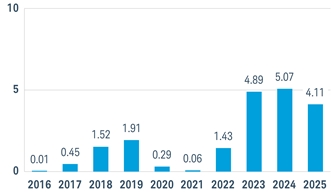
The
bar chart below shows how the fund’s investment results have varied from year to year, and the following
table shows the fund’s average annual total returns for various periods. This information provides
some indication of the risks of investing in the fund. All figures assume distributions were reinvested.
The figures do not reflect the fees and expenses of any insurance company separate account or variable
insurance contract issued by such insurance company. Such expenses, if included, would lower the figures
shown. The fund’s past performance is not necessarily an indication of how the fund will perform in
the future. Prior to April 14, 2016, the fund was named Schwab Money Market Portfolio, and the fund operated
under certain different investment policies. The fund’s historical performance may not represent its
current investment policies. Keep in mind that future performance may differ from past performance. For
current performance information, please see www.schwabassetmanagement.com/prospectus or call toll-free 1-877-824-5615 for the fund’s current seven-day yield.
| |
Annual
Total Returns (%) as of 12/31 |
| |
Best
Quarter: 1.30% Q4 2023 |
Worst
Quarter: 0.00% Q1 2021 |
| | | | | | | | | | | |
Average
Annual Total Returns as of 12/31/25 | | | | | | | |
| | | | | | | | | | |
| | 1 Year | | | 5 Years | | | 10
Years |
Schwab
Government Money
Market Portfolio | 4.11% | | | 3.09% | | | 1.96% | |
| | | | | | | | | | |
Charles
Schwab Investment Management, Inc., dba Schwab Asset Management®
Purchase and Sale of Fund Shares
Shares of the fund are sold on a continuous no load basis and are currently available
exclusively for variable annuity and variable life insurance separate accounts, and in the future may
be offered to
| | |
Schwab Government Money Market Portfolio | Summary Prospectus | 3 |
| |
tax-qualified retirement plans (tax qualified plans). Variable life insurance
and variable annuity contract (variable contract(s)) investors should review the variable contract prospectus
prepared by their insurance company for information on how to allocate premiums to the fund and to transfer
to, and redeem amounts from, the fund.
The fund is open for business each day that
the New York Stock Exchange (NYSE) is open except when the following federal holidays are observed: Columbus
Day and Veterans Day. If the NYSE is closed due to weather or other extenuating circumstances on a day
it would typically be open for business, or the NYSE has an unscheduled early closing on a day it has
opened for business, the fund reserves the right to treat such day as a business day and accept purchase
and redemption orders and calculate its share price as of the normally scheduled close of regular trading
on the NYSE for that day.
The
fund declares a dividend every business day, and pays a dividend to the participating insurance companies’
separate accounts every month, except that in December dividends are paid by the last business day of
the month. Distributions are normally reinvested pursuant to elections by the separate accounts. Since
the fund’s shareholders are insurance company separate accounts, the tax treatment of dividends and
distributions will depend on the tax status of the insurance company. Accordingly, no discussion is included
about the personal income tax consequences to variable contract holders. For this information, such persons
should consult the appropriate variable contract prospectus.
Payments to Financial Intermediaries
The fund is currently available solely as an underlying investment for variable
contracts issued by insurance companies. The fund and its related companies may make payments to insurance
companies (or their affiliates), and to broker-dealers and other financial intermediaries, for distribution
and/or other services. These payments may be a factor that the insurance company considers in including
the fund as an underlying investment option for its variable contracts. Payments to broker-dealers and
other financial intermediaries may create a conflict of interest by influencing the broker-dealer or
other financial intermediary to recommend a variable contract and the fund over another investment. Ask
your financial adviser or visit the website of the insurance company or the financial intermediary for
more information. The disclosure document for your variable contract may contain additional information
about these payments.
| | |
4 | Schwab
Government Money Market Portfolio | Summary Prospectus |
| |