PROSPECTUS
MAY 1, 2026

As filed with the Securities and Exchange Commission on April 28, 2026
Registration File Nos. 033-79124 and 811-08520
U. S. SECURITIES AND EXCHANGE COMMISSION
Washington, D.C. 20549
FORM N-3
| REGISTRATION STATEMENT UNDER THE SECURITIES ACT OF 1933 | [X] | |
| Pre-Effective Amendment No. | [ ] | |
| Post-Effective Amendment No. 35 | [X] | |
| REGISTRATION STATEMENT UNDER THE INVESTMENT COMPANY ACT OF 1940 | [X] | |
| Amendment No. 38 | [X] | |
| (Check Appropriate Box or Boxes) | ||
TIAA SEPARATE ACCOUNT VA-1
Teachers Insurance and Annuity Association of America
730 Third Avenue
New York, New York 10017-3206
(Address of Insurance Company’s Principal Executive Offices)
Insurance Company’s Telephone Number, Including Area Code: (212) 490-9000
| Name and Address of Agent for Service: | Copy to: | |
| Rachael M. Zufall, Esq. Teachers Insurance and Annuity Association of America 8500 Andrew Carnegie Blvd. Charlotte, North Carolina 28262 |
Adam T. Teufel, Esq. Dechert LLP 1900 K Street, NW Washington, DC 20006 |
Securities to be Registered: Interests in an open-end management investment company for individual and group flexible payment deferred variable annuity contracts
Approximate Date of Proposed Public Offering:
As soon as practicable after effectiveness of the Registration Statement.
It is proposed that this filing will become effective (check appropriate box):
| [ ] | Immediately upon filing pursuant to paragraph (b) |
| [X] | On May 1, 2026 pursuant to paragraph (b) |
| [ ] | 60 days after filing pursuant to paragraph (a)(1) |
| [ ] | On (date) pursuant to paragraph (a)(1) |
| [ ] | 75 days after filing pursuant to paragraph (a)(2) |
| [ ] | On (date) pursuant to paragraph (a)(2) of rule 485 |
If appropriate, check the following box:
[ ] This post-effective amendment designates a new effective date for a previously filed post-effective amendment.
PROSPECTUS MAY 1, 2026 |
|
Individual flexible-premium deferred variable annuities
funded through
TIAA Separate Account VA-1
of Teachers Insurance and Annuity Association of America
This prospectus (“Prospectus”) tells you about the Teachers Personal Annuity, an individual flexible-premium deferred variable annuity contract (the “Contract”) funded through TIAA Separate Account VA-1 of TIAA. Read it carefully before investing and keep it for future reference.
Important Note: TIAA has suspended all sales of its Teachers Personal Annuity Contracts until further notice. TIAA has not distributed new applications for the Contracts since May 22, 2003. Existing Contracts, or replacements for those Contracts, remain in effect and existing Contractowners can continue to contribute money to those Contracts.
The separate account is a segregated investment account of TIAA. The separate account provides individual variable annuities for employees of nonprofit institutions, including governmental institutions, organized in the United States. Its main purpose is to accumulate, invest and then disburse funds for lifetime income or through other payment options. The separate account currently has only one investment portfolio, the Stock Index Account (the “Stock Index Account”).
TIAA offers the separate account as part of the Contract, which also has a fixed account.
Additional information about certain investment products, including variable annuities, has been prepared by the Securities and Exchange Commission’s (“SEC”) staff and is available at Investor.gov.
The SEC has not approved or disapproved these securities or passed upon the accuracy or adequacy of this Prospectus. Any representation to the contrary is a criminal offense. The separate account is not insured or guaranteed by the U.S. Government, the Federal Deposit Insurance Corporation (“FDIC”) or any other governmental agency.
Table of contents
The terms and phrases below are defined so you will know how they are used in this Prospectus. To understand some definitions, you may have to refer to other defined terms.
Accumulation. The total value of your accumulation units under the Contract.
Accumulation Phase. The phase during which investment account accumulations are held under a Contract prior to their being annuitized or otherwise paid out.
Annuitant. The natural person whose life is used in determining the annuity payments to be received. You are the Annuitant under the Contract.
Annuity Partner. The person you name, if you choose to receive income under a two-life annuity, to receive an income for life if he or she survives you. In some Contracts, this person is referred to as the second annuitant.
Annuity Phase. The phase during which investment account accumulations are annuitized or otherwise paid out.
Beneficiary. Any person or institution you name, in a form satisfactory to us, to receive benefits if you die during the accumulation period or if you (and your Annuity Partner, if you have one) die before the end of any guaranteed period.
Business Day. Any day the New York Stock Exchange (“NYSE”) or its affiliated exchanges, NYSE Arca Equities or NYSE American (collectively with the NYSE, the “NYSE Exchanges”), are open for trading. A Business Day generally ends at 4:00 p.m. Eastern Time or when trading closes on the NYSE Exchanges, if earlier. A Business Day may end early only as of the latest closing time of the regular (or core) trading session of any of the NYSE Exchanges.
Calendar Day. Any day of the year. Calendar days end at the same time as a Business Day.
Commuted Value. The present value of annuity payments due under an income option or method of payment not based on life contingencies.
Contract. The fixed and variable components of the individual, flexible-premium deferred Teachers Personal Annuity described in this Prospectus.
Contractowner. The person (or persons) who controls all the rights and benefits under a Contract.
Eligible Institution. A nonprofit institution, including any governmental institution, organized in the United States.
Fixed Account. The component of the Contract guaranteeing principal plus a specified rate of interest supported by assets in the general account.
General Account. All of TIAA’s assets other than those allocated to the separate account or to any other TIAA separate account.
Good Order. Actual receipt of an order along with all information and supporting legal documentation necessary to effect the transaction. This information and documentation generally includes your complete application (or complete request for redemptions, transfers, withdrawals or payment of death or other
TIAA Separate Account VA-1 ■ Prospectus 3
benefits), and any other information or supporting documentation we may require. With respect to purchase requests, “good order” also generally includes receipt of sufficient funds by us to effect the transaction. We may, in our sole discretion, determine whether any particular transaction request is in good order and reserve the right to change or waive any good order requirement at any time either in general or with respect to a particular plan, Contract or transaction. In addition, it is also possible that if we are unable to reach you to obtain additional or missing information relating to incomplete applications, or transaction requests that are not in good order, the transaction may be cancelled.
Income Option. Any of the ways you can elect to receive your annuity income. It is also referred to as an “annuity option.”
Premium. Any amount you invest in the Contract.
Separate Account. TIAA Separate Account VA-1 (the “separate account”), which was established by TIAA under New York law to fund your variable annuity. The separate account holds its assets apart from TIAA’s other assets.
Stock Index Account. The sole investment portfolio of the separate account.
TIAA. Teachers Insurance and Annuity Association of America.
Valuation Day. Any Business Day.
You or Your. This means any Contractowner.
Important information you should consider about the Contract
Location in Prospectus | |||||||
FEES AND EXPENSES |
|||||||
Charges for Early Withdrawals |
· None |
Overview of the Contract | |||||
Transaction Charges |
· The Contract does not impose a transaction charge nor a transfer charge. |
Fee and expense tables of the Contract | |||||
Ongoing Fees and Expenses (annual charges) |
The table below describes the fees and expenses that you may pay each year, depending on the options you choose. Please refer to your Contract specifications page for information about the specific fees you will pay each year based on the options you have elected. |
Fee and expense tables of the Contract | |||||
Annual Fee |
Minimum |
Maximum |
|||||
Annual Contract Expenses (as a percentage of average annual net assets) |
0.660% |
0.660% |
|||||
Optional benefits available for an additional charge (for a single optional benefit, if elected) |
N/A |
N/A |
|||||
4 Prospectus ■ TIAA Separate Account VA-1
Location in Prospectus | |||||||
To help you understand the cost of owning your Contract, the following table shows the lowest and highest cost you could pay each year, based on current charges. This estimate assumes that you do not take withdrawals from the Contract, which could add charges for early withdrawals that substantially increase costs. |
|||||||
Lowest Annual Cost: |
Highest Annual Cost: |
||||||
Assumes: · Investment of $100,000 · 5% annual appreciation · Least expensive combination of separate account management fees · No optional benefits · No sales charges · No additional purchase payments, transfers or withdrawals |
Assumes: · Investment of $100,000 · 5% annual appreciation · Most expensive combination of separate account management fees · No optional benefits · No sales charges · No additional purchase payments, transfers or withdrawals |
||||||
RISKS |
|||||||
Risk of Loss |
· You can lose money by investing in your Contract, including loss of principal. |
Principal risks of investing in the Contract | |||||
Not a Short-Term Investment |
· The Contract is not designed for short-term investing and is not appropriate for an investor who needs ready access to cash. · The benefits of adding premiums over time to the value of your Contract and long-term income means the Contract is generally more beneficial to investors with a long-term horizon. |
Principal risks of investing in the Contract | |||||
Risks Associated with Investments |
· An investment in the Contract is subject to the risk of poor investment performance. Performance can vary depending on the performance of the Stock Index Account. · The Stock Index Account has its own unique risks. · You should review the Stock Index Account before making an investment decision. |
Principal risks of investing in the Contract | |||||
Insurance Company Risks |
· An investment in the Contract is subject to risks related to TIAA, and any obligations, guarantees or benefits of the Contract are subject to TIAA’s claims-paying ability. More information about TIAA, including its financial strength ratings, is available by visiting our website at www.tiaa.org/public. |
Principal risks of investing in the Contract | |||||
TIAA Separate Account VA-1 ■ Prospectus 5
Location in Prospectus | |||||
RESTRICTIONS |
|||||
Investments |
· We have adopted policies and procedures to discourage market timing and excessive transaction activity. · Transfers between the Stock Index Account and the fixed account must be for at least $250. · We reserve the right to add or close investment options, substitute another investment option without your consent, or combine investment options. A substituted investment option may have different fees and expenses. |
Who we are and other related information Market timing | |||
Optional Benefits |
· Certain optional benefits are subject to a minimum dollar amount. We reserve the right to cancel optional benefits at any time. · There are restrictions on the frequency of transactions within a certain period. |
Benefits available under the Contract | |||
TAXES |
|||||
Tax Implications |
· You should consult with a qualified tax professional to determine the tax implications of an investment in and purchase payments received under the Contract. · Withdrawals on your Contract will be subject to ordinary income tax and may be subject to a 10% premature distribution tax if taken before age 59½. · Generally, you are not taxed until you make a withdrawal from the Contract. · Premium taxes may apply with respect to the Contract. · If you purchased the Contract through a tax-qualified plan or individual retirement account (IRA), you do not get any additional tax benefit. |
Federal income taxes | |||
CONFLICTS OF INTEREST |
|||||
Financial Professional Compensation |
· No commissions are paid in connection with the distribution of the Contract because new Contracts are no longer offered or distributed. |
Overview of the Contract | |||
Exchanges |
· Some financial professionals may have a financial incentive to offer you a new contract in place of the one you already own. You should only exchange your Contract if you determine, after comparing the features, fees, and risks of both contracts, that it is preferable for you to purchase the new contract rather than continue to own the existing Contract. |
||||
Purpose of the Contract
The Contract is an individual flexible-premium (meaning that you can contribute varying amounts) deferred variable annuity that accepts only after-tax dollars from eligible purchasers. The value of your investments or accumulation units is used to calculate your benefits under the Contract. At the end of the accumulation phase,
6 Prospectus ■ TIAA Separate Account VA-1
we use that accumulation to calculate the payments that we make during the annuity phase. Generally speaking, a longer accumulation phase may result in a greater accumulated value for setting your annuity payouts and optional benefits. The Contract also includes a standard death benefit to help financially protect your designated beneficiary.
The Contract may be appropriate for you if you have a long investment time horizon. Any withdrawals made during the accumulation phase will reduce the accumulation of the Contract. In addition, the Contract is not intended for individuals who intend to engage in frequent transfers of the investment accounts.
Your financial goal in acquiring the Contract should be consistent with a long-term insurance product for long-term investment purposes offering the prospect of growth through the investment of premiums in the Stock Index Account.
Phases of the Contract
The Contract has two phases: (1) an accumulation phase (for savings) and (2) an annuity phase (for income).
Accumulation phase
During the accumulation phase, earnings accumulate on a tax-deferred basis and are taxed as income when you make a withdrawal. Premium payments made during the accumulation phase are flexible in terms of timing and amount but must be for a minimum amount of $100.
To accumulate value during the accumulation phase, you may allocate your premiums and earnings into the Stock Index Account or the fixed account. The Stock Index Account seeks a favorable long-term rate of return from a diversified portfolio selected to track the overall market for common stocks publicly traded in the United States, as represented by the Russell 3000®Index, a broad market index. The Stock Index Account implements certain investment strategies to obtain this objective and carries its own potential risks. Amounts that you allocate to the Stock Index Account will increase or decrease in dollar value depending on the investment performance of the Account.
You can allocate premiums to the fixed account or transfer from the separate account to the fixed account at any time. Premiums allocated and amounts transferred to the fixed account become part of the general account assets of TIAA, which support insurance and annuity obligations. Currently, TIAA guarantees that amounts in the fixed account will earn an interest rate that is at least as high as the minimum guaranteed rate allowed by the law in effect at the time your Contract is issued, in the state where your Contract is issued. At its discretion, TIAA can credit amounts in the fixed account with interest at a higher rate. Please call TIAA or consult your Contract for information on the applicable guaranteed rate under your Contract.
You bear the risk of any decline in the balance of your Contract resulting from the performance of the Stock Index Account. Your accumulation value could decline significantly, and there is a risk of loss of the entire amount invested.
TIAA Separate Account VA-1 ■ Prospectus 7
You should consider the investment objectives, risks, and charges and expenses of the Stock Index Account carefully before making an investment decision. Additional information about the Stock Index Account is provided in the Appendix at the end of this Prospectus.
Annuity phase
You enter the income phase when you annuitize your Contract. The annuity phase occurs after the annuity starting date and when you or a second annuitant begin receiving regular annuity payments from your Contract. During the annuity phase, you will receive a stream of fixed income payments for the annuity payout period of time you elect. Subject to the provisions under your Contract and your employer’s plan, you can elect any one of the following options to receive annuity payments: (1) one-life annuity with or without a guaranteed period; (2) annuity for a fixed period; and (3) two-life annuities. Please note that when you annuitize, your investments are converted to income payments and you will no longer be able to make any additional withdrawals from your Contract. During the annuity phase, your annuity units will continue to be allocated to either the Stock Index Account or the fixed account as chosen by you. All accumulation phase benefits terminate upon annuitization, including the standard death benefit.
Contract features
The Contract provides for the accumulation of retirement savings and income. The Contract offers income, death benefit protection and various payout options.
Accessing Your Money. Before your Contract is annuitized, you can take withdrawals from your Contract. Withdrawals may reduce your account value, will be subject to ordinary income tax and may be subject to a 10% premature distribution tax if you take a withdrawal before age 59½.
Tax Treatment. You can transfer money between the Stock Index Account and the fixed account without tax implications, and earnings (if any) on your investments are generally tax-deferred. You are taxed only upon: (1) making a withdrawal; (2) surrender of the Contract; (3) when you receive an income payment from the Contract; or (4) payment of a death benefit.
Death Benefit. The Contract includes a standard death benefit, which will pay a death benefit to your designated beneficiary at the time of your death.
Additional features
Systematic Withdrawals. Subject to the provisions under your Contract, you may have withdrawals redeemed from the Stock Index Account on a systematic basis. Systematic withdrawals are generally subject to a minimum amount of $100 and may be scheduled to be paid semi-monthly, monthly, quarterly, semi-annually or annually. Withdrawals may lower your Contract value, will be subject to ordinary income tax and may be subject to a 10% premature distribution tax if taken before age 59½.
8 Prospectus ■ TIAA Separate Account VA-1
Systematic Transfers. Subject to the provisions under your Contract, systematic transfers between the Stock Index Account and the fixed account are generally subject to a minimum amount of $100. Systematic transfers may be scheduled semi-monthly, monthly, quarterly, semi-annually or annually.
Fee and Expense Tables of the Contract
The following tables describe the fees and estimated expenses that you will pay when buying, owning, surrendering, or making withdrawals from the Contract. Please refer to your Contract specifications page for information about the specific fees you will pay each year based on the options you have elected.
The first table describes the fees and estimated expenses that you will pay at the time that you buy the Contract, surrender or make withdrawals from the Contract, or transfer Contract value between the Stock Index Account and the fixed account. State premium taxes may also be deducted.
TRANSACTION EXPENSES
Sales load imposed on purchases (as a percentage of premiums) |
none |
|||
Deferred sales load (or surrender charge) (as a percentage of premiums or amount surrendered, as applicable) |
none |
|||
Exchange fee or Redemption fee |
none |
The next table describes the fees and expenses of the Stock Index Account that you will pay each year during the time that you own the Contract.
ANNUAL CONTRACT EXPENSES
(as a percentage of average net assets)
|
|
Base contract expenses |
|
Management fees
|
2 |
Other |
|
Total other expenses |
|
Total annual expense deductions |
3 | |
|
|
|
|
|
|
|
|
|
|
|
|
|
Maximum expense1 |
|
1.000 |
% |
- |
|
- |
|
- |
|
- |
| |
Current expense |
|
0.400 |
% |
0.060 |
% |
0.200 |
% |
0.200 |
% |
0.660 |
% | |
|
|
|
|
|
|
|
|
|
|
|
|
|
|
|
|
|
|
|
|
|
|
|
|
|
|
1 |
TIAA reserves the right to increase the mortality and expense risk charge to a maximum of 1.00% of average daily net assets per year. |
2 |
Advisors has contractually agreed to waive the portion of its annual investment advisory fee charge that exceeds 0.060% of average daily net assets. This fee waiver arrangement will continue through at least April 30, 2027, unless earlier terminated by written agreement of Advisors and the separate account. |
3 |
If the full amount of the administrative expense, investment advisory and mortality and expense risk charges were imposed, total annual expenses would be 1.500% of average daily net assets. TIAA guarantees that total annual expenses will never exceed this level. |
TIAA Separate Account VA-1 ■ Prospectus 9
Example
This Example is intended to help you compare the cost of investing in the Contract with the cost of investing in other variable annuity contracts. These costs include transaction expenses, annual Contract expenses, and Stock Index Account operating expenses.
The Example assumes that you invest $100,000 in the Contract for the time periods indicated and surrender your Contract at the end of each of these time periods. The Example also assumes that your investment has a 5% return each year. There are no additional charges for optional benefits under the Contract. Although your actual costs may be higher or lower, based on these assumptions, your costs would be:
|
|
1 year |
|
3 years |
|
5 years |
|
10 years |
|
|
|
|
|
|
|
|
|
|
|
|
Stock Index Account |
$674 |
|
$2,112 |
|
$3,677 |
|
$8,225 |
|
|
|
|
|
|
|
|
|
|
|
Portfolio turnover
The Stock Index Account pays transaction costs, such as commissions, when it buys and sells securities (or “turns over” its portfolio). A higher portfolio turnover rate may indicate higher transaction costs. These costs, which are not reflected in annual Contract expenses or in the Example, affect the Stock Index Account’s performance. During the most recent fiscal year, the Stock Index Account’s portfolio turnover rate was 2% of the average value of its portfolio.
Principal risks of investing in the Contract
Investing in the Contract involves risks. The following are the principal risks of an investment in the Contract. You should carefully consider the below risks in addition to the other information contained in this Prospectus. Additional risks and details regarding various risks and benefits of investing in the Contract are described in other sections of the Prospectus and in the Statement of Additional Information (“SAI”). These include more specific risks that the Stock Index Account may be subject to, which are detailed in the Appendix. The Contract may be subject to additional risks other than those identified and described in the Prospectus and SAI.
Risk of loss. The Contract is subject to market risk (the risk that your investments may decline in value or underperform your expectations). As a result, you can lose money by investing in the Contract, including loss of principal. An investment in the Contract is not a bank deposit and is not guaranteed by the U.S. Government, the FDIC, or any other governmental agency.
Not a short-term investment. The Contract is not appropriate for an investor who needs ready access to cash. The Contract serves primarily as a savings vehicle and is intended for long-term investment purposes. The investment portfolio available under the Contract follow this long-term objective. If you require immediate or near-term access to funds, carefully consider whether the
10 Prospectus ■ TIAA Separate Account VA-1
Contract aligns with your financial needs. The Contract is not suitable as a short-term savings vehicle.
Early withdrawals may result in ordinary income tax liability and 10% premature distribution tax for withdrawals prior to age 59½.
Investment risk. As with all variable annuities, an investment in the Contract is subject to the risk of poor investment performance of the Stock Index Account. You bear the risk of any decline in the account balance of your Contract resulting from the performance of the Stock Index Account. Your account value could decline significantly, and there is a risk of loss of the entire amount invested. You should review the Stock Index Account carefully before making an investment decision.
The Stock Index Account will have its own unique risks. We do not guarantee the investment performance of the Stock Index Account, and you bear the entire investment risk. Additional information regarding the Stock Index Account is provided below in this Prospectus under “Appendix: Additional information about the Stock Index Account.”
Risks associated with TIAA. An investment in the Contract is subject to risks related to TIAA, and any obligations, guarantees or benefits of the Contract are subject to TIAA’s overall financial strength and claims-paying ability. It is important to note there is no guarantee we will always be able to meet our claims-paying obligations, and there are risks to purchasing any variable annuity. The “mortality risk” of the Stock Index Account is shared among those who receive income from it and is not guaranteed by TIAA. Information about TIAA, including its financial strength ratings, is available upon request by visiting TIAA’s website at www.tiaa.org/public.
Possible adverse tax consequences. Failure to comply with tax and other legal requirements regarding premium contributions, withdrawals, distributions, and other Contract-related transactions may result in adverse tax consequences.
Due to the complexity and individual nature of tax implications, which can vary based on personal circumstances and state of residence, we cannot provide tax guidance. Furthermore, tax regulations are subject to change without notice, and such changes could affect your Contract. We cannot anticipate future legislative proposals or enactments.
We strongly recommend consulting with a qualified tax professional before making contributions to your Contract, executing any Contract-related transactions, or making decisions regarding payment distributions.
Business continuity risks. Our ability to administer your Contract could be adversely affected by natural and man-made disasters such as storms, fires, earthquakes, public health crises, disease outbreaks, and terrorist acts. In the event of a natural or man-made disaster, a significant portion of our workforce or certain key personnel may become unable to fulfill their duties. System outages could compromise our operational effectiveness and impair our capacity to process Contract transactions or calculate Contract values. Our operations rely significantly on the outsourcing of critical business functions to third parties and
TIAA Separate Account VA-1 ■ Prospectus 11
rely upon their successful implementation and execution of their business continuity planning. While we monitor the business continuity planning of such entities, we cannot directly control the successful implementation and execution of their continuity strategies. Should one or more of these third-party service providers experience operational failures, our ability to administer your Contract could be substantially impaired.
Cybersecurity risks. With the increased use of technologies such as the internet to conduct business, we, any third-party administrator, the separate account, intermediaries and other affiliated or third-party service providers are susceptible to operational, information security and related risks through breaches in cybersecurity. In general, cybersecurity attacks can result from infection by computer viruses or other malicious software or from deliberate actions or unintentional events, including gaining unauthorized access through “hacking” or other means to digital systems, networks, or devices used to service our operations in order to misappropriate assets or sensitive information, corrupt data, or cause operational disruption. Cybersecurity attacks can also be carried out in a manner that does not require gaining unauthorized access, including by carrying out a “denial-of-service” attack on our or our service providers’ websites. In addition, authorized persons could inadvertently or intentionally release and possibly destroy confidential or proprietary information stored on our systems or the systems of our service providers.
Cybersecurity failures by us or any of our service providers, the separate account, or the issuers of securities in which the separate account invests, may result in disruptions to and impact business operations, and may adversely affect us and the value of your accumulation units. Such disruptions or impacts may result in: financial losses; interference with our processing of Contract transactions, including the processing of orders from our website; interference with our ability to calculate unit values; barriers to trading and order processing; your inability to transact business with us; violations of applicable federal and state privacy or other laws; regulatory fines; penalties; reputational damage; reimbursement or other compensation costs; or additional compliance costs. We may incur additional, incremental costs to prevent and mitigate the risks of cybersecurity attacks or incidents in the future. We and Contractowners could be negatively impacted by such cyberattacks or incidents. Although we have established business continuity plans and risk-based processes and controls to address such cybersecurity risks, there are inherent limitations in such plans and systems in part due to the evolving nature of technology and cybersecurity attack tactics. As a result, it is possible that we or our service providers will not be able to adequately identify or prepare for all cybersecurity attacks. In addition, we cannot directly control the cybersecurity plans or systems implemented by our service providers.
12 Prospectus ■ TIAA Separate Account VA-1
Who we are and other related information
TIAA is a stock life insurance company, organized under the laws of New York. It was founded on March 4, 1918, by the Carnegie Foundation for the Advancement of Teaching. All of the stock of TIAA is held by the TIAA Board of Governors, a nonprofit New York membership corporation whose main purpose is to hold TIAA’s stock. TIAA’s headquarters is located at 730 Third Avenue, New York, NY 10017-3206. TIAA’s general account offers traditional annuities, which guarantee principal and a specified interest rate while providing the opportunity for additional dividends.
TIAA is the companion organization of the College Retirement Equities Fund (“CREF”), the first company in the United States to issue a variable annuity. CREF is a nonprofit membership corporation established in New York in 1952. Together, TIAA and CREF form the principal retirement system for the nation’s education and research communities and one of the largest retirement systems in the world, based on assets under management. As of December 31, 2025, TIAA’s statutory admitted assets were approximately $380 billion and the combined net assets for TIAA, CREF and other entities within the TIAA organization totaled approximately $1.506 trillion (although CREF does not stand behind TIAA’s guarantees). TIAA serves as the separate account’s administrator and is the parent company of Teachers Advisors, LLC (“Advisors”), the separate account’s investment adviser.
The separate account was established on February 16, 1994, as a separate investment account of TIAA under New York law, by resolution of TIAA’s Board of Trustees. The separate account is governed by a Management Committee (the “Management Committee”). As an “open-end” diversified management investment company, the separate account has no limit on how many units of participation it can issue. The separate account is registered with the SEC under the Investment Company Act of 1940, as amended (the “1940 Act”). As part of TIAA, the separate account is also subject to regulation by the New York State Department of Financial Services (“NYDFS”) and the insurance departments of other jurisdictions in which the Contracts are offered (see the SAI).
The separate account offers one investment account: the Stock Index Account.
TIAA owns the assets of the Stock Index Account and the obligations under the Contract are obligations of TIAA. The Contract states, however, that the Stock Index Account’s income, investment gains, and investment losses are credited to
TIAA Separate Account VA-1 ■ Prospectus 13
or charged against the assets of that Account without regard to TIAA or its other separate accounts or products, other income, gains, or losses. Under New York law, we cannot charge the Stock Index Account with liabilities incurred by TIAA, any of its other separate accounts, its products or affiliates other than those arising from the Contract.
When the Contract is purchased through qualified plans, earnings on accumulation in the Stock Index Account are not taxed until withdrawn or paid as annuity income (see “Federal income taxes” below).
You may allocate premiums between the Stock Index Account and the fixed account.
The separate account reserves the right to change the Stock Index Account or other investment options available in the future, including adding or removing investment options, or materially changing their investment characteristics.
As with all variable annuities, your accumulation will increase or decrease depending on the investment performance over time of the Stock Index Account. We do not guarantee the investment performance of the Stock Index Account, and you bear the entire investment risk.
The information regarding the Stock Index Account, including (i) its name; (ii) a statement concerning its investment objectives and strategies; (iii) its investment adviser; (iv) current expenses; and (v) performance is provided below in this Prospectus under “Appendix: Additional information about the Stock Index Account.” Expense information regarding the Stock Index Account is located above in the section entitled “Fee and Expense Tables of the Contract.”
A description of the separate account’s policies and procedures with respect to the disclosure of the Stock Index Account’s portfolio securities is available in the separate account’s SAI.
You will have one vote per dollar of your assets in the Stock Index Account’s accumulation fund. The separate account is the legal owner of the assets in the Stock Index Account in your Contract. It, therefore, has the right to vote its shares at any meeting of Contractowners. When Contractowner meetings are held, we will give you the right to instruct us how to vote the assets attributable to your Contract.
14 Prospectus ■ TIAA Separate Account VA-1
Management of the Stock Index Account
The account’s investment adviser
Advisors manages the assets of the Stock Index Account under the supervision of the separate account’s Management Committee. Advisors is a wholly controlled subsidiary of TIAA and is registered as an investment adviser with the SEC under the Investment Advisers Act of 1940. Advisors shares investment personnel with other affiliates of TIAA, including TIAA-CREF Investment Management, LLC (“TCIM”). As of December 31, 2025, Advisors and TCIM together had approximately $727.4 billion of assets under management. Advisors is located at 730 Third Avenue, New York, NY 10017-3206.
Under its investment management services agreement with the separate account, Advisors’ duties include managing the assets of the Stock Index Account, conducting research, recommending investments and placing orders to buy and sell securities, subject to the supervision of the Management Committee. Advisors also arranges for the provision by State Street Bank and Trust Company of portfolio accounting, custodial and related services for the Stock Index Account. Advisors supervises and acts as liaison among various other service providers to the Stock Index Account.
On or about the close of business on July 31, 2026, Advisors is expected to merge into Nuveen Asset Management, LLC (“Nuveen Asset Management”). In connection with this merger and subject to all required approvals, on or about the day after the merger it is expected that Nuveen Fund Advisors, LLC (“Nuveen Fund Advisors”) will become the investment adviser and Nuveen Asset Management will become the sub-adviser to the Stock Index Account. Advisors, Nuveen Fund Advisors and Nuveen Asset Management are each wholly owned subsidiaries of Nuveen, LLC and, ultimately, TIAA. There are no anticipated changes to the Stock Index Account’s portfolio management team, investment objective, principal investment strategies, principal risks, or fees and expenses related to the merger. On or about the day after the merger, this Prospectus and the SAI will be updated to reflect the new advisory arrangements.
During the fiscal year ended December 31, 2025, the Stock Index Account paid Advisors an investment management fee of 0.09% of the Stock Index Account’s average net assets.
A discussion regarding the basis for the Management Committee’s approval of the Stock Index Account’s investment management agreement is available in the separate account’s most recent semi-annual report to Contractowners for the six-month period ended June 30. For a free copy of the separate account’s Contractowner reports, please visit the separate account’s website at www.tiaa.org, visit the SEC’s website at www.sec.gov or call 877-518-9161.
TIAA Separate Account VA-1 ■ Prospectus 15
The Stock Index Account is managed by a team of managers, whose members are responsible for the day-to-day management of the Account, with expertise in the area(s) applicable to the Account’s investments. Certain team members are, for example, principally responsible for selecting appropriate investments for the Stock Index Account and others are principally responsible for asset allocation. The following is a list of members of the management team primarily responsible for managing the Stock Index Account’s investments, along with their relevant experience. The members of the team may change from time to time.
Name & Title |
Portfolio Role |
Experience
Over |
Total
Experience | ||
At
|
|
On
| |||
Philip James (Jim) |
Portfolio Manager |
Advisors, TCIM and other advisory affiliates of TIAA—2005 to Present (portfolio management of domestic and international large-, mid- and small-cap equity index and environmental, social and governance (“ESG”) portfolios) |
2005 |
1991 |
2005 |
Darren Tran,
CFA |
Portfolio Manager |
Advisors, TCIM and other advisory affiliates of TIAA—2005 to Present (portfolio management of domestic and international large-, mid- and small-cap equity index and ESG portfolios) |
2005 |
2000 |
2019 |
Nazar Romanyak,
CFA |
Portfolio Manager |
Advisors, TCIM and other advisory affiliates of TIAA—2013 to Present (portfolio management of domestic and international large-, mid- and small-cap equity index and ESG portfolios) |
2013 |
2012 |
2024 |
The separate account’s SAI provides additional disclosure about the compensation structure of the Stock Index Account’s portfolio managers, the other accounts they manage, total assets in those accounts and potential conflicts of interest, as well as the portfolio managers’ ownership of accumulation units in the Stock Index Account.
The principal underwriter and distributor of the Contract is TIAA-CREF Individual & Institutional Services, LLC (“Services”), a wholly controlled subsidiary of TIAA. Services is registered with the SEC as a broker-dealer and is a member of the Financial Industry Regulatory Authority (“FINRA”). Its address is 730 Third Avenue, New York, NY 10017-3206. No commissions are paid to dealers as a percentage of purchase payments. Underwriting commissions are not paid to Services for distribution of the Contracts.
16 Prospectus ■ TIAA Separate Account VA-1
TIAA, which serves as administrator to the separate account, is located at 730 Third Avenue, New York, NY 10017-3206. Administrative expenses, which are charged to cover expenses of the administration and operations of the separate account and the Contract, include expenses associated with recordkeeping, premium allocation, tax and financial reporting, accounting, legal and compliance, facilities, and other Contractowner-related services.
About the Stock Index Account’s expenses
The Stock Index Account deducts expenses from the net assets of the Stock Index Account each Valuation Day for, among other services and expenses, investment management and administration services. Please see the section above entitled “Fee and Expense Tables of the Contract” for the amounts of these estimated Stock Index Account-level expenses. TIAA reserves the right to increase the overall maximum expense charge (excluding acquired fund fees and expenses, if any) to a maximum of 1.50% of average daily net assets per year.
Investment Advisory Charge. This charge is paid to Advisors for investment advice, portfolio accounting, custodial and similar services provided for the separate account by Advisors. The investment management agreement between Advisors and the separate account sets the investment advisory fee at an annual rate of 0.30% of average daily net assets. However, Advisors has contractually agreed to waive 0.24% of its fee, so that the actual investment advisory fee charged is equivalent to an annual rate of 0.06% of the average daily net assets. This contractual waiver will continue through at least April 30, 2027 and may thereafter be discontinued at any time without notice. These expenses are included in the category labeled “Management fees” in the expense table above.
Administrative Expense Charge. This charge is paid to TIAA for administration and operations services provided to the separate account by TIAA, such as allocating premiums and administering accumulations. The current deduction is equivalent to an annual rate of 0.20% of average daily net assets. These expenses are included in the category labeled “Other expenses: Administrative expenses” in the expense table above.
The separate account’s expenses also include the costs of its Manager compensation, audit and legal services, and certain other services provided by third parties, all of which are included in one or more of the expense groups noted above and which are borne by either Advisors or TIAA through their respective agreements with the separate account.
Mortality and Expense Risk Charge. TIAA imposes a daily charge as compensation for bearing certain mortality and expense risks in connection with the Contract. The current deduction is equal to an annual rate of 0.40% of average daily net assets. Accumulations and annuity payments are not affected by changes in actual mortality experience or by TIAA’s actual expenses.
TIAA Separate Account VA-1 ■ Prospectus 17
TIAA’s mortality risks come from its contractual obligations to make annuity payments and to pay death benefits before the annuity starting date. This assures that neither your own longevity nor any collective increase in life expectancy will lower the amount of your annuity payments. TIAA also bears a risk in connection with its death benefit guarantee, since a death benefit may exceed the actual amount of an accumulation at the time when it is payable.
TIAA’s expense risk is the possibility that TIAA’s actual expenses for administering the Contract and the separate account will exceed the amount recovered through the administrative expense charge.
If the mortality and expense risk charge is not enough to cover TIAA’s actual costs, TIAA will absorb the deficit. On the other hand, if the charge more than covers costs, the excess will belong to TIAA. TIAA can use the excess to offset any losses incurred through the administrative expense charge. TIAA will pay a fee from its general account assets, which may include amounts derived from the mortality and expense risk charge, to Services, the principal underwriter of the variable component of the Contract, for distribution of the variable component of the Contract. This expense is included in the category labeled “Base Contract expenses” in the expense table above.
No Deductions from Premiums. The Contract does not impose any front-end charges, sales loads or redemption fees.
Premium Taxes. Some states may assess premium taxes. We will deduct the total amount of premium taxes, if any, from your accumulation based on current state insurance laws, subject to the provisions of your Contract, and our status in the state. Charges for premium taxes on a particular Contract ordinarily will be deducted from the accumulation value when amounts are applied to provide annuity payments. However, if a jurisdiction imposes premium taxes at other times, such as when premiums are paid or when cash withdrawals are taken, TIAA will deduct premium taxes at those times. Current state premium taxes range from 0.00% to 3.50% of non-qualified annuity considerations.
Other than the Stock Index Account-level expenses detailed in the section entitled “Fee and Expense Tables of the Contract” above, no other fees and expenses are charged by the separate account, including no sales loads, charges for optional benefits or administrative fees. No commissions are paid on separate account transactions. All Stock Index Account expenses are paid out of the assets of the Account. Depending upon your state of residence and personal circumstances, various tax consequences may apply to you. Please consult your personal tax advisor for more information on your personal tax circumstances.
The Contract is an individual flexible-premium (meaning that you can contribute varying amounts) deferred variable annuity that accepts only after-tax
18 Prospectus ■ TIAA Separate Account VA-1
dollars from eligible purchasers. The rights and benefits under the variable component of the Contract are summarized below; however, the descriptions you read here are qualified entirely by the Contract itself. The Contracts are approved for sale in all 50 states and the District of Columbia. Until further notice the Contracts are not being currently offered; however, TIAA does accept additional premiums for existing Contracts (or Contract replacements). TIAA does not offer Contracts in states where TIAA’s affiliate, TIAA-CREF Life Insurance Company, offers an individual deferred variable annuity contract.
Eligible purchasers of the Contract
In the event sales of Contracts resume, an employee, trustee or a retiree of an eligible institution could also purchase a Contract. For this purpose, an individual who is at least 55 years old and has completed at least five years of service at an eligible institution is considered to be a “retiree.” A spouse (or surviving spouse) of an employee, trustee or retiree of an eligible institution can also purchase a Contract. Any individual who owns a TIAA or CREF annuity contract, certificate or individual insurance policy, as well as the spouse or surviving spouse of such a person, can also purchase a Contract.
As with all variable annuities, your accumulation will increase or decrease depending on the investment performance over time of the Stock Index Account. We do not guarantee the investment performance of the Stock Index Account, and you bear the entire investment risk.
Contracts Can Differ Pursuant to State Laws. Contract terms and features may differ due to state laws and regulations. These differences may include, among other things, availability of certain income options, how frequently you can transfer into or out of the Stock Index Account, or our ability to restrict transfers into or out of the Stock Index Account. You should review your Contract along with this Prospectus to understand the product features and charges under your Contract.
Changes to the Contract. The separate account currently consists of a single investment portfolio, the Stock Index Account, but TIAA can add new investment portfolios in the future. TIAA does not guarantee that the Stock Index Account, or any investment portfolio added in the future, will always be available. TIAA reserves the right, subject to any applicable law, to change the separate account and its investments. TIAA can add or close portfolios, substitute one portfolio for another with the same or different fees and charges or combine portfolios, subject to the requirements of applicable law. TIAA can also make any changes to the separate account or to the Contract required by applicable insurance law, the Internal Revenue Code of 1986 (the “IRC”) or the 1940 Act. TIAA can make some changes at its discretion, subject to NYDFS and SEC approval, as required. The separate account can (i) operate under the 1940 Act as a unit investment trust that invests in another investment company or in any other form permitted by law; (ii) deregister under the 1940 Act if registration is no longer required; or (iii) combine with other separate accounts. As permitted by law, TIAA can transfer
TIAA Separate Account VA-1 ■ Prospectus 19
the separate account assets to another separate account or accounts of TIAA or another insurance company or transfer a particular Contract to another insurance company.
Important information about procedures for purchasing a new Contract
Note: TIAA has suspended all sales of its Teachers Personal Annuity Contracts until further notice. TIAA has not distributed new applications for the Contracts since May 22, 2003. Existing Contracts, or replacements for those Contracts, remain in effect and existing Contractowners can continue to contribute money to those Contracts.
To help the U.S. Government fight the funding of terrorism and money laundering activities, federal law requires all financial institutions, including TIAA, to obtain, verify and record information that identifies each person who purchases a Contract.
What this means for you: When you purchase a Contract, TIAA will ask for your name, physical address (a P.O. Box alone is insufficient), date of birth, Social Security number and other information that will allow TIAA to identify you, such as your primary telephone number. Until you provide TIAA with the information it needs, it may not be able to provide you with a Contract or effect any transactions for you.
Additional Premiums. Subsequent premiums must be for at least $100. Send a check payable to TIAA, along with a personalized payment coupon (supplied upon purchasing a Contract) to:
TIAA
P.O. Box 933866
Atlanta, GA 31139-3866
If you do not have a coupon, use a separate piece of paper to provide your name, address and Contract number. These premiums will be credited as of the Business Day TIAA receives them. Currently, TIAA will accept premiums at any time both the Contractowner and the annuitant are living and your Contract is in the accumulation period. However, TIAA reserves the right not to accept premiums under this Contract after you have been given three months’ notice. If TIAA stops accepting premiums under your Contract, it will accept premiums under a new replacement Contract issued to you with the same annuitant, annuity starting date, beneficiary and methods of benefit payment as those under your Contract at the time of replacement.
Electronic Payment. You may make initial or subsequent investments by electronic payment, such as federal wires or ACH payments. A federal wire is usually received the same day and an ACH payment is usually received by the second day after transmission. Be aware that your bank may charge you a fee to wire funds, although an ACH payment is usually less expensive than a federal wire. Here is what you need to do:
1. If you are sending in an initial premium, send TIAA your application;
20 Prospectus ■ TIAA Separate Account VA-1
2. Instruct your bank to wire money or send an ACH payment to:
Wells Fargo
ABA Number 121000248
San Francisco, CA
Account of: TIAA-CREF Life Insurance Company
Account Number: 2000035305820
3. Specify on the wire or payment:
· Your name, address and Social Security number(s) or Taxpayer Identification Number
· Indicate if this is for a new application or existing Contract (provide Contract number if existing)
Certain Restrictions. Except as described below, the Contract does not restrict how large your premiums are or how often you send them, although TIAA reserves the right to impose restrictions in the future. Your total premiums and transfers to the separate account during the “free look” period cannot exceed $10,000 if you live in a state which requires TIAA to refund all payments upon the cancellation of your Contract during the free look period.
Contributions to the fixed account are limited to $300,000 on a rolling twelve-month basis. New contributions and/or transfers from the Stock Index Account count toward this limit.
TIAA reserves the right to reject any premium payment or to place dollar limitations on the amount of a premium. If mandated under applicable law, including federal laws designed to counter terrorism and prevent money laundering, TIAA may be required to reject a premium payment. TIAA may also be required to block a Contractowner’s account and refuse to pay any request for transfers, withdrawals, surrenders or death benefits, until instructions are received from the appropriate regulator. TIAA may also be required to provide additional information about you and your Contract to government regulators.
Federal law requires TIAA to obtain, verify and record information that identifies each person who purchases a Contract. Until TIAA receives the information it needs, TIAA may not be able to effect transactions for you. Furthermore, if TIAA is unable to verify your identity, or that of another person authorized to act on your behalf, or if TIAA believes that it has identified potentially criminal activity or false information, TIAA reserves the right to take such action as it deems appropriate, which may include terminating your Contract.
TIAA will not be deemed to have received any premiums sent to the lockbox addresses TIAA has designated in this Prospectus for remitting premiums until the lockbox provider has processed the payment on TIAA’s behalf.
Premiums paid to the separate account purchase accumulation units. When you remit premiums or transfer amounts into the separate account, the number of your units will increase; when you transfer amounts from the separate account
TIAA Separate Account VA-1 ■ Prospectus 21
(including applying funds to the fixed account to begin annuity income) or take a cash withdrawal, the number of your accumulation units will decrease. TIAA calculates how many accumulation units to credit you by dividing the amount allocated to the separate account by its unit value for the Business Day when TIAA received your premium. TIAA may use a later Business Day for your initial premium. To determine how many accumulation units to subtract for transfers and cash withdrawals, TIAA uses the unit value for the Business Day when it receives your completed transaction request, in good order, and all required information and documents. (You can choose to have your transaction completed at a later date; if you do, TIAA will use that later date as the Valuation Day.) For amounts to be applied to begin annuity income, the unit value will be the one for the last Valuation Day of the month when TIAA receives, in good order, all required information and documentation (see “The annuity period” below). For amounts to be applied to begin death benefits, the unit value will be the one for the Valuation Day when TIAA receives proof of death (see “Death benefit” below).
The value of the accumulation units will depend mainly on investment performance, though the unit value reflects expense deductions from assets (see “About the Stock Index Account’s expenses” above). The unit value is calculated at the close of each Valuation Day as A divided by B, where A and B are defined as: A equals the value of the Stock Index Account’s accumulation fund as of the end of the Valuation Day. B is the total number of accumulation units held by all participants in the Stock Index Account as of the end of the Valuation Day. The value of the Stock Index Account’s accumulation fund and the total number of accumulation units does not include the impact of funds or units added or subtracted as a result of transactions effective as of that Valuation Day.
Advisors calculates the value of the assets in the separate account as of the close of every Valuation Day. We generally use market quotations or values obtained from independent pricing services to value securities and other instruments held by the separate account. If market quotations are not readily available or are not considered reliable, we will value the securities using “fair value,” in accordance with procedures adopted by Advisors and approved by the Management Committee. We may also use “fair value” if events that have an effect on the value of an investment (as determined in Advisors’ discretion) occur between the time when its price is determined and the time the separate account’s accumulation unit value (“AUV”) is calculated. For example, we might use a domestic security’s fair value when the exchange on which the security is principally traded closes early or when trading in the security is halted and does not resume before the separate account’s AUV is calculated. The use of fair value pricing can involve reliance on quantitative models or individual judgment, and may result in changes to the prices of portfolio securities that are used to calculate the separate account’s AUV. Although we fair value portfolio securities
22 Prospectus ■ TIAA Separate Account VA-1
on a security-by-security basis, foreign portfolio securities may be fair valued more frequently than other securities.
Fair value pricing most commonly occurs with securities that are primarily traded outside of the United States. Fair value pricing may occur, for instance, when there are market movements in the United States after foreign markets have closed, and there is the expectation that securities traded on foreign markets will adjust based on market movements in the United States when their markets open the next day. In these cases, we may fair value certain foreign securities when it is believed the last traded price on the foreign market does not reflect the value of that security at the end of any Valuation Day (generally 4:00 p.m. Eastern Time). This may have the effect of decreasing the ability of market timers to engage in “stale price arbitrage,” which takes advantage of the perceived difference in price from a foreign market closing price.
While using a fair value price for foreign securities is intended to decrease the ability of market timers to make money by exchanging into or out of the separate account to the detriment of longer-term investors, it may reduce some of the certainty in pricing obtained by using actual market close prices.
Our fair value pricing procedures provide, among other things, for Advisors to examine whether to fair value foreign securities when there is a movement in the value of a U.S. market index between the close of one or more foreign markets and the close of the NYSE Exchanges. For these securities, the separate account uses a fair value pricing service approved by Advisors, as the valuation designee. This pricing service employs quantitative models to value foreign equity securities in order to adjust for stale pricing, which may occur between the close of certain foreign exchanges and the close of the NYSE Exchanges. Fair value pricing is subjective in nature and the use of fair value pricing by the separate account may cause the AUV of the separate account’s units to differ significantly from the AUV that would have been calculated using market prices at the close of the foreign exchange on which a portfolio security is primarily traded. Advisors also examines the prices of individual securities to determine, among other things, whether the price of such securities reflects fair value at the close of the NYSE Exchanges based on market movements. Additionally, we may fair value any security when it is believed the last market quotation is not readily available or such quotation does not represent the fair value of that security.
Fixed-income securities, including money market instruments, are valued using market quotations, independent pricing sources or values derived from a pricing matrix that has various types of the applicable fixed-income instrument along one axis and various maturities along the other. The use of a price derived from a pricing matrix is a method of fair value pricing.
The Management Committee has designated Advisors as the valuation designee pursuant to Rule 2a-5 under the 1940 Act and delegated to Advisors the responsibility of making fair value determinations.
TIAA Separate Account VA-1 ■ Prospectus 23
Premiums allocated and amounts transferred to the fixed account become part of the general account assets of TIAA, which support insurance and annuity obligations. The general account includes all the assets of TIAA, except those in the separate account or in any other TIAA separate investment account. Interests in the fixed account have not been registered under the Securities Act of 1933, as amended (the “1933 Act”), nor is the fixed account registered as an investment company under the 1940 Act. Neither the fixed account nor any interests therein are generally subject to the 1933 Act or 1940 Act. The SEC staff has informed TIAA that they do not review the information in this Prospectus about the fixed account.
You can allocate premiums to the fixed account or transfer from the separate account to the fixed account at any time. In contrast, you can transfer or take a cash withdrawal from the fixed account only once every 180 days. TIAA may defer payment of a transfer or cash withdrawal from the fixed account for up to six months.
Currently, TIAA guarantees that amounts in the fixed account will earn an interest rate that is at least as high as the minimum guaranteed rate allowed by the law in effect at the time your Contract is issued, in the state where your Contract is issued. At its discretion, TIAA can credit amounts in the fixed account with interest at a higher rate. Please call TIAA or consult your Contract for information on the applicable guaranteed rate under your Contract.
This Prospectus provides information mainly about the Contract’s variable component, which is funded by the separate account. For more about the fixed account, see the Contract itself.
Transfers between the separate account and the fixed account
Subject to the conditions above, you can transfer some (at least $250 at a time, except for systematic transfers, which must be at least $100) or all of the amount accumulated under your Contract between the separate account and the fixed account. Currently, TIAA does not charge you for transfers from the separate account to the fixed account. TIAA does not currently limit the number of transfers from the separate account, but TIAA reserves the right to do so in the future to once every 90 days with three months’ notice. You can transfer from the fixed account to the separate account or take a withdrawal from the fixed account no more than once every 180 days. Transfers to the fixed account begin participating on the day following effectiveness of the transfer (see below).
You can withdraw some or all of your accumulation in the separate account as cash. Cash withdrawals must generally be for at least $1,000 (except for
24 Prospectus ■ TIAA Separate Account VA-1
systematic withdrawals, which must be at least $100) or your entire accumulation, if less. TIAA reserves the right to cancel any Contract where no premiums have been paid to either the separate account or the fixed account for three years and your total amount in the separate account and the fixed account falls below $2,000. Currently, there is no charge for cash withdrawals.
If you withdraw your entire accumulation in the separate account and the fixed account, TIAA will cancel your Contract and all of TIAA’s obligations to you under the Contract will end.
General consideration for all transfers and cash withdrawals
You can tell TIAA how much you want to transfer or withdraw in dollars, accumulation units or as a percentage of your accumulation.
Transfers and cash withdrawals are effective at the end of the Business Day TIAA receives your request and any required information and documentation. Transfers and cash withdrawals made at any time other than during a Business Day will be effective at the close of the next Business Day. You can also defer the effective date of a transfer or cash withdrawal to a future Business Day acceptable to TIAA.
To request a transfer, use the TIAA Web Center’s account access feature over the Internet at www.tiaa.org, write to TIAA’s home office or call TIAA’s Automated Telephone Service at 800-842-2252 (there is an option to speak with a live person, if you wish). If you make a telephone or Internet transfer at any time other than during a Business Day, it will be effective at the close of the next Business Day. TIAA can suspend or terminate your ability to transfer by telephone or over the Internet at any time for any reason.
The separate account typically will pay transfer or withdrawal proceeds using holdings of cash (including cash flows into the separate account) in the Stock Index Account’s portfolio, or using the proceeds from sales of portfolio securities. The separate account also may meet transfer or withdrawal requests through overdrafts at the separate account’s custodian, by borrowing under a credit agreement to which the separate account is a party or by borrowing from certain other registered investment companies advised by Advisors or TCIM under an inter-fund lending program maintained by the separate account and such other registered investment companies pursuant to exemptive relief granted by the SEC. These methods listed in the foregoing sentences are more likely to be used to meet large transfer or withdrawal requests or in times of stressed market conditions.
Make sure you understand the possible federal and other income tax consequences of transfers and cash withdrawals. Cash withdrawals are usually taxed at the current rates for ordinary income—i.e., they are not treated as capital gains. They may subject you to early distribution taxes or penalties as well. For details, see “Federal income taxes” below.
TIAA Separate Account VA-1 ■ Prospectus 25
Because you may only make transfers out of the fixed account once every 180 days, and because there may be a 10% premature distribution tax for early withdrawals, the opportunities for market timing between the Stock Index Account and the fixed account are limited. In addition, the separate account primarily consists of domestic securities and has only one investment portfolio (the Stock Index Account). As a result, no specific market timing policies have been adopted by the Management Committee for the separate account. The separate account seeks to apply its transfer restrictions to all Contractowners. No exceptions are currently made with respect to these restrictions.
Transferring money back and forth among the fixed account and the Stock Index Account in an effort to “time” the market could cause the Stock Index Account to incur transaction costs, including, among other things, expenses for buying and selling securities. These costs would be borne by all investors in the Stock Index Account. In addition, market timing can interfere with efficient portfolio management and cause dilution if timers are able to take advantage of pricing inefficiencies.
The Stock Index Account is not appropriate for market timing. You should not invest in the separate account if you want to engage in market timing.
Usually, TIAA will make the following kinds of payments from the separate account within seven calendar days after TIAA has received the information it needs to process a request:
· cash withdrawals;
· transfers to the fixed account; and
· death benefits.
TIAA can extend the seven-day period only if (1) the NYSE Exchanges are closed (or trading is restricted by the SEC) on a day that is not a weekend or holiday; (2) an SEC-recognized emergency makes it impractical for Advisors to sell securities or determine the value of assets in the separate account; or (3) the SEC permits or requires TIAA by order to postpone payments to protect you and other separate account Contractowners.
All annuity payments are paid to the Contractowner from the fixed account. TIAA fixed annuity payments are usually monthly. You can choose quarterly, semi-annual and annual payments as well. TIAA reserves the right not to make payments at any interval that would cause the initial payment to be less than $100.
26 Prospectus ■ TIAA Separate Account VA-1
The value of the amount accumulated upon which payments are based will be set at the end of the last Valuation Day of the month before the annuity starting date. TIAA transfers your separate account accumulation to the fixed account on that day. At the annuity starting date, the dollar amount of each periodic annuity payment is fixed, based upon the number and value of the separate account accumulation units being converted to annuity income, the annuity option chosen, the ages of the annuitant and the annuity partner (under a survivor income option) and the annuity purchase rates at that time. (These will not be lower than the rates outlined in your Contract.) Payments will not change while the annuitant and the annuity partner (under a survivor income option) are alive. After the end of the accumulation phase, your Contract will no longer participate in the separate account. The total value of annuity payments may be more or less than total premiums paid by the Contractowner. Please note that when you annuitize, your investments are converted to income payments and you will no longer be able to make any additional withdrawals from your Contract.
Technically all benefits are payable at TIAA’s home office, but TIAA will send your annuity payments by mail to your home address or (on your request) by mail or electronic fund transfer to your bank. If the address or bank where you want your payments sent changes, it is your responsibility to let TIAA know. TIAA can send payments to your residence or bank abroad, although there are some countries where the U.S. Treasury Department imposes restrictions.
Generally, you pick an annuity starting date (it has to be the first day of a month) when you first apply for a Contract. If you do not, TIAA will tentatively assume the annuity starting date will be the latest permissible annuity starting date (i.e., the first day of the month of the annuitant’s 90th birthday). You can change the annuity starting date at any time before annuity payments begin (see “Choices and Changes” below). In any case, the annuity starting date must be at least 14 months after the date your Contract is issued.
For payments to begin on the annuity starting date, TIAA must have received all information and documentation necessary for the income option you’ve picked. (For more information, contact TIAA—see below.) If TIAA hasn’t received all the necessary information, it will defer the annuity starting date until the first day of the month after the information was received, but not beyond the latest permissible annuity starting date. If, by the latest permissible annuity starting date, you have not picked an income option or if TIAA has not otherwise received all the necessary information, it will begin payments under the automatic election option stated in your Contract. Your first annuity check may be delayed while TIAA processes your choice of income options and calculates the amount of your initial payment.
TIAA Separate Account VA-1 ■ Prospectus 27
You may select from the several income options set forth in your Contract (all from the fixed account) or any other annuity option available from TIAA at the time of selection. However, federal tax law might limit the options available to you. You may change your choice any time before payments begin, but once they have begun no change can be made. You have a number of different annuity options from which to choose.
The current options are:
Single Life Annuity. Pays income (usually monthly) as long as the annuitant lives. Remember: All payments end at the annuitant’s death, so it would be possible, for example, for the Contractowner to receive only one payment if the annuitant died less than a month after annuity payments started. If you die before the annuitant, your beneficiary becomes the Contractowner.
Single Life Annuity with a 10-, 15- or 20-Year Guaranteed Period. Pays income (usually monthly) as long as the annuitant lives or until the end of the guaranteed period, whichever is longer. If the annuitant dies before the period is up, payments continue for the remaining time. If you die while any payments remain due, your beneficiary becomes the Contractowner.
Payments for a Fixed Period. Pays income (usually monthly) for a stipulated period of not less than two nor more than thirty years. At the end of the period you have chosen, payments stop. If you die before the period is up, your beneficiary becomes the Contractowner.
Survivor Income Options. Pays income at least as long as the annuitant and the annuity partner are alive, then continues upon the death of one at either the same or a reduced level until the second person dies. Once annuity payments begin under a survivor annuity, you cannot change the annuity partner. If you die while any payments remain due, your beneficiary becomes the Contractowner.
Full Benefit, With or Without Guaranteed Period. If the annuitant or the annuity partner dies, payments continue for the life of the survivor. If you have not chosen a guaranteed period, all payments stop when the second person dies. If you have chosen a guaranteed period of 10, 15 or 20 years and both the annuitant and the annuity partner die before it elapses, payments to the beneficiary still continue for the rest of the period.
Two-Thirds Benefit, With or Without Guaranteed Period. If the annuitant or the annuity partner dies, payments of two-thirds of the amount that would have been paid if both had lived continue for the life of the survivor. If you have not chosen a guaranteed period, all payments stop when the second person dies. If you’ve chosen a guaranteed period of 10, 15 or 20 years and both the annuitant and the annuity partner die before it elapses, payments to the beneficiary of two-thirds of the amount that would have been paid if both had lived continue for the rest of the period.
Half-Benefit after the Death of the Annuitant, With or Without Guaranteed Period. If the annuity partner outlives the annuitant, payments of half the amount
28 Prospectus ■ TIAA Separate Account VA-1
that would have been paid if the annuitant had lived will continue for the life of the annuity partner. If you haven’t chosen a guaranteed period, all payments stop when the second person dies. If you’ve chosen a guaranteed period of 10, 15 or 20 years and both the annuitant and the annuity partner die before it elapses, payments to the beneficiary of half the amount that would have been paid if the annuitant had lived continue for the rest of the period.
TIAA may make variable income options available in the future, subject to applicable law.
Benefits available under the Contract
The following table summarizes information about the benefits available under the Contract.
Name of benefit
|
Standard/ |
Maximum fee |
Brief description of restrictions/limitations |
|||||
Death benefit |
||||||||
The amount of the death benefit is the accumulation on the valuation day that we authorize payment of the death benefit or the total premiums paid adjusted for any withdrawals, whichever is greater. |
Standard |
No charge |
· Withdrawals could significantly reduce the death benefit. |
|||||
For more information on the death benefit, see the section below.
Death benefit
Death benefit is a standard benefit under the Contract. The death benefit becomes payable when TIAA receives proof that you or the annuitant has died during the accumulation period. When you fill out an application for a Contract, you name one or more beneficiaries to receive the death benefit if you die. You can change your beneficiary at any time during the accumulation period (see “Choices and Changes” below). For more information on designating beneficiaries, contact TIAA or your legal adviser. If the annuitant dies during the accumulation period, you become the death benefit payee.
Currently, your accumulation will continue participating in the investment experience of the separate account up to and including the day when the beneficiary claims the death benefit. If the Contractowner’s spouse is the sole beneficiary, when the Contractowner dies the spouse can choose to become the Contractowner and continue the Contract or receive the death benefit. If the spouse does not make a choice within 60 days after TIAA receives proof of death, no death benefit will be made and the spouse will automatically become the Contractowner. The spouse will also become the annuitant if the Contractowner was the annuitant.
TIAA Separate Account VA-1 ■ Prospectus 29
The amount of the death benefit will equal the greater of (1) the amount you have accumulated in the separate and fixed accounts on the day TIAA receives proof of death or, if that is not a Business Day, on the next Business Day, or (2) the total premiums paid under your Contract adjusted for cash withdrawals (or surrender charges on cash withdrawals or transfers from the fixed account). If (2) is greater than (1), TIAA will deposit the difference in the fixed account as of the day TIAA receives proof of death.
Here is an example of how the basic death benefit is calculated:
The Contract was issued with purchase payments totaling $100,000 but, due to negative Stock Index Account performance, the account value had decreased to $80,000. If the owner died, the death benefit would still be $100,000. This amount, however, is reduced proportionally when you make a withdrawal from the Contract. If the Contractowner had withdrawn 50% of the remaining $80,000, the death benefit would also be reduced by 50%. Since the death benefit had been $100,000, it would now be $50,000.
You can choose in advance the method by which death benefits should be paid, or you can leave it up to the death benefit payee. Except with the Single-Sum Payment and Interest Payments methods, the amount of each periodic payment is fixed (see “The fixed account” above). While you and the annuitant are both alive, you can change the method of payment you have chosen. You can also stipulate that your beneficiary not change the method you’ve specified in advance. (To choose, change or restrict the method by which death benefits are to be paid, you or your beneficiary has to notify TIAA in writing.) Once death benefits start, the method of payment cannot be changed.
To pay a death benefit, TIAA must have received all necessary forms and documentation. (For more information, contact TIAA—see below.) Even if TIAA has not received all of the required information, death benefits must begin by the first day of the month following the 60th day after TIAA receives proof of death. If no method of payment has been chosen by that time, TIAA will pay the entire death benefit to the death benefit payee within five years of death, using the Payments for a Fixed Period method. If the Contractowner is not a natural person (e.g., it is an estate or a corporation), TIAA will apply these distribution requirements if the annuitant dies.
Every state has some form of unclaimed property laws that impose varying legal and practical obligations on insurers and, indirectly, on participants, insureds, beneficiaries and other payees of proceeds. Unclaimed property laws generally provide for escheatment to the state of unclaimed proceeds under various circumstances.
In all events, the death benefit and the termination provisions of the Contract will be administered in accordance with the requirements of Sections 72(s) of the IRC.
30 Prospectus ■ TIAA Separate Account VA-1
TIAA limits the methods of payment for death benefits to those suitable under federal income tax law for annuity contracts. (For more information, see “Taxation of annuities” below.) With methods offering periodic payments, benefits are usually monthly, but the death benefit payee can request to receive them quarterly, semi-annually or annually instead. Federal law may restrict the availability of certain methods to the death benefit payee; conversely, TIAA may offer additional methods in the future. At present, the methods of payment for TIAA death benefits are:
Single-Sum Payment. The entire death benefit is paid at once (within seven days after TIAA receives all necessary forms and documentation). When the beneficiary is an estate, the single-sum method is automatic, and TIAA reserves the right to pay death benefits only as a single sum to corporations, trustees, partnerships, guardians or any beneficiary not a natural person.
Single Life Annuity. Payable monthly for the life of the death benefit payee, with payments ending when he or she dies.
Single Life Annuity With a 10-, 15- or 20-Year Guaranteed Period. Payable monthly for the death benefit payee’s lifetime or until the end of the period chosen, whichever is later. If he or she dies before the period is up, the remaining payments continue to the person named to receive them (see “Choices and Changes” below). Federal tax law says the guaranteed period selected cannot exceed the death benefit payee’s life expectancy.
Payments for a Fixed Period. Payable over two to 30 years, as determined by you or your beneficiary. At the end of the selected period, payments stop. If the death benefit payee dies before the period is up, the remaining payments continue to the person named to receive them. The fixed period selected cannot exceed the death benefit payee’s life expectancy.
Interest Payments. TIAA will pay interest on the amount of the death benefit each month for two to 30 years. You (or your beneficiary, unless you specify otherwise) choose the period. The death benefit is payable at the end of the period chosen. If the death benefit payee dies before the interest payment period is up, the death benefit becomes payable immediately. For this interest-only method, the death benefit must be at least $5,000.
The Single Life Annuity and the Single Life Annuity With a 10-, 15- or 20-Year Guaranteed Period methods are available only if the death benefit payee is a natural person. Under any method (except the Interest Payments method) that would result in payments of less than $100 a month, TIAA reserves the right to require a change in choice that will result in payments of $100 or more.
The following discussion is based on current federal income tax laws under the IRC and the relevant regulations issued by the Department of Treasury. TIAA cannot guarantee that the law or regulations will not change.
TIAA Separate Account VA-1 ■ Prospectus 31
TIAA has not considered any applicable state or other tax laws. Of course, your own tax status or that of your beneficiary could affect your final outcome. You should consult a qualified tax professional for advice before executing any transaction involving a Contract.
Tax status of the Contract
Diversification Requirements. Section 817(h) of the IRC and the regulations under it provide that separate account investments underlying a Contract must be “adequately diversified” for it to qualify as an annuity contract under IRC section 72. The separate account intends to comply with the diversification requirements of the regulations under section 817(h). This will affect how Advisors makes investments for the separate account.
Owner Control. In certain circumstances, owners of variable annuity contracts have been considered for federal income tax purposes to be the owners of the assets of the separate account supporting their Contracts due to their ability to exercise investment control over those assets. When this is the case, the Contractowners have been currently taxed on income and gains attributable to the variable account assets. There is limited guidance in this area, and some features of our Contracts, such as the flexibility of a Contractowner to allocate premiums and transfer amounts between the fixed account and the separate account, have not been explicitly addressed in published rulings. While we believe that the Contracts do not give owners investment control over separate account assets, we reserve the right to modify Contracts as necessary to prevent a Contractowner from being treated as the owner of the separate account assets supporting the Contract.
Required Distributions. To qualify as an annuity contract under section 72(s) of the IRC, a Contract must provide that: (a) if any owner dies on or after the annuity starting date but before all amounts under the Contract have been distributed, the remaining amounts will be distributed at least as quickly as under the method being used when the owner died; and (b) if any owner dies before the annuity starting date, all amounts under the Contract will be distributed within five years of the date of death. So long as the distributions begin within a year of the owner’s death, the Internal Revenue Service (“IRS”) will consider these requirements satisfied for any part of the owner’s interest payable to or for the benefit of a “designated beneficiary” and distributed over the beneficiary’s life or over a period that cannot exceed the beneficiary’s life expectancy. A designated beneficiary is the person the owner names to assume ownership when the owner dies. A designated beneficiary must be a natural person. If a Contractowner’s spouse is the designated beneficiary, he or she can continue the Contract when the Contractowner dies.
The Contract is designed to comply with section 72(s). TIAA will review the Contract and amend it if necessary to make sure that it continues to comply with the section’s requirements.
32 Prospectus ■ TIAA Separate Account VA-1
Definition of Spouse under Federal Law. A person who meets the definition of “spouse” under federal law may avail themselves of certain contractual rights and benefits. Any right of a spouse that is made available to continue the policy and all policy provisions relating to spouses and spousal continuation are available only to a person who meets the definition of “spouse” under federal law. IRS guidance provides that civil unions and domestic partnerships that may be recognized under state law are not marriages unless denominated as such. The impact of the Respect for Marriage Act, providing certain protections for interracial and same-sex marriages, on existing IRS guidance regarding civil unions and domestic partnerships is uncertain. Consult a qualified tax advisor for more information on this subject.
Taxation of annuities
Assuming the Contracts qualify as annuity contracts for federal income tax purposes:
In General. IRC section 72 governs annuity taxation generally. TIAA believes an owner who is a natural person usually will not be taxed on increases in the value of a Contract until there is a distribution (i.e., the owner withdraws all or part of the accumulation or takes annuity payments). Assigning, pledging or agreeing to assign or pledge any part of the accumulation usually will be considered a distribution. Withdrawals of accumulated investment earnings are taxable as ordinary income. Generally under the IRC, withdrawals are first allocated to investment earnings.
The owner of any annuity contract who is not a natural person generally must include in income any increase in the excess of the accumulation over the “investment in the Contract.”
The following discussion applies generally to Contracts owned by a natural person:
Medicare Tax. Distributions from after-tax Contracts may be considered “investment income” for purposes of the Medicare tax on investment income. Thus, in certain circumstances, a 3.8% tax may be applied to some or all of the taxable portion of distributions (i.e., earnings) to individuals whose income exceeds certain threshold amounts ($200,000 for filing single, $250,000 for married filing jointly and $125,000 for married filing separately). Please consult a qualified tax adviser for more information.
Withdrawals. If you withdraw funds from your Contract before the annuity starting date, IRC section 72(e) usually deems taxable any amounts received to the extent that the accumulation value immediately before the withdrawal exceeds the investment in the Contract. Any remaining portion of the withdrawal is not taxable. The investment in the Contract usually equals all premiums paid by the Contractowner or on the Contractowner’s behalf.
If you withdraw your entire accumulation under a Contract, you will be taxed only on the part that exceeds your investment in the Contract.
TIAA Separate Account VA-1 ■ Prospectus 33
Annuity Payments. Although tax consequences can vary with the income option you pick, IRC section 72(b) provides generally that, before you recover the investment in the Contract, gross income does not include that fraction of any annuity income payments that equals the ratio of investment in the Contract to the expected return at the annuity starting date. After you recover your investment in the Contract, all additional annuity payments are fully taxable.
Taxation of Death Benefit Proceeds. Amounts may be paid from a Contract because an owner has died. If the payments are made in a single sum, they are taxed the same way a full withdrawal from the Contract is taxed. If they are distributed as annuity payments, they’re taxed as annuity payments. Generally, under the Interest Payments method the death benefit will be taxed as though it were distributed as a single-sum payment at the beginning of the payment period, with interest taxed as it is paid.
Premature Distribution Tax on Some Withdrawals. You may have to pay a premature distribution tax (10% of the amount treated as taxable income) on some withdrawals. However, there is usually no 10% premature distribution tax on distributions:
(1) on or after you reach 59½;
(2) after you die (or after the annuitant dies, if the owner is not an individual);
(3) after you become disabled;
(4) that are part of a series of substantially equal periodic (at least annual) payments for your life (or life expectancy) or the joint life (or life expectancy) of you and your beneficiary; or
(5) that come from purchase payments made prior to August 1, 1982.
With respect to (4) above, if the series of substantially equal periodic payments is modified (unless under permitted exceptions) before the later of your attaining age 59½ or 5 years from the date of the first periodic payment, then the tax for the year of the modification is increased by an amount equal to the tax which would have been imposed (the 10% premature distribution tax) but for the exception plus interest for the tax years in which the exception was used. A 1035 Exchange after December 31, 2023 is generally disregarded in determining whether a series of substantially equal periodic payments is modified, provided that in the aggregate the contracts involved in the exchange continue the substantially equal periodic payments.
Enacted Tax Legislation. On July 4, 2025, Congress enacted the One Big Beautiful Bill Act, Public Law 119-21. This law did not specifically address taxation of annuity contracts. However, the Act concerns individual tax rates and expiring individual tax provisions, among many other individual tax provisions, and is likely to affect your personal tax situation. One such provision is the increase to the federal estate tax, gift tax and GST tax exemptions (see “Federal estate, gift and generation-skipping transfer taxes”). You should consult a tax advisor with respect to these legislative developments.
Possible Tax Changes. Legislation is proposed from time to time that would change the taxation of annuity contracts. It is possible that such legislation could
34 Prospectus ■ TIAA Separate Account VA-1
be enacted and that it could be retroactive (that is, effective prior to the date of the change). You should consult a qualified tax adviser with respect to legislative developments and their effect on the Contract.
Transfers, assignments or exchanges of a Contract
Transferring Contract ownership, designating an annuitant, payee or other beneficiary who is not also the owner, or exchanging a Contract can have other tax consequences that are not discussed here. If you are thinking about any of those transactions, contact a qualified tax adviser for advice before executing a transaction.
Withholding
Annuity distributions usually are subject to withholding for the recipient’s federal income tax liability at rates that vary according to the type of distribution and the recipient’s tax status. In some cases, the recipient can choose not to have tax withheld from distributions. However, if you tell us not to withhold but we do not have your taxpayer identification number on file, we still are required to deduct taxes.
Multiple contracts
In determining gross income, section 72(e) generally treats as one Contract all TIAA and its affiliates’ non-qualified deferred annuity contracts issued after October 21, 1988, to the same owner during any calendar year. This could affect when income is taxable and how much might be subject to the 10% premature distribution tax (see above). There might be other situations where the U.S. Treasury Department concludes that it would be appropriate to treat two or more annuity contracts purchased by the same owner as if they were one Contract. Consult a qualified tax adviser before buying more than one annuity contract that falls within the scope of these rules.
Federal estate, gift and generation-skipping transfer taxes
Keep in mind that the value of an annuity contract owned by a decedent and payable to a beneficiary by virtue of surviving the decedent is included in the decedent’s gross estate. Depending on the terms of the annuity contract, the value of the annuity included in the gross estate may be the value of the lump sum payment payable to the designated beneficiary or the actuarial value of the payments to be received by the beneficiary. Consult an estate planning adviser for more information.
Under certain circumstances, the IRC may impose a “generation-skipping transfer tax” when all or part of an annuity contract is transferred to, or a death benefit is paid to, an individual two or more generations younger than the owner. The federal estate tax, gift tax and generation-skipping transfer tax exemption is $15,000,000 for 2026. The maximum federal estate tax, gift tax and generation-skipping transfer tax rate is 40%. Regulations issued under the IRC may require
TIAA Separate Account VA-1 ■ Prospectus 35
TIAA to deduct the tax from your Contract, or from any applicable payment, and pay it directly to the IRS. Please note, a deceased spouse’s estate may transfer any unused portion of the deceased spouse’s exemption to a surviving spouse.
Residents of Puerto Rico
The IRS’s current position is that income received from a nonqualified annuity contract received by residents of Puerto Rico from a contract issued by a U.S. insurer is U.S.-source income that is generally subject to U.S. federal income tax.
Annuity purchases by nonresident non-citizens of the United States and foreign corporations
The discussion above provides general information regarding U.S. federal income tax consequences to annuity purchasers that are U.S. citizens or residents. Purchasers that are not U.S. citizens or residents will generally be subject to U.S. federal withholding tax on taxable distributions from annuity contracts at a 30% rate, unless a lower treaty rate applies. In addition, purchasers may be subject to state and/or municipal taxes and taxes that may be imposed by the purchaser’s country of citizenship or residence. Consult with a qualified tax adviser regarding U.S., state and foreign taxation.
Possible charge for TIAA’s taxes
Currently, TIAA does not charge the separate account for any federal, state or local taxes on it or its contracts, including the Contract (other than premium taxes—see above), but TIAA reserves the right to charge the separate account or the contracts for any other cost that TIAA believes should be attributed to them.
Tax advice
The above discussion on tax laws is for general informational purposes only—it is not meant to be used, and cannot be used, by individuals to avoid federal, state or local tax penalties. Taxation varies depending on an individual’s circumstances, tax status and transaction type; in addition, foreign, state and local taxes may be implicated upon distribution. The general information provided above does not cover every situation. For complete information on your personal tax situation, check with a qualified tax adviser.
Legal Proceedings: Neither the separate account, Advisors, TIAA or Services is involved in any legal action that we consider likely to have a material adverse effect on the separate account, the ability of the separate account or TIAA to meet its obligations under the Contract, or the ability of Advisors or Services to perform its contract with the separate account.
Financial Condition of TIAA: Many financial services companies, including insurance companies, have been facing challenges in the recent economic and
36 Prospectus ■ TIAA Separate Account VA-1
market environment. TIAA is providing important information to help you understand how TIAA’s contracts work and how TIAA’s ability to meet its obligations affects your Contract.
Assets in the separate account. You assume all of the investment risk for accumulations allocated to the investment accounts. Your accumulation in the investment accounts is part of the assets of the separate account. These assets are segregated and insulated from the TIAA general account, and may not be charged with liabilities arising from any other business that TIAA may conduct. This means that your accumulated value allocated to the separate account should generally not be adversely affected by the financial condition of the TIAA general account (see “The separate account” above).
Assets in the TIAA General Account. TIAA issues insurance policies and financial products other than the separate account and some of these products are supported by the assets in the TIAA general account (e.g., TIAA Traditional). These general account products are subject to TIAA’s claims-paying ability.
TIAA’s Financial Condition. As an insurance company, TIAA is required by state insurance regulation to hold a specified amount of reserves in order to meet the contractual obligations of its general account. In order to meet its claims-paying obligations, TIAA monitors its reserves so that TIAA holds amounts required under state law to cover actual or expected Contract and claims payments. However, it is important to note that there is no guarantee that TIAA will always be able to meet its claims-paying obligations, and that there are risks to purchasing any insurance product.
State insurance regulation. State insurance regulators also require insurance companies to maintain a minimum amount of capital, which acts as a cushion in the event that the insurer suffers a financial impairment, based on the inherent risks in the insurer’s operations. These risks include those associated with losses that TIAA may incur as the result of defaults on the payment of interest or principal on its general account assets, which include bonds, mortgages, general real estate investments, and stocks, as well as the loss in market value of these investments.
Financial Statements. TIAA encourages Contractowners to read and understand TIAA’s financial statements. The financial statements of TIAA are located in the SAI.
How to Obtain More Information. For a free copy of the SAI, simply call or write TIAA at the phone number or address referenced earlier in this Prospectus. In addition, the SAI is available on the SEC’s website at www.sec.gov.
Customer Complaints: Customer complaints may be directed to TIAA Customer Care, P.O. Box 1259, Charlotte, NC 28201-1259, telephone 800-842-2252.
Choices and Changes: As long as the Contract permits, the Contractowner (or the annuitant, the annuity partner, beneficiary or any other payee) can choose or change any of the following: (1) an annuity starting date; (2) an income option; (3) a transfer; (4) a method of payment for death benefits; (5) an annuity partner, beneficiary or other person named to receive payments; and (6) a cash
TIAA Separate Account VA-1 ■ Prospectus 37
withdrawal or other distribution. You have to make your choices or changes via a written notice in good order, satisfactory to TIAA and received at TIAA’s home office (see below). You can change the terms of a transfer, cash withdrawal or other cash distribution only before they are scheduled to take place. When TIAA receives a notice of a change in beneficiary or other person named to receive payments, it will execute the change as of the date it was signed, even if the signer dies in the meantime. TIAA executes all other changes as of the date received in good order. As already mentioned, TIAA will delay the effective date of some transactions until it receives additional documentation (see “Important information about procedures for purchasing a new Contract” above).
Telephone and Internet Transactions: You can use TIAA’s Web Center’s account access feature over the Internet 24 hours a day to check your accumulation balances and/or your current allocation percentages, transfer between the separate account and the fixed account and/or allocate future premiums to the separate account or the fixed account. The Web Center will lead you through the transaction process and will use reasonable procedures to confirm that instructions given are genuine. TIAA will not be responsible for loss due to unauthorized or fraudulent transactions if it follows such procedures. You can use TIAA’s Automated Telephone Service (ATS) to check your accumulation balances, perform limited transactions and hear other personal account updates 24 hours a day. All transactions made within the Web Center and the ATS are electronically recorded.
To use the ATS, you need to call 800-842-2252 on a touch-tone phone. To use the Web Center’s account access feature, access the TIAA Internet home page at www.tiaa.org.
TIAA can suspend or terminate your ability to transact by telephone, Internet or by fax at any time for any reason. Also, telephone, Internet or fax transactions may not always be available, due to circumstances beyond our control.
Your Voting Rights: When Contractowner meetings are held, Contractowners generally can vote: (1) to elect members of the Management Committee; (2) to ratify the selection of an independent registered public accounting firm for the separate account; and (3) on any other matter that requires a vote by Contractowners. On the record date, you will have one vote per dollar of your accumulation.
The phrase “majority of outstanding voting securities” means the lesser of: (a) 67% of the voting securities present, as long as the holders of at least half the voting securities are present or represented by proxy; or (b) 50% of the outstanding voting securities. If a majority of outstanding voting securities is not required to decide a question, the separate account will generally require a quorum of 10% of the outstanding voting securities, with a simple majority of votes cast required to decide the issue. If laws, regulations or legal interpretations make it unnecessary to submit any issue to a vote, or otherwise restrict your voting rights, TIAA reserves the right to act as permitted.
38 Prospectus ■ TIAA Separate Account VA-1
Electronic Prospectuses: If you received this Prospectus electronically and would like a paper copy, please call 800-223-1200, and TIAA will send it to you free of charge.
Errors or Omissions: TIAA reserves the right to correct any errors or omissions on any form, report or statement that TIAA may send you.
Householding: To cut costs and eliminate duplicate documents sent to your home, TIAA may mail only one copy of the separate account Prospectus, prospectus supplements, annual and semi-annual reports or certain other required documents to your household, even if more than one Contractowner lives there. If you would prefer to continue receiving your own copy of any of these documents, you may call TIAA toll-free at 800-233-1200 or write TIAA.
Signature Requirements: For some transactions, TIAA may require your signature to be notarized or guaranteed by a commercial bank or a member of a national securities exchange.
Contacting TIAA: TIAA will not consider any notice, form, request or payment to have been received by TIAA until it reaches the following address: TIAA, P.O. Box 1261, Charlotte, North Carolina 28201-1261. You can ask questions by calling toll-free 800-223-1200.
Appendix: Additional information about the Stock Index Account
The separate account currently consists solely of the Stock Index Account. The investment objective of the Stock Index Account is favorable long-term return from a diversified portfolio selected to track the overall market for common stocks publicly traded in the United States, as represented by a broad stock market index. Of course, there is no guarantee that the Stock Index Account will meet its investment objective.
The Stock Index Account seeks a favorable long-term rate of return from a diversified portfolio selected to track the overall market for common stocks publicly traded in the United States, as represented by the Russell 3000® Index (the “Index”), a broad-based market index (see “Russell 3000 Index” below). Under normal circumstances, the Stock Index Account has a policy of investing at least 80% of its assets in securities within the Index. Advisors will provide Contractowners with at least 60 days’ prior notice before making changes to this policy. For purposes of the 80% investment policy, the term “assets” means net assets, plus the amount of any borrowings for investment purposes.
The Stock Index Account buys most, but not necessarily all, of the stocks in the Index, and attempts to closely match the overall investment characteristics of the Index.
TIAA Separate Account VA-1 ■ Prospectus 39
Using the Index is not fundamental to the Stock Index Account’s investment objective and policies. The Stock Index Account’s benchmark index can change at any time and TIAA will notify you if this happens.
The Stock Index Account is classified as a diversified investment company, as defined under the 1940 Act. However, the Stock Index Account may become non-diversified under the 1940 Act without the approval of Stock Index Account Contractowners solely as a result of a change in relative market capitalization or index weighting of one or more constituents of its benchmark index, the Russell 3000 Index, which the Stock Index Account seeks to track.
Principal risks of investing in the Stock Index Account
In general, the value of equity securities fluctuates in response to the performance of individual companies and in response to general market and economic conditions. Therefore, the value of an investment in the Stock Index Account may decrease because the value of equity securities in which the Stock Index Account invests could decrease. The fact that a particular risk below is not specifically identified as being heightened under current conditions does not mean that the risk is not greater than under normal conditions. An investment in the Stock Index Account, or any of the Stock Index Account’s equity investments, is subject to the following principal investment risks described below:
· Market Risk—The risk that the price of equity investments may fluctuate in response to general market and economic conditions or events, including conditions and developments outside of the financial markets such as significant changes in interest and inflation rates, the availability of credit, and the occurrence of other factors, such as governmental actions and/or interventions (including, but not limited to, the threat or imposition of tariffs, trade restrictions, currency restrictions or similar actions), natural disasters or public health emergencies (pandemics and epidemics) as well as armed conflict. Certain securities may be difficult to value under such conditions. There is an increased likelihood that these types of events or conditions can, sometimes rapidly and unpredictably, result in a variety of adverse developments and circumstances, such as reduced liquidity, supply chain disruptions and market volatility, as well as increased general uncertainty and broad ramifications for markets, economies, issuers, businesses in many sectors and societies globally. Certain securities may be difficult to value under such conditions, and the value of the equity investments that the Stock Index Account holds may decline over short or extended periods of time. Any investment is subject to the risk that the financial markets as a whole may decline in value, thereby depressing the investment’s price. Such conditions may add significantly to the risk of volatility in the AUV of the Stock Index Account’s shares and adversely affect the Stock Index Account and its investments. Equity markets, for example, tend to be cyclical, with periods when prices generally rise and periods when prices generally decline. During periods of unusual volatility or turmoil in the financial markets, the
40 Prospectus ■ TIAA Separate Account VA-1
Stock Index Account may undergo an extended period of decline. From time to time, the Stock Index Account may invest a significant portion of its assets in companies in one or more related sectors or industries, which would make the Stock Index Account more vulnerable to adverse developments affecting such sectors or industries.
· Information Technology Sector Risk—The Stock Index Account currently invests a significant portion of its assets in the information technology sector, although this may change over time. Securities of companies in the information technology sector can be significantly affected by changes in, among other things, the supply and demand for specific products and services, the pace of technological development and product obsolescence, market competition, government regulation, investor perception and/or confidence, and patent and intellectual property rights. The Stock Index Account may be adversely affected by events or developments negatively impacting the information technology sector.
· Issuer Risk (often called Financial Risk)—The risk that the issuer’s earnings prospects, credit rating and overall financial position will deteriorate, causing a decline in the value of the issuer’s financial instruments over short or extended periods of time. In times of market turmoil, perceptions of an issuer’s credit risk can quickly change and even large, well-established issuers may deteriorate rapidly with little or no warning.
· Index Risk—The risk that the Stock Index Account’s performance may not correspond to, or may underperform, its benchmark index for any period of time. Although the Stock Index Account attempts to use the investment performance of the Stock Index Account’s index as a baseline, it may not duplicate the exact composition of that index. In addition, unlike a variable annuity, the returns of an index are not reduced by investment and other operating expenses, and therefore, the ability of the Stock Index Account to match the performance of its index is adversely affected by the costs of buying and selling investments as well as other expenses. Therefore, the Stock Index Account cannot guarantee that its performance will match or exceed its index for any period of time.
· Large-Cap Risk—The risk that, by focusing on securities of larger companies, the Stock Index Account may have fewer opportunities to identify securities that the market misprices and that these companies may grow more slowly than the economy as a whole or not at all. Also, larger companies may fall out of favor with the investing public as a result of market, political and economic conditions, including for reasons unrelated to their businesses or economic fundamentals.
· Mid-Cap Risk—Securities of medium-sized companies may experience greater fluctuations in price than the securities of larger companies. From time to time, medium-sized company securities may have to be sold at a discount from their current market prices or in small lots over an extended
TIAA Separate Account VA-1 ■ Prospectus 41
period, since they may be harder to sell than larger-cap securities. In addition, it may be difficult to find buyers for securities of medium-sized companies that the Stock Index Account wishes to sell when the company is not perceived favorably in the marketplace or during periods of poor economic or market conditions. Such companies may be subject to certain business risks due to their smaller size, limited markets and financial resources, narrow product lines and frequent lack of depth of management. The costs of purchasing and selling securities of medium-sized companies may be greater than those of more widely traded securities.
· Small-Cap Risk—Securities of small-sized companies may experience greater fluctuations in price than the securities of larger companies. The securities of small-sized companies often have lower overall liquidity than those of larger, more established companies. The number of small-sized companies whose securities are listed on securities exchanges has been declining while investor demand for the securities of such issuers has been increasing, in each case relative to historical trends, which may increase the Stock Index Account’s exposure to illiquid investments risk. As a result, the Stock Index Account’s investments in the securities of small-sized companies may be difficult to purchase or sell at an advantageous time or price, which could prevent the Stock Index Account from taking advantage of investment opportunities. From time to time, small-sized company securities may have to be sold at a discount from their current market prices or in small lots over an extended period, since they may be harder to sell than larger-cap securities. In addition, it may be difficult to find buyers for securities of small-sized companies that the Stock Index Account wishes to sell when the company is not perceived favorably in the marketplace or during periods of poor economic or market conditions. Such companies may be subject to certain business risks due to their smaller size, limited markets and financial resources, narrow product lines and frequent lack of depth of management. The costs of purchasing and selling securities of small-sized companies may be greater than those of more widely traded securities.
· Non-Diversification Risk—While the Stock Index Account is considered to be a diversified investment company under the 1940 Act, the Stock Index Account may become non-diversified under the 1940 Act without Contractowner approval when necessary to continue to track its benchmark index. Non-diversified status means that the Stock Index Account can invest a greater percentage of its assets in the securities of a single issuer than a diversified investment company. Investing in a non-diversified investment company involves greater risk than investing in a diversified investment company because a loss in value of a particular investment may have a greater effect on the investment company’s return since that investment may represent a larger portion of the investment company’s total portfolio
42 Prospectus ■ TIAA Separate Account VA-1
assets, which could lead to greater volatility in the investment company’s returns.
Additional information about investment objective
Changing the investment objective of the Stock Index Account does not require a vote by Contractowners. The Stock Index Account can also change some of its investment policies (i.e., the methods used to pursue the investment objective) without such approval. Please see the SAI for more information on the Stock Index Account’s fundamental investment policies (i.e., policies that require Contractowner approval to change).
The Stock Index Account’s general perspective is long-term, and Advisors seeks to avoid both extreme conservatism and high risk in investing. Advisors manages the Stock Index Account’s assets (see “Management of the Stock Index Account” above). Personnel of Advisors, a subsidiary of TIAA, also manage assets of one or more CREF accounts on behalf of TCIM, an investment adviser that is also a TIAA subsidiary. Personnel of Advisors also manage assets of other investment companies, including certain funds within the Nuveen Fund Complex. Ordinarily, investment decisions for the Stock Index Account will be made independently, but managers for the Stock Index Account may at times decide to buy or sell a particular security at the same time as a CREF account or another investment company whose assets they may also be managing. If so, investment opportunities are allocated equitably, which can have an adverse effect on the size of the position the Stock Index Account buys or sells, as well as the price paid or received.
Additional information about investment strategies and risks
Other investments
The Stock Index Account may invest in stock index futures contracts, options (puts and calls) on futures contracts, debt securities, other derivatives and other similar financial instruments, such as equity swaps, so long as these derivatives and financial instruments are consistent with the Stock Index Account’s investment objective and restrictions, policies and current regulations. The Stock Index Account may use swaps to hedge or manage the risks associated with the assets held in the Stock Index Account or to facilitate implementation of portfolio strategies of purchasing and selling assets for the Stock Index Account’s portfolio. Investing in options or futures contracts and entering into equity swaps involves special risks. The Stock Index Account can hold other types of securities with equity characteristics, such as bonds convertible into common stock, warrants, preferred stock and depository receipts for such securities. In addition, the Stock Index Account can hold fixed-income securities that it acquires because of mergers, recapitalizations or other transactions.
For more information on these instruments and their risks, see the SAI. Such investing by the Stock Index Account is subject to any necessary regulatory approvals and requirements. For liquidity, the Stock Index Account can also
TIAA Separate Account VA-1 ■ Prospectus 43
invest in short-term debt securities and other money market instruments, including those denominated in foreign currencies. The Stock Index Account may also manage cash by investing in money market funds or other short-term investment company securities.
Global economic risk
National and regional economies and financial markets are becoming increasingly interconnected, which increases the possibilities that conditions in one country, region or market might adversely impact issuers in a different country, region or market. Changes in legal, political, regulatory, tax and economic conditions may cause fluctuations in markets and securities prices around the world, which could negatively impact the value of the Stock Index Account’s investments. Major economic or political disruptions, particularly in large economies, may have global negative economic and market repercussions. Additionally, events such as war, armed conflict, terrorism, the imposition of economic sanctions and tariffs and other governmental actions and/or interventions, natural and environmental disasters and the spread of infectious illnesses or other public health emergencies may adversely affect the global economy and the markets and issuers in which the Stock Index Account invests. These events could reduce consumer demand or economic output, result in market closure, travel restrictions or quarantines, and generally have a significant impact on the economy. These events could also impair the information technology and other operational systems upon which the Stock Index Account’s service providers, including the investment adviser, Advisors, rely, and could otherwise disrupt the ability of employees of the Stock Index Account’s service providers to perform essential tasks on behalf of the Stock Index Account. The imposition of tariffs, trade restrictions, currency restrictions or similar actions (or retaliatory measures taken in response to such actions) could lead to price volatility and overall declines in U.S. and global investment markets. In addition, sanctions and other measures could limit or prevent the Stock Index Account from buying and selling securities (in sanctioned country and other markets), significantly delay or prevent the settlement of securities transactions, and significantly impact liquidity and performance. Governmental and quasi-governmental authorities and regulators throughout the world have in the past responded to major economic disruptions with a variety of significant fiscal and monetary policy changes, including but not limited to direct capital infusions into companies, new monetary programs and dramatically lower interest rates. An unexpected or quick reversal of these policies, or the ineffectiveness of these policies, could increase volatility in securities markets, which could adversely affect the Stock Index Account’s investments.
The Stock Index Account’s investments may be subject to inflation risk, which is the risk that the real value (i.e., nominal price of the asset adjusted for inflation), liquidity of assets or income from investments will be less in the future because inflation decreases the purchasing power and value of money (i.e., as
44 Prospectus ■ TIAA Separate Account VA-1
inflation increases, the real value of the Stock Index Account’s assets can decline as can the value of the Stock Index Account’s distributions). Inflation rates may change frequently and significantly as a result of various factors, including unexpected shifts in the domestic or global economy, changes in monetary or economic policies (or expectations that these policies may change), public health policies, and other crises and responses by governments and companies to such crises. In addition, this risk may be significantly elevated compared to normal conditions because of monetary policy measures and the current interest rate environment and level of government intervention and spending.
Cybersecurity risk
The Stock Index Account and its service providers (including, but not limited to, the Stock Index Account’s administrator, custodian, transfer agent, distributor and their delegates) are susceptible to operational, information security and related risks through breaches in cybersecurity. In general, cybersecurity attacks can result from infection by computer viruses or other malicious software or from deliberate actions or unintentional events, including gaining unauthorized access through hacking or other means to digital systems, networks, or devices that are used to service the Stock Index Account’s operations in order to misappropriate assets or sensitive information, corrupt data, or cause operational disruption. Geopolitical tensions may, from time to time, increase the scale and sophistication of deliberate cyber attacks. The use of cloud-based service providers and/or services could heighten or change these risks. Cybersecurity failures or breaches affecting the Stock Index Account and their service providers have the ability to cause disruptions and impact business operations, potentially resulting in financial losses, interference with the Stock Index Account’s ability to calculate their AUV, impediments to trading, the inability of the Stock Index Account Contractowners to transact business, destruction to equipment and systems, violations of applicable privacy and other laws, regulatory fines, penalties, reputational damage, reimbursement or other compensation costs and/or additional compliance costs. In addition, substantial costs may be incurred in order to prevent any cybersecurity breaches in the future. There is no assurance that any such efforts to mitigate cybersecurity risks undertaken by the Stock Index Account, Advisors, or their service providers will be effective. While such parties may establish business continuity and other plans and processes that seek to address the possibility of and fallout from cyber attacks, disruptions, or failures, there are inherent limitations in such plans and systems, including that they do not apply to third parties, such as the Stock Index Account counterparties, issuers of securities held by the Stock Index Account, or other market participants, as well as the possibility that certain risks have not been identified or that unknown threats may emerge in the future and there is no assurance that such plans and processes will address the possibility of and fallout from cyber attacks, disruptions, or failures.
TIAA Separate Account VA-1 ■ Prospectus 45
Options, futures and other investments
The Stock Index Account may write (sell) call options, including covered call options, and purchase call and put options, to try to enhance income, reduce portfolio volatility or protect gains in the Stock Index Account’s portfolio. Such options may include put and call options on securities of the types in which the Stock Index Account may invest and on securities indices composed of such securities. The Stock Index Account may also purchase futures to the extent permitted by the NYDFS, the SEC and the Commodity Futures Trading Commission. Advisors intends to use options and futures contracts in seeking to meet the separate account’s investment objective, including for cash management purposes. However, use of these instruments involves special considerations and risks.
The Stock Index Account can also invest in other financial instruments, such as equity swaps and equity-linked fixed-income securities, so long as these are consistent with its investment objective and regulatory requirements. Changes in regulation relating to a registered investment company’s use of derivatives could potentially limit or impact the Stock Index Account’s ability to invest in derivatives and adversely affect the value or performance of derivatives and the Stock Index Account. For more information, see the SAI.
Illiquid investments
The Stock Index Account may invest up to 10% of its net assets, measured at the time of investment, in illiquid investments. Such an investment may not be readily marketable, which could make it difficult to sell the investment quickly at fair market value. For more information, see the SAI.
Temporary defensive measures
The Stock Index Account may, for temporary defensive purposes, invest all of its assets in cash and money market instruments. In doing so, the Stock Index Account may be successful in avoiding market losses but may otherwise fail to achieve its investment objective. Cash assets are generally not income-generating and could impact the Stock Index Account’s performance, as compared with a portfolio maintaining lower cash balances.
Repurchase agreements
The Stock Index Account can use repurchase agreements to manage cash balances. In a repurchase agreement, Advisors buys an underlying debt instrument for the Stock Index Account on the condition that the seller agrees to buy it back at a fixed time (usually a relatively short period) and price. The period from purchase to repurchase is usually no more than a week and never more than a year. Repurchase agreements may involve special risks. For more information, see the SAI.
46 Prospectus ■ TIAA Separate Account VA-1
Firm commitment agreements and “when-issued” securities
The Stock Index Account can enter into “firm commitment” agreements to buy securities at a fixed price or yield on a specified future date. The Stock Index Account might do this if Advisors expects a decline in interest rates, believing that it may be better to commit now to purchase securities with a later issue or delivery date. The Stock Index Account may also purchase securities on a “when-issued” basis, with the exact terms set at the time of the transaction. Advisors expects that these transactions will be relatively infrequent. For more information, see the SAI.
Investment companies
The Stock Index Account may invest up to 10% of the value of its assets in other investment companies, including mutual funds and exchange-traded funds (“ETFs”). The Stock Index Account may also use ETFs for cash management purposes and other purposes, including to gain exposure to certain sectors or securities that are represented by ownership in ETFs. When the Stock Index Account invests in another investment company, like an ETF, the Stock Index Account bears a proportionate share of expenses charged by the investment company in which it invests.
Securities lending
The Stock Index Account may lend its securities to brokers and dealers that are not affiliated with TIAA and to certain other financial institutions. All loans will be fully collateralized by cash, securities issued or guaranteed by the U.S. Government (e.g., Treasury securities) or other collateral permitted by applicable law.
Cash collateral received by the Stock Index Account will generally be invested in high-quality short-term instruments, or in one or more funds maintained by the securities lending agent for the purpose of investing cash collateral. During the term of the loan, the Stock Index Account will continue to have investment risks with respect to the securities being loaned, as well as risk with respect to the investment of the cash collateral, and the Stock Index Account may lose money as a result of a decline in the value of such collateral.
As with any extension of credit, there are risks of delay in recovering the loaned securities or in liquidating the collateral should the borrower of securities default, become the subject of bankruptcy proceedings, or otherwise be unable to fulfill its obligations or fail financially. For more information, see the SAI.
Borrowing
The Stock Index Account can borrow money from banks, not exceeding 33 ¹/3% of the Stock Index Account’s total assets taken at market value at the time of borrowing. The Stock Index Account can also borrow money from other sources temporarily, but in an amount that is no more than 5% of the Stock Index Account’s total assets taken at market value at the time of borrowing. If the Stock Index Account borrows money, it could leverage its portfolio by keeping
TIAA Separate Account VA-1 ■ Prospectus 47
securities that it might otherwise have sold had it not borrowed money. The risks of leverage include a greater possibility that the Stock Index Account’s AUV may change in response to market fluctuations. For more information, see the SAI.
The following bar chart and performance table below help illustrate some of the risks of investing in the Stock Index Account, and how investment performance varies. The bar chart shows the Stock Index Account’s investment performance period in the form of annual total returns for the past 10 calendar years. Performance reflects Contract fees and expenses that are paid by each Contractowner. Below each chart, the best and worst returns of the Stock Index Account for a calendar quarter during this period are noted.
The benchmark index listed below is unmanaged, and you cannot invest directly in this index. The use of a particular benchmark or comparative index is not a fundamental policy and can be changed without Contractowner approval. The separate account will notify you if such a change is made.
ANNUAL TOTAL RETURNS (%)
Stock Index Account
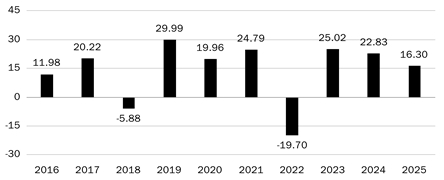
Best quarter: 21.69%, for the quarter ended June 30, 2020. Worst quarter: -20.98%, for the quarter ended March 31, 2020.
ANNUAL TOTAL RETURNS FOR THE STOCK INDEX ACCOUNT
For the period ended December 31, 2025
|
|
Inception date |
|
One year |
|
Five years |
|
Ten years |
| |||
Stock Index Account |
11/1/1994 |
|
16.30 |
% |
|
12.33 |
% |
|
13.45 |
% |
| |
Russell 3000® Index |
|
|
|
|
|
|
|
|
|
|
| |
(reflects no deductions for fees, expenses or taxes) |
|
|
17.15 |
% |
|
13.15 |
% |
|
14.29 |
% |
| |
|
|
|
|
|
|
|
|
|
|
|
|
|
Current performance of the Account may be higher or lower than that shown above. | ||||||||||||
48 Prospectus ■ TIAA Separate Account VA-1
The benchmark index described below is unmanaged, and you cannot invest directly in the index.
The Stock Index Account is an index account. An index account seeks to hold all, or a representative sample, of the securities that make up its benchmark index. Use of the following index by the Stock Index Account is not a fundamental policy of the Stock Index Account, so the Stock Index Account can substitute other indices without Contractowner approval. The separate account will notify Contractowners when such a change is made.
Advisors will generally rebalance the Stock Index Account’s portfolio quarterly, or each time its benchmark index rebalances. Advisors can also adjust the Stock Index Account’s portfolio because of mergers and other similar events.
Russell 3000 Index
The Russell 3000 Index represents the 3,000 largest publicly traded U.S. companies, based on market capitalization (according to Frank Russell Company (“Russell”)). Russell 3000 Index companies represent about 96% of the total market capitalization of the publicly traded U.S. equity market. Russell determines the composition of the index based only on market capitalization and can change its composition at any time. The Russell 3000 Index is reconstituted (rebalanced) annually in June, with quarterly initial public offering additions made in March, September and December.
Additional information about index providers
Russell index
Source: London Stock Exchange Group plc and its group undertakings (collectively, the “LSE Group”). © LSE Group 2026. FTSE Russell is a trading name of certain of the LSE Group companies. “FTSE®,” “Russell®” and “FTSE Russell®” are trademarks of the relevant LSE Group companies and are used by any other LSE Group company under license. All rights in the FTSE Russell indexes or data vest in the relevant LSE Group company which owns the index or the data. Neither LSE Group nor its licensors accept any liability for any errors or omissions in the indexes or data and no party may rely on any indexes or data contained in this communication. No further distribution of data from the LSE Group is permitted without the relevant LSE Group company’s express written consent. The LSE Group does not promote, sponsor or endorse the content of this communication.
TIAA Separate Account VA-1 ■ Prospectus 49
[This page intentionally left blank.]
[This page intentionally left blank.]
More information about the separate account is contained in its SAI, dated May 1, 2026, which is incorporated by reference into this Prospectus. The Prospectus, SAI and the separate account’s annual report for the year ended December 31, 2025 and semi-annual report for the period ended June 30, 2025, which are incorporated by reference herein, are on file with the SEC. For a free copy of any of these documents, to request additional information about the separate account or to make other investor inquiries, visit our website at www.tiaa.org, write to us at 730 Third Avenue, New York, NY 10017-3206, Attn: TIAA Imaging Services or call us at 877-518-9161.
You may also obtain reports and other information about the separate account on the SEC’s website at www.sec.gov and copies of this information may be obtained, upon payment of a duplicating fee, by electronic request at the following email address: publicinfo@sec.gov.
How to reach us
TIAA website
Account performance, personal account information and transactions, product descriptions, and information about investment choices and income options
TIAA.org
24 hours
a day, 7 days a week
Automated Telephone Service
Check accumulation balances and hear other personal account updates 24 hours a day. You can also speak with a consultant during call center hours.
800-842-2252
By mail
Send all notices, forms and requests to:
TIAA
P.O. Box
1261
Charlotte, NC
28201
National Contact Center
Retirement saving and planning, income options and payments, beneficiary services and tax reporting
800-842-2252
8 a.m. to 10 p.m. (ET),
Monday–Friday
Insurance planning center
After-tax annuities and life insurance
For an existing policy or contract
800-223-1200
8 a.m. to 6 p.m. (ET),
Monday–Friday
For the hearing- or speech-impaired
800-842-2755
8 a.m. to 10 p.m. (ET),
Monday–Friday
Advisor services
888-842-0318
8 a.m. to 6 p.m. (ET), Monday–Friday
|
|
TIAA-CREF Individual & Institutional Services, LLC, Member FINRA and the Securities Investor Protection Corporation (“SIPC”), distributes securities products. SIPC only protects customers’ securities and cash held in brokerage accounts. Annuity contracts and certificates are issued by Teachers Insurance and Annuity Association of America (TIAA) and College Retirement Equities Fund (CREF), New York, NY. Each is solely responsible for its own financial condition and contractual obligations.
©2026 Teachers Insurance and Annuity Association of America–College Retirement
Equities Fund, 730 Third Avenue, New York, NY 10017-3206
EDGAR contract identifier: C000013885 |
A10857 (5/26) |
|
Individual flexible-premium deferred variable annuities
Funded through
TIAA Separate Account VA-1
of
Teachers Insurance and Annuity Association of America
MAY 1, 2026
Teachers Personal Annuity is an individual flexible-premium deferred variable annuity contract (the “Contract”), which is funded through TIAA Separate Account VA-1 (the “separate account”) of Teachers Insurance and Annuity Association of America (“TIAA”).
This Statement of Additional Information (“SAI”) is not a prospectus and should be read in connection with the current prospectus dated May 1, 2026 (the “Prospectus”) for the variable annuity that is the variable component of the contract. The Prospectus is available without charge upon written or oral request to: Teachers Insurance and Annuity Association of America, 730 Third Avenue, New York, New York 10017-3206, Attention: Imaging Services: telephone 800-223-1200. Capitalized or defined terms in the Prospectus are incorporated into this SAI. As used in this SAI, references to the separate account also include the Stock Index Account (“SIA”). The audited financial statements of the separate account for the fiscal period ended December 31, 2025 are incorporated into this SAI by reference to the separate account’s report on Form N-CSR, which contains the Annual Report to contractowners, for the year ended December 31, 2025.
THIS SAI IS NOT A PROSPECTUS AND SHOULD BE READ ONLY IN CONJUNCTION WITH THE PROSPECTUS FOR THE CONTRACTS.
Table of contents
Teachers Insurance and Annuity Association of America 2 Investment policies and risk considerations 3 Disclosure of portfolio holdings 16 |
Information about the separate account’s portfolio management 26 Index to TIAA financial statements 32 Appendix A: Nuveen proxy voting guidelines and policies 91 |
Teachers Insurance and Annuity Association of America
Teachers Insurance and Annuity Association of America (“TIAA”) is a stock life insurance company, organized under the laws of New York. It was founded on March 4, 1918, by the Carnegie Foundation for the Advancement of Teaching. All of the stock of TIAA is held by the TIAA Board of Governors, a nonprofit New York membership corporation whose main purpose is to hold TIAA’s stock. TIAA’s headquarters is located at 730 Third Avenue, New York, NY 10017-3206. TIAA’s general account offers traditional annuities, which guarantee principal and a specified interest rate while providing the opportunity for additional dividends.
TIAA is the companion organization of the College Retirement Equities Fund (“CREF”), the first company in the United States to issue a variable annuity. CREF is a nonprofit membership corporation established in New York in 1952. Together, TIAA and CREF form the principal retirement system for the nation’s education and research communities and one of the largest retirement systems in the world, based on assets under management. As of December 31, 2025, TIAA’s statutory admitted assets were approximately $380 billion and the combined net assets for TIAA, CREF and other entities within the TIAA organization totaled approximately $1.506 trillion (although CREF does not stand behind TIAA’s guarantees). TIAA is the parent company of Teachers Advisors, LLC (“Advisors”), the separate account’s investment adviser.
The separate account was established on February 16, 1994, as a separate investment account of TIAA under New York law, by resolution of TIAA’s Board of Trustees. The separate account is governed by a Management Committee (the “Management Committee”). As an “open-end” diversified management investment company, the separate account has no limit on how many units of participation it can issue. The separate account is registered with the Securities and Exchange Commission (“SEC”) under the Investment Company Act of 1940, as amended (the “1940 Act”). As part of TIAA, the separate account is also subject to regulation by the New York State Department of Financial Services (“NYDFS”) and the insurance departments of other jurisdictions in which the contracts are offered.
Although TIAA owns the assets of the separate account, the contract states that the separate account’s income, investment gains and investment losses are credited to or charged against the assets of the separate account without regard to TIAA’s other income, gains or losses. Under New York law, the separate account cannot be charged with liabilities incurred by any other TIAA separate account or other business activity TIAA may undertake.
The contract accepts only after-tax dollars. Like earnings from other annuity products, earnings on accumulations in the separate account are not taxed until withdrawn or paid as annuity income.
The following restrictions are fundamental policies with respect to the separate account and may not be changed without the approval of a majority of the separate account’s outstanding voting securities, as that term is defined under the 1940 Act.
1. The separate account will not issue senior securities except as SEC regulations permit;
2. The separate account will not borrow money, except: (a) the separate account may purchase securities on margin, as described in restriction 9 below; and (b) from banks (only in amounts not in excess of 33 1⁄3 % of the market value of the separate account’s assets at the time of borrowing), and, from other sources, for temporary purposes (only in amounts not exceeding 5% of the separate account’s total assets taken at market value at the time of borrowing). Money may be
2 Statement of Additional Information TIAA Separate Account VA-1
temporarily obtained through bank borrowing, rather than through the sale of portfolio securities, when such borrowing appears more attractive for the separate account;
3. The separate account will not underwrite the securities of other companies, except to the extent that it may be deemed an underwriter in connection with the disposition of securities from its portfolio;
4. The separate account will not, with respect to at least 75% of the value of its total assets, invest more than 5% of its total assets in the securities of any one issuer other than securities issued or guaranteed by the U.S. Government, its agencies or instrumentalities, except as may be necessary to approximate the composition of its benchmark index;
5. The separate account will not make an investment in an industry if after giving effect to that investment the separate account’s holding in that industry would exceed 25% of the separate account’s total assets—this restriction, however, does not apply to investments in obligations issued or guaranteed by the United States Government, its agencies or instrumentalities;
6. The separate account will not purchase real estate or mortgages directly;
7. The separate account will not purchase commodities or commodities contracts, except to the extent futures are purchased as described herein;
8. The separate account will not make loans, except: (a) that it may make loans of portfolio securities not exceeding 33 1 ⁄3 % of the value of its total assets, which are collateralized by either cash, United States Government securities, or other means permitted by applicable law, equal to at least 102% of the market value of the loaned securities, or such lesser percentage as may be permitted by the NYDFS (not to fall below 100% of the market value of the loaned securities), as reviewed daily; (b) loans through entry into repurchase agreements may be made; (c) privately placed debt securities may be purchased; or (d) participation interests in loans, and similar investments, may be purchased; and
9. The separate account will not purchase any security on margin (except that the separate account may obtain such short-term credit as may be necessary for the clearance of purchases and sales of portfolio securities).
With the exception of percentage restrictions related to borrowings, if a percentage restriction is adhered to at the time of investment, a later increase or decrease in percentage beyond the specified limit resulting from a change of values in portfolio securities will not be considered a violation.
The separate account is a diversified, open-end, management investment company. However, the separate account may become non-diversified under the 1940 Act without the approval of the separate account’s outstanding voting securities solely as a result of a change in relative market capitalization or index weighting of one or more constituents of its benchmark index, which the separate account seeks to track, notwithstanding Investment Restriction “4” above.
Investment policies and risk considerations
Credit Facility and Borrowing and Lending Among Affiliates. The separate account participates in an unsecured revolving credit facility for temporary or emergency purposes, including, without limitation, funding of contractowner redemptions that otherwise might require the untimely disposition of securities. An annual commitment fee for the credit facility is borne by the participating funds and the separate account. Interest associated with any borrowing by the separate account under the credit facility will be charged to the separate account at rates that are based on a specified rate of interest.
If the separate account borrows money, it could leverage its portfolio by keeping securities it might otherwise have had to sell. Leveraging exposes the separate account to special risks, including greater fluctuations in accumulated unit value (“AUV”) in response to market changes.
Additionally, the SEC has granted an exemptive order (the “Order”) permitting the separate account to participate in an inter-fund lending facility whereby the separate account may directly lend to and borrow money from certain other affiliated registered investment companies, as described below, for temporary purposes (e.g., to satisfy transfer or withdrawal requests or to cover unanticipated cash shortfalls) (the “Inter-Fund Program”). Certain accounts or series of CREF, TIAA-CREF Funds (“TCF”) and TIAA-CREF Life Funds (“TCLF”) may also participate in the Inter-Fund Program, and each such account or series, as well as the separate account, each of which is managed by Advisors or an affiliate of Advisors, is considered to be a “Fund” for the purpose of the description of the Inter-Fund Program in this section. The Inter-Fund Program is subject to a number of conditions, including, among other things, the requirements that: (i) no Fund may borrow or lend money through the Inter-Fund Program unless it receives a more favorable interest rate than is available from a bank or other financial institution for a comparable transaction; (ii) no Fund may borrow on an unsecured basis through the Inter-Fund Program unless the Fund’s outstanding borrowings from all sources immediately after the inter-fund borrowing total 10% or less of its total assets; provided that if the borrowing Fund has a secured borrowing outstanding from any other lender, including but not limited to another Fund, the inter-fund loan must be secured on at least an equal priority basis with at least an equivalent percentage of collateral to loan value; (iii) if a Fund’s total outstanding borrowings immediately after an inter-fund borrowing would be greater than 10% of its total assets, the Fund may borrow through the inter-fund loan on a secured basis only; (iv) no Fund may lend money if the loan would cause its aggregate outstanding loans through the Inter-Fund Program to exceed 15% of its current net assets at the
TIAA Separate Account VA-1 Statement of Additional Information 3
time of the loan; (v) a Fund’s inter-fund loans to any one Fund shall not exceed 5% of the lending Fund’s net assets; (vi) the duration of inter-fund loans will be limited to the time required to receive payment for securities sold, but in no event more than seven days; and (vii) each inter-fund loan may be called on one business day’s notice by a lending Fund and may be repaid on any day by a borrowing Fund. In addition, a Fund may participate in the Inter-Fund Program only if and to the extent that such participation is consistent with the Fund’s investment objective and investment policies, including the fundamental investment policies on borrowing and lending set forth above, and authorized by its portfolio manager(s). Due to the separate account’s fundamental investment policies, under the Inter-Fund Program, the separate account is permitted to be a borrower but only to a lesser extent than is permitted by the Order, and the separate account is not permitted to be a lender. The Management Committee has approved the separate account’s participation in the Inter-Fund Program and is responsible for ongoing oversight of the Inter-Fund Program, as required by the Order.
The limitations detailed above and the other conditions of the SEC exemptive order permitting the Inter-Fund Program are designed to minimize the risks associated with the Inter-Fund Program for both the lending Fund and the borrowing Fund. However, no borrowing or lending activity is without risk. When a Fund borrows money from another Fund, there is a risk that the loan could be called on one day’s notice or not renewed, in which case the Fund may have to borrow from a bank at a higher rate or take other actions to pay off such loan if an inter-fund loan is not available from another Fund. Any delay in repayment to a lending Fund could result in a lost investment opportunity or additional costs.
Temporary Defensive Positions. The separate account may take temporary defensive positions. During periods when Advisors believes there are unstable market, economic, political or currency conditions domestically or abroad, Advisors may assume, on behalf of the separate account, a temporary defensive posture and (1) without limitation, hold cash and/or invest in money market instruments, or (2) restrict the securities markets in which the separate account’s assets will be invested by investing those assets in securities markets deemed by Advisors to be conservative in light of the separate account’s investment objective and policies. Under normal circumstances, the separate account may invest a portion of its total assets in cash or money market instruments for cash management purposes, pending investment in accordance with the separate account’s investment objective and policies and to meet operating expenses. To the extent that the separate account holds cash or invests in money market instruments, it may not achieve its investment objective. Cash assets are generally not income-generating and would impact the separate account’s performance.
Additional Risks Resulting From Market or Other Events and Government Intervention in Financial Markets and Regulatory Matters. National and regional economies and financial markets are becoming increasingly interconnected, which increases the possibilities that conditions in one country, region or market might adversely impact issuers in a different country, region or market. Changes in legal, political, regulatory, tax and economic conditions may cause fluctuations in markets and securities prices around the world, which could negatively impact the value of the separate account’s investments. Major economic or political disruptions, particularly in large economies, may have global negative economic and market repercussions. Events such as war (for example, the ongoing armed conflict between Russia and Ukraine, as well as that between Israel and Hamas and other militant groups in the Middle East, and the conflict with Iran), terrorism, natural and environmental disasters and the spread of infectious illnesses or other public health emergencies, conflicts, social unrest, recessions, inflation, rapid interest rate changes, changes in economic or other policies, governmental intervention including trade policies, immigration restrictions and reductions in federal spending and supply chain disruptions may adversely affect the global economy and the markets and issuers in which the separate account invests. Additionally, the spread of infectious outbreaks, epidemics or pandemics have caused volatility, severe market dislocations and liquidity constraints in many markets, including markets for the investments the separate account holds, and have, at times, adversely affected the separate account's investments and operations. These events could reduce consumer demand or economic output, result in market closures, travel restrictions or quarantines, and generally have a significant impact on the economy. These events could also impair the information technology and other operational systems upon which the separate account’s service providers, including Advisors, rely, and could otherwise disrupt the ability of employees of the separate account’s service providers to perform essential tasks on behalf of the separate account.
U.S. and global markets, in recent years, have experienced increased volatility, including as a result of the failures of certain U.S. and non-U.S. banks, which could be harmful to the separate account and issuers in which they invest. For example, if a bank in which the separate account or an issuer in which the separate account invests has an account that fails, any cash or other assets in bank accounts may be temporarily inaccessible or permanently lost by the separate account or issuer. If a bank that provides a subscription line credit facility, asset-based facility, other credit facility and/or other services to an issuer fails, the issuer could be unable to draw funds under its credit facilities or obtain replacement credit facilities or other services from other lending institutions with similar terms. Even if banks remain solvent, continued volatility in the banking sector could cause or intensify an economic recession, increase the costs of capital and banking services or result in the issuers in which the separate account invests being unable to obtain or refinance indebtedness at all or on as favorable terms as could otherwise have been obtained. Market conditions and legislative or regulatory responses, as well as a changing interest rate environment, can contribute to decreased market liquidity and erode the value of certain holdings. Market volatility and uncertainty and/or a downturn in market and economic and financial conditions, as a result of developments in the banking industry or otherwise
4 Statement of Additional Information TIAA Separate Account VA-1
(including as a result of delayed access to cash or credit facilities), could have an adverse impact on the separate account and issuers in which they invest.
Changing interest rate environments (whether downward or upward) impact the various sectors of the economy in different ways. During periods when interest rates are low (or negative), the separate account’s yield (or total return) may also be low and fall below zero. Very low or negative interest rates may magnify interest rate risk. The U.S. Federal Reserve (the “Fed”) has increased interest rates significantly over recent periods and has over more recent periods decreased interest rates meaningfully. Changing interest rates may have unpredictable effects on markets, may result in heightened market volatility and may detract from the separate account’s performance to the extent the separate account is exposed to such interest rates and/or volatility.
Governments or their agencies may also acquire distressed assets from financial institutions and acquire ownership interests in those institutions. The implications of government ownership and disposition of these assets are unclear, and such a program may have positive or negative effects on the liquidity, valuation and performance of the separate account’s portfolio holdings. Furthermore, volatile financial markets can expose the separate account to greater market and liquidity risk and potential difficulty in valuing portfolio holdings, as well as potentially higher portfolio turnover and related transaction costs. Advisors will monitor developments and seek to manage the separate account in a manner consistent with achieving its investment objective, but there can be no assurance that Advisors will be successful in doing so.
In November 2022, the SEC proposed rule amendments which, among other things, would require funds to adopt swing pricing in order to mitigate dilution of contractowners’ interests in a fund by requiring the adjustment of fund AUV per share to pass on costs stemming from contractowner purchase or redemption activity. In addition, the proposed rule would amend the existing liquidity rule framework. The proposal’s impact on the separate account will not be known unless and until any final rulemaking is adopted.
On February 25, 2025, the SEC extended the compliance date applicable to the clearing mandate for Treasury repo transactions. Under the extended compliance date, market participants, absent an exemption, will be required to clear Treasury repo transactions under the rule beginning June 30, 2027. The clearing mandate is expected to result in the separate account being required to clear all or substantially all of its Treasury repo transactions as of the compliance date, and may necessitate expenditures by the separate account that trades in Treasury repo transactions in connection with entering into new agreements with sponsoring members and taking other actions to comply with the new requirements. Advisors will monitor developments in the Treasury repo transactions market as the implementation period progresses.
In December 2023, the SEC adopted rule amendments providing that any covered clearing agency (“CCA”) for U.S. Treasury securities require that every direct participant of the CCA (which generally would be a bank or broker-dealer) submit for clearance and settlement all eligible secondary market transactions in U.S. Treasury securities to which it is a counterparty. The clearing mandate includes in its scope all repurchase or reverse repurchase agreements of such direct participants collateralized by U.S. Treasury securities (collectively, “Treasury repo transactions”) of a type accepted for clearing by a registered CCA, including both bilateral Treasury repo transactions and triparty Treasury repo transactions where a bank agent provides custody, collateral management and settlement services.
The Treasury repo transactions of registered funds with any direct participants of a CCA will be subject to the mandatory clearing requirement. Currently, the Fixed Income Clearing Corporation (“FICC”) is the only CCA for U.S. Treasury securities. FICC currently operates a “Sponsored Program” for clearing of Treasury repo transactions pursuant to which a registered fund may enter into a clearing arrangement with a “sponsoring member” bank or broker-dealer that is a direct participant of FICC as a “sponsored member” of FICC.
In August 2024, the SEC adopted amendments to the reporting requirements on Form N-PORT and Form N-CEN. Under the amendments, funds must file Form N-PORT reports on a monthly basis within 30 days of month end, and each report will be made public 60 days after month end. Additionally, funds will be required to identify and provide certain information about liquidity service providers on Form N-CEN, including the asset classes for which the liquidity service provider provided liquidity classifications and whether the provider was hired or terminated during the period. The compliance date for these amendments was November 17, 2025. On April 16, 2025, the SEC extended the compliance date for Form N-PORT amendments to November 17, 2027. On February 18, 2026, the SEC then extended the compliance date for Form N-PORT reporting requirements related to the Names Rule to November 17, 2027 for fund groups with net assets of $10 billion or more. In addition, on February 18, 2026, the SEC proposed amendments to certain reporting requirements on Form N-PORT that would, if adopted, provide that monthly reports must be filed within 45 days of month end and reduce the frequency of publication of reports on Form N-PORT from monthly (within 60 days of each month end) to quarterly (within 60 days after fiscal quarter end).
Until any policy or regulatory changes are made, it is not possible to predict the impact such changes may have on the value of portfolio holdings of the separate account, the issuers thereof or TIAA (or their affiliates). Financial entities, such as investment companies and investment advisers, are generally subject to extensive government regulation and intervention. Actions by governments, including legislation or regulation may change the way in which the separate account itself is regulated. Such legislation or regulation may also affect the expenses incurred directly by the separate account and the value of its investments, and could limit or preclude the separate account’s ability to achieve its investment objective. Government regulation
TIAA Separate Account VA-1 Statement of Additional Information 5
may change frequently and may have significant adverse consequences. Moreover, government regulation may have unpredictable and unintended effects.
The value of the separate account’s holdings is also generally subject to the risk of future local, national, or global economic disturbances based on unknown weaknesses in the markets in which the separate account invests. For example, any public health emergency could reduce consumer demand or economic output, result in market closures, travel restrictions or quarantines, and generally have a significant impact on the economy, which in turn could adversely affect the separate account’s investments. In the event of such a disturbance, issuers of securities held by the separate account may experience significant declines in the value of their assets and even cease operations, or may receive government assistance accompanied by increased restrictions on their business operations or other government intervention. In addition, it is not certain that the U.S. Government will intervene in response to a future market disturbance and the effect of any such future intervention cannot be predicted. It is difficult for issuers to prepare for the impact of future financial downturns and/or changes in economic or other policies, although companies can seek to identify and manage future uncertainties through risk management programs.
Investors should also be aware that geopolitical tensions and armed conflict could also negatively impact markets as well as investments held by the separate account. These issues could lead to, among others, (1) possible imposition of market controls or currency exchange controls; (2) possible seizure, expropriation or nationalization of assets; (3) the possibility that a foreign government could restrict an issuer from paying principal and interest on its debt obligations to investors outside the country; or (4) economic sanctions or other measures by the United States or other governments. The type and severity of sanctions and other similar measures, including counter sanctions and other retaliatory actions, that may be imposed could vary broadly in scope, and their impact is impossible to predict. The imposition of sanctions could, among other things, cause a decline in the value and/or liquidity of securities issued by the sanctioned country or companies located in or economically tied to the sanctioned country and increase market volatility and disruption in the sanctioned country and throughout the world. Sanctions and other similar measures could limit or prevent the separate account from buying and selling securities (in the sanctioned country and other markets), significantly delay or prevent the settlement of securities transactions, and significantly impact the separate account's liquidity and performance.
Restricted Securities. The separate account may invest in restricted securities. A restricted security is one that has a contractual restriction on resale or cannot be resold publicly until it is registered under the Securities Act of 1933, as amended (the “1933 Act”). From time to time, restricted securities can be considered illiquid under the separate account's Liquidity Risk Program (as defined below). However, purchases by the separate account of securities of foreign issuers offered and sold outside the United States may not be considered illiquid even though they are restricted. The Management Committee has designated Advisors to determine the value and liquidity of restricted securities and other investments held by the separate account.
Distressed and Defaulted Securities in a Workout Arrangement. In the event that the separate account holds distressed or defaulted securities of an issuer, Advisors may determine that it is in the best interest of separate account contractowners to pursue a workout arrangement with the issuer, which may involve making loans to the issuer, purchasing bonds, equity or other interests of the issuer, or taking other related or similar steps involving the investment of additional monies.
The separate account may make a loan to an entity suffering severe economic distress, oftentimes in or near bankruptcy. It is generally more time-consuming and expensive for a troubled entity to issue additional bonds, instead of borrowing, as a means of obtaining liquidity in times of severe financial distress. Making a loan to such an entity may allow the entity to remain a “going concern” and enable it to eventually both repay the loan as well as be in better position to pay interest and principal on the pre-existing securities held by the separate account. Absent a loan, the separate account may be forced to liquidate the entity’s assets, which can reduce recovery value.
In the course of pursuing such a workout arrangement, Advisors may acquire material non-public information regarding an issuer, which may limit its ability to purchase or sell securities or otherwise to participate in an investment opportunity for the separate account.
Illiquid Investments. The separate account has implemented a written liquidity risk management program (the “Liquidity Risk Program”), as required by applicable SEC regulation, reasonably designed to assess and manage the separate account’s liquidity risk. As a result of its designation as Liquidity Risk Program administrator by the Management Committee, Advisors is also responsible for determining the liquidity of investments held by the separate account. The separate account may invest up to 10% of its net assets, measured at the time of investment, in illiquid investments that are assets. Illiquid investments are those that are not reasonably expected to be sold or disposed of in current market conditions in seven calendar days or less without the sale or disposition significantly changing the market value of the investment. Investments may be illiquid because of, among other factors, the absence of a trading market or distress in a trading market, making it difficult to value the investments or dispose of them promptly at the value at which they are carried. Investments in illiquid investments or holding securities that have become illiquid pose risks of potential delays in resale. Limitations on or delays in resale may have an adverse effect on the marketability of portfolio securities, and it may be difficult for the separate account to dispose of illiquid investments promptly or to sell such investments for the value at which they are carried, if at all, or at any price within the desired time frame. The separate account may receive distressed prices and incur higher transaction costs when selling illiquid
6 Statement of Additional Information TIAA Separate Account VA-1
investments. There is also a risk that unusually high redemption requests, including redemption requests from certain large contractowners (such as institutional investors), asset allocation changes, or other unusual market conditions may make it difficult for the separate account to sell investments in sufficient time to allow it to meet redemptions. Redemption requests could require the separate account to sell illiquid investments at reduced prices or under unfavorable conditions, which may negatively impact the separate account’s performance. The regulations adopted by the SEC may limit the separate account’s ability to invest in illiquid investments, which may adversely affect the separate account’s performance and ability to achieve its investment objective.
Inflation/Deflation Risk. The separate account’s investments may be subject to inflation risk, which is the risk that the real value (i.e., nominal price of the asset adjusted for inflation) of assets or income from investments will be less in the future as inflation decreases the purchasing power and value of money (i.e., as inflation increases, the real value of the separate account’s assets can decline). Inflation rates may change frequently and significantly as a result of various factors, including unexpected shifts in the domestic or global economy and changes in monetary or economic policies (or expectations that these policies may change), and the separate account’s investments may not keep pace with inflation, which would generally adversely affect the real value of separate account contractowners’ investments in the separate account. This risk is generally greater for fixed-income instruments with longer durations.
Deflation risk is the risk that prices throughout the economy decline over time. Deflation may have an adverse effect on the creditworthiness of issuers and may make issuer default more likely, which may result in a decline in the value of the separate account’s assets.
Preferred Stock. The separate account can invest in preferred stock consistent with its investment objective. Preferred stock pays dividends at a specified rate and generally has preference over common stock in the payment of dividends and the liquidation of the issuer’s assets but is junior to the debt instruments of the issuer in those same respects. Unlike interest payments on debt instruments, dividends on preferred stock are generally payable at the discretion of the issuer’s board of directors, and contractowners may suffer a loss of value if dividends are not paid. Preferred contractowners generally have no legal recourse against the issuer if dividends are not paid. The market prices of preferred stocks are subject to changes in interest rates and are more sensitive to changes in the issuer’s creditworthiness than are the prices of debt securities. Under ordinary circumstances, preferred stock does not carry voting rights.
Small and Medium Capitalization Companies. The separate account may invest in common stocks of issuers with small or medium market capitalizations. An investment in common stocks of issuers with small or medium market capitalizations generally involves greater risk and price volatility than an investment in common stocks of larger, more established companies. This increased risk may be due to the greater business risks of their small or medium size, limited markets and financial resources, narrow product lines and frequent lack of management depth. The securities of small and medium capitalization companies are often traded in the over-the-counter market, and might not be traded in volumes typical of securities traded on a national securities exchange. Thus, the securities of small and medium capitalization companies are likely to be less liquid and subject to more abrupt or erratic market movements than securities of larger, more established companies.
Options and Futures. The separate account may engage in options (puts and calls) and futures strategies to the extent permitted by the NYDFS and subject to SEC and Commodity Futures Trading Commission (“CFTC”) requirements. Advisors intends to use options and futures strategies in seeking to meet the separate account’s investment objective, including for cash management purposes. Options and futures transactions may increase the separate account’s transactional costs and portfolio turnover rate and will be initiated only when consistent with the separate account’s investment objective.
Options. Options-related activities could include: (1) the sale of call option contracts (including covered call options) and the purchase of call option contracts, to close out a position acquired through the sale of such options; (2) buying put option contracts (including covered put options) and selling put option contracts, including to close out a position acquired through the purchase of such options; and (3) selling call option contracts or buying put option contracts on groups of securities and on futures on groups of securities, and buying similar call option contracts or selling put option contracts, including to close out a position acquired through a sale of such options. This list of options-related activities is not intended to be exclusive, and the separate account may engage in other types of options transactions consistent with its investment objective and policies and applicable law.
A call option is a short-term contract (generally for nine months or less) that gives the purchaser of the option the right but not the obligation to purchase the underlying security at a fixed exercise price at any time (American style) or at a set time (European style) prior to the expiration of the option regardless of the market price of the security during the option period. As consideration for the call option, the purchaser pays the seller a premium, which the seller retains whether or not the option is exercised. The seller of a call option has the obligation, upon the exercise of the option by the purchaser, to sell the underlying security at the exercise price. Selling a call option would benefit the separate account if, over the option period, the underlying security declines in value or does not appreciate above the aggregate of the exercise price and the premium. However, the separate account risks an “opportunity loss” of profits if the underlying security appreciates above the aggregate value of the exercise price and the premium.
TIAA Separate Account VA-1 Statement of Additional Information 7
The separate account may close out a position acquired through selling a call option by buying a call option on the same security with the same exercise price and expiration date as the call option that it had previously sold on that security. Depending on the premium for the call option purchased by the separate account, the separate account will realize a profit or loss on the transaction on that security.
A put option is a similar short-term contract that gives the purchaser of the option the right to sell the underlying security at a fixed exercise price at any time prior to the expiration of the option regardless of the market price of the security during the option period. As consideration for the put option, the purchaser pays the seller a premium, which the seller retains whether or not the option is exercised. The seller of a put option has the obligation, upon the exercise of the option by the purchaser, to purchase the underlying security at the exercise price. The buying of a covered put contract limits the downside exposure for the investment in the underlying security. The risk of purchasing a put option is that the market price of the underlying stock prevailing on the expiration date may be above the option’s exercise price. In that case, the option would expire worthless and the entire premium would be lost.
Selling a put or call option may require the payment of initial and variation margin, and adverse market movements against the underlying security or instrument may require the seller to make additional margin payments. The separate account may have to sell securities or other instruments at a time when it may be disadvantageous to do so to meet margin and settlement payment requirements in connection with the sale of put or call options.
The separate account may close out a position acquired through buying a put option by selling an identical put option on the same security with the same exercise price and expiration date as the put option that it had previously bought on the security. Depending on the premium for the put option bought and sold, the separate account would realize a profit or loss on the transaction.
In addition to options (both calls and puts) on individual securities, there are also options on groups of securities, such as the options on the Standard & Poor’s 100 Index, which are traded on the Chicago Board Options Exchange. There are also options on the futures of groups of securities such as the Standard & Poor’s 500 Index and the New York Stock Exchange Composite Index. The selling of such calls can be used in anticipation of, or in, a general market or market sector decline that may adversely affect the market value of the separate account’s portfolio of securities. To the extent that the separate account’s portfolio of securities changes in value in correlation with a given stock index, the sale of call options on the futures of that index would substantially reduce the risk to the portfolio of a market decline, and, by so doing, provide an alternative to the liquidation of securities positions in the portfolio with resultant transaction costs. A risk in all options, particularly the relatively new options on groups of securities and on the futures on groups of securities, is a possible lack of liquidity. This will be a major consideration of Advisors before it deals in any option on behalf of the separate account.
There is another risk in connection with selling a call option on a group of securities or on the futures of groups of securities. This arises because of the imperfect correlation between movements in the price of the call option on a particular group of securities and the price of the underlying securities held in the portfolio. Unlike a covered call on an individual security, where a large movement on the upside for the call option will be offset by a similar move on the underlying stock, a move in the price of a call option on a group of securities may not be offset by a similar move in the price of securities held due to the difference in the composition of the particular group and the portfolio itself.
Futures. To the extent permitted by applicable regulatory authorities, the separate account may purchase and sell futures contracts on securities or other instruments, or on groups or indices of securities or other instruments. The purpose of hedging techniques using financial futures is to protect the principal value of the separate account against adverse changes in the market value of securities or instruments in its portfolio, and to obtain better returns on investments than available in the cash market. Since these are hedging techniques, the gains or losses on the futures contract normally will be offset by losses or gains, respectively, on the hedged investment. Futures contracts also may be offset prior to the future date by executing an opposite futures contract transaction.
A futures contract on an investment is a binding contractual commitment which, if held to maturity, generally will result in an obligation to make or accept delivery, during a particular future month, of the securities or instrument underlying the contract.
By purchasing a futures contract—assuming a “long” position—Advisors will legally obligate the separate account to accept the future delivery of the underlying security or instrument and pay the agreed price. By selling a futures contract—assuming a “short” position—Advisors will legally obligate the separate account to make the future delivery of the security or instrument against payment of the agreed price.
Positions taken in the futures markets are not normally held to maturity, but are instead liquidated through offsetting transactions that may result in a profit or a loss. While futures positions taken by the separate account usually will be liquidated in this manner, the separate account may instead make or take delivery of the underlying securities or instruments whenever it appears economically advantageous to the separate account to do so. A clearing corporation associated with the exchange on which futures are traded assumes responsibility for closing out positions and guarantees that the sale and purchase obligations will be performed with regard to all positions that remain open at the termination of the contract.
8 Statement of Additional Information TIAA Separate Account VA-1
A stock index futures contract, unlike a contract on a specific security, does not provide for the physical delivery of securities, but merely provides for profits and losses resulting from changes in the market value of the contract to be credited or debited at the close of each trading day to the respective accounts of the parties to the contract. On the contract’s expiration date, a final cash settlement occurs and the futures positions are closed out. Changes in the market value of a particular stock index futures contract reflect changes in the specified index of equity securities on which the future is based.
Stock index futures may be used to hedge the equity investments of the separate account with regard to market (systematic) risk (involving the market’s assessment of overall economic prospects), as distinguished from stock specific risk (involving the market’s evaluation of the merits of the issuer of a particular security). By establishing an appropriate “short” position in stock index futures, Advisors may seek to protect the value of the separate account’s securities portfolio against an overall decline in the market for equity securities. Alternatively, in anticipation of a generally rising market, Advisors can seek to avoid losing the benefit of apparently low current prices by establishing a “long” position in stock index futures and later liquidating that position as particular equity securities are in fact acquired. To the extent that these hedging strategies are successful, the separate account will be affected to a lesser degree by adverse overall market price movements, unrelated to the merits of specific portfolio equity securities, than would otherwise be the case.
Unlike the purchase or sale of a security, no price is paid or received by the separate account upon the purchase or sale of a futures contract. Initially, the separate account will be required to deposit in a segregated account with the broker (futures commission merchant) carrying the futures account on behalf of the separate account an amount of cash, U.S. Treasury securities, or other permissible assets equal to a percentage of the contract amount as determined by the clearinghouse. This amount is known as “initial margin.” The nature of initial margin in futures transactions is different from that of margin in security transactions in that futures contract margin does not involve the borrowing of funds by the customer to finance the transactions. Rather, the initial margin is in the nature of a performance bond or good faith deposit on the contract that is returned to the separate account upon termination of the futures contract assuming all contractual obligations have been satisfied. Subsequent payments to and from the broker, called “variation margin,” will be made on a daily basis as the price of the underlying stock index fluctuates, making the long and short positions in the futures contract more or less valuable, a process known as “marking to the market.”
For example, when the separate account has purchased a stock index futures contract and the price of the underlying stock index has risen, that position will have increased in value, and the separate account will receive from the broker a variation margin payment equal to that increase in value. Conversely, where the separate account has purchased a stock index futures contract and the price of the underlying stock index has declined, the position would be less valuable and the separate account would be required to make a variation margin payment to the broker. At any time prior to expiration of the futures contract, the separate account may elect to close the position by taking an opposite position that will operate to terminate the separate account’s position in the futures contract. A final determination of variation margin is then made, additional cash is required to be paid by or released to the separate account, and the separate account realizes a loss or a gain.
There are several risks in connection with the use of a futures contract as a hedging device. One risk arises because of the imperfect correlation between movements in the prices of the futures contracts and movements in the securities or instruments that are the subject of the hedge. Advisors, on behalf of the separate account, will attempt to reduce this risk by engaging in futures transactions, to the extent possible, where, in Advisors’ judgment, there is a significant correlation between changes in the prices of the futures contracts and the prices of the separate account’s portfolio securities or instruments sought to be hedged.
Successful use of futures contracts for hedging purposes also is subject to the user’s ability to correctly predict movements in the direction of the market. For example, it is possible that where the separate account has sold futures to hedge its portfolio against declines in the market, the index on which the futures are written may advance and the values of securities or instruments held in the separate account’s portfolio may decline. If this occurred, the separate account would lose money on the futures and also experience a decline in value in its portfolio investments. However, Advisors believes that over time the value of the separate account’s portfolio will tend to move in the same direction as the market indices that are intended to correlate to the price movements of the portfolio securities or instruments sought to be hedged.
It also is possible that, for example, if the separate account has hedged against the possibility of a decline in the market adversely affecting stocks held in its portfolio and stock prices increased instead, the separate account will lose part or all of the benefit of increased value of those stocks that it has hedged because it will have offsetting losses in its futures positions. In addition, in such situations, if the separate account has insufficient cash, it may have to sell securities or instruments to meet daily variation margin requirements. Such sales may be, but will not necessarily be, at increased prices that reflect the rising market. The separate account may have to sell securities or instruments at a time when it may be disadvantageous to do so.
In addition to the possibility that there may be an imperfect correlation, or no correlation at all, between movements in the futures contracts and the portion of the portfolio being hedged, the prices of futures contracts may not correlate perfectly with movements in the underlying security or instrument due to certain market distortions. First, all transactions in the futures market are subject to margin deposit and maintenance requirements. Rather than meeting additional margin deposit
TIAA Separate Account VA-1 Statement of Additional Information 9
requirements, investors may close futures contracts through offsetting transactions that could distort the normal relationship between the index and futures markets. Second, the margin requirements in the futures market are less onerous than margin requirements in the securities market, and as a result the futures market may attract more speculators than the securities market does. Increased participation by speculators in the futures market also may cause temporary price distortions. Due to the possibility of price distortion in the futures market and also because of the imperfect correlation between movements in the futures contracts and the portion of the portfolio being hedged, even a correct forecast of general market trends by Advisors still may not result in a successful hedging transaction over a very short time period.
Firm Commitment Agreements and Purchase of “When-Issued” Securities. The separate account can enter into firm commitment agreements for the purchase of securities on a specified future date. Thus, the separate account may purchase, for example, issues of fixed-income instruments on a “when-issued” basis, whereby the payment obligation, or yield to maturity, or coupon rate on the instruments may not be fixed at the time of the transaction. In addition, the separate account may invest in asset-backed securities on a delayed delivery basis. This reduces the separate account’s risk of early repayment of principal, but exposes the separate account to some additional risk that the transaction will not be consummated.
When the separate account enters into a firm commitment agreement, liability for the purchase price—and the rights and risks of ownership of the securities—accrues to the separate account at the time it becomes obligated to purchase such securities, although delivery and payment occur at a later date. Accordingly, if the market price of the security should decline, the effect of the agreement would be to obligate the separate account to purchase the security at a price above the current market price on the date of delivery and payment. In addition, certain rules of the Financial Industry Regulatory Authority (“FINRA”) include mandatory margin requirements that will require the separate account to post collateral in connection with their to-be-announced (“TBA”) transactions. There is no similar requirement applicable to the separate account’s TBA counterparties. The required collateralization of TBA trades could increase the cost of TBA transactions to the separate account and impose added operational complexity. The separate account may have to sell securities or other instruments at a time when it may be disadvantageous to do so to meet such payment requirements. The separate account will not purchase securities on a “when-issued” basis if, as a result, more than 15% of its net assets would be so invested. The separate account must comply with the SEC rule related to the use of derivatives and certain other transactions when engaging in the transactions discussed above. See “Derivatives and Other Similar Instruments” below.
Other investment policies
Securities Lending. Subject to the separate account’s investment restriction relating to loans of portfolio securities set forth above, the separate account may lend its securities. The separate account may lend its securities to brokers and dealers that are not affiliated with TIAA, are registered with the SEC and are members of FINRA, and also to certain other financial institutions. All loans will be fully collateralized. Any borrower of the separate account’s portfolio securities must maintain acceptable collateral, marked to market daily, with the separate account’s custodian (or a sub-custodian or a special “tri-party” custodian). In connection with the lending of its securities, the separate account will receive as collateral cash, securities issued or guaranteed by the U.S. Government (e.g., Treasury securities), or other collateral permitted by applicable law, which at all times while the loan is outstanding will be maintained in amounts equal to at least 102% of the current market value of the outstanding loaned securities for U.S. equities and fixed-income assets and 105% for non-U.S. equities, or such lesser percentage as may be permitted by the NYDFS and SEC interpretations (not to fall below 100% of the market value of the loaned securities), as reviewed daily. Cash collateral received by the separate account will generally be invested in high-quality short-term instruments, or in one or more funds maintained by the securities lending agent for the purpose of investing cash collateral. During the term of the loan, the separate account will continue to have investment risks with respect to the securities being loaned, as well as risk with respect to the investment of the cash collateral, and the separate account may lose money as a result of the investment of (including a decline in the value of) such collateral. Voting rights may pass with the loaned securities, but the separate account will retain the right to call any security in anticipation of any material vote. The separate account also bears the risk that the reinvestment of collateral will result in a principal loss. Finally, there is the risk that the price of the securities will increase while they are on loan and the collateral will not be adequate to cover their value. In addition, the separate account could suffer a loss if the loan terminates and the separate account is forced to liquidate investments at a loss in order to return the cash collateral to the borrower.
By lending its securities, the separate account will receive amounts equal to the interest or dividends paid on the securities loaned and, in addition, will expect to receive a portion of the income generated by the short-term investment of cash received as collateral or, alternatively, where securities or letter of credit are used as collateral, a lending fee paid directly to the separate account by the borrower of the securities. Under certain circumstances, a portion of the lending fee may be paid or rebated to the borrower by the separate account. Such loans will be terminable by the separate account at any time and will not be made to affiliates of TIAA. The separate account may terminate a loan of securities in order to regain record ownership of, and to exercise beneficial rights related to, the loaned securities, including, but not necessarily limited to, voting or subscription rights or certain tax benefits, and Advisors may, in the exercise of its fiduciary duties, terminate a loan in the event that a vote of holders of those securities is required on a material matter. The separate account may pay reasonable fees to persons
10 Statement of Additional Information TIAA Separate Account VA-1
unaffiliated with the separate account for services, for arranging such loans, or for acting as securities lending agent (each an “Agent”). Loans of securities will be made only to firms deemed creditworthy. In lending its securities, the separate account bears the market risk with respect to the investment of collateral and the risk the Agent may default on its contractual obligations to the separate account. The Agent bears the risk that the borrower may default on its obligation to return the loaned securities as the Agent is contractually obligated to indemnify the separate account if at the time of a default by a borrower some or all of the loaned securities have not been returned. Substitute payments for dividends received by the separate account for securities loaned out by the separate account will not be considered as qualified dividend income or as eligible for the corporate dividend received deduction. Each Agent is authorized to engage a third-party bank as a special “tri-party” custodian for securities lending activities and enter into a separate custodian undertaking with each applicable borrower under the separate account’s securities lending program.
During the fiscal year ended December 31, 2025, the Agent for the separate account provided various services to the separate account, including locating borrowers, monitoring daily the value of the loaned securities and collateral, requiring additional collateral from borrowers as necessary, cash collateral management, qualified dividend management, negotiation of loan terms, selection of securities to be loaned, recordkeeping and account servicing, monitoring dividend activity and material proxy votes relating to loaned securities, and arranging for return of loaned securities to the separate account at loan termination.
For the fiscal year ended December 31, 2025, the table below reflects the dollar amounts of income received and the compensation paid to the Agent, including any share of revenue generated by the securities lending program paid to the Agent (“revenue split”), related to the securities lending activities of the separate account:
|
|
|
|
Fees and/or compensation for securities lending activities and related services |
|
|
|
|
| |||||||||||
|
|
|
|
|
|
|
|
|
|
|
|
|
|
|
|
|
|
|
|
|
|
Account |
|
Gross |
|
Fees paid to
|
|
Fees paid for
|
* |
Administrative
|
|
Indemnification
|
|
Rebates |
|
Other |
|
Aggregate |
|
Net |
|
|
Stock Index Account |
$ |
172,365 |
$ |
4,560 |
$ |
1,108 |
$ |
|
$ |
|
$ |
114,259 |
$ |
|
$ |
119,927 |
$ |
52,438 |
|
|
|
|
|
|
|
|
|
|
|
|
|
|
|
|
|
|
|
|
|
|
|
|
|
|
|
|
|
|
|
|
|
|
|
|
|
|
|
|
|
|
|
* |
Including fees deducted from a pooled cash collateral reinvestment vehicle. |
|||||||||||||||||||
Regulations adopted by federal banking regulators under the Dodd-Frank Wall Street Reform and Consumer Protection Act require that certain qualified financial contracts (“QFCs”) with counterparties that are part of U.S. or foreign global systemically important banking organizations be amended to include contractual restrictions on close-out and cross-default rights. QFCs include, but are not limited to, securities contracts, commodities contracts, forward contracts, repurchase agreements, securities lending agreements and swap agreements, as well as related master agreements, security agreements, credit enhancements, and reimbursement obligations. If a covered counterparty of the separate account or certain of the covered counterparty’s affiliates were to become subject to certain insolvency proceedings, the separate account may be temporarily unable to exercise certain default rights, and the QFC may be transferred to another entity. These requirements may impact the separate account’s credit and counterparty risks.
Repurchase Agreements. Repurchase agreements are one of several short-term vehicles the separate account can use to manage cash balances effectively. In a repurchase agreement, the separate account buys an underlying debt instrument on the condition that the seller agrees to buy it back at a fixed price and time (usually no more than a week and never more than a year). Repurchase agreements have the characteristics of loans by the separate account, and will be fully collateralized (either with physical securities or evidence of book entry transfer to the account of the custodian bank) at all times. During the term of the repurchase agreement, the separate account retains the security subject to the repurchase agreement as collateral securing the seller’s repurchase obligation, continually monitors the market value of the security subject to the agreement, and requires the separate account’s seller to deposit with the separate account additional collateral equal to any amount by which the market value of the security subject to the repurchase agreement falls below the resale amount provided under the repurchase agreement. The separate account will enter into repurchase agreements only with member banks of the Federal Reserve System, or with primary dealers in U.S. Government securities or their wholly owned subsidiaries whose creditworthiness has been reviewed and found satisfactory by Advisors and who have, therefore, been determined to present minimal credit risk.
Securities underlying repurchase agreements will be limited to certificates of deposit, commercial paper, bankers’ acceptances, or obligations issued or guaranteed by the U.S. Government or its agencies or instrumentalities, in which the separate account may otherwise invest.
If a seller of a repurchase agreement defaults and does not repurchase the security subject to the agreement, the separate account would look to the collateral underlying the seller’s repurchase agreement, including the securities subject to the repurchase agreement, for satisfaction of the seller’s obligation to the separate account. In such event, the separate account
TIAA Separate Account VA-1 Statement of Additional Information 11
might incur disposition costs in liquidating the collateral and might suffer a loss if the value of the collateral declines. In addition, if bankruptcy proceedings are instituted against a seller of a repurchase agreement, realization upon the collateral may be delayed or limited.
Swap Transactions. The separate account may, to the extent permitted by the applicable state and federal regulatory authorities, enter into privately negotiated “swap” transactions with other financial institutions in order to take advantage of investment opportunities generally not available in public markets (generally known as an over-the-counter, “OTC” or “uncleared” swap). In general, these transactions involve “swapping” a return based on certain securities, instruments, or financial indices with another party, such as a commercial bank, in exchange for a return based on different securities, instruments, or financial indices.
By entering into a swap transaction, the separate account may be able to protect the value of a portion of its portfolio against declines in market value. The separate account may also enter into swap transactions to facilitate implementation of allocation strategies between different market segments or countries or to take advantage of market opportunities that may arise from time to time. The separate account may be able to enhance its overall performance if the return offered by the other party to the swap transaction exceeds the return swapped by the separate account. However, there can be no assurance that the return the separate account receives from the counterparty to the swap transaction will exceed the return it swaps to that party.
While the separate account will only enter into swap transactions with counterparties considered creditworthy (and will monitor the creditworthiness of parties with which it enters into swap transactions), a risk inherent in swap transactions is that the other party to the transaction may default on its obligations under the swap agreement. In times of general market turmoil, the creditworthiness of even large, well-established counterparties may decline rapidly. If the other party to a swap transaction defaults on its obligations, the separate account would be limited to the agreement’s contractual remedies. There can be no assurance that the separate account will succeed when pursuing its contractual remedies. To minimize the separate account’s exposure in the event of default, it will usually enter into swap transactions on a net basis (i.e., the parties to the transaction will net the payments payable to each other before such payments are made). When the separate account enters into swap transactions on a net basis, the net amount of the excess, if any, of the separate account’s obligations over its entitlements with respect to each such swap agreement will be accrued on a daily basis. The separate account must comply with the SEC rule related to the use of derivatives and certain other transactions when engaging in the transactions discussed above. See “Derivatives and Other Similar Instruments” below.
Additionally, certain standardized swaps must now be cleared through a clearinghouse that serves as a central counterparty (generally known as a “cleared” swap). Certain swaps subject to the clearing requirement must also be executed on a designated contract market or swap execution facility. Exchange trading and central clearing are intended to reduce counterparty credit risk and increase liquidity, but it does not make cleared swap transactions risk-free. Depending on the size of the separate account and other factors, the margin required under the rules of a clearinghouse and by a clearing member may be in excess of the collateral required to be posted by the separate account to support its obligations under a similar uncleared swap. However, the CFTC and other applicable regulators have adopted rules imposing certain margin requirements, including minimums, on uncleared swaps which may result in the separate account and its counterparties posting higher amounts for uncleared swaps.
Swap agreements may be illiquid and, in such circumstances, could be subject to the limitations on illiquid investments. See “Illiquid Investments” above.
To the extent that there is an imperfect correlation between the return on the separate account’s obligation to its counterparty under the swap and the return on related assets in its portfolio, the swap transaction may increase the separate account’s financial risk. The separate account will not enter into a swap transaction that is inconsistent with its investment objective, policies and strategies. The separate account may engage in swap transactions to hedge or manage the risks associated with assets held in, or to facilitate the implementation of portfolio strategies of purchasing and selling assets for, the separate account, to manage their cash flow more efficiently and to seek to increase total return.
Derivatives and Other Similar Instruments. Under Rule 18f-4, which regulates a registered investment company’s use of derivatives and certain other investments, a registered investment company’s derivatives exposure is limited through a value-at-risk test and the rule requires the adoption and implementation of a derivatives risk management program for certain derivatives users. However, subject to certain conditions, limited derivatives users (as defined in Rule 18f-4) are not subject to the full requirements of Rule 18f-4. In addition, under Rule 18f-4, the separate account is permitted to invest in when-issued securities, and the transaction will be deemed not to involve a senior security, provided that (i) the separate account intends to physically settle the transaction and (ii) the transaction will settle within 35 days of its trade date (the “Delayed-Settlement Securities Provision”). The separate account may otherwise engage in such transactions that do not meet the conditions of the Delayed-Settlement Securities Provision so long as the separate account treats any such transaction as a “derivatives transaction” for purposes of compliance with the rule. Rule 18f4 could limit the separate account’s ability to engage in certain derivatives transactions and/or increase the costs of such derivatives transactions, which could adversely affect the value or performance of the separate account.
12 Statement of Additional Information TIAA Separate Account VA-1
The separate account may also use futures contracts, options on futures contracts and swaps as hedging techniques to manage its cash flow more effectively and to seek to increase total return. These instruments will, however, only be used in accordance with certain CFTC exemptive provisions that permit Advisors to claim an exclusion from the definition of a “commodity pool operator” under the Commodity Exchange Act with regard to the separate account. Advisors has claimed an exclusion from the definition of the term “commodity pool operator” under the Commodity Exchange Act and the regulations thereunder and, therefore, is not currently subject to registration or regulation as a commodity pool operator with regard to the separate account. If the exclusion becomes unavailable, the separate account may incur additional expenses.
Options and futures transactions may increase the separate account’s transaction costs and portfolio turnover rate and will be initiated only when consistent with its investment objective.
Investment Companies. Subject to certain exceptions and limitations, the separate account may invest up to 5% of its assets in any single investment company and up to 10% of its assets in all other investment companies in the aggregate. However, the separate account cannot hold more than 3% of the total outstanding voting stock of any single investment company. When the separate account invests in another investment company, it bears a proportionate share of expenses charged by the investment company in which it invests. Registered investment companies may invest in an underlying fund in excess of these percentage limits imposed by the 1940 Act in reliance on certain exemptions, such as Rule 12d1-4 under the 1940 Act. When the separate account serves as an underlying fund in reliance on Rule 12d1-4, or in reliance on Section 12(d)(1)(G) of the 1940 Act while relying on Rule 12d1-4 to invest in other investment companies, the separate account’s ability to invest in other investment companies and private funds will generally be limited to 10% of the separate account’s assets. Additionally, the separate account may invest in other investment companies, such as exchange-traded funds (“ETFs”), for cash management and other purposes, subject to the limitations set forth above. The separate account may also use ETFs to gain exposure to certain sectors or securities that are represented by ownership in ETFs.
Note that if the separate account serves as an underlying fund investment for an affiliated fund of funds pursuant to Section 12(d)(1)(G) of the 1940 Act, it will adopt a policy not to, in turn, rely on Sections 12(d)(1)(F) or (G) to invest in other affiliated or unaffiliated funds beyond the limits of Sections 12(d)(1)(A) or (B).
Exchange-Traded Funds. Additionally, the separate account may invest in other investment companies, which may include ETFs for cash management, investment exposure or defensive purposes. ETFs generally seek to track the performance of an equity, fixed-income or balanced index by holding in its portfolio either the contents of the index or a representative sample of the securities in the index. Some ETFs, however, select securities consistent with the ETF’s investment objectives and policies without reference to the composition of an index. Typically, the separate account would purchase ETF shares to obtain exposure to all or a portion of the stock or bond market. An investment in an ETF generally presents the same primary risks as an investment in a conventional stock, bond or balanced mutual fund (i.e., one that is not exchange-traded) that has the same investment objective, strategies, and policies. The price of an ETF can fluctuate within a wide range, and the separate account could lose money investing in an ETF if the prices of the securities owned by the ETF go down. In addition, ETFs are subject to the following risks that do not apply to conventional mutual funds: (1) the market price of the ETF’s shares may trade at a discount or premium to their AUV; (2) an active trading market for an ETF’s shares may not develop or be maintained; or (3) trading of an ETF’s shares may be halted if the listing exchange’s officials deem such action appropriate, the shares are de-listed from the exchange, or the activation of market-wide “circuit breakers” (which are tied to large decreases in stock prices) halts stock trading generally. Most ETFs are investment companies. Therefore, the separate account’s purchase of ETF shares generally is subject to the limitations on the separate account’s investments in other investment companies, which are described above under the heading “Investment Companies.” As with other investment companies, when the separate account invests in an ETF, it will bear certain investor expenses charged by the ETF. Generally, the separate account will treat an investment in an ETF as an investment in the type of security or index to which the ETF is attempting to provide investment exposure. For example, an investment in an ETF that attempts to provide the return of the equity securities represented in the Russell 3000® Index will be considered as an equity investment by the separate account.
Exchange-Traded Notes (“ETNs”) and Equity-Linked Notes (“ELNs”). The separate account may purchase shares of ETNs or ELNs. ETNs and ELNs are fixed-income securities with principal and/or interest payments (or other payments) linked to the performance of referenced currencies, interest rates, commodities, indices or other financial indicators (each, a “Reference”), or linked to the performance of a specified investment strategy (such as an options or currency trading program). ETNs are traded on an exchange, while ELNs are not. Often, ETNs and ELNs are structured as uncollateralized medium-term notes. Typically, the separate account would purchase ETNs or ELNs to obtain exposure to all or a portion of the financial markets or specific investment strategies. Because ETNs and ELNs are structured as fixed-income securities, they are generally subject to the risks of fixed-income securities, including (among other risks) the risk of default by the issuer of the ETN or ELN. The price of an ETN or ELN can fluctuate within a wide range, and the separate account could lose money investing in an ETN or ELN if the value of the Reference or the performance of the specified investment strategy goes down. In addition, ETNs and ELNs are subject to the following risks that do not apply to most fixed-income securities: (1) the market price of the ETNs or ELNs may trade at a discount to the market price of the Reference or the performance of the specified investment strategy; (2) an active trading market for ETNs or ELNs may not develop or be maintained; or (3) trading of ETNs may be halted if the listing
TIAA Separate Account VA-1 Statement of Additional Information 13
exchange’s officials deem such action appropriate, the ETNs are de-listed from the exchange or the activation of market-wide “circuit breakers” (which are tied to large decreases in stock prices) halts stock trading generally.
When the separate account invests in an ETN or ELN, it will bear certain investor expenses charged by these products. While ETNs and ELNs are structured as fixed-income obligations, rather than as investment companies, they generally provide exposure to a specified market sector or index like ETFs, but are also subject to the general risks of fixed-income securities, including risk of default by their issuers.
Generally, the separate account will treat an investment in an ETN or ELN as an investment in the type of security or index to which the ETN or ELN is attempting to provide investment exposure. For example, an investment in an ELN that attempts to provide the return of the equity securities represented in the Russell 3000 Index will be considered as an equity investment by the separate account, and not a fixed-income investment.
Other investment techniques and opportunities
The separate account may take certain actions with respect to merger proposals, tender offers, conversion of equity-related securities and other investment opportunities with the objective of enhancing the portfolio’s overall return, regardless of how these actions may affect the weight of the particular securities in the separate account’s portfolio.
Special Risks Related to Cybersecurity. With the increased use of technologies such as the Internet to conduct business, the separate account and its service providers (including, but not limited to, the separate account’s custodian, transfer agent and financial intermediaries) are susceptible to cybersecurity risks. In general, cybersecurity attacks can result from infection by computer viruses or other malicious software or from deliberate actions or unintentional events, including gaining unauthorized access through “hacking” or other means to digital systems, networks, or devices that are used to service the separate account’s operations in order to misappropriate assets or sensitive information, corrupt data, or cause operational disruption. Cybersecurity attacks can also be carried out in a manner that does not require gaining unauthorized access, including by carrying out a “denial-of-service” attack on the separate account or its service providers’ websites. In addition, authorized persons could inadvertently or intentionally release confidential or proprietary information stored on the separate account’s systems.
Cybersecurity failures by Advisors, other service providers, or the issuers of the portfolio securities in which the separate account invests have the ability to result in disruptions to and impacts on business operations. Such disruptions or impacts may result in financial losses, including a reduction in AUV, interference with the separate account’s ability to calculate its AUV, barriers to trading, contractowners’ inability to transact business with the separate account, violations of applicable federal and state privacy or other laws, regulatory fines, penalties, reputational damage, reimbursement or other compensation costs, or additional compliance costs. The separate account may incur additional, incremental costs to prevent and mitigate the risks of cybersecurity attacks or incidents in the future. The separate account and its contractowners could be negatively impacted by such attacks or incidents. Although Advisors has established business continuity plans and risk-based processes and controls to address such cybersecurity risks, there are inherent limitations in such plans and systems in part due to the evolving nature of technology and cybersecurity attack tactics. The use of cloud-based service providers could heighten or change these risks. In addition, work-from-home arrangements by TIAA, Advisors or their service providers could increase all of the above risks, create additional data and information accessibility concerns, and make the separate account, Advisors or their service providers susceptible to operational disruptions, any of which could adversely impact their operations. As a result, it is possible that the separate account, Advisors or the separate account’s service providers will not be able to adequately identify or prepare for all cybersecurity attacks. In addition, the separate account cannot directly control the cybersecurity plans or systems implemented by its service providers or issuers in which it invests.
Portfolio turnover
The securities transactions the separate account engages in are reflected in its portfolio turnover rate. The rate of portfolio turnover is calculated by dividing the lesser of the amount of purchases or sales of portfolio securities during the fiscal year by the monthly average of the value of the separate account’s portfolio securities (excluding from the computation all securities, including options, with maturities at the time of acquisition of one year or less). A high rate of portfolio turnover generally involves correspondingly greater brokerage commission expenses, which must be borne directly by the separate account and ultimately by the separate account’s contractowners. However, because portfolio turnover is not a limiting factor in determining whether or not to sell portfolio securities, a particular investment may be sold at any time, if investment judgment or account operations make a sale advisable. The separate account has no fixed policy on portfolio turnover. Because a higher portfolio turnover rate will increase brokerage costs to the separate account, however, Advisors will carefully weigh the added costs of short-term investment against the gains and reductions in index tracking error anticipated from such transactions. For the year ended December 31, 2025, the portfolio turnover rate of the separate account did not change significantly from the portfolio turnover rate in 2024.
14 Statement of Additional Information TIAA Separate Account VA-1
Rule 2a-5 (“Rule 2a-5”) under the 1940 Act provides that a market quotation is readily available only when that quotation is a quoted price (unadjusted) in active markets for identical investments that an account can access on the measurement date, provided that a quotation will not be deemed to be readily available if it is not reliable. Securities for which market quotations are not readily available must be valued at fair value as determined in good faith by the Management Committee. The Management Committee has designated Advisors as the valuation designee pursuant to Rule 2a-5 to perform fair value determinations for the separate account. Advisors, as the valuation designee, is responsible for periodically assessing any material risks associated with the determination of the fair value of the separate account’s investments; establishing and applying fair value methodologies; testing the appropriateness of fair value methodologies; and overseeing and evaluating third-party pricing services. Valuing securities at fair value involves greater reliance on judgment than valuing securities that have readily available market quotations. Accordingly, there can be no assurance that the determination of a security’s fair value in accordance with the separate account’s valuation procedures will in fact approximate the price at which the separate account could sell that security at that time. The assets of the separate account are valued as of the close of each valuation day in the following manner:
Investments for which market quotations are readily available
Investments for which market quotations are readily available are valued at the market value of such investments, determined as follows:
Equity securities
Equity securities listed or traded on a national market or exchange are valued based on their sale price on such market or exchange at the close of business (usually 4:00 p.m. Eastern Time) on the date of valuation, or at the mean of the closing bid and asked prices if no sale is reported. For securities traded on NASDAQ Stock Market, Inc. (“NASDAQ”), the official closing price quoted by NASDAQ for that security is used. Equity securities that are traded on neither a national securities exchange nor on NASDAQ are valued at the last sale price at the close of business on the New York Stock Exchange (“NYSE”), NYSE Arca Equities or NYSE American (collectively, the “NYSE Exchanges”) (normally, 4:00 p.m. Eastern Time or such earlier time that is the latest close of a regular (or core) trading session of any of the NYSE Exchanges), if a last sale price is available, or otherwise at the mean of the closing bid and asked prices. Such an equity security may also be valued at fair value by Advisors as determined in good faith using procedures approved by the Management Committee if events materially affecting its value occur between the time its price is determined and the time the separate account’s unit value is calculated.
Debt securities
Generally, debt securities for which market quotations are readily available are valued based on the most recent bid price or the equivalent quoted yield for such securities (or those of comparable maturity, quality and type), although certain debt securities, such as municipal securities, broadly syndicated loans and collateralized loan obligations, are valued based on the most recent mid-price, which is generally the average of the most recent bid and ask prices. These values will be derived utilizing an independent pricing service, except when it is believed that the prices do not accurately reflect the security’s fair value.
Values for debt securities, including money market instruments, may also be derived from a pricing matrix that has various types of debt securities along one axis and various maturities along the other.
All debt securities may also be valued at fair value by Advisors as determined in good faith using procedures approved by the Management Committee. The use of a price derived from a pricing matrix is a method of fair value pricing.
Options and futures
Portfolio investments underlying options are valued as described above. Stock options written by the separate account are valued at the last quoted sale price, or at the closing bid price if no sale is reported for the day of valuation as determined on the principal exchange on which the option is traded. The value of the separate account’s net assets will be increased or decreased by the difference between the premiums received on writing options and the costs of liquidating such positions measured by the closing price of the options on the date of valuation.
For example, when the separate account writes a call option, the amount of the premium is included in the separate account’s assets and an equal amount is included in its liabilities. The liability thereafter is adjusted to the current market value of the call. Thus, if the current market value of the call exceeds the premium received, the excess would be unrealized depreciation; conversely, if the premium exceeds the current market value, such excess would be unrealized appreciation. If a call expires or if the separate account enters into a closing purchase transaction it realizes a gain (or a loss if the cost of the transaction exceeds the premium received when the call was written) without regard to any unrealized appreciation or depreciation in the underlying securities, and the liability related to such call is extinguished. If a call is exercised, the separate
TIAA Separate Account VA-1 Statement of Additional Information 15
account realizes a gain or loss from the sale of the underlying securities and the proceeds of the sale increased by the premium originally received.
A premium paid on the purchase of a put will be deducted from the separate account’s assets and an equal amount will be included as an investment and subsequently adjusted to the current market value of the put. For example, if the current market value of the put exceeds the premium paid, the excess would be unrealized appreciation; conversely, if the premium exceeds the current market value, such excess would be unrealized depreciation.
Stock and bond index futures, and options thereon, which are traded on commodities exchanges, are valued at their last sale prices as of the close of such commodities exchanges.
Investments for which market quotations are not readily available
Portfolio securities or other assets for which market quotations are not readily available will be valued at fair value as determined in good faith using procedures approved by the Management Committee. For more information about the separate account’s fair value pricing procedures, see “Valuation of Assets” in the Prospectus.
Disclosure of portfolio holdings
The separate account has adopted a portfolio holdings disclosure policy that governs the dissemination of the separate account’s portfolio holdings. In accordance with this policy, the separate account may provide portfolio holdings information to third parties no earlier than the time a report is filed with the SEC that is required to contain such information or one day after the information is posted on the separate account’s publicly accessible website, www.tiaa.org. A complete list of portfolio holdings information is generally made available on the separate account’s website ten business days after the end of the month. Additionally, the separate account publishes on the website a list of its top ten holdings as of the end of each month, approximately two to five business days after the end of the month for which the information is current. This information will remain available on the website at least until the separate account files with the SEC its Form N-CSR or Form N-PORT for the period that includes the date as of which the website information is current.
Additionally, the separate account may disclose portfolio holdings information that has not been included in a filing with the SEC or posted on the separate account’s website (i.e., non-public portfolio holdings information) only if there is a legitimate business purpose for doing so and if the recipient is required, either by explicit agreement or by virtue of the recipient’s duties to the separate account as an agent or service provider, to maintain the confidentiality of the information and to not use the information in an improper manner (e.g., personal trading). In this context, portfolio holdings information does not include summary information from which the identity of the separate account’s specific portfolio holdings cannot reasonably be derived. The separate account may disclose on an ongoing basis non-public portfolio holdings information in the normal course of its investment and administrative operations to various service providers, including, but not limited to, Nuveen and TIAA employees, fund accounting agents, auditors, custodians, pricing vendors, financial printers, proxy voting agents, securities lending agents, counsel to the separate account or the independent managers, regulatory authorities, stock exchanges and other listing organizations. Also, Advisors may transmit to service providers non-public portfolio holdings information to enable Advisors to perform portfolio attribution analysis using third-party systems and software programs. Advisors may also provide certain portfolio holdings information to broker-dealers from time to time in connection with the purchase or sale of securities or requests for price quotations or bids on one or more securities. In providing this information, reasonable precautions are taken in an effort to avoid potential misuse of the disclosed information, including limitations on the scope of the portfolio holdings information disclosed, when appropriate. The separate account and Advisors do not receive compensation or other consideration in exchange for the disclosure of portfolio holdings.
Non-public portfolio holdings information may be provided to other persons if approved by a Managing Director in the Legal Department or Secretary of the separate account upon a determination that there is a legitimate business purpose for doing so, the disclosure is consistent with the interests of the contractowners of the separate account, and the recipient is obligated to maintain the confidentiality of the information and not misuse it, which includes a prohibition on trading on such non-public information. Notification must be provided to the separate account’s Chief Compliance Officer prior to the holdings information being released.
Compliance officers of the separate account and Advisors periodically monitor overall compliance with the policy to ascertain whether portfolio holdings information is disclosed in a manner that is consistent with the separate account’s policies.
There is no assurance that the separate account’s policies on portfolio holdings information will protect the separate account from the potential misuse of portfolio holdings information by individuals or firms in possession of such information.
The following parties currently receive non-public portfolio holdings information of the separate account on an ongoing basis pursuant to the various arrangements described above: Advent; Adviser Compliance Associates, LLC; Alphasense, Inc.; Bank of America PriceServe; Barclays Capital, Inc., BARRA; Bloomberg Finance, L.P.; Broadridge Investor Communication Solutions, Inc.; Broadridge Systems; Chapman and Cutler, LLP; Citibank, N.A., Command Financial Press; Compliance Solutions Strategies; Confluence NXT; Donnelley Financial Solutions; Eagle Investment Systems, LLC; Electra Information Systems; Ernst & Young;
16 Statement of Additional Information TIAA Separate Account VA-1
FactSet Research Systems Inc.; Financial Graphic Services; Glass, Lewis & Co., LLC; Houlihan Lokey Financial Advisors, Inc.; ICE Benchmark Administration Limited; ICE Data Services; IHS Markit, Ltd., ISS; Investortools; Lipper, Inc., a Reuters Company; Moody’s; Morningstar, Inc.; Northern Trust Corp; Omgeo, LLC; PricewaterhouseCoopers LLP; PricingDirect Inc.; Refinitiv; Ridgeline, Inc.; Rimes Technologies Corporation; Sherpa Funds Technology Pte Ltd.; SS&C; State Street Bank and Trust Co.; Strategic Insight and Wolters Kluwer.
You can request more frequent portfolio holdings information, subject to the separate account’s policy as stated above, by writing to the separate account at 730 Third Avenue, New York, NY 10017-3206.
In addition, the separate account or Advisors may distribute certain portfolio attribution analyses and related data and commentary (“Portfolio Data”). Specifically, the separate account or Advisors and/or the separate account’s distributor, TIAA-CREF Individual & Institutional Services, LLC (“TCIIS”), may provide oral or written information about the separate account, including, but not limited to, how the separate account’s investments are divided among: various sectors; industries; countries; value and growth stocks; small-, mid- and large-cap stocks; and various asset classes such as stocks, bonds, currencies and cash; as well as types of bonds, bond maturities, bond coupons and bond credit quality ratings. Portfolio Data may also include information on how these various weightings and factors contributed to separate account performance including the attribution of the separate account’s return by asset class, sector, industry and country, among other factors, as well as how various factors impacted separate account performance as compared to its benchmark. Portfolio Data may also include various financial characteristics of the separate account or its underlying portfolio securities, including, but not limited to, alpha, beta, R-squared, duration, maturity, information ratio, Sharpe ratio, earnings growth, payout ratio, price/book value, projected earnings growth, return on equity, standard deviation, tracking error, weighted average quality, market capitalization, percent debt to equity, price to cash flow, dividend yield or growth, default rate, portfolio turnover and risk and style characteristics.
Portfolio Data may be based on the separate account’s most recent quarter-end portfolio, month-end portfolio or some other interim period, so long as that portfolio has been made publicly available. Portfolio Data may be provided to members of the press, contractowners in the separate account, persons considering investing in the separate account, or representatives of such contractowners or potential contractowners, such as consultants, financial intermediaries, fiduciaries of a 401(k) plan or a trust and their advisers and rating and ranking organizations. While the separate account or Advisors and/or TCIIS will provide Portfolio Data to persons upon appropriate request, the content and nature of the information provided to any person or category of persons may differ. Please contact the separate account for information about obtaining Portfolio Data. The separate account or Advisors and/or TCIIS may restrict access to any or all Portfolio Data in their sole discretion, including, but not limited to, if the separate account or Advisors and/or TCIIS believe the release of such Portfolio Data may be harmful to the separate account.
Advisors serves as investment adviser to various other funds and accounts that may have investment objectives, strategies and portfolio holdings that are substantially similar to or overlap with those of the separate account, and in some cases, these funds may publicly disclose portfolio holdings on a more frequent basis than is required for the separate account. As a result, it is possible that other market participants may use such information for their own benefit, which could negatively impact the separate account’s execution of purchase and sale transactions.
Management of the separate account
The Management Committee
The separate account is governed by its Management Committee, which oversees the separate account’s business and affairs. The Management Committee delegates the day-to-day management of the separate account to Advisors and the officers of the separate account (see below).
Management Committee leadership structure and related matters
The Management Committee is composed of seven managers (the “Managers”), all of whom are independent or disinterested, which means that they are not “interested persons” of the separate account as defined in Section 2(a)(19) of the 1940 Act (independent Managers). One of the independent Managers serves as the Chair of the Management Committee. The Chair’s responsibilities include: coordinating with management in the preparation of the agenda for each meeting of the Management Committee; presiding at all meetings of the Management Committee; and serving as a liaison with other Managers, the separate account’s officers and other management personnel, and counsel to the independent Managers. The Chair performs such other duties as the Management Committee may from time to time determine. The Chief Executive Officer of the separate account does not serve on the Management Committee.
The Management Committee meets periodically to review, among other matters, the separate account’s activities, contractual arrangements with companies that provide services to the separate account and the performance of the separate account’s investment portfolio (the SIA). The Management Committee holds regularly scheduled meetings each year and may hold special meetings, as needed, to address matters arising between regularly-scheduled meetings. During a portion of each
TIAA Separate Account VA-1 Statement of Additional Information 17
regularly-scheduled meeting and, as the Management Committee may determine, at its other meetings, the Management Committee meets without management present.
The Management Committee has established a committee structure that includes (i) standing committees, each composed of all of the independent Managers and chaired by an independent Manager, and (ii) non-standing committees (which, when constituted, shall be composed of independent Managers and chaired by an independent Manager). The Management Committee, with the assistance of its Nominating and Governance Committee, periodically evaluates its structure and composition, as well as various aspects of its operations. The Management Committee believes that its leadership and operating structure, which includes (i) its committees, (ii) having an independent Manager in the position of Chair of the Management Committee and of each committee, and (iii) having independent counsel to the independent Managers, provides for independent oversight of management and is appropriate for the separate account in light of, among other factors, the asset size and nature of the separate account and the SIA, the number of portfolios overseen by the Management Committee, the arrangements for the conduct of the separate account’s operations, the number of Managers, and the Management Committee’s responsibilities.
All of the persons that serve on the Management Committee of VA-1 also serve on the Board of Trustees of CREF, and the same person serves as Chair of the Management Committee and Board, respectively.
Qualifications of Managers
The Management Committee believes that each of the Managers is qualified to serve as a Manager of the separate account based on a review of the experience, qualifications, attributes and skills of each Manager. The Management Committee bases this view on its consideration of a variety of criteria, no single one of which is controlling. Generally, the Management Committee looks for: character and integrity; ability to review critically, evaluate, question and discuss information provided and exercise effective business judgment in protecting contractowner interests; and willingness and ability to commit the time necessary to perform the duties of manager. Each Manager’s ability to perform his or her duties effectively is evidenced by his or her experience in one or more of the following fields: management, consulting, and/or board experience in the investment management industry; academic positions in relevant fields; management, consulting, and/or board experience with public companies in other fields, nonprofit entities or other organizations; educational background and professional training; and experience as a Manager of the separate account, Trustee of CREF and previously as trustees of other funds in the Nuveen Fund Complex. The Management Committee seeks representative diversity within its membership and generally considers the manner in which an individual’s professional experience, education, expertise in relevant matters, general leadership experience and life experiences are complementary and, as a whole, contribute to the ability of the Management Committee to perform its duties.
Information indicating certain of the specific experience and relevant qualifications, attributes and skills of each Manager relevant to the Management Committee’s belief that the Manager should serve in this capacity is provided in the “Independent Managers” table included herein. The table includes, for each Manager, positions held with the separate account, length of office and time served, and principal occupations held in the last five years. The table also includes the number of portfolios in VA-1 and CREF overseen by each Manager and certain directorships and certain other positions held by each of them, including in the last five years.
Committees
The Management Committee has appointed the following standing committees, each with specific responsibilities for aspects of the separate account’s operations and whose charters are available upon request:
(1) An Audit and Compliance Committee, consisting solely of independent Managers, which assists the Management Committee in fulfilling its oversight responsibilities relating to accounting and financial reporting processes, valuation issues and certain compliance matters. The Audit and Compliance Committee is also charged with, among other matters, approving and/or recommending for Management Committee approval the appointment, compensation and retention (or termination) of the separate account’s independent registered public accounting firm. All members of the Management Committee are members of the Audit and Compliance Committee, with Mr. Carrier serving as chair. Mr. Carrier has been designated as an “audit committee financial expert” as defined by the rules of the SEC. During the fiscal year ended December 31, 2025, the Audit and Compliance Committee held four meetings.
(2) An Executive Committee, consisting solely of independent Managers, which generally is vested with full Management Committee powers for emergent matters that arise between regularly scheduled Management Committee meetings. The Management Committee Chair, Chair of the Nominating and Governance Committee and Chair of the Audit and Compliance Committee are members of the Executive Committee, with Prof. Poterba serving as chair. During the fiscal year ended December 31, 2025, the Executive Committee held no meetings.
(3) A Finance Committee, consisting solely of independent Managers, which assists the Management Committee in fulfilling its oversight responsibilities for certain financial and other matters, including arrangements connected with custodians and depositories, securities lending activities, lines of credit, and insurance. All members of the Management Committee are
18 Statement of Additional Information TIAA Separate Account VA-1
members of the Finance Committee, with Ms. Eckl serving as chair. During the fiscal year ended December 31, 2025, the Finance Committee held eight meetings.
(4) An Investment Committee, consisting solely of independent Managers, which assists the Management Committee in fulfilling its oversight responsibilities for the investment management process, strategies and policies for VA-1. This includes review of investment performance and risk metrics, and VA-1 and its adviser’s trading practices. All members of the Management Committee are members of the Investment Committee, with Mr. Berkley serving as chair. During the fiscal year ended December 31, 2025, the Investment Committee held five meetings.
(5) A Nominating and Governance Committee, consisting solely of independent Managers, which assists the Management Committee in addressing internal governance matters for VA-1, including determining the criteria, policies and process for consideration and selection of Manager candidates and recommending persons to be nominated or re-nominated as Managers, reviewing Manager and CCO compensation matters, periodically reviewing the size, composition, independence, and functioning of the Management Committee and its Committees, recommending the appointment of officers and signatories for VA-1 and monitoring environmental, social and governance (ESG) developments, issues, trends and regulatory matters that may impact ESG strategy. All members of the Management Committee are members of the Nominating and Governance Committee, with Prof. Eberly serving as chair. During the fiscal year ended December 31, 2025, the Nominating and Governance Committee held nine meetings.
(6) A Products Committee, consisting solely of independent Managers, which assists the Management Committee in fulfilling its oversight responsibilities for certain operational matters of VA-1. All members of the Management Committee are members of the Products Committee, with Prof. Jackson serving as chair. During the fiscal year ended December 31, 2025, the Products Committee held four meetings.
Investors can recommend, and the Nominating and Governance Committee will consider, nominees for election as Managers by providing potential nominee names and background information to the Secretary of the separate account. The Secretary’s address is: Office of the Corporate Secretary, 730 Third Avenue, New York, NY 10017-3206 or trustees@tiaa.org.
Risk oversight
Day-to-day management of the various risks relating to the administration and operation of the separate account and the SIA is the responsibility of management, which includes professional risk management staff. The Management Committee oversees this risk management function consistent with and as part of its oversight responsibility. The Management Committee performs this risk management oversight directly and, as to certain matters, through its standing committees (which are described below) and, at times, through its use of non-standing committees. The following provides an overview of the principal, but not all, aspects of the Management Committee’s oversight of risk management for the separate account and the SIA. The Management Committee recognizes that it is not possible to identify all of the risks that may affect the separate account and the SIA or to develop procedures or controls that eliminate the separate account’s and the SIA’s exposure to all of these risks.
In general, the SIA’s risks include, among others, market risk, derivatives risk, liquidity risk, valuation risk, operational risk, reputational risk, regulatory compliance risk, and cybersecurity risk. The Management Committee has adopted, and periodically reviews, policies and procedures designed to address certain (but not all) of these and other risks to the separate account and the SIA. In addition, under the general oversight of the Management Committee, Advisors, the investment adviser for the SIA as well as the administrator of the SIA’s Liquidity Risk Program, and other service providers to the separate account, including TIAA, have themselves adopted a variety of policies, procedures and controls designed to address particular risks to the SIA. Different processes, procedures and controls are employed with respect to different types of risks.
The Management Committee, with advice of counsel to the independent Managers, also oversees risk management for the separate account and the SIA through receipt and review by the Management Committee or its committee(s) of regular and special reports, presentations and other information from officers of the separate account and other persons, including from senior risk management personnel for Advisors and its affiliates. Senior officers of the separate account, senior officers of Advisors, TIAA and their affiliates, and the separate account’s CCO regularly report to the Management Committee and/or one or more of the Management Committee’s committees on a range of matters, including those relating to risk management. The Management Committee also regularly receives reports, presentations and other information from Advisors with respect to the investments and securities trading of the SIA. At least annually, the Management Committee receives a report from the separate account’s CCO regarding the effectiveness of the separate account’s compliance program. Also, on an annual basis, the Management Committee receives reports, presentations and other information from management in connection with the Management Committee’s consideration of the renewal of the separate account’s investment management agreement with Advisors. In addition, on an annual basis, Advisors, in its capacity as Liquidity Risk Program administrator pursuant to applicable SEC regulations, provides the Management Committee with a written report that addresses the operation, adequacy and effectiveness of the separate account’s Liquidity Risk Program. The Management Committee provides oversight of SIA’s use of derivatives in accordance with Rule 18f-4 under the 1940 Act. With respect to SIA, which is classified as a limited derivatives user fund (as defined in Rule 18f-4), the Management Committee oversees SIA’s derivatives risks through, among
TIAA Separate Account VA-1 Statement of Additional Information 19
other things, receiving written reports by the Derivatives Risk Manager (as defined in Rule 18f-4) regarding SIA’s exceedance of the derivatives exposure threshold set forth in Rule 18f-4. Additionally, as required by Rule 18f-4, the Management Committee has implemented written policies and procedures reasonably designed to manage SIA’s derivatives risks.
Officers of the separate account and officers of TIAA and its affiliates also report regularly to the Audit and Compliance Committee on the separate account’s internal controls over financial reporting and accounting and financial reporting policies and practices. The separate account’s CCO reports regularly to the Audit and Compliance Committee on compliance matters, and the TIAA Internal Audit organization reports regularly to the Audit and Compliance Committee regarding internal audit matters. In addition, the Audit and Compliance Committee receives regular reports from the separate account’s independent registered public accounting firm on internal controls and financial reporting matters.
The Finance Committee receives regular reports, presentations and other information from separate account officers and from other management personnel regarding arrangements with custodians and depositories, securities lending activities, revolving credit facilities, and insurance depositories. The Finance Committee also receives regular reports, presentations and other information from Advisors and other TIAA personnel, as well as reports, presentations and other information regarding certain other service providers to the separate account, either directly or through the separate account’s officers, Advisors personnel or other management personnel.
The Investment Committee regularly receives reports, presentations and other information from Advisors with respect to the investments, securities trading, portfolio liquidity and other portfolio management aspects of the SIA.
The Nominating and Governance Committee routinely monitors various aspects of the Management Committee’s structure and oversight activities, including reviewing matters such as the workload of the Management Committee, the balance of responsibilities delegated among the Management Committee’s committees, the relevant skill sets of Management Committee members, and the oversight of the proxy voting policies and guidelines. On an annual basis, the Nominating and Governance Committee reviews the independent status of each Manager under the 1940 Act and the independent status of counsel to the independent Managers.
The Products Committee monitors various aspects of the separate account product, including its annuity features and expense structure. In addition, the Products Committee oversees matters related to the separate account’s structure and operations.
20 Statement of Additional Information TIAA Separate Account VA-1
Independent Managers
Name, address and |
|
Position(s) held |
|
Term of office |
|
Principal occupation(s) during past 5 years and |
|
Number of |
|
Other directorships |
|
|
|
|
|
|
|
|
|
|
|
Forrest Berkley |
|
Manager |
|
Indefinite term. |
|
Partner (1990-2005) and Head of Global Product Management (2003-2005), GMO (formerly, Grantham, Mayo, Van Otterloo &
Co.) (investment management); and member of asset allocation portfolio management team, GMO
(2003-2005). |
|
9 |
|
Investment Committee Member, Maine Community Foundation. |
|
|
|
|
|
|
|
|
|
|
|
|
|
|
|
|
|
|
|
|
|
|
Joseph A. Carrier |
|
Manager |
|
Indefinite term. Manager since 2023. |
|
Senior Vice President, Enterprise Risk Management, Franklin Resources, Inc. (2020-2022). Senior Managing Director, Chief
Risk Officer and Chief Audit Executive, Legg Mason, Inc. (2008-2020). |
|
9 |
|
Director, Franklin Templeton Irish Funds; Director, CAIS Sports, Media & Entertainment Fund; Board and Executive Committee Member, Cal Ripken, Sr. Foundation; Director, University of Maryland Medical Center; Advisory Board Member, Loyola University Maryland, Sellinger School of Business and Management. |
|
|
|
|
|
|
|
|
|
|
|
|
|
|
|
|
|
|
|
|
|
|
Janice C. Eberly |
|
Manager |
|
Indefinite term. Manager since 2018. |
|
Executive Editor, Journal of Finance: Insights and Perspectives (since 2025). Distinguished Senior Fellow, MIT Sloan and
Golub Center for Finance and Policy (2023-2024). James R. and Helen D. Russell Professor of Finance (2002-2011 and since 2013), Senior Associate Dean for Strategy and Academics (2020-2023) and Chair of the Finance Department (2005-2007) at the
Kellogg School of Management, Northwestern University. President-Elect (since 2026) and Vice President, American Economic Association (2020-2021). Assistant Secretary for Economic Policy, United States Department of the Treasury (2011-2013). |
|
9 |
|
Director, Avant, LLC; Executive Committee Member, American Finance Association. |
|
|
|
|
|
|
|
|
|
|
|
|
|
|
|
|
|
|
|
|
|
|
Nancy A. Eckl |
|
Manager |
|
Indefinite term. Manager since 2007. |
|
Vice President (1990-2006), American Beacon Advisors, Inc., and of certain funds advised by American Beacon Advisors,
Inc. |
|
9 |
|
Independent Director/Trustee and Audit Committee Chair, The Lazard Funds, Inc., Lazard Retirement Series, Inc., Lazard Global Total Return and Income Fund, Inc., and Lazard Active ETF Trust. |
|
|
|
|
|
|
|
|
|
|
|
|
|
|
|
|
|
|
|
|
|
|
Howell E. Jackson |
|
Manager |
|
Indefinite term. |
|
James S. Reid, Jr. Professor of Law (since 2004), Senior Adviser to President and Provost (2010-2012), Acting Dean (2009),
Vice Dean for Budget (2003-2006) and on the faculty (since 1989) of Harvard Law School. Special Adviser, White House National Economic Council (2023-2024). |
|
9 |
|
|
|
|
|
|
|
|
|
|
|
|
|
|
|
|
|
|
|
|
|
|
|
|
TIAA Separate Account VA-1 Statement of Additional Information 21
Name, address and |
|
Position(s) held |
|
Term of office |
|
Principal occupation(s) during past 5 years and |
|
Number of |
|
Other directorships |
Nicole Thorne Jenkins |
|
Manager |
|
Indefinite term. |
|
Professor of Accountancy (2020-present), John A. Griffin Dean (2020-2025), McIntire School of Commerce at the University of
Virginia. Vice Dean (2016-2020), Von Allmen Chaired Professor of Accountancy (2017-2020), Associate Professor and EY Research Fellow (2012-2017), Gatton College of Business and Economics at the University of Kentucky. |
|
9 |
|
Trustee and Chair of the Investment, Audit & Finance Committee, Strada Education Foundation; Treasurer and Director, The Montpelier Foundation; Advisory Board Member, University of Iowa Tippie College of Business. |
|
|
|
|
|
|
|
|
|
|
|
|
|
|
|
|
|
|
|
|
|
|
James M. Poterba |
|
Chair of the Management Committee and Manager |
|
Indefinite term. |
|
President and Chief Executive Officer (since 2008) and Program Director (1990-2008), National Bureau of Economic Research.
Mitsui Professor of Economics, Massachusetts Institute of Technology (“MIT”) (since 1996); Affiliated Faculty Member of the Finance Group, Alfred P. Sloan School of Management (since 2014); Head (2006–2008) and Associate Head
(1994–2000 and 2001–2006), Economics Department of MIT. |
|
9 |
|
Director, National Bureau of Economic Research; Member, Congressional Budget Office Panel of Economic Advisers. |
|
|
|
|
|
|
|
|
|
|
|
|
|
|
|
|
|
|
|
|
|
|
22 Statement of Additional Information TIAA Separate Account VA-1
Officers
The table below includes certain information about the officers of the separate account, including positions held with the separate account, length of office and time served, and principal occupations in the last five years.
Name, business address and |
|
Position(s) held |
|
Term of office |
|
Principal occupation(s) during past 5 years |
|
|
|
|
|
|
|
Richard S. Biegen |
|
Chief Compliance Officer |
|
One-year term. Chief Compliance Officer since 2008. |
|
Senior Managing Director, TIAA. Chief Compliance Officer of CREF and TIAA Separate Account VA-1. Formerly, Chief Compliance Officer of TIAA-CREF Funds and TIAA-CREF Life Funds. |
|
|
|
|
|
|
|
|
|
|
|
|
|
|
Marc Cardella |
|
Principal Financial Officer, Principal Accounting Officer and Treasurer |
|
One-year term. Principal Financial Officer, Principal Accounting Officer and Treasurer since 2024. |
|
Senior Managing Director, Head, Public Investment Finance, Nuveen. Principal Financial Officer, Principal Accounting Officer and Treasurer of CREF and TIAA Separate Account VA-1. Formerly, Managing Director and Deputy Head of Fund Administration, Nuveen. |
|
|
|
|
|
|
|
|
|
|
|
|
|
|
Derek B. Dorn |
|
Senior Managing Director, General Counsel and Corporate Secretary |
|
One-year term. Senior Managing Director, General Counsel and Corporate Secretary since 2020. |
|
Senior Managing Director, General Counsel, Governance and Operations, and Corporate Secretary of TIAA, CREF and TIAA Separate Account VA-1. Formerly, Senior Managing Director and Corporate Secretary of the TIAA-CREF Funds and TIAA-CREF Life Funds, Managing Director, Special Assistant to the CEO and Managing Director, Regulatory Affairs, TIAA. Prior to joining TIAA, Mr. Dorn served as a partner at Davis & Harman LLP and an adjunct professor of Law at Georgetown University Law Center. |
|
|
|
|
|
|
|
|
|
|
|
|
|
|
Deirdre Hykal |
|
Executive Vice President, General Counsel, and Assistant Secretary |
|
One-year term. Executive Vice President, General Counsel, and Assistant Secretary since 2025. |
|
Executive Vice President and General Counsel, Product & Distribution, TIAA. Formerly, General Counsel, TIAA Financial Solutions, and Head of Litigation, TIAA. Prior to joining TIAA, Ms. Hykal served as a partner at Willkie Farr & Gallagher LLP. |
|
|
|
|
|
|
|
|
|
|
|
|
|
|
Colbert Narcisse |
|
President and Chief Executive Officer |
|
One-year term. President and Chief Executive Officer since 2022. |
|
Senior Executive Vice President, Chief Product Officer, Head of Insurance Solutions & New Markets of TIAA. President and Chief Executive Officer of CREF and TIAA Separate Account VA-1. Formerly, Executive Vice President of TIAA-CREF Funds and TIAA-CREF Life Funds. Executive Vice President and Head of Advisory and Corporate Solutions, TIAA. Prior to joining TIAA, Mr. Narcisse served as Managing Director and Head of International Wealth Management and Head of Traditional and Alternative Investment Products at Morgan Stanley. |
|
|
|
|
|
|
|
TIAA Separate Account VA-1 Statement of Additional Information 23
Equity ownership of Managers
The following chart includes information relating to equity securities that are beneficially owned by Managers in the separate account and in all registered investment companies in the same “family of investment companies” as the separate account, as of December 31, 2025. The separate account’s family of investment companies included the separate account and CREF, each a registered investment company.
Name |
Dollar range of equity securities in the registrant1 |
Aggregate dollar range of equity securities in | |
Forrest Berkley |
None |
Over $100,000 | |
Joseph A. Carrier |
None |
Over $100,000 | |
Janice C. Eberly |
None |
Over $100,000 | |
Nancy A. Eckl |
None |
Over $100,000 | |
Howell E. Jackson |
None |
Over $100,000 | |
Nicole Thorne Jenkins |
None |
Over $100,000 | |
James M. Poterba |
None |
Over $100,000 |
1 Includes notional amounts allocated under both the long-term compensation plan and optional deferred compensation plan described below.
Manager and officer compensation
The following table shows the compensation received for services provided to the separate account and CREF by each non-officer Manager during the fiscal year ended December 31, 2025. The separate account’s officers receive no direct compensation from the separate account or CREF; all compensation for services provided by the non-officer Managers to the separate account are borne by TIAA.
|
Name |
|
Aggregate compensation from the registrant1 |
|
Amount of compensation |
|
Total compensation paid |
| ||||||
|
|
|
|
|
|
|
|
| ||||||
|
Forrest Berkley |
|
$ |
2,028 |
|
|
$ |
2,028 |
|
|
$ |
430,000 |
|
|
|
Joseph A. Carrier |
|
|
2,028 |
|
|
|
811 |
|
|
|
430,000 |
|
|
|
Janice C. Eberly |
|
|
2,028 |
|
|
|
1,014 |
|
|
|
430,000 |
|
|
|
Nancy A. Eckl |
|
|
2,122 |
|
|
|
679 |
|
|
|
450,000 |
|
|
|
Howell E. Jackson |
|
|
2,146 |
|
|
|
901 |
|
|
|
455,000 |
|
|
|
Nicole Thorne Jenkins |
|
|
1,981 |
|
|
|
707 |
|
|
|
420,000 |
|
|
|
James M. Poterba |
|
|
2,405 |
|
|
|
2,405 |
|
|
|
510,000 |
|
|
|
|
|
|
|
|
|
|
|
|
|
|
|
|
|
|
|
|
|
|
|
|
|
|
|
|
|
|
|
|
1 |
Compensation figures include cash and amounts deferred under the optional deferred compensation plan described below, as well as amounts related to special, ad hoc working groups that are temporary in nature and not expected to be long-term, ongoing compensation. | |||||||||||||
Compensation is paid to the Managers based on each Manager’s service as a member of the Management Committee of VA1 and as a member of the Board of Trustees of CREF, and Manager compensation expenses are allocated among each of the single portfolio of VA-1 and the Accounts of CREF, as applicable. Effective January 1, 2026, Manager compensation is based on the following rates: an annual retainer of $250,000; an annual committee chair fee of $30,000 each for the Audit and Compliance Committee, Finance Committee, Investment Committee, Nominating and Governance Committee and Products Committee; an annual Management Committee chair fee of $90,000; and an annual committee retainer of $30,000 each for the Audit and Compliance Committee, Finance Committee, Investment Committee, Nominating and Governance Committee and Products Committee.
The chair and members of the Executive Committee, which act on behalf of the Management Committee if needed between regularly scheduled meetings, do not receive fees for service on this committee. The Managers may also receive non-standing committee fees, such as special, working group or ad hoc committee fees, or related chair fees, as determined by the Management Committee. The level of compensation is evaluated regularly and is based on a study of compensation for board members at comparable companies, the time and responsibilities required of the Managers, and the need to attract and retain well-qualified Management Committee members.
The Management Committee strongly encourages Managers to invest substantial sums in the CREF Account(s) of their choice. Deferral of Manager compensation is one mechanism for investing in the accounts. VA-1 has an unfunded deferred compensation plan for Managers. Under this plan, Managers may elect to contribute any portion of their annual compensation to the plan, which is allocated to notional investments in certain annuities or other proprietary investments selected by each Manager. As currently structured, after the Manager leaves this Management Committee, benefits related to service on this Management Committee will be paid in a lump sum or in annual installments over a period of 2 to 20 years, as requested by
24 Statement of Additional Information TIAA Separate Account VA-1
the Manager. The Management Committee may waive the mandatory retirement policy for the Managers, which would delay the commencement of benefit payments until after the Manager eventually retires from the Management Committee.
The separate account has adopted a mandatory retirement policy for its Managers. Under this policy, Managers who attain the age of 72 are currently not eligible for re-election at the next succeeding annual meeting of the separate account (if any); and they must also resign from the Board of Trustees of CREF, effective as of the last day of said Manager’s membership on the CREF Board of Trustees. Such requirement may be waived with respect to one or more Managers for reasonable time periods upon the unanimous approval and at the sole discretion of the Management Committee, and the Managers eligible for the waiver are not permitted to vote on such proposal regarding their waiver.
The separate account has adopted policies and procedures to govern its voting of proxies of portfolio companies. The separate account seeks to use proxy voting as a tool to promote positive returns for long-term contractowners. The separate account believes that sound corporate governance practices and responsible corporate behavior create the framework from which public companies can be managed in the long-term interests of contractowners.
As a general matter, the Management Committee has delegated to Advisors responsibility for voting proxies of the portfolio companies in accordance with the Nuveen Proxy Voting Policies, attached as an Appendix to this SAI.
Advisors has a dedicated team of professionals responsible for reviewing and voting proxies. In analyzing a proposal, in addition to exercising their professional judgment, these professionals utilize various sources of information to enhance their ability to evaluate the proposal. These sources may include research from third-party proxy advisory firms and other consultants, various corporate governance-focused organizations, related publications and TIAA investment professionals. Based on their analysis of proposals and guided by the Nuveen Proxy Voting Policies, these professionals then vote in a manner intended solely to advance the best interests of the separate account contractowners. Occasionally, when a proposal relates to issues not addressed in the Nuveen Proxy Voting Policies, Advisors may seek guidance from the Management Committee or a designated committee thereof.
The separate account and Advisors believe that they have implemented policies, procedures and processes designed to prevent conflicts of interest from influencing proxy voting decisions. These include (i) oversight by the Management Committee or a designated committee thereof; (ii) a clear separation of proxy voting functions from external client relationship and sales functions; and (iii) the active monitoring of required annual disclosures of potential conflicts of interest by individuals who have direct roles in executing or influencing the separate account’s proxy voting (e.g., Advisors’ proxy voting professionals, a Manager, or a senior executive of the separate account, Advisors or Advisors’ affiliates) by Advisors’ legal and compliance professionals.
There could be rare instances in which an individual who has a direct role in executing or influencing the proxy voting (e.g., Advisors’ proxy voting professionals, a Manager, or a senior executive of the separate account, Advisors or Advisors’ affiliates) is either a director or executive of a portfolio company or may have some other association with a portfolio company. In such cases, this individual is required to recuse himself or herself from all decisions related to proxy voting for that portfolio company.
A record of all proxy votes cast for the separate account for the 12-month period ended June 30 can be obtained, free of charge, at www.tiaa.org, and on the SEC’s website at www.sec.gov.
Investment advisory and related services
Investment advisory services
Investment advisory services and related services for the separate account are provided by personnel of Advisors, which is registered with the SEC as an investment adviser under the Investment Advisers Act of 1940 (“Advisers Act”). Advisors manages the investment and reinvestment of the assets of the separate account, subject to the direction and control of the Management Committee of the separate account. The advisory personnel of Advisors perform all research, make recommendations and place orders for the purchase and sale of securities. Advisors also provides for all portfolio accounting, custodial and related services for the assets of the separate account.
As described in the Prospectus, the investment management agreement between Advisors and the separate account provides for payment by the separate account of an investment advisory fee of 0.30% of average daily net assets annually. With Advisors contractually waiving 0.24% of that fee, a daily deduction from the net assets of the separate account is made at an annual rate of 0.06% for expenses related to the management of the assets of the separate account through at least April 30, 2027.
For the years ended December 31, 2025, 2024, and 2023, the separate account paid annual investment advisory fees equal to 0.15% of average daily net assets, amounting to $1,164,835, $1,912,682 and $1,689,784 respectively. These fees reflect the waiver by Advisors of a portion of its gross investment advisory fee. The gross investment advisory fees for the years ended December 31, 2025, 2024, and 2023 were $3,944,249, $3,825,364 and $3,379,560 respectively.
TIAA Separate Account VA-1 Statement of Additional Information 25
Personal trading policy
The separate account and TCIIS have adopted Codes of Ethics (“codes”) under applicable SEC rules. These codes govern the personal trading activities and related conduct of certain employees, or “access persons” of the separate account and TCIIS, as well as members of their households. While access persons are generally permitted to invest in securities (excluding, for certain access persons, purchases of municipal securities as defined under Section 3(a)(29) of the Securities Exchange Act of 1934) that may also be purchased or held by the separate account, they are also generally required to preclear and/or report all transactions involving reportable securities covered under the codes. In addition, access persons are required to maintain their accounts at approved brokers so that their reportable accounts, transactions and holdings information can be monitored by Compliance. Such reportable accounts, transactions and holdings are regularly reviewed, and certified to, by each access person.
Information about the separate account’s portfolio management
Structure of compensation for portfolio managers
Portfolio managers are primarily compensated through a combination of base salary and variable compensation (“VC”). Portfolio managers have a VC target which is expressed as a percentage of their base salary. A portfolio manager’s actual VC award could be higher or lower than the VC target depending on several factors, including (i) TIAA’s total VC pool based on company performance, (ii) the portion of the pool allocated to the line of business/function across TIAA, (iii) individual performance rating, and (iv) individual total compensation relative to internal peers and external market.
To calibrate the performance review process, scorecards are utilized, when applicable, to provide a consistent approach across teams and sectors for evaluating individual portfolio manager performance ratings. The scorecard considers both quantitative and qualitative criteria. Quantitative metrics are weighted more heavily and focus on sustained, long-term fund performance by assessing one, three, and five-year performance results versus peer groups and benchmarks. Qualitative metrics are subject to manager discretion and internal peer reviews. Because a greater emphasis is placed on the quantitative metrics, positive fund or account performance generally results in better overall performance ratings and subsequently higher VC.
Once the VC award is determined, it is allocated to two components – annual cash award and TIAA Long Term Performance Plan (“LTPP”) award; the portion of VC aligned to each of these components is based on a progressive rate scale with higher deferral percentages as a portfolio manager’s total compensation increases. A portion of a portfolio manager’s LTPP award may be allocated to the PM Plan – which is intended to align portfolio manager compensation to the performance of the fund(s) or account(s) they manage. As a subplan to LTPP, the PM Plan awards follow LTPP vesting and payment terms, with payment amount based on the most recent annual valuations of the fund(s) or account(s) preceding payment. Management reviews PM Plan fund or account alignments and allocation percentages on an annual basis to ensure portfolio managers are not incentivized to take undue risks with the funds or accounts they manage.
Additionally, portfolio managers may be included in the Profits Interest program, which is a long-term, equity-like compensation program based on the future value of the organization and is intended to drive desired behaviors that achieve strong investment results, grow the business, and manage costs. The Profits Interest program has a five-year vesting period that serves as an important retention mechanism.
There are generally no differences between the methods used to determine compensation with respect to the funds or accounts and the Other Accounts shown in the table below.
Additional information regarding portfolio managers
The following chart includes information relating to the separate account’s portfolio managers, such as other funds and accounts managed by them (registered investment companies and registered and unregistered pooled investment vehicles), total assets in those funds and accounts, and the dollar range of equity securities owned in the separate account as of December 31, 2025.
|
|
Number of other accounts managed |
|
Total assets in other accounts managed (millions) |
|
|
|
| ||||||||||||
|
Name of portfolio manager |
|
Registered
|
|
Other pooled
|
|
|
|
|
|
Registered
|
|
Other pooled
|
|
|
|
|
|
Dollar range of equity securities owned in Account |
* |
|
Stock Index Account |
|
|
|
|
|
|
|
|
|
|
|
|
|
|
|
|
|
|
|
|
Philip James (Jim) Campagna |
|
26 |
|
6 |
|
9 |
|
|
|
$210,989 |
|
$11,045 |
|
$3,077 |
|
|
|
$0 |
|
|
Darren Tran |
|
26 |
|
6 |
|
9 |
|
|
|
$210,989 |
|
$11,045 |
|
$3,077 |
|
|
|
$0 |
|
|
Nazar Romanyak |
|
26 |
|
6 |
|
9 |
|
|
|
$210,989 |
|
$11,045 |
|
$3,077 |
|
|
|
$0 |
|
|
|
|
|
|
|
|
|
|
|
|
|
|
|
|
|
|
|
|
|
|
|
|
|
|
|
|
|
|
|
|
|
|
|
|
|
|
|
|
|
|
|
* |
Includes notional amounts awarded in connection with long-term compensation awards described above. |
|||||||||||||||||||
26 Statement of Additional Information TIAA Separate Account VA-1
Potential conflicts of interest of Advisors and portfolio managers
Certain portfolio managers of the separate account also manage other registered investment companies or unregistered investment pools and investment accounts, including accounts for TIAA, its affiliated investment advisers, or other client or proprietary accounts (collectively, “Accounts”), which may raise potential conflicts of interest. Advisors has put in place policies and procedures designed to mitigate any such conflicts. Additionally, TIAA or its affiliates may be involved in certain investment opportunities that have the effect of restricting or limiting separate account participation in such investment opportunities. Such conflicts and mitigating policies and procedures include the following:
TIAA. TIAA or its affiliates sponsor an array of financial products for retirement and other investment goals, and provide services worldwide to a diverse customer base. Accordingly, from time to time, the separate account may be restricted from purchasing or selling securities, or from engaging in other investment activities because of regulatory, legal or contractual restrictions that arise due to an Account’s investments and/or the internal policies of TIAA or its affiliates designed to comply with such restrictions. As a result, there may be periods, for example, when Advisors will not initiate or recommend certain types of transactions in certain securities or instruments with respect to which investment limits have been reached.
The investment activities of TIAA or its affiliates may also limit the investment strategies and rights of the separate account. For example, in certain circumstances where the separate account invests in securities issued by companies that operate in certain regulated industries, in certain emerging or international markets, or are subject to corporate or regulatory ownership definitions, or invest in certain futures and derivative transactions, there may be limits on the aggregate amount invested by TIAA or its affiliates for the separate account and Accounts that may not be exceeded without the grant of a license or other regulatory or corporate consent. If certain aggregate ownership thresholds are reached or certain transactions undertaken, the ability of Advisors, on behalf of the separate account or Accounts, to purchase or dispose of investments or exercise rights or undertake business transactions may be restricted by regulation or otherwise impaired. As a result, Advisors, on behalf of the separate account or Accounts, may limit purchases, sell existing investments, or otherwise restrict or limit the exercise of rights (including voting rights) when Advisors, in its sole discretion, deems it appropriate in light of potential regulatory or other restrictions on ownership or other consequences resulting from reaching investment thresholds.
Conflicting Positions. Investment decisions made for the separate account may differ from, and may conflict with, investment decisions made by Advisors or any of its affiliated investment advisers, for Accounts due to differences in investment objectives, investment strategies, account benchmarks, client risk profiles and other factors. As a result of such differences, if an Account were to sell a significant position in a security while the separate account maintained its position in that security, the market price of such security could decrease and adversely impact the separate account’s performance. In the case of a short sale, the selling Account would benefit from any decrease in price.
Conflicts may also arise in cases where the separate account or Accounts are invested in different parts of an issuer’s capital structure. For example, the separate account (or an Account) could acquire debt obligations of a company while an Account (or the separate account) acquires an equity investment in the same company. In negotiating the terms and conditions of any such investments, Advisors (or, in the case of an Account, an affiliated investment adviser) may find that the interests of the debt-holding separate account (or Account) and the equity-holding Account (or the separate account) may conflict. If that issuer encounters financial problems, decisions over the terms of the workout could raise conflicts of interest (including, for example, conflicts over proposed waivers and amendments to debt covenants). For example, the debt-holding separate account (or Accounts) may be better served by a liquidation of an issuer in which they could be paid in full, while equity-holding Accounts (or the separate account) might prefer a reorganization of the issuer that would have the potential to retain value for the equity holders. As another example, holders of an issuer’s senior securities may be able to act to direct cash flows away from junior security holders, and both the junior and senior security holders may be the separate account (or an Account). Any of the foregoing conflicts of interest will be discussed and resolved on a case-by-case basis pursuant to policies and procedures designed to mitigate any such conflicts. Any such discussions will factor in the interests of the relevant parties and applicable laws and regulations. Advisors may seek to avoid such conflicts, and, as a result, Advisors may choose not to make such investments on behalf of the separate account, which may adversely affect the separate account’s performance if similarly attractive opportunities are not available or identified.
Allocation of Investment Opportunities. Even where Accounts have similar investment mandates as the separate account, Advisors may determine that investment opportunities, strategies or particular purchases or sales are appropriate for one or more Accounts, but not for the separate account, or are appropriate for the separate account but in different amounts, terms or timing than is appropriate for an Account. As a result, the amount, terms or timing of an investment by the separate account may differ from, and performance may be lower than, investments and performance of an Account.
Aggregation and Allocation of Orders. Advisors and its affiliated investment advisers may aggregate orders of the separate account and Accounts, in each case consistent with the applicable adviser’s policy to seek best execution for all orders. Although aggregating orders is a common means of reducing transaction costs for participating Accounts and the separate account, Advisors may be perceived as causing the separate account or Account to participate in an aggregated transaction in order to increase Advisors’ overall allocation of securities in that transaction or future transactions. Allocations of aggregated trades may also be perceived as creating an incentive for Advisors to disproportionately allocate securities expected to increase
TIAA Separate Account VA-1 Statement of Additional Information 27
in value to certain Accounts at the expense of the separate account. In addition, the separate account may bear the risk of potentially higher transaction costs if aggregated trades are only partially filled or if orders are not aggregated at all.
Advisors and its affiliated investment advisers have adopted procedures designed to mitigate the foregoing conflicts of interest by treating the separate account and each Account they advise fairly and equitably over time in the allocation of investment opportunities and the aggregation and allocation of orders. The procedures also are designed to mitigate conflicts in potentially inconsistent trading and provide guidelines for trading priority. Moreover, Advisors’ trading activities are subject to supervisory review and compliance monitoring to help address and mitigate conflicts of interest and ensure the separate account and Accounts are being treated fairly and equitably over time.
For example, in allocating investment opportunities, a portfolio manager considers an Account’s investment objectives, investment restrictions, cash position, need for liquidity, sector concentration and other objective criteria. In addition, orders for the same single security are generally aggregated with other orders for the same single security received at the same time. If aggregated orders are fully executed, each participating Account or the separate account is allocated its pro rata share on an average price and trading cost basis. In the event the order is only partially filled, each participating Account or the separate account receives a pro rata share. Portfolio managers are also subject to restrictions on potentially inconsistent trading of single securities.
Advisors’ procedures also address basket trades (orders comprised of more than a single security) used in quantitative and index strategies. Basket trades are commonly processed separately from other orders, and are generally not aggregated with orders for the same security in other baskets, or with single security orders for the same name.
Research. Advisors allocates brokerage commissions to brokers who provide execution and research services for some or all of Advisors’ other clients. Such research services may not always be utilized in connection with other client Accounts that may have provided the commission or a portion of the commission paid to the broker providing the services. Advisors is authorized to pay, on behalf of certain other clients, higher brokerage fees than another broker might have charged in recognition of the value of brokerage or research services provided by the broker. Advisors has adopted procedures with respect to these so-called “soft dollar” arrangements, including the use of brokerage commissions to pay for brokers’ in-house and non-proprietary research, the process for allocating brokerage, and Advisors’ practices regarding the use of third-party soft dollars. Trades on behalf of clients that follow an index strategy, like the separate account, may not generate soft dollars, but, at times, a broker may send Advisors unsolicited proprietary research that is based, in part, on such trades.
IPO Allocation. Advisors has adopted procedures designed to ensure that it allocates initial public offerings to the separate account and Advisors’ other clients in a fair and equitable manner, consistent with its fiduciary obligations to its clients.
Compensation. The compensation paid to Advisors for managing the separate account, as well as certain other clients, is based on a percentage of assets under management, whereas the compensation paid to Advisors for managing certain other clients is based on cost. However, no client currently pays Advisors a performance-based fee. Nevertheless, Advisors may be perceived as having an incentive to allocate securities that are expected to increase in value to accounts in which Advisors has a proprietary interest or to certain other accounts in which Advisors receives a larger asset-based fee.
TIAA provides the administrative services for the separate account and the contracts. The current daily deduction for such services equates to 0.20% of net assets annually. For the prior three fiscal years ended December 31, 2025, December 31, 2024, and December 31, 2023, administrative expenses incurred were $2,629,500, $2,550,243 and $2,253,045 respectively.
The main offices of both TIAA and Advisors are located at 730 Third Avenue, New York, NY 10017-3206.
TIAA holds all of the shares of Nuveen, LLC (“Nuveen”), the investment management arm of TIAA. Nuveen, in turn, holds all of the shares of Nuveen Finance, LLC, which holds all of the shares of Advisors. TIAA also holds all the shares of TCIIS, the separate account’s distributor. All of the foregoing are affiliates of the separate account and Advisors.
Nuveen Fund Advisors, LLC (“Nuveen Fund Advisors”), Nuveen Asset Management, Advisors and Investment Management are each wholly owned subsidiaries of Nuveen. Advisors currently serves as sub-adviser to certain funds managed by Nuveen Fund Advisors. As a result of their common ownership by Nuveen and, ultimately, TIAA, Nuveen Fund Advisors, Nuveen Asset Management, Advisors and Investment Management are considered affiliated persons under common control, and the registered investment companies managed by each are considered to be part of the same group of investment companies.
28 Statement of Additional Information TIAA Separate Account VA-1
Custodian and fund accounting agent
The custodian for the assets of the separate account is State Street Bank and Trust Company (“State Street”), One Congress Street, Suite 1, Boston, MA 02114-2016. As custodian, State Street is responsible for the safekeeping of the separate account’s portfolio securities. State Street also provides fund accounting services to the separate account and also acts as the separate account’s securities lending agent.
Independent registered public accounting firm
PricewaterhouseCoopers LLP (“PwC”), 214 N Tryon Street, Suite 4200, Charlotte, NC 28202, serves as the separate account’s independent registered public accounting firm and has audited its financial statements for the fiscal year ended December 31, 2025.
Advisors is responsible for decisions to buy and sell securities for the separate account as well as for selecting brokers and, where applicable, negotiating the amount of the commission rate paid. It is the intention of Advisors to place brokerage orders with the objective of obtaining the best execution. In evaluating best execution for equity transactions, Advisors considers a number of factors, including, without limitation, the following: best price; the nature of the security being traded; the nature and character of the markets for the security to be purchased or sold; the likely market impact of the transaction based on the nature of the transaction; the skill of the executing broker; the liquidity being provided by the broker; the broker-dealer’s settlement and clearance capability; the reputation and financial condition of the broker-dealer; the costs of processing information; the nature of price discovery in different markets; and the laws and regulations governing investment advisers. When purchasing or selling securities traded on the over-the-counter market, Advisors generally will execute the transactions with a broker engaged in making a market for such securities. When Advisors deems the purchase or sale of a security to be in the best interests of the separate account, it may, consistent with its fiduciary obligations, decide either to buy or to sell a particular security for the separate account at the same time as for other accounts that it may be managing, or that may be managed by its affiliated investment advisers. In that event, allocation of the securities purchased or sold, as well as the expenses incurred in the transaction, will be made in an equitable manner.
Transactions on equity exchanges, commodities markets and other agency transactions involve the payment of negotiated brokerage commissions. Such commissions vary among different brokers. Transactions in foreign investments also have negotiated commission rates and they are for the most part the same for all brokers in a particular country with a few exceptions. Trades are regularly monitored for best execution purposes by the equity trading desk.
Transactions in fixed-income instruments with dealers generally involve spreads rather than commissions. That is, the dealer generally functions as a principal, generating income from the spread between the dealer’s purchase and sale prices, rather than as a broker charging a proportional or fixed fee.
Every broker is formally approved by the Equity or Fixed-Income Best Execution Committee, as appropriate, which is comprised of representatives from trading, portfolio management, compliance and law. Risk Management also reviews the creditworthiness of all brokers.
The aggregate amount of brokerage commissions paid by the separate account for the prior fiscal years ended December 31, 2025, December 31, 2024 and December 31, 2023, was as follows:
|
Account |
December 31, 2025 |
|
December 31, 2024 |
|
December 31, 2023 |
| |||
|
Stock Index Account |
$ |
6,526 |
|
$ |
8,813 |
|
$ |
6,828 |
|
|
|
|
|
|
|
|
|
|
|
|
Brokerage commissions paid by the separate account may vary substantially from year to year as a result of changing asset levels throughout the year, portfolio turnover rates, differences in shareholder purchase and redemption activity, varying market conditions and other factors.
During the fiscal year ended December 31, 2025, the separate account acquired securities of certain regular brokers or dealers (as such term is defined under Rule 10b-1 of the 1940 Act) or their parents. These entities and the value of the separate account's aggregate holdings in the securities of those entities, as of December 31, 2025, are set forth below:
TIAA Separate Account VA-1 Statement of Additional Information 29
REGULAR BROKER OR DEALER BASED ON BROKERAGE COMMISSIONS PAID
|
Account |
Broker |
|
Holdings (US$) |
|
|
Stock Index Account |
JPMORGAN CHASE & CO |
|
18,093,942 |
|
|
|
BANK OF AMERICA CORP |
|
7,545,285 |
|
|
|
WELLS FARGO & CO |
|
6,068,718 |
|
|
|
GOLDMAN SACHS GROUP INC |
|
5,377,722 |
|
|
|
CITIGROUP INC |
|
4,312,979 |
|
|
|
MORGAN STANLEY |
|
4,228,587 |
|
|
|
SCHWAB (CHARLES) CORP |
|
3,534,816 |
|
|
|
STATE STREET CORP |
|
746,194 |
|
|
|
FIFTH THIRD BANCORP |
|
681,086 |
|
|
|
RAYMOND JAMES FINANCIAL INC |
|
570,897 |
|
|
|
STIFEL FINANCIAL CORP |
|
273,480 |
|
|
|
JEFFERIES FINANCIAL GROUP INC |
|
208,095 |
|
|
|
PIPER JAFFRAY COS |
|
142,338 |
|
|
|
|
|
|
|
REGULAR BROKER OR DEALER BASED ON ENTITIES ACTING AS PRINCIPALS
|
Account |
Broker |
|
Holdings (US$) |
|
|
Stock Index Account |
BANK OF AMERICA CORP |
|
7,545,285 |
|
|
|
|
|
|
|
Directed brokerage
In accordance with the 1940 Act, the separate account has adopted a policy prohibiting the separate account from compensating brokers or dealers for the sale or promotion of contracts by the direction of portfolio securities transactions for the separate account to such brokers or dealers. In addition, Advisors has instituted policies and procedures so that Advisors’ personnel do not violate this policy of the separate account.
Prior to the time an entire accumulation has been withdrawn in cash or transferred to the fixed account a contractowner will be sent a statement each quarter which sets forth the following:
(1) premiums paid during the quarter;
(2) the number and dollar value of accumulation units in the separate account credited to the contractowner during the quarter and in total;
(3) cash withdrawals from the separate account during the quarter; and
(4) any transfers between the separate account and the fixed account during the quarter.
The separate account also will transmit to contractowners, at least semi-annually, reports showing the financial condition of the separate account and a schedule of investments held in the separate account in which they have accumulations.
30 Statement of Additional Information TIAA Separate Account VA-1
Assignment of contracts
You can assign the contract at any time. However, you should consult a qualified tax professional before assigning your contract.
Payment to an estate, guardian, trustee, etc.
TIAA reserves the right to pay in one sum the commuted value of any benefits due an estate, corporation, partnership, trustee or other entity not a natural person. Neither TIAA nor the separate account will be responsible for the conduct of any executor, trustee, guardian, or other third party to whom payment is made.
Benefits based on incorrect information
If the amounts of benefits provided under a contract were based on information that is incorrect, benefits will be recalculated on the basis of the correct data. If any overpayments or underpayments have been made by the separate account, appropriate adjustments will be made.
Proof of survival
TIAA reserves the right to require satisfactory proof that anyone named to receive benefits under a contract is living on the date payment is due. If this proof is not received after a request in writing, the separate account will have the right to make reduced payments or to withhold payments entirely until such proof is received.
State regulation
TIAA and the separate account are subject to regulation by the NYDFS, as well as by the insurance regulatory authorities of certain other states and jurisdictions.
TIAA and the separate account must file with the Superintendent both quarterly and annual statements on forms promulgated by the NYDFS. The separate account’s books and assets are subject to review and examination by the NYDFS and its agents at all times, and a full examination into the affairs of the separate account is made at least every five years. In addition, a full examination of the separate account’s operations is usually conducted periodically by some other states.
Legal matters
All matters of applicable state law pertaining to the contracts, including TIAA’s right to issue the contracts, have been passed upon by Rachael M. Zufall, Managing Director, Associate General Counsel, of TIAA and CREF. Dechert LLP serves as legal counsel to the separate account and has provided advice to the separate account related to certain matters under the federal securities laws.
Experts
Separate account financial statements
The financial statements of TIAA Separate Account VA-1 as of December 31, 2025 and for each of the periods indicated therein included in this Registration Statement have been so included in reliance on the report of PricewaterhouseCoopers LLP, an independent registered public accounting firm, given on the authority of said firm as experts in auditing and accounting.
TIAA statutory-basis financial statements
The statutory-basis financial statements as of December 31, 2025 and 2024 and for each of the three years in the period ended December 31, 2025 included in this Registration Statement have been so included in reliance on the report of PricewaterhouseCoopers LLP, an independent registered public accounting firm, given on the authority of said firm as experts in auditing and accounting.
Additional information
A Registration Statement has been filed with the SEC, under the 1933 Act, with respect to the contracts discussed in the Prospectus and in this SAI. Not all of the information set forth in the Registration Statement, amendments and exhibits thereto has been included in the Prospectus or this SAI. Statements contained herein concerning the contents of the contracts and other legal instruments are intended to be summaries. For a complete statement of the terms of these documents, reference should be made to the instruments filed with the SEC.
TIAA Separate Account VA-1 Statement of Additional Information 31
The audited financial statements of TIAA follow. The financial statements of TIAA should be distinguished from the financial statements of the separate account, which are included in the separate account’s Annual Report to contractowners and are incorporated herein by reference, and should be considered only as bearing upon the ability of TIAA to meet its obligations under the contracts. They should not be considered as bearing on the investment performance of the assets held in the separate account.
| TEACHERS INSURANCE AND ANNUITY ASSOCIATION OF AMERICA | ||
| Index of audited statutory–basis financial statements | ||
| December 31, 2025 | ||
| Report of independent auditors | 33 | |
| Statutory–basis financial statements: | ||
| Statements of admitted assets, liabilities and capital and contingency reserves | 35 | |
| Statements of operations | 36 | |
| Statements of changes in capital and contingency reserves | 37 | |
| Statements of cash flows | 38 | |
| Notes to financial statements | 39 | |
| 32 | Statement of Additional Information ∎ TIAA Separate Account VA-1 |
Report of independent auditors
To the Board of Trustees of Teachers Insurance and Annuity Association of America
Opinions
We have audited the accompanying statutory-basis financial statements of Teachers Insurance and Annuity Association of America (the “Company”), which comprise the statutory-basis statements of admitted assets, liabilities and capital and contingency reserves as of December 31, 2025 and 2024, and the related statutory-basis statements of operations, of changes in capital and contingency reserves, and of cash flows for each of the three years in the period ended December 31, 2025, including the related notes (collectively referred to as the “financial statements”).
Unmodified opinion on statutory basis of accounting
In our opinion, the accompanying financial statements present fairly, in all material respects, the admitted assets, liabilities and capital and contingency reserves of the Company as of December 31, 2025 and 2024, and the results of its operations and its cash flows for each of the three years in the period ended December 31, 2025, in accordance with the accounting practices prescribed or permitted by the New York State Department of Financial Services described in Note 2.
Adverse opinion on u.s. generally accepted accounting principles
In our opinion, because of the significance of the matter discussed in the Basis for Adverse Opinion on U.S. Generally Accepted Accounting Principles section of our report, the accompanying financial statements do not present fairly, in accordance with accounting principles generally accepted in the United States of America, the financial position of the Company as of December 31, 2025 and 2024, or the results of its operations or its cash flows for each of the three years in the period ended December 31, 2025.
Basis for opinions
We conducted our audit in accordance with auditing standards generally accepted in the United States of America (US GAAS). Our responsibilities under those standards are further described in the Auditors’ Responsibilities for the Audit of the Financial Statements section of our report. We are required to be independent of the Company and to meet our other ethical responsibilities, in accordance with the relevant ethical requirements relating to our audit. We believe that the audit evidence we have obtained is sufficient and appropriate to provide a basis for our audit opinions.
Basis for adverse opinion on u.s. generally accepted accounting principles
As described in Note 2 to the financial statements, the financial statements are prepared by the Company on the basis of the accounting practices prescribed or permitted by the New York State Department of Financial Services, which is a basis of accounting other than accounting principles generally accepted in the United States of America.
The effects on the financial statements of the variances between the statutory basis of accounting described in Note 2 and accounting principles generally accepted in the United States of America, although not reasonably determinable, are presumed to be material.
Responsibilities of management for the financial statements
Management is responsible for the preparation and fair presentation of the financial statements in accordance with the accounting practices prescribed or permitted by the New York State Department of Financial Services. Management is also responsible for the design, implementation, and maintenance of internal control relevant to the preparation and fair presentation of financial statements that are free from material misstatement, whether due to fraud or error.
In preparing the financial statements, management is required to evaluate whether there are conditions or events, considered in the aggregate, that raise substantial doubt about the Company’s ability to continue as a going concern for one year after the date the financial statements are available to be issued.
Auditors responsibilities for the audit of the financial statements
Our objectives are to obtain reasonable assurance about whether the financial statements as a whole are free from material misstatement, whether due to fraud or error, and to issue an auditors’ report that includes our opinion. Reasonable assurance is a high level of assurance but is not absolute assurance and therefore is not a guarantee that an audit conducted in accordance with US GAAS will always detect a material misstatement when it exists. The risk of not detecting a material misstatement resulting from fraud is higher than for one resulting from error, as fraud may involve collusion, forgery, intentional omissions, misrepresentations, or the override of internal control. Misstatements are considered material if there is a substantial likelihood that, individually or in the aggregate, they would influence the judgment made by a reasonable user based on the financial statements.
| www.pwc.com/us | PricewaterhouseCoopers LLP 300 Madison Avenue New York, New York 10017 (646) 471 3000 |
| TIAA Separate Account VA-1 ∎ Statement of Additional Information | 33 |
In performing an audit in accordance with US GAAS, we:
| • | Exercise professional judgment and maintain professional skepticism throughout the audit. |
| • | Identify and assess the risks of material misstatement of the financial statements, whether due to fraud or error, and design and perform audit procedures responsive to those risks. Such procedures include examining, on a test basis, evidence regarding the amounts and disclosures in the financial statements. |
| • | Obtain an understanding of internal control relevant to the audit in order to design audit procedures that are appropriate in the circumstances, but not for the purpose of expressing an opinion on the effectiveness of the Company’s internal control. Accordingly, no such opinion is expressed. |
| • | Evaluate the appropriateness of accounting policies used and the reasonableness of significant accounting estimates made by management, as well as evaluate the overall presentation of the financial statements. |
| • | Conclude whether, in our judgment, there are conditions or events, considered in the aggregate, that raise substantial doubt about the Company’s ability to continue as a going concern for a reasonable period of time. |
We are required to communicate with those charged with governance regarding, among other matters, the planned scope and timing of the audit, significant audit findings, and certain internal control-related matters that we identified during the audit.
/s/ PricewaterhouseCoopers LLP
New York, New York
March 11, 2026
| 34 | Statement of Additional Information ∎ TIAA Separate Account VA-1 |
Statutory–basis statements of admitted assets, liabilities and
capital and contingency reserves
Teachers Insurance and Annuity Association of America
| December 31, | ||||||||||||
| (in millions, except share amounts) | 2025 | 2024 | ||||||||||
| ADMITTED ASSETS |
||||||||||||
| Bonds |
$ | 222,873 | $ | 213,616 | ||||||||
| Preferred stocks |
908 | 1,054 | ||||||||||
| Common stocks |
3,920 | 2,361 | ||||||||||
| Mortgage loans |
36,692 | 38,205 | ||||||||||
| Real estate |
3,424 | 3,518 | ||||||||||
| Cash, cash equivalents and short-term investments |
520 | 3,541 | ||||||||||
| Contract loans |
362 | 433 | ||||||||||
| Derivatives |
1,448 | 1,929 | ||||||||||
| Securities lending collateral assets |
2,474 | 1,373 | ||||||||||
| Other invested assets |
43,663 | 43,476 | ||||||||||
| Total cash and invested assets |
316,284 | 309,506 | ||||||||||
| Investment income due and accrued |
2,288 | 2,128 | ||||||||||
| Net deferred federal income tax asset |
1,783 | 1,799 | ||||||||||
| Other assets |
1,873 | 1,248 | ||||||||||
| Separate account assets |
58,134 | 53,294 | ||||||||||
| Total admitted assets |
$ | 380,362 | $ | 367,975 | ||||||||
| LIABILITIES, CAPITAL AND CONTINGENCY RESERVES |
||||||||||||
| Liabilities |
||||||||||||
| Reserves for life and health insurance, annuities and deposit-type contracts |
$ | 263,239 | $ | 257,099 | ||||||||
| Dividends due to policyholders |
2,312 | 2,308 | ||||||||||
| Interest maintenance reserve |
1,193 | 1,539 | ||||||||||
| Borrowed money |
110 | 100 | ||||||||||
| Asset valuation reserve |
6,358 | 6,172 | ||||||||||
| Derivatives |
831 | 98 | ||||||||||
| Payable for collateral for securities loaned |
2,474 | 1,373 | ||||||||||
| Other liabilities |
5,170 | 6,005 | ||||||||||
| Separate account liabilities |
57,002 | 52,231 | ||||||||||
| Total liabilities |
338,689 | 326,925 | ||||||||||
| Capital and Contingency Reserves |
||||||||||||
| Capital stock and additional paid-in capital (2,500 shares of $1,000 par value common stock authorized, issued and outstanding and $550,000 paid-in capital) |
3 | 3 | ||||||||||
| Surplus notes |
5,942 | 5,942 | ||||||||||
| Contingency reserves: |
||||||||||||
| For investment losses, annuity and insurance mortality, and other risks |
35,728 | 35,105 | ||||||||||
| Total capital and contingency reserves |
41,673 | 41,050 | ||||||||||
| Total liabilities, capital and contingency reserves |
$ | 380,362 | $ | 367,975 | ||||||||
| See notes to statutory-basis financial statements | TIAA Separate Account VA-1 ∎ Statement of Additional Information | 35 |
Statutory–basis statements of operations
Teachers Insurance and Annuity Association of America
| For the Years Ended December 31, | ||||||||||||||||
| (in millions) | 2025 | 2024 | 2023 | |||||||||||||
| REVENUES |
||||||||||||||||
| Insurance and annuity premiums and other considerations |
$ | 21,842 | $ | 19,876 | $ | 19,457 | ||||||||||
| Annuity dividend additions |
2,314 | 2,723 | 3,065 | |||||||||||||
| Net investment income |
14,612 | 13,931 | 13,640 | |||||||||||||
| Other revenue |
360 | 355 | 357 | |||||||||||||
| Total revenues |
$ | 39,128 | $ | 36,885 | $ | 36,519 | ||||||||||
| BENEFITS AND EXPENSES |
||||||||||||||||
| Policy and contract benefits |
$ | 27,088 | $ | 26,499 | $ | 27,993 | ||||||||||
| Dividends to policyholders |
4,329 | 4,661 | 5,100 | |||||||||||||
| Increase in policy and contract reserves |
5,213 | 3,648 | 3,905 | |||||||||||||
| Net operating expenses |
1,440 | 1,645 | 1,636 | |||||||||||||
| Net transfers to (from) separate accounts |
(1,294 | ) | (906 | ) | (3,082 | ) | ||||||||||
| Total benefits and expenses |
$ | 36,776 | $ | 35,547 | $ | 35,552 | ||||||||||
| Income before federal income taxes and net realized capital gains (losses) |
$ | 2,352 | $ | 1,338 | $ | 967 | ||||||||||
| Federal income tax expense (benefit) |
4 | (125 | ) | 8 | ||||||||||||
| Net realized capital gains (losses) less capital gains taxes, after transfers to the interest maintenance reserve |
(2,510 | ) | (2,677 | ) | (1,690 | ) | ||||||||||
| Net income (loss) |
$ | (162 | ) | $ | (1,214 | ) | $ | (731 | ) | |||||||
| 36 | Statement of Additional Information ∎ TIAA Separate Account VA-1 | See notes to statutory-basis financial statements |
Statutory–basis statements of changes in capital and contingency reserves
Teachers Insurance and Annuity Association of America
| (in millions) | Capital Stock and Additional Paid-in Capital |
Surplus Notes | Contingency Reserves |
Total | ||||||||||||
| Balance, December 31, 2022 |
$ | 3 | $ | 6,291 | $ | 36,435 | $ | 42,729 | ||||||||
| Net income (loss) |
— | — | (731 | ) | (731 | ) | ||||||||||
| Change in net unrealized capital gains (losses) on investments, net of $(55) in taxes |
— | — | 230 | 230 | ||||||||||||
| Change in asset valuation reserve |
— | — | (226 | ) | (226 | ) | ||||||||||
| Change in liability for reinsurance in unauthorized companies |
— | — | 1 | 1 | ||||||||||||
| Change in net deferred income tax |
— | — | 609 | 609 | ||||||||||||
| Change in post-retirement benefit liability |
— | — | (4 | ) | (4 | ) | ||||||||||
| Change in non-admitted assets: |
||||||||||||||||
| Deferred federal income tax asset |
— | — | (126 | ) | (126 | ) | ||||||||||
| Other assets |
— | — | (342 | ) | (342 | ) | ||||||||||
| Surplus (contributed to) withdrawn from Separate Accounts |
— | — | (618 | ) | (618 | ) | ||||||||||
| Change in surplus in separate accounts |
— | — | 594 | 594 | ||||||||||||
| Balance, December 31, 2023 |
$ | 3 | $ | 6,291 | $ | 35,822 | $ | 42,116 | ||||||||
| Net income (loss) |
— | — | (1,214 | ) | (1,214 | ) | ||||||||||
| Change in net unrealized capital gains (losses) on investments, net of $(18) in taxes |
— | — | 73 | 73 | ||||||||||||
| Change in asset valuation reserve |
— | — | 701 | 701 | ||||||||||||
| Change in net deferred income tax |
— | — | 385 | 385 | ||||||||||||
| Change in post-retirement benefit liability |
— | — | (6 | ) | (6 | ) | ||||||||||
| Change in non-admitted assets: |
||||||||||||||||
| Deferred federal income tax asset |
— | — | (309 | ) | (309 | ) | ||||||||||
| Other assets |
— | — | (313 | ) | (313 | ) | ||||||||||
| Surplus (contributed to) withdrawn from Separate Accounts |
— | — | (294 | ) | (294 | ) | ||||||||||
| Change in surplus of separate accounts |
— | — | 260 | 260 | ||||||||||||
| Change in surplus notes |
— | (349 | ) | — | (349 | ) | ||||||||||
| Balance, December 31, 2024 |
$ | 3 | $ | 5,942 | $ | 35,105 | $ | 41,050 | ||||||||
| Net income (loss) |
— | — | (162 | ) | (162 | ) | ||||||||||
| Change in net unrealized capital gains (losses) on investments, net of $(210) in taxes |
— | — | 867 | 867 | ||||||||||||
| Change in asset valuation reserve |
— | — | (186 | ) | (186 | ) | ||||||||||
| Change in liability for reinsurance in unauthorized companies |
— | — | (6 | ) | (6 | ) | ||||||||||
| Change in net deferred income tax |
— | — | 237 | 237 | ||||||||||||
| Change in post-retirement benefit liability |
— | — | (9 | ) | (9 | ) | ||||||||||
| Change in non-admitted assets: |
||||||||||||||||
| Deferred federal income tax asset |
— | — | (43 | ) | (43 | ) | ||||||||||
| Other assets |
— | — | (109 | ) | (109 | ) | ||||||||||
| Change in surplus of separate accounts |
— | — | 34 | 34 | ||||||||||||
| Balance, December 31, 2025 |
$ | 3 | $ | 5,942 | $ | 35,728 | $ | 41,673 | ||||||||
| See notes to statutory-basis financial statements | TIAA Separate Account VA-1 ∎ Statement of Additional Information | 37 |
Statutory–basis statements of cash flows
Teachers Insurance and Annuity Association of America
| For the Years Ended December 31, | ||||||||||||||||
| (in millions) | 2025 | 2024 | 2023 | |||||||||||||
| CASH FROM OPERATIONS |
||||||||||||||||
| Insurance and annuity premiums and other considerations |
$ | 21,850 | $ | 19,889 | $ | 19,457 | ||||||||||
| Net investment income |
13,912 | 13,422 | 12,967 | |||||||||||||
| Miscellaneous income |
318 | 335 | 343 | |||||||||||||
| Total receipts |
36,080 | 33,646 | 32,767 | |||||||||||||
| Policy and contract benefits |
26,239 | 25,849 | 27,397 | |||||||||||||
| Operating expenses |
1,217 | 1,665 | 1,536 | |||||||||||||
| Dividends paid to policyholders |
2,011 | 1,990 | 1,943 | |||||||||||||
| Federal income taxes paid (received) |
4 | (40 | ) | (31 | ) | |||||||||||
| Net transfers to (from) separate accounts |
(1,294 | ) | (595 | ) | (2,479 | ) | ||||||||||
| Total disbursements |
28,177 | 28,869 | 28,366 | |||||||||||||
| Net cash from operations |
7,903 | 4,777 | 4,401 | |||||||||||||
| CASH FROM INVESTMENTS |
||||||||||||||||
| Proceeds from investments sold, matured, or repaid: |
||||||||||||||||
| Bonds |
25,763 | 20,226 | 24,883 | |||||||||||||
| Stocks |
3,123 | 2,543 | 7,482 | |||||||||||||
| Mortgage loans and real estate |
5,821 | 4,012 | 2,630 | |||||||||||||
| Other invested assets |
4,996 | 3,885 | 2,950 | |||||||||||||
| Miscellaneous proceeds |
312 | 1,026 | 1,331 | |||||||||||||
| Cost of investments acquired: |
||||||||||||||||
| Bonds |
34,574 | 21,469 | 21,896 | |||||||||||||
| Stocks |
4,438 | 2,984 | 3,329 | |||||||||||||
| Mortgage loans and real estate |
3,738 | 2,193 | 6,049 | |||||||||||||
| Other invested assets |
4,960 | 5,484 | 10,056 | |||||||||||||
| Miscellaneous applications |
3,205 | 1,338 | 1,071 | |||||||||||||
| Net cash used in investments |
(10,900 | ) | (1,776 | ) | (3,125 | ) | ||||||||||
| CASH FROM FINANCING AND OTHER |
||||||||||||||||
| Surplus notes |
1 | (350 | ) | — | ||||||||||||
| Borrowed money |
10 | (60 | ) | 60 | ||||||||||||
| Net deposits on deposit-type contracts funds |
63 | 104 | (60 | ) | ||||||||||||
| Other cash provided (applied) |
(98 | ) | 48 | (1,780 | ) | |||||||||||
| Net cash from financing and other |
(24 | ) | (258 | ) | (1,780 | ) | ||||||||||
| NET CHANGE IN CASH, CASH EQUIVALENTS AND SHORT-TERM INVESTMENTS |
(3,021 | ) | 2,743 | (504 | ) | |||||||||||
| CASH, CASH EQUIVALENTS AND SHORT-TERM INVESTMENTS, BEGINNING OF YEAR |
3,541 | 798 | 1,302 | |||||||||||||
| CASH, CASH EQUIVALENTS AND SHORT-TERM INVESTMENTS, END OF YEAR |
$ | 520 | $ | 3,541 | $ | 798 | ||||||||||
| 38 | Statement of Additional Information ∎ TIAA Separate Account VA-1 | See notes to statutory-basis financial statements |
Notes to statutory–basis financial statements
Teachers Insurance and Annuity Association of America
Note 1—organization
Teachers Insurance and Annuity Association of America (“TIAA” or the “Company”) was established in 1918 as a stock life insurance company under the insurance laws of the State of New York. All of the outstanding common stock of TIAA is held by the TIAA Board of Governors (“Board of Governors”), a not-for-profit corporation incorporated in the State of New York originally created for the purpose of holding the stock of TIAA.
On December 4, 2025, the Company and its wholly owned subsidiary, TIAA-CREF Life Insurance Company (“TIAA Life”), executed an Agreement and Plan of Merger. Effective at the close of business on December 31, 2025, after the receipt of all required regulatory approvals, TIAA Life merged with and into the Company, with the Company as the surviving entity.
The merger was accounted for in accordance with SSAP 68, Business Combinations and Goodwill, as a statutory merger. As such, financial statements for periods prior to the merger were combined and the recorded assets, liabilities, and surplus of TIAA Life on a statutory basis were carried forward to the merged company. The common capital stock of TIAA Life was deemed cancelled by operation of law under the Plans of Merger. Each share of the Company’s capital stock issued and outstanding immediately before the merger continues to represent one share of the capital stock.
Summarized financial information for TIAA and TIAA Life presented separately for the current year and the periods prior to the merger is as follows:
| December 31, 2025 | ||||||||||||||||
| TIAA | TIAA Life | Eliminations | Merged Totals | |||||||||||||
| Total admitted assets |
$ | 361,260 | $ | 19,997 | $ | (895 | ) | $ | 380,362 | |||||||
| Total liabilities |
319,587 | 19,112 | (10 | ) | 338,689 | |||||||||||
| Total capital and contingency reserves |
41,673 | 885 | (885 | ) | 41,673 | |||||||||||
| Total revenues |
38,348 | 780 | — | 39,128 | ||||||||||||
| Total benefits and expenses |
36,090 | 686 | — | 36,776 | ||||||||||||
| Net income (loss) |
(242 | ) | 80 | — | (162 | ) | ||||||||||
| Other surplus adjustments |
862 | (20 | ) | (57 | ) | 785 | ||||||||||
| December 31, 2024 | ||||||||||||||||
| TIAA | TIAA Life | Eliminations | Merged Totals | |||||||||||||
| Total admitted assets |
$ | 349,971 | $ | 18,838 | $ | (834 | ) | $ | 367,975 | |||||||
| Total liabilities |
308,918 | 18,013 | (6 | ) | 326,925 | |||||||||||
| Total capital and contingency reserves |
41,053 | 825 | (828 | ) | 41,050 | |||||||||||
| Total revenues |
36,260 | 685 | (60 | ) | 36,885 | |||||||||||
| Total benefits and expenses |
34,936 | 611 | — | 35,547 | ||||||||||||
| Net income (loss) |
(1,216 | ) | 62 | (60 | ) | (1,214 | ) | |||||||||
| Other surplus adjustments |
158 | (69 | ) | 59 | 148 | |||||||||||
| December 31, 2023 | ||||||||||||||||
| TIAA | TIAA Life | Eliminations | Merged Totals | |||||||||||||
| Total capital and contingency reserves |
$ | 42,111 | $ | 832 | $ | (827 | ) | $ | 42,116 | |||||||
| Total revenues |
35,985 | 652 | (118 | ) | 36,519 | |||||||||||
| Total benefits and expenses |
34,975 | 577 | — | 35,552 | ||||||||||||
| Net income (loss) |
(674 | ) | 61 | (118 | ) | (731 | ) | |||||||||
| Other surplus adjustments |
63 | (126 | ) | 181 | 118 | |||||||||||
Eliminations included in the table above represent adjustments for TIAA’s investment in TIAA Life within total admitted assets and capital and contingency reserves, as well as related intercompany activity, including dividends paid from TIAA Life to TIAA included within total revenues and net income (loss).
The Company’s primary purpose is to aid and strengthen non-profit educational and research organizations, governmental entities, and other non-profit institutions by providing retirement and insurance benefits for their employees and their families and by counseling such organizations and their employees on benefit plans and other measures of economic security. In addition, TIAA may otherwise engage in any business permitted under the New York Insurance Law for a domestic life stock insurance company, provided that such business supports this purpose, including without limitation by (i) enhancing the creditworthiness, financial strength and reputation of TIAA, (ii) providing all of the holders and beneficiaries of TIAA’s contracts and policies with benefits of scale, increased diversity in offered products and newly innovated products and (iii) providing for additional infrastructure and support to TIAA.
| TIAA Separate Account VA-1 ∎ Statement of Additional Information | 39 |
| Notes to statutory–basis financial statements |
Teachers Insurance and Annuity Association of America
The Company also issues non-qualified annuity contracts with fixed and variable components, and funding agreements issued directly to states in support of state sponsored 529 college savings and scholarship plans.
Note 2—significant accounting policies
Basis of Presentation:
The financial statements of TIAA are presented on the basis of statutory accounting principles prescribed or permitted by the New York State Department of Financial Services (“NYDFS” or the “Department”); a comprehensive basis of accounting that differs from accounting principles generally accepted in the United States (“GAAP”). The Department requires insurance companies domiciled in the State of New York to prepare their statutory-basis financial statements in accordance with the National Association of Insurance Commissioners’ (“NAIC”) Accounting Practices and Procedures Manual (“NAIC SAP”), subject to any deviation prescribed or permitted by the Department (“New York SAP”).
Under Regulation No. 172 (11 NYCRR 83), the Department did not adopt certain NAIC SAP guidance, specifically subparagraph 4.a. of SSAP No. 26R, Bonds, and the third sentence in footnote 1 of SSAP No. 97, Investments in Subsidiary, Controlled and Affiliated Entities, to treat certain exchange traded funds (“ETFs”) designated by the Securities Valuation Office (“SVO”), (“SVO-Identified ETFs”), as qualifying for bond accounting treatment. Rather, the Department requires these SVO-identified ETFs to be reflected as equities under SSAP No. 30R, “Unaffiliated Common Stock”. However, if the ETF meets certain criteria, the asset valuation reserve (“AVR”) and interest maintenance reserve (“IMR”) may be retained under SSAP No. 26R, and the ETF can be treated as a bond for the purpose of a domestic insurer’s risk based capital (“RBC”) report. The total balance of investment grade ETF holdings treated as equities as of December 31, 2025 and 2024, but treated as bonds for AVR, IMR and RBC, are $2,248 million and $648 million, respectively. This prescribed practice does not result in a difference to net income or capital and contingency reserves when compared to NAIC SAP.
The table below provides a reconciliation of the Company’s net income and capital and contingency reserves between NAIC SAP and the New York SAP Annual Statement filed with the Department.
| For the Years Ended December 31, | ||||||||||||||||||
| (in millions) | NAIC SAP# | Financial Statement Line | 2025 | 2024 | 2023 | |||||||||||||
| Net income, New York SAP |
$ | (162 | ) | $ | (1,214 | ) | $ | (731 | ) | |||||||||
| New York SAP Prescribed Practices that are an increase/(decrease) to NAIC SAP: |
||||||||||||||||||
| Additional reserves for term conversions |
51R | Increase in policy and contract reserves | (2 | ) | (3 | ) | (3 | ) | ||||||||||
| Net income (loss), NAIC SAP |
$ | (164 | ) | $ | (1,217 | ) | $ | (734 | ) | |||||||||
| Capital and surplus, New York SAP |
$ | 41,673 | $ | 41,050 | $ | 42,116 | ||||||||||||
| New York SAP Prescribed Practices that are an increase/(decrease) to NAIC SAP: |
||||||||||||||||||
| Deferred Premium Asset Limitation |
51R, 61R | Other assets | — | — | 1 | |||||||||||||
| Additional reserves for term conversions |
51R | Reserves for life and health insurance, annuities and deposit-type contracts | 15 | 17 | 19 | |||||||||||||
| Capital and surplus, NAIC SAP |
$ | 41,688 | $ | 41,067 | $ | 42,136 | ||||||||||||
The additional reserve for the term conversions results from the Department requiring in Regulation No. 147 (11 NYCRR 98), Valuation of Life Insurance Reserves, Section 98.4 for any policy which guarantees renewal, or conversion to another policy, without evidence of insurability, additional reserves shall be held to account for excess mortality due to anti-selection with appropriate margins to cover expenses and risk of moderately adverse deviations in experience.
The deferred premium asset limitation results from the NYDFS Circular Letter No. 11 (2010), which prescribed the calculation and clarified the accounting for deferred premium assets when reinsurance is involved.
The Company’s RBC as of December 31, 2025 and 2024 would not have triggered a regulatory event without the use of the New York SAP prescribed and permitted practices.
Accounting Principles Generally Accepted in the United States: The Financial Accounting Standards Board (“FASB”) dictates the accounting principles for financial statements that are prepared in conformity with GAAP with applicable authoritative accounting pronouncements. As a result, the Company cannot refer to financial statements prepared in accordance with NAIC SAP and New York SAP as having been prepared in accordance with GAAP.
| 40 | Statement of Additional Information ∎ TIAA Separate Account VA-1 |
| continued |
The primary differences between GAAP and NAIC SAP can be summarized as follows:
Under GAAP:
| • | Investments in bonds considered to be available-for-sale (“AFS”) are carried at fair value rather than at amortized cost under NAIC SAP; |
| • | For held-to-maturity and AFS investments, lifetime expected credit losses are immediately recognized through the allowance for credit losses, and is adjusted at each reporting period. Under NAIC SAP, an impairment for securities other than asset-backed securities is recorded through earnings for the difference between amortized cost and fair value. For asset-backed securities, non-interest related other-than-temporary impairment (“OTTI”) losses shall be recorded through the AVR, while interest related other-than-temporary impairment losses may be recorded through the IMR in certain circumstances; |
| • | If in the aggregate, the Company has a net negative cash balance, the negative cash is recorded as a liability rather than as a negative asset under NAIC SAP; |
| • | Changes in the allowance for estimable uncollectible amounts related to mortgage loans are recorded through earnings rather than as unrealized losses on impairments included in the AVR, which is a component of surplus under NAIC SAP; |
| • | Changes in the value of certain other invested assets accounted for under the equity method of accounting are recorded through earnings rather than as unrealized gains (losses), which is a component of surplus under NAIC SAP; |
| • | Investments in wholly-owned subsidiaries, other entities under the control of the parent, and certain variable interest entities are consolidated in the parent’s financial statements rather than being carried at the parent’s share of the underlying GAAP equity or statutory surplus of a domestic insurance subsidiary under NAIC SAP; |
| • | Contracts that contain an embedded derivative are bifurcated from the host contract and accounted for separately under GAAP, whereas under NAIC SAP, the embedded derivative is not bifurcated between components and is accounted for as part of the host contract; |
| • | All derivative instruments are carried at fair value under GAAP, whereas under NAIC SAP, certain derivative instruments are carried at amortized cost; |
| • | Changes in the fair value of derivative instruments are generally reported through earnings unless they qualify and are designated for cash flow or net investment hedge accounting, whereas under NAIC SAP, changes in the fair value of derivative instruments not carried at amortized cost are recorded as unrealized capital gains or losses and reported as changes in surplus; |
| • | Certain assets designated as “non-admitted assets” and excluded from assets in the statutory balance sheet are included in the GAAP balance sheet; |
| • | Surplus notes are reported as a liability under GAAP rather than a component of capital and contingency reserves under NAIC SAP; |
| • | The AVR is not recognized under GAAP. The AVR is established under NAIC SAP with changes recorded as a direct charge to surplus; |
| • | The IMR is not recognized under GAAP. The realized gains and losses resulting from changes in interest rates are reported as a component of net income under GAAP rather than being deferred and subsequently amortized into income over the remaining expected life of the investment sold under NAIC SAP; |
| • | Dividends on participating policies are accrued when earned under GAAP rather than being recognized for the year when they are approved under NAIC SAP; |
| • | Policy acquisition costs, such as commissions, and other costs incurred in connection with acquiring new business, are deferred and amortized over the expected lives of the policies issued rather than being expensed when incurred under NAIC SAP; |
| • | Policy and contract reserves are based on management’s best estimates of expected mortality, morbidity, persistency and interest rather than being based on statutory mortality, morbidity and interest requirements under NAIC SAP; |
| • | Deferred income taxes, subject to valuation allowance, include federal and state income taxes and changes in the deferred tax are reflected in earnings. Under NAIC SAP, deferred taxes exclude state income taxes and are admitted to the extent they can be realized within three years subject to a 15% limitation of capital and surplus with changes in the net deferred tax reflected as a component of surplus; |
| • | Contracts that do not subject the Company to significant risks arising from policyholder mortality or morbidity are reported as a deposit liability. Under NAIC SAP, an annuity contract containing a life contingency is required to be classified as a life insurance contract, regardless of the significance of any mortality and morbidity risk, and amounts received and paid under these contracts are reported as revenue and benefits, respectively; |
| • | Assets and liabilities are reported gross of reinsurance under GAAP and net of reinsurance under NAIC SAP. Certain reinsurance transactions are accounted for as financing transactions under GAAP and as reinsurance under NAIC SAP. Transactions recorded as financing have no impact on premiums or losses incurred, while under NAIC SAP, premiums paid to |
| TIAA Separate Account VA-1 ∎ Statement of Additional Information | 41 |
| Notes to statutory–basis financial statements |
Teachers Insurance and Annuity Association of America
| the reinsurer are recorded as ceded premiums (a reduction in revenue) and expected reimbursement for losses from the reinsurer are recorded as a reduction in losses; |
| • | When reserves ceded to an unauthorized reinsurer exceed the assets or letters of credit supporting the reserves no liability is established under GAAP. Under NAIC SAP, a liability is established and changes to these amounts are credited or charged directly to unassigned surplus (deficit). |
| • | Revenue recognition for administrative service expense reimbursements are recognized as gross revenue and gross expense in the Statements of Operations when the Company is the principal in the transaction and where the Company controls the administrative services before transferring them to the customer. Under NAIC SAP, the administration expenses incurred are included in operating expenses and any offsetting reimbursements are netted against operating expenses. |
The effects of these differences, while not determined, are presumed to be material.
Use of Estimates: The preparation of statutory-basis financial statements requires management to make estimates and assumptions that impact the reported amounts of assets and liabilities at the date of the financial statements. Management is also required to disclose contingent assets and liabilities at the date of the financial statements and the reported amounts of revenues and expenses during the reporting periods. Actual results may differ from those estimates.
The most significant estimates include those used in the recognition of OTTIs, reserves for life and health insurance, annuities and deposit-type contracts and the valuation of deferred tax assets.
Reclassifications: Certain prior year amounts within these financial statement footnotes have been reclassified to conform to the current year presentation. No reclassifications were made to the Statements of Admitted Assets, Liabilities, and Capital and Contingency Reserves and the related Statements of Operations, Changes in Capital and Contingency Reserves, and Cash Flows.
Accounting Policies:
The following is a summary of the significant accounting policies followed by the Company:
Bonds: Upon acquisition, the Company classifies bonds as either issuer credit obligations (“ICO”) or asset-backed securities (“ABS”). Bonds classified as ICO are supported entirely by the general creditworthiness of the issuer. Bonds classified as ABS are repaid by cash flows derived from specified underlying assets, subject to additional requirements related to credit enhancement and meaningful cash flows. Debt securities not meeting the criteria for either ICO or ABS classification are reported as debt securities not meeting the definition of a bond included in Other Invested Assets.
Bonds are stated at amortized cost using the constant yield method. Bonds in or near default (rated NAIC 6) are stated at the lower of amortized cost or fair value. NAIC ratings are applied to bonds and other securities. Categories 1 and 2 are considered investment grade, while Categories 3 through 6 are considered below investment grade. The principal for Treasury Inflation Protected Securities (“TIPS”) bonds is adjusted based on inflation and is recorded as an unrealized gain or loss and amortized over the remaining life of the security. Bonds are recorded on a trade date basis, except for private placement bonds, which are recorded on the funding date. Bonds that the Company intends to sell prior to maturity (“held for sale”) are stated at the lower of amortized cost or fair value.
Estimated future cash flows and expected prepayment speeds are used to determine the amortization of asset-backed securities under the prospective method. Expected future cash flows and prepayment speeds are evaluated quarterly. Certain asset-backed securities are reported at the lower of amortized cost or fair value as a result of the NAIC modeling process.
If it is determined that a decline in the fair value of a bond, excluding asset-backed securities, is other-than-temporary, the cost basis of the bond is written down to fair value and the amount of the write down is accounted for as a realized loss. The new cost basis is not changed for subsequent recoveries in fair value. Future declines in fair value which are determined to be other-than-temporary are recorded as realized losses.
For asset-backed securities and debt securities that do not qualify as bonds which the Company has the intent and ability to hold for a period of time sufficient to recover the amortized cost basis, when an OTTI has occurred because the Company does not expect to recover the entire amortized cost basis of the security, the amount of the OTTI recognized as a realized loss is the difference between the security’s amortized cost basis and the present value of cash flows expected to be collected, discounted at the asset-backed security’s effective interest rate.
For asset-backed securities and debt securities that do not qualify as bonds , when an OTTI has occurred because the Company intends to sell the security or does not have the intent and ability to retain the security for a period of time sufficient to recover the amortized cost basis, the amount of the OTTI realized is the difference between the security’s amortized cost basis and fair value at the balance sheet date.
In periods subsequent to the recognition of an OTTI loss for an asset-backed security, the Company accounts for the other-than-temporarily impaired security as if the security had been purchased on the measurement date of the impairment. The difference
| 42 | Statement of Additional Information ∎ TIAA Separate Account VA-1 |
| continued |
between the new amortized cost basis and the cash flows expected to be collected is accreted as interest income in future periods based on prospective changes in cash flow estimates.
Preferred Stocks: Non-perpetual preferred stocks are stated at amortized cost unless they have an NAIC rating designation of 4, 5, or 6, which are stated at the lower of amortized cost or fair value. Perpetual and mandatory convertible preferred stocks are carried at fair value. The fair value of preferred stocks is determined using prices provided by independent pricing services or internally developed pricing models. When it is determined that a decline in fair value of an investment is other-than-temporary, the cost basis of the investment is reduced to its fair value and the amount of the reduction is accounted for as a realized loss.
Common Stocks: Unaffiliated common stocks are stated at fair value, which is based on quoted market prices, where available. Changes in fair value are recorded through surplus as an unrealized gain or loss. When it is determined that a decline in fair value of an investment is other-than-temporary, the cost basis of the investment is reduced to its fair value and the amount of the reduction is accounted for as a realized loss. Investment grade bond ETFs are accounted for as common stocks and are stated at fair value.
Investments in subsidiary, controlled and affiliated (“SCA”) entities are stated at the value of their underlying net assets as follows: (1) domestic insurance subsidiaries are stated at the value of their underlying statutory surplus, and (2) non-insurance subsidiaries are stated at the value of their underlying audited GAAP equity. Dividends and distributions from subsidiaries are recorded in investment income to the extent they are not in excess of the investee’s undistributed accumulated earnings, and changes in the equity of subsidiaries are recorded directly to surplus as unrealized gains or losses.
Mortgage Loans: Mortgage loans are stated at amortized cost, net of valuation allowances. Amortized cost consists of the unpaid principal balance of the loans, net of unamortized premiums, discounts, and certain mortgage origination fees. Mortgage loans held for sale are stated at the lower of amortized cost or fair value. Mortgage loans are evaluated for impairment when it is probable that the receipt of contractual payments of principal and interest may not occur when scheduled. If the impairment is considered to be temporary, a valuation allowance is established for the excess of the carrying value of the mortgage over its estimated fair value. Changes in valuation allowance for mortgage loans are included in net unrealized capital gains and losses on investments.
When an event occurs resulting in an impairment that is other-than-temporary, a direct write-down is recorded as a realized loss and a new cost basis is established. The fair value of mortgage loans is generally determined using a discounted cash flow methodology based on coupon rates, maturity provisions and credit assumptions.
Real Estate: Real estate occupied by the Company and real estate held for the production of income is carried at depreciated cost, less encumbrances. Real estate held for sale is carried at the lower of depreciated cost or fair value, less encumbrances, and estimated costs to sell. The Company utilizes the straight-line method of depreciation on real estate and it is generally computed over a forty-year period. A real estate property may be considered impaired when events or circumstances indicate that the carrying value may not be recoverable. When the Company determines that an investment in real estate is impaired, a direct write-down is made to reduce the carrying value of the property to its estimated fair value based on an external appraisal, net of encumbrances, and a realized loss is recorded. The Company makes investments in commercial real estate directly, through SCA entities and through real estate limited partnerships which are included in “Other invested assets.” The Company monitors the effects of current and expected market conditions and other factors on its real estate investments to identify and quantify any impairment in value. The Company evaluates the recoverability of income producing directly held real estate investments based on undiscounted cash flows and then reviews the results of an independent third party appraisal to determine the fair value and if an impairment is required.
Other Invested Assets: Other invested assets primarily include investments in joint ventures, partnerships, and limited liability companies which are stated at cost, adjusted for the Company’s underlying equity percentage based on the respective entity’s most recent available audited US GAAP or International Financial Reporting Standards financial statements.
Dividends and distributions from subsidiaries are recorded in investment income to the extent they are not in excess of the investee’s undistributed accumulated earnings, and changes in the equity of subsidiaries are recorded directly to surplus as unrealized gains or losses.
Other invested assets include the Company’s investments in debt securities that do not qualify as bonds under the Principles-Based Bond Definition and shall be reported as non-bond debt securities in scope of SSAP No. 21—Other Admitted Assets. Other invested assets also include residual tranches which apply the Allowable Earned Yield measurement method elected and shall be reported in scope under SSAP No. 21—Other Admitted Assets.
The Company monitors the effects of current and expected market conditions and other factors on these investments to identify and quantify any impairment in value. The Company assesses the investments for potential impairment by performing analysis between the fair value and the cost basis of the investments. The Company evaluates recoverability of the Company’s direct investment to determine if an OTTI has occurred. When it is determined that a decline in fair value of an investment is other-than-temporary, the cost basis of the investment is reduced to its fair value, and the amount of the reduction is accounted for as a realized loss.
| TIAA Separate Account VA-1 ∎ Statement of Additional Information | 43 |
| Notes to statutory–basis financial statements |
Teachers Insurance and Annuity Association of America
Cash and Cash Equivalents: Cash includes cash on deposit and cash equivalents. Cash equivalents are short-term, highly liquid investments with original maturities of three months or less at the date of purchase and are stated at amortized cost. If in the aggregate, the Company has a net negative cash balance, the negative cash is recorded as a negative asset.
Short-Term Investments: Short-term investments (investments with remaining maturities greater than three months and less than or equal to one year at the time of acquisition, excluding those investments classified as cash equivalents) that are not impaired are stated at amortized cost using the straight line interest method. Short-term investments that are impaired are stated at the lower of amortized cost or fair value.
Contract Loans: Contract loans are stated at outstanding principal balances. Interest income accrued on contract loans past due 90 days or more are included in the unpaid balance of the loan. The excess of unpaid contract loan balances over the cash surrender value, if any, is non-admitted and reflected as an adjustment to surplus. Interest income on such contract loans is recorded as earned using the contractually agreed upon interest rate.
Derivative Instruments: The Company designates its derivative transactions as hedging or replication transactions.
Derivatives that qualify and are designated for hedge accounting are reported as assets or liabilities on the balance sheet and accounted for in a manner consistent with the hedged item. Swap coupon cash flows and income accruals are reported as a component of net investment income. The gains or losses on these contracts are recognized in a manner consistent with the disposed hedged item.
Derivatives used in hedging relationships that do not qualify or are not designated for hedge accounting are carried at fair value. Changes in fair value are reported in surplus as net unrealized capital gains (losses). Swap coupon cash flows and income accruals are reported as a component of net investment income. The gains or losses on these contracts are recognized as realized capital gains (losses) and are subject to IMR or AVR treatment.
Derivatives used in replication transactions are accounted for in a manner consistent with the cash instrument and the replicated asset. Accordingly, these derivatives are carried at amortized cost or fair value. Amortization of derivative premiums and accretion of derivative discounts, swap coupon cash flows and income accruals are recorded as a component of net investment income. The gains or losses on these contracts are recognized as realized capital gains (losses) and are subject to IMR or AVR treatment.
The Company monitors the unrealized loss position for replication credit default swaps. If it is determined that a decline in fair value is other than temporary, the cost basis will be written down to fair value and the amount of the write down is accounted for as a realized loss.
The Company does not offset the carrying values recognized in the balance sheet for derivatives executed with the same counterparty under the same master netting agreement.
The net premiums and discounts of derivative trades are reported on the cash flow statement as either miscellaneous proceeds within proceeds from investments sold, matured or repaid or miscellaneous applications within cost of investments acquired. Upon termination, the net proceeds and payments are recorded on the cash flow statement as miscellaneous proceeds from investments sold, matured or repaid or miscellaneous applications within cost of investments acquired.
Investment Income Due and Accrued: Investment income due is investment income earned and legally due to be paid to the Company at the reporting date. Investment income accrued is investment income earned but not legally due to be paid to the Company until subsequent to the reporting date. The Company writes off amounts deemed uncollectible as a charge against investment income in the period such determination is made. Amounts deemed collectible, but over 90 days past due for any invested asset except mortgage loans in default are non-admitted. Amounts deemed collectible, but over 180 days past due for mortgage loans in default are non-admitted. The Company accrues interest income on impaired loans to the extent it is deemed collectible.
Separate Accounts: Separate accounts are established in conformity with insurance laws, are segregated from the Company’s general account and are maintained for the benefit of separate account contract holders. In accordance with the provisions of the separate account products, some separate account assets are considered legally insulated, which prevents such assets from being generally available to satisfy claims resulting from the General Account with the exception of the Separate Account MVA-1, which is not legally insulated. Separate accounts are accounted for at fair value, except the TIAA Stable Value separate account, which supports book value separate account agreements, in which case the assets are accounted for at amortized cost. Separate account liabilities reflect the contractual obligations of the insurer arising out of the provisions of the insurance contract. Separate account premiums and other considerations are recorded as income within “Insurance and annuity premiums and other considerations” and as an offsetting expense within “Net transfers to (from) separate accounts”. Separate account benefits and surrenders are recorded as expenses within “Policy and contract benefits” with an offsetting contra expense within “Net transfers to (from) separate accounts”. Transfers to or from the general account products from or to the separate account products are recorded within the “Net transfers to (from) separate accounts”.
Foreign Currency Transactions and Translation: Investments denominated in foreign currencies and foreign currency contracts are valued in U.S. dollars, based on exchange rates at the balance sheet date. Investment transactions in foreign currencies are
| 44 | Statement of Additional Information ∎ TIAA Separate Account VA-1 |
| continued |
recorded at the exchange rates prevailing on the respective transaction dates. All other asset and liability accounts denominated in foreign currencies are adjusted to reflect exchange rates at the balance sheet date. Realized and unrealized gains and losses due to foreign exchange transactions and translation adjustments are not separately reported but are collectively included in realized and unrealized capital gains and losses, respectively.
Non-Admitted Assets: For statutory accounting purposes, certain assets are designated as non-admitted assets. Changes in non-admitted assets are reported as a direct adjustment to surplus.
At December 31, the major categories of assets that are non-admitted are as follows (in millions):
| 2025 | 2024 | Change | ||||||||||
| Net deferred federal income tax asset |
$ | 3,293 | $ | 3,250 | $ | 43 | ||||||
| Furniture and electronic data processing equipment |
818 | 705 | 113 | |||||||||
| Invested assets |
885 | 880 | 5 | |||||||||
| Prepaid expenses |
185 | 195 | (10 | ) | ||||||||
| Other |
222 | 221 | 1 | |||||||||
| Total |
$ | 5,403 | $ | 5,251 | $ | 152 | ||||||
Electronic Data Processing Equipment, Computer Software, Furniture and Equipment and Leasehold Improvements: Electronic data processing (“EDP”) equipment, computer software and furniture and equipment which qualify for capitalization are depreciated over the lesser of useful life or 3 years. Office alterations and leasehold tenant improvements which qualify for capitalization are depreciated over the lesser of useful life or 5 years or the remaining life of the lease, respectively.
At December 31, the accumulated depreciation on EDP equipment, computer software, furniture and equipment and leasehold improvements is as follows (in millions):
| 2025 | 2024 | |||||||
| EDP equipment and computer software |
$ | 2,422 | $ | 2,287 | ||||
| Furniture and equipment and leasehold improvements |
$ | 233 | $ | 204 | ||||
Repurchase Agreement: Repurchase agreements are agreements between a seller and a buyer, whereby the seller of securities sells and simultaneously agrees to repurchase the same or substantially the same securities from the buyer at a stated price on a specified date. Repurchase agreements are generally accounted for as secured borrowings. The assets transferred are not removed from the balance sheet; the cash collateral received is reported on the balance sheet with an offsetting liability reported in “Other liabilities.”
Reverse Repurchase Agreement: Reverse repurchase agreements are agreements to purchase and resell short-term securities. Reverse repurchase agreements are generally accounted for as secured borrowings. The assets transferred stay on the transferee’s balance sheet. The Company records the amount paid for these securities purchased under agreements to resell in short-term investments.
Securities Lending Program: The Company has a securities lending program whereby it may lend securities to qualified institutional borrowers to earn additional income. The Company receives collateral (in the form of cash) against the loaned securities and maintains collateral in an amount not less than 102% of the market value of loaned securities during the period of the loan. The cash collateral received is reported in “Securities lending collateral assets” with an offsetting collateral liability included in “Payable for collateral for securities loaned.” Securities lending income is recorded in the accompanying Statements of Operations in “Net investment income.”
Insurance and Annuity Premiums and Other Considerations: Life insurance premiums are recognized as revenue over the premium-paying period of the related policies. Annuity premiums and other considerations, including consideration on annuity product rollovers, are recognized as revenue when received. Deposits on deposit-type contracts are recorded directly as a liability when received. Expenses incurred when acquiring new business are charged to operations as incurred.
Reserves for Life and Health Insurance, Annuities and Deposit-type Contracts: Policy and contract reserves are determined in accordance with standard valuation methods approved by the Department and are computed in accordance with standard actuarial methodology. The reserves established utilize assumptions for interest, mortality and other risks insured. Such reserves are established to provide for adequate contractual benefits guaranteed under policy and contract provisions.
Liabilities for deposit-type contracts, which do not contain any life contingencies, are equal to deposits received and interest credited to the benefit of contract holders, less surrenders or withdrawals (that represent a return to the contract holders) plus additional reserves (if any) necessitated by actuarial guidelines and statutory regulations. The Company’s funding agreements that are issued directly to states in support of state sponsored 529 college savings and scholarship plans do not contain life contingencies and are accounted for as deposit-type contracts. Funding agreements used in an investment spread capacity are also included within deposit-type contracts.
| TIAA Separate Account VA-1 ∎ Statement of Additional Information | 45 |
| Notes to statutory–basis financial statements |
Teachers Insurance and Annuity Association of America
Reinsurance: The Company enters into reinsurance agreements in the normal course of its insurance business to reduce overall risk. The Company remains liable for reinsurance ceded if the reinsurer fails to meet its obligation on the business assumed. All reinsurance is placed with unaffiliated reinsurers. A liability is established for reserves ceded to unauthorized reinsurers which are not secured by or in excess of letters of credit or trust agreements. The Company does not have reinsurance agreements in effect under which the reinsurer may unilaterally cancel the agreement. Reinsurance premiums, benefits and reserves are accounted for on bases consistent with those used in accounting for the original policies issued and the terms of the reinsurance contracts. The Company records a receivable for reinsured benefits paid but not yet reimbursed by the reinsurer and reduces policyholders’ reserves for the portion of insurance liabilities that are reinsured. Commissions and expense allowances on reinsurance ceded are reported within other income in the summary of operations, and the balance sheet provision for due and accrued amounts is reported as an asset. Amounts shown in the financial statements are reported net of the impact of reinsurance.
Asset Valuation Reserve and Interest Maintenance Reserve: Mandatory reserves have been established for the General Account and separate Account investments, where required. Such reserves consist of the AVR for potential credit-related losses on applicable General Account and separate account invested assets. Changes to the AVR are reported as direct additions to or deductions from surplus. An IMR is established for interest-related realized capital gains (losses) resulting from changes in the general level of interest rates for the General Account, as well as any separate accounts, not carried at fair value. Transfers to the IMR are deducted from realized capital gains and losses and are net of related federal income tax. IMR amortization, as calculated under the grouped method, is included in net investment income. Net realized capital gains (losses) are presented net of federal income tax expense or benefit and IMR transfer. For bonds, excluding loan-back and structured securities, losses from other-than-temporary impairments are recorded entirely to either the AVR or the IMR in accordance with the nature of the impairment.
Net Realized Capital Gains (Losses): Realized capital gains (losses), net of taxes, exclude gains (losses) deferred into the IMR and gains (losses) of the separate accounts. Realized capital gains (losses), including OTTI, are recognized in net income and are determined using the specific identification method.
Dividends Due to Policyholders: Dividends on insurance policies and pension annuity non-participating contracts in the payout phase are declared by the TIAA Board of Trustees (the “Board”) and recorded in December of each year. Dividends on pension annuity non-participating contracts in the accumulation phase are declared by the Board in February of each year, and such dividends on the various existing vintages of pension annuity contracts in the accumulation phase are credited to policyholders during the ensuing twelve month period beginning March 1.
Federal Income Taxes: Current federal income taxes are charged or credited based upon amounts estimated to be payable or recoverable as a result of operations for the current year and any adjustments to such estimates from prior years. Deferred federal income tax assets (“DTAs”) and deferred federal income tax liabilities (“DTLs”) are recognized for expected future tax consequences of temporary differences between statutory and taxable income. Temporary differences are identified and measured using a balance sheet approach whereby statutory and tax balance sheets are compared. Changes in DTAs and DTLs are recognized as a separate component of surplus except for net deferred taxes related to the unrealized appreciation or depreciation on investments, which are included in the change in unrealized capital gains (losses) on investments. Net DTAs are admitted to the extent permissible. Gross DTAs are reduced by a statutory valuation allowance if it is more likely than not that some portion or all of the gross DTA will not be realized. The Company is required to establish a tax loss contingency if it is more likely than not that a tax position will not be sustained. The amount of the contingency reserve is management’s best estimate of the amount of the original tax benefit that could be reversed upon audit, unless the best estimate is greater than 50% of the original tax benefit, in which case the reserve is equal to the entire tax benefit.
The Company files a consolidated federal income tax return with its includable insurance and non-insurance subsidiaries. The consolidating companies participate in tax allocation agreements. The tax allocation agreements provide that each member of the group is allocated its share of the consolidated tax provision or benefit, determined generally on a separate company basis, but may, where applicable, recognize the tax benefits of net operating losses or capital losses utilizable by the consolidated group. Intercompany tax balances are settled quarterly on an estimated basis with a final settlement occurring within 30 days of the filing of the consolidated return. The tax allocation agreements are not applied to subsidiaries that are disregarded under federal tax law.
Statements of Cash Flows: Noncash activities are excluded from the Statutory - Basis Statements of Cash Flows. These noncash activities for the years ended December 31 include the following (in millions):
| 2025 | 2024 | 2023 | ||||||||||
| Exchange/transfer/conversion/distribution of invested assets |
$ | 5,730 | $ | 6,047 | $ | 4,192 | ||||||
| Annuity dividend additions |
$ | 2,314 | $ | 2,723 | $ | 3,065 | ||||||
| Capitalized interest |
$ | 482 | $ | 392 | $ | 339 | ||||||
| Interest credited on deposit-type contracts |
$ | 674 | $ | 660 | $ | 490 | ||||||
| 46 | Statement of Additional Information ∎ TIAA Separate Account VA-1 |
| continued |
Application of New Accounting Pronouncements:
Recently Issued Accounting Guidance:
The NAIC adopted 2024-10, Book Value Separate Accounts, in February 2025. Adopted revisions clarify measurement method guidance and prescribe guidance for how transfers to/from the general account and a book value separate account shall be recognized, which will ultimately result in a net zero impact in the IMR between the selling account and the purchasing account. The revisions are effective January 1, 2026. The Company is currently evaluating the impact of adoption; however, it is not expected to have a material impact to the financial statements.
The NAIC adopted 2025-13, Residential Mortgage Loans Held in Statutory Trusts, in December 2025. These revisions add residential mortgage loans held in qualifying investment trusts to the scope of SSAP 37, Mortgage Loans. Additionally, the guidance requires reporting of these residential mortgage loans as Mortgage Loans. The revised guidance is effective January 1, 2027 with early adoption permitted beginning January 1, 2026. The Company plans to early adopt this guidance which will result in the reclassification of approximately $800 million of residential mortgage loans held in a trust from Other Invested Assets to Mortgage Loans.
Recently Adopted Accounting Pronouncements:
During 2023 and 2024, the NAIC adopted several issuances under the overarching principles-based bond definition project. These issuances primarily revised SSAP No. 26, Bonds; SSAP No. 43, Asset-Backed Securities; and SSAP No. 21, Other Admitted Assets. The revisions provide a principles-based framework for bond classification. To be classified as a bond, an investment must qualify as either an ICO or an ABS within the updated framework. Investments not meeting this definition shall not be classified as bonds. The Company adopted the revisions effective January 1, 2025. The total carrying value of investments reclassified from Bonds to Other Invested Assets upon reevaluation under the updated framework was not material to the Company’s financial statements.
In March 2024, the NAIC adopted revisions to SSAP 21, Other Admitted Assets, to prescribe the accounting guidance (measurement method) for all residual interests regardless of legal form. Upon adoption, residual interests will be reported initially at cost. Subsequent to initial acquisition, residuals will be reported either 1) at the lower of amortized cost or fair value under the Allowable Earned Yield method, or 2) using the calculated practical expedient method. The Allowable Earned Yield method is based on a discounted cash flow methodology and allows for cash receipts to be recorded as investment income up to the calculated allowable yield, with the excess cash flow applied to the amortized cost balance. The practical expedient is a cost recovery method, resulting in no interest income recognition until the residual interest has a carrying value of zero. The Company elected to use the Allowable Earned Yield method, which was adopted January 1, 2025 on a prospective basis using the December 31, 2024 carrying value as the starting point of the calculation. The adoption of this guidance did not have a material impact to the Company’s financial statements.
The NAIC adopted 2024-22, ASU 2024-01—Scope Application of Profits Interest and Similar Awards, in February 2025 which adopted with modification FASB ASU 2024-01. The revisions require reporting entities which issue profits interest or similar awards as compensation to either employees or non-employees in exchange for goods or services to apply the guidance in SSAP 104, Share-Based Payments to determine whether the award is a share-based payment transaction and in scope of SSAP 104. This guidance was effective December 31, 2025 and did not have a material impact to the Company’s financial statements.
Note 3—Long-Term Bonds, Preferred Stocks, and Unaffiliated Common Stocks
The book/adjusted carrying value, estimated fair value, excess of fair value over book/adjusted carrying value and excess of book/adjusted carrying value over fair value of long-term bonds at December 31, is shown below (in millions):
| 2025 | ||||||||||||||||||||
| Excess of | ||||||||||||||||||||
| Book/ Adjusted Carrying Value |
Fair Value Over Book/Adjusted Carrying Value |
Book/Adjusted Carrying Value Over Fair Value |
Estimated Fair Value |
|||||||||||||||||
| Issuer Credit Obligations: |
||||||||||||||||||||
| U.S. governments |
$ | 16,257 | $ | 51 | $ | (2,030 | ) | $ | 14,278 | |||||||||||
| Non-U.S. sovereign jurisdiction securities |
3,617 | 118 | (197 | ) | 3,538 | |||||||||||||||
| Municipal bonds - general obligations |
1,807 | 28 | (113 | ) | 1,722 | |||||||||||||||
| Municipal bonds - special revenues |
13,380 | 66 | (1,453 | ) | 11,993 | |||||||||||||||
| Single entity backed obligations |
776 | 1 | (108 | ) | 669 | |||||||||||||||
| Project finance bonds issued by operating entities |
8,374 | 71 | (719 | ) | 7,726 | |||||||||||||||
| Mortgage loans that qualify as SVO-identified credit tenant loans |
141 | — | (10 | ) | 131 | |||||||||||||||
| TIAA Separate Account VA-1 ∎ Statement of Additional Information | 47 |
| Notes to statutory–basis financial statements |
Teachers Insurance and Annuity Association of America
| 2025 | ||||||||||||||||||||
| Excess of | ||||||||||||||||||||
| Book/ Adjusted Carrying Value |
Fair Value Over Book/Adjusted Carrying Value |
Book/Adjusted Carrying Value Over Fair Value |
Estimated Fair Value |
|||||||||||||||||
| Corporate bonds |
127,164 | 1,378 | (11,264 | ) | 117,278 | |||||||||||||||
| Bonds issued by funds representing operating entities |
137 | — | (19 | ) | 118 | |||||||||||||||
| Bank loans |
9,203 | 56 | (269 | ) | 8,990 | |||||||||||||||
| Other issuer credit obligations |
216 | 3 | (1 | ) | 218 | |||||||||||||||
| Total ICO |
$ | 181,072 | $ | 1,772 | $ | (16,183 | ) | $ | 166,661 | |||||||||||
| 2024 | ||||||||||||||||||||
| Excess of | ||||||||||||||||||||
| Book/ Carrying |
Fair Value Over Book/Adjusted Carrying Value |
Book/Adjusted Carrying Value Over Fair Value |
Estimated Fair Value |
|||||||||||||||||
| Issuer Credit Obligations: |
(in millions) | |||||||||||||||||||
| U.S. governments |
$ | 18,668 | $ | 40 | $ | (2,701 | ) | $ | 16,007 | |||||||||||
| Non-U.S. sovereign jurisdiction securities |
3,577 | 53 | (328 | ) | 3,302 | |||||||||||||||
| Municipal bonds–general obligations |
959 | 1 | (131 | ) | 829 | |||||||||||||||
| Municipal bonds–special revenues |
13,026 | 61 | (1,640 | ) | 11,447 | |||||||||||||||
| Single entity backed obligations |
653 | 5 | (21 | ) | 637 | |||||||||||||||
| Project finance bonds issued by operating entities |
8,154 | 65 | (812 | ) | 7,407 | |||||||||||||||
| Mortgage loans that qualify as SVO-identified credit tenant loans |
111 | 0 | (7 | ) | 104 | |||||||||||||||
| Corporate bonds |
118,100 | 802 | (13,133 | ) | 105,769 | |||||||||||||||
| Bonds issued by funds representing operating entities |
155 | — | (11 | ) | 144 | |||||||||||||||
| Bank loans |
10,157 | 91 | (235 | ) | 10,013 | |||||||||||||||
| Other issuer credit obligations |
27 | — | — | 27 | ||||||||||||||||
| Total ICO |
$ | 173,587 | $ | 1,118 | $ | (19,019 | ) | $ | 155,686 | |||||||||||
| 2025 | ||||||||||||||||||||
| Excess of | ||||||||||||||||||||
| Book/ Value |
Fair Value Over Book/Adjusted Carrying Value |
Book/Adjusted Carrying Value Over Fair Value |
Estimated Fair Value |
|||||||||||||||||
| Asset-Backed Securities: |
||||||||||||||||||||
| Financial asset-backed securities–self-liquidating |
$ | 30,081 | $ | 412 | $ | (1,609 | ) | $ | 28,884 | |||||||||||
| Financial asset-backed securities–not self-liquidating |
617 | 1 | (8 | ) | 610 | |||||||||||||||
| Non-financial asset-backed securities–practical expedient |
3,553 | 78 | (59 | ) | 3,572 | |||||||||||||||
| Non-financial asset-backed securities–full analysis |
7,550 | 94 | (178 | ) | 7,466 | |||||||||||||||
| Total ABS |
$ | 41,801 | $ | 585 | $ | (1,854 | ) | $ | 40,532 | |||||||||||
| 2024 | ||||||||||||||||||||
| Excess of | ||||||||||||||||||||
| Book/ Carrying |
Fair Value Over Book/Adjusted Carrying Value |
Book/Adjusted Carrying Value Over Fair Value |
Estimated Fair Value |
|||||||||||||||||
| Asset-Backed Securities: |
||||||||||||||||||||
| Financial asset-backed securities–self-liquidating |
$ | 39,447 | $ | 336 | $ | (2,859 | ) | $ | 36,924 | |||||||||||
| Financial asset-backed securities–not self-liquidating |
46 | 13 | (2 | ) | 57 | |||||||||||||||
| Non-financial asset-backed securities–practical expedient |
536 | 4 | (27 | ) | 513 | |||||||||||||||
| Non-financial asset-backed securities–full analysis |
— | — | — | — | ||||||||||||||||
| Total ABS |
$ | 40,029 | $ | 353 | $ | (2,888 | ) | $ | 37,494 | |||||||||||
Impairment Review Process: All securities are subjected to the Company’s process for identifying OTTI. The Company writes down securities it deems to have an OTTI in value during the period the securities are deemed to be impaired, based on management’s
| 48 | Statement of Additional Information ∎ TIAA Separate Account VA-1 |
| continued |
case-by-case evaluation of the decline in value and prospects for recovery. Management considers a wide range of factors in the impairment evaluation process, including, but not limited to, the following: (a) the length of time the fair value has been below amortized cost; (b) the financial condition and near-term prospects of the issuer; (c) whether the debtor is current on contractually obligated interest and principal payments; (d) the intent and ability of the Company to retain the investment for a period of time sufficient to allow for any anticipated recovery in fair value or repayment; (e) information obtained from regulators and ratings agencies; (f) the potential for impairments in an entire industry sector or sub-sector; (g) the potential for impairments in certain economically-depressed geographic locations and (h) the potential for impairment based on an estimated discounted cash flow analysis for asset-backed securities and debt securities that no longer qualify as bonds. Where decline in value is considered to be other-than-temporary, the Company recognizes a realized loss and adjusts the cost basis of the security accordingly. The Company does not change the revised cost basis for subsequent recoveries in value.
Unrealized Losses on Bonds, Preferred Stocks and Unaffiliated Common Stocks: The gross unrealized losses and estimated fair values for securities by the length of time that individual securities are in a continuous unrealized loss position are shown in the table below (in millions):
| Less than twelve months | Twelve months or more | |||||||||||||||||||||||||||||||
| Amortized Cost |
Gross Unrealized Loss |
Estimated Fair Value |
Amortized Cost |
Gross Unrealized Loss |
Estimated Fair Value |
|||||||||||||||||||||||||||
| December 31, 2025 |
||||||||||||||||||||||||||||||||
| Issuer Credit Obligations |
$ | 14,989 | $ | (332 | ) | $ | 14,657 | $ | 114,842 | $ | (15,535 | ) | $ | 99,307 | ||||||||||||||||||
| Asset-Backed Securities |
2,671 | (92 | ) | 2,579 | 24,313 | (1,797 | ) | 22,516 | ||||||||||||||||||||||||
| Total bonds |
17,660 | (424 | ) | 17,236 | 139,155 | (17,332 | ) | 121,823 | ||||||||||||||||||||||||
| Unaffiliated common stocks |
124 | (40 | ) | 84 | 250 | (45 | ) | 205 | ||||||||||||||||||||||||
| Preferred stocks |
25 | (6 | ) | 19 | 161 | (43 | ) | 118 | ||||||||||||||||||||||||
| Total bonds and stocks |
$ | 17,809 | $ | (470 | ) | $ | 17,339 | $ | 139,566 | $ | (17,420 | ) | $ | 122,146 | ||||||||||||||||||
| Less than twelve months | Twelve months or more | |||||||||||||||||||||||||||||||
| Amortized Cost |
Gross Unrealized Loss |
Estimated Fair Value |
Amortized Cost |
Gross Unrealized Loss |
Estimated Fair Value |
|||||||||||||||||||||||||||
| December 31, 2024 |
||||||||||||||||||||||||||||||||
| Issuer Credit Obligations |
$ | 25,799 | $ | (769 | ) | $ | 25,030 | $ | 107,206 | $ | (16,314 | ) | $ | 90,892 | ||||||||||||||||||
| Asset-Backed Securities |
5,554 | (142 | ) | 5,412 | 38,951 | (4,385 | ) | 34,566 | ||||||||||||||||||||||||
| Total bonds |
31,353 | (911 | ) | 30,442 | 146,157 | (20,699 | ) | 125,458 | ||||||||||||||||||||||||
| Unaffiliated common stocks |
310 | (9 | ) | 301 | 851 | (50 | ) | 801 | ||||||||||||||||||||||||
| Preferred stocks |
— | — | — | 152 | (40 | ) | 112 | |||||||||||||||||||||||||
| Total bonds and stocks |
$ | 31,663 | $ | (920 | ) | $ | 30,743 | $ | 147,160 | $ | (20,789 | ) | $ | 126,371 | ||||||||||||||||||
Estimated fair values for bonds are subject to market fluctuations, including changes in interest rates. Generally, if interest rates increase, the value of bonds will decrease, and conversely a decline in general interest rates will tend to increase the value of bonds. As of December 31, 2025, 97% of unrealized losses were from investment grade bonds. Based upon the Company’s current evaluation of these securities in accordance with its impairment policy, the Company has concluded that these securities are not other-than-temporarily impaired. Additionally, the Company currently intends and has the ability to hold the securities with unrealized losses for a period of time sufficient for them to recover.
Scheduled Maturities of Bonds: The carrying value and estimated fair value of bonds, categorized by contractual maturity, are shown below (in millions). Bonds not due at a single maturity date have been included in the following table based on the year of final maturity. Actual maturities may differ from contractual maturities because borrowers may prepay obligations with or without call or prepayment penalties.
| TIAA Separate Account VA-1 ∎ Statement of Additional Information | 49 |
| Notes to statutory–basis financial statements |
Teachers Insurance and Annuity Association of America
| December 31, 2025 | December 31, 2024 | |||||||||||||||||||||||
| Book/ Adjusted Carrying Value |
Estimated Fair Value |
Book/ Adjusted Carrying Value |
Estimated Fair Value |
|||||||||||||||||||||
| Issuer Credit Obligation |
||||||||||||||||||||||||
| Due in one year or less |
$ | 6,164 | $ | 6,163 | $ | 15,041 | $ | 14,810 | ||||||||||||||||
| Due after one year through five years |
35,671 | 34,965 | 39,610 | 38,266 | ||||||||||||||||||||
| Due after five years through ten years |
42,896 | 42,171 | 34,832 | 32,823 | ||||||||||||||||||||
| Due after ten years through twenty years |
51,784 | 46,811 | 47,302 | 41,088 | ||||||||||||||||||||
| Due after twenty years |
44,557 | 36,551 | 36,802 | 28,699 | ||||||||||||||||||||
| Subtotal of ICO |
$ | 181,072 | $ | 166,661 | $ | 173,587 | $ | 155,686 | ||||||||||||||||
| Asset-Backed Securities |
||||||||||||||||||||||||
| Due in one year or less |
$ | 391 | $ | 433 | $ | 553 | $ | 550 | ||||||||||||||||
| Due after one year through five years |
2,131 | 2,190 | 2,011 | 1,987 | ||||||||||||||||||||
| Due after five years through ten years |
2,882 | 2,873 | 2,822 | 2,747 | ||||||||||||||||||||
| Due after ten years through twenty years |
15,982 | 15,664 | 15,151 | 14,371 | ||||||||||||||||||||
| Due after twenty years |
20,415 | 19,372 | 19,492 | 17,839 | ||||||||||||||||||||
| Subtotal of ABS |
$ | 41,801 | $ | 40,532 | $ | 40,029 | $ | 37,494 | ||||||||||||||||
| Total Bonds |
$ | 222,873 | $ | 207,193 | $ | 213,616 | $ | 193,180 | ||||||||||||||||
Bond Diversification: The following table presents the diversification of the carrying values of long-term bond investments at December 31, for issuer credit obligations and asset-backed securities bonds.
| 2025 | 2024 | |||||||
| Corporate Bonds |
57.2 | % | 62.6 | % | ||||
| Other Asset-Backed |
7.6 | % | 7.4 | % | ||||
| U.S. Government Obligations |
7.3 | % | 6.1 | % | ||||
| Municipal Bonds - Special Revenue |
6.0 | % | 5.9 | % | ||||
| Agency commercial mortgage-backed securities / residential mortgage-backed securities |
5.0 | % | 7.6 | % | ||||
| Non-Agency commercial mortgage-backed securities / residential mortgage-backed securities |
4.6 | % | 3.1 | % | ||||
| Bank Loans |
4.1 | % | 4.7 | % | ||||
| Project Finance Bonds |
3.7 | % | — | % | ||||
| Non-U.S. Sovereign Jurisdiction |
1.6 | % | 1.5 | % | ||||
| Non-Agency collateralized loan obligations/collateralized bond obligations/collateralized debt obligations |
1.0 | % | 0.7 | % | ||||
| Municipal Bonds - General Obligations |
0.8 | % | 0.3 | % | ||||
| Other |
1.1 | % | 0.1 | % | ||||
| Total |
100.0 | % | 100.0 | % | ||||
The following table presents the carrying value of the long-term bond portfolio by investment grade as of December 31, (in millions):
| 2025 | 2024 | |||||||||||||||||||||||
| NAIC 1 and 2 |
$ | 203,129 | 91.1 | % | $ | 191,933 | 89.8 | % | ||||||||||||||||
| NAIC 3 through 6 |
19,744 | 8.9 | 21,683 | 10.2 | ||||||||||||||||||||
| Total |
$ | 222,873 | 100.0 | % | $ | 213,616 | 100.0 | % | ||||||||||||||||
Asset-backed Securities: The near-term prepayment assumptions for asset-backed securities are based on historical averages drawing from performance experience for a particular transaction and may vary by security type. The long-term assumptions are adjusted based on expected performance.
For the years ended December 31, 2025 and 2024, the Company recognized OTTI on asset-backed securities of $118 million and $115 million, respectively.
| 50 | Statement of Additional Information ∎ TIAA Separate Account VA-1 |
| continued |
Other Disclosures: The following table represents the carrying amount of bonds and stocks denominated in a foreign currency as of December 31, (in millions):
| 2025 | 2024 | |||||||
| Carrying amount of bonds and stocks denominated in foreign currency |
$ | 8,902 | $ | 6,646 | ||||
| Carrying amount of bonds and stocks denominated in foreign currency which are collateralized by real estate |
$ | 1,232 | $ | 1,097 | ||||
Note 4—Mortgage Loans
The Company originates mortgage loans that are principally collateralized by commercial real estate. The composition of the mortgage loan portfolio as of December 31, is as follows (in millions):
| Loan Type | 2025 | 2024 | ||||||
| Commercial loans |
$ | 31,937 | $ | 33,005 | ||||
| Mezzanine loans |
859 | 1,506 | ||||||
| Residential loans |
3,896 | 3,694 | ||||||
| Total |
$ | 36,692 | $ | 38,205 | ||||
The maximum and minimum lending rates for mortgage loans originated or purchased during 2025 and 2024 are as follows:
| 2025 | 2024 | |||||||||||||||||||||||
| Loan Type | Maximum | Minimum | Maximum | Minimum | ||||||||||||||||||||
| Commercial loans |
7.75 | % | 3.50 | % | 12.00 | % | 3.95 | % | ||||||||||||||||
| Mezzanine loans |
N/A | N/A | 12.58 | % | 12.58 | % | ||||||||||||||||||
| Residential loans |
7.63 | % | 4.50 | % | N/A | N/A | ||||||||||||||||||
The maximum percentage of any one loan to the value (“LTV”) of the property at the time of the loan, exclusive of insured, guaranteed, or purchase money mortgages, originated or purchased during 2025 and 2024 are as follows:
| Maximum LTV | ||||||||||||
| Loan Type | 2025 | 2024 | ||||||||||
| Commercial loans |
76.2 | % | 113.6 | % | ||||||||
| Mezzanine loans |
N/A | 52.1 | % | |||||||||
| Residential loans |
80.0 | % | N/A | |||||||||
There were no mezzanine mortgage loans originated or purchased during 2025. There were no residential mortgage loans originated or purchased during 2024.
Impairment Review Process: The Company monitors the effects of current and expected market conditions and other factors on the collectability of mortgage loans to identify and quantify any impairment in value. Impairments are classified as either temporary, for which a recovery is anticipated, or other-than-temporary. Mortgage loans held to maturity with other-than-temporarily impaired values at December 31, 2025 and 2024 have been written down to net realizable values based upon independent appraisals of the collateral. For impaired mortgage loans where the impairments are deemed to be temporary, an allowance for credit losses is established.
The following table provides the recorded investment on impaired loans with or without an allowance for credit losses and impaired loans subject to a participant or co-lender mortgage loan agreement for which the Company is restricted from unilaterally foreclosing on the mortgage loan as of December 31, (in millions):
| Mortgage Loans | ||||||||||||||||
| 2025 | 2024 | 2023 | ||||||||||||||
| With allowance for credit losses–Commercial |
$ | 229 | $ | 677 | $ | 941 | ||||||||||
| With allowance for credit losses–Residential |
— | — | — | |||||||||||||
| No allowance for credit losses–Commercial |
692 | 490 | 619 | |||||||||||||
| No allowance for credit losses–Residential |
— | — | — | |||||||||||||
| Total |
$ | 921 | $ | 1,167 | $ | 1,560 | ||||||||||
| Subject to a participant or co-lender mortgage loan agreement for
which |
$ | 180 | $ | 124 | $ | 221 | ||||||||||
| TIAA Separate Account VA-1 ∎ Statement of Additional Information | 51 |
| Notes to statutory–basis financial statements |
Teachers Insurance and Annuity Association of America
The following table provides information for investment in impaired loans for the years ended December 31, (in millions):
| Commercial | ||||||||||||||||
| 2025 | 2024 | 2023 | ||||||||||||||
| Average recorded investment |
$ | 921 | $ | 1,167 | $ | 1,560 | ||||||||||
| Interest income recognized |
$ | 37 | $ | 48 | $ | 71 | ||||||||||
| Recorded investments on nonaccrual status |
$ | 836 | $ | 1,095 | $ | 360 | ||||||||||
| Amount of interest income recognized using a cash-basis method of accounting |
$ | — | $ | — | $ | — | ||||||||||
Credit Quality
For commercial and mezzanine mortgage loans, the primary credit quality indicators are the loan-to-value ratio, debt service coverage ratio, and delinquency. LTV ratios compare the unpaid principal balance of the loan to the estimated fair value of the underlying collateral. Generally, the higher the loan-to-value ratio, the higher the risk of experiencing a credit loss. Debt service coverage compares a property’s net operating income to amounts needed to service the principal and interest due under the loan. Generally, the lower the debt service coverage ratio, the higher the risk of experiencing a credit loss. The debt service coverage ratio and the loan-to-value ratio, as well as the values utilized in calculating these ratios, are updated quarterly, with a portion of the loan portfolio updated annually. Delinquency is defined as a mortgage loan which is past due. Commercial mortgage loans more than 30 days past due are considered delinquent.
For residential mortgage loans, the Company’s primary credit quality indicator is performance versus non-performance. The Company generally defines nonperforming residential mortgage loans as those that are 90 or more days past due and/or on non-accrual status. Generally, nonperforming residential loans have a higher risk of experiencing a credit loss.
The credit quality of the recorded investment, which represents carrying value plus accrued interest, in commercial and mezzanine mortgage loans at December 31, are as follows (in millions):
| Recorded Investment—Commercial and Mezzanine | ||||||||||||||||||||
| Loan-to-value Ratios | ||||||||||||||||||||
| 2025 | > 70% | < 70% | Total | % of Total | ||||||||||||||||
| Debt service coverage ratios: |
||||||||||||||||||||
| Greater than 1.20x |
$ | 9,031 | $ | 18,671 | $ | 27,702 | 84.0 | % | ||||||||||||
| Less than 1.20x |
3,093 | 1,673 | 4,766 | 14.5 | % | |||||||||||||||
| Construction |
222 | 275 | 497 | 1.5 | % | |||||||||||||||
| Total |
$ | 12,346 | $ | 20,619 | $ | 32,965 | 100 | % | ||||||||||||
| Recorded Investment - Commercial and Mezzanine | ||||||||||||||||||||
| Loan-to-value Ratios | ||||||||||||||||||||
| 2024 | > 70% | < 70% | Total | % of Total | ||||||||||||||||
| Debt service coverage ratios: |
||||||||||||||||||||
| Greater than 1.20x |
$ | 10,139 | $ | 18,131 | $ | 28,270 | 81.4 | % | ||||||||||||
| Less than 1.20x |
3,885 | 2,066 | 5,951 | 17.1 | % | |||||||||||||||
| Construction |
— | 531 | 531 | 1.5 | % | |||||||||||||||
| Total |
$ | 14,024 | $ | 20,728 | $ | 34,752 | 100.0 | % | ||||||||||||
The credit quality of the recorded investment, which represents carrying value plus accrued interest, in residential mortgage loans at December 31, are as follows (in millions):
| 2025 | 2024 |
|
||||||||||||||||||||||
| Residential | Recorded Investment | % of total | Recorded Investment | % of total | ||||||||||||||||||||
| Credit quality indicators: |
||||||||||||||||||||||||
| Performing |
$ | 3,902 | 99.6 | % | $ | 3,704 | 99.7 | % | ||||||||||||||||
| Nonperforming |
15 | 0.4 | % | 10 | 0.3 | % | ||||||||||||||||||
| Total |
$ | 3,917 | 100.0 | % | $ | 3,714 | 100.0 | % | ||||||||||||||||
| 52 | Statement of Additional Information ∎ TIAA Separate Account VA-1 |
| continued |
Mortgage Loan Age Analysis: The following table sets forth an age analysis of mortgage loans and identification of mortgage loans in which the Company is a participant or co-lender in a mortgage loan agreement as of December 31, (in millions):
| Residential | Commercial | |||||||||||||||||||||||||||
| 2025 | Insured | All Other | Insured | All Other | Mezzanine | Total | ||||||||||||||||||||||
| Recorded investment |
||||||||||||||||||||||||||||
| Current |
$ | — | $ | 3,882 | $ | — | $ | 32,102 | $ | 720 | $ | 36,704 | ||||||||||||||||
| 30-59 days past due |
$ | — | $ | 19 | $ | — | $ | — | $ | 47 | $ | 66 | ||||||||||||||||
| 60-89 days past due |
$ | — | $ | 1 | $ | — | $ | — | $ | — | $ | 1 | ||||||||||||||||
| 90-179 days past due |
$ | — | $ | 5 | $ | — | $ | — | $ | — | $ | 5 | ||||||||||||||||
| 180+ days past due |
$ | — | $ | 10 | $ | — | $ | — | $ | 96 | $ | 106 | ||||||||||||||||
| Participant or co-lender in a mortgage loan agreement |
||||||||||||||||||||||||||||
| Recorded investment |
$ | — | $ | — | $ | — | $ | 4,046 | $ | 862 | $ | 4,908 | ||||||||||||||||
| Residential | Commercial | |||||||||||||||||||||||||||
| 2024 | Insured | All Other | Insured | All Other | Mezzanine | Total | ||||||||||||||||||||||
| Recorded investment |
||||||||||||||||||||||||||||
| Current |
$ | — | $ | 3,682 | $ | — | $ | 33,155 | $ | 1,447 | $ | 38,284 | ||||||||||||||||
| 30-59 days past due |
$ | — | $ | 18 | $ | — | $ | — | $ | — | $ | 18 | ||||||||||||||||
| 60-89 days past due |
$ | — | $ | 4 | $ | — | $ | — | $ | — | $ | 4 | ||||||||||||||||
| 90-179 days past due |
$ | — | $ | 5 | $ | — | $ | 64 | $ | — | $ | 69 | ||||||||||||||||
| 180+ days past due |
$ | — | $ | 4 | $ | — | $ | — | $ | 86 | $ | 90 | ||||||||||||||||
| Participant or co-lender in a mortgage loan agreement |
||||||||||||||||||||||||||||
| Recorded investment |
$ | — | $ | — | $ | — | $ | 4,024 | $ | 1,533 | $ | 5,557 | ||||||||||||||||
Mortgage Loan Diversification: The following tables set forth the mortgage loan portfolio by property type and geographic distribution as of December 31:
| Mortgage Loans by Property Type (Commercial & Residential): |
||||||||||||||||
| 2025 | 2024 | |||||||||||||||
| % of Total | % of Total | |||||||||||||||
| Apartments |
27.3 | % | 26.3 | % | ||||||||||||
| Office buildings |
20.9 | 22.3 | ||||||||||||||
| Industrial buildings |
17.0 | 15.2 | ||||||||||||||
| Shopping centers |
12.7 | 14.6 | ||||||||||||||
| Other - commercial |
11.5 | 11.9 | ||||||||||||||
| Residential |
10.6 | 9.7 | ||||||||||||||
| Total |
100.0 | % | 100.0 | % | ||||||||||||
| Mortgage Loans by Geographic Distribution: | ||||||||||||||||||||||||
| 2025 | 2024 | |||||||||||||||||||||||
| % of Total | % of Total | |||||||||||||||||||||||
| Commercial | Residential | Commercial | Residential | |||||||||||||||||||||
| Pacific |
19.2 | % | 44.2 | % | 21.0 | % | 44.2 | % | ||||||||||||||||
| South Atlantic |
16.5 | 15.4 | 16.2 | 16.1 | ||||||||||||||||||||
| Middle Atlantic |
16.9 | 8.2 | 17.8 | 8.5 | ||||||||||||||||||||
| South Central |
8.5 | 10.3 | 9.9 | 10.6 | ||||||||||||||||||||
| North Central |
10.8 | 5.2 | 9.0 | 5.3 | ||||||||||||||||||||
| New England |
7.7 | 3.2 | 7.8 | 2.7 | ||||||||||||||||||||
| Mountain |
2.5 | 13.5 | 2.2 | 12.6 | ||||||||||||||||||||
| Other |
17.9 | — | 16.1 | — | ||||||||||||||||||||
| Total |
100.0 | % | 100.0 | % | 100.0 | % | 100.0 | % | ||||||||||||||||
| TIAA Separate Account VA-1 ∎ Statement of Additional Information | 53 |
| Notes to statutory–basis financial statements |
Teachers Insurance and Annuity Association of America
Scheduled Mortgage Loan Maturities: At December 31, contractual maturities for mortgage loans are as follows (in millions):
| 2025 | 2024 | |||||||||||||||
| Carrying Value | Carrying Value | |||||||||||||||
| Due in one year or less |
$ | 5,304 | $ | 4,187 | ||||||||||||
| Due after one year through five years |
18,387 | 20,702 | ||||||||||||||
| Due after five years through ten years |
8,768 | 8,603 | ||||||||||||||
| Due after ten years |
4,233 | 4,713 | ||||||||||||||
| Total |
$ | 36,692 | $ | 38,205 | ||||||||||||
Actual maturities may differ from contractual maturities because borrowers may have the right to prepay mortgages, although prepayment premiums may be applicable.
With respect to impaired loans, the Company accrues interest income to the extent it is deemed collectible. Cash received on impaired mortgage loans that are performing according to their contractual terms is applied in accordance with those terms. For mortgage loans in the process of foreclosure, cash received is initially held in suspense and applied as a return of principal at the time that the foreclosure process is completed, or the mortgage is otherwise disposed.
There were no amounts due from related parties that are collateralized by real estate owned by the Company’s investment subsidiaries and affiliates for the years ended December 31, 2025 or 2024.
Note 5—Real Estate
At December 31, 2025 and 2024, the Company’s directly owned real estate investments, were carried net of third party mortgage encumbrances. There were $328 million of third party mortgage encumbrances as of December 31, 2025, and $439 million for December 31, 2024.
The directly owned real estate portfolio is diversified by property type and geographic region based on carrying value at December 31, as follows:
| Directly Owned Real Estate by Property Type: | ||||||||||||||||
| 2025 | 2024 | |||||||||||||||
| % of Total | % of Total | |||||||||||||||
| Industrial buildings |
54.1 | % | 53.7 | % | ||||||||||||
| Office buildings |
22.3 | 22.3 | ||||||||||||||
| Apartments |
15.2 | 15.8 | ||||||||||||||
| Retail |
4.7 | 4.5 | ||||||||||||||
| Mixed-use projects |
2.1 | 2.1 | ||||||||||||||
| Farmland (Vineyard) |
1.3 | 1.3 | ||||||||||||||
| Land under development |
0.3 | 0.3 | ||||||||||||||
| Total |
100.0 | % | 100.0 | % | ||||||||||||
| Directly Owned Real Estate by Geographic Region: | ||||||||||||||||
| 2025 | 2024 | |||||||||||||||
| % of Total | % of Total | |||||||||||||||
| Pacific |
30.3 | % | 31.1 | % | ||||||||||||
| South Atlantic |
20.6 | 22.5 | ||||||||||||||
| Mountain |
16.7 | 16.6 | ||||||||||||||
| South Central |
11.8 | 10.7 | ||||||||||||||
| Middle Atlantic |
9.8 | 9.7 | ||||||||||||||
| North Central |
10.8 | 9.4 | ||||||||||||||
| Total |
100.0 | % | 100.0 | % | ||||||||||||
| 54 | Statement of Additional Information ∎ TIAA Separate Account VA-1 |
| continued |
Note 6—Subsidiary, controlled and affiliated entities
The Company holds interests in SCA entities which are reported as “Common stock” or “Other invested assets”. The carrying value of investments in SCA entities at December 31, are shown below (in millions):
| 2025 | 2024 | |||||||
| Net carrying value of the SCA entities |
||||||||
| Reported as common stock |
$ | 216 | $ | 183 | ||||
| Reported as other invested assets |
27,674 | 27,749 | ||||||
| Total net carrying value |
$ | 27,890 | $ | 27,932 | ||||
As of December 31, 2025 and 2024, no investment in a SCA entity exceeded 10% of the Company’s admitted assets, and the Company does not have any material investments in foreign insurance subsidiaries. The Company did not have any significant investments in non-insurance SCA entities reported as common stocks as of December 31, 2025 and 2024.
As of December 31, 2025 and 2024, the Company held $266 million and $155 million in bonds of affiliates, respectively.
As of December 31, 2025 and 2024, the net amount due to SCA entities was $367 million and $528 million, respectively. The net amounts are generally settled on a daily or monthly basis. These balances are reported in “Other assets” and “Other liabilities.” The Company has a subsidiary deposit program which allows certain subsidiaries the ability to deposit excess cash with the Company and earn daily interest. The deposits from this program are included in the net amount due to SCA entities and were $801 million and $646 million as of December 31, 2025 and 2024, respectively.
The Company holds investments in downstream non-insurance holding companies, which are valued by the Company utilizing the look-through approach as defined in SSAP 97, Investments in Subsidiary, Controlled and Affiliated Entities. The financial statements for the downstream non-insurance holding companies are not audited and the Company has limited the value of its investment in these non-insurance holding companies by excluding immaterial assets that are not audited. All liabilities, commitments, contingencies, guarantees or obligations of these subsidiaries, which are required to be recorded as liabilities, commitments, contingencies, guarantees or obligations under applicable accounting guidance, are reflected in the Company’s determination of the carrying value of the investment in these subsidiaries, if not already recorded in the subsidiaries’ financial statements. The Company’s carrying value in these downstream non-insurance holding companies is $9,223 million and $9,161 million as of December 31, 2025 and 2024, respectively. Significant holdings as of December 31, are as follows (in millions):
| 2025 | 2024 | |||||||||||
| Subsidiary | Carrying Value | Carrying Value | ||||||||||
| TIAA Global Ag Holdco LLC |
$ | 1,106 | $ | 1,030 | ||||||||
| T-C Europe LP |
1,094 | 962 | ||||||||||
| Demeter Agricultural Properties, LLC |
512 | 437 | ||||||||||
| ND Properties LLC |
413 | 377 | ||||||||||
| TGA APAC Fund Holdings LLC |
406 | 381 | ||||||||||
| Occator Agricultural Properties, LLC |
389 | 425 | ||||||||||
| TIAA Super Regional Mall Member Sub LLC |
358 | 365 | ||||||||||
| TGA European RE Holdings I LLC |
347 | 384 | ||||||||||
| NGFF Holdco, LLC |
291 | 302 | ||||||||||
| NGTF Holdco LLC |
275 | 292 | ||||||||||
| TIAA Infrastructure Investments, LLC |
263 | 242 | ||||||||||
| T-C Lux Fund Holdings LLC |
249 | 225 | ||||||||||
| 730 Digital Infra LLC |
247 | 130 | ||||||||||
| TGA European RE Holdings III LLC |
224 | — | ||||||||||
| TGA MKP Member LLC |
192 | 200 | ||||||||||
| TGA Sparrow Investor LLC |
186 | 201 | ||||||||||
| T-C Waterford Blue Lagoon LLC |
168 | 175 | ||||||||||
| T-C MV Member LLC |
163 | 185 | ||||||||||
| TEFF Holdco LLC |
146 | 98 | ||||||||||
| T-C UK RE Holdings III LLC |
145 | 140 | ||||||||||
| TIAA NBS LLC |
142 | 136 | ||||||||||
| 730 Data Centers, LLC |
141 | 226 | ||||||||||
| TGA JL MCF II Investor Member LLC |
122 | 130 | ||||||||||
| T-C MV Member II LLC |
118 | 153 | ||||||||||
| TIAA GCREIT Holdings LLC |
114 | 185 | ||||||||||
| T-C SV Member LLC |
114 | 105 | ||||||||||
| TIAA Separate Account VA-1 ∎ Statement of Additional Information | 55 |
| Notes to statutory–basis financial statements |
Teachers Insurance and Annuity Association of America
| 2025 | 2024 | |||||||||||
| Subsidiary | Carrying Value | Carrying Value | ||||||||||
| TGA Sparrow II Investor LLC |
110 | 116 | ||||||||||
| TIAA GTR Holdco LLC |
96 | 117 | ||||||||||
| TGA SS Self Storage Portfolio Inv Mbr LLC |
86 | 108 | ||||||||||
| TGA Peaceable Investor Member LLC |
60 | 70 | ||||||||||
| Other |
946 | 1,264 | ||||||||||
| Total |
$ | 9,223 | $ | 9,161 | ||||||||
Note 7—Other Invested Assets
As of December 31, 2025 and 2024, the components of the Company’s carrying value in “Other invested assets” are (in millions):
| 2025 | 2024 | |||||||
| Affiliated other invested assets |
$ | 27,674 | $ | 27,749 | ||||
| Unaffiliated other invested assets |
15,748 | 15,212 | ||||||
| Receivables for securities, derivative collateral and line of credit |
241 | 515 | ||||||
| Total other invested assets |
$ | 43,663 | $ | 43,476 | ||||
As of December 31, 2025 and 2024, affiliated other invested assets consist primarily of investments through downstream legal entities in the following (in millions):
| 2025 | 2024 | |||||||
| Real estate and mortgage loans |
$ | 10,110 | $ | 10,592 | ||||
| Operating subsidiaries and affiliates |
6,165 | 6,257 | ||||||
| Investment subsidiaries |
4,599 | 4,274 | ||||||
| Agriculture and timber |
5,286 | 4,973 | ||||||
| Energy and infrastructure |
1,514 | 1,653 | ||||||
| Total affiliated other invested assets |
$ | 27,674 | $ | 27,749 | ||||
Of the $6,165 million and $6,257 million of operating subsidiaries and affiliates as of December 31, 2025 and 2024, $5,789 million and $5,917 million were attributed to Nuveen, LLC, TIAA’s largest subsidiary, respectively.
As of December 31, 2025 and 2024, unaffiliated other invested assets consist primarily of joint ventures.
The following table presents the OTTI recorded for the years ended December 31, (in millions) for “Other invested assets” for which the carrying value is not expected to be recovered:
| 2025 | 2024 | 2023 | ||||||||||
| Operating Subsidiaries |
$ | 1,198 | $ | 1,150 | $ | 1,013 | ||||||
| All Other |
1,117 | 219 | 166 | |||||||||
| Total |
$ | 2,315 | $ | 1,369 | $ | 1,179 | ||||||
The following table presents the carrying value for “Other invested assets” denominated in foreign currency for the years ended December 31, (in millions):
| 2025 | 2024 | |||||||||||
| Other invested assets denominated in foreign currency |
$ | 1,592 | $ | 1,190 | ||||||||
Note 8—Investments Commitments
The outstanding obligation for future investments at December 31, 2025, is shown below by asset category (in millions):
| 2026 | In later years | Total Commitments | ||||||||||
| Bonds |
$ | 1,480 | $ | 2,695 | $ | 4,175 | ||||||
| Mortgage loans |
509 | — | 509 | |||||||||
| Real estate |
5 | 1 | 6 | |||||||||
| Other invested assets |
2,675 | 9,130 | 11,805 | |||||||||
| Total |
$ | 4,669 | $ | 11,826 | $ | 16,495 | ||||||
| 56 | Statement of Additional Information ∎ TIAA Separate Account VA-1 |
| continued |
The funding of bond commitments is contingent upon the continued favorable financial performance of the potential borrowers and the funding of real estate and commercial mortgage commitments is generally contingent upon the underlying properties meeting specified requirements, including construction, leasing and occupancy. The funding of residential mortgage loan commitments is contingent upon the loan meeting specified guidelines including property appraisal reviews and confirmation of borrower credit. For other invested assets, primarily fund investments, there are scheduled capital calls that extend into future years.
Note 9—Investment Income and Capital Gains and Losses
Net Investment Income: The components of net investment income for the years ended December 31, are as follows (in millions):
| 2025 | 2024 | 2023 | ||||||||||
| Bonds |
$ | 10,245 | $ | 9,959 | $ | 9,500 | ||||||
| Stocks |
333 | 279 | 141 | |||||||||
| Mortgage loans |
1,738 | 1,773 | 1,759 | |||||||||
| Real estate |
472 | 499 | 492 | |||||||||
| Derivatives |
280 | 297 | 299 | |||||||||
| Other invested assets |
2,535 | 2,202 | 2,292 | |||||||||
| Cash, cash equivalents and short-term investments |
61 | 87 | 78 | |||||||||
| Contract loans |
19 | 3 | 3 | |||||||||
| Total gross investment income |
15,683 | 15,099 | 14,564 | |||||||||
| Less investment expenses |
(1,222 | ) | (1,376 | ) | (1,359 | ) | ||||||
| Net investment income before amortization of IMR |
14,461 | 13,723 | 13,205 | |||||||||
| Plus amortization of IMR |
151 | 208 | 435 | |||||||||
| Net investment income |
$ | 14,612 | $ | 13,931 | $ | 13,640 | ||||||
The gross, nonadmitted and admitted amounts for interest income due and accrued for the years ended December 31, are as follows (in millions):
| 2025 | 2024 | |||||||
| Gross |
$ | 2,288 | $ | 2,128 | ||||
| Nonadmitted |
— | — | ||||||
| Total admitted interest income due and accrued |
$ | 2,288 | $ | 2,128 | ||||
The cumulative amounts of paid-in-kind (“PIK”) interest included in the current principal balance for the years ended December 31, are as follows (in millions):
| 2025 | 2024 | |||||||
| Cumulative amounts of PIK interest included in the current principal balance |
$ | 1,520 | $ | 1,582 | ||||
Realized Capital Gains and Losses: The net realized capital gains (losses) on sales, redemptions and write-downs due to OTTI for the years ended December 31, are as follows (in millions):
| 2025 | 2024 | 2023 | ||||||||||
| Bonds |
$ | (373 | ) | $ | (615 | ) | $ | (479 | ) | |||
| Stocks |
39 | (33 | ) | (718 | ) | |||||||
| Mortgage loans |
(269 | ) | (722 | ) | (402 | ) | ||||||
| Real estate |
49 | 98 | 60 | |||||||||
| Derivatives |
(152 | ) | (108 | ) | (43 | ) | ||||||
| Other invested assets |
(2,065 | ) | (1,582 | ) | (1,249 | ) | ||||||
| Cash, cash equivalents and short-term investments |
66 | 23 | 86 | |||||||||
| Total before capital gains taxes and transfers to IMR |
(2,705 | ) | (2,939 | ) | (2,745 | ) | ||||||
| Transfers to IMR |
195 | 262 | 1,047 | |||||||||
| Capital gain/loss tax benefit (expense) |
— | — | 8 | |||||||||
| Net realized capital losses less capital gains taxes, after transfers to IMR |
$ | (2,510 | ) | $ | (2,677 | ) | $ | (1,690 | ) | |||
| TIAA Separate Account VA-1 ∎ Statement of Additional Information | 57 |
| Notes to statutory–basis financial statements |
Teachers Insurance and Annuity Association of America
Write-downs of investments resulting from OTTI, included in the preceding table, are as follows for the years ended December 31, (in millions):
| 2025 | 2024 | 2023 | ||||||||||
| Other-than-temporary impairments: |
||||||||||||
| Bonds |
$ | 266 | $ | 505 | $ | 214 | ||||||
| Stocks |
104 | 45 | 57 | |||||||||
| Mortgage loans |
202 | 702 | 364 | |||||||||
| Real estate |
8 | 68 | 100 | |||||||||
| Other invested assets |
2,315 | 1,369 | 1,179 | |||||||||
| Total |
$ | 2,895 | $ | 2,689 | $ | 1,914 | ||||||
Information related to the sales of long-term bonds are as follows for the years ended December 31, (in millions):
| Sales of long term bonds (ICO) | 2025 | 2024 | 2023 | |||||||||
| Proceeds from sales |
$ | 7,161 | $ | 5,904 | $ | 9,977 | ||||||
| Gross gains on sales |
63 | 90 | 117 | |||||||||
| Gross losses on sales |
201 | 159 | 279 | |||||||||
| Sales of long term bonds (ABS) | 2025 | 2024 | 2023 | |||||||||
| Proceeds from sales |
$ | 1,549 | $ | 559 | $ | 3,698 | ||||||
| Gross gains on sales |
16 | 1 | 80 | |||||||||
| Gross losses on sales |
19 | 21 | 104 | |||||||||
The Company performs periodic reviews of its portfolio to identify investments which may have deteriorated in credit quality to determine if any are candidates for sale in order to maintain a quality portfolio of investments. In accordance with the Company’s valuation and impairment process, the investments which are deemed held for sale will be monitored quarterly for further declines in fair value at which point an OTTI will be recorded until actual disposal of the investment.
Note 10—disclosures about fair value of financial instruments
Fair Value of Financial Instruments
Included in the Company’s financial statements are certain financial instruments carried at fair value. Other financial instruments are periodically measured at fair value, such as when impaired, or for certain bonds and preferred stocks when carried at the lower of cost or fair value.
Fair value is the price that would be received to sell an asset or paid to transfer a liability in an orderly transaction between market participants at the measurement date.
Fair values of financial instruments are based on quoted market prices when available. When market prices are not available, fair values are primarily provided by a third party-pricing service for identical or comparable assets, or through the use of valuation methodologies using observable market inputs. These fair values are generally estimated using a discounted cash flow analysis, incorporating current market inputs for similar financial instruments with comparable terms and credit quality. In instances where there is little or no market activity for the same or similar instruments, the Company estimates fair value using methods, models and assumptions that management believes market participants would use to determine a current transaction price in a hypothetical market. These valuation techniques involve management estimation and judgment for many factors including market bid/ask spreads, and such estimations may become significant with increasingly complex instruments or pricing models.
The Company’s financial assets and liabilities are classified, for disclosure purposes, based on a hierarchy defined by SSAP No. 100R, Fair Value Measurements. The fair value hierarchy prioritizes the inputs to valuation techniques used to measure fair value into three broad levels. The hierarchy gives the highest ranking to fair values determined using unadjusted quoted prices in active markets for identical assets and liabilities (Level 1) and the lowest ranking to fair values determined using methodologies and models with unobservable inputs (Level 3). An asset’s or a liability’s classification is based on the lowest level input that is significant to its measurement. For example, a Level 3 fair value measurement may include inputs that are both observable (Levels 1 and Level 2) and unobservable (Level 3). The levels of the fair value hierarchy are as follows:
Level 1—Inputs are unadjusted quoted prices in active markets for identical assets and liabilities that the Company has the ability to access at the measurement date.
Level 2—Other than quoted prices within Level 1 inputs are observable for the asset or liability, either directly or indirectly.
| 58 | Statement of Additional Information ∎ TIAA Separate Account VA-1 |
| continued |
Level 2 inputs include:
| • | Quoted prices for similar assets or liabilities in active markets, |
| • | Quoted prices for identical or similar assets or liabilities in markets that are not active, |
| • | Inputs other than quoted prices that are observable for the asset or liability, |
| • | Inputs that are derived principally from or corroborated by observable market data by correlation or other means. |
Level 3—Inputs are unobservable inputs for the asset or liability supported by little or no market activity. Unobservable inputs reflect the Company’s own assumptions about the assumptions that market participants would use in pricing the asset or liability. The Company’s data used to develop unobservable inputs is adjusted if information is reasonably available without undue cost and effort that indicates that market participants would use different assumptions.
Net Asset Value (“NAV”) practical expedient—TIAA has elected the NAV practical expedient for certain investments held by its separate account. These investments are excluded from the valuation hierarchy, as these investments are fair valued using their net asset value as a practical expedient since market quotations or values from independent pricing services are not readily available. The separate account assets that have elected the NAV practical expedient represent investments in limited partnerships and limited liability companies that invest in real estate properties. The fair value, determined by the NAV practical expedient, of these assets were $840 million and $740 million for the years ended December 31, 2025 and 2024, respectively, and total unfunded commitments were $165 million and $232 million for the years ended December 31, 2025 and 2024, respectively. For these investments, redemptions are prohibited prior to liquidation.
The following table provides information about the aggregate fair value of the Company’s financial instruments and their level within the fair value hierarchy as well as investments valued at their NAV, at December 31, 2025 (in millions):
| Aggregate Fair Value |
Statement Value |
Level 1 | Level 2 | Level 3 | NAV | |||||||||||||||||||
| Assets: |
||||||||||||||||||||||||
| Bonds: |
||||||||||||||||||||||||
| Issuer Credit Obligations |
$ | 166,661 | $ | 181,072 | $ | — | $ | 166,205 | $ | 456 | $ | — | ||||||||||||
| Asset-Backed Securities |
40,532 | 41,801 | — | 40,009 | 523 | — | ||||||||||||||||||
| Total Bonds |
207,193 | 222,873 | — | 206,214 | 979 | — | ||||||||||||||||||
| Common stock(1) |
3,704 | 3,704 | 3,168 | 97 | 439 | — | ||||||||||||||||||
| Preferred stock |
877 | 908 | — | 829 | 48 | — | ||||||||||||||||||
| Mortgage loans |
33,869 | 36,692 | — | — | 33,869 | — | ||||||||||||||||||
| Derivatives |
79 | 1,448 | — | (947 | )# | 1,026 | — | |||||||||||||||||
| Other invested assets(1) |
581 | 527 | — | 581 | — | — | ||||||||||||||||||
| Contract loans |
362 | 362 | — | — | 362 | — | ||||||||||||||||||
| Separate account assets |
58,101 | 58,134 | 30,044 | 5,147 | 22,070 | 840 | ||||||||||||||||||
| Cash, cash equivalents & short term investments |
519 | 520 | 90 | 427 | 2 | — | ||||||||||||||||||
| Total |
$ | 305,285 | $ | 325,168 | $ | 33,302 | $ | 212,348 | $ | 58,795 | $ | 840 | ||||||||||||
| Aggregate Fair Value |
Statement Value |
Level 1 | Level 2 | Level 3 | NAV | |||||||||||||||||||
| Liabilities: |
||||||||||||||||||||||||
| Deposit-type contracts |
$ | 19,023 | $ | 19,023 | $ | — | $ | — | $ | 19,023 | $ | — | ||||||||||||
| FHLB debt |
110 | 110 | — | — | 110 | — | ||||||||||||||||||
| Separate account liabilities |
57,002 | 57,002 | — | — | 57,002 | — | ||||||||||||||||||
| Derivatives |
703 | 831 | — | 734 | (31 | )* | — | |||||||||||||||||
| Total |
$ | 76,838 | $ | 76,966 | $ | — | $ | 734 | $ | 76,104 | $ | — | ||||||||||||
| (1) | Excludes investments accounted for under the equity method. |
| # | The negative amount in the asset table represents the negative fair value of effective asset swaps, bond forwards, certain effective cross currency swaps and replications. |
| * | The negative amount in the liabilities table represents the positive market value of certain effective cross currency swaps and Tranched Credit Default Index Replications that were traded at a discount. |
| TIAA Separate Account VA-1 ∎ Statement of Additional Information | 59 |
| Notes to statutory–basis financial statements |
Teachers Insurance and Annuity Association of America
The following table provides information about the aggregate fair value of the Company’s financial instruments and their level within the fair value hierarchy as well as investments valued at their NAV at December 31, 2024 (in millions):
| Aggregate Fair Value |
Statement Value |
Level 1 | Level 2 | Level 3 | NAV | |||||||||||||||||||
| Assets: |
||||||||||||||||||||||||
| Issuer Credit Obligations |
$ | 155,686 | $ | 173,587 | $ | — | $ | 154,896 | $ | 790 | $ | — | ||||||||||||
| Asset-Backed Securities |
37,494 | 40,029 | — | 36,890 | 604 | — | ||||||||||||||||||
| Total Bonds |
193,180 | 213,616 | — | 191,786 | 1,394 | — | ||||||||||||||||||
| Common stock(1) |
2,178 | 2,178 | 1,553 | 139 | 486 | — | ||||||||||||||||||
| Preferred stock |
1,024 | 1,054 | 53 | 910 | 61 | — | ||||||||||||||||||
| Mortgage loans |
34,053 | 38,205 | — | — | 34,053 | — | ||||||||||||||||||
| Derivatives |
930 | 1,929 | — | 54 | 876 | — | ||||||||||||||||||
| Other invested assets(1) |
229 | 216 | — | 229 | — | — | ||||||||||||||||||
| Contract loans |
433 | 433 | — | — | 433 | — | ||||||||||||||||||
| Separate account assets |
53,154 | 53,294 | 26,679 | 4,162 | 21,573 | 740 | ||||||||||||||||||
| Cash, cash equivalents & short term investments |
3,543 | 3,541 | 310 | 3,219 | 14 | — | ||||||||||||||||||
| Total |
$ | 288,724 | $ | 314,466 | $ | 28,595 | $ | 200,499 | $ | 58,890 | $ | 740 | ||||||||||||
| Aggregate Fair Value |
Statement Value |
Level 1 | Level 2 | Level 3 | NAV | |||||||||||||||||||
| Liabilities: |
||||||||||||||||||||||||
| Deposit-type contracts |
$ | 18,288 | $ | 18,288 | $ | — | $ | — | $ | 18,288 | $ | — | ||||||||||||
| FHLB debt |
100 | 100 | — | — | 100 | — | ||||||||||||||||||
| Separate account liabilities |
52,231 | 52,231 | — | — | 52,231 | — | ||||||||||||||||||
| Derivatives |
(28 | ) | 98 | — | 47 | (75 | )* | — | ||||||||||||||||
| Total |
$ | 70,591 | $ | 70,717 | $ | — | $ | 47 | $ | 70,544 | $ | — | ||||||||||||
| (1) | Excludes investments accounted for under the equity method. |
| * | The negative amount in the liabilities table represents the positive market value of the Tranched Credit Default Index Replications that were traded at a discount. |
The estimated fair values of the financial instruments presented above are determined by the Company using market information available as of December 31, 2025 and 2024. Considerable judgment is required to interpret market data in developing the estimates of fair value for financial instruments for which there are no available market value quotations. The estimates presented are not necessarily indicative of the amounts the Company could realize in a market exchange. The use of different market assumptions and/or estimation methodologies may have a material effect on the estimated fair value amounts.
Level 1 financial instruments
Unadjusted quoted prices for these securities are provided to the Company by independent pricing services. Common stock, preferred stock, and separate account assets in Level 1 primarily include mutual fund investments valued by the respective mutual fund companies, exchange listed equities, and public real estate investment trusts. Bond ETFs are classified as common stock and are valued using quoted market prices.
Cash included in Level 1 represents cash on hand.
Level 2 financial instruments
Bonds included in Level 2 are valued principally by third party pricing services using market observable inputs. Because most bonds do not trade daily, independent pricing services regularly derive fair values using recent trades of securities with similar features. When recent trades are not available, pricing models are used to estimate the fair values of securities by discounting future cash flows at estimated market interest rates. Typical inputs to models used by independent pricing services include but are not limited to benchmark yields, reported trades, broker-dealer quotes, issuer spreads, benchmark securities, bids, offers, reference data, and industry and economic events. Additionally, for asset-backed securities, valuation is based primarily on market inputs including benchmark yields, expected prepayment speeds, loss severity, delinquency rates, weighted average coupon, weighted average maturity and issuance specific information. Issuance specific information includes collateral type, payment terms of underlying assets, payment priority within the tranche, structure of the security, deal performance and vintage of loans.
Preferred stocks included in Level 2 include those which are traded in an inactive market for which prices for identical securities are not available. Valuations are based principally on observable inputs including quoted prices in markets that are not considered active.
Derivative assets and liabilities classified in Level 2 represent over-the-counter instruments that include, but are not limited to, fair value hedges using foreign currency swaps, foreign currency forwards, interest rate swaps, credit default swaps, bond
| 60 | Statement of Additional Information ∎ TIAA Separate Account VA-1 |
| continued |
forwards, total return swaps and swaptions. Fair values for these instruments are determined internally using market observable inputs that include, but are not limited to, forward currency rates, interest rates, credit default rates and published observable market indices.
Other invested assets in Level 2 include surplus notes and debt securities that do no qualify as bonds within other invested assets that are valued by a third party pricing vendor using primarily observable market inputs. Observable inputs include benchmark yields, reported trades, market dealer quotes, issuer spreads, two-sided markets, benchmark securities, bids, offers and reference data. Additionally, for residual tranches or interests, valuation may be based on market inputs including benchmark yields, expected prepayment speeds, loss severity, delinquency rates, weighted average coupon, weighted average maturity and issuance specific information. Issuance specific information includes collateral type, payment terms of underlying assets, payment priority within the tranche, structure of the security, deal performance and vintage of loans.
Separate account assets in Level 2 consist principally of short-term government agency notes and corporate bonds that are valued principally by third party pricing services using market observable inputs.
Cash equivalents, short term investments and common stock included in Level 2 are valued principally by third party services using market observable inputs.
Level 3 financial instruments
Valuation techniques for issuer credit obligations, asset-backed securities, debt securities that do not qualify as bonds within other invested assets, and short-term investments included in Level 3 are generally the same as those described in Level 2 except that the techniques utilize inputs that are not readily observable in the market, including illiquidity premiums and spread adjustments to reflect industry trends or specific credit-related issues. The Company assesses the significance of unobservable inputs for each security and classifies that security in Level 3 as a result of the significance of unobservable inputs.
Estimated fair value for privately traded common equity securities are principally determined using valuation and discounted cash flow models that require a substantial level of judgment. Included in Level 3 common stock is the Company’s holdings in the Federal Home Loan Bank of New York (“FHLBNY”) stock as described in Note 18 -FHLBNY Membership and Borrowings. As prescribed in the FHLBNY’s capital plan, the par value of the capital stock is $100 and all capital stock is issued, redeemed, repurchased, or transferred at par value. Since there is not an observable market for the FHLBNY’s stock, these securities have been classified as Level 3.
Preferred shares are valued using valuation and discounted cash flow models that require a substantial level of judgment.
Mortgage loans are valued using discounted cash flow models that utilize inputs which include loan and market interest rates, credit spreads, the nature and quality of underlying collateral and the remaining term of the loans.
Derivatives assets classified as Level 3 represent structured financial instruments that rely on inputs that are significant to the estimated fair value that are not observable in the market or cannot be corroborated by observable market data. Significant inputs that are unobservable generally include references to inputs outside the observable portion of credit curves or other relevant market measures. These unobservable inputs require significant management judgment or assumptions. Level 3 methodologies are validated through periodic comparison of the Company’s fair values to external broker-dealer values.
Contract loans are fully collateralized by the cash surrender value of underlying insurance policies and are valued based on the carrying value of the loan, which is determined to be its fair value, and are classified as Level 3.
Separate account assets classified as Level 3 primarily include directly owned real estate properties, real estate joint ventures and real estate limited partnerships. Directly owned real estate properties are valued on a quarterly basis based on independent third party appraisals. Real estate joint venture interests are valued based on the fair value of the underlying real estate, any related mortgage loans payable and other factors such as ownership percentage, ownership rights, buy/sell agreements, distribution provisions and capital call obligations. Real estate limited partnership interests are valued based on the most recent NAV of the partnership.
Separate account liabilities are accounted for at fair value, except the TIAA Stable Value separate account, which supports book value separate account agreements, in which case the assets are accounted for at amortized cost. Separate account liabilities reflect the contractual obligations of the insurer arising out of the provisions of the insurance contract.
FHLB debt provides additional liquidity to the Company to support general business operations. FHLB debt held by the Company is generally comprised of short term advances and is reflected as borrowed money within the Company’s financial statements. Borrowings outstanding at December 31, 2025 and 2024, had maturity dates less than three business days from the reporting date. Accordingly, the fair value of the debt is valued using the par value, which approximates fair value.
Deposit-type contracts include FHLB funding agreements, funding agreements issued directly to states, and other deposit-type contracts. FHLB funding agreements are used in an investment spread capacity and are valued using the par value, which approximates fair value. Funding agreements issued directly to states and other deposit-type contracts are valued based on the accumulated account value, which approximates fair value. All deposit-type contracts are classified as Level 3.
| TIAA Separate Account VA-1 ∎ Statement of Additional Information | 61 |
| Notes to statutory–basis financial statements |
Teachers Insurance and Annuity Association of America
Assets and Liabilities Measured and Reported at Fair Value
The following table provides information about the aggregate fair value for financial instruments measured and reported at fair value and their level within the fair value hierarchy as well as investments valued at their NAV at December 31, (in millions):
| 2025 | ||||||||||||||||||||
| Level 1 | Level 2 | Level 3 | NAV | Total | ||||||||||||||||
| Assets at fair value: |
||||||||||||||||||||
| Bonds |
||||||||||||||||||||
| Issuer Credit Obligation |
$ | — | $ | 1,194 | $ | — | $ | — | $ | 1,194 | ||||||||||
| Asset-Backed Securities |
— | 350 | 3 | — | 353 | |||||||||||||||
| Total bonds |
$ | — | $ | 1,544 | $ | 3 | $ | — | $ | 1,547 | ||||||||||
| Common stock |
||||||||||||||||||||
| Industrial and miscellaneous |
$ | 3,169 | $ | 97 | $ | 439 | $ | — | $ | 3,705 | ||||||||||
| Total common stocks |
$ | 3,169 | $ | 97 | $ | 439 | $ | — | $ | 3,705 | ||||||||||
| Preferred stock |
$ | — | $ | 768 | $ | 48 | $ | — | $ | 816 | ||||||||||
| Total preferred stocks |
$ | — | $ | 768 | $ | 48 | $ | — | $ | 816 | ||||||||||
| Derivatives |
||||||||||||||||||||
| Foreign exchange contracts |
$ | — | $ | 233 | $ | — | $ | — | $ | 233 | ||||||||||
| Credit default swaps |
— | — | — | — | — | |||||||||||||||
| Total derivatives |
$ | — | $ | 233 | $ | — | $ | — | $ | 233 | ||||||||||
| Separate accounts assets |
$ | 30,006 | $ | 1,813 | $ | 22,070 | $ | 840 | $ | 54,729 | ||||||||||
| Total assets at fair value |
$ | 33,175 | $ | 4,455 | $ | 22,560 | $ | 840 | $ | 61,030 | ||||||||||
| Liabilities at fair value: |
||||||||||||||||||||
| Derivatives |
||||||||||||||||||||
| Interest rate contracts |
$ | — | $ | 3 | $ | — | $ | — | $ | 3 | ||||||||||
| Foreign exchange contracts |
— | 437 | — | — | 437 | |||||||||||||||
| Total liabilities at fair value |
$ | — | $ | 440 | $ | — | $ | — | $ | 440 | ||||||||||
| 62 | Statement of Additional Information ∎ TIAA Separate Account VA-1 |
| continued |
| 2024 | ||||||||||||||||||||
| Level 1 | Level 2 | Level 3 | NAV | Total | ||||||||||||||||
| Assets at fair value: |
||||||||||||||||||||
| Bonds |
||||||||||||||||||||
| Issuer Credit Obligation |
$ | — | $ | 1,079 | $ | — | $ | — | $ | 1,079 | ||||||||||
| Asset-Backed Securities |
— | 637 | — | — | 637 | |||||||||||||||
| Total bonds |
$ | — | $ | 1,716 | $ | — | $ | — | $ | 1,716 | ||||||||||
| Common stock |
||||||||||||||||||||
| Industrial and miscellaneous |
$ | 1,553 | $ | 139 | $ | 486 | $ | — | $ | 2,178 | ||||||||||
| Total common stocks |
$ | 1,553 | $ | 139 | $ | 486 | $ | — | $ | 2,178 | ||||||||||
| Preferred stock |
$ | 52 | $ | 848 | $ | 61 | $ | — | $ | 961 | ||||||||||
| Total preferred stocks |
$ | 52 | $ | 848 | $ | 61 | $ | — | $ | 961 | ||||||||||
| Derivatives |
||||||||||||||||||||
| Foreign exchange contracts |
$ | — | $ | 779 | $ | — | $ | — | $ | 779 | ||||||||||
| Total derivatives |
$ | — | $ | 779 | $ | — | $ | — | $ | 779 | ||||||||||
| Separate accounts assets |
$ | 26,654 | $ | 1,241 | $ | 21,573 | $ | 740 | $ | 50,208 | ||||||||||
| Total assets at fair value |
$ | 28,259 | $ | 4,723 | $ | 22,120 | $ | 740 | $ | 55,842 | ||||||||||
| Liabilities at fair value: |
||||||||||||||||||||
| Derivatives |
||||||||||||||||||||
| Interest rate contracts |
$ | — | $ | 5 | $ | — | $ | — | $ | 5 | ||||||||||
| Foreign exchange contracts |
— | 34 | — | — | 34 | |||||||||||||||
| Total liabilities at fair value |
$ | — | $ | 39 | $ | — | $ | — | $ | 39 | ||||||||||
Reconciliation of Level 3 assets and liabilities measured and reported at fair value:
The following is a reconciliation of the beginning and ending balances for assets and liabilities measured and reported at fair value using Level 3 inputs at December 31, 2025 (in millions):
| Balance at 1/1/2025 |
Transfers into Level 3 |
Transfers out of Level 3 |
Total gains (losses) included in |
Total gains included in Surplus |
Purchases | Issuances | Sales | Settlements | Ending Balance at 12/31/2025 |
|||||||||||||||||||||||||||||||
| Issuer Obligations |
$ | — | $ | 7a | $ | (3 | )b | (3 | ) | $ | (1 | ) | $ | — | $ | — | $ | — | $ | — | $ | — | ||||||||||||||||||
| Asset- |
— | 4a | — | — | — | — | — | (1 | ) | 3 | ||||||||||||||||||||||||||||||
| Common stock |
486 | — | (9 | )b | 34 | (31 | ) | 1,191 | — | (1,232 | ) | — | 439 | |||||||||||||||||||||||||||
| Preferred stock |
61 | — | — | 2 | (12 | ) | — | — | (3 | ) | — | 48 | ||||||||||||||||||||||||||||
| Separate account assets |
21,573 | — | — | 97 | 37 | 1,717 | — | (943 | ) | (411 | ) | 22,070 | ||||||||||||||||||||||||||||
| Total |
$ | 22,120 | $ | 11 | $ | (12 | ) | $ | 130 | $ | (7 | ) | $ | 2,908 | $ | — | $ | (2,178 | ) | $ | (412 | ) | $ | 22,560 | ||||||||||||||||
| (a) | The Company transferred bonds into Level 3 that were measured and reported at fair value. |
| (b) | The Company transferred bonds and common stocks into Level 3 that were measured and reported at fair value. |
| TIAA Separate Account VA-1 ∎ Statement of Additional Information | 63 |
| Notes to statutory–basis financial statements |
Teachers Insurance and Annuity Association of America
The following is a reconciliation of the beginning and ending balances for assets and liabilities measured and reported at fair value using Level 3 inputs at December 31, 2024 (in millions):
| Beginning 1/1/2024 |
Transfers into Level 3 |
Transfers out of Level 3 |
Total gains (losses) included in |
Total gains (losses) Surplus |
Purchases | Issuances | Sales | Settlements | Ending Balance at 12/31/2024 |
|||||||||||||||||||||||||||||||
| Issuer |
$ | — | $ | — | $ | — | $ | (4 | ) | $ | 3 | $ | — | $ | 1 | $ | — | $ | — | $ | — | |||||||||||||||||||
| Common stock |
505 | — | — | 26 | (25 | ) | 2,210 | — | (2,230 | ) | — | 486 | ||||||||||||||||||||||||||||
| Preferred |
74 | 9 | a | — | (7 | ) | (4 | ) | — | — | (11 | ) | — | 61 | ||||||||||||||||||||||||||
| Separate account assets |
24,290 | — | — | (356 | ) | (1,394 | ) | 774 | — | (1,679 | ) | (62 | ) | 21,573 | ||||||||||||||||||||||||||
| Total |
$ | 24,869 | $ | 9 | $ | — | $ | (341 | ) | $ | (1,420 | ) | $ | 2,984 | $ | 1 | $ | (3,920 | ) | $ | (62 | ) | $ | 22,120 | ||||||||||||||||
| (a) | The Company transferred Preferred stock into Level 3 that is measured and reported at fair value. |
The Company’s policy is to recognize transfers into and out of Level 3 at the actual date of the event or change in circumstances that caused the transfer.
Quantitative information regarding level 3 fair value measurements
The following table provides quantitative information on significant unobservable inputs (Level 3) used in the fair value measurement of assets that are measured and reported at fair value at December 31, 2025 (in millions):
| Financial Instrument | Fair Value |
Valuation Techniques | Significant Unobservable Inputs |
Range of Inputs | Weighted Average |
|||||||||
| ABS |
||||||||||||||
| Residential mortgage-backed |
$ | 3 | Discounted cash Flow | Discount rate | 6.3% | 6.3 | % | |||||||
| Equity securities: |
||||||||||||||
| Common stock |
$ | 439 | Market comparable | Earnings before interest, taxes, depreciation and amortization (“EBITDA”) multiple | 6.50x-14.00x | 9.93x | ||||||||
| Equity method | Company Financials | 1.0x | 1.0x | |||||||||||
| Market comparable | Revenue Multiple | 8.4x | 8.4x | |||||||||||
| Preferred stock |
$ | 48 | Market comparable | EBITDA multiple | 13.5x | 13.5x | ||||||||
| Market comparable | Price-to-book multiple | 2.5x | 2.5x | |||||||||||
| Market comparable | Market Yield | 12.6% | 12.6 | % | ||||||||||
| Separate account assets: |
||||||||||||||
| Real estate properties and real |
$ | 20,760 | ||||||||||||
| Office properties |
Income approach—discounted cash flow | Discount rate | 6.8% – 11.0% | 8.5 | % | |||||||||
| Terminal capitalization rate | 5.5% – 10.3% | 6.9 | % | |||||||||||
| Income approach—direct capitalization | Overall capitalization rate | 5.0% – 12.5% | 6.9 | % | ||||||||||
| Industrial properties |
Income approach–discounted cash flow | Discount rate | 6.5% – 8.1% | 7.2 | % | |||||||||
| Terminal capitalization rate | 5.2% – 6.8% | 5.6 | % | |||||||||||
| Income approach—direct capitalization | Overall capitalization rate | 3.8% – 6.3% | 5.2 | % | ||||||||||
| Residential properties |
Income approach—discounted cash flow | Discount rate | 6.5% – 9.3% | 7.0 | % | |||||||||
| Terminal capitalization rate | 5.0% – 7.8% | 5.5 | % | |||||||||||
| Income approach—direct capitalization | Overall capitalization rate | 4.8% – 7.0% | 5.0 | % | ||||||||||
| Retail properties |
Income approach—discounted cash flow | Discount rate | 6.5% – 12.0% | 7.4 | % | |||||||||
| Terminal capitalization rate | 5.5% – 9.5% | 6.3 | % | |||||||||||
| Income approach—direct capitalization | Overall capitalization rate | 5.0% – 9.0% | 6.0 | % | ||||||||||
| Hotel properties |
Income approach—discounted cash flow | Discount rate | 10.0% | 10.0 | % | |||||||||
| Terminal capitalization rate | 8.0% | 8.0 | % | |||||||||||
| Income approach—direct capitalization | Overall capitalization rate | 7.8% | 7.8 | % | ||||||||||
| Land |
Sales Comparison Approach | Price per projected unit | $55-$140 | $ | 101 | |||||||||
| 64 | Statement of Additional Information ∎ TIAA Separate Account VA-1 |
| continued |
Separate account real estate assets include the values of the related mortgage loans payable in the table below at December 31, 2025 (in millions):
| Financial Instrument | Fair Value |
Valuation Techniques | Significant Unobservable Inputs |
Range of Inputs | Weighted Average |
|||||||||
| Mortgage loans payable |
$ | (830 | ) | |||||||||||
| Office properties |
Discounted cash flow | Loan-to-value ratio | 42.4% – 80% | 71.4 | % | |||||||||
| Equivalency rate | 5.8% – 6.7% | 6.5 | % | |||||||||||
| Loan-to-value ratio | 42.4% – 80% | 71.4 | % | |||||||||||
| Net present value | Weighted average cost of | 1.1x – 1.9x | 1.7x | |||||||||||
| capital risk premium | ||||||||||||||
| multiple | ||||||||||||||
| Industrial properties |
Discounted cash flow | Loan-to-value ratio | 30.3% – 40.6% | 35.1 | % | |||||||||
| Equivalency rate | 5.4% – 5.9% | 5.6 | % | |||||||||||
| Loan-to-value ratio | 30.3% – 40.6% | 35.1 | % | |||||||||||
| Net present value | Weighted average cost of | 1.1x – 1.1x | 1.1x | |||||||||||
| capital risk premium | ||||||||||||||
| multiple | ||||||||||||||
| Residential properties |
Discounted cash flow | Loan-to-value ratio | 44.8% – 72.8% | 56.3 | % | |||||||||
| Equivalency rate | 4.7% – 6% | 5.2 | % | |||||||||||
| Loan-to-value ratio | 44.8% – 72.8% | 56.3 | % | |||||||||||
| Net present value | Weighted average cost of | 1.2x – 1.5x | 1.3x | |||||||||||
| capital risk premium | ||||||||||||||
| multiple | ||||||||||||||
| Retail properties |
Discounted cash flow | Loan-to-value ratio | 48.7% – 75.4% | 53.9 | % | |||||||||
| Equivalency rate | 5.5% – 7.3% | 6.3 | % | |||||||||||
| Loan-to-value ratio | 48.7% – 75.4% | 53.9 | % | |||||||||||
| Net present value | Weighted average cost of | 1.2x – 1.6x | 1.3x | |||||||||||
| capital risk premium | ||||||||||||||
| multiple | ||||||||||||||
Separate account real estate assets include the values of the related loan receivable in the table below at December 31, 2025 (in millions):
| Financial Instrument | Fair Value |
Valuation Techniques | Significant Unobservable Inputs |
Range of Inputs | Weighted Average |
|||||||||
| Loan receivable |
$ | 1,067 | ||||||||||||
| Office properties |
Discounted cash flow | Loan-to-value ratio | 55.0% – 73.3% | 63.6 | % | |||||||||
| Equivalency rate | 6.2% – 9.3% | 6.7 | % | |||||||||||
| Industrial properties |
Discounted cash flow | Loan-to-value ratio | 51.6% – 68.8% | 55.9 | % | |||||||||
| Equivalency rate | 5.3% – 8.3% | 6.0 | % | |||||||||||
| Residential properties |
Discounted cash flow | Loan-to-value ratio | 58.3% – 61.7% | 60.6 | % | |||||||||
| Equivalency rate | 7.0% – 8.3% | 7.4 | % | |||||||||||
Separate account real estate assets include the values of the real estate operating business in the table below at December 31, 2025 (in millions):
| Financial Instrument | Fair Value |
Valuation Techniques |
Significant Unobservable Inputs |
Range of Inputs | Weighted Average |
|||||||||
| Real estate operating business |
$ | 1,073 | ||||||||||||
| Discounted cash flow | Discount rate | 13.0% | 13.0 | % | ||||||||||
| Terminal growth rate | 11.4% | 11.4 | % | |||||||||||
| Market approach | EBITDA multiple | 30.3x | 30.3x | |||||||||||
| Terminal EBITDA Multiple | 20.0x | 20.0x | ||||||||||||
Additional Qualitative Information on Fair Valuation Process
The Company has various processes and controls in place to ensure that fair value is reasonably estimated. The procedures and framework for fair value methodologies are approved by the TIAA Valuation Committee. The valuation teams are responsible for the determination of fair value in accordance with the procedures and framework approved by the TIAA Valuation Committee.
| TIAA Separate Account VA-1 ∎ Statement of Additional Information | 65 |
| Notes to statutory–basis financial statements |
Teachers Insurance and Annuity Association of America
The valuation teams (1) compare price changes between periods to current market conditions, (2) compare trade prices of securities to fair value estimates, (3) compare prices from multiple pricing sources, and (4) perform ongoing vendor due diligence to confirm that independent pricing services use market-based parameters for valuation. Internal and vendor valuation methodologies are reviewed on an ongoing basis and revised as necessary based on changing market conditions to ensure values represent a reasonable exit price.
Markets in which the Company’s fixed income securities trade are monitored by surveying the Company’s traders. The valuation teams determine if liquidity is active enough to support a Level 2 classification. Use of independent non-binding broker quotations may indicate a lack of liquidity or the general lack of transparency in the process to develop these price estimates, causing them to be considered Level 3.
Level 3 equity investments generally include private equity co-investments along with general and limited partnership interests. Values are derived by the general partners. The partners generally fair value these instruments based on projected net earnings, earnings before interest, taxes depreciation and amortization, discounted cash flow, public or private market transactions, or valuations of comparable companies. When using market comparables, certain adjustments may be made for differences between the reference comparable and the investment, such as liquidity. Investments may also be valued at cost for a period of time after an acquisition, as the best indication of fair value.
With respect to real property investments in the TIAA Real Estate Account (“REA”), each property is appraised, and each mortgage loan is valued, at least once every calendar quarter. Each property is appraised by an independent, third party appraiser, reviewed by the Company’s internal appraisal staff and as applicable, the REA’s independent fiduciary. Any differences in the conclusions of the Company’s internal appraisal staff and the independent appraiser are reviewed by the independent fiduciary, who will make a final determination. The independent fiduciary was appointed by a special subcommittee of the Investment Committee of TIAA Board of Trustees to, among other things, oversee the appraisal process. The independent fiduciary must approve all independent appraisers used by the REA.
Mortgage loans payable are valued internally by the valuation teams, and reviewed by the REA’s independent fiduciary, at least quarterly based on market factors, such as market interest rates and spreads for comparable loans, the performance of the underlying collateral (such as the loan-to-value ratio and the cash flow of the underlying collateral), the liquidity for mortgage loans of similar characteristics, the maturity date of the loan, the return demands of the market.
The loans receivable are valued internally by the valuation teams, and reviewed by the REA’s independent fiduciary, at least quarterly based on market factors, such as market interest rates and spreads for comparable loans, the liquidity for loans of similar characteristics, the performance of the underlying collateral (such as the loan-to-value ratio and the cash flow of the underlying collateral) and the credit quality of the counterparty. The Real Estate Account continues to use the revised value after valuation adjustments for the loan receivable to calculate the Account’s daily NAV until the next valuation review.
| 66 | Statement of Additional Information ∎ TIAA Separate Account VA-1 |
| continued |
Note 11—Restricted Assets
The following tables provide information on the amounts and nature of assets pledged to others as collateral or otherwise restricted by the Company as of December 31, (in millions):
|
|
2025 |
|
|
|
|
|
||||||||||||||||||||||||||||||||||||||
| 1 | 2 | 3 | 4 | 5 | 6 | 7 | 8 | 9 | 10 | 11 | ||||||||||||||||||||||||||||||||||
| Restricted Asset Category | Total General Account (G/A) |
G/A Supporting (S/A) Activity |
Total Separate Account S/A Restricted Assets |
S/A Assets Supporting G/A Activity |
Total (1 plus 3) |
Total From Prior Year |
Increase / (Decrease) (5 minus 6) |
Total Nonadmitted Restricted |
Total Admitted Restricted (5 minus 8) |
Gross (Admitted & Nonadmitted) Restricted to Total Assets |
Admitted Restricted to Total Admitted Assets |
|||||||||||||||||||||||||||||||||
| Collateral held under security lending agreements |
$ | 2,474 | $ | — | $ | 4 | $ | — | $ | 2,478 | $ | 1,375 | $ | 1,103 | $ | — | $ | 2,478 | 0.64 | % | 0.65 | % | ||||||||||||||||||||||
| Subject to reverse repurchase agreements |
23 | — | 265 | — | 288 | — | 288 | — | 288 | 0.07 | % | 0.08 | % | |||||||||||||||||||||||||||||||
| FHLB capital stock |
375 | — | — | — | 375 | 373 | 2 | — | 375 | 0.10 | % | 0.10 | % | |||||||||||||||||||||||||||||||
| On deposit with states |
19 | — | — | — | 19 | 19 | — | — | 19 | — | % | — | % | |||||||||||||||||||||||||||||||
| Pledged as collateral to FHLB (including assets backing funding agreements) |
8,804 | — | — | — | 8,804 | 9,108 | (304 | ) | — | 8,804 | 2.28 | % | 2.31 | % | ||||||||||||||||||||||||||||||
| Pledged as collateral not captured in other categories |
2,061 | — | — | — | 2,061 | 1,186 | 875 | — | 2,061 | 0.53 | % | 0.54 | % | |||||||||||||||||||||||||||||||
| Other restricted assets |
— | — | 26 | — | 26 | 48 | (22 | ) | — | 26 | 0.01 | % | 0.01 | % | ||||||||||||||||||||||||||||||
| Collateral assets received and on balance sheet |
612 | — | — | — | 612 | 1,570 | (958 | ) | — | 612 | 0.16 | % | 0.16 | % | ||||||||||||||||||||||||||||||
| Assets held under modco reinsurance agreements |
251 | — | 155 | — | 406 | 379 | 27 | — | 406 | 0.11 | % | 0.11 | % | |||||||||||||||||||||||||||||||
| Total restricted assets |
$ | 14,619 | $ | — | $ | 450 | $ | — | $ | 15,069 | $ | 14,058 | $ | 1,011 | $ | — | $ | 15,069 | 3.91 | % | 3.96 | % | ||||||||||||||||||||||
|
|
2024 |
|
|
|
|
|
||||||||||||||||||||||||||||||||||||||
| 1 | 2 | 3 | 4 | 5 | 6 | 7 | 8 | 9 | 10 | 11 | ||||||||||||||||||||||||||||||||||
| Restricted Asset Category | Total General Account (G/A) |
G/A Supporting Separate Account (S/A) Activity |
Total S/A |
S/A Assets |
Total (1 plus 3) |
Total From Prior Year |
Increase / (Decrease) (5 minus 6) |
Total Nonadmitted Restricted |
Total Admitted Restricted (5 minus 8) |
Gross Assets |
Admitted Restricted to Total Admitted Assets |
|||||||||||||||||||||||||||||||||
| Collateral held under security lending agreements |
$ | 1,373 | $ | — | $ | 2 | $ | — | $ | 1,375 | $ | 652 | $ | 723 | $ | — | $ | 1,375 | 0.37 | % | 0.37 | % | ||||||||||||||||||||||
| FHLB capital stock |
373 | — | — | — | 373 | 367 | 6 | — | 373 | 0.10 | % | 0.10 | % | |||||||||||||||||||||||||||||||
| On deposit with states |
19 | — | — | — | 19 | 19 | — | — | 19 | 0.01 | % | — | % | |||||||||||||||||||||||||||||||
| Pledged as collateral to FHLB (Including assets backing funding agreements) |
9,108 | — | — | — | 9,108 | 8,729 | 379 | — | 9,108 | 2.44 | % | 2.48 | % | |||||||||||||||||||||||||||||||
| Pledged as collateral not captured in other categories |
1,186 | — | — | — | 1,186 | 231 | 955 | — | 1,186 | 0.32 | % | 0.32 | % | |||||||||||||||||||||||||||||||
| Other restricted assets |
— | — | 48 | — | 48 | 37 | 11 | — | 48 | 0.01 | % | 0.01 | % | |||||||||||||||||||||||||||||||
| Collateral assets received and on balance sheet |
1,570 | — | — | — | 1,570 | 1,039 | 531 | — | 1,570 | 0.42 | % | 0.43 | % | |||||||||||||||||||||||||||||||
| Assets held under modco reinsurance agreements |
246 | — | 133 | — | 379 | 357 | 22 | — | 379 | 0.10 | % | 0.10 | % | |||||||||||||||||||||||||||||||
| Total restricted assets
|
$ | 13,875 | $ | — | $ | 183 | $ | — | $ | 14,058 | $ | 11,431 | $ | 2,627 | $ | — | $ | 14,058 | 3.77 | % | 3.81 | % | ||||||||||||||||||||||
| TIAA Separate Account VA-1 ∎ Statement of Additional Information | 67 |
| Notes to statutory–basis financial statements |
Teachers Insurance and Annuity Association of America
As of December 31, 2025, there were no reconciling differences between the Restricted Assets footnote and the General Interrogatories. For the prior year ended December 31, 2024, the General Interrogatories category ‘Pledged as collateral not captured in other categories’ included $1,570 million of cash collateral that counterparties pledged to the Company. This amount is separately disclosed in collateral assets received and on balance sheet within the table above.
The pledged as collateral not captured in other categories primarily represents derivative collateral the Company has pledged.
The other restricted assets represents real estate deposits held within separate accounts.
The following tables provide the collateral received and assets held under Modco reinsurance agreements reflected as assets by the Company and the recognized obligation to return collateral assets as of December 31, (in millions):
| 2025 | ||||||||||||||||||||||||
| Assets | Book/ Adjusted Carrying Value (“BACV”) Collateral |
BACV Modco |
Fair Value Collateral |
Fair Value Modco |
% of BACV to Total Assets (Admitted and Nonadmitted) |
% of BACV to Total Admitted Assets |
||||||||||||||||||
| General Account: |
||||||||||||||||||||||||
| Cash, Cash Equivalents and Short-Term Investments |
$ | 612 | $ | — | $ | 612 | $ | — | 0.187 | % | 0.190 | % | ||||||||||||
| ICO |
— | 245 | — | 212 | 0.075 | % | 0.076 | % | ||||||||||||||||
| ABS |
4 | — | 4 | 0.001 | % | 0.001 | % | |||||||||||||||||
| Preferred stocks |
2 | — | 1 | 0.001 | % | 0.001 | % | |||||||||||||||||
| Securities lending collateral assets |
2,474 | — | 2,474 | — | 0.755 | % | 0.768 | % | ||||||||||||||||
| Total Assets |
$ | 3,086 | $ | 251 | $ | 3,086 | $ | 217 | 1.019 | % | 1.036 | % | ||||||||||||
| Separate Account: |
||||||||||||||||||||||||
| Common stocks |
$ | — | $ | 155 | $ | — | $ | 155 | 0.267 | % | 0.267 | % | ||||||||||||
| Securities lending collateral assets |
4 | — | 4 | — | 0.007 | % | 0.007 | % | ||||||||||||||||
| Total Assets |
$ | 4 | $ | 155 | $ | 4 | $ | 155 | 0.274 | % | 0.274 | % | ||||||||||||
| 2025 | ||||||||
| Amount | % of Total Liabilities |
|||||||
| Recognized Obligation to Return Collateral Asset (General Account) |
$ | 3,086 | 1.10 | % | ||||
| Recognized Obligation to Return Collateral Asset (Separate Account) |
$ | 4 | 0.01 | % | ||||
| Recognized Obligation for Modco assets (General Account) |
$ | 251 | 0.09 | % | ||||
| Recognized Obligation for Modco assets (Separate Account) |
$ | 155 | 0.27 | % | ||||
| 2024 | ||||||||||||||||||||||||
| Assets | BACV | BACV Modco |
Fair Value Collateral |
Fair Value Modco |
% of BACV to |
% of BACV to Total Admitted Assets |
||||||||||||||||||
| General Account: |
||||||||||||||||||||||||
| Cash, Cash Equivalents and Short-Term Investments |
$ | 1,570 | $ | 10 | $ | 1,570 | $ | 10 | 0.51 | % | 0.52 | % | ||||||||||||
| ICO |
— | 230 | — | 188 | — | % | — | % | ||||||||||||||||
| ABS |
4 | — | 4 | — | % | — | % | |||||||||||||||||
| Preferred Stocks |
2 | — | 1 | — | % | — | % | |||||||||||||||||
| Securities lending collateral assets |
1,373 | — | 1,373 | — | 0.45 | % | 0.46 | % | ||||||||||||||||
| Total Assets |
$ | 2,943 | $ | 246 | $ | 2,943 | $ | 203 | 0.96 | % | 0.98 | % | ||||||||||||
| Separate Account: |
||||||||||||||||||||||||
| Common stocks |
$ | — | $ | 133 | $ | — | $ | 133 | 0.25 | % | 0.25 | % | ||||||||||||
| Securities lending collateral assets |
2 | — | 2 | — | — | % | — | % | ||||||||||||||||
| Total Assets |
$ | 2 | $ | 133 | $ | 2 | $ | 133 | 0.25 | % | 0.25 | % | ||||||||||||
| 68 | Statement of Additional Information ∎ TIAA Separate Account VA-1 |
| continued |
| 2024 | ||||||||
| Amount | % of Total Liabilities |
|||||||
| Recognized Obligation to Return Collateral Assets (General Account) |
$ | 2,943 | 1.13 | % | ||||
| Recognized Obligation to Return Collateral Asset (Separate Account) |
$ | 2 | — | % | ||||
| Recognized Obligation for Modco assets (General Account) |
$ | 246 | 0.09 | % | ||||
| Recognized Obligation for Modco assets (Separate Account) |
$ | 133 | 0.26 | % | ||||
For the years ended December 31, 2025 and 2024, no investments held under Modco reinsurance agreements were related to or affiliated with the reinsurer.
None of the assets held as collateral or under Modco reinsurance agreements were pledged for another purpose.
The Company receives primarily cash collateral for derivatives. The Company reinvests the cash collateral or uses the cash for general corporate purposes.
Note 12—Derivative Financial Instruments
The Company uses derivative instruments for economic hedging and asset replication purposes. The Company does not engage in derivative financial instrument transactions for speculative purposes. The Company does not enter into derivative financial instruments with financing premiums.
Counterparty and Credit Risk: Derivative financial instruments used by the Company may be exchange-traded or contracted in the over-the-counter market (“OTC”). The Company’s OTC derivative transactions are cleared and settled through central clearing counterparties (“OTC-cleared”) or through bilateral contracts with other counterparties (“OTC-bilateral”). Should an OTC-bilateral counterparty fail to perform its obligations under contractual terms, the Company may be exposed to credit-related losses. The current credit exposure of the Company’s derivatives is limited to the net positive fair value of derivatives at the reporting date, after taking into consideration the existence of netting agreements and any collateral received. All of the credit exposure for the Company from OTC-bilateral contracts is with investment grade counterparties. The Company also monitors its counterparty credit quality on an ongoing basis.
The Company currently has International Swaps and Derivatives Association (“ISDA”) master swap agreements in place with each derivative counterparty relating to OTC transactions. In addition to the ISDA agreement, Credit Support Annexes (“CSA”), which are bilateral collateral agreements, are put in place with a majority of the Company’s derivative OTC-bilateral counterparties. The CSAs allow the Company’s mark-to-market exposure to a counterparty to be collateralized by
| TIAA Separate Account VA-1 ∎ Statement of Additional Information | 69 |
| Notes to statutory–basis financial statements |
Teachers Insurance and Annuity Association of America
the posting of cash or highly liquid U.S. government securities. The Company also exchanges cash and securities margin for derivatives traded through a central clearinghouse. Due to the level of material swap exposure, the Company also entered Uncleared Margin Rules (“UMR”) agreements with certain non-clearinghouse counterparties to adhere to Initial Margin (“IM”) obligations for uncleared swap transactions. As of December 31, 2025 and 2024, counterparties pledged the following cash and initial margins to the Company (in millions):
| December 31, | ||||||||
| 2025 | 2024 | |||||||
| Cash collateral and margin |
$ | 612 | $ | 1,570 | ||||
| Securities collateral and margin |
$ | 548 | $ | 398 | ||||
The Company must also post collateral or margin to the extent its net position with a given counterparty or clearinghouse is at a loss relative to the counterparty. As of December 31, 2025 and 2024, the Company pledged the following collateral and initial margins to its counterparties (in millions):
| December 31, | ||||||||
| 2025 | 2024 | |||||||
| Cash collateral and margin |
$ | 5 | $ | 5 | ||||
| Securities collateral and margin |
$ | 1,990 | $ | 1,113 | ||||
The amount of accounting loss the Company will incur if any party to the derivative contract fails completely to perform according to the terms of the contract and the collateral or other security, if any, for the amount due proved to be of no value to the Company is equal to the gross asset value and accrued interest receivable of all derivative contracts which, as of December 31, 2025 and 2024, were $1,605 million and $2,066 million, respectively.
Certain of the Company’s master swap agreements governing its derivative instruments contain provisions that require the Company to maintain a minimum credit rating from two of the major credit rating agencies. If the Company’s credit rating falls below the specified minimum, each of the counterparties to agreements with such requirements could terminate all outstanding derivative transactions between such counterparty and the Company. The termination requires immediate payment of amounts expected to approximate the net liability positions of such transactions with such counterparty. The aggregate fair value of all derivative instruments with credit-risk-related contingent features in a liability position on December 31, 2025 and 2024 were $1,125 million and $235 million, respectively, for which the Company posted collateral of $1,235 million and $244 million, respectively, through the normal course of business.
Derivative Types: The Company utilizes the following types of derivative financial instruments and strategies within its portfolio:
Interest Rate Swap Contracts: The Company enters into interest rate swap contracts to economically hedge against the effect of interest rate fluctuations on certain variable interest rate bonds and other commitments. The Company also uses interest rate swap contracts in certain replication synthetic asset transactions. (“RSAT”). RSATs are derivative transactions (the derivative component) established concurrently with other investments (the cash component) in order to “replicate” the investment characteristics of another permissible instrument (the reference entity). The Company does not apply hedge accounting for these derivatives instruments.
Foreign Currency Swap Contracts: The Company enters into foreign currency swap contracts and forward foreign currency swap contracts to exchange fixed and variable amounts of foreign currency at specified future dates and at specified rates (in U.S. dollars) as a cash flow hedge to manage currency risks on investments denominated in foreign currencies. The Company applies hedge accounting to certain of these derivatives instruments and fair value accounting to the majority of these derivatives instruments.
Foreign Currency Forward Contracts: The Company enters into foreign currency forward contracts to exchange foreign currency at specified future dates and at specified rates (in U.S. dollars) to manage currency risks on investments denominated in foreign currencies. The Company does not apply hedge accounting for these derivatives instruments.
Purchased Credit Default Swap Contracts: The Company purchases credit default swaps to hedge against unexpected credit events on selective investments held in the Company’s investment portfolio. The Company pays a periodic fee in exchange for the right to put the underlying investment back to the counterparty at par upon a credit event by the underlying referenced issuer. Credit events are typically defined as bankruptcy, failure to pay, or certain types of restructuring. The Company does not apply hedge accounting for these derivatives instruments.
Written Credit Default Swaps used in Replication Transactions: Credit default swaps are used by the Company in conjunction with long-term bonds as RSAT. The Company sells credit default swaps on single name corporate or sovereign credits, credit indices, or credit index tranches and provides credit default protection to the buyer. Events or circumstances that would require the Company to perform under a written credit default swap may include, but are not limited to, bankruptcy, failure to pay, debt moratorium, debt repudiation, debt restructuring, or default. The Company does not apply hedge accounting for these derivatives instruments.
| 70 | Statement of Additional Information ∎ TIAA Separate Account VA-1 |
| continued |
Asset Swap Contracts: The Company enters into asset swap contracts to hedge against inflation risk associated with its TIPS. The Company also uses asset swap contracts in certain RSATs. For hedges of its TIPS, the Company pays all cash flows received from the TIPS security to the counterparty in exchange for fixed interest rate coupon payments. The Company applies hedge accounting for asset swaps used in hedging transactions, and does not apply hedge accounting for asset swaps used in RSATs.
Total Return Swap Contracts: The Company enters into total return swap contracts in conjunction with long-term bonds as part of its RSAT strategy. The Company does not apply hedge accounting for these derivatives instruments.
Bond Forward Contracts: The Company enters into forward bond contracts to purchase an identified bond at a specified price on a future date to economically hedge against the effect of interest rate fluctuations. The Company applies hedge accounting for these derivative instruments. The Company also uses bond forward contracts as part of its RSAT strategy. The Company does not apply hedge accounting for these derivatives instruments.
Swaption Contracts: The Company enters into swaption contracts as part of its RSAT strategy. The purchased swaption provides the Company with the option, but not the obligation, to enter into the interest rate swap agreement at predetermined terms. The written swaption grants the counterparty the right, but not the obligation, to enter into the interest rate swap at the predetermined terms. The swaption contracts help manage duration risk and provide flexibility in the Company’s asset-liability management program. The Company does not apply hedge accounting for these derivative instruments.
The table below illustrates the change in net unrealized capital gains and losses and realized capital gains and losses from derivative instruments. Instruments utilizing hedge accounting treatment are shown as qualifying hedge relationships. Instruments that utilize fair value accounting are shown as non-qualifying hedge relationships. Derivatives used in replication strategies are shown as derivatives used for other than hedging purposes (in millions):
| December 31, 2025 | December 31, 2024 | December 31, 2023 | ||||||||||||||||||||||
| Qualifying hedge relationships | Change in Net Unrealized Capital Gain (Loss) |
Net Realized Capital Gain (Loss) |
Change in Net Unrealized Capital Gain (Loss) |
Net Realized Capital Gain (Loss) |
Change in Net Unrealized Capital Gain (Loss) |
Net Realized Capital Gain (Loss) |
||||||||||||||||||
| Foreign currency swap |
$ | (519 | ) | $ | 23 | $ | 246 | $ | 2 | $ | (101 | ) | $ | (3 | ) | |||||||||
| Total qualifying hedge relationships |
$ | (519 | ) | $ | 23 | $ | 246 | $ | 2 | $ | (101 | ) | $ | (3 | ) | |||||||||
| Non-qualifying hedge relationships |
||||||||||||||||||||||||
| Foreign currency swaps |
$ | (495 | ) | $ | 10 | $ | 195 | $ | (7 | ) | $ | (417 | ) | $ | 85 | |||||||||
| Foreign currency forwards |
(459 | ) | (136 | ) | 444 | 2 | (147 | ) | 28 | |||||||||||||||
| Interest rate swaps |
3 | — | (1 | ) | — | 86 | (172 | ) | ||||||||||||||||
| Total non-qualifying hedge relationships |
$ | (951 | ) | $ | (126 | ) | $ | 638 | $ | (5 | ) | $ | (478 | ) | $ | (59 | ) | |||||||
| Derivatives used for other than hedging purposes |
$ | — | $ | (49 | ) | $ | — | $ | (105 | ) | $ | — | $ | 19 | ||||||||||
| Total derivatives |
$ | (1,470 | ) | $ | (152 | ) | $ | 884 | $ | (108 | ) | $ | (579 | ) | $ | (43 | ) | |||||||
Events or circumstances that would require the Company to perform under a written credit derivative position may include, but are not limited to, bankruptcy, failure to pay, debt moratorium, debt repudiation, restructuring of debt and acceleration, or default. The maximum potential amount of future payments (undiscounted) the Company could be required to make under the credit derivative is represented by the notional amount of the contract. Should a credit event occur, the amounts owed to a counterparty by the Company may be subject to recovery provisions that include, but are not limited to:
| 1. | Notional amount payment by the Company to Counterparty and/or delivery of physical security by Counterparty to the Company. |
| 2. | Notional amount payment by the Company to Counterparty net of contractual recovery fee. |
| 3. | Notional amount payment by the Company to Counterparty net of auction determined recovery fee. |
The Company will record an other-than-temporary impairment loss on a derivative position if an existing condition or set of circumstances indicates there is a limited ability to recover an unrealized loss.
The Company enters into replication transactions whereby credit default swaps have been written by the Company on credit indices, credit index tranches, or single name corporate or sovereign credits. Credit index positions represent replications where credit default swaps have been written by the Company on the Dow Jones North American Investment Grade Series of indexes (“DJ.NA.IG”). Each index is comprised of 125 liquid investment grade credits domiciled in North America and represents a broad exposure to the investment grade corporate market. Index positions also represent replications where credit default swaps have been written by the Company on the Dow Jones North American High Yield Series of indexes (“DJ.NA.HY”). Each index is comprised of 100 high yield credits domiciled in North America and represents a broad exposure to the high yield corporate market.
| TIAA Separate Account VA-1 ∎ Statement of Additional Information | 71 |
| Notes to statutory–basis financial statements |
Teachers Insurance and Annuity Association of America
The Company writes contracts on the “Senior” tranche of the Dow Jones North American Investment Grade Index Series, whereby the Company is obligated to perform should the default rates of each index fall between 7%-15%. The Company also writes contracts on the “Super Mezzanine” and “Super Senior” tranches of the Dow Jones North American High Yield Index Series, whereby the Company is obligated to perform should the default rates of each index fall between 25%-35% and 35%-100%, respectively. The maximum potential amount of future payments (undiscounted) the Company could be required to make under these positions is represented by the notional amount of the contracts.
Information related to the credit quality of replication positions involving credit default swaps appears below. The values below are listed in order of their NAIC credit designation, with a designation of 1 having the highest credit quality based on the underlying asset referenced by the credit default swap (in millions):
| December 31, 2025 | December 31, 2024 | |||||||||||||||||||||||||||||||||
| Referenced Credit Obligation | CDS Notional Amount |
CDS Estimated Fair Value |
Weighted Average Years to Maturity |
CDS Notional Amount |
CDS Estimated Fair Value |
Weighted Average Years to Maturity |
||||||||||||||||||||||||||||
| RSAT NAIC Designation |
||||||||||||||||||||||||||||||||||
| 1 Highest quality |
Single name credit default swaps | $ | — | $ | — | — | $ | — | $ | — | — | |||||||||||||||||||||||
| Credit default swaps on indices | 12,799 | 1,055 | 4 | 12,327 | 948 | 4 | ||||||||||||||||||||||||||||
| Subtotal | 12,799 | 1,055 | 4 | 12,327 | 948 | 4 | ||||||||||||||||||||||||||||
| 2 High quality |
Single name credit default swaps | — | — | — | — | — | — | |||||||||||||||||||||||||||
| Credit default swaps on indices | 100 | 2 | 3 | 150 | 3 | 4 | ||||||||||||||||||||||||||||
| Subtotal | 100 | 2 | 3 | 150 | 3 | 4 | ||||||||||||||||||||||||||||
| 3 Medium quality |
Single name credit default swaps | — | — | — | — | — | — | |||||||||||||||||||||||||||
| Credit default swaps on indices | — | — | — | — | — | — | ||||||||||||||||||||||||||||
| Subtotal | — | — | — | — | — | — | ||||||||||||||||||||||||||||
| Total | $ | 12,899 | $ | 1,057 | 4 | $ | 12,477 | $ | 951 | 4 | ||||||||||||||||||||||||
The table on the following page illustrates derivative asset and liability positions held by the Company, including notional amounts, carrying values and estimated fair values. Instruments utilizing hedge accounting treatment are shown as qualifying hedge relationships. Hedging instruments that utilize fair value accounting are shown as non-qualifying hedge relationships. Derivatives used in replication strategies are shown as derivatives used for other than hedging purposes.
| Summary of Derivative Positions | ||||||||||||||||||||||||||||||
| (in millions) | ||||||||||||||||||||||||||||||
| December 31, 2025 | December 31, 2024 | |||||||||||||||||||||||||||||
| Qualifying hedge relationships | Notional | Carrying Value |
Estimated FV |
Notional | Carrying Value |
Estimated FV |
||||||||||||||||||||||||
| Asset swaps |
Assets | $ | 1,210 | $ | — | $ | (267 | ) | $ | 1,210 | $ | — | $ | (258 | ) | |||||||||||||||
| Liabilities |
— | — | — | — | — | — | ||||||||||||||||||||||||
| Effective foreign currency swaps |
Assets | 1,763 | 178 | 262 | 4,634 | 432 | 428 | |||||||||||||||||||||||
| Liabilities |
4,793 | (287 | ) | (176 | ) | 556 | (22 | ) | (9 | ) | ||||||||||||||||||||
| Bond Forwards |
Assets | 5,000 | — | (251 | ) | — | — | — | ||||||||||||||||||||||
| Liabilities |
— | — | — | — | — | — | ||||||||||||||||||||||||
| Total qualifying hedge relationships |
$ | 12,766 | $ | (109 | ) | $ | (432 | ) | $ | 6,400 | $ | 410 | $ | 161 | ||||||||||||||||
| Non-qualifying hedge relationships |
||||||||||||||||||||||||||||||
| Interest rate swaps |
Assets | $ | — | $ | — | $ | — | $ | — | $ | — | $ | — | |||||||||||||||||
| Liabilities |
61 | (3 | ) | (3 | ) | 116 | (5 | ) | (5 | ) | ||||||||||||||||||||
| Foreign currency swaps |
Assets | 2,462 | 224 | 224 | 5,569 | 488 | 488 | |||||||||||||||||||||||
| Liabilities |
4,131 | (259 | ) | (259 | ) | 1,140 | (33 | ) | (33 | ) | ||||||||||||||||||||
| Foreign currency forwards |
Assets | 254 | 9 | 9 | 6,381 | 291 | 291 | |||||||||||||||||||||||
| Liabilities |
6,276 | (178 | ) | (178 | ) | 10 | (1 | ) | (1 | ) | ||||||||||||||||||||
| Purchased credit default swaps |
Assets | — | — | — | — | — | — | |||||||||||||||||||||||
| Liabilities |
10 | — | — | — | — | — | ||||||||||||||||||||||||
| Total non-qualifying hedge relationships |
$ | 13,194 | $ | (207 | ) | $ | (207 | ) | $ | 13,216 | $ | 740 | $ | 740 | ||||||||||||||||
| 72 | Statement of Additional Information ∎ TIAA Separate Account VA-1 |
| continued |
| Summary of Derivative Positions | ||||||||||||||||||||||||||||||
| (in millions) | ||||||||||||||||||||||||||||||
| December 31, 2025 | December 31, 2024 | |||||||||||||||||||||||||||||
| Qualifying hedge relationships | Notional | Carrying Value |
Estimated FV |
Notional | Carrying Value |
Estimated FV |
||||||||||||||||||||||||
| Derivatives used for other than hedging purposes | ||||||||||||||||||||||||||||||
| Written credit default swaps |
Assets | $ | 11,284 | $ | 940 | $ | 1,026 | $ | 8,912 | $ | 718 | $ | 876 | |||||||||||||||||
| Liabilities |
1,615 | (7 | ) | 31 | 3,565 | (37 | ) | 75 | ||||||||||||||||||||||
| Asset swaps and total return swaps |
Assets | 684 | — | (8 | ) | 835 | — | (7 | ) | |||||||||||||||||||||
| Liabilities |
— | — | — | — | — | — | ||||||||||||||||||||||||
| Bond Forwards |
Assets | 14,200 | — | (857 | ) | 9,175 | — | (879 | ) | |||||||||||||||||||||
| Liabilities |
— | — | — | — | — | — | ||||||||||||||||||||||||
| Interest Rate Swaps |
Assets | 4,650 | — | (123 | ) | 50 | — | (9 | ) | |||||||||||||||||||||
| Liabilities |
— | — | — | — | — | — | ||||||||||||||||||||||||
| Swaptions |
Assets | $ | 3,000 | $ | 97 | $ | 64 | — | — | — | ||||||||||||||||||||
| Liabilities |
$ | 3,000 | $ | (97 | ) | $ | (118 | ) | — | — | — | |||||||||||||||||||
| Total derivatives used for other than hedging purposes |
$ | 38,433 | $ | 933 | $ | 15 | $ | 22,537 | $ | 681 | $ | 56 | ||||||||||||||||||
| Total derivatives |
$ | 64,393 | $ | 617 | $ | (624 | ) | $ | 42,153 | $ | 1,831 | $ | 957 | |||||||||||||||||
For the year ended December 31, 2025 and 2024, the average fair value of derivatives used for other than hedging purposes, was $119 million and $452 million.
Note 13—Separate Accounts
The TIAA Separate Account VA-1 (“VA-1”) is a segregated investment account established on February 16, 1994 under the insurance laws of the State of New York for the purpose of issuing and funding after-tax variable annuity contracts for employees of non-profit institutions organized in the United States, including governmental institutions. VA-1 is registered with the Securities and Exchange Commission, (the “Commission”) effective November 1, 1994 as an open-end, diversified management investment company under the Investment Company Act of 1940. VA-1 consists of a single investment portfolio, the Stock Index Account (“SIA”). The SIA was established on October 3, 1994 and invests in a diversified portfolio of equity securities selected to track the overall market for common stocks publicly traded in the United States.
The TIAA Real Estate Account (“REA” or “VA-2”) is a segregated investment account organized on February 22, 1995, under the insurance laws of the State of New York for the purpose of providing an investment option to TIAA’s pension customers to direct investments to an investment vehicle that invests primarily in real estate. VA-2 is registered with the Commission under the Securities Act of 1933 effective October 2, 1995. VA-2’s target is to invest between 75% and 85% of its assets directly in real estate or in real estate-related investments, with the remainder of its assets invested in publicly-traded securities and other instruments easily converted to cash to maintain adequate liquidity. During 2025, REA’s liquid assets have comprised less than 10% of its net assets, primarily due to continued elevated owner withdrawals driven by unfavorable market trends in the U.S. commercial real estate market, with elevated interest rates negatively impacting property values.
The TIAA Separate Account VA-3 (“VA-3”) is a segregated investment account organized on May 17, 2006 under the laws of the State of New York for the purposes of funding individual and group variable annuities for retirement plans of employees of colleges, universities, other educational and research organizations, and other governmental and non-profit institutions. VA-3 is registered with the Commission as an investment company under the Investment Company Act of 1940, effective September 29, 2006, and operates as a unit investment trust.
TIAA Separate Account VA-5, formerly known as TIAA-CREF Life Separate Account VA-1, was established on July 27, 1998 under New York Law to fund individual non-qualified variable annuities. VA-5 is registered with the Commission as a unit investment trust under the Investment Company Act of 1940. The assets of this account are carried at market value.
The TIAA Stable Value Separate Account (“TSV”) is an insulated, non-unitized separate account established on March 31, 2010 qualifying under New York Insurance Law 4240(a)(5)(ii). The separate account supports a flexible premium group deferred fixed annuity contract intended to be offered to employer sponsored retirement plans. The assets of this account are carried at book value.
TIAA Separate Account VLI-1, formerly known as TIAA-CREF Life Separate Account VLI-1, is a unit investment trust and was organized on May 23, 2001, and established under New York Law for the purpose of issuing and funding flexible premium variable universal life insurance policies and is registered with the SEC. The assets of this account are carried at market value.
| TIAA Separate Account VA-1 ∎ Statement of Additional Information | 73 |
| Notes to statutory–basis financial statements |
Teachers Insurance and Annuity Association of America
TIAA Separate Account VLI-2, formerly known as TIAA-CREF Life Separate Account VLI-2, is a unit investment trust and was organized on February 15, 2012, and established under New York Law for the purpose of issuing and funding group and individual variable life insurance policies and is registered with the SEC. The assets of this account are carried at market value.
TIAA Separate Account MVA-1, formerly known as TIAA-CREF Life Separate Account MVA-1, was established on July 23, 2008 under New York Law as a non-unitized Separate Account that will support flexible premium deferred fixed annuity contracts subject to withdrawal charges and a market value adjustment feature. The assets of this account are carried at market value. The contract supported by this separate account, TIAA Investment Horizon Annuity, is registered with the SEC.
In accordance with the domiciliary state procedures for approving items within the separate accounts, the separate accounts classification of the following items are supported by a specific state statute:
| Product Identification | Product Classification | State Statute Reference | ||
| TIAA Separate Account VA-1 |
Variable Annuity | Section 4240 of the New York Insurance Law | ||
| TIAA Real Estate Account VA-2 |
Variable Annuity | Section 4240 of the New York Insurance Law | ||
| TIAA Separate Account VA-3 |
Variable Annuity | Section 4240 of the New York Insurance Law | ||
| TIAA Separate Account VA-5 |
Variable Annuity | Section 4240 of the New York Insurance Law | ||
| TIAA Stable Value |
Group Deferred Fixed Annuity | Section 4240(a)(5)(ii) of the New York Insurance Law | ||
| TIAA Separate Account VLI-1 |
Variable Life | Section 4240 of the New York Insurance Law | ||
| TIAA Separate Account VLI-2 |
Variable Life | Section 4240 of the New York Insurance Law | ||
| TIAA Separate Account MVA-1 |
Fixed Annuity | Section 4240 of the New York Insurance Law | ||
In accordance with the provisions of the separate account products, some assets are considered legally insulated whereas others are not legally insulated from the general account. The legal insulation of the separate account assets prevents such assets from being generally available to satisfy claims resulting from the General Account.
The Company’s separate account statement includes legally and not legally insulated assets as of December 31 attributed to the following products (in millions):
| 2025 | 2024 | |||||||||||||||||||||||
| Separate Account Assets | Separate Account Assets | |||||||||||||||||||||||
| Product | Legally Insulated |
Not Legally Insulated | Legally Insulated | Not Legally Insulated | ||||||||||||||||||||
| TIAA Real Estate Account VA-2 |
$ | 24,762 | $ | — | $ | 23,656 | $ | — | ||||||||||||||||
| TIAA Separate Account VA-3 |
23,266 | — | 20,447 | — | ||||||||||||||||||||
| TIAA Separate Account VA-1 |
1,376 | — | 1,316 | — | ||||||||||||||||||||
| TIAA Stable Value |
3,405 | — | 3,086 | — | ||||||||||||||||||||
| TIAA Separate Account VLI-1 |
629 | — | 546 | — | ||||||||||||||||||||
| TIAA Separate Account VLI-2 |
366 | — | 315 | — | ||||||||||||||||||||
| TIAA Separate Account VA-5 |
4,301 | — | 3,900 | — | ||||||||||||||||||||
| TIAA Separate Account MVA-1 |
— | 28 | — | 28 | ||||||||||||||||||||
| Total |
$ | 58,105 | $ | 28 | $ | 53,266 | $ | 28 | ||||||||||||||||
In accordance with the products recorded within the separate accounts, some separate account liabilities are guaranteed by the General Account. In accordance with the guarantees provided, if the investment proceeds are insufficient to cover the rate of return guaranteed for the product, the policyholder proceeds will be remitted by the General Account.
The General Account provides the REA with a liquidity guarantee to ensure it has funds available to meet participant transfer or cash withdrawal requests. When the REA cannot fund participant requests, the General Account will fund the requests by purchasing accumulation units (also referred to as “liquidity units”) in the REA. Under this agreement, the Company guarantees participants will be able to redeem their accumulation units at their accumulation unit value determined after the transfer or withdrawal request is received in good order. See Note 20 – Contingencies and Guarantees for additional disclosures on purchases of accumulation units in the REA.
| 74 | Statement of Additional Information ∎ TIAA Separate Account VA-1 |
| continued |
Additional information regarding separate accounts of the Company is as follows for the years ended December 31, (in millions):
| 2025 | ||||||||||||||||||||
| Non-indexed Guarantee less than/equal to 4% |
Non-indexed more than 4% |
Non-guaranteed Separate Accounts |
Total | |||||||||||||||||
| Premiums, considerations or deposits |
$ | 798 | $ | — | $ | 4,938 | $ | 5,736 | ||||||||||||
| Reserves |
||||||||||||||||||||
| For accounts with assets at: |
||||||||||||||||||||
| Fair value |
$ | 9 | $ | 6 | $ | 51,815 | $ | 51,830 | ||||||||||||
| Amortized cost |
3,159 | — | — | 3,159 | ||||||||||||||||
| Total reserves |
$ | 3,168 | $ | 6 | $ | 51,815 | $ | 54,989 | ||||||||||||
| By withdrawal characteristics: |
||||||||||||||||||||
| Subject to discretionary withdrawal: |
||||||||||||||||||||
| With market value adjustment |
$ | 8 | $ | 6 | $ | — | $ | 14 | ||||||||||||
| At book value without market value adjustment and with current surrender charge of 5% or less* |
3,159 | — | — | 3,159 | ||||||||||||||||
| At fair value |
— | — | 51,815 | 51,815 | ||||||||||||||||
| Not subject to discretionary withdrawal |
1 | — | — | 1 | ||||||||||||||||
| Total reserves |
$ | 3,168 | $ | 6 | $ | 51,815 | $ | 54,989 | ||||||||||||
| * | Withdrawable at book value without adjustment or charge. |
| 2024 | ||||||||||||||||||||
| Non-indexed Guarantee less than/equal to 4% |
Non-indexed Guarantee more than 4% |
Non-guaranteed Separate Accounts |
Total | |||||||||||||||||
| Premiums, considerations or deposits |
$ | 662 | $ | — | $ | 5,222 | $ | 5,884 | ||||||||||||
| Reserves |
||||||||||||||||||||
| For accounts with assets at: |
||||||||||||||||||||
| Fair value |
$ | 8 | $ | 5 | $ | 48,159 | $ | 48,172 | ||||||||||||
| Amortized cost |
2,895 | — | — | 2,895 | ||||||||||||||||
| Total reserves |
$ | 2,903 | $ | 5 | $ | 48,159 | $ | 51,067 | ||||||||||||
| By withdrawal characteristics: |
||||||||||||||||||||
| Subject to discretionary withdrawal: |
||||||||||||||||||||
| With market value adjustment |
$ | 8 | $ | 5 | $ | — | $ | 13 | ||||||||||||
| At book value without market value adjustment and with current surrender charge of 5% or less* |
2,895 | — | — | 2,895 | ||||||||||||||||
| At fair value |
— | — | 48,159 | 48,159 | ||||||||||||||||
| Not subject to discretionary withdrawal |
— | — | — | — | ||||||||||||||||
| Total reserves |
$ | 2,903 | $ | 5 | $ | 48,159 | $ | 51,067 | ||||||||||||
| * | Withdrawable at book value without adjustment or charge. |
| TIAA Separate Account VA-1 ∎ Statement of Additional Information | 75 |
| Notes to statutory–basis financial statements |
Teachers Insurance and Annuity Association of America
| 2023 | ||||||||||||||||||||
| Non-indexed Guarantee less than/equal to 4% |
Non-indexed Guarantee more than 4% |
Non-guaranteed Separate Accounts |
Total | |||||||||||||||||
| Premiums, considerations or deposits |
$ | 548 | $ | — | $ | 3,871 | $ | 4,419 | ||||||||||||
| Reserves |
||||||||||||||||||||
| For accounts with assets at: |
||||||||||||||||||||
| Fair value |
$ | 13 | $ | 3 | $ | 46,830 | $ | 46,846 | ||||||||||||
| Amortized cost |
2,822 | — | — | 2,822 | ||||||||||||||||
| Total reserves |
$ | 2,835 | $ | 3 | $ | 46,830 | $ | 49,668 | ||||||||||||
| By withdrawal characteristics: |
||||||||||||||||||||
| Subject to discretionary withdrawal: |
||||||||||||||||||||
| With market value adjustment |
$ | 12 | $ | 3 | $ | — | $ | 15 | ||||||||||||
| At book value without market value adjustment and with current surrender charge of 5% or less* |
2,822 | — | — | 2,822 | ||||||||||||||||
| At fair value |
— | 46,830 | 46,830 | |||||||||||||||||
| Not subject to discretionary withdrawal |
1 | — | — | 1 | ||||||||||||||||
| Total reserves |
$ | 2,835 | $ | 3 | $ | 46,830 | $ | 49,668 | ||||||||||||
| * | Withdrawable at book value without adjustment or charge. |
The following is a reconciliation of transfers to (from) the Company to the separate accounts for the years ended December 31, (in millions):
| 2025 | 2024 | 2023 | ||||||||||
| Transfers reported in the Summary of Operations of the separate accounts statement: |
||||||||||||
| Transfers to separate accounts |
$ | 6,073 | $ | 6,247 | $ | 4,713 | ||||||
| Transfers from separate accounts |
(7,367 | ) | (7,153 | ) | (7,795 | ) | ||||||
| Reconciling adjustments: |
||||||||||||
| Fund transfer exchange gain (loss) |
— | — | — | |||||||||
| Transfers reported in the Summary of Operations of the Life, Accident & Health Annual Statement |
$ | (1,294) | $ | (906 | ) | $ | (3,082 | ) | ||||
Note 14—Policy and Contract Reserves
Policy and contract reserves are determined in accordance with standard valuation methods approved by NYDFS and are computed in accordance with standard actuarial methodology. The reserves are based on assumptions for interest, mortality and other risks insured.
For annuities and supplementary contracts, policy and contract reserves are calculated using Commissioner’s Annuity Reserve Valuation Method (“CARVM”) in accordance with New York State Regulation 151, New York State Regulation 213, and VM-21 and VM-22 as applicable.
Reserves for all life insurance policies are calculated in accordance with New York State Regulation 147.
The Company has established policy reserves on deferred and payout annuity contracts issued January 1, 2001 and later that exceed the minimum amounts determined under Appendix A-820, “Minimum Life and Annuity Reserve Standards” of NAIC SAP. The excess above the minimum is as follows (in millions):
| December 31, 2025 | December 31, 2024 | |||||||
| Deferred and payout annuity contracts issued after 2000 |
$ | 4,469 | $ | 4,309 | ||||
The Company performed asset adequacy analysis in order to test the adequacy of its reserves in light of the assets supporting such reserves. This analysis reflected the requirements of the NYDFS and the NYDFS Special Considerations Letter, which specifies certain requirements related to reserves and asset adequacy analysis. The Company determined that its reserves are sufficient to meet its obligations for the years ending December 31, 2025 and 2024.
The Tabular Interest, Tabular Less Actual Reserve Released and Tabular Cost are determined by formulae as prescribed by the NAIC except for deferred annuities, for which tabular interest is determined from the basic data.
| 76 | Statement of Additional Information ∎ TIAA Separate Account VA-1 |
| continued |
Withdrawal characteristics of individual annuity reserves, group annuity reserves, and deposit-type contract funds for the years ended December 31, are as follows (in millions):
| 2025 | ||||||||||||||||||||||||
| INDIVIDUAL ANNUITIES: | General Account |
Separate Account with Guarantees |
Separate Account Nonguaranteed |
Total | % of Total | |||||||||||||||||||
| Subject to Discretionary Withdrawal: |
||||||||||||||||||||||||
| With market value adjustment |
$ | — | $ | 14 | $ | — | $ | 14 | — | % | ||||||||||||||
| At fair value |
— | — | 27,271 | 27,271 | 14.3 | % | ||||||||||||||||||
| Total with market value adjustment or at fair value |
— | 14 | 27,271 | 27,285 | 14.3 | % | ||||||||||||||||||
| At book value without adjustment (minimal or no charge or adjustment) |
30,329 | — | — | 30,329 | 15.9 | % | ||||||||||||||||||
| Not subject to discretionary withdrawal |
133,228 | — | — | 133,228 | 69.8 | % | ||||||||||||||||||
| Total (direct + assumed) |
$ | 163,557 | $ | 14 | $ | 27,271 | $ | 190,842 | 100.0 | % | ||||||||||||||
| Reinsurance ceded |
— | — | — | — | ||||||||||||||||||||
| Total (net) |
$ | 163,557 | $ | 14 | $ | 27,271 | $ | 190,842 | ||||||||||||||||
| 2024 | ||||||||||||||||||||||||
| INDIVIDUAL ANNUITIES: | General Account |
Separate Account with Guarantees |
Separate Account Nonguaranteed |
Total | % of Total | |||||||||||||||||||
| Subject to Discretionary Withdrawal: |
||||||||||||||||||||||||
| With market value adjustment |
$ | — | $ | 14 | $ | — | $ | 14 | — | % | ||||||||||||||
| At fair value |
— | — | 25,795 | 25,795 | 13.6 | % | ||||||||||||||||||
| Total with market value adjustment or at fair value |
— | 14 | 25,795 | 25,809 | 13.6 | % | ||||||||||||||||||
| At book value without adjustment (minimal or no charge or adjustment) |
30,125 | — | — | 30,125 | 15.9 | % | ||||||||||||||||||
| Not subject to discretionary withdrawal |
133,856 | — | — | 133,856 | 70.5 | % | ||||||||||||||||||
| Total (direct + assumed) |
$ | 163,981 | $ | 14 | $ | 25,795 | $ | 189,790 | 100.0 | % | ||||||||||||||
| Reinsurance ceded |
— | — | — | — | ||||||||||||||||||||
| Total (net) |
$ | 163,981 | $ | 14 | $ | 25,795 | $ | 189,790 | ||||||||||||||||
| 2025 | ||||||||||||||||||||||||
| GROUP ANNUITIES: | General Account |
Separate Account with Guarantees |
Separate Account Nonguaranteed |
Total | % of Total | |||||||||||||||||||
| Subject to Discretionary Withdrawal: |
||||||||||||||||||||||||
| With market value adjustment |
$ | — | $ | — | $ | — | $ | — | — | % | ||||||||||||||
| At fair value |
— | — | 23,462 | 23,462 | 22.8 | % | ||||||||||||||||||
| Total with market value adjustment or at fair value |
— | — | 23,462 | 23,462 | 22.8 | % | ||||||||||||||||||
| At book value without adjustment (minimal or no charge or adjustment) |
45,067 | 3,151 | — | 48,218 | 46.9 | % | ||||||||||||||||||
| Not subject to discretionary withdrawal |
31,178 | — | — | 31,178 | 30.3 | % | ||||||||||||||||||
| Total (direct + assumed) |
$ | 76,245 | $ | 3,151 | $ | 23,462 | $ | 102,858 | 100.0 | % | ||||||||||||||
| Reinsurance ceded |
— | — | — | — | ||||||||||||||||||||
| Total (net) |
$ | 76,245 | $ | 3,151 | $ | 23,462 | $ | 102,858 | ||||||||||||||||
| TIAA Separate Account VA-1 ∎ Statement of Additional Information | 77 |
| Notes to statutory–basis financial statements |
Teachers Insurance and Annuity Association of America
| 2024 | ||||||||||||||||||||||||
| GROUP ANNUITIES: | General Account |
Separate Account with Guarantees |
Separate Account Nonguaranteed |
Total | % of Total | |||||||||||||||||||
| Subject to Discretionary Withdrawal: |
||||||||||||||||||||||||
| With market value adjustment |
$ | — | $ | — | $ | — | $ | — | — | % | ||||||||||||||
| At fair value |
— | — | 21,425 | 21,425 | 22.6 | % | ||||||||||||||||||
| Total with market value adjustment or at fair value |
— | — | 21,425 | 21,425 | 22.6 | % | ||||||||||||||||||
| At book value without adjustment (minimal or no charge or adjustment) |
41,356 | 2,888 | — | 44,244 | 46.6 | % | ||||||||||||||||||
| Not subject to discretionary withdrawal |
29,255 | — | — | 29,255 | 30.8 | % | ||||||||||||||||||
| Total (direct + assumed) |
$ | 70,611 | $ | 2,888 | $ | 21,425 | $ | 94,924 | 100.0 | % | ||||||||||||||
| Reinsurance ceded |
— | — | — | — | ||||||||||||||||||||
| Total (net) |
$ | 70,611 | $ | 2,888 | $ | 21,425 | $ | 94,924 | ||||||||||||||||
| 2025 | ||||||||||||||||||||||||
| DEPOSIT-TYPE CONTRACTS: (no life contingencies) |
General Account |
Separate Account with Guarantees |
Separate Account Nonguaranteed |
Total | % of Total | |||||||||||||||||||
| Subject to Discretionary Withdrawal: |
||||||||||||||||||||||||
| With market value adjustment |
$ | — | $ | — | $ | — | $ | — | — | % | ||||||||||||||
| At fair value |
— | — | 88 | 88 | 0.5 | % | ||||||||||||||||||
| Total with market value adjustment or at fair value |
— | — | 88 | 88 | 0.5 | % | ||||||||||||||||||
| At book value without adjustment (minimal or no charge or adjustment) |
11,337 | 7 | — | 11,344 | 59.3 | % | ||||||||||||||||||
| Not subject to discretionary withdrawal |
7,687 | — | — | 7,687 | 40.2 | % | ||||||||||||||||||
| Total (direct + assumed) |
$ | 19,024 | $ | 7 | $ | 88 | $ | 19,119 | 100.0 | % | ||||||||||||||
| Reinsurance ceded |
— | — | — | — | ||||||||||||||||||||
| Total (net) |
$ | 19,024 | $ | 7 | $ | 88 | $ | 19,119 | ||||||||||||||||
| 2024 | ||||||||||||||||||||||||
| DEPOSIT-TYPE CONTRACTS: (no life contingencies) |
General Account |
Separate Account with Guarantees |
Separate Account Nonguaranteed |
Total | % of Total | |||||||||||||||||||
| Subject to Discretionary Withdrawal: |
||||||||||||||||||||||||
| With market value adjustment |
$ | — | $ | — | $ | — | $ | — | — | % | ||||||||||||||
| At fair value |
— | — | 79 | 79 | 0.4 | % | ||||||||||||||||||
| Total with market value adjustment or at fair value |
— | — | 79 | 79 | 0.4 | % | ||||||||||||||||||
| At book value without adjustment (minimal or no charge or adjustment) |
10,682 | 7 | — | 10,689 | 58.2 | % | ||||||||||||||||||
| Not subject to discretionary withdrawal |
7,605 | — | — | 7,605 | 41.4 | % | ||||||||||||||||||
| Total (direct + assumed) |
$ | 18,287 | $ | 7 | $ | 79 | $ | 18,373 | 100.0 | % | ||||||||||||||
| Reinsurance ceded |
— | — | — | — | ||||||||||||||||||||
| Total (net) |
$ | 18,287 | $ | 7 | $ | 79 | $ | 18,373 | ||||||||||||||||
| 78 | Statement of Additional Information ∎ TIAA Separate Account VA-1 |
| continued |
The following tables provide the life actuarial reserves by withdrawal characteristics for the years ended December 31, (in millions):
| 2025 | ||||||||||||||||
| General Account | ||||||||||||||||
| Account Value |
Cash Value |
Reserve | ||||||||||||||
| Subject to discretionary withdrawal, surrender values, or policy loans: |
||||||||||||||||
| Universal Life |
$ | 2,025 | $ | 2,025 | $ | 2,065 | ||||||||||
| Other Permanent Cash Value Life Insurance |
315 | 315 | 367 | |||||||||||||
| Variable Universal Life |
363 | 363 | 375 | |||||||||||||
| Not subject to discretionary withdrawal or no cash values: |
||||||||||||||||
| Term Policies with Cash Value |
— | — | 583 | |||||||||||||
| Disability - Active Lives |
— | — | 13 | |||||||||||||
| Disability - Disabled Lives |
— | — | 70 | |||||||||||||
| Miscellaneous Reserves |
— | — | 35 | |||||||||||||
| Total (direct + assumed) |
$ | 2,703 | $ | 2,703 | $ | 3,508 | ||||||||||
| Reinsurance Ceded |
— | — | 406 | |||||||||||||
| Total (net) |
$ | 2,703 | $ | 2,703 | $ | 3,102 | ||||||||||
| 2024 | ||||||||||||||||
| General Account | ||||||||||||||||
| Account Value |
Cash Value |
Reserve | ||||||||||||||
| Subject to discretionary withdrawal, surrender values, or policy loans: |
||||||||||||||||
| Universal Life |
$ | 2,008 | $ | 2,008 | $ | 2,043 | ||||||||||
| Other Permanent Cash Value Life Insurance |
315 | 315 | 370 | |||||||||||||
| Variable Universal Life |
364 | 363 | 375 | |||||||||||||
| Not subject to discretionary withdrawal or no cash values: |
||||||||||||||||
| Term Policies with Cash Value |
— | — | 604 | |||||||||||||
| Disability - Active Lives |
— | — | 14 | |||||||||||||
| Disability - Disabled Lives |
— | — | 73 | |||||||||||||
| Miscellaneous Reserves |
— | — | 38 | |||||||||||||
| Total (direct + assumed) |
$ | 2,687 | $ | 2,686 | $ | 3,517 | ||||||||||
| Reinsurance Ceded |
— | — | 418 | |||||||||||||
| Total (net) |
$ | 2,687 | $ | 2,686 | $ | 3,099 | ||||||||||
Note 15—Management Agreements
Under Cash Disbursement and Reimbursement Agreements, the Company serves as the common pay-agent for certain subsidiaries and affiliates. Under a management agreement, the Company provides administrative services to VA-1. The Company provided administrative services to TIAA, FSB (“the Bank”), a subsidiary of FSB, through July 30, 2023. Additionally, under a General Service and Facilities Agreement with Nuveen, LLC, the Company provides and receives general services at cost inclusive of charges for overhead.
As the common pay-agent, the Company allocated expenses of $2,765 million, $2,693 million and $2,522 million to its various subsidiaries and affiliates for the years ended December 31, 2025, 2024 and 2023, respectively. The expense allocation process determines the portion of the operating expenses attributable to each legal entity based on defined allocation methodologies. These methodologies represent either shared or direct costs depending on the nature of the service provided. At the completion of the allocation process all expenses are assigned to a legal entity.
Activities necessary for the operation of the College Retirement Equities Fund (“CREF”), a companion organization of TIAA, are provided at-cost by the Company and two of its subsidiaries, TIAA-CREF Investment Management, LLC (“TCIM”) and TIAA-CREF Individual and Institutional Services, LLC (“TC Services”). Such services are provided in accordance with an Administrative Service Agreement between CREF and the Company, an Investment Management Agreement between CREF and TCIM, and a Principal Underwriting and Distribution Services Agreement between CREF and TC Services (collectively the “CREF Agreements”). The Company is the common pay-agent for CREF and TC Services. The Company collects the distribution expense reimbursements
| TIAA Separate Account VA-1 ∎ Statement of Additional Information | 79 |
| Notes to statutory–basis financial statements |
Teachers Insurance and Annuity Association of America
from CREF and then remits those payments to TC Services. The administration and investment expenses incurred by the Company are included in operating expenses and offset against the related expense reimbursements received from CREF and Nuveen Services, respectively. The expense reimbursements under the CREF Agreements and the equivalent expenses, amounted to approximately $488 million, $578 million, and $577 million for the years ended December 31, 2025, 2024 and 2023, respectively.
TC Services maintains a Distribution Agreement with the Company under which TC Services is the principal underwriter and distributor for variable annuity contracts issued by the Company. Such activities performed by TC Services are reimbursed at cost. The Company paid $14 million, $13 million, and $10 million for the years ended December 31, 2025, 2024, and 2023, respectively for these services. TC Services also maintains a Distribution Agreement with the Company under which TC Services is the distributor for proprietary and non-proprietary mutual funds, whereby the Company does not provide cost reimbursements to TC Services.
The Company had a General Service Agreement through July 30, 2023, whereby the Company provided general administrative services such as technology, marketing, finance, corporate overhead and individual advisory services to the Bank. Expense allocations to the Bank were $44 million for the year ended December 31, 2023.
Teachers Advisors, LLC (“Advisors”) provides investment advisory services for VA-1, certain proprietary funds and other separately managed portfolios in accordance with investment management agreements. Nuveen Securities, LLC (“Securities”), an indirect subsidiary of Nuveen, LLC, distributes registered securities for certain proprietary funds and non-proprietary mutual funds.
The Company has Investment Management Agreements with Advisors and Nuveen Alternatives Advisors, LLC, wholly owned subsidiaries of Nuveen, LLC, and Churchill Asset Management, a majority owned subsidiary of Nuveen, LLC, to manage, at a negotiated fee, investments held within the Company’s General Account including investments owned by investment subsidiaries of the Company. As of June 30, 2023, a portion of the Investment Management Agreement between the Company and Nuveen Alternative Advisors, LLC was permanently assigned to Churchill Asset Management. The Company paid $151 million, $153 million, and $155 million to Advisors, and $277 million, $289 million, and $316 million to Nuveen Alternatives Advisors, LLC, for the years ended December 31, 2025, 2024, and 2023, respectively. The Company paid $115 million, $126 million and $46 million to Churchill Asset Management for the years ended December 31, 2025, 2024 and 2023 respectively.
The Company has an Omnibus Service Agreement with Nuveen, LLC, pursuant to which Nuveen, LLC directly or through its subsidiaries agreed to provide services complementary to investment management to the Company at cost, inclusive of charges for overhead. The Company paid $7 million to Nuveen, LLC for the years ended December 31, 2025, 2024 and 2023 respectively.
The Company has a sublease agreement for certain leases and leasehold improvements with Nuveen Services, LLC. The Company makes the applicable lease payments on behalf of Nuveen Services, LLC and then allocates those costs. Under the sublease agreement, the Company allocated $12 million, $14 million and $15 million to Nuveen Services, LLC for the years ended December 31, 2025, 2024, and 2023, respectively.
All services necessary for the operation of the REA are provided at-cost by the Company and TC Services. The Company provides investment management and administrative services for the REA in accordance with an Investment Management and Administrative Agreement. Distribution services for the REA are provided in accordance with a Distribution Agreement among TC Services, the Company and the REA (collectively the “Agreements”). The Company and TC Services receive payments from the REA on a daily basis according to formulae established annually and adjusted periodically for performance of these Agreements. The daily fee is based on an estimate of the at-cost expenses necessary to operate the REA and is based on projected REA expense and asset levels, with the objective of keeping the fees as close as possible to actual expenses attributable to operating the REA. At the end of each quarter, any differences between the daily fees paid and actual expenses for the quarter are added to or deducted from REA’s fee in equal daily installments over the remaining days in the immediately following quarter. Reimbursements collected under the Agreements amounted to approximately $135 million, $161 million, and $170 million for the periods ended December 31, 2025, 2024 and 2023, respectively.
The Company provides certain separate account guarantees, including a liquidity guarantee to REA, and is compensated for these guarantees. See Note 20 Contingencies and Guarantees for additional information on separate account guarantees.
The Company had a Service Agreement with the Bank through July 30, 2023, whereby the Bank provided general services in support of the Company’s and its subsidiaries’ activities at cost inclusive of charges for overhead. The Company paid $1 million to the Bank for the year ended December 31, 2023.
The Company has a Cash Disbursement and Reimbursement Agreement with Nuveen Investments, an indirect subsidiary of Nuveen, LLC, whereby the Company provides cash disbursements and related services at cost. The Company allocated $138 million, $101 million, and $105 million to Nuveen Investments for the years ended December 31, 2025, 2024, and 2023, respectively.
| 80 | Statement of Additional Information ∎ TIAA Separate Account VA-1 |
| continued |
The Company has a Cash Disbursement and Reimbursement Agreement with TIAA Kaspick, LLC (“Kaspick”), an indirect subsidiary of TIAA, whereby the Company provides cash disbursements and related services at cost. The Company allocated $39 million, $42 million, and $40 million to Kaspick for the years ended December 31, 2025, 2024, and 2023, respectively.
The Company has a Cash Disbursement and Reimbursement Agreement with TIAA-CREF Tuition Financing, Inc. (“TFI”), a subsidiary of the Company, whereby the Company provides cash disbursements and related services at cost. The Company allocated $108 million, $100 million, and $87 million to TFI for the years ended December 31, 2025, 2024, and 2023, respectively.
Services for certain funding agreements for qualified state tuition programs for which TFI is the program manager, are provided to the Company by TFI pursuant to a service agreement between the Company and TFI. The Company paid $29 million, $27 million, and $33 million for the years ended December 31, 2025, 2024, and 2023, respectively for these services.
The Company has a Service Agreement with TIAA Global Business Services (India) Private Limited (“TIAA India”), an indirect wholly-owned subsidiary of the Company, whereby TIAA India provides information technology and non-technology services for the Company and its affiliates. The Company paid $150 million, $170 million, and $143 million to TIAA India for the years ended December 31, 2025, 2024, and 2023, respectively.
The Company has a Technology Support and Services Agreement with MyVest Corporation (“MyVest”), a wholly-owned subsidiary of the Company, whereby MyVest provides certain wealth management software and services solutions to the Company. The Company paid $31 million and $37 million to MyVest for the years ended December 31, 2024 and 2023, respectively. The Company agrees to provide MyVest administrative services for use in its day to day operations. The Company allocated administrative service expenses of $7 million, $2 million, and $3 million for each of the years ended December 31, 2025, 2024, and 2023, respectively. Effective April 30, 2025, MyVest entered into a Transition Services Agreement assigning all MyVest contracts, including the Technology Support and Services Agreement, to a third party. In pursuant to the agreement, the third party is entitled to all wealth management platform services revenue, excluding platform development, for the year ended December 31, 2025. For the period from January 1, 2025, through April 30, 2025, the Company paid MyVest $10 million which was subsequently paid to the third party. For the period from May 1, 2025 through December 31, 2025, the Company made payments directly to the third party. For the year ended December 31, 2025, the Company paid $5 million to MyVest related to platform development.
The Bank provided custody and trustee services to the Company through July 30, 2023. The Company paid $4 million to the Bank for the year ended December 31, 2023, for these services. As of July 31, 2023, these services are provided by the Trust pursuant to a general services agreement. The Company paid $7 million, $7 million and $2 million to the Trust during the years ended December 31, 2025, 2024 and 2023, respectively.
The Company has a service and subcontracting agreement with TIAA Shared Services, LLC (“TSS”), a wholly-owned subsidiary of the Company. Under the agreement, TSS serves as an internal administrative service provider for the Company as well as for CREF and the Company’s affiliates with existing administrative services agreements with the Company. The Company pays TSS compensation it receives (and TSS reimburses the Company for disbursements it makes) relating to the provision of administrative services for the Company. The Company also reimburses TSS at cost for administrative services provided in support of the Company’s insurance business and the fulfillment of its contractual obligation to provide such services to CREF and the Company’s affiliates. The Company also provides to TSS any services necessary to conduct its operations, and TSS reimburses the Company at cost for these services. TSS reimbursed the Company $707 million, $666 million, and $612 million for the years ended December 31, 2025, 2024, and 2023, respectively.
Note 16—Federal Income Taxes
By charter, the Company is a stock life insurance company operating on a non-profit basis. However, the Company has been fully subject to federal income taxation as a stock life insurance company since January 1, 1998.
The application of SSAP No. 101 Income Taxes requires a company to evaluate the recoverability of DTAs and to establish a valuation allowance if necessary to reduce the DTA to an amount which is more likely than not to be realized. Based on the weight of all available evidence, the Company has not recorded a valuation allowance on DTAs at December 31, 2025 or December 31, 2024.
| TIAA Separate Account VA-1 ∎ Statement of Additional Information | 81 |
| Notes to statutory–basis financial statements |
Teachers Insurance and Annuity Association of America
Components of the net deferred tax asset/(liability) are as follows (in millions):
| 12/31/2025 | 12/31/2024 | Change | ||||||||||||||||||||||||||||||||||||||
| (1) Ordinary |
(2) Capital |
(3) (Col 1+2) Total |
(4) Ordinary |
(5) Capital |
(6) (Col 4+5) Total |
(7) (Col 1–4) Ordinary |
(8) (Col 2–5) Capital |
(9) (Col 7+8) Total |
||||||||||||||||||||||||||||||||
| a) Gross Deferred Tax Assets |
$ | 5,798 | $ | 3,421 | $ | 9,219 | $ | 5,572 | $ | 2,995 | $ | 8,567 | $ | 226 | $ | 426 | $ | 652 | ||||||||||||||||||||||
| b) Statutory Valuation Allowance Adjustments |
— | — | — | — | — | — | — | — | — | |||||||||||||||||||||||||||||||
| c) Adjusted Gross Deferred Tax Assets (a–b) |
5,798 | 3,421 | 9,219 | 5,572 | 2,995 | 8,567 | 226 | 426 | 652 | |||||||||||||||||||||||||||||||
| d) Deferred Tax Assets Non-admitted |
1,053 | 2,240 | 3,293 | 1,196 | 2,054 | 3,250 | (143 | ) | 186 | 43 | ||||||||||||||||||||||||||||||
| e) Subtotal Net Admitted Deferred Tax Asset (c-d) |
4,745 | 1,181 | 5,926 | 4,376 | 941 | 5,317 | 369 | 240 | 609 | |||||||||||||||||||||||||||||||
| f) Deferred Tax Liabilities |
3,062 | 1,081 | 4,143 | 2,621 | 897 | 3,518 | 441 | 184 | 625 | |||||||||||||||||||||||||||||||
| g) Net Admitted Deferred Tax Assets/(Net Deferred Tax Liability) (e–f) |
$ | 1,683 | $ | 100 | $ | 1,783 | $ | 1,755 | $ | 44 | $ | 1,799 | $ | (72 | ) | $ | 56 | $ | (16 | ) | ||||||||||||||||||||
| 12/31/2025 | 12/31/2024 | Change | ||||||||||||||||||||||||||||||||||||||
| (1) Ordinary |
(2) Capital |
(3) (Col 1+2) Total |
(4) Ordinary |
(5) Capital |
(6) (Col 4+5) Total |
(7) (Col 1–4) Ordinary |
(8) (Col 2–5) Capital |
(9) (Col 7+8) Total |
||||||||||||||||||||||||||||||||
| Admission Calculation Components SSAP No. 101 | ||||||||||||||||||||||||||||||||||||||||
| a) Federal Income Taxes Paid In Prior Years Recoverable Through Loss Carrybacks |
$ | — | $ | — | $ | — | $ | — | $ | — | $ | — | $ | — | $ | — | $ | — | ||||||||||||||||||||||
| b) Adjusted Gross DTA Expected To Be Realized (Excluding The Amount of DTA From (a) above After Application of the Threshold Limitation.( The Lesser of (b)1 and (b)2 Below) |
1,683 | 100 | 1,783 | 1,755 | 44 | 1,799 | (72 | ) | 56 | (16 | ) | |||||||||||||||||||||||||||||
| 1. Adjusted Gross DTA Expected to be Realized Following the Balance Sheet Date |
1,683 | 100 | 1,783 | 1,755 | 44 | 1,799 | (72 | ) | 56 | (16 | ) | |||||||||||||||||||||||||||||
| 2. Adjusted Gross DTA Allowed per Limitation Threshold |
XXX | XXX | 5,979 | XXX | XXX | 6,006 | XXX | XXX | (27 | ) | ||||||||||||||||||||||||||||||
| c) Adjusted Gross DTA (Excluding The Amount Of DTA From (a) and (b) above) Offset by Gross DTL |
3,062 | 1,081 | 4,143 | 2,621 | 897 | 3,518 | 441 | 184 | 625 | |||||||||||||||||||||||||||||||
| d) DTA Admitted as the result of application of SSAP No. 101. Total ((a)+(b)+(c)) |
$ | 4,745 | $ | 1,181 | $ | 5,926 | $ | 4,376 | $ | 941 | $ | 5,317 | $ | 369 | $ | 240 | $ | 609 | ||||||||||||||||||||||
| 2025 | 2024 | |||||||
| Ratio percentage used to determine recovery |
964 | % | 935 | % | ||||
| Amount of adjusted capital and surplus used to |
$ | 39,861 | $ | 40,043 | ||||
| 12/31/2025 | 12/31/2024 | Change | ||||||||||||||||||||||||||
| (1) Ordinary |
(2) Capital |
(3) Ordinary |
(4) Capital |
(5) (Col 1–3) Ordinary |
(6) (Col 2–4) Capital |
|||||||||||||||||||||||
| Impact of Tax Planning Strategies: (in millions) Determination of adjusted g ross DTAs and net admitted DTAs, by tax character as a percentage |
||||||||||||||||||||||||||||
| Adjusted Gross DTAs Amount From Above |
$ | 5,798 | $ | 3,421 | $ | 5,572 | $ | 2,995 | $ | 226 | $ | 426 | ||||||||||||||||
| Percentage Of Adjusted Gross DTAs By Tax Character Attributable To The Impact Of Tax Planning Strategies |
—% | —% | —% | —% | —% | —% | ||||||||||||||||||||||
| Net Admitted Adjusted Gross DTAs Amount From Above |
$ | 4,745 | $ | 1,181 | $ | 4,376 | $ | 941 | $ | 369 | $ | 240 | ||||||||||||||||
| Percentage Of Net Admitted Adjusted Gross DTAs By Tax Character Admitted Because Of The Impact Of Tax Planning Strategies |
7.73% | —% | 12.48% | —% | (4.75 | )% | —% | |||||||||||||||||||||
The Company supports the admittance of $367 million of DTA with $1,594 million of tax planning strategies. The Company does not have tax planning strategies that include the use of reinsurance.
The Company has no temporary differences for which DTLs are not recognized.
| 82 | Statement of Additional Information ∎ TIAA Separate Account VA-1 |
| continued |
Income taxes incurred consist of the following major components as of December 31, (in millions):
| 2025 | 2024 | 2023 | ||||||||||
| Current Income Tax: |
||||||||||||
| Federal income tax expense (benefit) |
$ | (304 | ) | $ | (535 | ) | $ | (569 | ) | |||
| Foreign taxes |
— | 1 | — | |||||||||
| Subtotal |
$ | (304 | ) | $ | (534 | ) | $ | (569 | ) | |||
| Federal income taxes expense on net capital gains |
176 | 135 | (56 | ) | ||||||||
| Generation/(utilization) of loss carry-forwards |
128 | 413 | 630 | |||||||||
| Intercompany tax sharing expense/(benefit) |
3 | (126 | ) | (6 | ) | |||||||
| Other |
— | — | — | |||||||||
| Federal and foreign income tax expense / (benefit) |
$ | 3 | $ | (112 | ) | $ | (1 | ) | ||||
| 12/31/2025 | 12/31/2024 | Change | ||||||||||
| Deferred Tax Assets: |
||||||||||||
| Ordinary: |
||||||||||||
| Policyholder reserves |
$ | 23 | $ | 23 | $ | — | ||||||
| Investments |
417 | 387 | 30 | |||||||||
| Policyholder dividends accrual |
486 | 485 | 1 | |||||||||
| Fixed assets |
258 | 248 | 10 | |||||||||
| Compensation and benefits accrual |
514 | 482 | 32 | |||||||||
| Net operating loss carry-forward |
1,443 | 1,264 | 179 | |||||||||
| Other (including items < 5% of total ordinary tax assets) |
855 | 733 | 122 | |||||||||
| Intangible assets – business in force and software |
1,802 | 1,950 | (148 | ) | ||||||||
| Subtotal |
$ | 5,798 | $ | 5,572 | $ | 226 | ||||||
| Statutory valuation allowance adjustment |
$ | — | $ | — | $ | — | ||||||
| Non-admitted |
1,053 | 1,196 | (143 | ) | ||||||||
| Admitted ordinary deferred tax assets |
$ | 4,745 | $ | 4,376 | $ | 369 | ||||||
| Capital: |
| |||||||||||
| Investments |
$ | 3,412 | $ | 2,971 | $ | 441 | ||||||
| Real estate |
9 | 24 | (15 | ) | ||||||||
| Subtotal |
$ | 3,421 | $ | 2,995 | $ | 426 | ||||||
| Statutory valuation allowance adjustment |
$ | — | $ | — | $ | — | ||||||
| Non-admitted |
2,240 | 2,054 | 186 | |||||||||
| Admitted capital deferred tax assets |
1,181 | 941 | 240 | |||||||||
| Admitted deferred tax assets |
$ | 5,926 | $ | 5,317 | $ | 609 | ||||||
| 12/31/2025 | 12/31/2024 | Change | ||||||||||
| Deferred Tax Liabilities: |
||||||||||||
| Ordinary: |
||||||||||||
| Investments |
$ | 3,055 | $ | 2,563 | $ | 492 | ||||||
| Reserves transition adjustment |
1 | 53 | (52 | ) | ||||||||
| Other (including items < 5% of total ordinary tax liabilities) |
6 | 5 | 1 | |||||||||
| Subtotal |
$ | 3,062 | $ | 2,621 | $ | 441 | ||||||
| Capital: |
||||||||||||
| Investments |
$ | 1,081 | $ | 897 | $ | 184 | ||||||
| Subtotal |
$ | 1,081 | $ | 897 | $ | 184 | ||||||
| Deferred tax liabilities |
$ | 4,143 | $ | 3,518 | $ | 625 | ||||||
| Net Deferred Tax: |
||||||||||||
| Assets/Liabilities |
$ | 1,783 | $ | 1,799 | $ | (16 | ) | |||||
| TIAA Separate Account VA-1 ∎ Statement of Additional Information | 83 |
| Notes to statutory–basis financial statements |
Teachers Insurance and Annuity Association of America
The provision for federal and foreign income taxes incurred differs from the amount obtained by applying the statutory federal income tax rate to income before income taxes. The significant items causing this difference at December 31, 2025 are as follows (in millions):
| Description | Tax Effect | Effective Tax Rate |
||||||
| Provision computed at statutory rate |
$ | (74 | ) | 21.00 | % | |||
| Dividends received deduction |
(115 | ) | 32.49 | |||||
| Transfer pricing adjustment |
22 | (6.30 | ) | |||||
| Amortization of interest maintenance reserve |
(32 | ) | 9.01 | |||||
| Statutory impairment of affiliated common stock |
22 | (6.19 | ) | |||||
| Other permanent differences |
2 | (0.51 | ) | |||||
| Prior year true-ups (TIAA & Subs) |
(80 | ) | 22.60 | |||||
| Prior year true-ups (TIAA & Subs)—tax credits |
(1 | ) | 0.32 | |||||
| Current year tax credit activity |
47 | (13.21 | ) | |||||
| Current year non-admitted assets |
(20 | ) | 5.61 | |||||
| Other |
(5 | ) | 1.38 | |||||
| Total statutory income taxes |
$ | (234 | ) | 66.20 | % | |||
| Federal and foreign income tax expense (benefit)—Ordinary |
3 | (0.86 | ) | |||||
| Federal and foreign income tax expense (benefit)—Capital |
— | — | ||||||
| Change in net deferred income tax charge (benefit) |
(237 | ) | 67.06 | |||||
| Total statutory income taxes |
$ | (234 | ) | 66.20 | % | |||
As of December 31, 2025, the Company had the following net operating loss carry forwards (in millions):
| Year Incurred | Net Operating Losses | Year of Expiration |
||||||
| 2017 |
$ | 150 | 2032 | |||||
| 2022 |
1,736 | Indefinite | ||||||
| 2023 |
2,569 | Indefinite | ||||||
| 2024 |
1,849 | Indefinite | ||||||
| 2025 |
568 | Indefinite | ||||||
| Total |
$ | 6,872 | ||||||
As of December 31, 2025, the Company had the following foreign tax credit carry forwards (in millions):
| Year Incurred | Foreign Tax Credit | Year of Expiration |
||||||
| 2018 |
$ | 3 | 2028 | |||||
| 2019 |
3 | 2029 | ||||||
| 2020 |
1 | 2030 | ||||||
| 2021 |
2 | 2031 | ||||||
| 2022 |
42 | 2032 | ||||||
| 2023 |
37 | 2033 | ||||||
| Total |
$ | 88 | ||||||
As of December 31, 2025, the Company has no taxes available for recoupment in the event of future losses.
At December 31, 2025, the Company had no net capital loss carry forwards.
At December 31, 2025, the Company has general business credits of $132 million generated during the years 2006 to 2024 and expiring between 2026 to 2044.
| 84 | Statement of Additional Information ∎ TIAA Separate Account VA-1 |
| continued |
The Company does not have any protective tax deposits on deposit with the Internal Revenue Service under IRC Section 6603.
Beginning in 1998, the Company filed a consolidated federal income tax return with its includable affiliates (the “consolidating companies”). The consolidating companies participate in tax-sharing agreements. Under the general agreement, which applies to all of the below listed entities except those denoted with an asterisk (*), current federal income tax expense (benefit) is computed on a separate return basis and provides that members shall make payments or receive reimbursements to the extent their income (loss) contributes to or reduces consolidated federal tax expense. The consolidating companies are reimbursed for net operating losses or other tax attributes they have generated when utilized in the consolidated return.
1) 730 Texas Forest Holdings, Inc.
2) Brooklyn Artificial Intelligence, Inc
3) MyVest Corporation
4) NIS/R&T, Inc.*
5) Nuveen Holdings, Inc.*
6) Nuveen Holdings 1, Inc.*
7) Nuveen Investments, Inc.*
8) Nuveen Investments Holdings, Inc.*
9) Nuveen Securities, LLC*
10) T-C SP, Inc.
11) TIAA Board of Governors
12) TIAA-CREF Tuition Financing, Inc.
13) TIAA Trust, N.A.
The companies denoted with an asterisk above (collectively, “Nuveen subgroup”), are subject to a separate tax sharing agreement, under which current federal income tax expense (benefit) is computed on a separate subgroup return basis. Under the Agreement, Nuveen Holdings 1, Inc. makes payments to TIAA for amounts equal to the federal income payments that the Nuveen subgroup would be obliged to pay the federal government if the Nuveen subgroup had actually filed a separate consolidated tax return. Nuveen Holdings 1, Inc. is reimbursed for the subgroup losses to the extent that the subgroup tax return reflects a tax benefit that the Nuveen subgroup could have carried back to a prior consolidated return year.
Amounts receivable (payable) from the Company’s subsidiaries for federal income taxes are $4 million and $2 million at December 31, 2025 and 2024, respectively.
The Company’s tax years 2018 through 2020 are currently under examination by the Internal Revenue Service (“IRS”), and tax years 2021 through 2024 are open to examination.
The Inflation Reduction Act (“Act”) was enacted on August 16, 2022. The Act included a new corporate alternative minimum tax (“CAMT”) which is a 15 percent tax on an applicable corporation’s adjusted financial statement income for the tax year, reduced by corporate alternative minimum foreign tax credits. The tax is effective for tax years beginning after 2022 for applicable corporations.
Pursuant to guidance released by the Statutory Accounting Principles Working Group (“SAPWG”) within INT 23-03, the Company has determined as of the reporting date that it will not be an applicable entity and will not be liable for CAMT for the years ended December 31, 2025, 2024, and 2023.
The One Big Beautiful Bill Act (the “Act”) was signed into law by the President on July 4, 2025. The Act changes existing United States tax law and includes numerous provisions that will affect a wide range of businesses and industries. The Act also includes reform of the existing US international tax system. Management has evaluated the impact of the Act and has concluded to have no material impact to the financial statements.
Note 17—Repurchase and Securities Lending Programs
Repurchase Program
The Company has a repurchase program to sell and repurchase securities for the purposes of providing additional liquidity. For repurchase agreements, the Company’s policy requires a minimum of 95% of the fair value of securities transferred under repurchase agreements to be maintained as collateral.
| TIAA Separate Account VA-1 ∎ Statement of Additional Information | 85 |
| Notes to statutory–basis financial statements |
Teachers Insurance and Annuity Association of America
The Company has procedures in place to monitor the value of the collateral held and the fair value of the securities transferred under the agreements. If at any time the value of the collateral received from the counterparty falls below 95% of the fair value of the securities transferred, the Company is entitled to receive additional collateral from its counterparty. The Company monitors the estimated fair value of the securities sold under the agreements on a daily basis with additional collateral sent/obtained as necessary. If the counterparty were to default on its obligation to return the securities sold under the agreement on the repurchase date, the Company has the right to retain the collateral.
During the years ended December 31, 2025 and 2024, the Company engaged in certain repurchase transactions as cash taker. These transactions were “bilateral” in nature and the Company did not engage in any “Tri-party” repurchase transactions during the year. Additionally, there were no securities sold during the years ended December 31, 2025 and 2024 that resulted in default.
As of December 31, 2025 and 2024, the Company had no outstanding repurchase agreements.
Reverse Repurchase Program
The Company enters into tri-party reverse repurchase agreements to purchase and resell short-term securities. The Company receives securities as collateral, having a fair value at least equal to 102% of the purchase price paid by the Company for the securities. If at anytime the fair value of the collateral is less than 100% of the purchase price paid by the Company, the counterparty shall be obligated to deliver additional collateral, the fair value of which, together with fair value of all collateral then held in connection with the transaction, at least equals 102% of the purchase price of the transferred securities. The Company is not permitted to sell or repledge these securities. The collateral is not recorded on the Company’s financial statements. However, if the counterparty defaults, the Company would then exercise its right with respect to the collateral, including a sale of the collateral. The Company records the amount paid for these securities purchased under agreements to resell in short-term investments. At December 31st, 2025, the Company held $23 million in short-term investments for reverse repurchase agreements.
Securities Lending Program
The Company has a securities lending program whereby it may lend securities to qualified institutional borrowers to earn additional income. The Company receives collateral (in the form of cash) against the loaned securities and maintains collateral in an amount not less than 102% of the market value of loaned securities during the period of the loan; any additional collateral required due to changes in security values is delivered to the Company the next business day. Cash collateral received by the Company will generally be invested in high-quality short-term instruments or bank deposits.
As of December 31, 2025, the estimated fair value of the Company’s securities on loan under the program was $2,422 million. The estimated fair value of collateral held by the Company for the securities on loan as of December 31, 2025, was reported in “Securities lending collateral assets” with an offsetting collateral liability of $2,474 million included in “Payable for collateral for securities loaned”. This collateral received is cash and has not been sold or re-pledged as of December 31, 2025.
Of the cash collateral received from the program, $2,474 million is held as cash or reinvested in overnight, government backed, repurchase agreements as of December 31, 2025. Thus, the collateral remains liquid and could be returned in the event of a collateral call. The amortized cost and fair value of the reinvested cash collateral by the maturity date of the invested asset is as follows as of December 31, 2025 (in millions):
| Amortized Cost | Fair Value | |||||||
| Open |
$ | 2,474 | $ | 2,474 | ||||
| Total collateral reinvested |
$ | 2,474 | $ | 2,474 | ||||
As of December 31, 2024 the estimated fair value of the Company’s securities on loan under the program was $1,342 million. The estimated fair value of collateral held by the Company for the securities on loan as of December 31, 2024, was reported in “Securities lending collateral assets” with an offsetting collateral liability of $1,373 million included in “Payable for collateral for securities loaned.” This collateral received was cash and had not been sold or re-pledged as of December 31, 2024.
Of the cash collateral received from the program, $1,373 million was held as cash or reinvested in overnight, government backed, repurchase agreements as of December 31, 2024. Thus, the collateral remains liquid and could be returned in the event of a collateral call. The amortized cost and fair value of the reinvested cash collateral by the maturity date of the invested asset is as follows as of December 31, 2024 (in millions):
| Amortized Cost | Fair Value | |||||||
| Open |
$ | 1,373 | $ | 1,373 | ||||
| Total collateral reinvested |
$ | 1,373 | $ | 1,373 | ||||
| 86 | Statement of Additional Information ∎ TIAA Separate Account VA-1 |
| continued |
Note 18—Federal Home Loan Bank of New York Membership and Borrowings
The Company is a member of the FHLBNY. Through its membership, the Company has the ability to conduct business activity (“advances”) with the FHLBNY. It is part of the Company’s strategy to utilize these funds to provide additional liquidity to supplement existing sources. The Company is required to pledge collateral to the FHLBNY in the form of eligible securities for all advances received. The Company considers the amount of collateral pledged to the FHLBNY as the amount encumbered by advances from the FHLBNY at a point in time. The Company has determined the estimated maximum borrowing capacity as about $19,018 million. The Company calculated this amount using 5% of total net admitted assets at the current reporting date.
The following table shows the FHLBNY capital stock held in the General Account as of December 31, (in millions):
| 2025 | 2024 | |||||||
| Membership stock—class A |
$ | — | $ | — | ||||
| Membership stock—class B |
50 | 50 | ||||||
| Activity stock |
325 | 323 | ||||||
| Excess stock |
— | — | ||||||
| Total |
$ | 375 | $ | 373 | ||||
There were no FHLBNY capital stock held in separate accounts as of December 31, 2025 and 2024.
Membership stock at December 31, 2025 and 2024, is not eligible for redemption.
The Company had $7,119 million and $7,078 million in funding agreements, $7,119 million and $7,078 million in funding agreement reserves established, and $110 million and $100 million in debt outstanding at December 31, 2025 and December 31, 2024, respectively. The Company does not have any prepayment obligations for these funding agreement arrangements.
The following table shows the maximum collateral pledged to FHLBNY in the General Account during the year ending December 31, (in millions):
| 2025 | 2024 | |||||||||||||||||||||||||||||||
| Fair Value |
Carrying Value |
Amount Borrowed at Time of Maximum Collateral |
Fair Value |
Carrying Value |
Amount Borrowed at Time of Maximum Collateral |
|||||||||||||||||||||||||||
| Total |
$ | 8,948 | $ | 9,742 | $ | 8,009 | $ | 9,347 | $ | 10,362 | $ | 8,280 | ||||||||||||||||||||
There was no collateral pledged to FHLBNY in the separate accounts during the years ended December 31, 2025 and 2024.
The following table shows the maximum borrowing from FHLBNY in the General Account during the year ending December 31, (in millions):
| 2025 | 2024 | |||||||
| Debt |
$ | 890 | $ | 1,785 | ||||
| Funding agreements |
7,119 | 6,496 | ||||||
| Total |
$ | 8,009 | $ | 8,281 | ||||
There were no borrowings from FHLBNY in the separate accounts during the year ended December 31, 2025 and 2024.
The following table shows the collateral pledged to FHLB in the General Account as of December 31, 2025 and 2024 (in millions):
| 2025 | 2024 | |||||||||||||||||||||||||||||||
| Fair Value |
Carrying Value |
Aggregate Total Borrowing |
Fair Value |
Carrying Value |
Aggregate Total Borrowing |
|||||||||||||||||||||||||||
| Total |
$ | 8,077 | $ | 8,804 | $ | 7,229 | $ | 8,213 | $ | 9,108 | $ | 7,178 | ||||||||||||||||||||
There was no collateral pledged to FHLB in the separate account as of December 31, 2025 and 2024.
| TIAA Separate Account VA-1 ∎ Statement of Additional Information | 87 |
| Notes to statutory–basis financial statements |
Teachers Insurance and Annuity Association of America
Note 19—Capital and Contingency Reserves and Shareholders’ Dividends Restrictions
The portion of contingency reserves increased or (reduced) by each item below for the years ended December 31 are as follows (in millions):
| 2025 | 2024 | 2023 | ||||||||||
| Net income (loss) |
$ | (162 | ) | $ | (1,214 | ) | $ | (731 | ) | |||
| Change in net unrealized capital gains (losses), net of taxes |
867 | 73 | 230 | |||||||||
| Change in asset valuation reserve |
(186 | ) | 701 | (226 | ) | |||||||
| Change in net deferred income tax |
237 | 385 | 609 | |||||||||
| Change in non-admitted assets |
(152 | ) | (622 | ) | (468 | ) | ||||||
| Surplus (contributed to) withdrawn from Separate Accounts |
— | (294 | ) | (618 | ) | |||||||
| Change in surplus of separate accounts |
34 | 260 | 594 | |||||||||
| Change in surplus notes |
— | (349 | ) | — | ||||||||
| Change in post-retirement benefit liability |
(9 | ) | (6 | ) | (4 | ) | ||||||
| Change in liability for reinsurance of unauthorized companies |
(6 | ) | — | 1 | ||||||||
As of December 31, 2025 and 2024, the portion of contingency reserves represented by cumulative net unrealized gains was $4,566 million and $3,586 million, gross of deferred taxes, respectively.
Capital: The Company has 2,500 shares of Class A common stock authorized, issued and outstanding. All of the outstanding common stock of the Company is held by the TIAA Board of Governors, a not-for-profit corporation created for the purpose of holding the common stock of the Company. By charter, the Company operates without profit to its sole shareholder.
Surplus Notes: The following table provides information related to the Company’s outstanding surplus notes as of December 31, 2025 (in millions):
| Date Issued |
Interest Rate |
Original Issue Amount of Note |
Carrying Value |
Carrying Value Current Year |
Current Year Interest Expense Recognized |
Life-To-Date Expense Recognized |
Life-To-Date Principal Paid |
Date of Maturity |
||||||||||||||||||||||||
| 12/16/2009 |
6.850 | % | $ | 2,000 | $ | 1,049 | $ | 1,049 | $ | 72 | $ | 1,151 | $ | 950 | 12/16/2039 | |||||||||||||||||
| 09/18/2014 |
4.900 | % | 1,650 | 1,649 | 1,649 | 81 | 889 | — | 09/15/2044 | |||||||||||||||||||||||
| 05/08/2017 |
4.270 | % | 2,000 | 1,995 | 1,995 | 85 | 727 | — | 05/15/2047 | |||||||||||||||||||||||
| 05/07/2020 |
3.300 | % | 1,250 | 1,249 | 1,249 | 41 | 228 | — | 05/15/2050 | |||||||||||||||||||||||
| Total |
$ | 6,900 | $ | 5,942 | $ | 5,942 | $ | 279 | $ | 2,995 | $ | 950 | ||||||||||||||||||||
In 2024, the Company called a $350 million fixed to floating surplus note that was issued on September 18, 2014. It bore interest at a fixed annual rate of 4.375% until September 15, 2024, at which time it converted to a floating rate and became callable. The interest expense in 2024 associated with this surplus note was $16 million.
For the years ended December 31, 2025 and 2024, the Company did not have any related parties as holders of surplus notes or unapproved interest or principal. There were no amounts of current year interest offset or principal paid and the notes were not contractually linked. Surplus note payments are not subject to administrative offsetting and proceeds were not used to purchase assets directly from the holder of the note.
The instruments listed in the above table, are unsecured debt obligations of the type generally referred to as “surplus notes” and are issued in accordance with Section 1307 of the New York Insurance Law. The surplus notes are subordinated in right of payment to all present and future indebtedness, policy claims and other creditor claims of the Company and rank pari passu with any future surplus notes of the Company and with any other similarly subordinated obligations.
The notes were issued in transactions pursuant to Rule 144A under the Securities Act of 1933, as amended, and the notes are evidenced by one or more global notes deposited with a custodian for, and registered in the name of a nominee of, The Depository Trust Company.
No subsidiary or affiliate of the Company is an obligor or guarantor of the notes, which are solely obligations of the Company. No affiliates of the Company hold any portion of the notes.
The notes are unsecured and subordinated to all present and future indebtedness, policy claims and other creditor claims of the Company. Under New York Insurance Law, the notes are not part of the legal liabilities of the Company. The notes are not scheduled to repay any principal prior to maturity. Each payment of interest and principal may be made only with the prior approval of the Superintendent and only out of the Company’s surplus funds, which the Superintendent of the Department
| 88 | Statement of Additional Information ∎ TIAA Separate Account VA-1 |
| continued |
determines to be available for such payments under New York Insurance Law. In addition, provided that approval is granted by the Superintendent of the Department, the notes may be redeemed at the option of the Company at any time at the “make-whole” redemption price equal to the greater of the principal amount of the notes to be redeemed, or the sum of the present values of the remaining scheduled interest and principal payments, excluding accrued interest as of the redemption date, discounted to the redemption date on a semi-annual basis at the adjusted Treasury rate plus a pre-defined spread, plus in each case, accrued and unpaid interest payments on the notes to be redeemed to the redemption date.
Dividend Restrictions: The Company is subject to stockholder dividend restrictions under the New York Insurance Law. However, all of the outstanding common stock of the Company is collectively held by TIAA Board of Governors, a non-profit corporation created to hold the stock of the Company, and therefore the Company does not make stockholder dividend payments.
20—Contingencies and Guarantees
Subsidiary and Affiliate Guarantees:
The Company has unconditionally guaranteed $1,000 million in 4.0% senior unsecured notes issued by Nuveen, LLC due in 2028. The Company agrees to cause any such payment to be made punctually when and as the same shall become due and payable, whether at maturity, upon acceleration, redemption, repayment or otherwise, and as if such payment were made by Nuveen, LLC. The guarantee is made to/on behalf of a wholly-owned subsidiary, and as such the liability is excluded from recognition. The maximum potential amount of future payments the Company could be required to make under the guarantee as of December 31, 2025, is $1,120 million, which includes the future undiscounted interest payments. Should action under the guarantee be required, the Company would contribute cash to Nuveen, LLC, to fund the obligation, thereby increasing the Company’s investment in Nuveen, LLC, as reported in other invested assets. Based on Nuveen, LLC’s financial position and operations, the Company views the risk of performance under this guarantee as remote.
Additionally, the Company has the following agreements and lines of credit with subsidiaries, affiliates, and other related parties:
The Company also provides a $1,000 million uncommitted line of credit to certain accounts of CREF, a companion organization of TIAA. Loans under this revolving credit facility are for a maximum of 60 days and are made solely at the discretion of the Company to fund shareholder redemption requests or other temporary or emergency needs of CREF. As of December 31, 2025, there were no balances outstanding. It is the intent of the Company and CREF to use this facility as a supplemental liquidity facility, which would only be used after CREF has exhausted the availability of the current $500 million committed credit facility maintained with a group of banks.
The Company guarantees that CREF transfers to the Company for the immediate purchase of lifetime payout annuities will produce guaranteed payments that will never be less than the amounts calculated at the stipulated interest rate and mortality defined in the applicable CREF contract.
The Company provides a $100 million unsecured 364-day revolving line of credit arrangement with the Trust. $100 million of this facility is maintained on a committed basis with an expiration date of June 29, 2026. As of December 31, 2025, there were no balances outstanding.
The Company provides a $5 million unsecured 364-day revolving line of credit arrangement with MyVest, Inc. This line has an expiration date of December 30, 2026. As of December 31, 2025, $5 million was outstanding.
The Company provides a $250 million committed 364-day revolving line of credit arrangement with Nuveen, LLC. This line has an expiration date of December 17, 2026. As of December 31, 2025, there were no balances outstanding.
The Company also provides a $200 million unsecured revolving line of credit arrangement with T-C S-T REIT LLC. This line of credit has an open ended expiration date and is effective until terminated. As of December 31, 2025, there were no balances outstanding.
Separate Account Guarantees: The Company provides mortality and expense guarantees to VA-1, for which it is compensated. The Company guarantees, at death, the total death benefit payable from the fixed and variable accounts will be at least a return of total premiums paid less any previous withdrawals. The Company also guarantees expense charges to VA-1 participants will never rise above the maximum amount stipulated in the contract.
The Company provides mortality, expense, and liquidity guarantees to REA and is compensated for these guarantees. The Company guarantees once REA contract owners begin receiving lifetime annuity income benefits, monthly payments will never be reduced as a result of adverse mortality experience. The Company also guarantees expense charges to REA contract owners will never rise above the maximum amount stipulated in the contract. The Company provides REA with a liquidity guarantee to ensure it has funds available to meet contract owner transfer or cash withdrawal requests. If REA cannot fund contract owner requests, TIAA’s general account will fund them by purchasing accumulation units in the REA. Under this agreement, TIAA guarantees that contract owners will be able to redeem their accumulation units at the accumulation unit value next determined after the transfer or withdrawal request is received in good order.
| TIAA Separate Account VA-1 ∎ Statement of Additional Information | 89 |
| Notes to statutory–basis financial statements | concluded |
Teachers Insurance and Annuity Association of America
Pursuant to the liquidity guarantee obligation, the TIAA General Account has purchased 1,851 thousand liquidity units issued by the REA for a total of $911 million since the guarantee was activated in 2023 and continues to hold these liquidity units as of December 31, 2025. No liquidity units were purchased in 2025. The fair value of these liquidity units was $887 million as of December 31, 2025. liquidity units owned by TIAA are valued in the same manner as units owned by individual REA contract owners on a fair value basis and will fluctuate in value.
Because TIAA’s ability to purchase and sell liquidity units raises certain technical issues under the Employee Retirement Income Security Act of 1974, as amended (“ERISA”), TIAA applied for and received a prohibited transaction exemption from the U.S. Department of Labor in 1996 (“PTE 96-76”). In connection with the exemption, TIAA has appointed an independent fiduciary for the REA. The independent fiduciary reviews and approves the valuation of units in the REA as well as the account’s investment guidelines and monitoring whether its investments comply with those guidelines. In addition, the independent fiduciary has certain responsibilities with respect to the REA whenever TIAA is required to purchase and own liquidity units in the Account in connection with operation of the REA’s liquidity guarantee. The independent fiduciary is vested with oversight and approval over any redemption of TIAA’s liquidity units (including setting the “trigger point” or maximum amount of liquidity units that can be acquired by TIAA), acting in the best interests of REA contract owners. To the extent liquidity units are held by the TIAA General Account, the independent fiduciary reserves the right to authorize or direct the redemption of all or a portion of liquidity units at any time, including when the trigger point is reached. Upon termination and liquidation of the REA (wind-up), any liquidity units held by TIAA will be the last units redeemed, unless the independent fiduciary directs otherwise.
The Company provides mortality and expense guarantees to VA-3 and is compensated for these guarantees. The Company guarantees once VA-3 participants begin receiving lifetime annuity income benefits, monthly payments will never be reduced as a result of adverse mortality experience. The Company also guarantees expense charges to VA-3 participants will never rise above the maximum amount stipulated in the contract.
Other Contingencies:
In the ordinary conduct of certain of its investment activities, the Company provides standard indemnities covering a variety of potential exposures. For instance, the Company provides indemnifications in connection with site access agreements relating to due diligence review for real estate acquisitions, and the Company provides indemnification to underwriters in connection with the issuance of securities by or on behalf of the Company or its subsidiaries. It is the Company management’s opinion that the fair value of such indemnifications are negligible and do not materially affect the Company’s financial position, results of operations or liquidity.
Other contingent liabilities arising from litigation and other matters over and above amounts already provided for in the financial statements or disclosed elsewhere in these notes are not considered material in relation to the Company’s financial position or the results of its operations.
The Company receives and responds to subpoenas, examinations, or other inquiries from state and federal regulators, including state insurance commissioners; state attorneys general and other state governmental authorities; the SEC; federal governmental authorities; and the Financial Industry Regulatory Authority (“FINRA”), seeking a broad range of information. The Company cooperates in connection with these inquiries and believes the ultimate liability that could result from litigation and proceedings would not have a material adverse effect on the Company’s financial position.
Note 21—Subsequent Events
In preparing these financial statements, the Company has evaluated events and transactions for potential recognition or disclosure through March 11, 2026, the date the financial statements were available to be issued.
On February 12, 2026, Nuveen and Schroders, a leading provider of active asset management, advisory and wealth management services agreed to the terms of a board recommended cash acquisition (“the Transaction”) by Nuveen for the entire issued and to-be-issued share capital of Schroders. The Transaction is currently expected to become effective and close during Q4 2026, subject to the satisfaction or waiver of certain conditions, including the approval by Schroders shareholders and relevant antitrust and regulatory authorities.
| 90 | Statement of Additional Information ∎ TIAA Separate Account VA-1 |
Appendix
A
Nuveen proxy voting guidelines and
policies
Nuveen proxy voting guidelines
Applicability
These Guidelines apply to Nuveen associates acting on behalf of Nuveen Asset Management, LLC (“NAM”), Teachers Advisors, LLC (“TAL”) and TIAA-CREF Investment Management, LLC (“TCIM”) (each an “Adviser” and collectively referred to as the “Advisers”)
I. Introduction
Our voting practices are guided by our fiduciary obligations to our clients.
These Guidelines set forth the manner in which the Advisers intend to vote on proxy matters involving publicly traded portfolio companies held in client portfolios, and serve to assist clients, portfolio companies and other interested parties in understanding how the Advisers intend to vote on proxy-related issues.
We vote proxies in accordance with what we believe is in the best interest of our clients. In making those decisions, we are principally guided by enhancing long-term shareholder value, and may take into account many factors, including input from our investment teams and third-party research.
As indicated in these Guidelines, we monitor portfolio companies’ environmental, social and governance (ESG) practices in an effort to ensure that boards consider these factors in the context of their strategic deliberations consistent with the aim of preserving and enhancing long-term shareholder value. It is our belief that a one-size-fits-all approach to proxy voting is not appropriate and we may vote differently on the same proposal given the portfolio company’s individual circumstances. The Guidelines are not exhaustive and do not necessarily dictate how the Advisers will ultimately vote with respect to any proxy proposal.
The Guidelines are implemented by Nuveen’s Stewardship Group and applied in consideration of the facts and circumstances of the particular proxy proposal. The Stewardship Group relies on its professional judgment informed by proprietary research and reports provided by various third-party research providers. The portfolio managers of the Advisers maintain the ultimate decision-making authority with respect to how proxies will be voted and may determine to vote contrary to the Guidelines if such portfolio manager determines it is in the best interest of the respective Adviser’s clients to do so. The rationale for votes submitted contrary to the Guidelines will be documented and maintained.
The Guidelines are applicable to any publicly traded operating company held in an account that is managed by an Adviser or a Nuveen Affiliated Entity. For the avoidance of doubt, Portfolio Company excludes investment companies.
II. Accountability and transparency
Board of directors
Elect directors
General Policy: We generally vote in favor of the board’s nominees but will consider withholding or voting against some or all directors in the following circumstances:
· When we conclude that the actions of directors are unlawful, unethical, negligent, or do not meet fiduciary standards of care and loyalty, or are otherwise not in the best interest of shareholders. Such actions would include:
· Egregious compensation practices
· Lack of responsiveness to a failed vote
· Unequal treatment of shareholders
· Adoption of inappropriate antitakeover devices, or
· When a director has consistently failed to attend board and committee meetings without an appropriate rationale being provided
· Independence
· When board independence is not in line with local market regulations or best practices
· When a member of executive management sits on a key board committee that should be composed of only independent directors
· When directors have failed to disclose, resolve or eliminate conflicts of interest that affect their decisions
TIAA Separate Account VA-1 Statement of Additional Information 91
· Board refreshment
· When there is insufficient representation of different backgrounds, experiences, and perspectives on the board, and the company has not demonstrated its commitment to making the board more inclusive and reflective of a broad range of characteristics, or
· When we determine that director tenure is excessive and there has been no recent board refreshment
Contested elections
General Policy: We will support the candidates we believe will represent the best interests of shareholders.
Majority vote for the election of directors
General Policy: We generally support shareholder resolutions asking that companies amend their governance documents to provide for director election by majority vote.
Establish specific board committees
General Policy: We generally vote against shareholder resolutions asking the company to establish specific board committees unless we believe specific circumstances dictate otherwise.
Annual election of directors
General Policy: We generally support shareholder resolutions asking that each member of the board of a publicly traded operating company stand for re-election annually.
Cumulative voting
General Policy: We generally do not support proposals asking that shareholders be allowed to cumulate votes in director elections, as this practice may encourage the election of special interest directors.
Separation of Chairman and Chief Executive Officer
General Policy: We will consider supporting shareholder resolutions asking that the roles of chairman and CEO be separated when we believe the company’s board structure and operation has insufficient features of independent board leadership, such as the lack of a lead independent director. In addition, we may also support resolutions on a case-by-case basis where we believe, in practice, that there is not a bona fide lead independent director acting with robust responsibilities or the company’s ESG practices or business performance suggest a material deficiency in independent influence into the company’s strategy and oversight.
Shareholder rights
Proxy access
General Policy: We will consider on a case-by-case basis shareholder proposals asking that the company implement a form of proxy access. In making our voting decision, we will consider several factors, including, but not limited to: current performance of the company, minimum filing thresholds, holding periods, number of director nominees that can be elected, existing governance issues and board/management responsiveness to material shareholder concerns.
Ratification of auditor
General Policy: We will generally support the board’s choice of auditor and believe that the auditor should be elected annually. However, we will consider voting against the ratification of an audit firm where non-audit fees are excessive, where the firm has been involved in conflict of interest or fraudulent activities in connection with the company’s audit, where there has been a material restatement of financials or where the auditor’s independence is questionable.
Supermajority vote requirements
General Policy: We will generally support shareholder resolutions asking for the elimination of supermajority vote requirements.
Dual-class common stock and unequal voting rights
General Policy: We will generally support shareholder resolutions asking for the elimination of dual classes of common stock or other forms of equity with unequal voting rights or special privileges.
Right to call a special meeting
General Policy: We will generally support shareholder resolutions asking for the right to call a special meeting. However, we believe a 25% ownership level is reasonable and generally would not be supportive of proposals to lower the threshold if it is already at that level.
92 Statement of Additional Information TIAA Separate Account VA-1
Right to act by written consent
General Policy: We will consider on a case-by-case basis shareholder resolutions requesting the right to act by written consent.
Antitakeover devices (poison pills)
General Policy: We will consider on a case-by-case basis proposals relating to the adoption or rescission of antitakeover devices with attention to the following criteria:
· Whether the company has demonstrated a need for antitakeover protection
· Whether the provisions of the device are in line with generally accepted governance principles
· Whether the company has submitted the device for shareholder approval
· Whether the proposal arises in the context of a takeover bid or contest for control
We will generally support shareholder resolutions asking to rescind or put to a shareholder vote antitakeover devices that were adopted without shareholder approval.
Reincorporation
General Policy: We will evaluate on a case-by-case basis proposals for reincorporation taking into account the intention of the proposal and the established laws of the new domicile and jurisprudence of the target domicile. We will not support the proposal if we believe the intention is to take advantage of laws or judicial interpretations that provide antitakeover protection or otherwise reduce shareholder rights.
Corporate political influence
General Policies:
· We will generally support reasonable shareholder resolutions seeking disclosure or reports relating to a company’s direct political contributions, including board oversight procedures.
· We will generally support reasonable shareholder resolutions seeking disclosure or reports relating to a company’s charitable contributions and other philanthropic activities.
· We may consider not supporting shareholder resolutions that appear to promote a political agenda that is contrary to the long-term health of the corporation.
· We will evaluate on a case-by-case basis shareholder resolutions seeking disclosure of a company’s lobbying expenditures.
Closed-end funds
We recognize that many exchange-listed closed-end funds (“CEFs”) have adopted particular corporate governance practices that deviate from certain policies set forth in the Guidelines. We believe that the distinctive structure of CEFs can provide important benefits to investors but leaves CEFs uniquely vulnerable to opportunistic traders seeking short-term gains at the expense of long-term shareholders. Thus, to protect the interests of their long-term shareholders, many CEFs have adopted measures to defend against attacks from short-term oriented activist investors. As such, in light of the unique nature of CEFs and their differences in corporate governance practices from operating companies, we will consider on a case-by-case basis proposals involving the adoption of defensive measures by CEFs. This is consistent with our approach to proxy voting that recognizes the importance of case-by-case analysis to ensure alignment with investment team views, and voting in accordance with the best interest of our shareholders.
Compensation issues
Advisory votes on executive compensation (say on pay)
General Policy: We will consider on a case-by-case basis the advisory vote on executive compensation (say on pay). We expect well-designed plans that clearly demonstrate the alignment between pay and performance, and we encourage companies to be responsive to low levels of support by engaging with shareholders. We also prefer that companies offer an annual non-binding vote on executive compensation. In absence of an annual vote, companies should clearly articulate the rationale behind offering the vote less frequently.
We generally note the following red flags when evaluating executive compensation plans:
· Undisclosed or Inadequate Performance Metrics: We believe that performance goals for compensation plans should be disclosed meaningfully. Performance hurdles should not be too easily attainable. Disclosure of these metrics should enable shareholders to assess whether the plan will drive long-term value creation.
· Excessive Equity Grants: We will examine a company’s past grants to determine the rate at which shares are being issued. We will also seek to ensure that equity is being offered to more than just the top executives at the company. A pattern of excessive grants can indicate failure by the board to properly monitor executive compensation and its costs.
TIAA Separate Account VA-1 Statement of Additional Information 93
· Lack of Minimum Vesting Requirements: We believe that companies should establish minimum vesting guidelines for senior executives who receive stock grants. Vesting requirements help influence executives to focus on maximizing the company’s long-term performance rather than managing for short-term gain.
· Misalignment of Interests: We support equity ownership requirements for senior executives and directors to align their interests with those of shareholders.
· Special Award Grants: We will generally not support mega-grants. A company’s history of such excessive grant practices may prompt us to vote against the stock plans and the directors who approve them. Mega-grants include equity grants that are excessive in relation to other forms of compensation or to the compensation of other employees and grants that transfer disproportionate value to senior executives without relation to their performance. We also expect companies to provide a rationale for any other one-time awards such as a guaranteed bonus or a retention award.
· Excess Discretion: We will generally not support plans where significant terms of awards—such as coverage, option price, or type of awards—are unspecified, or where the board has too much discretion to override minimum vesting or performance requirements.
· Lack of Clawback Policy: We believe companies should establish clawback policies that permit recoupment from any senior executive who received compensation as a result of defective financial reporting, or whose behavior caused financial harm to shareholders or reputational risk to the company.
Equity-based compensation plans
General Policy: We will review equity-based compensation plans on a case-by-case basis, giving closer scrutiny to companies where plans include features that are not performance-based or where potential dilution or burn rate total is excessive. As a practical matter, we recognize that more dilutive broad-based plans may be appropriate for human-capital intensive industries and for small- or mid-capitalization firms and start-up companies.
We generally note the following red flags when evaluating equity incentive plans:
· Evergreen Features: We will generally not support option plans that contain evergreen features, which reserve a specified percentage of outstanding shares for award each year and lack a termination date.
· Reload Options: We will generally not support reload options that are automatically replaced at market price following exercise of initial grants.
· Repricing Options: We will generally not support plans that authorize repricing. However, we will consider on a case-by-case basis management proposals seeking shareholder approval to reprice options. We are likely to vote in favor of repricing in cases where the company excludes named executive officers and board members and ties the repricing to a significant reduction in the number of options.
· Undisclosed or Inappropriate Option Pricing: We will generally not support plans that fail to specify exercise prices or that establish exercise prices below fair market value on the date of grant.
Golden parachutes
General Policy: We will vote on a case-by-case basis on golden parachute proposals, taking into account the structure of the agreement and the circumstances of the situation. However, we would prefer to see a double trigger on all change-of-control agreements and no excise tax gross-up.
Shareholder resolutions on executive compensation
General Policy: We will consider on a case-by-case basis shareholder resolutions related to specific compensation practices. Generally, we believe specific practices are the purview of the board.
III. Guidelines for ESG shareholder resolutions
We generally support shareholder resolutions seeking reasonable disclosure of the environmental or social impact of a company’s policies, operations or products. We believe that a company’s management and directors should determine the strategic impact of environmental and social issues and disclose how they are dealing with these issues to mitigate risk and advance long-term shareholder value.
Environmental issues
Climate change
General Policy: We will generally support reasonable shareholder resolutions seeking disclosure of greenhouse gas emissions, the impact of climate change on a company’s business activities and products and strategies designed to reduce the company’s long-term impact on the global climate.
94 Statement of Additional Information TIAA Separate Account VA-1
Use of natural resources
General Policy: We will generally support reasonable shareholder resolutions seeking disclosure or reports relating to a company’s use of natural resources, the impact on its business of declining resources and its plans to improve the efficiency of its use of natural resources.
Impact on ecosystems
General Policy: We will generally support reasonable shareholder resolutions seeking disclosure or reports relating to a company’s initiatives to reduce any harmful impacts or other hazards to local, regional or global ecosystems that result from its operations or activities.
Animal welfare
General Policy: We will generally support reasonable shareholder resolutions asking for reports on the company’s impact on animal welfare.
Issues related to customers
Product responsibility
General Policy: We will generally support reasonable shareholder resolutions seeking disclosure relating to the quality, safety and impact of a company’s goods and services on the customers and communities it serves.
Issues related to employees and suppliers
Human capital
General Policies:
· We will generally support reasonable shareholder resolutions seeking disclosure or reports relating to a company’s nondiscrimination policies and practices, or seeking to implement such policies, including equal employment opportunity standards.
· We will generally support reasonable shareholder resolutions seeking disclosure or reports relating to a company’s workforce, board composition in terms of varied backgrounds and perspectives, and gender pay equity policies and practices.
Global labor standards
General Policy: We will generally support reasonable shareholder resolutions seeking a review of a company’s labor standards and enforcement practices, as well as the establishment of global labor policies based upon internationally recognized standards.
Issues related to communities
Corporate response to health risks
General Policy: We will generally support reasonable shareholder resolutions seeking disclosure or reports relating to significant public health impacts resulting from a company’s operations and products, as well as the risks to a company’s operations and long-term growth.
Global human rights codes of conduct
General Policy: We will generally support reasonable shareholder resolutions seeking a review of a company’s human rights standards and the establishment of global human rights policies, especially regarding company operations in conflict zones or areas of weak governance.
Disclosures
Nuveen Asset Management, LLC, Teachers Advisors, LLC, and TIAA-CREF Investment Management, LLC are SEC registered investment advisers and subsidiaries of Nuveen, LLC
Nuveen proxy voting policy
Applicability
This Policy applies to Nuveen associates acting on behalf of Nuveen Asset Management, LLC, (“NAM”), Teachers Advisors, LLC, (“TAL”) and TIAA-CREF Investment Management, LLC (“TCIM”), (each an “Adviser” and, collectively, referred to as the “Advisers”)
TIAA Separate Account VA-1 Statement of Additional Information 95
Policy purpose and statement
Proxy voting is the primary means by which shareholders may influence a publicly traded company’s governance and operations and thus create the potential for value and positive long-term investment performance. In certain cases, the Advisers may engage with Portfolio Companies as part of their process to make informed vote decisions and generally consider various factors including insights gained through engagement where that occurs. While the Advisers may generally share their views on a particular topic, these are not for the purpose of changing control of the issuer.
When an SEC registered investment adviser has proxy voting authority, the adviser has a fiduciary duty to vote proxies in the best interests of its clients and must not subrogate its clients’ interests to its own. In their capacity as fiduciaries and investment advisers, Advisers vote proxies for the Portfolio Companies held by their respective clients, including investment companies and other pooled investment vehicles, institutional and retail separate accounts, and other clients as applicable. The Advisers have adopted this Policy, the Nuveen Proxy Voting Guidelines, and the Nuveen Proxy Voting Conflicts of Interest Policy for voting the proxies of the Portfolio Companies they manage. The Advisers leverage the expertise and services of an internal group referred to as Nuveen’s Stewardship Group to administer the Advisers’ proxy voting. The Stewardship Group adheres to the Advisers’ Proxy Voting Guidelines which are reasonably designed to ensure that the Advisers vote client securities in the best interests of the Advisers’ clients.
Policy statement
Proxy voting is a key component of a Portfolio Company’s corporate governance program and is the primary method for exercising shareholder rights and articulating Nuveen’s position on the Portfolio Company’s behavior in an effort to enhance long-term shareholder value. Nuveen makes informed voting decisions in compliance with Rule 206(4)-6 (the “Rule”) of the Investment Advisers Act of 1940, as amended (the “Advisers Act”), and applicable laws and regulations (e.g., the Employee Retirement Income Security Act of 1974, “ERISA”).
Enforcement
As provided in the TIAA Code of Business Conduct, all associates are expected to comply with applicable laws and regulations, as well as the relevant policies, procedures and compliance manuals that apply to Nuveen’s business activities. Violation of this Policy may result in disciplinary action up to and including termination of employment.
Terms and definitions
Advisory Personnel includes the Adviser’s portfolio managers and research analysts.
Proxy Voting Guidelines (the “Guidelines”) are a set of pre-determined principles setting forth the manner in which the Advisers intend to vote on specific voting categories, and serve to assist clients, Portfolio Companies, and other interested parties in understanding how the Advisers generally intend to vote on proxy-related matters. The Guidelines are not exhaustive and do not necessarily dictate how the Advisers will ultimately vote with respect to any proposal or resolution. While the Guidelines are developed, maintained, and implemented by the Stewardship Group, and reviewed by the Nuveen Proxy Voting Committee, the portfolio managers of the Advisers maintain the ultimate authority with respect to how proxies will be voted and may determine to vote contrary to the Guidelines if such portfolio manager believes it is in the best interest of the respective Adviser’s clients to do so.
Portfolio Company refers to any publicly traded operating company held in an account that is managed by an Adviser or a Nuveen Affiliated Entity. For the avoidance of doubt, Portfolio Company excludes investment companies.
Policy requirements
Investment advisers, in accordance with the Rule, are required to (i) adopt and implement written policies and procedures that are reasonably designed to ensure that proxies are voted in the best interest of clients, and address resolution of material conflicts that may arise, (ii) describe their proxy voting procedures to their clients and provide copies on request, and (iii) disclose to clients how they may obtain information on how the Advisers voted their proxies. Portfolio Companies may obtain information on how many shares the Advisers hold through regulatory filings and in public reports.
The Nuveen Proxy Voting Committee (the “Committee”), the Advisers, the Stewardship Group and Nuveen Compliance are subject to the respective requirements outlined below under “Roles and Responsibilities.”
Although it is the general policy to vote all applicable proxies received in a timely fashion with respect to securities selected by an Adviser for current clients, the Adviser may refrain from voting in certain circumstances where such voting would be disadvantageous, materially burdensome or impractical, or otherwise inconsistent with the overall best interest of clients.
96 Statement of Additional Information TIAA Separate Account VA-1
Roles and responsibilities
Nuveen Proxy Voting Committee
The purpose of the Committee is to establish a governance framework to oversee the proxy voting activities of the Advisers in accordance with the Policy. The Committee’s voting members will be comprised from Research, the Advisers, and the Stewardship Group. Non-voting members will be comprised from Nuveen Legal, Nuveen Compliance, Nuveen Advisory Product, and Nuveen Investment Risk. The Committee may invite others on a standing, routine and/or an ad hoc basis to attend Committee meetings. The CCOs of CREF, VA-1 and the Nuveen Funds shall be standing, non-voting invitees. The Committee has delegated responsibility for the implementation and ongoing administration of the Policy to the Stewardship Group, subject to the Committee’s ultimate oversight and responsibility as outlined in the Committee’s Proxy Voting Charter.
Advisers
1. Advisory Personnel maintain the ultimate decision-making authority with respect to how proxies will be voted, unless otherwise instructed by a client, and may determine to vote contrary to the Guidelines and/or a vote recommendation of the Stewardship Group if such Advisory Personnel determines it is in the best interest of the Adviser’s clients to do so. The rationale for all such contrary vote determinations will be documented and maintained.
2. When voting proxies for different groups of client accounts, Advisory Personnel may vote proxies held by the respective client accounts differently depending on the facts and circumstances specific to such client accounts. The rationale for all such vote determinations will be documented and maintained.
3. Advisory Personnel must comply with the Nuveen Proxy Voting Conflicts of Interest Policy with respect to potential material conflicts of interest.
Nuveen Stewardship Group
1. Performs day-to-day administration of the Advisers’ proxy voting processes.
2. Seeks to vote proxies in adherence to the Guidelines, which have been constructed in a manner intended to align with the best interests of clients. In applying the Guidelines, the Stewardship Group, on behalf of the Advisers, takes into account several factors, including, but not limited to:
· Input from Advisory Personnel
· Third-party research
· Specific Portfolio Company context, including environmental, social and governance practices, and financial performance.
3. Assists in the development of securities lending recall protocols in cooperation with the Securities Lending Committee.
4. Performs Form N-PX filings in accordance with regulatory requirements.
5. Delivers copies of the Advisers’ Policy to clients and prospective clients upon request in a timely manner, as appropriate.
6. Assists with the disclosure of proxy votes as applicable on corporate websites and elsewhere as required by applicable regulations.
7. Prepares reports of proxies voted on behalf of the Advisers’ investment company clients to their Boards or committees thereof, as applicable.
8. Performs an annual vote reconciliation for review by the Committee.
9. Arranges the annual service provider due diligence of proxy voting vendors, including a review of the service provider’s potential conflicts of interests, and presents the results to the Committee.
10. Facilitates quarterly Committee meetings, including agenda and meeting minute preparation.
11. Complies with the Nuveen Proxy Voting Conflicts of Interest Policy with respect to potential material conflicts of interest.
12. Creates and retains certain records in accordance with Nuveen’s Record Management program.
13. Oversees the proxy voting service provider with respect to its responsibilities, including making and retaining certain records as required under applicable regulation.
Nuveen Compliance
1. Seeks to ensure proper disclosure of Advisers’ Policy to clients as required by regulation or otherwise.
2. Seeks to ensure proper disclosure to clients of how they may obtain information on how the Advisers voted their proxies.
3. Assists the Stewardship Group with arranging the annual service provider due diligence and presenting the results to the Committee.
4. Assesses regulatory developments, pronouncements and guidance notes in coordination with Legal partners to determine policy and process implications. Shares assessment results with the Committee.
TIAA Separate Account VA-1 Statement of Additional Information 97
5. Monitors for compliance with this Policy and retains records relating to its monitoring activities pursuant to Nuveen’s Records Management program.
Nuveen Legal
1. Provides legal guidance as requested.
Governance
Review and approval
This Policy will be reviewed at least annually and will be updated sooner if substantive changes are necessary. The Policy Owner, the Committee and the Nuveen Equity and Fixed Income (“NEFI”) Compliance Committee are responsible for the review and approval of this Policy.
Implementation
Nuveen has established the Committee to provide centralized management and oversight of the proxy voting process administered by the Stewardship Group for the Advisers in accordance with its Proxy Voting Committee Charter and this Policy.
Exceptions
Any request for a proposed exception or variation to this Policy will be submitted to the Committee for approval and reported to the appropriate governance committee(s), where appropriate.
Nuveen proxy voting conflicts of interest policy and procedures
Applicability
This Policy applies to Nuveen (“Nuveen”) associates acting on behalf of Nuveen Asset Management, LLC (“NAM”), Teachers Advisors, LLC (“TAL”) and TIAA-CREF Investment Management, LLC (“TCIM”) (each an “Adviser” and collectively referred to as the “Advisers”).
Policy purpose and statement
Proxy voting by investment advisers is subject to U.S. Securities and Exchange Commission (“SEC”) rules and regulations, and for accounts subject to ERISA, U.S. Department of Labor (“DOL”) requirements. These rules and regulations require policies and procedures reasonably designed to ensure proxies are voted in the best interest of clients and that such procedures set forth how the adviser addresses material conflicts that may arise between the Adviser’s interests and those of its clients. The purpose of this Proxy Voting Conflicts of Interest Policy and Procedures (“Policy”) is to describe how the Advisers monitor and address the risks associated with Material Conflicts of Interest arising out of business and personal relationships that could affect proxy voting decisions.
Nuveen’s Stewardship Group is responsible for providing vote recommendations, based on the Nuveen Proxy Voting Guidelines (the “Guidelines”), to the Advisers and for administering the voting of proxies on behalf of the Advisers. When determining how to vote proxies, the Nuveen Stewardship Group adheres to the Guidelines, which are reasonably designed to ensure that the Advisers vote proxies in the best interests of the Advisers’ clients.
Advisers may face certain potential Material Conflicts of Interest when voting proxies. The procedures set forth below have been reasonably designed to identify, monitor, and address potential Material Conflicts of Interest to ensure that the Advisers’ voting decisions are based on the best interest of their clients and are not the product of a conflict.
Policy statement
The Advisers have a fiduciary duty to vote proxies in the best interests of their clients and must not subrogate the interests of their clients to their own.
Enforcement
As provided in the TIAA Code of Business Conduct, all associates are expected to comply with applicable laws and regulations, as well as the relevant policies, procedures and compliance manuals that apply to Nuveen’s business activities. Violation of this Policy may result in disciplinary action up to and including termination of employment.
Terms and definitions
Advisory Personnel includes the Adviser’s portfolio managers and research analysts.
98 Statement of Additional Information TIAA Separate Account VA-1
Conflicts Watch List (“Watch List”) refers to a list maintained by the Stewardship Group based on the following:
1. The positions and relationships of the following categories of individuals are evaluated to assist in identifying a potential Material Conflict with a Portfolio Company:
i. The TIAA CEO,
ii. The Nuveen Executive Management Team and the Nuveen Extended Leadership Team,
iii. The Stewardship Group members who provide proxy voting recommendations on behalf of the Advisers,
iv. Advisory Personnel, and
v. Household Members of the parties listed above in Nos. 1(i)–1(iv).
The following criteria constitute a potential Material Conflict:
· Any individual identified above in 1(i)–1(v) who serves on a Portfolio Company’s board of directors; and/or
· Any individual identified above in 1(v) who serves as a senior executive* of a Portfolio Company.
2. In addition, the following circumstances have been determined to constitute a potential Material Conflict:
i. Voting proxies for funds sponsored by any Adviser and/or a Nuveen Affiliated Entity (i.e., registered investment funds and other funds that require proxy voting) held in client accounts,
ii. Voting proxies for Portfolio Companies that are direct advisory clients of the Advisers and/or the Nuveen Affiliated Entities,
iii. Voting proxies for Portfolio Companies that have a material distribution relationship† with regard to the products or strategies of the Advisers and/or the Nuveen Affiliated Entities,
iv. Voting proxies for Portfolio Companies that are institutional investment consultants with which the Advisers and/or the Nuveen Affiliated Entities have engaged for any material business opportunity† and
v. Any other circumstance where the Stewardship Group, the Nuveen Proxy Voting Committee (the “Committee”), the Advisers, Nuveen Legal or Nuveen Compliance are aware of in which the Adviser’s duty to serve its clients’ interests could be materially compromised.
In addition, certain conflicts may arise when a Proxy Service Provider or their affiliate(s) have determined and/or disclosed that a relationship exists with i) a Portfolio Company ii) an entity acting as a primary shareholder proponent with respect to a Portfolio Company or iii) another party. Such relationships include, but are not limited to, the products and services provided to, and the revenue obtained from, such Portfolio Company or its affiliates. The Proxy Service Provider is required to disclose such relationships to the Advisers, and the Stewardship Group reviews and evaluates the Proxy Service Provider’s disclosed conflicts of interest and associated controls annually and reports its assessment to the Committee.
Household Member includes any of the following who reside or are expected to reside in your household for at least 90 days a year: i) spouse or Domestic Partner, ii) sibling, iii) child, stepchild, grandchild, parent, grandparent, stepparent, and in-laws (mother, father, son, daughter, brother, sister).
Domestic Partner is defined as an individual who is neither a relative of, or legally married to, a Nuveen associate but shares a residence and is in a mutual commitment similar to marriage with such Nuveen associate.
Material Conflicts of Interest (“Material Conflict”) A conflict of interest that reasonably could have the potential to influence a recommendation based on the criteria described in this Policy.
Nuveen Affiliated Entities refers to TIAA and entities that are under common control with the Advisers and that provide investment advisory services. TIAA and the Advisers will undertake reasonable efforts to identify and manage any potential TIAA-related conflicts of interest.
Portfolio Company refers to any publicly traded operating company held in an account that is managed by an Adviser or a Nuveen Affiliated Entity. For the avoidance of doubt, Portfolio Company excludes investment companies.
Proxy Service Provider(s) refers to any independent third-party vendor(s) who provides proxy voting administrative, research and/or recordkeeping services to Nuveen.
Proxy Voting Guidelines (the “Guidelines”) are a set of pre-determined principles setting forth the manner in which the Advisers generally intend to vote on specific voting categories and serve to assist clients, Portfolio Companies, and other interested parties in understanding how the Advisers generally intend to vote proxy-related matters. The Guidelines are not exhaustive and do not necessarily dictate how the Advisers will ultimately vote with respect to any proposal or resolution. While the Guidelines are developed, maintained, and implemented by the Stewardship Group, and reviewed by the Nuveen Proxy Voting Committee, the portfolio managers of the Advisers maintain the ultimate authority with respect to how proxies will be voted and may determine to vote contrary to the Guidelines if such portfolio manager believes it is in the best interest of the respective Adviser’s clients to do so.
Proxy Voting Conflicts of Interest Escalation Form (“Escalation Form”) Used in limited circumstances as described below to formally document certain requests to deviate from the Guidelines, the rationale supporting the request, and the ultimate resolution.
TIAA Separate Account VA-1 Statement of Additional Information 99
____
* Senior executives are defined as “C-suite” positions such as CEO, CFO, COO, CAO, CMO, CIO, CTO, etc.
† Such criteria are defined in a separate standard operating procedure.
Policy requirements
The Advisers have a fiduciary duty to vote proxies in the best interests of their clients and must not subrogate the interests of their clients to their own.
The Stewardship Group and Advisory Personnel are prohibited from being influenced in their proxy voting decisions by any individual outside the established proxy voting process. The Stewardship Group and Advisory Personnel are required to report to Nuveen Compliance any individuals or parties seeking to influence proxy votes outside the established proxy voting process.
The Stewardship Group generally seeks to vote proxies in adherence to the Guidelines. In the event that a potential Material Conflict has been identified, the Committee, the Stewardship Group, Advisory Personnel and Nuveen Compliance are required to comply with the following:
Proxies are generally voted in accordance with the Guidelines. In instances where a proxy is issued by a Portfolio Company on the Watch List, and the Stewardship Group’s vote direction is in support of company management and either contrary to the Guidelines or the Guidelines require a case-by-case review, then the Stewardship Group vote recommendation is evaluated using established criteria‡ to determine whether a potential conflict exists. In instances where it is determined a potential conflict exists, the vote direction shall default to the recommendation of an independent third-party Proxy Service Provider based on such provider’s benchmark policy. To the extent the Stewardship Group believes there is a justification to vote contrary to the Proxy Service Provider’s benchmark recommendation in such an instance, then such requests are evaluated and mitigated pursuant to an Escalation Form review process as described in the Roles and Responsibilities section below. In all cases votes are intended to be in line with the Guidelines and in the best interests of clients.
The Advisers are required to adhere to the baseline standards and guiding principles governing client and personal conflicts as outlined in the TIAA Conflicts of Interest Policy to assist in identifying, escalating and addressing proxy voting conflicts in a timely manner.
____
‡ Such criteria are defined in a separate standard operating procedure.
Roles and responsibilities
Nuveen Proxy Voting Committee
1. Annually, review and approve the criteria constituting a Material Conflict involving the individuals and entities named on the Watch List.
2. Review and approve the Policy annually, or more frequently as required.
3. Review Escalation Forms as described above to determine whether the rationale of the recommendation is clearly articulated and reasonable relative to the potential Material Conflict.
4. Review Stewardship Group Material Conflicts reporting.
5. Review and consider any other matters involving the Advisers’ proxy voting activities that are brought to the Committee.
Nuveen Stewardship Group
1. Promptly disclose Stewardship Group members’ Material Conflicts to Nuveen Compliance.
2. Stewardship Group members must recuse themselves from all decisions related to proxy voting for the Portfolio Company seeking the proxy for which they personally have disclosed, or are required to disclose, a Material Conflict.
3. Compile, administer and update the Watch List promptly based on the Watch List criteria described herein as necessary.
4. Evaluate vote recommendations for Portfolio Companies on the Watch List, based on established criteria to determine whether a vote shall default to the third-party Proxy Service Provider, or whether an Escalation Form is required.
5. In instances where an Escalation Form is required as described above, the Stewardship Group reviews and processes the Form, which is then routed to Committee members for prompt approval (including the approval response deadline). Committee members review the form to determine whether a Material Conflict exists and whether the recommendation rationale is clearly articulated and reasonable relative to the existing conflict. A majority vote is required.
6. Provide Nuveen Compliance with established reporting.
7. Prepare Material Conflicts reporting to the Committee and other parties, as applicable.
8. Retain Escalation Forms and responses thereto and all other relevant documentation in conformance with Nuveen’s Record Management program.
100 Statement of Additional Information TIAA Separate Account VA-1
Advisory Personnel
1. Promptly disclose Material Conflicts to Nuveen Compliance.
2. Provide input and/or vote recommendations to the Stewardship Group upon request. Advisory Personnel are prohibited from providing the Stewardship Group with input and/or recommendations for any Portfolio Company for which they have disclosed, or are required to disclose, a Material Conflict.
3. From time to time as part of the Adviser’s normal course of business, Advisory Personnel may initiate an action to override the Guidelines for a particular proposal. For a proxy vote issued by a Portfolio Company on the Watch List, if Advisory Personnel request a vote against the Guidelines and in favor of Portfolio Company management, then the request will be evaluated by the Stewardship Group in accordance with their established criteria and processes described above. To the extent an Escalation Form is required, the Committee reviews the Escalation Form to determine whether the rationale of the recommendation is clearly articulated and reasonable relative to the potential Material Conflict.
Nuveen Compliance
1. Determine criteria constituting a Material Conflict involving the individuals and entities named on the Watch List.
2. Determine parties responsible for collection of, and providing identified Material Conflicts to, the Stewardship Group for inclusion on the Watch List.
3. Perform periodic reviews of votes where Material Conflicts have been identified to determine whether the votes were cast in accordance with this Policy.
4. Develop and maintain, in consultation with the Stewardship Group, standard operating procedures to support the Policy.
5. Perform periodic monitoring to determine adherence to the Policy.
6. Administer training to the Advisers and the Stewardship Group, as applicable, to ensure applicable associates understand Material Conflicts and disclosure responsibilities.
7. Assist the Committee with the annual review of this Policy.
Nuveen Legal
1. Provide legal guidance as requested.
Governance
Review and approval
This Policy will be reviewed at least annually and will be updated sooner if changes are necessary. The Policy Owner, the Committee and the NEFI Compliance Committee are responsible for the review and approval of this Policy.
Implementation
Nuveen has established the Committee to provide centralized management and oversight of the proxy voting process administered by the Stewardship Group for the Advisers in accordance with its Proxy Voting Committee Charter and this Policy.
Exceptions
Any request for a proposed exception or variation to this Policy will be submitted to the Committee for approval and reported to the appropriate governance committee(s), where appropriate.
TIAA Separate Account VA-1 Statement of Additional Information 101
[This page intentionally left blank.]
[This page intentionally left blank.]
[This page intentionally left blank.]
[This page intentionally left blank.]
|
||
730 Third Avenue |
A10893 (5/26) |
PART C
OTHER INFORMATION
Item 32. Exhibits
| (a) | Resolution of the Board of Trustees of TIAA establishing the Registrant (3) |
| (b) |
(2) Amendment to the Rules and Regulations of the Registrant, adopted as of October 8, 2001 (6)
(3) Amendment to the Rules and Regulations of the Registrant, adopted as of October 2, 2006 (10)
| (c) |
| (d) |
(2) Amendment dated May 1, 2016 to the Investment Management Agreement (17)
(3) Investment Management Fee Waiver Agreement dated May 1, 2026*
| (e) |
(2) Amendment dated August 1, 1995 to Distribution Agreement (1)
(3) Amendment dated November 3, 1997 to Distribution Agreement (2)
(4) Amendment dated October 19, 2004 to Distribution Agreement (9)
(6) Amendment dated May 1, 2016 to Distribution Agreement (17)
| (f) | (1) Form of original Teachers Personal Annuity Contract (effective November 1, 1994) (3) |
(2) Forms of new Teachers Personal Annuity Contracts (8)
(3) Form of Endorsement to Teachers Personal Annuity Contract (in-force prior to November 1, 1994) (3)
| (g) | Form of Application for Teachers Personal Annuity Contract (3) |
| (h) | (1) Charter of TIAA, as amended and restated March 4, 2015 (15) |
(2) Bylaws of TIAA, as amended January 1, 1998 (3)
(3) Amendment dated November 13, 2002 to the Bylaws of TIAA (7)
(4) Amendment dated August 17, 2004 to the Bylaws of TIAA (9)
(5) Amendment dated June 8, 2009 to the Bylaws of TIAA (12)
(6) Amendment dated March 4, 2015 to the Bylaws of TIAA (15)
(7) Amendment to the Charter of TIAA (16)
| (i) | None |
| (j) |
| (k) |
(3) Form of Amended and Restated Administrative Services Agreement dated May 1, 2026 *
| (l) | (1) Form of Manager Indemnification Agreement dated May 14, 2020 * |
| (m) |
(2) Consent of Dechert LLP *
| (n) | (1) Consent of PricewaterhouseCoopers LLP (with respect to the Registrant) * |
(2) Consent of PricewaterhouseCoopers LLP (with respect to TIAA) *
| (o) | None |
| (p) | Form of Seed Money Agreement by and between TIAA and the Registrant (3) |
| (q) | (1) Supplement to Nuveen Code of Ethics for Independent Trustees of the TIAA-CREF Funds Complex (19) |
(2) Advisors and TCIM Employee Trading Supplemental Policy (19)
(3) Nuveen Code of Ethics dated January 6, 2026*
| (r) | None |
| (s) | Powers of Attorney |
(1) Powers of Attorney for Forrest Berkley, Nancy A. Eckl, Howell E. Jackson and James M. Poterba (14)
(2) Power of Attorney for Janice C. Eberly (17)
(3) Powers of Attorney for Joseph A. Carrier and Nicole Thorne Jenkins (19)
* Filed herewith.
| (1) | Previously filed in Post-effective Amendment No. 2 to Form N-3 as filed with the commission on March 26, 1996 (File No. 033-79124) and incorporated herein by reference. |
| (2) | Previously filed in Post-effective Amendment No. 4 to Form N-3 as filed with the commission on March 27, 1998 (File No. 033-79124) and incorporated herein by reference. |
| (3) | Previously filed in Post-effective Amendment No. 5 to Form N-3 as filed with the commission on April 1, 1999 (File No. 033-79124) and incorporated herein by reference. |
| (4) | Previously filed in Post-effective Amendment No. 6 to Form N-3 as filed with the commission on March 31, 2000 (File No. 033-79124) and incorporated herein by reference. |
| (5) | Previously filed in Post-effective Amendment No. 7 to Form N-3 as filed with the commission on March 29, 2001 (File No. 033-79124) and incorporated herein by reference. |
| (6) | Previously filed in Post-effective Amendment No. 8 to Form N-3 as filed with the commission on April 1, 2002 (File No. 033-79124) and incorporated herein by reference. |
| (7) | Previously filed in Post-effective Amendment No. 9 to Form N-3 as filed with the commission on April 29, 2003 (File No. 033-79124) and incorporated herein by reference. |
| (8) | Previously filed in Post-effective Amendment No. 10 to Form N-3 as filed with the commission on April 30, 2004 (File No. 033-79124) and incorporated herein by reference. |
| (9) | Previously filed in Post-effective Amendment No. 12 to Form N-3 as filed with the commission on May 2, 2005 (File No. 033-79124) and incorporated herein by reference. |
| (10) | Previously filed in Post-effective Amendment No. 14 to Form N-3 as filed with the commission on May 1, 2007 (File No. 033-79124) and incorporated herein by reference. |
| (11) | Previously filed in Post-effective Amendment No. 15 to Form N-3 as filed with the commission on April 29, 2008 (File No. 033-79124) and incorporated herein by reference. |
| (12) | Previously filed in Post-effective Amendment No. 17 to Form N-3 as filed with the commission on April 28, 2010 (File No. 033-79124) and incorporated herein by reference. |
| (13) | Previously filed in Post-effective Amendment No. 20 to Form N-3 as filed with the commission on April 30, 2013 (File No. 033-79124) and incorporated herein by reference. |
| (14) | Previously filed in Post-effective Amendment No. 21 to Form N-3 as filed with the commission on April 30, 2014 (File No. 033-79124) and incorporated herein by reference. |
| (15) | Previously filed in Post-effective Amendment No. 22 to Form N-3 as filed with the commission on April 30, 2015 (File No. 033-79124) and incorporated herein by reference. |
| (16) | Previously filed in Post-effective Amendment No. 23 to Form N-3 as filed with the commission on April 28, 2016 (File No. 033-79124) and incorporated herein by reference. |
| (17) | Previously filed in Post-effective Amendment No. 25 to Form N-3 as filed with the commission on April 26, 2018 (File No. 033-79124) and incorporated herein by reference. |
| (18) | Previously filed in Post-effective Amendment No. 28 to Form N-3 as filed with the commission on April 23, 2021 (File No. 033-79124) and incorporated herein by reference. |
| (19) | Previously filed in Post-effective Amendment No. 32 to Form N-3 as filed with the commission on April 27, 2023 (File No. 033-79124) and incorporated herein by reference. |
Item 33. Directors and Officers of the Insurance Company
| Name and Principal Business Address |
Executive Positions and Offices with Insurance Company |
Executive Positions and Offices with Registrant | ||
| Priya Abani Chief Executive Officer AliveCor 730 Third Avenue New York, NY 10017-3206 |
Trustee | None |
| Name and Principal Business Address |
Executive Positions and Offices with Insurance Company |
Executive Positions and Offices with Registrant | ||
| Samuel R. Bright Vice President and General Manager of Google Play & Developer Ecosystem Google 730 Third Avenue New York, NY 10017-3206 |
Trustee | None | ||
| Jason E. Brown Chief Executive Officer MRO Corporation 730 Third Avenue New York, NY 10017-3206 |
Trustee | None | ||
| Jeffrey R. Brown Larry Gies Family Chair in Business and Professor of Finance Gies College of Business at the University of Illinois at Urbana-Champaign 730 Third Avenue New York, NY 10017-3206 |
Trustee | None | ||
| Angel Cabrera President Georgia Institute of Technology 730 Third Avenue New York, NY 10017-3206 |
Trustee | None | ||
| James R. Chambers Former Director, President and Chief Executive Officer Weight Watchers International, Inc. 730 Third Avenue New York, NY 10017-3206 |
Trustee | None | ||
| Michael R. Fanning Chief Executive Officer and Interim Chair Advisor 360 730 Third Avenue New York, NY 10017-3206 |
Trustee | None | ||
| Lisa W. Hess Former President and Managing Partner Sky Top Capital 730 Third Avenue New York, NY 10017-3206 |
Trustee | None | ||
| Name and Principal Business Address |
Executive Positions and Offices with Insurance Company |
Executive Positions and Offices with Registrant | ||
| Edward M. Hundert, M.D. Associate Director of the Center for Bioethics and Senior Lecturer in Global Health and Social Medicine Harvard Medical School Harvard University 730 Third Avenue New York, NY 10017-3206 |
Trustee | None | ||
| Gina L. Loften Former Chief Technology Officer for the US Microsoft 730 Third Avenue New York, NY 10017-3206 |
Trustee | None | ||
| Ramona E. Romero Vice President and General Counsel Princeton University 730 Third Avenue New York, NY 10017-3206 |
Trustee | None | ||
| Kimberly M. Sharan Former President of Financial Planning and Wealth Strategies and Chief Marketing Officer Ameriprise Financial 730 Third Avenue New York, NY 10017-3206 |
Trustee | None | ||
| La June Montgomery Tabron Chief Executive Officer W.K. Kellogg Foundation 730 Third Avenue New York, NY 10017-3206 |
Trustee | None | ||
| Christopher A. Baraks TIAA 730 Third Avenue New York, NY 10017-3206 |
Senior Vice President, Chief Accounting Officer and Corporate Controller |
Senior Vice President | ||
| Name and Principal Business Address |
Executive Positions and Offices with Insurance Company |
Executive Positions and Offices with Registrant | ||
| Claire Borelli TIAA 730 Third Avenue New York, NY 10017-3206 |
Senior Executive Vice President, Chief People Officer |
None | ||
| Michael J. Cowell TIAA 730 Third Avenue New York, NY 10017-3206 |
Senior Executive Vice President, Chief Risk and Compliance Officer |
None | ||
| Derek B. Dorn TIAA 730 Third Avenue New York, NY 10017-3206 |
Senior Managing Director, Corporate Secretary & General Counsel |
Senior Managing Director, Corporate Secretary & General Counsel | ||
| W. Dave Dowrich TIAA 730 Third Avenue New York, NY 10017-3206 |
Senior Executive Vice President, Chief Financial Officer |
None | ||
| Thasunda Brown Duckett TIAA 730 Third Avenue New York, NY 10017-3206 |
President and Chief Executive Officer |
None | ||
| Sastry Durvasula TIAA 730 Third Avenue New York, NY 10017-3206 |
Senior Executive Vice President, Chief Operating, Information & |
None | ||
| Derek Ferguson TIAA 730 Third Avenue New York, NY 10017-3206 |
Senior Executive Vice President, Chief Administrative Officer |
None | ||
| Name and Principal Business Address |
Executive Positions and Offices with Insurance Company |
Executive Positions and Offices with Registrant | ||
| Keith Floman TIAA 730 Third Avenue New York, NY 10017-3206 |
Senior Vice President, Chief Actuary |
None | ||
| Kourtney Gibson TIAA 730 Third Avenue New York, NY 10017-3206 |
Senior Executive Vice President, Chief Executive Officer, Retirement Solutions |
None | ||
| Bret Hester TIAA 730 Third Avenue New York, NY 10017-3206 |
Senior Executive Vice President, Chief Legal Officer |
None | ||
| William T. Huffman TIAA 730 Third Avenue New York, NY 10017-3206 |
Senior Executive Vice President, Chief Executive Officer, Nuveen |
None | ||
| Colbert Narcisse TIAA 730 Third Avenue New York, NY 10017-3206 |
Senior Executive Vice President, Chief Product and Business Development Officer |
President and Chief Executive Officer, Chief Product and Business Development Officer | ||
| David Nason TIAA 730 Third Avenue New York, NY 10017-3206 |
Senior Executive Vice President, Chief Executive Officer, Wealth Management and Advice Solutions |
None | ||
| Micky Onvural TIAA 730 Third Avenue New York, NY 10017-3206 |
Senior Executive Vice President, Chief Marketing & Communications Officer |
None | ||
Item 34. Persons Controlled by or Under Common Control with the Insurance Company or Registrant
The Registrant disclaims any assertion that its investment adviser, Teachers Advisors, LLC (“Teachers Advisors”), or the parent company or any affiliate of Teachers Advisors directly or indirectly controls the Registrant or is under common control with the Registrant. Additionally, all of the persons that serve on the Management Committee of the Registrant also serve on the board of the College Retirement Equities Fund (“CREF”) (collectively, the “other registrants”), each of which has Teachers Advisors, or an affiliate, as its investment adviser. In addition, the Registrant and the other registrants have some officers in common.
Nonetheless, the Registrant takes the position that it is not under common control with the other registrants because the power residing in the respective boards and officers arises as the result of an official position with the respective investment companies.
Item 35. Indemnification
The Registrant shall indemnify each of the members of the Management Committee (“Managers”) and officers of the Registrant against all liabilities and expenses, including but not limited to, counsel fees, amounts paid in satisfaction of judgments, as fines or penalties, or in compromise or settlement, reasonably incurred in connection with the defense or disposition of any threatened, pending, or completed claim, action, suit, or other proceeding, whether civil, criminal, administrative, or investigative, whether before any court or administrative or legislative body, to which such person may be or may have been subject, while holding office or thereafter, by reason of being or having been such a Manager or officer; provided that such person acted, or failed to act, in good faith and in the reasonable belief that such action was in the best interests of the Separate Account, and, with respect to any criminal action or proceeding, such person had no reasonable cause to believe the conduct was unlawful; and except that no such person shall be indemnified for any liabilities or expenses arising by reason of disabling conduct, whether or not there is an adjudication of liability.
The Managers have also entered into an indemnification agreement with the Registrant under which the Registrant has agreed to: (i) indemnify the Managers against any expenses reasonably incurred by the Manager in any proceeding arising out of or in connection with the Managers’ service to the Registrant to the maximum extent permitted by applicable law, and (ii) advance funds to the Managers to cover such expenses, to the fullest extent permitted by applicable law, in each case subject to certain conditions and procedures. The indemnification rights and obligations included in the indemnification agreement are intended to set forth separate and uniform contractual rights and obligations, notwithstanding any differences in terms of indemnification across the organizational documents of the various registrants the Managers serve, subject only to the laws applicable to each registrant. These rights and obligations are in addition to, and not exclusive of, those in the Registrant’s bylaws.
In addition, the Registrant has in effect insurance policies that will indemnify its governors, Managers, officers and employees for liabilities arising from certain forms of conduct.
Item 36. Business and Other Connections of Investment Adviser
Investment advisory services for the Registrant are provided by Teachers Advisors. In this connection, Advisors is registered as an investment adviser under the Investment Advisers Act of 1940, as amended.
The business and other connections of Advisors’ officers are listed in Schedules A and D of Form ADV as currently on file with the Commission (File No. 801-46887), the text of which is hereby incorporated by reference.
Item 37. Principal Underwriters
TIAA-CREF Individual & Institutional Services, LLC (“Services”) acts as the principal underwriter for the Registrant. The Managers of Services are Ross Abbott, Raymond Bellucci, Julian D’Ambrosi, James Deats, Derek Heaslip, Benjamin Lewis, Niladri Mukherjee, Shankar Saravanan and Christopher Strickrod. The executive officers of Services are as follows:
| Name and Principal Business Address* |
Positions and Offices with Underwriter |
Positions and Offices with Registrant | ||
| Ross Abbott |
Manager, Chief Operating Officer | None | ||
| Raymond Bellucci |
Manager, Senior Managing Director | None | ||
| Julian D’Ambrosi |
Manager, Chairman, Chief Executive Officer, President | None | ||
| James Deats |
Manager | None | ||
| Derek Heaslip |
Manager | None | ||
| Benjamin Lewis |
Manager | None | ||
| Niladri Mukherjee |
Manager | None | ||
| Shankar Saravanan |
Manager | None | ||
| Christopher Stickrod |
Manager | Executive Vice President, Principal Executive Officer | ||
| Christopher A. Baraks |
Vice President | Senior Vice President | ||
| Helen Barnhill |
Director, Chief Legal Officer, Assistant Secretary | None | ||
| Christopher Beam |
Assistant Treasurer | None | ||
| Troy Burk |
Chief Anti-Money Laundering & Sanctions Officer | Managing Director, Chief Anti-Money Laundering & Sanctions Officer | ||
| Christopher J. Heald |
Treasurer | None | ||
| Lisa Humphries |
Chief Conflict of Interest Officer | None | ||
| Jennifer Mangano |
Chief Financial Officer | None | ||
| Jessica Martin |
Chief Risk Officer | None | ||
| Eloho Ovhori |
Director | None | ||
| Scott Weinstein |
Chief Compliance Officer, Senior Managing Director | None | ||
| Jeanne Zelnick |
Secretary | None |
* The business address of all directors and officers of Services is 730 Third Avenue, 12th Floor, New York, NY 10017-3206.
Additional information about the officers of Services can be found on Schedule A of Form BD for Services, as currently on file with the Commission (File No. 8-44454).
Item 38. Location of Accounts and Records
See Item B.3 of the most recent TIAA Separate Account VA-1 N-CEN filing.
Item 39. Management Services
Not Applicable.
Item 40. Fee Representation
TIAA represents that the fees and charges deducted under the Contracts, in the aggregate, are reasonable in relation to the services rendered, the expenses expected to be incurred, and the risks assumed by TIAA.
SIGNATURES
Pursuant to the requirements of the Securities Act of 1933 and the| Investment Company Act of 1940, the TIAA Separate Account VA-1 certifies that it meets all of the requirements for effectiveness of this Registration Statement under Rule 485(b) under the Securities Act of 1933 and has duly caused this Registration Statement to be signed on its behalf by the undersigned, duly authorized, in the City of New York, and State of New York on the 28th day of April, 2026.
| TIAA SEPARATE ACCOUNT VA-1 | ||
| By: | /s/Christopher Stickrod | |
| Christopher Stickrod | ||
| Principal Executive Officer and Executive Vice President | ||
| TIAA | ||
| By: | /s/Bridget Bouchard | |
| Bridget Bouchard | ||
| Managing Director, Variable Annuities Product Management | ||
As required by the Securities Act of 1933, this Registration Statement has been signed by the following persons in the capacities and on the dates indicated.
| Signature |
Title |
Date | ||
| TIAA SEPARATE ACCOUNT VA-1 | ||||
| /s/Christopher Stickrod Christopher Stickrod |
Principal Executive Officer and Executive Vice President (Principal Executive Officer) |
April 28, 2026 | ||
| /s/Marc Cardella Marc Cardella |
Principal Financial Officer, Principal Accounting Officer and Treasurer (Principal Financial and Accounting Officer) |
April 28, 2026 | ||
| TIAA | ||||
| /s/Bridget Bouchard Bridget Bouchard |
Managing Director, Variable Annuities Product Management | April 28, 2026 | ||
| SIGNATURE OF MANAGER |
DATE |
SIGNATURE OF MANAGER |
DATE | |||||||||
| * | April 28, 2026 | * | April 28, 2026 | |||||||||
| Forrest Berkley |
Howell E. Jackson | |||||||||||
| * | April 28, 2026 | * | April 28, 2026 | |||||||||
| Joseph A. Carrier |
Nicole Thorne Jenkins | |||||||||||
| * | April 28, 2026 | * | April 28, 2026 | |||||||||
| Janice C. Eberly |
James M. Poterba | |||||||||||
| * | April 28, 2026 | |||||||||||
| Nancy A. Eckl |
||||||||||||
| /s/Rachael M. Zufall |
April 28, 2026 | |||||||||||
| Rachael M. Zufall |
||||||||||||
| as attorney-in-fact |
||||||||||||
| * | Signed by Rachael M. Zufall pursuant to powers of attorney previously filed with the Securities and Exchange Commission. |
EXHIBIT INDEX