AS FILED WITH THE SECURITIES AND EXCHANGE COMMISSION
ON APRIL 29, 2026
REGISTRATION NOS. 033-79858
811-08544
UNITED STATES
SECURITIES AND EXCHANGE COMMISSION
WASHINGTON,
D.C. 20549
FORM N-1A
| |
REGISTRATION STATEMENT UNDER THE SECURITIES
ACT OF 1933 |
☐ |
| |
PRE-EFFECTIVE AMENDMENT
NO. |
☐ |
| |
POST-EFFECTIVE AMENDMENT NO.
148 |
☒ |
| |
AND/OR |
|
| |
REGISTRATION STATEMENT UNDER THE INVESTMENT COMPANY
ACT OF 1940 |
☐ |
| |
AMENDMENT NO. 149 |
☒ |
INVESTMENT MANAGERS SERIES TRUST III
(Exact Name of Registrant as Specified in Charter)
235 West Galena Street
Milwaukee, Wisconsin 53212
(Address of Principal Executive Offices, including
Zip Code)
Registrant’s Telephone Number, Including Area
Code: (626) 385-5777
Diane J. Drake
Mutual Fund Administration, LLC
2220 E. Route 66, Suite 226
Glendora, California 91740
(Name and Address of Agent for Service)
COPIES TO:
Laurie Anne Dee
Morgan, Lewis & Bockius LLP
600 Anton Boulevard, Suite 1800
Costa Mesa, California 92626
It is proposed that this filing will become effective (check appropriate
box):
| |
☐ |
immediately upon filing pursuant to paragraph
(b) of Rule 485; or |
| |
☒ |
on April 30, 2026 pursuant to paragraph (b) of Rule 485; or |
| |
☐ |
60 days after filing pursuant to paragraph (a)(1) of
Rule 485; |
| |
☐ |
on _______________ pursuant to paragraph (a)(1) of
Rule 485; or |
| |
☐ |
75 days after filing pursuant to paragraph (a)(2) of
Rule 485; or |
| |
☐ |
on _______________ pursuant to paragraph (a)(2) of
Rule 485; or |
| |
☐ |
on _______________ pursuant to paragraph (a)(3) of
Rule 485. |
If appropriate, check the following box:
☐ This post-effective amendment designates a new effective date
for a previously filed post-effective amendment.
FPA Crescent Fund
PROSPECTUS
Institutional Class Shares - (FPACX)
Investor Class Share - (FPFRX)
FPA Crescent Fund (the "Fund") seeks to generate equity-like returns over the long-term, take less risk than the market and avoid permanent impairment of capital. The Fund's portfolio managers employ a strategy of selectively investing across a company's capital structure in a combination of equity and debt securities that they believe have the potential to increase in market value, seeking to achieve rates of return with less risk than the broad U.S. equity indices.
THE SECURITIES AND EXCHANGE COMMISSION HAS NOT APPROVED OR DISAPPROVED THESE SECURITIES OR PASSED UPON THE ACCURACY OR ADEQUACY OF THIS PROSPECTUS. ANY REPRESENTATION TO THE CONTRARY IS A CRIMINAL OFFENSE.
April 30, 2026

Distributor:
DISTRIBUTION SERVICES, LLC
190 Middle Street, Suite 301
Portland, ME 04101
FPA CRESCENT FUND
235 West Galena Street
Milwaukee, Wisconsin 53212
Table of Contents
|
|
|
Page |
|
|
Fund Summary |
|
|
2 |
|
|
|
Additional Information About the Fund |
|
|
15 |
|
|
|
Additional Information About the Principal Investment Strategies |
|
|
17 |
|
|
|
Additional Information About the Principal Risks |
|
|
19 |
|
|
|
Management of the Fund |
|
|
31 |
|
|
|
Investing with the Fund |
|
|
33 |
|
|
|
How to Buy Fund Shares |
|
|
36 |
|
|
|
How to Redeem Your Shares |
|
|
37 |
|
|
|
How to Exchange Your Shares |
|
|
39 |
|
|
|
Other Shareholder Services |
|
|
41 |
|
|
|
Distributions and Taxes |
|
|
43 |
|
|
|
Financial Highlights |
|
|
46 |
|
|
1
FUND SUMMARY
INVESTMENT OBJECTIVE
The Fund seeks to generate equity-like returns over the long-term, take less risk than the market and avoid permanent impairment of capital.
FEES AND EXPENSES OF THE FUND'S INSTITUTIONAL AND INVESTOR CLASSES
This table describes the fees and expenses that you may pay if you buy, hold, and sell shares of the Fund's Institutional and Investor Classes. You may pay other fees, such as brokerage commissions and other fees to financial intermediaries, which are not reflected in the table and example below.
Shareholder Fees
(fees paid directly from your investment) |
|
|
|
Institutional
Class |
|
|
|
Investor
Class |
|
Maximum Sales Charge (Load) Imposed on
Purchases (as a percentage of offering price) |
|
|
|
|
|
|
None |
|
|
|
|
|
|
|
None |
|
|
Maximum Deferred Sales Charge (Load) (as a
percentage of original sales price or redemption
proceeds, as applicable) |
|
|
|
|
|
|
None |
|
|
|
|
|
|
|
None |
|
|
|
Exchange Fee |
|
|
|
|
|
|
None |
|
|
|
|
|
|
|
None |
|
|
Annual Operating Expenses of the Fund's Institutional and Investor Class of Shares
(expenses that you pay each year as a percentage of the value of your investment in this class)
|
|
|
Management Fees1
|
|
|
|
|
|
|
1.00
|
%
|
|
|
|
|
|
|
1.00
|
%
|
|
|
Distribution (Rule 12b-1) fees
|
|
|
|
|
|
|
None
|
|
|
|
|
|
|
|
None
|
|
|
|
Other Expenses
|
|
|
|
|
|
|
0.09
|
%
|
|
|
|
|
|
|
0.28
|
%
|
|
|
Shareholder Service Fee
|
|
|
0.06
|
%
|
|
|
|
|
|
|
0.25
|
%
|
|
|
|
|
All Other Expenses
|
|
|
0.03
|
%
|
|
|
|
|
|
|
0.03
|
%
|
|
|
|
|
Total Annual Fund Operating Expenses
|
|
|
|
|
|
|
1.09
|
%
|
|
|
|
|
|
|
1.28
|
%
|
|
|
Expense Reimbursement2
|
|
|
|
|
|
|
(0.04
|
)%
|
|
|
|
|
|
|
(0.13
|
)%
|
|
Total Annual Operating Expenses after Expense
Reimbursement2
|
|
|
|
|
|
|
1.05
|
%
|
|
|
|
|
|
|
1.15
|
%
|
|
1
2
2
Example. This Example is intended to help you compare the cost of investing in the Institutional Class and Investor Class of the Fund with the cost of investing in other mutual funds. The Example assumes you invest $10,000 in the Institutional Class and Investor Class for the time periods indicated and then redeem all of your shares at the end of those periods. The Example also assumes that your investment has a 5% return each year and that the Fund's operating expenses remain the same. The one-year figure is based on total annual Fund operating expenses after expense reimbursement. Although your actual costs may be higher or lower, based on these assumptions your costs would be:
|
|
|
One Year
|
|
Three Years
|
|
Five Years
|
|
Ten Years
|
|
|
Institutional Class
|
|
$
|
107
|
|
|
$
|
338
|
|
|
$
|
593
|
|
|
$
|
1,321
|
|
|
|
Investor Class
|
|
$
|
117
|
|
|
$
|
380
|
|
|
$
|
677
|
|
|
$
|
1,522
|
|
|
Portfolio Turnover. The Fund pays transaction costs, such as commissions, when it buys and sells securities (or "turns over" its portfolio). A higher portfolio turnover rate may indicate higher transaction costs and may result in higher taxes when shares are held in a taxable account. These costs, which are not reflected in annual fund operating expenses or in the example, affect the Fund's performance. During the most recent fiscal year, the Fund's portfolio turnover rate was 23% of the average value of its portfolio. The Fund's portfolio turnover rate may vary from year to year as well as within a year.
PRINCIPAL INVESTMENT STRATEGIES
To pursue the Fund's investment objective, the Fund's portfolio managers invest in both equity and debt securities of companies. The Fund's portfolio managers believe that this combination of securities broadens the universe of opportunities for the Fund, offers additional diversification and helps to lower volatility. The portfolio managers invest primarily in equity securities and the balance of the Fund's portfolio in debt securities, cash, and cash equivalents. The Fund has no limit on the amount of assets it may invest in non-U.S. securities. The decision to invest in a non-U.S. security will be based on the portfolio managers' fundamental security analysis. In addition, the Fund may sell securities short, and the portfolio managers may employ a short selling strategy for a portion of the Fund.
Equity securities represent an ownership interest, or the right to acquire an ownership interest, in an issuer. Different types of equity securities provide different voting and dividend rights and priority in case of the bankruptcy of the issuer. The Fund may invest in a variety of equity securities, including common stocks, preferred stocks, convertible securities, rights, and warrants.
The portfolio managers look for large and small companies that they believe to have excellent future prospects that are undervalued by the securities markets. The portfolio managers believe that these opportunities often arise when companies are out-of-favor or undiscovered by most of Wall Street. The portfolio managers also search for companies that offer earnings growth, opportunity for price/earnings multiple expansion and the best combination of such quality criteria as strong market share, good management, high barriers to entry and high return on capital.
3
Using fundamental security analysis, the portfolio managers may look for investments that trade at a substantial discount to the portfolio managers' determination of the company's value (absolute value) rather than those that might appear inexpensive based on a discount to their peer groups or the market average (relative value). The portfolio managers attempt to determine a company's absolute value using fundamental security analysis, which they believe generally provides them with a thorough view of a company's financial and business characteristics. As a part of their process, the portfolio managers may:
• Review stock prices or industry group under-performance, insider purchases, management changes and corporate spin-offs.
• Communicate directly with company management, suppliers, and customers.
• Use their judgment to define the company's future potential, financial strength, and competitive position.
The portfolio managers generally seek to sell an equity investment when they believe that the company's value has been fully reflected in a higher valuation by the market or when a negative fundamental development occurs in the company or its industry that the portfolio managers believe could significantly impact future earnings growth.
A debt security is an interest-bearing security that companies or governments use to borrow money from investors. The issuer of a debt security promises to pay interest at a stated rate, which may be variable or fixed, and to repay the amount borrowed at maturity (the date when the debt security is due and payable). The Fund may invest in debt securities issued by companies, the U.S. government, and its agencies; mortgage-backed and asset-backed securities (i.e. securities that are backed by pools of loans or mortgages assembled for sale to investors); municipal notes and bonds; and commercial paper and certificates of deposit.
The portfolio managers invest in debt securities seeking to provide the Fund with a reliable and recurring stream of income, while seeking to preserve its capital. The Fund may also invest in debt securities rated below investment grade ("high yield bonds" or "junk bonds"). The Fund has the ability to invest up to 65% of its total assets in debt securities, although it will generally invest a greater percentage of its portfolio in equity securities than debt securities.
The portfolio managers select debt securities by using an approach that is similar to the approach they use to select equity securities and by trying to forecast current interest rate trends. The portfolio managers generally employ a defensive interest rate strategy, which means they seek to keep the average maturity of the debt-securities portion of the Fund to 10 years or less, by investing at different points along the yield curve. The portfolio managers also continually consider yield spreads and other underlying factors such as credit quality, investor perception and liquidity to determine which sectors offer the best investment value at any given time.
The portfolio managers may engage in a strategy known as selling short. Selling a security short is when the Fund sells a security it does not own. To sell a security short, the Fund must borrow the security from someone else to deliver to the buyer. The Fund then replaces the security it borrowed
4
by purchasing it at the market price at or before the time of replacement. Until it replaces the security, the Fund repays the person that lent it the security for any interest or dividends that may have accrued during the period of the loan. The Fund typically sells securities short to take advantage of an anticipated decline in prices or to protect a profit in a security it already owns.
PRINCIPAL RISKS
Risk is inherent in all investing and you could lose money by investing in the Fund. A summary description of certain principal risks of investing in the Fund is set forth below. Before you decide whether to invest in the Fund, carefully consider these risk factors associated with investing in the Fund, which may cause investors to lose money. There can be no assurance that the Fund will achieve its investment objective.
Market Risk. The market price of a security or instrument may decline, sometimes rapidly or unpredictably, due to general market conditions that are not specifically related to a particular company, such as real or perceived adverse economic, political, or geopolitical conditions throughout the world, changes in the general outlook for corporate earnings, changes in interest or currency rates, or adverse investor sentiment generally. The market value of a security or instrument also may decline because of factors that affect a particular industry or industries, such as tariffs, labor shortages or increased production costs and competitive conditions within an industry. In addition, local, regional or global events such as war, acts of terrorism, international conflicts, trade disputes, supply chain disruptions, cybersecurity events, the spread of infectious illness or other public health issues, natural disasters or climate events, or other events could have a significant impact on a security or instrument. The increasing interconnectivity between global economies and financial markets increases the likelihood that events or conditions in one region or financial market may adversely impact issuers in a different country, region or financial market.
Risks Associated with Investing in Equities. Equity securities, generally common stocks and/or depositary receipts, held by the Fund may experience sudden, unpredictable drops in value or long periods of decline in value. This may occur because of factors that affect the securities markets generally, such as adverse changes in economic or political conditions, the general outlook for corporate earnings, interest rates or investor sentiment. Sustained periods of market volatility, either globally or in any jurisdiction in which the Fund invests, may increase the risks associated with an investment in the Fund. Equity securities may also lose value because of factors affecting an entire industry or sector, such as increases in production costs, or factors directly related to a specific company, such as decisions made by its management. Equity securities generally have greater price volatility than debt securities. The Fund's shares are not bank deposits and are not guaranteed, endorsed, or insured by any financial institution, government authority or the FDIC.
Interest Rate Risk. Generally, fixed income securities decrease in value if interest rates rise and increase in value if interest rates fall, with longer-term securities being more sensitive than shorter-term securities. For example, the price of a security with a three-year duration would be expected to drop by approximately 3% in response to a 1% increase in interest rates. Generally, the longer the maturity and duration of a bond or fixed rate loan, the more sensitive it is to this risk. Falling interest rates also create the potential for a decline in the Fund's income. Changes in
5
governmental policy, rising inflation rates, and general economic developments, among other factors, could cause interest rates to increase and could have a substantial and immediate effect on the values of the Fund's investments. In addition, a potential rise in interest rates may result in periods of volatility and increased redemptions that might require the Fund to liquidate portfolio securities at disadvantageous prices and times.
Adjustable Rate Mortgage ("ARM") Risk. During periods of extreme fluctuations in interest rates, the resulting fluctuations of ARM rates could affect the ARMs' market value. Most ARMs have annual reset limits or "caps." Fluctuations in interest rates above these levels, thus, could cause the mortgage-backed securities to "cap out" and to behave more like long-term, fixed-rate debt securities. During periods of declining interest rates, of course, the coupon rates may readjust downward and result in lower yields.
Credit Risk. Credit risk refers to the likelihood that an issuer will default on the payment of principal and/or interest on a security. Various factors could affect the issuer's actual or perceived willingness or ability to make timely interest or principal payments, including changes in the issuer's financial condition or in general economic conditions. High yield bonds, commonly referred to as "junk" bonds, are highly speculative securities that are usually issued by smaller, less credit-worthy and/or highly leveraged (indebted) companies. Compared with investment-grade bonds, high yield bonds carry a greater degree of risk and are less likely to make payments of interest and principal. Market developments and the financial and business conditions of the corporation issuing these securities influence their price and liquidity more than changes in interest rates, when compared to investment-grade debt securities. Insufficient liquidity in the high yield bond market may make it more difficult to dispose of high yield bonds and may cause the Fund to experience sudden and substantial price declines. A lack of reliable, objective data or market quotations may make it more difficult to value high yield bonds accurately. There is no limit on the ratings of high yield securities that may be purchased or held by the Fund, and the Fund may invest in securities that are in default.
Call Risk. Issuers of callable bonds are permitted to redeem these bonds before their final maturity. If an issuer calls a security in which the Fund is invested, the Fund could lose potential price appreciation and be forced to reinvest the proceeds in securities that bear a lower interest rate or more credit risk.
Risks Associated with Investing in Smaller-Cap and Mid-Cap Companies. The prices of securities of mid-cap and smaller-cap companies tend to fluctuate more widely than those of larger, more established companies. Mid-cap and smaller-cap companies may have limited product lines, markets or financial resources or may depend on the expertise of a few people and may be subject to more abrupt or erratic market movements than securities of larger, more established companies or market averages in general. In addition, these companies often have shorter operating histories and are more reliant on key products or personnel than larger companies. The securities of smaller- or medium- sized companies are often traded over-the-counter, and may not be traded in volumes typical of securities traded on a national securities exchange. Securities of such issuers may lack sufficient market liquidity to effect sales at an advantageous time or without a substantial drop in price.
6
Risks Associated with Investing in Non-U.S. Securities. Non-U.S. investments involve special risks not present in U.S. investments that can increase the chances that the Fund will lose money. The prices of non-U.S. securities may be more volatile than the prices of securities of U.S. issuers because of economic and social conditions abroad, political developments, and changes in the regulatory environments of foreign countries. Changes in exchange rates and interest rates, and the imposition of sanctions, confiscations, trade restrictions (including tariffs) and other government restrictions by the United States and/or other governments may adversely affect the values of the Fund's non-U.S. investments. Foreign companies are generally subject to different legal and accounting standards than U.S. companies, and foreign financial intermediaries may be subject to less supervision and regulation than U.S. financial firms. In addition, since January 20, 2025, the current U.S. administration has pursued an aggressive foreign policy agenda, including the imposition of tariffs, which may have unforeseen consequences on the United States' relations with foreign countries, the economy, and markets generally. Emerging markets tend to be more volatile than the markets of more mature economies and generally have less diverse and less mature economic structures and less stable political systems than those of developed countries.
Risks Associated with Investing in Emerging Markets. Investing in emerging markets may magnify the risks of investing in non-U.S. markets. Security prices in emerging markets can be significantly more volatile than those in more developed markets, reflecting the greater uncertainties of investing in less established markets and economies. In particular, countries with emerging markets may:
• Have relatively unstable governments;
• Present greater risks of nationalization of businesses, restrictions on foreign ownership and prohibitions on the repatriation of assets;
• Have government exchange controls, currencies with no recognizable market value relative to the established currencies of developed market economies, little or no experience in trading in securities, no financial reporting standards, or a lack of a banking and securities infrastructure to handle such trading;
• Offer less protection of property rights than more developed countries;
• Have economies that are based on only a few industries, may be highly vulnerable to changes in local or global trade conditions, and may suffer from extreme and volatile debt burdens or inflation rates; and
• Not have developed structures governing private or foreign investment or allowing for judicial redress for investment losses or injury to private property, which may limit legal rights and remedies available to the Fund and the ability of U.S. authorities (e.g., the SEC and the U.S. Department of Justice) to bring actions against bad actors may be limited.
Local securities markets may trade a small number of securities and may be unable to respond effectively to increases in trading volume, potentially making prompt liquidation of holdings difficult or impossible at times.
7
Risks Associated with Short Selling. The Fund can lose money if the price of the security it sold short increases between the date of the short sale and the date on which the Fund replaces the borrowed security. These losses are theoretically unlimited. To borrow the security, the Fund also may be required to pay a premium, which would increase the cost of the security sold. The Fund will incur transaction costs in effecting short sales. The Fund's gains and losses will be decreased or increased, as the case may be, by the amount of the premium, dividends, interest, or expenses the Fund may be required to pay in connection with a short sale.
Risks Associated with Value Investing. Value securities, including those selected by the portfolio managers for the Fund, are subject to the risks that their intrinsic value may never be realized by the market and that their prices may go down. In addition, value style investing may fall out of favor and underperform growth or other styles of investing during given periods. The Fund's value discipline may result in a portfolio of securities that differs materially from its illustrative indices.
Securities selected by the portfolio managers using a value strategy may never reach their intrinsic value because the market fails to recognize what the portfolio managers consider to be the true business value or because the portfolio managers have misjudged those values. There may be periods during which the investment performance of the Fund suffers while using a value strategy.
Liquidity Risk. The Fund's investments in illiquid securities may reduce the returns of the Fund because it may not be able to sell the illiquid securities at an advantageous time or price.
Over-the-Counter ("OTC") Investments Risk. Securities and derivatives traded in OTC markets may trade in smaller volumes, and their prices may be more volatile, than securities principally traded on securities exchanges. Such securities may be less liquid than more widely traded securities. In addition, the prices of such securities may include an undisclosed dealer markup, which the Fund pays as part of the purchase price.
U.S. Government Securities Risk. Certain U.S. government securities are supported by the full faith and credit of the United States; others are supported by the right of the issuer to borrow from the U.S. Treasury; others are supported by the discretionary authority of the U.S. government to purchase the agency's obligations; and still others are supported only by the credit of the issuing agency, instrumentality, or enterprise. Although U.S. government-sponsored enterprises such as the Federal Home Loan Mortgage Corporation (Freddie Mac) and the Federal National Mortgage Association (Fannie Mae) may be chartered or sponsored by Congress, they are not funded by Congressional appropriations, and their securities are not issued by the U.S. Treasury, are not supported by the full faith and credit of the U.S. government, and involve increased credit risks in comparison to U.S. Treasury securities or other securities supported by the full faith and credit of the U.S. government.
Mortgage-Related and Asset-Backed Securities Risk. Mortgage-related and other asset-backed securities represent interests in "pools" of mortgages or other assets such as consumer loans or receivables held in trust and often involve risks that are different from or possibly more acute than risks associated with other types of debt instruments. Mortgage-related securities, including commercial mortgage-backed securities ("CMBS") and residential mortgage-backed securities ("RMBS") are subject to prepayment risk (the risk that borrowers will repay a loan more quickly
8
in periods of falling interest rates) and "extension risk" (the risk that borrowers will repay a loan more slowly in periods of rising interest rates) and can be highly sensitive to changes in interest rates. Mortgage-backed securities, and in particular those not backed by a government guarantee, are subject to credit risk. The Fund's investments in other asset-backed securities are subject to risks similar to those associated with mortgage-related securities, as well as additional risks associated with the nature of the assets and the servicing of those assets.
Risks Associated with Investing in High Yield Securities. High yield bonds, which are sometimes called "junk" bonds, are highly speculative securities that are usually issued by smaller, less credit- worthy and/or highly leveraged (indebted) companies. High yield securities are generally subject to greater levels of credit, call and liquidity risks than higher-rated securities of similar maturity. In addition, such securities may, under certain circumstances, be less liquid than higher rated securities. These securities pay investors a premium (a high interest rate or yield) because of the potential illiquidity and increased risk of loss. These securities can also be subject to greater price volatility. In times of unusual or adverse market, economic or political conditions, these securities may experience higher than normal default rates.
Risks Associated with Investing in Sovereign and Government-Related Debt. Sovereign debt includes securities issued or guaranteed by a non-U.S. sovereign government or its agencies, authorities, or political subdivisions. Government-related debt includes securities issued by non-U.S. regional or local governmental entities or government-controlled entities. In the event an issuer of sovereign debt or government-related debt is unable or unwilling to make scheduled payments of interest or principal, holders may be asked to participate in a restructuring of the debt and to extend further credit to the issuer. In the event of a default by such an issuer, there may be few or no effective legal remedies for collecting on such debt.
Risks Associated with Investing in Convertible Securities. A convertible security is a bond, debenture, or note that may be exchanged for particular common stocks in the future at a predetermined price or formula within a specified period of time. A convertible security entitles the holder to receive interest paid or accrued on the debt security until the convertible security matures or is redeemed. Prior to redemption, convertible securities provide benefits similar to nonconvertible debt securities in that they generally provide income with higher yields than those of similar common stocks. Convertible securities may entail less risk than the corporation's common stocks. Convertible securities are generally not investment grade. The risks of nonpayment of the principal and interest increase when debt securities are rated lower than investment grade or are not rated.
Risks Associated with Investing in Repurchase Agreements. A repurchase agreement is a short-term investment. The Fund acquires a debt security that the seller agrees to repurchase at a future time and set price. If the seller declares bankruptcy or defaults, the Fund may incur delays and expenses liquidating the security. The security may also decline in value or fail to provide income.
Large Investor Risk. Ownership of shares of the Fund may be concentrated in one or a few large investors. Such investors may redeem shares in large quantities or on a frequent basis. Redemptions
9
by a large investor may affect the performance of the Fund, may increase realized capital gains, may accelerate the realization of taxable income to shareholders and may increase transaction costs. These transactions potentially limit the use of any capital loss carryforwards and certain other losses to offset future realized capital gains (if any). Such transactions may also increase the Fund's expenses. In addition, the Fund may be delayed in investing new cash after a large shareholder purchase, and under such circumstances may be required to maintain a larger cash position than it ordinarily would.
Management Risk. The Fund is subject to management risk as an actively managed investment portfolio. The portfolio managers will apply investment techniques and risk analyses in making investment decisions for the Fund, but there can be no guarantee that these will produce the desired results. The portfolio managers' opinions about the intrinsic worth or creditworthiness of a company or security may be incorrect, the portfolio managers may not make timely purchases or sales of securities for the Fund, the Fund's investment objective may not be achieved, or the market may continue to undervalue the Fund's securities. In addition, the Fund may not be able to quickly dispose of certain securities holdings. The frequency of trading within the Fund impacts portfolio turnover rates, which are shown in the financial highlights table. A higher rate of portfolio turnover could produce higher trading costs and taxable distributions, which would detract from the Fund's performance. Moreover, there can be no assurance that all of the Adviser's personnel will continue to be associated with the Adviser for any length of time. The loss of services of one or more key employees of the Adviser, including the portfolio managers, could have an adverse impact on the Fund's ability to achieve its investment objective. Certain securities or other instruments in which the Fund seeks to invest may not be available in the quantities desired. In such circumstances, the portfolio managers may determine to purchase other securities or instruments as substitutes. Such substitute securities or instruments may not perform as intended, which could result in losses to the Fund.
Recent Market Events. Periods of market volatility may occur in response to market events, public health emergencies, natural disasters or climate events, and other economic, political, and global macro factors. U.S. and international markets have recently experienced, and may continue to experience, periods of significant volatility due to various factors, including uncertainty regarding inflation and central banks' interest rate changes, the possibility of a national or global recession, trade tensions and tariffs, and political and geopolitical events. In addition, wars or threats of war and aggression, such as Russia's invasion of Ukraine and the conflicts among nations and militant groups in the Middle East, have led, and in the future may lead, to increased short-term market volatility and may have adverse long-term effects on the U.S. and world economies and markets generally, each of which may negatively impact the Fund's investments. Additionally, since the change in the U.S. presidential administration in 2025, the administration has pursued an aggressive foreign policy agenda, including through suggestions that the United States should control certain sovereign foreign territories, attempts to restructure federal government agencies with international influence, and the imposition of tariffs, and trade barriers on certain foreign countries, including China and long-time U.S. allies. These and other similar events could be prolonged and could adversely affect the value and liquidity of the Fund's investments, impair the Fund's ability to satisfy redemption requests, and negatively impact the Fund's performance.
10
Cybersecurity Risk. Cybersecurity incidents may allow an unauthorized party to gain access to Fund assets, customer data (including private shareholder information), or proprietary information, or cause the Fund, the Adviser, and/or other service providers (including custodians, sub-custodians, transfer agents and financial intermediaries) to suffer data breaches, data corruption or loss of operational functionality. In an extreme case, a shareholder's ability to exchange or redeem Fund shares may be affected. The use of artificial intelligence and machine learning could exacerbate these risks. Issuers of securities in which the Fund invests are also subject to cybersecurity risks, and the value of those securities could decline if the issuers experience cybersecurity incidents.
PERFORMANCE INFORMATION
The bar chart and Average Annual Total Returns table below provide an indication of the risks of investing in the Fund by showing changes in the Fund's performance from year to year for Institutional Class shares and by showing how the average annual total returns of Institutional Class and Investor Class shares of the Fund, for the 1, 5 and 10 calendar year periods, compare with those of the MSCI All Country World Index, a broad-based securities market index. The Fund also compares its performance to the Standard & Poor's 500 Stock Index ("S&P 500"), a customized index comprised of 60% S&P 500 and 40% Bloomberg U.S. Aggregate Bond Index, and the Consumer Price Index ("CPI"). The S&P 500 and 60%/40% S&P 500/Bloomberg U.S. Aggregate Bond indexes are included as broad-based comparisons to the capitalization characteristics of the Fund's portfolio. The CPI is included as a comparison of the Fund's results to inflation. Certain past performance information shown below is for Institutional Class shares of the Fund. Although Institutional Class shares would have similar annual returns to Investor Class shares because the classes are invested in the same portfolio of securities, the returns for Investor Class shares will vary from Institutional Class shares because of the higher expenses paid by Investor Class shares. The chart and table reflect the reinvestment of dividends and distributions. In addition, the Fund's past performance (before and after taxes) is not necessarily an indication of how the Fund will perform in the future.
The MSCI All Country World Index is a float-adjusted market capitalization index that is designed to measure the combined equity market performance of developed and emerging market countries. The S&P 500 is a capitalization-weighted index which is considered a measure of large capitalization U.S. equity performance, covering approximately 80% of available market capitalization. The 60%/40% S&P 500 Index/Bloomberg U.S. Aggregate Bond Index is a composite blend of 60% of the S&P 500 Index and 40% of the Bloomberg U.S. Aggregate Bond Index. The Consumer Price Index ("CPI") is an unmanaged index representing the rate of inflation of U.S. consumer prices as determined by the U.S. Bureau of Labor Statistics.
To obtain updated monthly performance information, please visit the Fund's website at https://fpa.com/fund or call (800) 982-4372.
11
Calendar-Year Total Return (before taxes) for Institutional Class
For each calendar year at NAV
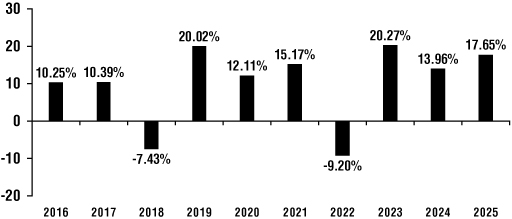
The Fund's highest/lowest quarterly results during this time period were:
Institutional Class
Highest 18.15% (Quarter ended 12/31/2020)
Lowest (20.51)% (Quarter ended 03/31/2020)
Average Annual Total Returns
(for the periods ended December 31, 2025)
|
|
One
Year
|
|
Five
Years
|
|
Ten
Years
|
|
|
Institutional Class Shares—Before Taxes
|
|
|
17.65
|
%
|
|
|
11.02
|
%
|
|
|
9.84
|
%
|
|
Institutional Class Shares—After Taxes on
Distributions1
|
|
|
15.15
|
%
|
|
|
9.20
|
%
|
|
|
8.25
|
%
|
|
Institutional Class Shares—After Taxes on
Distributions and Sale of Fund Shares1
|
|
|
12.19
|
%
|
|
|
8.43
|
%
|
|
|
7.64
|
%
|
|
|
Investor Class Shares—Before Taxes2
|
|
|
17.52
|
%
|
|
|
10.91
|
%
|
|
|
9.73
|
%
|
|
MSCI All Country World Index
(reflects no deductions for fees, expenses, or taxes)
|
|
|
22.34
|
%
|
|
|
11.19
|
%
|
|
|
11.72
|
%
|
|
S&P 500 Index (reflects no deductions for fees,
expenses, or taxes)
|
|
|
17.88
|
%
|
|
|
14.42
|
%
|
|
|
14.82
|
%
|
|
60%/40% S&P 500 Index/Bloomberg U.S. Aggregate
Bond Index (reflects no deductions for fees,
expenses, or taxes)
|
|
|
13.70
|
%
|
|
|
8.47
|
%
|
|
|
9.78
|
%
|
|
Consumer Price Index (reflects no deductions for fees,
expenses, or taxes)
|
|
|
2.63
|
%
|
|
|
4.47
|
%
|
|
|
3.21
|
%
|
|
1
2
12
INVESTMENT ADVISER
First Pacific Advisors, LP is the Fund's investment adviser.
PORTFOLIO MANAGERS
Steven Romick, a Managing Partner of the Adviser, has been a portfolio manager of the Fund since its inception on June 2, 1993. Mark Landecker and Brian Selmo, each a Partner of the Adviser, have been portfolio managers of the Fund since June 2, 2013. Messrs. Romick, Landecker and Selmo are primarily responsible for the day-to-day management of the Fund's portfolio.
PURCHASE AND SALE OF FUND SHARES
Investors may purchase or redeem shares on any business day by written request, check, wire, ACH (Automated Clearing House), telephone, or through dealers as further described in this prospectus. You may conduct transactions by mail (FPA Funds, c/o UMB Fund Services, Inc., P.O. Box 2175, Milwaukee, Wisconsin 53201-2175, or 235 West Galena Street, Milwaukee, Wisconsin 53212), by wire, or by telephone at (800) 638-3060. Purchases and redemptions by telephone are only permitted if you previously established this option in your account. Investors can use the Account Application for initial purchases.
Investors can purchase shares by contacting any investment dealer authorized to sell the Fund's shares. The minimum initial investment is $1,500 for both the Institutional Class and Investor Class Shares, and each subsequent investment, which can be made directly to UMB Fund Services, Inc., must be at least $100. However, as described herein, no minimum investment amount is imposed for investments in retirement plans. All purchases made by check should be in U.S. dollars and made payable to the FPA Funds. Third party, starter or counter checks will not be accepted. A charge may be imposed if a check does not clear. The Fund reserves the right to waive or lower purchase and investment minimums in certain circumstances. For example, the minimums listed above may be waived or lowered for investors who are Trustees or officers of the Fund, employees of the Adviser and/or customers of certain financial intermediaries that hold the Fund's shares in certain omnibus accounts, and investments in the Fund in connection with liquidity programs (described in additional detail below under "Management of the Fund"), at the discretion of the officers of the Fund. In addition, financial intermediaries may impose their own minimum investment and subsequent purchase amounts.
Subsequent investments and redemptions can be made directly to UMB Fund Services, Inc.
Notice to Non-U.S. Resident Individual Shareholders. The Fund and its shares are only registered in the United States and its territories ("United States"). Regulations outside of the United States may restrict the sale of shares to certain non-U.S. residents or subject certain shareholder accounts to additional regulatory requirements. As a result, individuals resident outside the United States are generally not eligible to invest in the Fund. The Fund reserves the right, however, to sell shares to certain other non-U.S. investors in compliance with applicable law. If a current shareholder of the Fund provides a non-U.S. address, this will be deemed a representation and warranty from such investor that he/she is not a U.S. resident and will continue to be a non-U.S. resident unless
13
and until the Fund is notified of a change in the investor's resident status. Any current shareholder that has a resident address outside of the United States may be restricted from purchasing additional shares.
TAX INFORMATION
The Fund's distributions are taxable and will be taxed as ordinary income and/or long-term capital gain, unless you are investing through a tax-deferred arrangement, such as an IRA or 401(k) plan.
INFORMATION REGARDING TRANSACTIONS THROUGH FINANCIAL INTERMEDIARIES
Shareholders may be required to pay a commission directly to their broker or other financial intermediary when buying or selling shares of the Fund. Shareholders and potential investors may wish to contact their broker or other financial intermediary for information regarding applicable commissions, transaction fees or other charges associated with transactions in shares of the Fund.
In addition, brokers, dealers, banks, trust companies and other financial representatives may receive compensation from the Fund or its service providers for providing a variety of services, which may include recordkeeping, transaction processing for shareholders' accounts and certain shareholder services not currently offered to shareholders that deal directly with the Fund. These payments may create a conflict of interest by influencing the broker-dealer or other intermediary and your salesperson to recommend the Fund over another investment. Ask your salesperson or visit your financial intermediary's web site for more information.
14
ADDITIONAL INFORMATION ABOUT THE FUND
Investment Objective
The Fund seeks to generate equity-like returns over the long-term, take less risk than the market and avoid permanent impairment of capital.
The Fund's investment objective is not fundamental and may be changed by the Board without shareholder approval, upon at least 60 days' prior written notice to shareholders. The Fund's investment strategies and policies may be changed from time to time without shareholder approval or prior written notice, unless specifically stated otherwise in this Prospectus or the Statement of Additional Information ("SAI").
Principal Investment Strategies
To pursue the Fund's investment objective, the portfolio managers invest in both equity and debt securities of companies. The portfolio managers believe that this combination of securities broadens the universe of opportunities for the Fund, offers additional diversification and helps to lower volatility. The portfolio managers invest primarily in equity securities and the balance of the Fund's portfolio in debt securities, cash, and cash equivalents. The Fund has no limit on the amount of assets it may invest in non-U.S. securities. The decision to invest in a non-U.S. security will be based on the portfolio managers' fundamental security analysis. In addition, the Fund may sell securities short, and the portfolio managers may employ a short selling strategy for a portion of the Fund.
Equity securities represent an ownership interest, or the right to acquire an ownership interest, in an issuer. Different types of equity securities provide different voting and dividend rights and priority in case of the bankruptcy of the issuer. The Fund may invest in a variety of equity securities, including common stocks, preferred stocks, convertible securities, rights, and warrants.
The portfolio managers look for large and small companies that they believe to have excellent future prospects that are undervalued by the securities markets. The portfolio managers believe that these opportunities often arise when companies are out-of-favor or undiscovered by most of Wall Street. The portfolio managers also search for companies that offer earnings growth, opportunity for price/earnings multiple expansion and the best combination of such quality criteria as strong market share, good management, high barriers to entry and high return on capital.
Using fundamental security analysis, the portfolio managers may look for investments that trade at a substantial discount to the portfolio managers' determination of the company's value (absolute value) rather than those that might appear inexpensive based on a discount to their peer groups or the market average (relative value). The portfolio managers attempt to determine a company's absolute value using fundamental security analysis, which they believe generally provides them with a thorough view of a company's financial and business characteristics. As a part of their process, the portfolio managers may:
• Review stock prices or industry group under-performance, insider purchases, management changes and corporate spin-offs.
15
• Communicate directly with company management, suppliers, and customers.
• Use their judgment to define the company's future potential, financial strength, and competitive position.
The portfolio managers generally seek to sell an equity investment when they believe that the company's value has been fully reflected in a higher valuation by the market or when a negative fundamental development occurs in the company or its industry that the portfolio managers believe could significantly impact future earnings growth.
A debt security is an interest-bearing security that companies or governments use to borrow money from investors. The issuer of a debt security promises to pay interest at a stated rate, which may be variable or fixed, and to repay the amount borrowed at maturity (the date when the debt security is due and payable). The Fund may invest in debt securities issued by companies, the U.S. government, and its agencies; mortgage-backed and asset-backed securities (i.e. securities that are backed by pools of loans or mortgages assembled for sale to investors); municipal notes and bonds; and commercial paper and certificates of deposit.
The portfolio managers invest in debt securities seeking to provide the Fund with a reliable and recurring stream of income, while seeking to preserve its capital. The Fund may also invest in debt securities rated below investment grade ("high yield bonds" or "junk bonds"). The Fund has the ability to invest up to 65% of its total assets in debt securities, although it will generally invest a greater percentage of its portfolio in equity securities than debt securities.
The portfolio managers select debt securities by using an approach that is similar to the approach they use to select equity securities and by trying to forecast current interest rate trends. The portfolio managers generally employ a defensive interest rate strategy, which means they seek to keep the average maturity of the debt-securities portion of the Fund to 10 years or less, by investing at different points along the yield curve. The portfolio managers also continually consider yield spreads and other underlying factors such as credit quality, investor perception and liquidity to determine which sectors offer the best investment value at any given time.
The portfolio managers may engage in a strategy known as selling short. Selling a security short is when the Fund sells a security it does not own. To sell a security short, the Fund must borrow the security from someone else to deliver to the buyer. The Fund then replaces the security it borrowed by purchasing it at the market price at or before the time of replacement. Until it replaces the security, the Fund repays the person that lent it the security for any interest or dividends that may have accrued during the period of the loan. The Fund typically sells securities short to take advantage of an anticipated decline in prices or to protect a profit in a security it already owns.
16
ADDITIONAL INFORMATION ABOUT THE PRINCIPAL INVESTMENT STRATEGIES
To pursue the Fund's investment objective, the portfolio managers generally invest the Fund's assets in common stocks and other securities of international and U.S. companies and debt securities, including but not limited to the following securities:
Equity Securities. Equity securities represent ownership shares in a company, and include securities that convey an interest in, may be converted into or give holders a right to purchase or otherwise acquire such ownership shares in a company.
Common Stock. Common stocks represent shares of ownership in a company. After other company obligations are satisfied, common stockholders participate in company profits on a pro-rata basis; profits may be paid out in dividends or reinvested in the company to help it grow. Increases and decreases in earnings are usually reflected in a company's stock price, so common stocks generally have the greatest appreciation and depreciation potential of all corporate securities. Ownership of common stock of a non-U.S. company may be represented by depositary receipts (which are certificates evidencing ownership of securities of a non-U.S. issuer).
Preferred Stock. Preferred stock is typically subordinated to an issuer's senior debt, but senior to the issuer's common stock. Typically, preferred stock is structured as a long-dated or perpetual bond that distributes income on a regular basis. Issuers are permitted to skip ("non-cumulative" preferred stock) or defer ("cumulative" preferred stock) distributions. Preferred stock may be convertible into common stock and may contain call or maturity extension features.
Warrants and Rights. Warrants are options to buy a stated number of shares of common stock at a specified price anytime during the life of the warrants (generally two or more years). They have no voting rights, pay no dividends, and have no rights with respect to the assets of the entity issuing them. Rights are similar to warrants but normally have a shorter duration and are typically distributed directly by the issuers to existing shareholders, while warrants are typically attached to new debt or preferred stock issuances. The market price of warrants may be substantially lower than the current market price of the underlying common stock, yet warrants are subject to similar price fluctuations. As a result, warrants may be more volatile investments than the underlying common stock. If a warrant is exercised, the Fund may hold common stock in its portfolio even if it does not ordinarily invest in common stock. Warrants and rights generally do not entitle the holder to dividends or voting rights with respect to the underlying common stock and do not represent any rights in the assets of the issuer. Warrants and rights will expire if not exercised on or prior to the expiration date.
Non-U.S. Securities. The Fund may invest in securities of U.S.-dollar denominated non-U.S. issuers traded in the United States and in non-U.S. currency-denominated securities of non-U.S. issuers. For purposes of this prospectus, non-U.S. issuers are generally non-U.S. governments or companies either domiciled outside the U.S. or traded on non-U.S. exchanges, but the portfolio managers may make a different designation in certain circumstances. The non-U.S. issuers that the Fund may invest in include issuers with significant exposure to countries with developing economies and/or markets.
17
Cash Equivalents. Cash equivalents are short-dated instruments that are readily convertible into cash. They may include bank obligations, commercial paper, and repurchase agreements. Bank obligations include certificates of deposit and bankers' acceptances. Commercial paper is a short-term promissory note issued by a corporation, which may have a floating or variable rate. Repurchase agreements are transactions under which the Fund purchases a security from a dealer counterparty and agrees to resell the security on a specified future date at the same price, plus a specified interest rate.
U.S. Government Securities. The U.S. government sector includes fixed-income securities issued by the U.S. government or its agencies and instrumentalities, such as U.S. Treasury and U.S. government agency securities, mortgage pass-through securities, including Government National Mortgage Association (Ginnie Mae), Federal Home Loan Mortgage Corporation (Freddie Mac) and the Federal National Mortgage Association (Fannie Mae), and agency mortgage-backed securities.
Mortgage-Backed Securities. In addition to the U.S. government mortgage-pass through securities described above, the mortgage sector includes non-agency mortgage-backed securities, such as collateralized mortgage obligations ("CMOs"), CMBS, RMBS and single- and multi-class pass- through securities. Mortgage-backed securities represent direct or indirect participation in mortgage loans secured by real property.
Asset-Backed Securities. Asset-backed securities are bonds issued through special purpose vehicles and backed by pools of loans, other receivables, or other assets. Asset-backed securities are created from many types of assets, such as home equity loans, auto loans, student loans and credit card receivables. The credit quality of an asset-backed security depends on the quality and performance of the underlying assets and/or the level of any credit support provided by the securitization structure. The proportions of the Fund's portfolio invested in various types of asset-backed securities will depend on many factors, including the portfolio managers' appraisal of the economy, yield, credit quality, macroeconomic factors, and capital appreciation potential, among others. To the extent the Fund focuses its investments in a particular type of asset-backed security, it may be more susceptible to economic conditions and risks affecting the type of asset-backed security.
Corporate Debt Securities. The Fund may invest in corporate bonds, bank debt, notes and commercial paper of varying maturities and may invest in domestic bonds, bank debt and notes and those issued by non-U.S. corporations and governments. Issuers of these securities have a contractual obligation to pay interest at a specified rate on specified date and to repay principal on a specified maturity date, and may have provisions that allow the issuer to redeem or "call" the security before its maturity.
Temporary Investments and Other Measures. As a temporary measure for defensive purposes, the Fund may invest up to 100% of its total assets in short-term investments, including cash or cash equivalents, corporate debt, or direct or indirect U.S. and non-U.S. government and agency obligations, money market instruments, bank obligations, commercial paper, corporate notes and repurchase agreements. The Fund may make these investments or increase its investment in these securities when the managers are unable to find enough attractive long-term investments, to reduce exposure to the Fund's primary investments when the managers believe it is advisable to do so,
18
during periods of significant shareholder redemptions or when adverse or unusual market, economic, political, or other conditions exist. The Fund may take such portfolio positions for as long a period as deemed necessary. In doing so, the Fund may succeed in avoiding losses but may otherwise fail to achieve its investment objective. However, there can be no guarantee that a defensive strategy will be successful. Investing defensively may adversely affect Fund performance. During these times, the portfolio managers may make frequent portfolio holding changes, which could result in increased trading expenses and taxes, and decreased Fund performance.
As part of its normal operations, the Fund may hold cash or invest a portion of its portfolio in short-term interest bearing U.S. dollar denominated securities, pending investments or to provide for possible redemptions. Investments in such short-term debt securities can generally be sold easily and have limited risk of loss, but earn only limited returns. The Fund may increase its cash holdings and/or such short-term investments in anticipation of a greater than normal number of shareholder redemptions.
The Fund's emphasis on a value-oriented investment approach could result in a portfolio that does not reflect the national economy, differs significantly from broad market indices, and consists of securities considered by the average investor to be unpopular or unfamiliar.
Percentage Investment Limitations. Unless otherwise stated, all percentage limitations on Fund investments listed in this prospectus will apply at the time of purchase. The Fund would not violate these limitations unless an excess or deficiency occurs or exists immediately after and as a result of an investment.
Other Investments and Techniques. The Fund may invest in other types of securities and use a variety of investment techniques and strategies which are not principal investment strategies and are not described in this prospectus. These securities and techniques may subject the Fund to additional risks. Please see the Statement of Additional Information (the "SAI") for additional information about the securities and investment techniques described in this prospectus and about additional securities and techniques that may be used by the Fund.
ADDITIONAL INFORMATION ABOUT THE PRINCIPAL RISKS
The Fund's principal risks are set forth below. Before you decide whether to invest in the Fund, carefully consider these risk factors and special considerations associated with investing in the Fund, which may cause you to lose money.
Market Risk. The market price of a security or instrument may decline, sometimes rapidly or unpredictably, due to general market conditions that are not specifically related to a particular company, such as real or perceived adverse economic, political, or geopolitical conditions throughout the world, changes in the general outlook for corporate earnings, changes in interest or currency rates, or adverse investor sentiment generally. The market value of a security or instrument also may decline because of factors that affect a particular industry or industries, such as tariffs, labor shortages or increased production costs and competitive conditions within an industry. In addition, local, regional or global events such as war, acts of terrorism, international conflicts, trade disputes, supply chain disruptions, cybersecurity events, the spread of infectious illness or other public health issues, natural disasters or climate events, or other events could have a significant
19
impact on a security or instrument. Such events could make identifying investment risks and opportunities especially difficult for the Adviser. In response to certain crises, the United States and other governments have taken steps to support financial markets. The withdrawal of this support or failure of efforts in response to a crisis could negatively affect financial markets generally as well as the value and liquidity of certain securities. In addition, policy and legislative changes in the United States and in other countries are changing many aspects of financial regulation. The impact of these changes on the markets, and the practical implications for market participants, may not be fully known for some time. The increasing interconnectivity between global economies and financial markets increases the likelihood that events or conditions in one region or financial market may adversely impact issuers in a different country, region or financial market.
Risks Associated with Investing in Equities. Equity securities, generally common stocks, preferred stocks and/or depositary receipts held by the Fund may experience sudden, unpredictable drops in value or long periods of decline in value. This may occur because of factors that affect the securities markets generally, such as adverse changes in economic or political conditions, the general outlook for corporate earnings, interest rates or investor sentiment. Sustained periods of market volatility, either globally or in any jurisdiction in which the Fund invests, may increase the risks associated with an investment in the Fund. Equity securities may also lose value because of factors affecting an entire industry or sector, such as increases in production costs or factors directly related to a specific company, such as decisions made by its management.
Common stock of an issuer in the Fund's portfolio may decline in price if the issuer fails to make anticipated dividend payments because, among other reasons, the issuer of the security experiences a decline in its financial condition. Common stock is subordinated to preferred stocks, bonds, and other debt instruments in a company's capital structure, in terms of priority with respect to corporate income, and therefore will be subject to greater dividend risk than preferred stocks or debt instruments of such issuers. In addition, while broad market measures of common stocks have historically generated higher average returns than fixed income securities, common stocks have also experienced significantly more volatility in those returns. Because preferred stock is generally junior to debt securities and other obligations of the issuer, deterioration in the credit quality of the issuer will cause greater changes in the value of a preferred stock than in a more senior debt security with similar stated yield characteristics.
Interest Rate Risk. As with most funds that invest in debt securities, changes in interest rates, including rates that fall below zero, are one of the most important factors that could affect the value of an investment in the Fund. Interest rate risk is the risk that debt securities will decline in value because of increases in interest rates. Any such change in interest rates may be sudden and significant, with unpredictable effects on the financial markets and the Fund's investments. Generally, bonds with longer maturities have a greater duration and thus are subject to greater price volatility from changes in interest rates. Adjustable rate instruments also react to interest rate changes in a similar manner although generally to a lesser degree (depending, however, on the characteristics of the reset terms, including the index chosen, frequency of reset and reset caps or floors, among other things). Low interest rates may pose heightened risks with respect to investments in fixed income securities. When interest rates rise from a low level, fixed income securities markets may experience lower prices, increased volatility, and lower liquidity. The negative impact on fixed income securities from rate increases, regardless of the cause, could be swift and significant, which could result in significant losses by the Fund, even if such rate increases
20
are anticipated by the portfolio managers. The Fund may be subject to heightened interest rate risk because the Federal Reserve has raised, and may continue to raise, interest rates. During periods of increasing interest rates the Fund may experience high redemptions and, as a result, increased portfolio turnover, which could increase the costs that the Fund incurs and may negatively impact the Fund's performance.
ARM Risk. During periods of extreme fluctuations in interest rates, the resulting fluctuations of ARM rates could affect the ARMs' market value. Most ARMs have annual reset limits or "caps." Fluctuations in interest rates above these levels, thus, could cause the mortgage-backed securities to "cap out" and to behave more like long-term, fixed-rate debt securities. During periods of declining interest rates, of course, the coupon rates may readjust downward and result in lower yields. Because of this feature, the value of ARMs will likely not rise during periods of declining interest rates to the same extent as fixed-rate instruments.
Credit Risk. Credit risk refers to the likelihood that an issuer will default on the payment of principal and/or interest on a security. Various factors could affect the issuer's actual or perceived willingness or ability to make timely interest or principal payments, including changes in the issuer's financial condition or in general economic conditions. In addition, lack of or inadequacy of collateral or credit enhancements for a fixed income security may affect its credit risk. Below investment grade securities have more risk with respect to the issuer's ability to pay interest and repay principal when due, and therefore involve a greater risk of default or nonpayment. Credit risk of a security may change over time. Ratings agencies periodically review certain securities and may downgrade a security that is held by the Fund. However, ratings are only opinions of the agencies issuing them and are not absolute guarantees as to quality.
Call Risk. Issuers of callable bonds are permitted to redeem these bonds before their final maturity. Issuers may call outstanding securities before maturity for a number of reasons, including decreases in prevailing interest rates or improvements to the issuer's credit profile. If an issuer calls a security in which the Fund is invested, the Fund could lose potential price appreciation and be forced to reinvest the proceeds in securities that bear a lower interest rate or more credit risk.
Risks Associated with Investing in Smaller-Cap and Mid-Cap Companies. The prices of securities of smaller-cap and mid-cap companies tend to fluctuate more widely than those of larger, more established companies. Smaller-cap and mid-cap companies may have limited product lines, markets or financial resources or may depend on the expertise of a few people and may be subject to more abrupt or erratic market movements than securities of larger, more established companies or market averages in general. In addition, these companies often have shorter operating histories and are more reliant on key products or personnel than larger companies. The securities of smaller- or medium-sized companies are often traded over-the-counter, and may not be traded in volumes typical of securities traded on a national securities exchange. Securities of such issuers may lack sufficient market liquidity to effect sales at an advantageous time or without a substantial drop in price.
Risks Associated with Investing in Non U.S. Securities. Non-U.S. investments involve special risks not present in U.S. investments that can increase the chances that the Fund will lose money.
21
Certain of the risks noted below may also apply to securities of U.S. issuers with significant non- U.S. operations. Investments in non-U.S. securities involve the following risks:
• The economies of some non-U.S. markets often do not compare favorably with that of the U.S. in areas such as growth of gross domestic product, reinvestment of capital, resources, and balance of payments. Some of these economies may rely heavily on particular industries or non-U.S. capital. They may be more vulnerable to adverse diplomatic developments, the imposition of economic sanctions against a country, changes in international trading patterns, trade barriers and other protectionist or retaliatory measures.
• Governmental actions—such as the imposition of capital controls, nationalization of companies or industries, expropriation of assets or the imposition of punitive taxes—may adversely affect investments in non-U.S. markets. Such governments may also participate to a significant degree, through ownership or regulation, in their respective economies.
• The governments of certain countries may prohibit or substantially restrict foreign investing in their capital markets or in certain industries. This could severely affect security prices. This could also impair the Fund's ability to purchase or sell non-U.S. securities or transfer its assets or income back to the U.S. or otherwise adversely affect the Fund's operations.
• Other non-U.S. market risks include foreign exchange controls, difficulties in pricing securities, defaults on non-U.S. government securities, difficulties in enforcing favorable legal judgments in non-U.S. courts, and political and social instability. Legal remedies available to investors in some non-U.S. countries are less extensive than those available to investors in the U.S. Many non-U.S. governments supervise and regulate stock exchanges, brokers, and the sale of securities to a lesser extent than the U.S. government does. Corporate governance may not be as robust as in more developed countries. As a result, protections for minority investors may not be strong, which could adversely affect the Fund's non-U.S. holdings or exposures.
• Accounting standards in other countries are not necessarily the same as in the U.S. If the accounting standards in another country do not require as much disclosure or detail as U.S. accounting standards, it may be harder for the portfolio managers to completely and accurately determine a company's financial condition or otherwise assess a company's creditworthiness.
• Because there may be fewer investors on non-U.S. exchanges and smaller numbers of shares traded each day, it may be difficult for the Fund to buy and sell securities on those exchanges. In addition, prices of non-U.S. securities may be more volatile than prices of securities traded in the U.S.
• Non-U.S. markets may have different clearance and settlement procedures. In certain markets, settlements may not keep pace with the volume of securities transactions. If this occurs, settlement may be delayed, and the Fund's assets may be uninvested and may not be earning returns. The Fund also may miss investment opportunities or not be able to sell an investment or reduce its exposure because of these delays.
22
• Changes in currency exchange rates will affect the value of the Fund's non-U.S. holdings or exposures.
• The costs of non-U.S. securities transactions tend to be higher than those of U.S. transactions, increasing the transaction costs paid directly or indirectly by the Fund.
• International trade barriers or economic sanctions against non-U.S. countries may adversely affect the Fund's non-U.S. holdings or exposures. Since January 20, 2025, the current U.S. administration has pursued an aggressive foreign policy agenda, including the imposition of tariffs, which may have unforeseen consequences on the United States' relations with foreign countries, the economy, and markets generally. In addition, the current administration has sought to reduce the size of the U.S. government by, for example, reducing the headcount of and freezing funding available to certain U.S. government agencies. Such efforts may continue throughout U.S. federal agencies, which could increase administrative burdens on remaining government employees, increase processing times of company filings, alter regulatory policymaking, and increase regulatory volatility. These, as well as other potential effects which are not currently known, may have a negative impact on the Fund or on markets generally.
• Global economies are increasingly interconnected, which increases the possibilities that conditions in one country region or financial market may adversely impact a different country, region, or financial market.
The severity or duration of these conditions may be affected if one or more countries leave the European Union or the euro currency or if other policy changes are made by governments or quasi- governmental organizations.
The Fund may invest in depositary receipts, including American Depositary Receipts ("ADRs"), European Depositary Receipts ("EDRs"), Global Depositary Receipts ("GDRs") and Global Depositary Notes ("GDNs"), which are certificates evidencing ownership of securities of a non-U.S. issuer. Depositary receipts may be sponsored by the non-U.S. issuer or unsponsored. Depositary receipts are subject to the risks of changes in currency or exchange rates and the risks of investing in non-U.S. securities that they evidence or into which they may be converted. The issuers of unsponsored depositary receipts are not obligated to disclose information that would be considered material in the U.S., or to pass through to shareholders any voting rights with respect to the deposited securities. Therefore, there may be less information available regarding these issuers, and there may not be a correlation between such information and the market value of the depositary receipts.
Risks Associated with Investing in Emerging Markets. In investing the Fund's assets, the portfolio managers focus on countries with established rules of law and political systems that allow for transparent and unbiased enforcement of those laws, although there can be no assurance that the Fund's assets will in all cases be invested in countries that offer such protections, and such investments may be subject to heightened risk. The Fund's investments in non-U.S. issuers in developing or emerging market countries may involve increased exposure to changes in economic, social, and political factors as compared to investments in more developed countries. The economies of most emerging market countries are in the early stage of capital market development and may
23
be dependent on relatively fewer industries. As a result, their economic systems are still evolving. Emerging markets may have less established legal, accounting, and financial reporting systems than those in more developed markets, which may reduce the scope or quality of financial information available to investors. Companies in emerging markets may also be subject to less stringent standards on disclosure, accounting and financial reporting, and record keeping, which may affect the Fund's ability to evaluate potential and current investments. In addition, their legal and political systems may also be less stable than those in developed economies. Securities markets in these countries can also be smaller, and there may be increased settlement risks , and investor protection regimes may be more limited. For example, it may be more difficult for shareholders to bring derivative litigation or for U.S. regulators to bring enforcement actions against issuers in emerging markets. Emerging market countries often suffer from currency devaluation and higher rates of inflation. Due to these risks, securities issued in developing or emerging countries may be more volatile, less liquid, and harder to value than securities issued in more developed countries.
Risks Associated with Short Selling. The Fund can lose money if the price of the security it sold short increases between the date of the short sale and the date on which the Fund replaces the borrowed security. These losses are theoretically unlimited. To borrow the security, the Fund also may be required to pay a premium, which would increase the cost of the security sold. The Fund will incur transaction costs in effecting short sales. The Fund's gains and losses will be decreased or increased, as the case may be, by the amount of the premium, dividends, interest, or expenses the Fund may be required to pay in connection with a short sale.
Risks Associated with Value Investing. Value stocks, including those selected by the portfolio managers for the Fund, are subject to the risks that their intrinsic value may never be realized by the market and that their prices may go down. In addition, value style investing may fall out of favor and underperform growth or other styles of investing during given periods. The Fund's value discipline may result in a portfolio of securities that differs materially from its illustrative indices.
Securities selected by the portfolio managers using a value strategy may never reach their intrinsic value because the market fails to recognize what the portfolio managers consider to be the true business value or because the portfolio managers have misjudged those values. There may be periods during which the investment performance of the Fund suffers while using a value strategy.
Liquidity Risk. The Fund's investments in illiquid securities may reduce the returns of the Fund because it may not be able to sell the illiquid securities at an advantageous time or price. Investments in high yield securities, non-U.S. securities, derivatives, or other securities with substantial market and/or credit risk tend to have the greatest exposure to liquidity risk. Certain investments in private placements and Rule 144A securities may be considered illiquid investments under certain circumstances. Lower-rated debt securities tend to be less liquid than higher-rated securities. Illiquid securities may trade at a discount from comparable, more liquid investments, and may be subject to wider fluctuations in market value. Investments in illiquid derivatives may create the potential for the Fund to face ongoing margin and settlement payment obligations thereunder. Furthermore, reduced number and capacity of dealers and other counterparties to "make markets" in fixed income securities, in connection with the growth of the fixed income markets, may increase liquidity risk with respect to the Fund's investments in fixed income securities. When there is no willing buyer and investments cannot be readily sold, the Fund may have to lower the selling price, sell other investments, or may not be able to sell the securities at all and may have to forego another, more
24
appealing investment opportunity, any of which could have a negative effect on the Fund's performance. These securities may also be difficult to value and their values may be more volatile because of liquidity risk. Increased Fund redemption activity may negatively impact Fund performance and increase liquidity risk due to the need of the Fund to sell portfolio securities. Regulatory changes may further constrain the ability of market participants to create liquidity, particularly in times of increased market volatility. Liquidity risk may intensify during periods of economic uncertainty.
OTC Investments Risk. Securities and derivatives traded in OTC markets may trade in smaller volumes, and their prices may be more volatile, than securities principally traded on securities exchanges. Such securities may be less liquid than more widely traded securities. In addition, the prices of such securities may include an undisclosed dealer markup, which the Fund pays as part of the purchase price.
U.S. Government Securities Risk. Certain U.S. government securities are supported by the full faith and credit of the United States; others are supported by the right of the issuer to borrow from the U.S. Treasury; others are supported by the discretionary authority of the U.S. government to purchase the agency's obligations; and still others are supported only by the credit of the issuing agency, instrumentality, or enterprise. Although U.S. government-sponsored enterprises such as the Federal Home Loan Mortgage Corporation (Freddie Mac) and the Federal National Mortgage Association (Fannie Mae) may be chartered or sponsored by Congress, they are not funded by Congressional appropriations, and their securities are not issued by the U.S. Treasury, are not supported by the full faith and credit of the U.S. government, and involve increased credit risks in comparison to U.S. Treasury securities or other securities supported by the full faith and credit of the U.S. government. Any security guaranteed by the U.S. government or its agencies or instrumentalities, or a security backed by the U.S. Treasury or the full faith and credit of the United States, is guaranteed or backed only as to the timely payment of interest and principal when held to maturity, but the market values for such securities are not guaranteed and will fluctuate.
Any market movements, regulatory changes, or changes in political or economic conditions that affect the U.S. government agencies or instrumentalities in which the Fund invests may have a significant impact on the Fund's performance. Events that would adversely affect the market prices of securities issued or guaranteed by one government agency or instrumentality may adversely affect the market price of securities issued or guaranteed by other government agencies or instrumentalities. Because many types of U.S. government securities trade actively outside the United States, their prices may rise and fall as changes in global economic conditions affect the demand for these securities.
Mortgage-Related and Asset-Backed Securities Risk. Mortgage-related and other asset-backed securities represent interests in "pools" of mortgages or other assets such as consumer loans or receivables held in trust and often involve risks that are different from or possibly more acute than risks associated with other types of debt instruments. Mortgage-related securities, including CMBS and RMBS, are subject to prepayment risk and can be highly sensitive to changes in interest rates. Generally, in a period of rising interest rates, individual borrowers are less likely to exercise prepayment options which tend to extend the expected maturity of mortgage-related securities, making them more sensitive to changes in interest rates. As a result, if the Fund holds mortgage- related securities, rising interest rates may cause the Fund to exhibit additional volatility due to the
25
increased expected average life of its mortgage-related holdings. When interest rates decline, borrowers may pay their mortgages sooner than expected. These prepayments can reduce the returns of the Fund because the Fund may realize losses on securities that were acquired at a premium to par and the Fund may have to reinvest the proceeds from prepayments at the lower prevailing interest rates which can reduce the Fund's yield.
Mortgage-related securities may be either pass-through securities or CMOs. Pass-through securities represent a right to receive principal and interest payments collected on a pool of mortgages which are passed through to security holders. CMOs are created by dividing the principal and interest payments collected on a pool of mortgages into several cash flow streams ("tranches") with different priority rights to portions of the underlying mortgage payments. Certain CMO tranches may represent a right to receive specific sources of cash flow such as interest-only ("IOs") or principal- only ("POs"). These securities are frequently referred to as "stripped securities" and are subject to interest rate risks described above. If the Fund invests in CMO tranches (including CMO tranches issued by government agencies) and interest rates move in a manner not anticipated by the managers, it is possible that the Fund could lose all or substantially all of its investment. The market prices of CMOs structured as accrual certificates (also known as "Z-Bonds") are affected to a greater extent by interest rate changes and therefore tend to be more volatile than securities which pay current interest in cash. Mortgage-related securities, including CMBS and RMBS, and in particular those not backed by a government guarantee, are subject to credit risk, i.e., the likelihood that an issuer will default on the payment of principal and/or interest on a security. CMBS and RMBS investments that are backed by mortgages given to borrowers considered to be higher risk borrowers generally include one or more aggressive mortgage terms, such as a high loan-to-value ratio. Such mortgages carry a higher degree of credit risk than other loans, and, therefore, a higher probability of default.
The Fund may invest in CDOs, which include collateralized loan obligations ("CLOs"), collateralized bond obligations ("CBOs"), and other similarly structured securities. The risks of an investment in a CDO depend largely on the type of the collateral securities and the class of the CDO in which the Fund invests. In addition to the normal risks associated with credit-related securities discussed elsewhere in the prospectus (e.g., interest rate risk and default risk), CDOs carry additional risks including, but not limited to, the risk that: (i) distributions from collateral securities may not be adequate to make interest or other payments; (ii) the quality of the collateral may decline in value or default; (iii) the Fund may invest in CDOs that are subordinate to other classes; and (iv) the complex structure of the security may not be fully understood at the time of investment and may produce disputes with the issuer or unexpected investment results. Investments in CDOs are also more difficult to value than other investments. In addition, although not required, valuations of Fund holdings are ordinarily verified via a second pricing source. However, second source pricing may not be available with respect to certain CDOs in which the Fund invests as a result of a lack of readily available market quotations. In addition, there may be delays in the Fund's ability to invest in CDOs at desired levels as a result of the increased time necessary for the Adviser to resolve valuation and operational issues necessary to make these investments.
The Fund's investments in other asset-backed securities are subject to risks similar to those associated with mortgage-related securities, as well as additional risks associated with the nature of the assets and the servicing of those assets. Payment of principal and interest on asset-backed securities may be largely dependent upon the cash flows generated by the assets backing the
26
securities, and asset-backed securities may not have the benefit of any security interest in the related assets. Certain asset-backed securities, including securities backed by auto loans, are subject to subprime lending and loan-to-value risk. One of the most significant risks to a holder of an auto loan asset-backed security is the fluctuation of the value of the loans acquired. The higher the loan-to-value ratio, the riskier the loan is for a lender. Further, subprime loans underlying auto loan asset-backed securities may have higher default rates than loans that meet more stringent underwriting requirements.
Risks Associated with Investing in High Yield Securities. High yield bonds, sometimes called "junk" bonds, are highly speculative securities that are usually issued by smaller, less credit-worthy and/or highly leveraged (indebted) companies. Because investment in lower-rated or unrated securities involves greater investment risk, achievement of the Fund's investment objective is more dependent on the portfolio managers' credit analysis of these securities than with respect to the Fund's investments in higher-rated securities. The portfolio managers do not employ a rating valuation for unrated securities. Decisions to purchase and sell these securities are based on the portfolio manager's evaluation of their investment potential and not on the ratings assigned by credit agencies. Compared with investment-grade bonds, high yield bonds carry a greater degree of risk and are less likely to make payments of interest and principal. Compared to investment-grade debt securities, market developments and the financial and business conditions of the corporation issuing high yield securities influence the price and liquidity of high yield securities more than changes in interest rates when compared to investment grade debt securities. Lower-rated securities may be more susceptible to real or perceived adverse economic and competitive industry conditions than investment grade securities. A projection of an economic downturn, for example, could cause a decline in the prices of lower-rated securities because the advent of a recession could lessen the ability of a highly leveraged company to make principal and interest payments on its debt securities. New and proposed laws and regulations could negatively impact the market for high-yield bonds. Insufficient liquidity in the high yield bond market may make it more difficult to dispose of high yield bonds and may cause the Fund to experience sudden and substantial price declines. A lack of reliable, objective data or market quotations may make it more difficult to value high yield bonds accurately. There is no limit on the ratings of high yield securities that may be purchased or held by the Fund, and the Fund may invest in securities that are in default.
Risks Associated with Investing in Sovereign and Government-Related Debt. Sovereign debt includes securities issued or guaranteed by a non-U.S. sovereign government or its agencies, authorities, or political subdivisions. Government-related debt includes securities issued by non-U.S. regional or local governmental entities or government-controlled entities. In the event an issuer of sovereign debt or government-related debt is unable or unwilling to make scheduled payments of interest or principal, holders may be asked to participate in a restructuring of the debt and to extend further credit to the issuer. In the event of a default by such an issuer, there may be few or no effective legal remedies for collecting on such debt.
Risks Associated with Investing in Convertible Securities. A convertible security is a bond, debenture, or note that may be exchanged for particular common stocks in the future at a predetermined price or formula within a specified period of time. A convertible security entitles the holder to receive interest paid or accrued on the debt security until the convertible security matures or is redeemed. Prior to redemption, convertible securities provide benefits similar to nonconvertible debt securities in that they generally provide income with higher yields than those
27
of similar common stocks. Convertible securities may entail less risk than the corporation's common stocks. Convertible securities are generally not investment grade. The risks of nonpayment of the principal and interest increase when debt securities are rated lower than investment grade or are not rated.
Risks Associated with Investing in Repurchase Agreements. A repurchase agreement is a short-term investment. The Fund acquires a debt security that the seller agrees to repurchase at a future time and set price. If the seller declares bankruptcy or defaults, the Fund may incur delays and expenses liquidating the security. The security may also decline in value or fail to provide income.
Large Investor Risk. Ownership of shares of the Fund may be concentrated in one or a few large investors. Such investors may redeem shares in large quantities or on a frequent basis. Redemptions of Fund shares by a large investor may negatively affect the performance of the Fund, may increase realized capital gains, may accelerate the realization of taxable income to shareholders and may increase transaction costs. These transactions potentially limit the use of any capital loss carryforwards and certain other losses to offset future realized capital gains (if any). Such transactions may also increase the Fund's expenses. In addition, the Fund may be delayed in investing new cash after a large shareholder purchase, and under such circumstances may be required to maintain a larger cash position than it ordinarily would.
Management Risk. The Fund is subject to management risk as an actively managed investment portfolio. The portfolio managers will apply investment techniques and risk analyses in making investment decisions for the Fund, but there can be no guarantee that these will produce the desired results. The portfolio managers' opinion about the intrinsic worth or creditworthiness of a company or security may be incorrect, the portfolio managers may not make timely purchases or sales of securities for the Fund, the Fund's investment objective may not be achieved, or the market may continue to undervalue the Fund's securities. In addition, the Fund may not be able to quickly dispose of certain securities holdings. The frequency of trading within the Fund impacts portfolio turnover rates, which are shown in the financial highlights table. A higher rate of portfolio turnover could produce higher trading costs and taxable distributions, which would detract from the Fund's performance. Moreover, there can be no assurance that all of the Adviser's personnel will continue to be associated with the Adviser for any length of time. The loss of services of one or more key employees of the Adviser, including the portfolio managers, could have an adverse impact on the Fund's ability to achieve its investment objective. Certain securities or other instruments in which the Fund seeks to invest may not be available in the quantities desired. In such circumstances, the portfolio managers may determine to purchase other securities or instruments as substitutes. Such substitute securities or instruments may not perform as intended, which could result in losses to the Fund. In addition, the Fund and its service providers are subject to potential operational and information security risks from breaches in cyber security. A breach in cyber security refers to both intentional and unintentional cyber events and may include, among other events, the stealing or corrupting of data maintained online or digitally, denial of service attacks on websites, the unauthorized release or misuse of confidential information or various other forms of cyber-attacks. Cyber-security breaches affecting the Fund or the Adviser, custodian, transfer agent, intermediaries, trading counterparties or other third-party service providers may adversely impact the Fund. For instance, cyber security breaches may interfere with the processing of shareholder transactions, impact the Fund's ability to calculate its net asset value, cause the release of private shareholder information or confidential (including proprietary) company information, impede trading, result in
28
violations of applicable privacy and other laws, subject the Fund to regulatory fines, cause the Fund and its shareholders to experience financial losses, or cause reputational damage and/or otherwise disrupt normal business operations. The Fund may also incur additional costs for cyber security risk management purposes. The Fund has established business continuity plans and risk management systems reasonably designed to seek to reduce the risks associated with cyber-attacks and disruptions in services, but there are inherent limitations in these plans and systems. For example, the nature of malicious cyber-attacks is becoming increasingly sophisticated; the Fund cannot control the cyber-security systems of issuers or third-party service providers; and certain current risks may not have been identified and additional unknown threats may emerge in the future. There is also a risk that cyber security breaches may not be detected. The Fund and its shareholders could be negatively impacted as a result.
Recent Market Events. Periods of market volatility may occur in response to market events, public health emergencies, natural disasters or climate events, and other economic, political, and global macro factors. U.S. and international markets have recently experienced, and may continue to experience, periods of significant volatility due to various factors, including uncertainty regarding inflation and central banks' interest rate changes, the possibility of a national or global recession, trade tensions and tariffs, and political and geopolitical events. In addition, some countries and regions in which the Fund may invest have experienced security concerns; wars or threats of war and aggression, such as Russia's invasion of Ukraine and conflicts among nations and militant groups in the Middle East; terrorism; economic uncertainty; natural and environmental disasters; and/or systemic market dislocations that have led, and in the future may lead, to increased short-term market volatility and may have adverse long-term effects on the U.S. and world economies and markets generally, each of which may negatively impact the Fund's investments.
Additionally, since the change in the U.S. presidential administration in 2025, the administration has pursued an aggressive foreign policy agenda, including through suggestions that the United States should control certain sovereign foreign territories, attempts to restructure federal government agencies with international influence, and the—imposition of tariffs and trade barriers on certain foreign countries, including China and long-time U.S. allies. In particular, the imposition of tariffs has led to retaliatory tariffs by certain foreign countries and could lead to retaliatory tariffs by targeted additional foreign countries, as well as increased and prolonged market volatility, and sector-specific downturns in industries reliant on international trade. The new administration has also sought to reduce the headcount of and freeze or reduce funding available to certain U.S. government agencies. Such efforts may continue throughout U.S. federal agencies, which could increase administrative burdens on remaining government employees, increase processing times of company filings, alter regulatory policymaking, and increase regulatory volatility. These efforts and other similar actions may have a unforeseen consequences on the economy and markets generally, and could negatively impact the Fund.
Raising the ceiling on U.S. government debt and passing periodic legislation to fund the government have become increasingly politicized. Any failure to do either could lead to a default on U.S. government obligations, with unpredictable consequences for economies and markets in the United States and elsewhere.
Changing interest rate environments (whether downward or upward) impact various sectors of the economy and asset classes in different ways. For example, low interest rate environments tend to
29
be positive for the equity markets, whereas high interest rate environments tend to apply downward pressure on earnings and equity prices. It is difficult to accurately predict the pace at which interest rates might change, the timing, frequency or magnitude of any such changes in interest rates, or when such changes might stop or reverse course. Unexpected changes in interest rates could lead to significant market volatility or reduce liquidity in certain sectors of the market.
The events and circumstances described above could be prolonged and could adversely affect the value and liquidity of the Fund's investments, impair the Fund's ability to satisfy redemption requests, and negatively impact the Fund's performance. Other market events may cause similar disruptions and effects.
Cybersecurity Risk. Cybersecurity incidents may allow an unauthorized party to gain access to Fund assets, customer data (including private shareholder information), or proprietary information, or cause the Fund, the Adviser, and/or other service providers (including custodians, sub-custodians, transfer agents and financial intermediaries) to suffer data breaches, data corruption or loss of operational functionality. A cybersecurity incident may disrupt the processing of shareholder transactions, impact the Fund's ability to calculate its net asset value, and prevent shareholders from redeeming their shares. The use of artificial intelligence and machine learning could exacerbate these risks. Issuers of securities in which the Fund invests are also subject to cybersecurity risks, and the value of those securities could decline if the issuers experience cybersecurity incidents.
INFORMATION ABOUT NON-PRINCIPAL INVESTMENT STRATEGIES
As a secondary matter, the Fund may invest in a wide range of other investments, including futures and other derivatives. The Fund may also employ investment practices that are not principal investment strategies and that this prospectus does not describe. For more information concerning the Fund's investment practices and its risks, see the SAI.
Derivatives. The Fund may invest in derivatives, a category of investments that includes forward non-U.S. currency exchange contracts, futures, options, and swaps to protect its investments against changes resulting from market conditions or currency changes (a practice called "hedging"), to reduce transaction costs or to manage cash flows. Forward non-U.S. currency exchange contracts, futures and options are called derivatives because their value is derived from an underlying asset or economic factor. Derivatives are often more volatile than other investments and may magnify the Fund's gains or losses. There are various factors that affect the Fund's ability to achieve its objectives with derivatives. Successful use of a derivative depends on the degree to which prices of the underlying assets correlate with price movements in the derivatives the Fund buys or sells. The Fund could be negatively affected if the change in market value of its securities fails to correlate perfectly with the values of the derivatives it purchased or sold. In addition, derivatives can be volatile and involve significant risks, including counterparty risk (the risk that the other party to a contract defaults or refuses to honor the obligation), leverage risk (the risk that some derivatives entail embedded leverage magnifying losses), market risk (the risk from potential adverse market movements in relation to the Fund's derivatives positions, or the risk that markets could experience a change in volatility that adversely impacts Fund returns and the Fund's obligations and exposures), operational risk (the risk related to potential operational issues, including documentation issues, settlement issues, systems failures, inadequate controls, and human error), legal risk (the risk related to insufficient documentation, insufficient capacity or authority of counterparty, or legality or
30
enforceability of a contract) and liquidity risk (the risk that the derivative will be difficult to sell or close out at a favorable time or price). Changes in regulations relating to a mutual fund's use of derivatives and related instruments could potentially limit or impact the Fund's ability to invest in derivatives and adversely affect the value or performance of derivatives and the Fund.
PORTFOLIO HOLDINGS DISCLOSURE
A description of the Fund's policies and procedures with respect to the disclosure of the Fund's portfolio securities is available in the Fund's SAI. For instructions on how to obtain an SAI, please refer to the back cover of this prospectus.
MANAGEMENT OF THE FUND
Investment Adviser
First Pacific Advisors, LP is the Fund's investment adviser. Together with its predecessor organizations, the Adviser has been in the investment advisory business since 1954 and has served as the Fund's investment adviser since March 1, 1996. As of March 31, 2026, the Adviser managed assets of approximately $32.3 billion and serves as the investment adviser for other investment companies, as well as institutional, sub-advised, and private fund accounts. The Adviser is headquartered at 2101 E. El Segundo Boulevard., Suite 301, El Segundo, California 90245. The portfolio managers, who are affiliated with the Adviser, select investments for the Fund.
The total management fee rate paid by the Fund, as a percentage of average daily net assets, for the previous fiscal year was 0.89%. The current management fee rate paid by the Institutional and Investor Class shares is 1.00%, which includes both the advisory fee of 0.93% and a class-specific administrative service fee of 0.07%. In addition, the Adviser has contractually agreed to reimburse the Fund for operating expenses in excess of 0.05% of the average net assets of the Institutional Class shares of the Fund, and in excess of 0.15% of the average net assets of the Investor Class shares of the Fund, excluding management fees (advisory fees and administrative service fees), short sale dividend expenses and interest expenses on cash deposits relating to short sales, brokerage fees and commissions, redemption liquidity service expenses, interest, taxes, fees and expenses of other funds in which the Fund invests, and extraordinary expenses, including litigation expenses not incurred in the Fund's ordinary course of business, through January 8, 2028. The Adviser has also contractually agreed to reimburse the Fund for redemption liquidity service expenses in excess of 0.0044% of the average net assets of the Institutional Class and Investor Class shares of the Fund through January 8, 2028. These agreements may only be terminated earlier by the Board or upon termination of the Advisory Agreement.
A discussion regarding the basis for the Board's approval of the Investment Advisory Agreement is available in the Fund's Form N-CSR for the semi-annual fiscal period ended June 30, 2025.
"Management Fees" in the Annual Fund Operating Expenses table in this prospectus include the advisory fee and fees for administrative services provided by the Adviser. Under a separate agreement effective September 4, 2020, approved by the Board, administrative services are provided by the Adviser to provide non-distribution services to Fund shareholders and their advisors either directly or by assisting third parties. These services include providing in-depth information on the
31
Fund and market developments that impact Fund investments, communicating with shareholders about their holdings of shares; answering shareholder inquiries regarding account status and the procedures for the purchase and redemption of shares; providing account balances; providing communications from the fund and its portfolio managers and officers; detailed Fund analytics, and; such other matters as may reasonably be requested by advisers or other intermediaries to assist them in their provision of service to shareholders of the Fund. Administrative services also include, but are not limited to, coordinating, monitoring, and overseeing third parties that provide services to Fund shareholders. The Administrative Services Agreement between the Fund and the Adviser provides the Fund the ability to charge an administrative services fee of up to 0.07%, depending on the share class. The Fund's Adviser receives an administrative services fee at the annual rate of 0.07% of the average daily net assets of the Fund attributable to both the Institutional Class and Investor Class shares, for its provision of administrative services.
Portfolio Managers
Steven Romick has been a Portfolio Manager of the Fund since the Fund's inception on June 2, 1993, a Managing Partner of the Adviser since January 2010, and he was a Trustee of the Fund from 2002 to 2023.
Mark Landecker has been a Portfolio Manager of the Fund since June 2, 2013. Mr. Landecker is currently a Partner of the Adviser since December 2013. Mr. Landecker was a Managing Director from January 2013 to December 2013 and a Vice President from 2009 to 2012 of the Adviser.
Brian Selmo has been a Portfolio Manager since June 2, 2013. Mr. Selmo is currently a Partner of the Adviser since December 2013. Mr. Selmo was a Managing Director from January 2013 to December 2013 and a Vice President from 2008 to 2012 of the Adviser.
Messrs. Romick, Landecker and Selmo are primarily responsible for the day-to-day management of the Fund's portfolio.
The SAI provides additional information about the portfolio managers' compensation, other accounts managed by the portfolio managers, and the portfolio managers' ownership of shares of the Fund.
Fund Liquidity Programs
If deemed in the best interests of the Fund and its shareholders, the Fund may participate in liquidity programs ("Liquidity Programs" or "Programs") offered by independent third-party service providers, unaffiliated with the Fund and Adviser, designed to provide alternative liquidity sources for mutual funds when conducting normal business activities. These Liquidity Programs provide participating mutual funds, including the Fund, with a source of cash that is used to meet net shareholder redemptions, to manage and optimize its portfolio composition, to offset transaction costs associated with portfolio transactions, and/or to more efficiently manage its portfolio. Depending on the Program used, the Fund's shares are redeemed when the Fund experiences net sales, at the end of a maximum holding period set by each Program, which ranges from two to eight days, or at other times in the discretion of the Program or the Adviser.
32
During the period that a third party holds the Fund's shares through a Program, the third party will have the same rights and privileges with respect to those shares as any other shareholder. A third party that invests in the Fund through a Program does so on an investment-blind basis without regard to the Fund's objective, policies, or anticipated performance. The third party purchases shares of the Fund at net asset value and is not subject to the Fund's investment minimums or the limitations noted under "Excessive Trading and Market Timing" section contained in this Prospectus.
One of the Programs charges the Fund a fee each time the Fund requests the Program to purchase Fund shares. The fee is calculated by applying a fee rate to the total value of the shares purchased by the Program. The fee rate is determined through an automated daily auction among participating mutual funds. The current minimum fee rate is 0.14% of the total value of the Fund shares purchased, although the Fund may submit a bid at a higher fee rate if it determines that doing so is in the best interest of the Fund and its shareholders. In accordance with federal securities laws, this third party is prohibited from acquiring more than 3% of the outstanding voting securities of the Fund, whereas the other third party Program provider is prohibited from acquiring more than 5% of the outstanding voting securities of the Fund.
When a third party that invested in the Fund through a Program redeems its Fund shares, it will redeem its entire share position in the Fund and generally requests that such redemption be delivered in kind in accordance with the Fund's redemption in kind policies described under the "In-Kind Transactions" section in this Prospectus. The Fund is not expected to recognize gain or loss for U.S. federal income tax purposes on in-kind redemptions effected in connection with Liquidity Programs.
The Fund's Board has approved the use of the Liquidity Programs. The Adviser believes that the Liquidity Programs may benefit the Fund and its shareholders, although there is no guarantee that the Liquidity Programs will do so. For example, redemptions in-kind may reduce the need for a Fund to maintain cash reserves, reduce Fund transaction costs, reduce the need to sell Fund investments at inopportune times, and lower Fund capital gain recognition. To the extent that the Fund's assets do not decline, the Adviser may also benefit.
INVESTING WITH THE FUND
Purchase and Investment Minimums
Investors can purchase shares by contacting any investment dealer authorized to sell the Fund's shares. Investors can obtain an Account Application for initial investment. The minimum initial investment is $1,500 for the Institutional and Investor Class Shares, and each subsequent investment, which can be made directly to UMB Fund Services, Inc., must be at least $100. However, as described herein, no minimum investment amount is imposed for investments in retirement plans. All purchases made by check should be in U.S. dollars and made payable to the FPA Funds. Third party, starter or counter checks will not be accepted. A charge may be imposed if a check does not clear. The Fund reserves the right to waive or lower purchase and investment minimums in certain circumstances. For example, the minimums listed above may be waived or lowered for investors who are Trustees or officers of the Fund, employees of the Adviser and/or
33
customers of certain financial intermediaries that hold the Fund's shares in certain omnibus accounts, at the discretion of the officers of the Fund. In addition, financial intermediaries may impose their own minimum investment and subsequent purchase amounts.
Share Price
Net Asset Value. The offering price of each class of the Fund's shares is the net asset value ("NAV") of that class, as of the close of trading on the NYSE, every day the NYSE is open, normally 4:00 p.m. Eastern time. The NYSE is closed not only on weekends but also on customary holidays, which currently are New Year's Day, Martin Luther King, Jr. Day, Presidents' Day, Good Friday, Memorial Day, Juneteenth National Independence Day, Independence Day, Labor Day, Thanksgiving Day, and Christmas Day. Non-U.S. securities owned by the Fund may trade on weekends or other days when the Fund does not price its shares. As a result, the Fund's net asset value may change on days when you will not be able to purchase or redeem the Fund's shares. The share price is rounded to the nearest cent per share and equals the market value of all portfolio securities plus other assets, less all liabilities, divided by the number of Fund shares outstanding. Orders received by dealers before the NYSE closes on any business day are priced based on the share price for that day, as described in greater detail below. Orders received by UMB Fund Services, Inc. at the Fund's P.O. Box address are priced based upon the Fund's share price at the close of trading on the day received at the P.O. Box.
The value of an instrument is either the market value, if quotes are readily available (defined below), or the fair value as determined in good faith by the Board, or its designee. The Board has designated the Adviser as valuation designee (the "Valuation Designee") to perform the fair value determinations relating to all Fund investments pursuant to the valuation procedures of the Fund and the Valuation Designee (the "Valuation Procedures"). Pursuant to Rule 2a-5 under the 1940 Act, a market quotation is readily available only when that quotation is a quoted price (unadjusted) in active markets for identical investments that the Fund can access at the measurement date, provided that a quotation will not be readily available if it is not reliable. As a result, any security valued using inputs other than Level 1 inputs under U.S. GAAP (unless an SEC staff no-action position is available providing an exception from the readily available market quotation requirement) is deemed to be a fair value.
The Valuation Designee uses various methods and inputs to establish the value of its investments, other assets, and liabilities. Use of particular methods and inputs may vary over time based on availability and relevance as market and economic conditions evolve. Equity securities are generally valued each day at the official closing price of, or the last reported sale price on, the exchange or market on which such securities are principally traded, as of the close of business on that day. If there have been no sales that day, or if an equity security is unlisted, such equity securities are generally valued at the last available bid price. Fixed income securities are valued at the last reported sales price, if available and if the security is actively traded. Most fixed income securities are generally valued at prices obtained from pricing vendors. If no such vendor prices are available, such fixed income securities are valued using at least three broker quotes (or two broker quotes if three are not available). Vendors value fixed income securities based on one or more of the following inputs: transactions, bids, offers, quotations from dealers and trading systems, spreads and other relationships observed in the markets among comparable securities, benchmarks, underlying equity
34
of the issuer, and proprietary pricing models such as cash flows, financial or collateral performance and other reference data (includes prepayments, defaults, collateral, credit enhancements, and interest rate volatility). Fixed-income and convertible securities listed on a national securities exchange for which the over-the-counter market more accurately reflects the securities' value in the judgment of the Fund's officers, are valued at the most recent bid price. Currency forwards are valued at the closing currency exchange rate which is typically not materially different from the forward rate. Short-term corporate notes with maturities of 60 days or less are valued at amortized cost.
The Valuation Designee will assess the availability of market quotations each day and may determine that a market quotation for a security is not available (such as when the market for a security is closed) or is unreliable (such as when transactions in a security are infrequent, the validity of quotations appears questionable, there is a thin market, or the size of the reported trades is not considered representative of the Fund's holdings). If such a determination is made, the Valuation Designee will fair value the security in accordance with the Valuation Procedures or override the security's price. For example, if trading in a security has been halted, suspended or otherwise materially restricted; a security has been de-listed from a national exchange; a security has not been traded for an extended period of time; there is other data that may call into question the reliability of market quotations; or if events occur between the close of markets outside the United States and the close of regular trading on the NYSE that, in the opinion of the Valuation Designee, materially affect the value of any of the Fund's securities that trade principally in those international markets, those securities will be valued in accordance with the Valuation Procedures. Various inputs may be reviewed in order to determine a fair valuation of a security. These inputs include, but are not limited to: fundamental analytical data relating to the investment, including the Valuation Designee's analysis of the fundamental position of the issuer; the most recent closing market prices, including "after hours" trading; the type of security or asset; financial statements of the issuer; the cost of the security or asset at the date of purchase; the size of the holding; information as to any transactions or offers with respect to the security; price and extent of public trading in similar securities of the issuer or comparable companies; related corporate actions; significant events occurring after the close of trading in the security; changes in overall market conditions, including interest rates; reports prepared by internal or external analysts, third party pricing consultants and/or industry experts; values of baskets of securities traded on other markets, exchanges or among dealers; and other factors that the Valuation Designee reasonably believes to be relevant under the circumstances.
Special valuation considerations may apply with respect to "odd-lot" fixed-income transactions, which due to their small size, may receive evaluated prices by pricing services that reflect a large block trade and not what actually could be obtained for the odd-lot position. Fair valuations and valuations of investments that are not actively trading involve judgment and may differ materially from valuations of investments that would have been used had greater market activity occurred. Use of the Valuation Procedures is intended to result in more appropriate net asset values.
Additional fair value procedures are followed to address issues related to Fund holdings outside the United States. Non-U.S. securities held by the Fund trade in markets that open and close at different times, reflecting time zone differences. If significant events occur after the close of a market (and before the Fund's net asset value is next determined) which affect the value of these portfolio securities, appropriate adjustments from closing market prices may be made to reflect these events. Events of this type could include, for example, significant price changes in other
35
markets. The Valuation Designee may utilize an independent fair valuation service in adjusting the valuations of non-U.S. securities. In addition, such use is intended to reduce potential arbitrage opportunities otherwise available to short-term investors.
Orders received by authorized dealers, certain retirement plans and certain other financial intermediaries before the NYSE closes, if communicated to UMB Fund Services, Inc. by later deadlines on the following business day, are priced at the share price for the prior business day. The share price for sales (redemptions) of Fund shares is the first share price determined after UMB Fund Services, Inc. receives a properly completed request, except that sale orders received by an authorized dealer, certain retirement plans and certain other financial intermediaries before the NYSE closes are priced at the closing price for that day if communicated to UMB Fund Services, Inc. within the times specified by the Fund. No other action is required by the shareholder who places an order with a financial intermediary.
HOW TO BUY FUND SHARES
Investors may purchase shares on any business day by written request, check, wire, ACH (Automated Clearing House), telephone, or through dealers as further described in this prospectus. You may conduct transactions by mail (FPA Funds, c/o UMB Fund Services, Inc., P.O. Box 2175, Milwaukee, Wisconsin 53201-2175, or 235 West Galena Street, Milwaukee, Wisconsin 53212), by wire, or by telephone at (800) 638-3060. Purchases and redemptions by telephone are only permitted if you previously established this option in your account. You can use the Account Application for initial purchases.
Investors can purchase shares by contacting any investment dealer authorized to sell the Fund's shares. The minimum initial investment is $1,500 for the Institutional and Investor Class Shares, and each subsequent investment, which can be made directly to UMB Fund Services, Inc., must be at least $100. However, as described herein, no minimum investment amount is imposed for investments in retirement plans. All purchases made by check should be in U.S. dollars and made payable to the FPA Funds. Third party, starter or counter checks will not be accepted. A charge may be imposed if a check does not clear. The Fund reserves the right to waive or lower purchase and investment minimums in certain circumstances. For example, the minimums listed above may be waived or lowered for investors who are Trustees or officers of the Fund, employees of the Adviser and/or customers of certain financial intermediaries that hold the Fund's shares in certain omnibus accounts, at the discretion of the officers of the Fund. In addition, financial intermediaries may impose their own minimum investment and subsequent purchase amounts.
Subsequent investments can be made directly to UMB Fund Services, Inc.
Federal regulations may require the Fund to obtain your name, your date of birth (for a natural person), your residential street address or principal place of business and your Social Security Number, Employer Identification Number or other government issued identification when you open an account. Additional information may be required in certain circumstances or to open accounts for corporations or other entities, and certain information regarding beneficial ownership will be verified, including information about beneficial owners of such entities. The Fund may use this information to attempt to verify your identity and, for legal entities, the identity of beneficial owners. The Fund may not be able to establish an account if the necessary information is not received. The
36
Fund may also place limits on account transactions while it is in the process of attempting to verify your identity and, for legal entities, the identity of beneficial owners. Additionally, if the Fund is unable to verify the identity of you or your beneficial owners after your account is established, the Fund, the Fund's distributor, and the Fund's transfer agent each reserve the right to reject further purchase orders from you or to take such other action as they deem reasonable or required by law, including closing your account. If your account is closed for this reason, your shares will be redeemed at the NAV next calculated on the date your account is closed, and you bear the risk of loss.
HOW TO REDEEM YOUR SHARES
Redeeming (Selling) Your Shares—Redemption Payments May Be Made By Check, Wire or ACH. You can redeem (sell) for cash without charge any or all of your shares at any time by sending a written request to UMB Fund Services, Inc. Faxes are not acceptable. You can also place redemption requests through dealers, but they may charge a fee. If you are selling shares from a retirement plan, you should consult the plan documentation concerning federal tax consequences and consult your plan custodian about applicable procedures for selling shares.
The amount of time for a redeeming shareholder to receive redemption proceeds will vary based on the method of payment elected (i.e., ACH, wire, check). Redemption proceeds by check will generally be mailed to you within three to seven business days after UMB Fund Services, Inc., receives a properly completed redemption request; and redemption proceeds by ACH or wire will generally be sent to you within one to three business days after UMB Fund Services, Inc., receives a properly completed redemption request (as described below under "Written Requests" and "Telephone Transactions"). Generally, your redemption request cannot be processed on days the NYSE is closed. If you purchase shares by check and request a redemption before the check has cleared, the Fund may postpone payment of your redemption proceeds up to 15 days while the Fund waits for the check to clear.
Redemption proceeds are normally paid in cash; however, subject to the limits described below in "In-Kind Transactions," the Fund reserves the right to make payment for redeemed shares wholly or in part by giving the redeeming shareholder portfolio securities. For cash redemptions, under normal market conditions, the Fund typically expects to meet such redemption requests by using holdings of cash or cash equivalents and/or proceeds from the sale of portfolio securities. In addition, for temporary or emergency purposes, the Fund may borrow to meet redemption requests.
The right of redemption can be suspended and the payment therefore may be postponed for more than seven days during any period when: (a) the NYSE is closed for other than customary weekends or holidays; (b) trading on the NYSE is restricted; (c) an emergency exists as a result of which disposal by the Fund of securities it owns is not reasonably practicable or it is not reasonably practicable for the Fund to fairly determine the value of its net assets; or (d) the Securities and Exchange Commission, by order, so permits.
The Fund's transfer agent, consistent with relevant regulatory guidance or court rulings, may place a temporary hold on the payment of redemption proceeds from an account if the transfer agent reasonably believes that financial exploitation of a Specified Adult (as defined below) has occurred,
37
is occurring, has been attempted, or will be attempted. For purposes of this paragraph, the term "Specified Adult" refers to an individual who is (A) a natural person age 65 and older, or (B) a natural person age 18 and older who is reasonably believed to have a mental or physical impairment that renders the individual unable to protect their own interests.
Written Requests. Requests must be signed by the registered shareholder(s). A signature guarantee is required if the redemption is made payable to someone other than the registered shareholder, being sent to somewhere other than the registered address or being sent to the address of record if that address of record has been changed within the past 30 days.
A signature guarantee must be a Stamp 2000 Medallion Signature Guarantee and can be obtained from a bank or trust company; a broker or dealer; a credit union; a national securities exchange, registered securities association or clearing agency; or a savings and loan association. Additional documents such as articles of incorporation, business licenses, partnership agreements or trust documents may be required for sales by corporations, partnerships, trusts, fiduciaries, executors, or administrators.
Telephone Transactions. You must elect the option on the Account Application to have the right to sell your shares by telephone. If you wish to make an election to have the right to sell your shares via telephone or to change such an election after opening an account, you will need to complete an Account Privileges Change Form with a signature guarantee. Sales via telephone are not available for shares in certificate form.
If you have elected the option to sell your shares by telephone, you may direct that a check for the proceeds payable to the shareholder of record be mailed to the address of record or you may designate a bank account to receive the proceeds of such redemptions. There is a $3.50 charge per wire. No telephone redemptions to the address of record will be processed within 30 days of a change in the address of record.
UMB Fund Services, Inc. uses procedures it considers reasonable to confirm redemption instructions via telephone, including requiring account registration verification from the caller and recording telephone instructions. Neither UMB Fund Services, Inc. nor the Fund is liable for losses due to unauthorized or fraudulent instructions if there is a reasonable belief in the authenticity of received instructions and reasonable procedures are employed. During periods of significant economic or market changes, it may be difficult to sell your shares by telephone.
The Fund can change or discontinue telephone redemption privileges without notice.
Automatic Redemption (Sale) of Your Shares. If as a result of a redemption, your account value falls below $500, the Fund can direct UMB Fund Services, Inc. to redeem your remaining Fund shares. In such case, you will be notified in writing that your account value is insufficient and be given up to 60 days to increase it to $500.
Escheatment. If your account is deemed "abandoned" or "unclaimed" under state law, the Fund may be required to "escheat" or transfer the assets in your account to the applicable state's unclaimed property administration. The state may sell escheated Fund shares and, if you
38
subsequently seek to reclaim your proceeds of liquidation from the state, you may only be able to recover the amount received when the shares were sold. Escheatment rules vary considerably by state. Please check your state's unclaimed or abandoned property department website for specific information. It is your responsibility to ensure that you maintain a correct address for your account, keep your account active, and promptly cash all checks for dividends, capital gains and redemptions. Neither the Fund, the Fund's transfer agent, the Fund's distributor nor the Adviser or its affiliates will be liable to shareholders or their representatives for good faith compliance with state escheatment laws. Escheatment of an IRA account will be subject to 10% federal withholding tax and treated as a taxable distribution to you.
Excessive Trading and Market Timing. The Fund is not intended as a vehicle for frequent trading and/or market timing in an attempt to profit from short-term fluctuations in the securities markets and does not accommodate frequent trading. The Board has adopted policies and procedures designed to deter or prevent frequent purchases and redemptions. Such trading could interfere with the efficient management of the Fund's portfolio, increase brokerage and administrative costs, and dilute the value of Fund shares held by long-term investors. In addition, exchanges between this Fund and the other FPA Funds are limited to no more than four exchanges during any calendar year (see the section titled "How to Exchange Your Shares"). Irrespective of these exchange limits, the Fund reserves the right to reject any purchase request (including in connection with an exchange) if management determines in its discretion that the request may be part of a pattern of excessive trading that could adversely affect the Fund. Notifications will be made in writing by the Fund within five days. There can be no assurance that the Fund will successfully detect or prevent market timing. In addition, the Fund's use of an optional Liquidity Program, which is designed to provide an alternative liquidity source for the Fund when processing share redemptions or in connection with the management and optimization of portfolio composition, may result from time to time in certain shareholders engaging in increased short-term trading in order to provide liquidity to the Fund.
HOW TO EXCHANGE YOUR SHARES
You can add to an existing FPA Fund account or start a new FPA Fund account by exchanging your shares of the Fund for shares of other FPA Funds, namely FPA Flexible Fixed Income Fund, FPA New Income Fund, FPA Queens Road Small Cap Value Fund, and FPA Queens Road Value Fund, which are offered in separate prospectuses.
The Fund can change or discontinue the right to exchange Fund shares into the FPA Flexible Fixed Income Fund, FPA New Income Fund, FPA Queens Road Small Cap Value Fund, and FPA Queens Road Value Fund upon 60 days' notice to shareholders.
You can exercise your exchange privileges either by written instructions or telephone (telephone exchange privileges are available unless you specifically decline them on the Account Application).
Exchanges and purchases are effected at the share price next determined after receipt of a proper request (as described above under "Written Requests") by UMB Fund Services, Inc.
39
For federal income tax purposes, an exchange is treated as a sale of shares and could result in a capital gain or loss.
Exchanges are subject to the following restrictions:
• You are limited to four exchanges in one account during any calendar year;
• Shares must be owned 15 days before exchanging, and cannot be in certificate form unless you deliver the certificate when you request the exchange;
• An exchange is subject to the same initial investment minimums required for each particular FPA Fund and, at a minimum, requires the purchase of shares with a value of at least $1,000; and
• Exchanges are subject to the same signature and signature guarantee requirements applicable to the redemption of shares.
For more information or for prospectuses for other FPA Funds, please visit https://fpa.com/fund or contact a dealer or Distribution Services, LLC. You should read the prospectuses of these other Funds and consider differences in objectives and policies before making any exchange.
Converting Shares
You may be eligible for share conversion between the Institutional Class or Investor Class shares of the Fund, subject to the discretion of the Fund to permit or reject such a conversion. If you hold Institutional Class or Investor Class shares and are eligible to purchase Supra Institutional Class shares, which are offered under a separate prospectus, you may be eligible to convert your Institutional Class or Investor Class shares to Supra Institutional Class shares of the Fund, subject to the discretion of the Fund to permit or reject such a conversion. Please contact your financial intermediary, UMB Fund Services, Inc., or the Fund for information related to share class conversions.
A conversion between share classes of the Fund is generally expected to be a nontaxable event.
If you convert from one class of shares to another, the transaction will be based on the respective NAVs of the two classes on the trade date for the conversion. Consequently, a conversion may provide you with fewer shares or more shares than you originally owned, depending on that day's NAV. At the time of conversion, the total dollar value of your "old" shares will equal the total dollar value of your "new" shares. However, subsequent share price fluctuations may decrease or increase the total dollar value of your "new" shares compared with that of your "old" shares.
40
OTHER SHAREHOLDER SERVICES
Investment Account. Each shareholder has an investment account in which UMB Fund Services, Inc. holds shares. You will receive a statement showing account activity after each transaction. Stock certificates will not be issued.
In-Kind Transactions. Subject to procedures adopted by the Fund's Board and at the Fund's sole discretion, you may pay for shares of the Fund with securities instead of cash ("in-kind purchases"). The Fund has agreed to redeem shares, with respect to any one shareholder of record during any 90-day period, solely in cash up to the lesser of $250,000 or 1% of the net asset value of the Fund at the beginning of the period. Pursuant to procedures adopted by the Fund's Board, the Fund reserves the right in its sole discretion to honor any redemption request in excess of the foregoing limits by making payment in whole or in part in readily marketable securities chosen by the Fund and valued as such securities are valued for purposes of computing the Fund's net asset value ("in-kind redemptions"). The Fund also expects to redeem shares in kind through its participation in a Liquidity Program. If payment is made in securities, a shareholder may incur transaction expenses in converting those securities to cash, may realize, upon receipt, a gain or loss for tax purposes, and will be exposed to market risk prior to and upon the sale of such securities or other property.
Pre-authorized Investment Plan. You may establish an account with a $100 minimum initial investment and the establishment of automatic monthly investments of at least $100. To make automatic monthly investments, you must complete the Account Application available from dealers or Distribution Services, LLC. UMB Fund Services, Inc. will withdraw funds from your bank account monthly for $100 or more as specified through the Automated Clearing House.
Retirement Plans. A retirement plan account and/or an IRA can purchase shares by contacting any investment dealer authorized to sell the Fund's shares. Investments can be made directly to UMB Fund Services, Inc., and no minimum investment amount is imposed for subsequent investments in retirement plans. UMB Fund Services, Inc. currently charges an annual account maintenance fee of $15 on retirement accounts. All purchases made by check should be in U.S. dollars and made payable to the FPA Funds. Third party, starter or counter checks will not be accepted. A charge may be imposed if a check does not clear. Please note that financial intermediaries may impose their own minimum investment and subsequent purchase amounts.
You should consult your tax adviser about the implications of investing in Fund shares through a retirement account. Persons with earned income ineligible for deductible contributions generally may make non- deductible contributions to an IRA. The earnings on shares held in an IRA are generally tax-deferred. In addition, although contributions to a Roth IRA are not deductible, earnings in the account generally are not taxed even on withdrawal. Retirement-related tax matters are complicated and you should consult your tax adviser about them. Distribution Services, LLC and dealers have applicable forms and information regarding plan administration, custodial fees, and other plan documents.
Systematic Withdrawal Plan. If you have an account with a value of $10,000 or more, you can make monthly, quarterly, semi-annual, or annual withdrawals of $50 or more by electing this option on the Account Privileges Change Form. Under this arrangement, sufficient Fund shares will be
41
sold to cover the withdrawals and the proceeds will be forwarded to you as directed on the Account Privileges Change Form. If withdrawals continually exceed reinvestments, your account will be reduced and ultimately exhausted. Please note that concurrent withdrawals and purchases are ordinarily not in your best interest and you will generally recognize any taxable gains or losses on the withdrawals.
Shareholder Servicing Arrangements and Shareholder Service Fees. Brokers, dealers, banks, trust companies and other financial representatives (each, a "Service Organization") may receive compensation from the Fund or its service providers for providing a variety of services. This section briefly describes how Service Organizations may be compensated.
For providing certain services to their clients, a Service Organization may be paid a fee based on the assets or number of accounts of the Fund that are attributable to the Service Organization. These non-distribution administrative and support services may include establishing and maintaining accounts and records relating to shareholders, processing dividend and distribution payments from the Fund on behalf of shareholders, forwarding communications from the Fund, providing sub- accounting with respect to Fund shares, and other similar services. In addition, your Service Organization may charge you other account fees for buying or redeeming shares of the Fund or for servicing your account. You Service Organization should provide you with a schedule of its fees and services.
Pursuant to the Shareholder Service Plan adopted by the Board, on behalf of the Fund, the Fund may pay a fee at an annual rate of up to 0.10% and 0.25% of its average daily net assets attributable to Institutional Class and Investor Class shares, respectively, to Service Organizations. The Fund does not pay these service fees on shares purchased directly. In addition, the Adviser may, at its own expense, pay financial representatives and/or shareholder servicing agents for these services.
Distribution Services, LLC, the Fund's principal underwriter, may enter into agreements with selling dealers where the selling dealer waives its right to shareholder servicing fees for selling Fund shares or servicing shareholder accounts. These arrangements typically are intended to avoid duplicate payment of fees where the selling dealer's transactions are through an omnibus account with a different clearing broker and that broker is entitled to receive shareholder servicing fees from the Fund.
The Adviser may, at its own expense and out of its own resources, pay financial representatives for distribution and marketing services performed with respect to the Fund. These payments by the Adviser may include one or more of the following types of payments: one-time account establishment fees, annual per-account fees and/or annual asset-based charges. These payments may create a conflict of interest by influencing the broker or financial intermediary and your salesperson to recommend the Fund over another investment. For more information, ask your salesperson or visit your financial intermediary's website.
42
DISTRIBUTIONS AND TAXES
Distributions
The Fund earns income from its investments and distributes that income, if and to the extent it exceeds expenses, to its shareholders as dividends. The Fund also realizes capital gains and losses from the sale or exchange of its investments and distributes any net capital gains to its shareholders as capital gain distributions (as used in this section, together with income dividends, "distributions"). The Fund distributes any distributions at least annually.
Distributions the Fund pays may be reinvested automatically in Fund shares at net asset value or taken in cash. If your account is held directly with the Fund and you would like to receive distributions in cash, contact UMB Fund Services, Inc. at the address and phone number located on the back cover page of this Prospectus. If your account is with a securities dealer or other financial intermediary that has an agreement with the Fund, contact your dealer or intermediary about which option you prefer.
Taxes
Except for tax-advantaged retirement plans and accounts and other tax-exempt investors, all Fund distributions you receive generally are subject to federal income tax, whether you receive them in cash or reinvest them in additional shares. Fund distributions to IRAs (including Roth IRAs) and qualified retirement plans generally are tax-free, but may be taxable upon later distribution from such accounts.
Distributions of net investment income, the excess of net short-term capital gain over net long-term capital loss, and net gains (if any) from certain non-U.S. currency transactions (i.e., "dividends") are generally taxed as ordinary income. The Fund's dividends attributable to "qualified dividend income" (generally, dividends it receives on stock of most U.S. and certain non-U.S. corporations with respect to which the Fund satisfies certain holding period and other restrictions) are subject to federal income tax for individual and certain other non- corporate shareholders (each, an "individual shareholder") who satisfy those restrictions with respect to their Fund shares at the rates for long- term capital gains—a maximum of 15% or 20%, depending on whether the individual shareholder's income exceeds certain threshold amounts.
Distributions of net capital gain (i.e., the excess of net long-term capital gain over net short-term capital loss) are generally taxed as long-term capital gain and, for individual shareholders, are subject to the 15% or 20% maximum federal income tax rates mentioned above. The tax treatment of capital gain distributions from the Fund depends on how long the Fund held the securities it sold that generated the gain, not when you bought your Fund shares or whether you reinvested your distributions.
Fund distributions generally are taxable to you in the year you receive them. In some cases, however, distributions you receive in January are taxable as if they had been paid the previous December 31.
43
When you sell (redeem) shares, including pursuant to an exchange, you generally will realize a taxable gain or loss. An exception, once again, applies to tax-advantaged retirement plans and accounts and other tax-exempt investors. Any capital gain that an individual shareholder recognizes on a redemption of their shares that have been held for more than one year will qualify for the 15% or 20% maximum federal income tax rates mentioned above.
The federal income tax you actually owe on distributions and share transactions can vary with many factors, such as your marginal tax bracket, how long you held your shares and whether you owe federal alternative minimum tax. Shortly after the end of each calendar year, the Fund will send you a tax statement that will detail the distributions you received during that year and will show their tax status. This may be separate from the statement that covers your share transactions. Most importantly, consult your tax professional. Everyone's tax situation is different, and your tax professional should be able to help you answer any questions you may have.
The Fund is required to withhold 24% of the money you are otherwise entitled to receive from its distributions and redemption proceeds (regardless of whether you realize a gain or loss) if you are an individual shareholder who fails to provide a correct taxpayer identification number to the Fund (together with the withholding described in the next sentence, "backup withholding"). Withholding at that rate also is required from the Fund's distributions to which you are otherwise entitled if you are such a shareholder and the Internal Revenue Service ("Service") tells the Fund that you are subject to backup withholding or you are subject to backup withholding for any other reason. Backup withholding is not an additional tax, and any amounts so withheld may be credited against a shareholder's federal income tax liability or refunded.
If you buy shares when the Fund has earned or realized, but not yet distributed, ordinary income or net capital gains, you will be "buying a dividend" by paying the full price of the shares and then receiving a portion of the price back in the form of a taxable distribution. You can avoid this situation by waiting to invest until after the record date for the distribution.
Distributions are taxable to you even if they are paid from income or gain earned by the Fund before your investment (and thus were included in the price you paid for your Fund shares).
The amounts of the Fund's distributions are driven by federal tax requirements. The Fund's required taxable distributions to shareholders may be significant even if the Fund's overall performance for the period is negative.
Generally, if you are investing in the Fund through a tax-advantaged retirement plan or account, distributions paid by the Fund are not taxable to you on a current basis (but may be taxable upon withdrawal from such plan or account).
An individual is required to pay a 3.8% tax on the lesser of (1) the individual's "net investment income," which generally includes distributions the Fund pays and net gains realized on the redemption or exchange of Fund shares, or (2) the excess of the individual's "modified adjusted gross income" over a threshold amount ($250,000 for married persons filing jointly and $200,000 for single taxpayers). This tax is in addition to any other taxes due on that income. A similar tax
44
applies to estates and trusts. Shareholders should consult their own tax advisers regarding the effect, if any, this provision may have on their investment in Fund shares.
A Fund shareholder's basis in shares acquired after December 31, 2011 ("Covered Shares"), will be determined in accordance with the Fund's default method, which is HIFL (highest in, first long- term) basis, unless the shareholder affirmatively elects in writing (which may be electronic) to use the average basis method or a different acceptable basis determination method (e.g., a specific identification method). The method a Fund shareholder elects (or the default method) may not be changed with respect to a redemption of Covered Shares after the settlement date of the redemption.
In addition to the requirement to report the gross proceeds from the redemption of shares, the Fund (or its administrative agent) must report to the Service and furnish to its shareholders the basis information for Covered Shares and indicate whether they had a short-term (one year or less) or long-term (more than one year) holding period. Fund shareholders should consult with their tax advisers to determine the best Service-accepted basis method for their tax situation and to obtain more information about how the basis reporting law applies to them.
Shareholders other than U.S. persons may be subject to a different U.S. federal income tax treatment, including withholding tax at the rate of 30% on amounts treated as ordinary dividends from the Fund, as discussed in more detail in the SAI.
This section summarizes some of the consequences under current federal income tax law of an investment in the Fund. It is not a substitute for personal tax advice. Consult your tax adviser about the potential tax consequences of an investment in the Fund under all applicable tax laws.
45
FINANCIAL HIGHLIGHTS
The Fund's Financial Highlights for the fiscal year ended December 31, 2025, are incorporated in this Prospectus by reference to the Fund's Annual Financials and Other Information, which are included as part of the Fund's most recent Form N-CSR filing, which can be located on the SEC's website and is available upon request (see back cover).
46
Investment Adviser
First Pacific Advisors, LP
2101 E. El Segundo Blvd., Suite 301
El Segundo, California 90245
Fund Co-Administrator
Mutual Fund Administration, LLC
2220 E. Route 66, Suite 226
Glendora, California 91740
Fund Co-Administrator, Transfer Agent and Fund Accountant
UMB Fund Services, Inc.
235 West Galena Street
Milwaukee, Wisconsin 53212
Custodian
UMB Bank, n.a.
928 Grand Boulevard, 5th Floor
Kansas City, Missouri 64106
Distributor
Distribution Services, LLC
190 Middle Street, Suite 301
Portland, Maine 04101
Counsel to the Trust and Independent Trustees
Morgan, Lewis & Bockius LLP
600 Anton Boulevard, Suite 1800
Costa Mesa, California 92626
Independent Registered Public Accounting Firm
Tait, Weller & Baker LLP
Two Liberty Place
50 South 16th Street, Suite 2900
Philadelphia, Pennsylvania 19102
For Shareholder Services Contact
UMB Fund Services, Inc.
P.O. Box 2175
Milwaukee, Wisconsin 53201-2175 or
235 West Galena Street Milwaukee, Wisconsin 53212
(800) 638-3060
For Retirement Plan Services call your employer or plan administrator
For 24-hour Information go to the Fund's Web Site at: https://fpa.com/fund
For Dealer Services call
Distribution Services, LLC
190 Middle Street, Suite 301
Portland, Maine 04101
(800) 638-3060
Inquiries concerning transfer of registration, distributions, redemptions and shareholder service should be directed to UMB Fund Services, Inc. Inquiries concerning sales should be directed to Distribution Services, LLC.
Telephone conversations may be recorded or monitored for verification, recordkeeping, and quality assurance purposes.
OTHER FUND INFORMATION
Shareholder Reports and Financials and Other Information
Additional information about the Fund's investments is available in the Fund's annual and semi-annual reports to shareholders and the Fund's Financials and Other Information, which are each included in the Fund's Form N-CSR filings. In the Fund's annual report, you will find a summary of the key factors that significantly affected the Fund's performance during its most recent fiscal year. In the Fund's Financials and Other Information, you will find the Fund's annual and semi-annual financial statements.
Statement of Additional Information (SAI)
The SAI provides additional details about the investments and techniques of the Fund and certain other additional information. The SAI is on file with the SEC and is incorporated into this Prospectus by reference. This means that the SAI is legally considered a part of this Prospectus even though it is not physically within this Prospectus.
Shareholder reports and other information about the Fund (including the SAI) are available without charge, upon request, by calling Distribution Services, LLC at (800) 638-3060 and on the EDGAR database on the Securities and Exchange Commission's ("SEC") Web Site at https://www.sec.gov, and copies of this information may be obtained, upon payment of a duplicating fee, by electronic request at publicinfo@sec.gov.
For more information, to request a free copy of any of the documents above or to discuss any questions about the Fund you may contact Distribution Services, LLC at 190 Middle Street, Suite 301, Portland, Maine 04101, or (800) 638-3060, or go to https://fpa.com/fund.
Investment Company Act No. 811-08544
FPA Crescent Fund
PROSPECTUS
Supra Institutional Class Shares - (FPCSX)
FPA Crescent Fund (the "Fund") seeks to generate equity-like returns over the long-term, take less risk than the market and avoid permanent impairment of capital. The Fund's portfolio managers employ a strategy of selectively investing across a company's capital structure in a combination of equity and debt securities that they believe have the potential to increase in market value, seeking to achieve rates of return with less risk than the broad U.S. equity indices.
THE SECURITIES AND EXCHANGE COMMISSION HAS NOT APPROVED OR DISAPPROVED THESE SECURITIES OR PASSED UPON THE ACCURACY OR ADEQUACY OF THIS PROSPECTUS. ANY REPRESENTATION TO THE CONTRARY IS A CRIMINAL OFFENSE.
April 30, 2026

Distributor:
DISTRIBUTION SERVICES, LLC
190 Middle Street, Suite 301
Portland, ME 04101
FPA CRESCENT FUND
235 West Galena Street
Milwaukee, Wisconsin 53212
Table of Contents
|
|
|
Page
|
|
|
Fund Summary
|
|
|
2
|
|
|
|
Additional Information About the Fund
|
|
|
15
|
|
|
|
Additional Information About the Principal Investment Strategies
|
|
|
17
|
|
|
|
Additional Information About the Principal Risks
|
|
|
19
|
|
|
|
Management of the Fund
|
|
|
31
|
|
|
|
Investing with the Fund
|
|
|
33
|
|
|
|
How to Buy Fund Shares
|
|
|
36
|
|
|
|
How to Redeem Your Shares
|
|
|
37
|
|
|
|
How to Exchange Your Shares
|
|
|
39
|
|
|
|
Other Shareholder Services
|
|
|
41
|
|
|
|
Distributions and Taxes
|
|
|
42
|
|
|
|
Financial Highlights
|
|
|
46
|
|
|
1
FUND SUMMARY
INVESTMENT OBJECTIVE
The Fund seeks to generate equity-like returns over the long-term, take less risk than the market and avoid permanent impairment of capital.
FEES AND EXPENSES OF THE SUPRA INSTITUTIONAL CLASS
This table describes the fees and expenses that you may pay if you buy, hold, and sell shares of the Fund's Supra Institutional Class. You may pay other fees, such as brokerage commissions and other fees to financial intermediaries, which are not reflected in the table and example below.
Shareholder Fees
(fees paid directly from your investment) |
|
Maximum Sales Charge (Load) Imposed on
Purchases (as a percentage of offering price) |
|
|
|
|
|
|
None |
|
|
Maximum Deferred Sales Charge (Load) (as a
percentage of original sales price or redemption
proceeds, as applicable) |
|
|
|
|
|
|
None |
|
|
|
Exchange Fee |
|
|
|
|
|
|
None |
|
|
Annual Operating Expenses of the Fund's Supra Institutional Class
(expenses that you pay each year as a percentage of the value of your investment in this class)
|
|
|
Management Fees1
|
|
|
|
|
0.94
|
%
|
|
|
Distribution (12b-1) Fees
|
|
|
|
|
None
|
|
|
|
Other Expenses
|
|
|
|
|
0.11
|
%
|
|
|
Shareholder Service Fee
|
|
|
0.08
|
%
|
|
|
|
|
All Other Expenses
|
|
|
0.03
|
%
|
|
|
|
|
Total Annual Fund Operating Expenses
|
|
|
|
|
1.05
|
%
|
|
|
Expense Reimbursement2
|
|
|
|
|
(0.06
|
)%
|
|
Total Annual Operating Expenses after Expense
Reimbursement2
|
|
|
|
|
0.99
|
%
|
|
1
2
2
Example. This Example is intended to help you compare the cost of investing in the Supra Institutional Class of the Fund with the cost of investing in other mutual funds. The Example assumes you invest $10,000 in the Supra Institutional Class for the time periods indicated and then redeem all of your shares at the end of those periods. The Example also assumes that your investment has a 5% return each year and that the Fund's operating expenses remain the same. The one-year figure is based on total annual Fund operating expenses after expense reimbursement. Although your actual costs may be higher or lower, based on these assumptions your costs would be:
|
One Year
|
|
Three Years
|
|
Five Years
|
|
Ten Years
|
|
|
$
|
101
|
|
|
$
|
322
|
|
|
$
|
567
|
|
|
$
|
1,271
|
|
|
Portfolio Turnover. The Fund pays transaction costs, such as commissions, when it buys and sells securities (or "turns over" its portfolio). A higher portfolio turnover rate may indicate higher transaction costs and may result in higher taxes when shares are held in a taxable account. These costs, which are not reflected in annual fund operating expenses or in the example, affect the Fund's performance. During the most recent fiscal year, the Fund's portfolio turnover rate was 23% of the average value of its portfolio. The Fund's portfolio turnover rate may vary from year to year as well as within a year.
PRINCIPAL INVESTMENT STRATEGIES
To pursue the Fund's investment objective, the Fund's portfolio managers invest in both equity and debt securities of companies. The Fund's portfolio managers believe that this combination of securities broadens the universe of opportunities for the Fund, offers additional diversification and helps to lower volatility. The portfolio managers invest primarily in equity securities and the balance of the Fund's portfolio in debt securities, cash, and cash equivalents. The Fund has no limit on the amount of assets it may invest in non-U.S. securities. The decision to invest in a non-U.S. security will be based on the portfolio managers' fundamental security analysis. In addition, the Fund may sell securities short, and the portfolio managers may employ a short selling strategy for a portion of the Fund.
Equity securities represent an ownership interest, or the right to acquire an ownership interest, in an issuer. Different types of equity securities provide different voting and dividend rights and priority in case of the bankruptcy of the issuer. The Fund may invest in a variety of equity securities, including common stocks, preferred stocks, convertible securities, rights, and warrants.
The portfolio managers look for large and small companies that they believe to have excellent future prospects that are undervalued by the securities markets. The portfolio managers believe that these opportunities often arise when companies are out-of-favor or undiscovered by most of Wall Street. The portfolio managers also search for companies that offer earnings growth, opportunity for price/earnings multiple expansion and the best combination of such quality criteria as strong market share, good management, high barriers to entry and high return on capital.
Using fundamental security analysis, the portfolio managers may look for investments that trade at a substantial discount to the portfolio managers' determination of the company's value (absolute value) rather than those that might appear inexpensive based on a discount to their peer groups or
3
the market average (relative value). The portfolio managers attempt to determine a company's absolute value using fundamental security analysis, which they believe generally provides them with a thorough view of a company's financial and business characteristics. As a part of their process, the portfolio managers may:
• Review stock prices or industry group under-performance, insider purchases, management changes and corporate spin-offs.
• Communicate directly with company management, suppliers, and customers.
• Use their judgment to define the company's future potential, financial strength, and competitive position.
The portfolio managers generally seek to sell an equity investment when they believe that the company's value has been fully reflected in a higher valuation by the market or when a negative fundamental development occurs in the company or its industry that the portfolio managers believe could significantly impact future earnings growth.
A debt security is an interest-bearing security that companies or governments use to borrow money from investors. The issuer of a debt security promises to pay interest at a stated rate, which may be variable or fixed, and to repay the amount borrowed at maturity (the date when the debt security is due and payable). The Fund may invest in debt securities issued by companies, the U.S. government, and its agencies; mortgage-backed and asset-backed securities (i.e. securities that are backed by pools of loans or mortgages assembled for sale to investors); municipal notes and bonds; and commercial paper and certificates of deposit.
The portfolio managers invest in debt securities seeking to provide the Fund with a reliable and recurring stream of income, while seeking to preserve its capital. The Fund may also invest in debt securities rated below investment grade ("high yield bonds" or "junk bonds"). The Fund has the ability to invest up to 65% of its total assets in debt securities, although it will generally invest a greater percentage of its portfolio in equity securities than debt securities.
The portfolio managers select debt securities by using an approach that is similar to the approach they use to select equity securities and by trying to forecast current interest rate trends. The portfolio managers generally employ a defensive interest rate strategy, which means they seek to keep the average maturity of the debt-securities portion of the Fund to 10 years or less, by investing at different points along the yield curve. The portfolio managers also continually consider yield spreads and other underlying factors such as credit quality, investor perception and liquidity to determine which sectors offer the best investment value at any given time.
The portfolio managers may engage in a strategy known as selling short. Selling a security short is when the Fund sells a security it does not own. To sell a security short, the Fund must borrow the security from someone else to deliver to the buyer. The Fund then replaces the security it borrowed by purchasing it at the market price at or before the time of replacement. Until it replaces the security, the Fund repays the person that lent it the security for any interest or dividends that may
4
have accrued during the period of the loan. The Fund typically sells securities short to take advantage of an anticipated decline in prices or to protect a profit in a security it already owns.
PRINCIPAL RISKS
Risk is inherent in all investing and you could lose money by investing in the Fund. A summary description of certain principal risks of investing in the Fund is set forth below. Before you decide whether to invest in the Fund, carefully consider these risk factors associated with investing in the Fund, which may cause investors to lose money. There can be no assurance that the Fund will achieve its investment objective.
Market Risk. The market price of a security or instrument may decline, sometimes rapidly or unpredictably, due to general market conditions that are not specifically related to a particular company, such as real or perceived adverse economic, political, or geopolitical conditions throughout the world, changes in the general outlook for corporate earnings, changes in interest or currency rates, or adverse investor sentiment generally. The market value of a security or instrument also may decline because of factors that affect a particular industry or industries, such as tariffs, labor shortages or increased production costs and competitive conditions within an industry. In addition, local, regional or global events such as war, acts of terrorism, international conflicts, trade disputes, supply chain disruptions, cybersecurity events, the spread of infectious illness or other public health issues, natural disasters or climate events, or other events could have a significant impact on a security or instrument. The increasing interconnectivity between global economies and financial markets increases the likelihood that events or conditions in one region or financial market may adversely impact issuers in a different country, region or financial market.
Risks Associated with Investing in Equities. Equity securities, generally common stocks and/or depositary receipts, held by the Fund may experience sudden, unpredictable drops in value or long periods of decline in value. This may occur because of factors that affect the securities markets generally, such as adverse changes in economic or political conditions, the general outlook for corporate earnings, interest rates or investor sentiment. Sustained periods of market volatility, either globally or in any jurisdiction in which the Fund invests, may increase the risks associated with an investment in the Fund. Equity securities may also lose value because of factors affecting an entire industry or sector, such as increases in production costs, or factors directly related to a specific company, such as decisions made by its management. Equity securities generally have greater price volatility than debt securities. The Fund's shares are not bank deposits and are not guaranteed, endorsed, or insured by any financial institution, government authority or the FDIC.
Interest Rate Risk. Generally, fixed income securities decrease in value if interest rates rise and increase in value if interest rates fall, with longer-term securities being more sensitive than shorter-term securities. For example, the price of a security with a three-year duration would be expected to drop by approximately 3% in response to a 1% increase in interest rates. Generally, the longer the maturity and duration of a bond or fixed rate loan, the more sensitive it is to this risk. Falling interest rates also create the potential for a decline in the Fund's income. Changes in governmental policy, rising inflation rates, and general economic developments, among other factors, could cause interest rates to increase and could have a substantial and immediate effect on the values of the
5
Fund's investments. In addition, a potential rise in interest rates may result in periods of volatility and increased redemptions that might require the Fund to liquidate portfolio securities at disadvantageous prices and times.
Adjustable Rate Mortgage ("ARM") Risk. During periods of extreme fluctuations in interest rates, the resulting fluctuations of ARM rates could affect the ARMs' market value. Most ARMs have annual reset limits or "caps." Fluctuations in interest rates above these levels, thus, could cause the mortgage-backed securities to "cap out" and to behave more like long-term, fixed-rate debt securities. During periods of declining interest rates, of course, the coupon rates may readjust downward and result in lower yields.
Credit Risk. Credit risk refers to the likelihood that an issuer will default on the payment of principal and/or interest on a security. Various factors could affect the issuer's actual or perceived willingness or ability to make timely interest or principal payments, including changes in the issuer's financial condition or in general economic conditions. High yield bonds, commonly referred to as "junk" bonds, are highly speculative securities that are usually issued by smaller, less credit-worthy and/or highly leveraged (indebted) companies. Compared with investment-grade bonds, high yield bonds carry a greater degree of risk and are less likely to make payments of interest and principal. Market developments and the financial and business conditions of the corporation issuing these securities influence their price and liquidity more than changes in interest rates, when compared to investment-grade debt securities. Insufficient liquidity in the high yield bond market may make it more difficult to dispose of high yield bonds and may cause the Fund to experience sudden and substantial price declines. A lack of reliable, objective data or market quotations may make it more difficult to value high yield bonds accurately. There is no limit on the ratings of high yield securities that may be purchased or held by the Fund, and the Fund may invest in securities that are in default.
Call Risk. Issuers of callable bonds are permitted to redeem these bonds before their final maturity. If an issuer calls a security in which the Fund is invested, the Fund could lose potential price appreciation and be forced to reinvest the proceeds in securities that bear a lower interest rate or more credit risk.
Risks Associated with Investing in Smaller-Cap and Mid-Cap Companies. The prices of securities of mid-cap and smaller-cap companies tend to fluctuate more widely than those of larger, more established companies. Mid-cap and smaller-cap companies may have limited product lines, markets or financial resources or may depend on the expertise of a few people and may be subject to more abrupt or erratic market movements than securities of larger, more established companies or market averages in general. In addition, these companies often have shorter operating histories and are more reliant on key products or personnel than larger companies. The securities of smaller-or medium-sized companies are often traded over-the-counter, and may not be traded in volumes typical of securities traded on a national securities exchange. Securities of such issuers may lack sufficient market liquidity to effect sales at an advantageous time or without a substantial drop in price.
Risks Associated with Investing in Non-U.S. Securities. Non-U.S. investments involve special risks not present in U.S. investments that can increase the chances that the Fund will lose money.
6
The prices of non-U.S. securities may be more volatile than the prices of securities of U.S. issuers because of economic and social conditions abroad, political developments, and changes in the regulatory environments of foreign countries. Changes in exchange rates and interest rates, and the imposition of sanctions, confiscations, trade restrictions (including tariffs) and other government restrictions by the United States and/or other governments may adversely affect the values of the Fund's non-U.S. investments. Foreign companies are generally subject to different legal and accounting standards than U.S. companies, and foreign financial intermediaries may be subject to less supervision and regulation than U.S. financial firms. In addition, since January 20, 2025, the current U.S. administration has pursued an aggressive foreign policy agenda, including the imposition of tariffs, which may have unforeseen consequences on the United States' relations with foreign countries, the economy, and markets generally. Emerging markets tend to be more volatile than the markets of more mature economies and generally have less diverse and less mature economic structures and less stable political systems than those of developed countries.
Risks Associated with Investing in Emerging Markets. Investing in emerging markets may magnify the risks of investing in non-U.S. markets. Security prices in emerging markets can be significantly more volatile than those in more developed markets, reflecting the greater uncertainties of investing in less established markets and economies. In particular, countries with emerging markets may:
• Have relatively unstable governments;
• Present greater risks of nationalization of businesses, restrictions on foreign ownership and prohibitions on the repatriation of assets;
• Have government exchange controls, currencies with no recognizable market value relative to the established currencies of developed market economies, little or no experience in trading in securities, no financial reporting standards, or a lack of a banking and securities infrastructure to handle such trading;
• Offer less protection of property rights than more developed countries;
• Have economies that are based on only a few industries, may be highly vulnerable to changes in local or global trade conditions, and may suffer from extreme and volatile debt burdens or inflation rates; and
• Not have developed structures governing private or foreign investment or allowing for judicial redress for investment losses or injury to private property, which may limit legal rights and remedies available to the Fund and the ability of U.S. authorities (e.g., the SEC and the U.S. Department of Justice) to bring actions against bad actors may be limited.
Local securities markets may trade a small number of securities and may be unable to respond effectively to increases in trading volume, potentially making prompt liquidation of holdings difficult or impossible at times.
7
Risks Associated with Short Selling. The Fund can lose money if the price of the security it sold short increases between the date of the short sale and the date on which the Fund replaces the borrowed security. These losses are theoretically unlimited. To borrow the security, the Fund also may be required to pay a premium, which would increase the cost of the security sold. The Fund will incur transaction costs in effecting short sales. The Fund's gains and losses will be decreased or increased, as the case may be, by the amount of the premium, dividends, interest, or expenses the Fund may be required to pay in connection with a short sale.
Risks Associated with Value Investing. Value securities, including those selected by the portfolio managers for the Fund, are subject to the risks that their intrinsic value may never be realized by the market and that their prices may go down. In addition, value style investing may fall out of favor and underperform growth or other styles of investing during given periods. The Fund's value discipline may result in a portfolio of securities that differs materially from its illustrative indices.
Securities selected by the portfolio managers using a value strategy may never reach their intrinsic value because the market fails to recognize what the portfolio managers consider to be the true business value or because the portfolio managers have misjudged those values. There may be periods during which the investment performance of the Fund suffers while using a value strategy.
Liquidity Risk. The Fund's investments in illiquid securities may reduce the returns of the Fund because it may not be able to sell the illiquid securities at an advantageous time or price.
Over-the-Counter ("OTC") Investments Risk. Securities and derivatives traded in OTC markets may trade in smaller volumes, and their prices may be more volatile, than securities principally traded on securities exchanges. Such securities may be less liquid than more widely traded securities. In addition, the prices of such securities may include an undisclosed dealer markup, which the Fund pays as part of the purchase price.
U.S. Government Securities Risk. Certain U.S. government securities are supported by the full faith and credit of the United States; others are supported by the right of the issuer to borrow from the U.S. Treasury; others are supported by the discretionary authority of the U.S. government to purchase the agency's obligations; and still others are supported only by the credit of the issuing agency, instrumentality, or enterprise. Although U.S. government-sponsored enterprises such as the Federal Home Loan Mortgage Corporation (Freddie Mac) and the Federal National Mortgage Association (Fannie Mae) may be chartered or sponsored by Congress, they are not funded by Congressional appropriations, and their securities are not issued by the U.S. Treasury, are not supported by the full faith and credit of the U.S. government, and involve increased credit risks in comparison to U.S. Treasury securities or other securities supported by the full faith and credit of the U.S. government.
Mortgage-Related and Asset-Backed Securities Risk. Mortgage-related and other asset-backed securities represent interests in "pools" of mortgages or other assets such as consumer loans or receivables held in trust and often involve risks that are different from or possibly more acute than risks associated with other types of debt instruments. Mortgage-related securities, including commercial mortgage-backed securities ("CMBS") and residential mortgage-backed securities ("RMBS") are subject to prepayment risk and can be highly sensitive to changes in interest rates. Mortgage-backed securities, and in particular those not backed by a government guarantee, are
8
subject to credit risk. Mortgage-backed securities, and in particular those not backed by a government guarantee, are subject to credit risk. The Fund's investments in other asset-backed securities are subject to risks similar to those associated with mortgage-related securities, as well as additional risks associated with the nature of the assets and the servicing of those assets.
Risks Associated with Investing in High Yield Securities. High yield bonds, which are sometimes called "junk" bonds, are highly speculative securities that are usually issued by smaller, less credit- worthy and/or highly leveraged (indebted) companies. High yield securities are generally subject to greater levels of credit, call and liquidity risks than higher-rated securities of similar maturity. In addition, such securities may, under certain circumstances, be less liquid than higher rated securities. These securities pay investors a premium (a high interest rate or yield) because of the potential illiquidity and increased risk of loss. These securities can also be subject to greater price volatility. In times of unusual or adverse market, economic or political conditions, these securities may experience higher than normal default rates.
Risks Associated with Investing in Sovereign and Government-Related Debt. Sovereign debt includes securities issued or guaranteed by a non-U.S. sovereign government or its agencies, authorities, or political subdivisions. Government-related debt includes securities issued by non-U.S. regional or local governmental entities or government-controlled entities. In the event an issuer of sovereign debt or government-related debt is unable or unwilling to make scheduled payments of interest or principal, holders may be asked to participate in a restructuring of the debt and to extend further credit to the issuer. In the event of a default by such an issuer, there may be few or no effective legal remedies for collecting on such debt.
Risks Associated with Investing in Convertible Securities. A convertible security is a bond, debenture, or note that may be exchanged for particular common stocks in the future at a predetermined price or formula within a specified period of time. A convertible security entitles the holder to receive interest paid or accrued on the debt security until the convertible security matures or is redeemed. Prior to redemption, convertible securities provide benefits similar to nonconvertible debt securities in that they generally provide income with higher yields than those of similar common stocks. Convertible securities may entail less risk than the corporation's common stocks. Convertible securities are generally not investment grade. The risks of nonpayment of the principal and interest increase when debt securities are rated lower than investment grade or are not rated.
Risks Associated with Investing in Repurchase Agreements. A repurchase agreement is a short-term investment. The Fund acquires a debt security that the seller agrees to repurchase at a future time and set price. If the seller declares bankruptcy or defaults, the Fund may incur delays and expenses liquidating the security. The security may also decline in value or fail to provide income.
Large Investor Risk. Ownership of shares of the Fund may be concentrated in one or a few large investors. Such investors may redeem shares in large quantities or on a frequent basis. Redemptions by a large investor may affect the performance of the Fund, may increase realized capital gains, may accelerate the realization of taxable income to shareholders and may increase transaction costs. These transactions potentially limit the use of any capital loss carryforwards and certain other losses to offset future realized capital gains (if any). Such transactions may also increase the Fund's expenses. In addition, the Fund may be delayed in investing new cash after a large shareholder purchase, and under such circumstances may be required to maintain a larger cash position than it ordinarily would.
9
Management Risk. The Fund is subject to management risk as an actively managed investment portfolio. The portfolio managers will apply investment techniques and risk analyses in making investment decisions for the Fund, but there can be no guarantee that these will produce the desired results. The portfolio managers' opinions about the intrinsic worth or creditworthiness of a company or security may be incorrect, the portfolio managers may not make timely purchases or sales of securities for the Fund, the Fund's investment objective may not be achieved, or the market may continue to undervalue the Fund's securities. In addition, the Fund may not be able to quickly dispose of certain securities holdings. The frequency of trading within the Fund impacts portfolio turnover rates, which are shown in the financial highlights table. A higher rate of portfolio turnover could produce higher trading costs and taxable distributions, which would detract from the Fund's performance. Moreover, there can be no assurance that all of the Adviser's personnel will continue to be associated with the Adviser for any length of time. The loss of services of one or more key employees of the Adviser, including the portfolio managers, could have an adverse impact on the Fund's ability to achieve its investment objective. Certain securities or other instruments in which the Fund seeks to invest may not be available in the quantities desired. In such circumstances, the portfolio managers may determine to purchase other securities or instruments as substitutes. Such substitute securities or instruments may not perform as intended, which could result in losses to the Fund.
Recent Market Events. Periods of market volatility may occur in response to market events, public health emergencies, natural disasters or climate events, and other economic, political, and global macro factors. U.S. and international markets have recently experienced, and may continue to experience, periods of significant volatility due to various factors, including uncertainty regarding inflation and central banks' interest rate changes, the possibility of a national or global recession, trade tensions and tariffs, and political and geopolitical events. In addition, wars or threats of war and aggression, such as Russia's invasion of Ukraine and the conflicts among nations and militant groups in the Middle East, have led, and in the future may lead, to increased short-term market volatility and may have adverse long-term effects on the U.S. and world economies and markets generally, each of which may negatively impact the Fund's investments. Additionally, since the change in the U.S. presidential administration in 2025, the administration has pursued an aggressive foreign policy agenda, including through suggestions that the United States should control certain sovereign foreign territories, attempts to restructure federal government agencies with international influence, and the imposition of tariffs, and trade barriers on certain foreign countries, including China and long-time U.S. allies. These and other similar events could be prolonged and could adversely affect the value and liquidity of the Fund's investments, impair the Fund's ability to satisfy redemption requests, and negatively impact the Fund's performance.
Cybersecurity Risk. Cybersecurity incidents may allow an unauthorized party to gain access to Fund assets, customer data (including private shareholder information), or proprietary information, or cause the Fund, the Adviser, and/or other service providers (including custodians, sub-custodians, transfer agents and financial intermediaries) to suffer data breaches, data corruption or loss of operational functionality. In an extreme case, a shareholder's ability to exchange or redeem Fund shares may be affected. The use of artificial intelligence and machine learning could exacerbate these risks. Issuers of securities in which the Fund invests are also subject to cybersecurity risks, and the value of those securities could decline if the issuers experience cybersecurity incidents.
10
PERFORMANCE INFORMATION
The bar chart and Average Annual Total Returns table below provide an indication of the risks of investing in the Fund by showing changes in the Fund's performance from year to year and by showing how the average annual total returns of Supra Institutional Class shares of the Fund, for the 1, 5 and 10 calendar year periods, compare with those of the MSCI All Country World Index, a broad-based securities market index. Because the Supra Institutional Class of the Fund commenced operations on September 4, 2020, the chart and the table show the Institutional Class's return for the period prior to September 4, 2020. The Fund also compares its performance to the Standard & Poor's 500 Stock Index ("S&P 500"), a customized index comprised of 60% S&P 500 and 40% Bloomberg U.S. Aggregate Bond Index, and the Consumer Price Index ("CPI"). The S&P 500 and 60%/40% S&P 500/Bloomberg U.S. Aggregate Bond indexes are included as broad-based comparisons to the capitalization characteristics of the Fund's portfolio. The CPI is included as a comparison of the Fund's results to inflation. The chart and table reflect the reinvestment of dividends and distributions. In addition, the Fund's past performance (before and after taxes) is not necessarily an indication of how the Fund will perform in the future.
The MSCI All Country World Index is a float-adjusted market capitalization index that is designed to measure the combined equity market performance of developed and emerging market countries. The S&P 500 is a capitalization-weighted index which is considered a measure of large capitalization U.S. equity performance, covering approximately 80% of available market capitalization. The 60%/40% S&P 500 Index/Bloomberg U.S. Aggregate Bond Index is a composite blend of 60% of the S&P 500 Index and 40% of the Bloomberg U.S. Aggregate Bond Index. The Consumer Price Index ("CPI") is an unmanaged index representing the rate of inflation of U.S. consumer prices as determined by the U.S. Bureau of Labor Statistics.
To obtain updated monthly performance information, please visit the Fund's website at https://fpa.com/fund or call (800) 982-4372.
Calendar-Year Total Return (before taxes) for Supra Institutional Class
For each calendar year at NAV
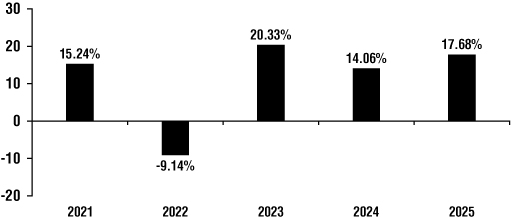
The Fund's highest/lowest quarterly results during this time period were:
Highest 9.79% (Quarter ended 03/31/2021)
Lowest (9.29)% (Quarter ended 06/30/2022)
11
Average Annual Total Returns—Supra Institutional Class
(for the periods ended December 31, 2025)
|
|
One
Year
|
|
Five
Years
|
|
Since
Inception
(09/04/20)2
|
|
|
Before Taxes
|
|
|
17.68
|
%
|
|
|
11.08
|
%
|
|
|
13.33
|
%
|
|
|
After Taxes on Distributions1
|
|
|
15.17
|
%
|
|
|
9.25
|
%
|
|
|
11.46
|
%
|
|
|
After Taxes on Distributions and Sale of Fund Shares1
|
|
|
12.22
|
%
|
|
|
8.48
|
%
|
|
|
10.35
|
%
|
|
MSCI All Country World Index (reflects no deductions
for fees, expenses, or taxes)
|
|
|
22.34
|
%
|
|
|
11.19
|
%
|
|
|
13.09
|
%
|
|
S&P 500 (reflects no deductions for fees,
expenses, or taxes)
|
|
|
17.88
|
%
|
|
|
14.42
|
%
|
|
|
15.57
|
%
|
|
60%/40% S&P 500 Index/Bloomberg U.S. Aggregate
Bond Index (reflects no deductions for fees,
expenses, or taxes)
|
|
|
13.70
|
%
|
|
|
8.47
|
%
|
|
|
9.21
|
%
|
|
Consumer Price Index (reflects no deductions for fees,
expenses, or taxes)
|
|
|
2.63
|
%
|
|
|
4.47
|
%
|
|
|
4.38
|
%
|
|
1
2
INVESTMENT ADVISER
First Pacific Advisors, LP is the Fund's investment adviser.
PORTFOLIO MANAGERS
Steven Romick, a Managing Partner of the Adviser, has been a portfolio manager of the Fund since its inception on June 2, 1993. Mark Landecker and Brian Selmo, each a Partner of the Adviser, have been portfolio managers of the Fund since June 2, 2013. Messrs. Romick, Landecker and Selmo are primarily responsible for the day-to-day management of the Fund's portfolio.
PURCHASE AND SALE OF FUND SHARES
Investors may purchase or redeem shares on any business day by written request, check, wire, ACH (Automated Clearing House), telephone, or through dealers as further described in this prospectus. You may conduct transactions by mail (FPA Funds, c/o UMB Fund Services, Inc., P.O. Box 2175, Milwaukee, Wisconsin 53201-2175, or 235 West Galena Street, Milwaukee, Wisconsin 53212), by wire, or by telephone at (800) 638-3060. Purchases and redemptions by telephone are only permitted if you previously established this option in your account. Investors can use the Account Application for initial purchases.
12
Investors can purchase shares by contacting any investment dealer authorized to sell the Fund's shares. The minimum initial investment in the Supra Institutional Class is generally $100,000,000, and each subsequent investment, which can be made directly to UMB Fund Services, Inc., must be at least $100. All purchases made by check should be in U.S. dollars and made payable to the FPA Funds. Third party, starter or counter checks will not be accepted. A charge may be imposed if a check does not clear. Certain financial intermediaries may be permitted to accumulate the Supra Institutional Class shares over which they have investment discretion and/or are held in certain omnibus accounts to reach the minimum. Such intermediaries may also be eligible to invest in the Supra Institutional Class if the accumulated shares over which they have investment discretion total at least $50,000,000 and the officers of the Fund reasonably believe that the financial intermediary will increase those accumulated shares to at least $100,000,000 over the subsequent 12 months. The Fund reserves the right to waive or lower purchase and investment minimums in certain circumstances. For example, the minimums listed above may be waived or lowered for investors who are Trustees or officers of the Fund, employees of the Adviser and/or customers of certain financial intermediaries that hold the Fund's shares in certain omnibus accounts, and investments in the Fund in connection with the liquidity programs (described in additional detail below under "Management of the Fund"), at the discretion of the officers of the Fund. In addition, financial intermediaries may impose their own minimum investment and subsequent purchase amounts.
Subsequent investments and redemptions can be made directly to UMB Fund Services, Inc.
Notice to Non-U.S. Resident Individual Shareholders. The Fund and its shares are only registered in the United States and its territories ("United States"). Regulations outside of the United States may restrict the sale of shares to certain non-U.S. residents or subject certain shareholder accounts to additional regulatory requirements. As a result, individuals resident outside the United States are generally not eligible to invest in the Fund. The Fund reserves the right, however, to sell shares to certain other non-U.S. investors in compliance with applicable law. If a current shareholder of the Fund provides a non-U.S. address, this will be deemed a representation and warranty from such investor that he/she is not a U.S. resident and will continue to be a non-U.S. resident unless and until the Fund is notified of a change in the investor's resident status. Any current shareholder that has a resident address outside of the United States may be restricted from purchasing additional shares.
TAX INFORMATION
The Fund's distributions are taxable and will be taxed as ordinary income and/or long-term capital gain, unless you are investing through a tax-deferred arrangement, such as an IRA or 401(k) plan.
INFORMATION REGARDING TRANSACTIONS THROUGH FINANCIAL INTERMEDIARIES
Shareholders may be required to pay a commission directly to their broker or other financial intermediary when buying or selling shares of the Fund. Shareholders and potential investors may wish to contact their broker or other financial intermediary for information regarding applicable commissions, transaction fees or other charges associated with transactions in shares of the Fund.
13
In addition, brokers, dealers, banks, trust companies and other financial representatives may receive compensation from the Fund or its service providers for providing a variety of services, which may include recordkeeping, transaction processing for shareholders' accounts and certain shareholder services not currently offered to shareholders that deal directly with the Fund. These payments may create a conflict of interest by influencing the broker-dealer or other intermediary and your salesperson to recommend the Fund over another investment. Ask your salesperson or visit your financial intermediary's web site for more information.
14
ADDITIONAL INFORMATION ABOUT THE FUND
Investment Objective
The Fund seeks to generate equity-like returns over the long-term, take less risk than the market and avoid permanent impairment of capital.
The Fund's investment objective is not fundamental and may be changed by the Board without shareholder approval, upon at least 60 days' prior written notice to shareholders. The Fund's investment strategies and policies may be changed from time to time without shareholder approval or prior written notice, unless specifically stated otherwise in this Prospectus or the Statement of Additional Information ("SAI").
Principal Investment Strategies
To pursue the Fund's investment objective, the portfolio managers invest in both equity and debt securities of companies. The portfolio managers believe that this combination of securities broadens the universe of opportunities for the Fund, offers additional diversification and helps to lower volatility. The portfolio managers invest primarily in equity securities and the balance of the Fund's portfolio in debt securities, cash, and cash equivalents. The Fund has no limit on the amount of assets it may invest in non-U.S. securities. The decision to invest in a non-U.S. security will be based on the portfolio managers' fundamental security analysis. In addition, the Fund may sell securities short, and the portfolio managers may employ a short selling strategy for a portion of the Fund.
Equity securities represent an ownership interest, or the right to acquire an ownership interest, in an issuer. Different types of equity securities provide different voting and dividend rights and priority in case of the bankruptcy of the issuer. The Fund may invest in a variety of equity securities, including common stocks, preferred stocks, convertible securities, rights, and warrants.
The portfolio managers look for large and small companies that they believe to have excellent future prospects that are undervalued by the securities markets. The portfolio managers believe that these opportunities often arise when companies are out-of-favor or undiscovered by most of Wall Street. The portfolio managers also search for companies that offer earnings growth, opportunity for price/earnings multiple expansion and the best combination of such quality criteria as strong market share, good management, high barriers to entry and high return on capital.
Using fundamental security analysis, the portfolio managers may look for investments that trade at a substantial discount to the portfolio managers' determination of the company's value (absolute value) rather than those that might appear inexpensive based on a discount to their peer groups or the market average (relative value). The portfolio managers attempt to determine a company's absolute value using fundamental security analysis, which they believe generally provides them with a thorough view of a company's financial and business characteristics. As a part of their process, the portfolio managers may:
• Review stock prices or industry group under-performance, insider purchases, management changes and corporate spin-offs.
15
• Communicate directly with company management, suppliers, and customers.
• Use their judgment to define the company's future potential, financial strength, and competitive position.
The portfolio managers generally seek to sell an equity investment when they believe that the company's value has been fully reflected in a higher valuation by the market or when a negative fundamental development occurs in the company or its industry that the portfolio managers believe could significantly impact future earnings growth.
A debt security is an interest-bearing security that companies or governments use to borrow money from investors. The issuer of a debt security promises to pay interest at a stated rate, which may be variable or fixed, and to repay the amount borrowed at maturity (the date when the debt security is due and payable). The Fund may invest in debt securities issued by companies, the U.S. government, and its agencies; mortgage-backed and asset-backed securities (i.e. securities that are backed by pools of loans or mortgages assembled for sale to investors); municipal notes and bonds; and commercial paper and certificates of deposit.
The portfolio managers invest in debt securities seeking to provide the Fund with a reliable and recurring stream of income, while seeking to preserve its capital. The Fund may also invest in debt securities rated below investment grade ("high yield bonds" or "junk bonds"). The Fund has the ability to invest up to 65% of its total assets in debt securities, although it will generally invest a greater percentage of its portfolio in equity securities than debt securities.
The portfolio managers select debt securities by using an approach that is similar to the approach they use to select equity securities and by trying to forecast current interest rate trends. The portfolio managers generally employ a defensive interest rate strategy, which means they seek to keep the average maturity of the debt-securities portion of the Fund to 10 years or less, by investing at different points along the yield curve. The portfolio managers also continually consider yield spreads and other underlying factors such as credit quality, investor perception and liquidity to determine which sectors offer the best investment value at any given time.
The portfolio managers may engage in a strategy known as selling short. Selling a security short is when the Fund sells a security it does not own. To sell a security short, the Fund must borrow the security from someone else to deliver to the buyer. The Fund then replaces the security it borrowed by purchasing it at the market price at or before the time of replacement. Until it replaces the security, the Fund repays the person that lent it the security for any interest or dividends that may have accrued during the period of the loan. The Fund typically sells securities short to take advantage of an anticipated decline in prices or to protect a profit in a security it already owns.
16
ADDITIONAL INFORMATION ABOUT THE PRINCIPAL INVESTMENT STRATEGIES
To pursue the Fund's investment objective, the portfolio managers generally invest the Fund's assets in common stocks and other securities of international and U.S. companies and debt securities, including but not limited to the following securities:
Equity Securities. Equity securities represent ownership shares in a company, and include securities that convey an interest in, may be converted into or give holders a right to purchase or otherwise acquire such ownership shares in a company.
Common Stock. Common stocks represent shares of ownership in a company. After other company obligations are satisfied, common stockholders participate in company profits on a pro-rata basis; profits may be paid out in dividends or reinvested in the company to help it grow. Increases and decreases in earnings are usually reflected in a company's stock price, so common stocks generally have the greatest appreciation and depreciation potential of all corporate securities. Ownership of common stock of a non-U.S. company may be represented by depositary receipts (which are certificates evidencing ownership of securities of a non-U.S. issuer).
Preferred Stock. Preferred stock is typically subordinated to an issuer's senior debt, but senior to the issuer's common stock. Typically, preferred stock is structured as a long-dated or perpetual bond that distributes income on a regular basis. Issuers are permitted to skip ("non-cumulative" preferred stock) or defer ("cumulative" preferred stock) distributions. Preferred stock may be convertible into common stock and may contain call or maturity extension features.
Warrants and Rights. Warrants are options to buy a stated number of shares of common stock at a specified price anytime during the life of the warrants (generally two or more years). They have no voting rights, pay no dividends, and have no rights with respect to the assets of the entity issuing them. Rights are similar to warrants but normally have a shorter duration and are typically distributed directly by the issuers to existing shareholders, while warrants are typically attached to new debt or preferred stock issuances. The market price of warrants may be substantially lower than the current market price of the underlying common stock, yet warrants are subject to similar price fluctuations. As a result, warrants may be more volatile investments than the underlying common stock. If a warrant is exercised, the Fund may hold common stock in its portfolio even if it does not ordinarily invest in common stock. Warrants and rights generally do not entitle the holder to dividends or voting rights with respect to the underlying common stock and do not represent any rights in the assets of the issuer. Warrants and rights will expire if not exercised on or prior to the expiration date.
Non-U.S. Securities. The Fund may invest in securities of U.S.-dollar denominated non-U.S. issuers traded in the United States and in non-U.S. currency-denominated securities of non-U.S. issuers. For purposes of this prospectus, non-U.S. issuers are generally non-U.S. governments or companies either domiciled outside the U.S. or traded on non-U.S. exchanges, but the portfolio managers may make a different designation in certain circumstances. The non-U.S. issuers that the Fund may invest in include issuers with significant exposure to countries with developing economies and/or markets.
17
Cash Equivalents. Cash equivalents are short-dated instruments that are readily convertible into cash. They may include bank obligations, commercial paper, and repurchase agreements. Bank obligations include certificates of deposit and bankers' acceptances. Commercial paper is a short-term promissory note issued by a corporation, which may have a floating or variable rate. Repurchase agreements are transactions under which the Fund purchases a security from a dealer counterparty and agrees to resell the security on a specified future date at the same price, plus a specified interest rate.
U.S. Government Securities. The U.S. government sector includes fixed-income securities issued by the U.S. government or its agencies and instrumentalities, such as U.S. Treasury and U.S. government agency securities, mortgage pass-through securities, including Government National Mortgage Association (Ginnie Mae), Federal Home Loan Mortgage Corporation (Freddie Mac) and the Federal National Mortgage Association (Fannie Mae), and agency mortgage-backed securities.
Mortgage-Backed Securities. In addition to the U.S. government mortgage-pass through securities described above, the mortgage sector includes non-agency mortgage-backed securities, such as collateralized mortgage obligations ("CMOs"), CMBS, RMBS and single- and multi-class pass- through securities. Mortgage-backed securities represent direct or indirect participation in mortgage loans secured by real property.
Asset-Backed Securities. Asset-backed securities are bonds issued through special purpose vehicles and backed by pools of loans, other receivables, or other assets. Asset-backed securities are created from many types of assets, such as home equity loans, auto loans, student loans and credit card receivables. The credit quality of an asset-backed security depends on the quality and performance of the underlying assets and/or the level of any credit support provided by the securitization structure. The proportions of the Fund's portfolio invested in various types of asset-backed securities will depend on many factors, including the portfolio managers' appraisal of the economy, yield, credit quality, macroeconomic factors, and capital appreciation potential, among others. To the extent the Fund focuses its investments in a particular type of asset-backed security, it may be more susceptible to economic conditions and risks affecting the type of asset-backed security.
Corporate Debt Securities. The Fund may invest in corporate bonds, bank debt, notes and commercial paper of varying maturities and may invest in domestic bonds, bank debt and notes and those issued by non-U.S. corporations and governments. Issuers of these securities have a contractual obligation to pay interest at a specified rate on specified date and to repay principal on a specified maturity date, and may have provisions that allow the issuer to redeem or "call" the security before its maturity.
Temporary Investments and Other Measures. As a temporary measure for defensive purposes, the Fund may invest up to 100% of its total assets in short-term investments, including cash or cash equivalents, corporate debt, or direct or indirect U.S. and non-U.S. government and agency obligations, money market instruments, bank obligations, commercial paper, corporate notes and repurchase agreements. The Fund may make these investments or increase its investment in these securities when the managers are unable to find enough attractive long-term investments, to reduce exposure to the Fund's primary investments when the managers believe it is advisable to do so,
18
during periods of significant shareholder redemptions or when adverse or unusual market, economic, political, or other conditions exist. The Fund may take such portfolio positions for as long a period as deemed necessary. In doing so, the Fund may succeed in avoiding losses but may otherwise fail to achieve its investment objective. However, there can be no guarantee that a defensive strategy will be successful. Investing defensively may adversely affect Fund performance. During these times, the portfolio managers may make frequent portfolio holding changes, which could result in increased trading expenses and taxes, and decreased Fund performance.
As part of its normal operations, the Fund may hold cash or invest a portion of its portfolio in short-term interest bearing U.S. dollar denominated securities, pending investments or to provide for possible redemptions. Investments in such short-term debt securities can generally be sold easily and have limited risk of loss, but earn only limited returns. The Fund may increase its cash holdings and/or such short-term investments in anticipation of a greater than normal number of shareholder redemptions.
The Fund's emphasis on a value-oriented investment approach could result in a portfolio that does not reflect the national economy, differs significantly from broad market indices, and consists of securities considered by the average investor to be unpopular or unfamiliar.
Percentage Investment Limitations. Unless otherwise stated, all percentage limitations on Fund investments listed in this prospectus will apply at the time of purchase. The Fund would not violate these limitations unless an excess or deficiency occurs or exists immediately after and as a result of an investment.
Other Investments and Techniques. The Fund may invest in other types of securities and use a variety of investment techniques and strategies which are not principal investment strategies and are not described in this prospectus. These securities and techniques may subject the Fund to additional risks. Please see the Statement of Additional Information (the "SAI") for additional information about the securities and investment techniques described in this prospectus and about additional securities and techniques that may be used by the Fund.
ADDITIONAL INFORMATION ABOUT THE PRINCIPAL RISKS
The Fund's principal risks are set forth below. Before you decide whether to invest in the Fund, carefully consider these risk factors and special considerations associated with investing in the Fund, which may cause you to lose money.
Market Risk. The market price of a security or instrument may decline, sometimes rapidly or unpredictably, due to general market conditions that are not specifically related to a particular company, such as real or perceived adverse economic, political, or geopolitical conditions throughout the world, changes in the general outlook for corporate earnings, changes in interest or currency rates, or adverse investor sentiment generally. The market value of a security or instrument also may decline because of factors that affect a particular industry or industries, such as tariffs, labor shortages or increased production costs and competitive conditions within an industry. In addition, local, regional or global events such as war, acts of terrorism, international conflicts, trade disputes, supply chain disruptions, cybersecurity events, the spread of infectious illness or other public health issues, natural disasters or climate events, or other events could have a significant
19
impact on a security or instrument. Such events could make identifying investment risks and opportunities especially difficult for the Adviser. In response to certain crises, the United States and other governments have taken steps to support financial markets. The withdrawal of this support or failure of efforts in response to a crisis could negatively affect financial markets generally as well as the value and liquidity of certain securities. In addition, policy and legislative changes in the United States and in other countries are changing many aspects of financial regulation. The impact of these changes on the markets, and the practical implications for market participants, may not be fully known for some time. The increasing interconnectivity between global economies and financial markets increases the likelihood that events or conditions in one region or financial market may adversely impact issuers in a different country, region or financial market.
Risks Associated with Investing in Equities. Equity securities, generally common stocks, preferred stocks and/or depositary receipts held by the Fund may experience sudden, unpredictable drops in value or long periods of decline in value. This may occur because of factors that affect the securities markets generally, such as adverse changes in economic or political conditions, the general outlook for corporate earnings, interest rates or investor sentiment. Sustained periods of market volatility, either globally or in any jurisdiction in which the Fund invests, may increase the risks associated with an investment in the Fund. Equity securities may also lose value because of factors affecting an entire industry or sector, such as increases in production costs or factors directly related to a specific company, such as decisions made by its management.
Common stock of an issuer in the Fund's portfolio may decline in price if the issuer fails to make anticipated dividend payments because, among other reasons, the issuer of the security experiences a decline in its financial condition. Common stock is subordinated to preferred stocks, bonds, and other debt instruments in a company's capital structure, in terms of priority with respect to corporate income, and therefore will be subject to greater dividend risk than preferred stocks or debt instruments of such issuers. In addition, while broad market measures of common stocks have historically generated higher average returns than fixed income securities, common stocks have also experienced significantly more volatility in those returns. Because preferred stock is generally junior to debt securities and other obligations of the issuer, deterioration in the credit quality of the issuer will cause greater changes in the value of a preferred stock than in a more senior debt security with similar stated yield characteristics.
Interest Rate Risk. As with most funds that invest in debt securities, changes in interest rates, including rates that fall below zero, are one of the most important factors that could affect the value of an investment in the Fund. Interest rate risk is the risk that debt securities will decline in value because of increases in interest rates. Any such change in interest rates may be sudden and significant, with unpredictable effects on the financial markets and the Fund's investments. Generally, bonds with longer maturities have a greater duration and thus are subject to greater price volatility from changes in interest rates. Adjustable rate instruments also react to interest rate changes in a similar manner although generally to a lesser degree (depending, however, on the characteristics of the reset terms, including the index chosen, frequency of reset and reset caps or floors, among other things). Low interest rates may pose heightened risks with respect to investments in fixed income securities. When interest rates rise from a low level, fixed income securities markets may experience lower prices, increased volatility, and lower liquidity. The negative impact on fixed income securities from rate increases, regardless of the cause, could be swift and significant, which could result in significant losses by the Fund, even if such rate increases
20
are anticipated by the portfolio managers. The Fund may be subject to heightened interest rate risk because the Federal Reserve has raised, and may continue to raise, interest rates. During periods of increasing interest rates the Fund may experience high redemptions and, as a result, increased portfolio turnover, which could increase the costs that the Fund incurs and may negatively impact the Fund's performance.
ARM Risk. During periods of extreme fluctuations in interest rates, the resulting fluctuations of ARM rates could affect the ARMs' market value. Most ARMs generally have annual reset limits or "caps." Fluctuations in interest rates above these levels, thus, could cause the mortgage-backed securities to "cap out" and to behave more like long-term, fixed-rate debt securities. During periods of declining interest rates, of course, the coupon rates may readjust downward and result in lower yields. Because of this feature, the value of ARMs will likely not rise during periods of declining interest rates to the same extent as fixed-rate instruments.
Credit Risk. Credit risk refers to the likelihood that an issuer will default on the payment of principal and/or interest on a security. Various factors could affect the issuer's actual or perceived willingness or ability to make timely interest or principal payments, including changes in the issuer's financial condition or in general economic conditions. In addition, lack of or inadequacy of collateral or credit enhancements for a fixed income security may affect its credit risk. Below investment grade securities have more risk with respect to the issuer's ability to pay interest and repay principal when due, and therefore involve a greater risk of default or nonpayment. Credit risk of a security may change over time. Ratings agencies periodically review certain securities and may to downgrade a security that is held by the Fund. However, ratings are only opinions of the agencies issuing them and are not absolute guarantees as to quality.
Call Risk. Issuers of callable bonds are permitted to redeem these bonds before their final maturity. Issuers may call outstanding securities before maturity for a number of reasons, including decreases in prevailing interest rates or improvements to the issuer's credit profile. If an issuer calls a security in which the Fund is invested, the Fund could lose potential price appreciation and be forced to reinvest the proceeds in securities that bear a lower interest rate or more credit risk.
Risks Associated with Investing in Smaller-Cap and Mid-Cap Companies. The prices of securities of smaller-cap and mid-cap companies tend to fluctuate more widely than those of larger, more established companies. Smaller-cap and mid-cap companies may have limited product lines, markets or financial resources or may depend on the expertise of a few people and may be subject to more abrupt or erratic market movements than securities of larger, more established companies or market averages in general. In addition, these companies often have shorter operating histories and are more reliant on key products or personnel than larger companies. The securities of smaller-or medium-sized companies are often traded over-the-counter, and may not be traded in volumes typical of securities traded on a national securities exchange. Securities of such issuers may lack sufficient market liquidity to effect sales at an advantageous time or without a substantial drop in price.
Risks Associated with Investing in Non U.S. Securities. Non-U.S. investments involve special risks not present in U.S. investments that can increase the chances that the Fund will lose money.
21
Certain of the risks noted below may also apply to securities of U.S. issuers with significant non-U.S. operations. Investments in non-U.S. securities involve the following risks:
• The economies of some non-U.S. markets often do not compare favorably with that of the U.S. in areas such as growth of gross domestic product, reinvestment of capital, resources, and balance of payments. Some of these economies may rely heavily on particular industries or non-U.S. capital. They may be more vulnerable to adverse diplomatic developments, the imposition of economic sanctions against a country, changes in international trading patterns, trade barriers and other protectionist or retaliatory measures.
• Governmental actions—such as the imposition of capital controls, nationalization of companies or industries, expropriation of assets or the imposition of punitive taxes—may adversely affect investments in non-U.S. markets. Such governments may also participate to a significant degree, through ownership or regulation, in their respective economies.
• The governments of certain countries may prohibit or substantially restrict foreign investing in their capital markets or in certain industries. This could severely affect security prices. This could also impair the Fund's ability to purchase or sell non-U.S. securities or transfer its assets or income back to the U.S. or otherwise adversely affect the Fund's operations.
• Other non-U.S. market risks include foreign exchange controls, difficulties in pricing securities, defaults on non-U.S. government securities, difficulties in enforcing favorable legal judgments in non-U.S. courts, and political and social instability. Legal remedies available to investors in some non-U.S. countries are less extensive than those available to investors in the U.S. Many non-U.S. governments supervise and regulate stock exchanges, brokers, and the sale of securities to a lesser extent than the U.S. government does. Corporate governance may not be as robust as in more developed countries. As a result, protections for minority investors may not be strong, which could adversely affect the Fund's non-U.S. holdings or exposures.
• Accounting standards in other countries are not necessarily the same as in the U.S. If the accounting standards in another country do not require as much disclosure or detail as U.S. accounting standards, it may be harder for the portfolio managers to completely and accurately determine a company's financial condition or otherwise assess a company's creditworthiness.
• Because there may be fewer investors on non-U.S. exchanges and smaller numbers of shares traded each day, it may be difficult for the Fund to buy and sell securities on those exchanges. In addition, prices of non-U.S. securities may be more volatile than prices of securities traded in the U.S.
• Non-U.S. markets may have different clearance and settlement procedures. In certain markets, settlements may not keep pace with the volume of securities transactions. If this occurs, settlement may be delayed, and the Fund's assets may be uninvested and may not be earning returns. The Fund also may miss investment opportunities or not be able to sell an investment or reduce its exposure because of these delays.
22
• Changes in currency exchange rates will affect the value of the Fund's non-U.S. holdings or exposures.
• The costs of non-U.S. securities transactions tend to be higher than those of U.S. transactions, increasing the transaction costs paid directly or indirectly by the Fund.
• International trade barriers or economic sanctions against non-U.S. countries may adversely affect the Fund's non-U.S. holdings or exposures. Since January 20, 2025, the current U.S. administration has pursued an aggressive foreign policy agenda, including the imposition of tariffs, which may have unforeseen consequences on the United States' relations with foreign countries, the economy, and markets generally. In addition, the current administration has sought to reduce the size of the U.S. government by, for example, reducing the headcount of and freezing funding available to certain U.S. government agencies. Such efforts may continue throughout U.S. federal agencies, which could increase administrative burdens on remaining government employees, increase processing times of company filings, alter regulatory policymaking, and increase regulatory volatility. These, as well as other potential effects which are not currently known, may have a negative impact on the Fund or on markets generally.
• Global economies are increasingly interconnected, which increases the possibilities that conditions in one country region or financial market may adversely impact a different country, region, or financial market.
The severity or duration of these conditions may be affected if one or more countries leave the European Union or the euro currency or if other policy changes are made by governments or quasi-governmental organizations.
The Fund may invest in depositary receipts, including American Depositary Receipts ("ADRs"), European Depositary Receipts ("EDRs"), Global Depositary Receipts ("GDRs") and Global Depositary Notes ("GDNs"), which are certificates evidencing ownership of securities of a non-U.S. issuer. Depositary receipts may be sponsored by the non-U.S. issuer or unsponsored. Depositary receipts are subject to the risks of changes in currency or exchange rates and the risks of investing in non-U.S. securities that they evidence or into which they may be converted. The issuers of unsponsored depositary receipts are not obligated to disclose information that would be considered material in the U.S., or to pass through to shareholders any voting rights with respect to the deposited securities. Therefore, there may be less information available regarding these issuers, and there may not be a correlation between such information and the market value of the depositary receipts.
Risks Associated with Investing in Emerging Markets. In investing the Fund's assets, the portfolio managers focus on countries with established rules of law and political systems that allow for transparent and unbiased enforcement of those laws, although there can be no assurance that the Fund's assets will in all cases be invested in countries that offer such protections, and such investments may be subject to heightened risk. The Fund's investments in non-U.S. issuers in developing or emerging market countries may involve increased exposure to changes in economic, social, and political factors as compared to investments in more developed countries. The economies of most emerging market countries are in the early stage of capital market development and may
23
be dependent on relatively fewer industries. As a result, their economic systems are still evolving. Emerging markets may have less established legal, accounting, and financial reporting systems than those in more developed markets, which may reduce the scope or quality of financial information available to investors. Companies in emerging markets may also be subject to less stringent standards on disclosure, accounting and financial reporting, and record keeping, which may affect the Fund's ability to evaluate potential and current investments. In addition, their legal and political systems may also be less stable than those in developed economies. Securities markets in these countries can also be smaller, and there may be increased settlement risks , and investor protection regimes may be more limited. For example, it may be more difficult for shareholders to bring derivative litigation or for U.S. regulators to bring enforcement actions against issuers in emerging markets. Emerging market countries often suffer from currency devaluation and higher rates of inflation. Due to these risks, securities issued in developing or emerging countries may be more volatile, less liquid, and harder to value than securities issued in more developed countries.
Risks Associated with Short Selling. The Fund can lose money if the price of the security it sold short increases between the date of the short sale and the date on which the Fund replaces the borrowed security. These losses are theoretically unlimited. To borrow the security, the Fund also may be required to pay a premium, which would increase the cost of the security sold. The Fund will incur transaction costs in effecting short sales. The Fund's gains and losses will be decreased or increased, as the case may be, by the amount of the premium, dividends, interest, or expenses the Fund may be required to pay in connection with a short sale.
Risks Associated with Value Investing. Value stocks, including those selected by the portfolio managers for the Fund, are subject to the risks that their intrinsic value may never be realized by the market and that their prices may go down. In addition, value style investing may fall out of favor and underperform growth or other styles of investing during given periods. The Fund's value discipline may result in a portfolio of securities that differs materially from its illustrative indices.
Securities selected by the portfolio managers using a value strategy may never reach their intrinsic value because the market fails to recognize what the portfolio managers consider to be the true business value or because the portfolio managers have misjudged those values. There may be periods during which the investment performance of the Fund suffers while using a value strategy.
Liquidity Risk. The Fund's investments in illiquid securities may reduce the returns of the Fund because it may not be able to sell the illiquid securities at an advantageous time or price. Investments in high yield securities, non-U.S. securities, derivatives, or other securities with substantial market and/or credit risk tend to have the greatest exposure to liquidity risk. Certain investments in private placements and Rule 144A securities may be considered illiquid investments under certain circumstances. Lower-rated debt securities tend to be less liquid than higher-rated securities. Illiquid securities may trade at a discount from comparable, more liquid investments, and may be subject to wider fluctuations in market value. Investments in illiquid derivatives may create the potential for the Fund to face ongoing margin and settlement payment obligations thereunder. Furthermore, reduced number and capacity of dealers and other counterparties to "make markets" in fixed income securities, in connection with the growth of the fixed income markets, may increase liquidity risk with respect to the Fund's investments in fixed income securities. When there is no willing buyer and investments cannot be readily sold, the Fund may have to lower the selling price, sell other investments, or may not be able to sell the securities at all and may have to forego another, more
24
appealing investment opportunity, any of which could have a negative effect on the Fund's performance. These securities may also be difficult to value and their values may be more volatile because of liquidity risk. Increased Fund redemption activity may negatively impact Fund performance and increase liquidity risk due to the need of the Fund to sell portfolio securities. Regulatory changes may further constrain the ability of market participants to create liquidity, particularly in times of increased market volatility. Liquidity risk may intensify during periods of economic uncertainty.
OTC Investments Risk. Securities and derivatives traded in OTC markets may trade in smaller volumes, and their prices may be more volatile, than securities principally traded on securities exchanges. Such securities may be less liquid than more widely traded securities. In addition, the prices of such securities may include an undisclosed dealer markup, which the Fund pays as part of the purchase price.
U.S. Government Securities Risk. Certain U.S. government securities are supported by the full faith and credit of the United States; others are supported by the right of the issuer to borrow from the U.S. Treasury; others are supported by the discretionary authority of the U.S. government to purchase the agency's obligations; and still others are supported only by the credit of the issuing agency, instrumentality, or enterprise. Although U.S. government-sponsored enterprises such as the Federal Home Loan Mortgage Corporation (Freddie Mac) and the Federal National Mortgage Association (Fannie Mae) may be chartered or sponsored by Congress, they are not funded by Congressional appropriations, and their securities are not issued by the U.S. Treasury, are not supported by the full faith and credit of the U.S. government, and involve increased credit risks in comparison to U.S. Treasury securities or other securities supported by the full faith and credit of the U.S. government. Any security guaranteed by the U.S. government or its agencies or instrumentalities, or a security backed by the U.S. Treasury or the full faith and credit of the United States, is guaranteed or backed only as to the timely payment of interest and principal when held to maturity, but the market values for such securities are not guaranteed and will fluctuate.
Any market movements, regulatory changes, or changes in political or economic conditions that affect the U.S. government agencies or instrumentalities in which the Fund invests may have a significant impact on the Fund's performance. Events that would adversely affect the market prices of securities issued or guaranteed by one government agency or instrumentality may adversely affect the market price of securities issued or guaranteed by other government agencies or instrumentalities. Because many types of U.S. government securities trade actively outside the United States, their prices may rise and fall as changes in global economic conditions affect the demand for these securities.
Mortgage-Related and Asset-Backed Securities Risk. Mortgage-related and other asset-backed securities represent interests in "pools" of mortgages or other assets such as consumer loans or receivables held in trust and often involve risks that are different from or possibly more acute than risks associated with other types of debt instruments. Mortgage-related securities, including CMBS and RMBS, are subject to prepayment risk and can be highly sensitive to changes in interest rates. Generally, in a period of rising interest rates, individual borrowers are less likely to exercise prepayment options which tend to extend the expected maturity of mortgage-related securities, making them more sensitive to changes in interest rates. As a result, if the Fund holds mortgage-related securities, rising interest rates may cause the Fund to exhibit additional volatility due to the
25
increased expected average life of its mortgage-related holdings. When interest rates decline, borrowers may pay their mortgages sooner than expected. These prepayments can reduce the returns of the Fund because the Fund may realize losses on securities that were acquired at a premium to par and the Fund may have to reinvest the proceeds from prepayments at the lower prevailing interest rates which can reduce the Fund's yield.
Mortgage-related securities may be either pass-through securities or CMOs. Pass-through securities represent a right to receive principal and interest payments collected on a pool of mortgages which are passed through to security holders. CMOs are created by dividing the principal and interest payments collected on a pool of mortgages into several cash flow streams ("tranches") with different priority rights to portions of the underlying mortgage payments. Certain CMO tranches may represent a right to receive specific sources of cash flow such as interest-only ("IOs") or principal-only ("POs"). These securities are frequently referred to as "stripped securities" are subject to interest rate risks described above. If the Fund invests in CMO tranches (including CMO tranches issued by government agencies) and interest rates move in a manner not anticipated by the managers, it is possible that the Fund could lose all or substantially all of its investment. The market prices of CMOs structured as accrual certificates (also known as "Z-Bonds") are affected to a greater extent by interest rate changes and therefore tend to be more volatile than securities which pay current interest in cash. Mortgage-related securities, including CMBS and RMBS, and in particular those not backed by a government guarantee, are subject to credit risk, i.e., the likelihood that an issuer will default on the payment of principal and/or interest on a security. CMBS and RMBS investments that are backed by mortgages given to borrowers considered to be higher risk borrowers generally include one or more aggressive mortgage terms, such as a high loan-to-value ratio. Such mortgages carry a higher degree of credit risk than other loans, and, therefore, a higher probability of default.
The Fund may invest in CDOs, which include collateralized loan obligations ("CLOs"), collateralized bond obligations ("CBOs"), and other similarly structured securities. The risks of an investment in a CDO depend largely on the type of the collateral securities and the class of the CDO in which the Fund invests. In addition to the normal risks associated with credit-related securities discussed elsewhere in the prospectus (e.g., interest rate risk and default risk), CDOs carry additional risks including, but not limited to, the risk that: (i) distributions from collateral securities may not be adequate to make interest or other payments; (ii) the quality of the collateral may decline in value or default; (iii) the Fund may invest in CDOs that are subordinate to other classes; and (iv) the complex structure of the security may not be fully understood at the time of investment and may produce disputes with the issuer or unexpected investment results. Investments in CDOs are also more difficult to value than other investments. In addition, although not required, valuations of Fund holdings are ordinarily verified via a second pricing source. However, second source pricing may not be available with respect to certain CDOs in which the Fund invests as a result of a lack of readily available market quotations. In addition, there may be delays in the Fund's ability to invest in CDOs at desired levels as a result of the increased time necessary for the Adviser to resolve valuation and operational issues necessary to make these investments.
The Fund's investments in other asset-backed securities are subject to risks similar to those associated with mortgage-related securities, as well as additional risks associated with the nature of the assets and the servicing of those assets. Payment of principal and interest on asset-backed securities may be largely dependent upon the cash flows generated by the assets backing the
26
securities, and asset-backed securities may not have the benefit of any security interest in the related assets. Certain asset-backed securities, including securities backed by auto loans, are subject to subprime lending and loan-to-value risk. One of the most significant risks to a holder of an auto loan asset-backed security is the fluctuation of the value of the loans acquired. The higher the loan-to-value ratio, the riskier the loan is for a lender. Further, subprime loans underlying auto loan asset-backed securities may have higher default rates than loans that meet more stringent underwriting requirements.
Risks Associated with Investing in High Yield Securities. High yield bonds, sometimes called "junk" bonds, are highly speculative securities that are usually issued by smaller, less credit-worthy and/or highly leveraged (indebted) companies. Because investment in lower-rated or unrated securities involves greater investment risk, achievement of the Fund's investment objective is more dependent on the portfolio managers' credit analysis of these securities than with respect to the Fund's investments in higher-rated securities. The portfolio managers do not employ a rating valuation for unrated securities. Decisions to purchase and sell these securities are based on the portfolio manager's evaluation of their investment potential and not on the ratings assigned by credit agencies. Compared with investment-grade bonds, high yield bonds carry a greater degree of risk and are less likely to make payments of interest and principal. Compared to investment-grade debt securities, market developments and the financial and business conditions of the corporation issuing high yield securities influence the price and liquidity of high yield securities more than changes in interest rates when compared to investment grade debt securities. Lower-rated securities may be more susceptible to real or perceived adverse economic and competitive industry conditions than investment grade securities. A projection of an economic downturn, for example, could cause a decline in the prices of lower-rated securities because the advent of a recession could lessen the ability of a highly leveraged company to make principal and interest payments on its debt securities. New and proposed laws and regulations could negatively impact the market for high-yield bonds. Insufficient liquidity in the high yield bond market may make it more difficult to dispose of high yield bonds and may cause the Fund to experience sudden and substantial price declines. A lack of reliable, objective data or market quotations may make it more difficult to value high yield bonds accurately. There is no limit on the ratings of high yield securities that may be purchased or held by the Fund, and the Fund may invest in securities that are in default.
Risks Associated with Investing in Sovereign and Government-Related Debt. Sovereign debt includes securities issued or guaranteed by a non-U.S. sovereign government or its agencies, authorities, or political subdivisions. Government-related debt includes securities issued by non-U.S. regional or local governmental entities or government-controlled entities. In the event an issuer of sovereign debt or government-related debt is unable or unwilling to make scheduled payments of interest or principal, holders may be asked to participate in a restructuring of the debt and to extend further credit to the issuer. In the event of a default by such an issuer, there may be few or no effective legal remedies for collecting on such debt.
Risks Associated with Investing in Convertible Securities. A convertible security is a bond, debenture, or note that may be exchanged for particular common stocks in the future at a predetermined price or formula within a specified period of time. A convertible security entitles the holder to receive interest paid or accrued on the debt security until the convertible security matures or is redeemed. Prior to redemption, convertible securities provide benefits similar to nonconvertible debt securities in that they generally provide income with higher yields than those
27
of similar common stocks. Convertible securities may entail less risk than the corporation's common stocks. Convertible securities are generally not investment grade. The risks of nonpayment of the principal and interest increase when debt securities are rated lower than investment grade or are not rated.
Risks Associated with Investing in Repurchase Agreements. A repurchase agreement is a short-term investment. The Fund acquires a debt security that the seller agrees to repurchase at a future time and set price. If the seller declares bankruptcy or defaults, the Fund may incur delays and expenses liquidating the security. The security may also decline in value or fail to provide income.
Large Investor Risk. Ownership of shares of the Fund may be concentrated in one or a few large investors. Such investors may redeem shares in large quantities or on a frequent basis. Redemptions of Fund shares by a large investor may negatively affect the performance of the Fund, may increase realized capital gains, may accelerate the realization of taxable income to shareholders and may increase transaction costs. These transactions potentially limit the use of any capital loss carryforwards and certain other losses to offset future realized capital gains (if any). Such transactions may also increase the Fund's expenses. In addition, the Fund may be delayed in investing new cash after a large shareholder purchase, and under such circumstances may be required to maintain a larger cash position than it ordinarily would.
Management Risk. The Fund is subject to management risk as an actively managed investment portfolio. The portfolio managers will apply investment techniques and risk analyses in making investment decisions for the Fund, but there can be no guarantee that these will produce the desired results. The portfolio managers' opinion about the intrinsic worth or creditworthiness of a company or security may be incorrect, the portfolio managers may not make timely purchases or sales of securities for the Fund, the Fund's investment objective may not be achieved, or the market may continue to undervalue the Fund's securities. In addition, the Fund may not be able to quickly dispose of certain securities holdings. The frequency of trading within the Fund impacts portfolio turnover rates, which are shown in the financial highlights table. A higher rate of portfolio turnover could produce higher trading costs and taxable distributions, which would detract from the Fund's performance. Moreover, there can be no assurance that all of the Adviser's personnel will continue to be associated with the Adviser for any length of time. The loss of services of one or more key employees of the Adviser, including the portfolio managers, could have an adverse impact on the Fund's ability to achieve its investment objective. Certain securities or other instruments in which the Fund seeks to invest may not be available in the quantities desired. In such circumstances, the portfolio managers may determine to purchase other securities or instruments as substitutes. Such substitute securities or instruments may not perform as intended, which could result in losses to the Fund. In addition, the Fund and its service providers are subject to potential operational and information security risks from breaches in cyber security. A breach in cyber security refers to both intentional and unintentional cyber events and may include, among other events, the stealing or corrupting of data maintained online or digitally, denial of service attacks on websites, the unauthorized release or misuse of confidential information or various other forms of cyber-attacks. Cyber-security breaches affecting the Fund or the Adviser, custodian, transfer agent, intermediaries, trading counterparties or other third-party service providers may adversely impact the Fund. For instance, cyber security breaches may interfere with the processing of shareholder transactions, impact the Fund's ability to calculate its net asset value, cause the release of private shareholder information or confidential (including proprietary) company information, impede trading, result in
28
violations of applicable privacy and other laws, subject the Fund to regulatory fines, cause the Fund and its shareholders to experience financial losses, or cause reputational damage and/or otherwise disrupt normal business operations. The Fund may also incur additional costs for cyber security risk management purposes. The Fund has established business continuity plans and risk management systems reasonably designed to seek to reduce the risks associated with cyber-attacks and disruptions in services, but there are inherent limitations in these plans and systems. For example, the nature of malicious cyber-attacks is becoming increasingly sophisticated; the Fund cannot control the cyber-security systems of issuers or third-party service providers; and certain current risks may not have been identified and additional unknown threats may emerge in the future. There is also a risk that cyber security breaches may not be detected. The Fund and its shareholders could be negatively impacted as a result.
Recent Market Events. Periods of market volatility may occur in response to market events, public health emergencies, natural disasters or climate events, and other economic, political, and global macro factors. U.S. and international markets have recently experienced, and may continue to experience, periods of significant volatility due to various factors, including uncertainty regarding inflation and central banks' interest rate changes, the possibility of a national or global recession, trade tensions and tariffs, and political and geopolitical events. In addition, some countries and regions in which the Fund may invest have experienced security concerns; wars or threats of war and aggression, such as Russia's invasion of Ukraine and conflicts among nations and militant groups in the Middle East; terrorism; economic uncertainty; natural and environmental disasters; and/or systemic market dislocations that have led, and in the future may lead, to increased short-term market volatility and may have adverse long-term effects on the U.S. and world economies and markets generally, each of which may negatively impact the Fund's investments.
Additionally, since the change in the U.S. presidential administration in 2025, the administration has pursued an aggressive foreign policy agenda, including through suggestions that the United States should control certain sovereign foreign territories, attempts to restructure federal government agencies with international influence, and the imposition of tariffs and trade barriers on certain foreign countries, including China and long-time U.S. allies. In particular, the imposition of tariffs has led to retaliatory tariffs by certain foreign countries and could lead to retaliatory tariffs by targeted additional foreign countries, as well as increased and prolonged market volatility, and sector-specific downturns in industries reliant on international trade. The new administration has also sought to reduce the headcount of and freeze or reduce funding available to certain U.S. government agencies. Such efforts may continue throughout U.S. federal agencies, which could increase administrative burdens on remaining government employees, increase processing times of company filings, alter regulatory policymaking, and increase regulatory volatility. These efforts and other similar actions may have a unforeseen consequences on the economy and markets generally, and could negatively impact the Fund.
Raising the ceiling on U.S. government debt and passing periodic legislation to fund the government have become increasingly politicized. Any failure to do either could lead to a default on U.S. government obligations, with unpredictable consequences for economies and markets in the United States and elsewhere.
Changing interest rate environments (whether downward or upward) impact various sectors of the economy and asset classes in different ways. For example, low interest rate environments tend to be positive for the equity markets, whereas high interest rate environments tend to apply downward
29
pressure on earnings and equity prices. It is difficult to accurately predict the pace at which interest rates might change, the timing, frequency or magnitude of any such changes in interest rates, or when such changes might stop or reverse course. Unexpected changes in interest rates could lead to significant market volatility or reduce liquidity in certain sectors of the market.
The events and circumstances described above could be prolonged and could adversely affect the value and liquidity of the Fund's investments, impair the Fund's ability to satisfy redemption requests, and negatively impact the Fund's performance. Other market events may cause similar disruptions and effects.
Cybersecurity Risk. Cybersecurity incidents may allow an unauthorized party to gain access to Fund assets, customer data (including private shareholder information), or proprietary information, or cause the Fund, the Adviser, and/or other service providers (including custodians, sub-custodians, transfer agents and financial intermediaries) to suffer data breaches, data corruption or loss of operational functionality. A cybersecurity incident may disrupt the processing of shareholder transactions, impact the Fund's ability to calculate its net asset value, and prevent shareholders from redeeming their shares. The use of artificial intelligence and machine learning could exacerbate these risks. Issuers of securities in which the Fund invests are also subject to cybersecurity risks, and the value of those securities could decline if the issuers experience cybersecurity incidents.
INFORMATION ABOUT NON-PRINCIPAL INVESTMENT STRATEGIES
As a secondary matter, the Fund may invest in a wide range of other investments, including futures and other derivatives. The Fund may also employ investment practices that are not principal investment strategies and that this prospectus does not describe. For more information concerning the Fund's investment practices and its risks, see the SAI.
Derivatives. The Fund may invest in derivatives, a category of investments that includes forward non-U.S. currency exchange contracts, futures, options, and swaps to protect its investments against changes resulting from market conditions or currency changes (a practice called "hedging"), to reduce transaction costs or to manage cash flows. Forward non-U.S. currency exchange contracts, futures and options are called derivatives because their value is derived from an underlying asset or economic factor. Derivatives are often more volatile than other investments and may magnify the Fund's gains or losses. There are various factors that affect the Fund's ability to achieve its objectives with derivatives. Successful use of a derivative depends on the degree to which prices of the underlying assets correlate with price movements in the derivatives the Fund buys or sells. The Fund could be negatively affected if the change in market value of its securities fails to correlate perfectly with the values of the derivatives it purchased or sold. In addition, derivatives can be volatile and involve significant risks, including counterparty risk (the risk that the other party to a contract defaults or refuses to honor the obligation), leverage risk (the risk that some derivatives entail embedded leverage magnifying losses), market risk (the risk from potential adverse market movements in relation to the Fund's derivatives positions, or the risk that markets could experience a change in volatility that adversely impacts Fund returns and the Fund's obligations and exposures), operational risk (the risk related to potential operational issues, including documentation issues, settlement issues, systems failures, inadequate controls, and human error), legal risk (the risk related to insufficient documentation, insufficient capacity or authority of counterparty, or legality or enforceability of a contract) and liquidity risk (the risk that the derivative will be difficult to sell or
30
close out at a favorable time or price). Changes in regulations relating to a mutual fund's use of derivatives and related instruments could potentially limit or impact the Fund's ability to invest in derivatives and adversely affect the value or performance of derivatives and the Fund.
PORTFOLIO HOLDINGS DISCLOSURE
A description of the Fund's policies and procedures with respect to the disclosure of the Fund's portfolio securities is available in the Fund's SAI. For instructions on how to obtain an SAI, please refer to the back cover of this prospectus.
MANAGEMENT OF THE FUND
Investment Adviser
First Pacific Advisors, LP is the Fund's investment adviser. Together with its predecessor organizations, the Adviser has been in the investment advisory business since 1954 and has served as the Fund's investment adviser since March 1, 1996. As of March 31, 2026, the Adviser managed assets of approximately $32.3 billion and serves as the investment adviser for other investment companies, as well as institutional, sub-advised, and private fund accounts. The Adviser is headquartered at 2101 E. El Segundo Boulevard., Suite 301, El Segundo, California 90245. The portfolio managers, who are affiliated with the Adviser, select investments for the Fund.
The total management fee rate paid by the Fund, as a percentage of average daily net assets, for the previous fiscal year was 0.89%. The current management fee rate paid by Supra Institutional Class shares is 0.94%, which includes both the advisory fee of 0.93% and a class-specific administrative service fee of 0.01%. In addition, the Adviser has contractually agreed to reimburse operating expenses in excess of 0.05% of the average daily net assets of the Fund, excluding management fees (advisory fees and administrative service fees), short sale dividend expenses and interest expenses on cash deposits relating to short sales, brokerage fees and commissions, redemption liquidity service expenses, interest, taxes, fees and expenses of other funds in which the Fund invests, and extraordinary expenses, including litigation expenses not incurred in the Fund's ordinary course of business, through January 8, 2028. The Adviser has also contractually agreed to reimburse the Fund for redemption liquidity service expenses in excess of 0.0044% of the average net assets of the Fund through January 8, 2028. These agreements may only be terminated earlier by the Board or upon termination of the Advisory Agreement.
A discussion regarding the basis for the Board's approval of the Investment Advisory Agreement is available in the Fund's Form N-CSR for the semi-annual fiscal period ended June 30, 2025.
"Management Fees" in the Annual Fund Operating Expenses table in this prospectus include the advisory fee and fees for administrative services provided by the Adviser. Under a separate agreement effective September 4, 2020, approved by the Board, administrative services are provided by the Adviser to provide non-distribution services to Fund shareholders and their advisors either directly or by assisting third parties. These services include providing in-depth information on the Fund and market developments that impact Fund investments, communicating with shareholders about their holdings of shares; answering shareholder inquiries regarding account status and the procedures for the purchase and redemption of shares; providing account balances; providing
31
communications from the fund and its portfolio managers and officers; detailed Fund analytics; and such other matters as may reasonably be requested by advisers or other intermediaries to assist them in their provision of service to shareholders of the Fund. Administrative services also include, but are not limited to, coordinating, monitoring, and overseeing third parties that provide services to Fund shareholders. The Administrative Services Agreement between the Fund and the Adviser provides the Fund the ability to charge an administrative services fee of up to 0.07%, depending on the share class. The Fund's Adviser receives an administrative services fee at the annual rate of 0.01% of the average daily net assets of the Fund attributable to the Supra Institutional Class shares for its provision of administrative services.
Portfolio Managers
Steven Romick has been a Portfolio Manager of the Fund since the Fund's inception on June 2, 1993, a Managing Partner of the Adviser since January 2010, and he was a Trustee of the Fund from 2002 to 2023.
Mark Landecker has been a Portfolio Manager of the Fund since June 2, 2013. Mr. Landecker is currently a Partner of the Adviser since December 2013. Mr. Landecker was a Managing Director from January 2013 to December 2013 and a Vice President from 2009 to 2012 of the Adviser.
Brian Selmo has been a Portfolio Manager since June 2, 2013. Mr. Selmo is currently a Partner of the Adviser since December 2013. Mr. Selmo was a Managing Director from January 2013 to December 2013 and a Vice President from 2008 to 2012 of the Adviser.
Messrs. Romick, Landecker and Selmo are primarily responsible for the day-to-day management of the Fund's portfolio.
The SAI provides additional information about the portfolio managers' compensation, other accounts managed by the portfolio managers, and the portfolio managers' ownership of shares of the Fund.
Fund Liquidity Programs
If deemed in the best interests of the Fund and its shareholders, the Fund may participate in liquidity programs ("Liquidity Programs" or "Programs") offered by independent third-party service providers, unaffiliated with the Fund and Adviser, designed to provide alternative liquidity sources for mutual funds when conducting normal business activities. These Liquidity Programs provide participating mutual funds, including the Fund, with a source of cash that is used to meet net shareholder redemptions, to manage and optimize its portfolio composition, to offset transaction costs associated with portfolio transactions, and/or to more efficiently manage its portfolio. Depending on the Program used, the Fund's shares are redeemed when the Fund experiences net sales, at the end of a maximum holding period set by each Program, which ranges from two to eight days, or at other times in the discretion of the Programs or the Adviser.
During the period that a third party holds the Fund's shares through a Program, the third party will have the same rights and privileges with respect to those shares as any other shareholder. A third party that invests in the Fund through a Program does so on an investment-blind basis without
32
regard to the Fund's objective, policies, or anticipated performance. The third party purchases shares of the Fund at net asset value and is not subject to the Fund's investment minimums or the limitations noted under "Excessive Trading and Market Timing" section contained in this Prospectus.
One of the Programs charges the Fund a fee each time the Fund requests the Program to purchase Fund shares. The fee is calculated by applying a fee rate to the total value of the shares purchased by the Program. The fee rate is determined through an automated daily auction among participating mutual funds. The current minimum fee rate is 0.14% of the total value of the Fund shares purchased, although the Fund may submit a bid at a higher fee rate if it determines that doing so is in the best interest of the Fund and its shareholders. In accordance with federal securities laws, this third party is prohibited from acquiring more than 3% of the outstanding voting securities of the Fund, whereas the other third party Program provider is prohibited from acquiring more than 5% of the outstanding voting securities of the Fund.
When a third party that invested in the Fund through a Program redeems its Fund shares, it will redeem its entire share position in the Fund and generally requests that such redemption be delivered in kind in accordance with the Fund's redemption in kind policies described under the "In-Kind Transactions" section in this Prospectus. The Fund is not expected to recognize gain or loss for U.S. federal income tax purposes on in-kind redemptions effected in connection with Liquidity Programs.
The Fund's Board has approved the use of the Liquidity Programs. The Adviser believes that the Liquidity Programs may benefit the Fund and its shareholders, although there is no guarantee that the Liquidity Programs will do so. For example, redemptions in-kind may reduce the need for a Fund to maintain cash reserves, reduce Fund transaction costs, reduce the need to sell Fund investments at inopportune times, and lower Fund capital gain recognition. To the extent that the Fund's assets do not decline, the Adviser may also benefit.
INVESTING WITH THE FUND
Purchase and Investment Minimums
Investors can purchase shares by contacting any investment dealer authorized to sell the Fund's shares. The minimum initial investment in the Supra Institutional Class is generally $100,000,000, and each subsequent investment, which can be made directly to UMB Fund Services, Inc., must be at least $100. All purchases made by check should be in U.S. dollars and made payable to the FPA Funds. Third party, starter or counter checks will not be accepted. A charge may be imposed if a check does not clear. Certain financial intermediaries may be permitted to accumulate the Supra Institutional Class shares over which they have investment discretion and/or held in certain omnibus accounts to reach the minimum. Such intermediaries may also be eligible to invest in the Supra Institutional Class if the accumulated shares over which they have investment discretion total at least $50,000,000 and the officers of the Fund reasonably believe that the financial intermediary will increase those accumulated shares to at least $100,000,000 over the subsequent 12 months. The Fund reserves the right to waive or lower purchase and investment minimums in certain circumstances. For example, the minimums listed above may be waived or lowered for investors who are Trustees or officers of the Fund, employees of the Adviser and/or customers of certain
33
financial intermediaries that hold the Fund's shares in certain omnibus accounts, at the discretion of the officers of the Fund. In addition, financial intermediaries may impose their own minimum investment and subsequent purchase amounts.
Share Price
Net Asset Value. The Fund calculates its share price, also called net asset value, as of the close of trading on the NYSE, every day the NYSE is open, normally 4:00 p.m. Eastern time. The NYSE is closed not only on weekends but also on customary holidays, which currently are New Year's Day, Martin Luther King, Jr. Day, Presidents' Day, Good Friday, Memorial Day, Juneteenth National Independence Day, Independence Day, Labor Day, Thanksgiving Day, and Christmas Day. Non-U.S. securities owned by the Fund may trade on weekends or other days when the Fund does not price its shares. As a result, the Fund's net asset value may change on days when you will not be able to purchase or redeem the Fund's shares. The share price is rounded to the nearest cent per share and equals the market value of all portfolio securities plus other assets, less all liabilities, divided by the number of Fund shares outstanding. Orders received by dealers before the NYSE closes on any business day are priced based on the share price for that day, as described in greater detail below. Orders received by UMB Fund Services, Inc. at the Fund's P.O. Box address are priced based upon the Fund's share price at the close of trading on the day received at the P.O. Box.
The value of an instrument is either the market value, if quotes are readily available (defined below), or the fair value as determined in good faith by the Board, or its designee. The Board has designated the Adviser as valuation designee (the "Valuation Designee") to perform the fair value determinations relating to all Fund investments pursuant to the valuation procedures of the Fund and the Valuation Designee (the "Valuation Procedures"). Pursuant to Rule 2a-5 under the 1940 Act, a market quotation is readily available only when that quotation is a quoted price (unadjusted) in active markets for identical investments that the Fund can access at the measurement date, provided that a quotation will not be readily available if it is not reliable. As a result, any security valued using inputs other than Level 1 inputs under U.S. GAAP (unless an SEC staff no-action position is available providing an exception from the readily available market quotation requirement) is deemed to be a fair value.
The Valuation Designee uses various methods and inputs to establish the value of its investments, other assets, and liabilities. Use of particular methods and inputs may vary over time based on availability and relevance as market and economic conditions evolve. Equity securities are generally valued each day at the official closing price of, or the last reported sale price on, the exchange or market on which such securities are principally traded, as of the close of business on that day. If there have been no sales that day, or if an equity security is unlisted, such equity securities are generally valued at the last available bid price. Fixed income securities are valued at the last reported sales price, if available and if the security is actively traded. Most fixed income securities are generally valued at prices obtained from pricing vendors. If no such vendor prices are available, such fixed income securities are valued using at least three broker quotes (or two broker quotes if three are not available). Vendors value fixed income securities based on one or more of the following inputs: transactions, bids, offers, quotations from dealers and trading systems, spreads and other relationships observed in the markets among comparable securities, benchmarks, underlying equity of the issuer, and proprietary pricing models such as cash flows, financial or collateral performance and other reference data (includes prepayments, defaults, collateral, credit enhancements, and
34
interest rate volatility). Fixed-income and convertible securities listed on a national securities exchange for which the over-the-counter market more accurately reflects the securities' value in the judgment of the Fund's officers, are valued at the most recent bid price. Currency forwards are valued at the closing currency exchange rate which is typically not materially different from the forward rate. Short-term corporate notes with maturities of 60 days or less are valued at amortized cost.
The Valuation Designee will assess the availability of market quotations each day and may determine that a market quotation for a security is not available (such as when the market for a security is closed) or is unreliable (such as when transactions in a security are infrequent, the validity of quotations appears questionable, there is a thin market, or the size of the reported trades is not considered representative of the Fund's holdings). If such a determination is made, the Valuation Designee will fair value the security in accordance with the Valuation Procedures or override the security's price. For example, if trading in a security has been halted, suspended or otherwise materially restricted; a security has been de-listed from a national exchange; a security has not been traded for an extended period of time; there is other data that may call into question the reliability of market quotations; or if events occur between the close of markets outside the United States and the close of regular trading on the NYSE that, in the opinion of the Valuation Designee, materially affect the value of any of the Fund's securities that trade principally in those international markets, those securities will be valued in accordance with the Valuation Procedures. Various inputs may be reviewed in order to determine a fair valuation of a security. These inputs include, but are not limited to: fundamental analytical data relating to the investment, including the Valuation Designee's analysis of the fundamental position of the issuer; the most recent closing market prices, including "after hours" trading; the type of security or asset; financial statements of the issuer; the cost of the security or asset at the date of purchase; the size of the holding; information as to any transactions or offers with respect to the security; price and extent of public trading in similar securities of the issuer or comparable companies; related corporate actions; significant events occurring after the close of trading in the security; changes in overall market conditions, including interest rates; reports prepared by internal or external analysts, third party pricing consultants and/or industry experts; values of baskets of securities traded on other markets, exchanges or among dealers; and other factors that the Valuation Designee reasonably believes to be relevant under the circumstances. Special valuation considerations may apply with respect to "odd-lot" fixed-income transactions, which due to their small size, may receive evaluated prices by pricing services that reflect a large block trade and not what actually could be obtained for the odd-lot position. Fair valuations and valuations of investments that are not actively trading involve judgment and may differ materially from valuations of investments that would have been used had greater market activity occurred. Use of the Valuation Procedures is intended to result in more appropriate net asset values.
Additional fair value procedures are followed to address issues related to Fund holdings outside the United States. Non-U.S. securities held by the Fund trade in markets that open and close at different times, reflecting time zone differences. If significant events occur after the close of a market (and before the Fund's net asset value is next determined) which affect the value of these portfolio securities, appropriate adjustments from closing market prices may be made to reflect these events. Events of this type could include, for example, significant price changes in other markets. The Valuation Designee may utilize an independent fair valuation service in adjusting the valuations of non-U.S. securities. In addition, such use is intended to reduce potential arbitrage opportunities otherwise available to short-term investors.
35
Orders received by authorized dealers, certain retirement plans and certain other financial intermediaries before the NYSE closes, if communicated to UMB Fund Services, Inc. by later deadlines on the following business day, are priced at the share price for the prior business day. The share price for sales (redemptions) of Fund shares is the first share price determined after UMB Fund Services, Inc. receives a properly completed request, except that sale orders received by an authorized dealer, certain retirement plans and certain other financial intermediaries before the NYSE closes are priced at the closing price for that day if communicated to UMB Fund Services, Inc. within the times specified by the Fund. No other action is required by the shareholder who places an order with a financial intermediary.
HOW TO BUY FUND SHARES
Investors may purchase shares on any business day by written request, check, wire, ACH (Automated Clearing House), telephone, or through dealers as further described in this prospectus. You may conduct transactions by mail (FPA Funds, c/o UMB Fund Services, Inc., P.O. Box 2175, Milwaukee, Wisconsin 53201-2175, or 235 West Galena Street, Milwaukee, Wisconsin 53212), by wire, or by telephone at (800) 638-3060. Purchases and redemptions by telephone are only permitted if you previously established this option in your account. You can use the Account Application for initial purchases.
Investors can purchase shares by contacting any investment dealer authorized to sell the Fund's shares. The minimum initial investment in the Supra Institutional Class is generally $100,000,000, and each subsequent investment, which can be made directly to UMB Fund Services, Inc., must be at least $100. All purchases made by check should be in U.S. dollars and made payable to the FPA Funds. Third party, starter or counter checks will not be accepted. A charge may be imposed if a check does not clear. Certain financial intermediaries may be permitted to accumulate the Supra Institutional Class shares over which they have investment discretion and/or held in certain omnibus accounts to reach the minimum. Such intermediaries may also be eligible to invest in the Supra Institutional Class if the accumulated shares over which they have investment discretion total at least $50,000,000 and the officers of the Fund reasonably believe that the financial intermediary will increase those accumulated shares to at least $100,000,000 over the subsequent 12 months. The Fund reserves the right to waive or lower purchase and investment minimums in certain circumstances. For example, the minimums listed above may be waived or lowered for investors who are Trustees or officers of the Fund, employees of the Adviser and/or customers of certain financial intermediaries that hold the Fund's shares in certain omnibus accounts, at the discretion of the officers of the Fund. In addition, financial intermediaries may impose their own minimum investment and subsequent purchase amounts.
Subsequent investments can be made directly to UMB Fund Services, Inc.
Federal regulations may require the Fund to obtain your name, your date of birth (for a natural person), your residential street address or principal place of business and your Social Security Number, Employer Identification Number or other government issued identification when you open an account. Additional information may be required in certain circumstances or to open accounts for corporations or other entities, and certain information regarding beneficial ownership will be verified, including information about beneficial owners of such entities. The Fund may use this
36
information to attempt to verify your identity and, for legal entities, the identity of beneficial owners. The Fund may not be able to establish an account if the necessary information is not received. The Fund may also place limits on account transactions while it is in the process of attempting to verify your identity and, for legal entities, the identity of beneficial owners. Additionally, if the Fund is unable to verify the identity of you or your beneficial owners after your account is established, the Fund, the Fund's distributor, and the Fund's transfer agent each reserve the right to reject further purchase orders from you or to take such other action as they deem reasonable or required by law, including closing your account. If your account is closed for this reason, your shares will be redeemed at the NAV next calculated on the date your account is closed, and you bear the risk of loss.
HOW TO REDEEM YOUR SHARES
Redeeming (Selling) Your Shares—Redemption Payments May Be Made By Check, Wire or ACH. You can redeem (sell) for cash without charge any or all of your shares at any time by sending a written request to UMB Fund Services, Inc. Faxes are not acceptable. You can also place redemption requests through dealers, but they may charge a fee. If you are selling shares from a retirement plan, you should consult the plan documentation concerning federal tax consequences and consult your plan custodian about applicable procedures for selling shares.
The amount of time for a redeeming shareholder to receive redemption proceeds will vary based on the method of payment elected (i.e., ACH, wire, check). Redemption proceeds by check will generally be mailed to you within three to seven business days after UMB Fund Services, Inc., receives a properly completed redemption request; and redemption proceeds by ACH or wire will generally be sent to you within one to three business days after UMB Fund Services, Inc., receives a properly completed redemption request (as described below under "Written Requests" and "Telephone Transactions"). Generally, your redemption request cannot be processed on days the NYSE is closed. If you purchase shares by check and request a redemption before the check has cleared, the Fund may postpone payment of your redemption proceeds up to 15 days while the Fund waits for the check to clear.
Redemption proceeds are normally paid in cash; however, subject to the limits described below in "In-Kind Transactions," the Fund reserves the right to make payment for redeemed shares wholly or in part by giving the redeeming shareholder portfolio securities. For cash redemptions, under normal market conditions, the Fund typically expects to meet such redemption requests by using holdings of cash or cash equivalents and/or proceeds from the sale of portfolio securities. In addition, for temporary or emergency purposes, the Fund may borrow to meet redemption requests.
The right of redemption can be suspended and the payment therefore may be postponed for more than seven days during any period when: (a) the NYSE is closed for other than customary weekends or holidays; (b) trading on the NYSE is restricted; (c) an emergency exists as a result of which disposal by the Fund of securities it owns is not reasonably practicable or it is not reasonably practicable for the Fund to fairly determine the value of its net assets; or (d) the Securities and Exchange Commission, by order, so permits.
37
The Fund's transfer agent, consistent with relevant regulatory guidance or court rulings, may place a temporary hold on the payment of redemption proceeds from an account if the transfer agent reasonably believes that financial exploitation of a Specified Adult (as defined below) has occurred, is occurring, has been attempted, or will be attempted. For purposes of this paragraph, the term "Specified Adult" refers to an individual who is (A) a natural person age 65 and older, or (B) a natural person age 18 and older who is reasonably believed to have a mental or physical impairment that renders the individual unable to protect their own interests.
Written Requests. Requests must be signed by the registered shareholder(s). A signature guarantee is required if the redemption is made payable to someone other than the registered shareholder, being sent to somewhere other than the registered address or being sent to the address of record if that address of record has been changed within the past 30 days.
A signature guarantee must be a Stamp 2000 Medallion Signature Guarantee and can be obtained from a bank or trust company; a broker or dealer; a credit union; a national securities exchange, registered securities association or clearing agency; or a savings and loan association. Additional documents such as articles of incorporation, business licenses, partnership agreements or trust documents may be required for sales by corporations, partnerships, trusts, fiduciaries, executors, or administrators.
Telephone Transactions. You must elect the option on the Account Application to have the right to sell your shares by telephone. If you wish to make an election to have the right to sell your shares via telephone or to change such an election after opening an account, you will need to complete an Account Privileges Change Form with a signature guarantee. Sales via telephone are not available for shares in certificate form.
If you have elected the option to sell your shares by telephone, you may direct that a check for the proceeds payable to the shareholder of record be mailed to the address of record or you may designate a bank account to receive the proceeds of such redemptions. There is a $3.50 charge per wire. No telephone redemptions to the address of record will be processed within 30 days of a change in the address of record.
UMB Fund Services, Inc. uses procedures it considers reasonable to confirm redemption instructions via telephone, including requiring account registration verification from the caller and recording telephone instructions. Neither UMB Fund Services, Inc. nor the Fund is liable for losses due to unauthorized or fraudulent instructions if there is a reasonable belief in the authenticity of received instructions and reasonable procedures are employed. During periods of significant economic or market changes, it may be difficult to sell your shares by telephone.
The Fund can change or discontinue telephone redemption privileges without notice.
Automatic Redemption (Sale) of Your Shares. If as a result of a redemption, your account value falls below $500, the Fund can direct UMB Fund Services, Inc. to redeem your remaining Fund shares. In such case, you will be notified in writing that your account value is insufficient and be given up to 60 days to increase it to $500.
38
Escheatment. If your account is deemed "abandoned" or "unclaimed" under state law, the Fund may be required to "escheat" or transfer the assets in your account to the applicable state's unclaimed property administration. The state may sell escheated Fund shares and, if you subsequently seek to reclaim your proceeds of liquidation from the state, you may only be able to recover the amount received when the shares were sold. Escheatment rules vary considerably by state. Please check your state's unclaimed or abandoned property department website for specific information. It is your responsibility to ensure that you maintain a correct address for your account, keep your account active, and promptly cash all checks for dividends, capital gains and redemptions. Neither the Fund, the Fund's transfer agent, the Fund's distributor nor the Adviser or its affiliates will be liable to shareholders or their representatives for good faith compliance with state escheatment laws. Escheatment of an IRA account will be subject to 10% federal withholding tax and treated as a taxable distribution to you.
Excessive Trading and Market Timing. The Fund is not intended as a vehicle for frequent trading and/or market timing in an attempt to profit from short-term fluctuations in the securities markets and does not accommodate frequent trading. The Board has adopted policies and procedures designed to deter or prevent frequent purchases and redemptions. Such trading could interfere with the efficient management of the Fund's portfolio, increase brokerage and administrative costs, and dilute the value of Fund shares held by long-term investors. In addition, exchanges between this Fund and the other FPA Funds are limited to no more than four exchanges during any calendar year (see the section titled "How to Exchange Your Shares"). Irrespective of these exchange limits, the Fund reserves the right to reject any purchase request (including in connection with an exchange) if management determines in its discretion that the request may be part of a pattern of excessive trading that could adversely affect the Fund. Notifications will be made in writing by the Fund within five days. There can be no assurance that the Fund will successfully detect or prevent market timing. In addition, the Fund's use of an optional Liquidity Program, which is designed to provide an alternative liquidity source for the Fund when processing share redemptions or in connection with the management and optimization of portfolio composition, may result from time to time in certain shareholders engaging in increased short-term trading in order to provide liquidity to the Fund.
HOW TO EXCHANGE YOUR SHARES
You can add to an existing FPA Fund account or start a new FPA Fund account by exchanging your shares of the Fund for shares of other FPA Funds, namely FPA New Income Fund, FPA Flexible Fixed Income Fund, FPA Queens Road Small Cap Value Fund, and FPA Queens Road Value Fund, which are offered under separate prospectuses.
The Fund can change or discontinue the right to exchange Fund shares into the FPA Flexible Fixed Income Fund, FPA New Income Fund, FPA Queens Road Small Cap Value Fund, and FPA Queens Road Value Fund upon 60 days' notice to shareholders.
You can exercise your exchange privileges either by written instructions or telephone (telephone exchange privileges are available unless you specifically decline them on the Account Application).
39
Exchanges and purchases are effected at the share price next determined after receipt of a proper request (as described above under "Written Requests") by UMB Fund Services, Inc.
For federal income tax purposes, an exchange is treated as a sale of shares and could result in a capital gain or loss.
Exchanges are subject to the following restrictions:
• You are limited to four exchanges in one account during any calendar year;
• Shares must be owned 15 days before exchanging, and cannot be in certificate form unless you deliver the certificate when you request the exchange;
• An exchange is subject to the same initial investment minimums required for each particular FPA Fund and, at a minimum, requires the purchase of shares with a value of at least $1,000; and
• Exchanges are subject to the same signature and signature guarantee requirements applicable to the redemption of shares.
For more information or for prospectuses for other FPA Funds, please visit https://fpa.com/fund or contact a dealer or Distribution Services, LLC. You should read the prospectuses of these other Funds and consider differences in objectives and policies before making any exchange.
Converting Shares
If an account no longer meets the eligibility requirements for investing in Supra Institutional Class shares, as set forth in the section titled "Investing with the Fund—Purchase and Investment Minimums," the Fund may, in its discretion automatically convert the shares in the account to Institutional Class shares. The Fund will provide written notice before any such automatic share class conversion occurs.
A conversion between share classes of the Fund is generally expected to be a nontaxable event.
If you convert from one class of shares to another, the transaction will be based on the respective NAVs of the two classes on the trade date for the conversion. Consequently, a conversion may provide you with fewer shares or more shares than you originally owned, depending on that day's NAV. At the time of conversion, the total dollar value of your "old" shares will equal the total dollar value of your "new" shares. However, subsequent share price fluctuations may decrease or increase the total dollar value of your "new" shares compared with that of your "old" shares.
40
OTHER SHAREHOLDER SERVICES
Investment Account. Each shareholder has an investment account in which UMB Fund Services, Inc. holds shares. You will receive a statement showing account activity after each transaction. Stock certificates will not be issued.
In-Kind Transactions. Subject to procedures adopted by the Fund's Board and at the Fund's sole discretion, you may pay for shares of the Fund with securities instead of cash ("in-kind purchases"). The Fund has agreed to redeem shares, with respect to any one shareholder of record during any 90-day period, solely in cash up to the lesser of $250,000 or 1% of the net asset value of the Fund at the beginning of the period. Pursuant to procedures adopted by the Fund's Board, the Fund reserves the right in its sole discretion to honor any redemption request in excess of the foregoing limits by making payment in whole or in part in readily marketable securities chosen by the Fund and valued as such securities are valued for purposes of computing the Fund's net asset value ("in-kind redemptions"). The Fund also expects to redeem shares in kind through its participation in a Liquidity Program. If payment is made in securities, a shareholder may incur transaction expenses in converting those securities to cash, may realize, upon receipt, a gain or loss for tax purposes, and will be exposed to market risk prior to and upon the sale of such securities or other property.
Retirement Plans. A retirement plan account and/or an IRA can purchase shares by contacting any investment dealer authorized to sell the Fund's shares. UMB Fund Services, Inc. currently charges an annual account maintenance fee of $15 on retirement accounts. All purchases made by check should be in U.S. dollars and made payable to the FPA Funds. Third party, starter or counter checks will not be accepted. A charge may be imposed if a check does not clear. Please note that financial intermediaries may impose their own minimum investment and subsequent purchase amounts.
You should consult your tax adviser about the implications of investing in Fund shares through a retirement account. Persons with earned income ineligible for deductible contributions generally may make non- deductible contributions to an IRA. The earnings on shares held in an IRA are generally tax-deferred. In addition, although contributions to a Roth IRA are not deductible, earnings in the account generally are not taxed even on withdrawal. Retirement-related tax matters are complicated and you should consult your tax adviser about them. Distribution Services, LLC and dealers have applicable forms and information regarding plan administration, custodial fees, and other plan documents.
Systematic Withdrawal Plan. If you have an account with a value of $10,000 or more, you can make monthly, quarterly, semi-annual, or annual withdrawals of $50 or more by electing this option on the Account Privileges Change Form. Under this arrangement, sufficient Fund shares will be sold to cover the withdrawals and the proceeds will be forwarded to you as directed on the Account Privileges Change Form. If withdrawals continually exceed reinvestments, your account will be reduced and ultimately exhausted. Please note that concurrent withdrawals and purchases are ordinarily not in your best interest and you will generally recognize any taxable gains or losses on the withdrawals.
41
Shareholder Servicing Arrangements and Shareholder Service Fees. Brokers, dealers, banks, trust companies and other financial representatives (each, a "Service Organization") may receive compensation from the Fund or its service providers for providing a variety of services. This section briefly describes how Service Organizations may be compensated.
For providing certain services to their clients, a Service Organization may be paid a fee based on the assets or number of accounts of the Fund that are attributable to the Service Organization. These non-distribution administrative and support services may include establishing and maintaining accounts and records relating to shareholders, processing dividend and distribution payments from the Fund on behalf of shareholders, forwarding communications from the Fund, providing sub-accounting with respect to Fund shares, and other similar services. In addition, your Service Organization may charge you other account fees for buying or redeeming shares of the Fund or for servicing your account. Your Service Organization should provide you with a schedule of its fees and services.
Pursuant to the Shareholder Service Plan adopted by the Board, on behalf of the Fund, the Fund may pay a fee at an annual rate of up to 0.10% of its average daily net assets attributable to Supra Institutional Class shares to Service Organizations. The Fund does not pay these service fees on shares purchased directly. In addition, the Adviser may, at its own expense, pay financial representatives and/or shareholder servicing agents for these services.
Distribution Services, LLC, the Fund's principal underwriter, may enter into agreements with selling dealers where the selling dealer waives its right to shareholder servicing fees for selling Fund shares or servicing shareholder accounts. These arrangements typically are intended to avoid duplicate payment of fees where the selling dealer's transactions are through an omnibus account with a different clearing broker and that broker is entitled to receive shareholder servicing fees from the Fund.
The Adviser may, at its own expense and out of its own resources, pay financial representatives for distribution and marketing services performed with respect to the Fund. These payments by the Adviser may include one or more of the following types of payments: one-time account establishment fees, annual per-account fees and/or annual asset-based charges. These payments may create a conflict of interest by influencing the broker or financial intermediary and your salesperson to recommend the Fund over another investment. For more information, ask your salesperson or visit your financial intermediary's website.
DISTRIBUTIONS AND TAXES
Distributions
The Fund earns income from its investments and distributes that income, if and to the extent it exceeds expenses, to its shareholders as dividends. The Fund also realizes capital gains and losses from the sale or exchange of its investments and distributes any net capital gains to its shareholders as capital gain distributions (as used in this section, together with income dividends, "distributions"). The Fund distributes any distributions at least annually.
42
Distributions the Fund pays may be reinvested automatically in Fund shares at net asset value or taken in cash. If your account is held directly with the Fund and you would like to receive distributions in cash, contact UMB Fund Services, Inc. at the address and phone number located on the back cover page of this Prospectus. If your account is with a securities dealer or other financial intermediary that has an agreement with the Fund, contact your dealer or intermediary about which option you prefer.
Taxes
Except for tax-advantaged retirement plans and accounts and other tax-exempt investors, all Fund distributions you receive generally are subject to federal income tax, whether you receive them in cash or reinvest them in additional shares. Fund distributions to IRAs (including Roth IRAs) and qualified retirement plans generally are tax-free, but may be taxable upon later distribution from such accounts.
Distributions of net investment income, the excess of net short-term capital gain over net long-term capital loss, and net gains (if any) from certain non-U.S. currency transactions (i.e., "dividends") are generally taxed as ordinary income. The Fund's dividends attributable to "qualified dividend income" (generally, dividends it receives on stock of most U.S. and certain non-U.S. corporations with respect to which the Fund satisfies certain holding period and other restrictions) are subject to federal income tax for individual and certain other non- corporate shareholders (each, an "individual shareholder") who satisfy those restrictions with respect to their Fund shares at the rates for long-term capital gains—a maximum of 15% or 20%, depending on whether the individual shareholder's income exceeds certain threshold amounts.
Distributions of net capital gain (i.e., the excess of net long-term capital gain over net short-term capital loss) are generally taxed as long-term capital gain and, for individual shareholders, are subject to the 15% or 20% maximum federal income tax rates mentioned above. The tax treatment of capital gain distributions from the Fund depends on how long the Fund held the securities it sold that generated the gain, not when you bought your Fund shares or whether you reinvested your distributions.
Fund distributions generally are taxable to you in the year you receive them. In some cases, however, distributions you receive in January are taxable as if they had been paid the previous December 31.
When you sell (redeem) shares, including pursuant to an exchange, you generally will realize a taxable gain or loss. An exception, once again, applies to tax-advantaged retirement plans and accounts and other tax-exempt investors. Any capital gain that an individual shareholder recognizes on a redemption of their shares that have been held for more than one year will qualify for the 15% or 20% maximum federal income tax rates mentioned above.
The federal income tax you actually owe on distributions and share transactions can vary with many factors, such as your marginal tax bracket, how long you held your shares and whether you owe federal alternative minimum tax. Shortly after the end of each calendar year, the Fund will send you a tax statement that will detail the distributions you received during that year and will show their tax status. This may be separate from the statement that covers your share transactions. Most
43
importantly, consult your tax professional. Everyone's tax situation is different, and your tax professional should be able to help you answer any questions you may have.
The Fund is required to withhold 24% of the money you are otherwise entitled to receive from its distributions and redemption proceeds (regardless of whether you realize a gain or loss) if you are an individual shareholder who fails to provide a correct taxpayer identification number to the Fund (together with the withholding described in the next sentence, "backup withholding"). Withholding at that rate also is required from the Fund's distributions to which you are otherwise entitled if you are such a shareholder and the Internal Revenue Service ("Service") tells the Fund that you are subject to backup withholding or you are subject to backup withholding for any other reason. Backup withholding is not an additional tax, and any amounts so withheld may be credited against a shareholder's federal income tax liability or refunded.
If you buy shares when the Fund has earned or realized, but not yet distributed, ordinary income or net capital gains, you will be "buying a dividend" by paying the full price of the shares and then receiving a portion of the price back in the form of a taxable distribution. You can avoid this situation by waiting to invest until after the record date for the distribution.
Distributions are taxable to you even if they are paid from income or gain earned by the Fund before your investment (and thus were included in the price you paid for your Fund shares).
The amounts of the Fund's distributions are driven by federal tax requirements. The Fund's required taxable distributions to shareholders may be significant even if the Fund's overall performance for the period is negative.
Generally, if you are investing in the Fund through a tax-advantaged retirement plan or account, distributions paid by the Fund are not taxable to you on a current basis (but may be taxable upon withdrawal from such plan or account).
An individual is required to pay a 3.8% tax on the lesser of (1) the individual's "net investment income," which generally includes distributions the Fund pays and net gains realized on the redemption or exchange of Fund shares, or (2) the excess of the individual's "modified adjusted gross income" over a threshold amount ($250,000 for married persons filing jointly and $200,000 for single taxpayers). This tax is in addition to any other taxes due on that income. A similar tax applies to estates and trusts. Shareholders should consult their own tax advisers regarding the effect, if any, this provision may have on their investment in Fund shares.
A Fund shareholder's basis in shares acquired after December 31, 2011 ("Covered Shares"), will be determined in accordance with the Fund's default method, which is HIFL (highest in, first long-term) basis, unless the shareholder affirmatively elects in writing (which may be electronic) to use the average basis method or a different acceptable basis determination method (e.g., a specific identification method). The method a Fund shareholder elects (or the default method) may not be changed with respect to a redemption of Covered Shares after the settlement date of the redemption.
In addition to the requirement to report the gross proceeds from the redemption of shares, the Fund (or its administrative agent) must report to the Service and furnish to its shareholders the basis
44
information for Covered Shares and indicate whether they had a short-term (one year or less) or long-term (more than one year) holding period. Fund shareholders should consult with their tax advisers to determine the best Service-accepted basis method for their tax situation and to obtain more information about how the basis reporting law applies to them.
Shareholders other than U.S. persons may be subject to a different U.S. federal income tax treatment, including withholding tax at the rate of 30% on amounts treated as ordinary dividends from the Fund, as discussed in more detail in the SAI.
This section summarizes some of the consequences under current federal income tax law of an investment in the Fund. It is not a substitute for personal tax advice. Consult your tax adviser about the potential tax consequences of an investment in the Fund under all applicable tax laws.
45
FINANCIAL HIGHLIGHTS
The Fund's Financial Highlights for the fiscal year ended December 31, 2025, are incorporated in this Prospectus by reference to the Fund's Annual Financials and Other Information, which are included as part of the Fund's most recent Form N-CSR filing, which can be located on the SEC's website and is available upon request (see back cover).
46
Investment Adviser
First Pacific Advisors, LP
2101 E. El Segundo Blvd., Suite 301
El Segundo, California 90245
Fund Co-Administrator
Mutual Fund Administration, LLC
2220 E. Route 66, Suite 226
Glendora, California 91740
Fund Co-Administrator, Transfer Agent and Fund Accountant
UMB Fund Services, Inc.
235 West Galena Street
Milwaukee, Wisconsin 53212
Custodian
UMB Bank, n.a.
928 Grand Boulevard, 5th Floor
Kansas City, Missouri 64106
Distributor
Distribution Services, LLC
190 Middle Street, Suite 301
Portland, Maine 04101
Counsel to the Trust and Independent Trustees
Morgan, Lewis & Bockius LLP
600 Anton Boulevard, Suite 1800
Costa Mesa, California 92626
Independent Registered Public Accounting Firm
Tait, Weller & Baker LLP
Two Liberty Place
50 South 16th Street, Suite 2900
Philadelphia, Pennsylvania 19102
For Shareholder Services Contact
UMB Fund Services, Inc.
P.O. Box 2175
Milwaukee, Wisconsin 53201-2175 or
235 West Galena Street
Milwaukee, Wisconsin 53212
(800) 638-3060
For Retirement Plan Services call your employer or plan administrator
For 24-hour Information go to the Fund's Web Site at: https://fpa.com/fund
For Dealer Services call
Distribution Services, LLC
190 Middle Street, Suite 301
Portland, Maine 04101
(800) 638-3060
Inquiries concerning transfer of registration, distributions, redemptions and shareholder service should be directed to UMB Fund Services, Inc. Inquiries concerning sales should be directed to Distribution Services, LLC.
Telephone conversations may be recorded or monitored for verification, recordkeeping, and quality assurance purposes.
OTHER FUND INFORMATION
Shareholder Reports and Financial and Other Information
Additional information about the Fund's investments is available in the Fund's annual and semi-annual reports to shareholders and the Fund's Financials and Other Information, which are each included in the Fund's Form N-CSR filings. In the Fund's annual report, you will find a summary of the key factors that significantly affected the Fund's performance during its most recent fiscal year. In the Fund's Financials and Other Information, you will find the Fund's annual and semi-annual financial statements.
Statement of Additional Information (SAI)
The SAI provides additional details about the investments and techniques of the Fund and certain other additional information. The SAI is on file with the SEC and is incorporated into this Prospectus by reference. This means that the SAI is legally considered a part of this Prospectus even though it is not physically within this Prospectus.
Shareholder reports and other information about the Fund (including the SAI) are available without charge, upon request, by calling Distribution Services, LLC and on the EDGAR database on the Securities and Exchange Commission's ("SEC") Web Site at https://www.sec.gov, and copies of this information may be obtained, upon payment of a duplicating fee, by electronic request at publicinfo@sec.gov.
For more information, to request a free copy of any of the documents above or to discuss any questions about the Fund you may contact Distribution Services, LLC at 190 Middle Street, Suite 301, Portland, Maine 04101, or (800) 638-3060, or go to https://fpa.com/fund.
Investment Company Act No. 811-08544
STATEMENT OF ADDITIONAL INFORMATION
FPA CRESCENT FUND
FPACX
– Institutional Class
FPCSX
– Supra Institutional Class
FPFRX –
Investor Class
A series of Investment Managers Series Trust
III
235 West Galena Street
Milwaukee, Wisconsin 53212
April 30, 2026
This Statement of Additional Information (“SAI”)
supplements the current prospectus (the “Prospectus”) of the FPA Crescent Fund (the “Fund”) dated April 30,
2026, as it may be amended from time to time. This SAI should be read in conjunction with the Fund’s Prospectus. Although this
SAI is not itself a prospectus, it is, in its entirety, incorporated by reference into the Fund’s Prospectus. The Fund’s
audited financial statements for the fiscal year ended December 31, 2025, are incorporated in this SAI by reference to the Fund’s
Annual Financials and Other Information, which are included as part of the Fund’s most recent Form N-CSR
filing. A copy of the Annual Report, Semi-Annual Report, and Financial and Other Information can be obtained by contacting your securities
dealer or the Fund’s principal underwriter, Distribution Services, LLC (“Distributor”), at 190 Middle Street, Suite 301,
Portland, Maine 04101; by calling (800) 638-3060; or by visiting the web site https://fpa.com/fund. Capitalized terms used
herein and not defined have the same meanings as those used in the Prospectus.
TABLE OF CONTENTS
FUND HISTORY
Investment Managers Series Trust III
was organized under the name The Regis Fund II as a Delaware business trust on May 18, 1994. The Regis Fund II changed its name
to UAM Funds Trust on October 31, 1995. UAM Funds Trust changed its name to FPA Funds Trust on August 30, 2002. FPA Funds Trust
changed its name to Investment Managers Series Trust III on January 10, 2024. The Trust is an open-end, management investment
company and currently consists of several other series of shares of beneficial interest.
The Trust is registered with the Securities and
Exchange Commission (“SEC”) as an open-end management investment company. Such a registration does not involve supervision
of the management or policies of the Fund. The Prospectus of the Fund and this SAI omit certain of the information contained in the Registration
Statement filed with the SEC. Copies of such information may be obtained from the SEC upon payment of the prescribed fee.
The Fund, which commenced operations in 1993,
is classified as a diversified fund, which means it is subject to the diversification requirements under the Investment Company Act of
1940, as amended (the “1940 Act”). Under the 1940 Act, a diversified fund may not, with respect to 75% of its total assets,
invest more than 5% of its total assets in the securities of one issuer (and in not more than 10% of the outstanding voting securities
of an issuer), excluding cash, government securities, and securities of other investment companies.
The Fund currently offers three classes of shares:
the Institutional Class, the Supra Institutional Class and the Investor Class. Other classes may be established from time to time
in accordance with the provisions of the Trust’s Agreement and Declaration of Trust (the “Declaration of Trust”). Each
class of shares of the Fund generally is identical in all respects except that each class of shares is subject to its own distribution
expenses and minimum investments. Each class of shares also has exclusive voting rights with respect to its distribution fees.
DESCRIPTION OF PERMITTED INVESTMENTS
Additional information concerning the characteristics
of certain of the Fund’s investments, strategies and risks is set forth below. The Fund may employ new strategies without prior
notification to shareholders, unless it expects such strategies to become principal strategies. You can find more information concerning
the limits on the ability of the Fund to use these investments in “Investment Policies of the Fund.” First Pacific Advisors,
LP (the “Adviser” or “FPA”) serves as the investment adviser to the Fund.
Equity Securities. Equity securities represent
ownership interests in a company or corporation, and include common stock, preferred stock, warrants and other rights to acquire such
instruments. Holders of equity securities are not creditors of the issuer and, in the event the issuer is liquidated, would be entitled
to their pro rata share of the issuer’s assets, if any, after creditors (including the holders of fixed income securities and senior
equity securities) are paid.
Common Stocks. Common stocks represent
units of ownership in a company. Common stocks usually carry voting rights and earn dividends. Unlike preferred stocks, which are described
below, dividends on common stocks are not fixed but are declared at the discretion of the company’s board.
Preferred Stocks. Preferred stocks
are also units of ownership in a company. Preferred stocks normally have preference over common stock in the payment of dividends and
the liquidation of the company. However, in all other respects, preferred stocks are subordinated to the liabilities of the issuer. Unlike
common stocks, preferred stocks are generally not entitled to vote on corporate matters. Types of preferred stocks include adjustable-rate
preferred stock, fixed dividend preferred stock, perpetual preferred stock, and sinking fund preferred stock. Generally, the market values
of preferred stock with a fixed dividend rate and no conversion element vary inversely with interest rates and perceived credit risk.
Convertible Securities. The Fund may invest
in convertible securities. Convertible securities are securities that may be exchanged for, converted into, or exercised to acquire a
predetermined number of shares of the issuer’s common stock at the holder’s option during a specified time period (such as
convertible preferred stocks, convertible debentures and warrants). A convertible security is generally a fixed income security that
is senior to common stock in an issuer’s capital structure, but is usually subordinated to similar non-convertible securities.
In exchange for the conversion feature, many corporations will pay a lower rate of interest on convertible securities than debt securities
of the same corporation. In general, the market value of a convertible security is at least the higher of its “investment value”
(i.e., its value as a fixed income security) or its “conversion value” (i.e., its value upon conversion into
its underlying common stock). While providing a fixed income stream (generally higher in yield than the income derivable from common
stock but lower than that afforded by a similar non-convertible security), a convertible security affords an investor the opportunity,
through its conversion feature, to participate in the capital appreciation attendant upon a market price advance in the convertible security’s
underlying common stock.
Convertible securities are subject to the same
risks as similar securities without the convertible feature. The price of a convertible security is more volatile during times of steady
interest rates than other types of debt securities. he price of a convertible security tends to increase as the market value of the underlying
stock rises, whereas it tends to decrease as the market value of the underlying common stock declines.
Rights and Warrants. The Fund may receive
warrants in relation to certain investments. Warrants generally confer a right, but not the obligation, to buy a stated number of shares
of common stock at a specified price anytime during the life of the warrants. A right is a privilege granted to existing shareholders
of a corporation to subscribe to shares of a new issue of common stock before it is issued. Rights normally have a short life, usually
two to four weeks, are freely transferable and entitle the holder to buy the new common stock at a lower price than the public offering
price. Warrants are securities that are usually issued together with a debt security or preferred stock and that give the holder the
right to buy proportionate amount of common stock at a specified price. Warrants are freely transferable and are traded on major exchanges.
Unlike rights, warrants normally have a life that is measured in years and entitles the holder to buy common stock of a company at a
price that is usually higher than the market price at the time the warrant is issued. Corporations often issue warrants to make the accompanying
debt security more attractive.
An investment in warrants and rights may entail
greater risks than certain other types of investments. Generally, rights and warrants do not carry the right to receive dividends or
exercise voting rights with respect to the underlying securities, and they do not represent any rights in the assets of the issuer. In
addition, their value does not necessarily change with the value of the underlying securities, and they cease to have value if they are
not exercised on or before their expiration date. Investing in rights and warrants increases the potential profit or loss to be realized
from the investment as compared with investing the same amount in the underlying securities.
Risks of Investing in Equity Securities.
While investing in stocks allows investors to participate in the benefits of owning a company, investors must accept the risks of ownership.
Unlike bondholders, who have preferential rights to a company’s earnings and cash flow, preferred stockholders, followed by common
stockholders in order of priority, are entitled only to the residual amount after a company meets its other obligations. For this reason,
the value of a company’s stock will usually react more strongly to actual or perceived changes in the company’s financial
condition or prospects than its debt obligations. Stockholders of a company that fares poorly can lose money.
Stock markets tend to move in cycles with short
or extended periods of rising and falling stock prices. The value of a company’s stock may fall because of:
| ● | Factors
that directly relate to that company, such as decisions made by its management or lower demand
for the company’s products or services; |
| ● | Factors
affecting an entire industry, such as increases in production costs; and |
| ● | Changes
in financial market conditions that are relatively unrelated to the company or its industry,
such as changes in interest rates, currency exchange rates or inflation rates. |
Because preferred stock is generally junior to
debt securities and other obligations of the issuer, deterioration in the credit quality of the issuer will cause greater changes in
the value of a preferred stock than in a more senior debt security with similar stated yield characteristics.
Small and Medium-Sized Company Risk.
Investors in small and medium-sized companies typically take on greater risk and price volatility than they would by investing in larger,
more established companies. This increased risk may be due to the greater business risks of their small or medium-sized limited markets
and financial resources, narrow product lines, shorter operating histories, and frequent lack of management depth. The securities of
small and medium-sized companies are often traded in the over-the-counter market and might not be traded in volumes typical of securities
traded on a national securities exchange. Thus, the securities of small and medium capitalization companies are less likely to be liquid,
and may be subject to more abrupt or erratic market movements, than securities of larger, more established companies.
Initial Public Offerings (“IPOs”).
The Fund may invest a portion of its assets in securities of companies offering shares in IPOs. Because IPO shares frequently are volatile
in price, the Fund may hold IPO shares for a very short period of time. This may increase the turnover of the Fund’s portfolio
and may lead to increased expenses for the Fund, such as commissions and transaction costs. By selling shares, the Fund may realize taxable
gains it will subsequently distribute to shareholders. In addition, the market for IPO shares can be speculative and/or inactive for
extended periods of time. The limited number of shares available for trading in some IPOs may make it more difficult for the Fund to
buy or sell significant amounts of shares without an unfavorable impact on prevailing prices. Shareholders in IPO shares can be affected
by substantial dilution in the value of their shares, by sales of additional shares and by concentration of control in existing management
and principal shareholders.
The Fund’s investment in IPO shares may
include the securities of unseasoned companies (companies with less than three years of continuous operations), which presents risks
considerably greater than common stocks of more established companies. These companies may have limited operating histories and their
prospects for profitability may be uncertain. These companies may be involved in new and evolving businesses and may be vulnerable to
competition and changes in technology, markets and economic conditions. They may be more dependent on key managers and third parties
and may have limited product lines.
Securities of Non-U.S. Issuers. Non-U.S.
issuers are generally non-U.S. governments or companies either domiciled outside of the U.S. or traded on non-U.S. exchanges, but the
portfolio managers may make a different designation in certain circumstances. The countries in which these markets are located can be
developed or emerging. Investors can invest in non-U.S. securities in a number of ways:
| ● | directly in non-U.S. securities
denominated in a non-U.S. currency; |
| ● | through investments in American Depositary
Receipts, European Depositary Receipts, Global Depositary Receipts, Global Depositary Notes
and other similar global instruments; and |
| ● | through investments in investment funds. |
Depositary Receipts. The Fund may invest
in securities of non-U.S. issuers traded in the United States in the form of American Depositary Receipts, Global Depositary Receipts,
European Depositary Receipts and Global Depositary Notes (collectively, depositary receipts). Depositary receipts are certificates evidencing
ownership of securities of a non-U.S. issuer. These certificates are issued by depositary banks, and the underlying shares are held in
trust by a custodian bank or similar financial institution in the issuer’s home country. Depositary receipts may be purchased and
sold in OTC markets or on securities exchanges. The Fund may make arrangements through a broker/dealer to purchase a non-U.S. security
on the issuer’s primary securities exchange and convert the security to a U.S. dollar-denominated depositary receipt. Depositary
receipts are subject to currency risk if the underlying securities are denominated in a non-U.S. currency and to other risks to which
the underlying securities are exposed.
Depositary receipts may be sponsored by the non-U.S.
issuer or may be unsponsored. Unsponsored depositary receipts are organized independently and without the cooperation of the non-U.S.
issuer of the underlying securities. As a result, available information regarding the issuer may not be as current as for sponsored depositary
receipts, and the prices of unsponsored depositary receipts may be more volatile than if they were sponsored by the issuers of the underlying
securities. In addition, in a sponsored depositary receipt arrangement the non-U.S. issuer assumes the obligation to pay some or all
of the depository’s transaction fees, whereas under an unsponsored arrangement the depository’s transaction fees are paid
by the depositary receipt holders.
Eurodollar and Yankee Obligations. The
Fund may invest in Eurodollar and Yankee obligations. Eurodollar bank obligations are dollar-denominated certificates of deposit and
time deposits issued outside the U.S. capital markets by non-U.S. branches of U.S. banks and by non-U.S. banks. Yankee bank obligations
are dollar-denominated obligations issued in the U.S. capital markets by non-U.S. banks. Eurodollar and Yankee bank obligations are subject
to the same risks that pertain to domestic issues, notably credit risk, market risk, and liquidity risk. Additionally, Eurodollar (and
to a limited extent, Yankee) bank obligations are subject to certain sovereign risks and other risks associated with non-U.S. investments.
One such risk is the possibility that a sovereign country might prevent capital, in the form of dollars, from flowing across their borders.
Other risks include: adverse political and economic developments; the extent and quality of government regulation of financial markets
and institutions; the imposition of non-U.S. withholding taxes, and the expropriation or nationalization of non-U.S. issues.
Emerging Markets. An “emerging country”
is generally a country that the International Bank for Reconstruction and Development (World Bank) and the International Finance Corporation
would consider to be an emerging or developing country. Typically, emerging markets are in countries that are in the process of industrialization,
with lower gross national products (GNP) than more developed countries. The economies of most emerging market countries are in the early
stage of capital market development and may be dependent on relatively fewer industries. As a result, their economic systems are still
evolving. Their legal and political systems may also be less stable than those in developed economies. Securities markets in these countries
can also be smaller, and there may be increased settlement risks. There are currently over 130 countries that the international financial
community generally considers to be emerging or developing countries, approximately 40 of which currently have securities exchanges.
These countries generally include every nation in the world except the United States, Canada, Japan, Australia, New Zealand and most
nations located in Western Europe.
Investment Funds. Some emerging countries
currently prohibit direct foreign investment in the securities of their companies. Certain emerging countries, however, permit indirect
foreign investment in the securities of companies listed and traded on their stock exchanges through investment funds that they have
specifically authorized. Investments in these investment funds are subject to the provisions of the 1940 Act. If the Fund were to invest
these types of securities, shareholders would bear not only their proportionate share of the Fund’s expenses (including operating
expenses and the fees of the Adviser), but would also indirectly bear similar expenses of the underlying investment funds. In addition,
these investment funds may trade at a premium over their net asset value.
Risks of Non-U.S. Securities.
Non-U.S. Market Risks. Non-U.S.
security investment involves additional risks not present in U.S. investments that can increase the chances that the Fund will lose money.
These additional risks are higher for emerging markets investments, which can be subject to greater social, economic, regulatory and
political uncertainties, and may have significantly less liquidity, than developed markets.
Exchange and Market Risk. The portfolio
managers anticipate that in most cases an exchange or over-the-counter (“OTC”) market located outside of the United States
will be the best available market for non-U.S. securities. Non-U.S. exchanges and markets (for both equities and debt), while growing
in volume and sophistication, are generally not as developed as the exchanges and markets in the United States. Non-U.S. exchanges and
markets tend to differ from those in the United States in a number of ways. As compared to U.S. exchanges and markets, non-U.S. exchanges
and markets: are generally more volatile, and not as well developed or efficient; have substantially less volume; trade securities that
may have reduced liquidity and experience rapid and erratic price movements; have generally higher commissions and are subject to set
minimum rates, as opposed to negotiated rates; employ trading, settlement and custodial practices that are less developed; and may have
different settlement practices, which may cause delays and increase the potential for failed settlements.
Non-U.S. markets may offer less protection to
shareholders than U.S. markets because, among other reasons: non-U.S. accounting, auditing, and financial reporting requirements may
render a non-U.S. corporate balance sheet more difficult to understand and interpret than one subject to U.S. law and standards; adequate
public information on non-U.S. issuers may not be available, and it may be difficult to secure dividends and information regarding corporate
actions on a timely basis; in general, there is less overall governmental supervision and regulation of securities exchanges, brokers,
and listed companies than in the United States; OTC markets tend to be less regulated than stock exchange markets and, in certain countries,
may be totally unregulated; economic or political concerns may influence regulatory enforcement and may make it difficult for shareholders
to enforce their legal rights; and restrictions on transferring securities within the United States or to U.S. persons may make a particular
security less liquid as compared to non-U.S. securities of the same class that are not subject to such restrictions. Some of these risks
are explained further below.
Non-U.S. Economy Risk. The economies
of certain non-U.S. markets often do not compare favorably with that of the U.S. with respect to such issues as growth of gross domestic
product, reinvestment of capital, resources, and balance of payments positions. Certain non-U.S. economies may rely heavily on particular
industries or non-U.S. capital and are more vulnerable to diplomatic developments, the imposition of economic sanctions against a particular
country or countries, changes in international trading patterns, trade barriers, and other protectionist or retaliatory measures. In
addition, international trade tensions may arise from time to time which could result in trade tariffs, embargos or other restrictions
or limitations on trade. The imposition of any actions on trade could trigger a significant reduction in international trade, an oversupply
of certain manufactured goods, substantial price reductions of goods and possible failure of individual companies or industries which
could have a negative impact on a fund’s performance. Events such as these are difficult to predict and may or may not occur in
the future.
Investments in non-U.S. markets may also be adversely
affected by governmental actions such as the imposition of capital controls, nationalization of companies or industries, expropriation
of assets, or the imposition of punitive taxes. In addition, the governments of certain countries may prohibit or impose substantial
restrictions on foreign investing in their capital markets or in certain industries. Any of these actions could severely affect security
prices, impair the Fund’s ability to purchase or sell non-U.S. securities or transfer the Fund’s assets back into the U.S.,
or otherwise adversely affect the Fund’s operations. Other non-U.S. market risks include foreign exchange controls, difficulties
in pricing securities, defaults on non-U.S. government securities, difficulties in enforcing favorable legal judgments in non-U.S. courts,
and political and social instability. Legal remedies available to investors in certain non-U.S. countries may be less extensive than
those available to investors in the U.S. or other countries. Non-U.S. corporate governance may not be as robust as in the U.S. As a result,
protections for minority investors may not be strong, which could affect security prices.
Global economies are increasingly interconnected,
which increases the possibility that conditions in one country or region might adversely impact a different country or region. The severity
or duration of these conditions may be affected if policy changes are made by governments or quasi-governmental organizations. For example,
on January 31, 2020, the United Kingdom officially withdrew from the EU (commonly referred to as “Brexit”). On December 30,
2020, the United Kingdom and the EU signed an agreement on the terms governing certain aspects of the EU’s and the United Kingdom’s
relationship, the EU-UK Trade and Cooperation Agreement (the “TCA”). Notwithstanding the TCA, there is considerable uncertainty
as to the United Kingdom’s post-transition framework, and in particular as to the arrangements which will apply to the United Kingdom’s
relationships with the EU and with other countries, which is likely to continue to develop. While the long-term consequences remain unclear,
Brexit has already resulted in periods of volatility in European and global financial markets. There remains significant market uncertainty
regarding Brexit’s ramifications, and the range and potential implications of possible political, regulatory, economic and market
outcomes are difficult to predict. Any of these events, as well as an exit or expulsion of an EU member state other than the United Kingdom
from the EU, could negatively impact Fund returns.
Currency Risk and Exchange Risk. While
the Fund denominates its net asset value in U.S. dollars, the securities of non-U.S. issuers are frequently denominated in non-U.S. currencies.
Thus, a change in the value of a non-U.S. currency against the U.S. dollar will result in a corresponding change in value of securities
denominated in that currency. Some of the factors that may impair the investments denominated in a non-U.S. currency are: it may be expensive
to convert non-U.S. currencies into U.S. dollars and vice versa; complex political and economic factors may significantly affect the
values of various currencies, including U.S. dollars, and their exchange rates; there may be no systematic reporting of last sale information
for non-U.S. currencies or regulatory requirement that quotations available through dealers or other market sources be firm or revised
on a timely basis; available quotation information is generally representative of very large round-lot transactions in the inter-bank
market and thus may not reflect exchange rates for smaller odd-lot transactions (less than $1 million) where rates may be less favorable;
and the inter-bank market in non-U.S. currencies is a global, around-the-clock market. To the extent that a market is closed while the
markets for the underlying currencies remain open, certain markets may not always reflect significant price and rate movements.
Governmental Supervision and Regulation/Accounting
Standards Risk. Many governments supervise and regulate stock exchanges, brokers and the sale of securities to a lesser extent
than the U.S. government. Some countries may not have laws to protect investors the way that the U.S. securities laws do. Accounting
standards in other countries are not necessarily the same as in the U.S. If the accounting standards in another country do not require
as much disclosure or detail as U.S. accounting standards, it may be harder for the Fund’s portfolio managers to completely and
accurately determine a company’s financial condition or otherwise determine its creditworthiness.
Euro Risk. Many European countries
have adopted a single European currency, the euro. Upon the adoption of the euro, the exchange rates of participating European countries
were irrevocably fixed between the member countries. The euro has presented unique uncertainties for participating nations, including
the fluctuation of the euro relative to non-euro currencies; whether the interest rate, tax and labor regimes of European countries participating
in the euro will converge over time; and whether the conversion of the currencies of other countries that now are or may in the future
become members of the European Union, may have an impact on the euro. Also, it is possible that the euro could be abandoned in the future
by some or all the countries that have already adopted its use. Recent political and economic issues have created uncertainty concerning
the future of the euro and the impact if one or more countries leave the eurozone. These or other events, including political and economic
developments, could cause market disruptions and could adversely affect the value of securities held by the Fund. Because of the number
of countries using this single currency, a significant portion of the non-U.S. assets held by the Fund may be denominated in euros.
Emerging Markets Risk. Investing
in emerging markets may magnify the risks of investing in non-U.S. markets. Security prices in emerging markets can be significantly
more volatile than those in more developed markets, reflecting the greater uncertainties of investing in less established markets and
economies. In particular, countries with emerging markets may:
| ● | Have relatively unstable
governments; |
| ● | Present greater risks of nationalization of
businesses, restrictions on foreign ownership and prohibitions on the repatriation of assets; |
| ● | Have government exchange controls, currencies
with no recognizable market value relative to the established currencies of developed market
economies, little or no experience in trading in securities, no financial reporting standards,
or a lack of a banking and securities infrastructure to handle such trading; |
| ● | Offer less protection of property rights than
more developed countries; and |
| ● | Have economies that are based on only a few
industries, may be highly vulnerable to changes in local or global trade conditions, and
may suffer from extreme and volatile debt burdens or inflation rates; and |
| ● | Not have developed structures governing private
or foreign investment or allowing for judicial redress for investment losses or injury to
private property, which may limit legal rights and remedies available to the Fund and the
ability of U.S. authorities (e.g., the SEC and the U.S. Department of Justice) to
bring actions against bad actors may be limited. |
Local securities markets may trade a small number
of securities and may be unable to respond effectively to increases in trading volume, potentially making prompt liquidation of holdings
difficult or impossible at times.
Non-U.S. Ownership Reporting. Non-U.S.
issuers may require disclosure of substantial holdings of the issuer’s securities at lower thresholds than a domestic issuer would
impose, and may require issuer consent for holdings over prescribed thresholds. These requirements could result in the Fund’s position
in a non-U.S. issuer being disclosed to the issuer and potentially to market participants.
Certain Risks of Holding Fund Assets Outside
the U.S. Non-U.S. securities in which the Fund invests are generally held outside the U.S. in non-U.S. banks and securities
depositories. The Fund’s primary custodian is its “foreign custody manager.” The “foreign custody manager”
is responsible for determining that the Fund’s directly-held non-U.S. assets will be subject to reasonable care, based on standards
applicable to custodians in relevant non-U.S. markets. However, certain non-U.S. banks and securities depositories may be recently organized
or new to the non-U.S. custody business. They may also have operations subject to limited or no regulatory oversight. Also, the laws
of certain countries may put limits on the Fund’s ability to recover its assets if a non-U.S. bank or depository or issuer of a
security or an agent of any of the foregoing goes bankrupt. In addition, it likely will be more expensive for the Fund to buy, sell and
hold securities, or increase or decrease exposures thereto, in certain non-U.S. markets than it is in the U.S. market due to higher brokerage,
transaction, custody and/or other costs. The increased expense of investing in non-U.S. markets reduces the amount the Fund can earn
on its investments. Settlement and clearance procedures in certain non-U.S. markets differ significantly from those in the U.S. Non-U.S.
settlement and clearance procedures and trade regulations also may involve certain risks (such as delays in payment for or delivery of
securities) not typically involved with the settlement of U.S. investments. Communications between the U.S. and emerging market countries
may be unreliable, increasing the risk of delayed settlements or losses of security certificates. Settlements in certain non-U.S. countries
at times have not kept pace with the number of securities transactions. The problems may make it difficult for the Fund to carry out
transactions. If the Fund cannot settle or is delayed in settling a purchase of securities, the Fund may miss attractive investment opportunities,
and certain of its assets may be uninvested with no return earned thereon for some period. If the Fund cannot settle or is delayed in
settling a sale of securities, directly or indirectly, it may lose money if the value of the security then declines, or if it has contracted
to sell the security to another party, the Fund could be liable to that party for any losses incurred.
Risks of Investing
in China. The Fund may invest in China A-shares of certain Chinese companies listed and traded on the Shanghai Stock Exchange
(“SSE”) through the Shanghai-Hong Kong Stock Connect Program (“Stock Connect”). Stock Connect is a securities
trading and clearing program developed by the Stock Exchange of Hong Kong, the SSE and the China Securities Depository and Clearing Corporation
Limited. It facilitates foreign investment in the People’s Republic of China via brokers in Hong Kong. Investors through Stock
Connect are subject to Chinese regulations and SSE listing rules, among others. These could include limitations on trading or suspension
of trading. Stock Connect is in its initial stages. Further developments are likely and there can be no assurance as to whether
or how such developments may restrict or affect the Fund’s investments or returns.
Stock Connect is subject to aggregate and daily
quota limitations on purchases and the Fund may experience delays in transacting via Stock Connect. Once the daily quota is reached,
the remaining orders for that day are rejected. A-shares obtained on Stock Connect may only be sold, purchased or otherwise transferred
through Stock Connect. Stock Connect only operates when both Chinese and Hong Kong markets are open for trading and when banking services
are available in both markets for the corresponding settlement dates. Shares are held in an omnibus account and registered in nominee
name.
In addition to the risks
of investing through Stock Connect, it is important to understand that significant portions of the Chinese securities markets may become
rapidly illiquid, as the Chinese regulatory authorities and Chinese issuers have the ability to suspend the trading of equity securities,
and have shown a willingness to exercise that option in response to market volatility and other events. The liquidity of Chinese securities
may shrink or disappear suddenly and without warning as a result of adverse economic, market or political events, or adverse investor
perceptions, whether or not accurate. The liquidity of a suspended security may be significantly impaired, and may be more difficult
to value accurately. Illiquidity of the Fund’s holdings may limit the ability of the Fund to obtain cash to meet redemptions on
a timely basis.
Synthetic local access instruments.
Participation notes, market access warrants and other similar structured products (collectively, “synthetic local access instruments”)
are instruments used by investors to obtain exposure to equity investments in local markets, such as in China, India, and Saudi
Arabia, where direct ownership by foreign investors is not permitted or is otherwise restricted by local law. Synthetic local access
instruments, which are generally structured and sold over-the-counter by a local branch of a bank or broker-dealer that is permitted
to purchase equity securities in the local market, are designed to replicate exposure to one or more underlying equity securities. The
price and performance a synthetic local access instrument are normally intended to track the price and performance of the underlying
equity assets as closely as possible. However, there can be no assurance that the results of synthetic local access instruments will
replicate exactly the performance of the underlying securities due to transactions costs, taxes and other fees and expenses. The holder
of a synthetic local access instrument may also be entitled to receive any dividends paid in connection with the underlying equity assets,
but usually does not receive voting rights as it would if such holder directly owned the underlying assets.
Investment in synthetic local access instruments
involve the same risks associated with a direct investment in the shares of the companies the instruments seek to replicate, including,
in particular, the risks associated with investing outside the United States. Synthetic local access instruments also involve risks that
are in addition to the risks normally associated with a direct investment in the underlying equity securities. For instance, synthetic
local access instruments represent unsecured, unsubordinated contractual obligations of the banks or broker-dealers that issue them.
Consequently, a purchaser of a synthetic local access instrument relies on the creditworthiness of such a bank or broker-dealer counterparty
and has no rights under the instrument against the issuer of the underlying equity securities. Synthetic local access instruments involve
transaction costs in addition to those applicable to a direct investment in securities. Additionally, there is no guarantee that
a liquid market for a synthetic local access instrument will exist or that the issuer of the instrument will be willing to repurchase
the instrument when an investor wishes to sell it.
Debt Securities. Corporations and governments
use debt securities to borrow money from investors. Most debt securities promise a variable or fixed rate of return and repayment of
the amount borrowed at maturity. Some debt securities, such as zero-coupon bonds, do not pay current interest and are purchased at a
discount from their face value. Investments in fixed-income securities with longer maturities generally produce higher yields but are
subject to greater market fluctuation.
Factors affecting the Value of Debt Securities.
The total return of a debt instrument is composed of two elements: the percentage change in the security’s price and interest income
earned. The yield to maturity of a debt security estimates its total return only if the price of the debt security remains unchanged
during the holding period and coupon interest is reinvested at the same yield to maturity. The total return of a debt instrument,
therefore, will be determined not only by how much interest is earned, but also by how much the price of the security and interest rates
change.
Interest Rate Risk. The price of a debt
security generally moves in the opposite direction from interest rates (i.e., if interest rates go up, the value of the bond will
go down, and vice versa). Interest rate changes can be sudden and unpredictable, and a wide variety of factors can cause interest rates
to rise (e.g., central bank monetary policies, inflation rates, general economic conditions). To the extent that interest rates
remain below historic levels, future increases in interest rates may result in reduced liquidity and greater volatility of debt securities.
As a result, investments in debt securities may face heightened levels of interest rate risk because the Board of Governors of the Federal
Reserve System (the “Federal Reserve Board”) has raised and may continue to raise interest rates from current levels. In
addition, current or future regulations applicable to financial intermediaries of debt securities may result in those financial intermediaries
restricting their market-making activities for certain debt securities, which may reduce liquidity and increase volatility for such debt
securities.
Prepayment Risk. Prepayment risk affects
mainly mortgage-backed securities. The unexpected timing of mortgage and asset-backed prepayments caused by the variations in interest
rates may shorten or lengthen the expected average maturity or effective duration of a security beyond what was anticipated at the time
of purchase. Unlike other debt securities, falling interest rates can hurt mortgage-backed securities, which may cause the Fund’s
share price to fall. Lower rates motivate borrowers to repay the loans underlying mortgage-backed and asset-backed securities earlier
than expected. These prepayments can reduce the returns of the Fund because the Fund may realize losses on securities that were acquired
at a premium to par and the Fund may have to reinvest that proceeds from prepayments at the lower prevailing interest rates which can
reduce the Fund’s yield. Rising interest rates can cause the Fund’s expected average maturity to lengthen unexpectedly due
to a decrease in mortgage prepayments. Extending the average life of a mortgage-backed security increases the risk of price declines
due to future increases in market interest rates. This extension of the average life would increase the sensitivity of the Fund
to rising rates and its potential for price declines. For these reasons, mortgage-backed securities may be less effective than other
types of U.S. government securities as a means of “locking in” interest rates.
Extension Risk. In contrast
to prepayment risk, extension risk occurs when interest rates are rising and borrowers tend to defer payments. Rising interest rates
can cause the Fund’s average maturity to lengthen unexpectedly due to a drop in mortgage prepayments. This would increase
the sensitivity of the Fund to rising rates and its potential for price declines. Extending the average life of a mortgage-backed
security increases the risk of depreciation due to future increases in market interest rates.
Credit Rating. The credit rating
or financial condition of an issuer may affect the value of a debt security. Corporate securities offer higher yields than Treasury
securities because their payment of interest and complete repayment of principal is less certain. Generally, the lower the quality
rating of a security, the greater the risks that the issuer will fail to pay interest and return principal. Coupon interest is
offered to investors of debt securities as compensation for assuming risk. To compensate investors for taking on increased risk, issuers
with lower credit ratings usually offer their investors a higher “risk premium” in the form of higher interest rates above
comparable Treasury securities.
Changes in investor confidence regarding the
certainty of interest and principal payments of a corporate debt security will result in an adjustment to this “risk premium.”
If an issuer’s outstanding debt carries a fixed coupon, adjustments to the risk premium must occur in the price, which affects
the yield to maturity of the securities. If an issuer defaults or becomes unable to honor its financial obligations, the securities
may lose some or all of their value.
U.S. Government Securities. The Fund may
invest in securities issued or guaranteed by the United States government, its agencies or instrumentalities. The U.S. Government does
not guarantee the net asset value of the Fund’s shares. U.S. Treasury obligations include bonds, notes and bills which are backed
by the full faith and credit of the United States bills which are backed by the full faith and credit of the United States. Some Government
agencies and instrumentalities (“Federal Agencies”) such as the Government National Mortgage Association (“GNMA”)
issue debt securities which are supported by the full faith and credit of the United States; others, such as those of the Export-Import
Bank of the United States, are supported to the extent such entities have the right to borrow from the Treasury; others, such as those
of the Federal National Mortgage Association (“FNMA”), are supported by the discretionary authority of the U.S. government
to purchase the agency’s obligations; still others, such as those of the Federal Home Loan Mortgage Corporation (“FHLMC”),
are supported only by the credit of the instrumentality. The guaranteed mortgage pass-through securities in which the Fund may invest
include those issued or guaranteed by GNMA, FNMA and FHLMC. FNMA and FHLMC are federally chartered, privately owned corporations which
are instrumentalities of the United States. No assurance can be given that the U.S. government would provide financial support to U.S.
government-sponsored instrumentalities if it is not obligated to do so by law. Securities issued by U.S. Government agencies or government-sponsored
enterprises (“Federal Agencies”) may not be guaranteed by the U.S. Treasury. The Government National Mortgage Association
(“GNMA”), a wholly owned U.S. Government corporation, is authorized to guarantee, with the full faith and credit of the U.S.
Government, the timely payment of principal and interest on securities issued by institutions approved by GNMA and backed by pools of
mortgages insured by the Federal Housing Administration or guaranteed by the Department of Veterans Affairs. Government-related guarantors
(i.e., not backed by the full faith and credit of the U.S. Government) include the FNMA and the Federal Home Loan Mortgage Corporation
(“FHLMC”). Pass-through securities issued by FNMA are guaranteed as to timely payment of principal and interest by FNMA but
are not backed by the full faith and credit of the U.S. Government. FHLMC guarantees the timely payment of interest and ultimate collection
of principal, but its participation certificates are not backed by the full faith and credit of the U.S. Government. Instead, they are
supported only by the discretionary authority of the U.S. Government to purchase the agency’s obligations. Under the direction
of the Federal Housing Finance Agency (“FHFA”), FNMA and FHLMC have entered into a joint initiative to develop a common securitization
platform for the issuance of a uniform mortgage-backed security (“UMBS”) (the “Single Security Initiative”) that
aligns the characteristics of FNMA and FHLMC certificates. The Single Security Initiative was implemented in June 2019, and the
effects it may have on the market for mortgage-backed securities are uncertain.
Corporate Bonds. The Fund may invest in
corporate bonds, bank debt, notes and commercial paper of varying maturities and may invest in domestic bonds, bank debt and notes and
those issued by non-U.S. corporations and governments. Issuers of these securities have a contractual obligation to pay interest at a
specified rate on specified date and to repay principal on a specified maturity date, and may have provisions that allow the issuer to
redeem or “call” the security before its maturity.
Senior Loans. The Fund may invest in participations
in senior loans made by banks and other financial institutions to corporate and other borrowers. Such loans are generally arranged through
private negotiations between a borrower and one or more financial institutions and may be secured by collateral. Participations in senior
loans generally are not listed on any securities exchange or automated quotation system, and no active trading market generally exists
for these participations. Such senior loan participations may have reduced liquidity, which may impair the ability of the Fund to sell
them in a timely manner.
Mortgage-Backed Securities. The Fund may
invest in mortgage-backed securities, which include (a) obligations issued or guaranteed by Federal Agencies, such as GNMA, FNMA
and FHLMC; (b) collateralized mortgage obligations (“CMOs”), including real estate mortgage investment conduits, issued
by domestic or non-U.S. private issuers that represent an interest in or are collateralized by mortgage-backed securities issued or guaranteed
by Federal Agencies; and (c) obligations issued by domestic or non-U.S. private issuers that represent an interest in or are collateralized
by whole mortgage loans or mortgage-backed securities without a government guarantee but usually having some form of private credit enhancement.
The average maturity of pass-through pools of
mortgage-backed securities varies with the maturities of the underlying mortgage instruments. In addition, a pool’s stated maturity
may be shortened by unscheduled payments on the underlying mortgages. Factors affecting mortgage prepayments include the level of interest
rates, general economic and social conditions, the location of the mortgaged property and the age of the mortgage. Because prepayment
rates of individual mortgage pools vary widely, it is not possible to accurately predict the average life of a particular pool. Common
industry practice, for example, is to assume that prepayments will result in a 7- to 9-year average life for pools of fixed-rate 30-year
mortgages. Pools of mortgages with different characteristics will have varying average life assumptions.
The Fund may invest in both fixed rate and adjustable
rate mortgage securities (“ARMs”), which are pass-through mortgage securities collateralized by mortgages with adjustable
rather than fixed rates. ARMs eligible for inclusion in a mortgage pool generally provide for a fixed initial mortgage interest rate
for either the first three, six, twelve or thirteen, twenty-four, thirty-six or longer scheduled monthly payments. Thereafter, the interest
rates are subject to periodic adjustment based on changes to a designated benchmark. ARMs will reset off of a variety of short-term indices
including, but not limited to, LIBOR (London Interbank Offered Rate), 90-day United States Treasury Bills and the 11th District Cost
of Funds Index (“COFI”). Fixed rate investments may be of varying maturities.
The mortgage-backed securities in which the Fund
may invest may include those backed by the full faith and credit of the United States. GNMA, the principal U.S. guarantor of such securities,
is a wholly owned U.S. government corporation within the Department of Housing and Urban Development. The Fund may also invest in government-related
mortgage-backed securities that are not backed by the full faith and credit of the United States, such as those issued by FNMA and FHLMC.
Pass-through securities issued by FNMA are guaranteed as to timely payment of principal and interest by FNMA. Participation certificates
representing interests in mortgages from FHLMC’s national portfolio are guaranteed as to the timely payment of interest and ultimate
collection of principal by FHLMC. The Fund may also invest in mortgage-backed securities issued by private non-governmental corporations,
such as financial institutions.
Historically, FNMA and FHLMC were agencies sponsored
by the U.S. government that were supported only by the credit of the issuing agencies and not backed by the full faith and credit of
the United States. In 2008, however, due to the declining value of FNMA and FHLMC securities and concerns that the firms did not have
sufficient capital to offset losses resulting from the mortgage crisis, the Federal Housing Finance Agency (“FHFA”) placed
FNMA and FHLMC into conservatorship. As the conservator, FHFA succeeded to all rights, titles, powers and privileges of FNMA and FHLMC
and of any stockholder, officer or director of FNMA and FHLMC with respect to FNMA and FHLMC and the assets of FNMA and FHLMC.
FNMA and FHLMC are continuing to operate as going
concerns while in conservatorship and each remain liable for all of its obligations, including its guaranty obligations, associated with
its mortgage-backed securities. The FHFA has indicated that the conservatorship of each enterprise will end when the director of FHFA
determines that FHFA’s plan to restore the enterprise to a safe and solvent condition has been completed.
Under the Federal Housing Finance Regulatory
Reform Act of 2008 (the “Reform Act”), which was included as part of the Housing and Economic Recovery Act of 2008, FHFA,
as conservator or receiver, has the power to repudiate any contract entered into by FNMA or FHLMC prior to FHFA’s appointment as
conservator or receiver, as applicable, if FHFA determines, in its sole discretion, that performance of the contract is burdensome and
that repudiation of the contract promotes the orderly administration of FNMA’s or FHLMC’s affairs. The Reform Act requires
FHFA to exercise its right to repudiate any contract within a reasonable period of time after its appointment as conservator or receiver.
FHFA, in its capacity as conservator, has indicated
that it has no intention to repudiate the guaranty obligations of FNMA or FHLMC because FHFA views repudiation as incompatible with the
goals of the conservatorship. However, in the event that FHFA, as conservator or if it is later appointed as receiver for FNMA or FHLMC,
were to repudiate any such guaranty obligation, the conservatorship or receivership estate, as applicable, would be liable for actual
direct compensatory damages in accordance with the provisions of the Reform Act. Any such liability could be satisfied only to the extent
of FNMA’s or FHLMC’s assets available therefor.
In the event of repudiation, the payments of
interest to holders of FNMA or FHLMC mortgage-backed securities would be reduced if payments on the mortgage loans represented in the
mortgage loan groups related to such mortgage-backed securities are not made by the borrowers or advanced by the servicer. Any actual
direct compensatory damages for repudiating these guaranty obligations may not be sufficient to offset any shortfalls experienced by
such mortgage-backed security holders.
Further, in its capacity as conservator or receiver,
FHFA has the right to transfer or sell any asset or liability of FNMA or FHLMC without any approval, assignment or consent. Although
FHFA has stated that it has no present intention to do so, if FHFA, as conservator or receiver, were to transfer any such guaranty obligation
to another party, holders of FNMA or FHLMC mortgage- backed securities would have to rely on that party for satisfaction of the guaranty
obligation and would be exposed to the credit risk of that party.
In addition, certain rights provided to holders
of mortgage-backed securities issued by FNMA and FHLMC under the operative documents related to such securities may not be enforced against
FHFA, or enforcement of such rights may be delayed, during the conservatorship or any future receivership. The operative documents for
FNMA and FHLMC mortgage-backed securities may provide (or with respect to securities issued prior to the date of the appointment of the
conservator may have provided) that upon the occurrence of an event of default on the part of FNMA or FHLMC, in its capacity as guarantor,
which includes the appointment of a conservator or receiver, holders of such mortgage-backed securities have the right to replace FNMA
or FHLMC as trustee if the requisite percentage of mortgage-backed securities holders consent. The Reform Act prevents mortgage-backed
security holders from enforcing such rights if the event of default arises solely because a conservator or receiver has been appointed.
The Reform Act also provides that no person may exercise any right or power to terminate, accelerate or declare an event of default under
certain contracts to which FNMA or FHLMC is a party, or obtain possession of or exercise control over any property of FNMA or FHLMC,
or affect any contractual rights of FNMA or FHLMC, without the approval of FHFA, as conservator or receiver, for a period of 45 or 90
days following the appointment of FHFA as conservator or receiver, respectively.
No assurance can be given that the U.S. government
will continue to support FNMA and FHLMC. In addition, the future for FNMA and FHLMC remains uncertain. Congress continues to evaluate
proposals to reduce the U.S. government’s role in the mortgage market of both FNMA and FHLMC, including proposals as to whether
FNMA and FHLMC should be nationalized, privatized, restructured or eliminated altogether. Should the federal government adopt any such
proposal, the value of the Fund’s investments in securities issued by FNMA and FHLMC would be impacted. FNMA and FHLMC are also
the subject of continuing legal actions and investigations, which may have an adverse effect on these entities.
Creditor Liability and Participation on Creditors
Committees. Generally, when the Fund holds bonds or other similar fixed income securities of an issuer, it becomes a creditor of
the issuer. If the Fund is a creditor of an issuer, it may be subject to challenges related to the securities that it holds, either in
connection with the bankruptcy of the issuer or in connection with another action brought by other creditors of the issuer, shareholders
of the issuer or the issuer itself. Although under no obligation to do so, FPA, as investment adviser to the Fund, may from time to time
have an opportunity to consider, on behalf of the Fund and other similarly situated clients, negotiating or otherwise participating in
the restructuring of the Fund’s portfolio investment or the issuer of such investment. The portfolio managers, in their judgment
and discretion and based on the considerations deemed by them to be relevant, may believe that it is in the best interests of the Fund
to negotiate or otherwise participate in such restructuring. Accordingly, the Fund may from time to time participate on committees formed
by creditors to negotiate with the management of financially troubled issuers of securities held by the Fund. Such participation may
subject the Fund to expenses such as legal fees and may make the Fund an “insider” of the issuer for purposes of the federal
securities laws, and therefore may restrict the Fund’s ability to trade in or acquire additional positions in a particular security
when it might otherwise desire to do so. Participation by the Fund on such committees also may expose the Fund to potential liabilities
under the federal bankruptcy laws or other laws governing the rights of creditors and debtors. In addition, negotiating the terms and
conditions of any workout may raise conflicts of interest. For example, with respect to an issuer in which the Fund and another FPA client
directly or indirectly hold different classes of securities (or other assets, instruments or obligations issued by such issuer or underlying
investments of such issuer), decisions over the terms of any workout will raise conflicts of interest (including, for example, conflicts
over proposed waivers and amendments to debt covenants).
Collateralized Mortgage Obligations, Multiclass
Pass-Through Securities and Accrual Certificates (Z-Bonds). The Fund may invest in CMOs, which are debt obligations collateralized
by mortgage loans or mortgage pass-through securities. Typically, CMOs are collateralized by GNMA, FNMA or FHLMC certificates but also
may be collateralized by whole loans or private mortgage pass-through securities (collectively, “Mortgage Assets”). Multiclass
pass-through securities are equity interests in a trust composed of Mortgage Assets. Payments of principal of and interest on the Mortgage
Assets, and any reinvestment income thereon, provide the funds to pay debt service on the CMOs or make scheduled distributions on the
multiclass pass-through securities. CMOs may be issued by Federal Agencies, or by private originators of, or investors in, mortgage loans,
including savings and loan associations, mortgage banks, commercial banks, investment banks and special purpose subsidiaries of the foregoing.
The issuer of a series of CMOs may elect to be treated as a Real Estate Mortgage Investment Conduit (“REMIC”). REMICs include
governmental and/or private entities that issue a fixed pool of mortgages secured by an interest in real property. REMICs are similar
to CMOs in that they issue multiple classes of securities, but unlike CMOs, which are required to be structured as debt securities, REMICs
may be structured as indirect ownership interests in the underlying assets of the REMICs themselves. However, the Fund’s investment
in a CMO is not effected by the issuer’s election to be treated as a REMIC, and all future references to CMOs shall also be deemed
to include REMICs.
In CMOs, a series of bonds or certificates is
issued in multiple classes. Each class of CMOs, often referred to as a “tranche,” is issued at a specific fixed or floating
coupon rate and has a stated maturity or final distribution date. Principal prepayments on the Mortgage Assets may cause the CMOs to
be retired substantially earlier than their stated maturities or final distribution dates. Interest is paid or accrued on all classes
of the CMOs on a monthly, quarterly or semiannual basis. The market prices of CMOs structured as accrual certificates (also known as
“Z-Bonds”) are affected to a greater extent by interest rate changes and therefore tend to be more volatile than securities
which pay current interest in cash. See also “Federal Tax Aspects.” Accrual bonds have characteristics similar in some respects
to those of zero coupon U.S. government securities and can be subject to greater volatility. Certain CMOs may have variable or floating
interest rates and others may be stripped mortgage securities.
Guaranteed Mortgage Pass-Through Securities.
The Fund may invest in mortgage pass-through securities representing participation interests in pools of residential mortgage loans originated
by United States governmental or private lenders and guaranteed, to the extent provided in such securities, by a Federal Agency. Such
securities, which are ownership interests in the underlying mortgage loans, differ from conventional debt securities, which provide for
periodic payment of interest in fixed amounts (usually semiannually) and principal payments at maturity or on specified dates. Mortgage
pass-through securities provide for monthly payments (not necessarily in fixed amounts) that are a “pass-through” of the
monthly interest and principal payments (including any prepayments) made by the individual borrowers on the pooled mortgage loans, net
of any fees paid to the guarantor of such securities and the servicer of the underlying mortgage loans.
Certificates for these types of mortgage-backed
securities evidence an interest in a specific pool of mortgages. These certificates are, in most cases, “modified pass-through”
instruments, under which the issuing agency guarantees the payment of principal and interest on mortgages underlying the certificates,
whether or not such amounts are collected by the issuer on the underlying mortgages.
Private Mortgage Pass-Through Securities.
The Fund may invest in private mortgage pass-through securities. Private mortgage pass-through securities are structured similarly to
the GNMA, FNMA and FHLMC mortgage pass-through securities and are issued by domestic and non-U.S. private issuers such as originators
of and investors in Mortgage Assets, including savings and loan associations, mortgage banks, commercial banks, investment banks and
special purpose subsidiaries of the foregoing. These securities usually are backed by a pool of conventional fixed rate or adjustable
rate Mortgage Assets. Since private mortgage pass-through securities typically are not guaranteed by an entity having the credit status
of GNMA, FNMA and FHLMC, such securities generally are structured with one or more types of credit enhancement. The degree of credit
support provided for each issue is generally based on historical information respecting the level of credit risk associated with the
underlying assets. Delinquencies or losses in excess of those anticipated could adversely affect the return on an investment in these
securities.
Stripped Mortgage Securities. The Fund
may invest in stripped mortgage securities, which may be issued by Federal Agencies, or by private originators of, or investors in, Mortgage
Assets. Stripped mortgage securities usually are structured with two classes that receive different proportions of the interest, principal
or other distribution on a pool of Mortgage Assets. A common type of stripped mortgage security will have one class receiving some of
the interest and most of the principal from the Mortgage Assets, while the other class will receive most of the interest and the remainder
of the principal. In the most extreme case, one class will receive all of the interest (the interest-only or “IO” class),
while the other class will receive all of the principal (the principal-only or “PO” class). PO classes generate income through
the accretion of the deep discount at which such securities are purchased, and, while PO classes do not receive periodic payments of
interest, they receive monthly payments associated with scheduled amortization and principal prepayment from the Mortgage Assets underlying
the PO class. The yield to maturity on an IO class is extremely sensitive to the rate of principal payments (including prepayments) on
the related underlying Mortgage Assets, and a rapid rate of principal payments may have a material adverse effect on such security’s
yield to maturity. If the underlying Mortgage Assets experience greater than anticipated prepayments of principal, the Fund may fail
to fully recoup its initial investment in these securities.
Inverse Floaters. The Fund may invest
in inverse floaters. Inverse floaters constitute a class of CMOs with a coupon rate that moves inversely to a designated index, such
as LIBOR or COFI. Inverse floaters have coupon rates that typically change at a multiple of the changes of the relevant index rate. Any
rise in the index rate (as a consequence of an increase in interest rates) causes a drop in the coupon rate on an inverse floater, while
any drop in the index rate causes an increase in the coupon rate of an inverse floater. In some circumstances, the coupon on an inverse
floater could decrease to zero. In addition, like most other fixed-income securities, the value of inverse floaters will decrease as
interest rates increase. Inverse floaters exhibit greater price volatility than the majority of mortgage-backed securities. In addition,
some inverse floaters display extreme sensitivity to changes in prepayments. As a result, the yield to maturity of an inverse floater
is sensitive not only to changes in interest rates but also to changes in prepayment rates on the related underlying Mortgage Assets.
Inverse floaters may be used alone or in tandem with interest-only stripped mortgage securities. See “Risks of Stripped Mortgage
Securities and Inverse Floaters” below.
Risks of Mortgage-Backed Securities.
Credit and Market Risks. Investments in
fixed rate and floating rate mortgage-backed securities entail normal credit risks (i.e., the risk of non-payment of interest
and principal) and market risks (i.e., the risk that interest rates and other factors will cause the value of the instrument to decline).
Many issuers or servicers of mortgage-backed securities guarantee timely payment of interest and principal on the securities, whether
or not payments are made when due on the underlying mortgages. This kind of guarantee generally increases the quality of a security,
but does not mean that the security’s market value and yield will not change. Like bond investments, the value of fixed rate mortgage-backed
securities will tend to rise when interest rates fall, and fall when rates rise. The value of all mortgage- backed securities may also
change because of changes in the market’s perception of the creditworthiness of the organization that issued or guarantees them.
In addition, the mortgage-backed securities market in general may be adversely affected by changes in governmental legislation or regulation.
Fluctuations in the market value of mortgage-backed securities after their acquisition usually do not affect cash income from such securities
but are reflected in the Fund’s net asset value. The liquidity of mortgage-backed securities varies by type of security; at certain
times the Fund may encounter difficulty in disposing of investments. Other factors that could affect the value of a mortgage-backed security
include, among other factors, the types and amounts of insurance which a mortgagor carries, the amount of time the mortgage loan has
been outstanding, the loan-to-value ratio of each mortgage and the amount of overcollateralization of a mortgage pool.
If the Fund purchases mortgage-backed securities
that are “subordinated” to other interests in the same mortgage pool, the Fund as a holder of those securities may only receive
payments after the pool’s obligations to other investors have been satisfied. An unexpectedly high rate of defaults on the mortgages
held by a mortgage pool may limit substantially the pool’s ability to make payments of principal or interest to the Fund as a holder
of such subordinated securities, reducing the values of those securities or in some cases rendering them worthless; the risk of such
defaults is generally higher in the case of mortgage pools that include so-called “subprime” mortgages. An unexpectedly high
or low rate of prepayments on a pool’s underlying mortgages may have similar effects on subordinated securities. A mortgage pool
may issue securities subject to various levels of subordination; the risk of non-payment affects securities at each level, although the
risk is greater in the case of more highly subordinated securities.
In general, mortgage loan repayments may be adversely
affected by matters such as a general economic turndown, high unemployment, a general slowdown in the real estate market, a drop in the
market prices of real estate, or an increase in interest rates resulting in high mortgage payments by holders of adjustable rate mortgages.
Factors that adversely impact mortgage loan repayments also generally negatively impact mortgage-related securities. For example, the
value of mortgage-related securities may be adversely affected by, among other things, disruptions in the credit markets, increases in
the default rate on residential mortgages, and/or a decrease in residential home prices. It is possible that values of mortgage-related
securities may be adversely affected for extended periods of time, due to the factors discussed above or other factors.
Prepayment and Redemption Risk. Mortgage-backed
securities reflect an interest in monthly payments made by the borrowers who receive the underlying mortgage loans. Although the underlying
mortgage loans are for specified periods of time, such as 20 or 30 years, the borrowers can, and typically do, pay them off sooner. In
such an event, the mortgage-backed security which represents an interest in such underlying mortgage loan will be prepaid. A borrower
is more likely to prepay a mortgage which bears a relatively high rate of interest. This means that in times of declining interest rates
some higher yielding securities held by the Fund might be converted to cash, and the Fund would be forced to accept lower interest rates
when that cash is used to purchase additional securities. The increased likelihood of prepayment when interest rates decline also limits
market price appreciation of mortgage-backed securities. In addition, a mortgage-backed security may be subject to redemption at the
option of the issuer.
Risks of Stripped Mortgage Securities and
Inverse Floaters. Both interest-only stripped mortgage securities and inverse floaters are highly sensitive to changes in interest
and prepayment rates. As a result, each individually is highly volatile. The portfolio managers believe that interest-only stripped mortgage
securities and inverse floaters may at times produce higher yields than more traditional securities such as U.S. Treasuries or mortgage-backed
securities. Changes in the value of inverse floaters tend to be inversely proportional to the direction of interest rates as is the case
with traditional fixed-income securities, while the value of interest-only stripped mortgage-backed securities often is directly proportional
to the direction of interest rates, so that used in combination, inverse floaters and interest-only stripped mortgage securities can
serve as a hedging device for the Fund. However, effective use of this hedging technique depends on the portfolio managers’ ability
to correctly hedge the securities by forecasting interest rate volatility and corresponding prepayment rates. If these assumptions are
erroneous, the Fund’s yield and total return may be reduced.
Risks of Adjustable Rate Mortgages. ARMs
contain maximum and minimum rates beyond which the mortgage interest rate may not vary over the lifetime of the security. In addition,
certain ARMs provide for additional limitations on the maximum amount by which the mortgage interest rate may adjust for any single adjustment
period. Alternatively, certain ARMs contain limitations on changes in the required monthly payment. In the event that a monthly payment
is not sufficient to pay the interest accruing on an ARM, any such excess interest is added to the principal balance of the mortgage
loan, which is repaid through future monthly payments. The adjustable interest rate feature of the mortgages underlying ARMs generally
acts as a buffer to reduce sharp changes in the market value of ARMs in response to normal interest rate fluctuations. As the interest
rate on the mortgages underlying ARMs are reset periodically, yields of the securities will gradually align themselves to reflect changes
in market rates. During periods of rising interest rates, which includes the current interest rate environment, however, changes in the
coupon rate lag behind changes in the market rate. During periods of extreme fluctuations in interest rates, the resulting fluctuation
of ARM rates could affect the ARM’s market value. Most ARMs generally have annual reset limits or “caps”, for example
of 100 to 200 basis points. Fluctuation in interest rates above these levels could cause such mortgage-backed securities to “cap
out” and to behave more like long-term, fixed-rate debt securities. During periods of declining interest rates, of course, the
coupon rates may readjust downward and result in lower yields. Because of this feature, the value of ARMs will likely not rise during
periods of declining interest rates to the same extent as fixed-rate instruments.
Other Asset-Backed Securities. The Fund
may invest in asset-backed securities that have structural characteristics similar to mortgage-backed securities but have underlying
assets that are not mortgage loans or interests in mortgage loans. Various types of assets, primarily automobile and credit card receivables,
are securitized in pass-through structures similar to mortgage pass-through structures. As with mortgage-related securities, asset-backed
securities are often backed by a pool of assets representing the obligations of a number of different parties and use similar credit
enhancement techniques. The cash flow generated by the underlying assets is applied to make required payments on the securities and to
pay related administrative expenses. The amount of residual cash flow resulting from a particular issue of asset-backed securities depends
on, among other factors, the characteristics of the underlying assets, the coupon rates on the securities, prevailing interest rates,
the amount of administrative expenses and the actual prepayment experience on the underlying assets. Certain asset-backed securities
do not have the benefit of the same security interest in the related collateral as do mortgage-backed securities. Credit card receivables
are generally unsecured, and the debtors are entitled to the protection of a number of state and federal consumer credit laws, many of
which give such debtors the right to set off certain amounts owned on the credit cards, thereby reducing the balance due. In addition,
some issuers of automobile receivables permit the servicers to retain possession of the underlying obligations. If the servicer were
to sell these obligations to another party, there is a risk that the purchaser would acquire an interest superior to that of the holders
of the related automobile receivables.
Risks of Asset-Backed Securities. Some
asset-backed securities, particularly home equity loan transactions, are subject to interest-rate risk and prepayment risk. A change
in interest rates can affect the pace of payments on the underlying loans, which in turn, affects total return on the securities. Asset-backed
securities also carry credit or default risk. If many borrowers on the underlying loans default, losses could exceed the credit enhancement
level and result in losses to investors in an asset-backed security transaction. Additionally, the value of asset-backed securities are
subject to risks associated with the servicers’ performance. In some circumstances, a servicer’s or originator’s mishandling
of documentation related to the underlying collateral (e.g., failure to properly document a security interest in the underlying
collateral) may affect the rights of the security holders in and to the underlying collateral. Finally, asset-backed securities have
structure risk due to a unique characteristic known as early amortization, or early payout, risk. Built into the structure of most asset-backed
securities are triggers for early payout, designed to protect investors from losses. These triggers are unique to each transaction and
can include: a big rise in defaults on the underlying loans, a sharp drop in the credit enhancement level, or even the bankruptcy of
the originator. Once early amortization begins, all incoming loan payments (after expenses are paid) are used to pay investors as quickly
as possible based upon a predetermined priority of payment.
Inflation-Indexed Bonds. The Fund may
invest in inflation-indexed bonds, which are fixed-income securities whose principal value is periodically adjusted to reflect the rate
of inflation. Such bonds generally are issued at an interest rate lower than comparable non-indexed bonds, but are expected to retain
their principal value over time. The interest rate on these bonds is fixed at issuance, but over the life of the bond this interest may
be paid on an increasing principal value, which has been adjusted for inflation. Inflation- indexed bonds issued by the U.S. Treasury
(“TIPS”) have maturities of five, ten, and thirty years, although it is anticipated that securities with other maturities
will be issued in the future. When a TIPS matures, the investor is paid the adjusted principal or original principal, whichever is greater.
This can provide investors with a hedge against inflation, as it helps preserve the purchasing power of your investment. Because of this
inflation-adjustment feature, inflation-protected bonds typically have lower yields than conventional fixed-rate bonds. Municipal inflation
bonds generally have a fixed principal amount, and the inflation component is reflected in the nominal coupon.
The periodic adjustment of U.S. inflation-indexed
bonds is tied to the Consumer Price Index for Urban Consumers (“CPI-U”), which is calculated monthly by the U.S. Bureau of
Labor Statistics. The CPI-U is a measurement of changes in the cost of living, made up of components such as housing, food, transportation
and energy. There can be no assurance that the CPI-U will accurately measure the real rate of inflation in the prices of goods and services.
If the periodic adjustment rate measuring inflation
falls, the principal value of inflation-indexed bonds will be adjusted downward, and consequently the interest payable on these securities
(calculated with respect to a smaller principal amount) will be reduced. Repayment of the original bond principal upon maturity (as adjusted
for inflation) is guaranteed in the case of TIPS, even during a period of deflation. However, because the principal amount of U.S. TIPS
would be adjusted downward during a period of deflation, the Fund will be subject to deflation risk with respect to its investments in
these securities. Additionally, the current market value of the bonds is not guaranteed and will fluctuate. Any increase in the principal
amount of an inflation-indexed bond is considered taxable ordinary income, even though investors do not receive their principal until
maturity.
TIPS pay interest on a semi-annual basis, equal
to a fixed percentage of the inflation- adjusted principal amount. For example, if the Fund purchased TIPS with a par value of $1,000
and a 3% real rate of return coupon (payable 1.5% semi-annually), and inflation over the first six months were 1%, the mid-year par value
of the bond would be $1,010, and the first semi-annual interest payment would be $15.15 ($1,010 times 1.5%). If inflation continued during
the second half of the year and reached 3% by year end, the end-of-year par value of the bond would be $1,030, and the second semi- annual
interest payment would be $15.45 ($1,030 times 1.5%).
The value of inflation-indexed bonds is expected
to change in response to changes in real interest rates. Real interest rates in turn are tied to the relationship between nominal interest
rates and the rate of inflation. Therefore, if inflation were to rise at a faster rate than nominal interest rates, real interest rates
might decline, leading to an increase in the value of inflation-indexed bonds. In contrast, if nominal interest rates increased at a
faster rate than inflation, real interest rates might rise, leading to a decrease in the value of inflation-indexed bonds.
While these securities are expected to be protected
from long-term inflationary trends, short-term increases in inflation may lead to a decline in value. If interest rates rise due to reasons
other than inflation (for example, due to changes in currency exchange rates), investors in these securities may not be protected to
the extent that the increase is not reflected in the bond’s inflation measure.
Short-Term Investments. To earn a return
on uninvested assets, meet anticipated redemptions, or for temporary defensive purposes, the Fund may invest a portion of its assets
in the short-term securities listed below, U.S. government securities and investment-grade corporate debt securities. Unless otherwise
specified, a short-term debt security has a maturity of one year or less.
Bank Obligations. The Fund will
only invest in a security issued by a commercial bank if the bank:
| ● | Has
total assets of at least $1 billion, or the equivalent in other currencies; |
| ● | Is
a U.S. bank and a member of the Federal Deposit Insurance Corporation; and |
| ● | Is
a non-U.S. branch of a U.S. bank and the Adviser believes the security is of an investment
quality comparable with other debt securities that the Fund may purchase. |
Time Deposits. Time deposits are
non-negotiable deposits, such as savings accounts or certificates of deposit, held by a financial institution for a fixed term with the
understanding that the depositor can withdraw its money only by giving notice to the institution. However, there may be early withdrawal
penalties depending upon market conditions and the remaining maturity of the obligation. The Fund may only purchase time deposits maturing
from two business days through seven calendar days.
Certificates of Deposit. Certificates
of deposit are negotiable certificates issued against funds deposited in a commercial bank or savings and loan association for a definite
period of time and earning a specified return.
Bankers’ Acceptance. A bankers’
acceptance is a time draft drawn on a commercial bank by a borrower, usually in connection with an international commercial transaction
(to finance the import, export, transfer or storage of goods).
Commercial Paper. Commercial paper
is a short-term obligation with a maturity ranging from 1 to 270 days issued by banks, corporations and other borrowers. Such investments
are unsecured and usually discounted. The Fund may invest in commercial paper rated A-1 or A-2 by Standard & Poor’s Ratings
Services (“S&P”) or Prime-1 or Prime-2 by Moody’s Investors Service (“Moody’s”), or, if not rated,
issued by a corporation having an outstanding unsecured debt issue rated A or better by Moody’s or by S&P.
Yankee Bonds. Yankee bonds are
dollar-denominated bonds issued inside the United States by non-U.S. entities. Investment in these securities involve certain risks which
are not typically associated with investing in domestic securities. See “Non-U.S. Securities” in this SAI.
Zero Coupon Bonds. These securities
make no periodic payments of interest, but instead are sold at a discount from their face value. When held to maturity, their entire
income, which consists of accretion of discount, comes from the difference between the issue price and their value at maturity. The amount
of the discount rate varies depending on factors including the time remaining until maturity, prevailing interest rates, the security’s
liquidity and the issuer’s credit quality. The market value of zero coupon securities may exhibit greater price volatility than
ordinary debt securities because a stripped security will have a longer duration than an ordinary debt security with the same maturity.
The Fund’s investments in pay-in-kind, delayed and zero coupon bonds may require it to sell certain of its portfolio securities
to generate sufficient cash to satisfy certain income distribution requirements.
These securities may include treasury securities
that have had their interest payments (“coupons”) separated from the underlying principal (“corpus”) by their
holder, typically a custodian bank or investment brokerage firm. Once the holder of the security has stripped or separated corpus and
coupons, it may sell each component separately. The principal or corpus is then sold at a deep discount because the buyer receives only
the right to receive a future fixed payment on the security and does not receive any rights to periodic interest (cash) payments. Typically,
the coupons are sold separately or grouped with other coupons with like maturity dates and sold bundled in such form. The underlying
treasury security is held in book-entry form at the Federal Reserve Bank or, in the case of bearer securities (i.e., unregistered securities
which are owned ostensibly by the bearer or holder thereof), in trust on behalf of the owners thereof. Purchasers of stripped obligations
acquire, in effect, discount obligations that are economically identical to the zero coupon securities that the U.S. Treasury sells itself.
The U.S. Treasury has facilitated transfers of
ownership of zero coupon securities by accounting separately for the beneficial ownership of particular interest coupon and corpus payments
on Treasury securities through the Federal Reserve book-entry record keeping system. Under a Federal Reserve program known as “STRIPS”
or “Separate Trading of Registered Interest and Principal of Securities,” the Fund may record its beneficial ownership of
the coupon or corpus directly in the book-entry record-keeping system.
Terms to Understand
Maturity. Every debt security has a
stated maturity date when the issuer must repay the amount it borrowed (principal) from investors. Some debt securities, however, are
callable, meaning the issuer can repay the principal earlier, on or after specified dates (“call dates”). Debt securities
are most likely to be called when interest rates are falling because the issuer can refinance at a lower rate, similar to a homeowner
refinancing a mortgage. The effective maturity of a debt security is usually its nearest call date.
Mutual funds that invest in debt securities
have no real maturity. Instead, they calculate their weighted average maturity. This number is an average of the effective or anticipated
maturity of each debt security held by the mutual fund, with the maturity of each security weighted by the percentage of the assets of
the mutual fund it represents.
Duration. Duration is a calculation
that seeks to measure the price sensitivity of a debt security, or of a mutual fund that invests in debt securities, to changes in interest
rates. It measures sensitivity more accurately than maturity because it takes into account the time value of cash flows generated over
the life of a debt security. Future interest payments and principal payments are discounted to reflect their present value and then are
multiplied by the number of years they will be received to produce a value expressed in years — the duration. Effective duration
takes into account call features and sinking fund prepayments that may shorten the life of a debt security.
An effective duration of 4 years, for
example, would suggest that for each 1% reduction in interest rates at all maturity levels, the price of a security is estimated to increase
by 4%. An increase in rates by the same magnitude is estimated to reduce the price of the security by 4%. By knowing the yield and the
effective duration of a debt security, one can estimate total return based on an expectation of how much interest rates, in general,
will change. While serving as a good estimator of prospective returns, effective duration is an imperfect measure.
Derivatives. Derivatives are financial
instruments whose value is based on an underlying asset, such as a stock or a bond, or an underlying economic factor, such as an interest
rate or a market benchmark. Unless otherwise stated in the Fund’s Prospectus, the Fund may use derivatives to gain exposure to
various markets in a cost efficient manner, to reduce transaction costs or to remain fully invested. The Fund may also invest in derivatives
to protect it from broad fluctuations in market prices, interest rates or foreign currency exchange rates (a practice known as “hedging”).
When hedging is successful, the Fund will have offset any depreciation in the value of its portfolio securities by the appreciation in
the value of the derivative position. Although techniques other than the sale and purchase of derivatives could be used to control the
exposure of the Fund to market fluctuations, the use of derivatives may be a more effective means of hedging this exposure.
Futures. A futures contract is an agreement
between two parties whereby one party sells and the other party agrees to buy a specified amount of a financial instrument at an agreed
upon price and time. The financial instrument underlying the contract may be a stock, stock index, bond, bond index, interest rate, foreign
exchange rate or other similar instrument. Agreeing to buy the underlying financial information is called buying a futures contract or
taking a long position in the contract. Likewise, agreeing to sell the underlying financial instrument is called selling a futures contract
or taking a short position in the contract.
Futures contracts are traded in the United States
on commodity exchanges or boards of trade — known as “contract markets” — approved for such trading and regulated
by the CFTC. These contract markets standardize the terms, including the maturity date and underlying financial instrument, of all futures
contracts.
Unlike other securities, the parties to a futures
contract do not have to pay for or deliver the underlying financial instrument until some future date (the delivery date). Contract markets
require both the purchaser and seller to deposit “initial margin” with a futures broker, known as a futures commission merchant,
or custodian bank when they enter into the contract. Initial margin deposits are typically equal to a percentage of the contract’s
value. After they open a futures contract, the parties to the transaction must compare the purchase price of the contract to its daily
market value. If the value of the futures contract changes in such a way that a party’s position declines, that party must make
additional “variation margin” payments so that the margin payment is adequate. On the other hand, the value of the contract
may change in such a way that there is excess margin on deposit, possibly entitling the party that has a gain to receive all or a portion
of this amount. This process is known as “marking to the market.”
Although the actual terms of a futures contract
calls for the actual delivery of and payment for the underlying security, in many cases the parties may close the contract early by taking
an opposite position in an identical contract. If the sale price upon closing out the contract is less than the original purchase price,
the person closing out the contract will realize a loss. If the sale price upon closing out the contract is more than the original purchase
price, the person closing out the contract will realize a gain. If the purchase price upon closing out the contract is more than the
original sale price, the person closing out the contract will realize a loss. If the purchase price upon closing out the contract is
less than the original sale price, the person closing out the contract will realize a gain.
The Fund may incur commission expenses when it
opens or closes a futures position.
Options. An option is a contract between
two parties for the purchase and sale of a financial instrument for a specified price (known as the “strike price” or “exercise
price”) at any time during the option period. Unlike a futures contract, an option grants a right (not an obligation) to buy or
sell a financial instrument. Generally, a seller of an option can grant a buyer two kinds of rights: a “call” (the right
to buy the security) or a “put” (the right to sell the security). Options have various types of underlying instruments, including
specific securities, indices of securities prices, non-U.S. currencies, interest rates and futures contracts. Options may be traded on
an exchange (exchange-traded-options) or may be customized agreements between the parties (over-the-counter or “OTC options”).
Like futures, a financial intermediary, known as a clearing corporation, financially backs exchange-traded options. However, OTC options
have no such intermediary and are subject to the risk that the counter-party will not fulfill its obligations under the contract.
Purchasing Put and Call Options. When
the Fund purchases a put option, it buys the right to sell the instrument underlying the option at a fixed strike price. In return for
this right, the Fund pays the current market price for the option (known as the “option premium”). The Fund may purchase
put options to offset or hedge against a decline in the market value of its securities (“protective puts”) or to benefit
from a decline in the price of securities that it does not own. The Fund would ordinarily realize a gain if, during the option period,
the value of the underlying securities decreased below the exercise price sufficiently to cover the premium and transaction costs. However,
if the price of the underlying instrument does not fall enough to offset the cost of purchasing the option, a put buyer would lose the
premium and related transaction costs.
Call options are similar to put options, except
that the Fund obtains the right to purchase, rather than sell, the underlying instrument at the option’s strike price. The Fund
would normally purchase call options in anticipation of an increase in the market value of securities it owns or wants to buy. The Fund
would ordinarily realize a gain if, during the option period, the value of the underlying instrument exceeded the exercise price plus
the premium paid and related transaction costs. Otherwise, the Fund would realize either no gain or a loss on the purchase of the call
option.
The purchaser of an option may terminate its
position by:
| ● | Allowing it to expire
and losing its entire premium; |
| ● | Exercising the option and either selling (in
the case of a put option) or buying (in the case of a call option) the underlying instrument
at the strike price; or |
| ● | Closing it out in the secondary market at its
current price. |
Selling (Writing) Put and Call Options.
When the Fund writes a call option it assumes an obligation to sell specified securities to the holder of the option at a specified price
if the option is exercised at any time before the expiration date. Similarly, when the Fund writes a put option it assumes an obligation
to purchase specified securities from the option holder at a specified price if the option is exercised at any time before the expiration
date. The Fund may terminate its position in an exchange-traded put option before exercise by buying an option identical to the one it
has written. Similarly, it may cancel an over-the-counter option by entering into an offsetting transaction with the counter-party to
the option.
The Fund could try to hedge against an increase
in the value of securities it would like to acquire by writing a put option on those securities. If security prices rise, the Fund would
expect the put option to expire and the premium it received to offset the increase in the security’s value. If security prices
remain the same over time, the Fund would hope to profit by closing out the put option at a lower price. If security prices fall, the
Fund may lose an amount of money equal to the difference between the value of the security and the premium it received. Writing covered
put options may deprive the Fund of the opportunity to profit from a decrease in the market price of the securities it would like to
acquire.
The characteristics of writing call options are
similar to those of writing put options, except that call writers expect to profit if prices remain the same or fall. The Fund could
try to hedge against a decline in the value of securities it already owns by writing a call option. If the price of that security falls
as expected, the Fund would expect the option to expire and the premium it received to offset the decline of the security’s value.
However, the Fund must be prepared to deliver the underlying instrument in return for the strike price, which may deprive it of the opportunity
to profit from an increase in the market price of the securities it holds.
Options on Securities Indices. Options
on securities indices are similar to options on securities, except that the exercise of securities index options requires cash settlement
payments and does not involve the actual purchase or sale of securities. In addition, securities index options are designed to reflect
price fluctuations in a group of securities or segment of the securities market rather than price fluctuations in a single security.
Options on Futures. An option on a futures
contract provides the holder with the right to buy a futures contract (in the case of a call option) or sell a futures contract (in the
case of a put option) at a fixed time and price. Upon exercise of the option by the holder, the contract market clearing house establishes
a corresponding short position for the writer of the option (in the case of a call option) or a corresponding long position (in the case
of a put option). If the option is exercised, the parties will be subject to the futures contracts. In addition, the writer of an option
on a futures contract is subject to initial and variation margin requirements on the option position. Options on futures contracts are
traded on the same contract market as the underlying futures contract.
The buyer or seller of an option on a futures
contract may terminate the option early by purchasing or selling an option of the same series (i.e., the same exercise price and expiration
date) as the option previously purchased or sold. The difference between the premiums paid and received represents the trader’s
profit or loss on the transaction.
The Fund may purchase put and call options on
futures contracts instead of selling or buying futures contracts. The Fund may buy a put option on a futures contract for the same reasons
it would sell a futures contract. It also may purchase such put options in order to hedge a long position in the underlying futures contract.
The Fund may buy call options on futures contracts for the same purpose as the actual purchase of the futures contracts, such as in anticipation
of favorable market conditions.
The Fund may write a call option on a futures
contract to hedge against a decline in the prices of the instrument underlying the futures contracts. If the price of the futures contract
at expiration were below the exercise price, the Fund would retain the option premium, which would offset, in part, any decline in the
value of its portfolio securities.
The writing of a put option on a futures contract
is similar to the purchase of the futures contracts, except that, if the market price declines, the Fund would pay more than the market
price for the underlying instrument. The premium received on the sale of the put option, less any transaction costs, would reduce the
net cost to the Fund.
Combined Positions. The Fund may purchase
and write options in combination with each other, or in combination with futures or forward contracts, to adjust the risk and return
characteristics of the overall position. For example, the Fund could construct a combined position whose risk and return characteristics
are similar to selling a futures contract by purchasing a put option and writing a call option on the same underlying instrument. Alternatively,
the Fund could write a call option at one strike price and buy a call option at a lower price to reduce the risk of the written call
option in the event of a substantial price increase. Because combined options positions involve multiple trades, they result in higher
transaction costs and may be more difficult to open and close out.
Forward Foreign Currency Exchange Contracts.
A forward foreign currency contract involves an obligation to purchase or sell a specific amount of currency at a future date or date
range at a specific price. In the case of a cancelable forward contract, the holder has the unilateral right to cancel the contract at
maturity by paying a specified fee. Forward foreign currency exchange contracts differ from non-U.S. currency futures contracts in certain
respects. Unlike futures contracts, forward contracts:
| ● | Do not have standard maturity
dates or amounts (i.e., the parties to the contract may fix the maturity date and the amount). |
| ● | Are traded in the inter-bank markets conducted
directly between currency traders (usually large commercial banks) and their customers, as
opposed to futures contracts which are traded only on exchanges regulated by the CFTC. |
| ● | Do not require an initial margin deposit. |
| ● | May be closed by
entering into a closing transaction with the currency trader who is a party to the original
forward contract, as opposed to a commodities exchange. |
Non-U.S. Currency Hedging Strategies.
A “settlement hedge” or “transaction hedge” is designed to protect the Fund against an adverse change in non-U.S.
currency values between the date a security is purchased or sold and the date on which payment is made or received. Entering into a forward
contract for the purchase or sale of the amount of non-U.S. currency involved in an underlying security transaction for a fixed amount
of U.S. dollars “locks in” the U.S. dollar price of the security. The Fund may also use forward contracts to purchase or
sell a non-U.S. currency when it anticipates purchasing or selling securities denominated in non-U.S. currency, even if it has not yet
selected the specific investments.
The Fund may use forward contracts to hedge against
a decline in the value of existing investments denominated in non-U.S. currency. Such a hedge, sometimes referred to as a “position
hedge,” would tend to offset both positive and negative currency fluctuations, but would not offset changes in security values
caused by other factors. The Fund could also hedge the position by selling another currency expected to perform similarly to the currency
in which the Fund’s investment is denominated. This type of hedge, sometimes referred to as a “proxy hedge,” could
offer advantages in terms of cost, yield, or efficiency, but generally would not hedge currency exposure as effectively as a direct hedge
into U.S. dollars. Proxy hedges may result in losses if the currency used to hedge does not perform similarly to the currency in which
the hedged securities are denominated. Transaction and position hedging do not eliminate fluctuations in the underlying prices of the
securities that the Fund owns or intends to purchase or sell. They simply establish a rate of exchange that one can achieve at some future
point in time. Additionally, these techniques tend to minimize the risk of loss due to a decline in the value of the hedged currency
and to limit any potential gain that might result from the increase in value of such currency.
The Fund may enter into forward contracts to
shift its investment exposure from one currency into another. Such transactions may call for the delivery of one non-U.S. currency in
exchange for another non-U.S. currency, including currencies in which its securities are not then denominated. This may include shifting
exposure from U.S. dollars to a non-U.S. currency, or from one non-U.S. currency to another non-U.S. currency. This type of strategy,
sometimes known as a “cross-hedge,” will tend to reduce or eliminate exposure to the currency that is sold, and increase
exposure to the currency that is purchased. Cross-hedges protect against losses resulting from a decline in the hedged currency, but
will cause the Fund to assume the risk of fluctuations in the value of the currency it purchases. Cross hedging transactions also involve
the risk of imperfect correlation between changes in the values of the currencies involved.
It is difficult to forecast with precision the
market value of portfolio securities at the expiration or maturity of a forward or futures contract. Accordingly, the Fund may have to
purchase additional non-U.S. currency on the spot market if the market value of a security it is hedging is less than the amount of non-U.S.
currency it is obligated to deliver. Conversely, the Fund may have to sell on the spot market some of the non-U.S. currency it received
upon the sale of a security if the market value of such security exceeds the amount of non-U.S. currency it is obligated to deliver.
Currency Transaction Risks. Currency hedging
involves many of the same risks as other derivative transactions. Currency transactions can result in losses to the Fund if the currency
being hedged fluctuates in value to a degree or in a direction that is not anticipated. Further, the perceived linkage or correlation
between various currencies may not be present or may not be present during the particular time that the Fund engages in these transactions.
There can be no assurance that a liquid market will exist at the time when the Fund seeks to close out a currency futures position. Currency
derivative transactions are also subject to risks different from those of other derivative transactions. Because currency control is
of great importance to the issuing governments and influences economic planning and policy, purchases and sales of currency and related
instruments can be adversely affected by government exchange controls, limitations or restrictions on repatriation of currency, and manipulations
or exchange restrictions imposed by governments. Governmental actions can result in losses to the Fund if it is unable to deliver or
receive currency or monies in settlement of obligations and could also cause hedges it has entered into to be rendered useless, resulting
in full currency exposure as well as incurring transaction costs. Buyers and sellers of currency futures contracts are subject to the
same risks that generally apply to futures contracts. Further, settlement of a currency futures contract for the purchase of most currencies
must occur at a bank based in the issuing nation. Currency exchange rates may also fluctuate based on broader factors extrinsic to any
particular country’s economy. In addition, unlike other types of swaps, currency and cross-currency swaps typically involve the
delivery of the entire principal (notional) amounts of the two designated currencies. As a result, the entire principal value of a cross
currency swap is subject to the risk that the swap counterparty will default on its contractual delivery obligations. There can be no
assurance that currency transactions or currency hedging techniques will be successful. In addition, changes in regulation relating to
a mutual fund’s use of derivatives and related instruments may make derivatives more costly, may limit the availability of derivatives,
or may otherwise adversely affect the value or performance of derivatives and the Fund.
Swaps. A swap is a financial instrument
that typically involves the exchange of cash flows between two parties on specified dates (settlement dates), where the cash flows are
based on agreed-upon prices, rates, indices, etc. The nominal amount on which the cash flows are calculated is called the notional
amount. Swaps are individually negotiated and structured to include exposure to a variety of different types of investments or market
factors, such as interest rates, foreign currency rates, mortgage securities, corporate borrowing rates, security prices or inflation
rates.
Swaps may increase or decrease the overall volatility
of the investments of the Fund and its share price. The performance of swaps may be affected by a change in the specific interest rate,
currency, or other factors that determine the amounts of payments due to and from the Fund. If a swap calls for payments by the Fund,
the Fund must be prepared to make such payments when due. In addition, if the counter-party’s creditworthiness declined, the value
of a swap would be likely to decline, potentially resulting in losses.
Generally, swaps have a fixed maturity date that
will be agreed upon by the parties. The agreement can be terminated before the maturity date only under limited circumstances, such as
default by one of the parties or insolvency, among others, and can be transferred by a party only with the prior written consent of the
other party. The Fund may be able to eliminate its exposure under a swap either by assignment or by other disposition, or by entering
into an offsetting swap with the same party or a similarly creditworthy party. If the counter-party is unable to meet its obligations
under the contract, declares bankruptcy, defaults or becomes insolvent, the Fund may not be able to recover the money it expected to
receive under the contract. A swap can be a form of leverage, which can magnify the Fund’s gains or losses.
Equity Swaps — In a typical equity swap,
one party agrees to pay another party the return on a stock, stock index or basket of stocks in return for a specified interest rate.
By entering into an equity index swap, for example, the index receiver can gain exposure to stocks making up the index of securities
without actually purchasing those stocks. Equity index swaps involve not only the risk associated with investment in the securities represented
in the index, but also the risk that the performance of such securities, including dividends, will not exceed the return on the interest
rate that the Fund will be committed to pay.
Interest Rate Swaps — Interest rate swaps
are financial instruments that involve the exchange of one type of interest rate for another type of interest rate cash flow on specified
dates in the future. Some of the different types of interest rate swaps are “fixed-for floating rate swaps,” “termed
basis swaps” and “index amortizing swaps.” Fixed-for floating rate swaps involve the exchange of fixed interest rate
cash flows for floating rate cash flows. Termed basis swaps entail cash flows to both parties based on floating interest rates, where
the interest rate indices are different. Index amortizing swaps are typically fixed-for floating swaps where the notional amount changes
if certain conditions are met.
Like a traditional investment in a debt security,
the Fund could lose money by investing in an interest rate swap if interest rates change adversely. For example, if the Fund enters into
a swap where it agrees to exchange a floating rate of interest for a fixed rate of interest, the Fund may have to pay more money than
it receives. Similarly, if the Fund enters into a swap where it agrees to exchange a fixed rate of interest for a floating rate of interest,
the Fund may receive less money than it has agreed to pay.
Currency Swaps — A currency swap is an
agreement between two parties in which one party agrees to make interest rate payments in one currency and the other promises to make
interest rate payments in another currency. The Fund may enter into a currency swap when it has one currency and desires a different
currency. Typically the interest rates that determine the currency swap payments are fixed, although occasionally one or both parties
may pay a floating rate of interest. Unlike an interest rate swap, however, the principal amounts are exchanged at the beginning of the
contract and returned at the end of the contract. Changes in foreign exchange rates and changes in interest rates, as described above
may negatively affect currency swaps.
Caps, Collars and Floors. Caps and floors
have an effect similar to buying or writing options. In a typical cap or floor agreement, one party agrees to make payments only under
specified circumstances, usually in return for payment of a fee by the other party. For example, the buyer of an interest rate cap obtains
the right to receive payments to the extent that a specified interest rate exceeds an agreed-upon level. The seller of an interest rate
floor is obligated to make payments to the extent that a specified interest rate falls below an agreed-upon level. An interest rate collar
combines elements of buying a cap and selling a floor.
Risks of Derivatives. Derivatives are
generally subject to a number of risks such as leveraging risk, market risk, liquidity risk, counterparty risk (the risk that the other
party in an agreement will fail to perform its obligations), management risk, operational risk and legal risk. While transactions in
derivatives may reduce certain risks, they entail certain other risks. For example, unanticipated changes in interest rates, securities
prices or currency exchange rates may result in a poorer overall performance of the Fund than if it had not entered into any derivatives
transactions. Derivatives may magnify the Fund’s gains or losses, causing it to make or lose substantially more than it invested.
Also, the Fund may be required to hold additional cash or sell other investments in order to obtain cash to close out derivatives or
meet the liquidity demands that derivatives can create to make payments of margin, collateral, or settlement payments to counterparties.
The Fund may have to sell a security at a disadvantageous time or price to meet such obligations.
When used for hedging purposes, increases in
the value of the securities the Fund holds or intends to acquire should offset any losses incurred with a derivative. Purchasing derivatives
for purposes other than hedging could expose the Fund to greater risks.
Correlation of Prices. The Fund’s
ability to hedge its securities through derivatives depends on the degree to which price movements in the underlying index or instrument
correlate with price movements in the relevant securities. In the case of poor correlation, the price of the securities the Fund is hedging
may not move in the same amount, or even in the same direction as the hedging instrument. The portfolio managers will try to minimize
this risk by investing only in those contracts whose behavior it expects to resemble the portfolio securities it is trying to hedge.
However, if the Fund’s prediction of interest and currency rates, market value, volatility or other economic factors is incorrect,
the Fund may lose money, or may not make as much money as it expected.
Derivative prices can diverge from the prices
of their underlying instruments, even if the characteristics of the underlying instruments are very similar to the derivative. Listed
below are some of the factors that may cause such a divergence:
| ● | current and anticipated
short-term interest rates, changes in volatility of the underlying instrument, and the time
remaining until expiration of the contract; |
| ● | a difference between the derivatives and securities
markets, including different levels of demand, how the instruments are traded, the imposition
of daily price fluctuation limits or trading of an instrument stops; and |
| ● | differences between the derivatives, such as
different margin requirements, different liquidity of such markets and the participation
of speculators in such markets. |
Derivatives based upon a narrower index of securities,
such as those of a particular industry group, may present greater risk than derivatives based on a broad market index. Since narrower
indices are made up of a smaller number of securities, they are more susceptible to rapid and extreme price fluctuations because of changes
in the value of those securities.
While currency futures and options values are
expected to correlate with exchange rates, they may not reflect other factors that affect the value of the investments of the Fund. A
currency hedge, for example, should protect a yen-denominated security from a decline in the yen, but will not protect the Fund against
a price decline resulting from deterioration in the issuer’s creditworthiness. Because the value of the Fund’s non-U.S. currency-denominated
investments changes in response to many factors other than exchange rates, it may not be possible to match the amount of currency options
and futures to the value of the Fund’s investments precisely over time.
Liquidity. Before a futures contract or
option is exercised or expires, the Fund can terminate it only by entering into a closing purchase or sale transaction. Moreover, the
Fund may close out a futures contract only on the exchange the contract was initially traded. Although the Fund intends to purchase options
and futures only where there appears to be an active market, there is no guarantee that such a liquid market will exist. If there is
no secondary market for the contract, or the market is illiquid, the Fund may not be able to close out its position.
In a market with reduced liquidity, the Fund
may:
| ● | have to sell securities
to meet its daily margin requirements at a time when it is disadvantageous to do so; |
| ● | have to purchase or sell the instrument underlying
the contract; |
| ● | not be able to hedge its investments; and |
| ● | not be able to realize profits or limit its
losses. |
Derivatives may have reduced liquidity (i.e.,
difficult to sell at a desired time and price) under a variety of market conditions. For example:
| ● | an exchange may suspend
or limit trading in a particular derivative instrument, an entire category of derivatives
or all derivatives, which sometimes occurs because of increased market volatility; |
| ● | unusual or unforeseen circumstances may interrupt
normal operations of an exchange; |
| ● | the facilities of the exchange may not be adequate
to handle current trading volume; |
| ● | equipment failures, government intervention,
insolvency of a brokerage firm or clearing house or other occurrences may disrupt normal
trading activity; or |
| ● | investors may lose interest in a particular
derivative or category of derivatives. |
Management Risk. The Fund may lose money
by investing in derivatives. For example, if the Fund were to write a call option based on the portfolio managers’ expectation
that the price of the underlying security would fall, but the price were to rise instead, the Fund could be required to sell the security
upon exercise at a price below the current market price. Similarly, if the Fund were to write a put option based on the portfolio managers’
expectation that the price of the underlying security would rise, but the price were to fall instead, the Fund could be required to purchase
the security upon exercise at a price higher than the current market price.
Margin. Because of the low margin deposits
required upon the opening of a derivative position, such transactions involve an extremely high degree of leverage. Consequently, a relatively
small price movement in a derivative may result in an immediate and substantial loss (as well as gain) to the Fund and it may lose more
than it originally invested in the derivative.
If the price of a futures contract changes adversely,
the Fund may have to sell securities at a time when it is disadvantageous to do so to meet its minimum daily margin requirement. The
Fund may lose its margin deposits if a broker with whom it has an open futures contract or related option becomes insolvent or declares
bankruptcy.
Volatility and Leverage. The prices of
derivatives are volatile (i.e., they may change rapidly, substantially and unpredictably) and are influenced by a variety of factors,
including:
| ● | actual and anticipated
changes in interest rates; |
| ● | fiscal and monetary policies; and |
| ● | national and international political events. |
Most exchanges limit the amount by which the
price of a derivative can change during a single trading day. Daily trading limits establish the maximum amount that the price of a derivative
may vary from the settlement price of that derivative at the end of trading on the previous day. Once the price of a derivative reaches
this value, the Fund may not trade that derivative at a price beyond that limit. The daily limit governs only price movements during
a given day and does not limit potential gains or losses. Derivative prices have occasionally moved to the daily limit for several consecutive
trading days, preventing prompt liquidation of the derivative.
Counterparty Risk. Some derivatives are
obligations entered into with a particular counterparty. If the counterparty defaults or refuses to honor its obligations, the Fund may
lose amounts due it from the obligations, or may be delayed in receiving such amounts.
Market Risk. Market risk generally refers to
risk from potential adverse market movements in relation to the Fund’s derivatives positions, or the risk that markets could experience
a change in volatility that adversely impacts fund returns and the fund’s obligations and exposures.
Operational Risk. Operational risk generally
refers to risk related to potential operational issues, including documentation issues, settlement issues, systems failures, inadequate
controls, and human error.
Legal Risk. Legal risk generally refers to insufficient
documentation, insufficient capacity or authority of counterparty, or legality or enforceability of a contract.
Risk of Potential Government Regulation of
Derivatives. It is possible that additional government regulation of various types of derivative instruments may limit or prevent
the Fund from using such instruments as a part of its investment strategy, and could ultimately prevent the Fund from being able to achieve
its investment objective. It is impossible to fully predict the effects of past, present or future legislation and regulation in this
area, but the effects could be substantial and adverse. It is possible that legislative and regulatory activity could limit or restrict
the ability of the Fund to use certain instruments as a part of its investment strategy. Limits or restrictions applicable to counterparties
with which the Fund engages in derivative transactions could also prevent the Fund from using certain instruments.
Investment Company Shares. The Fund may
invest in shares of other investment companies (each, an “Underlying Fund”), including open-end funds, closed-end funds,
unit investment trusts (“UITs”) and exchange-traded funds (“ETFs”), to the extent permitted by applicable law
and subject to certain restrictions set forth in this SAI.
Under Section 12(d)(1)(A) of the 1940
Act, the Fund may acquire shares of an Underlying Fund in amounts which, as determined immediately after the acquisition is made, do
not exceed (i) 3% of the total outstanding voting stock of such Underlying Fund, (ii) 5% of the value of the Fund’s total
assets, and (iii) 10% of the value of the Fund’s total assets when combined with all other Underlying Fund shares held by
the Fund. The Fund may exceed these statutory limits when permitted by SEC order or other applicable law or regulatory guidance, such
as is the case with many ETFs. In October 2020, the SEC adopted certain regulatory changes and took other actions related to the
ability of an investment company to invest in the shares of another investment company. These changes include, in part, the rescission
of certain SEC exemptive orders permitting investments in excess of the statutory limits, the withdrawal of certain related SEC staff
no-action letters, and the adoption of Rule 12d1-4 under the 1940 Act, which permits the Fund to invest in other investment companies
beyond the statutory limits, subject to certain conditions. Rule 12d1-4, among other things, (1) applies to both “acquired
funds” and “acquiring funds,” each as defined under the rule; (2) includes limits on control and voting of acquired
funds’ shares; (3) requires that the investment advisers of acquired funds and acquiring funds relying on the rule make
certain specified findings based on their evaluation of the relevant fund of funds structure; (4) requires acquired funds and acquiring
funds that are relying on the rule, and which do not have the same investment adviser, to enter into fund of funds investment agreements,
which must include specific terms; and (5) includes certain limits on complex fund of funds structures.
Generally, under Sections 12(d)(1)(F) and
12(d)(1)(G) of the 1940 Act and SEC rules adopted pursuant to the 1940 Act, the Fund may acquire the shares of affiliated and
unaffiliated Underlying Funds subject to the following guidelines and restrictions:
| ● | The
Fund may own an unlimited amount of the shares of any registered open-end fund or registered
unit investment trust that is affiliated with the Fund, so long as any such Underlying Fund
has a policy that prohibits it from acquiring any shares of registered open-end funds or
registered UITs in reliance on certain sections of the 1940 Act. |
| ● | The
Fund and its “affiliated persons” may own up to 3% of the outstanding stock of
any fund, subject to the following restrictions: |
| i. |
| the Fund and each Underlying Fund, in
the aggregate, may not charge a sales load greater than the limits set forth in Rule 2830(d)(3) of
the Conduct Rules of the Financial Industry Regulatory Authority (“FINRA”)
applicable to funds of funds; |
| ii. |
| each Underlying Fund is not obligated
to redeem more than 1% of its total outstanding shares during any period less than 30 days;
and |
| iii. |
| the Fund is obligated either to (i) seek
instructions from its shareholders with regard to the voting of all proxies with respect
to the Underlying Fund and to vote in accordance with such instructions, or (ii) to
vote the shares of the Underlying Fund held by the Fund in the same proportion as the vote
of all other shareholders of the Underlying Fund. |
Underlying Funds typically incur fees that are
separate from those fees incurred directly by the Fund. The Fund’s purchase of such investment company shares results in the layering
of expenses as Fund shareholders would indirectly bear a proportionate share of the operating expenses of such investment companies,
including advisory fees, in addition to paying Fund expenses. In addition, the shares of other investment companies may also be leveraged
and will therefore be subject to certain leverage risks. The net asset value and market value of leveraged securities will be more volatile
and the yield to shareholders will tend to fluctuate more than the yield generated by unleveraged securities. Investment companies may
have investment policies that differ from those of the Fund.
Under certain circumstances an open-end investment
company in which the Fund invests may determine to make payment of a redemption by the Fund wholly or in part by a distribution in kind
of securities from its portfolio, instead of in cash. As a result, the Fund may hold such securities until the Adviser determines it
is appropriate to dispose of them. Such disposition will impose additional costs on the Fund.
Investment decisions by the investment advisors
to the registered investment companies in which the Fund invests are made independently of the Fund. At any particular time, one Underlying
Fund may be purchasing shares of an issuer whose shares are being sold by another Underlying Fund. As a result, under these circumstances
the Fund indirectly would incur certain transactional costs without accomplishing any investment purpose.
Exchange-Traded Funds. The Fund may invest
in ETFs. ETFs are pooled investment vehicles that generally seek to track the performance of specific indices. ETFs may be organized
as open-end funds or as UITs. Their shares are listed on stock exchanges and can be traded throughout the day at market-determined prices.
An ETF generally issues index-based investments
in large aggregations of shares known as “Creation Units” in exchange for a “Portfolio Deposit” consisting of
(a) a portfolio of securities designated by the ETF, (b) a cash payment equal to a pro rata portion of the dividends accrued
on the ETF’s portfolio securities since the last dividend payment by the ETF, net of expenses and liabilities, and (c) a cash
payment or credit designed to equalize the net asset value of the shares and the net asset value of a Portfolio Deposit.
Shares of ETFs are not individually redeemable,
except upon the reorganization, merger, conversion or liquidation of the ETF. To redeem shares of an ETF, an investor must accumulate
enough shares of the ETF to reconstitute a Creation Unit. The liquidity of small holdings of ETF shares, therefore, will depend upon
the existence of a secondary market for such shares. Upon redemption of a Creation Unit, the investor will receive securities designated
by the ETF (“Redemption Securities”) and a cash payment in an amount equal to the difference between the net asset value
of the shares being redeemed and the net asset value of the Redemption Securities.
The price of ETF shares is based upon (but not
necessarily identical to) the value of the securities held by the ETF. Accordingly, the level of risk involved in the purchase or sale
of ETF shares is similar to the risk involved in the purchase or sale of traditional common stock, with the exception that the pricing
mechanism for ETF shares is based on a basket of stocks. Disruptions in the markets for the securities underlying ETF shares purchased
or sold by the Fund could result in losses on such shares. There is no assurance that the requirements of the national securities exchanges
necessary to maintain the listing of shares of any ETF will continue to be met.
Closed-End Funds. The Fund may invest
in shares of closed-end funds. Investments in closed-end funds are subject to various risks, including reliance on management’s
ability to meet the closed-end fund’s investment objective and to manage the closed-end fund portfolio; fluctuation in the net
asset value of closed-end fund shares compared to the changes in the value of the underlying securities that the closed-end fund owns;
and bearing a pro rata share of the management fees and expenses of each underlying closed-end fund resulting in the Fund’s shareholders
being subject to higher expenses than if he or she invested directly in the closed-end fund(s).
Repurchase Agreements. The Fund can invest
in repurchase agreements with domestic banks or dealers to earn interest on temporarily available cash. A repurchase agreement is a short-term
investment in which the purchaser (i.e., the Fund) acquires a debt security that the seller agrees to repurchase at a future time and
set price, thereby determining the yield during the holding period. Repurchase agreements are generally collateralized by the underlying
debt securities and may be considered loans under the 1940 Act. In the event of bankruptcy or other default by the seller, the Fund could
experience delays and expenses liquidating the underlying security, including expenses in enforcing its rights, loss from decline in
value of such security, and lack of access to income on such security. In addition, changes in regulatory requirements concerning margin
for certain types of financing transactions, including repurchase agreements, could impact the Fund’s ability to utilize these
investment strategies and techniques.
Certain repurchase agreements that the Fund may
enter into may or may not be subject to an automatic stay in bankruptcy proceedings. As a result of the automatic stay, to the extent
applicable, the Fund could be prohibited from selling the collateral in the event of a counterparty’s bankruptcy unless a fund
is able to obtain the approval of the bankruptcy court. Regulations adopted by prudential regulators (i.e., Office of the Comptroller
of the Currency, the Board of Governors of the Federal Reserve System, the Federal Deposit Insurance Corporation, the Farm Credit Administration
and the Federal Housing Finance Agency) require certain bank-regulated counterparties and certain of their affiliates to include in certain
financial contracts, including many repurchase agreements and purchase and sale contracts, terms that delay or restrict the rights of
counterparties, such as the Fund, to terminate such agreements, take foreclosure action, exercise other default rights or restrict transfers
of credit support in the event that the counterparty and/or its affiliates are subject to certain types of resolution or insolvency proceedings.
It is possible that these new requirements, as well as potential additional government regulation and other developments in the market,
could adversely affect the Fund’s ability to terminate existing repurchase agreements and purchase and sale contracts or to realize
amounts to be received under such agreements.
Reverse Repurchase Agreements. Reverse
repurchase agreements are identical to repurchase agreements except that rather than buying securities for cash subject to their repurchase
by the seller, the Fund may sell portfolio assets concurrently with an agreement by the Fund to repurchase the same assets at a later
date at a fixed price. During the reverse repurchase agreement period, the Fund continues to receive principal and interest payments
on these securities. It is possible that changing government regulation may significantly limit the use of reverse repurchase agreements
by mutual funds. Reverse repurchase agreements involve the risk that the market value of the securities the Fund is obligated to repurchase
under a transaction may decline below the repurchase price. In the event the buyer of securities under a reverse repurchase agreement
files for bankruptcy or becomes insolvent, the Fund’s use of the proceeds of the agreement may be restricted pending a determination
by the other party, or its trustee or receiver, whether to enforce the Fund’s obligation to repurchase the securities. See Derivatives
Regulatory Matters.
Liquidity Risk Management. Many factors
may influence the price at which the Fund could sell an investment at a given time. Investments are subject to liquidity risk when they
are difficult to purchase or sell under favorable conditions. Investments in certain securities or other assets may be particularly subject
to liquidity risk. The Fund’s ability to sell an instrument may be negatively impacted as a result of various market events or
circumstances or characteristics of the particular instrument. In addition, market participants attempting to sell the same or similar
instruments at the same time as the Fund may increase the Fund’s exposure to liquidity risk. Investments in less liquid or illiquid
investments may reduce the returns of the Fund because it may be unable to sell the investments at an advantageous time or price. Thus,
the Fund may be forced to accept a lower sale price for the security, sell other investments or forego another more attractive investment
opportunity. Liquid investments purchased by the Fund may subsequently become less liquid or illiquid, and harder to value.
Pursuant to Rule 22e-4 under the 1940
Act, the Fund may not acquire any “illiquid investment” if, immediately after the acquisition, the Fund would have invested
more than 15% of its net assets in illiquid investments that are assets. An “illiquid investment” is any investment that
the Fund reasonably expects cannot be sold or disposed of in current market conditions in seven calendar days or less without the sale
or disposition significantly changing the market value of the investment. The Trust has implemented a written liquidity risk management
program and related procedures (“Liquidity Risk Management Program”) that is reasonably designed to assess and manage the
Fund’s “liquidity risk” (defined by the SEC as the risk that the Fund could not meet requests to redeem shares issued
by the Fund without significant dilution of remaining investors’ interests in the Fund). Liquidity classifications will be made
after reasonable inquiry and taking into account, among other things, market, trading and investment-specific considerations deemed to
be relevant to the liquidity classification of the Fund’s investments in accordance with the Liquidity Risk Management Program.
Rule 144A and Other Restricted Securities.
The Fund may purchase restricted securities that are not registered for sale to the general public. The Fund may also purchase shares
that are not registered for sale to the general public but which are eligible for resale to qualified institutional investors under Rule 144A
of the Securities Act of 1933 (the “1933 Act”).
Rule 144A was adopted under the 1933 Act
to allow a broader institutional trading market for securities subject to restriction on resale to the general public. The Rule provides
a “safe harbor” for the resale of certain restricted securities among qualified institutional investors without registration
under the 1933 Act. The liquidity of such instruments is determined by considering relevant factors pursuant to procedures adopted by
the Board. Provided that a dealer or institutional trading market in such securities exists, these restricted securities are generally
not treated as illiquid securities for purposes of the Fund’s investment limitations. Other securities subject to legal or contractual
restrictions on resale generally may be resold only in a privately negotiated transaction with a limited number of purchasers or in a
public offering registered under the 1933 Act. Considerable delay could be encountered in either event. These difficulties and delays
could result in the Fund’s inability to realize a favorable price upon disposition of restricted securities and in some cases may
make disposition of such restricted securities at the time desired by the Fund impossible. The price realized from the sales of these
securities could be more or less than those originally paid by the Fund or less than what may be considered the fair value of such securities.
Structured Investments. Included among
the issuers of debt or equity securities in which the Fund may invest are special purpose entities organized and operated solely for
the purpose of restructuring the investment characteristics of various securities. These entities are typically organized by investment
banking firms which receive fees in connection with establishing each entity and arranging for the placement of its securities. This
type of restructuring involves the deposit with or purchase by an entity, such as a corporation or trust, of specified instruments and
the issuance by that entity of one or more classes of securities (structured investments) backed by, or representing interests in, the
underlying instruments. Unless a structured investment includes some form of credit enhancement, such as a guarantee by a third party,
its credit risk will generally be equivalent to that of its underlying instruments; the extent of the payments made with respect to structured
investments usually depends on the extent of the cash flow on the underlying instruments. However, structured investment vehicles permit
cash flows and credit risk to be apportioned among multiple levels or “tranches” of securities with different investment
characteristics such as varying maturities, payment priorities, or interest rate provisions. The Fund could purchase senior or subordinated
structured investments. Subordinated structured investments typically have higher yields and present greater risks than unsubordinated
structured investments. Purchasing subordinated structured investments may have an economic effect similar to borrowing against the related
securities.
Structured investments are potentially more volatile
and carry liquidity risk since the instruments are often “customized” to meet the portfolio needs of a particular investor,
and therefore, the number of investors that are willing and able to buy such instruments in the secondary market may be smaller than
that for more traditional debt securities. Structured investments may entail significant risks that are not associated with their underlying
assets.
Securities Lending. The Fund may lend
a portion, up to 33%, of its total assets to broker- dealers or other financial institutions. It may then reinvest the collateral it
receives in short-term securities and money market instruments. The Fund lends its securities in a manner consistent with the 1940 Act,
the rules thereunder and relevant guidance by the SEC or its staff.
The risks of the Fund lending its securities
are similar to the risks involved with repurchase agreements. When the Fund lends securities, any losses on the collateral received from
the borrower will be borne by the Fund. Moreover, there is a risk that the borrower will become financially unable to honor its contractual
obligations. If this happens, the Fund could:
| ● | Lose
its rights in the collateral and not be able to retrieve the securities it lent to the borrower;
and |
| ● | Experience
delays in recovering its securities. |
Any costs associated with securities lending
would not appear as expenses in the Fund’s fee table in the Prospectus. When securities are lent, the Fund will not be able to
vote proxies for these securities unless they are recalled by the Fund. However, the Board or the Fund may have obligations to recall
lent securities in time to vote proxies if it has knowledge that a vote concerning a material event regarding the securities will occur.
Short Sales. Selling a security short
is when an investor sells a security it does not own. To sell a security short an investor must borrow the security from someone else
to deliver to the buyer. The investor then replaces the security it borrowed by purchasing it at the market price at or before the time
of replacement. Until it replaces the security, the investor repays the person that lent it the security for any interest or dividends
that may have accrued during the period of the loan.
Investors typically sell securities short to:
| ● | Take
advantage of an anticipated decline in prices. |
| ● | Protect
a profit in a security it already owns. |
The Fund can lose money if the price of the security
it sold short increases between the date of the short sale and the date on which the Fund replaces the borrowed security. This risk is
theoretically unlimited. The Fund would profit if the price of the security declines between those dates.
To borrow the security, the Fund also may be
required to pay a premium, which would increase the cost of the security sold. The Fund will incur transaction costs in effecting short
sales. The Fund’s gains and losses will be decreased or increased, as the case may be, by the amount of the premium, dividends,
interest, or expenses the Fund may be required to pay in connection with a short sale.
The broker will retain the net proceeds of the
short sale, to the extent necessary to meet margin requirements, until the short position is closed out.
Short Sales Against the Box. In
addition, the Fund may engage in short sales “against the box”. In a short sale against the box, the Fund agrees to sell
at a future date a security that it either currently owns or has the right to acquire at no extra cost. The Fund will incur transaction
costs to open, maintain and close short sales against the box.
Restrictions on Short Sales. The
Fund will not short sell a security if:
| ● | After
giving effect to such short sale, the total market value of all securities sold short would
exceed 25% of the value of the Fund net assets. |
When-Issued, Delayed-Delivery and Forward
Transactions. A when-issued security is one whose terms are available and for which a market exists, but which have not been issued.
In a forward delivery transaction, the Fund contracts to purchase securities for a fixed price at a future date beyond customary settlement
time. “Delayed delivery” refers to securities transactions on the secondary market where settlement occurs in the future.
In each of these transactions, the parties fix the payment obligation and the interest rate that they will receive on the securities
at the time the parties enter the commitment; however, they do not pay money or deliver securities until a later date. Typically, no
income accrues on securities the Fund has committed to purchase before the securities are delivered. The Fund will only enter into these
types of transactions with the intention of actually acquiring the securities, but may sell them before the settlement date.
The Fund uses when-issued, delayed-delivery and
forward delivery transactions to secure what it considers an advantageous price and yield at the time of purchase. When the Fund engages
in when-issued, delayed-delivery and forward delivery transactions, it relies on the other party to consummate the sale. If the other
party fails to complete the sale, the Fund may miss the opportunity to obtain the security at a favorable price or yield.
When purchasing a security on a when-issued,
delayed delivery, or forward delivery basis, the Fund assumes the rights and risks of ownership of the security, including the risk of
price and yield changes. At the time of settlement, the market value of the security may be more or less than the purchase price. The
yield available in the market when the delivery takes place also may be higher than those obtained in the transaction itself. Because
the Fund does not pay for the security until the delivery date, these risks are in addition to the risks associated with its other investments.
Government Intervention in Financial Markets.
Instability in the financial markets during and after the 2008-2009 financial downturn led the U.S. government and governments across
the world to take a number of unprecedented actions designed to support certain financial institutions and segments of the financial
markets that have experienced extreme volatility, and in some cases a lack of liquidity. Most significantly, the U.S. government enacted
a broad-reaching regulatory framework over the financial services industry and consumer credit markets, the full impact of which on the
value of securities held by the Fund is unknown. Federal, state, and other governments, their regulatory agencies, or self-regulatory
organizations may take actions that affect the regulation of the instruments in which the Fund invests, or the issuers of such instruments,
in ways that are unforeseeable. Legislation or regulation may also change the way in which the Fund itself is regulated. Such legislation
or regulation could limit or preclude the Fund’s ability to achieve its investment objective.
The value of the Fund’s holdings is also
generally subject to the risk of future local, national, or global economic disturbances based on unknown weaknesses in the markets in
which the Fund invests. In the event of such a disturbance, issuers of securities held by the Fund may experience significant declines
in the value of their assets and even cease operations, or may receive government assistance accompanied by increased restrictions on
their business operations or other government intervention. Future events may cause governments or their agencies to acquire distressed
assets from financial institutions and acquire ownership interests in those institutions. The implications of government ownership and
disposition of these assets are unclear, and such a program may have positive or negative effects on the liquidity, valuation and performance
of the Fund’s portfolio holdings. Furthermore, volatile financial markets can expose the Fund to greater market and liquidity risk
and potential difficulty in valuing portfolio instruments held by the Fund. The Board has adopted procedures to assess the liquidity
of portfolio holdings and to value instruments for which market prices may not be readily available. The portfolio managers will monitor
developments and seek to manage the Fund in a manner consistent with achieving the Fund’s investment objective, but there can be
no assurance that it will be successful in doing so. In addition, it is not certain whether the U.S. government or other governments
will intervene in response to a future market disturbance and the effect of any such future intervention cannot be predicted. It is difficult
for issuers to prepare for the impact of future financial downturns, although companies can seek to identify and manage future uncertainties
through risk management programs.
Increasing Government Debt. The
total public debt of the United States as a percentage of gross domestic product grew rapidly as a result of the 2008-2009 financial
downturn and again grew rapidly due to the U.S. government’s response to the global outbreak of COVID-19, which began in 2020.
Governmental agencies project that the United States will continue to maintain high debt levels for the foreseeable future. Although
high debt levels do not necessarily indicate or cause economic problems, they may create certain systemic risks if sound debt management
practices are not implemented.
A high national debt level may increase market
pressures to meet government funding needs, which may drive debt costs higher and cause the U.S. Treasury to sell additional debt with
shorter maturity periods, thereby increasing refinancing risk. A high national debt also raises concerns that the U.S. government will
not be able to make principal or interest payments when they are due. In the worst case, unsustainable debt levels can cause declines
in the valuation of currencies, and can prevent the U.S. government from implementing effective counter-cyclical fiscal policy in economic
downturns.
Inflation and Deflation. The Fund
may be subject to inflation and deflation risk. Inflation risk is the risk that the present value of assets or income of the Fund will
be worth less in the future as inflation decreases the present value of money. The Fund’s dividend rates or borrowing costs, where
applicable, may also increase during periods of inflation. This may further reduce the Fund’s performance. Deflation risk is the
risk that prices throughout the economy decline over time creating an economic recession, which could make issuer default more likely
and may result in a decline in the value of the Fund’s assets. Generally, securities issued in emerging markets are subject to
a greater risk of inflationary or deflationary forces, and more developed markets are better able to use monetary policy to normalize
markets.
Regulatory Risk. Financial entities,
such as investment companies and investment advisers, are generally subject to extensive government regulation and intervention. Government
regulation and/or intervention may change the way the Fund is regulated, affect the expenses incurred directly by the Fund and the value
of its investments, and limit and/or preclude the Fund’s ability to achieve its investment objective. Government regulation may
change frequently and may have significant adverse consequences. Moreover, government regulation may have unpredictable and unintended
effects. Changes to current federal securities laws or the regulations thereunder could materially impact the profitability of the Fund
and the value of assets it holds, expose the Fund to additional costs, require changes to investment practices, and adversely affect
the Fund’s ability to pay dividends. The Fund may incur additional costs to comply with new requirements as well as to monitor
for compliance in the future. In addition, legal, regulatory or policy changes in the U.S. or abroad could negatively impact financial
markets and could reduce the value and/or liquidity of the Fund’s investments.
SOFR Risk. Public and
private sector actors have worked to establish alternative reference rates, such as Secured Overnight Financing Rate (“SOFR”),
to be used in place of the London Interbank Offered Rate (“LIBOR”), the publication of which has ceased. Certain floating
or variable rate obligations or investments of the Fund may reference SOFR.
SOFR is intended to be a broad measure of
the cost of borrowing funds overnight in transactions that are collateralized by U.S. Treasury securities. SOFR is calculated based on
transaction-level repo data collected from various sources. For each trading day, SOFR is calculated as a volume-weighted median rate
derived from such data.
SOFR is calculated and published by the Federal
Reserve Bank of New York (“FRBNY”). If data from a given source required by the FRBNY to calculate SOFR is unavailable for
any day, then the most recently available data for that segment will be used, with certain adjustments. If errors are discovered in the
transaction data or the calculations underlying SOFR after its initial publication on a given day, SOFR may be republished at a later
time that day. Rate revisions will be effected only on the day of initial publication and will be republished only if the change in the
rate exceeds one basis point.
SOFR is a financing rate based on overnight
secured funding transactions, and thus it differs fundamentally from LIBOR. LIBOR was intended to be an unsecured rate that represented
interbank funding costs for different short-term maturities or tenors. It was a forward-looking rate that reflected expectations regarding
interest rates for the applicable tenor. Thus, LIBOR was intended to be sensitive, in certain respects, to bank credit risk and to term
interest rate risk. In contrast, SOFR is a secured overnight rate reflecting the credit of U.S. Treasury securities as collateral. Thus,
it is largely insensitive to credit-risk considerations and to short-term interest rate risks. SOFR is a transaction-based rate, and
it has been more volatile than other benchmark or market rates during certain periods. For these reasons, among others, there is no assurance
that SOFR, or rates derived from SOFR, will perform in the same or similar way as LIBOR would have performed at any time, and there is
no assurance that SOFR-based rates will be a suitable substitute for LIBOR. SOFR has a limited history, having been first published in
April 2018. The future performance of SOFR, and SOFR-based reference rates, is not known based on SOFR’s history or otherwise.
Levels of SOFR in the future may bear little or no relation to historical levels of SOFR, LIBOR or other rates.
Derivatives Regulatory Matters. The
Adviser has filed with respect to the Fund a notice of eligibility with National Futures Association to claim an exclusion from the definition
of the term “Commodity Pool Operator” (“CPO”) under Rule 4.5 under the Commodity Exchange Act (“CEA”).
Therefore, the Adviser is not deemed to be a CPO with respect to its service as investment adviser to the Fund and is not subject to
registration or regulation as a commodity pool operator under the CEA. The Fund intends to limit its investments in certain derivatives,
such as futures, commodity options and swaps, if any, to de minimis thresholds necessary to meet the exclusion from commodity pool registration
under the Commodity Exchange Act afforded by Rule 4.5 promulgated by the Commodity Futures Trading Commission (“CFTC”).
These limits may prevent the Fund from seeking attractive investment opportunities if the Fund is otherwise investing in instruments
subject to CFTC regulation. Changes in regulation relating to a mutual fund’s use of derivatives and related instruments could
significantly limit or impact the Fund’s ability to invest in derivatives and other instruments, limit the ability to employ certain
strategies that use derivatives and adversely affect the Fund’s efficiency in implementing its strategy, liquidity and ability
to pursue its investment objective.
Rule 18f-4 under the 1940 Act, which governs
the use of derivatives, short sales, reverse repurchase agreements and certain other transactions that create future obligations by registered
investment companies, requires the Fund to trade derivatives and certain other transactions that create future payment or delivery obligations
subject to a value-at-risk (“VaR”) leverage limit, as well as certain derivatives risk management program and board oversight
and reporting requirements. Generally, these requirements apply unless the Fund qualifies as a “limited derivatives user,”
as defined in the final rule. In addition, under the rule, the Fund is permitted to invest in a security on a when-issued or forward-settling
basis, or with a non-standard settlement cycle, and the transaction will be deemed not to involve a senior security (as defined under
Section 18(g) of the 1940 Act), provided that, (i) the Fund intends to physically settle the transaction and (ii) the
transaction will settle within 35 days of its trade date (the “Delayed-Settlement Securities Provision”). The Fund may otherwise
engage in when-issued, forward-settling and non-standard settlement cycle securities transactions that do not meet the conditions of
the Delayed-Settlement Securities Provision so long as the Fund treats any such transaction as a “derivatives transaction”
for purposes of compliance with the rule. Further, under the rule, the Fund is permitted to enter into an unfunded commitment agreement,
and such unfunded commitment agreement will not be subject to the asset coverage requirements under the 1940 Act, if the Fund reasonably
believes, at the time it enters into such agreement, that it will have sufficient cash and cash equivalents to meet its obligations with
respect to all such agreements as they come due.
Cannabis-Related Company Risk. Cannabis-related
companies are subject to various laws and regulations that differ at the state/local and federal level, including that their business
operations are not legalized at the federal level even though they may be operating legally under state law. These laws and regulations
may significantly affect a cannabis-related company’s ability to secure financing, impact the market for marijuana business sales
and services, and set limitations on marijuana use, production, transportation, and storage. In addition to criminal enforcement and
regulatory action, litigation initiated by private citizens or companies could have a negative impact on the financial and/or operational
status of cannabis-related companies. Cannabis-related companies may also be required to secure permits and authorizations from state
and local government agencies to cultivate or research marijuana. In addition, cannabis-related companies are subject to the risks associated
with the agricultural, biotechnology, and pharmaceutical industries.
U.S. Regulation of Marijuana. Although
the medical use of marijuana is legal in more than half of the states, as well as the District of Columbia, and non-medical use of marijuana
is legal in an increasing number of states and the District of Columbia, the manufacturing (or cultivating or growing), distribution,
or dispensation, or possession with the intent to manufacture, distribute, or dispense of marijuana remains illegal under U.S. federal
law. Actions by federal criminal and regulatory agencies, such as enforcement of federal marijuana laws and the prosecution of nonviolent
federal drug crimes by the Department of Justice (“DOJ”), could produce a chilling effect on the industry’s growth
and discourage banks and other financial institutions from expanding their services to cannabis-related companies where such services
are currently limited because of the anti-money laundering compliance obligations of financial institutions. The conflict between the
status and regulation of marijuana under federal and state law creates volatility and risk for all cannabis-related companies and the
financial institutions that provide services to such companies. Because marijuana is a Schedule I controlled substance under the Controlled
Substances Act (“CSA”), no drug product containing cannabis or cannabis extracts has been approved for use by the Food and
Drug Administration (“FDA”), nor has such a product obtained registration from the Drug Enforcement Agency (“DEA”)
for commercial production. Further, there is no guarantee that such products will ever be legally produced or sold in the U.S. Cannabis-related
companies in the U.S. that engage in medical or pharmaceutical research or the production and distribution of controlled substances such
as marijuana must be registered with the DEA to perform such activities and have the security, control, recordkeeping, reporting and
inventory mechanisms required by the DEA to prevent drug loss and diversion. With respect to cannabis-related companies and vendors servicing
such companies, the Fund will not make direct investments in the securities of companies that grow, sell, distribute, transport, or handle
cannabis unless they are registered with the DEA or otherwise in compliance with U.S. federal regulations. In addition, because cannabis
is a Schedule I controlled substance, Section 280E of the Internal Revenue Code of 1986, as amended (the “Internal Revenue
Code”) applies by its terms to the purchase and sale of medical-use cannabis products and provides that no deduction or credit
is allowed for expenses incurred during a taxable year “in carrying on any trade or business if such trade or business (or the
activities which comprise such trade or business) consists of trafficking in controlled substances (within the meaning of Schedules I
and II of the CSA) which is prohibited by federal law or the law of any state in which such trade or business is conducted.” The
disallowance of such tax deductions will likely affect the value of cannabis-related companies. All of these factors and others may prevent
cannabis-related companies from becoming profitable, which may materially reduce the value of certain Fund investments.
Fund Operational Risk. An investment
in the Fund, like any fund, can involve operational risks arising from factors such as processing errors, human errors, inadequate or
failed internal or external processes, failures in systems and technology, changes in personnel and errors caused by third-party service
providers. The occurrence of any of these failures, errors or breaches could result in a loss of information, regulatory scrutiny, reputational
damage or other events, any of which could have a material adverse effect on the Fund. While the Fund seeks to minimize such events through
controls and oversight, there may still be failures that could cause losses to the Fund.
Political, Social and Economic Uncertainty
Risk. Social, political, economic and other conditions and events (such as natural disasters, epidemics and pandemics, terrorism,
conflicts and social unrest) that occur from time to time will create uncertainty and may have significant impacts on issuers, industries,
governments and other systems, including the financial markets, to which the Fund and the issuers in which it invests are exposed. As
global systems, economies and financial markets are increasingly interconnected, events that once had only local impact are now more
likely to have regional or even global effects. Events that occur in one country, region or financial market will, more frequently, adversely
impact issuers in other countries, regions or markets, including in established markets such as the United States. These impacts can
be exacerbated by failures of governments and societies to adequately respond to an emerging event or threat.
Uncertainty can result in or coincide with: increased
volatility in the global financial markets, including those related to equity and debt securities, loans, credit, derivatives and currency;
a decrease in the reliability of market prices and difficulty in valuing assets; greater fluctuations in currency exchange rates; increased
risk of default (by both government and private issuers); further social, economic, and political instability; nationalization of private
enterprises; greater governmental involvement in the economy or in social factors that impact the economy; greater, less or different
governmental regulation and supervision of the securities markets and market participants and increased, decreased or different processes
for and approaches to monitoring markets and enforcing rules and regulations by governments or self-regulatory organizations; limited,
or limitations on the, activities of investors in such markets; controls or restrictions on foreign investment, capital controls and
limitations on repatriation of invested capital; inability to purchase and sell assets or otherwise settle transactions (i.e., a market
freeze); unavailability of currency hedging techniques; substantial, and in some periods extremely high, rates of inflation, which can
last many years and have substantial negative effects on markets as well as the economy as a whole; recessions; and difficulties in obtaining
and/or enforcing legal judgments.
Although it is impossible to predict the precise
nature and consequences of these events, or of any political or policy decisions and regulatory changes occasioned by emerging events
or uncertainty on applicable laws or regulations that impact the Fund’s investments, it is clear that these types of events will
impact the Fund and the issuers in which it invests. The issuers in which the Fund invests could be significantly impacted by emerging
events and uncertainty of this type and the Fund will be negatively impacted if the value of its portfolio holdings decrease as a result
of such events and the uncertainty they cause. There can be no assurance that emerging events will not cause the Fund to suffer a loss
of any or all of its investments or interest thereon. The Fund will also be negatively affected if the operations and effectiveness of
the Adviser, its affiliates, the issuers in which the Fund invests or their key service providers are compromised or if necessary or
beneficial systems and processes are disrupted.
Cyber Security Risk. As the use of technology
has become more prevalent in the course of business, the Fund has become potentially more susceptible to operational and information
security risks resulting from breaches in cyber security. A breach in cyber security refers to both intentional and unintentional cyber
events from outside threat actors or internal resources that may, among other things, cause the Fund to lose proprietary information,
suffer data corruption and/or destruction or lose operational capacity, result in the unauthorized release or other misuse of confidential
information, or otherwise disrupt normal business operations. Cyber security breaches may involve unauthorized access to the Fund’s
digital information systems (e.g., through “hacking,” malicious software coding, etc.), from multiple sources including
outside attacks such as denial-of-service attacks (i.e., efforts to make network services unavailable to intended users) or (cyber extortion
including exfiltration of data held for ransom and/or “ransomware” attacks that renders systems inoperable until ransom is
paid) or insider actions. In addition, cyber security breaches involving the Fund’s third party service providers (including but
not limited to advisers, administrators, transfer agents, custodians, vendors, suppliers, distributors and other third parties), trading
counterparties or issuers in which the Fund invests can also subject the Fund to many of the same risks associated with direct cyber
security breaches or extortion of company data. Moreover, cyber security breaches involving trading counterparties or issuers in which
the Fund invests could adversely impact such counterparties or issuers and cause the Fund’s investment to lose value.
Cyber security failures or breaches may result
in financial losses to the Fund and its shareholders. These failures or breaches may also result in disruptions to business operations,
potentially resulting in financial losses; interference with the Fund’s ability to calculate its NAV, process shareholder transactions
or otherwise transact business with shareholders; impediments to trading; violations of applicable privacy and other laws; regulatory
fines; penalties; third party claims in litigation; reputational damage; reimbursement or other compensation costs; additional compliance
and cyber security risk management costs and other adverse consequences. In addition, substantial costs may be incurred in order to prevent
any cyber incidents in the future.
Like with operational risk in general, the Fund
has established business continuity plans and risk management systems designed to reduce the risks associated with cyber security. However,
there are inherent limitations in these plans and systems, including that certain risks may not have been identified, in large part because
different or unknown threats may be unknown or emerge in the future. As such, there is no guarantee that such efforts will succeed, especially
because the Fund does not directly control the cyber security systems of issuers in which the Fund may invest, trading counterparties
or third party service providers to the Fund. Such entities have experienced cyber-attacks and other attempts to gain unauthorized access
to systems from time to time, and there is no guarantee that efforts to prevent or mitigate the effects of such attacks will be successful.
There is also a risk that cyber security breaches may not be detected. The Fund and its shareholders may suffer losses as a result of
a cyber security breach related to the Fund, its service providers, trading counterparties or the issuers in which the Fund invests.
Use of Artificial Intelligence. The Adviser
may use artificial intelligence technology tools (“AI”), including generative artificial intelligence and similar technologies
(“GenAI”), to aid in the development of infrastructure and technology, to assist in the research process, and for other use
cases as identified by the Adviser. AI is an emerging and rapidly evolving technology and therefore it is difficult to fully assess the
risks associated with it. While the Adviser endeavors to evaluate AI tools before using them in its business, and is developing protocols
for use of AI which attempt to address certain known risks associated with the technology, there can be no assurance that it will do
so successfully, and the use of AI may adversely affect the Adviser and the Fund. GenAI may create output that superficially appears
correct but may in fact be incorrect. To the extent the Adviser uses GenAI software, there is no assurance that such software will function
correctly, efficiently, or without security weaknesses. While the Adviser has implemented certain quality control procedures for software
development generally, there is no assurance that such procedures will identify all relevant issues, defects or errors in any software,
including any AI-generated output. There is no assurance that the Adviser can successfully assert proprietary rights in any AI-generated
output. The intellectual property laws relating to AI-generated works of authorship or inventions is unclear, and there is no assurance
that intellectual property laws would be sufficient to permit the Adviser to protect its AI-generated output in the event that others
obtain access to it. Conversely, it is possible that the output from any GenAI model may be similar to preexisting content on which the
GenAI model was trained and there is also a risk that the Adviser and the Fund could incur liability or expense in connection with claims
of infringement or similar claims by third parties related to information which the Adviser receives through GenAI.
The use of AI as a tool in investment management
is relatively new and has not been the subject of significant regulatory oversight. The regulatory landscape for the use of AI for investment
management purposes is likely to evolve. It is possible that new regulations may emerge in this area which impede or hinder the Adviser’s
ability to use AI in the future. There can be no assurance that the Adviser’s anticipated use of AI will be able to continue without
restrictive regulatory requirements.
Temporary Defensive Position. When adverse
market or economic conditions indicate to the portfolio managers that a temporary defensive strategy is appropriate, the Fund may invest
up to 100% of its assets in short-term investment grade debt obligations of the U.S. government, its agencies and instrumentalities,
bank certificates of deposit, bankers’ acceptances, high quality commercial paper, demand notes, cash and/or repurchase agreements.
Under such circumstances, the Fund may not achieve its investment objective.
INVESTMENT RESTRICTIONS
Fundamental Investment Policies. The following
investment policies are fundamental, which means the Fund cannot change them without approval by the vote of a majority of the outstanding
voting securities of the Fund, as defined by the 1940 Act. The Fund will determine investment limitation percentages (with the exception
of a limitation relating to borrowing) immediately after and as a result of its acquisition of such security or other asset. Accordingly,
the Fund will not consider changes in values, net assets or other circumstances when determining whether the investment complies with
its investment limitations. The Fund will not:
| 1. | Make any investment inconsistent with
its classification as a diversified series of an open-end investment company under the 1940
Act. This restriction does not, however, apply to any Fund classified as a non-diversified
series of an open-end investment company under the 1940 Act. |
| 2. | Borrow money, except to the extent permitted
by applicable law, as amended and interpreted or modified from time to time by any regulatory
authority having jurisdiction and the guidelines set forth in the Fund’s prospectus
and statement of additional information as they may be amended from time to time. |
| 3. | Issue senior securities, except to the
extent permitted by applicable law, as amended and interpreted or modified from time to time
by any regulatory authority having jurisdiction. |
| 4. | Underwrite securities of other issuers,
except insofar as the Fund may technically be deemed to be an underwriter under the Securities
Act of 1933 in connection with the purchase or sale of its portfolio securities. |
| 5. | Concentrate its investments in the securities
of one or more issuers conducting their principal business activities in the same industry
(other than securities issued or guaranteed by the U.S. government or its agencies or instrumentalities). |
| 6. | Purchase or sell real estate, except
(1) to the extent permitted by applicable law, as amended and interpreted or modified
from time to time by any regulatory authority having jurisdiction, (2) that the Fund
may invest in, securities of issuers that deal or invest in real estate and (3) that
the Fund may purchase securities secured by real estate or interests therein. |
| 7. | Purchase or sell commodities or contracts
on commodities except that the Fund may engage in financial futures contracts and related
options and currency contracts and related options and may otherwise do so in accordance
with applicable law and without registering as a commodity pool operator under the Commodity
Exchange Act. |
| 8. | Make loans to other persons, except that
the Fund may lend its portfolio securities in accordance with applicable law, as amended
and interpreted or modified from time to time by any regulatory authority having jurisdiction
and the guidelines set forth in the Fund’s Prospectus and this Statement of Additional
Information as they may be amended from time to time. The acquisition of investment securities
or other investment instruments shall not be deemed to be the making of a loan. |
Certain of these restrictions are expanded upon
in the non-fundamental policies described below. For purposes of the restriction under the second bullet above, the Fund may borrow money
to the extent permitted by the non-fundamental policy under the first bullet below. Any borrowing by the Fund that exceeds that threshold
must be reduced within 48 hours (excluding weekends and holidays) to meet such limitations. For purposes of the restriction under the
third bullet above, a senior security does not include any promissory note or evidence of indebtedness if such loan is for temporary
purposes only and in an amount not exceeding 5% of the value of the total assets of the Fund at the time the loan is made (a loan is
presumed to be for temporary purposes if it is repaid within 60 days and is not extended or renewed). For purposes of the restriction
under the fifth bullet above, the Fund may not invest 25% or more of its total assets in the securities of issuers in a particular industry.
Percentage limitations are calculated and applied at the time of investment, except with respect to the third bullet point above. Thus,
if securities of a given issuer come to constitute more than 5%, or securities of a given industry come to constitute more than 25%,
of the value of the Fund’s total assets by reason of changes in value of either the given securities or other assets, the excess
need not be sold.
Non-Fundamental Policies. The following
policies are non-fundamental, which means the Fund may change them without shareholder approval.
| 1. | The Fund may not borrow money, except
that (1) the Fund may borrow from banks (as defined in the 1940 Act) or enter into reverse
repurchase agreements, in amounts up to 33 1/3% of its total assets (including the amount
borrowed), (2) the Fund may borrow up to an additional 5% of its total assets for temporary
purposes, (3) the Fund may obtain such short-term credit as may be necessary for the
clearance of purchases and sales of portfolio securities, and (4) the Fund may purchase
securities on margin and engage in short sales to the extent permitted by applicable law. |
Notwithstanding the investment restrictions
above, the Fund may not borrow amounts in excess of 33 1/3% of its total assets, taken at market value, except that the Fund may borrow
from banks as a temporary measure for extraordinary or emergency purposes such as the redemption of Fund shares. The Fund will not purchase
securities while borrowings are outstanding except to exercise prior commitments and to exercise subscription rights.
| 2. | The Fund may purchase and sell currencies
or securities on a when-issued, delayed delivery or forward-commitment basis. |
| 3. | The Fund may purchase and sell non-U.S.
currency, purchase options on non-U.S. currency and foreign currency exchange contracts. |
| 4. | The Fund may invest in the securities
of non-U.S. issuers. |
| 5. | The Fund may purchase shares of other
investment companies to the extent permitted by applicable law. The Fund may, notwithstanding
any fundamental policy or other limitation, invest all of its investable assets in securities
of a single open-end management investment company with substantially the same investment
objectives, policies and limitations. |
The 1940 Act currently permits the
Fund to invest up to 10% of its total assets in the securities of other investment companies. However, the Fund may not invest more than
5% of its total assets in the securities of any one investment company or acquire more than 3% of the outstanding securities of any one
investment company.
| 6. | The Fund may invest in illiquid and restricted
securities to the extent permitted by applicable law. |
The Fund intends to follow the policies
of the SEC as they are adopted from time to time with respect to illiquid securities, including (1) treating as illiquid any investment
that the Fund reasonably expects cannot be sold or disposed of in current market conditions in seven calendar days or less without the
sale or disposition significantly changing the market value of the investment; and (2) limiting its holdings of such securities
to 15% of net assets.
| 7. | The Fund may write covered call options
and may buy and sell put and call options. |
| 8. | The Fund may enter into repurchase agreements. |
| 9. | The Fund may lend portfolio securities
to registered broker-dealers or other institutional investors. These loans may not exceed
33 1/3% of the Fund’s total assets taken at market value. In addition, the Fund must
receive at least 100% collateral. |
| 10. | The Fund may sell securities short and
engage in short sales “against the box.” |
| 11. | The Fund may enter into swaps. |
PORTFOLIO TURNOVER
The portfolio turnover rate is calculated
by dividing the lesser of purchases or sales of portfolio securities for a fiscal year by the average monthly value of the portfolio
securities during such fiscal year. Securities maturing in one year or less at the time of acquisition are not included in this computation.
The turnover rate for prior periods is shown in the Prospectus under the caption “Financial Highlights.” This rate may vary
greatly from year to year as well as within a year depending on the amount of trading activity the portfolio managers deem appropriate
in seeking to achieve the Fund’s investment objective, consistent with the Fund’s investment strategies described in the
Prospectus and this SAI. A greater rate of portfolio turnover may be experienced during periods of marketplace volatility which necessitates
more active trading. A higher portfolio turnover rate involves greater transaction costs to the Fund and may result in the realization
of net capital gains which would be taxable to shareholders when distributed. The Fund’s portfolio turnover rate was 23% for the
fiscal year ended December 31, 2025, and 10% for the fiscal year ended December 31, 2024.
PORTFOLIO HOLDINGS DISCLOSURE
The Fund provides a complete list of its holdings
on a quarterly basis by filing the lists with the SEC on Form N-CSR (as of the end of the second and fourth quarters) and Form N-PORT
(as of the end of the first and third quarters). Disclosures of the Fund’s complete portfolio holdings as of quarter-end on Form N-CSR
and Exhibit F of Form N-PORT will be publicly available within 60 days after the end of the quarter. The Fund’s portfolio
holdings information for the third month of each quarter filed on Form N-PORT will be made publicly available within 60 days after
the end of such quarter. Shareholders may view the Fund’s Forms N-CSR and N-PORT on the SEC’s website at www.sec.gov. A list
of the Fund’s quarter-end holdings is also available at https:// fpa.com/fund and upon request on or about 15 days following each
quarter end and remains available on the website until the list is updated in the subsequent quarter.
Occasionally, certain third parties—including
the Fund’s service providers, third parties investing in the Fund in connection with liquidity programs designed to provide alternative
liquidity sources for mutual funds when conducting normal business activities (“Liquidity Programs”), independent rating
and ranking organizations, intermediaries that distribute the Fund’s shares, institutional investors and others—request information
about the Fund’s portfolio holdings. The Board has approved policies and procedures relating to disclosure of the Fund’s
portfolio holdings, which include measures for the protection of non-public portfolio holdings information, and which are designed to
protect the interests of shareholders and to address potential conflicts of interest that could arise between the interests of the Fund’s
shareholders, on the one hand, and those of FPA, on the other. The Fund’s general policy is to disclose portfolio holdings to third
party service providers or other third parties only: (1) if legally required to do so; or (2) when the Fund believes there
is a legitimate business purpose for the Fund to disclose the information and the recipient is subject to a duty of confidentiality,
including a duty not to use the information to engage in any trading of the Fund’s holdings or Fund shares on the basis of nonpublic
information. This duty of confidentiality may exist under law or may be imposed by contract. Confidentiality agreements must be consistent
with the policies adopted by the Board and in form and substance acceptable to FPA’s Legal and Compliance Departments and the Fund’s
Chief Compliance Officer. In situations where the Fund’s policies and procedures require a confidentiality agreement, persons and
entities unwilling to execute an acceptable confidentiality agreement may only receive portfolio holdings information that has otherwise
been publicly disclosed.
The Fund may provide, at any time, portfolio
holdings information to its service providers, such as the Fund’s investment adviser, transfer agent, custodian/fund accounting
agent, administrator, financial printer, pricing services, auditors, counsel, and proxy voting services, as well as to state, federal,
and non-U.S. regulators and government agencies, and as otherwise required by law or judicial process. Government entities and Fund service
providers are generally subject to duties of confidentiality, including a duty not to trade on non-public information, imposed by law
and/or contract.
From time to time portfolio holdings information
may be provided to broker-dealers, prime brokers, futures commission merchants or derivatives clearing merchants, in connection with
the Fund’s portfolio trading activities; these counterparties may not be subject to a duty of confidentiality. In providing this
information, reasonable precautions, including limitations on the scope of the portfolio holdings information disclosed, are taken to
avoid potential misuse of the disclosed information.
FPA provides investment advice to clients other
than the Fund that have investment objectives that may be substantially similar to those of the Fund. These clients also may have portfolios
consisting of holdings substantially similar to those of the Fund and generally have access to current portfolio holding information
for their accounts. These clients do not owe FPA or the Fund a duty of confidentiality with respect to disclosure of their portfolio
holdings.
FPA’s portfolio holdings policy requires
any violations of the policy that affects the Fund be reported to the Fund’s Chief Compliance Officer. If the Fund’s Chief
Compliance Officer, in the exercise of his duties, deems that a violation constitutes a “Material Compliance Matter” within
the meaning of Rule 38a-1 under the 1940 Act, he is required to report the violation to the Fund’s Board.
MANAGEMENT OF THE FUND
Trustees and Officers
The overall management of the business and affairs
of the Trust is vested with its Board of Trustees (the “Board”). The Board approves all significant agreements between the
Trust and persons or companies furnishing services to it, including the agreements with the Adviser, Distributor, co-administrators,
custodian and transfer agent. The day-to-day operations of the Trust are delegated to its officers, except that the Adviser is responsible
for making day-to-day investment decisions in accordance with the Fund’s investment objective, strategies, and policies, all of
which are subject to general supervision by the Board.
Trustees serve until the next meeting of shareholders
or until their successors are duly elected. Since shareholder meetings are not held each year, a Trustee’s term is indefinite in
length. If a Trustee dies or resigns, a successor generally can be elected by the remaining Trustees. Each Trustee was last elected to
the Board at a shareholder meeting held on June 1, 2023.
Sandra Brown, Robert F. Goldrich, and John P.
Zader, are all of the Trustees of the Trust who are not “interested persons” of the Trust, as that term is defined in the
1940 Act (collectively, the “Independent Trustees”).
The Trustees and officers of the Trust, their years
of birth and positions with the Trust, term of office with the Trust and length of time served, their business addresses and principal
occupations during the past five years and other directorships held during the past five years are listed in the table below.
Name,
Address(1) and
Age |
Position(s)
with Trust |
Term
of Office
and Length of
Time Served |
Principal
Occupations During
Past Five Years |
Number
of
Portfolios
in Fund
Complex
Overseen
By Trustee(2) |
Other
Directorships
Held By
Trustee
During Past
Five Years(3) |
Independent
Trustees
|
|
|
|
|
|
Sandra
Brown
Born 1955 |
Trustee |
Unlimited;
Since 2016 |
Consultant
(2009 – present). Formerly, CEO and President of Transamerica Financial Advisers, Inc. (1999 – 2009); President,
Transamerica Securities Sales Corp. (1998 – 2009); Vice President, Bank of America Mutual Fund Administration (1990 –
1998); Trustee of Bragg Capital Trust (2020 – 2023). |
9 |
None |
Name,
Address(1) and
Age |
Position(s)
with Trust |
Term
of Office
and Length of
Time Served |
Principal
Occupations During
Past Five Years |
Number
of
Portfolios
in Fund
Complex
Overseen
By Trustee(2) |
Other
Directorships
Held By
Trustee
During Past
Five Years(3) |
| Robert
F. Goldrich Born 1962 |
Trustee |
Unlimited;
Since 2022 |
President
of WireFox LLC (2022 – present); SVP Strategies Initiative of CMW Strategies (2022 – 2024); President/CFO of the Leon
Levy Foundation (2014 – 2022); Trustee of Bragg Capital Trust (2022 – 2023). |
9 |
None |
John
P. Zader
Born 1961 |
Trustee |
Unlimited;
Since 2023 |
Retired
(June 2014 – present); Formerly, CEO, UMB Fund Services, Inc. (2006 – 2014), a mutual fund and hedge
fund service provider; President, Investment Managers Series Trust (2007 – 2014). |
9 |
Investment
Managers Series Trust, a registered investment company (includes 30 portfolios) (2007-2022); and Investment Managers Series Trust
II, a registered investment company (includes 262 portfolios) (2013-present). |
Name,
Address(1) and
Age |
Position(s)
with Trust |
Term
of Office
and Length of
Time Served |
Principal
Occupations During
Past Five Years |
Number
of
Portfolios
in Fund
Complex
Overseen
By Trustee(2) |
Other
Directorships
Held By
Trustee
During Past
Five Years(3) |
Interested
Trustees
|
|
|
|
|
|
Maureen
Quill(4)
Born 1963 |
Trustee
and President |
Unlimited;
Since 2023 |
President
of each FPA Fund (2023 – present); President, Investment Managers Series Trust
(2019 – present); EVP/Executive Director Registered Funds (2018 – present). Formerly,
Chief Operating Officer (2014 – 2018), and Executive Vice President (2007 – 2014),
UMB Fund Services, Inc.; President, UMB Distribution Services (2013 – 2020); Vice
President, Investment Managers Series Trust (2013 – 2014). |
9 |
Investment
Managers Series Trust, a registered investment company (includes 30 portfolios)
(2019 – present) |
| (1) |
The address
for each Trustee is 235 West Galena Street, Milwaukee, Wisconsin 53212. |
| (2) |
The Trust is comprised
of multiple series managed by unaffiliated investment advisers. Each Trustee serves as Trustee of each series of the Trust.
The term “Fund Complex” applies only to the series managed by the same investment adviser, as well as to Source Capital,
a closed-end investment management company, to which the Trustees also serve as directors. FPA serves as investment adviser
to the (i) FPA Crescent Fund, (ii) FPA New Income Fund, (iii) FPA Flexible Fixed Income Fund, (iv) FPA Queens
Road Small Cap Value Fund, (v) FPA Queens Road Value Fund, (vi) FPA Global Equity ETF, (vii) FPA Short Duration Government
ETF, and (viii) FPA Queens Road Value ETF (collectively, the “FPA Funds”), which are offered in separate prospectuses. The
FPA Funds do not hold themselves out as related to any other series within the Trust, for purposes of investment and investor services,
nor do they share the same investment adviser with any other series. |
| (3) |
“Other Directorships
Held” includes only directorships of companies required to register or file reports with the SEC under the Securities Exchange
Act of 1934, as amended (that is, “public companies”), or other investment companies registered under the 1940 Act. |
| (4) |
Ms. Quill is an
“interested person” within the meaning of the 1940 Act by virtue of her affiliation with UMB Fund Services, Inc.
and UMB Distribution Services, LLC. |
Officers of the Trust
The following individuals serve as officers of the Trust.
Name, Address(1) and
Year of Birth |
|
Position
with
Trust |
|
Year
First
Elected as
Officer of the
Trust |
|
Principal Occupation(s)
During the Past Five Years |
Max
Banhazl
Born 1987 |
|
Vice President |
|
2023 |
|
Vice
President, Mutual Fund Administration, LLC (2012-present); Managing Director, Marketing and
Sales Director, Foothill Capital Management (2018-2022).
|
Korey
Bauer
Born 1989 |
|
Vice President |
|
2023 |
|
Vice
President/Business Development, Mutual Fund Administration, LLC (2022-present); Chief Investment
Officer, Managing Director, and Portfolio Manager of Foothill Capital Management (2018-2022);
Portfolio Manager, AXS Investments, LLC (2020-2022).
|
Name, Address(1) and
Year of Birth |
|
Position
with
Trust |
|
Year
First
Elected as
Officer of the
Trust |
|
Principal Occupation(s)
During the Past Five Years |
Rita
Dam
Born 1966 |
|
Treasurer
and Assistant Secretary |
|
2023 |
|
Co-Chief
Executive Officer (2016 – present), and Vice President (2006 – 2015), Mutual
Fund Administration, LLC; Treasurer and Assistant Secretary, Investment Managers Series Trust
(December 2007 – present); Co-President, Foothill Capital Management, LLC, a registered
investment adviser (2018 – 2022).
|
Diane
Drake
Born 1967 |
|
Secretary |
|
2023 |
|
Senior
Counsel, Mutual Fund Administration, LLC (October 2015 – present); Chief Compliance
Officer, Foothill Capital Management, LLC, a registered investment adviser (2018 –
2019).
|
Martin
Dziura
Born 1959
|
|
Chief Compliance
Officer |
|
2023 |
|
Principal,
Dziura Compliance Consulting, LLC (October 2014 - present). |
| (1) |
The address for each Officer
is 235 West Galena Street, Milwaukee, Wisconsin 53212. |
Leadership Structure and Responsibilities
of the Board and its Committees.
The Board has general oversight responsibility
with respect to the Fund’s business and affairs. Although the Board has delegated day-to-day oversight to the Adviser, all Fund
operations are overseen by the Board, which meets at least quarterly. The Board is currently composed of five Trustees, three of whom
are each not an “interested person” of the Fund, as that term is defined in the 1940 Act (each an “Independent Trustee”).
The Board holds executive sessions (with and without partners and/or employees of the Adviser) in connection with its regularly scheduled
Board meetings. The Audit Committee of the Board meets quarterly at regularly scheduled meetings and the Nominating and Governance Committee
meets at least twice a year. The Independent Trustees have retained “independent legal counsel” as defined in the rules under
the 1940 Act.
The Board has appointed an Independent Trustee
to serve in the role of Chairman. The Chairman’s responsibilities include presiding at all meetings of the Board, working with
the President to set the agenda for meetings and serving as liaison among the other Trustees and with Trust officers and management personnel.
The Board periodically reviews its leadership
structure, including the role of the Chairman. The Board also conducts an annual self-assessment during which it reviews its leadership
and Committee structure and considers whether its structure remains appropriate in light of the Fund’s current operations, among
other matters. The Board believes that its leadership structure, including the current percentage of the Board who are Independent Trustees,
is appropriate given its specific characteristics.
The Board is comprised of individuals with considerable
and varied business experiences, backgrounds, skills, and qualifications who collectively have a strong knowledge of business and financial
matters and are committed to helping the Fund achieve its investment objective while acting in the best interests of the Fund’s
shareholders. Several members of the Board have had a long and continued service with the Fund. As noted in the table above, the Trustees
bring a variety of experiences and qualifications through their business backgrounds in the fields of consulting and strategic planning,
education, corporate management, and investment management. The Board believes that each particular Trustee’s financial and business
experience gives him or her the qualifications and skills to serve as a Trustee. Notwithstanding the accomplishments noted above, none
of the members of the Board is considered an “expert” within the meaning of the federal securities laws with respect to the
information in the Fund’s registration statement.
Day-to-day management of the Fund, including
risk management, is the responsibility of the Adviser, which is responsible for managing all Fund operations and the Fund’s risk
management processes. The Board oversees the processes implemented by the Adviser or other service providers to manage relevant risks
and considers risk management issues as part of its responsibilities throughout the year at regular meetings. The Audit Committee also
considers risk management issues affecting the Fund’s financial reporting and controls at its regular meetings throughout the year.
The Adviser and other service providers prepare regular reports for Board and Audit Committee meetings that address a variety of risk-related
matters, and the Board as a whole or the Audit Committee may also receive special written reports or presentations on a variety of risk
issues at their request. For example, the portfolio managers of the Fund meet regularly with the Board to discuss portfolio performance,
including investment risk trading, and the impact on the Fund of investments in particular securities. The Adviser also prepares reports
for the Board regarding various issues, including valuation and liquidity.
Not all risks that may affect the Fund can be
identified or processes and controls developed to eliminate or mitigate their effect. Moreover, it is necessary to bear certain risks
(such as investment-related risks) to achieve the Fund’s objectives. As a result of the foregoing and other factors, the ability
of the Fund’s service providers to eliminate or mitigate risks is subject to limitations.
The Board has also appointed a chief compliance
officer (“CCO”) for the Fund. The CCO reports directly to the Board and participates in the meetings of the Board. The Independent
Trustees meet quarterly in executive session with the CCO, and the CCO prepares and presents periodic compliance reports, which update
compliance activities to date and results thereon. Additionally, the CCO presents an annual written report to the Board evaluating and
reporting on the Fund’s compliance policies and procedures.
Committees of the Board.
The Board has an Audit Committee and a Nominating
and Governance Committee (the “Nominating Committee”). The responsibilities of each committee are described below.
The Audit Committee is comprised of all of
the Independent Trustees. The Committee makes recommendations to the Board concerning the selection of the Fund’s independent registered
public accounting firm and reviews with such firm the results of the annual audit, including the scope of auditing procedures, the adequacy
of internal controls, and compliance by the Fund with the accounting, recording and financial reporting requirements of the 1940 Act.
The Audit Committee is expected to meet at least twice a year with respect to each series of the Trust. The Audit Committee met twice
with respect to the Fund during the fiscal year ended December 31, 2025.
The Nominating Committee is comprised of all
of the Independent Trustees. The Committee recommends to the full Board nominees for election as Trustees of the Fund to fill the vacancies
on the Board, when and as they occur. The Committee periodically reviews such issues as the Board’s composition and compensation
and other relevant issues, and recommends any appropriate changes to the full Board. While the Committee normally is able to identify
from its own resources an ample number of qualified candidates, it will consider shareholders’ suggestions of persons to be considered
as nominees to fill future vacancies on the Board. Such suggestions must be sent in writing to the Nominating and Governance Committee
of the Fund, in care of the Fund’s Secretary, and must be accompanied by complete biographical and occupational data on the prospective
nominee along with a written consent of the prospective nominee for consideration of their name by the Committee. The determination of
nominees recommended by the Committee is within the full discretion of the Committee, and a final selection of nominees is within the
sole discretion of the Board. Therefore, no assurance can be given that any persons recommended by shareholders will be nominated as
Trustees. The Nominating Committee met once during the fiscal year ended December 31, 2025.
The Nominating Committee is responsible for searching
for Trustee candidates that meet the evolving needs of the Board. Trustee candidates must have the highest personal and professional
ethics and integrity. Additional criteria weighed by the Nominating and Governance Committee in the Trustee identification and selection
process include the relevance of a candidate’s experience in investment company and/or public company businesses, enterprise or
business leadership and managerial experience, broad economic and policy knowledge, the candidate’s independence from conflicts
of interest or direct economic relationship with the Fund, financial literacy and knowledge, and the candidate’s ability and willingness
to devote the proper time to prepare for, attend and participate in discussions in meetings. The Committee also takes into account whether
a candidate satisfies the criteria for independence under the rules and regulations of the 1940 Act, and if a nominee is sought
for service on the Audit Committee, the financial and accounting expertise of a candidate, including whether the candidate would qualify
as an Audit Committee financial expert. While the Nominating and Governance Committee does not have a formal policy regarding diversity
on the Board, consideration is given to nominating persons with different perspectives and experience to enhance the deliberation and
decision-making processes of the Board.
Trustee Compensation.
The Fund typically pays each Independent Trustee
an annual retainer, as well as fees for attending meetings of the Board and its Committees. Board and Committee chairs receive additional
fees for their services. No pension or retirement benefits are accrued as part of Fund expenses. Each such Independent Trustee is also
reimbursed for out-of-pocket expenses incurred as a Trustee. No other entity affiliated with the Trust pays any compensation to the Trustees.
Effective January 1, 2026, each Independent
Trustee receives a fixed annual retainer of $195,000, payable in equal quarterly increments; $6,000 for each special in-person meeting
attended; and $2,500 for each other special meeting attended by videoconference or teleconference at which Board action is taken and/or
materials were prepared for review. In addition, Mr. Zader will receive an additional annual retainer of $50,000 for serving
as Chair of the Board; Ms. Brown will receive an additional annual retainer of $20,000 for serving as Chair of the Audit Committee;
and Mr. Goldrich will receive an additional annual retainer of $20,000 for serving as Chair of the Nominating Committee.
Prior to January 1,
2026, each Independent Trustee received a fixed annual retainer of $177,500, payable in equal quarterly
increments; $6,000 for each special in-person meeting attended; and $2,500 for each other special meeting attended by videoconference
or teleconference at which Board action is taken and/or materials were prepared for review. In addition, Mr. Zader received
an additional annual retainer of $40,000 for serving as Chair of the Board; Ms. Brown received an additional annual retainer of
$20,000 for serving as Chair of the Audit Committee; and Mr. Goldrich received an additional annual retainer of $20,000 for serving
as Chair of the Nominating Committee.
The Trust has no pension or retirement plan.
No other entity affiliated with the Trust pays any compensation to the Trustees.
The Trustees may elect to defer payment of their
compensation from the Funds pursuant to the Trust’s non-qualified Deferred Compensation Plan for Trustees which permits the Trustees
to defer receipt of all or part of their compensation from the Trust. Amounts deferred are deemed invested in shares of one or more series
of the Trust, as selected by the Trustee from time to time. A Trustee’s deferred compensation account will be paid in cash at such
times as elected by the Trustee, subject to certain mandatory payment provisions in the Deferred Compensation Plan. Deferral and payment
elections under the Deferred Compensation Plan are subject to strict requirements for modification.
Ms. Quill is not compensated for her
service as Trustee because of her affiliation with UMB Fund Services, Inc. Officers of the Trust are not compensated by the Fund
for their services.
| | |
Sandra Brown,
Independent
Trustee and
Audit Committee
Chair | | |
Robert F.
Goldrich,
Independent
Trustee and
Nominating Committee Chair | | |
John
P. Zader,
Independent
Trustee and
Chairperson | |
| FPA
Crescent Fund1,3 | |
$ | 55,706 | | |
$ | 55,706 | | |
$ | 61,341 | |
| Pension or Retirement Benefits Accrued as Part of
Fund’s Expenses | |
| None | | |
| None | | |
| None | |
| Estimated Annual Benefits Upon Retirement | |
| None | | |
| None | | |
| None | |
| Total
Compensation from Fund and FPA Fund Complex Paid to Trustees1,2,3 | |
$ | 176,286 | | |
$ | 176,286 | | |
$ | 194,136 | |
| 1 | For the fiscal year ended December 31, 2025. |
| 2 | There are currently multiple portfolios comprising
the Trust. Total compensation from the Fund Complex also includes compensation for serving
as a Trustee of Source Capital. The FPA Funds do not hold themselves out as related to any
other series within the Trust, for purposes of investment and investor services. For the
Fund’s fiscal year ended December 31, 2025, the aggregate Independent Trustees’
fees for the Trust were $612,500. |
| 3 | As of the fiscal year ended December 31, 2025,
the total amount of deferred compensation payable to Mr. Zader that deferred his compensation
was $133,663. |
Fund Shares Beneficially Owned by Trustees.
The following table sets forth the dollar range of equity securities beneficially owned by
each Trustee in the Fund and the Fund Complex, as of December 31, 2025. The following are the ranges: None, $1-$10,000, $10,001-$50,000,
$50,001-$100,000, or over $100,000.
| Trustee | |
Ownership
in the
Fund | |
Ownership
in
Fund Complex |
| Sandra Brown, Independent
Trustee | |
None | |
$10,001-$50,000 |
| Robert F. Goldrich, Independent
Trustee | |
None | |
None |
| John P. Zader, Independent
Trustee | |
None | |
None |
| Maureen Quill, Interested
Trustee | |
None | |
None |
Code of Ethics. The Trust and the Adviser
have each adopted Codes of Ethics under Rule 17j-1 of the 1940 Act. These Codes of Ethics are designed to prevent officers and/or
employees who may have access to nonpublic information about the trading activities of the Fund (access persons) from profiting from
that information.
The Adviser’s Code of Ethics outlines policies
and procedures designed to detect and prevent conflicts of interest relating to personal trading by employees and to ensure that FPA
effects transactions for clients in a manner consistent with its fiduciary duty and in accordance with applicable laws. The Adviser’s
Code of Ethics prohibits FPA employees from purchasing securities (with certain limited exceptions) that are held in any client account
or are under active consideration for purchase or sale by any client account. Included in this prohibition are all equivalent and/or
related securities, based on the issuer. In addition, all employees are prohibited from trading, either personally or on behalf of others,
on material nonpublic information or communicating material nonpublic information to others in violation of the law. Various procedures
have been adopted under the Adviser’s Code of Ethics including the requirement to pre-clear all applicable transactions. Additional
restrictions relating to short-term trading and purchases of initial public offerings are also defined in the Adviser’s Code of
Ethics and applicable to all employees. This requirement does not apply to 401(k) investments and month-end direct payroll deductions
into the mutual funds managed by the Adviser, nor does it apply to money market funds, bankers’ acceptances, bank certificates
of deposit, or commercial paper.
PROXY VOTING POLICIES AND PROCEDURES
Proxy Voting Policies and Procedures.
The Fund has delegated the responsibility for voting proxies to FPA, subject to the Board’s continuing oversight. FPA’s Proxy
Voting Policy seeks to ensure that Fund proxies are voted consistently and in the best economic interests of the Fund. FPA considers
each proxy individually, on a case-by-case basis.
Where a proxy proposal raises a material conflict
between FPA’s interests and the Fund’s interests, FPA will resolve the conflict by convening an internal group of senior
FPA employees who are independent from the conflict of interest at issue, and after review of the issue and any associated documentation,
the internal group will propose a course of action that they determine is in the best interest of the applicable FPA Client(s). The internal
group may take, but is not limited to, the following courses of action:
| ● | Consulting
with the Board of Trustees for a course of action; |
| ● | Voting
in accordance with the recommendation of its proxy voting service provider; |
| ● | “Echo”
or “mirror” voting those shares in the same proportion as other votes; |
| ● | Seeking
Client consent for the vote recommended by the Portfolio Manager; |
| ● | Engaging
an independent third party to provide a recommendation on how to vote the proxy; or |
| ● | Abstaining
from voting the proxy; or |
| ● | For
debt proxies, additional courses of action may also include: (i) voting with the majority
of uninterested lenders; (ii) ceding its vote to the agent bank if the asset held is
bank debt; or (iii) appointing an independent committee or party to make the voting
decision. |
FPA will vote the proxy or abstain from voting
the proxy pursuant to the internal group’s instructions. In certain instances, FPA may elect not to vote a proxy or otherwise be
unable to vote a proxy on the Fund’s behalf. Such instances may include but are not limited to a de minimis number of shares held,
potential adverse impact on the Fund’s portfolio of voting such proxy (e.g., share blocking or short-term prohibitions on
selling the issuer’s shares after the vote), or logistical or other considerations related to non-U.S. issuers (e.g., where
an investment company’s legal structure may not be recognized in the relevant jurisdiction). In addition, FPA generally will
not seek to recall securities that are out on loan for the purpose of voting the securities unless it is in the Fund’s best interests
to do so.
The Fund is required to annually file Form N-PX,
which lists the Fund’s complete proxy voting record for the 12-month period ended June 30 of each year. The Fund’s proxy
voting record is available without charge, upon request, by calling toll-free (800) 982-4372, visiting the Fund’s website https://fpa.com/fund,
or visiting the SEC’s web site at www.sec.gov.
CONTROL PERSONS AND PRINCIPAL SHAREHOLDERS
A control person is one who owns beneficially
or through controlled companies more than 25% of the voting securities of the Fund or acknowledges the existence of control. Shareholders
with a controlling interest could affect the outcome of voting or the direction of management of the Fund. As of March 31,
2026, there were no control persons of the Fund.
The following table lists the principal shareholders
of the Fund as of March 31, 2026. The principal shareholders are holders of record of 5% or more of the outstanding shares of the
indicated class of the Fund, including the listed shareholders that are financial intermediaries.1
| Principal Shareholders | |
% of
Total Outstanding Shares of the Class
as of March 31, 2026 | |
| Institutional Class | |
| | |
Charles Schwab and
Co, Inc.
San Francisco, CA 94104 | |
| 23.95 | % |
Merrill Lynch Pierce Fenner and
Smith
Jacksonville, FL 32246 | |
| 13.14 | % |
UBS WM USA
Weehawken, NJ 07089 | |
| 9.60 | % |
First Clearing LLC
Saint Louis,
MO 63103 | |
| 7.80 | % |
LPL Financial
San Diego, CA 92150 | |
| 5.45 | % |
| Supra Institutional Class | |
| | |
Morgan Stanley Smith Barney LLC
New York, NY 10004 | |
| 13.44 | % |
Charles Schwab and Co, Inc.
San Francisco, CA 94104 | |
| 13.08 | % |
Raymond James
Saint Petersburg,
FL 33716 | |
| 10.00 | % |
Pershing LLC
Jersey City, NJ
07399 | |
| 5.16 | % |
| Investor Class | |
| | |
National Financial Services LLC
New York, NY 10281 | |
| 51.53 | % |
Charles Schwab and Co, Inc.
San Francisco, CA 94104 | |
| 33.11 | % |
1 The Fund has no information regarding
the beneficial owners of Fund shares owned through accounts with financial intermediaries.
As of March 31, 2026, the Trustees and
officers of the Trust as a group did not own more than 1% of the outstanding shares of the Fund. Furthermore, neither the Independent
Trustees, nor members of their immediate families, own securities beneficially or of record in the Adviser, the Distributor, or any of
their respective affiliates.
INVESTMENT ADVISORY AND OTHER SERVICES
Investment Adviser. First Pacific Advisors,
LP, together with its predecessor organizations, has been in the investment advisory business since 1954 and has served as the Fund’s
investment adviser since March 1, 1996. As of March 31, 2026, the Adviser managed assets of approximately $32.3 billion
and serves as the investment adviser for other investment companies as well as institutional, sub-advised and private fund accounts.
As of December 31, 2025, the personnel of First Pacific Advisors, LP consists of 20 persons engaged full time in portfolio management
or investment research in addition to 57 persons engaged full time in trading, administrative, sales, client service, financial, legal,
compliance or clerical activities. FPA is a privately owned limited partnership. FPA GP is the general partner of FPA. Steven Romick
has a controlling interest in FPA.
The Trust has entered into an Investment Advisory
Agreement dated October 1, 2006 (“Advisory Agreement”), with the Adviser pursuant to which the Adviser provides continuing
supervision of the Fund’s investment portfolio. The Adviser is authorized, subject to the control of the Board, to determine which
securities are to be bought or sold by the Fund and in what amounts. The Adviser also provides, or arranges for and supervises the provision
of, certain other services related to the day-to-day operations of the Fund that are necessary or appropriate for it to operate as an
open-end investment company.
Other than the expenses the Adviser specifically
assumes under the Advisory Agreement, the Fund bears all costs of its operation. These costs include the charges and expenses of any
independent accountants, custodian and depository, administrator, legal counsel, and transfer agent, including the costs of maintaining
the Fund’s shareholder account books and records, dividend disbursing agent and registrar, if any; costs of designing, printing,
engraving and issuing certificates representing shares of the Fund; expenses, including fees and disbursements of counsel, in connection
with litigation by or against the Fund; taxes, including franchise, income, issue, transfer, business license and other corporate fees
payable by the Fund to federal, state or other governmental agencies; premiums for the fidelity bond maintained by the Fund pursuant
to Section 17 of the 1940 Act and for any errors and omissions insurance policy maintained by the Fund; dues for the Fund’s
membership in trade organizations; interest on indebtedness, if any, incurred by the Fund; costs of designing, printing and mailing periodic
and other reports to shareholders, proxy statements, dividend notice and other communications to the Fund’s shareholders; expenses
of meetings of shareholders and directors; brokers’ commissions, issuer and transfer taxes and other costs chargeable to the Fund
in connection with security transactions to which the Fund is a party or with securities owned by the Fund; fees and expenses in connection
with maintaining registration of the Fund under the federal securities laws and under the laws of states which regulates the sale of
the Fund’s shares and the costs of complying with the requirements of the Securities and Exchange Commission (the “SEC”)
under the 1940 Act, the Securities Act of 1933, the Securities Exchange Act of 1934 and applicable state securities laws.
For services rendered to the Fund in relation
to management of the Fund’s Institutional Class of shares, the Adviser is paid a monthly fee computed at annual rate of 1.00%
of the Institutional Class and Investor Class of shares’ average daily net assets. For services rendered to the Fund
in relation to management of the Fund’s Supra Institutional Class of shares, the Adviser is paid a monthly management fee
computed at annual rate of 0.94% of the Supra Institutional Class of shares’ average daily net assets. The average net assets
of each class of shares are determined by taking the average of all the daily determinations of net assets of the relevant class of shares
made, in the manner provided in the Fund’s Agreement and Declaration of Trust, during a calendar month.
The Management fee paid by each class of shares
includes both the advisory fee of 0.93% and class-specific administrative service fee. Effective September 4, 2020, the Board approved
the reduction in the annual advisory fee rate paid by the Fund to 0.93%. Under a separate agreement effective September 4, 2020
approved by the Board, administrative services are provided by the Adviser to provide non-distribution services to Fund shareholders
and their advisors either directly or by assisting third parties. These services include providing in-depth information on the Fund and
market developments that impact Fund investments, communicating with shareholders about their holdings of shares; answering shareholder
inquiries regarding account status and the procedures for the purchase and redemption of shares; providing account balances; providing
communications from the fund and its portfolio managers and officers; detailed Fund analytics; and such other matters as may reasonably
be requested by advisers or other intermediaries to assist them in their provision of service to shareholders of the Fund. Administrative
services also include, but are not limited to, coordinating, monitoring and overseeing third parties that provide services to Fund shareholders.
The Administrative Services Agreement between the Fund and the Adviser provides the Fund the ability to charge an administrative services
fee of up to 0.07%, depending on the share class.
The Fund’s Adviser receives an administrative
services fee at the annual rate of 0.07% of the average daily net assets of the Fund attributable to the Institutional Class and
Investor Class for its provision of administrative services. The Fund’s Adviser receives an administrative services fee at
the annual rate of 0.01% of the average daily net assets of the Fund attributable to the Supra Institutional Class for its provision
of administrative services.
The Adviser has contractually agreed to reimburse
operating expenses in excess of 0.05% of the average daily net assets of the Fund attributable to the Supra and Institutional Class of
shares, and 0.15% of the average daily net assets of the Fund attributable to the Investor Class of shares, excluding Management
Fees (advisory fees and administrative service fees), short sale dividend expenses and interest expenses on cash deposits relating to
short sales, brokerage fees and commissions, interest, redemption liquidity service expenses, taxes, fees and expenses of other funds
in which the Fund invests, and extraordinary expenses, including litigation expenses not incurred in the Fund’s ordinary course
of business, through January 8, 2028. The Adviser has also contractually agreed to reimburse the Fund for redemption liquidity service
expenses in excess of 0.0044% of the average net assets of the Fund through January 8, 2028.
The Advisory Agreement provides that the Adviser
does not have any liability to the Fund or any of its shareholders for any error of judgment, any mistake of law or any loss the Fund
suffers in connection with matters related to the Advisory Agreement, except for liability resulting from willful misfeasance, bad faith
or negligence on the part of the Adviser or the reckless disregard of its duties under the Advisory Agreement.
The Advisory Agreement as it applies to the Fund
had an initial term of two years and thereafter is renewable annually if specifically approved each year (a) by the Board or by
the vote of a majority (as defined in the 1940 Act) of the Fund’s outstanding voting securities and (b) by the vote of a majority
of the Trust’s Trustees who are not parties to the Advisory Agreement or interested persons (as defined in the 1940 Act) of any
such party, by votes cast in person at a meeting called for the purpose of voting on such approval. The Advisory Agreement has been approved
by the Board and a majority of the Fund’s Trustees who are not parties to the Advisory Agreement or interested persons of any such
party (as defined in the 1940 Act). The Advisory Agreement may be terminated without penalty with respect to the Fund by the Board, or
the vote of a majority (as defined in the 1940 Act) of the Fund’s outstanding voting securities on 60 days’ written notice
to the Adviser. The Advisory Agreement automatically terminates in the event of its assignment (as defined in the 1940 Act).
For the fiscal years ended December 31,
2025, December 31, 2024, and December 31, 2023, the Fund paid the following advisory fees:
| Fiscal Year Ended | |
Gross
Management
Fees1 Earned by
the Adviser | | |
Advisory
Fees
Waived | | |
Net
Fees Earned
by the Adviser | |
| December 31, 2025 | |
$ | 103,595,446 | | |
$ | 4,551,313 | | |
$ | 99,044,133 | |
| December 31, 2024 | |
$ | 96,008,671 | | |
$ | 1,904,319 | | |
$ | 94,104,352 | |
| December 31, 2023 | |
$ | 85,304,615 | | |
$ | 3,015,185 | | |
$ | 82,289,430 | |
1 The Management Fees include the advisory fee and the
administrative service fee.
Principal Underwriter. Distribution
Services, LLC, a wholly owned subsidiary of Foreside Financial Group, LLC (d/b/a ACA Group), is the distributor (also known as the principal
underwriter) of the shares of the Fund and is located at 190 Middle Street, Suite 301, Portland, Maine 04101. The Distributor is
a registered broker-dealer and is a member of FINRA. The Distributor is not affiliated with the Trust, the Adviser, or any other service
provider for the Fund.
Under a Distribution Agreement with the Trust
(the “Distribution Agreement”), the Distributor acts as the agent of the Trust in connection with the continuous offering
of shares of the Fund. The Distributor continually distributes shares of the Fund on a commercially reasonable efforts basis. The Distributor
has no obligation to sell any specific quantity of Fund shares. The Distributor and its officers have no role in determining the investment
policies or which securities are to be purchased or sold by the Trust.
The Distributor may enter into agreements with
selected broker-dealers, banks or other financial intermediaries for distribution of shares of the Fund. With respect to certain financial
intermediaries and related fund “supermarket” platform arrangements, the Fund and/or the Adviser, rather than the Distributor,
typically enter into such agreements. These financial intermediaries may charge a fee for their services and may receive shareholder
service or other fees from parties other than the Distributor. These financial intermediaries may otherwise act as processing agents
and are responsible for promptly transmitting purchase, redemption and other requests to the Fund. Investors who purchase shares through
financial intermediaries will be subject to the procedures of those intermediaries through which they purchase shares, which may include
charges, investment minimums, cutoff times and other restrictions in addition to, or different from, those listed herein. Information
concerning any charges or services will be provided to customers by the financial intermediary through which they purchase shares. Investors
purchasing shares of the Fund through financial intermediaries should acquaint themselves with their financial intermediary’s procedures
and should read the Prospectus in conjunction with any materials and information provided by their financial intermediary. The financial
intermediary, and not its customers, will be the shareholder of record, although customers may have the right to vote shares depending
upon their arrangement with the financial intermediary. The Distributor does not receive compensation from the Fund for its distribution
services except the distribution/service fees with respect to the shares of those classes for which a Rule 12b-1 distribution plan
is effective. The Adviser pays the Distributor a fee for certain distribution-related services.
The Distribution Agreement has an initial term
of up to two years and will continue in effect only if such continuance is specifically approved at least annually by the Board or by
vote of a majority of the Fund’s outstanding voting securities in accordance with the 1940 Act. The Distribution Agreement is terminable
without penalty by the Trust on behalf of the Fund on no less than 60 days’ written notice when authorized either by a vote of
a majority of the outstanding voting securities of the Fund or by vote of a majority of the members of the Board who are not “interested
persons” (as defined in the 1940 Act) of the Trust and have no direct or indirect financial interest in the operation of the Distribution
Agreement, or by the Distributor, and will automatically terminate in the event of its “assignment” (as defined in the 1940
Act). The Distribution Agreement provides that the Distributor shall not be liable for any error of judgment or mistake of law or for
any loss suffered by the Trust in connection with the performance of the Distributor’s obligations and duties under the Distribution
Agreement, except a loss resulting from the Distributor’s willful misfeasance, bad faith or gross negligence in the performance
of such duties and obligations, or by reason of its reckless disregard thereof.
Pursuant to the Distribution Agreement, should
any amounts be retained by the Distributor, such amounts would not be held for profit by the Distributor, but instead would be used solely
for distribution-related expenditures.
Co-Administrators. UMB Fund Services, Inc.
(“UMBFS”), 235 West Galena Street, Milwaukee, Wisconsin 53212, and Mutual Fund Administration, LLC (“MFAC”),
2220 E. Route 66, Suite 226, Glendora, California 91740 (together, the “Co-Administrators”), serve as the co-administrators
to the Fund Complex. Under the administration agreement, the Co-Administrators are generally responsible for managing the administrative
affairs of the Fund. As compensation for its administrative services, each FPA Fund pays the Co-Administrators tiered asset based fees,
calculated based on a percentage of its average daily net assets, subject to certain minimums and out of pocket reimbursements.
The Fund paid the following co-administration
fees for the period(s) indicated:
| | |
Co-Administration
Fees ($)1 | |
| For the fiscal year ended December 31,
2025 | |
$ | 1,622,361 | |
| For the fiscal year ended December 31, 2024 | |
$ | 1,419,305 | |
| For
the period July 28, 20232 through December 31, 2023 | |
$ | 525,876 | |
1 Includes Fund Administration, Accounting, Transfer
Agent and Custody fees.
2 Prior to the July 28, 2023,
fees were paid to the predecessor administrator.
Transfer Agent. Pursuant to a transfer
agent agreement, UMB Fund Services, Inc., located at 235 West Galena Street, Milwaukee, Wisconsin 53212, serves as transfer agent
for the Fund.
Custodian. Pursuant to a custodian agreement,
UMB Bank, n.a., located at 928 Grand Boulevard, Kansas City, Missouri 64106, serves as the custodian of the Fund’s assets.
Independent Registered Public Accounting Firm.
The Fund’s independent registered public accounting firm, Tait, Weller & Baker LLP (“Tait Weller”), is responsible
for performing the audit of the Fund’s financial statements and financial highlights in accordance with the standards of the Public
Company Accounting Oversight Board (United States). Tait Weller or its affiliates may also perform other professional accounting, auditing,
tax, and advisory services when engaged to do so by the Trust. Shareholders will be sent audited annual and unaudited semi-annual financial
statements. The address of Tait Weller is Two Liberty Place, 50 South 16th Street, Suite 2900, Philadelphia, Pennsylvania 19102.
Legal Counsel. Morgan, Lewis &
Bockius LLP, 600 Anton Boulevard, Suite 1800, Costa Mesa, California 92626, serves as legal counsel to the Trust and the Independent
Trustees.
PORTFOLIO MANAGERS
The portfolio managers, Steven Romick, Mark Landecker
and Brian Selmo, are also responsible for the day-to-day management of the other accounts.
Other Accounts Managed by Portfolio Managers.
As of December 31, 2025, information on other accounts managed by the Funds’ portfolio managers is as follows:
| | |
Registered
Investment
Companies | | |
Other
Pooled
Investment Vehicles | | |
Other
Accounts | |
| Portfolio Managers | |
Number of
Accounts | |
Total
Assets
(in millions) | | |
Number of
Accounts | |
Total
Assets
(in millions) | | |
Number of
Accounts | |
Total
Assets
(in millions) | |
| Steven Romick | |
3 | |
$ | 512 | | |
8 | |
$ | 1,954 | | |
1 | |
| - | |
| Mark Landecker | |
4 | |
$ | 809 | | |
8 | |
$ | 3,852 | | |
4 | |
$ | 388 | |
| Brian Selmo | |
4 | |
$ | 809 | | |
8 | |
$ | 3,634 | | |
4 | |
$ | 388 | |
| Number
of Accounts with Advisory Fee Based on Performance |
|
| | |
Registered
Investment
Companies | | |
Other
Pooled
Investment Vehicles | | |
Other
Accounts | |
| Portfolio Managers | |
Number of
Accounts | |
Total
Assets
(in millions) | | |
Number of
Accounts | |
Total
Assets
(in millions) | | |
Number of
Accounts | |
Total
Assets
(in millions) | |
| Steven Romick | |
0 | |
$ | 0 | | |
7 | |
$ | 518 | | |
1 | |
| - | |
| Mark Landecker | |
0 | |
$ | 0 | | |
2 | |
$ | 436 | | |
0 | |
$ | 0 | |
| Brian Selmo | |
0 | |
$ | 0 | | |
2 | |
$ | 218 | | |
0 | |
$ | 0 | |
Conflicts of Interest. A portfolio manager
may also be responsible for managing other accounts in addition to the Fund. Such accounts may include, without limitation, separately
managed accounts for foundations, endowments, pension plans, and high net-worth families; registered investment companies; unregistered
investment companies relying on either Section 3(c)(1) or Section 3(c)(7) of the 1940 Act (such companies are commonly
referred to as “hedge funds”); non-U.S. investment companies; and may also include accounts or investments managed or made
by the portfolio managers in a personal or other capacity. Management of other accounts in addition to the Fund can present certain conflicts
of interest, as described below.
Investment and Trade Opportunities. A
potential conflict of interest may arise as a result of a portfolio manager’s management of a number of accounts with varying investment
guidelines. Often, an investment opportunity may be suitable for both the Fund and other accounts managed by the portfolio manager, but
may not be available in sufficient quantities for both the Fund and the other accounts to participate fully. Because of their positions
with the Fund, a portfolio manager knows the size, timing and possible market impact of the Fund’s trades. It is theoretically
possible that a portfolio manager could use this information to the advantage of other accounts he manages and to the possible detriment
of the Fund. In addition, regulatory issues applicable to FPA or one or more of the investment companies or other accounts it manages
may result in the Fund not receiving securities that may otherwise be appropriate for it. Similarly, there may be limited opportunity
to sell an investment held by the Fund and another account. FPA has adopted policies and procedures reasonably designed to allocate investment
opportunities on a fair and equitable basis over time. FPA has implemented additional procedures to complement the general trade allocation
policy that are designed to address potential conflicts of interest due to the side-by-side management of the Fund and certain other
pooled investment vehicles, including investment opportunity allocation issues.
Whenever decisions are made to buy or sell securities
by the Fund and one or more of the other accounts simultaneously, FPA may aggregate the purchases and sales of the securities and will
allocate the securities transactions in a manner that it believes to be equitable under the circumstances. While these aggregation and
allocation policies could have a detrimental effect on the price or amount of the securities available to the Fund from time to time,
it is the opinion of the portfolio managers that the overall benefits outweigh any disadvantages that may arise from this practice. In
general, and except as provided below, this means that such opportunities will be allocated pro rata among the Fund and the other
accounts based on available capacity for such investment. Nevertheless, investment and/or sale opportunities may be allocated other than
on a pro rata basis, if FPA deems in good faith that a different allocation among the Fund and the other accounts is appropriate, taking
into account, among other considerations: (a) the risk-return profile of the proposed investment; (b) the Fund’s or the
other accounts’ objectives, whether such objectives are considered solely in light of the specific investment under consideration
or in the context of the portfolio’s overall holdings; (c) the potential for the proposed investment to create an imbalance
in the Fund’s and the other accounts’ portfolios; (d) liquidity requirements of the Fund and the other accounts; (e) tax
consequences; (f) regulatory restrictions; (g) the need to re-size risk in the Fund’s or the other accounts’ portfolios;
(h) redemption/withdrawal requests from the other accounts and anticipated future contributions into the Fund and the other accounts;
(i) when a pro rata allocation could result in de minimis or “odd lot” allocation; (j) availability
of leverage and any requirements or other terms of any existing leverage facilities; (k) the nature and extent of involvement in
the transaction on the part of the respective teams of investment professionals dedicated to the Fund or such other accounts; and (l) other
considerations deemed relevant by FPA. Subject to applicable laws and/or account restrictions, FPA may buy, sell or hold securities for
other accounts while entering into a different or opposite investment decision for the Fund.
Conflicts potentially limiting the Fund’s
investment opportunities may also arise when the Fund and other FPA clients invest in different parts of an issuer’s capital structure,
such as when one client owns senior debt obligations of an issuer and other clients own junior tranches of the same issuer. In such circumstances,
decisions over whether to trigger an event of default, over the terms of any workout, or how to exit an investment may result in conflicts
of interest. Depending upon the particular facts and circumstances, FPA may enact internal procedures designed to minimize such conflicts,
which could have the effect of limiting the Fund’s investment opportunities. Moreover, the Fund or other account managed by FPA
may invest in a transaction in which one or more investment companies or accounts managed by FPA are expected to participate, or already
have made or will seek to make, an investment. Such investment companies or accounts may have conflicting interests and objectives in
connection with such investments, including, for example and without limitation, with respect to views on the operations or activities
of the issuer involved, the targeted returns from the investment, and the timeframe for, and method of, exiting the investment. When
making investment decisions where a conflict of interest may arise, FPA will endeavor to act in a fair and equitable manner as between
the Fund and other clients; however, in certain instances the resolution of the conflict may result in FPA acting on behalf of another
client in a manner that may not be in the best interest, or may be opposed to the best interest, of the Fund.
Cross-Trades.
FPA, to the extent consistent with applicable law, including the 1940 Act, may cause the Fund to purchase investments from, to sell investments
to or to exchange investments with any of its affiliates. Any such purchases, sales, or exchanges generally will be effected only in
a manner consistent with the 1940 Act, the rules thereunder and relevant guidance by the SEC or its staff and will be subject to
approval by FPA’s compliance department and Board oversight.
Material Non-Public Information.
FPA may come into possession of material non-public information with respect to an issuer, as a result of another fund’s or account’s
investment, or otherwise. Should this occur, FPA would be restricted from buying or selling securities, derivatives or loans of the issuer
on behalf of the Fund until such time as the information became public or was no longer deemed material. FPA may establish information
barriers that have the effect that disclosure of such information to FPA personnel responsible for the affairs of the Fund will be on
a need-to-know basis only, and the Fund may not be free to act upon any such information. Therefore, the Fund may not have access to
material non-public information in the possession of FPA which might be relevant to an investment decision to be made by the Fund, and
the Fund may initiate a transaction or sell an investment which, if such information had been known to it, may not have been undertaken.
Due to these restrictions, the Fund may not be able to initiate a transaction that it otherwise might have initiated and may not be able
to sell an investment that it otherwise might have sold.
Performance Fees; Investments in FPA Private
Funds. A portfolio manager may advise certain accounts with respect to which the advisory fee is based entirely or partially
on performance. In addition, a portfolio manager may have investments in one or more FPA-managed private funds. Any performance fee arrangements
or private fund investments may create a conflict of interest for a portfolio manager and for FPA in that the portfolio manager and FPA
may have an incentive to allocate the investment and trade opportunities that s/he or they believe might be the most profitable to such
other accounts instead of allocating them to the Fund. FPA has adopted policies and procedures reasonably designed to allocate investment
and trade opportunities between the FPA Funds and such other accounts on a fair and equitable basis over time or otherwise. (See Investment
and Trade Opportunities above.)
Any such performance fee arrangements or private
fund investments may also create a potential conflict of interest for a portfolio manager and for FPA with respect to an FPA Fund’s
investments in privately placed securities: the portfolio manager and FPA may have an incentive to structure the Fund’s investment
in these securities in such a way that it might favor the private fund’s investment over the Fund’s. FPA and the FPA Funds
have adopted policies and procedures reasonably designed to address this potential conflict and to prevent such investments from favoring
an FPA private fund. Among other requirements, these policies and procedures require that such investments comply with Section 17(d) of
the 1940 Act and SEC rules and guidance thereunder, which have the effect of requiring that any such investments be on equal terms
and that FPA cannot negotiate to structure an investment to favor the private funds. In addition, these policies and procedures require
legal and compliance approval and oversight by the Fund’s Board, and they provide for management of conflicts that might arise
from the exercise of ownership rights after purchase. Such investments also are subject to FPA’s allocation procedures, described
above.
The Fund currently has invested in privately
placed securities in which certain FPA-managed hedge funds also have invested, on equal terms; the Fund’s portfolio managers have
invested in certain of these private funds. FPA’s legal and compliance department monitors these investments to determine whether
they present additional conflicts of interest that must be addressed, and the compliance department periodically reports on this subject
to the Board.
Shareholder and Creditor Activism Risk.
The Fund’s portfolio managers may engage in activist strategies or otherwise play a more activist role when, in their view, such
engagement may protect or enhance shareholder value. Although the Fund generally does not
intend to invest in companies for the purpose of effecting change or influencing or controlling management itself, the Fund invests in
companies that the portfolio managers believe have potential for capital appreciation resulting from such changes. Activism with
respect to an equity stake can take any of several forms, up to and including, proxy solicitations or contests, publicity campaigns,
shareholder proposals, negotiations with management, and other techniques for effecting change with respect to the issuers in which the
Fund invests. Activism with respect to a debt stake can include, but is not limited to, electing to form or participating in formal or
informal creditor committees to negotiate with or participate in the restructuring or workout of issuers of securities held by the Fund.
Such strategies may cause the Fund to incur expenses, which may include, but are not limited to, fees of attorneys and proxy solicitors
and printing, publishing or mailing costs. There is no guarantee that the portfolio managers will be successful in implementing the Fund’s
activist strategies. The portfolio managers’ evaluation of such issuers or such objectives may prove incorrect, or their efforts
with respect to issuers in which the Fund invests may not be successful, or even if successful, may have unintended affects or cause
the Fund’s investment to lose value. There may also be instances where the portfolio managers obtain material, non-public information
with respect to such issuers, and the Fund will become subject to trading restrictions pursuant to the internal trading policies of such
companies or as a result of applicable law, regulations or internal compliance policies. Such restrictions may have an adverse effect
on the Fund. Participation on creditor committees may also expose the Fund to potential liabilities under the federal bankruptcy laws
or other laws governing the rights of creditors and debtors. It is also possible that FPA may become involved in litigation, which entails
expense and the possibility of claims for damages against the Fund.
Compensation. Compensation of the portfolio
managers of funds advised by the Adviser consists of: (i) a base salary; (ii) an annual bonus; and (iii) if the portfolio
manager is an equity owner of the Adviser, participation in residual profits of the Adviser.
The bonus calculation has both variable and fixed
components. The most significant portion of the variable component is based upon the Adviser’s assessment of the portfolio manager’s
performance in three key areas: long-term performance, team building, and succession planning. The Adviser assesses long-term performance
over a full market cycle, which generally lasts between five and ten years. Other considerations include manager and strategy recognition,
client engagement and retention and business development.
The majority of the fixed portion of the bonus
is based on the revenues received on the assets managed by the portfolio manager, including the Fund’s assets.
The value of a portfolio manager’s ownership
interest in the Adviser is dependent upon a variety of factors, including his ability to effectively manage the business over the long
term.
Portfolio Manager(s) Fund Ownership.
As of December 31, 2025, the portfolio managers owned shares of the Fund as set forth in the table below. The following are the
ranges: None, $1-$10,000, $10,001-$50,000, $50,001-$100,000, $100,001-$500,000, $500,001-$1,000,000, or over $1,000,000.
| Name
of Portfolio Manager | |
Dollar
Range of Equity Securities in the Fund |
| Steven Romick | |
Over $1,000,000 |
| Mark Landecker | |
Over $1,000,000 |
| Brian Selmo | |
Over $1,000,000 |
PORTFOLIO TRANSACTIONS AND BROKERAGE
The Adviser makes decisions to buy and sell securities
for the Fund, selects broker-dealers and negotiates commission rates or net prices. Equity securities are generally traded on an agency
basis. For fixed-income securities traded in the over-the-counter market, orders are placed directly with a principal market maker, unless
it is believed better prices and executions are available elsewhere, generally on an agency basis. Portfolio transactions are effected
with broker-dealers selected for their abilities to give prompt execution at prices favorable to the Fund. In selecting broker-dealers
and in negotiating commissions, the Adviser considers: the best net price available; each firm’s reliability, integrity and financial
condition; the size of and difficulty in executing the order; and the value of the firm’s expected contribution to the Fund’s
investment performance on a continuing basis, among other factors. Accordingly, the net price to the Fund in any transaction may be less
favorable than that available from another broker-dealer if the difference is reasonably justified by other aspects of its services.
Subject to policies determined by the Board, the Adviser shall not be deemed to have acted unlawfully or to have breached any duty created
by the Advisory Agreement or otherwise solely because the Fund paid a broker- dealer providing brokerage and research services commissions
for effecting a transaction in excess of the commission another broker-dealer would have charged for the same transaction. The Adviser
must determine in good faith that such commission was reasonable relative to the value of the brokerage and research services provided,
considering either that particular transaction or the Adviser’s overall responsibilities to the Fund. The Adviser is further authorized
to allocate orders it places for the Fund to broker-dealers providing products or services that assist in making investment decisions.
The Adviser allocates the amounts and proportions of such costs and regularly reports on such allocations to the Board.
The Advisory Agreement authorizes the Adviser
to pay commissions on security transactions to broker-dealers furnishing research services in an amount higher than the lowest available
rate. The Adviser must determine in good faith that such amount is reasonable in relation to the brokerage and research services provided
(as required by Section 28(e) of the Securities Exchange Act of 1934) viewed in terms of the particular transaction or the
Adviser’s overall responsibilities with respect to accounts for which it exercises investment discretion. The term brokerage and
research services is defined to include (a) providing advice as to the value of securities, the advisability of investing in, purchasing
or selling securities, and the availability of securities or purchasers or sellers of securities; (b) furnishing analyses and reports
concerning issuers, industries, securities, economic factors and trends, portfolio strategy and performance of accounts; and (c) effecting
securities transactions and performing related incidental functions, such as clearance, settlement and custody. The advisory fee is not
reduced as a result of the Adviser’s receipt of such research.
To the extent research services may be a factor
in selecting broker-dealers, such services may be in written form or through direct contact with individuals and may include information
about securities, companies, industries, markets, economics, the valuation of investments and portfolio strategy. Research may be in
the form of research reports, electronic market data, computer and technical market analyses, and access to research analysts, corporate
management personnel and industry experts. Research services furnished by broker-dealers effecting securities transactions for the Fund
can be used by the Adviser for all advisory accounts. However, the Adviser might not use all such research services in managing the Fund’s
portfolio. In the Adviser’s opinion, it is not possible to measure separately the benefits from research services to each advisory
account. Because the volume and nature of the trading activities of advisory accounts are not uniform, the amount of commissions in excess
of the lowest available rate paid by each advisory account for brokerage and research services will vary. However, the Adviser believes
the total commissions the Fund pays are not disproportionate to the benefits it receives on a continuing basis.
Because of different objectives or other factors,
a particular security may be bought for one or more clients of the Adviser when one or more clients of the Adviser are selling the same
security. Transactions in such securities will be made, insofar as feasible, for the respective Fund and clients in a manner deemed equitable
to all. To the extent that transactions on behalf of more than one client of the Adviser during the same period may increase the demand
for securities being purchased or the supply of securities being sold, there may be an adverse effect on price.
The Adviser attempts to allocate portfolio transactions
equitably whenever concurrent decisions are made to purchase or sell securities for the Fund and other advisory accounts. In some cases,
this procedure could have an adverse effect on the price or amount of securities available to the Fund. The main factors considered in
such allocations are the respective investment objectives, the relative size of portfolio holdings of the same or comparable securities,
the availability of cash for investment, the size of investment commitments generally held, and the opinion of the persons responsible
for recommending the investments.
Generally, equity securities are bought and sold
through brokerage transactions for which commissions are payable. Purchases from underwriters will include the underwriting commission
or concession, and purchases from dealers serving as market makers will include a dealer’s mark-up or reflect a dealer’s
mark-down.
Debt securities are usually bought and sold directly
from the issuer or an underwriter or market maker for the securities. Generally, the Fund will not pay brokerage commissions for such
purchases. When a debt security is bought from an underwriter, the purchase price will usually include an underwriting commission or
concession. The purchase price for securities bought from dealers serving as market makers will similarly include the dealer’s
mark up or reflect a dealer’s mark down. When the Fund executes transactions in the over-the-counter market, it will deal with
primary market makers unless prices that are more favorable are otherwise obtainable.
The Adviser anticipates that brokerage commissions
and other transaction costs on non-U.S. stock exchange transactions will generally be higher than in the U.S., although the Adviser will
endeavor to achieve the best net results in effecting its portfolio transactions. There generally is less governmental supervision and
regulation of non-U.S. stock exchanges and brokers than in the U.S.
The Fund paid the following brokerage commissions
on portfolio transactions for the periods indicated below. The Fund’s aggregate brokerage commissions may vary greatly from year
to year as well as within a year, depending on the amount of trading activity the portfolio manager deems appropriate in seeking to achieve
the Fund’s investment objective, consistent with the Fund’s investment strategies described in the Prospectus and this SAI.
| Period | |
Brokerage
Commissions ($) | | |
Soft Dollar
Commissions ($) | |
| For the fiscal year ended December 31, 2025 | |
$ | 3,338,998 | | |
$ | 2,045,386 | |
| For the fiscal year ended December 31, 2024 | |
$ | 2,203,589 | | |
$ | 1,372,540 | |
| For the fiscal year ended December 31, 2023 | |
$ | 1,267,180 | | |
$ | 1,152,852 | |
Holdings of Securities of the Fund’s Regular Brokers or Dealers
From time to time, the Fund may acquire and
hold securities issued by its “regular brokers or dealers” or the parents of those brokers or dealers. “Regular brokers
or dealers” (as such term is defined in the 1940 Act) of the Fund are the ten brokers or dealers that, during the most recent fiscal
year, (i) received the greatest dollar amounts of brokerage commissions from the Fund’s portfolio transactions, (ii) engaged
as principal in the largest dollar amounts of the portfolio transactions of the Fund, or (iii) sold the largest dollar amounts of
the Fund’s shares. The following table indicates the value of the Fund’s aggregate holdings, in thousands, of the securities
of its regular brokers or dealers for the fiscal year ended December 31, 2025.
| Broker/Dealer | |
Aggregate
Holdings
(in thousands) | |
| Wells Fargo | |
$ | 65,538 | |
| Citigroup | |
$ | 255,821 | |
Shareholder Service Plan
The Board has adopted, on behalf of the Fund,
a Shareholder Service Plan (the “Service Plan”) under which the Adviser will provide, or arrange for others (such as banks,
trust companies, broker-dealers and other financial intermediaries (each, a “Service Organization”)) to provide, certain
specified non-distribution shareholder servicing functions for Fund shares owned by its respective customers, including but not limited
to (a) establishing and maintaining accounts and records relating to customers who invest in the Fund; (b) aggregating and
processing orders involving Fund shares; (c) processing dividend and other distribution payments from the Fund on behalf of customers;
(d) preparing tax reports or forms on behalf of customers; (e) forwarding communications from the Fund; (f) providing
sub-accounting with respect to shares for the Fund; (g) providing customers with a service that invests the assets of their accounts
in Fund shares pursuant to specific or pre-authorized instructions; and (h) providing such other similar services as the Adviser
may reasonably request to the extent it or a Service Organization is permitted to do so under applicable statutes, rules or regulations.
The Fund will pay the Service Organizations at an annual rate of up to 0.10%, 0.10% and 0.25% attributable to the Supra Institutional
Class, the Institutional Class and the Investor Class shares of the Fund’s average daily net assets, respectively, payable
monthly. The amount paid by the Fund to any Service Organization may be expressed in terms of a dollar amount per shareholder account
in the Fund held by clients of the Service Organization, and/or in terms of percentage of the net assets of such accounts. For the fiscal
year ended December 31, 2025, the Fund paid $$4,471,639, $44,660, and $3,119,222 in shareholder servicing fees for the Institutional
Class, Investor Class, and Supra Institutional Class Shares, respectively.
CAPITAL STOCK
Capital Stock. The Agreement and Declaration
of Trust permits the Trust to issue an unlimited number of shares of beneficial interest, without par value. The Board has the power
to designate one or more series (portfolios) or classes of shares of beneficial interest without shareholder approval.
When issued and paid for, the shares of each
series and class of the Trust participates equally in dividend and liquidation rights. Fund shares are transferable, fully paid and non-assessable,
and do not have any preemptive or conversion rights.
Voting Rights. The Agreement and Declaration
of Trust requires shareholder meetings to elect trustees only when required by the 1940 Act, which is likely to occur infrequently. When
matters are submitted for a shareholder vote, each shareholder is entitled to one vote for each share owned.
PURCHASE, REDEMPTION AND PRICING OF SHARES
Share Classes. Consistent with
the terms in the separate prospectus for each class of shares, the Fund issues three classes of shares: Institutional Class, Supra Institutional
Class, and Investor Class. Institutional Class, Supra Institutional Class, and Investor Class shares of the Fund represent an identical
interest in the investment portfolio of the Fund, and have the same rights, except that, as discussed in the section titled “Investment
Advisory and Other Services,” each class of shares bears a different administrative services fee. The administrative services fees
that are imposed on each class of shares are imposed directly against the assets of the relevant class of shares and not against all
assets of the Fund. Dividends paid by the Fund for each class of shares are calculated in the same manner at the same time and differ
only to the extent that the different administrative services fee charged to each class are borne exclusively by that class.
Net Asset Value. The share price,
also called net asset value, of each share class of the Fund, is calculated as of the close of trading on the New York Stock Exchange
(“NYSE”), every day the NYSE is open, normally 4:00 p.m. Eastern time. The NYSE is closed not only on weekends but also
on customary holidays, which currently are New Year’s Day, Martin Luther King, Jr. Day, Presidents’ Day, Good Friday,
Memorial Day, Juneteenth National Independence Day, Independence Day, Labor Day, Thanksgiving Day and Christmas Day. Non-U.S. securities
owned by the Fund may trade on weekends or other days when the Fund does not price its shares. As a result, the Fund’s net asset
value may change on days when you will not be able to purchase or redeem the Fund’s shares. The share price for each class is rounded
to the nearest cent per share and equals the market value of all portfolio securities plus other assets, less all liabilities, divided
by the number of shares outstanding of each class. Orders received by dealers before the NYSE closes on any business day are priced based
on the share price for that day, as described in greater detail below. Orders received by UMB Fund Services, Inc. at the Fund’s
P.O. Box address are priced based upon the Fund’s share price at the close of trading on the day received at the P.O. Box.
The value of an instrument is either the market
value, if quotes are readily available (defined below), or the fair value as determined in good faith by the Board, or its designee.
The Board has designated the Adviser as valuation designee (the “Valuation Designee”) to perform the fair value determinations
relating to all Fund investments pursuant to the valuation procedures of the Fund and the Valuation Designee (the “Valuation Procedures”).
Pursuant to Rule 2a-5 under the 1940 Act, a market quotation is readily available only when that quotation is a quoted price (unadjusted)
in active markets for identical investments that the Fund can access at the measurement date, provided that a quotation will not be readily
available if it is not reliable. As a result, any security valued using inputs other than Level 1 inputs under U.S. GAAP (unless an SEC
staff no-action position is available providing an exception from the readily available market quotation requirement) is deemed to be
a fair value.
The Valuation Designee uses various methods and
inputs to establish the value of its investments, other assets and liabilities. Use of particular methods and inputs may vary over time
based on availability and relevance as market and economic conditions evolve. Equity securities are generally valued each day at the
official closing price of, or the last reported sale price on, the exchange or market on which such securities are principally traded,
as of the close of business on that day. If there have been no sales that day, or if an equity security is unlisted, such equity securities
are generally valued at the last available bid price. Fixed income securities are valued at the last reported sales price, if available
and if the security is actively traded. Most fixed income securities are generally valued at prices obtained from pricing vendors. If
no such vendor prices are available, such fixed income securities are valued using at least three broker quotes (or two broker quotes
if three are not available). Vendors value fixed income securities based on one or more of the following inputs: transactions, bids,
offers, quotations from dealers and trading systems, spreads and other relationships observed in the markets among comparable securities,
benchmarks, underlying equity of the issuer, and proprietary pricing models such as cash flows, financial or collateral performance and
other reference data (includes prepayments, defaults, collateral, credit enhancements, and interest rate volatility). Fixed-income and
convertible securities listed on a national securities exchange for which the over-the-counter market more accurately reflects the securities’
value in the judgment of the Fund’s officers, are valued at the most recent bid price. Currency forwards are valued at the closing
currency exchange rate which is typically not materially different from the forward rate. Short-term corporate notes with maturities
of 60 days or less are valued at amortized cost.
The Valuation Designee will assess the availability
of market quotations each day and may determine that a market quotation for a security is not available (such as when the market for
a security is closed) or is unreliable (such as when transactions in a security are infrequent, the validity of quotations appears questionable,
there is a thin market, or the size of the reported trades is not considered representative of the Fund’s holdings). If such a
determination is made, the Valuation Designee will fair value the security in accordance with the Valuation Procedures or override the
security’s price. For example, if trading in a security has been halted, suspended or otherwise materially restricted; a security
has been de-listed from a national exchange; a security has not been traded for an extended period of time; there is other data that
may call into question the reliability of market quotations; or if events occur between the close of markets outside the United States
and the close of regular trading on the NYSE that, in the opinion of the Adviser, materially affect the value of any of the Fund’s
securities that trade principally in those international markets, those securities will be valued in accordance with the Valuation Procedures.
Various inputs may be reviewed in order to determine a fair valuation of a security. These inputs include, but are not limited to: fundamental
analytical data relating to the investment, including the Adviser’s analysis of the fundamental position of the issuer; the most
recent closing market prices, including “after hours” trading; the type of security or asset; financial statements of the
issuer; the cost of the security or asset at the date of purchase; the size of the holding; information as to any transactions or offers
with respect to the security; price and extent of public trading in similar securities of the issuer or comparable companies; related
corporate actions; significant events occurring after the close of trading in the security; changes in overall market conditions, including
interest rates; reports prepared by internal or external analysts, third party pricing consultants and/or industry experts; values of
baskets of securities traded on other markets, exchanges or among dealers; and other factors that the Adviser reasonably believes to
be relevant under the circumstances. Fair valuations and valuations of investments that are not actively trading involve judgment and
may differ materially from valuations of investments that would have been used had greater market activity occurred. Use of the Valuation
Procedures is intended to result in more appropriate net asset values.
Additional fair value procedures are followed
to address issues related to Fund holdings outside the United States. Non-U.S. securities held by the Fund trade in markets that open
and close at different times, reflecting time zone differences. If significant events occur after the close of a market (and before the
Fund’s net asset value is next determined) which affect the value of these portfolio securities, appropriate adjustments from closing
market prices may be made to reflect these events. Events of this type could include, for example, significant price changes in other
markets. The Valuation Designee may utilize an independent fair valuation service in adjusting the valuations of non-U.S. securities.
In addition, such use is intended to reduce potential arbitrage opportunities otherwise available to short-term investors.
Orders received by authorized dealers, certain
retirement plans and certain other financial intermediaries before the NYSE closes, if communicated to UMB Fund Services, Inc. by
later deadlines on the following business day, are priced at the share price for the prior business day. The share price for sales (redemptions)
of Fund shares is the first share price determined after UMB Fund Services, Inc. receives a properly completed request, except that
sale orders received by an authorized dealer, certain retirement plans and certain other financial intermediaries before the NYSE closes
are priced at the closing price for that day if communicated to UMB Fund Services, Inc. within the times specified by the Fund.
No other action is required by the shareholder who places an order with a financial intermediary.
Notice to Non-U.S. Resident Individual Shareholders.
The Fund and its shares are only registered in the United States and its territories (“United States”). Regulations outside
of the United States may restrict the sale of shares to certain non-U.S. residents or subject certain shareholder accounts to additional
regulatory requirements. As a result, individuals resident outside the United States are generally not eligible to invest in the Fund.
The Fund reserves the right, however, to sell shares to certain other non-U.S. investors in compliance with applicable law. If a current
shareholder of the Fund provides a non-U.S. address, this will be deemed a representation and warranty from such investor that he/she
is not a U.S. resident and will continue to be a non-U.S. resident unless and until the Fund is notified of a change in the investor’s
resident status. Any current shareholder that has a resident address outside of the United States may be restricted from purchasing additional
shares.
In-Kind Purchases. The Fund, in its sole
discretion and subject to procedures adopted by the Board, may determine to issue its shares in-kind in exchange for securities held
by the purchaser having a value, determined in accordance with the Fund’s policies for valuation of its portfolio securities, equal
to the purchase price of the shares of the Fund issued. The Fund will accept for in-kind purchases only securities or other instruments
that are appropriate under its investment objective and policies. In addition, the Fund generally will not accept securities of any issuer
unless they are liquid, have a readily ascertainable market value, and are not subject to restrictions on resale. All dividends, distributions,
and subscription or other rights associated with the securities become the property of the Fund, along with the securities. Shares purchased
in exchange for securities in-kind generally cannot be redeemed for fifteen days following the exchange to allow time for the transfer
to settle.
Investors who are subject to federal taxation
upon exchange may realize a gain or loss for federal income tax purposes depending upon the cost of securities or local currency exchanged.
Investors interested in such exchanges should contact the Adviser.
Authorized Financial Intermediaries. The
Fund has authorized certain financial intermediaries including one or more brokers to accept on its behalf purchase and redemption orders.
These brokers are authorized to designate other intermediaries to accept purchase and redemption orders on the Fund’s behalf. The
Fund is deemed to have received a purchase or redemption order when an authorized financial intermediary, including an authorized broker
or if applicable a broker’s authorized designee, accepts the order. No other action is required by the shareholder who places an
order with a financial intermediary. Customer orders are priced at the Fund’s net asset value per share next computed after they
are accepted by an authorized financial intermediary, including an authorized broker or the broker’s authorized designee. Certain
financial intermediaries perform recordkeeping and administrative services for their clients that would otherwise be performed by the
Fund’s transfer agent. In some circumstances, the Fund will pay the service provider a fee for performing these services.
FPA Exchange Privilege. The procedures
for exchanging shares between FPA Funds are described under “How to Exchange Your Shares” in the Fund’s Prospectus.
If the account registration information for the two FPA Fund accounts involved in the exchange are different in any respect, the exchange
instructions must be in writing and must contain a signature guarantee as described under “How to Redeem Your Shares” in
the Fund’s Prospectus.
By use of the exchange privilege, the investor
authorizes UMB Fund Services, Inc. (“Shareholder Service Agent”) to act on telephonic, telegraphic or written exchange
instructions from any person representing himself or herself to be the investor or the agent of the investor and believed by the Shareholder
Service Agent to be genuine. The Shareholder Service Agent uses procedures it considers reasonable to confirm exchange instructions via
telephone, including requiring account registration verification from the caller and recording telephone instructions. Neither the Shareholder
Service Agent nor the Fund is liable for losses due to unauthorized or fraudulent instructions if there is a reasonable belief in the
authenticity of received instructions and reasonable procedures are employed. The Shareholder Service Agent’s records of such instructions
are binding.
Exchange requests received on a business day
before shares of the FPA Funds involved in the request are priced, are processed on the date of receipt by the Shareholder Service Agent.
“Processing” a request means that shares in the Fund from which the shareholder is withdrawing an investment will be redeemed
at the net asset value per share next determined after receipt. Shares of the new Fund into which the shareholder is investing will also
normally be purchased at the net asset value per share next determined after receipt by the Shareholder Service Agent. Exchange requests
received on a business day after the time shares of the FPA Funds involved in the request are priced, are processed on the next business
day as described above.
Redemption of Shares. Redemptions are
not made on days when the NYSE is closed, including those holidays listed under “Investing with the Fund-Net Asset Value.”
The right of redemption can be suspended and the payment therefore may be postponed for more than seven days during any period when (a) the
NYSE is closed for other than customary weekends or holidays; (b) trading on the NYSE is restricted; (c) an emergency exists
as a result of which disposal by the Fund of securities it owns is not reasonably practicable or it is not reasonably practicable for
the Fund to fairly determine the value of its net assets; or (d) the SEC, by order, so permits.
Telephone Redemption. Redemptions can
be made by telephone once the shareholder has properly completed and returned to the Shareholder Service Agent the Account Application
indicating that the shareholder has elected the telephone redemption option. The shareholder may direct that a check for the proceeds
payable to the shareholder of record be mailed to the address of record or they may designate a bank account (“Designated Bank”)
to which the proceeds of such redemptions are sent. New investors who wish to establish the telephone redemption privilege must complete
the appropriate section on the Account Privileges Change Form. Existing shareholders who wish to establish the telephone redemption privilege
or change the Designated Bank should either enter the new information on an Account Privileges Change Form, marking it for “change
of information” purposes, or send a letter identifying the Fund account and specifying the exact information to be changed. The
letter must be signed exactly as the shareholder’s name(s) appear on the account. All signatures require a guarantee as described
under “How to Redeem Your Shares” in the Fund’s Prospectus. The Account Application and Account Privileges Change Form are
available from authorized security dealers or the Distributor.
Shareholders who want to use a savings and loan
(“S&L”) as their Designated Bank are advised that if the S&L is not a participant in the Federal Reserve System,
redemption proceeds must be wired through a commercial bank that is a correspondent of the S&L. As this may delay receipt by the
shareholder’s account, it is suggested that shareholders who wish to use an S&L discuss wire procedures with their S&L
and submit any special wire transfer information with the telephone redemption authorization. If appropriate wire information is not
supplied, redemption proceeds will be mailed to such Designated Bank.
A shareholder can cancel the telephone redemption
authorization upon written notice. If the shareholder has authorized telephone redemptions, neither the Fund nor the Shareholder Service
Agent is responsible for any unauthorized telephone redemptions. If the Fund shares to be redeemed by telephone (technically a repurchase
by agreement between the Fund and the shareholder) were recently purchased by check, the Shareholder Service Agent can delay transmitting
the proceeds until the purchasing check has cleared but no more than 15 days from purchase.
The Shareholder Service Agent uses procedures
it considers reasonable to confirm redemption instructions via telephone, including requiring account registration verification from
the caller and recording telephone instructions. Neither the Shareholder Service Agent nor the Fund is liable for losses due to unauthorized
or fraudulent instructions if there is a reasonable belief in the authenticity of received instructions and reasonable procedures are
employed.
Redemptions-In-Kind. Subject to procedures
adopted by the Fund’s Board and at the Fund’s sole discretion, you may pay for shares of the Fund with securities instead
of cash. The Fund has agreed to redeem shares, with respect to any one shareholder of record during any 90-day period, solely in cash
up to the lesser of $250,000 or 1% of the net asset value of the Fund at the beginning of the period. Pursuant to procedures adopted
by the Board, the Fund reserves the right in its sole discretion to honor any redemption request in excess of the foregoing limits by
making payment in whole or in part in readily marketable securities chosen by the Fund and valued as such securities are valued for purposes
of computing the Fund’s net asset value. The Fund also expects to redeem shares in kind through its participation in a Liquidity
Program. If payment is made in securities, a shareholder may incur transaction expenses in converting those securities to cash, may realize,
upon receipt, a gain or loss for tax purposes, and will be exposed to market risk prior to and upon the sale of such securities or other
property.
Excessive Trading and Market Timing. The
Fund is not intended as a vehicle for frequent trading and/or market timing in an attempt to profit from short-term fluctuations in the
securities markets and does not accommodate frequent trading. The Board has adopted policies and procedures designed to deter or prevent
frequent purchases and redemptions. Such trading could interfere with the efficient management of the Fund’s portfolio, increase
brokerage and administrative costs and dilute the value of Fund shares held by long-term investors. Exchanges between this Fund and the
other FPA Funds are limited to no more than four exchanges during any calendar year (see the section titled “How to Exchange Your
Shares” in the Prospectus). Irrespective of the exchange limits, the Fund reserves the right to reject any purchase request (including
in connection with an exchange) if management determines in its discretion that the request may be part of a pattern of excessive trading
that could adversely affect the Fund. Notifications will be made in writing by the Fund within five days. Further, the Fund fair values
its holdings, when applicable, as described under “Investing with the Fund” in the Prospectus. There can be no assurance
that the Fund will successfully detect or prevent market timing.
TAX SHELTERED RETIREMENT PLANS
UMB Fund Services, Inc. presently acts as
custodian for these retirement plans and imposes fees for administering them. When contributions for any tax-qualified plan are invested
in Fund shares, all dividends and capital gains distributions paid on those Fund shares are retained in such plan and automatically reinvested
in additional Fund shares at net asset value. All earnings accumulate tax- free until distribution.
An investor should consult his or her own tax
adviser concerning the tax ramifications of establishing, and receiving distributions from, a retirement plan.
FEDERAL TAX ASPECTS
General. The Fund intends to continue
to qualify for treatment as a “regulated investment company” (as defined in section 851(a) of the Code) (“RIC”).
By doing so, the Fund (but not its shareholders) will be relieved of federal income tax on the part of its investment company taxable
income (consisting generally of net investment income, the excess, if any, of net short-term capital gain over net long-term capital
loss (“net short-term capital gain”), and net gains and losses from certain non-U.S. currency transactions, if any, all determined
without regard to any deduction for dividends paid) and net capital gain (i.e., the excess of net long-term capital gain over net short-
term capital loss) that it distributes to its shareholders.
To continue to qualify for treatment as a RIC,
the Fund must distribute annually to its shareholders an amount at least equal to 90% of its investment company taxable income and net-tax
exempt income (“Distribution Requirement”) and must meet several additional requirements. These requirements include the
following: (1) the Fund must derive at least 90% of its gross income each taxable year from dividends, interest, payments with respect
to securities loans, and gains from the sale or other disposition of securities or non-U.S. currencies, net income from certain publicly
traded partnerships (“QPTPs”) or other income derived with respect to its business of investing in securities or those currencies
(“Income Requirement”); and (2) at the close of each quarter of the Fund’s taxable year, (a) at least 50%
of the value of its total assets must be represented by cash and cash items, government securities, securities of other RICs, and other
securities limited, in respect of any one issuer, to an amount that does not exceed 5% of the value of the Fund’s total assets
and that does not represent more than 10% of the issuer’s outstanding voting securities, and (b) not more than 25% of the
value of its total assets may be invested in (i) the securities (other than government securities or securities of other RICs) of
any one issuer, (ii) the securities (other than securities of other RICs) of two or more issuers the Fund controls that are determined
to be engaged in the same, similar, or related trades or businesses and (iii) the securities of one or more QPTPs (“Diversification
Requirements”).
If the Fund failed to qualify for treatment as
a RIC for any taxable year either (1) by failing to satisfy the Distribution Requirement, even if it satisfied the Income and Diversification
Requirements, or (2) by failing to satisfy the Income Requirement and/or either Diversification Requirement and was unable, or determined
not to, avail itself of certain cure provisions then for federal tax purposes it would be taxed as an ordinary corporation on the full
amount of its taxable income for that year without being able to deduct the distributions it makes to its shareholders. In addition,
for those purposes the shareholders would treat all those distributions, including distributions of net capital gain, as dividends to
the extent of the Fund’s earnings and profits, taxable as ordinary income except that, for individual and certain other non-corporate
shareholders, the part thereof that is “qualified dividend income” (as described in the Prospectus) (“QDI”) would
be subject to federal income tax at the rates for net capital gain, a maximum of 15% or 20% depending on whether the shareholder’s
income exceeds certain threshold amounts — and, for corporate shareholders, all or part of those dividends would be eligible for
the dividends-received deduction available to corporations under certain circumstances. Furthermore, the Fund could be required to recognize
unrealized gains, pay substantial taxes and interest, and make substantial distributions before requalifying for RIC treatment.
The Fund will be subject to a nondeductible 4%
federal excise tax (“Excise Tax”) to the extent it fails to distribute by the end of any calendar year substantially all
of its ordinary income for that year (taking into account certain deferrals and elections) and capital gain net income for the one-year
period ending on October 31 of that year, plus certain other amounts. The Fund will be treated as having distributed any amount
on which it is subject to income tax for any taxable year. The Fund generally intends to continue to meet this distribution requirement
to avoid Excise Tax liability.
In determining its net capital gain, including
in connection with determining the amount available to support a capital gain dividend, its taxable income and its earnings and profits,
the Fund generally may elect to treat part or all of any post-October capital loss (defined as any net capital loss attributable
to the portion, if any, of the taxable year after October 31 or, if there is no such loss, the net long-term capital loss or net
short-term capital loss attributable to such portion of the taxable year) or late-year ordinary loss (generally, the sum of its (i) net
ordinary loss from the sale, exchange or other taxable disposition of property, attributable to the portion, if any, of the taxable year
after October 31, and its (ii) other net ordinary loss attributable to the portion, if any, of the taxable year after December 31)
as if incurred in the succeeding taxable year.
The capital losses of the Fund, if any, do not
flow through to shareholders. Rather, the Fund may use its capital losses, subject to applicable limitations, to offset its capital gains
without being required to pay taxes on or distribute to shareholders such gains that are offset by the losses. If the Fund has a “net
capital loss” (that is, capital losses in excess of capital gains) for a taxable year, the excess (if any) of the Fund’s
net short-term capital losses over its net long-term capital gains is treated as a short-term capital loss arising on the first day of
the next taxable year, and the excess (if any) of the Fund’s net long-term capital losses over its net short-term capital gains
is treated as a long-term capital loss arising on the first day of the next taxable year. Any such capital losses of the Fund that are
not used to offset capital gains may be carried forward indefinitely to reduce any future capital gains realized by the Fund in succeeding
taxable years; any such carryforward losses will retain their character as short-term or long-term. The amount of capital losses that
can be carried forward and used in any single year is subject to an annual limitation if there is a more than 50% “change in ownership”
of the Fund. An ownership change generally results when shareholders owning 5% or more of the Fund increase their aggregate holdings
by more than 50% over a three-year look-back period. An ownership change could result in capital loss carryovers being used at a slower
rate, thereby reducing the Fund’s ability to offset capital gains with those losses. An increase in the amount of taxable gains
distributed to the Fund’s shareholders could result from an ownership change. No Fund undertakes any obligation to avoid or prevent
an ownership change, which can occur in the normal course of shareholder purchases and redemptions or as a result of engaging in a tax-free
reorganization with another fund. Moreover, because of circumstances beyond the Fund’s control, there can be no assurance that
the Fund will not experience, or has not already experienced, an ownership change. Additionally, if the Fund engages in a tax-free reorganization
with another Fund, the effect of these and other rules not discussed herein may be to disallow or postpone the use by the Fund of
its capital loss carryovers (including any current year losses and built-in losses when realized) to offset its own gains or those of
the other Fund, or vice versa, thereby reducing the tax benefits Fund shareholders would otherwise have enjoyed from the use of such
capital loss carryovers.
Special Tax Treatment. Certain of the
Fund’s investments may be subject to special U.S. federal income tax provisions that may, among other things, (i) disallow,
suspend or otherwise limit the allowance of certain losses or deductions, (ii) convert lower-taxed long-term capital gain into higher-taxed
short-term capital gain or ordinary income, (iii) convert an ordinary loss or a deduction into a capital loss, the deductibility
of which is more limited, (iv) adversely affect when a purchase or sale of stock or securities is deemed to occur, (v) adversely
alter the intended characterization of certain complex financial transactions, (vi) cause the Fund to recognize income or gain without
a corresponding receipt of cash and (vii) produce income that will not constitute qualifying income for purposes of the Income Requirement.
The application of these rules could cause the Fund to be subject to U.S. federal income tax or the Excise Tax and, under certain
circumstances, could affect the Fund’s status as a RIC. The Fund will monitor its investments and may make certain tax elections
in order to mitigate the effect of these provisions.
Zero-Coupon Securities. The Fund may acquire
(1) zero-coupon or other securities issued with original issue discount (“OID”) and/or (2) Treasury inflation indexed
securities (initially known as Treasury inflation-protection securities) (“TIPS”), on which principal is adjusted based on
changes in the Consumer Price Index. The Fund must include in its gross income the OID that accrues on those securities, and the amount
of any principal increases on TIPS, during the taxable year, even if it receives no corresponding payment on them during the year. Because
the Fund annually must distribute substantially all of its investment company taxable income, including any accrued OID and other non-cash
income, to satisfy the Distribution Requirement and avoid imposition of the Excise Tax, it might be required in a particular year to
distribute as a dividend an amount that is greater than the total amount of cash it actually receives. Those distributions would have
to be made from the Fund’s cash assets or, if necessary, from the proceeds of sales of its portfolio securities. The Fund might
realize capital gains or losses from those sales, which would increase or decrease its investment company taxable income and/or net capital
gain.
Certain Fixed Income Securities. The Fund
may hold residual interests in real estate mortgage investment conduits (“REMICs”). A portion of the net income allocable
to REMIC residual interest holders may be an “excess inclusion.” The Code authorizes the issuance of regulations dealing
with the taxation and reporting of excess inclusion income of RICs that hold residual REMIC interests. Although those regulations have
not yet been issued, the U.S. Treasury Department and the Internal Revenue Service (“Service”) issued a notice in 2006 (“Notice”)
announcing that, pending the issuance of further guidance, the Service would apply the principles in the following paragraphs to all
excess inclusion income, whether from REMIC residual interests.
The Notice provides that a RIC must (1) allocate
its excess inclusion income to its shareholders generally in proportion to dividends paid, (2) inform shareholders that are nominees
of the amount and character of the excess inclusion income allocated thereto, (3) pay tax (at the highest federal income tax rate
imposed on corporations) on the excess inclusion income allocated to its record shareholders that are “disqualified organizations”
(which generally includes certain cooperatives, governmental entities, and tax exempt organizations not subject to unrelated business
taxable income) nominees, and (4) apply the withholding tax provisions with respect to the excess inclusion part of dividends paid
to non-U.S. persons without regard to any treaty exception or reduction in tax rate. Excess inclusion income allocated to certain tax-exempt
entities (including qualified retirement plans, individual retirement accounts, and public charities) constitutes unrelated business
taxable income to them.
The Notice further provides that a RIC is not
required to report the amount and character of the excess inclusion income allocated to its shareholders that are not nominees, except
that a RIC with excess inclusion income from all sources that exceeds 1% of its gross income must do so.
Non-U.S. Investments. Dividends and interest
the Fund receives, and gains it realizes, on non-U.S. securities may be subject to income, withholding, or other taxes non-U.S. countries
and U.S. possessions impose that would reduce the total return on its investments. Tax conventions between certain countries and the
United States may reduce or eliminate those taxes, however, and many non-U.S. countries do not impose taxes on capital gains on investments
by non-U.S. investors.
The Fund may invest in the stock of “passive
foreign investment companies” (each, a “PFIC”). A PFIC is any non-U.S. corporation (with certain exceptions) that,
in general, meets either of the following tests for a taxable year: (1) at least 75% of its gross income is passive or (2) an
average of at least 50% of its assets produce, or are held for the production of, passive income. Under certain circumstances, the Fund
will be subject to federal income tax on a portion of any “excess distribution” it receives on stock of a PFIC or of any
gain on its disposition of that stock (collectively “PFIC income”), plus interest thereon, even if the Fund distributes the
PFIC income as a dividend to its shareholders. The balance of the PFIC income will be included in the Fund’s investment company
taxable income and, accordingly, will not be taxable to it to the extent it distributes that income to its shareholders. Fund distributions
thereof will not be eligible for the reduced maximum federal income tax rates on QDI mentioned above.
If the Fund invests in a PFIC and elects to treat
the PFIC as a “qualified electing fund” (“QEF”), then in lieu of the foregoing tax and interest obligation, the
Fund would be required to include in income each taxable year its pro rata share of the QEF’s annual ordinary earnings and net
capital gain — which the Fund likely would have to distribute to satisfy the Distribution Requirement and avoid imposition of the
Excise Tax — even if the Fund did not receive those earnings and gain from the QEF. In most instances it will be very difficult,
if not impossible, to make this election because some of the information required to make this election may not be easily obtainable.
The Fund may elect to “mark to market”
any stock in a PFIC it owns at the end of its taxable year. “Marking-to-market,” in this context, means including in gross
income each taxable year (and treating as ordinary income) the excess, if any, of the fair market value of the stock over the Fund’s
adjusted basis therein (including mark-to-market gain for each prior year for which an election was in effect) as of the end of that
year. Pursuant to the election, the Fund also would be allowed to deduct (as an ordinary, not a capital, loss) the excess, if any, of
its adjusted basis in PFIC stock over the fair market value thereof as of the taxable year-end, but only to the extent of any net mark-to-market
gains with respect to that stock the Fund included in income for prior taxable years under the election. The Fund’s adjusted basis
in each PFIC’s stock subject to the election would be adjusted to reflect the amounts of income included and deductions taken thereunder.
Investors should be aware that the Fund may not
be able, at the time it acquires a non-U.S. corporation’s shares, to ascertain whether the corporation is a PFIC and that a non-U.S.
corporation may become a PFIC after the Fund acquires shares therein. The Fund reserves the right to make investments in PFICs as a matter
of its investment policy.
Non-U.S. Currencies. Gains from the disposition
of non-U.S. currencies (except certain gains that may be excluded by future regulations), if any, will be treated as qualifying income
under the Income Requirement. The Fund monitors its transactions, and seeks to make appropriate tax elections, if any, and entries in
its books and records when it acquires any non-U.S. currency, (1) to mitigate the effect of complex rules that determine for
income tax purposes the amount, character, and timing of recognition of the gains and losses it realizes in connection therewith, (2) to
prevent its disqualification as a RIC, and (3) to minimize the imposition of federal income taxes and the Excise Tax.
Under Code section 988, any gains or losses (1) from
the disposition of non-U.S. currencies and (2) that are attributable to exchange rate fluctuations between the time the Fund accrues
dividends, interest, or other receivables or expenses or other liabilities denominated in a non-U.S. currency and the time it actually
collects the receivables or pays the liabilities, generally are treated as ordinary income or loss. These gains or losses will increase
or decrease the amount of the Fund’s investment company taxable income to be distributed to its shareholders as ordinary income,
rather than affecting the amount of its net capital gain. If the Fund’s section 988 losses exceed other investment company taxable
income for a taxable year, the Fund would not be able to distribute any dividends, and any distributions made during that year before
the losses were realized would be recharacterized as a return of capital to shareholders, rather than as a dividend, thereby reducing
each shareholder’s basis in his or her Fund shares. Although the Fund values its assets daily in terms of U.S. dollars, it is not
likely to physically convert all of its holdings of non-U.S. currencies into U.S. dollars on a daily basis. When the Fund does so, it
will incur the costs of currency conversion.
Taxation of the Fund’s Shareholders.
Fund dividends, if any, derived from interest on certain U.S. government securities may be exempt from state and local personal income
taxes, subject in some states to minimum investment or reporting requirements the Fund must meet. However, income from repurchase agreements
and interest on mortgage-backed U.S. government securities generally are not so exempt. A capital loss a shareholder realizes on a redemption
of Fund shares held for six months or less must be treated as a long-term (not a short-term) capital loss to the extent of any capital
gain distributions received with respect to those shares. In addition, any loss a shareholder realizes on a redemption of Fund shares
will be disallowed to the extent the shares are replaced within a 61-day period beginning 30 days before and ending 30 days after the
disposition of the shares. In that case, the basis in the acquired shares will be adjusted to reflect the disallowed loss.
Certain distributions reported by the Fund as
section 163(j) interest dividends may be treated as interest income by shareholders for purposes of the tax rules applicable
to interest expense limitations under Code section 163(j). Such treatment by the shareholder is generally subject to holding period requirements
and other potential limitations, although the holding period requirements are generally not applicable to dividends declared by money
market funds and certain other funds that declare dividends daily and pay such dividends on a monthly or more frequent basis. The amount
that the Fund is eligible to report as a section 163(j) dividend for a tax year is generally limited to the excess of the Fund’s
business interest income over the sum of the Fund’s (i) business interest expense and (ii) other deductions properly
allocable to the Fund’s business interest income.
If the NAV of a shareholder’s Fund shares
is reduced, by reason of a distribution of net investment income or realized net capital gains, below the shareholder’s cost, the
distribution nevertheless will be taxable to the shareholder, and a sale of those shares at that time would result in a capital loss
for federal income tax purposes.
Dividends the Fund pays to a nonresident alien
individual, non-U.S. corporation or partnership, or non-U.S. trust or estate (each, a “foreign shareholder”), other than
(1) dividends paid to a non-U.S. shareholder whose ownership of shares is effectively connected with a trade or business within
the United States the shareholder conducts and (2) capital gain distributions paid to a nonresident alien individual who is physically
present in the United States for no more than 182 days during the taxable year, generally will be subject to a federal withholding tax
of 30% (or lower treaty rate). Two categories of dividends, however, “short-term capital gain dividends” and “interest-related
dividends,” if reported by the Fund in writing to its shareholders, will be exempt from that tax. “Short-term capital gain
dividends” are dividends that are attributable to net short-term capital gain, computed with certain adjustments. “Interest-related
dividends” are dividends that are attributable to “qualified net interest income” (i.e., “qualified interest
income,” which generally consists of certain original issue discount, interest on obligations “in registered form,”
and interest on deposits, less allocable deductions) from sources within the United States. Depending on the circumstances, the Fund
may report all, some or none of the Fund’s potentially eligible dividends as eligible for exemption from withholding tax, and a
portion of the Fund’s distributions (e.g., interest and dividends from non-U.S. sources or any non-U.S. currency gains) would be
ineligible for such exemption. In the case of shares held through an intermediary, the intermediary may withhold on a payment even if
the Fund reports the payment as eligible for the exemption from withholding. In order to qualify for this exemption from withholding,
a non-U.S. shareholder must have provided appropriate withholding certificates (e.g., an executed W-8BEN, etc.) certifying foreign
status.
An additional 3.8% Medicare tax is imposed on
certain net investment income (including ordinary dividends and capital gain distributions received from the Fund and net gains from
redemptions or other taxable dispositions of Fund shares) of U.S. individuals, estates and trusts to the extent that such person’s
“modified adjusted gross income” (in the case of an individual) or “adjusted gross income” (in the case of an
estate or trust) exceeds certain threshold amounts.
Backup Withholding. The Fund may be required
to withhold tax at the current rate of 24% from all taxable distributions and redemption proceeds payable to shareholders who fail to
provide the Fund with their correct taxpayer identification number or to make required certifications, or who have been notified by the
Service that they are subject to backup withholding. Corporate shareholders and certain other shareholders specified in the Code generally
are exempt from such backup withholding. Backup withholding is not an additional tax. Any amounts withheld may be credited against the
shareholder’s U.S. federal tax liability.
Other Taxation. Distributions also may
be subject to additional state, local and foreign taxes, depending on each shareholder’s particular situation. Under the laws of
various states, distributions of investment company taxable income generally are taxable to shareholders even though all or a substantial
portion of such distributions may be derived from interest on certain federal obligations which, if the interest were received directly
by a resident of such state, would be exempt from such state’s income tax (qualifying federal obligations). However, some states
may exempt all or a portion of such distributions from income tax to the extent the shareholder is able to establish that the distribution
is derived from qualifying federal obligations. Moreover, for state income tax purposes, interest on some federal obligations generally
is not exempt from taxation, whether received directly by a shareholder or through distributions of investment company taxable income
(for example, interest on FNMA Certificates and GNMA Certificates). Shareholders are advised to consult their own tax advisers with respect
to the particular tax consequences to them of an investment in the Fund.
Foreign Account Tax Compliance Act (“FATCA”).
Under FATCA, “foreign financial institutions” (“FFIs”) or “non-financial foreign entities” (“NFFEs”)
that are Fund shareholders may be subject to a generally nonrefundable 30% withholding tax on income dividends the Fund pays. As discussed
more fully below, the FATCA withholding tax generally can be avoided (a) by an FFI, if it reports certain information regarding
direct and indirect ownership of financial accounts U.S. persons hold with the FFI and (b) by an NFFE that certifies its status
as such and, in certain circumstances, either that (i) it has no substantial U.S. persons as owners or (ii) it does have such
owners and reports information relating to them to the withholding agent (which may be the Fund).
The Treasury Department has negotiated intergovernmental
agreements (“IGAs”) with certain countries and is in various stages of negotiations with other non-U.S. countries with respect
to one or more alternative approaches to implement FATCA. An entity in those countries may be required to comply with the terms of the
IGA instead of Treasury regulations.
An FFI can avoid FATCA withholding by becoming
a “participating FFI,” which requires the FFI to enter into a tax compliance agreement with the Service under the Code. Under
such an agreement, a participating FFI agrees to (1) verify and document whether it has U.S. accountholders, (2) report certain
information regarding their accounts to the Service, and (3) meet certain other specified requirements.
An FFI resident in a country that has entered
into a Model I IGA with the United States must report to that country’s government (pursuant to the terms of the applicable IGA
and applicable law), which will, in turn, report to the Service. An FFI resident in a Model II IGA country generally must comply with
U.S. regulatory requirements, with certain exceptions, including the treatment of recalcitrant accountholders. An FFI resident in one
of those countries that complies with whichever of the foregoing applies will be exempt from FATCA withholding.
An NFFE that is the beneficial owner of a payment
from the Fund can avoid FATCA withholding generally by certifying its status as such and, in certain circumstances, either that (1) it
does not have any substantial U.S. owners or (2) it does have one or more such owners and reports the name, address, and taxpayer
identification number of each such owner. The NFFE will report to the Fund or other applicable withholding agent, which will, in turn,
report information to the Service.
Those non-U.S. shareholders also may fall into
certain exempt, excepted, or deemed compliant categories established by Treasury regulations, IGAs, and other guidance regarding
FATCA. An FFI or NFFE that invests in the Fund will need to provide the Fund with documentation properly certifying the entity’s
status under FATCA to avoid FATCA withholding. The requirements imposed by FATCA are different from, and in addition to, the tax certification
rules to avoid backup withholding described in the Prospectus. Non-U.S. investors are urged to consult their tax advisers regarding
the application of these requirements to their own situation and the impact thereof on their investment in the Fund.
* * * * *
The foregoing is an abbreviated summary of the
federal income tax consequences of an investment in the Fund. It is based on the applicable provisions of the Code and Treasury regulations
presently in effect and existing judicial decisions and administrative pronouncements, all of which are subject to change, or differing
interpretations, any of which may be prospective or retroactive. Fund distributions also may be subject to state and local taxes. Investors
are urged to consult their attorneys or other tax advisers regarding specific questions as to federal, non-U.S., state, or local taxes.
FINANCIAL STATEMENTS
The Trust’s independent registered public
accounting firm, Tait Weller, audits and reports on the Fund’s annual financial statements. Incorporated by reference herein is
the Fund’s Annual Financials and Other Information for the fiscal year ended December 31, 2025, which is included as part
of the Fund’s Form N-CSR
filing and includes the “Schedule of Investments”, “Statement of Assets and Liabilities”, “Statement of
Operations”, “Statements of Changes in Net Assets”, “Financial Highlights” and “Notes to Financial
Statements”. The Fund’s most recent Annual Financials and Other Information is available upon request without charge by contacting
the Fund at the address or telephone number set forth on the cover page of this SAI or at https://fpa.com/fund.
Other Information — The Fund
reserves the right to modify the privileges described in this SAI at any time.
FPA Flexible Fixed Income Fund
PROSPECTUS
April 30, 2026
Institutional Class - (FPFIX)
Advisor Class - (FFIAX)
Investor Class - (FFIRX)
FPA Flexible Fixed Income Fund (the "Fund") seeks to provide long-term total return, which includes income and capital appreciation, while considering capital preservation. The Fund's portfolio manager invests the Fund's assets primarily in a diversified portfolio of debt instruments, cash and cash equivalents.
THE SECURITIES AND EXCHANGE COMMISSION HAS NOT APPROVED OR DISAPPROVED THESE SECURITIES OR PASSED UPON THE ACCURACY OR ADEQUACY OF THIS PROSPECTUS. ANY REPRESENTATION TO THE CONTRARY IS A CRIMINAL OFFENSE.

Distributor:
DISTRIBUTION SERVICES, LLC
190 Middle Street, Suite 301
Portland, ME 04101
FPA FLEXIBLE FIXED INCOME FUND
235 West Galena Street
Milwaukee, Wisconsin 53212
Table of Contents
|
|
|
Page
|
|
|
Fund Summary
|
|
|
2
|
|
|
|
Additional Information About the Fund
|
|
|
14
|
|
|
|
Additional Information About the Principal Investment Strategies
|
|
|
16
|
|
|
|
Additional Information About the Principal Risks
|
|
|
18
|
|
|
|
Management of the Fund
|
|
|
30
|
|
|
|
Investing with the Fund
|
|
|
31
|
|
|
|
How to Buy Fund Shares
|
|
|
34
|
|
|
|
How to Redeem Your Shares
|
|
|
35
|
|
|
|
How to Exchange Your Shares
|
|
|
37
|
|
|
|
Other Shareholder Services
|
|
|
39
|
|
|
|
Distributions and Taxes
|
|
|
41
|
|
|
|
Financial Highlights
|
|
|
44
|
|
|
1
SUMMARY SECTION—FPA FLEXIBLE FIXED INCOME FUND
INVESTMENT OBJECTIVE
FPA Flexible Fixed Income Fund seeks to provide long-term total return, which includes income and capital appreciation, while considering capital preservation.
FEES AND EXPENSES OF THE FUND
This table describes the fees and expenses that you may pay if you buy and hold shares of the Fund. The table and example below do not reflect commissions that a shareholder may be required to pay directly to a broker or other financial intermediary when buying or selling shares of the Fund.
Shareholder Fees
(fees paid directly from your
investment) |
|
Institutional
Class |
|
Advisor
Class |
|
Investor
Class |
|
Maximum Sales Charge (Load)
Imposed on Purchases (as a
percentage of offering price) |
|
|
|
|
|
|
None |
|
|
|
|
|
|
|
None |
|
|
|
|
|
|
|
None |
|
|
Maximum Deferred Sales Charge
(Load) (as a percentage of
original sales price or redemption
proceeds, as applicable) |
|
|
|
|
|
|
None |
|
|
|
|
|
|
|
None |
|
|
|
|
|
|
|
None |
|
|
|
Redemption Fee |
|
|
|
|
|
|
None |
|
|
|
|
|
|
|
None |
|
|
|
|
|
|
|
None |
|
|
|
Exchange Fee |
|
|
|
|
|
|
None |
|
|
|
|
|
|
|
None |
|
|
|
|
|
|
|
None |
|
|
Annual Fund Operating Expenses
(expenses that you pay each year as a percentage of the value of your investment)
|
|
|
Management fees
|
|
|
|
|
|
|
0.50
|
%
|
|
|
|
|
|
|
0.50
|
%
|
|
|
|
|
|
|
0.50
|
%
|
|
|
Distribution (Rule 12b-1) fees
|
|
|
|
|
|
|
None
|
|
|
|
|
|
|
|
None
|
|
|
|
|
|
|
|
None
|
|
|
|
Other Expenses
|
|
|
|
|
|
|
0.13
|
%
|
|
|
|
|
|
|
0.15
|
%
|
|
|
|
|
|
|
0.31
|
%
|
|
|
Shareholder Service Fee
|
|
|
0.07
|
%
|
|
|
|
|
|
|
0.09
|
%
|
|
|
|
|
|
|
0.25
|
%
|
|
|
|
|
|
|
All Other Expenses
|
|
|
0.06
|
%
|
|
|
|
|
|
|
0.06
|
%
|
|
|
|
|
|
|
0.06
|
%
|
|
|
|
|
|
Total Annual Fund Operating
Expenses
|
|
|
|
|
|
|
0.63
|
%
|
|
|
|
|
|
|
0.65
|
%
|
|
|
|
|
|
|
0.81
|
%
|
|
|
Expense Reimbursement1
|
|
|
|
|
|
|
(0.08
|
)%
|
|
|
|
|
|
|
(0.05
|
)%
|
|
|
|
|
|
|
(0.16
|
)%
|
|
Total Annual Fund Operating
Expenses after Expense
Reimbursement1
|
|
|
|
|
|
|
0.55
|
%
|
|
|
|
|
|
|
0.60
|
%
|
|
|
|
|
|
|
0.65
|
%
|
|
1 First Pacific Advisors, LP (the "Adviser" or "FPA"), the Fund's investment adviser, has contractually agreed to reimburse the Fund for Total Annual Fund Operating Expenses (excluding interest, taxes, brokerage fees and commissions payable by the Fund in connection with the purchase or sale of portfolio securities, redemption liquidity service expenses, and extraordinary expenses, including litigation expenses not incurred in the Fund's
2
ordinary course of business) in excess of 0.554% of the average net assets of the Fund attributable to the Institutional Class, 0.604% of the average net assets of the Fund attributable to the Advisor Class, and 0.654% of the average net assets of the Fund attributable to the Investor Class for the one-year period ending April 30, 2027. Any expenses reimbursed to the Fund by FPA during any of the previous 36 months may be recouped by FPA, provided the Fund's Total Annual Fund Operating Expenses do not exceed 0.64% of the average net assets of the Fund attributable to the Institutional Class, 0.74% of the average net assets of the Fund attributable to the Advisor Class, and 0.79% of the average net assets of the Fund attributable to the Investor Class for any subsequent calendar year, regardless of whether there is a then-effective higher expense limit. This agreement may only be terminated earlier by the Fund's Board of Trustees (the "Board") or upon termination of the Advisory Agreement.
Example. This Example is intended to help you compare the cost of investing in the Fund with the cost of investing in other mutual funds. The Example assumes you invest $10,000 in the Fund for the time periods indicated and then redeem all of your shares at the end of those periods. The Example also assumes that your investment has a 5% return each year and that the Fund's operating expenses remain the same. The figures are based on total annual Fund operating expenses after expense reimbursement, but the example reflects the Fund's expense reimbursement only for the term of the contractual expense reimbursement. Although your actual costs may be higher or lower, based on these assumptions your costs would be:
|
|
|
One Year
|
|
Three Years
|
|
Five Years
|
|
Ten Years
|
|
|
Institutional Class
|
|
$
|
57
|
|
|
$
|
194
|
|
|
$
|
344
|
|
|
$
|
779
|
|
|
|
Advisor Class
|
|
$
|
62
|
|
|
$
|
203
|
|
|
$
|
358
|
|
|
$
|
806
|
|
|
|
Investor Class
|
|
$
|
67
|
|
|
$
|
243
|
|
|
$
|
434
|
|
|
$
|
987
|
|
|
Portfolio Turnover. The Fund pays transaction costs, such as commissions, when it buys and sells securities (or "turns over" its portfolio). A higher portfolio turnover rate may indicate higher transaction costs and may result in higher taxes when shares are held in a taxable account. These costs, which are not reflected in annual fund operating expenses or in the example, affect the Fund's performance. During the most recent fiscal year, the Fund's portfolio turnover rate was 48% of the average value of its portfolio. The Fund's portfolio turnover rate may vary from year to year as well as within a year.
PRINCIPAL INVESTMENT STRATEGIES
Under normal circumstances, the Fund's portfolio manager invests at least 80% of the value of its assets in a diversified portfolio of debt instruments. The debt instruments (bonds, debentures, notes, loans, convertible debt and other debt-related or fixed income instruments) will generally comprise the core of the Fund's portfolio, including, but not limited to the, following:
• Debt instruments issued by corporations, municipalities, governments, and their agencies and instrumentalities, including high yield bonds (sometimes called "junk" bonds), mortgage-backed pools, and obligations of supra-national agencies, including international development institutions that provide global financing and advisory services for economic development; and/or
• Structured debt instruments, including commercial mortgage-backed securities (CMBS), residential mortgage-backed securities (RMBS), asset-backed securities (ABS),
3
collateralized loan obligations (CLOs), collateralized debt obligations (CDOs), whole loans, structured notes, and similar such issues; and
• Privately placed debt instruments, including securities initially offered and sold without registration pursuant to Rule 144A under the Securities Act of 1933, as amended ("Rule 144A Securities").
The Fund's 80% investment policy is a non-fundamental investment policy that may be changed by the Fund's Board without shareholder approval upon at least 60 days' notice to shareholders.
The portfolio manager may also invest opportunistically using other non-principal investments and/or strategies, including, but not limited to:
• Cash and cash equivalents;
• Preferred shares, including convertible preferred securities;
• Equity residuals of structured debt transactions;
• Common shares, rights, and warrants: (i) attached to securities purchased or held; or (ii) in connection with conversion, corporate restructuring and/or recapitalization;
• Derivatives including forwards, options, futures, swaps, and others;
• Exchange Traded Funds ("ETF" or "ETFs"), generally to replicate exposure that cannot otherwise or might be less efficiently obtained through other investments or strategies;
• Selling short investments including, selling short or creating short exposure through the use of derivatives and/or ETFs (including long ETFs that replicate short exposure), in each case for hedging purposes, or selling short investments that the portfolio expects to receive in a recapitalization, reorganization, or other exchange for securities the portfolio contemporaneously owns or has the right to obtain, and uncovered or naked short selling;
• Currency, for both hedging and investment purposes;
• Business Development Companies ("BDCs"); and
• Real Estate Investment Trusts ("REITs").
The portfolio manager may also invest in cash equivalents, which may include publicly traded debt securities issued by the U.S. Government or agencies of the U.S. government, certificates of deposit, commercial paper, repurchase agreements, bankers' acceptance, and other similar short-term investments. Cash equivalents shall generally have maturities of 13 months or less.
4
The Fund will follow the general investment limitations below:
The Fund may invest up to 75% of its total assets in securities rated less than "A" (or its equivalent) by a nationally recognized statistical rating organization ("NRSRO"). If the security is rated by more than one NRSRO, the lowest rating shall be utilized. "A" or equivalent includes the plus (+) or minus (-) within the rating category.
The Fund may invest up to 25% of its total assets in: (i) non-U.S. dollar denominated securities of U.S. and non-U.S. issuers; and (ii) U.S. dollar denominated securities of non-U.S. issuers. An issuer is generally classified as non-U.S. if it is domiciled outside of the U.S. and derives a significant amount of its assets, revenues, or operating profits from non-U.S. countries. Conversely, an issuer domiciled outside of the U.S. is generally classified a U.S. issuer if a significant amount of its assets, revenues, or operating profits is U.S.-based. Determination of whether an issuer is a non-U.S. issuer is made by the portfolio manager in their discretion.
The Fund may invest up to 10% of its total assets in preferred shares, including convertible preferred shares.
The Fund may invest up to 5% of its total assets in derivatives, ETFs and currencies not used for hedging purposes and uncovered (naked) short positions. For the avoidance of doubt, options, futures, swaps, other derivatives, ETFs, and securities sold short are excluded from the 5% limit to the extent such investments are used for hedging purposes to seek to minimize the impact of losses to one or more investments.
The portfolio manager expects to manage the portfolio such that the average duration remains positive and they will not borrow to enhance returns.
PRINCIPAL RISKS
Risk is inherent in all investing, you could lose money by investing in the Fund. A summary description of certain principal risks of investing in the Fund is set forth below. Before you decide whether to invest in the Fund, carefully consider these risk factors associated with investing in the Fund, which may cause investors to lose money. There can be no assurance that the Fund will achieve its investment objective.
Interest Rate Risk. As with most funds that invest in debt securities, changes in interest rates are one of the most important factors that could affect the value of an investment in the Fund. Interest rate risk is the risk that debt securities will decline in value because of increases in interest rates. Rising interest rates tend to cause the prices of debt securities (especially those with longer maturities) and the Fund's share price to fall. When interest rates rise from a low level, fixed income securities markets may experience lower prices, increased volatility, and lower liquidity. The negative impact on fixed income securities from rate increases, regardless of the cause, could be swift and significant, which could result in significant losses by the Fund, even if such rate increases are anticipated by the portfolio manager.
5
Market Risk. The market price of a security or instrument may decline, sometimes rapidly or unpredictably, due to general market conditions that are not specifically related to a particular company, such as real or perceived adverse economic, political, or geopolitical conditions throughout the world, changes in the general outlook for corporate earnings, changes in interest or currency rates, or adverse investor sentiment generally. The market value of a security or instrument also may decline because of factors that affect a particular industry or industries, such as tariffs, labor shortages or increased production costs and competitive conditions within an industry. In addition, local, regional or global events such as war, acts of terrorism, international conflicts, trade disputes, supply chain disruptions, cybersecurity events, the spread of infectious illness or other public health issues, natural disasters or climate events, or other events could have a significant impact on a security or instrument. The increasing interconnectivity between global economies and financial markets increases the likelihood that events or conditions in one region or financial market may adversely impact issuers in a different country, region or financial market.
Risks Associated with Investing in High Yield Securities. High yield bonds, which are sometimes called "junk" bonds, are highly speculative securities that are usually issued by smaller, less credit-worthy and/or highly leveraged (indebted) companies. High yield securities are generally subject to greater levels of credit, call and liquidity risks than higher-rated securities of similar maturity. In addition, such securities may, under certain circumstances, be less liquid than higher rated securities. These securities pay investors a premium (a high interest rate or yield) because of the potential illiquidity and increased risk of loss. These securities can also be subject to greater price volatility. In times of unusual or adverse market, economic or political conditions, these securities may experience higher than normal default rates.
Mortgage-Related and Asset-Backed Securities Risk. Mortgage-related and other asset-backed securities represent interests in "pools" of mortgages or other assets such as consumer loans or receivables held in trust and often involve risks that are different from or possibly more acute than risks associated with other types of debt instruments. Mortgage-related securities, including CMBS and RMBS, are subject to "prepayment risk" (the risk that borrowers will repay a loan more quickly in periods of falling interest rates) and "extension risk" (the risk that borrowers will repay a loan more slowly in periods of rising interest rates) and can be highly sensitive to changes in interest rates. Mortgage-backed securities, and in particular those not backed by a government guarantee, are subject to credit risk. If the Fund invests in mortgage-backed or asset-backed securities that are subordinated to other interests in the same pool, the Fund may only receive payments after the pool's obligations to other investors have been satisfied. An unexpectedly high rate of defaults on the assets held by a pool may limit substantially the pool's ability to make payments of principal or interest to the Fund, reducing the values of those securities or in some cases rendering them worthless. The Fund's investments in other asset-backed securities are subject to risks similar to those associated with mortgage-related securities, as well as additional risks associated with the nature of the assets and the servicing of those assets.
Collateralized Debt Obligations Risk. The Fund may also invest in CDOs and other related instruments. The risks of an investment in a CDO depends largely on the type of collateral securities and the class of the CDO in which the Fund's invests. In addition to the normal risks associated with credit-related securities (e.g., interest rate risk and default risk), CDOs carry additional risks including, but not limited to, the risk that: (i) distributions from collateral securities may not be
6
adequate to make interest or other payments; (ii) the quality of the collateral may decline in value or default; (iii) the Fund may invest in CDOs that are subordinate to other classes; and (iv) the complex structure of the security may not be fully understood at the time of investment and may produce disputes with the issuer or unexpected investment results. Investments in CDOs are also more difficult to value than other investments.
Collateralized Loan Obligations Risk. The Fund is subject to asset manager, legal and regulatory, limited recourse, liquidity, redemption, and reinvestment risks as a result of the structure of CLOs in which the Fund may invest. A CLO's performance is linked to the expertise of the CLO manager and its ability to manage the CLO portfolio. Changes in the regulation of CLOs may adversely affect the value of the CLO investments held by the Fund and the ability of the Fund to execute its investment strategy. CLO debt is payable solely from the proceeds of the CLO's underlying assets and, therefore, if the income from the underlying loans is insufficient to make payments on the CLO debt, no other assets will be available for payment. CLO debt securities may be subject to redemption and the timing of redemptions may adversely affect the returns on CLO debt. The CLO manager may not find suitable assets in which to invest and the CLO manager's opportunities to invest may be limited. Such instruments are subject to credit, interest rate, valuation, prepayment and extension risks. These securities also are subject to risk of default on the underlying asset, particularly during periods of economic downturn.
Credit Risk. Credit risk refers to the likelihood that an issuer will default on the payment of principal and/or interest on a security. Various factors could affect the issuer's actual or perceived willingness or ability to make timely interest or principal payments, including changes in the issuer's financial condition or in general economic conditions.
Call Risk. Issuers of callable bonds are permitted to redeem these bonds before their final maturity. If an issuer calls a security in which the Fund is invested, the Fund could lose potential price appreciation and be forced to reinvest the proceeds in securities that bear a lower interest rate or more credit risk.
Liquidity Risk. The Fund's investments in illiquid securities may reduce the returns of the Fund because it may not be able to sell the illiquid securities at an advantageous time or price.
Large Investor Risk. Ownership of shares of the Fund may be concentrated in one or a few large investors. Such investors may redeem shares in large quantities or on a frequent basis. Redemptions by a large investor may affect the performance of the Fund, may increase realized capital gains, may accelerate the realization of taxable income to shareholders and may increase transaction costs. These transactions potentially limit the use of any capital loss carryforwards and certain other losses to offset future realized capital gains (if any). Such transactions may also increase the Fund's expenses. In addition, the Fund may be delayed in investing new cash after a large shareholder purchase, and under such circumstances may be required to maintain a larger cash position than it ordinarily would.
Management Risk. The Fund is subject to management risk as an actively managed investment portfolio. The portfolio manager will apply investment techniques and risk analyses in making investment decisions for the Fund, but there can be no guarantee that these will produce the desired
7
results. The portfolio manager's opinion about the intrinsic worth or creditworthiness of a company or security may be incorrect, the portfolio manager may not make timely purchases or sales of securities for the Fund, the Fund's investment objective may not be achieved, or the market may continue to undervalue the Fund's securities. In addition, the Fund may not be able to quickly dispose of certain securities holdings. The frequency of trading within the Fund impacts portfolio turnover rates, which are shown in the financial highlights table. A higher rate of portfolio turnover could produce higher trading costs and taxable distributions, which would detract from the Fund's performance. Moreover, there can be no assurance that all of the Adviser's personnel will continue to be associated with the Adviser for any length of time. The loss of services of one or more key employees of the Adviser, including the Fund's portfolio manager, could have an adverse impact on the Fund's ability to achieve its investment objective. Certain securities or other instruments in which the Fund seeks to invest may not be available in the quantities desired. In such circumstances, the portfolio manager may determine to purchase other securities or instruments as substitutes. Such substitute securities or instruments may not perform as intended, which could result in losses to the Fund.
Private Placements and Restricted Securities Risk. Private placement securities are securities that are not registered under the federal securities laws, and are generally eligible for sale only to certain eligible investors. The Fund may invest in securities that are purchased in private placements. Because there may be relatively few potential purchasers for such investments, especially under adverse market or economic conditions or in the event of adverse changes in the financial condition of the issuer, the Fund could find it more difficult to sell such securities when FPA believes it advisable to do so or may be able to sell such securities only at prices lower than if such securities were more widely held. At times, it may also be more difficult to determine the fair value of such securities for purposes of computing the net asset value of the Fund. The sale of such investments may also be restricted under securities laws.
U.S. Government Securities Risk. Certain U.S. government securities are supported by the full faith and credit of the United States; others are supported by the right of the issuer to borrow from the U.S. Treasury; others are supported by the discretionary authority of the U.S. government to purchase the agency's obligations; and still others are supported only by the credit of the issuing agency, instrumentality, or enterprise. Although U.S. government-sponsored enterprises such as the Federal Home Loan Mortgage Corporation (Freddie Mac) and the Federal National Mortgage Association (Fannie Mae) may be chartered or sponsored by Congress, they are not funded by Congressional appropriations, and their securities are not issued by the U.S. Treasury, are not supported by the full faith and credit of the U.S. government, and involve increased credit risks in comparison to U.S. Treasury securities or other securities supported by the full faith and credit of the U.S. government.
Currency Transactions Risk. Currency hedging involves many of the same risks as other derivative transactions, such as leveraging risk, market risk, liquidity risk, counterparty risk, management risk, operational risk, and legal risk. Currency derivative transactions are also subject to risks different from those of other derivative transactions and can be adversely affected by government exchange controls, limitations, or restrictions on repatriation of currency, and manipulations or exchange restrictions imposed by governments and based on broader factors extrinsic to any particular country's economy. There can be no assurance that currency transactions or currency hedging techniques will be successful.
8
Over-the-Counter ("OTC") Risk. Securities and derivatives traded in OTC markets may trade in smaller volumes, and their prices may be more volatile, than securities principally traded on securities exchanges. Such securities may be less liquid than more widely traded securities. In addition, the prices of such securities may include an undisclosed dealer markup, which the Fund pays as part of the purchase price.
Risks Associated with Investing in Non-U.S. Securities. Non-U.S. investments involve special risks not present in U.S. investments that can increase the chances that the Fund will lose money. The prices of non-U.S. securities may be more volatile than the prices of securities of U.S. issuers because of economic and social conditions abroad, political developments, and changes in the regulatory environments of foreign countries. Changes in exchange rates and interest rates, and the imposition of sanctions, confiscations, trade restrictions (including tariffs) and other government restrictions by the United States and/or other governments may adversely affect the values of the Fund's non-U.S. investments. Foreign companies are generally subject to different legal and accounting standards than U.S. companies, and foreign financial intermediaries may be subject to less supervision and regulation than U.S. financial firms. In addition, since January 20, 2025, the current U.S. administration has pursued an aggressive foreign policy agenda, including the imposition of tariffs, which may have unforeseen consequences on the United States' relations with foreign countries, the economy, and markets generally. Emerging markets tend to be more volatile than the markets of more mature economies and generally have less diverse and less mature economic structures and less stable political systems than those of developed countries.
Risks Associated with Investing in Convertible Securities. A convertible security is a bond, debenture, or note that may be exchanged for particular common stocks in the future at a predetermined price or formula within a specified period of time. A convertible security entitles the holder to receive interest paid or accrued on the debt security until the convertible security matures or is redeemed. Prior to redemption, convertible securities provide benefits similar to nonconvertible debt securities in that they generally provide income with higher yields than those of similar common stocks. Convertible securities may entail less risk than the corporation's common stocks. Convertible securities are generally not investment grade. The risks of nonpayment of the principal and interest increase when debt securities are rated lower than investment grade or are not rated.
Recent Market Events. Periods of market volatility may occur in response to market events, public health emergencies, natural disasters or climate events, and other economic, political, and global macro factors. U.S. and international markets have recently experienced, and may continue to experience, periods of significant volatility due to various factors, including uncertainty regarding inflation and central banks' interest rate changes, the possibility of a national or global recession, trade tensions and tariffs, and political and geopolitical events. In addition, wars or threats of war and aggression, such as Russia's invasion of Ukraine and the conflicts among nations and militant groups in the Middle East, have led, and in the future may lead, to increased short-term market volatility and may have adverse long-term effects on the U.S. and world economies and markets generally, each of which may negatively impact the Fund's investments. Additionally, since the change in the U.S. presidential administration in 2025, the administration has pursued an aggressive foreign policy agenda, including through suggestions that the United States should control certain sovereign foreign territories, attempts to restructure federal government agencies with international
9
influence, and the imposition of tariffs, and trade barriers on certain foreign countries, including China and long-time U.S. allies. These and other similar events could be prolonged and could adversely affect the value and liquidity of the Fund's investments, impair the Fund's ability to satisfy redemption requests, and negatively impact the Fund's performance.
Cybersecurity Risk. Cybersecurity incidents may allow an unauthorized party to gain access to Fund assets, customer data (including private shareholder information), or proprietary information, or cause the Fund, the Adviser, and/or other service providers (including custodians, sub-custodians, transfer agents and financial intermediaries) to suffer data breaches, data corruption or loss of operational functionality. In an extreme case, a shareholder's ability to exchange or redeem Fund shares may be affected. The use of artificial intelligence and machine learning could exacerbate these risks. Issuers of securities in which the Fund invests are also subject to cybersecurity risks, and the value of those securities could decline if the issuers experience cybersecurity incidents.
PERFORMANCE INFORMATION
The bar chart and Average Annual Total Returns table below provide an indication of the risks of investing in the Fund by showing changes in the Fund's performance from year to year for Institutional Class shares and by showing how the average annual total returns of each class of the Fund compare with the average annual total returns of the Bloomberg U.S. Universal Bond Index, a broad-based securities market index. The Fund also compares its performance to the CPI + 200 Basis Points index, a measure of the change in cost of living plus 200 basis points. Certain past performance information shown below is for Institutional Class shares of the Fund. Although Institutional Class shares would have similar annual returns to Advisor Class and Investor Class shares because the classes are invested in the same portfolio of securities, the returns for Advisor Class and Investor Class shares will vary from Institutional Class shares because of the higher expenses paid by Advisor Class and Investor Class shares. The chart and table reflect the reinvestment of dividends and distributions. In addition, the Fund's past performance (before and after taxes) is not necessarily an indication of how the Fund will perform in the future.
The Bloomberg U.S. Universal Bond Index represents the union of the following Bloomberg indices: the U.S. Aggregate Index, the U.S. Corporate High Yield Index, the Investment Grade 144A Index, the Eurodollar Index, the U.S. Emerging Markets Index, and the non-ERISA eligible portion of the CMBS Index. Tax-exempt municipal securities, private placements, and non-dollar-denominated issues are excluded from the Bloomberg U.S. Universal Bond Index. The only constituent of the index that includes floating-rate debt is the U.S. Emerging Markets Index. The CPI + 200 Basis Points index is created by adding 2% to the annual percentage change in the Consumer Price Index ("CPI"). This index reflects non-seasonally adjusted returns. The CPI is an unmanaged index representing the rate of inflation of U.S. consumer prices as determined by the U.S. Department of Labor Statistics.
To obtain updated monthly performance information, please visit the Fund's website at https://fpa.com/fund or call (800) 982-4372.
10
Calendar-Year Total Return (before taxes) for Institutional Class Shares
For each calendar year at NAV
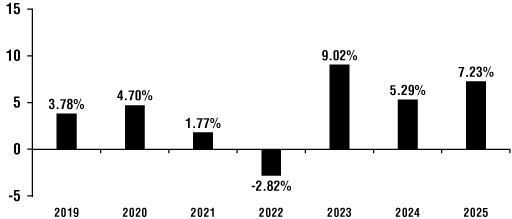
The Fund's highest/lowest quarterly results during this time period were:
Institutional Class
Highest Calendar Quarter Return at NAV 4.11% Quarter ended 12/31/2023
Lowest Calendar Quarter Return at NAV (1.46)% Quarter ended 03/31/2022
Average Annual Total Returns
(for the periods ended December 31, 2025)
|
|
One
Year
|
|
Five
Years
|
|
Since
Inception
|
|
Inception
Date
|
|
|
Institutional Class—Before Taxes
|
|
|
7.23
|
%
|
|
|
4.01
|
%
|
|
|
4.08
|
%
|
|
12/31/2018
|
|
|
Institutional Class—After Taxes on Distributions1
|
|
|
6.18
|
%
|
|
|
2.58
|
%
|
|
|
2.73
|
%
|
|
12/31/2018
|
|
Institutional Class—After Taxes on Distributions
and Sale of Fund Shares1
|
|
|
4.99
|
%
|
|
|
2.53
|
%
|
|
|
2.60
|
%
|
|
12/31/2018
|
|
|
Advisor Class—Before Taxes2
|
|
|
7.22
|
%
|
|
|
|
|
|
|
4.02
|
%
|
|
04/19/2021
|
|
|
Investor Class—Before Taxes2
|
|
|
|
|
|
|
|
|
|
|
3.03
|
%
|
|
07/01/2025
|
|
|
Bloomberg U.S. Universal Bond Index
|
|
|
7.58
|
%
|
|
|
0.06
|
%
|
|
|
2.38
|
%
|
|
12/31/2018
|
|
|
CPI + 200 Basis Points
|
|
|
4.70
|
%
|
|
|
6.58
|
%
|
|
|
5.80
|
%
|
|
12/31/2018
|
|
1
2
11
INVESTMENT ADVISER
First Pacific Advisors, LP is the Fund's investment adviser.
PORTFOLIO MANAGER
Abhijeet Patwardhan, Partner of the Adviser since 2017, has served as portfolio manager of the Fund since inception on December 31, 2018. Mr. Patwardhan is primarily responsible for the day-to-day management of the Fund's portfolio.
PURCHASE AND SALE OF FUND SHARES
Investors may purchase or redeem shares on any business day by written request, check, wire, ACH (Automated Clearing House), telephone, or through dealers as further described in this prospectus. You may conduct transactions by mail (FPA Funds, c/o UMB Fund Services, Inc., P.O. Box 2175, Milwaukee, Wisconsin 53201-2175, or 235 West Galena Street, Milwaukee, Wisconsin 53212), by wire, or by telephone at (800) 638-3060. Purchases and redemptions by telephone are only permitted if you previously established this option in your account. Investors can use the Account Application for initial purchases.
Investors can purchase shares by contacting any investment dealer authorized to sell the Fund's shares. The minimum initial investment in the Institutional Class is $100,000 and in the Advisor Class and Investor Class is $1,500, and each subsequent investment, which can be made directly to UMB Fund Services, Inc., must be at least $100. However, as described herein, the Fund has established different initial investment and subsequent investment minimums for retirement accounts and accounts established with a pre-authorized investment plan. All purchases made by check should be in U.S. dollars and made payable to the FPA Funds. Third party, starter or counter checks will not be accepted. A charge may be imposed if a check does not clear. The Fund reserves the right to waive or lower purchase and investment minimums in certain circumstances. For example, the minimums listed above may be waived or lowered for investors who are trustees or officers of the Fund, employees of the Adviser and/or customers of certain financial intermediaries that hold the Fund's shares in certain omnibus accounts, at the discretion of the officers of the Fund. In addition, financial intermediaries may impose their own minimum investment and subsequent purchase amounts.
Subsequent investments and redemptions can be made directly to UMB Fund Services, Inc.
Notice to Non-U.S. Resident Individual Shareholders. The Fund and its shares are only registered in the United States and its territories ("United States"). Regulations outside of the United States may restrict the sale of shares to certain non-U.S. residents or subject certain shareholder accounts to additional regulatory requirements. As a result, individuals resident outside the United States are generally not eligible to invest in the Fund. The Fund reserves the right, however, to sell shares to certain other non-U.S. investors in compliance with applicable law. If a current shareholder of the Fund provides a non-U.S. address, this will be deemed a representation and warranty from such investor that he/she is not a U.S. resident and will continue to be a non-U.S. resident unless and until the Fund is notified of a change in the investor's resident status. Any current shareholder that
12
has a resident address outside of the United States may be restricted from purchasing additional shares.
TAX INFORMATION
The Fund's distributions are taxable and will be taxed as ordinary income and/or long-term capital gain, unless you are investing through a tax-deferred arrangement, such as an IRA or 401(k) plan.
INFORMATION REGARDING TRANSACTIONS TROUGH FINANCIAL INTERMEDIARIES
Shareholders may be required to pay a commission directly to their broker or other financial intermediary when buying or selling shares of the Fund. Shareholders and potential investors may wish to contact their broker or other financial intermediary for information regarding applicable commissions, transaction fees or other charges associated with transactions in shares of the Fund.
In addition, brokers, dealers, banks, trust companies and other financial representatives may receive compensation from the Fund or its service providers for providing a variety of services, which may include recordkeeping, transaction processing for shareholders' accounts and certain shareholder services not currently offered to shareholders that deal directly with the Fund. These payments may create a conflict of interest by influencing the broker-dealer or other intermediary and your salesperson to recommend the Fund over another investment. Ask your salesperson or visit your financial intermediary's web site for more information.
13
ADDITIONAL INFORMATION ABOUT THE FUND
Investment Objective
FPA Flexible Fixed Income Fund seeks to provide long-term total return, which includes income and capital appreciation, while considering capital preservation.
The Fund's investment objective is not fundamental and may be changed by the Board of Trustees without shareholder approval, upon at least 60 days' prior written notice to shareholders. The Fund's investment strategies and policies may be changed from time to time without shareholder approval or prior written notice, unless specifically stated otherwise in this prospectus or the Statement of Additional Information ("SAI").
Principal Investment Strategies
Under normal circumstances, the Fund's portfolio manager invests at least 80% of the value of its assets in a diversified portfolio of debt instruments. The debt instruments (bonds, debentures, notes, loans, convertible debt and other debt-related or fixed income instruments) will generally comprise the core of the Fund's portfolio, including, but not limited, to the following:
• Debt instruments issued by corporations, municipalities, governments, and their agencies and instrumentalities, including high yield bonds (sometimes called "junk" bonds), mortgage-backed pools, and obligations of supra-national agencies, including international development institutions that provide global financing and advisory services for economic development; and/or
• Structured debt instruments, including commercial mortgage-backed securities (CMBS), residential mortgage-backed securities (RMBS), asset-backed securities (ABS), collateralized loan obligations (CLOs), collateralized debt obligations (CDOs), whole loans, structured notes, and similar such issues; and
• Privately placed debt instruments, including Rule 144A Securities.
The Fund's 80% investment policy is a non-fundamental investment policy that may be changed by the Board without shareholder approval upon at least 60 days' notice to shareholders.
The portfolio manager may also invest opportunistically using other non-principal investments and/or strategies including, but not limited to:
• Cash and cash equivalents;
• Preferred shares, including convertible preferred securities;
• Equity residuals of structured debt transactions;
• Common shares, rights, and warrants: (i) attached to securities purchased or held; or (ii) in connection with conversion, corporate restructuring and/or recapitalization;
14
• Derivatives including forwards, options, futures, swaps, and others;
• ETFs, generally to replicate exposure that cannot otherwise or might be less efficiently obtained through other investments or strategies;
• Selling short investments including, selling short or creating short exposure through the use of derivatives and/or ETFs (including long ETFs that replicate short exposure), in each case for hedging purposes, or selling short investments that the portfolio expects to receive in a recapitalization, reorganization, or other exchange for securities the portfolio contemporaneously owns or has the right to obtain, and uncovered or naked short selling;
• Currency, for both hedging and investment purposes;
• BDCs; and
• REITs.
The portfolio manager may also invest in cash equivalents, which may include publicly traded debt securities issued by the U.S. Government or agencies of the U.S. government, certificates of deposit, commercial paper, repurchase agreements, bankers' acceptance, and other similar short-term investments. Cash equivalents shall generally have maturities of 13 months or less.
The Fund will follow the general investment limitations below:
The Fund may invest up to 75% of its total assets in securities rated less than "A" (or its equivalent) by a NRSRO. If the security is rated by more than one NRSRO, the lowest rating shall be utilized. "A" or equivalent includes the plus (+) or minus (-) within the rating category.
The Fund may invest up to 25% of its total assets in: (i) non-U.S. dollar denominated securities of U.S. and non-U.S. issuers; and (ii) U.S. dollar denominated securities of non-U.S. issuers. An issuer is generally classified as non-U.S. if it is domiciled outside of the U.S. and derives a significant amount of its assets, revenues, or operating profits from non-U.S. countries. Conversely, an issuer domiciled outside of the U.S. is generally classified a U.S. issuer if a significant amount of its assets, revenues, or operating profits is U.S. based. Determination of whether an issuer is a non-U.S. issuer is made by the portfolio manager in their discretion.
The Fund may invest up to 10% of its total assets in preferred shares, including convertible preferred shares.
The Fund may invest up to 5% of its total assets in derivatives, ETFs and currencies not used for hedging purposes and uncovered (naked) short positions. For the avoidance of doubt, options, futures, swaps, other derivatives, ETFs, and securities sold short are excluded from the 5% limit to the extent such investments are used for hedging purposes to seek to minimize the impact of losses to one or more investments.
The portfolio manager expects to manage the portfolio such that the average duration remains positive and they will not borrow to enhance returns.
15
ADDITIONAL INFORMATION ABOUT THE PRINCIPAL INVESTMENT STRATEGIES
To pursue the Fund's investment objective, the portfolio manager generally invests the Fund's assets in a diversified portfolio of debt securities, cash, and cash equivalents, including, but not limited to, the following securities:
U.S. Government Securities. The U.S. government sector includes fixed-income securities issued by the U.S. government or its agencies and instrumentalities, such as U.S. Treasury and U.S. government agency securities, mortgage pass-through securities, including Government National Mortgage Association (Ginnie Mae), Federal Home Loan Mortgage Corporation (Freddie Mac) and the Federal National Mortgage Association (Fannie Mae), and agency mortgage-backed securities.
Mortgage-Backed Securities. In addition to the U.S. government mortgage-pass through securities described above, the mortgage sector includes non-agency mortgage-backed securities, such as collateralized mortgage obligations ("CMOs"), CMBS, RMBS and single- and multi-class pass-through securities. Mortgage-backed securities represent direct or indirect participation in mortgage loans secured by real property.
High Yield Securities. High yield securities are medium- or lower-rated securities and unrated securities of comparable quality, sometimes referred to as "high yield" or "junk" bonds. Generally, such securities offer a higher current yield than is offered by higher-rated securities, but also are predominantly speculative with respect to the issuer's capacity to pay interest and repay principal in accordance with the terms of the obligations. The market values of certain of these securities also tend to be more sensitive to individual corporate developments and changes in economic conditions than higher quality bonds. In addition, medium- and lower-rated securities and comparable unrated securities generally present a higher degree of credit risk.
Asset-Backed Securities. Asset-backed securities are bonds issued through special purpose vehicles and backed by pools of loans, other receivables, or other assets. Asset-backed securities are created from many types of assets, such as home equity loans, auto loans, student loans, equipment financing, and credit card receivables. The credit quality of an asset-backed security depends on the quality and performance of the underlying assets and/or the level of any credit support provided by the securitization structure. The proportions of the Fund's portfolio invested in various types of asset-backed securities will depend on many factors, including the portfolio manager's appraisal of the economy, yield, credit quality, macroeconomic factors, and capital appreciation potential, among others. To the extent the Fund focuses its investments in a particular type of asset-backed security, it may be more susceptible to economic conditions and risks affecting the type of asset-backed security.
Corporate Debt Securities. The Fund may invest in corporate bonds, bank debt, notes and commercial paper of varying maturities and may invest in domestic bonds, bank debt and notes and those issued by non-U.S. corporations and governments. Issuers of these securities have a contractual obligation to pay interest at a specified rate on a specified date and to repay principal on a specified maturity date, and may have provisions that allow the issuer to redeem or "call" the security before its maturity.
16
Sovereign and Government-Related Debt. Sovereign debt includes securities issued or guaranteed by a non-U.S. sovereign government or its agencies, authorities, or political subdivisions. Government-related debt includes securities issued by non-U.S. regional or local governmental entities or government-controlled entities. In the event an issuer of sovereign debt or government-related debt is unable or unwilling to make scheduled payments of interest or principal, holders may be asked to participate in a restructuring of the debt and to extend further credit to the issuer. In the event of a default by such an issuer, there may be few or no effective legal remedies for collecting on such debt.
Non-U.S. Securities. The Fund may invest in securities of U.S.-dollar denominated non-U.S. issuers traded in the United States and in non-U.S. currency-denominated securities of non-U.S. issuers. For purposes of this prospectus, non-U.S. issuers are generally non-U.S. governments or companies either domiciled outside the U.S. or traded on non-U.S. exchanges, but the portfolio manager may make a different designation in certain circumstances. The non-U.S. issuers that the Fund may invest in include issuers with significant exposure to countries with developing economies and/or markets.
Covered Bonds. Covered bonds are debt securities issued by banks and are secured by collateral, typically mortgages. In the event of a default, bondholders also have an unsecured claim against the issuing bank if the underlying collateral is insufficient to repay amounts owing in respect of the bonds.
Cash Equivalents. Cash equivalents are short-dated instruments that are readily convertible into cash. They may include bank obligations, commercial paper, and repurchase agreements. Bank obligations include certificates of deposit and bankers' acceptances. Commercial paper is a short-term promissory note issued by a corporation, which may have a floating or variable rate. Repurchase agreements are transactions under which the Fund purchases a security from a dealer counterparty and agrees to resell the security on a specified future date at the same price, plus a specified interest rate.
Warrants and Rights. Warrants are options to buy a stated number of shares of common stock at a specified price anytime during the life of the warrants (generally two or more years). They have no voting rights, pay no dividends, and have no rights with respect to the assets of the entity issuing them. Rights are similar to warrants but normally have a shorter duration and are typically distributed directly by the issuers to existing shareholders, while warrants are typically attached to new debt or preferred stock issuances. The market price of warrants may be substantially lower than the current market price of the underlying common stock, yet warrants are subject to similar price fluctuations. As a result, warrants may be more volatile investments than the underlying common stock. If a warrant is exercised, a Fund may hold common stock in its portfolio even if it does not ordinarily invest in common stock. Warrants and rights generally do not entitle the holder to dividends or voting rights with respect to the underlying common stock and do not represent any rights in the assets of the issuer. Warrants and rights will expire if not exercised on or prior to the expiration date.
Temporary Investments and Other Measures. As a temporary measure for defensive purposes, the Fund may invest up to 100% of its total assets in short-term investments, including cash or cash equivalents, corporate debt, or direct or indirect U.S. and non-U.S. government and agency
17
obligations, money market instruments, bank obligations, commercial paper, corporate notes and repurchase agreements. The Fund may make these investments or increase its investment in these securities when the manager is unable to find enough attractive long-term investments, to reduce exposure to the Fund's primary investments when the manager believes it is advisable to do so, during periods of significant shareholder redemptions or when adverse or unusual market, economic, political, or other conditions exist. The Fund may take such portfolio positions for as long a period as deemed necessary. In doing so, the Fund may succeed in avoiding losses but may otherwise fail to achieve its investment objective. However, there can be no guarantee that a defensive strategy will be successful. Investing defensively may adversely affect Fund performance. During these times, the portfolio manager may make frequent portfolio holding changes, which could result in increased trading expenses and taxes, and decreased Fund performance.
As part of its normal operations, the Fund may hold cash or invest a portion of its portfolio in short-term interest bearing U.S. dollar denominated securities, pending investments or to provide for possible redemptions. Investments in such short-term debt securities can generally be sold easily and have limited risk of loss, but earn only limited returns. The Fund may increase its cash holdings and/or such short-term investments in anticipation of a greater than normal number of shareholder redemptions.
Percentage Investment Limitations. Unless otherwise stated, all percentage limitations on Fund investments listed in this prospectus will apply at the time of purchase. The Fund would not violate these limitations unless an excess or deficiency occurs or exists immediately after and as a result of an investment.
Other Investments and Techniques. The Fund may invest in other types of securities and use a variety of investment techniques and strategies which are not principal investment strategies and are not described in this prospectus. These securities and techniques may subject the Fund to additional risks. Please see the SAI for additional information about the securities and investment techniques described in this prospectus and about additional securities and techniques that may be used by the Fund.
ADDITIONAL INFORMATION ABOUT THE PRINCIPAL RISKS
The Fund's principal risks are set forth below. Before you decide whether to invest in the Fund, carefully consider these risk factors and special considerations associated with investing in the Fund, which may cause you to lose money.
Interest Rate Risk. As with most funds that invest in debt securities, changes in interest rates, including rates that fall below zero, are one of the most important factors that could affect the value of an investment in the Fund. Interest rate risk is the risk that debt securities will decline in value because of increases in interest rates. Any such change in interest rates may be sudden and significant, with unpredictable effects on the financial markets and the Fund's investments. Rising interest rates tend to cause the prices of debt securities (especially those with longer maturities) and the Fund's share price to fall. Generally, bonds with longer maturities have a greater duration and thus are subject to greater price volatility from changes in interest rates. Adjustable rate instruments also react to interest rate changes in a similar manner although generally to a lesser
18
degree (depending, however, on the characteristics of the reset terms, including the index chosen, frequency of reset and reset caps or floors, among other things). Low interest rates may pose heightened risks with respect to investments in fixed income securities. When interest rates rise from a low level, fixed income securities markets may experience lower prices, increased volatility, and lower liquidity. The negative impact on fixed income securities from rate increases, regardless of the cause, could be swift and significant, which could result in significant losses by the Fund, even if such rate increases are anticipated by the portfolio manager. The Fund may be subject to heightened interest rate risk because the Federal Reserve has raised, and may continue to raise, interest rates. During periods of increasing interest rates the Fund may experience high redemptions and, as a result, increased portfolio turnover, which could increase the costs that the Fund incurs and may negatively impact the Fund's performance.
Market Risk. The market price of a security or instrument may decline, sometimes rapidly or unpredictably, due to general market conditions that are not specifically related to a particular company, such as real or perceived adverse economic, political, or geopolitical conditions throughout the world, changes in the general outlook for corporate earnings, changes in interest or currency rates, or adverse investor sentiment generally. The market value of a security or instrument also may decline because of factors that affect a particular industry or industries, such as tariffs, labor shortages or increased production costs and competitive conditions within an industry. In addition, local, regional or global events such as war, acts of terrorism, international conflicts, trade disputes, supply chain disruptions, cybersecurity events, the spread of infectious illness or other public health issues, natural disasters or climate events, or other events could have a significant impact on a security or instrument. Such events could make identifying investment risks and opportunities especially difficult for the Adviser. In response to certain crises, the United States and other governments have taken steps to support financial markets. The withdrawal of this support or failure of efforts in response to a crisis could negatively affect financial markets generally as well as the value and liquidity of certain securities. In addition, policy and legislative changes in the United States and in other countries are changing many aspects of financial regulation. The impact of these changes on the markets, and the practical implications for market participants, may not be fully known for some time. The increasing interconnectivity between global economies and financial markets increases the likelihood that events or conditions in one region or financial market may adversely impact issuers in a different country, region or financial market.
Risks Associated with Investing in High Yield Securities. High yield bonds, sometimes called "junk" bonds, are highly speculative securities that are usually issued by smaller, less credit-worthy and/or highly leveraged (indebted) companies. Because investment in lower-rated or unrated securities involves greater investment risk, achievement of the Fund's investment objective is more dependent on the portfolio manager's credit analysis of these securities than with respect to the Fund's investments in higher-rated securities. The portfolio manager does not employ a rating valuation for unrated securities. Decisions to purchase and sell these securities are based on the portfolio manager's evaluation of their investment potential and not on the ratings assigned by credit agencies. Compared with investment-grade bonds, high yield bonds carry a greater degree of risk and are less likely to make payments of interest and principal. Compared to investment-grade debt securities, market developments and the financial and business conditions of the corporation issuing high yield securities influence the price and liquidity of high yield securities more than changes in interest rates when compared to investment grade debt securities. Lower-rated securities may be
19
more susceptible to real or perceived adverse economic and competitive industry conditions than investment grade securities. A projection of an economic downturn, for example, could cause a decline in the prices of lower-rated securities because the advent of a recession could lessen the ability of a highly leveraged company to make principal and interest payments on its debt securities. New and proposed laws and regulations could negatively impact the market for high yield bonds. Insufficient liquidity in the high yield bond market may make it more difficult to dispose of high yield bonds and may cause the Fund to experience sudden and substantial price declines. A lack of reliable, objective data or market quotations may make it more difficult to value high yield bonds accurately. There is no limit on the ratings of high yield securities that may be purchased or held by the Fund, and the Fund may invest in securities that are in default.
Mortgage-Related and Asset-Backed Securities Risk. Mortgage-related and other asset-backed securities represent interests in "pools" of mortgages or other assets such as consumer loans or receivables held in trust and often involve risks that are different from or possibly more acute than risks associated with other types of debt instruments. Mortgage-related securities, including CMBS and RMBS, are subject to prepayment risk (the risk that borrowers will repay a loan more quickly in periods of falling interest rates) and "extension risk" (the risk that borrowers will repay a loan more slowly in periods of rising interest rates) and can be highly sensitive to changes in interest rates. Generally, in a period of rising interest rates, individual borrowers are less likely to exercise prepayment options which tend to extend the expected maturity of mortgage-related securities, making them more sensitive to changes in interest rates. As a result, if the Fund holds mortgage- related securities, rising interest rates may cause the Fund to exhibit additional volatility due to the increased expected average life of its mortgage-related holdings. When interest rates decline, borrowers may pay their mortgages sooner than expected. These prepayments can reduce the returns of the Fund because the Fund may realize losses on securities that were acquired at a premium to par and the Fund may have to reinvest the proceeds from prepayments at the lower prevailing interest rates which can reduce the Fund's yield. An unexpectedly high rate of defaults on the assets held by a pool may limit substantially the pool's ability to make payments of principal or interest to the Fund, reducing the values of those securities or in some cases rendering them worthless.
Mortgage-related securities may be either pass-through securities or CMOs. Pass-through securities represent a right to receive principal and interest payments collected on a pool of mortgages which are passed through to security holders. CMOs are created by dividing the principal and interest payments collected on a pool of mortgages into several cash flow streams ("tranches") with different priority rights to portions of the underlying mortgage payments. Certain CMO tranches may represent a right to receive specific sources of cash flow such as interest-only ("Ios") or principal-only ("Pos"). These securities are frequently referred to as "stripped securities" and are subject to interest rate risks described below. If the Fund invests in CMO tranches (including CMO tranches issued by government agencies) and interest rates move in a manner not anticipated by the manager, it is possible that the Fund could lose all or substantially all of its investment. The market prices of CMOs structured as accrual certificates (also known as "Z-Bonds") are affected to a greater extent by interest rate changes and therefore tend to be more volatile than securities which pay current interest in cash. Mortgage-related securities, including CMBS and RMBS, and in particular those not backed by a government guarantee, are subject to credit risk, i.e. the likelihood that an issuer will default on the payment of principal and/or interest on a security. CMBS and RMBS investments that are backed by mortgages given to borrowers considered to be higher risk borrowers generally
20
include one or more aggressive mortgage terms, such as a high loan-to-value ratio. Such mortgages carry a higher degree of credit risk than other loans, and, therefore, a higher probability of default.
The Fund's investments in other asset-backed securities are subject to risks similar to those associated with mortgage-related securities, as well as additional risks associated with the nature of the assets and the servicing of those assets. Payment of principal and interest on asset-backed securities may be largely dependent upon the cash flows generated by the assets backing the securities, and asset-backed securities may not have the benefit of any security interest in the related assets. Certain asset-backed securities, including securities backed by auto loans, are subject to subprime lending and loan-to-value risk. One of the most significant risks to a holder of an auto loan asset-backed security is the fluctuation of the value of the loans acquired. The higher the loan-to-value ratio, the riskier the loan is for a lender. Further, subprime loans underlying auto loan asset-backed securities may have higher default rates than loans that meet more stringent underwriting requirements.
Collateralized Debt Obligations Risk. The Fund may invest in CDOs, which include CLOs, collateralized bond obligations ("CBOs"), and other similarly structured securities. The risks of an investment in a CDO depend largely on the type of the collateral securities and the class of the CDO in which the Fund invests. In addition to the normal risks associated with credit-related securities discussed elsewhere in the prospectus (e.g., interest rate risk and default risk), CDOs carry additional risks including, but not limited to, the risk that: (i) distributions from collateral securities may not be adequate to make interest or other payments; (ii) the quality of the collateral may decline in value or default; (iii) the Fund may invest in CDOs that are subordinate to other classes; and (iv) the complex structure of the security may not be fully understood at the time of investment and may produce disputes with the issuer or unexpected investment results. Investments in CDOs are also more difficult to value than other investments. In addition, although not required, valuations of Fund holdings are ordinarily verified via a second pricing source. However, second source pricing may not be available with respect to certain CDOs in which the Fund invests as a result of a lack of readily available market quotations. In addition, there may be delays in the Fund's ability to invest in CDOs at desired levels as a result of the increased time necessary for the Adviser to resolve valuation and operational issues necessary to make these investments.
Collateralized Loan Obligations Risk. The Fund is subject to the following risks as a result of its investments in CLOs:
• Asset Manager Risk. The CLO's performance is linked to the expertise of the CLO manager and its ability to manage the CLO portfolio. The experience of a CLO manager plays an important role in the rating and risk assessment of CLO debt securities. One of the primary risks to investors of a CLO is the potential change in CLO manager, over which the Fund will have no control.
• Legal and Regulatory Risk. The Fund may be adversely affected by new (or revised) laws or regulations that may be imposed by government regulators or self-regulatory organizations that supervise the financial markets. These agencies are empowered to promulgate a variety of rules pursuant to financial reform legislation in the United States. The Fund may also be adversely affected by changes in the enforcement or interpretation
21
of existing statutes and rules. Changes in the regulation of CLOs may adversely affect the value of the investments held by the Fund and the ability of the Fund to execute its investment strategy.
• Limited Recourse Risk. CLO debt securities are limited recourse obligations of their issuers. CLO debt is payable solely from the proceeds of its underlying assets. Consequently, CLO investors must rely solely on distributions from the underlying assets for payments on the CLO debt they hold. No party or entity other than the issuer will be obligated to make payments on CLO debt. CLO debt is not guaranteed by the issuer or any other party or entity involved in the organization and management of a CLO. If income from the underlying loans is insufficient to make payments on the CLO debt, no other assets will be available for payment.
• Redemption Risk. CLO debt securities may be subject to redemption. For example, certain tranches of CLO debt may be redeemed if the CLO manager is unable to identify assets suitable for investment during the period when it has the ability to reinvest the principal proceeds from the sale of assets, scheduled redemptions and prepayments in additional assets (the "Reinvestment Period"). Additionally, holders of subordinated CLO debt may cause the redemption of senior CLO debt. In the event of an early redemption, holders of the CLO debt being redeemed will be repaid earlier than the stated maturity of the debt. The timing of redemptions may adversely affect the returns on CLO debt.
• Reinvestment Risk. The CLO manager may not find suitable assets in which to invest during the Reinvestment Period or to replace assets that the manager has determined are no longer suitable for investment (for example, if a security has been downgraded by a rating agency). Additionally, the Reinvestment Period is a pre-determined finite period of time; however, there is a risk that the Reinvestment Period may terminate early if, for example, the CLO defaults on payments on the securities which it issues or if the CLO manager determines that it can no longer reinvest in underlying assets. Early termination of the Reinvestment Period could adversely affect a CLO investment.
Credit Risk. Credit risk refers to the likelihood that an issuer will default on the payment of principal and/or interest on a security. Various factors could affect the issuer's actual or perceived willingness or ability to make timely interest or principal payments, including changes in the issuer's financial condition or in general economic conditions. In addition, lack of or inadequacy of collateral or credit enhancements for a fixed income security may affect its credit risk. Below investment grade securities have more risk with respect to the issuer's ability to pay interest and repay principal when due, and therefore involve a greater risk of default or nonpayment. Credit risk of a security may change over time. Ratings agencies periodically review certain securities and may downgrade a security that is held by the Fund. However, ratings are only opinions of the agencies issuing them and are not absolute guarantees as to quality.
Call Risk. Issuers of callable bonds are permitted to redeem these bonds before their final maturity. Issuers may call outstanding securities before maturity for a number of reasons, including decreases in prevailing interest rates or improvements to the issuer's credit profile. If an issuer calls a security in which the Fund is invested, the Fund could lose potential price appreciation and be forced to reinvest the proceeds in securities that bear a lower interest rate or more credit risk.
22
Liquidity Risk. The Fund's investments in illiquid securities may reduce the returns of the Fund because it may not be able to sell the illiquid securities at an advantageous time or price. Investments in high yield securities, non-U.S. securities, derivatives, or other securities with substantial market and/or credit risk tend to have the greatest exposure to liquidity risk. Certain investments in private placements and Rule 144A Securities may be considered illiquid investments. Lower-rated debt securities tend to be less liquid than higher-rated securities. Illiquid securities may trade at a discount from comparable, more liquid investments, and may be subject to wider fluctuations in market value. Investments in illiquid derivatives may create the potential for the Fund to face ongoing margin and settlement payment obligations thereunder. Furthermore, reduced number and capacity of dealers and other counterparties to "make markets" in fixed income securities, in connection with the growth of the fixed income markets, may increase liquidity risk with respect to the Fund's investments in fixed income securities. When there is no willing buyer and investments cannot be readily sold, the Fund may have to lower the selling price, sell other investments, or may not be able to sell the securities at all and may have to forego another, more appealing investment opportunity, any of which could have a negative effect on the Fund's performance. These securities may also be difficult to value and their values may be more volatile because of liquidity risk. Increased Fund redemption activity may negatively impact Fund performance and increase liquidity risk due to the need of the Fund to sell portfolio securities. Regulatory changes may further constrain the ability of market participants to create liquidity, particularly in times of increased market volatility. Liquidity risk may intensify during periods of economic uncertainty.
Large Investor Risk. Ownership of shares of the Fund may be concentrated in one or a few large investors. Such investors may redeem shares in large quantities or on a frequent basis. Redemptions of Fund shares by a large investor may negatively affect the performance of the Fund, may increase realized capital gains, may accelerate the realization of taxable income to shareholders and may increase transaction costs. These transactions potentially limit the use of any capital loss carryforwards and certain other losses to offset future realized capital gains (if any). Such transactions may also increase the Fund's expenses. In addition, the Fund may be delayed in investing new cash after a large shareholder purchase, and under such circumstances may be required to maintain a larger cash position than it ordinarily would.
Management Risk. The Fund is subject to management risk as an actively managed investment portfolio. The portfolio manager will apply investment techniques and risk analyses in making investment decisions for the Fund, but there can be no guarantee that these will produce the desired results. The portfolio manager's opinion about the intrinsic worth or creditworthiness of a company or security may be incorrect, the portfolio manager may not make timely purchases or sales of securities for the Fund, the Fund's investment objective may not be achieved, or the market may continue to undervalue the Fund's securities. In addition, the Fund may not be able to quickly dispose of certain securities holdings. The frequency of trading within the Fund impacts portfolio turnover rates, which are shown in the financial highlights table. A higher rate of portfolio turnover could produce higher trading costs and taxable distributions, which would detract from the Fund's performance. Moreover, there can be no assurance that all of the Adviser's personnel will continue to be associated with the Adviser for any length of time. The loss of services of one or more key employees of the Adviser, including the portfolio manager, could have an adverse impact on the Fund's ability to achieve its investment objective. Certain securities or other instruments in which the Fund seeks to invest may not be available in the quantities desired. In such circumstances, the portfolio manager may determine to purchase other securities or instruments as substitutes. Such
23
substitute securities or instruments may not perform as intended, which could result in losses to the Fund. In addition, the Fund and its service providers are subject to potential operational and information security risks from breaches in cyber security. A breach in cyber security refers to both intentional and unintentional cyber events and may include, among other events, the stealing or corrupting of data maintained online or digitally, denial of service attacks on websites, the unauthorized release or misuse of confidential information or various other forms of cyber-attacks. Cyber security breaches affecting the Fund or the Adviser, custodian, transfer agent, intermediaries, trading counterparties or other third-party service providers may adversely impact the Fund. For instance, cyber security breaches may interfere with the processing of shareholder transactions, impact the Fund's ability to calculate its net asset value, cause the release of private shareholder information or confidential (including proprietary) company information, impede trading, result in violations of applicable privacy and other laws, subject the Fund to regulatory fines, cause the Fund and its shareholders to experience financial losses, or cause reputational damage and/or otherwise disrupt normal business operations. The Fund may also incur additional costs for cyber security risk management purposes. The Fund has established business continuity plans and risk management systems reasonably designed to seek to reduce the risks associated with cyber-attacks and disruptions in services, but there are inherent limitations in these plans and systems. For example, the nature of malicious cyber-attacks is becoming increasingly sophisticated; the Fund cannot control the cyber security systems of issuers or third-party service providers; and certain current risks may not have been identified and additional unknown threats may emerge in the future. There is also a risk that cyber security breaches may not be detected. The Fund and its shareholders could be negatively impacted as a result.
Private Placements and Restricted Securities Risk. Private placement securities are securities that are not registered under the federal securities laws, and are generally eligible for sale only to certain eligible investors. The Fund may invest in securities that are purchased in private placements. Because there may be relatively few potential purchasers for such investments, especially under adverse market or economic conditions or in the event of adverse changes in the financial condition of the issuer, the Fund could find it more difficult to sell such securities when FPA believes it advisable to do so or may be able to sell such securities only at prices lower than if such securities were more widely held. At times, it may also be more difficult to determine the fair value of such securities for purposes of computing the net asset value of the Fund. The sale of such investments may also be restricted under securities laws.
U.S. Government Securities Risk. Certain U.S. government securities are supported by the full faith and credit of the United States; others are supported by the right of the issuer to borrow from the U.S. Treasury; others are supported by the discretionary authority of the U.S. government to purchase the agency's obligations; and still others are supported only by the credit of the issuing agency, instrumentality, or enterprise. Although U.S. government-sponsored enterprises such as the Federal Home Loan Mortgage Corporation (Freddie Mac) and the Federal National Mortgage Association (Fannie Mae) may be chartered or sponsored by Congress, they are not funded by Congressional appropriations, and their securities are not issued by the U.S. Treasury, are not supported by the full faith and credit of the U.S. government, and involve increased credit risks in comparison to U.S. Treasury securities or other securities supported by the full faith and credit of the U.S. government. Any security guaranteed by the U.S. government or its agencies or instrumentalities, or a security backed by the U.S. Treasury or the full faith and credit of the United
24
States, is guaranteed or backed only as to the timely payment of interest and principal when held to maturity, but the market values for such securities are not guaranteed and will fluctuate.
Any market movements, regulatory changes, or changes in political or economic conditions that affect the U.S. government agencies or instrumentalities in which the Fund invests may have a significant impact on the Fund's performance. Events that would adversely affect the market prices of securities issued or guaranteed by one government agency or instrumentality may adversely affect the market price of securities issued or guaranteed by other government agencies or instrumentalities. Because many types of U.S. government securities trade actively outside the United States, their prices may rise and fall as changes in global economic conditions affect the demand for these securities.
Currency Transactions Risk. Currency hedging involves many of the same risks as other derivative transactions, such as leveraging risk, market risk, liquidity risk, counterparty risk, management risk, operational risk, and legal risk. Currency derivative transactions are also subject to risks different from those of other derivative transactions. Because currency control is of great importance to the issuing governments and influences economic planning and policy, purchases and sales of currency and related instruments can be adversely affected by government exchange controls, limitations, or restrictions on repatriation of currency, and manipulations or exchange restrictions imposed by governments. Currency exchange rates may also fluctuate based on broader factors extrinsic to any particular country's economy. There can be no assurance that currency transactions or currency hedging techniques will be successful.
OTC Risk. Securities and derivatives traded in OTC markets may trade in smaller volumes, and their prices may be more volatile, than securities principally traded on securities exchanges. Such securities may be less liquid than more widely traded securities. In addition, the prices of such securities may include an undisclosed dealer markup, which the Fund pays as part of the purchase price.
Risks Associated with Investing in Non-U.S. Securities. Non-U.S. investments involve special risks not present in U.S. investments that can increase the chances that the Fund will lose money. Certain of the risks noted below may also apply to securities of U.S. issuers with significant non-U.S. operations. Investments in non-U.S. securities involve the following risks:
• The economies of some non-U.S. markets often do not compare favorably with that of the U.S. in areas such as growth of gross domestic product, reinvestment of capital, resources, and balance of payments. Some of these economies may rely heavily on particular industries or non-U.S. capital. They may be more vulnerable to adverse diplomatic developments, the imposition of economic sanctions against a country, changes in international trading patterns, trade barriers and other protectionist or retaliatory measures.
• Governmental actions—such as the imposition of capital controls, nationalization of companies or industries, expropriation of assets or the imposition of punitive taxes—may adversely affect investments in non-U.S. markets. Such governments may also participate to a significant degree, through ownership or regulation, in their respective economies.
25
• The governments of certain countries may prohibit or substantially restrict foreign investing in their capital markets or in certain industries. This could severely affect security prices. This could also impair the Fund's ability to purchase or sell non-U.S. securities or transfer its assets or income back to the U.S. or otherwise adversely affect the Fund's operations.
• Other non-U.S. market risks include foreign exchange controls, difficulties in pricing securities, defaults on non-U.S. government securities, difficulties in enforcing favorable legal judgments in non-U.S. courts, and political and social instability. Legal remedies available to investors in some non-U.S. countries are less extensive than those available to investors in the U.S. Many non-U.S. governments supervise and regulate stock exchanges, brokers, and the sale of securities to a lesser extent than the U.S. government does. Corporate governance may not be as robust as in more developed countries. As a result, protections for minority investors may not be strong, which could adversely affect the Fund's non-U.S. holdings or exposures.
• Accounting standards in other countries are not necessarily the same as in the U.S. If the accounting standards in another country do not require as much disclosure or detail as U.S. accounting standards, it may be harder for the portfolio manager to completely and accurately determine a company's financial condition or otherwise assess a company's creditworthiness.
• Because there may be fewer investors on non-U.S. exchanges and smaller numbers of shares traded each day, it may be difficult for the Fund to buy and sell securities on those exchanges. In addition, prices of non-U.S. securities may be more volatile than prices of securities traded in the U.S.
• Non-U.S. markets may have different clearance and settlement procedures. In certain markets, settlements may not keep pace with the volume of securities transactions. If this occurs, settlement may be delayed, and the Fund's assets may be uninvested and may not be earning returns. The Fund also may miss investment opportunities or not be able to sell an investment or reduce its exposure because of these delays.
• Changes in currency exchange rates will affect the value of the Fund's non-U.S. holdings or exposures.
• The costs of non-U.S. securities transactions tend to be higher than those of U.S. transactions, increasing the transaction costs paid directly or indirectly by the Fund.
• International trade barriers or economic sanctions against non-U.S. countries may adversely affect the Fund's non-U.S. holdings or exposures. Since January 20, 2025, the current U.S. administration has pursued an aggressive foreign policy agenda, including the imposition of tariffs, which may have unforeseen consequences on the United States' relations with foreign countries, the economy, and markets generally. In addition, the current administration has sought to reduce the size of the U.S. government by, for example, reducing the headcount of and freezing funding available to certain U.S. government agencies. Such efforts may continue throughout U.S. federal agencies, which could increase
26
administrative burdens on remaining government employees, increase processing times of company filings, alter regulatory policymaking, and increase regulatory volatility. These, as well as other potential effects which are not currently known, may have a negative impact on the Fund or on markets generally.
• Global economies are increasingly interconnected, which increases the possibilities that conditions in one country, region or financial market might adversely impact a different country, region, or financial market.
The severity or duration of these conditions may be affected if one or more countries leave the European Union or the euro currency or if other policy changes are made by governments or quasi-governmental organizations.
Risks Associated with Investing in Convertible Securities. A convertible security is a bond, debenture, or note that may be exchanged for particular common stocks in the future at a predetermined price or formula within a specified period of time. A convertible security entitles the holder to receive interest paid or accrued on the debt security until the convertible security matures or is redeemed. Prior to redemption, convertible securities provide benefits similar to nonconvertible debt securities in that they generally provide income with higher yields than those of similar common stocks. Convertible securities may entail less risk than the corporation's common stocks. Convertible securities are generally not investment grade. The risks of nonpayment of the principal and interest increase when debt securities are rated lower than investment grade or are not rated.
Recent Market Events. Periods of market volatility may occur in response to market events, public health emergencies, natural disasters or climate events, and other economic, political, and global macro factors. U.S. and international markets have recently experienced, and may continue to experience, periods of significant volatility due to various factors, including uncertainty regarding inflation and central banks' interest rate changes, the possibility of a national or global recession, trade tensions and tariffs, and political and geopolitical events. In addition, some countries and regions in which the Fund may invest have experienced security concerns; wars or threats of war and aggression, such as Russia's invasion of Ukraine and conflicts among nations and militant groups in the Middle East; terrorism; economic uncertainty; natural and environmental disasters; and/or systemic market dislocations that have led, and in the future may lead, to increased short-term market volatility and may have adverse long-term effects on the U.S. and world economies and markets generally, each of which may negatively impact the Fund's investments.
Additionally, since the change in the U.S. presidential administration in 2025, the administration has pursued an aggressive foreign policy agenda, including through suggestions that the United States should control certain sovereign foreign territories, attempts to restructure federal government agencies with international influence, and the imposition of tariffs and trade barriers on certain foreign countries, including China and long-time U.S. allies. In particular, the imposition of tariffs has led to retaliatory tariffs by certain foreign countries and could lead to retaliatory tariffs by targeted additional foreign countries, as well as increased and prolonged market volatility, and sector-specific downturns in industries reliant on international trade. The new administration has also sought to reduce the headcount of and freeze or reduce funding available to certain U.S.
27
government agencies. Such efforts may continue throughout U.S. federal agencies, which could increase administrative burdens on remaining government employees, increase processing times of company filings, alter regulatory policymaking, and increase regulatory volatility. These efforts and other similar actions may have a unforeseen consequences on the economy and markets generally, and could negatively impact the Fund.
Raising the ceiling on U.S. government debt and passing periodic legislation to fund the government have become increasingly politicized. Any failure to do either could lead to a default on U.S. government obligations, with unpredictable consequences for economies and markets in the United States and elsewhere.
Changing interest rate environments (whether downward or upward) impact various sectors of the economy and asset classes in different ways. For example, low interest rate environments tend to be positive for the equity markets, whereas high interest rate environments tend to apply downward pressure on earnings and equity prices. It is difficult to accurately predict the pace at which interest rates might change, the timing, frequency or magnitude of any such changes in interest rates, or when such changes might stop or reverse course. Unexpected changes in interest rates could lead to significant market volatility or reduce liquidity in certain sectors of the market.
The events and circumstances described above could be prolonged and could adversely affect the value and liquidity of the Fund's investments, impair the Fund's ability to satisfy redemption requests, and negatively impact the Fund's performance. Other market events may cause similar disruptions and effects.
Cybersecurity Risk. Cybersecurity incidents may allow an unauthorized party to gain access to Fund assets, customer data (including private shareholder information), or proprietary information, or cause the Fund, the Adviser, and/or other service providers (including custodians, sub-custodians, transfer agents and financial intermediaries) to suffer data breaches, data corruption or loss of operational functionality. A cybersecurity incident may disrupt the processing of shareholder transactions, impact the Fund's ability to calculate its net asset value, and prevent shareholders from redeeming their shares. The use of artificial intelligence and machine learning could exacerbate these risks. Issuers of securities in which the Fund invests are also subject to cybersecurity risks, and the value of those securities could decline if the issuers experience cybersecurity incidents.
ADDITIONAL INFORMATION ABOUT NON-PRINCIPAL RISKS
Stripped Securities Risk. Stripped securities are more volatile than securities where the principal and interest payments have not been separated. The value of stripped securities generally fluctuates more in response to interest rate movements than the value of traditional bonds because a change in interest rates may increase or decrease prepayments of principal. While the U.S. government or its agencies or instrumentalities may guarantee the full repayment of principal on stripped securities they issue, repayment of interest is generally guaranteed only while the underlying assets or pools of assets are outstanding. The market for stripped securities may be limited, which may make it difficult for the Fund to dispose of them quickly at an acceptable price.
Zero Coupon Securities. Special tax considerations are associated with investing in high yield bonds structured as zero coupon or pay-in-kind securities. The Fund does not receive any cash
28
interest on such bonds until the bond matures, but the interest on these securities is accrued as income. Similarly, the inflation accretion income recorded on inflation-indexed notes is not received until maturity. The Internal Revenue Code requires the Fund to distribute such income to its shareholders. Thus, the Fund may have to dispose of securities when it might not want to in order to provide the cash necessary to make distributions to those shareholders who do not reinvest dividends.
Risks Associated with Investing in Repurchase Agreements. A repurchase agreement is a short-term investment. The Fund acquires a debt security that the seller agrees to repurchase at a future time and set price. If the seller declares bankruptcy or defaults, the Fund may incur delays and expenses liquidating the security. The security may also decline in value or fail to provide income.
Sovereign Debt Risk. An issuer of sovereign debt or the governmental authorities that control the repayment of the debt may be unable or unwilling to repay principal or interest when due. In the event of a default by a governmental entity on a sovereign debt obligation, there may be few or no effective legal remedies for collecting on such debt.
Adjustable Rate Mortgage ("ARM") Risk. During periods of extreme fluctuations in interest rates, the resulting fluctuations of ARM rates could affect the ARMs' market value. Most ARMs have annual reset limits or "caps." Fluctuations in interest rates above these levels, thus, could cause the mortgage-backed securities to "cap out" and to behave more like long-term, fixed-rate debt securities. During periods of declining interest rates, of course, the coupon rates may readjust downward and result in lower yields. Because of this feature, the value of ARMs will likely not rise during periods of declining interest rates to the same extent as fixed-rate instruments.
Risks Associated with Deep Discount Securities. The high yield securities in which the Fund may invest may from time to time include debt securities of companies that are financially troubled, in default or are in bankruptcy or reorganization. These securities are called "Deep Discount Securities" and are deeply discounted from their face value. The Fund will invest in Deep Discount Securities when the portfolio manager believes that the issuer's financial condition is likely to improve. A debt instrument purchased at a deep discount, but prior to default, may pay a very high effective yield. If the issuer's financial condition improves, the underlying value of the securities may increase and result in a capital gain. If the issuer cannot meet its debt obligations, however, the Deep Discount Securities may stop generating income and lose its value or become worthless. The portfolio manager will balance the benefits of Deep Discount Securities with their risks. A diversified portfolio may reduce the overall impact of a Deep Discount Security in default or reduced in value, but the risk cannot be eliminated. A lack of reliable, objective data or market quotations may make it more difficult to value deep discount securities accurately. Insufficient liquidity in the deep discount security market may make it more difficult to dispose of such securities and may cause the Fund to experience sudden and substantial price declines.
Risks Associated with Investing in BDCs. A BDC is a type of closed-end investment company regulated under the 1940 Act. BDCs are a type of specialty finance company. Although many BDC loans and investments are to mature companies, a BDC may also invest in and lend to smaller and developing companies as well as companies that are experiencing financial crises. Investments in these types of companies may present a greater risk of loss due to the companies' youth, limited track records and limited access to capital markets, and these companies also may be susceptible
29
to competition and economic and market changes due to limited products and market shares. In addition, the securities of smaller and developing companies and companies experiencing financial crises typically have limited liquidity and may be more difficult to value. Those companies with limited capital resources may have a greater risk of default on their debt and may not be able to distribute dividends on any preferred and common stock. A BDC may use leverage (e.g., borrowing and the issuance of fixed income and preferred securities) to finance its own operations, which magnifies gains and losses on amounts invested by the BDC and increases the risks that a BDC and may suffer significant losses during periods of acute market fluctuation. The Fund has no control over management of a BDC or the investments made by BDCs, and BDCs are subject to additional risks, including periods when their shares trade at a discount to their net asset value, or conditions when public market liquidity is low. Some BDCs invest substantially, or even exclusively, in one sector or industry group and therefore carry risk of being susceptible to adverse conditions and economic or regulatory circumstances affecting the specific sector or industry group, which may increase volatility and risk. The Fund will indirectly bear its proportionate share of any management and other operating expenses, and of any performance based or incentive fees, charged by the BDCs in which it invests, in addition to the management fee and other expenses of the Fund.
REIT Risk. The Fund's investments in REITs will subject the Fund to risks similar to those associated with direct ownership of real estate, including losses from casualty or condemnation, and changes in local and general economic conditions, supply and demand, interest rates, zoning laws, regulatory limitations on rents, property taxes and operating expenses. Investment in REITs is subject to additional risks, such as poor performance by the manager of the REIT, adverse changes to the tax laws or failure by the REIT to qualify for the favorable tax treatment generally available to REITs under the Internal Revenue Code of 1986, as amended (the "Code"). In addition, some REITs have limited diversification because they invest in a limited number of properties, a narrow geographic area, or a single type of property.
For more information about the Fund and its investments, please see the Fund's SAI.
Portfolio Holdings Disclosure
A description of the Fund's policies and procedures with respect to the disclosure of the Fund's portfolio securities is available in the Fund's SAI. For instructions on how to obtain an SAI, please refer to the back cover of this prospectus.
MANAGEMENT OF THE FUND
Investment Adviser
First Pacific Advisors, LP is the Fund's investment adviser. Together with its predecessor organizations, the Adviser has been in the investment advisory business since 1954 and has served as the Fund's investment adviser since inception. As of March 31, 2026, the Adviser managed assets of approximately $32.3 billion and serves as the investment adviser for other investment companies, as well as institutional, sub-advised and private fund accounts. The Adviser is headquartered at 2101 E. El Segundo Blvd., Suite 301, El Segundo, California 90245. The portfolio manager, who is affiliated with the Adviser, selects investments for the Fund.
30
Pursuant to the investment advisory agreement (the "Advisory Agreement"), the Fund pays the Adviser an annual advisory fee of 0.50% of the Fund's average daily net assets for the services and facilities it provides, payable on a monthly basis. For the fiscal year ended December 31, 2025, the Adviser received advisory fees of 0.42% of the Fund's average daily net assets, after waiving fees pursuant to its expense limitation agreement with the Trust on behalf of the Fund. In addition, the Adviser has contractually agreed to reimburse the Fund for Total Annual Fund Operating Expenses (excluding interest, taxes, brokerage fees and commissions payable by the Fund in connection with the purchase or sale of portfolio securities, redemption liquidity service expenses, and extraordinary expenses, including litigation expenses not incurred in the Fund's ordinary course of business) in excess of 0.554% of the average net assets of the Fund attributable to the Institutional Class and 0.604% of the average net assets of the Fund attributable to the Advisor Class, and 0.654% of the average net assets of the Fund attributable to the Investor Class for the one-year period ending April 30, 2027. Any expenses reimbursed to the Fund by FPA during any of the previous 36 months may be recouped by FPA, provided the Fund's Total Annual Fund Operating Expenses do not exceed 0.64% of the average net assets of the Fund attributable to the Institutional Class, 0.74% of the average net assets of the Fund attributable to the Advisor Class, and 0.79% of the average net assets of the Fund attributable to the Investor Class for any subsequent calendar year, regardless of whether there is a then-effective higher expense limit. This agreement may only be terminated earlier by the Fund's Board or upon termination of the Advisory Agreement.
A discussion regarding the basis for the Board's approval of the Investment Advisory Agreement is available in the Fund's Form N-CSR for the semi-annual fiscal period ended June 30, 2025.
Portfolio Manager
Abhijeet Patwardhan is a Partner (since January 2017) and a Director of Research (since April 2015) of the Adviser. Previously, Mr. Patwardhan served as Managing Director of the Adviser from November 2015 to January 2017, Senior Vice President from January 2014 to November 2015, and as an analyst and Vice President from June 2010 to December 2013.
Mr. Patwardhan is primarily responsible for the day-to-day management of the Fund's portfolio.
The SAI provides additional information about the portfolio manager's compensation, other accounts managed by the portfolio manager and the portfolio manager's ownership of shares of the Fund.
INVESTING WITH THE FUND
Purchase and Investment Minimums
Investors can purchase shares by contacting any investment dealer authorized to sell the Fund's shares. The minimum initial investment in the Institutional Class is $100,000, and in the Advisor Class and Investor Class is $1,500. Each subsequent investment, which can be made directly to UMB Fund Services, Inc., must be at least $100. However, as described herein, the Fund has established different initial investment and subsequent investment minimums for retirement accounts and accounts established with a pre-authorized investment plan. All purchases made by
31
check should be in U.S. dollars and made payable to the FPA Funds. Third party, starter or counter checks will not be accepted. A charge may be imposed if a check does not clear. The Fund reserves the right to waive or lower purchase and investment minimums in certain circumstances. For example, the minimums listed above may be waived or lowered for investors who are Trustees or officers of the Fund, employees of the Adviser and/or customers of certain financial intermediaries that hold the Fund's shares in certain omnibus accounts, at the discretion of the officers of the Fund. In addition, financial intermediaries may impose their own minimum investment and subsequent purchase amounts.
Share Price
Net Asset Value. The Fund calculates its share price, also called net asset value, as of the close of trading on the New York Stock Exchange ("NYSE"), every day the NYSE is open, normally 4:00 p.m. Eastern time. The NYSE is closed not only on weekends but also on customary holidays, which currently are New Year's Day, Martin Luther King, Jr. Day, Presidents' Day, Good Friday, Memorial Day, Juneteenth National Independence Day, Independence Day, Labor Day, Thanksgiving Day, and Christmas Day. Non-U.S. securities owned by the Fund may trade on weekends or other days when the Fund does not price its shares. As a result, the Fund's net asset value may change on days when you will not be able to purchase or redeem the Fund's shares. The share price is rounded to the nearest cent per share and equals the market value of all portfolio securities plus other assets, less all liabilities, divided by the number of Fund shares outstanding. Orders received by dealers before the NYSE closes on any business day are priced based on the share price for that day, as described in greater detail below. Orders received by UMB Fund Services, Inc. at the Fund's P.O. Box address are priced based upon the Fund's share price at the close of trading on the day received at the P.O. Box.
The value of an instrument is either the market value, if quotes are readily available (defined below), or the fair value as determined in good faith by the Board, or its designee. The Board has designated the Adviser as valuation designee (the "Valuation Designee") to perform the fair value determinations relating to all Fund investments pursuant to the valuation procedures of the Fund and the Valuation Designee (the "Valuation Procedures"). Pursuant to Rule 2a-5 under the 1940 Act, a market quotation is readily available only when that quotation is a quoted price (unadjusted) in active markets for identical investments that the Fund can access at the measurement date, provided that a quotation will not be readily available if it is not reliable. As a result, any security valued using inputs other than Level 1 inputs under U.S. GAAP (unless an SEC staff no-action position is available providing an exception from the readily available market quotation requirement) is deemed to be a fair value.
The Valuation Designee uses various methods and inputs to establish the value of its investments, other assets, and liabilities. Use of particular methods and inputs may vary over time based on availability and relevance as market and economic conditions evolve. Equity securities are generally valued each day at the official closing price of, or the last reported sale price on, the exchange or market on which such securities are principally traded, as of the close of business on that day. If there have been no sales that day, or if an equity security is unlisted, such equity securities are generally valued at the last available bid price. Fixed income securities are valued at the last reported sales price, if available and if the security is actively traded. Most fixed income securities are
32
generally valued at prices obtained from pricing vendors. If no such vendor prices are available, such fixed income securities are valued using at least three broker quotes (or two broker quotes if three are not available). Vendors value fixed income securities based on one or more of the following inputs: transactions, bids, offers, quotations from dealers and trading systems, spreads and other relationships observed in the markets among comparable securities, benchmarks, underlying equity of the issuer, and proprietary pricing models such as cash flows, financial or collateral performance and other reference data (includes prepayments, defaults, collateral, credit enhancements, and interest rate volatility). Fixed-income and convertible securities listed on a national securities exchange for which the OTC market more accurately reflects the securities' value in the judgment of the Fund's officers, are valued at the most recent bid price. Currency forwards are valued at the closing currency exchange rate which is typically not materially different from the forward rate. Short-term corporate notes with maturities of 60 days or less are valued at amortized cost.
The Valuation Designee will assess the availability of market quotations each day and may determine that a market quotation for a security is not available (such as when the market for a security is closed) or is unreliable (such as when transactions in a security are infrequent, the validity of quotations appears questionable, there is a thin market, or the size of the reported trades is not considered representative of a Fund's holdings). If such a determination is made, the Valuation Designee will fair value the security in accordance with the Valuation Procedures or override the security's price. For example, if trading in a security has been halted, suspended or otherwise materially restricted; a security has been de-listed from a national exchange; a security has not been traded for an extended period of time; there is other data that may call into question the reliability of market quotations; or if events occur between the close of markets outside the United States and the close of regular trading on the NYSE that, in the opinion of the Valuation Designee, materially affect the value of any of the Fund's securities that trade principally in those international markets, those securities will be valued in accordance with the Valuation Procedures. Various inputs may be reviewed in order to determine a fair valuation of a security. These inputs include, but are not limited to: fundamental analytical data relating to the investment, including the Valuation Designee's analysis of the fundamental position of the issuer; the most recent closing market prices, including "after hours" trading; the type of security or asset; financial statements of the issuer; the cost of the security or asset at the date of purchase; the size of the holding; information as to any transactions or offers with respect to the security; price and extent of public trading in similar securities of the issuer or comparable companies; related corporate actions; significant events occurring after the close of trading in the security; changes in overall market conditions, including interest rates; reports prepared by internal or external analysts, third party pricing consultants and/or industry experts; values of baskets of securities traded on other markets, exchanges or among dealers; and other factors that the Valuation Designee reasonably believes to be relevant under the circumstances. Special valuation considerations may apply with respect to "odd-lot" fixed-income transactions, which due to their small size, may receive evaluated prices by pricing services that reflect a large block trade and not what actually could be obtained for the odd-lot position. Fair valuations and valuations of investments that are not actively trading involve judgment and may differ materially from valuations of investments that would have been used had greater market activity occurred. Use of the Valuation Procedures is intended to result in more appropriate net asset values.
Special valuation considerations may apply with respect to "odd-lot" fixed income transactions, which due to their small size, may receive evaluated prices by pricing services that reflect a large
33
block trade and not what actually could be obtained for the odd-lot position. Fair valuations and valuations of investments that are not actively trading involve judgment and may differ materially from valuations of investments that would have been used had greater market activity occurred. Use of the Valuation Procedures is intended to result in more appropriate net asset values.
Additional fair value procedures are followed to address issues related to Fund holdings outside the United States. Non-U.S. securities held by the Fund trade in markets that open and close at different times, reflecting time zone differences. If significant events occur after the close of a market (and before the Fund's net asset value is next determined) which affect the value of these portfolio securities, appropriate adjustments from closing market prices may be made to reflect these events. Events of this type could include, for example, significant price changes in other markets. The Valuation Designee may utilize an independent fair valuation service in adjusting the valuations of non-U.S. securities. In addition, such use is intended to reduce potential arbitrage opportunities otherwise available to short-term investors.
Orders received by authorized dealers, certain retirement plans and certain other financial intermediaries before the NYSE closes, if communicated to UMB Fund Services, Inc. by later deadlines on the following business day, are priced at the share price for the prior business day. The share price for sales (redemptions) of Fund shares is the first share price determined after UMB Fund Services, Inc. receives a properly completed request, except that sale orders received by an authorized dealer, certain retirement plans and certain other financial intermediaries before the NYSE closes are priced at the closing price for that day if communicated to UMB Fund Services, Inc. within the times specified by the Fund. No other action is required by the shareholder who places an order with a financial intermediary.
HOW TO BUY FUND SHARES
Investors may purchase shares on any business day by written request, check, wire, ACH (Automated Clearing House), telephone, or through dealers as further described in this prospectus. You may conduct transactions by mail (FPA Funds, c/o UMB Fund Services, Inc., P.O. Box 2175, Milwaukee, Wisconsin 53201-2175, or 235 West Galena Street, Milwaukee, Wisconsin 53212), by wire, or by telephone at (800) 638-3060. Purchases and redemptions by telephone are only permitted if you previously established this option in your account. You can use the Account Application for initial purchases.
Investors can purchase shares by contacting any investment dealer authorized to sell the Fund's shares. The minimum initial investment is in the Institutional Class $100,000, in the Advisor Class is $1,500, and each subsequent investment, which can be made directly to UMB Fund Services, Inc., must be at least $100. However, as described herein, the Fund has established different initial investment and subsequent investment minimums for retirement accounts and accounts established with a pre-authorized investment plan. All purchases made by check should be in U.S. dollars and made payable to the FPA Funds. Third party, starter or counter checks will not be accepted. A charge may be imposed if a check does not clear. The Fund reserves the right to waive or lower purchase and investment minimums in certain circumstances. For example, the minimums listed above may be waived or lowered for investors who are Trustees or officers of the Fund, employees of the Adviser and/or customers of certain financial intermediaries that hold the Fund's shares in certain
34
omnibus accounts, at the discretion of the officers of the Fund. In addition, financial intermediaries may impose their own minimum investment and subsequent purchase amounts.
Subsequent investments can be made directly to UMB Fund Services, Inc.
Federal regulations may require the Fund to obtain your name, your date of birth (for a natural person), your residential street address or principal place of business and your Social Security Number, Employer Identification Number or other government issued identification when you open an account. Additional information may be required in certain circumstances or to open accounts for corporations or other entities, and certain information regarding beneficial ownership will be verified, including information about beneficial owners of such entities. The Fund may use this information to attempt to verify your identity and, for legal entities, the identity of beneficial owners. The Fund may not be able to establish an account if the necessary information is not received. The Fund may also place limits on account transactions while it is in the process of attempting to verify your identity and, for legal entities, the identity of beneficial owners. Additionally, if the Fund is unable to verify the identity of you or your beneficial owners after your account is established, the Fund, the Fund's distributor, and the Fund's transfer agent each reserve the right to reject further purchase orders from you or to take such other action as they deem reasonable or required by law, including closing your account. If your account is closed for this reason, your shares will be redeemed at the NAV next calculated on the date your account is closed, and you bear the risk of loss.
HOW TO REDEEM YOUR SHARES
Redeeming (Selling) Your Shares—Redemption Payments May Be Made By Check, Wire or ACH. You can redeem (sell) for cash without charge any or all of your shares at any time by sending a written request to UMB Fund Services, Inc. Faxes are not acceptable. You can also place redemption requests through dealers, but they may charge a fee. If you are selling shares from a retirement plan, you should consult the plan documentation concerning federal tax consequences and consult your plan custodian about applicable procedures for selling shares.
The amount of time for a redeeming shareholder to receive redemption proceeds will vary based on the method of payment elected (i.e., ACH, wire, check). Redemption proceeds by check will generally be mailed to you within three to seven business days after UMB Fund Services, Inc., receives a properly completed redemption request; and redemption proceeds by ACH or wire will generally be sent to you within one to three business days after UMB Fund Services, Inc., receives a properly completed redemption request (as described below under "Written Requests" and "Telephone Transactions"). Generally, your redemption request cannot be processed on days the NYSE is closed. If you purchase shares by check and request a redemption before the check has cleared, the Fund may postpone payment of your redemption proceeds up to 15 days while the Fund waits for the check to clear.
Redemption proceeds are normally paid in cash; however, subject to the limits described below in "In-Kind Transactions," the Fund reserves the right to make payment for redeemed shares wholly or in part by giving the redeeming shareholder portfolio securities. For cash redemptions, under normal market conditions, the Fund typically expects to meet such redemption requests by using
35
holdings of cash or cash equivalents and/or proceeds from the sale of portfolio securities. In addition, for temporary or emergency purposes, the Fund may borrow to meet redemption requests.
The right of redemption can be suspended and the payment therefore may be postponed for more than seven days during any period when: (a) the NYSE is closed for other than customary weekends or holidays; (b) trading on the NYSE is restricted; (c) an emergency exists as a result of which disposal by the Fund of securities it owns is not reasonably practicable or it is not reasonably practicable for the Fund to fairly determine the value of its net assets; or (d) the Securities and Exchange Commission, by order, so permits.
The Fund's transfer agent, consistent with relevant regulatory guidance or court rulings, may place a temporary hold on the payment of redemption proceeds from an account if the transfer agent reasonably believes that financial exploitation of a Specified Adult (as defined below) has occurred, is occurring, has been attempted, or will be attempted. For purposes of this paragraph, the term "Specified Adult" refers to an individual who is (A) a natural person age 65 and older, or (B) a natural person age 18 and older who is reasonably believed to have a mental or physical impairment that renders the individual unable to protect their own interests.
Written Requests. Requests must be signed by the registered shareholder(s). A signature guarantee is required if the redemption is made payable to someone other than the registered shareholder, being sent to somewhere other than the registered address or being sent to the address of record if that address of record has been changed within the past 30 days.
A signature guarantee must be a Stamp 2000 Medallion Signature Guarantee and can be obtained from a bank or trust company; a broker or dealer; a credit union; a national securities exchange, registered securities association or clearing agency; or a savings and loan association. Additional documents such as articles of incorporation, business licenses, partnership agreements or trust documents may be required for sales by corporations, partnerships, trusts, fiduciaries, executors, or administrators.
Telephone Transactions. You must elect the option on the Account Application to have the right to sell your shares by telephone. If you wish to make an election to have the right to sell your shares via telephone or to change such an election after opening an account, you will need to complete an Account Privileges Change Form with a signature guarantee. Sales via telephone are not available for shares in certificate form.
If you have elected the option to sell your shares by telephone, you may direct that a check for the proceeds payable to the shareholder of record be mailed to the address of record or you may designate a bank account to receive the proceeds of such redemptions. There is a $3.50 charge per wire. No telephone redemptions to the address of record will be processed within 30 days of a change in the address of record.
UMB Fund Services, Inc. uses procedures it considers reasonable to confirm redemption instructions via telephone, including requiring account registration verification from the caller and recording telephone instructions. Neither UMB Fund Services, Inc. nor the Fund is liable for losses due to unauthorized or fraudulent instructions if there is a reasonable belief in the authenticity of
36
received instructions and reasonable procedures are employed. During periods of significant economic or market changes, it may be difficult to sell your shares by telephone.
The Fund can change or discontinue telephone redemption privileges without notice.
Automatic Redemption (Sale) of Your Shares. If as a result of a redemption, your account value falls below $500, the Fund can direct UMB Fund Services, Inc. to redeem your remaining Fund shares. In such case, you will be notified in writing that your account value is insufficient and be given up to 60 days to increase it to $500.
Escheatment. If your account is deemed "abandoned" or "unclaimed" under state law, the Fund may be required to "escheat" or transfer the assets in your account to the applicable state's unclaimed property administration. The state may sell escheated shares and, if you subsequently seek to reclaim your proceeds of liquidation from the state, you may only be able to recover the amount received when the shares were sold. Escheatment rules vary considerably by state. Please check your state's unclaimed or abandoned property department website for specific information. It is your responsibility to ensure that you maintain a correct address for your account, keep your account active, and promptly cash all checks for dividends, capital gains and redemptions. Neither the Fund, the Fund's transfer agent, the Fund's distributor nor the Adviser or its affiliates will be liable to shareholders or their representatives for good faith compliance with state escheatment laws. Escheatment of an IRA account will be subject to 10% federal withholding tax and treated as a taxable distribution to you.
Excessive Trading and Market Timing. The Fund is not intended as a vehicle for frequent trading and/or market timing in an attempt to profit from short-term fluctuations in the securities markets and does not accommodate frequent trading. The Board has adopted policies and procedures designed to deter or prevent frequent purchases and redemptions. Such trading could interfere with the efficient management of the Fund's portfolio, increase brokerage and administrative costs, and dilute the value of Fund shares held by long-term investors. In addition, exchanges between this Fund and the other FPA Funds are limited to no more than four exchanges during any calendar year (see the section titled "How to Exchange Your Shares"). Irrespective of exchange limits, the Fund reserves the right to reject any purchase request (including in connection with an exchange) if management determines in its discretion that the request may be part of a pattern of excessive trading that could adversely affect the Fund. Notifications will be made in writing by the Fund within five days. There can be no assurance that the Fund will successfully detect or prevent market timing.
HOW TO EXCHANGE YOUR SHARES
You can add to an existing FPA Fund account or start a new FPA Fund account by exchanging your shares of the Fund for shares of other FPA Funds, namely FPA Crescent Fund, FPA New Income Fund, FPA Queens Road Small Cap Value Fund, and FPA Queens Road Value Fund, which are offered in separate prospectuses.
37
The Fund can change or discontinue the right to exchange Fund shares into the FPA Crescent Fund, FPA New Income Fund, FPA Queens Road Small Cap Value Fund, and FPA Queens Road Value Fund upon 60 days' notice to shareholders.
You can exercise your exchange privileges either by written instructions or telephone (telephone exchange privileges are available unless you specifically decline them on the Account Application).
Exchanges and purchases are effected at the share price next determined after receipt of a proper request (as described above under "Written Requests") by UMB Fund Services, Inc.
For federal income tax purposes, an exchange is treated as a sale of shares and could result in a capital gain or loss.
Exchanges are subject to the following restrictions:
• You are limited to four exchanges in one account during any calendar year;
• Shares must be owned 15 days before exchanging, and cannot be in certificate form unless you deliver the certificate when you request the exchange;
• An exchange is subject to the same initial investment minimums required for each particular FPA Fund and, at a minimum, requires the purchase of shares with a value of at least $1,000; and
• Exchanges are subject to the same signature and signature guarantee requirements applicable to the redemption of shares.
For more information or for prospectuses for other FPA Funds, please visit https://fpa.com/fund or contact a dealer or Distribution Services, LLC. You should read the prospectuses of these other Funds and consider differences in objectives and policies before making any exchange.
Converting Shares
If an account no longer meets the eligibility requirements for investing in Institutional Class shares, as set forth in the section titled "Investing with the Fund—Purchase and Investment Minimums," the Fund may, in its discretion, automatically convert the shares in the account to Advisor Class or Investor Class shares. The Fund will provide written notice before any such automatic share class conversion occurs.
A conversion between share classes of the Fund is generally expected to be a nontaxable event.
If you convert from one class of shares to another, the transaction will be based on the respective NAVs of the two classes on the trade date for the conversion. Consequently, a conversion may provide you with fewer shares or more shares than you originally owned, depending on that day's NAV. At the time of conversion, the total dollar value of your "old" shares will equal the total dollar
38
value of your "new" shares. However, subsequent share price fluctuations may decrease or increase the total dollar value of your "new" shares compared with that of your "old" shares.
OTHER SHAREHOLDER SERVICES
Investment Account. Each shareholder has an investment account in which UMB Fund Services, Inc. holds shares. You will receive a statement showing account activity after each transaction. Stock certificates will not be issued.
In-Kind Transactions. Subject to procedures adopted by the Fund's Board and at the Fund's sole discretion, you may pay for shares of the Fund with securities instead of cash. The Fund has agreed to redeem shares, with respect to any one shareholder of record during any 90-day period, solely in cash up to the lesser of $250,000 or 1% of the net asset value of the Fund at the beginning of the period. Pursuant to procedures adopted by the Fund's Board, the Fund reserves the right in its sole discretion to honor any redemption request in excess of the foregoing limits by making payment in whole or in part in readily marketable securities chosen by the Fund and valued as such securities are valued for purposes of computing the Fund's net asset value. If payment is made in securities, a shareholder may incur transaction expenses in converting those securities to cash, may realize, upon receipt, a gain or loss for tax purposes, and will be exposed to market risk prior to and upon the sale of such securities or other property.
Pre-authorized Investment Plan. You may establish an account with a $2,500 minimum initial investment for the Institutional Class and $100 for the Advisor Class, and the establishment of automatic monthly investments of at least $100 and the expressed intention to increase the investment to $100,000 for the Institutional Class and $1,500 for the Advisor Class within 18 months. To make automatic monthly investments, you must complete the Account Application available from dealers or Distribution Services, LLC. UMB Fund Services, Inc. will withdraw funds from your bank account monthly for $100 or more as specified through the Automated Clearing House.
Retirement Plans. A retirement plan account and/or an IRA can purchase shares by contacting any investment dealer authorized to sell the Fund's shares. Investments can be made directly to UMB Fund Services, Inc., and no minimum investment amount is imposed for investments in retirement plans. UMB Fund Services, Inc. currently charges an annual account maintenance fee of $15 on retirement accounts. All purchases made by check should be in U.S. dollars and made payable to the FPA Funds. Third party, starter or counter checks will not be accepted. A charge may be imposed if a check does not clear. Please note that financial intermediaries may impose their own minimum investment and subsequent purchase amounts.
You should consult your tax adviser about the implications of investing in Fund shares through a retirement account. Persons with earned income ineligible for deductible contributions generally may make non-deductible contributions to an IRA. The earnings on shares held in an IRA are generally tax-deferred. In addition, although contributions to a Roth IRA are not deductible, earnings in the account generally are not taxed even on withdrawal. Retirement-related tax matters are complicated and you should consult your tax adviser about them. Distribution Services, LLC
39
and dealers have applicable forms and information regarding plan administration, custodial fees, and other plan documents.
Systematic Withdrawal Plan. If you have an account with a value of $10,000 or more, you can make monthly, quarterly, semi-annual, or annual withdrawals of $50 or more by electing this option on the Account Privileges Change Form. Under this arrangement, sufficient Fund shares will be sold to cover the withdrawals and the proceeds will be forwarded to you as directed on the Account Privileges Change Form. If withdrawals continually exceed reinvestments, your account will be reduced and ultimately exhausted. Please note that concurrent withdrawals and purchases are ordinarily not in your best interest and you will generally recognize any taxable gains or losses on the withdrawals.
Shareholder Servicing Arrangements and Shareholder Service Fees. Brokers, dealers, banks, trust companies and other financial representatives (each, a "Service Organization") may receive compensation from the Fund or its service providers for providing a variety of services. This section briefly describes how Service Organizations may be compensated.
For providing certain services to their clients, a Service Organization may be paid a fee based on the assets or number of accounts of the Fund that are attributable to the Service Organization. These non-distribution administrative and support services may include establishing and maintaining accounts and records relating to shareholders, processing dividend and distribution payments from the Fund on behalf of shareholders, forwarding communications from the Fund, providing sub- accounting with respect to Fund shares, and other similar services. In addition, your Service Organization may charge you other account fees for buying or redeeming shares of the Fund or for servicing your account. Your Service Organization should provide you with a schedule of its fees and services.
Pursuant to the Shareholder Service Plan adopted by the Board, on behalf of the Fund, the Fund may pay a fee at an annual rate of up to 0.10%, 0.15% and 0.25% of its average daily net assets attributable to Institutional Class, Advisor Class and Investor Class shares, respectively, to Service Organizations. The Fund does not pay these service fees on shares purchased directly. In addition, the Adviser may, at its own expense, pay financial representatives and/or shareholder servicing agents for these services.
The Adviser may, at its own expense and out of its own resources, pay financial representatives for distribution and marketing services performed with respect to the Fund. These payments by the Adviser may include one or more of the following types of payments: one-time account establishment fees, annual per-account fees and/or annual asset-based charges. These payments may create a conflict of interest by influencing the broker or financial intermediary and your salesperson to recommend the Fund over another investment. For more information, ask your salesperson or visit your financial intermediary's website.
Distribution Services, LLC, the Fund's principal underwriter, may enter into agreements with selling dealers where the selling dealer waives its right to shareholder servicing fees for selling Fund shares or servicing shareholder accounts. These arrangements typically are intended to avoid duplicate payment of fees where the selling dealer's transactions are through an omnibus account with a
40
different clearing broker and that broker is entitled to receive shareholder servicing fees from the Fund.
DISTRIBUTIONS AND TAXES
Distributions
The Fund earns income from its investments and distributes that income, if and to the extent it exceeds expenses, to its shareholders as dividends. The Fund also realizes capital gains and losses from the sale or exchange of its investments and distributes any net capital gains to its shareholders as capital gain distributions (as used in this section, together with income dividends, "distributions"). The Fund distributes income dividends monthly and other distributions, if any, at least annually.
Distributions the Fund pays may be reinvested automatically in Fund shares at net asset value or taken in cash. If your account is held directly with the Fund and you would like to receive distributions in cash, contact UMB Fund Services, Inc. at the address and phone number located on the back cover page of this prospectus. If your account is with a securities dealer or other financial intermediary that has an agreement with the Fund, contact your dealer or intermediary about which option you prefer.
Taxes
Except for tax-advantaged retirement plans and accounts and other tax-exempt investors, all Fund distributions you receive generally are subject to federal income tax, whether you receive them in cash or reinvest them in additional shares. Fund distributions to IRAs (including Roth IRAs) and qualified retirement plans generally are tax-free, but may be taxable upon later distribution from such accounts.
Distributions of net investment income, the excess of net short-term capital gain over net long-term capital loss, and net gains (if any) from certain non-U.S. currency transactions (i.e., "dividends") are generally taxed as ordinary income. The Fund's dividends attributable to "qualified dividend income" (generally, dividends it receives on stock of most U.S. and certain non-U.S. corporations with respect to which the Fund satisfies certain holding period and other restrictions) are subject to federal income tax for individual and certain other non-corporate shareholders (each, an "individual shareholder") who satisfy those restrictions with respect to their Fund shares at the rates for long-term capital gains—a maximum of 15% or 20%, depending on whether the individual shareholder's income exceeds certain threshold amounts. Given the Fund's investment strategies, it is not expected that a significant portion of the dividends paid by the Fund will be eligible to be designated as qualified dividend income.
Distributions of net capital gain (i.e., the excess of net long-term capital gain over net short-term capital loss) are generally taxed as long-term capital gain and, for individual shareholders, are subject to the 15% or 20% maximum federal income tax rates mentioned above. The tax treatment of capital gain distributions from the Fund depends on how long the Fund held the securities it sold that generated the gain, not when you bought your Fund shares or whether you reinvested your distributions.
41
Fund distributions generally are taxable to you in the year you receive them. In some cases, however, distributions you receive in January are taxable as if they had been paid the previous December 31.
When you sell (redeem) shares, including pursuant to an exchange, you generally will realize a taxable gain or loss. An exception, once again, applies to tax-advantaged retirement plans and accounts and other tax-exempt investors. Any capital gain that an individual shareholder recognizes on a redemption of their shares that have been held for more than one year will qualify for the 15% or 20% maximum federal income tax rates mentioned above.
The federal income tax you actually owe on distributions and share transactions can vary with many factors, such as your marginal tax bracket, how long you held your shares and whether you owe federal alternative minimum tax. Shortly after the end of each calendar year, the Fund will send you a tax statement that will detail the distributions you received during that year and will show their tax status. This may be separate from the statement that covers your share transactions. Most importantly, consult your tax professional. Everyone's tax situation is different, and your tax professional should be able to help you answer any questions you may have.
The Fund is required to withhold 24% of the money you are otherwise entitled to receive from its distributions and redemption proceeds (regardless of whether you realize a gain or loss) if you are an individual shareholder who fails to provide a correct taxpayer identification number to the Fund (together with the withholding described in the next sentence, "backup withholding"). Withholding at that rate also is required from the Fund's distributions to which you are otherwise entitled if you are such a shareholder and the Internal Revenue Service ("Service") tells the Fund that you are subject to backup withholding or you are subject to backup withholding for any other reason. Backup withholding is not an additional tax, and any amounts so withheld may be credited against a shareholder's federal income tax liability or refunded.
If you buy shares when the Fund has earned or realized, but not yet distributed, ordinary income or net capital gains, you will be "buying a dividend" by paying the full price of the shares and then receiving a portion of the price back in the form of a taxable distribution. You can avoid this situation by waiting to invest until after the record date for the distribution.
Distributions are taxable to you even if they are paid from income or gain earned by the Fund before your investment (and thus were included in the price you paid for your Fund shares).
The amounts of the Fund's distributions are driven by federal tax requirements. The Fund's required taxable distributions to shareholders may be significant even if the Fund's overall performance for the period is negative.
Generally, if you are investing in the Fund through a tax-advantaged retirement plan or account, distributions paid by the Fund are not taxable to you on a current basis (but may be taxable upon withdrawal from such plan or account).
An individual is required to pay a 3.8% tax on the lesser of (1) the individual's "net investment income," which generally includes distributions the Fund pays and net gains realized on the
42
redemption or exchange of Fund shares, or (2) the excess of the individual's "modified adjusted gross income" over a threshold amount ($250,000 for married persons filing jointly and $200,000 for single taxpayers). This tax is in addition to any other taxes due on that income. A similar tax applies to estates and trusts. Shareholders should consult their own tax advisers regarding the effect, if any, this provision may have on their investment in Fund shares.
A Fund shareholder's basis in shares acquired after December 31, 2011 ("Covered Shares"), will be determined in accordance with the Fund's default method, which is HIFL (highest in, first long- term) basis, unless the shareholder affirmatively elects in writing (which may be electronic) to use the average basis method or a different acceptable basis determination method (e.g., a specific identification method). The method a Fund shareholder elects (or the default method) may not be changed with respect to a redemption of Covered Shares after the settlement date of the redemption.
In addition to the requirement to report the gross proceeds from the redemption of shares, the Fund (or its administrative agent) must report to the Service and furnish to its shareholders the basis information for Covered Shares and indicate whether they had a short-term (one year or less) or long-term (more than one year) holding period. Fund shareholders should consult with their tax advisers to determine the best Service-accepted basis method for their tax situation and to obtain more information about how the basis reporting law applies to them.
Shareholders other than U.S. persons may be subject to a different U.S. federal income tax treatment, including withholding tax at the rate of 30% on amounts treated as ordinary dividends from the Fund, as discussed in more detail in the SAI.
This section summarizes some of the consequences under current federal income tax law of an investment in the Fund. It is not a substitute for personal tax advice. Consult your tax adviser about the potential tax consequences of an investment in the Fund under all applicable tax laws.
43
FINANCIAL HIGHLIGHTS
The Fund's Financial Highlights for the fiscal year ended December 31, 2025, are incorporated in this Prospectus by reference to the Fund's Annual Financials and Other Information, which are included as part of the Fund's most recent Form N-CSR filing, which can be located on the SEC's website and is available upon request (see back cover).
44
Investment Adviser
First Pacific Advisors, LP
2101 E. El Segundo Blvd., Suite 301
El Segundo, California 90245
Fund Co-Administrator
Mutual Fund Administration, LLC
2220 E. Route 66, Suite 226
Glendora, California 91740
Fund Co-Administrator, Transfer Agent and Fund Accountant
UMB Fund Services, Inc.
235 West Galena Street
Milwaukee, Wisconsin 53212
Custodian
UMB Bank, n.a.
928 Grand Boulevard, 5th Floor
Kansas City, Missouri 64106
Distributor
Distribution Services, LLC
190 Middle Street, Suite 301
Portland, Maine 04101
Counsel to the Trust and Independent Trustees
Morgan, Lewis & Bockius LLP
600 Anton Boulevard, Suite 1800
Costa Mesa, California 92626
Independent Registered Public Accounting Firm
Tait, Weller & Baker LLP
Two Liberty Place
50 S. 16th Street, Suite 2900
Philadelphia, Pennsylvania 19102-2529
For Shareholder Services
Contact
UMB Fund Services, Inc.
P.O. Box 2175
Milwaukee,
Wisconsin 53201-2175 or
235 West Galena Street
Milwaukee, Wisconsin 53212
(800) 638-3060
For Retirement Plan Services
call your employer or plan
administrator
For 24-hour Information go to
the Fund's Web Site at:
https://fpa.com/fund
For Dealer Services call
Distribution Services, LLC
190 Middle Street
Suite 301
Portland, Maine 04101
(800) 638-3060
Inquiries concerning transfer of registration, distributions, redemptions and shareholder service should be directed to UMB Fund Services, Inc. Inquiries concerning sales should be directed to Distribution Services, LLC.
Telephone conversations may be recorded or monitored for verification, recordkeeping, and quality assurance purposes.
OTHER FUND INFORMATION
Shareholder Reports and Financials and Other Information
Additional information about the Fund's investments is available in the Fund's annual and semi-annual reports to shareholders and the Fund's Financials and Other Information, which are each included in the Fund's Form N-CSR filings. In the Fund's annual report, you will find a summary of the key factors that significantly affected the Fund's performance during its most recent fiscal year. In the Fund's Financials and Other Information, you will find the Fund's annual and semi-annual financial statements.
Statement of Additional Information (SAI)
The SAI provides additional details about the investments and techniques of the Fund and certain other additional information. The SAI is on file with the SEC and is incorporated into this prospectus by reference. This means that the SAI is legally considered a part of this prospectus even though it is not physically within this prospectus.
Shareholder reports and other information about the Fund (including the SAI) are available without charge, upon request, by calling Distribution Services, LLC at (800) 638-3060 and on the Fund's website https://fpa.com/fund. Reports and other information about the Fund are also available on EDGAR database on the Securities and Exchange Commission's ("SEC") Web Site at https://www.sec.gov, and copies of this information may be obtained, upon payment of a duplicating fee, by electronic request at publicinfo@sec.gov.
For more information, to request a free copy of any of the documents above or to discuss any questions about the Fund you may contact Distribution Services, LLC at 190 Middle Street, Suite 301, Portland, Maine 04101, or (800) 638-3060, or go to https://fpa.com/fund.
Investment Company Act No. 811-08544
0.1025
0.1039
0.0743
0.2002
0.1211
0.1517
0.0920
0.2027
0.1396
0.1765
0.1524
0.0914
0.2033
0.1406
0.1768
0.0378
0.0470
0.0177
0.0282
0.0902
0.0529
0.0723
485BPOS
0000924727
false
2018-12-30
0000924727
2026-04-29
2026-04-29
0000924727
ck0000924727:doc_FPA_Crescent_Fund_Institutional_and_Investor_Class_SharesMember
ck0000924727:S000009495Member
2026-04-29
2026-04-29
0000924727
ck0000924727:doc_FPA_Crescent_Fund_Institutional_and_Investor_Class_SharesMember
ck0000924727:S000009495Member
ck0000924727:C000025975Member
2026-04-29
2026-04-29
0000924727
ck0000924727:doc_FPA_Crescent_Fund_Institutional_and_Investor_Class_SharesMember
ck0000924727:S000009495Member
ck0000924727:C000249813Member
2026-04-29
2026-04-29
0000924727
oef:RiskLoseMoneyMember
ck0000924727:doc_FPA_Crescent_Fund_Institutional_and_Investor_Class_SharesMember
ck0000924727:S000009495Member
2026-04-29
2026-04-29
0000924727
oef:RiskNotInsuredMember
ck0000924727:doc_FPA_Crescent_Fund_Institutional_and_Investor_Class_SharesMember
ck0000924727:S000009495Member
2026-04-29
2026-04-29
0000924727
ck0000924727:MarketRiskMember
ck0000924727:doc_FPA_Crescent_Fund_Institutional_and_Investor_Class_SharesMember
ck0000924727:S000009495Member
2026-04-29
2026-04-29
0000924727
ck0000924727:RisksAssociatedWithInvestingInEquitiesMember
ck0000924727:doc_FPA_Crescent_Fund_Institutional_and_Investor_Class_SharesMember
ck0000924727:S000009495Member
2026-04-29
2026-04-29
0000924727
us-gaap:InterestRateRiskMember
ck0000924727:doc_FPA_Crescent_Fund_Institutional_and_Investor_Class_SharesMember
ck0000924727:S000009495Member
2026-04-29
2026-04-29
0000924727
ck0000924727:AdjustableRateMortgageARMRiskMember
ck0000924727:doc_FPA_Crescent_Fund_Institutional_and_Investor_Class_SharesMember
ck0000924727:S000009495Member
2026-04-29
2026-04-29
0000924727
us-gaap:CreditRiskMember
ck0000924727:doc_FPA_Crescent_Fund_Institutional_and_Investor_Class_SharesMember
ck0000924727:S000009495Member
2026-04-29
2026-04-29
0000924727
ck0000924727:CallRiskMember
ck0000924727:doc_FPA_Crescent_Fund_Institutional_and_Investor_Class_SharesMember
ck0000924727:S000009495Member
2026-04-29
2026-04-29
0000924727
ck0000924727:RisksAssociatedWithInvestingInSmallerCapAndMidCapCompaniesMember
ck0000924727:doc_FPA_Crescent_Fund_Institutional_and_Investor_Class_SharesMember
ck0000924727:S000009495Member
2026-04-29
2026-04-29
0000924727
ck0000924727:RisksAssociatedWithInvestingInNonUSSecuritiesMember
ck0000924727:doc_FPA_Crescent_Fund_Institutional_and_Investor_Class_SharesMember
ck0000924727:S000009495Member
2026-04-29
2026-04-29
0000924727
ck0000924727:RisksAssociatedWithInvestingInEmergingMarketsMember
ck0000924727:doc_FPA_Crescent_Fund_Institutional_and_Investor_Class_SharesMember
ck0000924727:S000009495Member
2026-04-29
2026-04-29
0000924727
ck0000924727:RisksAssociatedWithShortSellingMember
ck0000924727:doc_FPA_Crescent_Fund_Institutional_and_Investor_Class_SharesMember
ck0000924727:S000009495Member
2026-04-29
2026-04-29
0000924727
ck0000924727:RisksAssociatedWithValueInvestingMember
ck0000924727:doc_FPA_Crescent_Fund_Institutional_and_Investor_Class_SharesMember
ck0000924727:S000009495Member
2026-04-29
2026-04-29
0000924727
ck0000924727:LiquidityRiskMember
ck0000924727:doc_FPA_Crescent_Fund_Institutional_and_Investor_Class_SharesMember
ck0000924727:S000009495Member
2026-04-29
2026-04-29
0000924727
ck0000924727:OvertheCounterOTCInvestmentsRiskMember
ck0000924727:doc_FPA_Crescent_Fund_Institutional_and_Investor_Class_SharesMember
ck0000924727:S000009495Member
2026-04-29
2026-04-29
0000924727
ck0000924727:USGovernmentSecuritiesRiskMember
ck0000924727:doc_FPA_Crescent_Fund_Institutional_and_Investor_Class_SharesMember
ck0000924727:S000009495Member
2026-04-29
2026-04-29
0000924727
ck0000924727:MortgageRelatedAndAssetBackedSecuritiesRiskMember
ck0000924727:doc_FPA_Crescent_Fund_Institutional_and_Investor_Class_SharesMember
ck0000924727:S000009495Member
2026-04-29
2026-04-29
0000924727
ck0000924727:RisksAssociatedWithInvestingInHighYieldSecuritiesMember
ck0000924727:doc_FPA_Crescent_Fund_Institutional_and_Investor_Class_SharesMember
ck0000924727:S000009495Member
2026-04-29
2026-04-29
0000924727
ck0000924727:RisksAssociatedWithInvestingInSovereignAndGovernmentRelatedDebtMember
ck0000924727:doc_FPA_Crescent_Fund_Institutional_and_Investor_Class_SharesMember
ck0000924727:S000009495Member
2026-04-29
2026-04-29
0000924727
ck0000924727:RisksAssociatedWithInvestingInConvertibleSecuritiesMember
ck0000924727:doc_FPA_Crescent_Fund_Institutional_and_Investor_Class_SharesMember
ck0000924727:S000009495Member
2026-04-29
2026-04-29
0000924727
ck0000924727:RisksAssociatedWithInvestingInRepurchaseAgreementsMember
ck0000924727:doc_FPA_Crescent_Fund_Institutional_and_Investor_Class_SharesMember
ck0000924727:S000009495Member
2026-04-29
2026-04-29
0000924727
ck0000924727:LargeInvestorRiskMember
ck0000924727:doc_FPA_Crescent_Fund_Institutional_and_Investor_Class_SharesMember
ck0000924727:S000009495Member
2026-04-29
2026-04-29
0000924727
ck0000924727:ManagementRiskMember
ck0000924727:doc_FPA_Crescent_Fund_Institutional_and_Investor_Class_SharesMember
ck0000924727:S000009495Member
2026-04-29
2026-04-29
0000924727
ck0000924727:RecentMarketEventsMember
ck0000924727:doc_FPA_Crescent_Fund_Institutional_and_Investor_Class_SharesMember
ck0000924727:S000009495Member
2026-04-29
2026-04-29
0000924727
ck0000924727:CybersecurityRiskMember
ck0000924727:doc_FPA_Crescent_Fund_Institutional_and_Investor_Class_SharesMember
ck0000924727:S000009495Member
2026-04-29
2026-04-29
0000924727
ck0000924727:doc_FPA_Crescent_Fund_Institutional_and_Investor_Class_SharesMember
ck0000924727:C000025975Member
2016-01-01
2016-12-31
0000924727
ck0000924727:doc_FPA_Crescent_Fund_Institutional_and_Investor_Class_SharesMember
ck0000924727:C000025975Member
2017-01-01
2017-12-31
0000924727
ck0000924727:doc_FPA_Crescent_Fund_Institutional_and_Investor_Class_SharesMember
ck0000924727:C000025975Member
2018-01-01
2018-12-31
0000924727
ck0000924727:doc_FPA_Crescent_Fund_Institutional_and_Investor_Class_SharesMember
ck0000924727:C000025975Member
2019-01-01
2019-12-31
0000924727
ck0000924727:doc_FPA_Crescent_Fund_Institutional_and_Investor_Class_SharesMember
ck0000924727:C000025975Member
2020-01-01
2020-12-31
0000924727
ck0000924727:doc_FPA_Crescent_Fund_Institutional_and_Investor_Class_SharesMember
ck0000924727:C000025975Member
2021-01-01
2021-12-31
0000924727
ck0000924727:doc_FPA_Crescent_Fund_Institutional_and_Investor_Class_SharesMember
ck0000924727:C000025975Member
2022-01-01
2022-12-31
0000924727
ck0000924727:doc_FPA_Crescent_Fund_Institutional_and_Investor_Class_SharesMember
ck0000924727:C000025975Member
2023-01-01
2023-12-31
0000924727
ck0000924727:doc_FPA_Crescent_Fund_Institutional_and_Investor_Class_SharesMember
ck0000924727:C000025975Member
2024-01-01
2024-12-31
0000924727
ck0000924727:doc_FPA_Crescent_Fund_Institutional_and_Investor_Class_SharesMember
ck0000924727:C000025975Member
2025-01-01
2025-12-31
0000924727
ck0000924727:doc_FPA_Crescent_Fund_Institutional_and_Investor_Class_SharesMember
ck0000924727:C000025975Member
2021-01-01
2025-12-31
0000924727
ck0000924727:doc_FPA_Crescent_Fund_Institutional_and_Investor_Class_SharesMember
ck0000924727:C000025975Member
2016-01-01
2025-12-31
0000924727
ck0000924727:doc_FPA_Crescent_Fund_Institutional_and_Investor_Class_SharesMember
ck0000924727:C000025975Member
oef:AfterTaxesOnDistributionsMember
2025-01-01
2025-12-31
0000924727
ck0000924727:doc_FPA_Crescent_Fund_Institutional_and_Investor_Class_SharesMember
ck0000924727:C000025975Member
oef:AfterTaxesOnDistributionsMember
2021-01-01
2025-12-31
0000924727
ck0000924727:doc_FPA_Crescent_Fund_Institutional_and_Investor_Class_SharesMember
ck0000924727:C000025975Member
oef:AfterTaxesOnDistributionsMember
2016-01-01
2025-12-31
0000924727
ck0000924727:doc_FPA_Crescent_Fund_Institutional_and_Investor_Class_SharesMember
ck0000924727:C000025975Member
oef:AfterTaxesOnDistributionsAndSalesMember
2025-01-01
2025-12-31
0000924727
ck0000924727:doc_FPA_Crescent_Fund_Institutional_and_Investor_Class_SharesMember
ck0000924727:C000025975Member
oef:AfterTaxesOnDistributionsAndSalesMember
2021-01-01
2025-12-31
0000924727
ck0000924727:doc_FPA_Crescent_Fund_Institutional_and_Investor_Class_SharesMember
ck0000924727:C000025975Member
oef:AfterTaxesOnDistributionsAndSalesMember
2016-01-01
2025-12-31
0000924727
ck0000924727:doc_FPA_Crescent_Fund_Institutional_and_Investor_Class_SharesMember
ck0000924727:C000249813Member
2025-01-01
2025-12-31
0000924727
ck0000924727:doc_FPA_Crescent_Fund_Institutional_and_Investor_Class_SharesMember
ck0000924727:C000249813Member
2021-01-01
2025-12-31
0000924727
ck0000924727:doc_FPA_Crescent_Fund_Institutional_and_Investor_Class_SharesMember
ck0000924727:C000249813Member
2016-01-01
2025-12-31
0000924727
ck0000924727:doc_FPA_Crescent_Fund_Institutional_and_Investor_Class_SharesMember
ck0000924727:index_MSCI_All_Country_World_Index_reflects_no_deductions_for_fees_expenses_or_taxesMember
2025-01-01
2025-12-31
0000924727
ck0000924727:doc_FPA_Crescent_Fund_Institutional_and_Investor_Class_SharesMember
ck0000924727:index_MSCI_All_Country_World_Index_reflects_no_deductions_for_fees_expenses_or_taxesMember
2021-01-01
2025-12-31
0000924727
ck0000924727:doc_FPA_Crescent_Fund_Institutional_and_Investor_Class_SharesMember
ck0000924727:index_MSCI_All_Country_World_Index_reflects_no_deductions_for_fees_expenses_or_taxesMember
2016-01-01
2025-12-31
0000924727
ck0000924727:doc_FPA_Crescent_Fund_Institutional_and_Investor_Class_SharesMember
ck0000924727:index_SP_500_Index_reflects_no_deductions_for_fees_expenses_or_taxesMember
2025-01-01
2025-12-31
0000924727
ck0000924727:doc_FPA_Crescent_Fund_Institutional_and_Investor_Class_SharesMember
ck0000924727:index_SP_500_Index_reflects_no_deductions_for_fees_expenses_or_taxesMember
2021-01-01
2025-12-31
0000924727
ck0000924727:doc_FPA_Crescent_Fund_Institutional_and_Investor_Class_SharesMember
ck0000924727:index_SP_500_Index_reflects_no_deductions_for_fees_expenses_or_taxesMember
2016-01-01
2025-12-31
0000924727
ck0000924727:doc_FPA_Crescent_Fund_Institutional_and_Investor_Class_SharesMember
ck0000924727:index_6040_SP_500_IndexBloomberg_US_Aggregate_Bond_Index_reflects_no_deductions_for_fees_expenses_or_taxesMember
2025-01-01
2025-12-31
0000924727
ck0000924727:doc_FPA_Crescent_Fund_Institutional_and_Investor_Class_SharesMember
ck0000924727:index_6040_SP_500_IndexBloomberg_US_Aggregate_Bond_Index_reflects_no_deductions_for_fees_expenses_or_taxesMember
2021-01-01
2025-12-31
0000924727
ck0000924727:doc_FPA_Crescent_Fund_Institutional_and_Investor_Class_SharesMember
ck0000924727:index_6040_SP_500_IndexBloomberg_US_Aggregate_Bond_Index_reflects_no_deductions_for_fees_expenses_or_taxesMember
2016-01-01
2025-12-31
0000924727
ck0000924727:doc_FPA_Crescent_Fund_Institutional_and_Investor_Class_SharesMember
ck0000924727:index_Consumer_Price_Index_reflects_no_deductions_for_fees_expenses_or_taxesMember
2025-01-01
2025-12-31
0000924727
ck0000924727:doc_FPA_Crescent_Fund_Institutional_and_Investor_Class_SharesMember
ck0000924727:index_Consumer_Price_Index_reflects_no_deductions_for_fees_expenses_or_taxesMember
2021-01-01
2025-12-31
0000924727
ck0000924727:doc_FPA_Crescent_Fund_Institutional_and_Investor_Class_SharesMember
ck0000924727:index_Consumer_Price_Index_reflects_no_deductions_for_fees_expenses_or_taxesMember
2016-01-01
2025-12-31
0000924727
ck0000924727:doc_FPA_Crescent_Fund_Supra_Institutional_Class_SharesMember
ck0000924727:S000009495Member
2026-04-29
2026-04-29
0000924727
ck0000924727:doc_FPA_Crescent_Fund_Supra_Institutional_Class_SharesMember
ck0000924727:S000009495Member
ck0000924727:C000221940Member
2026-04-29
2026-04-29
0000924727
oef:RiskLoseMoneyMember
ck0000924727:doc_FPA_Crescent_Fund_Supra_Institutional_Class_SharesMember
ck0000924727:S000009495Member
2026-04-29
2026-04-29
0000924727
oef:RiskNotInsuredMember
ck0000924727:doc_FPA_Crescent_Fund_Supra_Institutional_Class_SharesMember
ck0000924727:S000009495Member
2026-04-29
2026-04-29
0000924727
ck0000924727:MarketRiskMember
ck0000924727:doc_FPA_Crescent_Fund_Supra_Institutional_Class_SharesMember
ck0000924727:S000009495Member
2026-04-29
2026-04-29
0000924727
ck0000924727:RisksAssociatedWithInvestingInEquitiesMember
ck0000924727:doc_FPA_Crescent_Fund_Supra_Institutional_Class_SharesMember
ck0000924727:S000009495Member
2026-04-29
2026-04-29
0000924727
us-gaap:InterestRateRiskMember
ck0000924727:doc_FPA_Crescent_Fund_Supra_Institutional_Class_SharesMember
ck0000924727:S000009495Member
2026-04-29
2026-04-29
0000924727
ck0000924727:AdjustableRateMortgageARMRiskMember
ck0000924727:doc_FPA_Crescent_Fund_Supra_Institutional_Class_SharesMember
ck0000924727:S000009495Member
2026-04-29
2026-04-29
0000924727
us-gaap:CreditRiskMember
ck0000924727:doc_FPA_Crescent_Fund_Supra_Institutional_Class_SharesMember
ck0000924727:S000009495Member
2026-04-29
2026-04-29
0000924727
ck0000924727:CallRiskMember
ck0000924727:doc_FPA_Crescent_Fund_Supra_Institutional_Class_SharesMember
ck0000924727:S000009495Member
2026-04-29
2026-04-29
0000924727
ck0000924727:RisksAssociatedWithInvestingInSmallerCapAndMidCapCompaniesMember
ck0000924727:doc_FPA_Crescent_Fund_Supra_Institutional_Class_SharesMember
ck0000924727:S000009495Member
2026-04-29
2026-04-29
0000924727
ck0000924727:RisksAssociatedWithInvestingInNonUSSecuritiesMember
ck0000924727:doc_FPA_Crescent_Fund_Supra_Institutional_Class_SharesMember
ck0000924727:S000009495Member
2026-04-29
2026-04-29
0000924727
ck0000924727:RisksAssociatedWithInvestingInEmergingMarketsMember
ck0000924727:doc_FPA_Crescent_Fund_Supra_Institutional_Class_SharesMember
ck0000924727:S000009495Member
2026-04-29
2026-04-29
0000924727
ck0000924727:RisksAssociatedWithShortSellingMember
ck0000924727:doc_FPA_Crescent_Fund_Supra_Institutional_Class_SharesMember
ck0000924727:S000009495Member
2026-04-29
2026-04-29
0000924727
ck0000924727:RisksAssociatedWithValueInvestingMember
ck0000924727:doc_FPA_Crescent_Fund_Supra_Institutional_Class_SharesMember
ck0000924727:S000009495Member
2026-04-29
2026-04-29
0000924727
ck0000924727:LiquidityRiskMember
ck0000924727:doc_FPA_Crescent_Fund_Supra_Institutional_Class_SharesMember
ck0000924727:S000009495Member
2026-04-29
2026-04-29
0000924727
ck0000924727:OvertheCounterOTCInvestmentsRiskMember
ck0000924727:doc_FPA_Crescent_Fund_Supra_Institutional_Class_SharesMember
ck0000924727:S000009495Member
2026-04-29
2026-04-29
0000924727
ck0000924727:USGovernmentSecuritiesRiskMember
ck0000924727:doc_FPA_Crescent_Fund_Supra_Institutional_Class_SharesMember
ck0000924727:S000009495Member
2026-04-29
2026-04-29
0000924727
ck0000924727:MortgageRelatedAndAssetBackedSecuritiesRiskMember
ck0000924727:doc_FPA_Crescent_Fund_Supra_Institutional_Class_SharesMember
ck0000924727:S000009495Member
2026-04-29
2026-04-29
0000924727
ck0000924727:RisksAssociatedWithInvestingInHighYieldSecuritiesMember
ck0000924727:doc_FPA_Crescent_Fund_Supra_Institutional_Class_SharesMember
ck0000924727:S000009495Member
2026-04-29
2026-04-29
0000924727
ck0000924727:RisksAssociatedWithInvestingInSovereignAndGovernmentRelatedDebtMember
ck0000924727:doc_FPA_Crescent_Fund_Supra_Institutional_Class_SharesMember
ck0000924727:S000009495Member
2026-04-29
2026-04-29
0000924727
ck0000924727:RisksAssociatedWithInvestingInConvertibleSecuritiesMember
ck0000924727:doc_FPA_Crescent_Fund_Supra_Institutional_Class_SharesMember
ck0000924727:S000009495Member
2026-04-29
2026-04-29
0000924727
ck0000924727:RisksAssociatedWithInvestingInRepurchaseAgreementsMember
ck0000924727:doc_FPA_Crescent_Fund_Supra_Institutional_Class_SharesMember
ck0000924727:S000009495Member
2026-04-29
2026-04-29
0000924727
ck0000924727:LargeInvestorRiskMember
ck0000924727:doc_FPA_Crescent_Fund_Supra_Institutional_Class_SharesMember
ck0000924727:S000009495Member
2026-04-29
2026-04-29
0000924727
ck0000924727:ManagementRiskMember
ck0000924727:doc_FPA_Crescent_Fund_Supra_Institutional_Class_SharesMember
ck0000924727:S000009495Member
2026-04-29
2026-04-29
0000924727
ck0000924727:RecentMarketEventsMember
ck0000924727:doc_FPA_Crescent_Fund_Supra_Institutional_Class_SharesMember
ck0000924727:S000009495Member
2026-04-29
2026-04-29
0000924727
ck0000924727:CybersecurityRiskMember
ck0000924727:doc_FPA_Crescent_Fund_Supra_Institutional_Class_SharesMember
ck0000924727:S000009495Member
2026-04-29
2026-04-29
0000924727
ck0000924727:doc_FPA_Crescent_Fund_Supra_Institutional_Class_SharesMember
ck0000924727:C000221940Member
2021-01-01
2021-12-31
0000924727
ck0000924727:doc_FPA_Crescent_Fund_Supra_Institutional_Class_SharesMember
ck0000924727:C000221940Member
2022-01-01
2022-12-31
0000924727
ck0000924727:doc_FPA_Crescent_Fund_Supra_Institutional_Class_SharesMember
ck0000924727:C000221940Member
2023-01-01
2023-12-31
0000924727
ck0000924727:doc_FPA_Crescent_Fund_Supra_Institutional_Class_SharesMember
ck0000924727:C000221940Member
2024-01-01
2024-12-31
0000924727
ck0000924727:doc_FPA_Crescent_Fund_Supra_Institutional_Class_SharesMember
ck0000924727:C000221940Member
2025-01-01
2025-12-31
0000924727
ck0000924727:doc_FPA_Crescent_Fund_Supra_Institutional_Class_SharesMember
ck0000924727:C000221940Member
2021-01-01
2025-12-31
0000924727
ck0000924727:doc_FPA_Crescent_Fund_Supra_Institutional_Class_SharesMember
ck0000924727:C000221940Member
2020-09-04
2025-12-31
0000924727
ck0000924727:doc_FPA_Crescent_Fund_Supra_Institutional_Class_SharesMember
ck0000924727:C000221940Member
oef:AfterTaxesOnDistributionsMember
2025-01-01
2025-12-31
0000924727
ck0000924727:doc_FPA_Crescent_Fund_Supra_Institutional_Class_SharesMember
ck0000924727:C000221940Member
oef:AfterTaxesOnDistributionsMember
2021-01-01
2025-12-31
0000924727
ck0000924727:doc_FPA_Crescent_Fund_Supra_Institutional_Class_SharesMember
ck0000924727:C000221940Member
oef:AfterTaxesOnDistributionsMember
2020-09-04
2025-12-31
0000924727
ck0000924727:doc_FPA_Crescent_Fund_Supra_Institutional_Class_SharesMember
ck0000924727:C000221940Member
oef:AfterTaxesOnDistributionsAndSalesMember
2025-01-01
2025-12-31
0000924727
ck0000924727:doc_FPA_Crescent_Fund_Supra_Institutional_Class_SharesMember
ck0000924727:C000221940Member
oef:AfterTaxesOnDistributionsAndSalesMember
2021-01-01
2025-12-31
0000924727
ck0000924727:doc_FPA_Crescent_Fund_Supra_Institutional_Class_SharesMember
ck0000924727:C000221940Member
oef:AfterTaxesOnDistributionsAndSalesMember
2020-09-04
2025-12-31
0000924727
ck0000924727:doc_FPA_Crescent_Fund_Supra_Institutional_Class_SharesMember
ck0000924727:index_MSCI_All_Country_World_Index_reflects_no_deductions_for_fees_expenses_or_taxesMember
2025-01-01
2025-12-31
0000924727
ck0000924727:doc_FPA_Crescent_Fund_Supra_Institutional_Class_SharesMember
ck0000924727:index_MSCI_All_Country_World_Index_reflects_no_deductions_for_fees_expenses_or_taxesMember
2021-01-01
2025-12-31
0000924727
ck0000924727:doc_FPA_Crescent_Fund_Supra_Institutional_Class_SharesMember
ck0000924727:index_MSCI_All_Country_World_Index_reflects_no_deductions_for_fees_expenses_or_taxesMember
2020-09-04
2025-12-31
0000924727
ck0000924727:doc_FPA_Crescent_Fund_Supra_Institutional_Class_SharesMember
ck0000924727:index_SP_500_reflects_no_deductions_for_fees_expenses_or_taxesMember
2025-01-01
2025-12-31
0000924727
ck0000924727:doc_FPA_Crescent_Fund_Supra_Institutional_Class_SharesMember
ck0000924727:index_SP_500_reflects_no_deductions_for_fees_expenses_or_taxesMember
2021-01-01
2025-12-31
0000924727
ck0000924727:doc_FPA_Crescent_Fund_Supra_Institutional_Class_SharesMember
ck0000924727:index_SP_500_reflects_no_deductions_for_fees_expenses_or_taxesMember
2020-09-04
2025-12-31
0000924727
ck0000924727:doc_FPA_Crescent_Fund_Supra_Institutional_Class_SharesMember
ck0000924727:index_6040_SP_500_IndexBloomberg_US_Aggregate_Bond_Index_reflects_no_deductions_for_fees_expenses_or_taxesMember
2025-01-01
2025-12-31
0000924727
ck0000924727:doc_FPA_Crescent_Fund_Supra_Institutional_Class_SharesMember
ck0000924727:index_6040_SP_500_IndexBloomberg_US_Aggregate_Bond_Index_reflects_no_deductions_for_fees_expenses_or_taxesMember
2021-01-01
2025-12-31
0000924727
ck0000924727:doc_FPA_Crescent_Fund_Supra_Institutional_Class_SharesMember
ck0000924727:index_6040_SP_500_IndexBloomberg_US_Aggregate_Bond_Index_reflects_no_deductions_for_fees_expenses_or_taxesMember
2020-09-04
2025-12-31
0000924727
ck0000924727:doc_FPA_Crescent_Fund_Supra_Institutional_Class_SharesMember
ck0000924727:index_Consumer_Price_Index_reflects_no_deductions_for_fees_expenses_or_taxesMember
2025-01-01
2025-12-31
0000924727
ck0000924727:doc_FPA_Crescent_Fund_Supra_Institutional_Class_SharesMember
ck0000924727:index_Consumer_Price_Index_reflects_no_deductions_for_fees_expenses_or_taxesMember
2021-01-01
2025-12-31
0000924727
ck0000924727:doc_FPA_Crescent_Fund_Supra_Institutional_Class_SharesMember
ck0000924727:index_Consumer_Price_Index_reflects_no_deductions_for_fees_expenses_or_taxesMember
2020-09-04
2025-12-31
0000924727
ck0000924727:doc_FPA_Crescent_Fund_Supra_Institutional_Class_SharesMember
ck0000924727:C000221940Member
2026-04-29
2026-04-29
0000924727
ck0000924727:doc_FPA_Flexible_Fixed_Income_Fund_Institutional_Advisor_and_Investor_ClassMember
ck0000924727:S000064044Member
2026-04-29
2026-04-29
0000924727
ck0000924727:doc_FPA_Flexible_Fixed_Income_Fund_Institutional_Advisor_and_Investor_ClassMember
ck0000924727:S000064044Member
ck0000924727:C000207154Member
2026-04-29
2026-04-29
0000924727
ck0000924727:doc_FPA_Flexible_Fixed_Income_Fund_Institutional_Advisor_and_Investor_ClassMember
ck0000924727:S000064044Member
ck0000924727:C000227168Member
2026-04-29
2026-04-29
0000924727
ck0000924727:doc_FPA_Flexible_Fixed_Income_Fund_Institutional_Advisor_and_Investor_ClassMember
ck0000924727:S000064044Member
ck0000924727:C000262097Member
2026-04-29
2026-04-29
0000924727
oef:RiskLoseMoneyMember
ck0000924727:doc_FPA_Flexible_Fixed_Income_Fund_Institutional_Advisor_and_Investor_ClassMember
ck0000924727:S000064044Member
2026-04-29
2026-04-29
0000924727
us-gaap:InterestRateRiskMember
ck0000924727:doc_FPA_Flexible_Fixed_Income_Fund_Institutional_Advisor_and_Investor_ClassMember
ck0000924727:S000064044Member
2026-04-29
2026-04-29
0000924727
ck0000924727:MarketRiskMember
ck0000924727:doc_FPA_Flexible_Fixed_Income_Fund_Institutional_Advisor_and_Investor_ClassMember
ck0000924727:S000064044Member
2026-04-29
2026-04-29
0000924727
ck0000924727:RisksAssociatedWithInvestingInHighYieldSecuritiesMember
ck0000924727:doc_FPA_Flexible_Fixed_Income_Fund_Institutional_Advisor_and_Investor_ClassMember
ck0000924727:S000064044Member
2026-04-29
2026-04-29
0000924727
ck0000924727:MortgageRelatedAndAssetBackedSecuritiesRiskMember
ck0000924727:doc_FPA_Flexible_Fixed_Income_Fund_Institutional_Advisor_and_Investor_ClassMember
ck0000924727:S000064044Member
2026-04-29
2026-04-29
0000924727
ck0000924727:CollateralizedDebtObligationsRiskMember
ck0000924727:doc_FPA_Flexible_Fixed_Income_Fund_Institutional_Advisor_and_Investor_ClassMember
ck0000924727:S000064044Member
2026-04-29
2026-04-29
0000924727
ck0000924727:CollateralizedLoanObligationsRiskMember
ck0000924727:doc_FPA_Flexible_Fixed_Income_Fund_Institutional_Advisor_and_Investor_ClassMember
ck0000924727:S000064044Member
2026-04-29
2026-04-29
0000924727
us-gaap:CreditRiskMember
ck0000924727:doc_FPA_Flexible_Fixed_Income_Fund_Institutional_Advisor_and_Investor_ClassMember
ck0000924727:S000064044Member
2026-04-29
2026-04-29
0000924727
ck0000924727:CallRiskMember
ck0000924727:doc_FPA_Flexible_Fixed_Income_Fund_Institutional_Advisor_and_Investor_ClassMember
ck0000924727:S000064044Member
2026-04-29
2026-04-29
0000924727
ck0000924727:LiquidityRiskMember
ck0000924727:doc_FPA_Flexible_Fixed_Income_Fund_Institutional_Advisor_and_Investor_ClassMember
ck0000924727:S000064044Member
2026-04-29
2026-04-29
0000924727
ck0000924727:LargeInvestorRiskMember
ck0000924727:doc_FPA_Flexible_Fixed_Income_Fund_Institutional_Advisor_and_Investor_ClassMember
ck0000924727:S000064044Member
2026-04-29
2026-04-29
0000924727
ck0000924727:ManagementRiskMember
ck0000924727:doc_FPA_Flexible_Fixed_Income_Fund_Institutional_Advisor_and_Investor_ClassMember
ck0000924727:S000064044Member
2026-04-29
2026-04-29
0000924727
ck0000924727:PrivatePlacementsAndRestrictedSecuritiesRiskMember
ck0000924727:doc_FPA_Flexible_Fixed_Income_Fund_Institutional_Advisor_and_Investor_ClassMember
ck0000924727:S000064044Member
2026-04-29
2026-04-29
0000924727
ck0000924727:USGovernmentSecuritiesRiskMember
ck0000924727:doc_FPA_Flexible_Fixed_Income_Fund_Institutional_Advisor_and_Investor_ClassMember
ck0000924727:S000064044Member
2026-04-29
2026-04-29
0000924727
ck0000924727:CurrencyTransactionsRiskMember
ck0000924727:doc_FPA_Flexible_Fixed_Income_Fund_Institutional_Advisor_and_Investor_ClassMember
ck0000924727:S000064044Member
2026-04-29
2026-04-29
0000924727
ck0000924727:OvertheCounterOTCRiskMember
ck0000924727:doc_FPA_Flexible_Fixed_Income_Fund_Institutional_Advisor_and_Investor_ClassMember
ck0000924727:S000064044Member
2026-04-29
2026-04-29
0000924727
ck0000924727:RisksAssociatedWithInvestingInNonUSSecuritiesMember
ck0000924727:doc_FPA_Flexible_Fixed_Income_Fund_Institutional_Advisor_and_Investor_ClassMember
ck0000924727:S000064044Member
2026-04-29
2026-04-29
0000924727
ck0000924727:RisksAssociatedWithInvestingInConvertibleSecuritiesMember
ck0000924727:doc_FPA_Flexible_Fixed_Income_Fund_Institutional_Advisor_and_Investor_ClassMember
ck0000924727:S000064044Member
2026-04-29
2026-04-29
0000924727
ck0000924727:RecentMarketEventsMember
ck0000924727:doc_FPA_Flexible_Fixed_Income_Fund_Institutional_Advisor_and_Investor_ClassMember
ck0000924727:S000064044Member
2026-04-29
2026-04-29
0000924727
ck0000924727:CybersecurityRiskMember
ck0000924727:doc_FPA_Flexible_Fixed_Income_Fund_Institutional_Advisor_and_Investor_ClassMember
ck0000924727:S000064044Member
2026-04-29
2026-04-29
0000924727
ck0000924727:doc_FPA_Flexible_Fixed_Income_Fund_Institutional_Advisor_and_Investor_ClassMember
ck0000924727:C000207154Member
2019-01-01
2019-12-31
0000924727
ck0000924727:doc_FPA_Flexible_Fixed_Income_Fund_Institutional_Advisor_and_Investor_ClassMember
ck0000924727:C000207154Member
2020-01-01
2020-12-31
0000924727
ck0000924727:doc_FPA_Flexible_Fixed_Income_Fund_Institutional_Advisor_and_Investor_ClassMember
ck0000924727:C000207154Member
2021-01-01
2021-12-31
0000924727
ck0000924727:doc_FPA_Flexible_Fixed_Income_Fund_Institutional_Advisor_and_Investor_ClassMember
ck0000924727:C000207154Member
2022-01-01
2022-12-31
0000924727
ck0000924727:doc_FPA_Flexible_Fixed_Income_Fund_Institutional_Advisor_and_Investor_ClassMember
ck0000924727:C000207154Member
2023-01-01
2023-12-31
0000924727
ck0000924727:doc_FPA_Flexible_Fixed_Income_Fund_Institutional_Advisor_and_Investor_ClassMember
ck0000924727:C000207154Member
2024-01-01
2024-12-31
0000924727
ck0000924727:doc_FPA_Flexible_Fixed_Income_Fund_Institutional_Advisor_and_Investor_ClassMember
ck0000924727:C000207154Member
2025-01-01
2025-12-31
0000924727
ck0000924727:doc_FPA_Flexible_Fixed_Income_Fund_Institutional_Advisor_and_Investor_ClassMember
ck0000924727:C000207154Member
2021-01-01
2025-12-31
0000924727
ck0000924727:doc_FPA_Flexible_Fixed_Income_Fund_Institutional_Advisor_and_Investor_ClassMember
ck0000924727:C000207154Member
2018-12-30
2025-12-31
0000924727
ck0000924727:doc_FPA_Flexible_Fixed_Income_Fund_Institutional_Advisor_and_Investor_ClassMember
ck0000924727:C000207154Member
oef:AfterTaxesOnDistributionsMember
2025-01-01
2025-12-31
0000924727
ck0000924727:doc_FPA_Flexible_Fixed_Income_Fund_Institutional_Advisor_and_Investor_ClassMember
ck0000924727:C000207154Member
oef:AfterTaxesOnDistributionsMember
2021-01-01
2025-12-31
0000924727
ck0000924727:doc_FPA_Flexible_Fixed_Income_Fund_Institutional_Advisor_and_Investor_ClassMember
ck0000924727:C000207154Member
oef:AfterTaxesOnDistributionsMember
2018-12-30
2025-12-31
0000924727
ck0000924727:doc_FPA_Flexible_Fixed_Income_Fund_Institutional_Advisor_and_Investor_ClassMember
ck0000924727:C000207154Member
oef:AfterTaxesOnDistributionsAndSalesMember
2025-01-01
2025-12-31
0000924727
ck0000924727:doc_FPA_Flexible_Fixed_Income_Fund_Institutional_Advisor_and_Investor_ClassMember
ck0000924727:C000207154Member
oef:AfterTaxesOnDistributionsAndSalesMember
2021-01-01
2025-12-31
0000924727
ck0000924727:doc_FPA_Flexible_Fixed_Income_Fund_Institutional_Advisor_and_Investor_ClassMember
ck0000924727:C000207154Member
oef:AfterTaxesOnDistributionsAndSalesMember
2018-12-30
2025-12-31
0000924727
ck0000924727:doc_FPA_Flexible_Fixed_Income_Fund_Institutional_Advisor_and_Investor_ClassMember
ck0000924727:C000227168Member
2025-01-01
2025-12-31
0000924727
ck0000924727:doc_FPA_Flexible_Fixed_Income_Fund_Institutional_Advisor_and_Investor_ClassMember
ck0000924727:C000227168Member
2021-01-01
2025-12-31
0000924727
ck0000924727:doc_FPA_Flexible_Fixed_Income_Fund_Institutional_Advisor_and_Investor_ClassMember
ck0000924727:C000227168Member
2021-04-19
2025-12-31
0000924727
ck0000924727:doc_FPA_Flexible_Fixed_Income_Fund_Institutional_Advisor_and_Investor_ClassMember
ck0000924727:C000262097Member
2025-01-01
2025-12-31
0000924727
ck0000924727:doc_FPA_Flexible_Fixed_Income_Fund_Institutional_Advisor_and_Investor_ClassMember
ck0000924727:C000262097Member
2021-01-01
2025-12-31
0000924727
ck0000924727:doc_FPA_Flexible_Fixed_Income_Fund_Institutional_Advisor_and_Investor_ClassMember
ck0000924727:C000262097Member
2025-07-01
2025-12-31
0000924727
ck0000924727:doc_FPA_Flexible_Fixed_Income_Fund_Institutional_Advisor_and_Investor_ClassMember
ck0000924727:index_Bloomberg_US_Universal_Bond_IndexMember
2025-01-01
2025-12-31
0000924727
ck0000924727:doc_FPA_Flexible_Fixed_Income_Fund_Institutional_Advisor_and_Investor_ClassMember
ck0000924727:index_Bloomberg_US_Universal_Bond_IndexMember
2021-01-01
2025-12-31
0000924727
ck0000924727:doc_FPA_Flexible_Fixed_Income_Fund_Institutional_Advisor_and_Investor_ClassMember
ck0000924727:index_Bloomberg_US_Universal_Bond_IndexMember
2018-12-30
2025-12-31
0000924727
ck0000924727:doc_FPA_Flexible_Fixed_Income_Fund_Institutional_Advisor_and_Investor_ClassMember
ck0000924727:index_CPI_200_Basis_PointsMember
2025-01-01
2025-12-31
0000924727
ck0000924727:doc_FPA_Flexible_Fixed_Income_Fund_Institutional_Advisor_and_Investor_ClassMember
ck0000924727:index_CPI_200_Basis_PointsMember
2021-01-01
2025-12-31
0000924727
ck0000924727:doc_FPA_Flexible_Fixed_Income_Fund_Institutional_Advisor_and_Investor_ClassMember
ck0000924727:index_CPI_200_Basis_PointsMember
2018-12-30
2025-12-31
0000924727
ck0000924727:doc_FPA_Flexible_Fixed_Income_Fund_Institutional_Advisor_and_Investor_ClassMember
ck0000924727:C000227168Member
2026-04-29
2026-04-29
0000924727
ck0000924727:doc_FPA_Flexible_Fixed_Income_Fund_Institutional_Advisor_and_Investor_ClassMember
ck0000924727:C000207154Member
2026-04-29
2026-04-29
0000924727
ck0000924727:doc_FPA_Flexible_Fixed_Income_Fund_Institutional_Advisor_and_Investor_ClassMember
ck0000924727:C000262097Member
2026-04-29
2026-04-29
xbrli:pure
iso4217:USD
STATEMENT OF ADDITIONAL INFORMATION
FPA FLEXIBLE FIXED INCOME FUND
FPFIX – Institutional Class
FFIAX – Advisor Class
FFIRX – Investor Class
A series of Investment Managers Series Trust
III
235 West Galena Street
Milwaukee, Wisconsin 53212
April 30, 2026
This Statement of Additional Information (“SAI”)
supplements the current prospectus (the “Prospectus”) of the FPA Flexible Fixed Income Fund (the “Fund”) dated
April 30, 2026, as it may be amended from time to time. This SAI should be read in conjunction with the Fund’s Prospectus.
Although this SAI is not itself a prospectus, it is, in its entirety, incorporated by reference into the Fund’s Prospectus. The
Fund’s audited financial statements for the fiscal year ended December 31, 2025, are incorporated in this SAI by reference
to the Fund’s Annual Financials and Other Information, which are included as part of the Fund’s most recent Form N-CSR
filing. A copy of the Annual Report, Semi-Annual Report, and Financials and Other Information can be obtained by contacting your
securities dealer or the Fund’s principal underwriter, Distribution Services, LLC (“Distributor”), at 190 Middle Street,
Suite 301, Portland, Maine 04101, by calling (800) 638-3060; or by visiting the web site https://fpa.com/fund. Capitalized
terms used herein and not defined have the same meanings as those used in the Prospectus.
TABLE OF CONTENTS
FUND HISTORY
Investment Managers Series Trust III was
organized under the name The Regis Fund II as a Delaware business trust on May 18, 1994. The Regis Fund II changed its name to UAM
Funds Trust on October 31, 1995. UAM Funds Trust changed its name to FPA Funds Trust on August 30, 2002. FPA Funds Trust changed
its name to Investment Managers Series Trust III on January 10, 2024. The Trust is an open-end, management investment company
and currently consists of several other series of shares of beneficial interest.
The Trust is registered with the Securities and
Exchange Commission (“SEC”) as an open-end management investment company. Such a registration does not involve supervision
of the management or policies of the Fund. The Prospectus of the Fund and this SAI omit certain of the information contained in the Registration
Statement filed with the SEC. Copies of such information may be obtained from the SEC upon payment of the prescribed fee.
The Fund, which commenced operations on December 31,
2018, is classified as a diversified fund, which means it is subject to the diversification requirements under the Investment Company
Act of 1940, as amended (the “1940 Act”). Under the 1940 Act, a diversified fund may not, with respect to 75% of its total
assets, invest more than 5% of its total assets in the securities of one issuer (and in not more than 10% of the outstanding voting securities
of an issuer), excluding cash, government securities, and securities of other investment companies.
The Fund currently offers three classes of shares:
the Institutional Class, the Advisor Class, and the Investor Class. Other classes may be established from time to time in accordance
with the provisions of the Trust’s Agreement and Declaration of Trust (the “Declaration of Trust”). Each class of shares
of the Fund generally is identical in all respects except that each class of shares is subject to its own distribution expenses and minimum
investments.
Fund Name and Investment Policies. In
accordance with Rule 35d-1 under the 1940 Act, the Fund has adopted a policy that it will, under normal circumstances, invest at
least 80% of the value of its assets in debt instruments. For this policy, “assets” means net assets plus the amount of any
borrowings for investment purposes. The Fund’s policy to invest at least 80% of its assets in such a manner is not a “fundamental”
one, which means that it may be changed by the Board without shareholder approval provided that the policy will not be changed without
60 days’ prior notice to shareholders.
DESCRIPTION OF PERMITTED
INVESTMENTS
Additional information concerning the characteristics
of certain of the Fund’s investments, strategies and risks is set forth below. The Fund may employ new strategies without prior
notification to shareholders, unless it expects such strategies to become principal strategies. You can find more information concerning
the limits on the ability of the Fund to use these investments in “Investment Policies of the Fund.” First Pacific Advisors,
LP (the “Adviser” or “FPA”) serves as the investment adviser to the Fund.
Debt Securities. Under normal circumstances,
the Fund’s portfolio manager invests at least 80% of the value of the Fund’s assets in a diversified portfolio of debt instruments.
The cash equivalent securities that the Fund may invest in may include publicly traded securities issued by the U.S. government or agencies
of the U.S. government, certificates of deposit, commercial paper, repurchase agreements, bankers’ acceptances and other similar
short-term bonds with an original maturity not exceeding thirteen months. Corporations and governments use debt securities to borrow
money from investors. Most debt securities promise a variable or fixed rate of return and repayment of the amount borrowed at maturity.
Some debt securities, such as zero-coupon bonds, do not pay current interest and are purchased at a discount from their face value. Investments
in fixed-income securities with longer maturities generally produce higher yields but are subject to greater market fluctuation.
Factors affecting the Value of Debt Securities.
The total return of a debt instrument is composed of two elements: the percentage change in the security’s price and interest income
earned. The yield to maturity of a debt security estimates its total return only if the price of the debt security remains unchanged
during the holding period and coupon interest is reinvested at the same yield to maturity. The total return of a debt instrument,
therefore, will be determined not only by how much interest is earned, but also by how much the price of the security and interest rates
change.
Interest Rates. The price of a debt security
generally moves in the opposite direction from interest rates (i.e., if interest rates go up, the value of the bond will go down,
and vice versa). Interest rate changes can be sudden and unpredictable, and a wide variety of factors can cause interest rates to rise
(e.g., central bank monetary policies, inflation rates, general economic conditions). To the extent that interest rates remain
below historic levels, future increases in interest rates may result in reduced liquidity and greater volatility of debt securities.
As a result, investments in debt securities may face heightened levels of interest rate risk because the Board of Governors of the Federal
Reserve System (the “Federal Reserve Board”) has raised and may continue to raise interest rates from current levels. In
addition, current or future regulations applicable to financial intermediaries of debt securities may result in those financial intermediaries
restricting their market-making activities for certain debt securities, which may reduce liquidity and increase volatility for such debt
securities.
Prepayment Risk. Prepayment risk affects
mainly mortgage-backed securities. The unexpected timing of mortgage and asset-backed prepayments caused by the variations in interest
rates may shorten or lengthen the expected average maturity or effective duration of a security beyond what was anticipated at the time
of purchase. Unlike other debt securities, falling interest rates can hurt mortgage-backed securities, which may cause the Fund’s
share price to fall. Lower rates motivate borrowers to repay the loans underlying mortgage-backed and asset-backed securities earlier
than expected. These prepayments can reduce the returns of the Fund because the Fund may realize losses on securities that were acquired
at a premium to par and the Fund may have to reinvest that proceeds from prepayments at the lower prevailing interest rates which can
reduce the Fund’s yield. Rising interest rates can cause the Fund’s expected average maturity to lengthen unexpectedly due
to a decrease in mortgage prepayments. Extending the average life of a mortgage-backed security increases the risk of price declines
due to future increases in market interest rates. This extension of the average life would increase the sensitivity of the Fund
to rising rates and its potential for price declines. For these reasons, mortgage-backed securities may be less effective than other
types of U.S. government securities as a means of “locking in” interest rates.
Extension Risk. In contrast
to prepayment risk, extension risk occurs when interest rates are rising and borrowers tend to defer payments. Rising interest rates
can cause the Fund’s average maturity to lengthen unexpectedly due to a drop in mortgage prepayments. This would increase
the sensitivity of the Fund to rising rates and its potential for price declines. Extending the average life of a mortgage-backed
security increases the risk of depreciation due to future increases in market interest rates.
Credit Rating. The credit rating or financial
condition of an issuer may affect the value of a debt security. Corporate securities offer higher yields than Treasury securities
because their payment of interest and complete repayment of principal is less certain. Generally, the lower the quality rating of
a security, the greater the risks that the issuer will fail to pay interest and return principal. Coupon interest is offered to
investors of debt securities as compensation for assuming risk. To compensate investors for taking on increased risk, issuers with lower
credit ratings usually offer their investors higher interest rates above comparable Treasury securities (a “Risk Premium”).
Changes in investor confidence regarding the
certainty of interest and principal payments of a corporate debt security will result in an adjustment to this Risk Premium. If
an issuer’s outstanding debt carries a fixed coupon, adjustments to the Risk Premium must occur in the price, which affects the
yield to maturity of the securities. If an issuer defaults or becomes unable to honor its financial obligations, the securities
may lose some or all of their value.
A security rated within the four highest rating
categories by a rating agency is called investment-grade because its issuer is more likely to pay interest and repay principal than an
issuer of a lower rated or unrated security. Adverse economic conditions or changing circumstances, however, may weaken the capacity
of the issuer to pay interest and repay principal. The Adviser may retain securities that are downgraded, if it believes that keeping
those securities is warranted.
Rating agencies are organizations that assign
ratings to securities based primarily on the rating agency’s assessment of the issuer’s financial strength. The Fund primarily
uses ratings compiled by Moody’s Ratings (“Moody’s”), S&P Global Ratings (“S&P”) and Fitch
Ratings, Inc. (“Fitch”), but also may use ratings compiled by Morningstar DBRS (“Morningstar”), and Kroll
Bond Rating Agency, Inc. (“Kroll”) or any other nationally recognized statistical rating organization (“NRSRO”).
Credit ratings are only an agency’s opinion, not an absolute standard of quality, and they do not reflect an evaluation of market
risk.
The portfolio manager may use ratings produced
by ratings agencies as guidelines to determine the rating of a security at the time the Fund buys it. A rating agency may change its
credit ratings at any time. The portfolio manager monitors the rating of the security and will take appropriate actions if a rating agency
reduces the security’s rating. The Fund is not obligated to dispose of securities whose issuers subsequently are in default or
which are downgraded below the above-stated ratings. The Fund may invest in securities of any rating.
Corporate Bonds. The Fund may invest in
corporate bonds, bank debt, notes and commercial paper of varying maturities and may invest in domestic bonds, bank debt and notes and
those issued by non-U.S. corporations and governments. Issuers of these securities have a contractual obligation to pay interest at a
specified rate on specified date and to repay principal on a specified maturity date, and may have provisions that allow the issuer to
redeem or “call” the security before its maturity.
Convertible Securities and High Yield Debt
Securities (“Junk Bonds”). The Fund may invest in convertible securities and high yield debt securities (sometimes called
“junk bonds”). A convertible security is a bond, debenture, or note that may be converted into or exchanged for a specified
amount of common stock of the same or a different issuer within a particular period of time at a specified price or formula. A convertible
security entitles the holder to receive interest paid or accrued on the debt security until the convertible security matures or is redeemed,
converted, or exchanged. Before conversion, convertible securities have characteristics similar to non-convertible debt securities in
that they ordinarily provide a stable stream of income with generally higher yields than those of common stocks of the same or similar
issuers. Convertible securities rank senior to common stock in a corporation’s capital structure and, therefore, generally entail
less risk than the corporation’s common stock, although the extent to which such risk is reduced depends on a number of factors.
Convertible securities are generally not investment
grade that is, not rated within the equivalent of the four highest categories by S&P. To the extent that convertible securities or
other debt securities acquired by the Fund are rated lower than investment grade or are not rated (i.e. high yield securities),
there is a greater risk as to the timely repayment of the principal of, and timely payment of interest on, such securities. The Fund
may purchase convertible securities and other debt securities rated the equivalent of BB or lower by S&P, which ratings are considered
by the rating agencies to be speculative with respect to the issuer’s continuing ability to meet principal and interest payments.
Debt securities rated the equivalent of BB or lower by S&P are commonly referred to as junk bonds. The portfolio manager does not
employ a rating valuation for unrated securities. Decisions to purchase and sell these securities are based on the portfolio manager’s
evaluation of their investment potential and not on the ratings assigned by credit agencies. Because investment in high yield securities
involves greater investment risk, achievement of the Fund’s investment objective is more dependent on the portfolio manager’s
credit analysis than with respect to the Fund’s investments in higher rated securities. Compared to investment-grade debt securities,
market developments and the financial and business conditions of the corporation issuing high yield securities influence high yield securities
price and liquidity more than changes in interest rates when compared to investment grade debt securities. High yield securities may
be more susceptible to real or perceived adverse economic and competitive industry conditions than investment grade securities. A projection
of an economic downturn, for example, could cause a decline in the prices of high yield securities because the advent of a recession
could lessen the ability of a highly leveraged company to make principal and interest payments on its debt securities. In addition, new
laws and proposed new laws could negatively impact the market for high-yield bonds. Insufficient liquidity in the high yield bond market
may make it more difficult to dispose of high yield bonds and may cause the Fund to experience sudden and substantial price declines.
A lack of reliable, objective data or market quotations may make it more difficult to value high yield bonds accurately. There is no
limit on the ratings of high yield securities that may be purchased or held by the Fund, and the Fund may invest in securities that are
in default.
Prices of high yield securities may decline rapidly
in the event a significant number of holders decide to sell. Changes in expectations regarding an individual issuer, an industry or lower
rated securities generally could reduce market liquidity for such securities and make their sale by the Fund more difficult, at least
in the absence of price concessions. An economic downturn or an increase in interest rates could severely disrupt the market for high
yield bonds and adversely affect the value of outstanding bonds and the ability of the issuers to repay principal and interest.
The high yield securities in which the Fund may
invest may from time to time include debt securities of companies that are financially troubled, in default or are in bankruptcy or reorganization
(“Deep Discount Securities”). Debt obligations of such companies are usually available at a deep discount from the face value
of the instrument. The Fund will invest in Deep Discount Securities when the portfolio manager believes that existing factors are likely
to improve the company’s financial condition. Such factors include a restructuring of debt, management changes, existence of adequate
assets, or other special circumstances.
A debt instrument purchased at a deep discount,
but prior to default, may currently pay a very high effective yield. In addition, if the financial condition of the issuer improves,
the underlying value of the securities may increase, resulting in a capital gain. If the issuer defaults on its obligations or remains
in default, or if the plan of reorganization is insufficient for debtholders, the Deep Discount Securities may stop generating income
and lose value or become worthless. The portfolio manager will balance the benefits of Deep Discount Securities with their risks. While
a diversified portfolio may reduce the overall impact of a Deep Discount Security that is in default or loses its value, the risk cannot
be eliminated.
Risk Factors of High Yield Securities
Sensitivity to Interest Rate and Economic
Changes. The economy and interest rates affect high yield securities differently from other securities. The prices of high yield
bonds have been found to be less sensitive to interest rate changes than higher rated investments but more sensitive to adverse economic
changes or individual issuer developments. During an economic downturn or substantial period of rising interest rates, highly leveraged
issuers are likely to experience financial stress, which would adversely affect their ability to service their principal and interest
payment obligations, to meet projected business goals, and to obtain additional financing. If the issuer of a bond owned by the Fund
defaults, the Fund may incur additional expenses to seek recovery. In addition, periods of economic uncertainty and changes can be expected
to result in increased volatility of market prices of high yield bonds and the Fund’s asset value. Furthermore, the market prices
of high yield bonds structured as zero coupon or pay-in-kind securities are affected to a greater extent by interest rate changes and
thereby tend to be more volatile than securities that pay interest periodically and in cash.
Liquidity and Valuation. To the extent
that there is no established retail secondary market, there may be thin trading of high yield bonds, and there could be a negative impact
on the Fund’s ability to accurately value high yield bonds and the Fund’s assets and on the Fund’s ability to dispose
of the bonds. Adverse publicity and investor perceptions, whether or not based on fundamental analysis, can decrease the values and liquidity
of high yield bonds, especially in a thinly traded market. To the extent the Fund owns or may acquire illiquid high yield bonds, these
securities may involve special liquidity and valuation difficulties.
Legislation and Regulation. New laws or
regulations and proposed new laws or regulations could have a negative impact on the market for high yield bonds. For example, previous
legislation required federally-insured savings and loan associations to divest their investments in high yield bonds.
Taxation. Special tax considerations are
associated with investing in high yield bonds structured as zero coupon or pay-in-kind securities. The Fund accrues the interest on these
securities as income even though it receives no cash interest until the security’s maturity or payment date. The Fund is required
to distribute such income to its shareholders to satisfy its distribution requirement as a regulated investment company under Subchapter
M of the Internal Revenue Code of 1986, as amended (the “Code”), and to eliminate any corporate or excise tax at the Fund
level. Thus, the Fund may have to dispose of portfolio securities at a time it otherwise might not want to do so in order to provide
the cash necessary to make distributions to those shareholders who do not reinvest dividends.
Credit Ratings. Certain risks are associated
with applying credit ratings as a method of evaluating high yield bonds. Credit ratings evaluate the safety of principal and interest
payments, not market value risk, of high yield bonds. Since credit rating agencies may fail to timely change the credit ratings to reflect
subsequent events, the portfolio manager monitors the issuers of high yield bonds in the Fund’s portfolio to determine if the issuers
appear to have sufficient cash flow to meet required principal and interest payments. The Fund may retain a portfolio security whose
rating has been changed.
U.S. Government Securities. The Fund
may invest in securities issued or guaranteed by the United States government, its agencies, or instrumentalities. The U.S. Government
does not guarantee the net asset value of the Fund’s shares. U.S. Treasury obligations include bonds, notes and bills which are
backed by the full faith and credit of the United States bills which are backed by the full faith and credit of the United States. Some
Government agencies and instrumentalities (“Federal Agencies”) such as the Government National Mortgage Association (“GNMA”)
issue debt securities which are supported by the full faith and credit of the United States; others, such as those of the Export-Import
Bank of the United States, are supported to the extent such entities have the right to borrow from the Treasury; others, such as those
of the Federal National Mortgage Association (“FNMA”), are supported by the discretionary authority of the U.S. government
to purchase the agency’s obligations; still others, such as those of the Federal Home Loan Mortgage Corporation (“FHLMC”),
are supported only by the credit of the instrumentality. The guaranteed mortgage pass-through securities in which the Fund may invest
include those issued or guaranteed by GNMA, FNMA and FHLMC. FNMA and FHLMC are federally chartered, privately owned corporations which
are instrumentalities of the United States. No assurance can be given that the U.S. government would provide financial support to U.S.
government-sponsored instrumentalities if it is not obligated to do so by law. Securities issued by Federal Agencies may not be guaranteed
by the U.S. Treasury. GNMA, a wholly owned U.S. Government corporation, is authorized to guarantee, with the full faith and credit of
the U.S. Government, the timely payment of principal and interest on securities issued by institutions approved by GNMA and backed by
pools of mortgages insured by the Federal Housing Administration or guaranteed by the Department of Veterans Affairs. Government-related
guarantors (i.e., not backed by the full faith and credit of the U.S. Government) include the FNMA and the FHLMC. Pass-through
securities issued by FNMA are guaranteed as to timely payment of principal and interest by FNMA but are not backed by the full faith
and credit of the U.S. Government. FHLMC guarantees the timely payment of interest and ultimate collection of principal, but its participation
certificates are not backed by the full faith and credit of the U.S. Government. Instead, they are supported only by the discretionary
authority of the U.S. Government to purchase the agency’s obligations. Under the direction of the Federal Housing Finance Agency
(“FHFA”), FNMA and FHLMC have entered into a joint initiative to develop a common securitization platform for the issuance
of a uniform mortgage-backed security (“UMBS”) (the “Single Security Initiative”) that aligns the characteristics
of FNMA and FHLMC certificates. The Single Security Initiative was implemented in June 2019, and the effects it may have on the
market for mortgage-backed securities are uncertain.
Bank Loans. The Fund may invest in bank
loans, which involve risks that are additional to and different from those relating to bonds and other types of debt securities.
There is less publicly available, reliable information
about most bank loans than is the case for many other types of debt instruments. Loans are not securities and are not subject to many
of the rules governing the securities markets, including disclosure requirements. Traditionally, borrowers under bank loans make
non-public information available to their lenders. However, as the universe of bank loan market participants has expanded beyond traditional
lenders to include dealers, funds, and other investors who are active in the public securities markets, some participants choose not
to receive such non-public information and make investment decisions based solely on public information about the borrower. If the Fund
purchases a bank loan and elects not to receive non-public information with respect to the loan, it may forego information that would
be relevant to its investment decisions.
An economic downturn generally leads to a higher
non-payment rate for bank loans, and a loan may lose significant value before a default occurs. Moreover, any specific collateral used
to secure a loan may decline in value or become illiquid, which would adversely affect the loan’s value. In the event of the bankruptcy
of a borrower, the Fund could experience delays or limitations with respect to its ability to realize the benefits of the collateral
securing a loan. No active trading market may exist for certain loans, which may impair the ability of the Fund to realize full value
in the event of the need to sell a loan and which may make it difficult to value loans. Adverse market conditions may impair the liquidity
of some actively traded loans. To the extent that a secondary market does exist for certain loans, the market may be subject to irregular
trading activity, wide bid/ask spreads, and extended trade settlement periods.
The Fund may not be able to unilaterally enforce
all rights and remedies under a bank loan and with regard to any associated collateral. If a bank loan is acquired through a participation,
the Fund generally will have no right to enforce compliance by the borrower with the terms of the loan agreement, and the Fund may not
directly benefit from the collateral supporting the debt obligation in which it has purchased the participation. As a result, the Fund
will be exposed to the credit risk of both the borrower and the institution selling the participation.
Revolving Credit Facilities. The Fund
may invest in revolving credit facilities (“revolvers”), which involve risks that are additional to and different from those
relating to bonds and other types of debt securities.
Revolvers are borrowing arrangements in which
the lender such as the Fund agrees to make loans up to a maximum amount upon demand by the borrower during a specified term. As the borrower
repays the loan, an amount equal to the repayment may be borrowed again during the term of the revolver. Revolvers usually provide for
floating or variable rates of interest.
Revolvers may expose a lender such as the Fund
to credit and liquidity risk. Revolvers have the effect of requiring a lender to increase its investment in a company at a time when
it might not otherwise decide to do so (including at a time when the company’s financial condition makes it unlikely that such
amounts will be repaid). Revolvers may be subject to restrictions on transfer, and only limited opportunities may exist to resell such
instruments. As a result, the Fund may be unable to sell such investments at an opportune time or may have to resell them at less than
fair market value.
If the Fund chooses to dispose of revolvers prior
to contractual settlement, such investments could, as with the disposition of any other portfolio obligation, incur a gain or loss due
to market fluctuation.
When the Fund enters into a contractual obligation
to lend money under a revolver (under a bridge loan or unfunded commitment, for example), it is required to meet the requirements of
Rule 18f-4. See Derivatives Regulatory Matters.
Unfunded Commitments. The Fund may invest
in unfunded commitments, which involve risks that are additional to and different from those relating to bonds and other types of debt
securities. Unfunded commitments are contractual obligations pursuant to which the Fund agrees in writing to make one or more loans up
to a specified amount at one or more future dates. The underlying loan documentation sets out the terms and conditions of the lender’s
obligation to make the loans as well as the economic terms of such loans. The portion of the amount committed by a lender that the borrower
has not drawn down is referred to as “unfunded.” Loan commitments may be traded in the secondary market through dealer desks
at large commercial and investment banks although these markets are generally not considered liquid. They also are difficult to value.
Typically, the Fund receives a commitment fee for amounts that remain unfunded under its commitment. Unfunded commitments may subject
the Fund to risks that are similar to the risks described above under “Revolving Credit Facilities.”
Unfunded loan commitments expose lenders to credit
risk. A lender typically is obligated to advance the unfunded amount of a loan commitment at the borrower’s request, subject to
satisfaction of certain contractual conditions, such as the absence of a material adverse change. Borrowers with deteriorating creditworthiness
may continue to satisfy their contractual conditions and therefore be eligible to borrow at times when the lender might prefer not to
lend. In addition, a lender may have assumptions as to when a borrower may draw on an unfunded loan commitment when the lender enters
into the commitment. If the borrower does not draw as expected, the commitment may not prove as attractive an investment as originally
anticipated.
When the Fund enters into a contractual obligation
to lend money under an unfunded commitment, it is required to meet the requirements of Rule 18f-4. See Derivatives Regulatory
Matters.
Inflation-Indexed Bonds. The Fund
may invest in inflation-indexed bonds, which are fixed-income securities whose principal value is periodically adjusted to reflect the
rate of inflation. Such bonds generally are issued at an interest rate lower than comparable non-indexed bonds, but are expected to retain
their principal value over time. The interest rate on these bonds is fixed at issuance, but over the life of the bond this interest may
be paid on an increasing principal value, which has been adjusted for inflation. Inflation-indexed bonds issued by the U.S. Treasury
(“TIPS”) have maturities of five, ten, and thirty years, although it is anticipated that securities with other maturities
will be issued in the future. When a TIPS matures, the investor is paid the adjusted principal or original principal, whichever is greater.
This can provide investors with a hedge against inflation, as it helps preserve the purchasing power of your investment. Because of this
inflation-adjustment feature, inflation-protected bonds typically have lower yields than conventional fixed-rate bonds. Municipal inflation
bonds generally have a fixed principal amount, and the inflation component is reflected in the nominal coupon.
The periodic adjustment of U.S. inflation-indexed
bonds is tied to the Consumer Price Index for Urban Consumers (“CPI-U”), which is calculated monthly by the U.S. Bureau of
Labor Statistics. The CPI-U is a measurement of changes in the cost of living, made up of components such as housing, food, transportation,
and energy. There can be no assurance that the CPI-U will accurately measure the real rate of inflation in the prices of goods and services.
If the periodic adjustment rate measuring inflation
falls, the principal value of inflation-indexed bonds will be adjusted downward, and consequently the interest payable on these securities
(calculated with respect to a smaller principal amount) will be reduced. Repayment of the original bond principal upon maturity (as adjusted
for inflation) is guaranteed in the case of TIPS, even during a period of deflation. However, because the principal amount of TIPS would
be adjusted downward during a period of deflation, the Fund will be subject to deflation risk with respect to its investments in these
securities. Additionally, the current market value of the bonds is not guaranteed and will fluctuate. Any increase in the principal amount
of an inflation-indexed bond is considered taxable ordinary income, even though investors do not receive their principal until maturity.
TIPS pay interest on a semi-annual basis, equal
to a fixed percentage of the inflation-adjusted principal amount. For example, if the Fund purchased TIPS with a par value of $1,000
and a 3% real rate of return coupon (payable 1.5% semi-annually), and inflation over the first six months was 1%, the mid-year par value
of the bond would be $1,010 and the first semi-annual interest payment would be $15.15 ($1,010 times 1.5%). If inflation continued during
the second half of the year and reached 3% by year end, the end-of-year par value of the bond would be $1,030, and the second semi-annual
interest payment would be $15.45 ($1,030 times 1.5%).
The value of inflation-indexed bonds is expected
to change in response to changes in real interest rates. Real interest rates in turn are tied to the relationship between nominal interest
rates and the rate of inflation. Therefore, if inflation were to rise at a faster rate than nominal interest rates, real interest rates
might decline, leading to an increase in the value of inflation-indexed bonds. In contrast, if nominal interest rates increased at a
faster rate than inflation, real interest rates might rise, leading to a decrease in the value of inflation-indexed bonds.
While these securities are expected to be protected
from long-term inflationary trends, short-term increases in inflation may lead to a decline in value. If interest rates rise due to reasons
other than inflation (for example, due to changes in currency exchange rates), investors in these securities may not be protected to
the extent that the increase is not reflected in the bond’s inflation measure.
Zero Coupon Securities. The Fund may invest
in zero coupon U.S. government securities, which do not entitle the holder to any periodic payments of interest prior to maturity. Accordingly,
such securities usually trade at a deep discount from their face or par value and are subject to greater fluctuations of market value
in response to changing interest rates than debt obligations of comparable maturities that make periodic distributions of interest. On
the other hand, because there are no periodic interest payments to be reinvested prior to maturity, zero coupon securities eliminate
the reinvestment risk and lock in a rate of return to maturity. Current federal tax law requires that a holder (such as the Fund) of
a zero coupon security accrue a portion of the discount at which the security was purchased as income each year even though the Fund
received no interest payment in cash on the security during the year. See also “Federal Tax Aspects” in the Prospectus.
Mortgage-Backed Securities. The Fund may
invest in mortgage-backed securities, which include (a) obligations issued or guaranteed by Federal Agencies, such as GNMA, FNMA
and FHLMC; (b) collateralized mortgage obligations (“CMOs”), including real estate mortgage investment conduits, issued
by domestic or non-U.S. private issuers that represent an interest in or are collateralized by mortgage-backed securities issued or guaranteed
by Federal Agencies; and (c) obligations issued by domestic or non-U.S. private issuers that represent an interest in or are collateralized
by whole mortgage loans or mortgage-backed securities without a government guarantee but usually having some form of private credit enhancement.
The average maturity of pass-through pools of
mortgage-backed securities varies with the maturities of the underlying mortgage instruments. In addition, a pool’s stated maturity
may be shortened by unscheduled payments on the underlying mortgages. Factors affecting mortgage prepayments include the level of interest
rates, general economic and social conditions, the location of the mortgaged property and the age of the mortgage. Because prepayment
rates of individual mortgage pools vary widely, it is not possible to accurately predict the average life of a particular pool. Common
industry practice, for example, is to assume that prepayments will result in a 7- to 9-year average life for pools of fixed-rate 30-year
mortgages. Pools of mortgages with different characteristics will have varying average life assumptions.
The Fund may invest in both fixed rate and adjustable
rate mortgage securities (“ARMs”), which are pass-through mortgage securities collateralized by mortgages with adjustable
rather than fixed rates. ARMs eligible for inclusion in a mortgage pool generally provide for a fixed initial mortgage interest rate
for either the first three, six, 12, 13, 24, 36 or longer scheduled monthly payments. Thereafter, the interest rates are subject to periodic
adjustment based on changes to a designated benchmark. ARMs will reset off of a variety of short-term indices including, but not limited
to, the Secured Overnight Financing Rate (“SOFR”), 90-day United States Treasury Bills and the 11th District Cost of Funds
Index (“COFI”). Fixed rate investments may be of varying maturities.
The mortgage-backed securities in which the Fund
may invest may include those backed by the full faith and credit of the United States. GNMA, the principal U.S. guarantor of such securities,
is a wholly owned U.S. government corporation within the Department of Housing and Urban Development. The Fund may also invest in government-related
mortgage-backed securities that are not backed by the full faith and credit of the United States, such as those issued by FNMA and FHLMC.
Pass-through securities issued by FNMA are guaranteed as to timely payment of principal and interest by FNMA. Participation certificates
representing interests in mortgages from FHLMC’s national portfolio are guaranteed as to the timely payment of interest and ultimate
collection of principal by FHLMC. The Fund may also invest in mortgage-backed securities issued by private non-governmental corporations,
such as financial institutions.
Historically, FNMA and FHLMC were agencies sponsored
by the U.S. government that were supported only by the credit of the issuing agencies and not backed by the full faith and credit of
the United States. In 2008, however, due to the declining value of FNMA and FHLMC securities and concerns that the firms did not have
sufficient capital to offset losses resulting from the mortgage crisis, the FHFA placed FNMA and FHLMC into conservatorship. As the conservator,
FHFA succeeded to all rights, titles, powers, and privileges of FNMA and FHLMC and of any stockholder, officer, or director of FNMA and
FHLMC with respect to FNMA and FHLMC and the assets of FNMA and FHLMC.
FNMA and FHLMC are continuing to operate as going
concerns while in conservatorship and each remain liable for all of its obligations, including its guaranty obligations, associated with
its mortgage-backed securities. The FHFA has indicated that the conservatorship of each enterprise will end when the director of FHFA
determines that FHFA’s plan to restore the enterprise to a safe and solvent condition has been completed.
Under the Federal Housing Finance Regulatory
Reform Act of 2008 (the “Reform Act”), which was included as part of the Housing and Economic Recovery Act of 2008, FHFA,
as conservator or receiver, has the power to repudiate any contract entered into by FNMA or FHLMC prior to FHFA’s appointment as
conservator or receiver, as applicable, if FHFA determines, in its sole discretion, that performance of the contract is burdensome and
that repudiation of the contract promotes the orderly administration of FNMA’s or FHLMC’s affairs. The Reform Act requires
FHFA to exercise its right to repudiate any contract within a reasonable period of time after its appointment as conservator or receiver.
FHFA, in its capacity as conservator, has indicated
that it has no intention to repudiate the guaranty obligations of FNMA or FHLMC because FHFA views repudiation as incompatible with the
goals of the conservatorship. However, in the event that FHFA, as conservator or if it is later appointed as receiver for FNMA or FHLMC,
were to repudiate any such guaranty obligation, the conservatorship or receivership estate, as applicable, would be liable for actual
direct compensatory damages in accordance with the provisions of the Reform Act. Any such liability could be satisfied only to the extent
of FNMA’s or FHLMC’s assets available therefor.
In the event of repudiation, the payments of
interest to holders of FNMA or FHLMC mortgage-backed securities would be reduced if payments on the mortgage loans represented in the
mortgage loan groups related to such mortgage-backed securities are not made by the borrowers or advanced by the servicer. Any actual
direct compensatory damages for repudiating these guaranty obligations may not be sufficient to offset any shortfalls experienced by
such mortgage-backed security holders.
Further, in its capacity as conservator or receiver,
FHFA has the right to transfer or sell any asset or liability of FNMA or FHLMC without any approval, assignment, or consent. Although
FHFA has stated that it has no present intention to do so, if FHFA, as conservator or receiver, were to transfer any such guaranty obligation
to another party, holders of FNMA or FHLMC mortgage-backed securities would have to rely on that party for satisfaction of the guaranty
obligation and would be exposed to the credit risk of that party.
In addition, certain rights provided to holders
of mortgage-backed securities issued by FNMA and FHLMC under the operative documents related to such securities may not be enforced against
FHFA, or enforcement of such rights may be delayed, during the conservatorship or any future receivership. The operative documents for
FNMA and FHLMC mortgage-backed securities may provide (or with respect to securities issued prior to the date of the appointment of the
conservator may have provided) that upon the occurrence of an event of default on the part of FNMA or FHLMC, in its capacity as guarantor,
which includes the appointment of a conservator or receiver, holders of such mortgage-backed securities have the right to replace FNMA
or FHLMC as trustee if the requisite percentage of mortgage-backed securities holders consent. The Reform Act prevents mortgage-backed
security holders from enforcing such rights if the event of default arises solely because a conservator or receiver has been appointed.
The Reform Act also provides that no person may exercise any right or power to terminate, accelerate or declare an event of default under
certain contracts to which FNMA or FHLMC is a party, or obtain possession of or exercise control over any property of FNMA or FHLMC,
or affect any contractual rights of FNMA or FHLMC, without the approval of FHFA, as conservator or receiver, for a period of 45 or 90
days following the appointment of FHFA as conservator or receiver, respectively.
No assurance can be given that the U.S. government
will continue to support FNMA and FHLMC. In addition, the future for FNMA and FHLMC remains uncertain. Congress continues to evaluate
proposals to reduce the U.S. government’s role in the mortgage market of both FNMA and FHLMC, including proposals as to whether
FNMA and FHLMC should be nationalized, privatized, restructured, or eliminated altogether. Should the federal government adopt any such
proposal, the value of the Fund’s investments in securities issued by FNMA and FHLMC would be impacted. FNMA and FHLMC are also
the subject of continuing legal actions and investigations, which may have an adverse effect on these entities.
Creditor Liability and Participation on Creditors
Committees. Generally, when the Fund holds bonds or other similar fixed income securities of an issuer, it becomes a creditor of
the issuer. If the Fund is a creditor of an issuer, it may be subject to challenges related to the securities that it holds, either in
connection with the bankruptcy of the issuer or in connection with another action brought by other creditors of the issuer, shareholders
of the issuer or the issuer itself. Although under no obligation to do so, FPA, as investment adviser to the Fund, may from time to time
have an opportunity to consider, on behalf of the Fund and other similarly situated clients, negotiating, or otherwise participating
in the restructuring of the Fund’s portfolio investment or the issuer of such investment. The portfolio manager, in his judgment
and discretion and based on the considerations deemed by him to be relevant, may believe that it is in the best interests of the Fund
to negotiate or otherwise participate in such restructuring. Accordingly, the Fund may from time to time participate on committees formed
by creditors to negotiate with the management of financially troubled issuers of securities held by the Fund. Such participation may
subject the Fund to expenses such as legal fees and may make the Fund an “insider” of the issuer for purposes of the federal
securities laws, and therefore may restrict the Fund’s ability to trade in or acquire additional positions in a particular security
when it might otherwise desire to do so. Participation by the Fund on such committees also may expose the Fund to potential liabilities
under the federal bankruptcy laws or other laws governing the rights of creditors and debtors. In addition, negotiating the terms and
conditions of any workout may raise conflicts of interest. For example, with respect to an issuer in which the Fund and another FPA client
directly or indirectly hold different classes of securities (or other assets, instruments or obligations issued by such issuer or underlying
investments of such issuer), decisions over the terms of any workout will raise conflicts of interest (including, for example, conflicts
over proposed waivers and amendments to debt covenants).
Guaranteed Mortgage Pass-Through Securities.
The Fund may invest in mortgage pass-through securities representing participation interests in pools of residential mortgage loans
originated by United States governmental or private lenders and guaranteed, to the extent provided in such securities, by a Federal Agency.
Such securities, which are ownership interests in the underlying mortgage loans, differ from conventional debt securities, which provide
for periodic payment of interest in fixed amounts (usually semiannually) and principal payments at maturity or on specified dates. Mortgage
pass-through securities provide for monthly payments (not necessarily in fixed amounts) that are a “pass-through” of the
monthly interest and principal payments (including any prepayments) made by the individual borrowers on the pooled mortgage loans, net
of any fees paid to the guarantor of such securities and the servicer of the underlying mortgage loans.
Certificates for these types of mortgage-backed
securities evidence an interest in a specific pool of mortgages. These certificates are, in most cases, “modified pass-through”
instruments, under which the issuing agency guarantees the payment of principal and interest on mortgages underlying the certificates,
whether or not such amounts are collected by the issuer on the underlying mortgages.
Collateralized Mortgage Obligations, Multiclass
Pass-Through Securities and Accrual Certificates. The Fund may invest in CMOs, which are debt obligations collateralized by mortgage
loans or mortgage pass-through securities. Typically, CMOs are collateralized by GNMA, FNMA or FHLMC certificates but also may be collateralized
by whole loans or private mortgage pass-through securities (collectively, “Mortgage Assets”). Multiclass pass-through securities
are equity interests in a trust composed of Mortgage Assets. Payments of principal of and interest on the Mortgage Assets, and any reinvestment
income thereon, provide the funds to pay debt service on the CMOs or make scheduled distributions on the multiclass pass-through securities.
CMOs may be issued by Federal Agencies, or by private originators of, or investors in, mortgage loans, including savings and loan associations,
mortgage banks, commercial banks, investment banks and special purpose subsidiaries of the foregoing. The issuer of a series of CMOs
may elect to be treated as a Real Estate Mortgage Investment Conduit (“REMIC”). REMICs include governmental and/or private
entities that issue a fixed pool of mortgages secured by an interest in real property. REMICs are similar to CMOs in that they issue
multiple classes of securities, but unlike CMOs, which are required to be structured as debt securities, REMICs may be structured as
indirect ownership interests in the underlying assets of the REMICs themselves. However, the Fund’s investment in a CMO is not
effected by the issuer’s election to be treated as a REMIC, and all future references to CMOs shall also be deemed to include REMICs.
In CMOs, a series of bonds or certificates is
issued in multiple classes. Each class of CMOs, often referred to as a “tranche,” is issued at a specific fixed or floating
coupon rate and has a stated maturity or final distribution date. Principal prepayments on the Mortgage Assets may cause the CMOs to
be retired substantially earlier than their stated maturities or final distribution dates. Interest is paid or accrued on all classes
of the CMOs on a monthly, quarterly, or semiannual basis. The market prices of CMOs structured as accrual certificates (also known as
“Z-Bonds”) are affected to a greater extent by interest rate changes and therefore tend to be more volatile than securities
which pay current interest in cash. See also “Federal Tax Aspects.” Accrual bonds have characteristics similar in some respects
to those of zero coupon U.S. government securities and can be subject to greater volatility. Certain CMOs may have variable or floating
interest rates and others may be stripped mortgage securities.
The principal of and interest on the Mortgage
Assets may be allocated among the several classes of a CMO series in a number of different ways. Generally, the purpose of the allocation
of the cash flow of a CMO to the various classes is to obtain a more predictable cash flow to certain of the individual tranches than
exists with the underlying collateral of the CMO. As a general rule, the more predictable the cash flow is on a CMO tranche, the lower
the anticipated yield will be on that tranche at the time of issuance relative to prevailing market yields on other mortgage-backed securities.
As part of the process of creating more predictable cash flows on most of the tranches in a series of CMOs, one or more tranches generally
must be created that absorb most of the volatility in the cash flows on the underlying mortgage loans. The yields on these tranches are
generally higher than prevailing market yields on mortgage-backed securities with similar maturities. As a result of the uncertainty
of the cash flows of these tranches, the market prices of and yield on these tranches generally are more volatile.
The Fund may invest in multiple class securities
issued by U.S. government agencies and instrumentalities such as FNMA or FHLMC, or by private issuers, including CMOs and REMIC pass-through
or participation certificates. A REMIC is a CMO that qualifies for special tax treatment under the Code and invests in certain mortgages
principally secured by interests in real property and other permitted investments.
CMOs and REMIC pass-through certificates (“REMIC
Certificates”) are types of multiple class pass-through securities. Investors may purchase beneficial interests in REMICs, which
are known as “regular” interests or “residual” interests. The REMIC Certificates represent beneficial ownership
interests in a REMIC trust, generally consisting of Mortgage Assets.
CMOs and REMIC Certificates are issued in multiple
classes. Each class of CMOs or REMIC Certificates, often referred to as a “tranche,” is issued at a specific adjustable or
fixed interest rate and must be fully retired no later than its final distribution date. Principal prepayments on the mortgage loans
or the Mortgage Assets underlying the CMOs or REMIC Certificates may cause some or all of the classes of CMOs or REMIC Certificates to
be retired substantially earlier than their final distribution dates. Generally, interest is paid or accrued on all classes of CMOs or
REMIC Certificates on a monthly basis.
The principal of and interest on the Mortgage
Assets may be allocated among the several classes of CMOs or REMIC Certificates in various ways. In certain structures (known as “sequential
pay” CMOs or REMIC Certificates), payments of principal, including any principal prepayments, on the Mortgage Assets generally
are applied to the classes of CMOs or REMIC Certificates in the order of their respective final distribution dates. Thus no payment of
principal will be made on any class of sequential pay CMOs or REMIC Certificates until all other classes having an earlier final distribution
date have been paid in full.
Additional structures of CMOs and REMIC Certificates
include, among others, “parallel pay” CMOs and REMIC Certificates. Parallel pay CMOs and REMIC Certificates are those that
are structured to apply principal payments and prepayments of the Mortgage Assets to two or more classes concurrently on a proportionate
or disproportionate basis. These simultaneous payments are taken into account in calculating the final distribution date of each class.
A wide variety of REMIC Certificates may be issued
in the parallel pay or sequential pay structures. These securities include (i) Z-Bonds, which only accrue interest at a specified
rate until all other certificates having an earlier final distribution date have been retired and are converted thereafter to an interest-paying
security, and (ii) planned amortization class (“PAC”) certificates, which are parallel pay REMIC Certificates that generally
require that specified amounts of principal be applied on each payment date to one or more classes of REMIC Certificates (the “PAC
Certificates”), even though all other principal payments and prepayments of the Mortgage Assets are then required to be applied
to one or more other classes of the Certificates. The scheduled principal payments for the PAC Certificates generally have the highest
priority on each payment date after interest due has been paid to all classes entitled to receive interest currently. Shortfalls, if
any, are added to the amount payable on the next payment date. The PAC Certificate payment schedule is taken into account in calculating
the final distribution date of each class of PAC. In order to create PAC tranches, one or more (“companion”) tranches generally
must be created that absorb most of the prepayment risk or volatility in the underlying mortgage assets. These tranches tend to have
market prices and yields that are much more volatile than the PAC classes that provide fixed principal payments within a specified range
(or “collar”) of prepayment speeds on the underlying mortgages.
Targeted amortization class (“TAC”)
certificates are structured to provide a targeted amount of principal prepayments on the underlying mortgages, with any excess being
paid to the TAC support class certificates. TAC certificates thus have “call protection” but are not protected against slower
than expected prepayments, which extend the expected duration of the certificates.
Other CMO tranches that may be acquired include
“sticky” and “non-sticky” jump bonds. These are securities whose principal payment priorities change, depending
upon one or more trigger events. A sticky bond’s principal priority would change once, while a non-sticky bond’s principal
priority could change several times. These descriptions can also be applied to some forms of accrual and companion tranches.
The highest risk tranches in which the Fund may
invest are expected to be inverse floaters and non-sticky accrual bonds. These securities have structures whose average lives may change
significantly or the coupon interest rate paid may be highly variable. Such investments may be utilized as an alternative to purchasing
longer-term bonds.
Inverse Floaters. The Fund may invest
in inverse floaters. Inverse floaters constitute a class of CMOs with a coupon rate that moves inversely to a designated index, such
as LIBOR or COFI. Inverse floaters have coupon rates that typically change at a multiple of the changes of the relevant index rate. Any
rise in the index rate (as a consequence of an increase in interest rates) causes a drop in the coupon rate on an inverse floater, while
any drop in the index rate causes an increase in the coupon rate of an inverse floater. In some circumstances, the coupon on an inverse
floater could decrease to zero. In addition, like most other fixed-income securities, the value of inverse floaters will decrease as
interest rates increase. Inverse floaters exhibit greater price volatility than the majority of mortgage-backed securities. In addition,
some inverse floaters display extreme sensitivity to changes in prepayments. As a result, the yield to maturity of an inverse floater
is sensitive not only to changes in interest rates but also to changes in prepayment rates on the related underlying Mortgage Assets.
Inverse floaters may be used alone or in tandem with interest-only stripped mortgage securities. See “Risks of Stripped Mortgage
Securities and Inverse Floaters” below.
Private Mortgage Pass-Through Securities.
The Fund may invest in private mortgage pass-through securities. Private mortgage pass-through securities are structured similarly
to the GNMA, FNMA and FHLMC mortgage pass-through securities and are issued by domestic and non-U.S. private issuers such as originators
of and investors in Mortgage Assets, including savings and loan associations, mortgage banks, commercial banks, investment banks and
special purpose subsidiaries of the foregoing. These securities usually are backed by a pool of conventional fixed rate or adjustable
rate Mortgage Assets. Since private mortgage pass-through securities typically are not guaranteed by an entity having the credit status
of GNMA, FNMA and FHLMC, such securities generally are structured with one or more types of credit enhancement. The degree of credit
support provided for each issue is generally based on historical information respecting the level of credit risk associated with the
underlying assets. Delinquencies or losses in excess of those anticipated could adversely affect the return on an investment in these
securities.
Stripped Mortgage Securities. The Fund
may invest in stripped mortgage securities, which may be issued by Federal Agencies, or by private originators of, or investors in, Mortgage
Assets. Stripped mortgage securities usually are structured with two classes that receive different proportions of the interest, principal,
or other distribution on a pool of Mortgage Assets. A common type of stripped mortgage security will have one class receiving some of
the interest and most of the principal from the Mortgage Assets, while the other class will receive most of the interest and the remainder
of the principal. In the most extreme case, one class will receive all of the interest (the interest-only or “IO” class),
while the other class will receive all of the principal (the principal-only or “PO” class). PO classes generate income through
the accretion of the deep discount at which such securities are purchased, and, while PO classes do not receive periodic payments of
interest, they receive monthly payments associated with scheduled amortization and principal prepayment from the Mortgage Assets underlying
the PO class. The yield to maturity on an IO class is extremely sensitive to the rate of principal payments (including prepayments) on
the related underlying Mortgage Assets, and a rapid rate of principal payments may have a material adverse effect on such security’s
yield to maturity. If the underlying Mortgage Assets experience greater than anticipated prepayments of principal, the Fund may fail
to fully recoup its initial investment in these securities.
The Fund may purchase stripped mortgage securities
for income, or for hedging purposes to protect the Fund’s portfolio against interest rate fluctuations. For example, since an IO
class will tend to increase in value as interest rates rise, it may be utilized to hedge against a decrease in value of other fixed-income
securities in a rising interest rate environment. Yields on IO classes are generally higher than prevailing market yields on other mortgage-backed
securities because their cash flow patterns are more volatile and there is a greater risk that the initial investment will not be fully
recouped. There can be no assurance that the Fund will be able to effect a trade of a Stripped Mortgage Security at a time when it wishes
to do so. Stripped mortgage securities will be considered illiquid securities unless (i) issued by the United States government
or an agency or instrumentality thereof, (ii) backed by fixed-rate mortgages, and (iii) there appears to be a liquid secondary
market for the security.
Risks of Mortgage-Backed Securities
Credit and Market Risks. Investments
in fixed rate and floating rate mortgage-backed securities entail normal credit risks (i.e., the risk of non-payment of interest
and principal) and market risks (i.e., the risk that interest rates and other factors will cause the value of the instrument to
decline). Many issuers or servicers of mortgage-backed securities guarantee timely payment of interest and principal on the securities,
whether or not payments are made when due on the underlying mortgages. This kind of guarantee generally increases the quality of a security,
but does not mean that the security’s market value and yield will not change. Like bond investments, the value of fixed rate mortgage-backed
securities will tend to rise when interest rates fall, and fall when rates rise. The value of all mortgage-backed securities may also
change because of changes in the market’s perception of the creditworthiness of the organization that issued or guarantees them.
In addition, the mortgage-backed securities market in general may be adversely affected by changes in governmental legislation or regulation.
Fluctuations in the market value of mortgage-backed securities after their acquisition usually do not affect cash income from such securities
but are reflected in the Fund’s net asset value. The liquidity of mortgage-backed securities varies by type of security; at certain
times, the Fund may encounter difficulty in disposing of investments. Other factors that could affect the value of a mortgage-backed
security include, among other factors, the types and amounts of insurance which a mortgagor carries, the amount of time the mortgage
loan has been outstanding, the loan-to-value ratio of each mortgage and the amount of overcollateralization of a mortgage pool.
If the Fund purchases mortgage-backed securities
that are “subordinated” to other interests in the same mortgage pool, the Fund as a holder of those securities may only receive
payments after the pool’s obligations to other investors have been satisfied. An unexpectedly high rate of defaults on the mortgages
held by a mortgage pool may limit substantially the pool’s ability to make payments of principal or interest to the Fund as a holder
of such subordinated securities, reducing the values of those securities or in some cases rendering them worthless; the risk of such
defaults is generally higher in the case of mortgage pools that include so-called “subprime” mortgages. An unexpectedly high
or low rate of prepayments on a pool’s underlying mortgages may have similar effects on subordinated securities. A mortgage pool
may issue securities subject to various levels of subordination; the risk of non-payment affects securities at each level, although the
risk is greater in the case of more highly subordinated securities.
In general, mortgage loan repayments may be adversely
affected by matters such as a general economic turndown, high unemployment, a general slowdown in the real estate market, a drop in the
market prices of real estate, or an increase in interest rates resulting in high mortgage payments by holders of adjustable rate mortgages.
Factors that adversely impact mortgage loan repayments also generally negatively impact mortgage-related securities. For example, the
value of mortgage-related securities may be adversely affected by, among other things, disruptions in the credit markets, increases in
the default rate on residential mortgages, and/or a decrease in residential home prices. It is possible that values of mortgage-related
securities may be adversely affected for extended periods of time, due to the factors discussed above or other factors.
Prepayment and Redemption Risk.
Mortgage-backed securities reflect an interest in monthly payments made by the borrowers who receive the underlying mortgage loans. Although
the underlying mortgage loans are for specified periods of time, such as 20 or 30 years, the borrowers can, and typically do, pay them
off sooner. In such an event, the mortgage-backed security which represents an interest in such underlying mortgage loan will be prepaid.
A borrower is more likely to prepay a mortgage which bears a relatively high rate of interest. This means that in times of declining
interest rates some higher yielding securities held by the Fund might be converted to cash, and the Fund would be forced to accept lower
interest rates when that cash is used to purchase additional securities. The increased likelihood of prepayment when interest rates decline
also limits market price appreciation of mortgage-backed securities. In addition, a mortgage-backed security may be subject to redemption
at the option of the issuer.
Risks of Stripped Mortgage Securities and
Inverse Floaters. Both interest-only stripped mortgage securities and inverse floaters are highly sensitive to changes in interest
and prepayment rates. As a result, each individually is highly volatile. The portfolio manager believes that interest-only stripped mortgage
securities and inverse floaters may at times produce higher yields than more traditional securities such as U.S. Treasuries or mortgage-backed
securities. Changes in the value of inverse floaters tend to be inversely proportional to the direction of interest rates as is the case
with traditional fixed-income securities, while the value of interest-only stripped mortgage-backed securities often is directly proportional
to the direction of interest rates, so that used in combination, inverse floaters and interest-only stripped mortgage securities can
serve as a hedging device for the Fund. However, effective use of this hedging technique depends on the portfolio manager’s ability
to correctly hedge the securities by forecasting interest rate volatility and corresponding prepayment rates. If these assumptions are
erroneous, the Fund’s yield and total return may be reduced.
Risks of Adjustable Rate Mortgages.
ARMs contain maximum and minimum rates beyond which the mortgage interest rate may not vary over the lifetime of the security. In addition,
certain ARMs provide for additional limitations on the maximum amount by which the mortgage interest rate may adjust for any single adjustment
period. Alternatively, certain ARMs contain limitations on changes in the required monthly payment. In the event that a monthly payment
is not sufficient to pay the interest accruing on an ARM, any such excess interest is added to the principal balance of the mortgage
loan, which is repaid through future monthly payments. The adjustable interest rate feature of the mortgages underlying ARMs generally
acts as a buffer to reduce sharp changes in the market value of ARMs in response to normal interest rate fluctuations. As the interest
rate on the mortgages underlying ARMs are reset periodically, yields of the securities will gradually align themselves to reflect changes
in market rates. During periods of rising interest rates, which includes the current interest rate environment, however, changes in the
coupon rate lag behind changes in the market rate. During periods of extreme fluctuations in interest rates, the resulting fluctuation
of ARM rates could affect the ARM’s market value. Most ARMs generally have annual reset limits or “caps,” for example
of 100 to 200 basis points. Fluctuation in interest rates above these levels could cause such mortgage-backed securities to “cap
out” and to behave more like long-term, fixed-rate debt securities. During periods of declining interest rates, of course, the
coupon rates may readjust downward, and result in lower yields. Because of this feature, the value of ARMs will likely not rise during
periods of declining interest rates to the same extent as fixed-rate instruments.
Asset-Backed Securities. The Fund may
invest in asset-backed securities that have structural characteristics similar to mortgage-backed securities but have underlying assets
that are not mortgage loans or interests in mortgage loans. Various types of assets, primarily automobile and credit card receivables,
are securitized in pass-through structures similar to mortgage pass-through structures. As with mortgage-related securities, asset-backed
securities are often backed by a pool of assets representing the obligations of a number of different parties and use similar credit
enhancement techniques. The cash flow generated by the underlying assets is applied to make required payments on the securities and to
pay related administrative expenses. The amount of residual cash flow resulting from a particular issue of asset-backed securities depends
on, among other factors, the characteristics of the underlying assets, the coupon rates on the securities, prevailing interest rates,
the amount of administrative expenses and the actual prepayment experience on the underlying assets. Certain asset-backed securities
do not have the benefit of the same security interest in the related collateral as do mortgage-backed securities. Credit card receivables
are generally unsecured, and the debtors are entitled to the protection of a number of state and federal consumer credit laws, many of
which give such debtors the right to set off certain amounts owned on the credit cards, thereby reducing the balance due. In addition,
some issuers of automobile receivables permit the servicers to retain possession of the underlying obligations. If the servicer were
to sell these obligations to another party, there is a risk that the purchaser would acquire an interest superior to that of the holders
of the related automobile receivables.
Risks of Asset-Backed Securities.
Some asset-backed securities, particularly home equity loan transactions, are subject to interest-rate risk and prepayment risk. A change
in interest rates can affect the pace of payments on the underlying loans, which in turn, affects total return on the securities. Other
asset-backed securities, particularly securities backed by auto loans, are subject to subprime lending and loan-to-value risk. One of
the most significant risks to a holder of an auto loan asset-backed security is the fluctuation of the value of the loans acquired. The
higher the loan-to-value ratio, the riskier the loan is for a lender. Further, subprime loans underlying auto loan asset-backed securities
may have higher default rates than loans that meet more stringent underwriting requirements. Asset-backed securities also carry credit
or default risk. If many borrowers on the underlying loans default, losses could exceed the credit enhancement level and result in losses
to investors in an asset-backed security transaction. Additionally, the value of asset-backed securities are subject to risks associated
with the servicers’ performance. In some circumstances, a servicer’s or originator’s mishandling of documentation related
to the underlying collateral (e.g., failure to properly document a security interest in the underlying collateral) may affect
the rights of the security holders in and to the underlying collateral. Finally, asset-backed securities have structure risk due to a
unique characteristic known as early amortization, or early payout, risk. Built into the structure of most asset-backed securities are
triggers for early payout, designed to protect investors from losses. These triggers are unique to each transaction and can include:
a big rise in defaults on the underlying loans, a sharp drop in the credit enhancement level, or even the bankruptcy of the originator.
Once early amortization begins, all incoming loan payments (after expenses are paid) are used to pay investors as quickly as possible
based upon a predetermined priority of payment.
Securities of Non-U.S. Issuers. The Fund
may invest in securities of U.S.-dollar denominated non-U.S. issuers traded in the United States and in non-U.S. currency-denominated
securities of non-U.S. issuers. For purposes of this SAI, non-U.S. issuers are generally non-U.S. governments or companies either domiciled
outside the U.S. or traded on non-U.S. exchanges, but the portfolio manager may make a different designation in certain circumstances.
The non-U.S. issuers that the Fund may invest in include issuers with significant exposure to countries with developing economies and/or
markets.
Eurodollar and Yankee Obligations.
The Fund may invest in Eurodollar and Yankee obligations. Eurodollar bank obligations are dollar-denominated certificates of deposit
and time deposits issued outside the U.S. capital markets by non-U.S. branches of U.S. banks and by non-U.S. banks. Yankee bank obligations
are dollar-denominated obligations issued in the U.S. capital markets by non-U.S. banks. Eurodollar and Yankee bank obligations are subject
to the same risks that pertain to domestic issues, notably credit risk, market risk, and liquidity risk. Additionally, Eurodollar (and
to a limited extent, Yankee) bank obligations are subject to certain sovereign risks and other risks associated with non-U.S. investments.
One such risk is the possibility that a sovereign country might prevent capital, in the form of dollars, from flowing across their borders.
Other risks include: adverse political and economic developments; the extent and quality of government regulation of financial markets
and institutions; the imposition of non-U.S. withholding taxes, and the expropriation or nationalization of non-U.S. issues.
Emerging Markets. An “emerging
country” is generally a country that the International Bank for Reconstruction and Development (World Bank) and the International
Finance Corporation would consider to be an emerging or developing country. Typically, emerging markets are in countries that are in
the process of industrialization, with lower gross national products (GNP) than more developed countries. The economies of most emerging
market countries are in the early stage of capital market development and may be dependent on relatively fewer industries. As a result,
their economic systems are still evolving. Their legal and political systems may also be less stable than those in developed economies.
Securities markets in these countries can also be smaller, and there may be increased settlement risks. There are currently over 130
countries that the international financial community generally considers to be emerging or developing countries, approximately 40 of
which currently have securities exchanges. These countries generally include every nation in the world except the United States, Canada,
Japan, Australia, New Zealand, and most nations located in Western Europe.
Investment Funds. Some emerging
countries currently prohibit direct foreign investment in the securities of their companies. Certain emerging countries, however, permit
indirect foreign investment in the securities of companies listed and traded on their stock exchanges through investment funds that they
have specifically authorized. Investments in these investment funds are subject to the provisions of the 1940 Act. If the Fund were to
invest these types of securities, shareholders would bear not only their proportionate share of the Fund’s expenses (including
operating expenses and the fees of the Adviser), but would also indirectly bear similar expenses of the underlying investment funds.
In addition, these investment funds may trade at a premium over their net asset value.
Risks of Non-U.S. Securities.
Non-U.S. Market Risks. Non-U.S.
security investment involves additional risks not present in U.S. investments that can increase the chances that the Fund will lose money.
These additional risks are higher for emerging markets investments, which can be subject to greater social, economic, regulatory, and
political uncertainties, and may have significantly less liquidity, than developed markets.
Exchange and Market Risk. The portfolio
manager anticipates that in most cases an exchange or over-the-counter (“OTC”) market located outside of the United States
will be the best available market for non-U.S. securities. Non-U.S. exchanges and markets (for both equities and debt), while growing
in volume and sophistication, are generally not as developed as the exchanges and markets in the United States. Non-U.S. exchanges and
markets tend to differ from those in the United States in a number of ways. As compared to U.S. exchanges and markets, non-U.S. exchanges
and markets: are generally more volatile, and not as well developed or efficient; have substantially less volume; trade securities that
may have reduced liquidity and experience rapid and erratic price movements; have generally higher commissions and are subject to set
minimum rates, as opposed to negotiated rates; employ trading, settlement and custodial practices that are less developed; and may have
different settlement practices, which may cause delays and increase the potential for failed settlements.
Non-U.S. markets may offer less protection to
shareholders than U.S. markets because, among other reasons: non-U.S. accounting, auditing, and financial reporting requirements may
render a non-U.S. corporate balance sheet more difficult to understand and interpret than one subject to U.S. law and standards; adequate
public information on non-U.S. issuers may not be available, and it may be difficult to secure dividends and information regarding corporate
actions on a timely basis; in general, there is less overall governmental supervision and regulation of securities exchanges, brokers,
and listed companies than in the United States; OTC markets tend to be less regulated than stock exchange markets and, in certain countries,
may be totally unregulated; economic or political concerns may influence regulatory enforcement and may make it difficult for shareholders
to enforce their legal rights; and restrictions on transferring securities within the United States or to U.S. persons may make a particular
security less liquid as compared to non-U.S. securities of the same class that are not subject to such restrictions. Some of these risks
are explained further below.
Non-U.S. Economy Risk. The economies
of certain non-U.S. markets often do not compare favorably with that of the U.S. with respect to such issues as growth of gross domestic
product, reinvestment of capital, resources, and balance of payments positions. Certain non-U.S. economies may rely heavily on particular
industries or non-U.S. capital and are more vulnerable to diplomatic developments, the imposition of economic sanctions against a particular
country or countries, changes in international trading patterns, trade barriers, and other protectionist or retaliatory measures. In
addition, international trade tensions may arise from time to time which could result in trade tariffs, embargos or other restrictions
or limitations on trade. The imposition of any actions on trade could trigger a significant reduction in international trade, an oversupply
of certain manufactured goods, substantial price reductions of goods and possible failure of individual companies or industries which
could have a negative impact on a fund’s performance. Events such as these are difficult to predict and may or may not occur in
the future.
Investments in non-U.S. markets may also be adversely
affected by governmental actions such as the imposition of capital controls, nationalization of companies or industries, expropriation
of assets, or the imposition of punitive taxes. In addition, the governments of certain countries may prohibit or impose substantial
restrictions on foreign investing in their capital markets or in certain industries. Any of these actions could severely affect security
prices, impair the Fund’s ability to purchase or sell non-U.S. securities or transfer the Fund’s assets back into the U.S.,
or otherwise adversely affect the Fund’s operations. Other non-U.S. market risks include foreign exchange controls, difficulties
in pricing securities, defaults on non-U.S. government securities, difficulties in enforcing favorable legal judgments in non-U.S. courts,
and political and social instability. Legal remedies available to investors in certain non-U.S. countries may be less extensive than
those available to investors in the U.S. or other countries. Non-U.S. corporate governance may not be as robust as in the U.S. As a result,
protections for minority investors may not be strong, which could affect security prices.
Global economies are increasingly interconnected,
which increases the possibility that conditions in one country or region might adversely impact a different country or region. The severity
or duration of these conditions may be affected if policy changes are made by governments or quasi-governmental organizations. For example,
on January 31, 2020, the United Kingdom officially withdrew from the EU (commonly referred to as “Brexit”). On December 30,
2020, the United Kingdom and the EU signed an agreement on the terms governing certain aspects of the EU’s and the United Kingdom’s
relationship, the EU-UK Trade and Cooperation Agreement (the “TCA”). Notwithstanding the TCA, there is considerable uncertainty
as to the United Kingdom’s post-transition framework, and in particular as to the arrangements which will apply to the United Kingdom’s
relationships with the EU and with other countries, which is likely to continue to develop. While the long-term consequences remain unclear,
Brexit has already resulted in periods of volatility in European and global financial markets. There remains significant market uncertainty
regarding Brexit’s ramifications, and the range and potential implications of possible political, regulatory, economic and market
outcomes are difficult to predict. Any of these events, as well as an exit or expulsion of an EU member state other than the United Kingdom
from the EU, could negatively impact Fund returns.
Currency Risk and Exchange Risk. While
the Fund denominates its net asset value in U.S. dollars, the securities of non-U.S. issuers are frequently denominated in non-U.S. currencies.
Thus, a change in the value of a non-U.S. currency against the U.S. dollar will result in a corresponding change in value of securities
denominated in that currency. Some of the factors that may impair the investments denominated in a non-U.S. currency are: it may be expensive
to convert non-U.S. currencies into U.S. dollars and vice versa; complex political and economic factors may significantly affect the
values of various currencies, including U.S. dollars, and their exchange rates; there may be no systematic reporting of last sale information
for non-U.S. currencies or regulatory requirement that quotations available through dealers or other market sources be firm or revised
on a timely basis; available quotation information is generally representative of very large round-lot transactions in the inter-bank
market and thus may not reflect exchange rates for smaller odd-lot transactions (less than $1 million) where rates may be less favorable;
and the inter-bank market in non-U.S. currencies is a global, around-the-clock market. To the extent that a market is closed while the
markets for the underlying currencies remain open, certain markets may not always reflect significant price and rate movements.
Governmental Supervision and Regulation/Accounting
Standards Risk. Many governments supervise and regulate stock exchanges, brokers, and the sale of securities to a lesser extent
than the U.S. government. Some countries may not have laws to protect investors the way that the U.S. securities laws do. Accounting
standards in other countries are not necessarily the same as in the U.S. If the accounting standards in another country do not require
as much disclosure or detail as U.S. accounting standards, it may be harder for the Fund’s portfolio manager to completely and
accurately determine a company’s financial condition or otherwise determine its creditworthiness.
Euro Risk. Many European countries
have adopted a single European currency, the euro. Upon the adoption of the euro, the exchange rates of participating European countries
were irrevocably fixed between the member countries. The euro has presented unique uncertainties for participating nations, including
the fluctuation of the euro relative to non-euro currencies; whether the interest rate, tax and labor regimes of European countries participating
in the euro will converge over time; and whether the conversion of the currencies of other countries that now are or may in the future
become members of the European Union, may have an impact on the euro. Also, it is possible that the euro could be abandoned in the future
by some or all the countries that have already adopted its use. Recent political and economic issues have created uncertainty concerning
the future of the euro and the impact if one or more countries leave the eurozone. These or other events, including political and economic
developments, could cause market disruptions and could adversely affect the value of securities held by the Fund. Because of the number
of countries using this single currency, a significant portion of the non-U.S. assets held by the Fund may be denominated in euros.
Emerging Markets Risk. Investing
in emerging markets may magnify the risks of investing in non-U.S. markets. Security prices in emerging markets can be significantly
more volatile than those in more developed markets, reflecting the greater uncertainties of investing in less established markets and
economies. In particular, countries with emerging markets may:
| ● | Have relatively unstable
governments; |
| ● | Present greater risks of nationalization of
businesses, restrictions on foreign ownership and prohibitions on the repatriation of assets; |
| ● | Have government exchange controls, currencies
with no recognizable market value relative to the established currencies of developed market
economies, little or no experience in trading in securities, no financial reporting standards,
or a lack of a banking and securities infrastructure to handle such trading; |
| ● | Offer less protection of property rights than
more developed countries; and |
| ● | Have economies that are based on only a few
industries, may be highly vulnerable to changes in local or global trade conditions, and
may suffer from extreme and volatile debt burdens or inflation rates; and |
| ● | Not have developed structures governing private
or foreign investment or allowing for judicial redress for investment losses or injury to
private property, which may limit legal rights and remedies available to the Fund and the
ability of U.S. authorities (e.g., the SEC and the U.S. Department of Justice) to bring actions
against bad actors may be limited. |
Local securities markets may trade a small number
of securities and may be unable to respond effectively to increases in trading volume, potentially making prompt liquidation of holdings
difficult or impossible at times.
Non-U.S. Ownership Reporting. Non-U.S.
issuers may require disclosure of substantial holdings of the issuer’s securities at lower thresholds than a domestic issuer would
impose, and may require issuer consent for holdings over prescribed thresholds. These requirements could result in the Fund’s position
in a non-U.S. issuer being disclosed to the issuer and potentially to market participants.
Certain Risks of Holding Fund Assets Outside
the U. S. Non-U.S. securities in which the Fund invests are generally held outside the U.S. in non-U.S. banks and securities
depositories. The Fund’s custodian is its “foreign custody manager.” The “foreign custody manager” is responsible
for determining that the Fund’s directly-held non-U.S. assets will be subject to reasonable care, based on standards applicable
to custodians in relevant non-U.S. markets. However, certain non-U.S. banks and securities depositories may be recently organized or
new to the non-U.S. custody business. They may also have operations subject to limited or no regulatory oversight. Also, the laws of
certain countries may put limits on the Fund’s ability to recover its assets if a non-U.S. bank or depository or issuer of a security
or an agent of any of the foregoing goes bankrupt. In addition, it likely will be more expensive for the Fund to buy, sell and hold securities,
or increase or decrease exposures thereto, in certain non-U.S. markets than it is in the U.S. market due to higher brokerage, transaction,
custody and/or other costs. The increased expense of investing in non-U.S. markets reduces the amount the Fund can earn on its investments.
Settlement and clearance procedures in certain non-U.S. markets differ significantly from those in the U.S. Non-U.S. settlement and clearance
procedures and trade regulations also may involve certain risks (such as delays in payment for or delivery of securities) not typically
involved with the settlement of U.S. investments. Communications between the U.S. and emerging market countries may be unreliable, increasing
the risk of delayed settlements or losses of security certificates. Settlements in certain non-U.S. countries at times have not kept
pace with the number of securities transactions. The problems may make it difficult for the Fund to carry out transactions. If the Fund
cannot settle or is delayed in settling a purchase of securities, the Fund may miss attractive investment opportunities, and certain
of its assets may be uninvested with no return earned thereon for some period. If the Fund cannot settle or is delayed in settling a
sale of securities, directly or indirectly, it may lose money if the value of the security then declines, or if it has contracted to
sell the security to another party, the Fund could be liable to that party for any losses incurred.
Currency Transactions. The Fund may engage
in currency transactions, including currency forward contracts, currency futures contracts, currency swaps and other strategic transactions.
The Fund may engage in such transactions for a variety of risk management and investment purposes in connection with the management of
its non-U.S. currency exposure, including to increase or reduce exposure to certain currencies, to generate income or gains or to hedge
the value of portfolio securities denominated in particular currencies against fluctuations in relative value. For example, the Fund
may enter into a currency transaction in connection with a purchase or sale of a non-U.S. dollar denominated security in an effort to
“lock in” the U.S. dollar price of the security and avoid possible losses resulting from a change in the applicable non-U.S.
exchange rate after the trade date but before the settlement date for the security. In addition, the Fund may enter into a currency transaction
in an effort to hedge its non-U.S. currency exposure against anticipated changes in non-U.S. exchange rates. The Fund may also conduct
non-U.S. currency exchange transactions on a spot basis (that is, cash basis) at the spot rate for purchasing or selling currency prevailing
in the non-U.S. currency exchange market. The Fund may purchase and sell non-U.S. currency on a spot basis in connection with the settlement
of transactions in securities traded in such non-U.S. currency.
Currency Forwards. A currency forward
contract involves a privately negotiated obligation to purchase or sell (with delivery generally required) a specific currency at a future
date, which may be any fixed number of days from the date of the contract agreed upon by the parties, at a price set at the time of the
contract. The Fund may enter into a currency forward contract to sell, for a fixed amount of U.S. dollars, the amount of that currency
approximating the value of some or all of the Fund’s portfolio securities denominated in such currency. For example, the Fund may
do this if the portfolio manager believes that the currency of a particular country may decline in relation to the U.S. dollar. Forward
contracts may limit potential gain from a positive change in the relationship between the U.S. dollar and non-U.S. currencies.
Currency Futures. The sale of a
non-U.S. currency futures contract creates an obligation by the seller to deliver the amount of currency called for in the contract at
a specified future time for a specified price. The purchase of a non-U.S. currency futures contract creates an obligation by the buyer
to take delivery of an amount of currency at a specified future time at a specified price.
Currency and Cross-Currency Swaps.
A currency swap (or FX swap) is a simultaneous purchase and sale of identical amounts of one currency for another with two different
value dates. A currency swap is typically arranged as a spot currency transaction that will be reversed at a set date with an offsetting
forward transaction. Currency swaps are traded bilaterally.
A cross-currency swap is an agreement to exchange
cash flows based on the notional difference among two or more currencies and operates similarly to an interest rate swap. Cross-currency
swaps are also traded bilaterally. Upon initiation of a cross-currency swap, the two counterparties agree to make an initial exchange
of principal amounts in one currency for another currency. During the life of the swap, each party makes payments (in the currency of
the principal amount received) to the other. At the maturity of the swap, the parties make a final exchange of the initial principal
amounts, reversing the initial exchange at the same spot rate.
Currency Hedging Techniques. The
Fund may use one or more currency hedging techniques including: transaction hedging, position hedging, cross-hedging, and proxy hedging.
Transaction hedging typically involves entering into a currency derivative transaction with respect to specific assets or liabilities
of the Fund, which will generally arise in connection with the purchase or sale of portfolio securities or the receipt of income from
them. Position hedging typically involves entering into a currency derivative transaction with respect to portfolio securities positions
denominated or generally quoted in that currency. The Fund also may cross-hedge currencies by entering into transactions to purchase
or sell one or more currencies that are expected to increase or decline in value relative to other currencies to which the Fund has or
in which the Fund expects to have exposure. In addition, in an effort to reduce the effect of currency fluctuations on the value of existing
or anticipated portfolio holdings, the Fund may engage in proxy hedging. Proxy hedging typically entails entering into a forward contract
to sell a currency, the changes in the value of which are generally considered to be linked to a currency or currencies in which some
or all of the Fund’s securities are or are expected to be denominated, and to buy dollars. Proxy hedging is often used when the
currency to which the Fund’s holdings is exposed is difficult to hedge directly or difficult to hedge against the dollar.
Currency Transaction Risks. Currency
hedging involves many of the same risks as other derivative transactions. Currency transactions can result in losses to the Fund if the
currency being hedged fluctuates in value to a degree or in a direction that is not anticipated. Further, the perceived linkage or correlation
between various currencies may not be present or may not be present during the particular time that the Fund engages in these transactions.
There can be no assurance that a liquid market will exist at the time when the Fund seeks to close out a currency futures position. Currency
derivative transactions are also subject to risks different from those of other derivative transactions. Because currency control is
of great importance to the issuing governments and influences economic planning and policy, purchases and sales of currency and related
instruments can be adversely affected by government exchange controls, limitations, or restrictions on repatriation of currency, and
manipulations or exchange restrictions imposed by governments. Governmental actions can result in losses to the Fund if it is unable
to deliver or receive currency or monies in settlement of obligations and could also cause hedges it has entered into to be rendered
useless, resulting in full currency exposure as well as incurring transaction costs. Buyers and sellers of currency futures contracts
are subject to the same risks that generally apply to futures contracts. Further, settlement of a currency futures contract for the purchase
of most currencies must occur at a bank based in the issuing nation. Currency exchange rates may also fluctuate based on broader factors
extrinsic to any particular country’s economy. In addition, unlike other types of swaps, currency and cross-currency swaps typically
involve the delivery of the entire principal (notional) amounts of the two designated currencies. As a result, the entire principal value
of a cross currency swap is subject to the risk that the swap counterparty will default on its contractual delivery obligations. There
can be no assurance that currency transactions or currency hedging techniques will be successful. In addition, changes in regulation
relating to a mutual fund’s use of derivatives and related instruments may make derivatives more costly, may limit the availability
of derivatives, or may otherwise adversely affect the value or performance of derivatives and the Fund.
Liquidity Risk Management. Many factors
may influence the price at which the Fund could sell an investment at a given time. Investments are subject to liquidity risk when they
are difficult to purchase or sell under favorable conditions. Investments in certain securities or other assets may be particularly subject
to liquidity risk. The Fund’s ability to sell an instrument may be negatively impacted as a result of various market events or
circumstances or characteristics of the particular instrument. In addition, market participants attempting to sell the same or similar
instruments at the same time as the Fund may increase the Fund’s exposure to liquidity risk. Investments in less liquid or illiquid
investments may reduce the returns of the Fund because it may be unable to sell the investments at an advantageous time or price. Thus,
the Fund may be forced to accept a lower sale price for the security, sell other investments or forego another more attractive investment
opportunity. Liquid investments purchased by the Fund may subsequently become less liquid or illiquid, and harder to value.
Pursuant to Rule 22e-4 under the 1940
Act, the Fund may not acquire any “illiquid investment” if, immediately after the acquisition, the Fund would have invested
more than 15% of its net assets in illiquid investments that are assets. An “illiquid investment” is any investment that
the Fund reasonably expects cannot be sold or disposed of in current market conditions in seven calendar days or less without the sale
or disposition significantly changing the market value of the investment. The Trust has implemented a written liquidity risk management
program and related procedures (“Liquidity Risk Management Program”) that are reasonably designed to assess and manage the
Fund’s “liquidity risk” (defined by the SEC as the risk that the Fund could not meet requests to redeem shares issued
by the Fund without significant dilution of remaining investors’ interests in the Fund). Liquidity classifications are made after
reasonable inquiry and taking into account, among other things, market, trading, and investment-specific considerations deemed to be
relevant to the liquidity classification of the Fund’s investments in accordance with the Liquidity Risk Management Program.
Rule 144A and Other Restricted Securities.
The Fund can invest up to 15% of its net assets in illiquid investments, calculated at market value at the time of purchase. An
illiquid investment is any investment that may not reasonably be expected to be sold or disposed of in current market conditions in seven
calendar days or less without the sale or disposition significantly changing the market value of the investment.
Rule 144A was adopted under the Securities
Act of 1933 (the “1933 Act”) to allow a broader institutional trading market for securities subject to restriction on resale
to the general public. The Rule provides a “safe harbor” for the resale of certain restricted securities among qualified
institutional investors without registration under the 1933 Act. Provided that a dealer or institutional trading market in such securities
exists, these restricted securities are generally not treated as illiquid securities for purposes of the Fund’s investment limitations.
Other securities subject to legal or contractual restrictions on resale generally may be resold only in a privately negotiated transaction
with a limited number of purchasers or in a public offering registered under the 1933 Act. Considerable delay could be encountered in
either event. These difficulties and delays could result in the Fund’s inability to realize a favorable price upon disposition
of restricted securities and in some cases may make disposition of such restricted securities at the time desired by the Fund impossible.
The price realized from the sales of these securities could be more or less than those originally paid by the Fund or less than what
may be considered the fair value of such securities.
Delayed Delivery. Some securities in which
the Fund may invest are offered on a delayed delivery (including a “when issued”) basis. That is, delivery and payment for
the securities is scheduled to occur on a future settlement date but the price, interest rate and settlement date is fixed at the time
of commitment. The Fund can meet its obligations to pay for delayed delivery securities from the sale of the securities themselves, which
may have a value greater or lesser than the Fund’s payment obligation, thus producing a realized gain or loss. When purchasing
a security on a when-issued or delayed delivery basis, the Fund assumes the rights and risks of ownership of the security, including
the risk of price and yield changes. The yield available in the market when the delivery takes place may be higher than those obtained
in the transaction itself. Because the Fund does not pay for the security until the delivery date, these risks are in addition to the
risks associated with its other investments. See Derivatives Regulatory Matters.
Repurchase Agreements. The Fund can invest
in repurchase agreements with domestic banks or dealers to earn interest on temporarily available cash. A repurchase agreement is a short-term
investment in which the purchaser (i.e., the Fund) acquires a debt security that the seller agrees to repurchase at a future time
and set price, thereby determining the yield during the holding period. Repurchase agreements are generally collateralized by the underlying
debt securities and may be considered loans under the 1940 Act. In the event of bankruptcy or other default by the seller, the Fund could
experience delays and expenses liquidating the underlying security, including expenses in enforcing its rights, loss from decline in
value of such security, and lack of access to income on such security. In addition, changes in regulatory requirements concerning margin
for certain types of financing transactions, including repurchase agreements, could impact the Fund’s ability to utilize these
investment strategies and techniques.
Certain repurchase agreements that the Fund may
enter into may or may not be subject to an automatic stay in bankruptcy proceedings. As a result of the automatic stay, to the extent
applicable, the Fund could be prohibited from selling the collateral in the event of a counterparty’s bankruptcy unless a fund
is able to obtain the approval of the bankruptcy court. Regulations adopted by prudential regulators (i.e. Office of the Comptroller
of the Currency, the Board of Governors of the Federal Reserve System, the Federal Deposit Insurance Corporation, the Farm Credit Administration
and the Federal Housing Finance Agency) require certain bank-regulated counterparties and certain of their affiliates to include in certain
financial contracts, including many repurchase agreements and purchase and sale contracts, terms that delay or restrict the rights of
counterparties, such as the Fund, to terminate such agreements, take foreclosure action, exercise other default rights or restrict transfers
of credit support in the event that the counterparty and/or its affiliates are subject to certain types of resolution or insolvency proceedings.
It is possible that these new requirements, as well as potential additional government regulation and other developments in the market,
could adversely affect the Fund’s ability to terminate existing repurchase agreements and purchase and sale contracts or to realize
amounts to be received under such agreements.
Reverse Repurchase Agreements. Reverse
repurchase agreements are identical to repurchase agreements except that rather than buying securities for cash subject to their repurchase
by the seller, a Fund may sell portfolio assets concurrently with an agreement by the Fund to repurchase the same assets at a later date
at a fixed price. During the reverse repurchase agreement period, the Fund continues to receive principal and interest payments on these
securities. It is possible that changing government regulation may significantly limit the use of reverse repurchase agreements by mutual
funds. Reverse repurchase agreements involve the risk that the market value of the securities a Fund is obligated to repurchase under
a transaction may decline below the repurchase price. In the event the buyer of securities under a reverse repurchase agreement files
for bankruptcy or becomes insolvent, the Fund’s use of the proceeds of the agreement may be restricted pending a determination
by the other party, or its trustee or receiver, whether to enforce the Fund’s obligation to repurchase the securities.
Credit-Linked Notes. Credit-linked notes
(“CLNs”) are typically set-up as a “pass-through” note structures created by a broker or bank as an alternative
investment for funds or other purchasers to directly buying a bond, group of bonds, or portfolio of credit default swaps. CLNs are typically
issued at par, with a one-to-one relationship with the notional value to the underlying assets. The performance of the CLN, however,
including maturity value, is linked to the performance of the specified underlying assets as well as that of the issuing entity. In addition
to the risk of loss of its principal investment, the Fund bears the risk that the issuer of the CLN will default or become bankrupt.
In such an event, the Fund may have difficulty being repaid or fail to be repaid the principal amount of its investment. A downgrade
or impairment to the credit rating of the issuer or the underlying assets will also likely negatively impact the price of the CLN. A
CLN is typically structured as a limited recourse, unsecured obligation of the issuer of such security such that the security will usually
be the obligation solely of the issuer and will not be an obligation or responsibility of any other person, including the issuer of the
underlying bond(s).
Changes in liquidity may result in significant,
rapid, and unpredictable changes in the prices of CLNs. In certain cases, a market price for a CLN may not be available or may not be
reliable, and the Fund could experience difficulty in selling such security at a price the portfolio manager believes is fair.
Structured Investments. Included among
the issuers of debt or equity securities in which the Fund may invest are special purpose entities organized and operated solely for
the purpose of restructuring the investment characteristics of various securities. These entities are typically organized by investment
banking firms which receive fees in connection with establishing each entity and arranging for the placement of its securities. This
type of restructuring involves the deposit with or purchase by an entity, such as a corporation or trust, of specified instruments and
the issuance by that entity of one or more classes of securities (structured investments) backed by, or representing interests in, the
underlying instruments. Unless a structured investment includes some form of credit enhancement, such as a guarantee by a third party,
its credit risk will generally be equivalent to that of its underlying instruments; the extent of the payments made with respect to structured
investments usually depends on the extent of the cash flow on the underlying instruments. However, structured investment vehicles permit
cash flows and credit risk to be apportioned among multiple levels or “tranches” of securities with different investment
characteristics such as varying maturities, payment priorities, or interest rate provisions. The Fund could purchase senior or subordinated
structured investments. Subordinated structured investments typically have higher yields and present greater risks than unsubordinated
structured investments. Purchasing subordinated structured investments may have an economic effect similar to borrowing against the related
securities.
Structured investments are potentially more volatile
and carry liquidity risk since the instruments are often “customized” to meet the portfolio needs of a particular investor,
and therefore, the number of investors that are willing and able to buy such instruments in the secondary market may be smaller than
that for more traditional debt securities. Structured investments may entail significant risks that are not associated with their underlying
assets.
Government Intervention in Financial Markets.
Instability in the financial markets during and after the 2008-2009 financial downturn led the U.S. government and governments across
the world to take a number of unprecedented actions designed to support certain financial institutions and segments of the financial
markets that have experienced extreme volatility, and in some cases a lack of liquidity. Most significantly, the U.S. government enacted
a broad-reaching regulatory framework over the financial services industry and consumer credit markets, the full impact of which on the
value of securities held by the Fund is unknown. Federal, state, and other governments, their regulatory agencies, or self-regulatory
organizations may take actions that affect the regulation of the instruments in which the Fund invests, or the issuers of such instruments,
in ways that are unforeseeable. Legislation or regulation may also change the way in which the Fund itself is regulated. Such legislation
or regulation could limit or preclude the Fund’s ability to achieve its investment objective.
The value of the Fund’s holdings is also
generally subject to the risk of future local, national, or global economic disturbances based on unknown weaknesses in the markets in
which the Fund invests. In the event of such a disturbance, issuers of securities held by the Fund may experience significant declines
in the value of their assets and even cease operations, or may receive government assistance accompanied by increased restrictions on
their business operations or other government intervention. Future events may cause governments or their agencies to acquire distressed
assets from financial institutions and acquire ownership interests in those institutions. The implications of government ownership and
disposition of these assets are unclear, and such a program may have positive or negative effects on the liquidity, valuation, and performance
of the Fund’s portfolio holdings. Furthermore, volatile financial markets can expose the Fund to greater market and liquidity risk
and potential difficulty in valuing portfolio instruments held by the Fund. The Board has adopted procedures to assess the liquidity
of portfolio holdings and to value instruments for which market prices may not be readily available. The portfolio manager will monitor
developments and seek to manage the Fund in a manner consistent with achieving the Fund’s investment objective, but there can be
no assurance that it will be successful in doing so. In addition, it is not certain whether the U.S. government or other governments
will intervene in response to a future market disturbance and the effect of any such future intervention cannot be predicted. It is difficult
for issuers to prepare for the impact of future financial downturns, although companies can seek to identify and manage future uncertainties
through risk management programs.
Increasing Government Debt. The total
public debt of the United States as a percentage of gross domestic product grew rapidly as a result of the 2008-2009 financial downturn
and again grew rapidly due to the U.S. government’s response to the global outbreak of COVID-19, which began in 2020. Governmental
agencies project that the United States will continue to maintain high debt levels for the foreseeable future. Although high debt levels
do not necessarily indicate or cause economic problems, they may create certain systemic risks if sound debt management practices are
not implemented.
A high national debt level may increase market
pressures to meet government funding needs, which may drive debt costs higher and cause the U.S. Treasury to sell additional debt with
shorter maturity periods, thereby increasing refinancing risk. A high national debt also raises concerns that the U.S. government will
not be able to make principal or interest payments when they are due. In the worst case, unsustainable debt levels can cause declines
in the valuation of currencies, and can prevent the U.S. government from implementing effective counter-cyclical fiscal policy in economic
downturns.
Inflation and Deflation. The Fund may
be subject to inflation and deflation risk. Inflation risk is the risk that the present value of assets or income of the Fund will be
worth less in the future as inflation decreases the present value of money. The Fund’s dividend rates or borrowing costs, where
applicable, may also increase during periods of inflation. This may further reduce the Fund’s performance. Deflation risk is the
risk that prices throughout the economy decline over time creating an economic recession, which could make issuer default more likely
and may result in a decline in the value of the Fund’s assets. Generally, securities issued in emerging markets are subject to
a greater risk of inflationary or deflationary forces, and more developed markets are better able to use monetary policy to normalize
markets.
Regulatory Risk. Financial entities,
such as investment companies and investment advisers, are generally subject to extensive government regulation and intervention. Government
regulation and/or intervention may change the way the Fund is regulated, affect the expenses incurred directly by the Fund and the value
of its investments, and limit and/or preclude the Fund’s ability to achieve its investment objective. Government regulation may
change frequently and may have significant adverse consequences. Moreover, government regulation may have unpredictable and unintended
effects. Changes to current federal securities laws or the regulations thereunder could materially impact the profitability of the Fund
and the value of assets it holds, expose the Fund to additional costs, require changes to investment practices, and adversely affect
the Fund’s ability to pay dividends. The Fund may incur additional costs to comply with new requirements as well as to monitor
for compliance in the future. In addition, legal, regulatory or policy changes in the U.S. or abroad could negatively impact financial
markets and could reduce the value and/or liquidity of the Fund’s investments.
SOFR Risk. On July 27, 2017, the
United Kingdom’s Financial Conduct Authority announced the gradual phase out of the London Interbank Offered Rate (“LIBOR”),
with the final publication of LIBOR rates, including those listed on a temporary and synthetic basis, having ceased on September 30,
2024. In response to the discontinuation of LIBOR, the Federal Reserve Bank of New York began publishing SOFR in April 2018 as the
preferred alternative to USD LIBORs. Unlike LIBOR, which was an unsecured, forward-looking rate representing interbank funding costs
for different short-term maturities or tenors, SOFR is a broad measure of the cost of borrowing cash overnight collateralized by U.S.
Treasury securities. Since the discontinuation of LIBOR, CLOs (and the collateral they hold) have generally issued debt based on Term
SOFR, which is a forward-looking index rate published by the Chicago Mercantile Exchange that is derived by looking at where futures
contracts tied to SOFR trade relative to current SOFR rates. Changes in the levels of Term SOFR will affect the trading price and the
amount of interest payable on CLOs.
SOFR is a transaction-based rate, and it has
been more volatile than other benchmark or market rates, such as three-month LIBOR, during certain periods. For these reasons, among
others, there is no assurance that SOFR, or rates derived from SOFR, like Term SOFR, will perform in the same or similar way as LIBOR
would have performed at any time, and there is no assurance that SOFR or such SOFR-based rates will be a suitable substitute for LIBOR.
The future performance of SOFR, and SOFR-based reference rates like Term SOFR, cannot be predicted based on SOFR’s history or otherwise.
Levels of SOFR or Term SOFR in the future may bear little or no relation to historical levels of SOFR, LIBOR or other rates.
Derivatives Regulatory Matters. The Adviser
has filed with respect to the Fund a notice of eligibility with National Futures Association to claim an exclusion from the definition
of the term “Commodity Pool Operator” (“CPO”) under Rule 4.5 under the Commodity Exchange Act (“CEA”).
Therefore, the Adviser is not deemed to be a CPO with respect to its service as investment adviser to the Fund and is not subject to
registration or regulation as a commodity pool operator under the CEA. The Fund intends to limit its investments in certain derivatives,
such as futures, commodity options and swaps, if any, to de minimis thresholds necessary to meet the exclusion from commodity pool registration
under the Commodity Exchange Act afforded by Rule 4.5 promulgated by the Commodity Futures Trading Commission (“CFTC”).
These limits may prevent the Fund from seeking attractive investment opportunities if the Fund is otherwise investing in instruments
subject to CFTC regulation. Changes in regulation relating to a mutual fund’s use of derivatives and related instruments could
significantly limit or impact the Fund’s ability to invest in derivatives and other instruments, limit the ability to employ certain
strategies that use derivatives and adversely affect the Fund’s efficiency in implementing its strategy, liquidity, and ability
to pursue its investment objective.
Rule 18f-4 under the 1940 Act, which governs
the use of derivatives, short sales, reverse repurchase agreements and certain other transactions that create future obligations by registered
investment companies, requires the Fund to trade derivatives and certain other transactions that create future payment or delivery obligations
subject to a value-at-risk (“VaR”) leverage limit, as well as certain derivatives risk management program and board oversight
and reporting requirements. Generally, these requirements apply unless the Fund qualifies as a “limited derivatives user,”
as defined in the final rule. In addition, under the rule, a Fund is permitted to invest in a security on a when-issued or forward-settling
basis, or with a non-standard settlement cycle, and the transaction will be deemed not to involve a senior security (as defined under
Section 18(g) of the 1940 Act), provided that, (i) the Fund intends to physically settle the transaction and (ii) the
transaction will settle within 35 days of its trade date (the “Delayed-Settlement Securities Provision”). The Fund may otherwise
engage in when-issued, forward-settling and non-standard settlement cycle securities transactions that do not meet the conditions of
the Delayed-Settlement Securities Provision so long as the Fund treats any such transaction as a “derivatives transaction”
for purposes of compliance with the rule. Further, under the rule, the Fund is permitted to enter into an unfunded commitment agreement,
and such unfunded commitment agreement will not be subject to the asset coverage requirements under the 1940 Act, if the Fund reasonably
believes, at the time it enters into such agreement, that it will have sufficient cash and cash equivalents to meet its obligations with
respect to all such agreements as they come due. These requirements may increase the cost of the Fund’s investments and cost of
doing business, which could adversely affect investors.
Fund Operational Risk. An investment in
the Fund, like any fund, can involve operational risks arising from factors such as processing errors, human errors, inadequate or failed
internal or external processes, failures in systems and technology, changes in personnel and errors caused by third-party service providers.
The occurrence of any of these failures, errors or breaches could result in a loss of information, regulatory scrutiny, reputational
damage, or other events, any of which could have a material adverse effect on the Fund. While the Fund seeks to minimize such events
through controls and oversight, there may still be failures that could cause losses to the Fund.
Debt Security Ratings. Moody’s,
Fitch, and S&P employ the designations set forth in Appendix A to rate debt securities.
Securities Lending. The Fund may lend
a portion, up to 33%, of its total assets to broker-dealers or other financial institutions. It may then reinvest the collateral it receives
in short-term securities and money market instruments. The Fund lends its securities in a manner consistent with the 1940 Act, the rules thereunder
and relevant guidance by the SEC or its staff:
The risks of the Fund lending its securities
are similar to the risks involved with repurchase agreements. When the Fund lends securities, any losses on the collateral received from
the borrower will be borne by the Fund. Moreover, there is a risk that the borrower will become financially unable to honor its contractual
obligations. If this happens, the Fund could:
| ● | Lose
its rights in the collateral and not be able to retrieve the securities it lent to the borrower;
and |
| ● | Experience
delays in recovering its securities. |
Any costs associated with securities lending
would not appear as expenses in the Fund’s fee table in the Prospectus. When securities are lent, the Fund will not be able to
vote proxies for these securities unless they are recalled by the Fund. However, the Board or the Fund may have obligations to recall
lent securities in time to vote proxies if it has knowledge that a vote concerning a material event regarding the securities will occur.
Political, Social and Economic Uncertainty
Risk. Social, political, economic, and other conditions and events (such as natural disasters, epidemics and pandemics, terrorism,
conflicts, and social unrest) that occur from time to time will create uncertainty and may have significant impacts on issuers, industries,
governments, and other systems, including the financial markets, to which the Fund and the issuers in which it invests are exposed. As
global systems, economies and financial markets are increasingly interconnected, events that once had only local impact are now more
likely to have regional or even global effects. Events that occur in one country, region or financial market will, more frequently, adversely
impact issuers in other countries, regions, or markets, including in established markets such as the United States. These impacts can
be exacerbated by failures of governments and societies to adequately respond to an emerging event or threat.
Uncertainty can result in or coincide with: increased
volatility in the global financial markets, including those related to equity and debt securities, loans, credit, derivatives and currency;
a decrease in the reliability of market prices and difficulty in valuing assets; greater fluctuations in currency exchange rates; increased
risk of default (by both government and private issuers); further social, economic, and political instability; nationalization of private
enterprises; greater governmental involvement in the economy or in social factors that impact the economy; greater, less or different
governmental regulation and supervision of the securities markets and market participants and increased, decreased or different processes
for and approaches to monitoring markets and enforcing rules and regulations by governments or self-regulatory organizations; limited,
or limitations on the, activities of investors in such markets; controls or restrictions on foreign investment, capital controls and
limitations on repatriation of invested capital; inability to purchase and sell assets or otherwise settle transactions (i.e.,
a market freeze); unavailability of currency hedging techniques; substantial, and in some periods extremely high, rates of inflation,
which can last many years and have substantial negative effects on markets as well as the economy as a whole; recessions; and difficulties
in obtaining and/or enforcing legal judgments.
Although it is impossible to predict the precise
nature and consequences of these events, or of any political or policy decisions and regulatory changes occasioned by emerging events
or uncertainty on applicable laws or regulations that impact the Fund’s investments, it is clear that these types of events will
impact the Fund and the issuers in which it invests. The issuers in which the Fund invests could be significantly impacted by emerging
events and uncertainty of this type and the Fund will be negatively impacted if the value of its portfolio holdings decrease as a result
of such events and the uncertainty they cause. There can be no assurance that emerging events will not cause the Fund to suffer a loss
of any or all of its investments or interest thereon. The Fund will also be negatively affected if the operations and effectiveness of
the Adviser, its affiliates, the issuers in which the Fund invests or their key service providers are compromised or if necessary or
beneficial systems and processes are disrupted.
Cyber Security Risk. As the use of technology
has become more prevalent in the course of business, the Funds have become potentially more susceptible to operational and information
security risks resulting from breaches in cyber security. A breach in cyber security refers to both intentional and unintentional cyber
events from outside threat actors or internal resources that may, among other things, cause the Fund to lose proprietary information,
suffer data corruption and/or destruction or lose operational capacity, result in the unauthorized release or other misuse of confidential
information, or otherwise disrupt normal business operations. Cyber security breaches may involve unauthorized access to the Fund’s
digital information systems (e.g., through “hacking,” malicious software coding, etc.), from multiple sources
including outside attacks such as denial-of-service attacks (i.e., efforts to make network services unavailable to intended users)
or (cyber extortion including exfiltration of data held for ransom and/or “ransomware” attacks that renders systems inoperable
until ransom is paid) or insider actions. In addition, cyber security breaches involving the Fund’s third party service providers
(including but not limited to advisers, administrators, transfer agents, custodians, vendors, suppliers, distributors and other third
parties), trading counterparties or issuers in which the Fund invests can also subject the Fund to many of the same risks associated
with direct cyber security breaches or extortion of company data. Moreover, cyber security breaches involving trading counterparties
or issuers in which the Fund invests could adversely impact such counterparties or issuers and cause the Fund’s investment to lose
value.
Cyber security failures or breaches may result
in financial losses to the Fund and its shareholders. These failures or breaches may also result in disruptions to business operations,
potentially resulting in financial losses; interference with the Fund’s ability to calculate its NAV, process shareholder transactions
or otherwise transact business with shareholders; impediments to trading; violations of applicable privacy and other laws; regulatory
fines; penalties; third party claims in litigation; reputational damage; reimbursement or other compensation costs; additional compliance
and cyber security risk management costs and other adverse consequences. In addition, substantial costs may be incurred in order to prevent
any cyber incidents in the future.
Like with operational risk in general, the Fund
has established business continuity plans and risk management systems designed to reduce the risks associated with cyber security. However,
there are inherent limitations in these plans and systems, including that certain risks may not have been identified, in large part because
different or unknown threats may be unknown or emerge in the future. As such, there is no guarantee that such efforts will succeed, especially
because the Fund does not directly control the cyber security systems of issuers in which the Fund may invest, trading counterparties
or third party service providers to the Funds. Such entities have experienced cyber-attacks and other attempts to gain unauthorized access
to systems from time to time, and there is no guarantee that efforts to prevent or mitigate the effects of such attacks will be successful.
There is also a risk that cyber security breaches may not be detected. The Fund and its shareholders may suffer losses as a result of
a cyber security breach related to the Fund, its service providers, trading counterparties or the issuers in which the Fund invests.
Use of Artificial Intelligence. The Adviser
may use artificial intelligence technology tools (“AI”), including generative artificial intelligence and similar technologies
(“GenAI”), to aid in the development of infrastructure and technology, to assist in the research process, and for other use
cases as identified by the Adviser. AI is an emerging and rapidly evolving technology and therefore it is difficult to fully assess the
risks associated with it. While the Adviser endeavors to evaluate AI tools before using them in its business, and is developing protocols
for use of AI which attempt to address certain known risks associated with the technology, there can be no assurance that it will do
so successfully, and the use of AI may adversely affect the Adviser and the Fund. GenAI may create output that superficially appears
correct but may in fact be incorrect. To the extent the Adviser uses GenAI software, there is no assurance that such software will function
correctly, efficiently, or without security weaknesses. While the Adviser has implemented certain quality control procedures for software
development generally, there is no assurance that such procedures will identify all relevant issues, defects or errors in any software,
including any AI-generated output. There is no assurance that the Adviser can successfully assert proprietary rights in any AI-generated
output. The intellectual property laws relating to AI-generated works of authorship or inventions is unclear, and there is no assurance
that intellectual property laws would be sufficient to permit the Adviser to protect its AI-generated output in the event that others
obtain access to it. Conversely, it is possible that the output from any GenAI model may be similar to preexisting content on which the
GenAI model was trained and there is also a risk that the Adviser and the Fund could incur liability or expense in connection with claims
of infringement or similar claims by third parties related to information which the Adviser receives through GenAI.
The use of AI as a tool in investment management
is relatively new and has not been the subject of significant regulatory oversight. The regulatory landscape for the use of AI for investment
management purposes is likely to evolve. It is possible that new regulations may emerge in this area which impede or hinder the Adviser’s
ability to use AI in the future. There can be no assurance that the Adviser’s anticipated use of AI will be able to continue without
restrictive regulatory requirements.
Temporary Defensive Position. When adverse
market or economic conditions indicate to the portfolio manager that a temporary defensive strategy is appropriate, the Fund may invest
up to 100% of its assets in short-term investment grade debt obligations of the U.S. government, its agencies and instrumentalities,
bank certificates of deposit, bankers’ acceptances, high quality commercial paper, demand notes, cash and/or repurchase agreements.
Under such circumstances, the Fund may not achieve its investment objective.
Equity Securities. Equity securities represent
ownership interests in a company or corporation, and include common stock, preferred stock, warrants and other rights to acquire such
instruments. Holders of equity securities are not creditors of the issuer and, in the event the issuer is liquidated, would be entitled
to their pro rata share of the issuer’s assets, if any, after creditors (including the holders of fixed income securities and senior
equity securities) are paid.
Common Stocks. Common stocks
represent units of ownership in a company. Common stocks usually carry voting rights and earn dividends. Unlike preferred stocks, which
are described below, dividends on common stocks are not fixed but are declared at the discretion of the company’s Board.
Although the portfolio manager does not intend
to purchase common stocks, the Fund’s portfolio may include common stocks acquired upon conversion of convertible securities, upon
a corporate restructuring or recapitalization. Such securities are sold when the sale does not adversely affect the Fund’s assets.
Preferred Stocks. Preferred stocks
are also units of ownership in a company. The Fund may invest in preferred stocks in an amount not exceeding 10% of its total assets,
calculated at market value at the time of purchase. Preferred stocks normally have preference over common stock in the payment of dividends
and the liquidation of the company. However, in all other respects, preferred stocks are subordinated to the liabilities of the issuer.
Unlike common stocks, preferred stocks are generally not entitled to vote on corporate matters. Types of preferred stocks include adjustable-rate
preferred stock, fixed dividend preferred stock, perpetual preferred stock, and sinking fund preferred stock. Generally, the market values
of preferred stock with a fixed dividend rate and no conversion element vary inversely with interest rates and perceived credit risk.
Rights and Warrants. A right is
a privilege granted to existing shareholders of a corporation to subscribe to shares of a new issue of common stock before it is issued.
Rights normally have a short life, usually two to four weeks, are freely transferable and entitle the holder to buy the new common stock
at a lower price than the public offering price. Warrants are securities that are usually issued together with a debt security or preferred
stock and that give the holder the right to buy proportionate amount of common stock at a specified price. Warrants are freely transferable
and are traded on major exchanges. Unlike rights, warrants normally have a life that is measured in years and entitles the holder to
buy common stock of a company at a price that is usually higher than the market price at the time the warrant is issued. Corporations
often issue warrants to make the accompanying debt security more attractive.
An investment in warrants and rights may entail
greater risks than certain other types of investments. Generally, rights and warrants do not carry the right to receive dividends or
exercise voting rights with respect to the underlying securities, and they do not represent any rights in the assets of the issuer. In
addition, their value does not necessarily change with the value of the underlying securities, and they cease to have value if they are
not exercised on or before their expiration date. Investing in rights and warrants increases the potential profit or loss to be realized
from the investment as compared with investing the same amount in the underlying securities.
Risks of Investing in Equity Securities.
While investing in stocks allows investors to participate in the benefits of owning a company, investors must accept the risks of ownership.
Unlike bondholders, who have preferential rights to a company’s earnings and cash flow, preferred stockholders, followed by common
stockholders in order of priority, are entitled only to the residual amount after a company meets its other obligations. For this reason,
the value of a company’s stock will usually react more strongly to actual or perceived changes in the company’s financial
condition or prospects than its debt obligations. Stockholders of a company that fares poorly can lose money.
Stock markets tend to move in cycles with short
or extended periods of rising and falling stock prices. The value of a company’s stock may fall because of:
| ● | Factors
that directly relate to that company, such as decisions made by its management or lower demand
for the company’s products or services; |
| ● | Factors
affecting an entire industry, such as increases in production costs; and |
| ● | Changes
in financial market conditions that are relatively unrelated to the company or its industry,
such as changes in interest rates, currency exchange rates or inflation rates. |
Because preferred stock is generally junior to
debt securities and other obligations of the issuer, deterioration in the credit quality of the issuer will cause greater changes in
the value of a preferred stock than in a more senior debt security with similar stated yield characteristics.
Small and Medium-Sized Company Risk.
Investors in small and medium-sized companies typically take on greater risk and price volatility than they would by investing in larger,
more established companies. This increased risk may be due to the greater business risks of their small or medium-sized limited markets
and financial resources, narrow product lines, shorter operating histories, and frequent lack of management depth. The securities of
small and medium-sized companies are often traded in the OTC market and might not be traded in volumes typical of securities traded on
a national securities exchange. Thus, the securities of small and medium capitalization companies are less likely to be liquid, and may
be subject to more abrupt or erratic market movements, than securities of larger, more established companies.
Derivatives. Derivatives are financial
instruments whose value is based on an underlying asset, such as a stock or a bond, or an underlying economic factor, such as an interest
rate or a market benchmark. Unless otherwise stated in the Prospectus, the Fund may use derivatives to gain exposure to various markets
in a cost efficient manner, to reduce transaction costs or to remain fully invested. The Fund may also invest in derivatives to protect
it from broad fluctuations in market prices, interest rates or foreign currency exchange rates (a practice known as “hedging”).
When hedging is successful, the Fund will have offset any depreciation in the value of its portfolio securities by the appreciation in
the value of the derivative position. Although techniques other than the sale and purchase of derivatives could be used to control the
exposure of the Fund to market fluctuations, the use of derivatives may be a more effective means of hedging this exposure.
Futures. A futures contract is an agreement
between two parties whereby one party sells and the other party agrees to buy a specified amount of a financial instrument at an agreed
upon price and time. The financial instrument underlying the contract may be a stock, stock index, bond, bond index, interest rate, foreign
exchange rate or other similar instrument. Agreeing to buy the underlying financial information is called buying a futures contract or
taking a long position in the contract. Likewise, agreeing to sell the underlying financial instrument is called selling a futures contract
or taking a short position in the contract.
Futures contracts are traded in the United States
on commodity exchanges or boards of trade — known as “contract markets” — approved for such trading and regulated
by the CFTC. These contract markets standardize the terms, including the maturity date and underlying financial instrument, of all futures
contracts.
Unlike other securities, the parties to a futures
contract do not have to pay for or deliver the underlying financial instrument until some future date (the delivery date). Contract markets
require both the purchaser and seller to deposit “initial margin” with a futures broker, known as a futures commission merchant,
or custodian bank when they enter into the contract. Initial margin deposits are typically equal to a percentage of the contract’s
value. After they open a futures contract, the parties to the transaction must compare the purchase price of the contract to its daily
market value. If the value of the futures contract changes in such a way that a party’s position declines, that party must make
additional “variation margin” payments so that the margin payment is adequate. On the other hand, the value of the contract
may change in such a way that there is excess margin on deposit, possibly entitling the party that has a gain to receive all or a portion
of this amount. This process is known as “marking to the market.”
Although the actual terms of a futures contract
calls for the actual delivery of and payment for the underlying security, in many cases the parties may close the contract early by taking
an opposite position in an identical contract. If the sale price upon closing out the contract is less than the original purchase price,
the person closing out the contract will realize a loss. If the sale price upon closing out the contract is more than the original purchase
price, the person closing out the contract will realize a gain. If the purchase price upon closing out the contract is more than the
original sale price, the person closing out the contract will realize a loss. If the purchase price upon closing out the contract is
less than the original sale price, the person closing out the contract will realize a gain.
The Fund may incur commission expenses when it
opens or closes a futures position.
Options. An option is a contract
between two parties for the purchase and sale of a financial instrument for a specified price (known as the “strike price”
or “exercise price”) at any time during the option period. Unlike a futures contract, an option grants a right (not an obligation)
to buy or sell a financial instrument. Generally, a seller of an option can grant a buyer two kinds of rights: a “call” (the
right to buy the security) or a “put” (the right to sell the security). Options have various types of underlying instruments,
including specific securities, indices of securities prices, non-U.S. currencies, interest rates and futures contracts. Options may be
traded on an exchange (exchange-traded-options) or may be customized agreements between the parties (over-the-counter or “OTC options”).
Like futures, a financial intermediary, known as a clearing corporation, financially backs exchange-traded options. However, OTC options
have no such intermediary and are subject to the risk that the counter-party will not fulfill its obligations under the contract.
Purchasing Put and Call Options.
When the Fund purchases a put option, it buys the right to sell the instrument underlying the option at a fixed strike price. In return
for this right, the Fund pays the current market price for the option (known as the “option premium”). The Fund may purchase
put options to offset or hedge against a decline in the market value of its securities (“protective puts”) or to benefit
from a decline in the price of securities that it does not own. The Fund would ordinarily realize a gain if, during the option period,
the value of the underlying securities decreased below the exercise price sufficiently to cover the premium and transaction costs. However,
if the price of the underlying instrument does not fall enough to offset the cost of purchasing the option, a put buyer would lose the
premium and related transaction costs.
Call options are similar to put options, except
that the Fund obtains the right to purchase, rather than sell, the underlying instrument at the option’s strike price. The Fund
would normally purchase call options in anticipation of an increase in the market value of securities it owns or wants to buy. The Fund
would ordinarily realize a gain if, during the option period, the value of the underlying instrument exceeded the exercise price plus
the premium paid and related transaction costs. Otherwise, the Fund would realize either no gain or a loss on the purchase of the call
option.
The purchaser of an option may terminate its
position by:
| ● | Allowing it to expire
and losing its entire premium; |
| ● | Exercising the option and either selling (in
the case of a put option) or buying (in the case of a call option) the underlying instrument
at the strike price; or |
| ● | Closing it out in the secondary market at its
current price. |
Selling (Writing) Put and Call Options.
When the Fund writes a call option it assumes an obligation to sell specified securities to the holder of the option at a specified price
if the option is exercised at any time before the expiration date. Similarly, when the Fund writes a put option it assumes an obligation
to purchase specified securities from the option holder at a specified price if the option is exercised at any time before the expiration
date. The Fund may terminate its position in an exchange-traded put option before exercise by buying an option identical to the one it
has written. Similarly, it may cancel an OTC option by entering into an offsetting transaction with the counter-party to the option.
The Fund could try to hedge against an increase
in the value of securities it would like to acquire by writing a put option on those securities. If security prices rise, the Fund would
expect the put option to expire and the premium it received to offset the increase in the security’s value. If security prices
remain the same over time, the Fund would hope to profit by closing out the put option at a lower price. If security prices fall, the
Fund may lose an amount of money equal to the difference between the value of the security and the premium it received. Writing covered
put options may deprive the Fund of the opportunity to profit from a decrease in the market price of the securities it would like to
acquire.
The characteristics of writing call options are
similar to those of writing put options, except that call writers expect to profit if prices remain the same or fall. The Fund could
try to hedge against a decline in the value of securities it already owns by writing a call option. If the price of that security falls
as expected, the Fund would expect the option to expire and the premium it received to offset the decline of the security’s value.
However, the Fund must be prepared to deliver the underlying instrument in return for the strike price, which may deprive it of the opportunity
to profit from an increase in the market price of the securities it holds.
Options on Securities Indices.
Options on securities indices are similar to options on securities, except that the exercise of securities index options requires cash
settlement payments and does not involve the actual purchase or sale of securities. In addition, securities index options are designed
to reflect price fluctuations in a group of securities or segment of the securities market rather than price fluctuations in a single
security.
Options on Futures. An option on
a futures contract provides the holder with the right to buy a futures contract (in the case of a call option) or sell a futures contract
(in the case of a put option) at a fixed time and price. Upon exercise of the option by the holder, the contract market clearing house
establishes a corresponding short position for the writer of the option (in the case of a call option) or a corresponding long position
(in the case of a put option). If the option is exercised, the parties will be subject to the futures contracts. In addition, the writer
of an option on a futures contract is subject to initial and variation margin requirements on the option position. Options on futures
contracts are traded on the same contract market as the underlying futures contract.
The buyer or seller of an option on a futures
contract may terminate the option early by purchasing or selling an option of the same series (i.e., the same exercise price and expiration
date) as the option previously purchased or sold. The difference between the premiums paid and received represents the trader’s
profit or loss on the transaction.
The Fund may purchase put and call options on
futures contracts instead of selling or buying futures contracts. The Fund may buy a put option on a futures contract for the same reasons
it would sell a futures contract. It also may purchase such put options in order to hedge a long position in the underlying futures contract.
The Fund may buy call options on futures contracts for the same purpose as the actual purchase of the futures contracts, such as in anticipation
of favorable market conditions.
The Fund may write a call option on a futures
contract to hedge against a decline in the prices of the instrument underlying the futures contracts. If the price of the futures contract
at expiration were below the exercise price, the Fund would retain the option premium, which would offset, in part, any decline in the
value of its portfolio securities.
The writing of a put option on a futures contract
is similar to the purchase of the futures contracts, except that, if the market price declines, the Fund would pay more than the market
price for the underlying instrument. The premium received on the sale of the put option, less any transaction costs, would reduce the
net cost to the Fund.
Combined Positions. The Fund may
purchase and write options in combination with each other, or in combination with futures or forward contracts, to adjust the risk and
return characteristics of the overall position. For example, the Fund could construct a combined position whose risk and return characteristics
are similar to selling a futures contract by purchasing a put option and writing a call option on the same underlying instrument. Alternatively,
the Fund could write a call option at one strike price and buy a call option at a lower price to reduce the risk of the written call
option in the event of a substantial price increase. Because combined options positions involve multiple trades, they result in higher
transaction costs and may be more difficult to open and close out.
Forward Foreign Currency Exchange Contracts.
A forward foreign currency contract involves an obligation to purchase or sell a specific amount of currency at a future date or date
range at a specific price. In the case of a cancelable forward contract, the holder has the unilateral right to cancel the contract at
maturity by paying a specified fee. Forward foreign currency exchange contracts differ from non-U.S. currency futures contracts in certain
respects. Unlike futures contracts, forward contracts:
| ● | Do not have standard maturity
dates or amounts (i.e., the parties to the contract may fix the maturity date and the amount). |
| ● | Are traded in the inter-bank markets conducted
directly between currency traders (usually large commercial banks) and their customers, as
opposed to futures contracts which are traded only on exchanges regulated by the CFTC. |
| ● | Do not require an initial margin deposit. |
| ● | May be closed by entering into a closing
transaction with the currency trader who is a party to the original forward contract, as
opposed to a commodities exchange. |
Swap Agreements. A swap is a financial
instrument that typically involves the exchange of cash flows between two parties on specified dates (settlement dates), where the cash
flows are based on agreed-upon prices, rates, indices, etc. The nominal amount on which the cash flows are calculated is called
the notional amount. Swaps are individually negotiated and structured to include exposure to a variety of different types of investments
or market factors, such as interest rates, foreign currency rates, mortgage securities, corporate borrowing rates, security prices or
inflation rates.
Swap agreements may increase or decrease the
overall volatility of the investments of the Fund and its share price. The performance of swap agreements may be affected by a change
in the specific interest rate, currency, or other factors that determine the amounts of payments due to and from the Fund. If a swap
agreement calls for payments by the Fund, the Fund must be prepared to make such payments when due. In addition, if the counter-party’s
creditworthiness declined, the value of a swap agreement would be likely to decline, potentially resulting in losses.
Generally, swap agreements have a fixed maturity
date that will be agreed upon by the parties. The agreement can be terminated before the maturity date only under limited circumstances,
such as default by one of the parties or insolvency, among others, and can be transferred by a party only with the prior written consent
of the other party. The Fund may be able to eliminate its exposure under a swap agreement either by assignment or by other disposition,
or by entering into an offsetting swap agreement with the same party or a similarly creditworthy party. If the counter-party is unable
to meet its obligations under the contract, declares bankruptcy, defaults, or becomes insolvent, the Fund may not be able to recover
the money it expected to receive under the contract.
A swap agreement can be a form of leverage, which
can magnify the Fund’s gains or losses.
Equity Swaps — In a typical equity swap,
one party agrees to pay another party the return on a stock, stock index or basket of stocks in return for a specified interest rate.
By entering into an equity index swap, for example, the index receiver can gain exposure to stocks making up the index of securities
without actually purchasing those stocks. Equity index swaps involve not only the risk associated with investment in the securities represented
in the index, but also the risk that the performance of such securities, including dividends, will not exceed the return on the interest
rate that the Fund will be committed to pay.
Interest Rate Swaps — Interest rate swaps
are financial instruments that involve the exchange of one type of interest rate for another type of interest rate cash flow on specified
dates in the future. Some of the different types of interest rate swaps are “fixed-for floating rate swaps,” “termed
basis swaps” and “index amortizing swaps.” Fixed-for floating rate swaps involve the exchange of fixed interest rate
cash flows for floating rate cash flows. Termed basis swaps entail cash flows to both parties based on floating interest rates, where
the interest rate indices are different. Index amortizing swaps are typically fixed-for floating swaps where the notional amount changes
if certain conditions are met.
Like a traditional investment in a debt security,
the Fund could lose money by investing in an interest rate swap if interest rates change adversely. For example, if the Fund enters into
a swap where it agrees to exchange a floating rate of interest for a fixed rate of interest, the Fund may have to pay more money than
it receives. Similarly, if the Fund enters into a swap where it agrees to exchange a fixed rate of interest for a floating rate of interest,
the Fund may receive less money than it has agreed to pay.
Currency Swaps — A currency swap is an
agreement between two parties in which one party agrees to make interest rate payments in one currency and the other promises to make
interest rate payments in another currency. The Fund may enter into a currency swap when it has one currency and desires a different
currency. Typically, the interest rates that determine the currency swap payments are fixed, although occasionally one or both parties
may pay a floating rate of interest. Unlike an interest rate swap, however, the principal amounts are exchanged at the beginning of the
contract and returned at the end of the contract. Changes in foreign exchange rates and changes in interest rates, as described above
may negatively affect currency swaps.
Caps, Collars and Floors. Caps
and floors have an effect similar to buying or writing options. In a typical cap or floor agreement, one party agrees to make payments
only under specified circumstances, usually in return for payment of a fee by the other party. For example, the buyer of an interest
rate cap obtains the right to receive payments to the extent that a specified interest rate exceeds an agreed-upon level. The seller
of an interest rate floor is obligated to make payments to the extent that a specified interest rate falls below an agreed-upon level.
An interest rate collar combines elements of buying a cap and selling a floor.
Risks of Derivatives. Derivatives
are generally subject to a number of risks such as leveraging risk, market risk, liquidity risk, counterparty risk, management risk,
operational risk, and legal risk. While transactions in derivatives may reduce certain risks, they entail certain other risks. For example,
unanticipated changes in interest rates, securities prices or currency exchange rates may result in a poorer overall performance of the
Fund than if it had not entered into any derivatives transactions. Derivatives may magnify the Fund’s gains or losses, causing
it to make or lose substantially more than it invested. Also, the Fund may be required to hold additional cash or sell other investments
in order to obtain cash to close out derivatives or meet the liquidity demands that derivatives can create to make payments of margin,
collateral, or settlement payments to counterparties. The Fund may have to sell a security at a disadvantageous time or price to meet
such obligations.
When used for hedging purposes, increases in
the value of the securities the Fund holds or intends to acquire should offset any losses incurred with a derivative. Purchasing derivatives
for purposes other than hedging could expose the Fund to greater risks.
Correlation of Prices. The Fund’s
ability to hedge its securities through derivatives depends on the degree to which price movements in the underlying index or instrument
correlate with price movements in the relevant securities. In the case of poor correlation, the price of the securities the Fund is hedging
may not move in the same amount, or even in the same direction as the hedging instrument. The portfolio manager will try to minimize
this risk by investing only in those contracts whose behavior it expects to resemble the portfolio securities it is trying to hedge.
However, if the Fund’s prediction of interest and currency rates, market value, volatility or other economic factors is incorrect,
the Fund may lose money, or may not make as much money as it expected.
Derivative prices can diverge from the prices
of their underlying instruments, even if the characteristics of the underlying instruments are very similar to the derivative. Listed
below are some of the factors that may cause such a divergence:
| ● | current and anticipated
short-term interest rates, changes in volatility of the underlying instrument, and the time
remaining until expiration of the contract; |
| ● | a difference between the derivatives and securities
markets, including different levels of demand, how the instruments are traded, the imposition
of daily price fluctuation limits or trading of an instrument stops; and |
| ● | differences between the derivatives, such as
different margin requirements, different liquidity of such markets and the participation
of speculators in such markets. |
Derivatives based upon a narrower index of securities,
such as those of a particular industry group, may present greater risk than derivatives based on a broad market index. Since narrower
indices are made up of a smaller number of securities, they are more susceptible to rapid and extreme price fluctuations because of changes
in the value of those securities.
While currency futures and options values are
expected to correlate with exchange rates, they may not reflect other factors that affect the value of the investments of the Fund. A
currency hedge, for example, should protect a yen-denominated security from a decline in the yen, but will not protect the Fund against
a price decline resulting from deterioration in the issuer’s creditworthiness. Because the value of the Fund’s non-U.S. currency-denominated
investments changes in response to many factors other than exchange rates, it may not be possible to match the amount of currency options
and futures to the value of the Fund’s investments precisely over time.
Liquidity. Before a futures contract
or option is exercised or expires, the Fund can terminate it only by entering into a closing purchase or sale transaction. Moreover,
the Fund may close out a futures contract only on the exchange the contract was initially traded. Although the Fund intends to purchase
options and futures only where there appears to be an active market, there is no guarantee that such a liquid market will exist. If there
is no secondary market for the contract, or the market is illiquid, the Fund may not be able to close out its position.
In a market with reduced liquidity, the Fund
may:
| ● | have to sell securities
to meet its daily margin requirements at a time when it is disadvantageous to do so; |
| ● | have to purchase or sell the instrument underlying
the contract; |
| ● | not be able to hedge its investments; and |
| ● | not be able to realize profits or limit its
losses. |
Derivatives may have reduced liquidity (i.e.,
difficult to sell at a desired time and price) under a variety of market conditions. For example:
| ● | an exchange may suspend
or limit trading in a particular derivative instrument, an entire category of derivatives
or all derivatives, which sometimes occurs because of increased market volatility; |
| ● | unusual or unforeseen circumstances may interrupt
normal operations of an exchange; |
| ● | the facilities of the exchange may not be adequate
to handle current trading volume; |
| ● | equipment failures, government intervention,
insolvency of a brokerage firm or clearing house or other occurrences may disrupt normal
trading activity; or |
| ● | investors may lose interest in a particular
derivative or category of derivatives. |
Margin. Because of the low margin
deposits required upon the opening of a derivative position, such transactions involve an extremely high degree of leverage. Consequently,
a relatively small price movement in a derivative may result in an immediate and substantial loss (as well as gain) to the Fund and it
may lose more than it originally invested in the derivative.
If the price of a futures contract changes adversely,
the Fund may have to sell securities at a time when it is disadvantageous to do so to meet its minimum daily margin requirement. The
Fund may lose its margin deposits if a broker with whom it has an open futures contract or related option becomes insolvent or declares
bankruptcy.
Volatility and Leverage. The prices
of derivatives are volatile (i.e., they may change rapidly, substantially, and unpredictably) and are influenced by a variety of factors,
including:
| ● | actual and anticipated
changes in interest rates; |
| ● | fiscal and monetary policies; and |
| ● | national and international political events. |
Most exchanges limit the amount by which the
price of a derivative can change during a single trading day. Daily trading limits establish the maximum amount that the price of a derivative
may vary from the settlement price of that derivative at the end of trading on the previous day. Once the price of a derivative reaches
this value, the Fund may not trade that derivative at a price beyond that limit. The daily limit governs only price movements during
a given day and does not limit potential gains or losses. Derivative prices have occasionally moved to the daily limit for several consecutive
trading days, preventing prompt liquidation of the derivative.
Counterparty Risk. Some derivatives
are obligations entered into with a particular counterparty. If the counterparty defaults or refuses to honor its obligations, the Fund
may lose amounts due it from the obligations, or may be delayed in receiving such amounts.
Risk of Potential Government Regulation
of Derivatives. It is possible that additional government regulation of various types of derivative instruments may limit or
prevent the Fund from using such instruments as a part of its investment strategy, and could ultimately prevent the Fund from being able
to achieve its investment objective. It is impossible to fully predict the effects of past, present, or future legislation and regulation
in this area, but the effects could be substantial and adverse. It is possible that legislative and regulatory activity could limit or
restrict the ability of the Fund to use certain instruments as a part of its investment strategy. Limits or restrictions applicable to
counterparties with which the Fund engages in derivative transactions could also prevent the Fund from using certain instruments.
Management Risk. The Fund may lose
money by investing in derivatives. For example, if the Fund were to write a call option based on the portfolio manager’s expectation
that the price of the underlying security would fall, but the price were to rise instead, the Fund could be required to sell the security
upon exercise at a price below the current market price. Similarly, if the Fund were to write a put option based on the portfolio manager’s
expectation that the price of the underlying security would rise, but the price were to fall instead, the Fund could be required to purchase
the security upon exercise at a price higher than the current market price.
Investment Company Shares. The Fund may
invest in shares of other investment companies (each, an “Underlying Fund”), including open-end funds, closed-end funds,
unit investment trusts (“UITs”) and exchange-traded funds (“ETFs”), to the extent permitted by applicable law
and subject to certain restrictions set forth in this SAI.
Under Section 12(d)(1)(A) of the 1940
Act, the Fund may acquire shares of an Underlying Fund in amounts which, as determined immediately after the acquisition is made, do
not exceed (i) 3% of the total outstanding voting stock of such Underlying Fund, (ii) 5% of the value of the Fund’s total
assets, and (iii) 10% of the value of the Fund’s total assets when combined with all other Underlying Fund shares held by
the Fund. The Fund may exceed these statutory limits when permitted by SEC order or other applicable law or regulatory guidance, such
as is the case with many ETFs. In October 2020, the SEC adopted certain regulatory changes and took other actions related to the
ability of an investment company to invest in the shares of another investment company. These changes include, in part, the rescission
of certain SEC exemptive orders permitting investments in excess of the statutory limits, the withdrawal of certain related SEC staff
no-action letters, and the adoption of Rule 12d1-4 under the 1940 Act, which permits the Fund to invest in other investment companies
beyond the statutory limits, subject to certain conditions. Rule 12d1-4, among other things, (1) applies to both “acquired
funds” and “acquiring funds,” each as defined under the rule; (2) includes limits on control and voting of acquired
funds’ shares; (3) requires that the investment advisers of acquired funds and acquiring funds relying on the rule make
certain specified findings based on their evaluation of the relevant fund of funds structure; (4) requires acquired funds and acquiring
funds that are relying on the rule, and which do not have the same investment adviser, to enter into fund of funds investment agreements,
which must include specific terms; and (5) includes certain limits on complex fund of funds structures.
Generally, under Sections 12(d)(1)(F) and
12(d)(1)(G) of the 1940 Act and SEC rules adopted pursuant to the 1940 Act, the Fund may acquire the shares of affiliated and
unaffiliated Underlying Funds subject to the following guidelines and restrictions:
| ● | The
Fund may own an unlimited amount of the shares of any registered open-end fund or registered
unit investment trust that is affiliated with the Fund, so long as any such Underlying Fund
has a policy that prohibits it from acquiring any shares of registered open-end funds or
registered UITs in reliance on certain sections of the 1940 Act. |
| ● | The
Fund and its “affiliated persons” may own up to 3% of the outstanding stock of
any fund, subject to the following restrictions: |
| i. |
| the Fund and each Underlying Fund, in the aggregate, may not
charge a sales load greater than the limits set forth in Rule 2830(d)(3) of the Conduct
Rules of the Financial Industry Regulatory Authority (“FINRA”) applicable to
funds of funds; |
| ii. |
| each Underlying Fund is not obligated to redeem more than 1%
of its total outstanding shares during any period less than 30 days; and |
| iii. |
| the Fund is obligated either to (i) seek instructions from
its shareholders with regard to the voting of all proxies with respect to the Underlying Fund
and to vote in accordance with such instructions, or (ii) to vote the shares of the Underlying
Fund held by the Fund in the same proportion as the vote of all other shareholders of the Underlying
Fund. |
Underlying Funds typically incur fees that are
separate from those fees incurred directly by the Fund. The Fund’s purchase of such investment company shares results in the layering
of expenses as Fund shareholders would indirectly bear a proportionate share of the operating expenses of such investment companies,
including advisory fees, in addition to paying Fund expenses. In addition, the shares of other investment companies may also be leveraged
and will therefore be subject to certain leverage risks. The net asset value and market value of leveraged securities will be more volatile
and the yield to shareholders will tend to fluctuate more than the yield generated by unleveraged securities. Investment companies may
have investment policies that differ from those of the Fund.
Under certain circumstances an open-end investment
company in which the Fund invests may determine to make payment of a redemption by the Fund wholly or in part by a distribution in kind
of securities from its portfolio, instead of in cash. As a result, the Fund may hold such securities until the Adviser determines it
is appropriate to dispose of them. Such disposition will impose additional costs on the Fund.
Investment decisions by the investment advisors
to the registered investment companies in which the Fund invests are made independently of the Fund. At any particular time, one Underlying
Fund may be purchasing shares of an issuer whose shares are being sold by another Underlying Fund. As a result, under these circumstances
the Fund indirectly would incur certain transactional costs without accomplishing any investment purpose.
Exchange-Traded Funds. The Fund may invest
in ETFs. ETFs are pooled investment vehicles that generally seek to track the performance of specific indices. ETFs may be organized
as open-end funds or as UITs. Their shares are listed on stock exchanges and can be traded throughout the day at market-determined prices.
An ETF generally issues index-based investments
in large aggregations of shares known as “Creation Units” in exchange for a “Portfolio Deposit” consisting of
(a) a portfolio of securities designated by the ETF, (b) a cash payment equal to a pro rata portion of the dividends accrued
on the ETF’s portfolio securities since the last dividend payment by the ETF, net of expenses and liabilities, and (c) a cash
payment or credit designed to equalize the net asset value of the shares and the net asset value of a Portfolio Deposit.
Shares of ETFs are not individually redeemable,
except upon the reorganization, merger, conversion or liquidation of the ETF. To redeem shares of an ETF, an investor must accumulate
enough shares of the ETF to reconstitute a Creation Unit. The liquidity of small holdings of ETF shares, therefore, will depend upon
the existence of a secondary market for such shares. Upon redemption of a Creation Unit, the investor will receive securities designated
by the ETF (“Redemption Securities”) and a cash payment in an amount equal to the difference between the net asset value
of the shares being redeemed and the net asset value of the Redemption Securities.
The price of ETF shares is based upon (but not
necessarily identical to) the value of the securities held by the ETF. Accordingly, the level of risk involved in the purchase or sale
of ETF shares is similar to the risk involved in the purchase or sale of traditional common stock, with the exception that the pricing
mechanism for ETF shares is based on a basket of stocks. Disruptions in the markets for the securities underlying ETF shares purchased
or sold by the Fund could result in losses on such shares. There is no assurance that the requirements of the national securities exchanges
necessary to maintain the listing of shares of any ETF will continue to be met.
Closed-End Funds. The Fund may invest
in shares of closed-end funds. Investments in closed-end funds are subject to various risks, including reliance on management’s
ability to meet the closed-end fund’s investment objective and to manage the closed-end fund portfolio; fluctuation in the net
asset value of closed-end fund shares compared to the changes in the value of the underlying securities that the closed-end fund owns;
and bearing a pro rata share of the management fees and expenses of each underlying closed-end fund resulting in the Fund’s shareholders
being subject to higher expenses than if he or she invested directly in the closed-end fund(s).
Business Development Companies. The
Fund may invest in business development companies. A business development company (“BDC”) is a less common type of closed-end
investment company that more closely resembles an operating company than a typical investment company. The 1940 Act imposes certain
restraints upon the operations of a BDC. For example, BDCs are required to invest at least 70% of their total assets primarily
in securities of private companies or thinly traded U.S. public companies, cash, cash equivalents, U.S. government securities and high
quality debt investments that mature in one year or less. Generally, little public information exists for private and thinly traded
companies, and there is a risk that investors may not be able to make a fully informed investment decision. With investments in
debt instruments, there is a risk that the issuer may default on its payments or declare bankruptcy. Additionally, a BDC may incur
indebtedness only in amounts such that the BDC’s asset coverage equals at least 200% after such incurrence. These limitations
on asset mix and leverage may prohibit the way that the BDC raises capital. BDCs generally invest in less mature private companies,
which involve greater risk than well-established, publicly traded companies.
Real Estate Investment Trusts (“REITs”).
The Fund may invest in REITs. REITs are pooled investment vehicles that invest primarily in income producing real estate or real
estate related loans or interests. REITs are generally classified as equity REITs, mortgage REITs, or a combination of equity and mortgage
REITs. Equity REITs invest the majority of their assets directly in real property and derive income primarily from the collection of
rents. Equity REITs can also realize capital gains by selling properties that have appreciated in value. Mortgage REITs invest the majority
of their assets in real estate mortgages and derive income from the collection of principal and interest payments. Similar to regulated
investment companies such as the Fund, REITs are not taxed on income distributed to shareholders provided they comply with certain requirements
of the Code. The Fund will indirectly bear its proportionate share of expenses incurred by REITs in which the Fund invests in addition
to the expenses incurred directly by the Fund.
Investing in REITs involves certain unique
risks in addition to those risks associated with investing in the real estate industry in general. Equity REITs may be affected by changes
in the value of the underlying property owned by the REITs, while mortgage REITs may be affected by the quality of any credit extended.
REITs are dependent upon management skills, are not diversified, and are subject to heavy cash flow dependency, default by borrowers
and self-liquidation.
Investing in REITs involves risks similar
to those associated with investing in small capitalization companies. REITs may have limited financial resources, may trade less frequently
and in a limited volume and may be subject to more abrupt or erratic price movements than larger company securities. Historically, small
capitalization stocks, such as REITs, have had more price volatility than larger capitalization stocks.
REITs may fail to qualify for the favorable
federal income tax treatment generally available to them under the Code and may fail to maintain their exemptions from registration under
the 1940 Act. REITs (especially mortgage REITs) also are subject to interest rate risks. When interest rates decline, the value of a
REIT’s investment in fixed-rate obligations can be expected to rise. Conversely, when interest rates rise, the value of a REIT’s
investment in fixed-rate obligations can be expected to decline. In contrast, as interest rates on adjustable rate mortgage loans are
reset periodically, yields on a REIT’s investments in such loans will gradually align themselves to reflect changes in market interest
rates, causing the value of such investments to fluctuate less dramatically in response to interest rate fluctuations than would investments
in fixed-rate obligations.
Short Sales. Selling a security short
is when an investor sells a security it does not own. To sell a security short an investor must borrow the security from someone else
to deliver to the buyer. The investor then replaces the security it borrowed by purchasing it at the market price at or before the time
of replacement. Until it replaces the security, the investor repays the person that lent it the security for any interest or dividends
that may have accrued during the period of the loan.
Investors typically sell securities short to:
| ● | Take
advantage of an anticipated decline in prices. |
| ● | Protect
a profit in a security it already owns. |
The Fund can lose money if the price of the security
it sold short increases between the date of the short sale and the date on which the Fund replaces the borrowed security. This risk is
theoretically unlimited. The Fund would profit if the price of the security declines between those dates.
To borrow the security, the Fund also may be
required to pay a premium, which would increase the cost of the security sold. The Fund will incur transaction costs in effecting short
sales. The Fund’s gains and losses will be decreased or increased, as the case may be, by the amount of the premium, dividends,
interest, or expenses the Fund may be required to pay in connection with a short sale.
The broker will retain the net proceeds of the
short sale, to the extent necessary to meet margin requirements, until the short position is closed out.
Short Sales Against the Box. In
addition, the Fund may engage in short sales “against the box.” In a short sale against the box, the Fund agrees to sell
at a future date a security that it either currently owns or has the right to acquire at no extra cost. The Fund will incur transaction
costs to open, maintain and close short sales against the box.
When-Issued, Delayed-Delivery and Forward
Transactions. A when-issued security is one whose terms are available and for which a market exists, but which have not been issued.
In a forward delivery transaction, the Fund contracts to purchase securities for a fixed price at a future date beyond customary settlement
time. “Delayed delivery” refers to securities transactions on the secondary market where settlement occurs in the future.
In each of these transactions, the parties fix the payment obligation and the interest rate that they will receive on the securities
at the time the parties enter the commitment; however, they do not pay money or deliver securities until a later date. Typically, no
income accrues on securities the Fund has committed to purchase before the securities are delivered. The Fund will only enter into these
types of transactions with the intention of actually acquiring the securities, but may sell them before the settlement date.
The Fund uses when-issued, delayed-delivery and
forward delivery transactions to secure what it considers an advantageous price and yield at the time of purchase. When the Fund engages
in when-issued, delayed-delivery and forward delivery transactions, it relies on the other party to consummate the sale. If the other
party fails to complete the sale, the Fund may miss the opportunity to obtain the security at a favorable price or yield.
When purchasing a security on a when-issued,
delayed delivery, or forward delivery basis, the Fund assumes the rights and risks of ownership of the security, including the risk of
price and yield changes. At the time of settlement, the market value of the security may be more or less than the purchase price. The
yield available in the market when the delivery takes place also may be higher than those obtained in the transaction itself. Because
the Fund does not pay for the security until the delivery date, these risks are in addition to the risks associated with its other investments.
INVESTMENT RESTRICTIONS
Fundamental Investment Policies. The Fund
is an open-end, diversified investment management company and has adopted the investment restrictions stated below. The investment restrictions
apply at the time securities are purchased or other relevant action is taken. As a diversified investment management company, the Fund
intends to abide by the 1940 Act requirements that the Fund must have at least 75% of the value of its total assets represented by cash
and cash items (including receivables), U.S. government securities, securities of other investment companies, and other securities for
the purposes of this calculation limited in respect of any one issuer to an amount not greater in value than 5% of the value of the total
assets of the Fund and to not more than 10% of the outstanding voting securities of such issuer. This policy and the fundamental investment
policies below cannot be changed without approval of the holders of a majority of outstanding Fund shares. The 1940 Act defines this
majority as the lesser of (a) 67% or more of the voting securities present in person or represented by proxy at a meeting, if the
holders of more than 50% of the outstanding voting securities are present or represented by proxy; or (b) more than 50% of the outstanding
voting securities. These fundamental investment policies provide that the Fund will not:
| 1. | Borrow money or issue senior securities,
except as permitted by or to the extent not prohibited by applicable securities laws, rules,
regulations, or exemptions, as interpreted, modified, or applied by regulatory authority
having jurisdiction from time to time. |
| 2. | Invest in a security if, as a result
of such investment, more than 25% of its total assets would be invested in the securities
of one or more issuers conducting their principal business activities in a particular industry
or group of industries, provided this restriction does not apply to: (i) securities
issued or guaranteed by the U.S. government or any of its agencies or instrumentalities;
and (ii) repurchase agreements collateralized by the instruments described in the preceding
clause. |
| 3. | Make loans to other persons, except as
permitted by or to the extent not prohibited by applicable securities laws, rules, regulations,
or exemptions, as interpreted, modified, or applied by regulatory authority having jurisdiction
from time to time. |
| 4. | Purchase or sell real estate, except
it may purchase securities or instruments secured by real estate or interests therein, or
securities or instruments issued by companies which deal, invest, or otherwise engage in
real estate, or interests therein. |
| 5. | Purchase or sell physical commodities
unless acquired as a result of ownership of securities or other instruments, provided that
this restriction shall not prohibit the Fund from purchasing, selling or entering into financial
derivative or commodities contracts, such as futures contracts, options on futures contracts,
foreign currency forward contracts, foreign currency options, hybrid instruments, or any
interest rate or securities-related or foreign currency-related hedging instrument, including
swap agreements and other derivative instruments, subject to compliance with any applicable
provisions of the federal securities or commodities laws. |
| 6. | Underwrite securities of other issuers,
except insofar as the Fund may be deemed to be an underwriter under the Securities Act of
1933 in connection with the purchase or sale of its portfolio securities, and except as permitted
by or to the extent not prohibited by applicable securities laws, rules, regulations, or
exemptions, as interpreted, modified or applied by regulatory authority having jurisdiction
from time to time. |
Non-Fundamental Policies. The following
policies are non-fundamental, which means that the Board may change them without shareholder approval.
| 1. | The Fund may not lend any security or
make any other loan if, as a result, more than 33 1/3% of its total assets would be lent
to other parties (this restriction does not apply to purchases of debt securities or repurchase
agreements). |
| 2. | The Fund may not hold more than 15% of
its net assets in illiquid securities, calculated at market value at the time of purchase. |
PORTFOLIO TURNOVER
The portfolio turnover rate is calculated
by dividing the lesser of purchases or sales of portfolio securities for a fiscal year by the average monthly value of the portfolio
securities during such fiscal year. Securities maturing in one year or less at the time of acquisition are not included in this computation.
The turnover rate for prior periods is shown in the Prospectus under the caption “Financial Highlights.” This rate may vary
greatly from year to year as well as within a year depending on the amount of trading activity the portfolio manager deems appropriate
in seeking to achieve the Fund’s investment objective, consistent with the Fund’s investment strategies described in the
Prospectus and this SAI. A greater rate of portfolio turnover may be experienced during periods of marketplace volatility which necessitates
more active trading. A higher portfolio turnover rate involves greater transaction costs to the Fund and may result in the realization
of net capital gains which would be taxable to shareholders when distributed. The Fund’s portfolio turnover rate was 48% for the
fiscal year ended December 31, 2025, and 58% for the fiscal year ended December 31, 2024.
PORTFOLIO HOLDINGS DISCLOSURE
The Fund provides a complete list of its holdings
on a quarterly basis by filing the lists with the SEC on Form N-CSR (as of the end of the second and fourth quarters) and Form N-PORT
(as of the end of the first and third quarters). Disclosures of the Fund’s complete portfolio holdings as of quarter-end on Form N-CSR
and Exhibit F of Form N-PORT will be publicly available within 60 days after the end of the quarter. The Fund’s portfolio
holdings information for the third month of each quarter filed on Form N-PORT will be made publicly available within 60 days after
the end of such quarter. Shareholders may view the Fund’s Forms N-CSR and N-PORT on the SEC’s website at www.sec.gov. A list
of the Fund’s quarter-end holdings is also available at https://fpa.com/fund and upon request on or about 15 days following each
quarter end and remains available on the website until the list is updated in the subsequent quarter.
Occasionally, certain third parties—including
the Fund’s service providers, independent rating
and ranking organizations, intermediaries that distribute the Fund’s shares, institutional investors and others—request information
about the Fund’s portfolio holdings. The Board has approved policies and procedures relating to disclosure of the Fund’s
portfolio holdings, which include measures for the protection of non-public portfolio holdings information, and which are designed to
protect the interests of shareholders and to address potential conflicts of interest that could arise between the interests of the Fund’s
shareholders, on the one hand, and those of FPA, on the other. The Fund’s general policy is to disclose portfolio holdings to third
party service providers or other third parties only: (1) if legally required to do so; or (2) when the Fund believes there
is a legitimate business purpose for the Fund to disclose the information and the recipient is subject to a duty of confidentiality,
including a duty not to use the information to engage in any trading of the Fund’s holdings or Fund shares on the basis of nonpublic
information. This duty of confidentiality may exist under law or may be imposed by contract. Confidentiality agreements must be consistent
with the policies adopted by the Board and in form and substance acceptable to FPA’s Legal and Compliance Departments and the Fund’s
Chief Compliance Officer. In situations where the Fund’s policies and procedures require a confidentiality agreement, persons and
entities unwilling to execute an acceptable confidentiality agreement may only receive portfolio holdings information that has otherwise
been publicly disclosed.
The Fund may provide, at any time, portfolio
holdings information to its service providers, such as the Fund’s investment adviser, transfer agent, custodian/fund accounting
agent, administrator, financial printer, pricing services, auditors, counsel, and proxy voting services, as well as to state, federal,
and non-U.S. regulators and government agencies, and as otherwise required by law or judicial process. Government entities and Fund service
providers are generally subject to duties of confidentiality, including a duty not to trade on non-public information, imposed by law
and/or contract.
From time to time portfolio holdings information
may be provided to broker-dealers, prime brokers, futures commission merchants or derivatives clearing merchants, in connection with
the Fund’s portfolio trading activities; these counterparties may not be subject to a duty of confidentiality. In providing this
information, reasonable precautions, including limitations on the scope of the portfolio holdings information disclosed, are taken to
avoid potential misuse of the disclosed information.
FPA provides investment advice to clients other
than the Fund that have investment objectives that may be substantially similar to those of the Fund. These clients also may have portfolios
consisting of holdings substantially similar to those of the Fund and generally have access to current portfolio holding information
for their accounts. These clients do not owe FPA or the Fund a duty of confidentiality with respect to disclosure of their portfolio
holdings.
FPA’s portfolio holdings policy requires
any violations of the policy that affects the Fund be reported to the Fund’s Chief Compliance Officer. If the Fund’s Chief
Compliance Officer, in the exercise of their duties, deems that a violation constitutes a “Material Compliance Matter” within
the meaning of Rule 38a-1 under the 1940 Act, he or she is required to report the violation to the Fund’s Board.
MANAGEMENT OF THE FUND
Trustees and Officers
The overall management of the business and affairs
of the Trust is vested with its Board of Trustees (the “Board”). The Board approves all significant agreements between the
Trust and persons or companies furnishing services to it, including the agreements with the Adviser, Distributor, co-administrators,
custodian and transfer agent. The day-to-day operations of the Trust are delegated to its officers, except that the Adviser is responsible
for making day-to-day investment decisions in accordance with the Fund’s investment objective, strategies, and policies, all of
which are subject to general supervision by the Board.
Trustees serve until the next meeting of shareholders
or until their successors are duly elected. Since shareholder meetings are not held each year, a Trustee’s term is indefinite in
length. If a Trustee dies or resigns, a successor generally can be elected by the remaining Trustees. Each Trustee was last elected to
the Board at a shareholder meeting held on June 1, 2023.
Sandra Brown, Robert F. Goldrich, and John P.
Zader, are all of the Trustees of the Trust who are not “interested persons” of the Trust, as that term is defined in the
1940 Act (collectively, the “Independent Trustees”).
The Trustees and officers of the Trust, their years
of birth and positions with the Trust, term of office with the Trust and length of time served, their business addresses and principal
occupations during the past five years and other directorships held during the past five years are listed in the table below.
Name,
Address(1) and
Age |
Position(s)
with Trust |
Term
of Office
and Length of
Time Served |
Principal
Occupations During
Past Five Years |
Number
of
Portfolios
in Fund
Complex
Overseen
By Trustee(2) |
Other
Directorships
Held By
Trustee
During Past
Five Years(3) |
Independent
Trustees
|
|
|
|
|
|
Sandra
Brown
Born 1955 |
Trustee |
Unlimited;
Since 2016 |
Consultant
(2009 – present). Formerly, CEO and President of Transamerica Financial Advisers, Inc. (1999 – 2009); President,
Transamerica Securities Sales Corp. (1998 – 2009); Vice President, Bank of America Mutual Fund Administration (1990 –
1998); Trustee of Bragg Capital Trust 2020-2023. |
9 |
None |
Robert
F. Goldrich
Born 1962 |
Trustee |
Unlimited;
Since 2022 |
President
of WireFox LLC (2022 – present); SVP Strategies Initiative of CMW Strategies (2022 – 2024); President/CFO of the Leon
Levy Foundation (2014 – 2022); Trustee of Bragg Capital Trust (2022 – 2023). |
9 |
None |
John
P. Zader
Born 1961 |
Trustee |
Unlimited;
Since 2023 |
Retired
(2014 – present); Formerly, CEO, UMB Fund Services, Inc. (2006 – 2014), a mutual fund and hedge fund service provider;
President, Investment Managers Series Trust (2007 – 2014). |
9 |
Investment
Managers Series Trust, a registered investment company (includes 30 portfolios) (2007 – 2022); Investment Managers Series Trust
II, a registered investment company (includes 222 portfolios). (2013 –present). |
Name,
Address(1) and
Age |
Position(s)
with Trust |
Term
of Office
and Length of
Time Served |
Principal
Occupations During
Past Five Years |
Number
of
Portfolios
in Fund
Complex
Overseen
By Trustee(2) |
Other
Directorships
Held By
Trustee
During Past
Five Years(3) |
Interested
Trustee
|
|
|
|
|
|
Maureen
Quill (4)
Born 1963 |
Trustee
and President |
Unlimited;
Since 2023 |
President
of each FPA Fund (2023 – present); President, Investment Managers Series Trust
(2019 – present); EVP/Executive Director Registered Funds (2018 – present). Formerly,
Chief Operating Officer (2014 – 2018), and Executive Vice President (2007 – 2014),
UMB Fund Services, Inc.; President, UMB Distribution Services (2013 – 2020); Vice
President, Investment Managers Series Trust (2013 – 2014).
|
9 |
Investment
Managers Series Trust, a registered investment company (includes 30 portfolios) (2019
– present) |
(1)
The address of each Trustee is 235 West Galena Street, Milwaukee, Wisconsin 53212.
(2)
The Trust is comprised of multiple series managed by unaffiliated investment advisers. Each Trustee serves as Trustee of each series
of the Trust. The term “Fund Complex” applies only to the series managed by the same investment adviser, as well as to Source
Capital, a closed-end investment management company, to which the Trustees also serve as trustees. FPA serves as investment adviser to
the (i) FPA Crescent Fund, (ii) FPA New Income Fund, (iii) FPA Flexible Fixed Income Fund, (iv) FPA Queens Road Small
Cap Value Fund, (v) FPA Queens Road Value Fund, (vi) FPA Global Equity ETF, (vii) FPA Short Duration Government ETF and
(viii) FPA Queens Road Value ETF (collectively, the “FPA Funds”), which are offered in separate prospectuses. The FPA
Funds do not hold themselves out as related to any other series within the Trust, for purposes of investment and investor services, nor
do they share the same investment adviser with any other series.
(3) “Other
Directorships Held” includes only directorships of companies required to register or file reports with the SEC under the Securities
Exchange Act of 1923, as amended (that is, “public companies”) or other investment companies registered under the 1940 Act.
(4) Ms. Quill
is an “interested person” within the meaning of the 1940 Act by virtue of her affiliation with UMB Fund Services, Inc.
Officers of the Trust.
The following individuals serve as officers of the Trust.
Name,
Address(1) and
Year of Birth |
|
Position
with
Trust |
|
Year
First
Elected as
Officer of the
Trust |
|
Principal Occupation(s)
During the Past Five Years |
Max
Banhazl
Born 1987 |
|
Vice
President |
|
2023 |
|
Vice
President, Mutual Fund Administration, LLC (2012 – present). Managing Director, Marketing
and Sales Director, Foothill Capital Management (2018 – 2022).
|
Korey
Bauer
Born 1989 |
|
Vice
President |
|
2023 |
|
Vice
President/Business Development, Mutual Fund Administration, LLC (2022 – present). Formerly,
Chief Investment Officer, Managing Director, and Portfolio Manager of Foothill Capital Management
(2018 – 2022); Portfolio Manager, AXS Investments, LLC (2020 – 2022).
|
Rita
Dam
Born 1966
|
|
Treasurer
and Assistant Secretary |
|
2023 |
|
Co-Chief
Executive Officer (2016 – present), and Vice President (2006 – 2015), Mutual Fund Administration, LLC; Treasurer and
Assistant Secretary, Investment Managers Series Trust (December 2007 – present); Co-President, Foothill Capital
Management, LLC, a registered investment adviser (2018 – 2022). |
Diane
Drake
Born 1967
|
|
Secretary |
|
2023 |
|
Senior
Counsel, Mutual Fund Administration, LLC (October 2015 – present). Chief Compliance
Officer, Foothill Capital Management, LLC, a registered investment adviser (2018 –
2019).
|
Martin
Dziura
Born 1959
|
|
Chief
Compliance Officer |
|
2023 |
|
Principal,
Dziura Compliance Consulting, LLC (October 2014 – present).
|
| (1) |
The address
for each Officer is 235 West Galena Street, Milwaukee, Wisconsin 53212. |
Leadership Structure and Responsibilities
of the Board and its Committees. The Board has general oversight responsibility with respect to the Fund’s business and affairs.
Although the Board has delegated day-to-day oversight to the Adviser, all Fund operations are overseen by the Board, which meets at least
quarterly. The Board is currently composed of five Trustees, three of whom are each not an “interested person” of the Fund,
as that term is defined in the 1940 Act (each an “Independent Trustee”). The Board holds executive sessions (with and without
partners and/or employees of the Adviser) in connection with its regularly scheduled Board meetings. The Audit Committee of the Board
meets quarterly at regularly scheduled meetings and the Nominating and Governance Committee meets at least twice a year. The Independent
Trustees have retained “independent legal counsel” as defined in the rules under the 1940 Act.
The Board has appointed an Independent Trustee
to serve in the role of Chairman. The Chairman’s responsibilities include presiding at all meetings of the Board, working with
the President to set the agenda for meetings and serving as liaison among the other Trustees and with Trust officers and management personnel.
The Board periodically reviews its leadership
structure, including the role of the Chairman. The Board also conducts an annual self-assessment during which it reviews its leadership
and Committee structure and considers whether its structure remains appropriate in light of the Fund’s current operations, among
other matters. The Board believes that its leadership structure, including the current percentage of the Board who are Independent Trustees,
is appropriate given its specific characteristics.
The Board is comprised of individuals with considerable
and varied business experiences, backgrounds, skills, and qualifications who collectively have a strong knowledge of business and financial
matters and are committed to helping the Fund achieve its investment objective while acting in the best interests of the Fund’s
shareholders. Several members of the Board have had a long and continued service with the Fund. As noted in the table above, the Trustees
bring a variety of experiences and qualifications through their business backgrounds in the fields of consulting and strategic planning,
education, corporate management, and investment management. The Board believes that each particular Trustee’s financial and business
experience gives him or her the qualifications and skills to serve as a Trustee. Notwithstanding the accomplishments noted above, none
of the members of the Board is considered an “expert” within the meaning of the federal securities laws with respect to the
information in the Fund’s registration statement.
Day-to-day management of the Fund, including
risk management, is the responsibility of the Adviser, which is responsible for managing all Fund operations and the Fund’s risk
management processes. The Board oversees the processes implemented by the Adviser or other service providers to manage relevant risks
and considers risk management issues as part of its responsibilities throughout the year at regular meetings. The Audit Committee also
considers risk management issues affecting the Fund’s financial reporting and controls at its regular meetings throughout the year.
The Adviser and other service providers prepare regular reports for Board and Audit Committee meetings that address a variety of risk-related
matters, and the Board as a whole or the Audit Committee may also receive special written reports or presentations on a variety of risk
issues at their request. For example, the portfolio manager of the Fund meets regularly with the Board to discuss portfolio performance,
including investment risk trading, and the impact on the Fund of investments in particular securities. The Adviser also prepares reports
for the Board regarding various issues, including valuation and liquidity.
Not all risks that may affect the Fund can be
identified or processes and controls developed to eliminate or mitigate their effect. Moreover, it is necessary to bear certain risks
(such as investment-related risks) to achieve the Fund’s objectives. As a result of the foregoing and other factors, the ability
of the Fund’s service providers to eliminate or mitigate risks is subject to limitations.
The Board has also appointed a chief compliance
officer (“CCO”) for the Fund. The CCO reports directly to the Board and participates in the meetings of the Board. The Independent
Trustees meet quarterly in executive session with the CCO, and the CCO prepares and presents periodic compliance reports, which update
compliance activities to date and results thereon. Additionally, the CCO presents an annual written report to the Board evaluating and
reporting on the Fund’s compliance policies and procedures.
Committees of the Board. The Board has
an Audit Committee and a Nominating and Governance Committee (the “Nominating Committee”). The responsibilities of each committee
are described below.
The Audit Committee is comprised of all of
the Independent Trustees. The Committee makes recommendations to the Board concerning the selection of the Fund’s independent registered
public accounting firm and reviews with such firm the results of the annual audit, including the scope of auditing procedures, the adequacy
of internal controls, and compliance by the Fund with the accounting, recording and financial reporting requirements of the 1940 Act.
The Audit Committee is expected to meet at least twice a year with respect to each series of the Trust. The Audit Committee met two times
with respect to the Fund during the fiscal year ended December 31, 2025.
The Nominating Committee is comprised of all
of the Independent Trustees. The Committee recommends to the full Board nominees for election as Trustees of the Fund to fill the vacancies
on the Board, when and as they occur. The Committee periodically reviews such issues as the Board’s composition and compensation
and other relevant issues, and recommends any appropriate changes to the full Board. While the Committee normally is able to identify
from its own resources an ample number of qualified candidates, it will consider shareholders’ suggestions of persons to be considered
as nominees to fill future vacancies on the Board. Such suggestions must be sent in writing to the Nominating and Governance Committee
of the Fund, in care of the Fund’s Secretary, and must be accompanied by complete biographical and occupational data on the prospective
nominee along with a written consent of the prospective nominee for consideration of their name by the Committee. The determination of
nominees recommended by the Committee is within the full discretion of the Committee, and a final selection of nominees is within the
sole discretion of the Board. Therefore, no assurance can be given that any persons recommended by shareholders will be nominated as
Trustees. The Nominating Committee met once during the fiscal year ended December 31, 2025.
The Nominating Committee is responsible for searching
for Trustee candidates that meet the evolving needs of the Board. Trustee candidates must have the highest personal and professional
ethics and integrity. Additional criteria weighed by the Nominating and Governance Committee in the Trustee identification and selection
process include the relevance of a candidate’s experience in investment company and/or public company businesses, enterprise or
business leadership and managerial experience, broad economic and policy knowledge, the candidate’s independence from conflicts
of interest or direct economic relationship with the Fund, financial literacy and knowledge, and the candidate’s ability and willingness
to devote the proper time to prepare for, attend and participate in discussions in meetings. The Committee also takes into account whether
a candidate satisfies the criteria for independence under the rules and regulations of the 1940 Act, and if a nominee is sought
for service on the Audit Committee, the financial and accounting expertise of a candidate, including whether the candidate would qualify
as an Audit Committee financial expert. While the Nominating and Governance Committee does not have a formal policy regarding diversity
on the Board, consideration is given to nominating persons with different perspectives and experience to enhance the deliberation and
decision-making processes of the Board.
Trustee Compensation. The Fund typically
pays each Independent Trustee an annual retainer, as well as fees for attending meetings of the Board and its Committees. Board and Committee
chairs receive additional fees for their services. No pension or retirement benefits are accrued as part of Fund expenses. Each such
Independent Trustee is also reimbursed for out-of-pocket expenses incurred as a Trustee. No other entity affiliated with the Trust pays
any compensation to the Trustees.
Effective January 1, 2026, each Independent
Trustee receives a fixed annual retainer of $195,000, payable in equal quarterly increments; $6,000 for each special in-person meeting
attended; and $2,500 for each other special meeting attended by videoconference or teleconference at which Board action is taken and/or
materials were prepared for review. In addition, Mr. Zader will receive an additional annual retainer of $50,000 for serving
as Chair of the Board; Ms. Brown will receive an additional annual retainer of $20,000 for serving as Chair of the Audit Committee;
and Mr. Goldrich will receive an additional annual retainer of $20,000 for serving as Chair of the Nominating Committee.
Prior to January 1,
2026, each Independent Trustee received a fixed annual retainer of $177,500, payable in equal quarterly
increments; $6,000 for each special in-person meeting attended; and $2,500 for each other special meeting attended by videoconference
or teleconference at which Board action is taken and/or materials were prepared for review. In addition, Mr. Zader received
an additional annual retainer of $40,000 for serving as Chair of the Board; Ms. Brown received an additional annual retainer of
$20,000 for serving as Chair of the Audit Committee; and Mr. Goldrich received an additional annual retainer of $20,000 for serving
as Chair of the Nominating Committee.
The Trust has no pension or retirement plan.
No other entity affiliated with the Trust pays any compensation to the Trustees.
The Trustees may elect to defer payment of their
compensation from the Funds pursuant to the Trust’s non-qualified Deferred Compensation Plan for Trustees which permits the Trustees
to defer receipt of all or part of their compensation from the Trust. Amounts deferred are deemed invested in shares of one or more series
of the Trust, as selected by the Trustee from time to time. A Trustee’s deferred compensation account will be paid in cash at such
times as elected by the Trustee, subject to certain mandatory payment provisions in the Deferred Compensation Plan. Deferral and payment
elections under the Deferred Compensation Plan are subject to strict requirements for modification.
Ms. Quill is not compensated for her
service as Trustee because of her affiliation with UMB Fund Services, Inc. Officers of the Trust are not compensated by the Fund
for their services.
| | |
Sandra Brown,
Independent
Trustee and
Audit
Committee
Chair | | |
Robert F.
Goldrich,
Independent
Trustee and
Nominating
Committee Chair | | |
John
P. Zader,
Independent
Trustee
and
Chairperson2 | |
| FPA
Flexible Fixed Income Fund1,3 | |
$ | 16,275 | | |
$ | 16,275 | | |
$ | 17,921 | |
| Pension or Retirement Benefits Accrued as Part of
Fund’s Expenses | |
| None | | |
| None | | |
| None | |
| Estimated Annual Benefits Upon Retirement | |
| None | | |
| None | | |
| None | |
| Total
Compensation from Fund and Fund Complex Paid to Trustees1,2,3 | |
$ | 176,286 | | |
$ | 176,286 | | |
$ | 194,136 | |
| 1 | For the fiscal year ended December 31, 2025, |
| 2 | There are currently multiple portfolios
comprising the Trust. Total compensation from the Fund Complex also includes compensation
for serving as a Trustee of Source Capital. The FPA Funds do not hold themselves out as related
to any other series within the Trust, for purposes of investment and investor services. For
the Fund’s fiscal year ended December 31, 2025, the aggregate Independent Trustees’
fees for the Trust were $612,500. |
| 3 | As of the fiscal year ended December 31, 2025,
the total amount of deferred compensation payable to Mr. Zader was $133,663. |
Fund Shares Beneficially Owned by Trustees.
The following table sets forth the dollar range of equity securities beneficially owned by
each Trustee in the Fund and the Fund Complex, as of December 31, 2025. The following are the ranges: None, $1-$10,000, $10,001-$50,000,
$50,001-$100,000, or over $100,000.
Trustee | |
Ownership
in
the Fund | |
Ownership
in
Fund Complex |
| Sandra Brown, Independent
Trustee | |
None | |
$10,001-$50,000 |
| Robert F. Goldrich, Independent
Trustee | |
None | |
None |
| John P. Zader, Independent
Trustee | |
None | |
None |
| Maureen Quill, Interested
Trustee | |
None | |
None |
Code of Ethics. The Trust and the Adviser
have each adopted Codes of Ethics under Rule 17j-1 of the 1940 Act. These Codes of Ethics are designed to prevent officers and employees
who may have access to nonpublic information about the trading activities of the Fund (access persons) from profiting from that information.
The Adviser’s Code of Ethics outlines policies
and procedures designed to detect and prevent conflicts of interest relating to personal trading by employees. and to ensure that FPA
effects transactions for clients in a manner consistent with its fiduciary duty and in accordance with applicable laws. The Adviser’s
Code of Ethics prohibits FPA employees from purchasing securities (with certain limited exceptions) that are held in any client account
or are under active consideration for purchase or sale by any client account. Included in this prohibition are all equivalent and/or
related securities, based on the issuer. In addition, all employees are prohibited from trading, either personally or on behalf of others,
on material nonpublic information or communicating material nonpublic information to others in violation of the law. Various procedures
have been adopted under the Adviser’s Code of Ethics including the requirement to pre-clear all applicable transactions. Additional
restrictions relating to short-term trading and purchases of initial public offerings are also defined in the Adviser’s Code of
Ethics and applicable to all employees. This requirement does not apply to 401(k) investments and month-end direct payroll deductions
into the mutual funds managed by the Adviser, nor does it apply to money market funds, bankers’ acceptances, bank certificates
of deposit, or commercial paper.
Proxy
Voting Policies and Procedures
The Fund has delegated the responsibility for
voting proxies to FPA, subject to the Board’s continuing oversight. FPA’s Proxy Voting Policy seeks to ensure that Fund proxies
are voted consistently and in the best economic interests of the Fund. FPA considers each proxy individually, on a case-by-case basis.
Where a proxy proposal
raises a material conflict between FPA’s interests and the Fund’s interests, FPA will resolve the conflict by convening an
internal group of senior FPA employees who are independent from the conflict of interest at issue, and after review of the issue and
any associated documentation, the internal group will propose a course of action that they determine is in the best interest of the applicable
FPA Client(s). The internal group may take, but is not limited to, the following courses of action:
| ● | Consulting
with the Board of Trustees for a course of action; |
| ● | Voting
in accordance with the recommendation of its proxy voting service provider; |
| ● | “Echo”
or “mirror” voting those shares in the same proportion as other votes; |
| ● | Seeking
Client consent for the vote recommended by the Portfolio Manager; |
| ● | Engaging
an independent third party to provide a recommendation on how to vote the proxy; |
| ● | Abstaining
from voting the proxy; or |
| ● | For
debt proxies, additional courses of action may also include: (i) voting with the majority
of uninterested lenders; (ii) ceding its vote to the agent bank if the asset held is
bank debt; or (iii) appointing an independent committee or party to make the voting
decision. |
FPA will vote the proxy
or abstain from voting the proxy pursuant to the internal group’s instructions. In certain instances, FPA may elect not to vote
a proxy or otherwise be unable to vote a proxy on the Fund’s behalf. Such instances may include but are not limited to a de minimis
number of shares held, potential adverse impact on the Fund’s portfolio of voting such proxy (e.g., share blocking or short-term
prohibitions on selling the issuer’s shares after the vote), or logistical or other considerations related to non-U.S. issuers
(e.g., where an investment company’s legal structure may not be recognized in the relevant jurisdiction). In addition, FPA
generally will not seek to recall securities that are out on loan for the purpose of voting the securities unless it is in the Fund’s
best interests to do so.
The Fund is required
to annually file Form N-PX, which lists the Fund’s complete proxy voting record for the 12-month period ended June 30
of each year. The Fund’s proxy voting record is available without charge, upon request, by calling toll-free (800) 982-4372, visiting
the Fund’s website https://fpa.com/fund or visiting the SEC’s web site at www.sec.gov.
CONTROL PERSONS AND
PRINCIPAL SHAREHOLDERS
The following table lists the control persons
of the Fund as of March 31, 2026. A control person is one who owns beneficially or through controlled companies more than 25% of
the voting securities of the Fund or acknowledges the existence of control.1 Shareholders with a controlling interest could
affect the outcome of voting or the direction of management of the Fund.
| Control Persons | |
Jurisdiction | |
%
of Total Outstanding
Shares of the Fund as of March 31,
2026 | |
Charles Schwab and Co Inc.
San Francisco,
CA 94104 | |
California | |
| 28.27 | % |
1 The Fund has no information regarding
the beneficial owners of Fund shares owned through accounts with financial intermediaries.
The following table lists the principal shareholders
of the Fund as of March 31, 2026. The principal shareholders are holders of record of 5% or more of the outstanding shares of the
indicated class of the Fund, including the listed shareholders that are financial intermediaries.1
| Principal Shareholders | |
% of
Total Outstanding Shares of the Class
as of March 31, 2026 | |
| Institutional Class |
Charles Schwab and Co Inc.
San Francisco,
CA 94104 | |
| 29.70 | % |
National Financial Services LLC
New York, NY 10281 | |
| 5.16 | % |
LPL Financial
San Diego, CA 92150 | |
| 5.07 | % |
| Advisor Class |
SEI Private Trust Company
Oaks, PA 19456 | |
| 5.45 | % |
1 The Fund has no information
regarding the beneficial owners of Fund shares owned through accounts with financial intermediaries.
As of March 31, 2026, the Trustees and
officers of the Trust as a group did not own more than 1% of the outstanding shares of the Fund. Furthermore, neither the Independent
Trustees, nor members of their immediate families, own securities beneficially or of record in the Advisor, the Distributor, or any of
their respective affiliates.
INVESTMENT ADVISORY AND
OTHER SERVICES
Investment Adviser. First Pacific Advisors,
LP, together with its predecessor organizations, has been in the investment advisory business since 1954 and has served as the Fund’s
investment adviser since inception. As of March 31, 2026, the Adviser managed assets of approximately $32.3 billion and serves
as the investment adviser for other investment companies as well as institutional, sub-advised and private fund accounts. As of December 31,
2025, the personnel of First Pacific Advisors, LP consists of 20 persons engaged full time in portfolio management or investment research
in addition to 57 persons engaged full time in trading, administrative, sales, client service, financial, legal, compliance or clerical
activities. FPA is a privately owned limited partnership. FPA GP is the general partner of FPA. Steven Romick has a controlling interest
in FPA.
The Trust has entered into an Investment Advisory
Agreement dated December 31, 2018 (“Advisory Agreement”), with the Adviser pursuant to which the Adviser provides continuing
supervision of the Fund’s investment portfolio. The Adviser is authorized, subject to the control of the Board, to determine which
securities are to be bought or sold by the Fund and in what amounts. The Adviser also provides, or arranges for and supervises the provision
of, certain other services related to the day-to-day operations of the Fund that are necessary or appropriate for it to operate as an
open-end investment company.
Other than the expenses the Adviser specifically
assumes under the Advisory Agreement, the Fund bears all costs of its operation. These costs include: all costs and expenses incident
to the public offering of securities of the Fund, including those relating to the issuance and registration of its securities under the
1933 Act, and any filings required under state securities laws and any fees payable in connection therewith; the charges and expenses
of any custodian appointed by the Fund for the safekeeping of the cash, portfolio securities and other property of the Fund; the charges
and expenses of independent accountants; the charges and expenses of stock transfer and dividend disbursing agent or agents and registrar
or registrars appointed by the Fund; the charges and expenses of any accounting or subaccounting agent appointed by the Fund to provide
accounting services; brokerage commissions, dealer spreads, and other costs incurred in connection with proposed or consummated portfolio
securities transactions; all taxes, including securities issuance and transfer taxes, and corporate fees payable by the Trust to federal,
state, local or other governmental agencies; the cost and expense of printing and issuing certificates representing securities of the
Trust; fees involved in registering and maintaining registrations of the Trust under the 1940 Act; all expenses of shareholders’
and Trustees’ meetings, and of preparing, printing and mailing proxy, prospectuses and statements of additional information of
the Fund or other communications for distribution to existing shareholders; fees and expenses of Trustees who are not officers or employees
of the Adviser; all fees and expenses incident to the Fund’s dividend reinvestment plan; charges and expenses of legal counsel
to the independent trustees and to the Trust; charges and expenses of legal counsel related to a transaction for the benefit of the Fund;
trade association dues; interest payable on Fund borrowings; any shareholder relations expense; premiums for a fidelity bond and
any errors and omissions insurance maintained by the Fund; and any other ordinary or extraordinary expenses (including litigation expenses
not incurred in the Fund’s ordinary course of business) incurred by the Fund in the course of its business.
For services rendered to the Fund in relation
to management of the Fund’s portfolio, the Adviser is paid a monthly fee computed at an annual rate of 0.50% of the Fund’s
average daily net assets.
The Adviser has contractually agreed to reimburse
the Fund for Total Annual Fund Operating Expenses (excluding interest, taxes, brokerage fees and commissions payable by the Fund
in connection with the purchase or sale of portfolio securities, fees and expenses of other funds in which the Fund invests, redemption
liquidity service expenses, and extraordinary expenses, including litigation expenses not incurred in the Fund’s ordinary course
of business) in excess of 0.554% of the average net assets of the Fund attributable to the Institutional Class, 0.604% of the average
net assets of the Fund attributable to the Advisor Class, and 0.654% of the average net assets of the Fund attributable to the Investor
Class for the one-year period ending April 30, 2027. Any expenses reimbursed to the Fund by FPA during any of the previous
36 months may be recouped by FPA, provided the Fund’s Total Annual Fund Operating Expenses do not exceed 0.64% of the average net
assets of the Fund attributable to the Institutional Class, 0.74% of the average net assets of the Fund attributable to the Advisor Class,
and 0.79% of the average net assets of the Fund attributable to the Investor Class for any subsequent calendar year, regardless
of whether there is a then-effective higher expense limit. This agreement may only be terminated earlier by the Fund’s Board or
upon termination of the Advisory Agreement.
The Advisory Agreement provides that the Adviser
does not have any liability to the Fund or any of its shareholders for any error of judgment, mistake of law or any loss the Fund suffers
in connection with matters related to the Advisory Agreement, except for liability resulting from willful misfeasance, bad faith, gross
negligence, or the reckless disregard of its duties under the Advisory Agreement.
The Advisory Agreement as it applies to the Fund
has an initial term of two years and thereafter is renewable annually if specifically approved each year (a) by the Board or by
the vote of a majority (as defined in the 1940 Act) of the Fund’s outstanding voting securities and (b) by the vote of a majority
of the Trust’s Trustees who are not parties to the Advisory Agreement or interested persons (as defined in the 1940 Act) of any
such party, by votes cast in person at a meeting called for the purpose of voting on such approval. The Advisory Agreement has been approved
by the Board and a majority of the Fund’s Trustees who are not parties to the Advisory Agreement or interested persons of any such
party (as defined in the 1940 Act). The Advisory Agreement may be terminated without penalty with respect to the Fund by the Board or
the vote of a majority (as defined in the 1940 Act) of the Fund’s outstanding voting securities on 60 days’ written notice
to the Adviser. The Advisory Agreement automatically terminates in the event of its assignment (as defined in the 1940 Act).
For the fiscal years ended December 31,
2025, December 31, 2024, and December 31, 2023, the Fund paid the following advisory fees:
| Fiscal Year | |
Gross
Management Fees
Earned by
the Adviser | | |
Fees
Waived | | |
Net
Fees Earned
by the Adviser | |
| December 31, 2025 | |
$ | 8,095,755 | | |
$ | 1,331,221 | | |
$ | 6,764,534 | |
| December 31, 2024 | |
$ | 5,836,876 | | |
$ | 802,310 | | |
$ | 5,034,566 | |
| December 31, 2023 | |
$ | 4,065,017 | | |
$ | 774,947 | | |
$ | 3,290,070 | |
Principal Underwriter. Distribution
Services, LLC, a wholly owned subsidiary of Foreside Financial Group, LLC (d/b/a ACA Group), is the distributor (also known as the principal
underwriter) of the shares of the Fund and is located at 190 Middle Street, Suite 301, Portland, Maine 04101. The Distributor is
a registered broker-dealer and is a member of FINRA. The Distributor is not affiliated with the Trust, the Adviser, or any other service
provider for the Fund.
Under a Distribution Agreement with the Trust
(the “Distribution Agreement”), the Distributor acts as the agent of the Trust in connection with the continuous offering
of shares of the Fund. The Distributor continually distributes shares of the Fund on a commercially reasonable efforts basis. The Distributor
has no obligation to sell any specific quantity of Fund shares. The Distributor and its officers have no role in determining the investment
policies or which securities are to be purchased or sold by the Trust.
The Distributor may enter into agreements with
selected broker-dealers, banks or other financial intermediaries for distribution of shares of the Fund. With respect to certain financial
intermediaries and related fund “supermarket” platform arrangements, the Fund and/or the Adviser, rather than the Distributor,
typically enter into such agreements. These financial intermediaries may charge a fee for their services and may receive shareholder
service or other fees from parties other than the Distributor. These financial intermediaries may otherwise act as processing agents
and are responsible for promptly transmitting purchase, redemption and other requests to the Fund. Investors who purchase shares through
financial intermediaries will be subject to the procedures of those intermediaries through which they purchase shares, which may include
charges, investment minimums, cutoff times and other restrictions in addition to, or different from, those listed herein. Information
concerning any charges or services will be provided to customers by the financial intermediary through which they purchase shares. Investors
purchasing shares of the Fund through financial intermediaries should acquaint themselves with their financial intermediary’s procedures
and should read the Prospectus in conjunction with any materials and information provided by their financial intermediary. The financial
intermediary, and not its customers, will be the shareholder of record, although customers may have the right to vote shares depending
upon their arrangement with the financial intermediary. The Distributor does not receive compensation from the Fund for its distribution
services except the distribution/service fees with respect to the shares of those classes for which a Rule 12b-1 distribution plan
is effective. The Adviser pays the Distributor a fee for certain distribution-related services.
The Distribution Agreement has an initial term
of up to two years and will continue in effect only if such continuance is specifically approved at least annually by the Board or by
vote of a majority of the Fund’s outstanding voting securities in accordance with the 1940 Act. The Distribution Agreement is terminable
without penalty by the Trust on behalf of the Fund on no less than 60 days’ written notice when authorized either by a vote of
a majority of the outstanding voting securities of the Fund or by vote of a majority of the members of the Board who are not “interested
persons” (as defined in the 1940 Act) of the Trust and have no direct or indirect financial interest in the operation of the Distribution
Agreement, or by the Distributor, and will automatically terminate in the event of its “assignment” (as defined in the 1940
Act). The Distribution Agreement provides that the Distributor shall not be liable for any error of judgment or mistake of law or for
any loss suffered by the Trust in connection with the performance of the Distributor’s obligations and duties under the Distribution
Agreement, except a loss resulting from the Distributor’s willful misfeasance, bad faith or gross negligence in the performance
of such duties and obligations, or by reason of its reckless disregard thereof.
Pursuant to the Distribution Agreement, should
any amounts be retained by the Distributor, such amounts would not be held for profit by the Distributor, but instead would be used solely
for distribution-related expenditures.
Co-Administrators. UMB Fund Services, Inc.
(“UMBFS”), 235 West Galena Street, Milwaukee, Wisconsin 53212, and Mutual Fund Administration, LLC (“MFAC”),
2220 E. Route 66, Suite 226, Glendora, California 91740 (together, the “Co-Administrators”), serve as the co-administrators
to the Fund Complex. Under the administration agreement, the Co-Administrators are generally responsible for managing the administrative
affairs of the Fund. As compensation for its administrative services, each FPA Fund pays the Co-Administrators tiered asset based fees,
calculated based on a percentage of its average daily net assets, subject to certain minimums and out of pocket reimbursements.
The Fund paid the following co-administration
fees for the period(s) indicated:
| | |
Co-Administration
Fees ($)1 | |
| For the fiscal year ended December 31,
2025 | |
$ | 620,718 | |
| For the fiscal year ended December 31, 2024 | |
$ | 387,629 | |
| For
the period July 28, 20232 through December 31, 2023 | |
$ | 80,813 | |
1 Includes Fund Administration, Accounting,
Transfer Agent and Custody fees.
2 Prior to July 28, 2023, fees
were paid to the predecessor administrator.
Transfer Agent. Pursuant to a transfer
agent agreement, UMB Fund Services, Inc., located at 235 West Galena Street, Milwaukee, Wisconsin 53212, serves as transfer agent
for the Fund.
Custodian. Pursuant to a custodian agreement,
UMB Bank, n.a., located at 928 Grand Boulevard, Kansas City, Missouri 64106, serves as the custodian of the Fund’s assets.
Independent Registered Public Accounting Firm.
The Fund’s independent registered public accounting firm, Tait, Weller & Baker LLP (“Tait Weller”), is responsible
for performing the audit of the Fund’s financial statements and financial highlights in accordance with the standards of the United
States Public Company Accounting Oversight Board. Tait Weller or its affiliates may also perform other professional accounting, auditing,
tax, and advisory services when engaged to do so by the Trust. Shareholders will be sent audited annual and unaudited semi-annual financial
statements. The address of Tait Weller is Two Liberty Place, 50 South 16th Street, Suite 2900, Philadelphia, Pennsylvania 19102.
Legal Counsel. Morgan, Lewis &
Bockius LLP (“Morgan Lewis”), 600 Anton Boulevard, Suite 1800, Costa Mesa, California 92626, serves as legal counsel
to the Trust and the Independent Trustees.
PORTFOLIO MANAGER
The portfolio manager, Abhijeet Patwardhan, is
also responsible for the day-to-day management of other accounts.
Other Accounts Managed by the Portfolio
Manager. Set forth below is information regarding other accounts managed by the portfolio manager as of December 31, 2025. Mr. Patwardhan
manages the following accounts:
| | |
Registered
Investment
Companies | | |
Other
Pooled
Investment Vehicles | | |
Other
Accounts | |
| Portfolio Manager | |
Number of
Accounts | |
Total
Assets
(in millions) | | |
Number of
Accounts | |
Total
Assets
(in millions) | | |
Number of
Accounts | |
Total
Assets
(in millions) | |
| Abhijeet Patwardhan | |
4 | |
$ | 11,235 | | |
0 | |
$ | 0 | | |
7 | |
$ | 465 | |
| Number of Accounts with Advisory
Fee Based on Performance | |
| | |
Registered
Investment
Companies | | |
Other
Pooled Investment
Vehicles | | |
Other Accounts | |
| Portfolio Manager | |
Number of
Accounts | |
Total Assets
(in millions) | | |
Number of
Accounts | |
Total Assets
(in millions) | | |
Number of
Accounts | |
Total Assets
(in millions) | |
| Abhijeet Patwardhan | |
0 | |
$ | 0 | | |
0 | |
$ | 0 | | |
0 | |
$ | 0 | |
Conflicts of Interest. A portfolio
manager may also be responsible for managing other accounts in addition to the Fund. Such accounts may include, without limitation, separately
managed accounts for foundations, endowments, pension plans, and high net-worth families; registered investment companies; unregistered
investment companies relying on either Section 3(c)(1) or Section 3(c)(7) of the 1940 Act (such companies are commonly
referred to as “hedge funds”); non-U.S. investment companies; and may also include accounts or investments managed or made
by the portfolio manager in a personal or other capacity. Management of other accounts in addition to the Fund can present certain conflicts
of interest, as described below.
Investment and Trade Opportunities. A
potential conflict of interest may arise as a result of a portfolio manager’s management of a number of accounts with varying investment
guidelines. Often, an investment opportunity may be suitable for both the Fund and other accounts managed by the portfolio manager, but
may not be available in sufficient quantities for both the Fund and the other accounts to participate fully. Because of their positions
with the Fund, a portfolio manager knows the size, timing, and possible market impact of the Fund’s trades. It is theoretically
possible that a portfolio manager could use this information to the advantage of other accounts he manages and to the possible detriment
of the Fund. In addition, regulatory issues applicable to FPA or one or more of the investment companies or other accounts it manages
may result in the Fund not receiving securities that may otherwise be appropriate for it. Similarly, there may be limited opportunity
to sell an investment held by the Fund and another account. FPA has adopted policies and procedures reasonably designed to allocate investment
opportunities on a fair and equitable basis over time. FPA has implemented additional procedures to complement the general trade allocation
policy that are designed to address potential conflicts of interest due to the side-by-side management of the Fund and certain other
pooled investment vehicles, including investment opportunity allocation issues.
Whenever decisions are made to buy or sell securities
by the Fund and one or more of the other accounts simultaneously, FPA may aggregate the purchases and sales of the securities and will
allocate the securities transactions in a manner that it believes to be equitable under the circumstances. While these aggregation and
allocation policies could have a detrimental effect on the price or amount of the securities available to the Fund from time to time,
it is the opinion of the portfolio manager that the overall benefits outweigh any disadvantages that may arise from this practice. In
general, and except as provided below, this means that such opportunities will be allocated pro rata among the Fund and the other
accounts based on available capacity for such investment. Nevertheless, investment and/or sale opportunities may be allocated other than
on a pro rata basis, if FPA deems in good faith that a different allocation among the Fund and the other accounts is appropriate, taking
into account, among other considerations: (a) the risk-return profile of the proposed investment; (b) the Fund’s or the
other accounts’ objectives, whether such objectives are considered solely in light of the specific investment under consideration
or in the context of the portfolio’s overall holdings; (c) the potential for the proposed investment to create an imbalance
in the Fund’s and the other accounts’ portfolios; (d) liquidity requirements of the Fund and the other accounts; (e) tax
consequences; (f) regulatory restrictions; (g) the need to re-size risk in the Fund’s or the other accounts’ portfolios;
(h) redemption/withdrawal requests from the other accounts and anticipated future contributions into the Fund and the other accounts;
(i) when a pro rata allocation could result in de minimis or ’‘odd lot’’ allocation; (j) availability
of leverage and any requirements or other terms of any existing leverage facilities; (k) the nature and extent of involvement in
the transaction on the part of the respective teams of investment professionals dedicated to the Fund or such other accounts; and (l) other
considerations deemed relevant by FPA. Subject to applicable laws and/or account restrictions, FPA may buy, sell, or hold securities
for other accounts while entering into a different or opposite investment decision for the Fund.
Conflicts potentially limiting the Fund’s
investment opportunities may also arise when the Fund and other FPA clients invest in different parts of an issuer’s capital structure,
such as when one client owns senior debt obligations of an issuer and other clients own junior tranches of the same issuer. In such circumstances,
decisions over whether to trigger an event of default, over the terms of any workout, or how to exit an investment may result in conflicts
of interest. Depending upon the particular facts and circumstances, FPA may enact internal procedures designed to minimize such conflicts,
which could have the effect of limiting the Fund’s investment opportunities. Moreover, the Fund or other account managed by FPA
may invest in a transaction in which one or more investment companies or accounts managed by FPA are expected to participate, or already
have made or will seek to make, an investment. Such investment companies or accounts may have conflicting interests and objectives in
connection with such investments, including, for example and without limitation, with respect to views on the operations or activities
of the issuer involved, the targeted returns from the investment, and the timeframe for, and method of, exiting the investment. When
making investment decisions where a conflict of interest may arise, FPA will endeavor to act in a fair and equitable manner as between
the Fund and other clients; however, in certain instances the resolution of the conflict may result in FPA acting on behalf of another
client in a manner that may not be in the best interest, or may be opposed to the best interest, of the Fund.
Cross-Trades.
FPA, to the extent consistent with applicable law, including the 1940 Act, may cause the Fund to purchase investments from, to sell investments
to or to exchange investments with any of its affiliates. Any such purchases, sales, or exchanges generally will be effected only in
a manner consistent with the 1940 Act, the rules thereunder and relevant guidance by the SEC or its staff and will be subject to
approval by FPA’s compliance department and Board oversight.
Material Non-Public Information.
FPA may come into possession of material non-public information with respect to an issuer, as a result of another fund’s or account’s
investment, or otherwise. Should this occur, FPA would be restricted from buying or selling securities, derivatives, or loans of the
issuer on behalf of the Fund until such time as the information became public or was no longer deemed material. FPA may establish information
barriers that have the effect that disclosure of such information to FPA personnel responsible for the affairs of the Fund will be on
a need-to-know basis only, and the Fund may not be free to act upon any such information. Therefore, the Fund may not have access to
material non-public information in the possession of FPA which might be relevant to an investment decision to be made by the Fund, and
the Fund may initiate a transaction or sell an investment which, if such information had been known to it, may not have been undertaken.
Due to these restrictions, the Fund may not be able to initiate a transaction that it otherwise might have initiated and may not be able
to sell an investment that it otherwise might have sold.
Performance Fees; Investments in FPA Private
Funds. A portfolio manager may advise certain accounts with respect to which the advisory fee is based entirely or partially
on performance. In addition, a portfolio manager may have investments in one or more FPA-managed private funds. Any performance fee arrangements
or private fund investments may create a conflict of interest for a portfolio manager and for FPA in that the portfolio manager and FPA
may have an incentive to allocate the investment and trade opportunities that s/he or they believe might be the most profitable to such
other accounts instead of allocating them to the Fund. FPA has adopted policies and procedures reasonably designed to allocate investment
and trade opportunities between the FPA Funds and such other accounts on a fair and equitable basis over time or otherwise. (See Investment
and Trade Opportunities above.)
Any such performance fee arrangements or private
fund investments may also create a potential conflict of interest for a portfolio manager and for FPA with respect to an FPA Fund’s
investments in privately placed securities: the portfolio manager and FPA may have an incentive to structure the Fund’s investment
in these securities in such a way that it might favor the private fund’s investment over the Fund’s. FPA and the FPA Funds
have adopted policies and procedures reasonably designed to address this potential conflict and to prevent such investments from favoring
an FPA private fund. Among other requirements, these policies and procedures require that such investments comply with Section 17(d) of
the 1940 Act and SEC rules and guidance thereunder, which have the effect of requiring that any such investments be on equal terms
and that FPA cannot negotiate to structure an investment to favor the private funds. In addition, these policies and procedures require
legal and compliance approval and oversight by the Fund’s Board, and they provide for management of conflicts that might arise
from the exercise of ownership rights after purchase. Such investments also are subject to FPA’s allocation procedures, described
above.
As noted above, the Fund may invest in privately
placed securities in which certain FPA-managed private funds have also invested on equal terms. The Fund’s portfolio manager may
also have an investment in certain of the FPA-managed private funds and/or the Fund’s portfolio manager may sit on a creditors
committee for such privately placed securities. FPA’s legal and compliance departments monitor these investments to determine whether
they present additional conflicts of interest that must be addressed, and the legal or compliance departments periodically report on
this subject to the Board.
Shareholder and Creditor Activism Risk.
The Fund’s portfolio manager may engage in activist strategies or otherwise play a more activist role when, in their view, such
engagement may protect or enhance shareholder value. Although the Fund generally does not
intend to invest in companies for the purpose of effecting change or influencing or controlling management itself, the Fund invests in
companies that the portfolio manager believes have potential for capital appreciation resulting from such changes. Activism with
respect to an equity stake can take any of several forms, up to and including, proxy solicitations or contests, publicity campaigns,
shareholder proposals, negotiations with management, and other techniques for effecting change with respect to the issuers in which the
Fund invests. Activism with respect to a debt stake can include, but is not limited to, electing to form, or participating in formal
or informal creditor committees to negotiate with or participate in the restructuring or workout of issuers of securities held by the
Fund. Such strategies may cause the Fund to incur expenses, which may include, but are not limited to, fees of attorneys and proxy solicitors
and printing, publishing, or mailing costs. There is no guarantee that the portfolio manager will be successful in implementing the Fund’s
activist strategies. The portfolio manager’s evaluation of such issuers or such objectives may prove incorrect, or their efforts
with respect to issuers in which the Fund invests may not be successful, or even if successful, may have unintended affects or cause
the Fund’s investment to lose value. There may also be instances where the portfolio manager obtain material, non-public information
with respect to such issuers, and the Fund will become subject to trading restrictions pursuant to the internal trading policies of such
companies or as a result of applicable law, regulations, or internal compliance policies. Such restrictions may have an adverse effect
on the Fund. Participation on creditor committees may also expose the Fund to potential liabilities under the federal bankruptcy laws
or other laws governing the rights of creditors and debtors. It is also possible that FPA may become involved in litigation, which entails
expense and the possibility of claims for damages against the Fund.
Compensation. Compensation of the portfolio
manager of funds advised by the Adviser consists of: (i) a base salary; (ii) an annual bonus; and (iii) if the portfolio
manager is an equity owner of the Adviser, participation in residual profits of the Adviser.
The bonus calculation has both variable and fixed
components. The most significant portion of the variable component is based upon the Adviser’s assessment of the portfolio manager’s
performance in three key areas: long-term performance, team building, and succession planning. The Adviser assesses long-term performance
over a full market cycle, which generally lasts between five and ten years. Other considerations include manager and strategy recognition,
client engagement and retention and business development.
The majority of the fixed portion of the bonus
is based on the revenues received on the assets managed by the portfolio manager, including the Fund’s assets.
The value of each portfolio manager’s ownership
interest in the Adviser is dependent upon a variety of factors, including his ability to effectively manage the business over the long
term.
Portfolio Manager Fund Ownership. As
of December 31, 2025, the portfolio manager owned shares of the Fund as set forth in the table below. The following are the ranges:
None, $1-$10,000,–$10,001-$50,000, $50,001-$100,000, $100,001-$500,000, $500,001-$1,000,000, or over $1,000,000.
| Name
of Portfolio Manager | |
Dollar
Range of Equity Securities in
the Fund |
| Abhijeet Patwardhan | |
Over $1,000,000 |
PORTFOLIO TRANSACTIONS
AND BROKERAGE
The Adviser makes decisions to buy and sell securities
for the Fund, selects broker-dealers, and negotiates commission rates or net prices. Equity securities are generally traded on an agency
basis. For fixed-income securities traded in the over-the-counter market, orders are placed directly with a principal market maker, unless
it is believed better prices and executions are available elsewhere, generally on an agency basis. Portfolio transactions are effected
with broker-dealers selected for their abilities to give prompt execution at prices favorable to the Fund. In selecting broker-dealers
and in negotiating commissions, the Adviser considers: the best net price available; each firm’s reliability, integrity, and financial
condition; the size of and difficulty in executing the order; and the value of the firm’s expected contribution to the Fund’s
investment performance on a continuing basis, among other factors. Accordingly, the net price to the Fund in any transaction may be less
favorable than that available from another broker-dealer if the difference is reasonably justified by other aspects of its services.
Subject to policies determined by the Board, the Adviser shall not be deemed to have acted unlawfully or to have breached any duty created
by the Advisory Agreement or otherwise solely because the Fund paid a broker-dealer providing brokerage and research services commissions
for effecting a transaction in excess of the commission another broker-dealer would have charged for the same transaction. The Adviser
must determine in good faith that such commission was reasonable relative to the value of the brokerage and research services provided,
considering either that particular transaction or the Adviser’s overall responsibilities to the Fund. The Adviser is further authorized
to allocate orders it places for the Fund to broker-dealers providing products or services that assist in making investment decisions.
The Adviser allocates the amounts and proportions of such costs and regularly reports on such allocations to the Board.
The Advisory Agreement authorizes the Adviser
to pay commissions on security transactions to broker-dealers furnishing research services in an amount higher than the lowest available
rate. The Adviser must determine in good faith that such amount is reasonable in relation to the brokerage and research services provided
(as required by Section 28(e) of the Securities Exchange Act of 1934) viewed in terms of the particular transaction or the
Adviser’s overall responsibilities with respect to accounts for which it exercises investment discretion. The term brokerage and
research services is defined to include (a) providing advice as to the value of securities, the advisability of investing in, purchasing
or selling securities, and the availability of securities or purchasers or sellers of securities; (b) furnishing analyses and reports
concerning issuers, industries, securities, economic factors and trends, portfolio strategy and performance of accounts; and (c) effecting
securities transactions and performing related incidental functions, such as clearance, settlement and custody. The advisory fee is not
reduced as a result of the Adviser’s receipt of such research.
To the extent research services may be a factor
in selecting broker-dealers, such services may be in written form or through direct contact with individuals and may include information
about securities, companies, industries, markets, economics, the valuation of investments and portfolio strategy. Research may be in
the form of research reports, electronic market data, computer and technical market analyses, and access to research analysts, corporate
management personnel and industry experts. Research services furnished by broker-dealers effecting securities transactions for the Fund
can be used by the Adviser for all advisory accounts. However, the Adviser might not use all such research services in managing the Fund’s
portfolio. In the Adviser’s opinion, it is not possible to measure separately the benefits from research services to each advisory
account. Because the volume and nature of the trading activities of advisory accounts are not uniform, the amount of commissions in excess
of the lowest available rate paid by each advisory account for brokerage and research services will vary. However, the Adviser believes
the total commissions the Fund pays are not disproportionate to the benefits it receives on a continuing basis.
Because of different objectives or other factors,
a particular security may be bought for one or more clients of the Adviser when one or more clients of the Adviser are selling the same
security. Transactions in such securities will be made, insofar as feasible, for the respective Fund and clients in a manner deemed equitable
to all. To the extent that transactions on behalf of more than one client of the Adviser during the same period may increase the demand
for securities being purchased or the supply of securities being sold, there may be an adverse effect on price.
The Adviser attempts to allocate portfolio transactions
equitably whenever concurrent decisions are made to purchase or sell securities for the Fund and other advisory accounts. In some cases,
this procedure could have an adverse effect on the price or amount of securities available to the Fund. The main factors considered in
such allocations are the respective investment objectives, the relative size of portfolio holdings of the same or comparable securities,
the availability of cash for investment, the size of investment commitments generally held, and the opinion of the persons responsible
for recommending the investments.
Generally, equity securities are bought and sold
through brokerage transactions for which commissions are payable. Purchases from underwriters will include the underwriting commission
or concession, and purchases from dealers serving as market makers will include a dealer’s mark-up or reflect a dealer’s
mark-down.
Debt securities are usually bought and sold directly
from the issuer or an underwriter or market maker for the securities. Generally, the Fund will not pay brokerage commissions for such
purchases. When a debt security is bought from an underwriter, the purchase price will usually include an underwriting commission or
concession. The purchase price for securities bought from dealers serving as market makers will similarly include the dealer’s
mark up or reflect a dealer’s mark down. When the Fund executes transactions in the over-the-counter market, it will deal with
primary market makers unless prices that are more favorable are otherwise obtainable.
The Adviser anticipates that brokerage commissions
and other transaction costs on non-U.S. stock exchange transactions will generally be higher than in the U.S., although the Adviser will
endeavor to achieve the best net results in effecting its portfolio transactions. There generally is less governmental supervision and
regulation of non-U.S. stock exchanges and brokers than in the U.S.
During the fiscal years ended December 31,
2025, December 31, 2024, and December 31, 2023, the Fund paid no brokerage commissions.
Holdings of Securities of the Fund’s Regular Brokers or Dealers
From time to time, the Fund may acquire and
hold securities issued by its “regular brokers or dealers” or the parents of those brokers or dealers. “Regular brokers
or dealers” (as such term is defined in the 1940 Act) of the Fund are the ten brokers or dealers that, during the most recent fiscal
year, (i) received the greatest dollar amounts of brokerage commissions from the Fund’s portfolio transactions, (ii) engaged
as principal in the largest dollar amounts of the portfolio transactions of the Fund, or (iii) sold the largest dollar amounts of
the Fund’s shares. The following table indicates the value of the Fund’s aggregate holdings, in thousands, of the securities
of its regular brokers or dealers for the fiscal year ended December 31, 2025.
| Broker/Dealer | |
Aggregate
Holdings (in
thousands) | |
| JP Morgan | |
$ | 48,693 | |
Shareholder Service Plan
The Board has adopted, on behalf of the Fund,
a Shareholder Service Plan (the “Service Plan”) under which the Adviser will provide, or arrange for others (such as banks,
trust companies, broker-dealers and other financial intermediaries (each, a “Service Organization”)) to provide, certain
specified non-distribution shareholder servicing functions for Fund shares owned by its respective customers, including but not limited
to (a) establishing and maintaining accounts and records relating to customers who invest in the Fund; (b) aggregating and
processing orders involving Fund shares; (c) processing dividend and other distribution payments from the Fund on behalf of customers;
(d) preparing tax reports or forms on behalf of customers; (e) forwarding communications from the Fund; (f) providing
sub-accounting with respect to shares for the Fund; (g) providing customers with a service that invests the assets of their accounts
in Fund shares pursuant to specific or pre-authorized instructions; and (h) providing such other similar services as the Adviser
may reasonably request to the extent it or a Service Organization is permitted to do so under applicable statutes, rules or regulations.
The Fund will pay the Service Organizations at an annual rate of up to 0.10%, 0.15%, and 0.25% attributable to Institutional Class, Advisor
Class, and Investor Class shares of the Fund’s average daily net assets, respectively, payable monthly. The amount paid by
the Fund to any Service Organization may be expressed in terms of a dollar amount per shareholder account in the Fund held by clients
of the Service Organization, and/or in terms of percentage of the net assets of such accounts. For the fiscal year ended December 31,
2025, the Fund paid $1,121,502, $64,589 and $1,562 in shareholder servicing fees for the Institutional Class, Advisor Class, and Investor
Class shares, respectively.
CAPITAL STOCK
Capital Stock. The Agreement and Declaration
of Trust permits the Trust to issue an unlimited number of shares of beneficial interest, without par value. The Board has the power
to designate one or more series (portfolios) or classes of shares of beneficial interest without shareholder approval.
When issued and paid for, the shares of each
series and class of the Trust participates equally in dividend and liquidation rights. Fund shares are transferable, fully paid, and
non-assessable, and do not have any preemptive or conversion rights.
Voting Rights. The Agreement and Declaration
of Trust requires shareholder meetings to elect trustees only when required by the 1940 Act, which is likely to occur infrequently. When
matters are submitted for a shareholder vote, each shareholder is entitled to one vote for each share owned.
PURCHASE, REDEMPTION
AND PRICING OF SHARES
Share Classes. Consistent with the terms
in the prospectus, the Fund issues three classes of shares: Institutional Class, Advisor Class and Investor Class. Institutional
Class, Advisor Class, and Investor Class shares of the Fund represent an identical interest in the investment portfolio of the Fund,
and have the same rights, except that each Class bears different levels of expenses related to administrative and shareholder services,
such as those provided by intermediary platforms. Expenses that are borne by a particular class of shares are imposed directly against
the assets of the relevant class of shares and not against all assets of the Fund. Dividends paid by the Fund for each class of shares
are calculated in the same manner at the same time and differ only to the extent that the different expenses charged to each class are
borne exclusively by that class.
Net Asset Value. The Fund calculates its
share price, also called net asset value, as of the close of trading on the New York Stock Exchange (“NYSE”), every day the
NYSE is open, normally 4:00 p.m. Eastern time. The NYSE is closed not only on weekends but also on customary holidays, which currently
are New Year’s Day, Martin Luther King, Jr. Day, Presidents’ Day, Good Friday, Memorial Day, Juneteenth National Independence
Day, Independence Day, Labor Day, Thanksgiving Day, and Christmas Day. Non-U.S. securities owned by the Fund may trade on weekends
or other days when the Fund does not price its shares. As a result, the Fund’s net asset value may change on days when you will
not be able to purchase or redeem the Fund’s shares. The share price is rounded to the nearest cent per share and equals the market
value of all portfolio securities plus other assets, less all liabilities, divided by the number of Fund shares outstanding. Orders received
by dealers before the NYSE closes on any business day are priced based on the share price for that day, as described in greater detail
below. Orders received by UMB Fund Services, Inc. at the Fund’s P.O. Box address are priced based upon the Fund’s
share price at the close of trading on the day received at the P.O. Box.
The value of an instrument is either the market
value, if quotes are readily available (defined below), or the fair value as determined in good faith by the Board, or its designee.
The Board has designated the Adviser as valuation designee (the “Valuation Designee”) to perform the fair value determinations
relating to all Fund investments pursuant to the valuation procedures of the Fund and the Valuation Designee (the “Valuation Procedures”).
Pursuant to Rule 2a-5 under the 1940 Act, a market quotation is readily available only when that quotation is a quoted price (unadjusted)
in active markets for identical investments that the Fund can access at the measurement date, provided that a quotation will not be readily
available if it is not reliable. As a result, any security valued using inputs other than Level 1 inputs under U.S. GAAP (unless an SEC
staff no-action position is available providing an exception from the readily available market quotation requirement) is deemed to be
a fair value.
The Valuation Designee uses various methods and
inputs to establish the value of its investments, other assets, and liabilities. Use of particular methods and inputs may vary over time
based on availability and relevance as market and economic conditions evolve. Equity securities are generally valued each day at the
official closing price of, or the last reported sale price on, the exchange or market on which such securities are principally traded,
as of the close of business on that day. If there have been no sales that day, or if an equity security is unlisted, such equity securities
are generally valued at the last available bid price. Fixed income securities are valued at the last reported sales price, if available
and if the security is actively traded. Most fixed income securities are generally valued at prices obtained from pricing vendors. If
no such vendor prices are available, such fixed income securities are valued using at least three broker quotes (or two broker quotes
if three are not available). Vendors value fixed income securities based on one or more of the following inputs: transactions, bids,
offers, quotations from dealers and trading systems, spreads and other relationships observed in the markets among comparable securities,
benchmarks, underlying equity of the issuer, and proprietary pricing models such as cash flows, financial or collateral performance and
other reference data (includes prepayments, defaults, collateral, credit enhancements, and interest rate volatility). Fixed-income and
convertible securities listed on a national securities exchange for which the over-the-counter market more accurately reflects the securities’
value in the judgment of the Fund’s officers, are valued at the most recent bid price. Currency forwards are valued at the closing
currency exchange rate which is typically not materially different from the forward rate. Short-term corporate notes with maturities
of 60 days or less are valued at amortized cost.
The Valuation Designee will assess the availability
of market quotations each day and may determine that a market quotation for a security is not available (such as when the market for
a security is closed) or is unreliable (such as when transactions in a security are infrequent, the validity of quotations appears questionable,
there is a thin market, or the size of the reported trades is not considered representative of a Fund’s holdings). If such a determination
is made, the Valuation Designee will fair value the security in accordance with the Valuation Procedures or override the security’s
price. For example, if trading in a security has been halted, suspended or otherwise materially restricted; a security has been de-listed
from a national exchange; a security has not been traded for an extended period of time; there is other data that may call into question
the reliability of market quotations; or if events occur between the close of markets outside the United States and the close of regular
trading on the NYSE that, in the opinion of the Adviser, materially affect the value of any of the Fund’s securities that trade
principally in those international markets, those securities will be valued in accordance with the Valuation Procedures. Various inputs
may be reviewed in order to determine a fair valuation of a security. These inputs include, but are not limited to: fundamental analytical
data relating to the investment, including the Adviser’s analysis of the fundamental position of the issuer; the most recent closing
market prices, including “after hours” trading; the type of security or asset; financial statements of the issuer; the cost
of the security or asset at the date of purchase; the size of the holding; information as to any transactions or offers with respect
to the security; price and extent of public trading in similar securities of the issuer or comparable companies; related corporate actions;
significant events occurring after the close of trading in the security; changes in overall market conditions, including interest rates;
reports prepared by internal or external analysts, third party pricing consultants and/or industry experts; values of baskets of securities
traded on other markets, exchanges or among dealers; and other factors that the Adviser reasonably believes to be relevant under the
circumstances. Fair valuations and valuations of investments that are not actively trading involve judgment and may differ materially
from valuations of investments that would have been used had greater market activity occurred. Use of the Valuation Procedures is intended
to result in more appropriate net asset values.
Additional fair value procedures are followed
to address issues related to Fund holdings outside the United States. Non-U.S. securities held by the Fund trade in markets that open
and close at different times, reflecting time zone differences. If significant events occur after the close of a market (and before the
Fund’s net asset value is next determined) which affect the value of these portfolio securities, appropriate adjustments from closing
market prices may be made to reflect these events. Events of this type could include, for example, significant price changes in other
markets. The Valuation Designee may utilize an independent fair valuation service in adjusting the valuations of non-U.S. securities.
In addition, such use is intended to reduce potential arbitrage opportunities otherwise available to short-term investors.
Orders received by authorized dealers, certain
retirement plans and certain other financial intermediaries before the NYSE closes, if communicated to UMB Fund Services, Inc. by
later deadlines on the following business day, are priced at the share price for the prior business day. The share price for sales (redemptions)
of Fund shares is the first share price determined after UMB Fund Services, Inc. receives a properly completed request, except that
sale orders received by an authorized dealer, certain retirement plans and certain other financial intermediaries before the NYSE closes
are priced at the closing price for that day if communicated to UMB Fund Services, Inc. within the times specified by the Fund.
No other action is required by the shareholder who places an order with a financial intermediary.
Notice to Non-U.S. Resident Individual Shareholders.
The Fund and its shares are only registered in the United States and its territories (“United States”). Regulations outside
of the United States may restrict the sale of shares to certain non-U.S. residents or subject certain shareholder accounts to additional
regulatory requirements. As a result, individuals resident outside the United States are generally not eligible to invest in the Fund.
The Fund reserves the right, however, to sell shares to certain other non-U.S. investors in compliance with applicable law. If a current
shareholder of the Fund provides a non-U.S. address, this will be deemed a representation and warranty from such investor that he/she
is not a U.S. resident and will continue to be a non-U.S. resident unless and until the Fund is notified of a change in the investor’s
resident status. Any current shareholder that has a resident address outside of the United States may be restricted from purchasing additional
shares.
In-Kind Purchases. The Fund, in its sole
discretion and subject to procedures adopted by the Board, may determine to issue its shares in-kind in exchange for securities held
by the purchaser having a value, determined in accordance with the Fund’s policies for valuation of its portfolio securities, equal
to the purchase price of the shares of the Fund issued. The Fund will accept for in-kind purchases only securities or other instruments
that are appropriate under its investment objective and policies. In addition, the Fund generally will not accept securities of any issuer
unless they are liquid, have a readily ascertainable market value, and are not subject to restrictions on resale. All dividends, distributions,
and subscription or other rights associated with the securities become the property of the Fund, along with the securities. Shares purchased
in exchange for securities in-kind generally cannot be redeemed for fifteen days following the exchange to allow time for the transfer
to settle.
Investors who are subject to federal taxation
upon exchange may realize a gain or loss for federal income tax purposes depending upon the cost of securities or local currency exchanged.
Investors interested in such exchanges should contact the Adviser.
Authorized Financial Intermediaries. The
Fund has authorized certain financial intermediaries including one or more brokers to accept on its behalf purchase and redemption orders.
These brokers are authorized to designate other intermediaries to accept purchase and redemption orders on the Fund’s behalf. The
Fund is deemed to have received a purchase or redemption order when an authorized financial intermediary, including an authorized broker
or if applicable a broker’s authorized designee, accepts the order. No other action is required by the shareholder who places an
order with a financial intermediary. Customer orders are priced at the Fund’s net asset value per share next computed after they
are accepted by an authorized financial intermediary, including an authorized broker or the broker’s authorized designee. Certain
financial intermediaries perform recordkeeping and administrative services for their clients that would otherwise be performed by the
Fund’s transfer agent. In some circumstances, the Fund will pay the service provider a fee for performing these services.
FPA Exchange Privilege. The procedures
for exchanging shares between FPA Funds are described under “How to Exchange Your Shares” in the Fund’s Prospectus.
If the account registration information for the two FPA Fund accounts involved in the exchange are different in any respect, the exchange
instructions must be in writing and must contain a signature guarantee as described under “How to Redeem Your Shares” in
the Fund’s Prospectus.
By use of the exchange privilege, the investor
authorizes UMB Fund Services, Inc. (“Shareholder Service Agent”) to act on telephonic, telegraphic, or written exchange
instructions from any person representing himself or herself to be the investor or the agent of the investor and believed by the Shareholder
Service Agent to be genuine. The Shareholder Service Agent uses procedures it considers reasonable to confirm exchange instructions via
telephone, including requiring account registration verification from the caller and recording telephone instructions. Neither the Shareholder
Service Agent nor the Fund is liable for losses due to unauthorized or fraudulent instructions if there is a reasonable belief in the
authenticity of received instructions and reasonable procedures are employed. The Shareholder Service Agent’s records of such instructions
are binding.
Exchange requests received on a business day
before shares of the FPA Funds involved in the request are priced, are processed on the date of receipt by the Shareholder Service Agent.
“Processing” a request means that shares in the Fund from which the shareholder is withdrawing an investment will be redeemed
at the net asset value per share next determined after receipt. Shares of the new Fund into which the shareholder is investing will also
normally be purchased at the net asset value per share next determined after receipt by the Shareholder Service Agent. Exchange requests
received on a business day after the time shares of the FPA Funds involved in the request are priced, are processed on the next business
day as described above.
Redemption of Shares. Redemptions are
not made on days when the NYSE is closed, including those holidays listed under “Investing with the Fund-Net Asset Value.”
The right of redemption can be suspended and the payment therefore may be postponed for more than seven days during any period when (a) the
NYSE is closed for other than customary weekends or holidays; (b) trading on the NYSE is restricted; (c) an emergency exists
as a result of which disposal by the Fund of securities it owns is not reasonably practicable or it is not reasonably practicable for
the Fund to fairly determine the value of its net assets; or (d) the SEC, by order, so permits.
Telephone Redemption. Redemptions can
be made by telephone once the shareholder has properly completed and returned to the Shareholder Service Agent the Account Application
indicating that the shareholder has elected the telephone redemption option. The shareholder may direct that a check for the proceeds
payable to the shareholder of record be mailed to the address of record or they may designate a bank account (“Designated Bank”)
to which the proceeds of such redemptions are sent. New investors who wish to establish the telephone redemption privilege must complete
the appropriate section on the Account Privileges Change Form. Existing shareholders who wish to establish the telephone redemption privilege
or change the Designated Bank should either enter the new information on an Account Privileges Change Form, marking it for “change
of information” purposes, or send a letter identifying the Fund account and specifying the exact information to be changed. The
letter must be signed exactly as the shareholder’s name(s) appear on the account. All signatures require a guarantee as described
under “How to Redeem Your Shares” in the Fund’s Prospectus. The Account Application and Account Privileges Change Form are
available from authorized security dealers or the Distributor.
Shareholders who want to use a savings and loan
(“S&L”) as their Designated Bank are advised that if the S&L is not a participant in the Federal Reserve System,
redemption proceeds must be wired through a commercial bank that is a correspondent of the S&L. As this may delay receipt by the
shareholder’s account, it is suggested that shareholders who wish to use an S&L discuss wire procedures with their S&L
and submit any special wire transfer information with the telephone redemption authorization. If appropriate wire information is not
supplied, redemption proceeds will be mailed to such Designated Bank.
A shareholder can cancel the telephone redemption
authorization upon written notice. If the shareholder has authorized telephone redemptions, neither the Fund nor the Shareholder Service
Agent is responsible for any unauthorized telephone redemptions. If the Fund shares to be redeemed by telephone (technically a repurchase
by agreement between the Fund and the shareholder) were recently purchased by check, the Shareholder Service Agent can delay transmitting
the proceeds until the purchasing check has cleared but no more than 15 days from purchase. The Shareholder Service Agent uses procedures
it considers reasonable to confirm redemption instructions via telephone, including requiring account registration verification from
the caller and recording telephone instructions. Neither the Shareholder Service Agent nor the Fund is liable for losses due to unauthorized
or fraudulent instructions if there is a reasonable belief in the authenticity of received instructions and reasonable procedures are
employed.
Redemptions-In-Kind. The Fund has agreed
to redeem shares, with respect to any one shareholder of record during any 90-day period, solely in cash up to the lesser of $250,000
or 1% of the net asset value of the Fund at the beginning of the period. Pursuant to procedures adopted by the Board, the Fund reserves
the right to honor any redemption request in excess of the foregoing limits by making payment in whole or in part in readily marketable
securities chosen by the Fund and valued as such securities are valued for purposes of computing the Fund’s net asset value. If
payment is made in securities, a shareholder may incur transaction expenses in converting those securities to cash, may realize, upon
receipt, a gain or loss for tax purposes, and will be exposed to market risk prior to and upon the sale of such securities or other property.
Excessive Trading and Market Timing. The
Fund is not intended as a vehicle for frequent trading and/or market timing in an attempt to profit from short-term fluctuations in the
securities markets and does not accommodate frequent trading. The Board has adopted policies and procedures designed to deter or prevent
frequent purchases and redemptions. Such trading could interfere with the efficient management of the Fund’s portfolio, increase
brokerage and administrative costs, and dilute the value of Fund shares held by long-term investors. In addition, exchanges between this
Fund and the other FPA Funds are limited to no more than four exchanges during any calendar year (see the section titled “How to
Exchange Your Shares” in the Prospectus). Irrespective of these exchange limits, the Fund reserves the right to reject any purchase
request (including in connection with an exchange) if management determines in its discretion that the request may be part of a pattern
of excessive trading that could adversely affect the Fund. Notifications will be made in writing by the Fund within five days. Further,
the Fund fair values its holdings, when applicable, as described under “Investing with the Fund” in the Prospectus. There
can be no assurance that the Fund will successfully detect or prevent market timing.
TAX SHELTERED RETIREMENT
PLANS
UMB Fund Services, Inc. presently acts as
custodian for these retirement plans and imposes fees for administering them. When contributions for any tax-qualified plan are invested
in Fund shares, all dividends and capital gains distributions paid on those Fund shares are retained in such plan and automatically reinvested
in additional Fund shares at net asset value. All earnings accumulate tax-free until distribution.
An investor should consult their own tax adviser
concerning the tax ramifications of establishing, and receiving distributions from, a retirement plan.
FEDERAL TAX ASPECTS
General. The Fund intends to continue
to qualify for treatment as a “regulated investment company” (as defined in section 851(a) of the Code) (“RIC”).
By doing so, the Fund (but not its shareholders) will be relieved of federal income tax on the part of its investment company taxable
income (consisting generally of net investment income, the excess, if any, of net short-term capital gain over net long-term capital
loss (“net short-term capital gain”), and net gains and losses from certain non-U.S. currency transactions, if any, all determined
without regard to any deduction for dividends paid) and net capital gain (i.e., the excess of net long-term capital gain over net short-term
capital loss) that it distributes to its shareholders.
To continue to qualify for treatment as a RIC,
the Fund must distribute annually to its shareholders an amount at least equal to 90% of its investment company taxable income and net-tax
exempt income (“Distribution Requirement”) and must meet several additional requirements. These requirements include the
following: (1) the Fund must derive at least 90% of its gross income each taxable year from dividends, interest, payments with respect
to securities loans, and gains from the sale or other disposition of securities or non-U.S. currencies, net income from certain publicly
traded partnerships (“QPTPs”) or other income derived with respect to its business of investing in securities or those currencies
(“Income Requirement”); and (2) at the close of each quarter of the Fund’s taxable year, (a) at least 50%
of the value of its total assets must be represented by cash and cash items, government securities, securities of other RICs, and other
securities limited, in respect of any one issuer, to an amount that does not exceed 5% of the value of the Fund’s total assets
and that does not represent more than 10% of the issuer’s outstanding voting securities, and (b) not more than 25% of the
value of its total assets may be invested in (i) the securities (other than government securities or securities of other RICs) of
any one issuer, (ii) the securities (other than securities of other RICs) of two or more issuers the Fund controls that are determined
to be engaged in the same, similar, or related trades or businesses and (iii) the securities of one or more QPTPs (“Diversification
Requirements”).
If the Fund failed to qualify for treatment as
a RIC for any taxable year either (1) by failing to satisfy the Distribution Requirement, even if it satisfied the Income and Diversification
Requirements, or (2) by failing to satisfy the Income Requirement and/or either Diversification Requirement and was unable, or determined
not to, avail itself of certain cure provisions, then for federal tax purposes it would be taxed as an ordinary corporation on the full
amount of its taxable income for that year without being able to deduct the distributions it makes to its shareholders. In addition,
for those purposes the shareholders would treat all those distributions, including distributions of net capital gain, as dividends to
the extent of the Fund’s earnings and profits, taxable as ordinary income except that, for individual and certain other non-corporate
shareholders, the part thereof that is “qualified dividend income” (as described in the Prospectus) (“QDI”) would
be subject to federal income tax at the rates for net capital gain, a maximum of 15% or 20% depending on whether the shareholder’s
income exceeds certain threshold amounts— and, for corporate shareholders, all or part of those dividends would be eligible for
the dividends-received deduction available to corporations under certain circumstances. Furthermore, the Fund could be required to recognize
unrealized gains, pay substantial taxes, and interest, and make substantial distributions before requalifying for RIC treatment.
The Fund will be subject to a nondeductible 4%
federal excise tax (“Excise Tax”) to the extent it fails to distribute by the end of any calendar year substantially all
of its ordinary income for that year (taking into account certain deferrals and elections) and capital gain net income for the one-year
period ending on October 31 of that year, plus certain other amounts. The Fund will be treated as having distributed any amount
on which it is subject to income tax for any taxable year. The Fund generally intends to continue to meet this distribution requirement
to avoid Excise Tax liability.
In determining its net capital gain, including
in connection with determining the amount available to support a capital gain dividend, its taxable income and its earnings and profits,
the Fund generally may elect to treat part or all of any post-October capital loss (defined as any net capital loss attributable
to the portion, if any, of the taxable year after October 31 or, if there is no such loss, the net long-term capital loss or net
short-term capital loss attributable to such portion of the taxable year) or late-year ordinary loss (generally, the sum of its (i) net
ordinary loss from the sale, exchange or other taxable disposition of property, attributable to the portion, if any, of the taxable year
after October 31, and its (ii) other net ordinary loss attributable to the portion, if any, of the taxable year after December 31)
as if incurred in the succeeding taxable year.
The capital losses of the Fund, if any, do not
flow through to shareholders. Rather, the Fund may use its capital losses, subject to applicable limitations, to offset its capital gains
without being required to pay taxes on or distribute to shareholders such gains that are offset by the losses. If the Fund has a “net
capital loss” (that is, capital losses in excess of capital gains) for a taxable year, the excess (if any) of the Fund’s
net short-term capital losses over its net long-term capital gains is treated as a short-term capital loss arising on the first day of
the next taxable year, and the excess (if any) of the Fund’s net long-term capital losses over its net short-term capital gains
is treated as a long-term capital loss arising on the first day of the next taxable year. Any such capital losses of the Fund that are
not used to offset capital gains may be carried forward indefinitely to reduce any future capital gains realized by the Fund in succeeding
taxable years; any such carryforward losses will retain their character as short-term or long-term. The amount of capital losses that
can be carried forward and used in any single year is subject to an annual limitation if there is a more than 50% “change in ownership”
of the Fund. An ownership change generally results when shareholders owning 5% or more of the Fund increase their aggregate holdings
by more than 50% over a three-year look-back period. An ownership change could result in capital loss carryovers being used at a slower
rate, thereby reducing the Fund’s ability to offset capital gains with those losses. An increase in the amount of taxable gains
distributed to the Fund’s shareholders could result from an ownership change. No Fund undertakes any obligation to avoid or prevent
an ownership change, which can occur in the normal course of shareholder purchases and redemptions or as a result of engaging in a tax-free
reorganization with another fund. Moreover, because of circumstances beyond the Fund’s control, there can be no assurance that
the Fund will not experience, or has not already experienced, an ownership change. Additionally, if the Fund engages in a tax-free reorganization
with another Fund, the effect of these and other rules not discussed herein may be to disallow or postpone the use by the Fund of
its capital loss carryovers (including any current year losses and built-in losses when realized) to offset its own gains or those of
the other Fund, or vice versa, thereby reducing the tax benefits Fund shareholders would otherwise have enjoyed from the use of such
capital loss carryovers.
Special Tax Treatment. Certain of the
Fund’s investments may be subject to special U.S. federal income tax provisions that may, among other things, (i) disallow,
suspend or otherwise limit the allowance of certain losses or deductions, (ii) convert lower-taxed long-term capital gain into higher-taxed
short-term capital gain or ordinary income, (iii) convert an ordinary loss or a deduction into a capital loss, the deductibility
of which is more limited, (iv) adversely affect when a purchase or sale of stock or securities is deemed to occur, (v) adversely
alter the intended characterization of certain complex financial transactions, (vi) cause the Fund to recognize income or gain without
a corresponding receipt of cash and (vii) produce income that will not constitute qualifying income for purposes of the Income Requirement.
The application of these rules could cause the Fund to be subject to U.S. federal income tax or the Excise Tax and, under certain
circumstances, could affect the Fund’s status as a RIC. The Fund will monitor its investments and may make certain tax elections
in order to mitigate the effect of these provisions.
Zero-Coupon Securities. The Fund may acquire
(1) zero-coupon or other securities issued with original issue discount (“OID”) and/or (2) TIPS, on which principal
is adjusted based on changes in the Consumer Price Index. The Fund must include in its gross income the OID that accrues on those securities,
and the amount of any principal increases on TIPS, during the taxable year, even if it receives no corresponding payment on them during
the year. Because the Fund annually must distribute substantially all of its investment company taxable income, including any accrued
OID and other non-cash income, to satisfy the Distribution Requirement and avoid imposition of the Excise Tax, it might be required in
a particular year to distribute as a dividend an amount that is greater than the total amount of cash it actually receives. Those distributions
would have to be made from the Fund’s cash assets or, if necessary, from the proceeds of sales of its portfolio securities. The
Fund might realize capital gains or losses from those sales, which would increase or decrease its investment company taxable income and/or
net capital gain.
Market Discount. Some of the debt securities
that may be acquired by the Fund in the secondary market may be treated as having market discount. Generally, any gain recognized on
the disposition of, and any partial payment of principal on, a debt security having market discount is treated as ordinary income to
the extent the gain, or principal payment, does not exceed the “accrued market discount” on such debt security. Market discount
generally accrues in equal daily installments. The Fund may make one or more of the elections applicable to debt securities having market
discount, which could affect the character and timing of recognition of income.
Lower-Rated Securities. Investments in
lower-rated securities may present special tax issues for the Fund to the extent actual or anticipated defaults may be more likely with
respect to those kinds of securities. Tax rules are not entirely clear about issues such as when an investor in such securities
may cease to accrue interest, original issue discount, or market discount; when and to what extent deductions may be taken for bad debts
or worthless securities; how payments received on obligations in default should be allocated between principal and income; and whether
exchanges of debt obligations in a workout context are taxable. These and other issues will generally need to be addressed by the Fund,
in the event it invests in such securities, so as to seek to eliminate or to minimize any adverse tax consequences.
Certain Fixed Income Securities. The Fund
may hold residual interests in real estate mortgage investment conduits (“REMICs”). A portion of the net income allocable
to REMIC residual interest holders may be an “excess inclusion.” The Code authorizes the issuance of regulations dealing
with the taxation and reporting of excess inclusion income of RICs that hold residual REMIC interests. Although those regulations have
not yet been issued, the U.S. Treasury Department and the Internal Revenue Service (“IRS”) issued a notice in 2006 (“Notice”)
announcing that, pending the issuance of further guidance, the IRS would apply the principles in the following paragraphs to all excess
inclusion income, whether from REMIC residual interests.
The Notice provides that a RIC must (1) allocate
its excess inclusion income to its shareholders generally in proportion to dividends paid, (2) inform shareholders that are nominees
of the amount and character of the excess inclusion income allocated thereto, (3) pay tax (at the highest federal income tax rate
imposed on corporations) on the excess inclusion income allocated to its record shareholders that are “disqualified organizations”
(which generally includes certain cooperatives, governmental entities, and tax exempt organizations not subject to unrelated business
taxable income) nominees, and (4) apply the withholding tax provisions with respect to the excess inclusion part of dividends paid
to non-U.S. persons without regard to any treaty exception or reduction in tax rate. Excess inclusion income allocated to certain tax-exempt
entities (including qualified retirement plans, individual retirement accounts, and public charities) constitutes unrelated business
taxable income to them.
The Notice further provides that a RIC is not
required to report the amount and character of the excess inclusion income allocated to its shareholders that are not nominees, except
that a RIC with excess inclusion income from all sources that exceeds 1% of its gross income must do so.
Non-U.S. Investments. Dividends and interest
the Fund receives, and gains it realizes, on non-U.S. securities may be subject to income, withholding, or other taxes non-U.S. countries
and U.S. possessions impose that would reduce the total return on its investments. Tax conventions between certain countries and the
United States may reduce or eliminate those taxes, however, and many non-U.S. countries do not impose taxes on capital gains on investments
by non-U.S. investors.
The Fund may invest in the stock of “passive
foreign investment companies” (each, a “PFIC”). A PFIC is any non-U.S. corporation (with certain exceptions) that,
in general, meets either of the following tests for a taxable year: (1) at least 75% of its gross income is passive or (2) an
average of at least 50% of its assets produce, or are held for the production of, passive income. Under certain circumstances, the Fund
will be subject to federal income tax on a portion of any “excess distribution” it receives on stock of a PFIC or of any
gain on its disposition of that stock (collectively “PFIC income”), plus interest thereon, even if the Fund distributes the
PFIC income as a dividend to its shareholders. The balance of the PFIC income will be included in the Fund’s investment company
taxable income and, accordingly, will not be taxable to it to the extent it distributes that income to its shareholders. Fund distributions
thereof will not be eligible for the reduced maximum federal income tax rates on QDI mentioned above.
If the Fund invests in a PFIC and elects to treat
the PFIC as a “qualified electing fund” (“QEF”), then in lieu of the foregoing tax and interest obligation, the
Fund would be required to include in income each taxable year its pro rata share of the QEF’s annual ordinary earnings and net
capital gain—which the Fund likely would have to distribute to satisfy the Distribution Requirement and avoid imposition of the
Excise Tax—even if the Fund did not receive those earnings and gain from the QEF. In most instances it will be very difficult,
if not impossible, to make this election because some of the information required to make this election may not be easily obtainable.
The Fund may elect to “mark to market”
any stock in a PFIC it owns at the end of its taxable year. “Marking-to-market,” in this context, means including in gross
income each taxable year (and treating as ordinary income) the excess, if any, of the fair market value of the stock over the Fund’s
adjusted basis therein (including mark-to-market gain for each prior year for which an election was in effect) as of the end of that
year. Pursuant to the election, the Fund also would be allowed to deduct (as an ordinary, not a capital, loss) the excess, if any, of
its adjusted basis in PFIC stock over the fair market value thereof as of the taxable year-end, but only to the extent of any net mark-to-market
gains with respect to that stock the Fund included in income for prior taxable years under the election. The Fund’s adjusted basis
in each PFIC’s stock subject to the election would be adjusted to reflect the amounts of income included and deductions taken thereunder.
Investors should be aware that the Fund may not
be able, at the time it acquires a non-U.S. corporation’s shares, to ascertain whether the corporation is a PFIC and that a non-U.S.
corporation may become a PFIC after the Fund acquires shares therein. The Fund reserves the right to make investments in PFICs as a matter
of its investment policy.
Non-U.S. Currencies. Gains from the disposition
of non-U.S. currencies (except certain gains that may be excluded by future regulations), if any, will be treated as qualifying income
under the Income Requirement. The Fund monitors its transactions, and seeks to make appropriate tax elections, if any, and entries in
its books and records when it acquires any non-U.S. currency, (1) to mitigate the effect of complex rules that determine for
income tax purposes the amount, character, and timing of recognition of the gains and losses it realizes in connection therewith, (2) to
prevent its disqualification as a RIC, and (3) to minimize the imposition of federal income taxes and the Excise Tax.
Under Code section 988, any gains, or losses
(1) from the disposition of non-U.S. currencies and (2) that are attributable to exchange rate fluctuations between the time
the Fund accrues dividends, interest, or other receivables or expenses or other liabilities denominated in a non-U.S. currency and the
time it actually collects the receivables or pays the liabilities, generally are treated as ordinary income or loss. These gains or losses
will increase or decrease the amount of the Fund’s investment company taxable income to be distributed to its shareholders as ordinary
income, rather than affecting the amount of its net capital gain. If the Fund’s section 988 losses exceed other investment company
taxable income for a taxable year, the Fund would not be able to distribute any dividends, and any distributions made during that year
before the losses were realized would be recharacterized as a return of capital to shareholders, rather than as a dividend, thereby reducing
each shareholder’s basis in their Fund shares. Although the Fund values its assets daily in terms of U.S. dollars, it is not likely
to physically convert all of its holdings of non-U.S. currencies into U.S. dollars on a daily basis. When the Fund does so, it will incur
the costs of currency conversion.
Taxation of the Fund’s Shareholders.
Fund dividends, if any, derived from interest on certain U.S. government securities may be exempt from state and local personal income
taxes, subject in some states to minimum investment or reporting requirements the Fund must meet. However, income from repurchase agreements
and interest on mortgage-backed U.S. government securities generally are not so exempt. A capital loss a shareholder realizes on a redemption
of Fund shares held for six months or less must be treated as a long-term (not a short-term) capital loss to the extent of any capital
gain distributions received with respect to those shares. In addition, any loss a shareholder realizes on a redemption of Fund shares
will be disallowed to the extent the shares are replaced within a 61-day period beginning 30 days before and ending 30 days after the
disposition of the shares. In that case, the basis in the acquired shares will be adjusted to reflect the disallowed loss.
Certain distributions reported by the Fund as
section 163(j) interest dividends may be treated as interest income by shareholders for purposes of the tax rules applicable
to interest expense limitations under Code section 163(j). Such treatment by the shareholder is generally subject to holding period requirements
and other potential limitations, although the holding period requirements are generally not applicable to dividends declared by money
market funds and certain other funds that declare dividends daily and pay such dividends on a monthly or more frequent basis. The amount
that the Fund is eligible to report as a section 163(j) dividend for a tax year is generally limited to the excess of the Fund’s
business interest income over the sum of the Fund’s (i) business interest expense and (ii) other deductions properly
allocable to the Fund’s business interest income.
If the NAV of a shareholder’s Fund shares
is reduced, by reason of a distribution of net investment income or realized net capital gains, below the shareholder’s cost, the
distribution nevertheless will be taxable to the shareholder, and a sale of those shares at that time would result in a capital loss
for federal income tax purposes.
Dividends the Fund pays to a nonresident alien
individual, non-U.S. corporation or partnership, or non-U.S. trust or estate (each, a “foreign shareholder”), other than
(1) dividends paid to a non-U.S. shareholder whose ownership of shares is effectively connected with a trade or business within
the United States the shareholder conducts and (2) capital gain distributions paid to a nonresident alien individual who is physically
present in the United States for no more than 182 days during the taxable year, generally will be subject to a federal withholding tax
of 30% (or lower treaty rate). Two categories of dividends, however, “short-term capital gain dividends” and “interest-related
dividends,” if reported by the Fund in writing to its shareholders, will be exempt from that tax. “Short-term capital gain
dividends” are dividends that are attributable to net short-term capital gain, computed with certain adjustments. “Interest-related
dividends” are dividends that are attributable to “qualified net interest income” (i.e., “qualified interest
income,” which generally consists of certain original issue discount, interest on obligations “in registered form,”
and interest on deposits, less allocable deductions) from sources within the United States. Depending on the circumstances, the Fund
may report all, some, or none of the Fund’s potentially eligible dividends as eligible for exemption from withholding tax, and
a portion of the Fund’s distributions (e.g., interest and dividends from non-U.S. sources or any non-U.S. currency gains) would
be ineligible for such exemption. In the case of shares held through an intermediary, the intermediary may withhold on a payment even
if the Fund reports the payment as eligible for the exemption from withholding. In order to qualify for this exemption from withholding,
a non-U.S. shareholder must have provided appropriate withholding certificates (e.g., an executed W-8BEN, etc.) certifying foreign
status.
An additional 3.8% Medicare tax is imposed on
certain net investment income (including ordinary dividends and capital gain distributions received from the Fund and net gains from
redemptions or other taxable dispositions of Fund shares) of U.S. individuals, estates, and trusts to the extent that such person’s
“modified adjusted gross income” (in the case of an individual) or “adjusted gross income” (in the case of an
estate or trust) exceeds certain threshold amounts.
Backup Withholding. The Fund may
be required to withhold tax at the current rate of 24% from all taxable distributions and redemption proceeds payable to shareholders
who fail to provide the Fund with their correct taxpayer identification number or to make required certifications, or who have been notified
by the IRS that they are subject to backup withholding. Corporate shareholders and certain other shareholders specified in the Code generally
are exempt from such backup withholding. Backup withholding is not an additional tax. Any amounts withheld may be credited against the
shareholder’s U.S. federal tax liability.
Other Taxation. Distributions also
may be subject to additional state, local and foreign taxes, depending on each shareholder’s particular situation. Under the laws
of various states, distributions of investment company taxable income generally are taxable to shareholders even though all or a substantial
portion of such distributions may be derived from interest on certain federal obligations which, if the interest were received directly
by a resident of such state, would be exempt from such state’s income tax (qualifying federal obligations). However, some states
may exempt all or a portion of such distributions from income tax to the extent the shareholder is able to establish that the distribution
is derived from qualifying federal obligations. Moreover, for state income tax purposes, interest on some federal obligations generally
is not exempt from taxation, whether received directly by a shareholder or through distributions of investment company taxable income
(for example, interest on FNMA Certificates and GNMA Certificates). Shareholders are advised to consult their own tax advisers with respect
to the particular tax consequences to them of an investment in the Fund.
Foreign Account Tax Compliance Act
(“FATCA”). Under FATCA, “foreign financial institutions” (“FFIs”) or “non-financial foreign
entities” (“NFFEs”) that are Fund shareholders may be subject to a generally nonrefundable 30% withholding tax on income
dividends the Fund pays. As discussed more fully below, the FATCA withholding tax generally can be avoided (a) by an FFI, if it
reports certain information regarding direct and indirect ownership of financial accounts U.S. persons hold with the FFI and (b) by
an NFFE that certifies its status as such and, in certain circumstances, either that (i) it has no substantial U.S. persons as owners
or (ii) it does have such owners and reports information relating to them to the withholding agent (which may be the Fund).
The Treasury Department has negotiated intergovernmental
agreements (“IGAs”) with certain countries and is in various stages of negotiations with other non-U.S. countries with respect
to one or more alternative approaches to implement FATCA. An entity in those countries may be required to comply with the terms of the
IGA instead of Treasury regulations.
An FFI can avoid FATCA withholding by becoming
a “participating FFI,” which requires the FFI to enter into a tax compliance agreement with the IRS under the Code. Under
such an agreement, a participating FFI agrees to (1) verify and document whether it has U.S. accountholders, (2) report certain
information regarding their accounts to the IRS, and (3) meet certain other specified requirements.
An FFI resident in a country that has entered
into a Model I IGA with the United States must report to that country’s government (pursuant to the terms of the applicable IGA
and applicable law), which will, in turn, report to the IRS. An FFI resident in a Model II IGA country generally must comply with U.S.
regulatory requirements, with certain exceptions, including the treatment of recalcitrant accountholders. An FFI resident in one of those
countries that complies with whichever of the foregoing applies will be exempt from FATCA withholding.
An NFFE that is the beneficial owner of a payment
from the Fund can avoid FATCA withholding generally by certifying its status as such and, in certain circumstances, either that (1) it
does not have any substantial U.S. owners or (2) it does have one or more such owners and reports the name, address, and taxpayer
identification number of each such owner. The NFFE will report to the Fund or other applicable withholding agent, which will, in turn,
report information to the IRS.
Those non-U.S. shareholders also may fall into
certain exempt, excepted, or deemed compliant categories established by Treasury regulations, IGAs, and other guidance regarding
FATCA. An FFI or NFFE that invests in the Fund will need to provide the Fund with documentation properly certifying the entity’s
status under FATCA to avoid FATCA withholding. The requirements imposed by FATCA are different from, and in addition to, the tax certification
rules to avoid backup withholding described in the Prospectus. Non-U.S. investors are urged to consult their tax advisers regarding
the application of these requirements to their own situation and the impact thereof on their investment in the Fund.
* * * * *
The foregoing is an abbreviated summary of the
federal income tax consequences of an investment in the Fund. It is based on the applicable provisions of the Code and Treasury regulations
presently in effect and existing judicial decisions and administrative pronouncements, all of which are subject to change, or differing
interpretations, any of which may be prospective or retroactive. Fund distributions also may be subject to state and local taxes. Investors
are urged to consult their attorneys or other tax advisers regarding specific questions as to federal, non-U.S., state, or local taxes.
FINANCIAL STATEMENTS
The Trust’s independent registered public
accounting firm, Tait Weller, audits and reports on the Fund’s annual financial statements. Incorporated by reference herein is
the Fund’s Annual Financials and Other Information for the fiscal year ended December 31, 2025, which is included as part
of the Fund’s Form N-CSR
filing and includes the “Schedule of Investments”, “Statement of Assets and Liabilities”, “Statement of
Operations”, “Statements of Changes in Net Assets”, “Financial Highlights” and “Notes to Financial
Statements”. The Fund’s most recent Annual Financials and Other Information is available upon request without charge by contacting
the Fund at the address or telephone number set forth on the cover page of this SAI or at https://fpa.com/fund.
Other information — The Fund
reserves the right to modify the privileges described in this SAI at any time.
Appendix
A: Ratings
A debt obligation rating by Moody’s,
Fitch, S&P, Morningstar, or Kroll reflects their current assessment of the creditworthiness of an obligor with respect to a specific
obligation. The purpose of the rating systems is to provide investors with a simple system of gradation by which the relative investment
qualities of bonds may be noted. A rating is not a recommendation as to investment value, inasmuch as it does not comment as to market
price or suitability for a particular investor.
The ratings are based on current
information furnished by the issuer or from other sources that the rating agencies deem reliable. The ratings are based on the opinion
and judgment of the rating agencies and may prove to be inaccurate. The ratings may be changed, suspended, or withdrawn as a result of
changes in, or unavailability of, such information, or for other circumstances.
Unless a modifier is included,
all references in this SAI and the Fund’s Prospectus to a rating classification incorporate the full range of modifiers for the
classification. For example, a reference to Moody’s “Baa” or S&P’s “BBB” quality rating incorporates
Baa1 to Baa3 and BBB+ to BBB-, respectively.
The following is a description
of the characteristics of ratings as recently published by Moody’s, Fitch, S&P, Morningstar or Kroll.
Moody’s
Aaa - Bonds judged to be of the best quality.
They carry the smallest degree of investment risk and are generally referred to as gilt-edge. Interest payments are protected by a large
or an exceptionally stable margin and principal is secure. While the various protective elements are likely to change, such changes as
can be visualized are most unlikely to impair the fundamentally strong position of such issues.
Aa - Bonds judged to be of high quality by all
standards. Together with the Aaa group they comprise what are generally known as high-grade bonds. They are rated lower than the best
bonds because margins of protection may not be as large as in Aaa securities, fluctuation of protective elements may be of greater amplitude,
or there may be other elements present which make the long-term risks appear somewhat larger.
A - Bonds which possess many favorable investment
attributes and are to be considered as upper medium- grade obligations. Factors giving security to principal and interest are considered
adequate, but elements may be present which suggest a susceptibility to impairment some time in the future.
Baa - Bonds considered as medium-grade obligations
(i.e., they are neither highly protected nor poorly secured). Interest payments and principal security appear adequate for the
present but certain protective elements may be lacking or may be characteristically unreliable over any great length of time. Such bonds
lack outstanding investment characteristics and, in fact, have speculative characteristics as well.
Ba - Bonds judged to have speculative elements.
Their future cannot be considered to be as well assured. Often the protection of interest and principal payments may be very moderate
and thereby not well safeguarded during both good and bad times over the future. Uncertainty of position characterizes bonds in this
class.
B - Bonds which generally lack characteristics
of the desirable investment. Assurance of interest and principal payments or of maintenance of other terms of the contract over any long
period of time may be small.
Caa - Bonds of poor standing. Such issues may
be in default or there may be present elements of danger with respect to principal or interest.
Ca - Bonds which represent obligations that are
speculative in a high degree. Such issues are often in default or have other marked shortcomings.
C - The lowest rated class of bonds and issues
so rated can be regarded as having extremely poor prospects of ever attaining any real investment standing.
Nonrated - Where no rating has been assigned
or where a rating has been suspended or withdrawn, it may be for reasons unrelated to the quality of the issue.
Should no rating be assigned, the reason may
be one of the following:
| 1. | An application for rating was not received
or accepted. |
| 2. | The issue or issuer belongs to a group
of securities that are not rated as a matter of policy. |
| 3. | There is a lack of essential data pertaining
to the issue or issuer. |
| 4. | The issue was privately placed, in which
case the rating is not published in Moody’s publications. |
Suspension or withdrawal may occur if new and
material circumstances arise, the effects of which preclude satisfactory analysis; if there is no longer available reasonable up-to-date
data to permit a judgment to be formed; if a bond is called for redemption; or for other reasons.
Note: Those bonds in the Aa, A, Baa, Ba and B
groups which Moody’s believe possess the strongest investment attributes are designated by the symbols Aa 1, A 1, Baa 1, Ba 1,
and B 1.
Fitch
AAA - Highest credit quality. ‘AAA’
ratings denote the lowest expectation of credit risk. They are assigned only in cases of exceptionally strong capacity for payment of
financial commitments. This capacity is highly unlikely to be adversely affected by foreseeable events.
AA - Very high credit quality. ‘AA’
ratings denote expectations of very low credit risk. They indicate very strong capacity for payment of financial commitments. This capacity
is not significantly vulnerable to foreseeable events.
A - High credit quality. ‘A’ ratings
denote expectations of low credit risk. The capacity for payment of financial commitments is considered strong. This capacity may, nevertheless,
be more vulnerable to adverse business or economic conditions than is the case for higher ratings.
BBB - Good credit quality. ‘BBB’
ratings indicate that expectations of credit risk are currently low. The capacity for payment of financial commitments is considered
adequate but adverse business or economic conditions are more likely to impair this capacity.
BB - Speculative. ‘BB’ ratings indicate
an elevated vulnerability to credit risk, particularly in the event of adverse changes in business or economic conditions over time;
however, business, or financial alternatives may be available to allow financial commitments to be met.
B - Highly speculative. ‘B’ ratings
indicate that material default risk is present, but a limited margin of safety remains. Financial commitments are currently being met;
however, capacity for continued payment is vulnerable to deterioration in the business and economic environment.
CCC - Substantial credit risk. Default is a real
possibility.
CC - Very high levels of credit risk. Default
of some kind seems probable.
C - Exceptionally high levels of credit risk.
Default is imminent or inevitable, or the issuer is in standstill.
Note: The modifiers Plus (+) or Minus (-) may
be appended to a rating to denote relative status within major rating categories. Such suffixes are not added to the ‘AAA’
obligation category, or to corporate finance obligation ratings in the categories below ‘CCC.’
S&P
AAA - Capacity to pay interest and repay principal
is extremely strong.
AA - Capacity to pay interest and repay principal
is very strong, and these bonds differ from AAA issues only in small degree.
A - Capacity to pay interest and repay principal
is strong although they are somewhat more susceptible to the adverse effects of changes in circumstances and economic conditions than
bonds in higher rated categories.
BBB - Capacity to pay interest and repay principal
is adequate. Whereas these bonds normally exhibit adequate protection parameters, adverse economic conditions or changing circumstances
are more likely to lead to a weakened capacity to pay interest and repay principal than for bonds in higher rated categories.
BB, B, CCC, CC, C - Debt rated BB, B, CCC, CC
and C is regarded, on balance, as predominantly speculative with respect to capacity to pay interest and repay principal in accordance
with the terms of the obligations. BB indicates the lowest degree of speculation and C the highest degree of speculation. While such
debt will likely have some quality and protective characteristics, these are outweighed by large uncertainties or major risk exposures
to adverse conditions.
CI - reserved for income bonds on which no interest
is being paid.
D - in default, and payment of interest and/or
repayment of principal is in arrears.
Plus (+) or Minus (-): The ratings from “AA”
to “CCC” may be modified by the addition of a plus or minus sign to show relative standing within the major rating categories.
NR: Indicates that no rating has been requested,
that there is insufficient information on which to base a rating, or that S&P Global Ratings does not rate a particular type of obligation
as a matter of policy.
Morningstar
AAA – A rating of AAA is the highest credit
rating assigned by Morningstar. A rating of AAA indicates an extremely strong ability to make timely interest payments and ultimate principal
payments on or prior to a rated final distribution or maturity date.
AA+, AA, AA- A rating in the AA category indicates
a very strong ability to make timely interest and ultimate principal payments on or prior to a rated final distribution or maturity date.
A+, A, A- A rating in the A category indicates
a strong ability to make timely interest and ultimate principal payments on or prior to a rated final distribution or maturity date,
but that ability could be influenced by adverse changes in circumstances or conditions, such as adverse business or economic conditions.
BBB+, BBB, BBB- A rating in the BBB category
indicates the ability to make timely payments of interest and ultimate principal payments on or prior to a rated final distribution or
maturity date, but that ability could be impacted by adverse changes in circumstances or conditions, such as adverse business or economic
conditions.
BB+, BB, BB- A rating in the BB category indicates
the ability to make timely payments of interest and ultimate payment of principal on or prior to a rated final distribution or maturity
date in the absence of various adverse circumstances or conditions such as adverse business or economic conditions. The vulnerability
of securities rated BB to the previously mentioned conditions is greater than that of higher rated securities or issuers.
B+, B, B- A rating in the B category indicates
a default has not yet occurred, but the issuer or securities are vulnerable to adverse changes in the business or economic environment.
Securities rated in the B category are more vulnerable to nonpayment of timely interest and ultimate payment of principal on or prior
to a rated final distribution date than higher rated securities.
CCC+, CCC, CCC- A rating in the CCC category
indicates a material likelihood of default, and for corporate and financial institution obligations, significant dependence on favorable
business conditions to avoid default or capital restructuring. For structured finance securities, forecasted or actual losses may have
eroded but not yet eliminated available credit support.
CC – A rating of CC on a corporate or financial
institution issuer or security indicates a default has not yet occurred but the issuer or security is extremely dependent on favorable
business conditions to avoid default or significant capital restructuring. This rating does not apply to structured finance securities.
C – A rating of C on a corporate or financial
institution issuer or security indicates a default is expected in the very near term. Corporate and financial institution issuers or
securities will be rated C and placed on Under Review Negative during a cure period for payments of interest and principal. This rating
does not apply to structured finance securities.
SD – A rating of SD indicates a selective
default when an issuer has defaulted on one or more but not all its debt obligations without entering bankruptcy. Selective Default is
not applicable to individual issues and therefore is not applicable to structured finance securities.
D – A rating of ‘D’ indicates
that a default has occurred; or, for structured finance securities, (1) actual losses have reduced the principal balance of the
security; or (2) actual losses have eliminated available credit support. Additionally, forecasted losses that would reduce the principal
balance of the security or eliminate the available credit support, subject to our reasonable judgment, may be indicative of a D rating.
Kroll
AAA – Determined to have almost no risk
of loss due to credit-related events. Assigned only to the very highest quality obligors and obligations able to survive extremely challenging
economic events.
AA – Determined to have minimal risk of
loss due to credit-related events. Such obligors and obligations are deemed very high quality.
A – Determined to be of high quality with
a small risk of loss due to credit-related events. Issuers and obligations in this category are expected to weather difficult times with
low credit losses.
BBB – Determined to be of medium quality
with some risk of loss due to credit-related events. Such issuers and obligations may experience credit losses during stress environments.
BB – Determined to be of low quality with
moderate risk of loss due to credit-related events. Such issuers and obligations have fundamental weaknesses that create moderate credit
risk.
B – Determined to be of very low quality
with high risk of loss due to credit-related events. These issuers and obligations contain many fundamental shortcomings that create
significant credit risk.
CCC – Determined to be at substantial risk
of loss due to credit-related events, near default or in default with high recovery expectations.
CC – Determined to be near default or in
default with average recovery expectations.
C – Determined to be near default or in
default with low recovery expectations.
D – Kroll defines default as occurring
if: 1. There is a missed interest payment, principal payment, or preferred dividend payment, as applicable, on a rated obligation which
is unlikely to be recovered. 2. The rated entity files for protection from creditors, is placed into receivership, or is closed by regulators
such that a missed payment is likely to result. 3. The rated entity seeks and completes a distressed exchange, where existing rated obligations
are replaced by new obligations with a diminished economic value.
Kroll may append - or + modifiers to ratings
in categories AA through CCC to indicate, respectively, upper and lower risk levels within the broader category.
Commercial Paper Ratings. Moody’s
and S&P employ the designations set forth below to rate commercial paper.
Moody’s designations, all judged to be
investment grade, indicate the relative repayment capacity of rated issuers. Issuers rated Prime-1 have a superior capacity for repayment
of short-term promissory obligations. Issuers rated Prime-2 have a strong capacity for repayment of short-term promissory obligations.
Issuers rated Prime-3 have an acceptable capacity for repayment of short-term promissory obligations.
S&P ratings are an assessment of the likelihood
of timely payment of debt having an original maturity of no more than 365 days. Issuers assigned the highest rating by S&P (“A”)
are regarded as having the greatest capacity for timely payment. Issuers in this category are further refined with the designations 1,
2 and 3 to indicate the relative degree of safety. A-1 indicates that the degree of safety regarding timely payment is either overwhelming
(denoted with a plus sign) or very strong. A-2 indicates that capacity for timely payment is strong; however, the relative degree of
safety is not as high as for issuers designated A-1. A-3 indicates a satisfactory capacity for timely payment. They are, however, somewhat
more vulnerable to the adverse effects of changes in circumstances than obligations carrying the higher designations.
PART C: OTHER INFORMATION
FPA Crescent Fund
FPA Flexible Fixed Income Fund
| (a)(1) |
Agreement
and Declaration of Trust is incorporated herein by reference to Post-Effective Amendment No. 24 to Registrant’s Registration
Statement on Form N-1A filed with the Securities and Exchange Commission (the “Commission”) on July 13, 1998.
|
| |
|
| (a)(1)(i) |
Amendment
No. 1 to the Agreement and Declaration of Trust is incorporated herein by reference to Exhibit (a)(1)(i) to Post-Effective
Amendment No. 127 to Registrant’s Registration Statement on Form N-1A filed with the Commission on November 19,
2024. |
| |
|
| (a)(1)(ii) |
Amendment
No. 2 to the Agreement and Declaration of Trust is incorporated herein by reference to Exhibit (a)(1)(ii) to Post-Effective
Amendment No. 127 to Registrant’s Registration Statement on Form N-1A filed with the Commission on November 19,
2024. |
| |
|
| (a)(1)(iii) |
Amendment
No. 3 to the Agreement and Declaration of Trust is incorporated herein by reference to Exhibit (a)(1)(iii) to Post-Effective
Amendment No. 127 to Registrant’s Registration Statement on Form N-1A filed with the Commission on November 19,
2024. |
| |
|
| (a)(1)(iv) |
Amendment
No. 4 to the Agreement and Declaration of Trust is incorporated herein by reference to Exhibit (a)(1)(i) to Post-Effective
Amendment No. 113 to the Registrant’s Registration Statement on Form N-1A filed with the Commission on January 26,
2024. |
| |
|
| (a)(2) |
Certificate of Trust
is incorporated herein by reference to Post-Effective Amendment No. 24 to Registrant’s Registration Statement on Form N-1A
filed with the Commission on July 13, 1998. |
| |
|
| (a)(3) |
Certificate of Amendment
to Certificate of Trust is incorporated herein by reference to Post-Effective Amendment No. 24 to Registrant’s Registration
Statement on Form N-1A filed with the Commission on July 13, 1998. |
| |
|
| (a)(4) |
Certificate
of Amendment to Certificate of Trust is incorporated herein by reference to Post-Effective Amendment No. 52 to Registrant’s
Registration Statement on Form N-1A filed with the Commission on August 1, 2003. |
| |
|
| (a)(5) |
Certificate
of Amendment to the Certificate of Trust is incorporated herein by reference to Exhibit (a)(5) to Post-Effective Amendment
No. 113 to the Registrant’s Registration Statement on Form N-1A filed with the Commission on January 26, 2024.
|
| |
|
| (b)(1) |
By-Laws are incorporated
herein by reference to Post-Effective Amendment No. 24 to Registrant’s Registration Statement on Form N-1A filed with
the Commission on July 13, 1998. |
| |
|
| (b)(2) |
Amendment to By-Laws
dated December 10, 1998, is incorporated herein by reference to Post-Effective Amendment No. 27 to Registrant’s Registration
Statement on Form N-1A filed with the Commission on February 8, 1999. |
| |
|
| (b)(3) |
Amendment
to By-Laws dated February 6, 2006, is incorporated herein by reference to Post-Effective Amendment No. 55 to Registrant’s
Registration Statement on Form N-1A filed with the Commission on August 1, 2006. |
| (b)(4) |
Amendment
to By-Laws dated August 7, 2006, is incorporated herein by reference to Post-Effective Amendment No. 56 to Registrant’s
Registration Statement on Form N-1A filed with the Commission on August 1, 2007. |
| |
|
| (b)(5) |
Amendment
to By-Laws is incorporated herein by reference to Exhibit (b)(5) to Post-Effective Amendment No. 113 to the Registrant’s
Registration Statement on Form N-1A filed with the Commission on January 26, 2024. |
| |
|
| (c) |
Not applicable. |
| |
|
| (d)(1) |
Investment
Advisory Agreement between Registrant and First Pacific Advisors, LLC (now, First Pacific Advisors, LP) for the FPA Crescent Fund dated
October 1, 2006 is incorporated herein by reference to Post-Effective Amendment No. 56 to Registrant’s Registration Statement
on Form N-1A filed with the Commission on August 1, 2007. |
| |
|
| (d)(2) |
Investment
Advisory Agreement between Registrant and First Pacific Advisors, LP for FPA Flexible Fixed Income Fund is incorporated herein by reference
to Post-Effective Amendment No. 84 to Registrant’s Registration Statement on Form N-1A filed with the Commission on December 31,
2018. |
| |
|
| (d)(3) |
Expense Limit Agreement between Registrant and First Pacific Advisors, LP for FPA Crescent Fund – filed herewith. |
| |
|
| (d)(4) |
Expense
Limitation Agreement between the Registrant and First Pacific Advisors, LP for the FPA Flexible Fixed Income Fund is incorporated herein
by reference to Post Effective Amendment No. 131 to Registrant's Registration Statement on Form N-1A filed with the Commission on April
30, 2025. |
| |
|
| (d)(5) |
Expense Limit Agreement between Registrant and First Pacific
Advisors, LP for FPA Flexible Fixed Income Fund – filed herewith. |
| |
|
| (e)(1) |
Distribution
Agreement between Registrant and UMB Distribution Services, LLC dated as of September 28, 2012 is incorporated herein by reference
to Post-Effective Amendment No. 67 to Registrant’s Registration Statement on Form N-1A filed with the Commission on April 30, 2013.
|
| |
|
| (e)(2) |
Amendment
to Distribution Agreement between Registrant and UMB Distribution Services, LLC Fund is incorporated herein by reference to Post-Effective
Amendment No. 84 to Registrant’s Registration Statement on Form N-1A filed with the Commission on December 31, 2018.
|
| |
|
| (e)(3) |
Amendment
Agreement to the Distribution Agreement between Registrant and UMB Distribution Services, LLC and the Transfer Agency Agreement between
the Registrant and UMB Fund Services, Inc. is incorporated herein by reference to Exhibit (e)(3) to Post-Effective Amendment
No. 106 to Registrant’s Registration Statement on Form N-1A filed on June 30, 2023. |
| |
|
| (e)(4) |
Form of
Amendment to the Distribution Agreement between Registrant and UMB Distribution Services, LLC is incorporated herein by reference to
Exhibit (e)(2) to Post-Effective Amendment No. 127 to the Registrant’s Registration Statement on Form N-1A
filed with the Commission on November 19, 2024. |
| |
|
| (e)(5) |
Form of
Novation to the Distribution Agreement between Registrant and Distribution Services, LLC is incorporated herein by reference to Exhibit (e)(5) to
Post-Effective Amendment No. 128 to the Registrant’s Registration Statement on Form N-1A filed with the Commission on
January 27, 2025. |
| |
|
| (f) |
Not applicable. |
| |
|
| (g) |
Form of
Custody Agreement between Registrant and UMB Bank, N.A. is incorporated herein by reference to Exhibit (g)(4) to Post-Effective
Amendment No. 106 to Registrant’s Registration Statement on Form N-1A filed on June 30, 2023. |
| (h)(1) |
Transfer
Agency Agreement between Registrant and UMB Fund Services, Inc. is incorporated herein by reference to Post-Effective Amendment
No. 75 to Registrant’s Registration Statement of Form N-1A filed with the Commission on April 30, 2015. |
| |
|
| (h)(2) |
Amendment
to Transfer Agency Agreement between Registrant and UMB Fund Services, LLC Fund is incorporated herein by reference to Post-Effective
Amendment No. 84 to Registrant’s Registration Statement on Form N-1A filed with the Commission on December 31, 2018.
|
| |
|
| (h)(3) |
Co-Administration
Agreement among Registrant and UMB Fund Services, Inc. and Mutual Fund Administration LLC is incorporated herein by reference to
Exhibit (h)(2) to Post-Effective Amendment No. 113 to the Registrant’s Registration Statement on Form N-1A
filed with the Commission on January 26, 2024. |
| |
|
| (h)(4) |
Amended
and Restated Schedule A to Co-Administration Agreement among Registrant, UMBFS and MFAC is incorporated herein by reference to Exhibit (h)(3) to
Post-Effective Amendment No. 113 to the Registrant’s Registration Statement on Form N-1A filed with the Commission on
January 26, 2024. |
| |
|
| (h)(5) |
Form of
Fund Accounting Agreement between Registrant and UMB Fund Services, Inc. is incorporated herein by reference to Exhibit (h)(5) to
Post-Effective Amendment No. 106 to Registrant’s Registration Statement on Form N-1A filed on June 30, 2023.
|
| |
|
| (h)(6) |
Form of
Amended and Restated Administrative Services Agreement between Registrant and First Pacific Advisors, LP for FPA Crescent Fund is incorporated
herein by reference to Exhibit (h)(6) to Post-Effective Amendment No. 118 to Registrant’s Registration Statement
on Form N-1A filed on April 29, 2024. |
| |
|
| (i)(1) |
Opinion
and Consent of Counsel for FPA Crescent Fund is incorporated herein by reference to Exhibit (i)(1) to Post-Effective Amendment
No. 118 to Registrant’s Registration Statement on Form N-1A filed on April 29, 2024. |
| |
|
| (i)(2) |
Opinion
and Consent of Counsel for FPA Flexible Fixed Income Fund is incorporated herein by reference to Exhibit (i)(2) to Post-Effective
Amendment No. 118 to Registrant’s Registration Statement on Form N-1A filed on April 29, 2024. |
| |
|
| (j)(1) |
Consent of Independent Registered Public Accounting Firm for FPA Crescent Fund – filed herewith. |
| |
|
| (j)(2) |
Consent of Independent Registered Public Accounting Firm for FPA Flexible Fixed Income Fund – filed herewith. |
| |
|
| (k) |
Not applicable. |
| |
|
| (l)(1) |
Form of
Subscription Agreement for FPA Crescent Fund – Investor Class is incorporated herein by reference to Exhibit (l) to
Post-Effective Amendment No. 118 to Registrant’s Registration Statement on Form N-1A filed on April 29, 2024.
|
| |
|
| (l)(2) |
Subscription Agreement for FPA Flexible Fixed Income Fund – Investor Class – filed herewith. |
| |
|
| (m) |
Not applicable. |
| |
|
| (n) |
Rule 18f-3
Plan is incorporated herein by reference to Exhibit (n) to Post-Effective Amendment No. 133 to Registrant’s Registration
Statement on Form N-1A filed with the Commission on June 30, 2025. |
| |
|
| (o) |
Reserved. |
| ITEM 29. |
PERSONS CONTROLLED BY OR
UNDER COMMON CONTROL WITH THE FUNDS. |
Not applicable.
| ITEM 30. |
INDEMNIFICATION. |
Pursuant to Del. Code Ann. Title 12 Section 3817,
a Delaware statutory trust may provide in its governing instrument for the indemnification of its officers and Trustees from and against
any and all claims and demands whatsoever.
Reference is made to Article 8, Section 8.4
of the Registrant’s Agreement and Declaration of Trust, which provides:
Subject to the limitations, if applicable, hereinafter
set forth in this Section 8.4, the Trust shall indemnify (from the assets of the Series or Series to which the conduct
in question relates) each of its Trustees, officers, employees and agents (including Persons who serve at the Trust’s request as directors,
officers or trustees of another organization in which the Trust has any interest as a shareholder, creditor or otherwise (hereinafter,
together with such Person’s heirs, executors, administrators or personal representative, referred to as a “Covered Person”))
against all liabilities, including but not limited to amounts paid in satisfaction of judgments, in compromise or as fines and penalties,
and expenses, including reasonable accountants’ and counsel fees, incurred by any Covered Person in connection with the defense or disposition
of any action, suit or other proceeding, whether civil or criminal, before any court or administrative or legislative body, in which
such Covered Person may be or may have been involved as a party or otherwise or with which such Covered Person may be or may have been
threatened, while in office or thereafter, by reason of being or having been such a Trustee or officer, director or trustee, except with
respect to any matter as to which it has been determined that such Covered Person (i) did not act in good faith in the reasonable
belief that such Covered Person’s action was in or not opposed to the best interests of the Trust; (ii) had acted with willful misfeasance,
bad faith, gross negligence or reckless disregard of the duties involved in the conduct of such Covered Person’s office (iii) for
a criminal proceeding, had reasonable cause to believe that his conduct was unlawful (the conduct described in (i), (ii) and (iii) being
referred to hereafter as “Disabling Conduct”). A determination that the Covered Person is entitled to indemnification may
be made by (i) a final decision on the merits by a court or other body before whom the proceeding was brought that the Covered Person
to be indemnified was not liable by reason of Disabling Conduct, (ii) dismissal of a court action or an administrative proceeding
against a Covered Person for insufficiency of evidence of Disabling Conduct, or (iii) a reasonable determination, based upon a review
of the facts, that the indemnity was not liable by reason of Disabling Conduct by (a) a vote of a majority of a quorum of Trustees
who are neither “interested persons” of the Trust as defined in Section 2(a)(19) of the 1940 Act nor parties to the
proceeding (the “Disinterested Trustees”), or (b) an independent legal counsel in a written opinion. Expenses, including
accountants’ and counsel fees so incurred by any such Covered Person (but excluding amounts paid in satisfaction of judgments, in compromise
or as fines or penalties), may be paid from time to time by one or more Series to which the conduct in question related in advance
of the final disposition of any such action, suit or proceeding; provided that the Covered Person shall have undertaken to repay the
amounts so paid to such Series if it is ultimately determined that indemnification of such expenses is not authorized under this
Article 8 and (i) the Covered Person shall have provided security for such undertaking, (ii) the Trust shall be insured
against losses arising by reason of any lawful advances, or (iii) a majority of a quorum of the disinterested Trustees, or an independent
legal counsel in a written opinion, shall have determined, based on a review of readily available facts (as opposed to a full trial type
inquiry), that there is reason to believe that the Covered Person ultimately will be found entitled to indemnification.
Insofar as indemnification for liability arising
under the Securities Act of 1933 may be permitted to trustees, officers and controlling persons of the Registrant pursuant to the foregoing
provisions, or otherwise, the Registrant has been advised that in the opinion of the Securities and Exchange Commission such indemnification
is against public policy as expressed in the Act and is, therefore, unenforceable. In the event that a claim for indemnification against
such liabilities (other than the payment by the Registrant of expenses incurred or paid by a trustee, officer or controlling person of
the Registrant in the successful defense of any action, suit or proceeding) is asserted by such trustee, officer or controlling person
in connection with the securities being registered, the Registrant will, unless in the opinion of its counsel the matter has been settled
by controlling precedent, submit to a court of appropriate jurisdiction the question whether such indemnification by it is against public
policy as expressed in the Act and will be governed by the final adjudication of such issue.
The Registrant has also entered into Indemnification
Agreements with each of its trustees which provide that the Registrant shall advance expenses and indemnify and hold harmless each trustee
in certain circumstances against any expenses incurred by a trustee in any proceeding arising out of or in connection with the trustee’s
service to the Registrant, to the maximum extent permitted by the Delaware Statutory Trust Act, the Securities Act of 1933 and the Investment
Company Act of 1940, and which provide for certain procedures in connection with such advancement of expenses and indemnification.
ITEM 31. BUSINESS AND OTHER
CONNECTIONS OF INVESTMENT ADVISER.
With respect to the
Adviser, the response to this Item is incorporated by reference to the Adviser’s Uniform Application for Investment Adviser Registration
(Form ADV) on file with the Securities and Exchange Commission (“SEC”). The Adviser’s Form ADV may be obtained,
free of charge, at the SEC’s website at www.adviserinfo.sec.gov.
ITEM 32. PRINCIPAL UNDERWRITER.
(a) Distribution
Services, LLC, the principal underwriter for Registrant, acts as a principal underwriter for the Registrant and the following investment
companies:
| 1. | AOG Institutional Fund |
| 2. | Aspiriant Risk-Managed Capital Appreciation Fund |
| 3. | Aspiriant Risk-Managed Real Assets Fund |
| 4. | Aspiriant Trust |
| 5. | Callodine Specialty Income Fund |
| 6. | EP Emerging Markets Fund, Series of Investment Managers Series Trust |
| 7. | EuroPac Gold Fund, Series of Investment Managers Series Trust |
| 8. | EuroPac International Bond Fund, Series of Investment Managers Series Trust |
| 9. | EuroPac International Dividend Income Fund, Series of Investment Managers Series Trust |
| 10. | EuroPac International Value Fund, Series of Investment Managers Series Trust |
| 11. | E-Valuator Funds Trust |
| 12. | Felicitas Private Markets Fund |
| 13. | FlowStone Opportunity Fund |
| 14. | Green Century Funds |
| 15. | Hamilton Lane Private Assets Fund |
| 16. | Hamilton Lane Private Infrastructure Fund |
| 17. | Investment Managers Series Trust III |
| 18. | MA Specialty Credit Income Fund |
| 19. | Monachil Credit Income Fund |
| 20. | Pender Real Estate Credit Fund |
| 21. | Pursuit Asset-Based Income Fund |
| 22. | Redwood Private Real Estate Debt Fund |
| 23. | StepStone Private Credit Income Fund |
| 24. | StepStone Private Equity Strategies Fund |
| 25. | StepStone Private Infrastructure Fund |
| 26. | StepStone Private Markets |
| 27. | StepStone Private Venture and Growth Fund |
| 28. | The Marsico Investment Fund |
| 29. | Thirdline Real Estate Income |
| 30. | Variant Alternative Income Fund |
| 31. | Variant Alternative Lending Fund |
| 32. | Variant Impact Fund |
(b) The
following information is furnished with respect to each director and officer of Distribution Services, LLC.
| Name |
|
Address |
|
Position with Underwriter |
|
Position with Registrant |
| Teresa Cowan |
|
190 Middle Street, Suite 301, Portland, ME 04101 |
|
President |
|
None |
| Chris Lanza |
|
190 Middle Street, Suite 301, Portland, ME 04101 |
|
Vice President |
|
None |
| Kate Macchia |
|
190 Middle Street, Suite 301, Portland, ME 04101 |
|
Vice President |
|
None |
| Gordon B. Taylor |
|
190 Middle Street, Suite 301, Portland, ME 04101 |
|
Vice President and Chief Compliance Officer |
|
None |
| Gabriel E. Edelman |
|
190 Middle Street, Suite 301, Portland, ME 04101 |
|
Secretary |
|
None |
| Susan L. LaFond |
|
190 Middle Street, Suite 301, Portland, ME 04101 |
|
Treasurer |
|
None |
| Weston Sommers |
|
190 Middle Street, Suite 301, Portland, ME 04101 |
|
Financial and Operations Principal and Chief Financial
Officer |
|
None |
(c) Not applicable
ITEM 33. LOCATION OF BOOKS AND RECORDS.
The account books and
other documents required to be maintained by Registrant pursuant to Section 31(a) of the Investment Company Act of 1940 and
the Rules thereunder will be maintained at the offices of:
| (a) |
First
Pacific Advisors, LP, 11601 Wilshire Boulevard, Suite 1200, Los Angeles, California 90025 (records as investment advisor); |
| |
|
| (b) |
Mutual
Fund Administration LLC, 2220 E. Route 66, Suite 226, Glendora, CA 91740 (records as co-administrator); |
| |
|
| (c) |
UMB Fund
Services, Inc., 235 West Galena Street, Milwaukee, WI 53212 (records as co-administrator, transfer agent and shareholder service
agent); and |
| |
|
| (d) |
Distribution
Services, LLC, 190 Middle Street, Suite 301, Portland, ME 04101 (records relating to its function as distributor). |
ITEM 34. MANAGEMENT SERVICES.
There is no management-related
service contract under which services are provided to Registrant which is not discussed in Parts A or B hereof.
ITEM 35. UNDERTAKINGS.
Not applicable.
SIGNATURES
Pursuant to the requirements of the Securities
Act of 1933, as amended, and the Investment Company Act of 1940, as amended, the Registrant certifies that it meets all of the requirements
for effectiveness of this registration statement under rule 485(b) under the Securities Act of 1933 and has duly caused this
Registration Statement to be signed on its behalf by the undersigned, duly authorized, in the City of Milwaukee and State of Wisconsin,
on the 29th day of April, 2026.
| |
INVESTMENT MANAGERS SERIES TRUST III |
| |
|
| |
By: |
/s/Maureen Quill |
| |
|
Maureen Quill |
| |
|
President and Principal Executive Officer |
Pursuant to the requirements
of the Securities Act of 1933, this Registration Statement has been signed on 29th day of April, 2026, by the
following persons in the capacities set forth below.
| Signatures |
|
Title |
| |
|
|
| /s/ Maureen Quill |
|
Trustee, President & Principal Executive Officer |
| Maureen Quill |
|
|
| |
|
|
| † |
|
Trustee |
| Sandra Brown |
|
|
| |
|
|
| † |
|
Trustee |
| Robert F. Goldrich |
|
|
| |
|
|
| † |
|
Trustee |
| John P. Zader |
|
|
| |
|
|
| /s/ Rita Dam |
|
Treasurer, Principal Accounting Officer & Principal |
| Rita Dam |
|
Financial Officer |
| |
|
|
| † By: |
/s/Rita Dam |
|
| |
Rita Dam |
|
| |
Pursuant to Power of Attorney filed previously with
Post-Effective Amendment No. 147 filed on
April 24, 2026. |