Gabelli International Growth Fund, Inc.
SUMMARY PROSPECTUS April 30, 2026
Class AAA (GIGRX), A (GAIGX), C (GCIGX), I (GIIGX)
Before you invest, you may want to review the Fund’s Prospectus and Statement of Additional Information (“SAI”), which contain more information about the Fund and its risks. You can find the Fund’s Prospectus, SAI, reports to shareholders and other information about the Fund online at https://gabelli.com/funds/open-ends/documents. You can also get this information at no cost by calling 800-422-3554 or by sending an email request to info@gabelli.com. The Fund’s Prospectus and SAI, both dated April 30, 2026, as may be amended or supplemented, are incorporated by reference into this Summary Prospectus.
Investment Objective
The Fund seeks to provide investors with long-term capital appreciation.
Fees and Expenses of the Fund:
This table describes the fees and expenses that you may pay if you buy, hold and sell shares of the Fund. You may pay other fees, such as brokerage commissions and other fees to financial intermediaries, which are not reflected in the table and example below. You may qualify for sales charge discounts if you and your family invest, or agree to invest in the future, at least $50,000 in Class A shares of the Fund. More information about these and other discounts is available from your financial professional and in the section entitled, “Classes of Shares” on page 18 of the prospectus and in Appendix A, “Sales Charge Reductions and Waivers Available through Certain Intermediaries,” attached to the Fund’s prospectus.
| Class AAA | Class A | Class C | Class I | |||||||||||||||||||||
| Shares | Shares | Shares | Shares | |||||||||||||||||||||
| Shareholder
Fees (fees paid directly from your investment): |
||||||||||||||||||||||||
| Maximum
Sales Charge (Load) on Purchases (as a percentage of offering price) |
None | 5.75 | % | None | None | |||||||||||||||||||
| Maximum
Deferred Sales Charge (Load) (as a percentage of redemption or offering price, whichever is lower) |
None | None | 1.00 | % | None | |||||||||||||||||||
| Maximum
Sales Charge (Load) Imposed on Reinvested Dividends (as a percentage of amount invested) |
None | None | None | None | ||||||||||||||||||||
| Redemption
Fee (as a percentage of amount redeemed for shares held 7 days or less) |
2.00 | % | 2.00 | % | 2.00 | % | 2.00 | % | ||||||||||||||||
| Exchange Fee | None | None | None | None | ||||||||||||||||||||
| Annual
Fund Operating Expenses (expenses that you pay each year as a percentage of the value of your investment): |
||||||||||||||||||||||||
| Management Fees | 1.00 | % | 1.00 | % | 1.00 | % | 1.00 | % | ||||||||||||||||
| Distribution and Service (Rule 12b-1) Fees | 0.25 | % | 0.25 | % | 1.00 | % | None | |||||||||||||||||
| Other Expenses | 1.31 | % | 1.31 | % | 1.31 | % | 1.31 | % | ||||||||||||||||
| Total Annual Fund Operating Expenses | 2.56 | % | 2.56 | % | 3.31 | % | 2.31 | % | ||||||||||||||||
| Less Fee Waiver and/or Expense Reimbursement(1) | (1.81 | )% | (1.81 | )% | (1.81 | )% | (1.81 | )% | ||||||||||||||||
| Total
Annual Fund Operating Expenses After Fee Waiver and/or Expense Reimbursement(1) |
0.75 | % | 0.75 | % | 1.50 | % | 0.50 | % | ||||||||||||||||
| (1) | The Adviser has contractually agreed to waive its investment advisory fees and/or to reimburse expenses of the International Growth Fund to the extent necessary to maintain the Total Annual Fund Operating Expenses After Fee Waiver and Expense Reimbursement (excluding brokerage costs, acquired fund fees and expenses, interest, taxes, and extraordinary expenses) at no more than an annual rate of 1.25% and 1.00% for Class AAA and Class I shares, respectively. Under this same arrangement, the International Growth Fund has also agreed, during the three year period following the year of any such waiver or reimbursement by the Adviser, to repay such amount, but only to the extent the International |
| Growth Fund’s adjusted Total Annual Fund Operating Expenses would not exceed an annual rate of 1.25% and 1.00% for Class AAA and Class I shares, respectively, after giving effect to the repayments. This arrangement is in effect through April 30, 2027, and may be terminated only by the Board of Directors of the Fund (the “Board”) before such time. The Fund will carry forward any fees and expenses in excess of the expense limitation and repay the Adviser such amount provided the Fund is able to do so without exceeding the lesser of (1) the expense limit in effect at the time of the waiver or reimbursement, as applicable, or (2) the expense limit in effect at the time of recoupment after giving effect to the repayment. |
Expense Example
This example is intended to help you compare the cost of investing in the Fund with the cost of investing in other mutual funds.
The example assumes that you invest $10,000 in the Fund for the time periods indicated and then redeem all of your shares at the end of those periods. The example assumes a waiver of expenses through the date of the expiration of the waiver, and reflects Total Annual Fund Operating Expenses following the date of the expiration of the waiver. The example also assumes that your investment has a 5% return each year and the Fund’s operating expenses remain the same (taking into account the expense limitation agreement until April 30, 2027, with respect to Class AAA and Class I shares). Although your actual costs may be higher or lower, based on these assumptions your costs would be:
| 1 Year | 3 Years | 5 Years | 10 Years | |||||||||||||||||||||
| Class AAA Shares | $ | 77 | $ | 624 | $ | 1,197 | $ | 2,759 | ||||||||||||||||
| Class A Shares | $ | 647 | $ | 1,163 | $ | 1,704 | $ | 3,175 | ||||||||||||||||
| Class C Shares | $ | 253 | $ | 849 | $ | 1,569 | $ | 3,479 | ||||||||||||||||
| Class I Shares | $ | 51 | $ | 547 | $ | 1,070 | $ | 2,506 | ||||||||||||||||
You would pay the following expenses if you did not redeem your shares of the Fund:
| 1 Year | 3 Years | 5 Years | 10 Years | |||||||||||||||||||||
| Class AAA Shares | $ | 77 | $ | 624 | $ | 1,197 | $ | 2,759 | ||||||||||||||||
| Class A Shares | $ | 647 | $ | 1,163 | $ | 1,704 | $ | 3,175 | ||||||||||||||||
| Class C Shares | $ | 153 | $ | 849 | $ | 1,569 | $ | 3,479 | ||||||||||||||||
| Class I Shares | $ | 51 | $ | 547 | $ | 1,070 | $ | 2,506 | ||||||||||||||||
Portfolio Turnover
The Fund pays transaction costs, such as commissions, when it buys and sells securities (or “turns over” its portfolio). A higher portfolio turnover rate may indicate higher transaction costs and may result in higher taxes when Fund shares are held in a taxable account. These costs, which are not reflected in the annual fund operating expenses or in the example, affect the Fund’s performance. During the most recent fiscal year, the Fund’s portfolio turnover rate was 8% of the average value of its portfolio.
Principal Investment Strategies
Under normal circumstances, the Fund invests at least 65% of its total assets in equity securities of foreign issuers located in at least three countries outside the United States that Gabelli Funds, LLC (the “Adviser”) believes are likely to have rapid growth in revenues and earnings and potential for above-average capital appreciation. Equity securities include common and preferred stocks, securities convertible into common stocks and securities such as rights and warrants that have common stock characteristics. The Fund seeks to invest in companies that have the potential to grow faster than other companies in their respective equity markets and are priced at attractive valuation levels.
The Fund intends to diversify its investments across different countries. The percentage of Fund assets invested in particular countries or regions will change from time to time based on the Adviser’s judgment. The Fund intends to invest in the securities of companies located in developed countries and, to a lesser extent, those located in emerging markets.
The Adviser may sell a holding if its fundamentals deteriorate or change in a way, as determined by the Adviser, that the investment case for the holding is no longer appropriate for the Fund.
| 2 |
Principal Risks
You may want to invest in the Fund if:
| ● | you are a long-term investor |
| ● | you seek growth of capital |
| ● | you seek to diversify domestic investments with investments in foreign securities |
The Fund’s share price will fluctuate with changes in the market value of the Fund’s portfolio securities. An investment in the Fund is not a deposit of a bank and is not insured or guaranteed by the Federal Deposit Insurance Corporation or any other government agency. When you sell Fund shares, they may be worth more or less than what you paid for them; you may lose money by investing in the Fund.
The principal risks presented by the Fund are:
| ● | Consumer Discretionary Sector Risk. The consumer discretionary sector may be affected by changes in domestic and international economies, exchange and interest rates, competition, consumers’ disposable income, consumer preferences and tastes, social trends, marketing campaigns and introduction of new consumer products. |
| ● | Consumer Staples Sector Risk. The consumer staples sector may be affected by, among other things, marketing campaigns and introduction of new products, changes in consumer demands and preferences, government regulations and changes in commodity prices. |
| ● | Convertible Securities Risk. Convertible securities provide higher yields than the underlying common stock, but generally offer lower yields than nonconvertible securities of similar quality. The value of convertible securities fluctuates in relation to changes in interest rates and, in addition, fluctuates in relation to the underlying common stock. |
| ● | Equity Market Risk. The price of equity securities may rise or fall because of changes in the broad market or changes in a company’s financial condition, sometimes rapidly or unpredictably. These price movements may result from factors affecting individual companies, sectors or industries selected for the Fund’s portfolio or the securities market as a whole, such as changes in economic, global health, or political conditions. When the value of the Fund’s securities goes down, your investment in the Fund decreases in value. |
| ● | Inflation Risk. Inflation risk is the risk that the value of assets or income from investments will be worth less in the future as inflation decreases the value of money. As inflation increases, the real value of the Fund’s shares and distributions thereon can decline. Inflation risk is linked to increases in the prices of goods and services and a decrease in the purchasing power of money. Inflation often is accompanied or followed by a recession, or period of decline in economic activity, which may include job loss and other hardships and may cause the value of securities to go down generally. Inflation risk is greater for fixed-income instruments with longer maturities. In addition, this risk may be significantly elevated compared to normal conditions because of recent monetary policy measures and the current interest rate environment. |
| ● | Risk of Investing in Europe. The Fund is more exposed to the economic and political risks of Europe and of the European countries in which it invests than funds whose investments are more geographically diversified. Adverse economic and political events in Europe may cause the Fund’s investments to decline in value. The economies and markets of European countries are often closely connected and interdependent, and events in one country in Europe can have an adverse impact on other European countries. The Fund makes investments in securities of issuers that are domiciled in, or have significant operations in, member states of the European Union (the “EU”) that are subject to economic and monetary controls that can adversely affect the Fund’s investments. The European financial markets have experienced volatility and adverse trends in recent years and these events have adversely affected the exchange rate of the Euro and may continue to significantly affect other European countries. |
| ● | Healthcare Sector Risk. The profitability of companies in the healthcare sector may be affected by government regulations and government healthcare programs, increases or decreases in the cost of medical products and services, an increased emphasis on outpatient services, demand for medical products and services and product liability claims, among other factors. Many healthcare companies are heavily dependent |
| 3 |
| on patent protection, and the expiration of a company’s patent may adversely affect that company’s profitability. Healthcare companies are subject to competitive forces that may result in price discounting, and may be thinly capitalized and susceptible to product obsolescence. |
| ● | Issuer-Specific Risk. The value of an individual security or particular type of security can be more volatile than the market as a whole and can perform differently from the market as a whole. The Fund could lose all of its investment in a company’s securities. |
| ● | Risk of Investing in Japan. The Japanese economy may be subject to considerable degrees of economic, political and social instability, which could have a negative impact on the companies in which the Fund invests. Since 2000, Japan’s economic growth rate has generally remained low relative to other advanced economies, and it may remain low in the future. In addition, Japan is subject to the risk of natural disasters, such as earthquakes, volcanic eruptions, typhoons and tsunamis, which could negatively affect the Fund and its investments. Japan’s relations with its bordering countries have at times been strained, and strained relations may cause uncertainty in the Japanese markets and adversely affect the overall Japanese economy. |
| ● | Large-Capitalization Risk. Larger, more established companies may be unable to respond quickly to new competitive challenges such as changes in technology and consumer tastes. Many larger companies also may not be able to attain the high growth rate of successful smaller companies, especially during extended periods of economic expansion. |
| ● | Management Risk. If the portfolio manager is incorrect in his assessment of the growth prospects of the securities the Fund holds, then the value of the Fund’s shares may decline. |
| ● | Market Risk. Global economies and financial markets are increasingly interconnected, which increases the likelihood that events or conditions in one country or region will adversely impact markets or issuers in other countries or regions. Securities in the Fund’s portfolio may underperform in comparison to securities in general financial markets, a particular financial market, or other asset classes due to a number of factors, including inflation (or expectations for inflation), deflation (or expectations for deflation), interest rates, global demand for particular products or resources, market instability, debt crises and downgrades, embargoes, tariffs, sanctions and other trade barriers, regulatory events, other governmental trade or market control programs and related geopolitical events. For example, the U.S. and other countries are periodically involved in disputes over trade and other matters, which may result in tariffs, investment restrictions and adverse impacts on affected companies and securities. Trade disputes may adversely affect the economies of the U.S. and its trading partners, as well as companies directly or indirectly affected and financial markets generally. The current political climate, including political and diplomatic events within the U.S. and abroad, may adversely affect the U.S. regulatory landscape, the general market environment and/or investor sentiment, which could have an adverse impact on the Fund’s investments and operations. In addition, the value of the Fund’s investments may be negatively affected by the occurrence of global events such as war, terrorism, environmental disasters, natural disasters or events, country instability, and infectious disease epidemics or pandemics. For example, the ongoing armed conflicts between Russia and Ukraine in Europe and among Israel, Iran, Hamas and other militant groups in the Middle East have caused and may continue to cause significant market disruptions. As a result, there is significant uncertainty around how these conflicts will evolve, which may result in market volatility and may have long-lasting impacts on both the U.S. and global financial markets. |
| ● | Sector Risk. Although the Fund does not employ a sector focus, its exposure, from time to time, to specific sectors will increase based on the Adviser’s perception of available investment opportunities. If the Fund focuses on a particular sector, the Fund may face an increased risk that the value of its portfolio will decrease because of events disproportionately affecting that sector. Furthermore, investments in particular sectors may be more volatile than the broader market as a whole. |
| ● | Risk of Investing in the United Kingdom. Investments in United Kingdom (“U.K.”) companies may subject the Fund and its shareholders to regulatory, political, currency, security, and economic risks specific to the U.K. The U.K. has one of the largest economies in Europe, and the U.S. and other European countries are substantial trading partners of the U.K. As a result, the U.K.’s economy may be impacted by changes to the economic condition of the U.S. and other European countries. Following the U.K. officially withdrawing from the |
| 4 |
| EU, commonly referred to as “Brexit,” certain trading matters between the U.K. and the EU remain unresolved, including with respect to financial services. Continuing uncertainty regarding the U.K.’s relationship with the EU could have an adverse impact on the economy and currency of the U.K. Other risks to the U.K.’s economic growth and competitiveness include high public debt and relatively low productivity. |
| ● | Geopolitical Risk. Occurrences of global events such as war, terrorist attacks, natural disasters, country instability, infectious disease epidemics, pandemics and other public health issues, market instability, debt crises and downgrades, embargoes, tariffs, sanctions and other trade barriers and other governmental trade or market control programs, the potential exit of a country from its respective union and related geopolitical events, may result in market volatility and may have long-lasting impacts on both the U.S. and global financial markets. For example, the U.S. government has imposed, and may in the future further increase, tariffs on certain foreign goods, and some foreign governments have instituted retaliatory tariffs on certain U.S. goods. These and any further actions that may be taken by the U.S. and foreign governments with respect to trade policy may impair the value of your investment in the Fund. |
| ● | Large Shareholder Risk. Certain shareholders, including the Adviser and its affiliates, may own a substantial amount of the Fund’s shares. The Fund is subject to the risk that a redemption by those shareholders of all or a large portion of their Fund shares will adversely affect the Fund’s performance by requiring the Fund to sell portfolio securities, potentially at disadvantageous prices, to raise the cash needed to satisfy the redemption request. Redemptions of a large number of shares also may affect the liquidity of the Fund’s portfolio, increase transaction costs or, by necessitating a sale of portfolio securities, have adverse tax consequences for Fund shareholders. Additionally, redemptions that require the Fund to sell portfolio securities may limit the Fund’s ability to use capital loss carryforwards and other losses to offset future realized capital gains (if any). |
Performance
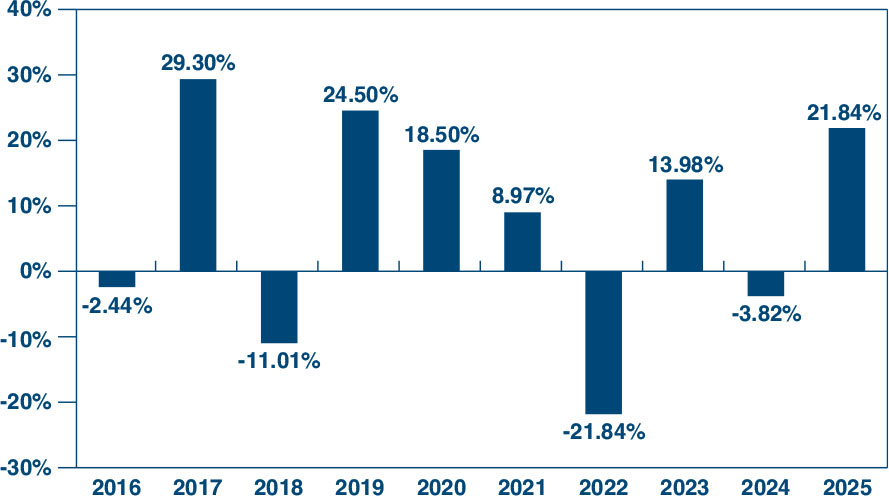
The bar chart and table that follow provide an indication of the risks of investing in the Fund by showing changes in the Fund’s performance from year to year, and by showing how the Fund’s average annual returns for one year, five years, and ten years compared with those of a broad based securities market index and an additional style specific index. As with all mutual funds, the Fund’s past performance (before and after taxes) does not predict how the Fund will perform in the future. Updated information on the Fund’s results can be obtained by visiting www.gabelli.com.
GABELLI INTERNATIONAL GROWTH FUND, INC.
(Total Returns for Class AAA Shares for the Years Ended December 31)
During the calendar years shown in the bar chart, the highest return for a quarter was 19.01% (quarter ended June 30, 2020) and the lowest return for a quarter was (17.04)% (quarter ended June 30, 2022).
| 5 |
| Average
Annual Total Returns (for the years ended December 31, 2025, with maximum sales charge, if applicable) |
Past One Year |
Past Five Years |
Past Ten Years |
|||||||||||||||
| Gabelli International Growth Fund, Inc. | ||||||||||||||||||
| Class AAA Shares | ||||||||||||||||||
| Return Before Taxes | 21.84 | % | 2.61 | % | 6.54 | % | ||||||||||||
| Return After Taxes on Distributions | 19.65 | % | 1.51 | % | 5.45 | % | ||||||||||||
| Return After Taxes on Distributions and Sale of Fund Shares | 14.50 | % | 2.02 | % | 5.18 | % | ||||||||||||
| Class A Shares | ||||||||||||||||||
| Return Before Taxes | 14.52 | % | 0.37 | % | 5.04 | % | ||||||||||||
| Class C Shares | ||||||||||||||||||
| Return Before Taxes | 19.55 | % | 0.81 | % | 4.88 | % | ||||||||||||
| Class I Shares | ||||||||||||||||||
| Return Before Taxes | 22.12 | % | 2.86 | % | 7.03 | % | ||||||||||||
| Morgan
Stanley Capital International (“MSCI”) Europe, Australia, and the Far East (“EAFE”) Index (reflects no deduction for fees, expenses, or taxes) |
31.89 | % | 9.47 | % | 8.72 | % | ||||||||||||
| Lipper International Multi-Cap Growth Fund Classification | 23.36 | % | 4.51 | % | 7.07 | % | ||||||||||||
After-tax returns are calculated using the historical highest individual federal marginal income tax rates and do not reflect the impact of state and local taxes. In some instances, the “Return After Taxes on Distributions and Sale of Fund Shares” may be greater than “Return Before Taxes” because the investor is assumed to be able to use the capital loss from the sale of Fund shares to offset other taxable gains. Actual after-tax returns depend on the investor’s tax situation and may differ from those shown. After-tax returns shown are not relevant to investors who hold their Fund shares through tax deferred arrangements, such as 401(k) plans or individual retirement accounts, including Roth IRAs and SEP IRAs (collectively, “IRAs”). After-tax returns are shown only for Class AAA shares. After-tax returns for other classes will vary due to the differences in expenses.
Management
The Adviser. Gabelli Funds, LLC
The Portfolio Manager. Mr. Caesar M.P. Bryan, Senior Vice President of GAMCO Investors, Inc., has served as portfolio manager of the Fund since its inception in 1995.
Purchase and Sale of Fund Shares
The minimum initial investment for Class AAA, Class A, and Class C shares is $1,000 ($250 for IRAs or Coverdell Education Savings Plans). There is no minimum initial investment for Class AAA, Class A, and Class C shares in an automatic monthly investment plan. Class I shares are available to investors with a minimum investment of $50,000 when purchasing the shares directly through G.distributors, LLC, the Fund’s distributor (“G.distributors” or the “Distributor”), or investors purchasing Class I shares through brokers or financial intermediaries that have entered into selling agreements with the Distributor specifically with respect to Class I shares, and which have different minimum investment amounts. If you transact in Class I shares through a broker or financial intermediary, you may be required to pay a commission and/or other forms of compensation to the broker or financial intermediary. The Distributor reserves the right to waive or change minimum investment amounts. There is no minimum for subsequent investments.
You can purchase or redeem shares of the Fund on any day the New York Stock Exchange (“NYSE”) is open for trading (a “Business Day”). You may purchase or redeem Fund shares by written request via mail (The Gabelli Funds, P.O. Box 219204, Kansas City, MO 64121-9204), personal or overnight delivery (The Gabelli Funds, c/o SS&C Global Investor & Distribution Solutions, Inc., 801 Pennsylvania Avenue, Suite 219204, Kansas City, MO 64105-1307), Internet, bank wire, or Automated Clearing House (“ACH”) system. You may also purchase or redeem Fund shares by telephone at 800-GABELLI (800-422-3554), if you have an existing account with banking instructions on file.
| 6 |
Fund shares can also be purchased or sold through registered broker-dealers or financial intermediaries that have entered into appropriate selling agreements with the Distributor. The broker-dealer or other financial intermediary will transmit these transaction orders to the Fund on your behalf and send you confirmation of your transactions and periodic account statements showing your investments in the Fund.
Tax Information
The Fund expects that distributions will generally be taxable as ordinary income or long-term capital gains, unless you are investing through a tax deferred arrangement, such as a 401(k) plan or an IRA.
Payments to Broker-Dealers and Other Financial Intermediaries
If you purchase shares of the Fund through a broker-dealer or other financial intermediary (such as a bank), the Fund and its related companies may pay the intermediary for the sale of Fund shares and related services. These payments may create a conflict of interest by influencing the broker-dealer or other intermediary and your salesperson to recommend the Fund over another investment. Ask your salesperson or visit your financial intermediary’s website for more information.
| 7 |
9 multi 2026
| 8 |