The information in this preliminary pricing supplement
is not complete and may be changed. This preliminary pricing supplement and the accompanying product supplement, underlying supplement,
prospectus supplement and prospectus are not an offer to sell these Notes and we are not soliciting an offer to buy these Notes in any
jurisdiction where the offer or sale is not permitted.
|
Subject to Completion, dated April 23, 2026
Pricing Supplement dated April , 2026
(To Product Supplement No. ELN-1 dated March 25, 2025,
Underlying Supplement No. ELN-1 dated March 25, 2025,
Prospectus Supplement dated March 25, 2025
and Prospectus dated March 25, 2025) |
Filed Pursuant to Rule 424(b)(2)
Registration Statement No. 333-285508

|
Bank of Montreal Trigger Autocallable Contingent Yield Notes
Linked to the Least Performing of the Nasdaq-100 Index®,
the Russell 2000® Index and the S&P 500® Index due on or about April 25, 2029
The Trigger Autocallable Contingent
Yield Notes (the “Notes”) are senior unsecured debt securities issued by Bank of Montreal (the “Issuer”)
linked to the least performing of the Nasdaq-100 Index®, the Russell 2000® Index and the S&P 500®
Index (each an “Underlier” and together the “Underliers”). On a quarterly basis, unless the Notes
have been previously called, the Issuer will pay you a coupon (the “Contingent Coupon”) if the Closing Value of each
Underlier on the applicable Coupon Observation Date is greater than or equal to its Coupon Barrier. However, if the Closing Value of any
Underlier on a Coupon Observation Date is less than its Coupon Barrier, you will not receive any Contingent Coupon for the relevant quarter.
If the Closing Value of each Underlier on any Call Observation Date is greater than or equal to its Closing Value on the Trade Date (the
“Initial Underlier Value”), the Notes will be automatically called, and the Issuer will pay you the Principal Amount
of the Notes plus a final Contingent Coupon, and no further payments will be made on the Notes. If the Notes are not automatically called
and the Closing Value of each Underlier on the Final Valuation Date (the “Final Underlier Value”) is greater than or
equal to its Downside Threshold, the Issuer will repay the Principal Amount at maturity plus any final Contingent Coupon otherwise due.
However, if the Final Underlier Value of any Underlier is less than its Downside Threshold, the Issuer will pay you a cash payment at
maturity that is less than the Principal Amount, if anything, resulting in a percentage loss on the Principal Amount of the Notes equal
to the negative Underlier Return of the Underlier with the lowest Underlier Return (the “Least Performing Underlier”).
In this case, you will have full downside exposure to the Least Performing Underlier from its Initial Underlier Value to its Final Underlier
Value, and will lose a significant portion, and possibly all, of your initial investment. Investing in the Notes involves significant
risks. You may lose a significant portion or all of your initial investment. You may receive few or no Contingent Coupons during the term
of the Notes. You will be exposed to the market risk of each Underlier and any decline in the value of one Underlier may negatively affect
your return and will not be offset or mitigated by a lesser decline or any potential increase in the value of any other Underlier. You
will not participate in any appreciation of any Underlier and will not receive any dividends on the securities included in any Underlier.
The Final Underlier Value of each Underlier is observed relative to its Downside Threshold only on the Final Valuation Date, and the contingent
repayment of principal feature applies only if you hold the Notes to maturity. Generally, the higher the Contingent Coupon Rate on a Note,
the greater the risk of loss on that Note. Any payment on the Notes, including any payment of the Principal Amount at maturity, is subject
to the credit of Bank of Montreal. If Bank of Montreal were to default on its payment obligations, you might not receive any amounts owed
to you under the Notes and you could lose your entire investment.
| q | Contingent Coupon: On each Contingent Coupon Payment Date, the Issuer will pay you a
Contingent Coupon if the Closing Value of each Underlier on the related Coupon Observation Date is greater than or equal to its Coupon
Barrier. However, if the Closing Value of any Underlier on any Coupon Observation Date is less than its Coupon Barrier, you will not receive
any Contingent Coupon on the related Contingent Coupon Payment Date. |
| q | Automatic Call: If the Closing Value of each Underlier on any Call Observation Date
is greater than or equal to its Initial Underlier Value, the Notes will be automatically called, and the Issuer will pay you the Principal
Amount of the Notes plus a final Contingent Coupon, and no further payments will be made on the Notes. |
| q | Downside Exposure with Contingent Repayment
of Principal at Maturity: If the Notes are not automatically called and the Final Underlier
Value of each Underlier is greater than or equal to its Downside Threshold, the Issuer will repay the Principal Amount at maturity plus
any final Contingent Coupon otherwise due. However, if the Final Underlier Value of any Underlier is less than its Downside Threshold,
the Issuer will repay less than the Principal Amount at maturity, if anything, resulting in a percentage loss on your investment equal
to the negative Underlier Return of the Least Performing Underlier. You may lose a significant portion or all of your initial investment.
Any payment on the Notes, including any payment of the Principal Amount at maturity, is subject to the credit of Bank of Montreal. |
| Trade Date: |
|
April 23, 2026 |
| Settlement Date: |
|
April 27, 2026 |
| Coupon Observation Dates2: |
|
Quarterly (see page PS-6) |
| Call Observation Dates2: |
|
Quarterly, beginning after six months (see page PS-6) |
| Final Valuation Date2: |
|
April 23, 2029 |
| Maturity Date2: |
|
April 25, 2029 |
| 1 | In the event that we make any changes to the expected Trade Date or Settlement Date, the other relevant
dates may be changed so that the stated term of the Notes remains the same. |
| 2 | Subject to postponement. See “Terms of the Notes” on page PS-5 of this pricing supplement. |
Notice to investors: The Notes are significantly
riskier than conventional debt instruments. The Issuer is not necessarily obligated to repay the full Principal Amount of the Notes at
maturity, and the Notes may have the full downside market risk of the Least Performing Underlier. This market risk is in addition to the
credit risk inherent in purchasing a debt obligation of the Issuer. You should not purchase the Notes if you do not understand or are
not comfortable with the significant risks involved in investing in the Notes.
You should carefully consider the risks described
under “Selected Risk Considerations” beginning on page PS-8 herein and “Risk Factors” beginning on page PS-5 of
the accompanying product supplement, page S-2 of the prospectus supplement and page 9 of the prospectus before purchasing any Notes. Events
relating to any of those risks, or other risks and uncertainties, could adversely affect the market value of, and the return on, your
Notes. You may lose a significant portion or all of your initial investment. The Notes will not be listed on any securities exchange.
We are offering Trigger Autocallable Contingent
Yield Notes linked to the least performing of the Nasdaq-100 Index®, the Russell 2000® Index and the
S&P 500® Index. The Contingent Coupon Rate and the Initial Underlier Value and corresponding Coupon Barrier and
Downside Threshold for each Underlier will be set on the Trade Date. The Initial Underlier Value of each Underlier will be its Closing
Value (as defined below) on the Trade Date. The Notes are offered at a minimum investment of $1,000 (100 Notes).
| Underlier |
Contingent
Coupon Rate |
Initial Underlier
Value |
Coupon Barrier* |
Downside Threshold* |
CUSIP/ ISIN |
| Nasdaq-100 Index® (NDX) |
At least 12.00% per annum |
|
75% of its Initial Underlier Value |
60% of its Initial Underlier Value |
063929640 / US0639296401 |
| Russell 2000® Index (RTY) |
|
75% of its Initial Underlier Value |
60% of its Initial Underlier Value |
| S&P 500® Index (SPX) |
|
75% of its Initial Underlier Value |
60% of its Initial Underlier Value |
|
*Rounded to two decimal places with respect to
the Nasdaq-100 Index® and S&P 500® Index and rounded to three decimal places with respect
to the Russell 2000® Index.
On the date of this preliminary pricing supplement,
the estimated initial value of the Notes is $9.97 per Note. The estimated initial value of the Notes at pricing may differ from this value
but will not be less than $9.67 per Note. However, as discussed in more detail in this pricing supplement, the actual value of the Notes
at any time will reflect many factors and cannot be predicted with accuracy. See “Estimated Value of the Notes” in this pricing
supplement.
The Notes are the unsecured obligations of
Bank of Montreal, and, accordingly, all payments on the Notes are subject to the credit risk of Bank of Montreal. If Bank of Montreal
defaults on its obligations, you could lose some or all of your investment. The Notes are not insured by the Federal Deposit Insurance
Corporation, the Deposit Insurance Fund, the Canada Deposit Insurance Corporation or any other governmental agency.
The Notes are not bail-inable notes and are
not subject to conversion into our common shares or the common shares of any of our affiliates under subsection 39.2(2.3) of the Canada
Deposit Insurance Corporation Act.
Neither the Securities and Exchange Commission
nor any state securities commission or other regulatory body has approved or disapproved of these Notes or passed upon the accuracy or
adequacy of this pricing supplement or the accompanying product supplement, underlying supplement, prospectus supplement and prospectus.
Any representation to the contrary is a criminal offense.
| |
Original Issue Price |
Underwriting Discount(1) |
Proceeds to Bank of Montreal |
| Per Note |
$10.00 |
$0.00 |
$10.00 |
| Total |
$ |
$ |
$ |
| (1) | BMO Capital Markets Corp. (“BMOCM”), our subsidiary, and UBS Financial Services Inc.
(“UBS”) are the agents for the distribution of the Notes. UBS has advised us that all sales of the Securities will
be made to certain fee-based advisory accounts for which UBS is an investment advisor at the Original Issue Price and UBS will not receive
a sales commission. See “Supplemental Plan of Distribution” in this pricing supplement for further information. |
| UBS Financial Services Inc. |
BMO Capital Markets |
| Estimated Value of the Notes |
Our estimated initial value of the Notes equals the sum of the values
of the following hypothetical components:
| · | a fixed-income debt component with the same tenor as the Notes, valued using
our internal funding rate for structured notes; and |
| · | one or more derivative transactions relating to the economic terms of the
Notes. |
The internal funding rate used in the determination of the initial estimated
value generally represents a discount from the credit spreads for our conventional fixed-rate debt. The value of these derivative transactions
is derived from our internal pricing models. These models are based on factors such as the traded market prices of comparable derivative
instruments and on other inputs, which include volatility, dividend rates, interest rates and other factors. As a result, the estimated
initial value of the Notes is based on market conditions at the time it is calculated.
For more information about the estimated initial value of the Notes,
see “Selected Risk Considerations” below.
| Additional Information About the Issuer and the Notes |
You should read this pricing supplement together
with product supplement no. ELN-1 dated March 25, 2025, underlying supplement no. ELN-1 dated March 25, 2025, the prospectus supplement
dated March 25, 2025 and the prospectus dated March 25, 2025 for additional information about the Notes. To the extent that disclosure
in this pricing supplement is inconsistent with the disclosure in the product supplement, underlying supplement, prospectus supplement
or prospectus, the disclosure in this pricing supplement will control. Certain defined terms used but not defined herein have the meanings
set forth in the product supplement, prospectus supplement or prospectus.
Our Central Index Key, or CIK, on the SEC website
is 927971. When we refer to “we,” “us” or “our” in this pricing supplement, we refer only to Bank
of Montreal.
You may access the product supplement, underlying
supplement, prospectus supplement and prospectus on the SEC website www.sec.gov as follows (or if such address has changed, by reviewing
our filings for the relevant date on the SEC website):
| · | Product Supplement No. ELN-1 dated March 25,
2025: |
https://www.sec.gov/Archives/edgar/data/927971/000121465925004723/o321252424b2.htm
| · | Underlying Supplement No. ELN-1 dated March 25,
2025: |
https://www.sec.gov/Archives/edgar/data/927971/000121465925004728/r321250424b2.htm
| · | Prospectus Supplement and Prospectus dated March
25, 2025: |
https://www.sec.gov/Archives/edgar/data/927971/000119312525062081/d840917d424b5.htm
The Notes may be appropriate for you if:
| ¨ | You fully understand the risks inherent in an
investment in the Notes, including the risk of loss of your entire investment. |
| ¨ | You can tolerate a loss of a significant portion
or all of your initial investment, and you are willing to make an investment that may have the full downside market risk of the Least
Performing Underlier. |
| ¨ | You are willing and able to accept the individual
market risk of each Underlier and understand that any decline in the value of one Underlier will not be offset or mitigated by a lesser
decline or any potential increase in the value of any other Underlier. |
| ¨ | You believe each Underlier is likely to close
at or above its Coupon Barrier on the specified Coupon Observation Dates, and, if any Underlier does not, you can tolerate receiving few
or no Contingent Coupons over the term of the Notes. |
| ¨ | You believe the Final Underlier Value of each
Underlier is not likely to be less than its Downside Threshold and, if the Final Underlier Value of any Underlier is less than its Downside
Threshold, you can tolerate a loss of a significant portion or all of your initial investment. |
| ¨ | You understand and accept that you will not participate
in any appreciation in the values of any Underlier and your potential return is limited to any Contingent Coupons paid on the Notes. |
| ¨ | You would be willing to invest in the Notes if
the Contingent Coupon Rate were set equal to the lowest possible Contingent Coupon Rate specified on the cover of this pricing supplement
(the actual Contingent Coupon Rate will be set on the Trade Date). |
| ¨ | You can tolerate fluctuations in the price of
the Notes prior to maturity that may be similar to or exceed the downside fluctuations in the values of the Underliers. |
| ¨ | You do not seek guaranteed current income from
this investment, you are willing to accept the risk of contingent yield and you are willing to forgo any dividends paid on the securities
included in the Underliers. |
| ¨ | You are willing to invest in Notes that may be
automatically called early and you are otherwise willing to hold the Notes to maturity and accept that there may be little or no secondary
market for the Notes. |
| ¨ | You understand and are willing to accept the
risks associated with each Underlier. |
| ¨ | You
are willing and able to assume the credit risk of Bank of Montreal, as Issuer of the Notes, for all payments under the Notes and you
understand that, if Bank of Montreal defaults on its obligations, you might not receive any amounts due to you, including any payment
of the Principal Amount at maturity. |
The Notes may not be appropriate
for you if:
| ¨ | You do not fully understand the risks inherent
in an investment in the Notes, including the risk of loss of your entire investment. |
| ¨ | You cannot tolerate the loss of a significant
portion or all of your initial investment, or you are not willing to make an investment that may have the full downside market risk of
the Least Performing Underlier. |
| ¨ | You are unwilling or unable to accept the individual
market risk of each Underlier or do not understand that any decline in the value of one Underlier will not be offset or mitigated by a
lesser decline or any potential increase in the value of any other Underlier. |
| ¨ | You do not believe each Underlier is likely to
close at or above its Coupon Barrier on the specified Coupon Observation Dates, or you cannot tolerate receiving few or no Contingent
Coupons over the term of the Notes. |
| ¨ | You believe at least one Underlier will depreciate
over the term of the Notes and its Final Underlier Value is likely to be less than its Downside Threshold. |
| ¨ | You seek an investment that participates in the
full appreciation of the Underliers and whose return is not limited to any Contingent Coupons paid on the Notes. |
| ¨ | You would be unwilling to invest in the Notes
if the Contingent Coupon Rate were set equal to the lowest possible Contingent Coupon Rate specified on the cover of this pricing supplement
(the actual Contingent Coupon Rate will be set on the Trade Date). |
| ¨ | You cannot tolerate fluctuations in the price
of the Notes prior to maturity that may be similar to or exceed the downside fluctuations in the values of the Underliers. |
| ¨ | You seek guaranteed current income from your
investment, you are unwilling to accept the risk of contingent yield or you would prefer to receive any dividends paid on the securities
included in the Underliers. |
| ¨ | You are unable or unwilling to hold Notes that
may be automatically called early, or you are otherwise unable or unwilling to hold the Notes to maturity, or you seek an investment for
which there will be an active secondary market. |
| ¨ | You do not understand or are not willing to accept
the risks associated with each Underlier. |
| ¨ | You prefer the lower risk, and therefore accept
the potentially lower returns, of fixed income investments with comparable maturities and credit ratings that bear interest at a prevailing
market rate. |
| ¨ | You are unwilling or unable to assume the credit
risk of Bank of Montreal, as Issuer of the Notes, for all payments under the Notes, including any payment of the Principal Amount at maturity. |
The considerations identified
above are not exhaustive. Whether or not the Notes are an appropriate investment for you will depend on your individual circumstances,
and you should reach an investment decision only after you and your investment, legal, tax, accounting and other advisors have carefully
considered the appropriateness of an investment in the Notes in light of your particular circumstances. You should also review carefully
the sections titled “Selected Risk Considerations” herein and “Risk Factors” in the accompanying product supplement
for risks related to an investment in the Notes. For more information about the Underliers, please see the sections titled “The
Nasdaq-100 Index®,” “The Russell 2000® Index” and “The S&P 500® Index”
below.
| Issuer: |
Bank of Montreal |
| Original Issue Price: |
100% of the Principal Amount of Notes |
| Principal Amount: |
$10 per Note |
| Underliers: |
The Nasdaq-100 Index® (Bloomberg ticker symbol: NDX), the Russell 2000® Index (Bloomberg ticker symbol: RTY) and the S&P 500® Index (Bloomberg ticker symbol: SPX) |
| Term: |
Approximately 3 years, unless automatically called earlier |
| Automatic Call Feature: |
If the Closing Value of each Underlier on any Call Observation Date is greater than or equal to its Initial Underlier Value, the Notes will be automatically called, and the Issuer will pay you the Principal Amount of the Notes plus the Contingent Coupon due on the Contingent Coupon Payment Date that is also the Call Settlement Date, and no further payments will be made on the Notes. |
| Contingent Coupon: |
If the Closing Value of each Underlier is greater
than or equal to its Coupon Barrier on any Coupon Observation Date, the Issuer will pay you a Contingent Coupon on the related Contingent
Coupon Payment Date.
If the Closing Value of any Underlier is less
than its Coupon Barrier on any Coupon Observation Date, the Contingent Coupon applicable to that Coupon Observation Date will not
accrue or be payable and the Issuer will not make any payment to you on the related Contingent Coupon Payment Date.
The Contingent Coupon is a fixed amount based upon
equal quarterly installments at the Contingent Coupon Rate. |
Contingent Coupon
Rate: |
At least 12.00% per annum (to be set on the Trade Date). Accordingly, the Contingent Coupon with respect to each Coupon Observation Date will be equal to at least $0.30 per Note. Whether Contingent Coupons will be paid on the Notes will depend on the performance of the Underliers. |
Coupon Observation
Dates: |
Quarterly. See “Coupon Observation Dates/Call Observation Dates/Contingent Coupon Payment Dates/Call Settlement Dates” below. |
Contingent Coupon
Payment Dates: |
Quarterly. See “Coupon Observation Dates/Call Observation Dates/Contingent Coupon Payment Dates/Call Settlement Dates” below. |
| Call Observation Dates: |
Quarterly, beginning approximately six months after the Settlement Date, on the Coupon Observation Dates scheduled to occur from October 2026 to January 2029, inclusive. |
| Call Settlement Date: |
The Contingent Coupon Payment Date immediately following the applicable Call Observation Date, if applicable. See “Coupon Observation Dates/Call Observation Dates/Contingent Coupon Payment Dates/Call Settlement Dates” below. |
| Payment at Maturity: |
If the Notes are not automatically called, on the
Maturity Date, you will receive from the Issuer a cash payment per Note calculated as follows:
· If
the Final Underlier Value of each Underlier is greater than or equal to both its Downside Threshold and its Coupon Barrier, the Issuer
will repay the Principal Amount at maturity of $10 per Note plus the Contingent Coupon due on the Contingent Coupon Payment Date
that is also the Maturity Date.
· If
the Final Underlier Value of each Underlier is greater than or equal to its Downside Threshold but the Final Underlier Value of any Underlier
is less than its Coupon Barrier, the Issuer will repay the Principal Amount at maturity of $10 per Note, but no Contingent Coupon
will be paid.
· If
the Final Underlier Value of any Underlier is less than its Downside Threshold, the Issuer will repay less than the Principal Amount
at maturity, if anything, resulting in a percentage loss on your investment equal to the negative Underlier Return of the Least Performing
Underlier. Accordingly, the payment at maturity per Note would be calculated as follows:
$10 + ($10 × Underlier Return of the Least
Performing Underlier)
If the Notes are not automatically called
and the Final Underlier Value of any Underlier is less than its Downside Threshold, your investment is fully exposed to the decline in
the Least Performing Underlier, and you will lose a significant portion or all of your initial investment at maturity. |
| Underlier Return: |
With respect to each Underlier:
Final Underlier Value – Initial Underlier
Value
Initial Underlier Value |
Least Performing
Underlier: |
The Underlier with the lowest Underlier Return |
| Initial Underlier Value: |
With respect to each Underlier, its Closing Value on the Trade Date, as specified on the cover of this pricing supplement |
| Final Underlier Value: |
With respect to each Underlier, its Closing Value on the Final Valuation Date |
| Closing Value: |
With respect to each Underlier, Closing Value has the meaning assigned to “Closing Level” set forth under “General Terms of the Notes—Certain Terms for Notes Linked to an Index—Certain Definitions” in the accompanying product supplement. |
| Coupon Barrier: |
With respect to each Underlier, 75% of its Initial Underlier Value, as specified on the cover of this pricing supplement |
| Downside Threshold: |
With respect to each Underlier, 60% of its Initial Underlier Value, as specified on the cover of this pricing supplement |
| Calculation Agent: |
BMO Capital Markets Corp. (“BMOCM”) |
Market Disruption
Events and
Postponement
Provisions: |
Each Coupon Observation Date (including the Final
Valuation Date) and each call Observation Date is subject to postponement due to non-scheduled trading days and the occurrence of a market
disruption event. In addition, a Contingent Coupon Payment Date, a Call Settlement Date and/or the Maturity Date, as applicable, will
be postponed if the immediately preceding Coupon Observation Date or Call Observation Date, as applicable, is postponed and will be adjusted
for non-business days.
For more information regarding adjustments to the
Coupon Observation Dates, the Call Observation Dates, the Contingent Coupon Payment Dates, the Call Settlement Dates and the Maturity
Date, see “General Terms of the Notes—Consequences of a Market Disruption Event; Postponement of a Valuation Date—Notes
Linked to Multiple Underliers” and “—Payment Dates” in the accompanying product supplement. For purposes of the
accompanying product supplement, each Coupon Observation Date, the Final Valuation Date and each Call Observation Date is a “Valuation
Date” and each Contingent Coupon Payment Date, Call Settlement Date and the Maturity Date is a “Payment Date.” In addition,
for information regarding the circumstances that may result in a market disruption event, see “General Terms of the Notes—Certain
Terms for Notes Linked to an Index—Market Disruption Events” in the accompanying product supplement. |
|
Coupon Observation Dates/Call Observation Dates/Contingent Coupon Payment
Dates/Call Settlement Dates |
| Coupon Observation Dates/Call Observation Dates* |
Contingent Coupon Payment Dates/Call Settlement Dates* |
| July 23, 2026 |
July 27, 2026 |
| October 23, 2026 |
October 27, 2026 |
| January 25, 2027 |
January 27, 2027 |
| April 23, 2027 |
April 27, 2027 |
| July 23, 2027 |
July 27, 2027 |
| October 25, 2027 |
October 27, 2027 |
| January 24, 2028 |
January 26, 2028 |
| April 24, 2028 |
April 26, 2028 |
| July 24, 2028 |
July 26, 2028 |
| October 23, 2028 |
October 25, 2028 |
| January 23, 2029 |
January 25, 2029 |
| April 23, 2029 (the Final Valuation Date) |
April 25, 2029 (the Maturity Date) |
* Each Coupon Observation Date (other than the Final Valuation Date),
starting from the second Coupon Observation Date, which is October 23, 2026, is a Call Observation Date. Thus, the first possible Call
Settlement Date will be October 27, 2026.
| |
Trade Date: |
|
The Initial Underlier Value of each Underlier is observed, the Contingent Coupon Rate is set and the Coupon Barrier and Downside Threshold of each Underlier are determined. |
| |
 |
|
|
| |
Coupon
Observation
Dates/Call
Observation
Dates (beginning
after six months): |
|
If the Closing Value of each Underlier is greater
than or equal to its Coupon Barrier on any Coupon Observation Date, the Issuer will pay you a Contingent Coupon on the related Contingent
Coupon Payment Date.
However, if the Closing Value of any Underlier
is less than its Coupon Barrier on any Coupon Observation Date, no Contingent Coupon payment will be made on the related Contingent Coupon
Payment Date.
In addition, if the Closing Value of each Underlier
on any Call Observation Date is greater than or equal to its Initial Underlier Value, the Notes will be automatically called, and the
Issuer will pay you the Principal Amount of the Notes plus a final Contingent Coupon, and no further payments will be made on the Notes.
|
| |
|
|
|
| |
Maturity Date: |
|
If the Notes are not automatically called, the
Final Underlier Value of each Underlier is observed and the Underlier Return of each Underlier is determined on the Final Valuation Date.
If the Final Underlier Value of each Underlier
is greater than or equal to both its Downside Threshold and its Coupon Barrier, the Issuer will repay the Principal Amount at maturity
of $10 per Note plus the Contingent Coupon due on the Contingent Coupon Payment Date that is also the Maturity Date.
If the Final Underlier Value of each Underlier
is greater than or equal to its Downside Threshold but the Final Underlier Value of any Underlier is less than its Coupon Barrier,
the Issuer will repay the Principal Amount at maturity of $10 per Note, but no Contingent Coupon will be paid.
If the Final Underlier Value of any Underlier
is less than its Downside Threshold, the Issuer will repay less than the Principal Amount at maturity, if anything, resulting in a
percentage loss on your investment equal to the negative Underlier Return of the Least Performing Underlier. Accordingly, the payment
at maturity per Note would be calculated as follows:
$10 + ($10 × Underlier Return of the Least
Performing Underlier)
If the Notes are not automatically called
and the Final Underlier Value of any Underlier is less than its Downside Threshold, your investment is fully exposed to the decline in
the Least Performing Underlier, and you will lose a significant portion or all of your initial investment at maturity.
|
Investing in the Notes
involves significant risks. You may receive few or no Contingent Coupons during the term of the Notes. You may lose a significant portion
or all of your investment. You will be exposed to the market risk of each Underlier and any decline in the value of one Underlier may
negatively affect your return and will not be offset or mitigated by a lesser decline or any potential increase in the value of any other
Underlier. The Final Underlier Value of each Underlier is observed relative to its Downside Threshold only on the Final Valuation Date,
and the contingent repayment of principal feature applies only if you hold the Notes to maturity. Generally, the higher the Contingent
Coupon Rate on a Note, the greater the risk of loss on that Note. Your return potential on the Notes is limited to any Contingent Coupons
paid on the Notes, and you will not participate in any appreciation of any Underlier. Any payment on the Notes, including any payment
of the Principal Amount at maturity, is subject to the creditworthiness of the Issuer. If Bank of Montreal were to default on its payment
obligations, you might not receive any amounts owed to you under the Notes and you could lose your entire investment.
|
Selected Risk Considerations |
The Notes involve risks not associated with an
investment in conventional debt securities. Some of the risks that apply to an investment in the Notes are summarized below, but we urge
you to read the more detailed explanation of the risks relating to the Notes generally in the “Risk Factors” section of the
accompanying product supplement and prospectus supplement. You should reach an investment decision only after you have carefully considered
with your advisors the appropriateness of an investment in the Notes in light of your particular circumstances.
Risks Relating To The Notes Generally
If The Notes Are Not Automatically Called Prior
To Maturity, You May Lose Some Or All Of The Principal Amount Of Your Notes At Maturity.
We will not repay you a fixed amount on the Notes
at maturity. If the Notes are not automatically called prior to maturity, you will receive a payment at maturity that will be equal to
or less than the Principal Amount, depending on the ending value of the Least Performing Underlier.
If the Final Underlier Value of the Least Performing
Underlier is less than its Downside Threshold, the payment at maturity will be less than the Principal Amount, you will have full downside
exposure to the decrease in the value of the Least Performing Underlier from its Initial Underlier Value, and you will lose 1% of the
Principal Amount for every 1% that the Final Underlier Value of the Least Performing Underlier is less than its Initial Underlier Value.
As a result, if the Final Underlier Value of the Least Performing Underlier is less than its Downside Threshold, you will lose a significant
portion, and possibly all, of the Principal Amount per Note at maturity. This is the case even if the value of the Least Performing Underlier
is greater than or equal to its Initial Underlier Value or its Downside Threshold at certain times during the term of the Notes.
Even if the Final Underlier Value of the Least
Performing Underlier is greater than its Downside Threshold, the payment at maturity will not exceed the Principal Amount (and any Contingent
Coupon otherwise due), and your yield on the Notes, taking into account any Contingent Coupons you may have received during the term of
the Notes, may be less than the yield you would earn if you bought a traditional interest-bearing debt security of Bank of Montreal or
another issuer with a similar credit rating with the same Maturity Date.
The Notes Do Not Provide For Fixed Payments
Of Interest And You May Receive No Contingent Coupons On One Or More Contingent Coupon Payment Dates, Or Even Throughout The Entire Term
Of The Notes.
On each Contingent Coupon Payment Date you will
receive a Contingent Coupon payment if, and only if, the Closing Value of each Underlier on the related Coupon Observation Date
is greater than or equal to its Coupon Barrier. If the Closing Value of any Underlier on any Coupon Observation Date is less than its
Coupon Barrier, you will not receive any Contingent Coupon payment on the related Contingent Coupon Payment Date. Furthermore, if the
Closing Value of any Underlier is less than its Coupon Barrier on each Coupon Observation Date over the term of the Notes, you will not
receive any Contingent Coupons over the entire term of the Notes.
The Notes Are Subject To The Full Risks Of Each
Underlier And Will Be Negatively Affected If Any Underlier Performs Poorly, Even If The Other Underliers Perform Favorably.
You are subject to the full risks of each Underlier.
If any Underlier performs poorly, you will be negatively affected, even if the other Underliers perform favorably. The Notes are not linked
to a basket composed of the Underliers, where the better performance of some Underliers could offset the poor performance of others. Instead,
you are subject to the full risks of each Underlier on each Coupon Observation Date. Furthermore, the risk that you will not receive one
or more, or any, Contingent Coupons during the term of the Notes and that you will lose a substantial portion, and possibly all, of the
Principal Amount at maturity is greater if you invest in the Notes as opposed to substantially similar securities that are linked to the
performance of a single Underlier. You should not invest in the Notes unless you understand and are willing to accept the full downside
risks of each Underlier.
You Will Not Benefit In Any Way From The Performance
Of The Better Performing Underliers.
Although it is necessary for each Underlier to
close at or above its respective Coupon Barrier on the relevant Coupon Observation Date in order for you to receive a Contingent Coupon
payment and at or above its respective Downside Threshold on the Final Valuation Date for you to receive the Principal Amount of your
Notes at maturity, you will not benefit in any way from the performance of the better performing Underliers. The Notes may underperform
an alternative investment linked to a basket composed of the Underliers, since in such case the performance of the Underliers would be
blended and the better performing Underliers could offset the poor performance of other Underliers.
You Will Be Subject To Risks Resulting From
The Relationship Among The Underliers.
It is preferable from your perspective for the
Underliers to be correlated with each other so that their values will tend to increase or decrease at similar times and by similar magnitudes.
By investing in the Notes, you assume the risk that the Underliers will not exhibit this relationship. The less correlated the Underliers,
the more likely it is that one of the Underliers will be performing poorly at any time over the term of the Notes. All that is necessary
for the Notes to perform poorly is for one of the Underliers to perform poorly; the performance of the better performing Underliers is
not relevant to your return on the Notes. It is impossible to predict what the relationship among the Underliers will be over the term
of the Notes. To the extent the Underliers represent a different equity market, such equity markets may not perform similarly over the
term of the Notes.
You May Be Fully Exposed To The Decline In The
Least Performing Underlier On The Final Valuation Date From Its Initial Underlier Value, But Will Not Participate In Any Positive Performance
Of Any Underlier.
Even though you will be fully exposed to a decline
in the value of the Least Performing Underlier if its Final Underlier Value is below its Downside Threshold, you will not participate
in any increase in the value of any Underlier over the term of the Notes. Your maximum possible return on the Notes will be limited to
the sum of the Contingent Coupons you receive, if any. Consequently, your return on the Notes may be significantly less than the return
you could achieve on an alternative investment that provides for participation in an increase in the value of any or each Underlier.
Contingent Repayment Of Your Initial Investment
Applies Only If You Hold The Notes To Maturity.
You should be willing to hold your Notes to maturity.
If you are able to sell your Notes prior to maturity in the secondary market, you may have to sell them at a substantial loss relative
to your initial investment, even if the value of any or each of the Underliers is greater than its Downside Threshold at the time of such
sale.
A Higher Contingent Coupon Rate And/Or A Lower
Coupon Barrier And/Or Downside Threshold Are Associated With Greater Risk.
The Notes offer Contingent Coupons at a higher
rate, if paid, than the fixed rate we would pay on conventional debt securities of the same maturity. These higher potential Contingent
Coupons are associated with greater levels of expected risk as of the Trade Date as compared to conventional debt securities, including
the risk that you may not receive a Contingent Coupon on one or more, or any, Contingent Coupon Payment Dates and the risk that you may
lose a substantial portion, and possibly all, of the Principal Amount at maturity. The volatility of the Underliers and the correlation
among the Underliers are important factors affecting this risk. Volatility is a measurement of the size and frequency of daily fluctuations
in the value of an Underlier, typically observed over a specified period of time. Volatility can be measured in a variety of ways, including
on a historical basis or on an expected basis as implied by option prices in the market. Correlation is a measurement of the extent to
which the values of the Underliers tend to fluctuate at the same time, in the same direction and in similar magnitudes. Greater expected
volatility of the Underliers or lower expected correlation among the Underliers as of the Trade Date may result in a higher Contingent
Coupon Rate and/or a lower Coupon Barrier and/or a lower Downside Threshold, but it also represents a greater expected likelihood as of
the Trade Date that the Closing Value of at least one Underlier will be less than its Coupon Barrier on one or more Coupon Observation
Dates, such that you will not receive one or more, or any, Contingent Coupons during the term of the Notes, and that the Closing Value
of at least one Underlier will be less than its Downside Threshold on the Final Valuation Date such that you will lose a substantial portion,
and possibly all, of the Principal Amount at maturity. In general, the higher the Contingent Coupon Rate is relative to the fixed rate
we would pay on conventional debt securities, the greater the expected risk that you will not receive one or more, or any, Contingent
Coupons during the term of the Notes and that you will lose a substantial portion, and possibly all, of the Principal Amount at maturity.
On the other hand, a lower Coupon Barrier or Downside Threshold does not necessarily indicate that the Notes have a greater likelihood
of paying Contingent Coupons or returning your principal at maturity.
You Will Be Subject To Reinvestment Risk.
If your Notes are automatically called, the term
of the Notes may be reduced. There is no guarantee that you would be able to reinvest the proceeds from an investment in the Notes at
a comparable return for a similar level of risk in the event the Notes are automatically called prior to maturity.
The Notes Are Subject To Credit Risk.
The Notes are our obligations and are not, either
directly or indirectly, an obligation of any third party. Any amounts payable under the Notes are subject to our creditworthiness and
you will have no ability to pursue any securities included in any Underlier for payment. As a result, our actual and perceived creditworthiness
may affect the value of the Notes and, in the event we were to default on our obligations under the Notes, you may not receive any amounts
owed to you under the terms of the Notes and you could lose your entire investment.
The U.S. Federal Income Tax Consequences Of
An Investment In The Notes Are Unclear.
There is no direct legal authority regarding the
proper U.S. federal income tax treatment of the Notes, and significant aspects of the tax treatment of the Notes are uncertain. Moreover,
non-U.S. investors should note that we intend to withhold on any coupon paid to a non-U.S. investor, generally at a rate of 30%. We will
not pay any additional amounts in respect of such withholding. You should review carefully the section entitled “United States Federal
Income Tax Considerations” herein, in combination with the section entitled “United States Federal Income Tax Considerations”
in the accompanying product supplement, and consult your tax advisor regarding the U.S. federal income tax consequences of an investment
in the Notes.
The Maturity Date Will Be Postponed If The Final
Valuation Date Is Postponed.
The Final Valuation Date will be postponed if the
originally scheduled Final Valuation Date is not a scheduled trading day or if the calculation agent determines that a market disruption
event has occurred or is continuing on the Final Valuation Date. If such a postponement occurs, the Maturity Date will be postponed. See
“General Terms of the Notes—Consequences of a Market Disruption Event; Postponement of a Valuation Date—Notes Linked
to Multiple Underliers” and “—Payment Dates” in the accompanying product supplement.
Risks
Relating To The Estimated Value Of The Notes And Any Secondary Market
The Estimated Value Of The Notes On The Trade
Date, Based On Our Proprietary Pricing Models, Will Be Less Than The Original Issue Price.
Our initial estimated value of the Notes is
only an estimate, and is based on a number of factors. The Original Issue Price of the Notes may exceed our initial estimated value, because
costs associated with offering, structuring and hedging the Notes are included in the Original Issue Price, but are not included in the
estimated value. These costs will include any underwriting discount and selling concessions and the cost of hedging our obligations under
the Notes through one or more hedge counterparties (which may be one or more of our affiliates). Such hedging cost includes our or our
hedge counterparty’s expected cost of providing such hedge, as well as the profit we or our hedge counterparty expect to realize
in consideration for assuming the risks inherent in providing such hedge.
The Terms Of The Notes Are Not Determined By
Reference To The Credit Spreads For Our Conventional Fixed-Rate Debt.
To determine the terms of the Notes, we use an
internal funding rate that represents a discount from the credit spreads for our conventional fixed-rate debt. As a result, the terms
of the Notes are less favorable to you than if we had used a higher funding rate.
The Estimated Value Of The Notes Is Not An Indication
Of The Price, If Any, At Which We, BMOCM Or Any Other Person May Be Willing To Buy The Notes From You In The Secondary Market.
Our initial estimated value of the Notes is
derived using our internal pricing models. This value is based on market conditions and other relevant factors, which include volatility
and correlation of the Underliers, dividend rates and interest rates. Different pricing models and assumptions, including those used by
other market participants, could provide values for the Notes that are greater than or less than our initial estimated value. In addition,
market conditions and other relevant factors after the Trade Date are expected to change, possibly rapidly, and our assumptions may prove
to be incorrect. After the Trade Date, the value of the Notes could change dramatically due to changes in market conditions, our creditworthiness,
and the other factors discussed in the next risk factor. These changes are likely to impact the price, if any, at which we, BMOCM or any
other party would be willing to purchase the Notes from you in any secondary market transactions. Our initial estimated value does not
represent a minimum price at which we, BMOCM or any other party would be willing to buy your Notes in any secondary market at any time.
For a period of approximately 1 month following
issuance of the Notes, the price, if any, at which we or our affiliates would be willing to buy the Notes from investors, and the value
that BMOCM may also publish for the Notes through one or more financial information vendors and which could be indicated for the Notes
on any brokerage account statements, will reflect a temporary upward adjustment from our estimated value of the Notes that would otherwise
be determined and applicable at that time. This temporary upward adjustment represents a portion of (a) the hedging profit that we or
our affiliates expect to realize over the term of the Notes and (b) any underwriting discount and selling concessions paid in connection
with this offering. The amount of this temporary upward adjustment will decline to zero on a straight-line basis over the 1-month period.
The Value Of The Notes Prior To Maturity Will
Be Affected By Numerous Factors, Some Of Which Are Related In Complex Ways.
The payout on the Notes could be replicated by
a hypothetical combination of financial instruments consisting of a fixed-income debt component and one or more derivative transactions.
As a result, the factors that influence the values of fixed-income bonds and derivative instruments will also influence the terms of the
Notes at issuance and the value of the Notes prior to maturity. The value of the Notes prior to maturity will be affected by the then-current
value of each Underlier, interest rates at that time and a number of other factors, some of which are interrelated in complex ways. The
effect of any one factor may be offset or magnified by the effect of another factor. The following factors, which are described in more
detail in the accompanying product supplement, are expected to affect the value of the Notes: performance of the Underliers; interest
rates; volatility of the Underliers; correlation among the Underliers; time remaining to maturity; and dividend yields on the securities
included in the Underliers. When we refer to the “value” of your Notes, we mean the value you could receive for your
Notes if you are able to sell them in the open market before the Maturity Date.
In addition to these factors, the value of the
Notes will be affected by actual or anticipated changes in our creditworthiness. You should understand that the impact of one of the factors
specified above, such as a change in interest rates, may offset some or all of any change in the value of the Notes attributable to another
factor, such as a change in the value of any or all of the Underliers. Because numerous factors are expected to affect the value of the
Notes, changes in the values of the Underliers may not result in a comparable change in the value of the Notes.
The Notes Will Not Be Listed On Any Securities
Exchange And We Do Not Expect A Trading Market For The Notes To Develop.
The Notes will not be listed or displayed on any
securities exchange. Although BMOCM and/or its affiliates intend to make a secondary market in relation to the Notes, they are not obligated
to do so. There can be no assurance that a secondary market will develop. Because we do not expect that any market makers will participate
in a secondary market for the Notes, the price at which you may be able to sell your Notes is likely to depend on the price, if any, at
which BMOCM is willing to buy your Notes. If a secondary market does exist, it may be limited. Accordingly, there may be a limited number
of buyers if you decide to sell your Notes prior to maturity. This may affect the price you receive upon such sale. Consequently, you
should be willing to hold the Notes to maturity.
Risks Relating To The Underliers
Any Payments On The Notes And Whether The Notes
Are Automatically Called Will Depend Upon The Performance Of The Underliers And Therefore The Notes Are Subject To The Following Risks,
Each As Discussed In More Detail In The Accompanying Product Supplement.
| · | Investing In The Notes Is Not The Same As
Investing In The Underliers. Investing in the Notes is not equivalent to investing in the Underliers. As an investor in the Notes,
your return will not reflect the return you would realize if you actually owned and held the securities included in each Underlier for
a period similar to the term of the Notes because you will not receive any dividend payments, distributions or any other payments paid
on those securities. As a holder of the Notes, you will not have any voting rights or any other rights that holders of the securities
included in the Underliers would have. |
| · | Historical Values Of The Underliers Should
Not Be Taken As An Indication Of The Future Performance Of The Underliers During The Term Of The Notes. |
| · | Changes That Affect The Underliers May Adversely
Affect The Value Of The Notes And Any Payments On The Notes. |
| · | We Cannot Control Actions By Any Of The Unaffiliated
Companies Whose Securities Are Included In The Underliers. |
| · | We And Our Affiliates Have No Affiliation
With Any Index Sponsor And Have Not Independently Verified Their Public Disclosure Of Information. |
The Notes Are Subject To Risks Relating To Non-U.S.
Securities With Respect To The Nasdaq-100 Index®.
Because some of the equity securities composing
the Nasdaq-100 Index® are issued by non-U.S. issuers, an investment in the Notes involves risks associated with the
home countries of those issuers. The prices of securities of non-U.S. companies may be affected by political, economic, financial and
social factors in those countries, or global regions, including changes in government, economic and fiscal policies and currency exchange
laws.
The Notes Are Subject To Small-Capitalization
Companies Risk With Respect To The Russell 2000® Index.
The Russell 2000® Index tracks
securities issued by companies with relatively small market capitalizations. These companies often have greater stock price volatility,
lower trading volume and less liquidity than large-capitalization companies. As a result, the value of the Russell 2000® Index
may be more volatile than that of a market measure that does not track solely small-capitalization stocks. Stock prices of small-capitalization
companies are also generally more vulnerable than those of large-capitalization companies to adverse business and economic developments,
and the stocks of small-capitalization companies may be thinly traded and may be less attractive to many investors if they do not pay
dividends. In addition, small-capitalization companies are often less well-established and less stable financially than large-capitalization
companies and may depend on a small number of key personnel, making them more vulnerable to loss of personnel. Small-capitalization companies
are often subject to less analyst coverage and may be in early, and less predictable, periods of their corporate existences. Small-capitalization
companies tend to have lower revenues, less diverse product lines, smaller shares of their target markets, fewer financial resources and
fewer competitive strengths than large-capitalization companies. These companies may also be more susceptible to adverse developments
related to their products or services.
Risks Relating To Conflicts Of Interest
Our Economic Interests And Those Of Any Dealer
Participating In The Offering Are Potentially Adverse To Your Interests.
You should be aware of the following ways in which
our economic interests and those of any dealer participating in the distribution of the Notes, which we refer to as a “participating
dealer,” are potentially adverse to your interests as an investor in the Notes. In engaging in certain of the activities described
below and as discussed in more detail in the accompanying product supplement, our affiliates or any participating dealer or its affiliates
may take actions that may adversely affect the value of and your return on the Notes, and in so doing they will have no obligation to
consider your interests as an investor in the Notes. Our affiliates or any participating dealer or its affiliates may realize a profit
from these activities even if investors do not receive a favorable investment return on the Notes.
| · | The calculation agent is our affiliate
and may be required to make discretionary judgments that affect the return you receive on the Notes. BMOCM, which is our affiliate,
will be the calculation agent for the Notes. As calculation agent, BMOCM will determine any values of the Underliers and make any other
determinations necessary to calculate any payments on the Notes. In making these determinations, BMOCM may be required to make discretionary
judgments that may adversely affect any payments on the Notes. See the sections entitled “General Terms of the Notes—Certain
Terms for Notes Linked to an Index—Market Disruption Events” and “—Discontinuation of, or Adjustments to, an Index”
in the accompanying product supplement. In making these discretionary judgments, the fact that BMOCM is our affiliate may cause it to
have economic interests that are adverse to your interests as an investor in the Notes, and BMOCM’s determinations as calculation
agent may adversely affect your return on the Notes. |
| · | The estimated value of the Notes was calculated
by us and is therefore not an independent third-party valuation. |
| · | Research reports by our affiliates or any
participating dealer or its affiliates may be inconsistent with an investment in the Notes and may adversely affect the values of the
Underliers. |
| · | Business activities of our affiliates or
any participating dealer or its affiliates with the companies whose securities are included in the Underliers may adversely affect the
values of the Underliers. |
| · | Hedging activities by our affiliates or
any participating dealer or its affiliates may adversely affect the values of the Underliers. |
| · | Trading activities by our affiliates or
any participating dealer or its affiliates may adversely affect the values of the Underliers. |
| · | A participating dealer or its affiliates
may realize hedging profits projected by its proprietary pricing models in addition to any selling concession and/or fee, creating a further
incentive for the participating dealer to sell the Notes to you. |
Hypothetical terms only. Actual terms may vary.
See the cover page for actual offering terms.
The examples below illustrate the payment upon
an automatic call or at maturity for a $10 Principal Amount Note on a hypothetical offering of Notes under various scenarios, with the
assumptions set forth in the table below. The terms used for purposes of these hypothetical examples do not represent the actual Contingent
Coupon Rate, Contingent Coupon, Initial Underlier Values, Coupon Barriers or Downside Thresholds. The hypothetical Initial Underlier Value
of 100.00 for each Underlier has been chosen for illustrative purposes only and does not represent the actual Initial Underlier Value
for any Underlier. The actual Contingent Coupon Rate, Contingent Coupon, Initial Underlier Values, Coupon Barriers and Downside Thresholds
will be determined on the Trade Date and will be set forth on the cover page and under “Terms of the Notes” above. For actual
historical data of the Underliers, see the historical information set forth herein. These examples are for purposes of illustration only
and the values used in the examples may have been rounded for ease of analysis. In these examples, we refer to the Nasdaq-100® Index,
the Russell 2000® Index and the S&P 500® Index as the “NDX Index,” the “RTY
Index” and the “SPX Index,” respectively.
| Term: |
Approximately 3 years (unless called earlier) |
| Hypothetical Contingent Coupon Rate: |
5.00% per annum (or 1.25% per quarter) |
| Hypothetical Contingent Coupon: |
$0.125 per quarter |
| Hypothetical Initial Underlier Value: |
For each Underlier, 100.00 |
| Hypothetical Coupon Barrier: |
For each Underlier, 90.00 (90% of its hypothetical Initial Underlier Value) |
| Hypothetical Downside Threshold: |
For each Underlier, 80.00 (80% of its hypothetical Initial Underlier Value) |
| Coupon Observation Dates: |
Quarterly |
| Call Observation Dates: |
Quarterly (callable after six months) |
The “total return” as used in this pricing supplement
is the number, expressed as a percentage, that results from comparing the total payments per Note over the term of the Notes to the purchase
price of $10 per Note.
Example 1 — Notes Are Automatically Called on the Second Coupon
Observation Date
Coupon Observation
Date |
|
Closing Value |
|
Payment (per Note) |
First Coupon
Observation Date |
|
NDX Index: 80.00
RTY Index: 65.00
SPX Index: 70.00
|
|
Not Callable.
Closing Value of at least one Underlier below its
Coupon Barrier; Issuer DOES NOT pay Contingent Coupon on the related Contingent Coupon Payment Date.
|
| |
|
|
|
|
Second Coupon
Observation Date |
|
NDX Index: 110.00
RTY Index: 115.00
SPX Index: 105.00
|
|
Closing Value of each Underlier at or above its Initial Underlier Value; Notes are automatically called; Issuer pays Principal Amount plus Contingent Coupon of $0.125 on Call Settlement Date. |
| Total Payments (per Note): |
|
Payment on Call Settlement Date: |
$10.125 ($10.00 + $0.125) |
| |
|
Prior Contingent Coupons: |
$0.00 |
| |
|
Total: |
$10.125 |
| |
|
Total Return: |
1.25% |
Because the Closing Value of each Underlier is
greater than or equal to its Initial Underlier Value on the second Coupon Observation Date (which is the first Call Observation Date),
the Notes are automatically called on that Coupon Observation Date. The Issuer will pay you on the related Call Settlement Date $10.125
per Note, which is equal to the Principal Amount plus the Contingent Coupon due on the Contingent Coupon Payment Date that is also
the Call Settlement Date. No further amounts will be owed to you under the Notes.
However, because the Closing Value of at least
one Underlier was less than its Coupon Barrier on the first Coupon Observation Date, the Issuer will not pay any Contingent Coupon on
the Contingent Coupon Payment Date following that Coupon Observation Date. Accordingly, the Issuer will have paid a total of $10.125 per
Note for a total return of 1.25% on the Notes.
Example 2 — Notes Are NOT Automatically Called and the Final
Underlier Value of Each Underlier Is At or Above Its Downside Threshold and Coupon Barrier
Coupon Observation
Date |
|
Closing Value |
|
Payment (per Note) |
First Coupon Observation
Date |
|
NDX Index: 110.00
RTY Index: 125.00
SPX Index: 105.00
|
|
Not Callable.
Closing Value of each Underlier at or above its
Coupon Barrier; Issuer pays Contingent Coupon of $0.125 on the related Contingent Coupon Payment Date.
|
| |
|
|
|
|
Second Coupon
Observation Date |
|
NDX Index: 95.00
RTY Index: 110.00
SPX Index: 105.00
|
|
Closing Value of at least one Underlier below its
Initial Underlier Value; Notes NOT automatically called.
Closing Value of each Underlier at or above its
Coupon Barrier; Issuer pays Contingent Coupon of $0.125 on the related Contingent Coupon Payment Date.
|
| |
|
|
|
|
Third Coupon Observation
Date |
|
NDX Index: 90.00
RTY Index: 70.00
SPX Index: 95.00
|
|
Closing Value of at least one Underlier below its
Initial Underlier Value; Notes NOT automatically called.
Closing Value of RTY Index below its Coupon Barrier;
Issuer DOES NOT pay Contingent Coupon on the related Contingent Coupon Payment Date.
|
| |
|
|
|
|
Fourth to Eleventh Coupon
Observation Dates |
|
Various (at least one Underlier below Coupon Barrier) |
|
Closing Value of at least one Underlier below its
Initial Underlier Value; Notes NOT automatically called.
Closing Value of at least one Underlier below its
Coupon Barrier; Issuer DOES NOT pay Contingent Coupon on any of the related Contingent Coupon Payment Dates.
|
| |
|
|
|
|
Twelfth Coupon
Observation Date (the
Final Valuation Date) |
|
NDX Index: 105.00
RTY Index: 95.00
SPX Index: 110.00
|
|
Not Callable.
Final Underlier Value of each Underlier at or above
Downside Threshold and Coupon Barrier; Issuer pays Principal Amount plus Contingent Coupon of $0.125 on Maturity Date.
|
| Total Payments (per Note): |
|
Payment at Maturity: |
$10.125 ($10.00 + $0.125) |
| |
|
Prior Contingent Coupons: |
$0.25 ($0.125 × 2) |
| |
|
Total: |
$10.375 |
| |
|
Total Return: |
3.75% |
Because the Closing Value of at least one Underlier
is less than its Initial Underlier Value on each Coupon Observation Date that is also a Call Observation Date, the Notes are not automatically
called. Because the Final Underlier Value of each Underlier is greater than or equal to its Downside Threshold and Coupon Barrier, the
Issuer will pay you on the Maturity Date $10.125 per Note, which is equal to the Principal Amount plus the Contingent Coupon due
on the Contingent Coupon Payment Date that is also the Maturity Date.
In addition, because the Closing Value of each
Underlier was greater than or equal to its Coupon Barrier on the first and second Coupon Observation Dates, the Issuer will pay the Contingent
Coupon of $0.125 on each of the related Contingent Coupon Payment Dates. However, because the Closing Value of at least one Underlier
was less than its Coupon Barrier on the third through eleventh Coupon Observation Dates, the Issuer will not pay any Contingent Coupon
on the Contingent Coupon Payment Dates following those Coupon Observation Dates. Accordingly, the Issuer will have paid a total of $10.375
per Note for a total return of 3.75% on the Notes.
Example 3 — Notes Are NOT Automatically Called and the Final
Underlier Value of Each Underlier Is At or Above Its Downside Threshold but the Final Underlier Value of At Least One Underlier Is Below
Its Coupon Barrier
Coupon Observation
Date |
|
Closing Value |
|
Payment (per Note) |
First Coupon
Observation Date |
|
NDX Index: 95.00
RTY Index: 125.00
SPX Index: 105.00
|
|
Not Callable.
Closing Value of each Underlier at or above its
Coupon Barrier; Issuer pays Contingent Coupon of $0.125 on the related Contingent Coupon Payment Date.
|
| |
|
|
|
|
Second Coupon
Observation Date |
|
NDX Index: 95.00
RTY Index: 110.00
SPX Index: 105.00
|
|
Closing Value of at least one Underlier below its
Initial Underlier Value; Notes NOT automatically called.
Closing Value of each Underlier at or above its
Coupon Barrier; Issuer pays Contingent Coupon of $0.125 on the related Contingent Coupon Payment Date.
|
| |
|
|
|
|
Third Coupon
Observation Date |
|
NDX Index: 120.00
RTY Index: 125.00
SPX Index: 65.00
|
|
Closing Value of SPX Index below its Initial Underlier
Value; Notes NOT automatically called.
Closing Value of SPX Index below its Coupon Barrier;
Issuer DOES NOT pay Contingent Coupon on the related Contingent Coupon Payment Date.
|
| |
|
|
|
|
Fourth to Eleventh
Coupon Observation
Dates |
|
Various (at least one Underlier below Coupon Barrier) |
|
Closing Value of at least one Underlier below its
Initial Underlier Value; Notes NOT automatically called.
Closing Value of at least one Underlier below its
Coupon Barrier; Issuer DOES NOT pay Contingent Coupon on any of the related Contingent Coupon Payment Dates.
|
| |
|
|
|
|
Twelfth Coupon
Observation Date (the
Final Valuation Date) |
|
NDX Index: 105.00
RTY Index: 95.00
SPX Index: 85.00
|
|
Not Callable.
Final Underlier Value of each Underlier at or above
its Downside Threshold but Final Underlier Value of SPX Index below its Coupon Barrier; Issuer pays Principal Amount but DOES NOT pay
Contingent Coupon on Maturity Date.
|
| Total Payments (per Note): |
|
Payment at Maturity: |
$10.00 |
| |
|
Prior Contingent Coupons: |
$0.25 ($0.125 × 2) |
| |
|
Total: |
$10.25 |
| |
|
Total Return: |
2.50% |
Because the Closing Value of at least one Underlier
is less than its Initial Underlier Value on each Coupon Observation Date that is also a Call Observation Date, the Notes are not automatically
called. Because the Final Underlier Value of each Underlier is greater than or equal to its Downside Threshold and the Final Underlier
Value of at least one Underlier is less than its Coupon Barrier, the Issuer will pay you on the Maturity Date $10.00 per Note, which is
equal to the Principal Amount, but no Contingent Coupon.
In addition, because the Closing Value of each
Underlier was greater than or equal to its Coupon Barrier on the first and second Coupon Observation Dates, the Issuer will pay the Contingent
Coupon of $0.125 on each of the related Contingent Coupon Payment Dates. However, because the Closing Value of at least one Underlier
was less than its Coupon Barrier on the third through eleventh Coupon Observation Dates, the Issuer will not pay any Contingent Coupon
on the Contingent Coupon Payment Dates following those Coupon Observation Dates. Accordingly, the Issuer will have paid a total of $10.25
per Note for a total return of 2.50% on the Notes.
Example 4 — Notes Are NOT Automatically
Called and the Final Underlier Value of At Least One Underlier Is Below its Downside Threshold
Coupon Observation
Date |
|
Closing Value |
|
Payment (per Note) |
| First Coupon Observation Date |
|
NDX Index: 70.00
RTY Index: 60.00
SPX Index: 80.00
|
|
Not Callable.
Closing Value of each Underlier below its Coupon
Barrier; Issuer DOES NOT pay Contingent Coupon on the related Contingent Coupon Payment Date.
|
| Second Coupon Observation Date |
|
NDX Index: 105.00
RTY Index: 85.00
SPX Index: 95.00
|
|
Closing Value of the SPX Index below its Initial
Underlier Value; Notes NOT automatically called.
Closing Value of RTY Index below its Coupon Barrier;
Issuer DOES NOT pay Contingent Coupon on the related Contingent Coupon Payment Date.
|
| Third Coupon Observation Date |
|
NDX Index: 40.00
RTY Index: 65.00
SPX Index: 90.00
|
|
Closing Value of at least one Underlier below its
Initial Underlier Value; Notes NOT automatically called.
Closing Value of at least one Underlier below its
Coupon Barrier; Issuer DOES NOT pay Contingent Coupon on the related Contingent Coupon Payment Date.
|
| Fourth to Eleventh Coupon Observation Dates |
|
Various (at least one Underlier below Coupon Barrier) |
|
Closing Value of at least one Underlier below its
Initial Underlier Value; Notes NOT automatically called.
Closing Value of at least one Underlier below its
Coupon Barrier; Issuer DOES NOT pay Contingent Coupon on any of the related Contingent Coupon Payment Dates.
|
| Twelfth Coupon Observation Date (the Final Valuation Date) |
|
NDX Index: 125.00
RTY Index: 110.00
SPX Index: 50.00
|
|
Not Callable.
Closing Value of SPX Index below its Coupon Barrier
and its Downside Threshold; Issuer DOES NOT pay Contingent Coupon on Maturity Date; Issuer repays less than the Principal Amount resulting
in a percentage loss on your investment equal to the negative Underlier Return.
|
| Total Payments (per Note): |
|
Payment at Maturity: |
$5.00 |
| |
|
Prior Contingent Coupons: |
$0.00 |
| |
|
Total: |
$5.00 |
| |
|
Total Return: |
-50.00% |
Because the Closing Value of at least one Underlier
is less than its Initial Underlier Value on each Coupon Observation Date that is also a Call Observation Date, the Notes are not automatically
called. Because the Final Underlier Value of at least one Underlier is less than its Downside Threshold on the Final Valuation Date, at
maturity, the Issuer will pay you a total of $5.00 per Note, for a total return of -50.00%
on the Notes, calculated as follows:
$10 + ($10 × Underlier Return of the Least
Performing Underlier)
Step 1: Calculate the Underlier Return of each Underlier:
Underlier Return of the NDX Index:
| Final Underlier Value – Initial Underlier Value |
= |
125.00 – 100.00 |
= 25.00% |
| Initial Underlier Value |
100.00 |
Underlier Return of the RTY Index:
| Final Underlier Value – Initial Underlier Value |
= |
110.00 – 100.00 |
= 10.00% |
| Initial Underlier Value |
100.00 |
Underlier Return of the SPX Index:
| Final Underlier Value – Initial Underlier Value |
= |
50.00 – 100.00 |
= -50.00% |
| Initial Underlier Value |
100.00 |
Step 2: Determine the Least Performing Underlier. The SPX Index
is the Underlier with the lowest Underlier Return and is, therefore, the Least Performing Underlier.
Step 3: Calculate the Payment at Maturity:
$10 + ($10 × Underlier Return of the Least
Performing Underlier)
$10 + ($10 × -50.00%) = $5.00
In addition, because the Closing Value of at least one Underlier is
less than its Coupon Barrier on each Coupon Observation Date, the Issuer will not pay any Contingent Coupons over the term of the Notes.
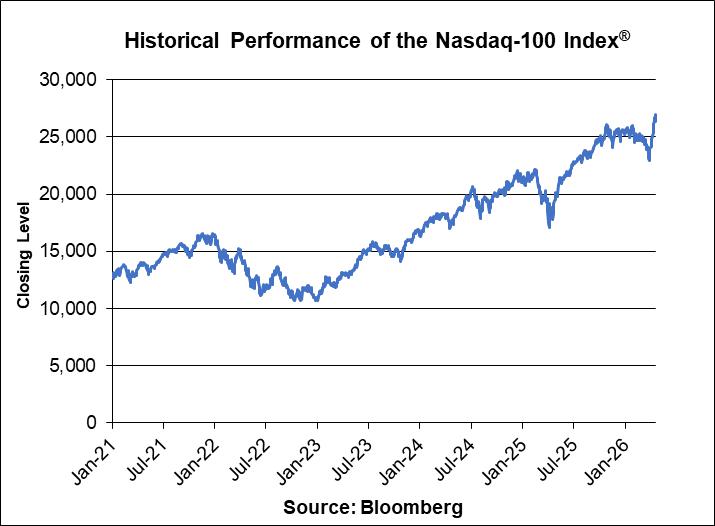
The Nasdaq-100 Index® is a
modified market capitalization-weighted index that is designed to measure the performance of 100 of the largest non-financial companies
listed on The Nasdaq Stock Market. For more information about the Nasdaq-100 Index®, see “Description of Indices—The
Nasdaq-100 Index®” in the accompanying underlying supplement.
Historical Information
We obtained the closing levels of the Nasdaq-100
Index® in the graph below from Bloomberg Finance L.P. (“Bloomberg”), without independent verification.
The following graph sets forth daily closing levels
of the Nasdaq-100 Index® for the period from January 4, 2021 to April 22, 2026. The closing level on April 22, 2026 was
26,937.28. The historical performance of the Nasdaq-100 Index® should not be taken as an indication of its future performance
during the term of the Notes.
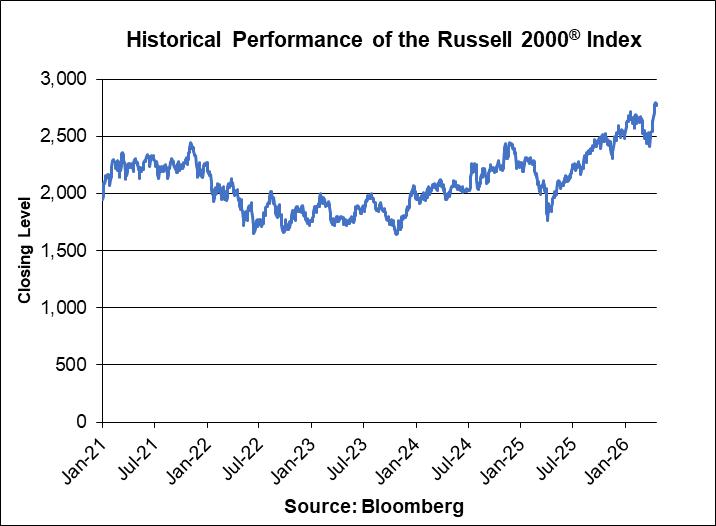
The Russell 2000® Index measures
the capitalization-weighted price performance of 2,000 U.S. small-capitalization stocks listed on eligible U.S. exchanges and is designed
to track the performance of the small-capitalization segment of the U.S. equity market. For more information about the Russell 2000® Index,
see “Description of Indices—The Russell Indices” in the accompanying underlying supplement.
Historical Information
We obtained the closing levels of the Russell 2000® Index
in the graph below from Bloomberg, without independent verification.
The following graph sets forth daily closing levels
of the Russell 2000® Index for the period from January 4, 2021 to April 22, 2026. The closing level on April 22, 2026
was 2,785.377. The historical performance of the Russell 2000® Index should not be taken as an indication of its future
performance during the term of the Notes.
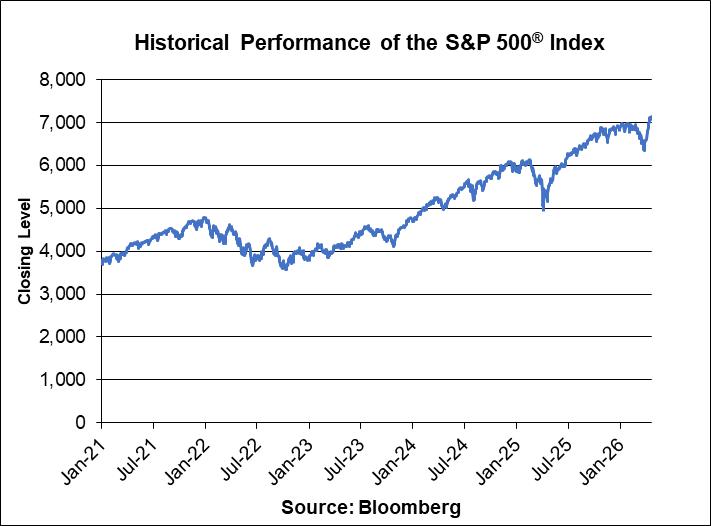
The S&P 500® Index consists
of stocks of 500 companies selected to provide a performance benchmark for the U.S. equity markets. For more information about the S&P
500® Index, see “Description of Indices—The S&P U.S. Indices” in the accompanying underlying supplement.
Historical Information
We obtained the closing levels of the S&P 500®
Index in the graph below from Bloomberg, without independent verification.
The following graph sets forth daily closing levels
of the S&P 500® Index for the period from January 4, 2021 to April 22, 2026. The closing level on April 22, 2026 was
7,137.90. The historical performance of the S&P 500® Index should not be taken as an indication of its future performance
during the term of the Notes.
|
Correlation of the Underliers |
The following
graph sets forth the historical performances of the Nasdaq-100 Index®, the Russell 2000® Index and
the S&P 500® Index from January 4, 2021 through April 22, 2026, based on the daily closing levels of the Underliers.
For comparison purposes, each Underlier has been normalized to have a closing level of 100.00 on January 4, 2021 by dividing the closing
level of that Underlier on each day by the closing level of that Underlier on January 4, 2021 and multiplying by 100.00.
We obtained
the closing levels used to determine the normalized closing levels set forth below from Bloomberg, without independent verification. The
historical performance of the Underliers should not be taken as an indication of their future performance during the term of the Notes.
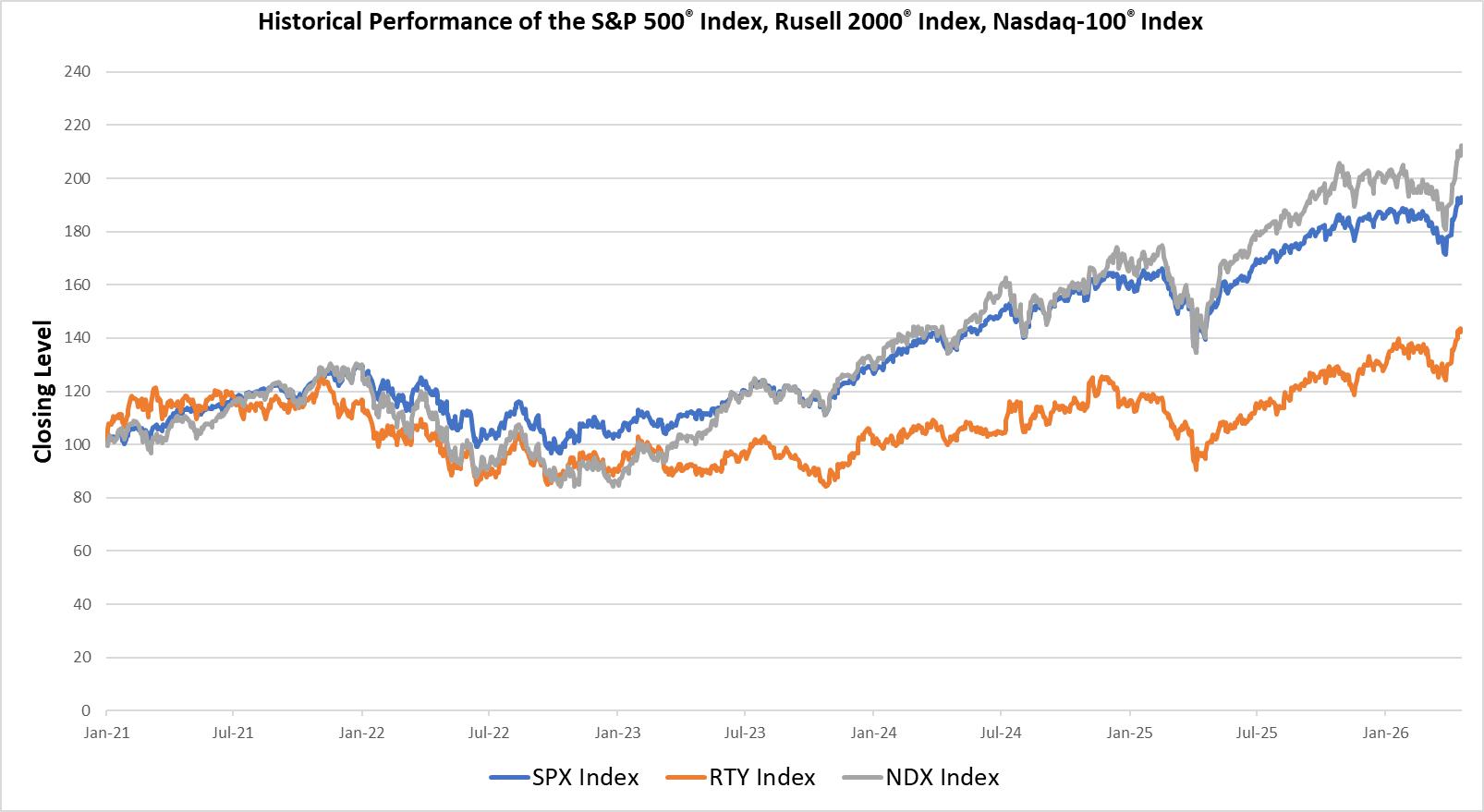
PAST PERFORMANCE AND CORRELATION OF THE UNDERLIERS
ARE NOT INDICATIVE OF FUTURE PERFORMANCE OR CORRELATION.
The correlation of a pair of Underliers represents
a statistical measurement of the degree to which the returns of those Underliers were similar to each other over a given period in terms
of timing and direction. The correlation between a pair of Underliers is scaled from 1.0 to -1.0, with 1.0 indicating perfect positive
correlation (i.e., the value of both Underliers are increasing together or decreasing together and the ratio of their returns has been
constant), 0 indicating no correlation (i.e., there is no statistical relationship between the returns of that pair of Underliers) and
-1.0 indicating perfect negative correlation (i.e., as the value of one Underlier increases, the value of the other Underlier decreases
and the ratio of their returns has been constant).
The closer the relationship of the returns of a
pair of Underliers over a given period, the more positively correlated those Underliers are. The graph above illustrates the historical
performance of each Underlier relative to each other over the time period shown and provides an indication of how close the relative performance
of each Underlier has historically been to each other. However, the graph does not provide a precise measurement of the correlation of
the Underliers. Moreover, any historical correlation of the Underliers is not indicative of the degree of correlation of the Underliers,
if any, that will be experienced over the term of the Notes.
The lower (or more negative) the correlation between
the Underliers, the less likely it is that the Underliers will move in the same direction at the same time and, therefore, the greater
the potential for one of the Underliers to close below its Coupon Barrier or Downside Threshold on any Coupon Observation Date or the
Final Valuation Date, respectively. This is because the less positively correlated the Underliers are, the greater the likelihood that
at least one of the Underliers will decrease in value. However, even if the Underliers have a higher positive correlation, one or more
of the Underliers might close below its Coupon Barrier or Downside Threshold on any Coupon Observation Date or the Final Valuation Date,
respectively, as the Underliers may decrease in value together.
Although the correlation of the Underliers’
performance may change over the term of the Notes, the Contingent Coupon Rate is determined, in part, based on the correlation of the
Underliers’ performance calculated using our internal models at the time when the terms of the Notes are finalized. A higher Contingent
Coupon Rate is generally associated with lower correlation of the Underliers, which reflects a greater potential for missed Contingent
Coupons and for a loss of principal at maturity. The correlation referenced in setting the terms of the Notes is calculated using our
internal models and is not derived from the returns of the Underliers over the period set forth above. In addition, other factors and
inputs other than correlation may impact how the terms of the Notes are set and the performance of the Notes.
|
Summary of Canadian Federal Income Tax Consequences |
For a discussion of the material Canadian federal
income tax consequences relating to an investment in the Notes, see the section entitled “Canadian Federal Income Tax Consequences”
in the accompanying product supplement. Notwithstanding anything to the contrary in the accompanying product supplement, the Canadian
tax consequences discussed in the accompanying product supplement do not take into account the proposed amendments to the “hybrid
mismatch arrangement” rules in the Tax Act released for consultation on January 29, 2026.
|
United States Federal Income Tax Considerations |
Although there is uncertainty regarding the U.S.
federal income tax consequences of an investment in the Notes due to the lack of governing authority, in the opinion of our counsel Davis
Polk & Wardwell LLP, under current law, and based on current market conditions, it is reasonable to treat a Note as a single prepaid
financial contract with associated coupons for U.S. federal income tax purposes. However, because our counsel’s opinion is based
in part on market conditions as of the date of this document, it is subject to confirmation in the final pricing supplement. Assuming
this treatment of the Notes is respected, the tax consequences are as outlined in the discussion under “United States Federal Income
Tax Considerations—Tax Consequences to U.S. Holders—Notes Treated as Prepaid Financial Contracts with Associated Coupons”
in the accompanying product supplement.
We do not plan to request a ruling from the Internal
Revenue Service (the “IRS”) regarding the treatment of the Notes. If the IRS were successful in asserting an alternative
treatment of the Notes, the tax consequences of the ownership and disposition of the Notes, including the timing and character of income
recognized by U.S. investors, might be materially and adversely affected. The U.S. Treasury Department and the IRS have requested comments
on various issues regarding the U.S. federal income tax treatment of “prepaid forward contracts” and similar financial instruments
and have indicated that such transactions may be the subject of future regulations or other guidance. Furthermore, members of Congress
have proposed legislative changes to the tax treatment of derivative contracts. Any legislation, Treasury regulations or other guidance
promulgated after consideration of these issues could materially and adversely affect the tax consequences of an investment in the Notes,
possibly with retroactive effect.
Non-U.S. Holders. The U.S. federal income
tax treatment of the coupons is unclear. We intend to withhold on any coupon paid to a Non-U.S. Holder, generally at a rate of 30% or
at a reduced rate specified by an applicable income tax treaty under an “other income” or similar provision. In order to claim
an exemption from, or a reduction in, the 30% withholding under an applicable treaty, you will need to comply with certification requirements
to establish that you are not a U.S. person and are eligible for such an exemption or reduction under an applicable tax treaty. You should
consult your tax advisor regarding the tax treatment of the Notes, including the possibility of obtaining a refund of all or a portion
of any amounts withheld.
As discussed in the accompanying product supplement,
Section 871(m) of the Code and the Treasury regulations thereunder (“Section 871(m)”) generally impose a 30% (or lower
treaty rate) withholding tax on “dividend equivalents” paid or deemed paid to non-U.S. investors with respect to certain financial
instruments linked to equities that could pay U.S.-source dividends for U.S. federal income tax purposes (“underlying securities”),
as defined under the applicable Treasury regulations, or indices that include underlying securities. Section 871(m) generally applies
to financial instruments that substantially replicate the economic performance of one or more underlying securities, as determined based
on tests set forth in the applicable Treasury regulations. Pursuant to an IRS notice, Section 871(m) will not apply to securities issued
before January 1, 2027 that do not have a delta of one with respect to any underlying security. Based on the terms of the Notes and current
market conditions, we expect that the Notes will not have a delta of one with respect to any underlying security on the pricing date.
However, we will provide an updated determination in the final pricing supplement. Our determination is not binding on the IRS, and the
IRS may disagree with this determination. Section 871(m) is complex and its application may depend on your particular circumstances, including
whether you enter into other transactions with respect to an underlying security. You should consult your tax advisor regarding the potential
application of Section 871(m) to the Notes.
If withholding is required, we will not be required
to pay any additional amounts with respect to the amounts so withheld.
Both U.S. and non-U.S. investors considering an
investment in the Notes should read the discussion under “United States Federal Income Tax Considerations” in the accompanying
product supplement and consult their tax advisors regarding all aspects of the U.S. federal income and estate tax consequences of an investment
in the Notes, including possible alternative treatments, and any tax consequences arising under the laws of any state, local or non-U.S.
taxing jurisdiction.
| Supplemental Plan of Distribution |
BMOCM, our subsidiary, and UBS are the agents for
the distribution of the Notes and will purchase the Notes at the Original Issue Price specified on the cover page of this pricing supplement.
UBS has advised us that all sales of the Notes will be made to certain fee-based advisory accounts for which UBS is an investment advisor
at the Original Issue Price and UBS will not receive a sales commission.
We expect to hedge our obligations through one
or more hedge counterparties (which may be one or more of our affiliates). BMOCM or another affiliate of ours expects to realize hedging
profits projected by its proprietary pricing models to the extent it assumes the risks inherent in hedging our obligations under the Notes.
Although BMOCM and/or its affiliates intend to
make a secondary market in relation to the Notes, they are not obligated to do so. BMOCM will determine any secondary market prices that
it is prepared to offer in its sole discretion.
For a period of approximately 1 month following
issuance of the Notes, the price, if any, at which we or our affiliates would be willing to buy the Notes from investors, and the value
that BMOCM may also publish for the Notes through one or more financial information vendors and which could be indicated for the Notes
on any brokerage account statements, will reflect a temporary upward adjustment from our estimated value of the Notes that would otherwise
be determined and applicable at that time. This temporary upward adjustment represents a portion of (a) the hedging profit that we or
our affiliates expect to realize over the term of the Notes and (b) any underwriting discount and selling concessions paid in connection
with this offering. The amount of this temporary upward adjustment will decline to zero on a straight-line basis over the 1 month period.
We may use this pricing supplement in the initial
sale of the Notes. In addition, BMOCM or another of our affiliates may use this pricing supplement in market-making transactions in any
Notes after their initial sale. Unless BMOCM or we inform you otherwise in the confirmation of sale, this pricing supplement is being
used by BMOCM in a market-making transaction.
See “Supplemental Plan of Distribution”
in the accompanying product supplement, “Supplemental Plan of Distribution (Conflicts of Interest) in the accompanying prospectus
supplement and “Plan of Distribution (Conflicts of Interest)” in the accompanying prospectus for more information.
Approved Jurisdictions:
In accordance with and subject to an agent
accession agreement between the Issuer and UBS, UBS will not offer, sell or deliver the Notes in any jurisdiction other than the
United States and the following jurisdictions: Argentina, Barbados, Belize, Bermuda, Bolivia, Brazil, British Virgin Islands, Cayman
Islands, Chile, Colombia, Costa Rica, Dominican Republic, Ecuador, European Economic Area, Guatemala, Honduras, Hong Kong, Israel,
Mexico, Panama, Paraguay, Peru and Uruguay.
UBS will comply with the non-U.S. selling restrictions
applicable to the above jurisdictions set forth below and in the accompanying product supplement:
Notice to Prospective Investors in Argentina
The Notes are not and will not be marketed in Argentina
by means of a public offering, as such term is defined under Section 2 of Law Number 26,831, as amended. No application has been or will
be made with the Argentine Comisión Nacional de Valores, the Argentine securities governmental authority, to offer the Notes in
Argentina. The contents of this pricing supplement and the related product supplement, any accompanying underlying supplement, the prospectus
supplement and the prospectus have not been reviewed by the Argentine Comisión Nacional de Valores.
Notice to Prospective Investors in Brazil
The Notes have not been, and will not be issued
nor publicly placed, distributed, offered or negotiated in the Brazilian capital markets and, as a result, have not been and will not
be registered with the Comissão de Valores Mobiliáros (“CVM”). Any public offering or distribution, as
defined under Brazilian laws and regulations, of the Notes in Brazil is not legal without prior registration under Law 6,385/76, and CVM
applicable regulation. Documents relating to the offering of the Notes, as well as information contained therein, may not be supplied
to the public in Brazil (as the offering of the Notes is not a public offering of securities in Brazil), nor be used in connection with
any offer for subscription or sale of the Notes to the public in Brazil. Persons wishing to offer or acquire the Notes within Brazil should
consult with their own counsel as to the applicability of registration requirements or any exemption therefrom.
Notice to Prospective Investors in Chile
Neither the Issuer nor the Notes have been registered
with the Comisión Para el Mercado Financiero pursuant to Law No. 18.045, the Ley de Mercado de Valores and regulations thereunder,
so they cannot be publicly offered in Chile. This pricing supplement (and the related product supplement, any accompanying underlying
supplement, the prospectus supplement and the prospectus) do not constitute an offer of, or an invitation to subscribe for or purchase,
the Notes in the republic of Chile, other than to individually identified buyers pursuant to a private offering within the meaning of
Article 4 of the Ley de Mercado de Valores (an offer that is not addressed to the public at large or to a certain sector or specific group
of the public).
Notice to Prospective Investors in the Dominican
Republic
Nothing in this pricing supplement constitutes
an offer of securities for sale in the Dominican Republic. The Notes have not been, and will not be, registered with the Superintendence
of Securities Market of the Dominican Republic (Superintendencia del Mercado de Valores), under Dominican Securities Market Law No. 249-17
(“Securities Law 249-17”), and the Notes may not be offered or sold within the Dominican Republic or to, or for the
account or benefit of, Dominican persons (as defined under Securities Law 249-17 and its regulations). Failure to comply with these directives
may result in a violation of Securities Law 249-17 and its regulations.
Prohibition of Sales to European Economic Area
Retail Investors.
The Notes will not be offered, sold or otherwise
made available to any retail investor in the European Economic Area (“EEA”). For these purposes, the expression “offer”
includes the communication in any form and by any means of sufficient information on the terms of the offer and the Notes to be offered
so as to enable an investor to decide to purchase or subscribe the Notes, and a “retail investor” means a person who
is one (or more) of: (a) a retail client, as defined in point (11) of Article 4(1) of Directive 2014/65/EU (as amended, “MiFID
II”); or (b) a customer, within the meaning of Directive (EU) 2016/97, as amended, where that customer would not qualify as
a professional client as defined in point (10) of Article 4(1) of MiFID II; or (c) not a qualified investor as defined in Regulation (EU)
(2017/1129) (the “Prospectus Regulation”). Consequently, no key information document required by Regulation (EU) No 1286/2014
(as amended, the “PRIIPs Regulation”) for offering or selling the Notes or otherwise making them available to retail
investors in the EEA has been prepared, and therefore, offering or selling the Notes or otherwise making them available to any retail
investor in the EEA may be unlawful under the PRIIPs Regulation.
Notice to Prospective Investors in Hong Kong
WARNING: The contents of this document have not
been reviewed by any regulatory authority in Hong Kong. You are advised to exercise caution in relation to the offer. If you are in any
doubt about any of the contents of this document, you should obtain independent professional advice. Please note that (1) the Notes may
not be offered or sold in Hong Kong by means of this document or any other document other than: (i) to “professional investors”
within the meaning of Part 1 of Schedule 1 to the Securities and Futures Ordinance of Hong Kong (Cap. 571) (SFO) and any rules made thereunder;
or (ii) in other circumstances which do not result in the document being a “prospectus” as defined in the Companies (Winding
Up and Miscellaneous Provisions) Ordinance of Hong Kong (Cap. 32) (“CWUMPO”) or which do not constitute an offer or
invitation to the public for the purposes of the CWUMPO or the SFO, and (2) no person shall issue, or possess for the purposes of issue,
whether in Hong Kong or elsewhere, any advertisement, invitation or document relating to the Notes which is directed at, or the contents
of which are likely to be assessed or read by, the public in Hong Kong (except if permitted to do so under the securities laws of Hong
Kong) other than with respect to the Notes which are or are intended to be disposed of only to persons outside Hong Kong or only to such
“professional investors” (as set out above).
Notice to Prospective Investors in Panama
The Notes have not been and will not be registered
with the Superintendency of Securities Market of the Republic of Panama under Decree Law N°1 of July 8, 1999 (the “Panamanian
Securities Act”) and may not be publicly offered or sold within Panama, except in certain limited transactions exempt from the
registration requirements of the Panamanian Securities Act, including the private placement rule based on number 2 of Article 83 of Law
Decree 1 of July 8, 1999 (or number 2 of Article 129 of the Unified Text of Law Decree 1 of July 8, 1999). The Notes do not benefit from
the tax incentives provided by the Panamanian Securities Act and are not subject to regulation or supervision by the Superintendency of
Securities Market of the Republic of Panama.
Notice to Prospective Investors in Paraguay
The sale of the Notes qualifies as a private placement pursuant to Law
No. 5810/17 “Stock Market”. The Notes must not be offered or sold to the public in Paraguay, except under circumstances which
do not constitute a public offering in accordance with Paraguayan regulations. The Notes are not and will not be registered before the
Paraguayan securities supervisory body Comisión Nacional de Valores (“CNV”) or the Paraguayan private stock
exchange Bolsa de Valores y Productos de Asunción (“BVPASA”). The issuer is also not registered before the CNV
or the BVPASA.
In no case may securities not registered before the CNV be offered to
the general public via mass media such as press, radio, television, or internet when such media are publicly accessible in the Republic
of Paraguay, regardless of the location from where they are issued.
The privately placed Notes are not registered with
the National Securities Commission, and therefore do not have tax benefits and are not negotiable through the BVPASA. Privately placed
securities may have less liquidity, making it difficult to sell such securities in the secondary market, which could also affect the sale
price. Private securities of issuers not registered before the CNV may not have periodic financial information or audited financial statements,
which could generate greater risk to the investor due to the asymmetry of information. It is the responsibility of the investor to ascertain
and assess the risk assumed in the acquisition of the Notes.
Notice to Prospective Investors in Peru
The Notes have not been and will not be registered
with the Capital Markets Public Registry of the Capital Markets Superintendence (“SMV”) nor the Lima Stock Exchange
Registry (“RBVL”) for their public offering in Peru under the Peruvian Capital Markets Law (Law No. 861/ Supreme Decree
No. 093-2002) and the decrees and regulations thereunder. Consequently, the Notes may not be offered or sold, directly or indirectly,
nor may this pricing supplement or the related product supplement, any accompanying underlying supplement, the prospectus supplement,
the prospectus or any other material relating to the Notes be distributed or caused to be distributed in Peru to the general public. The
Notes may only be offered in a private offering under Peruvian regulation and without using mass marketing, which is defined as a marketing
strategy utilizing mass distribution and mass media to offer, negotiate or distribute securities to the whole market. Mass media includes
newspapers, magazines, radio, television, mail, meetings, social networks, Internet servers located in Peru, and other media or technology
platforms.
Notice to Prospective Investors in Uruguay
The sale of the Notes qualifies as a private placement
pursuant to section 2 of Uruguayan law 18,627. The Notes must not be offered or sold to the public in Uruguay, except in circumstances
which do not constitute a public S-31 offering or distribution under Uruguayan laws and regulations. The Notes are not and will not be
registered with the Financial Services Superintendency of the Central Bank of Uruguay.
PS-24