First Quarter 2026 Webcast Presentation April 30, 2026 NYSE: WCC
Forward-Looking Statements and Non-GAAP Measures 2 All statements made herein that are not historical facts should be considered as "forward-looking statements" within the meaning of the Private Securities Litigation Reform Act of 1995. Such statements involve known and unknown risks, uncertainties and other factors that may cause actual results to differ materially. These statements include, but are not limited to, statements regarding business strategy, growth strategy, competitive strengths, productivity and profitability enhancement, competition, new product and service introductions, and liquidity and capital resources. Such statements can generally be identified by the use of words such as "anticipate," "plan," "believe," "estimate," "intend," "expect," "project," and similar words, phrases or expressions or future or conditional verbs such as "could," "may," "should," "will," and "would," although not all forward-looking statements contain such words. These forward-looking statements are based on current expectations and beliefs of Wesco's management, as well as assumptions made by, and information currently available to, Wesco's management, current market trends and market conditions and involve risks and uncertainties, many of which are outside of Wesco's and Wesco's management's control, and which may cause actual results to differ materially from those contained in forward-looking statements. Accordingly, you should not place undue reliance on such statements. Important factors that could cause actual results or events to differ materially from those presented or implied in the forward-looking statements include, among others, the failure to achieve the anticipated benefits of, and other risks associated with, acquisitions, joint ventures, divestitures and other corporate transactions; the inability to successfully integrate acquired businesses; the impact of increased interest rates or borrowing costs; fluctuations in currency exchange rates; evolving impacts from tariffs or other trade tensions between the U.S. and other countries (including implementation of new tariffs and retaliatory measures); failure to adequately protect Wesco's intellectual property or successfully defend against infringement claims; the inability to successfully deploy new technologies, digital products and information systems or to otherwise adapt to emerging technologies in the marketplace, such as those incorporating artificial intelligence (AI); risks relating to our use or reliance on AI; failure to execute on our efforts and programs related to environmental, social and governance (ESG) matters; unanticipated expenditures or other adverse developments related to compliance with new or stricter government policies, laws or regulations, including those relating to data privacy, cybersecurity, competition, sustainability and environmental protection; the inability to successfully develop, manage or implement new technology initiatives or business strategies, including with respect to the expansion of e-commerce or AI capabilities and other digital solutions and digitalization initiatives; disruption of information technology systems or operations; natural disasters (including as a result of climate change), health epidemics, pandemics and other outbreaks; supply chain disruptions; geopolitical conflicts and issues, such as the ongoing Middle East and Russia/Ukraine conflicts; the impact of changing and expanding export controls, sanctions, and data localization rules; the failure to manage the increased risks and impacts of cyber incidents or data breaches; and exacerbation of key materials shortages, inflationary cost pressures, material cost increases, demand volatility, and logistics and capacity constraints, any of which may have a material adverse effect on the Company's business, results of operations and financial condition. All such factors are difficult to predict and are beyond the Company's control. Additional factors that could cause results to differ materially from those described above can be found in Wesco's most recent Annual Report on Form 10-K and other periodic reports filed with the U.S. Securities and Exchange Commission. Non-GAAP Measures In addition to the results provided in accordance with U.S. Generally Accepted Accounting Principles (“U.S. GAAP”) above, this presentation includes certain non-GAAP financial measures. These financial measures include organic sales growth, gross profit, gross margin, earnings before interest, taxes, depreciation and amortization (EBITDA), adjusted EBITDA, adjusted EBITDA margin, financial leverage, free cash flow, adjusted selling, general and administrative expenses, adjusted income from operations, adjusted operating margin, adjusted other non-operating expense (income), adjusted provision for income taxes, adjusted income before income taxes, adjusted net income, adjusted net income attributable to WESCO International, Inc., adjusted net income attributable to common stockholders, and adjusted earnings per diluted share. The Company believes that these non-GAAP measures are useful to investors as they provide a better understanding of our financial condition and results of operations on a comparable basis. Additionally, certain non-GAAP measures either focus on or exclude items impacting comparability of results such as digital transformation costs, restructuring costs, cloud computing arrangement amortization, the loss on termination of business arrangement, and the related income tax effects, allowing investors to more easily compare the Company's financial performance from period to period. Management does not use these non-GAAP financial measures for any purpose other than the reasons stated above. © 2026 Wesco International
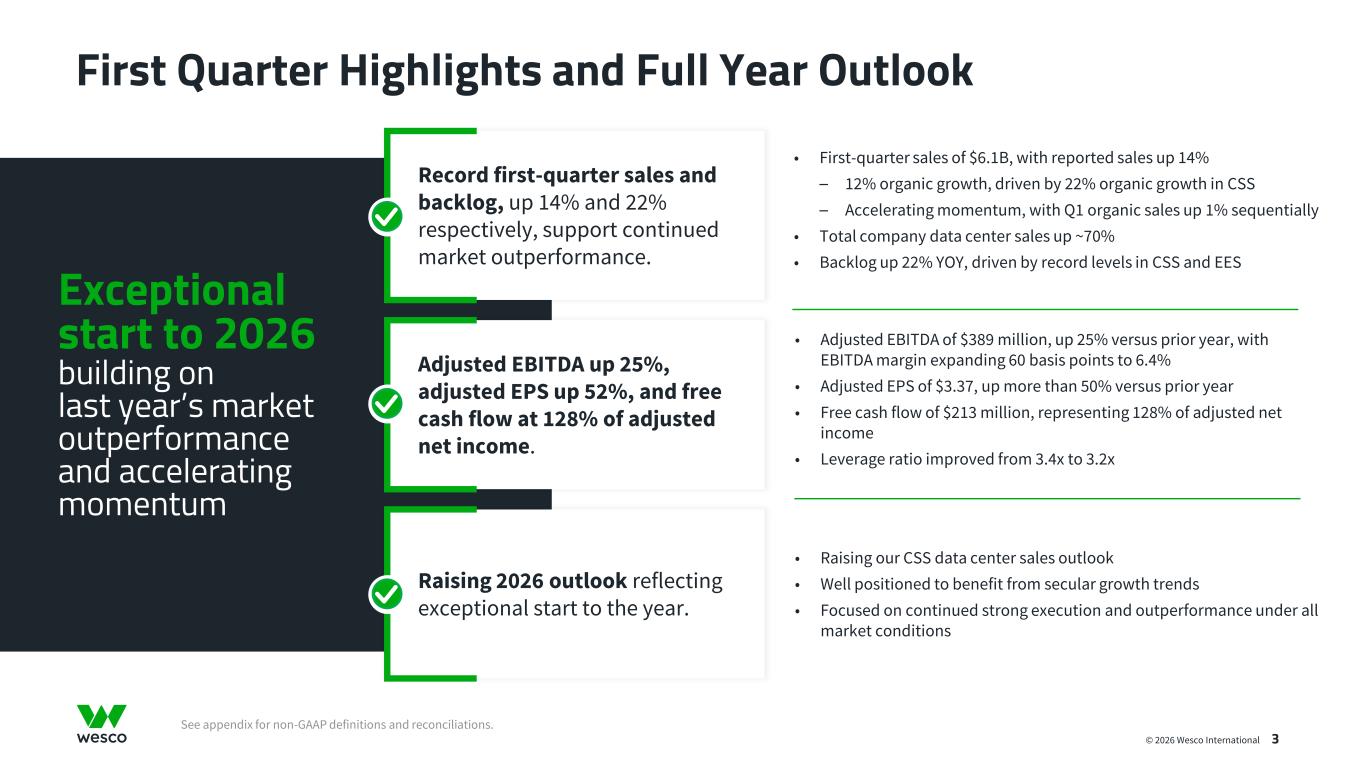
First Quarter Highlights and Full Year Outlook 3 Exceptional start to 2026 building on last year’s market outperformance and accelerating momentum • First-quarter sales of $6.1B, with reported sales up 14% – 12% organic growth, driven by 22% organic growth in CSS – Accelerating momentum, with Q1 organic sales up 1% sequentially • Total company data center sales up ~70% • Backlog up 22% YOY, driven by record levels in CSS and EES Record first-quarter sales and backlog, up 14% and 22% respectively, support continued market outperformance. • Adjusted EBITDA of $389 million, up 25% versus prior year, with EBITDA margin expanding 60 basis points to 6.4% • Adjusted EPS of $3.37, up more than 50% versus prior year • Free cash flow of $213 million, representing 128% of adjusted net income • Leverage ratio improved from 3.4x to 3.2x Adjusted EBITDA up 25%, adjusted EPS up 52%, and free cash flow at 128% of adjusted net income. • Raising our CSS data center sales outlook • Well positioned to benefit from secular growth trends • Focused on continued strong execution and outperformance under all market conditions Raising 2026 outlook reflecting exceptional start to the year. See appendix for non-GAAP definitions and reconciliations. © 2026 Wesco International
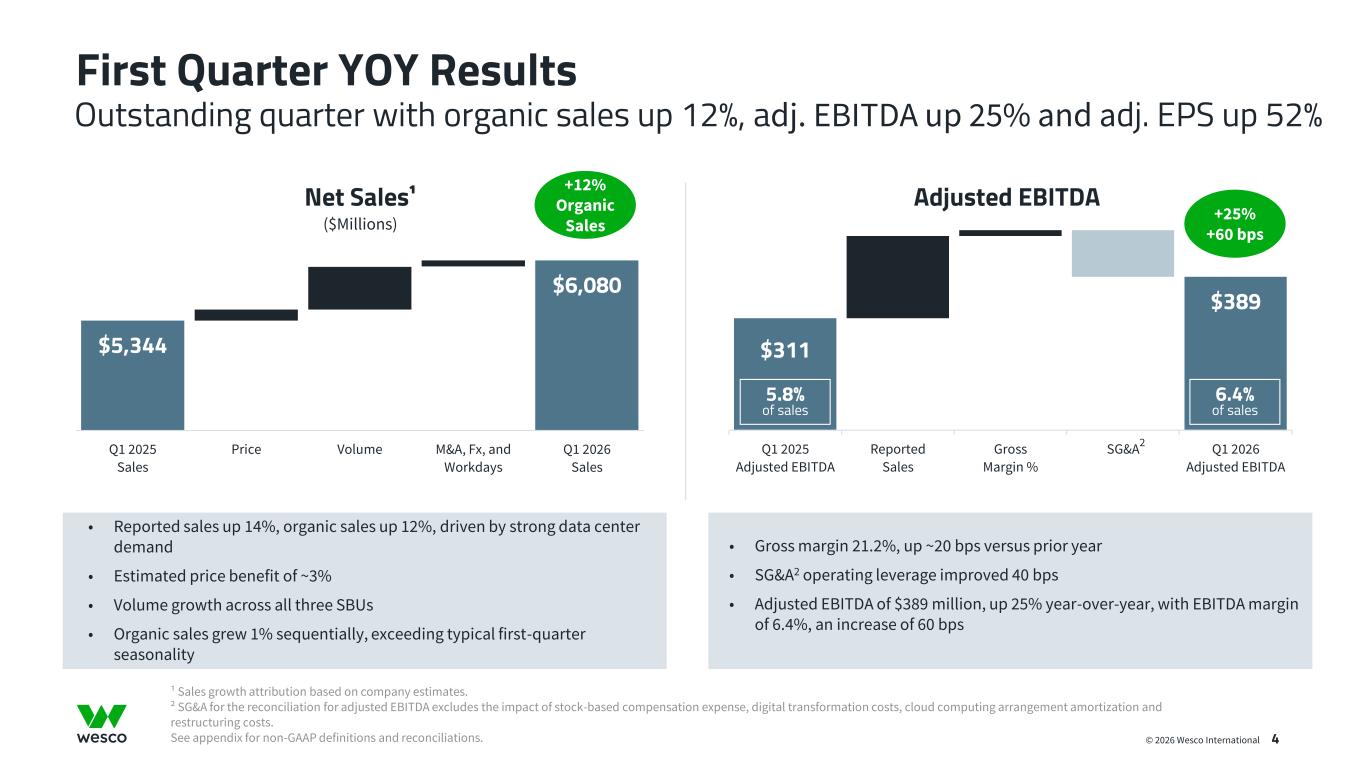
$5,344 $6,080 Q1 2025 Sales Price Volume M&A, Fx, and Workdays Q1 2026 Sales ¹ Sales growth attribution based on company estimates. ² SG&A for the reconciliation for adjusted EBITDA excludes the impact of stock-based compensation expense, digital transformation costs, cloud computing arrangement amortization and restructuring costs. See appendix for non-GAAP definitions and reconciliations. Outstanding quarter with organic sales up 12%, adj. EBITDA up 25% and adj. EPS up 52% First Quarter YOY Results 4 • Reported sales up 14%, organic sales up 12%, driven by strong data center demand • Estimated price benefit of ~3% • Volume growth across all three SBUs • Organic sales grew 1% sequentially, exceeding typical first-quarter seasonality • Gross margin 21.2%, up ~20 bps versus prior year • SG&A2 operating leverage improved 40 bps • Adjusted EBITDA of $389 million, up 25% year-over-year, with EBITDA margin of 6.4%, an increase of 60 bps $311 $389 Q1 2025 Adjusted EBITDA Reported Sales Gross Margin % SG&A Q1 2026 Adjusted EBITDA 5.8% of sales Net Sales¹ ($Millions) Adjusted EBITDA 6.4% of sales 2 © 2026 Wesco International +12% Organic Sales +25% +60 bps
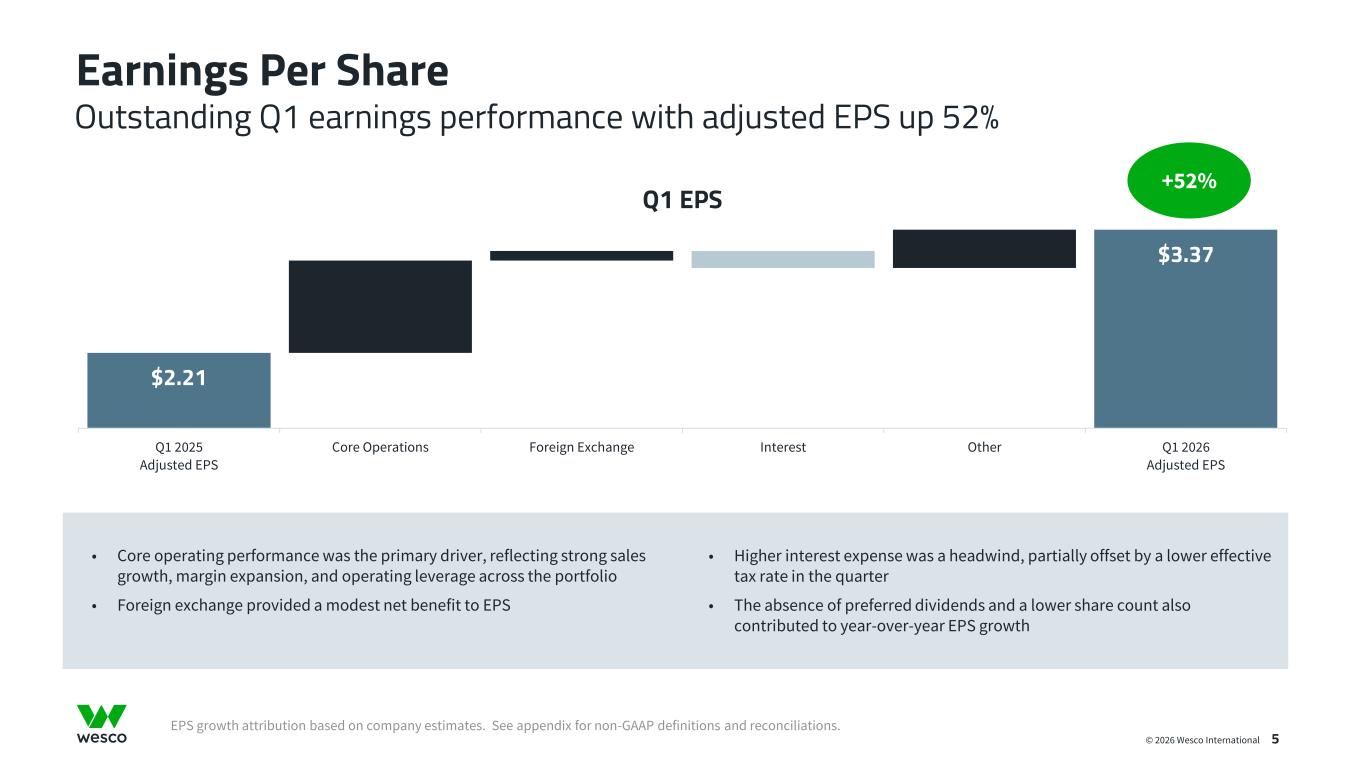
EPS growth attribution based on company estimates. See appendix for non-GAAP definitions and reconciliations. Outstanding Q1 earnings performance with adjusted EPS up 52% Earnings Per Share 5 • Core operating performance was the primary driver, reflecting strong sales growth, margin expansion, and operating leverage across the portfolio • Foreign exchange provided a modest net benefit to EPS Q1 EPS $2.21 $3.37 Q1 2025 Adjusted EPS Core Operations Foreign Exchange Interest Other Q1 2026 Adjusted EPS © 2026 Wesco International • Higher interest expense was a headwind, partially offset by a lower effective tax rate in the quarter • The absence of preferred dividends and a lower share count also contributed to year-over-year EPS growth +52%
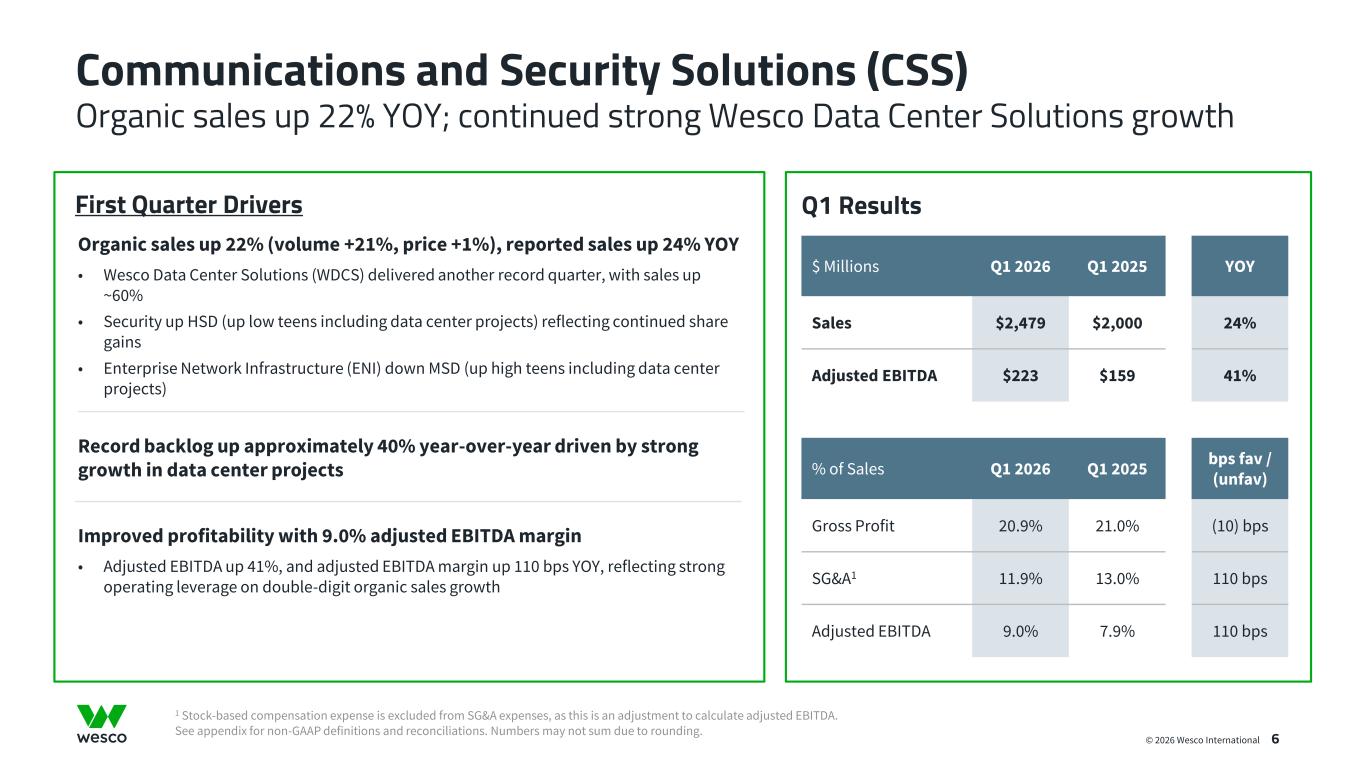
Organic sales up 22% YOY; continued strong Wesco Data Center Solutions growth Communications and Security Solutions (CSS) 6 1 Stock-based compensation expense is excluded from SG&A expenses, as this is an adjustment to calculate adjusted EBITDA. See appendix for non-GAAP definitions and reconciliations. Numbers may not sum due to rounding. Q1 Results $ Millions Q1 2026 Q1 2025 YOY Sales $2,479 $2,000 24% Adjusted EBITDA $223 $159 41% % of Sales Q1 2026 Q1 2025 bps fav / (unfav) Gross Profit 20.9% 21.0% (10) bps SG&A1 11.9% 13.0% 110 bps Adjusted EBITDA 9.0% 7.9% 110 bps © 2026 Wesco International First Quarter Drivers Organic sales up 22% (volume +21%, price +1%), reported sales up 24% YOY • Wesco Data Center Solutions (WDCS) delivered another record quarter, with sales up ~60% • Security up HSD (up low teens including data center projects) reflecting continued share gains • Enterprise Network Infrastructure (ENI) down MSD (up high teens including data center projects) Record backlog up approximately 40% year-over-year driven by strong growth in data center projects Improved profitability with 9.0% adjusted EBITDA margin • Adjusted EBITDA up 41%, and adjusted EBITDA margin up 110 bps YOY, reflecting strong operating leverage on double-digit organic sales growth
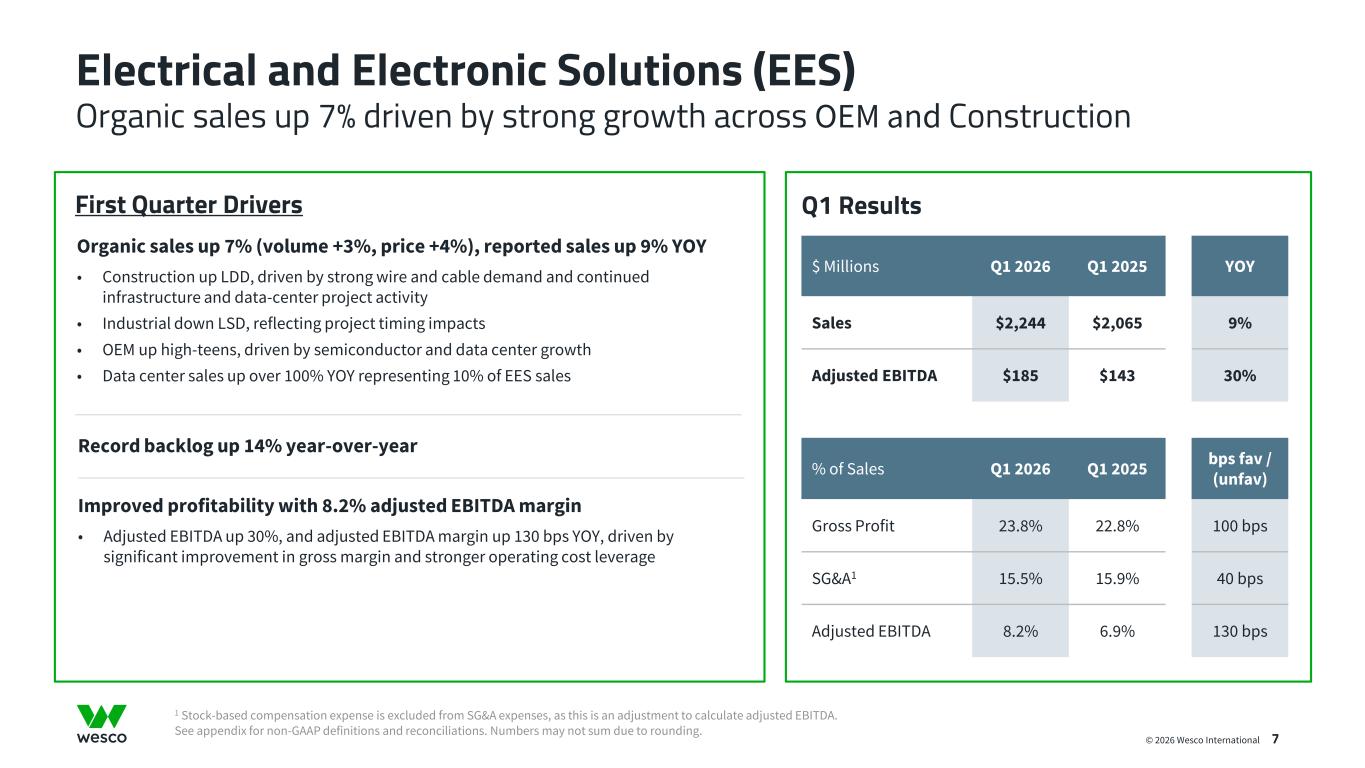
1 Stock-based compensation expense is excluded from SG&A expenses, as this is an adjustment to calculate adjusted EBITDA. See appendix for non-GAAP definitions and reconciliations. Numbers may not sum due to rounding. Organic sales up 7% driven by strong growth across OEM and Construction Electrical and Electronic Solutions (EES) 7© 2026 Wesco International Q1 Results $ Millions Q1 2026 Q1 2025 YOY Sales $2,244 $2,065 9% Adjusted EBITDA $185 $143 30% % of Sales Q1 2026 Q1 2025 bps fav / (unfav) Gross Profit 23.8% 22.8% 100 bps SG&A1 15.5% 15.9% 40 bps Adjusted EBITDA 8.2% 6.9% 130 bps First Quarter Drivers Organic sales up 7% (volume +3%, price +4%), reported sales up 9% YOY • Construction up LDD, driven by strong wire and cable demand and continued infrastructure and data-center project activity • Industrial down LSD, reflecting project timing impacts • OEM up high-teens, driven by semiconductor and data center growth • Data center sales up over 100% YOY representing 10% of EES sales Record backlog up 14% year-over-year Improved profitability with 8.2% adjusted EBITDA margin • Adjusted EBITDA up 30%, and adjusted EBITDA margin up 130 bps YOY, driven by significant improvement in gross margin and stronger operating cost leverage
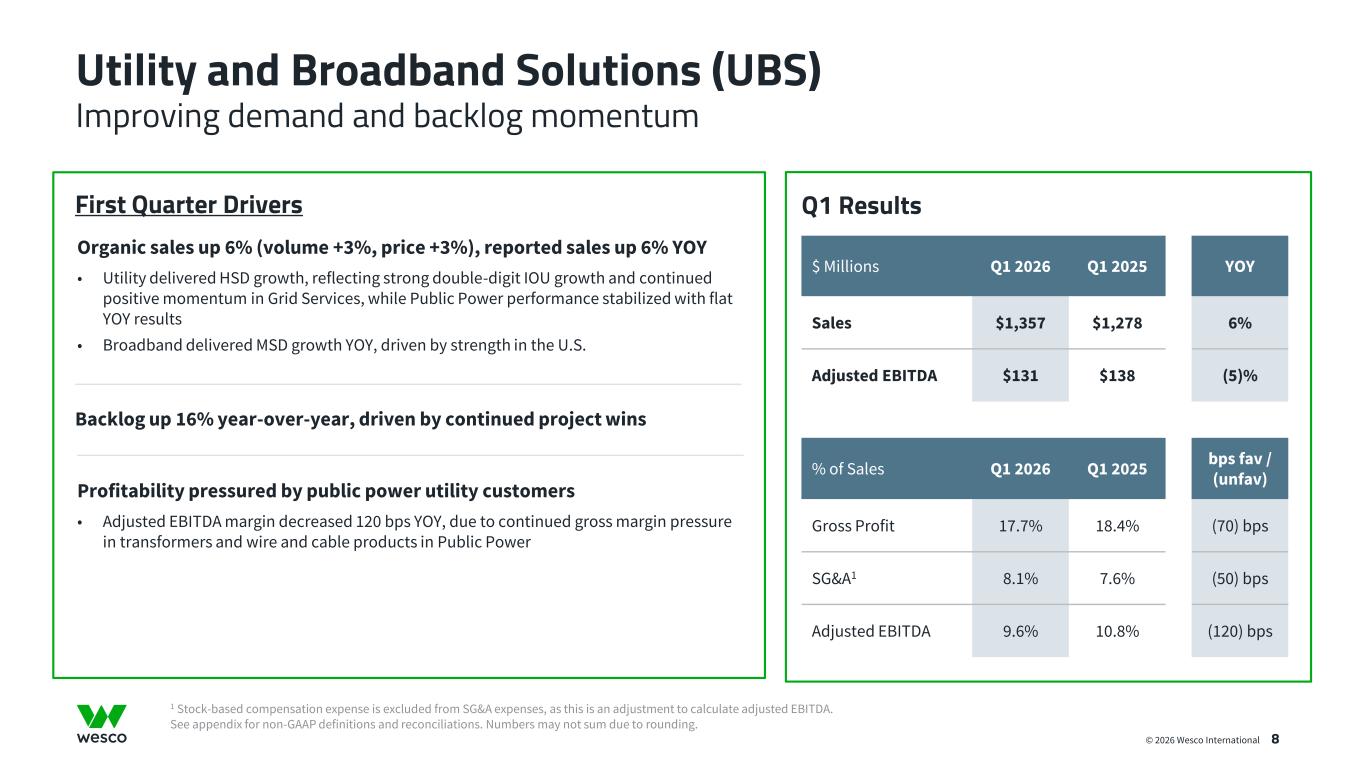
Improving demand and backlog momentum Utility and Broadband Solutions (UBS) 8 1 Stock-based compensation expense is excluded from SG&A expenses, as this is an adjustment to calculate adjusted EBITDA. See appendix for non-GAAP definitions and reconciliations. Numbers may not sum due to rounding. © 2026 Wesco International Q1 Results $ Millions Q1 2026 Q1 2025 YOY Sales $1,357 $1,278 6% Adjusted EBITDA $131 $138 (5)% % of Sales Q1 2026 Q1 2025 bps fav / (unfav) Gross Profit 17.7% 18.4% (70) bps SG&A1 8.1% 7.6% (50) bps Adjusted EBITDA 9.6% 10.8% (120) bps First Quarter Drivers Organic sales up 6% (volume +3%, price +3%), reported sales up 6% YOY • Utility delivered HSD growth, reflecting strong double-digit IOU growth and continued positive momentum in Grid Services, while Public Power performance stabilized with flat YOY results • Broadband delivered MSD growth YOY, driven by strength in the U.S. Backlog up 16% year-over-year, driven by continued project wins Profitability pressured by public power utility customers • Adjusted EBITDA margin decreased 120 bps YOY, due to continued gross margin pressure in transformers and wire and cable products in Public Power
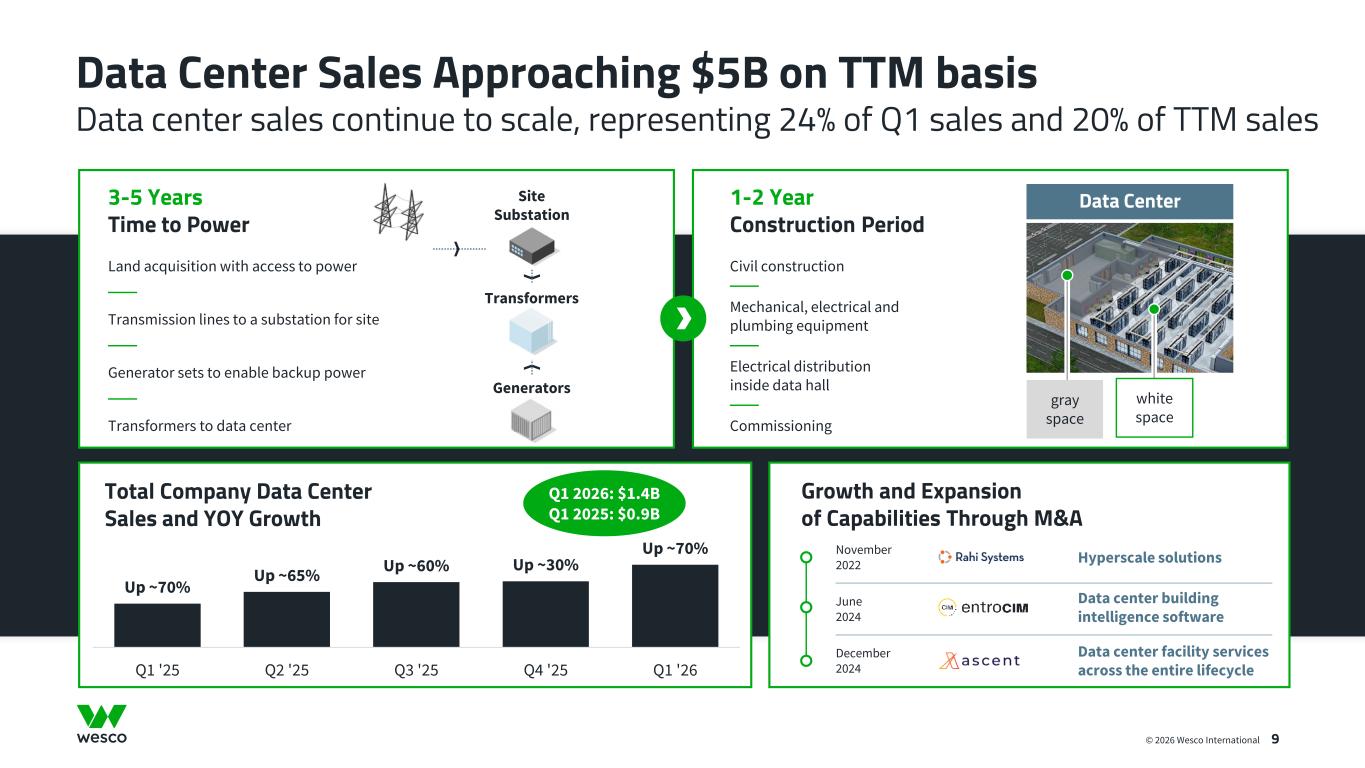
Data Center Sales Approaching $5B on TTM basis Data center sales continue to scale, representing 24% of Q1 sales and 20% of TTM sales 9 Up ~70% Up ~65% Up ~60% Up ~30% Up ~70% Q1 '25 Q2 '25 Q3 '25 Q4 '25 Q1 '26 Growth and Expansion of Capabilities Through M&A Data Center Land acquisition with access to power Transmission lines to a substation for site Generator sets to enable backup power Transformers to data center Civil construction Mechanical, electrical and plumbing equipment Electrical distribution inside data hall Commissioning November 2022 Hyperscale solutions Data center building intelligence software June 2024 Data center facility services across the entire lifecycle December 2024 3-5 Years Time to Power 1-2 Year Construction Period Total Company Data Center Sales and YOY Growth white space Transformers Site Substation Generators Q1 2026: $1.4B Q1 2025: $0.9B © 2026 Wesco International gray space
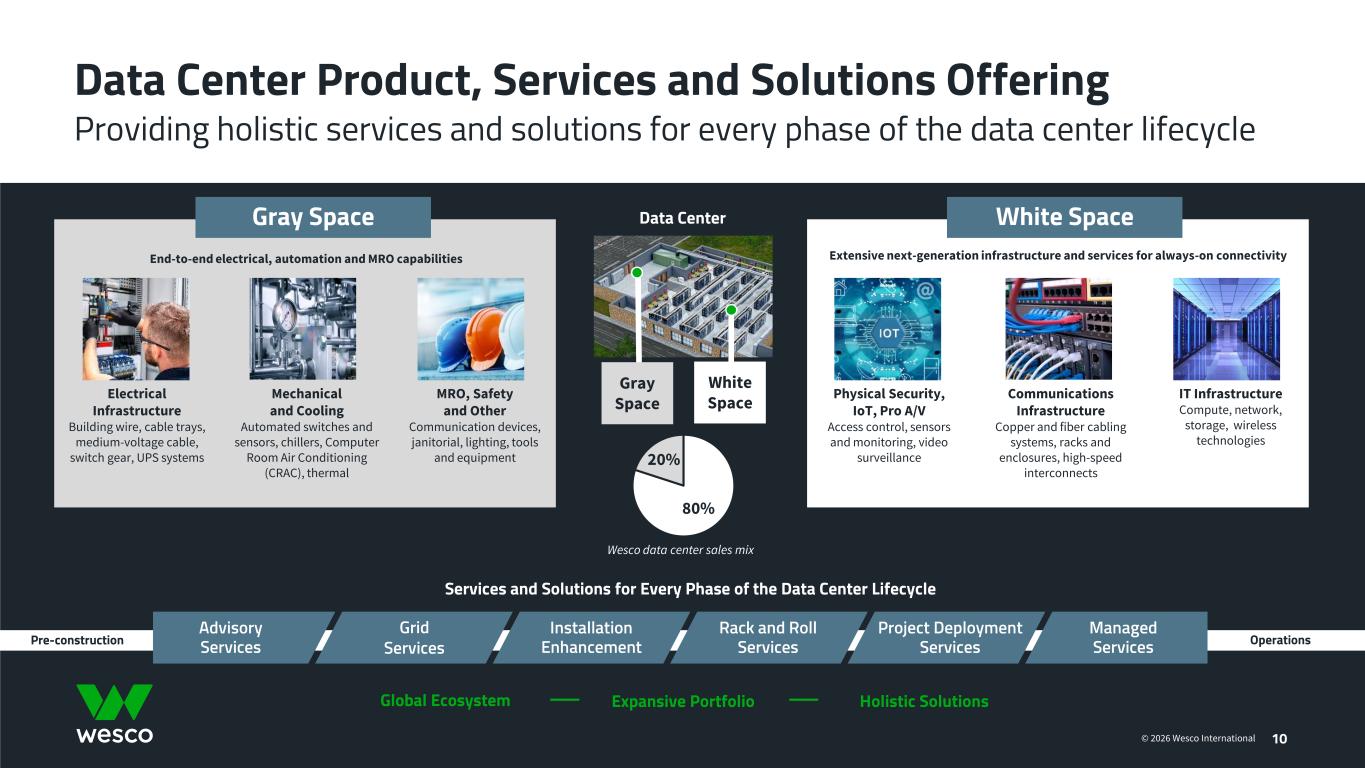
© 2026 Wesco International Data Center Product, Services and Solutions Offering Providing holistic services and solutions for every phase of the data center lifecycle 10 White SpaceGray Space End-to-end electrical, automation and MRO capabilities Extensive next-generation infrastructure and services for always-on connectivity Physical Security, IoT, Pro A/V Access control, sensors and monitoring, video surveillance Electrical Infrastructure Building wire, cable trays, medium-voltage cable, switch gear, UPS systems MRO, Safety and Other Communication devices, janitorial, lighting, tools and equipment Mechanical and Cooling Automated switches and sensors, chillers, Computer Room Air Conditioning (CRAC), thermal IT Infrastructure Compute, network, storage, wireless technologies Communications Infrastructure Copper and fiber cabling systems, racks and enclosures, high-speed interconnects 80% 20% Wesco data center sales mix Data Center White Space Gray Space Global Ecosystem Expansive Portfolio Holistic Solutions Services and Solutions for Every Phase of the Data Center Lifecycle Installation Enhancement Rack and Roll Services Managed Services Project Deployment Services Advisory Services Grid Services OperationsPre-construction © 2026 Wesco International
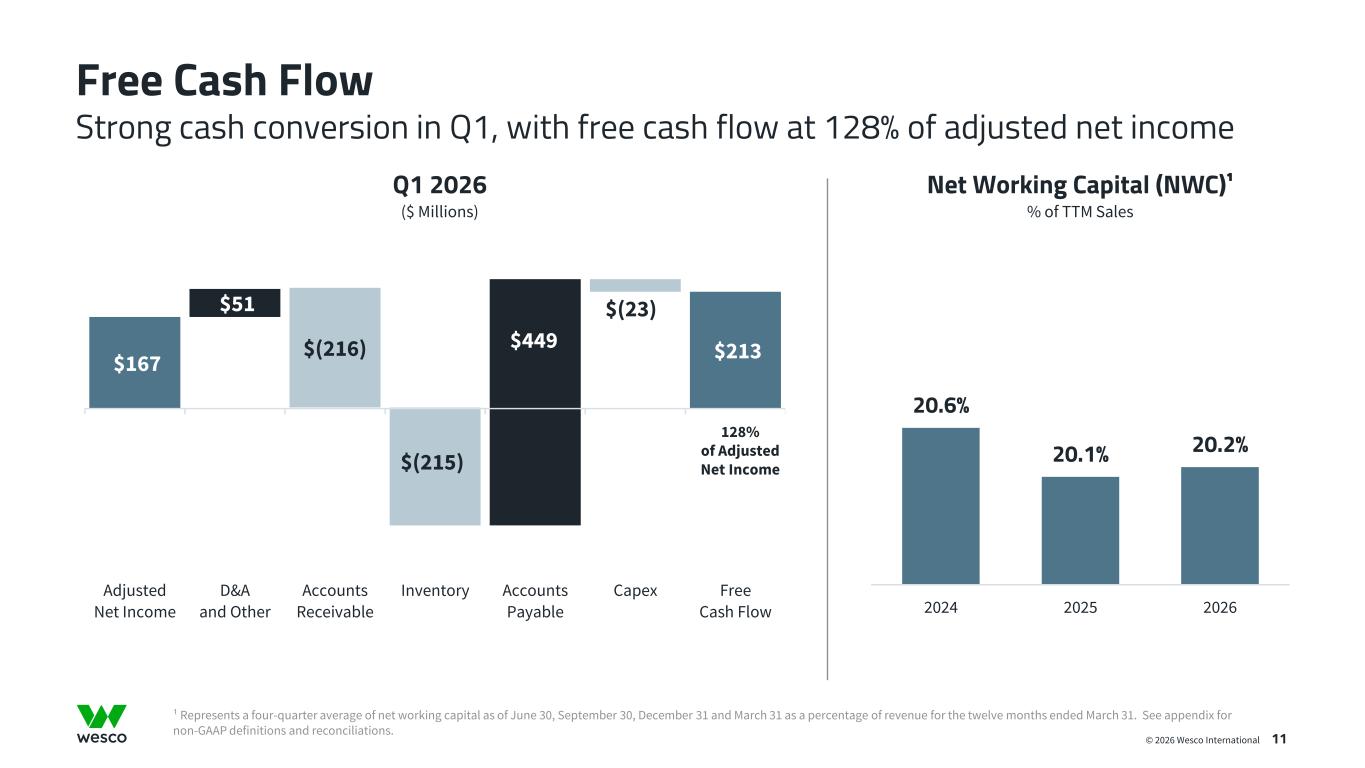
$167 $213 $51 $(216) $(215) $449 $(23) Adjusted Net Income D&A and Other Accounts Receivable Inventory Accounts Payable Capex Free Cash Flow ¹ Represents a four-quarter average of net working capital as of June 30, September 30, December 31 and March 31 as a percentage of revenue for the twelve months ended March 31. See appendix for non-GAAP definitions and reconciliations. Strong cash conversion in Q1, with free cash flow at 128% of adjusted net income Free Cash Flow 11 128% of Adjusted Net Income Q1 2026 ($ Millions) Net Working Capital (NWC)¹ % of TTM Sales 20.6% 20.1% 20.2% 2024 2025 2026 © 2026 Wesco International
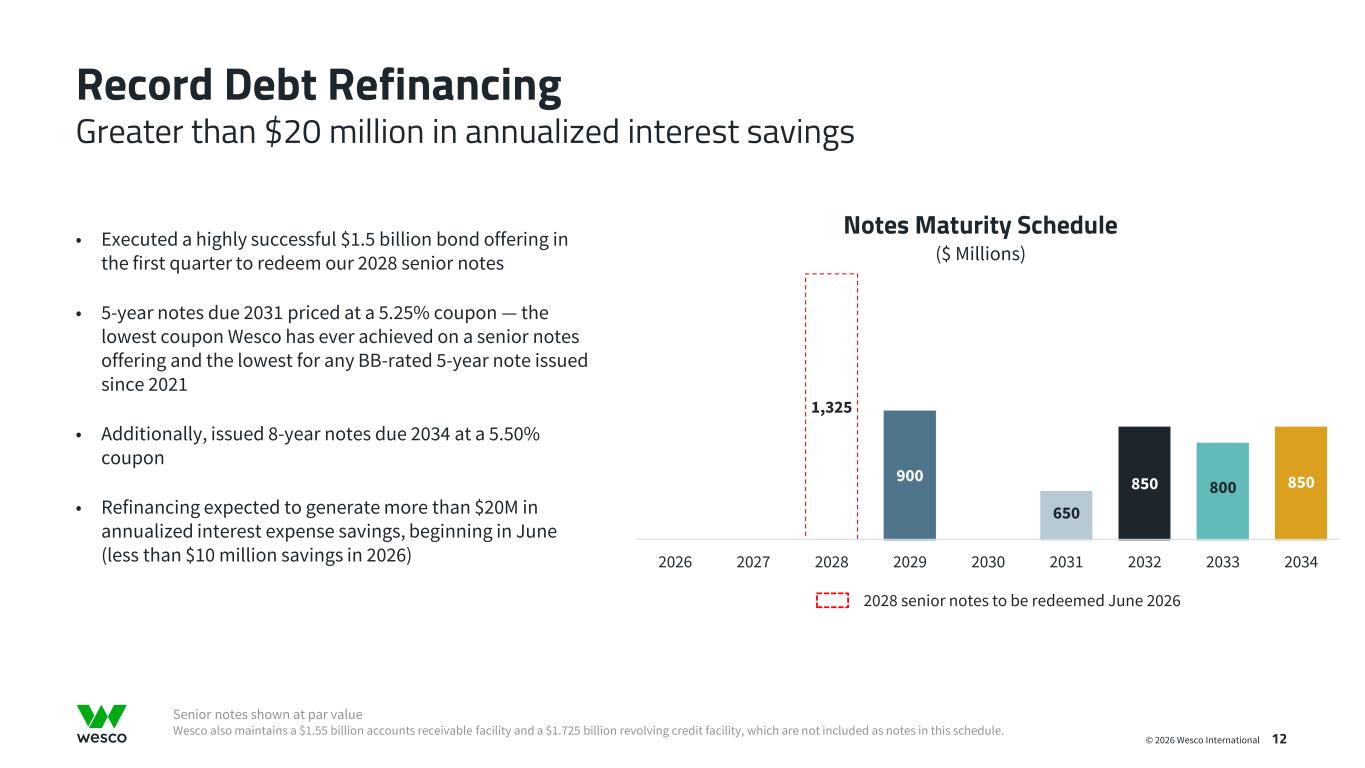
1,325 900 650 850 800 850 2026 2027 2028 2029 2030 2031 2032 2033 2034 Greater than $20 million in annualized interest savings Record Debt Refinancing Notes Maturity Schedule ($ Millions) 12© 2026 Wesco International • Executed a highly successful $1.5 billion bond offering in the first quarter to redeem our 2028 senior notes • 5-year notes due 2031 priced at a 5.25% coupon — the lowest coupon Wesco has ever achieved on a senior notes offering and the lowest for any BB-rated 5-year note issued since 2021 • Additionally, issued 8-year notes due 2034 at a 5.50% coupon • Refinancing expected to generate more than $20M in annualized interest expense savings, beginning in June (less than $10 million savings in 2026) Senior notes shown at par value Wesco also maintains a $1.55 billion accounts receivable facility and a $1.725 billion revolving credit facility, which are not included as notes in this schedule. 2028 senior notes to be redeemed June 2026
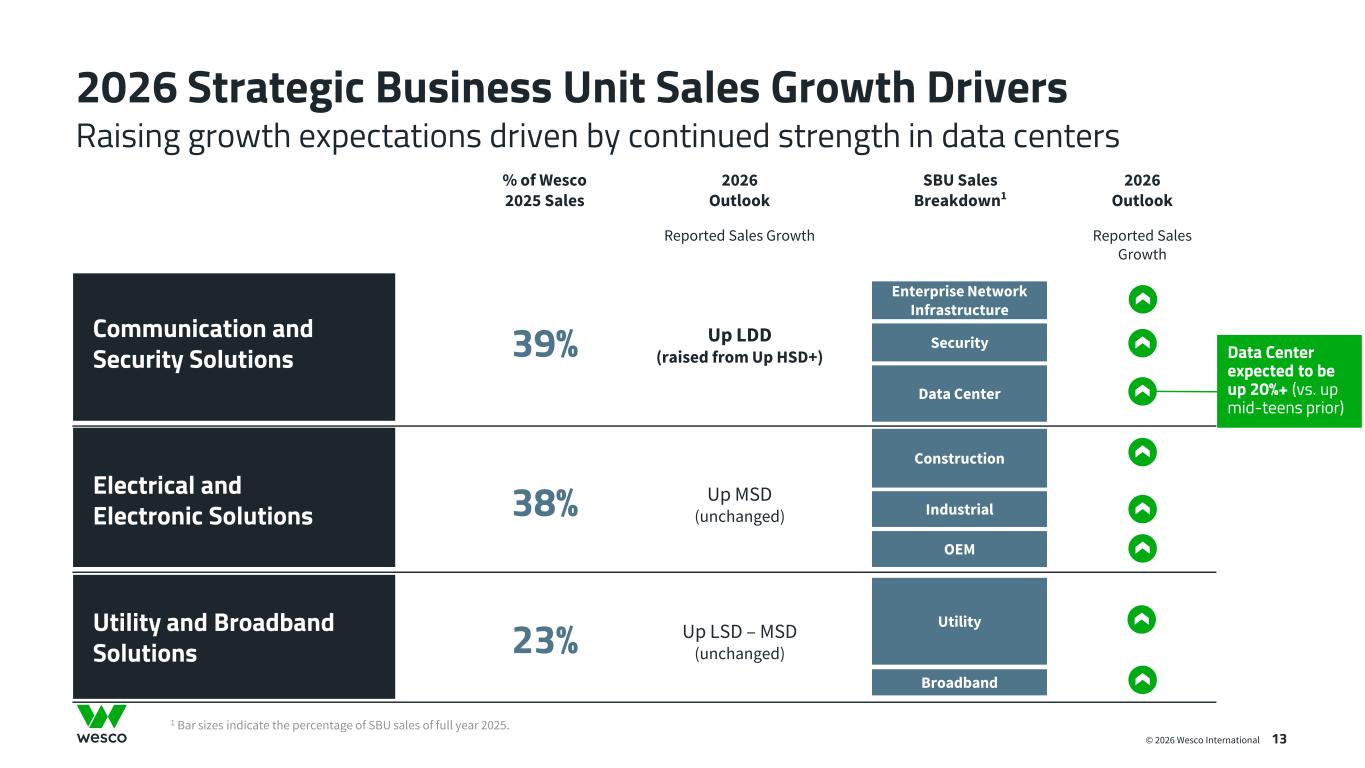
1 Bar sizes indicate the percentage of SBU sales of full year 2025. Raising growth expectations driven by continued strength in data centers 2026 Strategic Business Unit Sales Growth Drivers 13 Data Center expected to be up 20%+ (vs. up mid-teens prior) Construction Industrial OEM Utility Broadband Enterprise Network Infrastructure Security Data Center © 2026 Wesco International % of Wesco 2025 Sales 2026 Outlook SBU Sales Breakdown1 2026 Outlook Reported Sales Growth Reported Sales Growth Communication and Security Solutions 39% Up LDD (raised from Up HSD+) Electrical and Electronic Solutions 38% Up MSD (unchanged) Utility and Broadband Solutions 23% Up LSD – MSD (unchanged)
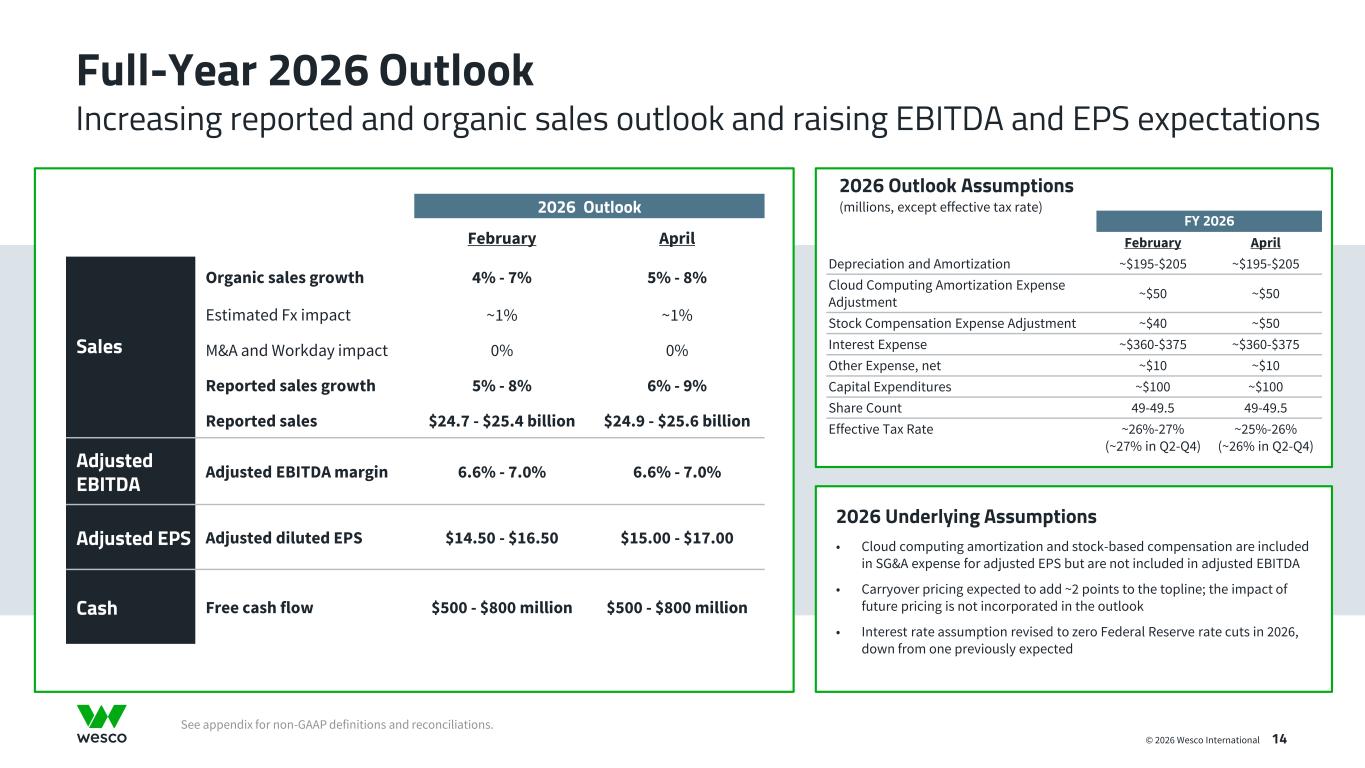
14 Increasing reported and organic sales outlook and raising EBITDA and EPS expectations Full-Year 2026 Outlook 2026 Underlying Assumptions • Cloud computing amortization and stock-based compensation are included in SG&A expense for adjusted EPS but are not included in adjusted EBITDA • Carryover pricing expected to add ~2 points to the topline; the impact of future pricing is not incorporated in the outlook • Interest rate assumption revised to zero Federal Reserve rate cuts in 2026, down from one previously expected 2026 Outlook February April Sales Organic sales growth 4% - 7% 5% - 8% Estimated Fx impact ~1% ~1% M&A and Workday impact 0% 0% Reported sales growth 5% - 8% 6% - 9% Reported sales $24.7 - $25.4 billion $24.9 - $25.6 billion Adjusted EBITDA Adjusted EBITDA margin 6.6% - 7.0% 6.6% - 7.0% Adjusted EPS Adjusted diluted EPS $14.50 - $16.50 $15.00 - $17.00 Cash Free cash flow $500 - $800 million $500 - $800 million FY 2026 February April Depreciation and Amortization ~$195-$205 ~$195-$205 Cloud Computing Amortization Expense Adjustment ~$50 ~$50 Stock Compensation Expense Adjustment ~$40 ~$50 Interest Expense ~$360-$375 ~$360-$375 Other Expense, net ~$10 ~$10 Capital Expenditures ~$100 ~$100 Share Count 49-49.5 49-49.5 Effective Tax Rate ~26%-27% (~27% in Q2-Q4) ~25%-26% (~26% in Q2-Q4) 2026 Outlook Assumptions (millions, except effective tax rate) © 2026 Wesco International See appendix for non-GAAP definitions and reconciliations.
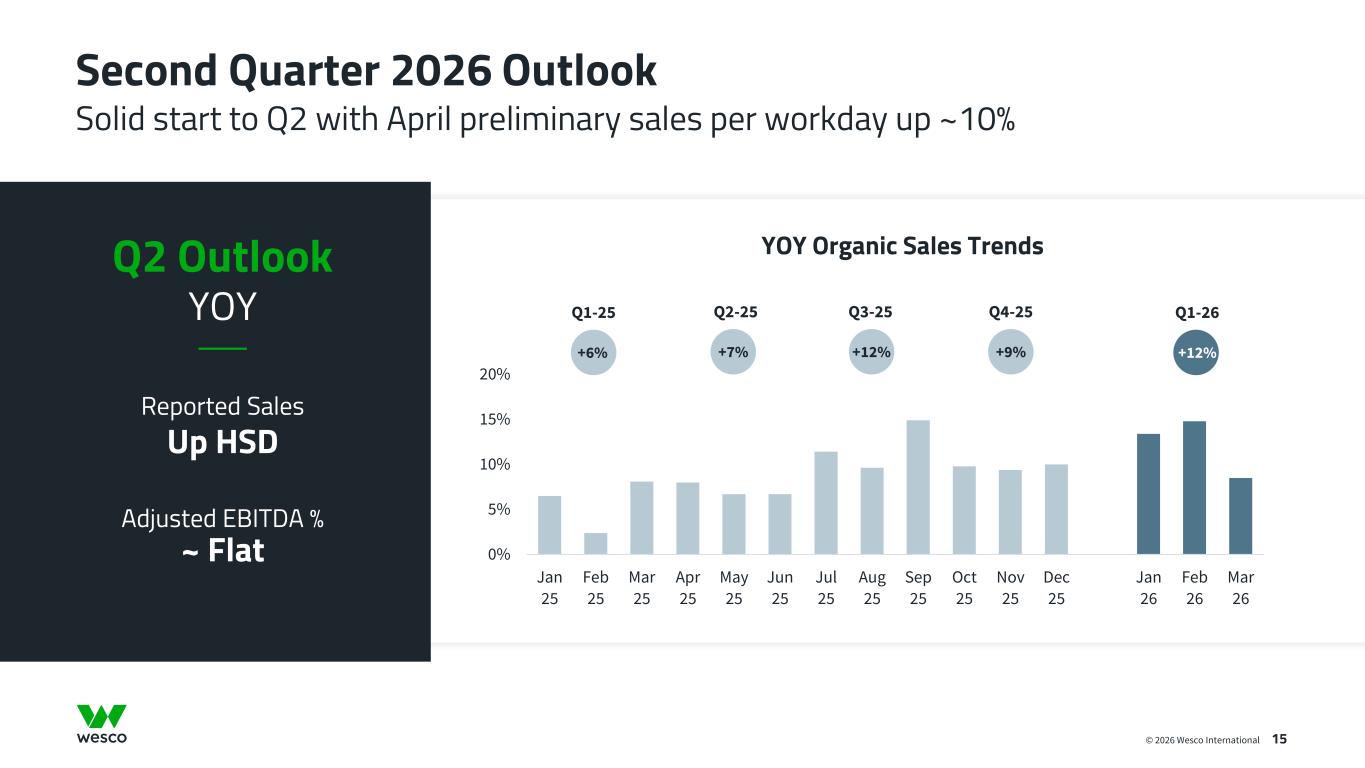
Solid start to Q2 with April preliminary sales per workday up ~10% Second Quarter 2026 Outlook 15 Q2 Outlook YOY Reported Sales Up HSD Adjusted EBITDA % ~ Flat 0% 5% 10% 15% 20% Jan 25 Feb 25 Mar 25 Apr 25 May 25 Jun 25 Jul 25 Aug 25 Sep 25 Oct 25 Nov 25 Dec 25 Jan 26 Feb 26 Mar 26 YOY Organic Sales Trends Q1-25 Q2-25 Q3-25 Q4-25 Q1-26 +6% +7% +12% +9% +12% © 2026 Wesco International
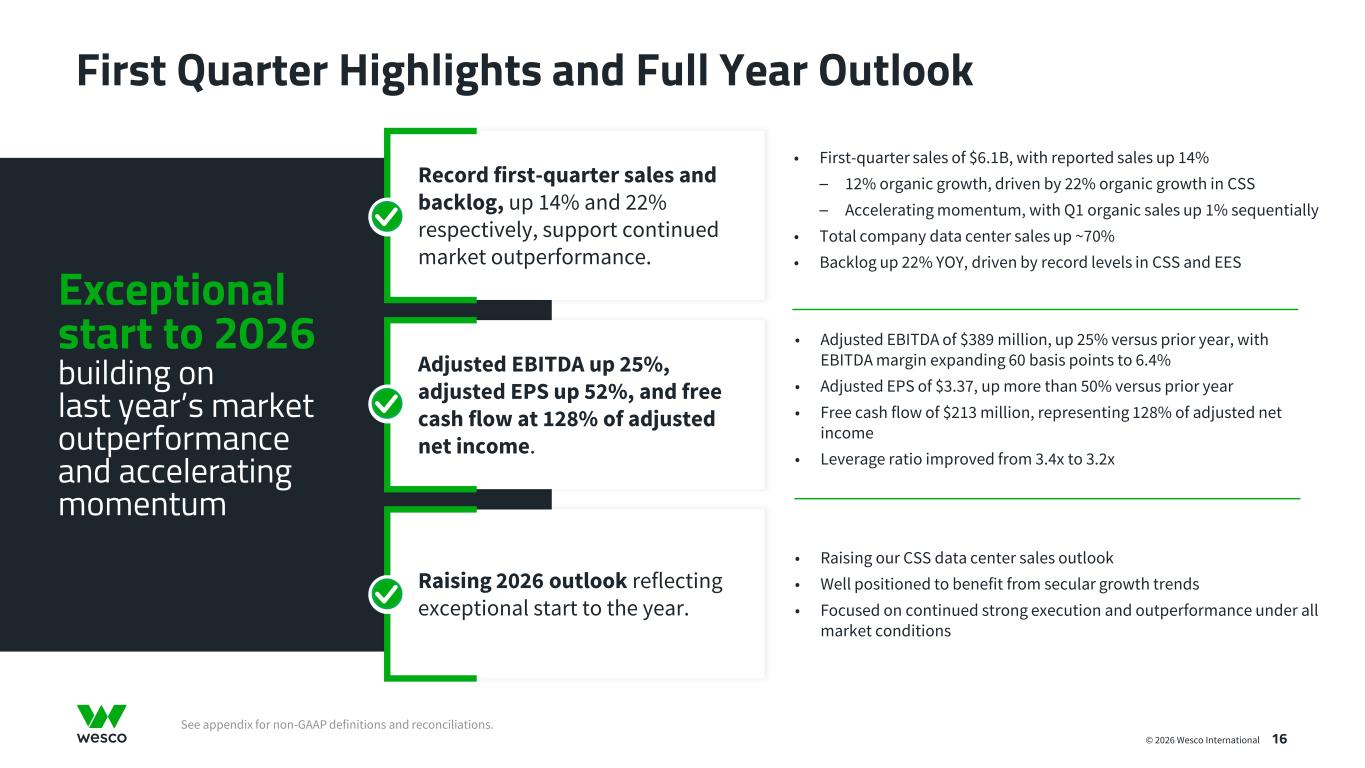
First Quarter Highlights and Full Year Outlook 16 Exceptional start to 2026 building on last year’s market outperformance and accelerating momentum • First-quarter sales of $6.1B, with reported sales up 14% – 12% organic growth, driven by 22% organic growth in CSS – Accelerating momentum, with Q1 organic sales up 1% sequentially • Total company data center sales up ~70% • Backlog up 22% YOY, driven by record levels in CSS and EES Record first-quarter sales and backlog, up 14% and 22% respectively, support continued market outperformance. • Adjusted EBITDA of $389 million, up 25% versus prior year, with EBITDA margin expanding 60 basis points to 6.4% • Adjusted EPS of $3.37, up more than 50% versus prior year • Free cash flow of $213 million, representing 128% of adjusted net income • Leverage ratio improved from 3.4x to 3.2x Adjusted EBITDA up 25%, adjusted EPS up 52%, and free cash flow at 128% of adjusted net income. • Raising our CSS data center sales outlook • Well positioned to benefit from secular growth trends • Focused on continued strong execution and outperformance under all market conditions Raising 2026 outlook reflecting exceptional start to the year. See appendix for non-GAAP definitions and reconciliations. © 2026 Wesco International
17 Appendix © 2026 Wesco International
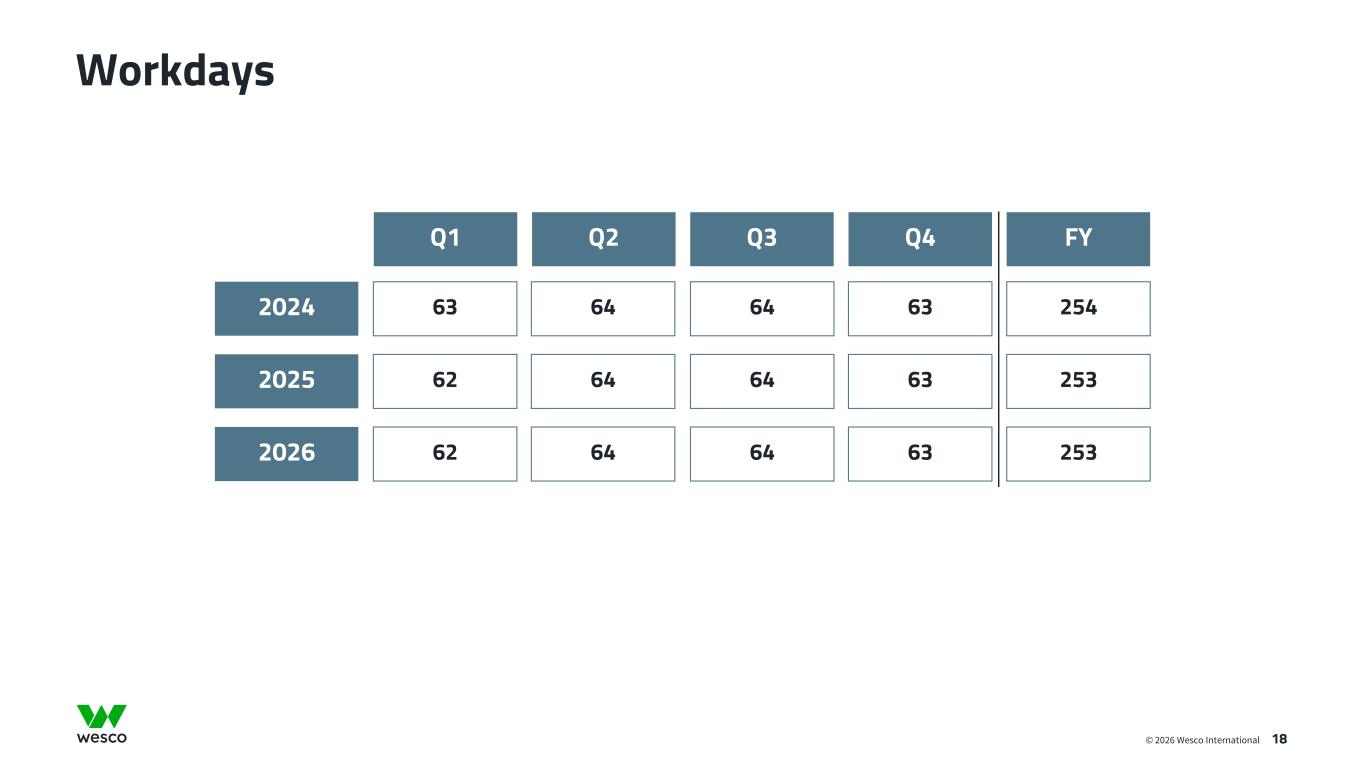
Workdays Q1 Q2 Q3 Q4 FY 2024 63 64 64 63 254 2025 62 64 64 63 253 2026 62 64 64 63 253 © 2026 Wesco International 18
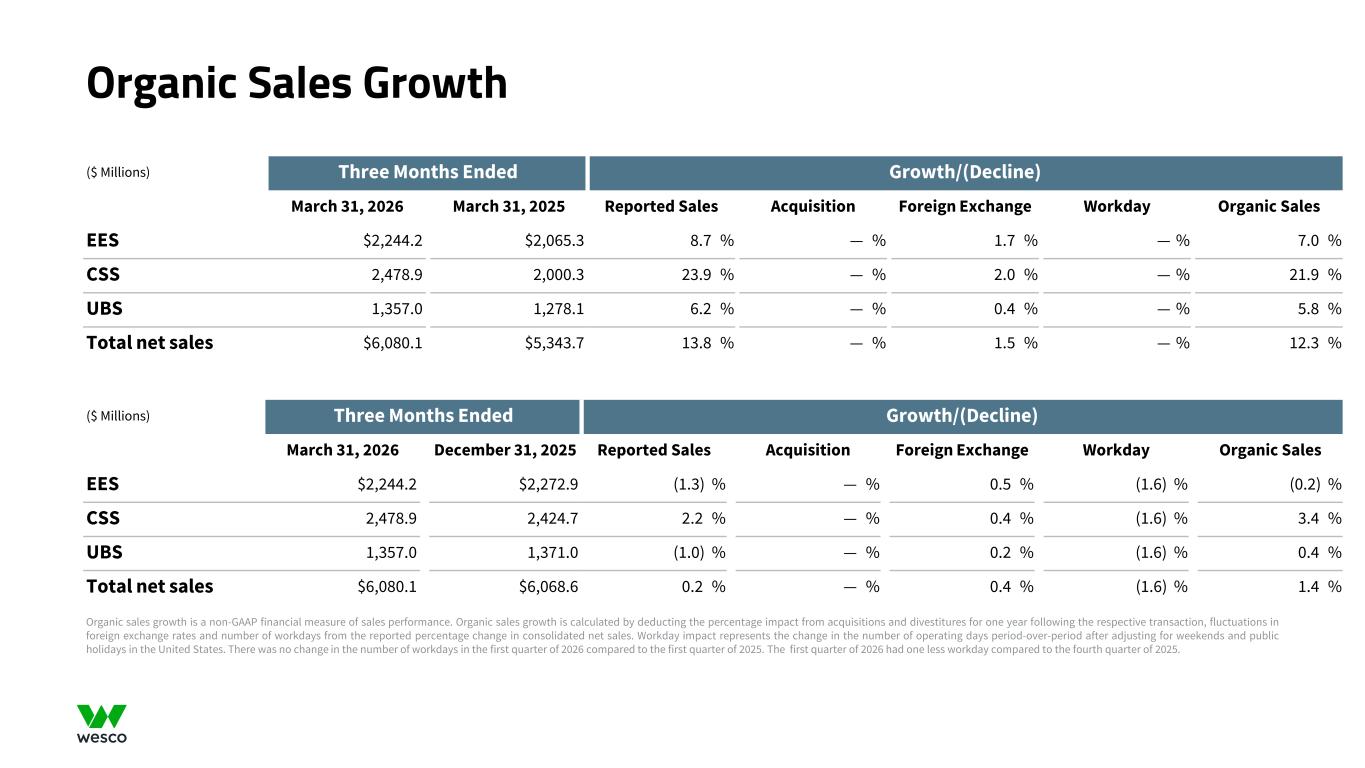
($ Millions) Three Months Ended Growth/(Decline) March 31, 2026 March 31, 2025 Reported Sales Acquisition Foreign Exchange Workday Organic Sales EES $2,244.2 $2,065.3 8.7 % — % 1.7 % — % 7.0 % CSS 2,478.9 2,000.3 23.9 % — % 2.0 % — % 21.9 % UBS 1,357.0 1,278.1 6.2 % — % 0.4 % — % 5.8 % Total net sales $6,080.1 $5,343.7 13.8 % — % 1.5 % — % 12.3 % Organic Sales Growth Organic sales growth is a non-GAAP financial measure of sales performance. Organic sales growth is calculated by deducting the percentage impact from acquisitions and divestitures for one year following the respective transaction, fluctuations in foreign exchange rates and number of workdays from the reported percentage change in consolidated net sales. Workday impact represents the change in the number of operating days period-over-period after adjusting for weekends and public holidays in the United States. There was no change in the number of workdays in the first quarter of 2026 compared to the first quarter of 2025. The first quarter of 2026 had one less workday compared to the fourth quarter of 2025. ($ Millions) Three Months Ended Growth/(Decline) March 31, 2026 December 31, 2025 Reported Sales Acquisition Foreign Exchange Workday Organic Sales EES $2,244.2 $2,272.9 (1.3) % — % 0.5 % (1.6) % (0.2) % CSS 2,478.9 2,424.7 2.2 % — % 0.4 % (1.6) % 3.4 % UBS 1,357.0 1,371.0 (1.0) % — % 0.2 % (1.6) % 0.4 % Total net sales $6,080.1 $6,068.6 0.2 % — % 0.4 % (1.6) % 1.4 %
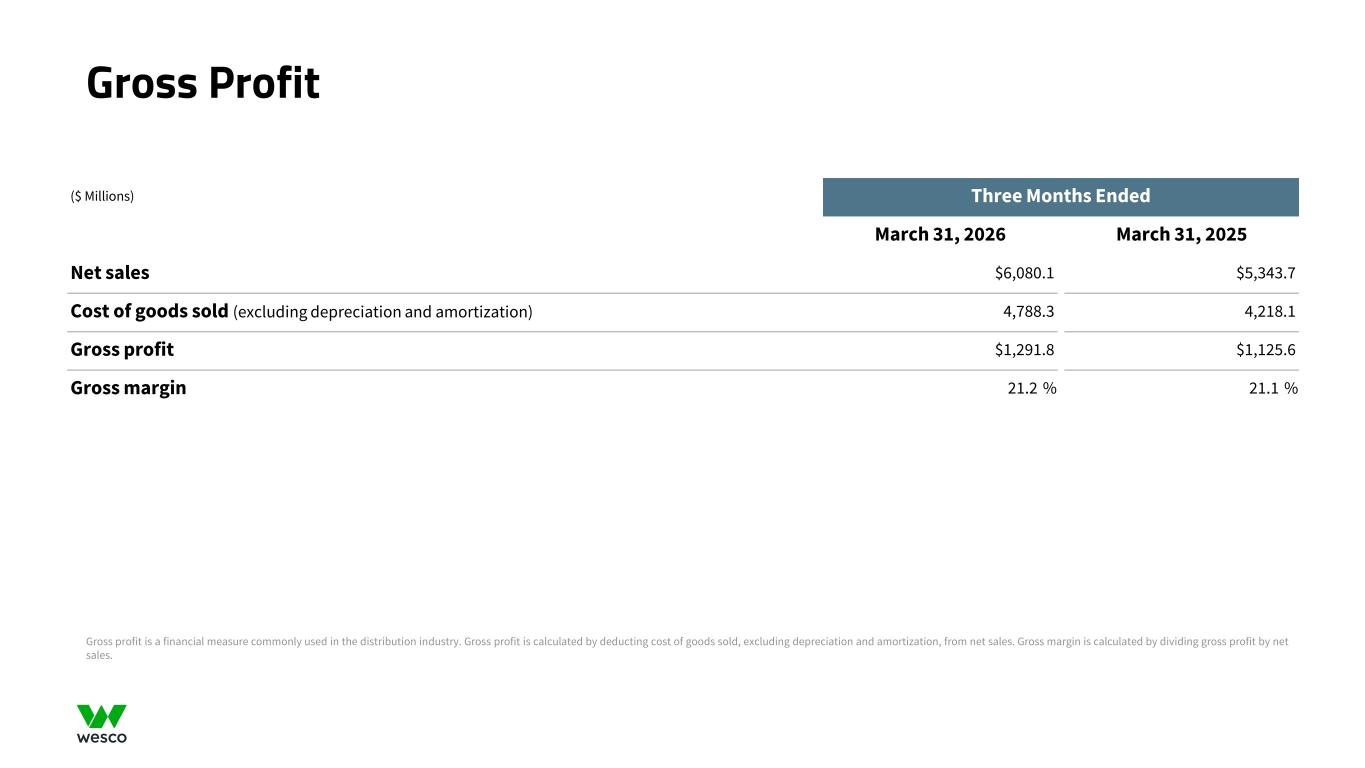
Gross Profit ($ Millions) Three Months Ended March 31, 2026 March 31, 2025 Net sales $6,080.1 $5,343.7 Cost of goods sold (excluding depreciation and amortization) 4,788.3 4,218.1 Gross profit $1,291.8 $1,125.6 Gross margin 21.2 % 21.1 % Gross profit is a financial measure commonly used in the distribution industry. Gross profit is calculated by deducting cost of goods sold, excluding depreciation and amortization, from net sales. Gross margin is calculated by dividing gross profit by net sales.
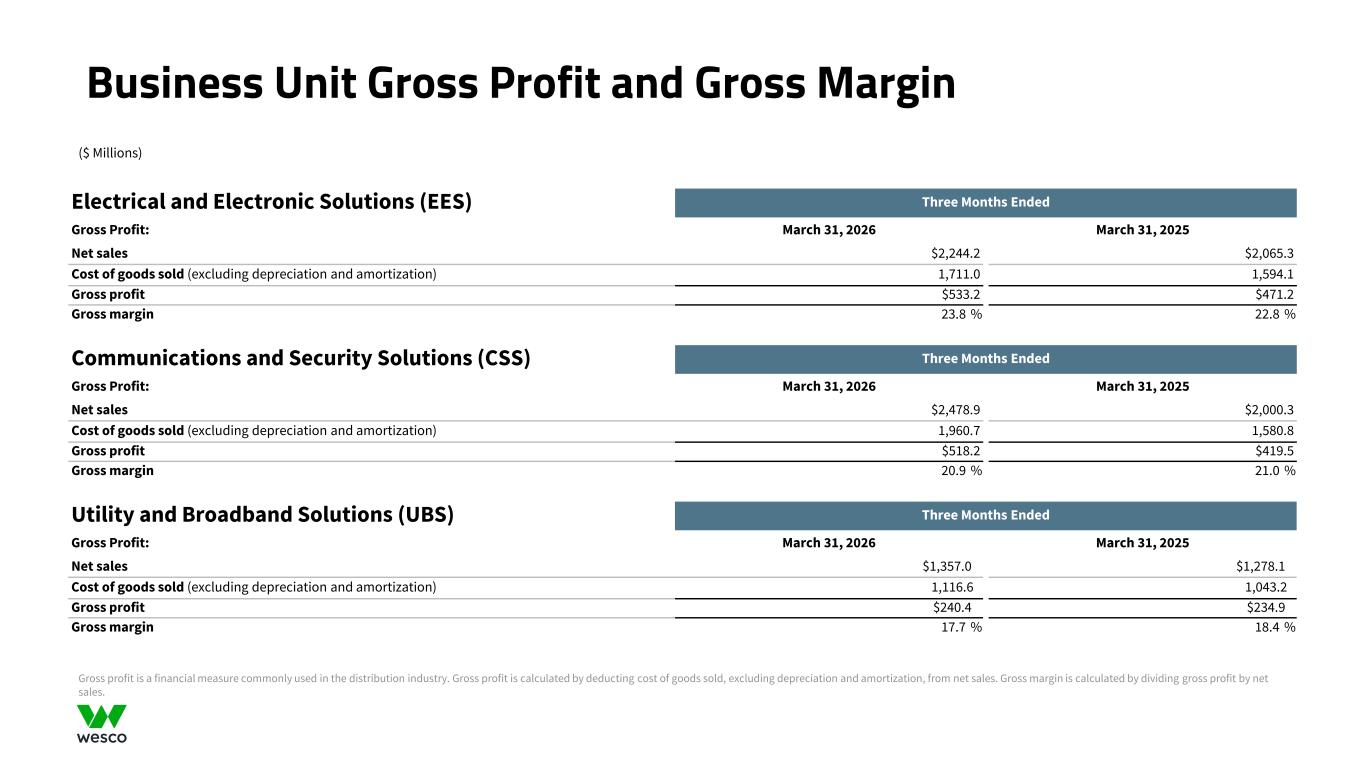
Business Unit Gross Profit and Gross Margin Electrical and Electronic Solutions (EES) Three Months Ended Gross Profit: March 31, 2026 March 31, 2025 Net sales $2,244.2 $2,065.3 Cost of goods sold (excluding depreciation and amortization) 1,711.0 1,594.1 Gross profit $533.2 $471.2 Gross margin 23.8 % 22.8 % Gross profit is a financial measure commonly used in the distribution industry. Gross profit is calculated by deducting cost of goods sold, excluding depreciation and amortization, from net sales. Gross margin is calculated by dividing gross profit by net sales. Communications and Security Solutions (CSS) Three Months Ended Gross Profit: March 31, 2026 March 31, 2025 Net sales $2,478.9 $2,000.3 Cost of goods sold (excluding depreciation and amortization) 1,960.7 1,580.8 Gross profit $518.2 $419.5 Gross margin 20.9 % 21.0 % Utility and Broadband Solutions (UBS) Three Months Ended Gross Profit: March 31, 2026 March 31, 2025 Net sales $1,357.0 $1,278.1 Cost of goods sold (excluding depreciation and amortization) 1,116.6 1,043.2 Gross profit $240.4 $234.9 Gross margin 17.7 % 18.4 % ($ Millions)
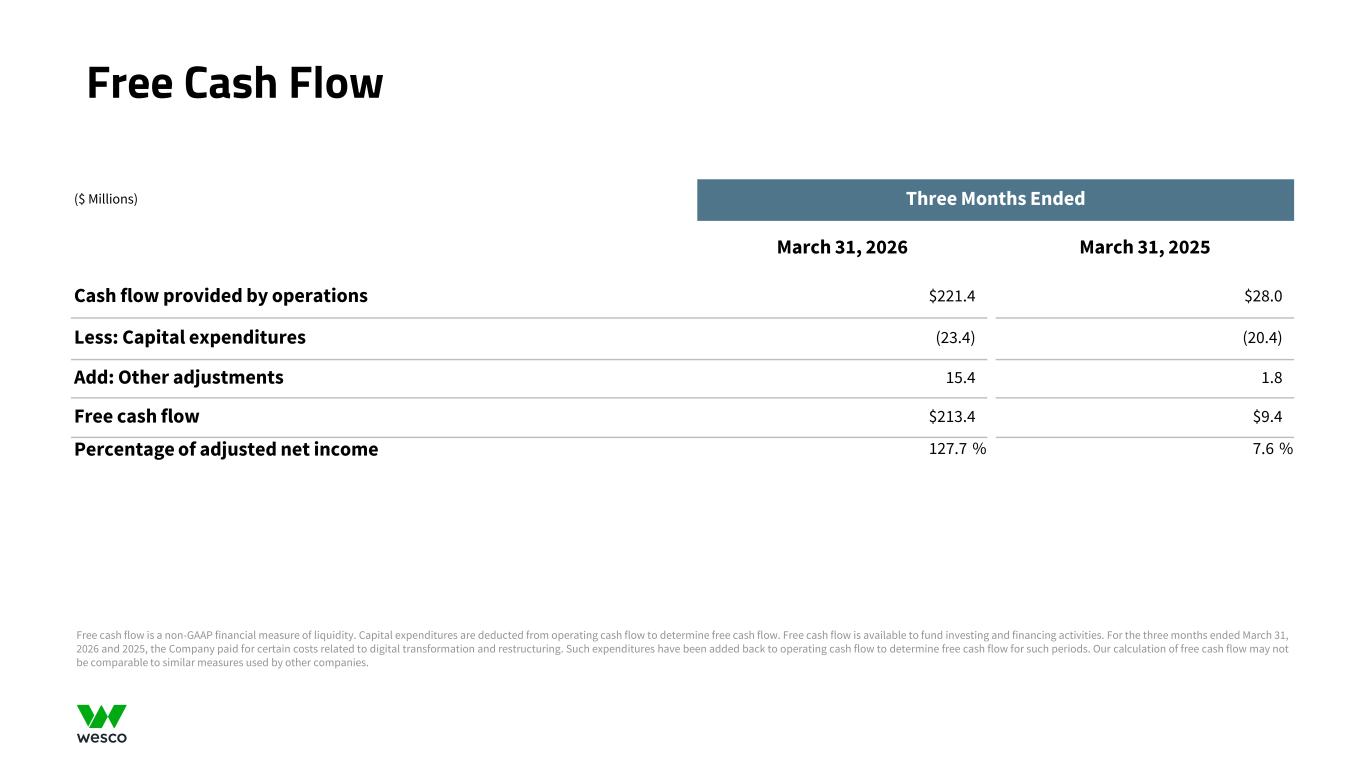
Free Cash Flow ($ Millions) Three Months Ended March 31, 2026 March 31, 2025 Cash flow provided by operations $221.4 $28.0 Less: Capital expenditures (23.4) (20.4) Add: Other adjustments 15.4 1.8 Free cash flow $213.4 $9.4 Percentage of adjusted net income 127.7 % 7.6 % Free cash flow is a non-GAAP financial measure of liquidity. Capital expenditures are deducted from operating cash flow to determine free cash flow. Free cash flow is available to fund investing and financing activities. For the three months ended March 31, 2026 and 2025, the Company paid for certain costs related to digital transformation and restructuring. Such expenditures have been added back to operating cash flow to determine free cash flow for such periods. Our calculation of free cash flow may not be comparable to similar measures used by other companies.
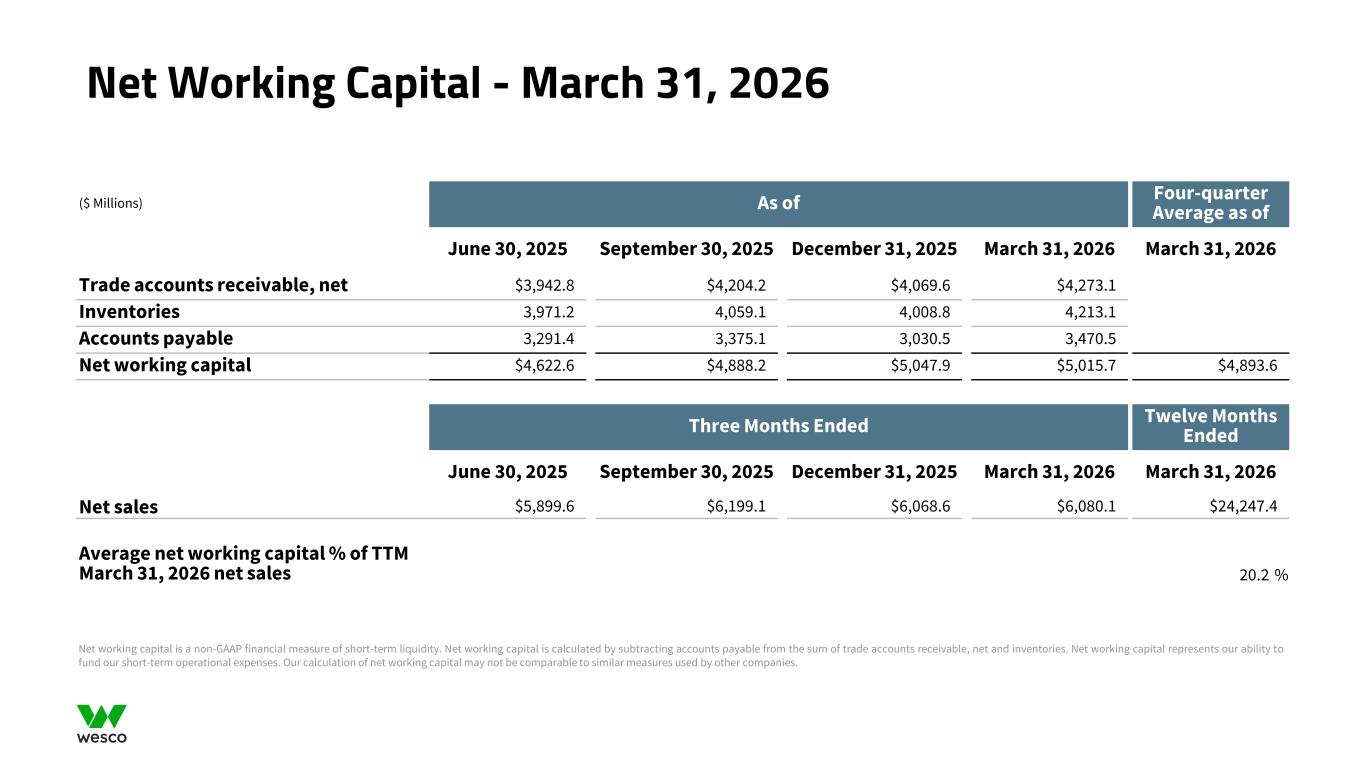
Net Working Capital - March 31, 2026 ($ Millions) As of Four-quarter Average as of June 30, 2025 September 30, 2025 December 31, 2025 March 31, 2026 March 31, 2026 Trade accounts receivable, net $3,942.8 $4,204.2 $4,069.6 $4,273.1 Inventories 3,971.2 4,059.1 4,008.8 4,213.1 Accounts payable 3,291.4 3,375.1 3,030.5 3,470.5 Net working capital $4,622.6 $4,888.2 $5,047.9 $5,015.7 $4,893.6 Three Months Ended Twelve Months Ended June 30, 2025 September 30, 2025 December 31, 2025 March 31, 2026 March 31, 2026 Net sales $5,899.6 $6,199.1 $6,068.6 $6,080.1 $24,247.4 Average net working capital % of TTM March 31, 2026 net sales 20.2 % Net working capital is a non-GAAP financial measure of short-term liquidity. Net working capital is calculated by subtracting accounts payable from the sum of trade accounts receivable, net and inventories. Net working capital represents our ability to fund our short-term operational expenses. Our calculation of net working capital may not be comparable to similar measures used by other companies.
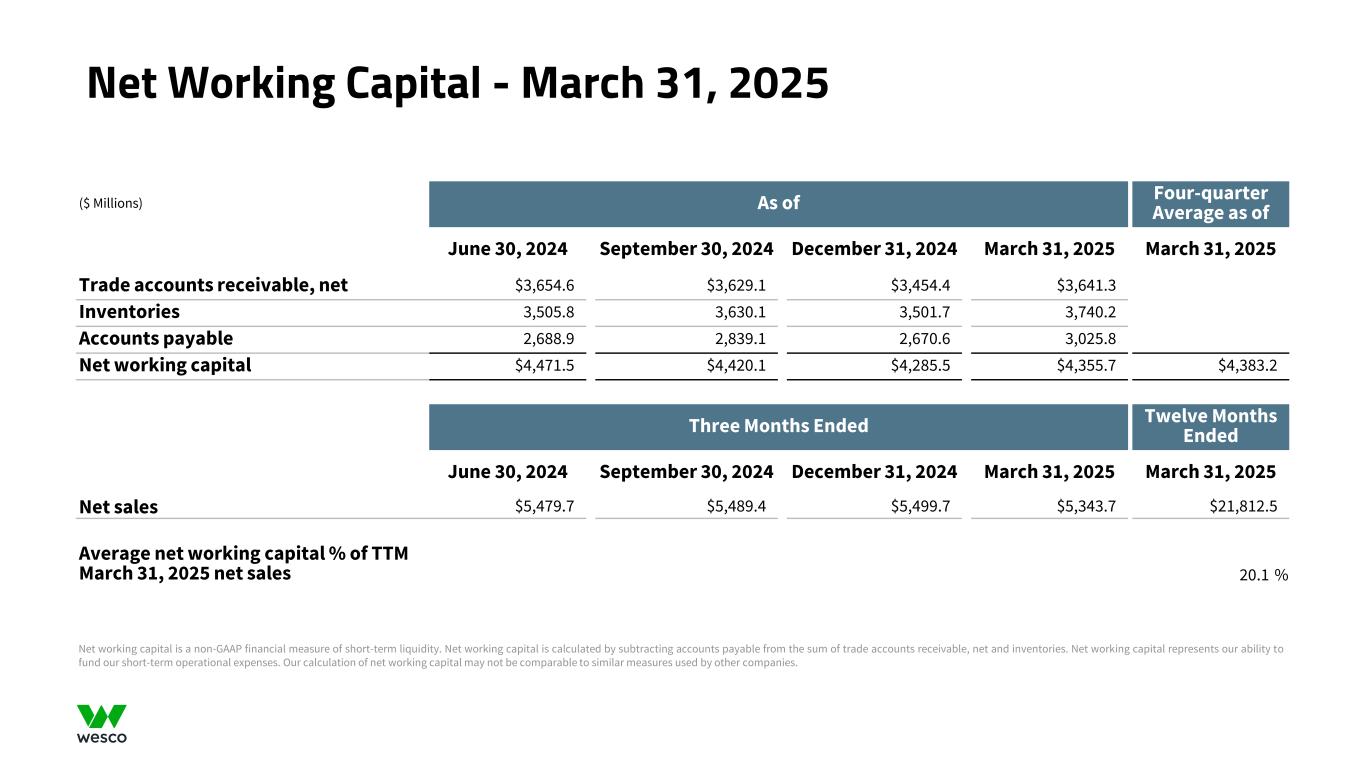
Net Working Capital - March 31, 2025 ($ Millions) As of Four-quarter Average as of June 30, 2024 September 30, 2024 December 31, 2024 March 31, 2025 March 31, 2025 Trade accounts receivable, net $3,654.6 $3,629.1 $3,454.4 $3,641.3 Inventories 3,505.8 3,630.1 3,501.7 3,740.2 Accounts payable 2,688.9 2,839.1 2,670.6 3,025.8 Net working capital $4,471.5 $4,420.1 $4,285.5 $4,355.7 $4,383.2 Three Months Ended Twelve Months Ended June 30, 2024 September 30, 2024 December 31, 2024 March 31, 2025 March 31, 2025 Net sales $5,479.7 $5,489.4 $5,499.7 $5,343.7 $21,812.5 Average net working capital % of TTM March 31, 2025 net sales 20.1 % Net working capital is a non-GAAP financial measure of short-term liquidity. Net working capital is calculated by subtracting accounts payable from the sum of trade accounts receivable, net and inventories. Net working capital represents our ability to fund our short-term operational expenses. Our calculation of net working capital may not be comparable to similar measures used by other companies.
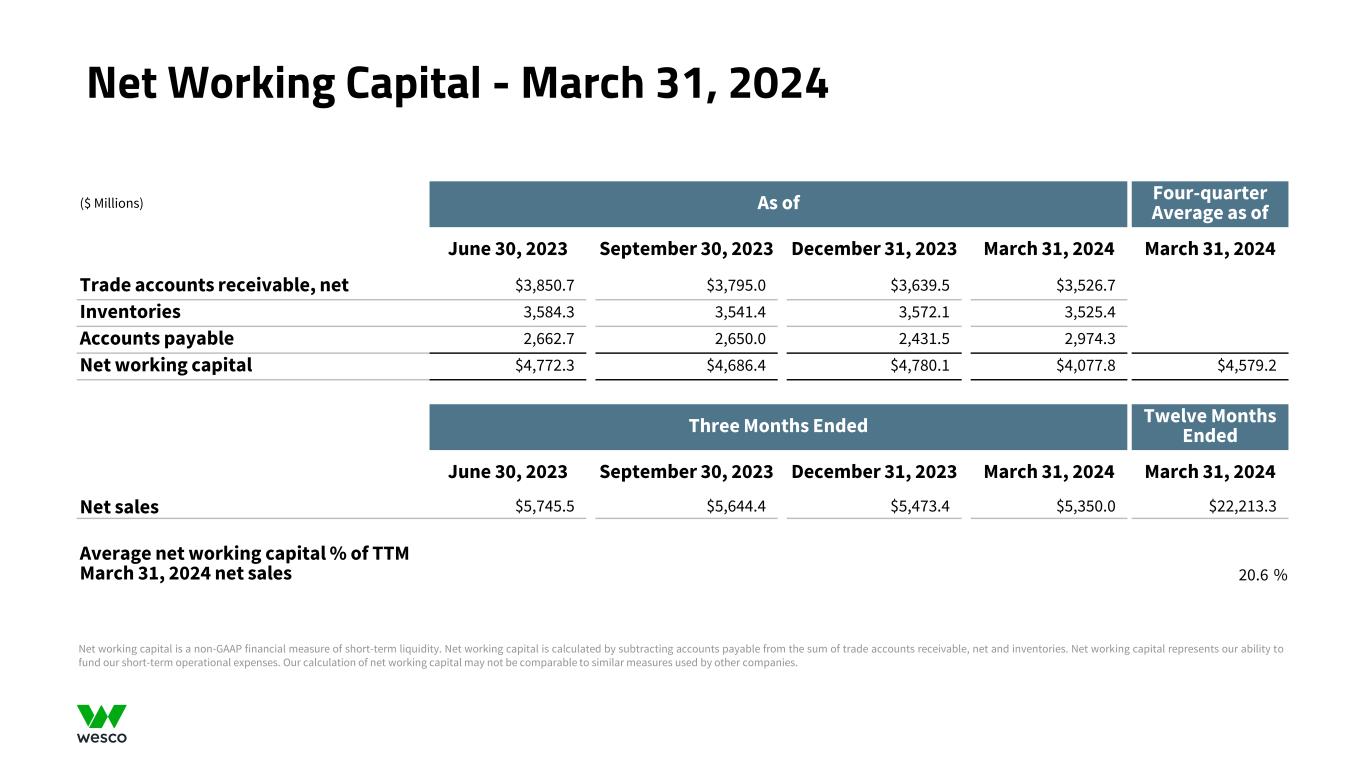
Net Working Capital - March 31, 2024 ($ Millions) As of Four-quarter Average as of June 30, 2023 September 30, 2023 December 31, 2023 March 31, 2024 March 31, 2024 Trade accounts receivable, net $3,850.7 $3,795.0 $3,639.5 $3,526.7 Inventories 3,584.3 3,541.4 3,572.1 3,525.4 Accounts payable 2,662.7 2,650.0 2,431.5 2,974.3 Net working capital $4,772.3 $4,686.4 $4,780.1 $4,077.8 $4,579.2 Three Months Ended Twelve Months Ended June 30, 2023 September 30, 2023 December 31, 2023 March 31, 2024 March 31, 2024 Net sales $5,745.5 $5,644.4 $5,473.4 $5,350.0 $22,213.3 Average net working capital % of TTM March 31, 2024 net sales 20.6 % Net working capital is a non-GAAP financial measure of short-term liquidity. Net working capital is calculated by subtracting accounts payable from the sum of trade accounts receivable, net and inventories. Net working capital represents our ability to fund our short-term operational expenses. Our calculation of net working capital may not be comparable to similar measures used by other companies.
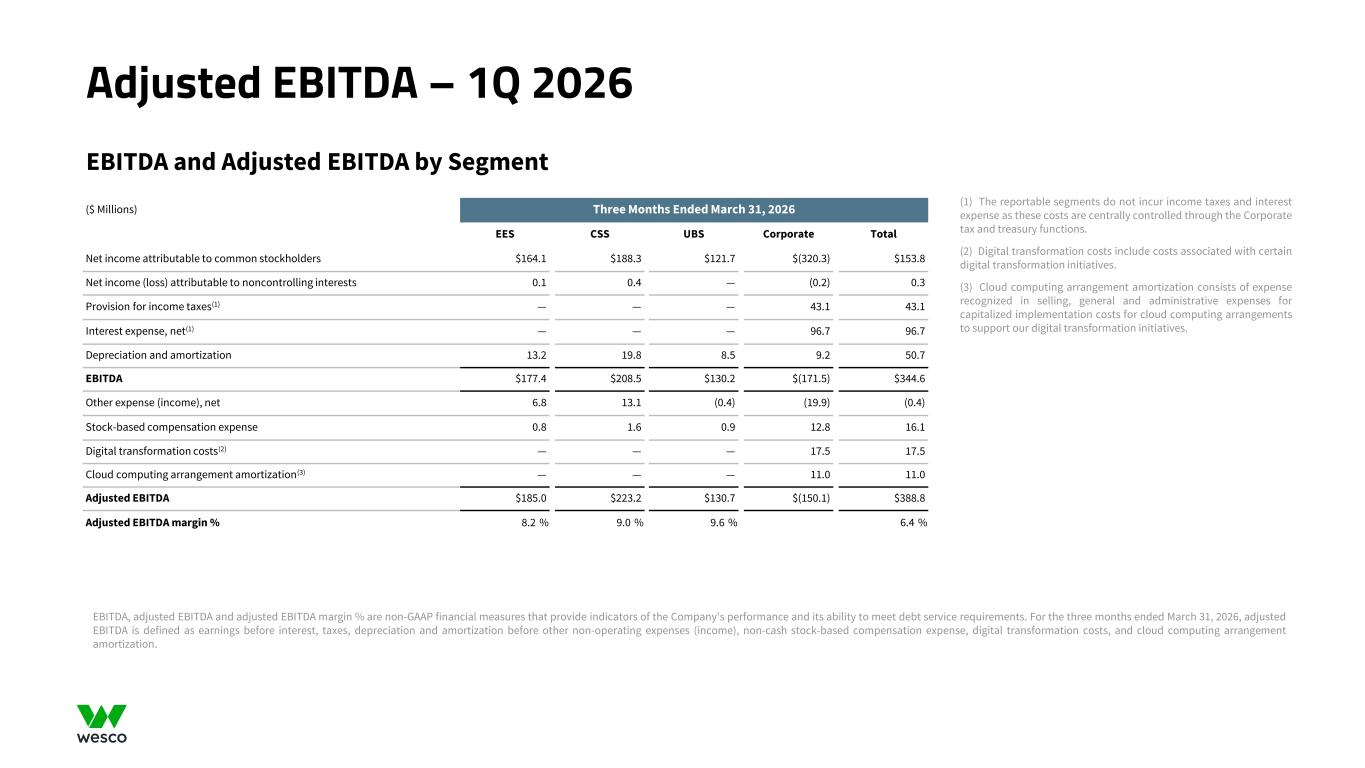
Adjusted EBITDA – 1Q 2026 EBITDA and Adjusted EBITDA by Segment ($ Millions) Three Months Ended March 31, 2026 EES CSS UBS Corporate Total Net income attributable to common stockholders $164.1 $188.3 $121.7 $(320.3) $153.8 Net income (loss) attributable to noncontrolling interests 0.1 0.4 — (0.2) 0.3 Provision for income taxes(1) — — — 43.1 43.1 Interest expense, net(1) — — — 96.7 96.7 Depreciation and amortization 13.2 19.8 8.5 9.2 50.7 EBITDA $177.4 $208.5 $130.2 $(171.5) $344.6 Other expense (income), net 6.8 13.1 (0.4) (19.9) (0.4) Stock-based compensation expense 0.8 1.6 0.9 12.8 16.1 Digital transformation costs(2) — — — 17.5 17.5 Cloud computing arrangement amortization(3) — — — 11.0 11.0 Adjusted EBITDA $185.0 $223.2 $130.7 $(150.1) $388.8 Adjusted EBITDA margin % 8.2 % 9.0 % 9.6 % 6.4 % (1) The reportable segments do not incur income taxes and interest expense as these costs are centrally controlled through the Corporate tax and treasury functions. (2) Digital transformation costs include costs associated with certain digital transformation initiatives. (3) Cloud computing arrangement amortization consists of expense recognized in selling, general and administrative expenses for capitalized implementation costs for cloud computing arrangements to support our digital transformation initiatives. EBITDA, adjusted EBITDA and adjusted EBITDA margin % are non-GAAP financial measures that provide indicators of the Company's performance and its ability to meet debt service requirements. For the three months ended March 31, 2026, adjusted EBITDA is defined as earnings before interest, taxes, depreciation and amortization before other non-operating expenses (income), non-cash stock-based compensation expense, digital transformation costs, and cloud computing arrangement amortization.
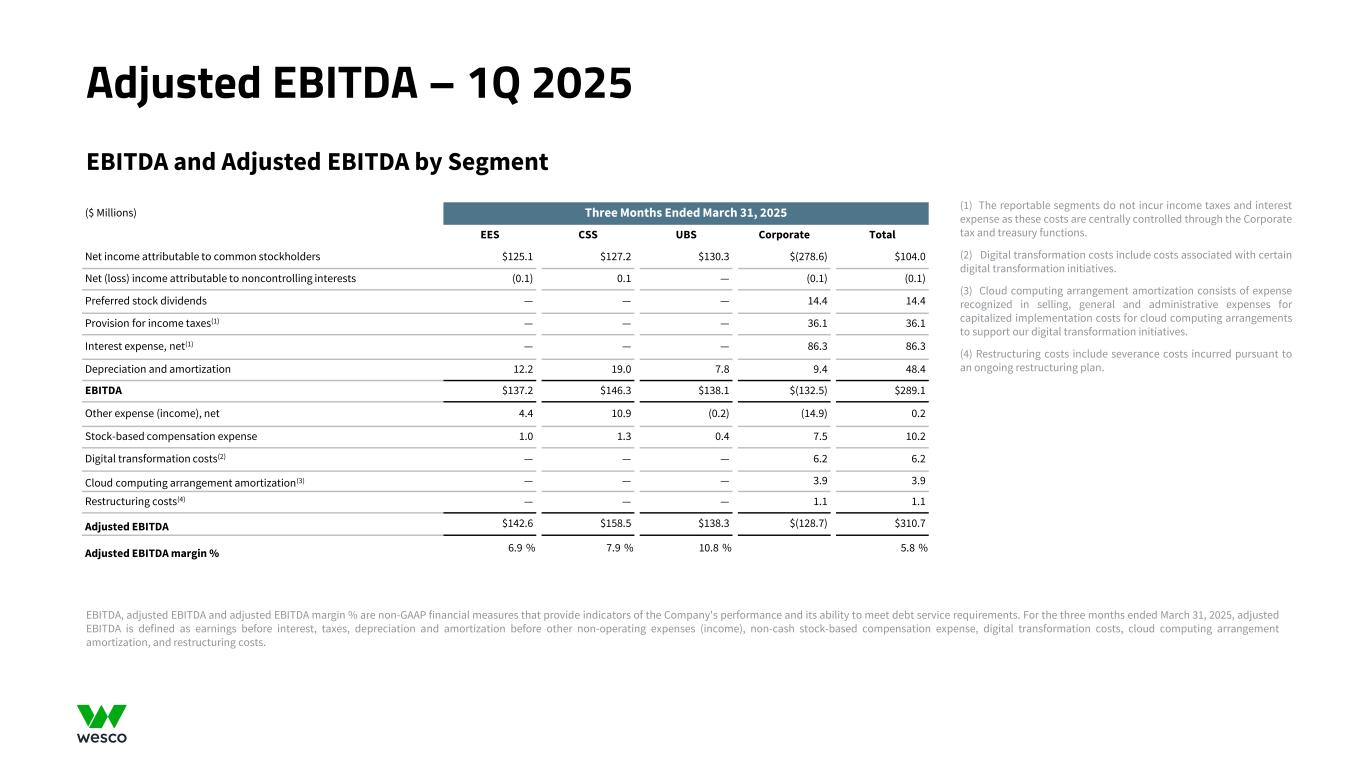
Adjusted EBITDA – 1Q 2025 ($ Millions) Three Months Ended March 31, 2025 EES CSS UBS Corporate Total Net income attributable to common stockholders $125.1 $127.2 $130.3 $(278.6) $104.0 Net (loss) income attributable to noncontrolling interests (0.1) 0.1 — (0.1) (0.1) Preferred stock dividends — — — 14.4 14.4 Provision for income taxes(1) — — — 36.1 36.1 Interest expense, net(1) — — — 86.3 86.3 Depreciation and amortization 12.2 19.0 7.8 9.4 48.4 EBITDA $137.2 $146.3 $138.1 $(132.5) $289.1 Other expense (income), net 4.4 10.9 (0.2) (14.9) 0.2 Stock-based compensation expense 1.0 1.3 0.4 7.5 10.2 Digital transformation costs(2) — — — 6.2 6.2 Cloud computing arrangement amortization(3) — — — 3.9 3.9 Restructuring costs(4) — — — 1.1 1.1 Adjusted EBITDA $142.6 $158.5 $138.3 $(128.7) $310.7 Adjusted EBITDA margin % 6.9 % 7.9 % 10.8 % 5.8 % (1) The reportable segments do not incur income taxes and interest expense as these costs are centrally controlled through the Corporate tax and treasury functions. (2) Digital transformation costs include costs associated with certain digital transformation initiatives. (3) Cloud computing arrangement amortization consists of expense recognized in selling, general and administrative expenses for capitalized implementation costs for cloud computing arrangements to support our digital transformation initiatives. (4) Restructuring costs include severance costs incurred pursuant to an ongoing restructuring plan. EBITDA, adjusted EBITDA and adjusted EBITDA margin % are non-GAAP financial measures that provide indicators of the Company's performance and its ability to meet debt service requirements. For the three months ended March 31, 2025, adjusted EBITDA is defined as earnings before interest, taxes, depreciation and amortization before other non-operating expenses (income), non-cash stock-based compensation expense, digital transformation costs, cloud computing arrangement amortization, and restructuring costs. EBITDA and Adjusted EBITDA by Segment
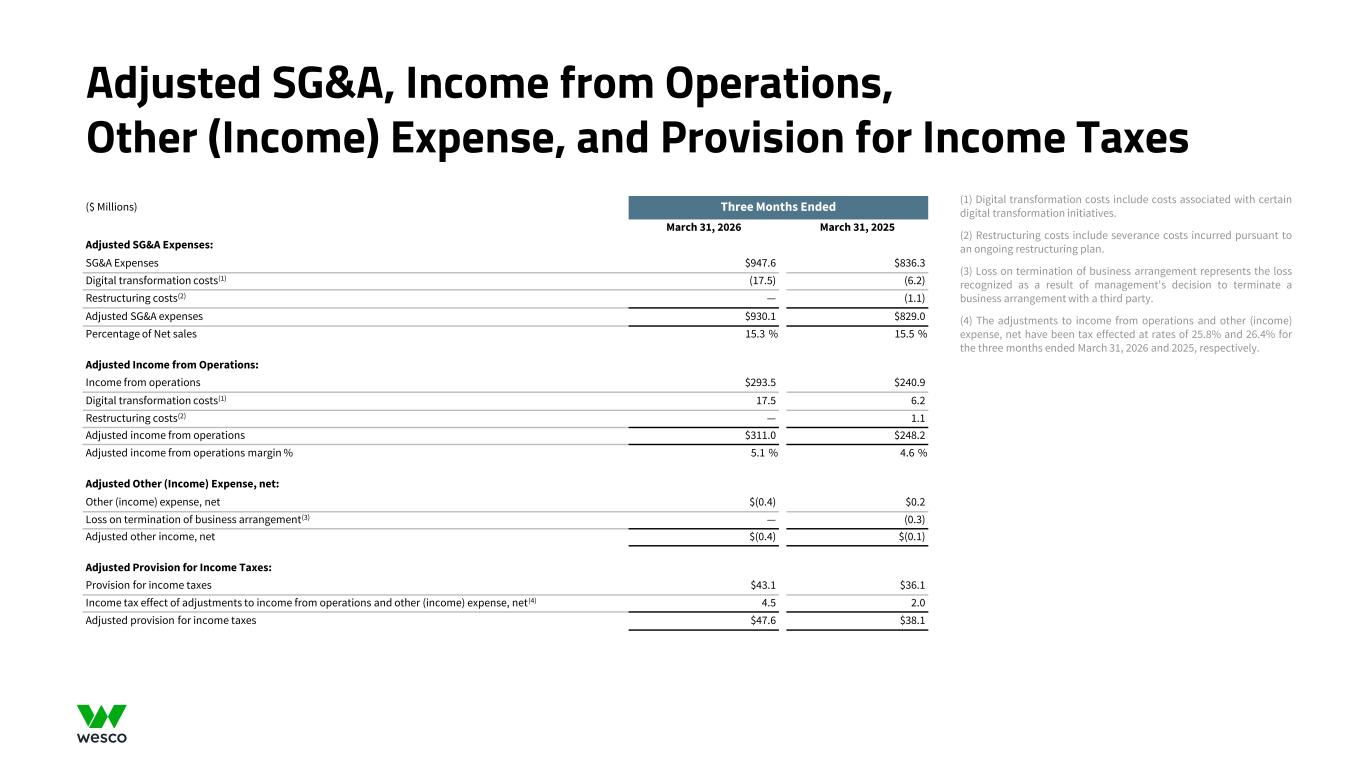
Adjusted SG&A, Income from Operations, Other (Income) Expense, and Provision for Income Taxes ($ Millions) Three Months Ended March 31, 2026 March 31, 2025 Adjusted SG&A Expenses: SG&A Expenses $947.6 $836.3 Digital transformation costs(1) (17.5) (6.2) Restructuring costs(2) — (1.1) Adjusted SG&A expenses $930.1 $829.0 Percentage of Net sales 15.3 % 15.5 % Adjusted Income from Operations: Income from operations $293.5 $240.9 Digital transformation costs(1) 17.5 6.2 Restructuring costs(2) — 1.1 Adjusted income from operations $311.0 $248.2 Adjusted income from operations margin % 5.1 % 4.6 % Adjusted Other (Income) Expense, net: Other (income) expense, net $(0.4) $0.2 Loss on termination of business arrangement(3) — (0.3) Adjusted other income, net $(0.4) $(0.1) Adjusted Provision for Income Taxes: Provision for income taxes $43.1 $36.1 Income tax effect of adjustments to income from operations and other (income) expense, net(4) 4.5 2.0 Adjusted provision for income taxes $47.6 $38.1 (1) Digital transformation costs include costs associated with certain digital transformation initiatives. (2) Restructuring costs include severance costs incurred pursuant to an ongoing restructuring plan. (3) Loss on termination of business arrangement represents the loss recognized as a result of management's decision to terminate a business arrangement with a third party. (4) The adjustments to income from operations and other (income) expense, net have been tax effected at rates of 25.8% and 26.4% for the three months ended March 31, 2026 and 2025, respectively.
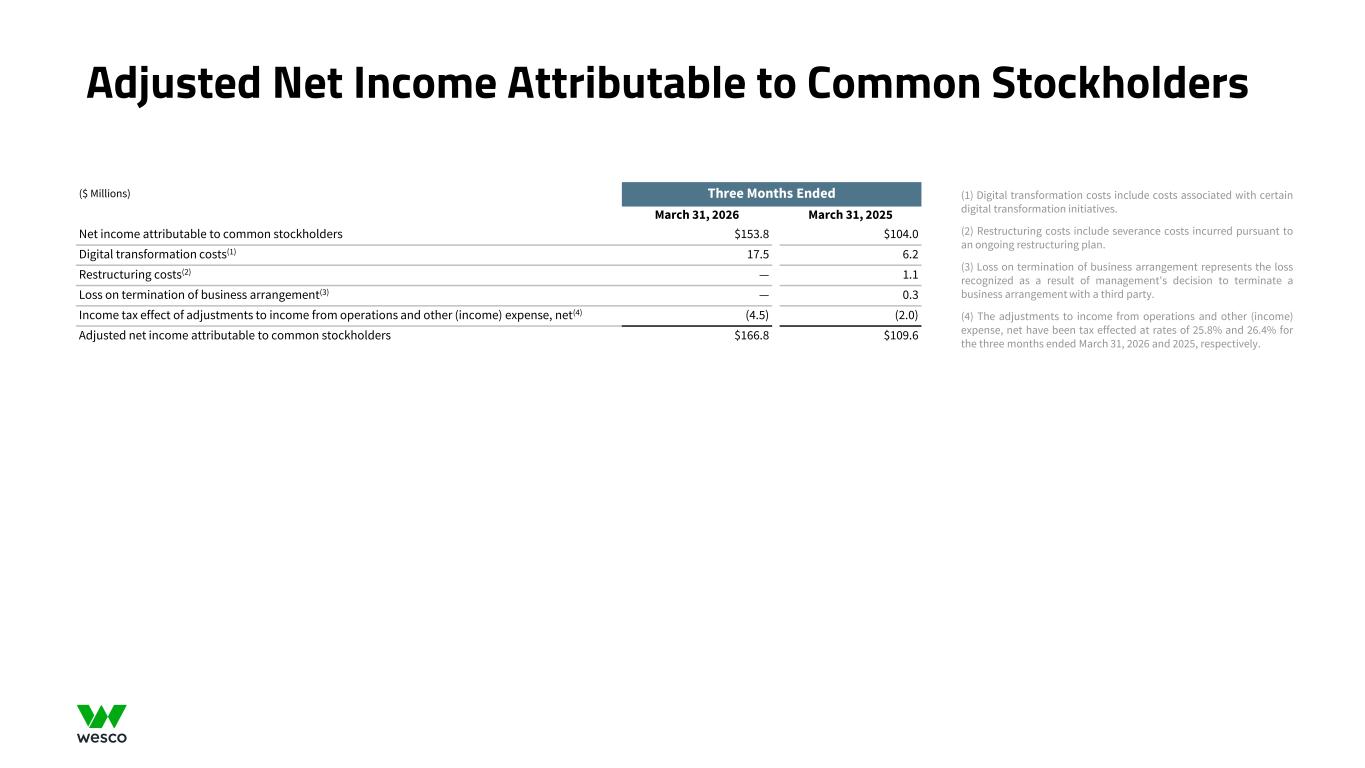
Adjusted Net Income Attributable to Common Stockholders ($ Millions) Three Months Ended March 31, 2026 March 31, 2025 Net income attributable to common stockholders $153.8 $104.0 Digital transformation costs(1) 17.5 6.2 Restructuring costs(2) — 1.1 Loss on termination of business arrangement(3) — 0.3 Income tax effect of adjustments to income from operations and other (income) expense, net(4) (4.5) (2.0) Adjusted net income attributable to common stockholders $166.8 $109.6 (1) Digital transformation costs include costs associated with certain digital transformation initiatives. (2) Restructuring costs include severance costs incurred pursuant to an ongoing restructuring plan. (3) Loss on termination of business arrangement represents the loss recognized as a result of management's decision to terminate a business arrangement with a third party. (4) The adjustments to income from operations and other (income) expense, net have been tax effected at rates of 25.8% and 26.4% for the three months ended March 31, 2026 and 2025, respectively.
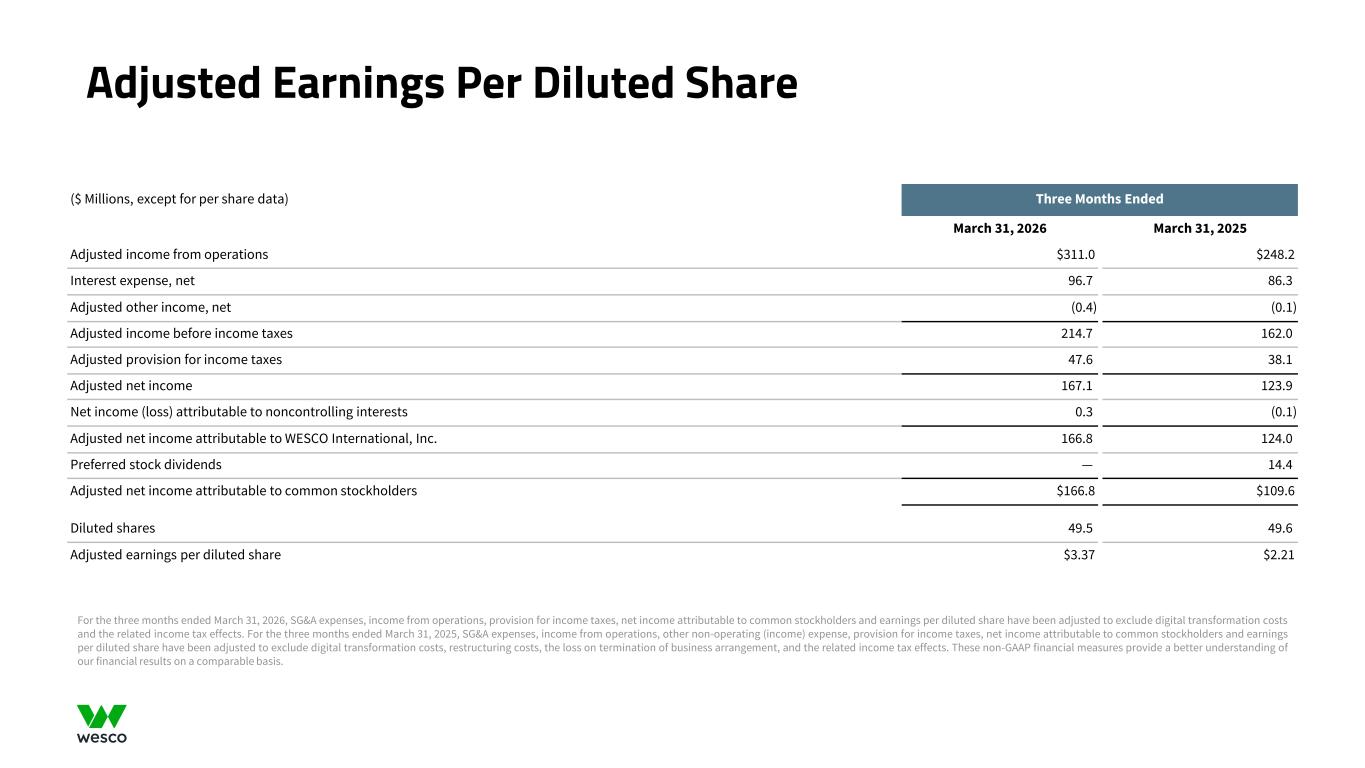
Adjusted Earnings Per Diluted Share ($ Millions, except for per share data) Three Months Ended March 31, 2026 March 31, 2025 Adjusted income from operations $311.0 $248.2 Interest expense, net 96.7 86.3 Adjusted other income, net (0.4) (0.1) Adjusted income before income taxes 214.7 162.0 Adjusted provision for income taxes 47.6 38.1 Adjusted net income 167.1 123.9 Net income (loss) attributable to noncontrolling interests 0.3 (0.1) Adjusted net income attributable to WESCO International, Inc. 166.8 124.0 Preferred stock dividends — 14.4 Adjusted net income attributable to common stockholders $166.8 $109.6 Diluted shares 49.5 49.6 Adjusted earnings per diluted share $3.37 $2.21 For the three months ended March 31, 2026, SG&A expenses, income from operations, provision for income taxes, net income attributable to common stockholders and earnings per diluted share have been adjusted to exclude digital transformation costs and the related income tax effects. For the three months ended March 31, 2025, SG&A expenses, income from operations, other non-operating (income) expense, provision for income taxes, net income attributable to common stockholders and earnings per diluted share have been adjusted to exclude digital transformation costs, restructuring costs, the loss on termination of business arrangement, and the related income tax effects. These non-GAAP financial measures provide a better understanding of our financial results on a comparable basis.
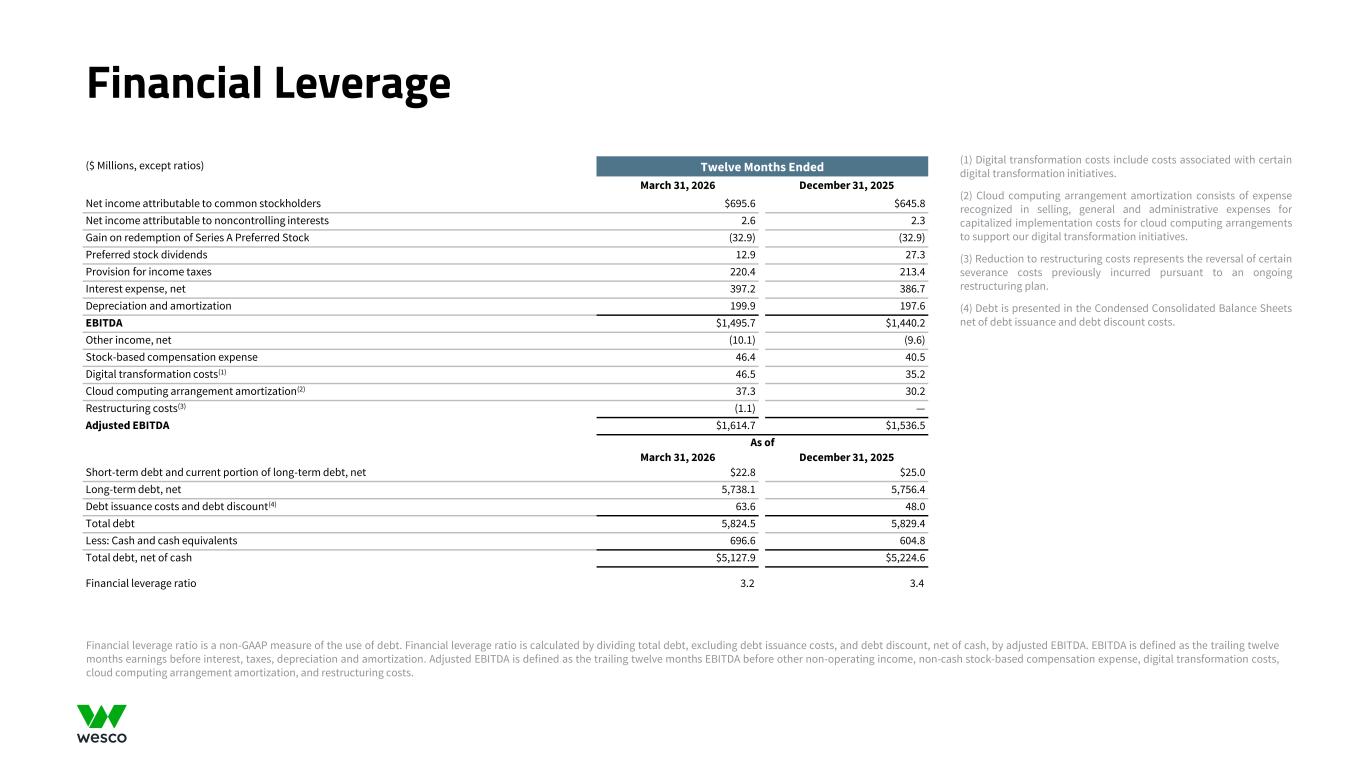
Financial Leverage ($ Millions, except ratios) Twelve Months Ended March 31, 2026 December 31, 2025 Net income attributable to common stockholders $695.6 $645.8 Net income attributable to noncontrolling interests 2.6 2.3 Gain on redemption of Series A Preferred Stock (32.9) (32.9) Preferred stock dividends 12.9 27.3 Provision for income taxes 220.4 213.4 Interest expense, net 397.2 386.7 Depreciation and amortization 199.9 197.6 EBITDA $1,495.7 $1,440.2 Other income, net (10.1) (9.6) Stock-based compensation expense 46.4 40.5 Digital transformation costs(1) 46.5 35.2 Cloud computing arrangement amortization(2) 37.3 30.2 Restructuring costs(3) (1.1) — Adjusted EBITDA $1,614.7 $1,536.5 As of March 31, 2026 December 31, 2025 Short-term debt and current portion of long-term debt, net $22.8 $25.0 Long-term debt, net 5,738.1 5,756.4 Debt issuance costs and debt discount(4) 63.6 48.0 Total debt 5,824.5 5,829.4 Less: Cash and cash equivalents 696.6 604.8 Total debt, net of cash $5,127.9 $5,224.6 Financial leverage ratio 3.2 3.4 (1) Digital transformation costs include costs associated with certain digital transformation initiatives. (2) Cloud computing arrangement amortization consists of expense recognized in selling, general and administrative expenses for capitalized implementation costs for cloud computing arrangements to support our digital transformation initiatives. (3) Reduction to restructuring costs represents the reversal of certain severance costs previously incurred pursuant to an ongoing restructuring plan. (4) Debt is presented in the Condensed Consolidated Balance Sheets net of debt issuance and debt discount costs. Financial leverage ratio is a non-GAAP measure of the use of debt. Financial leverage ratio is calculated by dividing total debt, excluding debt issuance costs, and debt discount, net of cash, by adjusted EBITDA. EBITDA is defined as the trailing twelve months earnings before interest, taxes, depreciation and amortization. Adjusted EBITDA is defined as the trailing twelve months EBITDA before other non-operating income, non-cash stock-based compensation expense, digital transformation costs, cloud computing arrangement amortization, and restructuring costs.