Columbia Variable Portfolio - Acorn Fund
(formerly known as Wanger Acorn)
Summary Prospectus
May 1, 2026
Ticker Symbol
WUSAX
The Fund may offer shares to separate accounts funding variable annuity contracts and variable life insurance policies (Contracts) issued by affiliated and unaffiliated life insurance companies as well as qualified pension and retirement plans (Qualified Plans) and other qualified institutional investors authorized by Columbia Management Investment Distributors, Inc. (the Distributor).
Before you invest, you may want to review the Fund’s prospectus, which contains more information about the Fund and its risks. You can find the Fund’s prospectus, reports to shareholders, statement of additional information and other information about the Fund online at https://www.columbiathreadneedleus.com/resources/literature. You can also get this information at no cost by calling 800.345.6611, by sending an email to serviceinquiries@columbiathreadneedle.com, or by contacting the participating insurance company or other financial intermediary through whom you hold your Fund shares. This Summary Prospectus incorporates by reference the Fund’s prospectus, dated May 1, 2026, and current Statement of Additional Information.
As with all mutual funds, the Securities and Exchange Commission has not approved or disapproved these securities or passed upon the adequacy of this prospectus. Any representation to the contrary is a criminal offense.

Investment Objective
Columbia Variable Portfolio - Acorn Fund (the Fund) seeks long-term capital appreciation.
Fees and Expenses of the Fund
This table describes the fees and expenses that you may pay as an investor in the Fund. The table does not reflect any fees or expenses imposed by your Contract or Qualified Plan, which are disclosed in your separate Contract prospectus or Qualified Plan disclosure documents. If the additional fees or expenses were reflected, the expenses set forth below would be higher.
Annual Fund Operating Expenses (expenses that you pay each year as a percentage of the value of your investment)
Management fees(a)
0.79
%
Distribution and/or service (12b-1) fees
0.00
%
Other expenses
0.16
%
Acquired fund fees and expenses
0.01
%
Total annual Fund operating expenses(b)
0.96
%
Less: Fee waivers and/or expense reimbursement(c)
(0.10
%)
Total annual Fund operating expenses after fee waivers and/or expense reimbursements
0.86
%
(a)
Management fees have been restated to reflect the current management fee rate.
(b)
“Total annual Fund operating expenses” include acquired fund fees and expenses (expenses the Fund incurs indirectly through its investments in other investment companies) and may be higher than the ratio of expenses to average net assets shown in the Financial Highlights section of this prospectus because the ratio of expenses to average net assets does not include acquired fund fees and expenses.
(c)
Columbia Management Investment Advisers, LLC and certain of its affiliates have contractually agreed to waive fees and/or to reimburse expenses (excluding transaction costs and certain other investment related expenses, interest, taxes, acquired fund fees and expenses, and infrequent and/or unusual expenses) through April 30, 2027, unless sooner terminated at the sole discretion of the Fund’s Board of Trustees. Under this agreement, the Fund’s net operating expenses, subject to applicable exclusions, will not exceed the annual rate of 0.85%. Any differences in the annual rate relative to the annual rate noted in the last row of the above table (e.g., net expense ratios) is due to applicable exclusions under the agreement.
Example
The following example is intended to help you compare the cost of investing in the Fund with the cost of investing in other mutual funds. The example illustrates the hypothetical expenses that you would incur over the time periods indicated, and assumes that:
you invest $10,000 in the Fund for the periods indicated,
your investment has a 5% return each year, and
the Fund’s total annual operating expenses remain the same as shown in the Annual Fund Operating Expenses table above.
The example does not reflect any fees and expenses that apply to your Contract or Qualified Plan. Inclusion of these charges would increase expenses for all periods shown.
Since the waivers and/or reimbursements shown in the Annual Fund Operating Expenses table above expire as indicated in the preceding table, they are only reflected in the 1 year example and the first year of the other examples. Although your actual costs may be higher or lower, based on the assumptions listed above, your costs would be:
 
1 year
3 years
5 years
10 years
Columbia Variable Portfolio - Acorn Fund (whether or not shares are redeemed)
$88
$296
$521
$1,169
Portfolio Turnover
The Fund may pay transaction costs, such as commissions, when it buys and sells securities (or “turns over” its portfolio). A higher portfolio turnover rate may indicate higher transaction costs. These costs, which are not reflected in annual fund operating expenses or in the example, affect the Fund’s performance. During the most recent fiscal year, the Fund’s portfolio turnover rate was 78% of the average value of its portfolio.
1
Columbia Variable Portfolio - Acorn Fund

Principal Investment Strategies
Under normal circumstances, the Fund invests a majority of its net assets in the common stock of small- and mid-sized companies. These companies have market capitalizations in the range of companies in the Russell 2500® Growth Index (the Capitalization Index), which ranged between $4.4 million and $50.2 billion as of March 31, 2026. The market capitalization range and composition of companies in the Capitalization Index are subject to change.
The Fund invests the majority of its assets in U.S. companies, but also may invest up to 33% of its total assets in foreign companies in developed markets (for example, Japan, Canada and the United Kingdom) and in emerging markets (for example, China, India and Brazil). The Fund may at times emphasize one or more sectors in selecting its investments, including the health care, industrials, and information technology sectors.
Principal Risks
An investment in the Fund involves risks, including Small- and Mid-Cap Stock Risk, and Market Risk, among others. Descriptions of these and other principal risks of investing in the Fund are provided below. There is no assurance that the Fund will achieve its investment objective and you may lose money. The value of the Fund’s holdings may decline, and the Fund’s net asset value (NAV) and share price may go down. An investment in the Fund is not a bank deposit and is not insured or guaranteed by the Federal Deposit Insurance Corporation or any other government agency. The significance of any specific risk to an investment in the Fund will vary over time depending on the composition of the Fund's portfolio, market conditions, and other factors. You should read all of the risk information below carefully, because any one or more of these risks may result in losses to the Fund.
Active Management Risk. Due to its active management, the Fund could underperform its benchmark index and/or other funds with similar investment objectives and/or strategies.
Emerging Market Securities Risk. Securities issued by foreign governments or companies in emerging market countries are more likely to have greater exposure to the risks of investing in foreign securities that are described in Foreign Securities Risk. In addition, emerging market countries are more likely to experience instability resulting, for example, from rapid changes or developments in social, political, economic or other conditions. Their economies are usually less mature and their securities markets are typically less developed with more limited trading activity (i.e., lower trading volumes and less liquidity) than more developed countries. Emerging market securities tend to be more volatile, and may be more susceptible to market manipulation, than securities in more developed markets. Many emerging market countries are heavily dependent on international trade and have fewer trading partners, which makes them more sensitive to world commodity prices and economic downturns in other countries, and some have a higher risk of currency devaluations. Due to the differences in the nature and quality of financial information of issuers of emerging market securities, including auditing and financial reporting standards, financial information and disclosures about such issuers may be unavailable or, if made available, may be considerably less reliable than publicly available information about other foreign securities.
Equity Securities Risk. Equity securities may experience significant volatility. Such securities may fall sharply in response to adverse events affecting overall markets, a particular industry or sector, or an individual company’s financial condition.
Foreign Securities Risk. Investments in or exposure to securities of foreign companies may involve heightened risks relative to investments in or exposure to securities of U.S. companies. Investing in securities of foreign companies subjects the Fund to the risks associated with an issuer’s (and any of its related companies’) country of organization and places of business operations, including risks related to political, regulatory, economic, social, diplomatic and other conditions or events (including, for example, military confrontations and actions, war, other conflicts, terrorism and disease/virus outbreaks and epidemics) occurring in the country or region, as well as risks associated with less developed custody and settlement practices. Foreign securities may be more volatile and less liquid than securities of U.S. companies and are subject to the risks associated with potential imposition of economic and other sanctions against a particular foreign country, its nationals or industries or businesses within the country. In addition, foreign governments may impose withholding or other taxes on the Fund’s income, capital gains or proceeds from the disposition of foreign securities, which could reduce the Fund’s return on such securities.
Growth Securities Risk. Growth securities typically trade at a higher multiple of earnings than other types of equity securities. Accordingly, the market values of growth securities may never reach their expected market value and may decline in price. In addition, growth securities, at times, may not perform as well as value securities or the stock market in general, and may be out of favor with investors for varying periods of time. Growth securities may also be sensitive to movements in interest rates.
Issuer Risk. An issuer in which the Fund invests or to which it has exposure may perform poorly or below expectations, and the value of its securities may therefore decline, which may negatively affect the Fund’s performance. Underperformance of an issuer may be caused by poor management decisions, competitive pressures,

Columbia Variable Portfolio - Acorn Fund
2

breakthroughs in technology, reliance on suppliers, labor problems or shortages, corporate restructurings, fraudulent disclosures, natural disasters, military confrontations and actions, war, other conflicts, terrorism, disease/virus outbreaks, epidemics or other events, conditions and factors which may impair the value of your investment in the Fund.
Small- and Mid-Cap Stock Risk. Investments in small- and mid-capitalization companies (small- and mid-cap companies) often involve greater risks than investments in larger, more established companies (larger companies) because small- and mid-cap companies tend to have less predictable earnings and may lack the management experience, financial resources, product diversification and competitive strengths of larger companies. Securities of small- and mid-cap companies may be less liquid and more volatile than the securities of larger companies.
Market Risk. The Fund may incur losses due to declines in the value of one or more securities in which it invests. These declines may be due to factors affecting a particular issuer, or the result of, among other things, political, regulatory, market, economic or social developments affecting the relevant market(s) more generally. In addition, turbulence in financial markets and reduced liquidity in equity, credit and/or fixed income markets may negatively affect many issuers, which could adversely affect the Fund’s ability to price or value hard-to-value assets in thinly traded and closed markets and could cause significant redemptions and operational challenges. Global economies and financial markets are increasingly interconnected, and conditions and events in one country, region or financial market may adversely impact issuers in a different country, region or financial market. These risks may be magnified if certain events or developments adversely interrupt the global supply chain; in these and other circumstances, such risks might affect companies worldwide. As a result, local, regional or global events such as terrorism, war, other conflicts, natural disasters, disease/virus outbreaks and epidemics or other public health issues, recessions, depressions or other events – or the potential for such events – could have a significant negative impact on global economic and market conditions.
Sector Risk. At times, the Fund may have a significant portion of its assets invested in securities of companies conducting business in an industry or related group of industries within one or more economic sectors, including the health care, industrials, and information technology sectors. Companies in the same sector may be similarly affected by economic, regulatory, political or market events or conditions, which may make the Fund vulnerable to unfavorable developments in that industry, group of industries or economic sector.
Health Care Sector. The Fund is vulnerable to the particular risks that may affect companies in the health care sector. Companies in the health care sector are subject to certain risks, including restrictions on government reimbursement for medical expenses, government approval of medical products and services, competitive pricing pressures, and the rising cost of medical products and services (especially for companies dependent upon a relatively limited number of products or services), among others. Performance of such companies may be affected by factors including government regulation, obtaining and protecting patents (or the failure to do so), product liability and other similar litigation as well as product obsolescence.
Industrials Sector. The Fund is vulnerable to the particular risks that may affect companies in the industrials sector. Companies in the industrials sector are subject to certain risks, including changes in supply and demand for their specific product or service and for industrial sector products in general, including decline in demand for such products due to rapid technological developments and frequent new product introduction. Performance of such companies may be affected by factors including government regulation, world events, economic conditions and risks for environmental damage and product liability claims.
Information Technology Sector. The Fund is vulnerable to the particular risks that may affect companies in the information technology sector. Companies in the information technology sector are subject to certain risks, including the risk that new services, equipment or technologies will not be accepted by consumers and businesses or will become rapidly obsolete. Performance of such companies may be affected by factors including obtaining and protecting patents (or the failure to do so) and significant competitive pressures, including aggressive pricing of their products or services, new market entrants, competition for market share and short product cycles due to an accelerated rate of technological developments. Such competitive pressures may lead to limited earnings and/or falling profit margins. As a result, the value of their securities may fall or fail to rise. In addition, many information technology sector companies have limited operating histories and prices of these companies’ securities historically have been more volatile than other securities, especially over the short term. Some companies in the information technology sector are facing increased government and regulatory scrutiny and may be subject to adverse government or regulatory action, which could negatively impact the value of their securities.
3
Columbia Variable Portfolio - Acorn Fund

Performance Information
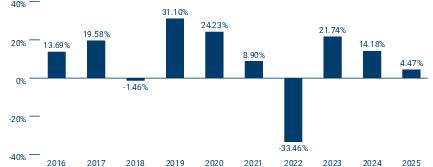
The following bar chart and table show you how the Fund has performed in the past, and can help you understand the risks of investing in the Fund. The bar chart shows how the Fund’s performance has varied for each full calendar year shown. The table below the bar chart compares the Fund’s returns for the periods shown with a broad measure of market performance, as well as another measure of performance for markets in which the Fund may invest.
The returns shown do not reflect any fees and expenses imposed under your Contract or Qualified Plan and would be lower if they did.
The Fund’s performance prior to May 1, 2022 reflects returns achieved pursuant to a strategy with a different market capitalization limit on the companies in which the Fund invested a majority of its assets. If the Fund's current strategies had been in place for the prior periods, results shown may have been different.
The Fund’s past performance is no guarantee of how the Fund will perform in the future. Updated performance information can be obtained by calling toll-free 800.345.6611 or visiting columbiathreadneedleus.com.
Year by Year Total Return (%)
as of December 31 Each Year
Best and Worst Quarterly Returns
During the Period Shown in the Bar Chart
Best
2nd Quarter 2020
26.59%
Worst
1st Quarter 2020
-27.04%
Average Annual Total Returns (for periods ended December 31, 2025)
 
Inception Date
1 Year
5 Years
10 Years
Returns before taxes
05/03/1995
4.47%
1.02%
8.66%
Russell 2500® Growth Index (reflects no deductions for fees, expenses or taxes)
 
10.31%
2.98%
10.55%
Russell 3000® Index (reflects no deductions for fees, expenses or taxes)
 
17.15%
13.15%
14.29%
Fund Management
Investment Manager: Columbia Management Investment Advisers, LLC
Portfolio Management
Title
Role with Fund
Managed Fund Since
Erika Maschmeyer, CFA
Senior Portfolio Manager
Lead Portfolio Manager
Portfolio Manager since 2019;
Service with the Fund since 2016
Pratyasha Rath
Portfolio Manager
Portfolio Manager
September 2025
Purchase and Sale of Fund Shares
The Fund is available for purchase through Contracts offered by the separate accounts of participating insurance companies or Qualified Plans or by other eligible investors authorized by Columbia Management Investment Distributors, Inc. (the Distributor). Shares of the Fund may not be purchased or sold by individual owners of Contracts or Qualified Plans. If you are a Contract holder or Qualified Plan participant, please refer to your separate Contract prospectus or Qualified Plan disclosure documents for information about minimum investment requirements and how to purchase and redeem shares of the Fund on days the Fund is open for business.
Tax Information
The Fund normally distributes its net investment income and net realized capital gains, if any, to its shareholders, which are generally the participating insurance companies and Qualified Plans investing in the Fund through separate accounts. These distributions may not be taxable to you as the holder of a Contract or a participant in a Qualified Plan. Please consult the prospectus or other information provided to you by your participating insurance company and/or Qualified Plan regarding the U.S. federal income taxation of your contract, policy and/or plan.
Columbia Variable Portfolio - Acorn Fund
4

Payments to Broker-Dealers and Other Financial Intermediaries
If you make allocations to the Fund, the Fund, its Distributor or other related companies may pay participating insurance companies or other financial intermediaries for the allocation (sale) of Fund shares and related services in connection with such allocations to the Fund. These payments may create a conflict of interest by influencing the participating insurance company, other financial intermediary or your salesperson to recommend an allocation to the Fund over another fund or other investment option. Ask your financial advisor or salesperson or visit your financial intermediary’s website for more information.
5
Columbia Variable Portfolio - Acorn Fund


Columbia Threadneedle Investments (Columbia Threadneedle) is the global brand name of the Columbia and Threadneedle group of
companies.
The Fund is distributed by Columbia Management Investment Distributors, Inc., 290 Congress Street, Boston, MA 02210.
© 2026 Columbia Threadneedle. All rights reserved.
columbiathreadneedleus.comSUM7064_12_E01_(05/26)